Theme 9: Analytical geometry
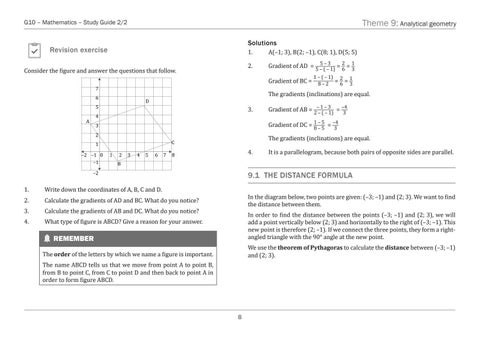
G10 – Mathematics – Study Guide 2/2
Solutions
Revision exercise
1.
A(–1; 3), B(2; –1), C(8; 1), D(5; 5)
Gradient of BC = _ = _ 26 = _ 31 8 – 2
2.
Consider the figure and answer the questions that follow.
5 – 3 Gradient of AD = _ = _ 2 = _ 1 5 – ( – 1) 6 3 1 – ( – 1)
The gradients (inclinations) are equal.
1 – 5 _ Gradient of DC = _ 8 – 5 = –4 3
3.
4.
– 1 – 3 Gradient of AB = _ 2 – ( – 1) = _ –4 3
The gradients (inclinations) are equal.
It is a parallelogram, because both pairs of opposite sides are parallel.
9.1 THE DISTANCE FORMULA 1.
Write down the coordinates of A, B, C and D.
4.
What type of figure is ABCD? Give a reason for your answer.
2. 3.
In the diagram below, two points are given: (–3; –1) and (2; 3). We want to find the distance between them.
Calculate the gradients of AD and BC. What do you notice? Calculate the gradients of AB and DC. What do you notice?
In order to find the distance between the points (–3; –1) and (2; 3), we will add a point vertically below (2; 3) and horizontally to the right of (–3; –1). This new point is therefore (2; –1). If we connect the three points, they form a rightangled triangle with the 90° angle at the new point.
REMEMBER
We use the theorem of Pythagoras to calculate the distance between (–3; –1) and (2; 3).
The order of the letters by which we name a figure is important.
The name ABCD tells us that we move from point A to point B, from B to point C, from C to point D and then back to point A in order to form figure ABCD.
8