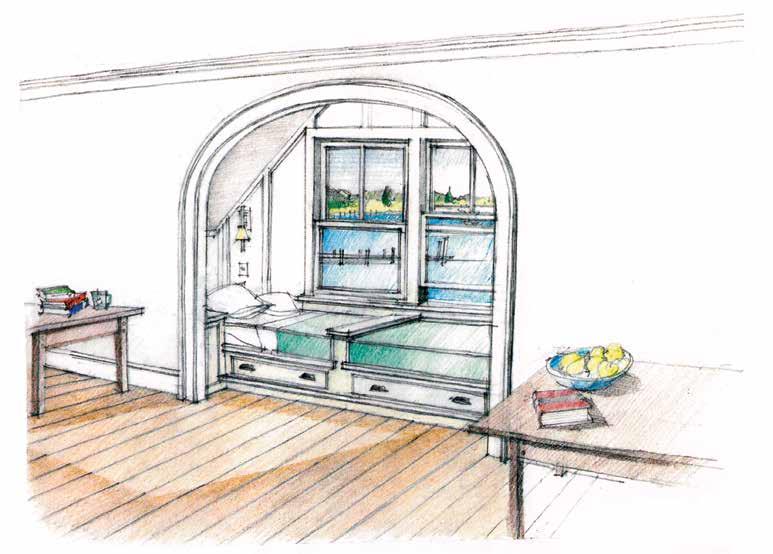
Whether an unexpected bench seat with pillows, a nook or a cranny or a secret alcove, an area of personal space becomes a room within a room, a moment of retreat within the larger space.
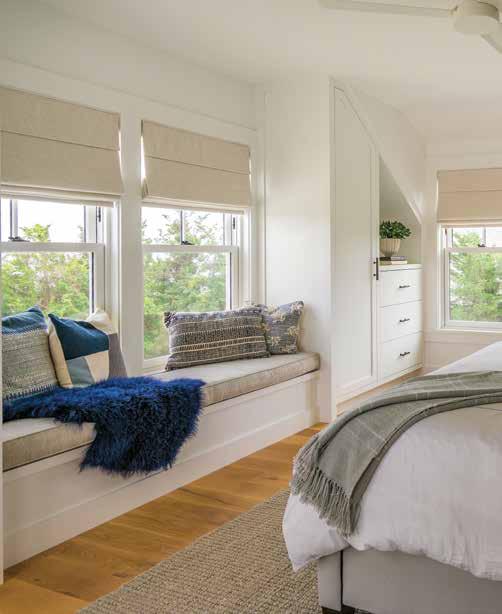
right Inviting rest and beckoning the view, the window seat is both furniture and frame.
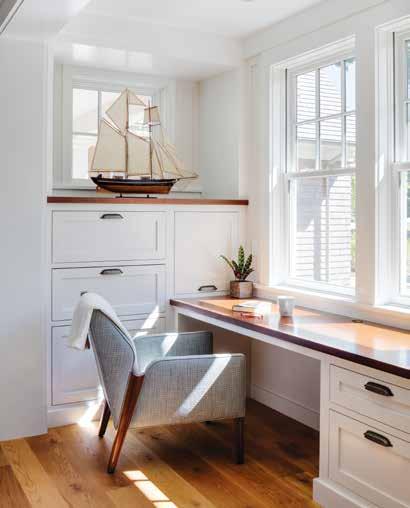
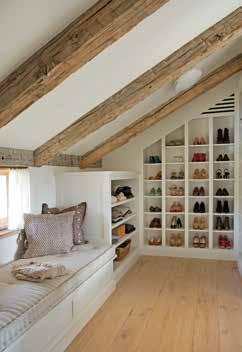
A narrow closet and chest of drawers in a niche are equally uncluttered and human-scale.
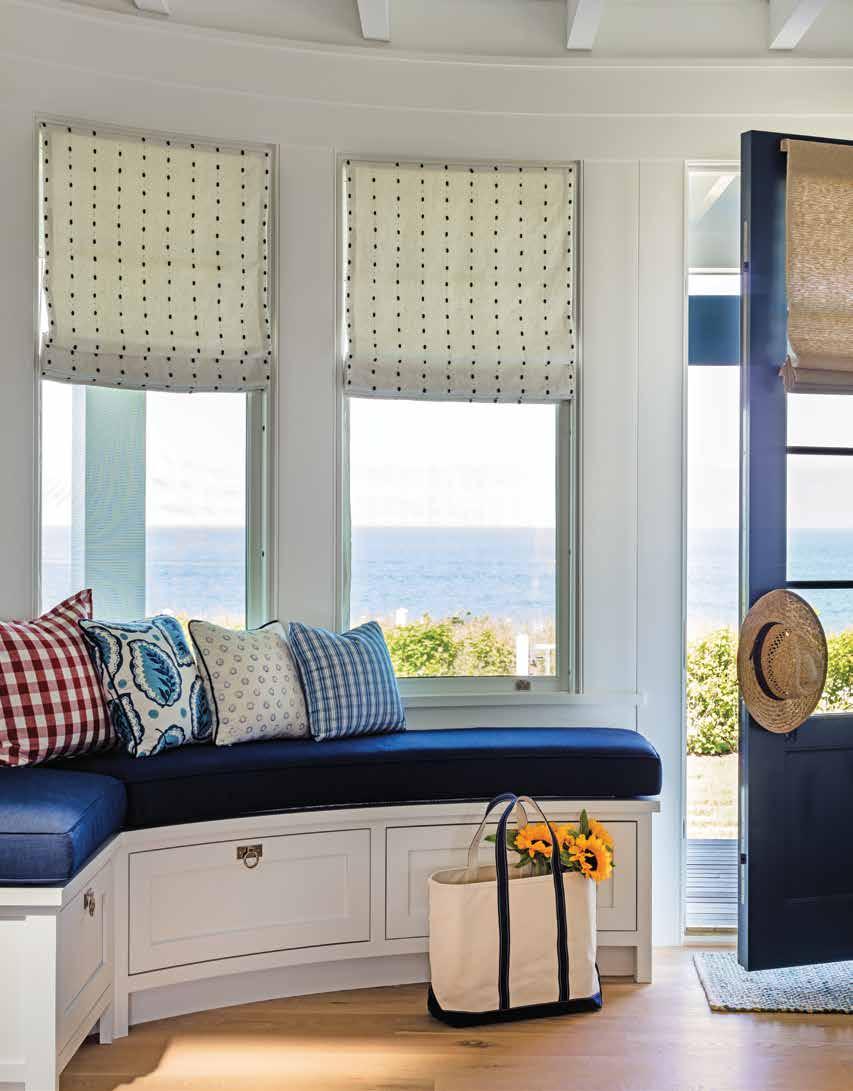
opposite In a new seaside house in a historic neighborhood, artisan-crafted built-ins include a bench at the entry, calling attention to the rounded bay and the ocean beyond.
designing built-in living spaces
I want an alcove just for me. Kind of like a hideout separate from the commotion in the rest of the house from which to read, write, nap, or just daydream. I want to be aware of the action in the house but be able to turn my shoulder politely and be by myself. • So goes the design brief from one of our clients. She’s not alone in her desire for personal scale and place-making in home design; this is a common human need. BY MARK
HUTKER
14-in.-deep bookshelves
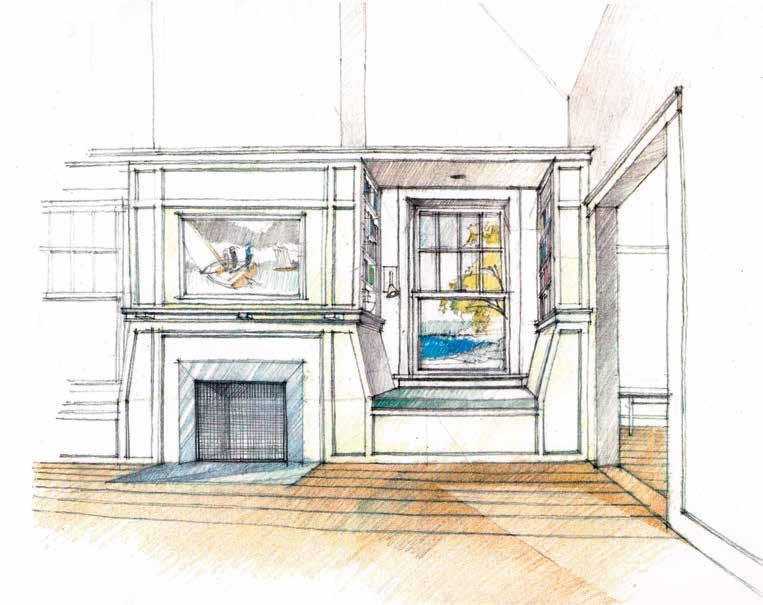
Angled backrest is integrated into the paneled fireplace surround to create a cohesive built-in unit.
Custom cushion with a lift-top bench seat offers storage below.
2-ft. 8-in.deep seat 5-ft.-wide seat
custom inglenook
A client who is an avid reader asked for her own personal space in a large living room. We obliged by designing her dream window in the manner of a personal library framing a window to a water view beyond. A double-hung window is the centerpiece of this inglenook framed by casings that align with opposing bookshelves. We designed an angled backrest after having the client test her preferred reading position during construction. The wall sconce was positioned strategically to be over her left shoulder and the windowsill to be aligned with her elbow. This space is at once part of the living area and of the landscape beyond.
At Hutker Architects, we create memorable spaces that our clients yearn to occupy to achieve our mission of creating heirloom homes worthy of preservation. We have found that most of the rooms we design are conceived initially as collective areas for family living. Dining rooms, kitchens, family or living rooms, and even studies and libraries are planned for multiple users. Naturally, the scale of these rooms is large, and when only one person uses such a space, it may not be comfortable.
One way to make a large space more comfortable for an individual is to create a smaller space in it. We often activate the edges of large rooms with built-in living spaces smaller in scale and near a window.
The success of these interstitial spaces is their relationship to the windows that animate them. A cherished characteristic of a window space is its intimate relationship to light, ventilation, and the view. The space allows one person to inhabit the defined area between inside and outside comfortably. These
area FOUND
Beyond their value in providing individual space, built-in seats and alcoves also make use of what might have been leftover space: on a stair landing, in a window bay, next to a chimney breast, in a dormer or under the eaves. Reclaimed space might be used for displaying a collection or for storing Dutch ovens. Not much square footage is needed for a quiet library corner—only an upholstered chair and a few bookshelves near a window or a good lamp. Old houses often have crannies awaiting a purpose. New houses designed to offer personal spaces gain a pleasing human scale.
below In a Martha’s Vineyard house inspired by a European farmhouse, space under the eaves is put to good use—and becomes a cozy retreat. left A fully functional office in just a few square feet, this bright, quiet space has a welcome serenity.
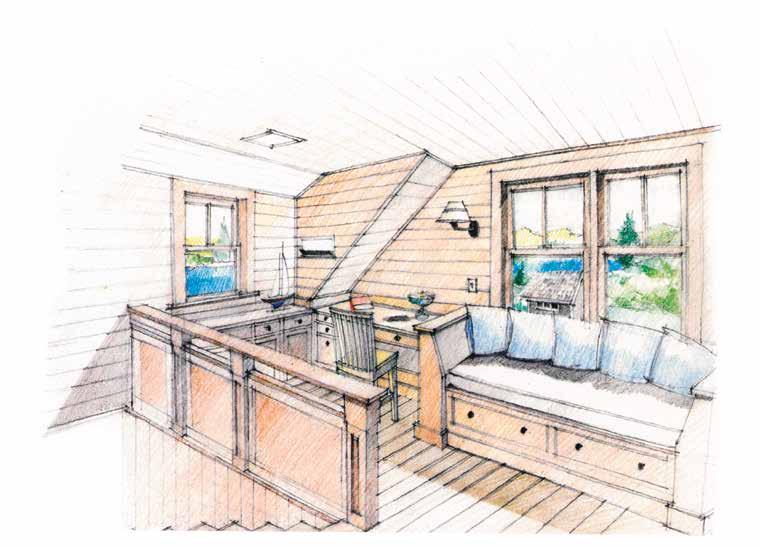
Counter-height cabinets
STUDY WITH A WINDOW SEAT
At the top of a stairway, tucked in a 72-sq.-ft. dormer space, is a combination window seat and desk. The railing of the stairway defines one edge of the study area. Facing north is a double-hung window with counter-height cabinets that hide a printer and office supplies. Beneath the eave is a desk space where head height is not an issue. The result is an efficient L-shaped workspace in a residual corner of the house that might otherwise have become a dead end. • Except for the mahogany desktop and cap rails, this entire composition is made of one material: cypress. There is a seamless flow between upstairs and downstairs, study and window seat.
SMALL SPACES BEG US
TO OCCUPY
THEM,
HOLED UP WITH SOMETHING TO READ OR SIP, EVERYTHING IN REACH.
built-in spaces are at once intimate relative to the larger room and expansive to nature beyond.
Here are three examples of custom built-in living spaces that beckon you to occupy them. Our clients like to hole up in these places with a few pillows, something to sip, and something to read. As in a cockpit or a berth on a boat, everything— light fixtures, a surface for resting a beverage, eyeglasses on a bookshelf—is a short reach away. Cuddling up with a good novel while being warmed by the fireplace, spending a summer evening slumbering in a custom berth, or writing at a desk ensconced in a natural environment is a sure way to develop a personal and meaningful relationship with your home.
mark hutker is a partner and founder of Hutker Architects (hutkerarchitects.com) in Massachusetts with offices in Boston, Plymouth, Falmouth, and Martha’s Vineyard.
Wall sconce serves both desk and window seat.
Angled armrest defines edge of desk area.
Window seat sized for occasional napping
Pillow and afghans are stored in drawer.
Stair rail defines edge of study area.
Cypress cladding creates continuity with adjacent living spaces.
custom bed alcove
Behind our office is a wooden-boat building business that produces 40-ft. to 60-ft. schooners. We take our interns back there to learn how the builders see wood, think through their designs, and craft their brilliant pieces of work. Together, we learn how efficient the spaces are in a boat and how many uses might come from a single space.
For the owner of such a boat and his family, we designed a harborfront beach cottage. Located on the second floor, beneath a pair of windows centered on a gable, are two sleeping berths adjacent to a playroom. Tucked into the eave spaces are headboards with a shelf above; the wall on each side
provides some privacy for the children. The berths are sized for standard eight-inch-thick mattresses. These two sleeping spaces occupy only 42 sq. ft., yet when looking out each window, occupants enjoy a feeling of spaciousness and of floating above the harbor below.
8-in.-thick, extralong twin mattress, 39 in. wide by 80 in. long.
Ventilation and sound are controlled through double-hung windows.
Low sill height evokes the feeling of space flowing outdoors.
Linen storage
Reading light with wall switch Wall conceals head for privacy.