Inside: Evidence Matters | Nursing Pulse | Safe Medication | SPECIAL FOCUS: Wound Care
www.hospitalnews.com
February 2021 Edition
FEATURED
The case for
mandatory vaccination Page 8 SPECIAL OFFER
CELEBRATING 25 YEARS 1997 - 2022
UP TO AN ADDITIONAL $1000 OF LTD COVERAGE AT NO COST!
ΖWȇV QHYHU WR HDUO\ WR SUHSDUH IRU WKH XQH[SHFWHG $W +&3 ZHȇUH SURXG WR RÎ?HU employees under 35* up to an additional $1000 of LTD coverage at no cost. Contact us today! 1-866-768-1477 or www.healthcareproviders.ca
CELEBRATING 25 YEARS 1997 - 2022
2Î?HU LV VXEMHFW WR HOLJLELOW\ DQG PHGLFDO XQGHUZULWLQJ
Challenging disrespect. Our members - over 68,000 nurses and health-care professionals - are essential to Ontario’s health-care system. The pandemic has made that truth more obvious than ever. Because their work is essential, the majority of our members can’t strike. The collective bargaining process is the only way for them to affirm their value. Collective bargaining is challenging, and it’s not perfect - but it does provide a structure for fairness. That fairness was demolished in November 2019, when the Ontario government passed Bill 124. Make no mistake: it’s punitive legislation. It imposes wage restrictions on female-dominated occupations, blocking fair compensation for thousands of female professionals and their male colleagues. When ONA applied for exemption from Bill 124, it took the government a year to respond - with a denial. Why did it take so long? The delay was intentional, another demonstration of government stonewalling and disrespect. ONA has filed a Charter challenge against Bill 124. So have other unions. A Charter challenge takes time and it’s costly. It’s definitely a last resort. But it’s the only way we can assert our constitutional right to fair bargaining. Our members deserve no less.
nursesknow.ona.org
Contents February 2021 Edition
IN THIS ISSUE:
Home Visiting Program
14
▲ Cover story: The case for mandatory vaccination
8
▲ Special focus: Wound care
16
▲ Contact tracing wearable device
COLUMNS
13
Guest editorial .................4 In brief .............................6 Nursing pulse ................24 From the CEO’s desk .....26 Evidence matters ...........28 Safe medication ............29 Ethics .............................30
▲ ICU during the COVID-19 pandemic
21
www.hospitalnews.com
Nominate your Nursing Hero!
25
▲ App and education toolkit
5
Triage in critical care:
A protocol to protect lives and principles By Dr. Andrew Baker, Dr. Andrea Frolic (PhD) and Dr. James Downar ealthcare resources are finite. This hard truth has never been felt more keenly than in this pandemic. Thousands of people are now at home waiting for their cancer or cardiac or other surgeries that have been cancelled because there are not enough resources to care for them as well as the surge of COVID patients now flooding into hospitals. We already know that delays in treatment due to the pandemic are resulting in preventable deaths and illness. In situations where resources are limited, the process of choosing who gets care becomes of paramount importance. Hospitals are making hard decisions every day about which surgeries are most urgent, using clinical evidence to allocate scarce beds based on the principle of saving lives and reducing illness. Critical care is also a finite life-saving resource. If hospitals become overwhelmed with critically ill patients we must have a fair, evidence-based and principled process for deciding who gets critical care. That is why the Ontario Critical Care COVID Command Centre has issued an emergency standard of care to assist bedside doctors in triaging patients for critical care admission. Based on broad consultation with experts in medicine, bioethics and human rights, this protocol is designed to allocate critical care resources to save the most lives possible while adhering to rigorous ethical principles. Triage will impact every critically ill person, whether or not they have COVID. If three patients present to the emergency room—one was injured in a motor vehicle accident, one has complications from pancreatic cancer, and one has heart failure –
H
there must be a system to decide which patient will be given the last critical care bed available. There are essentially four options for making this decision. One would be a passive first-come, first-served approach, where everyone receives critical care until all beds are full, and then everyone else is turned away. While this may work for concert or sporting event tickets, in healthcare this model risks many preventable deaths as people with a poor chance of survival (who are likely to die even with critical care) receive care because they arrived earlier, while others with a very good chance of survival may die because they arrived later. This model is also inequitable, disadvantaging those with poor access to healthcare and transportation (such as remote communities). A second option would be to randomly allocate intensive care beds using a lottery. This would likely also lead to a number of preventable deaths because some people who are likely to die anyway might be “lucky” enough to receive critical care, whereas others with a better likelihood of recovering may be “unlucky.” Surely the reason we have a healthcare system and clinical expertise is to have survival rates that are better than random chance. A third option is to leave it up to the discretion of individual doctors at the bedside to decide who gets access to critical care. This has several downsides: it would introduce inconsistencies in decision-making; unconscious biases could cause specific groups to be disadvantaged; and it would contribute to moral injury, PTSD and burnout amongst clinicians if they are forced to bear this moral responsibility alone. Continued on page 6
610 Applewood Crescent, Suite 401 Vaughan Ontario L4K 0E3 TEL. 905.532.2600|FAX 1.888.546.6189
www.hospitalnews.com Editor
Kristie Jones
editor@hospitalnews.com Advertising Representatives
Denise Hodgson
denise@hospitalnews.com Publisher
Stefan Dreesen
stefan@hospitalnews.com Accounting Inquiries
accountingteam@mediaclassified.ca Circulation Inquiries
info@hospitalnews.com Director of Print Media
Lauren Reid-Sachs
Senior Graphic Designer
Johannah Lorenzo
ADVISORY BOARD Barb Mildon,
RN, PHD, CHE VP Professional Practice & Research & CNE, Ontario Shores Centre for Mental Health Sciences
Helen Reilly,
Publicist Health-Care Communications
Jane Adams,
President Brainstorm Communications & Creations
Bobbi Greenberg,
Health care communications
Sarah Quadri Magnotta, Health care communications
Dr. Cory Ross,
B.A., MS.C., DC, CSM (OXON), MBA, CHE Vice President, Academic George Brown College, Toronto, ON ASSOCIATE PARTNERS:
UPCOMING DEADLINES MARCH 2021 ISSUE
APRIL 2021 ISSUE
EDITORIAL: February 5 ADVERTISING: Display – February 19 | Careers – February 23
EDITORIAL: March 12 ADVERTISING: Display – March 26 | Careers – March 30
Monthly Focus: Facilities Management and Design/Health Technology/Greening Healthcare/Infection Control: Innovative and efficient healthcare design, the greening of healthcare and facilities management. An update on the impact of technology, including robotics and artificial intelligence on healthcare delivery. Advancements in infection control in hospital settings.
Monthly Focus: Healthcare Transformation/eHealth and EHR/ Mobile Health: Programs and initiatives that are transforming care and contributing to an effective, accountable and sustainable system including virtual care. Innovations in electronic/digital healthcare, including mHealth and the Electronic Health Record (EHR).
+ INFECTION CONTROL SUPPLEMENT
+ ANNUAL E-HEALTH SUPPLEMENT
THANKS TO OUR ADVERTISERS Hospital News is provided at no cost in hospitals. When you visit our advertisers, please mention you saw their ads in Hospital News. 4 HOSPITAL NEWS FEBRUARY 2021
Hospital News is published for hospital health-care professionals, patients, visitors and students. It is available free of charge from distribution racks in hospitals in Ontario. Bulk subscriptions are available for hospitals outside Ontario. The statements, opinions and viewpoints made or expressed by the writers do not necessarily represent the opinions and views of Hospital News, or the publishers. Hospital News and Members of the Advisory Board assume no responsibility or liability for claims, statements, opinions or views, written or reported by its contributing writers, including product or service information that is advertised. Changes of address, notices, subscriptions orders and undeliverable address notifications. Subscription rate in Canada for single copies is $29.40 per year. Send enquiries to: subscriptions@ hospitalnews.com Canadian Publications mail sales product agreement number 42578518.
www.hospitalnews.com
NEWS
App and education toolkit help rehab patients reach recovery goals By Kelsi Break t’s been almost 10 years since Rob Staffen was in an accident that would change his life forever. Staffen was cycling down a mountain near Palm Springs, California in October 2012 when suddenly his road bike malfunctioned, catapulting him head-first into the rock-strewn desert landscape. The impact to his skull resulted in a severe traumatic brain injury. A concussion is a brain injury caused by a hit to the head or body that forces the brain to move back and forth inside the skull. Known as an invisible injury, a concussion can affect a person’s physical, mental, behavioral and/or emotional health. While 80 per cent of people recover from a concussion, 20 per cent have persistent symptoms that can develop or worsen over time. Too often after a concussion people either stop activity all together, delaying recovery or push themselves, doing too much too quickly, intensifying their concussion symptoms. To combat this, Becky Moran, an Occupational Therapist with St. Joseph’s Health Care London’s (St. Joseph’s) Acquired Brain Injury (ABI) Outpatient Program at Parkwood Institute developed the Pacing and Planning Program, a points system to help concussion patients track, manage and pace their daily activity. The system, much like points tracking used by dieters to monitor food choices, assigns values to tasks like driving, grocery shopping, screen use and exercise so patients can be active enough without overdoing it. Each person is given a total number of points per day that will keep their symptoms in the “safe range” and are encouraged to increase their points as their recovery progresses. The Pacing and Planning Program has helped hundreds of St. Joseph’s rehabilitation patients achieve their recovery goals. And now, thanks to funding provided by St. Joseph’s Health Care Foundation, the Cowan
I
www.hospitalnews.com
The MyBrainPacer™ app helps concussion patients self manage their condition. Foundation and a non-profit founded by the Staffen family called the Brain and Mind Matters Community Fund, the Pacing and Planning Program is available on your electronic devices. MyBrainPacer™ was co-designed by ABI patients and their caregivers, integrating technology and health care expertise into one easy-to-use tool. The app helps users safely monitor and track their daily activity and concussion symptoms using a smartphone, tablet, or personal computer. Launched February 1, MyBrainPacer™ App is part of a toolkit of educational resources St. Joseph’s ABI team has created to help concussion patients self-manage their condition. The resources also include a series of Concussion Care videos, an audio playlist of mindfulness exercises and resources to aid recovery for common concussion symptoms like visual disturbances, noise sensitivity and balance issues. Staffen credits the lessons he learned as a patient at St. Joseph’s with helping him get his life back on track. “Without the team at St. Joseph’s Parkwood Institute, I’m pretty
sure I wouldn’t be where I am today,” he says. “The tools they provided helped me balance my life, so I can stay active but keep my concussion symptoms under control by resting when I need to. With their guidance,
I was able to return to work and resuming my passion for road biking. I’m not totally recovered, but I can do the things I love – I just have to know my limits, which is perfectly H OK.” ■
Kelsi Break is a Communications Consultant at St. Joseph’s Health Care London.
FEBRUARY 2021 HOSPITAL NEWS 5
IN BRIEF
Care aides in Canadian LTC care homes are
a workforce in crisis he need for profound, systemic change in the long-term care sector in Canada has been clear for decades. The pandemic has only exacerbated existing deficiencies in the sector and made transforming it more urgent. Care aides or personal support workers (PSWs) provide up to 90 per cent of direct care in Canadian nursing homes. Care aides are both a neglected and socioeconomically disadvantaged workforce, as well as a critical source of emotional and social support for residents. Newly published research in JAMA Network OPEN from Translating Research in Elder Care (TREC), based at the University of Alberta, demon-
T
strates just how vulnerable the care aide population is in Canada. Researchers examined survey data collected between September 2019 and February 28, 2020 – just before the pandemic set in – across 91 nursing homes in western Canada (BC, Alberta, Manitoba) and found that this critical workforce is under significant strain. TREC data found that the majority of care aides are middle-aged to older women who speak English as an additional language. While the majority are highly satisfied with their jobs, they work in a resource-constrained environment, with more than 70 per cent of care aides reporting moderate to high risk for emotional exhaustion – and that’s before the pandemic.
Triage in critical care The fourth option is to adopt a standardized provincial triage protocol that allocates critical care resources based on explicit criteria informed by medical evidence. Triage protocols are commonly used in other situations, such as mass casualty events, in the hope of saving the most lives, while ensuring equity, consistency and transparency, and mitigating the moral burden on clinicians. Given these options, the Critical Care COVID Command Centre, which is charged by Ontario Health with managing critical care capacity and implementing best practices in response to the pandemic, has developed a critical care triage protocol for the province. It would only be used in a worst-case scenario after reasonable efforts to expand capacity and redistribute resources are exhausted. This protocol has been reviewed and endorsed by experts in medicine, ethics and law, and was used as the model for triage protocols adopted in other jurisdictions such as Quebec and Israel.
Characteristic of care aides in longterm care • Ages 40-49: 32% • 50-59: 27% • Over 60: 11% • Female: 89% • Care aide certificate: 94% • English as an additional language: 68% • Work in more than one nursing home: 24% • High or moderate rates of emotional exhaustion:72% Care aides also reported frequently rushing or missing essential care tasks in their most recent shifts and one half reported they worked short-staffed daily or weekly in the last month. Care tasks undone due to lack of time on most recent shift:
• Taking residents for a walk: 41% • Talking with residents: 34% • Mouth care: 16% • Toileting: 10% • Bathing: 9% • Feeding: 6% The majority also experienced significant rates of dementia-related verbal, physical or sexual behaviours from residents on a routine basis. In the last five shifts, care aides experienced from the residents: • Yelling and screaming: 86% • Hurtful remarks or behaviours: 73% • Being spit on, bitten, hit, pushed or pinched: 64% • Verbal threats: 62% • Repeated and unwanted questions of a sexual nature: 24% H • Sexual touching: 13% ■
Continued from page 4
The intention of this triage protocol is to provide a standard of care to help bedside doctors make the right decisions to save the most lives, using a process that is informed by the principles of: protecting human rights, non-discrimination, equity, proportionality, beneficence, respect for autonomy, accountability and fairness. This protocol balances these principles in the following way: • Ideally, all patients who could benefit from critical care would receive it, but patients with the best chance of survival would be offered critical care first in order to save the most lives • Every patient who becomes critically ill will be assessed using a standardized mortality risk tool, which helps doctors determine which patients are most likely to survive a critical illness. This allows people with different illnesses to be compared on equal terms. • Every assessment of mortality risk is repeated by a second physician, to ensure accuracy
• Human rights are explicitly protected; decisions are based purely on mortality risk, and not on prohibited grounds like sex, age, race, family status, disability, etc. Nobody would be denied access to critical care because of a disability. Mortality risk is the only criterion used for prioritization. • Every hospital would create a triage review committee to do quality assurance and monitor how the triage protocol is being used. If this triage protocol is triggered in the event of a major surge of critically illness, a patient who is admitted to hospital can expect that they will be asked about their goals and wishes. Many patients may wish to focus care on comfort and may not want ICU care. If a patient wishes to have ICU care, their doctor will complete a standardized assessment of their risk of mortality if they become critically ill. This assessment is based on their underlying conditions that may put them at higher risk of death. All patients will receive medical care and symptom
management, even if they are not prioritized for critical care. Healthcare providers and leaders are trying to tackle one of the most challenging ethical problems imaginable – who does and does not get access to potentially lifesaving critical care – with no historical precedent, and in real time. There are no easy answers, and regardless of the approach we use, some people will die who might have survived in non-pandemic times. In this situation, a systematic, standardized, principled and evidence-based approach to allocating these healthcare resources in a consistent way across the province provides the best way to avoid preventable deaths while safeguarding the psychological wellbeing of bedside clinicians, protecting human rights, and ensuring equitable access to care for all Ontarians. Let us be clear – nobody wants this, but a triage process that makes decisions based on clear principles and clinical criteria is far better than the H alternatives. ■
Dr. Andrew Baker, Critical Care Physician and Incident Commander Ontario Critical Care COVID Command Centre. Dr. Andrea Frolic (PhD), Director, Program for Ethics and Care Ecologies (PEaCE), Hamilton Health Sciences; Assistant Professor, Department of Family Medicine, McMaster University. Dr. James Downar, Head, Division of Palliative Care, University of Ottawa; Department of Critical Care, The Ottawa Hospital. 6 HOSPITAL NEWS FEBRUARY 2021
www.hospitalnews.com
IN BRIEF
Doctors provide facts, promote confidence in COVID vaccine to counter misinformation on social media ntario’s doctors are voicing concern about the urgent need to combat misinformation spreading on social media that may discourage people from getting the COVID-19 vaccine. Doubts and misinformation about how thoroughly the vaccines were tested or the extent of side effects are being shared widely on social media, especially among people under 25 and those between 25 and 34, according to new data released by the OMA. According to data collected by Advanced Symbolic Inc. (ASI), misinformation about the COVID vaccine is spreading among all age groups in Ontario on social media. ASI uses artificial intelligence methodology to build a representative sample of Ontarians from publicly available social
O
media information and obtain insights into public discussions about vaccine hesitancy. Vaccine misinformation by age groups: Under 25: Misinformation within this group includes strong doubts about the vaccine on social media, emphasizing they believe it is dangerous, “untested” and “largely experimental.” They speak, almost aggressively, about “it’s not your business whether I get the vaccine.” Those in this age group who are more open and accepting of the vaccine still have negative views about following government measures and advice aimed at curbing the pandemic, saying if the do so, they will be considered low risk and have to wait longer to get a vaccine than people at high risk.
Ages 25-34: More conspiracy theories are seen in this age group, in particular the belief that COVID is a genetically engineered virus so no vaccine can be trusted. This group is outspoken about refusing to have any “mandatory health tag” to prove they have been vaccinated. They want to make sure human rights are supported during the pandemic and question employers’ abilities to force employees to get the vaccine. Ages 35-44: This group is more supportive of a vaccine and is circulating less misinformation. But they are unhappy with the way the government rolled out the vaccines, especially the shutdown over the holidays and want the government to speed things up. This age group is talking a lot about vaccine safety and the need
for public health campaigns that address vaccine hesitancy. Specifically, they are seeking more information about the effect of the vaccine during pregnancy. Ages 45-65: This age group is using social media to voice their opinions about government actions. Many are frustrated at the slow roll out of the vaccine and want clarification about where the vaccines have gone and more transparency about the next steps. “Ontario’s doctors are committed to helping everyone make an informed decision by providing accurate, evidence-based facts,” says OMA CEO Allan O’Dette. “The facts will help us all make the right decision for ourselves, our families and our H communities.” ■
Colchicine reduces the risk of COVID-19-related complications he Montreal Heart Institute (MHI) recently announced that the COLCORONA clinical trial has provided clinically persuasive results of colchicine’s efficacy to treat COVID-19. The study results have shown that colchicine has reduced by 21 per cent the risk of death or hospitalizations in patients with COVID-19 compared to placebo. This result obtained for the global study population of 4488 patients approached statistical significance. The analysis of the 4159 patients in whom the diagnosis of
T
COVID-19 was proven by a naso-pharyngeal PCR test has shown that the use of colchicine was associated with statistically significant reductions in the risk of death or hospitalization compared to placebo. In these patients with a proven diagnosis of COVID-19, colchicine reduced hospitalizations by 25 per cent, the need for mechanical ventilation by 50 per cent, and deaths by 44 per cent. This major scientific discovery makes colchicine the world’s first oral drug that could be used to treat non-hospitalized patients with COVID-19.
Treating patients at risk of complications with colchicine as soon as the diagnosis of COVID-19 is confirmed by PCR reduces their risk of developing a severe form of the disease and, consequently, reduces the number of hospitalizations. Prescribing colchicine to patients could help alleviate the problems of hospital congestion and reduce healthcare costs here and around the world. COLCORONA is a contact-less, randomized, double-blind, placebo-controlled clinical trial that took place at home. It has been conduct-
ed in Canada, the United States, Europe, South America and South Africa. It was designed to determine whether colchicine could reduce the risk of severe complications associated with COVID-19. COLCORONA was conducted among approximately 4,500 COVID-19 patients not hospitalized at the time of enrollment, with at least one risk factor for COVID-19 complications. This is the world’s largest study testing an orally administered drug in non-hospitalized patients with COVID-19. For more H information, visit colcorona.net. ■
BASEMENT FINISHING HOME REMODELLING TO ALL OF YOU ON THE FRONTLINE
A HUGE THANK YOU!
10% DISCOUNT Offered throughout 2021*
capablegroupinc.ca
905.889.0025 From Concept To Creation Nobody Does It Better
www.hospitalnews.com
support@capablegroupinc.ca *offer cannot be combined with any other discounts
FEBRUARY 2021 HOSPITAL NEWS 7
COVER
Mandatory vaccination of health care workers By Colleen M. Flood, Bryan Thomas & Kumanan Wilson andatory vaccination is a tricky subject. People in liberal societies like ours are suspicious of being compelled to do anything at all, much less receive an injection. And in the context of SARS-CoV-2 (COVID-19), rapid vaccine development likely has exacerbated vaccine hesitancy. However, in the midst of the deadly SARS-CoV-2 pandemic, and with a clear need to ensure an adequate supply of health care workers and protect the patients they care for, can and should SARS-CoV-2 vaccinations be required for health care workers (HCWs)? We argue they should. In the past, decisions about whether to require HCWs to receive the annual flu vaccine have generally been left to individual hospitals and institutions. In our view, in the context of the COVID-19 pandemic, provincial and territorial governments need to take control of this matter now and set clear and unequivocal rules that apply to all institutions. This is particularly important for SARS-CoV-2 since disparities in response measures have led to devastating outbreaks in some longterm care and retirement homes and it should not be left for local administrators to decide whether HCWs at these facilities are vaccinated. There will no doubt be reservations on the part of some HCWs towards vaccination mandates – and perhaps more so at retirement and long-term care facilities where fewer HCWs have significant clinical training. Normally the best approach to vaccine hesitancy would be a campaign of education and persuasion, but in the circumstances of this pandemic there is no time for this. Vaccination of HCWs against SARSCoV-2 is already imperative and must proceed quickly. Any kind of government mandate for vaccination could be subjected to a Charter challenge (under s. 7 that protects life, liberty and security
M
8 HOSPITAL NEWS FEBRUARY 2021
of the person). Much of the existing case law involves labour law challenges to requirements by hospitals and other institutions that staff receive flu vaccines. It is important for decision-makers – both governments and courts reviewing a Charter claim - to acknowledge that SARS-CoV-2 is not influenza. There is a need for decisive precautionary measures given SARSCoV-2 has a higher transmission and case-fatality rate. As such, a government mandate for HCWs to be vaccinated against SARS-CoV-2 will likely survive constitutional challenge, subject to the following three caveats. Our first caveat concerns interpretations of the word “mandatory.” Any mandate in Canadian law would not mean that anyone will physically
force anyone else to be vaccinated. By “mandatory” we mean that there will be significant consequences for those who choose not to vaccinate, for example that they will be required to stay at home and not be paid. Such a “mandate” should not trigger s. 7 of the Charter of Rights and Freedoms, which does not generally protect economic rights and/or the right to practice a profession. Second, any “mandate” for vaccination must have some exemptions to be both ethically and legally defensible. So, those who for health reasons are unable to be vaccinated need to be exempted as well as those with genuine religious or conscience objections (scientific skepticism about vaccines not falling within those parameters).
Our third caveat is that government must continue to monitor the effectiveness of vaccination in preventing transmission, and lift mandates if they are not supported by the science. Vaccine-hesitant HCWs may argue that wearing personal protective equipment (PPE) should be sufficient to protect themselves, their patients, and others that they work with. This is a particularly difficult question to resolve as the evidence on the efficacy of the vaccines and their effects on transmission is still evolving, and the evidence for PPE is of a different quality. A relevant factor may be the difficulty of procuring PPE and pragmatically whether it is used appropriately to reduce the risk of acquiring SARS-CoV-2. Continued on page 11 www.hospitalnews.com
Online JHSC Certification Part 1 Training
A solution in sync with the times Completing Part 1 JHSC Certification training online can help healthcare workers ramp up their health and safety smarts and prep them to make a difference on the job
There’s no denying that this is a time of great disruption. We can’t escape the words “unprecedented”, “uncertainty” and “the new normal”, and healthcare organizations and their workers are at the very centre of it all. Making workplace health and safety a top priority is now more important than ever. In this pivotal time, Public Services Health & Safety Association is pleased to introduce eCert – JHSC Certification Part 1 eLearning. This new online program covers the first part of the training required for employees to become members of a workplace Joint Health and Safety Committee (JHSC). PSHSA’s eCert makes it possible for workers to safely complete Part 1 of Ontario’s JHSC Certification training requirement remotely, at their own pace in 35% less time the classroom training would take. Combined with workplace-specific JHSC Certification Part 2 training, this CPO-approved program leads to full certification under Ministry of Labour, Training and Skills Development (MLTSD) guidelines.
eLearning offers many great benefits. Learning time is reduced, requiring 40-60% less time than in a traditional classroom setting. Participants can learn conveniently at their own pace, picking up where they leave off, plus revisiting content whenever needed. eLearning is also a cost-effective training solution – learning can be done anytime, anywhere with no travel expenses or costs for materials. Most importantly, JHSC Certification Part 1 training represents a key step in ensuring the workplace is equipped to handle the hazards healthcare employees can face on a day-to-day basis, including those associated with COVID-19. The rationale for a healthier and safer workplace is clear – everyone is protected, productivity is increased and laws are not broken. Everything may seem different lately, but one positive change that makes great sense for occupational health and safety and our current environment is PSHSA’s eCert – JHSC Certification Part 1 eLearning. pshsa.ca/jhsc-elearning
CLASS IS ALWAYS IN SESSION
JHSC Certification Part 1 eLearning is now available. Enroll Now JHSC Certification Part 1 eLearning :
Limited Time Bundle Offer JHSC Certification Part 1 eLearning + Part 2 facilitator-led Training starting at:
$299
$599
For more information and to register visit
pshsa.ca/jhsc-elearning www.hospitalnews.com
FEBRUARY 2021 HOSPITAL NEWS 9
NEWS
Procurement’s time to shine By Neil Fraser have been working within the Canadian healthcare system for almost four decades and have witnessed the changing tides of health technology procurement. I’ve also seen countless reports on what we need to do to reform our healthcare system, and it is a rare treat to see those recommendations be put into action. When I first started working within the healthcare system, adoption of a new technology was based on a doctor’s judgement that the technology could improve outcomes for their patients. Over time, governments were finding themselves in deeper waters because healthcare costs – including capital, human resources, and pharmaceuticals – were representing a larger portion of GDP (from seven per cent in the 1980s to 11 per cent today). As a result, governments began focusing on reducing the growth in healthcare spending.
I
EMERGENCE OF CENTRALIZED PROCUREMENT
In the mid-2000s, centralized procurement agencies began to emerge in earnest, with a specific focus on creating a more consistent and transparent procurement process, and success was measured by their ability to reduce the average price of medical products being procured.
It worked. Transparency increased. The procurement process became very complicated, but more consistent. And the price of some devices, like stents and pacemakers, plummeted. But despite the savings on devices, the overall cost of healthcare continued to rise. The problem could be explained using basic math. Since medical devices only represent three-four per cent of healthcare spending, even if they were free, the system would only save four per cent at most. That is why considering the impact of devices on the total cost of care, including the other 96 per cent, is arguably more important. Furthermore, increasing the adoption of the right innovations could actually help the system support more patients without increasing overall costs or further burdening our human resources, which are already burning out. In the 2010s, governments began to realize they had a health innovation problem and in 2013, Ontario was the first of several governments to develop
10 HOSPITAL NEWS FEBRUARY 2021
health innovation councils. Two years later, the Ontario government accepted all the Ontario Health Innovation Council’s (OHIC) recommendations, which included the need to develop strategies to improve and coordinate the procurement, adoption and diffusion of innovative technologies across the entire health sector.
VALUE-BASED PROCUREMENT
In 2016, the Healthcare Sector Supply Chain Strategy (HSSCS) Expert Panel was put together and their top recommendation was also to form a single procurement agency in Ontario with the skills necessary to shift to value-based procurement. This meant that the procurement agency would be expected to give weight to patient outcomes with input from clinicians, to take resource utilization and the total cost of care into consideration, and focus on value, rather than just price. That same year, Gabriela Prada of the Conference Board of Canada, and one of the experts on the HSSCS panel, published her paper “Value-Based Procurement: The New Imperative for Canada”. She argued that the criteria for tender evaluation should explicitly include patient outcomes and the total costs associated with the product being procured, including price, life cycle and total operating costs. (Full disclosure, Prada is now Senior Director of Global Health Systems Policy at Medtronic). In Sweden, for example, Prada shared that procurement of wound-care products considered total care delivery costs for three different personas, rather than just the product itself. In Norway, procurement of IV catheters considered which products caused the least pain for patients and were least likely to break or require multiple attempts to administer.
In 2017, at the Healthcare Supply Chain Network, Kara LeBlanc from Shared Services New Brunswick presented her paper “Implementation Considerations for VBP in the Health Sector for New Brunswick, Canada”. While focused on New Brunswick, the key findings could be applied across Canada. LeBlanc’s research identified that the factors important to the successful implementation of value-based procurement (VBP) include: “public procurement legislation reform, executive government directors and support, interest and support from stakeholders, and directives to conduct pilot projects. In addition, sound structures and support from multi-sector government representation, such as, physicians, health ministries, finance and economic development ministries, procurement/shared service organizations, and legal are important. Directives and support must come from the top down.” I couldn’t agree more. VBP is integral to achieving the objectives of an innovation agenda. This was also one of the conclusions of the federal Health and Biosciences Economic Strategy Table in 2018, which also recommended funding sandboxes for innovative procurement that would “de-risk adoption of breakthrough Canadian health products”. This led to a $20 million investment in the CAN Health Network.
TIME TO SHINE
Fast forward to 2020 – seven years after the OHIC recommendations, after the publication of several more papers on the topic of VPB, and with a new government – the Ontario government created an integrated health supply chain organization called Supply Ontario. Its objectives, including “drive innovation and emerging technologies” and “deliver greater value for taxpayer dollars”. There has never been a more important time to leverage procurement to secure the supply of quality products that improve outcomes for patients and healthcare providers, given the global supply chain issues brought to light during the pandemic. Continues on page 11 www.hospitalnews.com
COVER
Mandatory vaccination Continued from page 8 Notwithstanding evidentiary uncertainty, Canadian governments should be able to defend a mandate for vaccination by applying the precautionary principle – a well-established framework for decision-making in public health which admits of the difficulties of perfect evidence in the context of a fast-moving pandemic. This would justify a mandate even in the absence of clear evidence of reduced viral transmission given the unique severity of the COVID-19 pandemic. If phase 3 trials provide data suggesting reduction in infectivity, the argument in favour of vaccine mandates (with no opt-out for PPE) will be considerably strengthened. All of this speaks to the importance of legal decisions and evolving scientific evidence marching forward in unison. But where there is uncertainty, the ethos of public health argues we move forward with risk-mitigating measures even if these may restrict individual rights and freedoms. This has been the case throughout the pandemic from lock-
downs to mask mandates. Arguably, the scientific evidence supporting mandatory vaccination outstrips the otherwise reasoned scientific basis of other precautionary measures taken to date. At the moment our focus is on vaccine roll-out and getting the vaccines to all who want them. However, soon our attention must turn to whether essential HCWs, working with those at great risk from SARS-CoV-2 have in fact been vaccinated. Faint hearts and handwringing will not bring back lives and provincial and territorial governments need to set clear rules for this while staying attentive to the evolving evidence and merits of different vaccines and PPE. A fuller discussion is available in CM Flood, B Thomas, K Wilson, “Mandatory vaccination for health care workers: an analysis of law and policy” CMAJ 2021 early-released January 19, 2021, Available online: https://www.cmaj.ca/content/ early/2021/01/19/cmaj.202755 We would like to thank Ryan Tanner for H his editorial comments. ■
Colleen Flood is a Professor in the Faculty of Law at the University of Ottawa and University Research Chair in Health Law and Policy; Director for the University of Ottawa Centre for Health Law, Policy and Ethics. Bryan Thomas is a Senior Research Associate, University of Ottawa Centre for Health Law, Policy and Ethics. Kumanan Wilson is a Professor, Department of Medicine, University of Ottawa; Senior Scientist, Clinical Epidemiology Program, Ottawa Hospital Research Institute; Scientist, Institute for Clinical Evaluative Sciences.
Procurement’s time to shine Continued from page 10 In particular, the pandemic has highlighted the importance of local production, as well as the need to partner with global suppliers. At the federal level, this challenge has now been passed on to the new Minster of Innovation, François-Philippe Champagne. When the pandemic is over, and our healthcare system faces a
tsunami of procedures delayed during the lockdown, my hope is that procurement, both provincial and federal, has its moment to shine by executing on the promise of procurement reform: procuring products that reduce procedure time, reduce readmissions, or keep patients out of the H hospital altogether. ■
Neil Fraser is President of Medtronic Canada and he was a member of both the Ontario Health Innovation Council and the federal Advisory Panel for Healthcare Innovation. Editorial support provided by Melicent Lavers-Sailly, Director, Communications, Strategy, and Stakeholder Engagement. www.hospitalnews.com
INTRODUCING A REUSABLE HALF MASK WITHOUT AN EXHALATION VALVE!!
... Filters air when you breathe in AND out ... Filters & mask can be reused ... N95 & P100 cartridges ... Can be sanitized after each patient visit ... Less expensive ... Better protection ... Won't fog glasses ... Made in America Our reusable half mask protects the patient and the healthcare provider from virus pathogens– reduces waste & costs, safer, more comfortable and reliable supply. Look closely at this alternative.
dentec@dentecsafety.com ®
Call 1-888-533-6832
SPECIALIZING IN SAFETY SOLUTIONS
FEBRUARY 2021 HOSPITAL NEWS 11
NEWS
SPONSORED CONTENT
Dapasoft’s Corolar Virtual Care: A Microsoft Teams-based tool made for the COVID-19 era By Diana Swift ne of the lasting legacies of the global SARSCoV-2 pandemic will doubtless be the establishment of virtual care as an integral part of mainstream medicine. As COVID-19 forced clinics and doctors’ offices to close, the need for acute patient care grew and safe solutions were sorely needed. One Canadian information technology company that nimbly responded to that need is Toronto-based Dapasoft Inc., an independent software vendor and a 20-year partner of Microsoft Canada in acute-care markets. Addressing requests from existing customers, the firm leveraged Microsoft Teams (Microsoft’s comprehensive collaboration hub offering secure chat, video and voice features) to create Corolar Virtual Care (CVC) – an add-on audiovisual product that allows healthcare organizations to quickly launch acute-care clinics. In its latest iteration, Corolar ConnectedCare (C3A), the tool is specifically designed for care coordination and collaboration. “The primary value of C3A is for clinicians across the care continuum to access patient’s acute-care data, collaborate and coordinate effectively with care providers to improve health outcomes,” explains Jijesh Devan, Dapasoft’s Senior Director of Product Marketing and Business Development. “The product has a lot of traction in the current pandemic because it sits on top of Teams and allows customers to set up urgent care to treat patients remotely in both scheduled and walk-in virtual visits.” Over the past six months, the Teams-native application, Corolar Virtual Care, has been helping hospital systems and regional health authorities to enable virtual care. Designed with specific input from healthcare executives and frontline healthcare workers, CVC is typically
O
PATIENTS CAN BOOK AND BE NOTIFIED WHEN TO COME IN BY SMS OR EMAIL AND BE PUT ON THE APPROPRIATE CARE PATHWAY. used by a range of professionals, including clinicians in specialty clinics, triage nurses and registration clerks. “This product is completely driven by end-users’ voices,” Devan says. Dapasoft is no stranger to infectious epidemics: its involvement in infectious disease outbreaks dates back to 2003 when the lethal SARS coronavirus first ravaged Ontario. “Now we’re back full circle with a significantly bigger pandemic,” Devan says.
12 HOSPITAL NEWS FEBRUARY 2021
Development of the latest-generation app began last January when prominent CIOs and other healthcare executives in the Greater Toronto Area acknowledged a pressing need for a product specific to the exigencies of the surging pandemic. Dapasoft’s response was rapid and surefooted, enabled by its long experience with Microsoft Teams. “We’d been working on Teams for several years and were very familiar with its operation,” says Devan.
Once aware of the urgent end-user requirements, Dapasoft was able to get the app’s beta version up and running for testing in customers’ environments by April 2020. “That’s a testimonial to the fantastic folks at Dapasoft and also to the agility and adaptive capability of the Teams platform,” Devan says. By June, CVC was ready for general release, and by August, awareness of the product was expanding. “Now several large healthcare systems – one in British Columbia and two each in Ontario and the Atlantic region – have adopted Corolar,” Devan says. As user needs evolve during the pandemic’s second surge, Devan says Corolar technology is poised to spring into action with the agility necessary to meet new demands. It has already done some fine-tuning to address the changing circumstances some of its early-adopters faces. In October 2020, when the Ontario Health Ministry called for the rolling out of urgent care clinics with a deadline of January 2021, Dapasoft was able to help customers launch these clinics on time. Patients can book and be notified when to come in by SMS or email and be put on the appropriate care pathway. According to Devan, it’s the basic functional flexibility of the Teams platform that easily accommodates the adaptation of add-on products such as Corolar Virtual Care. “Once clinicians learn to use Teams, it becomes easy to grasp the workings of a new application,” he says. And as customer needs further evolve, new enhancements can be readily made. “Lots of new releases will be coming out quickly,” Devan says. With the pandemic showing little sign of releasing its grip and Canada poised to undertake the largest vaccination program in its history, Teams-based Corolar Virtual Care would appear to H be tailor-made for the moment. Q www.hospitalnews.com
NEWS
Wearable device supports residents, staff in seniors’
homes, assists with contact tracing By Julia Nunes tewart Hardie has seen firsthand how devastating the effects of a fall can be for an older person. A few years ago, his grandmother fell, broke her hip and died of complications. Later, his stepmother had three falls in a month, requiring hospitalization each time. And in 2020, Hardie’s father, who lives in a seniors’ residence, fell and was trapped for three hours between his nightstand and bed before being found. “It’s a very personal thing for me and I don’t think my story is unusual,” Hardie says. “That was my motivation to find a technological solution.” Hardie’s innovative solution is a platform called Tenera Care that al-
S
lows staff taff in seniors’ facilities to track people’s e’s movements. Residents, s,, sstaff taff ta fff and visitors wear wristbands wristbban ands d orr clip-on n devices that pinpoint their location in real time within n 15 centimeters. The system m can “see” people moving around and give notifications if someone needs assistance. “In all three of my family members’ cases, the staff would instantly know to go and provide assistance. They could actually see on a map if my father is stuck or if he’s moving around,” Hardie explains. It’s not only about fall detection. The cloud-based system alerts staff if someone goes into the wrong room, gets out of bed at night, or is using the
CONTACT-TRACING CAPABILITIES bathroom more often, which can indicate a possible infection. Data can be used by staff to formulate individual care plans, and shared with family members. “We provide objective data of what’s actually going on in residents’ lives and how the trends are changing. Are their steps declining, how much time are they spending in their room, are they sleeping more or less,” says Hardie, CEO and founder of Tenera Care, which developed the system.
During the COVID-19 pandemic, the system can also be used for contact tracing if a staff member, visitor or resident is diagnosed with COVID-19. “At the push of a button we can tell you who they came in contact with, at what distance, how much time they spent together, and where they were,” Hardie says, “so you can more easily control the spread of COVID-19 by understanding who needs to be quarantined.” Based in Halifax, Tenera Care is rapidly building a client base. Shannex Incorporated, which provides seniors’ accommodation, is now testing the platform in four Nova Scotia facilities. Continued on page 15
Are you new to Canada? / Nouvellement arrivé(e) au Canada? Ž LJŽƵ ǁĂŶƚ ƚŽ ŝŵƉƌŽǀĞ LJŽƵƌ ǁŽƌŬƉůĂĐĞ ĐŽŵŵƵŶŝĐĂƟŽŶ ƐŬŝůůƐ͍ PĂƌƟĐŝƉĂƚĞ ŝŶ ĨƌĞĞ KĐĐƵƉĂƟŽŶͲƐƉĞĐŝĮĐ >ĂŶŐƵĂŐĞ dƌĂŝŶŝŶŐ ĐŽƵƌƐĞƐ tŽƌŬƉůĂĐĞ ŽŵŵƵŶŝĐĂƟŽŶ ^ŬŝůůƐ ĨŽƌ ,ĞĂůƚŚ Ăre • Dental HygieniƐt • Medical LaboƌĂƚŽƌLJ dĞĐŚŶŽůŽŐŝƐƚ • DĞĚŝĐĂů ZĂĚŝĂƟŽŶ dĞĐŚŶŽůŽŐŝƐƚ • NurƐĞ • PerƐŽŶĂů ^ƵƉƉŽƌƚ Worker • ^ůĞĞƉ TechnologiƐt
tŽƌŬƉůĂĐĞ ŽŵŵƵŶŝĐĂƟŽŶ ^ŬŝůůƐ ĨŽƌ /nterproĨĞƐƐŝŽŶĂů Health Care TĞĂŵƐ • ŝĞƟƟĂŶ • NurƐĞ • KĐĐƵƉĂƟŽŶĂů dŚĞƌĂƉŝƐƚ • PhyƐŝŽƚŚerapiƐt • ^ŽĐŝĂů Worker
&Žƌ ŵŽƌĞ ŝŶĨŽƌŵĂƟŽŶ ǀŝƐŝƚ ŚƩƉƐ͗ͬͬĐŽͲŽƐůƚ͘ŽƌŐ To qualify, you must have training or experience in the ĮĞůĚƐ ůŝƐƚĞĚ ƵŶĚĞƌ each course, be a ƉĞƌŵĂŶĞŶƚ ƌĞƐŝĚĞŶƚ ŽĨ ĂŶĂĚĂ Žƌ Ă ƉƌŽƚĞĐƚĞĚ ƉĞƌƐŽŶ͕ ĂŶĚ LJŽƵƌ ŶŐůŝƐŚ ŵƵƐƚ ďĞ Ăƚ ĂŶ Intermediate level ; ĂŶĂĚŝĂŶ >ĂŶŐƵĂŐĞ ĞŶĐŚŵĂƌŬƐ ϲ ʹ ϴͿ͘
www.hospitalnews.com
FEBRUARY 2021 HOSPITAL NEWS 13
NEWS
Home Visiting Program
Mikey and Penny Lamy say the Home Visiting Program has made a tremendous difference in Mikey’s care.
doubles its capacity to care for frail seniors during pandemic By Maria Sarrouh ver the holidays, Unity Health Toronto’s St. Michael’s Academic Family Health Team’s Home Visiting Program conducted home visits armed with face masks, face shields, their stethoscopes and a unique tool: boxes of cookies. The sweet treats are a simple gesture, and were also part of a larger plan to keep isolated seniors supported over the holidays. The stereotype of a house call is a doctor popping by to do a quick blood pressure check on the way home from the office. But the reality is quite different, says Dr. Amy Freedman, a family physician at St. James Town Health Centre – one of the family health team locations. Alongside co-lead Lorna McDougall, Nurse Practitioner for the program, they explain that patients often have multiple illnesses, significant limitations in their mobility and many have dementia. The team focuses on improving quality of life at home and in meeting the wishes and goals of the patient. “A high proportion of our patients live alone,” Dr. Freedman says. “They’re coping with social isolation and loneliness and the significant impact these problems have on physical and mental health. Studies have shown that loneliness and social isolation have the same impact on health as smoking 15 cigarettes a day.”
O
“Often, nobody visits them, except for us and their personal support workers,” adds McDougall. “Some of our patients have no one in the world. It’s heartbreaking.” Due to the pandemic, the team took on many new patients to meet the increased demand for home-based primary care. “Patients weren’t receiving care for their chronic diseases. Many ended up running out of their medications, or becoming weaker, having a fall and getting admitted to hospital,” Dr. Freedman says. The team does all visits in personal protective equipment. Much like the team from St. Joseph’s Health Centre Family Health team conducting home visits, the St. Michael’s team has found in-person care a crucial way to protect the frail elderly. Almost none of the St. Michael’s team’s patients have access to technology for video visits and the some don’t even have a telephone, making the need for in-person visits essential. The number of people getting admitted to long-term care homes has also decreased due to frequent COVID-19 outbreaks. Patients who need admission to a long-term care home are dealing with long waiting lists, whereas some individuals who were interested to be placed in a home before the pandemic have changed their minds due to the high prevalence of COVID-19 in long-term care.
14 HOSPITAL NEWS FEBRUARY 2021
DUE TO THE PANDEMIC, THE TEAM TOOK ON MANY NEW PATIENTS TO MEET THE INCREASED DEMAND FOR HOME-BASED PRIMARY CARE. “We’re taking care of our patients longer than we ordinarily would,” says McDougall. “We’re essentially providing long-term care in their home.” To meet the high demand for home visits, the team recruited Dr. Jessica Cuppage, a Family Physician who is a recent graduate of the Care of the Elderly Enhanced Skills Program in the Department of Family and Community Medicine at the University of Toronto. Dr. Freedman and Dr. Ann Stewart, another St. Michael’s Family Physician on the team, also work with family medicine residents who see patients at home as part of their training. Patients who don’t have a family physician or can’t access primary care
are often referred to the program by acute care hospitals when discharging a patient home or by the Toronto Central Local Health Integration Network (LHIN). Mikey Lamy joined the home visiting program over one year ago after it was recommended to him and his wife Penny by the St. Michael’s Emergency Department. Like many patients in the program, Mikey suffers from mobility and memory issues. Penny is legally blind and uses a wheelchair. They were unable to visit their family doctor when Mikey began having extreme difficulty walking outside the home. “It just wasn’t working for us, it was too far away. Mikey couldn’t do it www.hospitalnews.com
NEWS
Wearable device Continued from page 13
And Hardie has recently opened a U.S. office, with plans to expand across North America. AGE-WELL, Canada’s technology and aging network, has supported Tenera Care by connecting the company to others in the sector. A new collaboration with AGE-WELL researchers could open the door to other ways of using the platform to improve the health and wellbeing of longterm care residents. The company has also made valuable connections attending AGE-WELL conferences. “AGEWELL has given us those opportunities so we’re very grateful,”
Hardie says. “I’m looking forward to working together even more closely.” Hardie’s main goal is to improve the quality of life of residents while preserving their dignity. One of his most gratifying moments came on a recent visit to a seniors’ residence that is using his platform. He spoke with a resident in her mid-nineties. “She said, ‘I’ve always lived in fear of being forgotten. And now I don’t have that any longer. I feel so much better.’ So that, to me, is a very powerful statement that we’re providing a sense of H comfort.” ■
Julia Nunes is a Toronto-based writer. AGE-WELL is a federally-funded Network of Centres of Excellence. The pan-Canadian network brings together researchers, older adults, caregivers, partner organizations and future leaders to accelerate the delivery of technology-based solutions for healthy aging. www.agewell-nce.ca
Newly available for: REGISTERED PRACTICAL NURSES
physically or emotionally,” Penny says. “We were panicked about what to do, so having their help is such a relief.” Penny doesn’t want Mikey to go to a nursing home, and neither does he. The home visiting program gives them their preferred option to remain at home with the right supports and Mikey has felt healthier since he enrolled in the program. “The visits have cheered me up,” he says. “I have a really great relationship with all the doctors and nurses.” “We’ve been married for 45 years,” Penny adds. “What would he do without all his books? We feel his quality of life is better this way.” In addition to support from Dr. Freedman and McDougall, Mikey is followed at home by Dr. Maggie Hess, a Family Medicine Resident; and Jennifer Bugera, a Nurse. He also has sup-
port from a team of nurses, coordinators and personal support workers from the LHIN. They all work together to help Mikey manage his diabetes, heart condition, memory issues and painful calluses on his feet. In addition, they monitor his heart closely, since he underwent a surgery to have a stent inserted several months ago. “If they weren’t looking after him, we don’t know how he would be,” says Penny. “When Mikey is sick, they come to our home frequently. They show up for us. We love them.” Visiting patients in their homes is Dr. Freedman’s favourite part of being a family doctor. “We love taking care of our patients,” she says. “Going into someone’s home, you get to know them in a way you never would in the sterile environment of an office. It’s H very rewarding.” ■
LICENSED PRACTICAL NURSES
JOIN
CNA
Membership gives you:
Access to professional development courses Special rates on products & services Significant savings on the CNA Certification Program
Advocacy. Knowledge. Benefits.
Maria Sarrouh is a communications intern at Unity Health Toronto.
www.hospitalnews.com
REGISTERED PSYCHIATRIC NURSES
join.cna-aiic.ca FEBRUARY 2021 HOSPITAL NEWS 15
SPECIAL FOCUS: WOUND CARE
The impact of COVID-19 on wound care By Britney Ann Butt nurse and a doctor stand silently assessing their patient Lilly, an 87-year-old female. A pungent sweet sickly smell permeates the room, it is a distinct odour they have encountered before, the smell of infection. Having encountered this type of case several times before (two just this week), the nurse turns Lilly onto her side to investigate what she already knows to be true; the patient has a stage 4 infected sacral pressure injury. As the nurse and doctor assess the wound, they begin to think, “How did this wound deteriorate this significantly? Who is accountable for this?” How do we prevent this? and more urgently, “Who do we call who knows how to fix this?” Adverse events related to wound, ostomy and Continence (WOC) conditions such as Lilly’s have become common place and unnoteworthy in the medical community despite cries from health care providers. However, cases like these are being exposed and reported in the media. A CTV News article published in 2020, “Man rotting alive from bedsore dies of infection,” revealed the high incidence of pressure injuries in long term care (LTC) residents. While there has been public outcry, there has been little substantial change to our health care system to improve the lives of those suffering from WOC conditions. Health care providers specialized in WOC care are required if we want to have a significant improvement in the health outcomes of our patients. The need is clear, and the proof is in the numbers: • Wound care costs Canada about $3.9 billion a year, or three per cent of the country’s total annual health spending. • 70,000 people in Canada are living with an ostomy, and thousands more each year undergo some form of ostomy surgery and often experience complications that require
A
Britney Ann Butt treatment beyond the initial surgery, adding to already substantial care costs. • Between one and 3.5 million incontinence cases, almost 10 per cent of the Canadian population, have been reported. A Nurse Specialized in Wound, Ostomy, and Continence (NSWOC), formally known as an Enterostomal Therapist, is a practitioner trained specifically to provide advanced specialized care for patients with wounds, ostomies, and continence issues. NSWOCs receive a competency-based education through the Wound, Ostomy and Continence Institute. The Institute’s Wound, Ostomy and Con-
16 HOSPITAL NEWS FEBRUARY 2021
tinence – Education Program (WOCEP) is designed for bachelors-prepared registered nurses (RN) to provide advanced, WOC consultation. NSWOCs work in a variety to health care settings including acute care, community care, LTC, clinics and private care. In 2019, the Wound, Ostomy and Continence Institute launched the Skin Wellness Associate Nurse (SWANTM) Program. This was in response to the growing need in Canada for healthcare professionals with enhanced WOC knowledge and as a means to support and empower NSWOCs and improve clinical outcomes by enhancing WOC care teams. The
SWANTM program is designed for college prepared licensed practical nurses (LPN) or registered practical nurses (RPN) and prepares non-specialty nurses to provide basic, bedside WOC care. NSWOCs and SWANs work collaboratively within their health care team and contribute to WOC care effectiveness and cost-efficiency by: • Implementing best-practice approaches to the assessment and treatment of wounds, ostomies, and continence issues into their areas of care. • Educating patients and their families about how to manage ongoing holistic health needs. www.hospitalnews.com
SPECIAL FOCUS: WOUND CARE • Informing evidence-based and cost-efficient care decisions for WOC patients as interdisciplinary health team members. • Contributing to research projects, guidelines and policies related to their specialties. • Providing leadership within their health care teams and care setting by delivering ongoing WOC education and mentorship. The combination of these practices leads to higher-quality care, lower costs, and better outcomes for patients.
THE IMPACT OF COVID-19
In December of 2019 the World Health Organization (WHO) was informed of an unknown virus causing pneumonia like symptoms in Wuhan City, Hubei Province of China. The virus, that would ultimately be known as “COVID-19” was declared a pandemic by the WHO on March 11th, 2020. As of January 18th, 2021, over 715,072 COVID-19 cases have been confirmed in Canada with 240,348 of those cases located in Ontario. The pandemic has shed a light on the Ontario health care system and the need for nurses with advanced or enhanced knowledge of WOC conditions. In the spring of 2020, the Canadian military was deployed to several Ontario LTC facilities that were identified as needing staffing support and relief. On May 14th, 2020, the military produced a report highlighting the atrocious and inhumane living conditions of our most vulnerable population. Of note, wound care supplies meant for patient care were reported as being locked away from nursing staff, patients were found sitting in soiled linens for prolonged periods of time, there was improper catheter care, and a high incidence of pressure injuries were observed due to prolonged bed rest and improper bed positioning. The report identified a lack of resources within LTC facilities to adequately assess and treat these patients independently as they heavily relied on outside consultation which provided delayed and fragmented care. For years the concerns of residents and their families, health care practitioners and advocacy groups had been mount-
ing but little had been done to address these concerns. This military report finally shed light on LTCs crumbling house of cards. An internal Nurses Specialized in Wound, Ostomy and Continence Canada report confirms this gap in care as only 69 NSWOCs reported providing care support to LTC clients in Canada, while only 20 of those NSWOCS are solely dedicated to work in LTC. “It is posited that with 630 LTC facilities in Ontario, the fact that the majority of which are not serviced by an NSWOC is contributing to the persistently high prevalence of patients with WOC-related conditions in Ontario LTC facilities.” The increased burden on LTC facilities combined with a lack of resources available amplifies the strain on the Ontario health care system including the hospital sector which admits patients from LTC at an alarming rate due to the LTC facilities’ inability to adequately provide care for issues related to WOC. There is a clear and critical need for nurses specialized in wound, ostomy, and continence care (NSWOC) which can integrate evidence-based best practises into their care setting, provide ongoing education to staff, and assess and provide recommendations on wound, WOC related issues. With the incorporation of the skin wellness associate nurses (SWAN) as a member of the WOC team, LTC facilities can have access to on-site WOC care, providing rapid assessment, bedside WOC support to staff and wisely utilize health care spending. The integration of NSWOCs and SWANs into existing health care teams will improve health care outcomes of patients and improve upon the safety and well-being of Ontario’s vulnerable LTC population and while reducing hospital admissions for WOC related issues. Patients such as Lilly deserve better. They are your mother, your friend, your neighbour. They are you. The call to action is now, while we have the nations attention or risk another report being slipped under the rug, being pushed onto another administration and our most vulnerable population H being forgotten forever. ■
PLUGGED IN AND CHARGED UP: eWOC Educational Summit
Nurses Specialized in Wound Ostomy and Continence (NSWOC), Nurses, Industry Partners, and Allied Healthcare Professionals from the USA, Canada and around the world – to participate in the Nurses Specialized in Wound, Ostomy and Continence Canada’s (NSWOCCs) 40th Anniversary National Virtual Conference being held May 12-15, 2021. Mary Hill, RN, BScN, MN, WOCC(C) and the NSWOCC National Conference Planning Committee has developed a leading-edge educational program featuring national and international subject matter experts in the areas of wound, ostomy, continence. This 40th NSWOCC National Conference theme, PLUGGED IN AND CHARGED UP, will focus on advancing specialized care in the three domains of wound, ostomy and continence through a virtual conference platform – Zoom Webinar. They are ‘plugging’ into the latest trends and developments in wound, ostomy and continence care and are ‘charged up’ to bring these educational offerings to you. On Wednesday, May 12th, the Virtual Exhibit Hall, featuring the latest in wound, ostomy and continence products, technologies and services will officially open. This is followed by an afternoon of French educational sessions, the official opening ceremonies in English, a sponsored educational session, and then the NSWOCC Annual Members Meeting (NSWOCC members only). A full day of interactive workshops will take place on Thursday May 13, 2021 featuring an in-depth look at Negative Pressure Wound Therapy, Enterocutaneous and Enteroatmospheric Fistula Management, Basic and Advanced Ostomy, Debridement, and Continence Management. Plenary and concurrent sessions will take place Friday, May 14, 2021 and Saturday May 15, 2021 with a focus on Canadian Debridement Best Practice Recommendations, Infection Control, Pressure Injury prevention and management, Pessary management, Indigenous Wound Ostomy and Continence Health, Pilonidal Sinus management and so much more. Conference registrants will not want to miss out on the Friday evening networking event for NSWOCC’s 40th anniversary with a fun interactive virtual cooking session with with Canadian Chef Claire Tansey. Find a balance through learning more about cooking skills while you network with healthcare professionals. We cannot wait to have you join us at our eWOC Educational Summit and NSWOCC 40th Anniversary Virtual National Conference – May 12-15, 2021. For more information and updates, please visit www.nswoc.ca/conference2021 or email office@nswoc.ca
Britney Ann Butt, MClSc-WH, BScN, RN, NSWOC, WOCC(C) is the Wound Ostomy Continence Institute Program Development Coordinator/Skin Wellness Associate Nurse Program Lead/ NSWOC Core Program Lead – SWAN Community of Practice The Wound, Ostomy & Continence Institute. www.hospitalnews.com
FEBRUARY 2021 HOSPITAL NEWS 17
SPECIAL FOCUS: WOUND CARE
Prevention and management of skin damage related to Personal Protective Equipment (PPE) By K LeBlanc, C Heerschap, B Butt, J Bresnai-Harris, L Wiesenfeld hat do I say to a nurse in tears with a pressure injury on her nose from her PPE who is asking for a break after looking after COVID-19 patients when you are already down three or four nurses?” – Nurse Manager In response to an overabundance of calls and emails from healthcare professionals desperate for advice on how they could manage skin injury related to PPE use, Nurses Specialized in Wound, Ostomy and Continence Canada (NSWOCC) developed a tool kit to assist healthcare professionals in the prevention and management of PPE-related skin injuries. This tool kit included a complete report, a quick reference enabler, video, and PowerPoint presentation which are available (free for download from www.nswoc.ca) to help health care professionals protect and maintain their skin integrity. “
W
THE SCOPE OF THE PROBLEM
Since the onset of COVID-19 in early 2020, there has been a dramatic increase in the amount of personal protective equipment that is used on a daily basis by healthcare professionals. PPE skin related issues such as pressure injuries, contact dermatitis, itching, acne, and moisture related skin damage have become apparent. The longer a healthcare professional wears PPE the more skin issues present including skin irritation and skin breakdown. One study demonstrated that out of 542 healthcare workers who experienced burning, stinging, inflammation, papules, maceration and scaling when wearing PPE, 97 per cent had prolonged use. The most commonly impacted skin areas were the nasal bridge, cheeks, forehead and hands. When it comes to hands,
A World-Leading Medical Solutions Company With a Swedish Heritage Around the world, healthcare systems and professionals are under pressure to deliver better care, to more people, for better value. They need innovative solutions they can trust. That’s where we come in. We’re here to advance performance in healthcare. So, we’re always on the lookout for new ways to improve. Our focus: providing effective solutions and offering better value for money. We have one purpose – to advance performance in healthcare across the world. So that healthcare professionals have what they need to achieve the best clinical, patient and financial outcomes. But different healthcare professionals have different needs. So we start by listening and making sure we understand them. Then we create solutions that are right for them and for their patients, and that are supported by evidence. We contribute to advancing performance in other ways too. By sharing knowledge about our specialist clinical areas. And by helping to shape healthcare policies and protocols to raise standards of care worldwide. We have a strong commitment to healthcare professionals. And we’re proving it every day. Although we’re a global company our headquarters are still in Gothenburg – just a short distance from the town of Mölnlycke (pronounced ‘Mon-licka’). The place where the company was founded in 1849 and the origin of the Mölnlycke name.
Visit us at www.molnlycke.ca/education
18 HOSPITAL NEWS FEBRUARY 2021
This document also contains a table of the best practice “step-wise” approach to addressing the level of tissue damage as well as identifying dressing categories for the prevention and treatment of PPE Skin Related Damage. Strategies to reduce pressure can also be found.
PPE TOOLKIT
wearing gloves long-term occludes the skin and causes a moisture imbalance. When frequent handwashing is a must, irritation, maceration and erosion as well as dermatitis can develop. Applying a protective hand cream after washing the hands and before applying PPE is recommended. Often, PPE related skin injuries are seen as minor irritations, but healthcare professionals need to take steps in order to prevent further breakdown which could result in open areas which can be portals to infection. Key recommendations include the following: • Adequate skin care before and after the use of PPE. Application of skin barrier protectors and regular moisturizing should be carried out. • Moisturize hands regularly and ensure hands are clean and dry prior to donning gloves. • The use of dressing material as an interface should be used between the PPE and the skin in the areas of adhesion, pressure and friction. Healthcare workers must confirm with their infection control team that the dressing material used will not interfere with surgical masks. Dressing material could interfere with the efficacy of test-fitted masks.
Since the use of PPE has had a increased dramatically since the onset of COVID-19. NSWOCC is providing an evidence summary for the prevention and management of PPE skin related skin injuries called Prevention & Management of Skin Damage Related to Personal Protective Equipment (PPE), through a toolkit which is available on-line to all healthcare workers at nswoc.ca
THE PPE TOOLKIT CONTAINS:
1. Best Practice Recommendation Document 2. Quick Reference Enabler 3. Educational Video 4. Teaching power point presentation This PPE Tool Kit is intended to highlight the emerging concern of PPE-related skin injury and to provide prevention and management solutions for potential PPE related skin injury. Individuals may require a repeat mask fit testing to ensure prevention and management efforts do not interfere with PPE efficacy. Please note that it is the responsibility of each healthcare professional to verify with their institutional infection control team that any measures taken to prevent or manage PPE-related skin injuries do not interfere with the efficacy of the PPE nor are in contravenH tion to any workplace policy. ■
Kimberly Leblanc, PhD, RN, NSWOC, WOCC ( C) FCAN, Corey Heerschap, MScCH, BScN, RN, NSWOC, WOCC(C), IIWCC , Britney Butt MClSc-WH, BScN, RN, NSWOC, WOCC(C) and Julia Bresnai-Harris, BN, RN, NSWOC , TVN, all members of Nurses Specialized in Wound, Ostomy and Continence Canada, and Dr Lorne Weisenfeld, MDCM, FRCPC, worked diligently to develop a PPE Toolkit in order to assist healthcare professionals in reducing the risk of skin breakdown under PPE. www.hospitalnews.com
SPECIAL FOCUS: WOUND CARE
Skin health in the ICU during the COVID-19 pandemic By Corey Heerschap s concern regarding Canadian ICU beds filling due to the expanding number of COVID-19 pandemic cases continues to grow, healthcare facilities and decision makers must consider and prepare for the increased level of care these additional critical patients will require. Take the skin health of COVID-19 patients for example. Nurses Specialized in Wound, Ostomy and Continence Canada released best practice recommendations for skin health among critically ill patients with an emphasis on individuals suffering from COVID-19. These best practice recommendations, released in May of 2020, provide an overview of prevention and management of common skin issues found among critically ill patients including skin tears, moisture associated skin damage, medical adhesive related skin injuries, pressure injuries and device related pressure injuries, among others. As the case count within Canada continues to rise these recommendations will assist front-line clinicians and administrative decision-makers working with the critically ill population to provide safe and effective skin care to their patients. As of January 11th, 2021 COVID-19 patients within Canada filled 881 ICU beds, with 6,854 individuals being admitted to the ICU up to this point. At this same time, out of 72.8 per cent of report data provided to the Government of Canada, there are 464 COVID-19 patients ventilated nationally, with 1,310 individuals having required mechanical ventilation to date. The age group representing over 50 per cent of those admitted to the ICU in Canada as of January 15th, 2021 has been individuals between the ages of 60 and 79. This age group is also at the highest risk for pressure injury development within an acute care hospital. One pressure injury study identified that 73 per cent of pressure injuries occur in patients over 65 during their acute care stay.
A
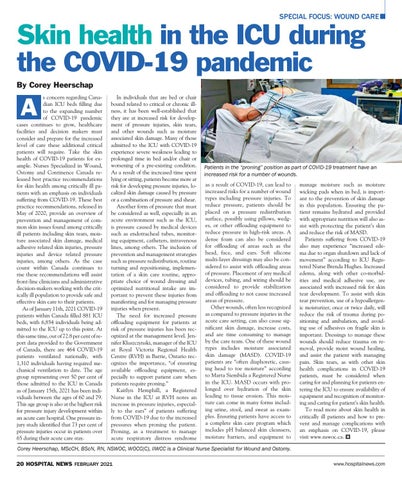
In individuals that are bed or chair bound related to critical or chronic illness, it has been well-established that they are at increased risk for development of pressure injuries, skin tears, and other wounds such as moisture associated skin damage. Many of those admitted to the ICU with COVID-19 experience severe weakness leading to prolonged time in bed and/or chair or worsening of a pre-existing condition. As a result of the increased time spent lying or sitting, patients become more at risk for developing pressure injuries, localized skin damage caused by pressure or a combination of pressure and shear. Another form of pressure that must be considered as well, especially in an acute environment such as the ICU, is pressure caused by medical devices such as endotracheal tubes, monitoring equipment, catheters, intravenous lines, among others. The inclusion of prevention and management strategies such as pressure redistribution, routine turning and repositioning, implementation of a skin care routine, appropriate choice of wound dressing and optimized nutritional intake are important to prevent these injuries from manifesting and for managing pressure injuries when present. The need for increased pressure offloading equipment for patients at risk of pressure injuries has been recognized at the management level. Jennifer Kluszczynski, manager of the ICU at Royal Victoria Regional Health Centre (RVH) in Barrie, Ontario recognizes the importance, “of ensuring available offloading equipment, especially to support patient care when patients require proning.” Kaitlyn Hemphill, a Registered Nurse in the ICU at RVH notes an increase in pressure injuries, especially to the ears” of patients suffering from COVID-19 due to the increased pressures when proning the patient. Proning, as a treatment to manage acute respiratory distress syndrome
Patients in the “proning” position as part of COVID-19 treatment have an increased risk for a number of wounds. as a result of COVID-19, can lead to increased risks for a number of wound types including pressure injuries. To reduce pressure, patients should be placed on a pressure redistribution surface, possibly using pillows, wedges, or other offloading equipment to reduce pressure in high-risk areas. A dense foam can also be considered for offloading of areas such as the head, face, and ears. Soft silicone multi-layer dressings may also be considered to assist with offloading areas of pressure. Placement of any medical devices, tubing, and wiring should be considered to provide stabilization and offloading to not cause increased areas of pressure. Other wounds, often less recognized as compared to pressure injuries in the acute care setting, can also cause significant skin damage, increase costs, and are time consuming to manage by the care team. One of these wound types includes moisture associated skin damage (MASD). COVID-19 patients are “often diaphoretic, causing head to toe moisture” according to Marta Siembida a Registered Nurse in the ICU. MASD occurs with prolonged over hydration of the skin leading to tissue erosion. This moisture can come in many forms including urine, stool, and sweat as examples. Ensuring patients have access to a complete skin care program which includes pH balanced skin cleansers, moisture barriers, and equipment to
manage moisture such as moisture wicking pads when in bed, is important to the prevention of skin damage in this population. Ensuring the patient remains hydrated and provided with appropriate nutrition will also assist with protecting the patient’s skin and reduce the risk of MASD. Patients suffering from COVID-19 also may experience “increased edema due to organ shutdown and lack of movement” according to ICU Registered Nurse Brenda Hughes. Increased edema, along with other co-morbidities and medical adhesive use, are associated with increased risk for skin tear development. To assist with skin tear prevention, use of a hypoallergenic moisturizer, once or twice daily, will reduce the risk of trauma during positioning and ambulation, and avoiding use of adhesives on fragile skin is important. Dressings to manage these wounds should reduce trauma on removal, provide moist wound healing, and assist the patient with managing pain. Skin tears, as with other skin health complications in COVID-19 patients, must be considered when caring for and planning for patients entering the ICU to ensure availability of equipment and recognition of monitoring and caring for patient’s skin health. To read more about skin health in critically ill patients and how to prevent and manage complications with an emphasis on COVID-19, please H visit www.nswoc.ca. ■
Corey Heerschap, MScCH, BScN, RN, NSWOC, WOCC(C), IIWCC is a Clinical Nurse Specialist for Wound and Ostomy. 20 HOSPITAL NEWS FEBRUARY 2021
www.hospitalnews.com
SPECIAL FOCUS: WOUND CARE
Scientists discover key enzyme responsible for skin blistering in the elderly By Vivian Sum and Sarah Ripplinger tions that affect our most vulnerable populations.” Common blisters – the separation of layers of skin and accumulation of fluid – are caused by friction or sunburn. In the case of PDs, blisters can spontaneously appear all over the body. These conditions can be very disfiguring and significantly reduce quality of life. The most common autoimmune blistering disease, bullous pemphigoid, affects mainly the elderly, and may be associated with age-related neurologic conditions, as well as the use of newer psychotropic drugs, checkpoint inhibitors for cancer and dipeptidyl peptidase IV (DPP4i) inhibitors for diabetes. “Given that there is currently no cure for pemphigoid diseases, the need for better treatments to care for affected individuals will continue to grow in the coming years as our population ages.”
he Granzyme B (GzmB) enzyme has been identified as a driver of itchy and sometimes life-threatening pemphigoid diseases (PDs): autoimmune conditions that cause blistering and skin erosion that originate below the skin’s surface. New research led by Vancouver Coastal Health Research Institute (VCHRI) scientist Dr. David Granville has found that a gel containing a specific and potent inhibitor of GzmB activity, VTI-1002, resulted in significant skin improvements. “Granzyme B is a destructive enzyme that accumulates in certain tissues as we age,” says Granville. “While we know that environmental factors that accelerate tissue aging, such as chronic smoking or sunlight exposure, can drive the production of this enzyme, the current study identifies its role in autoimmune blistering condi-
T
PureWick
RESEARCH IDENTIFIES A NOVEL TREATMENT FOR THE MOST COMMON AUTOIMMUNE BLISTERING DISEASES. Published in Nature Communications in January 2021, Granville’s study examined the topical application of the GzmB inhibitor VTI-1002 gel on skin affected by PDs. GzmB is naturally produced by immune cells in the body and plays a role in helping to eliminate unwanted cells. However, in certain conditions, GzmB escapes from these cells into the extracellular space where it accumulates and eats away at structural proteins that hold the skin together. In the case of PDs, GzmB accumulates in the blister fluid and surrounding tissues, cleaving key proteins that
anchor the top layer of skin (epidermis) to the bottom layer (dermis), which leads to skin separation and blistering. For Granville’s study, lead investigator and post-doctoral fellow in Granville’s laboratory, Dr. Sho Hiroyasu, found that inhibiting GzmB reduced blistering by approximately 50 per cent in three different PD models. Research results also showed that the GzmB-inhibiting gel protected the structural integrity of the skin and reduced inflammation.
®
Continued on page 23
Now Av ai for Hom lable e Use!
female external catheter Do you have a patient who is a good candidate? ☑ Patient requiring urine output monitoring but does not meet indications for indwelling Foley catheterization
☑ Urinary incontinence and/or frequent urination
☑ Skin injury or irritation related to urinary
☑ Post-surgical or procedure immobility ☑ Bedrest orders ☑ Difficulty walking from bed or chair to toilet ☑ Difficulty using a bedpan
incontinence or diapers
Visit www.PureWickAtHome.ca or call: 1-800-387-9473 for more information www.hospitalnews.com
FEBRUARY 2021 HOSPITAL NEWS 21
SPECIAL FOCUS: WOUND CARE
Specialized wound care nurses provide life changing care By Diana Rinne t’s not easy for Val Blain to talk about her ostomy. Like many who have a surgically-created opening (stoma) on the abdomen through which body waste material is collected in an exterior pouch, Blain keeps that part of her life rather private. “It’s not a topic we discuss with everybody,” she says. “For those of us like myself, it’s a soft subject.” But it’s a subject that needs to be talked about particularly when there are issues. For Blain and many others across the North Zone, that’s where Alberta Health Services Nurses Specialized in Wound, Ostomy and Continence (NSWOC) enter the picture. The North Zone has three NSWOCs located in Fort McMurray, Onoway and Grande Prairie, each covering a wide area of the zone. Michelle Rose is the NSWOC based in Onoway. She’s seen a lot of change since she began here back in 2009. “The need and types of patients we see has grown so much,” she says. “When I started out in homecare in Onoway, I did have a few patients who struggled with ostomies and their only option was to go to back to Edmonton and they were waiting so long,” she adds.
I
North Zone patient Val Blain (top left) solved an ostomy issue that had plagued her for more than 20 years with the help of Fort McMurray’s Michelle Sierink (top right), one of the Nurses Specialized in Wound, Ostomy and Continence (NSWOC) in the North Zone, who cares for patients in the eastern region. Other NSWOC nurses include Colette Smith (lower left), who’s based in Grande Prairie and serves the western region, while Michelle Rose (lower right), is based in Onoway and serves the central region. Colette Smith, based in Grande see elderly people and they don’t really Prairie, was a staff nurse on a surgical understand,” says Rose. “Our patients ward when she decided to enter the can be very young to very elderly peoNSWOC program. “Ostomy was defiple. We see lots of patients with chronnitely my first love, and that’s what got ic wounds, which means their wounds me into the program,” she says. She have been there for quite a long time, received her certification in 2003 and or maybe healing hasn’t happened as has served in her position since 2007. expected.” While Sierink, Rose and Smith do in-person visits their respective comCOLLABORATION WITH OTHER munities, they also do a lot virtual conHEALTHCARE PROFESSIONALS SUCH sultations via phone and email due to AS HOME CARE NURSES, DIETITIANS the vast geography of the North Zone. Patients are referred to the three NSOR OCCUPATIONAL THERAPISTS IS WOCs through Continuing Care AcA BIG PART OF THE JOB. cess (CCA), as well as by physicians, other healthcare professionals and self-referrals from patients with ostomy concerns. Michelle Sierink, who’s based iFort Having specialized nurses like her“We look at photos and videos and McMurray, went back to school at age self in the North Zone allows for patalk with the patient and the nurse on 48 to gain her NSWOC specialization tients to get the care they need in hand,” says Sierink. “With ostomies, when she saw how many people in her their own community, whether that there are so many reasons why a percommunity struggle with their wound be in person or through consultation son can have issues, so there are a lot care and ostomies. “My biggest concern with their regional NSWOC and local of questions. We work with the patient is for ostomy patients,” she says. “When healthcare staff. to find out what’s going on. There‘s a they have issues, it really affects their “Often, when I try to explain to lot of investigating.” lives. They don’t leave their homes.” people what I do, they think we just
Collaboration with other healthcare professionals such as home care nurses, dietitians or occupational therapists is a big part of the job. For example, the home care team in St. Paul connected Blain with Sierink when she broke her shoulder and had concerns about how she would handle her ostomy. “St. Paul home care nursing was the best bar none,” says Blain. “They are caring, compassionate and very helpful – and I’m a very shy person when it comes to my ostomy.” Working with home care and Sierink, it was determined that one of Blain’s issues was an allergy to the glue used to keep her appliance in place. “It was totally through the efforts of the home care personnel and my nurse (Sierink) that I was able to be completely cured of my allergy that I’d had for over 20 years,” she says. “Having someone I can talk to – that I don’t have to feel uncomfortable talking to about this stuff – makes all the difference.” Making that difference is easily one of the most satisfying parts of the job for all three nurses. “It’s kind of funny how it can be so intense and you’re talking to patients daily,” says Rose. “And then, once things are better, you let them go on their own and you don’t hear from them. But they know if they have a problem, you’re there.” Smith agrees: “It’s the patients. I’ve met so many wonderful people. Seeing someone from day one, and then you see them months later, or even sometimes years later, you don’t realize the impact that you’ve had on people at that point in their lives. It’s a privilege to be part of their journey.” “Some say we’ve changed their lives,” adds Sierink. “We do change lives depending on how much the patient wants to be involved in their health. It’s really up to the patient to H move forward.” ■
Diana Rinne works in communications at Alberta Health Services. 22 HOSPITAL NEWS FEBRUARY 2021
www.hospitalnews.com
SPECIAL FOCUS: WOUND CARE
Scientists discover key enzyme
Dr. David Granville
Continued from page 21 The current treatment for PDs is topical or oral corticosteroids. Often associated with severe side effects and occasionally mortality, they also contribute to skin thinning and impaired healing, both of which are already problematic among elderly individuals. Treatments are therefore needed that do not exacerbate these conditions. “While several studies have investigated how to target and block other enzymes that may lead to PDs, our Granzyme B-blocking VTI-1002 gel reduced both the inflammation and disruption of the skin layers that contribute to blistering,” notes Granville. One reason for the effectiveness of blocking GzmB is that, unlike other
proteases – enzymes that can break down proteins in the body – there are no inhibitors to prevent GzmB activity outside of cells, Granville explains. So when GzmB accumulates over time
due to chronic inflammation, the body lacks a natural defense mechanism to rein it in. “Our study results show great promise for GzmB inhibition,” says
Granville. “A GzmB-blocking gel could be used as a safer, more targeted alternative for treating autoimmune blistering and other inflammatory skin H diseases.” ■
Vivian Sum and Sarah Ripplinger on behalf of the Vancouver Coastal Health Research Institute.
Effective off the shelf pressure relief and off-loading Excellent comfort for patients and outstanding results!
+
APB™ All Purpose Boot The APB™ embodies nearly perfect four season postoperative protection with a closed-toe design that keeps dressings and toes warm and dry. Compatible with: PQ PegAssist™
WCS™ Open-Toe & Closed-Toe The WCS™ Wound Care Shoe System is the product of choice when dealing with lesions through Wagner
Off-loading, Wound Care Shoes
WCS™ APB™ All Purpose Boot PegAssist™
Order from Ashcon International Inc. Today! 4-3425 Laird Road • Mississauga, ON L5L 5R8 Phone: 905-569-2300 • Fax: 905-569-2301 Email: sales@ashcoint.com www.ashconmed.com www.ebuyashconmed.com
Grade 3 ulcerations. The four multi-density insoles can be modified, effectively decreasing pressure from
Product Tutorial Videos Available
the plantar aspect of the foot.
www.darcointernational.com
NURSING PULSE
From calm to
chaos By Kimberley Kearsey
obin Morash has been honing her skills as a nurse manager since 1989. You could say her 30+ years of experience motivating and leading others is what pulled her back to the frontlines in March 2020, almost two years after retiring. An advanced practice nurse in uro-oncology when she decided to embark on a new life chapter in June 2018, Morash didn’t hesitate to call her former employer – The Ottawa Hospital – when she heard it was looking for help amidst an emerging global pandemic. She “was hired within three hours, and was back to work within a week.” Morash is one of four managers (the other three also came out of retirement) at an Ottawa COVID-19 assessment centre, set up in Brewer Pool and Arena, home to one ice surface and an outdoor ice oval. “I’ve always enjoyed being part of something new,” she says. “We’ve never done this before.” The mother of two sons, 24 and 26, says she’s been asked a few times how long she thinks she’ll “stick it out” (not by her children though, who are very supportive of her return to work). She isn’t planning to return to retirement any time soon. “I feel a sense of camaraderie and obligation first of all to my team, and then to my community. Unless something becomes untenable or I really can’t do the work anymore, I’ll stick this through until we figure out where we’re headed from an ongoing testing perspective.” Trading the calm and tranquility of retirement for an extremely busy and sometimes tense COVID-19 assessment centre – filled with mostly fearful people uncertain of their diagnosis and the consequences of a positive test – hasn’t been as difficult as some might think. In fact, Morash says the experi-
R
ence has been one of her “most interesting from the perspective of working with a community of people.” “We’ve got staff from The Ottawa Hospital…the Children’s Hospital of Eastern Ontario…our Extreme Clean Company (which includes hotel workers, teachers, hairdressers and students caught up in this mess) …physicians… nurses from community health centres…because some of their clinics closed down…(and) people who work for the City of Ottawa and are maintaining our facilities,” she explains. “Having all these different people in a community team…it’s really good and exciting.” Looking back at the early years of her career, Morash remembers just how important it was for her as a new grad to have a good core team of colleagues. Right out of the gate, the young RN started in a field that might put the confidence of even some seasoned RNs to the test. Her first two years of frontline nursing were at Toronto General Hospital as a staff nurse in surgical oncology. “In those days, many people came in…for palliative treatment,” she recalls, noting only about half were there for curative surgery. “We didn’t see people living long lives in the community. Back then, we all thought cancer was a death sentence.” The role wasn’t for the faint of heart, but Morash says her closest colleagues – and an exceptional social worker who offered support to patients and staff alike – helped her through the tough days, and supported her as she built the skills and confidence that would carry her through the rest of her career. Morash always had a dream to work in critical care. She was hired by The Ottawa Hospital to do just that in 1985, but was disappointed when
RETIRED ADVANCED PRACTICE RN ROBIN MORASH GIVES UP RETIREMENT TO HELP DURING A GLOBAL PANDEMIC. the offer was withdrawn because she didn’t have critical care experience. That disappointment made the move to Ottawa somewhat unpleasant at first, she says, but she was able to get past it quickly. In fact, it led her to vascular surgery, which was a perfect fit. “The nurses…had critical care training because they went up to recovery and recovered their own patients,” she says, and she was able to get the experience she was looking for. An opportunity in critical care presented itself four years later, and the move may have seemed like a no-brainer, but that’s not what happened. In fact, Morash was convinced to pursue a management role instead. She was 28 and took the lead as a clinical manager in 1989. For Morash, deciding to pursue nursing back in Grade 13 wasn’t linked to anything particularly altruistic. After conversations with a few professors and family members in the health field, she developed an understanding of the opportunities she would have in
nursing. And those opportunities have been diverse through the years. She started in oncology as a new grad, and went back to it in 2007 as manager in a regional oncology program based at The Ottawa Hospital. Five years later, she became an advanced practice nurse with bladder cancer patients, the role she retired from. “Incident command” is printed on the nametag Morash wears during each 12-hour shift at the COVID-19 assessment centre. She’s still an employee of The Ottawa Hospital, but works at a centre that saw 200 people each day when it first opened, and reached a peak of 1,450 with the second wave of the virus hitting Ottawa hard. One day in early October, “we put through 1,100.” Compared to the work she’s done throughout her career, “It’s a different kind of challenging,” Morash says. “It’s using the same skill set in a different way. Everything I’ve done in my career has provided a foundation for this type H of work.” ■
Kimberley Kearsey is managing editor for RNAO. 24 HOSPITAL NEWS FEBRUARY 2021
www.hospitalnews.com
16th Annual Hospital News
NURSING HERO AWARDS
NOMINATE G N I S R U N A
! O R E H Celebrating Canada’s Nursing Heroes +DYH \RX EHHQ LQVSLUHG HQFRXUDJHG RU HPSRZHUHG E\ DQ HPSOR\HH RU D FROOHDJXH" +DYH \RX RU \RXU ORYHG RQH EHHQ WRXFKHG E\ WKH FDUH DQG FRPSDVVLRQ RI DQ RXWVWDQGLQJ QXUVH" 'R \RX NQRZ D QXUVH ZKR KDV JRQH DERYH DQG EH\RQG WKH FDOO RI GXW\" +RVSLWDO 1HZV ZLOO RQFH DJDLQ VDOXWH QXUVLQJ KHURHV WKURXJK RXU DQQXDO 1DWLRQDO 1XUVLQJ :HHN 0D\ WK WR WK FRQWHVW 1RPLQDWLRQV FDQ EH VXEPLWWHG E\ SDWLHQWV RU SDWLHQWҋV IDPLO\ PHPEHUV FROOHDJXHV RU PDQDJHUV
Please submit your nursing hero stories by April 9th and make sure that your entry contains the following information:
• Full name of the nurse • Facility where he/she worked at the time ‡ <RXU FRQWDFW LQIRUPDWLRQ ‡ 6SHFLÀF H[DPSOHV RI \RXU QRPLQHH JRLQJ DERYH DQG EH\RQG Along with having their story published, the winner also will take home:
CASH PRIZES: 1st PRIZE $1,500 2nd PRIZE $1000 3rd PRIZE $500 3OHDVH HPDLO VXEPLVVLRQV WR HGLWRU#KRVSLWDOQHZV FRP RU PDLO WR +RVSLWDO 1HZV $SSOHZRRG &UHVFHQW 6XLWH 9DXJKDQ 21 / . (
,I \RX GR QRW UHFHLYH FRQÀUPDWLRQ ZLWKLQ KRXUV RI HPDLOLQJ \RXU QRPLQDWLRQ SOHDVH IROORZ XS DW HGLWRU#KRVSLWDOQHZV FRP
LONG-TERM CARE NEWS
Collective action for pandemic response in long-term care By Jennifer Zelmer and Julie Weir espite best efforts, the long-term care (LTC) sector has been devastated by outbreaks of COVID-19. LTC residents accounted for 80 per cent of early COVID-19 related deaths in the country and continue to bear the brunt of the pandemic. Vaccines offer hope but are not a panacea. It’s imperative we respond in real time, matching the speed and effectiveness of our response to the scale of the challenge and the rapidity with which the virus, science, and pandemic status are evolving. While the challenges facing each home vary, there are common threads. Working
LONG-TERM CARE AND RETIREMENT HOMES FROM ACROSS THE COUNTRY ARE WORKING HARD TO RESPOND TO COVID-19. THE SCALE OF THE CHALLENGE CALLS FOR COLLECTIVE ACTION, NOT JUST INDIVIDUAL RESPONSE, AND LTC+ TEAMS ARE COMING TOGETHER TO SHARE WITH AND LEARN FROM EACH OTHER.
D
together, we can share resources and learning, insight, foresight – as well as offer mutual support. Nearly 400 LTC and retirement homes from all parts of the country have already joined together to respond via LTC+: Acting on Pandem-
ic Learning Together. Reducing the risk of outbreaks is, of course, a focus, but so is addressing the unintended consequences of pandemic response. Teams are focusing on promising practices in six areas: preparation, prevention, people in the workforce,
pandemic response and surge capacity, planning for COVID-19 and non-COVID-19 care, and the presence of family. They can access up to $10,000 in funding to strengthen their pandemic preparedness and response, dedicated coaching with quality improvement and change management experts, as well as peerto-peer support and virtual learning opportunities. In addition to connecting evidence with care delivery, the LTC+ program is generating new insights to refine future responses. To do so, it is backed by 14 implementation science research teams who are helping to integrate improvements into everyday practice.
Care after hospitalization
about where to turn, how to cope and where to get help. can be an overwhelming process. Our goal is to ensure that feel most comfortable – home.
Support is just a phone call away.
1.877.289.3997 clientservice@bayshore.ca
bayshore.ca 26 HOSPITAL NEWS FEBRUARY 2021
www.hospitalnews.com
LONG-TERM CARE NEWS
The researchers are working with a subset of the LTC+ homes to generate evidence on what interventions are most effective, in what settings and contexts, and why. Their findings will help focus efforts now and spread and scale the most effective approaches in the future, recognizing that many of the issues highlighted by the pandemic are not new and will require sustained attention. Teams that join LTC+ are not just joining a program, they are joining a community that shares challenges and
Jennifer Zelmer
Julie Weir
an ultimate goal to protect their residents, and those who care for them, while continuing to deliver safer, high quality care. With additional investment from the Government of Canada and the CMA Foundation, LTC+ aims to expand to support up to 1,000 homes.
LTC+ is being delivered by the newly amalgamated organization that brings together the Canadian Foundation for Healthcare Improvement and Canadian Patient Safety Institute. LTC+ is supported by partners, including the BC Patient Safety and Quality Council, New Brunswick
Association of Nursing Homes, Manitoba Institute for Patient Safety and CADTH, and with funding support from the CMA Foundation. The implementation science teams are funded by partners the Canadian Institutes of Health Research, New Brunswick Health Research Foundation, Saskatchewan Health Research Foundation, Centre for Aging + Brain Health Innovation and Michael Smith Foundation for Health Research. For more information, visit www. H cfhi-fcass.ca/LTC â–
Jennifer Zelmer is President and CEO of the newly amalgamated organization that brings together the Canadian Foundation for Healthcare Improvement and Canadian Patient Safety Institute. Julie Weir is Nurse Manager, Infection Prevention and Control, Horizon Health Network and Clinical and Care Consultant with the New Brunswick Association of Nursing Homes.
Do you know a spectacular unpaid caregiver? Nominate them for the Heart of Home Care Awards! Each year, VHA Home HealthCare recognizes the true heart and soul of home care – the family members and friends caring for people living with chronic disability and disease. Visit www.vha.ca/hohc to nominate an amazing Ontario non-professional caregiver before February 12, 2021!
www.hospitalnews.com
FEBRUARY 2021 HOSPITAL NEWS 27
EVIDENCE MATTERS
Considering the place of codeine in the treatment of osteoarthritis pain By Barbara Greenwood Dufour steoarthritis is the most common joint disease in older adults. It’s estimated that by 2035, one in four Canadians will have been diagnosed with it. Osteoarthritis causes chronic pain and stiffness, and it’s a progressive illness for which there is no cure. Therefore, the goal of treatment is to control the associated joint pain and improve function and mobility. Nonpharmacological options can be tried early in the disease (e.g., exercise, massage therapy, and heating pads or ice packs). But over time, as the severity of the osteoarthritis pain and functional impairment changes, pharmacological treatments are usually added – commonly acetaminophen or non-steroidal anti-inflammatory drugs (NSAIDs) such as ibuprofen. When the pain increases to the point that it can’t be adequately relieved by NSAIDs or acetaminophen, a weak opioid like codeine is sometimes prescribed. Codeine, available in tablet and liquid formulations, can be administered alone or as a single combination product (e.g., codeine with acetaminophen and caffeine). Though codeine is weaker than some other opioids, there’s concern over its potential to cause a range of adverse events in some patients – including drowsiness, nausea, constipation, respiratory depression, as well as addiction. You may be aware that, after reports of codeine leading to serious adverse events in children (including death), various health organizations around the world warned against its use in pediatric patients. Codeine relieves pain when the body metabolizes it into morphine, and children who are ultra-rapid metabolizers tend to metabolize codeine too quickly, putting them at a high risk of adverse events. Although codeine appears to be well tolerated in some adults, there can be variation in the ability of adults to metabolize it as well. Some adults
O
might metabolize codeine too quickly, resulting in an adverse event; while others might metabolize codeine poorly and find that, as a result, it doesn’t control pain well. Adverse events are a concern for this latter group too, as they may accidentally experience one as they take increasing amounts of codeine to try and manage their pain. To find out what the research says about the effectiveness of, and the risks associated with, codeine for osteoarthritis pain, CADTH reviewed the available research evidence on this topic. CADTH is an independent agency that finds, assesses, and summarizes the research on drugs, medical devices, tests, and procedures. CADTH looked for studies specifically on codeine for managing pain from osteoarthritis of the knee or hip (though osteoarthritis can also affect other joints such as the hands, big toes, and spine). Three randomized controlled trials and one systematic review with meta-analyses (reporting on the same three randomized controlled trials) were found. One trial looked at codeine alone (as a controlled-release
tablet), the second at codeine plus ibuprofen, and the third at codeine plus acetaminophen. In the randomized controlled trials, one of the effectiveness outcomes was measured by whether patients needed to receive a “rescue” treatment to get their pain under control. The rescue treatment was acetaminophen in the codeine-only and codeine-plus-ibuprofen studies, and ibuprofen in the codeine-plus-acetaminophen study. The codeine-only study found codeine to be effective (reduced the need for a rescue medication), but the other two studies didn’t find that codeine plus acetaminophen or ibuprofen was effective in reducing the need for a rescue medication. However, the systematic review that assessed the pooled results from all three studies concluded that codeine might provide a moderate benefit in terms of osteoarthritis knee or hip pain and function. Despite the mixed results in terms of the effectiveness of codeine for managing osteoarthritis pain, all three studies found that patients taking it were at a higher risk of adverse events – typically nausea and constipation. Pooled findings from the systematic
review suggest that research study participants were more likely to withdraw from a study because of adverse events if they were in the group receiving treatment with codeine. Interestingly, although health organizations have warned against codeine use in certain populations because of the risk of respiratory depression, none of these studies reported on this safety outcome. So, we don’t know how many participants, if any, experienced respiratory depression. It’s not clear how we can apply this research to clinical decision-making for treating osteoarthritis pain. None of the studies lasted beyond four weeks, so they don’t tell us how effective codeine is over time or about its long-term implications in terms of substance dependence, inappropriate prescribing, opioid misuse, and associated harms. In addition, all three studies were conducted more than 20 years ago. No relevant research has been produced recently – this could be because our understanding of how variable codeine’s effect can be from patient to patient makes the medication less attractive for research study, and the unpredictability of the medication might have already made both prescribers and patients more cautious about using it. You can access the full report – Codeine for Pain Related to Osteoarthritis of the Knee and Hip – at cadth.ca. CADTH has also produced reports on a variety of other pain-related topics, which you’ll find at cadth.ca/pain. Follow CADTH on Twitter: @ CADTH_ACMTS or talk to our Liaison Officer in your region: cadth.ca/contact-us/ H liaison-officers. ■
Barbara Greenwood Dufour is a knowledge mobilization officer at CADTH. 28 HOSPITAL NEWS FEBRUARY 2021
www.hospitalnews.com
SAFE MEDICATION
Burnout, well-being, and patient safety By Jia Hui (Jay) Zhao, Rajiv Rampersaud, Christy Mak, and Certina Ho ealthcare can be a very meaningful career, but at times, it can also be a stressful field to work in. What happens when this “stressful” feeling has become too burdensome, to the point when the demands of the job extend beyond your ability to perform in a safe and sustainable manner? Quite often, health care providers can be at risk for burnout.
H
BURNOUT
According to a 2018 study conducted using the Maslach Burnout Inventory Human Services Survey (MBI-HSS) in the United States, more than 50 per cent of health-system pharmacists reported that they were at risk for burnout. In another 2018 national survey published by the Canadian Medical Association, it was found that 30 per cent of physicians experienced burnout. Burnout can be characterized by: (1) emotional exhaustion where emotional resources are drained and no longer emotionally available; (2) depersonalization where negative and cynical attitudes are developed towards your job; and (3) reduced personal accomplishment where healthcare providers feel unsatisfied and unhappy about their job. There are different instruments that one can use to measure burnout and the MBI-HSS is a very commonly used tool in health professions. Healthcare provider burnout may be a consequence of several factors, ranging from individual, organiza-
tional, and environmental. Using community pharmacy practice as an example, from an individual perspective, a lack of control over stressful working conditions, including long hours and heavy workloads, may lead to burnout. At an organizational level, the administrative or managerial expectations to meet billing quotas for clinical and/or professional services may increase the rate at which burnout occurs. Lastly, environmental factors, such as new or revised reimbursement models (e.g. drug plan or insurance coverage changes for medications and/or medical devices), may create additional stress for pharmacy professionals who are often tasked with understanding and clarifying the details of insurance or third-party drug/device coverage to patients. With all these demands in mind, it is evident that healthcare providers (e.g. pharmacists) may face many challenges that may limit their ability to carry out their core responsibility of providing patient-centred care, and ultimately lead to burnout.
IMPACT OF BURNOUT ON PATIENT SAFETY AND HEALTHCARE SYSTEM
Burnout has an extensive impact on the individual and those around them. Individuals who experience burnout may endure depression, strained relationships, substance use disorders, or suicidal ideation. In addition to the impact on personal well-being, healthcare provider burnout is often associ-
ated with increased medical errors and poor quality of patient care. In fact, a 2016 study published by the Canadian Pharmacists Journal found that community pharmacists who were expected to meet monthly billing quotas for professional services reported a substantial negative impact on their perceived patient safety in practice. On the other hand, burnout also creates an economic burden on the healthcare system. According to a 2014 publication, the total cost of burnout was estimated to be over $200 million, most of which was attributed to early retirement and reduced clinical hours from Canadian physicians. Overall, the impact of healthcare provider burnout on productivity, efficiency, quality, and patient safety of the healthcare system cannot be underestimated.
WELL-BEING
Early identification of deteriorating mental and physical health can facilitate timely interventions to minimize the impact of burnout to healthcare providers’ competence, professionalism, career satisfaction, and their quality and safety of patient care. Therefore, monitoring and supporting the overall well-being of healthcare professionals is essential, as well-being encompasses not only the negative elements (such as burnout), but also positive elements, for instance, engagement, happiness, quality of life, and physical health of an individual. Similar to the measurement of burnout, there are various tools and
resources where one can use to measure well-being. The 5-item World Health Organization Well-Being Index (WHO-5), a short, self-administered survey that has been translated into more than 30 languages, is likely the most widely used instrument for assessing individual well-being across the world. It may be quite challenging for healthcare professionals to address burnout in a systematic approach, especially when they are confronted with multiple competing priorities within a complex healthcare system. In 2019, Deloitte Insights shared “a blueprint for workplace mental health programs” where return on investment (ROI) in overall employee well-being (to minimize burnout) can be realized through certain organizational initiatives, such as, having managers/leaders listening to the needs of employees, implementing resilience and mindfulness training, and providing sufficient support to promote positive cultural change, etc. Other potential ROI in workplace mental health programs or cost saving benefits may include improved staff retention rates, stronger talent attraction/recruitment, and more effective risk management. As healthcare professionals, it is important that we take care of our own well-being and also recognize the potential contributing factors and risks for burnout, so that we can be diligent and consistently provide quality and H safe patient care. ■
Jia Hui (Jay) Zhao and Rajiv Rampersaud are PharmD graduates at the Leslie Dan Faculty of Pharmacy (LDFP), University of Toronto; Christy Mak is a PharmD student at the LDFP, and Certina Ho is an Assistant Professor at the Department of Psychiatry and the LDFP, University of Toronto. www.hospitalnews.com
FEBRUARY 2021 HOSPITAL NEWS 29
ETHICS
Vaccine hesitancy and healthcare hesitancy By Claudia Barned n Dec 2020, provinces moved swiftly to roll out the Pfizer vaccine amongst healthcare workers and other prioritized groups. Government officials, bioethicists, and other healthcare professionals strategized on how to fairly distribute the vaccine. Despite this, there are numerous equity concerns regarding its allocation, prioritization and access within and across hospitals and care facilities. As decision-makers continue to strategize the now dual vaccine (Pfizer and Moderna) rollout, there are larger concerns regarding vaccine hesitancy. There is need for much pause and reflection here as this begs the question: what good is a rollout plan if a large percentage of the population refuses to take the vaccine? Vaccine hesitancy and public trust are major themes raised in conversations concerning the current rollout. Reports reveal that less than half (43%) of the 3000 workers in city-owned homes across Toronto have received the first dose or given consent for the vaccine (in comparison to the 91 per cent of long-term care residents who have taken the vaccine). The lack of uptake suggests a deeper, more significant issue at hand, one that must be addressed if widespread uptake is the aim. Hesitancy amongst healthcare workers who identify as Black, Indigenous or People of Colour (BIPOC) has not received sufficient attention, despite its far-reaching implications. As COVID-19 continues to disproportionately impact BIPOC communities in many countries, there have been numerous calls for meaningful engagement and consultation with the BIPOC community. Some healthcare workers have taken to publicizing their inoculation through social media posts, with the aim of showing solidarity in efforts to fight the spread. While it is somewhat encouraging to see vaccine selfies floating around social media, there will likely be a rise in vaccine hesitancy amongst the healthcare workforce if culturally sensitive materials directed toward the BIPOC community are missing.
HESITANCY AMONGST HEALTHCARE WORKERS WHO IDENTIFY AS BLACK, INDIGENOUS OR PEOPLE OF COLOUR (BIPOC) HAS NOT RECEIVED SUFFICIENT ATTENTION, DESPITE ITS FAR-REACHING IMPLICATIONS.
I
Vaccine hesitancy for some BIPOC members is simply a small component of what I’d like to term “healthcare hesitancy”. For racialized people, healthcare experiences are often accompanied by experiences of bias, discrimination and racism. After prolonged exposure to this, one becomes less trusting of the healthcare system. In fact, for some members of these communities, health recommendations are routinely read and interpreted with much scrutiny and anxiety. The violent atrocities committed against Canada’s Indigenous peoples provides a basis for why we must engage with BIPOC communities and address fears concerning the vaccine. Admittedly, the difficulty with this relates to uncertainty surrounding the long-term effects of the vaccine. It is likely that the concerns relayed and questions posed might be met with no definitive answers; and in a time in which there are multiple restrictions on one’s freedom (much of which is experienced differently for those whose lived realities already include marginalization), it is likely that the decision to take the vaccine is weighed within the context of the need to preserve one’s autonomy and the few aspects of one’s life that is seemingly in one’s control. In an era in which hospitals and other healthcare institutions are establishing anti-black racism and/or anti-racism policies, it’s important to acknowledge how unsafe hospitals are for racialized people. There are members of the community who, at times, would rather endure pain than open the doors to any hospital building. For as long as this vaccine remains voluntary, it is likely that members of the BIPOC community will watch, observe and gather as much information as they can before rolling up their sleeves. Healthcare hesitancy has contribut-
ed to this, so too has the deep-seated history of abuse and experimentation experienced by racialized groups. In case we have forgotten about the deep history of racist treatment and medical experimentation that Black and Indigenous people across North America were subjected to, perhaps a quick recap is necessary. Most would have read about the atrocities perpetrated against the 400 Black men in Tuskegee, Alabama who were unknowingly enrolled as experimental subjects in a 40 year Syphilis study because the United States Government, and Public Health Service wanted to study the effects of untreated Syphilis. Advances in gynecology are linked to vile forms of experimentation on Black women – the version of the speculum most commonly used in OBGYN is credited to James Marion Sims who improved this device for the treatment of vesicovaginal fistulas at the painful expense of several Black women to whom he performed countless procedures without the use of anesthesia. Henrietta Lacks, a Black woman whose cancer cells were taken for further study without her consent, and were used to create the first immortalized human cell line. Many scientific advances (e.g. polio vaccine) are due to experimentation with her cell line, widely known as HeLa cells. In Canada, we need to look no further than the decades-long medical experimentation and abuse inflicted upon Indigenous youth in Canadian residential schools and sanatoriums without their consent. From the 1930’s to the 1970’s, Canada subjected Indigenous people to cruel medical procedures and experiments including but not limited to: skin graft testing, vaccine experimentation, nutrition experiments, and dental observations amongst other violent acts. Breakthroughs from the copious medical
testing and research done on aboriginal children were later used to treat the wider Canadian population, yet these same medicines were withheld from them. Despite this history, these larger sociocultural impacts are not widely taken up in contemporary discourse pertaining to COVID-19 vaccine hesitancy. Government focused research excludes this as well; for example, a recent Statcan COVID-19 study examined Canadian willingness to get a COVID-19 vaccine by exploring group differences and reasons for vaccine hesitancy. Several sociodemographic factors were explored including: age, education, employment status, marital status, immigrant status and region of residence, yet, race; a factor likely to impact how vaccines are viewed, was not examined. This is astounding, especially when compared to the U.S. National Institute of Health (NIH), whose Institute on Minority Health and Health Disparities issued a funding opportunity to address vaccine hesitancy, uptake and implementation among populations that experience health disparities. This type of awareness and acknowledgment is necessary in the Canadian context as well – where are the funding opportunities and research efforts dedicated to exploring these issues here? If we are to be true to values such as equity, justice, transparency, and accountability, then we must ensure that we are attentive to the needs of all, especially those who have been underserved, underrepresented, and historically silenced. What is needed is cultural compassion, understanding and culturally sensitive materials, education, and engagement that include workarounds for BIPOC groups. We cannot put a Band-Aid on what is a deep, open wound for some. What is necessary is debridement (through meaningful, respectful and thorough engagement with communities), sutures and healing – we need to engage with the communities, truly address the histories of abuse and harm and work towards building trust from the ground up before rolling out any plans, H requests or orders. ■
Claudia Barned, PhD, is a Toronto-based bioethicist and an associate research member in the Pragmatic Health Ethics Research Unit at Institute de recherches cliniques de Montreal. 30 HOSPITAL NEWS FEBRUARY 2021
www.hospitalnews.com
NEWS
Start-ups building solutions for aging adults to watch for 2021 By Margaret DeRosia n Fall 2020, the Centre for Aging + Brain Health Innovation (CABHI) launched a Call for Innovations for its Mentorship, Capital and Continuation (MC2) program. MC2 Market Readiness sought early-stage companies creating solutions for aging adults in the healthtech space. The program addresses critical innovation gaps, not only by providing early-stage companies with direct access to two leading global accelerators, CABHI and Berkeley SkyDeck, but also by helping companies unlock funding to achieve their specific business milestones. More than 50 companies applied, which indicates a thriving Ontario healthtech sector invested in building solutions for aging adults. Semi-finalists were invited to pitch last autumn, and now CABHI is proud to announce the program’s six winning companies. They are currently (and virtually) participating in Berkeley SkyDeck, which offers access to the Silicon Valley ecosystem and a Pitch Showcase event, at which CABHI’s innovators may have the opportunity to pitch their solution to world-leading investors, buyers, industry leaders, and advisors. Typically, two out of every three companies that participate in this Pitch Showcase receive venture funding to scale and grow. Meet the six companies below!
I
AXEM NEUROTECHNOLOGY
Axem Neurotechnology’s proprietary system consists of a portable functional near-infrared spectroscopy device paired with tablet-based software. Together, they guide physical rehabilitation to promote the brain’s ability to repair itself. Stroke rehabilitation providers need to improve patient outcomes without exceeding costs, but few effective treatment options are covered by payers. Axem’s technology can help providers better personalize and monitor stroke rehabilitation, which will improve patient outcomes, guide resource allocation, and fit existing reimbursement pathways in the United States, allowing www.hospitalnews.com
for incremental clinic revenue. Axem’s solution strives to enhance the accessibility and efficacy of rehabilitation conducted of older adults in the comfort of their own homes, having the potential to bridge the rural-urban divide in cognitive rehabilitation.
BRAZE MOBILITY INC.
Braze Mobility has created the first blind spot sensor system that turns any wheelchair into a smart wheelchair, automatically detecting obstacles and providing multi-modal alerts to users. The system increases safe and independent mobility, and also widens access to powered mobility devices for those currently excluded due to safety concerns (such as those with vision and/ or cognitive impairment). Through increased spatial awareness and safety, Braze’s product allows older adults with mobility impairment to continue to remain independent and mobile, both at home and in a care setting.
fect the elderly, as pressure-induced symptoms cause extended hospitalization and delays in rehabilitation.
RS1 system can provide timely and reliable biomarker status information with comparable accuracy to the gold standard PET at a fraction of the cost.
RETISPEC
TRUALTA INC.
RetiSpec enables early detection of Alzheimer’s Disease (AD) with accessible and scalable screening. Through a quick eye exam, RetiSpec facilitates timely and accurate diagnosis of AD, which may improve patient outcomes, both now and when effective treatments become available – as early as early 2021, with Biogen’s Aducanamab (under FDA review). Ultimately, an AD diagnosis requires confirming the presence of amyloid beta (Aβ) biomarkers. RetiSpec’s
Trualta is a web-based education platform to help families build skills to manage care at home for a loved one with cognitive decline, Alzheimer’s Disease, or dementia. Trualta partners with social service organizations, healthcare providers, and payers across the US and Canada to provide professional-level educational content and training methodologies for the unH trained, family caregiver audience. â–
Margaret DeRosia is the Senior Communications Specialist, The Centre for Aging + Brain Health Innovation.
Careers www.hospitalnews.com VIEW CAREER ADS AT:
COSM MEDICAL
Cosm Medical has developed a novel and proprietary ultrasound-based measurement system. They are also creating a digital platform by combining it with data science and 3D printing to provide women with gynethotics made for their specific body and needs. Incontinence and prolapse are one of the major leading causes that prevent aging women from being able to live at home. Cosm’s digital urogynecology platform will modernize the business of urogynecology while personalizing care for millions of sufferers, so that more can live and age with dignity and grace.
REHABTRONICS INC.
Rehabtronic’s solution, Prelivia, uses a patented technology called Intermittent Electrical Stimulation (IES). IES induces brief muscle contractions, which actively increases blood circulation and tissue oxygenation that prevents pressure-induced ischemia, deep-tissue injuries, and full-thickness pressure injuries. The product comprises a stimulator and disposable electrodes placed directly on the skin or an optional garment. Rehabtronics aims to address the issue of pressure-induced symptoms that disproportionately af-
We’re Hiring! • Nurses • Personal Support Workers • Therapists 110+ Years
21,000
providing quality expert care
visits per day
97%
of our clients would recommend SE Health to family and friends
6( +HDOWK LV D &DQDGLDQ QRW IRU SURĘƒW KRPH FDUH RUJDQL]DWLRQ 1DPHG RQH RI &DQDGDČ‹V 0RVW $GPLUHG &RUSRUDWH &XOWXUHV :DWHUVWRQH ZHČ‹UH FRPPLWWHG WR VXSSRUWLQJ RXU VWDII DQG UHFRJQL]LQJ WKHLU XQLTXH QHHGV -RLQ RXU WHDP WRGD\ IRU WKH RSSRUWXQLW\ WR OHDUQ JURZ DQG EULQJ KRSH DQG KDSSLQHVV (PSOR\HH 3HUNV DQG %HQHĘƒWV •
2XU ČŠ7RWDO 5HZDUGV DQG 5HFRJQLWLRQČ‹ SURJUDP WKDW LQFOXGHV KHDOWK LQVXUDQFH
•
&RPSUHKHQVLYH SDLG WUDLQLQJ and orientation
•
7XLWLRQ $VVLVWDQFH 3URJUDP DQG EXUVDULHV
•
)OH[LEOH ZRUN KRXUV
•
$ SUHFHSWRU WR KHOS JXLGH \RX RQ WKH MRE WKURXJK WKH ĘƒUVW IHZ ZHHNV DQG EH\RQG
•
(OLJLELOLW\ IRU VXEVLGL]HG 51$2 531$2 PHPEHUVKLSV
Apply now for a full-time, part-time, virtual, hospital, or community role at SE Health.
$SSO\ QRZ DW jobs.sehc.com
FEBRUARY 2021 HOSPITAL NEWS 31
Care that never compromises safety. Put the well-being of residents ďŹ rst with TELUS Smart Building – Care Management. This innovative service allows suites to be monitored for irregular activity levels, and for instant notiďŹ cations to be sent to staff and even family members. And if a resident ever needs assistance, help is only a tap away. Connecting to care has never been simpler.
telus.com/SeniorsLiving