FOREWORD
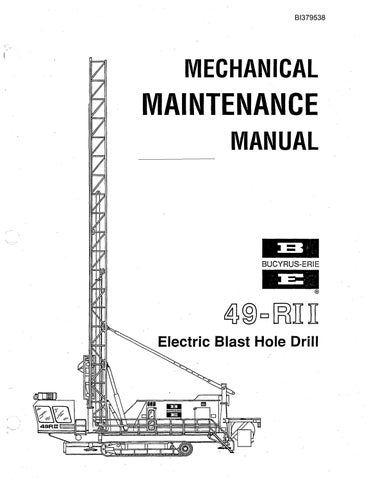
The purpose of this manual is to provide information concerning the general maintenance of the 49-RII Rotary Blast Hole Drill.
The Model 49-RII consists of three major units, the lower works, the mainframe and the mast. The lower works provides a foundation for the mainframe and contains the necessary equipment to propel the drill. The mainframe includes the hydraulic system, main air system, and the machinery house. The machinery house encloses the majority of the mechanical equipment necessary for the main air system, the hydraulic systems and electrical control systems. The machinery house is pressurized with flitered air to minimize dirt and heat build-up. The operator's cab, mounted to the mainframe, includes the operator's station, and encloses the majority of the controls necessary to operate the drill. The mast contains the drill pipe and drilling tools, the pipe racks, and the rotary and pulldown machinery.
This manual consists of six chapters, each divided into sections. A table of contents is located in the front of the manual.
Throughout this manual the words CAUTION, WARNING and NOTE appear in bold face type. CAUTION is preceded by the safety alert symbol A and indicates that injury to personnel could occur if the proper procedures are not followed during operation or maintenance. Always read the ( CAUTION note carefully and use extreme care while performing that particular function.
WARNING indicates a possible harzard to the machine or its components if the proper procedures are not followed. Whenever the word WARNING appears, special attention should be given to prevent possible equipment damage.
NOTE is used to stress a point or to give additional information concerning the procedure being discussed.
These CAUTION's and WARNING's are not all-inclusive. It is impossible for Bucyrus-Erie Company to know, evaluate, and advise maintenance and service personnel in every conceivable way a service operation might be performed and of the resulting possible hazardous consequences of each method. It is therefore extremely important that anyone who uses a service procedure or tool which is not recommended by Bucyrus-Erie Company to first satisfy himself that the service procedure or tool he chooses will not jeopardize his own safety, the safety of others, or cause machine or component damage.
Every effort has been made to make this manual as complete and accurate as possible at the time of publication. Bucyrus-Erie Company, however, reserves the right to continually improve its products. For this reason changes may have been made to the machine or its equipment that are not detailed in this manual.

MACHINE SERIAL NUMBER--------------------
BUCYRUS-ERIE COMPANY
General Offices: South Milwaukee, Wisconsin, U.S.A.
LIT S381 1291
BI379538 (

BI379538 I' ( . ( )

BI379538
PAGE CHAPTER 1 MECHANICAL MAINTENANCE SECTION 1 - MAINTENANCE PROCEDURE General ................................................................................................................................... 1-1-1 Maintenance Schedules and Reports ....................................................................... 1-1-1 Safety ...................................................................................................................................... 1-1-2 General ......................................................................................................................... 1-1-2 In-operation Maintenance .......................................................................................... 1-1-2 Precautions Before and During Maintenance Work .............................................. 1-1-2 SECTION 2 - LOWER WORKS Cra:wler Belts ........................................................................................................................ 1-2-1 Adjustment ................................................................................................................... 1-2-1 Link Replacement 1-2-3 Belt Replacement 1-2-4 Lower Rollers ........................................................................................................................ 1-2-5 Repair ........................................................................................................................... 1-2-5 Upper Rollers ........................................................................................................................ 1-2-6 Repair ........................................................................................................................... 1-2-6 Take-up Tumblers 1-2-6 Repair 1-2-7 Drive Tumbler 1-2-8 ( Repair 1-2-8 Planetary Gearbox 1-2-8 Crawler Frames 1-2-11 Repair 1-2-11 Axles ..................................................................................................................................... 1-2-12 Repair 1-2-13 SECTION 3 - MAINFRAME Mainframe .............................................................................................................................. 1-1-1 Repair ........................................................................................................................... 1-1-1 Bit viewing Hatch ................................................................................................................ 1-1-1 Repair ........................................................................................................................... 1-1-2 Mast A-Frame ....................................................................................................................... 1-1-2 Repair ........................................................................................................................... 1-1-2 Leveling Jacks ....................................................................................................................... 1-1-2 Repair ........................................................................................................................... 1-1-4 Machinery House 1-1-5 Repair 1-1-6 House Ventilation Fan and Filter 1-1-7 Walkways and Ladders 1-1-7 Operator's Cab 1-1-8 Operator's Seat 1-1-8 Operator's Controls 1-1-8 Ventilation Unit 1-1-9 Hydraulic Pump Drive 1-1-9 Cable Reel ............................................................................................................................ 1-1-11 Level Wind Drive Adjustment ................................................................................ 1-1-12 Hydraulic Adjustments ............................................................................................ 1-1-12 Lubrication ................................................................................................................. 1-1-12 Hydraulic Maintenance ............................................................................................ 1-1-14 Repair ......................................................................................................................... 1-1-14
TABLE OF CONTENTS

BI379538 SECTION 1-4-1 ( Repair 1-4-1 Mast Safety Slings 1-4-2 Repair 1-4-2 Rotary Gearcase .................................................................................................................... 1-4-2 Drive Shaft Adjustment ............................................................................................. 1-4-3 Repair ........................................................................................................................... 1-4-3 Rotary Motor ......................................................................................................................... 1-4-8 Rotary Coupling .................................................................................................................... 1-4-9 Repair ........................................................................................................................... 1-4-9 Rotary Shock Sub ............................................................................................................... 1-4-10 Repair ......................................................................................................................... 1-4-10 Rotary/Pulldown Guide Frame ......................................................................................... 1-4-11 Guide Roller Adjustment ......................................................................................... 1-4-11 Repair ......................................................................................................................... 1-4-15 Pulldown Gearcase ............................................................................................................. 1-4-16 Repair 1-4-16 Hoist Brake 1-4-20 Inspection 1-4-20 Brake Wear Adjustment 1-4-20 Replacement of Friction Discs 1-4-21 Disassembly of Magnet Body and Armature 1-4-21 Reassembly of Magnet Body and Armature 1-4-21 Pipe Racks ············································································"··············································1-4-22 Repair ......................................................................................................................... 1-4-22 (,' Tool Wrenches 1-4-23 Repair 1-4-25 Casing Tong Jib Crane ...................................................................................................... 1-4-26 Pipe Positioner 1-4-26 Auxiliary Winch .................................................................................................................. 1-4-26 Mast Braces ......................................................................................................................... 1-4-26 Repair ......................................................................................................................... 1-4-26 Adjustment ................................................................................................................. 1-4-26 CHAPTER
HYDRAULIC
SECTION 1 - SYSTEM OPERATION Cylinder Circuit Hydraulic System ................................................................................... 2-1-1 Propel Circuit Hydraulic System 2-1-1 SECTION 2 - GENERAL MAINTENANCE Hydraulic System Cleanliness 2-2-1 Oil Requirements 2-2-1 Oil and Filter Changes 2-2-1 Weekly Maintenance Checks .............................................................................................. 2-2-1 Oil Reservoir Repairs ........................................................................................................... 2-2-2 Prestart Inspection 2-2-2 Hydraulic Systems Tests ..................................................................................................... 2-2-2 Propel Pump Charge Pressure Check ..... ,............................................................... 2-2-2 Control Pressure Check ............................................................................................. 2-2-3 Propel Enable Valve and Low Speed Select Check 2-2-3 Jack Cylinder Check in Manual Mode 2-2-3 ( Flow Control Check 2-2-4 Jack Cylinder Drift Test 2-2-4 Brake Release Pressure Check 2-2-4
2
SYSTEM
CHAPTER 3 AIR SYSTEM

BI379538 ( \ Propel Brake Emergency Release Check ................................................................ 2-2-4 Propel Pump Main Relief Pressure Check 2-2-5 Crawler Function Check 2-2-5 Bit Viewing Hatch Check .......................................................................................... 2-2-5 Boarding Stair Check ................................................................................................. 2-2-5 Main Flow Valve Check ........................................................................... ........... 2-2-5 Breakout Wrench and Tool Wrench Check : 2-2-5 Dust Curtain Cylinders ;::.: 2-2-5 Dust Seal Slider 2-2-6 Mast Lock (Station 6 of 7-station manifold) 2-2-6 Mast Brace Lock Cylinders (Station 4 of 7-station manifold) 2-2-6 A-Frame Lock Cylinders (Station 5 of 7 Station Manifold) 2-2-6 Mast Lock Constant Pressure Check ...................................................................... 2-2-6 Mast Brace Constant Pressure Check ..................................................................... 2-2-6 Mast Raise/Lower ........................................................................................................ 2-2-6 Auxiliary Winch .......................................................................................................... 2-2-7 Pipe Rack Position ............................................................................................... :...... 2-2-7 Pipe Rack Lock and Gate Cylinder Port Relief Setting ....................................... 2-2-7 Check Jacks in Auto Level Mode ............................................................. ::.. .-: .......... 2-2-7 Hydraulic Lube Drive Pressure Reducing Valve Setting ..................... :: .. :........... 2-2-8
SECTION 1- SYSTEM OPERATION Main Air System 3-1-1 SECTION 2 - GENERAL MAINTENANCE Main Air System ................................................................................................................... 3-2-1 General 3-2-1 Intake Air Filter 3-2-1 Filter Replacement .............................................................................·........................ 3-2-1 Compressor Radiator ............................................................................................................ 3-2-2 SECTION 3 - ROTARY SCREW COMPRESSOR (A-C COMPRESSOR CORP. KS-31-LU OR KS-27-LU) Description 3-3-1 Coupling Alignment 3-3-1 Parallel Misalignment 3-3-2 Angular Misalignment 3-3-2 Start-Up Procedure 3-3-2 Shutdown ............................................................................................................................... 3-3-3 Controls and Instruments ................................................................................................... 3-3-3 Air Pressure Control System .................................................................................... 3-3-3 Reduced Unloaded Horsepower Feature ................................................................. 3-3-8 Variable Volume Feature (Optional) ............................................................ .; ....... 3-3-10 Lubrication System ............................................................................................................ 3-3-11 Compression Oil System 3-3-11 Oil Specifications 3-3-12 Filling Oil System (Initially) .................................................................................. 3-3-12 Oil Level Gauge ............................................................................................... :........ 3-3-12 Adding Oil Between Changes ................................................................................. 3-3-12 Oil Change Intervals ................................................................................................ 3-3-12 Draining Oil System ................................................................................................. 3-3-12 Refilling Oil System , 3-3-13 Compressor Oil Strainer and Filters 3-3-13 Compressor Oil Cooler 3-3-14

BI379538 Thermostatic Control Valve 3-3-14 Compressor Oil Separator 3-3-15 Cold Weather Start System 3-3-15 Air Filters 3-3-17 Maintenance Schedule 3-3-19 CHAPTER 4 AIR SYSTEM SECTION 1 - GENERAL MAINTENANCE Drilling Platforms and Dust Curtains .............................................................................. 4-1-1 FILTER/CLONE 011 System (Tipton) ..................................................................................... 4-1-1 Daily Maintenance Checks ........................................................................................ 4-1-1 Monthly Maintenance Checks ................................................................................... 4-1-1 Six Month Maintenance Checks ............................................................................... 4-1-2 Water Injection ..................................................................................................................... 4-1-2 Operation .. ;................................................................................................................... 4-1-2 SECTION 2 - MAINTENANCE OF FILTER/CLONE011 (TIPTON) Operating Principle ....................................................................................................... .-...... 4-2-1 Maintenance ................................................................................................................. 4-2-1 CHAPTER 5 LUBRICATION SECTION 1 - LUBRICATION PROCEDURES General ................................................................................................................................... 5-1-1 c.· Lubricant Cleanliness 5-1-1 Lubrication Points .......................................................... ."..................................................... 5-1-1 Lubrication Benchmarks ..................................................................................................... 5-1-8 SECTION 2 - LINCOLN AUTOMATIC SYSTEM Troubleshooting Systems 5-2-1 Air Locks 5-2-1 Dirty Supply Lines ..................................................................................................... 5-2-1 All Injectors Do Not Function Properly .................................................................. 5-2-1 Mter Venting, the Indicator Stems on the Injectors Do Not Return to their Normal Position .......................................................................................................... 5-2-1 Failure of the Pump to Build Up Pressure ............................................................ 5-2-2 Slow Pressure Rise ..................................................................................................... 5-2-2 Pump Operation .......................................................................................................... 5-2-2 Pump Disassembly and Reassembly .................................................................................. 5-2-2 Lubrication 5-2-5 CHAPTER 6 TROUBLESHOOTIN"G ..................................................................... 6-1-1 APPENDICES APPENDIX A1 - GEAR INSPECTION General ................................................................................................................................... 1A-1 APPENDIX A2 - BOLT TORQUING Torque Wrench Method 2A-1 ( Turn of the Nut Method ...................................................................................................... 2A-2 ',"-. APPENDIX A3 -PINION, BRAKE DRUM AND COUPLING INSTALLATION Removal from Shaft 3A-1 Mounting on Shaft 3A-1

BI379538 ( APPENDIX A4 - LUBE BENCHMARKS MPG - Multi-Purpose Type Grease 4A-1 ACSL - Air compressor (Screw Type) Lubricant AA-2 CDL - Chain Drive Lubricant 4A-3 DPTL - Drill Pipe Thread Lubricant ................................................................................. 4A-4 MPO -Multi-Purpose Oil ..................................................................................................... 4A-4 OGL - OPEN GEAR Lubricant 4A-5 RGL- REGULAR TYPE GEAR Lubricant AA-7 RWRL - RUNNING WIRE ROPE Lubricant AA-10 HYDO - HYDRAULIC OIL 4A-11 APPENDIX A5 - RECOMMENDED PROCEDURES FOR MAINTENANCE WELDING OF PRINCIPAL STRUCTURES ON BLAST HOLE DRILLS General ................................................................................................................................... 5A-1 Maintenance Welding ........................................................................................................... 5A-1 Structural Materials 5A-1 Welding Electrodes 5A-2 Preheat Requirements ; 5A-2 Removal of Cracks 5A-3 Weld Groove Preparation 5A-3 Drill Pipe Welding 5A-4 Welding Technique ................................................................................................................ 5A-5 Weld Inspection ..................................................................................................................... 5A-5 Repair of Broken Parts ........................................................................................................ 5A-5 APPENDIX A6 - PREVENTIVE MAINTENANCE CHECK LIST Level 1 Inspection GA-1 Level 2 Inspection 6A-5 Level 3 Inspection GA-7 APPENDIX A7- SPECIAL FITS .......................................................................................................... 7A-1

BI379538 ( ( (
CHAPTER I MECHANICAL MAINTENANCE
SECTION 1 -MAINTENANCE PROCEDURE
GENERAL
This section of the manual described those aspects of preventive maintenance such as scheduled reports and safety precautions as they pertain to the 49-RII drill.

MAINTENANCE SCHEDULES AND REPORTS
Ideally, all maintenance should be approached from the preventive standpoint and on a regularly scheduled basis. Obviously, this approach keeps downtime to a minimum and results in reduced maintenance costs. To establish a preventive upkeep program, scheduled inspections and an operator's daily report are the most useful tools available. Scheduled inspections should be conducted by the Mine Mechanical and Electrical Maintenance Departments since they are the most qualified. Either department should generate a certain amount of paperwork such as inspection records that become a part of the mine's permanent file on the machine. The inspection records should be explicit, complete, and cover every part of the machine. Each machine operator should complete a daily record of the machine's performance. This record should include time worked, time down, reasons for all delays, and observations on any unusual conditions encountered during operation. From these records, items that can potentially cause machine downtime can be corrected or prevented immediately, or scheduled for a future date when the machine availability can be coordinated with the other mine activities.
Each problem should be thoroughly reviewed and evaluated before scheduling any maintenance or repair. The following points should be considered during the evaluation.
1. Is the problem one of normal wear?
2. Is the problem caused by machine application?
3. Is the problem a result of operator error?
4. Is the problem a result of unavoidable circumstances?
5. Is the problem of a repetitive nature?
6. By leaving the repairs to a later date, will any other component be affected?
7. Can repairs be accomplished immediately?
8. Will the cost of repairs immediately rather than later be worthwhile?
9. How long will the machine be down?
Once maintenance or repair has been scheduled, take the following points into consideration to minimize downtime and expense.
1. Are all tools and equipment needed to accomplish maintenance or repair available on the job, and are they in good repair?
2. Are all replacement parts on hand and readily available?
3. Is replacement of auxiliary parts, such as seals and bearings, necessary to accomplish repair, and have they been ordered?
4. Is all disassembly and reassembly data available?
5. Have repair crews been scheduled?
6. Will there be adequate supervision on hand for the repair crews?
7: Has the manufacturer been consulted for Service or Engineering assistance?
8. How long will the machine be down?
Once repair has been accomplished, the problem should again be reviewed with the following things in mind.
1. Was the cause of the problem permanently corrected or just patched?
2. What guarantee is there the same problem will not occur again?
3. Is consultation with the manufacturer for design improvement necessary?
4. What costs were incurred in downtime, parts, tools and labor?
5. Could the problem have been prevented by prior action?
BI379538
1-1-1
GENERAL
SAFETY
The importance of overall safety in the maintenance of mining equipment should always be emphasized; excavating operations should always be emphasized; excavating operations may involve a variety of hazardous conditions. Many critical components are subject to wear and other deterioration which limits their useful life; thus they are expendable. When new, all such parts have a built-in reserve strength against unknown factors and reasonable loss of durability from gradual wear. If, however, inspection and adjustment are neglected, these parts eventually reach a condition where they become a safety problem. Similarly, failure to replace various mechanisms to insure proper performance of the machine also constitutes a safety problem. Study this manual carefully and follow all recommended procedures to avoid unsafe conditions. Review the manual periodically to refresh your knowledge of these procedures. Supervisor, operators and maintenance men should continuously follow safe practices.

IN-OPERATIONMAINTENANCE
Safety requirements dictate that all machines in active service be inspected at regular intervals for proper adjustment of operating mechanisms, excessive wear of components, system cleanliness and any other defects. In-operation deficiencies should be carefully investigated. It should be determined if a safety problem exists. Remember, maintenance is vital to safe operation. It should be performed systematically by competent personnel.
From an economic standpoint, it is advisable to perform as much of the upkeep as can be safely accomplished while the machine is running. Obviously, there are some maintenance procedures, such as gear tooth inspection and replacement, which require machine shut down. However, many support duties can be safely and effectively handled at shift change when the machine is still activated.
Automatic lubrication systems function throughout the operation cycles of the machine. These systems release premeasured lubricant which lengthen the wear life of the machinery units. Other parts of the machinery may be manually lubricated in a safe manner through extended grease or oil fittings designed to keep the operator's hands at a safe distance. Where this
is not possible, the machine must be shut down during the required lubrication.
A repair or maintenance job on equipment is not complete until guards, plates and other safety devices have been replaced before the equipment is restored to operation.
PRECAUTIONS BEFORE AND DURING MAINTENANCE WORK
The operator must be sure the equipment is in a safe position before repairs or adjustments are made. The machine should not be endangered by falling rock or a yielding support surface. Before beginning repair or adjustment, the operator shall:
• Secure the rotary drive unit and tool string.
• Set all brakes.
• De-energize control functions and tag.
• Do whatever else is necessary to prevent accidental movement of the machine.
NOTE: If power is essential to the repair, it should only be energized when all personnel are clear of electrical and mechanical hazards. The power should only be energized during the required period and not when repair work is being done.
Prior to undertaking any work, maintenance personnel should notify the operator about the nature and location of the job. If work is to be done on or near moving parts, the starting controls should be locked in the "off' position and tagged. The lock and tag should be removed only by the maintenance people who installed them. During all phases ofmaintenance, use extreme caution when working near electrical equipment. Never work near exposed, energized high voltage connections.
Approved protection equipment such as gloves and insulated hooks or tongs should always be used when high voltage electrical cables are handled. Only qualified electricians are permitted to directly maintain electrical equipment such as motors, transformers, and switches. While performing maintenance, the awkward positions assumed often increase injuries due to handling heavy parts. As a precautionary measure, use mechanical handling equipment whenever possible. The mining foreman can facilitate safer and easier maintenance work by providing blocking materials. Service crews should have a fundamental knowledge of lifting practices so their knees and legs are used rather than their backs.
1-1-2
BI379538
( c (
A CAUTION: Many of the components of .A the 49-RIT drill are heavy, bulky items. Extreme caution should be used when lifting. Personnel should be certain of the weights of components before attempting to lift them, either manually or with some lifting device. Follow all applicable safety rules when using cranes or other lifting equipment. Be sure of the load, lifting height and radius, and capacity of the lifting device before lifting. Failure to follow all applicable safety rules when lifting can cause serious or fatally injury to personnel.
A CAUTION: When removing certain ma.A chine parts for maintenance or replacement purposes, it may be a practice to loosen these parts by striking them with a sledge-hammer. Use extreme caution when striking metal parts as chips may fly off with great force and possibly cause serious injury. Wear adequate protective clothing including a face shield. Alternate methods of removal might involve using a soft metal hammer or a hydraulic jack with applicable fixtures.

BI379538 ( (
1-1-3
• Thank you very much for reading the preview of the manual.
• You can download the complete manual from: www.heydownloads.com by clicking the link below
• Please note: If there is no response to CLICKING the link, please download this PDF first and then click on it.

CLICK HERE TO DOWNLOAD THE COMPLETE MANUAL
CLICK HERE TO DOWNLOAD THE COMPLETE MANUAL