HENDRIX SCIENTIFIC’S PURPOSE IS TO PUBLICIZE RESEARCH CONDUCTED BY HENDRIX STUDENTS, AND IN DOING SO, IMPROVE OUR ABILITY TO COMMUNICATE SCIENCE IN A WAY THAT IS ACCESSIBLE TO ALL AUDIENCES. AS WE LEARN TO SYNTHESIZE SCIENTIFIC DISCUSSIONS, NEWS, AND RESEARCH AT HENDRIX AND BEYOND, WE WILL GRASP A BETTER UNDERSTANDING OF SCIENCE OURSELVES.
INTERESTED IN SUBMITTING?
GO TO OUR INSTAGRAM OR SCAN THE QR CODE BELOW!
FOLLOW US ON INSTAGRAM! @HENDRIXSCIENTIFIC
NOTE FROM THE EDITOR
Julie Schwartz EDITOR-IN-CHIEF
Whether it’s in undergraduate labs, Odyssey projects, or as a part of science classes, research is an essential part of the Hendrix experience for many students. Undergraduate researchers devote a considerable amount of time and efort to these projects, and their work merits a broad audience. While not all undergraduate research experiences include opportunities to publish work in a scientifc journal, anyone can submit to the Hendrix Scientifc.
I had the incredible experience of conducting undergraduate research all three years I have been a student at Hendrix, and I know frsthand the hard work it takes to develop enough expertise on a subject to explain it well to those outside of the feld. Writing for the Hendrix Scientifc pushed me to take a step back from writing for experts. I needed to understand the subject in a unique way to write for the magazine, which drove me to become a more knowledgeable researcher. As physicist Richard Feynman said, “If you cannot explain something in simple terms, you do not understand it.”
The Hendrix Scientifc editorial staf is dedicated to working with student science writers to ensure that published content is accurate and accessible to a wide audience. Our writers and editors have worked very hard to put this issue together, and I hope that you, as our reader, will have your curiosity sparked in the same way that ours was, that you appreciate the amazing talent and hard work of Hendrix students, and fnally, that you be inspired to explore scientifc research in the future. This issue continues the worthy tradition of producing passionate and efective science writing. With these aspirations in mind, I am proud to introduce to you the ffth issue of the Hendrix Scientifc.
BASKET WEAVING AND QUANTUM MECHANICS
LUNA RICHTER
The ability of a computer to process information lies in its CPU, and while classical computers— those we are used to in everyday life—do this using 0s or 1s, quantum computers theoretically function using 0s, 1s or both simultaneously. While a large-scale, generalpurpose quantum computer has yet to be developed, the potential applications of such a device are motivating extensive research into its development.
In a basic sense, such a device is constructed from qubits, which require highly optimized materials capable of storing and processing quantum information. One promising route is through bulk crystals: large, single-crystal materials grown in laboratories with highly symmetrical atomic arrangements. These crystals provide the ordered environment needed for quantum states, superconductivity or other exotic electron behaviors to emerge. Producing high-quality bulk crystals often takes months or years, making identifcation of suitable materials slow, yet this approach remains one of the most successful for quantumdevice material development1
One such symmetry is known as the “Kagome lattice.” This pattern is a two-dimensional network of corner-sharing triangles and hexagonal spaces named for a traditional Japanese basket-weaving pattern2. Though the design has existed for centuries within Japanese culture, this specifc crystal structure was frst identifed in the 1950s and dubbed duly. This lattice geometry has become a focal point of quantum-materials research. When unpaired electrons in a material align in the same direction, a magnetic feld is created. Triangular motifs within crystalline solid, like those carrying Kagome, prevent this as the third ion is left without another to align with. This is known as geometrical frustration, meaning the ions are unable to completely minimize their energy and cannot settle into permanent alignment2,3. Interest into Kagome was piqued early on when evidence of this was detected.
The Kagome structure has become a marker for promising quantum-device platforms. Because of that frustration, materials with Kagome geometry can host unconventional electron dynamics3. Such properties lie in the band structure which refers to the range of energy levels within a material, dependent upon atom structure. These
embedded properties provide fertile ground for quantum technology.
Researchers are now investigating metallic Kagome compounds which combine the Kagome geometry with magnetic order, topology, and superconductivity4. These exotic properties open pathways to next-generation devices. Qubits may be realized in materials with strong topological protection. Kagome materials can harbor topologically non‐trivial states, which are less sensitive to environmental noise. Additionally, the intrinsically frustrated geometry and many‐body interactions make the Kagome lattice a potential platform for quantum simulation, allowing a quantum device to emulate complex many‐body behaviors that classical computers cannot efciently handle. Devices such as low-power interconnects, spintronics, and superconducting logic may also beneft from the high mobility and novel transport phenomena seen in Kagome metals.
The Kagome lattices come in multiple forms: magnetic or non‐magnetic, insulating or metallic, topologically trivial or non‐trivial5. On the magnetic side, Kagome antiferromagnets sufer frustration, which suppresses classical ordering and enables quantum spin-liquid candidates where spin-liquid state refers to the inability of our third electron to ever properly align. On the metallic side, Kagome metals combine mobile electrons, magnetism, and topology (geometric properties) in one material4. The key for device development lies in the ability to grow large, clean bulk crystals of a Kagome structure, then probe their band structure to verify the presence of interesting magnetic and electronic transport properties and measure their signifcance1. Once suitable materials are identifed, the next step is to integrate them into device architectures: for example, incorporating Kagome superconductors, or exploiting the surface states of Kagome topological metals for robust qubit platforms in quantum computing. The hope is that by harnessing the symmetry and frustration of the Kagome lattice at the atomic scale, we may unlock quantum devices that operate more reliably, with higher coherence times and lower power consumption than current technologies.
The “quantum age” is upon us, and exploration into areas
like Kagome only serve to propel research forward and toward real-life applications of quantum theories. Though a slow process, bulk-crystal synthesis is a promising method for continued development of Kagome compounds and the uncovering of the exotic electronic and magnetic states that may underpin the next generation of quantum computing devices and superconducting logic units. As experimental techniques and crystal-growth capabilities improve, the Kagome geometry may indeed become a cornerstone of quantum device engineering.
Refernces
1. Wang, Q., Lei, H., Qi, Y. & Felser, C. Topological Quantum Materials with Kagome Lattice. Accounts of Materials Research 5, 786–796 (2024).
2. Chad Boutin. (2025, February 3). For newly discovered “Quantum Spin Liquid”, the beauty is in its simplicity. NIST. https://www.nist.gov/news-events/news/2012/12/newlydiscovered-quantum-spin-liquid-beauty-its-simplicity
3. Do frustrated magnets go critical? Physics https://physics.aps.org/articles/v3/s49? (2010).
4. Kang M. et al., “Dirac fermions and fat bands in the ideal Kagome metal FeSn”, Nat. Mater. 19, 163–169 (2020). DOI: 10.1038/s41563‐019‐0531‐0.
5. Negi P., Medhi K., Pancholi A. & Roychowdhury S., “Magnetic Kagome materials: bridging fundamental properties and topological quantum applications”, Mater. Horiz. 12, 4510–4544 (2025). DOI: 10.1039/D5MH00120J.
DIRT AND DIGESTION: CONSERVATION FROM SOIL TO STOMACH
ADILYNN HENRY
They say you are what you eat. While that may not be entirely true, we are undeniably connected to what we eat—and even more so to where our food grows. Humans and nature are locked in an endless, interconnected relationship. Yet, humanity often views itself as the center of existence, with all other life here to serve us. This perspective is slowly destroying the very planet we depend on. And it all starts underground. Before we go underground, we must understand where it all begins—with conservation. Between 1940 and 1987, Costa Rica lost nearly half of its forest cover. Today, it stands as one of the world’s leading examples of ecological restoration and biodiversity protection. How did this small country achieve such success? Through hope, hard work, and a collective commitment to conservation. Costa Rica’s story proves that recovery is possible—it’s simply a matter of inspiring change in the people who must protect the land: all of us.
Finca LIFE - Cafe Monteverde
Costa Rica is world-renowned for its rich, favorful cofee. In the mountain town of Santa Elena sits Café Monteverde, a cooperative café supplied by several sustainable farms, including Finca LIFE. Formed in 1990, the Unión Varsan de Monteverde, S.A. brought together 21 families with a mission centered on cofee production, education, and sustainable agriculture.
At Finca LIFE, growing cofee isn’t just about production—it’s about cultivating a relationship with the Earth. When asked why they focus on reducing pesticide dependency, a team member ranked the reasons in this order: (1) it improves land quality, (2) promotes biodiversity, (3) prevents erosion, and (4) protects plant health. The farm also practices intercropping, growing other crops between rows of cofee plants. This promotes nutrient exchange, aids in disease management, and builds resilient soil.
Going Underground
Conservation beneath the surface is just as vital as above it. Just as humans need stable roots in life, plants need strong foundations in soil. The quality of that soil determines the vitality of everything that grows. At Finca LIFE, soil health is a central focus.
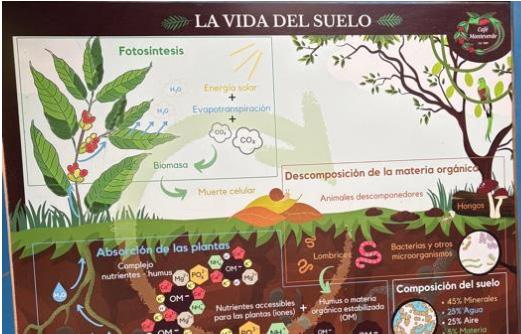
The fgures to the right are visual representations of the soil practices in place at Finca LIFE. For the plants to fourish, it is necessary for the plant to go through the cycle of fotosínthesis (photosynthesis), descomposición de la material orgánica (decomposition of organic matter), and absorción de las plantas (plant absorption). To sustain this cycle, Finca LIFE has developed its own biofertilizer, a fourstep mixture of soil microorganisms, liquid cultures, bioles (foliage fertilizer), and calcium sulfate. This organic blend maintains nutrient-rich soil, strengthens plant health, and minimizes environmental damage. Years of generational farming have proven that nurturing soil life directly nurtures all life.
It Takes Guts: How Conservation Afects Microbiomes
Healthy ecosystems, whether in soil or the human body, depend on microbial diversity. In our gut microbiomes, a high diversity of bacteria supports digestion, immunity, and overall health. When we take antibiotics, they eliminate both harmful and benefcial bacteria, leaving us vulnerable to disease. Similarly, pesticides and fungicides act like
antibiotics for the soil—killing the microbial diversity plants need to thrive.
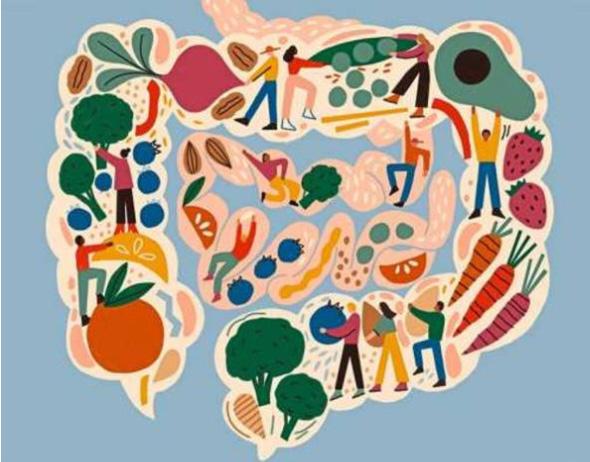
To restore our gut health after antibiotics, we turn to prebiotics and probiotics. Prebiotics provide nourishment for benefcial bacteria, whereas probiotics deliver live microorganisms that enhance digestion and help protect the gut from harmful bacteria1. Soil health functions in much the same way. Organic waste acts as a “prebiotic,” promoting microbial growth, while biofertilizers function as “probiotics,” introducing helpful microorganisms that strengthen soil structure and resilience. Both systems— our gut and the Earth’s soil—rely on microbial balance to stay healthy.
Nutrition in a Nutshell
Humans and the planet exist in a delicate feedback loop. Small disruptions—whether in soil or in diet—can destabilize the entire system. Our food choices, farming practices, and health are inseparable.
Improving gut health requires lifestyle and dietary changes, which directly align with conservation eforts. Eating organically grown, whole foods can prevent harmful bacterial growth linked to infammation and disease2. Choosing locally grown foods and supporting farmers markets shortens the distance between ourselves and the people who cultivate what we eat. This not only improves personal health but also strengthens community resilience and environmental stewardship. To truly protect the planet, we must start with what sustains us—the soil. Every bite of food connects
us to a complex underground ecosystem teeming with life. When we nurture that system through sustainable practices, we nurture ourselves. It is time to act—for our bodies, our communities, and the Earth beneath our feet. The health of the planet begins with the health of its soil, and the health of its soil begins with the choices we make every day.
References
1 Zeratsky, K. (2022, July 2). Probiotics and prebiotics: What you should know. Mayo Clinic. https://www.mayoclinic.org/healthy-lifestyle/nutrition-and-healthy-eating/ expert- answers/probiotics/faq-20058065
2 Department of Health & Human Services. Gut health. BetterHealth Vic https://www.betterhealth.vic.gov.au/health/healthyliving/gut-health (2023). EPA. (2018a, October 16). Composting at home. US EPA. https://www.epa.gov/recycle/composting-home
The Life of the Soil Diagram from Finca LIFE
Bio Fertilizer Diagram from Finca LIFE
SMFRET EXPLAINED: HOW BIO -
PHYSICISTS
STUDY LIFE ON THE SINGLE-MOLECULE LEVEL
ROWAN MCCOLLUM
Completing the jigsaw puzzle of the processes that sustain life is the primary aim of biological research on the molecular level. Through the study of biochemistry, molecular biology, genetics, and other numerous disciplines, scientists study biological processes with the aim to piece together the mechanisms that make life tick. Akin to a watchmaker exploring a new movement, we are the artisans picking up our tools to examine the intricacies of cellular mechanisms. Unlike the watchmaker, however, we cannot consult a blueprint of how the processes of life ft together, and must, in the dark, aim to employ the techniques at our disposal to glean these secrets blindly. Much of our understanding comes from the simple exercise of “looking at the thing”. However, when we endeavor to understand these processes – examining enzymes, nucleic acids, and other relevant molecules working together – we run into obvious problems. Simply put, the interactions between biomolecules are difcult to view, especially on the singlemolecule level. As a result, scientists have endeavored to come up with ways to view these processes indirectly. One of these powerful biophysical techniques is Single-Molecule Fluorescence Resonance Energy Transfer, or smFRET, which uses properties of fuorescence in order to watch molecular dynamics in real time on the single-molecule level1. Here, I will describe the basic principles behind smFRET, and show how it may be used to understand the processes of life.
To begin, let’s consider the properties of a fuorescing molecule, or fuorophore, upon direct excitation by a photon of light. When a fuorophore is excited by a photon, it moves from a characteristic “ground state” to an “excited state,” due to the energy imparted to it by that photon. Once excited, the fuorophore will subsequently move back down to its more stable “ground state,” but, in doing so, will emit a photon of light of a characteristic wavelength in a process called fuorescence2. smFRET takes advantage of the energy dynamics involved in excitation and emission,
using a “donor” and “acceptor” fuorophore that have spectral overlap, where the excitation wavelengths of the acceptor are those emitted by the donor3. These characteristics allow for energy transfer to occur between the two fuorophores; the efciency of this energy transfer can be measured in order to understand molecular dynamics.
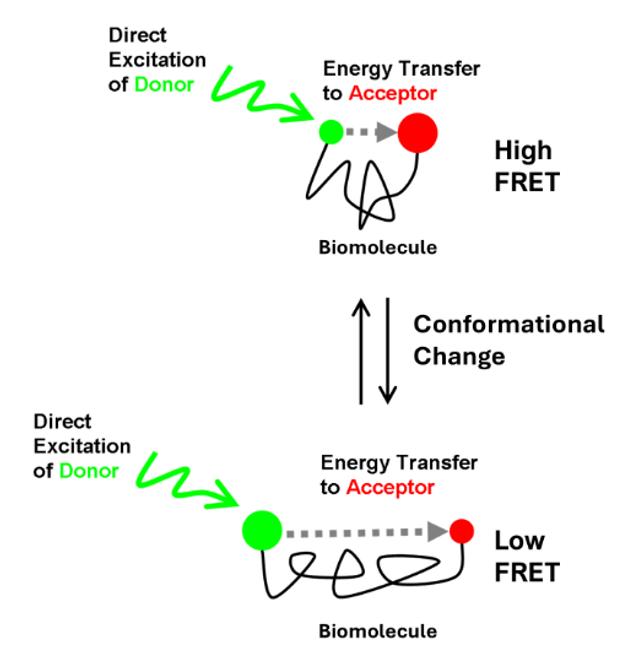
To give a generic example of smFRET in action, let’s consider a biomolecule of interest, in this case, DNA. Let’s label our DNA molecule with a “donor” fuorophore in green, and an “acceptor” fuorophore in red (Fig 1).
Figure 1. Generic labeling scheme used in smFRET. Biomolecule of interest (black squiggle) is labeled with a donor fuorophore (green circle) and acceptor fuorophore (red circle). Donor is directly excited by a photon and can transfer energy to the acceptor fuorophore. As the two fuorophores grow farther in distance due to a conformational change, the efciency of energy transfer decreases (High FRET to Low FRET shift).
As we have discussed, upon direct excitation of our green fuorophore in isolation, it will jump to an excited state and subsequently emit a photon of light as it returns to its ground state. In smFRET, however, we have two
fuorophores in play. Upon excitation of our donor
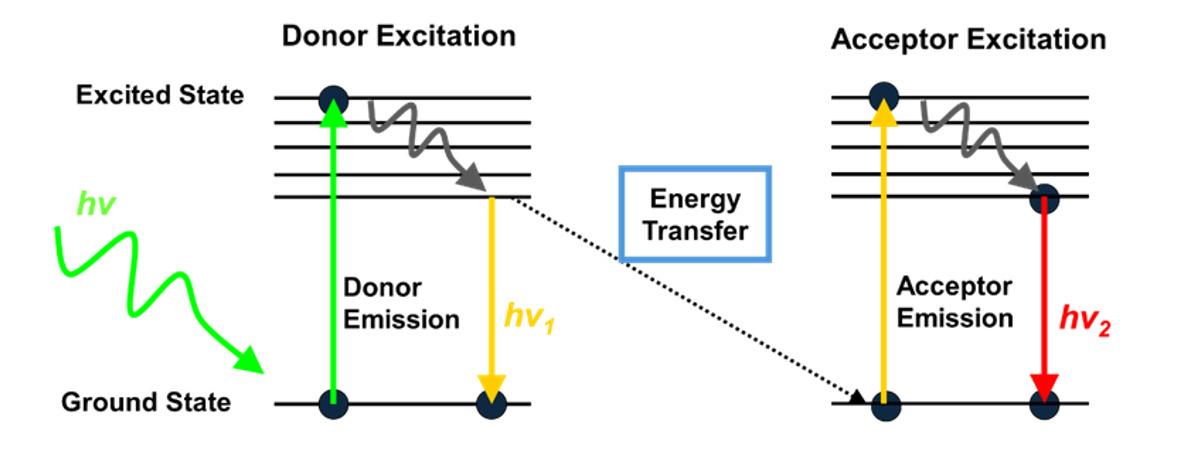
Figure 2. Non-radiative energy transfer between two fuorophores. Left side of fgure shows Donor Excitation, where a donor fuorophore is directly excited by a photo (green squiggle) and jumps to an excited state, before relaxing to a lower excited state level before eventually dropping to the group state. Energy transfer (Dotted-arrow) occurs to excite an acceptor fuorophore, which can then emit a photon of a diferent wavelength (red arrow).
fuorophore, when the acceptor fuorophore is in close proximity non- radiative energy transfer occurs, allowing for the acceptor fuorophore to enter an excited state and go through the process of fuorescence described above4 This can be modeled (Fig 2) wherethe energy states of the two fuorophores are visualized.
Here, you can see how our donor fuorophore transfers its energy to the acceptor after being excited.
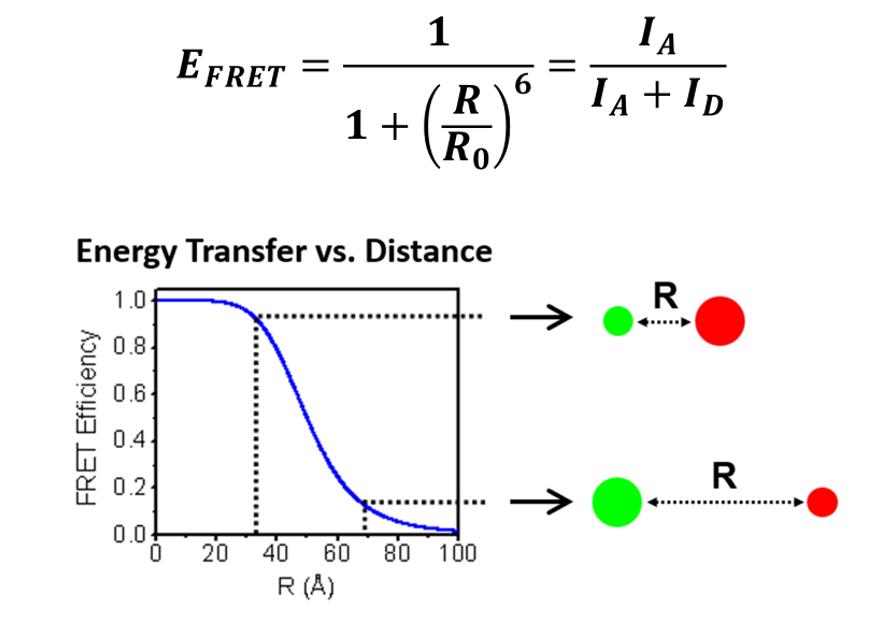
Going back to our frst example, if our DNA sequence of interest were to undergo a change in its structure, where the distance between our donor and acceptor fuorophores increases (Fig 1), the efciency of this energy transfer drops (High FRET to Low FRET states). If you imagine two radio antennae giving of signals and interacting with each other, as the distance between them grows the efciency of this interaction drops, in much the same way as the efciency of energy transfer between our two fuorophores drops. We can model this change in efciency of energy transfer over distance using the equation given in Figure 3, where we observe that
Figure 3. Modleing of enegry transfer as a function of distance. The efciency of energy transfer, EFRET, can be modeled by the given equation, where R is the distance between the fuorophores and R0 is the distance at which the efciency of energy transfer is 0.5 (50%). EFRET may also be calculated via taking the intensity of measured acceptor fuorescence signal IA over the sum of the donor and acceptor fuorescence signals IA + ID
smFRET is a technique sensitive to distance. Here, R is the distance between the two fuorophores, IA is the intensity of the acceptor signal, and ID is the intensity of the donor singal. In the lab, we can take the intensity of the acceptor signal IA over the sum of the intensity of the donor and acceptor signals IA + ID to calculate the efciency of energy transfer between the two fuorophores. Since this energy transfer is sensitive to distance, we allow for a remarkably accurate approximation of internal distance in the molecular frame3. In simple terms, the closer together the two fuorophores the higher the efciency of energy transfer! This means we can use smFRET as a distance proxy to think about how proteins interact with each other or on other biomolecules of interest.
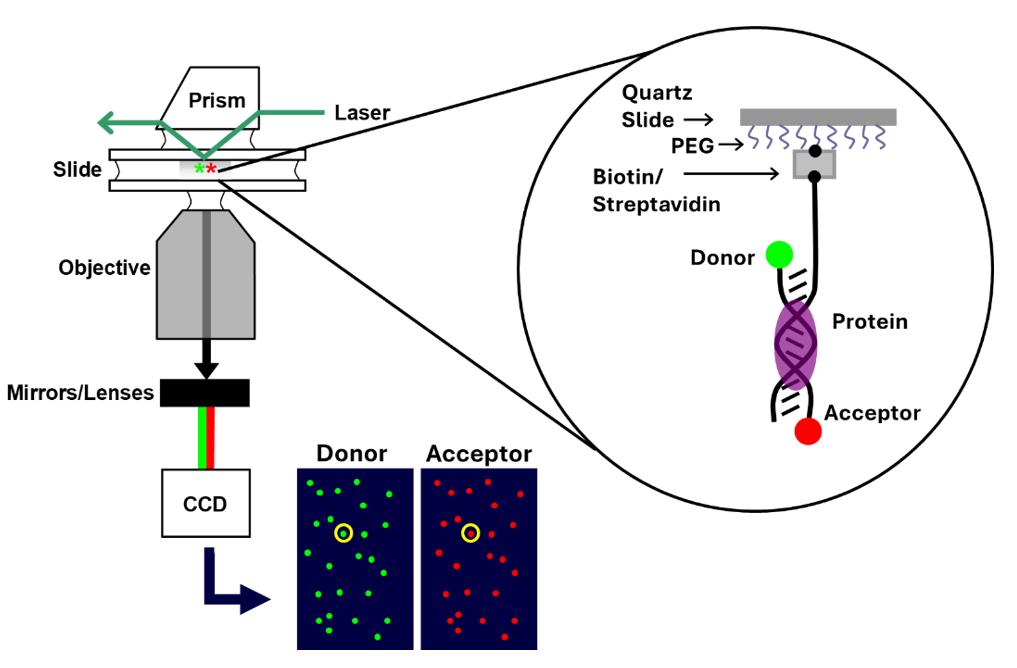
This wonderfully clever method allows scientists to view the molecular processes of life on the single-molecule level. Through afxing biomolecules of interest like DNA (Fig 4) to the surface of microscope slides, we can use a special type of microscopy setup called total internal refection microscopy to record the individual fuorescence signals of our donor and acceptor fuorophores that we’ve attached to our DNA substrate of interest1. By viewing these signals and measuring their intensities, we can calculate the efciency of energy transfer (as described above), and in our example begin to understand how diferent proteins, like the enzymes that bind to and replicate your DNA, interact with DNA itself! The use of smFRET and other biophysical techniques allow us to piece together the processes that repair our cells, manage our growth, and, ultimately, sustain life.
smFRET has been used in a variety of breakthroughs studying the conformational dynamics of biomolecules of interest, becoming a valuable piece of the toolkit we use to study biological processes. It has been used to study dynamics of HIV viral entry5, COVID-19 spike protein dynamics6, mechanisms of DNA repair7, and even the dynamics of genome editing via CRISPR/Cas9 systems8 By allowing us to view the machinery that sustains life, smFRET and other biophysical techniques are invaluable in our understanding of not only what is happening, but how these complex molecular processes happen.
Figure 4. Overview of smFRET experimental workfow. Samples are afxed to quartz slides coated with polyethylene glycol (PEG) via biotin/streptavidin bonds, and labeled with donor/acceptor fuorophores. Donor fuorophore is excited via a laser on a prism-type total internal refection microscope, where a CCD camera captures donor and acceptor signals in stacks of images. Corresponding donor and acceptor signals are paired (yellow circles) to defne single-molecule substrates for analysis.
References
1. Roy, R., Hohng, S. & Ha, T. A practical guide to single-molecule FRET. Nat Methods 5, 507–516 (2008).
2. Morrison, L. E. Basic Principles of Fluorescence and Energy Transfer. in Molecular Beacons: Signaling Nucleic Acid Probes, Methods, and Protocols (eds. Marx, A. & Seitz, O.) 3–19 (Humana Press, Totowa, NJ, 2008).
3. Szabó, Á., Szöllősi, J. & Nagy, P. Principles of Resonance Energy Transfer. Current Protocols 2, e625 (2022).
4. Fijen, C., Montón Silva, A., Hochkoeppler, A. & Hohlbein, J. A single-molecule FRET sensor for monitoring DNA synthesis in real time. Phys. Chem. Chem. Phys. 19, 4222–4230 (2017).
5. Lu, M. et al. Associating HIV-1 envelope glycoprotein structures with states on the virus observed by smFRET. Nature 568, 415–419 (2019).
6. Serrão, V. H. B. & Lee, J. E. FRETing over SARS-CoV-2: Conformational Dynamics of the Spike Glycoprotein. Cell Host Microbe 28, 778–779 (2020).
7. London, R. E. The structural basis of XRCC1-mediated DNA repair. DNA Repair (Amst) 30, 90–103 (2015).
8. Okafor, I. C. & Ha, T. Single Molecule FRET Analysis of CRISPR Cas9 Single Guide RNA Folding Dynamics. J. Phys. Chem. B 127, 45–51 (2023).
ALL-NIGHTER AHEAD? THINK AGAIN
ZAINA DAABOUL
Finals, exams, papers—most college students understand the appeal of pulling an all-nighter. Under the right circumstances, getting all of your assignments and studying out of the way in a cafeine-fueled daze may seem like the perfect solution. In fact, over 60% of college students demonstrate poor sleep, with 20% staying up all night at least once a month and 35% staying up till 3:00 AM at least once a week1 Those who pull frequent all-nighters, or repeatedly get minimal sleep in the name of schoolwork or social media, may know the most common efects: irritability, sleepiness, and brain fog. Research from Harvard and UC Berkeley demonstrates that subjects deprived of sleep for 32 hours report a short-term sense of euphoria afterwards. As the subcortical portion, deep within your brain, takes the front seat, the resulting emotional responses are amplifed and dysregulated. Meanwhile, the frontal lobe’s decision-making and impulse control functions are muted, promoting a tendency toward risky behavior which may sound familiar2 While inconvenient, these consequences may seem worthwhile for the chance to cram in that last review session.
But research suggests a much deeper risk. According to a study following 27,000 participants over almost nine years, poor sleep was shown to not only accelerate brain aging, but also increase their risk of dementia3. While the correlation between poor sleep and dementia has been detected previously, it was unclear which caused the other. Examining this phenomenon, researchers from China,
Sweden, and the UK found that the “brain age gap,” the diference between someone’s actual chronological age and the biological age of their brain, actually increased by about 0.5 years for every one-point decrease in someone’s sleep score.
The participants’ sleep scores were determined by researchers, on a scale from 1 to 5, using fve key characteristics of healthy sleep:
1) Waking up early
2) Sleeping 7-8 hours daily
3) No snoring
4) No insomnia
5) No unreasonable daytime fatigue.
The fndings of the team support past research, which even suggests that “chronic short sleep” can have neurodegenerative efects4. Chronic short sleep, defned as long-term daily sleep under 7 hours, often goes under the radar when compared to signifcant sleep deprivation. While the severity of the consequences depends on factors like lifestyle, duration, and severity, chronic short sleep has nonetheless been associated with depression, cardiovascular disease, and even cancer5
When Sleep Deprivation Turns Deadly
Cases of severe sleep deprivation, beyond the sleeping patterns of the typical college student, may be of interest to the morbid neuroscience fan. In 1980, Allan Rechtschafen and other researchers demonstrated an even more
signifcant efect of sleep deprivation in rats: death6. But how? Harvard researchers asked the same question and found a potential answer: the buildup of reactive oxygen species (ROS), a particular kind of chemically reactive molecules, in the gut. While a certain level of ROS in the body is useful and necessary, excessive amounts can cause damage to DNA, lipids, and proteins, ultimately causing cell death. In both fies and mice, prolonged loss of sleep caused severe oxidative damage in intestinal tissues. In humans, researchers are still striving to understand the efects of chronic sleep deprivation on brain damage. However, this research suggests an unexpected link between the gut and the brain, calling for more research on the fascinating complexity and interconnectedness of the human body.
Progress, Not Perfection
Knowing the efects of sleep deprivation on physical, mental, and spiritual health, how can one move forward? While it would be ideal to follow the 5 sleep principles every day, it is admittedly unrealistic, especially for students and professionals. Additionally, the brain aging reported in the study considered long-term patterns over multiple years. So how much leeway does one have? Studies have demonstrated that negative impacts on cognition, mood, and physiological stability increase with the amount of sleep lost, even from one night7. In one experiment, participants were asked to engage in one of the most basic, fundamental parts of human interaction: categorizing faces as sad, angry, or happy. After only one night, the sleep-deprived group performed signifcantly worse than
the rested group in recognizing the correct emotional expression8. Considering the importance of this ability in maintaining both a social and professional presence, this study exposes an issue with the logic of many all-nighter enthusiasts. Sleep deprivation with the noble aim of professional and academic advancement may create new problems to solve, even beyond your health.
That being said, small eforts to improve your “sleep score” can be helpful. They have been shown to improve cognitive performance, mood, and health in both the short- and long-term. In the aforementioned experiment, initially sleep-deprived participants recovered their facial recognition abilities after a night of recovery sleep8. Aspiring for harm reduction, while not perfect, is realistic, and can be a practical and sustainable goal for students hoping to reduce long-term negative impacts. You may be missing sleep to study for a test, but consider that your cognitive abilities, including attention, memory, and executive function, are signifcantly hindered9. Going to sleep may just be worth it after all.
References
1. Lund, H. G., Reider, B. D., Whiting, A. B. & Prichard, J. R. Sleep Patterns and Predictors of Disturbed Sleep in a Large Population of College Students. Journal of Adolescent Health 46, 124–132 (2010).
2. Gujar, N., Yoo, S.-S. ., Hu, P. & Walker, M. P. Sleep Deprivation Amplifes Reactivity of Brain Reward Networks, Biasing the Appraisal of Positive Emotional Experiences. Journal of Neuroscience 31, 4466–4474 (2011).
3. Miao, Y. et al. Poor sleep health is associated with older brain age: the role of systemic infammation. eBioMedicine 120, 105941 (2025).
4. Pankowska, M. M. Prevalence and Geographic Patterns of Self-Reported Short Sleep Duration Among US Adults, 2020. Preventing Chronic Disease 20, (2023).
5. Lanza, G., Mogavero, M. P., Salemi, M. & Ferri, R. The Triad of Sleep, Immunity, and Cancer: A Mediating Perspective. Cells 13, 1246–1246 (2024).
6. Vaccaro, A. et al. Sleep Loss Can Cause Death through Accumulation of Reactive Oxygen Species in the Gut. Cell 181, 1307-1328.e15 (2020).
7. Lee, S. Naturally Occurring Consecutive Sleep Loss and Day-to-Day Trajectories of Afective and Physical Well-Being. Annals of Behavioral Medicine (2021) doi: https:// doi.org/10.1093/abm/kaab055.
8. van der Helm, E., Gujar, N. & Walker, M. P. Sleep Deprivation Impairs the Accurate Recognition of Human Emotions. Sleep 33, 335–342 (2010).
9. Alhola, P. & Polo-Kantola, P. Sleep deprivation: Impact on cognitive performance. Neuropsychiatric Disease and Treatment 3, 553–567 (2007).
DINOSAURS AND CRIME: CONNECTIONS IN AN EVER-ADAPTING WORLD
SONAL REDDY
Generally speaking, dinosaurs and felonies do not go together. Not only are these prehistoric animals in no way related to criminals on a timeline, but their respective felds also seem leagues apart. However, despite the clear-cut diferences between these careers, there seems to be more similarities and overlaps than previously assumed.
A broad example of this is fossils. When you think of the word “fossils,” you most likely think of a Tyrannosaurus Rex skeleton in a museum, but fossils are so much more than that! A fossil may be thought of as evidence of life which has been geologically preserved. This interpretation has the obvious connection to paleontology, the scientifc study of ancient to life through historical evidence, including (but not limited to) fossils. Behaviors, lifestyle, age, and even evolutionary history can all be determined by the study of fossils. But another line of work uses similar, if not the same tools to determine the same information that paleontologists do.
Forensics, in short, is the practice of using scientifc methods to solve crimes. There are many diferent branches of forensics, such as blood splatter analysis, entomology (the study of insects), or ballistics. For our discussion, we will focus on taphonomy. What is it? Well, taphonomy is the study of what happens to biological remains after death! This is just prehistoric forensics! It helps determine how long something has been dead, what external elements afect the body after death, and what changes they cause in the body. It is incredibly useful for indicating what happened to a victim of a crime and establishing a timeline for the investigation. This method of analysis was developed by paleontologists in the 19th century to try and further their understanding of how bones changed after death. This connection not only aided the feld in their understanding of remnants of ancient creatures, but even those in our society today. Archeologists have compared the remains left behind from
both human and non-human scavengers to determine the diferences in the way food is prepared and eaten. This linkage has its place in forensics as well! Bites and slashes can be determined from the taphonomic signatures left behind, also known as forensic odontology.
If we delve deeper, past taphonomy and odontology, we may fnd more similarities underneath an umbrella of diferent careers, such as virtual anthropology. But what does anthropology have to do with either of these things? Actually, a lot! Anthropology can be thought of as the study of what exactly makes us human, whether that be socially, biologically, emotionally, or otherwise. In this day and age,
where things are becoming digital and technology is ever advancing, many felds have had to adapt to this new era.
New subfelds like virtual anthropology can truly encapsulates these developments, showing a growing focus on the changing human ideologies of the new modern era. These ideologies also include a shift in tools. DigTrace, a technology developed by a professor at Bournemouth University, is one such tool. It is a software tool for footprint analysis. A person can take pictures of
a scene from multiple angles and, using those pictures, the program creates a 3D model of what exactly caused those prints. It was originally developed to help track perpetrator’s footprints, allowing for an extensive 3D recreation of the crime scene. But it has also been used to help archeologists and paleontologists study dinosaur tracks. A 3D model of a footprint from a false sabertoothed cat was created in Oregon, and it helped show the nooks and crannies of the features of the ancient animal. The connections don’t stop there. Methodologies used by paleontologists have also found use in forensics for identifcation of suspects in crimes against cultural heritage. They have also been used to determine whether bones in crime scenes are real. Even the soil around crime scenes has been studied for bone material to compare to the environment around it. Taphonomy has even been used to help the analysis of illegal graves.You might be thinking, “why am I talking about fossils and crime like it’s
so relevant right now?” It’s mainly for enjoyment. But also, it is because the scientifc world is changing constantly. And so are we, and even the world around us. Nothing will look the same as it did yesterday. Everything is rapidly evolving at a rate it seems impossible to keep up with. For some that may be scary, but for others it can be wonderful. Many connections and comparisons can be made with the world around us through science. While to some these may seem outlandish, they open the opportunity to truly connect all people and bring new discoveries with them. Plus, who really knows. Maybe one day scientists will develop chicken-raptors from the past that chase robbers.
References
1. U;, S. E. Forensic paleontology: A tool for ‘Intelligence’ and investigation. Journal of forensic sciences (2013). Available at: https://pubmed.ncbi.nlm.nih.gov/23488480/.
2. Wilson, T. V. How fossils work. HowStufWorks Science (2023). Available at: https://science.howstufworks.com/environmental/earth/geology/fossil.htm
3. Joanna. Dinosaurs to forensics - unlocking the past using mathematics. Maths Careers (2020). Available at: https://www.mathscareers.org.uk/dinosaurs-forensics-unlocking-past-using- mathematics/.
4. Marra, A. C., Silvestro, G. D. & Somma, R. Palaeontology applied to criminal investigation. Atti della Accademia Peloritana dei Pericolanti - Classe di Scienze Fisiche, Matematiche e Naturali (2023). Available at: https://cab.unime.it/journals/index.php/AAPP/article/view/AAPP.101S1A4/AAPP101S1 A4.
5. Gov, N. What is a fossil? National Parks Service Available at: https://www.nps.gov/subjects/fossils/what-is-a-fossil.htm.
6. Dirkmaat, D. C. & Cabo, L. L. Forensic archaeology and forensic taphonomy: Basic considerations on how to properly process and interpret the outdoor forensic scene. Academic forensic pathology (2016). Available at: https://pmc.ncbi.nlm.nih.gov/articles/PMC6474560/.
7.Libretexts. 15.5: Taphonomy. Social Sci LibreTexts (2024). Available at: https://socialsci.libretexts.org/Courses/Fresno_City_College/ANTH- 1%3A_Explorations_2nd_Edition/15%3A_Forensic_Anthropology/15.05%3A_Taphono my.
8. Blau, S. Taphonomy - an overview | sciencedirect topics. Science Direct Available at: https://www.sciencedirect.com/topics/social-sciences/taphonomy.
9. Haglund, W. D. & Sorg, M. H. in Forensic Taphonomy: The Postmortem Fate of Human Remains (CRC Press, 1996).
10. Boudreau, D., McDaniel, M., Sprout, E. & Turgeon, A. Paleontology. Education Available at: https://education.nationalgeographic.org/resource/paleontology/.
11. Carmach. Digital anthropology. UNESCO.org (1970). https://www.unesco.org/en/digital-anthropology.
12. What is anthropology? American Anthropological Association (2025). Available at: https://americananthro.org/practice-teach/what-is-anthropology/.
13. Matthew Robert Bennett Professor of Environmental and Geographical Sciences & Marcin Budka Principal Academic in Data Science. From dinosaurs to crime scenes –how our new footprint software can bring the past to life. The Conversation (2025). Available at: https://theconversation.com/from-dinosaurs-to-crime-scenes-how-our-newfootprint- software-can-bring-the-past-to-life-67947.
AMAZING ÁRBOLES: ENDANGERED ACORNS AND AVOCADOS
ALEXIS VEGA-AGUILAR
Today, you may fnd yourself surrounded by trees, whether it be in your backyard or the city. Many of these trees tend to be oak, one of the largest and most common groups of trees found in North America1. They provide many benefts to us, such as oxygen, shade, and food. However, with the efects of climate change, some trees may soon no longer be with us. One example is the maple-leaf Oak (Quercus acerifolia), a species found exclusively in Arkansas2. At frst, this tree may look like your ordinary oak, but it is a rare fnd to see, with only about 600 specimens2. Now this may come as an alarming surprise, but the maple-leaf oak is endangered due to its limited geographical range and the dangers of climate change. However, there is hope if we look at other examples of successful conservation elsewhere in the world.
2,500 miles away from Arkansas, in Monteverde, Costa Rica, is a tree called Ocotea monteverdensis, part of the Lauraceae (avocado) family3. Also known as aguacatillo, meaning small wild avocado, Ocotea serves a crucial part in the ecosystem in Monteverde by providing food and shelter for animals3. Despite seed dispersal from birds, the Ocotea tree is experiencing the same problem as the maple-leaf oak. According to the International Union for Conservation of Nature (IUCN), as of 2025, O. monteverdensis is a critically endangered species with only about 870 mature trees left4. Due to climate change and deforestation in Costa Rica during the 1940s and 1950s, this population has signifcantly decreased, afecting the ecosystem in which it lives. Additionally, the resplendent quetzal, a bird that relies on trees for food and habitat, has experienced a decline in its population due to factors afecting the tree’s population such as deforestation and climate change1
Luckily, there are organizations and communities that are increasing the population of the tree through conservation programs. Dev Joslin was one of the frst people to begin a conservation program for O. monteverdensis5. He decided, alongside the Monteverde Institute, to create the Mi
Ocotea project, a campaign bringing awareness around the importance of O. monteverdensis. Over the years, the project has seen signifcant success5. The Monteverde Institute has planted 2,900 seedlings and has improved the conditions for over 2,000 plants for natural regeneration by placing protection and cutting down foliage from other plants as of 20256. Joslin and his team were even able to convince all landowners with Ocotea trees to protect them. They continue to hold meetings to discuss current eforts for O. monteverdensis conservation and collaborate with artists to make infographics about the tree for display in community centers6. With all of these conservation eforts focused in Costa Rica, conservation eforts for the mapleleaf oak the states look quite diferent.
The maple-leaf oak has a similar story to O. monteverdensis. Part of the Fagaceae (oak) family, the maple-leaf oak has only been found in high elevations along the Ouachita mountains and around west-central Arkansas7. They are typically found on blufs and can grow like shrubs or trees up to 50 feet tall8. Growing only within a small, specifc region, the maple-leaf oak is naturally at high risk of losing its’ habitat during climactic shifts. In contrast to the Ocotea, where we have a wealth of information, it seems unfortunate that we do not yet know what will happen to the ecosystems in Arkansas if the tree goes extinct. The maple-leaf oak may be a tree that you have never heard or cared about, but it truly is an astounding species. The leaves of the maple-leaf oak look similar to a sugar maple tree and even turn red when it grows new leaves9. It is unique to see a tree that looks like a maple but, upon closer inspection, is an oak. It’s amazing to learn that some plants can only be found in certain parts of the country and aren’t found anywhere else in the world. Since this rarity also makes the maple-leaf oak vulnerable, its limited range creates challenges for conservation.
There are few conservation programs for the maple-leaf Oak, as there are some obstacles that come with the tree. One is that the acorns of the tree cannot be dried or preserved for later use, as they bear “recalcitrant seeds,” which do not survive preservation and cannot be
germinated after they are dried10. Another difculty is that hybridization (cross breeding species) is common in Oak trees which makes it harder to identify trees and select them but even with these challenges, scientists conserve them10. For example, Ryan Russell, a horticulturist, has explored the Ouachita Mountains to bring back acorns for planting at the Stephens Lake Park Arboretum7. Other programs involve arboreta such as the Morris Arboretum and Arnold Arboretum, each with a maple-leaf oak9. Most of these programs are started by researchers. Although these conservation programs are not accessible by the non-scientifc community, don’t worry, there are other ways to help.
Join the International Oak Society, which posts about maple-leaf oak and other oak trees in conservation programs11. Another way to help is visiting the Morton Arboretum and reading about the Global Conservation Consortium for Oak12. Even if you are not a scientist or a gardener, notifying local scientists and municipalities about the plants and learning about the endangered species can help bring awareness of the tree, just like in Costa Rica. Despite their distance, the maple-leaf oak and Mi Ocotea are intimately connected. Growing awareness and understanding about how the natural world is connected across continents is a vital part of growing conservation eforts. Learning how diferent countries carry out their conservation eforts helps everyone work towards a future that can sustain healthy ecosystems. Trees may take a long time to grow, but conservation comes with patience, which serves to beneft future generations in enjoying the nature we have today. If you are around the Hendrix College Campus, go around the Bailey library to see our very own maple-leaf oak!
References
1. Frankel, S.J., Juzwik, J., Rizzo, D.M. Forests (oaks) in North America. Global Plant Health Assessment. International Society of Plant Pathology. pp. 152-158.(2022). https://research.fs.usda.gov/treesearch/67252
2. Subedi, S.C., Ruston, B., Hogan, J., & Coggeshall, M. V. Defning the extent of suitable habitat for the endangered Maple-Leaf oak (Quercus acerifolia). Frontiers of Biogeography, 15(3). (2023). http://dx.doi.org/10.21425/F5FBG58763.
3. Monteverde Institute. Conservation of the critically endangered Ocotea Monteverdensis and other threatened species in Costa Rica.http://monteverde- institute-blog.org/ blog/2020/4/22/conservation-of-the-critically-endangered-ocotea- monteverdensis-and-other-threatened-species-in-costa-rica. (2020).
4. International Union for Conservation of Nature. IUCN red list of threatened species: Ocotea Monteverdensis. IUCN Red List of Threatened Species. https://www.iucnredlist.org/species/48724260/263415602 (2025)
5. Joslin Jr, J.D., Cruz, D.Q. Estudio de caso sobre la conservación del Ocotea monteverdensis, una especie de árbol en peligro crítico de extinción. Revista Ambientico. 293. 64. (2025). https://www.ambientico.una.ac.cr/revista- ambientico/estudio-de-caso-sobre-la-conservacion-del-ocotea-monteverdensis-una- especie-de-arbol-en-peligro-critico-de-extincion/.
6. Monteverde Institute. Expanding the population of Ocotea monteverdensis by promoting natural regeneration. (2020). http://monteverde-institute- blog.org/ blog/2020/9/2/expanding-the-population-of-ocotea-monteverdensis-by- promoting-natural-regeneration-september-2020.
7. Russell, R. In search of an endangered species: Quercus Acerifolia. International Oak Society. https://www.intenationaloaksociety.org/content/search-endangered-species- quercus-acerifolia. (2020).
8. Encyclopedia of Arkansas. Maple-Leaf Oak. https://encyclopediaofarkansas.net/entries/maple-leaf-oak-6874/. (2023)
9. Arnold Arboretum. Maple-Leaf Oak. https://arboretum.harvard.edu/plant-bios/maple- leaf-oak/. Accessed on November 1, 2025.
10. Kramer, A.T., and Pence, V. The challenges of ex situ conservation for threatened oaks. International Oak Journal. 23. 91-108. (2012). https://www.internationaloaksociety.org/sites/default/fles/fles/IO/IOS%20Journal%2 0%2323/International%20Oaks%20No.%2023%20- %20The%20Challenges%20of%20Ex%20Situ%20Conservation%20for%20Threaten ed%20Oaks%20-%20A.T.%20Kramer%2C%20V.%20Pence.pdf
11. International Oak Society. Join the IOS. https://www.internationaloaksociety.org/content/join-ios. (2025).
12. The Morton Arboretum. Global conservation consortium for oak (GCCO) https://mortonarb.org/science/projects/global-conservation-consortium-for-oak-gcco/. (2025).
IS THIS DÉJÀ VU?: THE NEUROSCIENCE BEHIND MIND GLITCHES
MARYAM ARAB
Have you ever caught yourself thinking, “Wait –has this happened before?” That strange feeling of familiarity can be so vivid that it almost feels real. For centuries, scholars were puzzled by this sensation that seemed like a mythical occurrence, yet somehow happens to the majority of the human population. In recent decades, neuroscientists and philosophers have tried to understand and uncover why our brains create this illusion of “remembering” something that never has happened. This phenomenon is called déjà vu, a French phrase meaning “already seen”1. It occurs when an individual experiences a moment that feels vaguely familiar, but in truth has never happened. Explained déjà vu as a false memory, something that’s completely new. So, what is the reasoning behind this psychological glitch in our brain?
Recognition Memory
The human mind has an incredible way of storing information and memory. One key process involved in neurological data storing is recognition memory, which allows people to recall a moment that has happened before, like recalling a song you’ve heard before. But, in the case of déjà vu, it’s a glitch in our system that is unclear. In an article by Anne Cleary, recognition researchers have theorized a reason for this phenomenon of false memory: Theory of Dual-Processing, where two processes can give rise to recognition memory for both recollection and familiarity2. Researchers believe that this plays into the role of déjà vu reoccurring. The hippocampus, which helps the brain form and retrieve memories, briefy sends a false signal of familiarity even when no real memory exists3. Particularly, a miscommunication in the dual-process may be what triggers this strange feeling. In recognition memory processes, the familiarity-based process is where recognition is more like a feeling of close recognition rather than specifc experiences. The problem of déjà vu is when familiarity-based recognition leads to source error; the brain confusing diferent information that’s being encoded within. When the brain cannot identify where this information,
or “memory,” is coming from, the brain is keen to make quick connections and recognize patterns. This mismatch between familiarity and actual memory may be what triggers déjà vu: a moment when the brain confuses a false signal for a real recollection. In investigating how and why these false signals occur, researchers have also looked in the temporal lobe.
Temporal Lobe & Medical Conditions
Research has shown that the temporal lobe, the area that processes sensory input and stores memory, often activates during episodes of déjà vu. Particularly, individuals with temporal lobe epilepsy reported experiencing éjà vu right before a seizure3. Alan Brown explains that this sensation may result from a brief misfre in the brain’s memory circuits. Meaning the neurons responsible for recognizing familiar situations fre at the wrong moment. The hippocampus and parahippocampal gyrus, parts of the brain that help facilitate in retrieving memories, momentarily activate even when there is no memory to recall.
This phenomenon creates the experience of recognition, a false signal that something has happened before.
Physicians have discovered that déjà vu can be triggered by fatigue, stress, or even distractions4. This is because when the brain is put under those conditions, it processes information unevenly and confuses similar moments from previous experiences. In essence, déjà vu reveals how glitches in the mind can blur the lines between memory and perception.
Even with growing scientifc understanding, déjà vu continues to stand at the edge of both neuroscience and our understanding of how it occurs. It reveals how powerful yet mysterious the human mind can truly be. While researchers like have linked this to memory encoding errors2,3, its emotional weight goes beyond biology. These fndings show that déjà vu often derives from momentary misfres between brain regions responsible for familiarity, recollection, and sensory processing often misalign. Author Joseph Heller describes déjà vu from his novel, Catch 22, as “…just a momentary infnitesimal lag in the operation of coactive sensory nerve centres that commonly functioned simultaneously”, a poetic way to capture the brief delay between perception and recognition that can make a new moment feel strangely familiar. Déjà vu is a brief reminder that our sense of reality is not fxed; it is a ficker of awareness that our consciousness is more complex than we know. Even the most complex part of humans, the brain, is capable of wonder and error at the same time. So, the next time you wonder, “has this happened before?” remember that the brain is paradoxical and can make the unknown known.
References
1. Wolfradt, U. (2005). STRANGELY Familiar. Scientifc American Mind, 16(1), 32–37. JSTOR. https://doi.org/10.2307/24997595 nkel, J., Juzwik, J., Rizzo, D.M. Forests
2. Cleay, A. M. (2008). Recognition Memory, Familiarity, and Déjà Vu Experiences. Current Directions in Psychological Science, 17(5), 353–357. JSTOR. https://doi. org/10.2307/20183318
3. Brown, A. S. (2004). The Déjà Vu Illusion. Current Directions in Psychological Science, 13(6), 256–259. JSTOR. https://doi.org/10.2307/20182969
4. Cleveland Clinic. (2022, October 23). Why Does Déjà Vu Happen? Cleveland Clinic. https://health.clevelandclinic.org/deja-vu-what-it-is-and-when-it-may-be-cause-forconcern Strongman, L. (2012). Déjà vu explained? A qualitative perspective. The Journal of Mind and Behavior, 33(3/4), 205–218. JSTOR. https://doi.org/10.2307/43854342
RELIGIOSITY AND RISK-TAKING IN COLLEGE STUDENTS
MARYAM SAYYAH
Growing up in the South one might hear the saying “Saturday night mistakes, Sunday morning forgiveness,” or one of many others to the same efect. The dilemma of balancing fun and faith is one that may read especially challenging for college students who, often for the frst time, have the freedom to engage in risky behaviors such as partying, experimenting with substances, or engaging in sexual activity away from their parents. Interestingly, research has found that religiosity—the quality or extent to which one identifes religiously—can actually be used as a determinant for college students’ engagement in those risky behaviors.
Religiosity And Health Defned
Before covering fndings, it is important to understand what exactly researchers mean when they use the terms ‘health’ and ‘religiosity.’ Health, in the research discussed, was considered holistically rather than just focusing on physiological wellbeing. The research utilizes William Hettler’s Six Dimensions of Wellness, a model incorporating “physical, mental, social, occupational, intellectual and spiritual dimensions”1. In terms of religiosity, studies have acknowledged that religion has started to look diferent in the US, with more people leading secular lifestyles and those that do identify religiously choosing non-afliation over specifc institutional faiths2. One might consider themselves spiritual, but not specifcally Christian or Jewish for example. Due to this nuance, research has utilized various surveying tools including selfidentifcation, frequency of religious service attendance, and Worthington’s Religion Commitment Inventory to paint a more accurate picture of modern religiosity.
Substance Use
The Journal of Religion and Health has featured several studies over the last few years addressing the issue of religion and substance use. In one study, 221 college students were surveyed on their religious commitment using Worthington’s Inventory. Students were asked how many times on average they
drink during diferent periods of time, how often they binge drink (consume >5 drinks at once), and if they’ve had
alcohol-related problems. Results showed that considering religion an important aspect of one’s life was correlated with less drinking3 . Similar results were observed in a more recent study of 765 Midwestern college students, which found that the “level of drinking behavior decreased .22 units for each standard deviation unit increase in religious attendance”4. The more often students attended religious services, the less likely they were to drink. This emphasis on service attendance suggests a lower drinking rate not just due to individual faith but also to engagement with a larger religious community. These fndings suggest that the norms and expectations that arise through religious communities could play a role in the decreased substance use among religious college students. Some may choose not to use substances out of fear of judgement from peers or because they’re not otherwise exposed to such things through their social groups.
Religiosity’s relationship with tobacco use has been addressed as well, with one study identifying a correlation between increased religiosity/spirituality and lower tobacco use among University of Tennessee students1. A separate
study considering the likelihood of secondhand exposure to tobacco was conducted across 20,497 respondents in the US and determined that “exposure to ETS [environmental tobacco smoke] in frequent attenders of religious services was only about 70% as frequent as in others”5. Similar to the alcohol fndings, those who attended religious services regularly were exposed to signifcantly less second-hand smoke than others, suggesting that membership in a religious community may not only cause college students to be less interested in engaging in substance use, but that they may also be exposed to less outside substance use as well, further positively impacting their health.
RELIGION AND SAFE SEX
Research has also explored the link between religiosity and engagement in safe sex practices. Safe sexual practices are defned by the following studies as practices that prevent the spread of sexually transmitted diseases and infections as well as unwanted pregnancy.
In one study, 12,222 British citizens were asked if they have ever had an STI (sexually transmitted infection) and if so, how many they’d been diagnosed with. They were then asked to self-report their perceived HIV/AIDS risk. Researchers found that those identifying as religious reported lower STI rates and risk of HIV/AIDS. These trends are likely related to the fact that the religious participants also reported having fewer sexual partners and were more often either abstinent or monogamous if they were in relationships6. These fndings were not tied to any specifc faith, but instead linked to service attendance, illustrating the impact of peer pressure and community norms on sexual practices. In considering safe sex practices, it seems to matter less what religion someone is and more how engaged they are in that religious community.
While much research shows a link between greater religiosity and lower risk for STIs or unwanted pregnancy, past research has found religious communities often recommend abstinence to youth rather than educating them on safe practices. This lack of information could potentially lead to a heightened risk of STIs or unplanned
pregnancies for the youth that do decide to have sex. Furthermore, in a study conducted among religious college students, there was a small subcategory of self-identifed males whom, when anonymously surveyed about their risk-taking behavior, reported greater than average levels of substance use, with increased use prior to engaging in premarital sex7 . This presents an interesting facet to the conversation as it appears that community or doctrine-based pressures behave in certain ways that may sometimes push religious students to engage in risky behaviors as a guilt response to not meeting expectations.
References
1.Nelms, L. W., Hutchins, E., Hutchins, D. & Pursley, R. J. Spirituality and the health of college students. Journal of Religion and Health 46, 249–265 (2007).
2.Burke, A., Van Olphen, J., Eliason, M., Howell, R. & Gonzalez, A. Re-examining religiosity as a protective factor: comparing alcohol use by self-identifed religious, spiritual, and secular college students. Journal of Religion and Health 53, 305–316 (2012).
3.Menagi, F. S., Harrell, Z. A. & June, L. N. Religiousness and college student alcohol use: examining the role of social support. Journal of Religion and Health 47, 217–226 (2008).
4.Carmack, C. C. & Lewis, R. K. Assessing whether religious behaviors and positive and negative afect are associated with alcohol use and abuse among a sample of college students living in the Midwest. Journal of Religion and Health 55, 1107–1119 (2016).
5.Gillum, R. F. Frequency of attendance at religious services and exposure to environmental tobacco smoke. Journal of Religion and Health 60, 1760–1765 (2021).
6.Awaworyi Churchill, S., Appau, S. & Ocloo, J. E. Religion and the risks of sexually transmissible infections: evidence from Britain. Journal of Religion and Health 60, 1613–1629 (2021).
7.Horton, K. D., Ellison, C. G., Loukas, A., Downey, D. L. & Barrett, J. B. Examining attachment to God and health risk-taking behaviors in college students. Journal of Religion and Health 51, 552–566 (2010).oaksociety.org/sites/default/fles/fles/IO/IOS%20Journal%2 0%2323/International%20Oaks%20No.%2023%20- %20The%20Chal-
1600 Washington Avenue Conway, AR 72032
Have any questions or want to get involved in Hendrix Scientifc? Reach out at hendrixscientifc@gmail.com.