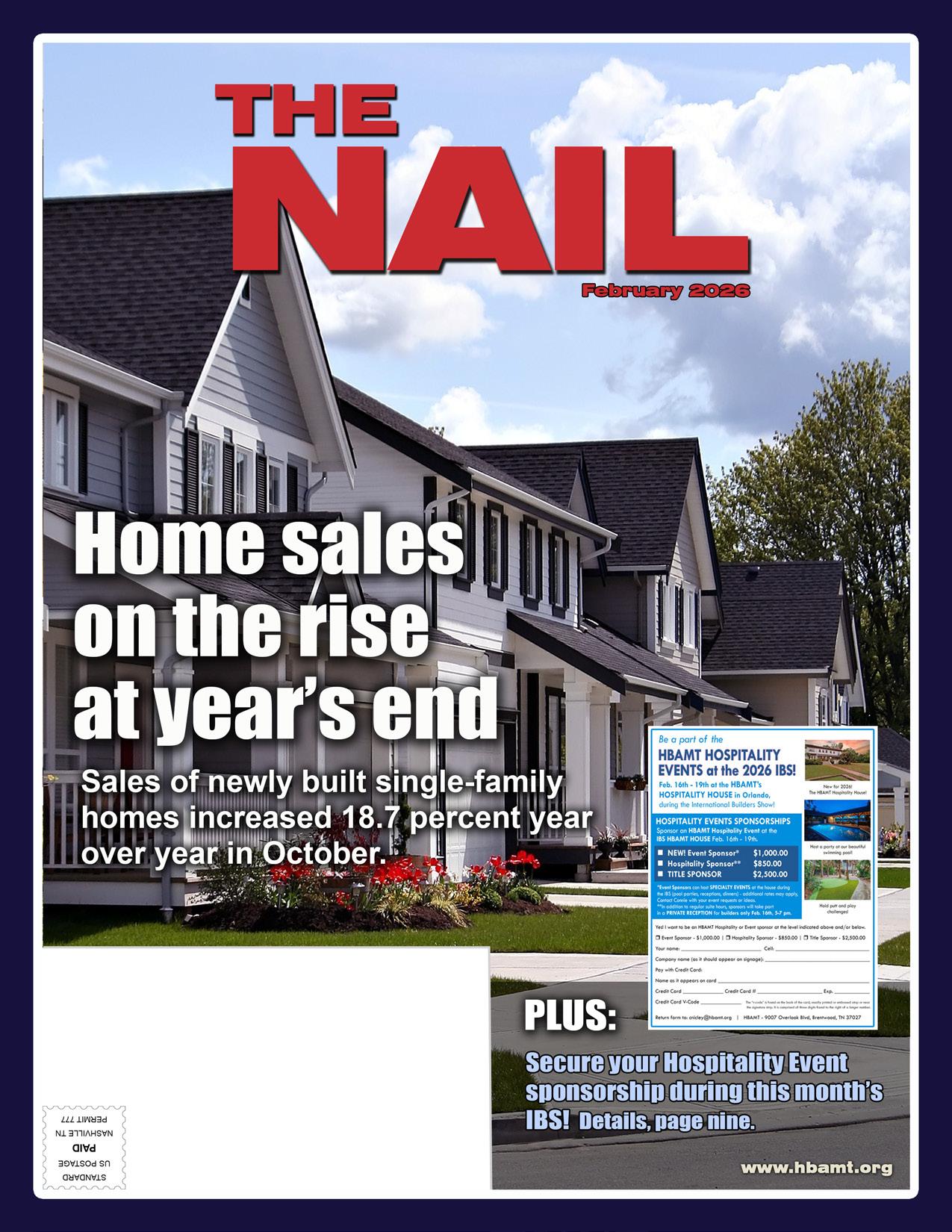




The official magazine of Home Builders Association of Middle Tennessee
President Eli Routh
Vice President
Danny Clawson
Secretary/Treasurer
Sam Gray
Executive Vice President John Sheley
Editor and Designer Jim Argo
Staff
Connie Nicley
Kim Grayson
THE NAIL is published monthly by the Home Builders Association of Middle Tennessee, a non-profit trade association dedicated to promoting the American dream of homeownership to all residents of Middle Tennessee.
SUBMISSIONS: THE NAIL welcomes manuscripts and photos related to the Middle Tennessee housing industry for publication. Editor reserves the right to edit due to content and space limitations.
POSTMASTER: Please send address changes to: HBAMT, 9007 Overlook Boulevard, Brentwood, TN 37027. Phone: (615) 377-1055.
Register now to sponsor or host events at the HBAMT Hospitality House during the 2026 IBS Show in Orlando. The show is scheduled for February 16-19 so sign up now!
A partial government shutdown went into effect at the end of January. A long-run shutdown, lasting several weeks or a month or more, could have significant impacts on the building industry.
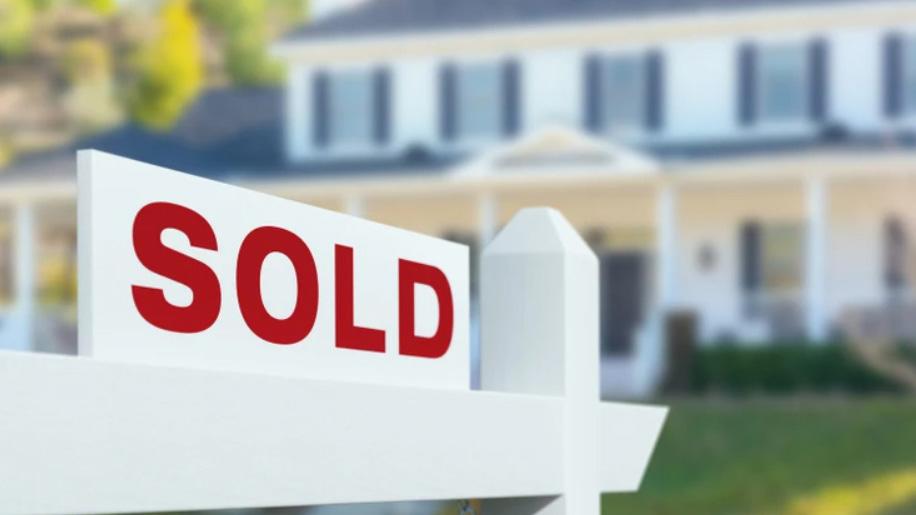
The new home sector has played an increasingly important role in meeting housing demand as resale inventory remains constrained in many regions. The latest data released today (and delayed because of the government shutdown in fall of 2025) indicate that new single-family home sales continue to reflect a stabilizing market after a period of heightened volatility. While month-to-month activity shows some variability, sales remain stronger than a year ago, signaling that buyer interest in newly built homes has improved.
Sales of newly built single-family homes increased 18.7 percent year over year in October to a seasonally adjusted annual rate of 737,000 units, according to the U.S. Department of Housing and Urban Development and the U.S. Census Bureau. This represented a modest 0.1 percent decline from September and a 1.2 percent decrease on a year-to-date basis. A new home sale is recorded when a contract is signed or a deposit is accepted, regardless of the stage of construction. The seasonally adjusted annual rate reflects the pace of sales that would occur over a 12-month period if current conditions persisted.
New single-family home inventory totaled 488,000 units in October, unchanged from the prior month and 1.7 percent higher than a year earlier. At the current sales pace, the months’ supply of new homes stood at 7.9, down from 9.3 months one year ago, though still above the sixmonth level that is generally considered balanced.
Combined new and existing home inven-
tory has edged lower in recent months, with total months’ supply declining to 4.9, reflecting slower construction activity. Meanwhile, inventory conditions in the existing home market have shown gradual improvement, and moderating prices across both markets have helped support buyer demand amid ongoing affordability concerns.
By the end of October 2025, there were 124,000 completed, ready-to-occupy homes available for sale on a not seasonally adjusted basis, up 10.7 percent from a year earlier. Completed homes accounted for roughly one-quarter of total inventory, while homes under construction made up 51 percent. The remaining 24 percent of homes sold in October had not yet started construction at the time the sales contract was signed
Home prices showed further signs of easing in October. The median new home sale price declined 3.3 percent to $392,300, marking an 8.0 percent decrease from a year ago. Affordability improved at the lower end of the market, with 25 percent of new homes priced below $300,000, the highest share in recent months. Thirty percent of homes were priced above $500,000, while the remaining 45 percent fell within the $300,000 to $500,000 range.
Regionally, year-to-date new home sales declined in three of the four regions, falling 0.1 percent in the Midwest, 7.2 percent in the West, and 22.9 percent in the Northeast. The South was the only region to post growth, with sales up 2.9 percent n

The National Association of Home Builders (NAHB) released its NAHB/ Westlake Royal Remodeling Market Index (RMI) for the fourth quarter, posting a reading of 64, up four points compared to the previous quarter.
The NAHB/Westlake Royal RMI survey asks remodelers to rate five components of the remodeling market as “good,” “fair” or “poor.” Each question is measured on a scale from 0 to 100, where an index number above 50 indicates that a higher share view conditions as good than poor. The results of the RMI are seasonally adjusted.
The Current Conditions Index is an average of three components: the current market for large remodeling projects, moderately-sized projects and small projects. The Future Indicators Index is an average of two components: the current rate at which leads and inquiries are coming in and the current backlog of remodeling projects. The overall RMI is calculated
by averaging the Current Conditions Index and the Future Indicators Index. Any number over 50 indicates that more remodelers view remodeling market conditions as good than poor.
“Most remodelers are finding reasonably strong market conditions, even with the normal seasonal slowdown during the holidays,” said NAHB Remodelers Chair Nicole Goolsby Morrison, a remodeler from Raleigh, N.C. “However, rising costs and customer hesitation due to economic and policy uncertainty remain key challenges for the industry.”
“The RMI reading of 64 is consistent

Builder confidence moved lower to start the year as affordability concerns continue to weigh heavily with buyers, and builders continue to contend with rising costs.
Builder confidence in the market for newly built single-family homes fell two points to 37 in January, according to the NAHB/Wells Fargo Housing Market Index (HMI) released recently.
“While the upper end of the housing market is holding steady, affordability conditions are taking a toll on the lower and midrange sectors,” said NAHB Chairman Buddy Hughes. “Buyers are concerned about high home prices and mortgage rates, with downpayments particularly challenging given elevated price to income ratios.”
“In a positive development, Freddie Mac reported that the average mortgage rate fell to 6.06% as of Jan. 15, the lowest rate in three years and nearly 100 basis points below the same period last year,” said NAHB Chief Economist Robert Dietz.
Most responses to the January HMI survey were received prior to the announcement that Fannie Mae and Freddie Mac would be purchasing $200 billion in mortgage-backed securities in an effort to bring down mortgage interest rates. And while this latest policy action on the interest rate front was largely not factored in the HMI survey, builders continue to report several supply-side headwinds.
“The future sales component of the HMI dipped below 50 for the first time since September, indicating that builders continue to face several issues that include labor and lot shortages as well as elevated regulatory and material costs,” Dietz noted.
In a further sign of ongoing challenges for the housing market, the latest HMI survey also revealed that 40% of builders reported cutting prices in January, unchanged from December but the third consecutive month the share has been at 40% or higher since May 2020. Meanwhile, the average price reduction was 6% in January, up from the 5% rate in December. The
with NAHB’s forecast for continued moderate growth in remodeling activity in 2026,” said NAHB Chief Economist Robert Dietz. “Demand for remodeling is being supported by an aging housing stock, strong homeowner equity and increasing need for aging-inplace improvements.”
The Current Conditions Index averaged 71, increasing three points compared to the previous quarter. All three components remained above 50 in positive territory: the component measuring large remodeling projects ($50,000 or more) rose five points to 69, the component measuring moderate remodeling projects (at least $20,000 but less than $50,000) inched up one point to 71, and the component measuring smallsized remodeling projects (under $20,000) increased two points to 73.
The Future Indicators Index averaged 56, up four points compared to the previous quarter. The component measuring the current rate at which leads and inquiries are coming in rose five points to 54, and the component measuring the backlog of remodeling jobs increased two points to 58. n
use of sales incentives was 65% in January, marking the 10th consecutive month this share has exceeded 60%.
Derived from a monthly survey that NAHB has been conducting for more than 40 years, the NAHB/Wells Fargo HMI gauges builder perceptions of current single-family home sales and sales expectations for the next six months as “good,” “fair” or “poor.” The survey also asks builders to rate traffic of prospective buyers as “high to very high,” “average” or “low to very low.” Scores for each component are then used to calculate a seasonally adjusted index where any number over 50 indicates that more builders view conditions as good than poor.
All of the HMI subindices fell in January. The HMI index gauging current sales conditions declined one point to 41 and the gauge charting traffic of prospective buyers dropped three points to 23. The index measuring future sales fell three points to 49, marking the first time this component fell below the breakeven point of 50 since September.
Looking at the three-month moving averages for regional HMI scores, the Northeast fell two points to 45, the Midwest held steady at 43, the South dropped one point to 35 and the West gained one point to 35. n



Although the Senate passed a spending bill to fund the vast majority of the federal government through Sept. 30, 2026, a partial government shutdown went into effect at 12:01 a.m. on Saturday, Jan. 31. It is unclear how fast the House will vote on the funding legislation passed by the Senate.
The partial shutdown affects major parts of the federal government, including the departments of Defense, Treasury, State, Health and Human Services, Labor, Housing and Urban Development, Transportation, and Education.
The White House and Republican and Democratic congressional leaders are seeking to avoid a weeks-long shutdown like the one that occurred last fall, and the House could vote as early as Feb. 2 on the Senate legislation to keep the full government running through fiscal year 2026, with the exception of the Department of Homeland Security, which would have a two-week stopgap funding level while lawmakers negotiate changes to the agency.
In most cases, the short-run impacts of a shutdown on the housing sector will be minor. A long-run shutdown, lasting several weeks or a month or more, could have significant impacts on mortgage accessibility and reduce housing demand.
In general, NAHB members should expect delays for any housing-related federal government programs that are still operating and plan accordingly. NAHB continues to monitor the situation closely.
Of immediate concern is the effect on the National Flood Insurance Program (NFIP):
l The authority to provide new flood insurance contracts is expired for the duration of the government shutdown. This will delay all new home sales or insurance renewals for property owners with federally backed mortgages who lie in a Special Flood Hazard Area.
l This disruption could lead to significant uncertainty in the housing market and may result in the cancellation of sales. However, flood insurance contracts entered into
before Jan. 30 will continue until the end of their policy term of one year.
Although Congress has reauthorized the NFIP retroactively following most prior lapses in authorization that have occurred, there is no guarantee that it will do so in this instance. A failure to retroactively renew the flood insurance program will impact the effective date of policies that can be issued once the NFIP has been reauthorized and once again begins issuing new policies.
The Trump administration has not published updated contingency plans for agencies late Friday evening.
Compiled by NAHB, the following is a list of government programs that could affect home builders and housing stakeholders under the current shutdown. The list below is based on government plans and actions currently available or on previous shutdowns, but is subject to change based on administration actions. NAHB will continue to update this list as new information becomes available.
l FHA-insured single-family loans will continue to be endorsed in the near term, although some delays in processing and closing should be expected.
l FHA multifamily insured projects with firm commitments and scheduled closings may go forward, although no new firm commitments will be issued.
l HUD will make payments under previously obligated Section 8 contracts, Section 236 agreements, Section 202 and 811 Project Rental Assistance Contracts (PRAC), and Section 811 Project Rental Assistance (PRA).
l HUD will continue to process rental subsidy contract renewals to the extent that there is budget authority available from prior appropriations or recaptures.
l NSPIRE physical inspections will only proceed a) when the servicing mortgagee is responsible for procuring the inspection; b) when funds for the NSPIRE inspection contracts were obligated before the lapse in
appropriations; or c) where there is reason to believe that there is a threat to life or property at a specific location.
l CDBG, HOME and other block grant funds will be dispersed in cases where failure to address issues results in a threat to life, safety and protection of property.
l Authorized drawdowns for approved CPD program activities (homeless assistance programs, CDBG, HOME, HOPWA) using pre-FY2026 program funds will continue uninterrupted unless it is necessary for a HUD employee to approve a voucher or lift a system edit prior to a drawdown.
l E-Verify, the web-based system that allows businesses to determine the eligibility of their employees to work in the U.S., is unavailable due to the government shutdown. While E-Verify is unavailable, employers may not be able to access their E-Verify accounts.
l OSHA’s investigation and enforcement activities will be substantially reduced during the shutdown, with the agency focusing on “imminent danger” situations involving the threat of safety, life or property and other emergencies, such as catastrophic and fatal workplace accidents.
l The agency will likely stop processing employers’ foreign labor certifications to access temporary workers under the H-2B program.
l Some lenders require home borrowers to file IRS form 4506-T to verify the mortgage applicant’s income and Social Security number. With the IRS shut down, this could result in major delays in some mortgage application approvals.
l Taxpayer services will be suspended, meaning no refunds will be issued and taxpayers will not be able to phone the IRS for advice. n


CHEATHAM COUNTY CHAPTER
Chapter President - Roy Miles
Cheatham County Chapter details are being planned. Next meeting: to be announced. RSVP to: cnicley@hbamt.org
DICKSON COUNTY CHAPTER
Chapter President - Matt Spann
Dickson County Chapter meetings are typically held on the third Thursday of the month.
Next meeting: to be announced. Typically held at Colton's Steak House - 2431 Highway 46 S, Dickson 37055 Free w/RSVP to: cnicley@hbamt.org
MAURY COUNTY CHAPTER
Chapter President - Sam Gray
Maury County Chapter meetings are typically held on the first Tuesday of the month.
Next meeting: Tuesday, February 3rd, 11:30 a.m. at Los Portas Taco Shop - 106A East 8th Street, Columbia TN, 38401. Topic: "Builder Roundtable: Shaping the Future of Maury County." Join us for an important and timely builder roundtable discussion featuring the Who’s Who of Maury County’s private building community.
FREE w/RSVP thanks to DominionX; $20 w/o RSVP PLEASE RSVP to cnicley@hbamt.org
METRO/NASHVILLE CHAPTER
Chapter President - Lisa Underwood Metro/Nashville Chapter details are typically held on the fourth Thursday of the month. Next meeting: to be announced.
RSVP to: cnicley@hbamt.org
ROBERTSON COUNTY CHAPTER
Robertson County Chapter details are currently being planned. Next meeting: to be announced. RSVP to: cnicley@hbamt.org
SUMNER COUNTY CHAPTER
Chapter President - Joe Dalton
The Sumner County Chapter typically meets on the third Tuesday of the month. Next meeting: to be announced. RSVP to: cnicley@hbamt.org
WILLIAMSON COUNTY CHAPTER
Chapter President - Rachel Holloway Williamson County Chapter meetings are typically held on the third Tuesday of the month. Next meeting: to be announced.
FREE w/RSVP pending sponsorship. RSVP to: cnicley@hbamt.org
WILSON COUNTY CHAPTER
Chapter President - Margaret Tolbert
Wilson County Chapter meetings are typically held on the second Thursday of the month.
Next meeting: Thursday, February 12th, 11:00 a.m. to 12:30 p.m. at East Nashville Beer Works – Wilson County. Topic: "Speed Networking." A fast-paced, interactive way to meet and connect with fellow HBAMT members doing business right here in Wilson County.
East Nashville Beer Works - Wilson County 1688 Callis Rd, Lebanon, TN 37090
FREE with RSVP pending sponsorship.
RSVP to: cnicley@hbamt.org
HBAMT REMODELERS COUNCIL
The HBAMT Remodelers Council meets at varying locations throughout the year.
Next meeting: to be announced.
RSVP to RMC meetings and events to: cnicley@hbamt.org
INFILL BUILDERS COUNCIL
Infill Builders Council meetings are typically held on the last Wednesday of the month.
Next meeting: to be announced.
PLEASE RSVP to: cnicley@hbamt.org
MIDDLE TENN SALES & MARKETING COUNCIL
Council President - Kristen Carbine
The SMC typically meets on the first Thursday of the month. Next event: Thursday, February 5th, 9 a.m. at the Rosebrooke Clubhouse in Brentwood.
Topic: "Before You Unlock: Realtor Safety in the Field." Barb Jordan, safety expert with Always Bev Self-Defense, will be the special guest for a discussion about onsite safety. Rosebrooke Clubhouse
1620 Rosebrooke Dr, Brentwood, TN 37027
Free for SMC Members w/RSVP thanks to DR Horton, Ole South, and Toll Brothers.
NON-SMC MEMBERS MUST RSVP and PAY: $25 with RSVP; $30 w/o RSVP
**HBAMT members must be a paid member of the Sales & Marketing Council in order to receive council rates** RSVP to: cnicley@hbamt.org
$0 enrollment fee with code: FITNESSGOALS²






Plus 9,400+ additional premium exercise studios at 20% - 70% off retail1
Bundle and save. Get $5 off each additional gym you join.3
No long-term contracts. Easily sign up, switch gyms, or cancel online with no fees or penalties.
Connect 1-on-1 with a personal well-being coach for motivation in nutrition, stress management, sleep, and more at no additional cost.
Create a free account to get instant access to 14,000+ on-demand workout videos!









1
3