Bolling Suite
Improving on perfection: reimagining Bolling’s Suite for Flute and Jazz Trio by Gareth McLearnon
I
t can be said, perhaps even hoped, that in our creative endeavours, the search for improvement, for progress, for wringing that last drop of emotion, that slight improvement in tone, that elusive perfect diminuendo into nothingness is never-ending. The well-worn, and maybe overused cliché ‘if it ain’t broke – don’t fix it’ has little place in the arts. As performers and creative people, the moment that we settle for ‘it’ll do’ is inevitably a sad one. For one man, his wish to augment and reinterpret a certain piece of the flute repertoire began on the very day he first heard it, as an undergraduate student of Minnesota State University in 1975. The student was the pianist, composer, arranger and GRAMMY nominee Steve Barta; the piece was Claude Bolling’s Suite for Flute and Jazz Trio – performed by Jean-Pierre Rampal with Bolling himself on piano. Like so many new connections these days, I first encountered Steve through Facebook. One of my responsibilities as European Artist-in-Residence for the Wm. S. Haynes Flute Co. is looking after the company’s social media threads. Always seeking to promote my fellow Haynes artists, I was interested to feature the work of the legendary jazz flautist Hubert Laws. I saw that there was a new and interesting project that he was involved in with Steve, and once I had listened to a few of the snippets that had been shared online, my appetite was sufficiently whetted to get in touch to find out more. This being a modern-day encounter, I arranged an interview with Steve via Skype with me in South London, and he in his home in Colorado Springs. We began speaking about the original 1975 Rampal recording. “I listened to it all the time” Steve enthused. “It was a really new, exciting genre – probably one of the very first big successes in the Classical-Jazz crossover genre. I loved the writing, I loved the playing, but always felt like it needed different treatment.” As well as seeing possibilities in the writing and arrangement of the piece, it seemed to Steve that the sophistication of technique, the polished delivery of the consummate flûtiste of the day, although wonderful, wasn’t quite ringing true – or perhaps not true enough. Jazz flute was a rougher, more raw, occasionally more boisterous, but equally frequently more vulnerable art-form than that of the refined eloquence of the concert performer. Steve has had quite a prolific output as a composer/ performer since his career took off in the 1980’s, with fifteen albums and six music publications under his belt. He has
32
bfs.org.uk
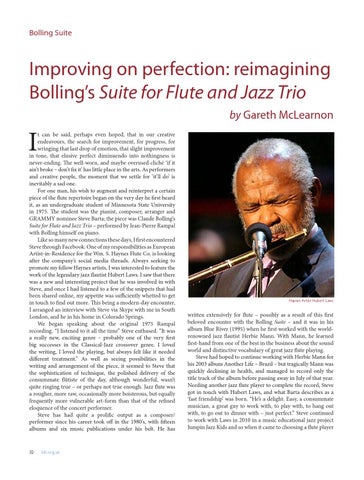
Haynes Artist Hubert Laws
written extensively for flute – possibly as a result of this first beloved encounter with the Bolling Suite – and it was in his album Blue River (1995) when he first worked with the worldrenowned jazz flautist Herbie Mann. With Mann, he learned first-hand from one of the best in the business about the sound world and distinctive vocabulary of great jazz flute playing. Steve had hoped to continue working with Herbie Mann for his 2003 album Another Life – Brazil – but tragically Mann was quickly declining in health, and managed to record only the title track of the album before passing away in July of that year. Needing another jazz flute player to complete the record, Steve got in touch with Hubert Laws, and what Barta describes as a ‘fast friendship’ was born. “He’s a delight. Easy, a consummate musician, a great guy to work with, to play with, to hang out with, to go out to dinner with – just perfect.” Steve continued to work with Laws in 2010 in a music educational jazz project Jumpin Jazz Kids and so when it came to choosing a flute player
Bolling Suite
for this new symphonic arrangement of the suite, Hubert was the only name on the list. For the piano part, Steve had to look a little harder. An accomplished pianist himself (a Steinway artist) and having played on all of his own previous albums, Steve wanted to take the role of the producer for this disc rather than that of a player. “With this project essentially being forty years in the making – I thought it was important to ask myself, ‘What’s really the best decision for the project as a whole? Who is the best person to do this job?’” He browsed the Steinway artist list and came across the abundant and incredibly varied work of the virtuoso American pianist Jeffrey Biegel. Barta and Biegel met in 2009 when he was playing two concertos with the Colorado Springs Philharmonic. “I asked Jeff if he played jazz. He replied that he could, but only if it was written out – like in the Keith Emerson Concerto he’d just done with the orchestra, or Lalo Schifrin’s Concerto No. 2, or (of course) the Claude Bolling Suite! We both remarked on how we’d always wished there was an orchestral version of the piece. Then, on discovering that Jeff and Rampal shared a French agent (Anne-Marie Pochet de Valmalete) the connection was then made with Bolling, and the process began. With Jeff, it was like the stars aligned, it just felt right. It’s a choice I’ll never regret.” Biegel is indeed a musical tour de force – a champion of new music, with dozens of commissioned works and premieres, he has worked prolifically in so many different genres and his contribution to this disc is absolutely first rate. With natural, humorous, stylish playing throughout, it’s difficult to believe that this is a classical pianist at the keyboard and not a seasoned jazz master. With veteran musicians from the Los Angeles Studios Mike Valerio (bass), and Mike Shapiro (drums) also in the line-up, even if it were just going to be a traditional rendition of the piece in its original format it would certainly be a disc worth hearing. However, the addition of the symphonic element is what makes this a truly unique interpretation of this seminal work. Classically, Steve says that his influences stem from Rachmaninoff, Britten Vaughan Williams and David Amram, but for me, the arrangements surrounding this work have pepperings of Sondheim, Bernstein, Dave Grusin, and even a Randy Newman Toy Story sort of vibe. There is sophistication and careful orchestration, but what comes across most in the recording is tremendous warmth and generosity; Barta really has provided the perfect bed for this work to lie on: not too hard, not too soft – just right. I asked Steve about the orchestration, and he had very specific reasons for setting things out as he did. “I started with adding a string quartet, so there can be intimacy in the quieter moments, and soloistic string moments when necessary. I didn’t want it getting too big or symphonic too quickly. But then there is a thirteen-piece string orchestra, flute, picc, oboe, two clarinets, bassoon, four horns, three trumpets, three
trombones, harp and percussion creating a rich and varied orchestral timbre.” Steve has also made the orchestral parts available for hire so that his reinterpretation can go out into the hands of new musicians and have a life of its own in the concert hall. At 40 minutes, it could certainly be an innovative and attractive programming choice in the years ahead. Not being affiliated with a record label, Barta has produced and funded this project from top to bottom and it’s clearly been a labour of love. “The whole project was recorded over two days in January in Entourage Studios in West Hollywood. First the jazz quartet; then the string quartet; then next morning adding the string orchestra, with the winds and brass in the afternoon, then came the lengthy mixing and mastering process.” The experienced studio musicians on the album really do an impeccable job; listening through the tracks, the additional instrumental parts don’t feel ‘bolted on’ as they might have the potential to – the orchestral treatment has been sensitively and lovingly thought out. Nor does it sound like the dreaded ‘muzak’ or elevator music that orchestral jazz can be occasionally reduced to. No, the amazing thing is that it just feels like a totally natural, and timely update – a beautifully crafted modernisation. I think it’s fair to say that the flute playing in a strictly classical or technical sense, maybe isn’t as careful, or clean-cut as in other recordings of this work, but the poetry, vulnerability, expression, use of gesture, humour and importantly the authenticity of the swing and natural feel of the jazz vernacular of Hubert Laws are all utterly first class. Trying to find a favourite moment, or favourite track is tricky – each movement of this work has moments that are so charming, or so humorous or heartfelt that they raise a smile. Like Steve Barta who incessantly listened to the Rampal 1975 rendition, I can happily say that since receiving the reviewer’s copy, my iPod has been regularly graced with this fabulous recording and I discover new, enchanting little moments on each listening. Perhaps in the same way that Early Music specialists give us a new dimension and elegance to Baroque and Classical works, with complexity of gesture and subtlety only a specialist can bring, the interpretation of a jazz master such as Hubert Laws – and the ensemble creation directed by Barta – may well have given us a truly definitive recording of this pivotal ClassicalJazz work. Claude Bolling himself seems to think so – with a published cry of ‘A thousand bravos!’ This is one of those beautifully crafted creations, that has seemingly improved on the unimprovable – and as a result, the recording is definitely one of those definitive flute albums you’re going to want to hear again and again. The recording of Symphonic Arrangement of Suite for Flute and Jazz Piano Trio is available on iTunes, Amazon, CDBaby, and from www. stevebarta.com where the orchestral parts for this work are also available for hire.
September 2015
33