
Ten years after the Paris Agreement, taking stock of 2035 climate action plans on the road to achieving the 1.5°C limit.
Countrieshavemadecollectivecommitmentstolimittheglobaltemperature riseto1.5°C,toreduceemissionsby60%by2035,totriplerenewableenergy anddoubleenergyefficiencyby2030,andtotransitionawayfromfossilfuels. Butcurrenttargets,policies,measures,andfinancialsupportarenot matchingupandwearefacingasubstantialambitionandimplementation gap Withallcountriesexpectedtobringinnew2035targetsbyCOP30,itwas hopedthatsubstantialprogresswouldbemade.BythemiddleofCOP30 howevermanycountrieshavenot(yet)submittednewtargets,andthosewho didhavepresentedplansthatcollectivelydonotmeetexpectations.In particular,G20countries-andespeciallythedevelopedcountriesamong them-whoareresponsibleforthevastmajorityofglobalgreenhousegas emissionsandthebulkoffossilfuelconsumption,arefailingtopresent adequatetargetsandmeasures.
TheimportanceoftheG20ʼscontributiontoglobalclimateactioncannotbe overstated.Thesemajoremittersaccountforalmost80%ofcurrentemissions andaround85%ofglobalGDP,givingtheirpoliciesoutsizedinfluenceon
globaltrade,investmentandtechnologyflows.Inshort,whatG20countries do-orfailtodo-willdeterminewhetherthe1.5°Ctemperaturelimitremains inreach.
Yettakentogetherasagroup,G20countriesʼsubmittedandannounced2035 targetswouldonlyleadtoareductionof23%to29%oftheiremissions comparedtotheiremissionsin2019.Thisrepresentsaseriousshortfall comparedtotheglobal60%reductionagreedintheGlobalStocktakeonlytwo yearsago.
WithintheG20,developedcountriesbearthegreatestresponsibility,given theirhistoricandcurrentcontributiontoglobalemissionsandtheirfar greatercapacitytoact.Theiremissionreductioncommitmentsshould thereforebewellinexcessof60%,accompaniedbytheprovisionofadequate climatefinancetosupportactionindevelopingcountries.Manyfallfarshort of60% andnonemeettheirfairshareoftheactionrequiredtomeetthis collectivetarget Takentogether,G20developedcountryNDCsamounttoonly a51%to57%reductioninemissionscomparedwith2019levels,representing aglaringfailuretoleadbythecountriesthatshouldbedrivingglobal ambition.
Beyondtheemissionsgap,allG20countryNDCsarefailingtoadequately contributetotheagreedenergytransition.Theylackboththenecessary commitmenttophaseoutfossilfuelsaswellasquantifiedtargetsforprogress relatedtorenewablesandenergyefficiencydevelopments.Overall,G20 countries-hometotheworldʼslargestproducersandconsumersoffossilfuelsofferNDCsthatconspicuouslylackcredible,actionableplanstophaseoutthe veryfuelsdrivingtheclimatecrisis.Developedcountriesinparticularstandout: thoughtheybearthegreatestresponsibilitytoleadandmovefirstandfastest, theirNDCscomenowhereclose.
AtCOP30,countrieswillneedtoadoptaGlobalResponsePlantotacklethe mitigationambitiongapandensuresubstantialandequitableprogressis madeinreducinggreenhousegasemissionsandphasingoutfossilfuels. Progressonclimatefinance,especiallytheprovisionofsignificantlyscaledup publicfinancebydevelopedcountries,willalsobecriticaltounlockgreater ambitionfromdevelopingcountriesthatneedsupport.
2024wasthewarmestyearsinceobservationsstarted175yearsago,withaverage temperaturesgoingbeyond15°C(comparedtothe1850-1900average)forthefirst time.1 Averagewarmingovera20-yearperiodreached1.25°C,whichsubstantially increasedextremeweatherevents,includingdestructivecyclones,floods,
1 Pleasenotethatthisreferstoanannualaverageabove15°Cwhichisdifferentfromthetargetunderthe ParisAgreementwhichreferstoa20yearaveragetemperaturerise
droughts,forestfiresandextremeheat,withdevastatingimpactonhumanlife.2 Andtheseimpactswillonlygrowasweareontracktofurthersubstantial increases,3 witheconomistswarningthattheglobaleconomycouldfacea50% lossinGDPafter2070,unlessimmediatepolicyactiononrisksposedbythe climatecrisisistaken.4
Temperatureswillcontinuerisingunlesswedrasticallyreduceemissions Emissionshaveincreasedby1.4%peryearbetween1990and2015,theyearofthe adoptionoftheParisAgreement,andby1.6%peryeareversince.5 Emissionsare highlyconcentratedinalimitednumberofcountries.The43membercountries oftheG20,includingtheEU27butexcludingtheAfricanUnion,madeupfor77% ofemissionsin2023 Whenaddingthe55membersoftheAfricanUnion,the sharewouldincreasebyonly5%,highlightingthelargediscrepancyinthe contributionofdifferentcountries(andcontinents).Thesedisparitiesincrease furtherwhentakingintoaccountthehistoricalresponsibilityofmostlydeveloped countriesforgreenhousegasconcentrationsintheatmosphere.
Ifwearetosubstantiallyreduceglobalgreenhousegasemissionstonearzero, thentheuseoffossilfuelswillneedtobecompletelyphasedout.Currentlyfossil fueluseisresponsibleforaround70%ofgreenhousegasemissions,and emissionsfromfossilfuelusehaveincreasedbymorethan60%since1990 6 Inits recentAdvisoryOpinionontheobligationsofstateswithrespecttoclimate change,7 theInternationalCourtofJustice(ICJ)underlinedtheimportanceof phasingoutfossilfueluseinordertoachievethegoalsoftheParisAgreement stating“thatastateʼsfossilfuelproduction,fossilfuelconsumption,grantingof fossilfuelexplorationlicenses,andtheprovisionoffossilfuelsubsidiesmay constituteaninternationallywrongfulactwhichisattributabletothatstate” (paragraph427).
Alreadyin1992,whenadoptingtheUNFrameworkConventiononClimate Change,countriescommitted“toachievestabilizationofgreenhousegas concentrationsintheatmosphereatalevelthatwouldpreventdangerous
2 WMO(2025),“StateoftheGlobalClimate2024”.March2025: https://librarywmoint/viewer/69455/download?file=WMO-1368-2024 enpdf&type=pdf&navigator=1
3 IPCC,“ClimateChange2022:Impacts,AdaptationandVulnerability”. February2022: https://wwwipccch/report/sixth-assessment-report-working-group-ii
4Trust,Setal (2025),“PlanetarySolvency–findingourbalancewithnatureGlobalriskmanagementfor humanprosperity”,InstituteandFacultyofActuariesandUniversityofExeter January2025: https://actuariesorguk/document-library/thought-leadership/thought-leadership-campaigns/climate-paper s/planetary-solvency-finding-our-balance-with-nature
5EDGAR,“GHGEmissionsofallworldcountries” 2024:https://edgarjrceceuropaeu/report 2024
6UnitedNations,“Causesandeffectsofclimatechange”. https://www.un.org/en/climatechange/science/causes-effects-climate-change
7 InternationalCourtofJustice(ICJ)(2025),“ObligationsofStatesinrespectofClimateChange”,Advisory Opinion July2025:https://wwwicj-cijorg/sites/default/files/case-related/187/187-20250723-adv-01-00-enpdf
anthropogenicinterferencewiththeclimatesystem”.8 Inthe2015Paris Agreement,countriesfurthercommittedto“holdingtheincreaseintheglobal averagetemperaturetowellbelow2°Cabovepre-industriallevelsandpursuing effortstolimitthetemperatureincreaseto1.5°Cabovepre-industriallevels, recognizingthatthiswouldsignificantlyreducetherisksandimpactsofclimate change”.9 Subsequentagreementsconfirmedcountries'commitmenttolimit temperatureriseto1.5°Cbytheendofthecentury.10
TheParisAgreementobligescountriestosubmit,atleasteveryfiveyears, NationallyDeterminedContributions(NDCs)indicatingspecificnational objectivesforthenext10years.Throughthefirstandsecondround11 ofNDCs,195 countriessetspecificobjectivesfor2030 12 ThethirdroundofNDCswhichhaveto besubmittedthisyear13 shouldincludeobjectivesfor2035.
Asof15November2025,114countries,covering74%ofglobalemissionshave submittedan(economy-wideorsectoral)2035target 14 Someofthelargest emittingcountriesarestilltosubmittheirNDC.Asofnow,twelveG20member stateshavesubmittedanNDC.ThisincludestheUS,whoseNDCisnolonger supportedbythecurrentadministration,andisnotonlywithdrawingfromthe ParisAgreement,butalsorollingbackpoliciesandmeasuresthatwould implementtheNDC Asaresult,itisestimatedthattheUSwouldonlyachieve halforevenlessoftheemissionreductionsincludedinits2035NDC 15
TheParisAgreementalsoputsinplacea5-yearGlobalStocktakeprocesstotake stockoftheprogressofcountriesinreachingthecollectiveobjectivetolimitthe globalaveragetemperatureriseto1.5°C.Thisprocessshouldinformthe
8UnitedNations(1992),“UnitedNationsFrameworkConventiononClimateChange” May1992: https://unfccc.int/files/essential background/background publications htmlpdf/application/pdf/conveng.p df
9UnitedNations(2015),“ParisAgreement”.December2015: https://unfcccint/sites/default/files/english paris agreementpdf
10Suchasinparagraph21oftheGlasgowClimatePactofNovember2021: https://unfcccint/sites/default/files/resource/cma3 auv 2 cover%20decisionpdf
11ThefirstroundofNDCsweresubmittedpriortothe2015COP21inParis MostoftheseNDCstargeted 2030,thoughafewalsotargeted2025emissions Asecondroundmostlyconsistedofanupdateofthefirst NDCsintheperiod2021-2023,withpledgesfocusingon2030.
12TheUNreceived168NDCs,representing195countries Nolessthan180countriesprovidedmultiple (updated/improved)versionsoftheirfirstNDC.Source: https://unfcccint/process-and-meetings/the-paris-agreement/nationally-determined-contributions-ndcs/20 24-ndc-synthesis-report
13InfacttheParisAgreementcallsforthesesubmissionstohappenatthe latest9monthsbeforeCOP30, meaningthe'official'deadlinewasFebruary10 As90%ofcountriesfailedtosubmittheirNDCintime,a seconddeadlinewassetforendSeptembertoallowtheUNFCCCsecretariattoincludetheseNDCsintheir annualSynthesisReport Only64countriessubmittedanNDCintimefortheSynthesisReport
14 123countries(includingallEU27MemberStates)havesubmittedaneworrevisedNDCsince1stof November2024.Ofthese,100countriessubmittedanNDCwithaneconomy-wide2035target.14countries submittedanNDCcontainingasectoraltarget,while9countries(re-)submitteda2030target.Afull overviewcanbefoundontheUNFCCCNDCSubmissionpage:https://unfccc.int/NDCREG
15 TheRhodiumGroupestimatestheUSisontracktoreduceemissionsby26%to35%by2035,ascompared totheNDCwhichaimsatreducingemissionsby61%to66% B King(2025),“TakingStock2025:USEnergy andEmissionsOutlook“https://rhgcom/research/taking-stock-2025
developmentofNDCs.TheoutcomeofthefirstGlobalStocktake,whichendedin November2023,wasclear:moreactionisneededifwearetopreventdangerous climatechange UndertheGlobalStocktake,countriesendorsed:
● deep,rapidandsustainedreductionsinglobalgreenhousegasemissions of43percentby2030and60percentby2035relativetothe2019leveland reachingnetzerocarbondioxideemissionsby2050(para27);
● triplingrenewableenergycapacityby2030(para28a);
● doublingtheannualrateofenergyefficiencyimprovementsby2030(para 28a);
● transitioningawayfromfossilfuelsinenergysystems,inajust,orderly andequitablemanner,acceleratingactioninthiscriticaldecade(para 28d);
TheoutcomeoftheGlobalStocktake16 isamajorachievementasitclearlyputs theenergytransitionfrontandcentreofthedebateandcontainsspecific commitmentsrelatedtothepromotionofrenewablesandenergyefficiencyand thephaseoutoffossilfueluse.

16 UnitedNations(2023) Outcomesofthefirstglobalstocktake:https://unfcccint/documents/637073
Havingcountriescommittothe15°CtemperaturetargetintheParisAgreement wasamajorachievement,butonethatneedstobefollowedbyambitious nationaltargetsaswellaspoliciesandmeasurestoensurethetargetsaremet. Severalreportsassessingcountries'currenttargets,policiesandmeasuresclearly indicatethattheworldfacesasubstantialgapbetweenwhatisneededtolimit temperatureriseto1.5°Candwhatisactuallybeingdone.
BothlastyearʼsUNEP2024EmissionsGapReport17 andtheUNFCCC's2024NDC SynthesisReport18 wereclear:afailuretoincreaseambitionin2030NDCs combinedwiththeirweakimplementationputstheworldontrackfora temperatureincreaseof26°Cto31°Coverthecourseofthiscentury Current NDCswouldleadtoemissionsof51.5GtCO2-ein2030,alevelonly2.6%lower thanin2019.Thisisfarfromthe43%cutby2030agreedintheGlobalStocktake. A2.6°Cincreaseinglobaltemperaturewouldleadtoasignificantescalationof climatechangeimpactscomparedto1.5°C,includingmorefrequentandintense heatwaves,droughts,andfloods,widespreadoceanimpactslikethelossof tropicalcoralreefs,andsevereconsequencesforwater,agriculture,andhuman health.Thislevelofwarming,whichcurrentclimatepledgesputusontrackto reach,wouldbemarkedbydangerous,compoundingrisks,andthelikelihoodof crossingmultipletippingpointsintheclimatesystem,triggeringsevere,abrupt andirreversiblechanges.19
TheimportanceoftheG20ʼscontributiontotheachievementofa60%greenhouse gasemissionreductionby2035cannotbeoverstated.Thesemajoremitters accountfor almost80%ofcurrentemissionsandaround85%ofglobalGDP, givingtheirpoliciesoutsizedinfluenceonglobaltrade,investmentand technologyflows Inshort,whatG20countriesdo-orfailtodo-willdetermine whetherthe1.5°Ctemperaturelimitremainsinreach.
OftheG20memberstates,Australia,Brazil,Canada,China,theEU,Indonesia, Japan,Russia,SouthAfrica,Turkiye,theUKandtheUShavesubmitteda2035 target.Twomorecountries(MexicoandSouthKorea)publiclyannouncedtheir 2035targetsbutdidnotofficiallysubmitthisyettotheUN.ThreeG20countries
17UNEnvironmentProgramme(2024),“Nomorehotair please!Withamassivegapbetweenrhetoricand reality,countriesdraftnewclimatecommitments” October2024: https://www.unep.org/resources/emissions-gap-report-2024
18UNFCCC(2024),“NationallydeterminedcontributionsundertheParisAgreement Synthesisreportby thesecretariat“.October2024:https://unfccc.int/sites/default/files/resource/cma2024 10 adv.pdf
19ArmstrongMcKayetal (2022)“Exceeding15°Cglobalwarmingcouldtriggermultipleclimatetipping points” Science,9September2022: https://wwwscienceorg/doi/101126/scienceabn7950
(Argentina,IndiaandSaudiArabia)havenot(yet)submitted(norannounced) theirNDC.
AsTable1shows,basedonthesubmittedandannounced2035targets,G20 countrieswouldreducetheiremissionsby-23%to-29%by2035comparedto2019 -farshortofthetrajectoryrequiredtolimitwarmingto1.5°C.20
Table1:2035targetsforallG20memberscomparedwith2019emissions21
2-e(net) -29%-42%
SouthAfrica 320-380MtCO2-e(net) -21%-33% SouthKorea -53%-61%/2018(net) -50%-59%
Turkiye 643MtCO2-e(net) +42% UK -81%/1990(net) -66%
Combinedtotalfor G20countrieswith a2035target -23%-29%
1:CanadaistheonlyG20countrythathassubmittedagrossemissionstarget,whichonlydealswith emissionsandnotwithland-based(LULUCF)norindustrialremovals;2:tocalculateChinaʼstargetwe assumedemissionswouldpeakin2024andbasedpeakemissionsonanincreaseof670Mt(asreportedin theEDGARdatabase)abovethe2021emissionslevelsreportedinChinaʼsBiennialTransparencyReport (BTR);3:basedontheexistingNDCfromtheBidenadministration.
20 AllnumbersbasedondatacontainedincountriesʼNDC,furtheraddedbydatafromcountriesʼrespective InventoryReportstotheUNFCCCandwhereneededadditionaldatawereusedfromfromtheClimate Watchdatabase:www.climatewatchdata.org/ghg-emissions
21 Alltargetnumbersinthetablearebasedonofficialsubmissions Notallcountriesusethesame methodologytoaccountfortheiremissionsandactualemissionsmaydiffersubstantiallyfromthose reportedbygovernments
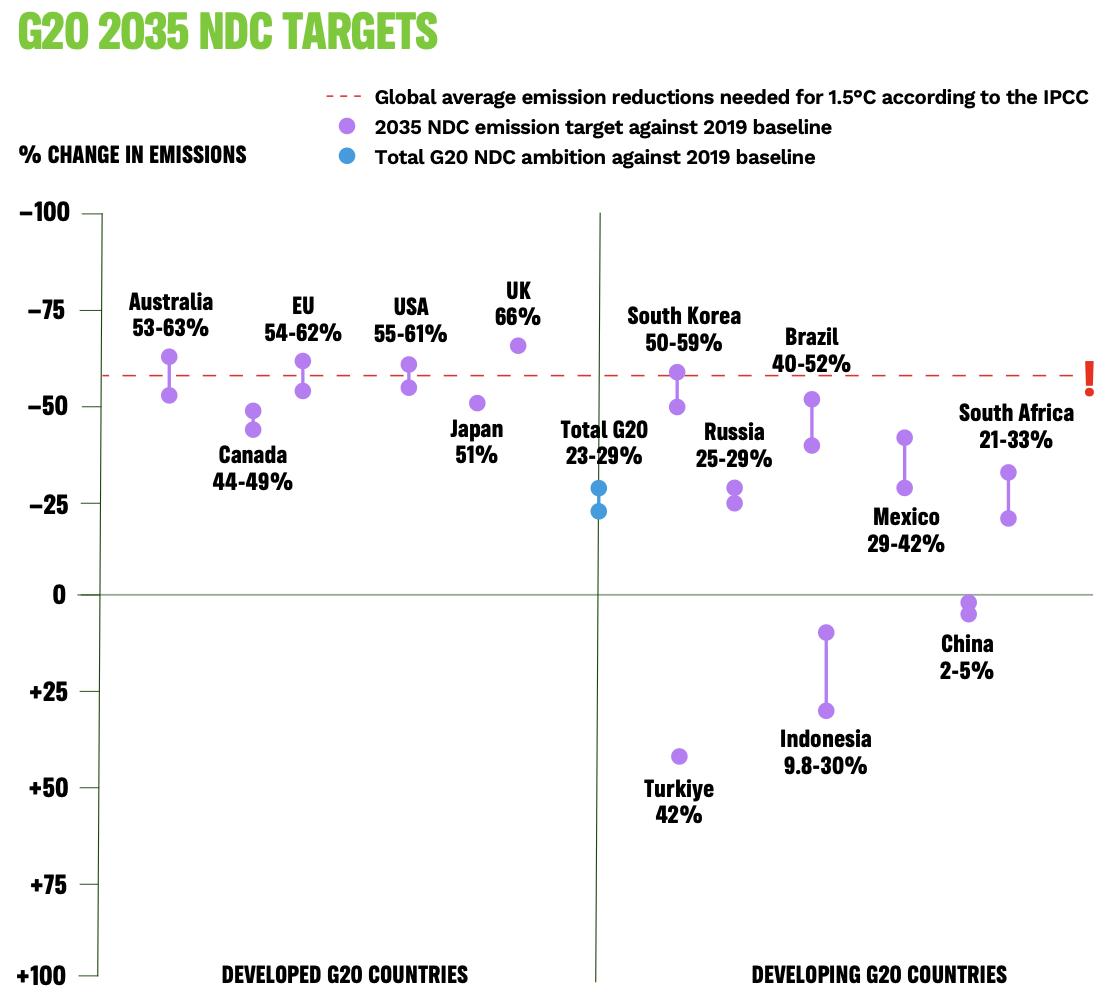
Notethatdevelopedcountries,owingtotheirhigherhistoricalemissionsandgreatereconomiccapacity, shouldaimforsignificantlydeeperemissionsreductionsthantherequiredglobalaverage
The G20 and beyond: Assessing global ambition of 2035 NDCs Asof15November2025,100countriessubmittedaneconomy-wide2035target. Furthermore,14countriessubmittedanNDCwithsectoraltargetsfor2035.A preliminaryassessmentofallcurrent2035economy-widetargets22 showsthatthe worldisfarofftrackfromreachingthe60%reductionby2035(comparedto2019) thatwasagreedintheGlobalStocktake.Currentsubmitted(andannounced) NDCs(G20countriesandbeyond)wouldleadtoagreenhousegasreduction between16%and25%23 comparedto2019emissions24 .
22 NotethatthisassessmentdoesnotincludeNDCswithsectoraltargets.
23 Thisassessmentincludesbothconditionalandunconditionaltargets Anumberofdevelopingcountries havesubmittedconditionaltargets(nexttounconditionalones)whoseimplementationdependsonthe provisionofadequateclimatefinanceandothersupportfromdevelopedcountries
24 NotethisassessmentincludesNDCssubmittedafterthecutoffdatefortheUNFCCCʼs(updated)Synthesis ReportaswellastheannouncedtargetsofMexicoandSouthKoreawhichwerenotincludedinthe SynthesisReport.Furthermore,theSynthesisReportsfocusesontargetsexcludingLULUCF(landuse,land usechangeandforestry)whileonlysevenofthe102countriesassessedhavetargetsexcludingLULUCF. ThisindicatesthatforalargemajorityofcountriestheSynthesisReportisbasedonassumptionsonthe divisionofcountriesʼeffortsbetweenemissionsandremovalsintheLULUCFsectorandemissionsinthe non-LULUCFsectors Ourreporthasnotengagedincalculatingsuchassumptionsandfocusesoncountriesʼ nettargetsasindicatedintheirNDCs.
Whilealreadyfarfromtheneeded60%reduction,thisnumbermightberather optimisticas(a)possiblythecountriesthathavenotyetsubmitteda2035target willhavebelowaveragetargets;(b)China'stargetiscalculatedbasedonits2024 emissions,assumingthiscouldbetheirpeakyear,whichmaynotbethecaseand inthatcaseChina'semissionsin2035willbehigherthaninthisexercise;and(c) theUSNDCwassubmittedbytheBidenadministrationandactionstakenbythe currentadministrationwillmakeachievingthistargetextremelychallenging.
Akeydriverofthislowambitionisweakcommitmentsfrommostdeveloped countries.AspartoftheequityprinciplesoftheUNFrameworkConventionon ClimateChange,developedcountries25 areexpectedtotaketheleadinreducing emissionsandshouldthusaimatemissionreductiontargetswellbeyondthe averageof-60%.UNSecretary-GeneralAntonioGuterrescalledupondeveloped countriestoreducegreenhousegasemissionstonetzeroby2040,whichwould needdevelopedcountriestoreducetheiremissionsbyatleast75%by2035.26 However, currentpledgesindicatedevelopedcountriesareontrackfor emissionsreductionsofonly-50%to-55%comparedto2019.
Althoughtheoverwhelmingresponsibilityfortheemissionsgaprestswith developedcountries,whosehistoricandcurrentemissionsremainfarabove equitablelevels,strongerambitionfromsomedevelopingcountrieswillalsobe essentialtolimitwarmingto1.5°C.Evenifdevelopedcountriesweretocommitto achievingnetzerogreenhousegasemissionsassoonas2035,toachievethe agreed-60%reduction,developingcountriesasawholewouldstillneedtoreduce their2019emissionsbyatleast35%by2035.Severalmajordeveloping-country emittershavesettargetsthatfallshortoftheirfairshareofwhatisrequired, furtherwideningtheglobalambitiongap.
Itshouldbenotedhoweverthatdevelopingcountriesarenotahomogenous groupintermsoftheiremissionsprofiles,economiccapacities,ordevelopment needs-andthisshapeswhatcanbeexpectedoftheir2035NDCtargets.For developingcountrieswithlowerincomesandsignificantdevelopmentneeds, substantialinternationalsupportwillalsobecriticaltoraisingambition
Aswellasleadingonmitigationefforts,theequityprinciplesoftheUN FrameworkConventionalsorequiredevelopedcountriestoprovidesubstantial climatefinancetosupportactionindevelopingcountriesthatneedit The inadequateNewCollectiveQuantifiedGoal(NCQG)agreedatCOP29lastyear highlightsthatthisisstillfarfrombeingachieved.27 Itisbothunjustand
25Developedcountriesinthisassessmentincludeallso-calledAnnex1countries,exceptforTurkiye,and all(non-annex1)Europeancountries
26 UnitedNations(2023) Secretary-GeneralCallsonStatestoTackleClimateChangeʻTimeBombʼthrough NewSolidarityPact,AccelerationAgenda,atLaunchofIntergovernmentalPanelReport.20March2023: https://press.un.org/en/2023/sgsm21730.doc.htm
27 SeeGreenpeaceInternationalresponsetoCOP29outcome https://wwwgreenpeaceorg/international/press-release/71474/cop29-ends-weak-climate-finance-goal-eyesturn-belem/
unrealistictoexpectdevelopingcountriesthatneedsupporttodramatically increasetheirambitionwithoutit.
2030 NDCs (and policies)
Doubling,nottriplingrenewableenergy:
ToimplementtherenewablesgoaloftheGlobalStocktakerenewableenergy capacityinthepowersectorneedstobeincreasedtoatleast11,000GWby2030, whichisatriplingascomparedto2022 28 TheIEA29 assessedcountries'renewables targetsandmeasuresinandoutsideofNDCsanditsanalysisindicatesthat triplingglobalrenewablepowercapacityby2030isanambitiousbutachievable goal.Countriesʼoverallambitionsonrenewablepowercapacitycorrespondto reachingalmost8,000GWgloballyin2030,whichis2.2timesthe2022leveland 30%shortoftriplingby2030 Solarandwindmakeupmostofthecapacity explicitlyidentifiedbygovernments.
28IEA,“NetZeroRoadmap:AGlobalPathwaytoKeepthe15°CGoalinReach 2023Update” September 2023:https://www.iea.org/reports/net-zero-roadmap-a-global-pathway-to-keep-the-15-0c-goal-in-reach
29IEA,“COP28TriplingRenewableCapacityPledge.Trackingcountriesʼambitionsandidentifyingpolicies tobridgethegap” June2024: https://ieablobcorewindowsnet/assets/ecb74736-41aa-4a55-aacc-d76bdfd7c70e/COP28TriplingRenewableC apacityPledgepdf
AsimilaranalysisbyEmber30 foundthatnearlytwoyearsaftertheagreementto triplerenewableenergycapacity,mostcountrieshaveyettoreflectthisambition intheirownnationalrenewableenergytargets AsofJuly2025,onlyeight countrieshaveupdatedtheirnationalrenewabletargets,withtheglobalsumof nationaltargetsjust2%higherthanatthetimetheGlobalStocktakeended.
Only1%,not2%energyefficiencyimprovements:
Globalenergyefficiencyprogress–measuredbytherateofchangeinprimary energyintensity–issettoseeonlyaweakimprovementofabout1%in2024.31 Thisisthesamerateasin2023,andaroundhalfoftheaveragerateoverthe 2010-19period.Whiletheenergycrisismarkedapossibleturningpointfor energyefficiencyinsomecountries,globalenergyintensityprogresshasbeen lacklustrein2023and2024.
Noorganisedtransitionawayfromfossilfuels:
Hardlyanycountryhassetatargetfortransitioningawayfromfossilfuelsintheir nationalpolicies,letaloneintheirNDC.Thisissupportedbyananalysis32 of2030 NDCsfromthetop20biggestfossil-fuel-producingcountries,33 whichtogether accountfor93%ofglobalcoalproduction,80%ofoil,and77%ofgas.Athirdof theseNDCsmakenomentionoffossilfuelproduction,whilesixstatedan intentiontocontinueorincreaseproduction.
Giventheabovefindingsthatcountriesarecurrentlynotontracktoachievethe collectiveenergytargetsofthefirstGlobalStocktake,itisimportanttoassess whetherthe2035NDCsprovideneweffortstobridgethegap.Ascountriesare askedtoexplicitlyindicatehowthefirstGlobalStocktakehasaffectedthe developmentofthenewNDCs,newcommitmentswouldbeexpected.However suchcommitmentsremainlimited,includingfromdevelopedcountrieswho shouldbeleadingtheway.
WhileallG20NDCs,withtheexceptionofJapanandRussia,givespecific attentionandsupporttoatleastoneofthemainthreecommitmentsofthefirst GlobalStocktake:triplingrenewables;doublingefficiency;andtransitioningaway
30Altieri,K.,“Whatʼsnewwithnationalrenewabletargets?Notmuch!”,Ember.July2025: https://ember-energyorg/app/uploads/2025/07/Ember-Whats-new-with-national-renewables-targets -Nothi ng-much-1pdf
31IEA(2024),“EnergyEfficiency2024” November2024:https://wwwieaorg/reports/energy-efficiency-2024
32IISD(2024):HowtheTransitionAwayFromFossilFuelProductionCanBeIncludedinNewClimate CommitmentsandPlans June2024: https://www.iisd.org/system/files/2024-06/fossil-fuel-transition-new-climate-commitments.pdf
33ThisincludesthefollowingG20countries:Australia,Brazil,Canada,China,Germany,India,Indonesia, Poland(aspartoftheEU),Russia,SaudiArabia,SouthAfrica,TürkiyeandtheUnitedStates.Additionally theresearchalsocovers:Algeria,Iran,Iraq,Kuwait,Norway,QatarandUnitedArabEmiratesanddoesnot coverthefollowingG20members:Argentina,mostoftheEU27,UnitedKingdom,Japan,SouthKoreaand Mexico
fromfossilfuels,fewincludespecificqualitativeandquantitativeindicationshow theywillcontributetothecollectivetargetsoftheGST.Withoutquantified economy-widerenewablesandefficiencytargetsandwithoutclearindicationsof pathwaystophaseoutfossilfueluse,itisimpossibletoassessthecontributionof G20countriestotheachievementofthecollectivegoalsoftheGST.
WhilemostG20NDCs(againwiththeexceptionofJapanandRussia)contain clearreferencestopolicies,measuresandsometimestargetstoincreasethe shareofrenewableenergy,theygenerallyprovidelimiteddetailonenergy efficiency(withtheEUasanotableexception).Andoverall,whileG20NDCs acknowledgethecommitmenttotransitionawayfromfossilfuels,theygenerally gonofurtherthansupportingtheglobaltransitionandinafewcasesthe domesticphaseoutofcoal.OnlytheNDCsofBrazilandtheUKcanbeseenas goingabitfurtherthantheothers.
Overall,G20countries-hometotheworldʼslargestproducersandconsumersof fossilfuels-offerNDCsthatconspicuouslylackcredible,actionableplansto phaseouttheveryfuelsdrivingtheclimatecrisis.Developedcountriesin particularstandout:thoughtheybearthegreatestresponsibilitytoleadand movefirstandfastest,theirNDCscomenowhereclose.
Table2providesanoverviewofenergycommitmentsinG20NDCs,andis followedbyacompilationofelementsfromG20NDCsonthethreekeyenergy commitmentsoftheGST.
ThetablebelowindicateswhetherG20countriesreferencepolicies,measures,or targetsintheirNDCsthatsupportthecommitmentstotriplerenewables,double efficiency,ortransitionawayfromfossilfuels.ItdoesnotassesswhethertheNDC contentoracountryʼspoliciesaresufficienttoachievetheseobjectives. AsnoG20 countrymentionsatargetfortransitioningawayfromfossilfuels,thesubtarget columnreferstotargetsrelatedtoeithercoalpowerplantsand/orcombustionengine phaseouts. Tripling
Target(s) (oncoal and/or combust ion engines only)
34 ThisassessmentoftheenergycontentofNDCsdoesnotincludeMexiconorSouthKorea Whilethey publiclyannouncedtheir2035climatetargets,withouttheirNDCsubmissionitisimpossibletoassesstheir energycommitments GiventhecurrentUSadministrationistakingoppositemeasurestothose announcedintheNDC,theUSNDCisalsotakenoutofthisexerciseoflookingattheenergyelementsof the2035NDCs
Japan
Mexico
Russia
Saudi
Arabia
South Africa
South Korea
Turkiye
Triplingrenewablecapacity
Australia Wehavepoliciesinplacetosupportafurtherdoublingofourproportionof renewablesby2030,increasingrenewableelectricitygenerationtoatargetof 82%by2030.TheAustralianGovernmenthasintroducedtheRewiringthe Nationprogramtosupportthemodernisationoftheelectricitygrid, alongsidetheCapacityInvestmentScheme,anationalframeworktosupport greaterinvestmentinrenewables,todeliver40GWofrenewableenergy generationcapacityby2030.
Brazil Intheenergysector,wherethecountryalreadystandsoutforthehighshare ofrenewablesourcesinitsenergymatrix-89.2%electricitymixand49.1%in energymix-Brazilwillseektoexpandelectricitygenerationwithan increasedshareoftechnologyandcleansources
Canada Canadahasoneofthecleanestelectricitymixesintheworld–over80%of electricitygeneratedisnon-emitting However,Canadaisdrivingtowardsan evencleanerelectricitygridthroughtheCleanElectricityRegulations.
China Thecombinedinstalledcapacityofwindandsolarpowergenerationwillbe morethansixtimesthatof2020,strivingtoreach36billionkilowatts
EU
TheEUagreedtoatargettoensurethattheshareofenergyfromrenewable sourcesintheUnionʼsgrossfinalconsumptionofenergyin2030isatleast 42.5%,withanadditionalendeavourtoincreasetheshareofenergyfrom renewablesourcesintheUnionʼsgrossfinalconsumptionofenergyin2030to 45%
Indonesia GovernmentRegulationNo 40Year2025onNationalEnergyPolicy,setout theambitiontotransformby2030,2040and2060,theprimaryenergy supplymixwithsharesofnewandrenewableenergyasfollows:(i)19%-23% in2030,(ii)36%-40%in2040,and(iii)70%-72%in2060
South Africa
Ourelectricityplanenvisagesaddingsignificantgreenenergysourcestothe SouthAfricanpowersystem TheIRP2025indicatesthatatotalof44GWof newrenewableenergycapacitywillbeinstalledby2035,thuscontributingto greenindustrializationandhelpingtoachievethemitigationtargetsinthis secondNDC
Turkiye TheLongTermStrategy,whichisalignedwiththeoutcomesofthefirst GlobalStocktake(GST),outlineskeysectoralpoliciesfor2035and2053, includinganincreaseintheuseofrenewableenergysourcesand technologies,thedevelopmentofbatteryandhydrogeninfrastructure,the reductionofenergyintensity
UK TheUKisfullycommittedtotheoutcomesofParagraph28and33oftheGST, includingcontributingtowardtheseglobalgoals,commitmentsandefforts, andthisisreflectedintheactiontakentoachieveourNDC Thegovernment willworkwiththeprivatesectortoradicallyincreasethedeploymentof onshorewind,solarandoffshorewindsothatelectricitygeneratedby renewablesandnuclearpowerwillbethebackboneofacleanelectricity systemby2030.
Australia Whileincreasingrenewableenergysupply,theAustralianGovernmenthas introducedmeasurestoreduceenergydemandthroughtheNationalEnergy PerformanceStrategy,workingwithstateandterritorygovernmentsandlocal councils
Brazil Brazilwillalsoprioritizetheexpansionofenergyefficiencyactions ThePact forEcologicalTransformationincludescommitmentstoimplement managementmeasurestoincreaseenergyefficiency.
Canada TheCanadaGreenBuildingsStrategyincludesseveralaspectsimportantfor improvingenergyefficiency,suchasdeliveringtheCanadaGreenerHomes AffordabilityProgram(CGHAP),modernizingtheEnergyEfficiencyAct;and
developingasuiteofcommonlabellingstandards,tools,andguidelinesto supporthomelabellinginitiativesacrossCanada
China Strictlycontrolfossilfuelconsumption,prioritisingreductionsinnon-power coaluseanddispersed,inefficientcoalcombustion,whileenhancingthe cleanandefficientutilisationoffossilfuels.
EU TheEUagreedtoincreaseambitiononenergysavingsthroughanenhanced targettoreducefinalenergyconsumptionatEUlevelby11.7%in2030 comparedtotheprojectionsofthe2020EUReferenceScenario.
Indonesia GovernmentRegulationNo.33Year2023concerningEnergyConservation, representsaconcretesteptakenbythegovernmenttoregulatetheefficient andrationaluseofenergyresources,energysources,andenergyusage This regulationestablishesvariousprogrammesandmechanismstopromotethe implementationofenergy conservationacrossdifferentsectors(energy provider,industrial,transportation,building,andhousehold)
South Africa SouthAfricacontinuestoenhanceourmitigationefforts,withthe implementationofpolicies,programmesandplanswithsignificant mitigationoutcomes,includingourIntegratedResourcePlanforelectricity, GreenTransportStrategy,draftpost-2015NationalEnergyEfficiencyStrategy.
Turkiye
TheLongTermStrategy,whichisalignedwiththeoutcomesofthefirst GlobalStocktake(GST),outlineskeysectoralpoliciesfor2035and2053, includinganincreaseintheuseofrenewableenergysourcesand technologies,thedevelopmentofbatteryandhydrogeninfrastructure,the reductionofenergyintensity.
UK ThisgovernmenthasalsocommittedtotheWarmHomesPlantoimprove energyefficiencyandtosupporttheconversiontolowcarbon heatingin Britishbuildings
Australia Alongsidetheexitofcoalfromourenergysystem,theAustralianGovernment isacceleratingthedeploymentofrenewableresourcestodelivercleaner, morereliableenergyforAustralia.Australiaisrapidlyshiftingtoamodern, cost-effectiveelectricitysystembasedonrenewableenergy,withcoal-fired power-generationphasingout,andgasplayingafirmingrolealongsidehydro andbatteries.35
Brazil Brazilwouldwelcomethelaunchingofinternationalworkforthedefinition ofschedulesfortransitioningawayfromfossilfuelsinenergysystems,ina just,orderlyandequitablemanner,withdevelopedcountriestakingthelead, onthebasisofthebestavailablescience,reflectingequity Intheenergy
35 NotethatthiscommitmentcoversonlyAustraliaʼsdomesticuseoffossilfuels Thevastmajorityof Australianfossilfuelproductionisforexport
sector TheNationalClimatePlanwillprovidedetailsabouttheexpansionof electricitygenerationand,inthemediumtolongterm,thegradual replacementoftheuseoffossilfuelswithelectrificationsolutionsand advancedbiofuels.
Canada In2016,Canadabecamethefirstcountryintheworldtointroduceregulations oncoal-firedpowerplantsandannouncedaphase-outofcoal-firedelectricity by2030
China China'sNDCadherestotheprinciplesandprovisionsoftheConventionand theParisAgreement,takingfullaccountofthefindingsofthefirstglobal stocktake.
EU TheEUanditsMemberStateshighlighttheimportanceofachievingthe globalphaseoutofunabatedfossilfuelsandapeakanddeclineintheir consumptionalreadyinthisdecadetodeliverthenecessarymitigationas indicatedbyIPCC TheEUanditsMemberStatesagreedthattheenergy sectorshouldbepredominantlyfreeoffossilfuelswellaheadof2050 underliningtheimportanceofaimingtoachieveafullyorpredominantly decarbonisedglobalpowersysteminthe2030s,leavingnoroomfornewcoal power.
South Africa Thisstructuraltransformationrequiresdiversifyingoureconomyawayfrom adependenceonfossilfuels,inajust,orderlyandequitablemanner,and informedbybestavailablescienceandsustainabledevelopmentpriorities.
Turkiye TürkiyeiscommittedtocontributingtheglobalgoalsoutlinedinthefirstGST.
UK InDecember2024,theUKpublishedtheCleanPower2030ActionPlansetting outapathwaytoacleanpowersystemby2030.Wewillconsultonour commitmenttonotissuenewoilandgaslicensestoexplorenewfields.The UKiscommittedtocleanpowerby2030andwehavealreadymadesignificant progressintransitioningawayfromfossilfuelsInSeptember2024,theUK wasthefirstG7economytoachievecoalpowerphaseout.
InordertoensurethecollectiveclimateandenergycommitmentsoftheParis AgreementandthefirstGlobalStocktakeareupheld,countriesmusturgently takeadditionalactiontoensurethe1.5°Ctargetremainsinreachandthe transitionawayfromfossilfuelsisaccelerated.
GreenpeaceiscallingonG20countriestoraisetheirambition-withdeveloped countriestakingthelead-andtoworktogethertocoordinateglobalaction groundedinequityandsharedresponsibilitytoachievemuchdeeperemissions reductions.TheworldcannotwaitforthenextGlobalStocktaketoagreeand advancethecollectiveactionneeded.COP30mustbeaturningpointwhere countriescommittoacredibleGlobalResponsePlantokeep1.5alive.
ThisGlobalResponsePlanmustinclude:
● Arecognitionofthecollectiveshortfallinemissionreduction commitmentsandanagreementtopeakglobalgreenhousegasemissions in2025anddeclinerapidlythereafteronapathto60%reductionby2035 (comparedto2019);
● Acommitmenttoreviseandstrengthen2035NDCsbyCOP31,whichmust includenationalplansandtimelinestotransitionawayfromfossil fuels,alignedwithequityandeachcountryʼsfairshare,andwhich contributetotheglobalgoalsonrenewableenergyandenergyefficiency;
● Anagreementona(existingornew)processwherecountriescandiscuss anddeliveracceleratedactiontotacklethemitigationambitiongapand theimplementationoftheGlobalStocktakeincludingsectoralaction;
● Theadoptionofadedicatedworkprogrammeonaroadmapforajust, orderlyandequitabletransitionawayfromfossilfuels;andtheadoption ofaForestActionPlanandmeasurestoaddresstheemissionscausedby theagricultureandland-usesectorby2030;
● AnagreementonexpandingthemandateoftheannualNDCSynthesis Reporttotrackandassesscollectiveprogresstowardsthemitigation relatedgoalsofthefirstGlobalStocktake.
IntegraltothesuccessofaGlobalResponsePlan,progressonclimatefinanceis vitaltoensureenhancedambitionindevelopingcountriesissupportedbythe necessarymeansofimplementation,includingcritically,theurgentscalingupof publicfinancebydevelopedcountries.Affirmingprogressiveenvironmental taxationinlinewiththepolluterpaysprincipleandCBDR-RC(Commonbut DifferentiatedResponsibilitiesandRespectiveCapabilities),andcommittingto taxcorporatepolluters-suchasprofittaxesonoilandgascorporations-willbe keytomobilisingtheadditionalresourcesneededformitigationaction,and protectingcommunitiesfromclimateimpacts
COP30mustalsodeliveraBelemActionMechanismonjusttransition-to coordinate,support,andscaleupjusttransitioneffortsworldwide,particularlyin developingcountries-ensuringthatactionstoreduceemissiondonotleave affectedcommunitiesbehindorworsenexistinginequalities