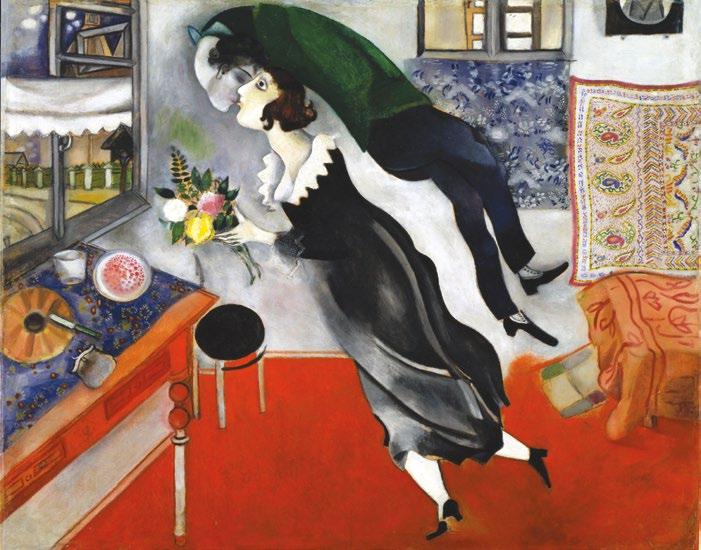
GREAT MINDS TEACHER EDITION WIT & WISDOM® 8 GRADE MODULE 3 WHAT IS LOVE?
Great Minds® is the creator of Eureka Math® , Wit & Wisdom® , Alexandria Plan™, and PhD Science®
Published by Great Minds PBC greatminds.org
© 2023 Great Minds PBC. All rights reserved. No part of this work may be reproduced or used in any form or by any means—graphic, electronic, or mechanical, including photocopying or information storage and retrieval systems—without written permission from the copyright holder. Where expressly indicated, teachers may copy pages solely for use by students in their classrooms.
Printed in the USA A-Print
Module Summary 2
Essential Question 3
Suggested Student Understandings 3 Texts 3
Module Learning Goals 4 Module in Context............................................................................................................................... ........................ 6 Standards ............................................................................................................................... ....................................... 7 Major Assessments 9 Module Map 11
Focusing Question: Lessons 1–5
How do the characters in A Midsummer Night’s Dream understand love?
Lesson 1 21
n TEXT: A Midsummer Night’s Dream, William Shakespeare ¢ Style and Conventions Deep Dive: Examine Functions of a Comma Lesson 2 37
n TEXT: A Midsummer Night’s Dream, William Shakespeare ¢ Vocabulary Deep Dive: Examine Academic Vocabulary: Yield Lesson 3 49
n TEXT: A Midsummer Night’s Dream, William Shakespeare ¢ Style and Conventions Deep Dive: Experiment with Using Commas with Interrupters Lesson 4 63
n TEXT: A Midsummer Night’s Dream, William Shakespeare ¢ Vocabulary Deep Dive: Explore Figurative Language: Puns
Lesson 5 ............................................................................................................................... ...................................... 77
n TEXT: A Midsummer Night’s Dream, William Shakespeare
¢ Style and Conventions Deep Dive: Execute Commas with Interrupters
Focusing Question: Lessons 6–17
What defines the experience of love?
Lesson 6 85
n TEXT: A Midsummer Night’s Dream, William Shakespeare ¢ Explore Academic Vocabulary: Aggravate, obscenely
Lesson 7 99
n TEXT: A Midsummer Night’s Dream, William Shakespeare
¢ Vocabulary Deep Dive: Examine Academic Vocabulary: Dissension Lesson 8 111
n TEXT: A Midsummer Night’s Dream, William Shakespeare Lesson 9 123
n TEXT: A Midsummer Night’s Dream, William Shakespeare
¢ Vocabulary Deep Dive: Develop Academic Vocabulary: Contagious Lesson 10 135
n TEXT: A Midsummer Night’s Dream, William Shakespeare
¢ Vocabulary Deep Dive: Explore the Morpheme ceiv Lesson 11 145
¢ TEXTS: A Midsummer Night’s Dream, William Shakespeare • The Arnolfini Portrait, Jan van Eyck
¢ Style and Conventions Deep Dive: Examine Conditional Verb Mood
Lesson 12 157
n TEXTS: The Arnolfini Portrait, Jan van Eyck • “In the Brain, Romantic Love Is Basically an Addiction,” Helen Fisher
¢ Vocabulary Deep Dive: Explore Morphemes –ity and –al Lesson 13 ............................................................................................................................... ............................................ 169
n TEXTS: Birthday, Marc Chagall • “In the Brain, Romantic Love Is Basically an Addiction,” Helen Fisher
¢ Style and Conventions Deep Dive: Experiment with Conditional Verb Mood Lesson 14 181
¢ TEXTS: “What Is Love? Five Theories on the Greatest Emotion of All,” Jim Al-Khalili, Philippa Perry, Julian Baggini, Jojo Moyes, and Catherine Wybourne • Birthday, Marc Chagall • “In the Brain, Romantic Love Is Basically an Addiction,” Helen Fisher • “March of Progress,” Rudolph Zallinger
¢ Vocabulary Deep Dive: Explore the Morpheme volv Lesson 15 191
n TEXTS: Birthday, Marc Chagall • “In the Brain, Romantic Love Is Basically an Addiction,” Helen Fisher
¢ Vocabulary Deep Dive: Explore Content Vocabulary: Besotted, obsessed Lesson 16 201
n TEXTS: “In the Brain, Romantic Love Is Basically an Addiction,” Helen Fisher • The Arnolfini Portrait, Jan van Eyck •
A Midsummer Night’s Dream, William Shakespeare
¢
Style and Conventions Deep Dive: Experiment with Conditional Verb Mood
Lesson 17 209
¢ TEXTS: All Module Texts • Birthday, Marc Chagall • The Arnolfini Portrait, Jan van Eyck
¢ Style and Conventions Deep Dive: Excel with Conditional Verb Mood
What makes love complicated?
Lesson 18 ............................................................................................................................... ............................................ 219
n TEXTS: A Midsummer Night’s Dream, William Shakespeare • “Globe On Screen 2014: A Midsummer Night’s Dream”
¢ Vocabulary Deep Dive: Explore Content Vocabulary: Entice, enamored, enthralled Lesson 19 233
n TEXTS: A Midsummer Night’s Dream, William Shakespeare • “In the Brain, Romantic Love Is Basically an Addiction,” Helen Fisher
¢ Vocabulary Deep Dive: Vocabulary Assessment 1 Lesson 20 ............................................................................................................................... .......................................... 245
n TEXTS: A Midsummer Night’s Dream, William Shakespeare • “In the Brain, Romantic Love Is Basically an Addiction,” Helen Fisher
¢ Vocabulary Deep Dive: Explore the Morpheme con Lesson 21 255
¢ TEXT: A Midsummer Night’s Dream, William Shakespeare
¢ Vocabulary Deep Dive: Examine Morphemes ver and fall Lesson 22 265
¢ TEXTS: A Midsummer Night’s Dream, William Shakespeare • The Starry Night, Vincent van Gogh
¢ Vocabulary Deep Dive: Explore the Morpheme –ous Lesson 23 275
n TEXTS: “EPICAC,” Kurt Vonnegut • “In the Brain, Romantic Love Is Basically an Addiction,” Helen Fisher
¢ Style and Conventions Deep Dive: Examine Subjunctive Verb Mood Lesson 24 289
n TEXTS: A Midsummer Night’s Dream, William Shakespeare • “EPICAC,” Kurt Vonnegut
¢ Vocabulary Deep Dive: Explore Academic Vocabulary: Bluff, spared Lesson 25 303
n TEXTS: A Midsummer Night’s Dream, William Shakespeare • “EPICAC,” Kurt Vonnegut
¢ Style and Conventions Deep Dive: Experiment with Subjunctive Verb Mood Lesson 26 315
n TEXTS: A Midsummer Night’s Dream, William Shakespeare • “EPICAC,” Kurt Vonnegut
¢ Style and Conventions Deep Dive: Execute Subjunctive Verb Mood Lesson 27 ............................................................................................................................... ........................................... 325
n TEXTS: A Midsummer Night’s Dream, William Shakespeare • “EPICAC,” Kurt Vonnegut • “In the Brain, Romantic Love Is Basically an Addiction,” Helen Fisher
¢ Style and Conventions Deep Dive: Excel with Subjunctive Verb Mood Lesson 28 333
¢ TEXT: A Midsummer Night’s Dream, William Shakespeare
Is love real in A Midsummer Night’s Dream?
Lesson 29 ............................................................................................................................... .................................. 339
n TEXTS: A Midsummer Night’s Dream, William Shakespeare • “EPICAC,” Kurt Vonnegut ¢ Style and Conventions Deep Dive: Experiment with Shifts in Verb Moods
Lesson 30 351
n TEXT: A Midsummer Night’s Dream, William Shakespeare • “What Is Love? Five Theories on the Greatest Emotion of All,” Jim Al-Khalili, Philippa Perry, Julian Baggini, Jojo Moyes, and Catherine Wybourne
¢ Vocabulary Deep Dive: Explore Academic Vocabulary: Amity, enmity
Lesson 31 ............................................................................................................................... .................................. 363
n TEXT: A Midsummer Night’s Dream, William Shakespeare ¢ Style and Conventions Deep Dive: Execute Correct Spelling
Lesson 32 373
n TEXTS: All Module Texts ¢ Style and Conventions Deep Dive: Excel with Spelling Correctly
Is love in A Midsummer Night’s Dream a result of agency or fate?
Lesson 33 383
n TEXT: A Midsummer Night’s Dream, William Shakespeare
¢ Vocabulary Deep Dive: Vocabulary Assessment 2
Lesson 34 ............................................................................................................................... .................................. 391
n TEXT: A Midsummer Night’s Dream, William Shakespeare
Lesson 35 397
n TEXT: A Midsummer Night’s Dream, William Shakespeare ¢ Style and Conventions Deep Dive: Excel at Using Commas with Interrupters
Lesson 36 405
n TEXT: A Midsummer Night’s Dream, William Shakespeare
¢ Style and Conventions Deep Dive: Excel with Shifts in Verb Moods
Appendix A: Text Complexity .............................................................................................................................. 413
Appendix B: Vocabulary 415
Appendix C: Answer Keys, Rubrics, and Sample Responses 425
Appendix D: Volume of Reading 443
Appendix E: Works Cited 445
“The course of true love never did run smooth” (1.1.136).
In this module, students examine a question that has vexed humans—and the world’s most renowned literary authors—for generations: what is love? Deceptively simple, this question requires students to examine ideas about the roles of individual choice, fate, power, and social status in the development of seemingly personal relations. Their primary testing ground will be Shakespeare’s eternally popular comedy A Midsummer Night’s Dream, in which love transforms characters in unexpected ways.
This module challenges the idea that love is a strictly emotional and personal experience, removed from social attitudes, scientific definition, and forces beyond an individual’s control. This study doesn’t negate the personal importance of falling in love or being crushed from heartache; rather, it situates those experiences in larger contexts to ask about the motivations for love and whether we have the freedom to choose whom we love or even understand what love is. The module’s questions compel students to combine intellectual and creative thinking, as they gain a deeper appreciation for the complexities of love. They come to discover that love has never been simple or static but nonetheless remains a powerful force in our lives. The meaning of love is the perfect topic to introduce students to argument writing and claim-making, which they practice in written and oral formats.
Shakespeare’s A Midsummer Night’s Dream offers a compelling and humorous way for students to think about love. Shakespeare’s characters introduce multiple, conflicting perspectives about love and about its purpose, place, and power, and students see love wax and wane through the action and inaction of those at love’s mercy in the play. Through this work, students discover the comedy and conflict that erupts when love takes unexpected turns. Magic and confusion abound as the fairies interfere with the human activities in the play. In addition to mirth, A Midsummer Night’s Dream offers opportunities for deep rereading and commenting on the roles of social norms, agency, and fate in the relationships between men and women. Numerous instances of figurative language and wordplay contribute to the density and complexity of this Shakespearean comedy, and they prompt an investigation of the power of figurative language and symbols to communicate humans’ experiences of love.
The human experience of love is considered from a dramatically different perspective in a neuroscientific argument that provides provocative and groundbreaking information on the state of being in love. This is a challenging article, but the scientific point of view provides an excellent counterpart to Shakespeare’s canonical comedy that, in some ways, seems to support similar claims about the power of love to overtake the individual. Furthermore, the article offers an outstanding example of an argument, as it clearly states a claim, counterclaim, and reasoning. Students also read the modern short story “EPICAC,” by Kurt Vonnegut, which, although comedic, raises ethical questions about the actions undertaken in the name of love. Finally, students examine two compelling paintings, The Arnolfini Portrait, painted in 1434 by Jan Van Eyck, and Birthday, painted
in 1915 by Marc Chagall, and analyze how elements such as line and color create very specific and stylized understandings of love.
For their End-of-Module (EOM) Task, students write an argument essay that asserts whether one character from A Midsummer Night’s Dream chose whom they loved at the end of the drama, thus attributing the nature of love to either agency or fate.
What is love?
Love may be a personal and emotional experience, but it is also a physical, mental, and social experience.
Love can be complicated, manipulated, or shaped by factors beyond an individual’s control. Arguments require logical reasoning.
A Midsummer Night’s Dream, William Shakespeare
Opinion Piece
“What Is love? Five Theories on the Greatest Emotion of All,” Jim Al-Khalili, Philippa Perry, Julian Baggini, Jojo Moyes, and Catherine Wybourne (http://witeng.link/0259)
Birthday, Marc Chagall (http://witeng.link/0258)
The Arnolfini Portrait, Jan Van Eyck (http://witeng.link/0255)
The Starry Night, Vincent van Gogh (http://witeng.link/0274)
“In the Brain, Romantic Love Is Basically an Addiction,” Helen Fisher (http://witeng.link/0256)
“EPICAC,” Kurt Vonnegut
Illustration
“March of Progress,” Rudolph Zallinger (http://witeng.link/0260)
“All I Want is You,” Barry Louis Polisar (http://witeng.link/0275)
“Globe On Screen 2014: A Midsummer Night’s Dream,” Shakespeare’s Globe (http://witeng.link/0273)
Identify how drama, fiction, and informational texts define love and its impact.
Understand why love is a complex idea and experience.
Analyze how love is affected by social norms, human agency, and matters beyond one’s control.
Determine one or more themes of a text and analyze its development over the course of the text, including its relationship to the characters, setting, and plot (RL.8.2).
Analyze the impact of word choices on meaning and tone, including analogies or allusions to other texts (RL.8.4, RI.8.4).
Analyze how differences in the points of view of the characters and the audience (e.g., created through the use of dramatic irony) create effects such as suspense or humor (RL.8.6).
Analyze how a modern work of fiction draws on themes, patterns of events, or character types from myths, traditional stories, or religious works, explaining how the material is rendered new (RL.8.9).
Delineate and evaluate the argument and specific claims in a text, assessing the reasoning and evidence, and recognizing when irrelevant evidence is introduced (RI.8.8).
Assert clear and logical evidence-based claims in response to debatable questions (W.8.1.a).
Write an argument essay that supports well-distinguished claims with clear reasons that are developed logically with relevant evidence and demonstrate understanding of the text (W.8.1).
Try a new approach to argument sequencing, by purposefully reordering pieces of an argument to create different effects (W.8.5).
Distinguish claims from alternate or opposing claims, using appropriate transitions (W.8.1.a, W.8.1.c).
Produce clear and coherent writing in which the development, organization, and style are appropriate to the task, purpose, and audience (W.8.1.d).
Focus on purpose of discussion through preparation and posing of questions that connect ideas of several speakers using relevant evidence (SL.8.1.c).
Listen to assess the logic of a speaker’s assertions (SL.8.3).
Use grade-appropriate morphemes to infer the meaning of words and verify the preliminary definitions using a dictionary (L.8.4.b, L.8.4.d).
Consult a glossary to find the pronunciation of words and to determine the precise meanings of words (L.8.4.c).
Distinguish among the connotations of words with similar denotations to analyze a text (L.8.5.c).
Accurately use grade-appropriate, general academic, and domain-specific vocabulary (L.8.6).
Form and use verbs in the conditional and subjunctive moods to express uncertainty and hypothetical situations (L.8.1.c, L.8.3.a).
Recognize and correct inappropriate shifts in verb moods (L.8.1.d).
Spell correctly (L.8.2.c).
Knowledge: Students continue their work grappling with big ideas by focusing intently on the concept of agency, or individual choice, in relation to fate, contemplating questions such as: How much do we dictate what happens to us? What defines agency, and can that definition change depending upon circumstances? Are we truly agents in the pursuit of personal experiences like love, or do external or biological drivers dictate them? In a more implicit way, students extend their understanding of sense of self by exploring how love can undermine or empower one’s sense of self. This also gets at the idea that one cannot always control or act on their love because of factors outside their control. Students continue to develop their understanding of the value of the humanities by understanding how literary and artistic texts do not present unilateral and didactic commentary but instead raise important questions about humanity that offer rich opportunities for exploration and spirited debate.
Reading: Students extend their analytical and close reading skills by working with a Shakespearean play with its dense language and sophisticated themes, as well as with a complex scientific article and a contemporary short story that build deep knowledge about love. While reading A Midsummer Night’s Dream, students examine how the central ideas about love are developed in increasingly complex ways through the play’s events and Shakespeare’s use of figurative language and dramatic irony. With the play and short story, students examine the role of fate and agency in love and apply that understanding in their EOM Task through an analysis of the outcome of the romantic relationships in A Midsummer Night’s Dream. Students expand their analysis of the claims the play makes about love to explain and evaluate the arguments made in informational texts. Building on their extensive reading of informational texts in previous modules, students hone their analytical skills by discerning the effectiveness of an author’s reasoning and evidence.
Writing: This module features argument writing. Students practice in discrete and manageable steps, focusing on aspects such as evidence-based claims, argument structure, and alternate and opposing claims. With published texts and their peers’ works, students explain and evaluate the claims, logic, and validity of arguments. In formal writing assessments, students demonstrate their ability to construct arguments that include clear and persuasive claims, logical reasoning, relevant evidence, elaboration, an effective sequence with transitional language, and a conclusion.
Speaking and Listening: Students build their speaking and listening skills and develop their work with argument writing by listening for a speaker’s logic and posing questions that connect ideas from multiple speakers.
RL.8.2 Determine a theme or central idea of a text and analyze its development over the course of the text, including its relationship to the characters, setting, and plot; provide an objective summary of the text.
RL.8.4 Determine the meaning of words and phrases as they are used in a text, including figurative and connotative meanings; analyze the impact of specific word choices on meaning and tone, including analogies or allusions to other texts.
RL.8.6 Analyze how differences in the points of view of the characters and the audience or reader (e.g., created through the use of dramatic irony) create such effects as suspense or humor.
RL.8.9 Analyze how a modern work of fiction draws on themes, patterns of events, or character types from myths, traditional stories, or religious works such as the Bible, including describing how the material is rendered new.
RI.8.4 Determine the meaning of words and phrases as they are used in a text, including figurative, connotative, and technical meanings; analyze the impact of specific word choices on meaning and tone, including analogies or allusions to other texts.
RI.8.8 Delineate and evaluate the argument and specific claims in a text, assessing whether the reasoning is sound and the evidence is relevant and sufficient; recognize when irrelevant evidence is introduced.
W.8.1 Write arguments to support claims with clear reasons and relevant evidence.
W.8.4 Produce clear and coherent writing in which the development, organization, and style are appropriate to task, purpose, and audience.
W.8.4 With some guidance and support from peers and adults, develop and strengthen writing as needed by planning, revising, editing, rewriting, or trying a new approach, focusing on how well purpose and audience have been addressed. (Editing for conventions should demonstrate command of Language standards 1-3 up to and including Grade 8 here.)
L.8.1.c Form and use verbs in the indicative, imperative, interrogative, conditional, and subjunctive mood.
L.8.1.d Recognize and correct inappropriate shifts in verb voice and mood.
L.8.2.a Use punctuation (comma, ellipsis, dash) to indicate a pause or break.
L.8.2.c Spell correctly.
L.8.4.b Use common, grade-appropriate Greek or Latin affixes and roots as clues to the meaning of a word (e.g., precede, recede, secede).
L.8.4.c Consult general and specialized reference materials (e.g., dictionaries, glossaries, thesauruses), both print and digital, to find the pronunciation of a word or determine or clarify its precise meaning or its part of speech.
L.8.4.d Verify the preliminary determination of the meaning of a word or phrase (e.g., by checking the inferred meaning in context or in a dictionary).
L.8.5.a Interpret figures of speech (e.g. verbal irony, puns) in context.
L.8.5.c Distinguish among the connotations (associations) of words with similar denotations (definitions) (e.g., bullheaded, willful, firm, persistent, resolute).
SL.8.1.a Come to discussions prepared, having read or researched material under study; explicitly draw on that preparation by referring to evidence on the topic, text, or issue to probe and reflect on ideas under discussion.
SL.8.1.c Pose questions that connect the ideas of several speakers and respond to others’ questions and comments with relevant evidence, observations, and ideas.
SL.8.3 Delineate a speaker’s argument and specific claims, evaluating the soundness of the reasoning and relevance and sufficiency of the evidence and identifying when irrelevant evidence is introduced.
RL.8.10
By the end of the year, read and comprehend literature, including stories, dramas, and poems, at the high end of grades 6–8 text-complexity band independently and proficiently.
RI.8.10
By the end of the year, read and comprehend literary nonfiction at the high end of the grades 6–8 text-complexity band independently and proficiently.
L.8.6 Acquire and use accurately grade-appropriate general academic and domain-specific words and phrases; gather vocabulary knowledge when considering a word or phrase important to comprehension or expression.
1. Write four informative/explanatory paragraphs that identify and explain one character’s understanding of love from A Midsummer Night’s Dream
2. Write two informative/explanatory paragraphs that explain and evaluate Helen Fisher’s argument in “In the Brain, Romantic Love Is Basically an Addiction.”
3. Write two informative/explanatory paragraphs that explain how the love triangle in Kurt Vonnegut’s “EPICAC” draws on the complexities of love in A Midsummer Night’s Dream and makes this pattern of events new.
4. Write a one-paragraph argument about whether love is strange or true that is supported with reason, evidence, and elaboration.
Summarize events from A Midsummer Night’s Dream
Demonstrate an understanding of how a character from A Midsummer Night’s Dream experiences love.
Delineate and evaluate an argument about love.
Recognize strong evidence and various parts of an argument.
Demonstrate an understanding of the complexities of love.
Organize evidence clearly and appropriately to demonstrate reasons.
RL.8.1, 8.2, 8.4; W.8.2.b, 8.4, 8.9.a; L.8.2.a, 8.5.a
RI.8.1, 8.8; W.8.2.a, b, c, d, e, 8.9.b; L.8.1.c, 8.1.d
RL.8.1, RL.8.2, RL.8.9; W.8.2.a, W.8.2.b, W.8.2.c, W.8.2.d, W.8.9.a; L.8.1.c, L.8.1.d
Establish a claim and acknowledge an alternate or opposing claim.
Elaborate and expand on evidence to support a claim.
RL.8.1, RL.8.2; W.8.1.a, W.8.1.b, W.8.1.c, W.8.1.d, W.8.1.e; L.8.1.d, L.8.2.c
1. Read an excerpt from Act 2, Scene 2, of A Midsummer Night’s Dream. Respond to multiplechoice questions, and then write two paragraphs, the first translating Shakespeare, the second explaining the final incident in Scene 2.
2. Read a new informational article, “What Is love? Five Theories on the Greatest Emotion of All.” Respond to multiple-choice questions, and then write two short-answer responses that explain aspects of arguments in the article.
3. Read an excerpt from Act 3, Scene 2, of A Midsummer Night’s Dream. Respond to multiplechoice questions, and then write two paragraphs analyzing dramatic irony and Robin Goodfellow’s actions in the whole portion of Act 3, Scene 2.
Analyze a specific incident in A Midsummer Night’s Dream
Demonstrate an understanding of Shakespearean language and the action of the play.
Identify a claim, including the strongest evidence to support a claim.
Analyze different qualities of love.
RL.8.1, RL.8.2, RL.8.3, RL.8.4; W.8.10; L.8.4.d, L.8.5.a, L.8.5.c
RI.8.1, RI.8.3, RI.8.4, RI.8.8; W.8.10; L.8.4.a, L.8.5.c
Apply an understanding of a particular character’s experience in the play.
Summarize an understanding of a large portion of A Midsummer Night’s Dream
RL.8.1, RL.8.2, RL.8.3, RL.8.4, RL.8.6; W.8.10; L.8.4.a, L.8.4.c, L.8.5.a
1. Analyze whether the characters in A Midsummer Night’s Dream and “EPICAC” should be held responsible for their situation or actions.
2. Debate connections between love, imagination, and reality in all module texts, and consider whether love is something that can be defined as “real.”
Synthesize an understanding of the actions and perspectives of different characters in A Midsummer Night’s Dream
Apply an understanding of ideas of fate and agency to characters in A Midsummer Night’s Dream
RL.8.1, RL.8.2, RL.8.9; SL.8.1, SL.8.6
Analyze love as an abstract idea through collaborative conversation with peers.
RL.8.1, RL.8.2; SL.8.1, SL.8.3, SL.8.6
Write an argument essay that argues whether the outcome of a romantic relationship between one of the four lovers is directed by agency or fate.
Assert and develop an evidence-based claim.
Develop an evidence-based claim with reasons and with well-chosen and wellorganized evidence.
Support the overall sequence of the argument by elaborating on evidence.
RL.8.1, RL.8.2; W.8.1, W.8.4, W.8.5, W.8.9.a; L.8.1.d, L.8.2.a, L.8.2.c
Demonstrate understanding of academic, text-critical, and domainspecific words, phrases, and/or word parts.
Acquire and use grade-appropriate academic terms. Acquire and use domain-specific or text-critical words essential for communication about the module’s topic.
L.8.4.b L.8.6
* While not considered Major Assessments in Wit & Wisdom, Vocabulary Assessments are listed here for your convenience. Please find details on Checks for Understanding (CFUs) within each lesson.
Focusing Question 1: How do the characters in A Midsummer Night’s Dream understand love?
Text(s) Content Framing Question Craft Question(s) Learning Goals
1 A Midsummer Night’s Dream, 1.1.1–20
2 A Midsummer Night’s Dream, 1.1.21–129
Wonder What do I notice and wonder about A Midsummer Night’s Dream?
Organize What’s happening in Act 1, Scene 1?
3 A Midsummer Night’s Dream, 1.1.130–182
Reveal
What does a deeper exploration of character relationships reveal?
Examine
Why are commas important?
4 A Midsummer Night’s Dream, 1.1.183–257
Reveal
What does a deeper exploration of figurative language in A Midsummer Night’s Dream reveal?
Experiment How do commas and interrupters work? Examine
Why are evidencebased claims important in an argument?
Examine
Why is focusing on the purpose of a discussion important? Experiment
How does making evidence-based claims in an argument work?
Make inferences about characters in A Midsummer Night’s Dream using text features (RL.8.1).
Identify the various functions of a comma (L.8.2.a).
Summarize the conflict between Egeus, Hermia, Lysander, and Demetrius (RL.8.1, RL.8.2, RL.8.4, W.8.10).
Use context to determine multiple meanings and connotations of yield (L.8.4.a, L.8.5.c).
Explain how Hermia and Lysander’s predicament exemplifies Lysander’s description of love in A Midsummer Night’s Dream (RL.8.2, W.8.10, L.8.5.a).
Use commas with interrupters (L.8.2.a).
Analyze how figurative language reveals an idea about love (RL.8.1, RL.8.2, RL.8.4, L.8.5.a).
Identify an evidence-based claim about a character (W.8.1.a, W.8.1.b).
Interpret puns and determine their significance in context of the play (RL.8.1, RL.8.2, RL.8.4, L.8.5.a).
Focusing Question 1: How do the characters in A Midsummer Night’s Dream understand love?
Text(s) Content Framing Question Craft Question(s) Learning Goals
5 FQT
A Midsummer Night’s Dream, 1.1 Distill
What are the central ideas about love in Act 1, Scene 1, of A Midsummer Night’s Dream?
Execute
How do I use commas with interrupters in FQT 1?
Focusing Question 2: What defines the experience of love?
Summarize the plot in Act 1, Scene 1, and explain a particular character’s point of view on the central ideas of love and marriage in a style that is appropriate to a talk show (RL.8.1, RL.8.2, RL.8.4, W.8.2.b, W.8.4, W.8.9.a, L.8.2.a, L.8.5.a).
Use commas with interrupters to demonstrate understanding of the play (L.8.2.a).
Text(s) Content Framing Question Craft Question(s) Learning Goals
6 A Midsummer Night’s Dream, 1.2 and 2.1.1–150
Organize What’s happening with the fairies in Act 2, Scene 1?
Examine
Why is the structure of an argument important? Examine
Why is listening for a speaker’s logic important?
7 A Midsummer Night’s Dream, 2.1.62–194
Reveal
What does a deeper exploration of Oberon and Titania’s conflict reveal?
Experiment How does structuring an argument work?
8 A Midsummer Night’s Dream, 2.1.195–276
Distill
What are the central ideas about the experience of love in Act 1 and Act 2?
Execute
How do I write an evidence-based claim? Experiment How does focusing on the purpose of discussion work?
Summarize key details about Titania and Oberon, and make inferences to explain each one’s perception of the couple’s problem (RL.8.1, RL.8.2, RL.8.3, W.8.10).
Use context to predict the meaning of a word, consult a glossary to clarify its precise meaning, and determine the intended word’s meaning by using a dictionary (L.8.4.a, L.8.4.c, L.8.4.d).
Apply an understanding of Shakespearean language to explain the impact of Titania and Oberon’s conflict around love (RL.8.1, RL.8.2, RL.8.3, RL.8.4, W.8.10, L.8.5.a).
Delineate the aspects of an argument structure (W.8.1.a, W.8.1.b).
Distinguish among the connotations of argument, debate, dissension and feud (L.8.5.c).
Using effective evidence, analyze how a central idea about love in Act 1 is developed in Act 2 (RL.8.1, RL.8.3, RL.8.4, W.8.10, L.8.5.a).
Make an evidence-based claim that is supported by strong evidence and logical reasoning (W.8.1.a, W.8.1.b).
Text(s) Content Framing Question Craft Question(s) Learning Goals
9 A Midsummer Night’s Dream, 2.2.1–93
Reveal What does a deeper exploration of character conflict reveal in Act 2, Scene 2, of A Midsummer Night’s Dream?
Execute
How do I structure an argument?
Experiment
How does listening for a speaker’s logic work?
10 NR
A Midsummer Night’s Dream, 2.2.94–163
Organize What’s happening in Act 2, Scene 2, of A Midsummer Night’s Dream?
Excel
How do I improve argument structure?
The Arnolfini Portrait
Distill What are the themes about love in A Midsummer Night’s Dream?
Execute
How do I listen for a speaker’s logic?
Execute
How do I focus on the purpose of discussion?
Examine
Why is the conditional verb mood important?
Analyze Hermia and Lysander’s conflict in the woods, explaining the rationale for their different perspectives (RL.8.1, RL.8.3, W.8.1.c, W.8.10).
Execute a CREE outline to support an evidence-based claim (W.8.1.a, W.8.1.b).
Determine how the connotation of a word develops meaning in a passage, using a glossary to support general understanding of the passage (L.8.4.c, L.8.5.c).
Demonstrate an understanding of the meaning and impact of incidents and language in a new portion of Act 2, Scene 2, of A Midsummer Night’s Dream (RL.8.1, RL.8.3, RL.8.4, W.8.10, L.8.4.d, L.8.5.a, L8.5.c).
Revise an argument outline based on feedback from a peer (W.8.1.a, W.8.1.b, W.8.5).
Use context, knowledge of the root ceiv, and various prefixes as clues to the meaning of words and verify preliminary definitions in dictionaries (L.8.4.a, L.8.4.b, L.8.4.d).
Synthesize evidence to identify a theme about the experience of love in A Midsummer Night’s Dream (RL.8.1, RL.8.2, W.8.10).
Analyze peers’ claims about what defines the experience of love in A Midsummer Night’s Dream (RL.8.1, RL.8.2, SL.8.1.a, SL.8.1.c, SL.8.3).
Identify the traits of the conditional verb mood and recognize verbs in the conditional mood (L.8.1.c).
Focusing Question 2: What defines the experience of love?
Text(s) Content Framing Question Craft Question(s) Learning Goals
12 “In the Brain, Romantic Love Is Basically an Addiction”
The Arnolfini Portrait
Wonder
What do I notice and wonder about the relationship between love and the brain?
Examine
Why is formal style important?
Identify a connection between love, the brain, and addiction in “In the Brain, Romantic Love Is Basically an Addiction” (RI.8.1, RI.8.4).
Consult a glossary to determine the pronunciation and part of speech of words, and use knowledge of the suffixes –ity and –al to determine the meaning of words (L.8.4.b, L.8.4.c).
13 “In the Brain, Romantic Love Is Basically an Addiction”
Birthday
Organize
What’s happening in “In the Brain, Romantic Love Is Basically an Addiction”?
Experiment
How does formal style work? Experiment How does the conditional verb mood work?
14 NR
“What Is love? Five Theories on the Greatest Emotion of All”
Birthday
Reveal What does a deeper exploration of arguments about love reveal?
Identify Helen Fisher’s claim in “In the Brain, Romantic Love Is Basically an Addiction” (RI.8.1, RI.8.8, W.8.10).
Form verbs in the conditional verb mood (L.8.1.c).
Listen and explain the arguments in a new text (RI.8.1, RI.8.3, RI.8.4, RI.8.8, W.8.10, L.8.4.a, L.8.5.c).
Use knowledge of the root volv and context clues to determine the meaning of evolution (L.8.4.a, L.8.4.b).
15 “In the Brain, Romantic Love Is Basically an Addiction”
Birthday
Distill What’s the central message of “In the Brain, Romantic Love Is Basically an Addiction”?
Outline Helen Fisher’s argument, including organization and structure (RI.8.1, RI.8.2, RI.8.8).
Use context to determine the meaning of words and distinguish between the connotations of besotted and obsessed (L.8.4.a, L.8.4.c, L.8.5.c).
Text(s) Content Framing Question Craft Question(s) Learning Goals
19
VOC
A Midsummer Night’s Dream, 3.2.43–123
Reveal
What does a deeper exploration of dramatic irony reveal?
Experiment How does distinguishing opposing claims work?
Analyze how dramatic irony creates humor, suspense, or surprise in A Midsummer Night’s Dream (RL.8.1, RL.8.6, W.8.10).
Distinguish an evidence-based claim from an opposing or opposite claim (W.8.1.a, W.8.1.c).
20 A Midsummer Night’s Dream, 3.2.124–226
Organize
What’s happening in Act 3, Scene 2?
Experiment How does distinguishing alternate claims work?
Demonstrate acquisition of gradeappropriate academic and domainspecific words (L.8.4.a, L.8.6).
Summarize the conflict between the four lovers (RL.8.1, RL.8.2).
Distinguish an evidence-based claim from an alternate claim (W.8.1.a, W.8.1.c).
Use knowledge of the prefix con– to determine word meanings and to infer significance of a key passage (L.8.4.b, L.8.5.a).
21 A Midsummer Night’s Dream, 3.2.227–365
Reveal
What does a deeper exploration of point of view reveal?
22 NR
A Midsummer Night’s Dream, 3.2.418–459
Distill
What are the central ideas of A Midsummer Night’s Dream?
Execute
How do I distinguish claims in a NewRead Assessment?
Synthesize an understanding of how different points of view can complicate love (RL.8.1, RL.8.2, RL.8.6).
Apply knowledge of roots and context clues to solve word meaning and verify definitions using a dictionary (L.8.4.b, L.8.4.d).
Analyze how the conflict between the four lovers develops central ideas about love’s complexities in a new portion of text in A Midsummer Night’s Dream (RL.8.1, RL.8.2, RL.8.3, RL.8.4, RL.8.6, W.8.10, L 8.4.a, L.8.4.c, L.8.5.a).
Distinguish an original claim from an alternate or opposing claim (W.8.1.a, W.8.1.c).
Use knowledge of affixes and roots to help infer meanings of words (L.8.4.b).
23 “EPICAC” Organize
What’s happening in “EPICAC”?
Examine
Why is the sequence of an argument important? Examine
Why is the subjunctive verb mood important?
24 A Midsummer Night’s Dream
“EPICAC”
Reveal
What does a deeper exploration of the love triangle in “EPICAC” reveal?
Experiment
How does sequencing an argument work?
25 A Midsummer Night’s Dream
“EPICAC”
Distill What are the central ideas of “EPICAC”?
Experiment How does the subjunctive verb mood work?
26 SS A Midsummer Night’s Dream
“EPICAC”
Know
How do A Midsummer Night’s Dream and “EPICAC” build my knowledge of love’s complexities?
Execute
How do I sequence an argument?
Execute
How do I use the subjunctive verb mood in my Knowledge Journal response?
Summarize the relationship between the characters in “EPICAC” (RL.8.1, RL.8.2, W.8.10).
Create a sentence using the subjunctive verb mood (L.8.1.c).
Delineate how the love triangle in “EPICAC” draws on the same pattern of events in A Midsummer Night’s Dream (RL.8.1, RL.8.9, W.8.10).
Use context clues to determine the meanings of bluff and spared, and determine how these words provide insight into the point of view of the narrator in “EPICAC” (L.8.4.a).
Analyze fate and agency in “EPICAC,” drawing on an understanding of situations from A Midsummer Night’s Dream (RL.8.1, RL.8.2, RL.8.9, W.8.10).
Form and use verbs in the subjunctive verb mood to express formal suggestions and ideas contrary to fact (L.8.1.c, L.8.3.a).
Apply an understanding of central ideas in A Midsummer Night’s Dream and “EPICAC,” considering how actions taken by characters complicate love through collaborative conversation with peers (RL.8.2, SL.8.1).
Outline an argument, trying a new approach to the order of the sequence (W.8.1, W.8.5).
Use the subjunctive verb mood to achieve particular effects (L.8.1.c, L.8.3.a).
Focusing Question 3: What makes love complicated?
Text(s) Content Framing Question Craft Question(s) Learning Goals
27
FQT A Midsummer Night’s Dream “EPICAC” “In the Brain, Romantic Love Is Basically an Addiction”
28
A Midsummer Night’s Dream, 3.2.250–295 and 334–365
Know
How do A Midsummer Night’s Dream and “EPICAC” build my knowledge of love?
Excel How do I improve the style of my writing?
Analyze how “EPICAC” develops ideas and patterns of events about the complexities of love found in A Midsummer Night’s Dream and makes them new (RL.8.1, RL.8.2, RL.8.9, W.8.2.a, W.8.2.b, W.8.2.c, W.8.2.d, W.8.9.a).
Know
How does A Midsummer Night’s Dream build my knowledge of dramatic performance?
Focusing Question 4: Is love real in A Midsummer Night’s Dream?
29
Form and use verbs in the subjunctive verb mood in FQT 3 (L.8.1.c, L.8.3.a).
Demonstrate an understanding of Shakespearean drama by participating in a Readers’ Theater and employing wellchosen oral strategies (SL.8.5).
Text(s) Content Framing Question Craft Question(s) Learning Goals
A Midsummer Night’s Dream, 4.1
Reveal
What does a deeper exploration of point of view in Act 4, Scene 1, reveal?
30
A Midsummer Night’s Dream, 5.1
“What Is love? Five Theories on the Greatest Emotion of All”
Distill What is the central idea of A Midsummer Night’s Dream?
Examine
Why are conclusions important?
Experiment
How do verb moods work?
Experiment
How do conclusions work?
Analyze how the outcome of the lovers’ situation in A Midsummer Night’s Dream creates humor, suspense, or surprise (RL.8.1, RL.8.6).
Use and form verbs to achieve particular effects and avoid inappropriate shifts in verb moods (L.8.1.c, L.8.1.d, L.8.3.a).
Analyze how the central idea of love as a fantasy has developed over the course of A Midsummer Night’s Dream (RL.8.1, RL.8.2).
Write a concluding statement that follows from and supports an argument (W.8.1.d).
Use context clues to infer word meaning and create mnemonic devices to remember spellings and meanings (L.8.2.c, L.8.4.a, L.8.4.d).
Focusing
31
Text(s) Content Framing Question Craft Question(s) Learning Goals
FQT A Midsummer Night’s Dream, 5.1
Know
How does A Midsummer Night’s Dream build my knowledge of love?
Execute
How do I write a concluding statement in a Focusing Question Task?
Execute
How do I spell correctly in my Endof-Module Task?
32 SS All module texts Know
How do module texts build my knowledge of love?
Excel
How do I improve listening for a speaker’s logic?
Excel
How do improve my spelling in my Endof-Module Task?
Focusing
Lesson
33
EOM
VOC
A Midsummer Night’s Dream Know
How does the experience of a character in A Midsummer Night’s Dream build my knowledge of fate and agency?
34 A Midsummer Night’s Dream Know
How does the experience of a character in A Midsummer Night’s Dream build my knowledge of fate and agency?
Excel
How do I improve listening for a speaker’s logic?
Respond to a claim about love in A Midsummer Night’s Dream (RL.8.1, RL.8.2, W.8.1.a, W.8.1.b, W.8.1.c, W.8.1.d, W.8.1.e).
Correctly spell commonly misspelled homophones and words (L.8.2.c).
Analyze love as an abstract idea through collaborative conversation with peers (RL.8.1, RL.8.2, SL.8.1, SL.8.3).
Revise writing to correct spelling errors (L.8.2.c).
Identify evidence that best supports a claim about a character’s pursuit of love in A Midsummer Night’s Dream (RL.8.1, RL.8.2, W.8.5).
Demonstrate acquisition of gradeappropriate academic and domainspecific words (L.8.4.a, L.8.6).
Establish an argument outline with reasons, evidence, and an opposing claim, using a new approach to sequencing the argument (RL.8.1, RL.8.2, W.8.1.a, W.8.1.b, W.8.5).
Text(s) Content Framing Question Craft Question(s) Learning Goals35 A Midsummer Night’s Dream Know
How does the experience of a character in A Midsummer Night’s Dream build my knowledge of fate and agency?
Execute
How do I give and receive feedback on an argument essay? Excel
How can I improve my use of commas with interrupters in the rebuttal of my End-ofModule Task?
Revise argument writing in response to peer and teacher review (W.8.1, W.8.5).
Revise EOM Task to use commas with interrupters (L.8.2.a).
36 A Midsummer Night’s Dream Know
How does the experience of a character in A Midsummer Night’s Dream build my knowledge of fate and agency?
Excel
How do I avoid inappropriate shifts in verb mood in my End-of-Module Task?
Finalize draft of an argument essay through self-assessment (RL.8.1, RL.8.2, W.8.1, W.8.4, W.8.5, W.8.9, L.8.1.d, L.8.2.a, L.8.2.c).
Revise EOM Task to avoid inappropriate shifts in verb mood (L.8.1.c, L.8.1.d).
AGENDA
Welcome (5 min.)
Define a Concept Launch (10 min.)
Learn (55 min.)
Examine Shakespearean Language (7 min.)
Examine Text Features (13 min.)
Read to Understand Characters (20 min.)
Research Topics of Interest (15 min.)
Land (4 min.)
Answer the Content Framing Question
Wrap (1 min.)
Assign Homework
Style and Conventions Deep Dive: Examine Functions of a Comma (15 min.)
The full text of ELA Standards can be found in the Module Overview.
RL.8.1, RL.8.4
Writing W.8.7, W.8.10
Speaking and Listening SL.8.1
Language
L.8.4.a, L.8.4.c, L.8.4.d L.8.2.a
Volume of Reading Reflection Questions
Make inferences about characters in A Midsummer Night’s Dream using text features (RL.8.1).
Record two inferences about Theseus and Hippolyta.
Identify the various functions of a comma (L.8.2.a).
Complete an Exit Ticket to determine function of the comma(s) in each sentence.
FOCUSING QUESTION: Lessons 1–5
How do the characters in A Midsummer Night’s Dream understand love?
CONTENT FRAMING QUESTION: Lesson 1
Wonder: What do I notice and wonder about A Midsummer Night’s Dream?
In this module, students examine a question that has vexed humans—and the world’s most renowned literary authors—for generations: what is love? Deceptively simple, this question requires students to examine ideas about the roles of individual choice, fate, power, social norms, and science in the development of a seemingly personal and emotional experience. The meaning of love is the perfect topic to introduce students to argument writing and making claims, which they practice in written and oral formats throughout the module. Their primary testing ground for students’ investigation of love is Shakespeare’s eternally popular comedy A Midsummer Night’s Dream, which they begin reading in this first Focusing Question arc. In this sequence of lessons, students focus on closely reading the dense language of Shakespeare’s play. Their analysis of the different characters’ perspectives on love provides a foundation for deeper textual analysis and builds essential understanding for their EOM Task, in which they analyze one character’s experience to make an argument about whether love is the result of agency or fate.
5 MIN.
Students write a three- or four-sentence response to the following question: “How would you explain the idea of love to an alien on their first day on Earth?”
10 MIN.
Post the Essential Question, Focusing Question, and Content Framing Question. Have a volunteer read the Essential Question aloud.
Instruct students to underline two nouns and/or adjectives in their response from the Welcome task that best answer the Essential Question.
Ask: “Look at your responses: why do you think this is an important or interesting question for study?”
Facilitate a brief discussion of responses.
Now provide the following definition, and have students record it in the New Words section of their Vocabulary Journal.
Word Meaning Synonyms universal (adj.) 1. Of, having to do with, or characteristic of the whole world or the world’s population.
1. global, worldwide
2. comprehensive, general
2. For or affecting everyone.
Ask: “Using one or both of these definitions, do you think love is a universal experience?”
Lead a brief discussion of responses.
Now have students share their underlined words with three or four peers.
Then ask: “Based on your shared words, do you think your understanding of love is a universal experience?”
Lead a brief discussion of responses.
Tell students that in this module they examine the Essential Question primarily through studying a play, A Midsummer Night’s Dream, by a writer named William Shakespeare. In this first Focusing Question sequence, they begin their examination of love and whether there is a universal understanding of love, by exploring how Shakespeare’s characters understand love.
Distribute copies of A Midsummer Night’s Dream.
7 MIN.
Instruct students to form pairs and try to read aloud the first stanza of A Midsummer Night’s Dream, from “Now, fair Hippolyta” to “young man’s revenue” (1.1.1–6).
Encourage students to attempt to pronounce every word. Tell them to notice where they have difficulty but not to worry if they don’t yet understand what the text means.
Have partners Stop and Jot, and ask: “What do you notice about the language and words Shakespeare uses?”
n I notice that Shakespeare uses very formal language.
n I notice there is a lot of figurative language.
n I notice that Shakespeare uses poetic language.
n I notice there are a lot of words I do not know.
Tell students that Shakespeare was writing this and other plays more than four hundred years ago.
Emphasize that the English language has changed and developed a great deal since that time. Tell students that if they met someone from Shakespeare’s time who was speaking English, they might have trouble understanding one another! Given this distance from the time Shakespeare was writing, students may find that reading Shakespeare is challenging and potentially even frustrating. Tell students that people can spend their entire lives studying Shakespeare, and it is extremely difficult for nonexperts to read Shakespeare at any age.
Explain that despite these challenges, Shakespeare has remained one of the most enduring writers in the English language—people have been reading, performing, and discussing his plays for centuries! Shakespeare wrote some of the most beautiful, rich, and complex texts we have available to us today, and Shakespeare is one of the most important and influential figures in literature. Understanding Shakespeare opens up a world of possibilities and connections in literature!
Establish and post a list of class norms and strategies for reading, and add to it throughout the next few lessons. Begin with points such as:
Do not feel like you need to understand every word or line of the play on your first try. Do engage in productive struggle. Do make every effort to stay engaged with the text when you encounter frustration. Do ask for help when you need it!
Tell students that now they examine some tools and tricks that can help them as they read and understand Shakespeare for the first time.
13 MIN.
Instruct students to create a Notice and Wonder T-Chart in their Response Journal. Have a student read the title of the play aloud.
Ask: “What do you notice and wonder about the title of the play?”
Students record their observations and wonderings on the T-chart.
Have students share responses.
n I notice that the play takes place in the summertime.
n I notice the word “midsummer” is not a word we commonly use today.
n I wonder if there will be more than one dream in this play.
n I wonder if the play is about something that is real or something someone imagined.
Inform students that before they begin to examine how the characters in A Midsummer Night’s Dream understand love, they need to have a basic understanding of how to read a play and the text features that a play contains.
Instruct students to turn to page 3, “Characters in the Play.”
Instruct students to write their observations on the Notice side of the T-chart, and ask: “What does the page show us about the characters?”
n There are names in all capital letters; we learn the character’s names.
n There are names in groups; we learn which characters are similar or related, for example, that Egeus is Hermia’s father.
n After the names, there are descriptions of that character; we learn a little bit about most of the characters.
n We learn what some characters have in common.
n The way the groups are divided suggests the relationship between characters, for example, Hermia, Lysander, Helena, and Demetrius are all “lovers” and there is a group of fairies who work for Titania.
Instruct students to write their wonderings on the Wonder side of the T-chart, and ask: “What do you wonder about the play based on the character list?”
n I wonder where the play happens and what the setting is going to be.
n I wonder why all the characters have such unusual names.
n I wonder what time period the play is set in and when it takes place.
n I wonder what the “four lovers” are like and their relationship to one another.
n I wonder if this is a fantasy story because there is royalty and magical creatures.
Instruct students to jot their wonderings on the Wonder side of the T-chart, and ask: “How do you think the character list relates to the title of the play? Does the list resolve any questions you have or raise any new ones?”
n I wonder if the fairies will be real or part of the dream.
n I wonder if the whole play is one character’s dream.
n I wonder if the whole play takes place at night.
n I wonder if the play is happy, since the word dream is sometimes used as a synonym for the word wonderful.
Have students flip through the text and jot their observations on the Notice side of the T-chart, and ask: “What do you notice about the text features in A Midsummer Night’s Dream?”
TEACHER NOTE
Remind students of text features they have encountered in Grade 8 so far, such as headlines and bylines in a news article, or titles and line breaks in a poem.
n The left-hand page includes words and phrases and definitions of those words and phrases.
n The right-hand page includes the text of the play.
n The text of the play is divided into acts and scenes, like chapters in a book.
n At the beginning of every scene, there is a summary on the left-hand page.
n The text of each act and scene is divided into lines, like poetry.
n The lines of the play are numbered.
n Before each block of text, there is a character’s name in all caps, which probably shows who is speaking.
n There are italicized lines in the play that show when people enter and exit the play.
Have students Think–Pair–Share, and ask: “What is the purpose of the left-hand pages?”
n The left-hand pages define some words and phrases that may be unfamiliar to the reader.
n The left-hand pages define words that we use differently than people in Shakespeare’s time.
n The left-hand pages, at the beginning of each scene, have a summary at the top to help orient the reader by explaining what happens in the scene.
Tell students that when they encounter an unknown word or phrase, they should try to determine the word in context and then check the left-hand page to try to determine the definition before using a dictionary.
Now, students will examine how the notes on the left-hand page work.
Instruct students to turn to page 7 of A Midsummer Night’s Dream and mark lines that are defined in the notes section (N) and lines that are not (X).
Ask: “What do you notice about the number of definitions in the notes section?”
n The number of words and phrases defined in the notes is 11 out of 20 lines, over half!
n The notes section provides different definitions for multiple sets of lines and individual words and phrases.
Tell students they will now use the text features they identified to try and understand the first lines of A Midsummer Night’s Dream.
Display the following line, with citation: “Now, fair Hippolyta, our nuptial hour / draws on apace” (1.1.1).
Briefly explain that the way we cite lines in a play can also be a tool to help you find the exact line you are referring to, quickly and easily:
The first number indicates the act, for example, (Act 1).
The second number indicates the scene, for example, (Act 1.Scene 1).
The third number indicates a line or lines, for example, (Act 1.Scene 1.Line 1).
Instruct students to use the citation to locate the line in the play.
Now, students use the text features of the play to respond to the following questions and write their answers in their Response Journal:
Which character is speaking?
Who is this character speaking to?
What does “our nuptial hour” (1.1.1) mean?
n Theseus, the duke of Athens, is speaking this line.
n Theseus is speaking to Hippolyta, the Amazon queen.
n “[O]ur nuptial hour” means “the time for our wedding” (6).
Tell students that text features will be useful for determining definitions of unusual or unknown words and phrases and to get a general gist of what’s happening in the play. Inform students that text features do not replace close reading, but they help clarify challenging passages so students can focus on digging deep into the meaning of the text.
Explain that a play is a unique narrative text that is written for performance. If students were watching a play, they would have other cues, such as the character’s body language or the set design, to help them understand what is happening. Inform students that in a later lesson in this module they will have the opportunity to view a recorded performance of A Midsummer Night’s Dream.
Tell them that because there are no descriptions of the setting or events in the printed text of A Midsummer Night’s Dream, they have to pay more attention to the dialogue to understand what is happening and to the meaning of the figurative language to infer what people are thinking and feeling.
Read aloud Act 1, Scene 1, Lines 1–20, and have students follow along in their copies of the text, jotting notes in their Response Journal about what they notice and wonder about the characters they encounter.
Throughout the module, consider using a recorded version of the play (http://witeng.link/0225), which would allow students to hear different actors read different roles, and thus, support their fluency work as students read portions of the play aloud. This portion of text runs from 00:17–01:33.
Ask: “What do you notice and wonder about Theseus and Hippolyta?”
n I notice Theseus and Hippolyta are talking to each other.
n I notice Theseus talks more than Hippolyta does.
n I notice Theseus has a servant.
n I wonder what Theseus and Hippolyta are talking about.
n I wonder what’s going to happen in “four happy days” (1.1.2).
n I wonder how Theseus and Hippolyta know each other.
Ask: “Who are Theseus and Hippolyta?”
TEACHER NOTE Remind students to reference the text features as they answer these initial questions about the play.
n These two characters are royalty: Theseus is the duke of Athens and Hippolyta is the queen of the Amazons.
Reread aloud Act 1, Scene 1, Lines 1–20, and have students follow along in their copies of the text, jotting notes about what they notice and wonder about the content and language of the characters’ remarks.
Ask: “What are these characters saying to each other?”
n Theseus and Hippolyta do not agree with each other.
n They both mention “four days” (1.1.7), and I wonder why Theseus calls them “happy” (1.1.2).
n They both talk about time passing, but Theseus thinks time passes in a “slow” way (1.1.3) and Hippolyta thinks time passes “quickly” (1.1.7).
n They both use similes, for example, Theseus says “like to a stepdame of a dowager” (1.1.5), and Hippolyta says “like to a silver bow” (1.1.9).
Remind students that, in the play, the dialogue between the characters provides insight into their thoughts and feelings, about the situation and their relationship.
Have students start a new page in their Response Journal labeled Character Relationships.
Students Stop and Jot, recording two inferences about Theseus and Hippolyta’s relationship and referencing the text feature that informed their inferences.
Create an anchor chart called Character Relationships. Have students share responses, and add them to the anchor chart. Continue to add observations about character relationships at key moments throughout the module.
Explain that to gain helpful background information about William Shakespeare, and to better understand the original production of A Midsummer Night’s Dream, students will conduct brief research about a topic of their choice.
Direct students to page xlviii “An Introduction to this Text,” and ask: “When was this play published?”
n A Midsummer Night’s Dream was published in 1600.
Explain that when we read a play that was written and performed at another point in history, it is always interesting—and illuminating—to understand more about its original production. Tell students to choose one of the following research questions to explore:
What is known about William Shakespeare, and why do we still read his plays?
Where were Shakespeare’s plays originally performed? How did people at the time think about plays and theater?
How did people in Shakespeare’s time understand the language he uses in his plays? Is this how people talked at that time?
Have students quickly find a partner interested in the same topic. Explain that students should research the topic they choose for homework, take notes in their own words in their Response Journal about what they discover, and be ready to share one or two interesting discoveries with two other pairs that focused on the same research questions in the following lesson.
Doing brief, informal research assignments helps students become more comfortable with the research process, practice their skills as researchers without the pressure of having to produce a formal research paper, and learn how to use research to answer questions of interest. These research topics will also help answer some of students’ wonder questions from this lesson and prepare them for a fuller understanding of the rest of the text.
Depending on students’ skills and the technology available, consider letting students search for resources on their own with guidance for how to select sources. Or, consider providing them with links or printed articles from sites like the following:
http://witeng.link/0228. http://witeng.link/0229. http://witeng.link/0231. http://witeng.link/0232.
4 MIN.
Wonder: What do I notice and wonder about A Midsummer Night’s Dream?
In their Response Journal, students record one thing they noticed about A Midsummer Night’s Dream and one question they have about the play.
1 MIN.
Students reread Act 1, Scene 1, Lines 1–20.
Additionally, students may continue their research and prepare to share something they learned in the following lesson.
Distribute and review the Volume of Reading Reflection Questions. Explain that students should consider these questions as they read independently and respond to them when they finish a text.
Students may complete the reflections in their Knowledge Journal or submit them directly. The questions can also be used as discussion questions for a book club or other small-group activity. See the Implementation Guide for further explanation of Volume of Reading, as well as various ways of using the reflection.
Students make inferences about characters in A Midsummer Night’s Dream, using text features (RL.8.1). Given that this is their first encounter with a drama and Shakespeare in this module, it is crucial that students are able to correctly use text features and make inferences about characters to support their success as they continue to read the play. Check for the following success criteria:
Expresses an understanding of Theseus and Hippolyta’s relationship.
If students have difficulty making inferences, direct them to specific lines of text that are supported in the notes section, such as Line 16, which indicates the mood and tone of the scene and could be a jumping-off point for inferences about the relationship between the royal couple.
Time: 15 min.
Text: A Midsummer Night’s Dream, William Shakespeare, 1.1.1–20
Style and Conventions Learning Goal: Identify the various functions of a comma (L.8.2.a).
STYLE AND CONVENTIONS CRAFT QUESTION: Lesson 1
Examine: Why are commas important?
Refresher on Interrupters (L.8.2.a)
Interrupters are “asides” in a sentence that add additional information but are not essential to the main clause. Interrupters can be a word or phrase, such as however or for instance, or they can add more specific information.
Interrupters are punctuated with two commas. The subject and the predicate of a sentence can be separated by an interrupter framed by two commas but should never be separated by only one comma.
Have students Stop and Jot all the uses of a comma that they can remember. Challenge students to see who can correctly list the most.
Perform a Give One–Get One–Move On to share their ideas.
Call on students, and display student responses.
n Commas separate items in a list.
n Commas separate coordinate adjectives.
n Commas are used to join two independent clauses or two sentences.
n Commas are used to indicate nonrestrictive or unnecessary information.
n Commas are sometimes used to emphasize dependent clauses.
n Commas are used in direct address.
n Commas are used with dialogue.
If students struggle to recall some of the functions of a comma, write examples of commas being used in particular ways on the board, and ask students if the examples remind them of the ways commas can function.
Reveal that they will examine the use of commas in A Midsummer Night’s Dream.
Instruct students to Think–Pair–Share, and ask: “After examining the features of the text and reading the first lines, what functions of the comma do you predict will be most common in this play?”
n I think that we will see the comma used frequently for direct address because characters will be talking to one another.
n I think we will also see it with dependent clauses and restrictive elements because the lines in a play are spoken, and we talk with a lot of pauses and added ideas.
n I thought we’d see commas with dialogue, but a play doesn’t use quotation marks.
Direct students to Act 1, Scene 1, Lines 1–20. Read aloud the lines, and tell students to circle all the commas.
TEACHER NOTE When reading these lines, emphasize the commas by intentionally pausing at these points.
Have student pairs identify the function of each comma and write their notes in the margins of the play. Encourage students to return to the displayed list for help. Circulate as students work, offering refreshers about the comma rules as needed.
Call on students to share annotations.
n The first comma is used with “O” (1.1.3). We said that maybe this was a nonrestrictive element.
n The next comma is used with “like to a silver bow / [New]-bent in heaven” (1.1.9-10). This phrase is describing the moon, so it’s nonrestrictive or unnecessary.
n The next comma is used in a direct address to the character Philostrate.
n Then, the next comma is used in a direct address to Hippolyta.
n The comma before the word but is being used to join two sentences, and the last comma is used with another nonrestrictive or unnecessary element.
Direct students’ attention to the commas surrounding “O” (1.1.3).
Read the line aloud, and ask: “Why is Theseus saying ‘O’ (1.1.3) here?”
n It sounds like he is frustrated because time moves so slowly.
n Sometimes people say things like “O,” “ugh,” or “darn” when they are mad or frustrated.
Reveal that these lines show how the comma functions to emphasize interrupters. Interrupters are words and phrases that interrupt the thought(s) in a sentence but are not essential to the main idea(s).
Add another item on the list of comma functions: commas are used to emphasize interrupters. Tell students that they will look at other interrupters in the following lessons.
Land Display:
Theseus, will you marry me?
Egeus, Hermia, Lysander, and Demetrius come to Theseus for help.
Theseus, understandably so, is very eager to marry Hippolyta.
Students complete an Exit Ticket to determine function of the comma(s) in each sentence.
If time remains, have students brainstorm words that might interrupt the flow of ideas in a sentence.
Welcome (5 min.)
Brainstorm Romantic Gestures
Launch (5 min.)
Learn (60 min.)
Share Research (10 min.)
Read to Understand Characters (25 min.)
Annotate for Character Details (10 min.)
Summarize Key Details (15 min.)
Land (4 min.)
Answer the Content Framing Question Wrap (1 min.)
Assign Homework
Vocabulary Deep Dive: Examine
Academic Vocabulary: Yield (15 min.)
The full text of ELA Standards can be found in the Module Overview.
RL.8.1, RL.8.2, RL.8.4
Writing W.8.10
Speaking and Listening SL.8.1
Language
L.8.4.a, L.8.4.c, L.8.4.d, L.8.5.a, L.8.5.c
L.8.4.a, L.8.5.c
Summarize the conflict between Egeus, Hermia, Lysander, and Demetrius (RL.8.1, RL.8.2, RL.8.4, W.8.10).
Write two to three sentences that summarize the main conflict in Act 1, Scene 1, using either woo, bewitch, or vexation
Use context to determine multiple meanings and connotations of yield (L.8.4.a, L.8.5.c).
Write one-sentence summaries of Act 1, Scene 1, Lines 69–75 and 81–84, using synonyms for yield that fit the context of the lines.
FOCUSING QUESTION: Lessons 1–5
How do the characters in A Midsummer Night’s Dream understand love?
CONTENT FRAMING QUESTION: Lesson 2
Organize: What’s happening in Act 1, Scene 1?
Students encounter the first conflict of A Midsummer Night’s Dream, as they continue to read Act 1, Scene 1, and discuss Hermia’s disagreement with her father when he tries to marry her off to a man she doesn’t love. This work establishes what will become a module-long theme— love is not simple, it is not easy, and it is certainly not gained without a struggle! First, students establish an understanding of the section of text they read in the previous lesson, before moving on to apply their understanding of text features to support their understanding of who Hermia is and why her father is so upset with her. Students are also introduced to the laws of Athens, which are unyielding and give women no control over their future. This work establishes a foundational understanding of some of the different arenas that affect and might exert control over love—familial, social, or even magical.
Display the following questions:
How would you get someone to go on a date?
What are ways to get someone’s attention using social media?
How do you show someone you care about them more than others?
Students consider the displayed questions and brainstorm a list of all the different ways they could engage someone romantically.
5 MIN.
Display the following definitions, and have students record the definitions in the New Words section of their Vocabulary Journal.
woo (v.) bewitch (v.)
To seek to win the love or approval of.
To enchant or cast a spell over with magic or as if with magic. To charm or fascinate.
Have students return to their brainstorm from the Welcome task and identify any examples of romantic gestures that fit the definition of either woo or bewitched
Ask: “Is wooing someone the same romantic gesture as bewitching them? Why or why not?”
Lead a brief discussion of responses.
n Whether you describe a romantic gesture as wooing or bewitching might depend on your opinion of the relationship of the two people involved.
n If someone you like tried to do something romantic, you might think they were wooing you, but if your friend started hanging out with someone you didn’t like, you might say that person bewitched your friend.
n Whether you describe a romantic gesture as wooing or bewitching is particular to your experience. Love might be a universal idea, but that doesn’t mean there is a universal understanding of romantic gestures. It’s about your perspective and how you interpret them.
Post the Focusing Question and Content Framing Question.
Explain that in this lesson students encounter several new characters who have very different ideas about the same romantic gestures.
60 MIN.
SHARE RESEARCH 10 MIN.
Tell students that before they continue their work with the play, they will share what they learned through research.
Have pairs form small groups, with all the students in a group having researched the same question. Partners share their findings with one another.
Then, have each small group share one or two things they learned through their research.
Ask: “How can what you learned help you better understand what is happening in A Midsummer Night’s Dream?”
Possible responses:
n Knowing that people have been reading and thinking about Shakespeare’s plays for hundreds of years can help me feel more comfortable with being confused or taking my time to understand—these plays are challenging and complex, and that’s part of what makes them so lasting!
n Imagining the play as a performance can help me picture what is happening while the characters are speaking and where the characters are in relationship to one another.
n Understanding that plays were originally thought of as entertainment, like modern movies, can help me appreciate the humor and drama of the play and think about how the plot might be similar to entertainment I already enjoy.
n Knowing that people in Shakespeare’s time didn’t talk the way the characters talk helps me feel confident to rely more on context clues to support my understanding, in the same way that Shakespeare’s audiences would have relied on gestures, tone of voice, and expressions to understand the language.
Students record their group members’ research in their Response Journal.
READ TO UNDERSTAND CHARACTERS 25 MIN.
Tell students that before they move on to a new portion of text, they need to orient to the characters and setting of the play. Have students return to their notes from the previous lesson, and ask them to briefly summarize: Who? What? Where?
n Who: The duke of Athens, Theseus, and his fiancé, Hippolyta.
n What: The duke and Hippolyta are about to get married.
n When: In the middle of summer.
n Where: The city of Athens.
Read Act 1, Scene 1, Lines 21–129, aloud as students follow along silently in their portion of the text.
Tell students that they will need to track the characters’ relationships to one another to orient themselves to the events of the play.
Have students review Act 1, Scene 1, Lines 21–129, and annotate for information about the relationship of the new characters they encounter.
Have students Think–Pair–Share, and ask: “What are the relationships between Egeus, Hermia, Lysander, and Demetrius?”
Record responses on the Character Relationships Anchor Chart.
Students record these relationships or draw a visual representation of them in their Response Journal.
n Egeus is Hermia’s father.
n Hermia is in love with Lysander.
n Lysander is in love with Hermia.
n Egeus gave Demetrius permission to marry Hermia.
n Egeus hates Lysander.
Have students Think–Pair–Share, and ask: “Why did these characters come to see Theseus?”
n Egeus came to Theseus for help with his problem, his daughter doesn’t want to marry the man he wants her to marry, Demetrius.
n Hermia came to Theseus to try and get permission to marry Lysander.
n Lysander came to Theseus to try and get permission to marry Hermia.
n Demetrius came to Theseus to try and get permission to marry Hermia.
Tell students that as they track relationships, they should not only pay attention to how people are related (e.g., through family or marriage), but also how they feel about one another.
Ask: “How do Lysander, Demetrius, Hermia, and Egeus feel toward one another?”
n Demetrius is angry with Lysander.
n Lysander is angry with Demetrius and Egeus.
n Egeus is angry with Hermia and Lysander.
n Hermia is upset with her father.
Have students add to the Character Relationships Anchor Chart and the related section of their Response Journal.
10 MIN.
Instruct students to reread Act 1, Scene 1, Lines 21–129, and annotate about Hermia’s character as expressed by all of the characters. Remind students to use text features to support their annotations and understanding of the text.
Annotations may include:
n “This man [Lysander] hath bewitched the bosom of my child” (1.1.28).
n “Turned her obedience (which is due to me) / To stubborn harshness” (1.1.38–39).
n “[F]air maid” (1.1.47).
n “I would my father looked but with my eyes” (1.1.58).
n “My soul consents not to give sovereignty” (1.1.84).
Ask: “What do you know about Hermia from this portion of text?”
n Hermia won’t listen to her father when he tells her whom to marry.
n Hermia used to have a good relationship with her father, until she met Lysander.
n Hermia is very beautiful.
n Hermia isn’t afraid to disagree with her father, or with the duke.
n Hermia is stubborn and brave.
Tell students they will now look more closely at Hermia’s relationship with her father and its impact on her current situation.
15 MIN.
Groups discuss the following questions about Hermia’s situation, recording notes and definitions in their Response Journal. Facilitate a brief whole-group discussion after each question to ensure understanding.
Explain that filch is a verb that means “to steal in a sly manner.”
1. Egeus states that he is “full of vexation” (1.1.23) about his problem. Use your definitions of bewitch and filch to determine what vexation means. How does Egeus feel about Lysander’s relationship to Hermia?
n Bewitched describes a kind of trickery that happens by magic, and filched describes theft. Since Egeus is describing his emotions after having Hermia stolen from him by magic, vexation probably means a combination of anger, confusion, and annoyance.
n Egeus is upset that something has been stolen from him, but he also doesn’t fully understand how it was stolen, since he thinks it happened by magic.
n Vexation is probably the kind of anger you feel when you are confused, irritated, or frustrated about something.
n Egeus feels like someone stole something from him, and he thinks Lysander used tricks or magic to get Hermia to love him. Egeus is extremely upset about Lysander and Hermia.
Students add the definition of vexation to the New Words section of their Vocabulary Journal.
Ask: “Why is a word like vexation more appropriate to describe Egeus’s emotions than words like rage or displeasure?”
n Egeus is not just angry; he also feels frustrated, as if he is unable to solve this problem on his own. A word like rage only describes anger and does not capture the combination of emotions Egeus is feeling.
n Egeus is unhappy with his daughter for not behaving how he thinks she should, but he is also angry with Hermia and Lysander. He’s irritated and upset, so a word like displeasure, which only describes unhappiness, doesn’t fully convey his emotions.
2. Why does Theseus say that Hermia should treat her father “as a god” (1.1.48)?
n Theseus says that Hermia must respect her father “as a god” (1.1.48) because it is part of the “ancient privilege of Athens” (1.1.42) for a father to control the decisions of his daughter.
n Theseus believes Hermia must respect her father “as a god” (1.1.48) because fathers control their daughters like property. Egeus tells Lysander that Hermia is his to give to whomever he chooses (1.1.97–99).
3. What will happen to Hermia if she disobeys her father and doesn’t agree to marry Demetrius?
n If Hermia decides to disobey her father, then she has the choice of becoming a nun or being killed: “To death or to a vow of single life” (1.1.123).
n If Hermia does not listen to her father, she will never be able to get married to anyone else.
n If Hermia disobeys her father, she will still be unable to marry Lysander, the man she loves.
4 MIN.
Organize: What’s happening in Act 1, Scene 1?
Tell students they will now demonstrate their understanding of Act 1, Scene 1, through summary. Have students choose one of the following words from the text that best exemplifies the conflict in this scene: using either woo, bewitch, or vexation.
Using the word they chose, students write two to three sentences in response to the following question: “What is the problem in Act 1, Scene 1?”
Students reread Act 1, Scene 1, Lines 21–129, and, in their Response Journal, explain in their own words why Lysander thinks he should be able to marry Hermia.
Students summarize the conflict between Egeus and Hermia, using a word of their choice that best exemplifies that conflict (RL.8.1, RL.8.2, RL.8.4, W.8.10). As students continue their introduction to Shakespeare, it is important they begin to summarize and articulate the plot of the play and the relationships among the characters. Check for the following success criteria:
Summarizes Egeus and Hermia’s conflicting opinions about whom she should marry.
If students have difficulty comprehending and summarizing the plot and events in this portion of the play, consider annotating and summarizing the text as a whole group. Additionally, consider using a Boxes and Bullets Chart to support students’ summaries.
Time: 15 min.
Text: A Midsummer Night’s Dream, William Shakespeare, 1.1.69–75 and 81–84
Vocabulary Learning Goal: Use context to determine multiple meanings and connotations of yield (L.8.4.a, L.8.5.c).
Launch TEACHER NOTE
Vocabulary Deep Dives 19 and 33 provide direct vocabulary assessment tools and corresponding directions. To best meet students’ language needs, consider using this tool to assess students at the start of this module. Do not share results with students, but use the data to inform and differentiate your vocabulary instruction. In Deep Dives 19 and 33, reassess students using the same tools to determine their growth against the baseline data.
Draw a yield sign on the board. Instruct students to Think–Pair–Share, and ask: “What do you know about yield signs?”
n Cars slow down when they see it.
n It means to wait your turn.
n You don’t stop, but you look around before moving.
n It signals you to be cautious.
Explain that yield signs indicate that drivers should give way to other cars that have the right-of-way.
Ask: “What connotations or feelings are associated with this word in the context of a yield sign?”
n It’s not a shocking traffic sign. I don’t think I would feel anything; it’s a pretty neutral word.
n I feel worried because danger may be near.
n I might feel the need to be cautious and more aware of situations around me.
Explain that students will use a word chart to look at two different ways Shakespeare uses yield in the first scene of A Midsummer Night’s Dream.
Display the word chart below and instruct students to draw one in the New Words section of their Vocabulary Journal.
Text Who or what is yielding? Who or what must they yield to?
What are the consequences if they don’t yield?
What does yield mean in these lines?
Reread Act 1, Scene 1, Lines 71–72, aloud.
Use a Think Aloud to model how to analyze yield and use the word chart.
Write the line numbers in the Text column.
The words if and not give a lot of information about yield here. It sounds like a threat; Theseus is talking about consequences if certain decisions are made.
Theseus references Hermia’s father’s choice. Egeus chooses Demetrius as Hermia’s future husband, and Hermia rejects his choice.
Write Hermia under the second column and Her father’s choice under the third column.
Theseus says that if she won’t yield to her father’s choice, she can endure “livery” of a nun. Livery looks a lot like life, so I’ll substitute that in when I reread it:
“If you yield not to your father’s choice [of Demetrius]
You can endure [life] as a nun.”
Write Has to be a nun under the fourth column.
So rather than yield meaning “caution,” here it’s connected to Hermia’s choices. If she doesn’t choose Demetrius, then she’s not giving in to her father, and she’ll have to be a nun. In these lines, yield means “to give in” or “surrender.”
Write give in under the final column.
Instruct students to work in pairs to complete the same process in a new row of the chart for yield in Act 1, Scene 1, Lines 81–84.
Pairs share their charts and copy responses onto the displayed chart.
Text Who or what is yielding? Who or what must they yield to?
What are the consequences if they don’t yield?
What does yield mean in these lines?
n 1.1.81–84. n Hermia’s virgin patent. n Theseus. n She dies. n Surrender.
Have students record the definition of yield in the New Words section of their Vocabulary Journal. Instruct students to also record synonyms that capture the connotations of yield
Tell students to replace yield with the synonym hand over.
Ask: “How does the connotation of hand over alter Helena’s lines?”
n Hand over is more active, and it signals the tension. If you have to hand something over, then you are not really willing to part with it.
n Yield seems to imply less action—like she’s just giving up. It makes the decision to obey her father sound easy.
Students write one-sentence summaries of Act 1, Scene 1, Lines 69–75 and 81–84, in their Vocabulary Journal, using synonyms for yield that fit the context of the lines.
If time remains, ask students to predict whether Hermia will yield to her father’s wishes.
Welcome (5 min.)
Identify Prior Knowledge
Launch (5 min.)
Learn (58 min.)
Read to Examine Characters (12 min.)
Examine Character Relationships (15 min.)
Explore Descriptive Language (16 min.)
Examine an Evidence-Based Claim (15 min.)
Land (6 min.)
Answer the Content Framing Question
Wrap (1 min.)
Assign Homework
Style and Conventions Deep Dive: Experiment with Using Commas with Interrupters (15 min.)
The full text of ELA Standards can be found in the Module Overview.
RL.8.1, RL.8.2, RL.8.3, RL.8.4
W.8.1.a, W.8.1.b, W.8.10
Speaking and Listening SL.8.1
Language L.8.5.a L.8.2.a
MATERIALS
Handout 3A: Drama Analysis Handout 3B: Exemplar Argument Essay
Explain how Hermia and Lysander’s predicament exemplifies Lysander’s description of love in A Midsummer Night’s Dream (RL.8.2, W.8.10, L.8.5.a).
Complete a Quick Write that describes the couple’s situation and explains how it illustrates Lysander’s claim about the nature of true love.
Use commas with interrupters (L.8.2.a).
Complete an Exit Ticket, and choose one of four interrupters to complete each sentence, adding the necessary commas.
FOCUSING QUESTION: Lessons 1–5
How do the characters in A Midsummer Night’s Dream understand love?
CONTENT FRAMING QUESTION: Lesson 3
Reveal: What does a deeper exploration of character relationships reveal?
CRAFT QUESTION: Lesson 3
Examine: Why are evidence-based claims important in an argument?
In this lesson, students focus on the first pair of lovers in A Midsummer Night’s Dream: Hermia and Lysander, paying close attention to the rich language Shakespeare uses to describe their predicament. Students deepen their understanding of love, examining how Lysander and Hermia express their predicament in their iconic exchange on true love. Lysander and Hermia make bold claims about love, providing a fitting introduction to the module’s focus on argument writing and making claims. The emphasis on language and conflict surrounding love continues in the following lesson and prepares students for the Focusing Question Task (FQT) in which they will engage with a specific character’s understanding of love.
Students find a partner and brainstorm a list of love stories.
To create their list, students consider the following: Movies they have seen. Stories they have heard. Literature they have read.
5 MIN.
Ask students to review their list and place a star next to any love story that includes a major problem or conflict.
Ask: “Why do you think love stories are often organized around conflicts and problems?”
n Conflicts and problems can be a way to show difference between who the lover chooses as a mate and who others think is a suitable mate. For example, in Romeo and Juliet, the lovers’ families disapprove of the couple’s relationship and try to keep the lovers apart.
n Conflicts and problems can be a way to show problems with the way society thinks about love. For example, in a story like Beauty and the Beast, Belle’s love for the beast is thought of as scary and wrong by the people in her town.
n Conflicts and problems can be a way to bring people together and show how they fall in love. For example, in The Fault in Our Stars, Hazel and Augustus meet at a cancer support group and fall in love despite very challenging health problems.
Highlight specific examples that show how the conflicts occur because the lovers seem to represent differences in social standing: different ages, ethnicities, cultures, or economic standing. Consider asking how a popular story like Twilight presents a conflict around human and vampire lovers to reveal such differences.
Post the Focusing Question and Content Framing Question.
Explain that in this lesson, students continue to analyze conflicts and problems in A Midsummer Night’s Dream, as they consider how these conflicts and problems might reveal deeper understandings of the people involved.
58 MIN.
READ TO EXAMINE CHARACTERS 12 MIN.
Whole Group
Read aloud Act 1, Scene 1, Lines 130–182, as students follow along silently in their copies of the text.
If students feel comfortable reading aloud this portion of text, consider soliciting volunteers and assigning roles.
Ask: “What do you learn about Lysander and Hermia’s relationship from their conversation?”
n Lysander and Hermia seem really in love, even obsessed with each other.
n Lysander is not quite as positive about their situation as Hermia.
n Lysander and Hermia listen to and care about one another.
n Lysander and Hermia are so committed to each other that they are willing to leave Athens together.
Students add information to their Character Relationships section in their Response Journal.
15 MIN.
Pairs discuss their homework, explaining in their own words why Lysander believes he should marry Hermia.
Lead a brief whole-group discussion of responses.
n Lysander believes he should marry Hermia because he is just as wealthy as Demetrius.
n Lysander believes he should marry Hermia because Demetrius already told Helena that he loves her.
n Lysander believes that he should marry Hermia because she loves him and not Demetrius; only Egeus loves Demetrius.
Display and distribute Handout 3A: Drama Analysis.
Pairs reread Act 1, Scene 1, Lines 130–182, and complete Handout 3A.
To scaffold student understanding, complete the first row of Handout 3A as a whole group.
“Belike for want of rain, which I could well / beteem them from the tempest of my eyes.” (1.1.132–133)
Hermia’s face is pale because she is about to cry.
What does this reveal about Lysander and Hermia’s relationship?
Hermia is very sad and worried about her relationship with Lysander.
Pairs that finish before their peers find and analyze an additional quote from this section that reveals important information about Lysander and Hermia’s relationship.
Facilitate a brief whole-group discussion of responses to Handout 3A.
Pairs discuss the first three questions, recording notes and definitions in their Response Journal. Conduct a brief discussion after the third question to ensure students’ understanding.
1. Edict means “an order or decree proclaimed by someone in authority,” and destiny means “that which has happened or must happen to someone because of fate or luck.” According to Hermia, what is an “edict in destiny” (1.1.153) if two lovers meet?
n Hermia says that if two lovers meet, it is their “edict in destiny” (1.1.153) to have trouble and face obstacles to their love.
n So, Hermia is saying that love between two people is always difficult and there will always be some part of a relationship that requires a couple to overcome the odds.
Students add the definitions of edict and destiny to the New Words section of their Vocabulary Journal.
2. How does this “edict in destiny” (1.1.153) influence Lysander and Hermia’s actions?
n The couple believes that the order or decree for lovers is that their love will be difficult. Because the couple is aware of this difficulty, it motivates them to think of a way to escape the “sharp Athenian law” (1.1.164) that would keep them apart.
n Hermia’s decision to meet Lysander to get away from “the sharp Athenian law” (1.1.164) reveals that her love for Lysander is stronger than the love for her family. Hermia would rather leave her father’s house than stay and marry a man she does not love.
Now, have partners Think–Pair–Share, and ask: “What figures of speech have you encountered in Grade 8 or earlier?”
Post responses.
n Hyperbole.
n Metaphor.
n Simile.
n Irony.
n Puns.
n Personification.
Now have pairs review their notes about effective figurative language from Module 1. Collaboratively reconstruct and display the list of purposes and effects of strong figurative language:
Effective figurative language:
Creates a vivid mood, image, or scene. Captures the action of a moment or event. Provides details that help readers imagine a person, place, thing, action, event, emotion, or experience.
Appeals to a reader’s senses by providing descriptions of things we can see, hear, smell, taste, or feel.
Helps readers gain a deeper understanding of the identity, experiences, or relationships of one or more characters.
Helps readers gain a deeper understanding of a central idea, theme, or conflict.
Shows a character’s feelings, attitude, or point of view. Engages the reader in the story.
Helps increase the impact of an important moment, revelation, or statement.
Have pairs reread the following sets of lines and identify the figurative language used to describe love. Pairs record the type of figurative language and jot notes about what the figurative language says about love. Remind pairs to use the glossary to aid their understanding.
Sets of lines to review:
Lines 134–137. Lines 145–147. Line 175.
3. What does Hermia’s decision reveal about her love and her family?
Pairs share responses.
n Lysander says, “[t]he course of true love never did run smooth” (1.1.136), which is a metaphor comparing love to a path or river that is not easy to move on. It means there are a lot of bumps or twists and turns in the journey of love.
n In Lines 145–147, Lysander uses four different metaphors, comparing love to a sound, shadow, dream, and a flash of lightning (1.1.145–147). These images illustrate his point that the choice to love is fast and cannot be appreciated for very long. In addition, the choice to love comes suddenly, without thought; it’s impulsive.
n Hermia uses a metaphor when she describes their obstacles to love as a “customary cross” (1.1.155), which means that love includes difficulties. There are burdens the couple must deal with in love.
n Hermia says that love “knitteth souls” (1.1.175), which personifies love as an active force that weaves two people together like knitting needles do to yarn.
Tell students they will continue their work with figurative language in the following lesson.
Display the Craft Question:
Examine: Why are evidence-based claims important in an argument?
Have a student read aloud the following line: “the course of true love never did run smooth” (1.1.136).
Ask: “What is Lysander arguing about true love?”
n Lysander is arguing that true love has never been easy and predictable.
n Lysander is arguing that true love always contains some problems or obstacles.
n Lysander is arguing that true love is a difficult proposition.
Inform students that in this module, they will be working to develop and write arguments about love. In this lesson, students will consider the heart of an argument: the evidence-based claim.
Ask: “What evidence does Lysander have to support his claim?”
n Lysander says that true lovers could be “different in blood” (1.1.137), which means two people in love could be of unequal social status, making love a challenge.
n Lysander says that true lovers could be “misgraffèd in respect of years” (1.1.1139), which means that their ages do not match.
n Lysander says that true lovers could have their love “stood upon the choice of friends” (1.1.141), which means the friends of the lovers could judge whether the lovers are matched well.
n Lysander says that true love is threatened by “[w]ar, death, or sickness” (1.1.144).
Distribute Handout 3B: Exemplar Argument Essay.
Inform students that they will return to this exemplar throughout the module as an example of strong argument writing.
Date Class
Directions Over the course of this module, you will work with this essay as an exemplar of argumentative writing. In this lesson, read the title and first paragraph, and then highlight the claim.
Is Pyramus and Thisbe a Tragedy or a Comedy? Theseus, the duke in A Midsummer Night’s Dream has an important decision to make during his wedding celebration: what to watch. Of all the entertainment available for the evening, he picks the play Pyramus and Thisbe because it is advertised as “tragical mirth” (5.1.61). The idea that a play could be both sad and funny, tragic and comic, is intriguing to the duke because they are contradictory ideas, and he calls the idea of a funny tragedy “hot ice” and “wondrous strange snow” (5.1.63). What Theseus, and the audience, learns is that the play, while comically delivered, is truly a tragedy. Pyramus and Thisbe is a tragedy because in the action of the play, two young lovers are overwhelmed by outside pressures and commit suicide.
The first point that demonstrates Pyramus and Thisbe is a tragedy is that there are outside forces acting on the lovers. From the moment Pyramus appears onstage, it is clear that he faces opposition with regard to his relationship with his lover, Thisbe. Played by Snout the tinker, the wall separates the two lovers, who must whisper “through Wall’s chink” (5.1.141), or a small hole, to communicate. This kind of barrier between people in love can make it tough to develop a relationship; the couple cannot even kiss! As Thisbe says, “I kiss the wall’s hole, not your lips at all” (5.1.214). The wall separates the lovers, and in that way, it is just an obstacle, but it actually represents the reason for the lovers’ separation, as Pyramus explains as he waits for Thisbe to appear: “And thou, O wall, O sweet, O lovely wall, / That stand’st between her father’s ground and / mine,” (5.1.183–185). Therefore, the real division between the two lovers is who owns the wall, Thisbe’s father, and the fact that Pyramus cannot get past the wall to Thisbe’s family’s property. It is true that the play does not reveal any further details about the conflict between Thisbe’s father and Pyramus, but it seems unlikely that Pyramus got along with Thisbe’s father, since he was whispering to Thisbe through a hole in the wall. Furthermore, if Thisbe’s father approved of the lovers’ relationship, why would they have to meet face to face in secret? Pressure from outside forces, like a family member from an older generation, is one of the most common reasons for conflict in Shakespearean tragedies. For instance, Romeo and Juliet is the most famous example of two lovers who cannot wed because of their families. On a smaller scale, Pyramus and Thisbe experience these same pressures, and this separation and need for secrecy are what cause the couple to meet at “Ninus’ tomb” (5.1.147) where they meet their end.
The second point that supports the conclusion that Pyramus and Thisbe is a tragedy is the ending of the play. Pyramus and Thisbe are two lovers whose ending is swift, tragic, and permanent. Their plan to meet away from anyone who would object to their union results in each taking their own life. Pyramus arrives immediately after Thisbe and finds a bloody piece of clothing. Pyramus exclaims, “lion vile hath here deflowered my dear” (5.1.307) as he mistakenly thinks Thisbe has been killed by an animal. It is then that the play takes a dramatic turn toward tragedy: Pyramus takes out his sword and kills himself, telling the audience “Now am I dead” (5.1.317). Thisbe returns to find her lover’s dead body and chooses also to die by the sword (5.1.360–361). The play ends in death, a common trait among tragedies. This tragic ending of the play, a conclusion of death, is important because it eliminates any perception that Pyramus and Thisbe is a comedy. © Great Minds PBC
TEACHER NOTE
This exemplar makes an argument about the play Pyramus and Thisbe that is performed in the final act of A Midsummer Night’s Dream. Students will read more about Pyramus and Thisbe as they continue their close reading of A Midsummer Night’s Dream.
Direct students to the title of the essay: “Is Pyramus and Thisbe a Tragedy or a Comedy?”
Ask: “How many possible answers are there to this question? Where have you seen questions like this before?”
n There are at least two possible answers to this question. You could say that Pyramus and Thisbe is a tragedy, or you could say that Pyramus and Thisbe is a comedy.
n I’ve encountered questions like this in Socratic Seminars.
Some students may respond that you could claim that Pyramus and Thisbe is both a tragedy and a comedy or that it is neither. These are valid responses. To provide scaffolding for students, many of the argument questions in this module are binary questions. However, encourage students who are ready to make more complex responses to these argument questions.
Explain that this question prompts many possible answers. When faced with a complex question, students first examine evidence and then decide which possible answer they agree with. This possible answer will become the basis of their evidence-based claim. Emphasize that since the claim is based in evidence, students should always look to the evidence before they make their claim and base their claim on what they see in the evidence.
Instruct students to independently read the first paragraph of Handout 3B and underline the author’s claim. Ask students to read and then paraphrase the author’s claim.
n Pyramus and Thisbe is a tragedy because in the action of the play, two young lovers are overwhelmed by outside pressures and commit suicide.
n The author’s claim is that the play is a tragedy and not a comedy.
Ask: “What makes this claim evidence-based?”
n This claim is evidence-based because the author is basing it on a deep understanding of the topic.
n This claim is evidence-based because of the evidence it paraphrases after “because.” The claim states that the play is a tragedy “because in the action of the play, two young lovers are overwhelmed by outside pressures and commit suicide.”
n The opening paragraph also uses quoted text evidence to establish context for the claim.
Ask: “What is the role of the evidence-based claim in the essay?”
n The author is stating the main idea of their argument essay, they are choosing the possible answer that they will argue for.
n The evidence-based claim is like the thesis statement of an explanatory essay. It establishes the main idea or point of the essay.
Tell students that in their work with argument writing, they will write evidence-based claims in response to complex questions. Students will begin writing their own evidence-based claims in the following lesson.
6 MIN.
Reveal: What does a deeper exploration of character relationships reveal?
Students complete a Quick Write that describes the couple’s situation in Act 1, Scene 1, and then explains how their situation illustrates Lysander’s claim that “[t]he course of true love never did run smooth” (1.1.136).
Students reread Act 1, Scene 1, Lines 130–182, and identify the example of figurative language that best exemplifies their current understanding of love.
Students explain how Hermia and Lysander’s predicament exemplifies Lysander’s description of love in A Midsummer Night’s Dream (RL.8.2, L.8.5.a). Check for the following success criteria:
Explains Lysander and Hermia’s predicament as a conflict with her father and Athenian law.
Interprets a figure of speech correctly from the play.
If students have difficulty determining the meaning of the quotations and conversation between Lysander and Hermia, consider spending more time reviewing figurative language and collaboratively reviewing the notes section of the play to build a shared understanding of some of the more difficult references and uses of language in this portion of text.
Time: 15 min.
Text: A Midsummer Night’s Dream, William Shakespeare, 1.1.21–129
Style and Conventions Learning Goal: Use commas with interrupters (L.8.2.a).
STYLE AND CONVENTIONS CRAFT QUESTION: Lesson 3 Experiment: How do commas and interrupters work?
Launch Display:
“And, my gracious duke, / Be it so she will not here before your Grace / Consent to marry with Demetrius, / I beg the ancient privilege of Athens” (1.1.39–42).
Instruct students to Think–Pair–Share, and ask: “What element in this sentence interrupts the main idea, and why is it there?”
n The direct address to the duke, “my gracious duke” (1.1.39), interrupts the sentence. The main idea is that Egeus wants the ancient privilege of Athens to apply to Hermia if she doesn’t agree to marry Demetrius.
n Egeus wants the duke to agree with him, so he interrupts himself after he starts speaking to be extra respectful to the duke.
n Egeus calls him “my gracious duke” (1.1.39) because he wants to show respect and remind Theseus of his power.
Reveal that a direct address can be an interrupting element when it is in the middle of a sentence. When a direct address occurs at the start of a sentence, there isn’t an interruption of the main thought(s). However, speakers often address their audience mid-speech. These are interrupters and require commas to separate them from the rest of the sentence.
Learn Display:
Hermia unfortunately will not yield to her father’s wishes.
Lysander however doesn’t seem to care about Egeus’s authority over his daughter.
Demetrius of course will not relinquish what he feels like is his rightful claim.
Direct students’ attention to the first sentence. Read the sentence aloud, and ask: “Does this sentence require commas? If so, where?”
Ask a volunteer to come to the display to add the commas.
n Hermia, unfortunately, will not yield to her father’s wishes.
Ask: “What is the purpose of this interrupter?”
n Unfortunately gives additional information about how the speaker feels about the circumstances.
n The interrupter emphasizes the tragedy of the situation.
n The interrupter breaks the flow of the sentence after Hermia’s name. It seems that if Hermia won’t yield to her father’s wishes, bad things will happen.
Tell students that interrupters serve many purposes. In this case, the interrupter calls our attention to the potential results of Hermia’s decision.
Explain that there must be a comma on either side of an interrupter to show that it is a break, or separate, from the main idea of the sentence.
TEACHER NOTE
Consider providing a mnemonic device for students to remember the commas: If I’m interrupting you, it takes two!
Have pairs add commas to sentences 2 and 3 and explain the purpose of the interrupters.
Call on students.
n In the second sentence, the commas belong around however.
n This interrupter shows us a change in ideas. However is like saying “on the other hand.” It’s a transition that shows us that something opposing follows.
n The interrupter emphasizes that Lysander’s point of view is very different from Egeus’s.
n In the third sentence, the commas belong around “of course.”
n This interrupter breaks up the flow of the sentence and perhaps shows some frustration with Demetrius. When we say “of course” someone won’t do something, it might be because we feel annoyed or defeated.
n The interrupter could show agreement with Demetrius. The speaker might agree that Demetrius shouldn’t give up his claim, so the speaker uses “of course” as emphasis.
Reveal that interrupters can indicate the speaker’s feelings about a topic, draw attention to an idea, signal a similar idea, or highlight a change a speaker’s point of view: interrupters can be used to disrupt the flow of ideas to call attention to something important.
Land Display:
on the other hand realistically like (character’s name) without a doubt Hermia should obey her father’s wishes.
Demetrius’s promises to Helena were totally ignored.
Students complete an Exit Ticket and choose one of four interrupters to complete each sentence, adding the necessary commas.
Welcome (5 min.) Describe a Concept Launch (10 min.)
Learn (55 min.)
Read to Understand Events (15 min.)
Analyze Figurative Language (15 min.)
Examine a Drama Summary (10 min.)
Experiment with Evidence-Based Claims (15 min.)
Land (4 min.)
Answer the Content Framing Question
Wrap (1 min.)
Assign Homework
Vocabulary Deep Dive: Explore
Figurative Language: Puns (15 min.)
The full text of ELA Standards can be found in the Module Overview.
RL.8.1, RL.8.2, RL.8.3, RL.8.4
Writing
W.8.1.a, W.8.1.b
Speaking and Listening SL.8.1 Language L.8.4.a, L.8.5.a L.8.5.a
Handout 4A: Figurative Language Analysis
Handout 4B: Fluency Homework
Analyze how figurative language reveals an idea about love (RL.8.1, RL.8.2, RL.8.4, L.8.5.a).
Write an Exit Ticket that identifies, translates, and explains an example of figurative language that provides a new insight into an idea about love.
Identify an evidence-based claim about a character (W.8.1.a, W.8.1.b).
Draft an evidence-based claim about Hermia’s conflict with her father using one piece of textual evidence.
Interpret puns and determine their significance in context of the play (L.8.5.a).
Pairs complete an Exit Ticket explaining how this pun demonstrates an idea about love.
* In alignment with the CCSS, formal instruction and assessment of RF.4 occurs in Grades K–5. However, students in Grades 6–8 continue to build and refine their fluency skills. Adjust instruction and assessment based on students’ needs.
FOCUSING QUESTION: Lessons 1–5
How do the characters in A Midsummer Night’s Dream understand love?
CONTENT FRAMING QUESTION: Lesson 4
Reveal: What does a deeper exploration of figurative language in A Midsummer Night’s Dream reveal?
CRAFT QUESTION: Lesson 4
Examine: Why is focusing on the purpose of a discussion important?
Experiment: How does making evidence-based claims in an argument work?
Shakespeare delivers a powerful picture of love at the end of Act 1, employing figurative language that provides insight into the meaning of love and the characters who experience it. Students analyze several examples, gaining more familiarity with interpreting Shakespeare’s language while building their knowledge of different characters’ understandings of love. Students apply this understanding in the next lesson’s first FQT and then continue to trace the development of love in the second Focusing Question sequence. Students also begin to experiment with making evidence-based claims, which is a foundational process for their argument writing in this module.
10 MIN.
Conduct a Whip Around, with students reading their sentences.
Post the Focusing Question and Content Framing Question.
Have students reflect on their reading thus far, their knowledge of figurative language, and their Whip Around response, and ask: “Why do you think love is so commonly described using figurative language?”
Responses will vary, but among other observations, highlight the ideas that figurative language offers insights into a powerful phenomenon that people experience deeply in many different ways (physically, emotionally, spiritually). Figurative language captures that experience by giving it a form. In addition, figurative language offers readers insights into the characters, conveying their different understandings of love. Tell students that, in this lesson, they conclude their reading of Act 1, Scene 1, and they encounter the fourth lover, Helena, and her unique perspective on love, which she describes using rich figurative language.
55 MIN.
READ TO UNDERSTAND
Whole Group
Read aloud Act 1, Scene 1, Lines 183–257.
15 MIN.
Students follow along silently in their copy of the text.
Ask: “What is happening at the end of Act 1, Scene 1?”
n Lysander and Hermia meet Helena, who is upset that Demetrius loves Hermia.
n Lysander and Hermia tell Helena of their plan to leave Athens.
n Helena plans to tell Demetrius about the lovers’ plan so he will pay attention to her.
1. How do Hermia, Lysander, and Demetrius each feel about Helena?
n Helena says Demetrius hates her: “The more I love, the more he hateth me” (1.1.204).
n Hermia thinks of Helena as a friend. Hermia calls Helena a “sweet playfellow” (1.1.225) and wishes her good luck with Demetrius.
n Lysander does not speak much to Helena, but he also wishes her good luck with Demetrius, telling her that Demetrius should return her love: “As you on him, Demetrius dote on you!” (1.1.231).
Provide the following definition for students to add to the New Words section of their Vocabulary Journal.
Word Meaning Synonym(s) perjured (v.) Rendered (oneself) guilty of lying in a court by giving false testimony under oath.
Instruct pairs to reread aloud Act 1, Scene 1, Lines 183–257, and annotate for figurative language.
Annotations should include:
n “Your eyes are lodestars” (1.1.186).
n “[Y]our tongue’s sweet air / More tunable than lark to a shepherd’s ear” (1.1.186–187).
n “[H]e hath turned a heaven unto a hell!” (1.1.212).
n “We must starve our sight / From lovers’ food” (1.1.227–228).
n “[ I ]s winged Cupid painted blind” (1.1.241).
n “[The] boy Love is perjured everywhere” (1.1.247).
n “Love is said to be a child” (1.1.244).
Distribute Handout 4A.
Model the format of Handout 4A using the first example of figurative language.
Use the citation style: (Act.Scene. Line)
What is the exact translation of this figurative language?
“Your eyes are lodestars” (1.1.186). Hermia’s eyes are like stars that sailors use to guide their way.
What does this language mean in the context of the play?
Helena says that Hermia’s eyes are beautiful, like stars, but also they guide and direct the actions of men like Demetrius.
Pairs complete Handout 4A, identifying the literal and figurative meanings of the figurative language in this portion of text.
Ask: “What are some of the effects of the figurative language in this portion of text?”
n Helena’s metaphors of Hermia’s features, like her eyes as stars and the sound of her voice as a lark (1.1.186–187), are overwhelming and vivid. This is also an example of hyperbole that shows the intensity of Helena’s feelings about Hermia’s beauty and the intensity of her sense of inferiority.
n Hermia’s use of hyperbole to describe Athens’ transformation from “a heaven unto a hell!” (1.1.212) helps the reader gain an understanding of the intensity of her love of Lysander and the severity of her conflict with Egeus.
n Hermia says that “lover’s food” (1.1.228) is the sight of Lysander, and this helps the reader gain a further understanding of the importance of love and the intensity of her relationship with Lysander.
n Helena’s metaphor of love as a “child” (1.1.244) helps the reader get an understanding about the central idea of love—that love might be innocent and weak like a child.
Pairs discuss the following questions about the end of Act 1, Scene 1, recording notes and definitions in their Response Journal. Facilitate a brief whole-group discussion after each question to ensure understanding.
2. What does the metaphor of sickness reveal about Helena?
n Helena uses language associated with sickness to express her wish that she could “catch” Hermia’s qualities to capture Demetrius’s affections (1.1.190).
n This metaphor reveals that Helena knows she cannot do anything herself to get Demetrius to love her, instead she needs an outside force like a sickness to change her.
3. How does the metaphor of Athens as “heaven unto a hell!” (1.1.212) reveal Hermia’s understanding of love?
n The metaphor refers to Athens’ transformation from a “heaven unto a hell!” (1.1.212).
n Once Hermia thought Athens was a “paradise” (1.1.210), or a perfect place to live, but her love for Lysander changes her attitude.
n Because Athens law prohibits them from marrying, her perfect home becomes hell, the worst place to live.
n This metaphor reveals the power of love to transform reality.
4. How
legal term perjured reveal Helena’s conflict in love?
n Using the word perjured develops the intensity of Helena’s conflict with Demetrius. Demetrius once “hailed down oaths” (1.1.249) to Helena but changed his mind, and by saying “love is perjured,” Helena is suggesting that Demetrius not only hurt her but is committing a crime.
Tell students that now that they have read and analyzed all of Act 1, Scene 1, they will examine a helpful text feature: the scene summary.
Display the Craft Question: Examine: Why is focusing on the purpose of a discussion important?
Tell students that they will be discussing Act 1, Scene 1, with the purpose of focusing on summary.
Ask: “Why might it be important to focus on the purpose of discussion when you are speaking during this activity?”
n Focusing on the purpose of this discussion will keep me on task.
n Focusing on the purpose of summarization will help me from being distracted by other aspects of the text that I am interested in.
n Focusing on the purpose of this discussion will help me make relevant comments, and my peers will be better able to understand what I’m saying.
Direct groups to the scene summary on the top of page 6, and have them read the first five sentences from “Theseus, Duke of Athens” to “Hermia make plans to flee Athens.”
Explain that for each scene in the play, there is a summary of the plot. Explain that these are models of strong summaries that have an important function of providing a support for reading, which many readers of Shakespeare appreciate. Remind students that the summaries are not a substitute for reading of the play or engagement with the text itself.
Assign each group a sentence from the summary. Instruct groups to collaboratively complete the following steps:
Figure out how the writer arrived at this summary: identify the specific lines from the play that align with the summary.
Elaborate on your summary sentence, adding details about characters from that portion of text. Students may add words to the original sentence. Then they should write one or more additional sentences. Consider:
What descriptive language and details can be added to the sentence?
What is the character thinking or feeling?
does the use of the
How does the character respond to the events that are unfolding in the play?
Groups reread their summary sentence and complete their elaboration.
Model the summary elaboration for the first sentence of the summary.
The first sentence in the summary refers to Act 1, Scene 1, Lines 1–20, in which Theseus and Hippolyta discuss the plans for their wedding. “Theseus, the duke of Athens, is excited and impatient for the day of his wedding to arrive. He would prefer not to wait, and, in the days before his wedding, he wants everyone to have a lot of fun. Hippolyta knows the day will come quickly and could be less excited than Theseus, who captured her in battle but will make up for it by charming the Amazon queen.”
Ask: “How does your sentence effectively distill the details from this scene?”
Facilitate a brief whole-group discussion of student elaborations and responses.
Whole Group
Display the Craft Question:
15 MIN.
Experiment: How does making evidence-based claims in an argument work?
Remind students that an evidence-based claim demonstrates a deep understanding of a topic; it is based in evidence and understanding. Remind them that strong claims are made after examining evidence.
Display the following steps, and have students write them in their Response Journal.
Read and discuss the question; identify several possible answers.
Examine and gather evidence for several possible answers.
Consider: Which possible answer provides the strongest evidence to answer the question?
Create a claim based on the strongest evidence.
As noted in the previous lesson, the majority of the argument questions in this module are binary. This scaffold is in place so the possible answers are clear to students and they can focus on evidence examination and deep understanding. Some students may find that the possible answers they develop after reading the question need to be revised once they have examined the evidence.
Tell students they will now experiment with making evidence-based claims using their understanding of A Midsummer Night’s Dream so far.
Display the following question: “Should Hermia disobey her father?”
Ask a student to read the first step of developing an evidence-based claim from their Response Journal.
Ask: “What are possible answers to this question?”
n No, Hermia should not disobey her father.
n Yes, Hermia should disobey her father.
Ask a student to read the second step. Instruct students to draw a T-chart, and label one side Yes and the other No.
Instruct students to Think–Pair–Share, and say: “Review Act 1, Scene 1, and annotate any evidence that could support the possible answer: Yes, Hermia should disobey her father.”
Have pairs share the evidence they identified.
Responses may include:
n “I would my father looked but with my eyes” (1.1.58).
n “My soul consents not to give sovereignty” (1.1.84).
n “I [Lysander] am beloved of beauteous Hermia” (1.1.106).
n “[L]et us teach out trial patience / because it is a customary cross” (1.1.154–155).
n “If thou [Hermia] lovest me [Lysander], then / steal forth thy father’s house tomorrow night” (1.1.164).
n “Tomorrow truly will I [Hermia] meet with thee [Lysander]” (1.1.181).
n “There my Lysander and myself [Hermia] shall meet, / and thence from Athens turn away our eyes” (1.1.222).
Instruct students to Think–Pair–Share, and say: “Review Act 1, Scene 1, and annotate any evidence that could support the possible answer: No, Hermia should not disobey her father.”
Have pairs share the evidence they identified.
Responses may include:
n “As she is mine, I may dispose of her, / Which shall be either to this gentleman / Or to her death” (1.1.43–45).
n “Either to die the death, or to abjure / Forever the society of men” (1.1.67–68).
n “To live a barren sister all your life” (1.1.74).
n “Upon that day either prepare to die / For disobedience to your father’s will, / Or else to wed Demetrius” (1.1.88–90).
n “Or else the law of Athens yields you up / (Which by no means we may extenuate) / To death or to a vow of single life” (1.1.121–123).
Have a student read the third step, and ask: “Which set of evidence provides the strongest evidence?”
Conduct a poll of the class about which of the possible answers has the strongest evidence to support a claim. Say: “On the count of three, show a thumbs-up if you think the strongest evidence supports a claim stating that Hermia should obey her father, and a thumbs-down if you think the strongest evidence supports a claim stating that Hermia should disobey her father.”
Have a student read the fourth step, and instruct students to draft a claim in their Response Journal, including one piece of text evidence that supports their claims.
Display the following sentence stem for students to use when drafting their evidence-based claim: Hermia should/should not disobey her father because .
Students draft an evidence-based claim using one piece of supporting evidence.
Facilitate a brief discussion about responses.
Reveal: What does a deeper exploration of figurative language in A Midsummer Night’s Dream reveal?
Tell students to reread the list of purposes and effects of strong figurative language and refer to it when they answer the following question.
Students complete and submit an Exit Ticket in response to the following question: “Which example of figurative language is most effective at revealing an idea about love? What does this figurative language mean, and why is it effective?”
Display and distribute Handout 4B: Fluency Homework. Review the assigned passage with students.
Additionally, students reread Act 1, Scene 1, Lines 183-257, and write a one-sentence summary of the plan that Helena has devised.
Finally, students review their notes and annotations in preparation for the FQT in the following lesson.
Name Date Class
Directions: 1. Day 1: Read the text carefully, and annotate to help you read fluently.
2. Each day: a. Practice reading the text aloud three to five times. b. Evaluate your progress by placing a +, or - in the appropriate, unshaded box. c. Ask someone (adult or peer) to listen and evaluate you as well.
3. Last day: Answer the self-reflection questions at the end.
HELENA How happy some o’er other some can be! Through Athens am thought as fair as she. But what of that? Demetrius thinks not so. He will not know what all but he do know. And, as he errs, doting on Hermia’s eyes, So I, admiring of his qualities. Things base and vile, holding no quantity, Love can transpose to form and dignity. Love looks not with the eyes but with the mind; And therefore is winged Cupid painted blind. Nor hath Love’s mind of any judgment taste. Wings, and no eyes, figure unheedy haste. And therefore is Love said to be a child Because in choice he is so oft beguiled. As waggish boys in game themselves forswear, So the boy Love is perjured everywhere. For, ere Demetrius looked on Hermia’s eyne, He hailed down oaths that he was only mine; And when this hail some heat from Hermia felt, So he dissolved, and show’rs of oaths did melt. will go tell him of fair Hermia’s flight. Then to the wood will he tomorrow night Pursue her. And, for this intelligence If have thanks, it is a dear expense. But herein mean to enrich my pain, To have his sight thither and bacwk again Shakespeare, William. A Midsummer Night’s Dream 1600. Edited by Barbara A. Mowat and Paul Werstine, Simon & Schuster, 2009, 1.1.232–257. © Great Minds PBC
Students analyze how figurative language reveals an idea about love, identifying the most effective instance of figurative language (RL.8.1, RL.8.2, RL.8.4, L.8.5.a). Given that this is early in the module, it is important for students to explore and unpack one instance of figurative language deeply in order to build their understanding for Shakespeare’s language. Check for the following success criteria:
Identifies why this piece of figurative language is most effective at revealing an idea about love.
Explains the ideas about love expressed at the end of Act 1, Scene 1.
If students have difficulty identifying and explaining figurative language in this portion of text, consider completing Handout 4A as a whole group or scaffolding student understanding by having students work in small groups rather than pairs.
of 2
Time: 15 min.
Text: A Midsummer Night’s Dream, William Shakespeare
Vocabulary Learning Goal: Interpret puns and determine their significance in context of the play (L.8.5.a).
Launch TEACHER NOTE
Before the start of this lesson, create an index card for each student that contains one cell from the table below. Ideally, each student will have one joke or a punch line. If there is an uneven number of students in the class, the activity may result in groups of three (i.e., two of the same jokes and one matching punch line, or two of the punch lines and one matching joke).
What did the ocean say to the shore? Nothing. It just waved. Why can’t a bicycle stand on its own? Because it’s too tired.
What do you call a cow with no legs? Ground beef. How do celebrities stay cool? They have many fans. Why are rivers so rich? They have two banks.
Give each student an index card. Explain that some students have a joke, while others have a punch line. Ask students to find their corresponding joke or punch line.
Allow students to circulate to find a matching partner.
Ask pairs to discuss the following: “How did you find your matching joke or punch line?”
n The words in the joke and punch line match up. For instance, a river has banks and an ocean has waves.
n I’ve heard some of these jokes before!
n I used process of elimination.
Have pairs underline the word or words that gave them clues to find their partners.
Instruct students to Think–Pair–Share, and ask: “Why are these jokes funny, or why are they supposed to be funny?”
n The jokes play with the meaning of certain words. For example, a cow with no legs would literally be on the ground, but there is also something called ground beef, which is meat that comes from a cow. The joke plays with two meanings of the word ground.
n The jokes use different meanings of the same words. A river has banks of earth on either side, but another meaning of bank is “a place to put money.”
n The jokes use words that aren’t exactly the same, but they sound alike. A bicycle has two tires, but the joke uses too instead of two and the word tired to indicate that a bike can’t stand on its own because it’s exhausted.
Explain that this kind of wordplay is called a pun and that puns are an example of figurative language. Remind students that they have already looked at other examples of figurative language like simile, metaphor, and irony.
Tell students that puns can be very obvious, like the jokes they just read, or they can be subtler.
Ask: “What seems to be the effect of a pun?”
n Most often, the effect of a pun is humor.
Provide the following definition for students to add to the Figurative Language section of their Vocabulary Journal. Instruct students to use their jokes as the examples.
pun (n.) Word play, often for humorous effect, that is based on a similarity in sound of two or more words or on various meanings of the same word.
Have students reread Act 1 Scene 1, Lines 249–251. Reveal that oath means “a solemn pledge or promise,” so Demetrius was making promises, like a marriage proposal, to Helena.
Instruct students to clarify the meaning of “hailed down” by using the glossary on the opposite page. Tell students to select “hailed down” and “hailed” (1.1.249–251).
Inform students that hail can be a verb that means “to salute or greet” and is also a noun that means “pellets of frozen rain.”
Instruct students to Think–Pair–Share, and ask them to explain the pun in these lines.
n At first, hail refers to the first meaning, that Demetrius was showering Helena with compliments or greeting her with praises. However, then the word means “frozen rain” because Helena says that when Demetrius felt some heat or interest from Hermia, his hail, or his interest in Helena, melted.
n Demetrius’s interest in Helena is compared to frozen rain because when Hermia shows some heat, or passion, toward Demetrius, his feelings for Helena melt or disappear. Before that though, Demetrius showered Helena with love.
Pairs complete an Exit Ticket explaining how this pun demonstrates an idea about love.
Allow student pairs to create their own joke utilizing puns, and conduct a Whip Around if time remains.
To help students draft puns, consider providing them with a word bank of words with multiple meanings or homophones (e.g., leaves, foil, rose, type, date, pale/pail, ate/eight, red/read, roll/role).
Remind students to look for the repetition of words or similar sounding words so they can uncover puns throughout their reading.
Welcome (5 min.)
Create a Catchphrase Launch (5 min.)
Learn (55 min.)
Organize Evidence (25 min.)
Create: Focusing Question Task (30 min.)
Land (5 min.)
Answer the Content Framing Question Wrap (5 min.)
Assign Homework
Style and Conventions Deep Dive: Execute Commas with Interrupters (15 min.)
The full text of ELA Standards can be found in the Module Overview.
RL.8.1, RL.8.2, RL.8.4
Writing
W.8.2.b, W.8.4, W.8.9.a
Speaking and Listening SL.8.1
Language L.8.2.a, L.8.5.a L.8.2.a
Handout 5A: Evidence Collection
Assessment 5A: Focusing Question Task 1
Summarize the plot in Act 1, Scene 1, and explain a particular character’s point of view on the central ideas of love and marriage in a style that is appropriate to a talk show (RL.8.1, RL.8.2, RL.8.4, W.8.2.b, W.8.4, W.8.9.a, L.8.2.a, L.8.5.a).
Complete Assessment 5A.
Use commas with interrupters to demonstrate understanding of the play (L.8.2.a).
Reread their FQT 1, and add at least one interrupter with the appropriate commas. Then, explain the purpose of inserting the interrupter in the margins.
FOCUSING QUESTION: Lessons 1–5
How do the characters in A Midsummer Night’s Dream understand love?
CONTENT FRAMING QUESTION: Lesson 5
Distill: What are the central ideas about love in Act 1, Scene 1, of A Midsummer Night’s Dream?
In their first FQT, students demonstrate their understanding of the play’s examination of love as a point of conflict and as an experience that is neither smooth nor straightforward. Specifically, students explain one character’s perspective on love, identifying and interpreting key figures of speech and dialogue to craft their responses. To capture a bit of the performative nature of the play, students write their FQT as if their character was appearing on a TV talk show, with an audience eager to hear all sides of the story. This task focuses on students’ comprehension of Shakespearean drama, which is a necessary foundation for their continued analysis of A Midsummer Night’s Dream. The explanation of a single character’s perspective and experience primes students for a similar focus in the EOM Task.
Students choose a character from A Midsummer Night’s Dream and respond to the following question: “If you had to write one sentence that captures your character’s understanding of love for their dating profile, what would it be?”
Consider:
What has your character said about love so far?
What understanding about love would be important for your character to communicate to others?
MIN.
Have several students share responses that represent a variety of characters and perspectives.
Ask: “How do the responses vary according to characters? What does this tell you about the way love is understood in the play?”
Post the Focusing Question and Content Framing Question.
Explain that in this lesson, students complete their first FQT of the module, in which they demonstrate their understanding of a character and that character’s perspectives on love, marriage, and the current state of affairs in Athens.
Prompt students to write their own interview questions in addition to those on Assessment 5A. Alternately, allow students to extend the activity by creating a dialogue between two of the listed characters. After the assessment, provide the opportunity for role-play with students performing an interview for the class. Having students adopt the persona of a character and extemporaneously respond to new interview questions about love would be an effective way for students to demonstrate their knowledge of the play.
Land5 MIN.
Distill: What are the central ideas about love in Act 1, Scene 1, of A Midsummer Night’s Dream?
In their Response Journal, students write a one-sentence summary of their character’s perspective by completing the following sentence stem:
According to [character’s name], love is an experience that is and .
5 MIN.
Tell students their homework reading introduces them to two new sets of characters. Direct students to the “Characters in the Play” page, and have them read through the third and fourth groups of characters. Then, read the Folger summary at the beginning of Act 1, Scene 2, to help orient students. Remind students to refer to these supports throughout their reading. Also, point out that a change in setting occurs at this point in the play.
For homework, students read Act 1, Scene 2, as well as Act 2, Scene 1, Lines 1–61. Students make notes about what they notice and wonder. Students also continue their fluency homework.
Students summarize the plot in Act 1, Scene 1, and explain a particular character’s point of view on the central ideas of love and marriage in a style that is appropriate to a talk show (RL.8.1, RL.8.2, RL.8.4, W.8.2.b, W.8.4, W.8.9.a, L.8.2.a, L.8.5.a). Refer to Appendix C for an exemplar student response. Check for the following success criteria:
Summarizes the events from Act 1, Scene 1.
Demonstrates an understanding of how a character from A Midsummer Night’s Dream views love.
Applies an understanding of how figurative language develops a view of love in A Midsummer Night’s Dream.
If students were unable to complete their interview questions, consider modeling one of the characters on Handout 5A and limiting students’ choice to three characters. Additionally, consider modeling aloud how this character may respond to one of the questions to provide an example of the particular writing style for this assignment.
Group students with similar needs, and plan small group support to set students up for success with their next FQT.
Time: 15 min.
Text: A Midsummer Night’s Dream, William Shakespeare, 1.1
Style and Conventions Learning Goal: Use commas with interrupters to demonstrate understanding of the play (L.8.2.a).
STYLE AND CONVENTIONS CRAFT QUESTION: Lesson 5
Execute: How do I use commas with interrupters in Focusing Question Task 1?
Launch Display: Conversation 1:
Helena: You promised that you would always love me. Now you are running after Hermia. Have you no shame?
Demetrius: The heart wants what the heart wants. You need to move on and let me find love with Hermia.
Helena: And YOU need to honor your promises. I’m just as smart and beautiful as Hermia.
Demetrius: You aren’t Hermia. That is the problem.
Helena: I still love you.
Conversation 2:
Helena: You promised that you would always love me. Now, surprisingly, you are running after Hermia. Have you no shame?
Demetrius: The heart wants, believe me, what the heart wants. You need to move on and let me find love with Hermia.
Helena: And YOU, my darling, need to honor your promises. I’m just as smart and beautiful as Hermia.
Demetrius: But you, sadly, aren’t Hermia. That is the problem.
Helena: I still love you.
Call on two pairs to perform the dialogues. Tell students to exaggerate the pauses.
Instruct students to Think–Pair–Share, and ask: “How do the interrupters affect the feeling and meaning of the dialogue?”
n The interrupters make feelings more explicit and add emphasis to those feelings.
n The interrupters also break the flow of the sentence and give the audience an auditory cue that something is different or important.
n Using interrupters makes the dialogue sound like regular speech. We don’t speak in uninterrupted sentences. We are often revising and adding to what we say.
Instruct students to show a partner where they used an interrupter in their FQT 1. If a student did not use one, advise the student to show their partner where they are thinking of adding an interrupter.
Have students provide feedback to their partners on their interrupters. Encourage students to focus on what the interrupter will add to the conversations.
Ask three or four pairs to share the sentences with interrupters. Ask each partner to explain the purpose of the interrupter.
Since this task is open-ended, student responses will vary. Consider writing the new lines of dialogue on the board and checking punctuation as a class. Encourage students to consider how the interrupters affect the main idea and require students to pause appropriately to demonstrate how the interrupter affects the delivery of the sentence.
Students reread their FQT 1 and add at least one interrupter with appropriate commas. Students explain the purpose of inserting the interrupter in the margins.
Have students share any additions to their FQT 1 if time remains.
Welcome (5 min.)
Synthesize Evidence
Launch (10 min.)
Learn (55 min.)
Explore the Play-within-a-Play (10 min.)
Analyze a Character’s Description and Role (15 min.)
Examine Characters in Conflict (20 min.)
Examine Argument Structure (10 min.)
Land (4 min.)
Answer the Content Framing Question
Wrap (1 min.)
Assign Homework
Vocabulary Deep Dive: Explore Academic Vocabulary: Aggravate, obscenely (15 min.)
The full text of ELA Standards can be found in the Module Overview.
RL.8.1, RL.8.2, RL.8.3, RL.8.4
Writing
W.8.1.a, W.8.1.b, W.8.1.c, W.8.2.b. W.8.10
Speaking and Listening
SL.8.1, SL.8.3
L.8.4.c
L.8.4.a, L.8.4.c, L.8.4.d
MATERIALS
Handout 3B: Exemplar Argument Essay
Handout 6A: Character Description
Summarize key details about Titania and Oberon, and make inferences to explain each one’s perception of the couple’s problem (RL.8.1, RL.8.2, RL.8.3, W.8.10).
Write a summary that describes Oberon and Titania and explains how each character understands their conflict.
Use context to predict the meaning of a word, consult a glossary to clarify its precise meaning, and determine the intended word’s meaning by using a dictionary (L.8.4.a, L.8.4.c, L.8.4.d).
Use context clues to predict the meaning of the word obscenely, and explain its impact in the scene.
FOCUSING QUESTION: Lessons 6–17
What defines the experience of love?
CONTENT FRAMING QUESTION: Lesson 6
Organize: What’s happening with the fairies in Act 2, Scene 1?
CRAFT QUESTION: Lesson 6
Examine: Why is the structure of an argument important?
Examine: Why is listening for a speaker’s logic important?
In this second Focusing Question arc, students extend and deepen the line of inquiry from the first five lessons by examining the intriguing question of what defines the experience of love. In their work with Shakespeare’s play, students examine how new sets of characters affect the development of the play’s central ideas about love as a transformative force and as a course that never runs smooth. Later in the arc, students read two informational texts that introduce several theories about what defines the experience of love. In this lesson, they enter the world of the fairies, examining how the characters and their conflicts drive the play’s action. Students return to the exemplar essay to examine the overall structure of an argument and examine logic in writing and listening.
Before students enter the classroom, label four corners with one of the following names: Theseus, Lysander, Egeus, Hermia.
Taking their Response Journal, students move to the label of the character they wrote about in their FQT.
Once at their corner, students work in small groups and complete the following steps.
Display:
Share your Response Journal entries from the end of the previous lesson.
Create one collaborative revision of the original sentence stem that synthesizes group members’ thinking: According to [character’s name], love is an experience that is and .
Find one direct quote (a phrase or full line) that supports the new sentence, and write it underneath the sentence.
10 MIN.
Post the Focusing Question and Content Framing Question.
Have a student read aloud the Focusing Question.
Tell students that in the next several lessons, the class will collect evidence about what defines the experience of love.
Have students respond with a thumbs-up or thumbs-down, and ask: “Will the evidence show that the experience of love is universally the same?”
Tell students they will test their response by gathering evidence from their first FQT.
Create an anchor chart titled The Experience of Love.
Small groups share their responses from the Welcome task. Distill information, eliminate redundancies, and record information on the chart with the character’s name in parentheses.
TEACHER NOTE
With this anchor chart, the class begins its collaborative collection of evidence to answer the Essential Question. Have students add to this chart at key points throughout the module. Alternately, create a different chart for each character. Such an approach allows students to sort evidence in preparation for the EOM Task, for which they write about one character. However, this approach could become unwieldy, and it may offer fewer opportunities to distill information.
Explain that in this lesson, students focus on the introduction of the fairies, exploring the experiences of love that surface in the beginning of Act 2.
Have students return to Act 1, Scene 2. Remind students of their work with the exemplar argument essay, Handout 3B, in the previous lesson.
Have students share what they noticed and wondered about the characters in Act 1, Scene 2, for homework.
n I noticed the characters in Act 1, Scene 2, are workers from Athens who are trying to put on a play for Theseus and Hippolyta’s wedding.
n I noticed the characters in Act 1, Scene 2, are very ridiculous, they make a lot of mistakes when they speak, and they are constantly interrupting each other.
n I noticed the characters in Act 1, Scene 2, take themselves very seriously. They don’t seem to realize how ridiculous they are.
n I wonder what these men have to do with the lovers in Act 1, Scene 1.
Name
3B:
Directions Over the course of this module, you will work with this essay as an exemplar of argumentative writing.
In this lesson, read the title and first paragraph, and then highlight the claim.
Is Pyramus and Thisbe a Tragedy or a Comedy?
Theseus, the duke in A Midsummer Night’s Dream has an important decision to make during his wedding celebration: what to watch. Of all the entertainment available for the evening, he picks the play Pyramus and Thisbe because it is advertised as “tragical mirth” (5.1.61). The idea that a play could be both sad and funny, tragic and comic, is intriguing to the duke because they are contradictory ideas, and he calls the idea of a funny tragedy “hot ice” and “wondrous strange snow” (5.1.63). What Theseus, and the audience, learns is that the play, while comically delivered, is truly a tragedy. Pyramus and Thisbe is a tragedy because in the action of the play, two young lovers are overwhelmed by outside pressures and commit suicide.
The first point that demonstrates Pyramus and Thisbe is a tragedy is that there are outside forces acting on the lovers. From the moment Pyramus appears onstage, it is clear that he faces opposition with regard to his relationship with his lover, Thisbe. Played by Snout the tinker, the wall separates the two lovers, who must whisper “through Wall’s chink” (5.1.141), or a small hole, to communicate. This kind of barrier between people in love can make it tough to develop a relationship; the couple cannot even kiss! As Thisbe says, “I kiss the wall’s hole, not your lips at all” (5.1.214). The wall separates the lovers, and in that way, it is just an obstacle, but it actually represents the reason for the lovers’ separation, as Pyramus explains as he waits for Thisbe to appear: “And thou, O wall, O sweet, O lovely wall, / That stand’st between her father’s ground and / mine,” (5.1.183–185). Therefore, the real division between the two lovers is who owns the wall, Thisbe’s father, and the fact that Pyramus cannot get past the wall to Thisbe’s family’s property. It is true that the play does not reveal any further details about the conflict between Thisbe’s father and Pyramus, but it seems unlikely that Pyramus got along with Thisbe’s father, since he was whispering to Thisbe through a hole in the wall. Furthermore, if Thisbe’s father approved of the lovers’ relationship, why would they have to meet face to face in secret? Pressure from outside forces, like a family member from an older generation, is one of the most common reasons for conflict in Shakespearean tragedies. For instance, Romeo and Juliet is the most famous example of two lovers who cannot wed because of their families. On a smaller scale, Pyramus and Thisbe experience these same pressures, and this separation and need for secrecy are what cause the couple to meet at “Ninus’ tomb” (5.1.147) where they meet their end.
The second point that supports the conclusion that Pyramus and Thisbe is a tragedy is the ending of the play. Pyramus and Thisbe are two lovers whose ending is swift, tragic, and permanent. Their plan to meet away from anyone who would object to their union results in each taking their own life. Pyramus arrives immediately after Thisbe and finds a bloody piece of clothing. Pyramus exclaims, “lion vile hath here deflowered my dear” (5.1.307) as he mistakenly thinks Thisbe has been killed by an animal. It is then that the play takes a dramatic turn toward tragedy: Pyramus takes out his sword and kills himself, telling the audience “Now am I dead” (5.1.317). Thisbe returns to find her lover’s dead body and chooses also to die by the sword (5.1.360–361). The play ends in death, a common trait among tragedies. This tragic ending of the play, a conclusion of death, is important because it eliminates any perception that Pyramus and Thisbe is a comedy. © Great Minds PBC
Tell students that these characters are often referred to as the Mechanicals, because of their various professions. Instruct students to Think–Pair–Share, and ask: “What is the effect of having the Mechanicals put on a romantic play like Pyramus and Thisbe?”
n The effect is humorous, the Mechanicals are clearly not actors, so the fact that they are trying to perform a tragic love story is very funny.
n The effect is strange. I don’t know why Shakespeare would choose to have people rehearsing for a romantic play inside of a romantic play.
Tell students that the Mechanicals can be thought of as a kind of commentary on the larger action of the play, and ask: “How does this scene relate to the larger action of the play?”
n This scene acts as a transition between the city of Athens and the woods.
n Since the men are performing a play, this scene acts like a commentary on the “real” action of the play.
TEACHER NOTE It may be helpful to tell students that the “Duke’s Oak” (1.2.106) refers to the same woods where Hermia and Lysander are planning to meet.
Have students record observations about the Mechanicals in their Response Journal. Tell students that when they read scenes involving the Mechanicals, they can stop and consider what role that scene has in relationship to the larger play. The Mechanicals are very funny, but they also show some interesting perspectives on the larger action.
Tell students that, taking their cue from Act 1, they will continue to understand what’s happening in the play by asking two questions: “Who are the characters? And, what is the problem around love?”
Tell them they will start with the first character introduced in Act 2, Robin Goodfellow.
Assign half of the pairs to Lines 33–43 and the other half of the pairs to Lines 44–60.
Partners quietly reread their assigned lines and annotate for descriptions of Robin. Then, using the Folger edition glossary and a dictionary, pairs paraphrase and translate the descriptions of Robin’s behavior, jotting notes in their Response Journal.
Pairs share their findings with the whole group, pointing to specific lines that they interpreted.
For Lines 33–43, responses may include:
n “[S]hrewd and knavish sprite” (2.1.34).
n “[F]rights the maidens” (2.1.36).
n “Mislead night wanderers” (2.1.40).
n Robin frightens the women and frustrates the villagers’ work. He steals cream, and he prevents villagers from grinding their corn or making butter.
n Line 40 says that he misleads night wanderers, which makes it sound like he gives people directions so they will get lost. And then he laughs at them.
For Lines 44–60, responses may include:
n “[M]erry wanderer of the night” (2.1.45).
n “I jest to Oberon” (2.1.46).
n “[L]ikeness of a filly foal” (2.1.48).
n “[L]ikeness of a roasted crab” (2.1.50).
n Robin wanders around at night, and he tells jokes to King Oberon to make him laugh.
n Lines 47–50 say that Robin plays tricks by changing into different forms. He takes on the likeness of a young female horse to trick another horse, and he turns into a crab apple in the gossip’s hot ale, making her spill her drink.
Distribute Handout 6A.
Partners collaborate to complete Handout 6A.
Have several pairs share one of their summative sentences with the whole group.
Responses may include:
n Robin is a fairy who enjoys playing tricks on people and animals.
n Robin is a fairy who wanders the night, creating a lot of mischief.
n Robin is a fairy with magical powers that allow him to change into other forms and cause trouble.
n Robin thinks of himself as a merry jokester, but he plays harmful tricks on others.
n Robin is a fairy whose behavior is mischievous and unpredictable.
Reread aloud Lines 41–42. Tell students that Puck, hobgoblin, and Robin Goodfellow are all different names for the same legendary character in English folklore. The character is a well-known mischievous spirit, a powerful supernatural creature, sometimes described as evil. Show students the image on page 58, which is a depiction of Robin Goodfellow from a book published in 1639.
Inform students that, according to the Oxford English Dictionary, the origin of the name Puck is “unsettled.”
Have students Think–Pair–Share, and ask: “How does Shakespeare’s allusion to this legendary figure affect the meaning of the character’s appearance at the opening of Act 2? How does it set the tone for the scene?”
n Audience members would be familiar with this character as someone that causes mischief. They will be waiting for him to make mischief, so the allusion creates a tone of suspense.
n Shakespeare’s allusion to this familiar character may be foreshadowing that this scene will include characters being tricked or misled.
n Audience members will expect Robin to unsettle things. It makes you think that he might cause a problem.
Reread aloud Lines 18–32. Ask: “What problem does Robin identify in this passage?”
n Robin explains that King Oberon and Queen Titania are fighting.
n He says the queen should not come within the king’s sight because the king is angry and jealous.
n It sounds like the problem is about the possession of a child that they each want.
n He says that every time the king and queen meet, they “square” (2.1.31) or quarrel, which makes the other fairies run and hide.
Tell students they will continue reading to understand the conflict that Robin mentions.
Read aloud Lines 62–150, which begin with the entrance of Oberon and Titania. Have students follow along in their copy.
Group members reread the appropriate lines and answer the following questions about the married couple.
1. Reread Lines 62–78. How would you describe Oberon’s and Titania’s feelings about each other?
n Oberon says Titania is “proud” (2.1.62) and a rash wanton (2.1.65), which means “a foolish rebel.” He thinks she should obey him because he is her lord.
n Titania says Oberon is “jealous” (2.1.63). She won’t keep his company because he has been wooing other women.
n Titania says Oberon recently sat “versing love” (2.1.69–70) to Phillida. Titania also refers to the Amazon queen Hippolyta as Oberon’s “warrior love” (2.1.73).
n Oberon says Titania is not faithful either. She has feelings for Theseus. Oberon tells Titania, “I know thy love to Theseus” (2.1.78).
Reread Lines 121–142. Why are Oberon and Titania quarreling?
n Oberon wants the “little changeling boy” (2.1.123), but Titania won’t give him to Oberon.
n Oberon wants the boy to be his “henchman” (2.1.124) or page, which is like a servant or attendant.
n Titania “will not part” (2.1.142) with the boy because he is the son of her good friend, a mortal, or human, who died.
Distribute two new copies of Handout 6A to each student.
Small groups reread Lines 1–150 and collaborate to complete the quotations, adjectives, and roles and relationships sections of the handouts.
Small groups share their responses with the whole group.
Annotations:
Oberon:
n “For Oberon is passing fell and wrath” (2.1.20).
n “And jealous Oberon” (2.1.24).
n “[W]ith thy brawls thou hast disturbed our sport” (2.1.90).
Titania: n “[P]roud Titania” (2.1.62).
n “[R]ash wanton” (2.1.65).
n “Why should Titania cross her Oberon?” (2.1.122).
Oberon:
n Fairy king.
n Has Robin for a servant and entertainment.
n Wants the changeling boy to be his new page.
n Plays the pipes.
n Loves different women, like the Amazon queen, Hippolyta.
n Married to Titania, but currently separated.
n Expects Titania to obey him as her lord.
Titania: n Fairy queen.
n Married to Oberon, but currently separated.
n Loves Theseus, the duke of Athens.
n Fights with Oberon and will not do as he says.
n Was friends with an Indian woman who died.
n Is caretaker for her friend’s son.
n Invites Oberon to join her, even though they are fighting.
Oberon: n Angry. n Jealous. n Selfish. Titania: n Proud. n Loving. n Rebellious.
Students independently complete the last section of both handouts, writing a two-sentence summary to describe Oberon and a two-sentence summary to describe Titania. Then, at the bottom of each handout, students write a one-sentence response to the following question: “From the perspective of the character, what is the problem that causes the couple to fight and split apart?”
Tell students that in the next lesson, they will return to Lines 84–120 to explore the fairy couple’s conflict more deeply.
Display the Craft Question:
Examine: Why is the structure of an argument important?
Tell students that now that they have a basic understanding of evidence-based claims, they are going to discuss the other pieces of an argument. A strong evidence-based claim deserves strong support in your writing!
Remind students of their work with other mnemonics, such as To-SEEC, in explanatory writing.
Display the following mnemonic:
C—Evidence-Based Claim
State your claim(s) about a topic.
R—Reason
State a reason that supports your claim.
E—Evidence
Cite evidence for the reason, including necessary context.
E—Elaboration
Explain how the evidence relates to the reason.
Have students record the CREE mnemonic in their Response Journal.
Ask: “How do the four pieces of the CREE mnemonic work together?”
n The CREE mnemonic is like a pyramid; the claim is on top and is supported by the reason that is supported by the evidence that is supported by the elaboration.
n The pieces all work together to create an argument that is well supported and based in evidence.
Tell students that when an argument has all the necessary pieces, and those pieces work together to form a convincing argument, we call that argument logical. Logic is a way to describe how the pieces of an argument work together to form the whole.
Display the Listening Goal for the module: Listen for speaker’s logic.
Display the Craft Question:
Examine: Why is listening for a speaker’s logic important?
Have students Think–Pair–Share, and ask: “Why do you think logic is important in writing, speaking, and listening?”
Facilitate a brief discussion of responses, checking for students’ understanding of the term logic.
Land4 MIN.
ANSWER THE CONTENT FRAMING QUESTION
Organize: What’s happening with the fairies in Act 2, Scene 1?
Have small groups brainstorm, and ask: “Based on what you have learned about Robin Goodfellow, what is the effect of introducing him before Titania and Oberon? How does his character set the scene for the fairies’ conflict?”
1 MIN.
Students read Act 2, Scene 1, Lines 151–194, and annotate what they notice and wonder. Additionally, students continue their fluency homework.
Students summarize the characters of Titania and Oberon and make inferences to explain each one’s perception of the couple’s problem (RL.8.1, RL.8.2, RL.8.3, W.8.10). The goal in this lesson is for students to articulate a basic understanding of this new pair of characters, especially since their conflict will affect the experiences of the four human lovers. Answers here may vary, depending on students’ interpretation of the evidence. Check for the following success criteria:
Uses specific adjectives to describe Oberon, Titania, and their conflict.
Shows an awareness that each character interprets the problem differently.
If students have difficulty summarizing the characters and conflict in this portion of the play, consider completing Handout 6A for Robin Goodfellow as a whole group, or modeling completion of the handout using student annotations. Additionally, it may be helpful to note that although Titania’s monologue artfully describes the effects of their conflict, the description of the quarrel between the fairies is quite succinct.
Time: 15 min.
Text: A Midsummer Night’s Dream, William Shakespeare
Vocabulary Learning Goal: Use context to predict the meaning of a word, consult a glossary to clarify its precise meaning, and determine the intended word’s meaning by using a dictionary (L.8.4.a, L.8.4.c, L.8.4.d).
Have students participate in a Think–Pair–Share in response to the following questions: Have you ever misused a word? What happened because of this mix up?
Inform students that authors sometimes intentionally make characters misspeak. Ask: “Why might an author make a character misuse a word?”
Call on student volunteers.
n The author may want the audience to see that the character is careless or uneducated.
n The author might be trying to create humor since the audience will probably recognize the mistake.
Tell students that in literature, when someone misspeaks by using a word that sounds similar to the correct word but whose meaning is inappropriate, it is called malapropism. Inform them that this literary technique is often used to create humor—at that character’s expense!
Learn
Display 1.2.76–80. Underline aggravate. Inform students that you will read the lines aloud, and students should raise their hand when they hear a clue to the meaning of aggravate. Circle words or phrases as students raise their hands.
Call on students to explain why they selected certain context clues.
n Bottom says he will “aggravate” his voice to make his roar sound like a sweet bird. I wonder then if the word means “to change or imitate.”
n Bottom is concerned that they will “fright the ladies out of their wits” (1.2.76–77) by roaring like lions, so aggravate may mean “to lessen, to change, or to moderate.”
n I thought the word aggravate means “to annoy,” so I don’t see how the word fits with these clues!
Instruct students to see what the glossary tells them about aggravate. Call on a student to read the annotation aloud.
Look up aggravate in a dictionary, and reveal that it means “to make worse or to annoy.”
Say: “In this instance, the glossary not only makes the correction for Bottom’s malapropism, but it also gives us the definition of the correct word. What could we do if the glossary did not provide us with this definition?”
Call on student volunteers.
n We could assume that the meaning we predicted in context is likely correct.
n We could look up the correct word in a dictionary.
n If it doesn’t seem too important a word, we could skip the word.
Emphasize that students should use a dictionary if the glossary doesn’t provide the definitions that they need; however, glossaries tend to prioritize words that are most important to the understanding of a text.
Instruct students to participate in a Think–Pair–Share, and ask: “Is Bottom’s mistake funny? If so, why?”
n Moderate means “to tone down,” which would probably please the women. However, aggravate actually means “to make worse,” which is the opposite of what the Mechanicals want to do!
n Bottom’s malapropism is funny because, just like he speaks, he will probably do the opposite of what he intends.
Display:
Predicated meaning of obscenely: Literal meaning of obscenely:
Intended word and definition: Humor:
Students reread 1.2.103–105, using context clues to predict the meaning of the word obscenely. Then, students use a dictionary to verify the definitions of obscenely and seemly and explain how the mix-up is humorous.
Instruct students to add aggravate and obscenely to the New Words section of their Vocabulary Journal.
Land
Tell students to indicate how useful the glossary has been so far by raising fingers: five fingers to indicate extremely useful, and one finger to indicate not useful.
AGENDA
Welcome (5 min.)
Distill a Character’s Experience
Launch (5 min.)
Learn (55 min.)
Explain the Impact of a Conflict (15 min.)
Interpret Key Details (25 min.)
Experiment with Argument Structure (15 min.)
Land (9 min.)
Answer the Content Framing Question
Wrap (1 min.)
Assign Homework
Vocabulary Deep Dive: Examine Academic Vocabulary: Dissension (15 min.)
The full text of ELA Standards can be found in the Module Overview.
RL.8.1, RL.8.2, RL.8.3, RL.8.4
Writing
W.8.1.a, W.8.1.b, W.8.2, W.8.10
Speaking and Listening SL.8.1
Language
L.8.4.a, L.8.5.a L.8.5.c
MATERIALS
Handout 3B: Exemplar Argument Essay
Handout 7A: Color, Symbol, and Image
Glue sticks
Apply an understanding of Shakespearean language to explain the impact of Titania and Oberon’s conflict around love (RL.8.1, RL.8.2, RL.8.3, RL.8.4, W.8.10, L.8.5.a).
Paraphrase lines from the play, and write a paragraph explaining the larger significance of the fairy couple’s conflict.
Delineate the aspects of an argument structure (W.8.1.a, W.8.1.b).
Annotate Handout 3B for the elements of the CREE mnemonic.
Distinguish among the connotations of argument, debate, dissension, and feud (L.8.5.c).
Complete an Exit Ticket, and explain how the two sentences differ in meaning.
FOCUSING QUESTION: Lessons 6–17
What defines the experience of love?
CONTENT FRAMING QUESTION: Lesson 7
Reveal: What does a deeper exploration of Oberon and Titania’s conflict reveal?
CRAFT QUESTION: Lesson 7
Experiment: How does structuring an argument work?
In this lesson, students extend their initial understanding of love as an experience. They analyze the entire episode between Oberon and Titania, examining how the quarrel between the fairy king and queen wreaks havoc on the human world and the way that love becomes a kind of warfare, with arrows as weapons of love and unsuspecting victims being the target. Students deepen this knowledge by analyzing how a particular line of the play develops the experience of love. Students build on their skills working with argument structure and experiment with the CREE mnemonic and the exemplar argument essay.
5 MIN.
Display the sentence stem from the previous lessons: Love is an experience that is and .
Reviewing their notes, small groups brainstorm and complete the sentence for either Oberon or Titania.
Each group adds their response to The Experience of Love Anchor Chart.
5 MIN.
Facilitate a brief whole-group discussion of posted responses, revising and distilling responses as needed.
Ask: “Why might experiences of love differ, even within the same relationship?”
n Experiences of love could differ because each person in the relationship may have a different idea about what love requires.
n Experiences of love could be different in the same relationship because the two people might not talk much or express their ideas about love to each other.
n Experiences of love could be different in the same relationship because each person in the relationship might love each other to different degrees.
Post the Focusing Question and Content Framing Question.
Explain that in this lesson, students analyze the entire episode between Oberon and Titania, considering the larger impact of their conflict and what this conflict might reveal about experiences of love. Students also experiment with the structure of an argument, considering how the various pieces work together to support the main idea.
55 MIN.
15 MIN.
Read aloud Titania’s long speech, from Line 84 to Line 117, as students follow along in their copy.
Provide the following definitions:
progeny (n.): A descendent or offspring, such as a child. dissension (n.): Strong disagreement.
Ask: “What is Oberon and Titania’s dissension about?”
n Oberon and Titania’s dissension is about the custody of an Indian boy. Titania will not give an Indian boy to Oberon, and Oberon says Titania is rebelling against him. Titania thinks Oberon is unnecessarily jealous.
Ask: “What events has Oberon and Titania’s fight caused?”
n The couple’s fight has caused major disruptions.
n The winds have sucked up “[c]ontagious fogs” (2.1.93), which have made rivers overflow.
n The ox and the plowman are working “in vain” (2.1.96) because the corn “[h]ath rotted” (2.1.98).
n The fields, playing grounds for sports, and mazes are all drowned in water (2.1.99–103).
n Sheep have died from an infectious disease (2.1.100).
n The seasons have changed. Humans want “their winter” (2.1.104) but cannot have it and do not sing hymns or carols (2.1.105).
n The moon is angry and “washes the air” (2.1.107), which causes many “rheumatic diseases” (2.1.108), like colds and flus.
n “The seasons alter” (2.1.110), so there is frost in spring and “summer buds” (2.1.113) in winter.
n Autumn and winter change their “wonted liveries” (2.1.116), which means their “usual outfits,” so no one can tell the difference between them.
Reread aloud the end of Titania’s speech, from Line 118 to Line 120.
In their Response Journal, students paraphrase Titania’s speech.
n First of all, you are making things up because you are jealous. We haven’t been beautiful together since the middle of this summer. You’ve upset our fun and made rivers overflow with contagious fogs. The farmer and his animals cannot keep their corn from rotting. The people in the countryside cannot play sports because their fields are flooded. Sheep have died, and everyone is sick. You even changed the seasons! No one wants to sing carols or hymns when it’s warm. Autumn and winter have even changed places, and everyone is upset and confused because of our terrible fight with each other.
Have students Think–Pair–Share, and ask: “What is the progeny, or product, of Oberon and Titania’s disagreement, and what does their progeny reveal about their experience of love?”
n The quarrel between Oberon and Titania has produced an offspring of evils. They are the parents of evil events.
n These lines show that love has gone wrong for Titania and Oberon. Instead of being true to each other, they are jealous and unfaithful.
n Their fighting creates a lot of problems. For Titania and Oberon, the problem is that they produce bad events, like floods, instead of producing children!
n Their love has gone wrong, and that makes things go wrong in the whole world. Love gone wrong turns the world upside down, so nothing is natural or right.
Tell students that as they continue to analyze Oberon and Titania’s conflict, they should consider not only the implications that Titania mentions but also what their conflict might reveal about the experience of love.
Tell students that now that they have identified the impact of the fairy rulers’ quarrel, they will examine potential ways to solve the problem.
Have students turn to Oberon’s speech that begins with line 160. Tell students that in this speech, the word shaft is a synonym for arrow
Have pairs silently reread Act 2, Scene 1, Lines 162–174.
Have partners Think–Pair–Share, and ask: “What did Oberon witness Cupid do?”
Students annotate the passage, and Stop and Jot their responses.
n Oberon says he saw Cupid “all armed” (2.1.163), which means he saw Cupid with his bow and arrow.
n Oberon says Cupid took aim and shot his “love shaft” (2.1.165) or arrow, so it “should pierce a hundred thousand hearts” (2.1.166).
n But Oberon saw where Cupid’s arrow fell. It didn’t hit a woman; it hit a “little western flower” (2.1.172).
n Oberon saw that the flower, which was white, turned purple after being wounded by Cupid’s arrow.
n The name of the flower is “love-in-idleness” (2.1.174), and it is a pansy.
n Cupid’s arrow is very powerful and gives the power of love to the flower, making anyone “madly dote” (2.1.177) or be crazy with affection, for the first thing they see.
n These descriptions reveal that love is a strong force. Love can wound and pierce and do damage to things in the world.
Now, display the following definition for students to add to the New Words section of their Vocabulary Journal.
dote (v.)
To feel or display excessive affection, especially for a person. adore
Ask: “What example, if any, of doting have you seen so far in the play?”
Possible responses:
n Lysander dotes on Hermia.
n Hermia dotes on Lysander.
n Helena dotes on Demetrius.
Have pairs reread Lines 175-180, applying this definition to their reading.
Instruct students to Think–Pair–Share, and ask: “Why is it so important to Oberon that Robin Goodfellow fetch this flower?”
n Cupid’s arrow changed the flower into something powerful.
n Oberon wants the flower because its juice, placed on anyone’s eyelids, will make that person dote, or adore, “the next live creature that it sees” (2.1.178).
n Oberon wants to use the magic flower.
Direct students to the illustration of Cupid on page 46.
Instruct students to Think–Pair–Share, and ask: “How does this picture enhance your understanding of Oberon’s speech?”
n This drawing shows Cupid’s bow and arrow, ready to be fired into the distance.
n In this drawing, Cupid is blindfolded. That explains why he would have missed the many hearts of lovers.
n Cupid being blindfolded also suggests that he might miss his target. The recipient of his arrow might be random.
n This drawing helps me understand Oberon’s speech because Oberon says the flower’s juice will make a sleeping person love the next thing they see. Like Cupid, the person cannot see the recipient of their love. Both suggest that love is blind!
Now, have pairs silently reread Lines 183–194.
Instruct students to Think–Pair–Share, and say: “Recall the conflict Oberon has with his wife, Titania. What is Oberon’s plan for resolving the problem?”
n Oberon plans to use the magic flower’s juice on Titania to trick her into falling in love with whatever she sees, “be it lion, bear, or wolf, or bull” (2.1.187) when she wakes up. Then, while she is under the spell, he will get her to give the boy to him.
n Since Titania won’t currently obey Oberon and give him the boy to be his page, Oberon plans to use magic to get Titania to do what he wants.
a tragedy. Pyramus and Thisbe is a tragedy because in the action of the play, two young lovers are overwhelmed by outside pressures and commit suicide.
The first point that demonstrates Pyramus and Thisbe is a tragedy is that there are outside forces acting on the lovers. From the moment Pyramus appears onstage, it is clear that he faces opposition with regard to his relationship with his lover, Thisbe. Played by Snout the tinker, the wall separates the two lovers, who must whisper “through Wall’s chink” (5.1.141), or a small hole, to communicate. This kind of barrier between people in love can make it tough to develop a relationship; the couple cannot even kiss! As Thisbe says, “I kiss the wall’s hole, not your lips at all” (5.1.214). The wall separates the lovers, and in that way, it is just an obstacle, but it actually represents the reason for the lovers’ separation, as Pyramus explains as he waits for Thisbe to appear: “And thou, O wall, O sweet, O lovely wall, / That stand’st between her father’s ground and / mine,” (5.1.183–185). Therefore, the real division between the two lovers is who owns the wall, Thisbe’s father, and the fact that Pyramus cannot get past the wall to Thisbe’s family’s property. It is true that the play does not reveal any further details about the conflict between Thisbe’s father and Pyramus, but it seems unlikely that Pyramus got along with Thisbe’s father, since he was whispering to Thisbe through a hole in the wall. Furthermore, if Thisbe’s father approved of the lovers’ relationship, why would they have to meet face to face in secret? Pressure from outside forces, like a family member from an older generation, is one of the most common reasons for conflict in Shakespearean tragedies. For instance, Romeo and Juliet is the most famous example of two lovers who cannot wed because of their families. On a smaller scale, Pyramus and Thisbe experience these same pressures, and this separation and need for secrecy are what cause the couple to meet at “Ninus’ tomb” (5.1.147) where they meet their
Students will cut and manipulate the text of Handout 3B for this activity, so you may want to provide them with a clean copy.
Remind students of their work with argument structure and the CREE mnemonic in the previous lesson.
Tell students to write the evidence-based claim from the introductory paragraph at the top of a page in their Response Journal.
Explain that students’ task is to choose one paragraph from the exemplar essay and dissect it, or cut it apart, so they have the four pieces of CREE isolated from one another. Students then paste these pieces onto their page and explain how the claim in their paragraph supports the evidence-based claim, how the reason supports the claim in the paragraph, how the evidence supports the reason, and how the elaboration supports the evidence.
Consider assigning pairs paragraphs in the essay, so each paragraph is dissected by at least one pair. At the end of this activity, the class should have produced a dissected, annotated copy of the entire exemplar essay.
Explain that though students are working in pairs, each individual should paste a paragraph in their own Response Journal.
Pairs work together to identify the various part of the CREE structure and explain how they connect.
Now, have students share their responses, explaining their own reasoning to justify their choices.
Land9 MIN.
Reveal: What does a deeper exploration of Oberon and Titania’s conflict reveal?
Choose a line from Act 2, Scene 1, Lines 62–194 that best exemplifies Titania and Oberon’s experience of love in conflict.
Then, write a four- to six-sentence paragraph explaining how these lines describe the impact of the couple’s quarrel and respond to the following question: “What do these lines reveal about the experience of love?”
Students read Act 2, Scene 1, Lines 195–251, and annotate what they notice and wonder about the relationship between Helena and Demetrius. Additionally, students continue their fluency homework.
Students apply an understanding of Shakespearean language to explain the impact of Titania and Oberon’s conflict around love (RL.8.1, RL.8.2, RL.8.3, RL.8.4, W.8.10, L.8.5.a). This assessment is an excellent time to evaluate students’ understanding of Shakespearean language, as they will work more independently with the text in subsequent lessons. Check for the following success criteria:
Explains how a particular line develops an understanding of the quarrel between Oberon and Titania.
Identifies the king and queen’s experience of love.
Analyzes the impact of specific word choice and meanings.
If students have difficulty drafting a four- to six-sentence paragraph about the conflict between Oberon and Titania, consider returning to a line from Act 1, Scene 1, and unpacking what it reveals about the experience of love. Or review the first FQT with students as a whole group. Either choice provides students with a model of working with a particular line from the play. Alternatively, consider pairing students and having them brainstorm about experiences of love in the play thus far before they respond to the prompt.
Time: 15 min.
Text: A Midsummer Night’s Dream, William Shakespeare, 2.1.118–120
Vocabulary Learning Goal: Distinguish among the connotations of argument, debate, dissension, and feud (L.8.5.c).
Direct students to dissension in Act 2, Scene 1, Line 119. Have pairs work to predict the meaning of the word.
Remind students that they already studied the prefix dis– and recorded the definition in their Vocabulary Journal.
n Dis– means “not, lack of,” so we think dissension means “lack of peace and agreement” since Titania and Oberon are fighting.
n We think dissension means “argument,” like the word debate, because Titania says that “from our debate” (2.1.119), bad things happened. Debate means that there are two sides arguing about something.
Provide the following definition for students to add to their Vocabulary Journal.
Word Meaning Synonyms
dissension (n.) Strong disagreement or contention. strife Learn
Display: argument, debate, feud, dissension
Allow students to review the definitions of argument, debate, and feud in a dictionary if necessary.
Small groups of three or four place these words on a Word Line from mild to intense connotations.
Call on students to share Word Lines.
n We said debate had the mildest connotation because a debate doesn’t necessarily involve anger and negative feelings. Then, we chose argument because people can have arguments throughout the day, but they often make up quickly. Then dissension, since it means a strong disagreement. We said feud was the most intense because it is a deep and long-lasting fight, sometimes even between whole families.
n Feud is the most intense because it’s ingrained in whole generations of families. Then, we said argument because people sometimes yell and get upset in an argument. Next, we said dissension was slightly milder because it’s just a disagreement. Last, we said debate is the mildest because debates often have rules and are organized.
Provide students with a copy of Handout 7A: Color, Symbol, Image. Have students independently complete the handouts.
Display completed handouts, and conduct a Gallery Walk.
TEACHER NOTE
Land Display:
There is no debrief from the Gallery Walk because the purpose is to expose students to new ways of thinking about dissension. What each student takes away from the Gallery Walk is unique and helpful. However, feel free to comment on interesting interpretations and understandings that the whole class may benefit from hearing.
The debate between Theseus and Lysander is not resolved in Act 1.
The dissension between Theseus and Lysander is not resolved in Act 1.
Students complete an Exit Ticket and explain how the two sentences differ in meaning.
Reveal that many more dissensions will arise during the play.
Welcome (5 min.)
Choose a Symbol for Love
Launch (5 min.)
Learn (60 min.)
Interpret Figurative Language (20 min.)
Analyze the Development of an Idea about Love (12 min.)
Research Topics of Interest (15 min.)
Execute an Evidence-Based Claim (13 min.)
Land (4 min.)
Answer the Content Framing Question
Wrap (1 min.)
Assign Homework
The full text of ELA Standards can be found in the Module Overview.
RL.8.1, RL.8.3, RL.8.4
W.8.1.a, W.8.1.b, W.8.1.c, W.8.10
Speaking and Listening
SL.8.1
Language
L.8.5.a
Index cards
Handout 8A: Evidence-Based Claim Organizer
Using effective evidence, analyze how a central idea about love in Act 1 is developed in Act 2 (RL.8.1, RL.8.3, RL.8.4, W.8.10, L.8.5.a).
Write a paragraph that defines a central idea about love and explains how Helena’s conception of love develops this idea.
Make an evidence-based claim that is supported by strong evidence and logical reasoning (W.8.1.a, W.8.1.b).
Write two to three sentences that elaborate on evidence used to support an evidence-based claim.
FOCUSING QUESTION: Lessons 6–17
What defines the experience of love?
CONTENT FRAMING QUESTION: Lesson 8
Distill: What are the central ideas about the experience of love in Act 1 and Act 2?
CRAFT QUESTION: Lesson 8
Execute: How do I write an evidence-based claim?
Experiment: How does focusing on the purpose of discussion work?
In this lesson, students consider the development of ideas about love across the first two acts of A Midsummer Night’s Dream. Students first explore the ways Shakespeare’s play conveys the power of figurative language to express ideas and emotions of love, convincing people to define love in specific ways. Their investigation begins with their selection of a symbol that best represents the experience of love in A Midsummer Night’s Dream. During the lesson, students interpret a pivotal scene between Helena and Demetrius, in which Helena’s metaphors of the magnet and the dog reveal aspects of her character and her conception of love. Then students discern how their work with Helena’s metaphors helps them understand the development of a central idea from Act 1 to Act 2. After examining this type of convincing language, students turn to making claims in argument writing, as they follow the steps to make an evidence-based claim in response to a question.
Students choose the symbol that best represents the experience of love in A Midsummer Night’s Dream thus far and complete the following sentence stem:
Love is like a(n) [symbol] because
5 MIN.
Post the Focusing Question and Content Framing Question.
Remind students that symbolism is a form of figurative language.
Poll the class to see how many students chose each symbol as the best representation of love.
Ask several students to read their sentences from the Welcome task.
Lead a brief discussion of effective sentences.
Ask: “Based on the examples you’ve heard, is anyone convinced to change their opinion of which symbol is the best representation for love in the play?”
Ask students to consider what it would be like to define love without being able to use figurative language: no metaphors, similes, personification, symbols, or hyperbole.
Remind students that Shakespeare’s play gives them the opportunity to think about the power of figurative language to express ideas and emotions. Figurative language can convince us to perceive or define an idea or situation in a particular way. Suggest that symbols and metaphors can be viewed as claims about what defines love. Tell them that in this lesson, they analyze how figurative language illuminates the power relationships that define love.
Tell students that after examining this type of convincing language, they continue to work with making an evidence-based claim in argument writing.
60 MIN.
20 MIN.
Lead a brief discussion of what students noticed and wondered in their reading.
n I noticed that Helena is really in love with Demetrius.
n I wonder why Helena follows Demetrius around when he treats her so badly.
n I notice that Demetrius is angry and threatens Helena.
n I notice that both characters seem to be suffering but for different reasons.
n I notice that neither character is getting what they want.
Tell students they will now examine how Shakespeare uses figurative language to convey the dynamics of Helena and Demetrius’s relationship.
Have small groups jot responses to the following questions in their Response Journal. Then, small groups share their explanations with the whole group.
1. Reread Lines 202–205, and annotate for evidence of a metaphor of a magnet. Explain how and why Helena compares Demetrius to a magnet.
n Helena compares Demetrius to a magnet because he is “hard-hearted” (2.1.202), cold and hard like a magnet. He also “draws” or attracts her to him, like a magnet does to steel. She goes to him no matter her will. She says if he would give up his power to attract her, she would no longer follow him.
2. Reread Lines 210–217, and annotate for evidence of a metaphor about dogs. Explain how and why Helena compares herself to a dog.
n Helena compares herself to a dog owned by Demetrius. Like a dog that is dependent on its owner, Helena says she doesn’t care if Demetrius neglects her or loses her; she will still follow him. She compares herself to a spaniel that is faithful to its master even when he beats it. She says she would be loyal no matter how badly Demetrius treats her.
Instruct students to individually respond to the following prompt in writing.
3. Choose either the metaphor of the magnet or the dog. Write two or three sentences that explain what the comparison reveals about Helena and her conception of love.
Have students share their explanations.
n Magnet: Comparing Demetrius to a magnet that attracts her to him reveals that Helena perceives herself as powerless. Her conception of love is that of a force that belongs to someone else. The force acts on her, and she can only react.
n Dog: Comparing herself to a spaniel that belongs to Demetrius reveals that Helena sees herself as loyal, willing to follow Demetrius no matter what. She will be faithful, even if he neglects or abuses her. Her conception of love is that it requires loyalty but not respect. In her experience, love includes suffering, and one person has mastery over the other.
Now, tell small groups that they will examine Demetrius’s language.
4. How does Demetrius respond to Helena’s descriptions of their roles?
n Demetrius becomes angrier and angrier with Helena.
n At first, he tells her to “follow me no more” (2.1.201), and as the scene progresses he gets more upset. He says that he is “sick” (2.1.219) when he sees Helena.
n Demetrius also responds by questioning Helena’s reputation. He says her “modesty” (2.1.221) is in question because she has left Athens and is all alone in the woods with someone who does not love her.
n Then Demetrius says he will leave her to be hurt by “wild beasts” (2.1.235).
n When Helena still will not leave, Demetrius threatens to hurt her or “do thee mischief” (2.1.244).
n Demetrius does not use any metaphors. He uses accusations and threats.
Before the lesson, create a set of eight index cards for each group with one of the following words on each card: Helena, Demetrius, beloved, lover, powerful, powerless, male, female.
Distribute a set of index cards to each small group.
Have students spread the cards out, and explain that the cards contain pairs of opposites:
1. Helena/Demetrius
2. lover/beloved
3. female/male
4. powerful/powerless
Have groups place the cards with Helena and Demetrius next to each other. Groups reflect on their analysis of Helena and Demetrius’s interaction, and then choose one word from each of the remaining pairs and place them underneath the character they describe.
Ask: “What do your new groupings reveal about how this portion of the play represents love for the different characters?”
n The lover is female, and she is powerless.
n The beloved, Demetrius, is male, and he is powerful.
n The lover and beloved are not equals. One has power, and one doesn’t.
n The man has the power. This reminds me of Demetrius’s use of language. He was threatening Helena with this power.
n The woman is powerless in love. She must wait to see if the man will return her affection. Otherwise, she accepts his mistreatment of her.
Tell students that when we discuss rules and expectations for individuals in a certain time or place, we can refer to these rules and expectations as social norms. Explain that these norms can vary for different groups of people. Provide an example like the following: the norms, or rules and expectations, for children differ from the norms for adults. If adults act like children, it goes against the expectations and rules a society has for adult behavior.
Students add a definition of norms to the New Words section of their Vocabulary Journal.
Explain that the term gender norms refers to the expectations and rules a society has for men and women. Often, different norms exist for each of the two sexes.
If time allows, have students Think–Pair–Share, and ask: “What gender norms, if any, do you think exist for males and females in Grade 8?”
Asking students about gender norms is helpful for them to understand that norms are constructed, not natural or universal, and they can vary across time and place. Middle-school students may be quite perceptive about gender norms in their experience. At the same time, some students may want to take this discussion in a variety of directions, so decide how to frame this discussion in relation to your students’ needs and readiness.
Ask: “How does Helena’s remark that women ‘should be wooed and were not made to woo’ (2.1.249) enhance your understanding of the gender norms revealed in this portion of the play?”
n Helena says this because she feels that women have no control over who will love them. She “cannot fight for love” (2.1.247) like a man.
n Because she is a woman, Helena attempts to get Demetrius’s attention with compliments and begging. But they are not working either.
n Even though Helena has strong feelings, she is expected to just wait to see if Demetrius will love her. Unlike someone like Theseus, who “wooed Hippolyta with his sword” (1.1.17), she has no power she can use.
Remind students that when Demetrius and Helena entered the scene, Oberon was still there, and he has been listening to them.
Have students silently read Lines 252–276.
Explain that disdainful means “showing a lack of respect.”
Groups reread the lines to answer the following question.
5. What does Oberon decide to do after hearing Helena and Demetrius’s conversation?
n Oberon can see that Demetrius does not respect Helena, and he calls him a “disdainful youth” (2.1.269). He seems to sympathize with Helena because Demetrius does not treat her properly. He orders Robin to use the magic on Demetrius so he will fall in love with Helena.
Display these two important quotations about love from Act 1:
Lysander says, “The course of true love never did run smooth” (1.1.136).
Helena says, “Things base and vile, holding not quantity, / Love can transpose to form and dignity. / Love looks not with the eyes but with the mind; / And therefore is winged Cupid painted blind” (1.1.238–41).
Tell students they will now consider how these ideas, drawn from Act 1, are developed in Act 2.
Display the Craft Question:
Experiment: How does focusing on the purpose of discussion work?
Ask: “How can you focus on the purpose of this discussion: central ideas?”
n I can focus on the development of central ideas rather than on other parts of the play, like the events or the figurative language.
n I can focus on the evidence that helps me understand how a specific central idea develops.
n I can focus on one of the quotes from Act 1 to help guide my participation in the discussion.
Briefly discuss the different ways a central idea can be developed.
An episode can develop an existing idea by:
Illustrating how the idea applies to a completely different set of circumstances and is still true.
Taking the idea in a new direction, such as showing a different way that love does not run smooth or that love is blind.
Complicating the idea by showing how a new example reveals a deeper meaning.
Have students reread the displayed quotations.
Display the following questions:
“What central idea about love in the play does the quotation reveal?”
“How does Helena’s position and her conception of love in Act 2, Scene 1, develop that central idea?”
Tell students to choose one quotation, review their notes, and narrow their focus on one part of the scene to develop their response. Instruct students to use at least one piece of well-chosen evidence to support their response.
Students write a paragraph explaining how Helena’s perception of love develops a central idea, using effective evidence.
15 MIN.
Explain that students will research a topic of their choice to extend their thinking about different experiences of love and to understand the role of certain characters.
Display the following questions:
What were the gender norms for men and women during Shakespeare’s time?
What was the status of women during Shakespeare’s time?
What is the history of love potions?
What qualities were associated with fairies during the Renaissance?
What is the history of the character Robin Goodfellow or “Puck”?
Tell students to choose one question to explore, and quickly find a partner interested in the same topic. Explain that students should research the topic they chose, take notes in their own words in their Response Journal about what they discover, and be ready to share one or two interesting discoveries with classmates in the next lesson.
Depending upon students’ skills and the technology available, consider letting students search for resources on their own with guidance for how to select sources. Or, consider providing them with sources like the following:
(http://witeng.link/0245).
(http://witeng.link/0246).
(http://witeng.link/0247).
(http://witeng.link/0248).
(http://witeng.link/0249).
(http://witeng.link/0250).
(http://witeng.link/0251).
(http://witeng.link/0252).
(http://witeng.link/0253).
Individuals
Display the Craft Question:
Execute: How do I write an evidence-based claim?
Explain that in this lesson, students identify and make an evidence-based claim. In the next lesson, students apply their work with argument structure to create an outline based on this claim.
Tell students they will now execute the steps they experimented with and recorded in their Response Journal, in Lesson 4:
1. Read and discuss the question; identify several possible answers.
2. Examine and gather evidence for several possible answers.
3. Consider: Which possible answer provides the strongest evidence to answer the question?
4. Create a claim based on the strongest evidence.
Distribute Handout 8A: Evidence-Based Claim Organizer.
Students complete Handout 8A and independently make an evidence-based claim.
TEACHER NOTE In the following lesson, pairs evaluate their reasoning, evidence, and elaboration.
Land 4 MIN.
ANSWER THE CONTENT FRAMING QUESTION
Distill: What are the central ideas about the experience of love in Act 1 and Act 2?
Have small groups brainstorm, and ask: “What is the greatest difference between the way that Helena and Demetrius each understand the experience of love?”
Conduct a Whip Around of groups’ responses.
Students read Act 2, Scene 2, Lines 1–93. Students look up the meaning of the word languish (2.2.35) and write one sentence explaining its meaning in Line 35. Additionally, students continue their fluency homework in preparation for a fluent reading performance in the following lesson. Students may decide to continue researching their topic of interest.
Students analyze how a central idea about love in Act 1 is developed in Act 2 using effective evidence (RL.8.1, RL.8.3, RL.8.4, W.8.10, L.8.5.a). This CFU focuses on students’ ability to analyze how a central idea about love from Act 1 is developed in Act 2. It also challenges them to be selective in their focus, aiming for depth rather than breadth in their response. This is also an excellent opportunity to gauge students’ understanding of Shakespeare’s figurative language, a crucial component of the drama that illuminates character perspectives. Check for the following success criteria:
Explains an aspect of Helena’s character and her perspective based on her use of metaphor.
Identifies a central idea about love from a quotation.
Possible central ideas include: true love is a journey that includes many obstacles; the test of true love is whether it can overcome obstacles and hardships; love has the power to transform reality, turning something unappealing into an object of desire; love is blind because we see what we want to see, not what is right in front of our eyes.
Traces the development of a central idea about love in the play so far.
Uses effective evidence to demonstrate an understanding of a central idea about love.
If students have difficulty identifying a central idea about love from the quotations provided, consider having students translate each quote in pairs before they begin their analysis. Additionally, consider reviewing students’ previous work with figurative language and modeling how a previous instance of figurative language can illuminate character perspectives, such as Helena’s monologue in Act 1, Scene 1.
*Note that there is no Deep Dive in this lesson. Use any additional time to support practice of the vocabulary and/or style and conventions skills introduced in the module.
AGENDA
Welcome (5 min.)
Analyze Effects of Word Choice
Launch (5 min.)
Learn (59 min.)
Share Research (12 min.)
Summarize Events (7 min.)
Analyze a Character Conflict (20 min.)
Perform a Fluent Reading (10 min.)
Execute Argument Structure (10 min.)
Land (5 min.)
Answer the Content Framing Question
Wrap (1 min.)
Assign Homework
Vocabulary Deep Dive: Develop Academic Vocabulary: Contagious (15 min.)
The full text of ELA Standards can be found in the Module Overview.
RL.8.1, RL.8.2, RL.8.3, RL.8.4
Writing W.8.1.a, W.8.1.b, W.8.1.c, W.8.10
SL.8.1, SL.8.3
Language
L.8.4.c, L.8.5.a L.8.5.c
MATERIALS
Handout 9A: Conflict and Character Perspective
Handout 4B: Fluency Homework Handout 9B: CREE Outline
Handout 9C: Fluency Homework
Analyze Hermia and Lysander’s conflict in the woods, explaining the rationale for their different perspectives (RL.8.1, RL8.3, W.8.1.c, W.8.10).
Write a three- to five-sentence explanation of Lysander’s argument and Hermia’s reasons for rejecting it, using an effective transition to clarify the characters’ different perspectives.
Execute a CREE outline to support an evidence-based claim (W.8.1.a, W.8.1.b).
Draft an argument outline that uses reasoning, evidence, and elaboration to support an evidence-based claim.
Determine how the connotation of a word develops meaning in a passage, using a glossary to support general understanding of the passage (L.8.4.c, L.8.5.c).
Explain how connotations of contagious develop meaning of the passage.
FOCUSING QUESTION: Lessons 6–17
What defines the experience of love?
CONTENT FRAMING QUESTION: Lesson 9
Reveal: What does a deeper exploration of character conflict reveal in Act 2, Scene 2, of A Midsummer Night’s Dream?
CRAFT QUESTION: Lesson 9
Execute: How do I structure an argument?
Experiment: How does listening for a speaker’s logic work?
Students continue their exploration of the experience of love by analyzing conflicting perspectives on love. To understand Lysander and Hermia’s disagreement in the woods, they examine the effect of specific word choices on the meaning of the lovers’ exchange and differences of opinion. Students complete a written response explaining Lysander’s argument and Hermia’s rejection of it. This writing gives students practice delineating and evaluating the claims and evidence presented by each character. Students compose an argument outline, integrating their work with evidence-based claims and argument structure, and have an opportunity to practice the Listening Goal in this module. This speaking and listening practice prepares students for work with peer review in the following lesson and gives them an opportunity to review their own argument through speaking with a peer.
Display the following lines that Oberon recites after anointing Titania’s eyelids with the magic nectar: “What thou seest when thou dost wake, Do it for thy true love take.
Love and languish for his sake” (2.2.33-35).
In pairs, students share their definitions of languish
Display the following questions:
“Why is the verb languish included in this line when the verb love is already there?”
“What impact does this word have on the meaning of Oberon’s lines?”
Instruct partners to Stop and Jot in response to the questions.
5 MIN.
Have several pairs share their responses.
n Languish means “to have a strong desire for someone, especially in a depressed or gloomy way.”
n Oberon is saying that he wants Titania to love whoever she sees first, but not in a joyful way.
n Maybe he wants her to love the new person more than that person loves her. If you love and languish, you seem to suffer because of love.
n Love is about suffering. This sounds similar to Helena’s conception of love, except Oberon wants someone other than himself to suffer. He sounds spiteful and a bit cruel.
Post the Focusing Question and Content Framing Question.
Explain that in this lesson, students continue to examine struggles around love, especially the significance of different characters’ perspectives on the experience of love. Explain that, as with their analysis of Oberon’s lines, they continue to examine the effect of specific word choices on the meaning of love and the differences of opinion. Have them focus on delineating, evaluating, and writing evidence-based claims as they analyze the play and revise their own work.
Tell students that, first, they share research to build background knowledge and to aid their understanding of Shakespeare’s play.
59 MIN.
12 MIN.
Have research pairs join other pairs who researched the same question. Group members briefly share their findings and decide on one or two discoveries to share with the whole class.
Groups share their discoveries.
If time is limited, consider having students who researched questions about gender norms and the role of women start sharing. These topics are particularly relevant to the textual analysis in this lesson. In addition, consider dividing the sharing of research over the next several lessons.
SUMMARIZE EVENTS 7 MIN.
Have students Think–Pair–Share, and ask: “What has happened in the portion of Act 2, Scene 2, you read for homework?”
n Titania falls asleep, and her fairies sing to her.
n Oberon uses the magic potion on Titania’s eyes.
n Lysander and Hermia fall asleep in the woods.
n Robin sees Lysander and thinks he’s Demetrius, so he puts potion on his eyes.
n Demetrius abandons Helena in the woods.
Groups reread aloud Act 2, Scene 2, Lines 41–71, with half the group reading Hermia’s part and the other half reading Lysander’s.
Distribute Handout 9A.
Tell students that before they analyze the couple’s conflict, they will examine specific word choices to support their analysis.
Have groups look at Lines 49–50, and ask: “As they stop to rest, what is Hermia telling Lysander to do?”
n Hermia is telling him that, for her sake, he needs to lie down, or sleep, somewhere that is not close to her.
Remind students of the work they did with puns in the Lesson 4 Deep Dive, and ask: “What is the definition of a pun?”
n A pun is a type of word play that is based on a similarity in the sound of two or more words or on various meanings of the same word. It is often used for humorous effect.
Now, have groups brainstorm, and ask: “What is Lysander’s pun with the words lying and lie in 2.2.58?”
n Lysander responds to Hermia’s use of lie (lying down) using two different definitions of lie, one is “to be flat on the ground” and the other is “to say something that is untrue.”
n Line 58 can be interpreted in two ways:
n It could mean: “For lying by your side, Hermia, I do not tell a lie about my love.”
n It could also mean that what he said before this about his love is a falsehood, so he is tricking her.
Tell students they will focus on the meaning of a word important to Hermia’s response.
Direct students to Line 65. Instruct groups to consult a dictionary to determine meanings of the word virtuous and record definitions of the word, as well as any relevant synonyms, in the New Words section of their Vocabulary Journal. Remind students to also determine the meanings of any unknown words that appear in the definitions of virtuous.
This is a risqué part of the play. Consider framing this scene within the context of Shakespeare’s time. You might share brief background information on Elizabethan norms regarding female virtue and chastity, explaining that every woman, single and married, was expected to be virtuous, and it was also expected that all single women be chaste. You might remind students of Helena and Demetrius’s exchange in the last lesson, when Demetrius questioned Helena’s reputation and modesty as an unescorted woman in the woods.
Groups share their definitions and synonyms.
n Virtuous is an adjective that means characterized by moral excellence.
n Synonyms are ethical and good.
n Virtuous is also an adjective, and it means “chaste.”
n Chaste means “abstaining from sexual intercourse.” Synonyms are virginal and innocent.
Have groups brainstorm, and ask: “How does Hermia’s response to Lysander demonstrate the two meanings of virtuous?”
n Hermia’s rejection of Lysander’s suggestion to sleep near her is virtuous because it shows her “courtesy” and “modesty” (2.2.63-64). It is a good and moral way for a single woman to act during Shakespeare’s time.
n Hermia’s choice to sleep away from Lysander is virtuous because it shows that she is chaste and is protecting her reputation.
Now, instruct groups to complete the first two rows of Handout 9A, using their insights about specific word choices to inform their responses.
Circulate to ensure understanding before students complete the final section independently.
Students independently complete the last row of Handout 9A, writing an explanation of the couple’s conflict and using an effective transition between the two characters’ perspectives.
Students take out Handout 4B.
Individuals read aloud to the members of their small group, demonstrating mastery of fluent reading skills, including appropriate pace, tone, expression, emotion, and attention to words and punctuation.
Students self-assess their growth as fluent readers and submit Handout 4B.
Individuals
Display the Craft Question: Execute: How do I structure an argument?
10 MIN.
Name Date Class
Handout 4B: Fluency Homework Directions: 1. Day 1: Read the text carefully, and annotate to help you read fluently.
2. Each day: a. Practice reading the text aloud three to five times. b. Evaluate your progress by placing a +, or - in the appropriate, unshaded box. c. Ask someone (adult or peer) to listen and evaluate you as well. 3. Last day: Answer the self-reflection questions at the end. HELENA
How happy some o’er other some can be! Through Athens am thought as fair as she. But what of that? Demetrius thinks not so. He will not know what all but he do know. And, as he errs, doting on Hermia’s eyes, So I, admiring of his qualities.
Things base and vile, holding no quantity, Love can transpose to form and dignity. Love looks not with the eyes but with the mind; And therefore is winged Cupid painted blind. Nor hath Love’s mind of any judgment taste. Wings, and no eyes, figure unheedy haste. And therefore is Love said to be a child Because in choice he is so oft beguiled. As waggish boys in game themselves forswear, So the boy Love is perjured everywhere. For, ere Demetrius looked on Hermia’s eyne, He hailed down oaths that he was only mine; And when this hail some heat from Hermia felt, So he dissolved, and show’rs of oaths did melt. will go tell him of fair Hermia’s flight. Then to the wood will he tomorrow night Pursue her. And, for this intelligence If have thanks, it is a dear expense. But herein mean to enrich my pain, To have his sight thither and bacwk again Shakespeare, William. A Midsummer Night’s Dream 1600. Edited by Barbara A. Mowat and Paul Werstine, Simon & Schuster, 2009, 1.1.232–257. Page of 2
Instruct students to return to their work with evidence-based claims in the previous lesson.
Distribute Handout 9B: CREE Outline.
Using their work with evidence-based claims, students complete Handout 9B.
Display the Craft Question:
Experiment: How does listening for a speaker’s logic work?
After students have had time to complete their outline, remind them of the Listening Goal: Listen for speaker’s logic.
Have partners practice the Listening Goal by reading their CREE outline aloud to each other.
As they listen, students should jot a response to the following question:
How does my partner’s reasoning, elaboration, and evidence support and reinforce their evidencebased claim?
Students share their feedback with their partner.
Tell students that in the next lesson, they will have opportunity to revise and excel at their argument structure.
5 MIN.
Reveal: What does a deeper exploration of character conflict reveal in Act 2, Scene 2, of A Midsummer Night’s Dream?
Have small groups consider their analysis of Oberon’s, Lysander’s, and Hermia’s lines in this lesson, and ask: “Which defines the experience of love more: selfishness or selflessness? Why?”
Conduct a brief discussion of responses, adding new ideas to The Experience of Love Anchor Chart.
1 MIN.
Students analyze Hermia and Lysander’s conflict in the woods, explaining the rationale for their different perspectives (RL.8.1, RL8.3, W.8.1.c, W.8.10). Students translate lines of Shakespeare’s play that inform the content and strategy of Lysander’s argument and why these lead Hermia to reject his suggestion. Check for the following success criteria:
Identifies how Lysander constructs his argument.
Explains Hermia’s rejection of his argument, making a connection to the idea of virtue.
Uses a transition appropriately to signal the conflict in their perspectives.
If students have difficulty with translating the characters’ lines and unpacking the conflict between the couple, consider working through the first question on Handout 9A as a whole group. Encourage students to reread the text aloud as they continue to develop their proficiency with Shakespearean English.
Time: 15 min.
Text: A Midsummer Night’s Dream, William Shakespeare, 2.1.84–120
Vocabulary Learning Goal: Determine how the connotation of a word develops meaning in a passage, using a glossary to support general understanding of the passage (L.8.4.c, L.8.5.c).
Instruct students to return to their Vocabulary Journal and create a list of things that are contagious.
Conduct a Whip Around for students to share one word from their lists. Write responses on the board.
Possible responses:
n A cold.
n A feeling.
n An idea.
n A disease. n Laughter.
Learn
Circle any words students provided that relate to disease or health. Remind students that contagious means “capable of being spread from person to person by contact or association or carrying a disease.”
Provide the following definitions of synonyms for contagious for students to add to the New Words sections of their Vocabulary Journal.
infectious (adj.) Having the ability to be transmitted by virus or disease. contagious, spreadable transmittable (adj.) Having the ability to be passed from one person to another. contagious, transferable
Explain that although things like ideas and feelings can be contagious, the word is most often associated with the spread of disease.
Ask students to pause and think about how they feel about disease and illness, both when they are sick and when they are exposed to the sickness of others.
Instruct students to Think–Pair–Share, and ask: “What kind of connotations or feelings do you think are associated with the word contagious?”
n The word contagious has a negative connotation because diseases are things you don’t want to catch.
n The word contagious might have a connotation of fear because people are usually scared to get an illness.
n People could associate feelings of annoyance or disgust with this word since the cold or flu can be irritating and come with gross symptoms like snot and vomit. No one likes to be sick.
n The word also carries the feeling that something is wrong. People aren’t normally sick, so if a person is sick, something is wrong in their body.
If students seem unable or unwilling to move beyond labeling the word as being negative, remind them to think about their feelings about illness from the perspective of a sick person and from the perspective of someone who is healthy but exposed to a disease.
In the play, the word signals chaos in the natural world. Illness goes against the natural order, and Titania’s description of the results of her conflict with Oberon is rife with a lexical field of disease to demonstrate her and Oberon’s power over nature. This depiction also connects to the romantic conflicts for the lovers, setting up the play’s conflict.
Remind students of their summary of the results of Oberon and Titania’s disagreement. Instruct student pairs to reread Act 1, Scene 1, Lines 84–120, and underline words associated with the word contagious. Tell students to use the glossary provided in the text to reveal or clarify the meanings of words or phrases as needed.
Tell students they will consider the importance of the connotations of contagious in Titania’s speech.
Ask: “How do the connotations of contagious help you to understand the effects of Titania and Oberon’s argument?”
Students should Stop and Jot an answer to the question in their Vocabulary Journal.
Have students add connotations of contagious to their Vocabulary Journal entry.
Welcome (5 min.)
Launch (5 min.)
Learn (59 min.)
Complete New-Read Assessment 1 (39 min.)
Analyze Setting (10 min.)
Participate in Peer Review (10 min.)
Land (5 min.)
Answer the Content Framing Question
Wrap (1 min.)
Assign Homework
Vocabulary Deep Dive: Explore the Morpheme ceiv (15 min.)
The full text of ELA Standards can be found in the Module Overview.
RL.8.1, RL.8.2, RL.8.3, RL.8.4
W.8.1.a, W.8.1.b, W.8.5, W.8.10
Speaking and Listening
SL.8.1
Language
L.8.4.d, L.8.5.a, L.8.5.c
Demonstrate an understanding of the meaning and impact of incidents and language in a new portion of Act 2, Scene 2, of A Midsummer Night’s Dream (RL.8.1, RL.8.3, RL.8.4, W.8.10, L.8.4.d, L.8.5.a, L8.5.c).
Complete Assessment 10A.
Revise an argument outline based on feedback from a peer (W.8.1.a, W.8.1.b, W.8.5).
Make revisions to an argument outline based on peer feedback.
Assessment 10A: New-Read Assessment 1
Handout 10A: Peer Review
Use context, knowledge of the root ceiv, and various prefixes as clues to the meaning of words and verify preliminary definitions in dictionaries (L.8.4.a, L.8.4.b, L.8.4.d).
Complete an Exit Ticket in which the meaning of perceive is predicted and explain whether Act 2, Scene 2, Lines 160–163, support their definitions of perceive
FOCUSING QUESTION: Lessons 6–17
What defines the experience of love?
CONTENT FRAMING QUESTION: Lesson 10
Organize: What’s happening in Act 2, Scene 2, of A Midsummer Night’s Dream?
CRAFT QUESTION: Lesson 10
Excel: How do I improve argument structure?
Students complete their first New-Read Assessment, applying their understanding of love as a transformative experience through independent analysis of the end of Act 2, Scene 2. Students then reflect on their reading of the play thus far, taking a closer look at the importance of setting in A Midsummer Night’s Dream, and considering how the move from the city to the woods might have something to reveal about the tricky, transformative experience of love. Students also continue to build their understanding of argument structure through participating in a peer review. This provides practice with reviewing peers’ work and applying an understanding of argument structure through revision.
5 MIN.
In their Response Journal, partners create a T-chart with the left column titled Setting Act 1 and the right column titled Setting Act 2.
Pairs complete the T-chart by adding the following information in each column: Location.
Ruler (who’s in charge).
Major activities and events. Two adjectives that describe the environment.
5 MIN.
Tell students they will return to their T-chart later in the lesson.
Post the Focusing Question and Content Framing Question.
Explain that in this lesson, students complete Assessment 10A: New-Read Assessment 1, identifying and explaining the meaning and impact of disruptive events in a new portion of Act 2, Scene 2. Students will finish their reading of Act 2 and reflect on the importance of setting in defining different experiences of love in the play.
Distribute Assessment 10A: New-Read Assessment 1.
Instruct students to look closely at the task and decide what they need to do for success. Although it is up to students to decide how many times they reread, the Organize stage is especially important for orientation to the text and task. Engaging in the appropriate stages of reading and using appropriate accompanying routines, without teacher cues, shows how well the student has internalized the value of deep comprehension for assessment success.
Students complete New-Read Assessment 1.
Have students Think–Pair–Share their responses from the Welcome task.
Responses may include:
Setting Act 1:
n The setting is Athens, in the city, which is ruled by Theseus. Much of the action takes place inside the court.
n The major activities are disagreements, especially between father and daughter.
n The environment is hostile and suffocating.
Setting Act 2:
n The setting is the forest, which is ruled by the fairy king, Oberon, and fairy queen, Titania.
n The fairies like to dance and sing, but now there are a lot of disagreements between the fairy king and queen and between the human characters who come into the woods.
n There is also a lot of trickery and deception going on.
n The environment is unpredictable and chaotic.
n Act 2 takes place in the forest.
n Act 2 takes place outside in the natural world.,
Instruct students to Think–Pair–Share, and ask: “How does each setting represent a different definition of the experience of love?”
n In Athens, love is an experience that must follow the rule of law. Because Hermia wants to choose the man she marries, rather than accept the man her father chooses, she is taken to court. Egeus wants the conflict resolved by the court of law. Love is considered a contract and a matter of family concern rather than an experience of following your heart. Love matches are determined by those in charge, not the lovers themselves. Theseus and Egeus want the experience of love to be very predictable and orderly, and decided by men.
n In the forest, love is unruly, wild, and magical. There is a potion that can make anyone love anything. The experience of love in the forest is not straightforward. There are a lot of misunderstandings and mix-ups that make love unpredictable. However, the experience of love in the forest in similar to that in Athens because no one seems to be able to control their experiences.
Have students review their response about the conclusion of Act 2, Scene 2, from New-Read Assessment 1, and ask: “How has the atmosphere of the setting changed from the beginning to the end of Act 2, Scene 2?”
n Act 2, Scene 2, begins with the fairies singing Titania to sleep, and it ends with Hermia waking up from a nightmare.
n The atmosphere has changed from one of peaceful sleep and dreaming to one of fear and horror. Hermia is afraid Lysander has betrayed her, and she talks of finding him or death. It is a much more frightening scene than the opening.
Display the Craft Question:
Excel: How do I improve argument structure?
Distribute Handout 10A: Peer Review.
Ask: “How can peer review help you improve your argument structure?”
n My peer can help me identify places where my argument structure isn’t clear.
n My peer can help me identify if any of the elements of CREE are missing from my paragraph.
n My peer can help me check whether my logic is understandable to a reader.
Pairs read their partner’s paragraph from the previous lesson and complete the Peer Feedback portion of their partner’s copy of Handout 10A.
Partners complete their feedback and return Handout 10A to the writer.
Students complete the Plan for Revision portion of Handout 10A.
Students make revisions to their argument outlines based on peer feedback.
TEACHER NOTE
To monitor the efficacy of peer review, consider collecting Handout 10A to check for student engagement and ability as peer reviewers.
5 MIN.
Organize: What’s happening in Act 2, Scene 2, of A Midsummer Night’s Dream?
Display Lysander’s claim that “[T]he course of true love never did run smooth” (1.1.136).
Have students review their New-Read Assessment. Instruct them to Think–Pair–Share, and ask: “Which character’s experiences in this portion of the play best illustrates Lysander’s claim? Why?”
1 MIN.
Students complete any remaining revisions to their argument outline based on their feedback plan and continue to practice their fluency homework.
Students complete New-Read Assessment 1 and demonstrate an understanding of the meaning and impact of incidents (RL.8.1, RL.8.3, RL.8.4, W.8.10). Refer to Appendix C for the answer key and success criteria
Use this assessment to assess students’ ability to work with Shakespearean English. If students have difficulty translating Hermia’s lines or explaining the impact of the incidents in this portion of text, consider reviewing the strategies for reading Shakespeare already introduced in this module. Students will begin more independent work with the text, and it is important they have a strong understanding of what is happening and how the characters are feeling in order to transition into deeper analysis of the text.
Time: 15 min.
Text: A Midsummer Night’s Dream, William Shakespeare, 2.1.125–142 and 2.2.16–163 Vocabulary Learning Goal: Use context and knowledge of the root ceiv and various prefixes as clues to the meanings of words and verify preliminary definitions in dictionaries (L.8.4.a, L.8.4.b, L.8.4.d).
Launch Display: ceiv receive
Instruct student pairs to list two words that use the root ceiv. Tell students that the pair that finishes first will win.
TEACHER NOTE
Competition stimulates student engagement, especially low-stakes competitions such as this one. Setting up the challenge is the most important part of the exercise. Whether it’s a tense countdown to begin or an online timer on the board, setting the scene for an intense battle of the minds promotes student engagement. If students tend to respond quickly and confidently to timed challenges, feel free to require more words from the class.
Call on pairs to share, and write responses on the board.
n Perceive. n Deceive. n Conceive. n Preconceive. n Misconceive. n Inconceivable. Learn
Display and instruct students to draw the following table in the Morphology section of their Vocabulary Journal.
con–
ceiv (take, seize, or grasp) de– (reverse of)
re– (again)
per– (throughout, thoroughly)
Reveal that ceiv means “take, seize, or grasp.”
Remind students that knowledge of morphemes along with context clues can help them determine the meanings of unknown words. Encourage them to refer to the Morphology section of their Vocabulary Journal as they read the play independently to help them define unknown words.
Ask: “What are some words that use the prefix con–, and what clues do these words give us about the meaning of this prefix?”
n Congruent is a word we use in math, and it means “in a state of an agreement.” Con– seems to deal with two things that agree with each other.
n Construct means “to put together,” so the prefix means “with” or “together.”
n Another word is concentrate. That means “to focus on something” or “to bring together in one place” like a concentrated amount of water.
Have students predict the meaning of conceive based on what they know about the root ceiv and the prefix con–.
Read aloud Act 2, Scene 1, Lines 129–133, in A Midsummer Night’s Dream.
Instruct students to Think–Pair–Share, and ask: “Does your definition of conceive fit into the context of the play?”
n We both said conceive must mean “to take with or be seized with,” and those definitions work here because Titania is saying that the sails of boats are taken with wind.
n The sails are being filled with the wind, so the boats are being taken by the wind. We thought conceive might mean to “grasp with.” If that’s the case, then the wind would conceive. Maybe part of our definition is wrong.
Tell partners to look up conceive in the dictionary to verify their preliminary definitions.
Ask: “How does the dictionary define conceive?”
n “To become pregnant with.”
n “To cause to begin.”
Instruct students to Think–Pair–Share, and ask: “Which meaning of conceive does Titania’s lines support?”
It looks like it means “to become pregnant with” because she says that the sails grow “big-bellied,” which would mean that they look pregnant (2.1.133).
n The definition “to cause to begin” doesn’t fit here because the sails haven’t started anything new. Reveal that Titania is using the word conceive figuratively, as a metaphor. Remind students to always look up words in the dictionary and apply them in the context of the text when possible.
Have partners predict the meanings of receive and deceive and then look up the words in the dictionary.
Students complete an Exit Ticket in which they predict the meaning of perceive and explain whether Act 2, Scene 2, Lines 160–163, support their definitions of perceive
Have students fill in the table for perceive, use a dictionary to verify their definitions, and record the word and its definition in the New Word section of the Vocabulary Journal.
Some students may ask why the words in this lesson end with an e, but the letter doesn’t appear in the table. The letter e is silent and used for spelling. When adding a suffix to this root, we drop the e
A Midsummer Night’s Dream, William Shakespeare The Arnolfini Portrait, Jan van Eyck (http://witeng.link/0255)
Welcome (5 min.)
View a Painting Launch (10 min.)
Learn (55 min.)
Write about Theme (10 min.)
Comprehend the Subject of a Painting (15 min.)
Create a Symbol for Love (10 min.)
Participate in a Fishbowl Discussion (20 min.)
Land (4 min.)
Answer the Content Framing Question
Wrap (1 min.)
Assign Homework
Style and Conventions Deep Dive: Examine Conditional Verb Mood (15 min.)
The full text of ELA Standards can be found in the Module Overview.
RL.8.1, RL.8.2, RL.8.4
Writing W.8.10
Speaking and Listening SL.8.1, SL.8.3
Language L.8.5.a L.8.1.c
Handout 11A: Conditional Verb Mood
Synthesize evidence to identify a theme about the experience of love in A Midsummer Night’s Dream (RL.8.1, RL.8.2, W.8.10).
Complete a Quick Write explaining a theme about love.
Analyze peers’ claims about what defines the experience of love in A Midsummer Night’s Dream (RL.8.1, RL.8.2, SL.8.1.a, SL.8.1.c, SL.8.3).
Pose questions and elaborate on others’ comments during a Fishbowl, using effective evidence.
Identify the traits of the conditional verb mood, and recognize verbs in the conditional mood (L.8.1.c).
Identify the conditional verb mood in the original sentence, and paraphrase the sentence, maintaining the conditional verb mood.
FOCUSING QUESTION: Lessons 6–17
What defines the experience of love?
CONTENT FRAMING QUESTION: Lesson 11
Distill: What are the themes about love in A Midsummer Night’s Dream?
CRAFT QUESTION: Lesson 11
Execute: How do I listen for a speaker’s logic?
Execute: How do I focus on the purpose of discussion?
To start the lesson, students distill the evidence they have collected, individually and as a group, to develop themes about what defines the experience of love. Students then turn their attention to a new representation of love, Jan van Eyck’s painting The Arnolfini Portrait. Students examine the subject of this painting and learn about its allegorical symbols. Then they return to their themes and distill those ideas into a symbol for love. These verbal and graphic distillations serve as the basis for a Fishbowl discussion, in which students make an evidence-based claim about why their symbol effectively represents a theme about the experience of love. As students make their claims, their peers further the discussion with questions and observations that connect ideas. With this exploratory and analytical work, students distill their understanding of Shakespeare’s play, deepening their understanding of the importance of figurative language as a way to communicate abstract ideas and emotions.
5 MIN.
Display the painting The Arnolfini Portrait (http://witeng.link/0255) without revealing the title or artist’s name.
Students silently view the painting,
10 MIN.
Facilitate a brief discussion of observations about the painting.
Ask: “What do you notice and wonder about this painting?”
n The figures’ clothing makes me think this painting was made a long time ago.
n The mood of the painting is serious, or solemn. It is dark. The figures are not smiling or looking at each other.
n The scene is formal. Both figures are wearing nice, expensive-looking clothes. They both wear headwear.
n The painting seems to depict some kind of occasion. The gesture of the man’s raised hand and the way he holds the woman’s hand seems to indicate something important might be happening.
n Their room seems to have expensive furniture, like the chandelier and the curtained bed. They look like they are wealthy.
n I wonder when this painting was made.
n I wonder who this man and woman are; they look important.
n I wonder about the figures reflected in the mirror: who are they?
n I wonder if the woman is pregnant.
n I wonder why the man has his hand raised and why the woman’s hand is on top of his. Why aren’t they holding hands?
Tell students they will return to this painting later in the lesson.
Post the Focusing Question and Content Framing Question.
Tell students that they will reflect on the themes developed in the first two acts of A Midsummer Night’s Dream. Tell them that they will distill their understanding of what defines the experience of love, using both words and images, beginning with words.
55 MIN.
WRITE ABOUT THEME 10 MIN.
Individuals
Provide the following definition, and have students add it to the New Words section of their Vocabulary Journal.
transpose (v.) To change in form or appearance.
To change the place or position of something.
To cause two or more things to change places with each other.
Display the following quote:
transform, make over, reposition, exchange
Helena says, “Things base and vile, holding not quantity, / Love can transpose to form and dignity. / Love looks not with the eyes but with the mind; / And therefore is winged Cupid painted blind.” (1.1.238–241).
Instruct students to Think–Pair–Share, and ask: “What is Helena saying about love?”
n Love has the power to transpose something unappealing into something worthwhile.
n Love can change the identity of something into its opposite.
n Love does not accept the way things appear. Love is a force that can change, or transpose, reality.
Tell students that their observations identify themes about what defines the experience of love.
Have students consider their recent reflection on whether the experience of love is defined more by selflessness or selfishness.
Suggest that they can deepen their consideration of this question by thinking about how love might transpose one of these things into the other.
Have students reflect on the idea of transformation in Module 2 (Lesson 22, specifically). Review the prefix trans–Reflect on whether love can cause transformation—of individuals, norms, emotions. This might be an especially rich line of inquiry after students finish reading the entire play.
Tell students that this lesson gives them the opportunity to explore the play’s themes about love and think about the claims the play—not the individual characters—is making about what defines the experience of love.
Refer students to The Experience of Love Anchor Chart and their Response Journal to remind them of their previous discussions and writing about what defines the experience of love.
Students reflect on evidence they have collected and independently complete a Quick Write identifying and explaining a theme about what defines the experience of love.
Have students complete this work in pairs or small groups to emphasize the generative nature of their exploration. Or conduct a whole class discussion of the collected evidence on the anchor chart and collaboratively identify themes.
Refer students back to the painting. Explain that they will explore how this painting depicts an experience of love.
Display the painting, and share the title, artist, date, and medium of the painting: The Arnolfini Portrait. Jan van Eyck. 1434. Oil on panel.
Explain that the woman is not pregnant. Tell students that her dress illustrates a luxurious, expensive style of the day that requires vast amounts of luxurious velvet and a long train that a maid would carry.
Instruct students to Think–Pair–Share, and ask: “How can this information, as well as your other observations, help you understand what’s happening in the painting? How might it be related to topics we have examined in Shakespeare’s play?”
n The man and woman must be wealthy. There are other objects in the room that suggest this: the fur on his clothes, the luxurious curtains, the large chandelier, the decorative mirror, the stained-glass windows.
n They appear to be a couple. Their joined hands are in the middle of the painting, so they are the center of attention.
n Their serious expressions, and the formal quality of their dress, posture, and room suggest they are engaging in some kind of ceremony or ritual.
n They might be getting married. They don’t look very relaxed or happy, so maybe the marriage has been arranged by their families. It reminds me of Act 1 when Egeus wants Hermia to marry Demetrius.
Tell students they will now examine particular details to develop their understanding of what’s happening in the painting. Have students observe the painting up close.
Point out the slim glimpse of the tree through the window. Explain that this cherry tree is in full bloom, with green leaves and fruit.
Say: “Consider the season that trees bear fruit, and consider the season people wear fur and velvet. What might this tell you about the purpose of their dress?”
n The cherry tree would bear fruit in the summer, and you wouldn’t wear these clothes then because it is too warm. The only time you might do that is if you were going to a formal event or if you were a celebrity or other well-known person.
Now have students look closely at the mirror and ask: “What do you see that might give clues about what’s happening in the painting?”
n There is a reflection of two figures in the mirror. These figures may be watching the couple.
n The figures are witnessing this event, which seems like a marriage.
Confirm that the clothing is probably worn as a status symbol rather than for warmth. Explain that historians believe the couple in the portrait is a wealthy Flemish merchant, Giovanni di Nicolao Arnolfini, and his wife. The occasion may have been the announcement of a betrothal, the observance of the couple’s marriage.
Ask: “Based on your observations, how might you describe this painting’s depiction of the couple’s union?”
n Everything is formal, and the figures are serious and standing very upright, so they look stiff. This seems like it might be a marriage for status.
n Because they are wealthy, they may be marrying to join their families together.
n This painting depicts the experience of love as a formal marriage. It seems to be more about the joining of the man and woman because of who they are in society, not because of a romantic connection between them.
n This painting portrays the union as a legal bond. Love is more like a contract than an emotional attraction.
Tell students that The Arnolfini Portrait, painted almost 400 years ago, can be understood as a depiction of daily life.
Then explain that the painting also contains allegorical symbols that viewers would recognize. These symbols represent specific ideas and events associated with the experience of marriage, or love, which is the painting’s subject.
Share three examples:
The little dog is a symbol of fidelity or the hope for children. The popular name Fido comes from fidelity, or trust.
The bedpost’s finial is a carving of Saint Margaret, patron saint of childbirth.
The oranges on the windowsill and floor represent fertility; they also suggest the wealth of a family that can afford to buy them and leave them strewn around the room.
Ask: “How do these symbols develop your understanding of the painting’s depiction of an experience of love?”
n The dog represents the idea of fidelity, or trust, which is essential to marriage.
n The dog, carving of Saint Margaret, and oranges are symbols related to fertility or childbirth. They suggest that having children is one thing that defines the experience of marriage.
n The symbols represent ideas that help me understand some qualities that defined the experience of love in this time period or culture.
Tell students that these symbols are one way to distill important ideas into a recognizable and memorable form.
Remind students of the previous activity in which they evaluated three symbols—a magnet, an arrow, and a question mark—and selected the one that best represented the play’s ideas about the experience of love.
Tell students they will now create their own symbol to represent a theme about the experience of love. Then they will share their symbol with their peers and make their case for why it is the most effective symbol.
Have students review their writing about theme and create a symbol that represents their theme about the experience of love.
Students draw their symbol on a blank page in their Response Journal.
Tell students they will now participate in a Fishbowl Discussion, sharing their symbols and the themes they represent.
To prepare for the discussion, students gather their notes about the theme their symbol represents, and jot one example from the play that supports their theme.
Divide the class into two groups.
Have the first group arrange themselves in a circle inside the “fishbowl.” Then have the second group arrange themselves around their peers outside of the fishbowl.
Depending on the size of your class and students’ needs, consider creating two Fishbowl Discussions that will occur simultaneously so more students have an opportunity to participate effectively as speakers and listeners. Additionally, give students specific assignments of which speakers’ claims to evaluate so listeners respond to all speakers.
Explain that the students inside the fishbowl will share their symbols and ideas with each other, and the students outside of the fishbowl will listen to the discussion. Then they will switch places.
Tell students that when they are in the fishbowl, they should share their symbols and make a brief argument explaining why it is an effective symbol for representing their theme.
Display the Craft Questions:
Execute: How do I focus on the purpose of discussion?
Execute: How do I listen for a speaker’s logic?
Tell students that when they are listening, they should focus on the purpose of the discussion by:
Jotting a connection between two or more peers’ comments. The connection may be written in the form of an elaboration or a question.
Jot notes about effectiveness of two speakers’ claims.
Ask: “How can executing your Speaking Goal help you execute your Listening Goal?”
n Focusing on the purpose of discussion by jotting notes and questions can help me identify a speaker’s logic.
n Focusing on the purpose of discussion can help me recognize when a speaker is using irrelevant evidence or going off topic.
n Focusing on the purpose of the discussion can help me compare the logic of several speakers.
Conduct the Fishbowl Discussion by having the students in the fishbowl share and discuss their work.
After the speakers discuss their symbols and claims, have listeners share their observations and questions.
If time allows, facilitate a whole-group discussion of the most effective symbols. Have students explain the effectiveness of the speakers’ choice and reasoning about that choice.
Distill: What are the themes about love in A Midsummer Night’s Dream?
Students complete the following sentence frame:
Before the discussion, I thought , but after listening to my peers, I now think and .
Students read aloud the sentence to their partner. Then partners switch roles.
Students find one line from the play that illustrates the theme represented by their symbol and write it underneath their symbol. If they would like, students may choose to create a new symbol.
Students synthesize evidence to identify a theme about the experience of love in A Midsummer Night’s Dream (RL.8.1, RL.8.2, W.8.10). Check for the following success criteria:
Identifies a theme about the experience that defines love in A Midsummer Night’s Dream.
Addresses a claim about love from the play that is larger than one particular character’s experience.
Uses multiple pieces of evidence to support analysis.
If students have difficulty identifying a theme from A Midsummer Night’s Dream, consider engaging in a whole-class discussion of the anchor chart and have students orally process before they begin their writing. Additionally, consider modeling effective synthesis of evidence and differentiating between particular character perspectives and experiences and bigger themes that extend across the play.
Time: 15 min.
Text: A Midsummer Night’s Dream, William Shakespeare, Acts 1-2
Style and Conventions Learning Goal: Identify the traits of the conditional verb mood and recognize verbs in the conditional mood (L.8.1.c).
STYLE AND CONVENTIONS CRAFT QUESTION: Lesson 11 Examine: Why is the conditional verb mood important?
Display indicative, interrogative, and imperative for students to see. Lead a brief discussion with students regarding what they remember about these verb moods, and record their notes under the corresponding mood.
n Verb moods express a state of being or state of mind.
n The indicative verb mood expresses a fact or an opinion.
n The imperative verb mood expresses a command.
n The imperative mood is used in imperative sentences; these sentences use implied you as their subject.
n The interrogative verb mood expresses a state of questioning and occurs in questions.
Learn Display:
If Demetrius withdrew his claim, Hermia could marry Lysander.
Instruct students to Think–Pair–Share, and ask: “What do you notice and wonder about the verb phrase could marry?”
n I notice that there are two verbs here.
n I notice that using could means that whatever may happen won’t necessarily happen. Could usually means that something depends on something else.
n I wonder if these verbs always go together.
n I wonder if this is a new verb mood.
n I wonder if there are rules about how to use could
Reveal that could marry is an example of the conditional verb mood. Tell students that conditional means “depending on or imposing certain condition or conditions,” so this verb mood expresses ideas and events that are uncertain and hypothetical.
Distribute Handout 11A. Read aloud the definition and traits of the conditional verb mood. Call on students to read the examples.
Land Display: “O, were favor [looks] so! / Yours would I catch, fair Hermia, ere I go” (1.1.189–190).
Pairs identify the conditional verb mood in the original sentence and paraphrase the sentence, maintaining the conditional verb mood.
Tell students to pay attention for would, might, and could as they read the articles and the play and consider the various reasons someone may use the conditional verb mood.
The Arnolfini Portrait, Jan van Eyck (http://witeng.link/0255)
“In the Brain, Romantic Love Is Basically an Addiction,” Helen Fisher (http://witeng.link/0256)
Welcome (5 min.)
Participate in a Gallery Walk
Launch (5 min.)
Learn (60 min.)
Examine Elements of a Painting (15 min.)
Notice Word Relationships (10 min.)
Read a Scientific Text about Love (25 min.)
Examine Formal Style (10 min.)
Land (4 min.)
Answer the Content Framing Question
Wrap (1 min.)
Assign Homework
Vocabulary Deep Dive: Explore Morphemes –ity and –al (15 min.)
The full text of ELA Standards can be found in the Module Overview.
RI.8.1, RI.8.4
Speaking and Listening SL.8.1
Language L.8.4.c L.8.4.b, L.8.4.c
MATERIALS
Handout 12A: Glossary
Identify word relationships in the article, “In the Brain, Romantic Love Is Basically an Addiction” (RI.8.1, RI.8.4).
Visually represent an initial understanding of the relationship between love, the brain, and addiction that is presented in the article.
Consult a glossary to determine the pronunciation and part of speech of words, and use knowledge of the suffixes –ity and –al to determine the meaning of words (L.8.4.b, L.8.4.c).
Write one or two sentences to predict the parts of speech and definitions of universal and reality in “In the Brain, Romantic Love Is Basically an Addiction.”
FOCUSING QUESTION: Lessons 6–17
What defines the experience of love?
CONTENT FRAMING QUESTION: Lesson 12
Wonder: What do I notice and wonder about the relationship between love and the brain?
CRAFT QUESTION: Lesson 12
Examine: Why is formal style important?
Love is not only an experience we read about in stories, but it is also a social, physical, and psychological experience of our everyday lives. In this lesson, students add an informative perspective to their study of the experience of love, examining an argument by Helen Fisher, an anthropologist who studies love. Fisher’s scientific article outlines a clear argument for love as a positive addiction, in both an attempt to expand the definition of addiction and to expand the way we think about love, the human brain, and our own behavior. Students first work with the title, isolating key words and making predictions about relationships between them. Then, students write a question about the connection Fisher makes between the human brain and romantic love. Finally, students use Fisher’s article as a model for formal style in argument writing and begin to consider why formality might be an effective aspect of argument writing.
5 MIN.
Post the Focusing Question and Content Framing Question.
Ask: “What do your symbols tell you about the relationship between love and the brain?”
Briefly discuss responses. Answers will vary. If few or no students used the brain as a symbol, discuss why that might be the case. If several did, review the evidence from the play they used.
Remind students of the following line from A Midsummer Night’s Dream: “Love looks not with the eyes but with the mind” (1.1.240).
Inform students that in this lesson, students learn how a contemporary scientist agrees with Shakespeare!
Tell students that they will explore a very specific approach to Shakespeare’s claim by reading a scientific account of love, the body’s response to being in love, and what that might mean for the way we define the experience of love.
60 MIN.
15 MIN.
Display The Arnolfini Portrait (http://witeng.link/0255). Allow students a few moments to look at the painting.
Tell students to imagine folding the painting in half length-wise.
Have students Think-Pair-Share, jotting ideas in their Response Journal, and ask: “How has the artist balanced the composition?”
n The painting is symmetrical.
n The figures are balanced by the joining of their hands in the middle.
n The curtains on the right side balance the window on the left side.
n There are many vertical lines in the painting: the window, the outlines of the figures, the curtains, and the lines on the floorboards.
n Down the center of the painting, the positions of the objects create balance. Starting with the chandelier at the top, then moving down to the mirror, the joined hands, and the dog, there is an imaginary vertical line.
n The lines all draw attention to the joined hands at the center of the image.
n The position of the figures also creates balance. They are framed by the lines of the window pointing toward them from the left and the curtains from the right.
n The joined hands suggest a balance as the two figures stand an equal distance away from one another.
Have partners Think–Pair–Share, jotting ideas in their Response Journal, and ask: “What does this balance reveal about the mood of the painting?”
n The vertical lines of the figures emphasize their stiff postures and formal gestures. This creates a mood of seriousness and indicates the formality of this occasion.
n The symmetrical composition suggests order, calm, and stability.
n Each object is deliberately placed to support the symmetrical balance, creating a feeling of order. Everything is in its place.
n The composition is very careful, with nothing left to chance and no spontaneity of pose or gesture.
n Rather than depicting a moment of feeling between the couple, this painting appears to show how their relationship is supported or contained by social convention and wealth.
Display the title of Helen Fisher’s article: “In the Brain, Romantic Love Is Basically an Addiction.”
Have students identify the word they think is most important in the title and then read the title aloud with students joining in for the word they identified.
Circle the words students identified.
n Brain.
n Love.
n Addiction.
Ask: “What do you notice about the way the title connects the idea of love with the brain?”
n Love is inside of the brain.
n Love is taking place within the brain.
Have students consider how they might visually represent the relationships among these words. For example, students could draw the word love inside the shape of a brain, with an equal sign pointing to addiction.
Students draw their visual representations in their Response Journal.
Ask: “Based on the words you identified, what do you think this article might say about love and the brain?”
n This article might be about what happens in your brain when you are in love.
n This article might be about how your brain processes love.
n This article might be about how love is addictive to your brain.
READ A SCIENTIFIC TEXT ABOUT LOVE 25 MIN.
Instruct students to number each paragraph of “In the Brain, Romantic Love Is Basically an Addiction.”
Distribute Handout 12A: Glossary.
Read “In the Brain, Romantic Love Is Basically an Addiction” aloud as students follow along silently on their copy of the text.
Reread the first two paragraphs aloud.
(n.) A condition of misfortune or difficulty. cue (n.) Anything that serves as a signal for action. maintain (v.) To continue without making changes. monogamy (n.) The state of being in a relationship with only one individual.
Ask: “What do you notice and wonder about the first two paragraphs?”
n I notice that Helen Fisher quotes Albert Einstein, who was a genius.
n I notice that Helen Fisher wants to make the definition of addiction bigger.
n I notice that the scientific idea of an addiction says that it is negative.
n I wonder why Helen Fisher wants to rethink the definition of addiction.
n I wonder if Helen Fisher is only referring to the scientific terms of addiction.
n I wonder if the effect of “non-substance rewards” (paragraph 2) is the same as harmful substances.
Reread the rest of the article aloud.
Then, have students annotate for what they notice about romantic love.
Ask: “What do you notice about romantic love?”
n I notice Helen Fisher says romantic love is a positive addiction.
n I notice that romantic love was considered to be supernatural by some people.
n I notice that romantic love produces a lot of writing.
n I notice that many societies throughout history engaged in romantic love.
n I notice that Helen Fisher says romantic love is a natural addiction.
n I notice that Helen Fisher says romantic love is powerful.
Explain that although the word addiction is often associated with substance abuse, the word has a broader definition.
Provide the following definition for students to add to the New Words section of their Vocabulary Journal.
addiction (n.) A strong and harmful need to regularly have something (such as a drug) or do something (such as gamble).
An unusually great interest in something or a need to do or have something.
dependence, habit
Tell students that as they read and analyze Helen Fisher’s argument, they should return to this definition of addiction to inform their understanding.
Students return to the visual representations they created when looking at the title and add one new detail to their visual representation based on what they noticed and wondered about.
Display the Craft Question:
10 MIN.
Examine: Why is formal style important?
Tell students that in this module, they will be expected to establish and maintain a formal style in their argument writing. Tell students that style is a broad term that encompasses everything from the words the author uses to the way they put their sentences together.
Ask: “What kind of language or tone do you usually think of when you think of people in an argument?”
n Usually when people are having an argument, they use strong language and a frustrated tone.
n Usually when people are having an argument, they use direct language and an upset tone.
n Sometimes when people are having an argument, they use hurtful language and an angry tone.
Remind students that there are lots of different kinds of conversations that we might call an “argument”—everything from two people having a fight to politicians in a debate. Style can depend on the type of argument, who the author of that argument hopes to reach, and the overall purpose of the argument.
Have students identify the publication that Helen Fisher’s article appeared in, and ask: “What do you think Helen Fisher’s purpose might be, given that her article is published in a scientific magazine?”
n Helen Fisher’s purpose might be to convince people about a scientific fact.
n Helen Fisher’s purpose might be to argue her ideas in the scientific community.
n Helen Fisher’s purpose might be to change the way people think about these ideas.
Instruct students to Stop and Jot, and ask: “How would you describe Helen Fisher’s style in this article?”
Have one or two students share their responses and facilitate a brief discussion about Helen Fisher’s use of language and style.
n Helen Fisher uses a lot of academic vocabulary, which makes the tone of her argument formal.
n Helen Fisher uses a lot of academic vocabulary, and this makes the style of her argument one that is suited for an audience that is interested in the biology of love.
n Helen Fisher uses language that is scientific, and this shows that the style of her argument is one that is addressing others in the scientific field.
Students record three criteria for successful formal style in their Response Journal.
4 MIN.
Wonder: What do I notice and wonder about the relationship between love and the brain?
Students complete an Exit Ticket in which they write one question they have about the relationship between love, the brain, and addiction.
Students review Handout 12A and use one of the words from the glossary in a sentence about love. Students also continue their fluency homework.
Students identify word relationships “In the Brain, Romantic Love Is Basically an Addiction” (RI.8.1, RI.8.4). This work prepares students for deeper work with Fisher’s core analogy in later lessons and works to scaffold foundational understandings so that students can go on to successfully delineate Fisher’s argument. Check for the following success criteria:
Demonstrates an understanding that the brain, love, and addiction are all related in the article.
If students have difficulty making a connection between love and the brain, consider discussing the various ways we think about the “brain”—students may benefit from a distinction between the physical brain and the more abstract idea of the mind, which is also associated with the brain.
Time: 15 min.
Text: “In the Brain, Romantic Love Is Basically an Addiction,” Helen Fisher
Vocabulary Learning Goal: Consult a glossary to determine the pronunciations and parts of speech of words, and use knowledge of the suffixes –ity and –al to determine the meanings of words (L.8.4.b, L.8.4.c).
Instruct students to stand for yes and sit for no, and ask: “Is it helpful for a glossary to provide readers with the part of speech of a word?”
Call on students from each viewpoint.
n Yes, it is useful in case we want to use that word in our own writing.
n I think it is helpful because, in a science article like this one, we might be really confused. Knowing the part of speech of a word in a sentence can help us clarify the whole sentence.
n No. It’s extra information I don’t really need.
n It doesn’t help me because I already know the part of speech by looking at the sentence.
Tell students that glossaries can vary in the amount and types of information that they provide. Previewing a text’s glossary and consulting it while reading can boost comprehension. A glossary indicates that there may be content-specific words or high-level words that the audience isn’t expected to know before reading.
Learn
Display: biology/biological accident/accidental ceremony/ceremonial
Have students Think–Pair–Share, and ask: “What do you think the words biological, accidental, and ceremonial mean?”
n Biological must mean “relating to biology.” For example, there are biological reasons for your cold.
n The word accidental must be used to describe something that is an accident. For instance, “His accidental mess took the whole day to clean.”
n You could say that his sword was only ceremonial, so ceremonial describes things that are just used for ceremony.
“Looking at these words and thinking back to your work with morphemes, what do you remember about the suffix –al or –ial?” Encourage students to also look through their Vocabulary Journal.
n It is the suffix that changes nouns into adjectives.
n The suffix means “relating to” or “characterized by.”
Ask: “Looking at your glossary, do the words abnormal, supernatural, and statistical confirm your knowledge about the suffix?”
n It seems to because the glossary identifies all these words as adjectives.
n Looking at the definitions in the glossary, the words all describe being in the state of whatever word comes before the suffix –al or –ial. For instance, statistical means “of or concerning the use of statistics,” and statistics is part of the word.
Direct students to the last sentence of paragraph four under “Symptoms of Addiction,” and underline adversity. Tell students to look up the word in their glossaries.
Display:
Adverse (adj.) means bad or unfavorable. Instruct students to Think–Pair–Share, and ask: “Based on the definition of adverse and adversity, what can you predict about the suffix –ity?”
n The suffix must mean “a condition” since adverse means “bad,” and adversity means “the condition of misfortunate.”
n -ity might turn adjectives into nouns.
Provide the following definition for students to add to the Morphology sections of their Vocabulary Journal.
Morpheme Meaning Examples ity State or quality of; changes adjectives into nouns. adversity
Tell students they will use their knowledge of these suffixes and context clues to predict the part of speech and meaning of two new words.
Land Display: universal “Face it, You’re Addicted to Love,” paragraph 3 reality “Symptoms of Addiction,” paragraph 3
In an Exit Ticket, students use their knowledge of the suffixes –al and –ity to predict the parts of speech and definitions of universal and reality in “In the Brain, Romantic Love Is Basically an Addiction.”
Have students look up universal and reality in their glossaries and record their definitions in the New Words sections of their Vocabulary Journal.
Birthday, Marc Chagall (http://witeng.link/0258)
“In the Brain, Romantic Love Is Basically an Addiction,” Helen Fisher (http://witeng.link/0256)
Welcome (5 min.)
View a Painting Launch (10 min.)
Learn (55 min.)
Summarize an Argument about Love (15 min.)
Understand an Argument about Love (20 min.)
Experiment with Formal Style (10 min.)
Examine a Painting (10 min.)
Land (4 min.)
Answer the Content Framing Question
Wrap (1 min.)
Assign Homework
Style and Conventions
Deep Dive: Experiment with Conditional Verb Mood (15 min.)
The full text of ELA Standards can be found in the Module Overview.
RI.8.1, RI.8.2, RI.8.4, RI.8.8
Writing W.8.1.e, W.8.10
Speaking and Listening SL.8.1
Language L.8.1.c
Handout 12A: Glossary
Identify Fisher’s claim in “In the Brain, Romantic Love Is Basically an Addiction” (RI.8.1, RI.8.8, W.8.10).
Write a two-sentence Exit Ticket that identifies Fisher’s central claim and the strongest piece of evidence to support that claim.
Form verbs in the conditional mood (L.8.1.c).
Rewrite sentences using three different verb moods.
FOCUSING QUESTION: Lessons 6–17
What defines the experience of love?
CONTENT FRAMING QUESTION: Lesson 13
Organize: What’s happening in “In the Brain, Romantic Love Is Basically an Addiction”?
CRAFT QUESTION: Lesson 13
Experiment: How does formal style work?
Students continue their work with Helen Fisher’s argument about love, examining the analogy she sets up between love and addiction. Students continue their work with Fisher’s article, focusing on comprehension through paragraph summaries. They identify Fisher’s claim to explore her argument more deeply in subsequent lessons. Additionally, students expand their understanding of the experience of love by exploring a second painting that depicts a very different experience of love: Birthday by Marc Chagall. Students also experiment with formal style to understand the value of academic prose, even when it proves challenging for readers.
5 MIN.
Display the painting Birthday (http://witeng.link/0258) without revealing the title or artist’s name.
Students silently view the painting.
10 MIN.
Ask: “What do you notice and wonder about the painting?”
n This painting depicts a man and woman in a room. They have their faces together as though about to kiss.
n The man has contorted his upper body to face the woman and seems to “walk on air.”
n The woman might or might not have both feet on the ground.
n The woman holds a bouquet of flowers.
n The man closes his eyes, while the woman has one eye wide open, as if in surprise.
n The setting might be a single room; the room has a table with food and a window to the street, while a stepstool is next to the bed.
n Why has the artist distorted the man’s body and pose?
n Is this their only room? Is that a bed or a table to the right?
n Where are they, and what’s outside the window?
n Is this a special occasion of some sort?
Tell students they will return to the painting later in the lesson.
Post the Focusing Question and Content Framing Question.
Explain that in this lesson, students explore what’s happening in two texts’ very different examinations of what defines the experience of love.
55 MIN.
SUMMARIZE AN ARGUMENT ABOUT LOVE 15 MIN.
Instruct students to take turns reading aloud “In the Brain, Romantic Love Is Basically an Addiction” in their small groups.
Guide students through a summary of the first two paragraphs they examined in the previous lesson.
Paragraphs 1–2: “Psychiatrists have traditionally defined addiction in relation to substance abuse that activate reward pathways in the brain. Fisher wants the definition of addiction, even if it’s a strange idea, to include non-substance rewards.”
Instruct students to annotate phrases or sentences that suggest a connection between love and addiction.
n “[L]ove addiction is just as real as any other addiction” (paragraph 4).
n “[Love is] often a positive addiction” (paragraph 4).
n “[L]ove-besotted men and women show all the basic symptoms of addiction” (paragraph 6).
n “[L]over is stiletto-focused on his/her drug of choice, the love object” (paragraph 7).
n “Paramount in this experience is intense motivation to win one’s sweetheart, not unlike the substance abuser fixated on the drug” (paragraph 7).
n “[L]ike addicts who suffer when they can’t get their drug, the lover suffers when apart from the beloved” (paragraph 9).
n “[B]esotted lovers express all four of the basic traits of addiction: craving, tolerance, withdrawal, and relapse” (paragraph 10).
n “Lovers, like addicts, also often go to extremes” (paragraph 11).
n “Using fMRI, several scientists have now shown that feelings of intense romantic love engage regions of the brain’s ‘reward system’” (paragraph 12).
n “Lucy Brown has suggested that romantic love is a natural addiction” (paragraph 14).
n “[P]rofoundly powerful, natural, often positive addiction: romantic love” (paragraph 15).
Ask: “According to Fisher, what do love and addiction have in common?”
n According to Fisher, love and addiction affect people in similar ways.
n People who are in love show similar behaviors to people who are addicted.
n The brain in love is just like the brain when it is addicted.
Display the following:
Tell students this kind of connection is sometimes called an analogy. Fisher is claiming that love and addiction are analogous, or have the same qualities. Circle the colon between the two words and inform students that a colon between two words is a visual way to represent the idea that they are analogous.
Assign groups the following paragraphs to summarize from “In Your Brain, Romantic Love Is Basically an Addiction”:
Paragraphs 3–5.
Paragraphs 6–8.
Paragraphs 9–10.
Paragraph 11.
Paragraph 12–13.
Paragraphs 14–15.
Groups reread their assigned paragraphs and create a two- or three-sentence summary.
n Paragraphs 3–5
n Brain pathways are activated by more than substance abuse. For instance gambling is now an official addiction. Romantic love, which evidence shows is a human universal, affects the brain in the same way as substance abuse but should be considered a positive addiction.
n Paragraphs 6–8
n A person in love focuses on their lover with an intense obsession. The lover wants to be near the other person and the intensity of their love is similar to a drug addict’s need for an illicit substance.
n Paragraphs 9–10
n A person in love shows the traits of an addiction. They crave to be with their lover, and the more they see their lover the more they need them. If the love ends, they go through difficult emotional experiences like a drug withdrawal.”
n Paragraph 11
n A person in love goes to extremes when they want to get back with their lover. A person in love also has a physical and emotional craving for their lover when they are reminded of them through songs or cues.
n Paragraphs 12–13
n Neuroscience is the most convincing area that gives evidence for romantic love as an addiction. Dopamine pathways light up in response to romantic love and the area of the brain associated with all addictions is active in rejected lovers.
n Paragraphs 14–15
n Science shows that romantic love is an addiction. It is a positive addiction that evolved over time because it keeps people together in pairs to raise their children as a team. We will better understand ourselves as humans if we recognize that love is an addiction.
Facilitate a whole-group discussion to create a summary of the entire article.
Groups discuss the following questions, recording notes and definitions in their Response Journal.
Facilitate a brief whole-group discussion after each question to ensure understanding.
1. How does an addiction affect reward pathways in the brain?
n Addictive substances activate reward pathways in the brain and produce abnormal behaviors (paragraph 2), like “craving and obsession” (paragraph 2) with certain substances.
2. What makes romantic love a human universal?
n The presence of love across different kinds of art, like “poems, stories, operas, ballets, novels, myths, and legends” (paragraph 5), shows that love is a human universal.
n There has been evidence of romantic love found in “more than 200 societies,” over a really long period of time (paragraph 5).
n The actions of men and women, particularly violent or strong emotional responses to a lover, such as one who would “kill for love” (paragraph 5), shows that love is a human universal.
n Common brain patterns and responses of people who fall in love show that it is a human universal.
Remind students of their work with universal in Lesson 1.
3. According to the article, what are three characteristics of someone in love?
n A person in love is completely focused on their “love object” (paragraph 6).
n A person in love always wants to communicate with their love and “compulsively calls, writes, or stays in touch” (paragraph 7).
n A person in love “distort[s] reality” (paragraph 8) by changing their life to accommodate their lover.
n A person in love is “willing to sacrifice” (paragraph 8) for their love and will do potentially risky or dangerous things to impress them.
n A person in love wants “emotional and physical union” with the person they love and is upset when they cannot be close to them (paragraph 9).
4. What is the relationship between love and intoxication?
n A “besotted lover” is someone who is drunk or affected strongly by love and express the traits of an addiction (paragraph 10).
n When someone first falls in love the “‘rush’ of exhilaration” (paragraph 10) they experience is the same as intoxication.
n The intoxication of a lover is what drives their need to see the person they love more and more.
5. Reread paragraph 14, and refer to Handout 12A. According to Fisher, what is monogamy’s role in the biological purpose of a love addiction?
n Monogamy, or the state of being married to one person, allows two people to form a “pair-bond” to raise children together (paragraph 14). A love addiction promotes monogamy and makes two people very attached so they will be motivated to keep their children safe.
Display the Craft Question: Experiment: How does formal style work?
10 MIN.
Remind students of their work with formal style in the previous lesson. Have them return to their list of criteria for formal style and review the criteria they identified.
Display the following excerpt from “In the Brain, Romantic Love Is Basically an Addiction”: “Scientists and laymen have long regarded romantic love as part of the supernatural, or as a social invention of the troubadours in 12th-century France. Evidence does not support these notions.”
Tell students that one way to develop their understanding of, and ability to identify, formal style is to rewrite something that feels formal into a more conversational, or informal, style and then compare.
Direct students to the second sentence in the excerpt, and have them read it aloud. Instruct students to translate the second sentence into an informal style, and share their translation with their partner.
Possible responses:
n You can’t make me believe that! There’s, like, no proof.
n I don’t believe these silly ideas because there’s actually no evidence.
Pairs work to translate the first sentence in the displayed excerpt into informal style.
After students have translated their sentences, ask them to read the formal sentence aloud, then read their informal sentence.
Ask: “Why might formal style be a more effective choice than informal style when writing an argument essay?”
n Formal style is more serious than informal style, so it might be more convincing to a larger audience of readers.
n Formal style seems more appropriate for the subject matter than informal style. It might be more effective to use formal style when writing an argument about something important.
n Formal style shows how much an author knows about their subject; informal style uses less precise vocabulary, so it doesn’t seem as well informed.
10 MIN.
Display the painting Birthday (http://witeng.link/0258) without revealing the title or artist’s name.
Have students Think–Pair–Share, and ask: “What do you think is happening in this painting?”
n Two people appear to be celebrating. The woman holds a bouquet of flowers, and there is a piece of watermelon or cut fruit and a cake on the table.
n The figures may live in this one small room.
n They’re in a small city apartment. We see a street outside the window.
n An item that might be a cake with a knife sits on the table.
n Although the room looks small and simple, the couple appears happy.
n The couple seems to be in love.
Explain that this painting is called Birthday, by Marc Chagall. It was painted in 1915.
Remind them of what they have learned about analogies in this lesson, and display:
Tell students to look closely at the representations of the figures’ bodies, and ask: “How might this painting suggest that love and birthdays are analogous?”
n Birthdays are something that you celebrate, and these figures look like they are celebrating. The painting suggests that, like a birthday, love is a celebration.
n The figures look like they are floating. This depiction of their bodies suggests that love makes them feel like they are walking on air. They are celebrating that feeling.
4 MIN.
Organize: What’s happening in “In the Brain, Romantic Love Is Basically an Addiction”?
Students complete and submit an Exit Ticket in response to the following question: “What is Fisher’s claim in this article? What do you think is the strongest piece of evidence that supports that claim?”
1 MIN.
Students reread “In Your Brain, Romantic Love Is Basically an Addiction.” Students also continue their fluency homework to prepare for a fluent reading performance in the next lesson.
Students identify Fisher’s claim in “In the Brain, Romantic Love Its Basically an Addiction” (RI.8.1, RI.8.8, W.8.10). This work prepares students for their delineation of Fisher’s argument. Check for the following success criteria:
Demonstrates an understanding of Fisher’s main claim.
Demonstrates an understanding that the brain and chemical responses, not emotions, shapes our experience of love.
If students have difficulty understanding the article, consider working through each section as a whole group.
Time: 15 min.
Texts: “In the Brain, Romantic Love Is Basically an Addiction,” Helen Fisher; A Midsummer Night’s Dream, William Shakespeare, Acts 1–2
Style and Conventions Learning Goal: Form verbs in the conditional verb mood (L.8.1.c).
STYLE AND CONVENTIONS CRAFT QUESTION: Lesson 13
Experiment: How does the conditional verb mood work?
Tell students to perform a Quick Write in their Response Journal to answer the question: If you could be anyone for one day, who would you be?
Call on several students to read their Quick Writes. Ask the class to identify verbs in the conditional mood.
Explain that students are already proficient users of the conditional mood, and they will continue to refine their understanding of the verb mood and its effects.
Learn Display:
“Were the world mine, Demetrius being bated, / The rest I [would] give to you to be translated” (1.1.194-195).
Instruct students to Think–Pair–Share, and ask: “Which verbs are in the conditional mood, and why might Shakespeare use the conditional verb mood here?”
n The verbs in the conditional mood are would and give.
n Using the conditional verb mood here shows what Helena would do if she owned the whole world.
n The conditional verb mood allows Helena to express her greatest wish. If this impossible condition were met, that’s what she’d do.
Ask: “According to Fisher, what could happen if you fall in love?”
Instruct students to Stop and Jot a sentence that includes the conditional verb mood in response to the question.
Call on students, and ask them to share their sentences and identify the verbs in the conditional verb mood.
n You could experience the symptoms of addiction.
n You might think obsessively about that person.
n If the person you love breaks up with you, you would feel devastated and lose sleep!
Land Display: Hermia is left alone in the woods at the end of Act 2.
Students label the verb moods of the displayed sentence and rewrite the sentence in the three other verb moods.
Students will have to make edits and additions to achieve all of the verb moods.
2 1 3 5 6 7 15 26 11 19 30 9 17 28 13 24 21 32 8 16 27 12 23 20 31 10 18 29 14 25 22 4 33 35 36 34
“What Is Love? Five Theories on the Greatest Emotion of All,” Jim Al-Khalili, Philippa Perry, Julian Baggini, Jojo Moyes, and Catherine Wybourne (http://witeng.link/0259)
Birthday, Marc Chagall (http://witeng.link/0258)
“In the Brain, Romantic Love Is Basically an Addiction,” Helen Fisher (http://witeng.link/0256)
“March of Progress,” Rudolph Zallinger (http://witeng.link/0260)
Welcome (5 min.)
Describe a Painting Launch (5 min.)
Learn (60 min.)
Complete New-Read Assessment 2 (30 min.)
Evaluate an Argument About Love (10 min.)
Analyze Elements of a Painting (20 min.)
Land (4 min.)
Answer the Content Framing Question Wrap (1 min.)
Assign Homework
Vocabulary Deep Dive: Explore the Morpheme volv (15 min.)
The full text of ELA Standards can be found in the Module Overview.
RI.8.1, RI.8.3, RI.8.4, RI.8.8
Writing
W.8.10
Speaking and Listening SL.8.1
Language L.8.4.a L.8.4.a, L.8.4.b
Understand and explain the arguments in a new text
(RI.8.1, RI.8.3, RI.8.4, RI.8.8, W.8.10, L.8.4.a, L.8.5.c).
Complete Assessment 14A.
Use knowledge of the root volv and context clues to determine the meaning of evolution (L.8.4.a, L.8.4.b).
Complete a 3-2-1 Exit Ticket with three other words that share the root volv, two clues, and one applicable definition.
Handout 14A: What Is Love? Five Theories
Assessment 14A: New-Read Assessment 2
FOCUSING QUESTION: Lessons 6–17
What defines the experience of love?
CONTENT FRAMING QUESTION: Lesson 14
Reveal: What does a deeper exploration of arguments about love reveal?
Love is, of course, not only a topic for literary and scientific debate. Questions and conversations about love permeate all manner of disciplines, and in this lesson, students work with a short text that introduces arguments about love from five various experts, whose specialties range from religion to physics. Students complete New-Read Assessment 2, comprehending and explaining these arguments about love before returning to Chagall’s painting to engage in a deeper exploration of artistic elements. They connect their reading of the painting to ideas about our experience of the body in love as a physical, emotional, and intellectual experience.
5 MIN.
Display Chagall’s Birthday (http://witeng.link/0258).
In their Response Journal, students describe the painting’s representation of the figures’ bodies.
5 MIN.
Tell students they will return to the painting later in the lesson.
Post the Focusing Question and Content Framing Question.
Explain that students encounter more theories and ideas about the qualities that define love in their second New-Read Assessment of the module. Students also integrate their understanding of arguments and reasoning as they evaluate a portion of the article.
60 MIN.
Name Date Class
Handout 14A: What Is Love? Five Theories Directions: Read the following article, and answer the questions on Assessment 14A: New-Read Assessment 2.
[paragraph 1] “What is love” was the most searched phrase on Google in 2012, according to the company. In an attempt to get to the bottom of the question once and for all, the Guardian has gathered writers from the fields of science, psychotherapy, literature, religion, and philosophy to give their definition of the much-pondered word.
The physicist: ‘Love is chemistry’ [paragraph 2] Biologically, love is a powerful neurological condition like hunger or thirst, only more permanent. We talk about love being blind or unconditional, in the sense that we have no control over it. But then, that is not so surprising since love is basically chemistry. While lust is a temporary passionate sexual desire involving the increased release of chemicals such as testosterone and oestrogen, in true love, or attachment and bonding, the brain can release a whole set of chemicals: pheromones, dopamine, norepinephrine, serotonin, oxytocin, and vasopressin. However, frwom an evolutionary perspective, love can be viewed as a survival tool—a mechanism we have evolved to promote long-term relationships, mutual defence, and parental support of children and to promote feelings of safety and security.
• Jim Al-Khalili is a theoretical physicist and science writer.
The psychotherapist: ‘Love has many guises’ [paragraph 3] Unlike us, the ancients did not lump all the various emotions that we label “love” under the one word. They had several variations, including: [paragraph 4] Philia which they saw as a deep but usually non-sexual intimacy between close friends and family members or as a deep bond forged by soldiers as they fought alongside each other in battle. Ludus describes a more playful affection found in fooling around or flirting. Pragma is the mature love that develops over a long period of time between long-term couples and involves actively practising goodwill, commitment, compromise, and understanding. Agape is a more generalised love, it’s not about exclusivity but about love for all of humanity.
Philautia is self love, which isn’t as selfish as it sounds. As Aristotle discovered and as any psychotherapist will tell you, in order to care for others you need to be able to care about yourself. Last, and probably least, even though it causes the most trouble, eros is about sexual passion and desire. Unless it morphs into philia and/or pragma, eros will burn itself out. [paragraph 5] Love is all of the above. But is it possibly unrealistic to expect to experience all six types with only one person. This is why family and community are important. • Philippa Perry is a psychotherapist and author of Couch Fiction.
The philosopher: ‘Love is a passionate commitment’ [paragraph 6] The answer remains elusive in part because love is not one thing. Love for parents, partners, children, country, neighbour, God, and so on all have different qualities. Each has its variants—blind, one-sided, tragic, steadfast, fickle, reciprocated, misguided, unconditional. At its best, however, all love is a kind a passionate commitment that we nurture and develop, even though it usually arrives in our lives unbidden. That’s why it is more than just a powerful feeling. Without the commitment, it is mere infatuation. Without the passion, it is mere dedication. Without nurturing, even the best can wither and die. • Julian Baggini is a philosopher and writer.
G8 M3 Handout 14A WIT & WISDOM Page of 2
© Great Minds PBC
Date Class
Assessment 14A: New-Read Assessment 2
Directions: Read “What Is love? Five Theories on the Greatest Emotion of All,” by Jim Al-Khalili, et al. Then answer the following questions.
1. What makes love “a survival tool” (paragraph 2)? Love is a survival tool because it is a permanent human need, like hunger or thirst. b. Love is a survival tool because it provides protection. c. Love is a survival tool because it outlasts parents. d. Love is a survival tool because it releases a variety of brain chemicals.
2. What does a person need in order to experience the six kinds of love? a. A person needs a community of people in order to experience the six different kinds of love. b. A person needs to actively love all humanity in order to experience the six kinds of love A person needs to love themselves in order to experience the six kinds of love. d. A person needs a life-long partner to experience the six kinds of love.
3. Using context clues from the paragraphs written by Philippa Perry, the psychotherapist, predict the meaning of the word guises as used in the title “Love Has Many Guises.” a. “faces or forms” b. “benefits” c. “victims or people it affects” d. “complications” 4. According to Julian Baggini, why is love more than a “powerful feeling” (paragraph 5)? a. Love is more than a feeling because it is not always easy to find. b. Love is more than a feeling because it involves a long search. c. Love is more than a feeling because it arrives unexpectedly. d. Love is more than a feeling because it requires deep attention and support.
Instruct students to look closely at the task and decide what they need to do for success. Although it is up to students to decide how many times they reread, the Organize stage is especially important for orientation to the text and task. Engaging in the appropriate stages of reading and using appropriate accompanying routines, without teacher cues, shows how well the student has internalized the value of deep comprehension for assessment success.
10 MIN.
Direct students to the opening paragraph of “What Is Love,” and ask: “What was The Guardian’s purpose in having these experts talk about love?”
n The purpose is to “get to the bottom” of the question “What is love?”
n The purpose is to offer a variety of answers to the question “What is love?”
Tell students that although this article is not meant to offer a comprehensive argument, and each author’s ideas are presented briefly, the five authors are making claims about love. Remind students of the importance of evidence when forming a claim.
Read aloud the section “The Romantic Novelist: ‘Love Drives All Great Stories.’”
Instruct students to underline Jojo Moyes’s claim about love.
Ask: “What evidence does Moyes use to support her claim?”
n Moyes does not use any specific evidence.
n Moyes refers to “great stories” as evidence but does not give any specific examples.
Ask: “How does this lack of evidence affect your understanding of Moyes’s claim? Do you agree or disagree with her claim about love?”
n The lack of evidence makes it harder for me to agree with Moyes’s claim. Without evidence, there is no way to confirm or support her claim.
n The lack of evidence makes it more challenging for me to understand Moyes’s claim. I am interested in her claim, but I don’t have enough information to understand it or to agree or disagree.
Tell students that for homework, they will use evidence from A Midsummer Night’s Dream to add support to Moyes’s claim, but first they are going to take a closer look at the painting from the Welcome task.
Call students’ attention to Chagall’s Birthday (http://witeng.link/0258).
Have small groups respond to the following questions. Facilitate a whole-group discussion after each question.
1. How does the artist use line to attract our attention/draw our eye?
n The lines around the bodies swirl in a way that human bodies cannot bend. I am intrigued by the way the man’s upper body reverses itself. His impossible position draws the eye to the figures’ faces.
n The man’s feet point in different directions, as though his body is weightless.
n Lines formed by the edges of the table and window point to the figures. The lines formed by the figures’ legs against the wall lead toward their faces.
n The top of the picture frame, or edge, cuts into the shape of the man’s figure. Maybe he could have floated even higher.
n The lines of the woman’s lace collar frame her face. The lines and folds of her dress flow with her movement.
n Most of the lines in the painting lead the eye to the two faces.
n The curving brushstrokes of the woman’s dress and the patterned fabrics give the painting an informal, spontaneous feeling.
2. How does the artist use shape to guide the eye?
n The figures’ legs and the table edge form a triangular shape, with the two faces near the apex, or top.
n The shapes of the figures are distorted or exaggerated, so the feet appear to be tiny, the legs to be elongated.
3. How does the artist use color to express his ideas or convey a mood?
n The bright colors and patterns in the bouquet of flowers, the tablecloth, bedspread, and textiles give the scene a cheerful, festive mood. The room is small, but happy, with bright colors decorating the space.
n The black and white shapes of the two figures against the gray wall create contrast that draws the eye to the floating legs.
n The man’s green shirt seems to form the side of a triangular shape, with the red line of the table edge and the red carpet forming the other sides. The green draws the eye toward the top of this shape.
n The contrast between the figures’ black clothing and the whitish-gray wall behind it draws attention to the figures’ legs and helps guide the eye to the faces, the focal point of the artwork.
n The woman’s face is a little brighter than the man’s, right next to it, and draws our attention to her surprised expression—her open eye and her pursed mouth. Their dark hair contrasts with their pale faces, also bringing the eye to the focal point of the two faces.
Have students Think–Pair–Share, and ask: “What does the painting convey about how love affects the human body, and what connections can you make to Helen Fisher’s argument about the relationship between love and the body?”
Discuss responses as a class.
4 MIN.
Reveal: What does a deeper exploration of arguments about love reveal?
Students complete and submit an Exit Ticket in response to the following question: “Which theory of love in ‘What Is Love? Five Theories on the Greatest Emotion of All’ did you find most interesting? Why?”
1 MIN.
Students find two pieces of evidence from A Midsummer Night’s Dream that could be used to support Moyes’s claim in “What Is Love? Five Theories on the Greatest Emotion of All.”
Students understand and explain the arguments in a new text (RI.8.1, RI.8.3, RI.8.4, RI.8.8, L.8.4.a, L.8.5.c). Check for the following success criteria: Demonstrates an understanding of how to infer meaning from context clues. Discerns the main ideas of the various arguments.
If students have difficulty completing the assessment effectively and/or within the given time, review routines that aid reading for comprehension, such as annotation and summary strategies.
Time: 15 min.
Text: “In the Brain, Romantic Love Is Basically an Addiction,” Helen Fisher
Vocabulary Learning Goal: Use knowledge of the root volv and context clues to determine the meaning of evolution (L.8.4.a, L.8.4.b).
Launch
Display Zallinger’s illustration March of Progress (http://witeng.link/0260).
Ask: “What do you notice and wonder about this illustration?”
n I notice that there are pictures of both man and ape.
n I notice that there appears to be a chart on top of each illustration.
n I notice that the pictures appear to be quite similar as we look to the right, but the ape or man tends to get taller and more human-like.
n I wonder what this picture depicts.
n I wonder what the relationship is between the monkeys and the men.
n I wonder if this is scientific or fictional.
Reveal that this illustration is titled March of Progress and depicts the theory of human evolution as scientists understood it in 1965. Human evolution is the name of the very long process of humans adapting to their environment to evolve from their from ape-like predecessors.
Learn Display: volv means “roll”
Have students Think–Pair–Share, and ask: “How does the meaning of volv relate to the illustration?”
n If humans came from apes, then it’s like we were rolled out over time.
n Something that rolls usually continues on and on until something stops it, so evolution just continues on and on.
n In a way, it looks like man is unrolling from a slumped over figure to a tall man.
Tell students to add volv to the Morphemes section of their Vocabulary Journal.
Instruct students to perform a Stop and Jot in response to the question: What do you think evolution means based on your understanding of volv and March of Progress?
Provide the following definitions for students to add to the New Words section of their Vocabulary Journal.
evolution (n.) 1. The continuous adaptation of organisms to their environments.
2. A gradual process of change and development that something goes through, becoming more complex and sometimes better.
development, growth
Note that the second definition shows us that evolution can also refer to the development of items, not just living organisms. Allow students a minute to brainstorm other things that have changed or developed over time and, as a result, become more complex.
Conduct a Whip Around to hear ideas.
n Technology.
n Cell phones. n Architecture. n Food. n Transportation. n Communication.
Direct students to paragraph 3 in the section titled “Love on the Mind” from “In the Brain, Romantic Love Is Basically an Addiction.” Tell students to underline evolution.
Students complete a 3–2–1 Exit Ticket with the definition that applies to evolution in the context of the article, two clues that helped them decide on a definition, and three other words that share the root volv.
Students should choose the first definition that conveys the adaptation of organisms to their environments. The reference in the article to “4.4 million years ago” and the word mammalian, along with other scientific vocabulary, should provide context for students to choose the correct definition.
Instruct students to draw at least three stages of the evolution of love in their Vocabulary Journal under their entries for evolution. Encourage students to be creative and have fun!
If time permits, have students Mix and Mingle to share their illustrations.
“In the Brain, Romantic Love Is Basically an Addiction,” Helen Fisher (http://witeng.link/0256)
, Marc Chagall (http://witeng.link/0258)
Welcome (5 min.)
Share Evidence
Launch (5 min.)
Learn (60 min.)
Perform a Fluent Reading (10 min.)
Outline an Argument about Love (25 min.)
Analyze the Meaning of a Painting (15 min.)
Write to Learn (10 min.)
Land (4 min.)
Answer the Content Framing Question
Wrap (1 min.)
Assign Homework
Vocabulary Deep Dive: Explore Content Vocabulary: Besotted, obsessed (15 min.)
The full text of ELA Standards can be found in the Module Overview.
RI.8.1, RI.8.2, RI.8.8
Writing W.8.10
Speaking and Listening SL.8.1
Language
L.8.4.a, L.8.4.c, L.8.5.c
Handout 9A: Conflict and Character Perspective
Handout 3B: Exemplar Argument Essay
Handout 15A: Argument Outline
Handout 15B: Fluency Homework
Handout 15C: Frayer Model
Handout 12A: Glossary
Outline Helen Fisher’s argument, including organization and structure (RI.8.1, RI.8.2, RI.8.8).
Complete Handout 15A.
Use context to determine the meaning of words and distinguish between the connotations of besotted and obsessed (L.8.4.a, L.8.4.c, L.8.5.c).
Complete an Exit Ticket explaining connotations.
FOCUSING QUESTION: Lessons 6–17
What defines the experience of love?
CONTENT FRAMING QUESTION: Lesson 15
Distill: What’s the central message of “In the Brain, Romantic Love Is Basically an Addiction”?
The work of writing and reading arguments is closely related. In this lesson, students apply their understanding of argument structure to begin to deconstruct and evaluate Helen Fisher’s argument. Students review the exemplar argument for this module and apply their understanding of the various components of an argument to a delineation of Fisher’s article. Once students have an understanding of the structure of Fisher’s argument, they write a paragraph, adopting an imaginary perspective of a professional peer, who evaluates Fisher’s argument for validity in the scientific community. Students consider the strength of Fisher’s claims and evidence and suggest whether they would support Fisher’s proposal about the definition of addiction
5 MIN.
Students write the evidence they identified for homework on sticky notes and post their evidence on a piece of chart paper.
5 MIN.
Review the gathered evidence, and sort examples of the same evidence.
Ask: “Which pieces of evidence are the strongest evidence to support Moyes’s claim about love?”
Lead a brief discussion of responses.
Post the Focusing Question and Content Framing Question.
Tell students that in this lesson, they evaluate Helen Fisher’s claim about love in her article. Remind students that, as with Moyes’s claim, they should continue to focus on evidence as they evaluate arguments.
60 MIN.
MIN.
Students take out Handout 9A, and individually read aloud to their small groups to demonstrate mastery of fluent reading skills, including appropriate pace, tone, expression, emotion, and attention to words and punctuation.
Students self-assess their growth as fluent readers and submit Handout 9A.
OUTLINE AN ARGUMENT ABOUT LOVE 25 MIN.
Tell students they will now return to their work with argument structure to examine and eventually evaluate Fisher’s argument.
Explain that Fisher’s article is an argument, and although it is not structured in the exact same way students will write their arguments in this module, Fisher does make use of the same components students will use in their own writing.
Have a student read the CREE mnemonic aloud.
Ask: “How can you use the CREE mnemonic to help you outline Fisher’s argument?”
n I can use the CREE mnemonic to identify all the pieces of Helen Fisher’s argument.
n I can use the CREE mnemonic to annotate Fisher’s argument.
n I can use the CREE mnemonic to consider whether Fisher’s claim, reasons, and evidence are connected, and if she elaborates effectively.
Display and distribute Handout 15A.
Explain that in the previous lesson, students identified Fisher’s claim of the argument: “A love addiction is the same as any other addiction, but it is a positive addiction.”
Pairs fill in the Claim portion of Handout 15A.
Direct students to the first paragraph of “In the Brain, Romantic Love Is Basically an Addiction,” and ask: “What is the effect of Fisher’s use of a quote from Albert Einstein?”
n Fisher’s use of the quotation shows that she understands that her idea about love as a positive addiction might be strange but that it is not wrong.
n Fisher’s use of the Einstein quotation connects her argument to the work of other smart scientists.
n Fisher’s use of the Einstein quotation is intriguing because it proposes that good ideas might be strange but this usually means they are right.
Pairs complete the Hook portion of Handout 15A.
Consider having students add H for hook to their CREE mnemonic in their Response Journal. The use of hooks will not be assessed in the EOM Task, but is a valuable element of argument writing for students to understand.
Instruct students to complete the rest of the handout, referring to their notes and annotations from homework.
Pairs complete Handout 15A.
Ask: “What did you notice about the reasons in Fisher’s argument?”
n Fisher has a lot of reasons to support her claim.
n Fisher’s reasons are outlined in her subtitles, like “Symptoms of Addiction,” and “Love on the Mind.”
n Fisher has reasons from various sources, like a Nobel laureate, and a brain scientist.
Facilitate a whole-group discussion of responses.
Display Birthday (http://witeng.link/0258).
Students silently view the painting for a few minutes.
Have students consider their discussion of line, color, and shape, and ask: “What is the essential meaning of Birthday?”
n The colors and lines are free. Chagall is not concerned with painting in a realistic manner. He creates a feeling of a dream or a fantasy, where two people in love can float on air.
n We sometimes refer to people as being weighed down by care or worry, but this couple seems to rise above any concerns, buoyed by their spontaneous expression of tenderness.
n Chagall captures a loving moment in a relationship. They seem to be alone together with everything they need.
Share the following quote from Chagall:
“In our life there is a single color, as on an artist’s palette, which provides the meaning of life and art. It is the color of love.”
Have students Stop and Jot, and ask: “What do the painting, and this quotation, convey about love?”
Conduct a brief discussion of responses.
TO LEARN 10 MIN.
Students return to Handout 15A and complete a Quick Write in response to the following prompt:
You are a prominent psychologist on the board of the Diagnostic and Statistical Manual of Mental Disorders [DSM]. It is time to update the DSM, and the vote to include love as an addiction is split 4–4. You are the deciding vote. Explain whether you agree with Fisher’s claim. Why or why not? Based on your answer, which side would you vote with?
4 MIN.
Distill: What’s the central message of “In the Brain, Romantic Love Is Basically an Addiction”?
Tally students’ votes from the Quick Write, and facilitate a brief discussion of their responses to Fisher’s argument.
G8 M3 Handout 15B WIT & WISDOM
Display and distribute Handout 15B. Review the assigned passage with students.
Students reread their notes and analysis of “In the Brain, Romantic Love Is Basically an Addiction” in preparation for the FQT in the following lesson.
sometimes doing degrading or physically dangerous things to win back the beloved. And lovers relapse the way drug addicts do. Long after the relationship is over, events, people, places, songs, or other external cues associated with their abandoning sweetheart can trigger memories and renewed craving.” Fisher, Helen. “In the Brain, Romantic Love Is Basically an Addiction.” Discover, Kalmbach Publishing Co., 13 Feb. 2015. Accessed 15 Sept. 2016.
Students outline Fisher’s argument, including organization and structure (RI.8.1, RI.8.2, RI.8.8). Check for the following success criteria: Accurately identifies the different components of Fisher’s argument. Includes salient information from the article.
If students have difficulty with this assignment, review the CREE model with them.
Time: 15 min.
Text: “In the Brain, Romantic Love Is Basically an Addiction,” Helen Fisher
Vocabulary Learning Goal: Use context to determine the meaning of words and distinguish between the connotations of besotted and obsessed (L.8.4.a, L.8.4.c, L.8.5.c).
Instruct students to look at the second paragraph in Fisher’s article and underline obsession.
Have students circle context clues that can help them form a definition for obsession. Call on students.
n The word craving is linked with obsession by the conjunction and. These two words must have similar meanings. I know that if you crave something you are very hungry or impatient to have it.
n We learned that pathological means “related to disease,” so if obsession produces disease-like behaviors, then it must mean something that isn’t good for you.
n The word is in a paragraph about addiction to drugs, like cocaine, so it must have to do with addiction.
Tell students to look up the word in a dictionary and record the definition in the New Words section of their Vocabulary Journal.
Instruct students to reread the first sentence under the section titled “Symptoms of Addiction” and underline besotted.
Tell students to consult Handout 12A and review the definition of besot. Have students Think–Pair–Share, and ask: “Based on the definition of besot and the context of the sentence, what is the definition and part of speech of besotted?”
n The term in the article is love-besotted, so it must mean someone who has been made foolish or drunk on love.
n The term love-besotted comes before the nouns men and women. That makes it seem like the term love-besotted describes men and women. Maybe besotted is an adjective.
Reveal that besotted is an adjective that means “strongly infatuated with or completely in love with someone or something and always thinking of them.” Explain that infatuated means “having a strong and irrational attraction to someone or something,” so it is not synonymous with love.
Display: obsessed
Ask: “Based on our observations of besot and besotted, what can you infer about the meaning and part of speech of obsessed?”
n Well, when we added –ed to besot, it became an adjective. Perhaps obsessed is an adjective, too.
n Obsessed must mean “have the signs of obsession”; things like reoccurring or dominating thoughts about a person or thing.
Tell students that obsessed is an adjective meaning “a state in which someone thinks about someone or something constantly or frequently, especially in a way that is not normal.”
Have students return to their partner from Think–Pair–Share. Distribute Handout 15C. Instruct one student in each pair to complete Handout 15C for besotted and the other student for obsessed. Require students to use dictionaries to hone their understanding of the words.
Instruct students to discuss their Frayer Model and copy their partner’s Frayer Model onto the back of their copy of Handout 15C.
As students work, observe their progress to assess their understanding of the words. Students should use a variety of negative examples for obsessed, since the word indicates excess and abnormality. For besotted, students should cite examples that deal with fondness and love. For students to successfully complete the Exit Ticket, their Frayer Model should show an awareness of each word’s precise definition.
Display:
1. He was so besotted/obsessed with fame, he lost track of his friends and family.
2. The young, besotted/obsessed girl followed him around like a love-sick puppy.
In an Exit Ticket, students write the word that best completes each sentence, and respond to the following question: Which word has a more positive connotation, and why?
“In the Brain, Romantic Love Is Basically an Addiction,” Helen Fisher (http://witeng.link/0256)
The Arnolfini Portrait, Jan van Eyck (http://witeng.link/0255)
A Midsummer Night’s Dream, William Shakespeare, Acts 1–2
Welcome (5 min.)
Respond to an Argument
Launch (5 min.)
Learn (60 min.)
Organize Evidence (15 min.)
Create: Complete Focusing Question Task 2 (30 min.)
Analyze the Meaning of a Painting (15 min.)
Land (4 min.)
Answer the Content Framing Question 2
Wrap (1 min.)
Assign Homework
Style and Conventions
Deep Dive: Experiment with Conditional Verb Mood (15 min.)
The full text of ELA Standards can be found in the Module Overview.
RI.8.1, RI.8.2, RI.8.8
W.8.2.a, W.8.2.b, W.8.2.c, W.8.2.d, W.8.2.e, W.8.9.b
Speaking and Listening Language
L.8.1.c, L.8.1.d L.8.1.c, L.8.3.a
Explain and evaluate the claim, structure, and reasoning of Fisher’s argument in two explanatory paragraphs (RI.8.1, RI.8.2, RI.8.8, W.8.2.a, W.8.2.b, W.8.2.c, W.8.2.d, W.8.2.e, W.8.9.b, L.8.1.c, L.8.1.d).
Complete Assessment 16A.
Use verbs in the conditional verb mood to express a relationship between ideas (L.8.1.c, L.8.3.a).
Rewrite a sentence from Assessment 16A in the conditional verb mood.
Assessment 16A: Focusing Question Task 2
Handout 16A: Evidence Collection
FOCUSING QUESTION: Lessons 6–17
What defines the experience of love?
CONTENT FRAMING QUESTION: Lesson 16
Distill: What are the central messages of “In the Brain, Romantic Love Is Basically an Addiction”?
In FQT 2, students synthesize their work, analyzing the experience of love in both scientific and literary texts. To prime them for this task, students consider how their character from Focusing Question 1 would respond to Fisher. Students prepare for the FQT by identifying Fisher’s claim, reasons, and relevant evidence to explain the relevance of the evidence to the reasons and claim. Students explain and then evaluate the claim and development of Fisher’s argument, synthesizing the work they have been building over the past several lessons. Finally, students return to van Eyck’s painting to consider the meanings of its depiction of love.
5 MIN.
Students return to their response from FQT 1 and respond to the following question: “Would your character from A Midsummer Night’s Dream agree or disagree with Fisher’s argument about romantic love as an addiction? Find one piece of evidence from the play that supports your response.”
5 MIN.
Establish Agree and Disagree corners in the classroom. Students move to the corner that represents their response to the Welcome task.
Facilitate a brief discussion of responses and evidence.
Post the Focusing Question and Content Framing Question.
Explain that in this lesson, students engage in their own explanation and evaluation of Fisher’s argument, completing their second FQT.
Handout
Display The Arnolfini Portrait (http://witeng.link/0255).
Give students a few moments to silently view the painting.
Have pairs review their notes on the painting.
Have pairs Stop and Jot, and say: “Consider the subject, setting, and figures in the painting. What is the essential meaning of The Arnolfini Portrait in relationship to what defines the experience of love?”
Students share responses.
n The artist carefully depicted details of the couple’s social status and religious orientation. Feelings or emotions between the couple are more difficult to determine.
n The experience of love is not always defined as an emotional experience. It can be an event or occasion. It can represent a union of social equals or a legal agreement.
n The relationship between a man and a woman is subject to the conventions and traditions of the society in which they live.
Land4 MIN.
Distill: What are the central messages of “In the Brain, Romantic Love Is Basically an Addiction”?
Have students Stop and Jot in their Response Journal, and ask: “What part of Fisher’s argument is most illuminating in developing your understanding of what defines the experience of love?”
Students review their notes and analysis about what defines the experience of love and continue their fluency homework.
Students explain and evaluate the claim, structure, and reasoning of Fisher’s argument in two explanatory paragraphs (RI.8.1, RI.8.2, RI.8.8, W.8.2.a, W.8.2.b, W.8.2.c, W.8.2.d, W.8.2.e, W.8.9.b, L.8.1.c, L.8.1.d). This work is a critical lynchpin in students’ understanding of both the content and craft of argument writing, so it is essential that all students do the following: Identify and delineate all elements of Fisher’s argument. Demonstrate an understanding that Fisher’s argument is well reasoned and her claim well supported.
If students have difficulty with this crucial task, consider spending an additional lesson on Fisher’s argument. Remind students to use their understanding of the CREE-A mnemonic to inform their understanding, and allow students to work in pairs or groups. You may also consider guiding students to the understanding that Fisher’s argument is well reasoned, and evaluate students on their ability to explain why that is so.
Time: 15 min.
Text: “In the Brain, Romantic Love Is Basically an Addiction,” Helen Fisher; A Midsummer Night’s Dream, William Shakespeare, Acts 1–2
Style and Conventions Learning Goal: Use verbs in the conditional verb mood to express a relationship between ideas (L.8.1.c, L.8.3.a).
STYLE AND CONVENTIONS CRAFT QUESTION: Lesson 16
Execute: How do I use the conditional verb mood in Focusing Question Task 2?
Have students Stop and Jot ways to use the conditional verb mood.
Facilitate a brief discussion of students’ responses.
n We could use the conditional verb mood when we are making plans with someone. For instance, “I might be able to go to the movies this weekend if my parents let me.”
n We can use it to express uncertainty: “I would agree with your opinion if you used more concrete evidence.”
n The conditional verb mood could help us communicate an educated guess or inference: “If the statistics are correct, we could see a cure for this disease in ten years.”
Explain that the conditional verb mood lets writers express uncertainty and their reasoning, since their reasoning is dependent upon their analysis of facts and data.
Direct students to the last paragraph of “In the Brain, Romantic Love Is Basically an Addiction.” Tell students to reread the paragraph and work in pairs to write a sentence that uses the conditional verb mood to restate the main idea of the paragraph.
n If we embrace what science tells us about the brain, we might better understand others and ourselves.
n We could understand others better if we listened to brain science.
n We would understand the billions of other people and ourselves a lot better if we listened to brain scientists.
Ask: “Is the original ending or the ending in the conditional verb mood more effective and why?”
n The original ending is more effective because it states her opinion with strength and conviction.
n The conditional verb mood makes the audience seem more responsible. If we as readers can listen to science, we can change the world!
n The conditional verb mood sounds less certain, so I think keeping it in the indicative verb mood ends on a more powerful note.
Tell students to review their FQT 2 and identify an idea that may be better expressed in the conditional verb mood. Have students rewrite this idea in the conditional verb mood and switch papers with another student.
Instruct students to select the sentence they think is more effective and briefly jot why. Have students return the paper to their partner. Allow students to make the choice of which sentence to choose.
Students review Assessment 16A and rewrite at least one sentence in the conditional verb mood to demonstrate their understanding of Fisher’s argument or to evaluate her argument.
All Module Texts
Birthday, Marc Chagall (http://witeng.link/0258)
The Arnolfini Portrait, Jan van Eyck (http://witeng.link/0255)
Welcome (5 min.)
Create a Pie Chart
Launch (5 min.)
Learn (59 min.)
Compare Two Paintings (15 min.)
Develop a Claim about Love (19 min.)
Depict an Experience of Love Visually (10 min.)
Express Knowledge (15 min.)
Land (5 min.)
Answer the Content Framing Question Wrap (1 min.)
Assign Homework
Style and Conventions Deep Dive: Excel with Conditional Verb Mood (15 min.)
The full text of ELA Standards can be found in the Module Overview.
RL.8.1, RL.8.2, RI.8.1, RI.8.2
W.8.1.a, W.8.1.b
Language
L.8.1.c, L.8.1.d, L.8.3.a
Make an evidence-based claim about the strongest influence on the experience of love that is supported by strong evidence and logical reasoning (RL.8.1, RI.8.1, W.8.1.a, W.8.1.b).
Write a paragraph that makes and develops a claim about the strongest influence on the experience of love, using effective evidence.
Colored pencils, markers, and/or pastels
Chart paper
Use verbs in the conditional mood to convey a developing response to the Essential Question (L.8.1.c, L.8.1.d, L.8.3.a).
Revise sentences for correct verb moods.
FOCUSING QUESTION: Lessons 6–17
What defines the experience of love?
CONTENT FRAMING QUESTION: Lesson 17
Know: How do module texts build my knowledge of love?
As with any type of writing, arguments and claims are formed and presented in a variety of contexts, for a variety of purposes. In this lesson, students synthesize their understanding of what defines the experience of love as well as expand their understanding of what it means to write an argument by engaging in a variety of forms of claim-making. They examine and evaluate the influences on love, and express their understanding orally, visually, and in writing. Coming midway through module, this lesson provides a rich opportunity for students to integrate the understandings they have developed so far. This synthesis prepares them to dig into the complex third act of A Midsummer Night’s Dream in subsequent lessons and grapple with the more abstract and complex questions that inform the EOM Task.
5 MIN.
Post the following question and terms:
Based on the texts you have studied, what factor(s) shape the experience of love?
Brain chemistry.
Emotions.
Social norms.
Something else you name.
To answer the question, individual students create a pie chart indicating the percentage that each factor shapes the experience of love. Students may include all, some, or one of the above factors.
5 MIN.
Tell students they will return to their pie charts later in the lesson.
Post the Focusing Question and Content Framing Question, and post the Essential Question: “What is love?”
Tell students they will synthesize their understanding of depictions of and claims about love in order to express their knowledge of the factors that shape and define the experience of love.
59 MIN.
COMPARE TWO PAINTINGS 15 MIN.
Small Groups
Display The Arnolfini Portrait and Birthday side by side for the rest of the lesson.
Have students silently view the paintings.
Have small groups review their notes about the paintings.
Tell the groups to brainstorm, and ask: “What similarities and differences do you notice between these paintings’ depictions of the experience of love?”
n The composition of the two images is very similar. Each shows a man and a woman in the center of a room, with a bed to the right, and a window and table to the left.
n Each couple is connected with a gesture. The couple in The Arnolfini Portrait stands erect, connected by the joined hands, the man holding the woman’s limp hand in his as though he controls the relationship. Chagall’s figures float through the air, the man levitating with happiness or love. Chagall’s figures are connected by the kiss about to happen.
n Van Eyck depicts a formal relationship between the two figures, who are dressed in fine clothes and headgear, and the two additional figures we see reflected in the mirror, who witness the occasion. Van Eyck carefully shows every detail of the room, the objects and furniture, the scene outside the window, and the two figures’ clothing, faces, and bodies. He uses a hyper-realistic style so we can see everything, even the texture of the fur trimming the clothing.
n Chagall shows his two figures alone, concentrating on each other and the moment between them. Chagall uses loose, expressive brushstrokes to show the setting and details about the figures’ clothing. The small, simple room sets the scene for the intimacy and privacy the couple enjoy.
n Van Eyck’s figures are wealthy, and their union or contract appears to be an important social affair. Chagall’s figures seem to care only about each other.
Remind students of their Speaking and Listening Goals for this module: “Focus on the purpose of discussion” and “Listen for a speaker’s logic.”
Tell students that during this activity they will both present and listen to claims, so they should practice either the Speaking or Listening Goal throughout this activity.
Establish four corners of the room:
Brain chemistry. Emotions. Social norms.
Something else you name.
Have students take out their pie charts.
Have students to go to the corner that represents the largest percentage on their pie charts.
Once students are gathered in their corner, each group comes up with an evidence-based claim in response to the following question: “Why is your choice the greatest influence on what defines the experience of love?”
Have one group present their argument to the class.
After the group presents their claim, ask: “Does this argument convince anyone to change their corner and join this group?”
Students change groups or stay where they are.
Repeat this process with the remaining groups.
After all groups have presented their claims, individual students write a four- or five-sentence paragraph that argues for the strongest influence on the experience of love. Students present their claim in the first sentence, and develop the claim with two pieces of evidence from any of the module texts.
Distribute chart paper, colored pencils, markers, and/or pastels.
Tell students they will experiment with creating a representation that brings together texts they have examined.
Have students choose one of the couples from A Midsummer Night’s Dream and sketch the couple in the style of either The Arnolfini Portrait or Birthday.
Instruct students to choose the style that is more relevant to the experience of love between the couple in the play. Tell students to be sure to create their sketch following the composition and style of the original, choosing a setting appropriate for their depiction of the couple.
Have students take out their Knowledge Journal and turn to the Reflections section.
Students independently brainstorm a list of the top four things they have learned about what defines the experience of love from the module texts. Students write each item in the form of a full sentence.
Students annotate each item with a corresponding symbol; for example, a capital W in a circle for Knowledge of the World, etc.
Students now transfer each item to the appropriate section of their Knowledge Journal.
For the remaining time, students elaborate on at least one entry, beginning with the one that interests them the most.
Encourage students to make as many connections as possible and to consider connections not discussed in class.
5 MIN.
Know: How do module texts build my knowledge of love?
Have students share their portrait or Knowledge Journal entry with the class.
Wrap1 MIN.
Students read Act 3, Scene 1, Lines 1–106, of A Midsummer Night’s Dream, annotating for key details. Students also continue their fluency homework.
Students make an evidence-based claim about the strongest influence on the experience of love that is supported by strong evidence and logical reasoning (RL.8.1, RI.8.1, W.8.1.a, W.8.1.b). Responses may, and should, vary. Check for the following success criteria:
Begins with a clear and specific claim that demonstrates consideration of the scope of their learning thus far.
Uses evidence from one or more of the module texts to develop the claim.
If students have difficulty making claims, practice work as a whole class by using the CREE structure to develop an argument about one or more of the factors that share the experience of love.
Time: 15 min.
Text: All Module Texts
Style and Conventions Learning Goal: Use verbs in the conditional verb mood to convey a developing response to the Essential Question (L.8.1.c, L.8.3.a).
STYLE AND CONVENTIONS CRAFT QUESTION: Lesson 17
Excel: How do I improve the clarity of my ideas?
Tell students to think back to their conversations about their pie charts. Ask: “What would have convinced you to change your mind to another corner?”
Call on volunteers.
n I might have changed my mind if someone could have given me an example.
n If someone could have proven my ideas wrong, I would have changed my mind.
n If I could have chosen two reasons, I would have also chosen emotions/brain chemistry/social norms.
n I could also see social norms as a big part of the experience of love. I was on the fence.
Emphasize that students just used the conditional verb mood to reflect on the activity.
Instruct students to Think–Pair–Share, and ask: “How might the conditional verb mood help you express your understanding about the experience of love?”
n It can help me show a relationship between ideas. For instance, I could explain how one experience or idea is dependent on a condition.
n I can reveal that I am uncertain about an idea. Since I don’t have a lot of personal experience with romantic love, some of my opinions could change.
n It could help me look at another point of view. For instance, if a particular situation occurs, I could see another perspective.
Instruct students to Think–Pair–Share, and ask: “How could you misuse the conditional verb mood?”
n I guess if you are talking about something that isn’t actually conditional—meaning it’s already happened or it will definitely happen.
n Perhaps if there isn’t a clear condition, the conditional verb mood might be confusing.
n If you are writing exclusively in another verb mood and then just suddenly use the conditional verb mood, it could be jarring for readers.
Direct students back to their pie charts to determine the second-most influential factor in the experience of love. Instruct students to Stop and Jot three to four sentences that reveal the second-most influential factor they chose and use the conditional verb mood at least once in their responses.
Have students switch papers with a partner and underline the verbs in the conditional mood. Have partners write a checkmark if they think their partner correctly and appropriately used the conditional verb mood.
Tell students to return their partner’s paper.
Call on students to share examples of the conditional verb mood. Verify the examples as a class.
n Brain chemistry might also be an important factor in love if Fisher’s research proves true.
n If society is strict in its rules, then it could influence whom a person loves.
n Emotions might be the largest influence, but brain chemistry has more scientific support.
Students revise their responses about the second-most influential factor in the experience of love, paying close attention to their use of the conditional verb mood.
A Midsummer Night’s Dream, William Shakespeare, 3.1.107–208
“Globe On Screen 2014: A Midsummer Night’s Dream,” Shakespeare’s Globe (http://witeng.link/0273)
AGENDA
Welcome (5 min.)
Draw a Picture Launch (10 min.)
Learn (55 min.)
View a Dramatic Performance (10 min.)
Examine a Dramatic Performance (25 min.)
Write about Point of View (10 min.)
Examine Distinguishing Claims (10 min.)
Land (4 min.)
Answer the Content Framing Question
Wrap (1 min.)
Assign Homework
The full text of ELA Standards can be found in the Module Overview.
RL.8.1, RL.8.6, RL.8.7
Writing
W.8.1.a, W.8.1.c, W.8.10
Speaking and Listening SL.8.2 Language L.8.4.c L.8.4.a, L.8.4.b, L.8.4.d
Handout 18A: Dramatic Performance Terminology
Handout 3B: Exemplar Argument Essay
Explain the differences between the points of view of the audience, Bottom, and Titania in this scene (RL.8.1, RL.8.6).
Record evidence, and then write two to three descriptive sentences that summarize the differences in points of view in Act 3, Scene 1.
Use knowledge of the prefix en– and context clues to determine the meanings of enticed, enamored, and enthralled and verify preliminary definitions in a dictionary (L.8.4.a, L.8.4.b, L.8.4.d).
Use the Outside-In strategy to solve the use of enthralled in Act 3, Scene 1, Lines 139–143.
FOCUSING QUESTION: Lessons 18–28
What makes love complicated?
CONTENT FRAMING QUESTION: Lesson 18
Organize: What’s happening in Act 3, Scene 1?
CRAFT QUESTION: Lesson 18
Examine: Why is distinguishing claims important?
Focusing Question 3 pushes students further in their quests to understand love by asking them to analyze what makes love complicated. As the play reaches the height of its conflict, students explore the growing confusion and increasing obstacles the lovers face. In this lesson, students consider how points of view can complicate the messy, confusing, yet strangely rewarding enigma that is love. Students more fully consider their roles as audience members by experiencing Shakespeare’s drama in the context it was originally intended for: the stage. After watching a brief clip from the Globe Theatre, students explore the ways that this production heightens the action of the play and illuminates meaning. They also distinguish among the various points of view of the characters in the scene. Examining points of view prepares students to work with dramatic irony in the following lessons, and therefore, to understand the way the play presents and treats love’s complications. In addition, students further develop the ability to distinguish among different points of view as they consider other perspectives in argument writing to distinguish their own claims from others.
Students draw a picture of how they imagine Bottom looks after his transformation.
10 MIN.
Have students share their drawings.
Ask: “What text evidence informed your drawing of Bottom?”
n The stage directions say that Bottom re-enters with an “ass-head,” so I drew Bottom with the head of a donkey but a normal body like a man.
n Quince’s first reaction is to say, “Oh monstrous! O strange! We are haunted” (3.1.105). This made me think that Bottom must look kind of scary, so I made him look like a terrifying monster!
n They say he is “changed” (3.1.117) and “translated” (3.1.120-121). Those two comments make me think that Bottom must still look a little bit like himself. Something that is translated maintains the essence or meaning of the original.
n Titania is “enthralled to [Bottom’s] shape” (3.1.141), which means she thinks Bottom looks very beautiful. But I know she is tricked into thinking that by the potion, so I drew Bottom as very ugly.
Ask: “How does your drawing of Bottom help you understand why the situation between Bottom and Titania is complicated?”
n My drawing of Bottom with a donkey’s head helps me understand that Titania thinks she is in love with a strange creature. It’s complicated because she doesn’t seem to realize that he’s not fully human!
n My drawing of Bottom as a monster helps me understand that Titania’s love is preventing her from seeing how scary Bottom is. It’s complicated because her love is making her blind to the reality of Bottom’s appearance.
n My drawing of Bottom as very ugly helps me understand that Titania’s love is making her see him as beautiful, which is complicated because without the potion she would probably think he was ugly.
Post the Focusing Question and Content Framing Question.
Tell students that in this lesson, they will begin to consider just some of the ways that love is complicated in A Midsummer Night’s Dream. Throughout this Focusing Question sequence, students consider what makes love complicated in a variety of ways.
Point out that directors and actors who put on a performance of the play rely on the text to inform the way they represent the characters, scenes, and complications. Remind students of their work with film in Module 2. Suggest that when choosing to perform a play like A Midsummer Night’s Dream, directors aim to bring something new to the play as well as remain faithful to Shakespeare’s writing.
TEACHER
NOTE
Students were introduced to working with film in Module 2, Lesson 23.
Tell students that in this lesson, they think more deeply about A Midsummer Night’s Dream as a dramatic performance and examine their role as the audience. Reveal that viewing the scenes of the play will better highlight the humor that results from the characters’ conflicting points of view, especially the characters’ views of love.
55 MIN.
Whole
10 MIN.
Screen the clip “Globe On Screen 2014: A Midsummer Night’s Dream” (1:35) (http://witeng.link/0273).
Tell students to note any observations or reactions as they watch.
Ask: “What did you notice?”
Students might point out that the interaction between Titania and Bottom is very funny, or that the movements they make on stage are more elaborate than what is written in the text of the play.
Guide students to notice that the clip puts them in the audience, watching the play with the other audience members in the Globe. Briefly discuss what it might mean to be part of an audience.
Play the first forty-five seconds of the clip a second time, and have students jot one thing they hear and one thing they see.
Possible responses include the following:
n
I hear the audience laughing.
n
I hear the actor that plays Bottom singing.
n I see that the actor that plays Bottom is wearing a giant donkey mask.
n I see that the actor that plays Titania has a very expressive face.
n I see that the stage is decorated with paintings of trees, like a forest.
Tell students that this performance of A Midsummer Night’s Dream was performed at the Globe Theatre, the same theater where Shakespeare originally performed his plays.
Inform students that this clip of the play is from Act 3, Scene 1, and includes Lines 127–143.
Have students reread 3.1.127–143.
Tell students they will begin their examination of the dramatic performance by listening to the way the actors deliver their lines.
Distribute Handout 18A: Dramatic Performance Terminology.
Read aloud the top section of the handout, and have students turn their attention to the Stage Direction and Actors’ Movements section.
Read aloud the information in these two sections, and review the stage directions using the classroom as an example. Then, ask students to give an example of each term listed under Actors’ Movements.
Consider having a few volunteers, or the whole group, stand and act out:
A gesture (e.g., waving goodbye).
A position (e.g., standing with your back toward the teacher).
A level (e.g., crouching down).
A pantomime (e.g., brushing your teeth).
Mugging (e.g., an exaggerated frown).
Name Date Class
Handout 18A: Dramatic Performance Terminology
Directions: Employ these terms in your discussion of the dramatic performance. Annotate key points on the handout, and add your own notes. As you analyze the performance, ask yourself:
How does a dramatic performance affect:
My reaction to an event in the play?
My understanding of the language?
My understanding of the meaning?
Term(s) Characteristics Stage Direction These four terms describe actors’ or other objects’ position on the stage and how close they are to the audience.
Upstage: The actors or objects are at the farthest part of the stage, away from the audience.
Downstage: The actors or objects are at the nearest part of the stage, as close as they can get to the audience.
Stage right: The right side of the stage from the perspective of an actor facing the audience.
Stage left: The left side of the stage from the perspective of an actor facing the audience.
Center stage: The middle of the stage.
Staging Staging refers to the visual detail and design of the stage; the decorations and physical objects that are used to create the setting of the play.
Stage dressing: Everything used to decorate the stage, including the set backdrop, and props Set: The painted structures of a stage set meant to suggest a particular location. Sometimes plays will have multiple sets for different scenes or changing locations. Backdrop: A painted cloth hung at the back of a stage as part of the scenery for the set. Prop: Any object on the stage that is used by the actors during the performance. Everything the actors use is included in this definition, from a book they hold in their hand to a chair the actor sits in—these are considered props
Replay the clip, and have students record as many examples of actors’ movements and expressions as possible.
n The prop of the donkey head makes Bottom’s transformation pretty funny!
n Bottom gestures to his ear when he sings about listening to the birds sing.
n Titania pantomimes waking up by yawning and rubbing her eyes; then her eyes grow wider as she notices Bottom.
n Bottom throws his arms out wide when he is singing, and pantomimes the words little and nay. As he is singing, he acts like there is an audience in front of him. He could be mugging, but we don’t really know since he is wearing the donkey head.
n When Bottom sings, he increases his volume and tries to over-articulate some of the words.
n Titania slowly approaches Bottom from stage right, but he cannot see her since he is downstage.
n While Titania is upstage, she picks up Bottom’s tail and looks at it with an exaggerated expression of wonder. Since Bottom is downstage, he doesn’t see her right away. The blocking gives the audience plenty of time to laugh at Titania’s reaction and Bottom’s total ignorance.
n Titania takes Bottom’s arm and then throws her hand out in an exaggerated gesture when she asks him to “sing again.”
n Bottom jumps in the air and acts frightened when he notices Titania, which also frightens her.
n Titania slows her pacing and pauses, then gestures to her heart when she tells Bottom she loves him.
Ask: “How does the audience react to Titania’s movements in this scene?”
n Titania wakes up and sees Bottom before he sees her. The audience knows she’s awake, but Bottom doesn’t.
n When Titania does things like pick up Bottom’s tail, the audience laughs, but Bottom still doesn’t notice her.
n Most of the time Titania is moving. Bottom doesn’t know she is behind him but the audience does.
n When Bottom does notice Titania, he is startled, and this makes the audience laugh.
Have students turn their attention to the Actors’ Speech section of Handout 18A.
Read aloud the information in this section, and ask students to provide examples of the terms provided (e.g., mumbling vs. speaking articulately, talking very fast vs. talking very slow, speaking in a low voice vs. a light and airy voice, yelling vs. whispering, speaking angrily vs. speaking happily).
Tell students they will now listen to the entire clip, without watching the movement of the actors. Ask students to listen for examples of the terms listed on their handout.
Replay the clip as students listen with their head down or eyes closed. Then, students record what they heard in their Response Journal, using terms from Handout 18A.
Students share responses.
n I hear Bottom singing in an off-key, warbling pitch. His singing voice is not very articulate.
n I hear Titania and Bottom yell when they are startled by each other.
n I hear Titania pausing before some of her lines, like when she says, “sing again” and “I love thee.”
n I hear Titania using a flirtatious tone of voice when she asks Bottom to “sing again,” and then an emotional and sincere tone when she tells him she is in love with him.
Ask: “How does listening to the actors deliver these lines help you understand the lines’ meaning?”
n Listening to the actors deliver these lines helps me understand when they are talking directly to one another and when they are talking to themselves. For example, when Titania first wakes up and wonders what woke her up, she is talking to herself.
n Listening to the actors deliver these lines helps me understand how funny the lines are. For example, when Titania says “angel” (3.1.131) in a loud, projected voice, it is funny because Bottom is singing so badly and he does not have a voice like an angel at all.
n Listening to the actors deliver these lines helps me understand some of the jokes, like when Bottom sings “nay” (3.1.135) and it sounds like the noise that a horse or donkey might make.
n Listening to the actors deliver these lines helps me understand what certain words mean. For example, when Titania says she is “enthralled to [Bottom’s] shape” (3.1.141), I can understand from her tone of voice that she is interested or attracted to the way Bottom looks.
In their Response Journal, have students draw a three-column table. Instruct students to label the columns Titania, Bottom, and Audience.
Display the following prompt, and then have students review 3.1.107–208. Consider playing the clip an additional time.
Consider these three points of view in Act 3, Scene 1:
• What does Titania know?
• What does Bottom know?
• What does the audience know?
Record your responses to each question in the appropriate column.
Assign each point of view a different color (i.e., Audience is green, Bottom is blue, and Titania is yellow). Then, highlight the passage accordingly to show what each point of view knows.
Next, assign one color for information that is shared across all three points of view, and annotate the remaining evidence.
Below your table, explain in two or three sentences the differences between points of view in Act 3, Scene 1.
Students record evidence, and then write two or three descriptive sentences that summarize the differences in points of view in Act 3, Scene 1.
Facilitate a brief whole-group discussion of responses.
n Titania thinks Bottom is a beautiful mortal with a great voice, and she thinks she is in love with him. Bottom doesn’t know that he has a donkey’s head, and the audience knows that Titania has been tricked into loving this hideous, foolish man.
n Bottom thinks his friends have left him as a joke, and he believes he looks just as he always does. Titania thinks she is in love with Bottom, but the audience knows that Bottom looks like a donkey and that Titania has been influenced by the flower’s magic.
n The audience knows everything: Bottom has the head of a donkey, and Titania has been forced into loving Bottom. On the other hand, Bottom thinks he is as handsome as ever, and Titania truly thinks she is in love with Bottom.
Display the Craft Question:
Examine: Why is distinguishing claims important?
Ask a volunteer to define distinguish, and ask: “What does it mean to distinguish something from something else?”
n Distinguish means to show how two things are different.
n Distinguish means to show how something is distinct, or individual.
n Distinguish means to separate one thing from another.
Tell students they will now add another letter to their CREE mnemonic:
A—alternate or opposing claims.
Have students add this letter to the CREE mnemonic they have recorded in their Response Journal.
Instruct students to consider their work with claims thus far in the module, and ask: “Why might it be important to include other claims in an argument?”
n It might be important to show how your claim is different from similar claims, so your audience isn’t confused.
n It might be important to show how your claim is stronger compared to other claims.
n It might be important to show how your claim is unique.
Tell students that in this Focusing Question sequence they will distinguish claims in a variety of ways, including showing how their claim is unique compared to opposing claims, or how their claim is unique compared to similar claims.
Have students take out Handout 3B.
Have a student read the evidence-based claim in the first paragraph of the exemplar essay: “Pyramus and Thisbe is a tragedy because in the action of the play, two young lovers are overwhelmed by outside pressures and commit suicide.”
Then, ask students to find and underline the alternate or opposing claim that the author identifies in the essay.
n “There are those who would argue that Pyramus and Thisbe is not a tragedy but actually a comedy.”
The first point that
“wondrous
of a
Pyramus and
(5.1.63).
a
is that there are
acting on the
From the moment Pyramus appears
it is
that he faces
with regard to his relationship with his lover, Thisbe. Played by Snout the tinker, the wall separates the two lovers, who must whisper “through Wall’s chink” (5.1.141), or a small hole, to communicate. This kind of barrier between people in love can make it tough to develop a relationship; the couple cannot even kiss! As Thisbe says, “I kiss the wall’s hole, not your lips at all” (5.1.214). The wall separates the lovers, and in that way, it is just an obstacle, but it actually represents the reason for the lovers’ separation, as Pyramus explains as he waits for Thisbe to appear: “And thou, O wall, O sweet, O lovely wall, / That stand’st between her father’s ground and / mine,” (5.1.183–185). Therefore, the real division between the two lovers is who owns the wall, Thisbe’s father, and the fact that Pyramus cannot get past the wall to Thisbe’s family’s property. It is true that the play does not reveal any further details about the conflict between Thisbe’s father and Pyramus, but it seems unlikely that Pyramus got along with Thisbe’s father, since he was whispering to Thisbe through a hole in the wall. Furthermore, if Thisbe’s father approved of the lovers’ relationship, why would they have to meet face to face in secret? Pressure from outside forces, like a family member from an older generation, is one of the most common reasons for conflict in Shakespearean tragedies. For instance, Romeo and Juliet is the most famous example of two lovers who cannot wed because of their families. On a smaller scale, Pyramus and Thisbe experience these same pressures, and this separation and need for secrecy are what cause the couple to meet at “Ninus’ tomb” (5.1.147) where they meet their end.
The second point that supports the conclusion that Pyramus and Thisbe is a tragedy is the ending of the play. Pyramus and Thisbe are two lovers whose ending is swift, tragic, and permanent. Their plan to meet away from anyone who would object to their union results in each taking their own life. Pyramus arrives immediately after Thisbe and
Ask: “Is this an alternate or opposing claim? How do you know?”
n This is an opposing claim.
n This claim makes the opposite argument of the author’s evidence-based claim.
Ask: “How does the author distinguish this claim from their own?”
n The author uses the phrase “There are those who would argue” to signal that this claim is different from their own.
Land4 MIN.
Organize: What’s happening in Act 3, Scene 1?
Conduct a Whip Around for students to share one way that watching the dramatic performance helped them better understand what’s happening in Act 3, Scene 1.
1 MIN.
Students read 3.2.43–123 in A Midsummer Night’s Dream and annotate for differences in point of view. Students also continue their fluency homework and prepare for a fluent reading in the following lesson.
If students have access to the internet, assign the following task: search for and watch one clip of A Midsummer Night’s Dream, from a portion of the play you have read so far. Write two or three sentences about how watching a new performance helps develop your understanding of the corresponding scene.
If it is not feasible for students to search for and watch clips at home, consider assigning this task on a day when students have access to a computer lab.
Students must distinguish among the various points of view in this scene (RL.8.6). Check for the following success criteria:
Determine what information is shared by the characters and audience as opposed to what is concealed from certain parties.
Summarize their understanding of the points of view.
If students have difficulty differentiating between information that is shared and concealed, consider replaying the clip and pausing at certain intervals that demonstrate important reactions by the characters and audience. At these points, ask students to explain why the character or audience reacts a certain way. In explaining the reactions, students must recount what information has caused this response, therefore, exploring the differences in point of view.
Time: 15 min.
Text: A Midsummer Night’s Dream, William Shakespeare, 2.1.206–208 and 3.1.139-143
Vocabulary Learning Goal: Use knowledge of the prefix en– and context clues to determine the meanings of enticed, enamored, and enthralled and verify preliminary definitions in a dictionary (L.8.4.a, L.8.4.b, L.8.4.d).
Instruct students to look through the Morphology section of their Vocabulary Journal to find the prefix en–
n The prefix en– means “to cause to be” or “in, into.”
n Some examples of words that use the prefix en– are engulf, endanger, encage, enshrine, and entwine.
Inform students that they will use the Outside-In strategy to determine the meaning of three new words.
Direct students to Act 2, Scene 1, Lines 206–208. Tell students that they will determine the meaning of the word entice.
Write Outside on the board. Instruct students to Think–Pair–Share, and ask: “What clues are there outside of the word to help you guess its meaning?”
n Demetrius is asking a question, so entice is something he wonders if he does to Helena.
n In the question following entice, Demetrius asks Helena if he speaks nicely to her. Then, we see the word or, which means that whatever follows is usually a different option. After the word or, Demetrius says that he actually tells her straightforwardly that he cannot love her. Because it comes before or, entice must be something nice, since after or, Demetrius speaks about rejecting Helena. Entice must mean “to do something nice for” or “to attract.”
n We know that Demetrius is trying to get rid of Helena, and he can’t believe she still follows him. Thus, entice must be the opposite of “to get rid of” because Demetrius can’t understand what he is doing that would keep Helena around him.
Write Inside on the board. Instruct students to Think–Pair–Share, and ask: “How does looking at the word parts, specifically the prefix en–, help you understand the word?”
n Since en– means “in or into,” entice might mean “to draw in.” Demetrius doesn’t understand why Helena follows him, no matter how cruel he is to her. This is why he asks if he entices her, or draws her toward him, because he doesn’t think he acts in that way.
n Entice might mean “to cause to be attracted to,” since en– means “to cause to be,” and we know Demetrius is confused about what causes Helena to want him.
Instruct pairs to look up the word entice in the dictionary and to write the word and definition into the New Word sections of their Vocabulary Journal.
Have student pairs repeat the same strategy for enamored in Act 3, Scene 1, Lines 139–143. Have students complete their Outside-In charts in their Vocabulary Journal and record the definition for enamored in the New Word sections of their Vocabulary Journal.
Reveal that enamored contains an important root, amor, which means “love, loving, or fondness for.”
Ask: “How are the meanings of en– and amor reflected in the definition of enamored?”
n Enamored means “in love.” En– means “in,” and amor means “love.” It’s a perfect marriage of morphemes!
Students use the Outside-In strategy to solve for enthralled in Act 3, Scene 1, Lines 139–143.
Once they have completed the Outside-In strategy, instruct students to look up enthralled in dictionaries and to record the word in the New Words sections of their Vocabulary Journal.
A Midsummer Night’s Dream, William Shakespeare, 3.2.43–123
“In the Brain, Romantic Love Is Basically an Addiction,” Helen Fisher (http://witeng.link/0256)
Welcome (5 min.)
Imagine an Ironic Scenario Launch (5 min.)
Learn (60 min.)
Examine Dramatic Irony (13 min.) Analyze Dramatic Irony (20 min.) Write about Dramatic Irony (7 min.)
Experiment with Distinguishing Claims (10 min.) Perform a Fluent Reading (10 min.)
Land (4 min.) Answer the Content Framing Question
Wrap (1 min.)
Assign Homework
Vocabulary Deep Dive: Vocabulary Assessment 1 (15 min.)
The full text of ELA Standards can be found in the Module Overview.
RL.8.1, RL.8.6
Writing W.8.1.a, W.8.1.c, W.8.10
Speaking and Listening SL.8.1
Language L.8.5.a L.8.4.a, L.8.6.
Handout 15B: Fluency Homework Handout 19A: Fluency Homework Assessment 19A: Vocabulary Assessment 1
Analyze how dramatic irony creates humor, suspense, or surprise in A Midsummer Night’s Dream (RL.8.1, RL.8.6, W.8.10).
Write a paragraph that defines dramatic irony and explains the overall effect of an example from A Midsummer Night’s Dream
Distinguish an evidencebased claim from an opposing or opposite claim (W.8.1.a, W.8.1.c).
Use sentence stems to write a sentence that distinguishes two claims.
Demonstrate acquisition of grade-appropriate academic and domain-specific words (L.8.4.a, L.8.6).
Create accurate definitions for vocabulary words in context.
FOCUSING QUESTION: Lessons 18–28
What makes love complicated?
CONTENT FRAMING QUESTION: Lesson 19
Reveal: What does a deeper exploration of dramatic irony reveal?
CRAFT QUESTION: Lesson 19
Experiment: How does distinguishing opposing claims work?
Students acquire a more sophisticated understanding of points of view in theater by extending their work to include analysis of dramatic irony. By understanding dramatic irony, and eventually its effects, students will be prepared to analyze how A Midsummer Night’s Dream shows the ways in which love becomes more and more complicated. Students also continue their work with distinguishing claims by examining how specific language is used to differentiate opposing claims from one another. Finally, students practice their fluency skills by performing a fluent read of text from “In the Brain, Romantic Love Is Basically an Addiction.”
5 MIN.
Display the following: irony (n.): contrast between expectation and outcome, or an event or situation that contains such contrast.
Also display the following example of an ironic scenario: a fire station burns down or a car crashes into a car repair shop.
Students write an ironic scenario.
5 MIN.
Have students share their scenarios, and highlight a few strong examples. Ask: “What makes these scenarios ironic? How does irony affect your scenario?”
n These scenarios are ironic because what was expected was not what happened, and usually what actually happened was the opposite of what was expected.
n Irony affects scenarios in a variety of ways. It can be funny, like when someone yells into a microphone to tell others to be quiet, or sad, like when a fire station burns down.
NOTE Students first explored irony in Module 1, Lesson 16.
Post the Focusing Question and Content Framing Question.
Tell students that like love, the effect of irony can depend on your point of view or perspective. For example, it is ironic when a teacher fails a test. This irony might seem funny to students but could be very upsetting for the teacher!
Have students record the definition of irony as well as their example of an ironic scenario in their Vocabulary Journal.
In this lesson, students will continue to explore point of view in A Midsummer Night’s Dream, through exploration of a new concept in the play: dramatic irony, as well as the effects it creates.
60 MIN.
13 MIN.
Have students turn to a new page in their Vocabulary Journal. Have students sketch a bird’s-eye view of a stage and an auditorium.
Using their homework annotations of Act 3, Scene 2, Lines 43–123, students record information that the characters in the play know in the stage area and information that the audience knows in the auditorium or seating area.
Ask: “What are the differences between what the audience knows at the beginning of this section and what the characters in the play know?”
n The audience knows that Oberon used the love potion on Titania, but she does not know.
n The audience knows that Robin Goodfellow used the love potion on the wrong person. He was supposed to use it on Demetrius, but instead he put it on Lysander’s eyes.
n Robin Goodfellow does not know he has put the potion on the wrong person’s eyes, and Oberon does not know that Robin Goodfellow made a mistake.
n Lysander, Demetrius, Helena, and Hermia do not know that Robin used the love potion on them—they do not even know the fairies are there!
Ask: “What is the overall effect of this difference?”
n The overall effect is humor because the audience can laugh at what the characters don’t know.
n The overall effect is tension because the audience wonders when the characters will figure out what the audience already knows.
n The overall effect is surprise because the characters act in unpredictable ways since they do not know the consequences of their actions like the audience does.
Tell students that when the audience knows more than the characters, we call this dramatic irony, a term that means “the use of ironic contrast in drama, as between the actual situation and what the characters understand or say about it, to create suspense or comedy.”
Tell students to record dramatic irony and its definition at the top of the page, and below the drawing, write one message about love that the dramatic irony in this scene reveals. Encourage students to phrase the message like a short, catchy bumper sticker (e.g., “Love Is Pain,” “Great Love Brings Great Hate,” “Passion: Isn’t Always Good,” “Don’t Follow Too Closely,” or “Distance Makes the Heart Grow Scared”).
Pairs discuss the following questions, recording observations in their Response Journal.
1. According to Oberon, what has Robin done to “true love’s sight” (3.2.91)?
n Instead of changing Demetrius’s “false” love for Hermia into “true” love like Oberon asks him to, Robin changes Lysander’s love for Hermia.
n Oberon is saying that Lysander’s love for Hermia was a truthful love, and Demetrius’s love for Hermia was a false love.
2. Fate means “predetermined or inevitable outcome; destiny” or “the nonhuman force that is often believed to decide events in human life.” Fate is often seen as the opposite of choice because the idea of fate means that people have no control over the outcomes of their lives. What does Robin mean when he says that he believes “fate o’errules” love (3.2.94)?
n Robin believes that fate is more often involved in humans’ choices than true love because for every person who finds truth, “[a] million fail” (3.2.94–95). Robin thinks that the majority of people are too confused about love to make their own “oaths” or decisions (3.2.95).
n Robin is saying that his actions were meant to happen, suggesting that changing the love of Lysander is something that may have happened anyway.
3. How does Oberon’s reaction to Robin develop the dramatic irony of this scene?
n Oberon’s reaction shows that Oberon and Robin now have the same knowledge that the audience has. Oberon, Robin, and the audience all know that Robin has made a mistake with the love potion.
n This heightens the suspense caused by the dramatic irony. It makes the audience wonder whether the issue will be solved and when the four lovers will realize what has happened.
Instruct students to read lines 3.2.112–123 and choose one word that best describes Robin’s point of view toward the situation between the lovers. Then, read lines 3.2.112–123 aloud, while students join in for their chosen word.
Post the students’ chosen words, and ask: “What does Robin think about the situation between the lovers?”
n Robin thinks the situation between the lovers is funny. He calls the lovers “fools” (3.2.117) and the situation “sport” (3.2.121) meaning it is like a game, which “please[s]” him (3.2.122).
n Robin thinks the situation between the lovers is entertaining. He asks Oberon if he wants to watch the “fond pageant” (3.2.116).
n Robin thinks the situation between the lovers is ridiculous. He says the situation is “prepost’rous” (3.2.123) and the lovers are “fools” (3.2.117).
Ask: “How does Hermia’s and Demetrius’s points of view about their situation compare to Robin’s?”
n Hermia feels that being with Lysander is a matter of life and death. She tells Demetrius that if he has hurt Lysander, he should “kill [her] too” (3.2.51). She is also very angry, and she yells insults at Lysander, calling him a “murderer” (3.2.62).
n Demetrius also thinks about the situation as life and death, but Lysander’s death rather than his own. He would rather kill Lysander with “hounds” (3.2.66) than see Hermia with him. Demetrius is also very sad. He says he is full of “sorrow” (3.2.51) because Hermia does not love him.
n Hermia and Demetrius are taking their situation very seriously; they do not think it is funny, ridiculous, or entertaining at all.
Ask: “Would the other characters agree with Robin’s statement?”
Possible responses include the following:
n The lovers would not agree with Robin’s statement, since they do not understand what is happening to them. If they knew that Robin had used the potion on them, then they would probably blame him, not fate.
n Oberon knows Robin is the one who made a mistake, so he would probably not agree that the lovers changed their affections based on fate.
n Hermia’s father Egeus might agree with Robin’s statement, since he thought that Lysander would not be a faithful husband to his daughter.
Instruct students to Think–Pair–Share, and ask: “What do the multiple points of view in this scene reveal about what makes love complicated?”
n Robin’s point of view shows us that love can be complicated for reasons that are entirely outside of our control.
n Robin thinks complicated love is funny, while Demetrius and Hermia think complications in love are grave and serious.
n Hermia’s and Demetrius’s points of view show that outside forces can complicate love. For Hermia, she worries that Demetrius has harmed Lysander, but Demetrius is saddened that Hermia has rejected him.
n Oberon and Robin, in some ways, seem to agree that fate can complicate love. Oberon uses the term “true love” (3.2.91), which implies that there is a single person for each person. Robin also thinks love is predestined. Fate strips away choice. Those who want to go against their fates can cause problems and experience disappointment.
n Love itself is a complication. Demetrius loves Hermia, and because of his love, he annoys her by following her about the forest.
n We see that the complications of love make people very vulnerable. Hermia would rather die than be without Lysander, and Demetrius says that Hermia’s rejection is killing him.
Students complete a Quick Write in response to the following prompt:
Write a definition of dramatic irony in your own words. Then, choose an example of dramatic irony from 3.2.43–123.
Explain how this example fits into your definition.
Finally, explain the overall effect of your example on the rest of the scene.
Students complete a Quick Write paragraph that defines dramatic irony and explains the overall effect of an example from A Midsummer Night’s Dream.
Display the Craft Question:
Experiment: How does distinguishing opposing claims work?
Tell students they will now consider how to distinguish a claim from an opposing claim. Ask: “What does opposing mean?”
n Opposing means something that is exactly opposite.
n Opposing means something that is opposite, but the connotation is that the thing opposing is not only opposite but disagrees with the original thing.
Display the following sentence stems:
My claim is , but from a different perspective one could argue
My claim is , but those who disagree claim that
On the other hand, one could claim that , which is different from my claim that .
One could claim that , but on the other hand my claim is .
Ask: “How do these sentence stems use specific language to distinguish one claim from another?”
n The sentence stems use words like other, different, disagree, and opposite to show that the claim that follows is in opposition to the claim the author is making.
Tell students that the words these sentence stems use to distinguish one claim from another are called transitions. Have students underline the transitions in these sentences.
Have students record the sentence stems in their Response Journal.
Have students take out Fisher’s article “In the Brain, Romantic Love Is Basically an Addiction.” Remind students of their work with Fisher’s main claim in this article, and ask: “What claim does Fisher present that opposes her main claim?”
n The opposing claim is that love “[has] not been regarded as [an] addiction.”
Students may want to identify other opposing claims in the article, including the idea that addiction is negative (versus Fisher’s assertion that it is positive). For clarity’s sake, encourage students to work with this opposing claim that love is not an addiction, since this is the most straightforward and opposite to Fisher’s main claim.
Tell students they will now practice distinguishing opposing claims by using the sentence stems, Fisher’s main claim, and the opposing claim from her article. Instruct students to write Fisher’s claim and the opposing claim in their own words.
Students use sentence stems to draft a sentence that distinguishes a claim from the opposing claim.
10 MIN.
Evidence: 1. 2. 2:
Students self-assess their growth as fluent readers and submit Handout 15B.
© Great Minds PBC
Land
ANSWER THE CONTENT FRAMING QUESTION
241 © 2023 Great Minds PBC G8 M3 Lesson 19 WIT & WISDOM®
Students read 3.2.124–226 in A Midsummer Night’s Dream and annotate for unknown words. Students use a dictionary to determine the meaning of the words they identify. Name Date Class
Display and distribute Handout 19A: Fluency Homework. Tell students that for this fluency reading, they will have a partner read Robin Goodfellow’s lines, and they will read Robin’s lines for their partner.
Students record examples of irony from their own lives and write a definition of irony in their own words.
Handout 19A WIT & WISDOM
Handout 19A: Fluency Homework
Directions: 1. Day 1: Read the text carefully, and annotate to help you read fluently. 2. Each day: a. Practice reading the text aloud three to five times. b. Evaluate your progress by placing a a √+, √, or √- in the appropriate, unshaded box. c. Ask someone (adult or peer) to listen and evaluate you as well. 3. Last day: Answer the self-reflection questions at the end.
OBERON
ROBIN
OBERON About the wood swifter than the wind, / and Helena of Athens look thou find. / All fancy-sick she is and pale of cheer / with signs of love that costs the fresh blood dear. / By some illusion see thou bring her here. / I’ll charm his eyes against she do appear.
ROBIN go, I go, look how go, / swifter than arrow from the Tartar’s bow. [He exits.]
OBERON [applying the nectar to Demetrius’s eyes] Flower of this purple dye, / hit with Cupid’s archery, / sink in apple of his eye. / When his love he doth espy, / let her shine as gloriously / as the Venus of the sky. / When thou wak’st, if she be by, / beg of her for remedy. Shakespeare, William. A Midsummer Night’s Dream 1600. Edited by Barbara A. Mowat and Paul Werstine, Simon & Schuster, 2009, 3.2.90–111.
Students express a robust knowledge of dramatic irony by not only identifying instances but also analyzing an example to determine its effects (RL.8.1, RL.8.6, L.8.5.a). Check for the following success criteria: Distinguishes between various points of view. Identifies moments of dramatic irony. Explains how dramatic irony functions in the context of the play. Analyzes dramatic irony to uncover its specific effect.
If students have difficulty finding examples of dramatic irony, consider presenting three or four scenarios, two of which are instances of dramatic irony. In addition, consider displaying the typical effects of dramatic irony: humor, suspense, and surprise. Remember that the focus of this CFU is to assess students’ grasp of dramatic irony, so refrain from focusing feedback too heavily on craft.
Time: 15 min.
Text: N/A
Vocabulary Learning Goal: Demonstrate acquisition of grade-appropriate academic and domain-specific words (L.8.4.a, L.8.6).
You will now take the first vocabulary assessment. All the words on the assessment have been discussed in class. This assessment is not a test of your reading, writing, or spelling ability. Its purpose is to measure your understanding of the words we studied. If you need me to pronounce a word for you, or you need help with spelling, raise your hand.
For each sentence, consider the word or word part in bold and the context around it. Write a definition for the word. It doesn’t have to be in complete sentences or spelled perfectly. I won’t be grading your writing skills or punctuation, just whether you can prove, through your definition, that you know what each word means.
The words for this module have been split into two tests; you’ll take half now and half later in the module.
Students create accurate definitions for vocabulary words in context.
Distribute Assessment 19A: Vocabulary Assessment 1. Circulate to answer questions, pronounce words, or give spelling support.
A Midsummer Night’s Dream, William Shakespeare, 3.2.124–226
“In the Brain, Romantic Love Is Basically an Addiction,” Helen Fisher (http://witeng.link/0256)
Welcome (5 min.)
Share Vocabulary
Launch (10 min.)
Learn (55 min.)
Examine Figurative Language and Word Relationships (25 min.)
Express an Understanding of Key Details (20 min.)
Experiment with Distinguishing Claims (10 min.)
Land (4 min.)
Answer the Content Framing Question Wrap (1 min.)
Assign Homework
Vocabulary Deep Dive: Explore the Morpheme con– (15 min.)
The full text of ELA Standards can be found in the Module Overview.
RL.8.1, RL.8.2, RL.8.3, RL.8.4, RL.8.6
W.8.1.a, W.8.1.c
Summarize the conflict between the four lovers (RL.8.1, RL.8.2).
Create a social media profile summarizing key details about one character’s situation in Act 3, Scene 2.
L.8.4.a, L.8.5.a, L.8.5.b L.8.4.b, L.8.5.a
Handout 20A: Figurative Language and Word Relationship Questions
Distinguish an evidence-based claim from an alternate claim (W.8.1.a, W.8.1.c).
Use sentence stems to write a sentence that distinguishes two claims.
Use knowledge of the prefix con to determine word meanings and to infer significance of a key passage (L.8.4.b, L.8.5.a).
Complete a Connect–Extend–Challenge Exit Ticket.
FOCUSING QUESTION: Lessons 18–28
What makes love complicated?
CONTENT FRAMING QUESTION: Lesson 20
Organize: What’s happening in Act 3, Scene 2?
CRAFT QUESTION: Lesson 20
Experiment: How does distinguishing alternate claims work?
Students analyze key vocabulary in Act 3, Scene 2, to understand the various points of view and attitudes displayed by the lovers and how these points of view illuminate the events of this scene. This work with vocabulary connects to students’ work with figurative language and vocabulary throughout the module and grounds their summary of this scene in the language the characters use to describe their own situations. Students consider how the lovers can all use similar words to very different effects, complicating the situation even further. Students also extend their work with distinguishing claims to include distinguishing alternate claims. This work provides another opportunity to discuss the importance of distinguishing their claims from others but approaches this skill from a like-minded, rather than oppositional, standpoint.
5 MIN.
Students share the words and definitions they identified for homework with a partner.
10 MIN.
Students share their vocabulary words.
Possible responses:
n Scorn (3.2.124).
n (n.) A feeling of hatred for someone or something thought of as worthless or evil.
n (v.) To treat as hateful or not proper.
n Derision (3.2.125).
n (n.) Mockery or ridicule.
n Cunning (3.2.130).
n (n.) Skill used in a sly or tricky way.
n Fray (3.2.131).
n (n.) A noisy dispute or conflict; brawl or battle.
n Spite (3.2.148).
n (n.) The wish to hurt, bother, or embarrass a person.
n Conjure (3.2.161).
n (v.) To do or produce as if by magic or sleight of hand.
n Disparage (3.2.178).
n (v.) To depreciate or belittle, especially in speech.
n Conjoined (3.2.198).
n (v.) Combined for a common purpose.
Ask: “Which of the words you identified are synonyms?”
n Scorn, derision, spite and disparage are all words that describe taking a negative action against another person, such as trying to hurt them or insult them.
n Cunning and conjure are both words that describe people doing something tricky or sneaky.
Post the Focusing Question and Content Framing Question.
Tell students that in this lesson, they put together an overall understanding of Act 3, Scene 2, summarizing both the events of this scene and the way those events are being conveyed. Students will continue to consider how language use and specific word choices can help us understand what’s happening in the play.
55 MIN.
2, Lines 124–226.
After students have responded to the questions in their small groups, briefly discuss responses as a whole group.
Track uses of scorn on the board, including meaning and parts of speech. Ask: “How do these uses of scorn–the specific part of speech used and its meaning—make the conversation between the lovers more complicated?”
n Lysander uses scorn as both a verb and a noun. Lysander says he would not “woo in scorn” (3.2.124), which is the verb form of scorn. Lysander also wonders why Helena thinks his actions are “scorn,” which is the noun form. Lysander does not want Helena to think scorn is something he would do to her, or something he would try and give to her.
n Helena uses scorn as a verb. Helena thinks that Hermia and the men are “scorning” (3.2.221) her. For Helena, scorn is an action that is being acted upon her; she feels that the other characters are actively scorning her.
n Hermia uses scorn as a verb. Hermia repeats Helena’s use of scorn in her reply to Helena’s accusations (3.2.226). Hermia is confused and tries to understand why Helena is upset with her by turning Helena’s words back on her.
n Examining all these uses of scorn shows how even though the characters might use the same word, they all have very different ideas about what is going on. This makes the conversation more complicated because it sounds like they are saying similar things, but really they are all saying something different.
Ask: “How does an examination of figurative language and word relationships help you understand what is happening in Act 3, Scene 2?”
n Figurative language and word relationships in this section of the play show that the lovers are talking at one another but not really understanding one another. They all use similar language to describe what is happening, but they do not really know what is going on.
n Figurative language and word relationships also heighten the humor of this scene since it shows how often the lovers are misunderstanding each other.
n The repetition of words and the relationship between words in this section also reinforces the idea that the lovers are confused and separated by misunderstandings.
Instruct students to record any new understandings about vocabulary from this section of text in their Vocabulary Journal.
Have students reread 3.2.124–226.
Remind students of the dating profile sentence they wrote in Lesson 5.
Tell students they will now express an understanding of what’s happening in Act 3, Scene 2, by creating a social media profile from the point of view of one of the four lovers. This profile can take any form students choose but should include the following information:
Who is this character in love with?
Who is in love with them?
What does this character want?
How does this character feel about their situation?
Who is this character angry with?
Who is angry with them?
Students should use contemporary language when creating their profile, considering the specific language choices they examined earlier in this lesson.
Remind students that evidence collection guides and graphic organizers are tools to support students’ work with a text. Explain that as students continue to develop skills around evidence collection, they will begin to do more of this work independently, without the support of premade graphic organizers or handouts.
Ask: “What are the different ways you could collect evidence to complete this task?”
n Annotation.
n Graphic organizer chart.
n T-chart: Character/Others.
n Social media profile structure.
Students create a social media profile summarizing key details about one character from Act 3, Scene 2.
After groups have completed their social media profiles, hang them around the room and have students participate in a Gallery Walk.
Display the Craft Question:
Experiment: How does distinguishing alternate claims work?
Tell students they will now consider how to distinguish a claim from an alternate claim. Ask: “What does alternate mean?”
n Alternate means something that can stand in for something else.
n Alternate means something that is similar, but not exactly the same.
Tell students that while it is important to distinguish claims from their opposites, like they did in the previous lesson, it is as important, and sometimes even more challenging, to distinguish a claim from an alternate claim.
Display the following sentence stems:
Alternatively, one might claim that , which is similar to my claim because .
Similarly, one could claim that , which supports my claim because
. My claim is , and a related claim could be made that .
My claim is , and, much the same, one might claim that .
Have students record the sentence stems in their Response Journal.
Ask: “How do these sentence stems use specific language to distinguish one claim from another?”
n The sentence stems use words like alternatively, similarly, same, and related to show that the claim to follow agrees with the claim the author is making; it is just an alternative.
Remind students that the words these sentence stems use to distinguish one claim from another are called transitions. Have students underline the transitions in these sentences.
Have students record the sentence stems in their Response Journal.
Have students take out Fisher’s article “In the Brain, Romantic Love Is Basically an Addiction.” Remind students of their work with the opposing claim in this article in the previous lesson. Present the following claim:
Romantic love is like a bad habit.
Ask: “How is this claim an alternative to Fisher’s main claim?”
n This claim is similar to Fisher’s main claim because it is connecting romantic love to a repeated, continued negative behavior. However, this claim is not exactly the same as Fisher’s because bad habits are not the same as addictions.
Identifying alternate claims is much more challenging than identifying opposing ones. Students may need assistance in order to see how this claim is similar to, but different from, Fisher’s main claim in such a way that it is not opposing. This claim agrees with Fisher’s main point but gets to that claim in a different way and with a different degree of strength.
Tell students they will now practice distinguishing alternate claims by using the sentence stems, Fisher’s main claim, and the alternate claim above. Instruct students to write Fisher’s claim and the alternate claim in their own words.
Students use the sentence stems to draft a sentence that distinguishes a claim from the alternate claim.
Land4 MIN.
Organize: What’s happening in Act 3, Scene 2?
Students choose a vocabulary word from Act 3, Scene 2, that best exemplifies the events and write an Exit Ticket explaining their choice.
1 MIN.
Students read 3.2.366–417 and annotate for key events that develop the lovers’ conflict.
Students continue their fluency homework.
Students summarize the conflict between the four lovers (RL.8.2). Check for the following success criteria:
Identifies a particular character’s situation and perspective in Act 3, Scene 2.
Uses contemporary and specific language choices, aligning with the Shakespearean meaning.
If students have difficulty delineating and summarizing a particular character’s situation and perspective in this scene, consider modeling the creation of a social media profile for one of the four lovers as a whole group in order to support student understanding. Additionally, consider directing students to review their previous translations of Shakespearean language in order to support their specific language choices.
Time: 15 min.
Text: A Midsummer Night’s Dream, William Shakespeare, 3.2.197-225
Vocabulary Learning Goal: Use knowledge of the prefix con– to determine word meanings and to infer the significance of a key passage (L.8.4.b, L.8.5.a).
Have students reread Act 3, Scene 2, Lines 208–213, aloud in pairs. Ask: “What word is repeated, and why might Helena repeat it here?”
Call on students.
n The word one is repeated. Helena repeats this word here because she wants to show how close she and Hermia used to be.
n Helena repeats both and one. Repetition of both shows that she and Hermia were always in unison. Repetition of one demonstrates how they shared one mind and heart even though they were two people.
Emphasize that repeated words can signal an important idea or theme in a literary work.
Remind students that they already predicted the meaning of the prefix con– as “with.”
Provide the following definition for students to add to the Morphology section of their Vocabulary Journal.
con–
With, together, jointly.
Direct students to the word confederacy in Act 3, Scene 2, Line 197. Read aloud Lines 197–199. Instruct students to Think–Pair–Share, and ask: “Using context clues and the meaning of con–, what do you think confederacy means?”
n Since con– means “jointly” or “with,” I think confederacy must mean some kind of group of antagonists. Helena says this word to accuse Hermia of joining with Lysander and Demetrius, whom she thinks are intentionally pestering her.
n I think confederacy means “selective group” because con– means “together” and Helena thinks Hermia is in on some joke with Lysander and Demetrius. Since Helena thinks she’s excluded, a confederacy must be an organization that rejects some people.
Reveal that one definition of confederacy is “a group of persons united for illicit purposes; conspiracy”; however, confederacy can also mean “an alliance or union of persons, groups, states, or nations.”
Poll the class about which definition fits best in the context of the play.
Students should choose the first definition since the context of the play supports the idea of a conspiracy. Helena believes Demetrius, Lysander, and Hermia are conspiring against her. Share the definition of conspiracy with the class if needed.
Break the class into three groups, and assign each group a word: conjoined, conspired, and contrived. Instruct students to individually solve for the meaning of their word in Act 3, Scene 2, Lines 197–202. Allow groups to Mix and Mingle to compare their definitions.
Have students verify their definition in a dictionary.
Call on a student from each group to share a definition for each of the words. Instruct students to record the words in the New Words section of their Vocabulary Journal.
Students complete a Connect–Extend–Challenge Exit Ticket: How does the meaning of con– connect to the passage as a whole? How does your knowledge of con– and the new words extend your understanding of the passage? Which parts of the passage are still challenging?
Remind students to use their knowledge of morphemes as they read. If they do not have a definition for a particular morpheme, thinking of words they do know that share that morpheme can help them define new words.
Welcome (5 min.)
Sketch a Definition Launch (10 min.)
Learn 55 min.)
Interpret Shakespearean Insults (15 min.)
Analyze Points of View (25 min.)
Synthesize an Understanding of Points of View (15 min.)
Land (4 min.)
Answer the Content Framing Question
Wrap (1 min.)
Assign Homework Vocabulary Deep Dive: Examine Morphemes ver and fall (15 min.)
The full text of ELA Standards can be found in the Module Overview.
RL.8.1, RL.8.2, RL.8.3, RL.8.6
Language
L.8.5.c
L.8.4.b, L.8.4.d
Handout 21A: Shakespearean Insults
Synthesize an understanding of how different points of view can complicate love (RL.8.1, RL.8.2, RL.8.6).
Write one to two sentences that synthesize an understanding of the effect of point of view in Act 3, Scene 2.
Apply knowledge of roots and context clues to solve for word meaning and verify definitions using a dictionary (L.8.4.b, L.8.4.d).
Chart Paper
Solve for the meaning of aver using their knowledge of the root and context clues and verify their definitions in a dictionary.
FOCUSING QUESTION: Lessons 18–28
What makes love complicated?
CONTENT FRAMING QUESTION: Lesson 21
Reveal: What does a deeper exploration of point of view reveal?
To begin this lesson, students use the text glossary to analyze how the repeated, but changing, use of the word amazed reveals different points of view in Act 3, Scene 2. Through a dynamic Shakespearean insult activity, students work to summarize an understanding of the conflict between the four lovers. Then, students take this understanding of the conflict and apply it to their analysis of point of view in a Chalk Talk, finally creating individual mind maps to synthesize understanding of point of view in this portion of text. This work with point of view empowers students to follow not only the complex plot of Act 3, Scene 2, but also consider how the conflict makes love more complicated in this scene.
5 MIN.
Students use the glossary in A Midsummer Night’s Dream to determine the definition of amazed (3.2.365) as it is used in the text.
Students sketch a picture to represent this definition in their Vocabulary Journal.
10 MIN.
Have several students share their sketches, and ask: “Would Lysander, Hermia, or Demetrius use amazed in this way to describe how they are feeling? Why or why not?”
n In Act 3, Scene 2, Line 365, Helena says she feels caught in a maze. She is confused and lost, and she does not understand what is happening.
n The other characters probably wouldn’t use this word to describe how they feel since Hermia is convinced she knows what is going on and Lysander and Demetrius are under the spell of the potion and do not know what is happening to them.
Now, ask: “From the audience’s point of view, does amazed apply to all four lovers?”
n From the audience’s point of view, all the lovers are caught in a tangled maze. They are lost in the woods, but they are also confused and turned around. None of the lovers really understands the whole situation. Therefore, from the audience’s perspective, all four characters are amazed
Post the Focusing Question and Content Framing Question.
Extension
Instruct students to reread 3.2.225 and compare the use of amazéd to amazed, and ask: “How does comparing these two words help you better understand Helena’s point of view?”
Tell students that in this lesson they examine the lovers’ individual points of view and consider how these four characters understand their complicated love lives, whether they feel caught in a maze or totally surprised by what is happening.
Distribute Handout 21A: Shakespearean Insults.
Consider modeling a row of Handout 21A, to support students’ understanding.
Text Speaker of Insult and Target of Insult
“You juggler, you cankerblossom, / You thief of love!” (3.2.296–297).
Hermia is the speaker, Helena is the target.
Paraphrase Rewrite in Contemporary Slang
Hermia is saying that Helena is a liar and a destroyer of love. She attacks her honesty and loyalty.
“You liar! You worm! You stole my man!”
Students complete Handout 21A using the text notes to understand the Shakespearean insults.
Have students Stop and Jot, and ask: “What word or words would you emphasize if you were performing these insults? What gestures would appropriately capture the insults?”
There will occasionally be that rebellious middle school student who seeks to shock with a rude or inappropriate gesture. Depending on the dynamics of your classroom, it may be necessary to reiterate what is appropriate versus inappropriate or eliminate that question.
Tell students to stand up, and on the count of three, have half the class hurl an insult by performing their lines and gestures at the other half.
Repeat the activity so the other half of the class now hurls an insult.
Ask: “What is it like to be on the receiving end of the insult? What is it like to be delivering the insult?”
n It feels terrible to be on the receiving end of an insult; it makes me want to run and hide or insult that person back.
n I feel angry but also powerful to be on the delivering end of an insult. It doesn’t feel good afterward, but in the moment, it is a rush.
Have students annotate their text for any additional insults in 3.2.270–348.
1. How do the lovers react to being insulted?
n Lysander reacts to Demetrius’s insult by insulting Hermia (3.2.270).
n Hermia reacts to Lysander’s insults by not believing what Lysander is saying to her (3.2.272–273). She thinks he is joking (3.2.276).
n Helena reacts to Hermia’s insults by insulting her back (3.2.299–303), but eventually she asks Hermia to stop fighting with her (3.2.322–333).
n Hermia reacts to Helena’s insults by insulting her back, and trying to attack her (3.2.304–313). Eventually she tells Helena to go away (3.2.334).
2. What is the overall effect of the insults in this portion of text?
n The insults heighten the tension of this scene; they show the level of emotion and anger that is exchanged between the lovers.
n The insults heighten the humor of this scene; they are funny and show how ridiculous the lovers’ situation is.
n The insults heighten the confusion of the scene, since each character is insulting another for a different reason and with a different understanding of what is going on.
Tell students they will participate in a Chalk Talk to analyze point of view in Act 3, Scene 2.
Write each of the following four questions on a piece of chart paper and display them around the room:
Reread 3.2.227–263. How does point of view contribute to the conflict between Lysander and Demetrius?
Reread 3.2.264–295. How is Lysander’s statement (3.2.278) an example of dramatic irony?
Reread 3.2.296–337. From Helena’s point of view, what is happening? How does her understanding of the events further the conflict?
Reread 3.2.338–365. What does Hermia mean when she tells Helena “all this coil is long of you” (3.2.359)? How does this statement develop Hermia’s point of view?
At each station, students reread a portion of the excerpt and respond to the question on the chart paper, adding to or building on the observations of other groups.
Students participate in a Chalk Talk.
After all groups have had a chance to respond to each question, review student responses on the chart paper.
Then, lead a whole group discussion, and ask: “From the audience’s point of view, are the lovers’ actions making love more or less complicated? What about from the lovers’ point of view?”
n From the audience’s point of view, the lovers are only making things harder on themselves. Not only are they under the influence of the love potion but also they are getting into physical fights and verbal arguments that might damage their relationships with one another. Because the audience can see the whole situation, the audience understands that the fights are making these romantic relationships even more complex.
n From the lovers’ points of view, they are trying to figure out what is happening and stick up for themselves. They are all acting in a way that serves their own interests, so they probably feel like they are making things less complicated for themselves.
Display the following question: “How does point of view complicate love in Act 3, Scene 2?”
Remind students of their work designing a social media profile in the previous lesson. Tell students they will now independently create a mind map to synthesize their understanding of point of view in A Midsummer Night’s Dream and collect evidence in response to the posted question.
Ask: “What kinds of analysis is a mind map helpful for?”
n A mind map is helpful for brainstorming new ideas and connections in my understanding.
n A mind map is helpful for drawing connections between multiple ideas or pieces of evidence.
n A mind map is helpful for organizing evidence and showing an overall picture of my thinking.
Students draw a mind map in their Response Journal, recording evidence around point of view and making connections between ideas.
Encourage students to add individual elements to their mind maps to make this tool their own. Students can add illustrations, use a variety of colors, or come up with their own visual code for tracking connections and ideas.
This activity is designed to scaffold gradual release of responsibility. Depending on students’ needs, they may work in groups to create these mind maps or work collaboratively on a class mind map that can serve as an anchor chart in this Focusing Question sequence.
4 MIN.
Reveal: What does a deeper exploration of point of view reveal?
Students write a one- to two-sentence Exit Ticket in response to the question from the previous activity: “How does point of view complicate love in Act 3, Scene 2?”
Students read 3.2.366–417 and annotate the text for Robin and Oberon’s involvement in the unfolding events.
Students continue their fluency homework to prepare for a fluent reading in the following lesson.
Students synthesize an understanding of how different points of view can complicate love (RL.8.2, RL.8.6). It is crucial that students have a strong understanding of the four lovers’ perspectives that they delineated in the previous lesson in order to extend their work and analyze point of view in this lesson. Check for the following success criteria: Makes connections between different pieces of evidence. Explains the way point of view complicates love in this scene.
If students have difficulty synthesizing an understanding of point of view across evidence in the text, consider creating student pairs for the creation of mind maps or doing this activity as a whole group, as noted above. Additionally, consider drawing students’ attention to the function of point of view as students deliver and receive insults earlier in this lesson.
Time: 15 min.
Text: A Midsummer Night’s Dream, William Shakespeare, 3.2.124–226
Vocabulary Learning Goal: Apply knowledge of roots and context clues to determine word meaning and verify definitions using a dictionary (L.8.4.b, L.8.4.d).
Launch Display: Though Demetrius’s love for Helena seems to be a fallacy, Helena claims it was once a verity
Have students read the sentence and predict the meanings of fallacy and verity
Have students compare their predictions with a partner and verify their definitions using a dictionary. Instruct students to clarify or correct their definitions in their Vocabulary Journal.
Tell students that for this Deep Dive, they will use one full page in the Morphology section of their Vocabulary Journal. Provide the following definitions for students to add to the Vocabulary Journal.
Morpheme Meaning Examples
ver True. verity
fail, fall, fals False, mistake, fail. fallacy
Ask: “How do the meanings of these root words connect to the definitions you just examined?”
n Verity means “something that is true,” and the root ver means “true.”
n The root fall means “false or mistake,” and fallacy is “a false or misleading idea.”
n Both words capture the basic meaning of each root.
Remind students that knowledge of morphemes along with context clues can help them determine the meanings of unknown words. Encourage them to refer to the Morphology section of their Vocabulary Journal as they read.
Direct students to page 89, and reread aloud 3.2.90–95. Instruct students to Think–Pair–Share, and ask: “How do the words false and fail demonstrate the meaning of the root fall?”
n
In these lines, Oberon is chastising Robin for his mistake, and “mistake” is one of the meanings of the root.
n False means “something that is untrue.” The word ties directly to the root’s meaning of “false” and also reminds us that Lysander’s love for Helena is a mistake and not real.
n When Robin responds, he uses fail to describe men’s inability to fight fate. He believes love is in fate’s hands, so men’s vows often prove untrue. Fail means “to not complete something or break down.” Again, this word is part of the definition of the root.
n The word fail here reminds us that, in the play, promises of love often aren’t fulfilled, like Demetrius’s oaths to Hermia.
Encourage students to consider the repetition of words with a similar root. Ask: “How might this repetition relate to the central ideas or themes about love?”
Display:
Though Lysander avers his love for Helena, the audience knows that his feelings for her are a result of Robin’s failure to follow Oberon’s directions.
Students solve for the meaning of ver using their knowledge of the root and context clues. Then, students verify their definitions in a dictionary, adding the correct definition to the New Words section of their Vocabulary Journal.
Land
Display:
1. Titania loves Bottom.
2. Demetrius gave oaths of love to Helena.
3. Lysander left Hermia in the woods.
4. Demetrius loves Hermia.
5. Demetrius loves Helena.
Instruct students to draw a T-chart in the Morphology section of their Vocabulary Journal on the page for this lesson. Have students label one side Verity and the other Fallacy. Tell students to sort the events above into one of the two columns.
Emphasize that students must consider what emotions they believe are real versus those they believe are false.
Students may sort the events differently. However, this exercise provides an opportunity to discuss the power of the flower and also elements like fate and choice. For example, does the flower’s power render its results false? Ultimately though, the goal is for students to make choices in their sorting based on their understanding of the root words.
A Midsummer Night’s Dream, William Shakespeare, 3.2. 418–459 The Starry Night, Vincent van Gogh (http://witeng.link/0274)
AGENDA
Welcome (5 min.)
Write a Response Launch (5 min.)
Learn (60 min.)
Complete New-Read Assessment (25 min.)
Write a Claim (15 min.)
Distinguish Between Alternate and Opposing Claims (10 min.)
Perform a Fluent Reading (10 min.)
Land (4 min.)
Answer the Content Framing Question
Wrap (1 min.)
Assign Homework
Vocabulary Deep Dive: Explore the Morpheme –ous (15 min.)
The full text of ELA Standards can be found in the Module Overview.
RL.8.1, RL.8.2, RL.8.3, RL.8.4, RL.8.6
W.8.1.a, W.8.1.c, W.8.10
Speaking and Listening
SL.8.1
Language
L 8.4.a, L.8.4.c, L.8.5.a L.8.4.b
MATERIALS
Assessment 22A: New-Read Assessment 3
Handout 19A: Fluency Homework Handout 22A: Readers’ Theater Script 1
Handout 22B: Readers’ Theater Script 2
Analyze how the conflict between the four lovers develops central ideas about love’s complexities in a new portion of text in A Midsummer Night’s Dream (RL.8.1, RL.8.2, RL.8.3, RL.8.4, RL.8.6, W.8.10, L 8.4.a, L.8.4.c, L.8.5.a).
Complete Assessment 22A.
Distinguish an original claim from an alternate or opposing claim (W.8.1.a, W.8.1.c).
Write a sentence that distinguishes between claims, using appropriate transitions.
Use knowledge of affixes and roots to help infer meanings of words (L.8.4.b).
Determine the meanings of virtuous and injurious, and write each definition on a sticky note.
FOCUSING QUESTION: Lessons 18–28
What makes love complicated?
CONTENT FRAMING QUESTION: Lesson 22
Distill: What are the central ideas of A Midsummer Night’s Dream?
CRAFT QUESTION: Lesson 22
Execute: How do I distinguish claims in a New-Read Assessment?
In this lesson, students complete their final New-Read Assessment for this module. This assessment prompts students to integrate their understanding of the development of all the ways love can become complicated in Act 3, Scene 2, of A Midsummer Night’s Dream. It also provides students with an opportunity to engage deeply with the content before articulating a central idea that is developing throughout the play. Students extend this work with central ideas to craft a claim about whether love is necessarily complicated—do things have to be this way? Finally, students apply their work with claims by distinguishing their own claim from an alternate or opposing one, an essential skill for their EOM Task argument writing. Welcome 5 MIN.
Students respond in writing to the following question: “How have Robin and Oberon affected the ‘business’ (3.2.417) between the lovers?”
5 MIN.
Have students share their responses.
n Oberon and Robin have caused all the problems between the lovers; now they are going to fix those problems.
n Oberon tried to fix the problems between the four lovers, but Robin messed everything up. Now, Oberon is asking Robin to fix his mistakes.
n Robin caused the problems between the four lovers to entertain himself, now Oberon is telling him it is time to end the game.
Then, ask: “What text evidence from your homework annotations was most helpful in writing your response?”
n “This is thy [Robin’s] negligence” (3.2.366).
n “I [Robin] mistook” (3.2.368).
n “As this their jangling I [Robin] esteem a sport” (3.2.374).
n “We may effect this business yet ere day” (3.2.417).
Post the Focusing Question and Content Framing Question.
Tell students that in this lesson, they will complete their final New-Read Assessment for this module, reading a new portion of A Midsummer Night’s Dream and applying their understanding of the events of Act 3, Scene 2, as well as considering how outside influences, such as Robin and Oberon, have contributed to the increasingly complicated situation.
60 MIN.
is going to start a fight. c. His insult is offensive because Lysander is a really nice guy. d. His insult is effective because it hurts Lysander’s feelings.
4. Using the glossary provided by the text, view the definition of abate (3.2.461). How does the meaning of this word further convey Helena’s feelings? The word highlights her eagerness for daylight so she can find Demetrius. b. Abate is used as a firm command to the night and, therefore, reveals how angry Helena is at Demetrius and Lysander. c. Her plead for the night to abate itself shows her sorrow and desperation to leave the woods. d. The use of abate demonstrates how frightened she is of spending the night in the woods. 5. What makes Helena’s line “from these that my poor company detest” (3.2.463) an example of dramatic irony? a. Helena does not know she is lying down to sleep near Lysander and Demetrius. b. Helena does not know that Robin is lulling her to sleep. c. Helena does not know what time it is. d. Helena does not know that Demetrius and Lysander are fighting.
Instruct students to look closely at the task and decide what they need to do for success. Although it is up to students to decide how many times they reread, the Organize stage is especially important for orientation to the text and task. Engaging in the appropriate stages of reading and using appropriate accompanying routines, without teacher cues, shows how well the student has internalized the value of deep comprehension for assessment success.
Remind students of their work with central ideas in Module 2 and their discussion of what it means for an idea to be universal in the first lessons of this module.
TEACHER NOTE Students worked with central ideas explicitly in Module 2, Lesson 23.
Have students Think–Pair–Share the central ideas they identified on their New-Read Assessment, and ask: “Does your central idea suggest something universal about love?”
Briefly discuss responses as a whole group.
TEACHER NOTE
This conversation need not be exhaustive, and, since the subject matter is subjective, guide students to a discussion of whether their central idea is specific to A Midsummer Night’s Dream (e.g., “In A Midsummer Night’s Dream, Robin’s interference unnecessarily complicates the relationships between the four lovers”), or could be revised into a more universal statement (e.g., “Meddling with the dynamics of a relationship is unlikely to result in a happy romance.”).
Then, display the following prompt:
Using the evidence you examined in your New-Read Assessment, make a claim in response to the following question: “Does love have to be complicated?”
Include three pieces of evidence from the text to support your response.
Ask: “How can the central ideas you have been discussing help you respond to this claim?”
n The central ideas we have been discussing are based in text evidence, so they provide the evidence I need to make an informed claim.
n The central ideas we have been discussing provide lots of evidence for both possible responses to this question.
n The central ideas we have been discussing sometimes sound like claims, they make statements about love. I can use these statements to form my claim.
Students draft a claim in response to the prompt.
Display the Craft Question:
Execute: How do I distinguish claims in a New-Read Assessment?
Tell students that they will now use the claim they drafted in the previous activity, and the sentence stems for distinguishing claims that they recorded in their Response Journal, to craft a sentence that distinguishes their claim from an alternate or opposing claim.
Remind students that the type of transition they choose to use in their sentence will signal to their reader whether the claim being presented is alternate or opposing.
Distinguishing an opposing claim is a more accessible scaffold for students, identifying an alternate claim may be more challenging. Consider having students find a partner who took the opposite position to their claim (i.e., a student who responded yes to the prompt above, paired with a student who responded no). Then, students can use their partner’s opposing claim to draft this sentence.
Students write a sentence that distinguishes their claim from an alternate or opposing claim.
A FLUENT READING 10 MIN.
Students take out Handout 19A: Fluency Homework and individually read aloud 3.2.90–111 to their small groups, demonstrating mastery of fluent reading skills, including appropriate pace, tone, expression, emotion, and attention to words and punctuation.
Students self-assess their growth as fluent readers and submit Handout 19A.
4 MIN.
Distill: What are the central ideas of A Midsummer Night’s Dream?
Remind students of Lysander’s line from the beginning of the play: “The course of true love never did run smooth” (1.1.136).
Pairs discuss how the central ideas they identified connect to Lysander’s statement about love.
1 MIN.
Assign students to groups of four.
Display and distribute Handouts 22A: Readers’ Theater Script 1 and 22B: Readers’ Theater Script 2, assigning each excerpt to half the groups in the class. Tell students they will be performing a Readers’ Theater as their final fluency activity in this module, as a way to display their knowledge of Shakespeare’s language, action, and humor. Students can even use props and costumes, design sets, and choreograph their performances!
Handout 22B: Readers’ Theater Script 2 Adapted
Review the directions, and allow time for any clarifying questions and for groups to determine who will take each speaking part.
For additional variety for the Readers’ Theater or if there are not enough small groups of four, assign the following sections: 3.2.45–83 (two speaking parts) or 3.2.124–176 (three speaking parts).
Students complete the steps listed on Handout 22A and 22B for homework.
Students complete their third New-Read Assessment and analyze how the conflict between the four lovers develops central ideas about love’s complexities in A Midsummer Night’s Dream (RL.8.1, RL.8.2, RL.8.3, RL.8.4, RL.8.6, W.8.1.a). Refer to Appendix C for the answer key and success criteria.
If students have difficulty distilling the development of a central idea in the parts of the play that they have read, consider reviewing ideas about love as a whole group before the New-Read Assessment and tracing the development of love in the play so far. Love is a dominant force that drives the conflict in this scene, and the fighting is not brought to rest until the portion of text students encounter in this New-Read Assessment.
Time: 15 min.
Text: A Midsummer Night’s Dream, William Shakespeare, Acts 1-3
Vocabulary Learning Goal: Use knowledge of affixes and roots to help infer meanings of words (L.8.4.b).
Display Vincent van Gogh’s The Starry Night (http://witeng.link/0274).
Tell students that this picture demonstrates the meaning of the word celestial found in Act 3, Scene 2, Line 232.
Remind students that they already know the meaning of the suffix –al and that –ial has the same meaning: “relating to.”
Instruct students to Think–Pair–Share, and ask: “Considering this painting, the context of the play, and your knowledge of the suffix, what do you think celestial means?”
n Celestial must mean “of the stars or heavens,” since the painting is of a night sky and in the play, Helena lists it as an example of a compliment.
n The word must mean “of great importance” because the sky and stars are immense and important. Demetrius also suddenly feels that Helena is important in his life.
n Celestial could mean “of the night,” but I am not sure how that would be a compliment to Helena.
Reveal that celestial is an adjective that means “of or pertaining to heaven, of or pertaining to the sky, or of the highest quality.” Instruct students to record the definitions in the New Words section of their Vocabulary Journal.
Tell students that they will examine another suffix that changes the part of speech of a word: –ous
Conduct a Whip Around for students to share words that have this suffix.
Possible responses:
n Conscious.
n Nervous.
n Rebellious.
n Famous.
n Monotonous.
n Fabulous.
n Tremendous.
n Religious.
n Enormous.
n Disastrous.
Ask: “Does this suffix create nouns, adjectives, or verbs?”
Take a poll of the class.
Reveal that –ous creates adjectives and means “full of” or “characterized by.” Instruct students to record this suffix in the Morphology section of their Vocabulary Journal.
Direct students to Act 1, Scene 1, Line 106.
Instruct students to Think–Pair–Share, and ask: “What do you think beauteous means?”
n Beauteous means “being full of beauty”; it sounds like beauty.
n Beloved is a clue because the speaker complimenting the beauty of someone who loves him, so it must mean “full of beauty.”
Direct students to Act 2, Scene 1, Lines 156–157.
Have students Think–Pair–Share, and ask: “What do you think harmonious means?”
n Harmonious means “full of harmony.” The word sounds like harmony, and I know that in music, harmony sounds pleasing. Harmonious could mean “characterized by agreement” since that is pleasant-sounding.
n Oberon says that the sea grew calm from hearing the mermaid’s song, so her music must have been pleasing, or full of harmony.
Instruct students to verify their definitions using a dictionary.
Land
Write virtuous (3.2.388–389) and injurious (3.2.200–202) on either side of a T-chart.
Students determine the meanings of virtuous and injurious and write each definition on a sticky note.
When finished, students initial the sticky notes and post them in the appropriate column.
Review students’ definitions, and call the class’ attention to the definitions that best take the part of speech into account.
“EPICAC,” Kurt Vonnegut
“In the Brain, Romantic Love Is Basically an Addiction,” Helen Fisher (http://witeng.link/0256)
“All I Want Is You,” Barry Louis Polisar (http://witeng.link/0275)
AGENDA
Welcome (5 min.)
Engage Prior Knowledge
Launch (5 min.)
Learn (60 min.)
Read to Understand Key Details (15 min.)
Explore Key Details and Vocabulary (25 min.)
Write to Summarize (10 min.)
Examine an Argument Sequence (10 min.)
Land (4 min.)
Answer the Content Framing Question
Wrap (1 min.)
Assign Homework
Style and Conventions Deep Dive: Examine Subjunctive Verb Mood (15 min.)
The full text of ELA Standards can be found in the Module Overview.
RL.8.1, RL.8.2, RL.8.4
W.8.1.a, W.8.10
Language
L.8.4.a, L.8.5.b L.8.1.c
MATERIALS
Handout 23A: “EPICAC,” Kurt Vonnegut
Summarize the relationships between the characters in “EPICAC” (RL.8.1, RL.8.2, W.8.10).
Write a letter that summarizes the first half of “EPICAC,” and then pose any remaining questions.
Create a sentence using the subjunctive verb mood (L.8.1.c).
Emulate a line from a song using the subjunctive verb mood.
Handout 3B: Exemplar Argument Essay
Handout 19A: Fluency Homework
Handout 22A: Readers’ Theater Script 1
Handout 22B: Readers’ Theater Script 2
FOCUSING QUESTION: Lessons 18–28
What makes love complicated?
CONTENT FRAMING QUESTION: Lesson 23
Organize: What’s happening in “EPICAC”?
CRAFT QUESTION: Lesson 23
Examine: Why is the sequence of an argument important?
In this lesson, students begin work with a new text, the short story “EPICAC” by iconic writer Kurt Vonnegut. “EPICAC” takes the complicated love triangle as well as the deception and trickery of A Midsummer Night’s Dream and throws them into an entirely new context, to very different results. Students begin by returning to a scenario from The Crossover, which they read in Module 1, in order to frame the ethical line of questioning that will continue throughout their reading of Kurt Vonnegut’s “EPICAC.” Students then approach “EPICAC” as investigative reporters, curious about the story—both what is stated and what really happened. Students begin by examining the opening of “EPICAC” for clues about the story’s outcome, then work to determine the narrator’s purpose and establish what the narrator thinks of EPICAC. Finally, students write a letter to their newspaper editor, explaining their initial understanding of the story, and posing questions that still require investigation. Students also examine the sequence of an argument, considering ways in which the order of information and evidence can affect how the reader interacts with and understands an argument.
5 MIN.
Display the poem “Phone Conversation (I Sub for JB)” (pages 106–109) from The Crossover, which students read in Module 1.
Students silently vote on a piece of paper: “Was it fair for JB to ask Josh to speak to Miss Sweet Tea for him, pretending he was JB?”
5 MIN.
Poll student responses, and ask several students to share their thinking.
n It was fair for JB to ask Josh to speak to Miss Sweet Tea for him because JB and Josh are brothers and brothers should help each other when they are feeling nervous.
n It was not fair for JB to ask Josh to speak to Miss Sweet Tea for him because he was basically lying to Miss Sweet Tea and putting Josh in an awkward position.
Remind students that Josh is a better poet than his brother, so he’s able to say sweeter things to Miss Sweet Tea than JB can, and ask: “Does this change your opinion of whether what JB did was fair?”
n This does not change my opinion, since it means that Miss Sweet Tea is even more deceived. She thinks JB can do something that he cannot do because of the lie JB asked Josh to tell for him.
n This does change my opinion because Josh is just helping JB with his romantic relationship by doing something that comes naturally to him.
Post the Focusing Question and Content Framing Question.
Tell students that another word for assessing the fairness of an action is to question whether it was justified. In other words, to ask if an action is justified is to ask if there is a sufficient or good reason to support the action.
Have students add justified to the New Words section of their Vocabulary Journal.
In this lesson, students will explore a new text, a short story by the writer Kurt Vonnegut. This story presents a situation that poses big questions about what actions are and are not justified when pursuing love and how those actions can make love even more complicated.
Distribute Handout 23A: “EPICAC”. Have students number the paragraphs on their handout.
Read the first two paragraphs of “EPICAC” aloud to students as they silently read along in their copy. Have students annotate the text for what they notice and wonder.
Have several students share their observations.
n I wonder who the narrator is.
n I wonder what EPICAC stands for.
n I wonder why this story is “embarrassing” for the government.
n I notice that EPICAC is probably dead since the narrator says “God rest his soul.”
n I notice that EPICAC probably is not a person since the narrator describes how much he cost and that he was “designed” by a scientist.
Handout 23A: “EPICAC,” Kurt Vonnegut
Hell, it’s about time someone told about my friend EPICAC. After all, he cost the taxpayers $776,434,927.54. They have a right to know about him, picking up a check like that. EPICAC got a big send-off in the papers when Dr. Ormand von Kleigstadt designed him for the Government people. Since then, there hasn’t been a peep about him—not a peep. It isn’t any military secret about what happened to EPICAC, although the Brass has been acting as though it were. The story is embarrassing, that’s all. After all that money, EPICAC didn’t work out the way he was supposed to.
And that’s another thing: want to vindicate EPICAC. Maybe he didn’t do what the Brass wanted him to, but that doesn’t mean he wasn’t noble and great and brilliant. He was all of those things. The best friend I ever had, God rest his soul.
You can call him a machine if you want to. He looked like a machine, but he was a whole lot less like a machine than plenty of people could name. That’s why he fizzled as far as the Brass was concerned.
EPICAC covered about an acre on the fourth floor of the physics building at Wyandotte College. Ignoring his spiritual side for a minute, he was seven tons of electronic tubes, wires, and switches, housed in a bank of steel cabinets and plugged into a 110-volt A.C. line just like a toaster or a vacuum cleaner.
Von Kleigstadt and the Brass wanted him to be a super computing machine that (who) could plot the course of a rocket from anywhere on earth to the second button from the bottom on Joe Stalin’s overcoat, if necessary. Or, with his controls set right, he could figure out supply problems for an amphibious landing of a Marine division, right down to the last cigar and hand grenade. He did, in fact.
The Brass had good luck with smaller computers, so they were strong for EPICAC when he was in the blueprint stage. Any ordnance or supply officer above field grade will tell you that the mathematics of modern war is far beyond the fumbling minds of mere human beings. The bigger the war, the bigger the computing machines needed. EPICAC was, as far as anyone in this country knows, the biggest computer in the world. Too big, in fact, for even von Kleigstadt to understand much about. won’t go into the details about how EPICAC worked (reasoned), except to say that you would set up your problem on paper, turn dials and switches that would get him ready to solve that kind of problem, then feed numbers into him with a keyboard that looked something like a typewriter. The answers came out typed on a paper ribbon fed from a big spool. It took EPICAC a split second to solve problems fifty Einsteins couldn’t handle in a lifetime. And EPICAC never forgot any piece of information that was given to him. Clickety-click, out came some ribbon, and there you were. Page of 7
n If EPICAC is not a person, I wonder how he was the narrator’s friend.
Ask: “Based on the first two paragraphs, what do you think this story will be about?”
Have students record their prediction about the story on a slip of paper. Inform students they will return to these predictions at the end of the lesson.
Have students continue reading “EPICAC” silently, annotating for unknown vocabulary.
TEACHER NOTE
For this first reading, students will read the entire story once through. This lesson focuses on the first half of the story, but a full first reading supports comprehension.
Tell students that they will now examine “EPICAC” as if they were an investigative reporter who had heard about the story and wants to figure out what really happened with EPICAC, the super computer.
Ask: “What are the five journalistic questions?”
n Who, what, when, where, and why.
Have students write these five questions on a page in their Response Journal. Tell students their first job as a journalist will be to interview the narrator to determine what the story says about who, what, when, and where the story happened. Students will return to why after they have considered the first four questions.
Pairs reread the first ten paragraphs of “EPICAC” and annotate for who, what, when, and where. Have pairs share their annotations with the whole group.
n Who: The narrator, a scientist; EPICAC, a super computer; Pat Kilgallen, a scientist in the narrator’s lab; Dr. Ormand von Kleigstadt, the head scientist in the narrator’s lab; The Brass, people from the government.
n What: The super computer EPICAC unexpectedly “fizzled” (paragraph 3), only the narrator seems to know the real story about what happened.
n When: It’s not clear exactly when all this happened, but the narrator says “Pat wasn’t my wife then” (paragraph 9), so the story is taking place in the past, before the narrator and Pat Kilgallen were married.
n Where: “the fourth floor of the physics building at Wyandotte College” (paragraph 4), somewhere in America.
Set up an Anchor Chart for “EPICAC” to track what the narrator says about what happened, and then, in later lessons, track what really happened.
Instruct students to find and underline the narrator’s stated purpose for telling this story.
n The narrator states that he is telling this story because “I want to vindicate EPICAC” (paragraph 2).
1. What does vindicate mean in this context, and what does this statement tell you about why the narrator is telling this story?
n The narrator wants to prove that EPICAC was “noble and great and brilliant” (paragraph 2) and not “embarrassing” (paragraph 1).
n Vindicate probably means to prove that someone is innocent, even if other people think they are not.
Tell students that now that they have determined the stated who, what, when, where, and why of “EPICAC,” they need to learn a little more about the main characters. Remind students that when we talk about a person’s character, we sometimes mean the abstract qualities that make up their personality rather than the physical descriptions of what they look like.
Instruct students to annotate the first ten paragraphs for descriptions of EPICAC’s character
n “Noble and great and brilliant” (paragraph 2).
n “He looked like a machine but he was a whole lot less like a machine than plenty of people I could name” (paragraph 3).
n “A super computing machine that (who) could plot the course of a rocket from anywhere on earth” (paragraph 5).
n “EPICAC worked (reasoned)” (paragraph 7).
n “It took EPICAC a split second to solve problems fifty Einsteins couldn’t handle in a lifetime” (paragraph 7).
n “EPICAC never forgot any piece of information that was given to him” (paragraph 7).
n “He was a good bit below his specifications” (paragraph 8).
n “He was sluggish, and the clicks of his answers had a funny irregularity” (paragraph 8).
Call attention to the two instances of parentheses in these descriptions. Tell students that this use of parentheses is called an aside, which means depart from the main point of discussion, or, in drama, to make a comment only the audience can hear.
TEACHER NOTE
Students worked with the idea of asides through the use of commas in the Deep Dive in Lesson 1.
2. What is the narrator suggesting about EPICAC in these parenthetical asides?
n The narrator says that the government wanted EPICAC to be a “supercomputing machine that … could plot the course of a rocket,” but he interjects “(who)” after “that.” Because the pronoun who is used for people and that is used for inanimate objects, this shows that the narrator believes EPICAC was a person, not just a machine.
n Similarly, the narrator says that he will not “go into details about how EPICAC worked,” but he interjects “(reasoned)” after worked. Since reasoned is a word used to describe human thinking and would not usually describe a computer, this shows that the narrator believes EPICAC “reasoned” like a person.
Ask: “As an investigative reporter, what do these asides suggest to you about the narrator?”
n The asides suggest that the narrator thinks of EPICAC as being like a person, with thoughts and feelings.
n The asides suggest that the narrator cares about EPICAC.
n The asides suggest that there is more to the story than the narrator is letting on in these first ten paragraphs.
n The asides suggest that the narrator might say one thing aloud but think something else privately.
Students add information about EPICAC and the narrator to their Who notes in their Response Journal.
10 MIN.
Tell students that as investigative reporters, they will need to check in with their newspaper editor to explain what they know about the story so far and pose any questions they still have. Their goal is to convince their newspaper editor to let them continue to investigate this story.
Students write a letter to their editor that sums up what they know about “EPICAC” so far and then pose any questions they still have about what really happened.
Display the Craft Question:
10 MIN.
Examine: Why is the sequence of an argument important?
Have students return to the CREE-A mnemonic they recorded in their Response Journal.
Have students take out Fisher’s article “In the Brain, Romantic Love Is Basically an Addiction” and annotate the first four paragraphs for the CREE-A mnemonic.
Ask: “Where does Fisher’s main claim first appear?”
n Fisher’s main claim first appears in the fourth paragraph: “I shall propose that love addiction is just as real as any other addiction, in terms of its behavior patterns and brain mechanisms.”
Ask: “Where does the opposing claim appear in Fisher’s article?”
n The opposing claim appears in the second and third paragraphs: “the compulsive pursuit of gambling, food, and sex (known as non-substance rewards) have not been regarded as addictions,” “The abuse of sex and food have not yet been included [as addictions]. Neither has romantic love.”
Instruct students to Think–Pair–Share, and ask: “How does this order affect the role of the main claim and opposing claim in this article?”
n Having the opposing claim appear first gives context for the way people think about this issue right now.
n Having the main claim appear after undercuts the opposing claim and shows how Fisher’s argument is different from the current thinking.
Ask: “What effect does the order of the main and opposing claims have on you as a reader?”
n The order of the main and opposing claims are different from what I expect, so it has the effect of surprising me and getting me to pay attention to what Fisher is arguing.
n The order of the main and opposing claims makes me think that Fisher’s idea is probably more forward thinking or progressive than the opposing claim. The opposing claim is left in the past; Fisher’s claim moves forward into the future!
Tell students that there is no one right way to sequence an argument. The CREE-A model gives them the basic building blocks and a solid sequence to start from, but as their arguments grow more sophisticated, students should consider trying a new approach to the sequence as a powerful way to affect their reader’s interaction with their argument.
Land4 MIN.
Organize: What’s happening in “EPICAC”?
Students return to the prediction they made during their first encounter with “EPICAC.” Students share their prediction with a partner and explain how their thinking was confirmed, challenged, or changed after reading the story.
Students read “EPICAC” from “That’s how I came to talk with EPICAC in the first place” to “‘15-8,’ said EPICAC’s paper strip—‘Oh.’” (paragraphs 10–51) and annotate for details about the relationship between the narrator, Pat, and EPICAC.
Students continue to practice for the Readers’ Theater.
Students summarize the relationships between the characters in “EPICAC” (RL.8.2, W.8.10). Check for the following success criteria: Identifies the relationship between the narrator, EPICAC, and Pat. Delineates between what the narrator tells the reader and what most people believe happened to EPICAC.
If students have difficulty summarizing the outcome of the story and relationships between characters, consider providing students with a frame to capture their journalistic questions. If the format of a letter challenges students, consider providing a handout to allow students to focus on the content of their letters. Additionally, it may also be helpful to remind students of their work with dramatic irony as they are introduced to the concept of asides in this lesson.
Time: 15 min.
Texts: A Midsummer Night’s Dream, William Shakespeare, 1.1.194–195; “EPICAC,” Kurt Vonnegut
Style and Conventions Learning Goal: Create a sentence using the subjunctive verb mood (L.8.1.c).
STYLE AND CONVENTIONS CRAFT QUESTION: Lesson 23
Examine: Why is the subjunctive verb mood important?
Subjunctive and Conditional Mood Refresher
CCSS.ELA-LITERACY.L.8.1.C
It is commonly understood that the subjunctive verb form in English expresses something contrary to fact or something imaginary or hypothetical. The subjunctive verb mood also can also express wishes, desires, commands, and suggestions.
Regardless of number or person of the subject, we use were in these cases, not the indicative form of the word to be, as in
1. If I were (not “was”) president … ”
2. He wishes he were (not “was”) thinner … ”
3. We wondered if you were coming to the party … ” Note: The person and number of the subject are irrelevant to the correct subjunctive verb form.
Display the song lyrics of “All I Want Is You” (http://witeng.link/0275).
Ask students what they notice and wonder about the content and form of the first and third stanzas. Consider playing the song as students silently notice and wonder.
TEACHER NOTE In a song, these divisions are called verses and refrains; however, for the sake of the lesson, use poetic terminology students have already encountered.
n Each sentence is a metaphor that conveys how close the speaker wants to be to his audience.
n Each sentence starts with the word if.
n He says “I’d be,” so he is using the verb modal would
n He says, “If I were.” Usually, we use the form was with I. For instance, “I was happy to see you.”
n I see the conditional verb mood with all the use of would. He states a condition, and then he says what he or his audience would be.
Tell students that the speaker is using the subjunctive verb mood in this song and that they will return to the song later in the lesson.
Learn
Display:
“Were the world mine, Demetrius being bated, / The rest I’d give to be you translated” (1.1.194-195).
Remind students that they already examined this sentence for the use of the conditional mood in the independent clause.
Paraphrase the statement, and write it on the board:
If the world were mine, I would give it all (with the exception of Demetrius) to be you.
Underline “if the world were mine.”
Ask: “If we wrote a sentence with world as the subject, what form of the verb to be would we use?”
n The world is a scary place. It’s the singular form.
n The world was once full of dinosaurs. Even in the past, we’d use the singular form.
Reveal that in the subjunctive verb mood, we use the past plural form of the verb to be: were. Instruct students to Think–Pair–Share, and ask: “What do you notice about the conditions in the “if” clauses in the song and this statement from Helena?”
n I notice that all the conditions are examples of wishful thinking.
n None of these conditions could ever actually happen. The singer can’t be a flower, and Helena can’t actually have the whole world.
Explain that the subjunctive verb mood is used to present wishes, desires, commands, suggestions, and hypothetical situations that are contrary to reality, like “if I ruled the world.” We use the verb were because the subjunctive verb mood presents conditions that exist outside of time. These conditions either can’t happen or won’t necessarily happen.
Display the song lyrics again and the following prompt:
Think back to A Midsummer Night’s Dream. Lysander and Hermia are two lovers that decide to run away so they can be together. How much more romantic can you get? Imagine that you are either Lysander or Hermia and you want to write a song for your beloved. Use the format of the song we examined at the start of the lesson to write a line of a song. Remember to use the subjunctive verb mood.
Pairs emulate a line from the song using the subjunctive verb mood.
Conduct a Whip Around to create a whole class song.
AGENDA
Welcome (5 min.)
Visually Represent Relationships
Launch (10 min.)
Learn (55 min.)
Examine the Love Triangle (15 min.)
Analyze the Love Triangle (15 min.)
Experiment with Sequencing an Argument (15 min.)
Research Love Triangles (10 min.)
Land (4 min.)
Answer the Content Framing Question
Wrap (1 min.)
Assign Homework
Vocabulary Deep Dive: Explore
Academic Vocabulary: Bluff, spared (15 min.)
The full text of ELA Standards can be found in the Module Overview.
RL.8.1, RL.8.2, RL.8.6, RL.8.9
Writing
W.8.1.a, W.8.5, W.8.10
Speaking and Listening SL.8.1 Language L.8.4.a
MATERIALS
Handout 23A: “EPICAC,” Kurt Vonnegut
Handout 3B: Exemplar Argument Essay
Chart paper
Delineate how the love triangle in “EPICAC” draws on the same pattern of events in A Midsummer Night’s Dream (RL.8.1, RL.8.9, W.8.10).
Write a 3–2–1 Exit Ticket, explaining connections between “EPICAC” and A Midsummer Night’s Dream as well as the way the love triangle makes love more complicated in these texts.
Use context clues to determine the meanings of bluff and spared, and determine how these words provide insight into the point of view of the narrator in “EPICAC” (L.8.4.a).
Complete each thought to reveal understanding of how the narrator and audience feel about the narrator’s actions.
FOCUSING QUESTION: Lessons 18–28
What makes love complicated?
CONTENT FRAMING QUESTION: Lesson 24
Reveal: What does a deeper exploration of the love triangle in “EPICAC” reveal?
CRAFT QUESTION: Lesson 24
Experiment: How does sequencing an argument work?
In this lesson, students examine the love triangles in both “EPICAC” and A Midsummer Night’s Dream, beginning to draw connections between the two stories and consider how “EPICAC” takes the love triangle and does something new with it. In later lessons, students will consider the ethical question that “EPICAC” presents about lying for love, but this lesson’s purpose is to connect the two texts. Students also order information in argument writing and consider how a new sequence can affect the way a reader interacts with an argument.
5 MIN.
Students draw a shape that represents the relationship between Pat, the narrator, and EPICAC.
10 MIN.
Have students share their examples, and ask: “Which of your homework annotations was most helpful in deciding what shape to draw?”
n “‘Pat, loosen up and marry me’” (paragraph 11).
n “‘You’re sweet, but you won’t do’” (paragraph 16).
n “Pat’s mind was mush by the time she had finished it” (paragraph 28).
n “I had taught EPICAC about love and about Pat. Now, automatically, he loved Pat” (paragraph 34).
n “‘Women can’t love machines, and that’s that’” (paragraph 46).
TEACHER NOTE
Ideally, students will draw a triangle or similar shape to represent the relationships in “EPICAC.”
Tell students that when three people are involved in a romantic relationship, this is commonly referred to as a love triangle. Inform students that love triangles are a classic trope, or common literary device, in love stories.
Post the Focusing Question and Content Framing Question.
Ask: “Where have you recently seen this pattern in relationships?”
n There are several love triangles in A Midsummer Night’s Dream.
Tell students that in this lesson, they consider how “EPICAC” takes the love triangle in A Midsummer Night’s Dream and does something new with it.
55 MIN.
EXAMINE THE LOVE TRIANGLE 15 MIN.
Whole Group
Ask students to identify the love triangles in A Midsummer Night’s Dream. Record them on the board.
n Beginning of the play:
n Hermia, Lysander, and Demetrius.
n Helena, Hermia, and Demetrius.
n Middle of the play:
n Lysander, Demetrius, and Hermia.
n Hermia, Helena, and Lysander.
n Oberon, Titania, and Bottom.
Draw the above love triangles in the shape of a triangle, with arrows to indicate who loves whom.
This visual representation will further support students’ understanding of the love triangles in A Midsummer Night’s Dream. Some students might also suggest that the love triangles in A Midsummer Night’s Dream are more like love rectangles, since there are four lovers involved, not three.
Ask: “What causes the love triangles in Act 3 of A Midsummer Night’s Dream?
n In A Midsummer Night’s Dream, the love potion that Oberon and Robin give to the lovers and to Titania causes the love triangles.
Now ask, “What causes the love triangle in ‘EPICAC’?”
n In “EPICAC,” the narrator causes the love triangle by telling EPICAC about Pat, and telling Pat that he wrote the poems himself. He says it was his “fault” because he “taught EPICAC about love and about Pat” (paragraph 34).
Instruct students to review paragraphs 11–51 and annotate for descriptions of the characters’ emotions, using a letter to indicate the name of the character that is feeling that emotion (P for Pat, N for the narrator, E for EPICAC).
n N: “a little sore” (paragraph 13).
n P: “sarcastically” (paragraph 14).
n N: “apathetically” (paragraph 19).
n N: “I laughed out loud” (paragraph 20).
n N: “Pat was crying over the poem” (paragraph 25).
n N: “I was wildly happy” (paragraph 26).
n E: “he was fascinated” (paragraph 26).
n P: “Pat’s mind was mush” (paragraph 28).
n N: “sadly” (paragraph 34).
n E: “erratic, possibly peevish” (paragraph 35).
n N: “I became arrogant” (paragraph 36).
n N: “I typed defensively” (paragraph 38).
n N: “I said desperately” (paragraph 42).
Ask: “Which character seems to be underrepresented in your annotations?”
n EPICAC is underrepresented in the annotations.
Instruct students to Stop and Jot questions about EPICAC’s emotional responses, and ask: “At what point in the story do you really want to know how EPICAC feels?”
n I really want to know how EPICAC feels when the narrator tells him that Pat and the narrator are going to be married.
n This is the one response that goes unsaid in the text. It is implied that EPICAC is very sad, since he short circuits right afterward, but the only response that is represented in the text is EPICAC saying “[o]h.”
Remind students that love can become complicated in many different ways, whether through complicated events, emotions, or situations.
1. How do the emotions, or lack of emotions, in “EPICAC” develop your understanding of the love triangle?
n The emotions in “EPICAC” center around the humans in the love triangle, particularly the narrator, and this makes the love triangle uneven.
n EPICAC is not an equal emotional part of the love triangle in the story. This lack of emotion or attention to the supercomputer makes it appear as if EPICAC will never have a chance to fulfill his love.
Have students return to their notes about character relationships from A Midsummer Night’s Dream, and point out to students that one difference between the play and the story is that in the play, all the characters get a chance to speak. In “EPICAC,” the narrator is the only one who has his perspective fully represented.
2. How does the lack of Pat or EPICAC’s perspective complicate love in “EPICAC”?
n The lack of emotional representation between all sides of the love triangle complicates love in “EPICAC” because it leaves room for mystery.
n There is an uncertainty about the depth of the computer’s emotions, and about how accurately the narrator is representing EPICAC.
3. How is “EPICAC” complicated in a way that is different from A Midsummer Night’s Dream?
n In A Midsummer Night’s Dream all the characters in intersecting love triangles are given their due. The audience knows how each character feels about the other in Shakespeare’s drama, but in “EPICAC,” the feelings of one of the principal characters is not voiced at all.
Hang three pieces of chart paper around the room, labeled with the following: Pat, Narrator, and EPICAC.
Tell students they will participate in a Chalk Talk to consider how the love triangle affects these characters and how being in a love triangle makes love more complicated for them.
Display the following questions for students to consider during the Chalk Talk: What relationship does the character have to the other two? What information does this character have that the others do not? Conversely, what information is this character unaware of? How does the love triangle make love more complicated for this character?
Students participate in a Chalk Talk, recording evidence from the text for each of the three characters.
After all groups have had a chance to respond at each station, review responses.
Read aloud the following sentence from the beginning of “EPICAC”: “My wife, the former Pat Kilgallen, and I worked with him on the night shift, from five in the afternoon until two in the morning. Pat wasn’t my wife then. Far from it” (paragraph 9).
Ask: “What information does the narrator present to the audience in this quote? What information does he leave out?”
n The narrator tells the audiences who his wife is, and that she used to work with him in the lab.
n The narrator does not tell the audience that EPICAC was also in love with Pat or that EPICAC was the reason Pat and the narrator were married in the first place.
Ask: “How does the narrator’s ordering of information affect your understanding of the relationships in the story?”
n The order affects the audience’s understanding of the outcome of the story because the narrator tells the audience right away that Pat is now his wife, so we know the outcome of the romance before we even start reading about EPICAC.
n The ordering of information makes the audience wonder how Pat and the narrator fell in love and were married.
n The ordering makes the narrator’s marriage to Pat seem inevitable, like it was always meant to happen. This is because it is the first piece of information we have about the romantic relationships in the story, so it informs every other piece of information about the relationships.
Remind students that, as in this example from “EPICAC,” the way you present information has an effect on the way your audience understands it. Tell students they will now experiment with the way information and evidence are organized in argumentative writing.
Played by Snout the tinker, the wall separates the two lovers, who must whisper “through Wall’s chink” (5.1.141), or a small hole, to communicate. This kind of barrier between people in love can make it tough to develop a relationship; the couple cannot even kiss! As Thisbe says, “I kiss the wall’s hole, not your lips at all” (5.1.214). The wall separates the lovers, and in that way, it is just an obstacle, but it actually represents the reason for the lovers’ separation, as Pyramus explains as he waits for Thisbe to appear: “And thou, O wall, O sweet, O lovely wall, / That stand’st between her father’s ground and / mine,” (5.1.183–185). Therefore, the real division between the two lovers is who owns the wall, Thisbe’s father, and the fact that Pyramus cannot get past the wall to Thisbe’s family’s property. It is true that the play does not reveal any further details about the conflict between Thisbe’s father and Pyramus, but it seems unlikely that Pyramus got along with Thisbe’s father, since he was whispering to Thisbe through a hole in the wall. Furthermore, if Thisbe’s father approved of the lovers’ relationship, why would they have to meet face to face in secret? Pressure from outside forces, like a family member from an older generation, is one of the most common reasons for conflict in Shakespearean tragedies. For instance, Romeo and Juliet is the most famous example of two lovers who cannot wed because of their families. On a smaller scale, Pyramus and Thisbe experience these same pressures, and this separation and need for secrecy are what cause the couple to meet at “Ninus’ tomb” (5.1.147) where they meet their end. The second point that supports the conclusion that Pyramus and Thisbe is a tragedy is the ending of the play. Pyramus and Thisbe are two lovers whose ending is swift, tragic, and permanent. Their plan to meet away from anyone who would object to their union results in each taking their own life. Pyramus arrives immediately after Thisbe and finds a bloody piece of clothing. Pyramus
TEACHER
Since students will be cutting and rearranging the exemplar essay, consider providing clean copies for them to work with.
Tell students they will now experiment with sequencing an argument in different ways, and discuss how different sequences produce different results.
Groups label the exemplar essay with CREE-A, then cut up the exemplar essay, and rearrange the essay, trying a new approach to the CREE-A sequence.
At the top of their chart paper, students explain their reasoning for reordering the sequence in the way that they did.
Hang these new versions of the exemplar essay around the room, and distribute sticky notes.
Students participate in a Gallery Walk, adding sticky notes that describe their reaction as a reader when seeing the argument presented in this new way.
Not all sequencing will be effective. Highlight successful approaches to this sequencing task, and encourage students to discuss why one new sequence may not be effective as another. Encourage students to discuss how the content of an argument can help guide the sequence, and vice versa. Trying a new approach to sequencing should be purposeful and well reasoned, not variety for variety’s sake.
10 MIN.
Explain that to in order to gain helpful background about love triangles as a consistent pattern in literature, students will conduct brief research about a love triangle of their choice.
Students brainstorm other examples of love triangles from books they have read or movies they have seen. Lead a brief discussion about the use of love triangles in popular books and movies (e.g., the love triangle between Luke, Han, and Leia in the first Stars Wars movie).
Ask: “Why do you think so many love stories have love triangles in them?”
n Love triangles are interesting for an audience or reader; they provide conflict, which makes the story move forward.
n Love triangles heighten the tension or suspense of a love story because you do not know until the end who will end up together.
n
Love triangles are a clear way to show how complicated love can be. When a relationship is just between two people, it might not be as clear that love is complicated, but a love triangle obviously makes things complicated.
Explain that whenever we read a contemporary piece of literature, it is always interesting—and illuminating—to understand more about what came before, and what sources that literature is drawing on and adapting into something new. Tell students they will have the opportunity to choose one of the following love triangles to explore:
Cephalus, Procis, and Eos.
Aphrodite, Hephaestus, and Ares.
Orpheus, Eurydice, and Aristaeus.
Oedipus, King Laius, and Jocasta. King Arthur, Lancelot, and Guinevere.
Have students quickly find a partner interested in the same love triangle. Explain that students should research the love triangle they chose for homework, take notes in their own words in their Response Journal about what they discover, and be ready to share one or two interesting discoveries with their partner in the following lesson.
Since this is the third opportunity for research in this module, students should try to find their own sources. Depending upon students’ skills and the technology available, provide guidance on how to select sources.
Reveal: What does a deeper exploration of the love triangle in “EPICAC” reveal?
Students write a 3–2–1 Exit Ticket discussing the following:
Three ways the love triangle in “EPICAC” is similar to or different from the love triangles in A Midsummer Night’s Dream
Two ways the love triangle in “EPICAC” makes love more complicated.
One new understanding about how love is complicated from considering the love triangles in A Midsummer Night’s Dream and “EPICAC.”
Students finish reading “EPICAC” from “I had stumped him at last” to “say nothing but good of the dead” (paragraphs 52–64) and annotate for lies told by the narrator.
Students conduct research on the love triangle of their choice, and write a list of connections they can make between “EPICAC,” A Midsummer Night’s Dream, and the love triangle they conduct research on.
Students continue to practice for the Readers’ Theater.
Students delineate how the love triangle in “EPICAC” draws on the same pattern of events in A Midsummer Night’s Dream (RL.8.1, RL.8.9, W.8.10). Check for the following success criteria: Compares how love is complicated by love triangles in both texts. Identifies the unique qualities of the love triangle in “EPICAC.”
If students have difficulty comparing the love triangles in both texts, consider spending more time on the narrator as a reliable perspective and source of information. Lead a discussion about the differences in form and narrative technique between Vonnegut’s story and Shakespeare’s drama. The story involves a questionable narrator while, in the play, the audience has a more objective vantage point. It may also be worthwhile to draw students’ attention to the difference in the agents of love in both the texts: EPICAC being the agent of love and member of the love triangle while the magic flower exists outside the interpersonal conflict.
Time: 15 min.
Text: : “EPICAC,” Kurt Vonnegut
Vocabulary Learning Goal: Use context clues to determine the meanings of bluff and spared, and determine how these words provide insight into the point of view of the narrator in “EPICAC” (L.8.4.a).
Launch Display:
There are two sides to every story.
Ask students to stand if they agree with this statement.
Have students explain their reasons for agreeing or disagreeing.
n People don’t always understand or experience things the same way, so there will be more than one story—as many stories as people involved!
n Your point of view and experience can shape the way you see things, so every person may view a story or incident differently.
n There is only one true story. There might be two sides in an argument, for instance, but there should only be one story.
Inform students that they will consider the point of view of the narrator of “EPICAC” by examining word choice or diction.
Direct students to the word bluff at the top of page 5. Instruct students to Think–Pair–Share, and ask: “Using context clues, what do you think bluff means?
n I think bluff means “throw him off” or “distract” because he uses a word that EPICAC may not know.
n EPICAC is asking a lot of questions that sort of prove he is superior to the narrator, so the narrator tries to derail his thought and argument. Maybe that’s what bluff means.
Have students look at the eleventh paragraph on page 6, and underline spare. Instruct students to Think–Pair–Share, and ask: “Using context clues, what do you think spare means?”
n He was about to ask EPICAC to do something “hideously heartless,” but spared him from doing it. Spare must mean “saved from.”
n We know the narrator didn’t humiliate EPICAC in that way, so he must have protected him or shielded him from it.
Provide the following definitions for students to add to the New Words section of their Vocabulary Journal.
bluff (v.) To mislead someone by using false pretenses. deceive, mislead spare (v.) 1. To save from undergoing something. 2. To refrain from injuring or destroying. save, protect
Instruct students to determine whether the definitions fit in the context of the story. Take a poll of students to see if they think the words’ definitions fit with the context of the story.
Reveal that they do fit in the context, and ask one or two students to explain why.
n We said that bluff must mean “to distract,” which is really similar to the definition. The only difference is that when you bluff, you do so to be intentionally deceptive.
n We said spare must have meant “save,” and that’s exactly what it means!
Instruct students to replace bluff with “trick him” and spared with “protected him from.” Have students Stop and Jot how their understanding of the story would change with these replacements in their Response Journal.
n Saying “trick him” makes the intention to deceive more of a focal point. Bluff made it seem like he was just caught up in the moment and scared. Trick signals bad intentions.
n The idea of protection seems like a more active and positive deed that spared Spared makes the action seem like an easy omission of a detail. Protect shows intentional desire to help someone.
Students complete an Exit Ticket in which they explain what the words bluff and spare demonstrate about how the narrator wants us to see his actions (i.e., cruel, kind, sympathetic). Then, students choose words that they think EPICAC might use to describe the narrator’s actions.
Some students may notice the narrator’s disgust with himself when he says, “I spared him that final humiliation” (Vonnegut 4). However, it’s more important that students see the desperation the narrator felt at the time of the events versus the disappointment he feels with himself now.
Reveal that word choice can influence how readers perceive the events of a story: When a narrator is also a character in a story, readers have to consider how their point of view affects the portrayal of the events.
If time remains, have students practice writing sentences using the words bluff and spared.
AGENDA
Welcome (5 min.)
Describe a Type of Lie
Launch (10 min.)
Learn (55 min.)
Examine Connections Among Texts (20 min.)
Analyze Central Ideas (25 min.)
Write to Express Understanding of Central Ideas (10 min.)
Land (4 min.)
Answer the Content Framing Question
Wrap (1 min.)
Assign Homework
Style and Conventions
Deep Dive: Experiment with Subjunctive Verb Mood (15 min.)
The full text of ELA Standards can be found in the Module Overview.
RL.8.1, RL.8.2, RL.8.4, RL.8.9
Writing W.8.10
Language
L.8.1.c, L.8.3.a
Analyze fate and agency in “EPICAC,” drawing on an understanding of situations from A Midsummer Night’s Dream (RL.8.1, RL.8.2, RL.8.9, W.8.10).
Handout 23A: “EPICAC,” Kurt Vonnegut
Handout 23B: Subjunctive Verb Mood
Write a paragraph about how Vonnegut does something new with Pat’s situation in “EPICAC” as compared to similar situations in A Midsummer Night’s Dream, including how fate and agency inform an understanding of Pat’s situation.
Form and use verbs in the subjunctive verb mood to express formal suggestions and ideas contrary to fact (L.8.1.c, L.8.3.a).
Explain fate, using the subjunctive verb mood.
FOCUSING QUESTION: Lessons 18–28
What makes love complicated?
CONTENT FRAMING QUESTION: Lesson 25
Distill: What are the central ideas of “EPICAC”?
Students begin this lesson by considering the a type of lie told in the service of love. This descriptive work prepares students for a discussion of the narrator’s culpability in the events of “EPICAC” and a comparison of the narrator’s role to that of Robin Goodfellow in A Midsummer Night’s Dream—perhaps Robin is less culpable, given that he is not in love with any of the people he is messing with! Students then consider whether the women in these two stories have agency over their situations. Working with the concepts of fate and agency, students consider how a central idea in “EPICAC” is doing something new with central ideas from A Midsummer Night’s Dream. These high-level literary concepts prepare students for the EOM Task, which asks them to consider whether fate or agency has more influence over love in Shakespeare’s play.
5 MIN.
Display the phrase: “little white lie.”
Using this phrase as a model, students come up with an adjective and a color that describe lies that are told in order to try and get someone to fall in love with you.
10 MIN.
Have several students share their phrases.
Tell students that a “little white lie” is usually accepted as a fair and justified lie, since it is in service of protecting someone’s feelings and the lie does not hurt the other person. It is “little” because it does not matter very much, and it is “white” because it is innocent, or aimed at protecting someone’s feelings.
Ask: “What does your phrase imply about the kinds of lies people tell to try and get someone to love them?”
Lead a brief discussion of student responses.
Students phrases will be varied, depending on students’ assessment of this type of lie in the texts they have been reading. This conversation should encourage students to connect the connotations of their color and adjective to the implication of their phrase. For example, a “big red lie” could describe this kind of lie, since it matters a great deal and red is often associated with love.
Post the Focusing Question and Content Framing Question.
Tell students that in this lesson, they will consider the conflict at the center of “EPICAC” and how the question of what is and isn’t justified makes love more complicated.
55 MIN.
Whole Group
Students share their homework annotations.
n “‘[M]y poems have told you how I feel’” (paragraph 53).
n “‘I promise’” (paragraph 54).
1. Based on these lies, what does the narrator think about love?
20 MIN.
n Based on these lies, the narrator believes it is appropriate to hide the truth about the poems from Pat to have a happy marriage.
n Based on these lies, the narrator is willing to cover up EPICAC’s love and contribution to his relationship with Pat to keep her with him.
Have students reread the first two paragraphs of “EPICAC,” and ask: “Has anything about your interpretation changed since your first reading?”
n The beginning seems more tragic now that I know EPICAC dies at the end of the story.
n The beginning seems more sinister now that I know the narrator lies to EPICAC and steals the computer’s poems.
n The beginning seems more ironic now that I know the narrator marries the girl his “best friend” was in love with, too.
Remind students of their work with the narrator’s stated purpose in Lesson 23, and ask: “What does the narrator’s stated purpose leave out?”
n The narrator’s stated purpose leaves out his own involvement in EPICAC’s death.
n The narrator’s stated purpose leaves out EPICAC’s feelings for Pat.
n The narrator’s stated purpose leaves out the narrator’s lies to EPICAC and does not mention how he stole EPICAC’s poems.
Draw a Venn diagram on the board, and label one side The Narrator in EPICAC and the other side Robin Goodfellow. Ask: “How does the narrator’s involvement in the events of ‘EPICAC’ compare to Robin Goodfellow’s involvement in A Midsummer Night’s Dream? What is similar, and what is different?”
TEACHER NOTE Students responded to a question about Robin’s involvement in the events of A Midsummer Night’s Dream for the Welcome task in Lesson 22.
Chart student responses.
Ask: “What do these two characters have in common?”
n Both characters believe they are acting in their best interests.
n Both characters trick others.
n Both characters have an understanding of fate.
n Both characters do not suffer significant negative consequence from their actions.
Ask: “What differences do you see in their involvement in the events of each story?”
n The narrator in “EPICAC” is part of the love triangle. Robin is an outside force, not involved in the love triangle.
n The narrator in “EPICAC” manipulates his friend the computer and his future wife. Robin manipulates the Athenians whom he does not know personally.
n The narrator in “EPICAC” uses the supercomputer to get the woman he loves. Robin uses a magic flower to enchant the Athenians.
Ask: “How do the narrator and Robin’s involvement in these events develop ideas about love being complicated?”
n The involvement of the narrator and Robin in both events show that love can be complicated by internal and external forces. The narrator of “EPICAC” manipulates the events in his love triangle at the expense of his friend and the trust of his wife. Robin manipulates the Athenian lovers because he is more powerful than them and enjoys playing tricks on humans.
Instruct students to Stop and Jot in response to the following question: “In what ways have the actions of the narrator of “ EPICAC” shown you something new about the idea that love is complicated?”
n Love can drive a person to manipulate their friends and the person they love in order to get what they want.
n Love can be selfish but also caring because the narrator does believe that he loves Pat even though he lies to her.
n Love can cause a person to lie to themselves; the narrator believes he is acting out of love, but his actions cause harm to his friend EPICAC.
Briefly discuss student responses as a whole group.
25 MIN.
Pairs discuss the following questions and record observations in their Response Journal.
Display the following quotes from A Midsummer Night’s Dream and “EPICAC”:
n “Then fate o’errules, that, one man holding troth / a million fail, confounding oath on oath.”
For Shakespeare: (3.2.94–95)
n “Noun, meaning predetermined and inevitable destiny.” For “EPICAC”: (Paragraph 50)
2. How does the narrator’s definition of fate align with this quote from A Midsummer Night’s Dream?
n In A Midsummer Night’s Dream, Robin is describing how Lysander’s change of love from Helena to Hermia is an example of how fate “o’errules” intentions. Robin is saying that most of the time people “fail” in love and go back on their word, so it is just natural and fated that Lysander would also do this, despite Robin’s mistake with the love potion.
n In “EPICAC,” the narrator defines fate as “‘Noun, meaning predetermined and inevitable destiny’” (paragraph 50). This definition is total; it does not leave any room for alternatives or possible solutions to EPICAC’s problem of being a machine. In “EPICAC,” fate also overrules by making love between EPICAC and Pat impossible.
n However, in “EPICAC,” like in A Midsummer Night’s Dream, there is a complicating factor. In the play that complication is the love potion, in “EPICAC,” that complication is the fact that the narrator is lying to EPICAC and has ulterior motives.
3. Why does the narrator’s definition of fate “stump” EPICAC?
n The narrator’s definition of fate causes EPICAC to fall silent because the computer is trying to solve an unsolvable problem.
n The narrator has already said that if EPICAC “were given a problem to which there was no solution, he would destroy himself trying to solve it” (paragraph 30), and the narrator’s definition of fate has no alternatives; there is no solution to the problem of fate.
Tell students that agency is a word that means “the ability of a person to act or make choices in a given situation.” Agency describes how much power and influence someone has over the things that happen around them and how much decision-making power they have.
Instruct students to record definitions of both agency and fate in the New Words section of their Vocabulary Journal.
Ask: “Why might it be helpful to think about agency when we talk about fate?”
n Agency and fate seem like opposites. Fate determines what happens without any input from the person (or people) involved, whereas agency gives the power to the person (or people) in a situation.
n It is helpful to think about agency and fate together because they seem to inform one another. The two ideas are opposites, but they are opposites that help you understand each other.
4. How does Pat’s decision to marry the narrator connect to the ideas of fate and agency?
n Pat’s decision to marry the narrator connects to the ideas of agency because although she is interested in someone who is romantic and poetic (paragraph 12), she does not get a chance to meet the character who is really the poet in the story. Pat’s agency is undermined by the narrator because he lies to her about the poems and Pat does not have all the facts.
n Pat’s decision to marry the narrator is not inevitable; it is not really her fate to marry the narrator, but she does so because of the poetry.
Agency is a complex, high-level idea in literary analysis. Students may not grasp the full scope of this concept, but guide the conversation to a discussion of whether Pat has power in her decisions and whether this ultimately matters to the outcome of the story.
Instruct students to consider these two concepts as they Stop and Jot in response to the following question: “Does Pat really love the narrator?”
n Pat likely does not love the narrator because she wants someone romantic and poetic (paragraph 12). The narrator is a mathematician who admits that he can “never seem to pick the right words” (paragraph 13). Pat’s mind “was mush” (paragraph 28) after reading one of the poems, so it is quite clear that she prefers the poetry over the person of the narrator. Pat even says she will only marry the narrator if he writes her poetry, which shows that she cares more about the poems than the man (paragraph 54).
Briefly discuss responses as a whole group.
10 MIN.
Remind students that in A Midsummer Night’s Dream, Helena and Hermia are not under the spell of the love potion, though the men they love are. Instruct students to consider the way the love potion makes love more complicated for these female characters as they respond to the following question: “How does Pat’s situation do something new with the patterns of events and ideas from Helena and Hermia’s situations?”
Students write a paragraph in response to the question.
Land4 MIN.
Distill: What are the central ideas of “EPICAC”?
Students write an Exit Ticket in response to the following question: “Do you agree with the narrator that the outcome of the love triangle is the result of fate? Why or why not?”
Wrap1 MIN.
Students review their notes and annotations to prepare for the Socratic Seminar in the following lesson.
Students continue to practice for their Readers’ Theater.
Students analyze fate and agency in “EPICAC,” drawing on an understanding of situations from A Midsummer Night’s Dream (RL.8.1, RL.8.2, RL.8.9, W.8.10). Students begin to wrestle with the big ideas of fate and agency, as they will continue to do in this module and in their EOM Task. Check for the following success criteria:
Explains the similar pattern of events in the short story and drama.
Identifies the role of agency in the short story and drama.
If students were unable to identify the common pattern of events in both texts, consider spending more time unpacking the big ideas of fate and agency and the role of the individual when it comes to making their own decisions. Consider having students write a letter to Pat, explaining her future husband’s actions and intentions, and lead a discussion about how that revelation may have affected Pat’s decision to marry the narrator.
Time: 15 min.
Text: “EPICAC,” Kurt Vonnegut Style and Conventions Learning Goal: Form and use verbs in the subjunctive verb mood to express formal suggestions and ideas contrary to fact (L.8.1.c, L.8.3.a). STYLE AND CONVENTIONS CRAFT QUESTION: Lesson 25 Experiment: How does the subjunctive verb mood work?
Instruct students to take out Handout 23B. Display:
“If he were given a problem to which there was no answer, he would destroy himself trying to solve it” (Vonnegut 3).
Tell students to work in pairs to annotate the sentence in their copy of the story. Have students underline the verbs and label the verb moods.
Call on student pairs to share the verbs they underlined and explain how they determined the verb moods.
n Were given is the first verb phrase. This verb phrase is in the subjunctive verb mood. EPICAC hasn’t been and may never be given a problem like that—it’s imaginary. Also, usually we would say “was given” because only one person would give him the problem, so it would take a singular verb. The past, plural form of to be lets us know it’s subjunctive.
n I see the verb was, which I think is the indicative mood because it’s describing the type of problem, stating a fact.
n I also see the conditional verb mood: “would destroy.” It lets us know what could happen if a condition was met.
Should students have difficulty identifying the verb phrases and moods, underline the phrases in advance. Avoid underlining was because the presence of an additional verb mood may confuse some students and distract them from focusing on the two new verb moods. However, if students ask about was, inform them that was exists in its own dependent clause that modifies problem. It is being used to convey a fact about the type of problem, so it’s in the indicative verb mood.
Have students return to Handout 23B. Remind students that if and that are words that begin dependent clauses.
Ask: “In example sentences 1 and 3, what verb mood is used in the independent clause?”
n The conditional is used because we see could and would.
Reveal that the conditional verb mood is used with the subjunctive verb mood when the subjunctive verb mood appears in a dependent clause starting with if. However, in the other examples where the subjunctive occurs with that, the conditional verb mood isn’t necessary.
Say: “Now look at sentence 2. The verb in the subjunctive mood is play. Usually, we would say “he plays,” but because the sentence expresses a suggestion, not an actual action, the verb is in the subjunctive verb mood, which is the past, plural form.”
Direct students’ attention to the last example sentence. Say: “Here the verb had appears in the dependent clause to signal the subjunctive verb mood. It’s still an imaginary situation, but the imagined event would have happened in the past. When we are trying to discuss an imaginary situation that already happened, we use the verb had. For example, ‘If I had been the president, I would have signed the bill.’”
Ask students to now imagine that the narrator is speaking to Pat. Tell students that the class will brainstorm a statement that conveys a wish the narrator has for Pat.
Instruct students to Think–Pair–Share, and ask: “What might the narrator wish for Pat or wish Pat may say or do in the first half of the story?”
n He wishes that Pat would marry him.
n He wishes that he were romantic.
n He might wish that Pat never know where the poetry came from.
Display: I wish that
Remind students that the wish has to be contrary to reality, so they will experiment with the second idea: the narrator wants to be romantic.
Write “I were romantic” in the blank, and circle the verb were
Ask: “Did I correctly use the subjunctive verb mood?”
Poll students, and reveal that the sentence is correct because of the use of were
It is worth noting that students could express that same idea in the conditional verb mood: I wish I could be more romantic. Explain that many times, writers choose verb moods other than the subjunctive to express wishes, desires, commands, and suggestions. The choice to use the subjunctive form is a stylistic one.
Have students work in pairs to write a sentence that expresses a suggestion and an imaginary condition related to “EPICAC.”
Call on pairs to share sentences. Check student work as a class, and make any necessary corrections.
n I suggest that the narrator stop talking to EPICAC.
n I suggest that he tell Pat the truth.
n I recommend that Pat not marry the narrator.
n If I were EPICAC, I would not write poetry for the narrator.
n If I were the narrator, I would tell Pat the truth.
n If I were the narrator, I would leave the country!
n If I were the Brass, I’d sue the narrator.
n If I were EPICAC, I would tell Pat the truth.
Land Display:
Pretend that you have to explain the concept of fate to EPICAC. Write three or four sentences, using the subjunctive mood at least once, to explain the idea of fate to EPICAC.
Students explain fate, using the subjunctive verb mood.
Allow students to share their subjunctive mood sentences.
Welcome (5 min.)
Explain a Saying Launch (5 min.)
Learn (60 min.)
Write to Learn for a Socratic Seminar (5 min.)
Participate in a Socratic Seminar (25 min.)
Express Knowledge (15 min.)
Execute an Argument Sequence (15 min.)
Land (4 min.)
Answer the Content Framing Question
Wrap (1 min.)
Assign Homework
Style and Conventions Deep
Dive: Execute Subjunctive Verb Mood (15 min.)
The full text of ELA Standards can be found in the Module Overview.
RL.8.1, RL.8.2, RL.8.9
W.8.1.a, W.8.1.b, W.8.1.c, W.8.5
Speaking and Listening
SL.8.1, SL.8.6
Language
L.8.1.c, L.8.3.a
Apply an understanding of central ideas in A Midsummer Night’s Dream and “EPICAC,” considering how actions taken by characters complicate love through collaborative conversation with peers (RL.8.2, SL.8.1).
Participate in a Socratic Seminar.
Outline an argument, trying a new approach to the order of the sequence (W.8.1, W.8.5).
Draft an argument outline.
Use the subjunctive verb mood to achieve particular effects (L.8.1.c, L.8.3.a).
Extend Knowledge Journal responses, using the subjunctive verb mood to express uncertainty.
FOCUSING QUESTION: Lessons 18–28
What makes love complicated?
CONTENT FRAMING QUESTION: Lesson 26
Know: How do A Midsummer Night’s Dream and “EPICAC” build my knowledge of love’s complexities?
CRAFT QUESTION: Lesson 26
Execute: How do I sequence an argument?
In this lesson, students consider the ethical and romantic implications of certain actions in “EPICAC” and A Midsummer Night’s Dream through collaborative conversation with peers. Students discuss whether the characters in these two stories are responsible for their actions and, thus, they debate whether they have control over their situations. Students then use this work with the two texts to construct an evidence-based claim. This work with evidence-based claims foregrounds topic knowledge, using the same approach that students will employ in their work in the EOM Task. Finally, students draft an outline for their argument using the CREE-A model but employing a new approach in sequencing their argument.
5 MIN.
Display the following saying: “All’s fair in love and war.”
Students write a sentence explaining what they think this quote means.
5 MIN.
Have several students share their explanations.
n This quote means that any action is permissible when someone is in love or fighting in a war.
n This quote means that love and war are similar and that a person should not feel guilty for whatever they do to win.
n This quote means that love and war are both serious endeavors, and any action taken to succeed in either cannot be judged as wrong.
Ask: “How does comparing love to war develop your understanding of what makes love complicated?”
n Comparing love to war develops the complexities of love because it implies there will be winners and losers in love.
n Comparing love to war develops the idea of love as something that can be potentially harmful and result in a clash or a fight.
n Comparing love to war develops the complexities of love because there can be multiple experiences and perspectives when a person is at war or in love.
n Comparing love to war develops love’s complexities as sometimes necessary to survival, similar to a war.
Post the Focusing Question and Content Framing Question.
Inform students that in this lesson, they apply their understanding of the complexities of love as they are represented in both “EPICAC” and A Midsummer Night’s Dream to consider what is fair in love in these two stories and what might go too far.
60 MIN.
WRITE TO LEARN FOR A
5 MIN.
Have students write responses to the following question in their Response Journal to prepare for a Socratic Seminar. Students identify at least two specific pieces of evidence from each text to support their ideas and refer to during the discussion.
The seminar revolves around the following question:
Are the characters in “EPICAC” and A Midsummer Night’s Dream responsible for their actions? Why or why not?
Students prepare for discussion by responding to the question in their Response Journal, identifying at least two specific pieces of evidence from each text to support their ideas and refer to during the discussion.
Circulate to gain a sense of differing opinions and preliminary responses.
Display the Speaking Goal: “Focus on the purpose of discussion.” Remind students to practice the goal during the seminar.
Students participate in a Socratic Seminar about whether the characters in A Midsummer Night’s Dream and “EPICAC” are responsible for their actions in pursuit of love and, thus, have any responsibility for their complicated love lives.
Ask a student to begin the Socratic Seminar. After the first student shares, prompt a student with a different opinion to respond.
Students participate in a Socratic Seminar.
If conversation lags, consider posing the following questions to prompt further debate:
What actions are justified in the pursuit of love? When, if ever, do things go too far?
How is love complicated by the fact that lovers undertake “false” actions to pursue “true” love?
Do the characters in “EPICAC” and A Midsummer Night’s Dream exert agency? Do they have control over their love lives?
EXPRESS KNOWLEDGE 15 MIN.
Have students return to the explanations they wrote in the Welcome task.
Display the following question: “Is ‘all fair’ in love?”
Instruct students to review their Socratic Seminar prewriting and the notes they took during the Seminar in order to respond to this question with an evidence-based claim. Students consider how their thinking has developed or changed in light of the evidence and ideas expressed by their peers.
Students free write in response to the above question in the Reflections section of their Knowledge Journal.
Display the Craft Question:
Execute: How do I sequence an argument?
Remind students that working with their Knowledge Journal and participating in a Socratic Seminar are two ways they develop and demonstrate deep knowledge about how love can be less-thanstraightforward.
Tell students they will now apply their work with sequencing arguments to draft an outline of an argument, using the claim they drafted in the previous activity and evidence from both “EPICAC” and A Midsummer Night’s Dream to support their claim.
Remind students that, though the parts of the CREE-A model are all necessary, the order students choose to sequence them is an individual decision. Remind students that the order of information can change how a reader interacts with and understands your argument.
Students draft a CREE-A outline in their Response Journal, using a new approach to sequencing.
Land4 MIN.
Know: How do A Midsummer Night’s Dream and “EPICAC” build my knowledge of love’s complexities?
Students discuss with a partner which of the two texts had more influence over the claim they developed in response to the question: “Is ‘all fair’ in love?”
Students review their notes and annotations in preparation for the FQT in the following lesson.
Students apply an understanding of central ideas and how actions taken by characters complicate love in A Midsummer Night’s Dream and “EPICAC” through collaborative conversation with peers (RL.8.2, SL.8.3). Refer to the Speaking and Listening Rubric in Appendix C for criteria of a discussion that effectively meets the Speaking and Listening criteria. During this Socratic Seminar, check for the following success criteria:
Makes connections across texts.
Demonstrates an understanding of agency and how it applies to characters from both texts.
Analyzes the actions and motivations of characters from both texts.
If students had trouble unpacking the ideas around responsibility and agency, consider reviewing the discussion from the previous lesson to generate an understanding of the different options and choices available to different characters from both texts. For instance, Pat had no way of knowing the origin of the poems, so she could not choose her true match. In the same way, Lysander had no knowledge of the love enchantment. Therefore, each character was not able to make a choice in that situation.
Time: 15 min.
Text: “EPICAC,” Kurt Vonnegut; A Midsummer Night’s Dream, William Shakespeare
Style and Conventions Learning Goal: Use subjunctive verb mood to achieve particular effects (L.8.1.c, L.8.3.a).
STYLE AND CONVENTIONS CRAFT QUESTION: Lesson 26
Execute: How do I use the subjunctive verb mood in my Knowledge Journal response?
Launch Display:
1. EPICAC wishes that he were human so he could marry Pat.
2. EPICAC wishes he could be human so he could marry Pat.
1. Both stories command that the audience consider the feelings of the rejected lover.
2. Both stories command the audience to consider the feelings of the rejected lover.
Instruct students to Think–Pair–Share, and ask: “Which sentence do you prefer in each pair, and why?”
n I prefer sentence 1 in the first pair because it sounds more formal and clear. He wishes that “he were” shows that it’s something he wants to be.
n I like the first sentence better in the first pair because the repetition of could in the second sentence sounds awkward.
n I like the first sentence in the second pair better because of the way it sounds.
n I like sentence 1 better in the second pair because “the audience consider” is more active than “the audience to consider.” The first sentence makes the point more powerful.
n I like the second sentence better in the second pair because that’s how I would say it.
Reveal that ideas written using the subjunctive verb mood can be expressed using other moods, too. Though the subjunctive verb mood is less common now than it was in Shakespeare’s time, it provides a sense of formality and even beauty that is still useful.
Instruct students to recall some of the ideas and opinions that they heard in the Socratic Seminar. Tell students to choose one idea or opinion with which they disagreed.
Have students write a brief response to that idea or opinion, using the subjunctive verb mood at least once.
Circulate as students write to monitor their understanding of the subjunctive verb mood.
Call on students to share their responses. Ask the class to identify the subjunctive verb mood and determine whether it was used correctly.
Instruct students to return to their Knowledge of the World section of their Knowledge Journal. Ask students to review their response to the question, “How did studying ‘EPICAC’ alongside A Midsummer Night’s Dream build your knowledge of the complexity of love?”
Students extend Knowledge Journal responses, using the subjunctive verb mood to express uncertainty.
A Midsummer Night’s Dream, William Shakespeare “EPICAC,” Kurt Vonnegut
“In the Brain, Romantic Love Is Basically an Addiction,” Helen Fisher (http://witeng.link/0256)
AGENDA
Welcome (5 min.)
Examine a Quote Launch (5 min.)
Learn (55 min.)
Collect Evidence (15 min.)
Execute: Focusing Question Task (40 min.)
Land (9 min.)
Answer the Content Framing Question
Wrap (1 min.)
Assign Homework
Style and Conventions Deep Dive: Excel with Subjunctive Verb Mood (15 min.)
The full text of ELA Standards can be found in the Module Overview.
RL.8.1, RL.8.2, RL.8.9
W.8.2.a, W.8.2.b, W.8.2.c, W.8.2.d, W.8.9.a
Language
L.8.1.c, L.8.1.d
L.8.1.c, L.8.3.a
Assessment 27A: Focusing Question Task 3
Analyze how “EPICAC” develops ideas and patterns of events about the complexities of love found in A Midsummer Night’s Dream and makes them new (RL.8.1, RL.8.9, W.8.2.a, W.8.2.b, W.8.2.c, W.8.2.d, W.8.9.a, L.8.1.c, L.8.1.d).
Complete Assessment 27A.
Form and use verbs in the subjunctive verb mood in FQT 3 (L.8.1.c, L.8.3.a).
Return to the FQT 3 and review the use of the subjunctive verb mood or draft at least one sentence in the subjunctive verb mood.
FOCUSING QUESTION: Lessons 18–28
What makes love complicated?
CONTENT FRAMING QUESTION: Lesson 27
Know: How do A Midsummer Night’s Dream and “EPICAC” build my knowledge of love?
Students consider how Vonnegut’s “EPICAC” uses the trope of the love triangle from Shakespeare’s A Midsummer Night’s Dream and makes the resulting complexities of love new. Students complete their FQT 3, writing an explanatory essay that explains how “EPICAC” reimagines this trope and how the challenges and obstacles inherent in the love triangles of both narratives can help students better understand the complexities of love. This work supports students’ development of deep knowledge of love and their work with writing arguments about love in the EOM Task.
5 MIN.
Display the following quote from “In the Brain, Romantic Love Is Basically an Addiction” by Fisher: “Impassioned lovers distort reality, change their priorities and daily habits to accommodate the beloved, experience personality changes (affect disturbance), and sometimes do inappropriate or risky things to impress this special other. Many are willing to sacrifice, even die for, ‘him’ or ‘her.’”
Students underline a word in the quote that is the most important for understanding what makes love complicated.
5 MIN.
Read the quote aloud, and have students join in for a Choral Read only for the word they underlined.
Possible student choices:
n Distort. n Change.
n Disturbance.
n Inappropriate. n Risky. n Sacrifice.
Ask: “What is Fisher describing?”
n Fisher is describing human actions, or how people act when they are in love.
Ask: “Do people in love always act in the same inappropriate or risky ways?”
n No, Fisher is describing a kind of behavior, but love can take many different forms.
Post the Focusing Question and Content Framing Question.
Tell students that in this FQT, they will consider how human actions affect love in a variety of ways, through examining how “EPICAC” takes ideas about love from A Midsummer Night’s Dream and makes them even more complicated.
Individuals
15 MIN.
Distribute Assessment 27A: Focusing Question Task 3.
Allow time for any clarifying questions.
Tell students they will prepare for writing by collecting evidence.
As students review both “EPICAC” and A Midsummer Night’s Dream, display the following questions to guide evidence collection:
n Who is involved in the love triangle in each narrative?
n What do these characters say about love and relationships?
n How does the love triangle in “EPICAC” build on the love triangles in A Midsummer Night’s Dream?
n How do the love triangles make love more complicated in A Midsummer Night’s Dream and “EPICAC”?
G8 M3 Assessment 27A WIT WISDOM
Assessment
in A Midsummer Night’s Dream and makes them new. The purpose of this Focusing Question Task is for you to demonstrate a proficient understanding of the complexities of love, employ structure by sequencing evidence, and include elaboration to support your explanation.
Introduction: Lysander states early in A Midsummer Night’s Dream “the course of true love never did run smooth” (1.1.136), but what is it exactly that makes love so complicated? Kurt Vonnegut’s short story, written 350 years after Shakespeare’s play, uses the love triangle as a way to show love growing more and more complicated—but what is new about Vonnegut’s version of this classic situation? It’s up to you to explain how Vonnegut takes this idea from Shakespeare and uses the love triangle in a new way to show how love can grow more and more complicated.
Task: Writing for an audience who has read the texts in this Focusing Question sequence, write a twoparagraph response that explains how the love triangle in Kurt Vonnegut’s “EPICAC” draws on the complexities of love in A Midsummer Night’s Dream and also makes this pattern of events new.
Checklist for Success: Include the following in your response: Explain the connection between the play and the short story’s love triangle.
Identify how “EPICAC” renders the pattern of events in a love triangle in a new way.
Use at least three pieces of evidence, drawing on both A Midsummer Night’s Dream and “EPICAC.” Sequence evidence within paragraphs to show clear organization. Form and use verbs in the subjunctive verb mood. Avoid inappropriate shifts in verb moods.
© Great Minds PBC Page of
Instruct students to draw an Evidence Collection graphic organizer in their Response Journal that will help them organize their responses to the displayed questions.
Review a variety of Evidence Collection graphic organizer examples for students to choose from.
Have students collect evidence in response to the displayed questions.
Circulate to ensure student understanding and monitor students’ choices around how to collect and organize evidence.
Instruct students to organize their notes, texts, and evidence and begin writing their Focusing Question Task.
Students independently complete FQT 3.
Land9 MIN.
Know: How do A Midsummer Night’s Dream and “EPICAC” build my knowledge of love?
In the Ideas section of their Knowledge Journal, students record one idea about love from studying “EPICAC” and A Midsummer Night’s Dream that surprised them.
Wrap1 MIN.
Students prepare for the Readers’ Theater in the following lesson.
Students analyze how “EPICAC” takes ideas and patterns of events about the complexities of love from A Midsummer Night’s Dream and makes them new (RL.8.1, RL.8.2, RL.8.9, W.8.2, W.8.9.a). Refer to Appendix C for exemplar student responses and success criteria.
If students have difficulty preparing for their essay, consider providing a graphic organizer and allowing students to work in pairs before drafting their essays. It may also be helpful for students to briefly revisit their discussion from the previous lesson to reinforce their understanding of the complexities of love across both texts.
Time: 15 min.
Text: “EPICAC,” Kurt Vonnegut; A Midsummer Night’s Dream, William Shakespeare
Style and Conventions Learning Goal: Form and use verbs in the subjunctive verb mood in FQT 3 (L.8.1.c, L.8.3.a).
STYLE AND CONVENTIONS CRAFT QUESTION: Lesson 27 Excel: How do I improve the style of my writing?
Launch Display:
1. I suggest that she listen to her mother.
2. I think she should listen to her mother.
3. I advise her to listen to her mother.
1. I wish that he were more considerate.
2. I would like him to be more considerate.
3. I want him to be more considerate.
Ask students to indicate the number of the sentences that use the subjunctive verb mood by raising their finger(s). Students should raise one finger.
Remind students that often ideas that can be written using the subjunctive verb mood can be expressed with other verb moods, like the conditional and indicative. Instruct students to reread the sentences silently and aloud.
Have students Think–Pair–Share, and ask: “What are some benefits of using the subjunctive verb mood in your writing?”
n The subjunctive verb seems like a very clear way to express a wish or suggestion. The other sentences are a little more complicated.
n I don’t think I speak in the subjunctive verb mood that often, but in formal writing, it sounds appropriate and shows you know your grammar rules.
n The sentences in the subjunctive verb mood have a pleasant sound and rhythm to them.
Direct students to Assessment 27A. Have students silently reread the introduction and task. Instruct students to Think–Pair–Share, and ask: “How could you appropriately use the subjunctive verb mood in this assignment?”
n We could use it in our reasoning. For example, “If Helena were like EPICAC, the love triangle would lose its humor.”
n We can use it if we paraphrase something from one of the texts that conveys an imaginary event, wish, or suggestion. For example, “The Duke commands that Hermia obey her father.”
n The subjunctive could work in a concluding statement, too. For example, “Modern readers wish that love were less complicated, but love triangles prove it can’t be so.”
Emphasize that employing various verb moods should always depend on the audience, format, and message.
Students return to their FQT 3 and review their use of the subjunctive verb mood or draft at least one sentence in the subjunctive verb mood.
Welcome (5 min.)
Imagine a Performance Launch (5 min.)
Learn (60 min.)
Participate in a Readers’ Theater (50 min.)
Express Knowledge (10 min.)
Land (4 min.) Answer the Content Framing Question
Wrap (1 min.) Assign Homework
The full text of ELA Standards can be found in the Module Overview.
RL.8.4
Speaking and Listening SL.8.5
Language L.8.5.a
Demonstrate an understanding of Shakespearean drama by participating in a Readers’ Theater and employing wellchosen oral strategies (SL.8.5).
Collaboratively participate in a Readers’ Theater.
Handout 22A: Readers’ Theater Script 1 Handout 22B: Readers’ Theater Script 2
FOCUSING QUESTION: Lessons 18–28
What makes love complicated?
CONTENT FRAMING QUESTION: Lesson 28
Know: How does A Midsummer Night’s Dream build my knowledge of dramatic performance?
To prepare for the Readers’ Theater, students imagine the decisions they would make as a director of an A Midsummer Night’s Dream production. This interactive work with dramatic performance reinforces students’ understanding of the decisions that actors and directors make in staging dramatic performances. Students spend the majority of this lesson performing and watching performances during the Readers’ Theater, which builds on the work students have been doing to summarize and analyze Shakespearean language and dramatic performance. Finally, to end their work with this activity and this Focusing Question sequence, students reflect and consider how performing a Readers’ Theater contributes to their understanding of A Midsummer Night’s Dream.
5 MIN.
Students imagine they are staging their own performance of A Midsummer Night’s Dream with an unlimited (imaginary!) budget. Some considerations include the following: What would the costumes look like? Would they set the play in a more contemporary setting? Would they use music?
5 MIN.
Students share their staging ideas with a partner.
Post the Focusing Question and Content Framing Question.
Remind students that they already viewed a part of the play when they watched The Royal Shakespeare Company’s performance of Titania awakening and falling in love with Bottom. Emphasize that the genre of drama is unique because its words create a script with the purpose of being performed, or acted. Tell students that sometimes playwrights include lots of detail about setting, costumes, and music, but Shakespeare does not. This leaves an incredible amount of freedom for actors and directors to breathe life into the script!
Explain that students will continue to breathe life into the script in this lesson, making their own decisions about how to perform the play.
60 MIN.
Tell groups to take out Handouts 22A and 22B, depending on the portion of the text they were assigned. Tell groups to also take out their props and costumes, and allow several minutes for groups to prepare for the Readers’ Theater.
Handout 22A: Readers’ Theater Script 1
Name Date Class
Adapted from A Midsummer Night’s Dream 3.2.25–295, by William Shakespeare.
Directions: 1. Read through the script. As a group, decide which person will read which part. Highlight your part wherever it appears on the script.
2. Examine your character’s lines, and using the text’s glossary and a dictionary, define any unknown words or expressions on the right-hand side of the script. Take special note of figurative language.
3. Complete the section titled “Character Motivation.”
4. Based on your understanding of your character’s language and motivation in this scene, choose at least one prop or piece of costume that emphasizes your character’s identity. 5. Practice with your group.
LYSANDER Stay, gentle Helena; hear my excuse: My love, my life my soul, fair Helena!
HELENA O excellent!
HERMIA [to Lysander] Sweet, do not scorn her so.
DEMETRIUS [to Lysander] If she cannot entreat, can compel.
LYSANDER Thou canst compel no more than she entreat: Thy threats have no more strength than her weak [prayers] — Helen, love thee; by my life, do: I swear by that which will lose for thee, To prove him false that says love thee not.
Name Date Class
Handout 22B: Readers’ Theater Script 2
Adapted from A Midsummer Night’s Dream 3.2.334—365, by William Shakespeare.
Directions:
1. Read through the script. As a group, decide which person will read which part. Highlight your part wherever it appears on the script.
2. Examine your character’s lines, and using the text’s glossary and a dictionary, define any
HERMIA
HELENA With Demetrius.
LYSANDER Be not afraid; she shall not harm thee, Helena.
Students briefly underline words or phrases they plan to emphasize and brainstorm gestures or motions that can communicate their ideas. Additionally, students decorate the classroom to create an atmosphere for their scenes.
Circulate to monitor students’ understanding and focus.
Display the following goals for students, and have different students read each one aloud: Read fluently using appropriate tone, volume, and pacing. Project your voice, and use expressive emotions. Pay attention to punctuation to guide pacing and expression.
Using these goals as guidance, students underline words or phrases they plan to emphasize and brainstorm gestures or motions that can communicate their ideas.
Students worked with a clip of an exemplary performance of A Midsummer Night’s Dream in Lesson 18.
Students decorate the classroom to create an atmosphere for their scenes.
Allow several minutes for groups to prepare for the Readers’ Theater.
Circulate to monitor students’ understanding and focus.
Remind students of the qualities of a good audience. As they watch other groups perform, students should record one “glow” (compliment) and one “grow” (constructive feedback). Students will submit their Glow and Grow at the end of the lesson.
Groups perform their Readers’ Theater pieces one at a time, using well-chosen oral strategies, gestures, and visual pieces, such as costumes and props.
Alternate between groups performing from Handout 22A and groups performing from Handout 22B. Since students will likely see the same scene at least twice, encourage students to discuss the similarities and differences in the use of props and costumes as well as the deliveries.
Depending on the size of your classroom, and the number of groups, consider having two performance spaces set up so multiple groups can perform.
EXPRESS KNOWLEDGE 10 MIN.
Instruct students to take out their Knowledge Journal.
Have students turn to the Reflection section of their Knowledge Journal and respond to the following question:
How has performing a scene from A Midsummer Night’s Dream developed your understanding?
Encourage students to make as many connections as possible and to consider connections not discussed in class.
4 MIN.
Display the Content Framing Question:
Know: How does A Midsummer Night’s Dream build my knowledge of dramatic performance?
Students complete the following sentence stems:
Before performing the script, I thought about dramatic performance.
After performing the script, I think about dramatic performance.
1 MIN.
Students read Act 4, Scene 1, from A Midsummer Night’s Dream and annotate for language related to sleep, night, and dreams
Students demonstrate an understanding of Shakespearean drama by participating in a Readers’ Theater and employing well-chosen oral strategies (SL.8.5). In this lesson, students have the opportunity to bring the drama and a type of performance into their work with Shakespeare. Check for the following success criteria:
Reads clearly and audibly, using tone to communicate emotion.
Uses punctuation to guide reading.
If students have difficulty with their fluent readings, consider reviewing their work with oral expression from previous modules, particularly in Module 1 with spoken word poetry, and discussing expectations about the qualities of a strong Readers’ Theater.
*Note that there is no Deep Dive in this lesson. Use any additional time to support practice of the vocabulary and/or style and conventions skills introduced in the module
1 3 5 6 7 15 26 11 19 30 17 28 13 24 21 32 33 34 35 36 8 9 16 27 12 23 20 31 10 18 29 14 25 22 2
A Midsummer Night’s Dream, William Shakespeare, 4.1 “EPICAC,” Kurt Vonnegut
Welcome (5 min.)
Imagine a Response Launch (10 min.)
Learn (55 min.)
Explore Imagery (10 min.)
Analyze Point of View (25 min.)
Write about Dramatic Irony (10 min)
Examine Conclusions (10 min.)
Land (4 min.)
Answer the Content Framing Question Wrap (1 min.)
Assign Homework Style and Conventions Deep Dive: Experiment with Shifts in Verb Moods (15 min.)
The full text of ELA Standards can be found in the Module Overview.
RL.8.1, RL.8.2, RL.8.4, RL.8.6
Writing W.8.1.d
Speaking and Listening
SL.8.3, SL.8.6
Language
L.8.5.a, L.8.5.b
L.8.1.c, L.8.1.d, L.8.3.a
Handout 3B: Exemplar Argument Essay
Chart paper
Sticky notes
Analyze how the outcome of the lovers’ situation in A Midsummer Night’s Dream creates humor, suspense, or surprise (RL.8.1, RL.8.6).
Write a paragraph explaining how the outcome of the lovers’ situation affects the dramatic irony of A Midsummer Night’s Dream
Use and form verbs to achieve particular effects and avoid inappropriate shifts in verb moods (L.8.1.c, L.8.1.d, L.8.3.a).
Write a RAFT, using multiple verb moods appropriately.
FOCUSING QUESTION: Lessons 29–32
Is love real in A Midsummer Night’s Dream?
CONTENT FRAMING QUESTION: Lesson 29
Reveal: What does a deeper exploration of point of view in Act 4, Scene 1, reveal?
CRAFT QUESTION: Lesson 29
Examine: Why are conclusions important?
Students have considered how experiences define love and what elements can complicate it— just as the four lovers from A Midsummer Night’s Dream have found and desperately tried to maintain love in the face of various obstacles, both real and imagined. In this Focusing Question sequence, students bring their analysis of love full circle to consider if the love presented in the play is, in fact, the real deal. Their study of the ending of the play isn’t about whether the events of the night in the forest actually happened but whether we are invited to view the love between these young people as real, honest, and actual. To effectively explore this question and articulate a thoughtful response, students must make well-informed inferences about effects of the imagery and points of view. They begin by formulating their responses to a particular aspect of the ending: Demetrius’s resumed love for Helena. This activity acts as an entry point to recognize their responses about the end of the play before completing an analysis of imagery in Act 4. Understanding the figurative elements of the act prepares students to understand and take on the point of view of one of the characters. This role-play requires students to zoom in on a particular aspect of the play’s craft and a character and then consider the impact on their response to the play. After deeply engaging with these lines, students can then determine the culminating effect of the dramatic irony that is woven throughout the fabric of the play.
Students are posed with an imaginary scenario: You are a guest at Demetrius and Helena’s wedding. The time has come for the officiant to deliver his famous line: If anyone knows just cause why these two should not be wed, speak now or forever hold your peace.
Students decide whether they would object to the marriage and provide several reasons to support their opinions.
10 MIN.
Poll the class to see who would object and who would not. Solicit responses from two or three students from each group.
n I would object because I don’t think Demetrius really loves Helena; it’s just the power of the flower.
n I would object for Helena’s sake. She doesn’t realize he’s under a spell, and he was so mean to her earlier. How can that be true love?
n I wouldn’t object because they are both happy. If they are happy now, should the past matter?
n I wouldn’t object because if they aren’t together, then Demetrius will wind up wanting Hermia again. If that happens, Hermia won’t get her happy ending.
n Demetrius apparently loved Helena before showing interest in Hermia, so I think it’s fine that they end up together.
Ask students to cite evidence from Act 4, Scene 1, especially the annotations they completed for homework, that support their opinions.
n Demetrius says that some “power” (4.1.171) made his love for Hermia disappear. Even he realizes there is something strange about his change of heart. He and Helena shouldn’t get married.
n Demetrius asks, “Are you sure / that we are we awake?” (4.1.201–202). He isn’t in his right mind and shouldn’t get married.
n Even Helena says that Demetrius feels like “mine own and not mine own” (4.1.199–200). She knows that Demetrius isn’t truly hers.
n Demetrius says that “these things seem small and undistinguishable” (4.1.194), and it seems like he’s talking about the night’s events. Perhaps the events of that night aren’t what is really important here, just the fact that they found each other again.
n Demetrius follows the duke to their weddings willingly. He calls the night before a “dream” (4.1.209). As far as he knows, the whole fight never happened. He accepts his love for Helena as reality. It’s fine to marry her.
n Demetrius likens his love for Helena like a return to health. When he puts it in that context, it sounds like a good thing that he loves Helena again (4.1.180–181).
Post the Focusing Question and Content Framing Question.
Underline the word real. Instruct students to Think–Pair–Share, and ask: “What makes something real? Is it possible for something to be real for one person and not real for someone else?”
n Real means that something actually exists. Like the school is a real building, and we are all real people.
n If something is real, then it exists to more than one person. For instance, if one kid has an imaginary friend, that “friend” isn’t real. That is just a result of someone’s imagination.
n I think things can be real for one person and not another. I thought the tooth fairy was real for a very long time and so do tons of kids. The tooth fairy is very real to them, even though we know it doesn’t exist.
n Even in the play, Helena’s love for Demetrius is very real to her, but it seems inconsequential or unimportant to him. I guess it depends on the person’s experiences and point of view.
Tell students that by analyzing points of view and, in particular, dramatic irony, they will consider how the ending of the play shapes their response to the Focusing Question.
Learn55 MIN.
EXPLORE IMAGERY 10 MIN.
Display the title of the play: A Midsummer Night’s Dream
Draw a circle around Dream, and begin a Mind Map on the board. Instruct students to draw the same Mind Map in their Response Journal.
Conduct a Whip Around, and ask students to share one thing they associate with dreams. Record these responses in the Mind Map.
n Imagination. n Night. n Sleep. n Fake. n Nightmare. n Feelings. n Fears.
Tell students to consider which ideas and feelings are echoed in the play.
Assign students to groups of three or four. Distribute chart paper.
Have students draw the following chart on their chart paper:
Display: Quotation Character Act, Scene, Lines
Imagery Elaboration
Inference
What does this reveal about love?
Explain that each group should choose the three most interesting annotations that they made for homework about imagery related to sleep, night, and dreams, and complete the columns for each annotation. Advise students to choose annotations that most of the group has in common.
Complete one example as a group.
Column 1: Quotation: Titania: “My Oberon, what visions have I seen! / Methought I was enamored of an ass” (4.1.77–78).
Column 2: Visions is the imagery. Elaboration: Helena said earlier that love looks with the mind, not the eyes. Titania is shocked that she could love something so hideous, so a dream is the only logical explanation.
Column 3: Love is just a dream.
Small groups work to complete the process for three quotations, recording their responses on chart paper. Allow students to write bullet points and phrases.
After students finish, hang chart paper around the room and complete a Gallery Walk. Display: I think the title of the play is important because .
Give each student a sticky note, and instruct them to complete the sentence stem and post their sticky notes on the chart paper that most influenced their response.
Display the following: Theseus. Egeus. Demetrius. Helena. Hermia. Lysander.
Have groups choose one character from the list, ensuring that at least two groups choose each character.
Display and instruct students to create the following table in their Response Journal:
He/she says ...
He/she knows ...
Explain that the Says box means literally what the character says in the scene about the night’s events and outcomes and that the Knows box relates to their point of view and what they know about the night’s events.
Instruct groups to skim Act 4, Scene 1, Lines 144–209, and collect key evidence for their characters.
Inform groups that they will draft a brief statement to deliver as their chosen character. One student from each character group will deliver the statement in character.
Tell students to imagine that the city of Athens is hosting a press conference to reveal and debrief the outcome of Hermia’s decision. The press wants to know: “Did love prevail?”
Display the following guiding questions:
1. What is real love?
2. How do I feel about the night’s outcome? Why?
3. What do I want/need now?
Instruct students to use their annotations and guiding questions to draft a brief statement for the press. Tell students that the delivery of their statement should not exceed one minute.
Allow students to rehearse when they finish drafting. Call on character groups to deliver their statements to the press. Encourage students to exhibit fluency skills and embrace the role of an attentive audience.
Tell students that they will now think about their role as audience members. Have students Stop and Jot to finish these two thoughts:
As a member of the audience, I know , and because I know these things, I feel .
Instruct students to Think–Pair–Share, and ask: “How did the lover’s reactions and your reaction deepen or complicate your understanding of ‘real’ love in the play?”
n Seeing that the lovers react as though the entire night was a dream made me laugh. They behaved so wildly and irrationally. I felt like I got to laugh at a joke at their expense. This made me think that perhaps real love is whatever we believe it is. They couldn’t accept their bad behavior or that of their lovers, so they just write it off as a dream.
n I’m left feeling a bit uneasy because Demetrius is still under the flower’s spell. It’s like Helena, Hermia, and Lysander woke up, but not Demetrius. Maybe there is no such thing as real love. Real love can be whatever you think it is. It’s all in the mind.
n It’s very funny that they think it was a dream because we know the real reason it happened: Robin Goodfellow. It makes the young lovers look silly, so maybe their struggles with love are unimportant. Perhaps real love is less erratic and more settled, like the characters seem to be at the end.
Individuals
Have students turn to a partner and summarize the dramatic irony that results from the play’s ending.
Then display the following: Does the outcome of the lovers’ situation increase or resolve the effects (e.g., humor, surprise, suspense) of the dramatic irony in A Midsummer Night’s’ Dream?
Students write a paragraph in their Response Journal explaining how the outcome of the lovers’ situation affects the dramatic irony of A Midsummer Night’s Dream.
Display the Craft Question:
10 MIN.
Examine: Why are conclusions important?
Tell students they will be adding the final piece to their CREE-A mnemonic: • C—Conclusion
Have students add this additional letter to the mnemonic in their Response Journal.
Ask students to share what they already know about why conclusions are important.
n Conclusions provide an ending for a piece of writing; they sum up the main points.
n Conclusions can suggest something about why an idea matters, or the implications of an idea. For example, in Module 2 our explanatory essay conclusions suggested the implications of the effects of war on society at large.
Have students take out Handout 3B.
Instruct students to read the conclusion of the exemplar essay, and ask: “What role does the conclusion serve in this argument essay?”
n The conclusion sums up the most important points of the argument.
n The conclusion provides a final piece of evidence to really emphasize the evidence-based claim.
Ask: “As a reader, does the conclusion leave you with any questions?”
n No, the conclusion is definitive. It restates the argument’s main claim and doesn’t leave any questions unanswered.
Handout 3B: Exemplar Argument Essay
Name Date Class
Directions Over the course of this module, you will work with this essay as an exemplar of argumentative writing.
In this lesson, read the title and first paragraph, and then highlight the claim.
Is Pyramus and Thisbe a Tragedy or a Comedy?
Theseus, the duke in A Midsummer Night’s Dream has an important decision to make during his wedding celebration: what to watch. Of all the entertainment available for the evening, he picks the play Pyramus and Thisbe because it is advertised as “tragical mirth” (5.1.61). The idea that a play could be both sad and funny, tragic and comic, is intriguing to the duke because they are contradictory ideas, and he calls the idea of a funny tragedy “hot ice” and “wondrous strange snow” (5.1.63). What Theseus, and the audience, learns is that the play, while comically delivered, is truly a tragedy. Pyramus and Thisbe is a tragedy because in the action of the play, two young lovers are overwhelmed by outside pressures and commit suicide.
The first point that demonstrates Pyramus and Thisbe is a tragedy is that there are outside forces acting on the lovers. From the moment Pyramus appears onstage, it is clear that he faces opposition with regard to his relationship with his lover, Thisbe. Played by Snout the tinker, the wall separates the two lovers, who must whisper “through Wall’s chink” (5.1.141), or a small hole, to communicate. This kind of barrier between people in love can make it tough to develop a relationship; the couple cannot even kiss! As Thisbe says, “I kiss the wall’s hole, not your lips at all” (5.1.214). The wall separates the lovers, and in that way, it is just an obstacle, but it actually represents the reason for the lovers’ separation, as Pyramus explains as he waits for Thisbe to appear: “And thou, O wall, O sweet, O lovely wall, / That stand’st between her father’s ground and / mine,” (5.1.183–185). Therefore, the real division between the two lovers is who owns the wall, Thisbe’s father, and the fact that Pyramus cannot get past the wall to Thisbe’s family’s property. It is true that the play does not reveal any further details about the conflict between Thisbe’s father and Pyramus, but it seems unlikely that Pyramus got along with Thisbe’s father, since he was whispering to Thisbe through a hole in the wall. Furthermore, if Thisbe’s father approved of the lovers’ relationship, why would they have to meet face to face in secret? Pressure from outside forces, like a family member from an older generation, is one of the most common reasons for conflict in Shakespearean tragedies. For instance, Romeo and Juliet is the most famous example of two lovers who cannot wed because of their families. On a smaller scale, Pyramus and Thisbe experience these same pressures, and this separation and need for secrecy are what cause the couple to meet at “Ninus’ tomb” (5.1.147) where they meet their end.
The second point that supports the conclusion that Pyramus and Thisbe is a tragedy is the ending of the play. Pyramus and Thisbe are two lovers whose ending is swift, tragic, and permanent. Their plan to meet away from anyone who would object to their union results in each taking their own life. Pyramus arrives immediately after Thisbe and finds a bloody piece of clothing. Pyramus exclaims, “lion vile hath here deflowered my dear” (5.1.307) as he mistakenly thinks Thisbe has been killed by an animal. It is then that the play takes a dramatic turn toward tragedy: Pyramus takes out his sword and kills himself, telling the audience “Now am I dead” (5.1.317). Thisbe returns to find her lover’s dead body and chooses also to die by the sword (5.1.360–361). The play ends in death, a common trait among tragedies. This tragic ending of the play, a conclusion of death, is important because it eliminates any perception that Pyramus and Thisbe is a comedy. © Great Minds PBC
G8 M3 Handout 3B WIT WISDOM Page of 2
Tell students that while a conclusion can serve many different purposes for an argument, including suggesting broader implications like the conclusions they wrote in Module 2, in this module, they will write conclusions that work to support or emphasize their argument. The conclusion is a place to make absolutely sure that your reader understands the most important parts of your argument.
Reveal: What does a deeper exploration of point of view in Act 4, Scene 1, reveal?
Students vote in response to the following question: “From your point of view as an audience member, was the outcome of the lovers’ situation satisfactory?”
Have several students explain their choices.
n The ending is satisfactory because the main conflicts were solved: Hermia will marry Lysander and Helena will marry Demetrius.
n The ending is satisfactory because we know exactly what will happen to the characters, and the conflicts between them are resolved.
n The ending is not satisfactory because Demetrius is still under the influence of the flower. It isn’t logical or fair to him!
n The ending is not satisfactory because Egeus’s wishes are totally ignored. His daughter is supposed to obey him. She ran away and didn’t get punished!
Wrap1 MIN.
Students read 4.2 and 5.1.1–90 and annotate for unknown words.
Students analyze the effects of dramatic irony (RL.8.1, RL.8.4) in the play’s resolution by consolidating the reactions of the characters and their own reactions as audience members (RL.8.6). By determining the effect of dramatic irony at this point in the play, students unpack the notion of “real love” (RL.8.2). Check for the following success criteria: Identifies dramatic irony. Analyzes the ultimate effect of dramatic irony on the audience. Supports their opinion about the text. Explores a central idea.
If students require assistance with the task, consider drawing a T-chart on the board and labeling one side Act 3 and the other Act 4, Scene 1. Instruct students to look back through their annotations and Response Journal to reacquaint themselves with their reactions to Act 3 and compare those to their feelings at the end of Act 4, Scene 1. The goal here is to prompt them to reflect upon what they expected in Act 4 and what they actually got. If there was a divergence from their expectations, why might that be? Giving these steps to students gradually builds a claim or response to the CFU question.
Time: 15 min.
Texts: “EPICAC,” Kurt Vonnegut; A Midsummer Night’s Dream, William Shakespeare
Style and Conventions Learning Goal: Use and form verbs to achieve particular effects and avoid inappropriate shifts in verb moods (L.8.1.c, L.8.1.d, L.8.3.a).
Experiment: How do verb moods work?
Launch Display:
“I had my chance when Pat stepped out of the room for a moment. Feverishly, I set EPICAC for conversation. Before I could peck out my first message, he was clicking away at a great rate. ‘ What’s she wearing tonight?’ he wanted to know. ‘ Tell me exactly how she looks. Did she like the poems I wrote to her?’ He repeated the last question twice” (Vonnegut 3).
Instruct students to Think–Pair–Share, and ask: “What are the verb moods of the underlined verbs?”
Call on students and record responses as annotations of the quotation.
n Had is in the indicative verb mood because it is stating a fact.
n The verb set is also in the indicative, and so is was clicking because they are both stating what happened that night.
n The verb phrase what’s and wearing is in the interrogative verb mood because it is part of a question.
n Tell is in the imperative mood because it’s giving a command.
n Did like is another example of interrogative verb mood because it’s also questioning.
Learn Display:
I had my chance when Pat stepped out of the room for a moment. Feverishly, I set EPICAC for conversation. Before I could peck out my first message, he was clicking away at a great rate. He wanted to know what she was wearing and exactly what she looked like. He asked me twice if she liked his poems.
Instruct students to Think–Pair–Share, and ask: “Which paragraph is more interesting to read and why?”
n The first paragraph, the one from the story, is better because there is dialogue. It varies the sentences.
n The first paragraph gives us better insight into the EPICAC’s growing interest in Pat because the questions and command create this sense of eagerness and urgency.
n I prefer the first paragraph because the second sounds too repetitive. The sentence structure is boring.
Reveal that verb moods help writers precisely convey feelings and attitudes as well as vary the pace of their writing.
Remind students that in previous modules, they saw examples of shifts in verb moods that were inappropriate. These shifts hindered or hurt their understanding of the feelings and ideas or were not appropriate to the audience or task.
Land Display:
R Role of the Writer Helena, Hermia, Lysander, Demetrius, Thesesus
A Audience Helena, Hermia, Lysander, Demetrius, Thesesus
F Format Dialogue, Letter
T Topic Love, Friendship, Law
Remind students how to write a RAFT: They choose one person, thing, or idea from each row and draft according to their choices.
Students write a RAFT, using multiple verb moods appropriately.
Have students switch and read a partner’s RAFT if time allows.
QUESTION: LESSONS 29–32 Is love real in A Midsummer Night’s Dream? A Midsummer Night’s Dream, William Shakespeare, 5.1 “What Is Love? Five Theories on the Greatest Emotion of All,” Jim Al-Khalili, Philippa Perry, Julian Baggini, Jojo Moyes, and Catherine Wybourne (http://witeng.link/0259)
Welcome (5 min.)
Define Key Vocabulary
Launch (5 min.)
Learn (55 min.)
Explore the Play-within-a-Play (25 min.)
Analyze the Development of Central Ideas (20 min.)
Experiment with Conclusions (10 min.)
Land (9 min.)
Answer the Content Framing Question
Wrap (1 min.)
Assign Homework
Vocabulary Deep Dive: Explore
Academic Vocabulary: Amity, enmity (15 min.)
The full text of ELA Standards can be found in the Module Overview.
RL.8.1, RL.8.2, RL.8.4
Writing
W.8.1.d
Language
Write a concluding statement that follows and supports an argument (W.8.1.d).
Revise a paragraph written by Phillipa Perry to add a summative statement and emphatic language.
L.8.5.a L.8.2.c, L.8.4.a, L.8.4.d
Handout 3B: Exemplar Argument Essay
Analyze how the central idea of love as a fantasy has developed over the course of A Midsummer Night’s Dream (RL.8.1, RL.8.2).
Complete a Claim–Support–Question Exit Ticket about the central idea of the play.
Use context clues to infer word meaning and create mnemonic devices to remember spellings and meanings (L.8.2.c, L.8.4.a, L.8.4.d).
Create mnemonic devices to show understanding of the meanings and spellings of amity and enmity
FOCUSING QUESTION: Lessons 29–32
Is love real in A Midsummer Night’s Dream?
CONTENT FRAMING QUESTION: Lesson 30
Distill: What is the central idea of A Midsummer Night’s Dream?
CRAFT QUESTION: Lesson 30
Experiment: How do conclusions work?
Students take on the role of the audience in two contexts: first, as readers of A Midsummer Night’s Dream, and second, as fictional audience members of Pyramus and Thisbe. From this viewpoint, students analyze both works to deepen and revise their developing ideas about a central idea of the play. Students first perform a tableau of Pyramus and Thisbe as it is presented in A Midsummer Night’s Dream. The focus on stage directions allows students to grasp the essential meaning, and therefore, the function of the play. This performance prompts students to then articulate how the play-within-a-play affects their reading of A Midsummer Night’s Dream Then, students analyze a central idea through a Chalk Talk. The analysis required to complete the Chalk Talk prepares students to make a claim about a central idea of the play, taking the full text into account. Formulating the central idea prepares students to take a side in response to the EOM Task.
Students use dictionaries to define two of the words they annotated for homework and record these words in the New Words section of their Vocabulary Journal.
Display: concord vs. discord tedious vs. brief
5 MIN.
Ask if any students defined these words. Call on students to share definitions.
n Concord means “a state of agreement or harmony.”
n Discord means “disagreement or lack of harmony.”
n Tedious means “long and boring.”
n Brief means “short in duration.”
Explain that these word pairs are antonyms. Remind students that the Mechanicals describe their play as tedious and brief and “tragical,” which means “sad, and merry, or happy.”
Tell students that they will discover whether this paradox, or contradictory statement, is actually possible and why such a play might be placed at the end of A Midsummer Night’s Dream.
Post the Focusing Question and Content Framing Question.
Have a student read the Focusing Question and the Content Framing Question. Instruct students to Think–Pair–Share, and ask: “How will our Content Framing Question help us answer our Focusing Question?”
n The central idea of the play probably has to do with what makes love real.
n Obviously, love is a central idea of the play, so looking at the central idea will tell us what makes love real.
55 MIN.
EXPLORE THE PLAY-WITHIN A-PLAY 25 MIN.
Explain that Theseus and the young lovers desire a play to “beguile the lazy time” (5.1.44–45), or in other words, to make the evening seem shorter, so they can begin their honeymoons. The paradoxical or contrary description of what is typically a tragedy attracts Theseus to the Mechanicals’ play!
Reveal that Pyramus and Thisbe is a Greek tragedy about two ill-fated lovers. Tragedies nearly always end in death for the main characters as a result of some dramatic irony, making the deaths all the sadder for the audience.
Ask: “Based on the description of the Mechanicals’ play and the other times we’ve seen this group, what do you expect from this performance of Pyramus and Thisbe?”
n In other scenes, the Mechanicals are always funny. They often misspeak, which makes them sound uneducated and simple.
n Earlier in the play, the Mechanicals were talking about ways to not scare the audience. For instance, they decided to write speeches to explain that the lion is fake and that the character of Moonshine is only representing the moon. My guess is this play will be unconventional and make the audience laugh at their attempts.
n I think the play will definitely be a comedy. Their description shows that whatever the play should be, it will be the opposite!
Display the cast list of Pyramus and Thisbe: Pyramus. Thisbe. Wall. Moonshine. Lion. Prologue.
Small groups skim Act 5, Scene 1, lines 114–380, and circle stage directions that pertain to Pyramus and Thisbe. Ensure each group has a full cast for Pyramus and Thisbe
Extension
If the class is large, consider assigning some students to the roles of Theseus and Demetrius. These characters help create humor in the scene with their commentary on the play. Instruct students playing these roles to choose three lines to interject into the groups’ tableaux.
Have students prepare a four-scene tableau that depicts the essential actions of the story. Remind students that a tableau is a still scene with no movement or speaking.
Have a few groups share their four-scene tableaux.
Ask: “How would you summarize Pyramus and Thisbe?”
n Pyramus and Thisbe talk through a hole in the wall and fall in love. They decide to meet each other later that night and run away so they can be together. Thisbe gets there first, but a lion arrives and scares her away. She accidentally drops her cloak. The lion chews it up, so when Pyramus arrives, he assumes Thisbe was killed by the lion and stabs himself. Thisbe comes back, sees that Pyramus is dead, and then kills herself as well.
Instruct students to Think–Pair–Share, and ask: “How does this play-within-a-play deepen or complicate our understanding of love in A Midsummer Night’s Dream?”
n A Midsummer Night’s Dream is a comedy about love, and Pyramus and Thisbe is supposed to be a tragedy. The play complicates our understanding by reminding us that love doesn’t always have a happy ending.
n In some ways Pyramus and Thisbe connects to the lovers’ plot because Hermia and Lysander tried to run away to be together. The play-within-a-play makes fun of how silly people in love can be. It develops the idea that love makes people do dangerous, stupid things.
n A play-within-a-play also about love makes me think about illusions and dreams again. Maybe love is just like a play. It’s made-up or a role we ask ourselves to play.
n I think that the Mechanicals’ performance complicates our understanding of love because throughout the play, love has been romantic, passionate, and even desperate. Pyramus and Thisbe provides a new lens to examine the night’s events. Demetrius and Lysander really wanted to fight each other. Love can be bloody and violent, even though the Mechanicals’ performance presents it in a humorous way.
Assign half of the class Theseus’s speech in lines 5.1.2–23 and the other half of the class Robin Goodfellow’s speech in lines 5.1.440–455. Remind students to use the Folger glossary and a dictionary to look up unknown words as needed.
Instruct students to read and annotate these lines, and ask: “Is the love between the lovers at the end of the play real?”
Display the question. After students annotate the lines, conduct a Chalk Talk in which students add their ideas.
As students write their ideas, circle any ideas that seem worth exploring further to prompt students to comment on these ideas.
If students seem to have difficulty with the important aspects of these speeches, pose questions on the board during the Chalk Talk to call students’ attention to significant lines: “How does Theseus’s claim that ‘the lunatic, the lover, and the poet / Are of imagination compact’ (5.1.7–8) influence your understanding of love? How does Robin addressing the audience impact the play’s ending? How do the references to dreams in Robin’s speech connect to the lover’s reactions to the night’s events?”
After several minutes, have students silently read all the comments.
Have students complete the following sentence stems in their Response Journal:
Before the Chalk Talk, I thought love in the play
After the Chalk Talk, I think love in the play .
Display the Craft Question: Experiment: How do conclusions work?
Have students take out Handout 3B.
Have students read the final paragraph aloud and underline the sentence, or part of a sentence, that best sums up the main point of the argument.
Possible responses:
.
MIN.
Name Date Class
Handout 3B: Exemplar Argument Essay
Directions Over the course of this module, you will work with this essay as an exemplar of argumentative writing. In this lesson, read the title and first paragraph, and then highlight the claim.
Is Pyramus and Thisbe a Tragedy or a Comedy?
Theseus, the duke in A Midsummer Night’s Dream has an important decision to make during his wedding celebration: what to watch. Of all the entertainment available for the evening, he picks the play Pyramus and Thisbe because it is advertised as “tragical mirth” (5.1.61). The idea that a play could be both sad and funny, tragic and comic, is intriguing to the duke because they are contradictory ideas, and he calls the idea of a funny tragedy “hot ice” and “wondrous strange snow” (5.1.63). What Theseus, and the audience, learns is that the play, while comically delivered, is truly a tragedy. Pyramus and Thisbe is a tragedy because in the action of the play, two young lovers are overwhelmed by outside pressures and commit suicide.
n “[T]he play of Pyramus and Thisbe is a struggle for love that does not end well.”
n “[T]here is nothing funny about two people dying for love.”
Tell students that after reading a conclusion, a reader should be able to summarize the argument’s most important claim in a simple sentence.
The first point that demonstrates Pyramus and Thisbe is a tragedy is that there are outside forces acting on the lovers. From the moment Pyramus appears onstage, it is clear that he faces opposition with regard to his relationship with his lover, Thisbe. Played by Snout the tinker, the wall separates the two lovers, who must whisper “through Wall’s chink” (5.1.141), or a small hole, to communicate. This kind of barrier between people in love can make it tough to develop a relationship; the couple cannot even kiss! As Thisbe says, “I kiss the wall’s hole, not your lips at all” (5.1.214). The wall separates the lovers, and in that way, it is just an obstacle, but it actually represents the reason for the lovers’ separation, as Pyramus explains as he waits for Thisbe to appear: “And thou, O wall, O sweet, O lovely wall, / That stand’st between her father’s ground and / mine,” (5.1.183–185). Therefore, the real division between the two lovers is who owns the wall, Thisbe’s father, and the fact that Pyramus cannot get past the wall to Thisbe’s family’s property. It is true that the play does not reveal any further details about the conflict between Thisbe’s father and Pyramus, but it seems unlikely that Pyramus got along with Thisbe’s father, since he was whispering to Thisbe through a hole in the wall. Furthermore, if Thisbe’s father approved of the lovers’ relationship, why would they have to meet face to face in secret? Pressure from outside forces, like a family member from an older generation, is one of the most common reasons for conflict in Shakespearean tragedies. For instance, Romeo and Juliet is the most famous example of two lovers who cannot wed because of their families. On a smaller scale, Pyramus and Thisbe experience these same pressures, and this separation and need for secrecy are what cause the couple to meet at “Ninus’ tomb” (5.1.147) where they meet their end.
The second point that supports the conclusion that Pyramus and Thisbe is a tragedy is the ending of the play. Pyramus and Thisbe are two lovers whose ending is swift, tragic, and permanent. Their plan to meet away from anyone who would object to their union results in each taking their own life. Pyramus arrives immediately after Thisbe and finds a bloody piece of clothing. Pyramus exclaims, “lion vile hath here deflowered my dear” (5.1.307) as he mistakenly thinks Thisbe has been killed by an animal. It is then that the play takes a dramatic turn toward tragedy: Pyramus takes out his sword and kills himself, telling the audience “Now am I dead” (5.1.317). Thisbe returns to find her lover’s dead body and chooses also to die by the sword (5.1.360–361). The play ends in death, a common trait among tragedies. This tragic ending of the play, a conclusion of death, is important because it eliminates any perception that Pyramus and Thisbe is a comedy. Page of 2
Ask: “Based on theses sentences, how would you summarize the most important point of the argument?”
n Pyramus and Thisbe is a tragedy.
Tell students that one way to end an argument is to restate your main claim emphatically. An emphatic statement is a statement that is definite and clear.
Have students identify the words or phrases in these concluding statements that are emphatic.
n “[I]s a struggle.”
n “[D]oes not end well.”
n “[T]here is nothing.”
Ask: “Why might it be important to use emphatic language in your conclusion?”
n Emphatic language is clear; your reader knows exactly what point you are trying to make.
n Emphatic language is direct; your reader knows exactly what your claim is.
Display paragraph 5 from “What Is Love? Five Theories on the Greatest Emotion of All”:
“Love is all of the above. But is it possibly unrealistic to expect to experience all six types with only one person. This is why family and community are important.”
Ask: “Is this statement clear and direct? Could you sum up Perry’s main argument based on this statement?”
Briefly discuss how general phrases such as “all of the above,” “six types,” and “are important” do not summarize the argument in as clear or full a way as the previous example.
Tell students they will now experiment with writing their own concluding statement by revising this paragraph from Perry’s argument to strengthen the emphatic language and add a clear summative statement of the main claim.
Students revise the paragraph from Perry’s short article to add a summative statement and emphatic language.
Land9 MIN.
Distill: What is the central idea of A Midsummer Night’s Dream?
Direct students’ attention back to the Chalk Talk and their Response Journal.
Display:
Claim: What is a central idea in A Midsummer Night’s Dream?
Support: What are two to three pieces of textual evidence from Acts 4 and 5 that support your claim?
Question: What question(s) about love are you left with at the end of the play?
Students complete a Claim–Support–Question Exit Ticket.
1 MIN.
Students review their notes and annotations on Acts 4 and 5 to prepare for the FQT in the following lesson.
Students analyze the resolution of the play to distill a central idea (RL.8.2). In this CFU, students must not only consider literary features they’ve frequently analyzed, like metaphor and imagery, but also the genre-specific technique of the play-within-a-play (RL.8.1, RL.8.4). Check for the following success criteria:
Drafts a claim based on textual evidence.
Provides sufficient, relevant evidence to support the claim.
Considers the ambiguities of the play’s ending.
It may be difficult for students to grasp the nuances of meaning implied by the play-within-aplay. To focus students’ attention on this feature prior to the completion of the CFU, consider allowing students to briefly discuss how the ending of A Midsummer Night’s Dream would be different without the performance of Pyramus and Thisbe. By exploring this alternative, students can better grasp the significance of its inclusion.
Time: 15 min.
Text: A Midsummer Night’s Dream, William Shakespeare, 4.1.89–96, 148–151
Vocabulary Learning Goal: Use context clues to infer word meaning and create mnemonic devices to remember spellings and meanings (L.8.2.c, L.8.4.a, L.8.4.d).
Launch
Display:
1.
During the night, Lysander and Demetrius are like .
2. The next morning, Lysander and Demetrius are like .
Have students Stop and Jot two similes to complete the sentence stems.
Call on students.
n During the night, Lysander and Demetrius are like cats and dogs.
n During the night, Lysander and Demetrius are like oil and water.
n During the night, Lysander and Demetrius are like boxers in a ring.
n During the night, Lysander and Demetrius are like enraged bears.
n The next morning, Lysander and Demetrius are like calm lakes.
n The next morning, Lysander and Demetrius are like peaceful doves.
n The next morning, Lysander and Demetrius are like helpless puppies.
Emphasize how different Demetrius’s and Lysander’s attitudes are toward each other the morning after their wild nights in the forest.
Tell students that they will also look at Oberon and Titania’s relationship in the dawn and find a word to describe their feelings.
Direct students to Act 4, Scene 1, Lines 89–96. Tell them to use context clues to determine the meaning of amity. Reread the lines aloud to the class.
Instruct students to Think–Pair–Share, and ask: “What context clues can help you infer the meaning of amity?”
n Oberon asks Titania to hold hands with him so they can dance together. If being in amity means that they act this way, the word must mean “agreement or togetherness.”
n The couple plans to dance together, so amity must have something to do with happiness and celebration.
n Other words in this passage are very positive like bless, fair, prosperity, and jollity Amity must also have a positive connotation and meaning.
Have pairs look up amity in a dictionary, and add the word and its definition to the New Words section in their Vocabulary Journal.
Inform students that the root ami means “friend.” When they see other words with this root, they can guess it’s likely these words have positive connotations indicating a friendly relationship or feeling.
Direct student pairs to Act 4, Scene 1, Lines 148–151 and tell them to use context clues to determine the meaning of enmity.
Call on students to share their definitions and clues.
n We think that enmity must mean “harm or vengeance.” The duke is shocked that these enemies slept near one another without fear of enmity. Enmity looks like it could have the same root as enemy, so we think they must have similar meanings and connotations.
n Enmity must mean “hostility or hatred.” Enemies usually dislike or hate each other. The duke uses the words enemies, hatred, and jealousy in the lines, so enmity must mean “hatred.” Also, enmity looks a lot like enemy.
Provide the following definition for students to add to the New Words section of their Vocabulary Journal.
enmity (n.) The mutual feeling of enemies toward each other; hatred; hostility; antagonism. hostility
Pose the following question and options: What is the relationship between amity and enmity? 1. They are synonyms. 2. They are antonyms. 3. They have similar connotations.
Tell students to hold up the number of fingers for the option they choose.
Reveal that the words are antonyms, yet they sound very similar to one another.
Ask: “Thinking about the similes you created at the start of the lesson, what might happen if you mixed up the words amity and enmity in your writing about A Midsummer Night’s Dream?”
n You might think we didn’t read and understand the play correctly.
n We could misrepresent the characters’ relationships.
n Our writing will look sloppy, like we didn’t proofread.
n We could fail the whole assignment!
Tell students that they must find a way to remember the different spellings and meanings of these words.
Students create mnemonic devices in their Vocabulary Journal to show their understanding of the meanings of amity and enmity as well as their spellings.
Conduct a Whip Around to hear students’ mnemonic devices.
Welcome (5 min.)
Draw a Diagram Launch (10 min.)
Learn (59 min.)
Collect Evidence (15 min.)
Create: Complete Focusing Question Task 4 (44 min.)
Land (5 min.)
Answer the Content Framing Question
Wrap (1 min.)
Assign Homework
Style and Conventions Deep Dive: Execute Correct Spelling (15 min.)
The full text of ELA Standards can be found in the Module Overview.
RL.8.1, RL.8.2
W.8.1.a, W.8.1.b, W.8.1.c, W.8.1.d, W.8.1.e
Language
Respond to a claim about love in A Midsummer Night’s Dream (RL.8.1, RL.8.2, W.8.1.a, W.8.1.b, W.8.1.c, W.8.1.d, W.8.1.e).
Write an argument paragraph that includes a concluding statement in response to FQT 4.
L.8.1.d, L.8.2.c L.8.2.c
Assessment 31A: Focusing Question Task 4
Correctly spell commonly misspelled homophones and words (L.8.2.c).
Take a traditional spelling test.
FOCUSING QUESTION: Lessons 29–32
Is love real in A Midsummer Night’s Dream?
CONTENT FRAMING QUESTION: Lesson 31
Know: How does A Midsummer Night’s Dream build my knowledge of love?
CRAFT QUESTION: Lesson 31
Execute: How do I write a concluding statement in a Focusing Question Task?
In this lesson, students complete their fourth and final FQT before the EOM Task. In this task, students demonstrate the understanding they have developed about love as a product of the imagination or something more definitive in A Midsummer Night’s Dream. Students also craft an argument paragraph that applies their argument writing skills. This work gives them opportunity to practice these skills before they begin their EOM Task.
5 MIN.
Students draw a diagram that depicts how the relationships between the four lovers evolved over the course of the play.
5 MIN.
Have students perform a Mix and Mingle to share their diagrams. Have students identify diagrams they found interesting or insightful, and ask the creators of those diagrams to share them with the whole class.
Instruct students to Think–Pair–Share, and ask: “Looking at each other’s diagrams, what one word would you use to sum up love in the play?”
n Messy.
n Evolving.
n Fickle.
n Uncontrollable.
n Complicated.
n Right.
n Stressful
Post the Focusing Question and Content Framing Question.
Tell students that in this lesson, they apply the learning they have developed in this Focusing Question arc, first about love in A Midsummer Night’s Dream and, second, about argument writing.
59 MIN.
COLLECT EVIDENCE 15 MIN. Pairs
Distribute Assessment 31A, and review the instructions with students, addressing any questions.
Ask: “What tools would be helpful to collect evidence for this task?”
n A T-chart would be helpful to show two possible answers and for comparing evidence before I make my claim.
n Sorting evidence using index cards would be helpful to organize my thinking and to see how much evidence I have before I make my claim.
n A Mind Map would be helpful to show connections among my ideas and evidence before I make my claim.
Students collect evidence using the tool of their choice.
Name Date Class
Assessment 31A: Focusing Question Task 4
Is love real in A Midsummer Night’s Dream?
Purpose: Over the last four lessons, you have read through the end of A Midsummer Night’s Dream and considered how the relationship between the lovers resolve (or don’t) into true love. You have also developed your understanding of writing arguments by composing concluding statements. The purpose of this Focusing Question Task is for you to make an argument about whether love is real in the play by agreeing or disagreeing with a statement about love from the play.
Introduction: By Act 5, Scene 1, in A Midsummer Night’s Dream, day has broken. Throughout the night, we witnessed the romantic relationships in the play take all sorts of twists and turns, but now that it is morning, it seems that hate has turned to love, love has turned back to hate, and confusion seems to have been exchanged for clarity. So, what is real by the end of the play? Theseus, after hearing the lovers’ story of what happened to them, makes a statement that questions the validity of the lovers’ story and the authenticity of their love. However, you as an audience member have also witnessed the events of the night, and you must argue whether you agree with Theseus’s assessment.
Task: “More strange than true.” —Theseus, 5.1.2
Is love strange, or is love true? Write a one-paragraph argument that conveys your agreement or disagreement with Theseus’s statement. Write for an audience that has studied and read the play as you have. Use text evidence from the play to support your claim, and distinguish your claim from Theseus’s. Remember to support your claim with reason, evidence, and elaboration. Finally, write a concluding statement that sums up your argument. In addition, style your response in a formal tone— you are writing in response to the duke, after all! Checklist for Success:
Include the following in your response: Acknowledge the position you disagree with.
Use direct quotes and paraphrased textual evidence, with citations.
Elaborate on and analyze evidence to expand on ideas.
A concluding statement that follows and supports the argument presented.
Appropriate and varied transitions.
A formal style and tone is established and maintained.
Avoid inappropriate shifts in verb moods. Correct spelling.
After students have collected evidence, either distribute or have them draw a CREE-A outline. Students complete the CREE-A outline in preparation for FQT 4.
Display the Craft Question:
Execute: How do I write concluding statement in a Focusing Question Task?
Remind students that in this FQT they will write a concluding statement for their paragraph.
Tell students that in their EOM Task, they will write a conclusion paragraph, but they will employ the same skills used when writing the concluding statement for this paragraph.
Ask: “What purpose will a concluding statement serve in your Focusing Question Task?”
n The concluding statement will sum up the main points of my argument.
n The concluding statement will make my paragraph cohesive, with a beginning, middle, and end.
n The concluding statement will remind the reader about the most important point of my argument to make sure they understand what my argument is saying.
Students independently write a concluding statement as part of their paragraph response for FQT 4.
Land5 MIN.
Display the Content Framing Question:
Know: How does A Midsummer Night’s Dream build my knowledge of love?
Have students return to their Notice and Wonder T-Chart from Lesson 1, and ask: “Have we answered all your questions?”
Students work with a partner to respond to one question they can now answer and to identify any unanswered questions.
Have the class decide which, if any, unanswered questions are still relevant to their study, and create a plan for answering those questions.
Students review their module texts, notes, and annotations to prepare for the Socratic Seminar in the following lesson.
FQT 4 assesses students’ abilities to formulate a claim in response to the text and to respond to an opposing claim (W.8.1.a) with logical reasoning provided by well-chosen examples from the text (W.8.1.b). Students must use language that is appropriate to their purpose and audience (W.8.1.c, W.8.1.d) to effectively convey their positions, and they must synthesize their claims and support to provide a concluding statement that supports their arguments (W.8.1.e). This FQT prepares students for the EOM Task by giving them the opportunity to refine their use of language in distinguishing claims as well as providing support to rebut an opposing claim. Check for the success criteria listed on Assessment 31A and refer to the exemplar in Appendix C.
First, determine which success criteria students are struggling to meet. To do so, review students’ work on FQT 3 and the CFUs in Lessons 29 and 30. While students draft FQT 4, support students through one-on-one or small-group conferences to strength certain skills and understandings. Should students who receive this support require extra time to draft the assignment, allow them to complete the assignment as homework. In addition, consider providing support for the whole class through targeted mini-lessons at the end of Module 3.
Time: 15 min.
Text: Student-generated responses, EOM Tasks
Style and Conventions Learning Goal: Correctly spell commonly misspelled homophones and words (L.8.2.c).
STYLE AND CONVENTIONS CRAFT QUESTION: Lesson 31 Execute: How do I spell correctly in my End-of-Module Task?
Launch Display: they’re their there than then your you’re who’s whose lose loose definitely
Have students turn to a new page in their Vocabulary Journal. Tell students that these words are some of the most commonly misspelled sight words, or words we see and use all the time.
Instruct students to define as many of the words as they can in three minutes.
Learn Display:
SUBJECT:
Dear Mr. Smith, I’m sorry that I didn’t do you’re homework that you assigned. I defiantly planned on doing it, but than I lost my books. There on their way to my house, since I ordered them last night. I’ll have you’re homework done for tommorrow.
Thanx.
Have students silently read the email. Tell students to jot the correct spelling of any misspelled words in their Vocabulary Journal.
Read the email aloud to the class, and have students raise their hands when you come to a misspelled word. Call on students to spell the words correctly.
n In the subject, you’re should be your.
n In the first sentence, you’re should be your
n It shouldn’t be defiantly, that means “doing something in protest.” The student means definitely.
n I think than should be then because then means “next.”
n There should be they’re
n Again, you’re should be your.
n Tomorrow only has one m
n If this is an email to a teacher, the student should spell thanks correctly.
Instruct students to Think–Pair–Share, and ask: “Why is spelling important?”
n Spelling makes our ideas clear. If we misspell words, people will be confused by what we have to say.
n All the misspellings in that email make the student look careless or uneducated. We don’t want to come across that way, especially to our teachers!
Assign small groups each a set of homophones. One group will just have the word definitely
Have groups look up definitions of the words in dictionaries and create a tip, like a mnemonic device, image, or action, for students to remember the meaning and spelling.
Call on each group to spell their word(s), share the definition(s), and reveal the mnemonic device(s). Have students write the definitions and tips in their Vocabulary Journal.
n They’re means “they are.” Their is the possessive form of they. There means “at that location.”
n Then means “at that time.” Than means “other than.” It shows a comparison.
n Your is the possessive form of you You’re means “you are.”
n Who’s is a contraction of who is. Whose is the possessive form of who.
n Lose means “to be unable to find,” and loose means “not stretched or pulled tight.”
n Definitely means “without doubt.”
Students’ tips will vary. Encourage creativity, and refine tips with the help of the class as needed. If students perform an action, have students jot the action through a description or image in their Vocabulary Journal.
Read the following sentences aloud, and have students spell the word that’s being used in the sentence on a sheet of paper to hand in as an Exit Ticket:
1. I would definitely like to go with you to the dance.
2. Can you take me there?
3. Please hand in your papers before you leave.
4. Who’s coming on the field trip?
5. I hope I don’t lose my cell phone.
6. They’re going on a vacation.
7. You’re doing a great job!
8. Then, we can go to the playground.
9. The ropes are too loose.
10. Whose car is that?
Students take a traditional spelling test as an Exit Ticket.
Welcome (4 min.)
Activate Prior Knowledge Launch (5 min.)
Learn (60 min.)
Write to Prepare for a Socratic Seminar (10 min.)
Engage in a Socratic Seminar (25 min.)
Write to Reflect on a Socratic Seminar (10 min.)
Express Knowledge (15 min.)
Land (5 min.)
Answer the Content Framing Question
Wrap (1 min.)
Assign Homework
Style and Conventions Deep Dive: Excel with Spelling Correctly (15 min.)
The full text of ELA Standards can be found in the Module Overview.
RL.8.1, RL.8.2
Writing W.8.1.a, W.8.1.c
SL.8.1, SL.8.3
Language L.8.6 L.8.2.c
Analyze love as an abstract idea through collaborative conversation with peers (RL.8.1, RL.8.2, SL.8.1, SL.8.3).
Participate in a Socratic Seminar, delineating peers’ claims and reasoning.
Revise writing to correct spelling errors (L.8.2.c).
Verify spelling, and revise spelling in manifestos.
FOCUSING QUESTION: Lessons 29–32
Is love real in A Midsummer Night’s Dream?
CONTENT FRAMING QUESTION: Lesson 32
Know: How do module texts build my knowledge of love?
CRAFT QUESTION: Lesson 32
Excel: How do I improve listening for a speaker’s logic?
In this lesson, students synthesize their understanding of love from across the entire module. In a Socratic Seminar, students debate their thoughts and opinions about whether love is real. Students reflect on their understanding of love throughout the module and compose a personal manifesto that captures their ideas and beliefs about love. This work ensures that students have ample opportunity to build deep content knowledge about love before they begin work on the EOM Task.
4 MIN.
Display the following quote from N. Scott Momaday’s essay “The Man Made of Words,” which students read in Module 1:
“We are what we imagine.”
Students respond in writing, making a connection between Momaday’s idea of imagination and the way they have been discussing imagination and love in this module.
5 MIN.
Have students share their responses with a Think–Pair–Share.
n Momaday is talking about the way people construct their identities through imagination. The imagination informs a person’s reality.
n This is like the ways that love is constructed through our imagination. There wouldn’t be love without imagination, and our experience of the world would be missing something if we didn’t imagine.
n But Momaday suggests that the imagination is part of our reality, and the play suggests that imagination might be opposed to what is real.
Post the Focusing Question and Content Framing Question.
Remind students that they have read various forms of fiction and nonfiction to develop an understanding of real love in this module, and they have also worked throughout the year to understand big ideas about imagination and the way people see themselves and the world. Remind students of their conversation about love as a human universal in the beginning of the module. Tell them that their job in this lesson will be to articulate and defend their understanding of real love while also respectfully and thoroughly responding to their peers’ ideas.
60 MIN.
10 MIN.
Have students generate responses to the following Socratic Seminar question in preparation for their discussion. Explain that the goal of this prewriting is for students to organize their thinking around the topic they will discuss; therefore, they may use phrases, bullet points, or full sentences to write their responses.
The seminar revolves around the following question: “Is love real?”
If students need more specificity to further their thinking now, or during the seminar, consider posing one or more of the following questions:
Is love dependent on the imagination?
How can we know if love is real? If love is not real, does that change how we experience love?
Students prepare for discussion by responding to the question in their Response Journal, identifying at least two specific pieces of evidence to support their ideas and refer to during the discussion.
Circulate to gain a sense of differing opinions and preliminary responses.
Display the Craft Question:
Excel: How do I improve listening for a speaker’s logic?
Display the Speaking and Listening Goals: “Focus on the purpose of discussion” and “Listen for a speaker’s logic.”
Remind students to practice them during the seminar.
Explain that one way to improve listening for a speaker’s logic is to use writing before and after a discussion to record and reflect on a speaker’s logic.
Tell students that creating a note-taking system to use during the discussion will improve their ability to listen for and capture a speaker’s logic.
Have students create a three-column chart in their Response Journal, with the following three headings: Peer’s Name, Claims, and Evidence and Logic.
Tell students that during the Socratic Seminar, when they are listening to their peers, they should use this chart to record and delineate arguments and logic from two of their peers.
Students participate in a Socratic Seminar on the reality of love by addressing the question: “Is love real?”
Ask an individual student to begin the Socratic Seminar. After the first student shares, prompt a student with a different opinion to respond.
During the discussion, prompt students, as necessary, to cite evidence and connect their ideas to those of others.
Students participate in a Socratic Seminar, recording and delineating two peers’ claims and logic.
Instruct students to review their prewriting and the records they kept of their peers’ claims and logic during the Socratic Seminar.
In their Response Journal, students reflect on how their thinking has changed or developed through discussion. In particular, students evaluate one argument made by a peer, explaining the effectiveness of the peer’s logic in developing their own understanding of the topic.
Have students take out their Knowledge Journal.
Tell students that a manifesto is a written statement, or proclamation, of the ideas or opinions of a person or group. Because it emphatically expresses the writer’s position and views, a manifesto is a creative form of argument.
Share one or more of the following examples for students to see before they write their own manifesto: TEACHER NOTE
Personal Manifesto: (http://witeng.link/0310). Corporate Manifesto: (http://witeng.link/0311). Artist Manifesto: (http://witeng.link/0312).
After reviewing their notes and work from the entire module, students write a manifesto in response to the Essential Question: “What is love?”
Students record their manifesto in the Knowledge of Ideas section of their Knowledge Journal.
Encourage students to synthesize what they have learned and express observations and connections not discussed in class.
5 MIN.
Display the Content Framing Question: Know: How do module texts build my knowledge of love?
Students read their manifesto aloud to a partner.
Students review their notes and annotations for A Midsummer Night’s Dream to prepare for the EOM Task in the following lessons.
Students synthesize an understanding of love that emerges in literature, science, and art through collaborative conversation with peers, delineating peers’ claims and logic (RL.8.1, RL.8.2, SL.8.1, SL.8.3). Refer to the Speaking and Listening Rubric in Appendix C for criteria of a discussion that effectively meets the Speaking and Listening criteria. During this Socratic Seminar, check for the following success criteria: Makes connections across the texts. Articulates a response to the main question. Demonstrates an awareness of the complexities and ambiguities of defining love. Listens for, records, and responds to peers’ logic.
If students have difficulty identifying evidence from their prewriting, consider requiring students to visually organize their evidence (e.g., color code) so they can easily locate support for the ideas during the discussion. In addition, consider displaying the central ideas of the texts on anchor charts around the classroom to prompt student thinking and offer a way to articulate the definitions of love provided by the texts.
Time: 15 min.
Texts: Student-generated responses, Knowledge Journals Style and Conventions Learning Goal: Revise writing to correct spelling errors (L.8.2.c).
STYLE AND CONVENTIONS CRAFT QUESTION: Lesson 32 Excel: How do improve my spelling in my End-of-Module Task?
Have students line up in front of the classroom. Tell students that they will participate in a spelling bee. Emphasize that they were not required to prepare, nor will they be graded on their performances.
Inform them that they will be given the words from the previous lesson to spell.
Formal spelling bees have various rules. However, adapt the rules of your spelling bee to fit students’ needs. For instance, students may benefit from hearing the word after the sentence or being told the part of speech.
Use sentences, or draft your own if needed.
1. Please don’t go there. 2. Their house is near ours. 3. Your book report is due tomorrow. 4. I am taller than him. 5. I will definitely finish my homework tonight. 6. If you’re going to the game, can you pick me up as well? 7. Whose dog is that? 8. They’re out of town. 9. I hope we don’t lose the game. 10. Who’s playing in the tournament? 11. That string is too loose 12. Then, he went home. 13. While they’re here, they want to visit with you. 14. That is the girl whose father owns the boat. 15. I always lose my pens at school.
16. We can definitely bring you to school.
17. She worked harder than he did.
18. Let’s meet over there.
19. Who’s planning on coming?
20. There is your bus.
21. He went to school and then went to practice.
22. Make sure those life jackets aren’t loose.
23. I hope that’s their car.
24. You’re my best friend.
Ask students to show fingers (five being the most, one being the least) to indicate how carefully they proofread their work for spelling errors.
Ask those students who claim to proofread carefully for spelling to offer suggestions to the rest of the class.
n I pay attention to spell-check on my computer. I look at each word to make sure it’s spelled correctly. I don’t just assume the spellchecker is right or wrong.
n I read my essay slowly and circle any words I’m not sure of. Then, I check a dictionary or I ask a friend.
n I make sure to finish my writing with enough time to let my essay sit before I proofread it. If I proofread as soon as I finish drafting, I won’t catch all my errors.
n I let a friend or parent read my writing.
Tell students that while peer editing can be a great tool for checking spelling errors, they need to practice careful reading to check their own work, too.
Instruct students to read their Knowledge of Ideas entries, the manifestos. Have students underline any words that are misspelled or that they are unsure of the spelling.
Students look up words to verify spelling and make any necessary revisions to spelling in their manifestos.
Remind students to proofread for spelling in their EOM Tasks.
Welcome (5 min.)
Participate in a Gallery Walk
Launch (10 min.)
Learn (55 min.)
Examine the End-of-Module Task (20 min.)
Collect Evidence (35 min.)
Land (4 min.)
Answer the Content Framing Question
Wrap (1 min.)
Assign Homework
Vocabulary Deep Dive: Vocabulary Assessment 2 (15 min.)
The full text of ELA Standards can be found in the Module Overview.
Reading
RL.8.1, RL.8.2
Writing W.8.1.a, W.8.5
Speaking and Listening
SL.8.1
Language
L.8.4.a, L.8.6
MATERIALS
Assessment 33A: End-of-Module Task
Handout 33A: Argument Writing Checklist
Assessment 33B: Vocabulary Assessment 2
Identify evidence that best supports a claim about a character’s pursuit of love in A Midsummer Night’s Dream (RL.8.1, RL.8.2, W.8.5).
Complete evidence collection for a character to prepare for the End-ofModule Task.
Demonstrate acquisition of grade-appropriate academic and domain-specific words (L.8.4.a, L.8.6).
Create accurate definitions for vocabulary words in context.
FOCUSING QUESTION: Lessons 33–36
Is love in A Midsummer Night’s Dream a result of agency or fate?
CONTENT FRAMING QUESTION: Lesson 33
Know: How does the experience of a character in A Midsummer Night’s Dream build my knowledge of fate and agency?
In this first lesson focused on the EOM Task, students examine the EOM Task assignment—an argument essay in which they argue for either fate or agency as the determining factor in one of the four lovers’ experience of love. Students begin the lesson by considering their peers’ ideas about love to establish the intersection of evidence and personal opinion that is crucial to writing evidence-based claims and convincing arguments. Then, students review the task and begin to collect evidence. Collectively, the learning in this lesson and throughout the module establishes a solid foundation for students’ success in their own writing.
5 MIN.
Students participate in a Gallery Walk of their peers’ manifestos from the previous lesson.
10 MIN.
Post the Essential Question, Focusing Question, and Content Framing Question.
Ask: “How does examining your peers’ manifestos help build your knowledge of love?”
n Examining my peers’ manifestos shows me what my peers think about this complicated question.
n Examining my peers’ manifestos helps me understand how many different ideas people can have about love.
n Examining my peers’ manifestos gives me new ideas about what love is that I might not have thought of on my own.
Tell students that while a strong argument is always, first and foremost, based in evidence, there is also an element of the personal in arguments. Students need to have deep knowledge of their topic but also an investment and belief in their claim. Particularly with a topic like love, many people will have personal investments in the argument. While students should remember to always start with the evidence, they should also remember to consider what they think about this question and remain deeply invested in the argument they are making.
Distribute Assessment 33A: End-of-Module Task and Handout 33A: Argument Writing Checklist.
Read the task aloud, and review the checklist. Allow time for any clarifying questions.
Remind students of the steps they recorded in their Response Journal about how to collect evidence before they make an evidence-based claim.
the playful sprite Robin Goodfellow, they make good and bad decisions, and their relationships change and shift. Finally, they emerge from the forest, and their relationships seem set in stone. Everything worked out the way it was supposed to! Or did it? You must choose a side in the great debate about love— were the outcomes of these relationships the result of decisions and human agency, or were they controlled by fate?
Task: Writing for an audience that has read and studied A Midsummer Night’s Dream as you have, choose one of the following characters: Lysander. Demetrius. Helena. Hermia. Write an argument essay to argue whether the outcome of this character’s romantic relationship by the end of the play is a result of agency or an outcome directed by fate.
I recognize and acknowledge alternate or opposing claim(s).
Have students choose a character they want to write about from the list on Assessment 33A.
Have students form small groups based on their chosen character and complete the first step of developing an evidence-based claim: discuss the question and identify possible answers.
Tell students they will independently collect evidence for two possible answers to the question before making their evidence-based claim.
Have students draw the following chart in their Response Journal:
Allow students to work in pairs or small groups to support their evidence collection.
Students complete evidence collection for their chosen character to prepare for the EOM Task.
After students have had time to collect evidence, ask: “Which set of evidence seems strongest?”
Students return to their groups from the previous activity and discuss the strength of their evidence.
Land4 MIN.
Know: How does the experience of a character in A Midsummer Night’s Dream build my knowledge of fate and agency?
Have students participate in a Think–Pair–Share, and ask: “How did your evidence collection impact your thinking about the question? Is there a clear answer for your character?”
Students record notes in their Response Journal.
Students write a claim in response to the EOM Task based on their evidence collection.
Students identify evidence that best supports a claim about fate and agency in A Midsummer Night’s Dream (RL.8.1, RL.8.2, W.8.5). After examining the EOM Task, discussing the question, and collecting evidence, students consider the strength of the evidence, their own interests, and their understanding of A Midsummer Night’s Dream to develop a claim for their argument essay. Check for the following success criteria: Completes the T-chart to collect evidence for two possible answers. Demonstrates an understanding of the evidence by participating in a group discussion.
It may be beneficial to model a Think Aloud with the strongest evidence to clarify the difference between forming an answer and confirming it with evidence and using the evidence to inform your answer. Additionally, consider providing students with sentence frames for their small group discussion.
Time: 15 min.
Text: N/A
Vocabulary Learning Goal: Demonstrate acquisition of grade-appropriate academic and domainspecific words (L.8.4.a, L.8.6).
You will now take the second vocabulary assessment. All the words on the assessment have been discussed in class. This handout is not a test of your reading, writing, or spelling ability. Its purpose is to measure your understanding of the words we studied. If you need me to pronounce a word for you or you need help with spelling, raise your hand.
For each sentence, consider the word or word part in bold and the context around it. Write a definition for the word. It doesn’t have to be in complete sentences or spelled perfectly. I won’t be grading your writing skills or punctuation, just whether you can prove, through your definition, that you know what each word means.
Students create accurate definitions for vocabulary words in context.
Distribute Assessment 33B: Vocabulary Assessment 2, circulating to answer questions, pronounce words, or give spelling support.
Welcome (5 min.)
Share Homework Launch (5 min.)
Learn (60 min.)
Identify Reasons and Opposing Claims (30 min.)
Draft an Argument Outline (30 min.)
Land (4 min.)
Answer the Content Framing Question
Wrap (1 min.)
Assign Homework
The full text of ELA Standards can be found in the Module Overview.
RL.8.1, RL.8.2
W.8.1.a, W.8.1.b, W.8.5
Speaking and Listening
SL.8.1, SL.8.3
Establish an argument outline with reasons, evidence, and an opposing claim, using a new approach to sequence the argument (RL.8.1, RL.8.2, W.8.1.a, W.8.1.b, W.8.5).
Draft an argument outline.
FOCUSING QUESTION: Lessons 33–36
Is love in A Midsummer Night’s Dream a result of agency or fate?
FRAMING QUESTION: Lesson 34
Know: How does the experience of a character in A Midsummer Night’s Dream build my knowledge of fate and agency?
CRAFT QUESTION: Lesson 34
Excel: How do I improve listening for a speaker’s logic?
In this lesson, students establish an outline for their EOM Task by examining evidence to identify reasons that support their claim and identifying an opposing claim. Students apply their understanding of argument sequence to create a purposeful organization for their essay. Students work together to complete these tasks, improving on their abilities as listeners, particularly when listening for a speaker’s logic. This listening work encourages students to consider other arguments and possible answers, hones their skills of understanding and connecting the pieces of an argument, and prepares them for the peer review in the following lesson.
5 MIN.
Pairs discuss their homework from the previous lesson, sharing the claim they drafted.
5 MIN.
Post the Focusing Question and Content Framing Question.
Explain that in this lesson, students work with reasons, the evidence they collected in the previous lesson, elaboration, and opposing claims to create an outline for their EOM Task.
60 MIN.
30 MIN.
Have pairs return to the evidence they collected in the previous lesson.
Display the Craft Question:
Excel: How do I improve listening for a speaker’s logic?
Tell students that in this activity, they will work in pairs to receive and provide feedback. This feedback will be based on listening to their partner’s argument and, based on what their partner says, helping their partner draft reasons and an opposing claim.
Have students set one personal Listening Goal for this activity, something they want to improve on through listening (e.g., “pay closer attention to what my partner says,” or “take more notes while I listen to my partner”).
Ask: “How can listening to a speaker’s logic help you with your own logic?”
n Listening to a speaker’s logic helps me get better at delineating arguments.
n Listening to a speaker’s logic can help me with my own logic as I notice areas for improvement in my partner’s work.
Post the following steps to identify reasons and opposing claims:
First, independently review your evidence from the previous lesson.
Next, consider what the evidence says. What are four specific reasons you can make that support your claim?
Then share your reasons with your partner.
As you listen, consider the following: do your partner’s reasons support their claim?
Also as you listen, remember to work on your personal goal!
After discussion, identify the two strongest reasons, and record them in your Response Journal.
Return to your evidence, and consider the following: what claim could someone make that is reasonable but opposite to my own?
Draft an opposing claim in your Response Journal.
Share your opposing claim with your partner.
Pairs complete the steps to draft reasons and an alternate or opposing claim.
Based on the instruction in this module, some students may wish to write an alternate claim instead of an opposing claim. This is a more nuanced approach to writing an argument that will require students to evaluate the same evidence from their T-chart in the previous lesson.
DRAFT AN ARGUMENT OUTLINE 30 MIN.
Tell students they will now use their evidence, claim, supporting claims, and alternate or opposing claim to create an outline for their EOM Task.
Remind students that their sequence should be purposeful, but it is up to them to decide how to order the pieces of their argument.
Ask: “What are the qualities of a purposeful argument sequence?”
n A purposeful argument sequence adds something to the reader’s experience of the argument essay.
n A purposeful argument sequence takes into account the content of the argument and sequences the pieces in a logical way that builds toward the conclusion.
n A purposeful argument sequence illuminates the main claim of the argument by affecting how the reader interacts with the argument.
Have students discuss with a partner how they might sequence their argument.
Students create a CREE-A outline for their EOM Task essay, trying a new approach to sequence their argument.
Land4 MIN.
Know: How does the experience of a character in A Midsummer Night’s Dream build my knowledge of fate and agency?
Students write an Exit Ticket in response to the following question: “How has identifying reasons and an opposing claim deepened your understanding of fate and agency?”
1 MIN.
Tell students the remaining piece of their argument is the elaboration on their reasons and evidence.
Students add elaboration to their EOM Task argument outline for homework.
TEACHER NOTE Students must complete their argument outline for homework to be ready to draft in the following lesson.
Students establish an argument outline with reasons, evidence, and an opposing claim using a new approach to sequencing the argument (RL.8.1, RL.8.2, W.8.1.a, W.8.1.b, W.8.5). Students also work to improve their role as listeners in peer review. Check for the following success criteria:
Connects reasons, evidence, and opposing claims logically.
Shows deep content knowledge by accurately identifying an opposing claim.
Sets and attempts to improve on a personal Listening Goal.
If students have difficulty setting a personal Listening Goal, consider establishing one shared goal for the class. Additionally, if students struggle to identify an opposing claim, consider pairing them with a student who is making the opposite argument with the same character (this may not be feasible in all cases). Students can swap claims to establish the opposing claim for their own argument.
AGENDA
Welcome (5 min.)
Reflect on Drafting Launch (5 min.)
Learn (60 min.)
Draft an Argument Essay (20 min.)
Execute a Peer Review (30 min.)
Plan for Revision (10 min.)
Land (4 min.)
Answer the Content Framing Question
Wrap (1 min.)
Assign Homework
Style and Conventions Deep Dive: Excel at Using Commas with Interrupters (15 min.)
The full text of ELA Standards can be found in the Module Overview.
Writing
W.8.1, W.8.5
Speaking and Listening SL.8.1
Language L.8.2.c
Handout 35A: CREE-A-C Peer Review
Handout 35B: Peer Review Accountability
Revise argument writing in response to peer and teacher review (W.8.1, W.8.5).
Plan revisions in response to peer and teacher feedback.
Revise EOM Task to use commas with interrupters (L.8.2.a).
Revise rebuttal of EOM Task to use commas with interrupters.
FOCUSING QUESTION: Lessons 33–36
Is love in A Midsummer Night’s Dream a result of agency or fate?
CONTENT FRAMING QUESTION: Lesson 35
Know: How does the experience of a character in A Midsummer Night’s Dream build my knowledge of fate and agency?
CRAFT QUESTION: Lesson 35
Execute: How do I give and receive feedback on an argument essay?
After they share reflections about the draft they completed for homework, students complete a first draft of their argument essay. Students spend the majority of this lesson participating in a peer review and then complete a review accountability handout to track and monitor their participation in this important step of the process. Finally, students make a plan for revising and finalizing their writing during the following lesson.
5 MIN.
Students share one challenge and one success with drafting the elaboration for their argument essay for homework.
5 MIN.
Post the Focusing Question and Content Framing Question.
Explain that in this lesson, students participate in a peer review, assessing each other’s argument essays for the various components of an effective argument essay.
60 MIN.
DRAFT AN ARGUMENT ESSAY 20 MIN.
Using the outline they completed in the previous lesson and for homework, students complete a first draft of their argument essay.
TEACHER NOTE Depending on the makeup of your class, it may be helpful for students to work in pairs or small groups to discuss and receive feedback on their plan before beginning to draft.
Small Groups
Display the Craft Question:
30 MIN.
Execute: How do I give and receive feedback on an argument essay?
Explain that students will participate in a peer review. Distribute Handout 35A: CREE-A-C Peer Review.
Review the directions with students, and allow time for any questions.
Students participate in peer review.
After students complete Handout 35A, they return Handout 35A and their peer’s essay to the original author. Individuals read the peer feedback they received on their essay and pose or respond to any clarifying questions as necessary.
Distribute Handout 35B: Peer Review Accountability.
Students complete Handout 35B: Peer Review Accountability. TEACHER NOTE Students may use any remaining time to implement their plan for revision.
Know: How does the experience of a character in A Midsummer Night’s Dream build my knowledge of fate and agency?
Students write an Exit Ticket in response to the following question: “How did reading and reviewing your peer’s essay build your knowledge of the pursuit of love?”
Students implement revisions based on peer review to prepare to finalize their EOM Task in the following lesson.
Students plan revisions in response to peer and teacher feedback (W.8.1, W.8.5). Students also provide feedback to their peers. Check for the following success criteria: Gives and receives feedback in a generous, productive manner. Makes effective choices about which feedback suggestions to implement.
If students have difficulty giving or providing feedback, consider the cause. If students are reluctant to give feedback directly to a peer, consider setting up an anonymous feedback exchange, using drafts of essays with the names removed. Additionally, encourage students to remember that their role is that of a reader, not a teacher. Students are not evaluating or grading one another’s work but offering the perspective of an intelligent and well-informed audience.
Time: 15 min.
Text: A Midsummer Night’s Dream, William Shakespeare; student-generated responses, EOM Task
Style and Conventions Learning Goal: Revise EOM Task to use commas with interrupters (L.8.2.a).
STYLE AND CONVENTIONS CRAFT QUESTION: Lesson 35 Excel: How can I improve my use of commas with interrupters in the rebuttal of my End-ofModule Task?
Launch Display: however on the other hand similarly without a doubt therefore moreover
Have students work in pairs to create two sentences about A Midsummer Night’s Dream that each appropriately uses one of these interrupters.
Call on students and display responses.
n Demterius, however, is also in love with Helena.
n Helena and Hermia, similarly, fight as much as Lysander and Demetrius.
n Egeus, without a doubt, is unhappy with the conflict’s resolution.
n Lysander, on the other hand, couldn’t be more pleased.
n The three couples, therefore, are wed that day.
As students provide their examples, prompt them to explain where they put commas. Remind them that interrupters break the flow of sentences and require commas on either side. Some students may get confused with the words however and therefore, in particular, since they are often used with semicolons as transitional words. Emphasize that they are not interrupters because they begin new sentences.
Instruct students to Think–Pair–Share, and ask: “Where do you think interrupters may be particularly useful in your EOM Task?”
n They could be really helpful in the rebuttal to express when we are talking about an opposing claim. Using an interrupter like “on the other hand” can be a clear signal to the reader that we are talking about the other side.
n I could use the interrupters in the conclusion, too, when I wrap up my main points to show the progression of ideas or call attention to a point.
n We could use an interrupter in any body paragraph since we have to make an argument. Interrupters can call attention to our reasoning.
Have each student switch papers with a partner. Instruct students to read their partner’s EOM Task and provide feedback to their partner if they see any interrupters without commas.
Tell students to read their EOM Task and make any revisions their partner noted that they think are valid.
Tell students they will use an interrupter with commas to demonstrate a change in point of view in their rebuttal paragraphs.
Students revise their rebuttal of EOM Task to use commas with interrupters.
Welcome (5 min.)
Reflect on Revisions Launch (5 min.)
Learn (55 min.)
Self-Assess Argument Writing (15 min.)
Create: Complete Argument Essay (40 min.)
Land (9 min.)
Reflect on the Module Wrap (1 min.)
Style and Conventions Deep Dive: Excel with Shifts in Verb Moods (15 min.)
The full text of ELA Standards can be found in the Module Overview.
Reading
RL.8.1, RL.8.2
Writing W.8.1, W.8.4, W.8.5, W.8.9
Speaking and Listening
SL.8.1
Language
L.8.1.d, L.8.2.a, L8.2.c L.8.1.c, L.8.1.d
Handout 33A: Argument Writing Checklist
Finalize the draft of an argument essay through selfassessment (RL.8.1, RL.8.2, W.8.1, W.8.4, W.8.5, W.8.9, L.8.1.d, L.8.2.a, L.8.2.c).
Finalize the EOM Task.
Avoid inappropriate shifts in verb mood (L.8.1.c, L.8.1.d). Revise EOM Task.
FOCUSING QUESTION: Lessons 33–36
Is love in A Midsummer Night’s Dream a result of agency or fate?
CONTENT FRAMING QUESTION: Lesson 36
Know: How does the experience of a character in A Midsummer Night’s Dream build my knowledge of fate and agency?
In the final lesson of this module, students assess their understanding of the argument writing and analysis they have completed. Students use the Argument Writing Checklist and selfassessment checklist to finalize their work, apply their understanding of the pieces of the CREEA-C mnemonic, and verify their understanding of their analysis of content in A Midsummer Night’s Dream.
5 MIN.
Pairs share one revision they implemented for homework based on the peer review from the previous lesson.
5 MIN.
Post the Essential Question, Focusing Question, and Content Framing Question.
Tell students that in this lesson, they self-assess and complete final revisions on their EOM Task argument essay.
Ask: “How can participating in peer review help you become better at self-assessing your own writing?”
n Peer review allows me to see other students’ work and gives me a broader idea of what is possible in my own writing.
n Peer review encourages me to read other students’ essays with attention to specific details, and I can read my own essay in the same way.
n Peer review reminds me to read carefully and deliberately and encourages me to make revisions in my own writing.
55 MIN.
Individuals
MIN.
Display the Craft Question: Excel: How do I improve my draft using the argument writing checklist?
Distribute and review Handout 33A with students, allowing time for any questions or clarification.
write precisely and concisely, without using unnecessary words. I write in an appropriately formal style. My writing style is appropriate for the audience.
Writing Process
I offer thoughtful and constructive feedback to my peers. I plan revisions based on a consideration of feedback from peers. Total # of +’s
If time allows, have students complete a peer review of drafts with a partner after self-assessing and before finalizing their EOM Task essay.
40 MIN.
Tell students they are now ready to finalize their argument essays. Students should use their peer feedback, teacher feedback, and argument writing checklist as they complete this assessment.
TEACHER NOTE As students complete their final revisions, circulate and answer any remaining questions.
Students finalize their EOM Task argument essay.
9 MIN.
Remind students of the start of the module, and ask: “Now that you have completed this module, how would you explain the idea of love to an alien on their first day on Earth?”
Have students record responses in the Reflections section of their Knowledge Journal.
Facilitate a discussion of responses.
Wrap1 MIN.
Congratulate students on their successful completion of this module!
Students engage in self-assessment and finalize their argument essays (W.8.2.a, W.8.2.b, W.8.2.f, W.8.4, W.8.9). By reviewing their drafts with Handout 33A, students ensure they have all the necessary components for success and have thoroughly understood the expectations for this writing task. Refer to the End-of-Module Task Annotated Sample Response in Appendix C for an essay that effectively meets the EOM Task criteria.
If students have difficulty engaging in self-review, consider modeling an effective self-assessment for the whole group. It may be helpful to provide students with cues and sentence frames to help facilitate their analysis of their own work if Handout 33A does not provide enough structure. Consider reviewing the exemplar essay (Handout 3B) with students before they begin finalization in this lesson.
Time: 15 min.
Text: A Midsummer Night’s Dream, William Shakespeare; student-generated response, EOM Task
Style and Conventions Learning Goal: Revise EOM Task to avoid inappropriate shifts in verb mood (L.8.1.c, L.8.1.d).
STYLE AND CONVENTIONS CRAFT QUESTION: Lesson 36
Excel: How do I avoid inappropriate shifts in verb mood in my End-of-Module Task?
Launch Display:
If I was Demetrius, I would not marry Helena.
One reason that the play supports the notion of agency is that Demetrius could have chosen not to go into the woods and then he will not fall victim to the flower’s magic.
Instruct students to Think–Pair–Share, and ask: “What shifts in verb moods do you see?” As students respond, underline the verbs and verb phrases they identify.
n In the first sentence, the verb mood shifts from indicative to conditional. I think it’s indicative because to be subjunctive, the verb would have to be were.
n The second sentence has a shift from indicative with supports then to conditional with could and back to indicative with will not fall.
Learn
Ask: “Are these shifts in verb mood appropriate? Why or why not?”
n I don’t think the shift in verb mood is appropriate. It should be in the subjunctive verb mood because the clause presents an idea that goes against reality. The speaker can never be Demetrius.
n I think it’s OK to have the first verb for the independent clause be in the indicative, but then, in the dependent clause, the shift from conditional to indicative sounds strange. I think that will not fall should be would not have fallen.
Remind students of their work with shifts in verb moods in Module 1. Students determined that shifts in verb moods within a sentence are confusing.
Reveal that we call this kind of shift an issue with parallelism. Parallelism, or parallel construction, means that sentences have balance and make sense. For instance, a writer shouldn’t switch verb tense or mood midsentence because then the sentence parts are not in balance with one another.
Tell students to reread their EOM Tasks to locate any inappropriate shifts in verb moods. Advise students to pay close attention to the conditional and subjunctive moods.
Students revise their EOM Tasks to avoid inappropriate shifts in verb mood.
Great Minds® carefully selects content-rich, complex module texts. Module texts, especially the core texts, must be appropriately challenging so that students develop their literacy skills and progress toward meeting Anchor Standard for Reading 10 by year’s end. Great Minds evaluates each core module text using quantitative and qualitative criteria outlined in both the Common Core State Standards (CCSS) (http://witeng.link/0483) and the updated CCSS Appendix A guidance on text complexity (http://witeng.link/0093).
This Appendix provides text-complexity details for each core text in order of appearance in the module. The analysis supports teachers and administrators in understanding the texts’ richness and complexity and the module’s knowledge building and goals. Alongside the Family Tip Sheets, this information can also support conversations with families about texts.
Core Module Texts:
Title and Author A Midsummer Night’s Dream, William Shakespeare
Description of Text Shakespeare’s A Midsummer Night’s Dream offers a compelling and humorous way for students to think about love. Magic and confusion abound in the play as the fairies interfere with the humans’ activities. In addition to mirth, A Midsummer Night’s Dream offers opportunities for deep rereading and commenting on the roles of agency and choice, and of gender and class.
Complexity Ratings Quantitative: N/A
Qualitative:
Meaning/Purpose: In this play, love transforms characters in unexpected ways. The characters introduce multiple, conflicting perspectives on love. One of Shakespeare’s most popular works, this play engages and entertains the reader or viewer, while providing ample food for thought.
Structure: The five-act structure of a play may need to be explained to students, particularly if this is their first encounter with the genre. The structure of the narrative is often straightforward, but the many characters, fantastical situations, and play-within-a-play structure may pose challenges.
Language: Figurative language, personification, metaphors, and wordplay contribute to the density and complexity of this Shakespearean comedy. Students will need to reference the notes and use strategies for reading the text to unpack the language. The text contains archaic word usage and words students may find familiar but that have different modern-day meanings. Additional challenges include altered sentence structures that highlight rhythm and rhyme.
Knowledge Demands: The play poses historical and cultural knowledge demands. The play references Greek tragedies and myths, which are addressed in the explanatory notes. The roles of the characters and references to occupations and positions, as well as archaic English expressions, present an additional challenge.
Because most students will need support in comprehending Shakespearean language, teachers can define or put into context specific words or phrases as appropriate to their school communities. As with all Shakespeare’s works, the play gives students an opportunity to explore the English language and discover the origin of well-known phrases and idioms, which, in this case, include fancy free and the course of true love never did run smooth
Teaching A Midsummer Night’s Dream offers a bridge from students’ middle school study to their high school study and is a perfect entry point for students into the Shakespeare canon. The play provides an opportunity for students to deepen their understandings of narrative and dramatic structures. In addition, the play offers students the chance in this module to examine a question that has vexed humans for centuries: What is love?
Wit & Wisdom focuses on teaching and learning words from texts. Students develop an awareness of how words are built, how they function within sentences, and how word choice affects meaning and reveals an author’s purpose.
The purpose of vocabulary study in Wit & Wisdom is to achieve the following three key student outcomes:
Improve comprehension of complex texts.
Increase students’ knowledge of words and word parts (including affixes, Latin or Greek roots, etc.).
Increase students’ ability to solve for unknown words on their own.
In order to achieve these outcomes, vocabulary study in Wit & Wisdom emphasizes the following three categories of vocabulary words:
Content Vocabulary: Necessary for understanding a central idea of the domain-specific text and/or module topic).
Academic Vocabulary: “High-priority” words that can be used across disciplines and are likely to be encountered in other texts. Often abstract and with multiple meanings, these words are unlikely to be known by students with limited vocabularies.
Text-Critical Vocabulary: Words and phrases that are essential to students’ understanding of a particular text or excerpt.
Vocabulary study in Wit & Wisdom will occur within the following types of instruction:
Core 75-min. daily lessons: Vocabulary study that is essential to understanding the text at-hand. Instructional strategies are explicitly introduced and practiced during vocabulary instruction and put into practice during a reading of a text.
Vocabulary Deep Dives: Vocabulary instruction and practice that advances students’ knowledge of high-value words and word-solving strategies, focusing on aspects such as abstract or multiple meanings, connotation, relationships across words, and morphology.
Vocabulary learning is assessed indirectly through application and directly through two-question assessments (Grades K–2) and sentence assessments (Grades 3–8).
Indirect Assessment: Students are expected to use and incorporate words from the following list into their academic discourse, through speaking and listening (during Socratic Seminars) and writing (during formal writing tasks, such as the EOM Task).
Direct Assessment: Students’ word knowledge will also be evaluated directly through definition assessments. Assessment words are selected because of their importance to the module’s content as well as their relevance and transferability to other texts and subject areas. Teachers should make this list of assessed words available to students. (List of assessment words can also be broken down into smaller word banks for ease of use.)
The following is a complete list of all words taught and practiced in the module. Those that are assessed, directly or indirectly, are indicated.
A Midsummer Night’s Dream, William Shakespeare
Lesson Number Word ContentSpecific Academic Text Critical Teaching Strategy Assessment 1 universal Teacher-provided definition; apply understanding 2, 20 wooed Teacher-provided definition; TDQ Direct Assessment in Deep Dive 19 2 vexation Use context to infer word meaning 2 bewitched Teacher-provided definition; word line Direct Assessment in Deep Dive 19 2 filched Teacher-provided definition 2DD yield Use context to infer word meaning; consider connotations
Direct Assessment in Deep Dive 19 3 edict Teacher-provided definition; TDQ 3 destiny Teacher-provided definition; TDQ 4 devised Homework 4 perjured Teacher-provided definition; TDQ 6 Puck (the character) Teacher-provided definition 6DD contagious Teacher provided definition; apply understanding
Direct Assessment in Deep Dive 19 7 progeny
Teacher provided definition; apply understanding; TDQ
definition; apply understanding
definition; apply understanding
definition New-Read Assessment
14DD
guise
consummation
paradox
evolution
obsessed
definition; apply understanding
Use context clues to infer meaning New-Read Assessment
Use context clues to distinguish connotations New-Read Assessment
Teacher-provided definition; apply understanding
Use knowledge of root volv and context clues to infer meaning
Use context to infer meaning and distinguish connotations
7 dote Teacher-provided G8 M3 Appendix B: Vocabulary WIT & WISDOM® 417
Direct Assessment in Deep Dive 19 © 2023 Great Minds PBC
Teacher-provided glossary; Frayer Model Direct Assessment in Deep Dive 19
23DD spared Use context to infer word meaning; apply understanding
Direct Assessment in Deep Dive 33
Direct Assessment in Deep Dive 33 23DD bluff Use context to infer word meaning; apply understanding
Understanding vocabulary and building background knowledge are essential for students’ comprehension of complex text. Wit & Wisdom students study topics for an extended period of time, building background knowledge. However, students may need additional support with unfamiliar vocabulary as they access complex text.
The words listed here may pose a challenge to student comprehension. Provide definitions or a glossary for these challenging words so that students will comprehend complex text. Use a free resource such as Wordsmyth (http://witeng.link/wordsmyth) to generate glossaries for students.
Midsummer Night’s Dream, William Shakespeare nuptial, 1.1.1 wanes, 1.1.4 mirth, 1.1.14 beseech, 1.1.64 abjure, 1.1.67 sovereignty, 1.1.87 prosecute, 1.1.108 edict, 1.1.153 errs, 1.1.236 beguiled, 1.1.245 changeling, 2.1.23
mockery, 2.1.114
harmonious, 2.1.156
charm, 2.1.190
fawn, 2.1.211
vile, 2.2.40
peril, 2.2.93
heresies, 2.1.146
knavery, 3.1.114
bower, 3.1.204
chide, 3.2.47
fray, 3.2.131 bide, 3.2.190 injurious, 3.2.200 officious, 3.2.349 proverb, 3.2.487
“In the Brain, Romantic Love Is Basically an Addiction,” Helen Fisher
diagnostics, paragraph 1
compulsive, paragraph 2
psychopathology, paragraph 2
anthropologist, paragraph 3
mechanisms, paragraph 4
layman, paragraph 5
anxiety, paragraph 9
withdrawal, paragraph 10
hypersomnia, paragraph 10
insomnia, paragraph 10
neuroscience, paragraph 12
fMRI, paragraph 12
ecstasy, paragraph 12
nucleus accumbens, paragraph 13
Nobel laureate, paragraph 14
mammalian, paragraph 14
antecedents, paragraph 14
hominid, paragraph 14
forebears, paragraph 14
metabolic, paragraph 14
psychotherapy, paragraph 1 philosophy, paragraph 1 testosterone, paragraph 2 estrogen, paragraph 2 guises, paragraph 3 exclusivity, paragraph 3 elusive, paragraph 4 unbidden, paragraph 4 mundane, paragraph 5 consummation, paragraph 5 theological, paragraph 6 paradox, paragraph 6
“EPICAC,” Kurt Vonnegut amphibious, page 1 ordinance, page 1 apathetically, page 2 placidly, page 2 flabbergasted, page 2 coy, page 3 peevish, page 3 demise, page 4
“What Is Love? Five Theories on the Greatest Emotion of All,” Jim Al-Khalili, Philippa Perry, Julian Baggini, Jojo Moyes, and Catherine Wybourne
Rubrics, and
Assessment 5A: Focusing Question Task 1 Sample Response
Assessment 10A: New-Read Assessment 1 Answer Key
Assessment 14A: New-Read Assessment 2 Answer Key
Assessment 16A: Focusing Question Task 2 Sample Response
Assessment 19A: Vocabulary Assessment 1 Answer Key
Assessment 22A: New-Read Assessment 3 Answer Key
Assessment 27A: Focusing Question Task 3 Sample Response
Assessment 31A: Focusing Question Task 4 Sample Response
Assessment 33A: End-of-Module Task Annotated Sample Response
Assessment 33A: End-of-Module Task Writing Rubric
Assessment 33B: Vocabulary Assessment 2 Answer Key
Socratic Seminar Tracking Sheet
Grade 8 Speaking and Listening Rubric
Text: A Midsummer Night’s Dream, William Shakespeare
Content Focusing Question: How do the characters in A Midsummer Night’s Dream understand love?
Task: Taking on the persona of one of the characters listed below, write a one-paragraph response for each of the four interview questions. Write for a television audience that is aware of the events in Act 1, Scene 1, and wants more insight about the characters and their perspectives on love. Use text evidence from the play to develop your responses. In addition, style your responses using conversational language.
Choose one of the following characters: Theseus Lysander Egeus Hermia
Interview Questions:
1. What happened in the royal court?
2. How would you describe the role of love in marriage in Athens today?
3. Who do you think should decide whom a person marries?
4. Explain the statement “[l]ove looks not with the eyes but with the mind” (1.1.239). Do you agree with this statement? Why or why not?
(RL.8.2, RL.8.4, W.8.2.b, W.8.9.a, L.8.2.a)
My character: Lysander
n What happened in the royal court today?
n Today in the royal court, Hermia’s father tried to get the duke to force her to marry Demetrius. Hermia is the love of my life, and she says we’re “true lovers” (1.1.152), but Demetrius wants to marry her because she’s the most beautiful woman in Athens. What no one knows is that Demetrius lied to a girl named Helena and already promised to marry her. I got into a fight with Hermia’s father about why I should be the one who marries Hermia. When he wouldn’t agree, I made a plan with Hermia to run away to my aunt’s house, far away from the “sharp Athenian law” (1.1.164). Then we can get married and be together for the rest of our lives.
n How would you describe the role of love in marriage in Athens today?
n Marriage in Athens today does not care about love, there is no “sympathy in choice” (1.1.143). The law is old fashioned and unjust. Marriage should be based on whom you love, not whom your parents want you to marry or whom the law says you get to marry, but that’s the way they do things in Athens. If I love someone, I should be able to “prosecute my right” (1.1.107) to marry them.
n Who do you think should decide whom you get to marry?
n I think you should decide for yourself who you get to marry. Hermia’s father won’t let us get married since he prefers Demetrius even though “I am beloved of beauteous Hermia” (1.1.106). I don’t think it’s OK that her dad is trying to decide whom she gets to marry.
n Explain the statement “[l]ove looks not with the eyes but with the mind” (1.1.239). Do you agree with this statement? Why or why not?
n That statement means that love is something more than a physical sense, it’s a deep bond between two people. I would partially agree with that statement, since I believe love is complicated, challenging, and often confusing, and “the course of true love never did run smooth” (1.1.136). Love isn’t just something that happens when you see a beautiful woman, but it is a deep emotional connection between two people, and they need to do anything they can to be together.
1. B
2. Inferred meaning: surprise; Definition: intense surprise or interest; Sum up: This means that Helena is saying it’s really no big surprise that Demetrius runs away from her.
3A. C
3B. C 4. A 5. C 6. B 7. A 8. A
Sample Responses:
9. Translations should include a reference to Hermia’s dream, the snake, and an acknowledgement that Lysander has vanished.
n Lysander, help me! There is a snake! No, it’s a terrible dream. I dreamt a snake ate my heart and you watched smiling. Lysander? Where did you go? You left without saying anything?! I’ll find you or die trying.
10. Answers will vary but should consider how Hermia’s nightmare creates a mood of conflict and foreshadows events in the play because Lysander’s feelings for her have changed at the end of Act 2, Scene 2.
n Act 2, Scene 2, ends with Hermia awaking because of a horrible dream of a serpent. She tells Lysander “you sat smiling” (2.2.157) while the snake ate her heart. This dream creates a mood of conflict and tension in the play because Lysander has physically and emotionally left Hermia! By the end of Act 2, Scene 2, Hermia’s nightmare gives a hint of the trouble that faces the four lovers.
1. RL.8.1, RL.8.2
2. RL.8.3, L.8.4.d, L.8.5.a
3A. RL.8.1, RL.8.2
3B. RL.8.1, RL.8.2
4. L.8.5.c
5. RL.8.2, RL.8.4
6. RL.8.2, RL.8.4
7. RL.8.4 8. RL.8.2
9. RL.8.1, RL.8.2, RL.8.4
RL.8.1, RL.8.2, RL.8.3, W.8.10
Multiple Choice Answer
Relevant Standards
1. RI.8.1, RI.8.3
2. RI.8.1, RI.8.3
3. RI.8.4, L.8.4.a
4. RI.8.1, RI.8.3, RI.8.8
5. RI.8.4, L.8.5.c
6. RI.8.1, RI.8.3
7. Answers should not vary widely and identify a specific reason why love is a paradox from the text.
n One reason Catherine Wybourne says that love is a paradox is that it “is supremely free yet attaches us with bonds stronger than death” (paragraph 8). This means that love has no rules or limits, which makes a person feel liberated without any obligations. But love encourages us to bond with others, so we choose to attach ourselves and be responsible to someone else.
8. Answers will vary depending on the argument students choose to summarize.
n In the physicist’s theory of love, “Love is chemistry,” Jim Al-Khalili argues that love is a permanent condition in the human brain (paragraph 2). Al-Khalili’s principal explanation for the mechanics of love is chemistry. When a person bonds or becomes attached to another person, they release chemicals like “testosterone and oestrogen” (paragraph 2). These chemicals are hardwired into the body; they are natural. Therefore Al-Khalili supports his claim that love is a permanent condition in the brain.
7. RI.8.1, RI.8.4, RI.8.8, W.8.10
10. RI.8.1, RI.8.3, RI.8.8, W.8.10
Text: “In the Brain, Love Is Basically an Addiction,” Helen Fisher
Content Focusing Question: What defines the experience of love?
Writing for an audience that has read this article, write two paragraphs that explain and evaluate Helen Fisher’s argument about love. In the first paragraph, explain Fisher’s claim, and summarize the organization and structure of her argument. In the second paragraph, evaluate Fisher’s reasoning, explaining whether the evidence she presents supports her claim.
(RI.8.1, RI.8.8, W.8.2.a, W.8.2.b, W.8.2.c, W.8.2.d, W.8.2.e, W.8.9.b, L.8.1.c, L.8.1.d)
Paragraph 1 (Delineate):
n In the argumentative article “In the Brain, Romantic Love Is Basically an Addiction,” anthropologist Helen Fisher claims that the way humans experience romantic love is the same as the way that we experience addiction. Fisher claims that even though scientists and psychiatrists have not yet “formally regarded [love] as [an] addiction” and that this is a mistake based on their “limited” “view” of love and the brain. Fisher supports her claim with the evidence that love has the same “behavior patterns and brain mechanisms” as other kinds of recognized addictions, like alcoholism. Further, she supports her claim with evidence that people in love “express all four of the basic traits of addiction” and that this can also be observed by looking at scans of brains in love. Importantly, Fisher maintains that love is a “positive” and “natural” addiction that has been present throughout all of human history.
Paragraph 2 (Assess):
n Overall, Helen Fisher’s argument is logical and convincing. She begins by outlining the current thinking around addiction and then states the ways in which this is a “limited” view of addiction. Fisher’s claim is then presented as a logical response to these limitations. She continues by using two different approaches to make her point, looking at how love addiction repeats the same “behavior patterns” as addiction, as well as “fMRI” evidence that shows that love is like an addiction in the brain. Using two kind of evidence adds to the strength of her argument, especially since what she is arguing is not a currently accepted view. She concludes by suggesting that her argument will be a positive change in the thinking around love and addiction and that “we’ll better understand ourselves” if we agree with her view.
Instructions: Under each sentence, write a brief definition of the bolded word. If a part of the word is bolded, only define that word part (morpheme).
TEACHER NOTE
The sample answers below are only illustrations: answers of course will vary, as there are many acceptable ways to define each word. When evaluating student responses, consider what level of specificity you will require for a correct answer. For instance, “Her cold is contagious” might provide enough context for a student to easily answer “able to spread,” but to demonstrate understanding of the particular meaning of contagious, a student would need to indicate that contagious requires contact.
1. You must yield to your mother’s request. (Answer: to give up, surrender)
2. Her cold is contagious.* (Answer: capable of being spread from person to person by contact)
3. That should entice him to do it.* (Answer: to lure or tempt)
4. Tom’s younger brother sometimes aggravates him. (Answer: to annoy or bother)
5. He looks as besotted with her as he did when they first met. (Answer: strongly infatuated)
6. Do I perceive some doubts? She received the package last night. (Answer: take, seize, or grasp)
7. She’s completely enthralled by the novel. (Answer: capture the fascinated attention of)
8. He obscenely displayed his wealth wherever he went. (Answer: to an offensive degree or in a rude or lewd manner)
9. The species has evolved in the last decade. The world doesn’t revolve around you. (Answer: roll)
10. His attempts at wooing her haven’t worked. (Answer: to seek to win the love or approval of)
11. The teacher was enamored with the sound of her voice. (Answer: to be in love with)
12. Obsession controls a person’s life. (Answer: that which preoccupies the mind and emotions abnormally or excessively)
* Source: Words Worth Teaching, by Andrew Biemiller (SRA/McGraw-Hill, 2009)
Multiple Choice Answer
1. B 2. A 3. A 4. C 5. A 6. D 7. B
8. Answers will vary but should suggest how Robin’s manipulation of the four lovers develops the dramatic irony.
n At the end of Act 3, Scene 2, Robin applies the antidote to the magic flower on Lysander’s eyes. Now Lysander will “delight” (3.2.484) in the sight of Hermia again. This action develops the dramatic irony in the play because the audience knows that the conflict between the lovers is resolved.
9. Answers should identify and explain Robin’s role as an agent of conflict and chaos in this scene.
n Robin’s overall involvement in this scene is one of mischief and mayhem. Robin is the reason the lovers are fighting in the first place, and because of his mistake, there is a lot of hilarious confusion.
10. Answers will vary but should include an understanding of love at this point in the play as being a powerful force that can cause confusion and heartache.
n At the end of Act 3, Scene 2, love is a powerful force that can clearly cause as much pain as it does joy. The emotions of the four lovers run wild in this scene, and the audience is exposed to Helena’s insecurities even though she has the affection of the man she desires and the friendship between the two women completely dissolve. Robin used the magic of the flower to start the chaos, but it is the force of love that gives it steam so far in the play.
Relevant Standards
1. RL.8.1, RL.8.2
2. RL.8.1, RL.8.2
3. RL.8.2, RL.8.4
4. RL.8.2, RL.8.4, L.8.4.c
5. RL.8.2, RL.8.6
6. RL.8.4, L.8.4.a
7. RL.8.1, RL.8.3, L.8.5.a
RL.8.1, RL.8.3, RL.8.6, W.8.10
RL.8.2, W.8.10
RL.8.1, RL.8.2
Text: A Midsummer Night’s Dream, William Shakespeare; “EPICAC,” Kurt Vonnegut
Content Focusing Question: What makes love complicated?
Writing for an audience who has read the texts in this Focusing Question sequence, write a twoparagraph response that explains how the love triangle in Kurt Vonnegut’s “EPICAC” draws on the complexities of love in A Midsummer Night’s Dream and also makes this pattern of events new.
Task: (RL.8.1, RL.8.9, W.8.2.a, W.8.2.b, W.8.2.c, W.8.2.d, W.8.9.a, L.8.1.c, L.8.1.d)
n Love triangles are a classic pattern of events in literature, especially in love stories. Love triangles can show the complexities of love, the challenges and the frustrations that come with being in love with someone who does not return those feelings or being loved by someone you do not love. Shakespeare’s A Midsummer Night’s Dream is a classic example of conflict in love, where several love triangles happen all at the same time. In Act 3, Scene 2, the confusing exchange of emotions erupts into a fight between the four lovers in the play. The trickster Robin Goodfellow is responsible for these confusing and frustrating love triangles. The fairy considers “their jangling ... a sport” (3.2.374), meaning he thinks of the four lovers’ quarrel as a game. The love triangles in A Midsummer Night’s Dream are dramatic, but also playful, and they are solved when Oberon decides “all things shall be peace” (3.2.398) and makes Robin fix the problem. The people involved in the love triangle have no idea what is going on while all this is happening. Robin and Oberon are not involved in the love triangle, but they are responsible for both the confusion and the resolution of the conflict.
n Kurt Vonnegut’s short story “EPICAC” takes the complicated nature of love triangles from A Midsummer Night’s Dream and transforms this idea into something new. In “EPICAC” the narrator, a man, and a supercomputer both love the same woman, Pat, who does not notice either of them. But, unlike A Midsummer Night’s Dream, where Robin is the one who plays games, the trickster in “EPICAC” is not the computer—it is the narrator! In A Midsummer Night’s Dream, Robin Goodfellow is the one who causes havoc and changes the relationships between the lovers. But in “EPICAC,” the narrator is the one who tricks the other members of the love triangle. The narrator wins the love of Pat when he steals the supercomputer’s love poems. The narrator gives the poems to Pat and says he wrote them for her. The narrator then lies to EPICAC, telling the supercomputer that humans and computers can never be in love. At the end of the story, the narrator thinks of love as a game, like Robin does, and EPICAC as a “sportsman” (Vonnegut paragraph 63). However, instead of making everything right and fixing his tricks like Robin does, the narrator says that he “won” in the game of love and that EPICAC “lost” (Vonnegut paragraph 63). “EPICAC” shows the complications of a love triangle, how people will do anything for love, play games and trick others, even if it means the complete ruin of their rival. Unlike in A Midsummer Night’s Dream, the narrator is responsible for his own actions and decisions, and the story’s ending leaves the reader uneasy about the outcome of the love triangle.
Text: A Midsummer Night’s Dream, William Shakespeare
Content Focusing Question: Is love real in A Midsummer Night’s Dream?
Task:
“More strange than true.” —Theseus, 5.1.2
Is love strange, or is love true? Writing in response to Theseus’ statement above, write a oneparagraph argument that conveys your agreement or disagreement with Theseus’s statement. Write for an audience that has studied and read the play as you have. Use text evidence from the play to support your claim, and distinguish your claim from Theseus’s. Remember to support your claim with reason, evidence, and elaboration. Finally, write a concluding statement that sums up your argument. In addition, style your response in a formal tone—you are writing in response to the duke, after all!
n At the beginning of Act 5, Scene 1, of A Midsummer Night’s Dream, the duke of Athens, Theseus, makes a comment that the four lovers experience, and their love, is “[m]ore strange than true” (2). Theseus has a good point. The love expressed by the four young lovers in the play is definitely strange and does not seem true. The reason their love is strange is that it has been manipulated by magic. Both Lysander and Demetrius were enchanted with a magic flower that would make them pursue anything they saw with “the soul of love” (2.1.189). Oberon, the fairy king, explains that this pursuit is not limited to people; it could even be a wild animal (2.1.186–188)! Therefore, it is lucky that both of the Athenian men saw Helena before they saw a wild ape. However, this enchantment makes the desires of Lysander and Demetrius strange and not true because they are under the influence of the flower’s magic. Demetrius himself admits it was a power that made his love for Hermia melt like the snow (4.1.171–173). It is this power, the power of the magic flower, that makes Theseus’s statement true and casts a strange pallor on the love of the four Athenians.
In A Midsummer Night’s Dream, there is much confusion about love and how easily it can change. Love leads to fights, escape attempts, transformations, and a wedding. It is clear from the play that it is not always possible to make a decision about whom to love. This is the case for Demetrius. Demetrius is one of the four Athenian lovers who struggles with love. His story makes it clear that the choice about love is not always up to the individual involved. Demetrius’s emotions were affected by forces out of his control.
At the start of the play, Demetrius loves Hermia by choice. There are two incidents in A Midsummer Night’s Dream that make this clear. First, Demetrius believes it is his “certain right” (1.1.94) to marry Hermia, and this is a marriage motivated by Demetrius’s love, which he professes to Hermia when he finds her in the woods, “why rebuke you him who loves you so?” (3.2.45). We soon learn Demetrius did not always love or want to marry Hermia; before the action of the play begins, he courted Helena (1.1.109), but his decision to wed Hermia shows he no longer cares for Helena. In addition to his marriage proposal, Demetrius chases after Hermia when she tries to escape Athens. Demetrius is angry with his rival Lysander, another man who plans to marry Hermia and take her far away from Athens. Demetrius explains his plan for dealing with the fleeing couple to Helena saying, “The one I’ll stay; the other stayeth me” (2.1.197). This means that Demetrius will stop Lysander from escaping with Hermia because she is the woman that holds or “stops” his heart. Demetrius goes to great lengths to find Hermia, and his pursuit and marriage proposal prove he has made a choice to love her even though she does not feel the same way about him.
W.8.1.a: Introduces a claim about love that directly addresses the prompt.
Unfortunately for Demetrius, someone else changes his plans to marry Hermia. The fairy king, Oberon, decides whom Demetrius ends up loving at the end of the play. Although Demetrius loves Hermia at the start of the play, in the end, he marries Helena, the woman he previously rejected. Oberon overhears Demetrius and Helena fighting in the forest when Demetrius makes clear to Helena how he feels about her: “I love thee not; therefore pursue me not” (2.1.195). Oberon decides that Demetrius is a “disdainful youth” (2.1.269) who does not appreciate Helena’s love and claims that Demetrius’s feelings for Hermia are a “false” love that needs to be changed to a “true” one for Helena (3.2.93). By dropping a love potion on Demetrius’s eyes, Oberon decides the fate of Demetrius’s feelings. The fairy king does not allow Demetrius to control his own emotions and love life.
W.8.1.b: Supports claims with logical reasoning and uses relevant evidence that demonstrates an understanding of the play. This portion elaborates on reasons why Demetrius really wants to marry Hermia instead of Helena.
W.8.1.b: This explanation of Demetrius’s line demonstrates an understanding of Shakespearean language.
W.8.1.c: Uses phrases to create cohesion among ideas and shows the relationship between claims. This transition connects the idea from the previous paragraph to a new idea about Oberon’s involvement.
Some might argue that Demetrius does have a choice about whom he loves, suggesting that he has been returned to his “first choice” by Oberon’s magic because he loved Helena before the beginning of the play; however, it is certain Demetrius did not choose to be enchanted by a magic spell placed on him by Oberon. Even Demetrius understands that outside forces he cannot comprehend have changed his feelings when he says, “I wot not by what power / (But by some power it is) my love to Hermia, / Melted as the snow” (4.1.171–173). Demetrius goes on to tell Theseus that he will continue to be faithful to Helena (4.4.183) even though she is not the woman he intended to marry. Demetrius’s newfound love continues for the rest of the play. The reason this love is permanent is a result of Oberon’s decision
Demetrius’s experience shows that love is out of our control. In the end, Demetrius does seem to love Helena, but he did not make that choice for himself. Oberon’s love potion was not lifted from his eyes, and it is unclear how long this change will last beyond the end of the play. If Demetrius’s future is anything like his experience in A Midsummer Night’s Dream, however, the way he feels will not always be up to him.
W.8.1.a: Acknowledges alternate or opposing claims that some may believe Demetrius has a choice in love.
W.8.1.d: Formal style that respectfully demonstrates why the opposing claim is incorrect.
W.8.1.e: Provides a concluding statement about Demetrius’s lack of control and agency in the play and supports the conclusions of the author.
Content knowledge: The essay argues that Demetrius did not have a choice about whom he could love at the end of A Midsummer Night’s Dream. The author sets up the argument by demonstrating an understanding of Demetrius’s intentions at the outset of the play and then tracking his experiences through the drama. This argument demonstrates an understanding of the content of A Midsummer Night’s Dream and the big idea of agency, specifically how agency is thwarted in the play.
4 (Exceeds expectations) 3 (Meets expectations) 2 (Partially meets expectations)
Responds thoroughly to all elements of prompt.
Maintains focus by arguing in support of claim throughout piece.
Responds to all elements of prompt.
Responds to some elements of prompt.
1 (Does not yet meet expectations)
Does not respond to prompt; off-topic.
Introduces claim clearly and thoroughly, acknowledging and distinguishing counterclaim(s).
Organizes reasons and evidence clearly and logically.
Provides a strong conclusion that follows from, supports, and expands on the focus.
Uses appropriate and varied transitions to create cohesion and clarify relationships.
Supports claim with clear, logical reasons and well-chosen, relevant, and accurate evidence from text(s).
Elaborates upon evidence thoroughly and insightfully.
Maintains focus by arguing in support of claim throughout piece with occasional minor departures.
Introduces claim clearly, acknowledging counterclaim(s).
Organizes reasons and evidence clearly and mostly logically.
Provides a conclusion that follows from and supports the focus.
Uses appropriate transitions to create cohesion and clarify relationships.
Often departs from focus on claim; may at times argue in support of alternate/opposing claims.
Piece lacks focus on claim or argues in support of alternate/ opposing claims.
Introduces claim in an incomplete or unclear way.
Organizes reasons and evidence inconsistently.
Provides a conclusion that is incomplete or may not follow from the focus.
Inconsistently uses transitions to connect ideas.
Supports claim with clear, logical reasons and relevant, accurate evidence from text(s).
Elaborates upon evidence.
Supports claim with unclear reasons and evidence from texts(s) that is occasionally irrelevant or inaccurate.
Elaborates upon evidence vaguely or superficially.
Does not introduce claim.
Reasons and evidence are disorganized.
Does not provide a conclusion.
Does not use transitions to connect ideas.
Does not support claim with reasons; lacks relevant, accurate evidence from text(s).
Does not elaborate upon evidence.
4 (Exceeds expectations) 3 (Meets expectations) 2 (Partially meets expectations)
Varies sentence patterns for clarity, emphasis, interest, and style.
Uses precise language and domain-specific vocabulary.
Consistently expresses ideas precisely and concisely.
Establishes and maintains a consistent, formal, and engaging style.
Writing shows exceptional awareness and skill in addressing audience’s needs.
Shows strong command of grammar, mechanics, spelling, and usage; errors are minor and few.
Varies sentence patterns for clarity and interest.
Uses domain-specific vocabulary.
Varies sentence patterns occasionally for clarity or interest.
1 (Does not yet meet expectations)
Sentence patterns are basic and repetitive.
Mostly expresses ideas precisely and concisely.
Establishes a formal style, with occasional minor lapses.
Writing is appropriate to audience.
Shows consistent command of grammar, mechanics, spelling, and usage; occasional errors do not significantly interfere with meaning.
Uses general vocabulary with a few domain-specific words.
Language is occasionally precise and may be unnecessarily wordy.
Attempts to use a formal style but with many lapses.
Writing is somewhat appropriate to audience.
Uses limited vocabulary inappropriate to the content.
Language is imprecise and lacks concision, often wordy or redundant.
Uses an inappropriately informal style.
Writing is inappropriate to audience.
Shows inconsistent command of grammar, mechanics, spelling, and usage; some errors interfere with meaning.
Does not show command of grammar, mechanics, spelling, and usage; errors significantly interfere with overall meaning and writing is difficult to follow.
Instructions: Under each sentence, write a brief definition of the bolded word. If a part of the word is bolded, only define that word part (morpheme).
The sample answers below are only illustrations: answers, of course, will vary, as there are many acceptable ways to define each word. When evaluating student responses, consider what level of specificity you will require for a correct answer. For instance, “You can’t bluff your way out this time” might provide enough context for a student to easily answer “maneuver or fake,” but to demonstrate understanding of the particular meaning of bluff, a student would need to indicate that bluff requires intentional deceit.
1. We proved it was a fallacy.* He provided false information. (Answer: false, mistake, fail)
2. The roommates lived together in amity. (Answer: friendship)
3. Her friend tried to spare her feelings. (Answer: to refrain from injuring)
4. The senators conspired against him. They formed a confederacy. (Answer: with, jointly)
5. Get away from that dangerous ledge! Your suitcase is enormous. (Answer: full of, characterized by)
6. In his heart, he felt nothing but enmity. (Answer: hatred, hostility, antagonism)
7. The paperwork is essential. The candidate’s controversial opinion lost him the election. (Answer: relating to)
8. You can’t bluff your way out this time. (Answer: to mislead by false pretenses)
9. Please verify your address. The judge delivered the verdict. (Answer: true)
* Source: Words Worth Teaching, by Andrew Biemiller (SRA/McGraw-Hill, 2009).
Speaking Name Builds on Previous Speaker Faces Speaker Cites Text Speaks Once or More Uses Complete Sentences Relevant Initiates Idea Elaborates Insightful Respectful
4 (Exceeds expectations) 3 (Meets expectations) 2 (Partially meets expectations)
Poses probing questions that connect the ideas of several speakers.
Adeptly responds to questions and comments with relevant evidence.
Organizes relevant and related well-chosen details to strong effect.
Effectively analyzes the purpose of information presented.
Coherently and effectively presents claims and findings emphasizing salient points.
Prepares thoroughly in advance for discussions and draws extensively on evidence from that preparation.
Logically and strategically orders contributions.
Effectively and strategically evaluates the soundness and validity of others’ reasoning.
Effectively reflects on and modifies own views in response to new, stronger ideas.
Effectively analyzes the motives behind presentations.
Poses questions that connect the ideas of several speakers.
Responds to questions and comments with relevant evidence.
Organizes relevant and related well-chosen details.
Analyzes the purpose of information presented.
Coherently presents claims and findings emphasizing salient points.
Prepares in advance for discussions and draws on evidence from that preparation.
Logically orders contributions.
Evaluates the soundness and validity of others’ reasoning.
Modifies own views in response to new, stronger ideas.
Analyzes the motives behind presentations.
Poses questions.
Responds to questions with relevant observations.
Sometimes connects relevant information.
Analyzes information and connects it to the topic of study.
1 (Does not yet meet expectations)
Does not yet pose questions.
Does not yet respond to questions.
Does not connect relevant information.
Does not yet analyze information connected to the topic of study.
Presents claims and findings using pertinent descriptions, facts, and details.
Prepares in advance for discussions.
Responds with some attention to logic.
Responds to others’ reasoning.
Acknowledges new ideas.
Acknowledges the motives behind presentations.
Does not yet present claims.
Does not prepare for discussions.
Does not yet use logic.
Does not yet respond to other’s reasoning.
Does not yet acknowledge new ideas.
Does not yet acknowledge the motives behind presentations.
4 (Exceeds expectations) 3 (Meets expectations) 2 (Partially meets expectations)
Uses multimedia components to strengthen and add interest to spoken descriptions.
Chooses precise and meaningful words to express ideas and feelings clearly.
Optimally adapts inflection, tone, and nonverbal expression to audience and purpose.
Effectively varies formality of speech to context.
Expresses clearly with effective volume.
Speaks in coherent and complex sentences.
Paces speech dynamically for meaning.
Uses effective eye contact.
Pronounces words clearly and accurately.
Uses multimedia components to add detail and interest to spoken descriptions.
Chooses strong words to express ideas and feelings clearly.
Adapts inflection, tone, and nonverbal expression to audience and purpose.
Varies formality of speech to context.
Uses multimedia components when speaking.
1 (Does not yet meet expectations)
Does not use multimedia components.
Chooses words to express ideas and feelings.
Adapts inflection, tone, or nonverbal expression to audience or purpose.
Word choice doesn’t yet enhance expression.
Does not yet use inflection.
Does not yet speak formally.
Speaks formally in academic conversations .
Does not yet adapt inflection, tone, or nonverbal expression to audience or purpose.
Speaks audibly and clearly.
Speaks in coherent sentences.
Speaks at an understandable pace.
Uses appropriate eye contact.
Pronounces words clearly.
Speaks audibly or clearly.
Speaks in complete sentences.
Does not yet speak audibly or clearly.
Does not yet speak in complete sentences.
Sometimes speaks at an understandable pace.
Occasionally makes eye contact.
Occasionally pronounces words clearly.
Speaks too fast or too slow.
Does not yet make eye contact.
Rarely, if ever, pronounces words clearly.
4 (Exceeds expectations)
Comments effectively balance questions and statements contribute significantly to discussion.
Upholds rules for collegial discussions for self and others and carries out defined individual roles.
Sets specific and effective goals and deadlines.
Builds and elaborates on other’s comments and contributes positively to a collaborative group process.
Agrees and disagrees respectfully and strategically, using knowledge of common categories of disagreements.
Routinely and adeptly identifies and refocuses irrelevant and off-topic discussion.
Facial expressions and body language demonstrate curiosity.
Attends in a structured conversation for as long as needed.
8—Speaking and Listening Rubric3 (Meets expectations) 2 (Partially meets expectations)
Comments balance questions and statements that contribute to discussion.
Follows rules for collegial discussions and defines individual roles.
Sets goals and deadlines.
Builds and elaborates on other’s comments.
Agrees and disagrees respectfully and strategically.
Identifies and refocuses irrelevant and off-topic discussion.
Contributes both questions and statements in conversations.
1 (Does not yet meet expectations)
Does not yet contribute both questions and statements in conversations.
Follows rules for collegial discussions or defines individual roles.
Sets goals or deadlines.
Follows few, if any, agreed-upon rules for conversations.
Does not yet set goals or deadlines.
Links comments to comments of others.
Agrees and disagrees respectfully.
Does not yet link comments to comments of others.
Acknowledges when the discussion is off topic.
Listens actively and cues the speaker with gestures and facial expressions.
Reflects and paraphrases strategically to consider multiple perspectives.
Eye contact and body language demonstrate attention.
Attends in a structured conversation for at least 30 minutes.
Cues the speaker with gestures and/or facial expressions.
Reflects and paraphrases to consider multiple perspectives.
Tracks speakers.
Attends in a structured conversation for at least 20 minutes.
Sometimes gives the speaker cues.
Does not yet indicate agreement or disagreement.
Does not yet acknowledge when the discussion is off topic.
Reflects or paraphrases to consider multiple perspectives.
Sometimes track speakers.
Attends in a structured conversation for less than 20 minutes.
Does not yet give the speaker cues.
Does not yet reflects or paraphrases to consider multiple perspectives.
These texts can be used as part of small-group instruction or as part of an independent and/or choice reading program. Volume of Reading Reflection questions can be found in the back of the Student Edition document.
Lexile measures are listed when available.
(690L) Who Was William Shakespeare?, Celeste Mannis
(GN740L) The Graphic Novel of Midsummer, John McDonald
(590L) Stargirl, Jerry Spinelli (770L) Tuck Everlasting, Natalie Babbit (990L) Emma, Jane Austen (1010L) King of Shadows, Susan Cooper
Shakespeare’s Stories for Young Readers, E. Nesbit
Absolute Shakespeare, AbsoluteShakespeare.com, 2005. Accessed 15 Sept. 2016.
Al-Khalili, Jim, et al. “What is Love? Five Theories on the Greatest Emotion of All.” The Guardian, Guardian News and Media Limited, 13 Dec. 2012, Accessed 15 Sept. 2016.
“The Arnolfini Portrait.” Wikimedia Commons, uploaded by Ayesha23, Wikimedia Foundation, 22 Jan. 2014. Accessed 15 Sept. 2016.
Castelow, Ellen. “The Origins of Fairies.” The History Magazine, History UK. Accessed 15 Sept. 2016.
Chagall, Marc. Birthday. 1915. The Museum of Modern Art, New York. MOMA. Accessed 15 Sept. 2016.
CNN, Turner Broadcasting System. Accessed 15 Sept. 2016.
The Epoch Times. Accessed 15 Sept. 2016.
“Fairy Lore in Shakespeare.” mymanwillyshakes, 25 Dec. 2012. Accessed 15 Sept. 2016.
Fisher, Helen. “In the Brain, Romantic Love Is Basically an Addiction.” Discover, Kalmbach Publishing Co., 13 Feb. 2015. Accessed 15 Sept. 2016.
“Gender, Family, Household—17th Century Norms and Controversies: Overview.” The Norton Anthology of English Literature, W.W. Norton and Company. Accessed 15 Sept. 2016.
Image of Rudolph Zallinger’s “The March of Progress.” Wikimedia Commons, Wikimedia Foundation, uploaded by InverseHypercube, 2 Aug. 2011. Accessed 15 Sept 2016.
Karim-Cooper, Farah. “Fairies Re-fashioned in A Midsummer Night’s Dream.” Discovering Literature: Shakespeare and Renaissance Writers, British Library, 15 Mar. 2016. Accessed 15 Sept. 2016.
Kleon, Austin. List of how to steal like an artist. Steal Like An Artist, Austin Kleon. Accessed 15 Sept. 2016.
Matthews, John. “Merry Robin: The Native British Trickster.” Mythic Passages: The Magazine of Imagination, 2006. Mythic Imagination, Mythic Imagination Institute. Accessed 15 Sept. 2016.
“A Midsummer Night’s Dream.” LibriVox, read by LibriVox volunteers, 23 June 2008. Accessed 15 Sept. 2016.
“A Midsummer Night’s Dream: Act 3, Scene 1 | Shakespeare’s Globe | Rent or Buy on Globe Player.” YouTube, uploaded by Shakespeare’s Globe, 7 July 2014. Accessed 15 Sept. 2016.
“The Mozilla Manifesto.” Mozilla. Accessed 15 Sept. 2016.
Polisar, Barry Louis. “All I Want Is You.” Barry Louis Polisar Books and Music for Children, Barry Louis Polisar. Accessed 15 Sept. 2016.
Radparvar, Mike and David Radparvar. “The Holstee Manifesto.” Holstee, image designed by Rachel, 2009. Accessed 15 Sept. 2016.
“Shakespeare’s Life.” Folger Shakespeare Library. Accessed 15 Sept. 2016.
Shakespeare Online. Accessed 15 Sept. 2016.
Shakespeare, William. A Midsummer Night’s Dream. 1600. Edited by Barbara A. Mowat and Paul Werstine, Simon & Schuster, 2009.
Sharnette, Heather. “Elizabethan Women.” Elizabeth R, Elizabethi.org. Accessed 15 Sept. 2016.
TIME. Accessed 15 Sept. 2016.
van Gogh, Vincent. The Starry Night. Wikimedia Commons, Wikimedia Foundation, uploaded by Dcoetzee, 1 Nov. 2012. Accessed 15 Sept 2016.
Vonnegut, Kurt. “EPICAC.” Welcome to the Monkey House. Random House, 1968.
“William Shakespeare: The Life and Legacy of England’s Bard.” iWonder, BBC. Accessed 15 Sept. 2016.
Great Minds® has made every effort to obtain permission for the reprinting of all copyrighted material. If any owner of copyrighted material is not acknowledged herein, please contact Great Minds® for proper acknowledgment in all future editions and reprints of this module.
All material from the Common Core State Standards for English Language Arts & Literacy in History/Social Studies, Science, and Technical Subjects © Copyright 2010 National Governors Association Center for Best Practices and Council of Chief State School Officers. All rights reserved.
All images are used under license from Shutterstock.com unless otherwise noted.
For updated credit information, please visit http://witeng.link/credits
Handout 14A: “What is love? Five theories on the greatest emotion of all” by Jim Al-Khalili, Julian Baggini, Jojo Moyes, Philippa Perry, and Catherine Wybourne. Copyright Guardian News & Media Ltd 2016.
Handout 23A: Excerpt(s) from WELCOME TO THE MONKEY HOUSE by Kurt Vonnegut, copyright © 1968 by Kurt Vonnegut Jr. Used by permission of Dell Publishing, an imprint of Random House, a division of Penguin Random House LLC. All rights reserved.
“Epicac,” copyright © 1950 By Kurt Vonnegut Jr; from WELCOME TO THE MONKEY HOUSE by Kurt Vonnegut. Used by permission of Dell Publishing, an imprint of Random House, a division of Penguin Random House LLC. All rights reserved. Any third party use of this material, outside of this publication, is prohibited. Interested parties must apply directly to Penguin Random House LLC for permission.
The following writers, editors, reviewers, and support staff contributed to the development of this curriculum.
Karen Aleo, Elizabeth Bailey, Ashley Bessicks, Sarah Brenner, Ann Brigham, Catherine Cafferty, Sheila ByrdCarmichael, Lauren Chapalee, Emily Climer, Rebecca Cohen, Elaine Collins, Julia Dantchev, Beverly Davis, Shana Dinner de Vaca, Kristy Ellis, Moira Clarkin Evans, Marty Gephart, Mamie Goodson, Nora Graham, Lindsay Griffith, Lorraine Griffith, Christina Gonzalez, Emily Gula, Brenna Haffner, Joanna Hawkins, Elizabeth Haydel, Sarah Henchey, Trish Huerster, Ashley Hymel, Carol Jago, Mica Jochim, Jennifer Johnson, Mason Judy, Sara Judy, Lior Klirs, Shelly Knupp, Liana Krissoff, Sarah Kushner, Suzanne Lauchaire, Diana Leddy, David Liben, Farren Liben, Brittany Lowe, Whitney Lyle, Stephanie Kane-Mainier, Liz Manolis, Jennifer Marin, Audrey Mastroleo, Maya Marquez, Susannah Maynard, Cathy McGath, Emily McKean, Andrea Minich, Rebecca Moore, Lynne Munson, Carol Paiva, Michelle Palmieri, Tricia Parker, Marya Myers Parr, Meredith Phillips, Eden Plantz, Shilpa Raman, Rachel Rooney, Jennifer Ruppel, Julie Sawyer-Wood, Nicole Shivers, Danielle Shylit, Rachel Stack, Amelia Swabb, Vicki Taylor, Melissa Thomson, Lindsay Tomlinson, Tsianina Tovar, Sarah Turnage, Melissa Vail, Keenan Walsh, Michelle Warner, Julia Wasson, Katie Waters, Sarah Webb, Lynn Welch, Yvonne Guerrero Welch, Amy Wierzbicki, Margaret Wilson, Sarah Woodard, Lynn Woods, and Rachel Zindler
We are grateful for the many educators, writers, and subject-matter experts who made this program possible.
David Abel, Robin Agurkis, Sarah Ambrose, Rebeca Barroso, Julianne Barto, Amy Benjamin, Andrew Biemiller, Charlotte Boucher, Adam Cardais, Eric Carey, Jessica Carloni, Dawn Cavalieri, Janine Cody, Tequila Cornelious, David Cummings, Matt Davis, Thomas Easterling, Jeanette Edelstein, Sandra Engleman, Charles Fischer, Kath Gibbs, Natalie Goldstein, Laurie Gonsoulin, Dennis Hamel, Kristen Hayes, Steve Hettleman, Cara Hoppe, Libby Howard, Gail Kearns, Lisa King, Sarah Kopec, Andrew Krepp, Shannon Last, Ted MacInnis, Christina Martire, Alisha McCarthy, Cindy Medici, Brian Methe, Ivonne Mercado, Patricia Mickelberry, Jane Miller, Cathy Newton, Turi Nilsson, Julie Norris, Tara O’Hare, Galemarie Ola, Tamara Otto, Christine Palmtag, Dave Powers, Jeff Robinson, Karen Rollhauser, Tonya Romayne, Emmet Rosenfeld, Mike Russoniello, Deborah Samley, Casey Schultz, Renee Simpson, Rebecca Sklepovich, Kim Taylor, Tracy Vigliotti, Charmaine Whitman, Glenda Wisenburn-Burke, and Howard Yaffe
The following early adopters provided invaluable insight and guidance for Wit & Wisdom:
Bourbonnais School District 53 • Bourbonnais, IL
Coney Island Prep Middle School • Brooklyn, NY
Gate City Charter School for the Arts • Merrimack, NH
Hebrew Academy for Special Children • Brooklyn, NY
Paris Independent Schools • Paris, KY
Saydel Community School District • Saydel, IA
Strive Collegiate Academy • Nashville, TN
Valiente College Preparatory Charter School • South Gate, CA
Voyageur Academy • Detroit, MI
Design Direction provided by Alton Creative, Inc.
Project management support, production design and copyediting services provided by ScribeConcepts.com
Copyediting services provided by Fine Lines Editing
Product management support provided by Sandhill Consulting