GREAT MINDS WIT & WISDOM® 4 GRADE MODULE 3 THE REDCOATS ARE COMING!
GREAT MINDS® WIT & WISDOM
The
© 2023 Great Minds PBC
Grade 4 Module 3
Redcoats Are Coming! Student Edition
Great Minds® is the creator of Eureka Math® , Wit & Wisdom® , Alexandria Plan™, and PhD Science®
Published by Great Minds PBC greatminds.org
© 2023 Great Minds PBC. All rights reserved. No part of this work may be reproduced or used in any form or by any means—graphic, electronic, or mechanical, including photocopying or information storage and retrieval systems—without written permission from the copyright holder. Printed in the USA 1 2 3 4 5 6 7 8 9 10 XXX 27 26 25 24 23 979-8-88588-753-3
Table of Contents
Handout 1A: Readers’ Theater
Handout 1B: Fluency Homework
Handout 2A: Perspectives Chart
Handout 3A: Perspectives Chart
Handout 3B: Frayer Model for Liberty Handout 4A: “Massacre in King Street”
Handout 4B: Perspectives Chart
Handout 4C: Focusing Question Task 1: Evidence Organizer
Handout 6A: Explanatory Essay
Handout 6B: Identifying Fragments and Run-Ons
Handout 7A: Explanatory Writing Checklist
Handout 7B: Sorting Fragments, Run-Ons, and Complete Sentences
Handout 7C: Identifying Fragments, Run-Ons, and Complete Sentences
Handout 10A: Discussion Questions for Colonial Voices, Part 1 Handout 10B: Opinion Paragraphs
Handout 11A: Discussion Questions for Colonial Voices, Part 2 Handout 12A: Opinion Organizer
Handout 12B: Fluency Homework
Handout 13A: “Detested Tea”
Handout 13B: Hutchinson’s Exemplar Opinion Letter
Handout 14A: Quotations Treasure Hunt
Handout 14B: Transitional Words and Phrases
Handout 15A: Opinion Writing Checklist
Handout 15B: Vocabulary Words
Handout 16A: Fluency Homework
Handout 17A: Punctuating Compound Sentences
Handout 19A: Essay Organizer
Handout 20A: Explanatory Writing Checklist
Handout 21A: Fluency Practice Homework
Handout 22A: Woods Runner Questions
© 2023 Great Minds PBC G4 Module 3 WIT & WISDOM® iii
Handout 22B: “Communication” in Woods Runner
Handout 23A: Author’s Craft Scavenger Hunt
Handout 24A: Samuel
Handout 25A: Facts in Fiction
Handout 25B: Vocabulary Clarification
Handout 26A: Fluency Practice Homework
Handout 26B: Relative Adverbs and Clauses
Handout 31A: Opinion Writing Checklist
Handout 33A: End-of-Module Task Evidence Organizer
Handout 33B: Opinion Writing Checklist
Volume of Reading Reflection Questions
Wit & Wisdom Family Tip Sheet
© 2023 Great Minds PBC G4 Module 3 WIT & WISDOM® iv
Handout 1A: Readers’ Theater
Directions: Read aloud with your class the part of the text labeled “All.” Find the part that matches your assigned group (G1 or G2) and read it aloud with your group. Use appropriate expression as you read.
All: There were once two enemies who were both named George.
G1: George Washington was the man who freed the American colonies from the British.
G2: And George III was the British king who lost them.
All: Was King George a “Royal Brute?”
G1: American patriots said so.
G2: But others hailed him as “the Father of the People.”
All: Was George Washington a traitor?
G2: The king’s supporters thought so.
G1: But many celebrated Washington as “the father of his country.”
All: Who was right?
All: There are two sides to every story.
Schanzer, Rosalyn. George vs. George: The American Revolution as Seen from Both Sides. 2004. National Geographic Society, 2008.
Name Date Class
© 2023 Great Minds PBC G4 M3 Handout 1A • WIT & WISDOM® This page may be reproduced for classroom use only. Page 1 of 1
Handout 1B: Fluency Homework
Directions:
1. Day 1: Read the text carefully, and annotate to help you read fluently.
2. Each day:
a. Practice reading the text aloud three to five times.
b. Evaluate your progress by placing a √+, √, or √- in the appropriate, unshaded box.
c. Ask someone (adult or peer) to listen and evaluate you as well.
3. Last day: answer the self-reflection questions at the end.
Introduction
Who could imagine that the fabric binding America to Great Britain was about to unravel or that the two Georges were about to become bitter enemies? Who could guess that George III would be the last king of America, and that George Washington would one day become its first president?
Neither George Washington nor King George III was fully responsible for everything that happened next. Many other thinkers, soldiers, and politicians helped to shape the future. Even so, as leaders of the two sides, these two Georges were to become the strongest symbols of their countries during the next 20 years. The different ideas they stood for would soon turn the whole world upside-down.
Schanzer, Rosalyn. George vs. George: The American Revolution as Seen from Both Sides. 2004, National Geographic Society, 2008.
Name Date Class
© 2023 Great Minds PBC G4 M3 Handout 1B • WIT & WISDOM® Page 1 of 2This page may be reproduced for classroom use only.
Student Performance Checklist Day 1 Day 2 Day 3 Day 4
Accurately read the passage three to five times.
Read with appropriate phrasing and pausing.
Read with appropriate expression.
Read articulately at a good pace, and an audible volume.
*Adult or peer
You You You YouListener* Listener* Listener* Listener*
Self-reflection: What choices did you make when deciding how to read this passage, and why? What would you like to improve on or try differently next time? (Thoughtfully answer these questions on the back of this paper.)
Name Date Class
© 2023 Great Minds PBC G4 M3 Handout 1B • WIT & WISDOM® Page 2 of 2This page may be reproduced for classroom use only.
Handout 2A: Perspectives Chart
Directions: Review pages 12–17 of George vs. George: The American Revolution as Seen from Both Sides to find evidence related to the different perspectives of the British and the colonists. Fill in the blanks with the missing words from each quote. Think about how each perspective may lead to conflict between the two sides. Circle the words that indicate or relate to perspective (how someone sees something, or thinks or feels about something).
British Perspectives
They thought of as “the Father of the People” (Schanzer 7).
They thought was “a traitor” (Schanzer 7).
“[T]he English were that the rest of the British Empire was and ” (Schanzer 13).
“[T]hroughout England, people ... would soon especially hard about the over in America” (Schanzer 13).
Great Britain made a law that said the colonists couldn’t settle the new territories. “London thought it was and to reserve these lands for the ” (Schanzer 15).
Colonists’ Perspectives
They thought was “a Royal Brute” (Schanzer 7).
They thought of as “the father of his country” (Schanzer 7).
“[T]he over in America” (Schanzer 13).
“Many colonists to settle the new territory they had helped to win ... George Washington agreed with plenty of other colonial settlers, who thought the law unfairly limited their .” They “poured into the west anyway” (Schanzer 15).
Name Date Class
© 2023 Great Minds PBC G4 M3 Handout 2A • WIT & WISDOM® Page 1 of 2This page may be reproduced for classroom use only.
“King George tried hard ... to see that decisions agreed with his point of view. ... Even so, he had some very strong ” (Schanzer 16).
“For years England had the other way” (Schanzer 17).
“[C]olonists British laws they didn’t ” (Schanzer 17).
Schanzer, Rosalyn. George vs. George: The American Revolution as Seen from Both Sides. 2004. National Geographic Society, 2008, pp. 12–17
Name Date Class
© 2023 Great Minds PBC G4 M3 Handout 2A • WIT & WISDOM® Page 2 of 2This page may be reproduced for classroom use only.
Handout 3A: Perspectives Chart
Directions: Review pages 18–22 of George vs. George: The American Revolution as Seen from Both Sides to find evidence related to the different perspectives of the British and the colonists. Fill in the blanks with the missing words and citations related to the quotations. Think about how each perspective may lead to conflict between the two sides. Circle the words that indicate or relate to perspective (how someone sees something, or thinks or feels about something).
Part 1
British Perspectives
Parliament “decided that Americans should help out by paying their .”
“Great Britain had spent plenty of money fighting in America for the good of the colonies” and they thought “[i]t was Great Britain’s to collect payment!” (Schanzer 18).
Colonists’ Perspectives
“The colonists were already paying separate taxes to cover their own war debts and to run the colonies. ... A lot of them thought paying twice wasn’t one bit ” (Schanzer ).
“To raise the money, Parliament passed a and a saying that colonists had to pay taxes to Great Britain for all sorts of imported goods” ( 18).
“[T]hey believed it was against the British Constitution. ... The colonists were British citizens, and the law guaranteed them the ‘rights of Englishmen’” which said “no without ” ( ).
“Though many colonists would stay (loyal) to the crown and obey its laws no matter what, others argued that Parliament might make them pay even more taxes without their ” ( ).
Name Date Class
© 2023 Great Minds PBC G4 M3 Handout 3A • WIT & WISDOM® This page may be reproduced for classroom use only. Page 1 of 3
British Perspectives Colonists’ Perspectives
“Four months later, hoping to restore , Parliament finally gave up and got rid of the hated ” (Schanzer 20).
“This troubled King George, who still thought the taxes were fair, but he signed the anyway” ( 20).
“Many colonial merchants refused to British goods” (Schanzer 19).
Groups of colonists, such as the Sons of Liberty, protested in different ways by writing pamphlets, preaching against the taxes, wrecking the home of the governor, burning the stamps, and flying flags at half-mast “to mourn the death of ” (Schanzer ).
“Nobody in America would even distribute the ” ( 20).
“British merchants were to get their lost customers back” (Schanzer 20).
“To show they weren’t afraid to tax the colonists, Parliament started even more taxes” ( 20).
“[A]ll of America ” (Schanzer 20).
“Patriot leaders ... made polite to the king, but politeness didn’t help one bit” (Schanzer ).
Name Date Class
Part 2
© 2023 Great Minds PBC G4 M3 Handout 3A • WIT & WISDOM® This page may be reproduced for classroom use only. Page 2 of 3
British Perspectives
“King George believed that God gave noblemen the to rule and that the colonists had a duty to obey” (Schanzer 21).
“King George was sure that certain ‘gentlemen who pretended to be patriots’ in Massachusetts were no more than , so he sent a fleet of warships to Boston to make them ” (Schanzer ).
Colonists’ Perspectives
“Colonists in untaxed goods from other countries, which was illegal” (Schanzer 21).
“[T]hey made a lot of their own [goods] instead of buying British ones” (Schanzer 21).
“[T]he supported the cause by weaving their own cloth, making their own ball gowns, and brewing their own ” ( 21).
Seven hundred British soldiers showed up in Boston and started doing things that bothered the colonists (Schanzer 22).
“The troops began firing into the crowd, and five colonists were ” ( 22).
The colonists were bothered by the British soldiers and wanted them to leave (Schanzer 22).
“In March 1770, an angry mob of American rowdies started eight of King George’s soldiers and pelting them with icy snowballs.
Then someone threw a lump of wood at a and knocked him flat” (Schanzer ).
“[I]t stirred up plenty of on both sides” ( ).
“Furious were quick to label this disaster ‘the Boston ,’ and it stirred up plenty of anger on both sides” ( ).
Name Date Class
© 2023 Great Minds PBC G4 M3 Handout 3A • WIT & WISDOM® This page may be reproduced for classroom use only. Page 3 of 3
Schanzer, Rosalyn. George vs. George: The American Revolution as Seen from Both Sides. 2004. National Geographic Society, 2008, pp. 18–22.
Handout 3B: Frayer Model for Liberty
Directions: Use what you learned from the text, George vs. George: The American Revolution as Seen from Both Sides, and about American symbols, to complete the Frayer Model for the word liberty. Definition: Word:
Name Date Class
Examples: Characteristics: Nonexamples: © 2023 Great Minds PBC G4 M3 Handout 3B • WIT & WISDOM® This page may be reproduced for classroom use only. Page 1 of 1
Handout 4A: “Massacre in King Street”
Directions: Follow along as your teacher reads the article aloud.
British soldiers had been taunted by Boston’s residents since their arrival in the city in October 1768. The troops had been sent to help Massachusetts acting governor Thomas Hutchinson keep law and order in the rebellious city. But Boston citizens resented their presence.
The Sons of Liberty met often to talk about what they should do. Samuel Adams felt that if the townspeople became angry enough, they might be ready to separate from Britain. Small fights between soldiers and citizens began to occur with some frequency. On March 5, 1770, events reached a boiling point.
The city was covered with a layer of new snow. Outside the Customs House on King Street, a barber’s apprentice, Edward Garrick, shouted at a British soldier, Hugh White. Angered by the insult, White struck Garrick with the butt of his rifle. Garrick yelled for help, and a crowd gathered. Bells in a nearby church started ringing, sounding an alarm in the city, and more people rushed to the scene. White called for help, and eight additional soldiers came to his aid.
By some estimates, a mob of almost 400 people crowded around the British soldiers outside the Customs House. In addition to shouting insults at the soldiers, the crowd began throwing things—a stone, some ice, a snowball. The soldiers had been ordered not to fire, but the colonists grew more menacing. One gun went off, followed by others. The crowd dispersed only when Hutchinson promised that the eight soldiers and their captain would be arrested and tried for their actions. By morning, five colonists were dead, and six others were wounded.
For the soldiers’ own safety, their trials were postponed a few months so that the Boston citizens could calm down. Hutchinson was forced to remove the troops from the city, which was a victory for the Sons of Liberty. However, the troops did not return to Britain. Instead, they moved to Castle William, an island in Boston Harbor.
Name Date Class
© 2023 Great Minds PBC G4 M3 Handout 4A • WIT & WISDOM® Page 1 of 2This page may be reproduced for classroom use only.
John Adams, Samuel Adams’ cousin, believed that Britain’s actions in the Colonies were unjust. But John was a lawyer, and he believed that laws, not propaganda, would solve the problems. John and Josiah Quincy agreed to be the defending lawyers at the soldiers’ trials. They convinced the jury that the soldiers had fired in self-defense. Only two of the men were found guilty of manslaughter. They were branded on the hand, a common form of punishment in those days, and discharged from the army.
The Boston Massacre, known at the time as the Bloody Massacre in King Street, was just one of a number of events that contributed toward a complete break with Great Britain. The loss of life that occurred made it stand out. And the Sons of Liberty organized a propaganda effort to put the blame for the deaths on the shoulders of the British soldiers.
Clemens, Mark. “Massacre in King Street.” Cobblestone, Sept. 2014.
Name Date Class
© 2023 Great Minds PBC G4 M3 Handout 4A • WIT & WISDOM® Page 2 of 2This page may be reproduced for classroom use only.
Handout 4B: Perspectives Chart
Directions: Review the article “Massacre in King Street” by Mark Clemens to find evidence related to the different perspectives of the British and the colonists. Fill in the blanks with the missing words and citations related to the quotations. Think about how each perspective may lead to conflict between the two sides. Circle the words that indicate or relate to perspective (how someone sees something, or thinks or feels about something).
British Perspectives
“British soldiers had been by Boston’s residents since their arrival in the city in October 1768” (Clemens “Massacre in King Street”).
“The troops had been sent to help Massachusetts acting governor Thomas Hutchinson keep in the rebellious city” (Clemens “ ”).
Colonists’ Perspectives
“Boston citizens their presence” (Clemens “Massacre in King Street”).
“The Sons of Liberty met often to talk about what they should do. Samuel Adams felt that if the townspeople became enough, they might be ready to separate from Britain” ( “Massacre in King Street”).
“Angered by the , White struck Garrick with the butt of his rifle” (Clemens “Massacre in King Street”).
“[A] barber’s apprentice, Edward Garrick, at a British soldier, Hugh White” (Clemens “Massacre in King Street”).
“Garrick yelled for , and a crowd gathered” ( “Massacre in King Street”).
Name Date Class
© 2023 Great Minds PBC G4 M3 Handout 4B • WIT & WISDOM® This page may be reproduced for classroom use only. Page 1 of 3
British Perspectives
“White called for help, and eight additional soldiers came to his ” (Clemens “Massacre in King Street”).
“The soldiers had been ordered not to fire, but the colonists grew more . One gun went off, followed by others” (Clemens “Massacre in King Street”).
Colonists’ Perspectives
“Bells in a nearby church started ringing, sounding an … and more people rushed to the scene” (Clemens “Massacre in King Street”).
“[A] mob of almost 400 people around the British soldiers. ... In addition to shouting insults at the soldiers, the crowd began throwing things—a stone, some ice, a snowball” (Clemens “ ”).
“Hutchinson promised that the eight soldiers and their captain would be and tried for their actions” (Clemens “Massacre in King Street”).
“By morning, colonists were dead, and six others were wounded” (Clemens “Massacre in King Street”).
“However, the troops did not return to . Instead, they moved to Castle William, an island in Boston Harbor” (Clemens “Massacre in King Street”).
“For the soldiers’ own safety, their trials were postponed a few months so that the Boston citizens could ” (Clemens “Massacre in King Street”).
“Hutchinson was forced to remove the troops from the city, which was a for the Sons of Liberty” (Clemens “Massacre in King Street”).
Name Date Class
© 2023 Great Minds PBC G4 M3 Handout 4B • WIT & WISDOM® This page may be reproduced for classroom use only. Page 2 of 3
British Perspectives Colonists’ Perspectives
“Only two of the men were found of manslaughter. They were branded on the hand, a common form of punishment in those days, and discharged from the army” (Clemens “Massacre in King Street”).
“John Adams, Samuel Adams’ cousin, believed that Britain’s actions in the Colonies were . But John was a lawyer, and he believed that laws, not , would solve the problems” (Clemens “Massacre in King Street”).
“John and Josiah Quincy agreed to be the defending lawyers at the soldiers’ trials. They convinced the jury that the soldiers had fired in ” (Clemens “Massacre in King Street”).
“[T]he Sons of Liberty organized a propaganda effort to put the for the deaths on the shoulders of the British soldiers” ( “ ”).
Clemens, Mark. “Massacre in King Street.” Cobblestone, Sept. 2014.
Name Date Class
© 2023 Great Minds PBC G4 M3 Handout 4B • WIT & WISDOM® This page may be reproduced for classroom use only. Page 3 of 3
Organizer
4C: Focusing Question Task 1 Evidence
Handout
Directions: Research the two texts and the artwork to find evidence of the British and colonists’ perspectives related to the conflicts which led up to the American Revolution. Reference also your Perspectives Charts. Record the perspectives on the left and the results on the right. Cite sources and page numbers for each entry.
Question/Purpose: What were the perspectives of the two main sides of the American Revolution?
Source, Page Number
Where did you find this information?
Elaboration/Explanation
What happened as a result of these perspectives? (the actions, decisions, conflicts, and so on)
Evidence
Context
What was the perspective? (what was felt, thought, or believed; how something was seen)
Which side? British
Colonists
Name Date Class
© 2023 Great Minds PBC G4 M3 Handout 4C • WIT & WISDOM® Page 1 of 5This page may be reproduced for classroom use only.
Name Date Class British Colonists © 2023 Great Minds PBC G4 M3 Handout 4C • WIT & WISDOM® Page 2 of 5This page may be reproduced for classroom use only.
Name Date Class British
© 2023 Great Minds PBC G4 M3 Handout 4C • WIT & WISDOM® Page 3 of 5This page may be reproduced for classroom use only.
Colonists
Name Date Class British Colonists © 2023 Great Minds PBC G4 M3 Handout 4C • WIT & WISDOM® Page 4 of 5This page may be reproduced for classroom use only.
Name Date Class British
© 2023 Great Minds PBC G4 M3 Handout 4C • WIT & WISDOM® Page 5 of 5This page may be reproduced for classroom use only.
Colonists
Handout 6A: Explanatory Essay
Directions: Write an explanatory essay to respond to the following prompt: What were the perspectives of the two main sides of the American Revolution?
Title: Introduction
Thesis
Supporting Point 1
Supporting Point 2
Supporting Paragraph 1
Name Date Class
© 2023 Great Minds PBC G4 M3 Handout 6A • WIT & WISDOM® Page 1 of 2This page may be reproduced for classroom use only.
Conclusion
Name Date Class
Supporting Paragraph 2
© 2023 Great Minds PBC G4 M3 Handout 6A • WIT & WISDOM® Page 2 of 2This page may be reproduced for classroom use only.
Handout 6B: Identifying Fragments and Run-Ons
Directions: Read the following groups of words. Write “FR” next to each fragment, “RO” next to each run-on, and “CS” next to each complete sentence. Answer the question at the bottom.
1. “A mob of almost 400 people crowded around the British soldiers outside the Customs House.”
2. “In addition to shouting insults at the soldiers.”
3. “The soldiers had been ordered not to fire, but the colonists grew more menacing, so one gun went off, followed by others, and the crowd dispersed only when Hutchinson promised that the eight soldiers and their captain would be arrested and tried for their actions.”
4. “A stone, some ice, a snowball.”
5. “By morning, five colonists were dead, and six others were wounded.”
Why is it important to avoid fragments and run-ons when writing?
Clemens, Mark. “Massacre in King Street.” Cobblestone, Sept. 2014.
Name Date Class
© 2023 Great Minds PBC G4 M3 Handout 6B • WIT & WISDOM® Page 1 of 1This page may be reproduced for classroom use only.
Handout 7A: Explanatory Writing Checklist
Directions: Use this checklist to revise your writing. Mark + for “yes” and Δ for “not yet.” Ask someone (adult or peer) to evaluate your writing as well.
Reading Comprehension
I read texts and find evidence to explain the British perspectives and resulting events leading up to the American Revolution.
I read texts and find evidence to explain the colonists’ perspectives and resulting events leading up to the American Revolution.
Structure
I use the format of an introduction, two supporting paragraphs, and a conclusion.
I include a context, a focus statement, and two supporting points in my introduction that link to the two supporting paragraphs.
I develop supporting paragraphs that include a context, topic sentence, evidence and elaboration, and conclusion.
I develop a concluding paragraph that relates to my introduction and wraps up the essay.
I use context and transitions to link paragraphs and ideas. Development
I develop my topic with evidence from at least two texts.
I include evidence that is related to the topic.
I elaborate upon evidence by explaining or analyzing it.
Name Date Class
Self +/ ∆ Peer +/ ∆ Teacher +/ ∆ © 2023 Great Minds PBC G4 M3 Handout 7A • WIT & WISDOM® Page 1 of 2This page may be reproduced for classroom use only.
Style
I use a variety of sentence patterns (simple, compound, complex).
I use at least three of the following vocabulary words: conflict, perspective, convinced, massacre, propaganda, liberty, revolution, independence, taunted.
I use a writing style appropriate for the audience.
Conventions
I use complete sentences in my writing and avoid the use of fragments and run-ons.
I use correct spelling, capitalization, and punctuation. Research
I gather relevant information from at least two sources as evidence for my supporting paragraphs.
Total number of +’s
Name Date Class
© 2023 Great Minds PBC G4 M3 Handout 7A • WIT & WISDOM® Page 2 of 2This page may be reproduced for classroom use only.
Handout 7B: Sorting Fragments, Run-Ons, and Complete Sentences
Directions: Cut out each group of words. Place each into a pile as a fragment, run-on, or complete sentence.
1. For the soldiers’ own safety, their trials were postponed a few months, so that the Boston citizens could calm down, and Hutchinson was forced to remove the troops from the city, which was a victory for the Sons of Liberty.
2. However, the troops did not return to Britain.
3. An island in Boston Harbor.
4. John Adams, Samuel Adams’ cousin, believed that Britain’s actions in the Colonies were unjust, and John was a lawyer, so he believed that laws, not propaganda, would solve the problems, and John and Josiah Quincy agreed to be the defending lawyers at the soldiers’ trials.
5. They convinced the jury that the soldiers had fired in self-defense.
6. Only two of the men.
7. They were branded on the hand, a common form of punishment in those days, and discharged from the army.
Adapted from Clemens, Mark. “Massacre in King Street.” Cobblestone, Sept. 2014.
Name Date Class
© 2023 Great Minds PBC G4 M3 Handout 7B • WIT & WISDOM® Page 1 of 1This page may be reproduced for classroom use only.
Handout 7C: Identifying Fragments, Run-Ons, and Complete Sentences
Directions: Read the following groups of words. Write “FR” next to each fragment, “RO” next to each run-on, and “CS” next to each complete sentence. Answer the question at the bottom.
1. The Boston Massacre … was just one of a number of events that contributed toward a complete break with Great Britain.
2. Massacre in King Street.
3. Known at the time as the Bloody Massacre.
4. The loss of life that occurred made it stand out.
5. The Sons of Liberty organized a propaganda effort to put the blame for the deaths on the shoulders of the British soldiers, and make it look like the colonists had no part in the blame, so the colonists would want to rise up and fight against the British, so that they could be free.
What makes a sentence complete and effective?
Adapted from Clemens, Mark. “Massacre in King Street.” Cobblestone, Sept. 2014.
Name Date Class
© 2023 Great Minds PBC G4 M3 Handout 7C • WIT & WISDOM® Page 1 of 1This page may be reproduced for classroom use only.
Handout 10A: Discussion Questions for Colonial Voices, Part 1
Directions: Read through the discussion questions and jot down notes on the text as you reread the first half of Colonial Voices: Hear Them Speak.
1. What is Ethan’s job on this day?
2. What must Governor Hutchinson decide?
Name Date Class
© 2023 Great Minds PBC G4 M3 Handout 10A • WIT & WISDOM® Page 1 of 2This page may be reproduced for classroom use only.
Name Date Class
3. What historical facts are used in the monologues?
© 2023 Great Minds PBC G4 M3 Handout 10A • WIT & WISDOM® Page 2 of 2This page may be reproduced for classroom use only.
4. What are some of the different opinions colonists had about the tea tax?
Handout 10B: Opinion Paragraphs
Directions: In each paragraph, highlight the opinion statement in green. Find two reasons that support the opinion statement and highlight one yellow and one blue.
Opinion Paragraph 1
Now that I have arrived in Boston, I understand what the captain meant when he said Boston is brewing with trouble. The family ordered to house me feeds me and has provided a firm bed, but it is obvious they do not want me here. I do not understand their opposition to us soldiers being stationed in Boston. Clearly the citizens need our protection from the craziness! The city is overrun with ruffians and thugs who are raising havoc at all hours of the night in protest of our presence. They are damaging or stealing the king’s property and terrorizing the good citizens who support the Crown! I must always keep a watchful eye out for these troublemakers to protect myself. It is a good thing the king sent us here to Boston before the whole city is destroyed!
Opinion Paragraph 2
Now that Private Jones has arrived, our home is no longer ours. King George is trying to take over Boston one house at a time by forcing us to house his soldiers. I barely have enough food to feed my own children, and now I must feed a gluttonous soldier who eats everything in sight! Last night, he even brought to our home two other soldiers who were rude and disrespectful. They kicked my children and me out of our own house while they ate all the food I had prepared for dinner! I understand now why the Sons of Liberty have been sounding the alarm about this imposition of soldiers into our city. If we do not stand up to King George soon, Boston will no longer be in our control. Who does King George think he is to tax us unjustly and force us to care for his soldiers? This has to stop soon!
Name Date Class
© 2023 Great Minds PBC G4 M3 Handout 10B • WIT & WISDOM® Page 1 of 1This page may be reproduced for classroom use only.
Handout 11A: Discussion Questions for Colonial Voices
,
Part 2
Directions: Read through the discussion questions and jot down notes on the text as you reread the second half of Colonial Voices: Hear Them Speak.
1. Is the Midwife a Loyalist or a Patriot? How do you know?
2. What do we learn about Loyalists from the Barber/Wigmaker?
3. Is the Blacksmith’s Slave a Loyalist, Patriot, or In-Between? How do you know?
Name Date Class
© 2023 Great Minds PBC G4 M3 Handout 11A • WIT & WISDOM® Page 1 of 2This page may be reproduced for classroom use only.
4. What is an apprentice?
5. What was Governor Hutchinson’s decision? 6. What is the secret Ethan delivered?
7. How do the Patriots feel about the act of the “Tea Party”?
Name Date Class
© 2023 Great Minds PBC G4 M3 Handout 11A • WIT & WISDOM® Page 2 of 2This page may be reproduced for classroom use only.
Handout 12A: Opinion Organizer
Directions: Write the name of your colonist at the top of the evidence organizer. Use your notes and texts to decide the political perspective of your colonist. Think about an opinion your colonist would have about the Boston Tea Party. Refer to your notes and your texts once again to identify two reasons that explain this opinion.
Name Date Class
1:
© 2023 Great Minds PBC G4 M3 Handout 12A • WIT & WISDOM® Page 1 of 1This page may be reproduced for classroom use only.
Monologue/Colonist: Is your colonist a Patriot, Loyalist, or In-Between? Opinion Statement: Reason
Reason 2:
Handout 12B: Fluency Homework
Directions:
1. Day 1: Read the text carefully, and annotate to help you read fluently.
2. Each day:
a. Practice reading the text aloud three to five times.
b. Evaluate your progress by placing a √+, √, or √- in the appropriate, unshaded box.
c. Ask someone (adult or peer) to listen and evaluate you as well.
3. Last day: answer the self-reflection question at the end.
The Milliner
When we think of the milliner, we often think of hats. But hats were not the only item that decked her shop. Fabrics, shoes, jewelry, lace, gloves, and dishes were imported from England, France, and Italy. She also sold tobacco, handkerchiefs, stockings and neckwear for men. The milliner displayed dolls dressed in the latest styles for her customers to admire and order a similar gown. Some milliners employed mantua makers. These seamstresses designed and fit each dress to the customer. If the lady could not come to the shop, the mantua maker would go to the customer’s home. Most milliners were women.
Accurately read the passage three to five times.
Read with appropriate phrasing and pausing.
Name Date Class
Performance Checklist Day 1 Day 2 Day 3 Day 4 You You You YouListener* Listener* Listener* Listener*
Winters, Kay. Colonial Voices: Hear them Speak. Illustrated by Larry Day. Dutton Children’s Books, 2008.
Student
© 2023 Great Minds PBC G4 M3 Handout 12B • WIT & WISDOM® Page 1 of 2This page may be reproduced for classroom use only.
Read with appropriate expression.
Read articulately at a good pace, and an audible volume.
*Adult or peer
Self-reflection: What choices did you make when deciding how to read this passage, and why? What would you like to improve on or try differently next time? (Thoughtfully answer these questions on the back of this paper.)
Name Date Class
© 2023 Great Minds PBC G4 M3 Handout 12B • WIT & WISDOM® Page 2 of 2This page may be reproduced for classroom use only.
Handout 13A: “Detested Tea”
Directions: Read the article “Detested Tea,” including the “Thomas Hutchinson” text and other text features, and answer the questions on the New-Read Assessment handout.
“Detested Tea,” by Andrew Matthews
By the mid-1700s, tea was so popular in Great Britain and its colonies that it was considered the national drink. The decision to boycott tea shows the extent of American frustration with British policies.
The three ships tied up to Griffin’s Wharf in Boston Harbor contained 342 chests that held 92,000 pounds of tea. Massachusetts governor Thomas Hutchinson was determined to get the cargo unloaded. Boston residents were equally determined to prevent that from happening. It turned into a historic standoff with dramatic results.
At issue was whether Great Britain had a right to collect a tax on certain items coming into the Colonies. In this case, the taxable item was tea—specifically tea owned by the British East India Company.
The British East India Company had been around since the turn of the seventeenth century. But by the 1770s, it was heavily in debt, and the company held large amounts of surplus tea—about seventeen million pounds—in its warehouses.
Parliament decided to help the struggling company. The Tea Act of 1773 gave the British East India Company the right to ship tea directly to the Colonies instead of going to Great Britain first. It eliminated any duties to be paid by the company. It gave exclusive control for the sale of tea in the colonies to specific agents who were chosen by the king.
The law eliminated competition in the colonies and enforced the Townshend Acts from 1767, which included a tax on tea. Payment of the tax was expected to be made when the tea was unloaded or within twenty days of a ship’s arrival. Parliament believed that when the colonists accepted this tax, they also would have to accept Parliament’s right to impose taxes on them.
Name Date Class
© 2023 Great Minds PBC G4 M3 Handout 13A • WIT & WISDOM® Page 1 of 3This page may be reproduced for classroom use only.
Except ... the colonists refused to pay the tax. Colonists convinced British East India Company agents and merchants to resign their positions. In New York, Philadelphia, Annapolis, and Charleston (South Carolina), the colonists refused the shipments of tea. They either sent them back to London, or they left the unloaded tea to rot on the docks.
But in Boston, Hutchinson and his sons, who had been appointed company agents, were not intimidated. When the first of three ships carrying tea arrived in late November, the citizens of Boston would not accept the cargo. They tried to send the ships back to Great Britain. But the ships were unable to leave without a pass from the governor, which Hutchinson refused to give until the tea was unloaded. So the ships sat in Boston Harbor.
As the twenty-day deadline approached, Boston’s Sons of Liberty mobilized. On the evening of December 16, 1773, a crowd of men dressed as Mohawk Indians (to keep their identities a secret) approached the wharf. They instructed the men guarding the ships to step aside and asked for the keys to the holds. Working quickly and efficiently for three hours, they threw all the tea overboard. Only the tea and the chests it was in were destroyed. No other damage was done, except for a padlock owned by one of the ship captains. And that was replaced the next day.
The harbor was described as being so thick with tea that citizens later went out in small boats to slap the tea with oars to make sure it sank.
The Boston Tea Party was the first major act of defiance by colonists. The reaction from London was swift and severe. Parliament passed the Coercive Acts, which aimed to punish Boston. The port of Boston was closed until the value of the tea and the tax due on it was paid in full. For a city that relied on shipping and trade, it was a harsh blow. The Massachusetts colonial assembly was disbanded, ending the colony’s ability to have a role in its government. And 4,000 British regulars were sent to Boston to police the colony. Boston citizens were expected to provide room and board for the soldiers.
Name Date Class
© 2023 Great Minds PBC G4 M3 Handout 13A • WIT & WISDOM® Page 2 of 3This page may be reproduced for classroom use only.
FAST FACT: American merchants owned the ships holding the tea in Boston.
By December 21, Sons of Liberty member Paul Revere set out from Boston for New York City with word of the Boston Tea Party. News of Great Britain’s reaction followed shortly. The Boston Tea Party helped unify the Colonies behind a common goal. Not only did the other colonies rally and send supplies to Boston’s citizens, but they came together in their desire to resist British oppression. When Virginia’s House of Burgesses voted to support Boston in 1774, Virginia’s royal governor ordered that the colonial assembly be disbanded. In response, Virginia’s leaders called for a meeting of the delegates from all the Colonies to discuss an organized plan of action. The First Continental Congress met in Philadelphia later that fall.
Did You Know? Only one participant in the Boston Tea Party was arrested. Francis Akeley, a Sons of Liberty member, was jailed for his actions that night. He died on June 19, 1775, at the Battle of Breed’s Hill.
“Thomas
Hutchinson,” by Marcia Amidon Lusted
“I doubt whether it is possible to project a system of government in which a colony 3,000 miles distant from the parent state shall enjoy all the liberty of the parent state” (Hutchinson).
Serving as lieutenant governor and then governor of Massachusetts from 1758 to 1774, Thomas Hutchinson became the focal point of colonial anger. While he had deep colonial roots, Hutchinson remained loyal to Great Britain. He thought the patriots were “hotheads” who used minor incidents to inflame public opinion against Britain. After his home was looted by an angry mob in 1765, Hutchinson secretly wrote to friends in Great Britain, urging the use of force to restrain the unruly Colonies. Some of his correspondence was released to the public, which further enraged Boston residents. Hutchinson’s enforcement of the Tea Act in 1773, which led to the Boston Tea Party and the passage of the Coercive Acts, resulted in his exile to England.
Matthews, Andrew. “Detested Tea.” Cobblestone, Sept. 2014.
Name Date Class
© 2023 Great Minds PBC G4 M3 Handout 13A • WIT & WISDOM® Page 3 of 3This page may be reproduced for classroom use only.
Handout 13B: Hutchinson’s Exemplar Opinion Letter
Directions: Use this exemplar opinion letter to analyze components of effective opinion writing.
December 17, 1773
Dear English Friends,
The Americans have gone mad! They have quarreled for years about the small taxes we have asked them to pay only to support their mother country. But the dumping of all that tea in Boston Harbor is an act of defiance that has gone too far! King George must use great force to stop this defiance and bring order back to the colonies. If something is not done soon, the Sons of Liberty will grow in power, and those loyal to the king will be in great danger.
I believe the Sons of Liberty will stop at nothing to turn my fellow colonists against the king. Look, for example, at how they blamed the British soldiers for the death of a few traitors. Just as a matter of fact, it was the mob of rabble-rousers who started the fight by throwing ice and blocks of wood at the soldiers. “Boston Massacre,” indeed! The Sons of Liberty are masters at making the British Crown look bad. As a result, many of our own fellow governors are too scared to stand up for what is right. I will not abandon my mother country. My decision to make the colonists pay the taxes on the tea was justified. The Sons of Liberty must be stopped.
There is no doubt that it is easy to stay loyal to the king. My own house was ransacked, and I fear I will be tarred and feathered by these heathens just for completing my sworn duties to the king. In addition, they boycott English goods, making it difficult for our law abiding citizens to make a living. To make matters worse, they also smuggle illegal goods from other countries and make their own tea. Although the king has sent soldiers to keep the peace, soldiers are not peacekeepers, and our condition does not improve.
Name Date Class
© 2023 Great Minds PBC G4 M3 Handout 13B • WIT & WISDOM® Page 1 of 2This page may be reproduced for classroom use only.
As I close this letter, please use whatever influence you have to convince the king that the time has come to use great force to regain control of the American colonies. Undoubtedly, the Sons of Liberty are growing in strength and numbers. England is the greatest power in the world, and to have our young colonies rebel against us impacts our very core. If the king continues to wait, it will be too late.
Yours truly, Thomas
Name Date Class
© 2023 Great Minds PBC G4 M3 Handout 13B • WIT & WISDOM® Page 2 of 2This page may be reproduced for classroom use only.
Handout
Name Date Class
Directions: After all students in your class have counted off by five, use your student number and the chart to find your assigned texts. In your assigned text, look for memorable, remarkable, and meaningful quotations that support a possible theme. Student 1 Student 2 Student 3 Student 4 Student 5 Text Colonial Voices Colonial Voices Colonial Voices Colonial Voices George vs. George Character Errand Boy Mistress of School Basket Trader The Patriots Printer Shoemaker Tavern Keeper Blacksmith’s Slave Baker Milliner Midwife Clockmaker Barber/Wigmaker Silversmith’s Apprentice Sons of Liberty Pages 18–25 © 2023 Great Minds PBC G4 M3 Handout 14A • WIT & WISDOM® Page 1 of 2This page may be reproduced for classroom use only.
14A: Quotations Treasure Hunt
When you find a strong quotation:
1. Write the quotation and monologue title (or page number) on a sticky note.
2. Place the sticky note on one of the colored charts to show if the quotation was said by a Patriot, Loyalist, or In-Between.
3. When everyone is finished finding quotations, discuss the theme for each group based on the quotations.
4. Using the marker, write one sentence on each chart that captures the theme for that group of people.
Name Date Class
© 2023 Great Minds PBC G4 M3 Handout 14A • WIT & WISDOM® Page 2 of 2This page may be reproduced for classroom use only.
Handout 14B: Transitional Words and Phrases
Directions: Use these transitional words and phrases to help organize and connect ideas in your opinion essay.
Introducing Your Opinion:
In my opinion, I believe It is my belief that
Introducing Your Reasons:
First, In the first place, Furthermore, Secondly Thirdly, Finally, Lastly,
There is no doubt that From my point of view It seems to me that
I question whether I (dis)agree with I maintain that
Equally important Likewise In addition, Similarly,
Besides, Next, Moreover, Also,
Introducing Examples/Reasons:
For example, In fact, For instance, As evidence, In support of this,
Name Date Class
© 2023 Great Minds PBC G4 M3 Handout 14B • WIT & WISDOM® Page 1 of 2This page may be reproduced for classroom use only.
Counterargument: (What “they” say)
Opponents may I realize some may I understand others Even though some Although some may Some people Opponents may Your idea to deserves some merit
say believe feel maintain want favor support argue state
Rebuttal: (What I say)
However, Yet, But, I doubt Yet, I question On the other hand Nevertheless Even so, In spite of this, Conversely, On the contrary,
Concluding your opinion:
For the reasons above, As you can see, As I have noted, In other words, On the whole,
In short, Without a doubt, Obviously, Unquestionably,
In brief, Undoubtedly,
Name Date Class
© 2023 Great Minds PBC G4 M3 Handout 14B • WIT & WISDOM® Page 2 of 2This page may be reproduced for classroom use only.
Handout 15A: Opinion Writing Checklist
Directions: Use this checklist to revise your writing. Mark + for “yes” and Δ for “not yet.” Ask someone (adult or peer) to evaluate your writing as well.
Reading Comprehension
I refer to details and examples from both literary and informational texts when explaining key points about the American Revolution.
I explain historical events related to the American Revolution, including what happened and why, based on specific information in a text.
Structure
I respond to all parts of the prompt.
I focus on my opinion throughout the piece.
I introduce the topic or text clearly in my introductory paragraph.
I state a clear opinion in my introductory paragraph.
I organize my ideas into body paragraphs.
I write a conclusion paragraph that relates to my opinion.
I use transitions to link paragraphs as well as to link opinions to reasons.
Development
I support my opinions with reasons.
I support my reasons with evidence from text(s).
I elaborate upon evidence.
Style
I use a variety of sentence patterns (simple, compound, complex).
I use vocabulary words that are specific and appropriate to the content.
Self +/Δ Peer +/Δ Teacher +/Δ
Name Date Class
© 2023 Great Minds PBC G4 M3 Handout 15A • WIT & WISDOM® Page 1 of 2This page may be reproduced for classroom use only.
I use a writing style appropriate for the audience.
Conventions
I use complete sentences by correcting fragments and run-ons.
I use formal English in my letter.
I use correct spelling, capitalization, and punctuation.
Writing Process
I revise and edit my writing using the checklist to make it the best I can.
Total number of +’s
Name Date Class
© 2023 Great Minds PBC G4 M3 Handout 15A • WIT & WISDOM® Page 2 of 2This page may be reproduced for classroom use only.
Handout 15B: Vocabulary Words
Directions: Stop and Jot: Review the list of vocabulary words. Jot ideas for using these words spoken by your character about the Boston Tea Party.
Role-play answering the following question: “What do you think your two characters would say to each other in response to finding out about the Tea Party?” Try to use as many vocabulary words listed below as possible in your discussion.
Vocabulary:
perspective
devoted
liberty
freedom
massacre
revolution
standoff
mobilized
restrained
Idioms:
“change is in the air”
“the time has come”
“make our mark”
“tell the tale”
“keep time”
“deed is done”
Winters, Kay. Colonial Voices: Hear them Speak. Illustrated by Larry Day. Dutton Children’s Books, 2008.
Name Date Class
© 2023 Great Minds PBC G4 M3 Handout 15B • WIT & WISDOM® Page 1 of 1This page may be reproduced for classroom use only.
Handout 16A: Fluency Homework
Directions:
1. Day 1: Read the text carefully, and annotate to help you read fluently.
2. Each day:
a. Practice reading the text aloud three to five times.
b. Evaluate your progress by placing a √+, √, or √- in the appropriate, unshaded box.
c. Ask someone (adult or peer) to listen and evaluate you as well.
3. Last day: answer the self-reflection questions at the end.
So once a week at dusk, using their secret code, Maddy Rose hung out her stockings and petticoats in the same order as the real ships along the wharf. A petticoat was code for a lightweight friendly vessel from the colonies. A scarlet stocking hanging toe up meant a merchant vessel from the islands or foreign port. When the toe hung down, it meant the vessel was suspicious and needed watching. But when the ship was riding low in the water, it meant only one thing—heavy firearms for the British. That’s when Maddy Rose would weight that stocking down with a cobblestone.
Accurately read the passage three to five times.
Read with appropriate phrasing and pausing.
Name Date Class
Day
Day
You Listener* You Listener You Listener* You Listener*
Noble, Trinka Hakes. The Scarlet Stockings Spy. Illustrated by Robert Papp, 2004. Sleeping Bear Press, 2011.
Student Performance Checklist Day 1 Day 2
3
4
© 2023 Great Minds PBC G4 M3 Handout 16A • WIT & WISDOM® Page 1 of 2This page may be reproduced for classroom use only.
Read with appropriate expression. Read articulately at a good pace, and an audible volume.
*Adult or peer
Self-reflection: What choices did you make when deciding how to read this passage, and why? What would you like to improve on or try differently next time? (Thoughtfully answer these questions on the back of this paper.)
Name Date Class
© 2023 Great Minds PBC G4 M3 Handout 16A • WIT & WISDOM® Page 2 of 2This page may be reproduced for classroom use only.
Handout 17A: Punctuating Compound Sentences
Directions: Combine two simple sentences into a compound sentence using a comma and the coordinating conjunction in brackets. Then, answer the question at the bottom.
1. Something made her look across the Delaware toward New Jersey. Her heart nearly stopped! (29). [and]
2. That night Jonathan didn’t come. Maddy Rose kept watch for him long into that black night (30). [yet]
3. She held up her chin. Her bottom lip quivered (38). [but]
Name Date Class
© 2023 Great Minds PBC G4 M3 Handout 17A • WIT & WISDOM® Page 1 of 2This page may be reproduced for classroom use only.
4. How proud and strong it flew, just like her father’s chin. It was Maddy Rose’s scarlet stockings flag (47). [for]
5. Why are compound sentences important?
*Sentences adapted from excerpts from Hakes Noble, Trinka. The Scarlet Stockings Spy. Sleeping Bear Press, 2004.
Name Date Class
© 2023 Great Minds PBC G4 M3 Handout 17A • WIT & WISDOM® Page 2 of 2This page may be reproduced for classroom use only.
Handout 19A: Essay Organizer
Directions: Use your notes, and work with a partner to fill in this essay organizer.
Introduction (Who is Maddy? What did Maddy think about the Revolution?):
Maddy’s perspective: Research/prior knowledge I can include:
Maddy’s actions: Research notes I can include:
Name Date Class
© 2023 Great Minds PBC G4 M3 Handout 19A • WIT & WISDOM® Page 1 of 2This page may be reproduced for classroom use only.
Concluding sentence:
Name Date Class
© 2023 Great Minds PBC G4 M3 Handout 19A • WIT & WISDOM® Page 2 of 2This page may be reproduced for classroom use only.
Handout 20A: Explanatory Writing Checklist
Directions: Use this checklist to revise your writing. Mark + for “yes” and Δ for “not yet.” Ask someone (adult or peer) to evaluate your writing as well.
Reading Comprehension
I read texts and find evidence to explain how Maddy’s actions show her perspective about the American Revolution.
I explain historical events related to the American Revolution, including what happened and why, based on specific information in a text.
Structure
I use the format of an introduction, two supporting paragraphs, and a conclusion.
I include a context, a focus statement, and two supporting points in my introduction that link to the two supporting paragraphs.
I develop supporting paragraphs that include a context, topic sentence, evidence and elaboration, and a conclusion.
I include a concluding paragraph that relates to my introduction and wraps up the essay.
I use context and transitions to link paragraphs and ideas.
Development
I develop my topic with evidence from at least two texts.
My evidence is related to the topic.
I elaborate upon evidence by explaining or analyzing it.
Self +/Δ Peer +/Δ
Teacher
+/Δ
Name Date Class
© 2023 Great Minds PBC G4 M3 Handout 20A • WIT & WISDOM® Page 1 of 2This page may be reproduced for classroom use only.
Style
I use a variety of sentence patterns (simple, compound, complex).
I use a writing style appropriate for the audience.
Conventions
I use complete sentences in my writing and avoid the use of fragments and run-ons.
I use a comma before my conjunction in a compound sentence.
I underline the sentence and draw a box around the comma and conjunction.
I use correct spelling, capitalization, and punctuation.
Writing Process
I use the writing checklist to revise and edit my essay to make it my best writing.
Total number of +’s
Name Date Class
© 2023 Great Minds PBC G4 M3 Handout 20A • WIT & WISDOM® Page 2 of 2This page may be reproduced for classroom use only.
Handout 21A: Fluency Practice Homework
Directions:
1. Day 1: Read the text carefully, and annotate to help you read fluently.
2. Each day:
a. Practice reading the text aloud three to five times.
b. Evaluate your progress by placing a √+, √, or √- in the appropriate, unshaded box.
c. Ask someone (adult or peer) to listen and evaluate you as well.
3. Last day: Fill out the reflection box at the end.
The forest was unimaginably vast, impenetrable, mysterious and dark. His father had told him that a man could walk west for a month, walk as fast as he could, and never see the sun, so high and dense was the canopy of leaves.
Even close to their homestead—twelve acres clawed out of the timber with a small log cabin and a leanto for a barn—the forest was so thick that in the summer Samuel could not see more than ten or fifteen yards into it. Some oak and elm and maple trees were four and five feet in diameter and so tall and thickly foliaged their height could only be guessed.
A wild world.
Name Date Class
© 2023 Great Minds PBC G4 M3 Handout 21A • WIT & WISDOM® Page 1 of 2This page may be reproduced for classroom use only.
Paulsen, Gary. Woods Runner. Random House Children’s Books, 2010.
Student Performance Checklist Day 1 Day 2 Day 3 Day 4 You Listener* You Listener You Listener* You Listener*
Accurately read the passage three to five times.
Read with appropriate phrasing and pausing.
Read with appropriate expression.
Read articulately at a good pace, and an audible volume.
*Adult or peer
Self-reflection: What choices did you make when deciding how to read this passage, and why? What would you like to improve on or try differently next time? (Thoughtfully answer these questions on the back of this paper.)
Name Date Class
© 2023 Great Minds PBC G4 M3 Handout 21A • WIT & WISDOM® Page 2 of 2This page may be reproduced for classroom use only.
Handout 22A: Woods Runner Questions
Directions: Read chapters 1–3 in Woods Runner. Write complete sentences to answer each question. Use evidence from the story to support your ideas.
1. Use the information on pages 4–5 to describe the forest. Why was it dangerous? Cite specific evidence from the text.
2. What information is written on the paper that Isaac shares with Samuel’s father and the other families in the settlement? How do the men react to the news?
3. On page 19, the text states, “He had seen no fresh sign until he came halfway up the fifth ridge.” Use the information in the rest of the paragraph to describe what sign means in the sentence. How does this help Samuel hunt?
Name Date Class
© 2023 Great Minds PBC G4 M3 Handout 22A • WIT & WISDOM® Page 1 of 2This page may be reproduced for classroom use only.
4. What caused Samuel to worry about an attack on his settlement? Use the information on page 21 to help you. Cite evidence from the text.
Quick Write:
Name Date Class
© 2023 Great Minds PBC G4 M3 Handout 22A • WIT & WISDOM® Page 2 of 2This page may be reproduced for classroom use only.
Handout 22B: “Communication” in Woods Runner
Directions:
1. Reread the informational text called “Communication” on page 12 in Woods Runner.
2. Record notes on the left side of the chart to explain what the text says.
3. Then read pages 14–16 in Woods Runner.
4. Find evidence in the story of the facts you learned about communication in colonial America from reading the informational text. Record the evidence on the right side of the chart.
5. Complete the Quick Write at the bottom.
Do this side first! Do this side second!
“Communication,” Page 12 Pages 14–15
How did people in colonial America get news? What textual evidence in the story relates to the facts about getting news?
Name Date Class
© 2023 Great Minds PBC G4 M3 Handout 22B • WIT & WISDOM® Page 1 of 2This page may be reproduced for classroom use only.
What were two problems with this method of communication?
What text evidence in the story demonstrates the problems with this type of communication?
Quick Write: How does this news affect Samuel and what he is thinking? Cite page numbers in your response.
Name Date Class
© 2023 Great Minds PBC G4 M3 Handout 22B • WIT & WISDOM® Page 2 of 2This page may be reproduced for classroom use only.
Handout 23A: Author’s Craft Scavenger Hunt
Directions: Scan chapters 1–3 of Woods Runner, and find the best example for each type of author’s craft that builds your understanding of the American Revolution. Write the example in the box. Then explain how each example helps you understand this story. Also record the page number on which you found each example.
What does this help you understand about the story related to the American Revolution?
Page
Figurative language, such as a simile or metaphor
Setting description using sensory details
Context clues to define a key word
Historic fact or information woven into story
Name Date Class
Author’s Craft Example in Woods Runner
© 2023 Great Minds PBC G4 M3 Handout 23A • WIT & WISDOM® Page 1 of 2This page may be reproduced for classroom use only.
Character speaking in dialect (way of speaking that is unique to a region) Flashback (a memory) Foreshadowing (a hint of something to come in the story)
Name Date Class
© 2023 Great Minds PBC G4 M3 Handout 23A • WIT & WISDOM® Page 2 of 2This page may be reproduced for classroom use only.
Handout 24A: Samuel
Part 1: Samuel’s Thoughts and Actions
Directions: Read chapters 4–6 in Woods Runner. Record examples of what Samuel is thinking and doing as he looks for his parents. What do Samuel’s thoughts and actions reveal about him?
Samuel’s Thoughts
This shows that Samuel is because . Page 29 31 36 41
Samuel’s Actions
This shows that Samuel is because . Page 30
Name Date Class
© 2023 Great Minds PBC G4 M3 Handout 24A • WIT & WISDOM® Page 1 of 3This page may be reproduced for classroom use only.
Part 2: Samuel’s Knowledge
Directions: Gather evidence of the knowledge Samuel has that he can use to help him find his parents. Then answer the Question/Purpose prompt.
Question/Purpose: What is the most important knowledge Samuel has that can help him find his parents?
Context What knowledge does Samuel have?
Evidence Quotation and Paraphrasing
Source Woods Runner Page Number Page 36 Page 34 G4 M3 Handout 24A • WIT & WISDOM® Page 2 of 3This page may be reproduced for classroom use only.
Name Date Class
36 45
Elaboration/Explanation Why is it important? © 2023 Great Minds PBC
Write an opinion statement to respond to the prompt.
Name Date Class
Page 38 Page 42 © 2023 Great Minds PBC G4 M3 Handout 24A • WIT & WISDOM® Page 3 of 3This page may be reproduced for classroom use only.
Handout 25A: Facts in Fiction
Directions: Scan chapters 7–9 of Woods Runner, and find the best example that demonstrates the factual information Paulsen mentioned in each short text. Record the page number where you found the example. Then write a few sentences to explain how this information affects your understanding of the story.
Informational Text Example in Woods Runner That Reflects This Fact Page
The World, page 46
“Native Americans fought on both sides.”
Warfare, page 52
“It took a special kind of courage to stand ready [against the British Army].”
Wounds, page 56
“Untreated battle wounds often led to gangrene, which causes the body to literally rot away,”
Name Date Class
© 2023 Great Minds PBC G4 M3 Handout 25A • WIT & WISDOM® Page 1 of 2This page may be reproduced for classroom use only.
American Spirit, page 65
“The Americans ... had much higher morale [enthusiasm and loyalty] than the British.”
How does Paulsen’s use of factual information affect your understanding of the story?
Name Date Class
© 2023 Great Minds PBC G4 M3 Handout 25A • WIT & WISDOM® Page 2 of 2This page may be reproduced for classroom use only.
25B: Vocabulary Clarification
Handout
Directions: As you read the text, look for unfamiliar words. List them in the left column. Then using Outside-In Strategy, write your prediction of the word’s meaning in the second column. Look up the word in the dictionary to confirm the meaning, and write a quick shortened definition. Then explain how understanding the meaning helps you understand the text.
Unknown Words
How does understanding this word help me more deeply understand the text? G4 M3 Handout 25B • WIT & WISDOM® Page 1 of 2This page may be reproduced for classroom use only.
Name Date Class
Prediction—Based on Outside and Inside Clues Quick Definition— Based on Dictionary © 2023 Great Minds PBC
Name Date Class © 2023 Great Minds PBC G4 M3 Handout 25B • WIT & WISDOM® Page 2 of 2This page may be reproduced for classroom use only.
Handout 26A: Fluency Practice Homework
Directions:
1. Day 1: Read the text carefully, and annotate to help you read fluently.
2. Each day:
a. Practice reading the text aloud three to five times.
b. Evaluate your progress by placing a √+, √, or √- in the appropriate, unshaded box.
c. Ask someone (adult or peer) to listen and evaluate you as well.
3. Last day: fill out the reflection box at the end.
He lay under overhanging hazel brush and studied the farm—here, very close to the middle of the wild, was an almost perfect little farm.
It had been three days since Samuel left the men behind. He’d eaten more and more meat, become stronger and stronger, and, at last, couldn’t stand the slowness of walking beside the ox. The men were in no particular hurry; or, as Coop said, “Still gonna be a war, catch it now or catch it later.” And they had gear to move, so had to go slowly.
But Samuel had become more frantic with every step. At last, when they’d stopped to rest, he had told Coop he was going to take off on his own.
Paulsen, Gary. Woods Runner. Random House Children’s Books, 2010.
Name Date Class
© 2023 Great Minds PBC G4 M3 Handout 26A • WIT & WISDOM® Page 1 of 2This page may be reproduced for classroom use only.
Student Performance Checklist Day 1 Day 2 Day 3 Day 4 You Listener* You Listener You Listener* You Listener*
Accurately read the passage three to five times.
Read with appropriate phrasing and pausing.
Read with appropriate expression.
Read articulately at a good pace, and an audible volume.
*Adult or peer
Self-reflection: What choices did you make when deciding how to read this passage, and why? What would you like to improve on or try differently next time? (Thoughtfully answer these questions on the back of this paper.)
Name Date Class
© 2023 Great Minds PBC G4 M3 Handout 26A • WIT & WISDOM® Page 2 of 2This page may be reproduced for classroom use only.
Handout 26B: Relative Adverbs and Clauses
Directions: Circle the relative adverb in each of the following sentences. Underline the clause which follows the relative adverb and gives more information about the sentence. Then, answer the question at the bottom of the page.
1. “[T]he water drains off and there is a handy clearing … where the lake was” (17).
2. “Samuel was just thirteen, but he lived on a frontier where … someone his age was thirteen going on thirty” (34).
3. The author describes frontier life as a time when childhood seemed to end once children were old enough to do some chores (34).
4. After waking, Samuel didn’t remember the reason why he had shot at an Indian (36).
Write at least one reason why relative adverbs are important:
Name Date Class
© 2023 Great Minds PBC G4 M3 Handout 26B • WIT & WISDOM® Page 1 of 1This page may be reproduced for classroom use only.
Paulsen, Gary. Woods Runner. Random House Children’s Books, 2010.
Handout 31A: Opinion Writing Checklist
Directions: Use this checklist to revise your writing. Mark + for “yes” and Δ for “not yet.” Ask someone (adult or peer) to evaluate your writing as well.
Reading Comprehension
I refer to details and examples from both literary and informational texts when explaining key points about the American Revolution.
I explain historical events related to the American Revolution, including what happened and why, based on specific information in a text.
Structure
I respond to all parts of the prompt.
I focus on my opinion throughout.
I introduce the topic or text clearly in my introductory paragraph.
I state a clear opinion in my introductory paragraph.
I organize my ideas into body paragraphs.
I include a concluding paragraph that relates to my opinion.
I use transitions to link paragraphs as well as to link opinions to reasons.
Development
I support my opinion with reasons.
I support my reasons with evidence from text(s).
I elaborate upon evidence.
Style
I use a variety of sentence patterns (simple, compound, complex).
I use vocabulary words that are specific and appropriate to the content.
Self +/Δ Peer +/Δ Teacher +/Δ
Name Date Class
© 2023 Great Minds PBC G4 M3 Handout 31A • WIT & WISDOM® Page 1 of 2This page may be reproduced for classroom use only.
I use a formal writing style.
Conventions
I use progressive verb tenses to make my writing more specific (he was walking; he is walking; he will be walking). I underline the words.
I use one relative adverb to be more specific when describing when, where, or why something happens (and I underline the clause).
I use complete sentences by correcting fragments and run-ons.
I use correct spelling, capitalization, and punctuation.
Writing Process
I revise and edit my writing using the checklist to make it the best it can be.
Total number of +’s
Name Date Class
© 2023 Great Minds PBC G4 M3 Handout 31A • WIT & WISDOM® Page 2 of 2This page may be reproduced for classroom use only.
Handout 33A: End-of-Module Task Evidence Organizer
Directions: Search through the module texts to find evidence for actions the British took against the colonists. Explain the colonists’ reactions. Then record the viewpoints of both the Patriots and the Loyalists. Be sure to record the text you used in your evidence organizer.
Name Date Class
Question/Purpose: In your opinion, were the American Patriots right to fight for their independence from Britain? Context British Action Evidence/ Paraphrasing How the American Patriots Responded Elaboration/ Explanation Viewpoint of the Patriots Elaboration/ Explanation Viewpoint of the Loyalists Source Where did this information come from? © 2023 Great Minds PBC G4 M3 Handout 33A • WIT & WISDOM® Page 1 of 2This page may be reproduced for classroom use only.
Name Date Class © 2023 Great Minds PBC G4 M3 Handout 33A • WIT & WISDOM® Page 2 of 2This page may be reproduced for classroom use only.
Handout 33B: Opinion Writing Checklist
Directions: Use this checklist to revise your writing. Mark + for “yes” and Δ for “not yet.” Ask someone (adult or peer) to evaluate your writing as well.
Reading Comprehension
I refer to details and examples from both literary and informational texts when explaining key points about the American Revolution.
I explain historical events related to the American Revolution, including what happened and why, based on specific information in a text.
Structure
I respond to all parts of the prompt.
I focus on my opinion throughout the essay.
I introduce the topic or text clearly in my introductory paragraph.
I state a clear opinion in my introductory paragraph.
I organize my ideas into body paragraphs.
I include a concluding paragraph that relates to my opinion.
I use transitions to link paragraphs as well as to link opinions to reasons.
Development
I support my opinion with reasons.
I support my reasons with evidence from text(s).
I elaborate upon evidence.
Style
I use a variety of sentence patterns (simple, compound, complex).
I use vocabulary words that are specific and appropriate to the content.
Self +/Δ Peer +/Δ Teacher +/Δ
Name Date Class
© 2023 Great Minds PBC G4 M3 Handout 33B • WIT & WISDOM® Page 1 of 2This page may be reproduced for classroom use only.
I use a formal writing style.
Conventions
I use one relative adverb to be more specific when describing when, where, or why something happens (and I underline the clause).
I use one compound sentence and punctuate it correctly. I circle the conjunction in the compound sentence.
I use complete sentences by correcting fragments and run-ons.
I use correct spelling, capitalization, and punctuation.
Writing Process
I revise and edit my writing using the checklist to make it the best it can be.
Total number of +s
Name Date Class
© 2023 Great Minds PBC G4 M3 Handout 33B • WIT & WISDOM® Page 2 of 2This page may be reproduced for classroom use only.
Volume of Reading Reflection Questions
Grade 4 Module 3: The Redcoats Are Coming!
Student Name: Text: Author: Topic: Genre/Type of Book:
Directions: Share what you learned through reading this text about the American Revolution.
Informational Text
1. Wonder: What might this text teach you about the American Revolution? Provide three details that support your response.
2. Organize: What are the main events or main ideas in this text? Describe the connection between two different ideas or events in the text.
3. Reveal: How does the text rely on illustrations to teach about the American Revolution and to make the information more interesting? Describe at least two things you learned from one powerful illustration the author uses.
Name Date Class
© 2023 Great Minds PBC G4 M3 WIT & WISDOM® Page 1 of 2
4. Distill: Based on the information presented in the book, what is one of the author’s main points about the American Revolution? How does he or she support the points?
5. Know: How did this text build your knowledge? Explain how the information you learned in this text built on your knowledge from other texts. Connect the information between the two texts with specific examples.
6. Vocabulary: Write three important vocabulary words and definitions that you learned in this text. What makes them important words to know?
Literary Text
1. Wonder: What about the front and/or back covers drew you to this story?
2. Organize: Write a short summary of the story including the major character(s), setting, problem, and resolution.
3. Reveal: Is this story told in first person or third person? What other literary work have you read in this module that is told from this point of view?
4. Distill: What is a theme of this story? Provide evidence from the text to support your response.
5. Know: How does the information about the American Revolution in this story build on what you already learned in this Module?
6. Vocabulary: Write three important vocabulary words and definitions that you learned in this text. What makes them important words to know?
Name Date Class
© 2023 Great Minds PBC G4 M3 WIT & WISDOM® Page 2 of 2
WIT & WISDOM FAMILY TIP SHEET
WHAT IS MY GRADE 4 STUDENT LEARNING IN MODULE 3?
Wit & Wisdom is our English curriculum. It builds knowledge of key topics in history, science, and literature through the study of excellent texts. By reading and responding to stories and nonfiction texts, we will build knowledge of the following topics: Module 1: A Great Heart Module 2: Extreme Settings Module 3: The Redcoats Are Coming!
Module 4: Myth Making
In the third module, The Redcoats Are Coming!, we will use a critical eye to see how the American Revolution was a foundation for American history. With a focus on identifying and analyzing perspective and its impact on our understanding of events and decisions people make, students will gain greater skill in the area of critical thinking as both readers and writers. We will ask the question: why is it important to understand all sides of a story? OUR CLASS WILL READ THESE BOOKS:
Poetry
OUR CLASS WILL EXAMINE THIS PAINTING:
Novel (Literary)
Woods Runner, Gary Paulsen Picture Book (Literary)
The Scarlet Stockings Spy: A Revolutionary War Tale, Trinka Hakes Noble Historical Account (Informational)
George vs. George: The American Revolution as Seen from Both Sides, Rosalyn Schanzer
Colonial Voices: Hear Them Speak, Kay Winters
© 2023 Great Minds PBC G4 M3 WIT & WISDOM®
Washington Crossing the Delaware, Emanuel Leutze
OUR CLASS WILL EXAMINE THIS ENGRAVING:
The Boston Massacre, Paul Revere
OUR CLASS WILL READ THESE ARTICLES:
“Massacre in King Street,” Mark Clemens
“Detested Tea,” Andrew Matthews
OUR CLASS WILL WATCH THESE VIDEOS:
“Paul Revere—Mini Biography”
“Fred Woods Trail—Driftwood, Pennsylvania”
“The Culper Spy Ring: Path through History”
“REBUILD—From The Ashes, The World Trade Center Rises Again”
OUR CLASS WILL VIEW THIS PHOTOGRAPH:
Raising the Flag at Ground Zero, Thomas E. Franklin
OUR CLASS WILL VISIT THESE WEBSITES:
EDSITEment: Emanuel Leutze’s Symbolic Scene of Washington Crossing the Delaware (http://witeng. link/0158)
The Gilder Lehrman Institute of American History (http://witeng.link/0209)
OUR CLASS WILL ASK THESE QUESTIONS:
What were the perspectives of the two main sides of the American Revolution?
How did different people’s experiences affect their perspectives about the American Revolution?
How did different people’s perspectives affect their actions during the American Revolution?
What drove the Patriots to fight for their independence from Britain?
QUESTIONS TO ASK AT HOME
As your Grade 4 student reads, ask:
What is happening in the story?
What is the essential meaning, or most important message, in this book?
How does this story build your knowledge about the American Revolution?
© 2023 Great Minds PBC G4 M3 WIT & WISDOM®
BOOKS TO READ AT HOME
Can’t You Make Them Behave, King George?, Jean Fritz
For Liberty: The Story of the Boston Massacre, Timothy Decker Chains, Laurie Halse Anderson
Forge, Laurie Halse Anderson
Johnny Tremain, Esther Hoskins Forbes
My Brother Sam is Dead, James Lincoln Collier
George Washington, Spymaster, Thomas B. Allen
Sophia’s War: A Tale of the Revolution, Avi
Sam the Minuteman, Nathaniel Benchley
If You Lived in the Times of the American Revolution, Kay Moore
Did it All Start with a Snowball Fight?, Mary Kay Carson
Sybil Ludington’s Midnight Ride, Marsha Amstel
Samuel’s Choice, Richard Berleth
IDEAS FOR TALKING ABOUT THE AMERICAN REVOLUTION
Ask your Grade 4 student to explain the perspectives of the two main sides in the American Revolution.
Explain the perspective of each group of colonists about the tax on tea (Patriots, Loyalists, In-Betweens).
Summarize what happens in the books read in class.
Create a comic strip story map to record in pictures what happens in each story read in class. Discuss with your child each night.
Practice telling a story about the American Revolution in first person (I, me, we) and third person (he, she, they).
Practice reading aloud a monologue assigned for homework. Ask your Grade 4 student how the colonists feel about the tea tax and why.
Discuss the American spirit that kept Patriots fighting in the war despite terrible conditions and odds of winning.
Discuss the characters in The Scarlet Stockings Spy and Woods Runner. Who are they? Why are they important to the stories?
Discuss whether or not the Patriots were justified in fighting for their independence from Britain. What was the cost of the war for each side in the conflict?
© 2023 Great Minds PBC G4 M3 WIT & WISDOM®
CREDITS
Great Minds® has made every effort to obtain permission for the reprinting of all copyrighted material. If any owner of copyrighted material is not acknowledged herein, please contact Great Minds® for proper acknowledgment in all future editions and reprints of this module.
All images are used under license from Shutterstock.com unless otherwise noted.
All material from the Common Core State Standards for English Language Arts & Literacy in History/Social Studies, Science, and Technical Subjects © Copyright 2010 National Governors Association Center for Best Practices and Council of Chief State School Officers. All rights reserved.
The Painted Essay® is used by permission of Diana Leddy.
Handout 4A: “Massacre in King Street” by Mark Clemens from Road to Revolution, Cobblestone September 2014. Text copyright © 2014 by Carus Publishing Company. Reprinted by permission of Cricket Media. All Cricket Media material is copyrighted by Carus Publishing d/b/a Cricket Media, and/or various authors and illustrators. Any commercial use or distribution of material without permission is strictly prohibited. Please visit http://www.cricketmedia.com/info/licensing2 for licensing and http://www.cricketmedia.com for subscriptions.
Handout 13A: “Detested Tea” by Andrew Matthews from Road to Revolution, Cobblestone September 2014. Text copyright © 2014 by Carus Publishing Company. Reprinted by permission of Cricket Media. All Cricket Media material is copyrighted by Carus Publishing d/b/a Cricket Media, and/or various authors and illustrators. Any commercial use or distribution of material without permission is strictly prohibited. Please visit http://www.cricketmedia.com/info/licensing2 for licensing and http://www. cricketmedia.com for subscriptions.
For updated credit information, please visit http://witeng.link/credits.
© 2023 Great Minds PBC G4 Module 3 WIT & WISDOM®
Great Minds® Staff
The following writers, editors, reviewers, and support staff contributed to the development of this curriculum.
Karen Aleo, Elizabeth Bailey, Ashley Bessicks, Sarah Brenner, Ann Brigham, Catherine Cafferty, Sheila Byrd-Carmichael, Lauren Chapalee, Emily Climer, Rebecca Cohen, Elaine Collins, Julia Dantchev, Beverly Davis, Shana Dinner de Vaca, Kristy Ellis, Moira Clarkin Evans, Marty Gephart, Mamie Goodson, Nora Graham, Lindsay Griffith, Lorraine Griffith, Christina Gonzalez, Emily Gula, Brenna Haffner, Joanna Hawkins, Elizabeth Haydel, Sarah Henchey, Trish Huerster, Ashley Hymel, Carol Jago, Mica Jochim, Jennifer Johnson, Mason Judy, Sara Judy, Lior Klirs, Shelly Knupp, Liana Krissoff, Sarah Kushner, Suzanne Lauchaire, Diana Leddy, David Liben, Farren Liben, Brittany Lowe, Whitney Lyle, Stephanie Kane-Mainier, Liz Manolis, Jennifer Marin, Audrey Mastroleo, Maya Marquez, Susannah Maynard, Cathy McGath, Emily McKean, Andrea Minich, Rebecca Moore, Lynne Munson, Carol Paiva, Michelle Palmieri, Tricia Parker, Marya Myers Parr, Meredith Phillips, Eden Plantz, Shilpa Raman, Rachel Rooney, Jennifer Ruppel, Julie Sawyer-Wood, Nicole Shivers, Danielle Shylit, Rachel Stack, Amelia Swabb, Vicki Taylor, Melissa Thomson, Lindsay Tomlinson, Tsianina Tovar, Sarah Turnage, Melissa Vail, Keenan Walsh, Michelle Warner, Julia Wasson, Katie Waters, Sarah Webb, Lynn Welch, Yvonne Guerrero Welch, Amy Wierzbicki, Margaret Wilson, Sarah Woodard, Lynn Woods, and Rachel Zindler
Colleagues and Contributors
We are grateful for the many educators, writers, and subject-matter experts who made this program possible.
David Abel, Robin Agurkis, Sarah Ambrose, Rebeca Barroso, Julianne Barto, Amy Benjamin, Andrew Biemiller, Charlotte Boucher, Adam Cardais, Eric Carey, Jessica Carloni, Dawn Cavalieri, Janine Cody, Tequila Cornelious, David Cummings, Matt Davis, Thomas Easterling, Jeanette Edelstein, Sandra Engleman, Charles Fischer, Kath Gibbs, Natalie Goldstein, Laurie Gonsoulin, Dennis Hamel, Kristen Hayes, Steve Hettleman, Cara Hoppe, Libby Howard, Gail Kearns, Lisa King, Sarah Kopec, Andrew Krepp, Shannon Last, Ted MacInnis, Christina Martire, Alisha McCarthy, Cindy Medici, Brian Methe, Ivonne Mercado, Patricia Mickelberry, Jane Miller, Cathy Newton, Turi Nilsson, Julie Norris, Tara O’Hare, Galemarie Ola, Tamara Otto, Christine Palmtag, Dave Powers, Jeff Robinson, Karen Rollhauser, Tonya Romayne, Emmet Rosenfeld, Mike Russoniello, Deborah Samley, Casey Schultz, Renee Simpson, Rebecca Sklepovich, Kim Taylor, Tracy Vigliotti, Charmaine Whitman, Glenda Wisenburn-Burke, and Howard Yaffe
Early Adopters
The following early adopters provided invaluable insight and guidance for Wit & Wisdom:
Bourbonnais School District 53 • Bourbonnais, IL
Coney Island Prep Middle School • Brooklyn, NY
Gate City Charter School for the Arts • Merrimack, NH
Hebrew Academy for Special Children • Brooklyn, NY
Paris Independent Schools • Paris, KY
Saydel Community School District • Saydel, IA
ACKNOWLEDGMENTS
© 2023 Great Minds PBC G4 Module 3 WIT & WISDOM®
Strive Collegiate Academy • Nashville, TN
Valiente College Preparatory Charter School • South Gate, CA
Voyageur Academy • Detroit, MI
Design Direction provided by Alton Creative, Inc.
Project management support, production design and copyediting services provided by ScribeConcepts.com
Copyediting services provided by Fine Lines Editing
Product management support provided by Sandhill Consulting
© 2023 Great Minds PBC G4 Module 3 WIT & WISDOM®
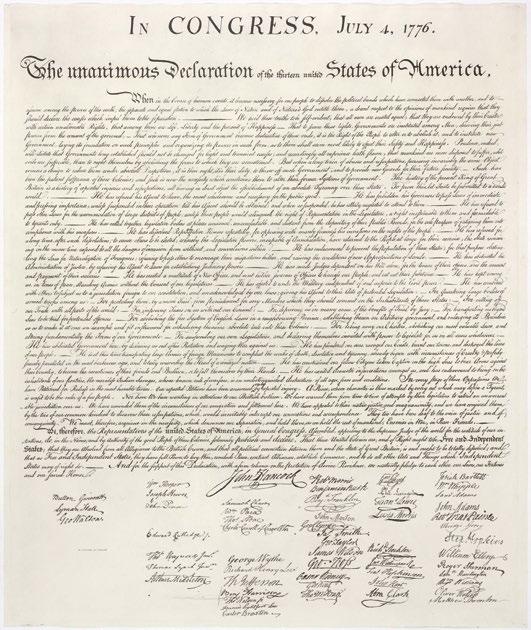
ISBN 979-8-88588-753-3 9 798885 887533 2023 EDITION THE REDCOATS ARE COMING! Paul Revere’s famous ride sounded an alarm that would forever change our nation. In this module, you will gain a rich understanding of the American Revolution by examining perspectives on the conflict. Books such as George vs. George and Woods Runner tell stories of citizens engaged in a battle for independence. MORE MEANINGFUL ENGLISH Examining, debating, and synthesizing evidence leads to a deep understanding of an entire text. As you explore such texts as Colonial Voices: Hear Them Speak, you will answer the question What is the essential meaning? GRADE 4 MODULES 1. A Great Heart 2. Extreme Settings 3. The Redcoats Are Coming! 4. Myth Making ON THE COVER Stone Engraving of the Declaration of Independence, 1823 William J. Stone, American Engraving Courtesy of The National Archives Grade 4 | Module 3 Learn more at GreatMinds.org WIT & WISDOM® Great Minds® brings teachers and scholars together to craft exemplary instructional materials that inspire joy in teaching and learning. PhD Science ®, Eureka Math®, Eureka Math 2™, and our English curriculum Wit & Wisdom® all give teachers what they need to take students beyond rote learning to provide a deeper, more complete understanding of the sciences, mathematics, and the humanities.