GREAT MINDS TEACHER EDITION WIT & WISDOM® 2 GRADE MODULE 4 GOOD EATING
Great Minds® is the creator of Eureka Math® , Wit & Wisdom® , Alexandria Plan™, and PhD Science® .
Published by Great Minds PBC greatminds.org
© 2023 Great Minds PBC. All rights reserved. No part of this work may be reproduced or used in any form or by any means—graphic, electronic, or mechanical, including photocopying or information storage and retrieval systems—without written permission from the copyright holder. Where expressly indicated, teachers may copy pages solely for use by students in their classrooms.
Printed in the USA A-Print
Module Summary 2
Essential Question ............................................................................................................................... .......................................................... 3
Suggested Student Understandings 3
Texts 3
Module Learning Goals 4 Module in Context 6 Standards 7 Major Assessments 8 Module Map ............................................................................................................................... .................................................................. 10
Focusing Question: Lessons 1–8
How can food nourish my body?
Lesson 1 21
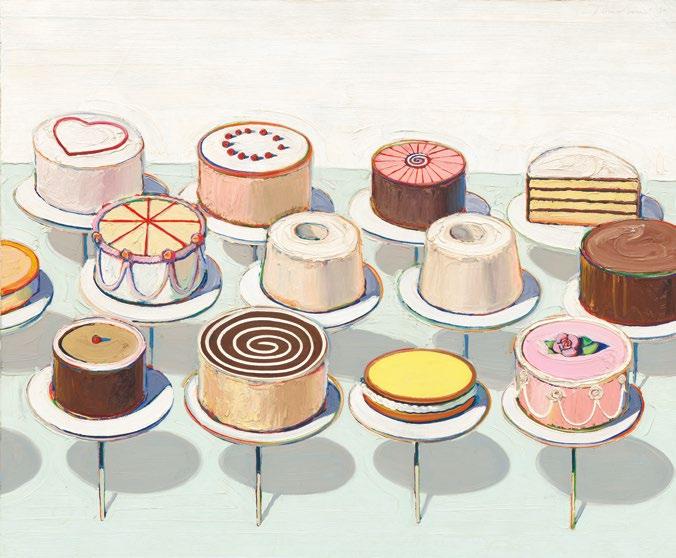
n TEXTS: All module texts • Cakes, Wayne Thiebaud • Two Cheeseburgers, with Everything (Dual Hamburgers), Claes Oldenburg • The Beaneater, Annibale Carracci
¢ Vocabulary Deep Dive: Academic Vocabulary: Digestive system Lesson 2 33
n TEXTS: The Digestive System, Christine Taylor-Butler • The Digestive System, Jennifer Prior
¢ Vocabulary Deep Dive: Content Vocabulary: Esophagus, starches Lesson 3 47
n TEXTS: The Digestive System, Christine Taylor-Butler • The Digestive System, Jennifer Prior
¢ Vocabulary Deep Dive: Content Vocabulary: Mucus, gastric Lesson 4 61
n TEXTS: The Digestive System, Christine Taylor-Butler • The Digestive System, Jennifer Prior
¢ Style and Conventions Deep Dive: Examine Apostrophes in Contractions
Lesson 5 77
n TEXTS: The Digestive System, Christine Taylor-Butler • The Digestive System, Jennifer Prior
¢ Vocabulary Deep Dive: Content Vocabulary: Absorb
Lesson 6 ...................................................................................................................................................................................................................... 93
n TEXT: The Digestive System, Christine Taylor-Butler
¢ Style and Conventions Deep Dive: Experiment with Apostrophes in Contractions
Lesson 7 105
n TEXTS: The Digestive System, Christine Taylor-Butler • The Digestive System, Jennifer Prior
¢ Vocabulary Deep Dive: Content Vocabulary: Belch, bacteria, saliva
Lesson 8 117
n TEXTS: The Digestive System, Christine Taylor-Butler • The Digestive System, Jennifer Prior • “Food and Family,” Nadine Burke
¢ Style and Conventions Deep Dive: Excel with Apostrophes in Contractions
Focusing Question: Lessons 9–16
How can food nourish a community?
Lesson 9 ...................................................................................................................................................................................................................... 131
n TEXTS: Stone Soup, Marcia Brown • The Beaneater, Annibale Carracci
¢ Vocabulary Deep Dive: Suffixes –less and –ful Lesson 10 143
n TEXT: Bone Button Borscht, Aubrey Davis
¢ Style and Conventions Deep Dive: Examine Reflexive Pronouns Lesson 11 157
n TEXTS: Bone Button Borscht, Aubrey Davis • The Beaneater, Annibale Carracci
¢ Vocabulary Deep Dive: Word Relationships Lesson 12 173
n TEXT: Bone Button Borscht, Aubrey Davis
¢
Style and Conventions Deep Dive: Experiment with Reflexive Pronouns Lesson 13 .................................................................................................................................................................................................................... 187
n TEXT: Bone Button Borscht, Aubrey Davis
¢ Vocabulary Deep Dive: Academic Vocabulary: Cooperation Lesson 14 199
n TEXT: Bone Button Borscht, Aubrey Davis
¢ Vocabulary Deep Dive: Academic Vocabulary: Cram, gather Lesson 15 211
n TEXTS: The Beaneater, Annibale Carracci • Bone Button Borscht, Aubrey Davis • Stone Soup, Marcia Brown
¢ Vocabulary Deep Dive: Academic Vocabulary: Banquet Lesson 16 223
n TEXTS: Bone Button Borscht, Aubrey Davis • Stone Soup, Marcia Brown
¢
Style and Conventions Deep Dive: Examine Apostrophes in Possessives
Question: Lessons 17–21
Where does nourishing food come from?
Lesson 17 ................................................................................................................................................................................................................... 235
n TEXT: The Vegetables We Eat, Gail Gibbons
¢ Style and Conventions Deep Dive: Examine Apostrophes in Possessives
Lesson 18 251
n TEXT: The Vegetables We Eat, Gail Gibbons
¢ Style and Conventions Deep Dive: Experiment with Apostrophes in Possessives
Lesson 19 265
n TEXT: The Vegetables We Eat, Gail Gibbons
¢ Style and Conventions Deep Dive: Experiment with Commas in Greetings and Closings of Letters
Lesson 20 277
n TEXTS: The Vegetables We Eat, Gail Gibbons • “Fruit Veggie Swag”
¢ Style and Conventions Deep Dive: Execute with Commas in Greetings and Closings of Letters
Lesson 21 ................................................................................................................................................................................................................... 287
n TEXTS: The Digestive System, Christine Taylor-Butler • The Vegetables We Eat, Gail Gibbons • “Try Something New,” Jamie Oliver
¢ Style and Conventions Deep Dive: Excel with Apostrophes in Possessives
How can I choose nourishing foods?
Lesson 22 299
n TEXTS: Good Enough to Eat, Lizzy Rockwell • “My Food Journey,” Dr. Nadine Burke • Cakes, Wayne Thiebaud
¢ Vocabulary Deep Dive: Content Vocabulary: Nutrient Lesson 23 ................................................................................................................................................................................................................... 313
n TEXTS: Good Enough to Eat, Lizzy Rockwell • “Eating Your A, B, C’s ...”
¢ Vocabulary Deep Dive: Academic Vocabulary: Energy Lesson 24 325
n TEXT: Good Enough to Eat, Lizzy Rockwell
¢ Vocabulary Deep Dive: Academic Vocabulary: Signal Lesson 25 337
n TEXTS: Cakes, Wayne Thiebaud • “Eating Your A, B, C’s ...”
¢ Style and Conventions Deep Dive: Experiment with Spelling Resources Lesson 26 347
n TEXTS: “Planting Seeds: The White House Garden and a Brooklyn School Farm” • Good Enough to Eat, Lizzy Rockwell • “Eating Your A, B, C’s ...”
¢ Style and Conventions Deep Dive: Execute with Spelling Resources Lesson 27 ................................................................................................................................................................................................................... 357
n TEXTS: Good Enough to Eat, Lizzy Rockwell • “Can Milk Make You Happy?”, Faith Hickman Brynie
¢ Style and Conventions Deep Dive: Execute with Spelling Resources
How does food nourish us?
Lesson 28 .................................................................................................................................................................................................................. 367
n TEXTS: All module texts • Two Cheeseburgers, with Everything (Dual Hamburgers), Claes Oldenburg • “Debate! Should Sugary Drinks Be Taxed?” Brenda Iasevoli • Good Enough to Eat, Lizzy Rockwell
¢
Vocabulary Deep Dive: Word Work with Module Vocabulary
Lesson 29 379
n TEXTS: All module texts • Two Cheeseburgers, with Everything (Dual Hamburgers), Claes Oldenburg
¢ Vocabulary Deep Dive: Link Up
Lesson 30 391
n TEXTS: All module texts • Cakes, Wayne Thiebaud • Two Cheeseburgers, with Everything (Dual Hamburgers), Claes Oldenburg • “Eating Your A, B, C’s ...”
¢ Vocabulary Deep Dive: Direct Vocabulary Assessment Part 1
Lesson 31 .................................................................................................................................................................................................................. 403
n TEXTS: “Fruit Veggie Swag” • Cakes, Wayne Thiebaud • Two Cheeseburgers, with Everything (Dual Hamburgers), Claes Oldenburg • The Beaneater, Annibale Carracci • “Eating Your A, B, C’s ...” • “Try Something New,” Jamie Oliver
¢ Vocabulary Deep Dive: Vocabulary Assessment Part 2
Lesson 32 413
n TEXTS: All module texts
¢ Style and Conventions Deep Dive: Distinguish between Formal and Informal Language
What is the story of the year?
Lesson 33 421
n TEXTS: “Autumn Landscape,” Maurice de Vlaminck • U.S. Marshals Escorting Ruby Bridges, Associated Press • Two Cheeseburgers, with Everything (Dual Hamburgers), Claes Oldenburg • All Module 1–4 texts
In the final module of the year, students examine how choosing to eat healthy foods can impact their lives. How does food nourish our bodies? What knowledge helps us make healthy eating choices? How can food bring communities together? Students explore these questions through rich questioning and writing prompts as they internalize the importance of making informed choices about what they eat.
The module begins with an investigation of the digestive system. Through close reading of two informational texts, students learn about the digestive process. Students conduct shared research related to organs of the digestive system, and they then independently write an informative paragraph detailing the important jobs of one organ.
Students then shift their focus from informative texts toward two literary texts: Stone Soup and Bone Button Borscht. Both versions of the classic folktale highlight how food has the potential to help bring communities together. Students analyze the story elements of Bone Button Borscht in depth, writing their first opinion paragraph of the year.
Next, students examine the informational text The Vegetables We Eat. This text introduces students to many different types of vegetables and how they are grown. Students write an informative paragraph describing the steps of growing food on a big farm. They apply to their writing the skill of using temporal words to connect the steps in a process.
Good Enough to Eat offers students the chance to study the specific nutrients in food that nourish their bodies. Students conduct research using two sources to help them choose a fruit or a vegetable to nourish their bodies. They use this new knowledge as they write an opinion paragraph that includes two reasons supported with textual evidence.
The End-of-Module Task builds directly from this task, asking students to evaluate and choose a plate of food to nourish their body. Students write an opinion paragraph that details their reasons and evidence for choosing their plate. The final Socratic Seminar provides students the opportunity to recount an experience when they made a healthy food choice. Both culminating activities offer students the chance to reflect on their new knowledge, further internalizing their understanding of the positive impact making healthy eating choices can have on their lives.
“It’s important to eat at least 5 servings of fruits and vegetables each day. Today, what will you choose?”
Our digestive system works like a machine to take nutrients from food to keep our bodies healthy.
The food we eat comes from small and large farms.
Different foods provide different essential nutrients needed to stay healthy and some of those foods are vegetables.
Food can nourish a community like it nourishes our body.
Picture Book (Informational)
The Digestive System, Christine Taylor-Butler
The Digestive System, Jennifer Prior
Good Enough to Eat: A Kid’s Guide to Food and Nutrition, Lizzy Rockwell
The Vegetables We Eat, Gail Gibbons
Picture Book (Literary)
Bone Button Borscht, Aubrey Davis
Stone Soup, Marcia Brown
“Food and Family,” Nadine Burke (http://witeng.link/0382)
“My Food Journey,” Nadine Burke (http://witeng.link/0424)
“Try Something New,” Jamie Oliver (http://witeng.link/0423)
“Planting Seeds: The White House Garden and a Brooklyn School Farm” (http://witeng.link/0428)
“Fruit Veggie Swag” (http://witeng.link/0422)
The Beaneater, Annibale Carracci (http://witeng.link/0379)
Cakes, Wayne Thiebaud (http://witeng.link/0377)
Two Cheeseburgers, with Everything (Dual Hamburgers), Claes Oldenburg (http://witeng.link/0378)
“Can Milk Make You Happy?” Faith Hickman Brynie
“Debate! Should Sugary Drinks Be Taxed?” TIME for Kids
“Eating Your A,B,C’s …” Kids Discover (http://witeng.link/0427)
Understand the process of digestion and the specific function of some organs.
Conceptualize that food gives our body nutrients that we need to live.
Identify the steps in the process of growing food (on a small and large farm).
Recognize that communities come together around food for nourishment, too.
Build knowledge of the author’s purpose within and throughout the entire text including teaching, explaining, and entertaining the reader. (RI 2.3)
Identify text features and how they contribute to conveying information efficiently in a text. (RI 2.5)
Read a series of ideas or steps in a procedure and understand the connection from beginning to end. (RI 2.3)
Determine how an illustrator contributes meaning to understanding of setting, characters, and plot. (RL 2.7)
Identify reasons that support the point an author is making. (RI.2.8)
Build understanding of characters, setting, and plot by analysis of the words in the text. (RL 2.7)
Write informative paragraphs about steps in a process that include an introduction, topic statement, evidence, and conclusion. (W.2.3, W.2.8)
Organize and choose text evidence to respond to a prompt. (W.2.2, W.2.3, W.2.8)
Write opinion paragraphs that include an introduction, opinion statement, reason, temporal words, and opinion conclusion. (W.2.1, W.2.8)
Conduct shared research using two sources to collect evidence to write an opinion paragraph. (W.2.1, W.2.7, W.2.8)
Speak to recount a personal experience. (SL 2.4)
Speak to recount a text read aloud. (SL 2.2)
Listen to appreciate a text or an experience. (SL 2.2, SL 2.4)
Consult reference materials to check spellings and clarify the meanings of words. (L.2.2.e, L.2.4.e) Identify real-life connections to words. (L.2.5.a)
Generalize spelling patterns. (L.2.2.d)
Form contractions and possessives using apostrophes. (L.2.2.c)
Use reflexive pronouns. (L.2.1.c)
Use commas in letters. (L.2.2.b)
Knowledge: In Module 4, students learn about the importance of healthy food choices. Students build knowledge about how food nourishes their bodies, and how food brings together and nourishes communities. They conduct shared research about the digestive system to write about the important job one organ does in processing their food. Students examine how food is grown in small gardens and on big farms. Toward the end of the module, students closely examine vitamins and minerals and how they nourish the body. Students build knowledge of specific foods that could help nourish their bodies, empowering them to make healthier food choices in their own lives.
Reading: Reading a variety of informational text, students consider the many different text features presented and learn how to efficiently derive information from them. Two similar texts about the digestive system, which use typical nonfiction-text structure and features, present a detailed investigation of how our bodies convert food to nutrients. Later in the module, students read two nonfiction texts with less typical structures to learn about food, particularly vegetables, and understand how food is grown in different settings. To lighten the heavy load of information being presented, students have an opportunity to compare two versions of the tale of a community coming together around a pot of soup and the lessons learned by all involved.
Writing: In the beginning of Module 4, students build their research skills by conducting shared research in small groups as preparation for writing an informational paragraph. Students are then introduced to opinion writing, learning to evaluate evidence to form an opinion statement that is well supported by reasons. In the middle of the module, students return to informative writing, this time focusing on how to write a paragraph that describes steps in a process. Students describe steps in the process of growing vegetables on a big farm and learn how to use temporal words to clarify their writing. Module 4 concludes with additional practice with research and opinion writing. Through Focusing Question Task 4 and the End-of-Module Task, students conduct research using two sources in order to form opinions about healthy foods.
Speaking and Listening: Students develop their speaking and listening skills further in this module by thinking about how listening to a text or an experience includes having an appreciation for what is being said. Then students continue practicing a skill that has been practiced all year, recounting. During this module students are no longer recounting in writing from an evidence chart; instead, they are recounting orally after hearing a Read Aloud and recounting their own personal experiences. In the first Socratic Seminar, students discuss the similarities and differences between Stone Soup and Bone Button Borscht, relying on their recounting skills to speak on topic. In the final Socratic Seminar of the module, students recount their own experiences of trying something new!
RL.2.7 Use information gained from the illustrations and words in a print or digital text to demonstrate understanding of its characters, setting, or plot.
RI.2.3 Describe the connection between a series of historical events, scientific ideas or concepts, or steps in a technical procedure.
RI.2.5 Know and use various text features (e.g., captions, bold print, subheadings, glossaries, indexes, electronic menus, icons) to locate key facts or information in a text efficiently.
RI.2.6 Identify the main purpose of a text, including what the author wants to answer, explain, or describe.
RI.2.8 Describe how reasons support specific points the author makes in a text.
W.2.1 Write opinion pieces in which they introduce the topic or book they are writing about, state an opinion, supply reasons that support the opinion, use linking words (e.g., because, and, also) to connect opinion and reasons, and provide a concluding statement or section.
W.2.7 Participate in shared research and writing projects (e.g., read a number of books on a single topic to produce a report; record science observations).
W.2.8 Recall information from experiences or gather information from provided sources to answer a question.
SL.2.2 Recount or describe key ideas or details from a text read aloud or information presented orally or through other media.
SL.2.4 Tell a story or recount an experience with appropriate facts and relevant, descriptive details, speaking audibly in coherent sentences.
L.2.1.c Use reflexive pronouns.
L.2.2.b Use commas in greetings and closings of letters.
L.2.2.c Use an apostrophe to form contractions and frequently occurring possessives.
L.2.2.d Generalize learned spelling patterns when writing words.
L.2.2.e Consult reference materials, including beginning dictionaries, as needed to check and correct spellings.
L.2.3.a Compare formal and informal uses of English.
L.2.4.e Use glossaries and beginning dictionaries, both print and digital, to determine or clarify the meaning of words and phrases.
L.2.5.a Identify real-life connections between words and their use.
RL.2.10 By the end of the year, read and comprehend literature, including stories and poetry, in the Grades 2–3 text-complexity band proficiently, with scaffolding as needed at the high end of the range.
RI.2.10 By the end of year, read and comprehend informational texts, including history/social studies, science, and technical texts, in the Grades 2–3 text-complexity band proficiently, with scaffolding as needed at the high end of the range.
L.2.6 Use words and phrases acquired through conversations, reading and being read to, and responding to texts, including using adjectives and adverbs to describe.
1. Choose either the stomach or the small intestine. What important jobs does this organ do as part of the digestive system?
Conduct shared research in a small group. Then, individually, write an informative paragraph that includes at least two pieces of evidence from the text.
2. Who benefited the most from making the soup in Bone Button Borscht? Write an opinion paragraph.
With support, conduct research in small groups.
Write an informative paragraph with an introduction, topic statement, two pieces of evidence from the text, and a conclusion.
Contractions, if used, should be used correctly.
RI.2.1, W.2.2, W.2.7, W.2.8, L.2.2.c
Evaluate evidence to form an opinion statement.
Write an opinion paragraph that includes an introduction, opinion statement, reason, and evidence from the text.
RL.2.1, W.2.1, W.2.8
3. Where does nourishing food come from? Describe how food is created on a big farm. Write an informative paragraph that includes the steps and the connections between them.
4. Consider the following options: strawberries, oranges, carrots, and broccoli. Which one would you choose to benefit your body? Support your opinion with evidence.
Independently write an informative paragraph with at least two pieces of evidence from the text.
Use temporal words in a written response.
Collect and evaluate evidence from two sources.
Conduct shared research.
Write an opinion paragraph with one reason and two pieces of evidence.
Include an introduction, opinion statement, and opinion conclusion.
RI.2.1, RI.2.3, W.2.2, W.2.8, L.2.2.c
RI.2.1, W.2.1, W.2.7, W.2.8, L.2.2.d, L.2.2.e
1. Read Stone Soup and then answer questions about how the illustrations clarify the text.
2. Read page 31 of The Digestive System and answer questions about text features.
Understand how illustrations expand and clarify information within a literary text.
Use information in text features to build understanding on a topic.
Use a glossary to determine the meaning of words or phrases.
RL.2.1, RL.2.7, W.10
RI.2.5, L.2.4.e, L.2.5.a
3. Read pages 14–15 of Good Enough to Eat. Answer questions to connect the steps in the digestive process.
4. Listen closely to “Debate! Should Sugary Drinks Be Taxed?” Complete a chart and answer questions about the author’s purpose and points.
Understand the connections between steps in a process. Use temporal words to connect steps in a process.
Identify the author’s reasons for believing her points. Name the author’s purpose.
RI.2.1, RI.2.3, W.10
RI.2.6, RI.2.8
1. Compare and contrast Stone Soup and Bone Button Borscht. Identify key ideas or details to recount module texts. Discuss similarities and differences between the two stories.
Reflect on use of formal language in a Socratic Seminar.
2. What happened when you tried eating something new? Prepare by recounting a Read Aloud. Write individually about which character helped most. Demonstrate use of reflexive pronouns.
SL.2.2, L.2.1.c, L.2.3.a
SL.2.1, SL.2.2, SL2.4, L.2.3.a
Look closely at the two images of plates. Which meal would you choose to nourish your body and why?
Support your response using evidence from the following sources:
Good Enough to Eat by Lizzy Rockwell
“Eating Your A, B, C’s ...” infographic
Write a paragraph that clearly states an opinion with a reason rooted in evidence from the text.
Introduce the book or topic.
Evaluate evidence to form an opinion statement with two parts.
Supply a reason that supports each part of the opinion statement.
Use temporal words to connect opinions and reasons. Reiterate the opinion in a conclusion statement.
RI.2.1, W.2.1, W.2.7, W.2.8
Demonstrate understanding of academic, text-critical, and domainspecific words, phrases, and/or word parts.
Acquire and use grade-appropriate academic terms. Acquire and use domain-specific or text-critical words essential for communication about the module’s topic.
L.2.6
*While not considered Major Assessments in Wit & Wisdom, Vocabulary Assessments are listed here for your convenience. Please find details on Checks for Understanding (CFUs) within each lesson.
Focusing Question 1: How can food nourish my body?
LESSON TEXTS CONTENT FRAMING QUESTION CRAFT QUESTIONS
1 All module texts Wonder
What do I notice and wonder about Good Enough to Eat?
2 The Digestive System, Christine Taylor-Butler
The Digestive System, Jennifer Prior
Wonder
What do I notice and wonder about The Digestive System?
Examine
Why is shared research important?
Ask questions and make observations about a section of the text Good Enough to Eat. (RI.2.1)
Use text-based clues to determine the meaning of digestive system. (L.2.4.a)
Ask and answer questions about The Digestive System. (RI.2.1)
Examine the importance of conducting shared research to answer a question. (W.2.7, W.10)
Use a glossary and beginning dictionary to determine or clarify the meaning of the word starches. (L.2.4.e)
Focusing Question 1: How can food nourish my body?
3
The Digestive System, Christine Taylor-Butler
The Digestive System, Jennifer Prior
Wonder
What do I notice and wonder about The Digestive System?
Experiment How does shared research work?
Ask and answer questions about The Digestive System. (RI.2.1)
Answer a research question by conducting shared research. (W.2.7, W.2.8)
Use a glossary or beginning dictionary to clarify the meaning of the words mucus and gastric. (L.2.4.e)
4
The Digestive System, Christine Taylor-Butler
The Digestive System, Jennifer Prior
Organize
What’s happening in The Digestive System?
Examine How do I collect shared research to answer Focusing Question Task 1? Examine Why is using apostrophes in contractions important?
Use text features to navigate an informational text. (RI.2.5)
Answer a research question by conducting shared research in small groups. (W.2.7, W.28)
Identify examples of contractions and explain the role of the apostrophes in contractions. (L.2.2.c)
5 The Digestive System, Jennifer Prior
The Digestive System, Christine Taylor-Butler
Organize What’s happening in Chapter 2 of The Digestive System?
6 FQT The Digestive System, Christine Taylor-Butler
Experiment How does speaking to recount work? Execute How do I collect shared research to answer FQT 1?
Describe the connection between the parts of the digestive system. (RI.2.3, SL.2.2)
Answer a research question by conducting shared research in small groups. (W.2.7, W.2.8)
Identify real-life connections between the word absorb and its use. (L.2.5.a)
Reveal What does a deeper exploration of text features reveal in The Digestive System?
Execute How do I write an informative paragraph for FQT 1? Experiment
How do apostrophes in contractions work?
Explain how images contribute to the text. (RI.2.7)
Use shared research about the digestive system to write an informative paragraph. (RI.2.1, W.2.2, W.2.7, W.2.8, L.2.2.c)
Use apostrophes to form contractions. (L.2.2.c)
7
FQT The Digestive System, Jennifer Prior
The Digestive System, Christine Taylor-Butler
Distill What is the essential meaning of The Digestive System?
Execute
How do I write an informative paragraph for FQT 1?
Determine the author’s purpose of the text The Digestive System by Christine TaylorButler. (RI 2.6, W.10)
Use shared research about the digestive system to write an informative paragraph. (RI.2.1, W.2.2, W.2.7, W.2.8, L.2.2.c)
Use sentence-level context or the glossary to determine the meaning of the words belch, bacteria, and saliva. (L.2.4.a, L.2.4.e)
Focusing Question 1: How can food nourish my body?
8
The Digestive System, Christine Taylor-Butler
“Food and Family,” Nadine Burke
Know
How does The Digestive System build my knowledge of how food nourishes my body?
Excel
How do I improve my informative paragraph? Excel
How do I improve my use of contractions in my informative paragraph?
Read and understand the purpose of captions in a text. (RI.2.5)
Identify reasons that support the author’s point in “Food and Family.” (RI.2.8)
Use apostrophes to form contractions. (L.2.2.c)
Focusing Question 2: How can food nourish a community?
9 Stone Soup, Marcia Brown
The Beaneater, Annibale Carracci
Wonder
What do I notice and wonder about Stone Soup?
10
Bone Button Borscht, Aubrey Davis
Stone Soup, Marcia Brown
The Beaneater, Annibale Carracci
Wonder
What do I notice and wonder about Bone Button Borscht?
11
Bone Button Borscht, Aubrey Davis
What’s happening in Bone Button Borscht?
How do I form opinion statements?
Make observations and generate questions about Stone Soup. (RL.2.1)
Determine the meaning of words formed when the suffixes -ful and -less are added to known root words. (L.2.4)
Ask and answer questions about Bone Button Borscht. (RL.2.1)
Identify and match reflexive pronouns in Bone Button Borscht with their antecedent. (L.2.1.c)
Recall story elements from the text Bone Button Borscht. (RL.2.2)
Identify important details when listening to a Read Aloud. (SL.2.2)
Experiment with forming opinion statements. (W.2.1)
Consider real-life connections between closely related verbs (trudged, hurried, hobbled, sped, rushed) and their use in order to distinguish their shades of meaning. (L.2.5.a, L.2.5.b)
12
Bone Button
Borscht, Aubrey Davis
Reveal
What does a deeper exploration of illustrations and words reveal in Bone Button Borscht?
13
FQT
Bone Button Borscht, Aubrey Davis
Reveal
What does a deeper exploration of illustrations and words reveal in Bone Button Borscht?
14
FQT
Bone Button Borscht, Aubrey Davis
Distill
What is the essential meaning of Bone Button Borscht?
Execute
How do I structure an opinion paragraph? Examine
How does using reflexive pronouns work?
Execute
How do I form opinion statements?
Use information from illustrations in Bone Button Borscht to demonstrate understanding of characters and setting. (RL.2.7)
Examine the structure of an opinion paragraph. (W.2.1)
Generate reflexive pronouns that match nouns and personal pronouns. (L.2.1.c)
Describe how the illustrations contribute to understanding of characters and setting. (RL2.7)
Write an opinion statement. (W.2.1) Generate real-life and text examples and non-examples of cooperation. (L.2.5.a)
Execute How do I prepare to write an opinion paragraph?
Determine the essential meaning and explain how both words and illustrations contribute to the essential meaning. (RL.2.1, RL.2.2, RL.2.7)
Prepare to write an opinion paragraph. (W.2.1)
Identify real-life connections between the words gather and cram and their use. (L.2.5.a)
15
NR
FQT
Bone Button
Borscht, Aubrey Davis
Know
How does Bone Button Borscht build my knowledge?
Excel How do I write an opinion paragraph in FQT 2?
Identify and describe how words and illustrations add meaning to the text. (RL.2.1, RL.2.7, W.10)
Write an opinion paragraph. (W.2.1, W.2.8, RL.2.1)
Create a Frayer Model for the word banquet using real-life connections. (L.2.4.a, L.2.5.a)
Stone Soup, Marcia Brown
Know: How do Bone Button Borscht and Stone Soup build my knowledge of how food can nourish a community?
Execute
How can I speak to recount to prepare for a Socratic Seminar? Examine
Why is it important to know the difference between formal and informal language? Examine
Why do writers use apostrophes in possessives?
Identify and explain the purpose of apostrophes in possessive nouns. (L.2.1.c)
17
The Vegetables We Eat, Gail Gibbons
Wonder: What do I notice and wonder about The Vegetables We Eat?
Examine: Why is writing about the steps in a process important? Examine
Why do writers use apostrophes in possessives?
Ask and answer questions about The Vegetables We Eat. (RI.2.1)
Demonstrate understanding of an informative paragraph with steps in a process. (W.2.2)
Recount an experience with descriptive details. (SL.2.2, SL.2.4)
Identify and explain the purpose of apostrophes in singular and plural possessives nouns. (L.2.2.c)
18
The Vegetables We Eat, Gail Gibbons
Organize
What’s happening in The Vegetables We Eat?
Experiment
How does writing with steps work?
Experiment
How do writers use apostrophes correctly in possessive nouns?
Reread and use the headings to determine the author’s purpose of sections of text. (RI.2.5, RI.2.6)
Record evidence detailing steps in a process. (RI.2.3)
Use apostrophes in singular and plural possessive nouns. (L.2.2.c)
19
FQT
The Vegetables We Eat, Gail Gibbons
Reveal What does a deeper exploration of the words and phrases reveal in The Vegetables We Eat?
Execute
How do I write the steps of a process in FQT 3?
Experiment
How does using commas in letters work?
Recall the meaning of topic specific vocabulary from the text The Vegetables We Eat. (RI.2.4)
Record evidence detailing steps in a process. (RI.2.1, RI.2.3, W.2.8)
Use commas in greetings and closings of letters. (L.2.2.b)
20
FQT
The Vegetables We Eat, Gail Gibbons
“Fruit Veggie Swag”
Distill
What is the essential meaning of The Vegetables We Eat?
Execute
How do I write the steps of a process in FQT 3?
Experiment
How does speaking formally and informally work?
Execute
How do I use commas in the greetings and closings of a letter?
State and examine the author’s purpose of a text. (RI.2.6)
Compare formal and informal language. (L.2.3.a)
Write an informative paragraph about steps in a process. (RI.2.1, RI.2.3, W.2.2, W.2.8)
Use commas in greetings and closings of letters. (L.2.2.b)
21
The Digestive System, Christine Taylor-Butler
“Try Something New,” Jamie Oliver
Know
How can The Vegetables We Eat build my knowledge of what is nourishing food and where it can come from?
Excel
How do I improve FQT 3?
Excel
How do I improve my use of possessives in my informational paragraph?
Use text features to locate information in The Digestive System. (RI.2.5)
Improve an informative paragraph about steps in a process. (W.2.2, W.2.5, W.2.8, RI.2.1, RI.2.3)
Identify reasons that support the author’s point in “Try Something New.” (RI.2.8)
Use apostrophes to form possessives. (L.2.2.c)
22 Good Enough to Eat, Lizzy Rockwell
“My Food Journey”
Cakes, Wayne Thiebaud
23 NR Good Enough to Eat, Lizzy Rockwell
“Eating Your A, B, C’s ...”
Wonder
What do I notice and wonder about Good Enough to Eat?
Organize
What’s happening in Good Enough to Eat?
Examine: Why is it important to use research from more than one source to form an opinion?
Experiment
How does conducting research from more than one source work?
Make observations and generate questions about Good Enough to Eat. (RI.2.1)
Deepen understanding of the word nutrient by exploring real-life examples. (L.2.5.a)
Describe the connection between steps in a process. (RI.2.1, RI.2.3, W.10)
Conduct shared research using two sources to collect evidence. (RI.2.1, W.2.7, W.2.8)
Use real-life and text connections to build an understanding of the word energy. (L.2.5.a)
24 Good Enough to Eat, Lizzy Rockwell Reveal
What does a deeper exploration of text features reveal in Good Enough to Eat?
Execute
How do I use research to form an opinion for FQT 4?
Analyze Good Enough to Eat through its text features. (RI.2.5)
Conduct shared research to collect evidence for FQT 4. (RI.2.1, W.2.7, W.2.8)
Identify real-life connections between the word signal and its use. (L.2.5.a)
FQT Good Enough to Eat, Lizzy Rockwell
25
Organize
Experiment
Cakes, Wayne Thiebaud
What is happening in the “Eating Your A, B, C’s ...” infographic?
How do I use research to form an opinion for FQT 4?
Experiment
How does using resources to check my spelling work?
Conduct shared research to collect evidence from two sources for FQT 4. (RI.2.1, W.2.7, W.2.8)
Use spelling patterns and reference materials to check and correct spellings. (L.2.2.d, L.2.2.e)
26
FQT Good Enough to Eat, Lizzy Rockwell
“Planting Seeds: The White House Garden and a Brooklyn School Farm”
“Eating Your A, B, C’s ...”
Distill
What is the essential meaning of Good Enough to Eat?
Execute
How do I use research to form an opinion for FQT 4?
Execute
How do I use resources to check my spelling in my Focusing Question Task?
Independently determine author’s purpose for writing a text. (RI.2.6, W.10)
Write an opinion paragraph about a nourishing food. (RI.2.1, W.2.1, W.2.7, W.2.8)
Use spelling patterns and reference materials to check or correct spelling in the Focusing Question Task. (L.2.2.d, L.2.2.e)
27 Good Enough to Eat, Lizzy Rockwell
“Eating Your A, B, C’s ...”
“Can Milk Make You Happy?”
Faith Hickman Brynie
Know
How can The Vegetables We Eat build my knowledge?
Excel
How do I improve my opinion paragraph? Execute
How do I use my resources to check my spelling in my Focusing Question Task?
Complete and revise the opinion paragraph for FQT 4. (RI.2.1 , W.2.1, W.2.5, W.2.8)
Identify reasons that support the author’s point in “Can Milk Make You Happy?” (RI.2.8)
Use spelling patterns and reference materials to check or correct spelling in the Focusing Question Task. (L.2.2.d, L.2.2.e)
28 NR All module texts
Two Cheeseburgers, with Everything (Dual Hamburgers), Claes Oldenburg “Debate! Should Sugary Drinks Be Taxed?”
Brenda Iasevoli
29 All module texts
Cheeseburgers, with Everything (Dual Hamburgers), Claes Oldenburg
Know
How do the module texts build my knowledge of nourishing food?
Execute
How do I use opinion writing in the EOM Task?
Identify the author’s purpose for writing the text and describe how reasons support the points the author makes. (RI.2.6, RI.2.8)
Collect evidence to write an opinion paragraph. (RI.2.1, W.2.7, W.2.8)
Determine the meaning of a new word formed when a known affix is added to a known root word. (L.2.4.b)
Know
How do the module texts build my knowledge of nourishing food?
Execute:
How do I use research to form an opinion in the EOM Task?
Collect evidence to prepare for the EOM Task. (RI.2.1, W.2.7, W.2.8)
Make connections between content vocabulary using connects to the text and the real world. (L.2.5.a)
30
VOC
All module texts
Cakes, Wayne Thiebaud Cheeseburgers, with Everything (Dual Hamburgers), Claes Oldenburg
Know
How do the module texts build my knowledge of nourishing food?
Execute
How do I use research to form an opinion in the EOM Task?
Collect evidence from a second source to prepare for the EOM Task. (RI.2.1, W.2.8)
Demonstrate understanding of module words by identifying correct or incorrect use in context. (L.2.6)
31
VOC
EOM
“Fruit Veggie Swag” Cakes, Wayne Thiebaud Cheeseburgers, with Everything (Dual Hamburgers), Claes Oldenburg
The Beaneater, Annibale Carracci
“Eating Your A, B, C’s ...”
“Try Something New,” Jamie Oliver
Know
How do the module texts build my knowledge of nourishing food?
Execute
How do I use opinion writing in the EOM Task?
Recount an experience understandably and with appropriate details. (SL.2.2, SL.2.4)
Orally rehearse and begin to draft an opinion paragraph about nutritious food. (W.2.1, W.2.8, RI.2.1)
Demonstrate understanding of module words by analyzing correct or incorrect use in context. (L.2.6)
32 SS EOM
All module texts Know
How do the module texts build my knowledge of nourishing food?
Execute
How does speaking formally to recount an experience in a Socratic Seminar work?
Excel
How do I improve opinion writing in the EOM Task?
Complete and revise the opinion paragraph for the EOM Task. (W.2.1, W.2.5)
Share an experience about trying a new food. (SL.2.1, SL.2.4, L.2.3.a)
Describe uses of formal and informal language. (L.2.3.a)
33 All Module 1–4 texts Autumn Landscape, Maurice de Vlaminck
U.S. Marshals Escorting Ruby Bridges
Cheeseburgers, with Everything (Dual Hamburgers), Claes Oldenburg
The Beaneater, Annibale Carracci
Know
How do this year’s texts build my knowledge?
Answer questions about key details in texts. (RL.2.1, RI.2.1)
All module texts
Cakes, Wayne Thiebaud (http://witeng.link/0377)
Two Cheeseburgers, with Everything (Dual Hamburgers), Claes Oldenburg (http://witeng.link/0378)
The Beaneater, Annibale Carracci (http://witeng.link/0379)
Welcome (10 min.)
Explore Module Texts
Launch (8 min.)
Learn (51 min.)
Create a Food Shopping List (15 min.)
Listen Actively and Share Observations (18 min.)
Develop Questions (10 min.)
Examine Module 4 Visual Art (8 min.)
Land (4 min.)
Wonder about the Essential Question Wrap (2 min.)
Reflect on Volume of Reading
Vocabulary Deep Dive: Academic Vocabulary: Digestive system (15 min.)
The full text of ELA Standards can be found in the Module Overview.
RI.2.1
Writing W.10*
Speaking and Listening SL.2.1
Language L.2.4.a
MATERIALS
Handout 1A: The Digestive System Sticky notes
Local food advertisements Scissors, tape, and construction paper
Blank Wonder Chart (retain for future lessons)
Ask questions and make observations about a section of the text Good Enough to Eat. (RI.2.1)
Generate questions about pages 1–11.
Use text-based clues to determine the meaning of digestive system. (L.2.4.a)
Stop and Jot at least two facts or characteristics about the term digestive system on Handout 1A.
* In alignment with the CCSS, W.10 formally begins in Grade 3. However, Kindergarten–Grade 2 students write routinely for a variety of time frames, tasks, purposes, and audiences. As a result, this lesson contains instruction related to W.10 in an effort to familiarize students with a range of writing.
ESSENTIAL QUESTION: Module 4
How does food nourish us?
FOCUSING QUESTION: Lessons 1–8
How can food nourish my body?
CONTENT FRAMING QUESTION: Lesson 1
Wonder: What do I notice and wonder about Good Enough to Eat?
In this lesson, students are introduced to the key concepts of Module 4 as they explore the module texts and discuss the Essential Question. Then, they notice and wonder about the opening pages of Good Enough to Eat and discuss the Module 4 Visual Art pieces, including Cakes, Two Cheeseburgers, with Everything (Dual Hamburgers), and The Beaneater
Display the Module 4 texts around the classroom.
Pair students up and give each pair two sticky notes. Instruct them to label one with a W for wonder and one with a N for notice.
Explain that pairs will first conduct a Gallery Walk of the Module 4 texts and jot down at least one observation and one question.
Describe how each pair will begin the Gallery Walk at a specific station, quietly examining the texts. Establish a signal (such as a bell or music) to signify that groups should rotate. Have volunteers briefly model this process, rotating correctly through the stations.
Pairs participate in a Gallery Walk, jotting down their observations and questions as they move from station to station.
Bring the class together and use Equity Sticks to have students share out observations and then questions. If students jotted down a similar observation or question, they should wave both of their hands above their heads when they hear their thoughts echoed.
Repeat this process until several key ideas have emerged. Let students know that they will be revisiting these observations and questions at the end of the module and encourage them to keep them in mind as they dive into Module 4.
8 MIN.
Post the Essential Question, Focusing Question, and Content Framing Question.
Read aloud the Essential Question, and ask: “What is an Essential Question, and how have we answered Essential Questions in previous modules?” Have volunteers respond.
Reinforce that the Essential Question is the big question to answer during the module as students explore the module texts.
Reread the Essential Question, emphasizing the word food. Instruct students to Think–Pair–Share, and ask them to complete this sentence in as many ways as they can:
Food makes me able to
Use Equity Sticks to call on pairs to share.
Reread the Essential Question, emphasizing the word nourish. Post the word nourish to the Word Wall and provide this definition: to provide food needed to live, grow and stay healthy. Explain that food does even more for us than keep us alive; it helps us grow in many ways, too! Explain that students will learn more about the many different ways food nourishes them.
Leave the Essential Question posted for students to reference throughout the module.
Extension
Continue to explore the word nourish by discussing how suffixes (e.g. –ing; -ed; -ment) can change the meaning or part of speech.
51 MIN.
Individuals
Ask: “Who has ever gone grocery shopping with a family member or friend? Raise your hand.”
Reinforce that shopping for food is an important task, and that, in this module, students will learn more about how to make choices when choosing the foods they eat, whether at home or school.
Present this challenge: Pretend you are planning a trip to the grocery store to buy some food for yourself to eat tomorrow. Your task is to select five to seven foods you would most like to buy. Cut them out and
tape them onto construction paper. Be prepared to share your choices and explain your reasons for choosing them to a small group.
Distribute several local grocery-store advertisements, scissors, glue, and construction paper to students.
As students work, circulate and ask questions such as this one: “What did you think about when you chose this?”
TEACHER NOTE
Resist the temptation to give guidance to students; reassure them that there are no right or wrong answers. This is an open-ended activity to get them thinking about foods they eat and enjoy.
At the same time, remain mindful of the time so that this activity serves its purpose as an informal measurement of students’ current food choices and does not derail additional instruction.
Retain these products, so that students are able to reflect on any changes in their choices at the end of the module.
Have students form pairs to share their choices and reasons.
Ask: “What are some similarities and differences between the choices you and your partner made?” Use Equity Sticks to choose pairs to share.
Extension
Create a class graph of foods chosen by category. Then, ask students to reflect on changes in class data when this activity is repeated at the end of the module.
TEACHER NOTE
The pages of this text are not numbered. For ease of instruction, number the pages of the book in advance of the Read Aloud. The first illustrated page, featuring a girl dressed as a salt shaker, is page 1.
Explain that now that students have made their choices, they are ready to learn more about how the food they eat helps their bodies.
Distribute partner copies of Good Enough to Eat and explain that, in this lesson, students will notice and wonder about a small part of this text. They will then return to the entire text later in the module.
Instruct pairs look closely at pages 2–3 and pages 38–39.
Post the following questions for pairs to discuss: What are all of these foods?
Did I choose foods from all of these groups when I created my shopping list? Why or why not?
Circulate and support pairs as they discuss the illustrations and ideas.
Bring the class back together and read aloud page 5.
Ask: “What foods do you notice on this page? What do you notice about the title?” Have volunteers respond.
Read aloud pages 6–11 as pairs follow along.
Instruct students to Think–Pair–Share, and ask: “What do you notice about this part of the text?”
Have pairs think back to the ways they responded to Food makes you able to Ask volunteers to compare it to their original thinking.
10 MIN.
Over the course of Modules 1–3, students have learned a variety of methods for developing questions, including the Wonder Wheel and Question Cubes. As appropriate, consider removing these scaffolds during Module 4, encouraging students to reflect on how their questions draw from a variety of question words and supporting them in pushing their questioning as needed.
Ask: “What happens after you make observations about a new text?” Use Equity Sticks to call on a student to answer. Confirm that students will now ask questions that encourage deeper thinking about the text.
Post a blank Wonder Chart labeled “Good Enough to Eat.”
Instruct students to revisit pages 1–11 with their partner.
Pairs generate questions about pages 1–11 and record their questions on sticky notes with each partner taking responsibility for writing down one question. The writer should put his or her name on the back of the sticky note.
Call on pairs to share one question they think might be answered by reading more of the text or learning more about this topic. Post these on the Wonder Chart.
If students have the same question, put a star next to the first posting of it, emphasizing how these might be especially powerful questions to return to later in the lessons and discuss their answers.
?What is a kid’s guide? (5)
What is nutrition? (5)
Why does eating make me feel better? (9)
How does food help me stay cool and warm? (11)
Explain to students that they will read the rest of this text during later lessons. At that time they will have the chance to add questions and answers to the Wonder Chart.
Display the Module 4 artwork, one piece at a time, giving students time to observe and enjoy each one. Do not reveal the titles or artists’ names:
Cakes, Wayne Thiebaud (http://witeng.link/0377)
Wonder Chart for Good Enough to Eat Wonders for Good Enough to Eat by Lizzy Rockwell QuestionsTwo Cheeseburgers, with Everything (Dual Hamburgers), Claes Oldenburg (http://witeng.link/0378)
The Beaneater, Annibale Carracci (http://witeng.link/0379)
Briefly show all three pieces again. Instruct students to Think–Pair–Share, and ask: “Which piece of art do you like best, and why?”
Explain to students that they will have more opportunities to view and think about their opinions on all three pieces of art in this module.
Land4 MIN.
Remind students that they opened the lesson by previewing the module texts and discussing the Essential Question. Instruct students to Stop and Jot in their Response Journal, and ask: “What is something you hope to learn as you explore the Essential Question, ‘How does food nourish us?’”
Wrap2 MIN.
Distribute and review the Volume of Reading Reflection. Explain that students should consider these questions as they read independently and respond to them when they finish a text.
Distribute and review the list of additional texts from Appendix D: Volume of Reading and the Volume of Reading Reflection Questions (see the Student Edition). Explain that the list contains books with further information about topics discussed in the module. Tell students that they should consider the reflection questions as they independently read any additional texts and respond to them when they finish a text.
Students may complete the reflections in their Knowledge Journal, or submit them directly. The questions can also be used as discussion questions for a book club or other small-group activity. See the Implementation Guide (http://witeng.link/IG) for a further explanation of Volume of Reading, as well as various ways of using the Volume of Reading Reflection Questions.
In this lesson, students generate questions about pages 1–11 of Good Enough to Eat. (RI.2.1 Each student)
Reviews pages 1–11 of the text with a partner.
Develops questions about the text based on the words and illustrations.
At this point in the year, students’ questions should demonstrate an increasing awareness of previously studied text features, structures, vocabulary, and so on.
Analyze students’ questions and observations with a focus on how their responses demonstrate application of this prior knowledge. For example, in Module 3, students studied how images can contribute to and clarify a text. As needed, look for opportunities to highlight pages with especially notable illustrations and follow up with probing questions.
For example:
Page 5: Notice how the letters are made out of food. What does this image tell us about this “guide to food and nutrition?”
Pages 12–13: What do we learn from the words? What do we learn from the images? How are these ideas connected?
Time: 15 min.
Text: The Digestive System, Christine Taylor-Butler
Vocabulary Learning Goal: Use text-based clues to determine the meaning of digestive system. (L.2.4.a)
Hold up The Digestive System by Christine Taylor-Butler and remind students that they explored this text during their Gallery Walk. Open to page 7 and read aloud the text. Repeat the next-tolast line: “It’s your digestive system in action, and it’s normal.”
Explain that learning about how food nourishes us requires understanding what happens to food when it enters our bodies. To help students reach this understanding, they will explore the meaning of digestive system.
Distribute copies of The Digestive System (Taylor-Butler). Pairs follow along as you read aloud the title, emphasizing the word system. Ask: “Where have you heard the word system before?” Have volunteers respond.
n I have heard the word system in phrases like solar system, bus system, voting system, number system, subway system, school system, or computer system.
Choose one response to explore with students, asking them to think about what this example reveals about the meaning of the word system.
To support students in understanding the term system, break the above examples of systems (e.g., solar system, bus system, voting system) into parts before revealing the definition. For example, draw a sketch or provide a diagram of a bus system or the solar system and ask students to explain or use arrows to show how the parts work together. Then, ask students whether just one of its parts (e.g., the sun) is a system and have them explain why it is not (the sun is one part of the solar system).
Post the word system to the Word Wall and provide this definition for students to record in their Vocabulary Journal.
Word Meaning
system (n.) A group of parts that work together.
Return to the front cover of the text and direct students’ attention to the word digest.
Instruct students to Think–Pair–Share, and ask: “What clues does the front cover give us about the meaning of the word digest?”
n The cover says that “[a] group of organs breaks down, or digests, food for the body,” so digest is another way to say “break down.”
n Since organs “digest food for the body,” digest is something the body does.
Confirm the following meaning of digest, noting how the verb digest is linked to the adjective digestive. Post the word digest to the Word Wall and provide this definition for students to record in their Vocabulary Journal.
Word Meaning digest (v.) To break down food into materials the body can use.
Tell students that digestive is an adjective, or a word that describes, related to the word digest.
Ask: “Using what you know about the word digest, what might digestive mean?”
n Since digest means “to break down food into materials the body can use,” digestive could be about breaking down food for the body.
Word Meaning digestive (adj.) Having to do with the process of breaking down food for the body to use.
Bring students’ attention back to the term digestive system
Instruct pairs to continue studying the front cover for clues that build their understanding of the term and to stand when they have an observation to share with the class. Select a few pairs to share. Probe students’ thinking by returning to the meanings of system and digest and prompting students to use both words in their explanations.
n We see a human body with certain parts colored in. Maybe these are the parts working together in the digestive system.
n We see an arrow pointing to these parts of the body that says “a group of organs.” That could mean that the digestive system is a group of organs working together to break down food.
n We think the digestive system relates to how your body breaks down food and how food goes through these parts of the body.
Distribute Handout 1A and read aloud the definition of digestive system: “Parts of the body that work together to break down food.”
Students Stop and Jot at least two facts or characteristics about the term digestive system on Handout 1A.
Name: Handout 1A: Digestive System
Directions: Fill in the boxes as you learn more about the digestive system in Module 4.
Digestive System
Examples of facts or characteristics:
It is a group of organs.
It breaks down food.
Its parts work together in a system.
It sends food through the body.
Facts/Characteristics: Vocabulary: Picture: Page of
Definition: Parts of the body that work together to break down food.
Use Equity Sticks to call on three students to share their fact or characteristics, giving time for students to add these to their handout.
Throughout the module, students will add to this reference page as they learn more about the digestive system.
The Digestive System, Christine Taylor-Butler
The Digestive System, Jennifer Prior
Welcome (8 min.)
Explore the Text
Launch (3 min.)
Learn (58 min.)
Listen Actively (20 min.)
Share Observations (8 min.)
Develop and Discuss Questions (15 min.)
Examine Shared Research (15 min.)
Land (3 min.)
Answer the Content Framing Question Wrap (3 min.)
Assign Homework
Vocabulary Deep Dive: Content
Vocabulary: Esophagus, starches (15 min.)
The full text of ELA Standards can be found in the Module Overview.
RI.2.1, RF.4
Writing W.2.7, W.10*
Speaking and Listening SL.2.1
Language L.2.4.e
Ask and answer questions about The Digestive System (RI.2.1)
Develop and discuss questions in small groups.
Examine the importance of conducting shared research to answer a question. (W.2.7, W.10)
Stop and Jot about the importance of shared research in Response Journal.
Handout 2A: Fluency Homework Sticky notes
Blank Wonder Chart (retain for future lessons)
Research Sources Chart from Module 3 (retain for future lessons)
Access to print or digital beginning dictionaries
Use a glossary and beginning dictionary to determine or clarify the meaning of the word starches (L.2.4.e)
Locate and record the definition of starches from a glossary and a beginning dictionary.
* This lesson prepares students for W.10, which first appears in the Grade 3 CCSS.
FOCUSING QUESTION: Lessons 1–8
How can food nourish my body?
CONTENT FRAMING QUESTION: Lesson 2
Wonder: What do I notice and wonder about The Digestive System?
CRAFT QUESTION: Lesson 2
Examine: Why is shared research important?
In this lesson, students remain in the Wonder stage as they explore the first half of The Digestive System by Christine Taylor-Butler. Students work in small groups to generate and answer these questions. Finally, students examine the concept of shared research as they prepare to write an informational paragraph about how food nourishes the body.
8 MIN.
Distribute The Digestive System by Christine Taylor-Butler. Read aloud the title as you remind students of their Gallery Walk with this text in the previous lesson, and ask: “Is this a literary or informational text? What makes you think so?” Have volunteers respond.
Reinforce that The Digestive System (Taylor-Butler) is informational.
Pairs flip through the pages and discuss the following questions:
How does this book look different than other informational texts you have read?
How does this book look similar to other informational texts you have read?
TEACHER NOTE
Use this time to encourage free discussion and observation. Students will likely be excited to look at the colorful, fun text features. More formal observations will take place when students hear and read the text as the lesson unfolds.
3 MIN.
Read aloud the Focusing Question and Content Framing Question.
Return to the word nourish on the Word Wall and restate that nourish means “to provide food needed to live, grow, and stay healthy.”
Ask: “What do you remember from the Deep Dive of Lesson 1 about the meaning of the digestive system? Have volunteers respond.
Reread the Focusing Question, and ask: “How might the digestive system be connected to our Focusing Question?” Have volunteers respond.
n Food is in the digestive system when we eat.
n We can nourish ourselves when we digest our food.
n The digestive system is connected to the question because we nourish our body by digesting.
Remind students to keep the Focusing Question in mind as they explore The Digestive System (TaylorButler). Learn 58 MIN.
LISTEN ACTIVELY 20 MIN.
Whole Group
TEACHER NOTE Due to the length and complex vocabulary and concepts of this text, students will review the text in two sections: pages 1–25 in Lesson 2 and pages 26–43 in Lesson 3.
Pair students up and direct their attention toward The Digestive System (Taylor-Butler).
Remind students that this is a good time to practice the listening goals they have learned throughout the year.
Read aloud the text from the beginning to page 25, including the Table of Contents on pages 4–5, as well as all diagrams and sidebars, while pairs follow along.
During the Read Aloud, if students become restless, pause for them to Think–Pair–Share briefly before moving on. To focus students’ discussions, pose a question, such as “What have you learned from this text so far?” Reserve whole-class discussion about the text for later in this and the next lessons.
Instruct students to Think–Pair–Share, and ask: “What did you notice about these sections of The Digestive System (Taylor-Butler)?”
n The stomach needs food in order to make energy. (page 8)
n There are six main parts of the digestive system. (page 13)
n The digestive system works together to get vitamins and nutrients out of food.
Circulate and listen to pairs’ conversations. Make note of text-based observations and highlight them for the class when you bring them back together.
Use Equity Sticks to choose a student to remind the class of the procedure for asking and answering questions. Then, arrange students into small groups and give each student two sticky notes.
Small groups develop questions about pages 1–25. Each student writes at least two questions on sticky notes. Groups then discuss their questions, placing a checkmark on those they can answer.
Post the Wonder Chart. Ask each group to share at least one question that they were unable to answer.
?What is a gas? (4, 7, 8)
Why are there bacteria in your stomach? (10)
How do nutrients, vitamins and minerals get into the blood? (13) What is chyme? (17)
Why does it take so long for food to be digested? (24–25)
Circulate and listen to students’ discussions. Continue to look for questions to add to the Wonder Chart. Encourage students to keep these unanswered questions in mind throughout their study of the text and look for organic opportunities to update the Wonder Chart.
Explain to students that they will read the second half of the text in the next lesson.
Post the Craft Question: Why is shared research important?
Hold up both versions of The Digestive System, and ask: “What kinds of books are these?” A volunteer confirms that both texts are informational.
Ask: “Where might the authors have found the information to write these books?”
n They may have talked to people who know a lot about the digestive system, like doctors or scientists.
n They might have read other books about the digestive system.
n Maybe they looked online, like we did when we did research on the real John Chapman.
Use students’ responses to reintroduce the Research Sources Chart from Module 3. As needed,
remind students of the research they conducted in Module 2 on the real John Chapman and in Module 3 on Martin Luther King Jr. Remind students of their learning of the various types of research sources discussed in Lesson 3 of Module 3, including, books, articles, digital books, the Internet, songs, photographs, and magazine articles. Reinforce the importance of research in helping learners answer questions.
TEACHER NOTE The Research Sources Chart is a key resource in Module 4. If you no longer have this chart, spend a few minutes re-creating it alongside students.
Ask: “How do research sources help us answer questions about the world?”
n Sources have information in them.
n We can read to help us learn about a topic.
n We can look at several sources to help us answer a question.
Tell students that in this module they will conduct a slightly different kind of research: shared research. Explain that this means they will work with a small group to collect and record evidence, sharing the responsibility.
Show students page 2 of The Digestive System by Jennifer Prior. Point out the word consultant and let students know that a consultant is a person who worked with the author to provide important information for the text. Read aloud the names of the three consultants as you reinforce that even professional authors use shared research to help them write.
If students are interested in what the initials after the consultants’ names mean, explain that the letters after a person’s name indicates his or her level of education and what he or she studied.
TEACHER NOTE
For example, explain someone with a “Ph.D.” went to additional school after college and received a degree in a specific topic. He or she is now considered an expert on that topic. Explain that a “C.S.T.” after a name means that the person is a Certified Surgeon Technologist. This person knows so much about the body that he or she can conduct surgery. Point out that if an “M.D.” is after someone’s name, he or she is a medical doctor, like the doctor they visit when they are sick. Also tell students that “F.A.C.P.” at the end of a name means Fellow of the American College of Physicians, which means the doctor is part of a well-respected group of doctors. The doctor has been honored for continuing to grow and be the best doctor he or she can be.
Direct students’ attention to The Digestive System (Taylor-Butler). Ask pairs to look through the first few pages to find the names of people who shared the responsibility of finding the information for the book. Call on volunteers.
Explain that all of these people contributed information about the topic that is in the book. Emphasize that a book that contains a great deal of information frequently needs more than one person to provide information.
Point out the resources on page 44 and 45. Explain that the author and the consultants sometimes gather information from books and websites.
Have students Think–Pair–Share, and ask: “Why do you think shared research is important?”
Students Stop and Jot at least one idea about why people share research in their Response Journal. Use Equity Sticks to share responses.
n Informational texts have so much information it’s hard for one person to do it all by himself or herself.
n One person might find something another person might not see.
n Two minds are better than one! It’s good to have someone to talk about ideas to make sure you pick the most important ones.
Congratulate students on their careful thinking about the importance of shared research. Explain that they will learn more about shared research and have the chance to practice it with the entire class before they work in small groups to conduct shared research with their peers in order to answer the Focusing Question Task.
Instruct students to Think–Pair–Share, and ask: “What question(s) are you interested in thinking about in the next lesson as we read Chapters 3–5 of The Digestive System (Prior)?”
Extension
Ask: “What questions do you think may take some research to answer?” Have volunteers respond.
Place a star next to these questions and consider setting up a research station with texts on the digestive system, including The Digestive System by Jennifer Prior, and/or electronic resources. Establish a routine for this station.
3 MIN.
Distribute Handout 2A.
Read aloud the fluency passage. Assign students a fluency passage based on their level. Alternatively, invite students to choose which passage they would like to practice. Explain that students are to read the fluency passage every night and turn in the homework at the end of this set of lessons.
Name: Handout 2A: Fluency Homework Directions: Choose one of the text options to read aloud. Option A
Human beings need food in order to feed the body. The healthier the food is, the better it is for your body. But what happens to food once we chew and swallow? Food is processed in the body by the digestive system. It is broken down into smaller and smaller pieces. Then it is absorbed into the body. This gives the body fuel to produce energy.
66 words
Prior, Jennifer. The Digestive System Teacher Created Materials. Page of 4
TEACHER NOTE
Students are assigned this passage for four nights; however, they will be studying this passage through Lesson 8. Use your judgment and understanding of students’ needs to determine how to disperse this fluency practice.
Foundational Skills Connection: Remind students of the importance of reading with good phrasing by scooping word groups or phrases in a sentence. Write the first sentence of the Option B Fluency Passage on the board. Read with improper phrasing, such as reading one word at a time to sound robotic or choppy. Then, draw lines to separate or “scoop” groups of words and use a pointer or finger to model reading with phrasing (e.g., “How do you/keep your digestive system/in top shape?”). Support students in noticing how the second reading sounded smoother and was easier to understand than the first reading. Instruct students to scoop at least two sentences in their fluency passage. Remind them they may phrase one sentence differently depending on how they interpret the meaning and which words they decide to emphasize. Next, have them Echo Read the passage as they scoop phrases with their fingers.
Students continue to develop and refine their ability to ask and answer questions (RI.2.1). Each student
Listens actively to develop questions.
Generates two questions.
Discusses questions with their classmates.
If students are still asking very surface-level questions, choose a few page spreads to focus on and encourage them to really examine the words and illustrations. Bring back scaffolds, such as the Question Cube, to challenge students to ask a variety of questions.
Time: 15 min.
Text: The Digestive System, Christine Taylor-Butler
Vocabulary Learning Goal: Use a glossary and beginning dictionary to determine or clarify the meaning of the word starches. (L.2.4.e)
Remind students that good readers become detectives when they encounter a new, challenging word. Ask: “What are some of the ways that readers gather information about unfamiliar words?” Use Equity Sticks to call on students to respond.
n We look for words and phrases outside the word that give clues.
n Look inside the word for word parts we know.
n We look at the pictures for extra information.
n We think about what kind of speech the word is (noun, verb, adjective)
n We replace the word with another word and ask, “Does this make sense in the sentence?”
Explain that students will use these tools, and two more, to learn more about important words in the text The Digestive System.
Distribute copies of The Digestive System. Pairs follow along as you read aloud pages 12 and 13, emphasizing the proper pronunciation of esophagus.
Scaffold
First, have students identify the number of syllables in esophagus by tapping them out on their desks. Next, have different volunteers read each of the four syllables in parentheses. Then, have students Choral Read and clap out the syllables until they are able to pronounce esophagus (i-SOF-uh-guhss).
Instruct students to Think–Pair–Share, and ask: “What information can you gather about the word esophagus using pages 12 and 13? What do you think esophagus means?” Use Equity Sticks to call on several pairs to share their observations.
n The esophagus is part of the digestive system.
n Esophagus is a noun because it is a part, and that is a thing.
n The esophagus brings food to your stomach.
n I think the esophagus looks like a long tube.
Ask students what else they notice about the word esophagus on page 13. Reinforce that it is printed in boldface, and ask: “Why do you think that might be?” Have volunteers respond.
Ask: “How does the word esophagus look different from the other words on the page? Why do you think that might be?” Have volunteers respond.
n The word esophagus looks thicker or darker than the other words on the page.
n Maybe esophagus looks different, because the author wants us to focus on the word.
Reinforce that the word esophagus is printed in boldface. Explain that words in boldface are often defined in a text’s glossary. Remind students that a glossary is another tool that readers use when they want to learn more about the meaning of a word. Although students should try to use clues in the text to determine a word’s meaning, glossaries help students check their understanding.
Instruct pairs to turn to the glossary in the back of the book, and ask: “What do you notice about this glossary?” Have volunteers respond.
n The glossary lists the words in alphabetical order.
n The glossary shows how to pronounce each word and explains what it means, just like a dictionary.
n There are fewer words in the glossary than in a dictionary, so it is easier to find words and their definitions.
n The author puts important words in the glossary, so we know that these are words we have to know to understand the text.
Divide students into two equal groups. Instruct one group of students to locate the definition of esophagus in a beginning dictionary (print or digital) and have the other group locate the definition of esophagus in the glossary. Alternatively, you might look up both definitions as a class.
Have a student share the definition of esophagus from their beginning dictionary. Then, read aloud the definition of esophagus from the glossary: “the tube that connects your throat to your stomach.” Have students give a thumbs-up or thumbs-down depending on whether they had a correct idea about the definition of esophagus prior to looking up the word.
Instruct student pairs to follow along as you read aloud page 14 and to note any boldface words.
Pairs identify the boldface word starches on page 14. Then, they locate and record the definition of starches from the glossary and a beginning dictionary.
Ask: “What did you learn about starches using your glossary or dictionary?” Use Equity Sticks to call on three students to share their notes.
n Starches are in food.
n Starches give the body energy.
n Starches are also called carbohydrates.
Post the following sentence frames to support students’ usage of new vocabulary:
The esophagus is important because it
Starches help our body by
Instruct students to Mix and Mingle, verbally completing the sentence frames with their ideas.
Use Equity Sticks to call on two students to share.
n The esophagus is important because it squeezes food from our throat down to our stomach and helps us to digest.
n Starches help our body by giving us energy and carbohydrates.
Ask: “How did you learn about these two words today?” Have volunteers respond.
Reinforce that the glossary provided helpful information for understanding how esophagus and starches are part of the digestive system.
Extension
Engage students in a kinetic activity to emphasize the esophagus’s function in the digestive system. For example, have students line up in two columns to form an esophagus while another student pretends to be a bolus of food being passed down the esophagus. Students draw closer to this student as he or she passes through, representing the contractions that push food down to the stomach.
Instruct students to return to Handout 1A and add information about the esophagus.
Return to page 12 in Good Enough to Eat. Have students name some of the starchy foods that contain carbohydrates that supply us with energy, such as breads, pastas, cereals, chips, or bagels.
The Digestive System provides opportunities to practice reading two-syllable words that contain open and closed syllables. Remind students of their knowledge of open and closed syllables. A closed syllable contains a short vowel sound and ends with a consonant (e.g., lac/tose). An open syllable contains a long vowel sound and ends with a vowel, not a consonant (e.g., hu/man). Read aloud the word digest and ask students where they hear one syllable end and another begin. Draw a vertical line between the syllables and mark the syllable and vowel type (di: open syllable with a long vowel, gest: closed syllable with a short vowel). Provide students a list of other twosyllable words such as mucus, human, lactose, inside, fiber, and volume. Read them aloud and have students draw a line where they should be syllabicated based on the vowel sound in the first syllable. Then, have students mark the syllable types and the vowels as short or long. See “Six Syllable Types” by Louisa Moats and Carol Tolman for descriptions of common syllable patterns. (http://witeng.link/0380)
System
System
Welcome (4 min.)
Share Understanding
Launch (2 min.)
Learn (65 min.)
Listen Actively (20 min.)
Share Observations (5 min.)
Develop and Discuss Questions (15 min.)
Experiment with Shared Research (25 min.)
Land (3 min.)
Answer the Content Framing Question Wrap (1 min.)
Assign Homework
Vocabulary Deep Dive: Content
Vocabulary: Mucus, gastric (15 min.)
The full text of ELA Standards can be found in the Module Overview.
RI.2.1, RF.2.4
Writing W.2.2, W.2.7, W.2.8
Speaking and Listening SL.2.1, SL.2.2
Language L.2.4.e
MATERIALS
Handout 1A: The Digestive System Handout 2A: Fluency Homework
Informative Writing Anchor Chart Sticky notes
Blank chart paper
Access to print or digital beginning dictionaries
Ask and answer questions about The Digestive System (RI.2.1)
Develop and discuss questions in small groups.
Answer a research question by conducting shared research. (W.2.7, W.2.8)
Contribute to a class evidence chart to answer a research question.
Use a glossary or beginning dictionary to clarify the meaning of the words mucus and gastric. (L.2.4.e)
Locate the definition of mucus in the glossary and Stop and Jot at least two facts about mucus in their Vocabulary Journal.
FOCUSING QUESTION: Lessons 1—8
How can food nourish my body?
CONTENT FRAMING QUESTION: Lesson 3
Notice and Wonder: What do I notice and wonder about The Digestive System?
CRAFT QUESTION: Lesson 3
Experiment: How does shared research work?
Students continue making observations and generating questions as they read the second half of Christine Taylor-Butler’s The Digestive System. They revisit their questions from the previous lesson and work collaboratively to find answers. Students experiment with shared research as they build knowledge about how food nourishes their bodies.
Instruct students to turn to Handout 1A and share with a partner what they have learned so far about the digestive system, adding new information that emerges as the pairs discuss.
Volunteers share additions they made.
2 MIN.
Direct students’ attention toward the Wonder Chart created in the previous lesson. Explain that students will now notice and wonder about the second half of The Digestive System (Taylor-Butler).
Read aloud the Focusing Question and Content Framing Question.
64 MIN.
LISTEN ACTIVELY 20 MIN.
Whole Group
Pair students up and distribute copies of The Digestive System (Taylor-Butler).
Ask students to recall two or three important things they learned during the Read Aloud in the previous lesson. Have volunteers respond. As needed, build on students’ responses to reinforce key concepts learned thus far about the digestive system.
n The digestive system breaks the food down into smaller and smaller parts.
n Our stomachs have gastric juices that are strong enough to dissolve metal.
n Food can stay in our stomach for five hours!
n The food we eat goes through lots of different parts of our body, like our esophagus, small intestine, stomach, and large intestine.
Tell students that today they are going to learn more about the digestive system, including what happens when the digestive system is not functioning properly.
Remind students that this is a good time to practice the listening goals they have learned throughout the year.
Read aloud pages 26–43 as pairs follow along in the text.
MIN.
Instruct students to Think–Pair–Share, and ask: “What did you notice about these sections of The Digestive System?”
Circulate and listen to student conversations. Make note of text-based observations and highlight them for the class.
n When we vomit it is good for us. It gets the poisons out of our body.
n Diarrhea can be caused by bacteria, or microbes, in our stomachs.
n My appendix is a small part at the end of my large intestine.
n Exercise helps my body move the food through my intestines.
n It’s important to drink water when I am thirsty.
15 MIN.
Arrange students into small groups and give each student two sticky notes.
Small groups develop questions about pages 26–43. Each student writes at least two questions on sticky notes. Groups then discuss their questions, placing a checkmark on those they can answer.
Post the Wonder Chart. Ask each group to share at least one question that they were unable to answer.
?Why does food have microbes? (29)
How does my stomach know when to vomit? (31)
Does heartburn hurt my esophagus? (31)
How did a man live with a hole in his stomach? (36)
Why does it take milk and cheese longer to digest than fruits and vegetables? (41)
Then, revisit the questions from the previous day. Read each question aloud and ask students to stand if they think they can begin to answer that question. Call on standing students to share, using the text to confirm their thinking. Move questions along with the Wonder Chart as they are discussed and answered.
TEACHER NOTE
As students continue to work with the text, be on the lookout for questions that may require research beyond the text. Consider bringing in The Digestive System by Jennifer Prior as a second source for these questions.
Post the Craft Question: How does shared research work?
Ask: “What do you already know about shared research?” Have volunteers respond.
Reinforce the value of shared research and explain that in today’s lesson students will experiment with conducting shared research on two parts of the digestive system: the mouth and the esophagus.
Students will be studying the mouth and esophagus together since they are very closely linked in the digestive system. Both of these organs, although important, have steps that are less complex than some of the other organs. For the purposes of teaching students to take notes from the text, teaching them at the same time provides a complex example to support students as they work on Focusing Question Task 1.
Remind students that researchers often start with questions. Post and echo read the research question “What important jobs does this organ do as part of the digestive system?”
Ask: “What organs are we focusing on today?” When volunteers respond, reinforce that students are focusing on the mouth and the esophagus. Explain that students will practice gathering shared research with The Digestive System by Jennifer Prior.
Explain that sections of this text will be read aloud as students listen carefully. Then, the text will be read aloud a second time in smaller sections so that students can record information they think will answer the research question.
Label a piece of blank chart paper “Evidence Organizer.”
Explain that the class will now combine its ideas to complete an evidence organizer. Emphasize that this is shared research since they are all contributing, or sharing, ideas in order to provide a complete answer to the research question.
Read aloud pages 10–13.
Ask students to chorally read the posted research question again. Remind students that now they will listen for information that could help them answer the question. Point out that there is a lot of important information in the text, but they should focus only on finding information that answers the research question.
Reread pages 10–13. This time move slowly through the text, reading two or three sentences and then asking students to silently act out the process through miming. For example, read the first two sentences on page 10. Have students use their mouths to mime what they just heard. Observe that students pretend to chew food. Direct students to jot down words or phrases on sticky notes.
Use Equity Sticks to choose students to share their notes and then add them to the class evidence organizer. Repeat the process of chunking the text, asking students to mime, and recording notes until the chart is complete.
Students jot down notes for the class evidence chart about how the mouth and esophagus are involved in digestion.
Since there is only one copy of this book, students will not have one to refer to as they jot down ideas. Let students know that it is acceptable to use their best spelling or draw a picture when they take notes. Emphasize that the intention of this process is to help them remember information for a class discussion; they are not expected to independently translate these ideas into a written paragraph.
Organ: Mouth/Esophagus
Research Question: What important jobs does this organ do as part of the digestive system?
Evidence: first step
teeth chew
saliva softens
chemicals break down food
pharynx pushes food to esophagus
mucus coats food
esophagus pushes food to stomach contractions push food to stomach
Review the evidence by reading the chart aloud. Explain that now that they have their evidence organized, they are ready to draft an answer to the research question.
Remind students of the informative paragraphs they have written this year, and ask: “What does an informative paragraph include?” Have volunteers respond. Refer to the Informative Writing Anchor Chart from Module 3 as needed. introduction
topic statement
evidence
evidence
closing statement
Think aloud as you verbally rehearse an informative paragraph. For example:
First, I’m going to start by rereading the research question: “What important jobs does this organ do as part of the digestive system?” I know the first part of my paragraph should be an introduction, so, next, I’m going to think about what would give my reader some background knowledge about the digestive process. It would be helpful to understand that the mouth and esophagus are part of the digestive process, so my introduction will be: Many parts of the body work together to digest food. I will write that down.
Next, I want to state the topic. In this case, that means I need to tell my readers which part of the digestive system I am talking about. I will write down the topic statement: The mouth and esophagus do important jobs.
Bring students into the process of forming sentences from the evidence organizer as the class adds two pieces of evidence and a closing statement. Guide students to look back at the notes and think about forming sentences from the phrases. Support students by having them think about the details that will make the ideas clearer.
Provide a few minutes for partners to look at their sticky notes and discuss how to turn the phrases into sentences. Complete an informative paragraph (I-TEEC) with the whole group.
For example, the whole group may write an informative paragraph like the example below.
Many parts of the body work together to digest food. The mouth and the esophagus do important jobs. In the mouth, teeth break down food into small pieces. Saliva makes it soft, too. The esophagus helps push food down to the stomach. The mouth and esophagus are important because they start the digestion process.
If most students easily understand the complex nature of the research task, have them work with partners or small groups or orally practice their own paragraph.
Thank students for their contributions to the chart and the informative paragraph. Explain to students that, in the next lesson, they will go through similar steps when they work in small groups to conduct shared research on The Digestive System by Christine Taylor-Butler.
3 MIN.
Return to unanswered questions in the Wonder Chart, and ask: “How could we continue to try to answer these questions?” Have volunteers respond.
1 MIN.
Assign Day 2 of Fluency Homework.
Foundational Skills Connection
Consider using The Digestive System to review previously taught words with irregular spellings. Remind students that irregularly spelled words have some letters that do not make their usual sounds. Write a series of irregularly spelled words on notecards, such as your, sometimes, or water. Hold up a notecard and ask: “How does this word not fit the sound-spelling patterns you know?” If necessary, ask students more targeted questions, such as the following: “What sound does the letter a normally make in a syllable that is closed by a consonant? How is this syllable different?” Help students identify and describe the irregular spellings. If students are prepared, you might examine irregular spellings in more challenging words such as stomach
Students contribute to shared research on how various organs support the digestive process (W.2.7). Each student
Listens actively to a source on the topic. Jots notes and information from the source.
If students struggle to identify information from the text to answer the research question:
Review the research question, reminding students that they are only looking for evidence that answers the question.
Reread the text in small portions, two or three sentences at a time. Then have students jot down notes using words or phrases. Have partners discuss to decide the most important information to add to the class chart.
Time: 15 min.
Text: The Digestive System, Jennifer Prior
Vocabulary Learning Goal: Use a glossary or beginning dictionary to clarify the meaning of the words mucus and gastric. (L.2.4.e)
Instruct students to Mix and Mingle, and ask: “What do you remember about glossaries from the last lesson’s Deep Dive? Why are glossaries important to readers?”
n We see glossaries in the back of informational texts.
n Glossaries give definitions for important words.
n The glossary lists the words in alphabetical order.
n Boldfaced words might be defined in a glossary.
n We can use glossaries to figure out words we don’t know.
n We can use glossaries to be sure about a word’s definition or to learn more about the word, like how to pronounce it.
Distribute copies of The Digestive System (Taylor-Butler). Direct students to text on pages 16–17 and instruct them to point to any words they think may be defined in the glossary. Circulate to ensure that students are pointing to gastric and mucus, both in boldface.
Read aloud pages 16–17. If necessary, tell students that a cell is “a very small part” of the body and that acid is “a strong material with a sour taste that can break down other materials.”
Use students’ encounter with the word cell to review the “soft c” rules.
After you read the first paragraph on page 16, challenge students to use their hands to mimic what the stomach does when food enters through the esophagus. Students might show their hands making expanding and contracting motions. Then, tell students to listen closely for another way that the stomach digests food (with gastric juice) as you read aloud the second paragraph on page 16.
Ask: “What did you learn about gastric juice from these pages?” Call on a few volunteers to share.
n It is a liquid.
n It is full of acid and enzymes.
n Gastric juice can break down metal.
n Gastric juice breaks down proteins in your stomach (eggs, meat, cheese).
n It mixes with food and becomes chyme.
“Using what you know about gastric juice, do you have any ideas about what gastric might mean?” Call on a student volunteer.
n I think gastric has something to do with the stomach because that’s where the liquid is.
“Where can we clarify the meaning of the word gastric?”
n The glossary in the back of the book.
n A dictionary.
Divide the class into two equal groups. Half of the class looks up gastric in the glossary, while half of the class confirms the meaning of gastric in a beginning dictionary.
Ask: “What did you learn about the word gastric?”
n • It is an adjective.
n • It means “having to do with the stomach.”
Tell students that if they know the meaning of gastric, they can determine the meaning of other phrases containing gastric. Ask students about the meaning of the phrases gastric muscles (stomach muscles), gastric movements (stomach movements), or gastric pain (stomach pain).
Return to pages 16–17, and ask: “Why do you think the liquid is called gastric juice? Why do you think the heading is ‘Don’t Drink This Juice’?”
n It’s not like the fruit or vegetable juice that we drink. It’s another kind of liquid.
n It is called gastric juice because gastric means having to do with the stomach and gastric juice is liquid in the stomach.
n The heading says “Don’t Drink This Juice” because the juice is full of strong acid that could dissolve metal.
Explain that students will now follow the same procedure for mucus. Students first examine mucus in the text, then jot down notes about mucus, and finally look it up in the glossary to confirm the meaning. If time allows, have students practice pronouncing mucus using the pronunciation key in the glossary.
Pairs locate the definition of mucus in the glossary and Stop and Jot at least two facts about mucus in their Vocabulary Journal.
Mucus protects the stomach from acid.
Mucus is a slimy fluid.
Mucus protects the breathing passages.
Mucus protects the stomach.
Land Post the following sentences:
Acid is a strong material that can dissolve or break down the things it touches. Acid and enzymes are in , which helps break down and dissolve food in the stomach.
on the walls of the stomach protects the stomach from acid.
Instruct pairs to fill in the blanks using the word mucus and the phrase gastric juice. Then, have students explain their answers.
Use a fake mucus recipe, such as the one below, to support students in understanding the consistency of mucus and how it coats and protects the stomach.
Combine half a cup of boiling water with three teaspoons of gelatin. Stir and let soften. Add a quarter cup of corn syrup and stir. As the mixture cools, slowly add more water until it has reached your desired consistency.
Place a piece of bread (food) in a plastic bag representing the stomach. If you made the fake mucus above, coat the inside of the bag with it! Then, pour orange or lemon juice into the bag to represent the gastric juice and its acids and enzymes. Have students squeeze and knead the bag for several minutes and observe what happens to the bread over time. Students will watch the bread “digest” due to the simulation of the stomach contracting and the simulation of gastric juices. Facilitate a discussion about how and why the bread was “digested” and what will happen to it next, encouraging the use of vocabulary such as digest, contract, mash, squeeze, dissolve, gastric, acid, and chyme
Welcome (3 min.)
Explore Text Images and Features
Launch (6 min.)
Learn (61 min.)
Hunt for Text Features (11 min.)
Practice Using Text Features (15 min.)
Conduct Shared Research (30 min.)
Examine Speaking to Recount (5 min.)
Land (4 min.)
Answer the Framing Question Wrap (1 min.)
Assign Homework Style and Conventions Deep Dive: Examine Apostrophes in Contractions (15 min.)
The full text of ELA Standards can be found in the Module Overview.
RI.2.1, RI.2.4, RI.2.5, RF.2.4
Writing
W.2.7, W.2.8
Speaking and Listening SL.2.1, SL.2.2
Language L.2.2.c
Handout 2A: Fluency Homework Handout 4A: Evidence Organizer
Speaking and Listening Anchor Chart
Blank chart paper for Text Features Chart (see lesson for details; retain for future lessons)
Sticky notes
Use text features to navigate an informational text. (RI.2.5)
Think–Pair–Share on how text features helped them locate information in Chapter 2 of The Digestive System.
Answer a research question by conducting shared research in small groups. (W.2.7, W.2.8)
Record evidence on sticky notes and share it with a small group.
Identify examples of contractions and explain the role of the apostrophes in contractions. (L.2.2.c)
Identify at least three other contractions, break them apart, and identify the letters the apostrophe replaces.
FOCUSING QUESTION: Lessons 1—8
How can food nourish my body?
CONTENT FRAMING QUESTION: Lesson 4
Organize: What’s happening in The Digestive System?
CRAFT QUESTION: Lesson 4
Experiment: How do I collect shared research to answer Focusing Question Task 1?
In this lesson, students move into the Organize content stage as they consider how text features build the structure of The Digestive System. They first generate a list of features and then collaborate to build a chart resource outlining the purposes of each feature. Students then zoom into chapter 2 and use various features to navigate and understand the chapter. Students listen carefully to a Read Aloud focusing on the stomach and the small intestine. Then, students work together to collect evidence for Focusing Question Task 1.
3 MIN.
Distribute copies of The Digestive System to pairs. Instruct students to Think–Pair–Share, and ask: “This text is full of detailed images such as photos and diagrams with captions. Which images are your favorites? How do they help you understand the text?”
Circulate among pairs as they flip through the text. Encourage students to ask each other follow-up questions to ensure they are explaining their reasoning with evidence from the text.
6 MIN.
Ask: “Does The Digestive System give information or tell a story?” Students respond in unison.
“How can informational texts look different from stories?” Have volunteers respond. Reinforce that text features often make informational texts look different.
Post and read aloud the Content Framing Question.
Explain that one way to answer “What’s happening?” in an informational text is to look closely at its text features.
Post a blank chart entitled Text Features Chart.
Ask: “What text features have we already studied this year?” Add correct responses to the lefthand side of the chart. Explain that in today’s lesson, students will explore the purpose of these features and how they help the reader answer what is happening in the text.
Text Features Chart
Text Feature Purpose glossary and bold words index table of contents headings and subheadings images and captions
Consider allowing students access to Module 2 texts such as The Plains Indians and Journey of a Pioneer to help them recall examples of previously studied text features.
Consider adding images to the chart to support students’ retention of the features and their purposes.
Explain that now students will take a closer look at how Christine Taylor-Butler used text features to organize The Digestive System
Distribute copies of The Digestive System, and ask: “What text feature is often found at the beginning of a text?” Confirm that the table of contents can be found at the beginning of the book on pages 4–5.
Ask: “What do you think is the purpose or reason for having a table of contents at the beginning of this text?” Have volunteers respond.
n It tells us there are five chapters.
n It also shows what else is in the book, like important words on page 46.
n I know where to look for information about the different topics.
Confirm that the table of contents is at the beginning of books and gives readers a list of what a text contains, or includes. It also provides a quick reference for page numbers for chapters and other features. Find table of contents on the Text Features Chart and jot down its purpose in the column on the right.
Give each pair a few sticky notes and instruct them to look for examples of other features listed in the Text Features Chart. When they find a feature, they should place the sticky note on top of it and then discuss how that feature helps readers understand the text, jotting down notes on the sticky notes.
Circulate as groups are working, supporting students with finding the features as needed by modeling flipping through the text to spot bold words and captions or using the table of contents to find the index and glossary.
Select pairs to share their examples of features and explain the purposes of each. Record these on the second column of the chart.
glossary and bold words defines key words in bold face index lists page numbers where key words are found table of contents lists the contents and page numbers for sections of information headings and subheadings provide clues to the reader about the main topics of each section images and captions provide more information and/or make text more clear
Explain that today, students will focus on using headings and subheadings as well as the index; they will work with the glossary and captions in future lessons.
Ask students to turn to the table of contents and locate the heading of chapter 2. Pause to allow students to locate the information, and then ask them to Whisper-Read the heading to confirm they were able to locate it.
Instruct students to use the table of contents to find where chapter 2 begins, and then turn to that page in the text. Confirm that students should be on page 13.
Give groups 3–5 minutes to explore chapter 2 and discuss the text features they notice.
Facilitate the following questions using a variety of questioning strategies, including Think–Pair–Share and Equity Sticks.
1 Ask: “What is this chapter about, and how do you know?”
n It is about the inside of the body because I see pictures of the parts inside.
n It is about digestion because I read a caption.
n It is about parts of the body that help with digestion, like the mouth. I can tell because of the images.
Draw students’ attention to the four red subheadings that begin sections within the chapter.
2 Ask: “How do these subheadings help you understand how the chapter is organized?”
n I see different organs in each section, so I think they all talk about different organs.
n They tell me that there are four parts to the chapter that tell about different parts of digestion.
Confirm that authors often use subheadings to signal readers that the topic of the text is changing a little but is still related to the main topic and belongs in the chapter.
Remind students of their work in the previous Deep Dive with the glossary and bold-faced word gastric on page 16. Ask: “What other feature can help readers learn more about the word gastric?” Have volunteers respond. Confirm that the index also contains this word. Have students turn to the index and look for the word gastric.
Ask: “What information about gastric can be found in the index?”
n I didn’t find gastric, but I did find gastric juices
n I see page 16 next to gastric juices, and that is where the word is found in the text.
n Page 16 is in bold and it says that bold words are found in illustrations.
n There are four pages in the book about gastric juices. I think I could learn more about the word by finding it on all those pages.
Tell students that they will closely reread parts of chapter 2 and use its features to better understand the detailed information during writing and in the next lesson.
30 MIN.
Post the Craft Question: How do I collect shared research to answer Focusing Question Task 1?
Explain to students that today they are going to conduct shared research in small groups. Remind students of the work they did together in the previous lesson to collect evidence about the mouth and the esophagus. If time allows, review the class notes from the previous lesson.
Ask: “What did we do in order to research this part of the digestive system? What was our process?”
n First, we reread part of the book.
n Then, we acted out the process.
n Then, we found a piece of evidence.
n Next, we shared it with the group. We pulled together all of our evidence and wrote notes on the chart.
n Then, we went back to reread to see what else we could find to answer the question.
n Finally, we practiced rehearsing our paragraphs aloud, like we do before we write.
Reiterate the fact that in shared research, people work together to learn about a topic. Let students know that they will follow the same process, but instead of miming the process, they will sketch it.
Point students back to the chart on page 9 of The Digestive System by Jennifer Prior. Explain to students that in this lesson, they are going to work in small groups to unpack one of the next two parts of the digestive system: either the stomach or the small intestine. Tell students that they will listen to the text passages and collect evidence for both organs before they choose which organ to write about.
Distribute two sticky notes to each student. Ask students to listen closely and follow along in the text as you reread pages 16–21 of The Digestive System by Christine Taylor-Butler. When you read an important, unfamiliar word in the text, stop and briefly define the word and provide an example sentence. Then reread the text’s sentence without interruption and continue the read aloud. See “Words to Know” in Appendix B for suggested words.
Explain to students that you will pause so they can take notes. Instead of miming the process, students are encouraged to sketch the organ and the important work it is doing. Reiterate that students should draw a picture or jot a few words that will help them remember their evidence.
Read pages 16–17. Pause and give students a minute to sketch or jot down one job that the stomach does as part of the digestive system.
Read pages 18–21. Pause and give students a minute to sketch or jot down one job that the small intestine does as part of the digestive system.
Students record evidence on sticky notes to share with their small groups.
Ask students to reread their sticky notes and decide which organ they would like to study more deeply and then write about. Once students have indicated a preference, put students into small groups of three to five. Have students put aside the sticky note for the organ they are not writing about.
Distribute Handout 4A. Direct students to circle the name of the body part they will be studying in the first row of the evidence organizer.
Name: Handout 4A: Evidence Organizer Directions: Use this Evidence Organizer to plan for Focusing Question Task 1.
Choose One (circle): stomach small Intestine Research Question: What important jobs does this organ do as part of the digestive system? 1 2 Conclusion: Why is this part of the system important?
1 2
Group students with diverse skill sets so that they can learn from one another in the shared research process. For example, pair students who struggle with this text type with students who excel with informational science texts. One learning goal of this writing task is to introduce students to the advantages of collaborative research. Creating groupings that support students in learning from one another will support this process.
Once students are in their small groups, give them three to five minutes to share the sticky notes they wrote about their organ. Encourage students to group any sticky notes with similar ideas.
Explain to students that they will now listen to the text passages once more to see if there is any additional evidence they can collect. Reiterate that while they will listen to passages for both the stomach and the small intestine, students only need to collect evidence on the passage they are writing about.
Reread pages 16–21 as students follow along. Pause between pages 17 and 18 to give students time to jot down any notes.
To support struggling readers, circulate to each group. Reread and show images of the text specific to the organ they are studying and allow students access to the text to collect more evidence.
Give students time to share any additional evidence they found with their groups. Encourage students to discuss what they heard in the text passage. Reinforce that by the end of this research session, each group should have several sticky notes with evidence from the text.
Sample Sticky Notes for the Stomach: stretches muscles squeeze and mash makes gastric juices breaks down proteins gastric juices mix with food; called chyme keeps food for 2–5 hours releases food into the small intestine
Sample Sticky Notes for the Small Intestine: where most food enters the blood breaks down food even more gets help from other organs (pancreas, liver) to help break down food absorbs food quickly has bumps (villi) that help the blood take in nutrients blood with nutrients goes on to the liver
The text passage relating to the small intestine is longer and more challenging to collect evidence from than the passage on the stomach. Work with groups studying the small intestine to provide extra support in rereading the text. Ask: “What is one job the small intestine does to help digest food?” Encourage students to focus on what the organ does, and to look for actions. Remind all students that when they face a tough vocabulary word, they can use the glossary in the back of the book to help them determine the meaning.
With three minutes remaining, direct students to finish jotting any last evidence. Ask students to reread their sticky notes aloud in their small groups. Explain that in the next research session, students will choose the evidence they would like to write about and jot it on Handout 4A.
TEACHER NOTE Collect the group of sticky notes from each group to save them for the next lesson.
Ask: “What are some different ways we have recounted texts this year?” Have volunteers respond.
n We have written sentences.
n We have used charts and organizers like Story Stones.
n We have talked with a partner.
Explain that in this module students will focus on the speaking skill Speaking to Recount.
Display the Speaking and Listening Anchor Chart from previous modules. Add Speaking to Recount
Have students Think–Pair–Share, and ask: “Why is speaking to recount text important?”
n I like to talk about stories and books. It’s fun!
n I understand things better if I talk about them.
n Talking about my ideas always helps me write them more easily.
n If I can talk about something, that means I know and understand it. That’s important.
n Partners can help each other when they talk about what they’ve read.
Explain that in the next lesson students will practice recounting using facts about the digestive system.
4 MIN.
Instruct students to Think–Pair–Share, and ask: “How do text features help readers understand what’s happening in a text? Which ones did you find most helpful in understanding how to use this book?”
Circulate as students respond.
1 MIN.
Assign Day 3 of Fluency Homework.
Context and Alignment
Students identify and use text features in The Digestive System to understand the structure of chapter 2. (RI.2.5) Each student Identifies examples of text features. Contributes to a conversation on the purpose of those features.
Uses text features to navigate to information in chapter 2. Discusses how those features helped them understand the text.
If students struggle to work with text features, consider:
Reinforcing the use of text features as students conduct collective research. For example, model your use of features to efficiently locate information. Collaborating with other colleagues to offer students more experience in using text features to navigate a text.
Time: 15 min.
Text: The Digestive System, Christine Taylor-Butler
Style and Conventions Learning Goal: Identify examples of contractions and explain the role of the apostrophes in contractions. (L.2.2.c)
In Grade 2, students explore how apostrophes are used to both combine two words to form a contraction as well as to indicate ownership in possessive nouns. To support students’ understanding and mastery of CCSS.ELALiteracy.L.2.2.c, these uses are taught and assessed separately, with some overlap as students compare the use of apostrophes in possessives and contractions. The Digestive System by Christine Taylor-Butler is an ideal text to launch the study of contractions because it contains few possessives that would distract or confuse students as they examine the concept.
Post the following sentences from page 7 of The Digestive System (Taylor-Butler), drawing students’ attention to the underlined words as you read aloud the sentences.
“If you eat or drink too fast, you’ll swallow too much air.” “
You’re having lunch with your grandparents.”
Instruct students to Think–Pair–Share, and ask: “What do you notice about the underlined words? What do they have in common?”
n I see a punctuation mark in the middle of both the words.
n The punctuation mark looks like a comma, but it hangs from the top line.
n “You’ll” is two words put together: “you” and “will.”
n “You’re” is two words put together: “you” and “are.”
Explain to students that this punctuation mark is called an apostrophe. Ask students to repeat the word three times as you circle the apostrophe in each sentence.
Point to the underlined words as you explain that apostrophes can be used to combine two words, and that these combined words are called contractions. Explain that students will study contractions in today’s Deep Dive.
Return to the posted sentences, and write “you will” underneath “you’ll” and “you are” underneath “you’re.”
you’ll you’re you will you are
Ask: “What is the difference between the word on top and the words underneath it?”
n The word on top is shorter; for example, you’ll is shorter than you will.
n The words on top have the mark in the middle, like a comma in the air. This is the apostrophe.
Model a squeezing motion and tell students to repeat the gesture. Restate that contract means to squeeze and when the –tion is added to the word, the word contract becomes contraction, which is a noun, in this case the word resulting from two words squeezed together.
Read aloud the sentences, exchanging the contractions with the words they represent. Have students Echo Read each sentence.
Ask: “What is the purpose of the apostrophe in the contractions you’ll and you’re?” Call on student volunteers to respond.
n The apostrophes replace the deleted letters.
n In you’ll, the apostrophe replaces the letters “w” and “i.”
n In you’re, the apostrophe replaces the letter “a.”
Ask: “Do you prefer the sentences with or without contractions? Why do you think the author chose to use contractions in these sentences?”
n The sentences sound more like the way we talk.
n The sentences sound smoother and shorter with contractions.
n The contractions let the author say the same thing in a shorter way.
Instruct students to Think–Pair–Share, and ask: “What word do you notice inside the word contraction? Why do you think putting two words together with an apostrophe is called a contraction?” Call on student volunteers to respond.
n I see the word contract in contraction
n Contract means “squeeze.” We learned about the word contract when we learned about the esophagus squeezing food down.
n We make a contraction when we squeeze two words together!
Distribute copies of The Digestive System to pairs. Instruct students to locate and jot down another example of a contraction in the text. Tell students to write the words the contraction represents underneath the contraction.
Pairs identify at least two other contractions, jotting them down in their notebook along with the words they represent and explaining the purpose of the apostrophe.
n The apostrophe in doesn’t takes the place of the “o” and shortens “does not.”
Circulate as students work and look for students who may benefit from additional small-group support.
Use Equity Sticks to call on students to share out sentences with contractions from the text. Follow up by asking students what words the contraction represents and which letters were replaced with an apostrophe.
Record student responses on a two-column chart.
it’s it is you’ll you will you’re you are don’t do not doesn’t does not can’t can not you’re you are haven’t have not what’s what is that’s that is didn’t did not
Students may incorrectly identify possessives as contractions. Remind students that a contraction is two words squeezed together. A contraction can be broken into two words, while a possessive cannot.
If this happens, support students in identifying whether a word is a contraction by having them read the sentence twice, once with the contraction and once with the words they think the contraction represents. Alternatively, you might pick out a possessive from the text (such as the word body’s on page 30) and have a student explain why it is not a contraction or cannot be split into two words.
Instruct students to Think–Pair–Share, and ask: “How can you tell if a word is a contraction? Why do you think authors use contractions instead of using both separate words?”
n A contraction is two words squeezed together with an apostrophe where the missing letters are.
n Contractions sound more like the way we speak.
n Contractions are a shorter way of saying the same thing in your writing.
The Digestive System, Jennifer Prior
The Digestive System, Christine Taylor-Butler “Absorb,” Sing Savvy
Welcome (6 min.)
Utilize the Glossary Launch (3 min.)
Learn (60 min.)
Experiment with Recounting (35 min.)
Conduct Shared Research (25 min.)
Land (3 min.)
Answer the Framing Question Wrap (1 min.)
Assign Homework
Vocabulary Deep Dive: Content Vocabulary: Absorb (15 min.)
The full text of ELA Standards can be found in the Module Overview.
RI.2.1, RI.2.3, RI.2.4, RI.2.5, RF.2.4
Writing
W.2.7, W.2.8
Speaking and Listening SL.2.1, SL.2.2
Language L.2.4.a L.2.5.a
Handout 2A: Fluency Homework Handout 4A: Focusing Question Task 1 Evidence Organizer Handout 5A: Digestive System Handout 5B: Digestive System Response Cards
Handout 5C: Vocabulary Graphic Organizer
Speaking and Listening Anchor Chart
Sticky notes
Describe the connection between the parts of the digestive system. (RI.2.3, SL.2.2)
Recount the digestive process described in chapter 2 of The Digestive System (TaylorButler).
Answer a research question by conducting shared research in small groups. (W.2.7, W.2.8)
Complete an evidence organizer and orally rehearse Focusing Question Task 1.
Identify real-life connections between the word absorb and its use. (L.2.5.a)
Jot or sketch as many real-life examples of objects that absorb liquids in box 3 of Handout 5A.
FOCUSING QUESTION: Lessons 1–8
How can food nourish my body?
CONTENT FRAMING QUESTION: Lesson 5
Organize: What’s happening in chapter 2 of The Digestive System?
CRAFT QUESTION: Lesson 5
Experiment: How does speaking to recount work?
Execute: How do I collect shared research to answer Focusing Question Task 1?
This lesson begins with students reviewing the connection between two text features, bold-print words and the glossary. They then focus back on chapter 2 of The Digestive System by Christine Taylor-Butler with the goal of speaking to recount. To this end, students are first guided by TDQs to recount what is happening in six major organs important to the digestive process as they place Response Cards on a diagram of the digestive system. Next, students verbally recount the digestive process with the support of the Response Cards and digestive system diagram. Students review the evidence they collected about the stomach or the small intestine in the previous lesson and choose two pieces to add to their evidence organizer. Finally, they orally rehearse their paragraphs in preparation for Focusing Question Task 1.
Instruct students to raise their hands in response, and ask: “Who likes to eat their vegetables? Who tries to avoid eating their vegetables?”
Display the cover and then pages 4–5 of The Digestive System by Jennifer Prior.
Instruct students to pay attention to the word absorbed as you read aloud pages 4–5. Students stand when they hear clues about the meaning of the word. Have volunteers share with the class.
Note that the world is bolded, and ask: “What have you learned about bolded words?” Have volunteers respond.
Reinforce that bolded words are often defined in the glossary. Model checking the glossary of the text for the meaning of the word absorb, “to take in through very small openings.”
3 MIN.
Post and read aloud the Content Framing Question.
Read aloud the caption on page 5, “Once you take a bite, your food begins an amazing journey through the digestive system.” Remind students that in the previous lesson they learned about how the text features of The Digestive System by Christine Taylor-Butler helped organize and explain the complex process of digestion.
Explain that in this lesson students will zoom in on the amazing journey food takes through the digestive system by closely rereading and recounting chapter 2 of the Taylor-Butler text.
MIN.
35 MIN.
Display the Speaking and Listening Anchor Chart and remind students that in the previous lesson they shared reasons why speaking to recount is important and helpful for understanding text.
Introduce the Craft Question: How does speaking to recount work? Reinforce that students have been doing this all year long, especially when examining what has happened in a text.
Explain that they will experiment with this skill using Response Cards to recount what’s happening in chapter 2 of The Digestive System (Taylor-Butler).
Distribute texts and read aloud pages 12–13 as students follow along. When you read an important, unfamiliar word in the text, stop and briefly define the word and provide an example sentence. Then reread the text’s sentence without interruption and continue the Read Aloud. See “Words to Know” in Appendix B for suggested words.
Pose the following Text-Dependent Questions (TDQs):
1 What is the digestive tract?
Have volunteers respond.
n A long tube of organs
n Where food gets digested
n A connected tube that breaks food into tiny bits
2 The digestive tract is compared with a long, winding tube. How does this comparison help you understand the diagram on page 12?
Have volunteers respond.
n I can see lots of folded-up tubes in the part called “small intestine.”
n The esophagus looks like a tube connecting my mouth to my stomach.
n The tubes wind around in the body.
Ask: “What is a food processor?” Have volunteers respond.
Scaffold
Bring in a food processor or display a photo and explain how it functions.
3 This chapter is titled “Your Food Processor.” What is your food processor?
Have volunteers respond.
Confirm that it is the digestive system, and when we discuss digestion we often refer to it as a process, or series of steps.
4 Instruct students to Think–Pair–Share as they complete this statement: My digestive system is like a food processor because
Encourage pairs to reread page 13 to discover that the digestive system breaks down food into tiny pieces much like a food processor.
Display an outline of the human body, such as the one featured on Handout 5A. Write the title The Digestive System, and ask: “What are the six main parts of the digestive tract?” Have students Choral Read the six parts on the bottom of page 13.
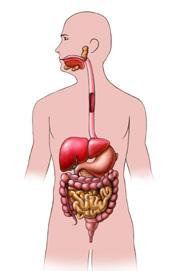
Explain that now the class will reread about each part to recount what happens from the beginning to end of the digestive process.
Distribute Handout 5A and Handout 5B. Have students cut apart the six Response Cards.
5A: Digestive System
Cut out the G2 M4 Handout 5B WIT & WISDOM Page of
cards
81 © 2023 Great Minds PBC G2 M4 Lesson 5 WIT & WISDOM®
TEACHER NOTE
You may wish to prepare in advance the outline of the body and the Digestive System Response Cards.
Read aloud the main text in each of the following four sections of chapter 2:
“Chew on This!”
“Don’t Drink This Juice”
“It’s Small, but It’s Long”
“The End of the Line”
Pause after each section to ask the following or similar TDQs to ensure students’ comprehension of what is happening during each part of digestion and how each part connects with the next part of the process.
TEACHER NOTE
In this lesson, all students are expected to recount the process from start to finish, even though they are already digging even deeper into one part of the process for their Focusing Question Task. This is an opportunity for students to “take the lead” as resident experts and answer those questions they have researched during the previous lesson.
5 What parts of the digestive tract are discussed in the section “Chew on This!”? Show the correct Response Cards and place them correctly on the handout.
n Mouth and esophagus Response Cards
6 What happens when food enters the mouth and esophagus, and how has it changed when it leaves?
Have volunteers respond.
n My body starts to break down food in my mouth.
n My teeth chew the food into small pieces.
n Saliva helps make the food I swallow go down the esophagus.
To support students’ retention of the process, associate a nonverbal motion with each organ that will support student recall later in the lesson and module. Demonstrate the gestures as the role of each organ is discussed and encourage students to use the gestures during their recounting.
7 What part of the digestive tract is discussed in the section “Don’t Drink This Juice”? Show the correct Response Card and place it correctly on the handout.
n Stomach Response Card
8 What happens when food enters the stomach, and how has it changed when it leaves?
Have volunteers respond.
n Food is squeezed and mashed into even smaller pieces.
n Gastric juice dissolves the food.
n The food is now all mixed together and called chyme.
9 What part of the digestive tract is discussed in the section “It’s Small, but It’s Long”? Show the correct Response Card and place it correctly on the handout.
n Small intestine Response Card
10 What happens when food enters the small intestine, and how has it changed when it leaves?
Have volunteers respond.
n Food is broken down even more.
n Other organs help digestion, like the pancreas and liver.
n Food nutrients enter my blood.
11 What parts of the digestive tract are discussed in the section “The End of the Line”? Show the correct Response Cards and place them correctly on the handout.
n Large intestine and rectum Response Cards
12 What happens when food enters the large intestine, and how has it changed when it leaves?
Have volunteers respond.
n The large intestine is for parts of food my body can’t use, called waste.
n The large intestine absorbs minerals and water that my body can use.
n Waste is pushed out when I go to the bathroom. Digestion is over!
Students mix up their Response Cards, putting them back out of order. Then, in pairs, they place the cards correctly on the handout and use them to recount what happens during each part of the digestive process.
Circulate and support students by rereading the text as needed. Remind students to use their nonverbal gestures as they recount the text. Encourage students to use time-order words to show that the process has a beginning and an ending. As students are working, add Response Cards to the class diagram of the human body.
First, I chew my food in my mouth. Then, I swallow the pieces and they go into my esophagus. Next, my stomach mashes up the pieces and mixes them with juices. That takes a long time. Then, the mushy food goes into the long small intestine, and the parts my body needs are absorbed into my blood. Finally, the waste goes into my large intestine and leaves when I use the bathroom.
Congratulate students on remembering so many details and using vocabulary words successfully as they recounted such a complex and amazing process.
Students will need Response Cards in future lessons; consider paperclipping them to Handout 5A.
25 MIN.
Post the Craft Question: How do I collect shared research to answer Focusing Question Task 1?
Remind students that in the previous lesson, they conducted research about one part of the digestive system: either the stomach or the small intestine. Explain to students that now that they have all of this evidence, they need to discuss and choose two pieces of evidence for their writing.
Direct students back into their small groups from Lesson 4. Distribute the pile of sticky notes that each group produced in Lesson 4. Give students two to three minutes to read these sticky notes aloud again, and recall the evidence that they collected together in Lesson 4.
Explain to students that they are now going to discuss their evidence and choose two sticky notes to record on Handout 4A. Encourage students to discuss all of their sticky notes before they choose. Emphasize that students should choose points that they all understand and that they think clearly describe a job that their organ does as part of the digestive system.
Give students a few minutes to choose the two sticky notes that are most important. Circulate to support students in evaluating their evidence.
Evidence Organizer
Use G2 M4 Lesson 5 WIT & WISDOM® 84
Name: Handout 4A: Evidence Organizer G2 M4 Handout 4A WIT & WISDOM Page of © 2023 Great Minds PBC
Choose One (circle): stomach small Intestine Research Question: What important jobs does this organ do as part of the digestive system?
Choose One (circle):
Stomach Small Intestine Research Question: What important jobs does this organ do as part of the digestive system?
1 Muscles squeeze and mash food.
2 Gastric juices break down proteins.
Choose One (circle): Stomach Small Intestine Research Question: What important jobs does this organ do as part of the digestive system?
1 Breaks down food.
2 Bumps help absorb nutrients.
Leave three to five minutes for students to orally rehearse their notes from Handout 4A as preparation for their Focusing Question Task drafting in the next lesson. Remind students that in addition to the evidence on their chart, they need to introduce the topic, include a topic statement, as well as include a closing statement. Reinforce the importance of practicing talking through the evidence before they begin writing like they did as a whole class with the mouth/esophagus.
Students orally rehearse their evidence organizer in preparation for Focusing Question Task 1.
Students may need extra support with the topic words in this informative paragraph. If time allows, have students underline any topic words that appear in their notes on Handout 4A. Ask students to choose two to three topic words to look up in the glossary in the back of The Digestive System. Have students chorally read the definition and add an extra notes to Handout 4A (words, pictures) that will help them use the word in their writing. In the oral rehearsal of their evidence, encourage students to stop and review the meaning of topic words as needed, so that they feel comfortable with writing them in the Focusing Question Task.
Congratulate students for conducting shared research about a part of the digestive system. Ask: “What is one advantage, or positive part, of working with others to conduct research?” Call on volunteers.
n We had more ideas about evidence.
n We worked together to decide what was important.
n We helped each other practice our paragraphs before writing them.
Explain to students that in the next lesson, they will use all of this research they did in small groups to help them write the answer to Focusing Question Task 1. Ask students to thank their small groups for their help and collaboration.
Land3 MIN.
Have students Think–Pair–Share, and ask: “How did speaking to recount help you understand what’s happening in chapter 2?
n I was able to remember all the parts by talking about the Response Cards.
n Saying everything in order will help me remember it better.
n Listening to my partner helped me learn better.
Assign Day 4 of Fluency Homework. Analyze Context and Alignment
In this lesson, students tackle the challenging task of verbally recounting the digestive process with the support of a visual aid. (RI.2.3, SL.2.2)
Correctly places Response Cards for six main digestive organs on a diagram of the digestive system.
Participates in answering TDQs related to what’s happening in major organs during the digestive process.
Recounts the digestive process to a partner with the aid of Response Cards and the digestive system diagram.
If students struggle with the recounting, reread passages of the text to confirm placement of the Response Cards. Then prompt students with time-order words that can help connect each part of the process such as first, next, then, and finally. Consider creating sentence frames for each part of the process and word banks with time-order words. Support students as they place Response Cards in the frames, place the frames in the correct order, and verbalize the connection between the steps of the digestive process.
In the Welcome of Lesson 6, students will again recount the digestive process to a partner. This provides another opportunity to evaluate student need for additional practice with vocabulary and comprehension of the digestive process or with verbally recounting using words to connect the steps of a process.
Time: 15 min.
Texts: The Digestive System, Taylor-Butler; The Digestive System, Jennifer Prior Vocabulary Learning Goal: Identify real-life connections between the word absorb and its use. (L.2.5.a)
In advance of today’s Deep Dive, create a larger chart version of Handout 5C to record student responses during the lesson.
Remind students of the definition of absorb discussed in the core lesson: “to take in through very small openings.”
Model or show students a video of the American Sign Language sign (http://witeng.link/0381) for absorb. Have several volunteers come up and model the sign for the class.
Tell students that they can sign the word when they hear or use it in Module 4 and that this sign will be a useful reminder of the word’s meaning.
Turn to page 4 in The Digestive System by Jennifer Prior and reread. Instruct students to listen closely for what the body absorbs. Call on a volunteer to share out.
n The body absorbs vitamins and other nutrients from food.
n The nutrients are absorbed into the bloodstream.
Explain to students that nutrients are “parts of food your body uses to do its work.” Vitamins and minerals are “kinds of nutrients that our body needs to stay healthy.” The body absorbs these nutrients through the bloodstream, which is the “blood flowing through your body.”
Students will encounter the terms vitamins, minerals, nutrients, and bloodstream again while reading Good Enough to Eat. You may want to post the definitions of these terms and add examples.
vitamins Kinds of nutrients in food that the body needs to stay healthy.
Vitamin D- helps bones Vitamin A- helps vision
minerals A kind of nutrient in food that the body needs to stay healthy. zinc, potassium, iron
nutrients Parts of food the body uses to do its work. carbohydrates, protein, fat, minerals, vitamins, water
bloodstream The blood flowing through the body.
Instruct students to Think–Pair–Share, and ask: “Does the body absorb every part of the food or drink a person eats? If not, what happens to the rest of the food?”
n The body absorbs the things it can use, but it can’t use everything.
n The body absorbs food’s nutrients in the intestines.
n The parts of food your body can’t use are released when you go to the bathroom.
If necessary, reread page 22 of The Digestive System (Taylor-Butler) to students to support them in answering this question. You might also direct students back to Handout 1A and their notes on the digestive system.
Distribute Handout 5C and direct students to boxes 5 and 6.
Ask: “What other words or phrases could replace absorb in the examples we listed?” Record student responses on the class chart and have students record their responses on Handout 5C.
n take in, soak up, suck, mop up, soak in
Ask: “What words or phrases would mean the opposite of absorb?” Record student responses on the class chart and direct students to write their responses on Handout 5C.
n release, push out, escape, leave, let go of
Explain to students that with a partner, they will jot or sketch as many real-life examples of objects that absorb, or take in, liquids. If necessary, give students the example of a towel absorbing water.
Pairs jot or sketch as many real-life examples of objects that absorb liquids in box 3 of Handout 5C.
Students with examples stand and explain their example in a complete sentence. Record these examples on the class chart.
n A mop absorbs spills.
n Soil absorbs water.
n A sponge absorbs water.
n A T-shirt absorbs sweat.
n Plant roots absorb water.
Instruct students to Think–Pair–Share, and ask: “What objects do not absorb liquid? What actions show the opposite of the meaning of absorb?” Record responses on the class chart and have students copy them onto their handouts.
n The hard floor can’t absorb liquid.
n The glass on the window doesn’t absorb rain.
n The faucet does not absorb liquid.
Display the following words: absorb, nutrients, bloodstream.
Instruct students to Stop and Jot a sentence with their partner using these three words in box 2 on their handout.
n The body absorbs nutrients from food into the bloodstream.
n Nutrients from food are absorbed into the bloodstream and help our body.
You might consider having students write another sentence with absorb or release, as well as other words such as vitamins, minerals, digest, release, waste, large intestine, and small intestine
1. Definition: To take in through very small openings
3. Examples: mop absorbs water soil absorbs water and nutrients small intestine absorbs nutrients villi absorb nutrients
absorb
2. Sentence(s): The body absorbs nutrients from food into the bloodstream.
4. Nonexamples: water on glass squeezing water out of a sponge vomiting food leaving intestines as waste belching •leasing gas
5. Synonyms: take in soak up suck mop up soak in
6. Antonyms release push out escape leave let go of
Welcome (5 min.)
Order Response Cards
Launch (3 min.)
Learn (60 min.)
Notice Similarities and Differences in Images (10 min.)
Reveal Information in Images (20 min.)
Execute Focusing Question Task 1 (30 min.)
Land (5 min.)
Answer the Content Framing Question Wrap (1 min.)
Assign Homework
Style and Conventions
Deep Dive: Experiment with Apostrophes in Contractions (15 min.)
The full text of ELA Standards can be found in the Module Overview.
RI.2.1, RI.2.7, RF.2.4
W.2.2, W.2.7, W.2.8, W.10*
Speaking and Listening
SL.2.1, SL.2.2
Language L.2.2.c
MATERIALS
Assessment 6A: Focusing Question Task 1
Handout 2A: Fluency Homework
Handout 4A: Evidence Organizer
Handout 5B: Digestive System Response Cards
Informative Writing Anchor Chart
Student Activity Game Cards (see Appendix C for this resource)
Blank chart paper for Apostrophe Anchor Chart (retain for future lessons)
Explain how images contribute to the text. (RI.2.7)
Respond in Response Journal to explain illustrator choices for images.
Use shared research about the digestive system to write an informative paragraph. (RI.2.1, W.2.2, W.2.7, W.2.8, L.2.2.c)
Write an informative paragraph using shared research for FQT 1.
Use apostrophes to form contractions. (L.2.2.c)
Stop and Jot the three contractions, placing the apostrophe in the correct location.
* This lesson prepares students for W.10, which first appears in the Grade 3 CCSS.
FOCUSING QUESTION: Lessons 1–8
How can food nourish my body?
CONTENT FRAMING QUESTION: Lesson 6
Reveal: What does a deeper exploration of images reveal in The Digestive System?
CRAFT QUESTION: Lesson 6
Execute: How do I write an informative paragraph for Focusing Question Task 1?
Students study the images in the text The Digestive System and identify the similarities and differences in the way the information is presented through the images. By writing in their Response Journal, they explain their understanding of how images support their understanding of the text. Finally, students use shared research about their chosen topic to begin writing an informative paragraph about the process of digestion in the stomach or the small intestine for Focusing Question Task 1.
5 MIN.
Ask: “How did the digestive system Response Cards help us yesterday? What are the important organs of the digestive system?” Have volunteers respond.
Remind students that there are many organs in our body that keep us alive and that the organs we are learning about as part of the digestive system perform the important role of breaking down food to nourish our body and help us grow.
With partners, students sort and order the Response Cards, reciting their learned knowledge about the digestive system and its job of breaking down the food we eat.
As volunteers share how they ordered the Response Cards and why, number the class digestive system graphic from the previous lesson.
3 MIN.
Read aloud the Focusing Question and Content Framing Question.
Explain that in a previous lesson they learned how paying attention to text features, such as the table of contents, before reading helps prepare their thinking for what the text will teach and in what order.
Reread the Content Framing Question and clue students in to the idea that images, including the text features, can reveal a deeper understanding of the information in the text.
50 MIN.
10 MIN.
Distribute partner copies of The Digestive System. List the following page numbers on the board: pages 12, 15, 16–17, 19, 20 and 24–25. Instruct pairs to quickly review these images and briefly discuss how they are alike and different. Use a variety of questioning techniques to encourage engagement.
1 How are the images on these different pages alike?
n They are labeled with green arrows and red labels so we know what the parts inside our body are called.
n The picture on page 12 looks like the picture on pages 24–25 except one is like a skeleton and the other is like a real boy.
n They all show parts of the digestive system.
2 If all the pictures are similar and are from the digestive system, why did the author include so many pictures of the same thing?
n They all show parts of the digestive system.
n Some show the whole system and some show just a part of the digestive system.
n The author wants the pictures to help us understand the different steps of the process by showing us the different parts separately.
Thank students for looking carefully at the images in chapter 2 and thinking about why there are so many. Affirm that the first and last are the whole system and the images in between are smaller parts of the system that they can study closely.
Tell students that when the author decided what images to include in the text, like the labeled diagrams, she made choices that would support learning new, challenging information.
If there is time, ask students to consider the font that the author uses with the text features and share what they notice. If students have had opportunities to do word processing they will notice right away that the font is different for different text features, like labels, captions, heading, and interesting facts. If students have not done word processing, point this out to them. Ask students why the author used all the different font colors and styles, and confirm that it is to make reading the text fun and interesting.
Instruct students to look closely at the images on pages 16–17 and on pages 24–25.
Remind them that they already determined that one is an image of the whole digestive system and the other is just a small part of the system.
Ask students to work in pairs and identify what information the author included on the images to add to understanding the text. Volunteers share.
Confirm that the image on pages 16–17 has arrows and is numbered and the image on pages 24–25 has times of the day. Facilitate the following questions, both calling on volunteers and using Equity Sticks.
3 What does the author want the different times of day on pages 24–25 to teach?
n It is showing us that digestion takes a long time.
n So that we can understand how long food stays in the esophagus, the stomach, and the intestines.
n We can see that the food only takes 1 minute to go down the esophagus into the stomach but it takes 12 hours for the process to move the chyme from the colon to the rectum.
4 Why do you think the image on pages 16–17 has arrows and not time?
n The process has to happen in that order.
n The arrows show what happens first, next, after that and finally.
n The order is shown with arrows, but it’s only a small part of digestion so it doesn’t need time.
Ask students to think about how the different images are labeled and how they help them understand the information presented.
Ask: “How do the different images help you understand the information?”
Students Think–Pair–Share to discuss how the illustrator uses different styles for different images in the text, and how that contributes to their understanding of the text.
Students record responses in their Response Journal.
Confirm for students that these differences in the images were intentional choices on the part of the author/illustrator to help convey important information.
Post the Craft Question: How do I write an informative paragraph for Focusing Question Task 1?
Ask: “What is special about how we conducted research to write these informative paragraphs?” Help students remember that they used shared research to gather information for their informative paragraphs.
Explain to students that in this lesson they will use the shared research to start writing informative paragraphs for Focusing Question Task 1.
Distribute Assessment 6A and have students do a Choral Read of Focusing Question Task 1. Emphasize that they only need to focus on the stomach OR the small intestine.
Choose either the stomach or the small intestine. What important jobs does this organ do as part of the digestive system? Conduct shared research in a small group. Then, individually, write an informative paragraph that includes at least two pieces of evidence from the text.
Remind students to refer to the Informative Writing Anchor Chart to guide them as they write, and review the task requirements with students: introduction topic statement two pieces of evidence from The Digestive System
Name: Assessment 6A: Focusing Question Task 1
conclusion
correct contractions (if used)
Ask students to refer to the completed Handout 4A.
Since the text is complex and some of the words on the evidence organizer are complex, circulate the room to make sure students remember the research they gathered. Echo read their notes with students to help them recall the information. If a student is still struggling, partner them with another student who would benefit from an additional oral rehearsal.
Direct students to refer to their notes and the Informative Writing Anchor Chart to help guide them as they write their informative paragraphs. Allow time for students in groups to orally rehearse what they want to include in their paragraphs. Circulate the room to listen to oral rehearsals to make sure students are ready to write.
While students orally rehearsed their evidence in Lesson 5, repetition of this oral rehearsal will provide support for students as they begin to write in this lesson. Oral rehearsal not only supports students in reviewing their evidence and the writing structure, but it also jumpstarts the drafting process.
Students begin Assessment 6A.
Circulate the room to support students as they use their notes on Handout 4A to write their informative paragraphs.
Emphasize students’ hard work as they start to draft their informative paragraphs. Let them know that they will complete their writing in the next lesson.
5 MIN.
Ask: “How did looking more closely at the images help us to understand the text better?” Use Equity Sticks to call on students to respond.
n The images showed us where the different organs are in our body.
n Looking at the images helped break the information down into parts, like the different parts of the digestive system.
n There was specific important information in the images that helped me know what the author/ illustrator wanted me to remember.
Assign additional fluency practice, as needed.
In this lesson, students complete Focusing Question Task 1, an informative paragraph describing one organ in the digestive system. (RI.2.1, W.2.2, W.2.7, W.2.8, L.2.2.c)
Each student
Includes a topic statement. Uses two pieces of evidence. Includes an introduction and concluding sentence. Review any contractions used for correctness.
Analyze students’ final pieces, identifying patterns of misunderstanding or areas of need. Use this data to inform small group instruction, bringing in previous informative/explanatory materials and samples.
Time: 15 min.
Text: The Digestive System, Christine Taylor-Butler
Style and Conventions Learning Goal: Use apostrophes to form contractions. (L.2.2.c)
STYLE AND CONVENTIONS CRAFT QUESTION: Lesson 6
Experiment: How do apostrophes in contractions work?
In Deep Dive 4, students identified contractions and determined what words they represented. In today’s Deep Dive, students use apostrophes to form their own contractions by playing a contraction-matching game. In preparation for today’s Deep Dive, find the Student Activity Game Cards and answer key in Appendix C and cut out the game cards. Consider laminating and keeping this game for students to practice at other moments in the school day.
Instruct students to Think–Pair–Share, and ask: “What is a contraction? Why do writers use contractions?”
n A contraction is two words squeezed together with an apostrophe where the missing letters are.
n Contractions are a shorter way of saying the same thing.
n Contractions sound like the way we talk.
Post the following sentence, adapted from page 7 of The Digestive System (Taylor-Butler): “Do not eat or drink too fast, or you will swallow too much air.”
Instruct students to Stop and Jot the contractions for the underlined words. Have two student volunteers explain the placement of the apostrophe in each contraction.
n I shortened do not to the contraction don’t. I placed an apostrophe where I took away the letter “o.”
n I shortened you will to the contraction you’ll. I placed an apostrophe where I took away the letters “w” and “i.”
Some students may benefit from being taught more explicit rules for forming contractions, such as the following:
When the second word is not, the apostrophe will take the place of the letter “o”.
When the second word is have, the apostrophe will take the place of the letters “ha.”
When the second word is are, the apostrophe will take the place of the letter “a.”
When the second word is is, the apostrophe will take the place of the letter “i.”
When the second word is will, the apostrophe will take the place of the letters “wi.”
You might choose to present contractions to students in groups according to the second word (i.e., present the contractions shouldn’t, wouldn’t, couldn’t, don’t, and haven’t together based on the second word not). Note that the contraction won’t does not follow typical contraction rules.
Shuffle and distribute game cards (in Appendix C) to students until there are none left. Some students may get multiple cards. Instruct students to read the top of their card, “I have ,” to themselves.
Tell students to think about the words that the contraction on the top of their card represent. Have students Stop and Jot their answer on scratch paper. For example, if a student’s card says haven’t, he or she would Stop and Jot the words have not.
Circulate to ensure students know and are able to write the meaning of their contraction. Tell students they are going to play a contraction-matching game and that they should listen closely for the words they jotted while playing the game.
Follow the directions below to lead students through the game:
1. Select one student to begin by reading his or her card aloud. For example, “I have don’t, who has have not?”
2. Instruct students to look at the contraction at the top of their card and stand if their contraction represents the phrase announced. For example, if a student says, “Who has have not?” then the student with haven’t stands.
3. The standing student now reads his or her card aloud. For example, “I have haven’t, who has did not?’” The student with didn’t stands.
4. Students continue, listening closely for the words that represent the contraction on the top of their card.
5. When the game returns to the first answer, the game is complete.
An alternative to the game is a simple matching game. Write the contractions from the game above on notecards and have students match them with the words they represent.
Students Stop and Jot the contraction formed using the following phrases, placing the apostrophe in the correct location: you are, does not, he will.
Conduct a Whip Around, having students call out two words that form a contraction (e.g., you will) and then calling out their contraction (e.g., you’ll). Add movement to this activity by having students put one hand out for each word and then clapping their hands together and saying the contraction (e.g., “you… will… you’ll!”).
In addition to calling out two words that form a contraction and the contraction itself, have students spell out the contraction orally. Instruct students to snap or clap after they hear the letter that the apostrophe should be placed after (e.g., “y…o…u…[SNAP]...l…l).
Add examples and explanations of how students used apostrophes in contractions to an Apostrophe Anchor Chart.
Apostrophes can be used to form contractions.
p Contractions squeeze two words into one word.
p To make a contraction, place an apostrophe where you delete letters.
Example: you will you’ll
System,
System
Welcome (5 min.)
Read Fluently and Reflect Launch (4 min.)
Learn (60 min.)
Identify Examples of Author’s Purpose (10 min.)
Explore Author’s Purpose (10 min.)
Determine the Author’s Purpose (10 min.)
Execute Focusing Question Task 1 (30 min.)
Land (5 min.)
Answer the Content Framing Question Wrap (1 min.)
Assign Homework
Vocabulary Deep Dive: Content
Vocabulary: Belch, bacteria, saliva (15 min.)
The full text of ELA Standards can be found in the Module Overview.
RI.2.5, RI.2.6, RI.2.1, RF.2.4
Writing
W.2.2, W.2.7, W.2.8, W.10*
Speaking and Listening SL.2.1, SL.2.2
Language L.2.4.a
MATERIALS
Assessment 6A: Focusing Question Task 1
Handout 2A: Fluency Homework
Handout 4A: Focusing Questions Task 1 Evidence Organizer
Handout 7A: Informative Writing Checklist
Fluency Anchor Chart
Informative Writing Anchor Chart
Blank chart paper for Author’s Purpose Chart (see lesson for details; retain for future lessons)
Determine the author’s purpose of The Digestive System by Christine TaylorButler. (RI.2.6, W.10*)
Jot the author’s purpose in their Response Journal.
Use shared research about the digestive system to write an informative paragraph. (RI.2.1, W.2.2, W.2.7, W.2.8, L.2.2.c)
Use shared research to complete Focusing Question Task 1.
Use sentence-level context or the glossary to determine the meaning of the words belch, bacteria, and saliva. (L.2.4.a, L.2.4.e)
Identify and record the definitions for belch (page 8) and bacteria (page 10) in their Vocabulary Journal.
* This lesson prepares students for W.10, which first appears in the Grade 3 CCSS.
FOCUSING QUESTION: Lessons 1–8
How can food nourish my body?
CONTENT FRAMING QUESTION: Lesson 7
Distill: What is the essential meaning of The Digestive System?
CRAFT QUESTION: Lesson 7
Execute: How do I write an informative paragraph for Focusing Question Task 1?
In this lesson, students first reflect on how their fluency-practice passage supports their understanding of the digestive system. Next, students learn there are many purposes for writing as they contribute to a class Author’s Purpose Chart. They then practice determining an author’s purpose using both digestive system texts. Finally, students complete their informative paragraphs for Focusing Question Task 1. Students refer to the Informative Writing Checklist to guide them in meeting the requirements for the task.
5 MIN.
Pair students who have been working on the same homework fluency passages. Refer to the Fluency Anchor Chart and remind students to demonstrate the qualities of fluent reading.
Then, instruct students to Think–Pair–Share to practice their passages, and ask: “How does your fluency work help you understand the digestive system?”
Ask for volunteers to read aloud their passage and share their thinking, making sure to include representatives for both fluency passages.
n My passage says that food is processed by the digestive system. I now understand what that means.
n I also learned the word absorbed better because it was in the homework passage.
n My homework passage reminds me that it is important to eat well, drink water, and exercise to help digestion and have energy. I will try to do all three!
Pair students with different fluency passages. Instruct them to discuss how both passages impact their understanding of the text before sharing with the whole class.
4 MIN.
Read aloud the Focusing Question and Content Framing Question.
Ask: “What is the essential meaning of a text, and why is it important?” Use Equity Sticks to select students to share their understanding of essential meaning. Confirm that the essential meaning is what readers take away from a text. Explain that authors write for many different reasons and to communicate various ideas. Explain that students will talk more about author’s purpose in today’s lesson.
Ask students to think about different types of shows that are on TV. Have volunteers share as you quickly jot a list of the types of shows that could be on TV.
If students do not watch television, this instruction could be adjusted to what kinds of websites are on the Internet, what you can listen to on the radio, or what kinds of books can be found in the library.
sports
cartoons
news
soaps
talk shows
History Channel/ Discovery Channel
movies
cooking shows
DIY shows
Ask: “Why are there so many different shows?” Have volunteers respond.
n There are a lot of different shows because some people like to watch one thing and other people like to watch something else.
n Some of the shows teach us about things, like the History Channel.
n The news tells us what is happening in our city, country, or even the world.
n The cartoons make me laugh out loud.
n You can learn how to do something by watching shows, too, like a cooking show or a decorating show.
n I like watching shows that are in places I can’t go so I feel like I am there.
Explain that similarly, there are many kinds of books, and these books are written for a reason, or purpose. All of the reasons stated for having different shows on television are true for all the different kinds of books.
Create a class chart entitled “Author’s Purpose.” Work with students to jot down reasons authors may write books. For example:
Authors write books to . . . entertain or make readers laugh teach new things explain how to do something describe an experience explain why/how something happens share a point of view summarize or recount an event
Explain that some authors write books that have the same purpose throughout, such as folk tales that entertain and make us laugh. Other authors write their books in parts, or sections, that can each have a slightly different purpose. Tell students that they will listen to different sections of The Digestive System by Jennifer Prior to determine the author’s purpose in each section.
Reinforce that there are a wide variety of author’s purposes by allowing students to sort familiar classroom texts.
Read aloud pages 4–5 using different voices to emphasize the humor in the dialogue. Ask: “Why did the author write this dialogue?” Have volunteers respond.
n It sounds like my mom talking to me!
n The girl talking to her mom was funny. The author wanted to make us laugh.
n The author’s purpose was to teach us about how vegetables keep us healthy in a funny way.
Confirm that while the author is writing about healthy eating, she chose to write this section in a way that entertains readers.
Read aloud the pages below and ask the following TDQs about author’s purpose. Use a variety of questioning strategies, including calling on volunteers, Think–Pair–Share, and Equity Sticks, to encourage engagement. Prompt students to refer to the Author’s Purpose Chart.
Read aloud pages 22–25.
1 What is the purpose of this part of the text The Digestive System, and how do you know?
n These pages are talking about being sick. The author explains different kinds of problems with the digestive system.
n The heading says, ‘When things go wrong’, so the purpose is to tell us what might go wrong with our digestive system.
Read aloud pages 28–29.
2 What is the author’s purpose in this part of the text?
n She is teaching us new things.
n She explaining some reasons our stomachs may hurt.
Affirm that these pages summarize the book and provide a conclusion.
10 MIN.
Distribute The Digestive System by Christine Taylor-Butler and ask pairs to open to pages 4–5 and read the table of contents.
Instruct students to Think–Pair–Share about what this text is about from beginning to end and why it was written, based on the title and table of contents as well as their learning from previous lessons.
Circulate as students discuss the text. Support them as needed by referring to the table of contents or chapters if they pause or are hesitant in their conversation.
3 What is this book about? Use Equity Sticks to choose a pair to respond.
Direct students’ attention to the Author’s Purpose Chart. Ask a volunteer to reread listed purposes.
4 Which of these is the author’s purpose for writing the whole book, and how do you know?
Students Think–Pair–Share to determine the author’s purpose for the text The Digestive System, and write it in their Response Journal. Circulate to ensure students are supporting their choices with reasons from the text.
n The title is The Digestive System, and in the book the author wrote about what happens to food we eat. I think the author’s purpose is to explain the process of digestion.
n Even though the first chapter was about gas, and that is funny, I think the author’s purpose for the whole book is to teach about digestion using words and lots of diagrams. I learned a lot!
n The author taught me that digestion is the process of breaking down food by lots of organs so our bodies get what we need from the food.
Individuals
Post the Craft Question: How do I write an informative paragraph for Focusing Question Task 1?
Explain to students that in this lesson they will continue to use their shared research to complete their informative paragraphs for Focusing Question Task 1.
Ask students to take out Assessment 6A and Handout 4A.
Name: Assessment 6A: Focusing Question Task 1
Task: Choose either the stomach or the small intestine. What important jobs does this organ do as part of the digestive system? Conduct shared research in a small group. Then, individually, write an informative paragraph that includes at least two pieces of evidence from the text.
Support your response using evidence from the following source: • The Digestive System, Christine Taylor-Butler Checklist for Success: Be sure to include all of the following in your response: introduction topic statement two pieces of evidence from The Digestive System conclusion correct contractions (if used)


Name: Handout 4A: Evidence Organizer Directions: Use this Evidence Organizer to plan for Focusing Question Task 1.
Choose One (circle): stomach small Intestine Research Question: What important jobs does this organ do as part of the digestive system? 1 2 Conclusion: Why is this part of the system important?
1 2 Page of
Page of
Read aloud the task again as students follow along on their sheets. Encourage students to reread the informative paragraphs that they started in Lesson 6. Ask students to think about their work to make sure they are answering the research question. Provide time for students to complete the Focusing Question Task.
Students complete Assessment 6A.
Distribute Handout 7A. As students finish, direct them to refer to the checklist to make sure that the question is answered and the requirements of the ITEEC are included in the informative paragraph.
Circulate to support students as they finish writing Focusing Question Task 1. Explain that students will use the checklist again in the next lesson to help them make improvements to their writing.
Name: Handout 7A:
Checklist
5 MIN.
With students, Choral Read the Content Framing Question.
Ask: “What did we do today to help us understand the essential meaning of the text?” Have volunteers respond.
Reinforce that the author’s purpose is to inform students about the digestive system, including the essential meaning that digestion is the process by which food is broken down into needed nutrients and unused waste.
1 MIN.
Assign additional fluency practice, as needed.
Students write an informative paragraph about the digestive system, checking it with the Informative Writing Checklist (RI.2.1, W.2.2, W.2.7, W.2.8). Each student
Writes an informative paragraph that contains an introduction, topic statement, evidence, and a concluding statement.
Clearly state the work that the stomach or the small intestine does as part of the digestive process.
If students find the task challenging, guide a small group focused on the digestion that takes place in the stomach. Use the illustrations on page 16 and 17 to further explain the digestive process. Then reread the text and help students plan for their task.
Time: 15 min.
Text: The Digestive System, Christine Taylor-Butler
Vocabulary Learning Goal: Use sentence-level context or the glossary to determine the meaning of the words belch, bacteria, and saliva. (L.2.4.a, L.2.4.e)
Distribute The Digestive System (Taylor-Butler) to student pairs.
Post the following two sentences from page 14:
“Your body begins to break down, or digest, food as soon as it enters your mouth.”
“Muscles around the esophagus squeeze, or contract, in waves.”
Instruct students to Think–Pair–Share, and ask: “What do you notice about how the author tells the reader the definition of contract and digest in these sentences?”
n Contract means “to squeeze.”
n Digest means “to break down.”
n The author uses the word or and gives us an easier way to understand the word.
n The author writes “squeeze, or contract” and “break down, or digest” to give us the definitions.
Remind students that in Deep Dive 2, they learned the meaning of the word starches.
Ask: “How did you learn the meaning of the word starches on page 14? How is this different than the way the author gave us the definition of contract and digest?”
n The author made starches in boldface and put the word in the glossary.
n The word starches is in the glossary, but the words contract and digest are defined in the sentences and not in the glossary.
Explain that authors give definitions of words in many ways. Some authors may include a glossary that has the definitions of important words. Other times, authors give us the definition of words in the text. In some cases, authors might not give us the definition at all and we may have to use other types of clues to determine a word’s meaning.
Then, read aloud the top of page 14, stopping after the word enzymes. Tell students to stay seated if the word saliva is defined in the glossary and to stand if saliva is defined in the text.
Ask: “What is the definition of saliva? How did the author give us the definition of saliva?”
n Saliva is not in the glossary. It is not in boldface.
n The author put the definition right in the text.
n Saliva is the liquid in your mouth.
Pairs identify and record the definitions for belch (page 8) and bacteria (page 10) in their Vocabulary Journal.
n belch – a burp
n bacteria – tiny, one-celled living things that can cause disease
Ask: “If the word belch were in the glossary, where would it be located, and what would the entry say?” Instruct students to Stop and Jot the answer using this Sentence Frame: The word belch would appear after the word and before the word . The glossary entry would say “belch –.”
n The word belch would appear after the word bacteria and before the word constipated
n The glossary entry would say “belch – another word for a burp.”
Provide possible guide words for students to use in the above blanks.
The Digestive System, Jennifer Prior
The Digestive System, Christine Taylor-Butler
“Food and Family,” Nadine Burke (http://witeng.link/0382)
Welcome (5 min.)
Reflect on the Essential Question Launch (3 min.)
Learn (63 min.)
Read Captions (10 min.) Identify Point and Reasons (25 min.)
Revise Focusing Question Task 1 (20 min.)
Record Knowledge (8 min.)
Land (3 min.)
Answer the Content Framing Question Wrap (1 min.) Assign Homework
Style and Conventions Deep Dive: Excel with Apostrophes in Contractions (15 min.)
The full text of ELA Standards can be found in the Module Overview.
RI.2.1, RI.2.2, RI.2.8, RI.2.5, RF.2.4
W.2.2, W.2.5, W.2.7, W.2.8, W.10*
Speaking and Listening SL.2.1, SL.2.2
Language L.2.2.c
MATERIALS
Assessment 6A: Focusing Question Task 1
Handout 2A: Fluency Homework
Handout 7A: Informative Writing Checklist
Blank chart paper for Author’s Point Chart (see lesson for details; retain for future lessons)
Knowledge Journal Chart
Read and understand the purpose of captions in a text. (RI.2.5)
Think–Pair–Share to explain why a caption is included in a section of text.
Identify reasons that support the author’s point in “Food and Family.” (RI.2.8)
Stop and Jot reasons and then describe their connection to the author’s point.
Use apostrophes to form contractions. (L.2.2.c)
Edit their contractions or replace two words with a contraction and identify the letter(s) that the apostrophe replaces.
* This lesson prepares students for W.10, which first appears in the Grade 3 CCSS.
FOCUSING QUESTION: Lessons 1–8
How can food nourish my body?
CONTENT FRAMING QUESTION: Lesson 8
Know: How does The Digestive System build my knowledge?
CRAFT QUESTION: Lesson 8
Excel: How do I improve my informative paragraph?
Students look at text features in both texts titled The Digestive System and practice reading and understanding captions. Then, after watching the video “Food and Family,” they gain their first practice with identifying an author’s point, as well as reasons, to a debatable topic. Students revise their informative paragraphs using the Informative Writing Checklist to ensure they have met all of the requirements for the task. Finally, students complete the Knowledge Journal Chart.
5 MIN.
Guide students in an Echo Read of the Essential Question. Ask a volunteer to remind the class of the meaning of the word nourish.
Instruct students to Mix and Mingle on what they have learned so far about how food nourishes their bodies.
3 MIN.
Read aloud the Focusing Question and Content Framing Question, and ask volunteers to share out any connected information from their Mix and Mingle. Explain that they will continue to discuss how the texts so far in this module have built their knowledge.
MIN.
Turn to pages 8–9 of The Digestive System by Jennifer Prior. Circulate so students can see the page spread, and ask: “What text features do you see on these two pages?” Call on volunteers for responses. Confirm that there is a chapter title, bold print, a photo with captions, and a diagram with labels.
Instruct students to listen as you read aloud the text on pages 8–9. Read aloud the caption on page 8.
1 Why do you think the author asks you a question in the caption for this photo? Have volunteers respond.
n It talks about eating healthfully. The man and boy are making a salad.
n The author asks us a question to make us think more about it and get us interested.
n The author asks us to answer the question because if you don’t know, you will want to learn more.
Confirm that captions give information about a photo that adds to the information learned from the text. Often the captions provide information that may not be part of the main topic but connect to the topic and add valuable knowledge.
Distribute partner copies of The Digestive System by Christine Taylor-Butler.
Explain that students will use the glossary in The Digestive System (Taylor-Butler) to think more about captions.
Instruct students to open to page 22 and explain they will read the subheading, text, and caption with a partner. Then they will answer the question.
2 How is the caption helpful to understanding the text?
n It tells us that kiwi can keep our intestines healthy.
n It gives us an example of what we should eat.
Students read page 22 with a partner and Think–Pair–Share.
Circulate to listen to pairs. If partners finish quickly, ask them to repeat their response to you. This provides an opportunity to measure their comprehension and gives students an opportunity to solidify ideas by restating their thoughts.
Explain that students will continue to work with text features in future lessons and challenge them, in the meantime, to look for text features in other books they read at home and school.
Turn to page 10 of The Digestive System by Jennifer Prior and read the paragraph about the mouth aloud, instructing students to listen for the main topic and key details in the paragraph.
Instruct students to Think–Pair–Share, and ask: “What was the main topic of that paragraph, and what key details supported that topic?”
Call on two pairs to share their thinking with the class.
n The main topic is how digestion begins with the mouth.
n The mouth is in charge of chewing the food.
n Saliva in the mouth breaks down the food so it can be swallowed.
Explain that informational texts, like The Digestive System, have main topics and key details. However, texts that are debatable, meaning someone could disagree with what the author is saying, have points and reasons.
The distinction between RI.2.2 and RI.2.8 can be tricky for students, so it is recommended to use separate texts to teach these standards. RI.2.8 should be used on texts that have a debatable nature to them in which students can identify the author’s point and then identify the reasons given to support that point. Consider the type of text you are using when deciding which standard to target.
Explain that a point is what the author is communicating that someone might be able to disagree with, and reasons are the information the author or speaker uses to prove that his or her point is true.
Post a blank piece of chart paper titled “Author’s Point” with space for bullet points in the second row.
Text: “Food and Family”
Point:
Reasons:
Ask: “When have we used a chart like this in the past?” Reinforce that students have previously used this type of setup when identifying the main topic and key details.
Explain that the process for determining the author’s point is very similar to that of looking for the main topic; however, the key difference is that people may have a different idea of the author’s main point. For example, the main topic of page 10 of The Digestive System (Prior) is that the mouth is the first step in the digestive process. It is difficult to disagree with this.
Reinforce the idea of debatable points by providing real-life examples and nonexamples and having students stand if someone would reasonably disagree with the statement (meaning it is a point) and remain seated if it’s not debatable.
Explain that students are now going to watch a video and look for the speaker’s main point. Ask: “What does she want the audience to believe?”
Access “Food and Family” (http://witeng.link/0382) and play the video once all the way through.
Instruct students to Think–Pair–Share, and ask: “What point is Dr. Burke making in this text?” Use Equity Sticks to choose a pair to share their thinking with the class. Reinforce that Dr. Burke believes it is important for families to eat together. Record this point in the first row of the Author’s Point Chart.
Explain that now that they know Dr. Burke’s point, they are ready to identify reasons she provides to support that point. Instruct students to Stop and Jot any reasons they hear in their Response Journal as they rewatch the video.
Students Stop and Jot reasons to support the author’s point and then Think–Pair–Share to discuss which reasons most strongly support the point.
Circulate as students discuss and choose a few pairs to share their thinking with the class. As they do, add their reasons to the second row of the chart.
Author’s Point
Text: “Food and Family”
Point:
Reasons:
You’re more likely to eat a nutritious meal.
You have more control over what you choose to eat.
You have a chance to spend quality time with your family.
Explain that students will continue to practice identifying an author’s point and supporting reasons over the course of this module. Challenge students to practice doing this when they hear someone making a debatable argument, such as peanut butter and jelly is the best type of sandwich.
Post the Craft Question: How do I improve my informative paragraph?
Remind students that in the previous lesson, they finished drafting their informative paragraphs. Direct students to Handout 7A, and ask: “What are some of the criteria, or requirements, for this Focusing Question Task?”
n To have an introduction to the topic n To include two pieces of evidence n To have a conclusion that strengthens the big idea of the paragraph
Reinforce the success criteria for Focusing Question Task 1. Give students five to ten minutes to reread their paragraphs and make any revisions. Guide them to look carefully at the checklist and their informative paragraph. If any of the items are marked “not yet,” have students revise.
If students need support, consider directing them back to the small groups from Lessons 3 and 4 so that they can work together to revise. Guide students in small groups to use Handout 7A to check that their partner included all requirements. If not, have students discuss how to revise and then provide time for the writing.
After revising, put students into pairs with someone who wrote about the other body part. Tell students that they are going to read aloud their paragraphs. Ask the student who wrote about the stomach to start, with the student who wrote about the small intestine to go second.
Have students Think–Pair–Share within small groups about one advantage, or positive, to conducting shared research. Then use Equity Sticks to students to share.
n You collect lots of different evidence.
n You get help rereading and finding facts.
n You get to work together to pick evidence and put it in the right order.
n You learn a lot about a topic quickly.
n You get to work with other people.
Explain that students will continue to work on revising their piece in today’s Deep Dive, this time with a focus on contractions.
Thank students on their hard work conducting shared research, writing independently, and then revising to make sure the writing contained all the requirements. Explain that this is a useful process that they will engage in throughout their years in school, and even when they get a job out in the world.
8 MIN.
Ask: “What do we do before we close a group of lessons and move onto the next text?” Have volunteers respond.
Reinforce that it is time to record entries on the Knowledge Journal Chart. Divide the class in half, and instruct one half to Think–Pair–Share on the important knowledge they have gained in this module and the other half to focus on the new skills they learned.
Use Equity Sticks to select pairs to share their new knowledge. Students give a thumbs-up if they agree with the ideas put forth. Record responses that capture new learning. Repeat this process for the skills column of the chart.
TEACHER NOTE Collect responses to be added to the Knowledge Journal Chart later to facilitate efficiency of sharing ideas.
The digestive system is made up of six organs.
Giving our bodies nutritious food is important to staying healthy.
The steps in the digestive system work together to give us energy.
I can work with others to gather shared research.
I can describe how reasons support an author’s point.
I can look closely at the images and text features to understand more about a topic.

Ask: “How does completing the Knowledge Chart help us build our knowledge when we read a text?”

Call on volunteers to respond.
Assign additional fluency practice as needed.
Students focus on the role of captions to support their ability to understand key information in The Digestive System (RI.2.5). Each student
Recalls examples of text features.
Discusses how the caption helps them understand the text.
If students struggle to communicate how captions help them understand the text, arrange them into a small group and use other sections of The Digestive System, avoiding page 31 due to its use in a future New Read. Continue to support students in identifying text features and then discussing how they support them in accessing the information from the text.
Time: 15 min.
Text: The Digestive System, Christine Taylor-Butler
Style and Conventions Learning Goal: Use apostrophes to form contractions. (L.2.2.c)
In this Deep Dive, students edit the contractions in their Focusing Question Task 1.
TEACHER NOTE
Formal writing typically avoids contractions; words are more likely to be simplified using contractions in informal writing. However, since even the most formal texts students encounter in Grade 2 use contractions widely, it is difficult to make and explore this distinction with students at this time. In later grades, students are exposed to formal and informal writing styles and the different and unique purposes of each. For example, in Grade 6 students are taught to establish and maintain a formal style in their writing (CCSS.ELALITERACY.W.6.1.d).
This Deep Dive focuses on students editing their own work for contractions to reinforce the skills they have been working on and lay the groundwork for future work with formal and informal language.
This Deep Dive focuses on students editing their own work for contractions to reinforce the skills they have been working on and lay the groundwork for future work with formal and informal language.
STYLE AND CONVENTIONS CRAFT QUESTION: Lesson 8
Excel: How do I improve my use of contractions in my informational paragraph?
Launch Scaffold
You might consider replacing the contractions in Launch to align with the contractions you notice your students struggling with the most in their writing.
Post the following adapted sentences from The Digestive System (Taylor-Butler):
Your body doesn’ot absorb fiber.
Do not drink too fast or you will swallow air.
Read aloud the first sentence and note the underlined incorrect contraction. Ask students for their help in fixing the mistake.
Instruct students to Stop and Jot the correct contraction and then Think–Pair–Share about the error you made.
n The contraction should be spelled doesn’t.
n The letter “o” should be deleted and the apostrophe should replace it.
n The letter “o” is taken away because this is the letter we don’t hear in the contraction.
Read aloud the second sentence. This time, challenge students to underline pairs of words that they notice could become contractions.
Instruct students to Stop and Jot the contractions for each pair of words and then Think–Pair–Share about how they formed the contractions.
n “Do not” becomes don’t if we delete the “o” and replace it with an apostrophe.
n “You will” becomes you’ll if we delete the “wi” and replace it with an apostrophe.
Be aware that students may overgeneralize rules about forming contractions and combine any two words using an apostrophe. Emphasize that only specific word pairs may be combined to form contractions, referring students to the Apostrophe Anchor Chart as a resource.
Remind students that in the core lesson they revised their informational paragraphs. Explain that students must check for one more item before they submit their writing: correct contractions.
Ensure that the Apostrophe Anchor Chart (developed in Deep Dive 6) is visible. Ask students to reread their informative paragraph and underline any contractions, just as you did in the Launch of this Deep Dive. Instruct students to check the contractions in their own writing and ensure that they formed contractions accurately. Students may also locate words that can be merged to form contractions and then substitute these words with a contraction.
Students edit their contractions or replace two words with a contraction and identify the letter(s) that the apostrophe replaces.
Some students may not have included contractions in their answer to Focusing Question Task 1. Bring aside students who did not find any contractions and post the following two sentences:
The stomach would not digest food without gastric acids.
The small intestine is super long, but it is’nt very wide.
Ask students to form a contraction using the underlined words in the first sentence and to correct the inaccurate contraction in the second sentence. Use student edits to assess their ability to use and identify the purpose of apostrophes in forming contractions.
wouldn’t
The stomach would not digest food without gastric acids. isn’t
The small intestine is super long, but it is’nt very wide.
Pairs show each other one or two places where they edited or inserted a contraction into their work.
Have students check each other’s work for any errors they may have missed.
Welcome (5 min.)
Explore the Text
Launch (6 min.)
Learn (59 min.)
Listen to Appreciate (10 min.)
Listen Actively (10 min.)
Make Independent Observations (10 min.)
Wonder Independently (15 min.)
Notice and Wonder about Visual Art (14 min.)
Land (4 min.) Answer the Content Framing Question
Wrap (1 min.) Assign Homework
Vocabulary Deep Dive: Suffixes
–less and –ful (15 min.)
The full text of ELA Standards can be found in the Module Overview.
RL.2.1, RI.2.2
Writing
W.10*
Speaking and Listening
SL.2.1, SL.2.2
Language
L.2.4
Make observations and generate questions about Stone Soup. (RL.2.1)
Generate and record two questions using the stems why and/or how about the text in Response Journal.
Determine the meaning of words formed when the suffixes –ful and –less are added to known root words. (L.2.4)
Define the words painful and painless and explain how they are related.
Handout 9A: Suffixes –ful and less
Speaking and Listening Anchor Chart
* This lesson prepares students for W.10, which first appears in the Grade 3 CCSS.
FOCUSING QUESTION: Lessons 9–16
How can food nourish a community?
CONTENT FRAMING QUESTION: Lesson 9
Wonder: What do I notice and wonder about Stone Soup?
CRAFT QUESTION: Lesson 9
Examine: Why is listening to appreciate important?
In this lesson, the concept of community is introduced, and students are encouraged to wonder how food can nourish a community. Students then listen to and read the folk tale Stone Soup with the goal of independently making observations and generating how and why questions. This text is used in Lesson 15 for a New-Read Assessment; therefore, no direct instruction with the text occurs in this lesson. Lastly, students notice and wonder about the visual art piece entitled The Beaneater.
5 MIN.
Display Stone Soup and read the title aloud. Ask students to individually notice and wonder about the genre. Ask: “Are you familiar with the text? Thumbs-up if you are, thumbs-down if you are not, and thumbs-middle if you are not sure.”
Distribute Stone Soup to pairs. Instruct them to flip through the pages quietly and without discussion. Tell students to independently predict and record the text genre in Response Journal.
TEACHER NOTE
In Lesson 15, students will complete a New-Read Assessment using this text. Because the aim is for students to demonstrate independence in the New-Read Assessment, limit instruction in this lesson to individual written reflection on questions and observations and do not address them in this lesson.
6 MIN.
Read aloud the Focusing Question and Content Framing Question.
Ask for a volunteer to provide the meaning of nourish. Remind students the previous Focusing Question focused on how food nourishes their bodies, and emphasize that this Focusing Question focuses on how food nourishes communities
Have students Think–Pair–Share, and ask: “What is a community? How might food nourish a community?”
Explain that a community is a group of people who share a connection such as where they live or what they enjoy. Tell students to clap the word community to identify the number of syllables in the word. Add the word community to the Word Wall. Ask students to continue to wonder how food might nourish a community as they read Stone Soup.
59 MIN.
LISTEN TO APPRECIATE 10 MIN.
Read the Craft Question: Why is listening to appreciate important?
Ask students to think about what it means to appreciate something. Tell them to indicate with a thumbs-up if they have heard the word and know what it means, thumbs-middle if they have heard it but are not sure what it means, and a thumbs-down if they don’t know what it means. Define appreciate as taking time to value something and give the example of appreciating a friend or a sibling for doing something nice.
By asking students to show with a thumbs-up, -sideways, or -down, it is easy to quickly gauge their familiarity with the word appreciate and decide whether to spend more time defining it or to move into the next part of the lesson.
Tell students that they can appreciate what they are listening to whether it is a story, music, or a speech.
Recall with students the speech of Dr. Martin Luther King, Jr. in Module 3 and explain that people appreciated the speech because of its powerful words and message of change.
Ask students to listen to a familiar song or poem. Have students tell what they appreciate about this song or poem.
TEACHER NOTE
Play a song for students that they will know and enjoy. This could be a song they have sung in school or a small part of a popular song they know. Help them describe what they appreciate about the song, such as how it makes them feel.
Tell students that the two listening experiences, the speech and the song, have different purposes and in order to appreciate the purpose, they listen differently.
Explain that to listen to appreciate, they prepare themselves according to the purpose. In school they are often listening to learn. By preparing their bodies and minds to listen, they can better appreciate what they hear.
Encourage students to keep this goal in mind and practice readying themselves to listen to appreciate during the Read Aloud today and throughout the module.
Add the new listening goal, listen to appreciate, to the Speaking and Listening Anchor Chart.
TEACHER NOTE
10 MIN.
The pages of this text are not numbered. For ease of instruction, number the pages of the book in advance of the Read Aloud. The title page is page 1, and the text begins on page 5.
Read aloud Stone Soup with minimal interruptions as students follow along in the text.
Remind students that this is a good time to practice the listening goals they have learned throughout the year.
Tell students they are now going to make independent observations about this text. Post the following or similar prompts, and ask students to choose one or two to Stop and Jot in their Response Journal:
What do you notice about the soldiers or townspeople?
What do you notice about the setting?
What do you notice about the problem and solution?
What do you notice about an illustration?
Circulate and support students as they record independent observations.
You may need to provide sentence frames for the independent observations, such as, “I noticed the villagers are ” or “I noticed the villagers are .”
To assist struggling students, be sure to keep these open-ended.
Let students know that instead of generating and discussing questions about the text with the class, they will reflect on the book independently. Tell students they are going to work independently to write two questions about the text in their Response Journal.
Remind students that a good question about the text can help them more deeply understand what is happening and why it matters. Ask: “What question words help us really think about the reasons things happen in a story?” Have volunteers respond. Confirm that often questions beginning with why and how are good thinking questions.
Students record at least two questions about Stone Soup in their Response Journal using the stems why and/or how
Let students know that their questions will be revisited in Lesson 15 when they return to Stone Soup In the meantime, encourage students to keep their questions in mind.
TEACHER NOTE
During this first exposure to the artwork for this module, do not share the title.
Remind students that in the very first lesson, they were introduced to three pieces of visual art that they would study over the course of the module. Explain to students that in this lesson, they are going to look closely at the first piece of visual art: a painting.
Display the painting. Give students time to silently study the painting, and then pose the following questions, using a variety of response strategies to encourage student engagement.
Ask: “What do we do first when we encounter a work of art?”
n We observe it silently.
n Look from corner to corner, top to bottom.
n Describe what we see and notice the details.
n Wonder and ask questions.
“What observations can you make about this piece of art?”
n A man is eating at a table by a window.
n He is wearing a hat, a white shirt and a vest. His clothes look old-fashioned.
n There are different kinds of food on the table. It’s hard to tell exactly what they are.
n The colors are mostly browns, grays and white.
“What questions do you have about this piece of art?” Have students turn to a partner and name one question they have. Then, use Equity Sticks to call on students to share with the class.
n What is he eating?
n When was this painting made?
n Is this a farmer? A peasant?
n Why aren’t there more colors in the painting?
“Does this meal look appealing, or good, to you? Why or why not?”
n It looks healthy because he is eating beans and vegetables. I like to eat healthy food!
n It looks disgusting! The food mostly looks brown and I don’t like beans.
n It looks delicious. I love beans and fresh rolls. The scallions might be strong-flavored, though.
Acknowledge all of the rich questions and observations that students made about this first painting of the module. Explain to students that in later lessons they will get the chance to dig more deeply into this piece of art.
Land4 MIN.
Ask: “How does generating questions by yourself help you think deeply about a text?” All the questions are mine and not someone else’s, so I really want to find out the answers.
I thought hard about using “why” in my questions.
Wrap1 MIN.
Ask students to talk with their families about communities and food. For example: “How does your family prepare or enjoy food together or with others?”
Students continue to develop their ability to independently generate text-based questions using the stems how and why (RL.2.1).
Each student
Listens actively and record observations in order to develop questions.
Generates two questions using the how and/or why question stems and record them in their Response Journal.
Some students may benefit from a verbal rehearsal of their questions before recording them since in this lesson they are expected to generate questions entirely independently. However, remind students not to discuss their questions within this lesson since the text will be used for later assessment. Consider modeling the creation of how and why questions using your or the students’ own observations, such as “I noticed the townspeople hid their food. I wonder, why did they hide all their food from the soldiers?”
Time: 15 min.
Text: : Stone Soup, Marcia Brown
Vocabulary Learning Goal: Determine the meaning of words formed when the suffixes –ful and –less are added to known root words.
TEACHER NOTE To save time, consider cutting out the words on Handout 9A in advance and distributing them to students in an envelope.
Post the following sentence adapted from Stone Soup: “Never had there been such a delightful feast.”
Have students clap out the syllables in delightful
Instruct students to Think–Pair–Share, and ask: “What do you notice about the word delightful?” Probe students’ thinking with additional questions such as “What or who does the word describe?” or, “What type of word is this?” or “What word parts do you see inside the word?”
n The word delightful describes the feast.
n The word delightful is an adjective because it describes a noun.
n I see the word delight when the ending is removed.
n I see the suffix –ful.
Students learned about the suffix –ful in Deep Dive 19 of Module 3. If necessary, direct students to their Vocabulary Journal to locate the meaning of the suffix –ful (full of). Tell students that delight means “great pleasure or enjoyment.”
Ask: “Using what you know about the root word delight and the suffix, what is the meaning of delightful?”
n Delightful means “full of pleasure or enjoyment.”
Other words with the suffix –ful in Module 4 texts include healthful (Taylor-Butler, page 42) mouthful (Taylor-Butler, page 25) harmful (Taylor-Butler, page 21)
Tell students that in today’s Deep Dive they will explore the meaning of another suffix that is related to –ful. Remind students that a suffix is a type of small word part that comes at the end of a word and changes the meaning of that word.
Distribute Handout 9A.
Instruct students to categorize the words into three groups, thinking about similarities and differences between the words’ meanings and parts.
Students should group words into the following categories: base [or known] words, words with the suffix –ful, and words with the suffix –less.
joyful careful fearful hopeful powerful colorful harmful thankful
Discuss as a whole class how students sorted their words.
joy care fear hope power color harm thank © 2023 Great Minds PBC
Name: Handout 9A: Suffixes –ful and –less Directions: Cut out the word cards and sort them into three categories. joy joyful careful harmful harm thank care joyless harmless fearless fearful fear hopeless power hope hopeful powerless powerful colorless thankful color colorful
Handout 9A WIT & WISDOM Page of
thankless careless
n This group has words with the suffix –less, this group has words with the suffix –ful, and this group has base words.
joyless careless fearless hopeless powerless colorless harmless thankless G2 M4 Lesson 9 WIT & WISDOM® 140
n Colorful means something is full of color, but colorless means it doesn’t have any color.
n If someone is fearful, that person is full of fear. If they are fearless, they aren’t scared.
n If someone is powerful, they have power or strength. If someone is powerless, they don’t have power or strength.
Tell students to look closely at all of the words with the suffix –less. Instruct students to Stop and Jot an idea for the meaning of –less. Choose a student volunteer to share.
n I think –less means “without.”
Provide the following definition for students to add to the Word Study section of their Vocabulary Journal.
–less (suffix) Without
Students define painful and painless and explain how the words are related.
n Painful and painless have the same root word but different suffixes. Painful means “full of pain” and painless means “without pain.” The words are opposites.
With a partner, students brainstorm and Stop and Jot other pairs of words with the suffix –less. If words they brainstorm have an opposite with the suffix –ful, students might jot this word down also.
n endless, heartless, worthless, wireless n useful, useless n thankless, thankful n thoughtless, thoughtful n helpless, helpful
Welcome (5 min.)
Connect to Prior Knowledge
Launch (5 min.)
Learn (60 min.)
Listen to Appreciate and Share Observations (20 min.)
Develop Questions Independently (20 min.)
Examine Opinions (20 min.)
Land (2 min.)
Answer the Content Framing Question Wrap (3 min.)
Assign Homework Style and Conventions Deep Dive: Examine Reflexive Pronouns (15 min.)
The full text of ELA Standards can be found in the Module Overview.
RL.2.1, RF.2.4
Writing W.2.1, W.10*
Speaking and Listening SL.2.1, SL.2.2
Language L.2.1.c
Handout 10A: Fluency Homework Handout 10B: Reflexive Pronouns Sticky notes
Blank Wonder Chart (retain for future lessons)
Speaking and Listening Anchor Chart
Ask and answer questions about Bone Button Borscht (RL.2.1)
Write two questions about Bone Button Borscht in Response Journal.
Identify and match reflexive pronouns in Bone Button Borscht with their antecedent. (L.2.1.c)
Complete Handout 10B, identifying the reflexive pronoun and representing the connection to its antecedent.
* This lesson prepares students for W.10, which first appears in the Grade 3 CCSS.
FOCUSING QUESTION: Lessons 9–16
How can food nourish a community?
CONTENT FRAMING QUESTION: Lesson 10
Wonder: What do I notice and wonder about Bone Button Borscht?
CRAFT QUESTION: Lesson 10
Experiment: How does listening to appreciate work?
Examine: Why is expressing an opinion important?
Students listen to the text Bone Button Borscht after being introduced to it through silent observations of the illustrations. Students then listen to the story and independently generate more questions, taking ownership of a routine they have practiced all year. The lesson concludes with students discussing the importance of opinions and examining how to form opinion statements.
5 MIN.
Display the cover of Bone Button Borscht
Instruct students to Think–Pair–Share, and ask: “What soup do you like to eat? What ingredients go into that soup?”
Ask a few volunteers to share.
5 MIN.
Read aloud the Focusing Question and Content Framing Question.
Ask a volunteer to state what happens during a Wonder lesson. Affirm that students will actively listen to and appreciate the new text read aloud as well as share observations and discuss questions using a Wonder Chart.
60 MIN.
20 MIN.
In preparation for this lesson, cut apart and display the illustrations from one copy of Bone Button Borscht along a wall in the classroom.
Explain that students will first silently study the illustrations and think about what they notice and wonder, jotting their questions on sticky notes as they go. As they write a sticky note, students post it on the illustration that made them think of their question, and continue the silent Gallery Walk.
Encourage silence to allow all students to think about the images they see. Limit the students to one to two sticky notes so that they spend more time observing the illustrations, rather than writing their questions.
Tell students they will return to these questions as they continue to study Bone Button Borscht.
Read the Craft Question: How does listening to appreciate work?
Display the Speaking and Listening Anchor Chart and ask students to read the new listening goal added to the chart during Lesson 9. Confirm that the new goal is listen to appreciate.
Ask: “What does it mean to appreciate something?” Have volunteers respond.
Reinforce that appreciate means “to value something”; today, it means to value what students are listening to during a Read Aloud.
Ask students to prepare to listen to appreciate by thinking about the purpose of the Read Aloud.
Ask students to take a few breaths to prepare themselves to listen actively to the Read Aloud.
Read aloud the text uninterrupted.
Instruct students to Think–Pair–Share, and ask: “What did you notice about the text Bone Button Borscht?”
n This book is just like the text we read yesterday!
n The soup is made from buttons instead of stones.
n There is a beggar in this book.
n Some of the words are new.
Circulate and listen to student conversations. Make note of text-based observations and highlight them for the class.
Explain to students that just like in Lesson 9, they will work individually to write questions about the text.
Students write two questions about the text Bone Button Borscht in their Response Journal using the stems why and/or how. Then they Think–Pair–Share their questions to see which can be answered.
As students engage in the Wonder stage, they should ask questions that demonstrate mastery of previous focus standards and areas of study.
For example: In Module 3, students explored how words and phrases added meaning to a text. Therefore, in this lesson, look for students to notice the repeated lines, sounds, and phrases in Bone Button Borscht.
Post a blank Wonder Chart. Ask volunteers to share a question that they were unable to answer and record it on the class chart.
Why does the beggar say “there is nothing like being a beggar?” (3)
Why won’t anyone help the beggar? (5)
Why do the townspeople start to bring ingredients? (20)
How did the beggar make the borscht? (22)
Why does the beggar leave? (27)
Use Equity Sticks to choose a volunteer to remind the class of the process for answering questions. Begin answering questions as a class, as time allows. Find time over future lessons for students to return to and update this chart.
Explain to students that in this module they will learn about a new kind of writing: opinion writing. Display and read aloud the Craft Question: Why is expressing an opinion important?
Underline or highlight the word opinion. Ask: “What do you already know about this word?” Have volunteers respond.
Reinforce that an opinion is “what someone thinks about a person or thing.” Students repeat the definition of opinion chorally.
Point out to students that they have opinions in real life all of the time. Provide an example
I like to eat chicken noodle soup. I like chicken noodle better than tomato soup. It is my opinion that chicken noodle is the best soup!
Ask students to turn to a partner and share their opinion about the best soup to eat. Circulate to listen to students as they express their opinions.
n I like to eat vegetable soup. In my opinion, it is the best soup!
n In my opinion, bean soup is the best.
n It is my opinion that tomato soup is the best soup.
Explain to students that what they just shared with their partner is called an opinion statement. An opinion statement is a sentence that expresses what you think or feel about a topic. Reiterate that in order to be an opinion statement, the sentence has to express what someone thinks or feels about something; it can’t just state a fact.
Students may naturally connect the idea of opinion to point as studied in Lesson 8. If not, feel free to make this connection for them: an author’s point can be expressed through his or her opinion.
Ask students to listen carefully to the following statements. Explain that after listening, students should stand if they think the sentence is an opinion statement. If students think it is not an opinion statement, they should remain seated.
Breakfast is the best meal of the day. (stand)
I ate pizza last night for dinner.
We live in the United States.
I think sneakers are more comfortable than sandals. (stand)
Playing tag is the most fun thing to do at recess. (stand)
If students struggle to identify which statements are opinion statements, reiterate that an opinion states how someone thinks or feels. If a sentence simply states a fact, without describing how the speaker thinks or feels, then it is not an opinion.
Applaud students for learning what makes an opinion statement. Ask: “Why do you think it is important to express our opinions?”
n It tells people what we think.
n It helps us explain our feelings to others.
n Other people can learn more about you.
Explain to students that in the next lesson, they will experiment with forming opinion statements about Bone Button Borscht.
2 MIN.
Read aloud the Content Framing Question.
Ask: “What did we do today to answer this question?”
n We asked questions about the illustrations.
n We asked more questions after we listened to the Read Aloud.
n We wrote important questions in our Response Journal.
3 MIN.
Distribute Handout 10A.
Read aloud the fluency passage. Assign students a fluency passage based on their level. Alternatively, invite students to choose which passage they would like to practice. Explain that students are to read the fluency passage every night and turn in the homework at the end of this set of lessons.
Handout 10A WIT & WISDOM
Name: Handout 10A: Fluency Homework Directions: Choose one of the text options to read aloud. Option A
words
TEACHER NOTE
Option A of the Fluency Homework provides several opportunities for students to review the punctuation end marks in different types of sentences and to practice reading with appropriate expression. Read aloud the three times the beggar says, “Oy, if only I had one more button,” and ask students to notice how and why the line sounds different each time the beggar uses it. Support students in noticing how the exclamation point, followed by an exclamation point and all capital letters, signals that the beggar is speaking louder and more forcefully each time he repeats his line. Ask students about any other punctuation end marks they notice in the paragraph and how they impact expression. Have students practice reading the line “Why not?” with and without modulating the intonation in their voice to signal a question. Finally, have student pairs take turns as the beggar and shamas, reading their lines with appropriate expression.
In this lesson, students generate questions first by looking at the illustrations and then after hearing the text read aloud. This lesson releases responsibility of asking questions about a text so that students are independently recording their questions in their Response Journal. (RI.2.1, SL.2.1). Each student
Generates questions relevant to their observations of the illustrations.
Records questions in their Response Journal that support understanding of the text and set a purpose for future readings.
Support students’ independence with asking and recording questions in their Response Journal by showing the connection between using the Wonder Chart and developing questions on their own. Encourage students to continue to ask questions using a variety of question stems that have been learned throughout the year.
Time: 15 min.
Text: Bone Button Borscht, Aubrey Davis
Style and Conventions Learning Goal: Identify and match reflexive pronouns in Bone Button Borscht with their antecedent. (L.2.1.c)
Pronoun Refresher:
The purpose of a pronoun is to replace a noun or pronoun in a sentence to help writing flow clearly and avoid repetition.
The word that the pronoun refers to is called its antecedent.
In Grade 1, students learned about the following types of pronouns: personal, possessive, and indefinite.
o Personal pronouns are the most common type of pronoun and take the place of a specific person, place, or thing (e.g., I, you, he, she, it, they, me, him, her, us, and them).
o Possessive pronouns show ownership and do not use an apostrophe (e.g., mine, yours, hers, and theirs).
o Indefinite pronouns do not refer to any specific person, place, amount, or thing (e.g., anything, something, anyone, and everyone).
Reflexive Pronouns:
Reflexive pronouns end in –self or –selves and are used when the object of the sentence is the same as the subject (e.g., myself, yourself, yourselves, himself, herself, oneself, itself, ourselves, and themselves).
Reflexive pronouns are used when the subject and object refer to the same person or thing. For example, “John sent himself a copy of the email.”
Note that an intensive pronoun is almost identical but not quite the same as a reflexive pronoun. An intensive pronoun ends in –self or –selves and adds emphasis to the subject in the sentence. However, unlike a reflexive pronoun, it can be removed from the sentence without changing its meaning (e.g., “The president himself came to the school.”). Students do not learn about intensive pronouns until Grade 6.
STYLE AND CONVENTIONS CRAFT QUESTION: Lesson 10
Examine: Why are reflexive pronouns important?
Post the following sentences: “The beggar hobbled along a lonely road. He was cold.”
Ask: “What is the word he replacing in the second sentence? What kind of word is this and what is its purpose?” Volunteers share their thinking with the class.
n He is being used instead of “the beggar.”
n He is a pronoun.
n Pronouns take the place of nouns or other pronouns.
n It sounds better to have he in the second sentence instead of starting again with “the beggar.”
Then post the following sentence adapted from page 2 of Bone Button Borscht: “ ‘Where’s the town?’ the beggar asked himself.”
Ask: “To what is the word himself referring?”
n The word himself refers to the beggar.
Post variations of the sentence replacing himself with other pronouns and deleting the reflexive pronoun, such as the following:
“ ‘Where’s the town?’ the beggar asked him.”
“ ‘Where’s the town?’ the beggar asked he.”
“ ‘Where’s the town?’ the beggar asked.”
Instruct students to Think–Pair–Share, and ask: “How does the meaning of the sentence change when we use words like him or he or if we take away the word himself?” Call on several volunteers to respond.
n If the sentence said him, then it would mean that the beggar was asking someone else where the town was.
n If the sentence said he, it wouldn’t sound right or make sense.
n If we took away the word himself, we wouldn’t know whom the beggar was asking.
Explain to students that this Deep Dive will focus on how pronouns such as himself make the meaning of sentences clearer.
If students need a deeper review of pronouns, have them underline the subject or object nouns in sentences and then replace them with pronouns (e.g., “The beggar saw the town.” becomes “He saw the town.”). Alternatively, use cloze activities and have students fill in blanks with the correct personal, possessive, or indefinite pronoun (e.g., “They took the beggar’s buttons. They took [his] buttons.”).
Refer to the posted sentence and circle himself. Draw an arrow from himself to beggar to signify their relationship.
Explain that words like himself are a type of pronoun called reflexive pronouns. Explain that we use reflexive pronouns when the subject and the object in the sentence are the same person.
Tell students that just as we look in a mirror and see our own reflection, we use reflexive pronouns to reflect, or show, the noun in that sentence. Since the beggar’s gender is “he,” the reflexive pronoun is himself.
Explain to students that just as it would sound very odd to say, “I see I in the mirror” instead of “I see myself in the mirror,” the sentence would sound very strange if it said, “ ‘Where’s the town?’ the beggar asked the beggar,” or, “ ‘Where’s the town?’ he asked he.”
Distribute Handout 10B.
Read aloud the first sentence: “The people crammed themselves inside.” Instruct students to circle the reflexive pronoun. Then, instruct students to draw an arrow from the pronoun to the antecedent; that is, the noun or pronoun it reflects or shows. Students should draw an arrow from themselves to people.
Repeat with the second sentence: “He warmed himself by the stove.” Instruct students to circle the reflexive pronoun (himself). Then, instruct students to draw an arrow from the pronoun to the noun or pronoun it reflects (he).
Name: Handout 10B: Reflexive Pronouns
Directions: Circle the reflexive pronoun. Draw an arrow from the reflexive pronoun to the noun or pronoun it reflects. Then, answer the question below the sentences.
Example: “Where’s the town?” the beggar asked himself.
1. The people crammed themselves inside.
2. He warmed himself by the stove.
3. Leah thought to herself before giving the beggar a spoon.
4. “You can help yourselves to borscht.”
5. “Please don’t go, why are you leaving by yourself?”
6. The shamas wondered to himself who the beggar was. What would happen to the sentences above if they did not have reflexive pronouns?
Students complete Handout 10B, identifying the reflexive pronoun and representing the connection to its antecedent.
If students complete the handout before the class is ready, have them prepare for the Land section by answering question 7.
Ask: “How would our speaking and writing be affected if we did not use reflexive pronouns?”
n We would sound strange and confusing because we would repeat the same nouns or pronouns.
n We would be missing important information in our sentences.
For additional practice with open syllables, demonstrate with the two-syllable word pronoun. Have students write the word pronoun and draw a line between its syllables (pro/noun). Ask: “Why does the syllable end before and not after the n?” Guide students to explain that pro has a long vowel sound at the end, so the syllable is open and not closed by a consonant. Provide students with a list of other two-syllable words containing long vowels, such as ladle, return, flavor, reply, and began. Instruct students to divide the syllable types with a vertical line, mark the syllable types, and read the word.
Welcome (3 min.)
Understanding Community Launch (4 min.)
Learn (65 min.)
Reread the Text (8 min.)
Identify Text Elements (12 min.)
Listen to Recount Details (13 min.)
Experiment with Forming Opinion Statements (20 min.)
Organize the Elements of a Painting (12 min.)
Land (2 min.)
Answer the Content Framing Question
Wrap (1 min.)
Assign Homework
Vocabulary Deep Dive: Word Relationships (15 min.)
The full text of ELA Standards can be found in the Module Overview.
RL.2.1, RL.2.2, RF.2.4
Writing W.2.1
Speaking and Listening SL.2.1, SL.2.2
Language
L.2.5.a, L.2.5.b
MATERIALS
Handout 10A: Fluency Homework Handout 11A: Word Relationships
Speaking and Listening Anchor Chart
Blank SCAPE Chart
Blank chart paper for Evidence Organizer Chart (retain for future lessons)
Recall story elements from the text Bone Button Borscht. (RL.2.2)
Contribute to a SCAPE Chart and verbally recount the story Bone Button Borscht, using the given frame.
Identify important details when listening to a Read Aloud. (SL.2.2)
Think–Pair–Share on details that helped them visualize the story.
Experiment with forming opinion statements. (W.2.1)
Share an opinion, reason, and evidence with a partner.
Consider real-life connections between closely related verbs (trudged, hurried, hobbled, sped, rushed) and their use in order to distinguish their shades of meaning. (L.2.5a, L.2.5b)
Stop and Jot the two words that fit in sentences containing real-life examples related to the words.
FOCUSING QUESTION: Lessons 9-16
How can food nourish a community?
CONTENT FRAMING QUESTION: Lesson 11
Organize: What’s happening in Bone Button Borscht?
CRAFT QUESTION: Lesson 11
Examine: Why is recounting details from a Read Aloud important?
Experiment: How do I form opinion statements?
In this lesson, students think about their own communities and what they share with those communities. They listen to a Read Aloud of Bone Button Borscht. Students demonstrate independence in recounting the story, a skill they have practiced all year. They learn a new speaking goal, recounting details, and begin to identify details about the characters in the text. Students continue with their work of forming opinions by thinking about the problems of the two main characters and which is a bigger problem. The lesson closes with an opportunity to look closely at the elements of a painting, The Beaneater
3 MIN.
Display the definition of community from Lesson 9.
Community: a group of people who share a connection such as where they live or what they enjoy.
Ask students to silently reflect on who is a part of their community and how.
4 MIN.
Read aloud the Focusing Question and Content Framing Question.
Use Equity Sticks to select students to share who is part of their community and how or why. Explain that today students will focus on the community of Bone Button Borscht in order to understand what is happening in the text.
Share with students that they may be part of more than one community, such as a community made up of their family and culture, a school community, a club or scouting community, a sports community, a church or religious community, etc.
Ask students to think about what connection they share with the people in their community and to draw and label a picture of the community they are describing. Display their community pictures on a wall until the end of the module.
Learn65 MIN.
REREAD THE TEXT 8 MIN.
Explain to students that during the Read Aloud today, their focus will be the story elements, something they have practiced all year.
Ask for volunteers to name the elements and describe each one.
Use responses to confirm that they will be looking for the
1 setting: where and when the story takes place
2 characters: the people in the story
3 actions and problem: the important events in the story and the problem the characters face
4 ending: the solution to the problem and resolution to the story
Remind students to practice their new Listening Goal, listen to appreciate, as they are particularly listening for the story elements today.
Reread the text, uninterrupted. When you read an important, unfamiliar word, stop and briefly define the word and provide an example sentence. Then reread the text’s sentence without interruption and continue the Read Aloud. See “Words to Know” in Appendix B for suggested words.
Remind students that they used the SCAPE organizer in Module 3 to recount the text Ruby Bridges Goes to School.
Display the class SCAPE Chart and ask students to discuss the setting(s), characters, actions, problem, and ending from the text Bone Button Borscht. Call on small groups to share their responses and complete the class SCAPE Chart.
SCAPE Chart
Setting: Town Synagogue
Problem/Actions:
The beggar needs food and a place to sleep.
Characters: Beggar Shamas Townspeople
The beggar tells the shamas that he will make bone button borscht. None of the townspeople usually help each other or share.
The shamas tells the townspeople to come watch. Little by little, the townspeople find and bring the ingredients for the borscht.
Ending: The borscht is finished and there is a big party. The beggar leaves.
After the class SCAPE Chart is complete, post the following frames and ask students to recount the story:
The story Bone Button Borscht takes place in . The characters in the story are . The problem is . In the end, Students recount the story with the support of sentence frames.
n The story Bone Button Borscht takes place in a town. The characters in the story are a beggar, a shamas, and a bunch of townspeople. The problem is that none of the townspeople would help or share. The beggar makes bone button borscht. Little by little, the townspeople join in. In the end, there is a big party
Ask students to pat themselves on the back for being so efficient with recounting stories at this point in the year. Tell them that today they are going to add another layer to the work of recounting. Explain that to understand the text better, they need to learn to pay attention to the details that the author provides about the story elements.
Read aloud the Craft Question: Why is recounting details from a Read Aloud important?
Add the new Speaking Goal to the Speaking and Listening Anchor Chart: Recounting details from a Read Aloud.
Ask students to listen carefully for details about the beggar as you reread page 2. They can indicate with a nonverbal signal, such as a thumbs-up, when they hear a detail that helps them imagine that part of the story.
Reread: “One dark winter’s night a ragged little beggar hobbled along a lonely road.” Tell students that the words ragged, little, and hobbled are the details the author provides about the beggar. Explain that the details help the reader imagine what the character looks like.
Ask: “What does ragged mean?” Confirm that it means he was wearing rags, or clothing that was falling apart.
If students don’t readily know the meaning of ragged, ask them what word they think of when they hear ragged. Confirm that the word rag is in the word ragged and that ragged means he is wearing old and torn clothing, or rags.
Ask: “What does hobbled mean?” Confirm that it means he is walking in an odd way because he might be old or injured.
Tell students that listening for details and recounting them helps deepen their understanding of the text and imagine the story as they listen.
As the next excerpt is read aloud, tell students to listen for details about the townspeople. They should again indicate with a nonverbal signal when they hear a detail.
Reread page 10 starting at line 7, “Finally the shamas spoke . . . .” When a student uses a nonverbal signal to indicate that they heard a detail, pause and record the detail in a list, then continue reading. Students share details they hear in the text as the teacher pauses and records on a list.
Pausing to collect student ideas while reading the page allows you to informally identify which students are understanding how to hear details and which students will need more scaffolded instruction to identify details.
After page 10 is read, students Think–Pair–Share which details from the page helped them imagine what the townspeople were like.
n we’re poor n we don’t give to each other n scoffed the shamas n impossible!
In Lessons 12 and 13, students will use this skill to reveal more about the text Bone Button Borscht.
20 MIN.
Display and read aloud the Craft Question: How do I form opinion statements?
Remind students of their learning about opinion statements in the previous lesson. Ask: “What makes a sentence an opinion statement?” Have volunteers respond.
n An opinion statement tells what someone thinks about a person or thing.
n It tells how someone thinks or feels.
n If it is just a fact, it is not an opinion statement.
As needed, review what makes an opinion statement. Remind students that in the previous lesson, they stated their opinion about the best soup to eat. Have students whisper share this opinion to a partner.
Explain to students that when they make an opinion statement, it is important to be able to express why they think or feel that way. It is important to offer a reason.
Ask students to turn back to their partner and name one reason that supports their opinion about the best soup. Model for students by doing a Think Aloud. For example:
My favorite soup is chicken noodle. I think this because it has the best-tasting broth.
Circulate and listen to students offer a reason to support their opinions.
Pull the class together and congratulate students on offering such clear reasons to support their opinions.
Point out that this opinion statement is about real life. Explain to students that they can also have opinions about people and events that they read about in books. Tell students that, when forming an opinion, it is especially important to think about the question and go back to the book to collect evidence. By looking closely at evidence, students can form their opinions and articulate clear reasons for why they think or feel the way they do.
Inform students that to experiment with this, they are going to form an opinion statement about Bone Button Borscht. Post and read aloud the following prompt:
Who faces the biggest problem at the beginning of Bone Button Borscht—the beggar or the townspeople?
Post chart paper and write “Evidence Organizer Chart” on the top of the page. Explain that you will reread the text. Students should listen closely and raise their hands if they hear a problem faced by the beggar or the townspeople.
Due to time constraints, this lesson suggests reading the text once, capturing the evidence for both the beggar and the townspeople and then forming their reason. If time allows and the extra support is needed, reread the passage twice. Students can raise their hand about evidence pertaining to the beggar during the first read and then for the townspeople during the second.
At this point in the year, students should be familiar with problem as a story element on their SCAPE Chart. If needed, pause and review that a problem is “a challenge that someone faces.” Reiterate that as students listen to Bone Button Borscht, they should listen for the things that are going wrong for the beggar and the townspeople.
Reread pages 2–10 of Bone Button Borscht, pausing along the way to jot notes on the class chart as students raise their hands.
Who faces the bigger problem at the beginning of Bone Button Borscht?
Out in the cold (2)
There are no lights or people out (4)
He knocks, but no one will help him (4–5)
Everyone is hiding in their homes (4–5)
No one will help the beggar (4–5)
They are poor (10)
They do not give to each other anymore (10)
Read the Evidence Organizer Chart aloud. Ask students to consider the evidence and form an opinion about who faces the bigger problem at the beginning of the book. Reiterate to students that there is no right or wrong answer.
Model for students by doing a Think Aloud. For example:
The beggar is out in the cold and has no food, but he has a plan for how to get it. The people are poor and do not help each other. It seems like they have been that way for a while. They are selfish. I think that is the bigger problem.
Students verbally share their opinion statement, the reason, and two pieces of evidence with a partner. Encourage students to think silently for a minute before sharing with their partner.
Circulate to support students.
If students need additional support with this oral rehearsal, offer the following sentence frame:
I think faces the biggest problem. I think he has/they have the biggest problem because .
If time allows, ask for volunteers to share their opinion statement, the reason, and two pieces of evidence with the class. Then ask: “Why is it important to have a reason and evidence for your opinions?”
n So that people know why you think what you do.
n So that you support your opinions with information from the book.
n The reasons help you make an opinion.
Reinforce the importance of reading closely to help form opinions about texts. Explain that just like with informative paragraphs, it is important to look at the evidence as students form opinions.
Explain that in the next lesson, students will learn how to structure, or organize, opinion paragraphs.
Remind students that in an earlier lesson, they looked closely at the first piece of visual art of the module: a painting. Display the painting. Explain to students that in this lesson they will consider a few more questions that will help them understand even more what is happening in the painting.
Remind students that the setting of a text is an important story element. Explain that in a painting, setting also has meaning.
Ask: “What is the setting for this image? How can you tell?” Have volunteers respond.
n The setting is inside an old building or house. The window looks like the paint is coming off.
n There is no glass in the window. It looks like the wall is crumbling.
n It’s hard to tell what is in the background because it is so dark. The only light is coming through the window.
Ask: “What foods do you recognize?” Have volunteers respond.
n a bowl of beans
n some bread or rolls
n a bunch of scallions (spring onions)
n a pitcher of juice or wine and a half-full glass
n a plate with some kind of green vegetable; maybe a vegetable pie
TEACHER NOTE
If necessary, explain that scallions are like young onions and have a similar flavor. Ask students if they have eaten scallions.
Ask students to Think–Pair–Share to tell of any connections they can make between what they see in the painting and the story Bone Button Borscht. Answers will vary.
Ask: “How would you describe this meal?” Have volunteers respond.
n This is a simple but nourishing meal.
n It’s not a fancy meal. He is eating with his hands.
n This looks like lunch instead of dinner because it is still light outside.
n It may be a quick meal because the man looks like he is eating quickly.
Direct students to focus attention on the man in the painting. Encourage students to notice as many details as they can about what he looks like: his pose and the expression on his face.
Ask: “Who do you think this man is? What makes you think so?” Encourage students to use what they see in the painting to help them. Have volunteers respond.
n I think he is a farmer who has stopped working and is taking a break to eat. His simple clothing and straw hat make me think he has been working in a field.
n I think he is a peasant from the olden days. His clothes look old-fashioned. He also looks like he is surprised or interrupted by something because of the way his eyes look and the way his spoon is turned so the soup is dripping.
n I think he is poor. His hat has a tear in it and his fingers look dirty, like he hasn’t washed recently.
n I think he is a poor person from a long time ago. He is eating a simple meal in a simple way. People don’t usually eat food directly off the table, but he leaves the scallions and bread directly on the table instead of putting them on a plate.
Prompt students, “Make your body and face look like this man.” Ask students to describe his pose and his expression using words. Call on volunteers to share with the class.
n His back is hunched.
n He is lifting the spoon with his mouth open. Some liquid is dripping from the spoon.
n He looks up while he’s eating, as if he’s been caught, or interrupted, during the meal.
n Maybe he’s eating quickly and sloppily because he is hungry.
n Maybe he’s eating fast so he can get back to work.
Reveal the title of this painting to students: The Beaneater. Thank students for paying such close attention to the details of this painting. Explain to students that they will return to look at this painting at the end of the module.
Extension
Ask students to turn to a partner and together come up with a possible title for this painting prior to revealing the actual title. Encourage students to use what they just observed about the setting, the meal, and the man in the painting to help them choose. Give students a minute or two to brainstorm and then call on pairs to share out. Ask students to turn to a partner and together come up with a possible title for this painting prior to revealing the actual title. Encourage students to use what they just observed about the setting, the meal, and the man in the painting to help them choose. Give students a minute or two to brainstorm and then call on pairs to share out.
Ask: “How does using the SCAPE Chart to identify story elements help you understand what is happening in the text Bone Button Borscht?” Use Equity Sticks to select students to respond.
Assign Day 2 of Fluency Homework.
Students complete a class SCAPE Chart and recount the text using the provided sentence frame, as a response to the Content Framing Question. (RL2.2) Students gain more independence in identifying story elements, a skill that has been practiced all year. Additionally, students begin to identify details from a story and incorporate them into their recounting. (SL.2.2)
Each student
Works with the class to identify the setting, characters, action, problem, and ending. Recounts the story using the SCAPE Chart and sentence frame. Contributes to the class list of details they hear during the rereading of text excerpts.
Students are expected to be proficient with identifying story elements at this time in the year. Use additional texts with very clear actions, problems, and ending with small groups of students who continue to struggle. Consider supporting students with recording information by requiring only a minimal number of words with page numbers or pages flagged to express each story element.
Time: 15 min.
Text: Bone Button Borscht, Aubrey Davis
Vocabulary Learning Goal: Consider real-life connections between closely related verbs (trudged, hurried, hobbled, sped, rushed) and their use in order to distinguish their shades of meaning. (L.2.5a, L.2.5b)
The vocabulary in this Deep Dive is found in the following locations in Bone Button Borscht by Aubrey Davis and Stone Soup by Marcia Brown.
NOTE
trudged page 6 page 5 hurried page 4 hobbled page 2 sped page 11 rushed page 9
Show students the illustration on page 6 and read aloud the following sentence: “He trudged further down the road.”
Instruct students to imagine and act out how the beggar might have looked when he trudged through the snow.
Ask a volunteer to demonstrate what it looks like to trudge around the room. If possible and if time allows, have all students stand to trudge around the room.
Instruct students to Think–Pair–Share, and ask: “Why did the author use the word trudged here instead of the word walked?”
n The beggar isn’t just walking. He is hunched over and having trouble walking through the snow.
n The word trudged tells us that the beggar is walking slowly and that he is probably tired.
Confirm for students that trudge means “to walk slowly with heavy steps.”
Bone Button Borscht Stone SoupAsk: “What would you trudge toward? What would you trudge through? Why might your trudge somewhere?” Have volunteers respond.
n I would trudge up a mountain because it is difficult.
n I might trudge through deep snow or mud.
n I would trudge if I didn’t want to do something or if I wasn’t looking forward to it.
Explain to students that to understand vocabulary more deeply, readers do exactly what they just did with the word trudge; that is, they think about how the word is used in the text and about real-life connections between the word and its use.
Consider reviewing present- and past-tense verbs with students by having students convert the present-tense verbs for hurried (hurry), trudged (trudge), walked (walk), hobbled (hobble), sped (speed), and marched (march)
Post the following words: hurried, trudged, walked, hobbled, sped, and rushed.
Ask: “What is similar about all of these words?” Have volunteers respond.
n They are all verbs.
n They all describe how someone got from one place to another.
Remind students that certain words may be similar but have small differences in meaning. We use these different words so we can express ourselves more clearly and accurately in speaking and writing.
Distribute Handout 11A and read aloud the directions.
Read the first sentence aloud to students. Then give pairs one minute to brainstorm a real-life example of the word. Repeat this with the remaining sentences.
Use Equity Sticks to call on students to share their examples from Handout 11A. Jot these examples underneath the verbs posted at the beginning of the Learn section.
n Someone might hobble if they get hurt and have to walk somewhere.
n I hurried to get out of the rain.
n I hurried to do my homework that was due the next day.
Handout 11A: Word Relationships Directions:
n A person might speed somewhere if they are late.
n I would rush to get to school on time.
Instruct students to use their knowledge of the words from the text and their experiences to choose the word that best fits in the following examples:
The girl with the broken leg (walked, hobbled, rushed) across the street on crutches.
He was running late, so he (trudged, sped, walked) to catch the bus.
Students Stop and Jot the two words that fit in sentences containing real-life examples related to the words.
n The girl with the broken leg hobbled across the street on crutches.
n He was running late, so he sped to catch the bus.
Instruct students to Think–Pair–Share, and ask: “Which of the words are similar to one another? Which are different?”
n Rushed, hurried, and sped are all similar. These words are fast motions.
n Trudged and hobbled are similar because they both describe someone walking in a slower way.
Challenge students to put the words in order on a word line from slowest to fastest and explain their choices, remembering that there is leeway for which words are placed where. One possible arrangement is the following: hobbled, trudged, walked, hurried, rushed, sped
Use the word trudge as a jumping-off point to practice distinguishing short and long vowels in regularly spelled single-syllable words. Ask students to listen to the word trudge and to make a nonverbal signal showing whether they hear a short or long vowel sound. Repeat with other words such as stone, sleep, bite, quilt, wells, grain, sick, pot, and cup. Then distribute slips of paper printed with the words. Instruct students to read and sort the words by short and long vowels.
Welcome (6 min.)
Examine a Text Illustration
Launch (3 min.)
Learn (60 min.)
Examine Text Illustrations (20 min.)
Examine the Author’s Words (20 min.)
Examine the Structure of an Opinion Paragraph (20 min.)
Land (5 min.)
Answer the Content Framing Question Wrap (1 min.)
Assign Homework
Style and Conventions Deep Dive: Experiment with Reflexive Pronouns (15 min.)
The full text of ELA Standards can be found in the Module Overview.
RL.2.1, RL.2.7, RL.2.4, RF.2.4
Writing
W.2.1, W.10*
Speaking and Listening SL.2.1
Language L.2.1.c
MATERIALS
Handout 10A: Fluency Homework Handout 12A: Experimentation with Reflexive Pronouns
Blank chart paper for Opinion Chart (retain for future lessons)
Use information from illustrations in Bone Button Borscht to demonstrate understanding of characters and setting. (RL.2.7)
Respond to TDQs.
Examine the structure of an opinion paragraph. (W.2.1)
Name the five parts of an opinion paragraph to a partner.
Generate reflexive pronouns that match nouns and personal pronouns. (L.2.1.c)
Match each reflexive pronoun to the correct sentence on Handout 12A.
* This lesson prepares students for W.10, which first appears in the Grade 3
FOCUSING QUESTION: Lessons 9–16
How can food nourish a community?
CONTENT FRAMING QUESTION: Lesson 12
Reveal: What does a deeper exploration of illustrations and words reveal in Bone Button Borscht?
CRAFT QUESTION: Lesson 12
Execute: How do I structure an opinion paragraph?
Students begin this lesson by closely examining illustrations to respond to questions about the characters and setting in Bone Button Borscht. Next, students reread specific passages to discover how the author’s words reveal deeper understanding of the characters. Students are then introduced to the structure of opinion paragraphs. This prepares students for collecting evidence and crafting their own opinion paragraphs for the Focusing Question Task.
6 MIN.
Display pages 2–3 of Bone Button Borscht, and ask: “Look closely at pages 2–3. What do you notice about the colors and the details? How do you think the picture was created?” Have volunteers respond.
n It might be in watercolor because it’s light brown and smudgy.
n There aren’t many details. I can’t really tell that it’s winter, but I remember it is from the story.
n I think it’s watercolor because there’s not a lot of detail.
Ask: “What does this help you understand about the setting and character of the beggar?” Have volunteers respond.
n He is all alone. Maybe he’s lonely.
n The road looks long and boring.
n The town is in the middle of nowhere.
Confirm that this illustration was painted using watercolor. Congratulate students on their close examination of the illustration and the deep thinking about what the illustration can tell readers about a text.
3 MIN.
Read aloud the Focusing Question and Content Framing Question.
Ask: “What can we do to answer the Content Framing Question?” Have volunteers respond.
n We can look closely at the pictures to think about what they tell us about the characters.
n The illustrations can help us imagine the setting and what it would be like to be there.
n If we reread the story, we can think about the words the author chose to use to describe the characters so we can understand them better.
Explain to students that today they will look closely at the illustrations and words the author used to tell about the characters and setting in the first half of Bone Button Borscht. First, students will zoom in on the illustrations, and then they will turn their attention to the words.
60 MIN.
EXAMINE TEXT ILLUSTRATIONS 20 MIN.
Whole Group
Display pages 4–5. Ask: “What is different about this illustration compared with the previous illustration?” Give students at least ten seconds to consider the question; call on a volunteer.
Explain that the author added details with pencil. Students are now going to look closely for details in the characters and setting of the story.
Ask: “What can you learn about the beggar or the village setting by looking at this illustration?” Have volunteers respond.
n The houses look wooden, maybe because they’re in pencil.
n The houses also look small.
n It is snowy and windy.
n The houses are separate from each other and there aren’t any people out except the beggar.
n The beggar is all bundled up and bent over, probably because it is cold and hard to walk in the snow.
Have students look for details in characters’ faces and in the setting. Display each illustration from pages 6–17. Pose the following TDQs as you read and instruct students to Think–Pair–Share. After students discuss each question, use Equity Sticks to choose a pair to share. As needed, ask follow-up questions, such as “What in the picture gives you that idea?”
Students answer TDQs and explain their reasoning to a partner.
1 What details did you notice on pages 6–7 or 8–9? What do they reveal, or show, about the characters of the beggar or shamas, or about the setting?
n The line of yellow is like a line to follow in the snow.
n The yellow is the light shining from the synagogue. I remember from the last module that light can mean hope, and I think this is the first light the beggar sees. That gives him hope he’ll find a warm place.
n He is still bent over and looking down while he walks in the snow. His eyes are open—he’s excited!
n The synagogue is colored with brown and looks warm and cozy because of the yellow fire and the steaming pot on the stove.
n The shamas and the beggar are looking at each other, but the shamas is away from him and huddled over the table with his arms folded. He didn’t get up to welcome the beggar inside, so maybe he isn’t friendly.
2 What details did you notice about the beggar on pages 10–11? What does that reveal about the beggar’s character?
n His eyes stand out. One is open really wide. That makes me wonder what he is up to!
n We can see he has a big gray beard. That makes him look old.
n His hat and coat are smudgy. We can only really see his face.
3 The beggar’s eyes revealed his character on pages 10–11. What details did you notice about the shamas and townspeople on pages 12–13? Look closely at their eyes. What does that reveal about these characters?
n The shamas is bent over while he knocks. Maybe he is a little afraid to knock on the person’s door.
n The shamas’ eyes look sad. He looks kind of like a beggar at the door.
n The townspeople just peek out of a crack. On page 13 you can see only their eyes. They are suspicious and not used to answering the door.
4 What details did you notice about the shamas and townspeople on pages 14–17? What does that reveal about these characters?
n The shamas is standing straighter in two of the pictures. Maybe he’s getting more confident.
n Some townspeople actually open their doors and step out by the third picture. They must be getting braver.
n More and more townspeople are joining in and bringing something for the soup. Their eyes are wide but they don’t look happy.
n There are more color details on the people, but just a little.
n Some people appear to be running by the third picture because they want to see what happens.
n The whole town has joined in so they are all very curious.
n On the last pages, it almost looks like they are chasing each other with knives and spoons. Maybe they all want to get there first.
Thank students for analyzing the illustrations to see what they reveal about the characters and setting. Remind students that both the illustrations and words of a text work together to tell the story and help us understand the story elements.
Explain that students will now look more closely at how the author’s words also reveal more about the characters and actions.
Read aloud pages 2–3. Instruct students to Think–Pair–Share, and ask: “We get to see inside the beggar’s head when the text says, ‘. . . but in his head it was warm and rosy.’ He also says, ‘. . . there is nothing like being a beggar.’ What does this reveal about the beggar?”
n He has a good imagination.
n He likes being a beggar.
n He is happy even though it is so cold and snowy and he is poor.
Reread the following pages. Choose from the following TDQs to ensure students think about what the author’s words reveal about the characters. It is not necessary to ask all of the questions; rather, use students’ responses to formatively assess their understanding and move forward based on their needs.
Reread page 5.
5 According to the text, why did the beggar wonder, “What’s wrong with these people?” What does that reveal about him?
n At one house they looked out the window and then didn’t answer him.
n At another house they shouted to go away.
n No one would help him.
n He expected them to welcome him inside.
6 The beggar tells the shamas he can make a miracle. Why? What does this reveal about him?
n He has an idea for how to get food.
n He is smart.
n He wants the shamas to help but knows that will happen only if the shamas wants to.
Reread page 9.
7 According to the text, why did the beggar say “Strange?”
n He said to the shamas, “peace be with you,” but the shamas did not answer him. He expected a reply.
8 How do we know that the beggar has an idea? What does this reveal about him?
n “A glimmer crept into his eye.” He is excited about his idea.
n “The corners of his mouth turned up ever so slightly.” He is happy about his idea.
9 Why does the beggar repeat, “Oy, if only I had one more button?” What does this reveal about the shamas?
n The shamas doesn’t answer it until the third time he shouts. I think he doesn’t want to.
n Maybe the beggar thinks the shamas doesn’t hear him. But I think he does and is ignoring him.
n The beggar doesn’t give up until the shamas answers. Maybe the shamas was thinking about what to say, or maybe he was just hoping the beggar would give up and go away.
10 The shamas uses the words ridiculous and impossible. What does this reveal about him?
n He doesn’t believe in things easily.
n He doesn’t trust the beggar.
n He thinks he is always right and knows everything.
Reread pages 11–15.
11 What did the townspeople say and do that was repeated? What does this reveal about them?
n “That’s impossible!” That shows they doubted the beggar.
n “I want to see this miracle.” That shows they have to see things for themselves.
n “They brought their families.” That shows they stick together.
n “No! Go away!” That shows they were unfriendly and selfish.
n “They followed the shamas.” That shows they were curious.
Ask: “What have you learned today from looking closely at the illustrations and words in Bone Button Borscht?” Have volunteers respond. Reinforce that both reveal details about the characters and setting.
Display and read aloud the Craft Question: Why is it important to structure an opinion paragraph?
Remind students of their new learning about forming opinion statements and providing reasons that support them. Explain to students that just as they have been doing through speaking, they can also write down their opinions.
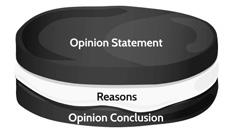
Tell students that for Focusing Question Task 2, they are going to write an opinion paragraph about Bone Button Borscht. To do this, they first need to examine the structure of an opinion paragraph.
Display the following chart. Tell students that to help them remember the parts of an opinion paragraph, they can think of an opinion sandwich, like a sandwich cookie with filling in the middle. Name each part of the paragraph structure and explain how the parts form the mnemonic I-OREO.
pinion Statement
Introduce the topic.
State your opinion on the topic.
Supply a reason that supports your opinion.
Provide evidence from the text for the reason.
Reinforce your opinion in a conclusion.
Post and read aloud an example of an opinion paragraph. Tell students that this example comes from the opinions they formed about who faces the biggest problem at the beginning of Bone Button Borscht
Many people face problems at the beginning of Bone Button Borscht. I think the townspeople face the biggest problem. I think this because they have become selfish. The shamas says they do not give to each other. They stay hidden in their homes. I think the townspeople face the biggest problem because they do not share.
Ask for volunteers to identify the following parts of an opinion paragraph in the example. As students respond, complete the labeling process for the class.
1 Underline the opinion statement.
2 Highlight the reason.
3 Put a star next to each sentence of evidence.
Take a moment to look closely at the sample paragraph with students. Reinforce that students should look closely at the evidence to help them determine their opinion. Explain how text evidence will help them come up with a solid reason that supports their opinion statement.
Have students Think–Pair–Share about the question, “In this paragraph, how does the text evidence relate to the reason?”
n It shows that the townspeople were staying away from people and not sharing.
n The evidence shows that the townspeople wouldn’t share with each other.
Confirm that the evidence shows that the townspeople were not sharing and being selfish.
Reinforce the other parts of an opinion paragraph using the sample paragraph. Then, ask students to turn to a partner and name the five parts of an opinion paragraph.
Students name the five parts of an opinion paragraph to a partner.
Ask students to consider whether there is any part they still feel unsure of or have questions about. Pull the class together and use the remaining time to address questions.
Explain that in the next lesson, students will start collecting evidence so that they can write their own opinion paragraphs for Focusing Question Task 2.
5 MIN.
Instruct students to Stop and Jot one word to describe the beggar and/or the shamas in their Response Journal. Use Equity Sticks to share as time allows. Clarify responses as needed with the question “How did the words or illustration help you describe the character?”
If needed, review words with the oo spelling pattern, an inconsistent but common one. Post the words good and food in two separate columns on the board. Then, read aloud the word cook and ask them if they hear an /oo/ as in good or an /oo/ as in food. Have students write the word cook under good. Repeat this process with other oo words from Stone Soup and Bone Button Borscht such as smooth, spoon, took, footsteps, look, book, room, too, soon, and stood
Wrap1 MIN.
Assign Day 3 of Fluency Homework.
Students closely examine both illustrations and words to discover what they reveal about characters and setting. (RL.2.7)
Each student: Listens actively in order to answer Text-Dependent Questions. Contributes answers and explains them using text evidence during whole-group discussion.
Select additional passages of this or other texts and provide additional practice to small groups or individuals as needed. Students are expected to independently apply this skill in Lesson 15 during a New-Read Assessment using Stone Soup, the other narrative text in this module.
Time: 15 min.
Text: Bone Button Borscht, Aubrey Davis
Style and Conventions Learning Goal: Generate reflexive pronouns that match nouns and personal pronouns. (L.2.1.c)
In preparation for today’s Deep Dive, consider bringing a mirror to support students in generating reflexive pronouns. You might also consider preparing a chart such as the one on Handout 12A that shows personal pronouns and their matching reflexive pronouns.
TEACHER NOTE
Personal Pronoun Reflective Pronoun I myself you yourself he himself she herself it itself we ourselves you (plural) yourselves they themselves
STYLE AND CONVENTIONS CRAFT QUESTION: Lesson 12 Experiment: How does using reflexive pronouns work?
Tell students to pretend they are holding up a mirror in front of their face.
Ask: “Who do you see in the mirror? Answer in a complete sentence.”
n I see myself in the mirror.
Write “I see myself” on the board.
Remind students that when we see a reflection in a mirror we see whatever is in front of the mirror being reflected or shown back to us. Ask students which word is the reflexive pronoun in the sentence on the board. Underline myself and draw an arrow to the word it reflects, I.
Continue using a real or imagined mirror and prompting students to use the pronouns as they respond to the following questions:
Who is he looking at in the mirror? (He is looking at himself.)
Who is Jayden looking at in the mirror? (Jayden is looking at himself.)
Who is she looking at in the mirror? (She is looking at herself.)
Who is Mia looking at in the mirror? (Mia is looking at herself.)
Who are they looking at in the mirror? (They are looking at themselves.)
Who are we looking at in the mirror? (We are looking at ourselves.)
Who is the class looking at in the mirror? (The class is looking at itself.)
Post a few nonexamples (e.g., “we are looking at us” or “he is looking at him” or “Jayden is looking at Jayden”) and discuss why they are incorrect.
Explain that students will continue to experiment with reflexive pronouns in their own writing.
Learn
Distribute Handout 12A.
NOTE
You may notice that some of the reflexive pronoun examples are pulled from Stone Soup, the text students first read in Lesson 9 and will be assessed on in Lesson 15. Be mindful of focusing only on the use of reflexive pronouns in these sentences, not the content of the story, to maintain the validity of the New-Read Assessment.
Handout 12A: Experimentation with Reflexive Pronouns
Read aloud the first sentence: “The soldiers could not make the soup by .”
Ask: “Which pronoun could we substitute for ‘the soldiers’?” If necessary, give students the choices he, she, we, or they. n they
Instruct students to repeat the sentence using each of the reflexive pronouns on the handout, thinking about which makes sense and sounds correct.
Reinforce that students should think about which reflexive pronoun matches the personal pronoun they.
Students write one of the reflexive pronouns in the blank. Circulate and look for students who may need more teacher support with the rest of the handout.
Once students have written themselves in the blank, have them circle themselves and draw an arrow to the word it reflects (soldiers).
Students match each reflexive pronoun to the correct sentence on Handout 12A.
Land
Use Equity Sticks to call on students to stand and read the sentences from the Check for Understanding (CFU) aloud to the class.
n 1. The soldiers could not make the soup by themselves
n 2. “I’m so hungry,” the beggar thought to himself
n 3. They walked down the road by themselves.
n 4. We do not have enough food to feed ourselves!
n 5. “I do not have food for myself,” said the woman.
n 6. He trudged down the road feeling sorry for himself.
Instruct students to Stop and Jot an answer to the following question on Handout 12A: “How do you choose the correct reflexive pronoun to use?”
n I think about which word the reflexive pronoun is talking about, or reflecting.
n I look at the word and think about which reflexive pronoun it matches.
n I try out different reflexive pronouns and think about which makes sense and sounds right.
Welcome (4 min.)
Finding Meaning in the Cover Art
Launch (1 min.)
Learn (65 min.)
Gallery Walk (25 min.)
Listening to Recount Details (10 min.)
Collect Evidence for Focusing Question Task 2 (30 min.)
Land (4 min.)
Answer the Content Framing Question Wrap (1 min.)
Assign Homework
Vocabulary Deep Dive: Academic Vocabulary: Cooperation (15 min.)
The full text of ELA Standards can be found in the Module Overview.
RI.2.1, RL. 2.2, RL.2.7, RF.2.4
W.2.1, W.2.8, W.10*
Speaking and Listening SL.2.1, SL.2.2
Language L.2.5.a
Assessment 13A: Focusing Question Task 2
Handout 10A: Fluency Homework Handout 13A: Academic Vocabulary: Cooperation
SCAPE Chart from Lesson 12 Sticky notes
Blank chart paper for evidence organizer (retain for future lessons)
Describe how the illustrations contribute to understanding of characters and setting. (RL2.7)
Jot in their Response Journal.
Write an opinion statement. (W.2.1)
Contribute to class notes and form an opinion statement for Focusing Question Task 2.
Generate real-life and text examples and nonexamples of cooperation. (L.2.5.a)
Complete Handout 13A with a partner.
* This lesson prepares students for W.10, which first appears in the Grade 3 CCSS.v
FOCUSING QUESTION: Lessons 9–16
How can food nourish a community?
CONTENT FRAMING QUESTION: Lesson 13
Reveal: What does a deeper exploration of illustrations and words reveal in Bone Button Borscht?
CRAFT QUESTION: Lesson 13
Execute: How do I form opinion statements?
In this lesson, students take a deeper look at the way the illustrations reveal the story in Bone Button Borscht. They think and write about how the colors of the illustrations reveal the changes in the setting and characters. Students practice their Speaking and Listening Goals to tell how the details in the text illuminate changes in the characters. Finally, students review the prompt for Focusing Question Task 2 and collect evidence to help them form an opinion.
4 MIN.
Display the front cover of Bone Button Borscht.
Instruct students to Think–Pair–Share, and ask: “What you notice about the way the beggar is painted and the way the townspeople are painted on the cover?”
Use Equity Sticks to share student responses.
Confirm that the townspeople are painted with more muted colors and the beggar is painted with brighter colors.
Ask: “What do you think it means that the beggar is colored with brighter colors?” Have volunteers respond.
n It means that he’s the most important character.
n Maybe it’s more colorful because he’s kind of magical.
n The soup is really bright colors, too. Maybe the colors mean that he has hope.
1 MIN.
Post and read the Focusing Question and Content Framing Question.
Explain to students that today they will think about the second half of the text Bone Button Borscht by closely reading the illustrations and text.
Learn60 MIN.
GALLERY WALK 25 MIN.
Instruct pairs to do a Gallery Walk of the posted illustrations of pages 18–30. Explain that students will pause in front of each image to ask and answer: “What does this illustration show about the characters? What does this illustration show about the setting?” Post these questions so that students can access them during the Gallery Walk. Establish a procedure for pairs moving through these illustrations.
Bring the class back together. Review the illustrations from pages 1–17 to notice the colors and mood of the images. Then ask students to think about what they saw in the color and mood of the second half of the text.
Ask: “What is different in the illustrations from the beginning of the text and the end of the text?” Have volunteers respond.
n The paintings are more colorful at the end.
n It makes the story feel happier with all the colors.
Ask: “Besides the illustrations, what else can readers look at for more information?” Have volunteers respond.
Reinforce that, for a deeper exploration of the text, readers must look at both the illustrations and the text.
Display the SCAPE Chart from Lesson 12. Explain that now they are going to look at the second half of the story and see what information it reveals about the story elements.
Open to pages 18–19 and instruct pairs to Think–Pair–Share about how the illustrator depicts the beggar. Volunteers share responses. Jot a few responses on sticky notes and place them on the SCAPE Chart.
For efficiency, and to provide an opportunity for a challenge, identify one or two students to record ideas on a sticky note and attach them to the SCAPE Chart as each page spread is discussed.
Open the text to pages 20–21 and ask pairs to Think–Pair–Share about the townspeople. Volunteers share responses as you record their ideas and place the sticky notes on the SCAPE Chart. Repeat this process with pages 24–25 to collect more ideas about the townspeople.
Open the text to pages 26–27 and ask students to think about what the illustration reveals about the setting and how it might be different from the beginning of the book. Ask pairs to Think–Pair–Share based on what they see in the illustration. Repeat the above process.
Ask: “What do you see in the images of the first half of the text and the images in the second half of the text that matches what you know about the story?” Have volunteers respond.
n In the first half, the illustrations are dark colors, and in the second half there is a lot more color.
n In the illustrations with the colors the townspeople seem happy, especially on pages 24–25.
n Yes, and on the illustrations that are less colorful, the town seems like a sad place.
Students respond to the following question in their Response Journal:
“How do the illustrations add to your understanding of the characters and setting?”
n The illustrations help show me the characters and setting.
n The illustrations help set the tone or feel.
n The illustrations help me see how characters and places change.
10 MIN.
Point to the Listening and Speaking Anchor Chart and remind students of the Speaking and Listening Goals for this module: Listen to Appreciate and Recount Details of a Read Aloud.
Tell students that in the previous part of this lesson, they learned how the illustrations add to their understanding of a text. Explain that students will now build on their understanding by recounting details of the second half of the book.
Reread the text on pages 24–25. Encourage students to pay attention to details. Have students Think–Pair–Share to discuss the details of the text, focusing on the characters and the setting.
Circulate and listen into the conversations of students.
Students prepare a statement to share with the whole class using this frame:
The townspeople have changed because
. The details that show us this are .
TEACHER NOTE If students are demonstrating competence with this frame, substitute the word townspeople with beggar and ask all partnerships to share again.
30 MIN.
Display and read aloud the Craft Question: How do we form opinion statements?
Explain to students that with all of their new knowledge about opinion writing, they are now ready to collect evidence for Focusing Question Task 2.
Ask: “Why is it important to reread and look at evidence before you form an opinion about a book?” Prompt students to think back to when they reread the beginning of Bone Button Borscht to form an opinion about who faced the biggest problem.
n So that you can figure out what you think or feel.
n To help you come up with your opinion statement.
n Evidence helps you make your decision.
This question may be challenging for some students. Support students by prompting them to look back at the evidence organizer they produced as a class in Lesson 11. Ask: “How did making this chart help you come up with your opinion?”
Explain to students that they will make a similar chart today. This evidence will help them form their own opinion.
Distribute Assessment 13A and chorally read the prompt for Focusing Question Task 2:
Who benefits the most from making the soup in Bone Button Borscht?
Review the requirements of the task: introduction opinion statement one reason for their opinion two pieces of evidence opinion conclusion
Name:
Assessment 13A: Focusing Question Task 2
Task: Who benefited the most from making the soup in Bone Button Borscht? Write an opinion paragraph.
Support your response using evidence from the following source: • Bone Button Borscht Aubrey Davis
Checklist for Success: Be sure to include all of the following in your response: introduction opinion statement one reason for their opinion two pieces of evidence opinion conclusion Page of
Underline the word benefits. Explain to students that to benefit means “to gain something positive, or good.” Reinforce that the prompt is asking who gains the most from making the soup.
The root ben- means “well/good.” The root bon- is similar. Ask students to name other words that they know with benor bon- such as beneficial, bonus, and benefit
Display an evidence organizer for Focusing Question Task 2.
Evidence Organizer
Who benefits the most from making the soup in Bone Button Borscht?
IDEA 1: townspeople
IDEA 2: beggar
Explain to students that they will listen carefully to the second half of the text twice. The first time, they will listen closely for ways that the beggar benefited. When they hear a way, they will raise their hands to share with the class, so that the evidence can be added to the Evidence Organizer Chart.
Reread pages 14–29 of Bone Button Borscht. Jot notes on the class Evidence Organizer Chart about how the beggar benefited from making soup. Include words, phrases, and pictures.
Reread pages 14–29 of Bone Button Borscht. Jot notes on the class Evidence Organizer Chart about how the townspeople benefited from making soup. Include words, phrases, and pictures.
How the beggar benefited from making the soup is more concrete than how the townspeople benefited. Support students by asking them to listen for details about the beggar first.
Who benefits the most from making the soup in Bone Button Borscht?
IDEA 1: townspeople
IDEA 2: beggar Left houses to watch the beggar Got to eat
Ate and laughed Had place to stay Sang and played music New buttons
Now that students have collected evidence, they are ready to form an opinion and think about the reason. Ask students to think silently about whether they think the beggar or the townspeople benefited more from making the soup. Give students two to three minutes to discuss with a partner.
Confirm that the reason is similar to the following examples: the townspeople learned to share and help each other, and the beggar’s wish came true and he helped the townspeople.
Ask students to look at the evidence to form an opinion statement and jot it in their Response Journal. Post the following sentence frame for support:
I think benefited the most from making the soup.
Students write an opinion statement in Response Journal.
Remind students that there is not one right or wrong answer. This is their opinion. Explain that in the next lesson, students will complete a Graphic Organizer and orally rehearse their responses to Focusing Question Task 2.
4 MIN.
Students Mix and Mingle to share a detail about the illustrations they thought gave them the most information about the story. Volunteers share with the entire class.
Consider reviewing the /ou/ sound of ou and ow, as well as exceptions to these sound-spelling patterns. Distribute slips of paper with words such as mouths, counted, round, house, out, down, town, how, and soup. Instruct students to sort the words by vowel team, looking carefully for the “oddball” that doesn’t have the /ou/ sound in words like house and down Discuss student findings and the word soup, which has the ou pattern but does not contain the /ou/sound.
Wrap1 MIN.
Assign Day 4 of Fluency Homework. Analyze
Context and Alignment
Before forming an opinion, students must carefully collect text evidence. After looking at the text evidence for both of the options, they are ready to form their opinion and write an opinion statement. (W.2.1) Each student
Expresses how he thinks or feels in his opinion statement.
States the opinion clearly in an opinion statement.
Writes the opinion statement in a complete sentence.
Support students who find writing an opinion statement challenging. Revisit the sentence frame provided in the lesson and have students work in pairs to orally rehearse their answer. Then guide them to complete the sentence frame in their Response Journal. Guide them to place a sticky note on the page of the Response Journal with the sentence frame so they can return to it whenever they write an opinion paragraph.
Time: 15 min.
Text: Bone Button Borscht, Aubrey Davis
Vocabulary Learning Goal: Generate real-life and text examples and nonexamples of cooperation. (L.2.5.a)
Students explored the word cooperate when studying the prefix co- in Deep Dive 30 of Module 3. Cooperate is an academic word that students will likely encounter across many disciplines and texts. In today’s Deep Dive, students will deepen their understanding of cooperate and cooperation by forming associations with other words, representing the words, and considering reallife and textual examples and nonexamples.
Ask: “What do you remember about the word cooperate from Module 3? What do you remember about its parts?” Have volunteers respond.
n I see the prefix co-. Co- means “with” or “together.”
n I see the base word operate
n I see the suffix –tion.
n I remember that cooperate means “to work together.”
Confirm that cooperate is a verb that means “to work together.”
Explain to students that you will call out a word and they will move to one side of the room if the word is like cooperate and the other side of the room if the word is unlike cooperate.
Call out the word compete and give students fifteen seconds to choose where to stand in the room. Then, have a volunteer explain why they stood where they stood.
n When people compete, they work against each other, not together. This word is different from cooperate
Repeat this process with the following words and phrases: work together, teamwork, argue, disagree, join in, collaborate, break apart.
Bring students back together and read aloud the back cover of Bone Button Borscht, emphasizing the phrase “with only six buttons and a little cooperation.” Ask: “What do you notice about the word cooperation?” Have volunteers respond.
n I see the same word part as in cooperate in the word cooperation.
n Cooperation seems like a thing, a noun.
Confirm that cooperation is a noun that means “the act of working together.” Post the word cooperation and provide this definition for students to record in their Vocabulary Journal.
cooperation (n.) The act of working together.
Distribute Handout 13A. Instruct students to think of and sketch a real-life example and nonexample of cooperation. Name: Handout 13A: Academic Vocabulary: Cooperation Directions: Complete the handout about the word cooperation cooperation (noun): the act of working together Examples Non-Examples Real-Life
Use Equity Sticks to call on three students to share their pictures and sentences. Students might use the words cooperate, cooperated, or cooperation in their responses.
n In music we played different instruments to make one song. This was an example of cooperation.
n A nonexample of cooperation is when a group doesn’t work together nicely on a project.
Direct pairs to locate and Stop and Jot an example and nonexample of cooperation in Bone Button Borscht Support struggling students by drawing their attention to the illustrations.
Pairs locate an example and nonexample of cooperation in Bone Button Borscht and Stop and Jot the examples on Handout 13A.
Invite students to share their examples and nonexamples of cooperation in Bone Button Borscht Again, students might use the words cooperate, cooperated, or cooperation in their responses.
n The people cooperate when they share their food and work together to make borscht.
n A nonexample of cooperation is when the people don’t want to work together to help the beggar.
n Passing each other ingredients shows cooperation.
n The people are not cooperating with each other when they are inside their houses only making food for themselves.
Have groups of students come up with skits representing examples and nonexamples of cooperate. Then have groups perform the skits while students explain what is happening in the skit (e.g., “The soccer team cooperates by passing the ball to each other to score a goal.”).
Welcome (6 min.)
Examine a Character Launch (3 min.)
Learn (60 min.)
Examine Text Illustrations and Words (30 min.)
Prepare for Focusing Question Task 2 (30 min.)
Land (4 min.)
Answer the Content Framing Question Wrap (2 min.)
Assign Homework
Vocabulary Deep Dive: Academic Vocabulary: Cram, gather (15 min.)
The full text of ELA Standards can be found in the Module Overview.
RL.2.1, RL.2.2, RL.2.7, R.F.2.4
W.2.1, W.2.8, W.10*
Speaking and Listening
SL.2.1, SL.2.2
Language L.2.5.a
MATERIALS
Handout 10A: Fluency Homework Handout 14A: Focusing Question Task 2 Evidence Organizer
SCAPE Chart for Bone Button Borscht
Evidence Organizer (developed in Lesson 13)
Opinion Chart (developed in Lesson 12)
Determine the essential meaning and explain how both words and illustrations contribute to the essential meaning. (RL.2.1, RL.2.2, RL.2.7)
Describe the essential meaning to a partner using evidence from the texts and illustrations.
Prepare to write an opinion paragraph. (W.2.1)
Complete a graphic organizer to prepare for Focusing Question Task 2.
Identify real-life connections between the words gather and cram and their use. (L.2.5.a)
Stop and Jot a similarity and difference of cram and gather in their Vocabulary Journal.
* This lesson prepares students for W.10, which first appears in the Grade 3 CCSS.
FOCUSING QUESTION: Lessons 9-16
How can food nourish a community?
CONTENT FRAMING QUESTION: Lesson 14
Distill: What is the essential meaning of Bone Button Borscht?
CRAFT QUESTION: Lesson 14
Execute: How do I prepare to write an opinion paragraph?
Students begin this lesson by thinking more deeply about the character of the beggar in Bone Button Borscht. Then, they return to their examination of the words and illustrations; this time as a strategy for distilling the essential meaning. Finally, students prepare for Focusing Question Task 2 by recording evidence and one reason for their opinion paragraphs.
Display and read aloud page 3.
Post the following questions and instruct students to Think–Pair–Share to discuss their answers.
What is the beggar’s opinion about being a beggar?
What are his reasons?
Did his experience in the town support these reasons?
Select a few pairs to share responses.
n He likes being a beggar. At the end of the story, he left and I think he is still going to be a beggar.
n He said it brings out the good in people. The townspeople did become good and share in the end.
n The beggar likes being a beggar because he gets something. He did get to eat and stay in the townspeople’s houses for a while.
3 MIN.
Read aloud the Focusing Question and Content Framing Question.
Ask: “How could we answer the Content Framing Question?” Have volunteers respond.
n We can reread parts of the book to figure out the important meaning.
n We can look at the illustrations again. They might help us.
n We can ask questions like, “What is something we learned from reading the story?”
Explain to students that today they will look closely at how the illustrations support the words the author used as they determine the essential meaning of Bone Button Borscht
60 MIN.
30 MIN.
Remind students that in the previous two lessons they discovered how both the words and illustrations reveal new ideas about the characters and setting. Ask a volunteer to give an example from the text of when he or she learned more about the characters and setting from looking at the illustrations.
Explain that sometimes, to find a text’s essential meaning, readers can study the problem and solution.
Display the Bone Button Borscht SCAPE Chart created in Lesson 11 and ask: “What problem did the beggar solve for himself?” Volunteers recount the problem and solution.
Use the following questions to support students in analyzing the problem and solution. Use Think–Pair–Share, Equity Sticks, and volunteers to facilitate the questions and increase engagement.
Ask: “What are some other ways he could have solved his problem?”
n Stolen food.
n Walked to another town and begged those people for food and shelter.
n Found an abandoned house to sleep in.
n Tried to find his own food in the woods.
Ask: “What can we learn from how he solved his problem?”
n We can try to get what we want by having a clever idea.
n He realized what the people were like, so he thought up a plan that made them curious and want to see it to believe it!
n He tried to get the townspeople interested and want to help. My parents always tell me not to force my brother to share but instead make a deal with him.
n He solved his problem of hunger by getting people to work together.
n He and everyone else benefited from his plan of making soup.
If students state that they learned it is okay to trick people or lie to them to get what you want, focus on the beggar’s intent. Ask students to consider how the story might have been different if his whole goal was to trick and lie to the townspeople for purely a selfish reason. Would he have shared the soup?
Ask: “The beggar didn’t only solve his own problem of being cold and hungry. What problem did he solve for the community?” Ask students to think about this as you display pages 4–5 and select passages to reread to show the problems of the community: selfishness, distrust, and isolation.
Instruct students to Think–Pair–Share, and ask the following or similar TDQs to guide students in closely examining how words and illustrations work together to communicate essential meaning. Select a few strong responses to share with the class.
1 How was the community different than what the beggar expected? How do you know from the words? Circulate and reread select passages to clarify students’ ideas as needed.
n The shamas did not greet him. He thought that was strange.
n No one shared and just told him to go away. He asked himself, “What is wrong with these people?”
n The people would not respond with the usual greeting of peace but were instead silent.
Ask students to recall their work with illustrations in the previous lesson as you flip through the pages and display the illustrations.
2 How was the community different because of the beggar’s visit? Which illustrations show this difference? Circulate and display specific illustrations to clarify students’ ideas as needed.
n The picture of all the townspeople eating at the big table shows they are together and happy.
n The picture of all the townspeople bunched up with the buttons when the beggar leaves shows they all will miss him and will use the buttons again.
n The picture of the people holding hands connecting the houses shows how much they like to be together instead of apart.
n In the last lesson we noticed how different the town and people look from the beginning pictures to the end pictures. The colors really show how it changed, and so do the townspeople’s eyes and faces. Everything is brighter and the people look happier.
Display and reread page 28.
3 What was the real miracle?
n They learned they could make soup without buttons.
n They learned that if they worked together, they would always have food to eat.
n They learned to help each other even when there were hard times.
Instruct students to Stop and Jot in their Response Journal, and ask: “What is the real, essential meaning of this story? How do words and pictures work together to provide evidence for your essential meaning?”
Students Stop and Jot a sentence stating the essential meaning in Response Journal.
n The story teaches that is important to share. The text said what all the people brought to share. We could see how much happier the townspeople were at the end in the pictures because they shared.
n The townspeople learned it is good to help each other thanks to the beggar, and I think that’s the message of the story. The beggar knew about sharing all along because even in the beginning he talked about it. But the people had to learn that from making the borscht together, and they changed from sad and lonely to happy in the pictures.
n The words and pictures both helped me understand how much the people changed in the story because they learned their lesson about working together. They used words like “no, go away!” but later they asked how they could help. In the pictures they were all hiding in their houses at first but by the end were holding hands and connecting.
Students add a sketch of the ending that further expresses this essential meaning to strengthen the connection between words and illustrations.
Whole Group
30 MIN.
Display and read aloud the Craft Question: How do I prepare to write an opinion paragraph?
Point students back to the Evidence Organizer Chart they produced in Lesson 13. Remind students that they used this evidence to help them form an opinion about who benefited the most from making the soup in Bone Button Borscht.
Ask students to open their Response Journal and reread the opinion statement they formed to a partner.
Display the Opinion Chart from Lesson 12. Point out the cookie sandwich on the chart and ask: “Why is there a cookie sandwich on this handout?”
n Because it helps us remember the parts of an opinion paragraph.
Review the parts of an opinion paragraph with students.
Distribute Handout 14A. Explain to students that they are now going to complete their own Evidence Organizer Chart. Tell students that their Evidence Organizer Chart will help them prepare to write an opinion paragraph in response to Focusing Question Task 2.
Guide students through the following steps, one step at a time, to complete Handout 14A:
1. Review the Evidence Organizer Chart from Lesson 13.
2. Look carefully at the evidence and decide who benefits the most. Circle “townspeople” or “beggar.”
3. Write two pieces of evidence for either the townspeople or beggars.
Name: Handout 14A: Focusing Question Task 2 Evidence Organizer Directions: After you form your opinion, use this planner to record the evidence you need to write your answer for Focusing Question Task 2. Then, look at your evidence to decide a reason.
Question: Who benefited the most from making the soup in Bone Button Borscht? (circle one) Townspeople OR Beggar Reason Page of
4. Look carefully at the evidence and think about the reason or why the evidence made you think or feel a certain way. Write the reason on the organizer.
TEACHER NOTE
Depending on the needs of your students, walk students through these steps one by one, or review them all with students and circulate as they work independently. Given that this is the first time this year that students have written opinion paragraphs, it may be useful to walk students through these steps one by one.
Students use Handout 14A to collect evidence to prepare for Focusing Question Task 2.
Circulate to support students in completing Handout 14A.
Scaffold
Some students may find that using the evidence to find the reason is challenging. Have students Think–Pair–Share about the how the evidence helped them to decide between the villager and the beggar.
Evidence Organizer Chart for Focusing Question Task 2
Question: Who benefited the most from making the soup in Bone Button Borscht?
Circle one: townspeople or beggar
Evidence 1 Left houses to watch the beggar
Evidence 2 Ate and laughed
Reason Learned to share/help each other
Question: Who benefited the most from making the soup in Bone Button Borscht?
Circle one: townspeople or beggar
Evidence 1 Got to eat
Evidence 2 Had place to stay
Reason Got his wish and helped townspeople, too
Emphasize the importance of students’ careful planning and let them know that they are ready to orally rehearse their paragraph and begin writing in the next lesson.
Land4 MIN.
Display the illustration on page 23. Instruct students to Think–Pair–Share, and ask: “In your opinion, does this illustration help support the essential meaning? Why or why not?”
Ask pairs to vote and have one student from each side support their reason.
Assign additional fluency practice as needed.
Stone Soup and Bone Button Borscht provide a good opportunity for practice with the /ü/ sound of oo, ou, and ew Display or distribute slips of paper printed with words such as soup, smooth, spoon, you, drew, grew, and noodle. Have students read each word aloud, then sort them by vowel team and discuss their patterns. Dictate other words with these spelling patterns (e.g., dew, group, boot), encouraging students to use the various spelling patterns for the /ü/ sound
Students consider both words and illustrations as they determine the essential meaning of Bone Button Borscht. (RL.2.7)
Actively listens and observes as pages are revisited to answer TDQs about story characters.
Determines the essential meaning and records it.
Describes the essential meaning and supporting text-based and illustration evidence to a partner.
Determining the essential meaning of a text is a habit of mind that will continue to be practiced throughout the Wit & Wisdom program. However, if students need extra practice using both text and illustration evidence to determine the essential meaning, provide more opportunities for practice using familiar texts. Consider bringing back texts from earlier modules such as Johnny Appleseed and looking for ways the illustrations also support or reveal essential meaning.
Time: 15 min.
Text: Bone Button Borscht, Aubrey Davis
Vocabulary Learning Goal: Identify real-life connections between the words gather and cram. (L.2.5.a)
Turn to page 18 in Bone Button Borscht and read aloud the first paragraph.
Ask: “What kind of word is cram?”
n Cram is a verb.
Instruct students to Think–Pair–Share, and ask: “Why did the people have to cram themselves inside the synagogue?”
n There was a huge crowd of people and the synagogue was small.
n It says “the whole town was with” the shamas, so there were a lot of people to fit inside the synagogue.
Confirm the meaning of cram. Provide the following definition for students to add to their Vocabulary Journal.
cram (v.)
To force into a small space.
Remind students that readers can think of real-life examples of words that will help them connect to and better understand the new word. This is what students practice in today’s Deep Dive.
Instruct students to Stop and Jot an example of when they would use the word cram under its definition in their Vocabulary Journal. Use Equity Sticks to call on at least three students to share.
n When we squeeze into the auditorium, we cram into it.
n When there are a lot of people on the bus, they have to cram together.
n When I put too much food in my mouth, I cram it in my mouth. Have students add an additional example to their Vocabulary Journal following this share.
Ask: “Now that you’ve thought of some other examples for using cram, what are some synonyms for cram?”
n squeeze, jam, ram, fill, stuff, crowd
TEACHER NOTE You might consider adding student examples and synonyms for cram and gather to a classroom chart in the form of images or words.
Turn to page 27 and read aloud the first sentence: “One day the beggar gathered the townsfolk together to say good-bye.”
Ask: “Why don’t you think the author used the word cram in this sentence? Why did she choose gather instead?”
n When you gather people you are bringing them together; you aren’t squeezing them together really tightly.
n The beggar brought people came together, but they don’t look squished in the illustration.
Confirm the meaning of gather. Provide the following definition for students to add to their Vocabulary Journal.
Word Meaning gather (v.) To bring together.
Instruct students to think of a real-life example of people gathering or things being gathered. Call on several volunteers to share out.
n Raking leaves together is gathering leaves together.
n Getting together when we hear the bell at recess is gathering.
n People gathered together when they got together at the March on Washington.
Instruct students to use their examples to think about the difference between cram and gather.
Students Stop and Jot a similarity and difference of cram and gather in their Vocabulary Journal.
Use Equity Sticks to call on several students to share about the similarities and differences between cram and gather.
n Both the words have to do with people or things coming into the same place.
n Cram means that something is brought together more tightly than gather.
Close by having several student volunteers act out some of the examples from today’s Deep Dive, having other students guess whether they are acting out cram or gather.
LESSONS 9–16 How can food nourish a community? The Beaneater, Annibale Carracci (http://witeng.link/0379) Bone Button Borscht, Aubrey Davis Stone Soup, Marcia Brown
Welcome (5 min.)
Make Connections Between Art and a Text
Launch (1 min.) Learn (65 min.)
Complete New-Read Assessment 1 (25 min.)
Complete Focusing Question Task 2 (30 min.)
Recount Text (10 min.)
Land (3 min.)
Answer the Content Framing Question Wrap (1 min.)
Assign Homework
Vocabulary Deep Dive: Academic
Vocabulary: Banquet (15 min.)
The full text of ELA Standards can be found in the Module Overview.
RL.2.1, RL.2.2, RL.2.7, RF.2.4
W.2.1, W.2.8, W.10*
Speaking and Listening
SL.2.2, SL.2.2
Language
L.2.4.a, L.2.5.a
MATERIALS
Assessment 15A: New-Read Assessment 1
Assessment 13A: Focusing Question Task 2
Handout 10A: Fluency Homework Handout 14A: Focusing Question Task 2 Evidence Organizer Handout 15A: Opinion Writing Checklist
Handout 15B: Frayer Model Opinion Chart
SCAPE Chart from Lesson 11 Sticky notes
* This lesson prepares students for W.10, which first appears in the Grade 3 CCSS.
Identify and describe how words and illustrations add meaning to the text. (RL.2.1, RL.2.7, W.10)
Complete New-Read Assessment 1.
Write an opinion paragraph. (W.2.1, W.2.8, RL.2.1)
Draft Focusing Question Task 2.
Use real-life connections to create a Frayer Model for the word banquet using real-life connections. (L.2.4.a, L.2.5.a)
Complete Handout 15B.
FOCUSING QUESTION: Lessons 9–16
How can food nourish a community?
CONTENT FRAMING QUESTION: Lesson 15
Know: How do Bone Button Borscht and Stone Soup build my knowledge?
CRAFT QUESTION: Lesson 15
Excel: How do I write an opinion paragraph in Focusing Question Task 2?
Experiment: How does recounting details from a Read Aloud work?
Students complete their first New-Read Assessment of Module 4 as they revisit Stone Soup. Students also wrap up Focusing Question Task 2, their first opinion piece of the module. The class then collaborates on creating a SCAPE Chart for Stone Soup in preparation for the next lesson.
5 MIN.
Remind students that they have read many texts and looked at many pieces of art this year that had some similarities. Explain that when they make connections between two texts or a piece of art and a text, they are deepening their comprehension of the works.
Display Bone Button Borscht and The Beaneater (http://witeng.link/0379).
Instruct students to Think–Pair–Share, and ask: “What do these two texts have in common?” Ask one pair to share their thinking.
1 MIN.
Tell students that they will be working with two texts, Stone Soup and Bone Button Borscht, today. Remind them that they read Stone Soup earlier in the module.
Read the Focusing Question and Content Framing Question.
Learn 60 MIN.
COMPLETE NEW-READ ASSESSMENT 1 25 MIN.
Individuals
TEACHER NOTE
As there may not be enough copies of Stone Soup for all students to complete the assessment at one time, consider the following strategy for managing this lesson: begin by reviewing the criteria for Focusing Question Task 2 and setting students up to successfully complete this task.
Then divide the class in half, with the first half completing New-Read Assessment 1 while the second half quietly rehearses their writing and completes Focusing Question Task 2. As students finish one task, quietly transition them to the other one.
Distribute Assessment 15A and read the directions aloud as students follow along.
Students complete New-Read Assessment 1.
Post the Craft Question: How do I write an opinion paragraph in Focusing Question Task 2? Distribute Assessment 13A.
Name: Assessment 13A: Focusing Question Task 2 Task: Who benefited the most from making the soup in Bone Button Borscht? Write an opinion paragraph.
Support your response using evidence from the following source: • Bone Button Borscht Aubrey Davis Checklist for Success: Be sure to include all of the following in your response: introduction opinion statement one reason for their opinion two pieces of evidence opinion conclusion
Review the steps of the Opinion Chart and direct students to take out their completed Graphic Organizers on Handout 14A. Explain that they will orally rehearse their opinion paragraph to make sure it includes the following requirements:
introduction opinion statement one reason for their opinion two pieces of evidence opinion conclusion
Name: Handout 14A: Focusing Question Task 2 Evidence Organizer Directions: After you form your opinion, use this planner to record the evidence you need to write your answer for Focusing Question Task 2. Then, look at your evidence to decide a reason.
Question: Who benefited the most from making the soup in Bone Button Borscht? (circle one) Townspeople OR Beggar Reason ©
Explain that this is the same type of oral rehearsal that they do when they write informative or narrative paragraphs. Encourage students to take turns practicing and helping each other add more detail to their oral rehearsal.
Circulate and listen closely to the oral rehearsals, making sure they include all of the requirements. This is an excellent opportunity to catch any misunderstandings and pull students aside to work one on one.
Once students are done with their oral rehearsal, they are ready to begin writing their opinion paragraphs.


Students complete Assessment 13A.
Circulate and remind students to reference Handout 14A to support them in developing their ideas.
Scaffold:
If less than half the class seems to demonstrate a common misunderstanding, provide a brief cue or refer students to a part of the initial lesson. Have students turn to a partner and explain the misunderstood concept; while they are doing so, listen in to check for understanding.
Distribute Handout 15A. Students assess their writing using Handout 15A.
10 MIN.
Display the Craft Question: How does recounting details from a Read Aloud work?
Remind students that readers can recount texts they have read, as well as those that have been read aloud to them. Explain that, in the next lesson, students will work with both Bone Button Borscht and Stone Soup
One way to prepare to recount is to make notes on a SCAPE Chart. Display the SCAPE Chart from Bone Button Borscht.
Divide students into pairs and assign each pair a story element: setting, characters, actions, problem, or ending. Give each pair a sticky note and instruct students to Think–Pair–Share about what notes on their assigned element would be helpful to have for recounting.
Call on each pair to share their thinking. Attach new notes to the side of the SCAPE Chart to represent Stone Soup.
3 MIN.
Instruct students to Think–Pair–Share, and ask: “What connections can you make between Stone Soup and Bone Button Borscht?”
1 MIN.
Assign Fluency Homework. Invite students to practice the passage they have not yet worked on from Handout 10A or to select a passage at their level from their home library.
Name: Handout 10A: Fluency Homework Directions: Choose one of the text options to read aloud. Option A
The beggar counted the buttons. There were five. “Oy, if only I had one more button,” he said. The shamas said nothing. “Oy, if only I had one more button!” Still the shamas was silent. “OY, IF ONLY I HAD ONE MORE BUTTON!” Finally the shamas spoke. “Look, mister, I won’t give you a button. Nobody in this town will give you a button.” “Why not?” asked the beggar. “Because we’re poor, Mr. Beggar. We don’t give to each other any more.” 82 words
Davis, Aubrey. Bone Button Borscht. Kids Can Press, 1995.
Students completed New-Read Assessment 1 to demonstrate their ability to use information from words and illustrations to understand story elements, including characters and settings. (RL.2.1, RL.2.7, W.10) Each student
Reads Stone Soup.
Uses information from the text and illustrations to answer questions about characters and setting.
Charts information from both the text and illustrations in what it reveals about the characters and setting.
If students struggled with this assessment, consider their miscues. For example: Did they have a basic understanding of Stone Soup? Was there vocabulary that confused or misled them? Did they spend time analyzing the illustrations or just look at them briefly?
Group students with like needs and use familiar, complex texts (such as from previous modules) to review and practice these skills.
Time: 15 min.
Text: Bone Button Borscht, Aubrey Davis; Stone Soup, Marcia Brown
Vocabulary Learning Goal: Use real-life connections to create a Frayer Model for the word banquet using real-life connections. (L.2.4.a, L.2.5.a)
Create a blank Frayer Model on chart paper in advance of today’s Deep Dive: banquet
Definition: Examples:
Characteristics: Nonexamples:
Ask: “What are some steps we can use when determining or clarifying the meaning of words we are unsure of?” Have volunteers respond.
n We can look for words and phrases outside the word that give you clues about its meaning.
n We can look at the pictures for extra information about the word.
n We can look inside the word at the word’s parts.
n We can replace the word with a definition and ask ourselves if it makes sense there.
Tell students that they will launch today’s Deep Dive by using these strategies as they look at a word in Stone Soup. Distribute copies of Stone Soup to pairs.
Instruct students to turn to page 34 and follow along as you read the following sentence: “Soon a banquet was spread and everyone sat down to eat. Never had there been such a feast.”
Draw students’ attention to the words feast and banquet.
Instruct pairs to gather and Stop and Jot evidence about the meaning of the words feast and banquet. Remind students to use the illustrations as well as the words.
Use Equity Sticks to call on students to share their evidence.
n In the picture, people are eating a big meal and putting things on the table.
n A feast and a banquet both seem like things (nouns) people eat.
n You can replace feast with banquet and you can replace banquet with feast. You can also replace either word with dinner or meal
Confirm that a banquet is a “large, fancy meal” and that a synonym for banquet is the word feast. Write the definition of banquet on the Frayer Model Chart.
Distribute Handout 15B.
Ask students to describe what they might see, smell, hear, or feel at a banquet. Instruct them to write their responses under “Characteristics” on their handout. Have volunteers respond.
n I would see lots of food spread out on the table.
n I would see big plates of food.
n I would see people passing food around.
n I would hear people talking and laughing.
n I would smell all the delicious food.
Name: Handout 15B: Frayer Model
Directions: Complete the Frayer Model for banquet Definition: Examples: Nonexamples:
Facts/Characteristics: Word: banquet © Great Minds PBC
G2 M4 Handout 15B WIT WISDOM Page of
Instruct pairs to Stop and Jot at least one example and one nonexample of a banquet. If students struggle to come up with examples, ask them when and why they might have a big meal or feast.
Students Stop and Jot an example and nonexample of a banquet on Handout 15B.
Chart student responses.
n A Thanksgiving meal is an example of a banquet.
n An apple is a nonexample of a banquet.
n A lunch tray is a nonexample of a banquet.
Scaffold:
Provide students with a list of examples and nonexamples to sort and justify. The list might include examples and nonexamples such as a lunch box of food, a plate, a breakfast buffet, and Thanksgiving dinner
Extension:
Provide students with a list of words and have them categorize them based on whether or not they relate to the words banquet and feast. The list might include words such as huge, celebration, hungry, meal, gobble, small, dinner, party, and unappetizing
Show students the illustration on pages 24 and 25 of Bone Button Borscht.
Instruct students to Think–Pair–Share, and ask: “Is this a banquet? Why or why not?”
n It is a banquet because it is a big, fancy meal and people are celebrating the miracle of the borscht.
Extension:
Ask students to pretend that they are villagers in Stone Soup or townspeople in Bone Button Borscht. Ask: “What will you bring to the feast/banquet?”
Encourage students to respond with the sentence frame “I will bring to the feast/banquet.”
n I will bring cider to the banquet.
n I will bring a roast to the feast.
Welcome (10 min.) Recount Bone Button Borscht
Launch (6 min.)
Learn (56 min.)
Examine Formal and Informal Language (12 min.)
Participate in a Socratic Seminar (25 min.)
Complete a Self-Reflection (10 min.)
Share Focusing Question Task 2 (9 min.)
Land (2 min.)
Answer the Content Framing Question
Wrap (1 min.)
Assign Homework
Style and Conventions Deep Dive: Examine Apostrophes in Possessives (15 min.)
The full text of ELA Standards can be found in the Module Overview.
RL.2.1
Writing
W.2.1, W.2.8, W.10*
Speaking and Listening SL.2.1, SL.2.2.
Language L.2.1.c, L.2.3.a L.2.2.c
Assessment 13A: Focusing Question Task 2
Handout 16A: Socratic Seminar Self-Reflection
Handout 10A: Fluency Homework
Handout 15A: Opinion Writing Checklist
Handout 16B: Possessive Nouns
SCAPE Chart from Lesson 11
Speaking and Listening Anchor Chart
Knowledge Journal Chart
Apostrophe Anchor Chart
* This lesson prepares students for W.10, which first appears in the Grade 3 CCSS.
Prepare for and participate in a Socratic Seminar in which characters are compared after text is recounted. (SL.2.1, SL.2.2, RL.2.1, L.2.1.c, W.10*)
Participate in a Socratic Seminar and then reflect on the Focusing Question using a reflexive pronoun.
Identify and explain the purpose of apostrophes in possessive nouns. (L.2.2.c)
Complete Part 2 of Handout 16A, determining whether the words with apostrophes are possessives and explaining why writers use apostrophes in possessive phrases.
FOCUSING QUESTION: Lessons 9–16
How can food nourish a community?
CONTENT FRAMING QUESTION: Lesson 16
Know: How do Bone Button Borscht and Stone Soup build my knowledge?
CRAFT QUESTION: Lesson 16
Execute: How do I use recounting from a Read Aloud to be successful in Socratic Seminar 1?
Examine: Why is it important to know the difference between formal and informal language?
In this lesson, students demonstrate their understanding of Bone Button Borscht and Stone Soup as they participate in a Socratic Seminar comparing the two texts. Through this task, students also demonstrate their ability to recount a Read Aloud and use reflexive pronouns. The lesson closes with students providing peer feedback on Focusing Question Task 2 before considering all of the knowledge and skills they have gained over this arc of lessons.
10 MIN.
Display and read the Craft Question: How do I use recounting from a Read Aloud to be successful in Socratic Seminar 1?
Display the SCAPE Chart, making sure that students can clearly distinguish between the notes from Bone Button Borscht and Stone Soup. Remind students that notes, like those on the SCAPE Chart, can be very useful when recounting a text from a Read Aloud.
Explain that students will be discussing both Bone Button Borscht and Stone Soup in today’s lesson. To be prepared, they will want to be sure the story of Bone Button Borscht is fresh in their minds. Instruct pairs to use the SCAPE Chart to take turns recounting Bone Button Borscht.
This Socratic Seminar lesson serves as a formal assessment of students’ abilities to recount a Read Aloud and use reflexive pronouns. To record observational data, consider creating a tracking chart, such as the one below, to use throughout the lesson. Circulate during the Welcome as well as the Socratic Seminar to listen for students’ use of these skills. If you are unable to gather data on specific students during this time, pull them aside to allow them to demonstrate their understanding.
CCSS.ELA-Literacy.SL.2.2 Recount or describe key ideas or details from a text read aloud or information presented orally or through other media.
Student Student Student
6 MIN.
CCSS.ELA-Literacy.L.2.1.c Use reflexive pronouns (e.g., myself, ourselves).
Post and read aloud the Focusing Question and Content Framing Question.
Explain that today students will participate in small group Socratic Seminars in which they compare Bone Button Borscht and Stone Soup.
Now that students have already practiced recounting Bone Button Borscht, ask a volunteer to recount Stone Soup for the class.
Explain that students will have many more chances to talk about these texts in this lesson.
Post the Craft Question: Why is it important to know the difference between formal and informal language? Circle the words formal and informal.
Post the following sentences from Stone Soup:
“Good evening to you,” they said. “Could you spare a bit of food for three hungry soldiers?” (6) “We are three hungry soldiers in a strange land.” (12)
Ask: “What do you notice about the way the soldiers are talking?” Have volunteers respond.
Reinforce that they are speaking very formally. Ask: “Why might the soldiers be speaking formally?” Have volunteers respond.
n Maybe that’s what they are supposed to do when they are in uniform.
n Maybe that’s how people talk where they’re from.
n Maybe they’re trying to be respectful.
Refer to the posted Craft Question, underline the prefix –in, and ask: “What does it mean to speak informally?” Have volunteers respond.
Remind students that the way we speak, and even sing, is different depending on whom we are with and where we are. Ask: “Do you speak the same way with your friends and with your older relatives? How about when you are at recess and when you are giving a speech in front of the class? Why or why not?” Have volunteers respond.
Explain that speaking to adults and giving a presentation are situations when formal, very correct language is expected, whereas speaking to friends at recess is not expected to be formal.
Reinforce that everyone, even the soldiers, uses formal and informal language; it just depends on whom they are talking with and where they are.
Have students stand, and ask: “In a Socratic Seminar, should we use formal or informal language? If you think formal, put your hands to your head. If you think informal, put your hands on your shoulders.” Reinforce that, since this is a formal discussion, it is important to use formal language.
Display the Speaking and Listening Anchor Chart and add: “Choose between Formal and Informal Language.”
Support students in generating some strategies they can use to speak formally in today’s Socratic Seminar.
Explain to students that they will be working in small groups during today’s Socratic Seminar so there will be plenty of time for each of them to participate and share their thinking. Arrange groups and review classroom expectations for Socratic Seminars.
Post and echo read the Socratic Seminar Opening Question: “In your opinion, were the soldiers or the beggar more helpful in nourishing the community?”
Allow students two to three minutes to Stop and Jot in their Response Journal before beginning their discussions.
Circulate and remind groups that, to support their opinions, they will need to be sure that they have retold important details from the story. Use a checklist (such as the one featured in the Welcome) to document students’ abilities to recount details from the text.
Encourage independence in the Socratic Seminar. As needed, prompt or redirect student conversation using these follow-up questions:
How are the stories alike?
How are they different?
How do characters in both stories feel in the end?
Bring the class together and use Equity Sticks to choose a few groups to share parts of their discussion. Reread the Focusing Question.
Ask students, based on their Socratic Seminars, to complete the following sentence frames in their Response Journal, using a reflexive pronoun in the first blank and supporting evidence in the second.
1. The beggar nourishes by .
2. The soldiers nourish by .
Students participate in a Socratic Seminar and then complete a reflection involving a reflexive pronoun.
Name:
Handout 16A: Socratic Seminar Self-Reflection Directions: Use one of the letters below to describe how often you performed each action during the Socratic Seminar. A = I always did that. S = I sometimes did that. N = I’ll do that next time.
Provide students time to complete the reflection. Instruct students to Think–Pair–Share, and ask: “How did you speak formally today? How did you speak informally?”
Expectation Evaluation (A, S, N)
I spoke on topic.
I listened to appreciate. I looked at the speaker. I recounted details for Bone Button Borscht based on our Read Alouds.
Distribute Handout 16A. Read the directions and criteria as students follow along. Page of
9 MIN.
Ask students to take out their completed Focusing Question Task 2 and Handout 15A. Pairs read their paragraphs aloud to each other as their partner completes the “peer” column on Handout 15A.
Thank students for all of their hard work with opinion writing, Stone Soup, and Bone Button Borscht.
Name: Handout 15A: Opinion Writing Checklist Directions: Circle Yes or Not Yet to answer each prompt. Then, set a writing goal.
Comprehension Self Peer Teacher I understand how the beggar and the townspeople benefitted from each other. Yes Not Yet Yes Not Yet Yes Not Yet Structure Self Peer Teacher I respond to all parts of the prompt. Yes Not Yet Yes Not Yet Yes Not Yet
I introduce the topic I am writing about.
Yes Not Yet Yes Not Yet Yes Not Yet I write an opinion statement. Yes Not Yet Yes Not Yet Yes Not Yet
2 MIN.
Display the Knowledge Journal Chart. Instruct students to Think–Pair–Share, and ask: “What do you think we should add to this chart?” Volunteers share as time allows.
1 MIN.
Ask students to record additional Knowledge Journal Chart ideas in their Response Journal.
Students prepare for and participate in a Socratic Seminar in which they compare Bone Button Borscht and Stone Soup. (SL.2.1, SL.2.2, RL.2.1, L.2.1.c, W.10*) Each student
Prepares by recounting Bone Button Borscht with a partner.
Writes individually on which character helped the most.
Demonstrates use of reflexive pronouns.
If students struggled with this discussion, consider the area of their struggle. For example: Did they understand both texts? Were they able to focus within their groups? Did they confuse the characters?
Group students with similar needs and revisit the source of their struggles in a smaller setting. Look for opportunities for them to continue to practice with these texts and/or skills.
Time: 15 min.
Text: Stone Soup, Marcia Brown
Vocabulary Learning Goal: Identify and explain the purpose of apostrophes in possessive nouns. (L.2.2.c)
STYLE AND CONVENTIONS CRAFT QUESTION: Lesson 16 Examine: Why do writers use apostrophes in possessives?
Due to the complexity of possessives, students will examine apostrophes in possessives over two Deep Dives. In this Deep Dive, students explain the meaning of possessive phrases, considering how the apostrophe functions differently in contractions versus possessives. In Deep Dive 17, students continue to examine apostrophes solely within possessives, considering how the placement of the apostrophe differs depending on whether the noun is singular or plural. Launch
TEACHER NOTE
Distribute Handout 16B.
Instruct students to notice the underlined words as you read aloud the first four sentences.
Ask: “What do you notice about the underlined words on your handout? What do they have in common?” Call on student volunteers.
n I see an apostrophe in all the words.
n All of the underlined words are nouns: a person, place, or thing.
Instruct students to Think–Pair–Share, and ask: “Are these words contractions? Why or why not?”
n The words have apostrophes, but they are not contractions.
n All of the words explain that something belongs to someone or something.
Draw students’ attention to the possessive phrase baker’s house in the first sentence on the handout. Instruct students to close their eyes and visualize what and who they see in their mind as you read the first sentence. Have students sketch a picture of the phrase next to the sentence on their handouts. Call on a volunteer to explain his or her sketch.
n This is the house of the baker, the baker’s house.
Explain that the underlined words with apostrophes like baker’s are called possessive nouns. Explain that possessives show that something belongs to something else. Unlike contractions, possessive nouns cannot be broken up into two words.
Tell students that they can use the “of test” to determine if baker’s is possessive. Instruct pairs to complete the first blank sentence on Handout 16B.
Have students repeat this process with sentences 2–4 in Part 1 of Handout 16B. Use Equity Sticks to call on students to respond.
n The beggar’s buttons = The buttons of the beggar.
n The soldiers’ feet = The feet of the soldiers
n The peasants’ eyes = The eyes of the peasants.
Tell students they will examine more words with apostrophes to determine whether the word is a possessive noun.
Students complete Part 2 of Handout 16B, determining whether the words with apostrophes are possessives and explaining why writers use apostrophes in possessive phrases.
n The fire’s heat The heat of the fire.
n The peasants’ meal. The meal of the peasants.
n Writers use possessives to show that something belongs to someone or something.
Instruct students to Think–Pair–Share, and ask: “Which words were possessives and which words were contractions? Why?”
n Fire’s heat is a possessive because the heat belongs to the fire.
n Peasants’ meal is a possessive because the meal belongs to the peasants.
n We’re means “we are,” so the third sentence contains a contraction and does not show that something belongs to something else.
Then ask: “Why do writers use apostrophes in possessive nouns and why do writers use apostrophes in contractions?” Add examples and explanations of how students used apostrophes in possessives on the Apostrophe Anchor Chart.
n Writers use possessive nouns to show ownership or that something belongs to someone or something.
n A contraction can be broken into two words, but a possessive cannot.
Add examples and explanations of how students used apostrophes in possessives to the Apostrophe Anchor Chart from Deep Dive 6.
Apostrophes can be used to form possessives.
Possessive nouns show that something belongs to someone or something.
Possessive nouns cannot be broken into two words.
Examples: baker’s house beggar’s buttons soldiers’ feet
Welcome (5 min.)
Explore the Text
Launch (5 min.)
Learn (60 min.)
Listen Actively (15 min.) Share Observations (5 min.)
Develop and Discuss Questions (15 min.)
Examine Writing about Steps in a Process (15 min.)
Experiment with Recounting an Experience (10 min.)
Land (2 min.)
Answer the Content Framing Question Wrap (3 min.)
Assign Homework
Style and Conventions Deep Dive: Examine Apostrophes in Possessives (15 min.)
The full text of ELA Standards can be found in the Module Overview.
RI.2.1, RF.2.4
Writing W.2.2, W.10*
Speaking and Listening SL.2.1, SL.2.2, SL.2.4
Language L.2.1.c
MATERIALS
Handout 17A: Fluency Homework Handout 17B: Singular and Plural Possessive Nouns
Wonder Chart
Types of Informative Paragraphs Chart
Temporal Words Chart Chart paper
Sticky notes
* This lesson prepares students for W.10, which first appears in the Grade 3 CCSS.
Ask and answer questions about The Vegetables We Eat (RI.2.1)
Develop and discuss questions in small groups.
Demonstrate understanding of an informative paragraph with steps in a process. (W.2.2)
Recount an experience with descriptive details. (SL.2.2, SL.2.4)
Recount to a partner the experience of trying a new vegetable.
Identify and explain the purpose of apostrophes in singular and plural possessive nouns. (L.2.2.c)
Complete Handout 17B, labeling possessive nouns as singular or plural and explaining the importance of apostrophe placement.
FOCUSING QUESTION: Lessons 17–21
Where does nourishing food come from?
CONTENT FRAMING QUESTION: Lesson 17
Wonder: What do I notice and wonder about The Vegetables We Eat?
CRAFT QUESTION: Lesson 17
Examine: Why is writing about the steps in a process important?
Experiment: How does recounting an experience work?
In this lesson, students are introduced to a new text, The Vegetables We Eat, which shows how nourishing vegetables are grown and how they end up on our tables. Students begin by making observations and generating questions that they will answer throughout their study of the text. Then, students build upon their knowledge of informative writing by learning how to write about the steps in a process. In addition, they learn how to use linking words, to make clear transitions and connect the steps together. Finally, students verbally recount a detailed experience about trying a new vegetable.
EXPLORE THE TEXT
5 MIN.
Distribute The Vegetables We Eat to pairs. Ask for a volunteer to read the title.
Pairs flip through the pages and discuss the following questions:
What is the genre of this book and how do you know?
How might this text relate to other module texts such as The Digestive System and Bone Button Borscht?
Confirm that this text is informational and has a few features such as headings and illustrations with captions. Remind students that informational books have a variety of features that make them unique, and not all features are present in all informational texts.
Use this time to encourage free discussion and observation. Students will likely be excited to look at the colorful illustrations in the text. More formal observations will take place when students hear and read the text as the lesson unfolds.
5 MIN.
Read aloud the Focusing Question and the Content Framing Question.
Highlight the word nourishing. Ask: “What are examples of nourishing foods you recall from reading about the digestive system?” Have volunteers respond. Students may recall that foods with nutrients like vitamins and minerals are nourishing, and there were many images featuring fruits and vegetables.
Ask: “This text is about vegetables. Stand up if you think the following foods are vegetables.” Slowly read aloud the list below, allowing time for students to consider their responses. After reading each word, have students chorally repeat the word and clap the syllables. lettuce potato
eggplant tomato
onion carrot pumpkin cucumber corn peas
Encourage students to listen for whether they are correct as they notice and wonder about the text in this lesson.
Reassure students that it is okay if they are not sure. You may consider offering students the choice of using another Nonverbal Signal to indicate uncertainty or unfamiliarity with certain vegetables from the list.
Consider creating a “What vegetables do you eat?” bulletin board. Before the text is read, have students contribute sticky notes with their name and a picture and/or label of vegetables they enjoy eating. After the text is read and throughout the rest of the module, offer students the opportunity to add additional sticky notes to the board. This could also take the form of a graph, thereby creating a natural mathematical connection.
60 MIN.
LISTEN
15 MIN.
Remind students that this is a good time to practice the Listening Goals they have learned throughout the year.
Read aloud the text from the beginning to the end. Focus on reading the bottom lines of text rather than text within the illustrations.
TEACHER NOTE
Be selective about how much illustration-related text is read aloud during this first exposure to the text. Reassure students that they will have many opportunities to more closely examine the illustrations and read additional text later in this lesson and during subsequent lessons.
5 MIN.
Instruct students to Think–Pair–Share, and ask: “What did you notice about The Vegetables We Eat? Were you correct about which foods were vegetables in the Welcome activity?”
n I didn’t know pumpkins are vegetables! The book calls them fruit vegetables!
n Soybeans are used in a lot of things besides foods. That’s cool!
n I learned about how to make my own garden this summer.
Circulate and listen to student conversations. Make note of text-based observations that can naturally lead to how and why questions and highlight them for the class.
Arrange students into small groups and give each student two sticky notes.
Small groups develop questions about the text. Each student writes at least one question on sticky notes. Groups then discuss their questions, placing a check mark on those they can answer.
Post the Wonder Chart. Ask each small group to share at least one question that they were unable to answer.
Continue to encourage students to seek out answers to questions independently.
How can vegetables keep our bodies strong? (page 4)
Are fruits vegetables? (page 7)
Are there more flower bud vegetables? What are they? (page 11)
What helps a garden grow best? (page 21)
How can I get some of those cool-looking vegetables? (page 31)
Use Equity Sticks to choose a volunteer to remind the class of the process for answering questions.
Circulate and listen to students’ discussions. Continue to look for questions to add to the Wonder Chart. Encourage students to keep these unanswered questions in mind throughout their study of the text.
15 MIN.
Post the Craft Question: Why is writing about the steps in a process important?
Explain that for Focusing Question Task 3, students will learn how to write a new type of informative paragraph—one that include steps in a process. Have a volunteer remind students of the informative paragraphs they have previously written and explain that they will use a similar structure.
Informative writing is often used in conjunction with opinion writing. It is important that students use factual knowledge to make decisions and form opinions as they answer questions in their writing. Guide students to make this connection throughout the module.
Create the Types of Informative Paragraphs Chart outlining the informative paragraph structure (ITEEC) and the structure of the informative paragraph with steps. For example:
Instruct students to Think–Pair–Share, and ask: “How is writing an informative paragraph with steps similar to the informative paragraph structure we used previously? How is it different?” Use Equity Sticks to choose students to share their discussions.
n They both have an introduction, a topic statement, and a conclusion.
n In the informative paragraph without steps, we include two pieces of evidence. When we write about steps in a process the evidence should be in the order that they happen.
n The paragraph about steps in a process might be longer if there are a lot of steps!
Ask: “Why do you think writing the steps in a process might be important?” Provide twenty seconds of wait time for students to think about the question and possible answers.
n Sometimes things happen in a certain order or they don’t make sense.
n We might want to see what happens in the beginning and then what happens in the end.
Reinforce that informative writing with steps in a process means that the information happens in a certain order; this is very important for the reader to understand to gain the information the author is communicating.
Remind students of their learning of temporal words when they wrote narratives in Module 3, as well as when they wrote informative paragraphs in Module 1 about the seasons.
Ask: “Why are temporal, or time, words important? What are some examples of temporal words?” Use Equity Sticks to call on volunteers. Confirm that temporal words, such as first, next, and last, provide transitions that help readers see the order of when things happen.
Explain that, when writing an informative paragraph about steps in the process, they will use temporal words that help the reader see clear transitions and connect ideas together. Share that they will use some of the time (temporal) words they learned in Module 3 narrative writing, but they will also use some new ones.
Display and read aloud a paragraph for students to examine.
Vegetables grow on farms. There are steps that happen before people can buy them in stores. First, they are put on trucks that keep them cold. Second, they are washed and sorted. Next, they are put in packages. Then, they are put on boats or trucks. Lastly, they go to stores or farm stands. It is important that the steps happen in order.
Ask: “What did you notice about this paragraph?”
n I see all the steps we discussed: introduction, topic statement, steps in a process, and conclusion.
n I see some words that tell me the order that the events happened. They link the ideas together! n Sometimes after a step, I noticed some more information that explains it better.
Explain that students will now work together to color-code the paragraph, helping them see how this type of paragraph works.
Ask: “Which sentence is the introduction? How do you know?” Provide twenty seconds of wait time to allow all students to look at the paragraph and respond. Then ask a volunteer to share a response. Highlight the introduction so students can clearly see it in the paragraph. Ask follow-up questions to help students support their answers.
Follow the same process to highlight in different colors the topic statement, all steps in the process, and the conclusion. Use a variety of questioning techniques to encourage student engagement.
Students contribute to the color-coding of an informational paragraph with steps.
After the paragraph is color-coded, go back to the steps in the process. Ask: “What is the first step?” Write a small number 1. Follow the same procedure for the rest of the steps.
This sample paragraph contains only the steps in the process so students can clearly understand the importance of listing each step. Students will learn more about the details in Lesson 18 and they will add details about the steps to Focusing Question Task 3.
Read aloud the sample paragraph again. Direct students to listen carefully for the temporal words. Have them stand and then sit back down every time they hear a linking word in the paragraph.
After the paragraph is read, underline in the text the temporal words: first, second, next, then, lastly. Ask: “How did the temporal words help you to understand the steps in the process more clearly?”
Provide a few minutes for students to Think–Pair–Share. Then use Equity Sticks to choose volunteers to share responses.
n The temporal words help me see the order that the steps happen.
n I can easily see how it starts, how it ends, and what happens in the middle.
Create and post a Temporal Words Chart.
first in addition finally to start with next in the end in the beginning second lastly then at the end at last
Let students know these are examples of words they might use in their writing to show the sequential order. Explain that the words will be displayed while they write so they can choose words that fit the best.
If students do not hear the temporal words in the paragraph, show them the Temporal Words Chart and ask them to look for words in the paragraph that match those on the chart.
Applaud students for their focus in learning about this new way of writing an informative paragraph. Explain to students that over the course of the next several lessons, they will get the chance to write their own paragraph that describes steps in a process.
Remind students of previous work with speaking to recount a text they’ve heard read aloud. Tell students that another reason for speaking to recount is to share or recount a personal experience; we talk about our own lives, in addition to the texts we read.
Post the Craft Question: How does recounting an experience work?
Have students close their eyes. Ask them to recall a time when they tried a new vegetable. Ask them to think about and visualize details of the event using these or similar sensory questions:
Where were they? When did it happen?
Who was with them?
What was the vegetable and what did it look/smell like?
How did they feel in the situation?
How did the new vegetable feel and taste in their mouth?
What were they thinking?
Students recount a detailed experience to their partner during which they tried a new vegetable.
If students become stuck and cannot recall such an experience, ask them to imagine a similar scenario and talk about their imagined experience rather than an actual memory. The goal is to have them share verbally an event with detail.
Explain that students will continue to practice recounting experiences in future lessons—including a time in which they tried a new food!
2 MIN.
Instruct students to Think–Pair–Share, and ask: “What surprised or interested you the most as you read The Vegetables We Eat? What question do you most hope to answer as we continue to study the text?”
Extension Ask: “What questions do you think may take some research to answer?” Have volunteers respond. Place a star next to these questions and consider setting up a research station with texts on gardening or botany. Remind students of the previously established routine for this station.
3 MIN.
Distribute Handout 17A: Fluency Homework.
Read aloud the fluency passage. Explain that students are to read the fluency passage every night and turn in the homework at the end of this set of lessons.
Handout 17A: Fluency Homework
TEACHER NOTE
Students are assigned this passage for four nights; however, they will be studying this passage through Lesson 21. Use your judgment and understanding of students’ needs to determine how to disperse this fluency practice.
In this lesson, students practice recounting an experience with descriptive details (SL.2.4).
Students: Visualize a time they tried a new vegetable when prompted by sensory-related questions. Recount their experience to a partner.
Students may need support and additional practice with recounting details. Consider modeling a personal, detailed recounting in a Think Aloud. Also consider providing a note-taking sheet on which students can jot details they wish to recount to ensure a detailed recounting. Students could also record their recounting and reflect on ways to increase their clarity and detail.
Time: 15 min.
Text: The Vegetables We Eat, Gail Gibbons
Vocabulary Learning Goal: Identify and explain the purpose of apostrophes in singular and plural possessives nouns. (L.2.2.c)
TEACHER NOTE
Create a chart in advance of today’s lesson with the following phrases: the roots of the tree … the stalk of the celery … the leaves of the plants … the bulbs of the vegetables …
STYLE AND CONVENTIONS CRAFT QUESTION: Lesson 17 Examine: Why do writers use apostrophes in possessives?
Launch
Post a chart with the following phrases: the roots of the tree … the stalk of the celery … the leaves of the plants … the bulbs of the vegetables …
Tell students that after you read aloud each of the phrases, they will turn the phrase into a phrase with a possessive noun. Then, when you count to three they will call out the possessive phrase together.
Record student responses and underline the possessive nouns on the chart. the roots of the tree … the tree’s roots the stalk of the celery … the celery’s stalk the leaves of the plants … the plants’ leaves the bulbs of the vegetables … the vegetables’ bulbs
If you notice students continue to struggle to differentiate between contractions and possessives, consider extending instruction from Deep Dive 15 on distinguishing between contractions and possessives in today’s Launch.
Post the following two sentences.
“More than half of the world’s soybeans are grown in the United States.”
“It’s important to eat your vegetables.”
Instruct students to Think–Pair–Share, and ask: “Which underlined word is a contraction and which is a possessive?”
n World’s is a possessive because it is a noun that shows possession over another noun—soybeans.
n World’s cannot be broken into two words, so it is not a contraction.
n It’s stands for “it is.” This is a contraction because it can be broken down into two words.
n It’s does not show possession.
Instruct students to Think–Pair–Share, and ask: “What makes the possessive nouns tree’s and celery’s different from plants’ and vegetables’?”
n The first two nouns have an apostrophe before the s and the last two nouns have an apostrophe after the s
n The words with an apostrophe before the s are one thing: one tree or one piece of celery.
n The words with an apostrophe after the s are more than one thing: many plants or many vegetables.
If students struggle to notice that the last two possessive nouns are plural, have them sketch each possessive phrase to visualize the difference.
Reinforce students’ observations that the apostrophe is placed before the s when something belongs to one thing, person, or idea and after the s when something belongs to more than one thing, person, or idea. Label the first two nouns on the chart as singular possessive nouns and the second two nouns as plural possessive nouns.
Then write the following phrase on the chart:
the farmer’s vegetables
the farmers’ vegetables
Ask: “How does the placement of the apostrophe change the meaning of these phrases?” Call on two student volunteers to share.
In the first phrase, the vegetables belong to one farmer: farmer’s is a singular possessive noun because the apostrophe comes before the s
n In the second phrase, the vegetables belong to more than one farmer: farmers’ is a plural possessive noun because the apostrophe comes after the s.
Confirm that the placement of the apostrophe changes the meaning of the phrase.
Distribute Handout 17B.
Students complete Handout 17B, labeling possessive nouns as singular or plural and explaining the importance of apostrophe placement.
1) Possessive: beet’s (singular) 2) Possessive: beans’ (plural)
3) Possessive: corn’s (singular)
Name:
Handout 17B: Singular and Plural Possessive Nouns Directions: 1. Circle the possessive nouns in the sentences below. 2. Use the location of the apostrophe and the meaning in the sentence to help you determine whether the noun is singular or plural. Label each noun with an S for “singular” and P for “plural.” 1) This beet’s color is red. 2) The beans’ pods can be eaten. 3) The corn’s husk is green. 4) We eat some plants’ seeds.
Why is the location of the apostrophe important in possessive nouns?
G2 Handout 17B WIT & WISDOM Page of
4) Possessive: plants’ (plural) The apostrophe tells us whether to imagine one (singular) or many (plural) of the noun in our minds.
Instruct students to Mix and Mingle about the following question: “Why are apostrophes important in possessive phrases?”
n Apostrophes are important because they tell us whether the noun is singular or plural. They help us to make an image of what we are reading.
n Apostrophes tell the reader that something belongs to something else: they show possession.
Welcome (4 min.)
Explore Illustrations
Launch (3 min.)
Learn (63 min.)
Examine Organization and Author’s Purpose (25 min.)
Identify Processes in a Text (8 min.)
Experiment with Steps in a Process (30 min.)
Land (4 min.)
Revisit the Focusing Question Wrap (1 min.)
Assign Homework Style and Conventions
Deep Dive: Experiment with Apostrophes in Possessives (15 min.)
The full text of ELA Standards can be found in the Module Overview.
RI.2.1, RI.2.3, RI.2.5, RI.2.6, RF.2.4
Writing
W.2.2, W.2.8, W.10*
Speaking and Listening SL.2.1, SL.2.2
Language L.2.2.c
MATERIALS
Handout 17A: Fluency Homework
Handout 18A: Experimentation with Possessive Nouns
Author’s Purpose Chart Chart paper
Sentence strips
* This lesson prepares students for W.10, which first appears in the Grade 3 CCSS.
Reread and use the headings to determine the author’s purpose of sections of text. (RI.2.5, RI.2.6)
Respond to TDQs. Record evidence detailing steps in a process. (RI.2.3)
Orally contribute steps and details to an evidence organizer as practice for Focusing Question Task 3.
Use apostrophes accurately in singular and plural possessive nouns. (L.2.2.c)
Rewrite the sentences on Handout 18A to include possessives.
FOCUSING QUESTION: Lessons 17–21
Where does nourishing food come from?
CONTENT FRAMING QUESTION: Lesson 18
Organize: What’s happening in The Vegetables We Eat?
CRAFT QUESTION: Lesson 18
Experiment: How does writing with steps work?
In this lesson, students revisit the illustrations in The Vegetables We Eat, selecting those they find interesting and discussing them with a partner. Next, they take a closer look at the headings as they determine the author’s purpose of each section. Students then explore the concept of process as they identify processes in the text, preparing them for their Craft Stage work with describing steps in a process. Finally, the class collaboratively collects evidence describing the steps in the process of growing a garden.
4 MIN.
Distribute The Vegetables We Eat to pairs.
Pairs go back through the book, examining illustrations. Post and have pairs discuss the following question: “What pages are the most interesting to you? Why?” Circulate to ensure students are asking each other follow-up questions that reveal their reasoning.
3 MIN.
Read aloud the Focusing Question and the Content Framing Question.
Ask: “What might help us understand what’s happening in this text?” Have volunteers respond.
n Illustrations explain the text and have lots of information.
n There are bold headings to show different sections.
n We could reread and pay attention to when the topic changes.
Thank students for their suggestions of ways to answer the Content Framing Question. Confirm that they will reread the text and look at the illustrations and headings to understand what’s happening in The Vegetables We Eat.
63 MIN.
Reread pages 3 and 31 with expression. Have volunteers respond.
1 How are these pages similar?
n They both show people buying vegetables and looking happy.
n There are farm stands or outdoor markets in both pictures.
n There are lots of bright colors and many kinds of vegetables in both pictures.
n You read both in a happy, excited way. I think the author likes vegetables!
n The first and last sentences are almost the same!
Reaffirm that these ideas must be important to the author if they are both at the beginning and end of the book.
Remind students of prior work with author’s purpose when they studied books about the digestive system. Ask: “What does author’s purpose mean?” Have volunteers respond. Confirm that author’s purpose is the reason or reasons the author writes a book. Display the Author’s Purpose Chart created in Lesson 7 and read the listed purposes aloud.
Remind students of the work they have done in previous arcs with using headings to understand how texts are organized and how topics and ideas are grouped together. Explain that now they will reread to find how the author grouped ideas and how these sections are different but still connected with the topic of vegetables.
Students Think–Pair–Share to respond to the following TDQs. Circulate, listening in on pairs’ conversations. Highlight pairs to share with the class. Be sure students reference the text when sharing answers to the following TDQs.
Reread pages 4–20 as students follow along. When you read an important, unfamiliar word in the text, stop and briefly define the word and provide an example sentence. Then reread the text’s sentence without interruption and continue the Read Aloud. See Words to Know in Appendix B for suggested words.
2 What were some headings you read in this section?
n Leaf Vegetables, Bulb Vegetables, Flower Bud Vegetables, Root Vegetables, Tuber Vegetables, Stem Vegetables, Fruit Vegetables, Seed Vegetables, The Soybean
3 What do you think is the author’s purpose for writing these pages with these headings?
n Each heading is for a section about a different kind of vegetable. The author must want to teach us about the different kinds.
n I remember seeing a page with all those headings on it. I think the author wanted to explain more about each of them.
Confirm that the author is trying to teach readers about all kinds of vegetables, explaining how they grow and showing us which part we eat.
Reread from page 21 to the end. Ask students to put their thumbs up anytime they notice a heading.
4 What were some headings you read in this section?
n How to Grow Your Own Vegetable Garden, Great Big Vegetable Farms, Vegetables …Vegetables … Vegetables …
5 What do you think is the author’s purpose for writing these pages with these headings?
n I think she wanted to teach us how to grow our own gardens.
n Another heading was about farms. I think she wanted to show how big farms grow vegetables.
n The last page is full of interesting facts. I think the author just wanted us to have fun reading those facts.
Confirm that there are three different sections in this part of the text, each with three different purposes. Reinforce that they all relate to the main topic of vegetables.
6 Think about the order of the sections. Why do you think the author put the sections in this order?
n I really didn’t know there are so many vegetables! I think since that part came first, I really started thinking about them and wondering where to get them because I want to try some.
n I liked reading about making my own garden and then learning about big farms because I know I can’t grow everything myself.
n Fun facts are at the end of a lot of books. I like to turn to the back of a new book just to check for them!
Remind students that when they read about the digestive system they learned about steps in a process.
Ask: “What is a process?” Have volunteers respond.
n Something that happens slowly.
n When you go through steps in order.
n When there is a beginning and an end to something happening.
Instruct students to Think–Pair–Share, and ask: “What processes are included in this text?” Have volunteers respond.
n How to grow your own garden.
n How vegetable farms work.
n How vegetables get to the store.
Confirm that these three processes are all described in this text.
Explain to students that in their writing lesson today they are looking more closely at the steps in the process of growing a garden.
In Lesson 21, students will be assessed on their ability to utilize text features in informational texts. Look for organic opportunities to reinforce and support the use of text features during Craft Stage lessons such as the one below.
Post the Craft Question: How does writing with steps work?
Explain that after listening to a section of the text about planting a vegetable garden, the class will work together to list the steps in sequential order and write a paragraph about steps in a process.
Read aloud pages 21–26, subtitled “How to Grow Your Own Vegetable Garden.” Ask students to listen carefully to determine the steps that go into growing a garden. Remind them of the importance of looking at all of the text, including text features like pictures and labels.
Use chart paper to create a class evidence organizer. Complete the evidence organizer with the class. Use Equity Sticks to call on volunteers. Jot notes, including words and pictures, to document student responses.
Students contribute orally to an evidence organizer as practice for Focusing Question Task 3.
Emphasize the importance of details that provide more information about the steps. Reinforce the concept of looking carefully at text features in informational books to find the important information. Use the questions below to support students in this process.
Read everything on page 21. Discuss the pictures. Think Aloud to decide the first step. For example: Wow! There is a lot of information on this page. The text on the bottom of the page provides some general information about the process from beginning to end. It’s great information but does not tell me much about the steps in a process or the details. Let’s look at the labels and the pictures. I notice that the word soil is used in every label. But what are they doing to the soil? Let me go back and look. [Reread the labels aloud.] Every label and picture gives me information about how they get the soil ready before they plant. I think that’s it! The first step is “Prepare the soil.” The information about how they prepare is the details!
Ask students to think about the details that provide more information. Ask: “How was the soil prepared?” Add these details to the evidence organizer.
Read aloud the labels and the text from page 22. Reread the text at the bottom of the page. Then ask: “What is happening on this page?” Provide time for students to discuss. Use Equity Sticks and ask a volunteer to provide the answer. Confirm that they are planting seeds and small plants called seedlings. Write this step on the class chart.
Ask: “What details provide more information about how they planted?” Add the details to the class chart using words and pictures.
If students need more support, provide another teacher-directed Think Aloud to show the strong connections between the words and the illustrations on the page. Explain how all of the words and pictures are about planting and how the details provide more information about how they plant and the tools they use.
Read aloud page 23. Ask: “What is happening on this page?” After a volunteer responds, ask: “What are the details that provide more information about how they are taking care of the garden?” Call on students to respond, and write the answers on the class chart.
Lastly, read aloud pages 24 and 25. Repeat the process of asking small groups, “What is happening?” and then ask students to provide the details.
Process: Steps in planting a garden.
Step
Step 1 prepare soil fertilizer shovel turns over soil smooth soil rake people do work

Step 2 plant seeds and starter plants dig small holes trowel plant seeds in circle or line strings or sticks people plant
Step 3 take care of garden people weed people water
Step 4 plants grow plants in ground or containers harvested people pick vegetables
Have students think of a picture that represents each of the four steps. Encourage students to draw the image.
Some students might find ordering the evidence challenging. Help students focus on the importance of keeping the steps in sequence by handing out sentence strips with Steps 1–4 written on them. Allow time for students to order the steps in the wrong way. Listen in to the discussions as students talk about what makes sense and what does not.
Ask: “Why is it important to have the steps in sequential order?”
n If you don’t take care of the soil first, then the plants won’t grow right. It has to happen in order.
n You can’t pick the plants if they are not grown yet! The order tells us what happens so that they do grow!
n When it is in order, I can see how everything is connected. Some things depend on other things to work right!
Review the Evidence Organizer Chart orally with students. Have students silently pantomime each step as they hear it aloud. For example, for Step 1, students could mime fertilizing, turning over the soil, and raking the soil.
Explain to students that now that they have the steps and the details, they can think about how to form a paragraph by orally rehearsing. Remind students to refer to the Types of Informative Paragraphs Chart so they remember to use the structure for writing steps in a process. Tell students that they should use information from the Details column of the evidence organizer at least two times, but more often if they can.
Share an example of an informative paragraph with steps and at least two details.
We eat vegetables to help keep us healthy. Some vegetables are grown in gardens. First, people prepare the soil by using shovels to turn the soil. Next, they plant seeds and starter plants. They dig small holes for the seeds with trowels. Then people have to take care of the garden. Finally, the plants grow! Many vegetables can grow in a garden!
TEACHER NOTE
Adding details about steps will provide readers with information that explains those steps more completely. Students will be required to explain two of the steps using details. They will not be required to add details for every step.
Challenge students that are ready to add more details to their informative paragraphs. Ask them to add three or four details to their paragraph.
Thank students for their hard work collecting evidence and putting it in a paragraph to make connections.
There are various words with the –ed suffix in The Vegetables We Eat. These provide an opportunity for review of the suffix –ed and how it forms the past tense when added to regular present-tense verbs. Write the words picked, sorted, and used on the board. Ask students how the –ed ending sounds different in each word. Guide students to notice that picked has a /t/ sound, sorted has an /id/ sound, and used has a /d/ sound. Send students on a hunt for other past-tense –ed words in The Vegetables We Eat, such as canned, shipped, washed, weeded, plowed, watered, harvested, added, planted, replanted, and harrowed. Have students write these words under picked (/t/), sorted (/id/), or used (/d/), depending on the sound –ed makes.
4 MIN.
Have students Choral Read the Focusing Question.
Ask: “What nourishing foods is this book talking about?” Students respond.
Give each student a sticky note. Instruct students to Think–Pair–Share, and ask: “How do you know that vegetables are nourishing? Find evidence in the text that supports the idea that vegetables are nourishing.” Students place their sticky notes on a page that provides evidence that vegetables are nourishing. Volunteers share their ideas as time allows.
1 MIN.
Assign Day 2 of fluency homework.
In this lesson, students used headings to determine the author’s purpose of different sections of the text (RI.2.6).
Students: Actively reread passages and identify headings.
Determine the author’s purpose for each section of text.
Refer often to the Author’s Purpose Chart as students suggest possible purposes, and ask questions such as, “What words in the text really help you know that is the purpose for this section?” or, “How does the heading also support your thinking?” Use additional, familiar texts to model and practice this skill with small groups.
Time: 15 min.
Text: The Vegetables We Eat, Gail Gibbons
Vocabulary Learning Goal: Use apostrophes accurately in singular and plural possessive nouns. (L.2.2.c)
In the previous Deep Dive, students identified possessive nouns and differentiated between plural and singular possessive nouns. In this Deep Dive, students practice using regular singular and possessive phrases, experimenting with how the placement of the apostrophe changes the meaning of the text.
TEACHER NOTE
Note that students may begin to incorrectly use an apostrophe when they hear an /s/ sound at the end of a word or at the end of a contraction. Use this as an opportunity to write out the phrase and clarify that these words do not own or possess anything else. Additionally, encouraging students to visualize the sentence based on apostrophe placement can help them to realize the importance of accuracy when using this convention.
Finally, placement of apostrophes with irregular and collective nouns is more complex. There is no agreed-upon way to add an apostrophe to a singular noun that ends with s or ss (bus, class, etc.). For this Deep Dive, guide students toward working with regular plural and singular possessive nouns.
STYLE AND CONVENTIONS DEEP DIVE: Lesson 18
Examine: How do writers use apostrophes correctly in possessive nouns?
Instruct students to sketch an image to show each of the following sentence’s meaning.
The girl’s garden is beautiful.
The girls’ garden is beautiful.
Ask: “How does the apostrophe change each sentence’s meaning?” Have volunteers share.
n In the first sentence, I know there is one girl because the apostrophe is before the s.
n In the second sentence, I know there is more than one girl because the apostrophe is after the s
Turn to page 8 of The Vegetables We Eat and read aloud the following sentence: “We eat the leaves of these vegetables.”
Ask: “What do the leaves belong to?”
n The vegetables.
Ask: “Is vegetables singular or plural?”
n Plural.
Instruct students to Stop and Jot a sentence using a possessive to describe the leaves of the vegetables. Then have a student volunteer explain their apostrophe placement.
n I wrote “We eat the vegetables’ leaves.”
n I placed the apostrophe after the s because vegetables is plural.
n If the apostrophe was before the s it would mean the leaves of only one vegetable.
Students rewrite the sentences on Handout 18A to include possessives.
The cauliflower’s buds are eaten.
The onions’ bulbs are eaten.
The vegetables’ stems are eaten.
The pumpkin’s color is orange.
We can eat the lima bean’s seeds.
Use Equity Sticks to call on students to read aloud their rewritten sentences.
As students read each sentence, the class listens closely. The class stands if the possessive is singular and stays seated if it is plural.
Then, have a student volunteer explain the placement of the apostrophe before or after the s.
Welcome (4 min.) Identify New Vocabulary Launch (5 min.) Learn (60 min.)
Connect Words and Phrases (30 min.)
Execute Focusing Question Task 3 (30 min.)
Land (1 min.) Answer the Content Framing Question Wrap (1 min.)
Assign Homework
Style and Conventions Deep Dive: Experiment with Commas in Greetings and Closings of Letters (15 min.)
The full text of ELA Standards can be found in the Module Overview.
RI.2.1, RI.2.4, RI.2.3, RF.2.4
Writing W.2.2, W.2.8
Speaking and Listening SL.2.1
Language L.2.2.b
Handout 19A: Word Riddles Assessment 19A: Focusing Question Task 3
Handout 19B: Steps in a Process Evidence Organizer
Handout 17A: Fluency Homework
Handout 19C: Experimentation with Commas in Letters
Highlighters or colored pencils
Chart paper
Recall the meaning of topicspecific vocabulary from the text The Vegetables We Eat (RI.2.4)
Record two new vocabulary words in their Vocabulary Journal, putting the meaning in their own words.
Record evidence detailing steps in a process. (RI.2.1, RI.2.3, W.2.8)
Complete Handout 19B and choose their steps and details for Focusing Question Task 3.
Use commas in greetings and closings of letters. (L.2.2.b)
Complete Handout 19C, using commas correctly.
FOCUSING QUESTION: Lessons 17–21
Where does nourishing food come from?
CONTENT FRAMING QUESTION: Lesson 19
Reveal: What does a deeper exploration of the words and phrases reveal in The Vegetables We Eat?
CRAFT QUESTION: Lesson 19
Execute: How do I write the steps of a process in Focusing Question Task 3?
In this lesson, students begin with exploring what the words and phrases in The Vegetables We Eat reveal about nourishing food as they play a matching game. This task supports students in understanding and applying the complex vocabulary within the text. Students then choose and organize evidence for Focusing Question Task 3. Although there is modeling and support for this process, students complete individual evidence organizers, demonstrating their growing ability to respond to prompts with text-based evidence.
4 MIN.
IDENTIFY NEW VOCABULARY 30 MIN.
Instruct students to look through the text and identify three to four words that they did not know before they started The Vegetables We Eat.
Students write the words they find on a sticky note.
5 MIN.
Instruct students to Think–Pair–Share to discuss the words on the sticky notes and what they currently know about their meaning.
Display and have students Echo Read the Content Framing Question. Tell students that in today’s lesson they focus on understanding how words and phrases in this text help to build their knowledge of where nourishing food comes from.
60 MIN.
Remind students of their previous lesson on author’s purpose in The Vegetables We Eat. Connect the idea that the author, Gail Gibbons, chose words to include in the text to help teach, explain, and describe information about the topic: vegetables.
Tell them today they will use riddles to explore some of the key vocabulary in the text.
Distribute Handout 19A and ask partners to read the words and definitions together. Ask if students need clarification on any of the words or definitions, encouraging other students to answer rather than jumping in yourself.
Instruct students to play a matching game by cutting apart the cards and putting them all facedown on the table. Each player selects two cards and reads them to see if they match. If they are a match, the players leave the cards faceup on the table. Allow students to play several rounds so that they begin to learn some of the vocabulary words and the definitions.
Handout 19A: Word Riddles
Directions: Cut the cards apart to play a matching game. Then, sort the cards into piles that fit together.
Name: I am a perennial. a plant that grows for many seasons without having to be replanted. I am an annual. a plant that grows for only one season. I am a botanist. a scientist who studies plants. I am a carrot, a root vegetable. long and thin, growing beneath the ground. Pull me up by my leaves and stem and there I’ll be found. © Great Minds PBC Page of 3
After a few rounds of the game, ask students to sort the cards with the words into piles that fit together.
Finally, ask pairs to explain to another pair of students how they decided to sort the words and why. Circulate and listen as students explain their decisions.
There are different ways that the cards can be sorted and no definitive right answer. Allowing students to negotiate how to sort them and then explain their decisions to other classmates provides another opportunity for them to build their understanding of the words and the text.
Students record two new vocabulary words they learned in their Vocabulary Journal, putting the meaning in their own words.
Post the Craft Question: How do I write the steps of a process in Focusing Question Task 3?
Ask a student to remind the class of their previous evidence collection about planting a vegetable garden. Explain that in today’s lesson, they are going to collect evidence about growing vegetables on a big farm to answer Focusing Question Task 3.
Distribute Assessment 19A and have students Choral Read the Focusing Question Task 3.
Where does nourishing food come from? Describe how food is created on a big farm. Write an informative paragraph that includes the steps and the connections between them.
Explain to students that they will use pages 26–31 from The Vegetables We Eat to gather evidence to answer the question.
Review the list of requirements with student and explain that they must include these items in their writing. introduction topic statement three steps (at least) one or two temporal words to connect steps two details (at least) about any of the steps conclusion
Distribute Handout 19B.
Display a large version of Handout 19B to serve as the class evidence organizer. Remind students that they can use words and pictures to take notes about the book. Explain to students that they will work through this process as a whole group but take notes individually.
Ask students to follow along as you reread pages 26–27 of the text.
Name:
Assessment 19A: Focusing Question Task 3
Task: Where does nourishing food come from? Describe how food is created on a big farm. Write an informative paragraph that includes the steps and the connections between them.
Support your response using evidence from the following source: • The Vegetables We Eat, Gail Gibbons Checklist for Success: Be sure to include all of the following in your response: introduction topic statement three steps (at least) one or two temporal words to connect steps two details (at least) about the steps conclusion correct possessives (if used) ©
Pause after reading the text on the bottom of page 26. Ask: “What happens first in the process?” Call on students to share ideas with the class. After some discussion, prompt students to come up with a few words or a picture to represent this step on the evidence organizer. Then, prompt students to look closely at the images and captions to add details. Provide a few minutes for students to work with a partner to discuss the details about each step.
Repeat this process for the next three steps. Encourage students to first document some thinking on Handout 19B and then contribute to the class evidence organizer. Remind students to take notes with words or pictures that will most help them write Focusing Question Task 3.
TEACHER NOTE Include pictures as well as words on the class evidence organizer. Model how to incorporate both into a note-taking process.
Process: Steps in planting a big vegetable farm.
Step Details
Step 1 prepare soil fertilizer big truck plow turns over soil harrow smooth soil
Step 2 plant seeds big truck planter in a straight line
Step 3 take care of plants water big sprinkler system
Step 4 plants grow harvested some people some machines
Explain that another important part of note-taking is choosing the information they want to include in their writing. Specifically, they will need to choose two details for each of the two steps they are writing about.
Think Aloud to model this process. For example:
The first step is “Prepare the soil.” There are a lot of details on this chart. I will write about the plow. For example, I could write the step and details using two sentences: “The first step is preparing the soil. Farmers use plows to turn over the soil.” Another way I could write it is by writing one sentence: “The first step is preparing the soil, which farmers do by turning the soil with a plow.”
Distribute highlighters or colored pencils. Ask students to add the steps and the two details to a clean copy of Handout 19B.
Students complete Handout 19B and choose their steps and details for Focusing Question Task 3.
Circulate to see if each group has the correct steps of the process and details to support them. Some students may need support unpacking additional details. Group these students together and reread once more. Prompt students to look more closely at the images and captions. Guide students through a Think Aloud to show them how to find one detail. Ask them to find the other details with the group.
5 MIN.
Have students Echo Read the Content Framing Question.
Students Think–Pair–Share how playing the matching game and learning new vocabulary revealed more about the text, The Vegetables We Eat.
1 MIN.
Assign Day 3 of fluency homework.
Context and Alignment
Students explore the rich vocabulary in The Vegetables We Eat as they match the words and their descriptions (RI.2.4). Students:
Work with a partner to review and match the key terms.
Choose two new vocabulary words to add to their Vocabulary Journal.
If students need additional support, consider adding visuals to the sorting cards and directing them to specific pages in the text to learn more about each word’s meaning.
Time: 15 min.
Text: The Vegetables We Eat, Gail Gibbons
Style and Conventions Learning Goal: Use commas in greetings and closings of letters. (L.2.2.b)
In Grade 1, students learned how to use commas to write dates and to separate items in a series. In Grade 3, students will learn how to use commas in addresses and within quotation marks to represent dialogue. In addition, students will likely be familiar with commas given their work with forming compound sentences and expanding or rearranging sentences.
TEACHER NOTE
Due to the discrete nature of this skill, you will note that there are fewer days for students to practice. For students who require additional practice, have them explain their thinking in a letter format for various assignments. While texts in Module 4 do not contain commas in the greetings and closings of letters, past module texts such as Journey of a Pioneer contain letters.
STYLE AND CONVENTIONS CRAFT QUESTION: Lesson 19
Experiment: How does using commas in letters work?
Post the following sentences without commas:
The date is May 3 2022.
I eat apples bananas grapes and pineapples.
Ask: “Where would you place commas in these sentences?” Call on several volunteers to insert commas and explain their placement.
n Writers use commas in dates. The comma should come after the number 3
n Writers use commas in lists. The list should say “apples, bananas, grapes, and pineapples.”
Confirm that students use commas in dates and to separate items in a series.
Instruct students to Think–Pair–Share, and ask: “Why do writers use commas to write dates and to separate items in a series?”
n Commas stop ideas and words from running together.
n Commas tell the reader where to pause.
n Commas help the reader figure out which words or phrases go together.
Consider supporting students in realizing the importance of commas by showing examples of the same sentences with and without commas and asking them to discuss the difference. For example:
“I like cooking my dog and my toys.” versus “I like cooking, my dog, and my toys.”
Use students’ observations to emphasize how commas can impact, or make a difference in, the meaning of a sentence.
Post and read aloud the following brief letter, filling in your name: May 5, 2022 Dear Class, Today we will write letters thanking others for the food we eat.
Sincerely,
Instruct students to Think–Pair–Share, and ask: “Where do you see commas in this letter? Why do you think these commas are necessary?”
n There is a comma after the name in the greeting to separate the greeting from the first sentence in the letter.
n There is a comma in the closing after sincerely. This tells us to pause as we read it.
n There is a comma in the date after the day of the month.
Confirm for students that a comma always follows the greeting and closing of a personal letter. Tell students that they will practice on their own now.
Distribute Handout 19C.
Read aloud the letter at the top of the page. Tell students to insert commas in the letter. Circulate to ensure that students insert commas after 6, Gibbons, and Sincerely
Pairs write their own short letter thanking someone for providing them food. Students might write to the cafeteria staff, a farmer, or a local grocery store. Tell students that there are spaces on the handout to write the date, a greeting, a body, and a closing.
Ask: “What are some ways we might start or end a letter?” Consider recording student ideas on chart paper.
Handout 19C: Experimentation with Commas in
Directions: Add commas to the letter below. The letter is from a reader to Gail Gibbons. May 6 2017
Dear Ms. Gibbons Thank you for teaching me about the different kinds of vegetables we eat. I never knew that there were eight different categories of vegetables.
Sincerely Edgar
Name: Page of
n Dear , n Sincerely, n From, Tell students that each member of the partnership will write one sentence in the letter. Once pairs have written two sentences, instruct them to insert the date, greeting, and closing in their letter with accurate use of commas.
Students accurately use commas in the greeting and closing of their letter.
Dear Ms. Johnson, Thank you for providing us with healthy food to eat each day. I love the small carrots that we eat on Tuesdays.
Sincerely, Shaun Land
Use Equity Sticks to call on two students to read their letters aloud. Instruct the class to draw a comma in the air when they hear a place it should be in the letter.
Welcome (4 min.)
Read Fluently and Reflect Launch (3 min.)
Learn (62 min.)
Review and Examine Author’s Purpose (18 min.)
Experiment with Informal and Formal Speech (14 min.)
Execute Focusing Question Task 3 (30 min.)
Land (5 min.)
Answer the Content Framing Question Wrap (1 min.)
Assign Homework
Style and Conventions Deep Dive: Execute with Commas in Greetings and Closings of Letters (15 min.)
The full text of ELA Standards can be found in the Module Overview.
RI.2.1, RI.2.2, RI.2.3, RI.2.6, RF.2.4
Writing
W.2.2, W.2.8, W.10*
Speaking and Listening SL.2.1, SL.2.2
Language L.2.3.a L.2.2.b
Handout 17A: Fluency Homework Assessment 19A: Focusing Question Task 3
Handout 19B: Steps in a Process Evidence Organizer
Handout 20A: Commas in Letters
Author’s Purpose Chart
Evidence Organizer Chart Sticky notes
State and examine the author’s purpose of a text. (RI.2.6)
Verbally state the author’s purpose of The Vegetables We Eat and explain why it is important to a partner.
Compare formal and informal language. (L.2.3.a)
Practice speaking formally and informally about vegetables.
Write an informative paragraph about steps in a process. (RI.2.1, RI.2.3, W.2.2, W.2.8)
Draft a response to Focusing Question Task 3.
Use commas in greetings and closings of letters. (L.2.2.b)
Write a letter accurately using commas in the greeting and closing.
* This lesson prepares students for W.10, which first appears in the Grade 3 CCSS.
FOCUSING QUESTION: Lessons 17–21
Where does nourishing food come from?
CONTENT FRAMING QUESTION: Lesson 20
Distill: What is the essential meaning of The Vegetables We Eat?
CRAFT QUESTION: Lesson 20
Experiment: How does speaking formally and informally work?
Execute: How do I write the steps of a process in Focusing Question Task 3?
Students begin this lesson by practicing their fluency homework and reflecting on the author’s purpose for the passage. They then work in pairs to determine the author’s purpose for several sections of The Vegetables We Eat as well as the entire book. This discussion supports students in distilling the text. Next, students enjoy a student-created rap about healthy eating. The song is used to introduce the differences between formal and informal speech. Finally, students orally rehearse and begin drafting their Focusing Question Task 3.
4 MIN.
Instruct pairs to practice the fluency homework passage as you distribute partner copies of The Vegetables We Eat.
Instruct students to Think–Pair–Share, and ask: “Where is our fluency passage in the book? Why might Gail Gibbons, the author, have written this passage? What could her purpose have been?” Circulate and select a few strong responses to share with the class.
3 MIN.
Read aloud the Focusing Question and the Content Framing Question.
Remind students of all their work with determining the essential meaning of a text throughout the year. Ask: “What is the essential meaning of a text, and why is it important?” Use Equity Sticks to choose students to respond.
n I think it is what I will remember from reading any book.
n It is like the lesson that the author wants readers to learn.
n It’s important to the author that we learn something from the book or speech.
n I can learn something important from each book I read or video I watch.
Explain that in this lesson students will practice determining the author’s purpose for The Vegetables We Eat. Share that the author’s purpose and the essential meaning can be connected. Explain that they will be thinking and talking about both as they determine what the author really wants readers to learn.
62 MIN.
Whole Group
18 MIN.
Display the Author’s Purpose Chart. Have students Choral Read the chart.
Instruct students to turn to the following sections of The Vegetables We Eat, and after each section ask: “What is the author’s purpose for writing these pages?” Use Equity Sticks to select students to share their thinking. Follow up with the question, “Why is this information important to readers?” to ensure students are not only considering the purpose of each section but also why each section is important.
Use these insights to facilitate students’ work with these pages:
Pages 4–20: Reinforce that the purpose is to teach readers about all kinds of vegetables and how they grow. Confirm that this information helps people appreciate the wide variety of vegetables and make new choices.
Pages 21–25: Reinforce that the purpose is to explain to readers the steps of growing a garden. Confirm that this information helps people grow their own favorite vegetables.
Pages 26–29: Reinforce that the purpose is to explain to readers how big farms grow vegetables. Confirm that this information helps people understand how big farms work and how they differ from gardens.
Some students may be ready to complete this activity in pairs or independently. Have them record and explain the author’s purpose of each section in Response Journal or on sticky notes and share with the class.
Instruct students to Think–Pair–Share, and ask: “What is the author’s purpose for writing the whole book, and why is it important to readers?”
n The author is teaching us about all kinds of vegetables and where they come from so that we will like them and eat them.
n The author is explaining what vegetables are and how they grow because it is important to get them and eat them.
n The author is showing all kinds of vegetables and where I can get them, so I want to try them all!
Circulate to listen in on students’ insights and choose a few to highlight for the class.
Display the Craft Question: How does speaking formally and informally work?
14 MIN.
Highlight the words formal and informal, and ask: “What do you remember about these words?” Have volunteers respond.
Reinforce that formal or informal language is used in different situations and with different audiences.
Instruct students to Think–Pair–Share, and ask: “Whom do you speak to informally? When? Whom do you speak to formally? When?”
Circulate and choose a few pairs to share, recognizing differences in students’ viewpoints.
Access and play “Fruit Veggie Swag” (http://witeng.link/0422).
Encourage students to move and sing along with the student performers.
Ask: “What is the purpose of this video? Why is it important?” Have volunteers respond.
n The kids are singing about eating fruits and veggies so that we eat them.
n They are telling us to make fruits and veggies half our plate so we are healthier.
n They show us what fruits and veggies we could eat so we fill half our plate with them to be healthy.
Ask: “For whom is this video made?” Have volunteers respond.
Ask: “Do you think the students in the video were speaking formally or informally? Stand if you believe they were speaking formally and remain seated if you believe it was informal language.”
Ask one to two students per group to support their choices. Confirm that the video uses informal language.
Ask students to think about what they could say about the topic of vegetables in both formal and informal language.
Students speak formally and informally about vegetables.
Extension
Replay other module videos and analyze the speaking style of each speaker. Are they using formal language or informal language and why? What is their purpose? How does the purpose of speaking affect speaking style?
Post the Craft Question: How do I write the steps of a process in Focusing Question Task 3?
Explain to students that in this lesson, they will orally rehearse what they want to include in their paragraph and begin drafting Focusing Question Task 3.
Ask: “Why is it important to think about the evidence and orally rehearse before writing?” Have volunteers respond. Remind students that this process helps them be organized, prepared, and thoughtful writers.
Have students review Handout 19B, which includes the steps in a process and the two details they decided to add to their paragraph for Focusing Question Task 3. Handout 19B: Steps in a Process
Assign partners and ask them to orally rehearse their paragraphs. Reinforce the criteria for Focusing Question Task 3 as listed on Assessment 19A. Remind students that for this Focusing Question Task, the goal is to write an informational paragraph that clearly tells the steps in a process. Have partners refer to each other’s evidence organizers to make sure all of the information is accounted for in their oral rehearsal. If more information needs to be added, have them practice the paragraph again.
Have students begin writing their informational paragraphs independently as you circulate to make note of those who may need additional assistance.
Students draft Focusing Question Task 3.
Pull aside a small group to support in transferring their notes from Handout 19B into paragraph form. Encourage students to orally rehearse a sentence for each step before they jot it down. Point students back to the Temporal Words Chart that they created in Lesson 17 if they are struggling with how to start their sentences.
Note that if this scaffold is used, it will influence the assessment information, as students will have had additional support in the task. Please keep this in mind when analyzing data from this task.
Congratulate students for completing a draft of Focusing Question Task 3. Explain that in the next lesson, they will get the chance to reread and revise their paragraphs.
If students finish drafting their paragraphs early, invite them to draw a picture to support their writing. Distribute a blank sheet of paper. Support students in folding their paper twice (once vertically, once horizontally) so that they form four boxes. Encourage students to label each box to include one of their steps. Students can draw a picture that illuminates details from their own writing. Have students label their drawing “How to Grow Food on a Big Farm.”
Have pairs reread pages 3–5 and discuss the author’s purpose in this section, including why it is important and meaningful to the entire text. Ask students to create a heading for these pages. Pairs share in a Whip Around.
Assign Day 4 of fluency homework.
Students drafted Focusing Question Task 3, an informative paragraph on how food is created on a big farm (RI.2.1, RI.2.3, W.2.2, W.2.8). Students: Choose three steps and two details. Write in an informative structure, including an introduction and conclusion. Use temporal words to connect steps.
If students struggle with this task, use the recipes at the back of the next text, Good Enough to Eat, to reinforce how steps in a process work. Encourage them to use temporal words to show connections. Allow students to also practice with familiar classroom routines by identifying their steps and corresponding details.
Time: 15 min.
Text: The Vegetables We Eat, Gail Gibbons
Style and Conventions Learning Goal: Use commas in greetings and closings of letters. (L.2.2.b)
STYLE AND CONVENTIONS CRAFT QUESTION: Lesson 20
Execute: How do I use commas in the greeting and closing of a letter?
Instruct students to Mix and Mingle, and ask: “What do you remember about commas from the previous Deep Dive? Why are commas important for readers?”
n We use commas in the greetings and closings of letters.
n We use commas in the date in a letter.
n We use commas to show a pause in our writing.
n Commas can affect the meaning of a sentence.
n Commas tell the reader where to pause and tell us which words to read together.
Remind students that in the previous Deep Dive, they wrote a letter thanking someone (e.g., a cafeteria staff, a farmer, their families, a grocery store) for the food they eat. Tell students that today, they may choose one of the following options:
Write another letter thanking a different person for the food they eat.
Write a letter giving another student at their school information about healthy vegetables. Explain that through their letters, students will show that they understand how to use commas in the greetings and closings of letters.
Instruct students to Think–Pair–Share, and ask: “Where will you place commas in your letter?”
n After the name in the greeting.
n Before the name in the closing.
n After the day of the month in the date.
Distribute Handout 20A.
Students write a letter accurately using commas in the greeting and closing.
Instruct student pairs to trade letters and give feedback on the placement of commas.
Handout 20A: Commas in Letters
Directions: Use the template to write a letter using commas in the correct places. Circle your commas when you finish your letter.
Name: Page of
does nourishing food come from? The Digestive System, Christine Taylor-Butler The Vegetables We Eat, Gail Gibbons “Try Something New,” Jamie Oliver (http://witeng.link/0423)
Welcome (3 min.)
Create a Knowledge Journal Chart
Launch (2 min.)
Learn (63 min.)
Excel with Temporal Words (25 min.)
Complete New Read Assessment (22 min.)
Identify Points and Reasons (16 min.)
Land (6 min.) Answer the Content Framing Question
Wrap (1 min.) Assign Homework
Style and Conventions Deep
Dive: Excel with Apostrophes in Possessives (15 min.)
The full text of ELA Standards can be found in the Module Overview.
RI.2.1, RI.2.3, RI.2.5, RI.2.8, RF.2.4
Writing
W.2.2, W.2.5, W.2.8, W.10*
Speaking and Listening SL.2.1, SL.2.2
Language L.2.2.c
MATERIALS
Assessment 19A: Focusing Question Task 3
Assessment 21A: New-Read Assessment 2
Handout 17A: Fluency Homework Apostrophe Anchor Chart
Knowledge Journal Chart
Temporal Words Chart
Author’s Point Chart
Highlighters
* This lesson prepares students for W.10, which first appears in the Grade 3 CCSS.
Use text features to locate information in The Digestive System. (RI.2.5)
Complete New-Read Assessment 2.
Improve an informative paragraph about steps in a process. (W.2.2, W.2.5, W.2.8, RI.2.1, RI.2.3)
Revise temporal words in Focusing Question Task 3.
Identify reasons that support the author’s point in “Try Something New.” (RI.2.8)
Identify and record reasons as a small group.
Use apostrophes to form possessives. (L.2.2.c)
Edit work to ensure accurate placement of apostrophes in possessive phrases.
FOCUSING QUESTION: Lessons 17–21
Where does nourishing food come from?
CONTENT FRAMING QUESTION: Lesson 21
Know: How does The Vegetables We Eat build my knowledge?
CRAFT QUESTION: Lesson 21
Excel: How do I improve Focusing Question Task 3?
In this lesson, students first improve their informative paragraphs on how food comes from big vegetable farms by adding temporal words. They then return to page 31 of The Digestive System to demonstrate their ability to use text features to navigate and locate information. Next, students continue their study of vegetables as they watch Jamie Oliver’s “Try Something New” video and identify his points and reasons. Students close the lesson by sharing their additions to the Knowledge Journal Chart.
3 MIN.
Display the Knowledge Journal Chart and the instruct students to make a basic T-chart in their Response Journal with the same labels. Circulate to support students in making this chart.
Explain that students will be returning to the chart during today’s lesson.
2 MIN.
Read aloud the Focusing Question and the Content Framing Question. Explain that today’s lesson is full of opportunities for students to reflect on and show what they have learned and can do after this set of lessons.
Post the Craft Question: How do I improve Focusing Question Task 3?
Remind students that in the previous two lessons, they drafted a paragraph that explained the steps of growing food on a big farm. Prompt students to look closely at the criteria on Assessment 19A and circle the one that says “one or two temporal words to connect steps.” Explain that in this lesson, students will make some improvements to, or revise, their paragraphs by adding temporal words.
Direct students to look at the Temporal Words Chart they created in Lesson 17. Have students Choral Read the words in each of the three columns. Then, instruct students to Think–Pair–Share, and ask: “Why is it important to use temporal words when we write steps in a process?”
n So that our ideas link with each other or connect.
n So that the reader can understand how one step relates to another.
n So that the reader knows the order of what happened.
Name: Assessment 19A: Focusing Question Task 3 Task: Where does nourishing food come from? Describe how food is created on a big farm. Write an informative paragraph that includes the steps and the connections between them. Support your response using evidence from the following source: • The Vegetables We Eat Gail Gibbons Checklist for Success: Be sure to include all of the following in your response: introduction topic statement three steps (at least) one or two temporal words to connect steps two details (at least) about the steps conclusion correct possessives (if used)
Students will mark up their draft paragraphs using highlighters and pencils. Consider making a copy of student drafts for Focusing Question Task 3 in advance of this lesson.
Prompt students to reread their paragraphs. Direct students to highlight the first few words of the steps they included in their paragraphs. Then, have them circle temporal words in those sentences.
Encourage students to use the Temporal Words Chart to help them. Circulate as students reread to offer additional support.
Pull the class together. Call on a few volunteers to share the temporal words that they found. Reassure students that it is okay if they did not find many temporal words. They will now add them.
Remind students of the three columns of the Temporal Words Chart. Reiterate that students may want to add a temporal word from the first column to their first step, words from the second column for their second and third steps, and a word from the third column for the last step.
Students work in pairs to add or improve the temporal words they have in their paragraphs. Encourage students to practice adding those words verbally first before they write them into their paragraphs.
Consider conducting a Think Aloud to model this process for students.
Students work in pairs to add temporal words to their drafts of Focusing Question Task 3.
Circulate to support students. Encourage all students to add at least one temporal word. If students already used many temporal words, invite them to consider replacing a temporal word with one they do not usually use.
Once students are done adding at least one temporal word to their paragraphs, give them the remaining time to continue improving their paragraphs according to the criteria on Assessment 19A.
Congratulate students for learning to write informative paragraphs that tell the reader about the steps in a process. Ask: “Can you think of another example when this type of writing might be useful?” Have volunteers respond.
n If I am telling people about how to play a game!
n If I am writing about how to tie my shoes.
n If I am explaining what I did yesterday.
Reiterate the usefulness of this new writing skill and tell students that they will use it again in future writing tasks and in future grades.
Remind students that they have been working hard at using text features to gather information from texts. Explain that today they will take New-Read Assessment 2, using a previously unstudied page of The Digestive System by Christine Taylor-Butler.
Since there are only partner copies of The Digestive System, students will take turns completing NewRead Assessment 2. If they are not working on the assessment, students should begin jotting down ideas for the Knowledge Journal in their Response Journal and continue improving Focusing Question Task 3 based on the checklist on Assessment 19A.
TEACHER NOTE
Beginning in Grade 3, students keep their own Knowledge Journal, so this provides an important release of responsibility.
Distribute Assessment 21A.
Students complete New-Read Assessment 2.
16 MIN.
Display the Author’s Point Chart originally created in Lesson 8. Below the current box, add a new box for today’s text, “Try Something New.”
Text: “Food and Family” Point: Reasons:
Author’s Point
Name: Assessment 21A: New-Read Assessment 2
Directions: Reread page 31 of The Digestive System by Christine Taylor-Butler. Use text features to answer the following questions.
1. Page 31 is part of which chapter? Circle the correct choice.
a. Chapter 1 It’s a Gas!
b. Chapter 3 Digestive Disorders
c. Chapter 5 Fit for Life 2. What is the subheading for page 31? © Great Minds PBC
G2 M4 Assessment 21A WIT & WISDOM Page of 5
Remind students of how they previously looked at how some authors make debatable points and then supply reasons to support them. Ask: “What does it mean for a point to be debatable?” Have volunteers respond.
Reinforce that a debatable point is one that someone could reasonably disagree with. For example: What’s the best book? Who’s the best author? What’s the best vegetable?
Scaffold
Spend some time asking students their opinions on questions such as the above and highlighting how different students could have different opinions on these points.
Explain that today students will watch a video with Jamie Oliver, a famous chef who encourages healthy eating, and work in small groups to determine his point and reasons.
Distribute three to four sticky notes to each small group. Tell students to label one sticky note with a P in the upper right corner and the other sticky notes with R’s in the upper right corners.
Explain that students will watch the video twice, first to identify Jamie Oliver’s point and then to identify the reasons that support that point.
Access and play the video “Try Something New” (http://witeng.link/0423).
Instruct groups to discuss, and ask: “What is this video about? What point is Jamie Oliver making? Once your group has decided on the point, record it on the sticky note with the P.”
n Jamie Oliver wants us to try different foods, like purple potatoes.
n He wants us to try some new foods.
Circulate as groups discuss and choose one to two groups to share their thinking with the class. Confirm that Oliver wants them to try new foods and record this on the Author’s Point Chart.
Ask groups to ready their R sticky notes as they prepare to watch the video again. Remind them that they are listening for reasons that Oliver gives to convince them that they should try new foods.
Replay the video.
Scaffold
Pause the video a few times to allow students to discuss and jot down their ideas.
Instruct groups to discuss, and ask: “What reasons did Jamie Oliver give that you should try new foods? Once your group has decided on the point, record it on the sticky notes with the R.”
n We should try new foods because eating the same thing is boring; trying something new would be cool.
n We should try new foods because there are all different kinds and colors out there, from all around the world!
n It’s exciting and different to try new foods.
Scaffold
Identify and record at least one reason as a class before asking groups to discuss.
Use Equity Sticks to choose students to share reasons with the class. If other groups had a similar answer they should silently cheer with their hands above their heads. Record the strongest points on the Author’s Point Chart.
Explain to students that, toward the end of this module, they will be asked to recount an experience in which they took on Jamie Oliver’s challenge and tried a new food. Ask them to go ahead and begin talking with their families about what they can try and encourage them to share the reasons they learned during today’s video.
Thank students for working independently on their Knowledge Journal Charts during today’s NewRead Assessment. Display the class Knowledge Journal Chart. Instruct one half of the class to Mix and Mingle on the important knowledge they have gained in this module and the other half to focus on the new skills they learned.
Pause the Mix and Mingle at least twice to encourage students to hear many ideas before returning to their seats. Use Equity Sticks to select students to share their new knowledge.
Students give a thumbs-up if they agree with the ideas put forth. Record responses that capture new learning. Repeat this process for the skills column of the chart.
There are perennial and annual vegetables.
People can plant their own vegetable garden by following specific steps.
There are lots of different types of vegetables that give your body different nutrients.
I can write about steps in a process.
I can use temporal words to describe steps.
I can speak in formal and informal language.
Assign additional fluency practice as needed.
Review the suffixes –er and –est with the fluency passages for The Vegetables We Eat. The suffix –er can be used to compare one thing with another (bigger), while –est typically forms a superlative and indicates something is “the most” (biggest). Display an adjective such as fresh from The Vegetables We Eat. Have students add the suffix –er and use the new word in a sentence. For example, “Today’s spinach is fresher than yesterday’s spinach.” Then have students add the suffix –est and use the new word in a sentence. For example, “These tomatoes are the freshest in the store.” Repeat this exercise, having students take away or add comparative suffixes to words from the fluency passage, such as strong, healthy, or tasty. If needed, review spelling exceptions for adding comparative suffixes to some words, such as substituting i for y when forming the words healthier or healthiest.
Students watch Jamie Oliver’s “Try Something New” video and work in small groups to identify his point and supporting reasons (RI.2.8). Students:
Listen for Oliver’s point and contribute to the small-group discussion.
Listen for Oliver’s reasons and contribute to the small-group discussion.
If students struggle with this task, consider where their miscues may be. For example: Do they understand what the word debatable means and how it differs from the main topic of an informational text? Are they able to identify the point but not the reasons? Arrange students with similar needs into small groups and provide targeted instruction using accessible texts with debatable points.
Time: 15 min.
Text: The Vegetables We Eat, Gail Gibbons
Style and Conventions Learning Goal: Use apostrophes to form possessives. (L.2.2.c)
STYLE AND CONVENTIONS CRAFT QUESTION: Lesson 21
Excel: How do I improve my use of possessives in my informational paragraph?
Post the following adapted sentences from The Vegetables We Eat:
The farmers plow prepares the soil.
The plants seeds grow in pods.
Read aloud the first sentence and note the underlined incorrect possessive. Ask students for their help in fixing the mistake to show that one farmer’s plow prepares the soil.
Instruct students to Stop and Jot the correct possessive and then Think–Pair–Share about the error.
n There is no apostrophe in the sentence showing that the plow belongs to the farmer.
n The word should be farmer’s with an apostrophe before the s.
n The apostrophe should come before the s because there is only one farmer.
Read aloud the second sentence. Tell students that the sentence is referring to the seeds of many plants, not just one. Ask students to Stop and Jot the correct possessive. Use Equity Sticks to call on two students to share why they put the apostrophe after the s.
n The word should be plants’.
n Since the seeds belong to many plants and not just one, we put the apostrophe after the s
Remind students that in the core lesson they revised their informative paragraphs. Explain that students must check for one more item before they submit their writing: correct possessives.
Ask: “Why are the apostrophes in these possessive phrases important?” Call on two volunteers to respond.
n Apostrophes tell the reader that something belongs to something else: they show possession.
n The apostrophes let the reader know whether the noun is singular or plural and give the reader an image of many or one of that thing.
Ensure that the Apostrophe Anchor Chart is visible to students. Ask students to reread their informative paragraph and underline possessives. Tell students that they might find that they forgot to put an apostrophe in some possessives or that they put the apostrophe in the wrong place.
Instruct students to check the apostrophes in their own writing and ensure that they formed possessives accurately. Students may also locate phrases that can be revised to form possessive phrases and then substitute a possessive phrase (e.g., “the seeds of the vegetables” becomes “the vegetables’ seeds”).
Students edit their work to ensure accurate placement of apostrophes in possessive phrases.
Some students may not have included any possessive phrases in their answer to Focusing Question Task 3. Bring aside students who did not find any contractions and post the following two sentences:
People eat the stems of the celery
The boys shovel turns over the soil.
Tell students to form a possessive to replace the underlined words in the first sentence and to correct the inaccurate contraction in the second sentence so that it refers to the shovel of one boy. Use student edits to assess their ability to use apostrophes in forming possessives.
celery’s stems.
People eat the stems of the celery
The boys shovel turns over the soil.
Pairs show each other one or two places where they edited a possessive or inserted a possessive phrase into their work.
Have students check each other’s work for errors they may have missed.
Good Enough to Eat, Lizzy Rockwell “My Food Journey,” Dr. Nadine Burke (http://witeng.link/0424) Cakes, Wayne Thiebaud (http://witeng.link/0377)
Welcome (7 min.)
Notice and Wonder about a Painting
Launch (4 min.)
Learn (58 min.)
Listen Actively (17 min.)
Make Independent Observations (8 min.)
Wonder Independently (11 min.)
Examine Opinion Research (12 min.)
Watch and Reflect (10 min.)
Land (3 min.)
Answer the Content Framing Question Wrap (3 min.)
Assign Homework
Vocabulary Deep Dive: Content
Vocabulary: Nutrient (15 min.)
The full text of ELA Standards can be found in the Module Overview.
RI.2.1, RL.2.1, RF.2.4
Writing
W.2.1, W.2.7, W.10*
Speaking and Listening SL.2.1, SL.2.2
Language L.2.5.a
MATERIALS
Handout 22A: Fluency Homework Handout 22B: Nutrient Word Riddles
Wonder Chart for Good Enough to Eat
Research Sources Chart
Make observations and generate questions about Good Enough to Eat. (RI.2.1)
Generate and record two questions using the stems “why” and/or “how” about the text in Response Journal.
Deepen understanding of the word nutrient by exploring real-life examples. (L.2.5.a)
Answer the word riddles on Handout 22B using Good Enough to Eat as a reference.
* This lesson prepares students for W.10, which first appears in the Grade 3 CCSS.
FOCUSING QUESTION: Lessons 22–27
How can I choose nourishing foods?
CONTENT FRAMING QUESTION: Lesson 22
Wonder: What do I notice and wonder about Good Enough to Eat?
CRAFT QUESTION: Lesson 22
Examine: Why is it important to use research from more than one source to form an opinion?
Students begin this lesson by returning to the painting Cakes. Next, they continue to grow in their independence with the Wonder Stage as they return to the initiating text of the module, Good Enough to Eat. Students then shift their focus to examine the role of research in forming opinions. At the end of the lesson, students watch a video, Dr. Nadine Burke’s description of her lifelong journey of making heathy food choices.
7 MIN.
Display Cakes (http://witeng.link/0377) and ask: “What do you remember about this piece?” Have volunteers respond. Reinforce that they examined this piece during the first lesson of this module. Explain that they will now take a closer look as they notice and wonder about the painting.
Give students at least thirty seconds to silently observe the painting.
Ask: “What do you notice about this work of art?” Have volunteers respond.
n There are lots of yummy-looking cakes! But the table and background are plain.
n The cakes are all decorated neatly.
n The cakes are in rows and all on matching stands and are mostly the same size.
n I see a lot of brown and pink. It must be bright because there are shadows underneath each cake. Ask: “How many kinds of cake are there? Whisper to your neighbor.” Count together to confirm, if needed, noting that two look very similar and therefore may be the same kind of cake.
Ask: “What do you wonder about this piece of art?” Have volunteers respond.
n What happened to the other half of the cake in the back row?
n Are they supposed to look real?
n Are they all different flavors?
n How are they standing up? It looks like they would fall over!
n Is this at a cake shop?
Acknowledge the rich questions and observations that students made about this painting. Explain to students that they will have the chance to look more closely at the painting in the next lesson.
4 MIN.
Read aloud the Focusing Question and the Content Framing Question.
Highlight the word choose. Ask: “What does it mean to choose, or to make choices?” Have volunteers respond.
Tell students that today they are reading a book that they were introduced to at the beginning of the module in Lesson 1—Good Enough to Eat. Explain that while they read they should think about how they can make good food choices.
58 MIN.
LISTEN
17 MIN.
Post the Wonder Chart from Lesson 1. Read aloud a few posted questions from sticky notes that students hoped would be answered by reading the entire text, and encourage students to listen and read for details that could answer the questions.
Read aloud Good Enough to Eat with minimal interruptions as pairs follow along in the text.
Remind students that this is a good time to practice the Listening Goals they have learned throughout the year.
This text will be used to assess RI.2.3 in Lesson 23. For this reason, students will not discuss their observations or questions in this lesson.
Tell students they are now going to make independent observations about this text. Post the following or similar prompts, and ask students to choose one or two to Stop and Jot in Response Journal:
What do you notice that connects with other module texts?
What is the genre? How do you know?
What do you notice about the illustrations?
Circulate and support students as they record independent observations.
n There is a picture of the digestive system that we learned about in other books.
n This book talks about nutrients, but it gives a lot more information about them than the digestive system books.
n I learned some more cool facts about water in my body!
n The pictures show kids cooking and eating together, and that reminds me of Bone Button Borscht
Explain that now students will question independently in their Response Journal. Remind students that questions beginning with why and how are good thinking questions.
Students record at least two questions about Good Enough to Eat in their Response Journal using the stems why and/or how.
? How can I get more vitamin C? (page 24)
Why do I need 5 servings of fruits and vegetables every day? (page 28)
Select a few strong, answerable questions and save them to add to the Wonder Chart. Look for opportunities to have students answer these questions in later lessons after their New-Read Assessment.
12 MIN.
Post the Craft Question: Why is it important to use research from more than one source to form an opinion?
Underline the word opinion in the Craft Question and ask: “What other opinion writing have we done?” Have volunteers respond. Reinforce that students wrote opinions about Bone Button Borscht on who benefited the most from making the soup: the beggar or the townspeople.
Ask students to silently reflect on what they have learned about opinion statements. Instruct students to Think–Pair–Share on what makes a sentence an opinion statement.
n An opinion statement is what someone thinks about someone or something.
n It’s what someone thinks or feels about a topic.
n Or a text!
n It’s kind of like a point—like that Jamie Oliver wants us to try something new!
Ask: “When writing opinions about Bone Button Borscht, what did we examine closely to help us form our opinions?” Have volunteers respond.
n We looked closely at what happened in the story.
n We collected evidence on a chart.
n We studied the actions of the beggar and the villagers.
Wonder Chart for Good Enough to EatBuild from students’ responses to emphasize the importance of examining evidence to form an opinion about a text or topic. Explain to students that for Focusing Question Task 4, they are going to conduct research in small groups to form opinions about healthy foods.
Underline the word research in the Craft Question. Remind students of the shared research they conducted about The Digestive System at the very beginning of the module.
Ask: “What did we do when we conducted research about the digestive system in the beginning of the module?” Have volunteers respond.
n We had a research question that we tried to answer.
n We worked together to collect evidence.
n We shared our notes and talked together about the evidence before we wrote.
Emphasize the importance of reading and rereading texts to answer a research question. Explain that reading to research a topic is one way people try to learn more about the world, especially when they are trying to decide how they think or feel about something.
Display and have students Choral Read the Research Sources Chart. Instruct students to Think–Pair–Share, and ask: “Why might it be important to look at more than one research source when we form an opinion about a topic?”
n Looking at more than one source helps you learn more about the topic.
n Some sources have different information.
n It helps you build even more knowledge so you can make an opinion.
n Authors might have different opinions or things to say.
Circulate and choose two groups to share their thinking with the class.
Emphasize that good researchers use more than one source to help them learn about a topic, especially when they are forming an opinion. For Focusing Question Task 4 and the End-of-Module Task, students will use two sources to conduct research. They will then use this research to form an opinion about healthy eating choices.
Ask: “What is a journey?” Remind students to recall reading Journey of a Pioneer. Have volunteers respond. Confirm that a journey is usually thought to be a long, adventure-filled trip that accomplishes a goal.
Explain that students will now be watching a video titled “My Food Journey.” Ask them to think about why Dr. Nadia Burke compares eating well to a journey as they watch.
Access and project “My Food Journey” (http://witeng.link/0424).
Ask: “Think about what Dr. Burke said. Why does she compare eating well with a journey?” Have volunteers respond.
n It takes a long time to learn how to eat well.
n She changed her habits, but it took a long time, like a journey.
n She had to learn a lot of new things, and on a journey you see new things.
n A journey is hard but is also fun, and I think exercising and eating well can be really hard but fun too.
Tell students that they are just beginning their lifelong journey to eating well, and both this video and lesson text give them knowledge and suggestions to help them along this journey.
Ask: “What choices did Dr. Burke make to help her eat more healthfully?” Have volunteers respond.
n She chose to stop eating fast food.
n She chooses to look up food facts.
n She chose to start exercising to be healthy.
Encourage students to continue to think about these choices as they work more with Good Enough to Eat.
3 MIN.
Instruct students to Think–Pair–Share, and ask: “What did you notice about this text that makes it different from the other informational texts you’ve read this year?”
n I saw a lot of speech bubbles.
n There are recipes in the back.
n There aren’t any chapters or headings.
Read aloud the fluency passages from Handout 22A. Assign students a fluency passage based on their level. Alternatively, invite students to choose which passage they would like to practice. Explain that students are to read the fluency passage every night and turn in the homework at the end of this set of lessons.
TEACHER NOTE
Students are assigned this passage for four nights; however, they will be studying this passage through Lesson 27. Use your judgment and understanding of students’ needs to determine how to disperse this fluency practice.
If students need practice distinguishing long and short vowels when reading regularly spelled one-syllable words, have them read and sort words from the first, second, or third fluency passages for Good Enough to Eat. After reading aloud the passage to students, distribute slips of paper printed with single-syllable words from the passage, such as sends, each, drink, keep, least, lots, but, grow, fun, and makes. Have students read each word aloud, then sort them by short and long vowels. After sorting and discussing the patterns, ask students to Echo Read the full passage.
Review the importance of commas as signals that remind readers to pause. Choose a sentence in one of the fluency passages with a comma and read the sentence with and without a pause. Ask students to discuss the effect the comma has on reading. Confirm that commas help readers use proper phrasing and understand what is being read. Instruct students to circle the commas in their fluency passage and have them Echo Read the full passage, pausing briefly at the commas. Finally, have pairs take turns reading the passage while the other listens for pauses at commas.
Students independently generate observations and questions about Good Enough to Eat (RI.2.1).
Students have worked with the Wonder Stage throughout the course of the year. They should be demonstrating additional independence at making text-based observations and generating questions that indicate retention of prior skills.
If students continue to struggle with this task, return to previous Analyze sections for wonder lessons (Lessons 1, 2, 9, and 17) for additional strategies.
Time: 15 min.
Text: Good Enough to Eat, Lizzy Rockwell
Vocabulary Learning Goal: Deepen understanding of the word nutrient by exploring real-life examples. (L.2.5.a)
Remind students that they discussed nutrients when studying the digestive system and the parts of food that the body absorbs during digestion (Deep Dive 5).
Distribute Good Enough to Eat and instruct pairs to follow along as you read the main text on pages 12–13.
Instruct students to Think–Pair–Share, and ask: “What is a nutrient? What information did we learn about nutrients on these pages?” As students share, consider recording their responses on chart paper.
parts of food body uses them to do work help us live and grow help us stay healthy six kinds
Healthy foods have lots of nutrients. We need large amounts of some and small amounts of others.
Tell students that in today’s Deep Dive they will explore different types of nutrients, the parts of food that the body needs to do its work.
Project the video “My Food Journey” (http://witeng.link/0424) from today’s core lesson.
Play 25 seconds of the video, from 0:45–1:10.
Ask: “What does Dr. Burke discuss during this clip?” Have volunteers respond.
n She is talking about the nutrients in her food and how she likes giving her body the nutrients it needs.
n She said she searches for the nutrients in her food.
n She is listing different nutrients in food (e.g., riboflavin, folate).
Instruct students to look closely at the illustration on pages 12–13. Read aloud the speech bubbles and additional information in the illustrations. Ask students probing questions about what they just heard, such as, “How much carbohydrates do we need each day?” or, “Why is fat important for your body?” Call on volunteers to respond.
n Carbohydrates are important because they give us energy.
n Protein makes us strong.
n We need sixty grams of fat each day.
n We need to drink two liters of water each day.
Consider creating a classroom chart that shows each type of nutrient. Students can add examples and information about each nutrient to the chart as they read Good Enough to Eat protein fat
Distribute Handout 22B and have students complete the sentence frame at the top of the page. Ask a volunteer to share a response.
n Nutrients are the parts of food that the body needs to do its work.
Tell students that they will solve more word riddles about different types of nutrients. Consider reading aloud the riddles before students begin their work in pairs.
Pairs answer the word riddles on Handout 22B, using Good Enough to Eat as a reference.
Student volunteers stand and share their answers with the class.
Remind students that nutrition is “the science of food.” Pass around or display a nutrition facts label.
Ask students to name nutrients that they see on the label. Have students discuss the value of these nutrients as they identify them.
You might have students record the total grams of various nutrients and determine whether they have reached the recommended daily amounts in Good Enough to Eat. As students look at nutrition labels, they might begin to notice that some foods are very nutritious while others lack many important nutrients.
Welcome (6 min.)
Identify What’s Happening in Visual Art
Launch (4 min.)
Learn (60 min.)
Complete New-Read Assessment 3 (30 min.)
Experiment with Collecting Evidence from Two Sources (30 min.)
Land (4 min.) Answer the Content Framing Question Wrap (1 min.)
Assign Homework
Vocabulary Deep Dive: Academic Vocabulary: Energy (15 min.)
The full text of ELA Standards can be found in the Module Overview.
RI.2.1, RI.2.3, RL.2.1, RF.2.4
W.2.1, W.2.7, W.2.8, W.10*
Speaking and Listening SL.2.1
Language L.2.5.a
MATERIALS
Assessment 23A: New-Read Assessment 3
Handout 22A: Fluency Homework Handout 23A: Vocabulary Graphic Organizer for energy
Opinion Chart from Lesson 12
Chart paper Sticky notes
* This lesson prepares students for W.10, which first appears in the Grade 3 CCSS.
Describe the connection between steps in a process. (RI.2.1, RI.2.3, W.10*)
Complete New-Read Assessment 3.
Conduct shared research using two sources to collect evidence. (RI.2.1, W.2.7, W.2.8)
Stop and Jot to add to a class evidence organizer by researching two sources to collect evidence.
Use real-life and text connections to build an understanding of the word energy. (L.2.5.a)
Draw a picture representing energy and write a sentence using the word energy on Handout 23A.
FOCUSING QUESTION: Lessons 22–27
How can I choose nourishing foods?
CONTENT FRAMING QUESTION: Lesson 23
Organize: What’s happening in Good Enough to Eat?
CRAFT QUESTION: Lesson 23
Experiment: How does conducting research from more than one source work?
Students return to Cakes as they focus on the setting to consider what is happening in the painting. Then, they demonstrate their understanding of how steps in a process are connected as they complete New-Read Assessment 3 on select pages of Good Enough to Eat. Finally, students experiment with opinion writing as they gather research from more than one source.
6 MIN.
Display Cakes by Thiebaud (http://witeng.link/0377) and ask students to quickly and silently sketch what they might see surrounding the cakes. Prompt students to draw the scene: where might the cakes be located? Use follow-up questions to direct students back to the text to support their answers.
Circulate and comment on the different scenes that students have sketched. If time allows, prompt students to share their sketch with a partner.
4 MIN.
Remind students that the same skills they use for reading books can be used for thinking about art. Thinking about the setting and what is happening in the painting helps them understand the painting.
Ask: “Where might the cakes be located?”
n In the grocery store.
n At the bakery, in the glass case.
n At the bake sale.
Read aloud the Focusing Question and the Content Framing Question.
Explain that today during the New-Read Assessment students will be thinking about what is happening in the text Good Enough to Eat, just like they did with the painting. Learn 60 MIN.
COMPLETE NEW-READ ASSESSMENT 3 30 MIN.
As there may not be enough copies of Good Enough to Eat for all students to take the assessment at one time, consider one of the following strategies for managing this task:
See if there are additional copies from a colleague’s classroom that you could borrow.
Start half of the class on work with Volume of Reading texts while the other half completes the assessment, then switch.
Distribute Assessment 23A and read the directions aloud as students follow along.
Students complete New-Read Assessment 3.
Name: Assessment 23A: New-Read Assessment 3 Directions: Read pages 14–15 of Good Enough to Eat. Then answer the following questions. Read pages 14–15.
1. Look at the diagram on page 15. How many steps are there in the digestive process? Steps
2. What important job does the mouth do in the digestive process? a. The mouth pushes food down to the stomach.
b. The mouth grinds nutrients.
3. What important job does the esophagus do in the digestive process?
a. The esophagus churns food and adds acids.
b. The esophagus is where unused food leaves the body.
c. The esophagus pushes food down to the stomach.
30 MIN.
Post and read aloud the Craft Question: How does conducting research from more than one source work?
Remind students that in the previous lesson they discussed the importance of conducting research to form an opinion about a topic. Explain to students that in this lesson, they are going to practice conducting research using more than one source. Students will use this skill for drafting Focusing Question Task 4 and the End-of-Module Task.
Explain to students that the first step in conducting research is to understand the research question. Post and read aloud the prompt for Focusing Question Task 4.
Consider the following options: strawberries, oranges, carrots, and broccoli. Which one would you choose to benefit your body? Support your opinion with evidence.
Have students Choral Read the research question in bold. Ask: “What evidence do we need to collect to form an opinion?” Have volunteers respond.
n We’ll need to collect evidence on each fruit and vegetable.
n How each one helps keep the body healthy.
n What vitamins and minerals each food has in it.
Display a blank evidence organizer and point out how this information will be recorded. Explain to students that this Experiment Evidence Organizer Chart will serve as practice for the chart they will complete for Focusing Question Task 4.
Explain to students that, as part of today’s experiment, they will collect evidence on a fruit they will not be writing about in Focusing Question Task 4: cantaloupe. In the next lesson, they will use the same process to collect evidence for the fruits and vegetables in the prompt.
Distribute copies of Good Enough to Eat. Reread pages 24–29 as pairs follow along. Read all text aloud, including the speech bubbles and the information about vitamins and minerals. When you read an important, unfamiliar word in the text, stop and briefly define the word and provide an example sentence. Then reread the text’s sentence without interruption and continue the Read Aloud. See Words to Know in Appendix B for suggested words.
Ask students to pay special attention and raise their hand when they see a picture of a cantaloupe.
Students may need support recalling what a cantaloupe looks like. Call on volunteers to name physical features of the cantaloupe so that all students can access a mental picture. Consider showing a picture of a cantaloupe from an online source if your students need extra support.
Call on students to add evidence to the class evidence organizer. Prompt students by asking: “What vitamin or mineral do you see the picture of the cantaloupe listed under? How does this vitamin or mineral help the body stay healthy?” Model for students how to use pictures and short phrases to take notes on the class chart.
Have students Choral Read the notes gathered from Good Enough to Eat. Explain that now students will look at another source.
Display the “Eating Your A, B, C’s ...” infographic (http://witeng.link/0427).
TEACHER NOTE
This site may request registration before accessing content. Registering for access is free.
Explain to students that this is a research source called an infographic, meaning it is an image, or picture, that provides information about a topic. This infographic tells about six important vitamins and some foods that have them.
Support students in a Choral Read of the names of the six major vitamins. Students may notice that some of these vitamins are listed in Good Enough to Eat, and others are not. Reassure students that this is okay, and will help them learn new information that is not in Good Enough to Eat.
The focus of this lesson is to introduce students to the infographic source and its overall structure. Students will conduct a closer read of the source in Lesson 25.
Direct students to look closely and see if they can find a picture of a cantaloupe on the infographic. Have students put their fingers on their noses when they have spotted it.
Call on a volunteer to point out the image of the cantaloupe. Ask: “What vitamin is the picture listed under?”
n Vitamin A.
Point out to students that this information confirms what they learned from Good Enough to Eat. Explain to students that discovering more than one source that says the same fact can help them be certain that the information is true.
Read aloud the information listed under the Vitamin A heading of the infographic. Offer quick definitions of vocabulary students are unfamiliar with in this text, such as immune system.
Distribute sticky notes. Reread this section of text and ask students to Stop and Jot pieces of information they could add to the evidence organizer.
Students Stop and Jot to contribute to a class evidence organizer to collect evidence from two sources.
Use Equity Sticks to call on students to share their thinking. Students who made similar notes should place their fingers on their noses.
Jot pictures and short phrases on the class chart as students contribute ideas. Use a different-color marker (bold below) to add these notes so that students can tell the information that came from each source.
Food Reason Evidence
cantaloupe vitamin A see well, even in dark strong teeth and bones fights sickness potassium helps balance water in body
Give students a minute to silently reread the evidence they recorded on the class evidence organizer. Ask: “Based on the evidence, do you think cantaloupe benefits your body?” Have students turn to discuss with a partner, and then call on volunteers to share with the class. Prompt students to offer one reason and one piece of evidence to support their opinion.
Model for students by Thinking Aloud. For example:
I think cantaloupe is a healthy food choice. It has vitamin A. Vitamin A helps me see well in the dark.
Remind students that for Focusing Question Task 4, they will collect evidence on four foods and then choose one that they think would be healthy for their bodies. Explain to students that they will use the same process that they did in today’s lesson, collecting evidence from both Good Enough to Eat and the infographic.
Ask: “Why was it important to look at both sources when we were collecting evidence?”
n They gave us different information.
n Some of the facts were the same, but that just proved that it was true.
n It helped us learn even more so that we could form an opinion.
Applaud students for tackling such a complex research task.
Scaffold4 MIN.
Instruct students to Think–Pair–Share, and ask: “What did you learn about what’s happening in pages 14—15 of Good Enough to Eat?
Use Equity Sticks to choose students to respond. Encourage them to build off each other’s responses.
1 MIN.
Assign Day 2 of fluency homework.
Analyze
Students complete New-Read Assessment 3, demonstrating their ability to describe steps in a process about pages 14–15 of Good Enough to Eat (RI.2.1, RI.2.3, W.10).
Students: Read pages 14–15. Describe the steps of the digestive process, including the importance of specific organs. Use temporal words to describe the steps.
If students struggle with this assessment, return to The Vegetables We Eat and the two processes it describes for getting our vegetables. As possible, use sorts, manipulatives, or Response Cards to engage students.
Time: 15 min.
Text: Good Enough to Eat, Lizzy Rockwell
Vocabulary Learning Goal: Use real-life and text connections to build an understanding of the word energy. (L.2.5.a)
Ask: “Where else have you heard the word energy in your life?” Call on several volunteers to share.
n People say it is a waste of energy to leave the lights on.
n I learned that plants need the sun for energy during science.
n Sometimes I say that I don’t have any more energy left when I’m really tired.
n I heard an adult say that they were paying the energy bill so that their home stays warm.
Direct students to follow along as you read aloud pages 10 and 11 of Good Enough to Eat by Lizzy Rockwell.
Instruct students to Think–Pair–Share, and ask: “Why do our bodies need food?” Then, ask: “What does it mean that food ‘energizes your body’?”
n Food keeps us alive.
n Food makes us able to grow, think, breathe, move, stay cool, stay warm, and so on.
n Food gives us the nutrients that make our body do its work and have energy.
n I think that “energizes your body” means makes your body active and alert.
n I think that “energizes your body” means to give your body energy.
Confirm that “energizes your body” means to give your body energy and that energy is “the power or ability to do work.” Tell students that in today’s Deep Dive they will further explore the term energy.
Stimulate students’ thinking by asking where everyday objects, such as a car, plant, light, get their energy.
Distribute Handout 23A.
Ask students to think of a gesture or motion that represents their body being full of energy, or energized. Have one volunteer show their motion to the class. Ask the other students to describe what this motion looks like. Then, have students make a gesture or motion that represents their body lacking energy. Ask them to describe what this looks like.
Instruct students to think about the motions they made and write synonyms and antonyms for energy in boxes 3 and 4 on Handout 23A. Support students by having them think of other words besides energy that would or wouldn’t make sense in the following sentence frame: Food gives us .
n synonyms: ability, activity, power, strength, life, fuel
n antonyms: weakness, tiredness, inactivity
G2 M4 Handout 23A WIT
Handout 23A: Vocabulary Graphic Organizer for energy
Directions: Complete the graphic organizer about the word energy energy
Name: 1. Definition: The power or ability to do work. Picture:
2. Sentence(s): 3. Examples: 4. Non-examples: 5. Synonyms: 6. Antonyms: © Great Minds PBC
Tell students to listen closely for more information about energy as you read aloud pages 16 and 17.
Instruct students to Stop and Jot at least one piece of information they learned about energy. Have students stand and share pieces of information. Consider recording these facts on chart paper.
Food gives us energy.
Carbohydrates, fat, and protein give us energy.
Energy is measured in calories. Without energy from food, we would die.
Carbohydrates give us energy.
Ask: “What are some examples of energy?” Call on volunteers to respond and instruct students to record at least one example on Handout 23A.
n carbohydrates, protein, fat
n vitamins and minerals
n calories
n fuel for a car
n sunlight
Ask: “What are some nonexamples of energy? Call on volunteers to respond and instruct students to record at least one example on Handout 23A.
n Waste is not energy. Waste is what the body doesn’t need to be active.
n The materials that are not absorbed into the body.
Students draw a picture representing energy and write a sentence using the word energy on Handout 23A.
After he ate the oranges, he was full of energy and ready to play soccer.
Show students a variety of pictures that represent and do not represent energy (e.g., a rock, an electrical cord, food, sun, a dark room). Have them make an energized motion when they see a picture that represents the word energy
Instruct students to read their sentence to a partner and think about whether their partner’s sentence uses the word energy correctly.
Have students agree upon one motion or gesture that represents energy (e.g., waving their hands in a lively way). Invite students to make this motion whenever they hear the word energy during the module to remind themselves of its meaning.
Welcome (5 min.)
Examine Text Features
Launch (3 min.)
Learn (63 min.)
Examining and Comparing Text Features (30 min.)
Conduct Research for Focusing Question Task 4 (33 min.)
Land (3 min.)
Answer the Content Framing Question Wrap (1 min.)
Assign Homework
Vocabulary Deep Dive: Academic Vocabulary: Signal (15 min.)
The full text of ELA Standards can be found in the Module Overview.
R1.2.1., RI.2.5, RF.2.4
Writing
W.2.1, W.2.7, W.2.8, W.10*
Speaking and Listening SL.2.1
Language L.2.5.a
MATERIALS
Handout 24A: Evidence Organizer Handout 22A: Fluency Homework Experiment Evidence Organizer Chart
Text Features Chart Opinion Chart Chart paper
Analyze Good Enough to Eat through its text features. (RI.2.5)
Mix and Mingle to share observations about text features and the information they reveal.
Conduct shared research to collect evidence for Focusing Question Task 4. (RI.2.1, W.2.7, W.2.8)
Complete Handout 24A to prepare to answer Focusing Question Task 4.
Identify real-life connections between the word signal and its use. (L.2.5.a)
Brainstorm real-life examples of signals and what they communicate.
* This lesson prepares students for W.10, which first appears in the Grade 3 CCSS.
FOCUSING QUESTION: Lessons 22–27
How can I choose nourishing foods?
CONTENT FRAMING QUESTION: Lesson 24
Reveal: What does a deeper exploration of text features reveal in Good Enough to Eat?
CRAFT QUESTION: Lesson 24
Execute: How do I use research to form an opinion for Focusing Question Task 4?
Pairs begin by browsing through Good Enough to Eat and identifying text features. Then they look at specific page spreads to discover the information revealed in each spread, especially within the speech bubbles and text boxes. Lastly, students continue their learning of opinion writing and prepare to answer Focusing Question Task 4. Students will become familiar with the Focusing Question Task 4 prompt and conduct shared research and collect evidence from the first of two sources.
5 MIN.
Pairs
Distribute copies of Good Enough to Eat.
Post these questions: “What are text features? What text features does the author use in the text Good Enough to Eat?” Pairs flip through the text and see how many features they can spot.
Ask pairs to use their fingers to hold up the number of text features they found. Use Equity Sticks to call on students to share an example. Jot down the features they find, including text boxes, speech bubbles, data, labels on images, and recipes at the end of the book.
3 MIN.
Have students Echo Read the Focusing Question for Lessons 22–27 and remind them that they are learning how food nourishes their bodies.
Display and have students Echo Read the Content Framing Question. Explain that today students will explore what text features can reveal in Good Enough to Eat.
63 MIN.
30 MIN.
Instruct students to look at pages 12–13 and follow along as you read aloud the text first, then the text boxes and speech bubbles.
Ask: “What do you notice on these pages?” What text features do you see?” Have volunteers respond.
Instruct students to Think–Pair–Share, and ask: “Why do you think the author put the information in the text boxes and speech bubbles instead of putting all of it in paragraphs?”
n The speech bubbles are funny. She wanted to make it entertaining even though she is teaching us about healthy eating.
n By putting the nutrients in the text boxes, it helps us remember that our body needs different nutrients.
n It’s easier to read this way, and more interesting.
n The author puts important information in the boxes.
n There are six different nutrients, but the last text box has vitamins and nutrients together, and we need only small amounts of those.
Use Equity Sticks to call on pairs to share. Reinforce reasonable options, such as that text boxes provide additional information about the topic and emphasize important facts and the speech bubbles add humor to the text.
Tell students they will now look closely at some other page spreads and see what information the speech bubbles and text boxes reveal.
Assign one of the following page spreads to pairs:
Pages 14–15.
Pages 16–17.
Pages 18–19.
Pages 20–21.
Pages 22–23.
Pages 24–25.
Instruct pairs to review their pages and be ready to share what they notice.
Return to pages 14–15 and call on pairs assigned that spread to share what they noticed while other pairs follow along. Repeat this for the remaining spreads through pages 24–25.
Have students turn to pages 24–25.
Instruct pairs to Think–Pair–Share, and ask: “How are the text boxes and speech bubbles on pages 24–25 and 26–27 the same and different from those on pages 12–13?”
n The text boxes have pictures now and before they didn’t.
n They show us the foods that give us the vitamins and minerals.
n The name of the vitamin or mineral is in all uppercase letters like the nutrients on the other pages.
n The speech bubbles tell us why each vitamin is good for us. That’s important information.
n The speech bubbles aren’t funny like they were before, but the pictures are funny!
Reread the Content Framing Question.
Instruct students to Mix and Mingle, and ask: “What did you learn from speech bubbles? What did you learn from text boxes? How did this information help you?”
Pause the Mix and Mingle two to three times, have students freeze, and call on students to share with the class.
Post and read aloud the Craft Question: How do I use research to form an opinion for Focusing Question Task 4?
Display the Experiment Evidence Organizer Chart from Lesson 23 and ask a volunteer to remind the class of the process it used in the previous lesson to collect information from two sources.
Remind students that they will use this same process to collect evidence for Focusing Question Task 4. Tell students that today they will work in small groups to collect evidence from Good Enough to Eat.
Post and read aloud the prompt for Focusing Question Task 4.
Consider the following options: strawberries, oranges, carrots, and broccoli. Which one would you choose to benefit your body? Support your opinion with evidence.
Distribute two copies of Good Enough to Eat to each small group of four to five. Ask students to turn to pages 24–27 and mark them with sticky notes. Explain to students that they will reread the information on these four pages to help them collect evidence about the four foods in the prompt.
Group students with varying reading and writing strengths. One purpose of shared research is for students to see how their varying talents can join together to accomplish a task. Give students the chance to struggle together before stepping in to offer support.
Circulate and offer support to small groups as they collect evidence. Remind students to look for images of the fruit or vegetable, and then look to see what vitamin or mineral it is listed under. Use the following questions to prompt students:
n Do you see a picture of (fruit or vegetable)?
n What vitamin or mineral is it listed under?
n What does the speech bubble say about that vitamin or mineral?
n How does that food help the body stay healthy?
Scaffold
Handout 24A: Evidence Organizer Name: © Great Minds PBC
G2 M4 Handout 24A WIT & WISDOM Page of
© 2023 Great Minds PBC G2 M4 Lesson 24 WIT & WISDOM® 330
Pull the class together. Post a class chart of the evidence organizer, using Handout 24A as a guide. Call on small groups to share their evidence with the class. Jot notes, using pictures and short phrases, on the class chart. Direct students to follow along, making additions or corrections to Handout 24A.
Students complete Handout 24A to collect evidence to answer Focusing Question Task 4.
Food Reason Evidence
strawberry vitamin C helps my skin to heal orange vitamin C potassium helps my skin to heal helps control water balance
carrot vitamin A see well, even in dark
broccoli B complex vitamins provides energy
Ask students to turn to their small groups and say thank you for the hard work and collaboration. Explain to students that in the next lesson, they will work as a whole class to collect evidence from their second source, the infographic.
3 MIN.
Display the Text Features Chart and ask: “How do text features reveal information?” Have volunteers respond.
Assign Day 3 of fluency homework.
Students analyze the features within Good Enough to Eat, revealing how specific text features are utilized to provide certain types of information (RI.2.5). Students: Compare their assigned page spreads with one another to see what speech bubbles and text boxes reveal. Follow along as classmates share their assigned page spreads. Share what they noticed about these text features and how the features helped them understand the text.
If students struggled with this, consider lining up copies of the book opened to the studied page spreads so that students can see the patterns all at once, rather than flipping back and forth.
Time: 15 min.
Text: Good Enough to Eat, Lizzy Rockwell
Vocabulary Learning Goal: Identify real-life connections between the word signal and its use. (L.2.5.a)
Reread aloud pages 7–10 of Good Enough to Eat by Lizzy Rockwell. Tell students to listen closely as you read for examples of signals that bodies send when they are hungry.
Instruct students to Think–Pair–Share, and ask: “What kinds of strong signals do bodies send when they are hungry?”
n Babies cry.
n Dogs howl.
n Our stomachs grumble.
n We feel weak or cranky.
Ask: “What word do you recognize within the word signal?” Follow up by asking what a sign does.
n Sign.
n A sign gives people instructions or information.
Confirm that signal and sign are related words, and that a signal is like a sign. A signal is an alert that communicates information.
Tell students that in today’s Deep Dive they will further explore the word signal.
Explain to students that signal can be used as a noun and that it can also be used as a verb. Provide the following definitions for students to add to their Vocabulary Journal. Read aloud the definitions and sample sentences.
Hunger sends a signal to our body that makes our stomachs growl. signal (v.) To send an alert that communicates information. Babies cry to signal they are hungry.
signal (n.) An alert that communicates information
Instruct students to Think–Pair–Share, and ask: “Why is a growling stomach an example of a signal?”
n Our bodies are trying to give us an alert or a sign that we need to eat.
n Our bodies are giving us information: we need to eat so we can have energy and stay alive.
Ask: “Can you think of other strong signals, or alerts, that our bodies send?”
n We shiver and our teeth chatter when we are too cold. This is a signal from our bodies.
n Our bodies send a signal to make us sweat when we are too warm.
Prompt students by asking: “How does our body tell us when it’s cold?” or, “How does our body tell us when it’s too warm?”
Tell students that they will think about other real-life examples of signals and the information they communicate, or what they mean. Instruct students to draw a T-chart in their Vocabulary Journal. Explain that they will write signals on one side of a T-chart and what they communicate on the other side of the T-chart.
Students brainstorm real-life examples of signals and what they communicate on a T-chart in their Vocabulary Journal.
Students share their examples and the class discusses whether the example is a signal and, if it is, what the signal communicates.
Signal
What It Communicates stop sign stop
telephone ringing Someone is calling. alarm clock wake up siren
An ambulance is coming. stomach growling hunger smiling happiness teacher’s hand in air
The teacher needs our attention. boldface text This is an important word. raised flag Begin the race. whistle at recess Recess is over.
Ask students to choose one example of a signal that a classmate brainstormed and to Stop and Jot a sentence about it, using the word signal. Give students the option of using signal as a noun or as a verb.
An ambulance siren is a signal for drivers to pull over and let it pass.
My teacher signals that recess is over with three long whistles.
The telephone ringing is a signal that someone is calling.
Dogs signal they are hungry by howling and barking.
, Wayne Thiebaud (http://witeng.link/0377)
A, B, C’s ...” (http://witeng.link/0427)
Welcome (10 min.)
Examine Shapes in a Painting
Launch (3 min.)
Learn (58 min.)
Study an Infographic (23 min.)
Conduct Research for Focusing Question Task 4 (35 min.)
Land (3 min.)
Answer the Content Framing Question Wrap (1 min.)
Assign Homework
Style and Conventions Deep Dive: Experiment with Spelling Resources (15 min.)
The full text of ELA Standards can be found in the Module Overview.
RI.2.1, RI.2.5, RL.2.1, RF.2.4
W.2.7, W.2.8
Speaking and Listening SL.2.1
Language L.2.2.d, L.2.2.e
Handout 24A: Evidence Organizer Handout 22A: Fluency Homework Research Sources Chart
Experiment Evidence Organizer Chart
Colored pencils
Class dictionaries or spelling references
Conduct shared research to collect evidence from two sources for Focusing Question Task 4. (RI.2.1, W.2.7, W.2.8)
Contribute to a class evidence organizer by collecting evidence from two answers and answering Focusing Question Task 4.
Use spelling patterns or a spelling reference tool to check and/or correct at least one misspelled word. (L.2.2.d, L.2.2.e)
Explain why and how writers use spelling patterns and reference materials to check and correct spellings.
FOCUSING QUESTION: Lessons 22–27
How can I choose nourishing foods?
CONTENT FRAMING QUESTION: Lesson 25
Organize: What is happening in the “Eating Your A, B, C’s ...” infographic?
CRAFT QUESTION: Lesson 25
Execute: How do I use research to form an opinion for Focusing Question Task 4?
The lesson begins with students returning to the Organize Stage to think more deeply about shapes in Cakes as well as the information presented in “Eating Your A, B, C’s …,” the infographic that will serve as their second source for Focusing Question Task 4. Students then collect evidence from the infographic and add it to the evidence organizer they started in Lesson 24. Finally, they analyze the evidence to choose a food to nourish their bodies to answer Focusing Question Task 4.
10 MIN.
Display the painting Cakes by Wayne Thiebaud (http://witeng.link/0377).
Remind students that in the previous lesson, they sketched ideas for the setting of Cakes. Explain to students that in this lesson, they are going to continue looking at what is happening by examining the elements, or parts, of the painting. Tell students that they will focus on one specific element: shapes.
TEACHER NOTE
Reiterate the importance of zooming in on one artistic element of a work of art. Remind students of how they have studied color, texture, and foreground/ background in other works of art.
Facilitate the following Text-Dependent Questions (TDQs) using a variety of questioning strategies to encourage engagement.
1 How does the artist make the cakes look different? The same?
n They are all circles; even the one that is half a circle was a circle. There aren’t any rectangular cakes.
n Some are tall and some are short.
n The colors are different, but the colors are all soft, not bright.
2 What kinds of colors did he use? Why?
n He uses pinks and whites and some browns and yellows.
n The colors the artist used make the painting feel soft.
n The colors make me feel happy and calm. It looks like a tea party.
3 What shapes do you see?
n Circles—all the cakes are circles and one half circle.
n The plates and shadows are circles too.
n There are straight lines too.
n Some of the cakes have U-shapes in the icing.
4 Notice that some lines are repeated. What shapes and lines are repeated? Why might an artist repeat shapes?
n The lines holding up the cakes get repeated.
n Two of the cakes have U-shaped lines that are repeated, or looped.
n Two of the cakes have lines that look like the spokes on my bicycle wheel.
n I think it makes the cakes look like they all belong together, like the cakes were all for the same party.
Thank students for thinking carefully about what is happening with the shapes in this painting and let them know they will return to this painting again toward the end of the module.
3 MIN.
Have students Echo Read the Focusing Question for Lessons 22–27 and remind students that they are learning how food nourishes our bodies.
Display and read the Content Framing Question. Tell students that today they will study what is happening in “Eating Your A, B, C’s ...” an infographic they looked at back in Lesson 23.
Display the “Eating Your A, B, C’s ...” infographic (http://witeng.link/0427).
Remind students that in Lesson 23, they used this infographic to collect additional evidence about the vitamins in a piece of fruit. Explain that they are now going to take a closer look at this source so that they will be prepared to collect additional evidence for Focusing Question Task 4.
Allow students to examine the infographic for a few minutes and make note of what they notice and wonder. Instruct students to Think–Pair–Share their observations and questions.
Ask: “What is an infographic?” Prompt students to activate their knowledge from the previous lesson and look closely at the features of the text in front of them. Have volunteers respond.
n An infographic is a picture that gives information.
n There are pictures and words mixed together.
n It gives information about a topic.
5 How is this infographic organized? What does it tell about?
n It tells about six different vitamins.
n It shows different foods that have those vitamins.
Take a minute to review the structure of this infographic with students, pointing out text features such as the title, subheadings, and images that fall inside each box.
Read aloud the text on the entire infographic. Pause between sections and ask students to name the foods shown under each vitamin heading.
Scaffold
There is some challenging vocabulary on this infographic. Offer quick definitions of words that students are not familiar with so that they do not get overwhelmed by the vocabulary demands.
6 Turn to a partner and name one food that has vitamin A.
n Broccoli.
n Carrots.
n Peaches.
n Eggs.
n Cantaloupe.
Add the word infographic to the Research Sources Chart posted in the class during Module 3. Explain to students that they will use this source later in the lesson to collect evidence for Focusing Question Task 4.
4 35 MIN.
Post and read aloud the Craft Question: How do I use research to form an opinion for Focusing Question Task 4?
Remind students that in the previous lesson, they collected evidence from Good Enough to Eat in small groups. Ask students to get out Handout 24A and review the evidence they collected with a partner.
Explain to students that they are now going to add evidence from the infographic.
Post the class version of the evidence organizer. Explain to students that for each fruit or vegetable, they are going to study the infographic to see if there is additional information they can add to the chart.
Tell students to take notes on Handout 24A as you jot on the class evidence organizer. Use a different-color marker than you did for the previous day’s recordings. Distribute colored pencils so that students can also record this evidence in a different color.
TEACHER NOTE
The notes from the second source, the infographic, appear in bold on the following sample evidence organizer.
Display the “Eating Your A, B, C’s ...” infographic (http://witeng.link/0427).
For each fruit or vegetable, pose the following questions. Document student responses on the class evidence organizer using pictures and short phrases.
Do you see a picture of (fruit or vegetable)?
What vitamin is it listed under?
What does that vitamin do to help the body stay healthy?
Support students with rereading the text, offering quick definitions of difficult words to keep students’ focus on how each food helps the body.
Point out to students instances when the evidence from the infographic restates a fact they learned from Good Enough to Eat. Remind students of the importance of having two sources that confirm the same fact; this helps a researcher be certain that the fact is true.
Students contribute to a class evidence organizer to collect evidence from two sources to answer Focusing Question Task 4.
strawberry vitamin C helps my skin to heal strong teeth and bones
orange vitamin C potassium helps my skin to heal strong teeth and bones helps control water balance
carrot vitamin A see well, even in dark strong teeth and bones fights sickness
broccoli B complex vitamins provides energy fights sickness keeps brain and nerves healthy make red blood cells make DNA
After adding evidence for all four foods, ask students to turn to a partner and review the evidence on Handout 24A. Give students time to discuss and then choose which food they would like to eat to nourish their bodies. Ask students to put a star next to this food on Handout 24A.
Prompt students to look at all of the evidence they have collected on Handout 24A. Applaud students for this hard work and explain that in the next lesson they will start drafting their opinion paragraphs.
3 MIN.
Students Mix and Mingle to answer the Content Framing Question.
1 MIN.
Assign Day 4 of fluency homework.
Students contribute to a class evidence organizer by collecting evidence from an infographic, the second source used to answer Focusing Question Task 4 (RI.2.1, W.2.7, W.2.8).
Students:
Review the existing evidence on Handout 24A.
Orally contribute evidence to the class evidence organizer.
Use this evidence to determine which food to write about for Focusing Question Task 4.
Use the provided questions to prompt student contributions to the class evidence organizer. As students repeat the process, encourage greater independence with the task, using the prompting questions only as needed. This will support students in preparing to complete this same evidence-collection process for the End-of-Module Task.
Time: 15 min.
Text: None
Style and Conventions Learning Goal: Use spelling patterns and reference materials to check and correct spellings. (L.2.2.d, L.2.2.e)
TEACHER NOTE
In preparation for Style and Conventions Deep Dives 25–27, analyze students’ writing and identify commonly confused spelling patterns that have occurred throughout the year and are aligned with your foundational reading program.
Ensure students have access to class dictionaries or spelling references, as well as classroom resources displaying spelling patterns.
STYLE AND CONVENTIONS CRAFT QUESTION: Lesson 25
Experiment: How does using resources to check my spelling work?
Ask: “What are some ways that writers revise and edit their work? Why is revising and editing important?” Have volunteers respond.
n Writers check their punctuation.
n Writers check their spelling.
n Writers make sure they have evidence to support their points and revise when they don’t.
n Writers edit apostrophes in contractions or possessives.
n Writers expand and rearrange sentences.
n Writers revise their work to make sure it makes senses and sounds right.
n Editing and revising makes the work clearer and helps writers get their message across to the readers.
Explain that in today’s Deep Dive, students will experiment with using resources to edit their work for spelling errors.
The following provides an example of using spelling patterns and spelling reference tools to confirm the spelling of grind. Consider altering this example based on your analysis of students’ writing samples.
Tell students that you have a writing sample and you need their help editing.
Post the following sentence with the misspelled word circled: “The teeth grined food.”
Explain to students that the writer circled the word because he thought it didn’t look or sound right and needed help spelling it.
Ask: “We need some clues on how to spell grind. What other words sound like grind and have a similar spelling pattern?”
n The words mind, kind, and find sound like grind
n These words don’t have a silent –e at the end. They have an –ind pattern.
n I hear a “gr” at the beginning of grind and an “ind” at the end of grind.
Ask: “What other tool might we use to confirm the spelling of grind? How do we use it?”
n We can look it up in the dictionary.
n We can look it up in our spelling journal.
n We should start by going to the G section and then to words that start with gr.
Show students how to cross out the incorrectly spelled word and then write the correctly spelled word above the original word.
Instruct students to return to their Response Journal and read over a piece of work, circling potentially misspelled words.
Students choose two words that they circled and share them with a partner.
Pairs discuss how they should check and/or correct the circled word. While some words might have common spelling patterns, other words might be better investigated with a dictionary or other spelling reference tool.
Pairs use spelling patterns or a spelling reference tool to check and/or correct a misspelled word in their Response Journal.
Land
Choose two to three students to share their spelling errors and how they corrected them. Ask these students how fixing the spelling error improved their writing.
“Planting Seeds: The White House Garden and a Brooklyn School Farm” (http://witeng.link/0428) Good Enough to Eat, Lizzy Rockwell “Eating Your A, B, C’s ...” (http://witeng.link/0427)
Welcome (6 min.)
Spy Vegetables
Launch (3 min.)
Learn (57 min.) Determining the Author’s Purpose (27 min.)
Draft Focusing Question Task 4 (30 min.)
Land (8 min.)
Answer the Content Framing Question Wrap (1 min.)
Assign Homework
Style and Conventions Deep Dive: Execute with Spelling Resources (15 min.)
The full text of ELA Standards can be found in the Module Overview.
RI.2.1, R1.2.6, RL.2.1, RF.2.4
W.2.1, W.2.7, W.2.8, W.10*
Speaking and Listening SL.2.1
Language
L.2.2.d, L.2.2.e
Handout 24A: Evidence Organizer Assessment 26A: Focusing Question Task 4
Handout 22A: Fluency Homework
Author’s Purpose Chart
Opinion Chart
Class dictionaries or spelling references
Independently determine author’s purpose for writing a text. (RI.2.6, W.10*)
Write a sentence about the author’s purpose in The Vegetables We Eat
Write an opinion paragraph about a nourishing food. (RI.2.1, W.2.1, W.2.7, W.2.8)
Orally rehearse and begin drafting Focusing Question Task 4.
Use spelling patterns and reference materials to check or correct spelling in the Focusing Question Task. (L.2.2.d, L.2.2.e)
Use spelling patterns or a spelling reference tool to check and/or correct the spelling of at least two words in their Focusing Question Task 4 drafts.
* This lesson prepares students for W.10, which first appears in the Grade 3 CCSS.
FOCUSING QUESTION: Lessons 22–27
How can I choose nourishing foods?
CONTENT FRAMING QUESTION: Lesson 26
Distill: What is the essential meaning of Good Enough to Eat?
CRAFT QUESTION: Lesson 26
Execute: How do I use research to form an opinion for Focusing Question Task 4?
Students first review author’s purposes in preparation for working in small groups to determine Lizzy Rockwell’s purpose in Good Enough to Eat. Then they continue their work with Focusing Question Task 4. They first orally rehearse their paragraphs and then begin drafting their opinion paragraphs.
Welcome6 MIN.
Ask students to think back to the beginning of this module and everything they have learned about nourishing food, especially vegetables. Explain that they are going to watch a video about two farms and challenge them to see how many vegetables they can spy. Students should whisper shout the vegetable when they see it.
Access and play “Planting Seeds: The White House Garden and a Brooklyn School Farm” (http://witeng.link/0428).
Remind students of another video they watched, Jamie Oliver’s “Try Something New,” and of their assignment to try a new vegetable, if they have not already. Explain that, in the coming lessons, they will recount their experience to their classmates.
3 MIN.
Post and have students Echo Read the Focusing Question and the Content Framing Question. Before displaying the Author’s Purpose Chart, see how many purposes students can remember. n entertain or make us laugh n teach n explain how to do something (which can be shortened to a how-to book) n experience something new n understand why/how something happens
Display the chart and explain that students will think about essential meaning as they think about Lizzy Rockwell’s purpose in Good Enough to Eat.
57 MIN.
27 MIN.
Remind students that they have worked with two texts during this module, The Digestive System and The Vegetables We Eat, to learn about and understand an author’s purpose for writing.
Remind students that sometimes a section, or part of a text, can have more than one purpose but overall the author usually has one main purpose for writing a text. For example, on pages 12–13 of Good Enough to Eat, the speech bubbles were funny, but the whole section of the text was not funny.
Explain that today students will work in small groups to discuss and determine the author’s purpose for a section of text and for the entire text. Then, during the Land, they will write independently about the author’s purpose.
Choose sections of the text to assign to groups, so they can determine the author’s purpose for the overall text. Recommended sections of the text for students to discuss author’s purpose are: pages 14–25, pages 7–9, pages 10–11, the recipes on pages 34–35, and the extra facts on page 36.
Use your knowledge of students’ abilities and reading stamina to assign the previous sections.
Explain that the task for the small group is to discuss and describe the author’s purpose for their assigned sections as well as the overall text. Remind students that they must support their choice with evidence from the text.
Circulate as groups are discussing and lean in to prompt and support student ideas.
Post and read aloud the Craft Question: How do I use research to form an opinion for Focusing Question Task 4?
Ask students to examine Handout 24A and recall which food they chose to help nourish their bodies. Remind students that they put a star next to this food in Lesson 24. Handout 24A: Evidence Organizer
Explain to students that they are now going to write an opinion paragraph that offers one reason and two pieces of evidence to support their reason.
Prompt students to look at the Opinion Chart from Lesson 12. Ask: “What are the five major parts of an opinion paragraph?” Have students turn and share with a partner. Circulate to assess students’ understanding.
n An introduction.
n An opinion statement.
n A reason.
n Evidence to support the reason.
n An opinion conclusion.
Tell students that they will use this same structure when they write Focusing Question Task 4, but with one additional challenge: they will include two pieces of evidence to support their reason.
Ask students to look closely at Handout 24A and circle one reason and two pieces of evidence they would like to use in their paragraph.
Distribute Assessment 26A. Briefly review the criteria for Focusing Question Task 4.
introduction opinion statement reason
two pieces of evidence to support the reason opinion conclusion temporal words to connect opinion and reason (at least one)
Students orally rehearse their opinion paragraph and then begin drafting.
Name: Assessment 26A: Focusing Question Task 4 Task: Consider the following options: strawberries, oranges, carrots, and broccoli. Which one would you choose to benefit your body? Support your opinion with evidence. Support your opinion using evidence from the following sources: • Good Enough to Eat, Lizzy Rockwell • “Eating Your A, B, C’s” infographic
Checklist for Success: Be sure to include all of the following in your response: introduction opinion statement reason two pieces of evidence to support the reason opinion conclusion linking words to connect opinion and reason (at least one) correct spelling © Great Minds PBC
G2 M4 Assessment 26A WIT & WISDOM Page of
Pairs orally rehearse their opinion paragraphs before drafting. Circulate to offer support in translating the notes into oral rehearsal.
If students need an example of an oral rehearsal that includes two pieces of evidence, offer a Think Aloud using the evidence on the cantaloupe from Lesson 23. For example: Healthy foods can help keep my body healthy. I choose cantaloupe to nourish my body. Cantaloupe has vitamin A. Vitamin A helps me see well in the dark. In addition, it gives me strong teeth and bones. This is why I choose cantaloupe to help me stay healthy.
Once students have orally rehearsed, they are ready to begin drafting. Circulate to offer support as needed. Encourage as much independence as possible at this point in the year.
If students are struggling to form an opinion statement, offer the following sentence frame: I choose to help nourish my body.
Pull the class together with one minute remaining. Ask students to silently read what they have written so far. Explain to students that, in the next lesson, they will get time to finish drafting and then revise their paragraphs.
8 MIN.
Ask: “What is Lizzy Rockwell’s purpose for writing the text Good Enough To Eat?”
Students respond by writing a statement in their Response Journal stating the author’s purpose for writing the text and supporting their statement with evidence from the text.
Wrap1 MIN.
Assign additional fluency practice as needed.
Analyze
Context and Alignment
Students identify the author’s purpose in Good Enough To Eat (RI.2.6). Students: Participate in a small-group examination of page spreads. Identify the purpose of page spreads as well as the entire text. Support their choice with evidence from the text.
If students struggle with this task, return to the various sections and chapters of both versions of The Digestive System. Have students work with a section of a chapter, identifying and recording its purpose on a sticky note. Then have them continue to move through and mark that chapter. Use prompting questions to encourage them to look for patterns when it comes to identifying an author’s purpose.
Time: 15 min.
Text: None
Style and Conventions Learning Goal: Use spelling patterns and reference materials to check or correct spelling in the Focusing Question Task. (L.2.2.d, L.2.2.e)
TEACHER NOTE
As with the previous Deep Dive, ensure students have access to class dictionaries or spelling references, as well as classroom resources displaying spelling patterns.
STYLE AND CONVENTIONS CRAFT QUESTION: Lesson 26
Execute: How do I use resources to check my spelling in my Focusing Question Task?
Instruct students to Mix and Mingle, and ask: “Why is accurate spelling important? How can we check if a word is misspelled?”
n Correct spelling makes our writing clearer.
n When we use correct spelling, our reader can understand our message.
n We can think about other words that sound the same and have similar patterns.
n We can check our spelling with a dictionary.
n We can check using spelling patterns in similar words.
n We can use our spelling notebooks.
Confirm that spelling adds clarity to our writing. In today’s Deep Dive students will continue to use spelling reference tools and spelling patterns to add clarity to their Focusing Question Task 4.
NOTE
Narrow this task by instructing students to look for mistakes that pertain to one type of spelling error, such as incorrect glued sounds or vowel teams. You might consider focusing students’ attention on words with common spelling patterns from Good Enough to Eat, such as:
bread, healthy, heavy, sweat
sweet, feel, keep, cheese
eat, weak, breathe, heal, stream, meat
Ask: “What should writers do if they come across a word they need to check or correct while rereading their work?”
n Circle it and come back to it.
Instruct students to return to their Focusing Question Task 4 drafts and to circle potentially misspelled words. Guide students by telling them to look for words with specific spelling patterns they are working on in their foundational reading program or for words that they know they have studied before.
Students use spelling patterns or a spelling reference tool to check and/or correct the spelling of at least two words in their Focusing Question Task 4 drafts.
Provide each student with a partner.
Instruct students to explain step by step to their new partner how they checked and/or corrected their spelling and how this made their writing better.
n First, I circled the word nutrition because I didn’t think it was spelled correctly. Then I went to the section with words starting with nu in the dictionary. I found the correct spelling there. I realized that I used the wrong ending. Finally, I wrote the correct spelling above the circled word in my Response Journal.
n First, I circled the word cook because I thought it was spelled incorrectly. Then I went to the Word Wall and searched other words that sounded like cook. I found look, book, and shook. I realized that I used one o instead of two. Finally, I wrote the correct spelling above the circled word in my Response Journal.
Welcome (5 min.) Set Writing Goals
Launch (7 min.)
Learn (53 min.)
Finish and Revise Focusing Question Task 4 (25 min.)
Identify Point and Reasons (28 min.)
Land (9 min.)
Answer the Content Framing Question Wrap (1 min.)
Assign Homework
Style and Conventions Deep Dive: Execute with Spelling Resources (15 min.)
The full text of ELA Standards can be found in the Module Overview.
RI.2.1, RI.2.8, RF.2.4
W.2.1, W.2.5, W.2.7, W.2.8
Speaking and Listening SL.2.1
Language
L.2.2.d, L.2.2.e
Assessment 26A: Focusing Question Task 4
Handout 27A: Opinion Writing Checklist
Handout 27B: “Can Milk Make You Happy?”
Handout 27C: Author’s Point and Reasons
Handout 22A: Fluency Homework
Author’s Point Chart
Knowledge Journal Chart
Class dictionaries or spelling references
Complete and revise the opinion paragraph for Focusing Question Task 4. (RI.2.1, W.2.1, W.2.5, W.2.8)
Finish writing the opinion paragraph for Focusing Question Task 4 and use a checklist to improve and revise.
Identify reasons that support the author’s point in “Can Milk Make You Happy?” (RI.2.8)
Complete Handout 27C.
Use spelling patterns and reference materials to check or correct spelling in the Focusing Question Task. (L.2.2.d, L.2.2.e)
Use spelling patterns or a spelling reference tool to check and/or correct the spelling of at least one word in Focusing Question Task 4.
FOCUSING QUESTION: Lessons 22–27
How can I choose nourishing foods?
CONTENT FRAMING QUESTION: Lesson 27
Know: How can The Vegetables We Eat build my knowledge?
CRAFT QUESTION: Lesson 27
Excel: How do I improve my opinion paragraph?
Students begin by completing and revising Focusing Question Task 4. Specifically, they practice adding the linking word because to connect opinions and reasons. Then, students continue their work with an author’s point and reasons as they read and analyze the Appleseeds article “Can Milk Make You Happy?” The lesson closes with students adding to the class Knowledge Journal Chart as they reflect on all the knowledge and skills they have gained.
5 MIN.
Have students take out their current drafts of Focusing Question Task 4 and silently reread them. Then, instruct students to Think–Pair–Share, and ask: “What could you do to improve or finish your draft today?”
Explain to students that they will have the opportunity to improve their opinion paragraphs in today’s lesson.
7 MIN.
Post and have students Echo Read the Focusing Question and the Content Framing Question.
Remind students of how they began their own Knowledge Journal Charts within their Response Journal in Lesson 21. Ask students to open back up to this page and record one or two ideas they would like to consider adding to the Knowledge Journal Chart. Explain that students will talk more about these additions in the lesson.
Post and read aloud the Craft Question: How do I improve my opinion paragraph?
Pairs read their current Focusing Question Task 4 drafts. Have students read aloud their current drafts and then orally rehearse the remaining sentences.
After this additional oral rehearsal, give students time to finish drafting their opinion paragraphs.
Students finish writing their opinion paragraph for Focusing Question Task 4 and then improve and revise using the Opinion Writing Checklist.
As students finish, distribute Handout 27A. Instruct students to use the Opinion Writing Checklist to support them in making revisions to improve their paragraphs. Explain to students that in today’s Deep Dive, they will spend more time checking their spelling, using the resources and tools they have been learning about.
Leave time to support students in adding at least one linking word to help connect ideas in their paragraphs. Explain that linking words are one way to connect ideas, just like they used temporal words to connect steps in a process.
Model for students how to use because to connect their opinions and reasons. For example:
My opinion statement reads, “I choose cantaloupe to nourish my body.” My reason is: “Cantaloupe has vitamin C.” One way to help connect these ideas more is to use the word because. I could revise my writing so that it says: “I choose cantaloupe to nourish my body. I choose cantaloupe because it has vitamin C.”
Point out to students that this revision helps their readers understand how the ideas are connected. Students turn to a partner and work on revising their first reason to include the word because.
Offer the following sentence frame if needed:
I choose because (food) (reason)
If time allows, pair students who chose different foods and leave time for them to share their paragraphs. Congratulate all students for conducting research to form an opinion. This is an advanced research skill, one that they will use again for the End-of-Module Task.
Ask all students to stand. Explain that you are going to call out some statements. If they think the statement is debatable, or could be argued, they should reach for the sky. If they think the statement cannot be debated, they should touch their toes.
Call out the following statements and formatively assess students’ retention of debatable points:
Strawberries are the most nutritious food.
The esophagus is part of the digestive system.
Food gives us energy.
Food from big farms tastes better than food from gardens.
Ask students to sit back down and quickly review the debatable statements (the first and the last), asking volunteers to explain why they are debatable.
Display the Author’s Point Chart originally created in Lesson 8.
Instruct students to Think–Pair–Share, and ask: “How would you describe what a point and reasons are?”
n The point is what the author wants you to believe.
n Reasons are ways the author tries to convince you; it’s how she supports her point.
n Point and reasons are kind of like opinions and evidence.
Use Equity Sticks to choose two pairs to share. Reinforce students’ understanding of point and reasons.
Explain that today students will read a text and determine the author’s, Faith Hickman Brynie, point and reasons.
Distribute Handouts 27B and 27C. Explain that today, students will read this text together but think independently about how to complete the Author’s Point Chart.
Name:
Handout 27B:
“Can Milk Make You Happy?”
Directions: Listen and follow along as the text is read aloud. Then, complete Handout 27C with the author’s point and reasons.
“Can Milk Make You Happy?”
Adapted from an article by Faith Hickman Brynie
We know that a diet full of whole grains, fruits, and vegetables is healthy. It might even help us avoid some diseases such as cancer or heart disease. But did you know that the foods you eat might also affect how you think and feel? Maybe by changing what you eat, you can be happier or smarter!
Picture this: It’s the middle of the night and you’re lying in bed, wide awake. You wonder if a snack will help you sleep. If you choose right, you might drift off to dreamland. But eat the wrong snack, and you’ll still be awake when the birds begin to sing. What will it be? Some foods help people feel relaxed and sleepy: cereals, crackers, potatoes, or pasta, for example. But who wants spaghetti in the middle of the night? How about a cup of warm milk? For many people, that’s just the right thing for relaxation.
Handout 27C:
Author’s Point and Reasons
Directions: Use the chart below to organize the points and reasons in “Can Milk Make You Happy?” Use the questions to help you complete each row.
Name: Point: What does the author want you to believe or think after reading this text? © Great Minds PBC Page of 2
Remind students that determining an author’s point, or what the author wants you to believe or think, is the first step of this process.
Read aloud Handout 27B once all the way through as students follow along. Gesture to the Point row on Handout 27C, and ask: “What does the author want you to believe or think after reading this text?” Instruct students to think carefully, refer to their text, and complete the row.
Instruct students to Think–Pair–Share their ideas. Use Equity Sticks to choose two pairs to share. Call on groups who had similar answers to support their answers. Use responses to reinforce that the author wants us to believe that food can change how we feel. As needed, have students add to Handout 27C.
Explain that you will now read the text again. Ask: “What will you be listening for this time?” Students respond in unison.
Read aloud the text a second time, stopping after the following sections to encourage students to see if they have reasons they can add. Before starting, read aloud the first and last paragraphs of the text, and ask: “What do you notice about these two paragraphs?” Have volunteers respond.
Reinforce that the first and last paragraphs are like the introduction and conclusion; they state the author’s point.
Read the following sections:
Second paragraph, ending with “right thing for relaxation.”
Third paragraph, ending with “fight the blues.”
Fourth paragraph, ending with “sleepy instead of awake.”
Students complete Handout 27C, identifying the reasons to support the author’s point.
Text: “Can Milk Make You Happy?”
Point: Food can change how we feel.
Reasons:
Food can help us relax so we can sleep.
Some foods, like sugar, give us energy, but they’re not the best way to help us feel better.
Food helps our brain feel better.
Instruct students to Think–Pair–Share, and ask: “How do the reasons you wrote down support the point? Remember to look at your Author’s Point Chart as you share.”
Circulate and make note of students who could benefit from additional practice with this skill before New-Read Assessment 4 in the next lesson.
9 MIN.
Display the class Knowledge Journal Chart. Pairs share their Knowledge Journal Chart entries written earlier in their Response Journal. Explain that pairs are to find the newest, most important pieces of knowledge and skills to add to the class Knowledge Journal Chart.
Allow students to Think–Pair–Share for two minutes before checking in to see how much more time they need. Remind them of the task and give additional time as needed.
Bring the class together. Use Equity Sticks to select students to share their proposed new knowledge.
Students give a thumbs-up if they agree with the ideas put forth. Record responses that capture new learning. Repeat this process for the skills column of the chart.
There are six different types of nutrients in food. Different foods have different vitamins in them. Artists use shapes to organize and give information about their paintings.
1 MIN.
Assign additional fluency practice as needed.
Craft an opinion statement.
I can collect evidence from multiple sources.
I can use evidence to form an opinion.
I can identify an author’s purpose.
Students write an opinion paragraph to communicate which fruit or vegetable they would choose to benefit their body (R.2.1, W.2.1, W.2.5, W.2.8). Students:
Offer one reason, supported by two pieces of evidence.
Use at least one linking word.
If students struggle with this task, take the time to color-code the parts of an opinion paragraph on their drafts of Focusing Question Task 4. Support students in noticing any part of their paragraph that is missing or needs revision. Ask students to describe how their two pieces of evidence support the reason that they included in their paragraph. Prompt students to set a writing goal for their opinion paragraphs for the End-of-Module Task.
Time: 15 min.
Text: None
Style and Conventions Learning Goal: Use spelling patterns and reference materials to check or correct spelling in the Focusing Question Task. (L.2.2.d, L.2.2.e)
STYLE AND CONVENTIONS CRAFT QUESTION: Lesson 27
Execute: How do I use my resources to check my spelling in my Focusing Question Task?
Today’s Deep Dive provides another opportunity for students to practice improving spelling in their Focusing Question Task 4. You might choose to have students focus on a particular type of spelling error as they comb through their Focusing Question Task 4 for a second time. For example, you might have students check and correct sight words, words in their Vocabulary Journal, or words with specific spelling patterns that they have learned.
Read aloud the following sentence: “Food protects and gives my body energy.”
Then, post the following sentence with spelling errors: “Food protekse and givs my body enurgy.”
Ask: “Which words might be misspelled? What should we do when we think a word might be misspelled?” If students do not know, tell them that you are unsure of how to spell protects, gives, and energy.
n The words protects, gives, and energy are misspelled.
n We should circle these words and then use a spelling tool to check.
Revise the Launch to focus your students’ attention on a specific spelling error based on your formative assessment, either based on spelling patterns or key vocabulary usage.
Instruct students to Think–Pair–Share, and ask: “What is the best resource to determine the spelling of each word?” If necessary, address each word individually with students and discuss whether each type of resource would help with its spelling.
n Gives is a sight word. We can look in our spelling notebook or on our Word Wall where we put sight words.
n Energy is a word we learned about recently. We can go back to that handout or back to that page in our Vocabulary Journal.
n I think that the r-controlled sound in energy is incorrect. We can use our spelling pattern reference and think about which other patterns make the same sound.
n We can look up protects in a dictionary. We should go to the P section and then the pr section.
Depending on your students’ areas for growth, divide the class into three groups and have them work on locating the spelling of protects, gives, and energy.
Call on three student volunteers to share.
n Gives has an e at the end. I found this in the sight-word section of my spelling notebook.
n Protects has an ect at the end. I found this in the dictionary.
n Energy has an er, not a ur. I used my r-controlled spelling patterns to help me.
n I found the spelling for energy in my Vocabulary Journal.
Tell students that today they will return one last time to their Focusing Question Task to find potentially misspelled words. Tell students that even if they think all the words are spelled correctly, they can still use a spelling tool to double-check.
Students use spelling patterns or a spelling reference tool to check and/or correct the spelling of at least one word in Focusing Question Task 4.
Students Stop and Jot how they checked and/or corrected the spelling of one word in Focusing Question Task 4.
As in the previous Deep Dive, students explain step by step to their new partner how they checked and/or corrected their spelling and how this made their writing better.
All Module Texts
Two Cheeseburgers, with Everything (Dual Hamburgers), Claes Oldenburg (http://witeng.link/0378)
“Debate! Should Sugary Drinks Be Taxed?,” Brenda Iasevoli Good Enough to Eat, Lizzy Rockwell “Eating Your A, B, C’s …,” (http://witeng.link/0427)
Welcome (7 min.)
Notice and Wonder about Visual Art
Launch (2 min.)
Learn (65 min.)
Complete New-Read Assessment 4 (30 min.)
Unpack the End-of-Module Task (35 min.)
Land (4 min.)
Answer the Content Framing Question Wrap (1 min.) Assign Homework
Vocabulary Deep Dive: Word Work with Module Vocabulary (15 min.)
The full text of ELA Standards can be found in the Module Overview.
RI.2.1, RI.2.6, RI.2.8, RL.2.1, RF.2.4
W.2.7, W.2.8, W.10*
Speaking and Listening SL.2.1
Language L.2.4.b
MATERIALS
Assessment 28A: New-Read Assessment 4
Handout 28A: Word Parts
Temporal Words Chart Evidence organizer
Identify the author’s purpose for writing the text and describe how reasons support the points the author makes. (RI.2.6, RI.2.8)
Complete New-Read Assessment 4.
Collect evidence to write an opinion paragraph. (RI.2.1, W.2.7, W.2.8)
Use a class evidence organizer to verbally practice for the End-of-Module Task.
Determine the meaning of a new word formed when a known affix is added to a known root word. (L.2.4.b)
Complete Handout 28A.
* This lesson prepares students for W.10, which first appears in the Grade 3 CCSS.
ESSENTIAL QUESTION: Lessons 28–32
How does food nourish us?
CONTENT FRAMING QUESTION: Lesson 28
Know: How do the module texts build my knowledge of nourishing food?
CRAFT QUESTION: Lesson 28
Experiment: How does using research to form an opinion work?
In this lesson, students demonstrate their knowledge of author’s purpose and describe how reasons support specific points in New-Read Assessment 4. Then students collect evidence to help them make a choice between two plates of food. The lesson concludes with students preparing for the End-of-Module (EOM) Task by color-coding the structure of an opinion paragraph.
7 MIN.
Display the visual art piece Two Cheeseburgers, with Everything (Dual Hamburgers) by Claes Oldenburg (http://witeng.link/0378).
Post the following prompts:
What do you notice about Two Cheeseburgers, with Everything (Dual Hamburgers)?
What do you wonder about Two Cheeseburgers, with Everything (Dual Hamburgers)?
Provide students time to observe and wonder about the piece. Remind students to closely examine the art as they have done all year.
Instruct students to record one or two observations and one or two questions about the piece in their Response Journal and share with a partner.
Explain that they will continue to review this piece, as well as additional pieces, in the next few lessons.
2 MIN.
Read aloud the Focusing Question and the Content Framing Question.
Explain that today students begin to think about how all the module texts help answer these questions. However, first, they will complete their final New-Read Assessment of the module to demonstrate their understanding of a text’s purpose as well as an author’s point and their supporting reasons.
65 MIN.
COMPLETE NEW-READ ASSESSMENT 4 30 MIN.
Individuals
Distribute Assessment 28A and read the directions aloud as students follow along.
Students complete New-Read Assessment 4.
UNPACK THE END-OF-MODULE TASK 35 MIN.
Post and read aloud the Craft Question: How does using research to form an opinion work?
Name: Assessment 28A: New-Read Assessment 4
Part 1 Directions: Listen to the Read Aloud of “Debate! Should Sugary Drinks Be Taxed?” by Brenda Iasevoli. Follow along with the text below.
“Debate! Should Sugary Drinks Be Taxed?”
“Over the years, many cities and states have tried to pass a tax on sweetened beverages. In November, Berkeley, California, succeeded.
The city in northern California will charge a penny-per-ounce tax on most sugary drinks. The tax is expected to raise more than $1 million annually to combat obesity.
Makers of soda and other sugary drinks are against the tax. They say singling out one product will not solve the obesity problem in America. They also argue that a tax is an attack on personal freedom.
Sweetened beverages are the biggest source of added sugars in the American diet. High intakes of sugar can lead to obesity, heart disease, Type 2 diabetes, and other health problems. Supporters say a tax is a surefire way to help reduce obesity in the U.S.
What do you think? Should sugary drinks be taxed?” Iasevoli, Brenda. “Debate! Should Sugary Drinks Be Taxed?” TIME for Kids, Time, 10 Nov. 2014, Web. Accessed 6 Dec. 2016.
Use Equity Sticks to call on students to remind the class of the process they used to write Focusing Question Task 4. Prompt students to use words from the Temporal Words Chart as they describe this process.
n First, we collected evidence from Good Enough to Eat.
n We worked in small groups and added it to our handouts.
n Then we collected evidence from the infographic.
n We worked as a class and added it to the handout with a different-color marker.
n Finally, we orally rehearsed the evidence and wrote our paragraphs.
This is also a great opportunity to review the learning students have done around steps in a process in this module. To provide extra support, provide students with the linking words first, then, and finally to use as they describe the process of collecting evidence.
Explain to students that they will follow this same process as they work on the EOM Task, only they will choose an entire plate of food this time!
Post and read aloud the prompt for the EOM Task:
Look closely at the two images of plates. Which meal would you choose to nourish your body and why? Use evidence from Good Enough to Eat to support your choice.
Instruct students to Think–Pair–Share, and ask: “What evidence do you need to collect to form an opinion?”
n We’ll need evidence on the different foods.
n We’ll need to know what vitamins and minerals they have.
n And what good things they can do to help keep us healthy.
Post a blank class evidence organizer. Read the columns and ask a volunteer what is noticed. Reinforce that the evidence organizer for this task looks the same as the one from Focusing Question Task 4. Ask: “Which of these foods have we already gathered evidence on?” Have volunteers respond.
Sample Plate food Reason
Evidence how this keeps me healthy carrot
peanut butter
vitamin or mineral in the food that keeps me healthy
Reinforce that students collected the evidence for carrots when they completed Focusing Question Task 4. Quickly copy that evidence onto the class chart. Explain that now students will practice collecting evidence for peanut butter to review the process. Emphasize that students will lead the way with this process to demonstrate their knowledge while you document their notes.
Distribute copies of Good Enough to Eat. Ask students to return to pages 24–29. As you read aloud these pages, have students follow along and raise their hands when they see a picture of peanuts or peanut butter.
Call on students to add evidence to the class evidence organizer. Prompt students by asking, “What vitamin or mineral do you see the picture of the peanuts listed under? How does this vitamin or mineral help the body stay healthy?”
TEACHER NOTE
Encourage as much independence as possible in this review of the process. Students practiced this same evidence-collection process for Focusing Question Task 4 and need the chance to demonstrate some independence with it. Step in to ask guiding questions only when necessary. Encourage students to lead the way, and explain that you are there to document.
Conduct a Choral Read of the notes gathered from Good Enough to Eat. Explain that now students will look at another familiar source.
Display the “Eating Your A, B, C’s ...” infographic (http://witeng.link/0427).
Direct students to look closely and see if they can find a picture of a peanut or peanut butter on the infographic. Have students put their fingers on their noses when they have spotted it.
Call on a volunteer to point out the image of the peanut butter. Ask: “What vitamin is the picture listed under?”
n Vitamin E.
Read aloud the information listed under the “Vitamin E” heading of the infographic. Offer quick definitions of vocabulary students are unfamiliar with in this text, such as red blood cells
Ask students to raise their hands when they hear a piece of information that they could add to the evidence organizer. Jot pictures and short phrases on the class chart as students contribute ideas. Use a different-color marker to add these notes so that students can tell the information that came from each source.
TEACHER NOTE
The notes from the second source, the infographic, appear in bold on the following sample evidence organizer.
Food Reason Evidence
carrot vitamin A see well, even in dark strong bones and teeth fights sickness
peanut butter vitamin E red blood cells helps muscles
Give students a minute to silently reread the evidence they recorded on the class evidence organizer. Ask: “Based on the evidence, do you think this plate offers a healthy meal?” Instruct students to Think–Pair–Share, being sure to include at least one reason and one piece of evidence to support their opinion.
Students use the evidence organizer to develop their thinking for the EOM Task.
Explain to students that for the actual EOM Task, they will collect evidence on two plates of food and then choose one to nourish their bodies. Remind students that they will use this same process when they collect evidence in the next lesson.
Land4 MIN.
Display the Two Cheeseburgers, with Everything (Dual Hamburgers) visual art piece again (http:// witeng.link/0378). Have students reread their Response Journal observations and questions from the Welcome.
Ask: “How might this piece connect with the Focusing Question, ‘How does food nourish us?’ ” Have volunteers respond.
Choose a fluency passage from this module for students to have additional practice with. Assign passage and explain purpose of this task.
Students read a brief Times for Kids article and analyze the author’s point, reasons, and purpose (RI.2.6, R1.2.8). Students: Actively listen as the piece is read aloud. Identify the author’s point and at least one reason that supports that point. Identify and support their thinking about the author’s purpose.
If students struggled with this assessment, consider bringing debate into the classroom in which students must make a point (or claim) and provide reasons that support that point. Begin with topics that are engaging and familiar to students.
Time: 15 min.
Texts: All Module Texts
Vocabulary Learning Goal: Determine the meaning of a new word formed when a known affix is added to a known root word. (L.2.4.b)
Students have studied a variety of prefixes and suffixes in Deep Dives throughout the year, including re–, un–, co–, dis–, in–, un–, –ly, –ful, –ing, and –less. In today’s Deep Dive students review and return to these prefixes with Module 4 vocabulary. Students may have studied other affixes in their foundational reading program. If so, you might consider adding or substituting words depending on students’ needs.
Launch
Write the following prefixes and suffixes on the board: un–, in–, im–, co–, non–, re–, –ful, –ly
Instruct students to Mix and Mingle. When you give a signal (e.g., ring a bell), students stop and link up with another student next to them.
Announce one of the prefixes or suffixes and ask: “What does this word part mean? Can you think of words with this word part?” Repeat with all the affixes listed on the board.
n Un– means “not.”
n Unafraid means “not scared or afraid.”
Have students take out their Vocabulary Journal and flip through the Word Study section with a partner, reviewing the affixes they learned over the course of the year.
Explain to students that in today’s lesson, they will build and define words using some of the word parts they’ve learned over the year.
Turn to page 20 in Good Enough to Eat by Lizzie Rockwell and read the last sentence: “You can also see the fat in the white and yellow parts of uncooked meat and chicken.”
Highlight the word uncooked, and ask: “What is the prefix?”
n un–
Circle or draw a rectangle around un–
Instruct students to Think–Pair–Share, and ask: “What is the meaning of uncooked? How did you use the word parts to determine its meaning?”
n Un– means “not.”
n Cook means to “prepare food” or to heat it up.
n If food is uncooked, it is not prepared or heated up.
Reread the sentence without the prefix un– before cooked.
Ask: “Would the meaning of the sentence change if the prefix was removed? How?” Use Equity Sticks to call on two students to respond.
n The meaning would completely change!
n You can’t see the fat in cooked chicken, so the sentence would be incorrect and it wouldn’t make sense.
Distribute Handout 28A.
Tell students that for each word, they will identify the prefix or suffix and draw a circle or rectangle around it. Then they will think about the meaning of the root word and the suffix or prefix and come up with a definition for the word.
Students write or sketch a definition for at least five words on Handout 28A using known affixes and root words.
Write the word parts on note cards or pieces of sentence strip. Ideally, write prefixes, suffixes, and root words on different-color note cards or in different-color ink. Have students build as many real words as they can with the pieces. Then have them record the words and their definitions in their Vocabulary Journals.
The following chart provides the location of the words in module texts.
unused Good Enough to Eat, page 15 quickly Good Enough to Eat, page 17 harmful The Digestive System (Taylor), page 21 indigestible The Digestive System (Taylor), page 22 mouthful The Digestive System (Taylor), page 25 unwanted The Digestive System (Taylor), page 39 healthful The Digestive System (Taylor), page 42 undigested The Digestive System (Prior), page 18 uncomfortable The Digestive System (Prior), page 22 nonfood The Vegetables We Eat, page 20 replanted The Vegetables We Eat, page 3 impossible Stone Soup, page 6 delightful Bone Button Borscht, page 25 slowly Bone Button Borscht, page 4 reappeared Bone Button Borscht, page 4
Pairs go through Handout 28A and take turns explaining how each word’s meaning changes without its prefix or suffix attached.
Encourage students to sketch a picture or use an example to support their explanation. For example, students might explain to their partner an example of something possible and an example of something impossible.
TEXTS G2 M4 Lesson 29 © 2023 Great Minds PBC
2 1 3 5 6 7 15 26 11 19 30 9 17 28 13 24 21 32 33 8 16 27 12 23 20 31 10 18 29 14 25 22 4 WIT & WISDOM®
Welcome (7 min.)
Share Vocabulary Launch (5 min.)
Learn (55 min.)
Organize and Reveal Visual Art (20 min.)
Conduct Research for the End-ofModule Task (35 min.)
Land (7 min.)
Answer the Content Framing Question Wrap (1 min.)
Assign Homework Vocabulary Deep Dive: Link Up (15 min.)
The full text of ELA Standards can be found in the Module Overview.
RI.2.1, RL.2.1, RF.2.4
W.2.1. W.2.7, W.2.8, W.10*
Speaking and Listening SL.2.1
Language L.2.5.a
Collect evidence to prepare for the EOM Task. (RI.2.1,W.2.7, W.2.8)
Add evidence from Good Enough to Eat to Handout 29A.
Make connections between content vocabulary using real-life and text connections. (L.2.5.a)
Write a sentence with two linked words.
Handout 29A: End-of-Module Task Evidence Organizer
Evidence organizer
* This lesson prepares students for W.10, which first appears in the Grade 3 CCSS.
ESSENTIAL QUESTION: Lessons 28–32
How does food nourish us?
CONTENT FRAMING QUESTION: Lesson 29
Know: How do the module texts build my knowledge of nourishing food?
CRAFT QUESTION: Lesson 29
Execute: How do I use research to form an opinion in the End-of-Module Task?
To begin this lesson, students analyze the artwork Two Cheeseburgers, with Everything (Dual Hamburgers), making detailed observations about how the food is represented through art. Students then begin to collect evidence using one of the sources they will use to write their opinion paragraph for the EOM Task.
Students Mix and Mingle to share key words they have learned in this module, such as nourish, digestive, and nutritious Direct students to carry around their Vocabulary Journal and explain a word from the journal to a partner.
TEACHER NOTE
Students will begin their Vocabulary Assessment in the next lesson, so look for opportunities to reinforce and remind them of vocabulary from this module.
5 MIN.
Ask students to use nourish in a sentence. Instruct students to Think–Pair–Share.
n I can nourish my body with vitamins and minerals.
n Making soup can nourish a community.
Encourage students to notice the similarities and differences between their sentences. If students do not remember that nourish can mean “to feed the body” and “to feed a community,” prompt them by offering examples.
Read aloud the Focusing Question and the Content Framing Question
55 MIN.
MIN.
Ask students to reread their observations and questions from the previous lesson in their Response Journal as you display Two Cheeseburgers, with Everything (Dual Hamburgers) by Claes Oldenburg (http://witeng.link/0378).
Ask: “What ingredients did the artist include in these cheeseburgers? Do they look real?”
Have volunteers respond.
n The lettuce looks so dark green and slimy! It doesn’t look very real.
n The bread looks heavy. It doesn’t look like it would taste very good.
n The cheese is so bright yellow.
Tell students this is photo of a sculpture. Claes Oldenburg is a sculptor, someone who sculpts, carves, or models with clay or other materials. Explain that a sculpture is a work of art one could hold in one’s hands or walk all the way around, rather than simply view hanging on a wall, because it has depth.
Reveal that the piece measures 7″ × 14¾″ × 85/8″ , about the size of a shoe box, and was made with a rough material called burlap, which was soaked in plaster and painted with enamel paints. Use a shoebox or book basket to show students the approximate size of the sculpture.
Tell students the title of the sculpture: Two Cheeseburgers, with Everything (Dual Hamburgers).
Depending on students’ experience with the difference between two-dimensional and three-dimensional art, consider exploring this concept by providing more examples of three-dimensional art or objects in contrast with two-dimensional objects, or compare with the paintings from this and other modules. To develop students’ concept of scale, consider bringing in real cheeseburgers for comparison to the shoe box or book basket. Note the size of the sculpture compared with real cheeseburgers and discuss the difference.
Ask: “Why might an artist choose to show burgers much larger than they actually are?” Have volunteers respond.
n Making them big makes it easy to see the sculpture.
n Making them big makes them look even more ugly and gross.
n To make people think how disgusting it would be to eat that much unhealthy food.
Ask: “How might these sculptures feel if you touched them? How would you describe the texture?” Have volunteers respond.
n Bumpy n Smooth n Hard
n Jagged
Ask: “How is this sculpture of cheeseburgers similar to and different from real cheeseburgers?” Instruct students to Think–Pair–Share.
n I think the sculpture would be cold and hard but a real hamburger is soft and warm.
n It is very messy looking and real cheeseburgers can be very messy.
n The bun looks more like a pancake and the lettuce looks slimy.
n Burgers are soft, but the sculpture is hard.
n The burgers don’t look real. They look like they were painted.
n I don’t want to eat them and I do want to eat real burgers!
Cover one burger and ask students to think about how one looks different than two. Uncover the burger.
Ask: “Why are there two burgers instead of one? How does the sculpture change with only one?” Students Think–Pair–Share and then volunteers respond.
n With only one burger it’s not as interesting.
n We don’t have anything to compare it to when the burger is alone.
n It wouldn’t be as big or disgusting with just one burger.
Thank students for making thoughtful and detailed observations of this piece of art. Explain that they just analyzed how one artist represents food unrealistically, or in an exaggerated way. Tell students that they will continue to think about this as they make comparisons between the different works of art in the module over the next few lessons.
35 MIN.
Post and read aloud the Craft Question: How do I use research to form an opinion in the End-of-Module Task?
Explain that since they practiced collecting evidence in the previous lesson, students are now ready to conduct research for the EOM Task. Tell students that just like Focusing Question Task 4, they will collect evidence from Good Enough to Eat in small groups.
Post and read aloud the prompt for Focusing Question Task 4.
Look closely at the two images of plates. Which meal would you choose to nourish your body and why? Use evidence from Good Enough to Eat to support your choice.
Call on volunteers to identify the foods on each plate.
TEACHER NOTE
If students have dietary restrictions that would prevent them from choosing either one of these plates, offer an alternative plate with foods they could eat. Be mindful that the foods included are featured in both Good Enough to Eat and the infographic so that students have opportunities to collect evidence from multiple sources.
Distribute two copies of Good Enough to Eat to each group of four to five students. They turn to pages 24–27 and reread the information on these four pages to help them collect evidence about the four foods in the prompt.
TEACHER NOTE
Group students with varying reading and writing strengths. One purpose of shared research is for students to see how their varying talents can join together to accomplish a task. Give students the chance to struggle together before stepping in to offer support.
Distribute Handout 29A. Circulate to offer support as needed.
Students complete Handout 29A to organize evidence from Good Enough to Eat.
Encourage as much independence as possible with this task. Give students the chance to struggle in their small groups before stepping in to provide guiding questions as needed.
Use questions to prompt students, such as: Do you see a picture of (fruit or vegetable)? What vitamin or mineral is it listed under? What does the speech bubble say about that vitamin or mineral? How does that food help the body stay healthy?
Handout 29A: End-of-Module Task Evidence Organizer
Directions: Use this Evidence Organizer to record evidence to help you choose a nutritious meal in preparation for the End-of-Module Task.
PLATE 1 FOOD REASON EVIDENCE PLATE 2 FOOD REASON EVIDENCE
Name: © Great Minds PBC Page of
Pull the class together. For each plate of food, call on volunteers to share a piece of evidence they collected as the rest of the class follows along on their evidence organizers to see if they can add evidence that they missed.
As they share, students will discover that there is no evidence on blueberries in Good Enough to Eat. Give them the chance to make this discovery on their own, and then confirm it when they share with the full class. Tell students that they will have to search for evidence on this food when they examine the infographic in the next lesson.
As a form of gradual release, have the class orally share this evidence instead of completing a class chart. Jot class notes only if it becomes evident that students need extra support in completing their evidence organizers.
PLATE 1
Food Reason Evidence
meat B complex vitamins give energy help brain and nerves help me feel happy fight sickness iron makes red blood cells helps brain, heart, and muscles spinach B complex vitamins give energy help brain and nerves help me feel happy fight sickness
PLATE 2
Food Reason Evidence eggs iron makes red blood cells helps brain, heart, and muscles blueberries
If students are ready for an additional challenge, consider adding a beverage to one of the above meals, such as orange juice or milk. Students can collect evidence on this additional food and include it in their opinion paragraph.
Ask students to turn to their small groups and say thank you for the hard work and collaboration. Explain to students that in the next lesson, they will work as a whole class to collect evidence from their second source, the infographic.
7 MIN.
Ask: “How does rereading Good Enough to Eat help answer the End-of-Module Task? What does it provide?” Instruct students to Think–Pair–Share.
n It provides evidence.
n Yes, evidence of vitamins and minerals that are in foods.
n It talks about what is healthy and nourishing for the body.
Reiterate the fact that this text offers information that directly addresses the prompt. It is an excellent research source.
Read the Essential Question. Instruct students to Think–Pair–Share, and ask: “What module text do you think has most helped you answer this question? Remember to support your answer with reasons.”
Call on volunteers to share as time allows.
1 MIN.
Continue with assigned fluency passage.
In this lesson, students conduct shared research to begin their evidence collection for the EOM Task, which will be continued in the next lesson (RI.2.1, W.2.7, W.2.8).
Students:
Contribute to the shared research by rereading the text and sharing ideas for the evidence organizer.
Record evidence on Handout 29A.
Share evidence from their evidence organizers with the class.
Listen carefully as other students share ideas and add additional information to their evidence organizers.
Move students to different groups and have them discuss their evidence organizers with each other. Direct students to discuss their research and why they think the reasons and evidence are important. Reinforce the importance of sharing research and having the ability to discuss the evidence. Have students add new information that they learned to their evidence organizers.
Time: 15 min.
Texts: All Module Texts
Vocabulary Learning Goal: Make connections between content vocabulary using real-life and text connections. (L.2.5.a)
In advance of today’s lesson, create word cards with the following words from Module 4: nourish, digest, body, energy, esophagus, stomach, waste, nutrients, absorb, intestines, vegetables, signal, live, starch, stomach, community, vitamins, nutrition, digestive system, carbohydrates.
Instruct students to Think–Pair–Share, and ask: “Have your ideas about food changed during this module? How?”
n I used to not know what was in my food, but now I know about all the different nutrients in food.
n I used to think that my stomach was the only part of my body that digested food, but now I know that there are lots of parts in the digestive system.
Explain that today students will be participating in an activity called Link Up that they may have played during other modules.
Model the Link Up process using the following words: carbohydrates, supply, protect, food
Call on student volunteers to Link Up pairs of words and to explain their connection.
n carbohydrates and supply (Food supplies our bodies with nutrients.)
n supply and food (Food supplies us with energy.)
n protect and food (Food helps our body protect itself.)
Distribute the following word cards to pairs so that each partnership has one card: nourish, digest, body, energy, esophagus, stomach, waste, nutrients, absorb, intestines, vegetables, signal, live, starch, stomach, community, vitamins, nutrition, digestive system, carbohydrates.
As a scaffold, write words in the same category on the same-color cards to help students Link Up more quickly. For example, write parts of the digestive system on yellow cards or words relating to planting vegetables on green cards. Then, have students partner with those who are holding the same-color cards.
Tell pairs that when you signal start, they are going to stand up, find another partnership with a
different word, link arms, and talk about how their words are connected.
After thirty to forty-five seconds, ask several groups to share how their words are connected.
Have pairs repeat this task several times, but have them find a different group. Then, reshuffle the vocabulary cards and hand them out again, repeating the process.
Remind students to use information about the key terms posted around the room. Circulate among students, listening to their discussions about how the words are connected.
Tell students that they will independently choose two of the words they linked in today’s Deep Dive and write a sentence including both of them.
Students write a sentence with two linked words to share with the class.
Consider having students add a sketch to their sentence to show how their works are connected.
Lay the word cards on the ground or tape them to the board.
Conduct a Whip Around and have students share their sentences with the class, pointing to the word cards they connected as they share.
Cakes, Wayne Thiebaud (http://witeng.link/0377)
Two Cheeseburgers, with Everything (Dual Hamburgers), Claes Oldenburg (http://witeng.link/0378)
“Eating Your A, B, C’s ...” (http://witeng.link/0427)
Welcome (7 min.)
Answer Questions
Launch (7 min.)
Learn (55 min.)
Distill Visual Art (20 min.)
Conduct Research for the End-ofModule Task (35 min.)
Land (5 min.)
Answer the Content Framing Question Wrap (1 min.)
Assign Homework
Vocabulary Deep Dive: Vocabulary Assessment Part 1 (15 min.)
The full text of ELA Standards can be found in the Module Overview.
RI.2.1, RF.2.4
Writing W.2.7, W.2.8
Speaking and Listening SL.2.1
Language L.2.1.e L.2.6
Handout 29A: End-of-Module Task Evidence Organizer
Assessment 30A: Vocabulary Assessment 1
Wonder Chart for Good Enough to Eat
Evidence organizers
Colored pencils
Collect evidence from a second source to prepare for the EOM Task. (RI.2.1, W.2.8)
Add evidence to Handout 29A.
Demonstrate understanding of module words by identifying correct or incorrect use in context. (L.2.6)
Complete Assessment 30A.
ESSENTIAL QUESTION: Lessons 28–32
How does food nourish us?
CONTENT FRAMING QUESTION: Lesson 30
Know: How do the module texts build my knowledge of nourishing food?
CRAFT QUESTION: Lesson 30
Execute: How do I use research to form an opinion in the End-of-Module Task?
In Lesson 30, students examine differences between Oldenburg’s Two Cheeseburgers, with Everything (Dual Hamburgers) and Thiebaud’s Cakes. They consider what each artist might be suggesting about the food they painted or sculpted. Students then resume their work on the EOM Task, orally rehearsing, and then starting to draft an opinion paragraph.
Welcome7 MIN.
Return to the Wonder Chart for Good Enough to Eat. Distribute each sticky note to the person that wrote the question. Ask students who have had their question answered to place it on the chart. Ask students who are still looking for the answer to the question to raise their hand. Coordinate small groups based on the number of unanswered questions. Guide each group to return to Good Enough to Eat and look for the answer to the questions.
Circulate while students are answering the questions. If students are having difficulty, work with them to locate the answer in the text using headings and pictures.
7 MIN.
Read aloud the Focusing Question and the Content Framing Question.
Have groups share their questions and the answers they worked on in the Welcome with the whole group. Ask each group to explain how they found the answers.
Encourage students to reflect on the process of finding the answers. Ask: “How do we use the text to find our answers?”
n We look at headings and pictures to see what page the answer to our question might be on.
n We read the words and look at the pictures.
n We look at the glossary.
55 MIN.
20 MIN.
Display the following two works of art:
Cakes, Wayne Thiebaud (http://witeng.link/0377)
Two Cheeseburgers, with Everything (Dual Hamburgers), Claes Oldenburg (http://witeng.link/0378)
Explain to students that in this lesson, they are going to examine similarities and differences between these two works.
Give students thirty to sixty seconds to look closely at Cakes. Ask: “What adjectives would you use to describe these cakes? What about the painting makes you pick that word?” Have volunteers respond.
n Perfect, because all of the cakes are the same size.
n Pretty, because the cakes are all beautiful colors.
n Neat, because each cake has decorations with different shapes and lines.
n Yummy, because the cakes make me want to eat them.
Give students thirty to sixty seconds to look closely at Two Cheeseburgers, with Everything (Dual Hamburgers). Ask: “What adjectives would you use to describe these cheeseburgers? What about the sculpture makes you pick that word?” Have volunteers respond.
n Gross, because the cheeseburgers are so much bigger than in real life.
n Disgusting, because the texture makes the burgers look hard.
n Ugly, because the colors make all the ingredients look fake.
Emphasize how each artist makes choices about how to portray, or show, the food in their work of art. Explain that these choices—about color, size, texture, shape, and material—impact how the viewer sees the food.
Extension
Show a cake sculpture by Oldenburg (http://witeng.link/0433), allowing students a few moments of study, and then alternate between this and Thiebaud’s Cakes (http://witeng.link/0377).
Ask: “How are the cakes depicted differently?” Encourage students to look closely at materials and think about the artists’ choices in each work.
The sculpture looks like plastic. It makes the cake look less pretty and perfect.
The sculpture makes the cake look fake. The painting looks more like real cakes.
The sculpture makes the cake look less fun to eat. The cakes in the painting look pretty and yummy.
Remind students that this year they have studied many works of art, including several beautiful landscapes and two important photographs. Point out to students that instead of important or beautiful scenes, the artists of these two works chose to reproduce everyday foods.
Ask: “Why might artists want to show everyday foods?” Instruct students to Think–Pair–Share. Have volunteers respond.
n To make people pay attention and notice the beauty in everyday objects.
n To make people want to eat unhealthy foods.
n To make people think more about what they buy and eat.
Reiterate the fact that artists make choices about what to paint or draw or sculpt, and how to do it. These choices can help viewers distill meaning from the work of art. Tell students that they will discuss this further in the last visual art lesson of the module.
Post and read aloud the Craft Question: How do I use research to form an opinion in the End-of-Module Task?
Ask a volunteer to remind the class of their previous work on the EOM Task. Reinforce that students have already collected evidence from Good Enough to Eat in small groups. Ask students to get out Handout 29A and review the evidence they collected with a partner.
Explain to students that they are now going to add evidence from the infographic that they studied earlier in the lesson. Tell students that they are going to lead this process.
Display the “Eating Your A, B, C’s ...” infographic (http:// witeng.link/0427).
Ask: “What is the first step?” Use Equity Sticks to choose a student to respond.
n First, we need to collect evidence on pork.
n We need to see if there is a picture of pork on the infographic.
Name:
Handout 29A: End-of-Module Task Evidence Organizer
End-of-Module Task.
Have students guide this process of collecting evidence from the infographic, stepping in to offer support with vocabulary as needed. Prompt students to jot pictures and short phrases on Handout 29A in a different-color pencil.
TEACHER NOTE The notes from the second source, the infographic, appear in bold on the following sample evidence organizer.
Students complete Handout 29A.
Given that this is the final writing task of the year, encourage as much independence as possible. As needed, prompt students with the questions after they have had the chance to think on their own. For example:
Do you see a picture of (food)?
What vitamin is it listed under?
What does that vitamin do to help the body stay healthy?
Point out instances when the evidence from the infographic restates a fact they learned from Good Enough to Eat. Reinforce the importance of having two sources that confirm the same fact; this helps a researcher be certain that the fact is true.
PLATE 1
Food Reason Evidence
meat B complex vitamins give energy help brain and nerves help me feel happy fight sickness make red blood cells make DNA iron makes red blood cells helps brain, heart, and muscles
spinach B complex vitamins give energy help brain and nerves help me feel happy fight sickness make red blood cells make DNA
PLATE 2
Food Reason Evidence
eggs iron makes red blood cells helps brain, heart, and muscles vitamin A helps eyes makes strong teeth and bones fights sickness blueberries vitamin C helps skin to heal makes strong teeth and bones
After adding evidence for all four foods, ask students to turn to a partner and review the evidence on Handout 29A. Give students time to discuss and then choose which plate they think would best nourish their bodies. Ask students to put a star next to this plate on Handout 29A.
Applaud students for this hard work and explain that in the next lesson they will start drafting their opinion paragraphs.
5 MIN.
Instruct students to Think–Pair–Share about the Content Framing Question: How do the module texts build my knowledge of nourishing food?
n We learned that every food nourishes us in a different way.
n We learned that we can make choices about what foods to eat to keep us healthy.
n We learned that during digestion, our body uses the nutrients to stay healthy.
1 MIN.
Students continue working on the fluency passage assigned in Lesson 28.
In this lesson, students collect evidence from a second source and add it to the evidence organizers they began in Lesson 29 (RI.2.1, W.2.8).
Students: Record evidence on Handout 29A.
Share evidence with the class.
Listen carefully to others and add additional information to their evidence organizers.
Guide students to think more deeply about the importance of basing opinions on facts and how having more than one point strengthens points.
Ask: “How did looking for evidence in the text help you make your decision about the two plates?”
Ask: “How does similar information in two sources help to strengthen an opinion?”
Allow time for a small group of students or the whole group to discuss textual evidence.
Time: 15 min.
Text: None
Vocabulary Learning Goal: Demonstrate understanding of module words by identifying correct or incorrect use in context. (L.2.6)
Remind students that in this module they have learned many new words and that now you will ask them questions about some of those words to help find out which ones they know well.
Distribute Assessment 30A. Name: Assessment 30A: Vocabulary Assessment 1
Explain to students how to complete the response sheet. Each question can be answered with yes or no. If students think the answer is yes, they should draw a circle around the smiling face. If they think the answer is no, they should draw a circle around the frowning face.
If necessary, practice with a word that is not found on the assessment. Ask students: “Is bread an example of a vegetable?” Read students the sentence twice. Then, Think Aloud how you consider the meaning of the word and whether the answer is yes or no.
Example: vegetable
Yes No
Use the teacher-facing version in Appendix C to administer the assessment. Read each question two times before students complete their answers. As students work, ensure they correctly follow the directions.
Provide oral cues as necessary if students need help locating the proper row and where to mark their answers.
Give students feedback on their effort. Point out positive effort such as students who took their time, students who revisited their answers to double check, and students who wrote neatly.
This material is based on research from the following study and on materials based on the study created by Gail Kearns:
Kearns, Gail, & Andrew Biemiller (2010). Two-Questions vocabulary assessment: Developing a new method for group testing in kindergarten through second grade. Journal of Education, 190 (1/2), 31–41.
2 1 3 5 6 7 15 26 11 19 30 9 17 28 13 24 21 32 33 8 16 27 12 23 20 31 10 18 29 14 25 22 4
TEXTS
“Fruit Veggie Swag” (http://witeng.link/0422)
Cakes, Wayne Thiebaud (http://witeng.link/0377)
Two Cheeseburgers, with Everything (Dual Hamburgers), Claes Oldenburg (http://witeng.link/0378)
The Beaneater, Annibale Carracci (http://witeng.link/0379)
“Eating Your A, B, C’s ...” (http://witeng.link/0427)
“Try Something New,” Jamie Oliver (http://witeng.link/0423)
Welcome (3 min.) Revisit a Song Launch (5 min.)
Learn (55 min.)
Recount an Experience with Visual Art (5 min.)
Build Knowledge about Visual Art (15 min.)
Execute the End-of-Module Task (35 min.)
Land (10 min.)
Answer the Content Framing Question Wrap (2 min.) Assign Homework
Vocabulary Deep Dive: Vocabulary Assessment Part 2 (15 min.)
The full text of ELA Standards can be found in the Module Overview.
RI.2.1
Writing W.2.1, W.2.8
Speaking and Listening SL.2.1, SL.2.2, SL.2.4
Language L.2.6
Recount an experience understandably and with appropriate details. (SL.2.2, SL.2.4)
Recount the experience of first seeing the Module 4 visual art.
Orally rehearse and begin to draft an opinion paragraph about nutritious food. (W.2.1, W.2.8, RI.2.1)
Assessment 31A: End-of-Module Task Assessment 31B: Vocabulary Assessment 2
Handout 29A: End-of-Module Task Evidence Organizer Opinion Chart Evidence organizers
Begin to draft the EOM Task. Demonstrate understanding of module words by analyzing correct or incorrect use in context. (L.2.6)
Complete Assessment 31B.
ESSENTIAL QUESTION: Lessons 28–32
How does food nourish us?
CONTENT FRAMING QUESTION: Lesson 31
Know: How do the module texts build my knowledge of nourishing food?
CRAFT QUESTION: Lesson 31
Experiment: How does recounting an experience work?
Execute: How do I use research to form an opinion in the End-of-Module Task?
In Lesson 31, students examine all three works of visual art in the module. They put these works in conversation with one another, as well as the other texts in this module, considering what they might have to say about healthy eating choices. Students then return to drafting the EOM Task. By the end of the lesson, students have a finished draft of the opinion paragraph that they will revise in Lesson 32.
3 MIN.
Access and play “Fruit Veggie Swag” (http://witeng.link/0422).
Encourage students to move and sing along with the student performers.
5 MIN.
Remind students of their learning about the purpose of a text in this module.
Ask: “What is the purpose of this video? Why is it important?” Have volunteers respond.
n The kids are singing about eating fruits and veggies so that we eat them.
n They are telling us to make fruits and veggies half our plate so we are healthier.
n They show us what fruits and veggies we could eat so we fill half our plate with them to be healthy.
Ask: “How does it connect to our Essential Questions?” Have volunteers respond.
Read the Focusing Question and the Content Framing Question.
55 MIN.
Whole Group
5 MIN.
Read the Craft Question: How does recounting an experience work?
Ask: “What is important to remember when getting ready to recount an experience?” Have volunteers respond.
n You need to speak in complete sentences.
n You need to speak so that your listener can hear you.
n You should give details, but not too many.
Display all module art:
Cakes, Wayne Thiebaud (http://witeng.link/0377)
Two Cheeseburgers, with Everything (Dual Hamburgers), Claes Oldenburg (http://witeng.link/0378)
The Beaneater, Annibale Carracci (http://witeng.link/0379)
Remind students of how they saw all three of these pieces during the first day of this module. Ask them to think back to this experience and Stop and Jot a few of their first thoughts.
Students Think–Pair–Share their recounts of first seeing the Module 4 visual art.
Direct students’ attention back to the Module 4 visual art. Remind them of their discussion in the previous lesson about the choices that artists make about how to paint or sculpt the subject of their work of art.
Ask: “What choices did each artist make about how to portray, or show, their food?” Remind students to consider the artists’ choices in color, texture, size, or shape. Instruct students to think silently about a choice that one of the artists made, and then call on volunteers to share.
n The artist for Cakes used beautiful colors to make the cakes look pretty.
n The artist for Two Cheeseburgers, with Everything (Dual Hamburgers) made them look even more disgusting by making them bigger than real life.
n The artist for The Beaneater made the meal look close to real life. It had a similar texture and shape of the real food.
Instruct students to Think–Pair–Share, and ask: “What can artists convey, or communicate, about food by their choices of color, texture, or materials?”
n They can make food look yummy by using soft colors or the same shapes over and over, like the cakes.
n They can make food look gross or disgusting by making it bigger than it really is or using unusual materials, like the cheeseburgers.
n They can show that food is an important part of our daily life, like the man eating his meal.
Ask students to consider each element (color, texture, and materials) separately, rather than all at once. If time allows, jot notes on a class chart to support students in making connections across the different works of art.
Explain to students that they are now going to form an opinion statement about the food in the visual art and offer one reason for their opinion.
Ask: “If you could choose to eat the food in one of these images, which would you eat and why?” Have students Think–Pair–Share their opinion and reason.
n I’d choose the cakes because they look so pretty and yummy.
n I’d choose the meal in the The Beaneater because it would nourish my body. I could do lots of work!
n I’d choose the burgers because even though they look big and greasy, I still think they would taste good. They wouldn’t be very healthy, though.
Congratulate students for all of their hard work looking at these pieces of visual art throughout the module. Explain to students that after Module 4, they will get a chance to look back at all of the visual art they have studied throughout Grade 2.
Post and read aloud the Craft Question: How do I use research to form an opinion in the End-of-Module Task?
Ask students to examine Handout 29A and recall which plate they chose to nourish their bodies. Remind students that they put a star next to this food in Lesson 30. Handout 29A: End-of-Module Task
Prompt students to look at the Opinion Chart from Lesson 12. Explain to students that for this task, they will write two reasons for why they chose their plate: one reason for each piece of food on the plate.
Use Equity Sticks to select students to review how to add this reason to the structure of the opinion paragraph.
An introduction.
An opinion statement.
A reason about one food and evidence to support.
A reason about the second food and evidence to support.
An opinion conclusion.
Offer students the following model, using the evidence collected for the sample plate in Lesson 28.
Healthy foods can help your body. I would choose the sample plate to help nourish my body. First, carrots have vitamin A. Vitamin A helps me see in the dark. Second, peanut butter has Vitamin E. vitamin E helps my muscles. I would choose the sample plate because it would help me grow big and strong.
If students need additional support understanding the structure of this paragraph, display the model paragraph and color-code each part of the paragraph as students identify it. Use the following colors:
Introduction: Red
Opinion Statement: Green
Reason and Evidence for Food 1: Yellow
Reason and Evidence for Food 2: Blue
Opinion Conclusion: Green
Ask students to look closely at Handout 29A and circle one reason and one piece of evidence for each food.
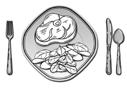
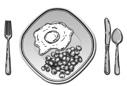
Distribute Assessment 31A. Briefly review the criteria for the End-of-Module Task.
introduction opinion statement two reasons (one for each food) two pieces of evidence (one for each food) temporal words to connect ideas opinion conclusion
Name:
31A: End-of-Module Task
Students orally rehearse their opinion paragraph and begin drafting the EOM Task.
Pairs orally rehearse their opinion paragraphs before drafting. Circulate to offer support in translating the notes into oral rehearsal.
Once students have orally rehearsed, they are ready to begin drafting. Circulate to offer support as needed; however, remember to encourage as much independence as possible at this point in the year.
Pull the class together with one minute remaining. Ask students to silently read what they have written so far. Explain to students that in the next lesson, they will get time to finish drafting and then revise their paragraphs.
10 MIN.
Remind students of their work with determining points Jamie Oliver made about trying new vegetables in Lesson 21.
Explain that now they will rewatch this video and think about what new vegetable or food they would be interesting in trying.
Project “Try Something New” by Jamie Oliver (http://witeng.link/0423).
Have students Stop and Jot about their taste-testing experience using the following or similar prompts:
What was the food?
When and where did you try it? How did you feel after trying it?
What did you learn from trying something new?
Tell students they will have the opportunity to share their experience with trying something new in the next lesson during the final Socratic Seminar of the module.
2 MIN.
Explain to students that for homework, they should practice retelling their experience with trying something new. Reiterate the fact that in the Socratic Seminar in Lesson 32, they will be asked to recount this experience and explain how it made them feel.
Remind students to use the notes they jotted in their Response Journal to assist with the recounting of their experience.
In this lesson, students build upon the knowledge of opinion writing that they have learned in this module. Since the evidence was collected in previous lessons, they are now ready to orally rehearse their opinion paragraphs and begin to draft the EOM Task (RI.2.1, W.2.1, W.2.8).
Students:
Refer to their evidence organizers to orally rehearse the opinion paragraph. Write independently, including all pieces of the opinion writing structure and the requirements on the EOM Task.
Support their opinions with reasons and evidence.
If students find it a challenge to transfer their notes into complete sentences, review what is required to have a complete sentence. Have them work directly on the evidence organizer to try to form complete sentences. Ask students to highlight the reason and evidence they plan to write about. Then guide them to go through the highlighted notes and look for or add a subject and verb to make complete sentences. Have them check that they used proper capitalization and punctuation, and that they convey complete thoughts. Then have them transfer the complete sentences to a full paragraph.
Time: 15 min.
Text: None
Vocabulary Learning Goal: Demonstrate understanding of module words by analyzing correct or incorrect use in context. (L.2.6)
Distribute Assessment 31B and repeat directions from Deep Dive Assessment Lesson 30.
Explain to students that they will take the second half of the Vocabulary Assessment and will answer questions in the same way they did in the previous lesson.
Begin the second half of the assessment, using the teacher-facing version in Appendix C. Read each question two times before students fill out their answers. As students work, make sure they are following directions correctly.
Name: Assessment 31B: Vocabulary Assessment 2
Provide oral cues as necessary if students need help locating the proper row and where to mark their answers.
Give students feedback on their effort. Point out positive effort such as students who took their time, students who revisited their answers to double-check, and students who wrote neatly.
This material is based on research from the following study and on materials based on the study created by Gail Kearns:
Kearns, Gail, & Andrew Biemiller (2010). Two-Questions vocabulary assessment: Developing a new method for group testing in kindergarten through second grade. Journal of Education, 190 (1/2), 31–41.
Welcome (7 min.)
Reflect on Writing Growth Launch (3 min.)
Learn (60 min.)
Revise and Share the End-ofModule Task (30 min.)
Speak to Recount an Experience in a Socratic Seminar (30 min.)
Land (5 min.)
Answer the Content Framing Question Wrap (1 min.)
Assign Homework
Style and Conventions Deep Dive: Distinguish between Formal and Informal Language (15 min.)
The full text of ELA Standards can be found in the Module Overview.
RL.2.1
Writing
W.2.1, W.2.5, W.10*
Speaking and Listening SL.2.1, SL.2.2, SL.2.4, SL.2.6
Language L.2.3.a
MATERIALS
Assessment 31A: End-of-Module Task
Handout 32A: Opinion Writing Checklist
Handout 32B: Socratic Seminar Self-Reflection
Speaking and Listening Anchor Chart
Complete and revise the opinion paragraph for the EOM Task. (W.2.1, W.2.5)
Finish writing the opinion paragraph for the EOM Task and add at least one linking word.
Share an experience about trying a new food. (SL.2.1, SL.2.2, SL.2.4, L.2.3.a)
Recount an experience in a Socratic Seminar.
Describe uses of formal and informal language. (L.2.3.a)
Complete the reflection questions on Handout 32B.
* This lesson prepares students for W.10, which first appears in the Grade 3 CCSS.
FOCUSING QUESTION: Lessons 28-32
How does food nourish us?
CONTENT FRAMING QUESTION: Lesson 32
Know: How do the module texts build my knowledge of nourishing food?
CRAFT QUESTION: Lesson 32
Execute: How do I speak formally to recount experiences in a Socratic Seminar?
Excel: How do I improve my opinion paragraph?
As Module 4 closes, students continue to improve their opinion writing as they revise the EOM Task. Finally, students reflect on their learning as they participate in a Socratic Seminar on how they have applied the knowledge they have gained about healthy, balanced eating.
7 MIN.
Acknowledge the tremendous growth that students have made in their writing throughout the year. Explain to students that to celebrate that growth, they will now take a moment to reflect on how their writing has changed from the beginning to the end of the year.
Instruct students to open their Response Journal to one of the first few pages and read one of their writing entries. Next to the entry, they should Stop and Jot what they notice about their writing.
Ask students to turn to a recent Response Journal entry and Stop and Jot what they notice about their writing from the end of the year. Encourage students to notice what has improved.
3 MIN.
Instruct students to Think–Pair–Share, and ask: “How has your writing changed over the year?” Circulate and choose two responses to share with the class.
Read aloud the Focusing Question and the Essential Question.
60 MIN.
30 MIN.
Post and read aloud the Craft Question: How do I improve my opinion paragraph?
Explain to students that today they are going to finish drafting their EOM Task and revise to include linking words.
Before giving students time to finish their drafts, guide them through the following review of linking words.
Ask: “How do linking words help make our writing more clear?” Have volunteers respond.
n Linking words help us make connections between sentences.
n They help us connect our opinion and reasons.
n They can make our writing sound smooth.
Remind students that for Focusing Question Task 4, they practiced connecting their opinion and their reason using the word because. Explain to students that they will now revise the EOM Task to include at least one linking word.
Explain to students that in this lesson, they will add the linking word also to help connect ideas in their writing. Point out to students that in this opinion paragraph, they have two different reasons. Have students silently reread the draft of their paragraphs, and ask: “Where might be a good place to add the linking word also?”
Confirm that the start of the second reason would be a helpful place to add the linking word also Explain that this is because students are offering another reason for why they chose their plate. Prompt students to work with a partner to insert also at the start of their second reason sentence.
Students may need additional practice with using the word because to connect their opinion and reason. If time allows, remind them of the sentence frame they used for Focusing Question Task 4. Students may want to use this sentence frame for their first reason sentence for the EOM Task:
I choose because . (plate) (reason)
After offering this instruction, give students time to finish completing their drafts and revising to include at least one linking word.
Students complete the EOM Task and revise to include at least one linking word.
Distribute Handout 32A to support students as they revise. After students work on adding a linking word, prompt them to use the checklist to make additional revisions.
Leave time to pair students with someone who chose a different plate than they did. Prompt students to read aloud their EOM Task paragraphs with one another. Encourage students to give each other one piece of positive feedback after their partner reads.
Applaud students for all of the great writing they did, not only on this challenging opinion piece, but throughout the year. Celebrate the growth that students made in informational, narrative, and opinion writing. Tell students that they are now ready to be Grade 3 writers and researchers.
Handout 32A: Opinion Writing Checklist


30 MIN.
Remind students of how, in the previous lesson, they reflected on the way they have taken Jamie Oliver’s challenge to “try something new.” Confirm that students jotted down notes in their Response Journal to help them remember the experience and then practiced recounting the experience for homework. Explain that in today’s Socratic Seminar they will practice recounting their experience and sharing how it made them feel.
Post the Speaking and Listening Anchor Chart and review the two most recent goals: Speak to recount. Choose between formal and informal language.
Allow students to verbally rehearse their experience with a partner before moving into the Socratic Seminar. Ask volunteers to demonstrate examples of formal and informal language for the class.
Review the expectations for a Socratic Seminar. Have students form the seminar circle.
Post and have students Echo Read the Socratic Seminar Opening Question: “What happened when you tried eating something new?”
It may be helpful to have students review their self-assessment checklist and feedback they received on their participation in the last Socratic Seminar to focus their attention on what they can improve in this one.
Students participate in the Socratic Seminar in which they recount a recent experience of trying something new.
Encourage independence in the Socratic Seminar. As needed, prompt or redirect student conversation using these follow-up questions: What did you learn from the texts about making good eating choices? How do the good eating choices we make keep us nourished? Did reading the module texts change the way you make food choices? Which text most inspired you to eat more healthfully?
Thank students for making so many rich connections about the Module 4 texts in this Socratic Seminar. Distribute Handout 32B so that students can self-assess their participation.
Explain that students will continue to reflect on this Socratic Seminar, especially when they used formal and informal language, during today’s Deep Dive.
Seminar
5 MIN.
Remind students of all of the important sharing they did in the Socratic Seminar about their experiences trying new foods.
Ask: “How did the experience of trying a new food help you build your knowledge about healthy food?”
n It helped me have the actual experience of eating a new healthy food.
n It helped me eat something different from what I usually do.
n It makes me want to keep trying new foods, like Jamie Oliver said.
Students turn to a partner and name one new food they might like to try. Prompt students to consider an idea that might be inspired by one of their classmates: Did a classmate try something particularly interesting?
1 MIN.
Students share what they have learned about good eating with their families.
Students recount an experience of trying a new food as part of the final Socratic Seminar of the module (SL.2.1, SL.2.4, L.2.3.a). Students: Verbally rehearse their recount with a partner. Participate actively in the seminar.
Respond to questions about their experience, including during the Vocabulary Deep Dive for this lesson.
Support students in using the Socratic Seminar Self-Reflection to consider their contributions to the seminar. In particular, use the last two reflection questions on Handout 32B to guide students in noticing the use of formal and informal language throughout the discussion. Offer concrete examples from the Socratic Seminar.
Time: 15 min.
Texts: All Module Texts
Style and Conventions Learning Goal: Describe uses of formal and informal language. (L.2.3.a)
STYLE AND CONVENTIONS CRAFT QUESTION: Lesson 32
Execute: How do I speak formally to recount experiences in a Socratic Seminar?
Thank students for their hard work and good conversation during today’s Socratic Seminar. Ask them to take out Handout 32B and note the reflection questions at the bottom.
Ask: “What have we learned about formal and informal language?” Have volunteers respond.
n That people use both formal and informal language.
n That people often use informal language around their friends or family members.
n That we use formal language when participating in Socratic Seminars.
Explain that students will now reflect on their use of formal and informal language, including when they were preparing for today’s Socratic Seminar.
Read through the reflection questions at the bottom of Handout 32B as students follow along.
Students complete the reflection on formal and informal language in Handout 32B.
Circulate as students work and support them in thinking back to the distinctions between formal and informal language.
Conduct a poll of who spoke formally when trying a new food and who spoke informally. Ask volunteers to describe the setting and explain why they spoke the way they did.
“Autumn Landscape,” Maurice de Vlaminck (http://witeng.link/0555) U.S. Marshals Escorting Ruby Bridges (http://witeng.link/0354)
Two Cheeseburgers, with Everything (Dual Hamburgers), Claes Oldenburg (http://witeng.link/0378) All Module 1–4 Core Texts
Welcome (10 min.)
Review Knowledge Journal Charts
Launch (4 min.)
Learn (55 min.)
Explore Change (30 min.)
Explore Choice (15 min.)
Write and Reflect (10 min.)
Land (5 min.)
Answer the Content Framing Question
Wrap (1 min.)
Celebrate with Family
The full text of ELA Standards can be found in the Module Overview.
RL.2.1, RI.2.1
Writing W.10*
Speaking and Listening SL.2.1
Knowledge Journal Charts
Answer questions about key details in texts. (RL.2.1, RI.2.1)
Participate in a Gallery Walk and make note of texts representing change
Chart paper
Sticky notes
* This lesson prepares students for W.10, which first appears in the Grade 3 CCSS.
FOCUSING QUESTION: Lesson 33
What is the story of the year?
CONTENT FRAMING QUESTION: Lesson 33
Know: How do this year’s texts build my knowledge?
In this final lesson of all four modules, students reflect on the knowledge and skills recorded in Knowledge Journal Charts. They then explore two key concepts that connect this learning: change and choice. They participate in a Gallery Walk, reviewing all core module texts through the lens of change. Once examples of people, places, and things changing have been charted, students analyze these examples for similarities and differences. Next, the concept of choice is explored and applied to selected visual art pieces and the charted examples of change. Finally, students are challenged to reflect on their own power to choose and make changes that can positively impact themselves and their world.
10 MIN.
Display the Knowledge Journal Charts from all four modules. Read aloud, or have volunteers read aloud, the entries in the What I Know columns.
Ask: “What new knowledge do you most want to remember from each module?” Provide a moment of quiet self-reflection. Then have students Stop and Jot in Response Journal about the new knowledge they most want to remember from each module.
4 MIN.
Read aloud the Content Framing Question.
Ask: “Why have we recorded new knowledge and skills learned on the Knowledge Journal Charts all year?” Have volunteers respond.
Use responses to emphasize how learners keep track of their learning so they can celebrate their hard work and continue to grow. Learners also know that it is important to review and reflect on their learning. Explain that, in this lesson, students will look back at the knowledge they gained throughout this year, focusing on the ideas of change and choice.
Learn55 MIN.
EXPLORE CHANGE 30 MIN.
Whole Group
TEACHER NOTE Before this lesson, arrange texts from each module in different locations of the classroom.
Instruct students to think back to Module 1 and their study of change. Ask: “What does it mean for something to change?” Have volunteers respond.
Display the following piece of art from Module 1:
“Autumn Landscape,” Maurice de Vlaminck (http://witeng.link/0555)
Remind student of their study of this piece back in Module 1 and highlight relevant entries on the Module 1 Knowledge Journal Chart.
Ask: “How does this piece of art add to our understanding of the word change?” Use Equity Sticks to choose students to respond.
n Leaves change color in the fall.
n Seasons change, and the picture shows how places change during the seasons.
n People change what they do during the fall and other seasons.
Redirect students’ attention to the Knowledge Journal Charts. Ask volunteers to highlight the knowledge on the Knowledge Journal Charts that relates to the concept of change, such as seasonal changes in Module 1 or the change in Sylvia Mendez’s feelings in Module 3.
As students mention examples of people, places, and things, write the words people, places, and things as headings of a three-column chart, and record a few examples in each column. If students do not mention examples of all three, guide them to do so with general questions, such as: “What did we learn about people who changed?”
Create and display a three-column chart for each module.
Module 1 A Season of Change
Module 2 The American West Module 3 Civil Rights Heroes Module 4 Good Eating
Explain that students will now take a Gallery Walk around all the texts for all four modules and look for examples of at least one person, one place, and one thing that changed. Distribute sticky notes and establish a procedure for students moving between the Gallery Walk stations.
TEACHER NOTE
Consider creating a slideshow of module art to project during the text Gallery Walk. Encourage students to reflect on how the artwork further adds to their understanding of change.
Students conduct a Gallery Walk to answer which texts serve as examples of change.
Alternatively, have students create and complete charts in their Response Journal. Then have volunteers offer ideas to be recorded on a single class chart.
Module 1 A Season of Change narrator in “Weather” the woods during different seasons leaves change color
Module 2 The American West John Henry Native Americans pioneers
Module 3 Civil Rights Heroes Sylvia Mendez people who discriminated
the prairie the buffalo
Washington, D.C. the United States laws
Module 4 Good Eating Dr. Burke the shamas the town in Bone Button Borscht food during digestion
Use probing questions to support students in finding similarities and differences between the notes from each module row. For example:
What do you notice about the chart? Are there more examples of change in certain rows or columns than in others?
What are some similarities between changes related to people? In what ways are the things that change similar and different? Use a variety of questioning strategies to increase engagement.
15 MIN.
Explain that, in addition to change, students explored other key ideas across modules. Highlight the word choose from the Module 4 Knowledge Journal Chart. Remind students of their learning in Module 4 about making choices. Discuss the meaning of choose/making choices, emphasizing that students each have the power to make choices every day. Ask: “What are some choices you have already made today or this week?” Have volunteers respond.
Display the following pieces of art from Modules 3 and 4:
U.S. Marshals escorting Ruby Bridges (http://witeng.link/0354)
Two Cheeseburgers, with Everything (Dual Hamburgers), Claes Oldenburg (http://witeng.link/0378)
Ask: “How do these pieces of art add to our understanding of the word choice?” Encourage students to make connections between the artwork.
n Ruby Bridges couldn’t choose her school, but her parents did choose to send her to the white school. She did choose to do her best though.
n I can choose to eat what’s best for me. I might not choose a cheeseburger all the time now.
n The people who watched Ruby go to school made bad choices because they were mean. People sometimes make bad choices in how they treat other people and in how they eat.
n Choosing can be good or bad, and sometimes it is hard to tell if it’s good or bad. Eating cheeseburgers might seem like a good choice because they taste good, but maybe when you’re old and not healthy you’ll wish you didn’t make those choices.
Connect back to the Knowledge about Change Chart by asking, “Which of these people, places, and things did and did not choose to change? How do you know?”
n Trees can’t choose to lose their leaves. That’s just nature.
n Johnny Appleseed and John Henry both chose to do what they did for America, but they didn’t choose to be famous. Other people remembered them and told stories about them. The prairie didn’t choose to be destroyed. People did that, but they didn’t know they were making a bad choice by planting crops there. Sometimes people don’t know how their choices will impact other people or things.
Affirm that people have the power to make choices every day, but with this power comes the responsibility of making good choices.
Instruct students to Think–Pair–Share, and ask the following reflection questions:
What do you hope to change in the future?
What might help you make good choices?
Emphasize that their choices do affect themselves and other people, places, and things. Encourage students to remember this as they make more and more independent choices.
Congratulate students on their new understandings about the words change and choice.
Post the following sentence frames and have students complete them in their Response Journal.
I can choose to make a change in my world. I will I can make good choices for myself. I will
This activity could easily be adapted into a class book, bulletin board, or other format for display. Consider collecting students’ responses to share with families or other members of the school community.
5 MIN.
Students Mix and Mingle to share their Response Journal writing from this lesson.
1 MIN.
Students share their learning from the year with their families.
Analyze Next Steps
Students engaged in a retrospective, focused on the themes of change and challenge. Consider one of the following strategies to create authentic audiences for students’ reflections:
Invite a Grade 1 class to visit and have students escort them through the Gallery Walk, previewing next year’s text.
Have students create a “Top Ten of What I’ll Always Remember from Second Grade” and post them in the hallway.
Invite families to join in the celebration of knowledge and skills.
Great Minds® carefully selects content-rich, complex module texts. Module texts, especially the core texts, must be appropriately challenging so that students develop their literacy skills and progress toward meeting Anchor Standard for Reading 10 by year’s end. Great Minds evaluates each core module text using quantitative and qualitative criteria outlined in both the Common Core State Standards (CCSS) (http://witeng.link/0483) and the updated CCSS Appendix A guidance on text complexity (http://witeng.link/0093).
This Appendix provides text-complexity details for each core text in order of appearance in the module. The analysis supports teachers and administrators in understanding the texts’ richness and complexity and the module’s knowledge building and goals. Alongside the Family Tip Sheets, this information can also support conversations with families about texts.
For ideas to support multilingual learners see the Wit & Wisdom® Multilingual Learner Resource.
Core module texts:
Title and Author Good Enough to Eat: A Kid’s Guide to Food and Nutrition, Lizzy Rockwell
Description of Text This informational text explains how the foods we eat help us stay healthy. Starting with how food helps our bodies stay active and alert, the text goes on to explain the nutrients in foods, how nutrients are released through the digestive process, and finally, what kinds of foods contain nutrients.
Complexity Ratings
Quantitative: AD740L
Qualitative:
Meaning/Purpose: This book provides excellent information about nutrition for young readers through the text and the illustrations. The purpose is clear and consistent throughout and focuses on how the foods we eat provide the nutrition we need to stay healthy.
Structure: The structure of the text goes from the big idea of how food helps us, to the idea of nutrients in food, and then narrows the focus to foods that contain specific nutrients. The text ends with tips and recipes for healthy eating. There are no text features to support readers in their understanding of the structure of the text, so supports may be needed.
Language: A dense technical vocabulary load for young readers adds to the complexity of the text. Sentences are fact-filled and about the same length throughout.
Knowledge Demands: The text covers a high level of discipline-specific knowledge about healthy eating and the nutrients in food.
Placement
While the content is dense and uses terms that students may find challenging, the illustrations are whimsical and engaging. Text features including captions, speech bubbles, interesting page layouts, charts, and recipes further support readers. Students may need additional support, however, as this text lacks common text features such as chapter headings, a glossary, and an index.
Good Enough to Eat opens the module to introduce students to key concepts of Module 4. Students return to Good Enough to Eat later in the module to support their work with research sources.
This informational text explains how the digestive system works and some of the problems associated with the digestive tract. This engaging text, illustrated with photographs, includes varied supportive text features.
Quantitative:
660L
Qualitative:
Meaning/Purpose: This book provides excellent information about digestion for young readers through the text, text features, and illustrations. The purpose is clear and consistent throughout and focuses on individual aspects of the digestive process.
Structure: The structure of the text is a well-crafted procedural essay. The opening dialogue hooks the reader before the focus is stated, and the steps of the digestive process follow. The text ends with a discussion of digestive problems, and the conclusion restates and extends the information in the text in a way that makes the central message clear to the reader.
Language: The text is fact filled, and sentences contain a high volume of technical vocabulary that may challenge young readers. However, the inclusion of a glossary and other supportive text features aids comprehension.
Knowledge Demands: The text requires a high level of discipline-specific knowledge about digestion and the problems with digestion.
The content is dense and includes terms that may be unfamiliar but varied well-designed text features support young readers. Students may recognize children like themselves in the photographs, which depict a variety of children involved with food in a positive way.
Paired with Taylor-Butler’s text of the same name, The Digestive System builds content knowledge about how the food we eat turns into nutrients in our bodies. This scientific information is essential to students’ understanding of module concepts.
This informational text, like the other text of the same name, explains how the digestive system works and some of the problems associated with the digestive tract. This engaging text is illustrated with photographs and labeled diagrams that depict the digestive process.
Complexity Ratings
Quantitative:
750L
Qualitative:
Meaning/Purpose: The purpose of the text is straightforward: It offers information about the digestive system and problems that can occur if people do not eat food that is healthy for their body.
Structure: The structure is straightforward with chapter titles and subheadings to help navigate the subtopics. The author engages young readers by starting with a chapter about gas and then details the steps of the digestive system before sharing information about digestive disorders. The text ends with a chapter on how to be “fit for life.”
Language: The text has a dense technical vocabulary load for young readers. Sentences are complex and fact filled.
Knowledge Demands: The text requires a high level of discipline-specific knowledge about the digestive system.
The content is dense and includes content-specific vocabulary, but many text features, including diagrams, vocabulary in boldface type, a glossary, a thorough bibliography, an index, and pictures with captions, support young readers.
Paired with Prior’s text of the same name, The Digestive System builds content knowledge about the way the food we eat turns into nutrients in our bodies. This scientific information is essential to students’ understanding of module concepts.
Description of Text Stone Soup is a folktale about three hungry soldiers who come to a town wanting a place to sleep and some food to eat. In that village they find healthy peasants who will not share with them. To meet their needs, the soldiers work together to trick the peasants into making soup by using special stones and thereby capitalizing on the peasants’ natural curiosity. At the end, the soldiers have befriended the townspeople, celebrated a delicious meal with them, and found comfortable beds for the night. The townspeople find something they were not even looking for: a greater camaraderie with their neighbors.
Complexity Ratings
Quantitative:
AD550L
Qualitative:
Meaning/Purpose: The purpose of sharing and working together is clear to the reader, if not the peasants, in this accessible story.
Structure: The story structure is clear, with a beginning, middle, and end and all the basic story elements. The illustrations are an excellent match for the story. When studied closely, the illustrations provide more information about the villagers and their reactions to the soldiers.
Language: The vocabulary is accessible for most Grade 2 students.
Knowledge Demands: Basic knowledge of story structure and some discussion of the setting will help make this text accessible to all students.
Title and Author Stone Soup, Marcia BrownWith Stone Soup, students are encouraged to wonder how food can nourish a community. Students first listen to and read the folktale, with the goal of independently making observations and generating how and why questions. Then later Stone Soup is used later in a New-Read Assessment. The text’s accessibility makes it an appropriate text for assessment of students’ reading skills.
This accessible text serves as a transition from students’ work with informational texts about food and the digestive system toward work with literary texts that engage these topics. The concept of “health” in Stone Soup is thematic and emphasizes the community and social aspects of eating, connecting to students’ work with Aubrey Davis’s Bone Button Borscht.
Description of Text Another version of the Stone Soup folktale, Bone Button Borscht is a wonderful story about a hungry beggar who comes to a expecting food, a warm fire, and a place to sleep but instead finds a town that is shuttered and populated by villagers who will not share with anyone. The beggar thinks of a way to trick the villagers into making “miracle” soup together by using the buttons from his coat, capitalizing on the natural curiosity of the people to meet his needs. In the end, the villagers realize buttons are not needed to bring people together. They learn the message the beggar brought to the town: When we share with others, we all benefit.
Complexity Ratings
Quantitative: 300L
Qualitative:
Meaning/Purpose: The purpose of sharing with others is clear in this beautifully written and illustrated text about people in a small village who learn an invaluable lesson. This text is well crafted and can be appreciated on many levels.
Structure: Inventive illustrations and deliberate use of color add to the richness of this story and complement the plight of the main character. The story progresses chronologically and has a touch of a cumulative tale in the pictures as the townspeople gradually come together while making the soup.
Language: A dense cultural vocabulary load needs to be addressed if young readers are going to fully appreciate the text. The book is full of humor that even young readers will appreciate.
Knowledge Demands: Basic knowledge of story structure will help make this text accessible to all students. Some background information about the cultural references and the setting of the story may be needed.
Students listen to the story, independently generating questions, and demonstrate independence in recounting a story, taking ownership of routines they have practiced all year. Students reread specific passages to discover how the author’s words reveal characters and how illustrations add to the story before distilling the story’s essential meaning.
This accessible text allows students to apply what they have learned about food to a literary context and to apply skills they have practiced throughout Grade 2. Work with Bone Button Borscht also connects to students’ analysis of Marcia Brown’s Stone Soup, supporting their success on the New-Read Assessment.
Title and Author Bone Button Borscht, Aubrey DavisDescription of Text This informational text is a straightforward explanation of the six different parts of a plant that can be a vegetable: the stem, leaves, roots, bulbs, fruit, and flowers. Most of the text is composed of colorful illustrations that show students the different types of vegetables, with scientific facts spread throughout. The second part of the book, distinct from the first half, gives students a closer look at how and where food is grown, comparing a small home garden to a large produce farm.
Quantitative:
660L
Qualitative:
Meaning/Purpose: The purpose of this text is twofold in that it teaches students the different categories of vegetables based on the parts of the plant they come from, and, more importantly, it helps students understand the process of how food is grown and transported to stores and ultimately to their plates.
Structure: The structure is not typical informational text structure. The illustrations, labels, and sidebars provide a significant amount of information with the text simplistically explaining the concepts presented.
Language: The text names many vegetables that may be new to students, and the vocabulary specific to farming/gardening may also be new; however, all the vocabulary is generally accessible.
Knowledge Demands: Background knowledge of a variety of vegetables may be useful.
Students apply their understanding of how illustrations reveal meaning in an informational context. Students also examine text features such as headers and labels to further their understanding and to discern the author’s purpose. A vocabulary game and supplementary materials, such as a student-created rap, support students’ understanding of the complex vocabulary in this text.
Students’ work with The Vegetables We Eat prepares them to return to the complex text Good Enough to Eat as they synthesize knowledge from the texts they have read throughout the module. The Vegetables We Eat also provides content information that students use in their opinion writing.
Wit & Wisdom focuses on teaching and learning words from texts. Students develop an awareness of how words are built, how they function within sentences, and how word choice affects meaning and reveals an author’s purpose.
The purpose of vocabulary study in Wit & Wisdom is to achieve the following three key student outcomes:
Improve comprehension of complex texts.
Increase students’ knowledge of words and word parts (including affixes, Latin or Greek roots, etc.).
Increase students’ ability to solve for unknown words on their own.
To achieve these outcomes, vocabulary study in Wit & Wisdom emphasizes the following three categories of vocabulary words:
Content-Specific Vocabulary: Necessary for understanding a central idea of the domain-specific text and/or module topic).
Academic Vocabulary: “High-priority” words that can be used across disciplines and are likely to be encountered in other texts. Often abstract and with multiple meanings, these words are unlikely to be known by students with limited vocabularies.
Text-Critical Vocabulary: Words and phrases that are essential to students’ understanding of a particular text or excerpt.
Vocabulary study in Wit & Wisdom will occur within the following types of instruction:
Core 75-minute daily lessons: Vocabulary study that is essential to understanding the text at hand. Instructional strategies are explicitly introduced and practiced during vocabulary instruction and put into practice during a reading of a text.
Vocabulary Deep Dives: Vocabulary instruction and practice that advance students’ knowledge of high-value words and word-solving strategies, focusing on aspects such as abstract or multiple meanings, connotation, relationships across words, and morphology.
Vocabulary learning is assessed indirectly through application, and directly through two-question assessments (Kindergarten–Grade 2) and sentence assessments (Grades 3–8).
Indirect Assessment: Students are expected to use and incorporate words from the following list into their academic discourse, through speaking and listening (during Socratic Seminars), and writing (during formal writing tasks, such as the EOM Task).
Direct Assessment: Students’ word knowledge will also be evaluated directly through definition assessments. Assessment words are selected because of their importance to the module’s content as well as their relevance and transferability to other texts and subject areas. Teachers should make this list of assessed words available to students. (List of assessment words can also be broken down into smaller word banks for ease of use.)
The following is a complete list of all words taught and practiced in the module. Those that are assessed, directly or indirectly, are indicated.
The Digestive System, Christine Taylor-Butler; The Digestive System, Jennifer Prior Lesson Number Word ContentSpecific Academic Text Critical Teaching Strategy Assessment
Deep Dive; teacherprovided definition
Direct Assessment in Deep Dives 30 and 31 1 DD, 2 system
1 DD digest
Deep Dive; teacherprovided definition 1 DD, 2 digestive Deep Dive 1, 2, 9 nourish
Word Wall; teacherprovided definition 2 DD starches Deep Dive; glossary Direct Assessment in Deep Dives 30 and 31 2 DD, 3 esophagus Deep Dive; glossary Direct Assessment in Deep Dives 30 and 31 3 DD mucus
Deep Dive; glossary Direct Assessment in Deep Dives 30 and 31 3 DD, 4 gastric
Deep Dive; glossary; TDQ Direct Assessment in Deep Dives 30 and 31 2 DD, 3 DD, 4 glossary
Teacherprovided definition; Deep Dive 4 index
Teacherprovided definition 4 table of content
Teacherprovided definition
Teacherprovided definition
Teacherprovided definition
Teacherprovided definition
stomach
TDQ; Response Cards
TDQ; Response Cards
TDQ; Response Cards
TDQ; Response Cards
Deep Dive; context clues Direct Assessment in Deep Dives 30 and 31
Deep Dive; context clues
Direct Assessment in Deep Dives 30 and 31 G2 M4 Appendix B: Vocabulary WIT & WISDOM® 437
Understanding vocabulary and building background knowledge are essential for students’ comprehension of complex text. Wit & Wisdom students study topics for an extended period, building background knowledge. However, students may need additional support with unfamiliar vocabulary as they access complex text.
The words listed here may pose a challenge to student comprehension. Provide definitions or a glossary for these challenging words so that students will comprehend complex text. Use a free resource such as Wordsmyth (http://witeng.link/glossary) to generate glossaries for students.
, Christine
acid (3, 16) dissolve (3) mold (5) aches (7) fuel (8) familiar (11) contract (14) release (16) mucus (16) bloodstream (18, 20, 30) blobs (19) lined (20) vessels (20) harmful (21) substances (21) indigestible (22) disorder (27) fluttery (27) dairy (28) toxins (29) reflex (30) vomiting (30) properly (31) wounds (31) require (35)
expert (35)
surgeon (36) remained (36) vigorous (42) convert (42) species (43)
The Digestive System, Jennifer Prior stalling (4) bloodstream (4) journey (5) fuel (6) feast (8) salivating (11) contractions (13) pouch (14) diagram (17) particles (17) colon (18) prevent (22)
spoiled (23) illnesses (23) nauseated (23) track (26) carbonation (27) process (28) machine (29)
Stone Soup, Marcia Brown harm (6) peasants (6) loft (8) wells (8) cellars (9) quilts (9)
spare (10) harvest (10) square (16) boil (20) fetch (24) steaming (31) torches (33) feast (34) banquet (34) roast (34) cider (34) wise (39) splendid (39)
Bone Button Borscht, Aubrey Davis beggar (2) bitter (2) rosy (2) borscht (2) host (2) crest (3) peered (3) vanished (4) spotted (6) synagogue (9) caretaker (9) shamas (9) glimmer (9) scoffed (10) ladle (11) tailor (11) marched (15) chattered (15)
sliced (22)
diced (22) chopped (22) shredded (22) dumped (22) aroma (22) rumbled (22) snatched (24) fasten (27)
The Vegetables We Eat, Gail
perennials (3) annuals (3) bulb (7, 10) edible (14) stem (7, 15) pods (18) substances (21) harvesting (21) mound (22) trowel (22) regularly (23) weeded (23) containers (24) fertilize (26) plowed (26)
sprinkling (27) haul (28) processing (28)
canned (28) shipped (29) display (30)
howl (7) grumbles (7) nick (8) protects (10) energizes (10) germs (11) carbohydrates (12) protein (12) supply (14) excess (14) grinds (15) churns (15) boosts (17) repairs (18) sources (19) lantern (20) calories (20) escapes (23) particles (26) variety (27)
Lesson 6: Student Activity Game Cards
Assessment 6A: Focusing Question Task 1 Sample Response
Assessment 13A: Focusing Question Task 2 Sample Response
Assessment 15A: New-Read Assessment 1 Answer Key
Lessons 16 and 32: Grade 2 Speaking and Listening Rubric
Assessment 19A: Focusing Question Task 3 Sample Response
Assessment 21A: New-Read Assessment 2 Answer Key
Assessment 23A: New-Read Assessment 3 Answer Key
Assessment 26A: Focusing Question Task 4 Sample Response
Assessment 28A: New-Read Assessment 4 Answer Key
Assessment 30A: Vocabulary Assessment Part 1 Answer Key
Assessment 31A: EOM Task Annotated Sample Response
Assessment 31B: Vocabulary Assessment Part 2 Answer Key
Lesson 32: Grade 2 Opinion Writing Rubric
Rubrics,
Directions: Cut out the game cards and follow the directions found in Deep Dive 6. The answer key is at the bottom of the handout.
I have don’t who has have not?
I have they’re who has is not?
I have haven’t who has we are?
I have isn’t who has that is?
I have we’d who has it is?
I have I’ve who has does not?
I have what’s who has would not?
I have it’s who has we will?
I have doesn’t who has could not?
I have wouldn’t who has should not?
I have we’re who has they are?
I have that’s who has we would?
I have we’ll who has I’ve?
I have couldn’t who has what is?
I have shouldn’t who has are not?
I have aren’t who has has not?
I have hasn’t who has was not?
I have didn’t who has he is?
I have you’re who has he will?
I have he’s who has you will?
I have he’ll who has she is?
I have wasn’t who has did not?
I have you’ll who has you are?
I have she’s who has they have?
I have they’ve who has do not?
The following lists the answers for the game in order:
1. I have don’t, who has have not?
2. I have haven’t, who has we are?
3. I have we’re, who has they are?
4. I have they’re, who has is not?
5. I have isn’t, who has that is?
6. I have that’s, who has we would?
7. I have we’d, who has it is?
8. I have it’s, who has we will?
9. I have we’ll, who has I have?
10. I have I’ve, who has does not? 11. I have doesn’t, who has could not? 12. I have couldn’t, who has what is? 13. I have what’s, who has would not?
14. I have wouldn’t, who has should not?
15. I have shouldn’t, who has are not?
16. I have aren’t, who has has not?
17. I have hasn’t, who has was not?
18. I have wasn’t, who has did not? 19. I have didn’t, who has he is? 20. I have he’s, who has you will? 21. I have you’ll who has you are?
22. I have you’re, who has he will? 23. I have he’ll, who has she is?
24. I have she’s, who has they have?
25. I have they’ve, who has do not?
Focusing Question: How can food nourish my body?
Prompt: Choose either the stomach or the small intestine. What important jobs does this organ do as part of the digestive system? Conduct shared research in a small group. Then, individually, write an informative paragraph that includes at least two pieces of evidence from the text (W.2.2, W.2.7, W.2.8, RI.2.1, L.2.2.c).
Support your response using evidence from the following source: The Digestive System, Christine Taylor-Butler
Be sure to include all of the following in your response: an introduction a topic statement two pieces of evidence from The Digestive System a conclusion correct contractions (if used)
Sample Response: Sample A:
n There are many parts of the digestive system. The stomach is one part that does important jobs. The stomach muscles squeeze and mash food. The stomach makes gastric juices. They break down protein. The stomach is an important part of the digestive system.
n Many parts of the body help digest food. The small intestine does important jobs. It breaks down food even more. The organ has bumps to help absorb nutrients. The small intestine plays a big part in the digestion of food.
Focusing Question: How can food nourish a community?
Prompt: Who benefited the most from making the soup in Bone Button Borscht? Write an opinion paragraph (RL.2.1, W.2.1, W.2.8).
Support your opinion using evidence from the following source:
Bone Button Borscht, Aubrey Davis
Be sure to include all of the following in your response: an introduction an opinion statement one reason for the opinion two pieces of evidence an opinion conclusion
Sample Response:
Sample A:
n Bone Button Borscht is a story about a magic soup. The townspeople in the town benefit the most from making the soup. One reason is that the village gets more friendly. The people cook and eat together and have fun. Another reason is that the townspeople learn to share. They share what they have to make the soup. The townspeople benefit most because they learn these lessons.
n Bone Button Borscht is a story about sharing. I think the beggar benefits the most. I think this because he gets his wish. The beggar wishes for a warm fire, soup, and noodle pudding. He hears voices in his head asking him if he wants more food. At the end, his thoughts came true. He ate soup with the villagers. People spoke nicely to him. The beggar benefits the most because his dreams came true.
Answer
1. C
2. The pictures help me see that the setting is a small town with lots of animals to feed.
3. Setting Character
Illustrations on pages 30–35 -party -eating at night (fires) -lots of food
Words on pages 30–35 -“lighted torches” (33) -“great tables” (33) -“feast” (34)
How do all the words and pictures listed above help you understand the setting and characters?
-lots of people -everyone smiling -young and old
RL.2.1, RL.2.7
RL.2.1, RL.2.7, W.2.10
RL.2.1, RL.2.7, W.2.10
-soldiers are tricky (31) -“Never had the peasants tasted such a soup.” (34)
They show and tell me how excited and happy everyone is at the feast.
Grade 2 Speaking
Structure Asks clarifying and probing questions about key details Answers clarifying and probing questions about key details Requests elaboration to further understanding Speaks on topic and prompts others to do the same
Development Reports thoroughly on topics and texts using relevant and descriptive details Recounts stories and experiences with appropriate facts and relevant details Anticipates and provides clarification when speaking
Asks questions about key details Answers questions about key details Requests more information to clear up confusion
Speaks on topic
Reports on topics and texts using relevant and descriptive details Recounts stories and experiences with appropriate facts and relevant details Provides clarification when requested
Rubrics,
Listening 4 (Exceeds expectations) 3 (Meets expectations) 2 (Partially meets expectations) 1 (Does not yet meet expectations)
Asks questions
Answers questions
Sometimes requests more information
Speaks about related ideas
Does not ask questions
Does not answer questions
Does not request more information
Speaks off topic
Reports on topics and texts using details Recounts stories and experiences with some facts and details Says more when requested
Uses drawings when speaking Expresses ideas and feelings Uses inflection to indicate questions or statements G2 M4 Appendix C: Answer Keys,
Does not yet report on topics and texts using details Does not recount stories and experiences Does not respond to requests
Does not use drawings Does not express ideas and feelings Does not yet use inflection and Sample Responses WIT & WISDOM® 455 This page may be reproduced for classroom use only.
4 (Exceeds expectations)
Conventions Expresses clearly with effective volume
Speaks in coherent and complex sentences
Process Alternates speaking and listening in conversations through multiple exchanges
Follows all agreedupon rules for conversations
Links comments to comments of others effectively
Uses kind words and tone
3 (Meets expectations) 2 (Partially meets expectations) 1 (Does not yet meet expectations)
Speaks audibly and clearly Speaks in coherent sentences
Speaks audibly or clearly Speaks in complete sentences
Does not yet speak audibly and clearly Does not yet consistently speak in complete sentences
Speaks in conversations through multiple exchanges
Follows most agreed-upon rules for conversations
Links comments to comments of others Uses kind words
Speaks in conversations
Follows some agreed-upon rules for conversations Sometimes links comments to comments of others Sometimes uses kind words
Does not yet speak in conversations
Follows few, if any, agreed-upon rules for conversations
Rarely, if ever, links comments to comments of others Does not yet use kind words
Focusing Question: Where does nourishing food come from?
Prompt: Where does nourishing food come from? Describe how food is created on a big farm. Write an informative paragraph that includes the steps and the connections between them (RI.2.1, RI.2.3, W.2.2, W.2.8, L.2.2.c).
Support your response using evidence from the following source:
The Vegetables We Eat, Gail Gibbons
Be sure to include all of the following in your response: an introduction a topic statement three steps (at least) one or two temporal words to connect steps two details (at least) about any of the steps a conclusion
Sample Response:
n Vegetables keep us healthy. Some grow on big farms. First, farmers prepare the soil. They use plows to turn over the soil. Next, they plant the seeds. Big trucks help them to plant the seeds. Then they take care of the plants. Lastly, the plants grow. Big farms grow many of the vegetables we eat.
Text: The Digestive System by Christine Taylor-Butler
Answer
1 B, Chapter 3 Digestive Disorders
Relevant Standards
RI.2.5
2 Heartburn and Ulcers RI.2.5
3 Pages 16, 24, 36 (31) RI.2.5
4 Heartburn is … a burning feeling in your esophagus
5 It happens when … your esophagus doesn’t close and stomach acid gets into it.
RI.2.1
6 a medicine that kills bacteria RI.2.5
7 Pages 10–11, 24, 29 (31) RI.2.5
8 From the text I learned that antacids reduce acid in gastric juice (so ulcers can heal).
9 From the caption I learned that antacids can take away pain.
10 From the glossary I learned that antacids make acids less strong.
11 Answers may vary. A few possible options: pepper, chili peppers, hot sauce, dumplings, and so on.
12 A shark attacks its prey.
RI.2.1, RI.2.5
L.2.5.a
L.2.5.a
Text: Good Enough to Eat by Lizzy Rockwell
Answer
1 5 Steps RI.2.1, RI.2.3
2 B RI.2.1, RI.2.3
3 C RI.2.1, RI.2.3
4 The stomach churns food and adds acids. RI.2.1, RI.2.3, W.10
5 C RI.2.1, RI.2.3
6 First, the mouth grinds the food. Second, the esophagus pushes food down to the stomach. Next/Then, acids combine with food to make a thick liquid. Then/Next, the small intestine absorbs nutrients. Finally, the large intestine gets rid of unused foods when you go to the bathroom.
RI.2.3, W.10
7 I can eat foods with fiber. RI.2.1, RI.2.3, W.2.10
Focusing Question: How can I choose nourishing foods?
Prompt: Consider the following options: strawberries, oranges, carrots, and broccoli. Which one would you choose to benefit your body? Support your opinion with evidence (RI.2.1, W.2.1, W.2.7, W.2.8, L.2.2.d, L.2.2.e).
Be sure to include all of the following in your response: an introduction opinion statement a reason two pieces of evidence to support the reason opinion conclusion temporal words to connect opinion and reason (at least one)
Sample Responses:
Sample A:
n Healthy foods keep my body healthy. I choose strawberries to nourish my body. Strawberries have vitamin C. Vitamin C helps my skin to heal. It also gives me strong teeth. This is why I choose strawberries to help me stay healthy.
Sample B:
n Healthy foods keep my body healthy. I choose oranges to nourish my body. Oranges have vitamin C. Vitamin C helps my skin to heal. In addition, it keeps my bones strong. This is why I choose oranges to help me stay healthy.
Sample C:
n Healthy foods help to keep my body healthy. I choose carrots to help me nourish my body. Carrots have vitamin A. Vitamin A helps me see in the dark. It also helps keep my immune system strong. This is why I choose carrots to help me stay healthy.
Sample D:
n Healthy foods keep my body healthy. I choose broccoli to nourish my body. Broccoli has vitamin B. B complex vitamins help fight germs and infection. They also turn food into energy. This is why I choose broccoli to keep me healthy.
Text: “Debate! Should Sugary Drinks Be Taxed?” by Brenda Iasevoli
1. Point: Some cities and states are trying to tax soda.
Reasons:
Soda has a lot of sugar.
Many people in America are getting sick.
2. I think she wrote this to give people information about sugar in soda. She says that soda is where we get most of our sugar from.
1. Digest: If you throw up, did your body digest the food you just ate? (No)
2. Esophagus: Is the esophagus a tube? (Yes)
3. Starches: Do starches give your body long-lasting energy? (Yes)
4. Mucus: Does mucus protect our bodies? (Yes)
5. Belch: Are belches silent? (No)
6. Gastric: If you have gastric pain, does your head hurt? (No)
7. Absorb: Does a rock absorb water? (No)
8. Trudge: If you trudge to an appointment, are you excited about getting there? (No)
9. Hobbled: Might a player hobble off the field if she gets hurt? (Yes)
10. Cram: If you have two books in your backpack, is your backpack crammed with books? (No)
11. Energy: Does food give people energy? (Yes)
12. Cooperate: If students did not work together on a group project, did they cooperate? (No)
13. Signal: Is a fire alarm a signal to leave a building? (Yes)
14. Nourish: If someone ate only candy for dinner, did he nourish his body? (No)
15. Nutrients: Are nutrients found only in water? (No)
Essential Question: How does food nourish us?
Prompt: Look closely at the two images of plates. Which meal would you choose to nourish your body and why (RI.2.1, W.2.1, W.2.7, W.2.8)?
Support your response using evidence from the following sources:
Good Enough to Eat, Lizzy Rockwell “Eating Your A, B, C’s ...” infographic
Students write an opinion paragraph choosing between two plates of food to nourish their body.
With prompting and support, students conduct shared research to collect evidence from two sources.
Students collect notes on a graphic organizer.
Students write opinion statements based on a reason and two pieces of evidence.
Students orally rehearse their opinion paragraphs, making sure to include all parts of the opinion paragraph structure: an introduction, opinion statement, two reasons (one for each food), two pieces of evidence (one for each food), temporal words, and an opinion conclusion.
Students draft an opinion paragraph.
Students revise their opinion paragraph using an Opinion Writing Checklist.
Students share their revised paragraphs with a partner.
Sample A:
n Healthy foods can help your body. I would choose Plate 1 to help nourish my body. First, meat has B complex vitamins. Vitamin B helps my body turn food into energy. Second, spinach has B complex vitamins too. Vitamin B also helps the body fight germs. I would choose Plate 1 to nourish my body.
Sample B:
n Healthy foods help your body. I choose Plate 2 to nourish my body. First, eggs have vitamin A. Vitamin A is good for my eyes. Second, blueberries have vitamin C. Vitamin C helps my skin heal. I choose Plate 2 to nourish my body.
1. Digest: When your body digests food, does it break it down? (Yes)
2. Esophagus: Does the esophagus push food out of your mouth? (No)
3. Starches: Do starches take away our energy? (No)
4. Mucus: Is mucus hard? (No)
5. Absorb: Can soil absorb water? (Yes)
6. Energy: If a child has a lot of energy, will he want to go to bed? (No)
7. Cram: Could a busy store be crammed with shoppers? (Yes)
8. Signal: Is food a signal? (No)
9. Nourish: If you gave a plant water and sunlight, did you nourish it? (Yes)
10. Gastric: Are gastric muscles the same as stomach muscles? (Yes)
11. Trudge: Is trudging somewhere slower than running there? (Yes)
12. Hobbled: Would a track star hobble down the track? (No)
13. Cooperate: If a soccer team passed the ball to score a goal, did the team cooperate? (Yes)
14. Belch: Does air leave your body when you belch? (Yes)
15. Nutrients: Do healthy foods have lots of nutrients? (Yes)
1 (Does not yet meet expectations)
Does not respond to prompt; offtopic Does not introduce or reference topic or book Does not state an opinion Does not supply a reason Does not provide closure Does not use linking words
2 (Partially meets expectations)
Does not use compound sentences Uses limited vocabulary inappropriate to the content
Does not use compound sentences Uses limited vocabulary inappropriate to the content
Responds to some elements of prompt References topic but does not clearly introduce it States an unclear opinion Supplies reasons before introducing topic or after conclusion Provides a brief or unclear sense of closure Inconsistently or incorrectly uses linking words to connect opinion and reasons
Supplies one reason Reason may not clearly support the opinion
Attempts to use one or two compound sentences but may be improperly used Uses 1–2 words and phrases related to the topic
3 (Meets expectations)
Grade 2 Opinion Writing 4 (Exceeds expectations)
Responds to all elements of prompt Introduces topic or book States an opinion Supplies reasons in the middle Provides a concluding statement or section Uses linking words to connect opinion and reasons
Responds thoroughly to all elements of prompt Introduces topic or book thoroughly States opinion clearly Supplies reasons in the middle that are listed or organized in a logical way Provides a strong concluding statement or section Uses a variety of well-chosen linking words to connect opinion and reasons
Structure
Supplies two or more reasons Reasons support the opinion
Development Supplies two or more reasons that show insightful understanding of text Reasons clearly and convincingly supports opinion
Uses simple and compound sentences Uses several words and phrases relevant to the text and topic
Uses a variety of appropriately chosen simple and compound sentences Uses several words and phrases specific to the text and topic
Style
Shows general command of endof-grade-level language standards for conventional written English, including mechanics, usage, and spelling; some errors interfere with meaning
Does not show command of endof-grade-level language standards for conventional written English, including mechanics, usage, and spelling; errors significantly interfere with overall meaning and writing is difficult to follow G2 M4 Appendix C: Answer Keys, Rubrics, and Sample Responses WIT & WISDOM® 465 This page may be reproduced for classroom use only.
Shows partial command of endof-grade-level language standards for conventional written English, including mechanics, usage, and spelling; errors interfere with meaning and some main points are not intelligible to reader © 2023 Great Minds PBC
Shows consistent command of end-of-grade-level language standards for conventional written English, including mechanics, usage, and spelling; occasional errors may interfere with meaning but main points are intelligible to reader
Students may select from these recommended titles that support the module content or themes. These texts can be used as part of small-group instruction or as part of an independent and/or choice reading program. Volume of Reading Reflection Questions can be found in the back of the Student Edition document.
Lexile measures are listed below when available. The Lexile code AD (Adult Directed) refers to a book that is usually read aloud to a child and includes difficult language or text elements. A text labeled with NP (Non-Prose) Lexile indicates a book that is more than 50% non-standard or non-conforming prose.
(AD470L) Before We Eat: From Farm to Table, Pat Brisson (630L) Your Digestive System, Rebecca L. Johnson
(870L) How Did That Get In My Lunchbox?: The Story of Food, Chris Butterworth*
(N/A) The Quest to Digest, Mary K. Corcoran
(AD550L/AD700L) Sopa de Frijoles: Bean Soup, Jorge Argueta** (630L) Thunder Cake, Patricia Polacco (AD660L) Strega Nona, Her Story, Tomie dePaola (AD660L) The Tale of Peter Rabbit, Beatrix Potter (670L) Too Many Tamales, Gary Soto
(AD770L) Farmer Will Allen and the Growing Table, Jacqueline Briggs Martin*
(810L) Granny Torrelli Makes Soup, Sharon Creech
(AD880L) Strega Nona, Tomie dePaola (NP) The Seven Silly Eaters, Mary Ann Hoberman
(N/P) “A Moose Boosh: A Few Choice Words about Food,” Eric-Shabazz Larkin
* This title is currently out of print. ** This title is written in both English and Spanish.
“Absorb.” Signing Savvy, Web. Accessed 6 Dec. 2016.
Brown, Marcia. Stone Soup. 1947. Aladdin Paperback Edition, Simon & Schuster, 1997.
Burke, Nadine, interviewee. “Food and Family.” Nourish, WorldLink, Web. Accessed 6 Dec. 2016.
Burke, Nadine, interviewee. “My Food Journey.” Nourish, WorldLink, Web. Accessed 6 Dec. 2016.
Brynie, Faith Hickman. “Can Milk Make You Happy?” Appleseeds, Nov. 2008. Cricket Media, Carus Publishing Company.
Carracci, Annibale. The Beaneater. 1584–1585. The Athenaeum, uploaded by kohn1fox, 15 Dec. 2013, Web. Accessed 6 Dec. 2016.
Christiansen, Keith. “Annibale Carracci (1560–1609).” The Met, The Metropolitan Museum of Art, Oct. 2003, Web. Accessed 6 Dec. 2016.
“Claes Oldenburg: On View: Apr. 14–Aug. 5, 2013.” MOMA, The Museum of Modern Art, Web. Accessed 6 Dec. 2016.
“Claes Oldenburg: The Street and The Store. Claes Oldenburg: Mouse Museum/Ray Gun Wing.” MOMA, The Museum of Modern Art, Web. Accessed 6 Dec. 2016.
Davis, Aubrey. Bone Button Borscht. Kids Can Press, 1995.
de Vlaminck, Maurice. Autumn Landscape. 1905. Museum of Modern Art, New York. MOMA, Web. Accessed 5 Dec. 2016.
“Eating Your A, B, C’s …” Kids Discover, 4 Nov. 2013, Web. Accessed 6 Dec. 2016.
“Fruit Veggie Swag.” YouTube, uploaded by CSHealthyHabits, 11 Nov. 2011, Web. Accessed 6 Dec. 2016.
Gibbons, Gail. The Vegetables We Eat. 2007. Holiday House, 2015.
Iasevoli, Brenda. “Debate! Should Sugary Drinks Be Taxed?” TIME for Kids, Time, 10 Nov. 2014, Web. Accessed 6 Dec. 2016.
Oldenburg, Claes. Two Cheeseburgers, with Everything (Dual Hamburgers). 1962. The Museum of Modern Art, New York. MOMA, Web. Accessed 6 Dec. 2016.
Oliver, Jamie, interviewee. “Try Something New.” Nourish, WorldLink, Web. Accessed 6 Dec. 2016.
Photograph of U.S. Deputy Marshals escorting Ruby Bridges from William Frantz Elementary School. America.gov: The U.S. Civil Rights Movement, United States Department of State, United States, Web. Accessed 15 Sept. 2016.
“Planting Seeds: The White House Garden & A Brooklyn School Farm.” Vimeo, uploaded by eatTV, 10 Feb. 2012, Web. Accessed 6 Dec. 2016.
Prior, Jennifer. The Digestive System. Teacher Created Materials, 2012.
Rockwell, Lizzy. Good Enough to Eat: A Kid’s Guide to Food and Nutrition. HarperCollins, 1999.
Taylor-Butler, Christine. The Digestive System. Scholastic, 2008.
Thiebaud, Wayne. Cakes. 1963. National Gallery of Art, Washington, DC. National Gallery of Art, Web. Accessed 6 Dec. 2016.
“Wayne Thiebaud: A Paintings Retrospective.” Resource Library Magazine, Traditional Fine Arts Organization, May 2000. Traditional Fine Arts Organization, Web. Accessed 6 Dec. 2016.
Great Minds® has made every effort to obtain permission for the reprinting of all copyrighted material. If any owner of copyrighted material is not acknowledged herein, please contact Great Minds® for proper acknowledgment in all future editions and reprints of this module.
All material from the Common Core State Standards for English Language Arts & Literacy in History/Social Studies, Science, and Technical Subjects © Copyright 2010 National Governors Association Center for Best Practices and Council of Chief State School Officers. All rights reserved.
All images are used under license from Shutterstock.com unless otherwise noted.
Handout 27B: “Can Milk Make You Happy?” by Faith Hickman Brynie from Let’s Eat, Appleseeds November 2008. Text copyright © 2008 by Carus Publishing Company. Reprinted by permission of Cricket Media. All Cricket Media material is copyrighted by Carus Publishing d/b/a Cricket Media, and/or various authors and illustrators. Any commercial use or distribution of material without permission is strictly prohibited. Please visit (http://witeng.link/cricketmedia) for licensing and subscriptions.
For updated credit information, please visit http://witeng.link/credits.
The following writers, editors, reviewers, and support staff contributed to the development of this curriculum.
Karen Aleo, Elizabeth Bailey, Ashley Bessicks, Sarah Brenner, Ann Brigham, Catherine Cafferty, Sheila Byrd-Carmichael, Lauren Chapalee, Emily Climer, Rebecca Cohen, Elaine Collins, Julia Dantchev, Beverly Davis, Shana Dinner de Vaca, Kristy Ellis, Moira Clarkin Evans, Marty Gephart, Mamie Goodson, Nora Graham, Lindsay Griffith, Lorraine Griffith, Christina Gonzalez, Emily Gula, Brenna Haffner, Joanna Hawkins, Elizabeth Haydel, Sarah Henchey, Trish Huerster, Ashley Hymel, Carol Jago, Mica Jochim, Jennifer Johnson, Mason Judy, Sara Judy, Lior Klirs, Shelly Knupp, Liana Krissoff, Sarah Kushner, Suzanne Lauchaire, Diana Leddy, David Liben, Farren Liben, Brittany Lowe, Whitney Lyle, Stephanie Kane-Mainier, Liz Manolis, Jennifer Marin, Audrey Mastroleo, Maya Marquez, Susannah Maynard, Cathy McGath, Emily McKean, Andrea Minich, Rebecca Moore, Lynne Munson, Carol Paiva, Michelle Palmieri, Tricia Parker, Marya Myers Parr, Meredith Phillips, Eden Plantz, Shilpa Raman, Rachel Rooney, Jennifer Ruppel, Julie Sawyer-Wood, Nicole Shivers, Danielle Shylit, Rachel Stack, Amelia Swabb, Vicki Taylor, Melissa Thomson, Lindsay Tomlinson, Tsianina Tovar, Sarah Turnage, Melissa Vail, Keenan Walsh, Michelle Warner, Julia Wasson, Katie Waters, Sarah Webb, Lynn Welch, Yvonne Guerrero Welch, Amy Wierzbicki, Margaret Wilson, Sarah Woodard, Lynn Woods, and Rachel Zindler
We are grateful for the many educators, writers, and subject-matter experts who made this program possible.
David Abel, Robin Agurkis, Sarah Ambrose, Rebeca Barroso, Julianne Barto, Amy Benjamin, Andrew Biemiller, Charlotte Boucher, Adam Cardais, Eric Carey, Jessica Carloni, Dawn Cavalieri, Janine Cody, Tequila Cornelious, David Cummings, Matt Davis, Thomas Easterling, Jeanette Edelstein, Sandra Engleman, Charles Fischer, Kath Gibbs, Natalie Goldstein, Laurie Gonsoulin, Dennis Hamel, Kristen Hayes, Steve Hettleman, Cara Hoppe, Libby Howard, Gail Kearns, Lisa King, Sarah Kopec, Andrew Krepp, Shannon Last, Ted MacInnis, Christina Martire, Alisha McCarthy, Cindy Medici, Brian Methe, Ivonne Mercado, Patricia Mickelberry, Jane Miller, Cathy Newton, Turi Nilsson, Julie Norris, Tara O’Hare, Galemarie Ola, Tamara Otto, Christine Palmtag, Dave Powers, Jeff Robinson, Karen Rollhauser, Tonya Romayne, Emmet Rosenfeld, Mike Russoniello, Deborah Samley, Casey Schultz, Renee Simpson, Rebecca Sklepovich, Kim Taylor, Tracy Vigliotti, Charmaine Whitman, Glenda Wisenburn-Burke, and Howard Yaffe
The following early adopters provided invaluable insight and guidance for Wit & Wisdom:
Bourbonnais School District 53 • Bourbonnais, IL
Coney Island Prep Middle School • Brooklyn, NY
Gate City Charter School for the Arts • Merrimack, NH
Hebrew Academy for Special Children • Brooklyn, NY
Paris Independent Schools • Paris, KY
Saydel Community School District • Saydel, IA
Strive Collegiate Academy • Nashville, TN
Valiente College Preparatory Charter School • South Gate, CA
Voyageur Academy • Detroit, MI
Design Direction provided by Alton Creative, Inc.
Project management support, production design, and copyediting services provided by ScribeConcepts.com
Copyediting services provided by Fine Lines Editing
Product management support provided by Sandhill Consulting