m w ch ch
g
v th a
p a c a
ck
d
sh
x y COUNTDOWN TEACHER GUIDE BOOK 2 UNITS 6–16
z yes
c win like like sh
w g f l t
z p e a b
th
f
wh
COUNTDOWN
Really Great Reading
PO Box 46 Cabin John, MD 20818 866-401-7323 www.ReallyGreatReading.com Copyright © 2017 Really Great Reading ®
Curriculum Development Team: Amy E. Vanden Boogart, Ed. D., Janeen Hergert, M. Ed., Sharon E. Stockman, M.S., CCC-SLP, Randall Klein, Scott DeSimone
Graphic Design and Interactive Media: Ingrid Shwaiko, Rachel Nadeau, Mark Snyder, Cora Jane Hay
First Edition ISBN: 978-1-942598-26-8
No portion of this book may be reproduced or transmitted in any form or by any means, electronic or mechanical, including photocopying or recording or by any information storage or retrieval system, without the express written permission of the publisher.
Printed in the U.S.A.
Table of Contents
INTRODUCTION i
UNIT 6:
Lesson 1 1 Lesson 2 6 Lesson 3 13 Lesson 4 19 Lesson 5 24
UNIT 7: Lesson 1 29 Lesson 2 35 Lesson 3 41 Lesson 4 47 Lesson 5 52
UNIT 8: Lesson 1 57 Lesson 2 64 Lesson 3 69 Lesson 4 75 Lesson 5 79
UNIT 9: Lesson 1 85 Lesson 2 91 Lesson 3 95 Lesson 4 100 Lesson 5 106
UNIT 10:
Lesson 1 111 Lesson 2 118 Lesson 3 123 Lesson 4 128 Lesson 5 132
UNIT 11:
Lesson 1 137 Lesson 2 144 Lesson 3 149 Lesson 4 154 Lesson 5 158
UNIT 12: Lesson 1 163 Lesson 2 169 Lesson 3 173 Lesson 4 177 Lesson 5 182
UNIT 13: Lesson 1 187 Lesson 2 194 Lesson 3 200 Lesson 4 205 Lesson 5 210
UNIT 14: Lesson 1 215 Lesson 2 221 Lesson 3 226 Lesson 4 231 Lesson 5 236
UNIT 15:
Lesson 1 241 Lesson 2 246 Lesson 3 250 Lesson 4 254 Lesson 5 259
UNIT 16:
Lesson 1 263 Lesson 2 268 Lesson 3 273 Lesson 4 278 Lesson 5 282 APPENDIX 287
Introduction
Table of Contents
What is Countdown? ii
Countdown’s Overarching Goals ii
Shift in Focus from Units 1-5 to Units 6-16 iv
Countdown’s Broad Structure: Strands & Sub-strands iv
Letter-Sound Instruction v
Sight Words/High-Frequency Words (Heart Words) v
Countdown’s Components and What’s In This Book vi
Environmental Activities vii
Countdown Activities: Units 1-16 vii
Items in Supplemental Resources of Countdown Online xiii
Items in the Appendix xv
Scope and Sequence xvi
© 2017 Really Great Reading Company, LLC i Introduction
What is Countdown?
Welcome to Countdown Teacher Guide 2, which contains Units 6-16. Countdown is a set of supplemental literacy lessons, structured in units, for young students who are learning to read. As in Units 1-5, each Countdown unit from 6-16 contains five lessons, each with three short 3-5 minute activities (called lesson “parts”). The lessons provide direct, explicit, multisensory, and systematic playful instruction in phonemic awareness, phonological awareness, and phonics to give students a firm foundation in the subskills that lead to strong decoding and fluent reading.
Countdown’s Overarching Goals
The primary goals of Countdown are:
1. To help students build robust phonemic awareness skills with an understanding that words are made out of a sequence of sounds and that we can isolate individual sounds and distinguish them from one another
2. To teach students how to use phonemic awareness skills to read and spell
3. To help students understand the alphabetic principle, or the idea that letters represent sounds
4. To build students’ automaticity with letter-sound relationships
5. To help students decode simple Closed Syllable words with accuracy and automaticity
6. To help students read a set of high-frequency words (referred to in Countdown as sight words) with accuracy and automaticity
7. To build students’ phonics knowledge related to consonant digraphs and consonant blends, and to provide strategies for reading simple two-syllable words
Essentially, Countdown is designed to give students the skills and knowledge they need to become strong decoders and fluent readers.
Countdown ’s secondary goals include:
1. To provide schools with a uniform, consistent path for teaching early key foundational literacy skills
2. To make delivery of instruction easy and stress free for the teacher and the student
3. To help teachers monitor the acquisition of key foundational literacy skills and use data to group their students by ability if so desired
Specific Curricular Goals
Countdown ’s specific curricular goals are listed below. The goals are broken down into two major sections: Units 1-16, which focus on pre-decoding skills and scaffolded decoding and encoding, and Units 17-28, which focus on increasingly independent encoding and decoding of words in isolation and in connected text.
ii © 2017 Really Great Reading Company, LLC Introduction
• The first half of the year (Units 1-16) teaches pre-decoding skills (understanding the alphabetic principle, building basic phonemic awareness skills, understanding letter-sound relationships, and watching and participating in models of proficient decoding and encoding). By Unit 16, students should be able to read and understand the structure of CVC words like hug, sat, rip, and wet, independently or with the teacher’s support.
• The second half of the year (Units 17-28) focuses on using these skills to decode more complex words in isolation and in connected text. Students practice both with support and independently, and the focus is on building automaticity with letter-sound relationships, increasing scaffolded and independent phonics decoding and spelling practice, building automaticity with high-frequency words, and reading connected text. By the end of the Countdown program (Unit 28), students should be able to read and understand the structure of more complex single-syllable Closed Syllable words, like dust, hush, smash, and west, as well as two-syllable words where both syllables are closed, like sunset and picnic.
Upon completion of the first half of Countdown (Units 1-16), students should, independently or with support, be able to:
• Recognize rhymes
• Produce rhymes
• Isolate the initial sounds of words
• Distinguish between letter sounds
• Identify letter-sound correspondences for short vowels and consonant sounds
• Blend the parts of spoken compound words
• Blend the onsets and rimes of spoken words
• Blend the sounds in twoand three-phoneme words
• Segment the sounds in two- and three-phoneme words
• Add and substitute phonemes in simple words
• Encode (spell) three-phoneme words with short vowels
• Decode (read) three-phoneme words with short vowels
• Read 27 high-frequency words
• Chorally read short, decodable phrases
Upon completion of the second half of Countdown (Units 17-28), students should be able to:
• Blend the sounds in threeand four-phoneme words
• Segment the sounds in threeand four-phoneme words
• Encode (spell) three- and fourphoneme words with short vowels
• Decode (read) three- and fourphoneme words with short vowels
• Read 60 high-frequency words
• Read short, decodable phrases and sentences with fluency and automaticity
• Distinguish between long and short vowel phonemes
• Delete, add, and substitute phonemes in spoken words
• Identify and decode words with digraphs
• Identify and decode words containing consonant blends
© 2017 Really Great Reading Company, LLC iii Introduction
• Identify and decode single-syllable Closed Syllable words
• Segment the syllables in two-syllable words
• Blend the syllables in two-syllable words
• Decode two-syllable words with Closed Syllables
Countdown accomplishes these goals with direct, explicit, and multisensory teaching of the subskills that lead to strong decoding and accurate, fluent reading. For the full Scope and Sequence, see p. xv.
For teachers who want to expand the scope of their Countdown instruction, some additional Countdown lessons are available through Countdown Online. These optional lessons teach two additional syllable types:
• Vowel-Consonant-e (words like hope, cape, snake, etc.)
• Open Syllables (words like hi, we, she, etc.)
Shift in Focus from Units 1-5 to Units 6-16
Unit 1 in Countdown Teacher Guide 1 focused on building students’ functional vocabulary and key background knowledge to enable them to participate effectively in the literacy activities. Units 2-5 focused on building a strong foundation of phonemic awareness skills, helping students to understand that words are made of individual sounds, and that those sounds can be isolated. Students participated in a variety of activities focused in particular on beginning sound isolation (BSI) and phoneme blending. In this second Teacher Guide, which contains Units 6-16, the focus of instruction shifts to letter-sound identification, encoding, and decoding, as students learn to match symbols to sounds and then to use those symbols to spell and read words. Students also begin to read a body of high-frequency words, called Heart Words. As they become more comfortable with the letter-sounds and Heart Words, they begin to read simple phrases containing decodable words and Heart Words. They also continue to hone and expand their phonemic awareness skills with continued practice in beginning sound isolation and blending, as well as with the introduction of phoneme segmentation and manipulation (addition and substitution) tasks. The guided instruction in Countdown supports students as they learn and gain confidence in a new set of skills in Units 6-16.
Countdown’s Broad Structure: Strands & Sub-strands
Developing the ability to read proficiently is somewhat like assembling a puzzle. There are many interlocking pieces, each essential to the whole picture. Countdown is organized into skill strands that are similar to puzzle pieces, with each piece contributing to the bigger picture of reading mastery. As each new piece is put into place, it becomes clearer how the additional pieces fit in. Some of these strands, or puzzle pieces, are broken down further into sub-strands based on individual skills that comprise the larger strand. The image on the next page displays Countdown’s strands. Detailed information about the strands and sub-strands can be found in the What You Need to Know sections in the introduction to Countdown Teacher Guide 1.
iv © 2017 Really Great Reading Company, LLC
Introduction
FUNCTIONAL VOCABULARY AND CONCEPTS SIGHT WORDS
RHYMING
PHONEMIC AWARENESS ALPHABETIC PRINCIPLE
Countdown’s Strands
Letter-Sound Instruction
Countdown introduces letters in clusters, beginning in Unit 6, which is the first unit in this book. Clusters typically contain three consonant letters and one vowel letter. Above is a chart of the clusters and their scheduled introduction. For more information on Countdown’s letter-sound instruction, see the Introduction of Countdown Teacher Guide 1.
Sight Words/HighFrequency Words (Heart Words)
Countdown gives students ample practice in reading highfrequency words beginning in Unit 8. In Countdown, we refer to high-frequency words as “sight words,” although a student’s sight word vocabulary consists not just of high-frequency words, but any word, high-frequency or not, that is read automatically, without conscious effort by the student. The expectation is that Countdown students will learn
Unit Cluster Letter Symbols Taught 6 1 m, t, p, a 7 2 s, h, c, i 8 3 d, f, r, o 9 Review Review of Clusters 1-3 10 4 g, l, n, u 11 5 b, k, v, e 12 Review Review of Clusters 1-5 13 6 j, w, z 14 7 qu, x, y 15 Review Review of Clusters 1-7 16 Review Review of Clusters 1-7 Unit Heart Words Taught Unit Heart Words Taught 8 the, in, my 17 N/A (Transitional Unit) 9 a, is, for 18 was, no, so 10 I, am, here 19 say, now, have 11 and, at, go 20 said, come, down 12 it, like, be 21 they, that, this 13 to, not, can 22 ate, our, who 14 you, are, do 23 where, what, must 15 did, too, will 24 we, he, she 16 with, all, me 25 but, want, there 26 saw, own, please 27 make, good, new 28 out, one, two
© 2017 Really Great Reading Company, LLC v Introduction
and practice 60 high-frequency words by the end of kindergarten. On the previous page is a table of the order in which the Heart Words are introduced. For more information on Countdown’s Heart Word instruction, see the Introduction of Countdown Teacher Guide 1.
If your goal is to teach more than 60 high-frequency words by the end of kindergarten, or a different set of words than the ones listed above, Countdown has some tools that can help you accomplish this. Countdown Online’s Supplemental Resources section contains a tool called the Heart Word Generator which allows you to choose which high-frequency words to teach and practice. This tool gives you the flexibility to teach the high-frequency words you select each week. If you choose to modify the list of Heart Words that your students are exposed to, it may change the cumulative and controlled nature of the phrase and sentence reading sections of Countdown because your students may not have learned all the words that are used in those activities.
Countdown’s Components and What’s In This Book
This Teacher Guide contains Units 6-16 of Countdown and is only one of the pieces you need to deliver Countdown instruction. It, along with Books 1 and 3 of the Teacher Guide set, contains stepby-step instructions for delivering Countdown with fidelity. It also includes an appendix and other reference materials that will help you understand Countdown’s curricular approach.
Additionally, you will need a subscription to Countdown Online, which can be purchased from Really Great Reading. Countdown cannot be taught without Countdown Online. As previously described, Countdown Online is organized into a sequence of units, lessons, and parts, and it is strictly aligned to this teacher guide. You will use Countdown Online for Units 1-28. You may also choose to use the manipulatives found in the Countdown Student Kit in the first half of Countdown instruction (Units 1-16). In the second half of the program (Units 17-28), the manipulatives are required, as is the Countdown Student Workbook
For more details on the components of Countdown, including tips on how to set up the Countdown Student Boards with letter and color tiles, see the Introduction of Countdown Teacher Guide 1 Countdown Teacher Guides Countdown Online Countdown Workbook Countdown Student Kit
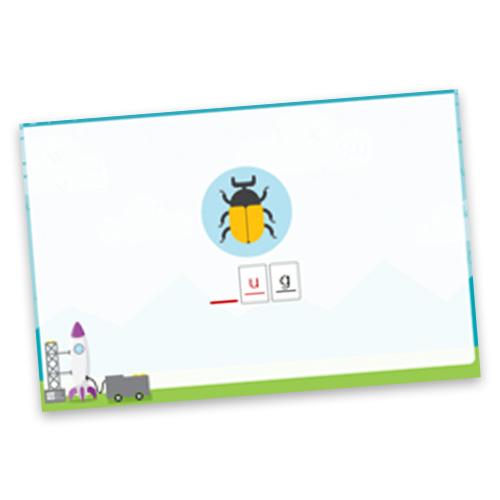
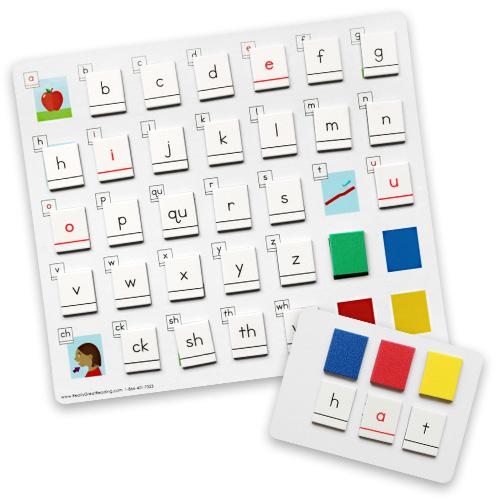
Components of Countdown
vi © 2017 Really Great Reading Company, LLC Introduction
Environmental Activities
The Countdown program includes a set of “environmental” literacy activities that are supplemental to the core instruction. These environmental activities, described in detail in the Appendix on p. 297, are simple activities meant to model and encourage word play, rhyming, and playing with sounds. Some of the activities can be utilized as you transition students from one classroom activity to another, requiring no additional time commitment. Other activities are presented as games that can be played with a whole class of students. These “games” require a short amount of additional time to play. All environmental activities can be incorporated at any time during your school day.
Countdown Activities: Units 1-16
The first two books of Countdown (Units 1-16) contain a series of activities that develop students’ pre-decoding and decoding skills in fun and playful ways. Each activity is described in the Teacher Guide with step-by-step instructions and correlates to the action taking place on screen through Countdown Online. There are 44 unique activities in Units 1-16. Some of these appear only once, and others are “standard activities” that are repeated multiple times throughout the first 16 units. The table below lists the numbered activities by strand, as well as where you can find the first instance of each activity. Detailed descriptions of the activities follow.
Countdown Activities, by Strand and First Instance Strand
Activity # Activity
First Instance
1 Introduction to Countdown 1.1.1
Describing and Comparing 1.1.2
Introduction to Category 1.2.1
Concept Sorting 1.3.1
Directionality & Order 1.3.2
Functional Vocabulary
Directionality & Spatial Sequence 1.3.3
Before/After 1.4.1
Whole/Part 1.4.2
Beginning/Middle/End 1.5.1 10 Above/Below 1.5.2 11 Temporal Sequencing 1.5.3
Rhyming 12 Hear That Rhyme 1.2.3 13 Which Words Rhyme? 2.2.3
Creating Rhymes 3.2.3
Peel That Sound 2.1.1
Sound Stories 2.1.2
Peel and Sort 2.2.1
PA: BSI
Peel and Say 2.5.1
Peel and Match 3.4.1 20 This or That? 3.5.1
© 2017 Really Great Reading Company, LLC vii Introduction
2
3
4
5
6
7
8
9
14
15
16
17
18
19
PA: Blending
21
Mystery Bag: Blending Compound Words 2.1.3 22 Mystery Bag: Blending Onset-Rime 2.5.3 23 What’s That Word? 3.1.3 24 Mystery Bag: Blending Sounds 4.1.3
PA: Segmenting 25 Stretch Those Sounds 6.2.3 26 Count the Sounds 9.4.1
PA: Addition & Substitution 27 Add That Sound 13.2.1 28 Sound Swap 16.2.1
AP: Letter ID
29 Letter-Sound Intro 6.1.1 30 Name That Sound 6.1.2 31 This Letter or That? 6.2.2 32 Find That Letter 6.4.2 33 Connect the Letter 6.5.1 34 Which Letter? 7.1.3 35 Letter-Sound Review 15.2.1
AP: Encoding
AP: Decoding
36 Guess My Word 7.2.3 37 Unscramble This 7.5.3 38 Build a Word 9.4.3
39 Letters Make Words 6.4.1 40 Touch & Say 6.5.2 41 Phrase Reading 10.5.3
Sight Words 42 Look, Think, Say; Pop-Up; 3-Up 8.1.3 43 Where’s That Heart Word? 8.3.1 44 Pop-Up and 3-Up 8.5.2
Detailed Activity Descriptions, Units 1-16
Introductory Activities targeting Functional Vocabulary and Key Concepts (note that these appear only in Unit 1 of the standard Countdown S&S):
1. Introduction to Countdown: You will explain that students will participate in a set of games and activities called Countdown. You will refer to learning through a sequence of activities (or “games”) and to the concept of counting with numbers (forward and backward).
2. Describing and Comparing: Students are introduced to the terms same, different, and compare. They will learn how to describe objects using multiple senses. They will then describe their observations of a dog while playing See It, Say It. After “saying” what they observe about the dog, an image of a different dog is presented, and students are asked to compare by making observations about the similarities between the two dogs. In the second lesson, students are presented with the same two dogs again and are asked to contrast them. They are then given two new images to compare and contrast.
3. Introduction to Category/Exclusion from a Category: Students learn the term “category.” They then play the game Welcome to the Club by describing similar characteristics between items that all belong to the same category, the “plant club.” In the second lesson, images appear on screen, and students are directed to observe whether or not all items can be a part
viii © 2017 Really Great Reading Company, LLC Introduction
of the same club, the “plant club.” Once they realize that the items cannot all be a part of the same club, they come up with a new club for the excluded items.
4. Concept Sort: Things We Eat vs. Things We Wear: Students are introduced to the concept of sorting items into categories. The screen is split into two vertical columns with an image representing either “things we eat” or “things we wear” at the top of each column. A new image appears at the bottom of the screen. You and your students work together to sort images that are items we eat or items we wear. Each new object will be placed in the correct column. This activity helps students practice categorizing items and exposes them to the format of online image sorts.
5. Left to Right & One to One: Directionality & Order: Students are introduced to the concepts of left-to-right directionality and number order. They will see a series of items in three rows on the screen. As you point to each item, left to right, students will name the item. In this way, students practice 1:1 correspondence and learn to move across a screen or page from top to bottom, left to right.
6. First/Next/Last, Before/After: Directionality & Spatial Sequence: Students are introduced to the concept of spatial sequences. They will see a series of three objects in a row and use the words before and after and then first, next, and last to describe the position of each object within the row.
7. Before/After: Two images will appear on the screen. Students will use the terms before and after to describe the proper order of these two actions/items. The items will then be displayed on the screen in the temporal sequence of the earlier event (before) on the left and the later event (after) on the right. A click will place the items in the correct order.
8. Whole/Part: Two images will appear on the screen. Students will use the terms part and whole to label the two items. You will verbally affirm which is the part and which is the whole.
9. Beginning/Middle/End: Three images will appear on the screen. Students will use the terms beginning, middle, and end to describe the order of these three images.
10. Above/Below: Three images will appear on the board. You will model the use of the terms above and below and ask questions about the location of images on the board.
11. First/Next/Last: Temporal Sequencing: Students are introduced to the concept of sequences showing order across time, as well as space. Three images will appear on the screen. Students will use the terms first, next, and last to describe the proper sequence of these three actions/ items. A click will place each item in the correct order.
Standard Rhyming Activities:
12. Hear That Rhyme: Two images representing a pair of rhyming words appear on the screen. At first, you will name each image and tell the students that the two words rhyme. In later rounds, students will recall and say the second word in the rhyming pair.
13. Which Words Rhyme?: Three images appear on the screen. Students must determine which two imaged words rhyme.
© 2017 Really Great Reading Company, LLC ix Introduction
14. Creating Rhymes: This phonological awareness activity asks students to generate rhyming words on their own. An individual image appears and students are asked to produce rhyming words. Standard Phonological and Phonemic Awareness Activities:
15. Mystery Bag: Blending Compound Words: You will say the two separate syllables in a com pound word, have students repeat, and then ask the students to blend the syllables to produce the compound word. An image representing the compound word is revealed. This activity is a precursor to blending onsets and rimes, and later, to the individual phonemes in words.
16. Mystery Bag: Blending Onset-Rime: You will segment the onset and rime of a word, have students repeat, and then ask the students to blend the word parts and say the blended word. An image representing the whole word appears. This activity is a precursor to blending the individual phonemes in words.
17. What’s That Word?: Two images appear on the screen. You will say the onset and rime of one of the imaged words, holding up a fist for each part. Students then repeat, and you will ask the students to blend the onset and rime, while bringing their fists together, to choose the image of the word that was blended together. This activity is a precursor to blending the individual phonemes in words.
18. Mystery Bag: Blending Sounds: A mystery bag will appear on the screen. You will say each phoneme in a two- or three-phoneme word and then ask the students to blend the phonemes and say the blended word. An image representing the word appears.
19. Peel That Sound: This activity consists of three rounds. During the first round, you will pronounce the imaged word, starting with the isolated beginning sound, and the students repeat. During the second round, you will pronounce just the isolated beginning sound of each word, and the students give the name of the image. During the third round, you will name the image, and students say the isolated beginning sound. This activity helps students understand that words are made of individual sounds and that we can isolate those sounds. The main goal is to model and give students practice with beginning sound isolation.
20. Sound Stories: Students will listen to an alliterative story. After listening to the story, they will participate by choosing words that start with the targeted sound.
21. Peel and Sort: The screen is split into two columns with a guideword image at the top of each. A new (non-guideword) image appears at the bottom of the screen. With your assistance, students determine which guideword image has the same beginning sound as the new image below. The new image is then sorted into the correct column. This activity reinforces the idea that words are made from individual sounds and that we can isolate individual sounds in words.
22. Peel and Say: Three images are added to the screen. You will name each image. The students are then asked to give you the shared beginning sound of the three words.
23. Peel and Match: One guideword image appears on the left side of the screen. You will name the image, starting with the isolated beginning sound. Two other images appear in a column on the right side of the screen, and you will name them, also starting with the beginning
x © 2017 Really Great Reading Company, LLC Introduction
sounds in isolation. You will direct the students to determine which of the two images on the right starts with the same beginning sound as the guideword on the left. More objects appear on the right, with the guideword image on the left remaining for several turns. A new guideword image appears on the left side at the start of the next round. There are three rounds total. This activity reinforces the idea that words are made of sounds and that we can isolate individual sounds in words.
24. This or That?: Two images appear on the board. The student is asked to identify which object begins with a certain phoneme. This activity reinforces the idea that words are made out of sounds and that we can isolate individual sounds in words.
25. Stretch Those Sounds: You will say a word aloud and model how to segment the sounds using finger-stretching, having students repeat. Eventually, you will withdraw some support and students will segment the words on their own.
26. Count the Sounds: Two columns appear on the screen with two and three color tiles (representing two and three phonemes) as headings. An image appears at the bottom of the screen. Your students stretch the phonemes (sounds) in the word. Students must determine how many phonemes are in each word. Each image is then sorted into the correct column.
27. Add That Sound: You will say a word aloud. You and students finger-stretch the phonemes. You will then model how to add a phoneme to the end of the word, stretching the sounds of the new word. Students then repeat the stretching process for the new word.
28. Sound Swap: An image appears. You will ask students to identify the beginning sound and then the rest of the word. You will then ask students to swap the beginning sound with a different beginning sound to create a new word. An image of the new word appears as confirmation.
Standard Alphabetic Principle Activities:
29. Letter-Sound Intro: You will introduce the idea that letters are sounds that are written down and then show an animation that brings this concept to life. This prepares students to learn the letters in clusters of three to four per unit, beginning in Unit 6.
30. Name That Sound: A guideword image (representing one sound) that students are already famil iar with appears. Students say the guideword and the initial sound of that guideword. Then the corresponding uppercase and lowercase letter tiles appear. You will explain that the letters are symbols that spell the initial sound associated with the guideword. Students learn that they can figure out the sounds that letter symbols spell through beginning sound isolation.
31. This Letter or That?: Two letter symbols, alongside the corresponding guideword images, appear at the top of the screen as headings and a new image appears at the bottom. Students must isolate the initial sound of that new image and then determine which letter symbol produces the initial sound. The image is then sorted into one of the two columns.
32. Find That Letter: This phonics activity gives students practice with isolating initial sounds while associating them with their letter symbols. Three images with the same initial sound appear and students are asked to find the corresponding letter tile. This activity promotes letter-sound correspondence with lowercase letters.
© 2017 Really Great Reading Company, LLC xi Introduction
33. Connect the Letter: One letter tile will appear at the top of the screen with three images be low. Students will determine which image’s beginning sound is spelled by the letter on the tile.
34. Which Letter?: An individual image appears along with the medial vowel and final consonant of the represented word. You will pronounce the whole word associated with the image and then ask students to isolate its beginning sound. On the next click, three letter tiles will appear, and you will ask students which letter tile matches the beginning sound. This activity promotes letter-sound correspondence with lowercase letters.
35. Letter-Sound Review: Four rows of letter tiles appear. You will point to a tile, saying the name of the letter. The students, with your help if needed, say the sound spelled by that letter. Upon a click, you will reveal the guideword image associated with that letter and say its beginning sound and its name. Students repeat the sound and the guideword. You will repeat this pattern until all 26 guideword images are revealed.
36. Guess My Word: Three letter tiles appear scrambled on the board. You will segment the individual phonemes of a word in the correct order, moving the letter tiles into the correct position. Students then blend the phonemes together to create a whole word, which is the “mystery word.” The image for that word then appears as confirmation. This activity serves to model the process of encoding for students.
37. Unscramble This: An image appears on the board along with the three scrambled letter tiles needed to spell the imaged word. As the students help you segment the word, you move the letter tiles into the correct positions to spell the word. You and students then use Touch & Say to blend the phonemes back into a whole word.
38. Build a Word: This encoding (spelling) activity begins with you and your students segmenting the phonemes in a word in order to spell it. First, they stretch the phonemes with their fingers, then they count the phonemes and put down a color tile for each sound they heard. Then, they match each sound they heard with the corresponding letter tile, spelling the word in order. Lastly, you and your students Touch & Say to check their spelling.
39. Letters Make Words: This activity will introduce students to some key concepts about letters and words as they examine several letters and words with you.
40. Touch & Say: This decoding (reading) activity begins with you and your students pronouncing the individual phonemes in a word as you underline each grapheme (letter tile sound spelling). Then, they blend the sounds together to read the whole word.
41. Phrase Reading: Three-word phrases will appear on the board, one word at a time. Students will read each word as it appears and will then read the phrase as a whole a few times to gain fluency. Heart Words are displayed in red with a heart symbol above them.
Standard Sight Word (High-Frequency Word) Automaticity Activities:
42. Look, Think, Say; Pop-Up; 3-Up: In Look, Think, Say, a Heart Word will appear on the board with three dots below it. As you click, the dots will fill with red, yellow, and green, and you will instruct students to look at, think about, and say the word aloud. During the “look” time, you will say the word. During the “think” time, the students will think about the word and try to
xii © 2017 Really Great Reading Company, LLC Introduction
remember it, or you will stretch the sounds in the word for students if the word is decodable (although the goal will be to remember it as a whole word). During the “say” time, students will repeat the word. In Pop-Up, individual Heart Words will appear on the screen at random, one at a time, and students will be instructed to read each word as it pops up onto the screen. In 3-Up, sets of three Heart Words will appear, with three dots below each set. As you click three times, the dots will fill with red, yellow, and green and you will instruct students to look, think, and say the three words in succession. The Heart Words will include words learned during th current unit and, in subsequent units, words from previous units.
43. Where’s That Heart Word?: Three Heart Words appear on the screen in a row. Students will read the three words from left to right. You will then have students read specific words that are at the “beginning, middle, end” of a row, “before, after” other words in the row, or “first, next, last” in the row.
44. Pop-Up and 3-Up: In Pop-Up, individual Heart Words will appear on the screen at random, one at a time, and students will be instructed to read each word as it pops up onto the screen. In 3-Up, sets of three Heart Words will appear, with three dots below each set. As you click three times, the dots will fill with red, yellow, and green and you will instruct students to look, think, and say the three words in succession. The Heart Words will include words learned during the current unit and, in subsequent units, words from previous units.
Items in Supplemental Resources of Countdown Online
Countdown Online has a growing body of supplemental resources to enhance and extend your instruction. The Supplemental Resources section, which can be accessed through the home screen in Countdown Online, has several sections, each with a variety of items and tools. These include: Interactive Resources
1. Letter Tile Free Play: online color and letter tiles that can be used for letter-sound practice, reading and spelling words, and more.
2. Letter-Sound Generator: this tool allows you to select up to six letter sounds to practice through a variety of activities (Look, Think, Say; Pop-Up; 3-Up; and Read a Row). The specific letters you select will populate in these activities, allowing you to provide targeted practice for your students with only the letter sounds of your choosing.
3. Heart Word Generator: this tool allows you to select three Heart Words to practice through a variety of activities (Look, Think, Say; Pop-Up; 3-Up; and Read a Row). Three Heart Words will be locked for each unit. The specific words you select will populate in these activities, allowing you to provide targeted practice for your students with only the high-frequency words of your choosing.
Videos & Animations
1. Countdown Getting Started Webinar: a webinar that provides information and tips as you get started with Countdown.
© 2017 Really Great Reading Company, LLC xiii Introduction
2. Short Vowel Animations: a series of five animations, each focused on reviewing the articulation of and guideword and motion for one short vowel phoneme.
3. Long Vowel Animations: a series of five animations, each focused on reviewing the articulation of and guideword and motion for one long vowel phoneme.
4. Whole Body Listening Animation: a short video that uses two characters to teach students how to be good listeners.
5. Classroom Demonstration Videos: real-life classroom demonstrations of Countdown’s standard activities.
6. Activity Overview Snippets: short detailed video walk-throughs of each standard Countdown activity.
PDF Resources
1. Really Great Reading’s Kindergarten Foundational Skills Surveys and the “Kindergarten Foundational Skills Surveys and Countdown” information packet: Really Great Reading’s kindergarten assessment tool that provides information on students’ knowledge in a variety of areas related to kindergarten literacy, as well as the information packet that guides you through using this assessment in conjunction with your Countdown instruction. Also available are several other assessment tools for phonological awareness, letter knowledge, and sight (high-frequency) word automaticity.
2. Optional Extension Units: three units that extend the content taught in Countdown for students who have completed all 28 standard units and need a challenge. These units teach spelling two-syllable words, Open Syllables, and Vowel-Consonant-e.
3. Alternative Introductory Activities: an alternative Scope & Sequence (see p. 289) offers three introductory units (rather than just one, as in the standard Scope & Sequence) focused on functional vocabulary and basic concepts to prepare students to succeed with Countdown instruction. The activities to be taught in these three alternative units are available as a PDF download.
4. Additional Practice Activities: additional, downloadable activities with corresponding online components to provide more practice for students who need it. There are additional activities available for rhyming, letter-sound identification, decoding, and encoding. The download will direct you to the corresponding online components required to complete the activities.
5. Short and Long Vowels Posters: posters with the guideword images for all short and long vowel sounds.
6. Countdown Decodable Passages: a set of highly controlled passages that allow students to put their decoding skills to work in longer, connected text. A differentiated version of these passages with additional support is also available. Both versions contain literal and inferential comprehension questions.
7. Sound-Letter Linking Charts: color and black and white versions of charts that provide visual
xiv © 2017 Really Great Reading Company, LLC Introduction
links between the Countdown guideword icons for the short vowel, consonant, and digraph sounds and the capital and lowercase letters that spell those sounds.
8. Uppercase-Lowercase Letter Correspondence Activities: a series of downloadable activities to help students practice uppercase-lowercase letter correspondence.
9. Additional Resources: additional resources are also available, including: ideas for how to use the Countdown Wall Cards; the User’s Guide for the Countdown Practice Cards deck; and a downloadable activity that helps students learn and practice the difference between Closed Syllables and Open Syllables (intended for use with the optional unit on Open Syllables)
We are continually adding to our body of Supplemental Resources, so check back often to see what is new.
Items in the Appendix
1. Components of Countdown, p. 288
2. Alternative Scope and Sequence, p. 289
3. Guidewords, Movements, and Proper Articulation of Sounds, p. 290
4. All Instances of Countdown Activities, by Strand, p. 295
5. Environmental Activities, p. 297
6. Additional Activities for Practice, p. 302
7. Whole Body Listening and Whole Brain Learning Lessons, p. 304
8. Items in Supplemental Resources of Countdown Online, p. 313
9. Glossary of Terms, p. 315
© 2017 Really Great Reading Company, LLC xv Introduction
BOOK 1 Lesson 1 Lesson 2 Lesson 3 Lesson 4 Lesson 5 Unit 1 (Intro) Introduction to Countdown Introduction to Category Eat vs. Wear Sort Before/After Beginning/Middle/End Describing and Comparing: Similarities Introduction to Category: Exclusion from Left to Right & One to One: Directionality & Order Whole/Part Above/Below Describing and Comparing: Differences Hear That Rhyme First/Next/Last, Before/After: Directionality & Spatial Sequence Hear That Rhyme First/Next/Last: Temporal Sequencing Unit 2 Peel That Sound Peel and Sort Peel That Sound Peel and Sort Peel and Say Sound Stories - /m/ Sound Stories - /s/ Sound Stories - /l/ Sound Stories - /n/ Sound Stories - /f/ Mystery Bag: Blending Compound Words Which Words Rhyme? Mystery Bag: Blending Compound Words Which Words Rhyme? Mystery Bag: Blending Onset-Rime Unit 3 Peel That Sound Peel and Sort Peel That Sound Peel and Match This or That? Sound Stories - /r/ Sound Stories - /v/ Sound Stories - /z/ Sound Stories - /p/ Sound Stories - /g/ What’s That Word? Creating Rhymes What’s That Word? Creating Rhymes What’s That Word? Unit 4 Peel That Sound Peel and Say This or That? Peel and Sort Peel and Match Sound Stories - /d/ Sound Stories - /t/ Sound Stories - /k/ Sound Stories - /b/ Sound Stories - /w/ Mystery Bag: Blending Sounds Mystery Bag: Blending Sounds What’s That Word? Mystery Bag: Blending Sounds Mystery Bag: Blending Sounds Unit 5 Peel That Sound Peel and Say Peel and Sort This or That? Peel and Match Sound Stories - /h/ Sound Stories - /kw/ Sound Stories - /j/ Sound Stories - /y/ Sound Stories - /ks/ What’s That Word? Mystery Bag: Blending Sounds What’s That Word? Mystery Bag: Blending Sounds What’s That Word? BOOK 2 Unit 6 (Cluster 1: m, t, p, a) Letter-Sound Intro Peel and Sort Peel and Match Letters Make Words Connect the Letter Name That Sound This Letter or That? This Letter or That? Find That Letter Touch & Say Peel and Say Stretch Those Sounds Stretch Those Sounds Stretch Those Sounds Mystery Bag: Blending Sounds Unit 7 (Cluster 2: s, h, c, i) Stretch Those Sounds This or That? What’s That Word? Peel and Sort Stretch Those Sounds Name That Sound This Letter or That? This Letter or That? Connect the Letter Touch & Say Which Letter? Guess My Word Find That Letter Which Letter? Unscramble This Unit 8 (Cluster 3: d, f, r, o) Peel and Say Stretch Those Sounds Where’s That Heart Word? (the, in, my) Stretch Those Sounds Connect the Letter Name That Sound This Letter or That? This Letter or That? Find That Letter Pop Up, 3-Up (the, in, my) Look, Think, Say; Pop Up; 3-Up (the, in, my) Guess My Word Which Letter? Unscramble This Touch & Say Countdown Scope and Sequence © 2017 Really Great Reading Company, LLC
Lesson 1 Lesson 2 Lesson 3 Lesson 4 Lesson 5 Unit 9 (Review Clusters 1-3) This Letter or That? Stretch Those Sounds Peel and Match Count the Sounds This Letter or That? Look, Think, Say; Pop Up; 3-Up (a, is, for) Find That Letter Where’s That Heart Word? (a, is, for) Connect the Letter Pop Up, 3-Up (a, is, for) Which Letter? Unscramble This Guess My Word Build a Word Touch & Say Unit 10 (Cluster 4: g, l, n, u) This or That? Touch & Say Connect the Letter Find That Letter Count the Sounds Name That Sound This Letter or That? This Letter or That? Stretch Those Sounds Pop Up, 3-Up (I, am, here) Look, Think, Say; Pop Up; 3-Up (I, am, here) Build a Word Where’s That Heart Word? (I, am, here) Unscramble This Phrase Reading Unit 11 (Cluster 5: b, k, v, e) Peel and Sort Guess My Word Stretch Those Sounds Find That Letter Count the Sounds Name That Sound This Letter or That? This Letter or That? Touch & Say Pop Up, 3-Up (and, at, go) Look, Think, Say; Pop Up; 3-Up (and, at, go) Which Letter? Where’s That Heart Word? (and, at, go) Build a Word Phrase Reading Unit 12 (Review Clusters 1-5) This Letter or That? Stretch Those Sounds Mystery Bag: Blending Sounds Count the Sounds This Letter or That? Look, Think, Say; Pop Up; 3-Up (it, like, be) Find That Letter Where’s That Heart Word? (it, like, be) Connect the Letter Pop Up, 3-Up (it, like, be) Touch & Say Unscramble This Guess My Word Build a Word Phrase Reading Unit 13 (Cluster 6: j, w, z) Peel and Match Add That Sound Find That Letter Touch & Say Add That Sound Name That Sound This Letter or That? This Letter or That? Stretch Those Sounds Pop Up, 3-Up (to, not, can) Look, Think, Say; Pop Up; 3-Up (to, not, can) Which Letter? Where’s That Heart Word? (to, not, can) Build a Word Phrase Reading Unit 14 (Cluster 7: qu, x, y) This or That? Guess My Word Add That Sound Connect the Letter Touch & Say Name That Sound This Letter or That? This Letter or That? Unscramble This Pop Up, 3-Up (you, are, do) Look, Think, Say; Pop Up; 3-Up (you, are, do) Which Letter? Where’s That Heart Word? (you, are, do) Build a Word Phrase Reading Unit 15 (Review Clusters 1-7) Mystery Bag: Blending Sounds Letter-Sound Review Which Letter? Add That Sound Touch & Say Look, Think, Say; Pop Up; 3-Up (did, too, will) Find That Letter Where’s That Heart Word? (did, too, will) Connect the Letter Pop Up, 3-Up (did, too, will) Touch & Say Unscramble This Phrase Reading Build a Word Phrase Reading Unit 16 (Review Clusters 1-7) Touch & Say Sound Swap Sound Swap Sound Swap Touch & Say Look, Think, Say; Pop Up; 3-Up (with, all, me) Connect the Letter Where’s That Heart Word? (with, all, me) Find That Letter Pop Up, 3-Up (with, all, me) Which Letter? Unscramble This Phrase Reading Build a Word Letter-Sound Review Countdown Scope and Sequence, continued KEY Functional Vocabulary Rhyming Sound Stories Sight Word Automaticity Phonemic Awareness: Beginning Sound Isolation Phonemic Awareness: Blending Phonemic Awareness: Segmenting Phonemic Awareness: Manipulation Alphabetic Principle: Letter Identification Alphabetic Principle: Encoding Alphabetic Principle: Decoding © 2017 Really Great Reading Company, LLC
xviii © 2017 Really Great Reading Company, LLC IntroductionCountdown Scope and Sequence, continued KEY Alphabetic Principle: Encoding and Decoding Alphabetic Principle: Letter Identification Sight Word Automaticity Phonemic Awareness BOOK 3 Lesson 1 Lesson 2 Lessons 3, 4, 5 Letter-Sound Fluency Heart Word Fluency Phonemic Awareness Phonics Concept, Reading, and Spelling UNIT 17 • Vowels vs. Consonants • Letter Names vs. Sounds • Review what makes words • Introduce Word Sort • Review short vowel sounds and motions • Review finger-stretching phonemes UNIT 18 Letter-Sound Review • Introduce long vowel sounds • Introduce Vowel-Consonant pattern (Closed Syllables) • Introduce Build a Word • Introduce Spell It! was, no, so UNIT 19 Letter-Sound Review • Short a vs. Long a • Introduce Phrases & Sentences to Read • Reading and spelling real and nonsense words with all short vowels say, now, have UNIT 20 Letter-Sound Review • Short i vs. Long i • Digraph sh • Reading and spelling with all short vowels • Introduce Detective Work said, come, down UNIT 21 Letter-Sound Review • Short u vs. Long u • Digraph th • Reading and spelling with all short vowels they, that, this UNIT 22 Letter-Sound Review • Short o vs. Long o • Review Digraphs sh & th • Reading and spelling with all short vowels ate, our, who UNIT 23 Letter-Sound Review • Short e vs. Long e • Digraphs ch & wh • Reading and spelling with all short vowels where, what, must UNIT 24 Letter-Sound Review • Review all short and long vowels • Digraph ck • Reading and spelling with all short vowels we, he, she UNIT 25 Letter-Sound Review • Sound Buddies (2-sound blends) • Chunk all and digraph review • Reading and spelling with all short vowels but, want, there UNIT 26 Letter-Sound Review • Sound Buddies (2-sound blends) • 2-sound blends (initial and final) saw, own, please UNIT 27 Letter-Sound Review • Introduce Syllable Stomp • Introduce blending syllables • Introduce terms “syllable” and “Closed Syllable” • Reading two-syllable words with Closed Syllables make, good, new UNIT 28 Letter-Sound Review • Review Syllable Stomp • Review blending syllables • More reading two-syllable words with Closed Syllables out, one, two © 2017 Really Great Reading Company, LLC
Unit 6 | Lesson 1 | Part 1
Activity 29: Letter-Sound Introduction AP: Letter ID Objective
Students will learn that sounds are represented by letters and will say the name of each letter, associating it with its sound and guideword.
What Students See
3, 2, 1…
Description
The teacher introduces the idea that letters are sounds that are written down and then shows an animation that brings this concept to life. This prepares students to learn the letters in clusters of three to four per unit, beginning in this unit.
Open Countdown Online to Unit 6, Lesson 1, Part 1 (6.1.1).

Launch! Say:
• “Today, we are going to see what our sounds look like when they are written down.
• Each sound we hear can be written down. Letters are sounds that are written down.
• Let’s watch a video to learn about letters.”
Click to play the letter-sound introductory animation.
Say “We will learn a lot more about letters as we play our Countdown games. Learning about letters will be so much fun!”
© 2017 Really Great Reading Company, LLC 1 UNIT 6 Lesson 1 | Part 1
Unit 6 | Lesson 1 | Part 2
Activity 30: Name That Sound AP: Letter ID
Objective
Students will identify the uppercase and lowercase letters associated with the sounds /m/, /t/, /p/, and //.
What Students See
Description
A guideword image (representing one sound) that students are already familiar with appears. Students say the guideword and the initial sound of that guideword. Then the corresponding uppercase and lowercase letter tiles appear. The teacher explains that the letters are symbols that spell the initial sound associated with the guideword. Students learn that they can figure out the sounds that letter symbols spell through beginning sound isolation.
3, 2, 1…
Open Countdown Online to Unit 6, Lesson 1, Part 2 (6.1.2).
Launch!
Say “We have already seen what our sounds look like when they are written down. Now we are going to focus on just four of those sounds and pay special attention to the letters that ‘say,’ or spell those four sounds.”
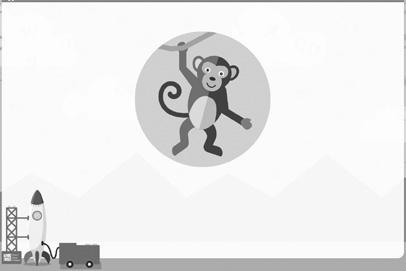
Click to display the monkey
Ask:
• “What is this a picture of?” A: a monkey
• “What is the first sound in monkey?” A: /m/
Click to display the corresponding uppercase and lowercase letter tiles.
Say:
• “Right, monkey begins with /m/, and these letters ‘say’ the sound, or spell, /m/.
• Do you remember Michael the Monkey? He likes munching mangoes at the movies! His favorite sound is /m/.
• The name of these letters is M. M says /m/, like the beginning of /m/, monkey.
2 © 2017 Really Great Reading Company, LLC UNIT 6 Lesson 1 | Part 2
•
This one (point to uppercase M) is called ‘capital M,’ and this one (point to lowercase m) is called ‘lowercase m.’ This is the one we will see most of the time, so we’ll just call it m.
• Let’s learn another new letter.”
Click to display the toothbrush.
Ask:
• “What is this a picture of?” A: a toothbrush
• “What is the first sound in toothbrush?” A: /t/
Click to display the corresponding uppercase and lowercase letter tiles. Say:
• “Right, toothbrush begins with /t/, and these letters say /t/.
• Do you remember Teagan the T iger? She taps her toes when she brushes her teeth with a toothbrush! Her favorite sound is /t/.
• The name of these letters is T. T says /t/, like the beginning of /t/, tiger.
•
This one (point to uppercase T) is called ‘capital T,’ and this one (point to lowercase t) is called ‘lowercase t.’ This is the one we will see most of the time, so we’ll just call it t.
Let’s learn another new letter.”
•
Click to display the popcorn.
Ask:
• “What is this a picture of?” A: popcorn
• “What is the first sound in popcorn?” A: /p/ Say “Do you remember Penny the Penguin? She and her pals eat popcorn while they put puzzles together! Her favorite sound is /p/.”
Click to display the corresponding uppercase and lowercase letter tiles. Ask “So, what do you think these letters say?” A: /p/ Say:
• “Yes! The name of these letters is P P says /p/, like the beginning of popcorn
•
This one (point to uppercase P) is called ‘capital P,’ and this one (point to lowercase p) is called ‘lowercase p.’ This is the one we will see most of the time, so we’ll just call it p
Let’s learn one more new letter.”
•
© 2017 Really Great Reading Company, LLC 3 UNIT 6 Lesson 1 | Part 2
As vowel sounds are more difficult to differentiate, a motion is taught to help students connect the vowel sound to the letter. These same short vowel motions are prevalent in other Really Great Reading programs. Consonant sounds tend to be easier to identify and differentiate. Motions for consonant sounds are available in the Appendix on p. 290 for students who may require more of a kinesthetic approach.
Click to display the apple.
Ask:
• “What is this a picture of?” A: an apple
• “What is the first sound in apple?” A: /ă/
Click to display the corresponding uppercase and lowercase letter tiles.
Ask “So, what do you think these letters say?” A: /ă/
Say:
• “Yes! The name of these letters is A . A says /ă/, like the beginning of /ă/, apple.
• This one (point to uppercase A) is called ‘capital A ,’ and this one (point to lowercase a) is called ‘lowercase a.’ This is the one we will see most of the time, so we’ll just call it a.”
Demonstrate /ă/, apple motion (you should use this motion, and all the short vowel motions, for all students):
Say:
• “Let’s do a motion to help us remember that sound.
• Pretend to hold an apple in your hand and move it like this.”
Demonstrate the short a, apple, motion while elongating the sound /ăăăă/, and have students repeat (pretend to hold an apple in your palm, face up, and move from right to left – so that students see it moving from left to right – across your body).
Click to display letter tiles m, t, p, and a. Say “Let’s name our letters one more time and say the sound that each letter spells.”
Point to each letter, one at a time, and say:
• “This is m. M says /m/.
• This is t. T says /t/.
• This is p. P says /p/.
• This is a. A says /ă/.”
4 © 2017 Really Great Reading Company, LLC UNIT 6 Lesson 1 | Part 2
Unit 6 | Lesson 1 | Part 3
Activity 18: Peel and Say PA: BSI
Objective
Students will isolate, identify, and produce the shared beginning sound of three words.
What Students See
Description
Three images are added to the screen. The teacher names each image. The students are then asked to give the teacher the shared beginning sound of the three words.
3, 2, 1…
Open Countdown Online to Unit 6, Lesson 1, Part 3 (6.1.3).
Launch!
Say “Now, we are going to peel the first sound off of some words. Listen and repeat after me.”
Click to display the images for up, umbrella, and oven and name them as you point to each one. (Students repeat the three words.)
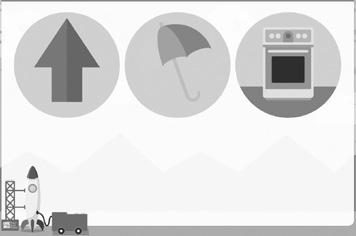
Ask “What’s the first sound in up, umbrella, and oven?” A: /ŭ/
Say “Let’s try another one.”
Click to display the sheep, shorts, and shadow and name them as you point to each one. (Students repeat the three words.)
Ask “What’s the first sound in sheep, shorts, and shadow?” A: /sh/
Continue with the remaining examples:
1. guitar, grapes, glasses - /g/ 2. violin, vase, van - /v/
acorn, apron, angel - /ā/ 4. thumb, thermometer, thread - /th/ 5. jar, jellybeans, jet - /j/ 6. hammer, hospital, horse - /h/
key, kangaroo, keyboard - /k/
ice, iron, island - /ī/
bear, butterfly, bookshelf - /b/
wave, watermelon, whale - /w/
piano, popcorn, peanut - /p/
sunflower, seal, sock - /s/
© 2017 Really Great Reading Company, LLC 5 UNIT 6 Lesson 1 | Part 3
7.
8.
9.
3.
10.
11.
12.
13. football, flower, fish - /f/
14. lick, ladybug, ladder - /l/
15. rabbit, rainbow, ring - /r/
16. mittens, mask, man - /m/
17. zoo, zero, zebra - /z/
18. elf, edge, elbow - /ĕ/
DIFFERENTIATION OPTIONS
Ways to simplify:
• Isolate the beginning sounds of each word as you name them (/m/, mouse; /m/, match; /m/, map), and then ask an easier question: “What’s the first sound in /m/, mouse; /m/, match; /m/, map?”
Unit 6 | Lesson 2 | Part 1
Activity 17: Peel and Sort PA: BSI
Objective
Students will identify matching beginning sounds.
What Students See
Description
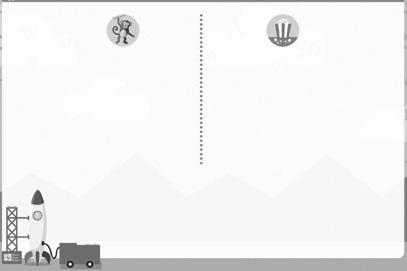
The screen is split into two columns with a guideword image at the top of each. A new (non-guideword) image appears at the bottom of the screen. With the teacher’s assistance, students determine which guideword image has the same beginning sound as the new image below. The new image is then sorted into the correct column. This activity reinforces the idea that words are made from individual sounds and that we can isolate individual sounds in words.
3, 2, 1…
Open Countdown Online to Unit 6, Lesson 2, Part 1 (6.2.1).
Launch!
SORT 1:
Say “Today, we are going to sort words by their beginning sounds.”
Click to display the monkey and the popcorn as the column headings. Point to the monkey and the popcorn and say “Our words will begin like /m/, monkey or /p/, popcorn.”
6 © 2017 Really Great Reading Company, LLC UNIT 6 Lesson 2 | Part 1
Click to display and point to the muffin.
Say:
• “/m/, muffin. Does /m/, muffin begin like monkey or popcorn?”
A: /m/, monkey
• “Right! /m/, muffin, /m/, monkey. I’ll move the muffin to the /m/, monkey side.”
Click to place the muffin in the monkey column.
Say “Let’s try another one.”
Continue with the remaining examples: /p/, peppermint; /m/, mouth; /m/, milk; /p/, paintbrush; /p/, piano; /m/, mask; /p/, pot; /m/, mountain; /p/, pants; /p/, penny; /m/, mittens.
Say:
• “Let’s go over our work (point to each image as you label it with students):
o /m/, monkey; /m/, muffin; /m/, mouth; /m/, milk; /m/, mask; /m/, mountain; /m/, mittens.
o /p/, popcorn; /p/, peppermint; /p/, paintbrush; /p/, piano; /p/, pot; /p/, pants; /p/, penny.
• Let’s try that with two new sounds.”
SORT 2:
Click to display the cat and the goat as the column headings. Point to the cat and the goat and say “Our words will begin like /k/, cat or /g/, goat.”
Click to display and point to the girl
Say:
• “/g/, girl. Does /g/, girl begin with the same sound as cat or goat?” A: goat (right side)
• “/g/, girl, /g/, goat. I’ll move the girl to the/g/, goat side.”
Click to place the girl in the goat column.
Say “Let’s try another one.”
Continue with the remaining examples: /k/, cop; /g/, gold; /g/, guitar; /k/, cactus; /g/, gumballs; /k/, cow; /g/, game; /k/, car; /k/, cookie; /g/, gate; /k/, corn.
Say:
• “Let’s go over our work (point to each image as you label it with students):
o /k/, cat; /k/, cop; /k/, cactus; /k/, cow; /k/, car; /k/, cookie; /k/, corn
© 2017 Really Great Reading Company, LLC 7 UNIT 6 Lesson 2 | Part 1
o /g/, goat; /g/, girl; /g/, gold; /g/, guitar; /g/, gumballs; /g/, game; /g/, gate.”
DIFFERENTIATION OPTIONS
Ways to simplify:
• Add more information to the question: “/m/, muffin. Does /m/, muffin begin with the same sound as /m/, monkey or /p/, popcorn?” A: /m/, monkey
Ways to challenge:
• Do not isolate the beginning sound for students at all; just name the objects on the screen, and then ask a harder question: “Muffin. Does muffin begin like monkey or popcorn?”
Unit 6 | Lesson 2 | Part 2
Activity 31: This Letter or That?
Objective
Students will identify the letter symbol that spells the first sound in a word. What Students See
Description
AP: Letter ID
Two letter symbols, alongside the corresponding guideword images, appear at the top of the screen as headings and a new image appears at the bottom. Students must isolate the initial sound of that new image and then determine which letter symbol produces the initial sound. The image is then sorted into one of the two columns.
3, 2, 1…
Open Countdown Online to Unit 6, Lesson 2, Part 2 (6.2.2).
Launch!
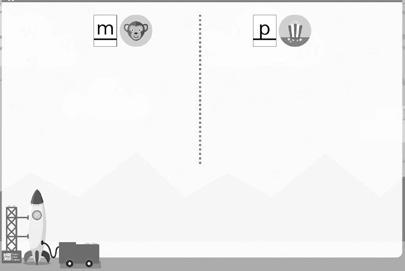
SORT 1: Click to display two columns with the headings “m” (for monkey) and “p” (for popcorn).
Ask “What is the first sound in monkey (while pointing to the monkey)?” A: /m/
8 © 2017 Really Great Reading Company, LLC UNIT 6 Lesson 2 | Part 2
Say “Remember, the sound /m/ is spelled with the letter m (while pointing to the letter tile m).”
Ask “What is the first sound in popcorn (while pointing to the popcorn)?” A: /p/
Say “Remember, the sound /p/ is spelled with the letter p (while pointing to the letter tile p).”
Click to display the map at the bottom of the screen.
Say “We are going to listen to the first sound in map and then put it under the correct letter.”
Ask “What is the first sound in map?” A: /m/
Say:
• “Right, so let’s move it under the /m/, monkey and the letter m
• We can use the picture at the top to help us figure out the matching letter.”
Click to place the map in the “m” column.
Click to display the pie at the bottom of the screen.
Ask:
• “Pie. What is the first sound in pie?” A: /p/
• “Should we put the /p/, pie, under the m, like /m/, monkey or the p, like /p/, popcorn?” A: p, /p/, popcorn
Say “Right, /p/, pie and /p/, popcorn both start with the letter p, so I’ll move the pie under the p.”
Click to place the pie in the “p” column.
Continue with remaining images: pig, man, milk, pen, mask, peas, paintbrush, muffin, pencil, monster.
Say:
• “Let’s go over our work (point to each image as you label it with students):
o /m/, monkey; /m/, map; /m/, man; /m/, milk; /m/, mask; /m/, muffin; /m/, monster
o /p/, popcorn; /p/, pie; /p/, pig; /p/, pen; /p/, peas; /p/, paintbrush; /p/, pencil.
•
Let’s try that with two new letters.”
SORT 2: Say “Let’s try that with two new letters.”
Click to display two columns with the headings “a” (for apple) and “ t ” (for toothbrush).
© 2017 Really Great Reading Company, LLC 9 UNIT 6 Lesson 2 | Part 2
Ask “What is the first sound in apple (while pointing to the apple)?” A: /ă/
Say “Remember, the sound /ă/ is spelled with the letter a (while pointing to the letter tile a).”
Ask “What is the first sound in toothbrush (while pointing to the toothbrush)?” A: /t/
Say “Remember, the sound /t/ is spelled with the letter t (while pointing to the letter tile t).”
Click to display the ant at the bottom of the screen.
Ask:
• “Ant. What is the first sound in ant?” A: /ă/
• “Should we put the /ă/, ant, under the a, like /ă/, apple or the t, like /t/, toothbrush?” A: a, /ă/, ant
Say “Right, /ă/, ant and /ă/, apple both start with the letter a, so I’ll move the ant under the a.”
Click to place the ant in the “a” column.
Continue with remaining images: alligator, tie, toy, add, teeth, ax, turtle, arrow, astronaut, toaster, table.
Say:
• “Let’s go over our work (point to each image as you label it with students):
o /ă/, apple; /ă/, ant; /ă/, alligator; /ă/, add; /ă/, ax; /ă/, arrow; /ă/, astronaut.
o /t/, toothbrush; /t/, tie; /t/, toy; /t/, teeth; /t/, turtle; /t/, toaster; /t/, table.”
DIFFERENTIATION OPTIONS
Ways to simplify:
• Isolate the beginning sound of the word before asking students the first sound: “This is a /m/, map. What is the first sound in /m/, map?” A: /m/
Ways to challenge:
• Have the students use their manipulatives to independently select which letter the image starts with (from the choices of m or p, or a or t) before the word is sorted on screen.
10 © 2017 Really Great Reading Company, LLC UNIT 6 Lesson 2 | Part 2
Unit 6 | Lesson 2 | Part 3
Activity 25: Stretch Those Sounds PA: Segmenting
Objective
Students will segment the phonemes (sounds) in two-sound words using finger-stretching.
What Students See
3, 2, 1…
Description
The teacher says a word aloud and models how to segment the sounds using fingerstretching, having students repeat. Eventually, the teacher will withdraw some support and students will segment the words on their own.
Open Countdown Online to Unit 6, Lesson 2, Part 3 (6.2.3).
Launch!
Click to display the ice.
Say:
• “Today, we are going to separate all of the sounds in some words. • Listen while I say the sounds in ice.”
• “ice” (hold closed fist against chest, crossing the midline) • “/ī/” (extend thumb), “/s/” (extend pointer finger) • “ice” (pull fingers back to a closed fist while saying the word)
Say: • “Watch what I did with my fingers while I said the sounds in ice.
• I stretched the word out into sounds, said each sound, and at the same time, I stretched a finger. We will call this finger-stretching.
• Let’s stretch the word ice again together.” (Students and teacher repeat sounds while finger-stretching.)
• “Let’s try another one.”
Click to display the zoo.
© 2017 Really Great Reading Company, LLC 11 UNIT 6 Lesson 2 | Part 3
Say:
• “Watch what I do with my fingers while I say the sounds in zoo.”
• “zoo” (hold closed fist against chest, crossing the midline)
• “/z/” (extend thumb), “/�/” (extend pointer finger)
• “zoo” (pull fingers back to a closed fist while saying the word)
Say:
• “Let’s stretch the word zoo again together.” (Students and teacher repeat sounds while finger-stretching.)
• “Let’s keep going.”
Continue with remaining images:
1. up (/ŭ/ /p/)
2. car (/k/ /ar/)
3. itch (/ĭ/ /ch/)
4. key (/k/ /ē/)
5. pie (/p/ /ī/)
6. cow (/k/ /ou/)
7. egg (/ĕ/ /g/)
8. bee (/b/ /ē/)
9. toy (/t/ /oi/)
10. add (/ă/ /d/)
11. jar (/j/ /ar/)
12. knee (/n/ /ē/)
13. shoe (/sh/ /�/)
14. door (/d/ /or/)
15. tie (/t/ /ī/)
16. ape (/ā/ /p/)
17. ace (/ā/ /s/)
18. ox (/ŏ/ /ks/)
DIFFERENTIATION OPTIONS
Ways to simplify:
• If finger-stretching is too physically challenging for the students, they can use their fingers to tap on the back of their hands while stretching and then clap and hold when blending the word together.
• Another option is to have students tap a whole fist on the table as they say the whole word, then touch each finger to the table as they say each sound, and then tap the whole fist on the table again with the blended word.
• Another option is to have students individually tap a finger on the table for each sound and then “fist bump” the teacher or another student when blending the word together
Ways to challenge:
• Have the students finger-stretch with the teacher the first time rather than the teacher modeling every example first.
12 © 2017 Really Great Reading Company, LLC UNIT 6 Lesson 2 | Part 3
Unit 6 | Lesson 3 | Part 1
Activity 19: Peel and Match PA: BSI
Objective
Students will identify two words that have the same beginning sound.
What Students See
Description
One guideword image appears on the left side of the screen. The teacher names the image, starting with the isolated beginning sound. Two other images appear in a column on the right side of the screen, and the teacher names them, also starting with the beginning sounds in isolation. The teacher directs the students to determine which of the two images on the right starts with the same beginning sound as the guideword on the left. More objects appear on the right, with the guideword image on the left remaining for several turns. A new guideword image appears on the left side at the start of the next round. There are three rounds total. This activity reinforces the idea that words are made of sounds and that we can isolate individual sounds in words.
3, 2, 1…
Open Countdown Online to Unit 6, Lesson 3, Part 1 (6.3.1).
Launch!
Say “Today, we’re going to listen for the words that have the same beginning sound.”
ROUND 1:
Click to display the octopus on the left.
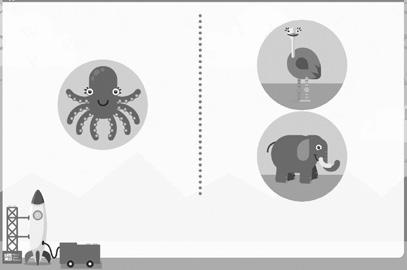
Point to the octopus and say “/ŏ/, octopus. Your turn.” A: /ŏ/, octopus
Click to display the ostrich and the elephant on the right.
Point to each image and say “ostrich, elephant.”
Ask “Which word begins the same as octopus?” A: ostrich
Click to show the correct answer.
Say “Let’s try another one.”
Click to display the eagle and the otter on the right.
Point to each image and say “eagle, otter.”
Ask “Which word begins the same as octopus?” A: otter
You do not have to isolate the beginning sounds before saying each word; however, if you would like to differentiate the activity to make it slightly easier for the students (see Differentiation Options on p. 15), the beginning sounds are isolated for you in the bulleted lists of examples.
© 2017 Really Great Reading Company, LLC 13 UNIT 6 Lesson 3 | Part 1
Click to show the correct answer.
Say “Let’s try another one.”
Continue to compare the next six image sets with the /ŏ/, octopus:
• /z/, zucchini & /ŏ/, October
• /l/, lemon & /ŏ/, ostrich
• /ŏ/, omelet & /ă/, alligator
• /s/, scissors & /ŏ/, avocado
• /b/, box & /ŏ/, ox
• /ŏ/, olives & /ĭ/, iguana
ROUND 2:
Say “Now, let’s see which words begin the same as queen.”
Click to display the queen on the left and the nail and the image for quiet on the right.
Continue to compare the next six image sets with the /kw/, queen:
• /n/, nail & /kw/, quiet
• /kw/, quilt & /z/, zero
• /t/, toes & /kw/, question
• /kw/, quarter & /sh/, shoe
• /v/, violin & /kw/, quick
• /kw/, quail & /ch/, cheetah
ROUND 3:
Say “Now, let’s see which words begin the same as rabbit.”
Click to display the rabbit on the left and the rainbow and jet on the right.
Continue to compare the next six image sets with the /r/, rabbit:
• /r/, rainbow & /j/, jet
• /t/, turtle & /r/, ring
• /p/, peas & /r/, rose
• /r/, raccoon & /b/, basketball
• /r/, rattle & /j/, jar
• /k/, cookie & /r/, rollercoaster
14 © 2017 Really Great Reading Company, LLC UNIT 6 Lesson 3 | Part 1
DIFFERENTIATION OPTIONS
Ways to simplify:
• Isolate the beginning sound of each word on the right side of the screen before asking students to determine the matching beginning sounds: Point to each image and say “/m/, match; /g/, goat.”
Unit 6 | Lesson 3 | Part 2
Activity 31: This Letter or That?
Objective
Students will identify the letter symbol that spells the first sound in a word.
See p. 8 for a full description of This Letter or That?
3, 2, 1…
AP: Letter ID
What Students See
Open Countdown Online to Unit 6, Lesson 3, Part 2 (6.3.2).
Launch!
SORT 1:
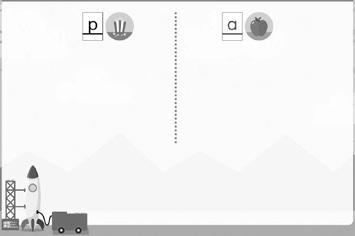
Click to display two columns with the headings “p” (for popcorn) and “a” (for apple).
Ask “What is the first sound in popcorn (while pointing to the popcorn)?” A: /p/
Say “Remember, the sound /p/ is spelled with the letter p (while pointing to the letter tile p).”
Ask “What is the first sound in apple (while pointing to the apple)?” A: /ă/
Say “Remember, the sound /ă/ is spelled with the letter a (while pointing to the letter tile a).”
Click to display the pencil at the bottom of the screen.
Say “We are going to listen to the first sound in pencil and then put it under the correct letter.”
© 2017 Really Great Reading Company, LLC 15 UNIT 6 Lesson 3 | Part 2
Ask “What is the first sound in pencil?” A: /p/
Say:
• “Right, so let’s move it under the /p/, popcorn and the letter p
• We can use the picture at the top to help us figure out the matching letter.”
Click to place the pencil in the “p” column.
Continue with remaining images: ax, pants, arrow, alligator, paintbrush, add, peanut, ant, peas, piano, astronaut.
Say:
• “Let’s go over our work (point to each image as you label it with students):
o /p/, popcorn; /p/, pencil; /p/, pants; /p/, paintbrush; /p/, peanut; /p/, peas; /p/, piano.
o /ă/, apple; /ă/, ax; /ă/, arrow; /ă/, alligator; /ă/, add; /ă/, ant; /ă/, astronaut
• Let’s try that with two new letters.”
SORT 2:
Click to display two columns with the headings “m” (for monkey) and “ t ” (for toothbrush).
Ask “What is the first sound in monkey (while pointing to the monkey)?” A: /m/ Say “Remember, the sound /m/ is spelled with the letter m (while pointing to the letter tile m).”
Ask “What is the first sound in toothbrush (while pointing to the toothbrush)?” A: /t/
Say “Remember, the sound /t/ is spelled with the letter t (while pointing to the letter tile t).”
Click to display the turtle at the bottom of the screen.
Ask:
• “ Turtle. What is the first sound in turtle?” A: /t/
• “Should we put the /t/, turtle under the m, like /m/, monkey or the t, like /t/, toothbrush?” A: t, /t/, toothbrush
Say “Right, /t/, turtle and /t/, toothbrush both start with the letter t, so I’ll move the turtle under the t.”
Click to place the turtle in the “ t ” column.
Continue with remaining images: muffin, toaster, twins, mouth, tiger, mitt, towel, mug, mountain, table, milk.
16 © 2017 Really Great Reading Company, LLC UNIT 6 Lesson 3 | Part 2
Say:
• “Let’s go over our work (point to each image as you label it with students):
o /m/, monkey; /m/, muffin; /m/, mouth; /m/, mitt; /m/, mug; /m/, mountain; /m/, milk
o /t/, toothbrush; /t/, turtle; /t/, toaster; /t/, twins; /t/, tiger; /t/, towel; /t/, table.”
See p. 10 for differentiation options for This Letter or That?
Unit 6 | Lesson 3 | Part 3
Activity 25: Stretch Those Sounds PA: Segmenting
Objective
Students will segment the phonemes (sounds) in threephoneme words using finger-stretching.
See p. 11 for a full description of Stretch Those Sounds.
What
Students
See 3, 2, 1…
Open Countdown Online to Unit 6, Lesson 3, Part 3 (6.3.3).
Launch!
Click to display the image for nap.
Say:
• “Now, we are going to separate all of the sounds in some words.
• Listen while I say the sounds in nap.”
• “nap” (hold closed fist against chest, crossing the midline)
• “/n/” (extend thumb), “/ă/” (extend pointer finger), “/p/” (extend middle finger)
• “nap” (pull fingers back to a closed fist while saying the word)
Say:
• “Watch what I did with my fingers while I said the sounds in nap.
© 2017 Really Great Reading Company, LLC 17 UNIT 6 Lesson 3 | Part 3
• I stretched the word out into sounds, said each sound, and at the same time, I stretched a finger.
• Let’s stretch the word nap again together.” (Students repeat sounds while finger-stretching.)
• “Let’s try another one.”
Click to display the mug.
Say:
• “Watch what I do with my fingers while I say the sounds in mug.”
• “mug ” (while holding closed fist against chest, crossing the midline)
• “/m/” (extend thumb), “/ŭ/” (extend pointer finger), “/g/” (extend middle finger)
• “mug ” (pull fingers back to a closed fist while saying the word)
• “Let’s stretch the word mug again together.” (Students repeat sounds while finger-stretching.)
• “Let’s keep going.”
Continue with remaining images: 1. bus (/b/ /ŭ/ /s/) 2. bat (/b/ /ă/ /t/) 3. fish (/f/ /ĭ/ /sh/) 4. sob (/s/ /ŏ/ /b/)
goat (/g/ /ō/ /t/)
horse (/h/ /or/ /s/)
ham (/h/ /ă/ /m/)
rose (/r/ /ō/ /z/)
nail (/n/ /ā/ /l/)
10. neck (/n/ /ĕ/ /k/) 11. wig (/w/ /ĭ/ /g/) 12. van (/v/ /ă/ /n/) 13. pen (/p/ /ĕ/ /n/) 14. sad (/s/ /ă/ /d/) 15. yawn (/y/ /aw/ /n/) 16. win (/w/ /ĭ/ /n/) 17. book (/b/ /�/ /k/) 18. dog (/d/ /ŏ/ /g/)
See p. 12 for differentiation options for Stretch Those Sounds.
18 © 2017 Really Great Reading Company, LLC UNIT 6 Lesson 3 | Part 3
5.
6.
7.
8.
9.
Unit 6 | Lesson 4 | Part 1
Activity 39: Letters Make Words AP: Decoding
Objective
Students will learn that some letters are consonants and some are vowels. Students will learn that, when put together, letters make up words, and all words have at least one vowel.
What Students See
3, 2, 1…
Description
This activity will introduce students to some key concepts about letters and words as they examine several letters and words with the teacher.
Open Countdown Online to Unit 6, Lesson 4, Part 1 (6.4.1).
Launch!
Say “Today, we are going to learn some more about letters.”
Click to display the map.
Click to display the letter tiles m, a, and p.
Say:
• “We have learned that letters are sounds that are written down.
• When we have two or more letters together, they can sometimes spell a word.”
• (Point to the word map.) “This is the word map. It is spelled with three letters: m, a, and p.” (Point to each letter as you name it.)
• “Soon we will begin reading words like map, but for now, we just need to know that words are made up of letters.”
Point to the letter tiles m and p.
Say “Some of our letters, like these two, are black. These letters are called consonants. Say the word ‘consonants.’” (Students say “consonants.”)
Point to the letter tile a.
© 2017 Really Great Reading Company, LLC 19 UNIT 6 Lesson 4 | Part 1
Say:
•
“Some of our letters, like this one, are red. These letters are called vowels. Say the word ‘vowels.’” (Students say “vowels.”)
• “All words have a vowel. You will always see one red letter in the words we read.
• Let’s look for the consonants and vowels in another word.”
Click twice to display the bug.
Click to display the letter tiles b, u, and g.
Say:
•
“This is the word bug. It is also spelled with three letters.
• Remember, some of our letters are black. These letters are called consonants.
• Some of our letters are red. These letters are called vowels.”
Point to the letter tile b and ask, “Is this letter a consonant or a vowel?”
A: consonant because it is black
Point to the letter tile u and ask, “Is this letter a consonant or a vowel?”
A: vowel because it is red
Point to the letter tile g and ask, “Is this letter a consonant or a vowel?”
A: consonant because it is black
Say “Good job observing those letters! As we play our Countdown games, you will see lots of letters together that spell words. You will also learn about lots of consonant letters and vowel letters.”
Unit 6 | Lesson 4 | Part 2
Activity 32: Find That Letter
Objective
Students will identify the letter symbol that spells the shared first sound in a set of three imaged words.
What Students See
Description
AP: Letter ID
This phonics activity gives students practice with isolating initial sounds while associating them with their letter symbols. Three images with the same initial sound appear and students are asked to find the corresponding letter tile. This activity promotes letter-sound correspondence with lowercase letters.
20 © 2017 Really Great Reading Company, LLC UNIT 6 Lesson 4 | Part 2
3, 2, 1…
OPTIONAL (only if you choose to use manipulatives)
Prepare materials:
• Letter tiles m, t, a, and p and working board from Countdown Student Kit for each student
Open Countdown Online to Unit 6, Lesson 4, Part 2 (6.4.2).
Launch!
OPTIONAL (only if you choose to use manipulatives)
Students take out letter tiles m, t, a, and p and working board.
Say “Now, we are going to match our letter tiles to the beginning sounds in some words.”
Click to display, point to, and name three images: ax, astronaut, apple
Ask “What is the beginning sound in all of these words?” A: /ă/
Click to display three letter tiles: a, t, and p
Say “Point to the letter that spells /ă/, and say its name.” A: a (pointing to the left)
Click to show the correct answer.
Say “Let’s find another letter.”
Click to display, point to, and name three images: toaster, toothbrush, twins
Ask “What is the beginning sound in all of these words?” A: /t/
Click to display three letter tiles: m, t, and p
Say “Point to the letter that spells /t/, and say its name.” A: t (pointing to the middle)
Click to show the correct answer.
Say “Let’s find another letter.”
Continue with remaining image sets:
1. pencil, pants, peanut (p)
2. match, man, mouth (m)
3. pot, pig, peppermint (p)
4. add, alligator, ant (a)
5. monster, mountain, mouse (m)
6. towel, tongue, teeth (t)
7. pen, popcorn, pie (p)
8. muffin, mitt, mug (m)
9. tiger, table, turtle (t)
10. monkey, match, mouse (m)
11. piano, peanut, pot (p)
12. mask, mad, mix (m)
13. arrow, astronaut, ax (a)
You may want to have students point all the way to the left for a, to the center for t, and all the way to the right for p. If students are using manipulatives, have them hold up the correct tile and name it rather than point.
© 2017 Really Great Reading Company, LLC 21 UNIT 6 Lesson 4 | Part 2
DIFFERENTIATION OPTIONS
Ways to simplify:
• Isolate the beginning sound of the three given words before asking students to identify the first sound: “Click to display, point to, and name three images: /ă/, ax; /ă/, astronaut; /ă/, apple.”
• Point to each of the three letter tile options and provide the sound for that letter, or have students provide the sounds, comparing each to the first sound in the target words.
Unit 6 | Lesson 4 | Part 3
Activity 25: Stretch Those Sounds PA: Segmenting
Objective
Students will segment the phonemes (sounds) in threephoneme words using finger-stretching.
See p. 11 for a full description of Stretch Those Sounds.
What Students See 3, 2, 1…
Open Countdown Online to Unit 6, Lesson 4, Part 3 (6.4.3).
Launch!
Click to display the image for yes
Say:
• “Now, we are going to separate all of the sounds in some words.
• Listen while I say the sounds in yes.”
• “yes ” (hold closed fist against chest, crossing the midline)
• “/y/” (extend thumb), “/ĕ/” (extend pointer finger), “/s/” (extend middle finger)
• “yes ” (pull fingers back to a closed fist while saying the word)
22 © 2017 Really Great Reading Company, LLC UNIT 6 Lesson 4 | Part 3
Say:
•
“Watch what I did with my fingers while I said the sounds in yes.
• I stretched the word out into sounds, said each sound, and at the same time, I stretched a finger.
• Let’s stretch the word yes again together.” (Students repeat sounds while finger-stretching.)
• “Let’s try another one.”
Continue with remaining images:
1. bell (/b/ /ĕ/ /l/)
2. dip (/d/ / ĭ/ /p/)
3. win (/w/ /ĭ/ /n/)
4. hose (/h/ /ō/ /z/)
5. log (/l/ /ŏ/ /g/)
6. fox (/f/ /ŏ/ /ks/)
7. boat (/b/ /ō/ /t/)
8. inch (/ĭ/ /n/ /ch/)
9. mouse (/m/ /ou/ /s/)
10. cheese (/ch/ /ē/ /z/)
11. lick (/l/ /ĭ/ /k/)
12. map (/m/ /ă/ /p/)
13. girl (/g/ /er/ /l/)
14. sad (/s/ /ă/ /d/)
15. check (/ch/ /ĕ/ /k/)
16. sheep (/sh/ /ē/ /p/)
17. book (/b/ /�/ /k/)
18. quick (/kw/ /ĭ/ /k/)
19. jam (/j/ /ă/ /m/)
See p. 12 for differentiation options for Stretch Those Sounds.
© 2017 Really Great Reading Company, LLC 23 UNIT 6 Lesson 4 | Part 3
Unit 6 | Lesson 5 | Part 1
Activity 33: Connect the Letter AP: Letter ID
Objective
Students will practice connecting a word’s beginning sound to its corresponding letter symbol.
What Students See
3, 2, 1…
Description
One letter tile will appear at the top of the screen with three images below. Students will determine which image’s beginning sound is spelled by the letter on the tile.
Open Countdown Online to Unit 6, Lesson 5, Part 1 (6.5.1).
Launch!
Say “Today, we are going to match letters to the beginning sounds in some words.”
Ask “This is the letter m. What sound does the letter m spell, or ‘say’?” A: /m/
Say “Right. Now, let’s look at a few pictures and see which one begins with that sound.”
Click to display, point to, and name three images below the letter tile m: table, ax, and match.
Ask “Which one begins with /m/?” A: match
Say “Yes, /m/, match begins with /m/, so match begins with letter m.”
Click to display the correct answer.
Say “Let’s try that with some new pictures.”
Click to display, point to, and name the three images below the letter tile m: monkey, popcorn, and apple.
Ask “Which one begins with m?” A: monkey
Say “Yes, /m/, monkey begins with m.”
Click to display the correct answer.
24 © 2017 Really Great Reading Company, LLC UNIT 6 Lesson 5 | Part 1
Continue with remaining letter tiles and images: m
• peanut, monster, astronaut • muffin, teeth, paint • add, milk, turtle t • toothbrush, map, alligator • ant, pig, toes • mouth, toy, pencil • peas, tie, ax • tongue, pan, mitten p • mix, pants, tape • add, two, paintbrush • pen, alligator, mitt • mouse, piano, toaster • tiger, pie, mountain a • penny, toast, apple • ax, towel, moose • astronaut, tie, peppermint • table, pot, alligator • piano, add, mask
DIFFERENTIATION OPTIONS
Ways to simplify:
• Isolate the beginning sound of each image for students before asking them to identify which image’s beginning sound matches the letter tile presented.
The correct answers for this activity are displayed in boldface text.
© 2017 Really Great Reading Company, LLC 25 UNIT 6 Lesson 5 | Part 1
Unit 6 | Lesson 5 | Part 2
Activity 40: Touch & Say AP: Decoding
Objective
Students decode (read) words by pronouncing one sound at a time and then blending them together.
What Students See
3, 2, 1…
Description
This decoding (reading) activity begins with teacher and students pronouncing the individual phonemes in a word as the teacher underlines each grapheme (letter or letters that spell a sound). Then, they blend the sounds together to read the whole word.
Open Countdown Online to Unit 6, Lesson 5, Part 2 (6.5.2).
Launch!
Click to display the letter tiles m, a, t.
Say:
• “We’re going to read some words by ‘sounding them out,’ which means saying them one sound at a time.
• Let’s get started with this word. Watch how I sound it out.”
Click to underline one letter tile at a time while saying its sound, “/m/ /ă/ /t/.”
Click to slide an arrow from left to right under the entire word while saying, “mat.”
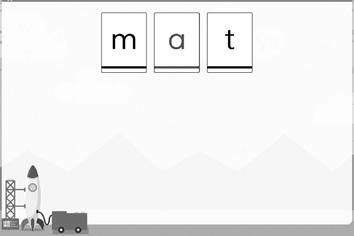
Say “Let’s keep going! This time, say the sounds and blend the word with me.”
Click to display the letter tiles t, a, p.
Click to underline one letter at a time while saying its sound with students, “/t/ /ă/ /p/.”
Click to slide an arrow from left to right under the entire word while saying, “tap.”
Continue with remaining words, making sure students are saying each sound with you as you click to underline it:
1. am (/ă/ /m/)
2. pat (/p/ /ă/ /t/)
3. mat (/m/ /ă/ /t/)
4. at (/ă/ /t/)
26 © 2017 Really Great Reading Company, LLC UNIT 6 Lesson 5 | Part 2
5. map (/m/ /ă/ /p/)
6. Pam (/p/ /ă/ /m/)
7. pat (/p/ /ă/ /t/)
8. am (/ă/ /m/)
9. tap (/t/ /ă/ /p/)
10. map (/m/ /ă/ /p/)
11. at (/ă/ /t/)
12. Pam (/p/ /ă/ /m/)
DIFFERENTIATION OPTIONS
Ways to challenge:
• Have students pronounce each individual sound and then blend the word independently as you underline the tiles.
Unit 6 | Lesson 5 | Part 3
Activity 24: Mystery Bag: Blending Sounds PA: Blending Objective
Students will blend two or three phonemes to produce a word.
What Students See
Description
A mystery bag will appear on the screen. The teacher says each phoneme in a twoor three-phoneme word and then asks the students to blend the phonemes and say the blended word. An image representing the word appears.
Due to the limited list of words that are decodable using only the Cluster 1 letters, each word in this activity is used twice.
3, 2, 1…
Open Countdown Online to Unit 6, Lesson 5, Part 3 (6.5.3).
Launch! Click to display the Mystery Bag. Say: • “Let’s see what words are in our mystery bag! Listen to my sounds. • /b/ /ŏ/ /ks/.”
© 2017 Really Great Reading Company, LLC 27 UNIT 6 Lesson 5 | Part 3
Ask “What word does it make when we put these sounds together, /b/ /ŏ/ /ks/?” A: box
Say “Let’s check in the bag!”
Click to display the box to confirm students’ answer. Say “Let’s try another one.”
Click to display the Mystery bag
Continue with the remaining examples:
1. /w/ /ĭ/ /n/, win 2. /s/ /ē/ /l/, seal 3. /b/ /er/ /d/, bird 4. /y/ /aw/ /n/, yawn 5. /b/ /ŭ/ /g/, bug 6. /k/ /or/ /n/, corn 7. /sh/ /er/ /t/, shirt 8. /s/ /ŏ/ /k/, sock 9. /f/ /ē/ /t/, feet 10. /s/ /ĭ/ /ks/, six 11. /g/ /er/ /l/, girl 12. /ă/ /n/ /t/, ant 13. /r/ /ŭ/ /n/, run 14. /l/ /ĕ/ /g/, leg 15. /kw/ /ĭ/ /k/, quick
16. /t/ /ō/ /z/, toes 17. /n/ /ĕ/ /t/, net 18. /d/ /ŏ/ /g/, dog 19. /ch/ /ĕ/ /k/, check 20. /w/ /ā/ /v/, wave 21. /f/ /�/ /t/, foot 22. /n/ /ī/ /f/, knife 23. /m/ /�/ /s/, moose 24. /b/ /ā/ /r/, bear 25. /s/ /ĭ/ /t/, sit 26. /f/ /ō/ /n/, phone 27. /s/ /ō/ /p/, soap 28. /sh/ /ar/ /k/, shark 29. /s/ /ĭ/ /k/, sick
DIFFERENTIATION OPTIONS
Ways to simplify:
• Give the phonemes twice before asking for a response, or even three times if necessary.
• Decrease the length of the pauses between the phonemes. When closer together, it will be easier to blend the phonemes into a word: /b/ - (PAUSE) - /ō/ - (PAUSE) - /t/, boat rather than /b/ - (PAUSE) - /ō/ - (PAUSE) - /t/, boat.
28 © 2017 Really Great Reading Company, LLC UNIT 6 Lesson 5 | Part 3
Unit 7 | Lesson 1 | Part 1
Activity 25: Stretch Those Sounds PA: BSI
Objective
Students will segment the phonemes (sounds) in threephoneme words using finger-stretching.
See p. 11 for a full description of Stretch Those Sounds.
3, 2, 1…
What Students See
Open Countdown Online to Unit 7, Lesson 1, Part 1 (7.1.1).
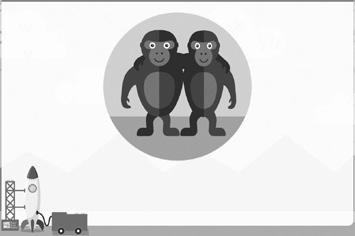
Launch! Click to display the image for hug Say: • “Today, we are going to separate all of the sounds in some words. • Listen while I say the sounds in hug.” • “hug ” (hold closed fist against chest, crossing the midline) • “/h/” (extend thumb), “/ŭ/” (extend pointer finger), “/g/” (extend middle finger) • “hug ” (pull fingers back to a closed fist while saying the word)
Say: • “Let’s stretch the word hug again together.” (Students repeat sounds while finger-stretching.) • “Let’s try another one.”
Continue with remaining images:
1. nose (/n/ /ō/ /z/) 2. duck (/d/ /ŭ/ /k/) 3. lime (/l/ /ī/ /m/) 4. six (/s/ /ĭ/ /ks/) 5. feet (/f/ /ē/ /t/) 6. man (/m/ /ă/ /n/)
7. worm (/w/ /er/ /m/) 8. shark (/sh/ /ar/ /k/) 9. toes (/t/ /ō/ /z/) 10. leaf (/l/ /ē/ /f/) 11. jam (/j/ /ă/ /m/) 12. bike (/b/ /ī/ /k/)
© 2017 Really Great Reading Company, LLC 29 UNIT 7 Lesson 1 | Part 1
Optional motions for consonant sounds are available in the Appendix on p. 290 for students who may require more of a kinesthetic approach.
13. thumb (/th/ /ŭ/ /m/)
14. bed (/b/ /ĕ/ /d/)
15. elf (/ĕ/ /l/ /f/)
16. hat (/h/ /ă/ /t/)
17. corn (/k/ /or/ /n/)
18. wig (/w/ /ĭ/ /g/)
19. sad (/s/ /ă/ /d/)
See p. 12 for differentiation options for Stretch Those Sounds.
Unit 7 | Lesson 1 | Part 2
Activity 30: Name That Sound AP: Letter ID
Objective
Students will identify the uppercase and lowercase letters associated with the sounds /s/, /h/, /k/, and //.
See p. 2 for a full description of Name That Sound.
What
Students
See 3, 2, 1…
Open Countdown Online to Unit 7, Lesson 1, Part 2 (7.1.2).
Launch!
Say “Now, we are going to see what our new sounds look like when they are written down.”
Click to display the soap.
Ask:
• “What is this a picture of?” A: soap
• “What is the first sound in /s/, soap?” A: /s/
Click to display the corresponding uppercase and lowercase letter tiles.
Say:
• “Right, soap begins with /s/, and these letters say the sound, or spell, /s/.
• Do you remember Sofia the Seal? After she slides down the sand dunes, she cleans herself up with soap. Her favorite sound is /s/.
• The name of these letters is S S says /s/, like the beginning of /s/, soap
30 © 2017 Really Great Reading Company, LLC UNIT 7 Lesson 1 | Part 2
•
This one (point to uppercase S) is called ‘capital S,’ and this one (point to lowercase s) is called ‘lowercase s.’ This is the one we will see most of the time, so we’ll just call it s.
Let’s learn another new letter.”
•
Click to display the hammer.
Ask:
• “What is this a picture of?” A: a hammer
• “What is the first sound in /h/, hammer?” A: /h/
Click to display the corresponding uppercase and lowercase letter tiles. Say:
• “Right, hammer begins with /h/, and these letters say /h/.
• Do you remember Hannah the Hedgehog? She is better at hula hooping than she is at swinging a hammer. Her favorite sound is /h/.
• The name of these letters is H. H says /h/, like the beginning of /h/, hammer.
•
This one (point to uppercase H) is called ‘capital H,’ and this one (point to lowercase h) is called ‘lowercase h.’ This is the one we will see most of the time, so we’ll just call it h.
Let’s learn another new letter.”
•
Click to display the cat.
Ask:
• “What is this a picture of?” A: a cat
• “What is the first sound in /k/, cat?” A: /k/
Click to display the corresponding uppercase and lowercase letter tiles.
Say “Right, cat begins with /k/, and these letters say /k/. Do you remember C arla the C at? She spent last summer canoeing in the creek at camp. Her favorite sound is /k/.”
Ask “So, what do you think these letters say?” A: /k/
Say:
• “Yes! The name of these letters is C C says /k/, like the beginning of /k/, cat
• This one (point to uppercase C) is called ‘capital C ,’ and this one (point to lowercase c) is called ‘lowercase c.’ This is the one we will see most of the time, so we’ll just call it c
Let’s learn one more new letter.”
•
Click to display the image for itch
© 2017 Really Great Reading Company, LLC 31 UNIT 7 Lesson 1 | Part 2
Ask:
• “What is this a picture of?” A: a hand scratching an itch
• “What is the first sound in /ĭ/, itch?” A: /ĭ/
Click to display the corresponding uppercase and lowercase letter tiles.
Ask “So, what do you think these letters say?” A: /ĭ/
Say:
• “Yes! The name of these letters is I I says /ĭ/, like the beginning of /ĭ/, itch
• This one (point to uppercase I) is called ‘capital I,’ and this one (point to lowercase i) is called ‘lowercase i.’ This is the one we will see most of the time, so we’ll just call it i.”
Demonstrate /ĭ/, itch motion (you should use this motion, and all the short vowel motions, for all students):
Say:
• “Let’s do a motion to help us remember that sound.
• Pretend you have an itch on your arm and you are scratching it.”
Demonstrate the short i, itch, motion while elongating the sound /ĭĭĭĭ/, and have students repeat (pretend to have an itch on your forearm and scratch it with your other hand).
Click to display letter tiles s, h, c, and i. Say “Let’s name our letters one more time and say the sound that each letter spells.”
Point to each letter, one at a time, and say:
• “This is s. S says /s/.
• This is h. H says /h/.
• This is c. C says /k/.
• This is i. I says / ĭ/.”
32 © 2017 Really Great Reading Company, LLC
UNIT 7 Lesson 1 | Part 2
Unit 7 | Lesson 1 | Part 3
Activity 34: Which Letter?
Objective
Students will isolate the beginning sound of a word and match that sound to its letter symbol.
What Students See
Description
AP: Letter ID
An individual image appears along with the medial vowel and final consonant of the represented word. The teacher pronounces the whole word associated with the image and then asks students to isolate its beginning sound. On the next click, three letter tiles will appear, and the teacher asks students which letter tile matches the beginning sound. This activity promotes letter-sound correspondence with lowercase letters.
3, 2, 1…
OPTIONAL (only if you choose to use manipulatives)
Prepare materials:
• Letter tiles a, c, h, i, m, p, s, and t and working board from Countdown Student Kit for each student (italicized letter tiles listed here are new to this unit; have students add these tiles to their boards)
Open Countdown Online to Unit 7, Lesson 1, Part 3 (7.1.3).
Launch!
OPTIONAL (only if you choose to use manipulatives)
Students take out letter tiles c, h, m, p, s, and t and working board.
Say “Now, we are going to spell the first letter of some words.”
Click to display the hat with the letters a t spelled out below.
Say “Hat.”
Ask “What is the first sound in hat?” A: /h/
Click to display three letter tiles: h, c, t.
Ask “Which of these letters spells /h/ like /h/, hat? Point to the letter tile that spells /h/, and say its name, /h/.” A: h
Click to show the correct answer.
Note that, although students should add the a and i tiles to their boards at this time, they won't use those tiles in this activity. However, since they will use them in other activities in this unit, it will be helpful to place them on the board now.
You may want to have students point all the way to the left for h, to the center for c, and all the way to the right for t. If students are using manipulatives, have them hold up the correct tile and name it rather than point.
© 2017 Really Great Reading Company, LLC 33
UNIT 7 Lesson 1 | Part 3
Click to display the map with the letters a p spelled out below.
Say “Map.”
Ask “What is the first sound in map?” A: /m/
Click to display three letter tiles: s, m, c.
Ask “Which of these letters spells /m/ like /m/, map? Point to the letter tile that spells /m/, and say its name.” A: m
Click to show the correct answer.
Continue with remaining images:
1. cap (c)
2. ham (h)
3. cat (c) 4. him (h) 5. sit (s)
6. mat (m)
7. pat (p)
8. sip (s)
9. tap (t) 10. hip (h)
11. pit (p) 12. sat (s)
13. hit (h) 14. tip (t)
DIFFERENTIATION OPTIONS
Ways to simplify:
• Isolate the beginning sound of the given word before asking students to identify the first sound: Say “/h/, hat.”
• Point to each of the three letter tile options and provide the sound for that letter (or have students provide it), comparing each to the first sound in the target word.
34 © 2017 Really Great Reading Company, LLC
UNIT 7 Lesson 1 | Part 3
Unit 7 | Lesson 2 | Part 1
Activity 20: This or That? PA: BSI
Objective
Students will identify which word of two has a specific beginning sound.
What Students See
3, 2, 1…
Description
Two images appear on the board. The student is asked to identify which object begins with a certain phoneme. This activity reinforces the idea that words are made out of sounds and that we can isolate individual sounds in words.
Open Countdown Online to Unit 7, Lesson 2, Part 1 (7.2.1).
Launch!
Say “Today, we are going to listen for the word that begins with the sound I say.”
Click to display the acorn and the doughnut
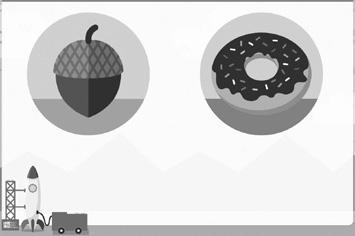
Point to each image and say “Acorn, doughnut. Which word starts with /ā/?” A: acorn
Say “Yes, /ā/, acorn.”
Click to show the correct answer.
Say “Let’s try another one.”
Click to display the shark and the feather.
Point to each image and say “Shark, feather. Which word starts with /sh/?” A: shark
Say “Yes, /sh/, shark.”
Click to show the correct answer.
Say “Let’s try another one.”
Continue with the remaining examples:
1. violin/chocolate (“Which one starts with /v/?” A: violin)
2. tie/pan (“Which one starts with /t/?” A: tie)
3. cookie/jump (“Which one starts with /j/?” A: jump)
© 2017 Really Great Reading Company, LLC 35
UNIT 7 Lesson 2 | Part 1
4. knee/monkey (“Which one starts with /n/?” A: knee)
5. hair/sock (“Which one starts with /h/?” A: hair)
6. car/yawn (“Which one starts with /y/?” A: yawn)
7. fish/lion (“Which one starts with /f/?” A: fish)
8. dinosaur/thread (“Which one starts with /th/?” A: thread)
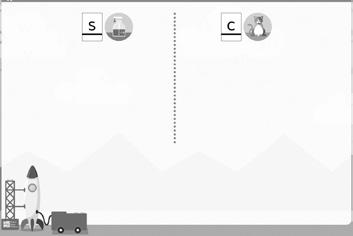
9. octopus/apple (“Which one starts with /ŏ/?” A: octopus)
10. balloon/snake (“Which one starts with /b/?” A: balloon) 11. cheese/corn (“Which one starts with /k/?” A: corn) 12. ice cream/unicorn (“Which one starts with /y�/?” A: unicorn) 13. newspaper/zebra (“Which one starts with /z/?” A: zebra)
14. itch/ox (“Which one starts with /ĭ/?” A: itch)
15. wave/zigzag (“Which one starts with /w/?” A: wave)
16. mouse/alligator (“Which one starts with /ă/?” A: alligator)
17. question/piano (“Which one starts with /kw/?” A: question)
18. grapes/jump (“Which one starts with /j/?” A: jump)
36 © 2017 Really Great Reading Company, LLC
DIFFERENTIATION OPTIONS
to simplify:
Isolate the beginning sound of each word:
rabbit.
.
Unit 7 | Lesson 2 | Part 2 Activity 31: This Letter or That? AP: Letter ID Objective Students will identify the letter symbol that spells the first sound in a word. See p. 8 for a full description of This Letter or That? What Students See UNIT 7 Lesson 2 | Part 2
Ways
•
“/r/,
/th/, thumb
Which word starts with /r/?”
3, 2, 1…
Open Countdown Online to Unit 7, Lesson 2, Part 2 (7.2.2).
Launch!
SORT 1:
Click to display two columns with the headings “s ” (for soap) and “c ” (for cat).
Ask “What is the first sound in soap (while pointing to the soap)?” A: /s/ Say “Remember, the sound /s/ is spelled with the letter s (while pointing to the letter tile s).”
Ask “What is the first sound in cat (while pointing to the cat)?” A: /k/
Say “Remember, the sound /k/ is spelled with the letter c (while pointing to the letter tile c).”
Click to display the cupcake at the bottom of the screen.
Say “We are going to listen to the first sound in cupcake and then put it under the correct letter.”
Ask “What is the first sound in cupcake?” A: /k/ Say: • “Right, so let’s move it under the /k/, cat and the letter c.
• We can use the picture at the top to help us figure out the matching letter.”
Click to place the cupcake in the “c ” column.
Click to display the school at the bottom of the screen.
Ask: • “Schoolhouse. What is the first sound in school?” A: /s/ • “Should we put the /s/, school, under the s, like /s/, soap or the c, like /k/, cat?” A: s, /s/, soap
Say “Right, so I’ll move the school to the ‘s ’ side.”
Click to place the school in the “s ” column.
Continue with remaining images: straw, cow, carrot, skunk, cactus, sunflower, cookie, snake, sat, cot.
Say: • “Let’s go over our work (point to each image as you label it with students): o /s/, soap; /s/, school; /s/, straw; /s/, skunk; /s/, sunflower; /s/, snake; /s/, sat.
© 2017 Really Great Reading Company, LLC 37
UNIT 7 Lesson 2 | Part 2
SORT 2:
o /k/, cat; /k/, cupcake; /k/, cow; /k/, carrot; /k/, cactus; /k/, cookie; /k/, cot.”
Click to display two columns with the headings “h” (for hammer) and “i ” (for itch).
Ask “What is the first sound in hammer (while pointing to the hammer)?” A: /h/
Say “Remember, the sound /h/ is spelled with the letter h (while pointing to the letter tile h).”
Ask “What is the first sound in itch (while pointing to the image for itch)?” A: / ĭ/
Say “Remember, the sound / ĭ/ is spelled with the letter i (while pointing to the letter tile i).”
Click to display the insect at the bottom of the screen.
Ask:
• “Insect. What is the first sound in insect?” A: /ĭ/
• “Should we put the / ĭ/, insect under the h, like /h/, hammer or the i, like /ĭ/, itch?” A: i, /ĭ/, itch
Say “Right, /ĭ/, insect and /ĭ/, itch both start with the letter i, so I’ll move the insect under the i.”
Click to place the insect in the “i ” column.
Continue with remaining images: inside, heart, hamburger, infant, hamster, igloo, inch, hanger, hug, iguana, hospital.
Say: • “Let’s go over our work (point to each image as you label it with students):
o /h/, hammer; /h/, heart; /h/, hamburger; /h/, hamster; /h/, hanger; /h/, hug; /h/, hospital.
o /ĭ/, itch; /ĭ/, insect; /ĭ/, inside; /ĭ/, infant; /ĭ/, igloo; /ĭ/, inch; /ĭ/, iguana.”
See p. 10 for differentiation options for This Letter or That?
38 © 2017 Really Great Reading Company, LLC
UNIT 7 Lesson 2 | Part 2
Unit 7 | Lesson 2 | Part 3
Activity 36: Guess My Word AP: Encoding
Objective
Students will observe the encoding of a word and then blend together the word's phonemes.
What Students See
Description
Three letter tiles appear scrambled on the board. The teacher segments the individual phonemes of a word in the correct order, moving the letter tiles into the correct position. Students then blend the phonemes together to create a whole word, which is the “mystery word.” The image for that word then appears as confirmation. This activity serves to model the process of encoding for students.
3, 2, 1…
Open Countdown Online to Unit 7, Lesson 2, Part 3 (7.2.3).
Launch!
Say “Now, you’re going to guess my mystery words that got all mixed up.”
Click to display the letter tiles a, c, t
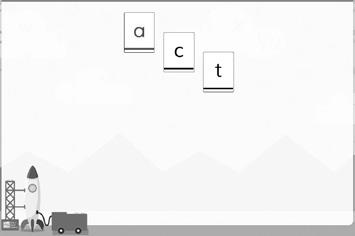
Say “Guess the mystery word, /k/ /ă/ /t/.” (Click to move the letter tiles into the correct position as you say each sound.)
Ask “What’s my word?” A: cat (Students blend the sounds together to say the word.)
Say “/k/ /ă/ /t/, cat.” (Point to each letter tile as you say its sound, and then sweep your finger under the word from left to right while saying the whole word.)
Click to display the cat
Continue with remaining images:
1. /h/ /ă/ /m/, ham
2. /m/ /ă/ /p/, map
3. /h/ /ă/ /t/, hat
4. /s/ /ĭ/ /t/, sit
5. /h/ /ĭ/ /m/, him
6. /h/ /ĭ/ /p/, hip
7. /m/ /ă/ /t/, mat
8. /p/ /ă/ /t/, pat
9. /h/ /ĭ/ /t/, hit
10. /s/ /ă/ /t/, sat
© 2017 Really Great Reading Company, LLC 39
UNIT 7 Lesson 2 | Part 3
11. /t/ /ă/ /p/, tap
12. /t/ /ĭ/ /p/, tip
13. /s/ /ĭ/ /p/, sip
14. /k/ /ă/ /p/, cap
DIFFERENTIATION OPTIONS
Ways to simplify:
• If students struggle to blend the sounds together, you may blend them together for students and have them repeat after you.
40 © 2017 Really Great Reading Company, LLC
UNIT 7 Lesson 2 | Part 3
Unit 7 | Lesson 3 | Part 1
Activity 23: What’s That Word? PA: Blending Objective
Students will blend the phonemes (sounds) in a three-phoneme word and say the whole word.
What Students See
3, 2, 1…
Description
Two images appear on the screen. The teacher says the indi vidual phonemes (sounds) of one of the image words, holding up a finger for each part. Students then repeat, and the teacher asks the students to blend the sounds to choose the image of the word that was blended together.
Open Countdown Online to Unit 7, Lesson 3, Part 1 (7.3.1).
Launch!
Say “I am going to say three sounds, and then we will blend them together to make a whole word.”
Click to display the wig and the nail.
Say: • “ Wig, nail.
•
Listen carefully while I say the sounds of one of these words: /n/ (hold up thumb; keep up) – (PAUSE) – /ā/ (hold up pointer finger; keep up) – (PAUSE) – /l/ (hold up middle finger; keep up).”
Ask “Look at these two pictures. If we blend those three sounds together, /n/ /ā/ /l/, what word do we get?” A: nail (Point to the correct picture and say the word.)
Click to show the correct answer.
Say “Let’s try another one.”
Click to display the shark and the jet
Say:
• “Shark, jet
•
Listen carefully while I say the sounds of one of these words: /j/ (hold up thumb; keep up) – (PAUSE) – /ĕ/ (hold up pointer finger; keep up) – (PAUSE) – /t/ (hold up middle finger; keep up).”
© 2017 Really Great Reading Company, LLC 41
UNIT 7 Lesson 3 | Part 1
Ask “Look at these two pictures. If we blend those three sounds together, /j/ /ĕ/ /t/, what word do we get?” A: jet (Point to the correct picture and say the word.)
Click to show the correct answer. Say “Let’s try another one.”
Continue with the remaining examples:
1. deer/bus /b/ /ŭ/ /s/ A: bus
2. robe/gate /g/ /ā/ /t/ A: gate
3. hug/neck /n/ /ĕ/ /k/ A: neck
4. fly/wig /f/ /l/ /ī/ A: fly
5. nose/van /n/ /ō/ /z/ A: nose
6. dog /bus /d/ /ŏ/ /g/ A: dog
7. girl/pig /p/ /ĭ/ /g/ A: pig
8. wave/feet /w/ /ā/ /v/ A: wave
9. robe/dip /d/ /ĭ/ /p/ A: dip
10. peas/bat /b/ /ă/ /t/ A: bat
11. chin/van /v/ /ă/ /n/ A: van
12. lime/ant /ă/ /n/ /t/ A: ant
13. seal/tape /s/ /ē/ /l/ A: seal
14. vase/shirt /sh/ /er/ /t/ A: shirt
15. nail/shark /n/ /ā/ /l/ A: nail
16. horse/mouse /m/ /ou/ /s/ A: mouse
17. sun/rug /r/ /ŭ/ /g/ A: rug
18. bike/check /ch/ /ĕ/ /k/ A: check
DIFFERENTIATION OPTIONS
Ways to simplify:
• Shorten the pause between segmented word parts: /k/ /ă/ /n/.
Ways to challenge:
• Lengthen the pause between segmented word parts: /k/ /ă/ /n/.
• Don't give the names of the objects before segmenting the word parts of the target word.
42 © 2017 Really Great Reading Company, LLC
UNIT 7 Lesson 3 | Part 1
Unit 7 | Lesson 3 | Part 2
Activity 31: This Letter or That?
Objective
Students will identify the letter symbol that spells the first sound in a word.
See p. 8 for a full description of This Letter or That?
3, 2, 1…
AP: Letter ID
What Students See
Open Countdown Online to Unit 7, Lesson 3, Part 2 (7.3.2).
Launch!
SORT 1:
Click to display two columns with the headings “h” (for hammer) and “s” (for soap).
Ask “What is the first sound in hammer (while pointing to the hammer)?” A: /h/
Say “Remember, the sound /h/ is spelled with the letter h (while pointing to the letter tile h).”
Ask “What is the first sound in soap (while pointing to the soap)?” A: /s/ Say “Remember, the sound /s/ is spelled with the letter s (while pointing to the letter tile s).”
Click to display the heart at the bottom of the screen.
Say “We are going to listen to the first sound in heart and then put it under the correct letter.”
Ask “What is the first sound in heart?” A: /h/ Say:
• “Right, so let’s move it under the /h/, hammer and the letter h.
• We can use the picture at the top to help us figure out the matching letter.”
Click to place the heart in the “h” column.
Click to display the sock at the bottom of the screen.
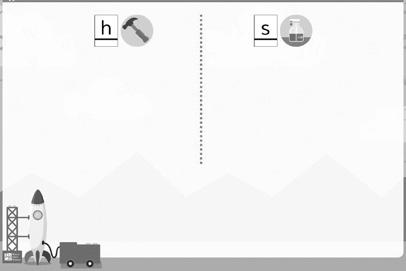
Ask:
• “Sock. What is the first sound in sock?” A: /s/
© 2017 Really Great Reading Company, LLC 43
UNIT 7 Lesson 3 | Part 2
• “Should we put the /s/, sock, under the h, like /h/, hammer or the s, like /s/, soap?” A: s, /s/, soap
Say “Right, /s/, sock and /s/, soap both start with the letter s, so I’ll move the sock under the s.”
Continue with remaining images: hamster, hose, snake, sidewalk, hug, sunflower, seal, hamburger, six, hospital.
Say:
• “Let’s go over our work (point to each image as you label it with students):
o /h/, hammer; /h/, heart; /h/, hamster; /h/, hose; /h/, hug; /h/, hamburger; /h/, hospital.
o /s/, soap; /s/, sock; /s/, snake; /s/, sidewalk; /s/, sunflower; /s/, seal; /s/, six
•
SORT 2:
Let’s try that with two new letters.”
Click to display two columns with the headings “c ” (for cat) and “i ” (for itch).
Ask “What is the first sound in cat (while pointing to the cat)?” A: /k/ Say “Remember, the sound /k/ is spelled with the letter c (while pointing to the letter tile c).”
Ask “What is the first sound in itch (while pointing to the image for itch)?” A: /ĭ/ Say “Remember, the sound /ĭ/ is spelled with the letter i (while pointing to the letter tile i).”
Click to display the image for inside at the bottom of the screen.
Ask:
• “Inside. What is the first sound in inside?” A: /ĭ/
• “Should we put /ĭ/, inside under the c, like /k/, cat or the i, like /ĭ/, itch?” A: i, /ĭ/, itch
Say “Right, /ĭ/, inside and /ĭ/, itch both start with the letter i, so I’ll move the image for inside under the i.”
Click to place the inside in the “i ” column.
Continue with remaining images: iguana, cupcake, cow, ill, cloud, inch, crab, igloo, insect, carrot, cup.
Say:
• “Let’s go over our work (point to each image as you label it with students):
o /k/, cat; /k/, cupcake; /k/, cow; /k/, cloud; /k/, crab; /k/, carrot; /k/, cup.
44 © 2017 Really Great Reading Company, LLC
UNIT 7 Lesson 3 | Part 2
o /ĭ/, itch; /ĭ/, inside; /ĭ/, iguana; /ĭ/, ill; /ĭ/, inch; /ĭ/, igloo; /ĭ/, insect.”
See p. 10 for differentiation options for This Letter or That?
Unit 7 | Lesson 3 | Part 3
Activity 32: Find That Letter AP: Letter ID
Objective
Students will identify the letter symbol that spells the shared first sound in a set of three imaged words.
See p. 20 for a full description of Find That Letter.
3, 2, 1…
What Students See
OPTIONAL (only if you choose to use manipulatives)
• Students take out letter tiles a, c, h, i, m, p, s, and t and working board.
Open Countdown Online to Unit 7, Lesson 3, Part 3 (7.3.3).
Launch!
Say “Now, we are going to match our letter tiles to the beginning sound of some words.”
Click to display, point to, and name three images: caveman, corn, cupcake
Ask “What is the beginning sound of all of these words?” A: /k/
Click to display three letter tiles: p, c, and i
Say “Point to the letter that spells /k/, and say its name.”
A: c (pointing to the center)
Click to show the correct answer.
Say “Let’s find another letter.”
Click to display, point to, and name three images: iguana, itch, inside.
Ask “What is the beginning sound of all of these words?” A: /ĭ/
Click to display three letter tiles: t, h, and i.
Say “Point to the letter that spells /ĭ/, and say its name.” A: i (pointing to the right)
You may want to have students point all the way to the left for p, to the center for c, and all the way to the right for i. If students are using manipulatives, have them hold up the correct tile and name it rather than point.
© 2017 Really Great Reading Company, LLC 45
7 Lesson 3 | Part 3
UNIT
Click to show the correct answer. Say “Let’s find another letter.”
Continue with remaining image sets:
1. schoolhouse, seal, soap (s)
2. mouse, monster, muffin (m)
3. house, headphones, hose (h)
4. toothbrush, teeth, turtle (t)
5. cloud, crab, cow (c)
6. inch, igloo, insect (i)
7. carrot, cactus, cake (c)
8. hug, hamburger, hair (h)
9. sunflower, sidewalk, skateboard (s)
10. towel, toy, tiger (t)
11. pan, penny, paintbrush (p)
12. man, mitt, mouth (m)
13. apple, ant, alligator (a)
See p. 22 for differentiation options for Find That Letter.
46 © 2017 Really Great Reading Company, LLC
UNIT 7 Lesson 3 | Part 3
Unit 7 | Lesson 4 | Part 1
Activity 17: Peel and Sort PA: BSI
Objective
Students will identify matching beginning sounds.
See p. 6 for a full description of Peel and Sort.
3, 2, 1…
What
Students See
Open Countdown Online to Unit 7, Lesson 4, Part 1 (7.4.1).
Launch!
SORT 1: Say “Today, we are going to sort words by their beginning sounds.”
Click to display the images for edge and key as the column headings.
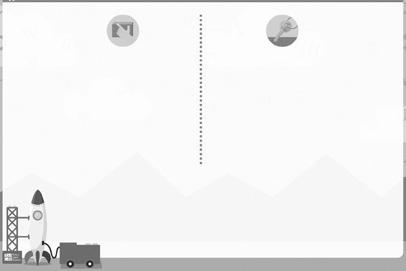
Point to the edge and the key and say “Our words will begin like /ĕ/, edge or /k/, key.”
Click to display and point to the kangaroo
Say:
• “/k/, kangaroo. Does /k/, kangaroo begin like edge or key?” A: /k/, key
• “/k/, kangaroo, /k/, key. I’ll move the kangaroo to the key side.”
Click to place the kangaroo in the key column. Say “Let’s try another one.”
Continue with the remaining examples: /ĕ/, eggplant; /k/, king; /ĕ/, elf; /ĕ/, envelope; /k/, kid; /k/, keyboard; /ĕ/, egg; /k/, kite; /ĕ/, elbow; /k/, kiwi; /ĕ/, elephant.
Say:
• “Let’s go over our work (point to each image as you label it with students):
o /ĕ/, edge; /ĕ/, eggplant; /ĕ/, elf; /ĕ/, envelope; /ĕ/, egg; /ĕ/, elbow; /ĕ/, elephant.
o /k/, key; /k/, kangaroo; /k/, king; /k/, kid; /k/, keyboard; /k/, kite; /k/, kiwi.
© 2017 Really Great Reading Company, LLC 47
UNIT 7 Lesson 4 | Part 1
• Let’s try that with two new sounds.”
SORT 2:
Click to display the nest and the image for yes as the column headings.
Point to the nest and the image for yes and say “Our words will begin like /n/, nest or /y/, yes.”
Click to display and point to the yoyo
Say:
• “/y/, yoyo. Does /y/, yoyo begin with the same sound as nest or yes?” A: yes
• “/y/, yoyo, /y/, yes. I’ll move the yoyo to the /y/, yes side.”
Click to place the yoyo in the yes column.
Say “Let’s try another one.”
Continue with the remaining examples: /n/, nap; /y/, yogurt; /y/, yarn; /n/, nurse; /n/, nose; /y/, yellow; /n/, needle; /y/, yawn; /n/, neck; /y/, yacht; /n/, newspaper.
Say “Let’s go over our work (point to each image as you label it with students):
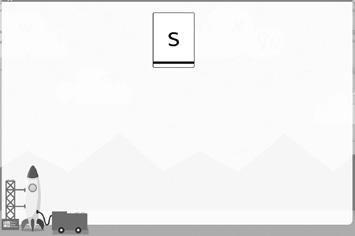
o /n/, nest; /n/, nap; /n/, nurse; /n/, nose; /n/, needle; /n/, neck; /n/, newspaper.
o /y/, yes; /y/, yoyo; /y/, yogurt; /y/, yarn; /y/, yellow; /y/, yawn; /y/, yacht.”
See p. 8 for differentiation options for Peel and Sort.
48 © 2017 Really Great Reading Company, LLC
Unit 7 | Lesson 4 | Part 2 Activity 33: Connect the Letter AP: Letter ID Objective Students will practice connecting a word’s beginning sound to its corresponding letter symbol. See p. 24 for a full description of Connect the Letter. What Students See 3, 2, 1…
Countdown Online to Unit 7, Lesson 4, Part 2 (7.4.2). Launch! UNIT 7 Lesson 4 | Part 2
Open
Say “Now, we are going to match letters to the beginning sounds in some words.”
Ask “This is the letter s. What sound does the letter s spell?” A: /s/
Say “Right. Now, let’s look at a few pictures and see which one begins with that sound.”
Click to display, point to, and name the three images below the letter tile s: cup, toothbrush, and soap.
Ask “Which one begins with /s/?” A: soap
Say “Yes, /s/, soap begins with /s/, so soap begins with the letter s.”
Click to show the correct answer.
Say “Let’s try that with some new pictures.”
Click to display, point to, and name the three images below the letter tile s: sunflower, inch, and piano.
Ask “Which one begins with s?” A: sunflower
Say “Yes, /s/, sunflower begins with s.”
Click to show the correct answer.
Continue with remaining letter tiles and images: s
• igloo, sock, headphones
• heart, paintbrush, sunglasses h
• skateboard, iguana, hamburger
• hospital, man, corn
• teeth, hug, snake
• cow, mountain, hammer c
• carrot, inside, moose
• hamster, caveman, ant • pan, sock, camel
• mittens, candy, horse i • hanger, itch, mouth • astronaut, igloo, cot • car, iguana, paints
The correct answers for this activity are displayed in boldface text.
© 2017 Really Great Reading Company, LLC 49
UNIT 7 Lesson 4 | Part 2
p
• mix, penny, ham
• peanut, alligator, six m
• pen, milk, inch
• seal, candles, muffin a
• add, hat, monster
See p. 25 for differentiation options for Connect the Letter.
Unit 7 | Lesson 4 | Part 3
Activity 34: Which Letter?
Objective
Students will isolate the beginning sound of a word and match that sound to its letter symbol.
See p. 33 for a full description of Which Letter?
3, 2, 1…
AP: Letter ID
What Students See
OPTIONAL (only if you choose to use manipulatives)
Students take out letter tiles c, h, m, p, s, and t and working board.
Open Countdown Online to Unit 7, Lesson 4, Part 3 (7.4.3).
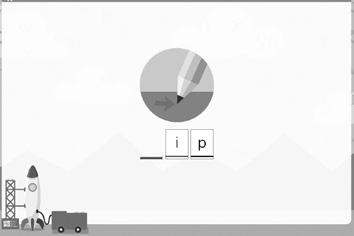
Launch!
Say “Now, we are going to spell the first letter of some words.”
Click to display the pencil tip with the letters i p spelled out below. Say “ Tip.”
Ask “What is the first sound in tip?” A: /t/
Click to display three letter tiles: h, c, t.
50 © 2017 Really Great Reading Company, LLC
UNIT 7 Lesson 4 | Part 3
Ask “Which of these letters spells /t/ like /t/, tip? Point to the letter tile that spells /t/, and say its name.” A: t
Click to show the correct answer.
Click to display the cap with the letters a p spelled out below. Say “Cap.”
Ask “What is the first sound in cap?” A: /k/
Click to display three letter tiles: c, m, p.
Ask “Which of these letters spells /k/ like /k/, cap? Point to the letter tile that spells /k/, and say its name.” A: c
Click to show the correct answer.
Continue with remaining images:
1. mat (m)
2. ham (h)
3. cat (c)
4. hat (h)
5. sit (s)
6. pit (p) 7. hip (h) 8. him (h) 9. pat (p) 10. sat (s)
11. tap (t) 12. sip (s) 13. map (m) 14. hit (h)
See p. 34 for differentiation options for Which Letter?
You may want to have students point all the way to the left for h, to the center for c, and all the way to the right for t. If students are using manipulatives, have them hold up the correct tile and name it rather than point.
© 2017 Really Great Reading Company, LLC 51
UNIT 7 Lesson 4 | Part 3
Unit 7 | Lesson 5 | Part 1
Activity 25: Stretch Those Sounds PA: Segmenting
Objective
Students will segment the phonemes (sounds) in threephoneme words using finger-stretching.
See p. 11 for a full description of Stretch Those Sounds.
What
Students
See 3, 2, 1…
Open Countdown Online to Unit 7, Lesson 5, Part 1 (7.5.1).
Launch!
Click to display the fox
Say:
• “Today, we are going to separate all of the sounds in some words.
• Listen while I say the sounds in fox.”
• “ fox ” (hold closed fist against chest, crossing the midline)
• “/f/” (extend thumb), “/ŏ/” (extend pointer finger), “/ks/” (extend middle finger)
• “ fox ” (pull fingers back to a closed fist while saying the word)
Say:
• “Let’s stretch the word fox again together.” (Students repeat sounds while finger-stretching.)
• “Let’s try another one.”
Continue with remaining images: 1. wave (/w/ /ā/ /v/)
horse (/h/ /or/ /s/)
duck (/d/ /ŭ/ /k/)
goat (/g/ /ō/ /t/)
elf (/ĕ/ /l/ /f/)
ant (/ă/ /n/ /t/)
fish (/f/ /ĭ/ /sh/)
queen (/kw/ /ē/ /n/)
house (/h/ /ou/ /s/)
deer (/d/ /ē/ /r/)
lick (/l/ /ĭ/ /k/)
cat (/k/ /ă/ /t/)
match (/m/ /ă/ /ch/)
leaf (/l/ /ē/ /f/)
52 © 2017 Really Great Reading Company, LLC
3.
4.
5.
6.
7.
8.
9.
10.
11.
12.
13.
14.
UNIT 7 Lesson 5 | Part 1
2.
15. man (/m/ /ă/ /n/)
16. lime (/l/ /ī/ /m/)
17. van (/v/ /ă/ /n/)
See p. 12 for differentiation options for Stretch Those Sounds.
Unit 7 | Lesson 5 | Part 2
Activity 40: Touch & Say AP: Decoding
Objective
Students decode (read) words by pronouncing one sound at a time and then blending them together.
See p. 26 for a full description of Touch & Say.
3, 2, 1…
What Students See
Open Countdown Online to Unit 7, Lesson 5, Part 2 (7.5.2).
Launch!
Click to display the letter tiles c, a, t.
Say:
•
“We’re going to read some words by ‘sounding them out,’ which means saying them one sound at a time.
•
Let’s get started with this word. Watch how I sound it out.”
Click to underline one letter tile at a time while saying its sound, “/k/ /ă/ /t/.”
Click to slide an arrow from left to right under the entire word while saying, “cat.”
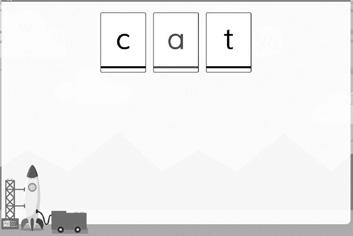
Say “Let’s keep going! This time, say the sounds and blend the word with me.”
Click to display the letter tiles p, i, t
Click to underline one letter at a time while saying its sound with students, “/p/ / ĭ/ /t/.”
Click to slide an arrow from left to right under the entire word while saying, “pit.”
Continue with remaining words, making sure students are saying each sound with you as you click to underline it:
1. tip (/t/ / ĭ/ /p/)
2. hat (/h/ /ă/ /t/)
© 2017 Really Great Reading Company, LLC 53
7 Lesson 5 | Part 2
UNIT
3. map (/m/ /ă/ /p/)
4. sit (/s/ / ĭ/ /t/) 5. at (/ă/ /t/) 6. him (/h/ / ĭ/ /m/) 7. Pam (/p/ /ă/ /m/) 8. tap (/t/ /ă/ /p/) 9. hit (/h/ / ĭ/ /t/)
10. sip (/s/ / ĭ/ /p/)
11. pat (/p/ /ă/ /t/)
12. hip (/h/ / ĭ/ /p/)
13. tam (/t/ /ă/ /m/) 14. ham (/h/ /ă/ /m/) 15. sap (/s/ /ă/ /p/) 16. cap (/k/ /ă/ /p/) 17. mat (/m/ /ă/ /t/) 18. sat (/s/ /ă/ /t/)
DIFFERENTIATION OPTIONS
Ways to challenge:
• Have students pronounce each individual sound and then blend the word independently as you underline them.
• Using Letter Tile Free Play (located in Supplemental Resources) or your whiteboard and marker, have students Touch & Say the following words with 2-sound consonant blends: act, amp, apt, and its
Unit 7 | Lesson 5 | Part 3
Activity 37: Unscramble This AP: Encoding
Objective
Students help the teacher segment the phonemes in words while the teacher mod els the encoding (spelling) of each sound.
What Students See
3, 2, 1…
Description
An image appears on the board along with the three scrambled letter tiles needed to spell the imaged word. As the students help the teacher segment the word, the teacher moves the letter tiles into the correct positions to spell the word. The teacher and students then use Touch & Say to blend the phonemes back into a whole word.
Open Countdown Online to Unit 7, Lesson 5, Part 3 (7.5.3).
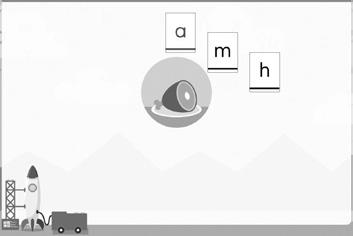
54 © 2017 Really Great Reading Company, LLC
UNIT 7 Lesson 5 | Part 3
Launch!
Say “Now, we’re going to unscramble some letters that got mixed up. When we unscramble them and put them in the right order, they will make real words we can read.”
Click to display the ham and the letter tiles a, m, h.
Say: • “Ham.
• Let’s stretch the sounds in ham together.”
Click to move each letter tile to the correct position AS you and students say the sounds /h/ /ă/ /m/.
Say “Now, let’s make sure those sounds really blend to make the word ham.”
Point to each letter tile as you and the students say its sound, /h/ /ă/ /m/, and then sweep your finger under the word from left to right while saying the whole word, ham
Say:
• “Let’s try to unscramble another mixed up word.
• This time, it’s your turn to stretch out the words on your own.”
Continue with remaining images:
1. tip (/t/ / ĭ/ /p/)
2. hat (/h/ /ă/ /t/)
3. map (/m/ /ă/ /p/) 4. sit (/s/ / ĭ/ /t/) 5. cat (/k/ /ă/ /t/) 6. him (/h/ / ĭ/ /m/) 7. Pam (/p/ /ă/ /m/) 8. tap (/t/ /ă/ /p/) 9. hit (/h/ / ĭ/ /t/)
10. sip (/s/ / ĭ/ /p/) 11. pat (/p/ /ă/ /t/) 12. hip (/h/ / ĭ/ /p/) 13. pit (/p/ / ĭ/ /t/) 14. ham (/h/ /ă/ /m/) 15. sap (/s/ /ă/ /p/) 16. cap (/k/ /ă/ /p/) 17. mat (/m/ /ă/ /t/) 18. sat (/s/ /ă/ /t/)
DIFFERENTIATION OPTIONS
Ways to simplify:
• If students struggle to segment the words on their own, segment along with them as you did for the initial example.
© 2017 Really Great Reading Company, LLC 55 UNIT 7 Lesson 5 | Part 3
56 © 2017 Really Great Reading Company, LLC
Unit 8 | Lesson 1 | Part 1
Activity 18: Peel and Say PA: BSI
Objective
Students will isolate, identify, and produce the shared beginning sound of three words.
See p. 5 for a full description of Peel and Say.
What Students See 3,
2, 1…
Open Countdown Online to Unit 8, Lesson 1, Part 1 (8.1.1).
Launch!
Say “Today, we are going to peel the first sound off of some words. Listen and repeat after me.”
Click to display the cheese, chalk, and chimney and name them as you point to each one. (Students repeat the three words.)
Ask “What’s the first sound in cheese, chalk, and chimney?” A: /ch/
Say “Let’s try another one.”
Click to display the zebra, zero, and zipper and name them as you point to each one. (Students repeat the three words.)
Ask “What’s the first sound in zebra, zero, and zipper?” A: /z/
Continue with the remaining examples:
1. water, whale, wave - /w/ 2. question, quick, quiet - /kw/ 3. inch, igloo, inside - /ĭ/ 4. duck, door, deer - /d/ 5. hamster, hair, heart - /h/ 6. giraffe, jump, jacket - /j/ 7. edge, elbow, eggplant - /ĕ/ 8. football, flag, fireman - /f/ 9. unicorn, unicycle, uniform - /y�/
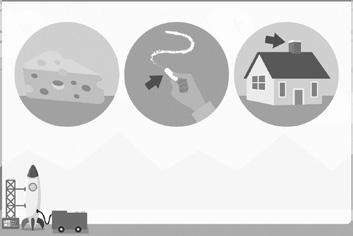
10. map, mouth, mask - /m/ 11. nap, needle, newspaper - /n/ 12. keyboard, king, kite - /k/ 13. snake, sidewalk, sad - /s/ 14. astronaut, apple, alligator - /ă/ 15. piano, penny, pen - /p/ 16. shadow, shark, shorts - /sh/ 17. under, umbrella, upside down - /ŭ/ 18. three, thread, thorn - /th/
See p. 6 for differentiation options for Peel and Say.
© 2017 Really Great Reading Company, LLC 57 UNIT 8 Lesson 1 | Part 1
Optional motions for consonant sounds are available in the Appendix on p. 290 for students who may require more of a kinesthetic approach.
Unit 8 | Lesson 1 | Part 2
Activity 30: Name That Sound AP: Letter ID
Objective
Students will identify the uppercase and lowercase letters associated with the sounds /d/, /f/, /r/, and //.
See p. 2 for a full description of Name That Sound.
What Students See 3,
2, 1…
Open Countdown Online to Unit 8, Lesson 1, Part 2 (8.1.2).
Launch!
Say “Now, we are going to see what some new sounds look like when they are written down.”
Click to display the duck.
Ask:
• “What is this a picture of?” A: duck
• “What is the first sound in /d/, duck?” A: /d/
Click to display the corresponding uppercase and lowercase letter tiles.
Say:
• “Right, duck begins with /d/, and these letters say the sound, or spell, /d/.
• Do you remember Daniel the Dalmatian Dog? He liked to dive into a deep pool, but he didn’t bother the ducks that dozed there. His favorite sound is /d/.
• This one (point to uppercase D) is called ‘capital D,’ and this one (point to lowercase d) is called ‘lowercase d.’ This is the one we will see most of the time, so we’ll just call it d.
• Let’s learn another new letter.”
Click to display the fish.
Ask:
• “What is this a picture of?” A: a fish
58 © 2017 Really Great Reading Company, LLC UNIT 8 Lesson 1 | Part 2
•
“What is the first sound in /f/, fish?” A: /f/
Click to display the corresponding uppercase and lowercase letter tiles.
Say:
• “Right, fish begins with /f/, and these letters say the sound, or spell, /f/.
• Do you remember Flo the Flying Fish? She learned to fly when saving her friend's favorite stuffed frog. Her favorite sound is /f/.
• This one (point to uppercase F) is called ‘capital F,’ and this one (point to lowercase f) is called ‘lowercase f.’ This is the one we will see most of the time, so we’ll just call it f.
• Let’s learn another new letter.”
Click to display the rabbit.
Ask:
• “What is this a picture of?” A: a rabbit
• “What is the first sound in /r/, rabbit?” A: /r/
Say “Do you remember Ricardo the Raccoon? He ran races against a rabbit at recess. His favorite sound is /r/.”
Click to display the corresponding uppercase and lowercase letter tiles.
Ask “So, what do you think these letters say?” A: /r/ Say:
• “Yes! The name of these letters is R . R says /r/, like the beginning of /r/, rabbit.
• This one (point to uppercase R) is called ‘capital R,’ and this one (point to lowercase r) is called ‘lowercase r.’ This is the one we will see most of the time, so we’ll just call it r.
• Let’s learn one more new letter.”
Click to display the octopus.
Ask:
• “What is this a picture of?” A: an octopus
• “What is the first sound in /ŏ/, octopus?” A: /ŏ/
Click to display the corresponding uppercase and lowercase letter tiles. Ask “So, what do you think these letters say?” A: /ŏ/
© 2017 Really Great Reading Company, LLC 59 UNIT 8 Lesson 1 | Part 2
Say:
•
“Yes! The name of these letters is O. O says /ŏ/, like the beginning of /ŏ/, octopus.
• This one (point to uppercase O) is called ‘capital O,’ and this one (point to lowercase o) is called ‘lowercase o.’ This is the one we will see most of the time, so we’ll just call it o.”
Demonstrate /ŏ/, octopus motion (you should use this motion, and all the short vowel motions, for all students):
Say:
• “Let’s do a motion to help us remember that sound.
• Pretend your hand is an octopus swimming in the ocean.”
Demonstrate the short o, octopus, motion while elongating the sound /ŏŏŏŏ/, and have students repeat (pretend your hand is an octopus with legs hanging down, swimming back and forth in the ocean above your head)
Click to display letter tiles d, f, r, and o.
Say “Let’s name our letters one more time and say the sound that each letter spells.”
Point to each letter, one at a time, and say:
• “This is d D says /d/.
• This is f. F says /f/.
• This is r R says /r/.
• This is o. O says /ŏ/.”
60 © 2017 Really Great Reading Company, LLC UNIT 8 Lesson 1 | Part 2
Unit 8 | Lesson 1 | Part 3
Activity 42: Look, Think, Say; Pop-Up; 3-Up Sight Words
Objective
• Students will read three Heart Words from memory (or by decoding if necessary).
• Students will read individual Heart Words as they pop up on the screen.
• Students will read sets of three Heart Words as they ap pear on the screen.
What Students See
Description
In Look, Think, Say, a Heart Word will appear on the board with three dots below it. As the teacher clicks, the dots will fill with red, yellow, and green, and the teacher will instruct students to look at, think about, and say the word aloud. During the “look” time, the teacher will say the word. During the “think” time, the students will think about the word and try to remember it, or the teacher will stretch the sounds in the word for students if the word is decodable (although the goal will be to remember it as a whole word). During the “say” time, students will repeat the word.
In Pop-Up, individual Heart Words will appear on the screen at random, one at a time, and students will be in structed to read each word as it pops up onto the screen.
In 3-Up, sets of three Heart Words will appear, with three dots below each set. As the teacher clicks three times, the dots will fill with red, yellow, and green and the teacher will instruct students to look, think, and say the three words in succession.
The Heart Words will include words learned during this cur rent unit and, in subsequent units, words from previous units.
3, 2, 1…
Open Countdown Online to Unit 8, Lesson 1, Part 3 (8.1.3).
Launch!
Say “Now, we are going to learn to read some words called Heart Words. They are called Heart Words because pretty soon, we will know them by heart. We will be able to look at them and know what they say right away.”
LOOK, THINK, SAY: Click twice to display the Heart Word the with one red and two empty dots below the word.
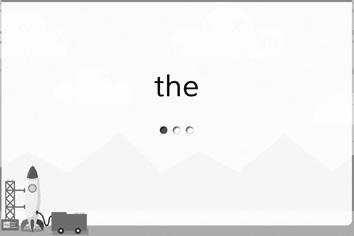
Say:
• “This red dot (point to the red dot) tells us to stop what we are doing so we can listen to the word.
© 2017 Really Great Reading Company, LLC 61 UNIT 8 Lesson 1 | Part 3
•
This word is the, as in, ‘I ate the cupcake.’”
Click to display the yellow dot.
Say “This yellow dot (point to the yellow dot) tells us to think about the word and try to remember it.”
Click to display the green dot. Say:
• “This green dot (point to the green dot) tells us to say the word out loud.
• Say the word with me, the.
• Let’s try another word.
• Remember to look, think, and then say. Only say the word out loud when the green dot shows up.”
Click twice to display the Heart Word in with one red dot and two empty dots below the word.
Say “Look at the word in, as in, ‘Put the book in your desk.’”
Click to display the yellow dot.
Say:
• “Think about this word. We know the sounds in this word, /ĭ/ /n/ (point to each letter as you say the sound), in.
• We can think about the sounds in this word, but it might be easier to just try to remember it.”
Click to display the green dot.
Say:
• “Say the word!
• Let’s try one more word.”
Click twice to display the Heart Word my with one red dot and two empty dots below the word.
Say “Look at the word my, as in, ‘My jacket is hanging on the hook.’”
Click to display the yellow dot.
Say “Think about this word.”
Click to display the green dot.
Say:
• “Say the word!
62 © 2017 Really Great Reading Company, LLC UNIT 8 Lesson 1 | Part 3
•
Let’s look at those words again.”
Continue with the same three Heart Words for two additional rounds.
POP-UP: Say:
• “Now, we are going to practice reading the Heart Words we just learned by playing two games.
• In our first game, when you see a word pop up onto the screen, say the word out loud.
• If you need help remembering, I can help, but try your best.”
Click to display the Heart Words the, in, and my at random. Each word will appear several times.
Read each word together with students as it pops up.
3-UP: Say:
• “Great job! In our next game, you will see three words on the screen.
• When you see the red dot, stop and look at the three words. When you see the yellow dot, think about the words and try to remember them. When you see the green dot, say the three words out loud.”
Click to display the sets of three Heart Words. Each set will contain the following words in a random order: the, in, and my. Each word will appear several times.
Look, think about, and say each set of three words together with students as the sets are displayed.
© 2017 Really Great Reading Company, LLC 63 UNIT 8 Lesson 1 | Part 3
Unit 8 | Lesson 2 | Part 1
Activity 25: Stretch Those Sounds PA: Segmenting
Objective
Students will segment the phonemes (sounds) in threephoneme words using finger-stretching.
See p. 11 for a full description of Stretch Those Sounds.
What Students See 3, 2, 1…
Open Countdown Online to Unit 8, Lesson 2, Part 1 (8.2.1).
Launch!
Click to display the mouse.
Say:
• “Today, we are going to separate all of the sounds in some words.
• Listen while I say the sounds in mouse.”
• “mouse” (hold closed fist against chest, crossing the midline)
• “/m/” (extend thumb), “/ou/” (extend pointer finger), “/s/” (extend middle finger)
• “mouse” (pull fingers back to a closed fist while saying the word)
Say:
• “Let’s stretch the word mouse again together.” (Students repeat sounds while finger-stretching.)
• Let’s keep going.”
Continue with remaining images: 1. pan (/p/ /ă/ /n/)
sheep (/sh/ /ē/ /p/)
yes (/y/ /ĕ/ /s/)
shirt (/sh/ /er/ /t/)
sick (/s/ /ĭ/ /k/)
queen (/kw/ /ē/ /n/)
run (/r/ /ŭ/ /n/)
rose (/r/ /ō/ /z/)
knife (/n/ /ī/ /f/)
bat (/b/ /ă/ /t/)
cake (/k/ /ā/ /k/)
fox (/f/ /ŏ/ /ks/)
64 © 2017 Really Great Reading Company, LLC UNIT 8 Lesson 2 | Part 1
3.
4.
5.
7.
8.
9.
10.
11.
12.
2.
6.
13. lime (/l/ /ī/ /m/)
14. mitt (/m/ /ĭ/ /t/)
15. juice (/j/ /�/ /s/)
16. sit (/s/ /ĭ/ /t/)
17. sad (/s/ /ă/ /d/)
18. tape (/t/ /ā/ /p/)
19. hose (/h/ /ō/ /z/)
See p. 12 for differentiation options for Stretch Those Sounds.
Unit 8 | Lesson 2 | Part 2
Activity 31: This Letter or That? PA: BSI Objective
What Students See
Students will identify the letter symbol that spells the first sound in a word.
See p. 8 for a full description of This Letter or That?
3, 2, 1…
Open Countdown Online to Unit 8, Lesson 2, Part 2 (8.2.2).
Launch!
SORT 1:
Click to display two columns with the headings “r ” (for rabbit) and “o” (for octopus).
Ask “What is the first sound in rabbit (while pointing to the rabbit)?” A: /r/
Say “Remember, the sound /r/ is spelled with the letter r (while pointing to the letter tile r).”
Ask “What is the first sound in octopus (while pointing to the octopus)?” A: /ŏ/
Say “Remember, the sound /ŏ/ is spelled with the letter o (while pointing to the letter tile o).”
Click to display the ox at the bottom of the screen. Ask: • “Ox. What is the first sound in ox?” A: /ŏ/
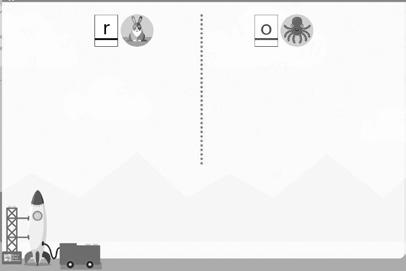
© 2017 Really Great Reading Company, LLC 65 UNIT 8 Lesson 2 | Part 2
• “Should we put the /ŏ/, ox, under the r, like /r/, rabbit or the o, like /ŏ/, octopus?” A: o, /ŏ/, octopus
Say “Right, /ŏ/, ox and /ŏ/, octopus both start with the letter o, so I’ll move the ox under the o.”
Click to place the ox in the “o” column.
Continue with remaining images: raccoon, rattle, robe, olives, rooster, ostrich, otter, run, omelet, rollercoaster, October
Say:
• “Let’s go over our work (point to each image as you label it with students):
o /r/, rabbit; /r/, raccoon; /r/, rattle; /r/, robe; /r/, rooster; /r/, run; /r/, rollercoaster
o /ŏ/, octopus; /ŏ/, ox; /ŏ/, olives; /ŏ/, ostrich; /ŏ/, otter; /ŏ/, omelet; /ŏ/, October.
• Let’s try that with two new letters.”
SORT 2:
Click to display two columns with the headings “d ” (for dog) and “ f ” (for fish).
Ask “What is the first sound in dog (while pointing to the dog)?” A: /d/
Say “Remember, the sound /d/ is spelled with the letter d (while pointing to the letter tile d).”
Ask “What is the first sound in fish (while pointing to the fish)?” A: /f/ Say “Remember, the sound /f/ is spelled with the letter f (while pointing to the letter tile f).”
Click to display the doghouse at the bottom of the screen.
Ask:
• “Doghouse. What is the first sound in doghouse?” A: /d/
• “Should we put the /d/, doghouse under the d, like /d/, dog or the f, like /f/, fish?” A: d, /d/, dog
Say “Right, /d/, doghouse and /d/, dog both start with the letter d, so I’ll move the doghouse under the d.”
Click to place the doghouse in the “d ” column.
Continue with remaining images: feather, footprints, deer, fox, door, feet, finger, dolphin, doughnut, fireman, dinosaur
66 © 2017 Really Great Reading Company, LLC UNIT 8 Lesson 2 | Part 2
Say:
•
“Let’s go over our work (point to each image as you label it with students):
o /d/, dog; /d/, doghouse; /d/, deer; /d/, door; /d/, dolphin; /d/, doughnut; /d/, dinosaur
o /f/, fish; /f/, feather; /f/, footprints; /f/, fox; /f/, feet; /f/, finger; /f/, fireman.”
See p. 10 for differentiation options for This Letter or That?
Unit 8 | Lesson 2 | Part 3
Activity 36: Guess My Word AP: Encoding
Objective
Students will observe the encoding of a word and then blend together the word's phonemes.
See p. 39 for a full description of Guess My Word.
3, 2, 1…
What
Students See
Open Countdown Online to Unit 8, Lesson 2, Part 3 (8.2.3).
Launch!
Say “Now, you’re going to guess my mystery words that got all mixed up.”
Click to display the letter tiles d, s, a.
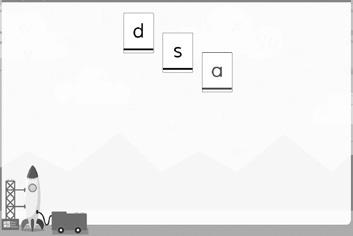
Say “Guess the mystery word, /s/ /ă/ /d/.” (Click to move the letter tiles into the correct position as you say each sound.)
Ask “What’s my word?” A: sad (Students blend the sounds together to say the word.)
Say “/s/ /ă/ /d/, sad.” (Point to each letter tile as you say its sound, and then sweep your finger under the word from left to right while saying the whole word.)
Click to display the image for sad
© 2017 Really Great Reading Company, LLC 67 UNIT 8 Lesson 2 | Part 3
Continue with remaining images:
1. /k/ /ă/ /t/, cat
2. /s/ /ĭ/ /t/, sit
3. /r/ /ă/ /t/, rat
4. /h/ /ă/ /m/, ham
5. /m/ /ă/ /p/, map
6. /h/ /ă/ /t/, hat
7. /p/ /ŏ/ /d/, pod
8. /h/ /ŏ/ /t/, hot
9. /m/ /ă/ /t/, mat 10. /r/ /ĭ/ /m/, rim 11. /f/ /ĭ/ /t/, fit 12. /d/ /ŏ/ /t/, dot 13. /r/ /ă/ /p/, rap 14. /t/ /ŏ/ /p/, top
See p. 40 for differentiation options for Guess My Word.
68 © 2017 Really Great Reading Company, LLC UNIT 8 Lesson 2 | Part 3
Unit 8 | Lesson 3 | Part 1
Activity 43: Where’s That Heart Word? Sight Words
Objective
Students will read three Heart Words from memory, using sequence and location vocabulary to identify where they are on the screen.
What Students See
Description
Three Heart Words appear on the screen in a row. Students will read the three words from left to right. The teacher will then have students read specific words that are at the “beginning, middle, end” of a row, “before, after” other words in the row, or “first, next, last” in the row.
3, 2, 1…
Open Countdown Online to Unit 8, Lesson 3, Part 1 (8.3.1).
Launch!
Say “Today, we are going to practice reading some of the Heart Words we learned earlier this week.”
Click to display the Heart Words the, in, my in a row. Say “Let’s read our Heart Words, starting here.” (Point to the words the, in, and my while reading them in left to right order.)
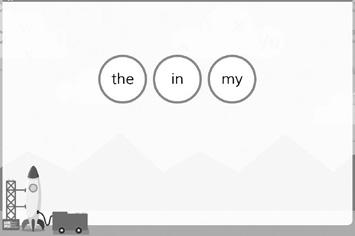
Ask:
See Alternative Options at the end of this activity for alternative methods of delivery.
“Which word is last?” A: my •
•
“Which word is before the word in?” A: the •
“Which word is first?” A: the •
“Which word is next?” A: in
Click to display the Heart Words in, my, the.
Say “Let’s read our Heart Words, starting here.” (Point to the words in, my, and the while reading them in left to right order.)
Ask:
•
“Which word is at the beginning of the row?” A: in
Ask more questions as time allows.
© 2017 Really Great Reading Company, LLC 69 UNIT 8 Lesson 3 | Part 1
•
“Which word is at the end of the row?” A: the
• “Which word is after the word in?” A: my
• “Which word is in the middle of the row?” A: my
Click to display the Heart Words my, the, in.
Say “Let’s read our Heart Words, starting here.” (Point to the words my, the, and in while reading them in left to right order.)
Ask:
•
“Which word is first?” A: my
• “Which word is next?” A: the
• “Which word is last?” A: in
• “Which word is after the word my?” A: the
Click to display the Heart Words the, my, in.
Say “Let’s read our Heart Words, starting here.” (Point to the words the, my, and in while reading them in left to right order.)
Ask:
•
“Which word is before the word in?” A: my
• “Which word is at the beginning of the row?” A: the
• “Which word is at the end of the row?” A: in
• “Which word is in the middle of the row?” A: my
ALTERNATIVE OPTIONS
• Simply have students read the Heart Words in order as you point to them. Do this as many times as desired.
• Have students read the Heart Words as you point to them in random order as many times as desired.
70 © 2017 Really Great Reading Company, LLC UNIT 8 Lesson 3 | Part 1
Unit 8 | Lesson 3 | Part 2
Activity 31: This Letter or That? AP: Letter ID
Objective
Students will identify the letter symbol that spells the first sound in a word.
See p. 8 for a full description of This Letter or That?
What Students See 3,
2, 1…
Open Countdown Online to Unit 8, Lesson 3, Part 2 (8.3.2).
Launch!
SORT 1:
Click to display two columns with the headings “ f ” (for fish) and “o” (for octopus).
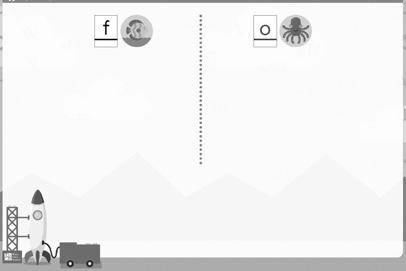
Ask “What is the first sound in fish (while pointing to the fish)?” A: /f/
Say “Remember, the sound /f/ is spelled with the letter f (while pointing to the letter tile f).”
Ask “What is the first sound in octopus (while pointing to the octopus)?” A: /ŏ/ Say “Remember, the sound /ŏ/ is spelled with the letter o (while pointing to the letter tile o).”
Click to display the fireworks at the bottom of the screen.
Ask:
• “Fireworks. What is the first sound in fireworks?” A: /f/
• “Should we put the /f/, fireworks under the f, like /f/, fish or the o, like /ŏ/, octopus?” A: f, /f/, fish
Say “Right, /f/, fireworks and /f/, fish both start with the letter f, so I’ll move the fireworks under the f.”
Click to place the fireworks in the “ f ” column.
Continue with remaining images: football, olives, omelet, fire, feather, ox, October, fly, ostrich, foot, otter
© 2017 Really Great Reading Company, LLC 71 UNIT 8 Lesson 3 | Part 2
Say:
• “Let’s go over our work (point to each image as you label it with students):
o /f/, fish; /f/, fireworks; /f/, football; /f/, fire; /f/, feather; /f/, fly; /f/, foot
o /ŏ/, octopus; /ŏ/, olives; /ŏ/, omelet; /ŏ/, ox; /ŏ/, October; /ŏ/, ostrich; /ŏ/, otter.
• Let’s try that with two new letters.”
SORT 2:
Click to display two columns with the headings “d ” (for dog) and “r ” (for rabbit).
Ask “What is the first sound in dog (while pointing to the dog)?” A: /d/ Say “Remember, the sound /d/ is spelled with the letter d (while pointing to the letter tile d).”
Ask “What is the first sound in rabbit (while pointing to the rabbit)?” A: /r/ Say “Remember, the sound /r/ is spelled with the letter r (while pointing to the letter tile r).”
Click to display the rug at the bottom of the screen.
Ask:
• “Rug. What is the first sound in rug?” A: /r/
• “Should we put the /r/, rug under the d, like /d/, dog or the r, like /r/, rabbit?” A: r, /r/, rabbit
Say “Right, /r/, rug and /r/, rabbit both start with the letter r, so I’ll move the rug under the r.”
Click to place the rug in the “r ” column.
Continue with remaining images: rainbow, rose, dot, duck, rattle, door, ring, dolphin, doughnut, rooster, deer
Say: • “Let’s go over our work (point to each image as you label it with students): o /d/, dog; /d/, dot; /d/, duck; /d/, door; /d/, dolphin; /d/, doughnut; /d/, deer.
o /r/, rabbit; /r/, rug; /r/, rainbow; /r/, rose; /r/, rattle; /r/, ring; /r/, rooster.”
See p. 10 for differentiation options for This Letter or That?
72 © 2017 Really Great Reading Company, LLC UNIT 8 Lesson 3 | Part 2
Unit 8 | Lesson 3 | Part 3
Activity 34: Which Letter? AP: Letter ID
Objective
Students will isolate the beginning sound of a word and match that sound to its letter symbol.
See p. 33 for a full description of Which Letter?
What Students See 3,
2, 1…
OPTIONAL (only if you choose to use manipulatives)
Prepare materials:
• Letter tiles a, c, d, f, h, i, m, o, p, r, s, and t and working board from Countdown Student Kit for each student (italicized letter tiles listed here are new to this unit; have students add these tiles to their boards)
Open Countdown Online to Unit 8, Lesson 3, Part 3 (8.3.3).
Launch!
OPTIONAL (only if you choose to use manipulatives)
Students take out letter tiles c, d, f, h, m, p, r, s, and t and working board.
Say “Now, we are going to spell the first letter of some words.”
Click to display the rat with the letters a t spelled out below.
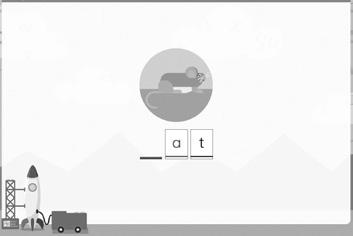
Say “Rat.”
Ask “What is the first sound in rat?” A: /r/
Click to display three letter tiles: h, c, r.
Ask “Which of these letters spells /r/ like /r/, rat? Point to the letter tile that spells /r/, and say its name.” A: r
Click to show the correct answer.
Click to display the image for sad with the letters a d spelled out below.
Say “Sad.”
Ask “What is the first sound in sad?” A: /s/
Note that, although students should add the o tile to their boards at this time, they won't use that tile in this activity. However, since they will use it in other activities in this unit, it will be helpful to place it on the board now. They will also need the a and i tiles later in this unit, which they have used in previous units.
You may want to have students point all the way to the left for h, to the center for c, and all the way to the right for r. If students are using manipulatives, have them hold up the correct tile and name it rather than point.
© 2017 Really Great Reading Company, LLC 73 UNIT 8 Lesson 3 | Part 3
Click to display three letter tiles: d, m, s. Ask “Which of these letters spells /s/ like /s/, sad? Point to the letter tile that spells /s/, and say its name.” A: s
Click to show the correct answer.
Continue with remaining images:
1. map (m) 2. hip (h) 3. cat (c) 4. cop (c) 5. mop (m) 6. pot (p)
7. hop (h) 8. fit (f ) 9. dip (d) 10. ram (r) 11. rip (r) 12. tap (t)
13. fat (f ) 14. cot (c) 15. sip (s) 16. mad (m) 17. him (h) 18. rot (r)
See p. 34 for differentiation options for Which Letter?
74 © 2017 Really Great Reading Company, LLC UNIT 8 Lesson 3 | Part 3
Unit 8 | Lesson 4 | Part 1
Activity 25: Stretch Those Sounds PA: Segmenting

Objective
Students will segment the phonemes (sounds) in threephoneme words using finger-stretching.
See p. 11 for a full description of Stretch Those Sounds.
What Students See 3, 2, 1…
Open Countdown Online to Unit 8, Lesson 4, Part 1 (8.4.1).
Launch
Click to display the man.
Say: • “Today, we are going to separate all of the sounds in some words. • Listen while I say the sounds in man.” • “man” (hold closed fist against chest, crossing the midline) • “/m/” (extend thumb), “/ă/” (extend pointer finger), “/n/” (extend middle finger) • “man” (pull fingers back to a closed fist while saying the word)
Say: • “Let’s stretch the word man again together.” (Students repeat sounds while finger-stretching.) • “Let’s try another one.”
Continue with remaining images:
1. nap (/n/ /ă/ /p/) 2. kite (/k/ /ī/ /t/) 3. nose (/n/ /ō/ /z/) 4. moose (/m/ /�/ /s/) 5. worm (/w/ /er/ /m/) 6. gate (/g/ /ā/ /t/)
7. hose (/h/ /ō/ /z/) 8. heart (/h/ /ar/ /t/) 9. check (/ch/ /ĕ/ /k/) 10. box (/b/ /ŏ/ /ks/) 11. can (/k/ /ă/ /n/) 12. boat (/b/ /ō/ /t/)
© 2017 Really Great Reading Company, LLC 75 UNIT 8 Lesson 4 | Part 1
13. thumb (/th/ /ŭ/ /m/)
14. bed (/b/ /ĕ/ /d/)
15. mouth (/m/ /ou/ /th/)
16. hat (/h/ /ă/ /t/)
17. nail (/n/ /ā/ /l/)
18. quail (/kw/ /ā/ /l/)
19. win (/w/ /ĭ/ /n/)
See p. 12 for differentiation options for Stretch Those Sounds.
Unit 8 | Lesson 4 | Part 2
Activity 32: Find That Letter AP: Letter ID
Objective
Students will identify the letter symbol that spells the shared first sound in a set of three imaged words.
See p. 20 for a full description of Find That Letter.
What Students See 3, 2, 1…
OPTIONAL (only if you choose to use manipulatives)
Students take out letter tiles a, c, d, f, h, i, m, o, p, r, s, and t and working board.
Open Countdown Online to Unit 8, Lesson 4, Part 2 (8.4.2).
Launch!
Say “Now, we are going to match our letter tiles to the beginning sounds in some words.”
Click to display, point to, and name three images: dog, dinosaur, doughnut.
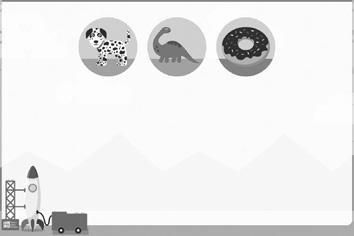
Ask “What is the beginning sound in all of these words?” A: /d/
Click to display three letter tiles: d, s, and o.
Say “Point to the letter that spells /d/ sound, and say its name.” A: d (pointing to the left)
Click to show the correct answer.
Say “Let’s find another letter.”
Click to display, point to, and name three images: ostrich, olives, octopus
76 © 2017 Really Great Reading Company, LLC UNIT 8 Lesson 4 | Part 2
Ask “What is the beginning sound in all of these words?” A: /ŏ/
Click to display three letter tiles: h, o, and f.
Say “Point to the letter that spells the /ŏ/ sound, and say its name.” A: o (pointing to the center)
Click to show the correct answer.
Say “Let’s find another letter.”
Continue with remaining image sets:
1. feather, feet, finger (f)
2. rainbow, ring, raccoon (r)
3. cow, crab, caveman (c)
4. inch, igloo, insect (i)
5. rat, robe, rooster (r)
6. add, ax, alligator (a)
7. cookie, clover, cactus (c)
8. fire, foot, fox (f)
9. hanger, hammer, hamburger (h)
10. ox, otter, October (o)
11. doghouse, door, drum (d)
12. popcorn, piano, pie (p)
13. milk, mask, monkey (m)
See p. 22 for differentiation options for Find That Letter.
Unit 8 | Lesson 4 | Part 3
Activity 37: Unscramble This AP: Encoding
Objective
Students help the teacher segment the phonemes in words while the teacher models the encoding (spelling) of each sound.
See p. 54 for a full description of Unscramble This.
3, 2, 1…
What Students See
Open Countdown Online to Unit 8, Lesson 4, Part 3 (8.4.3).
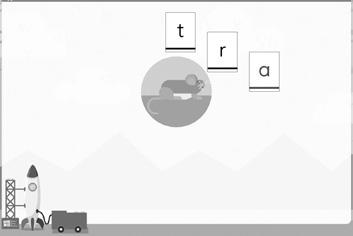
Launch!
Say “Now, we’re going to unscramble some letters that got mixed up. When we unscramble them and put them in the right order, they will make real words we can read.”
© 2017 Really Great Reading Company, LLC 77
8 Lesson 4 | Part 3
UNIT
Click to display the rat and the letter tiles t, r, a.
Say:
• “Rat
• Let’s stretch the sounds in rat together.”
Click to move each letter tile AS you and the students say its sound, /r/ /ă/ /t/, and then sweep your finger under the word from left to right while saying the whole word, rat.
Say “Now, let’s make sure those sounds really blend to make the word rat.”
Point to each letter tile as you and the students say its sound, /r/ /ă/ /t/, and then sweep your finger under the word from left to right while saying the whole word, rat.
Say:
• “Let’s try to unscramble another mixed up word.
• This time, it’s your turn to stretch out the words on your own.”
Continue with remaining images:
1. sad (/s/ /ă/ /d/) 2. ham (/h/ /ă/ /m/) 3. sit (/s/ / ĭ/ /t/) 4. hat (/h/ /ă/ /t/) 5. pod (/p/ /ŏ/ /d/) 6. cat (/k/ /ă/ /t/) 7. pot (/p/ /ŏ/ /t/)
8. mop (/m/ /ŏ/ /p/) 9. fit (/f/ / ĭ/ /t/) 10. dot (/d/ /ŏ/ /t/) 11. tap (/t/ /ă/ /p/) 12. hip (/h/ / ĭ/ /p/) 13. top (/t/ /ŏ/ /p/) 14. mad (/m/ /ă/ /d/)
See p. 55 for differentiation options for Unscramble This.
78 © 2017 Really Great Reading Company, LLC UNIT 8 Lesson 4 | Part 3
Unit 8 | Lesson 5 | Part 1
Activity 33: Connect the Letter AP: Letter ID
Objective
Students will practice connecting a word’s beginning sound to its corresponding letter symbol.
See p. 24 for a full description of Connect the Letter.
What Students See 3,
2, 1…
Open Countdown Online to Unit 8, Lesson 5, Part 1 (8.5.1).
Launch!
Say “Today, we are going to match letters to the beginning sounds in some words.”
Ask “This is the letter d. What sound does the letter d spell?” A: /d/
Say “Right. Now, let’s look at a few pictures and see which one begins with that sound.”
Click to display, point to, and name the three images below the letter tile d: fish, duck, and octopus
Ask “Which one begins with /d/?” A: duck
Say “Yes, /d/, duck begins with d.”
Click to show the correct answer.
Say “Let’s try that with some new pictures.”
Continue with remaining letter tiles and images: d
• feet, apple, doghouse
• cookie, dinosaur, rabbit
• doughnut, mask, pencil f
• pants, cot, fence
• ring, fireman, monkey
• dolphin, pie, fox
• ox, feather, robe
The correct answers for this activity are displayed in boldface text.
© 2017 Really Great Reading Company, LLC 79 UNIT 8 Lesson 5 | Part 1
r
• apple, rainbow, October
• dog, rose, map
• mitt, run, cup
• popcorn, raccoon, door o
• rollercoaster, ostrich, sad
• olives, drum, mug
• add, omelet, clock t
• twins, rug, pot
• deer, two, mouth c
• toy, rat, cactus
• cake, ax, match h
• hose, scissors, astronaut
See p. 25 for differentiation options for Connect the Letter.
Unit 8 | Lesson 5 | Part 2
Activity 44: Pop-Up and 3-Up Sight Words
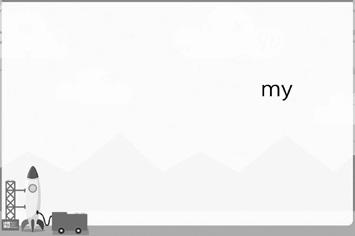
Objective
Students will read individual Heart Words as they pop up on the screen. Students will also read sets of three Heart Words as they appear on the screen.
What Students See
Description
In Pop-Up, individual Heart Words will appear on the screen at random, one at a time, and students will be instructed to read each word as it pops up onto the screen.
In 3-Up, sets of three Heart Words will appear, with three dots below each set. As the teacher clicks three times, the dots will fill with red, yellow, and green and the teacher will instruct students to look, think, and say the three words in succession. The Heart Words will include words learned during this current unit and, in subsequent units, words from previous units.
80 © 2017 Really Great Reading Company, LLC UNIT 8 Lesson 5 | Part 2
3, 2, 1…
Open Countdown Online to Unit 8, Lesson 5, Part 2 (8.5.2).
Launch!
POP-UP: Say:
• “Now, we are going to practice reading the Heart Words we learned the other day by playing two games.
• In our first game, when you see a word pop up onto the screen, say the word out loud.
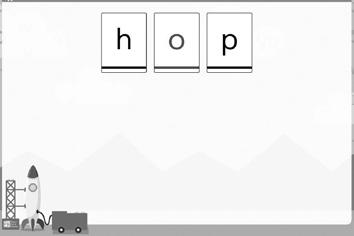
• If you need help remembering, I can help, but try your best.”
Click to display the Heart Words the, in, and my at random. Each word will appear a number of times.
3-UP: Say:
• “Great job! In our next game, you will see three words on the screen.
• Remember, when you see the red dot, stop and look at the three words. When you see the yellow dot, think about the words and try to remember them. When you see the green dot, say the three words out loud.
• If you need help remembering, I can help, but try your best.”
Click to display the sets of three Heart Words. Each set will contain the following words in a random order: the, in, and my. Each word will appear a number of times. Look, think about, and say each set of three words together with students as the sets are displayed.
Unit 8 | Lesson 5 | Part 3
Activity 40: Touch & Say AP: Decoding Objective
What Students See
Students decode (read) words by pronouncing one sound at a time and then blending them together.
See p. 26 for a full description of Touch & Say.
© 2017 Really Great Reading Company, LLC 81 UNIT 8 Lesson 5 | Part 3
3, 2, 1…
Open Countdown Online to Unit 8, Lesson 5, Part 3 (8.5.3).
Launch!
Click to display the letter tiles h, o, p. Say: • “We’re going to read some words by ‘sounding them out.’
• Let’s get started with this word. Watch how I sound it out.”
Click to underline one letter tile at a time while saying its sound, “/h/ /ŏ/ /p/.”
Click to slide an arrow from left to right under the entire word while saying, “hop.”
Say “Let’s keep going! This time, say the sounds and blend the word with me.”
Click to display the letter tiles p, a, d.
Click to underline one letter at a time while saying its sound with students, “/p/ /ă/ /d/.”
Click to slide an arrow from left to right under the entire word while saying, “pad.”
Continue with remaining words, making sure students are saying each sound with you as you click to underline it: 1. top (/t/ /ŏ/ /p/)
rim (/r/ / ĭ/ /m/)
sad (/s/ /ă/ /d/)
at (/ă/ /t/)
hit (/h/ / ĭ/ /t/)
cop (/k/ /ŏ/ /p/)
dip (/d/ / ĭ/ /p/)
cap (/k/ /ă/ /p/)
dot (/d/ /ŏ/ /t/)
10. had (/h/ /ă/ /d/)
fit (/f/ / ĭ/ /t/)
hot (/h/ /ŏ/ /t/)
mop (/m/ /ŏ/ /p/)
ram (/r/ /ă/ /m/)
it (/ ĭ/ /t/)
mad (/m/ /ă/ /d/)
sip (/s/ / ĭ/ /p/)
tap (/t/ /ă/ /p/)
82 © 2017 Really Great Reading Company, LLC UNIT 8 Lesson 5 | Part 3
3.
4.
5.
6.
7.
8.
2.
9.
11.
12.
13.
14.
15.
16.
17.
18.
DIFFERENTIATION OPTIONS
Ways to challenge:
• Have students pronounce each individual sound and then blend the word independently as you underline them.
• Using Letter Tile Free Play (located in Supplemental Resources) or your whiteboard and marker, have students Touch & Say the following additional words: ad, am, cat, cod, cot, dim, fat, ham, hat, hid, him, hip, if, map, mat, pat, pit, pod, pot, rad, rap, rat, rid, rip, rod, rot, sap, sat, sit, tad, Tim, tip, and Tom
• Using Letter Tile Free Play (located in Supplemental Resources) or your whiteboard and marker, have students Touch & Say the following words with 2-sound consonant blends: act, ads, amp, apt, imp, and its.
© 2017 Really Great Reading Company, LLC 83 UNIT 8 Lesson 5 | Part 3
84 © 2017 Really Great Reading Company, LLC
Unit 9 | Lesson 1 | Part 1
Activity 31: This Letter or That? AP: Letter ID
Objective
Students will identify the letter symbol that spells the first sound in a word.
See p. 8 for a full description of This Letter or That?
3, 2, 1…
What Students See
Open Countdown Online to Unit 9, Lesson 1, Part 1 (9.1.1).
Launch!
SORT 1:
Click to display two columns with the headings “h” (for hammer) and “m” (for monkey).
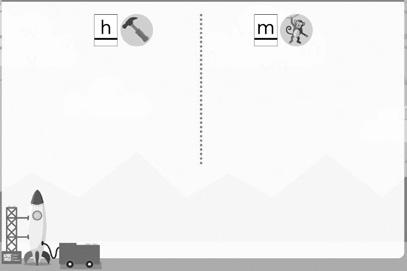
Ask “What is the first sound in hammer (while pointing to the hammer)?” A: /h/
Say “Remember, the sound /h/ is spelled with the letter h (while pointing to the letter tile h).”
Ask “What is the first sound in monkey (while pointing to the monkey)?” A: /m/ Say “Remember, the sound /m/ is spelled with the letter m (while pointing to the letter tile m).”
Click to display the mouse at the bottom of the screen.
Say “We are going to listen to the first sound in mouse and then put it under the correct letter.”
Ask:
• “Mouse What is the first sound in mouse?” A: /m/
• “Should we put the /m/, mouse, under the h, like /h/, hammer or the m, like /m/, monkey?” A: m, /m/, monkey
Say “Right, /m/, mouse and /m/, monkey both start with the letter m, so I’ll move the mouse under the m.”
Continue with remaining images: house, mittens, hat, moose, monster, hanger, hose, mountain, hospital, muffin, hug.
© 2017 Really Great Reading Company, LLC 85 UNIT 9 Lesson 1 | Part 1
Say:
• “Let’s go over our work (point to each image as you label it with students):
o /h/, hammer; /h/, house; /h/, hat; /h/, hanger; /h/, hose; /h/, hospital; /h/, hug.
o /m/, monkey; /m/, mouse; /m/, mittens; /m/, moose; /m/, monster; /m/, mountain; /m/, muffin.
• Let’s try that with two new letters.”
SORT 2:
Click to display two columns with the headings “d ” (for duck) and “c ” (for cat).
Ask “What is the first sound in duck (while pointing to the duck)?” A: /d/
Say “Remember, the sound /d/ is spelled with the letter d (while pointing to the letter tile d).”
Ask “What is the first sound in cat (while pointing to the cat)?” A: /k/
Say “Remember, the sound /k/ is spelled with the letter c (while pointing to the letter tile c).”
Click to display the dinosaur at the bottom of the screen.
Ask:
• “Dinosaur. What is the first sound in dinosaur?” A: /d/
• “Should we put the /d/, dinosaur under the d, like /d/, duck or the c, like /k/, cat?” A: d, /d/, duck
Say “Right, /d/, dinosaur and /d/, duck both start with the letter d, so I’ll move the dinosaur under the d.”
Click to place the dinosaur in the “d ” column.
Continue with remaining images: cup, cube, door, doghouse, cactus, dolphin, cookie, corn, doughnut, cow, deer.
Say:
• “Let’s go over our work (point to each image as you label it with students):
o /d/, duck; /d/, dinosaur; /d/, door; /d/, doghouse; /d/, dolphin; /d/, doughnut; /d/, deer.
o /k/, cat; /k/, cup; /k/, cube; /k/, cactus; /k/, cookie; /k/, corn; /k/, cow.”
See p. 10 for differentiation options for This Letter or That?
86 © 2017 Really Great Reading Company, LLC UNIT 9 Lesson 1 | Part 1
Unit 9 | Lesson 1 | Part 2
Activity 42: Look, Think, Say; Pop-Up; 3-Up
Objective
• Students will read three Heart Words from memory (or by decoding if necessary).
• Students will read individual Heart Words as they pop up on the screen.
• Students will read sets of three Heart Words as they appear on the screen.
Sight Words
What Students See
See p. 61 for a full description of Look, Think, Say; Pop-Up; 3-Up.
3, 2, 1…
Open Countdown Online to Unit 9, Lesson 1, Part 2 (9.1.2).
Launch!
Say “Now, we are going to learn to read some new Heart Words. Remember, they are called Heart Words because, pretty soon, we will know them by heart. We will be able to look at them and know what they say right away.”
LOOK, THINK, SAY:
Click twice to display the Heart Word a with one red dot and two empty dots below the word.
Say:
•
“This red dot (point to the red dot) tells us to stop what we are doing so we can listen to the word.
•
This is a word made of just one letter. When we name this letter, we say /ā/. When we use it as a word, we usually say /uh/.
• This word is a, as in, ‘I sat in a chair.’”
Click to display the yellow dot.
Say “This yellow dot (point to the yellow dot) tells us to think about the word and try to remember it.”
Click to display the green dot.
Say:
• “This green dot (point to the green dot) tells us to say the word out loud.
© 2017 Really Great Reading Company, LLC 87 UNIT 9 Lesson 1 | Part 2
• Say the word with me, a.
• Let’s try another word.
• Remember to look, think, and then say. Only say the word out loud when the green dot shows up.”
Click twice to display the Heart Word is with one red dot and two empty dots below the word.
Say “Look at the word is, as in, ‘Lamar is taller than Brandon.’”
Click to display the yellow dot.
Say “Think about this word, and try to remember it.”
Click to display the green dot.
Say:
• “Say the word!
• Let’s try one more word.”
Click twice to display the Heart Word for with one red dot and two empty dots below the word.
Say “Look at the word for, as in, ‘This gift is for you.’”
Click to display the yellow dot.
Say “Think about this word.”
Click to display the green dot.
Say:
• “Say the word!
• Let’s look at those words one more time.”
Continue with the same three Heart Words for two additional rounds.
POP-UP: Say:
• “Now, we are going to practice reading the Heart Words we just learned by playing two games.
• In our first game, when you see a word pop up onto the screen, say the word out loud.
• If you need help remembering, I can help, but try your best.”
Click to display the Heart Words a, is, the, in, my, and for at random. Each word will appear several times.
Read each word together with students as it pops up.
88 © 2017 Really Great Reading Company, LLC
UNIT 9 Lesson 1 | Part 2
3-UP: Say:
•
“Great job! In our next game, you will see three words on the screen.
• When you see the red dot, stop and look at the three words. When you see the yellow dot, think about the words and try to remember them. When you see the green dot, say the three words out loud.”
Click to display the sets of three Heart Words. Each set will contain the following words in a random order: a, is, the, in, my, and for. Each word will appear several times.
Look, think about, and say each set of three words together with students as the sets are displayed.
Unit 9 | Lesson 1 | Part 3
Activity 34: Which Letter? AP: Letter ID
Objective
Students will isolate the beginning sound of a word and match that sound to its letter symbol.
See p. 33 for a full description of Which Letter?
What Students See 3, 2, 1…
OPTIONAL (only if you choose to use manipulatives)
Students take out letter tiles a, c, d, f, h, i, m, o, p, r, s, and t and working board.
Open Countdown Online to Unit 9, Lesson 1, Part 3 (9.1.3).
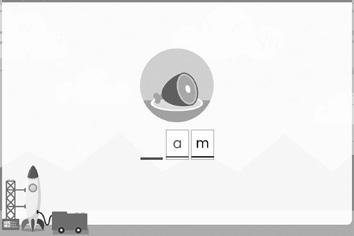
Launch!
Say “Now, we are going to spell the first letter of some words.”
Click to display the ham with the letters a m spelled out below.
Say “Ham.”
Ask “What is the first sound in ham?” A: /h/
Note that students will not need the a, i, and o tiles in this activity, but they will use them in other activities in this unit.
© 2017 Really Great Reading Company, LLC 89
UNIT 9 Lesson 1 | Part 3
You may want to have students point all the way to the left for h, to the center for c, and all the way to the right for r. If students are using manipulatives, have them hold up the correct tile and name it rather than point.
Click to display three letter tiles: h, c, r.
Ask “Which of these letters spells /h/ like /h/, ham? Point to the letter tile that spells /h/, and say its name.” A: h
Click to show the correct answer.
Click to display the image for sit with the letters i t spelled out below. Say “Sit.”
Ask “What is the first sound in sit?” A: /s/
Click to display three letter tiles: s, m, f
Ask “Which of these letters spells /s/ like /s/, sit? Point to the letter tile that spells /s/, and say its name.” A: s
Click to show the correct answer.
Continue with remaining images:
1. sad (s) 2. rat (r) 3. cat (c) 4. pot (p) 5. hat (h) 6. map (m)
7. hop (h)
8. fit (f ) 9. dip (d) 10. ram (r) 11. rip (r) 12. tap (t)
13. fat (f )
14. cot (c)
15. sip (s) 16. mad (m)
17. him (h) 18. rot (r)
See p. 34 for differentiation options for Which Letter?
90 © 2017 Really Great Reading Company, LLC
UNIT 9 Lesson 1 | Part 3
Unit 9 | Lesson 2 | Part 1
Activity 25: Stretch Those Sounds PA: Segmenting
Objective
Students will segment the phonemes (sounds) in threephoneme words using finger-stretching.
See p. 11 for a full description of Stretch Those Sounds.
What Students See 3,
2, 1…
Open Countdown Online to Unit 9, Lesson 2, Part 1 (9.2.1).
Launch!
Click to display the duck.
Say: • “Today, we are going to separate all of the sounds in some words. • Listen while I say the sounds in duck.” • “duck ” (hold closed fist against chest, crossing the midline) • “/d/” (extend thumb), “/ŭ/” (extend pointer finger), “/k/” (extend middle finger) • “duck ” (pull fingers back to a closed fist while saying the word)
Say: • “Let’s stretch the word duck again together.” (Students repeat sounds while finger-stretching.) • “Let’s try another one.”
Continue with remaining images:
1. chess (/ch/ /ĕ/ /s/)
2. cube (/k/ /y�/ /b/) 3. peas (/p/ /ē/ /z/) 4. pig (/p/ /ĭ/ /g/) 5. run (/r/ /ŭ/ /n/) 6. thumb (/th/ /ŭ/ /m/)
7. yawn (/y/ /aw/ /n/) 8. yes (/y/ /ĕ/ /s/) 9. worm (/w/ /er/ /m/)
10. van (/v/ /ă/ /n/) 11. box (/b/ /ŏ/ /ks/) 12. sit (/s/ /ĭ/ /t/)
© 2017 Really Great Reading Company, LLC 91
UNIT 9 Lesson 2 | Part 1
13. boat (/b/ /ō/ /t/)
14. seal (/s/ /ē/ /l/)
15. nurse (/n/ /er/ /s/)
16. bug (/b/ /ŭ/ /g/)
17. chin (/ch/ /ĭ/ /n/)
18. quail (/kw/ /ā/ /l/)
19. game (/g/ /ā/ /m/)
See p. 12 for differentiation options for Stretch Those Sounds.
Unit 9 | Lesson 2 | Part 2
Activity 32: Find That Letter AP: Letter ID
Objective
Students will identify the letter symbol that spells the shared first sound in a set of three imaged words.
See p. 20 for a full description of Find That Letter.
What Students See 3, 2, 1…
OPTIONAL (only if you choose to use manipulatives)
Students take out letter tiles a, c, d, f, h, i, m, o, p, r, s, and t and working board.
Open Countdown Online to Unit 9, Lesson 2, Part 2 (9.2.2).
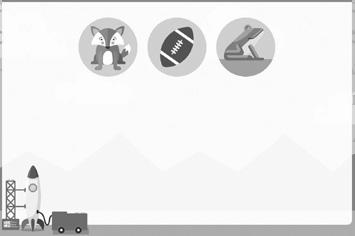
Launch!
Say “Now, we are going to match our letter tiles to the beginning sounds in some words.”
Click to display, point to, and name three images: fox, football, frog.
Ask “What is the beginning sound in all of these words?” A: /f/
Click to display three letter tiles: c, s, and f
Say “Point to the letter that spells /f/, and say its name.”
A: f (pointing to the right)
Click to show the correct answer.
92 © 2017 Really Great Reading Company, LLC
UNIT 9 Lesson 2 | Part 2
Continue with remaining image sets:
1. run, rainbow, rose (r)
2. ant, apple, alligator (a)
3. igloo, iguana, inch (i)
4. hammer, house, hamburger (h)
5. toothbrush, teeth, truck (t)
6. man, mouth, mix (m)
7. cookie, cow, clock (c)
8. sad, scissors, seal (s)
9. popcorn, penny, piano (p)
10. otter, olives, octopus (o)
11. door, dolphin, dinosaur (d)
12. inside, itch, igloo (i)
13. twins, toy, towel (t)
14. fireman, fire, fireworks (f)
See p. 22 for differentiation options for Find That Letter.
Unit 9 | Lesson 2 | Part 3
Activity 37: Unscramble This AP: Encoding
Objective
Students help the teacher segment the phonemes in words while the teacher models the encoding (spelling) of each sound.
See p. 54 for a full description of Unscramble This.
3, 2, 1…
What Students See
Open Countdown Online to Unit 9, Lesson 2, Part 3 (9.2.3).
Launch!
Say “Now, we’re going to unscramble some letters that got mixed up. When we unscramble them and put them in the right order, they will make real words we can read.”
Click to display the hat and the letter tiles t, a, h
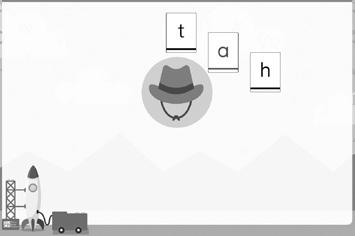
Say: • “Hat.
• Let’s stretch the sounds in hat together.”
Click to move each letter tile to the correct position AS you and students say the sounds /h/ /ă/ /t/.
© 2017 Really Great Reading Company, LLC 93
UNIT 9 Lesson 2 | Part 3
Say:
Say “Now, let’s make sure those sounds really blend to make the word hat.”
Point to each letter tile as you and the students say its sound, /h/ /ă/ /t/, and then sweep your finger under the word from left to right while saying the whole word, hat.
• “Let’s try to unscramble another mixed up word.
• This time, it’s your turn to stretch out the words on your own.”
Continue with remaining images:
1. cat (/k/ /ă/ /t/)
2. pot (/p/ /ŏ/ /t/)
3. ham (/h/ /ă/ /m/)
4. sit (/s/ / ĭ/ /t/)
5. rat (/r/ /ă/ /t/)
6. pod (/p/ /ŏ/ /d/)
7. sad (/s/ /ă/ /d/)
8. mop (/m/ /ŏ/ /p/)
9. fit (/f/ / ĭ/ /t/)
10. top (/t/ /ŏ/ /p/)
11. mad (/m/ /ă/ /d/)
12. dot (/d/ /ŏ/ /t/)
13. tap (/t/ /ă/ /p/)
14. hip (/h/ / ĭ/ /p/)
See p. 55 for differentiation options for Unscramble This.
94 © 2017 Really Great Reading Company, LLC
UNIT 9 Lesson 2 | Part 3
Unit 9 | Lesson 3 | Part 1
Activity 19: Peel and Match PA: BSI
Objective
Students will identify two words that have the same beginning sound.
See p. 13 for a full description of Peel and Match.
What Students See 3, 2,
1…
Open Countdown Online to Unit 9, Lesson 3, Part 1 (9.3.1).
Launch! Say “Today, we’re going to listen for the words that have the same beginning sound.”
ROUND 1:
Click to display the bear on the left.
Point to the bear and say “/b/, bear. Your turn.” A: /b/, bear
Click to display the bee and the dog on the right.
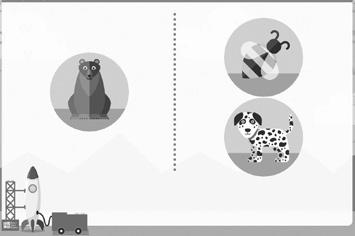
Point to each image and say “bee, dog.”
Ask “Which word begins the same as bear?” A: bee
Click to show the correct answer.
Say “Let’s try another one.”
Continue to compare the next six image sets with the /b/, bear:
• /b/, box & /p/, pie
• /l/, ladybug & /b/, butterfly
• /b/, bookshelf & /k/, car
• /b/, boy & /z/, zipper
• /ă/, alligator & /b/, bug
• /b/, boat & /g/, gold
ROUND 2:
Say “Now, let’s see which words begin the same as apple.”
Click to display the apple on the left.
You do not have to isolate the beginning sounds before saying each word; however, if you would like to differentiate the activity to make it slightly easier for the students (see Differentiation Options on p. 15), the beginning sounds are isolated for you in the bulleted lists of examples.
© 2017 Really Great Reading Company, LLC 95
UNIT 9 Lesson 3 | Part 1
Point to the apple and say “/ă/, apple. Your turn.” A: /ă/, apple
Click to display the peanut and ant on the right.
Continue to compare the next six image sets with the /ă/, apple:
• /p/, peanut & /ă/, ant
• /ă/, astronaut & /b/, ball
• /ă/, add & /ch/, cheetah
• /y�/, unicorn & /ă/, ax
• /r/, rooster & /ă/, arrow
• /ă/, alligator & /m/, mouse
ROUND 3:
Say “Now, let’s see which words begin the same as lion.”
Click to display the lion on the left and the lamp and nurse on the right.
Continue to compare the next seven image sets with the /l/, lion:
• /l/, lamp & /n/, nurse
• /l/, lemon & /sh/, sheep
• /j/, jellyfish & /l/, lightbulb
• /f/, fish & /l/, lollipop
• /l/, ladybug & /b/, blueberries
• /k/, cactus & /l/, ladder
• /d/, doughnut & /l/, leaf
See p. 15 for differentiation options for Peel and Match.
Unit 9 | Lesson 3 | Part 2
Activity 43: Where’s That Heart Word? Sight Words
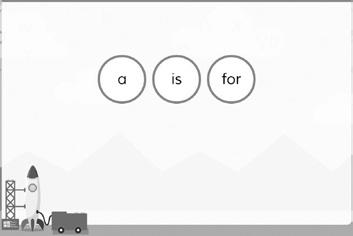
Objective
Students will read three Heart Words from memory, using sequence and location vocabulary to identify where they are on the screen.
See p. 69 for a full description of Where’s That Heart Word?
What Students See
96 © 2017 Really Great Reading Company, LLC
UNIT 9 Lesson 3 | Part 2
Open Countdown Online to Unit 9, Lesson 3, Part 2 (9.3.2).
Launch!
Say “Now, we are going to practice reading some of the Heart Words we’ve learned.”
Click to display the Heart Words a, is, for. Say “Let’s read our Heart Words, starting here (point to the words a, is, and for while reading them in left to right order).”
Ask: •
“Which word is last?” A: for •
“Which word is before the word for?” A: is •
“Which word is first?” A: a •
“Which word is next?” A: is
Click to display the Heart Words the, for, my Say “Let’s read these words, starting here (point to the words the, for, and my while reading them in left to right order).”
Ask: •
“Which word is at the beginning of the row?” A: the • “Which word is at the end of the row?” A: my •
“Which word is after the word the?” A: for • “Which word is in the middle of the row?” A: for
Click to display the Heart Words in, a, the Say “Let’s read these words, starting here (point to the words in, a, and the while reading them in left to right order).”
Ask: •
“Which word is first?” A: in •
“Which word is next?” A: a •
“Which word is last?” A: the •
“Which word is after the word in?” A: a
Click to display the Heart Words for, my, is. Say “Let’s read these words, starting here (point to the words for, my, and is while reading them in left to right order).”
See Alternative Options at the end of this activity for alternative methods of delivery.
Ask more questions as time allows.
© 2017 Really Great Reading Company, LLC 97
3, 2, 1…
UNIT 9 Lesson 3 | Part 2
Ask:
•
“Which word is before the word is?” A: my
• “Which word is at the beginning of the row?” A: for
• “Which word is at the end of the row?” A: is
• “Which word is in the middle of the row?” A: my
ALTERNATIVE OPTIONS
• Simply have students read the Heart Words in order as you point to them. Do this as many times as desired.
• Have students read the Heart Words as you point to them in random order as many times as desired.
Unit 9 | Lesson 3 | Part 3
Activity 36: Guess My Word AP: Encoding Objective
Students will observe the encoding of a word and then blend together the word's phonemes.
See p. 39 for a full description of Guess My Word.
What Students See 3, 2, 1…
Open Countdown Online to Unit 9, Lesson 3, Part 3 (9.3.3).
Launch!
Say “Now, you’re going to guess my mystery words that got all mixed up.”
Click to display the letter tiles t, h, a
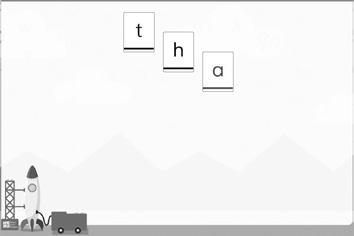
Say “Guess the mystery word, /h/ /ă/ /t/.” (Click to move the letter tiles into the correct position as you say each sound.)
Ask “What’s my word?” A: hat (Students blend the sounds together to say the word.)
98 © 2017 Really Great Reading Company, LLC
UNIT 9 Lesson 3 | Part 3
Say “/h/ /ă/ /t/, hat.” (Point to each letter tile as you say its sound, and then sweep your finger under the word from left to right while saying the whole word.)
Click to display the hat.
Continue with remaining images:
1. /r/ /ă/ /t/, rat
2. /s/ /ĭ/ /t/, sit
3. /k/ /ă/ /t/, cat
4. /h/ /ă/ /m/, ham
5. /m/ /ă/ /p/, map
6. /s/ /ă/ /d/, sad
7. /p/ /ŏ/ /d/, pod
8. /m/ /ă/ /t/, mat
9. /h/ /ă/ /d/, had 10. /k/ /ŏ/ /p/, cop
11. /f/ /ĭ/ /t/, fit
12. /d/ /ŏ/ /t/, dot 13. /r/ /ă/ /p/, rap
14. /t/ /ĭ/ /p/, tip
See p. 40 for differentiation options for Guess My Word.
© 2017 Really Great Reading Company, LLC 99
UNIT 9 Lesson 3 | Part 3
You should touch the tiles at the top of the left column as you check to see if there are, in fact, two sounds in the word.
Unit 9 | Lesson 4 | Part 1
Activity 26: Count the Sounds PA: Segmenting Objective
Students will segment and count the number of phonemes (sounds) in spoken words.
What Students See
Description
Two columns appear on the screen with two and three color tiles (representing two and three phonemes) as headings. An image appears at the bottom of the screen. Teacher and students stretch the phonemes (sounds) in the word. Students must determine how many phonemes are in each word. Each image is then sorted into the correct column.
3, 2, 1…
Open Countdown Online to Unit 9, Lesson 4, Part 1 (9.4.1).
Launch!
Click to display two columns with two and three color tiles as headings.
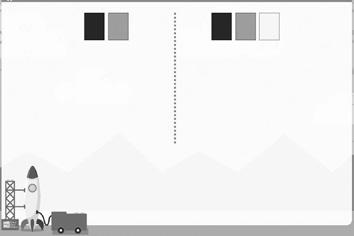
Say “Today, we are going to listen for how many sounds we hear in words. This side (point to the left column) is for words that have two sounds. This side (point to the right column) is for words that have three sounds.”
Click to display the bee at the bottom of the screen.
Say “Bee. Stretch that word with me, bee, /b/ /ē/, bee.” (Students and teacher finger-stretch.)
Ask “How many sounds did you hear in /b/ /ē/, bee?” A: two
Say “Let’s check it: /b/ (point to the first color tile), /ē/ (point to the second color tile), bee. You’re right!”
Click to place the bee in the column with two color tiles.
Although the letter x is comprised of two pho nemes, students are taught to handle them as one sound repre sented by one letter, as in the word ax
Continue with the remaining words:
1. goat, /g/ /ō/ /t/ (3)
2. egg, /ĕ/ /g/ (2)
3. up, /ŭ/ /p/ (2)
4. bat, /b/ /ă/ /t/ (3)
5. gate, /g/ /ā/ /t/ (3)
6. key, /k/ /ē/ (2)
7. ax, /ă/ /ks/ (2)
8. bug, /b/ /ŭ/ /g/ (3)
100 © 2017 Really Great Reading Company, LLC
UNIT 9 Lesson 4 | Part 1
9. rat, /r/ /ă/ /t/ (3)
10. tie, /t/ / ī/ (2)
11. log, /l/ /ŏ/ /g/ (3)
12. mouse, /m/ /ou/ /s/ (3)
13. ox, /ŏ/ /ks/ (2)
14. can, /k/ /ă/ /n/ (3)
15. nose, /n/ /ō/ /z/ (3)
16. zoo, /z/ /�/ (2)
17. edge, /ĕ/ /j/ (2)
18. wave, /w/ /ā/ /v/ (3)
19. ape, /ā/ /p/ (2)
20. car, /k/ /ar/ (2)
21. tape, /t/ /ā/ /p/ (3)
22. boy, /b/ /oi/ (2)
23. yes, /y/ /ĕ/ /s/ (3)
DIFFERENTIATION OPTIONS
Ways to simplify:
• Lengthen the pause between each phoneme: “/m/ /ă/ /p/, map.” This makes it easier for students to distinguish between and count the phonemes.
Ways to challenge:
• Shorten the pause between each phoneme: “/m/ /ă/ /p/, map.” This makes it more challenging for students to distinguish between and count the phonemes.
Open Countdown Online to Unit 9, Lesson 4, Part 2 (9.4.2).
© 2017 Really Great Reading Company, LLC 101
| Lesson 4 | Part 2 Activity 33: Connect the Letter AP: Letter ID Objective
will practice connecting a word’s beginning sound to its corresponding letter symbol.
of Connect the Letter. What Students See
Unit 9
Students
See p. 24 for a full description
3, 2, 1…
UNIT 9 Lesson 4 | Part 2
Launch!
Say “Now, we are going to match letters to the beginning sounds in some words.”
Ask “This is the letter i. What sound does the letter i spell?” A: / ĭ/
Say “Right. Now, let’s look at a few pictures and see which one begins with that sound.”
Click to display, point to, and name three images below the letter tile i: inch, ax, and feet.
Ask “Which one begins with / ĭ/?” A: inch
Say “Yes, / ĭ/, inch begins with / ĭ/, so inch begins with letter i.”
Click to show the correct answer.
Say “Let’s try that with some new pictures.”
Click to display, point to, and name the three images below the letter tile i: teeth, dinosaur, and insect.
Ask “Which one begins with i?” A: insect
Say “Yes, / ĭ/, insect begins with i.”
Click to show the correct answer.
Continue with remaining letter tiles and images: i
• hospital, iguana, seal
• infant, cupcake, paint
• cat, igloo, octopus s
• sunflower, mitt, rabbit
• apple, piano, scissors
• mouth, sock, toy
• peas, soap, candles
• six, dolphin, feather f
• inside, fish, tape
• popcorn, hot, fireworks
• finger, alligator, camel
102 © 2017 Really Great Reading Company, LLC
UNIT 9 Lesson 4 | Part 2
• moose, foot, olives
• peppermint, fox, hair c
• ostrich, tiger, carrot
• caveman, hamburger, penny
• cookie, firehose, astronaut
• deer, hamster, cube
• piano, cactus, sidewalk
See p. 25 for differentiation options for Connect the Letter.
Unit 9 | Lesson 4 | Part 3
Activity 38: Build a Word AP: Encoding
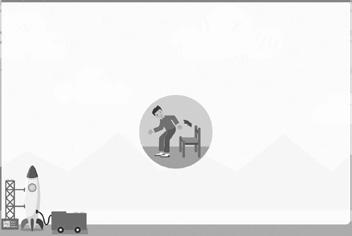
Objective
Students spell words by first segmenting sounds and then matching sounds to letters.
What Students See
Description
This encoding (spelling) activity begins with teacher and students segmenting the phonemes in a word in order to spell it. First, they stretch the phonemes with their fingers, then they count the phonemes and put down a color tile for each sound they heard. Then they match each sound they heard with the corresponding letter tile, spelling the word in order. Lastly, teacher and students Touch & Say to check their spelling.
3, 2, 1…
OPTIONAL
(only if you choose to use manipulatives)
Students take out letter tiles a, c, d, f, h, i, m, o, p, r, s, and t, and working board.
Open Countdown Online to Unit 9, Lesson 4, Part 3 (9.4.3).
© 2017 Really Great Reading Company, LLC 103
UNIT 9 Lesson 4 | Part 3
To finger-stretch, begin by saying the whole word with closed fist at chest. Then, extend one finger for each sound in the word, beginning with the thumb. Finally, bring hand back into a fist while saying the whole word again. If students are using manipulatives, have them use color and letter tiles to build the word along with you.
Launch!
Say:
• “Now, we are going to build words with our letter tiles by listening to the sounds in each word and putting our letter tiles in order. That is how we spell words.
• Let’s build our first word!”
Click to display the image for sit.
Say:
• “Listen carefully. Sit, /s/ /ĭ/ /t/, sit (while finger-stretching).
• I heard three sounds in sit, /s/ /ĭ/ /t/.”
Click to display one color tile at a time while again saying “/s/ / ĭ/ /t/.”
Say:
• “Now let’s build the word with letter tiles.
• The first sound I heard was /s/.”
Ask “What letter spells /s/?” A: s
Click to display the letter tile s under the first color tile. Say “The next sound I heard was / ĭ/. What letter spells / ĭ/?” A: i
Click to display the letter tile i under the second color tile.
Say “The last sound I heard was /t/. What letter spells /t/?” A: t
Click to display the letter tile t under the last color tile.
Say:
• “Let’s check our work. /s/ /ĭ/ /t/ (touching each letter as you say the sound), sit (sweeping pointer finger under the whole word from left to right).
• Awesome job; you just spelled sit. Let’s try another word.”
Continue with remaining words:
1. ham, /h/ /ă/ /m/
2. cat, /k/ /ă/ /t/
3. cod, /k/ /ŏ/ /d/
4. map, /m/ /ă/ /p/ 5. pot, /p/ /ŏ/ /t/
6. rat, /r/ /ă/ /t/ 7. sad, /s/ /ă/ /d/ 8. pod, /p/ /ŏ/ /d/ 9. hat, /h/ /ă/ /t/
104 © 2017 Really Great Reading Company, LLC
UNIT 9 Lesson 4 | Part 3
DIFFERENTIATION OPTIONS
Ways to simplify:
• Lengthen the pause between each phoneme: “/d/ /ŏ/ /t/, dot.” This allows the students more time to think of the corresponding letters for each sound.
• Elongate the vowel sound more than the other sounds when pronouncing the phonemes, and/or use the corresponding hand motion to reinforce the vowel sound: “/d/ /ŏŏŏŏ/ (while pretending your hand is an octopus with legs hanging down) /t/, dot.” This helps some students because the medial vowel sound in a word is often more difficult to perceive than the initial and final consonant sounds.
Ways to challenge:
• Shorten the pause between each phoneme: “/m/ /ă/ /p/, map.”
• Instead of asking students to say the names of the letters aloud, they can choose the correct letter tiles and spell the words on their working boards.
© 2017 Really Great Reading Company, LLC 105
UNIT 9 Lesson 4 | Part 3
Unit 9 | Lesson 5 | Part 1
Activity 31: This Letter or That?
AP: Letter ID
Objective
Students will identify the letter symbol that spells the first sound in a word.
See p. 8 for a full description of This Letter or That?
What Students See 3,
2, 1…
Open Countdown Online to Unit 9, Lesson 5, Part 1 (9.5.1).
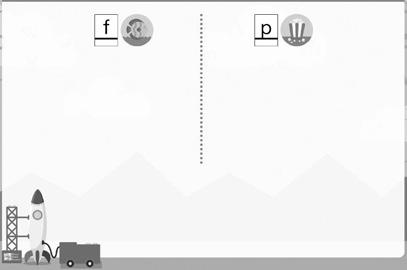
Launch!
SORT 1:
Click to display two columns with the headings “ f ” (for fish) and “p” (for popcorn).
Ask “What is the first sound in fish (while pointing to the fish)?” A: /f/
Say “Remember, the sound /f/ is spelled with the letter f (while pointing to the letter tile f).”
Ask “What is the first sound in popcorn (while pointing to the popcorn)?” A: /p/ Say “Remember, the sound /p/ is spelled with the letter p (while pointing to the letter tile p).”
Click to display the finger at the bottom of the screen.
Say “We are going to listen to the first sound in finger and then put it under the correct letter.”
Ask:
• “Finger. What is the first sound in finger?” A: /f/
• “Should we put the /f/, finger, under the f, like /f/, fish or the p, like /p/, popcorn?” A: f, /f/, fish
Say “Right, /f/, finger and /f/, fish both start with the letter f, so I’ll move the finger under the f.”
Click to place the finger in the “ f ” column.
106 © 2017 Really Great Reading Company, LLC
UNIT 9 Lesson 5 | Part 1
Continue with remaining images: football, pencil, flower, fence, pants, peanut, feather, paintbrush, peas, foot, pan
Say:
• “Let’s go over our work (point to each image as you label it with students):
o /f/, fish; /f/, finger; /f/, football; /f/, flower; /f/, fence; /f/, feather; /f/, foot.
o /p/, popcorn; /p/, pencil; /p/, pants; /p/, peanut; /p/, paintbrush; /p/, peas; /p/, pan.
• Let’s try that with two new letters.”
SORT 2:
Click to display two columns with the headings “s ” (for soap) and “ t ” (for toothbrush).
Ask “What is the first sound in soap (while pointing to the soap)?” A: /s/ Say “Remember, the sound /s/ is spelled with the letter s (while pointing to the letter tile s).”
Ask “What is the first sound in toothbrush (while pointing to the toothbrush)?” A: /t/
Say “Remember, the sound /t/ is spelled with the letter t (while pointing to the letter tile t).”
Click to display the table at the bottom of the screen.
Ask: • “ Table. What is the first sound in table?” A: /t/
• “Should we put the /t/, table under the s, like /s/, soap or the t, like /t/, toothbrush?” A: t, /t/, toothbrush
Say “Right, /t/, table and /t/, toothbrush both start with the letter t, so I’ll move the table under the t.”
Continue with remaining images: sled, tongue, towel, sock, stars, tie, sun, toes, sick, teeth, seal.
Say:
• “Let’s go over our work (point to each image as you label it with students): o /s/, soap; /s/, sled; /s/, sock; /s/, stars; /s/, sun; /s/, sick; /s/, seal.
o /t/, toothbrush; /t/, table; /t/, tongue; /t/, towel; /t/, tie; /t/, toes; /t/, teeth.”
See p. 10 for differentiation options for This Letter or That?
© 2017 Really Great Reading Company, LLC 107
UNIT 9 Lesson 5 | Part 1
Unit 9 | Lesson 5 | Part 2
Activity 44: Pop-Up and 3-Up Sight Words Objective
• Students will read individual Heart Words as they pop up on the screen.
• Students will read sets of three Heart Words as they appear on the screen.
See p. 80 for a full description of Pop-Up and 3-Up.
What Students See 3, 2, 1…
Open Countdown Online to Unit 9, Lesson 5, Part 2 (9.5.2).
Launch!
POP-UP: Say:
• “Now, we are going to practice reading the Heart Words we have learned so far.
• In our first game, when you see a word pop up onto the screen, say the word out loud.
• If you need help remembering, I can help, but try your best.”
Click to display the Heart Words the, in, my, a, is, and for at random. Each word will appear several times.
Read each word together with students as it pops up.
3-UP: Say:
• “Great job! In our next game, you will see three words on the screen.
• When you see the red dot, stop and look at the three words. When you see the yellow dot, think about the words and try to remember them. When you see the green dot, say the three words out loud.”
Click to display the sets of three Heart Words. Each set will contain three of the following words in a random order: the, in, my, a, is, and for. Each word will appear several times.
Look, think about, and say each set of three words together with students as the sets are displayed.
108 © 2017 Really Great Reading Company, LLC
UNIT 9 Lesson 5 | Part 2
Unit 9 | Lesson 5 | Part 3
Activity 40: Touch & Say AP: Decoding
Objective
Students decode (read) words by pronouncing one sound at a time and then blending them together.
See p. 26 for a full description of Touch & Say.
3, 2, 1…
What Students See
Open Countdown Online to Unit 9, Lesson 5, Part 3 (9.5.3).
Launch!
Click to display the letter tiles t, i, p
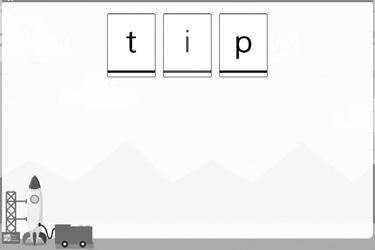
Say:
•
“We’re going to read some words by ‘sounding them out,’ which means saying them one sound at a time.
• Let’s get started with this word. Watch how I sound it out.”
Click to underline one letter tile at a time while saying its sound, “/t/ / ĭ/ /p/.”
Click to slide an arrow from left to right under the entire word while saying, “ tip.”
Say “Let’s keep going! This time, say the sounds and blend the word with me.”
Click to display the letter tiles h, a, m
Click to underline one letter at a time while saying its sound with students, “/h/ /ă/ /m/.”
Click to slide an arrow from left to right under the entire word while saying, “ham.”
Continue with remaining words, making sure students are saying each sound with you as you click to underline it:
1. am (/ă/ /m/)
2. rot (/r/ /ŏ/ /t/)
3. hid (/h/ / ĭ/ /d/)
4. rip (/r/ / ĭ/ /p/)
5. cat (/k/ /ă/ /t/)
6. sap (/s/ /ă/ /p/)
7. pat (/p/ /ă/ /t/)
8. dim (/d/ / ĭ/ /m/)
© 2017 Really Great Reading Company, LLC 109
UNIT 9 Lesson 5 | Part 3
9. hip (/h/ / ĭ/ /p/)
10. if (/ ĭ/ /f/)
11. mat (/m/ /ă/ /t/)
12. pod (/p/ /ŏ/ /d/)
13. rap (/r/ /ă/ /p/)
14. Tom (/t/ /ŏ/ /m/)
15. hat (/h/ /ă/ /t/)
16. map (/m/ /ă/ /p/)
17. pot (/p/ /ŏ/ /t/)
18. sit (/s/ / ĭ/ /t/)
DIFFERENTIATION OPTIONS
Ways to challenge:
• Have students pronounce each individual sound and then blend the word independently as you underline them.
• Using Letter Tile Free Play (located in Supplemental Resources) or your whiteboard and marker, have students Touch & Say the following additional words: ad, at, cap, cod, cop, cot, dip, dot, fat, fit, had, him, hit, hop, hot, it, mad, mop, pad, pit, rad, ram, rat, rid, rim, rod, sad, Sam, sat, sip, tad, tap, Tim, and top
• Using Letter Tile Free Play (located in Supplemental Resources) or your whiteboard and marker, have students Touch & Say the following words with 2-sound consonant blends: act, ads, amp, apt, imp, and its
110 © 2017 Really Great Reading Company, LLC UNIT 9 Lesson 5 | Part 3
Unit 10 | Lesson 1 | Part 1
Activity 20: This or That? PA: BSI
Objective
Students will identify which word of two has a specific beginning sound.
See p. 35 for a full description of This or That?
3, 2, 1…
What Students See
Open Countdown Online to Unit 10, Lesson 1, Part 1 (10.1.1).
Launch!
Say “Today, we are going to listen for the word that begins with the sound I say.”
Click to display the giraffe and the tongue
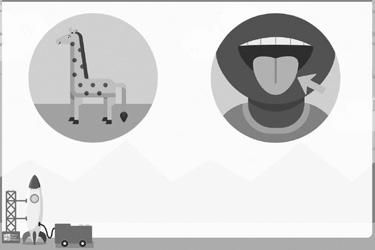
Point to each image and say “Giraffe, tongue. Which word starts with /j/?”
A: giraffe
Say “Yes, /j/, giraffe.”
Click to show the correct answer.
Say “Let’s try another one.”
Continue with the remaining examples:
1. towel/wing (“Which one starts with /w/?” A: wing)
2. zoom/bell (“Which one starts with /b/?” A: bell)
3. cake/jump (“Which one starts with /k/?” A: cake)
4. quick /run (“Which one starts with /kw/?” A: quick)
5. billboard/pie (“Which one starts with /p/?” A: pie)
6. lemon/wave (“Which one starts with /l/?” A: lemon)
7. nose/astronaut (“Which one starts with /ă/?” A: astronaut)
8. open/easel (“Which one starts with /ō/?” A: open)
9. girl/boy (“Which one starts with /g/?” A: girl)
10. feather/hug (“Which one starts with /h/?” A: hug)
11. under/apple (“Which one starts with /ŭ/?” A: under)
© 2017 Really Great Reading Company, LLC 111 UNIT 10 Lesson 1 | Part 1
Optional motions for consonant sounds are available in the Appendix on p. 290 for students who may require more of a kinesthetic approach.
12. shark/thumb (“Which one starts with /th/?” A: thumb)
13. rose/lime (“Which one starts with /r/?” A: rose)
14. angel/island (“Which one starts with /ā/?” A: angel)
15. lick/onion (“Which one starts with /ŭ/?” A: onion)
16. oboe/uniform (“Which one starts with /ō/?” A: oboe)
17. ladder/kite (“Which one starts with /k/?” A: kite)
18. monster/zipper (“Which one starts with /z/?” A: zipper)
19. quail/sad (“Which one starts with /s/?” A: sad)
See p. 36 for differentiation options for This or That?
Unit 10 | Lesson 1 | Part 2
Activity 30: Name That Sound
AP: Letter ID
Objective
Students will identify the uppercase and lowercase letters associated with the sounds /g/, /l/, /n/, and //.
See p. 2 for a full description of Name That Sound.
What Students See 3, 2, 1…
Open Countdown Online to Unit 10, Lesson 1, Part 2 (10.1.2).
Launch!
Say “Now, we are going to see what some new sounds look like when they are written down.”
Click to display the goat.
Ask:
• “What is this a picture of?” A: goat
• “What is the first sound in /g/, goat?” A: /g/
Click to display the corresponding uppercase and lowercase letter tiles.
112 © 2017 Really Great Reading Company, LLC UNIT 10 Lesson 1 | Part 2
Say:
•
“Right, goat begins with /g/, and these letters say the sound, or spell, /g/.
•
Do you remember Gary the Gorilla? He goes to grammar school with goats and guinea pigs! His favorite sound is /g/.
•
The name of these letters is G. G says /g/, like the beginning of /g/, goat.
•
This one (point to uppercase G) is called ‘capital G,’ and this one (point to lowercase g) is called ‘lowercase g.’ This is the one we will see most of the time, so we’ll just call it g.
Let’s learn another new letter.”
•
Click to display the lion.
Ask:
•
“What is this a picture of?” A: a lion
•
“What is the first sound in /l/, lion?” A: /l/
Click to display the corresponding uppercase and lowercase letter tiles.
Say:
•
“Right, lion begins with /l/, and these letters say /l/.
•
Do you remember Lola the Lizard? She licked a lemon lollipop, and then she accidentally licked a lion! Her favorite sound is /l/.
•
This one (point to uppercase L) is called ‘capital L ,’ and this one (point to lowercase l) is called ‘lowercase l.’ This is the one we will see most of the time, so we’ll just call it l.
Let’s learn another new letter.”
•
Click to display the nest.
Ask:
• “What is this a picture of?” A: a nest
• “What is the first sound in /n/, nest?” A: /n/ Say “Do you remember Nina the Nuthatch? Her nest was next door to a noisy nightingale’s! Her favorite sound is /n/.”
Click to display the corresponding uppercase and lowercase letter tiles.
Ask “So, what do you think these letters say?” A: /n/
Say:
• “Yes! The name of these letters is N. N says /n/, like the beginning of /n/, nest.
© 2017 Really Great Reading Company, LLC 113 UNIT 10 Lesson 1 | Part 2
•
This one (point to uppercase N) is called ‘capital N,’ and this one (point to lowercase n) is called ‘lowercase n.’ This is the one we will see most of the time, so we’ll just call it n.
• Let’s learn one more new letter.”
Click to display the image for up.
Ask:
• “What is this a picture of?” A: an arrow pointing up
• “What is the first sound in /ŭ/, up?” A: /ŭ/
Click to display the corresponding uppercase and lowercase letter tiles.
Ask “So, what do you think these letters say?” A: /ŭ/
Say:
• “Yes! The name of these letters is U U says /ŭ/, like the beginning of /ŭ/, up
• This one (point to uppercase U) is called ‘capital U,’ and this one (point to lowercase u) is called ‘lowercase u.’ This is the one we will see most of the time, so we’ll just call it u.”
Demonstrate /ŭ/, up motion (you should use this motion, and all the short vowel motions, for all students):
Say:
• “Let’s do a motion to help us remember that sound.
• Make your pointer finger go up from your waist to over your head.”
Demonstrate the short u, up, motion while elongating the sound /ŭŭŭŭ/, and have students repeat (with pointer finger pointing up, move your hand up from your waist to over your head).
Click to display letter tiles g, l, n, and u.
Say “Let’s name our letters one more time and say the sound that each letter spells.”
Point to each letter, one at a time, and say:
• “This is g. G says /g/.
• This is l L says /l/.
• This is n. N says /n/.
• This is u U says /ŭ/.”
114 © 2017 Really Great Reading Company, LLC UNIT 10 Lesson 1 | Part 2
Unit 10 | Lesson 1 | Part 3
Activity 42: Look, Think, Say; Pop-Up; 3-Up Sight Words
Objective
• Students will read three Heart Words from memory (or by decoding if necessary).
• Students will read individual Heart Words as they pop up on the screen.
• Students will read sets of three Heart Words as they appear on the screen.
What Students See
See p. 61 for a full description of Look, Think, Say; Pop-Up; 3-Up.
3, 2, 1…
Open Countdown Online to Unit 10, Lesson 1, Part 3 (10.1.3).
Launch!
Say “Now, we are going to learn to read some new Heart Words.”
LOOK, THINK, SAY:
Click twice to display the Heart Word I with one red dot and two empty dots below the word.
Say:
• “This red dot (point to the red dot) tells us to stop what we are doing so we can listen to the word.
•
This word is I, as in, ‘I will go to the doctor if I feel sick.’”
Click to display the yellow dot.
Say “This yellow dot (point to the yellow dot) tells us to think about the word and try to remember it.”
Click to display the green dot.
Say:
• “This green dot (point to the green dot) tells us to say the word out loud.
• Say the word with me, I.
• Let’s try another word.
• Remember to look, think, and then say. Only say the word out loud when the green dot shows up.”
© 2017 Really Great Reading Company, LLC 115 UNIT 10 Lesson 1 | Part 3
Click twice to display the Heart Word am with one red dot and two empty dots below the word.
Say “Look at the word am, as in, ‘I am almost as tall as my brother.’”
Click to display the yellow dot.
Say:
• “Think about this word. We know the sounds in this word, /ă/ /m/ (point to each letter as you say the sound), am.
• We can think about the sounds in this word, but it might be easier to just try to remember it.”
Click to display the green dot.
Say:
• “Say the word!
• Let’s try one more word.”
Click twice to display the Heart Word here with one red dot and two empty dots below the word.
Say “Look at the word here, as in, ‘Here I am.’”
Click to display the yellow dot.
Say “Think about this word.”
Click to display the green dot.
Say:
• “Say the word!
• Let’s look at those words again.”
Continue with the same three Heart Words for two additional rounds.
POP-UP: Say:
• “Now, we are going to practice reading the Heart Words we just learned by playing two games.
• In our first game, when you see a word pop up onto the screen, say the word out loud.
• If you need help remembering, I can help, but try your best.”
Click to display the Heart Words I, am, here, the, in, my, a, is, and for at random.
Each word will appear several times.
Read each word together with students as it pops up.
116 © 2017 Really Great Reading Company, LLC UNIT 10 Lesson 1 | Part 3
3-UP:
Say:
•
“Great job! In our next game, you will see three words on the screen.
• When you see the red dot, stop and look at the three words. When you see the yellow dot, think about the words and try to remember them. When you see the green dot, say the three words out loud.”
Click to display the sets of three Heart Words. Each set will contain the following words in a random order: I, am, here, the, in, my, a, is, and for. Each word will appear several times.
Look, think about, and say each set of three words together with students as the sets are displayed.
© 2017 Really Great Reading Company, LLC 117 UNIT 10 Lesson 1 | Part 3
Unit 10 | Lesson 2 | Part 1
Activity 40: Touch & Say AP: Decoding
Objective
Students decode (read) words by pronouncing one sound at a time and then blending them together.
See p. 26 for a full description of Touch & Say.
What Students See 3,
2, 1…
Open Countdown Online to Unit 10, Lesson 2, Part 1 (10.2.1).
Launch!
Click to display the letter tiles c, u, t. Say:
• “We’re going to read some words by ‘sounding them out,’ which means saying them one sound at a time.
• Let’s get started with this word. Watch how I sound it out.”
Click to underline one letter tile at a time while saying its sound, “/k/ /ŭ/ /t/.”
Click to slide an arrow from left to right under the entire word while saying, “cut.”
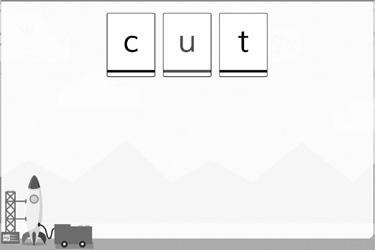
Say “Let’s keep going! This time, say the sounds and blend the word with me.”
Click to display the letter tiles l, a, p.
Click to underline one letter at a time while saying its sound with students, “/l/ /ă/ /p/.”
Click to slide an arrow from left to right under the entire word while saying, “lap.”
Continue with remaining words, making sure students are saying each sound with you as you click to underline it:
1. gum (/g/ /ŭ/ /m/)
2. fan (/f/ /ă/ /n/) 3. run (/r/ /ŭ/ /n/) 4. hum (/h/ /ŭ/ /m/) 5. dog (/d/ /ŏ/ /g/)
6. can (/k/ /ă/ /n/)
7. gas (/g/ /ă/ /s/)
8. us (/ŭ/ /s/)
9. pig (/p/ /ĭ/ /g/)
10. sun (/s/ /ŭ/ /n/)
11. not (/n/ /ŏ/ /t/)
12. lid (/l/ /ĭ/ /d/)
118 © 2017 Really Great Reading Company, LLC UNIT 10 Lesson 2 | Part 1
13. hog (/h/ /ŏ/ /g/)
14. cup (/k/ /ŭ/ /p/)
15. fun (/f/ /ŭ/ /n/)
16. gap (/g/ /ă/ /p/)
17. hug (/h/ /ŭ/ /g/)
18. log (/l/ /ŏ/ /g/)
DIFFERENTIATION OPTIONS
Ways to challenge:
• Have students pronounce each individual sound and then blend the word independently as you underline them.
• Using Letter Tile Free Play (located in Supplemental Resources) or your whiteboard and marker, have students Touch & Say the following additional words: cap, cop, cot, dig, dip, dot, dug, fit, fog, got, had, him, hit, hop, hot, hum, in, lad, mad, mop, mud, mug, nap, nut, on, pad, pan, pin, pit, rad, rag, ran, rid, rim, rug, sad, sip, tag, tap, Tim, top, and tug.
• Using Letter Tile Free Play (located in Supplemental Resources) or your whiteboard and marker, have students Touch & Say the following words with 2-sound consonant blends: act, ads, amp, and, ant, apt, imp, its, and ump Unit
Students will identify the letter symbol that spells the first sound in a word.
Launch! SORT 1: Click to display two columns with the headings “u ” (for up) and “g ” (for goat). Ask “What is the first sound in up (while pointing to the image for up)?” A: /ŭ/
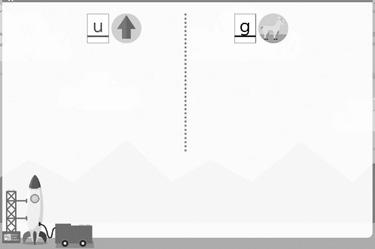
© 2017 Really Great Reading Company, LLC 119
10 Lesson 2 | Part 2
UNIT
10 | Lesson 2 | Part 2
Activity 31: This Letter or That? AP: Letter ID Objective
See p. 8 for a full description of This Letter or That? What Students See 3, 2, 1…
Open Countdown Online to Unit 10, Lesson 2, Part 2 (10.2.2).
Say “Remember, the sound /ŭ/ is spelled with the letter u (while pointing to the letter tile u).”
Ask “What is the first sound in goat (while pointing to the goat)?” A: /g/ Say “Remember, the sound /g/ is spelled with the letter g (while pointing to the letter tile g).”
Click to display the umbrella at the bottom of the screen.
Ask:
• “Umbrella. What is the first sound in umbrella?” A: /ŭ/
• “Should we put the /ŭ/, umbrella under the u, like /ŭ/, up or the g, like /g/, goat?” A: u, /ŭ/, up
Say “Right, /ŭ/, umbrella and /ŭ/, up both start with the letter u, so I’ll move the umbrella under the u.”
Click to place the umbrella in the “u ” column.
Continue with remaining images: upside down, grapes, under, unhappy, garden, gate, uncle, gloves, gold, unzip, guitar
Say:
• “Let’s go over our work (point to each image as you label it with students):
o /ŭ/, up; /ŭ/, umbrella; /ŭ/, upside down; /ŭ/, under; /ŭ/, unhappy; /ŭ/, uncle; /ŭ/, unzip
o /g/, goat; /g/, grapes; /g/, garden; /g/, gate; /g/, gloves; /g/, gold; /g/, guitar.
• Let’s try that with two new letters.”
SORT 2:
Click to display two columns with the headings “l ” (for lion) and “n” (for nest).
Ask “What is the first sound in lion (while pointing to the lion)?” A: /l/ Say “Remember, the sound /l/ is spelled with the letter l (while pointing to the letter tile l).”
Ask “What is the first sound in nest (while pointing to the nest)?” A: /n/ Say “Remember, the sound /n/ is spelled with the letter n (while pointing to the letter tile n).”
Click to display the nurse at the bottom of the screen.
Ask:
• “Nurse. What is the first sound in nurse?” A: /n/
• “Should we put the /n/, nurse under the l, like /l/, lion or the n, like /n/, nest?” A: n, /n/, nest
120 © 2017 Really Great Reading Company, LLC UNIT 10 Lesson 2 | Part 2
Say “Right, /n/, nurse and /n/, nest both start with the letter n, so I’ll move the nest under the n.”
Continue with remaining images: ladder, newspaper, neck, lime, log, needle, ladybug, net, lightbulb, nose, leaf.
Say: • “Let’s go over our work (point to each image as you label it with students):
o /l/, lion; /l/, ladder; /l/, lime; /l/, log; /l/, ladybug; /l/, lightbulb; /l/, leaf
o /n/, nest; /n/, nurse; /n/, newspaper; /n/, neck; /n/, needle; /n/, net; /n/, nose.”
See p. 10 for differentiation options for This Letter or That?
Unit 10 | Lesson 2 | Part 3
Activity 38:
Objective
Build a Word AP: Encoding
What Students See
Students encode (spell) words by first segmenting sounds and then matching sounds to letters.
See p. 103 for a full description of Build a Word.
3, 2, 1…
OPTIONAL (only if you choose to use manipulatives)
Prepare materials:
• Letter tiles a, c, d, f, g, h, i, l, m, n, o, p, r, s, t, and u and working board from Countdown Student Kit for each student (italicized letter tiles listed here are new to this unit; have students add these tiles to their boards)
Open Countdown Online to Unit 10, Lesson 2, Part 3 (10.2.3).
Launch!
OPTIONAL (only if you choose to use manipulatives)
Students take out letter tiles a, c, d, f, g, h, i, l, m, n, o, p, r, s, t, and u, and working board.
© 2017 Really Great Reading Company, LLC 121
Lesson 2 | Part 3
UNIT 10
To finger-stretch, begin by saying the whole word with closed fist at chest. Then, extend one finger for each sound in the word, beginning with the thumb. Finally, bring hand back into a fist while saying the whole word again.
Say:
• “Now, we are going to build words with our letter tiles by listening to the sounds in each word and putting our letter tiles in order. That is how we spell words.
• Let’s build our first word!”
Click to display the image for hug.
Say:
• “Listen carefully. Hug, /h/ /ŭ/ /g/, hug (while finger-stretching).
• I heard three sounds in hug, /h/ /ŭ/ /g/.”
Click to display one color tile at a time while again saying “/h/ /ŭ/ /g/.”
(If students are using manipulatives, have them build the word along with you.)
Say:
• “Now let’s build the word with letter tiles.
• The first sound I heard was /h/.”
Ask “What letter spells /h/?” A: h
Click to display the letter tile h under the first color tile. Say “The next sound I heard was /ŭ/. What letter spells /ŭ/?” A: u
Click to display the letter tile u under the second color tile. Say “The last sound I heard was /g/. What letter spells /g/?” A: g
If students are using manipulatives, have them use color and letter tiles to build the word along with you.
Click to display the letter tile g under the last color tile.
Say:
• “Let’s check our work. /h/ /ŭ/ /g/ (touching each letter as you say the sound), hug (sweeping pointer finger under the whole word from left to right).
•
Awesome job; you just spelled hug. Let’s try another word.”
Continue with remaining words:
1. nap, /n/ /ă/ /p/
2. sun, /s/ /ŭ/ /n/
3. log, /l/ /ŏ/ /g/
4. cup, /k/ /ŭ/ /p/
5. him, /h/ /ĭ/ /m/
6. mug, /m/ /ŭ/ /g/
7. pod, /p/ /ŏ/ /d/
8. rug, /r/ /ŭ/ /g/
9. sad, /s/ /ă/ /d/
See p. 105 for differentiation options for Build a Word.
122 © 2017 Really Great Reading Company, LLC UNIT 10 Lesson 2 | Part 3
Unit 10 | Lesson 3 | Part 1
Activity 33: Connect the Letter AP: Letter ID
Objective
Students will practice connecting a word’s beginning sound to its corresponding letter symbol.
See p. 24 for a full description of Connect the Letter.
What Students See 3,
2, 1…
Open Countdown Online to Unit 10, Lesson 3, Part 1 (10.3.1).
Launch!
Say “Today, we are going to match letters to the beginning sounds in some words.”
Ask “This is the letter g. What sound does the letter g spell?” A: /g/
Say “Right. Now, let’s look at a few pictures and see which one begins with that sound.”
Click to display, point to, and name the three images below the letter tile g: lion, gumballs, and fence.
Ask “Which one begins with /g/?” A: gumballs
Say “Yes, /g/, gumballs begins with /g/, so gumballs begins with the letter g.”
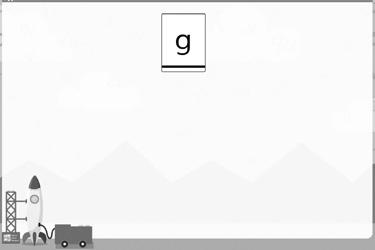
Click to show the correct answer.
Say “Let’s try that with some new pictures.”
Continue with remaining letter tiles and images: g
• garden, upside down, nose
• apple, lamp, game
• mountain, football, guitar l
• toothbrush, nail, lemon
• guinea pig, ladder, cake
• fox, ladybug, igloo
• lightning, neck, dog
© 2017 Really Great Reading Company, LLC 123 UNIT 10 Lesson 3 | Part 1
n
• nurse, gold, hamster
• unhappy, nap, mask
• astronaut, newspaper, log
• pants, ant, nest u
• lollipop, up, inside
• popcorn, gift, umbrella
• under, needle, mouth d
• leaf, dinosaur, net
• pencil, doughnut, gate p
• inch, gloves, peanut
• peppermint, unzip, snake r
• girl, rooster, leg
See p. 25 for differentiation options for Connect the Letter.
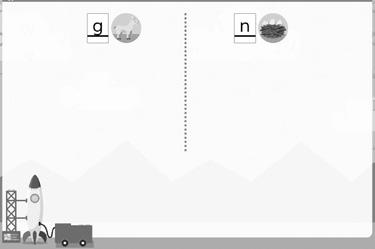
124 © 2017 Really Great Reading Company, LLC UNIT 10 Lesson 3 | Part 2
31: This Letter or That?
Letter ID
Unit 10 | Lesson 3 | Part 2 Activity
AP:
Objective
Students See
2, 1…
Students will identify the letter symbol that spells the first sound in a word. See p. 8 for a full description of This Letter or That? What
3,
Open Countdown Online to Unit 10, Lesson 3, Part 2 (10.3.2). Launch! SORT 1: Click to display two columns with the headings “g ” (for goat) and “n” (for nest).
Ask “What is the first sound in goat (while pointing to the goat)?” A: /g/
Say “Remember, the sound /g/ is spelled with the letter g (while pointing to the letter tile g).”
Ask “What is the first sound in nest (while pointing to the nest)?” A: /n/ Say “Remember, the sound /n/ is spelled with the letter n (while pointing to the letter tile n).”
Click to display the garbage at the bottom of the screen.
Ask:
• “Garbage. What is the first sound in garbage?” A: /g/
• “Should we put the /g/, garbage under the g, like /g/, goat or the n, like /n/, nest?” A: g, /g/, goat
Say “Right, /g/, garbage and /g/, goat both start with the letter g, so I’ll move the garbage under the g.”
Click to place the garbage in the “g ” column.
Continue with remaining images: glasses, nut, garden, gumballs, neck, newspaper, guinea pig, nail, nap, gift, nurse
Say:
• “Let’s go over our work (point to each image as you label it with students):
o /g/, goat; /g/, garbage; /g/, glasses; /g/, garden; /g/, gumballs; /g/, guinea pig; /g/, gift.
o /n/, nest; /n/, nut; /n/, neck; /n/, newspaper; /n/, nail; /n/, nap; /n/, nurse.
•
SORT 2:
Let’s try that with two new letters.”
Click to display two columns with the headings “u ” (for up) and “l ” (for lion).
Ask “What is the first sound in up (while pointing to the image for up)?” A: /ŭ/
Say “Remember, the sound /ŭ/ is spelled with the letter u (while pointing to the letter tile u).”
Ask “What is the first sound in lion (while pointing to the lion)?” A: /l/
Say “Remember, the sound /l/ is spelled with the letter l (while pointing to the letter tile l).”
Click to display the uncle at the bottom of the screen.
Ask:
• “Uncle. What is the first sound in uncle?” A: /ŭ/
© 2017 Really Great Reading Company, LLC 125 UNIT 10 Lesson 3 | Part 2
Remember, there are alternative ways to deliver this activity. See page 70 for details.
•
“Should we put the /ŭ/, uncle under the u, like /ŭ/, up or the l, like /l/, lion?” A: u, /ŭ/, up
Say “Right, /ŭ/, uncle and /ŭ/, up both start with the letter u, so I’ll move the uncle under the u.”
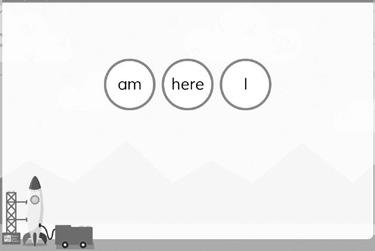
Click to place the uncle in the “u ” column. Continue with remaining images: lollipop, unhappy, under, lightning, lamp, umbrella, lime, unzip, ladybug, upside down, lick
Say: • “Let’s go over our work (point to each image as you label it with students):
o /ŭ/, up; /ŭ/, uncle; /ŭ/, unhappy; /ŭ/, under; /ŭ/, umbrella; /ŭ/, unzip; /ŭ/, upside down.
o /l/, lion; /l/, lollipop; /l/, lightning; /l/, lamp; /l/, lime; /l/, ladybug; /l/, lick.”
See p. 10 for differentiation options for This Letter or That?
Unit 10 | Lesson 3 | Part 3
Activity 43: Where’s That Heart Word? Sight Words
Objective
Students will read three Heart Words from memory, using sequence and location vocabulary to identify where they are on the screen.
See p. 69 for a full description of Where’s That Heart Word?
3, 2, 1…
What Students See
Open Countdown Online to Unit 10, Lesson 3, Part 3 (10.3.3).
Launch!
Say “Now, we are going to practice reading some of the Heart Words we’ve learned.” Click to display the Heart Words am, here, I
Say “Let’s read our Heart Words, starting here (point to the words am, here, and I while reading them in left to right order).”
126 © 2017 Really Great Reading Company, LLC UNIT 10 Lesson 3 | Part 3
Ask: •
“Which word is last?” A: I •
“Which word is before the word I?” A: here •
“Which word is first?” A: am •
“Which word is next?” A: here
Click to display the Heart Words the, is, for.
Say “Let’s read our Heart Words, starting here (point to the words the, is, and for while reading them in left to right order).”
Ask: •
“Which word is at the beginning of the row?” A: the • “Which word is at the end of the row?” A: for • “Which word is after the word the?” A: is • “Which word is in the middle of the row?” A: is
Click to display the Heart Words a, in, am.
Say “Let’s read our Heart Words, starting here (point to the words a, in, and am while reading them in left to right order).”
Ask: •
“Which word is first?” A: a •
“Which word is next?” A: in •
“Which word is last?” A: am •
“Which word is after the word in?” A: am
Click to display the Heart Words my, I, here
Say “Let’s read our Heart Words, starting here (point to the words my, I, and here while reading them in left to right order).”
Ask: •
“Which word is before the word here?” A: I •
“Which word is at the beginning of the row?” A: my • “Which word is at the end of the row?” A: here •
“Which word is in the middle of the row?” A: I
See p. 70 for differentiation options for Where’s That Heart Word?
Ask more questions as time allows.
© 2017 Really Great Reading Company, LLC 127 UNIT 10 Lesson 3 | Part 3
Unit 10 | Lesson 4 | Part 1
Activity 32: Find That Letter AP: Letter ID
Objective
Students will identify the letter symbol that spells the shared first sound in a set of three imaged words.
See p. 20 for a full description of Find That Letter.
What Students See 3, 2, 1…
OPTIONAL (only if you choose to use manipulatives)
Students take out letter tiles a, c, d, f, g, h, i, l, m, n, o, p, r, s, t, and u, and working board.
Open Countdown Online to Unit 10, Lesson 4, Part 1 (10.4.1).
Launch!
Say “Today, we are going to match our letter tiles to the beginning sounds of some words.”
Click to display, point to, and name three images: guitar, goat, girl
Ask “What is the beginning sound of all of these words?” A: /g/
Click to display three letter tiles: g, l, and n
Say “Point to the letter that spells the /g/ sound, and say its name.” A: g (pointing to the left)
Click to show the correct answer.
Continue with remaining image sets:
1. under, upside down, umbrella (u)
2. cow, cup, cactus (c) 3. hose, hamster, headphones (h) 4. ant, ax, apple (a)
5. lemon, lime, ladybug (l)
6. mask, mittens, muffin (m)
128 © 2017 Really Great Reading Company, LLC UNIT 10 Lesson 4 | Part 1
7. rug, rose, rollercoaster (r) 8. ox, otter, ostrich (o) 9. dinosaur, doghouse, dolphin (d) 10. inch, igloo, itch (i) 11. gumballs, gate, garden (g) 12. popcorn, pie, pencil (p) 13. nail, nap, neck (n) 14. soap, snake, straw (s)
See p. 22 for differentiation options for Find That Letter.
Unit 10 | Lesson 4 | Part 2
Activity 25: Stretch Those Sounds PA: Segmenting
Objective
Students will segment the phonemes (sounds) in threephoneme words using finger-stretching.
See p. 11 for a full description of Stretch Those Sounds.
3, 2, 1…
What Students See
Open Countdown Online to Unit 10, Lesson 4, Part 2 (10.4.2).
Launch! Click to display the pen
Say: • “Now, we are going to separate all of the sounds in some words. • Listen while I say the sounds in pen.” • “pen” (hold closed fist against chest, crossing the midline) • “/p/” (extend thumb), “/ĕ/” (extend pointer finger), “/n/” (extend middle finger) • “pen” (pull fingers back to a closed fist while saying the word)

© 2017 Really Great Reading Company, LLC 129 UNIT 10 Lesson 4 | Part 2
Say:
•
“Let’s stretch the word pen again together (students repeat sounds while finger-stretching).
• Let’s try another one.”
Continue with remaining images:
1. three (/th/ /r/ /ē/)
2. game (/g/ /ā/ /m/)
3. bat (/b/ /ă/ /t/)
4. elf (/ĕ/ /l/ /f/)
5. ant (/ă/ /n/ /t/)
6. hose (/h/ /ō/ /z/)
7. knife (/n/ /ī/ /f/)
8. lick (/l/ /ĭ/ /k/)
9. match (/m/ /ă/ /ch/)
10. queen (/kw/ /ē/ /n/)
11. toes (/t/ /ō/ /z/)
12. sun (/s/ /ŭ/ /n/)
13. quick (/kw/ /ĭ/ /k/)
14. tape (/t/ /ā/ /p/)
15. yawn (/y/ /aw/ /n/)
16. win (/w/ /ĭ/ /n/)
17. net (/n/ /ĕ/ /t/)
18. kite (/k/ /ī/ /t/)
19. house (/h/ /ou/ /s/)
See p. 12 for differentiation options for Stretch Those Sounds.
Unit 10 | Lesson 4 | Part 3
Activity 37: Unscramble This
AP: Encoding
Objective
Students help the teacher segment the phonemes in words while the teacher models the encoding (spelling) of each sound.
See p. 54 for a full description of Unscramble This.
What Students See 3, 2, 1…
Open Countdown Online to Unit 10, Lesson 4, Part 3 (10.4.3).
130 © 2017 Really Great Reading Company, LLC UNIT 10 Lesson 4 | Part 3
Launch!
Say “Now, we’re going to unscramble some letters that got mixed up. When we unscramble them and put them in the right order, they will make real words we can read.”
Click to display the pot and the letter tiles o, t, p.
Say: • “Pot.
• Let’s stretch the sounds in pot together.”
Click to move each letter tile to the correct position AS you and students say the sounds /p/ /ŏ/ /t/.
Say “Now, let’s make sure those sounds really blend to make the word pot.”
Point to each letter tile as you and the students say its sound, /p/ /ŏ/ /t/, and then sweep your finger under the word from left to right while saying the whole word, pot
Say:
• “Let’s try to unscramble another mixed up word.
• This time, it’s your turn to stretch out the words on your own.”
Continue with remaining images:
1. can, /k/ /ă/ /n/ 2. hug, /h/ /ŭ/ /g/ 3. pod, /p/ /ŏ/ /d/ 4. ham, /h/ /ă/ /m/ 5. rat, /r/ /ă/ /t/ 6. sit, /s/ /ĭ/ /t/ 7. dog, /d/ /ŏ/ /g/
8. pan, /p/ /ă/ /n/ 9. cod, /k/ /ŏ/ /d/ 10. map, /m/ /ă/ /p/ 11. sun, /s/ /ŭ/ /n/ 12. log, /l/ /ŏ/ /g/ 13. sad, /s/ /ă/ /d/ 14. hot, /h/ /ŏ/ /t/
See p. 55 for differentiation options for Unscramble This.
© 2017 Really Great Reading Company, LLC 131 UNIT 10 Lesson 4 | Part 3
You should touch the tiles at the top of the left column as you check to see if there are, in fact, two sounds in the word.
Unit 10 | Lesson 5 | Part 1
Activity 26: Count the Sounds PA: Segmenting Objective
Students will segment and count the number of phonemes (sounds) in spoken words.
See p. 100 for a full description of Count the Sounds.
What Students See 3, 2, 1…
Open Countdown Online to Unit 10, Lesson 5, Part 1 (10.5.1).
Launch!
Click to display two columns with two and three color tiles as headings.
Say “Today, we are going to listen for how many sounds we hear in words. This side (point to left column) is for words that have two sounds. This side (point to the right column) is for words that have three sounds.”
Click to display the image for add at the bottom of the screen.
Say “Add. Stretch that word with me, add, /ă/ /d/, add.” (Students and teacher finger-stretch.)
Ask “How many sounds did you hear in /ă/ /d/, add?” A: two
Say “Let’s check it: /ă/ (point to the first color tile), /d/ (point to the second color tile), add. You’re right!”
Click to place the image for add in the column with two color tiles.
Continue with the remaining words:
1. teeth, /t/ /ē/ /th/ (3)
2. two, /t/ /�/ (2)
3. bee, /b/ /ē/ (2)
4. pan, /p/ /ă/ /n/ (3)
5. phone, /f/ /ō/ /n/ (3)
6. egg, /ĕ/ /g/ (2) 7. boy, /b/ /oi/ (2)
8. jam, /j/ /ă/ /m/ (3) 9. duck, /d/ /ŭ/ /k/ (3) 10. itch, / ĭ/ /ch/ (2) 11. rose, /r/ /ō/ /z/ (3) 12. moose, /m/ /�/ /s/ (3) 13. ax, /ă/ /ks/ (2) 14. tip, /t/ / ĭ/ /p/ (3)
132 © 2017 Really Great Reading Company, LLC UNIT 10 Lesson 5 | Part 1
15. ham, /h/ /ă/ /m/ (3)
16. eight, /ā/ /t/ (2)
17. edge, /ĕ/ /j/ (2)
18. feet, /f/ /ē/ /t/ (3)
19. cow, /k/ /ou/ (2)
20. ace, /ā/ /s/ (2)
21. mitt, /m/ / ĭ/ /t/ (3)
22. key, /k/ /ē/ (2)
23. nut, /n/ /ŭ/ /t/ (3)
See p. 101 for differentiation options for Count the Sounds.
Unit 10 | Lesson 5 | Part 2
Activity 44: Pop-Up and 3-Up Sight Words
Objective
• Students will read individual Heart Words as they pop up on the screen.
• Students will read sets of three Heart Words as they appear on the screen.
See p. 80 for a full description of Pop-Up and 3-Up.
3, 2, 1…
What Students See
Open Countdown Online to Unit 10, Lesson 5, Part 2 (10.5.2).
Launch!
POP-UP: Say:
•
“Now, we are going to practice reading the Heart Words we have learned so far.
•
In our first game, when you see a word pop up onto the screen, say the word out loud.
•
If you need help remembering, I can help, but try your best.”
Click to display the Heart Words the, in, my, a, is, for, I, am, and here at random. Each word will appear several times.
Read each word together with students as it pops up.
© 2017 Really Great Reading Company, LLC 133
Lesson 5 | Part 2
UNIT 10
3-UP:
Say:
• “Great job! In our next game, you will see three words on the screen.
• When you see the red dot, stop and look at the three words. When you see the yellow dot, think about the words and try to remember them. When you see the green dot, say the three words out loud.”
Click to display the sets of three Heart Words. Each set will contain three of the following words in a random group: the, in, my, a, is, for, I, am, and here. Each word will appear several times.
Look, think about, and say each set of three words together with students as the sets are displayed.
Unit 10 | Lesson 5 | Part 3
Activity 41: Phrase Reading Decoding
Objective
Students will practice reading decodable words and Heart Words in three-word phrases.
What Students See
3, 2, 1…
What Students See
Three-word phrases will appear on the board, one word at a time. Students will read each word as it appears and will then read the phrase as a whole a few times to gain fluency. Heart Words are displayed in red with a heart symbol above them.
Open Countdown Online to Unit 10, Lesson 5, Part 3 (10.5.3).
Launch!
Say:
• “Now, we are going to put some of our Heart Words with some words we can sound out and read them together. We call a small group of words working together a phrase.
• When each word shows up on the screen, we’ll read it together.
134 © 2017 Really Great Reading Company, LLC UNIT 10 Lesson 5 | Part 3
•
Then, when all three words are up, we are going to read the whole phrase.
• Let’s get started!”
Click to display the black word cut
Say “When a word is in black, it means that we can sound it out. Let’s sound it out together.” (Use Touch & Say to sound out the word together: /k/ /ŭ/ /t/, cut.)
Click to display the red word the
Say “When a word is in red with a heart above it, it means that this is one of our Heart Words. Let’s say it together.” (the)
Click to display the black word ham.
Say “Here is another word in black. Let’s sound it out together.” (Use Touch & Say to sound out the word together: /h/ /ă/ /m/, ham.)
Say “Now we know all of the words, so let’s try to read them together in order. When I point to a word, read it out loud: cut the ham.” (Point to each word, having students read the words aloud as you go. Read the phrase at least three times. Begin with a pause between each word, and then repeat the process with shorter pauses on the second and third rounds to build fluency.)
Say “Let’s try another phrase, or group of words.”
Continue with the following phrases in the same manner: hug my dog, dig in* mud, here I am*, not for him, I am* sad, Tom is mad, a hot mug, in* the pan, got my map.
Some of the Heart Words, marked with an asterisk in the list, are also decodable, but they are still written in red because it is beneficial and more efficient for students to see these common words as words they should know by heart. If they struggle to remember these words, feel free to have your students sound out the decodable Heart Words.
© 2017 Really Great Reading Company, LLC 135 UNIT 10 Lesson 5 | Part 3
136 © 2017 Really Great Reading Company, LLC
Unit 11 | Lesson 1 | Part 1
Activity 17: Peel and Sort PA: BSI
Objective
Students will identify matching beginning sounds.
See p. 6 for a full description of Peel and Sort.
What Students See 3, 2, 1…
Open Countdown Online to Unit 11, Lesson 1, Part 1 (11.1.1).
Launch!
SORT 1: Say “Today, we are going to sort words by their beginning sounds.”
Click to display the images for itch and up as the column headings.
Point to itch and up and say “Our words will begin like /ĭ/, itch or /ŭ/, up.”
Click to display and point to the iguana
Say: • “/ĭ/, iguana. Does / ĭ/, iguana begin like itch or up?” A: itch
• “Right! /ĭ/, iguana, /ĭ/, itch. I’ll move the iguana to the /ĭ/, itch side.”
Click to place the iguana in the itch column. Say “Let’s try another one.”
Continue with the remaining examples: /ĭ/, inside; /ŭ/, umbrella; /ŭ/, under; /ĭ/, igloo; /ĭ/, inch; /ŭ/, upside down; /ĭ/, insect; /ŭ/, unzip; /ŭ/, unhappy; / ĭ/, infant; /ŭ/, oven.
Say: • “Let’s go over our work (point to each image as you label it with students): o /ĭ/, itch; /ĭ/, iguana; /ĭ/, inside; /ĭ/, igloo; /ĭ/, inch; /ĭ/, insect; / ĭ/, infant o /ŭ/, up; /ŭ/, umbrella; /ŭ/, under; /ŭ/, upside down; /ŭ/, unzip; /ŭ/, unhappy; /ŭ/, oven.
• Let’s try that with two new sounds.”
© 2017 Really Great Reading Company, LLC 137 UNIT 11 Lesson 1 | Part 1
*The /th/ sound in them is voiced (pronounced with the use of the vocal cords), unlike the unvoiced /th/ sound in all of the other /th/ words in this activity.
SORT 2:
Click to display the sheep and the thumb as the column headings.
Point to the sheep and the thumb and say “Our words will begin like /sh/, sheep or /th/, thumb.”
Click to display and point to the thermometer.
Say:
• “/th/, thermometer. Does /th/, thermometer begin like sheep or thumb?” A: thumb
• “/th/, thermometer, /th/, thumb. I’ll move the thermometer to the /th/, thumb side.”
Click to place the thermometer in the thumb column.
Say “Let’s try another one.”
Continue with the remaining examples: /sh/, shark; /th/, thorn; /th/, three; /sh/, shadow; /sh/, shorts; /th/, thread; /sh/, shoe; /th/, them; /sh/, shirt; /sh/, ship; /th/, thunder.
Say “Let’s go over our work (point to each image as you label it with students):
o /sh/, sheep; /sh/, shark; /sh/, shadow; /sh/, shorts; /sh/, shoe; /sh/, shirt; /sh/, ship.
o /th/, thumb; /th/, thermometer; /th/, thorn; /th/, three; /th/, thread; /th/, them*; /th/, thunder.”
See p. 8 for differentiation options for Peel and Sort.
138 © 2017 Really Great Reading Company, LLC UNIT 11 Lesson 1 | Part 2
Unit 11 | Lesson 1 | Part 2 Activity 30: Name That Sound AP: Letter ID Objective
will identify the uppercase and lowercase letters associated with the sounds /b/, /k/, /v/, and //.
Students
for a full description of Name That Sound.
Students See
See p. 2
What
3, 2, 1…
Open Countdown Online to Unit 11, Lesson 1, Part 2 (11.1.2).
Launch!
Say “Now, we are going to see what our sounds look like when they are written down.”
Click to display the bear.
Ask:
•
“What is this a picture of?” A: a bear
• “What is the first sound in bear?” A: /b/
Click to display the corresponding uppercase and lowercase letter tiles.
Say:
•
“Right, bear begins with /b/, and these letters say the sound, or spell, /b/.
• Do you remember Brandon the Black Bear? Sometimes he has to babysit his baby brother. His favorite sound is /b/.
•
The name of these letters is B. B says /b/, like the beginning of /b/, bear.
• This one (point to uppercase B) is called ‘capital B,’ and this one (point to lowercase b) is called ‘lowercase b.’ This is the one we will see most of the time, so we’ll just call it b.
Let’s learn another new letter.”
•
Click to display the key.
Ask:
•
“What is this a picture of?” A: a key
• “What is the first sound in key?” A: /k/
Click to display the corresponding uppercase and lowercase letter tiles.
Say:
•
“Right, key begins with /k/, and these letters say /k/.
• Do you remember Kayla the Kitten? She had to use a key to get her kayak out of the shed for the contest. Her favorite sound is /k/.
Optional motions for consonant sounds are available in the Appendix on p. 290 for students who may require more of a kinesthetic approach.
•
The name of these letters is K K says /k/, like the beginning of /k/, key • This one (point to uppercase K) is called ‘capital K,’ and this one (point to lowercase k) is called ‘lowercase k.’ This is the one we will see most of the time, so we’ll just call it k
© 2017 Really Great Reading Company, LLC 139 UNIT 11 Lesson 1 | Part 2
Let’s learn another new letter.”
•
Click to display the violin.
Ask:
• “What is this a picture of?” A: violin
• “What is the first sound in violin?” A: /v/ Say “Do you remember Vinnie the Vulture? He played his violin on vacation in Venezuela. His favorite sound is /v/.”
Click to display the corresponding uppercase and lowercase letter tiles.
Ask “So, what do you think these letters say?” A: /v/
Say:
• “Yes! The name of these letters is V. V says /v/, like the beginning of violin.
• This one (point to uppercase V) is called ‘capital V,’ and this one (point to lowercase v) is called ‘lowercase v.’ This is the one we will see most of the time, so we’ll just call it v.
•
Let’s learn one more new letter.”
Click to display the image for edge.
Ask:
• “What is this a picture of?” A: the edge of something
• “What is the first sound in /ĕ/, edge?” A: /ĕ/
Click to display the corresponding uppercase and lowercase letter tiles.
Ask “So, what do you think these letters say?” A: /ĕ/
Say:
• “Yes! The name of these letters is E. E says /ĕ/, like the beginning of /ĕ/, edge.
• This one (point to uppercase E) is called ‘capital E,’ and this one (point to lowercase e) is called ‘lowercase e.’ This is the one we will see most of the time, so we’ll just call it e.”
Demonstrate /ĕ/, edge motion (you should use this motion, and all the short vowel motions, for all students):
Say:
• “Let’s do a motion to help us remember that sound.
• Pretend to run your finger along the edge of a table or desk like this.”
140 © 2017 Really Great Reading Company, LLC UNIT 11 Lesson 1 | Part 2
Demonstrate the short e, edge, motion while elongating the sound /ĕĕĕĕ/, and have students repeat (pretend to run your finger along the edge of a table or desk from right to left – so that students see it moving from left to right – in front of you).
Click to display letter tiles b, k, v, and e Say “Let’s name our letters one more time and say the sound that each letter spells.”
Point to each letter, one at a time, and say:
•
“This is b. B says /b/.
•
This is k. K says /k/.
• This is v. V says /v/.
• This is e. E says /ĕ/.”
Unit 11 | Lesson 1 | Part 3
Activity 42: Look, Think, Say; Pop-Up; 3-Up Sight Words
Objective
• Students will read three Heart Words from memory (or by decoding if necessary).
• Students will read individual Heart Words as they pop up on the screen.
• Students will read sets of three Heart Words as they appear on the screen.
What Students See
See p. 61 for a full description of Look, Think, Say; Pop-Up; 3-Up.
3, 2, 1…
Open Countdown Online to Unit 11, Lesson 1, Part 3 (11.1.3).
Launch!
Say “Now, we are going to learn to read some new Heart Words.”
LOOK, THINK, SAY: Click twice to display the Heart Word and with one red dot and two empty dots below the word.
© 2017 Really Great Reading Company, LLC 141 UNIT 11 Lesson 1 | Part 3
Say:
• “Remember, this red dot (point to the red dot) tells us to stop what we are doing so we can listen to the word.
• This word is and, as in, ‘I like apples and bananas.’”
Click to display the yellow dot. Say:
• “Think about this word. We know the sounds in this word, /ă/ /n/ /d/ (point to each letter as you say the sound), and.
• We can think about the sounds in this word, but it might be easier to just try to remember it.”
Click to display the green dot.
Say:
• “Remember, this green dot (point to the green dot) tells us to say the word out loud.
• Say the word with me, and.
• Let’s try another word.
• Remember to look, think, and then say. Only say the word out loud when the green dot shows up.”
Click twice to display the Heart Word at with one red dot and two empty dots below the word.
Say “Look at the word at, as in, ‘We eat lunch at noon.’”
Click to display the yellow dot.
Say “Think about this word. We know the sounds in this word, /ă/ /t/ (point to each letter as you say the sound), at.”
Click to display the green dot.
Say:
• “Say the word!
• Let’s try one more word.”
Click twice to display the Heart Word go with one red dot and two empty dots below the word.
Say “Look at the word go, as in, ‘We will go to the zoo to see the animals.’”
Click to display the yellow dot.
Say “Think about this word.”
142 © 2017 Really Great Reading Company, LLC
UNIT 11 Lesson 1 | Part 3
Click to display the green dot.
Say: • “Say the word!
• Let’s look at those words one more time.”
Continue with the same three Heart Words for two additional rounds.
POP-UP: Say:
• “Now, we are going to practice reading the Heart Words we just learned by playing two games.
• In our first game, when you see a word pop up onto the screen, say the word out loud.
• If you need help remembering, I can help, but try your best.”
Click to display the Heart Words my, is, for, here, am, the, and, at, and go at random. Each word will appear several times. Read each word together with students as it pops up.
3-UP: Say:
• “Great job! In our next game, you will see three words on the screen.
• When you see the red dot, stop and look at the three words. When you see the yellow dot, think about the words and try to remember them. When you see the green dot, say the three words out loud.”
Click to display the sets of three Heart Words. Each set will contain the following words in a random order: my, is, for, here, am, the, and, at, and go. Each word will appear several times.
Look, think about, and say each set of three words together with students as the sets are displayed.
© 2017 Really Great Reading Company, LLC 143
UNIT 11 Lesson 1 | Part 3
Unit 11 | Lesson 2 | Part 1
Activity 36: Guess My Word AP: Encoding
Objective
Students will observe the encoding of a word and then blend together the word’s phonemes.
See p. 39 for a full description of Guess My Word.
What Students See 3, 2, 1…
Open Countdown Online to Unit 11, Lesson 2, Part 1 (11.2.1).
Launch!
Say “Today, you’re going to guess my mystery words that got all mixed up.”
Click to display the letter tiles n, v, a.
Say “Guess the mystery word, /v/ /ă/ /n/.” (Click to move the letter tiles into the correct position as you say each sound.)
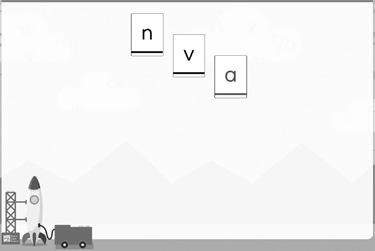
Ask “What’s my word?” A: van (Students blend the sounds together to say the word.)
Say “/v/ /ă/ /n/, van.” (Point to each letter tile as you say its sound, and then sweep your finger under the word from left to right while saying the whole word.)
Click to display the van.
Continue with remaining images:
1. /b/ /ĕ/ /d/, bed
2. /l/ /ĕ/ /g/, leg 3. /b/ /ă/ /t/, bat 4. /p/ /ĕ/ /n/, pen 5. /b/ /ŭ/ /g/, bug
6. /n/ /ĕ/ /t/, net 7. /k/ /ĭ/ /d/, kid 8. /l/ /ŏ/ /g/, log 9. /b/ /ă/ /g/, bag
10. /v/ /ĕ/ /t/, vet
11. /t/ /ĕ/ /n/, ten
12. /k/ /ĭ/ /t/, kit
13. /b/ /ĕ/ /g/, beg
14. /s/ /ŏ/ /b/, sob
See p. 40 for differentiation options for Guess My Word.
144 © 2017 Really Great Reading Company, LLC UNIT 11 Lesson 2 | Part 1
Unit 11 | Lesson 2 | Part 2
Activity 31: This Letter or That? AP: Letter ID
Objective
Students will identify the letter symbol that spells the first sound in a word.
See p. 8 for a full description of This Letter or That?
What Students See 3,
2, 1…
Open Countdown Online to Unit 11, Lesson 2, Part 2 (11.2.2).
Launch!
SORT 1:
Click to display two columns with the headings “b” (for bear) and “v ” (for violin).
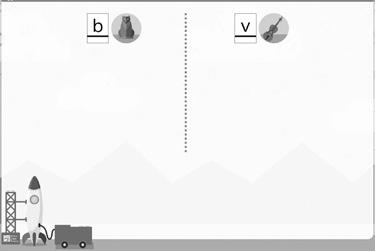
Ask “What is the first sound in bear (while pointing to the bear)?” A: /b/
Say “Remember, the sound /b/ is spelled with the letter b (while pointing to the letter tile b).”
Ask “What is the first sound in violin (while pointing to the violin)?” A: /v/ Say “Remember, the sound /v/ is spelled with the letter v (while pointing to the letter tile v).”
Click to display the van at the bottom of the screen.
Ask:
• “ Van. What is the first sound in van?” A: /v/
• “Should we put the /v/, van under the b, like /b/, bear or the v, like /v/, violin?” A: v, /v/, violin
Say “Right, /v/, van and /v/, violin both start with the letter v, so I’ll move the van under the v.”
Click to place the van in the “v ” column.
Continue with remaining images: baby, ball, vegetables, vacuum, bus, volcano, balloon, box, vase, butterfly, vehicle
© 2017 Really Great Reading Company, LLC 145 UNIT 11 Lesson 2 | Part 2
Say:
• “Let’s go over our work (point to each image as you label it with students):
o /b/, bear; /b/, baby; /b/, ball; /b/, bus; /b/, balloon; /b/, box; /b/, butterfly
o /v/, violin; /v/, van; /v/, vegetables; /v/, vacuum; /v/, volcano; /v/, vase; /v/, vehicle.
• Let’s try that with two new letters.”
SORT 2:
Click to display two columns with the headings “k ” (for key) and “e” (for edge).
Ask “What is the first sound in key (while pointing to the key)?” A: /k/ Say “Remember, the sound /k/ is spelled with the letter k (while pointing to the letter tile k).”
Ask “What is the first sound in edge (while pointing to the edge)?” A: /ĕ/ Say “Remember, the sound /ĕ/ is spelled with the letter e (while pointing to the letter tile e).”
Click to display the kangaroo at the bottom of the screen.
Ask:
• “Kangaroo. What is the first sound in kangaroo?” A: /k/
• “Should we put the /k/, kangaroo under the k, like /k/, key or the e, like /ĕ/, edge?” A: k, /k/, key
Say “Right, /k/, kangaroo and /k/, key both start with the letter k, so I’ll move the kangaroo under the k.”
Click to place the kangaroo in the “k ” column.
Continue with remaining images: egg, kid, king, envelope, elf, keyboard, elephant, enter, kiwi, kite, elbow.
Say: • “Let’s go over our work (point to each image as you label it with students):
o /k/, key; /k/, kangaroo; /k/, kid; /k/, king; /k/, keyboard; /k/, kiwi; /k/, kite.
o /ĕ/, edge; /ĕ/, egg; /ĕ/, envelope; /ĕ/, elf; /ĕ/, elephant; /ĕ/, enter; /ĕ/, elbow.”
See p. 10 for differentiation options for This Letter or That?
146 © 2017 Really Great Reading Company, LLC UNIT 11 Lesson 2 | Part 2
Unit 11 | Lesson 2 | Part 3
Activity 34: Which Letter? AP: Letter ID
Objective
Students will isolate the beginning sound in a word and match that sound to its letter symbol.
See p. 33 for a full description of Which Letter?
What Students See 3,
2, 1…
OPTIONAL (only if you choose to use manipulatives)
Prepare materials:
• Letter tiles a, b, c, d, e, f, g, h, i, k, l, m, n, o, p, r, s, t, u, and v and working board from Countdown Student Kit for each student (italicized letter tiles listed here are new to this unit; have students add these tiles to their boards)
Open Countdown Online to Unit 11, Lesson 2, Part 3 (11.2.3).
Launch!
OPTIONAL (only if you choose to use manipulatives)
Students take out letter tiles b, c, d, f, g, h, k, l, m, n, p, r, s, t, and v and working board.
Say “Now, we are going to spell the first letter of some words.”
Click to display the bug with the letters u g spelled out below.
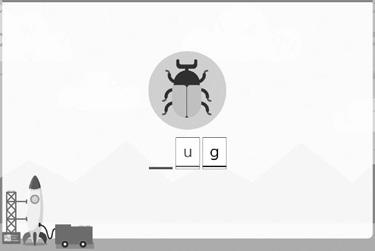
Say “Bug.”
Ask “What is the first sound in bug?” A: /b/
Click to display three letter tiles: n, b, k.
Ask “Which of these letters spells /b/ like /b/, bug? Point to the letter tile that spells /b/, and say its name.” A: b
Click to show the correct answer.
© 2017 Really Great Reading Company, LLC 147 UNIT 11 Lesson 2 | Part 3
You may want to have students point all the way to the left for n, to the center for b, and all the way to the right for k. If students are using manipulatives, have them hold up the correct tile and name it rather than point. If students select the letter k to spell the /k/ sound in the word cob or the letter c to spell the /k/ sound in the words kid or kit, tell them they are correct, but ask them which other letter they have learned can also spell that sound.
Click to display the kid with the letters i d spelled out below.
Say “Kid.”
Ask “What is the first sound in kid?” A: /k/
Click to display three letter tiles: t, h, k.
Ask “Which of these letters spells /k/ like /k/, kid? Point to the letter tile that spells /k/, and say its name.” A: k
Click to show the correct answer.
Continue with remaining images:
1. van (v) 2. bag (b) 3. pen (p) 4. bat (b) 5. cob (c) 6. bed (b)
7. leg (l) 8. net (n) 9. cub (c) 10. vet (v) 11. kit (k) 12. bus (b)
See p. 34 for differentiation options for Which Letter?
13. vat (v) 14. ten (t) 15. red (r) 16. fib (f ) 17. hub (h) 18. gum (g)
148 © 2017 Really Great Reading Company, LLC UNIT 11 Lesson 2 | Part 3
Unit 11 | Lesson 3 | Part 1
Activity 25: Stretch Those Sounds PA: Segmenting
Objective
Students will segment the phonemes (sounds) in three-phoneme words using finger-stretching.
See p. 11 for a full description of Stretch Those Sounds.
What Students
See 3, 2, 1…
Open Countdown Online to Unit 11, Lesson 3, Part 1 (11.3.1).
Launch! Click to display the jam.
Say:
• “Today, we are going to separate all of the sounds in some words.
• Listen while I say the sounds in jam.”
• “jam” (hold closed fist against chest, crossing the midline)
• “/j/” (extend thumb), “/ă/” (extend pointer finger), “/m/” (extend middle finger)
• “jam” (pull fingers back to a closed fist while saying the word)
Say:
• “Let’s stretch the word jam again together.” (Students repeat sounds while finger-stretching.)
• Let’s try another one.”
Continue with remaining images:
1. toes (/t/ /ō/ /z/)
2. house (/h/ /ou/ /s/) 3. net (/n/ /ĕ/ /t/) 4. fox (/f/ /ŏ/ /ks/) 5. juice (/j/ /�/ /s/) 6. corn (/k/ /or/ /n/)
7. teeth (/t/ /ē/ /th/)
8. run (/r/ /ŭ/ /n/) 9. bell (/b/ /ĕ/ /l/)
10. girl (/g/ /er/ /l/)
11. fish (/f/ /ĭ/ /sh/) 12. lick (/l/ /ĭ/ /k/)
© 2017 Really Great Reading Company, LLC 149 UNIT 11 Lesson 3 | Part 1
13. nail (/n/ /ā/ /l/)
14. cheese (/ch/ /ē/ /z/)
15. wig (/w/ /ĭ/ /g/)
16. yes (/y/ /ĕ/ /s/)
17. shirt (/sh/ /er/ /t/)
18. thorn (/th/ /or/ /n/)
19. log (/l/ /ŏ/ /g/)
See p. 12 for differentiation options for Stretch Those Sounds.
Unit 11 |
Lesson 3 | Part 2
Activity 31: This Letter or That?
AP: Letter ID
Objective
Students will identify the letter symbol that spells the first sound in a word.
See p. 8 for a full description of This Letter or That?
What Students See 3, 2, 1…
Open Countdown Online to Unit 11, Lesson 3, Part 2 (11.3.2).
Launch!
SORT 1:
Click to display two columns with the headings “v ” (for violin) and “k ” (for key).
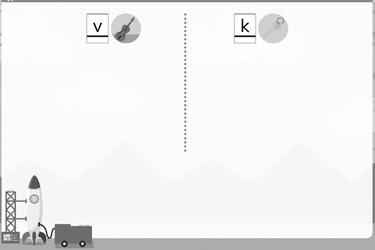
Ask “What is the first sound in violin (while pointing to the violin)?” A: /v/
Say “Remember, the sound /v/ is spelled with the letter v (while pointing to the letter tile v).”
Ask “What is the first sound in key (while pointing to the key)?” A: /k/
Say “Remember, the sound /k/ is spelled with the letter k (while pointing to the letter tile k).”
Click to display the king at the bottom of the screen.
Ask: • “King. What is the first sound in king?” A: /k/
150 © 2017 Really Great Reading Company, LLC UNIT 11 Lesson 3 | Part 2
•
“Should we put the /k/, king under the v, like /v/, violin or the k, like /k/, key?” A: k, /k/, key
Say “Right, /k/, king and /k/, key both start with the letter k, so I’ll move the king under the k.”
Click to place the king in the “k ” column.
Continue with remaining images: vacuum, volcano, kangaroo, kite, vehicle, vase, kiwi, van, keyboard, kid, vegetables
Say:
• “Let’s go over our work (point to each image as you label it with students):
o /v/, violin; /v/, vacuum; /v/, volcano; /v/, vehicle; /v/, vase; /v/, van; /v/, vegetables.
o /k/, key; /k/, king; /k/, kangaroo; /k/, kite; /k/, kiwi; /k/, keyboard; /k/, kid.
• Let’s try that with two new letters.”
SORT 2:
Click to display two columns with the headings “e” (for edge) and “b” (for bear).
Ask “What is the first sound in edge (while pointing to the edge)?” A: /ĕ/ Say “Remember, the sound /ĕ/ is spelled with the letter e (while pointing to the letter tile e).”
Ask “What is the first sound in bear (while pointing to the bear)?” A: /b/
Say “Remember, the sound /b/ is spelled with the letter b (while pointing to the letter tile b).”
Click to display the eggplant at the bottom of the screen.
Ask:
• “Eggplant. What is the first sound in eggplant?” A: /ĕ/
• “Should we put the /ĕ/, eggplant under the e, like /ĕ/, edge or the b, like /b/, bear?” A: e, /ĕ/, edge
Say “Right, /ĕ/, eggplant and /ĕ/, edge both start with the letter e, so I’ll move the eggplant under the e.”
Click to place the eggplant in the “e” column.
Continue with remaining images: bell, boat, elbow, banana, backpack, elephant, envelope, bike, elf, enter, bookshelf.
Say:
• “Let’s go over our work (point to each image as you label it with students):
© 2017 Really Great Reading Company, LLC 151 UNIT 11 Lesson 3 | Part 2
Remember, there are alternative ways to deliver this activity. See page 70 for details.
o /ĕ/, edge; /ĕ/, eggplant; /ĕ/, elbow; /ĕ/, elephant; /ĕ/, envelope; /ĕ/, elf; /ĕ/, enter
o /b/, bear; /b/, bell; /b/, boat; /b/, banana; /b/, backpack; /b/, bike; /b/, bookshelf.”
See p. 10 for differentiation options for This Letter or That?
Unit 11 | Lesson 3 | Part 3
Activity 43: Where’s That Heart Word? Sight Words
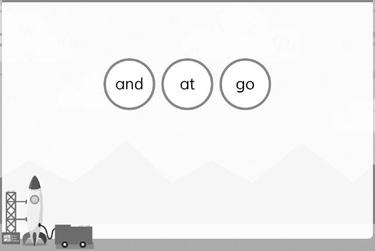
Ask more questions as time allows.
Objective
Students will read three Heart Words from memory, using sequence and location vocabulary to identify where they are on the screen.
See p. 69 for a full description of Where’s That Heart Word?
What
Students
See 3, 2, 1…
Open Countdown Online to Unit 11, Lesson 3, Part 3 (11.3.3).
Launch!
Say “Now, we are going to practice reading some of the ‘Heart Words’ we’ve learned.”
Click to display the Heart Words and, at, go.
Say “Let’s read our Heart Words, starting here (point to the words and, at, and go while reading them in left to right order).”
Ask:
•
“Which word is first?” A: and
•
“Which word is after the word at?” A: go
• “Which word is before the word go?” A: at
• “Which word is last?” A: go
Click to display the Heart Words am, and, the.
Say “Let’s read our Heart Words, starting here (point to the words am, and, and the while reading them in left to right order).”
152 © 2017 Really Great Reading Company, LLC UNIT 11 Lesson 3 | Part 3
Ask: •
“Which word is at the beginning of the row?” A: am •
“Which word is at the end of the row?” A: the • “Which word is after the word am?” A: and •
“Which word is in the middle the word row?” A: and
Click to display the Heart Words I, is, go.
Say “Let’s read our Heart Words, starting here (point to the words I, is, and go while reading them in left to right order).”
Ask: •
“Which word is first?” A: I •
“Which word is next?” A: is • “Which word is last?” A: go • “Which word is after the word I?” A: is
Click to display the Heart Words at, here, for.
Say “Let’s read our Heart Words, starting here (point to the words at, here, and for while reading them in left to right order).”
Ask: •
“Which word is before the word here?” A: at • “Which word is at the beginning of the row?” A: at • “Which word is at the end of the row?” A: for • “Which word is in the middle of the row?” A: here
See p. 70 for alternative options for Where’s That Heart Word?
© 2017 Really Great Reading Company, LLC 153 UNIT 11 Lesson 3 | Part 3
Unit 11 | Lesson 4 | Part 1
Activity 32: Find That Letter AP: Letter ID
Objective
Students will identify the letter symbol that spells the shared first sound in a set of three imaged words.
See p. 20 for a full description of Find That Letter.
What Students See 3, 2, 1…
OPTIONAL (only if you choose to use manipulatives)
Students take out letter tiles a, b, c, d, e, f, g, h, i, k, l, m, n, o, p, r, s, t, u, and v and working board.
Open Countdown Online to Unit 11, Lesson 4, Part 1 (11.4.1).
Launch!
Say “Today, we are going to match our letter tiles to the beginning sounds of some words.”
Click to display, point to, and name three images: edge, eggplant, elbow
Ask “What is the beginning sound in all of these words?” A: /ĕ/
Click to display three letter tiles: e, o, and u
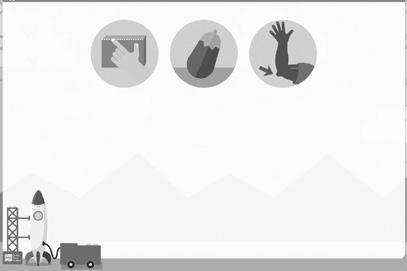
Say “Point to the letter that spells /ĕ/, and say its name.” A: e (pointing to the left)
Click to show the correct answer.
Continue with remaining groups of images: 1. vegetables, violin, van (v)
umbrella, under, upside down (u)
butterfly, bear, bird (b)
neck, newspaper, nurse (n)
keyboard, kiwi, king (k)
inch, iguana, ill (i)
banana, bread, bone (b)
grapes, girl, guitar (g)
volcano, vase, vehicle (v)
elbow, elephant, elf (e)
sidewalk, sun, stars (s)
kangaroo, kite, key (k)
ostrich, otter, octopus (o)
dolphin, deer, door (d)
See p. 22 for differentiation options for Find That Letter.
154 © 2017 Really Great Reading Company, LLC UNIT 11 Lesson 4 | Part 1
8.
9.
10.
11.
12.
2.
3.
4.
5.
6.
7.
13.
14.
Unit 11 | Lesson 4 | Part 2
Activity 40: Touch & Say AP: Decoding
Objective
Students decode (read) words by pronouncing one sound at a time and then blending them together.
See p. 26 for a full description of Touch & Say.
3, 2, 1…
What Students See
Open Countdown Online to Unit 11, Lesson 4, Part 2 (11.4.2).
Launch! Say:
• “We’re going to read some words by ‘sounding them out.’
• Let’s get started with this word. Watch how I sound it out.”
Click to underline one letter tile at a time while saying its sound, “/v/ /ĕ/ /t/.”
Click to slide an arrow from left to right under the entire word while saying, “vet.”
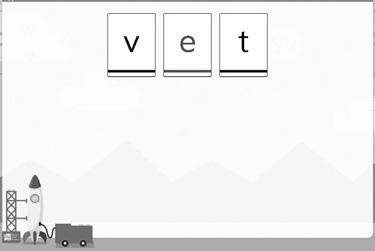
Say “Let’s keep going! This time, say the sounds and the word with me.”
Click to underline one letter at a time while saying its sound with students, “/l/ /ĕ/ /g/.”
Click to slide an arrow from left to right under the entire word while saying, “leg.”
Continue with remaining words, making sure students are saying each sound with you as you click to underline it:
1. kid (/k/ / ĭ/ /d/)
2. cub (/k/ /ŭ/ /b/)
3. jet (/j/ /ĕ/ /t/)
4. bug (/b/ /ŭ/ /g/)
5. set (/s/ /ĕ/ /t/)
6. van (/v/ /ă/ /n/)
7. tub (/t/ /ŭ/ /b/)
8. Ned (/n/ /ĕ/ /d/)
9. let (/l/ /ĕ/ /t/)
10. den (/d/ /ĕ/ /n/)
11. pet (/p/ /ĕ/ /t/)
12. bat (/b/ /ă/ /t/)
© 2017 Really Great Reading Company, LLC 155 UNIT 11 Lesson 4 | Part 2
13. cab (/k/ /ă/ /b/)
14. but (/b/ /ŭ/ /t/)
15. get (/g/ /ĕ/ /t/)
16. kit (/k/ / ĭ/ /t/)
17. met (/m/ /ĕ/ /t/)
18. rub (/r/ /ŭ/ /b/)
DIFFERENTIATION OPTIONS
Ways to challenge:
• Have students pronounce each individual sound and then blend the word independently as you underline them.
• Using Letter Tile Free Play (located in Supplemental Resources) or your whiteboard and marker, have students Touch & Say the following additional words: bad, bag, beg, bet, Ben, big, bin, bus, dig, dug, fib, fog, got, hen, hum, in, Kim, lad, led, Meg, mud, mug, nap, net, nut, on, pan, peg, pen, pin, rag, red, rib, rug, sob, sub, Ted, ten, tug, and vat.
• Using Letter Tile Free Play (located in Supplemental Resources) or your whiteboard and marker, have students Touch & Say the following words with 2-sound consonant blends: act, ads, amp, and, ant, apt, ask, elf, elk, end, imp, its, and ump.
Open Countdown Online to Unit 11, Lesson 4, Part 3 (11.4.3).
156 © 2017 Really Great Reading Company, LLC UNIT 11 Lesson 4 | Part 3
11 | Lesson 4 | Part 3
38: Build a Word AP: Encoding Objective
What Students See 3, 2, 1…
manipulatives)
Unit
Activity
Students encode (spell) words by first segmenting sounds and then matching sounds to letters. See p. 103 for a full description of Build a Word.
OPTIONAL (only if you choose to use
Students take out letter tiles a, b, c, d, e, f, g, h, i, k, l, m, n, o, p, r, s, t, u, and v and working board.
Launch!
Say:
• “Now, we are going to build words with our letter tiles by listening to the sounds in each word and putting our letter tiles in order. This is how we spell words.
• Let’s build our first word!”
Click to display the kid.
Say:
• “Listen carefully. Kid, /k/ /ĭ/ /d/, kid (while finger-stretching).
• I heard three sounds in kid, /k/ /ĭ/ /d/.”
Click to display one color tile at a time while again saying “/k/ /ĭ/ /d/.”
Say:
• “Now let’s build the word with letter tiles.
• The first sound I heard was /k/.”
Ask “What is one letter that spells /k/?” A: k
Click to display the letter tile k under the first color tile.
Say “The next sound I heard was /ĭ/. What letter spells /ĭ/?” A: i
Click to display the letter tile i under the second color tile.
Say “The last sound I heard was /d/. What letter spells /d/?” A: d
Click to display the letter tile d under the last color tile.
Say:
• “Let’s check our work. /k/ /ĭ/ /d/ (touching each letter as you say the sound), kid (sweeping pointer finger under the whole word from left to right).
• Awesome job, you just spelled kid. Let’s try another word.”
Continue with remaining words:
1. van, /v/ /ă/ /n/
2. bed, /b/ /ĕ/ /d/
3. pen, /p/ /ĕ/ /n/ 4. bug, /b/ /ŭ/ /g/
5. bat, /b/ /ă/ /t/
6. cub, /k/ /ŭ/ /b/ 7. bag, /b/ /ă/ /g/ 8. leg, /l/ /ĕ/ /g/ 9. ham, /h/ /ă/ /m/
See p. 105 for differentiation options for Build a Word.
If students are using manipulatives, have them use color and letter tiles to build the word along with you.
If students say that c spells /k/, tell them they are correct, and ask what other letter that they just learned about can also spell /k/.
© 2017 Really Great Reading Company, LLC 157 UNIT 11 Lesson 4 | Part 3
You should touch the tiles at the top of the left column as you check to see if there are, in fact, two sounds in the word.
Unit 11 | Lesson 5 | Part 1
Activity 26: Count the Sounds PA: Segmenting
Objective
Students will stretch and count the number of phonemes in spoken words.
See p. 100 for a full description of Count the Sounds.
3, 2, 1…
What
Students See
Open Countdown Online to Unit 11, Lesson 5, Part 1 (11.5.1).
Launch!
Click to display two columns with two and three color tiles as headings.
Say “Today, we are going to listen for how many sounds we hear in words. This side (point to left column) is for words that have two sounds. This side (point to the right column) is for words that have three sounds.”
Click to display the pie at the bottom of the screen.
Say “Pie. Stretch that word with me, pie, /p/ /ī/, pie.” (Students and teacher finger-stretch.)
Ask “How many sounds did you hear in /p/ /ī/, pie?” A: two
Say “Let’s check it: /p/ (point to the first color tile), / ī/ (point to the second color tile), pie. You’re right!”
Click to place the pie in the column with two color tiles.
Continue with the remaining words:
1. hose, /h/ /ō/ /z/ (3)
2. shoe, /sh/ /�/ (2)
3. bee, /b/ /ē/ (2)
4. hat, /h/ /ă/ /t/ (3)
5. bone, /b/ /ō/ /n/ (3)
6. ax, /ă/ /ks/ (2)
7. cow, /k/ /ou/ (2)
8. mug, /m/ /ŭ/ /g/ (3)
9. sock, /s/ /ŏ/ /k/ (3)
10. egg, /ĕ/ /g/ (2)
158 © 2017 Really Great Reading Company, LLC UNIT 11 Lesson 5 | Part 1
11. dog, /d/ /ŏ/ /g/ (3)
12. house, /h/ /ou/ /s/ (3)
13. ox, /ŏ/ /ks/ (2)
14. pan, /p/ /ă/ /n/ (3)
15. toes, /t/ /ō/ /z/ (3)
16. key, /k/ /ē/ (2)
17. edge, /ĕ/ /j/ (2)
18. wave, /w/ /ā/ /v/ (3)
19. boy, /b/ /oi/ (2)
20. car, /k/ /ar/ (2)
21. game, /g/ /ā/ /m/ (3)
22. ice, /ī/ /s/ (2)
23. yes, /y/ /ĕ/ /s/ (3)
See p. 101 for differentiation options for Count the Sounds.
Unit 11 | Lesson 5 | Part 2
Activity 44: Pop-Up and 3-Up Sight Words
Although the letter x is comprised of two phonemes, students are taught to handle them as one sound represented by one letter.
Objective
• Students will read individual Heart Words as they pop up on the screen.
• Students will read sets of three Heart Words as they appear on the screen.
See p. 80 for a full description of Pop-Up and 3-Up.
What
Students
See 3, 2, 1…
Open Countdown Online to Unit 11, Lesson 5, Part 2 (11.5.2).
Launch!
POP-UP: Say:
•
“Now, we are going to practice reading the Heart Words we have learned so far.
•
In our first game, when you see a word pop up onto the screen, say the word out loud.
•
If you need help remembering, I can help, but try your best.”
Click to display the Heart Words my, is, for, I, am, here, and, at, and go at random. Each word will appear several times.
© 2017 Really Great Reading Company, LLC 159 UNIT 11 Lesson 5 | Part 2
Read each word together with students as it pops up.
Say:
• “Great job! In our next game, you will see three words on the screen.
• Remember, when you see the red dot, stop and look at the three words. When you see the yellow dot, think about the words and try to remember them. When you see the green dot, say the three words out loud.
• If you need help remembering, I can help, but try your best.”
Click to display the sets of three Heart Words. Each set will contain three of the following words in a random group: my, is, for, I, am, here, and, at, and go. Each word will appear several times.
Look, think about, and say each set of three words together with students as the sets are displayed.
Unit 11 | Lesson 5 | Part 3
Activity 41: Phrase Reading AP: Decoding Objective
What Students See
Students will practice reading decodable words and Heart Words in three-word phrases.
See p. 134 for a full description of Phrase Reading.
3, 2, 1…
Open Countdown Online to Unit 11, Lesson 5, Part 3 (11.5.3).
Launch!
Say:
• “Now, we are going to read some phrases together.
• When each word shows up on the screen, we’ll read it together.
• Then, when all three words are up, we are going to read the phrase together.
• Let’s get started!”
Click to display the red word in.
160 © 2017 Really Great Reading Company, LLC UNIT 11 Lesson 5 | Part 3
Say “Remember, when a word is in red with a heart above it, it means that this is one of our Heart Words. Let’s say it together.” (in)
Click to display the red word the.
Say “Here is another word in red. Let’s say it together.” (the)
Click to display the black word van.
Say “Remember, when a word is in black, it means that we can sound it out. Let’s sound it out together.” (Use Touch & Say to sound out the word together: /v/ /ă/ /n/, van.)
Say “Now we know all of the words, but let’s try to read them together in order. When I point to a word, read it out loud: in* the van.” (Point to each word, having students read the words aloud as you go. Begin with a pause between each word, and then repeat the process two more times with shorter pauses on the second and third rounds to build fluency.)
Say “Let’s try another phrase, or group of words.”
Continue with the following phrases in the same manner: hop in* bed, hug the kid, get the bag, pot and* pan, go for it, mad at* Ken, at* the vet, my big dog, Kim and* Sam.
Some of the Heart Words, marked with an asterisk, are also decodable, but they are still written in red because it is beneficial and more efficient for students to see these common words as words they should know by heart. If they struggle to remember these words, feel free to have your students sound out the decodable Heart Words.
The word it will be taught as a Heart Word in Unit 12, but for now, you can have students sound it out since it is decodable.
© 2017 Really Great Reading Company, LLC 161 UNIT 11 Lesson 5 | Part 3
162 © 2017 Really Great Reading Company, LLC
Unit 12 | Lesson 1 | Part 1
Activity 31: This Letter or That? AP: Letter ID
Objective
Students will identify the letter symbol that spells the first sound in a word.
See p. 8 for a full description of This Letter or That?
What Students See 3,
2, 1…
Open Countdown Online to Unit 12, Lesson 1, Part 1 (12.1.1).
Launch!
SORT 1:
Click to display two columns with the headings “g ” (for goat) and “k ” (for key).
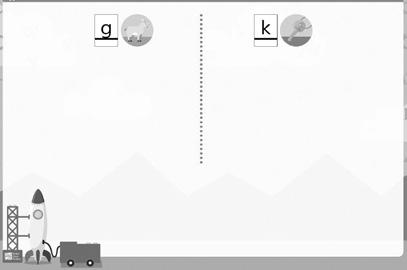
Ask “What is the first sound in goat (while pointing to the goat)?” A: /g/
Say “Remember, the sound /g/ is spelled with the letter g (while pointing to the letter tile g).”
Ask “What is the first sound in key (while pointing to the key)?” A: /k/ Say “Remember, the sound /k/ is spelled with the letter k (while pointing to the letter tile k).”
Click to display the guitar at the bottom of the screen.
Ask:
•
“Guitar. What is the first sound in guitar?” A: /g/
• “Should we put the /g/, guitar under the g, like /g/, goat or the k, like /k/, key?” A: g, /g/, goat
Say “Right, /g/, guitar and /g/, goat both start with the letter g, so I’ll move the guitar under the g.”
Click to place the guitar in the “g ” column.
Continue with remaining images: gate, kangaroo, gloves, girl, keyboard, kite, garden, king, kiwi, game, kid
© 2017 Really Great Reading Company, LLC 163 UNIT 12 Lesson 1 | Part 1
Say:
• “Let’s go over our work (point to each image as you label it with students):
o /g/, goat; /g/, guitar; /g/, gate; /g/, gloves; /g/, girl; /g/, garden; /g/, game
o /k/, key; /k/, kangaroo; /k/, keyboard; /k/, kite; /k/, king; /k/, kiwi; /k/, kid.
•
Let’s try that with two new letters.”
SORT 2:
Click to display two columns with the headings “u ” (for up) and “e” (for edge).
Ask “What is the first sound in up (while pointing to the image for up)?”
A: /ŭ/
Say “Remember, the sound /ŭ/ is spelled with the letter u (while pointing to the letter tile u).”
Ask “What is the first sound in edge (while pointing to the edge)?” A: /ĕ/
Say “Remember, the sound /ĕ/ is spelled with the letter e (while pointing to the letter tile e).”
Click to display the image for unzip at the bottom of the screen.
Ask:
• “Unzip. What is the first sound in unzip?” A: /ŭ/
• “Should we put /ŭ/, unzip under the u, like /ŭ/, up or the e, like /ĕ/, edge?” A: u, /ŭ/, up
Say “Right, /ŭ/, unzip and /ŭ/, up both start with the letter u, so I’ll move the unzip under the u.”
Click to place the image for unzip in the “u ” column.
Continue with remaining images: elephant, uncle, under, elf, elbow, unhappy, egg, umbrella, enter, upside down, envelope.
Say:
• “Let’s go over our work (point to each image as you label it with students):
o /ŭ/, up; /ŭ/, unzip; /ŭ/, uncle; /ŭ/, under; /ŭ/, unhappy; /ŭ/, umbrella; /ŭ/, upside down.
o /ĕ/, edge; /ĕ/, elephant; /ĕ/, elf; /ĕ/, elbow; /ĕ/, egg; /ĕ/, enter; /ĕ/, envelope.”
See p. 10 for differentiation options for This Letter or That?
164 © 2017 Really Great Reading Company, LLC UNIT 12 Lesson 1 | Part 1
Unit 12 | Lesson 1 | Part 2
Activity 42: Look, Think, Say; Pop-Up; 3-Up
Objective
• Students will read three Heart Words from memory (or by decoding if necessary).
• Students will read individual Heart Words as they pop up on the screen.
• Students will read sets of three Heart Words as they appear on the screen.
AP: Letter ID
What Students See
See p. 61 for a full description of Look, Think, Say; Pop-Up; 3-Up
3, 2, 1…
Open Countdown Online to Unit 12, Lesson 1, Part 2 (12.1.2).
Launch!
Say “Now, we are going to learn to read some new Heart Words.”
LOOK, THINK, SAY:
Click twice to display the Heart Word it with one red dot and two empty dots below the word.
Say:
• “Remember, this red dot (point to the red dot) tells us to stop what we are doing so we can listen to the word.
• This word is it, as in, ‘It is hot outside today.’”
Click to display the yellow dot.
Say:
• “Think about this word. We know the sounds in this word, /ĭ/ /t/ (point to each letter as you say the sound), it.
• We can think about the sounds in this word, but it might be easier to just try to remember it.”
Click to display the green dot.
Say:
• “Remember, this green dot (point to the green dot) tells us to say the word out loud.
© 2017 Really Great Reading Company, LLC 165 UNIT 12 Lesson 1 | Part 2
• Say the word with me, it.
• Let’s try another word.
• Remember to look, think, and then say. Only say the word out loud when the green dot shows up.”
Click twice to display the Heart Word like with one red dot and two empty dots below the word.
Say “Look at the word like, as in, ‘I like vanilla ice cream the best.’”
Click to display the yellow dot.
Say “Think about this word.”
Click to display the green dot.
Say:
• “Say the word!
• Let’s try one more word.”
Click twice to display the Heart Word be with one red dot and two empty dots below the word.
Say “Look at the word be, as in, ‘This will be a great day.’”
Click to display the yellow dot. Say “Think about this word.”
Click to display the green dot.
Say:
• “Say the word!
• Let’s look at those words one more time.”
Continue with the same three Heart Words for two additional rounds.
POP-UP: Say:
• “Now, we are going to practice reading the Heart Words we’ve learned.
• In our first game, when you see a word pop up onto the screen, say the word out loud.
• If you need help remembering, I can help, but try your best.”
Click to display the Heart Words and, go, my, the, here, at, it, like, and be at random. Each word will appear several times.
Read each word together with students as it pops up.
166 © 2017 Really Great Reading Company, LLC UNIT 12 Lesson 1 | Part 2
3-UP:
Say:
• “Great job! In our next game, you will see three words on the screen.
• When you see the red dot, stop and look at the three words. When you see the yellow dot, think about the words and try to remember them. When you see the green dot, say the three words out loud.”
Click to display the sets of three Heart Words. Each set will contain the following words in a random order: and, go, my, the, here, at, it, like, and be. Each word will appear several times.
Look, think about, and say each set of three words together with students as the sets are displayed.
Unit 12 | Lesson 1 | Part 3
Activity 40: Touch & Say AP: Decoding
Objective
Students decode (read) words by pronouncing one sound at a time and then blending them together.
See p. 26 for a full description of Touch & Say.
3, 2, 1…
What Students See
Open Countdown Online to Unit 12, Lesson 1, Part 3 (12.1.3).
Launch!
Say:
• “We’re going to read some words by ‘sounding them out.’
• Let’s get started with this word. Watch how I sound it out.”
Click to underline one letter tile at a time while saying its sound, “/n/ /ă/ /p/.”
Click to slide an arrow from left to right under the entire word while saying, “nap.”
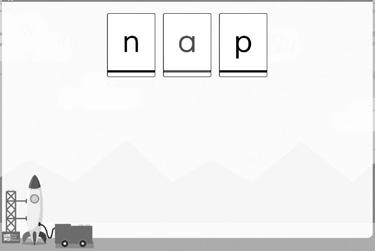
Say “Let’s keep going! This time, say the sounds and the word with me.”
Click to underline one letter at a time while saying its sound with students, “/p/ /ĕ/ /n/.”
© 2017 Really Great Reading Company, LLC 167
12 Lesson 1 | Part 3
UNIT
Click to slide an arrow from left to right under the entire word while saying, “pen.”
Continue with remaining words, making sure students are saying each sound with you as you click to underline it:
1. hen (/h/ /ĕ/ /n/)
2. mug (/m/ /ŭ/ /g/) 3. big (/b/ / ĭ/ /g/) 4. nut (/n/ /ŭ/ /t/) 5. bad (/b/ /ă/ /d/) 6. red (/r/ /ĕ/ /d/) 7. pan (/p/ /ă/ /n/) 8. on (/ŏ/ /n/) 9. beg (/b/ /ĕ/ /g/)
10. ten (/t/ /ĕ/ /n/)
11. dig (/d/ / ĭ/ /g/) 12. bus (/b/ /ŭ/ /s/) 13. in (/ ĭ/ /n/)
14. fog (/f/ /ŏ/ /g/)
15. hum (/h/ /ŭ/ /m/)
16. pin (/p/ / ĭ/ /n/)
17. mud (/m/ /ŭ/ /d/) 18. net (/n/ /ĕ/ /t/)
DIFFERENTIATION OPTIONS
Ways to challenge:
• Have students pronounce each individual sound and then blend the word independently as you underline the letters.
• Using Letter Tile Free Play (located in Supplemental Resources) or your whiteboard and marker, have students Touch & Say the following additional words: bag, bat, Ben, bet, bin, bug, but, cab, cub, den, dug, fib, get, got, hem, kid, Kim, kit, lad, led, let, Meg, men, met, Ned, peg, pet, rag, rib, rub, rug, set, sob, sub, Ted, tub, tug, van, and vat.
• Using Letter Tile Free Play (located in Supplemental Resources) or your whiteboard and marker, have students Touch & Say the following words with 2-sound consonant blends: act, ads, amp, and, ant, apt, ask, elf, elk, end, imp, its, and ump.
168 © 2017 Really Great Reading Company, LLC UNIT 12 Lesson 1 | Part 3
Unit 12 | Lesson 2 | Part 1
Activity 25: Stretch Those Sounds PA: Segmenting
Objective
Students will segment the phonemes (sounds) in threephoneme words using finger-stretching.
See p. 11 for a full description of Stretch Those Sounds.
What Students
See 3, 2, 1…
Open Countdown Online to Unit 12, Lesson 2, Part 1 (12.2.1).
Launch! Click to display the log
Say: • “Today, we are going to separate all of the sounds in some words. • Listen while I say the sounds in log.”
• “log ” (hold closed fist against chest, crossing the midline) • “/l/” (extend thumb), “/ŏ/” (extend pointer finger), “/g/” (extend middle finger) • “log ” (pull fingers back to a closed fist while saying the word)
Say: • “Let’s stretch the word log again together.” (Students repeat sounds while finger-stretching.)
• “Let’s try another one.”
Continue with remaining images:
1. quail (/kw/ /ā/ /l/) 2. cheese (/ch/ /ē/ /z/) 3. elf (/ĕ/ /l/ /f/) 4. hose (/h/ /ō/ /z/) 5. jam (/j/ /ă/ /m/) 6. moose (/m/ /�/ /s/) 7. cake (/k/ /ā/ /k/)
8. win (/w/ /ĭ/ /n/) 9. bag (/b/ /ă/ /g/) 10. dog (/d/ /ŏ/ /g/) 11. fly (/f/ /l/ /ī/) 12. horse (/h/ /or/ /s/) 13. kite (/k/ /ī/ /t/) 14. mug (/m/ /ŭ/ /g/)
© 2017 Really Great Reading Company, LLC 169 UNIT 12 Lesson 2 | Part 1
15. nail (/n/ /ā/ /l/)
16. nose (/n/ /ō/ /z/)
17. net (/n/ /ĕ/ /t/)
18. pig (/p/ /ĭ/ /g/)
19. rat (/r/ /ă/ /t/)
See p. 12 for differentiation options for Stretch Those Sounds.
Unit 12 | Lesson 2 | Part 2
Activity 32: Find That Letter
AP: Letter ID
Objective
Students will identify the letter symbol that spells the shared first sound in a set of three imaged words.
See p. 20 for a full description of Find That Letter.
What Students See 3, 2, 1…
Open Countdown Online to Unit 12, Lesson 2, Part 2 (12.2.2).
Launch!
OPTIONAL (only if you choose to use manipulatives)
Students take out letter tiles a, b, c, d, e, f, g, h, i, k, l, m, n, o, p, r, s, t, u, and v and working board.
Say “Now, we are going to match our letter tiles to the beginning sounds in some words.”
Click to display, point to, and name three images: itch, inside, iguana.
Ask “What is the beginning sound in all of these words?” A: /ĭ/
Click to display three letter tiles: c, u, and i.
Say “Point to the letter that spells /ĭ/, and say its name.” A: i (pointing to the right)
Click to show the correct answer.
Continue with remaining groups of images:
1. kiwi, king, key (k)
2. nest, newspaper, nose (n)
3. rainbow, rose, rug (r)
4. ox, otter, octopus (o)
170 © 2017 Really Great Reading Company, LLC UNIT 12 Lesson 2 | Part 2
5. hammer, hog, headphones (h)
6. volcano, vase, violin (v)
7. needle, nap, nail (n)
8. under, umbrella, upside down (u)
9. boat, bee, billboard (b)
10. seal, sled, sunglasses (s) 11. log, lightbulb, ladder (l) 12. envelope, edge, elephant (e) 13. gift, guitar, guinea pig (g) 14. doughnut, duck, deer (d)
See p. 22 for differentiation options for Find That Letter.
Unit 12 | Lesson 2 | Part 3
Activity 37: Unscramble This AP: Encoding
Objective
Students help the teacher segment the phonemes in words while the teacher models the encoding (spelling) of each sound.
See p. 54 for a full description of Unscramble This.
What Students See 3, 2, 1…
Open Countdown Online to Unit 12, Lesson 2, Part 3 (12.2.3).
Launch!
Say “Now, we’re going to unscramble some letters that got mixed up. When we unscramble them and put them in the right order, they will make real words we can read.”
Click to display the bag and the letter tiles g, b, a.
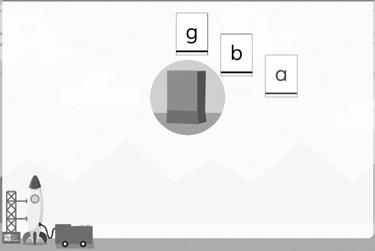
Say:
• “Bag.
• Let’s stretch the sounds in bag together.”
Click to move each letter tile to the correct position AS you and students say the sounds /b/ /ă/ /g/.
Say “Now, let’s make sure those sounds really blend to make the word bag.”
Point to each letter tile as you and the students say its sound, /b/ /ă/ /g/, and then sweep your finger under the word from left to right while saying the whole word, bag.
© 2017 Really Great Reading Company, LLC 171 UNIT 12 Lesson 2 | Part 3
Say:
• “Let’s try to unscramble another mixed up word.
• This time, it’s your turn to stretch out the words on your own.”
Continue with remaining images:
1. cup (/k/ /ŭ/ /p/) 2. net (/n/ /ĕ/ /t/) 3. sun (/s/ /ŭ/ /n/) 4. dog (/d/ /ŏ/ /g/) 5. pen (/p/ /ĕ/ /n/) 6. bat (/b/ /ă/ /t/) 7. hug (/h/ /ŭ/ /g/)
8. leg (/l/ /ĕ/ /g/) 9. sad (/s/ /ă/ /d/) 10. hot (/h/ /ŏ/ /t/) 11. rat (/r/ /ă/ /t/) 12. sit (/s/ / ĭ/ /t/) 13. bug (/b/ /ŭ/ /g/) 14. van (/v/ /ă/ /n/)
See p. 55 for differentiation options for Unscramble This.
172 © 2017 Really Great Reading Company, LLC UNIT 12 Lesson 2 | Part 3
Unit 12 | Lesson 3 | Part 1
Activity 24: Mystery Bag: Blending Sounds PA: Blending
Objective
Students will blend three phonemes to produce a word.
See p. 27 for a full description of Mystery Bag: Blending Sounds.
3, 2, 1…
What Students See
Open Countdown Online to Unit 12, Lesson 3, Part 1 (12.3.1).
Launch!
Click to display the Mystery Bag.
Say:
• “Let’s see what words are in our mystery bag! Listen to my sounds.
• /d/ /ŏ/ /g/.”
Ask “What word does it make when we put these sounds together, /d/ /ŏ/ /g/?” A: dog
Click to display the dog to confirm students’ answer.
Say “Right! /d/ /ŏ/ /g/, dog. Let’s try another one. Repeat after me.”
Click to display the Mystery Bag
Continue with the remaining examples:
1. /j/ /ă/ /m/, jam 2. /n/ /ĕ/ /t/, net 3. /s/ /ĭ/ /k/, sick 4. /y/ /aw/ /n/, yawn 5. /f/ /ō/ /n/, phone 6. /p/ /ŏ/ /t/, pot 7. /h/ /ŭ/ /g/, hug 8. /g/ /er/ /l/, girl 9. /b/ /ō/ /n/, bone
10. /k/ /y�/ /b/, cube 11. /ch/ /ĕ/ /s/, chess 12. /h/ /ar/ /t/, heart 13. /g/ /ā/ /t/, gate 14. /m/ /ĭ/ /t/, mitt 15. /s/ /ĭ/ /ks/, six 16. /y/ /ĕ/ /s/, yes 17. /s/ /ē/ /l/, seal 18. /m/ /�/ /s/, moose
© 2017 Really Great Reading Company, LLC 173 UNIT 12 Lesson 3 | Part 1
See Differentiation
Options on p. 70 for alternative methods of delivery.
19. /th/ /or/ /n/, thorn
20. /n/ /er/ /s/, nurse
21. /p/ /ă/ /n/, pan
22. /t/ /ō/ /z/, toes
23. /sh/ /er/ /t/, shirt
24. /f/ /ē/ /t/, feet
25. /k/ /or/ /n/, corn
26. /sh/ /ĭ/ /p/, ship
27. /n/ /ĕ/ /k/, neck
28. /l/ /ī/ /m/, lime
29. /ă/ /n/ /t/, ant
See p. 28 for differentiation options for Mystery Bag: Blending Sounds.
Unit 12 | Lesson 3 | Part 2
Activity 43: Where’s That Heart Word?
Objective
Students will read three Heart Words from memory, using sequence and location vocabulary to identify where they are on the screen.
See p. 69 for a full description of Where’s That Heart Word?
3, 2, 1…
Ask more questions as time allows.
Sight Words
What Students See
Open Countdown Online to Unit 12, Lesson 3, Part 2 (12.3.2).
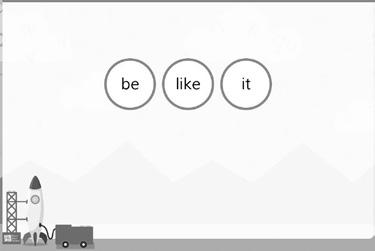
Launch!
Say “Now, we are going to practice reading some of the ‘Heart Words’ we’ve learned.”
Click to display the Heart Words be, like, it.
Say “Let’s read our Heart Words, starting here (point to the words be, like, and it while reading them in left to right order).”
Ask:
• “Which word is last?” A: it
• “Which word is before the word it?” A: like
• “Which word is first?” A: be
• “Which word is next?” A: like
174 © 2017 Really Great Reading Company, LLC UNIT 12 Lesson 3 |
2
Part
Click to display the Heart Words and, is, my.
Say “Let’s read our Heart Words, starting here (point to the words and, is, and my while reading them in left to right order).”
Ask:
• “Which word is at the beginning of the row?” A: and • “Which word is at the end of the row?” A: my • “Which word is after the word and?” A: is • “Which word is in the middle of the row?” A: is
Click to display the Heart Words the, at, go.
Say “Let’s read our Heart Words, starting here (point to the words the, at, and go while reading them in left to right order).”
Ask:
• “Which word is first?” A: the • “Which word is next?” A: at • “Which word is last?” A: go • “Which word is after the word the?” A: at
Click to display the Heart Words for, here, in.
Say “Let’s read our Heart Words, starting here (point to the words for, here, and in while reading them in left to right order).”
Ask:
•
“Which word is before the word in?” A: here • “Which word is at the beginning of the row?” A: for • “Which word is at the end of the row?” A: in • “Which word is in the middle of the row?” A: here
See p. 70 for differentiation options for Where’s That Heart Word?
© 2017 Really Great Reading Company, LLC 175 UNIT 12 Lesson 3 | Part 2
Unit 12 | Lesson 3 | Part 3
Activity 36: Guess My Word AP: Encoding
Objective
Students will observe the encoding of a word and then blend together the word's phonemes.
See p. 39 for a full description of Guess My Word.
What Students See 3, 2, 1…
Open Countdown Online to Unit 12, Lesson 3, Part 3 (12.3.3).
Launch!
Say “Now, you’re going to guess my mystery words that got all mixed up.”
Click to display the letter tiles n, p, e.
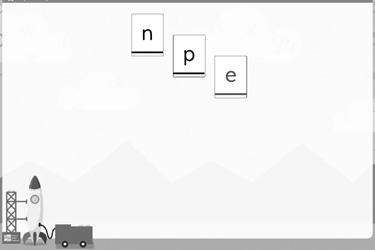
Say “Guess the mystery word, /p/ /ĕ/ /n/.” (Click to move the letter tiles into the correct position as you say each sound.)
Ask “What’s my word?” A: pen (Students blend the sounds together to say the word.)
Say “/p/ /ĕ/ /n/, pen.” (Point to each letter tile as you say its sound, and then sweep your finger under the word from left to right while saying the whole word.)
Click to display the pen.
Continue with remaining images:
1. /p/ /ĭ/ /g/, pig
2. /r/ /ă/ /t/, rat 3. /s/ /ŭ/ /n/, sun 4. /n/ /ĕ/ /t/, net 5. /h/ /ŏ/ /p/, hop 6. /h/ /ă/ /m/, ham 7. /b/ /ŭ/ /g/, bug
8. /k/ /ŭ/ /p/, cup 9. /n/ /ă/ /p/, nap 10. /p/ /ŏ/ /d/, pod
11. /r/ /ŭ/ /n/, run
12. /s/ /ĭ/ /t/, sit 13. /v/ /ă/ /n/, van 14. /l/ /ŏ/ /g/, log
See p. 40 for differentiation options for Guess My Word.
176 © 2017 Really Great Reading Company, LLC UNIT 12 Lesson 3 | Part 3
Unit 12 | Lesson 4 | Part 1
Activity 26: Count the Sounds PA: Segmenting
Objective
Students will segment and count the number of phonemes (sounds) in spoken words.
See p. 100 for a full description of Count the Sounds.
3, 2, 1…
What Students See
Open Countdown Online to Unit 12, Lesson 4, Part 1 (12.4.1).
Launch!
Click to display two columns with two and three color tiles as headings.
Say “Today, we are going to listen for how many sounds we hear in words. This side (point to left column) is for words that have two sounds. This side (point to the right column) is for words that have three sounds.”
Click to display the gate at the bottom of the screen.
Say “Gate. Stretch that word with me, gate, /g/ /ā/ /t/, gate." (Students and teacher finger-stretch.)
Ask “How many sounds did you hear in /g/ /ā/ /t/, gate?” A: three
Say “Let’s check it: /g/ (point to the first color tile), /ā/ (point to the second color tile), /t/ (point to the last color tile), gate. You’re right!”
Click to place the gate in the column with three color tiles.
Continue with the remaining words:
1. edge, /ĕ/ /j/ (2)
2. boy, /b/ /oi/ (2)
3. feet, /f/ /ē/ /t/ (3)
4. jam, /j/ /ă/ /m/ (3)
5. toes, /t/ /ō/ /z/ (3)
6. up, /ŭ/ /p/ (2)
7. ape, /ā/ /p/ (2)
8. fish, /f/ / ĭ/ /sh/ (3)
9. key, /k/ /ē/ (2)
10. ax, /ă/ /ks/ (2)
11. log, /l/ /ŏ/ /g/ (3)
12. ice, /ī/ /s/ (2)
13. lime, /l/ / ī/ /m/ (3)
14. car, /k/ /ar/ (2)
15. hug, /h/ /ŭ/ /g/ (3)
16. map, /m/ /ă/ /p/ (3)
Although the letter x is comprised of two phonemes, students are taught to handle them as one sound represented by one letter.
© 2017 Really Great Reading Company, LLC 177 UNIT 12 Lesson 4 | Part 1
17. bed, /b/ /ĕ/ /d/ (3)
18. cow, /k/ /ou/ (2)
19. lick, /l/ / ĭ/ /k/ (3)
20. bee, /b/ /ē/ (2)
21. pie, /p/ /ī/ (2)
22. sun, /s/ /ŭ/ /n/ (3)
23. zoo, /z/ /�/ (2)
See p. 101 for differentiation options for Count the Sounds.
Unit 12 | Lesson 4 | Part 2
Activity 33: Connect the Letter
AP: Letter ID
Objective
Students will practice connecting a word’s beginning sound to its corresponding letter symbol.
See p. 24 for a full description of Connect the Letter.
What Students See 3, 2, 1…
Open Countdown Online to Unit 12, Lesson 4, Part 2 (12.4.2).
Launch!
Say “Now, we are going to match letters to the beginning sounds in some words.”
Ask “This is the letter b. What sound does the letter b spell?” A: /b/
Say “Right. Now, let’s look at a few pictures and see which one begins with that sound.”
Click to display, point to, and name three images below the letter tile b: bear, mittens, and sunflower
Ask “Which one begins with /b/?” A: bear
Say “Yes, /b/, bear begins with /b/, so bear begins with the letter b.”
Click to show the correct answer.
Say “Let’s try that with some new pictures.”
Continue with remaining letter tiles and images:
178 © 2017 Really Great Reading Company, LLC UNIT 12 Lesson 4 | Part 2
b
• book, cow, heart
• envelope, boy, piano
• deer, butterfly, volcano k
• kiwi, hospital, hamburger
• bottle, king, game
• egg, key, muffin
• kangaroo, lemon, ham v
• vase, boat, football
• itch, violin, candles
• six, house, vegetables
• van, keyboard, ox e
• bed, edge, hug
• elephant, house, October
• tongue, sunglasses, elf t
• hammer, enter, toaster
• tiger, caveman, bee c
• basketball, cactus, headphones
• cube, vulture, scissors i
• iguana, bug, eggplant
See p. 25 for differentiation options for Connect the Letter.
The correct answers for this activity are displayed in boldface text.
© 2017 Really Great Reading Company, LLC 179 UNIT 12 Lesson 4 | Part 2
To finger-stretch, begin by saying the whole word with closed fist at chest. Then, extend one finger for each sound in the word, beginning with the thumb. Finally, bring hand back into a fist while saying the whole word again.
Unit 12 | Lesson 4 | Part 3
Activity 38: Build a Word AP: Encoding Objective
If students are using manipulatives, have them use color and letter tiles to build the word along with you.
Students encode (spell) words by first segmenting sounds and then matching sounds to letters.
See p. 103 for a full description of Build a Word.
What Students See 3, 2, 1…
OPTIONAL (only if you choose to use manipulatives)
Students take out letter tiles a, b, c, d, e, f, g, h, i, k, l, m, n, o, p, r, s, t, u, and v and working board.
Open Countdown Online to Unit 12, Lesson 4, Part 3 (12.4.3).
Launch!
Say:
• “Now, we are going to build words with our letter tiles by listening to the sounds in each word and putting our letter tiles in order. That is how we spell words.
• Let’s build our first word!”
Click to display the net
Say:
• “Listen carefully. Net, /n/ /ĕ/ /t/, net (while finger-stretching)
• I heard three sounds in net, /n/ /ĕ/ /t/.”
Click to display one color tile at a time while again saying “/n/ /ĕ/ /t/.”
Say:
• “Now let’s build the word with letter tiles.
• The first sound I heard was /n/.”
Ask “What letter spells /n/?” A: n
Click to display the letter tile n under the first color tile.
Say “The next sound I heard was /ĕ/. What letter spells /ĕ/?” A: e
180 © 2017 Really Great Reading Company, LLC UNIT 12 Lesson 4 | Part 3
Click to display the letter tile e under the second color tile.
Say “The last sound I heard was /t/. What letter spells /t/?” A: t
Click to display the letter tile t under the last color tile.
Say:
• “Let’s check our work. /n/ /ĕ/ /t/ (touching each letter as you say the sound), net (sweeping pointer finger under the whole word from left to right).
• Awesome job, you just spelled net. Let’s try another word.”
Continue with remaining words:
1. leg, /l/ /ĕ/ /g/
2. pen, /p/ /ĕ/ /n/
3. pod, /p/ /ŏ/ /d/
4. run, /r/ /ŭ/ /n/
5. cup, /k/ /ŭ/ /p/
6. bag, /b/ /ă/ /g/
7. hop, /h/ /ŏ/ /p/
8. van, /v/ /ă/ /n/
9. hug, /h/ /ŭ/ /g/
See p. 105 for differentiation options for Build a Word.
© 2017 Really Great Reading Company, LLC 181 UNIT 12 Lesson 4 | Part 3
Unit 12 | Lesson 5 | Part 1
Activity 31: This Letter or That?
AP: Letter ID
Objective
Students will identify the letter symbol that spells the first sound in a word.
See p. 8 for a full description of This Letter or That?
What Students See 3,
2, 1…
Open Countdown Online to Unit 12, Lesson 5, Part 1 (12.5.1).
Launch!
SORT 1:
Click to display two columns with the headings “c ” (for cat) and “h” (for hammer).
Ask “What is the first sound in cat (while pointing to the cat)?” A: /k/
Say “Remember, the sound /k/ can be spelled with the letter c (while pointing to the letter tile c).”
Ask “What is the first sound in hammer (while pointing to the hammer)?” A: /h/
Say “Remember, the sound /h/ is spelled with the letter h (while pointing to the letter tile h).”
Click to display the cube at the bottom of the screen.
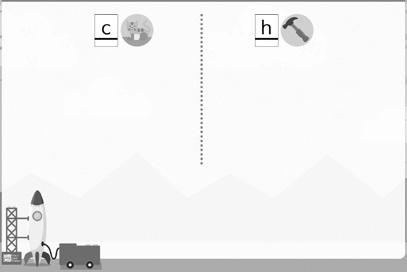
Ask:
• “Cube. What is the first sound in cube?” A: /k/
• “Should we put the /k/, cube under the c, like /k/, cat or the h, like /h/, hammer?” A: c, /k/, cat
Say “Right, /k/, cube and /k/, cat both start with the letter c, so I’ll move the cube under the c.”
Click to place the cube in the “c ” column.
Continue with remaining images: cupcake, hat, corn, caveman, hospital, heart, car, horse, hamster, carrot, hanger.
182 © 2017 Really Great Reading Company, LLC UNIT 12 Lesson 5 | Part 1
Say:
• “Let’s go over our work (point to each image as you label it with students):
o /k/, cat; /k/, cube; /k/, cupcake; /k/, corn; /k/, caveman; /k/, car; /k/, carrot
o /h/, hammer; /h/, hat; /h/, hospital; /h/, heart; /h/, horse; /h/, hamster; /h/, hanger.
• Let’s try that with two new letters.”
SORT 2:
Click to display two columns with the headings “i ” (for itch) and “o” (for octopus).
Ask “What is the first sound in itch (while pointing to the itch)?” A: / ĭ/
Say “Remember, the sound / ĭ/ is spelled with the letter i (while pointing to the letter tile i).”
Ask “What is the first sound in octopus (while pointing to the octopus)?”
A: /ŏ/
Say “Remember, the sound /ŏ/ is spelled with the letter o (while pointing to the letter tile o).”
Click to display the igloo at the bottom of the screen.
Ask:
• “Igloo. What is the first sound in igloo?” A: /ĭ/
• “Should we put the / ĭ/, igloo under the i, like / ĭ/, itch or the o, like /ŏ/, octopus?” A: i, / ĭ/, itch
Say “Right, / ĭ/, igloo and / ĭ/, itch both start with the letter i, so I’ll move the igloo under the i.”
Click to place the igloo in the “i ” column.
Continue with remaining images: October, inside, ill, ox, otter, inch, ostrich, infant, olives, iguana, omelet.
Say:
• “Let’s go over our work (point to each image as you label it with students):
o /ĭ/, itch; /ĭ/, igloo; /ĭ/, inside; /ĭ/, ill; /ĭ/, inch; /ĭ/, infant; /ĭ/, iguana
o /ŏ/, octopus; /ŏ/, October; /ŏ/, ox; /ŏ/, otter; /ŏ/, ostrich; /ŏ/, olives; /ŏ/, omelet.”
See p. 10 for differentiation options for This Letter or That?
© 2017 Really Great Reading Company, LLC 183 UNIT 12 Lesson 5 | Part 1
Unit
12 | Lesson 5 | Part 2
Activity 44: Pop-Up and 3-Up
AP: Letter ID
Objective
• Students will read individual Heart Words as they pop up on the screen.
• Students will read sets of three Heart Words as they appear on the screen.
See p. 80 for a full description of Pop-Up and 3-Up
What Students See 3, 2,
1…
Open Countdown Online to Unit 12, Lesson 5, Part 2 (12.5.2).
Launch!
POP-UP: Say:
• “Now, we are going to practice reading the Heart Words we’ve been reading all week.
• In our first game, when you see a word pop up onto the screen, say the word out loud.
• If you need help remembering, I can help, but try your best.”
Click to display the Heart Words it, like, be, the, my, is, for, and, and go at random. Each word will appear several times.
Say:
• “Great job! In our next game, you will see three words on the screen.
• Remember, when you see the red dot, stop and look at the three words. When you see the yellow dot, think about the words and try to remember them. When you see the green dot, say the three words out loud.
• If you need help remembering, I can help, but try your best.”
Click to display the sets of three Heart Words. Each set will contain three of the following words in a random group: it, like, be, the, my, is, for, and, and go. Each word will appear several times.
184 © 2017 Really Great Reading Company, LLC UNIT 12 Lesson 5 | Part 2
Unit 12 | Lesson 5 | Part 3
Activity 41: Phrase Reading AP: Decoding
Objective
Students will practice reading decodable words and Heart Words in three-word phrases.
See p. 134 for a full description of Phrase Reading.
3, 2, 1…
What Students See
Open Countdown Online to Unit 12, Lesson 5, Part 3 (12.5.3).
Launch!
Say:
• “Now, we are going to read some phrases together.
• When each word shows up on the screen, we’ll read it together.
• Then, when all three words are up, we are going to read the phrase together.
• Let’s get started!”
Click to display the black word dig. Say “Remember, we can sound out black words. Let’s sound it out together.” (Use Touch & Say to sound out the word together: /d/ /ĭ/ /g/, dig.)
Click to display the red word it Say “Remember, red words are Heart Words. Let’s say it together.” (it)
Click to display the black word up Say “Let’s sound this word out together.” (Use Touch & Say to sound out the word together: /ŭ/ /p/, up.)
Say “Now we know all of the words, but let’s try to read them together in order. When I point to a word, read it out loud: dig it* up.” (Point to each word, having students read the words aloud as you go. Begin with a pause between each word, and then repeat the process with shorter pauses on the second and third rounds to build fluency.)
© 2017 Really Great Reading Company, LLC 185 UNIT 12 Lesson 5 | Part 3
Some of the Heart Words, marked with an asterisk, are also decodable, but they are still written in red because it is beneficial and more efficient for students to see these common words as words they should know by heart. If they struggle to remember these words, feel free to have your students sound out the decodable Heart Words.
Say “Let’s try another phrase, or group of words.”
Continue with the following phrases in the same manner: hid the mop; hop in* mud; pet a dog; be like him; mad and* sad; is not fun; on my bus; dig a pit; beg for ham.
186 © 2017 Really Great Reading Company, LLC UNIT 12 Lesson 5 | Part 3
Unit 13 | Lesson 1 | Part 1
Activity 19: Peel and Match PA: BSI Objective
Students will identify two words that have the same beginning sound.
See p. 13 for a full description of Peel and Match.
What Students See 3, 2, 1…
Open Countdown Online to Unit 13, Lesson 1, Part 1 (13.1.1).
Launch! Say “Today, we’re going to listen for the words that have the same beginning sound.”
ROUND 1:
Click to display the duck on the left.
Point to the duck and say “/d/, duck. Your turn.” A: /d/, duck
Click to display the bird and dog on the right.
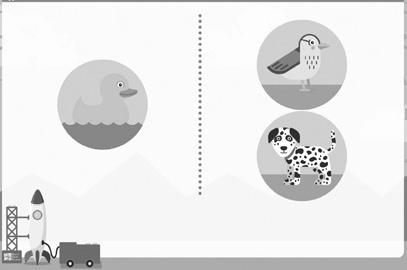
Point to each image and say “bird, dog.”
Ask “Which word begins the same as duck?” A: dog
Click to show the correct answer.
Say “Let’s try another one.”
Continue to compare the next six image sets with the /d/, duck:
• /d/, dinosaur & /p/, peppermint
• /l/, lime & /d/, dolphin
• /d/, deer & /k/, kangaroo
• /d/, doghouse & /v/, vegetables
• /ĕ/, elephant & /d/, doughnut
• /d/, door & /g/, girl
ROUND 2: Say “Now, let’s see which word begins the same as nest.”
You do not have to isolate the beginning sounds before saying each word; however, if you would like to differentiate the activity to make it slightly easier for the students (see Differentiation Options on p. 15), the beginning sounds are isolated for you in the bulleted lists of examples.
© 2017 Really Great Reading Company, LLC 187 UNIT 13 Lesson 1 | Part 1
Click to display the nest on the left and the mouse and nap on the right.
Continue to compare the next six image sets with the /n/, nest:
• /m/, mouse & /n/, nap
• /k/, carrot & /n/, neck
• /n/, needle & /b/, bone
• /n/, nose & /sh/, ship
• /y�/, uniform & /n/, net
• /r/, rainbow & /n/, nurse
ROUND 3:
Say “Now, let’s see which word begins the same as toothbrush.”
Click to display the toothbrush on the left and the tongue and nail on the right.
Continue to compare the next six image sets with the /t/, toothbrush:
• /t/, tongue & /n/, nail
• /t/, toes & /th/, thumb
• /j/, jump & /t/, tiger
• /f/, flower & /t/, table
• /t/, tape & /k/, cookie
• /w/, whale & /t/, teeth
See p. 15 for differentiation options for Peel and Match.
188 © 2017 Really Great Reading Company, LLC UNIT 13 Lesson 1 | Part 2
Unit 13 | Lesson 1 | Part 2 Activity 30: Name That Sound AP: Letter ID Objective Students will identify the uppercase and lowercase letters associated with the sounds /j/, /w/, and /z/.
p. 2 for a full description of Name That Sound. What Students See
See
3, 2, 1…
Open Countdown Online to Unit 13, Lesson 1, Part 2 (13.1.2).
Launch!
Say “Now, we are going to see what our sounds look like when they are written down.”
Click to display the image for jump.
Ask:
• “What is this a picture of?” A: a person jumping
• “What is the first sound in jump?” A: /j/
Click to display the corresponding uppercase and lowercase letter tiles.
Say:
• “Right, jump begins with /j/, and these letters say the sound, or spell, /j/.
• Do you remember Jamal the Jaguar? He can juggle three juice boxes while jumping! His favorite sound is /j/.
•
The name of these letters is J J says /j/, like the beginning of /j/, jump
•
This one (point to uppercase J) is called ‘capital J,’ and this one (point to lowercase j) is called ‘lowercase j.’ This is the one we will see most of the time, so we’ll just call it j
Let’s learn another new letter.”
•
Click to display the image for wave
Ask:
• “What is this a picture of?” A: a hand waving
• “What is the first sound in wave?” A: /w/
Click to display the corresponding uppercase and lowercase letter tiles.
Say:
•
“Right, wave begins with /w/, and these letters say /w/.
• Do you remember Willie the Walrus? He liked to wave to new friends and ask what their names were and where they were going. His favorite sound is /w/.”
Ask “So, what do you think these letters say?” A: /w/
Optional motions for consonant sounds are available in the Appendix on p. 290 for students who may require more of a kinesthetic approach.
© 2017 Really Great Reading Company, LLC 189 UNIT 13 Lesson 1 | Part 2
Say:
• “Yes! The name of these letters is W. W says /w/, like the beginning of wave.
• This one (point to uppercase W) is called ‘capital W,’ and this one (point to lowercase w) is called ‘lowercase w.’ This is the one we will see most of the time, so we’ll just call it w.
• Let’s learn another new letter.”
Click to display the zipper.
Ask:
• “What is this a picture of?” A: zipper
• “What is the first sound in zipper?” A: /z/
Click to display the corresponding uppercase and lowercase letter tiles.
Say “Do you remember Z ach the Zebra? He likes to zip line over the zucchini fields, and the zip line sounds like a zipper! His favorite sound is /z/.”
Ask “So, what do you think these letters say?” A: /z/
Say:
• “Yes! The name of these letters is Z . Z says /z/, like the beginning of zipper
• This one (point to uppercase Z) is called ‘capital Z,’ and this one (point to lowercase z) is called ‘lowercase z.’ This is the one we will see most of the time, so we’ll just call it z.”
Click to display letter tiles j, w, and z.
Say “Let’s name our letters one more time and say the sound that each letter spells.”
Point to each letter, one at a time, and say:
• “This is j. J says /j/.
• This is w. W says /w/.
• This is z. Z says /z/.”
190 © 2017 Really Great Reading Company, LLC UNIT 13 Lesson 1 | Part 2
Unit 13 | Lesson 1 | Part 3
Activity 42: Look, Think, Say; Pop-Up; 3-Up
Objective
• Students will read three Heart Words from memory (or by decoding if necessary).
• Students will read individual Heart Words as they pop up on the screen.
• Students will read sets of three Heart Words as they appear on the screen.
Sight Words
What Students See
See p. 61 for a full description of Look, Think, Say; Pop-Up; 3-Up.
3, 2, 1…
Open Countdown Online to Unit 13, Lesson 1, Part 3 (13.1.3).
Launch!
Say “Now, we are going to learn to read some new Heart Words.”
LOOK, THINK, SAY:
Click twice to display the Heart Word to with one red dot and two empty dots below.
Say:
• “Remember, this red dot (point to the red dot) tells us to stop what we are doing so we can listen to the word.
• This word is to, as in, ‘Let’s go to the park.’”
Click to display the yellow dot.
Say “Think about this word.”
Click to display the green dot.
Say:
• “Remember, this green dot (point to the green dot) tells us to say the word out loud.
• Say the word with me, to.
• Let’s try another word.
© 2017 Really Great Reading Company, LLC 191 UNIT 13 Lesson 1 | Part 3
• Remember to look, think, and then say. Only say the word out loud when the green dot shows up.”
Click twice to display the Heart Word not with one red dot and two empty dots below.
Say “Look at the word not, as in, ‘I did not want to wear my hat today.’”
Click to display the yellow dot.
Say:
• “Think about this word. We know the sounds in this word, /n/ /ŏ/ /t/ (point to each letter as you say the sound), not
• We can think about the sounds in this word, but it might be easier to just try to remember it.”
Click to display the green dot. Say: • “Say the word!
• Let’s try one more word.”
Click twice to display the Heart Word can with one red dot and two empty dots below.
Say “Look at the word can, as in, ‘I can help the teacher.’”
Click to display the yellow dot.
Say:
• “Think about this word. We know the sounds in this word, /k/ /ă/ /n/ (point to each letter as you say the sound), can.
• We can think about the sounds in this word, but it might be easier to just try to remember it.”
Click to display the green dot.
Say: • “Say the word!
• Let’s look at those words one more time.”
Continue with the same three Heart Words for two additional rounds.
POP-UP: Say: • “Now, we are going to practice reading the Heart Words we’ve learned.
192 © 2017 Really Great Reading Company, LLC UNIT 13 Lesson 1 | Part 3
•
In our first game, when you see a word pop up onto the screen, say the word out loud.
• If you need help remembering, I can help, but try your best.”
Click to display the Heart Words to, not, can, like, go, it, be, in, and my at random. Each word will appear several times. Read each word together with students as it pops up.
3-UP: Say:
• “Great job! In our next game, you will see three words on the screen.
• When you see the red dot, stop and look at the three words. When you see the yellow dot, think about the words and try to remember them. When you see the green dot, say the three words out loud.”
Click to display the sets of three Heart Words. Each set will contain the following words in a random order: to, not, can, like, go, it, be, in, and my. Each word will appear several times.
Look, think about, and say each set of three words together with students as the sets are displayed.
© 2017 Really Great Reading Company, LLC 193 UNIT 13 Lesson 1 | Part 3
Unit 13 | Lesson 2 | Part 1
Activity 27: Add That Sound PA: Manipulation
Objective
Students will add a sound to the end of a word to form a new word.
What Students See
Description
The teacher says a word aloud. Teacher and students finger-stretch the phonemes. The teacher then models how to add a phoneme to the end of the word, stretching the sounds of the new word. Students then repeat the stretching process for the new word.
3, 2, 1…
Open Countdown Online to Unit 13, Lesson 2, Part 1 (13.2.1).
Launch!
Say:
• “Today, we are going to add a sound to the end of some words.
• Listen to my word, she
• Let’s finger-stretch that word together. She, /sh/ /ē/, she.”
Click to display a color tile for each sound while saying the sounds again: /sh/ (first color tile appears), /ē/ (second color tile appears)
Say “I am going to add a new sound, /p/, to the end of she. I’ll add a new color tile since we are adding a sound.”
Click to display a third color tile.
Say:
• “Let’s see what the new word is: /shē/ (sweep finger under the first two tiles), /p/ (touch the third tile), sheep (sweep finger under all three tiles). The new word is sheep. Did you hear the new sound /p/ at the end?
• Let’s stretch all the sounds in sheep together (say the sounds while finger-stretching): /sh/ (extend thumb), /ē/ (extend pointer finger), /p/ (extend middle finger), sheep (pull closed fist to chest).
• Let’s try another one.
• Listen to my word, lay.
194 © 2017 Really Great Reading Company, LLC UNIT 13 Lesson 2 | Part 1
•
Let’s finger-stretch that word together. Lay, /l/ /ā/, lay.”
Click to display a color tile for each sound while saying the sounds again: /l/ (first color tile appears), /ā/ (second color tile appears).
Say “I am going to add a new sound, /k/, to the end of lay. I’ll add a new color tile since we are adding a sound.”
Click to display a third color tile.
Say:
• “Let’s see what the new word is: /lā/ (sweep finger under the first two tiles), /k/ (touch the third tile). Did you hear the new sound, /k/, at the end?
• Say those sounds with me so we can blend them together, /lā/ /k/.”
Ask “What is our new word?” A: lake
Say:
• “Let’s stretch all the sounds in lake together (say the sounds while finger-stretching): /l/ (extend thumb), /ā/ (extend pointer finger), /k/ (extend middle finger), lake (pull closed fist to chest).
• Let’s try another one.”
Continue with remaining additions:
1. bee (/b/ /ē/ + /n/) bean 2. tie (/t/ /ī/ + /m/) time 3. boy (/b/ /oi/ + /l/) boil 4. key (/k/ /ē/ + /p/) keep 5. knee (/n/ /ē/ + /d/) need 6. pie (/p/ /ī/ + /l/) pile 7. zoo (/z/ /�/ + /m/) zoom 8. he (/h/ /ē/ + /t/) heat 9. see (/s/ /ē/ + /d/) seed
10. we (/w/ /ē/ + /t/) wheat 11. no (/n/ /ō/ + /z/) nose 12. say (/s/ /ā/ + /m/) same 13. may (/m/ /ā/ + /d/) made 14. shy (/sh/ /ī/ + /n/) shine 15. my (/m/ /ī/ + /l/) mile 16. go (/g/ /ō/ + /t/) goat 17. she (/sh/ /ē/ + /t/) sheet 18. why (/w/ / ī/ + /n/) whine
© 2017 Really Great Reading Company, LLC 195 UNIT 13 Lesson 2 | Part 1
DIFFERENTIATION OPTIONS
Ways to simplify:
• If students struggle to say the new word independently, teacher can continue to say the new word first (as in the sheep example above) and have students repeat.
• Students can use their color tiles for the activity to make it more concrete (put out two, then add a third, touching tiles as they say the sounds).
Ways to challenge:
• Have students combine the initial word with the new sound independently.
• Instead of saying, “Did you hear the new sound (say sound) at the end?” after adding the new sound, have students recall what the new sound was independently; ask, “What is the new sound we added to the end of the word?”
• Have the students try to come up with an additional sound that, when added to the initial word, could make a different word. (Example: lay lake; students may then come up with lay late, or lay laid, or lay lane.)
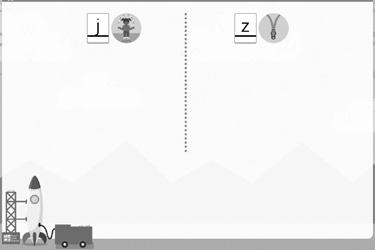
196 © 2017 Really Great Reading Company, LLC UNIT 13 Lesson 2 | Part 2
Unit 13 | Lesson 2 | Part 2 Activity 31: This Letter or That? AP: Letter ID Objective Students will identify the letter symbol that spells the first sound in a word. See p. 8 for a full description of This Letter or That? What Students See 3, 2, 1… Open Countdown Online to Unit 13, Lesson 2, Part 2 (13.2.2). Launch! SORT 1: Click to display two columns with the headings “j ” (for jump) and “z ” (for zipper).
Ask “What is the first sound in jump (while pointing to the image for jump)?” A: /j/
Say “Remember, the sound /j/ is spelled with the letter j (while pointing to the letter tile j).”
Ask “What is the first sound in zipper (while pointing to the zipper)?” A: /z/ Say “Remember, the sound /z/ is spelled with the letter z (while pointing to the letter tile z).”
Click to display the jacket at the bottom of the screen.
Ask:
• “Jacket. What is the first sound in jacket?” A: /j/
• “Should we put the /j/, jacket under the j, like /j/, jump or the z, like /z/, zipper?” A: j, /j/, jump
Say “Right, /j/, jacket and /j/, jump both start with the letter j, so I’ll move the jacket under the j.”
Click to place the jacket in the “j ” column.
Continue with remaining images: juice, zucchini, jellybeans, jet, zoo, zoom, jellyfish, zigzag, zero, jar, zebra
Say:
• “Let’s go over our work (point to each image as you label it with students): o /j/, jump; /j/, jacket; /j/, juice; /j/, jellybeans; /j/, jet; /j/, jellyfish; /j/, jar. o /z/, zipper; /z/, zucchini; /z/, zoo; /z/, zoom; /z/, zigzag; /z/, zero; /z/, zebra
•
Let’s try that with two new letters.”
SORT 2:
Click to display two columns with the headings “w ” (for wave) and “h” (for hammer).
Ask “What is the first sound in wave (while pointing to the hand waving)?” A: /w/ Say “Remember, the sound /w/ is spelled with the letter w (while pointing to the letter tile w).”
Ask “What is the first sound in hammer (while pointing to the hammer)?” A: /h/ Say “Remember, the sound /h/ is spelled with the letter h (while pointing to the letter tile h).”
Click to display the watermelon at the bottom of the screen.
Ask:
• “ Watermelon. What is the first sound in watermelon?” A: /w/
• “Should we put the /w/, watermelon under the w, like /w/, wave or the h, like /h/, hammer?” A: w, /w/, wave
© 2017 Really Great Reading Company, LLC 197 UNIT 13 Lesson 2 | Part 2
Say “Right, /w/, watermelon and /w/, wave both start with the letter w, so I’ll move the watermelon under the w.”
Click to place the watermelon in the “w ” column. Continue with remaining images: hospital, wagon, wig, heart, hug, win, hanger, worm, hamburger, waterfall, hair.
Say: • “Let’s go over our work (point to each image as you label it with students):
o /w/, wave; /w/, watermelon; /w/, wagon; /w/, wig; /w/, win; /w/, worm; /w/, waterfall
o /h/, hammer; /h/, hospital; /h/, heart; /h/, hug; /h/, hanger; /h/, hamburger; /h/, hair.”
See p. 10 for differentiation options for This Letter or That?
Unit 13 |
Lesson 2 | Part 3
Activity 34: Which Letter?
AP: Letter ID
Objective
Students will isolate the beginning sound in a word and match that sound to its letter symbol.
See p. 8 for a full description of This Letter or That?
What Students See 3, 2, 1…
OPTIONAL (only if you choose to use manipulatives)
Prepare materials:
• Letter tiles a, b, c, d, e, f, g, h, i, j, k, l, m, n, o, p, r, s, t, u, v, w, and z and working board from Countdown Student Kit for each student (italicized letter tiles listed here are new to this unit; have students add these tiles to their boards)
Open Countdown Online to Unit 13, Lesson 2, Part 3 (13.2.3).
198 © 2017 Really Great Reading Company, LLC UNIT 13 Lesson 2 | Part 3
Launch!
OPTIONAL (only if you choose to use manipulatives)
Students take out letter tiles b, c, d, f, g, h, j, k, l, m, n, p, r, s, t, v, w, and z and working board.
Say “Now, we are going to spell the first letter of some words.”
Click to display the jam with the letters a m spelled out below.
Say “Jam.”
Ask “What is the first sound in jam?” A: /j/
Click to display three letter tiles: j, k, z.
Ask “Which of these letters spells /j/ like /j/, jam? Point to the letter tile that spells /j/, and say its name.” A: j
Click to show the correct answer.
Click to display the wig with the letters i g spelled out below.
Say “ Wig.”
Ask “What is the first sound in wig?” A: /w/
Click to display three letter tiles: n, z, w.
Ask “Which of these letters spells /w/ like /w/, wig? Point to the letter tile that spells /w/, and say its name.” A: w
Click to show the correct answer.
Continue with remaining images:
1. six (s) 2. kid (k) 3. leg (l) 4. rat (r) 5. ham (h) 6. pot (p)
7. hop (h) 8. win (w) 9. bat (b) 10. nut (n) 11. gum (g) 12. mug (m)
13. van (v) 14. hat (h) 15. dog (d) 16. jet ( j) 17. cup (c) 18. fox (f )
See p. 10 for differentiation options for Which Letter?
You may want to have students point all the way to the left for j, to the center for k, and all the way to the right for z. If students are using manipulatives, have them hold up the correct tile and name it rather than point.
© 2017 Really Great Reading Company, LLC 199 UNIT 13 Lesson 2 | Part 3
You may want to have students point all the way to the left for g, to the center for w, and all the way to the right for m. If students are using manipulatives, have them hold up the correct tile and name it rather than point.
Unit 13 | Lesson 3 | Part 1
Activity 32: Find That Letter
AP: Letter ID Objective
Students will identify the letter symbol that spells the shared first sound in a set of three imaged words.
See p. 20 for a full description of Find That Letter.
What Students See 3, 2, 1…
OPTIONAL (only if you choose to use manipulatives)
Students take out letter tiles a, b, c, d, e, f, g, h, i, j, k, l, m, n, o, p, r, s, t, u, v, w, and z and working board.
Open Countdown Online to Unit 13, Lesson 3, Part 1 (13.3.1).
Launch!
Say “Today, we are going to match our letter tiles to the beginning sounds of some words.”
Click to display, point to, and name three images: watermelon, wing, wagon.
Ask “What is the beginning sound in all of these words?” A: /w/
Click to display three letter tiles: g, w, and m.
Say “Point to the letter that spells /w/, and say its name.” A: w (pointing to the middle)
Click to show the correct answer.
Continue with remaining image sets: 1. egg, elephant, elbow (e) 2. clock, cookie, crab (c)
zero, zebra, zap (z)
olives, ostrich, ox (o)
juice, jellyfish, jam ( j)
van, vehicle, violin (v)
ant, apple, add (a)
net, nurse, nose (n)
up, umbrella, upside down (u)
bug, brick, blueberries (b)
zoo, zipper, zigzag (z) 12. log, lightbulb, ladder (l)
gold, glasses, gate (g) 14. water, worm, win (w)
See p. 22 for differentiation options for Find That Letter.
200 © 2017 Really Great Reading Company, LLC UNIT 13 Lesson 3 | Part 1
3.
4.
5.
6.
7.
8.
9.
10.
11.
13.
Unit 13 | Lesson 3 | Part 2
Activity 31: This Letter or That? AP: Letter ID
Objective
Students will identify the letter symbol that spells the first sound in a word.
See p. 8 for a full description of This Letter or That?
What Students See 3, 2, 1…
Open Countdown Online to Unit 13, Lesson 3, Part 2 (13.3.2).
Launch!
SORT 1:
Click to display two columns with the headings “w ” (for wave) and “j ” (for jump).
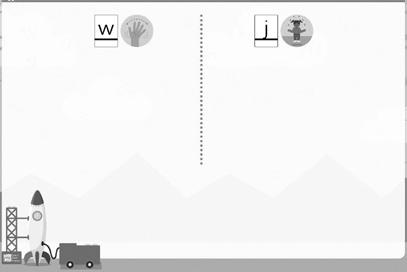
Ask “What is the first sound in wave (while pointing to the hand waving)?”
A: /w/
Say “Remember, the sound /w/ is spelled with the letter w (while pointing to the letter tile w).”
Ask “What is the first sound in jump (while pointing to the image for jump)?”
A: /j/
Say “Remember, the sound /j/ is spelled with the letter j (while pointing to the letter tile j).”
Click to display the bottle of water at the bottom of the screen.
Ask:
• “ Water. What is the first sound in water?” A: /w/
• “Should we put the /w/, water under the w, like /w/, wave or the j, like /j/, jump?” A: w, /w/, wave
Say “Right, /w/, water and /w/, wave both start with the letter w, so I’ll move the water under the w.”
Click to place the water in the “w ” column.
Continue with remaining images: juice, worm, jam, jacket, win, jellyfish, jar, wing, window, jet, wagon.
© 2017 Really Great Reading Company, LLC 201 UNIT 13 Lesson 3 | Part 2
Say:
• “Let’s go over our work (point to each image as you label it with students):
o /w/, wave; /w/, water; /w/, worm; /w/, win; /w/, wing; /w/, window; /w/, wagon
o /j/, jump; /j/, juice; /j/, jam; /j/, jacket; /j/, jellyfish; /j/, jar; /j/, jet.
• Let’s try that with two new letters.”
SORT 2:
Click to display two columns with the headings “z ” (for zipper) and “n” (for nest).
Ask “What is the first sound in zipper (while pointing to the zipper)?” A: /z/ Say “Remember, the sound /z/ is spelled with the letter z (while pointing to the letter tile z).”
Ask “What is the first sound in nest (while pointing to the nest)?” A: /n/ Say “Remember, the sound /n/ is spelled with the letter n (while pointing to the letter tile n).”
Click to display the image for zoom at the bottom of the screen.
Ask:
• “ Zoom. What is the first sound in zoom?” A: /z/
• “Should we put /z/, zoom under the z, like /z/, zipper or the n, like /n/, nest?” A: z, /z/, zipper Say “Right, /z/, zoom and /z/, zipper both start with the letter z, so I’ll move the zoom under the z.”
Click to place the zoom in the “z ” column.
Continue with remaining images: newspaper, zoo, zap, needle, neck, zucchini, nap, zigzag, nurse, zero, nose.
Say: • “Let’s go over our work (point to each image as you label it with students):
o /z/, zipper; /z/, zoom; /z/, zoo; /z/, zap; /z/, zucchini; /z/, zigzag; /z/, zero.
o /n/, nest; /n/, newspaper; /n/, needle; /n/, neck; /n/, nap; /n/, nurse; /n/, nose.”
See p. 10 for differentiation options for This Letter or That?
202 © 2017 Really Great Reading Company, LLC UNIT 13 Lesson 3 | Part 2
Unit 13 | Lesson 3 | Part 3
Activity 43: Where’s That Heart Word? Sight Words
Objective
Students will read three Heart Words from memory, using sequence and location vocabulary to identify where they are on the screen.
See p. 69 for a full description of Where’s That Heart Word?
What Students See 3, 2, 1…
Open Countdown Online to Unit 13, Lesson 3, Part 3 (13.3.3).
Launch!
Say “Now, we are going to practice reading some of the ‘Heart Words’ we’ve learned.”
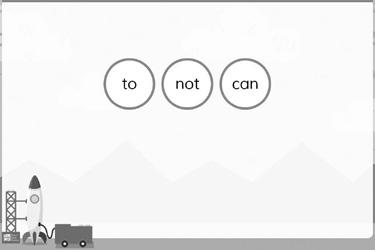
Click to display the Heart Words to, not, can.
Say “Let’s read our Heart Words, starting here.” (Point to the words to, not, and can while reading them in left to right order.)
Ask: • “Which word is last?” A: can • “Which word is before the word can?” A: not • “Which word is first?” A: to • “Which word is next?” A: not
Click to display the Heart Words like, am, the.
Say “Let’s read our Heart Words, starting here.” (Point to the words like, am, and the while reading them in left to right order.)
Ask: •
“Which word is at the beginning of the row?” A: like • “Which word is at the end of the row?” A: the • “Which word is after the word like?” A: am •
“Which word is in the middle of the row?” A: am
Click to display the Heart Words and, here, be.
See Differentiation Options on p. 70 for alternative methods of delivery. Ask more questions as time allows.
© 2017 Really Great Reading Company, LLC 203 UNIT 13 Lesson 3 | Part 3
Say “Let’s read our Heart Words, starting here.” (Point to the words and, here, and be while reading them in left to right order.)
Ask:
• “Which word is first?” A: and
• “Which word is next?” A: here
• “Which word is last?” A: be
• “Which word is after the word and?” A: here
Click to display the Heart Words it, for, go
Say “Let’s read our Heart Words, starting here.” (Point to the words it, for, and go while reading them in left to right order.)
Ask:
• “Which word is before the word go?” A: for
• “Which word is at the beginning of the row?” A: it
• “Which word is at the end of the row?” A: go
• “Which word is in the middle of the row?” A: for
See p. 70 for differentiation options for Where’s That Heart Word?
204 © 2017 Really Great Reading Company, LLC UNIT 13 Lesson 3 | Part 3
Unit 13 | Lesson 4 | Part 1
Activity 40: Touch & Say AP: Encoding
Objective
Students decode (read) words by pronouncing one sound at a time and then blending them together.
See p. 26 for a full description of Touch & Say.
3, 2, 1…
What Students See
Open Countdown Online to Unit 13, Lesson 4, Part 1 (13.4.1).
Launch! Say:
• “We’re going to read some words by ‘sounding them out.’
• Let’s get started with this word. Watch how I sound it out.”
Click to underline one letter tile at a time while saying its sound, “/j /ŏ/ /g/.”
Click to slide an arrow from left to right under the entire word while saying, “jog.”
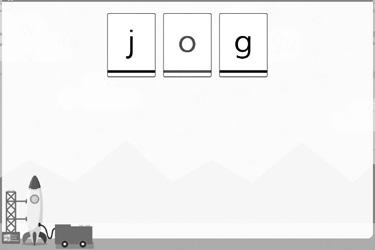
Say “Let’s keep going! This time, say the sounds and blend the word with me.”
Click to underline one letter at a time while saying its sound with students, “/z/ / ĭ/ /p/.”
Click to slide an arrow from left to right under the entire word while saying, “zip.”
Continue with remaining words, making sure students are saying each sound with you as you click to underline it:
1. web (/w/ /ĕ/ /b/)
2. zig (/z/ / ĭ/ /g/)
3. job (/j/ /ŏ/ /b/)
4. win (/w/ / ĭ/ /n/)
5. bag (/b/ /ă/ /g/)
6. tub (/t/ /ŭ/ /b/)
7. wet (/w/ /ĕ/ /t/)
8. Jen (/j/ /ĕ/ /n/)
9. zap (/z/ /ă/ /p/)
10. jam (/j/ /ă/ /m/)
11. pet (/p/ /ĕ/ /t/)
12. wag (/w/ /ă/ /g/)
13. bug (/b/ /ŭ/ /g/)
14. met (/m/ /ĕ/ /t/)
© 2017 Really Great Reading Company, LLC 205 UNIT 13 Lesson 4 | Part 1
15. rug (/r/ /ŭ/ /g/)
16. kid (/k/ / ĭ/ /d/)
17. Jim (/j/ / ĭ/ /m/)
18. wig (/w/ / ĭ/ /g/)
DIFFERENTIATION OPTIONS
Ways to challenge:
• Have students pronounce each individual sound and then blend the word independently as you underline the letters.
• Using Letter Tile Free Play (located in Supplemental Resources) or your whiteboard and marker, have students Touch & Say the following additional words: bag, bat, Ben, bet, bin, but, cab, cub, den, dug, fib, get, got, hem, jab, jag, Jan, Jed, Jon, jot, jug, Kim, kit, lad, led, let, Meg, men, Ned, peg, rag, rib, rub, set, sob, sub, Ted, tub, tug, van, vat, wed, zag, and zit
• Using Letter Tile Free Play (located in Supplemental Resources) or your whiteboard and marker, have students Touch & Say the following words with 2-sound consonant blends: act, ads, amp, and, ant, apt, ask, elf, elk, end, imp, its, and ump
Unit 13 | Lesson 4 | Part 2
Objective
Students will segment the phonemes (sounds) in three-phoneme words using finger-stretching.
See p. 11 for a full description of Stretch Those Sounds.
What Students See 3, 2, 1…
Open Countdown Online to Unit 13, Lesson 4, Part 2 (13.4.2).
Launch!
Click to display the cake.
206 © 2017 Really Great Reading Company, LLC UNIT 13 Lesson 4 | Part 2
Activity 25: Stretch Those Sounds PA: Segmenting
Say:
• “Now, we are going to separate all of the sounds in some words.
• Listen while I say the sounds in cake.”
• “cake” (hold closed fist against chest, crossing the midline)
• “/k/” (extend thumb), “/ā/” (extend pointer finger), “/k/” (extend middle finger)
• “cake” (pull fingers back to a closed fist while saying the word)
Say:
• “Let’s stretch the word cake again together.” (Students repeat sounds while finger-stretching.)
• “Let’s try another one.”
Continue with remaining images:
1. duck (/d/ /ŭ/ /k/)
2. bell (/b/ /ĕ/ /l/)
3. nail (/n/ /ā/ /l/)
4. mix (/m/ /ĭ/ /ks/)
5. robe (/r/ /ō/ /b/)
6. seal (/s/ /ē/ /l/)
7. worm (/w/ /er/ /m/)
8. yes (/y/ /ĕ/ /s/)
9. ship (/sh/ /ĭ/ /p/)
10. gate (/g/ /ā/ /t/)
11. thumb (/th/ /ŭ/ /m/)
12. ham (/h/ /ă/ /m/)
13. boat (/b/ /ō/ /t/)
14. hen (/h/ /ĕ/ /n/)
15. kid (/k/ /ĭ/ /d/)
16. inch (/ĭ/ /n/ /ch/)
17. feet (/f/ /ē/ /t/)
18. nose (/n/ /ō/ /z/)
19. pan (/p/ /ă/ /n/)
See p. 12 for differentiation options for Stretch Those Sounds.
Unit 13 | Lesson 4 | Part 3
Activity 38: Build a Word
Objective
Students encode (spell) words by first segmenting sounds and then matching sounds to letters.
See p. 103 for a full description of Build a Word.
AP: Encoding
What Students See
© 2017 Really Great Reading Company, LLC 207 UNIT 13 Lesson 4 | Part 3
To finger-stretch, begin by saying the whole word with closed fist at chest. Then, extend one finger for each sound in the word, beginning with the thumb. Finally, bring hand back into a fist while saying the whole word again. If students are using manipulatives, have them use color and letter tiles to build the word along with you.
3, 2, 1…
OPTIONAL (only if you choose to use manipulatives)
Students take out letter tiles a, b, c, d, e, f, g, h, i, j, k, l, m, n, o, p, r, s, t, u, v, w, and z and working board.
Open Countdown Online to Unit 13, Lesson 4, Part 3 (13.4.3).
Launch!
Say:
• “Now, we are going to build words with our letter tiles by listening to the sounds in each word and putting our letter tiles in order. That is how we spell words.
• Let’s build our first word!”
Click to display the image for win
Say:
• “Listen carefully. Win, /w/ / ĭ/ /n/, win (while finger-stretching)
• I heard three sounds in win, /w/ / ĭ/ /n/.”
Click to display one color tile at a time while again saying “/w/ /ĭ/ /n/.”
Say:
• “Now let’s build the word with letter tiles.
• The first sound I heard was /w/.”
Ask “What letter spells /w/?” A: w
Click to display the letter tile w under the first color tile. Say “The next sound I heard was /ĭ/. What letter spells /ĭ/?” A: i
Click to display the letter tile i under the second color tile.
Say “The last sound I heard was /n/. What letter spells /n/?” A: n
Click to display the letter tile n under the last color tile.
Say:
• “Let’s check our work. /w/ /ĭ/ /n/ (touching each letter as you say the sound), win (sweeping pointer finger under the whole word from left to right).
• Awesome job, you just spelled win. Let’s try another word.”
208 © 2017 Really Great Reading Company, LLC UNIT 13 Lesson 4 | Part 3
Continue with remaining words:
1. jet, /j/ /ĕ/ /t/
2. sad, /s/ /ă/ /d/
3. rug, /r/ /ŭ/ /g/
4. sit, /s/ /ĭ/ /t/
5. pod, /p/ /ŏ/ /d/
6. wet, /w/ /ĕ/ /t/
7. hug, /h/ /ŭ/ /g/
8. jam, /j/ /ă/ /m/
9. kid, /k/ /ĭ/ /d/
See p. 105 for differentiation options for Build a Word.
© 2017 Really Great Reading Company, LLC 209 UNIT 13 Lesson 4 | Part 3
Unit 13 | Lesson 5 | Part 1
Activity 27: Add That Sound PA: Manipulation
Objective
Students will add a sound to the end of a word to form a new word.
See p. 194 for a full description of Add That Sound.
What Students See 3, 2, 1…
Open Countdown Online to Unit 13, Lesson 5, Part 1 (13.5.1).
Launch!
Say:
• “Today, we are going to add a sound to the end of some words.
• Listen to my word, no
• Let’s finger-stretch that word together. No, /n/ /ō/, no.”
Click to display a color tile for each sound while saying the sounds again: /n/ (first color tile appears), /ō/ (second color tile appears)
Say “I am going to add a new sound, /t/, to the end of no. I’ll add a new color tile since we are adding a sound.”
Click to display a third color tile.
Say:
• “Let’s see what the new word is: /nō/ (sweep fingers under the first two tiles), /t/ (touch the third tile), note (sweep finger under the three tiles). The new word is note. Did you hear the new sound /t/ at the end?
• Let’s stretch all the sounds in note together (say the sounds while finger-stretching): /n/ (extend thumb), /ō/ (extend pointer finger), /t/ (extend middle finger), note (pull closed fist to chest).
• Let’s try another one.
• Listen to my word, bee.
• Let’s finger-stretch that word together. Bee, /b/ /ē/, bee.”
210 © 2017 Really Great Reading Company, LLC UNIT 13 Lesson 5 | Part 1
Click to display a color tile for each sound while saying the sounds with students: /b/ (first color tile appears), /ē/ (second color tile appears)
Say “I am going to add a new sound, /t/, to the end of bee. I’ll add a new color tile since we are adding a sound.”
Click to display a third color tile.
Say:
• “Let’s see what the new word is: /bē/ (sweep fingers under the first two tiles), /t/ (touch the third tile). Did you hear the new sound /t/ at the end?
• Say those sounds with me so we can blend them together, /bē/ /t/.”
Ask “What is our new word?” A: beet
Say:
• “Let’s stretch all the sounds in beet together (say the sounds while finger-stretching): /b/ (extend thumb), /ē/ (extend pointer finger), /t/ (extend middle finger), beet (pull closed fist to chest).
•
Let’s try another one.”
Continue with remaining additions:
1. say (/s/ /ā/ + /v/) save
2. may (/m/ /ā/ + /l/) mail
3. go (/g/ /ō/ + /l/) goal
4. ray (/r/ /ā/ + /k/) rake
5. day (/d/ /ā/ + /t/) date
6. she (/sh/ /ē/ + /t/) sheet
7. hi (/h/ /ī/ + /k/) hike
8. pie (/p/ /ī/ + /z/) pies
9. my (/m/ /ī/ + /t/) might
10. way (/w/ /ā/ + /k/) wake
11. day (/d/ /ā/ + /z/) days
12. we (/w/ /ē/ + /p/) weep
13. knee (/n/ /ē/ + /t/) neat
14. no (/n/ /ō/ + /p/) nope
15. moo (/m/ /�/ + /v/) move
16. lie (/l/ /ī/ + /k/) like
17. key (/k/ /ē/ + /z/) keys
18. see (/s/ /ē/ + /k/) seek
See p. 196 for differentiation options for Add That Sound.
© 2017 Really Great Reading Company, LLC 211 UNIT 13 Lesson 5 | Part 1
Unit 13 | Lesson 5 | Part 2
Activity 44: Pop-Up and 3-Up Sight Words Objective
• Students will read individual Heart Words as they pop up on the screen.
• Students will read sets of three Heart Words as they appear on the screen.
See p. 80 for a full description of Pop-Up and 3-Up.
What Students See 3, 2, 1…
Open Countdown Online to Unit 13, Lesson 5, Part 2 (13.5.2).
Launch!
POP-UP: Say:
• “Now, we are going to practice reading the Heart Words we’ve been reading all week.
• In our first game, when you see a word pop up onto the screen, say the word out loud.
• If you need help remembering, I can help, but try your best.”
Click to display the Heart Words to, not, can, like, and, go, in, for, and be at random. Each word will appear several times.
3-UP: Say:
• “Great job! In our next game, you will see three words on the screen.
• Remember, when you see the red dot, stop and look at the three words. When you see the yellow dot, think about the words and try to remember them. When you see the green dot, say the three words out loud.
• If you need help remembering, I can help, but try your best.”
Click to display the sets of three Heart Words. Each set will contain three of the following words in a random group: to, not, can, like, and, go, in, for, and be Each word will appear several times.
212 © 2017 Really Great Reading Company, LLC UNIT 13 Lesson 5 | Part 2
Unit 13 | Lesson 5 | Part 3
Activity 41: Phrase Reading AP: Decoding
Objective
Students will practice reading decodable words and Heart Words in three-word phrases.
See p. 134 for a full description of Phrase Reading.
3, 2, 1…
What Students See
Open Countdown Online to Unit 13, Lesson 5, Part 3 (13.5.3).
Launch! Say:
• “Now, we are going to read some phrases together.
• When each word shows up on the screen, we’ll read it together.
• Then, when all three words are up, we are going to read the phrase together.
• Let’s get started!”
Click to display the red word go.
Say “Remember, red words are Heart Words. Let’s say it together.” (go)
Click to display the red word to.
Say “Let’s say it together.” (to)
Click to display the black word bed.
Say “Remember, we can sound out black words. Let’s sound it out together.” (Use Touch & Say to sound out the word together: /b/ /ĕ/ /d/, bed.)
Say “Now we know all of the words, but let’s try to read them together in order. When I point to a word, read it out loud: go to bed.” (Point to each word, having students read the words aloud as you go. Begin with a pause between each word, and then repeat the process with shorter pauses on the second and third rounds to build fluency.)
Say “Let’s try another phrase, or group of words.”
Continue with the following phrases in the same manner: not* on top; can* get gum; tag and* run; sit in* mud; the red van; my pet ran; the big web; sun is hot; jog for fun
Some of the Heart Words, marked with an asterisk, are also decodable, but they are still written in red because it is beneficial and more efficient for students to see these common words as words they should know by heart. If they struggle to remember these words, feel free to have your students sound out the decodable Heart Words.
© 2017 Really Great Reading Company, LLC 213 UNIT 13 Lesson 5 | Part 3
214 © 2017 Really Great Reading Company, LLC
Unit 14 | Lesson 1 | Part 1
Activity 20: This or That? PA: BSI
Objective
Students will identify which word of two has a specific beginning sound.
See p. 35 for a full description of This or That?
3, 2, 1…
What Students See
Open Countdown Online to Unit 14, Lesson 1, Part 1 (14.1.1).
Launch! Say “Today, we are going to listen for the word that begins with the sound I say.”
Click to display the finger and the quarter.
Point to each image and say “Finger, quarter. Which word starts with /kw/?”
A: quarter Say:
• “Yes, /kw/, quarter
• Let’s try another one.”
Continue with the remaining examples:
1. elbow/avocado (“Which one starts with /ĕ/?” A: elbow)
2. muffin/rattle (“Which one starts with /r/?” A: rattle)
3. shadow/thunder (“Which one starts with /th/?” A: thunder)
4. oboe/easel (“Which one starts with /ē/?” A: easel)
5. leg /wave (“Which one starts with /l/?” A: leg)
6. chocolate/shoe (“Which one starts with /ch/?” A: chocolate)
7. icicle/unicorn (“Which one starts with /y�/?” A: unicorn)
8. toaster/penny (“Which one starts with /t/?” A: toaster)
9. king /balloon (“Which one starts with /k/?” A: king)
10. garden/nurse (“Which one starts with /g/?” A: garden)
11. jellybeans/headphones (“Which one starts with /j/?” A: jellybeans)
© 2017 Really Great Reading Company, LLC 215 UNIT 14 Lesson 1 | Part 1
Optional motions for consonant sounds are available in the Appendix on p. 290 for students who may require more of a kinesthetic approach.
12. iguana/umbrella (“Which one starts with /ŭ/?” A: umbrella)
13. zucchini/volcano (“Which one starts with /z/?” A: zucchini)
14. fireworks/doughnut (“Which one starts with /d/?” A: doughnut)
15. mittens/oatmeal (“Which one starts with /ō/?” A: oatmeal)
16. window/lightbulb (“Which one starts with /w/?” A: window)
17. cactus/stairs (“Which one starts with /k/?” A: cactus)
18. three/peas (“Which one starts with /p/?” A: peas)
19. garbage/juice (“Which one starts with /j/?” A: juice)
See p. 36 for differentiation options for This or That?
Unit 14 | Lesson 1 | Part 2
Activity 30: Name That Sound
Objective
Students will identify the uppercase and lowercase letters associated with the sounds /kw/, /ks/, and /y/.
See p. 2 for a full description of Name That Sound.
3, 2, 1…
AP: Letter ID
What Students See
Open Countdown Online to Unit 14, Lesson 1, Part 2 (14.1.2).
Launch!
Say “Now, we are going to see what our sounds look like when they are written down.”
Click to display the queen.
Ask:
• “What is this a picture of?” A: queen
• “What is the first sound in queen?” A: /kw/
Click to display the corresponding uppercase and lowercase letter tiles.
216 © 2017 Really Great Reading Company, LLC UNIT 14 Lesson 1 | Part 2
Say:
•
“Right, queen begins with /kw/, and these letters say the sound, or spell, /kw/.
•
Do you remember Quincy the Quail? She became the costume queen of the city after she made a quilted jacket. Her favorite sound is /kw/.
•
The name of these letters (point to the Q and q on the Qu and qu tiles) is Q , and Q is always followed by the letter u. When we see qu together, it will say /kw/, like the beginning of /kw/, queen.
•
This one (point to uppercase Q on the Qu tile) is called ‘capital Q ,’ and this one (point to lowercase q on the qu tile) is called ‘lowercase q.’ This is the one we will see most of the time, so we’ll just call it q
•
Whenever you see the letters qu, remember that they work together to say /kw/.
Let’s learn another new letter.”
•
Click to display the image for mix
Ask:
• “What is this a picture of?” A: a spoon mixing something in a bowl
• “What is the last sound in mix?” A: /ks/
Click to display the corresponding uppercase and lowercase letter tiles.
Say:
• “Right, mix ends with /ks/, and these letters say /ks/.
• Do you remember Max the Fox? He likes to mix everything on his dinner plate together. His favorite sound is /ks/.”
Ask “So, what do you think these letters say?” A: /ks/ Say: •
•
“Yes! The name of these letters is X . X says /ks/, like the end of mix.
This one (point to uppercase X) is called ‘capital X,’ and this one (point to lowercase x) is called ‘lowercase x.’ This is the one we will see most of the time, so we’ll just call it x
Let’s learn another new letter.”
•
Click to display the image for yes.
Ask: • “What is this a picture of?” A: a person saying “yes”
• “What is the first sound in yes?” A: /y/
© 2017 Really Great Reading Company, LLC 217 UNIT 14 Lesson 1 | Part 2
Click to display the corresponding uppercase and lowercase letter tiles.
Say:
• “Right, yes begins with /y/, and these letters say /y/.
• Do you remember Yolanda the Yak? She said yes to eating frozen yogurt and to yodeling from the hilltops. Her favorite sound is /y/.”
Ask “So, what do you think these letters say?” A: /y/
Say:
• “Yes! The name of these letters is Y Y says /y/, like the beginning of yes
• This one (point to uppercase Y) is called ‘capital Y,’ and this one (point to lowercase y) is called ‘lowercase y.’ This is the one we will see most of the time, so we’ll just call it y.”
Click to display letter tiles qu, x, and y.
Say “Let’s name our letters one more time and say the sound that each letter spells.”
Point to each letter, one at a time, and say:
• “This is qu. Qu says /kw/.
• This is x. X says /ks/.
• This is y. Y says /y/.”
Unit 14 | Lesson 1 | Part 3
Activity 42: Look, Think, Say; Pop-Up; 3-Up Sight Words
Objective
• Students will read three Heart Words from memory (or by decoding if necessary).
• Students will read individual Heart Words as they pop up on the screen.
• Students will read sets of three Heart Words as they appear on the screen
What Students See
See p. 61 for a full description of Look, Think, Say; Pop-Up; 3-Up.
3, 2, 1…
Open Countdown Online to Unit 14, Lesson 1, Part 3 (14.1.3).
218 © 2017 Really Great Reading Company, LLC UNIT 14 Lesson 1 | Part 3
Launch!
Say “Now, we are going to learn to read some new Heart Words.”
LOOK, THINK, SAY:
Click twice to display the Heart Word you with one red dot and two empty dots below.
Say:
• “This red dot (point to the red dot) tells us to stop what we are doing so we can listen to the word.
•
This word is you, as in ‘ You are a great friend.’”
Click to display the yellow dot.
Say “Think about this word.”
Click to display the green dot.
Say:
• “Remember, this green dot (point to the green dot) tells us to say the word out loud.
• Say the word with me, you.
• Let’s try another word.
• Remember to look, think, and then say. Only say the word out loud when the green dot shows up.”
Click twice to display the Heart Word are with one red dot and two empty dots below.
Say “Look at the word are, as in ‘We are learning to read many new words.’”
Click to display the yellow dot.
Say “Think about this word.”
Click to display the green dot.
Say:
• “Say the word!
• Let’s try one more word.”
Click twice to display the Heart Word do with one red dot and two empty dots below.
Say “Look at the word do, as in, ‘What should we do after school today?’”
Click to display the yellow dot.
© 2017 Really Great Reading Company, LLC 219 UNIT 14 Lesson 1 | Part 3
Say “Think about this word.”
Click to display the green dot.
Say:
• “Say the word!
• Let’s look at those words one more time.”
Continue with the same three Heart Words for two additional rounds.
POP-UP: Say:
• “Now, we are going to practice reading the Heart Words we’ve learned.
• In our first game, when you see a word pop up onto the screen, say the word out loud.
• If you need help remembering, I can help, but try your best.”
Click to display the Heart Words to, not, for, like, am, can, you, are, and do at random. Each word will appear several times.
Read each word together with students as it pops up.
3-UP: Say:
• “Great job! In our next game, you will see three words on the screen.
• When you see the red dot, stop and look at the three words. When you see the yellow dot, think about the words and try to remember them. When you see the green dot, say the three words out loud.”
Click to display the sets of three Heart Words. Each set will contain the following words in a random order: to, not, for, like, am, can, you, are, and do. Each word will appear several times.
Look, think about, and say each set of three words together with students as the sets are displayed.
220 © 2017 Really Great Reading Company, LLC UNIT 14 Lesson 1 | Part 3
Unit 14 | Lesson 2 | Part 1
Activity 36: Guess My Word AP: Encoding
Objective
Students will observe the encoding of a word and then blend together the word's phonemes.
See p. 39 for a full description of Guess My Word.
3, 2, 1…
What Students See
Open Countdown Online to Unit 14, Lesson 2, Part 1 (14.2.1).
Launch!
Say “Now, you’re going to guess my mystery words that got all mixed up.”
Click to display the letter tiles x, m, i.
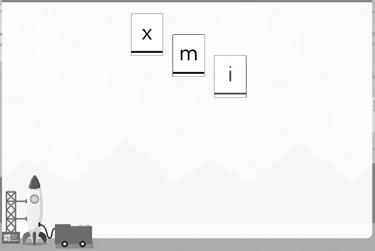
Say “Guess the mystery word, /m/ /ĭ/ /ks/.” (Click to move the letter tiles into the correct position as you say each sound.)
Ask “What’s my word?” A: mix (Students blend the sounds together to say the word.)
Say “/m/ /ĭ/ /ks/, mix.” (Point to each letter tile as you say its sound, and then sweep your finger under the word from left to right while saying the whole word.)
Click to display the image for mix.
Continue with remaining images:
1. /y/ /ĕ/ /s/, yes
2. /b/ /ă/ /t/, bat 3. /f/ /ŏ/ /ks/, fox
4. /h/ /ŭ/ /g/, hug
5. /l/ /ĕ/ /g/, leg
6. /k/ /ĭ/ /d/, kid
7. /h/ /ŏ/ /g/, hog
8. /v/ /ă/ /n/, van
9. /s/ /ĭ/ /ks/, six
10. /r/ /ĕ/ /d/, red
11. /y/ /ă/ /k/, yak
12. /kw/ /ĭ/ /t/, quit 13. /h/ /ĕ/ /n/, hen
14. /y/ /ă/ /m/, yam
See p. 40 for differentiation options for Guess My Word.
© 2017 Really Great Reading Company, LLC 221 UNIT 14 Lesson 2 | Part 1
Unit 14 | Lesson 2 | Part 2
Activity 31: This Letter or That?
Objective
Students will identify the letter symbol that spells the first or last sound in a word.
See p. 8 for a full description of This Letter or That?
3, 2, 1…
What
AP: Letter ID
Students See
Open Countdown Online to Unit 14, Lesson 2, Part 2 (14.2.2).
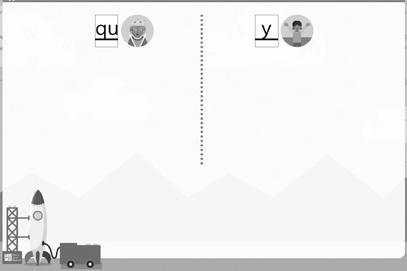
Launch!
SORT 1:
Click to display two columns with the headings “qu” (for queen) and “y ” (for yes).
Ask “What is the first sound in queen (while pointing to the queen)?” A: /kw/ Say “Remember, the sound /kw/ is spelled with the letters qu (while pointing to the letter tile qu).”
Ask “What is the first sound in yes (while pointing to the image for yes)?” A: /y/
Say “Remember, the sound /y/ is spelled with the letter y (while pointing to the letter tile y).”
Click to display the quail at the bottom of the screen.
Ask:
• “Quail. What is the first sound in quail?” A: /kw/
• “Should we put the /kw/, quail under the qu, like /kw/, queen or the y, like /y/, yes?” A: qu, /kw/, queen
Say “Right, /kw/, quail and /kw/, queen both start with the letters qu, so I’ll move the quail under the qu.”
Click to place the quail in the “qu ” column.
Continue with remaining images: quilt, yacht, quarter, question, yawn, yoyo, quick, yellow, yogurt, quiet, yarn.
222 © 2017 Really Great Reading Company, LLC UNIT 14 Lesson 2 | Part 2
Say:
•
“Let’s go over our work (point to each image as you label it with students):
o /kw/, queen; /kw/, quail; /kw/, quilt; /kw/, quarter ; /kw/, question; /kw/, quick; /kw/, quiet
o /y/, yes; /y/, yacht; /y/, yawn; /y/, yoyo; /y/, yellow; /y/, yogurt; /y/, yarn.
•
Let’s try that with two new letters.”
SORT 2:
Click to display two columns with the headings “x ” ( for mix) and “v ” (for violin).
Ask “What is the last sound in mix (while pointing to the image for mix)?”
A: /ks/
Say “Remember, the sound /ks/ is spelled with the letter x (while pointing to the letter tile x).”
Ask “What is the first sound in violin (while pointing to the violin)?” A: /v/
Say “Remember, the sound /v/ is spelled with the letter v (while pointing to the letter tile v).”
Click to display the ax at the bottom of the screen.
Ask:
• “Ax. What is the last sound in ax?” A: /ks/
• “What letter spells the sound /ks/?” A: x • “Should we put the ax, /ks/ under the x, like the last sound /ks/ in mix or the v, like the first sound in /v/, violin?” A: x, /ks/, mix
Click to place the ax in the “x ” column.
Continue with remaining images: vegetables, six, ox, vacuum, van, Max, vase, fox, volcano, wax, vehicle.
Say:
• “Let’s go over our work (point to each image as you label it with students): o mix, /ks/; ax, /ks/; six, /ks/; ox, /ks/; Max, /ks/; fox, /ks/; wax, /ks/. o /v/, violin; /v/, vegetables; /v/, vacuum; /v/, van; /v/, vase; /v/, volcano; /v/, vehicle.”
See p. 10 for differentiation options for This Letter or That?
© 2017 Really Great Reading Company, LLC 223 UNIT 14 Lesson 2 | Part 2
You may want to have students point all the way to the left for v, to the center for x, and all the way to the right for y. If students are using manipulatives, have them hold up the correct tile and name it rather than point.
Unit 14 | Lesson 2 | Part 3
Activity 34: Which Letter? AP: Letter ID
Objective
Students will isolate the beginning or ending sound in a word and match that sound to its letter symbol.
See p. 33 for a full description of Which Letter?
What Students See 3, 2, 1…
OPTIONAL (only if you choose to use manipulatives)
Prepare materials:
• All letter tiles and working board from Countdown Student Kit for each student
Open Countdown Online to Unit 14, Lesson 2, Part 3 (14.2.3).
Launch!
OPTIONAL (only if you choose to use manipulatives)
Students take out all letter tiles and working board.
Say “Now, we are going to spell the first or last letter of some words.”
Click to display the box with the letters b o spelled out below.
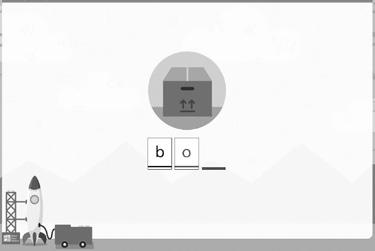
Say “Box.”
Ask “What is the last sound in box?” A: /ks/
Click to display three letter tiles: v, x, y.
Ask “Which of these letters spells /ks/ like at the end of box, /ks/? Point to the letter tile that spells the sound /ks/, and say its name.” A: x
Click to show the correct answer.
Click to display the image for yes with the letters e s spelled out below.
Say “ Yes.”
Ask “What is the first sound in yes?” A: /y/
224 © 2017 Really Great Reading Company, LLC UNIT 14 Lesson 2 | Part 3
Click to display three letter tiles: y, z, qu.
Ask “Which of these letters spells /y/ like /y/, yes? Point to the letter tile that spells /y/, and say its name.” A: y
Click to show the correct answer.
Continue with remaining images:
1. fox (x) (last sound)
2. ham (h)
3. wax (x) (last sound)
4. mug (m)
5. rug (r)
6. van (v)
7. nap (n)
8. jam ( j)
9. net (n)
10. sit (s) 11. hug (h) 12. dog (d) 13. cat (c) 14. bag (b) 15. six (x) (last sound) 16. bed (b) 17. hat (h) 18. leg (l)
See p. 34 for differentiation options for Which Letter?
© 2017 Really Great Reading Company, LLC 225 UNIT 14 Lesson 2 | Part 3
Unit 14 | Lesson 3 | Part 1
Activity 27: Add That Sound PA: Manipulation
Objective
Students will add a sound to the beginning of a word to form a new word.
See p. 194 for a full description of Add That Sound.
What
Students
See 3, 2, 1…
Open Countdown Online to Unit 14, Lesson 3, Part 1 (14.3.1).
Launch!
Say:
• “Today, we are going to add a sound to the beginning of some words.
• Listen to my word, ape.”
Click to display a color tile for each sound while saying the sounds with students: /ā/ (first color tile appears), /p/ (second color tile appears).
Say “I am going to add a new sound, /t/, to the beginning of ape. I’ll add a new color tile since we are adding a sound.”
Click to display a new color tile at the beginning.
Say:
•
“Let’s see what the new word is: /t/ (touch the first tile), /āp/ (sweep fingers under the second and third tiles), tape (sweep finger under the three tiles) The new word is tape. Did you hear the new sound, /t/, at the beginning?
•
Let’s stretch all the sounds in tape together (say the sounds while finger-stretching): /t/ (extend thumb), /ā/ (extend pointer finger), /p/ (extend middle finger), tape (pull closed fist to chest).
• Let’s try another one.
• Listen to my word, in.”
Click to display a color tile for each sound while stretching the sounds with students: /ĭ/ (first color tile appears), /n/ (second color tile appears)
Say “I am going to add a new sound, /w/, to the beginning of in. I’ll add a new color tile since we are adding a sound.”
226 © 2017 Really Great Reading Company, LLC UNIT 14 Lesson 3 | Part 1
Click to display a new color tile at the beginning.
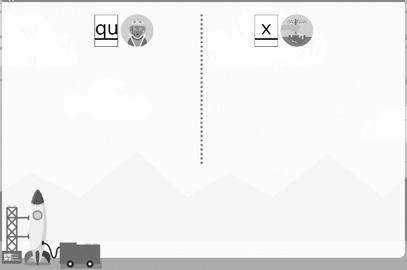
Say:
• “Let’s see what the new word is: /w/ (touch the first tile), /ĭn/ (sweep fingers under the second and third tiles). Did you hear the new sound, /w/, at the beginning?
• Say those sounds with me so we can blend them together.”
Ask “What is our new word?” A: win
Say:
•
“Let’s stretch all the sounds in win together (say the sounds while finger-stretching): /w/ (extend thumb), /ĭ/ (extend pointer finger), /n/ (extend middle finger), win (pull closed fist to chest).
• Let’s try another one.”
Continue with remaining images:
1. edge (/l/ + /ĕ/ /j/) ledge
2. at (/b/ + /ă/ /t/) bat
3. ache (/t/ + /ā/ /k/) take
4. oat (/b/ + /ō/ /t/) boat
5. an (/f/ + /ă/ /n/) fan
6. ax (/t/ + /ă/ /ks/) tax
7. itch (/r/ + /ĭ/ /ch/) rich
8. egg (/b/ + /ĕ/ /g/) beg
9. eat (/s/ + /ē/ /t/) seat
10. ate (/d/ + /ā/ /t/) date
11. on (/r/ + /ŏ/ /n/) Ron
12. ice (/n/ + /ī/ /s/) nice
13. in (/p/ + /ĭ/ /n/) pin
14. etch (/f/ + /ĕ/ /ch/) fetch
15. use (/f/ + /y�/ /z/) fuse
16. add (/m/ + /ă/ /d/) mad
17. ill (/f/ + /ĭ/ /l/) fill
18. at (/h/ + /ă/ /t/) hat
See p. 196 for differentiation options for Add That Sound.
Unit 14 | Lesson 3 | Part 2
Objective
Students will identify the letter symbol that spells the first or last sound in a word.
See p. 8 for a full description of This Letter or That?
What Students See
© 2017 Really Great Reading Company, LLC 227 UNIT 14 Lesson 3 | Part 2
Activity 31: This Letter or That? AP: Letter ID
3, 2, 1…
Open Countdown Online to Unit 14, Lesson 3, Part 2 (14.3.2).
Launch!
SORT 1:
Click to display two columns with the headings “qu” (for queen) and “x ” (for mix).
Ask “What is the first sound in queen (while pointing to the queen)?” A: /kw/ Say “Remember, the sound /kw/ is spelled with the letters qu (while pointing to the letter tile qu).”
Ask “What is the last sound in mix (while pointing to the image for mix)?” A: /ks/ Say “Remember, the sound /ks/ is spelled with the letter x (while pointing to the letter tile x).”
Click to display the fox at the bottom of the screen. Ask: • “Fox. What is the last sound in fox?” A: /ks/
• “Should we put the /ks/, fox under the qu, like /kw/, queen or the x, like /ks/, mix?” A: x, /ks/, mix
Say “Right, /ks/, fox and /ks/, mix both end with the letter x, so I’ll move the fox under the x.”
Click to place the fox in the “x ” column.
Continue with remaining images: question, ox, six, quick, ax, quarter, quiet, Max, quail, quilt, wax
Say: • “Let’s go over our work (point to each image as you label it with students):
o /kw/, queen; /kw/, question; /kw/, quick; /kw/, quarter; /kw/, quiet; /kw/, quail; /kw/, quilt.
o mix, /ks/; fox, /ks/; ox, /ks/; six, /ks/; ax, /ks/; Max, /ks/; wax, /ks/.
• Let’s try that with two new letters.”
SORT 2:
Click to display two columns with the headings “y ” (for yes) and “ f ” (for fish).
Ask “What is the first sound in yes (while pointing to the image for yes)?” A: /y/
Say “Remember, the sound /y/ is spelled with the letter y (while pointing to the letter tile y).”
Ask “What is the first sound in fish (while pointing to the fish)?” A: /f/
228 © 2017 Really Great Reading Company, LLC UNIT 14 Lesson 3 | Part 2
Say “Remember, the sound /f/ is spelled with the letter f (while pointing to the letter tile f).”
Click to display the fireworks at the bottom of the screen.
Ask: • “Fireworks. What is the first sound in fireworks?” A: /f/
• “Should we put the /f/, fireworks under the y, like /y/, yes or the f, like /f/, fish?” A: f, /f/, fish
Say “Right, /f/, fireworks and /f/, fish both start with the letter f, so I’ll move the fireworks under the f.”
Click to place the fireworks in the “ f ” column.
Continue with remaining images: feet, yarn, yellow, flower, fence, yawn, finger, yoyo, yacht, fries, yogurt.
Say: • “Let’s go over our work (point to each image as you label it with students): o /y/, yes; /y/, yarn; /y/, yellow; /y/, yawn; /y/, yoyo; /y/, yacht; /y/, yogurt. o /f/, fish; /f/, fireworks; /f/, feet; /f/, flower; /f/, fence; /f/, finger; /f/, fries.”
See p. 10 for differentiation options for This Letter or That?
Unit 14 | Lesson 3 | Part 3
Activity 43: Where’s That Heart Word? Sight Words
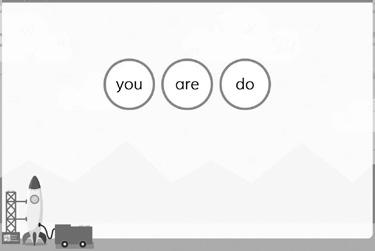
Objective
Students will read three Heart Words from memory, using sequence and location vocabulary to identify where they are on the screen.
What Students See
See p. 69 for a full description of Where’s That Heart Word?
3, 2, 1…
Open Countdown Online to Unit 14, Lesson 3, Part 3 (14.3.3).
Launch!
Say “Now, we are going to practice reading some of the Heart Words we’ve learned.”
© 2017 Really Great Reading Company, LLC 229 UNIT 14 Lesson 3 | Part 3
See Differentiation Options on p. 70 for alternative methods of delivery.
Click to display the Heart Words you, are, do.
Say “Let’s read our Heart Words, starting here.” (Point to the words you, are, and do while reading them in left to right order.)
Ask:
Ask more questions as time allows.
• “Which word is last?” A: do • “Which word is before the word do?” A: are • “Which word is first?” A: you • “Which word is next?” A: are
Click to display the Heart Words my, and, be.
Say “Let’s read our Heart Words, starting here.” (Point to the words my, and, and be while reading them in left to right order.)
Ask: • “Which word is at the beginning of the row?” A: my • “Which word is at the end of the row?” A: be • “Which word is after the word and?” A: be • “Which word is in the middle of the row?” A: and
Click to display the Heart Words the, like, not.
Say “Let’s read our Heart Words, starting here.” (Point to the words the, like, and not while reading them in left to right order.)
Ask: • “Which word is first?” A: the • “Which word is next?” A: like • “Which word is last?” A: not • “Which word is after the word the?” A: like
Click to display the Heart Words go, to, can.
Say “Let’s read our Heart Words, starting here.” (Point to the words go, to, and can while reading them in left to right order.)
Ask:
• “Which word is before the word can?” A: to • “Which word is at the beginning of the row?” A: go • “Which word is at the end of the row?” A: can
• “Which word is in the middle of the row?” A: to
See p. 70 for differentiation options for Where’s That Heart Word?
230 © 2017 Really Great Reading Company, LLC UNIT 14 Lesson 3 | Part 3
Unit 14 | Lesson 4 | Part 1
Activity 33: Connect the Letter
AP: Letter ID
Objective
Students will practice connecting a word’s beginning sound to its corresponding letter symbol.
See p. 24 for a full description of Connect the Letter.
What Students See 3, 2, 1…
Open Countdown Online to Unit 14, Lesson 4, Part 1 (14.4.1).
Launch!
Ask “This is the letter w. What sound does the letter w spell?” A: /w/
Say “Right. Now, let’s look at a few pictures and see which one begins with that sound.”
Click to display, point to, and name three images below the letter tile w: zero, wig, and volcano.
Ask “Which one begins with /w/?” A: wig
Say “Yes, /w/, wig begins with /w/, so wig begins with the letter w.”
Click to show the correct answer. Say “Let’s try that with some new pictures.”
Continue with remaining letter tiles and images: w
• wing, van, quick
• yarn, waterfall, sick
• wagon, box, candles
j
• jet, violin, quail
• watermelon, juice, yawn
• soap, cupcake, jellyfish
• jump, bookshelf, lion
© 2017 Really Great Reading Company, LLC 231 UNIT 14 Lesson 4 | Part 1
z
• zoo, bone, hamster
• quiet, zebra, yogurt
• sidewalk, wave, zigzag
• glass, volcano, zucchini g
• jellybeans, dinosaur, garden
• gift, whale, lamp
• garbage, stars, water y
• mouth, yellow, quilt
• yes, window, toes qu
• question, vase, upside down
• worm, queen, zipper e
• alligator, yoyo, elbow
See p. 25 for differentiation options for Connect the Letter.
Unit 14 | Lesson 4 | Part 2
Activity 37: Unscramble This AP: Encoding
Objective
Students help the teacher segment the phonemes in words while the teacher models the encoding (spelling) of each sound.
See p. 54 for a full description of Unscramble This.
What Students See 3, 2, 1…
Open Countdown Online to Unit 14, Lesson 4, Part 2 (14.4.2).
232 © 2017 Really Great Reading Company, LLC UNIT 14 Lesson 4 | Part 2
Launch!
Say “Now, we’re going to unscramble some letters that got mixed up. When we unscramble them and put them in the right order, they will make real words we can read.”
Click to display the image for yes and the letter tiles e, y, s.
Say: • “ Yes.
• Let’s stretch the sounds in yes together.”
Click to move each letter tile to the correct position AS you and students say the sounds /y/ /ĕ/ /s/.
Say “Now, let’s make sure those sounds really blend to make the word yes.”
Point to each letter tile as you and the students say its sound, /y/ /ĕ/ /s/, and then sweep your finger under the word from left to right while saying the whole word, yes
Say:
• “Let’s try to unscramble another mixed up word.
• This time, it’s your turn to stretch out the words on your own.”
Continue with remaining images:
1. six (/s/ / ĭ/ /ks/)
2. pen (/p/ /ĕ/ /n/) 3. van (/v/ /ă/ /n/) 4. mug (/m/ /ŭ/ /g/) 5. cat (/k/ /ă/ /t/) 6. kid (/k/ / ĭ/ /d/) 7. ran (/r/ /ă/ /n/)
8. pod (/p/ /ŏ/ /d/) 9. net (/n/ /ĕ/ /t/) 10. jet (/j/ /ĕ/ /t/) 11. hop (/h/ /ŏ/ /p/) 12. bug (/b/ /ŭ/ /g/) 13. fox (/f/ /ŏ/ /ks/) 14. cup (/k/ /ŭ/ /p/)
See p. 55 for differentiation options for Unscramble This.
© 2017 Really Great Reading Company, LLC 233 UNIT 14 Lesson 4 | Part 2
If students are using manipulatives, have them use color and letter tiles to build the word along with you.
Unit 14 | Lesson 4 | Part 3
Activity 38: Build a Word AP: Encoding Objective
Students encode (spell) words by first segmenting sounds and then matching sounds to letters.
See p. 103 for a full description of Build a Word.
What Students See 3, 2, 1…
OPTIONAL (only if you choose to use manipulatives)
Students take out all letter tiles and working board.
Open Countdown Online to Unit 14, Lesson 4, Part 3 (14.4.3).
Launch!
Say:
• “Now, we are going to build words with our letter tiles by listening to the sounds in each word and putting our letter tiles in order. That is how we spell words.
• Let’s build our first word!”
Click to display the six.
Say:
• “Listen carefully. Six, /s/ / ĭ/ /ks/, six (while finger-stretching).
• I heard three sounds in six, /s/ / ĭ/ /ks/.”
Click to display one color tile at a time while again saying “/s/ /ĭ/ /ks/.”
Say:
• “Now let’s build the word with letter tiles.
• The first sound I heard was /s/.”
Ask “What letter spells /s/?” A: s
Click to display the letter tile s under the first color tile.
Say “The next sound I heard was /ĭ/. What letter spells /ĭ/?” A: i
234 © 2017 Really Great Reading Company, LLC UNIT 14 Lesson 4 | Part 3
Click to display the letter tile i under the second color tile.
Say “The last sound I heard was /ks/. What letter spells /ks/?” A: x
Click to display the letter tile x under the last color tile.
Say:
• “Let’s check our work. /s/ /ĭ/ /ks/ (touching each letter as you say the sound), six (sweeping pointer finger under the whole word from left to right).
• Awesome job, you just spelled six. Let’s try another word.”
Continue with remaining words:
1. jam, /j/ /ă/ /m/
2. box, /b/ /ŏ/ /ks/
3. yam, /y/ /ă/ /m/
4. leg, /l/ /ĕ/ /g/
5. pan, /p/ /ă/ /n/
6. zip, /z/ /ĭ/ /p/
7. win, /w/ /ĭ/ /n/
8. bed, /b/ /ĕ/ /d/
9. yes, /y/ /ĕ/ /s/
See p. 105 for differentiation options for Build a Word.
© 2017 Really Great Reading Company, LLC 235 UNIT 14 Lesson 4 | Part 3
Unit 14 | Lesson 5 | Part 1
Activity 40: Touch & Say AP: Decoding
Objective
Students decode (read) words by pronouncing one sound at a time and then blending them together.
See p. 26 for a full description of Touch & Say.
What Students See 3, 2, 1…
Open Countdown Online to Unit 14, Lesson 5, Part 1 (14.5.1).
Launch! Say:
• “We’re going to read some words ‘by sounding them out.’
• Let’s get started with this word. Watch how I sound it out.”
Click to underline one letter tile at a time while saying its sound, “/f/ / ĭ/ /ks/.”
Click to slide an arrow from left to right under the entire word while saying, “fix.” Say “Let’s keep going! This time, say the sounds and blend the word with me.”
Click to underline one letter at a time while saying its sound with students, “/y/ /ĕ/ /s/.”
Click to slide an arrow from left to right under the entire word while saying, “yes.”
Continue with remaining words, making sure students are saying each sound with you as you click to underline it: 1. yam (/y/ /ă/ /m/)
six (/s/ / ĭ/ /ks/)
(/b/ /ă/ /g/)
(/ŏ/ /ks/)
(/f/ /ŏ/ /ks/)
(/j/ / ĭ/ /g/)
(/m/ / ĭ/ /ks/)
quit (/kw/ / ĭ/ /t/)
(/v/ /ă/ /n/)
(/b/ /ŏ/ /ks/)
(/g/ /ŏ/ /t/)
yak (/y/ /ă/ /k/)
(/b/ /ŭ/ /t/)
(/w/ /ă/ /ks/)
yum (/y/ /ŭ/ /m/)
men (/m/ /ĕ/ /n/)
dot (/d/ /ŏ/ /t/)
run (/r/ /ŭ/ /n/)
236 © 2017 Really Great Reading Company, LLC UNIT 14 Lesson 5 | Part 1
3.
4.
5.
6.
7.
8.
9.
10.
11.
12.
13.
14.
15.
16.
17.
18.
2.
bag
ox
fox
jig
mix
van
box
got
but
wax
DIFFERENTIATION OPTIONS
Ways to challenge:
• Have students pronounce each individual sound and then blend the word independently as you underline the letters.
• Using Letter Tile Free Play (located in Supplemental Resources) or your whiteboard and marker, have students Touch & Say the following additional words: ax, Ben, bet, den, dug, fax, fib, get, hem, jab, jag, Jan, Jed, Jon, jot, jug, Kim, kit, lad, led, let, Max, Meg, Ned, peg, quip, rag, Rex, rib, sax, set, sob, sub, tax, Ted, tub, tug, tux, vat, wed, yap, yep, yet, zag, and zit
• Using Letter Tile Free Play (located in Supplemental Resources) or your whiteboard and marker, have students Touch & Say the following words with 2-sound consonant blends: act, ads, amp, and, ant, apt, ask, elf, elk, end, imp, its, and ump
Unit 14 | Lesson 5 | Part 2
Activity 44: Pop-Up and 3-Up AP: Decoding
Objective
• Students will read individual Heart Words as they pop up on the screen.
• Students will read sets of three Heart Words as they appear on the screen.
See p. 80 for a full description of Pop-Up and 3-Up.
3, 2, 1…
What Students See
Open Countdown Online to Unit 14, Lesson 5, Part 2 (14.5.2).
Launch!
POP-UP: Say:
• “Now, we are going to practice reading the Heart Words we have learned so far.
• In our first game, when you see a word pop up onto the screen, say the word out loud.
© 2017 Really Great Reading Company, LLC 237 UNIT 14 Lesson 5 | Part 2
• If you need help remembering, I can help, but try your best.”
Click to display the Heart Words do, like, my, not, go, to, can, are, and you at random. Each word will appear several times.
3-UP: Say:
• “Great job! In our next game, you will see three words on the screen.
• Remember, when you see the red dot, stop and look at the three words. When you see the yellow dot, think about the words and try to remember them. When you see the green dot, say the three words out loud.
• If you need help remembering, I can help, but try your best.”
Click to display the sets of three Heart Words. Each set will contain three of the following words in a random group: do, like, my, not, go, to, can, are, and you. Each word will appear several times.
Unit 14 | Lesson 5 | Part 3
Activity 41: Phrase Reading AP: Decoding
Objective
Students will practice reading decodable words and Heart Words in three-word phrases.
See p. 134 for a full description of Phrase Reading.
What Students See 3, 2, 1…
Open Countdown Online to Unit 14, Lesson 5, Part 3 (14.5.3).
Launch! Say:
• “Now, we are going to read some phrases together.
• When each word shows up on the screen, we’ll read it together.
• Then, when all three words are up, we are going to read the phrase together.
• Let’s get started!”
238 © 2017 Really Great Reading Company, LLC UNIT 14 Lesson 5 | Part 3
Click to display the red word you.
Say “Remember, red words are Heart Words. Let’s say it together.” (you)
Click to display the red word can
Say “Let’s say it together.” (can)
Click to display the black word jog
Say “Remember, we can sound out black words. Let’s sound it out together.” (Use Touch & Say to sound out the word together: /j/ /ŏ/ /g/, jog.)
Say “Now we know all of the words, but let’s try to read them together in order. When I point to a word, read it out loud: you can* jog.” (Point to each word, having students read the words aloud as you go. Begin with a pause between each word, and then repeat the process with shorter pauses on the second and third rounds to build fluency.)
Say “Let’s try another phrase, or group of words.”
Continue with the following phrases in the same manner: do not* nap; in* the tub; quit and* run; hug for Gus; like my bag; a wet mop; wax is hot; be a pal; go tag Tim.
Some of the Heart Words, marked with an asterisk, are also decodable, but they are still written in red because it is beneficial and more efficient for students to see these common words as words they should know by heart. If they struggle to remember these words, feel free to have your students sound out the decodable Heart Words.
© 2017 Really Great Reading Company, LLC 239 UNIT 14 Lesson 5 | Part 3
240 © 2017 Really Great Reading Company, LLC
Unit 15 | Lesson 1 | Part 1
Activity 24: Mystery Bag: Blending Sounds PA: Blending
Objective
Students will blend three phonemes to produce a word.
See p. 27 for a full description of Mystery Bag: Blending Sounds.
3, 2, 1…
What Students See
Open Countdown Online to Unit 15, Lesson 1, Part 1 (15.1.1).
Launch!
Click to display the Mystery Bag.
Say:
• “Let’s see what words are in our mystery bag! Listen to my sounds.
• /p/ /ē/ /z/.”
Ask “What word does it make when we put these sounds together, /p/ /ē/ /z/?” A: peas
Say “Let’s check in the bag!”
Click to display the peas to confirm students’ answer.
Say “Right! /p/ /ē/ /z/, peas. Let’s try another one. Repeat after me.”
Continue with the remaining examples:
1. /s/ /ō/ /p/, soap
2. /g/ /ŭ/ /m/, gum 3. /l/ /ē/ /f/, leaf 4. /s/ / ĭ/ /k/, sick 5. /y/ /ĕ/ /s/, yes 6. /p/ /ă/ /n/, pan 7. /k/ /y�/ /b/, cube 8. / ĭ/ /n/ /ch/, inch
9. /b/ /ĕ/ /l/, bell
10. /m/ /ŭ/ /g/, mug 11. /ch/ /ā/ /n/, chain 12. /th/ /ŭ/ /m/, thumb 13. /m/ / ĭ/ /ks/, mix 14. /d/ /ŭ/ /k/, duck 15. /w/ / ĭ/ /g/, wig 16. /t/ /ŏ/ /p/, top 17. /m/ /ă/ /n/, man 18. /j/ /ĕ/ /t/, jet
© 2017 Really Great Reading Company, LLC 241 UNIT 15 Lesson 1 | Part 1
Note that the word ant has a 2-sound consonant blend, which may prove challenging for some students. Feel free to either use this as a challenge opportunity or skip this example.
19. /k/ / ĭ/ /d/, kid
20. /ă/ /n/ /t/, ant
21. /f/ /ē/ /t/, feet
22. /g/ /ō/ /t/, goat
23. /b/ /ă/ /g/, bag
24. /s/ /ŭ/ /n/, sun
25. /r/ /ō/ /b/, robe
26. /v/ /ă/ /n/, van
27. /n/ /ō/ /z/, nose
28. /p/ /ĕ/ /n/, pen
29. /ch/ /ĕ/ /k/, check
See p. 28 for differentiation options for Mystery Bag: Blending Sounds.
Unit 15 | Lesson 1 | Part 2
Activity 42: Look, Think, Say; Pop-Up; 3-Up Sight Words
Objective
• Students will read three Heart Words from memory (or by decoding if necessary).
• Students will read individual Heart Words as they pop up on the screen.
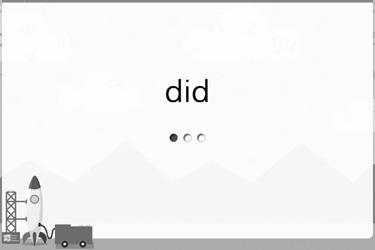
• Students will read sets of three Heart Words as they appear on the screen.
What Students See
See p. 61 for a full description of Look, Think, Say; Pop-Up; 3-Up.
3, 2, 1…
Open Countdown Online to Unit 15, Lesson 1, Part 2 (15.1.2).
Launch!
Say “Now, we are going to learn to read some new Heart Words.”
LOOK, THINK, SAY:
Click twice to display the Heart Word did with one red dot and two empty dots below.
Say:
• “This red dot (point to the red dot) tells us to stop what we are doing so we can listen to the word.
• This word is did, as in, ‘We did it together.’”
Click to display the yellow dot.
242 © 2017 Really Great Reading Company, LLC UNIT 15 Lesson 1 | Part 2
Say:
• “Think about this word. We know the sounds in this word, /d/ /ĭ/ /d/ (point to each letter as you say the sound), did.
• We can think about the sounds in this word, but it might be easier to just try to remember it.”
Click to display the green dot.
Say:
• “Say the word with me, did.
• Let’s try another word.
• Remember to look, think, and then say. Only say the word out loud when the green dot shows up.”
Click twice to display the Heart Word too with one red dot and two empty dots below.
Say “Look at the word too, as in, ‘I like apples and bananas, too.’”
Click to display the yellow dot.
Say “Think about this word.”
Click to display the green dot.
Say: • “Say the word!
• Let’s try one more word.”
Click twice to display the Heart Word will with one red dot and two empty dots below.
Say “Look at the word will, as in, ‘I will be there on time.’”
Click to display the yellow dot.
Say:
• “Think about this word. We know the sounds in this word, /w/ /ĭ/ /l/ (point to each letter as you say the sound), will
• We can think about the sounds in this word, but it might be easier to just try to remember it.”
Click to display the green dot.
Say: • “Say the word!
• Let’s look at those words one more time.”
Continue with the same three Heart Words for two additional rounds.
© 2017 Really Great Reading Company, LLC 243 UNIT 15 Lesson 1 | Part 2
POP-UP: Say:
• “Now, we are going to practice reading the Heart Words we’ve learned.
• In our first game, when you see a word pop up onto the screen, say the word out loud.
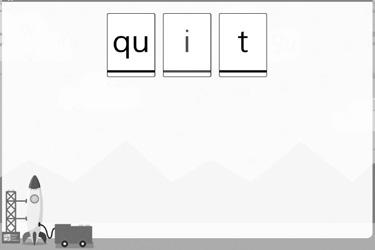
• If you need help remembering, I can help, but try your best.”
Click to display the Heart Words you, are, do, can, like, be, did, too, and will at random. Each word will appear several times.
Read each word together with students as it pops up.
3-UP: Say:
• “Great job! In our next game, you will see three words on the screen.
• When you see the red dot, stop and look at the three words. When you see the yellow dot, think about the words and try to remember them. When you see the green dot, say the three words out loud.”
Click to display the sets of three Heart Words. Each set will contain the following words in a random order: you, are, do, can, like, be, did, too, and will. Each word will appear several times.
Look, think about, and say each set of three words together with students as the sets are displayed.
Students decode (read) words by pronouncing one sound at a time and then blending them together.
See p. 26 for a full description of Touch & Say.
Open Countdown Online to Unit 15, Lesson 1, Part 3 (15.1.3).
244 © 2017 Really Great Reading Company, LLC UNIT 15 Lesson 1 | Part 3
40: Touch & Say AP: Decoding
Unit 15 | Lesson 1 | Part 3 Activity
Objective
Students See
What
3, 2, 1…
Launch!
Say:
• “We’re going to read some words by ‘sounding them out.’
• Let’s get started with this word. Watch how I sound it out.”
Click to underline one letter tile at a time while saying its sound, “/kw/ / ĭ/ /t/.”
Click to slide an arrow from left to right under the entire word while saying, “quit.”
Say “Let’s keep going! This time, say the sounds and blend the word with me.”
Click to underline one letter at a time while saying its sound with students, “/j/ /ă/ /m/.”
Click to slide an arrow from left to right under the entire word while saying, “jam.”
Continue with remaining words, making sure students are saying each sound with you as you click to underline it:
1. hop (/h/ /ŏ/ /p/)
2. fix (/f/ / ĭ/ /ks/)
3. wet (/w/ /ĕ/ /t/)
4. tap (/t/ /ă/ /p/)
5. nod (/n/ /ŏ/ /d/)
6. hum (/h/ /ŭ/ /m/)
7. can (/k/ /ă/ /n/)
8. jug (/j/ /ŭ/ /g/)
9. bad (/b/ /ă/ /d/)
10. dip (/d/ / ĭ/ /p/)
11. Gus (/g/ /ŭ/ /s/)
12. lid (/l/ / ĭ/ /d/)
13. mud (/m/ /ŭ/ /d/)
14. pot (/p/ /ŏ/ /t/)
15. Max (/m/ /ă/ /ks/)
16. den (/d/ /ĕ/ /n/)
17. fan (/f/ /ă/ /n/)
18. gum (/g/ /ŭ/ /m/)
DIFFERENTIATION OPTIONS
Ways to challenge:
• Have students pronounce each individual sound and then blend the word independently as you underline the letters.
• Using Letter Tile Free Play (located in Supplemental Resources) or your white board and marker, have students Touch & Say the following additional words: ad, ax, beg, bin, bun, cob, cud, Dan, dot, fax, gas, hid, hot, it, Jed, Jon, led, lot, Meg, mob, Ned, ox, pan, pod, rap, rig, Rob, sag, sat, sip, tab, tin, tug, vat, yep, and zit
• Using Letter Tile Free Play (located in Supplemental Resources) or your whiteboard and marker, have students Touch & Say the following words with 2-sound conso nant blends: act, ads, amp, and, ant, apt, ask, elf, elk, end, imp, its, and ump
© 2017 Really Great Reading Company, LLC 245 UNIT 15 Lesson 1 | Part 3
There is an additional letter-sound review activity available in Countdown Online
The activity can be found at the bottom of the dropdown menu below Additional Practice Activities. Four rows of guideword images appear. Upon each click, the letter tile that represents one sound is revealed. You can use this activity to review each sound and its corresponding letter in order.
Unit 15 | Lesson 2 | Part 1
Activity 35: Letter-Sound Review AP: Letter ID Objective
Students will say the sounds spelled by each letter.
What Students See
Description
Four rows of letter tiles appear. The teacher points to a tile, saying the name of the letter. The students, with the teacher’s help if needed, say the sound spelled by that letter. Upon a click, the teacher reveals the guideword image associated with that letter and says its beginning sound and its name. Students repeat the sound and the guideword. The teacher repeats this pattern until all 26 guideword images are revealed.
3, 2, 1…
Open Countdown Online to Unit 15, Lesson 2, Part 1 (15.2.1).
Launch! Say:
• “We have learned about all the letters of the alphabet as we have been playing our Countdown games. Remember that each letter makes a sound. Today, we are going to review the sounds of all of the letters.
• Let’s practice saying the sounds for each letter. When you see a letter, you will say that letter’s sound. Then you will say the name of the picture that goes with that sound.
• Let’s get started.”
Click to display the four rows of letter tiles.
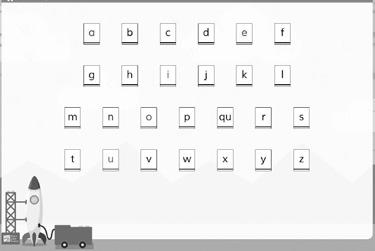
Point to the a and say “This is a. What does a say?” A: /ă/ (Students may say the sound independently or repeat after you.)
Click to reveal the apple
Say “/ă/, apple. Your turn.”
Students repeat “/ă/, apple.”
Point to the b and say “B. What does b say?” A: /b/ (Students may say the sound independently or repeat after you.)
Click to reveal the bear.
246 © 2017 Really Great Reading Company, LLC UNIT 15 Lesson 2 | Part 1
Say “/b/, bear. Your turn.”
Students repeat “/b/, bear.”
Point to the c and say “C . What sound?” A: /k / (Students may say the sound independently or repeat after you.)
Click to reveal the cat.
Say “/k/, cat. Your turn.”
Students repeat “/k/, cat.”
Continue to point to each letter tile, asking students to say the sound it spells (or having them repeat after you). Then, after clicking to reveal the guideword image, say the isolated beginning sound and the name of the image, and have students repeat. Cut down the language to move through each letter sound quickly. For ex ample: “d (while pointing to the d tile). What sound?” (CLICK) “/d/, duck. Your turn.”
Unit 15 | Lesson 2 | Part 2
Activity 3: Find That Letter
Objective
Students will identify the letter symbol that spells the shared first sound in a set of three imaged words.
See p. 20 for a full description of Find That Letter.
3, 2, 1…
AP: Letter ID
What Students See
Once students understand the process, feel free to cut down on language. Rather than saying, “Your turn,” simply pointing to the students when it’s their turn should be sufficient.
OPTIONAL (only if you choose to use manipulatives)
Prepare materials:
• All letter tiles and working board from Countdown Student Kit for each student
Open Countdown Online to Unit 15, Lesson 2, Part 2 (15.2.2).
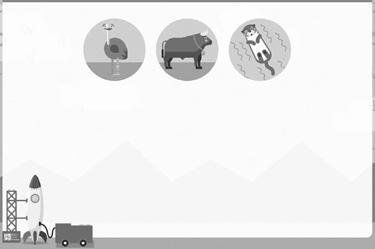
Launch!
OPTIONAL (only if you choose to use manipulatives)
Students take out all letter tiles and working board.
© 2017 Really Great Reading Company, LLC 247 UNIT 15 Lesson 2 | Part 2
You may want to have students point all the way to the left for e, to the center for i, and all the way to the right for o. If students are using manipulatives, have them hold up the correct tile and name it rather than point.
Say “Now, we are going to match our letter tiles to the beginning sounds of some words.”
Click to display, point to, and name three images: ostrich, ox, otter.
Ask “What is the beginning sound in all of these words?” A: /ŏ/
Click to display three letter tiles: e, i, and o.
Say “Point to the letter that spells /ŏ/, and say its sound.” A: o (pointing to the right)
Click to show the correct answer.
Continue with remaining image sets:
1. watermelon, waterfall, worm (w)
2. cookie, caveman, cactus (c)
3. truck, tie, two (t)
4. zoom, zero, zipper (z)
5. pen, penny, peppermint (p)
6. sock, skateboard, sidewalk (s)
7. vegetables, volcano, violin (v)
8. ladder, log, leaf (l)
9. needle, net, newspaper (n)
10. jacket, jump, juice (j)
11. yellow, yarn, yogurt (y)
12. elbow, egg, edge (e)
13. backpack, bike, bread (b)
14. garden, grapes, guitar (g)
See p. 22 for differentiation options for Find That Letter.
Unit 15 | Lesson 2 | Part 3
Activity 37: Unscramble This AP: Encoding
Objective
Students help the teacher segment the phonemes in words while the teacher models the encoding (spelling) of each sound.
See p. 54 for a full description of Unscramble This.
3, 2, 1…
What Students See
Open Countdown Online to Unit 15, Lesson 2, Part 3 (15.2.3).
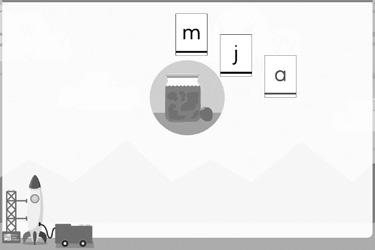
248 © 2017 Really Great Reading Company, LLC UNIT 15 Lesson 2 | Part 3
Launch!
Say “Now, we’re going to unscramble some letters that got mixed up. When we unscramble them and put them in the right order, they will make real words we can read.”
Click to display the jam and the letter tiles m, j, a.
Say: • “Jam.
• Let’s stretch the sounds in jam together.”
Click to move each letter tile to the correct position AS you and students say the sounds /j/ /ă/ /m/.
Say “Now, let’s make sure those sounds really blend to make the word jam.”
Point to each letter tile as you and the students say its sound, /j/ /ă/ /m/, and then sweep your finger under the word from left to right while saying the whole word, jam
Say:
• “Let’s try to unscramble another mixed up word.
• This time, it’s your turn to stretch out the words on your own.”
Continue with remaining images:
1. mug (/m/ /ŭ/ /g/)
2. nap (/n/ /ă/ /p/) 3. rug (/r/ /ŭ/ /g/) 4. six (/s/ / ĭ/ /ks/) 5. rat (/r/ /ă/ /t/) 6. van (/v/ /ă/ /n/) 7. yes (/y/ /ĕ/ /s/)
8. pig (/p/ / ĭ/ /g/) 9. bug (/b/ /ŭ/ /g/) 10. bed (/b/ /ĕ/ /d/) 11. jet (/j/ /ĕ/ /t/) 12. can (/k/ /ă/ /n/) 13. fox (/f/ /ŏ/ /ks/) 14. hug (/h/ /ŭ/ /g/)
See p. 55 for differentiation options for Unscramble This.
© 2017 Really Great Reading Company, LLC 249 UNIT 15 Lesson 2 | Part 3
You may want to have students point all the way to the left for v, to the center for j, and all the way to the right for l. If students are using manipulatives, have them hold up the correct tile and name it rather than point.
Unit 15 | Lesson 3 | Part 1
Activity 33: Which Letter? AP: Letter ID
Objective
Students will isolate the beginning or ending sound in a word and match that sound to its letter symbol.
See p. 34 for a full description of Which Letter?
What Students See 3, 2, 1…
OPTIONAL (only if you choose to use manipulatives)
Students take out all letter tiles and working board.
Open Countdown Online to Unit 15, Lesson 3, Part 1 (15.3.1).
Launch!
Say “Today, we are going to spell the first or last letter of some words.”
Click to display the jam with the letters a m spelled out below.
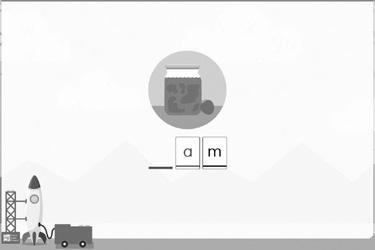
Say “Jam.”
Ask “What is the first sound in jam?” A: /j/
Click to display three letter tiles: v, j, l.
Ask “Which of these letters spells /j/ like at the beginning of /j/, jam?
Point to the letter tile that spells /j/, and say its name.” A: j
Click to show the correct answer.
Click to display the pod with the letters o d spelled out below.
Say “Pod.”
Ask “What is the first sound in pod?” A: /p/
Click to display three letter tiles: h, w, p.
Ask “Which of these letters spells /p/ like /p/, pod? Point to the letter tile that spells /p/, and say its name.” A: p
Click to show the correct answer.
Continue with remaining images:
250 © 2017 Really Great Reading Company, LLC UNIT 15 Lesson 3 | Part 1
1. yes (y)
2. cup (c)
3. bus (b)
4. mug (m)
5. log (l)
6. rug (r)
7. van (v)
8. elf (e)
9. jet ( j) 10. hop (h) 11. sad (s)
12. gum (g)
13. ant (a)
14. kid (k) 15. bug (b) 16. mix (x) (last sound) 17. sun (s) 18. hat (h)
See p. 34 for differentiation options for Which Letter?
Unit 15 | Lesson 3 | Part 2
Activity 43: Where’s That Heart Word? Sight Words
Objective
Students will read three Heart Words from memory, using sequence and location vocabulary to identify where they are on the screen.
See p. 69 for a full description of Where’s That Heart Word?
What Students See 3, 2, 1…
Open Countdown Online to Unit 15, Lesson 3, Part 2 (15.3.2).
Launch!
Say “Now, we are going to practice reading some of the ‘Heart Words’ we’ve learned.”
Click to display the Heart Words did, too, will. Say “Let’s read our Heart Words, starting here.” (Point to the words did, too, and will while reading them in left to right order.)
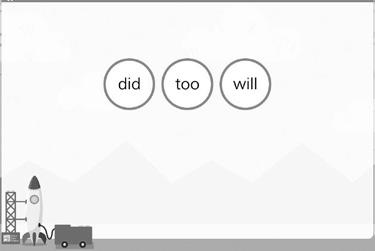
Ask: •
“Which word is last?” A: will •
“Which word is before the word too?” A: did •
“Which word is first?” A: did •
“Which word is next?” A: too
Click to display the Heart Words like, are, for.
Say “Let’s read our Heart Words, starting here.” (Point to the words like, are, and for while reading them in left to right order.)
Ask more questions as time allows.
© 2017 Really Great Reading Company, LLC 251 UNIT 15 Lesson 3 | Part 2
Ask:
•
“Which word is at the beginning of the row?” A: like • “Which word is at the end of the row?” A: for • “Which word is after the word are?” A: for • “Which word is in the middle of the row?” A: are
Click to display the Heart Words and, go, you
Say “Let’s read our Heart Words, starting here.” (Point to the words and, go, and you while reading them in left to right order.)
Ask:
• “Which word is first?” A: and • “Which word is next?” A: go • “Which word is last?” A: you • “Which word is after the word go?” A: you
Click to display the Heart Words the, to, is.
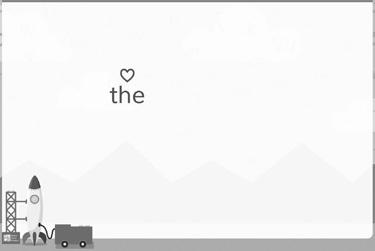
Say “Let’s read our Heart Words, starting here.” (Point to the words the, to, and is while reading them in left to right order.)
Ask: •
“Which word is before the word is?” A: to • “Which word is at the beginning of the row?” A: the • “Which word is at the end of the row?” A: is • “Which word is in the middle of the row?” A: to See p. 70
252 © 2017 Really Great Reading Company, LLC UNIT 15 Lesson 3 | Part 2
differentiation options for Where’s That Heart Word? Unit 15 | Lesson 3 | Part 3 Activity 41: Phrase Reading AP: Decoding Objective Students will practice reading decodable words and Heart Words in three-word phrases. See p. 134 for a full description of Phrase Reading. What Students See
for
3, 2, 1…
Open Countdown Online to Unit 15, Lesson 3, Part 3 (15.3.3).
Launch!
Say:
• “Now, we are going to put some of our Heart Words together with some words we can sound out and read them together.
• When each word shows up on the screen, we’ll read it together.
• Then, when all three words are up, we are going to read the phrase together.
• Let’s get started!”
Click to display the red word the.
Say “Remember, red words are Heart Words. Let’s say it together.” (the)
Click to display the black word hot.
Say “Remember, we can sound out black words. Let’s sound it out together.” (Use Touch & Say to sound out the word together: /h/ /ŏ/ /t/, hot.)
Click to display the black word tub.
Say “Remember, we can sound out black words. Let’s sound it out together.”
(Use Touch & Say to sound out the word together: /t/ /ŭ/ /b/, tub.)
Say “Now we know all of the words, but let’s try to read them together in order. When I point to a word, read it out loud: the hot tub.” (Point to each word, having students read the words aloud as you go. Begin with a pause between each word, and then repeat the process with shorter pauses on the second and third rounds to build fluency.)
Say “Let’s try another phrase, or group of words.”
Continue with the following phrases in the same manner: Jen did* hum; the fox too; dog will* run; you can* win; are not* wax; rub my leg; a pig pen; is so fun; zig and* zag.
Some of the Heart Words, marked with an asterisk, are also decodable, but they are still written in red because it is beneficial and more efficient for students to see these common words as words they should know by heart. If they struggle to remember these words, feel free to have your students sound the decodable Heart Words out.
© 2017 Really Great Reading Company, LLC 253 UNIT 15 Lesson 3 | Part 3
Unit 15 | Lesson 4 | Part 1
Activity 27: Add That Sound PA: Manipulation
Objective
Students will add a sound to the beginning of a word to form a new word.
See p. 194 for a full description of Add That Sound.
What Students See 3, 2, 1…
Open Countdown Online to Unit 15, Lesson 4, Part 1 (15.4.1).
Launch!
Say:
• “Today, we are going to add a sound to the beginning of some words.
• Listen to my word, in
• Let’s finger-stretch that word together. In, / ĭ/ /n/, in.”
Click to display a color tile for each sound while saying the sounds with students: /ĭ/ (first color tile appears), /n/ (second color tile appears).
Say “I am going to add a new sound, /t/, to the beginning of in. I’ll add a new color tile since we are adding a sound.”
Click to display a new color tile at the beginning.
Say:
• “Let’s see what the new word is: /t/ (touch the first tile), /ĭn/ (sweep fingers under the second and third tiles), tin (sweep finger under the three tiles). The new word is tin. Did you hear the new sound, /t/, at the beginning?
• Let’s stretch all the sounds in tin together (say the sounds while fingerstretching): /t/ (extend thumb), /ĭ/ (extend pointer finger), /n/ (extend middle finger), tin (pull closed fist to chest)
• Let’s try another one.
• Listen to my word, ate
• Let’s finger-stretch that word together. Ate, /ā/ /t/, ate.”
Click to display a color tile for each sound while stretching the sounds with students: /ā/ (first color tile appears), /t/ (second color tile appears).
254 © 2017 Really Great Reading Company, LLC UNIT 15 Lesson 4 | Part 1
Say “I am going to add a new sound, /g/, to the beginning of ate. I’ll add a new color tile since we are adding a sound.”
Click to display a new color tile at the beginning.
Say:
• “Let’s see what the new word is: /g/ (touch the first tile), /āt/ (sweep fingers un der the second and third tiles). Did you hear the new sound, /g/, at the beginning?
• Say those sounds with me so we can blend them together, /g/ /ā t/.”
Ask “What is our new word?” A: gate
Say:
•
“Let’s stretch all the sounds in gate together (say the sounds while fingerstretching): /g/ (extend thumb), /ā/ (extend pointer finger), /t/ (extend middle finger), gate (pull closed fist to chest).
• Let’s try another one.”
Continue with remaining images:
1. or (/m/ + /or/) more
2. eat (/n/ + /ē/ /t/) neat
3. ape (/k/ + /ā/ /p/) cape
4. at (/r/ + /ă/ /t/) rat
5. own (/f/ + /ō/ /n/) phone
6. it (/s/ + /ĭ/ /t/) sit
7. edge (/l/ + /ĕ/ /j/) ledge
8. of (/l/ + /ŭ/ /v/) love
9. oat (/g/ + /ō/ /t/) goat
10. ache (/f/ + /ā/ /k/) fake
11. ouch (/k/ + /ou/ /ch/) couch
12. aim (/g/ + /ā/ /m/) game
13. itch (/d/ + /ĭ/ /ch/) ditch
14. ill (/p/ + /ĭ/ /l/) pill
15. us (/b/ + /ŭ/ /s/) bus
16. Ed (/r/ + /ĕ/ /d/) red
17. add (/d/ + /ă/ /d/) dad
18. each (/p/ + /ē/ /ch/) peach
See p. 196 for differentiation options for Add That Sound.
Unit 15 | Lesson 4 | Part 2
Activity 33: Connect the Letter
Objective
Students will practice connecting a word’s beginning sound to its corresponding letter symbol.
See p. 24 for a full description of Connect the Letter.
AP: Letter ID
What Students See
© 2017 Really Great Reading Company, LLC 255 UNIT 15 Lesson 4 | Part 2
3, 2, 1…
Open Countdown Online to Unit 15, Lesson 4, Part 2 (15.4.2).
Launch!
Ask “This is the letter s. What sound does the letter s spell?” A: /s/
Say “Right. Now, let’s look at a few pictures and see which one begins with that sound.”
Click to display, point to, and name three images below the letter tile s: frog, sunglasses, and juice
Ask “Which one begins with /s/?” A: sunglasses
Say “Yes, /s/, sunglasses begins with /s/, so sunglasses begins with the letter s.”
Click to show the correct answer.
Say “Let’s try that with some new pictures.”
Continue with remaining letter tiles and images: s
• seal, milk, needle
• finger, sit, enter
• rainbow, jam, sock f
• footprints, turtle, up
• nail, flower, wave
• fireworks, hat, nest l
• pants, mouse, lime
• lick, omelet, raccoon
• skunk, lightbulb, van w
• water, key, gate
• horse, worm, yarn
• fireman, monkey, window j
• igloo, jellybeans, football
• jacket, map, nose
• feather, quail, jam
256 © 2017 Really Great Reading Company, LLC UNIT 15 Lesson 4 | Part 2
z
• clock, zoo, bell
• zipper, duck, octopus
• zebra, kangaroo, leaf u
• umbrella, edge, apple
• grapes, up, feet
See p. 25 for differentiation options for Connect the Letter.
Unit 15 | Lesson 4 | Part 3
Activity 38: Build a Word AP: Encoding
Objective
Students encode (spell) words by first segmenting sounds and then matching sounds to letters.
See p. 103 for a full description of Build a Word.
3, 2, 1…
What Students See
OPTIONAL (only if you choose to use manipulatives)
Students take out all letter tiles and working board.
Open Countdown Online to Unit 15, Lesson 4, Part 3 (15.4.3).
Launch! Say:
• “Now, we are going to build words with our letter tiles by listening to the sounds in each word and putting our letter tiles in order. That is how we spell words.
• Let’s build our first word!”
Click to display the bed
© 2017 Really Great Reading Company, LLC 257 UNIT 15 Lesson 4 | Part 3
If students are using manipulatives, have them use color and letter tiles to build the word along with you.
Say:
• “Listen carefully. Bed, /b/ /ĕ/ /d/, bed (while finger-stretching).
• I heard three sounds in bed, /b/ /ĕ/ /d/.”
Click to display one color tile at a time while again saying “/b/ /ĕ/ /d/.”
Say:
•
“Now let’s build the word with letter tiles.
• The first sound I heard was /b/.”
Ask “What letter spells /b/?” A: b
Click to display the letter tile b under the first color tile.
Say “The next sound I heard was /ĕ/. What letter spells /ĕ/?” A: e
Click to display the letter tile e under the second color tile.
Say “The last sound I heard was /d/. What letter spells /d/?” A: d
Click to display the letter tile d under the last color tile.
Say:
• “Let’s check our work. /b/ /ĕ/ /d/ (touching each letter as you say the sound), bed (sweeping pointer finger under the whole word from left to right).
• Awesome job, you just spelled bed. Let’s try another word.”
Continue with remaining words: 1. /d/ /ŏ/ /g/, dog 2. /y/ /ă/ /m/, yam
/f/ /ŏ/ /ks/, fox
/h/ /ŭ/ /g/, hug 5. /v/ /ă/ /n/, van
6. /w/ /ĭ/ /g/, wig
/p/ /ĕ/ /n/, pen
/n/ /ŭ/ /t/, nut
/j/ /ĕ/ /t/, jet
See p. 105 for differentiation options for Build a Word.
258 © 2017 Really Great Reading Company, LLC UNIT 15 Lesson 4 | Part 3
3.
4.
7.
8.
9.
Unit 15 | Lesson 5 | Part 1
Activity 40: Touch & Say AP: Decoding
Objective
Students decode (read) words by pronouncing one sound at a time and then blending them together.
See p. 26 for a full description of Touch & Say.
3, 2, 1…
What Students See
Open Countdown Online to Unit 15, Lesson 5, Part 1 (15.5.1).
Launch! Say:
• “We’re going to read some words by ‘sounding them out.’
• Let’s get started with this word. Watch how I sound it out.”
Click to underline one letter tile at a time while saying its sound, “/g/ /ă/ /p/.”
Click to slide an arrow from left to right under the entire word while saying, “gap.”
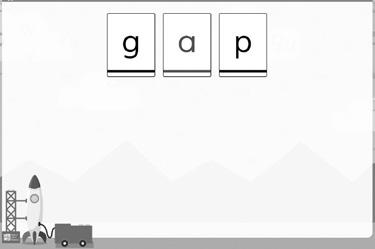
Say “Let’s keep going! This time, say the sounds and blend the word with me.”
Click to underline one letter at a time while saying its sound with students, “/z/ / ĭ/ /p/.”
Click to slide an arrow from left to right under the entire word while saying, “zip.”
Continue with remaining words, making sure students are saying each sound with you as you click to underline it:
1. yes (/y/ /ĕ/ /s/)
2. wig (/w/ / ĭ/ /g/)
3. ham (/h/ /ă/ /m/)
4. bet (/b/ /ĕ/ /t/)
5. sit (/s/ / ĭ/ /t/)
6. pat (/p/ /ă/ /t/)
7. log (/l/ /ŏ/ /g/)
8. get (/g/ /ĕ/ /t/)
9. fox (/f/ /ŏ/ /ks/)
10. rib (/r/ / ĭ/ /b/)
11. sun (/s/ /ŭ/ /n/)
12. yam (/y/ /ă/ /m/)
13. pin (/p/ / ĭ/ /n/)
14. lap (/l/ /ă/ /p/)
© 2017 Really Great Reading Company, LLC 259 UNIT 15 Lesson 5 | Part 1
15. fit (/f/ / ĭ/ /t/)
16. dog (/d/ /ŏ/ /g/)
17. cap (/k/ /ă/ /p/)
18. box (/b/ /ŏ/ /ks/)
DIFFERENTIATION OPTIONS
Ways to challenge:
• Have students pronounce each individual sound and then blend the word independently as you underline the letters.
• Using Letter Tile Free Play (located in Supplemental Resources) or your whiteboard and marker, have students Touch & Say the following additional words: am, bag, Ben, bop, but, cod, cup, Deb, dug, fig, god, Hal, hip, hut, jab, Jen, jot, leg, man, Mel, mug, net, pad, peg, pug, red, rim, rot, Sal, sax, sop, tan, tip, up, vet, and zag
• Using Letter Tile Free Play (located in Supplemental Resources) or your whiteboard and marker, have students Touch & Say the following words with 2-sound consonant blends: act, ads, amp, and, ant, apt, ask, elf, elk, end, imp, its, and ump
Unit 15 | Lesson 5 | Part 2
Activity 44: Pop-Up and 3-Up Sight Words
Objective
• Students will read individual Heart Words as they pop up on the screen.
• Students will read sets of three Heart Words as they appear on the screen.
See p. 80 for a full description of Pop-Up and 3-Up.
What Students See 3, 2, 1…
Open Countdown Online to Unit 15, Lesson 5, Part 2 (15.5.2).
Launch!
POP-UP: Say:
• “Now, we are going to practice reading the Heart Words we have learned so far.
260 © 2017 Really Great Reading Company, LLC UNIT 15 Lesson 5 | Part 2
•
In our first game, when you see a word pop up onto the screen, say the word out loud.
• If you need help remembering, I can help, but try your best.”
Click to display the Heart Words my, did, too, go, do, to, for, you, and will at random. Each word will appear several times.
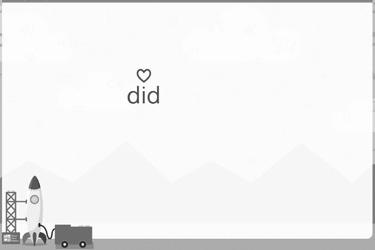
3-UP: Say:
• “Great job! In our next game, you will see three words on the screen.
• Remember, when you see the red dot, stop and look at the three words. When you see the yellow dot, think about the words and try to remember them. When you see the green dot, say the three words out loud.
• If you need help remembering, I can help, but try your best.”
Click to display the sets of three Heart Words. Each set will contain three of the following words in a random group: my, did, too, go, do, to, for, you, and will Each word will appear several times.
Unit 15 | Lesson 5 | Part 3
Activity 41:
Phrase Reading
AP: Decoding Objective
What Students See
Students will practice reading decodable words and Heart Words in three-word phrases.
See p. 134 for a full description of Phrase Reading.
3, 2, 1…
Open Countdown Online to Unit 15, Lesson 5, Part 3 (15.5.3).
Launch! Say:
• “Now, we are going to read some phrases together.
• When each word shows up on the screen, we’ll read it together.
• Then, when all three words are up, we are going to read the phrase together.
© 2017 Really Great Reading Company, LLC 261 UNIT 15 Lesson 5 | Part 3
Some of the Heart Words, marked with an asterisk, are also decodable, but they are still written in red because it is beneficial and more efficient for students to see these common words as words they should know by heart. If they struggle to remember these words, feel free to have your students sound out the decodable Heart Words.
•
Let’s get started!”
Click to display the red word did.
Say “Remember, red words are Heart Words. Let’s say it together.” (did)
Click to display the black word fix.
Say “Remember, we can sound out black words. Let’s sound it out together.” (Use Touch & Say to sound out the word together: /f/ /ĭ/ /ks/, fix.)
Click to display the red word it.
Say “Remember, red words are Heart Words. Let’s say it together.” (it)
Say “Now we know all of the words, but let’s try to read them together in order. When I point to a word, read it out loud: did* fix it*.” (Point to each word, having students read the words aloud as you go. Begin with a pause between each word, and then repeat the process with shorter pauses on the second and third rounds to build fluency.)
Say “Let’s try another phrase, or group of words.”
Continue with the following phrases in the same manner: Gus did* too; will* let go; Sam is mad; the hot sun; do not* quit; I will* mop; get a cup; kid can* hop; a big hug
262 © 2017 Really Great Reading Company, LLC UNIT 15 Lesson 5 | Part 3
Unit 16 | Lesson 1 | Part 1
Activity 40: Touch & Say AP: Decoding
Objective
Students decode (read) words by pronouncing one sound at a time and then blending them together.
See p. 26 for a full description of Touch & Say.
3, 2, 1…
What Students See
Open Countdown Online to Unit 16, Lesson 1, Part 1 (16.1.1).
Launch! Say:
• “We’re going to read some words by ‘sounding them out.’
• Let’s get started with this word. Watch how I sound it out.”
Click to underline one letter tile at a time while saying its sound, “/b/ /ĕ/ /d/.”
Click to slide an arrow from left to right under the entire word while saying, “bed.”
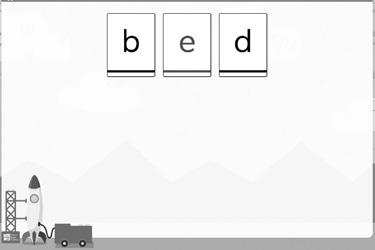
Say “Let’s keep going! This time, say the sounds and blend the word with me.”
Click to underline one letter at a time while saying its sound with students, “/r/ /ă/ /n/.”
Click to slide an arrow from left to right under the entire word while saying, “ran.”
Continue with remaining words, making sure students are saying each sound with you as you click to underline it:
1. six (/s/ / ĭ/ /ks/)
2. rug (/r/ /ŭ/ /g/)
3. ten (/t/ /ĕ/ /n/)
4. wag (/w/ /ă/ /g/) 5. not (/n/ /ŏ/ /t/)
6. men (/m/ /ĕ/ /n/)
7. bus (/b/ /ŭ/ /s/)
8. fib (/f/ / ĭ/ /b/)
9. got (/g/ /ŏ/ /t/)
10. hen (/h/ /ĕ/ /n/) 11. mad (/m/ /ă/ /d/) 12. let (/l/ /ĕ/ /t/) 13. nut (/n/ /ŭ/ /t/) 14. sob (/s/ /ŏ/ /b/) 15. yum (/y/ /ŭ/ /m/) 16. wax (/w/ /ă/ /ks/) 17. top (/t/ /ŏ/ /p/) 18. pig (/p/ / ĭ/ /g/)
© 2017 Really Great Reading Company, LLC 263 UNIT 16 Lesson 1 | Part 1
DIFFERENTIATION OPTIONS
Ways to challenge:
• Have students pronounce each individual sound and then blend the word independently as you underline the letters.
• Using Letter Tile Free Play (located in Supplemental Resources) or your whiteboard and marker, have students Touch & Say the following additional words: an, ban, bid, bug, cab, cop, cut, dig, fad, fin, gut, hat, hit, if, jag, jig, Kim, lit, map, met, nap, nip, pal, pet, rag, Rex, rob, run, Sam, set, sub, Ted, Tom, us, web, and zap
• Using Letter Tile Free Play (located in Supplemental Resources) or your whiteboard and marker, have students Touch & Say the following words with 2-sound conso nant blends: act, ads, amp, and, ant, apt, ask, elf, elk, end, imp, its, and ump.
Objective
• Students will read three Heart Words from memory (or by decoding if necessary).
• Students will read individual Heart Words as they pop up on the screen.
• Students will read sets of three Heart Words as they appear on the screen.
What Students See
See p. 61 for a full description of Look, Think, Say; Pop-Up; 3-Up. 3, 2,
Open Countdown Online to Unit 16, Lesson 1, Part 2 (16.1.2).
Launch!
Say “Now, we are going to learn to read some new Heart Words.”
LOOK, THINK, SAY:
Click twice to display the Heart Word with with one red dot and two empty dots below.
264 © 2017 Really Great Reading Company, LLC UNIT 16 Lesson 1 | Part 2
42: Look, Think, Say; Pop-Up; 3-Up Sight Words
Unit 16 | Lesson 1 | Part 2 Activity
1…
Say:
•
“This red dot (point to the red dot) tells us to stop what we are doing so we can listen to the word.
• This word is with, as in, ‘I love playing with my friends.’”
Click to display the yellow dot. Say “Think about this word.”
Click to display the green dot. Say:
• “Say the word with me, with.
• Let’s try another word.
• Remember to look, think, and then say. Only say the word out loud when the green dot shows up.”
Click twice to display the Heart Word all with one red dot and two empty dots below. Say “Look at the word all, as in, ‘Who ate all the popcorn?’”
Click to display the yellow dot. Say “Think about this word.”
Click to display the green dot.
Say: • “Say the word!
• Let’s try one more word.”
Click twice to display the Heart Word me with one red dot and two empty dots below.
Say “Look at the word me, as in, ‘Can you please help me with this?’”
Click to display the yellow dot. Say “Think about this word.”
Click to display the green dot.
Say: • “Say the word!
• Let’s look at those words one more time.”
Continue with the same three Heart Words for two additional rounds.
POP-UP: Say:
• “Now, we are going to practice reading the Heart Words we’ve learned.
© 2017 Really Great Reading Company, LLC 265 UNIT 16 Lesson 1 | Part 2
•
In our first game, when you see a word pop up onto the screen, say the word out loud.
• If you need help remembering, I can help, but try your best.”
Click to display the Heart Words will, can, you, not, too, like, with, all, and me at random. Each word will appear several times. Read each word together with students as it pops up.
3-UP: Say:
• “Great job! In our next game, you will see three words on the screen.
• When you see the red dot, stop and look at the three words. When you see the yellow dot, think about the words and try to remember them. When you see the green dot, say the three words out loud.”
Click to display the sets of three Heart Words. Each set will contain the following words in a random order: will, can, you, not, too, like, with, all, and me. Each word will appear several times.
Look, think about, and say each set of three words together with students as the sets are displayed.
266 © 2017 Really Great Reading Company, LLC UNIT 16 Lesson 1 | Part 3
Unit 16 | Lesson 1 | Part 3 Activity 34: Which Letter? AP: Letter ID Objective Students will isolate the beginning or ending sound in a word and match that sound to its letter symbol. See p. 33 for a full description of Which Letter? What Students See 3, 2, 1… OPTIONAL (only if you choose to use manipulatives) Prepare materials:
All letter tiles and working board from Countdown Student Kit for each student
•
Open Countdown Online to Unit 16, Lesson 1, Part 3 (16.1.3).
Launch!
OPTIONAL (only if you choose to use manipulatives)
Students take out all letter tiles and working board.
Say “Now, we are going to spell the first or last letter of some words.”
Click to display the box with the letters o x spelled out below.
Say “Box.”
Ask “What is the first sound in box?” A: /b/
Click to display three letter tiles: p, b, r.
Ask “Which of these letters spells /b/ like at the beginning of /b/, box? Point to the letter tile that spells /b/, and say its name.” A: b
Click to show the correct answer.
Click to display the image for wet with the letters e t spelled out below.
Say “ Wet.”
Ask “What is the first sound in wet?” A: /w/
Click to display three letter tiles: c, n, w.
Ask “Which of these letters spells /w/ like /w/, wet? Point to the letter tile that spells the sound /w/, and say its name.” A: w
Click to show the correct answer.
Continue with remaining images: 1. zip (z) 2. sun (s) 3. pig (p)
ant (a)
cub (c) 6. jog ( j) 7. gum (g)
8. six (x) (last sound)
man (m)
rat (r)
net (n)
ham (h)
fox (f )
dog (d)
15. kid (k)
wig (w)
yes (y) 18. van (v)
You may want to have students point all the way to the left for p, to the center for b, and all the way to the right for r. If students are using manipulatives, have them hold up the correct tile and name it rather than point.
See p. 34 for differentiation options for Which Letter?
© 2017 Really Great Reading Company, LLC 267 UNIT 16 Lesson 1 | Part 3
4.
5.
9.
10.
11.
12.
13.
14.
16.
17.
Unit 16 | Lesson 2 | Part 1
Activity 28: Sound Swap PA: Manipulation
Objective
Students will swap the beginning sound of a word with a different sound to create a new real word.
What Students See
Description
An image appears. The teacher asks students to identify the beginning sound and then the rest of the word. The teacher then asks students to swap the beginning sound with a different beginning sound to create a new word. An image of the new word appears as confirmation.
3, 2, 1…
Open Countdown Online to Unit 16, Lesson 2, Part 1 (16.2.1).
Launch!
Click to display the can.

Say:
• “We are going to turn some words into new words by changing the first sound.
• Let’s start with the word can.”
Ask:
• “What is the first sound in can?” A: /k/
• “What is the rest of the word?” A: /ăn/
• “Right! /k/ /ăn/, can. Now, let’s change the first sound to /p/. What word do we get?” A: pan
Click to display the pan.
Say “You got it! Let’s change another word.”
Click to display the image for mix
Ask:
• “What is the first sound in mix?” A: /m/
• “What is the rest of the word?” A: / ĭ ks/
268 © 2017 Really Great Reading Company, LLC UNIT 16 Lesson 2 | Part 1
•
“Right! /m/ / ĭ ks/, mix. Now, let’s change the first sound to /s/. What word do we get?” A: six
Click to display the six.
Say “Great! Let’s keep going.”
Continue with remaining pairs:
1. chin, /ch/ / ĭn/; change first sound to /w/ win
2. bug, /b/ /ŭg/; change first sound to /r/ rug
3. goat, /g/ /ōt/; change first sound to /b/ boat
4. house, /h/ /ous/; change first sound to /m/ mouse
5. fox, /f/ /ŏks/; change first sound to /b/ box
6. log, /l/ /ŏg/; change first sound to /d/ dog
7. ship, /sh/ / ĭp/; change first sound to /l/ lip
8. toes, /t/ /ōz/; change first sound to /n/ nose
9. pan, /p/ /ăn/; change first sound to /m/ man
10. cut, /k/ /ŭt/; change first sound to /n/ nut
11. hot, /h/ /ŏt/; change first sound to /p/ pot
12. thumb, /th/ /ŭm/; change first sound to /g/ gum
13. mat, /m/ /ăt/; change first sound to /h/ hat
14. hug, /h/ /ŭg/; change first sound to /m/ mug
15. jam, /j/ /ăm/; change first sound to /h/ ham
16. mitt, /m/ / ĭt/; change first sound to /s/ sit
17. chop, /ch/ /ŏp/; change first sound to /h/ hop
18. phone, /f/ /ōn/; change first sound to /b/ bone
DIFFERENTIATION OPTIONS
Ways to simplify:
• Give new onset and rime with a pause between: “The first sound in can is /k/. Let’s change it to /p/, /p/ /ăn/. What’s the new word?” A: pan
Ways to challenge:
• Don’t segment the rime in the first word: “The first word is can. Let’s change the first sound to /p/. What’s the new word?” A: pan
© 2017 Really Great Reading Company, LLC 269 UNIT 16 Lesson 2 | Part 1
Unit 16 | Lesson 2 | Part 2
Activity 33: Connect the Letter AP: Letter ID
Objective
Students will practice connecting a word’s beginning sound to its corresponding letter symbol.
See p. 24 for a full description of Connect the Letter.
What Students See 3,
2, 1…
Open Countdown Online to Unit 16, Lesson 2, Part 2 (16.2.2).
Launch!
Say “Now, we are going to match letters to the beginning sounds in some words.”
Ask “This is the letter r. What sound does the letter r spell?” A: /r/
Say “Right. Now, let’s look at a few pictures and see which one begins with that sound.”
Click to display, point to, and name three images below the letter tile r: table, nest, and rabbit.
Ask “Which one begins with /r/?” A: rabbit
Say “Yes, /r/, rabbit begins with /r/, so rabbit begins with the letter r.”
Click to display the correct answer.
Say “Let’s try that with some new pictures.”
Continue with remaining letter tiles and images: r
• rooster, volcano, wig
• quail, rose, snake
• hamburger, log, run b
•
robe, billboard, house
• bed, ladybug, jump
• bike, monster, headphones
• sled, book, log
270 © 2017 Really Great Reading Company, LLC UNIT 16 Lesson 2 | Part 2
• wagon, bank, kite
• peanut, kiwi, yes
• keyboard, twins, zucchini v
• volcano, ladder, iguana
• under, vegetables, guitar
• jar, quilt, van y
• yellow, lick, hanger
• jacket, yawn, pie
• match, yogurt, fire qu
• octopus, queen, peas
• newspaper, hospital, question
• quick, inside, match
See p. 25 for differentiation options for Connect the Letter.
Unit 16 | Lesson 2 | Part 3
Activity 3: Unscramble This AP: Encoding
Objective
Students help the teacher segment the phonemes in words while the teacher models the encoding (spelling) of each sound.
See p. 54 for a full description of Unscramble This.
3, 2, 1…
What Students See
Open Countdown Online to Unit 16, Lesson 2, Part 3 (16.2.3).
Launch!
Say “Now, we’re going to unscramble some letters that got mixed up. When we un scramble them and put them in the right order, they will make real words we can read.”
© 2017 Really Great Reading Company, LLC 271 UNIT 16 Lesson 2 | Part 3 k
*Note that the word elf has a 2-sound consonant blend, which may prove challenging for some students. Feel free to either use this as a challenge opportunity or skip this example.
Click to display the image for hot and the letter tiles t, h, o.
Say: • “Hot
• Let’s stretch the sounds in hot together.”
Click to move each letter tile to the correct position AS you and students say the sounds /h/ /ŏ/ /t/.
Say “Now, let’s make sure those sounds really blend to make the word hot.”
Point to each letter tile as you and the students say its sound, /h/ /ŏ/ /t/, and then sweep your finger under the word from left to right while saying the whole word, hot.
Say: • “Let’s try to unscramble another mixed up word.
• This time, it’s your turn to stretch out the words on your own.”
Continue with remaining images:
1. log (/l/ /ŏ/ /g/)
2. net (/n/ /ĕ/ /t/) 3. sun (/s/ /ŭ/ /n/) 4. dog (/d/ /ŏ/ /g/) 5. jam (/j/ /ă/ /m/) 6. bag (/b/ /ă/ /g/) 7. fox (/f/ /ŏ/ /ks/)
8. kid (/k/ / ĭ/ /d/)
9. sad (/s/ /ă/ /d/) 10. pan (/p/ /ă/ /n/) 11. wax (/w/ /ă/ /ks/) 12. gum (/g/ /ŭ/ /m/) 13. bat (/b/ /ă/ /t/)
14. elf* (/ĕ/ /l/ /f/)
See p. 55 for differentiation options for Unscramble This.
272 © 2017 Really Great Reading Company, LLC UNIT 16 Lesson 2 | Part 3
Unit 16 | Lesson 3 | Part 1
Activity 28: Sound Swap PA: Manipulation
Objective
Students will swap the beginning sound of a word with a different sound to create a new real word.
See p. 268 for a full description of Sound Swap.
3, 2, 1…
What Students See
Open Countdown Online to Unit 16, Lesson 3, Part 1 (16.3.1).
Launch!
Click to display the pig.
Say:
• “We are going to turn some words into new words by changing the first sound.
• Let’s start with the word pig.”
Ask:
• “What is the first sound in pig?” A: /p/
• “What is the rest of the word?” A: / ĭg/
• “Right! /p/ / ĭg/, pig. Now, let’s change the first sound to /w/. What word do we get?” A: wig
Click to display the wig.
Say “You got it! Let’s change another word.”
Click to display the log.
Ask:
• “What is the first sound in log?” A: /l/
• “What is the rest of the word?” A: /ŏg /
• “Right! /l/ /ŏg /, log. Now, let’s change the first sound to /d/. What word do we get?” A: dog
Click to display the dog
© 2017 Really Great Reading Company, LLC 273 UNIT 16 Lesson 3 | Part 1
Say “Great! Let’s keep going.”
Continue with remaining pairs:
1. nose, /n/ /ōz/; change first sound to /h/ hose
2. nut, /n/ /ŭt/; change first sound to /k/ cut
3. run, /r/ /ŭn/; change first sound to /s/ sun
4. jam, /j/ /ăm/; change first sound to /h/ ham
5. six, /s/ / ĭ ks/; change first sound to /m/ mix
6. hug, /h/ /ŭg/; change first sound to /b/ bug
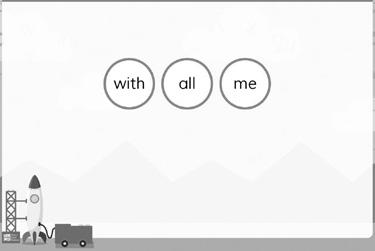
7. net, /n/ /ĕt/; change first sound to /j/ jet
8. top, /t/ /ŏp/; change first sound to /ch/ chop
9. chin, /ch/ / ĭn/; change first sound to /w/ win
10. thumb, /th/ /ŭm/; change first sound to /g/ gum
11. rat, /r/ /ăt/; change first sound to /m/ mat
12. van, /v/ /ăn/; change first sound to /p/ pan
13. sit, /s/ / ĭt/; change first sound to /m/ mitt
14. lip, /l/ / ĭp/; change first sound to /sh/ ship
15. juice, /j/ /�s/; change first sound to /m/ moose
16. bone, /b/ /ōn/; change first sound to /f/ phone
17. goat, /g/ /ōt/; change first sound to /b/ boat
18. sick, /s/ / ĭk /; change first sound to /kw/ quick
See p. 269 for differentiation options for Sound Swap.
274 © 2017 Really Great Reading Company, LLC UNIT 16 Lesson 3 | Part 2
Unit 16 | Lesson 3 | Part 2 Activity 43: Where’s That Heart Word? Sight Words Objective
Heart Words
Students will read three
from memory, using sequence and location vocabulary to identify where they are on the screen.
What Students See
See p. 69 for a full description of Where’s That Heart Word?
3, 2, 1…
Open Countdown Online to Unit 16, Lesson 3, Part 2 (16.3.2).
Launch!
Say “Now, we are going to practice reading some of the ‘Heart Words’ we’ve learned.”
Click to display the Heart Words with, all, me. Say “Let’s read our Heart Words, starting here.” (Point to the words with, all, and me while reading them in left to right order.)
Ask:
•
“Which word is last?” A: me
Remember, there are alternative ways to deliver this activity. See page 70 for details.
“Which word is before the word me?” A: all •
•
“Which word is first?” A: with • “Which word is next?” A: all
Click to display the Heart Words can, go, the Say “Let’s read our Heart Words, starting here.” (Point to the words can, go, and the while reading them in left to right order.)
Ask: •
“Which word is at the beginning of the row?” A: can •
“Which word is at the end of the row?” A: the •
“Which word is after the word can?” A: go •
“Which word is in the middle of the row?” A: go
Click to display the Heart Words like, did, you Say “Let’s read our Heart Words, starting here.” (Point to the words like, did, and you while reading them in left to right order.)
Ask: •
“Which word is first?” A: like •
Ask more questions as time allows.
“Which word is next?” A: did •
•
“Which word is last?” A: you
“Which word is after the word did?” A: you
Click to display the Heart Words be, too, is.
Say “Let’s read our Heart Words, starting here.” (Point to the words be, too, and is while reading them in left to right order.)
© 2017 Really Great Reading Company, LLC 275 UNIT 16 Lesson 3 | Part 2
Ask:
•
“Which word is before the word is?” A: too
• “Which word is at the beginning of the row?” A: be
• “Which word is at the end of the row?” A: is
• “Which word is in the middle of the row?” A: too
See p. 69 for differentiation options for Where’s That Heart Word?
Unit 16 | Lesson 3 | Part 3
Activity 41: Phrase Reading
AP: Decoding
Objective
Students will practice reading decodable words and Heart Words in three-word phrases.
See p. 134 for a full description of Phrase Reading.
What Students See 3, 2, 1…
Open Countdown Online to Unit 16, Lesson 3, Part 3 (16.3.3).
Launch!
Say:
• “Now, we are going to read some phrases together.
• When each word shows up on the screen, we’ll read it together.
• Then, when all three words are up, we are going to read the phrase together.
• Let’s get started!”
Click to display the red word did Say “Remember, red words are Heart Words. Let’s say it together.” (did)
Click to display the red word my
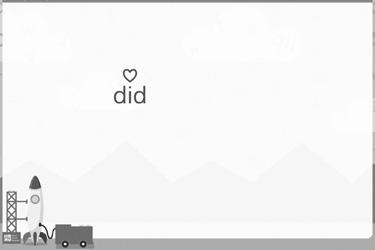
Say “Remember, red words are Heart Words. Let’s say it together.” (my)
Click to display the black word job
276 © 2017 Really Great Reading Company, LLC UNIT 16 Lesson 3 | Part 3
Say “Remember, we can sound out black words. Let’s sound it out together.” (Use Touch & Say to sound out the word together: /j/ /ŏ/ /b/, job.)
Say “Now we know all of the words, but let’s try to read them together in order. When I point to a word, read it out loud: did* my job.” (Point to each word, hav ing students read the words aloud as you go. Read the phrase at least three times. Begin with a pause between each word, and then repeat the process with shorter pauses on the second and third rounds to build fluency.)
Say “Let’s try another phrase, or group of words.”
Continue with the following phrases in the same manner: let him go; all had fun; will* hug me; did* get ham; my dog too; men do not*; fix the mop; ran like us; a big web.
Some of the Heart Words, marked with an asterisk, are also decodable, but they are still written in red because it is beneficial and more efficient for students to see these common words as words they should know by heart. If they struggle to remember these words, feel free to have your students sound the decodable Heart Words out.
© 2017 Really Great Reading Company, LLC 277 UNIT 16 Lesson 3 | Part 3
Unit 16 | Lesson 4 | Part 1
Activity 28: Sound Swap PA: Manipulation
Objective
Students will swap the beginning sound of a word with a different sound to create a new real word.
See p. 268 for a full description of Sound Swap.
What Students See 3, 2, 1…
Open Countdown Online to Unit 16, Lesson 4, Part 1 (16.4.1).
Launch!
Click to display the mitt
Say:
• “We are going to turn some words into new words by changing the first sound.
• Let’s start with the word mitt.”
Ask:
• “What is the first sound in mitt?” A: /m/
• “What is the rest of the word?” A: /ĭt/
• “Right! /m/ /ĭt/, mitt. Now, let’s change the first sound to /s/. What word do we get?” A: sit
Click to display the image for sit.
Say “You got it! Let’s change another word.”
Continue with remaining pairs:
1. cod, /k/ /ŏd/; change first sound to /p/ pod
2. rose, /r/ /ōz/; change first sound to /n/ nose
3. hot, /h/ /ŏt/; change first sound to /p/ pot
4. jet, /j/ /ĕt/; change first sound to /n/ net
5. corn, /k/ /orn/; change first sound to /th/ thorn
6. map, /m/ /ăp/; change first sound to /n/ nap
278 © 2017 Really Great Reading Company, LLC UNIT 16 Lesson 4 | Part 1
7. hip, /h/ / ĭp/; change first sound to /l/ lip
8. hose, /h/ /ōz/; change first sound to /t/ toes
9. quick, /kw/ / ĭk /; change first sound to /l/ lick
10. wig, /w/ / ĭg /; change first sound to /p/ pig
11. rat, /r/ /ăt/; change first sound to /s/ sat
12. win, /w/ / ĭn/; change first sound to /ch/ chin
13. goat, /g/ /ōt/; change first sound to /b/ boat
14. ham, /h/ /ăm/; change first sound to /j/ jam
15. check, /ch/ /ĕk /; change first sound to /n/ neck
16. house, /h/ /ous/; change first sound to /m/ mouse
17. bug, /b/ /ŭg /; change first sound to /h/ hug
18. fox, /f/ /ŏks/; change first sound to /b/ box
19. wing, /w/ /ing/; change first sound to /r/ ring
20. moose, /m/ /�s/; change first sound to /j/ juice
See p. 269 for differentiation options for Sound Swap.
Objective
Students will identify the letter symbol that spells the shared first sound in a set of three imaged words.
See p. 20 for a full description of Find That Letter.
3, 2, 1…
What Students See
OPTIONAL (only if you choose to use manipulatives)
Students take out all letter tiles and working board.
Open Countdown Online to Unit 16, Lesson 4, Part 2 (16.4.2).
© 2017 Really Great Reading Company, LLC 279 UNIT 16 Lesson 4 | Part 2
Unit 16 | Lesson 4 | Part 2
Activity 32: Find That Letter AP: Letter ID
You may want to have students point all the way to the left for g, to the center for d, and all the way to the right for w. If students are using manipulatives, have them hold up the correct tile and name it rather than point.
Launch!
Say “Now, we are going to match our letter tiles to the beginning sounds of some words.”
Click to display, point to, and name three images: gumballs, gold, gloves
Ask “What is the beginning sound in all in these words?” A: /g/
Click to display three letter tiles: g, d, and w
Say “Point to the letter that spells /g/, and name its sound.”
A: g (pointing to the left)
Click to show the correct answer.
Continue with remaining image sets:
1. lick, lightbulb, ladder (l)
2. cookie, crab, car (c)
3. newspaper, nurse, nap (n)
4. yarn, yoyo, yawn (y)
5. hospital, hamster, horse (h)
6. popcorn, pie, pants (p)
7. robe, rollercoaster, rattle (r)
8. edge, egg, elephant (e)
9. muffin, mitt, match (m)
10. snail, sit, sunflower (s)
11. olives, October, ostrich (o)
12. teeth, twins, train (t)
13. juice, jet, jacket (j)
14. queen, quick, quiet (qu)
See p. 22 for differentiation options for Find That Letter.
Unit 16 | Lesson 4 | Part 3
Activity 38: Build a Word
AP: Encoding
Objective
Students encode (spell) words by first segmenting sounds and then matching sounds to letters.
See p. 103 for a full description of Build a Word.
What Students See 3, 2, 1…
OPTIONAL (only if you choose to use manipulatives)
Students take out all letter tiles and working board.
280 © 2017 Really Great Reading Company, LLC UNIT 16 Lesson 4 | Part 3
Open Countdown Online to Unit 16, Lesson 4, Part 3 (16.4.3).
Launch!
Say:
• “Now, we are going to build words with our letter tiles by listening to the sounds in each word and putting our letter tiles in order. That is how we spell words.
• Let’s build our first word!”
Click to display the image for wax.
Say:
• “Listen carefully. Wax, /w/ /ă/ /ks/, wax (while finger-stretching).
• I heard three sounds in wax, /w/ /ă/ /ks/.”
Click to display one color tile at a time while again saying “/w/ /ă/ /ks/.”
Say:
• “Now let’s build the word with letter tiles.
• The first sound I heard was /w/.”
Ask “What letter spells /w/?” A: w
Click to display the letter tile w under the first color tile.
Say “The next sound I heard was /ă/. What letter spells /ă/?” A: a
Click to display the letter tile a under the second color tile.
Say “The last sound I heard was /ks/. What letter spells /ks/?” A: x
Click to display the letter tile x under the last color tile.
Say:
• “Let’s check our work. /w/ /ă/ /ks/ (touching each letter as you say the sound), wax (sweeping pointer finger under the whole word from left to right).
• Awesome job, you just spelled wax. Let’s try another word.”
Continue with remaining words:
1. zip, /z/ /ĭ/ /p/
2. net, /n/ /ĕ/ /t/
3. hot, /h/ /ŏ/ /t/
4. bag, /b/ /ă/ /g/
5. mug, /m/ /ŭ/ /g/
6. pan, /p/ /ă/ /n/
7. yes, /y/ /ĕ/ /s/
8. sit, /s/ /ĭ/ /t/
9. elf*, /ĕ/ /l/ /f/
See p. 105 for differentiation options for Build a Word.
If students are using manipulatives, have them use color and letter tiles to build the word along with you.
*Note that the word elf has a 2-sound consonant blend, which may prove challenging for some students. Feel free to either use this as a challenge opportunity or skip this example.
© 2017 Really Great Reading Company, LLC 281 UNIT 16 Lesson 4 | Part 3
Unit 16 | Lesson 5 | Part 1
Activity 40: Touch & Say AP: Decoding
Objective
Students decode (read) words by pronouncing one sound at a time and then blending them together.
See p. 26 for a full description of Touch & Say.
What Students See 3, 2, 1…
Open Countdown Online to Unit 16, Lesson 5, Part 1 (16.5.1).
Launch! Say:
• “We’re going to read some words by ‘sounding them out.’
• Let’s get started with this word. Watch how I sound it out.”
Click to underline one letter tile at a time while saying its sound, “/r/ /ă/ /t/.”
Click to slide an arrow from left to right under the entire word while saying, “rat.” Say “Let’s keep going! This time, say the sounds and blend the word with me.”
Click to underline one letter at a time while saying its sound with students, “/j/ /ŏ/ /g/.”
Click to slide an arrow from left to right under the entire word while saying, “jog.”
Continue with remaining words, making sure students are saying each sound with you as you click to underline it:
1. kid (/k/ / ĭ/ /d/) 2. jet (/j/ /ĕ/ /t/) 3. lab (/l/ /ă/ /b/) 4. him (/h/ / ĭ/ /m/) 5. tux (/t/ /ŭ/ /ks/) 6. win (/w/ / ĭ/ /n/) 7. fun (/f/ /ŭ/ /n/)
8. cot (/k/ /ŏ/ /t/) 9. hug (/h/ /ŭ/ /g/) 10. job (/j/ /ŏ/ /b/) 11. lip (/l/ / ĭ/ /p/) 12. mop (/m/ /ŏ/ /p/) 13. pen (/p/ /ĕ/ /n/) 14. rub (/r/ /ŭ/ /b/)
282 © 2017 Really Great Reading Company, LLC UNIT 16 Lesson 5 | Part 1
15. tag (/t/ /ă/ /g/)
16. van (/v/ /ă/ /n/)
17. yet (/y/ /ĕ/ /t/)
18. tax (/t/ /ă/ /ks/)
DIFFERENTIATION OPTIONS
Ways to challenge:
• Have students pronounce each individual sound and then blend the word independently as you underline the letters.
• Using Letter Tile Free Play (located in Supplemental Resources) or your whiteboard and marker, have students Touch & Say the following additional words: at, bat, big, bug, Cam, cub, dab, dim, fat, fog, had, hem, hog, in, Jan, Jim, kit, lob, mat, mix, Nat, on, Pam, pit, ram, rid, rod, sad, sap, sin, sum, Tim, tub, Val, yak, and zig
• Using Letter Tile Free Play (located in Supplemental Resources) or your whiteboard and marker, have students Touch & Say the following words with 2-sound conso nant blends: act, ads, amp, and, ant, apt, ask, elf, elk, end, imp, its, and ump
Unit 16 | Lesson 5 | Part 2
Activity 44: Pop-Up and 3-Up Sight Words
Objective
• Students will read individual Heart Words as they pop up on the screen.
• Students will read sets of three Heart Words as they appear on the screen.
See p. 80 for a full description of Pop-Up and 3-Up.
What Students See 3, 2, 1…
Open Countdown Online to Unit 16, Lesson 5, Part 2 (16.5.2).
Launch!
POP-UP: Say:
• “Now, we are going to practice reading the Heart Words we have learned so far.
© 2017 Really Great Reading Company, LLC 283 UNIT 16 Lesson 5 | Part 2
•
It may be helpful to point out to students that the words too and to sound the same, but they are spelled differently and have different meanings. The following example sentences may be useful:
“I want a popsicle, too.” (In this sentence, too means “also.”)
“I went to the store.” (In this sentence, to indicates movement toward a place.)
In our first game, when you see a word pop up onto the screen, say the word out loud.
• If you need help remembering, I can help, but try your best.”
Click to display the Heart Words with, all, me, too, are, to, like, is, and did at random. Each word will appear several times.
3-UP: Say:
• “Great job! In our next game, you will see three words on the screen.
• Remember, when you see the red dot, stop and look at the three words.
When you see the yellow dot, think about the words and try to remember them. When you see the green dot, say the three words out loud.
• If you need help remembering, I can help, but try your best.”
Click to display the sets of three Heart Words. Each set will contain three of the following words in a random group: with, all, me, too, are, to, like, is, and did Each word will appear several times.
Unit 16 | Lesson 5 | Part 3
Activity 35: Letter-Sound Review
Objective
Students will say the sounds spelled by each letter.
AP: Letter ID
What Students See
There is an additional letter-sound review activity available in Supplemental Resources on Countdown Online Four rows of guideword images appear. Upon each click, the letter tile that represents one sound is revealed. You can use this activity to review each sound and its corresponding letter in order.
See p. 246 for a full description of Letter-Sound Review.
3, 2, 1…
Open Countdown Online to Unit 16, Lesson 5, Part 3 (16.5.3).
Launch! Say:
• “Remember that each letter makes a sound. Now, we are going to review the sounds of all of the letters we have learned.
• Let’s practice saying the sounds for each letter. When you see a letter, you
284 © 2017 Really Great Reading Company, LLC UNIT 16 Lesson 5 | Part 3
will say that letter’s sound. Then you will say the name of the picture that goes with that sound.
• Let’s get started.”
Click to display the four rows of letter tiles.
Point to the a and say “This is a. What does a say?” A: /ă/ (Students may say the sound independently or repeat after you.)
Click to reveal the apple.
Say “/ă/, apple. Your turn.”
Students repeat “/ă/, apple.”
Point to the b and say “B. What does b say?” A: /b/ (Students may say the sound independently or repeat after you.)
Click to reveal the bear.
Say “/b/, bear. Your turn.”
Students repeat “/b/, bear.”
Point to the cat and say “C . What sound?” A: /k/ (Students may say the sound independently or repeat after you.)
Click to reveal the cat.
Say “/k/, cat. Your turn.”
Students repeat “/k/, cat.”
Continue to point to each letter tile, asking students to say the sound it spells (or having them repeat after you). Then, after clicking to reveal the guideword image, say the isolated beginning sound and the name of the image, and have students repeat. Cut down the language to move through each letter sound quickly. For example: “d (while pointing to the d tile). What sound?” (CLICK) “/d/, duck. Your turn.”
Once students understand the process, feel free to cut down on language. Rather than saying, “Your turn,” simply pointing to the students when it’s their turn should be sufficient.
© 2017 Really Great Reading Company, LLC 285 UNIT 16 Lesson 5 | Part 3
286 © 2017 Really Great Reading Company, LLC
Table of Contents
Components of Countdown 288
Alternative Scope and Sequence 289
Guidewords, Movements, and Proper Articulation of Sounds 290
All Instances of Countdown Activities, by Strand 295
Environmental Activities 297
Additional Activities for Practice 302
Whole Body Listening and Whole Brain Learning Lessons 304
Items in Supplemental Resources of Countdown Online 313
Glossary of Terms 315
© 2017 Really Great Reading Company, LLC 287
Appendix
Components of Countdown
Teacher Materials
1. Countdown Teacher Guides:
o Teacher Guide 1 (Units 1-5)
o Teacher Guide 2 (Units 6-16)
o Teacher Guide 3 (Units 17-28)
2. Vowels Posters (for Units 17-28)
o Short Vowels Poster o Long Vowels Poster
Student Materials
1. Student Workbook (for Units 17-28)
2. Countdown Student Kit, which contains:
o Holding board with letter tiles and color tiles o Syllaboards™, dry erase marker, and eraser o Working board
Online Resource
1. Countdown Online, which contains:
o Online components correlating to each activity in the Teacher Guides (for Units 1-16)
o Interactive activities for learning and practicing letter sounds, Heart Words, phonemic awareness concepts, and phonics concepts (for Units 17-28)
o Online letter and color tiles o Online Syllaboards™ o Online Vowels Posters
o Additional Supplemental Resources (see p. 313)
288 © 2017 Really Great Reading Company, LLC
Appendix
© 2017 Really Great Reading Company, LLC 289
Scope and Sequence This alternative Scope and Sequence features three introductory weeks focused on developing functional vocabulary and basic concepts, rather than just one. This allows for additional exposure to and practice with these important foundational terms and concepts for students who need it. The scripts for the activities in Alternative Units 1-3 are available as a PDF download in the Supplemental Resources section of Countdown Online. This PDF will direct you to the online tools that you will use to teach these activities. Lesson 1 Lesson 2 Lesson 3 Lesson 4 Lesson 5 Alternative Unit 1 Select three environmental activities a day from our list of options on p. 297. Introduction to Countdown Whole Brain Learning Describing and Comparing: Similarities Same vs. Different Left to Right, & One to One: Directionality & Order Whole Body Listening Whole Brain Learning Describing and Comparing: Differences Introduction to Category Making and Describing Observations Whole Body Listening Making and Describing Observations Opposites Introduction to Category: Exclusion From Whole/Part Alternative Unit 2 Select three environmental activities a day from our list of options on p. 297. Before/After Above/Below Opposites Beginning/ Middle/End Same vs. Different Red vs. Blue Air vs. Water Eat vs. Wear Pets vs. Zoo Animals Inside vs. Outside the House First/Next/Last, Before/After: Directionality & Spatial Sequence Whole/Part 1:1 Correspondence First/Next/Last: Directionality & Spatial Sequence Before/After Alternative Unit 3 Select three environmental activities a day from our list of options on p. 297. Same vs. Different Before/After Whole/Part 1:1 Correspondence
Temporal Sequencing Play With vs. Don’t Play With Eat vs. Don’t Eat Beginning/Middle/ End Loud vs. Quiet Above/Below Above/Below Hear That Rhyme First/Next/Last: Temporal Sequencing Hear That Rhyme Beginning/Middle/ End Upon completion of Alternative Units 1-3, resume instruction in the standard Scope & Sequence at Unit 2. Unit 2 Peel That Sound Peel and Sort Peel That Sound Peel and Sort Peel and Say Sound Stories - /m/ Sound Stories - /s/ Sound Stories - /l/ Sound Stories - /n/ Sound Stories - /f/ Mystery Bag: Blending Compound Words Which Words Rhyme? Mystery Bag: Blending Compound Words Which Words Rhyme? Mystery Bag: Blending Onset-Rime Appendix
Alternative
First/Next/Last:
Guidewords, Movements, and Proper Articulation of Sounds
SHORT VOWEL SOUNDS
Letter
Sound Guideword Movement
a /ă/
First sound in apple Pretend to hold an apple in your palm, face up, and move it across the front of your body while elongating the sound “/ăăăă/.”
Teaching/Articulation Tips
Your mouth is open wide, lips pulled back. Your tongue tip is low, and your tongue body is slightly raised toward your palate, but relaxed. Your voice is continuous.
e /ĕ/
First sound in edge Pretend to run your finger along the edge of a table or desk from left to right in front of you while elongating the sound “/ĕĕĕĕ/.”
Your mouth is moderately open, lips are wide. The body of your tongue is slightly raised toward your palate, but relaxed. Tongue sides lightly contact your upper teeth. Your voice is continuous.
i /ĭ/
First sound in itch Pretend to have an itch on your inner forearm and scratch it with your other hand while elongating the sound “/ ĭĭĭĭ/.”
Your mouth is slightly open and lips are wide. Your tongue is raised toward your palate, but relaxed. Tongue sides lightly contact your upper teeth. Your voice is continuous.
o /ŏ/
First sound in octopus Pretend your hand is an octopus with tentacles (fingers) hanging down, swimming above your head while elongating the sound “/ŏŏŏŏ/.”
u /ŭ/
First sound in up With pointer finger pointing up, move your hand from your waist to over your head while elongating the sound “/ŭŭŭŭ/.”
Your mouth is moderately open, lips are somewhat rounded. Your tongue is relaxed, lying on the mouth floor. Your voice is continuous.
Your mouth is open, lips relaxed. Your tongue tip is low, the back is slightly raised toward your palate, but relaxed. Your voice is continuous.
CONSONANT SOUNDS
Letter Sound Guideword Movement Teaching/Articulation Tips
b /b/
First sound in bear Cross your arms over your chest and pretend to scratch your “fur” by moving your hands up and down while saying “/b/, /b/, /b/, /b/.”
Close your lips to seal off your breath, turn on your voice, and let your lips pop open with a quick, noisy burst of air.
c /k/
First sound in cat Hold your thumb and pointer fingers together at the corners of your mouth, and then draw them out to the sides, away from your face (like cat whiskers) while saying “/k/, /k/, /k/, /k/.”
With your tongue tip down, press the back of your tongue up toward your throat to seal off your breath. Then, let air push past your tongue in a quick, quiet burst.
290 © 2017 Really Great Reading Company, LLC
Appendix
CONSONANT SOUNDS, continued
Letter Sound Guideword Movement Teaching/Articulation Tips
d /d/
First sound in duck Pretend your thumb and first two fingers are a duck bill in front of your mouth, opening and closing while saying “/d/, /d/, /d/, /d/.”
Press your tongue up behind your top teeth to seal off your breath, turn on your voice, and let air push over your tongue tip in a quick, noisy burst.
f /f/
First sound in fish Pretend your hand is a fish, thumb pointing up, and wave hand as if swimming through the water while elongating the sound “/ffff/.”
Rest your top teeth on your bottom lip and quietly blow air through them.
g /g/
First sound in goat Pretend your two pointer fingers are goat horns, and place them on the top of your head, while saying “/g/, /g/, /g/, /g/.”
With your tongue tip down, press the back of your tongue up toward your throat to seal off your breath. Turn on your voice, then let air push past your tongue in a quick, noisy burst.
h /h/
First sound in hammer Pretend to hold a hammer and repeatedly hit a nail while saying “/h/, /h/, /h/, /h/.”
Open your mouth, and with your tongue down, force quiet air out of your lungs.
j /j/
First sound in jump Make a small jumping motion (or small bounce if sitting) while saying the sound “/j/, /j/, /j/, /j/.”
Press the tip and sides of your tongue up against your top teeth to seal off your breath. Turn on your voice, and quickly push noisy air over your tongue tip.
k /k/
First sound in key Pretend you are holding a key and turning it to unlock a door, saying “/k/, /k/, /k/, /k/” as you turn your wrist back and forth.
With your tongue tip down, press the back of your tongue up toward your throat to seal off your breath. Then, let air push past your tongue in a quick, quiet burst.
l /l/
First sound in lion Hold hands on either side of your head with fingers curled. Pretend to comb fingers through your lion’s mane, repeatedly moving up and out from your face while elongating the sound “/llll/.”
Press the tip of your tongue to the back of your top teeth, turn on your voice, and let noisy air come over the sides of your tongue.
m /m/
First sound in monkey Hold out arms at sides, elbows out, hands cupped down, moving arms up and down like a monkey while saying “/mmmm/.”
Hold your lips together, turn on your voice, and let noisy air vibrate from your nose.
© 2017 Really Great Reading Company, LLC 291 Guidewords, Movements,
Appendix
and Proper Articulation of Sounds
CONSONANT SOUNDS, continued
Letter Sound Guideword Movement Teaching/Articulation Tips
n /n/
First sound in nest Cup your hands into a nest, as if you are holding eggs, while elongating the sound “/nnnn/.”
Press the tip of your tongue up behind your front teeth, turn on your voice, and let noisy air vibrate from your nose.
p /p/
First sound in popcorn Hold your hands in front of your body, pretending they are kernels of popcorn. Open and close your fingers back and forth on each hand quickly while saying “/p/, /p/, /p/, /p/.”
Close your lips to seal off your breath. Then, let your lips pop open with a quick, quiet burst of air.
qu /kw/
r /r/
First sounds in queen Make a circle with the thumbs and index fingers of both hands, and then place the small “crown” on your head while saying the sounds “/kw/, /kw/, /kw/, /kw/.”
First sound in rabbit Hold one hand with two extended fingers on top of your head (like rabbit ears). Make a small hopping motion (or small bounce if sitting) while elongating the sound “/rrrr/.”
With lips rounded, press the back of your tongue up toward your throat to seal off your breath (as in /k/). As you let air push past your tongue in a quiet stream, your lips open (as in /w/) and your voice turns on.
Crunch your tongue up and back, spreading its sides to contact your upper teeth. Turn on your voice and let noisy air come over your tongue.
s /s/
First sound in soap Rub your hands together as if washing them with soap while elongating the sound “/ssss/.”
Lift and spread your tongue so the sides touch your upper teeth. Pull your lips back into a smile, and slowly push a stream of quiet air over your tongue tip.
t /t/
First sound in toothbrush Pretend your finger is a toothbrush and use it to “brush” your teeth while saying “/t/, /t/, /t/, /t/.”
Press your tongue up behind your top teeth to seal off your breath. Then, let air push over your tongue tip in a quick, quiet burst.
v /v/
First sound in violin Pretend to hold a violin between your shoulder and chin, and use your hand to draw the bow across the strings while elongating the sound “/vvvv/.”
Rest your top teeth on your bottom lip, turn on your voice, and blow noisy air through your teeth.
w /w/
First sound in wave Wave hello with your hand, saying “/w/, /w/, /w/, /w/” as you wave it back and forth.
Round your lips into a small circle, turn on your voice, and let noisy air leak out as you open your mouth wider.
292 © 2017 Really Great Reading Company, LLC Appendix Guidewords, Movements, and Proper
Articulation of Sounds
CONSONANT SOUNDS, continued
Letter Sound Guideword Movement
x /ks/
Last sounds in mix Pretend you are holding a big spoon and mix something with your hand, moving it in a circular pattern in front of you, while saying “/ks/, /ks/, /ks/, /ks/.”
Teaching/Articulation Tips
With your tongue tip down, press the back of your tongue up toward your throat to seal off your breath (as in /k/). As air bursts out, lift your tongue tip and quickly smile as quiet air leaks out (as in /s/).
y /y/
First sound in yes Raise your fists above your head and then pull them down, saying “/y/, /y/, /y/, /y/.”
Pull your lips back into a smile, teeth slightly apart, turn on your voice, and then slowly open your mouth as noisy air streams out.
z /z/
First sound in zipper Pretend to zip and unzip a zipper on a coat, elongating the sound “/zzzz/” as you “pull the zipper” up and down.
Lift and spread your tongue so the sides touch your upper teeth. Pull your lips back into a smile, and slowly push a stream of noisy air over your tongue tip.
LONG VOWEL SOUNDS
Letter Sound Guideword Movement
a /ā/
First sound in acorn Pretend your pointer and middle fingers are a paintbrush and write the lowercase letter a in the air while saying “/ā/.”
Teaching/Articulation Tips
Your mouth is somewhat open, lips are spread. The body of your tongue is slightly raised toward your palate and tensed. Tongue sides lightly contact upper back teeth. Your voice is continuous.
e /ē/
First sound in eagle Pretend your pointer and middle fingers are a paintbrush and write the lowercase letter e in the air while saying “/ē/.”
Your mouth is slightly open, lips are wide. Your tongue is raised toward your palate and tensed. Tongue sides lightly contact your upper teeth. Your voice is continuous.
i /ī/
First sound in ice Pretend your pointer and middle fingers are a paintbrush and write the lowercase letter i in the air while saying “/ī/.”
Start with your mouth open wide, your tongue low. Your voice is continuous as your lips spread, your jaw lifts, and your tongue is tensed and raised toward your palate.
o /ō/
First sound in open Pretend your pointer and middle fingers are a paintbrush and write the lowercase letter o in the air while saying “/ō/.”
Your mouth is slightly open, lips are rounded. The back of your tongue is raised toward your palate and tensed. Your voice is continuous.
u /y�/
First sound in unicorn Pretend your pointer and middle fingers are a paintbrush and write the lowercase letter u in the air while saying “/y�/.”
Your mouth is slightly open, lips are wide. Your tongue is raised toward your palate and tensed. Your voice is continuous as your lips round and scoop forward.
© 2017 Really Great Reading Company, LLC 293
Guidewords, Movements, and Proper Articulation of Sounds Appendix
DIGRAPH SOUNDS
Letter Sound Guideword Movement
ch /ch/
First sound in chin Tap your chin with your pointer finger repeatedly while saying “/ch/, /ch/, /ch/, /ch/.”
Teaching/Articulation Tips
Press the tip and sides of your tongue up against your top teeth to seal off your breath. Then, quickly push a stream of quiet air over your tongue tip.
ck /k/
Last sound in sick Hold the back of your hand against your forehead while saying “/k/, /k/, /k/, /k/.”
With your tongue tip down, press the back of your tongue up toward your throat to seal off your breath. Then, let air push past your tongue in a quick, quiet burst.
sh /sh/
First sound in sheep Pretend one hand is a sheep and the other hand is scissors, trimming the sheep’s wool, while elongating the sound “/sh/, /sh/, /sh/, /sh/.”
Lift and spread your tongue so the sides touch your upper teeth. Scoop your lips forward and push a stream of quiet air over the middle of your tongue.
th /th/
First sound in thumb Give the “thumbs up” sign while elongating the sound “/th/, /th/, /th/, /th/.”
With your lips spread and teeth slightly open, press your tongue tip against the bottom edge of your front teeth and force a stream of air through the closure. This sound can be produced with no voice (as in “thing”) or with a voice (as in “that”).
wh /w/
First sound in whale Make a fist with thumb and pinky finger out straight to the sides. This is the whale of the tail. Make it swim back and forth while saying the sound “/w/, /w/, /w/, /w/.”
Round your lips into a small circle, turn on your voice, and let noisy air leak out as you open your mouth wider.
294 © 2017 Really Great Reading Company, LLC
Appendix Guidewords, Movements, and Proper Articulation of Sounds
Appendix
Instances
19
Sound Stories
Countdown Activities,
Strand Activity # ACTIVITY STRAND ALL INSTANCES
21 Mystery Bag: Blending Compound Words
2.1.1, 2.3.1, 3.1.1, 3.3.1, 4.1.1, 5.1.1
22 Mystery Bag: Blending Onset-Rime 2.5.3 23 What’s That Word?
© 2017 Really Great Reading Company, LLC 295
1
2
3
4
5 Directionality
Order
6 Directionality
7 Before/After
8 Whole/Part
9 Beginning/Middle/End
10 Above/Below
11
12
13
14
15
All 16
of
by
Introduction to Countdown Functional Vocabulary 1.1.1
Describing and Comparing 1.1.2, 1.1.3
Introduction to Category 1.2.1, 1.2.2
Concept Sorting 1.3.1
&
1.3.2
& Spatial Sequence 1.3.3
1.4.1
1.4.2
1.5.1
1.5.2
Temporal Sequencing 1.5.3
Hear That Rhyme Rhyming 1.2.3, 1.4.3
Which Words Rhyme? 2.2.3, 2.4.3
Creating Rhymes 3.2.3, 3.4.3
Peel
That Sound PA: BSI
2.1.2, 2.2.2, 2.3.2, 2.4.2, 2.5.2, 3.1.2, 3.2.2, 3.3.2, 3.4.2, 3.5.2, 4.1.2, 4.2.2, 4.3.2, 4.4.2, 4.5.2, 5.1.2, 5.2.2, 5.3.2, 5.4.2, 5.5.2 17 Peel and Sort 2.2.1, 2.4.1, 3.2.1, 4.4.1, 5.3.1, 6.2.1, 7.4.1, 11.1.1 18 Peel and Say 2.5.1, 4.2.1, 5.2.1, 6.1.3, 8.1.1
Peel and Match 3.4.1, 4.5.1, 5.5.1, 6.3.1, 9.3.1, 13.1.1 20 This or That? 3.5.1, 4.3.1, 5.4.1, 7.2.1, 10.1.1, 14.1.1
PA: Blending 2.1.3
, 2.3.3
3.1.3, 3.3.3, 3.5.3, 4.3.3, 5.1.3, 5.3.3, 5.5.3, 7.3.1 24 Mystery Bag: Blending Sounds
4.1.3, 4.2.3, 4.4.3, 4.5.3, 5.2.3, 5.4.3, 6.5.3, 12.3.1, 15.1.1
25 Stretch Those Sounds
PA: Segmenting
6.2.3, 6.3.3, 6.4.3, 7.1.1, 7.5.1, 8.2.1, 8.4.1, 9.2.1, 10.4.2, 11.3.1, 12.2.1, 13.4.2 26 Count the Sounds 9.4.1, 10.5.1, 11.5.1, 12.4.1 27 Add That Sound
PA: Manipulation
13.2.1, 13.5.1, 14.3.1, 15.4.1 28 Sound Swap 16.2.1, 16.3.1, 16.4.1 29 Letter-Sound Intro
6.1.1 30 Name That Sound
6.1.2, 7.1.2, 8.1.2, 10.1.2, 11.1.2, 13.1.2, 14.1.2 31 This Letter or That?
6.2.2, 6.3.2, 7.2.2, 7.3.2, 8.2.2, 8.3.2, 9.1.1, 9.5.1, 10.2.2, 10.3.2, 11.2.2, 11.3.2, 12.1.1, 12.5.1, 13.2.2, 13.3.2, 14.2.2, 14.3.2 32 Find That Letter
AP: Letter ID
6.4.2, 7.3.3, 8.4.2, 9.2.2, 10.4.1, 11.4.1, 12.2.2, 13.3.1, 15.2.2, 16.4.2 33 Connect the Letter
6.5.1, 7.4.2, 8.5.1, 9.4.2, 10.3.1, 12.4.2, 14.4.1, 15.4.2, 16.2.2
7.1.3, 7.4.3, 8.3.3, 9.1.3, 11.2.3, 13.2.3, 14.2.3, 15.3.1, 16.1.3
Letter-Sound Review 15.2.1, 16.5.3
7.2.3, 8.2.3, 9.3.3, 11.2.1, 12.3.3, 14.2.1
7.5.3, 8.4.3, 9.2.3, 10.4.3, 12.2.3, 14.4.2, 15.2.3, 16.2.3
9.4.3, 10.2.3, 11.4.3, 12.4.3, 13.4.3, 14.4.3, 15.4.3, 16.4.3
6.5.2, 7.5.2, 8.5.3, 9.5.3, 10.2.1, 11.4.2, 12.1.3, 13.4.1, 14.5.1, 15.1.3, 15.5.1, 16.1.1, 16.5.1
10.5.3, 11.5.3, 12.5.3, 13.5.3, 14.5.3, 15.3.3, 15.5.3, 16.3.3
8.1.3, 9.1.2, 10.1.3, 11.1.3, 12.1.2, 13.1.3, 14.1.3, 15.1.2, 16.1.2
Sight Words
8.3.1, 9.3.2, 10.3.3, 11.3.3, 12.3.2, 13.3.3, 14.3.3, 15.3.2, 16.3.2
8.5.2, 9.5.2, 10.5.2, 11.5.2, 12.5.2, 13.5.2, 14.5.2, 15.5.2, 16.5.2
296 © 2017 Really Great Reading Company, LLC
34
Which Letter?
35
36
Guess My Word AP: Encoding
37
Unscramble This
38
Build a Word
39
40
Letters Make Words AP: Decoding 6.4.1
Touch & Say
41
Phrase Reading
42 Look, Think, Say; Pop-Up; 3-Up
43 Where’s That Heart Word?
44 Pop-Up and 3-Up
Appendix All Instances of Countdown Activities, by Strand
Environmental Activities
The following listening-speaking-moving activities reinforce the phonological awareness skills addressed during Countdown’s structured lessons. As they require no visual supports or manipulatives, these activities can be incorporated into many environments, at almost any time. Our spoken language is made up of components, both large and small, that can be taken apart, manipulated, and put back together in a variety of ways. Children can learn this “whole-to-part-towhole” nature of speech more effectively by experiencing it through engagement in multisensory, game-like activities.
Alliteration and Rhyme Activities
1. Read Aloud
Provide children with early sound and word play by reading aloud from books that contain rhyming patterns (as in “Stop, stop, don’t hop on top!”) and alliteration (words with the same beginning sound, as in “big, bad, brown bear”). There is no need to explicitly point out these sound patterns although you may consider emphasizing these words and sounds while reading.
For example:
Alliteration:
o K is for Kissing a Cool Kangaroo (Giles Andreae)
o Princess Prunella and the Purple Peanut (Margaret Atwood)
o Pigs in Pajamas (Maggie Smith)
Rhyme:
o Green Eggs and Ham (Dr. Seuss)
o Chicka Chicka Boom Boom (Bill Martin Jr. and John Archambault)
o Llama Llama, Red Pajama (Anna Dewdney)
2. I’m Your Rhyme
Choose two, three, or four students to stand in different parts of the room. Ask each of these students to remember a given word and to say it aloud when asked or pointed to. Give each remaining student a word and ask them to find a student with a word that rhymes with his or hers. As two students say their words aloud, the standing student must respond, “Not this time” if the words do not rhyme, or, “I’m your rhyme” if they do.
For example:
o “tin” (point to first student: “bag”); “tin - bag: Are you my rhyme?” (“Not this time.”)
o “tin” (point to second student: “bed”); “tin - bed: Are you my rhyme?” (“Not this time.”)
o “tin” (point to third student: “pin”); “tin - pin: Are you my rhyme?” (“I’m your rhyme. Will you be mine?”)
© 2017 Really Great Reading Company, LLC 297
Appendix
o “tin - pin, they both end with ‘in.’ That makes a good rhyme!”
3. Name Games
During times when the class must line up or transition to a new space, use the children’s names to engage them in rhyme play. Tell the students that when they hear a word that rhymes with their name, they may line up.
For example:
o “rake” – Jake lines up
o “silly ” – Millie lines up
o “okay ” – José lines up
o “banana” – Hannah lines up
You can also use student names to engage them in alliterative word play, asking students to think of nouns, descriptive words, or action words that have the same beginning sound as their own names.
For example:
o Amy’s apron; able Amy; Amy aches
o Janeen’s jelly; joyful Janeen; Janeen jumps
Beginning Sound Isolation Activities
4. First Sound Fun
Have students isolate the beginning sounds in:
o Student names (/j/, John; /ā/, Asia; /d/, Devon; /s/, Sebastian)
o Activities (/k/, calendar time; /s/, circle time; /r/, recess; /l/, lunch)
o Places (/p/, playground; /t/, table; /k/, carpet; /d/, desks; /k/, cafeteria)
5. Show and Tell
If you plan on having Show and Tell in your classroom, here are a couple of ways to incorporate practice with beginning sound isolation or rhyme.
o Option 1: Have students bring in any object, or an object according to your theme. When they introduce it, they can isolate the beginning sound, with help if necessary.
o Option 2: Students bring in something in a bag that begins with the same sound as their name. The student must give clues as to what is in the bag. For example: “My object begins with the sound /(insert sound)/, or “My object rhymes with .” This gives students the opportunity to speak in front of others and to practice beginning sound isolation or rhyming, while allowing other students the opportunity to practice being good listeners.
298 © 2017 Really Great Reading Company, LLC Appendix Environmental Activities
6. I Spy!
Play a game of I Spy! with the clue being a beginning sound of the object you spy. Other options include “spying” an object based on its onset and rime or based on its individual phonemes (sounds). These options offer students the opportunity to blend parts of words or individual phonemes together to guess the “spied” object.
o Option 1 (Beginning Sound Isolation): “I spy something (an object in the classroom) that begins with /p/. What do I spy?” (pencils, paper, posters, etc.)
o Option 2 (Blending Onset and Rime): “I spy something (an object in the classroom) that begins with /r/ and ends with /ŭg /. What do I spy?” (If needed, say the onset and rime closer together.)
o Option 3 (Blending Individual Phonemes): “I spy (an object in the classroom) /g/ /ŭ/ /m/. What do I spy?” (If needed, say the phonemes closer together.) (Note that this should be done only with single-syllable words, beginning with words that have only two or three phonemes, like gum, key, or map.)
Segmenting Activities
These activities build awareness that our continuous stream of speech can be broken down into smaller units.
7. Stomp It Out!
Say a complete sentence, phrase, or word, and then demonstrate how to say it in segmented parts while taking a step (or “stomp”) forward with each verbal chunk produced. Ask the students to join in, reminding them to repeat the “whole” sentence, phrase, or word aloud before stomping out its “parts” (words, syllables, or sounds), and then say “the whole” sentence, phrase, or word again.
For example:
o Sentence Stomp: We – are – great – listeners – in – kindergarten
o Syllable Stomp: kin – der – gar – ten kindergarten
o Sound Stomp: /f/ – /ŭ/ – /n/ fun
8. All Aboard!
Choose several students to line up, one for each spoken segment, along with one extra child to say the “whole” unit at the end. Act as “conductor,” saying a complete sentence, phrase, or word, and then demonstrate how each segment of the “whole” can be said by different individuals (the train cars), one after another, and then put back together again at the end (by the caboose). For example:
o Word Train: I - color - a - picture. I color a picture.
o Syllable Train: wa - ter - mel - on watermelon
o Sound Train: /k/ – /ŭ/ – /p/ cup
© 2017 Really Great Reading Company, LLC 299
Appendix
Environmental Activities
Blending Activities
9. One + One = One?
Tell students that when you add one object to another object, you get two objects. However, when you add one word to another word, sometimes you still have one word! Then choose two students to stand side-by-side and whisper one part of a word (compound word, syllable, or sound) to each. Direct the students to say their words (or word parts) aloud, in the order given, and then to say the new word made by putting them together. For example:
o Word Math: snow + flake = snowflake
o Syllable Math: car + toon = cartoon, or ta + ble = table
o Sound Math: /sh/ + /�/ = shoe
10. Snail and Frog Race
Choose two students for a “race,” placing one at the “starting line” and one at the “finish line.” Give the “starter” a single sound (onset). Tell him or her to either stretch out the sound while taking sliding steps (like a snail), for sounds that are continuants and can be held out in one breath, or to repeat it while hopping (like a frog), for sounds that are stops and cannot be held out in one breath, as the child moves across the track. Give the student at the finish line a (rime) and tell him or her to say it aloud when the racer reaches the finish line. The “fans” (rest of the class) call out the new word made by blending the two.
For example:
o “/ssss/… / ĭt/” sit
o “/p/, /p/, /p/, /p/… / ĭt/” pit
11. Sound Slide
Demonstrate how stretching out the beginning consonant and vowel sounds of a word (or non-word) and then adding a new sound to the end can create a new word. The goal is to smoothly blend the initial consonant(s) with the vowel sound rather than separating the first sound into an onset-rime split. Students use hand motions to imitate going down a slide, stretching the body of the word, then saying the new word as they reach the bottom. The ending sound (coda) at the bottom changes each time while the beginning sounds (body) stay the same.
For example:
o “/tăăăă/…/p/” tap
o “/tăăăă/…/g/” tag
o “/tăăăă/…/k/” tack
o “/tăăăă/…/b/” tab
300 © 2017 Really Great Reading Company, LLC
Appendix Environmental Activities
12. Guess What?
Ask students to guess the word that is missing at the end of a spoken phrase or sentence. Given the individual sounds of the word, students blend them together to determine the “mystery” word and complete the message.
For example:
o “Has anyone seen my /p/ /ĕ/ /n/?” pen
o “It’s time to pack your bags and get ready for the /b/ /ŭ/ /s/.” bus
o “I’m hungry! It must be time for /l/ /ŭ/ /n/ /ch/.” lunch
Manipulation Activities (Addition, Deletion, Substitution)
13. Now You Hear It, Now You Don’t!
Say a complete word and then demonstrate how to say it without one of its parts. Discuss meanings of the original word and the “little word” that gets left behind. Repeat the two words (first with, and then without the omitted part) and challenge students to name the word part that “got away.” They may also determine if it “escaped” from the beginning or the end of a word. Then, invite students to try this task on their own.
For example:
o Word Escape: “Say ladybug, but don’t say bug ” lady; ladybug vs. lady
o Syllable Escape: “Say banana, but don’t say ba” nana; banana vs. nana
o Sound Escape: “Say cup, but don’t say /k/” up; cup vs. up
14. Presto Change-o!
The teacher says a word and then demonstrates how to say it with a new sound. The old word and new word are then said in succession, with the teacher drawing attention to which sound was substituted and how this changed word meaning. Once students understand that one sound replaces another, they are invited to try this task on their own.
For example:
o “Listen carefully while I say a word: cat. Now listen again. I’m going to change the first sound /k/ to a new sound, /r/. (Wave your arm and say…) Presto Chango, cat turns into… rat!
o Now say both words with me: cat – rat
o Cat and rat are different animals! See what happens when you change one little sound? Just like magic, you get a whole new word!”
© 2017 Really Great Reading Company, LLC 301
Environmental Activities Appendix
Additional Activities for Practice
The scripts for the following activities are available as a PDF download in the Supplemental Resources section of Countdown Online. This PDF will direct you to the online tools that you will use to teach these activities.
Activity Concept
Rhyme Time Rhyming
Rhyme or No Rhyme Rhyming
Rhyming Sentences Rhyming
This or That?
Peel and Say
Peel That Sound
Peel and Sort
Phonemic Awareness: Beginning Sound Isolation
Phonemic Awareness: Beginning Sound Isolation
Phonemic Awareness: Beginning Sound Isolation
Phonemic Awareness: Beginning Sound Isolation
Mystery Bag: Blending Sounds Phonemic Awareness: Blending
What’s That Word? Phonemic Awareness: Blending
New Activity Number Appropriate Unit for Practice
SRA1 1.1 SRA 1.2 SRA 1.3
Any Any Any
SRA 2.1 SRA 2.2 Any Any
SRA 3.1 SRA 3.2 Any Any
SRA 4.1 SRA 4.2 SRA 4.3
SRA 5.1 SRA 5.2 SRA 5.3
SRA 6.1 SRA 6.2 SRA 6.3
SRA 7.1 SRA 7.2 SRA 7.3
SRA 8.1 SRA 8.2 SRA 8.3
SRA 9.1 SRA 9.2 SRA 9.3
Any Any Any
Any Any Any
Any Any Any
Any Any Any
Any Any Any
Any Any Any
Mystery Words: Countdown Practice Cards Phonemic Awareness: Blending SRA 10.1 Any
Count, Touch & Say Phonemic Awareness: Segmenting
Stretch Those Sounds Phonemic Awareness: Segmenting
SRA 11.1 SRA 11.2 SRA 11.3 After Unit 6
SRA 12.1 SRA 12.2 SRA 12.3 After Unit 6
302 © 2017 Really Great Reading Company, LLC
Appendix
Activity Concept
Find That Letter
Alphabetic Principle: Letter Identification
New Activity Number Appropriate Unit for Practice
SRA 13.1 SRA 13.2 SRA 13.3 SRA 13.4 SRA 13.5 SRA 13.6 SRA 13.7
Unit 6 Unit 7 Units 8 & 9 Units 11 & 12 Units 14, 15, 16 Units 14, 15, 16 Units 14, 15, 16
Which One?
Alphabetic Principle: Letter Identification
SRA 14.1 SRA 14.2 SRA 14.3 SRA 14.4 SRA 14.5
Guess My Word
This Letter or That?
Unscramble This
Alphabetic Principle: Letter Identification
Alphabetic Principle: Letter Identification
Alphabetic Principle: Encoding
Which Letter?
Alphabetic Principle: Encoding
Build a Word
Alphabetic Principle: Encoding
SRA 15.1 SRA 15.2 SRA 15.3 SRA 15.4
SRA 16.1 SRA 16.2 SRA 16.3
Unit 7 Unit 7 Units 8 & 9 Unit 10 Unit 13
Unit 7 Units 8 & 9 Unit 10
Units 14, 15, 16 Units 14, 15, 16 Units 14, 15, 16
SRA 17.1 SRA 17.2 SRA 17.3 Unit 10 Unit 10
SRA 18.1 SRA 18.2 SRA 18.3 Units 11 & 12 After Unit 14
SRA 19.1 SRA 19.2 SRA 19.3 After Unit 14
Build a Word: Countdown Practice Cards Alphabetic Principle: Encoding SRA 20.1 After Unit 14
1 SRA stands for Supplemental Resource Activity.
© 2017 Really Great Reading Company, LLC 303
Appendix
Additional Activities for Practice
Whole Body Listening & Whole Brain Learning Lessons
The following lessons are optional. They provide material for helping your students learn what it means to be a good listener and how to learn with all of their senses. Although these activities are optional, they are strongly recommended, particularly for students who may have had limited or no schooling experience prior to kindergarten. You can access the online components that correlate with these lessons in the Supplemental Resources section of Countdown Online.
Whole Body Listening
Whole Body Listening, Part 1
Objective
Students will think about how to tell if someone is a good listener.
What Students See
3, 2, 1…
Description
The teacher introduces two rabbit characters who will help students learn that listening is more than just hearing.
Open Countdown Online to WBL, Whole Body Listening, Part 1, which can be accessed below Unit 28 in the Countdown Online drop-down menu.
Launch! Say:
• “Let’s learn some more about how we will learn as we play our Countdown games.
• When we learn, sometimes we need to get pretty good at one thing before we are ready do another thing.
• Today, we will learn about being a good listener. We need to be good listeners before we can be good learners.
• I want you to meet two friends of mine. My friends are hiding in this bag.”
Click to display the Mystery Bag.
Say:
• “My first friend has soft fur, a puffy tail, whiskers, and long floppy ears. What kind of animal do you think my friend is?” (Students respond.)
304 © 2017 Really Great Reading Company, LLC
Appendix
•
“That’s right, it ’s a rabbit. Let’s call this rabbit Floppy.”
Click to display the first rabbit on the left.
Say:
• “Okay, my second friend is a little bit the same as Floppy. This friend also has soft fur, whiskers, and a puffy tail. But it is a little different, too. Its ears are shorter and they are perked straight up!
•
What kind of animal do you think my friend is?” (Students respond.)
•
“That’s right. It is also a rabbit!”
Click to display the second rabbit on the right.
Say:
• “Let’s call this rabbit Perky.
• These two rabbits are a little bit the same, and a little bit different. Today is their first day of school and they are excited for story time. After they sit on the rug, the teacher says, ‘Please be good listeners.’ I wonder which one of my friends will be a better listener. What do you think?” (Students respond. Ask why they chose one rabbit over the other.)
•
“Do you think Floppy will be a better listener because Floppy has such big ears?” (Students respond.)
• “So, if you have a friend with bigger ears, is that friend always a better listener than you are?” (Students respond.)
•
“I’m not sure we can tell if rabbits are good listeners by looking at their ears. Let’s check back with our friends later.”
© 2017 Really Great Reading Company, LLC 305
Whole Body Listening Appendix
Whole Body Listening, Part 2
Objective
Students observe and describe the behaviors that interfere with good listening, as well as those associated with good “whole body listening.” Students will demonstrate the traits of a good listener.
What Students See
3, 2, 1…
Description
The teacher shows an animation where two rabbit characters help students understand that listening is more than just hearing. Students discuss the key features of being a good listener, as observed in the animation, and they learn a special chant to help them remember how to be good “whole body listeners.”
Open Countdown Online to WBL, Whole Body Listening, Part 2, which can be accessed below Unit 28 in the Countdown Online drop-down menu.
Launch!
Say:
• “Welcome back to Countdown. I’ve been thinking about our new rabbit friends, Floppy and Perky, and I still can’t decide who might be a better listener.
• I have an idea! Let’s watch while the rabbits listen to their teacher read a story to the class.
• We are going to observe, which means to look at something carefully, and then think about the things we see and hear. This is what good detectives and scientists do. A detective is someone who looks for clues to try to solve a problem or a puzzle. A detective must look very carefully to find the clues. A scientist is someone who also has to look very carefully for clues to try to figure out why something happens or how something works.
• Are you ready to observe our new friends, the rabbits, at school? Let’s observe them, just like a detective or a scientist would do, and see if we can discover what helps someone to be a good listener.”
Click to play the Who Is a Better Listener? animation.
Ask:
• “Now who do you think is a better listener, Floppy or Perky?
• How could you tell?” (Acknowledge and discuss ideas shared by students, and then provide
306 © 2017 Really Great Reading Company, LLC
Appendix Whole Body Listening
Say:
a summary of key points, including: Perky had a still body [hands, feet, bottom], was looking at materials, had zipped lips, was paying attention to the teacher, etc.)
• “You made some great observations! You told me what you noticed about our two friends, and together we thought about what that could mean. Let’s check our observations again.
• You are a good listener if:
o You look at the person who is talking (or at the things the person is showing you)
o You keep your hands and feet to yourself
o Your voice is turned off (no talking or making noise)
o Your body is still.”
Say:
• “Knowing how to be a good listener is the first step of learning in Countdown
• We just learned that you can hear with your ears, but you need to use your whole body to help you listen! I like the way Perky the rabbit used its whole body to help it listen by keeping its body still and quiet.
• Let’s learn a chant to help us all remember. I will say each line first, then you will be my ‘echo’ and say the same words:
•
Whole Body Listeners have …
Still hands and feet (Students repeat, ‘Still hands and feet.’)
Bottom in your seat (Students repeat.)
Zipped up lips (Students repeat.)
And perked up ears (Students repeat.)
Eyes on the speaker (Students repeat.)
So you can hear!” (Students repeat.)
Say “Great, you all said it! Now show me how you do it. Whole Body Listener Check in 5-4-3-21.” (Look around the room, and give feedback, e.g., “I love the way you all have your eyes on me,” or “I see hands touching the books; we need still hands and feet!”)
© 2017 Really Great Reading Company, LLC 307 Whole Body Listening Appendix
Whole Brain Learning
Whole Brain Learning, Part 1
Objective
Students participate in a discussion of the five senses and the parts of the body that use those senses to help them learn.
What Students See
3, 2, 1…
Description
The teacher leads a discussion of the special jobs that different parts of the body do and how those body parts help give the brain information. Then, through a series of images and leading questions, students begin to understand how using all of their senses helps them learn.
Open Countdown Online to WBL, Whole Brain Learning, Part 1, which can be accessed below Unit 28 in the Countdown Online drop-down menu.
Launch!
Say:
•
“We have learned about using your whole body to help you listen. Now, we’re going to learn about using your whole brain to help you learn!
• Your brain is a very special part of your body. Your body has so many different parts that do important jobs.”
Click four times to display the legs, mouth, hands, and arms, one at a time, while saying the descriptions below for each:
•
“Your legs let you walk and run.
•
Your mouth lets you eat and talk.
•
Your hands let you pick up and hold things.
•
Your arms let you hug someone!” (Students may want to share other examples.)
Click to display the brain.
Say:
• “Your brain is most important, though, because it’s in charge of all those other parts doing all those other jobs. Your brain is like the captain of a ship, telling all the people in the crew what to do and when to do it.
• How does your brain do this? Well, it has some very special helpers that collect information about your body and about everything around you. They are kind of like
308 © 2017 Really Great Reading Company, LLC
Appendix
Ask:
‘spies’ that go out looking for clues and information and then send all their information to your brain! Then your brain can think about all that information and decide what you should do.”
• “Have you ever heard of your five senses?” (Students respond; you can augment their responses as necessary, but you will go into more detail about the five senses below.)
•
“What senses do you think a detective needs to use?” (Students respond.)
• “How about a scientist?” (Students respond.)
Say “Your five senses are seeing, hearing, tasting, smelling, and feeling. Let’s see if we can name the parts of our bodies that do each of these special jobs. Watch while I pretend to use each of my five senses.”
Click to display the eyes and say:
• “I see a big red balloon in the sky.” (Look up and point.) “What helped my brain know this?” A: eyes
•
“You’re right, we see with our eyes!”
Click to display the ears and say:
• “I hear a bell ringing.” (Cup your hand behind your ear.) “What helped my brain know this?” A: ears
•
“You’re right, we hear with our ears!”
Click to display the tongue and say:
• “I taste a very sour fruit … it’s a lemon!” (Pucker your lips, and squint your eyes.) “What helped my brain know this?” A: tongue
•
“You’re right, we taste with our tongues!”
Click to display the nose and say:
• “I smell cookies baking … yum!” (Sniff the air.) “What helped my brain know this?” A: nose
• “You’re right, we smell with our noses!”
Click to display the fingers and say:
• “I feel hot water in the tub.” (Reach out, touch, then pull back, saying “ouch!”) “What helped my brain know this?” A: fingers
•
“You’re right, we feel with our fingertips when we touch things.”
Ask:
• “Can you feel hot water with your toes?” A: Yes!
• “Can you feel hot water with your mouth?” A: Yes!
© 2017 Really Great Reading Company, LLC 309 Whole
Appendix
Brain Learning
Say:
• “So we can feel with more than just our fingers. We can feel with our skin on all parts of our bodies, too!
• Later we will play games using some of our senses and find out more about how our brain helps us learn.”
Whole Brain Learning, Part 2
Objective
Students observe and participate in sensory activities while exploring how simultaneous use of multiple senses can help us better learn about the world.
What Students See
3, 2, 1…
Prepare materials:
Description
The teacher presents an object hidden in a bag and asks students to guess what is inside, with and without using their senses, to demonstrate that the use of multiple senses provides our brains with more information.
• Gather two brown paper/shopping bags or other bags that cannot be seen through.
• In each bag, place an object(s) that makes noise when shaken, such as pencils, crayons, paper clips, or small blocks.
Open Countdown Online to WBL, Whole Brain Learning, Part 2, which can be accessed below Unit 28 in the Countdown Online drop-down menu.
Launch!
Say “It’s time to think some more about our five senses!”
Ask “Who remembers what our five senses are?” (Students respond; help them as necessary to recall the senses of seeing, hearing, tasting, smelling, and feeling.)
Click to display the detective.

Ask “Who remembers what detectives do?” (Students respond.)
Say:
• “Detectives make observations and try to find clues to solve a problem or a puzzle. What about scientists? They also try to find clues to discover, or figure out for the first
310 © 2017 Really Great Reading Company, LLC
Appendix Whole Brain Learning
time, why things happen or how things work. They can also use what they learn to solve problems, or even to invent new things!
• Remember our five senses? What senses do you think a detective needs to use? How about a scientist?” (Students respond.)
• “Great ideas! I heard you talk about more than one of our senses. Do you think detectives can learn enough to solve mysteries just by hearing? Can scientists learn enough to discover and invent just by seeing? Or do you think they might use more than one of their senses to make the best observations and decisions?” (Students respond.)
• “Let’s try some experiments, just like scientists, to find out! An experiment is when you try something out a couple of different ways to find your answer.”
Click to display the Mystery Bag.
Say “We’re going to do an experiment by playing a game called ‘Mystery Bag.’ Who will be my helper?”
Select a student to come up in front of the group. Hold up a bag that can’t be seen through, such as a brown paper bag or shopping bag, that contains a familiar object. It should be something that makes a sound when shaken, like pencils, crayons, paper clips, or small blocks.
Say:
• “Okay, tell me what’s in my Mystery Bag?” (Student likely says “I don’t know” or guesses.)
• “Why don’t you know? Oh, you can’t see it? Hmmm, let’s try one of your other senses. Can you tell what it is by smelling it?”
Open bag enough for student to sniff inside, but not see the object.
Say “Still don’t know? Well, I can’t let you taste it. Can you tell what it is by hearing it?”
Shake bag and take guesses from student.
Say “It might be , but are you sure? What other sense can help you? I know, reach in and feel it. What does it feel like?” (Child describes, or ask prompting questions; e.g., “Is it hard or soft?” “Is it rounded, or does it have hard edges?” “Is it smooth or rough?” “Is it big or small?” “Is it long or short?” “Is it one thing or many things?” Listen to new guesses.)
Say:
• “Hey, I think you might be getting a better idea of what’s in the bag! Which sense can we use to find out what it is for sure?” (Students respond.)
• “Oh yes, we can’t see it! Should we take a look and see if your guesses are correct?” (Let child reach in, pull out object, and show group. Listen to student response.)
© 2017 Really Great Reading Company, LLC 311 Whole
Appendix
Brain Learning
•
“Wow, learning about something new would be really hard if your brain couldn’t get information from your senses! Let’s clap for our helper, (student name). Now let’s try our experiment a different way. Let’s have a new helper.”
Select a student to come up in front of the group. As above, hand the student a bag that can’t be seen through that contains a familiar object, something that makes a sound when shaken, like pencils, crayons, paper clips, or small blocks.
Say:
•
“Okay, can you tell me what’s in my Mystery Bag?” (Student likely says “I don’t know” or guesses.)
• “Oh no, not you, too? Oh wait, how can you solve this mystery and learn about what’s in the bag?” (All students may respond, likely referring to using the senses.)
• “That’s right! It’s easier to learn if your senses send information to your brain. Here, use whatever senses you think will help you learn the fastest.”
Hand the bag to the student and allow him or her to freely explore it and its contents. The student will likely shake it, reach in to feel the object, or pull it out right away. Ask the student to name the object and show it to the group.
Say:
•
“Look at how fast you did that! Did you notice that when you used more than one of your senses, your brain helped you learn more easily?
• Maybe we should use our senses together to learn about lots of things! We will keep using our senses as we play our Countdown games.”
312 © 2017 Really Great Reading Company, LLC Appendix Whole Brain Learning
Items in Supplemental Resources of Countdown Online
Countdown Online has a growing body of supplemental resources to enhance and extend your instruction. The Supplemental Resources section, which can be accessed through the home screen in Countdown Online, has several sections, each with a variety of items and tools. These include:
INTERACTIVE RESOURCES
1. Letter Tile Free Play: online color and letter tiles that can be used for letter-sound practice, reading and spelling words, and more.
2. Letter-Sound Generator: this tool allows you to select up to six letter sounds to practice through a variety of activities (Look, Think, Say; Pop-Up; 3-Up; and Read a Row). The specific letters you select will populate in these activities, allowing you to provide targeted practice for your students with only the letter sounds of your choosing.
3. Heart Word Generator: this tool allows you to select three Heart Words to practice through a variety of activities (Look, Think, Say; Pop-Up; 3-Up; and Read a Row). Three Heart Words will be locked for each unit. The specific words you select will populate in these activities, allowing you to provide targeted practice for your students with only the high-frequency words of your choosing.
VIDEOS & ANIMATIONS
1. Countdown Getting Started Webinar: a webinar that provides information and tips as you get started with Countdown
2. Short Vowel Animations: a series of five animations, each focused on reviewing the articulation of and guideword and motion for one short vowel phoneme.
3. Long Vowel Animations: a series of five animations, each focused on reviewing the articulation of and guideword and motion for one long vowel phoneme.
4. Whole Body Listening Animation: a short video that uses two characters to teach students how to be good listeners.
5. Classroom Demonstration Videos: real-life classroom demonstrations of Countdown’s standard activities.
6. Activity Overview Snippets: short detailed video walk-throughs of each standard Countdown activity.
PDF RESOURCES
1. Really Great Reading’s Kindergarten Foundational Skills Surveys and the “Kindergarten Foundational Skills Surveys and Countdown ” information packet: Really Great Reading’s kindergarten assessment tool that provides information on students’ knowledge in a variety of areas related to kindergarten literacy, as well as the information packet that guides you
© 2017 Really Great Reading Company, LLC 313
Appendix
through using this assessment in conjunction with your Countdown instruction. Also available are several other assessment tools for phonological awareness, letter knowledge, and sight (high-frequency) word automaticity.
2. Optional Extension Units: three units that extend the content taught in Countdown for students who have completed all 28 standard units and need a challenge. These units teach spelling two-syllable words, Open Syllables, and Vowel-Consonant-e.
3. Alternative Introductory Activities: an alternative Scope & Sequence (see p. 289) offers three introductory units (rather than just one, as in the standard Scope & Sequence) focused on functional vocabulary and basic concepts to prepare students to succeed with Countdown instruction. The activities to be taught in these three alternative units are available as a PDF download.
4. Additional Practice Activities: additional, downloadable activities with corresponding online components to provide more practice for students who need it. There are additional activities available for rhyming, letter-sound identification, decoding, and encoding. The download will direct you to the corresponding online components required to complete the activities.
5. Short and Long Vowels Posters: posters with the guideword images for all short and long vowel sounds.
6. Countdown Decodable Passages: a set of highly controlled passages that allow students to put their decoding skills to work in longer, connected text. A differentiated version of these passages with additional support is also available. Both versions contain literal and inferential comprehension questions.
7. Sound-Letter Linking Charts: color and black and white versions of charts that provide visual links between the Countdown guideword icons for the short vowel, consonant, and digraph sounds and the capital and lowercase letters that spell those sounds.
8. Uppercase-Lowercase Letter Correspondence Activities: a series of downloadable activities to help students practice uppercase-lowercase letter correspondence.
9. Additional Resources: additional resources are also available, including: ideas for how to use the Countdown Wall Cards; the User’s Guide for the Countdown Practice Cards deck; and a downloadable activity that helps students learn and practice the difference between Closed Syllables and Open Syllables (intended for use with the optional unit on Open Syllables)
We are continually adding to our body of Supplemental Resources, so check back often to see what is new.
314 © 2017 Really Great Reading Company, LLC Appendix Items in Supplemental Resources of Countdown Online
Glossary of Terms
accuracy (reading accuracy): reading without errors.
alphabetic principle: the understanding that spoken words are composed of individual sounds and that letters represent those sounds; the knowledge that there are predictable relationships between sounds and the letters that spell those sounds.
beginning sound isolation (BSI): a technique where the children are taught to pronounce the first phoneme in a word and then say the whole word (e.g., /b/, bear; /ă/, apple; /ch/, chin). The target of Beginning Sound Isolation exercises is to build up a child’s awareness that words are comprised of individual phonemes.
blend: see consonant blend.
Closed Syllable: a syllable that has one vowel letter followed by one or more consonant letters. The vowel sound in a Closed Syllable is usually short. Examples of Closed Syllables are cat, pick, and robot.
consonant blend (blend): two or more consonant letters next to each other where each letter spells a separate sound.
consonant letter: a letter that, on its own or when combined with other letters in a grapheme, spells a consonant sound. Letters are consonants only when they spell a consonant sound. For example, the letter y is a consonant in the word yes because it spells the consonant sound /y/. The letter y is a vowel in the word by because it spells the vowel sound long i.
consonant sound: a speech sound in which some obstruction of the flow of air makes the sound. The obstruction is made with the lips, the teeth, the tongue, or a combination of these. Consonant sounds can be made with or without using the vocal chords. Most syllables have consonant sounds.
continuant: a sound that the speaker can hold until he or she runs out of breath. Examples of continuants are the sounds /m/, /n/, /s/, or /l/.
decoding: the process of accurately pronouncing a printed word using knowledge of letter-sound relationships, or the translation of print (letters) into speech (sounds).
digraph: two letters that work together to spell one sound. The sound spelled by a digraph can be a vowel sound or a consonant sound. In Countdown, and in many other reading programs, the term “digraph” is used to refer only to consonant digraphs, or two consonant letters that spell one sound.
encoding: the process of translating sounds into symbols (letters); spelling.
© 2017 Really Great Reading Company, LLC 315
Appendix
fluency: reading with enough speed, accuracy, and expression to allow for comprehension of what is being read.
grapheme: a letter or letter combination that spells a phoneme. Graphemes can have one, two, three, or four letters. For example, in the word chef, the phoneme /sh/ is spelled by the grapheme ch.
long vowel: a vowel sound that is produced with tension in the vocal cords; also called “tense.” The five long vowel sounds in English are long a (/ā/), long e (/ē/), long i (/ī/), long o (/ō/), and long u (/y�/).
onset: the initial phonological unit (consonant or consonant blend) in a word. The onset consists of everything that comes before the vowel. For example, in the word cat, the onset is c. In the word split, the onset is spl. A word can be divided into its onset and rime (see rime), as in c-at or spl it.
Open Syllable: a syllable that ends with a single vowel letter. The vowel sound in an Open Syllable is usually long. Examples of Open Syllables are me, hi, table, open, and unit.
phoneme: the smallest unit of sound in a spoken word. A phoneme is a sound, not a letter.
phonemic awareness: a person’s ability to identify, segment, blend, hold in memory, and manipulate phonemes in words.
phonics: the study of the systematic relationship between sounds and the letters that spell those sounds.
phonological awareness: a person’s ability to understand all levels of the speech-sound system. Phonological awareness includes knowledge of word boundaries, syllables, onset-rime units, and phonemes. Phonemic awareness is a subset of phonological awareness.
rhyme: when two words rhyme, they have different initial sounds, or onsets (see onset), but the same vowel sound and ending, or rime (see rime). For example, pig and wig have the same rime (ig), but different onsets (p in pig and w in wig), so these words rhyme.
rime: the letter or letters that follow the onset (initial phonological unit) in a word. The rime consists of the vowel and everything after the vowel (final consonant or consonants). For example, in the word bug, the rime is ug. In the word smash, the rime is ash. A word can be divided into its onset and rime (see rime), as in b-ug or sm ash.
short vowel: a vowel sound that is produced with little tension in the vocal cords; also called “lax.” The five short vowel sounds in English are short a (/ă/), short e (/ĕ/), short i (/ĭ/), short o (/ŏ/), and short u (/ŭ/).
316 © 2017 Really Great Reading Company, LLC
Appendix Glossary of Terms
sound box: the two slashes surrounding a phoneme’s symbol. In Countdown, phonemes are represented by letters inside sound boxes. Examples of phonemes represented inside sound boxes are /r/, /ŭ/, /ī/, /m/, and /sh/. When a letter is shown inside a sound box, say the sound (phoneme), not the letter name.
stop: a consonant sound that cannot be held or elongated; the speaker forms the sound by constricting or “stopping” the air flow, cutting the sound off. Examples are /b/, /d/, /g/, and /p/.
syllable: a unit of spoken language that is larger than a phoneme. Every syllable contains a vowel sound, and almost every syllable contains one or more vowel letters.
Vowel-Consonant-e: a syllable type where a single vowel letter is followed by one consonant letter and the letter e. In Countdown’s optional extension lesson on Vowel-Consonant- e, the e in VowelConsonant- e is not considered silent because it works with the single vowel letter to spell the vowel sound. In Vowel-Consonant- e, the vowel sound is usually long. Examples of Vowel-Consonant- e are make, eve, fine, note, and cute
vowel letter: a letter that, on its own or when combined with other letters in a grapheme, spells a vowel sound.
vowel sound: a speech sound made with the mouth open, produced using the vocal cords, and with no obstruction of the flow of air to make the sound. Every spoken syllable has a vowel sound.
© 2017 Really Great Reading Company, LLC 317
Appendix
Glossary of Terms
318 © 2017 Really Great Reading Company, LLC