Encountering Jesus and the Kingdom (2) Luke and Acts
Sample Lesson: Level 3
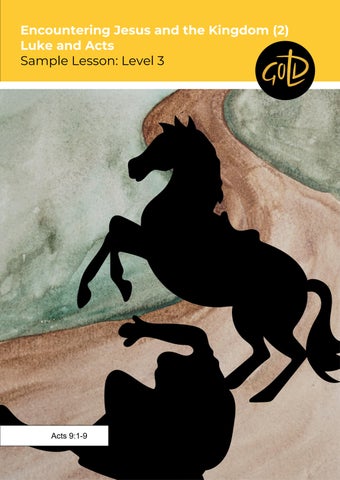
Acts 9:1-9
This sample lesson is from the Level 3 course Encountering Jesus and the Kingdom (2): Luke and Acts.
Copyright © GOLD Project
All rights reserved. No part of this publication may be reproduced, stored in a retrieval system, or transmitted in any form or by any means, electronic, mechanical, photocopying, recording or otherwise, without written permission from GOLD Project.
Scripture quotations are from the New Revised Standard Version Bible: Anglicized Edition, copyright © 1989, 1995 National Council of the Churches of Christ in the United States of America. Used by permission. All rights reserved worldwide.
Published (2024) by: www.goldproject.org
© GOLD Project 2024
The Group-based Open Learning Discipleship (GOLD) Project is a Charitable Incorporated Organisation (CIO) registered in England, registered charity no. 1166567
Our Open Learning courses are designed to help you learn by means of:
Home Study plus Group Meetings plus Practical Application
Home Study
Each course is made up of five Blocks and each Block has eight lessons. If you have about ¾ hr to spare (very roughly), you can complete one lesson. These lessons require you to read and interact with the course material as well as with your Bible.
Each lesson is programmed to help you check your progress as you work through. To get the maximum benefit it is important that you use the course in the way it was intended:
1. Read section 1 (often referred to by the technical term ‘frame’ 1).
2. Make the response required, if there is one.
3. Check that your answer corresponds with the feedback given in the ‘feedback’ section at the end. (Wherever feedback is given, it is marked with a raven).
4. Proceed to section 2.
Note that the course is programmed you are not being programmed! The aim of programming is that:
1. you can check frequently that you have understood the material presented;
2. you are stimulated to active and critical thinking;
3. you reinforce what you learn and are better able to remember it.
Sometimes, discussion frames are given. These are clearly indicated by a heading ‘For Discussion’ and box. Here you should answer the question in your own words and come to the group meeting prepared to discuss the question as indicated.
At the end of each lesson, we encourage you to spend some time in reflection on how what you have learnt applies to you in the situation where God has placed you.
Group Meeting
Regular group meetings take place (normally fortnightly) where you will have the opportunity to discuss points of interest that have arisen and think through with others how your learning may be applied. At the end of each block of home study, you will also normally be given a five-minute quiz.
The group meetings give the opportunity for you to clarify ideas and to share your own thoughts and to listen to the ideas of others. The process of learning from the Bible in a group is an essential part of the programme. It is here that you are able to think through areas of application and to pray and support each other in your studies.
Practical Application
Built into our courses are questions that encourage you to apply the message of the Bible to daily life. You are also encouraged to think through how your studies relate to your own discipleship and the mission and ministry of the local church.
Block 4 Lesson 3
Acts 8-12: The Gospel Reaches the Gentiles
Preparing for this lesson:
• Take a moment to pray that God will give you insight to reflect on how the Gospel reached the Gentiles
• Remember to keep a notebook handy to note down any questions or issues for discussion.
Objectives At the end of this lesson you will be able to:
1. list the main events of Acts 8-12;
2. give four examples of preaching to non-Jews in this section;
3. explain how this teaching might apply to the church today.
a. Introduction.
1. In this lesson, we shall see how the church began to witness outside Judea and the Jewish community, as recorded in Acts 8 - 12. Here are the four main events of this section, not in order.
Peter’s ministry to Tabitha and Cornelius
Peter reports about the conversion of the Gentiles and the church begins in Antioch.
The conversion of Paul
Peter’s release from prison
Philip’s ministry to Samaria and the Ethiopian Skim through this section now and arrange these events in the correct order. Write them below, with chapter numbers.
a.
b.
c.
d.
e.
2. Think about this section. Can you find four examples of witnessing to nonJews in it?
b. The Good News reaches Samaria
3. We have seen how the church began to witness in the power of the Holy Spirit in Judea (Acts 1-7). What was the next area in which Jesus said they would witness (1:8)?
4 According to Acts, who was the first person to take the Good News to Samaria (8:5)?
5. This Philip who started preaching to non-Jews in Samaria was not the apostle Philip (cf. John 12:21) The Philip in Acts is first mentioned in Acts 6:1-6. He is usually called Philip the Evangelist. What had this Philip been chosen to do?
c. The Good News reaches the Gentiles
6. Jesus had promised that when the Holy Spirit came on the apostles they would witness not only in Judea (to Jews) but also in Samaria and to the ends of the earth. The first Christians were all Jews, brought up to believe that Gentiles (non-Jews) were unclean and that the Samaritans were not much better (cf John 4:9 and Luke 10:25-37). Any contact with Samaritans and Gentiles made one unclean.
How do you think they felt about witnessing to them?
7. What made Philip decide to go to Samaria with the gospel (8:4)?
8. Now look at the beginning of the other two accounts of preaching to Gentiles in Acts 8-12. Note briefly how Philip and Peter came to preach to the Gentiles. Answer the following questions:
a. What prompted Philip to go down to the desert road and witness to the Ethiopian?
b. Why did God send Peter a vision before the envoys arrived from Cornelius?
9 It is quite clear from these stories that the Church did not choose to evangelise Gentiles, and that God forced them into it.
For Discussion
Is your church situated in a context where there are people from different social or ethnic groups? Are there special difficulties in approaching them with the Good News of Jesus? Would there be problems if they joined your church? What does Acts 8-12 have to say about such problems?
d. Peter and Cornelius
10. Immediately after recounting the conversion of Paul, Acts tells us of Peter’s dramatic encounter with a God-fearing Roman centurion named Cornelius.
How does this story begin (10:3-5)?
11. Then what happens? (vv.9-20)
12. There seems to be a parallel in the narratives of the conversion of Paul and the conversion of Cornelius, where the Holy Spirit is at work to bring an overcome unexpected person to faith and prompts one of the early disciples to their prejudices and take his message to the person God has already spoken to.
For Discussion
Do you think that this pattern of the Holy Spirit’s work followed by the church’s response to the prompting of the Holy Spirit has anything important to say about how we might do evangelism today? Is this especially relevant for reaching those who are ‘outside’ our normal circle of contacts?
13. Just as the Holy Spirit prompted Philip, Peter and Paul to proclaim the gospel to non-Jews, so also the Holy Spirit used another group to share their faith with those outside the Jewish faith, especially at Antioch.
Read Acts 11:19-21. Who shared the Gospel with the Greeks in Antioch?
14. Who do you think should be involved today in making known the gospel?
e. Review
15 Now try and answer the following questions on this section without looking at it again.
a. Who first went to Samaria and preached to non-Jews?
b. Where did Philip witness to an African?
c. Who was the Roman centurion in whose house Peter preached?
16. What are the five main events of this section?
17. Can you now recall the four examples of witnessing to Gentiles in this section? Write them below.
a.
b.
c.
d.
Reflecting on this lesson
Note down in your notebook anything from today’s lesson:
• that you want to discuss in your group meeting;
• that is significant for your own personal faith;
• that is significant for explaining Acts to others.
Spend some time in prayer asking God to help to put into practice what you have learnt.
Feedback: block 4 lesson 3
4.3.1 a. Philip’s ministry to Samaria and the Ethiopian (Acts 8) : b. the conversion of Paul (Acts 9) : c. Peter’s ministry to Tabitha and Cornelius (Acts 9-10) : d. Peter reports about the conversion of the Gentiles and the church begins in Antioch (Acts 11) : e. Peter’s release from prison (Acts 12)
4.3.2 a. Philip preached to Samaritans (8:5) and b. to an Ethiopian (8:26ff). c. Peter preached to Romans (10:34ff). d. The believers in Antioch shared their faith with the Greeks (11:20,21).
4.3.3 Samaria
4.3.4 Philip
4.3.5 distribute food
4.3.6 Your thoughts. They certainly did not take naturally to the idea.
4.3.7 persecution
4.3.8 a. a direct message from an angel of the Lord; b. to teach him to accept Gentiles.
4.3.10 God appears to Cornelius in a dream and tells him to send for Peter.
4.3.11 Your words. God appears to Peter in a dramatic vision about clean and unclean food and then tells him to go with the men who have come from Cornelius.
4.3.13 Ordinary Christians/believers (or similar)
4.3.14 Your answer. I would say ‘everyone’. Leaders (Peter), those who serve tables (Philip), converts (Paul), ordinary Christians (Antioch)
4.3.15 a. Philip, 8:4ff : b. the desert road to Gaza, 8:26 : c. Cornelius, 10:1, 24ff
4.3.16 If in doubt, check back to frame 1.
4.3.17 Check with frame 2.
4.3.1 a. Philip’s ministry to Samaria and the Ethiopian (Acts 8) : b. the conversion of Paul (Acts 9) : c. Peter’s ministry to Tabitha and Cornelius (Acts 9-10) : d. Peter reports about the conversion of the Gentiles and the church begins in Antioch (Acts 11) : e. Peter’s release from prison (Acts 12)
4.3.2 a. Philip preached to Samaritans (8:5) and b. to an Ethiopian (8:26ff). c. Peter preached to Romans (10:34ff). d. The believers in Antioch shared their faith with the Greeks (11:20,21).
4.3.3 Samaria
4.3.4 Philip
4.3.5 distribute food
4.3.6 Your thoughts. They certainly did not take naturally to the idea.
Whatever your educational level or knowledge of the Christian faith, we have courses that can enable you to grow in your faith.
As a group you can choose the level at which you want to study. We will train your group leader how the courses work.
All our courses combine:
✔ Home Study: using carefully designed workbooks
✔ Group Meetings: with a trained facilitator
✔ Application: Activities and opportunities to practice what you are learning
Level 1 Courses
For those who are new to the Christian faith and want an easily accessible form of study.
Level 2 Courses
For those who want to learn what it is to follow Jesus through an indepth study of his life and ministry.
Level 3 Courses
For those who want to take the study of the Bible further and engage with its meaning
For more information, contact: The GOLD Project
info@goldproject.org www.goldproject.org www.twitter.com/GOLDiscipleship www.facebook.com/groupbasedopenlearningdiscipleship
The Group-based Open Learning Discipleship (GOLD) Project is a Charitable Incorporated Organisation (CIO) registered in England, registered charity no. 1166567