Eastern Canada’s Trucking Newspaper Since 1981
January 2020
Delivering daily news at trucknews.com
Volume 39, Issue 12
Subscribe to our e-Newsletters
Pages 18
Page 36
Keep up to date with the latest news, events, videos and much more with a quick and easy subscription to our FREE e-Newsletters. Click on the SUBSCRIBE button at the top right hand of the trucknews.com home page.
A look back
Loving the lease
A look at the stories, issues, and deals that shaped Truck News’ first year.
Leases are evolving and becoming more popular because they provide peace of mind.
Auditor general blasts MTO
RET ADVERTAIL ISING P AGES 37 -
41
By Abdul Latheef TORONTO, ONTARIO Ontario’s auditor general has sharply criticized the Ministry of Transportation (MTO) over falling roadside commercial vehicle inspections, saying not enough is being done to ensure road safety. The rebuke came in the annual report released on Dec. 4 by Auditor General Bonnie Lysyk. The audit found that there are many opportunities for the ministry to improve overall safety through its Commercial Vehicle Safety and Enforcement Program. The report said one of the most important activities the ministry performs to ensure safety is its roadside inspections of commercial vehicles. “However, we found that between 2014 and 2018, the number of inspections the ministry conducted decreased by 22%, from over 113,000 in 2014 to fewer than 89,000 in 2018, because the ministry was unable to fill enforcement officer vacancies, and because the majority of enforcement officers did not meet their indiContinued on page 9
PM40063170
Careers: 2-3, 20-30 Ad Index: 43
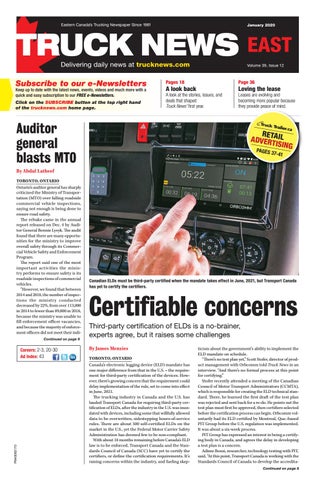
Canadian ELDs must be third-party certified when the mandate takes effect in June, 2021, but Transport Canada has yet to certify the certifiers.
Certifiable concerns Third-party certification of ELDs is a no-brainer, experts agree, but it raises some challenges By James Menzies TORONTO, ONTARIO Canada’s electronic logging device (ELD) mandate has one major difference from that in the U.S. – the requirement for third-party certification of the devices. However, there’s growing concern that the requirement could delay implementation of the rule, set to come into effect in June, 2021. The trucking industry in Canada and the U.S. has lauded Transport Canada for requiring third-party certification of ELDs, after the industry in the U.S. was inundated with devices, including some that willfully allowed data to be overwritten, sidestepping hours-of-service rules. There are about 500 self-certified ELDs on the market in the U.S., yet the Federal Motor Carrier Safety Administration has deemed few to be non-compliant. With about 18 months remaining before Canada’s ELD law is to be enforced, Transport Canada and the Standards Council of Canada (SCC) have yet to certify the certifiers, or define the certification requirements. It’s raising concerns within the industry, and fueling skep-
ticism about the government’s ability to implement the ELD mandate on schedule. “There’s no test plan yet,” Scott Stofer, director of product management with Orbcomm told Truck News in an interview. “And there’s no formal process at this point for certifying.” Stofer recently attended a meeting of the Canadian Council of Motor Transport Administrators (CCMTA), which is responsible for creating the ELD technical standard. There, he learned the first draft of the test plan was rejected and sent back for a re-do. He points out the test plan must first be approved, then certifiers selected before the certification process can begin. Orbcomm voluntarily had its ELD certified by Montreal, Que.-based PIT Group before the U.S. regulation was implemented. It was about a six-week process. PIT Group has expressed an interest in being a certifying body in Canada, and agrees the delay in developing a test plan is a concern. Adime Bonsi, researcher, technology testing with PIT, said, “At this point, Transport Canada is working with the Standards Council of Canada to develop the accreditaContinued on page 8
C riis Ch sttin ine e de d Bru ruin in in
Ambe Am mb be er B Ba alc l ae aen n
O ym Ol mpi p c Bo Bobs bsle bs le ed Piilo ot
Prroffes P essi ssi sion ional on nal a Rac ace ec ca arr Drriivve er
Patr Pa triic tr ciia a Viie enn nnea nea au Prof Pr offes o essi sion si sion onal all Tru a ruck ck Dririve ck verr ve
Whether navigating the steep banks of a speedway in a racecar, the precision of steering a bobsled down the track, or safely hauling 80,000 lb. through the Rockies; driving takes many forms – and women are leading the charge. See their stories at BisonDrivers.com
Bison Bi Biso so on Tr T an a sp s or o t is com ommi mitt mitt mi tted ted to di dive vers ve rsitty an rs a d in incl nclus clussio cl on in n the he wor orkp k la kp ace
FLEET SUMMIT
Practical strategies for fleet maintenance managers FRIDAY, APRIL 17 8 a.m. – 12 p.m. International Centre Toronto, Ontario
Learn how your fleet can: Q Tackle corrosion Q Avoid aftertreatment challenges Q Harness trailer telematics Q Prepare shops for electric vehicles
www.trucksummit.ca New event at
www.truckworld.ca
ISSN 0712-2683 (Print) ISSN 1923-3523 (Online)
Contents
Lou Smyrlis Director Business Development 416-510-6881 lou@newcom.ca Kathy Koras Associate Publisher 416-510-6892 kathy@newcom.ca A. (Tony) Hohenadel Publisher - truckandtrailer.ca 416-614-5800 tony@newcom.ca EDITORIAL James Menzies Editor 416-510-6896 james@newcom.ca Abdul Latheef Associate Editor 416-614-5828 abdul@newcom.ca Derek Clouthier Truck News – West Editor 403-969-1506 derek@newcom.ca
36
In Every Issue Products ...................... 34 Marketplace ............ 37-41 Announcement ............ 43 Ad Index ....................... 43
DESIGN AND PRODUCTION Michael Chimienti, Beverley Richards, Alicia Lerma, Carolyn Brimer
Mark Dalton ........... 44-45
ACCOUNT MANAGERS Anthony Buttino National Accounts Manager 514-292-2297 anthonyb@newcom.ca Nickisha Rashid National Accounts Manager 416-614-5824 nickisha@newcom.ca Denis Arsenault Quebec Accounts Manager 514-938-0639 ext. 2 denis@newcom.ca Doug Copeland Regional Accounts Manager 905-715-9511 doug@newcom.ca Paul Beelien Regional Accounts Manager 416-614-5806 paul@newcom.ca Stefanie Hohenadel Regional Account Manager (416) 510-5144 stefanie@newcom.ca
Truck News is published monthly by
Newcom Media Inc.
CHAIRMAN & FOUNDER: Jim Glionna PRESIDENT Joe Glionna VICE-PRESIDENT Melissa Summerfield Director of Circulation Pat Glionna Subscription Inquiries Lilianna Kantor Phone: 416-614-5815 Fax: 416-614-8861 Email: lily@newcom.ca RETURN UNDELIVERABLE CANADIAN ADDRESSES TO: CIRCULATION DEPARTMENT, TRUCK NEWS 5353 DUNDAS STREET, WEST, SUITE 400 TORONTO, ON M9B 6H8 PUBLICATIONS MAIL AGREEMENT NO. 40063170 CUSTOMER NO. 4006214
46 Feature Stories Bucking the trend Wellington Motor Freight implemented a safety strategy that it says significantly reduced insurance premiums in an environment of rising costs. 11
Loving the lease Weighing the pros and cons of leasing equipment, and why one fleet thinks a full-service lease is the smart decision. 36
27
Karen Bowen – Health Allergies can be exacerbated in the winter. Karen Bowen gives tips on how to recognize and deal with the condition.
29
Health Healthy Trucker rep Andrea Morley explains why mental health is moving from the back burner to the front.
31
7
19
Calendar of events
Scott Taylor – Tax Talk
In the final editorial of a Truck News print edition, the editor gives a nod to the past and a glimpse of the future.
Plan your 2020 with a list of some of trucking’s top events in the year to come.
Regulatory changes have affected income splitting, making it unbeneficial to many owner-operators.
8-17
21-23
46
The Truckload Carriers Association gives a U.S. regulatory update to Canadian fleets, inspiring women share their secrets to success, and how to prepare for an MTO facility audit. We also continue the series from behind the scenes of the Best Fleets to Drive For competition.
Cummins announces its sustainability objectives, and Lion Electric reveals plans to roll out electric vocational trucks.
Al Goodhall gives a view from behind the wheel, on why roundabouts have one fatal flaw.
Editorial
Business
18
A look back In the last print edition of Truck News, we take a look back at the stories and ads that shaped the very first issue, nearly 40 years ago.
Equipment
Al Goodhall – The Last Word
25
Mike Millian – Private Matters Mandatory entry-level training may not be perfect, but it gives us a good starting position and something to build on.
January 2020 • Truck News – East 5
Inside the Numbers with Lou Smyrlis In TRUCK DRIVER REPRESENTATION IN CANADA Maritimes
5.9%
0.4% 12.8% Alberta
14.6% Ontario
Saskatchewan
36%
3.9%
42%
4.8% Source: Trucking HR Canada, Statistics Canada
Source: Trucking HR Canada
CANADIAN TRUCK DRIVERS VS OVERALL CANADIAN LABOR FORCE
POSITIVE IMPRESSION AMONG MILLENNIALS - TRUCKING VS OTHER INDUSTRIES
68%
AGE
9.5%
Construction trades
<30
56%
23.8% Armed forces
YEARS OLD
27.8%
<40
45.1%
YEARS OLD
32%
<55
21%
YEARS OLD
51% Manufacturing
49% Retail
47% Resource extraction
6.6%
<65
4.4%
46%
YEARS OLD
Truck transport Source: Trucking HR Canada, Statistics Canada
Source: Trucking HR Canada
WARM TRUCKER LEADS PROFILE
36% 37%
Trucker prospects
Manitoba
LIKELY TO BE OLDER
ARE 24-29 YEARS OLD
46%
12%
British Columbia
20.8%
Non trucker prospects
Warm trucker leads
CDN WORKFORCE
Truck transportation has the highest job vacancy among all Canadian industries, averaging 6.6% in 2018. That’s more than double the Canadian average and makes for about 22,000 vacant positions. In addition, 6.6% of truck drivers are 65 or older, which means that as many as 20,000 drivers could be retiring and leaving the industry imminently. Attracting millennials, who are now the largest group in the labor pool, seems the obvious solution but is fraught with challenges. Research conducted on behalf of Trucking HR Canada shows that in the eyes of millennials trucking lags behind other industries when it comes to projecting a positive image.
Territories
Quebec
TRUCKING
Why it’s critical to boost trucking’s image among millennials
MILLENNIAL TALENT POOL TARGET GROUPS FOR LONGHAUL TRUCKING JOBS
LIKELY TO BE MALE
LIKELY TO MAKE LESS MONEY
67%
48% MAKE LESS THAN $50K
ARE MALE
ARE 30-36 YEARS OLD
STRONG INTEREST AMONG RURAL DWELLERS
STRONG INTEREST AMONG FIRST NATIONS
50%
15%
17%
HAVE ONLY HIGH SCHOOL OR LESS
WOULD CONSIDER LONGHAUL TRUCKING
WOULD CONSIDER LONGHAUL TRUCKING
LIKELY TO BE LESS EDUCATED
Source: Trucking HR Canada, Statistics Canada
#DeloDrives PERFORMANCE
The Next Generation of Heavy Duty Diesel Engine Oil
Delo 400 with ISOSYN Advanced Technology ®
®
Up to 35% Better Oxidation Control*
Up to 68% Better Wear Protection*
Up to 46% Better Piston Deposit Control*
Up to 60% Better
Component Durability*
canada.deloperformance.com *As compared to previous generation HDMO product test limits.
© 2019 Chevron Canada limited. All rights reserved. All trademarks are property owned by Chevron Intellectual Property LLC or their respective owners.
6 Truck News – East • January 2020
Editorial
See you on the other side As first reported last month, Truck News is transitioning to an online format with the publishing of this, its final print edition. As the magazine’s longest-serving editor, I greeted the inevitable announcement with mixed feelings. Like many of you, I look forward to receiving the print edition each month. The most rewarding part of being a magazine editor is the process of creating something completely new each month. No two issues are the same, and this keeps an editor sharp and engaged. On the other hand, my own reading habits are evolving along with societal shifts. When it comes to news, I get my information online. When it comes to presenting industry news, I love the immediacy of the internet and the many tools we have to present the news. We are no longer beholden to the number of words or pictures you can fit on a page, or to a print deadline that in many cases comes weeks after the completion of a timely story. The other good news about the transition is that we will continue to produce a print magazine, in the form of Today’s Trucking. The same editorial team that brings you this magazine will be playing a much larger role in the publishing of Today’s Trucking.
Al Goodhall, a popular Truck News columnist, will appear in Today’s Trucking, ensuring the view from behind the wheel isn’t lost. Harry Rudolfs, another long-time contributor and recently retired professional driver will also continue to write for us, both online and in Today’s Trucking. We have the Canadian trucking industry’s most impressive roster of contributors, and will continue to bring you their words and insights. Like the trucking industry itself, the publishing world is evolving. And as in trucking, we can either adapt or be left behind. As we near the end of 2019, I wish you all a happy holiday and thank you for reading. We’ll be back in the new year, stronger than ever! TN
When it comes to presenting industry news, I love the immediacy of the internet and the many new tools we have to present the news. In the coming weeks, we will be launching a completely redesigned TruckNews.com. It will offer us many new tools to enhance the way we present the news. You will
also continue to find us active on social media. We are creating new email newsletters to ensure a steady flow of news and insights from industry.
James Menzies can be reached by phone at (416) 510-6896 or by e-mail at james@newcom.ca. You can also follow him on Twitter @JamesMenzies
Mark Your Calendar!
TRUCK TECH FLEET SUMMIT
@ APRIL 16-18, 2020
APRIL 17, 2020
International Centre, Mississauga, Ontario, Canada
International Centre, Mississauga, Ontario, Canada
www.truckworld.ca
www.trucksummit.ca
January 2020 • Truck News – East 7
Business
Certifying the certifiers Continued from page 1
tion scheme to hand out accreditation to certifying bodies.” If the full contingent of some 500 or so ELD vendors who’ve self-certified their devices with the FMCSA chooses to become third-party certified for the Canadian market, it’s unlikely there’ll be sufficient time to certify them. “We don’t know how many people are going to be supplying the service,” added Jan Michaelsen, who heads PIT Group. “But we are kind of concerned. Once we get everything, the time window (to certify devices) will be pretty small.” Even if only 5% of the FMCSA-approved ELD suppliers choose to get Canada-certified, “In the span of six
months to a year, we will not be able to handle 25,” Bonsi said. When providing voluntary certification of ELDs in the U.S., it has taken as long as eight months to a year in some instances for vendors to make the necessary adjustments and bring their devices into compliance with the technical specification. But exactly how many ELD suppliers go through with third-party certification for the Canadian market remains to be seen. The CCMTA, according to sources who attended its most recent meeting, has suggested only 5% of ELD suppliers are expected go through the rigorous process. If so, that means Canadian fleets will be choosing from a much smaller supplier base, totaling only about 25 units. Orbcomm’s Stofer estimates between 50 to 125 devices will seek certification, while Mike Millian, president of the Pri-
8 Truck News – East • January 2020
vate Motor Truck Council of Canada (PMTC) feels there’ll be far fewer devices to choose from. “I think in Canada, we’re going to see 10 to 12,” Millian told Truck News. “A lot of the companies that operate south of the border are not going to invest the time and money to try to become certified in Canada, because they know they’re not going to get certified anyways.” This creates major issues for fleets that have already chosen an ELD supplier, if that supplier chooses not to get certified for the Canadian market. Stofer urges fleets to question their ELD vendor on their plans for Canadian certification. “The big one is, is your carrier committed to the Canadian market?” Stofer asked. “What have they done in the U.S. to ensure they can meet the certification process? Are they committed? Have they taken
steps to validate their system in the U.S.? Are they involved with committees, and in the rulemaking process? Have they worked in Canada previously? What’s your experience, how committed are you, how involved are you and what steps are you taking to make sure you are going to make it past third-party certification in Canada?” This may be a problem for U.S. fleets who’ve already chosen an ELD supplier, and may not be aware of Canada’s third-party certification requirement. Stofer said U.S. carriers are “100%” expected to comply with Canada’s requirement for ELDs to be certified by a third party. Neil Cawse, CEO of Geotab, said “Given the number of non-compliant systems we’re seeing in the U.S., I think there would be only a few that succeed (in getting certified).” U.S.-based fleets that do a small percentage of their miles in Canada won’t want to run two devices, Cawse added, yet the cost of swapping out the hardware across an entire fleet to a third-party certified device for the Canadian market may be prohibitive. This will create some difficult decisions for U.S.-domiciled fleets that have chosen an ELD supplier that’s not willing to pursue third-party certification. Despite all the challenges thirdparty certification has brought about, it seems everyone agrees it was the right approach. “Third-party certification is the right way to go,” said PMTC’s Millian. “We have to give Transport Canada credit for that. The fact you have over 500 suppliers in the states highlights the fact we need third-party certification. If anybody bothered to check on those companies, less than half would actually be compliant devices.” Geotab’s Cawse agreed with the decision to require third-party approval, though he wishes it wasn’t needed. “I’m normally in favor of self-certification,” he said. “You’d expect most companies would have a very compliant product. But what’s interesting to me is, we believe some of the American products – some of the ones that are very, very large – are not compliant. And the problem with a non-compliant product is that it creates a sales advantage for people who have a non-compliant product.” While the certification process is causing increased concern about Transport Canada’s ability to meet its own June, 2021 implementation deadline, fleets are urged not to count on an extension. “Transport Canada is very firm in their commitment that they’re going to reach the June, 2021 timeline,” Millian said. “I personally think it’s going to be very hard to meet without having problems.” But he also warns fleets not to wait and gamble on an extension. TN
Enforcement lapse Continued from page 1
vidual annual productivity targets for the number of inspections to complete,” the report said. It added, as a result, the ministry missed the opportunity to remove thousands of additional unsafe commercial vehicles and drivers from Ontario’s roads. The report also said that the ministry had estimated that Ontario’s truck traffic increased 10% from 2009 to 2018. In the 10 years from 2008 to 2017, commercial vehicles (large trucks and buses) were involved in more than 182,000 collisions in Ontario, it said. These collisions resulted in almost 44,000 injuries and 1,180 fatalities. Commercial vehicles were at-fault in 46% of these collisions, including 33% of collisions that resulted in a fatality, whether due to the driver’s actions or the vehicle’s condition, the report said. “According to the ministry, the direct social cost of large truck collisions in Ontario for the five-year period from 2011 to 2015 (the most recent data available) was $2 billion,” the report added. That includes costs related to property damage, health care, police, courts, fire and ambulance services, tow trucks and traffic delays.
The report noted that Ontario consistently ranks among the safest provinces in Canada and compares favorably to the U.S. for overall road safety. “However, Ontario maintained higher fatality and injury rates than Canada as a whole and the United States in the majority of years between 2008 and 2017 when evaluating only commercial vehicles,” the report said. From 2014-2015 to 2018-2019, the ministry spent more than $200 million on commercial vehicle enforcement, including $39.4 million in the 2018-2019 fiscal year. In 2018, about 60,000 carriers were registered to operate in the province and over 290,000 registered commercial vehicles. The report also criticized Ontario’s driver training standards. “We also found that driver training is not mandatory for some of the highest risk commercial driver’s licence classes, and that Ontario allows commercial vehicle driver licensing practices that are uncommon in other jurisdictions, such as allowing commercial vehicle carriers (businesses that operate commercial vehicles) with a poor collision history to test their own drivers for commercial vehicle driver’s licences.” It also accused the ministry of not effectively monitoring and taking action to address high-risk Motor
THIS MONTH’S CROSSWORD PUZZLE
Vehicle Inspection Station (MVIS) garages, which issue safety certificates for commercial vehicles. The report also said: • More unsafe commercial vehicles and drivers could have been removed from the roads with more inspections. • Roadside inspection enforcement is not consistent across the province, impacting the effectiveness of roadside inspections in preventing collisions. • The majority of carriers have not had a vehicle inspected in the past two years, including carriers with a poor collision history. • Most roadside inspections are performed on provincial highways, allowing “local haulers” to avoid inspection. • Despite a high risk of collisions, the Ministry does not sanction municipalities. • The ministry does not assess the reasonableness of kilometers traveled reported by carriers that are used to calculate safety ratings. • Mandatory entry-level training (MELT) has not been extended to other commercial class driver’s licences. • The ministry allows some carriers with a poor history of collisions to test their own employees for commercial vehicle driver licenses. • There is no mandatory drug and alcohol testing for commercial vehicle drivers.
The audit concluded that the ministry does not have fully effective and efficient processes and systems to consistently carry out safety programs that promote and enforce the operation of commercial vehicles. In its response, the ministry said it appreciates the work of the auditor general and welcomes the recommendations on how to improve the Commercial Vehicle Safety and Enforcement Program. “We agree with all the recommendations and are committed to implementing them as quickly as possible and will report back regularly on our progress,” it said. The Ontario Trucking Association (OTA) said the report highlights the need for enforcement improvements, adding that it echoed its own sentiments made in November regarding the need to modernize truck safety and enforcement. The association has been working with the ministry to improve the enforcement strategy, it said. “MTO has a holistic and visionary plan to tackle truck safety that will effectively address the concerns outlined by the auditor general. OTA looks forward to continuing to work with MTO on developing and executing this plan as quickly as possible over the next several months,” said Stephen Laskowski, president of OTA. TN
TN-199 Jan. 2020 M. Jackson
PUZZLED? DIESEL PARTICULATE FILTER Cleaning Service and Repairs p ASH LOADED
CLEAN
CLEAN
FILTERS
$$
SAVE $
Answers on page 43
DPF A REPLACFTER-MARKE T EM NOW AVENT FILTERS AIL
ABLE
Seasons Greetings! Across
1 4 8 9 10 11 12 14 18 20 21 22 23 24
Above-cab van area Rand McNally atlas page (4,3) Cummins and Detroit engines Airtronic heaters brand ’16 FedEx-acquired carrier (1,1,1) Oversize load escorts (5,4) QC carrier since ‘46 Grain trailer; ____ bottom In-out dash knob (4,5) Flat-face tractor, briefly (1,1,1) CB name, in a way Mack vocational model “There Ain’t No ____,” D. Dudley (4,3) Serpentine road sections
Down 1 2 3 4 5 6 7 13 15 16 17 18 19 20
Unwelcome CRA official Cargo crime Ultra-low gear Used truck transaction Freight or insurance contact Pre-GPS navigator’s assist (3,4) Truck dealership department Certain two-trailer rigs (1,6) Goods in excess of Bill of Lading Cold cargo carriers Mack’s “Born Ready” Fort Erie - Buffalo bridge Windshield accessory Tollbooth fodder, perhaps
has the solution. 905.795.2838 1.800.267.4740 fax 905.678.3030
Canada & U.S. hotline
www.texisexhaust.com SEE OUR AD PAGE 39
January 2020 • Truck News – East 9
Business
‘The taxman will come’ : Lawyer on Driver Inc. By James Menzies MISSISSAUGA, ONTARIO Kim Stoll, a transportation lawyer with Fernandes Hearn LLP, had some strong advice for truckers operating under the Driver Inc. model, which she offered at the ISB Global Biz and Breakfast Nov. 13. “I know it sounds ominous, but they are coming,” she said of Canada Revenue Agency (CRA). “And rightfully so, because Driver Inc., when set up in that manner is a sham. It rips off drivers and it rips off taxpayers.” Driver Inc. is the controversial employment model that categorizes company drivers as indepen-
dent contractors, allowing employers to sidestep source deductions and drivers to claim tax benefits they’re not entitled to. In Ontario, the Workplace Safety and Insurance Bureau has begun cracking down on trucking companies who’ve adopted this model, but so far CRA has not gone after drivers who are in such employment arrangements. Stoll thinks that will soon change. She urged drivers in that scenario to review the CRA website to determine if they are truly an independent contractor. It’s spelled out quite clearly at www.canada.ca/en/ revenue-agency.html. “The taxman will come,” she warned.
Asked if drivers will have any legal recourse against their employer, if they’ve been led to believe this arrangement is legal, Stoll was skeptical. “We haven’t seen that yet. I’m sure that will come,” she said. “Everybody is responsible for their own activity…You’re responsible for the decisions you make and the contracts you sign.” But she said drivers may file civil suits against their employers, on the grounds of “undue influence or some sort of employment contract breach.” Surviving a facility audit Jodi Burness, owner of Burness
Paralegal Services, offered advice on surviving an MTO facility audit. “There are two reasons a facility audit is conducted,” she said. “You invited the MTO into your house, or they’re there because of an event.” ‘Events’ could include a catastrophic crash, or a high CVOR violation rate. “That’s going to change the mood of the auditor coming in,” she warned. MTO auditors are allowed to show up without warning and to begin asking questions, Burness warned. Some fleets with conditional CVOR ratings will invite the MTO in for an audit, in order to improve their safety rating. Before doing so, suggested Burness, “You absolutely need to make sure your house is in order.”
“Driver Inc., when set up in that manner is a sham. It rips off drivers and it rips off taxpayers.” – Kim Stoll, lawyer She recommends arranging a pre-audit with a reputable firm. “If there is a sense you will not pass, make sure you have a conversation with the person you engaged, that they are not going to create paperwork as a result of their findings,” she urged, adding you don’t want a report of their findings, which could serve as a roadmap of your weaknesses if obtained by the MTO auditor. Before the MTO auditor arrives, Burness warned to have all documents in order and available. In fact, she said, start the communication process with the auditor the moment they first provide notice of the audit. She also said any material you produce could be used as evidence against you in the event of a trial if charges are laid. Burness said to ask questions of the auditor and don’t be afraid to write down their responses in front of them. “Let them see that you are putting that answer in writing.” Stoll added, “Make sure you’ve had policies and procedures vetted by people who know what they’re doing. Make sure everything is done properly, that you have gone over the policies, and that you are following those policies.” She said having policies reviewed by an expert, and keeping them regularly updated, is money well spent. TN
10 Truck News – East • January 2020
Bucking the trend How one fleet significantly lowered its insurance premiums By James Menzies GUELPH, ONTARIO With insurers reducing their risk exposure, and some exiting transportation altogether, many carriers have seen rising premiums and outright policy cancellations. But one Ontario carrier has bucked the trend, and seen a high double-digit decrease in their premiums this year. Derek Koza, president and CEO of Wellington Group of Companies, operator of Wellington Motor Freight, told Truck News that his company took a strategic approach to reducing its insurance premiums. The company has 85 vehicles, operating a regional fleet in the Toronto area, as well as serving the Toronto-Montreal corridor and Atlantic Canada. It also serves the U.S., but mostly by rail. The company started as a broker about five years ago and ramped up its asset-based trucking operation last year when capacity was tough to secure. Wellington took a holistic approach to lowering its insurance costs, including some forward-thinking measures. For one, drivers are all paid a salary. “We are one of the few in the industry, where all our company drivers are salaried drivers,” Koza said. “The reason why we wanted to do that was to drive consistency for drivers, where there’s no message in the back of their head where it’s rush, rush, rush.” Paying drivers a salary has resulted in a 95% retention rate, Koza said, and a waiting list of drivers looking to join the company. “With retention and consistency, comes safety,” Koza said. There are expectations for the drivers, of course. They must make themselves available five days a week for up to 60 hours. They’re paid overtime after 60 hours. Whenever possible, Wellington offers dedicated lanes. Being familiar with the route allows for better trip planning and improved safety, the company found. “We are getting into winter here and certain pockets in southwestern Ontario are going to be extremely windy, with lots of snow drifting. The drivers are anticipating that prior to entering into that zone,” said Koza. Wellington is uncompromising when it comes to hiring standards. Koza said that’s because once you compromise your standards, it becomes habit-forming. “You have to stay disciplined to the safety plan you put in place,” he said. Wellington is up-front with its customers that drivers are expected to park when weather is bad. “Every time there’s a snowstorm or heavy rain, we send out a message to our drivers reminding them
Wellington Motor Freight saw a major reduction in its insurance premiums after developing an in-depth safety strategy that included making drivers salaried employees. that they and the general public are more important than any load they’re delivering,” said Koza. Equipment is spec’d with active safety systems to support the driver and disc brakes. All reefers are seven years old or newer, dry vans are 10
years or newer, and trucks are five years or newer. Electronic logs are used, even by city drivers. All trailers are tracked by GPS, and telematics are used to identify incidents like hard braking and speeding violations. Having developed a comprehen-
33 Kippax Court, Brantford, ON N3S 0E5
sive safety plan, Wellington invited in its insurer to communicate the plan. It was already in the middle of the pack in terms of its premiums, not bad for a young fleet, but with room for improvement. “We were nowhere near the highest and nowhere near the lowest,” said Koza. But even as a fledgling fleet, the company was granted a 21B fleet policy, allowing it to hire drivers without first having them vetted by the insurance company. Koza didn’t want to publicly disclose the insurance premium savings the company now enjoys, but says the company was “rewarded handsomely” for its efforts. “I’m not going to say it was an easy journey,” said Koza. “But it really is simple if you sit down, put together a plan, get the engagement of the team, and most importantly, stick with the plan.” Even if new business is brought on or trucks are parked against the fence, Koza said it’s essential to not deviate from the plan. “You have to stay committed to the plan. You can’t take that sidestep and make that exception, because if you do, it’s going to continue to be a roller-coaster of exceptions going forward.” TN
www.trisontarps.ca 1-866-948-2777 519-720-9464
Canadian Made Tarps
Electric Side-Lok
Manual or Electric Cable Systems
Distributors For:
We Manufacture Our Own Aluminum Products!
Fully Stocked Showroom A DIVISION
OF
TRISON TARPS INC.
X Trailers X Dump Trucks X Live Bottoms X Hoppers X Bins X Sheet Plastic
“SUPPLIES FOR ALL YOUR EQUIPMENT NEEDS”
www.trisontarps.ca
January 2020 • Truck News – East 11
Business
Gordie Howe Bridge tower construction to start by summer By Ron Stang WINDSOR, ONTARIO To most people, including truckers driving over the existing Ambassador Bridge, work on the new $5.7-billion Gordie Howe International Bridge 3.2 kilometers away isn’t apparent yet, because the two towers which will hold up the bridge have yet to be constructed. But, work on the footings for those towers is well underway and tower construction itself will start by summer, bridge officials told reporters on a tour of the site in late November. The two A-frame bridge towers – one on the Canadian side and the other on the U.S. – will be a defining feature of the cable-stayed bridge, North America’s longest with a main span at 853 meters. “It will be the biggest in North America by far, and the fifth longest in the world,” said project lead Terry Poole of Bridging North America, the international consortium building the bridge.
The towers themselves, when finished, will be a dominant skyline feature of the Windsor-Detroit area – 220 meters (750 ft.) in height – as high as Detroit’s tallest skyscraper, the GM Renaissance Center. But the bridge’s opening date is still some time off – November, 2025. Pre-construction work, including removing soil moisture, relocation of utilities, a service and emergency access road on the Canadian side, are largely complete.
What’s new – and perhaps for various perennial skeptics, visual proof that the bridge itself is being built – is the fact that 12 caissons or concrete shafts on the Canadian side are almost finished. Similar work on the U.S. side is also underway, and massive blue cranes can also be seen. The caissons, or shafts, support what will be the bridge towers. The shafts are dropped almost 30 meters into the ground – six shafts per pier cap or base for each tower
Using high-tech to improve traffic flow along Windsor corridor By Ron Stang WINDSOR, ONTARIO Locally, it’s known as Truckers’ Tuesday. And Thursday might also be added to the endearing description. Because those are the two days of the week when the volume of truck traffic along Huron Church Road is at its heaviest. These are among the findings in a pilot project launched by local city and economic development officials. They commissioned Kitchener-based Miovision to carry out a detailed high-tech study on Huron Church, which connects Hwy. 401 to the Ambassador Bridge, and which is the busiest trade corridor in Canada. The project, which has seen the installation of three specialized cameras to measure traffic and types of vehicles using the six-lane road, has already resulted in a 20% increase in efficiency by better synchronizing traffic lights. “What they wanted to do was to use data to get a really clear view of what’s happening along that corridor,” said Susan Anzolin, executive director of the local Institute for Border Logistics and Security. “So, when is the corridor most busy, what types of vehicles are being used along there, could they change their traffic signal patterns to better enable mobility along that corridor?”
Miovision, which has conducted traffic studies in more than 15,000 communities around the world and has a European office in Germany, installed its Miovision SmartView 360 degrees fisheye cameras at three Windsor intersections to give traffic planners real-time information.
“In conversations that we’ve had with trucking companies, they’ve noted that it costs about a dollar every time that truck has to push on its brakes and slow down and then speed up and accelerate.” – Erin Skimson, Miovision The cameras count and separate types of traffic – from trucks to cars to cyclists – and feed the information into an algorithm, which helps planners decide how to increase efficiency.
12 Truck News – East • January 2020
“There is an awful lot of freight traffic and that’s impacting certainly the efficiency by which trucks are moving along that corridor,” Erin Skimson, Miovision’s vice-president of product development and corporate programs, said. “But it’s also impacting business locally.” More than 10,000 trucks per day can use the corridor but Miovision discovered that Tuesdays and Thursdays seem to have peak traffic “where there is an enormous truck load all 24 hours of the day,” Skimson said. In fact, Skimson, a seasoned traffic manager, couldn’t believe the amount of commercial traffic after she arrived in Windsor. “The volume of trucking traffic that has to get through on those two days in particular is astonishing,” she said. Tweaking traffic along Huron Church Road is important, even though the new Gordie Howe International Bridge is soon to get under construction. That bridge will likely take much of the commercial traffic off Huron Church Road. “The Gordie Howe is going to be the most technologically advanced border crossing – that’s its mandate – but it’s not going to be open until the end of 2024,” Anzolin said. “So, what can we do to facilitate the movement of goods right now? And
leg – inserted with a more than 40-meter cylindrical rebar cage – and then filled with concrete. Altogether, the bridge construction project is “really four in one,” said Bryce Phillips, CEO of the Windsor-Detroit Bridge Authority (WDBA), the Canadian Crown agency overseeing work. (The bridge is being built entirely by a Canadian public private partnership). That includes the bridge itself, the two ports of entry, including Customs plazas, and the road and interchange connecting the U.S. plaza to Interstate 75, less than a mile away. Construction of the ports of entry will take place as the bridge is being erected, officials said. Work on I-75 is expected to start within “the next few months” with reconstruction of ramps to and from Springwells St. and service drives between Springwells and Green St., a fact sheet stated. Phillips called the work to date “impressive,” even though it may not be obvious to the public. He said construction is now “scaling up” with peak construction years slated for 2021-2023. Locally, some 200 trucks per day will be needed to carry additional fill and aggregate to the Windsor port of entry site. TN
that’s by making sure our Huron Church Road is much more innovative.” The project will harvest information that traffic planners could use in a variety of ways. Not only could traffic light synchronization be tightened, but segregated truck lanes could be created. Or, working with the trucking and logistics industries – there have already been consultations with the Ontario Trucking Association and individual companies – shippers could be informed on the optimum times of days, and days of the week, to ship goods. “If you want to ship something next week then when’s the best time to do it?” Anzolin said. “There’s enough data sets that we should be able to build algorithms to figure that out.” Another possible improvement is green light extensions, such as what took place across the river in Detroit in a pilot along the busy commercial Larned Street corridor. A green light extended up to 10 seconds saw a 22% reduction in the likelihood of stopping and a corresponding 20% reduction in fuel consumption. Increasing movement even by these amounts can be significant economically. “In conversations that we’ve had with trucking companies, they’ve noted that it costs about a dollar every time that truck has to push on its brakes and slow down and then speed up and accelerate,” Skimson said. TN
Female leaders share keys to success in business By James Menzies MISSISSAUGA, ONTARIO Trucking HR Canada’s Women with Drive tour continued Nov. 26, with a visit to TransCore Link Logistics’ Mississauga, Ont., headquarters, where about 130 guests gathered to hear from three inspiring women in the trucking industry. The Mississauga stop marked the fifth of six regional events held this year. “We embarked on these regional initiatives because we were hearing from industry that they wanted to see us do more of these types of events,” explained Angela Splinter, CEO of Trucking HR Canada. A panel discussion was held featuring: Tracy Clayson, director of client development with In Transit Personnel; Stephanie Carruth, research and development with ONE For Freight; and Claudia Milicevic, general manager, TransCore. Asked about the key to achieving success in business as a woman, Milicevic urged those in attendance to network and attend industry events. This was initially difficult for her, as she says she’s an introvert. “I forced myself to go to events by myself. I would walk into a room, and oftentimes it was successful
business leaders and a predominantly mature male audience,” she said. “I was petrified…Not once was I told it was a requirement of my job. I did it because I felt that’s what I had to do.” Eventually, Milicevic developed the courage to participate more in those organizations, culminating in her becoming just the second female president of the Toronto Transportation Club. The networking paid off as she developed business relationships and found mentors in the industry. She said she was driven by a fear of failure. “I thought, if I didn’t go, someone else would. They would win and I would lose,” she said. “No one is going to open that door for you,” agreed Clayson. For Carruth, coming from an extensive academic background, joining private industry was an eyeopener. She quickly learned she had to earn her acceptance. “Moving into private industry, I think I walked in expecting I did all this work in academia and I expected to get respect immediately. I couldn’t have been more wrong about that. I was starting fresh. Nobody had any business understanding what I was capable of and I had to prove myself all over again,” Carruth said.
Quebec to allow LCVs in winter By Eric Berard QUEBEC CITY, QUEBEC Quebec has announced more flexible traffic regulations for long combination vehicles (LCVs) following a smiliar move by Ontario. The changes came into force Nov. 28. The authorities say they have taken into
account economic factors to update the standards dating back yo 2014. The most significant change is related to the winter period, specifically the months of December, January and February, when LCVs will be allowed to circulate, with the exception of holidays and Dec. 26. LCV traffic will also be
JUSTIN POLLARI
Trucking HR Canada CEO Angela Splinter introduces the panelists (from left in couch): Claudia Milicevic, TransCore Link Logistics; Tracy Clayson, In Transit Personnel; and Stephanie Carruth, ONE For Freight. This meant admitting she didn’t have all the answers and developing the courage to seek out the answers when needed. To help with her professional growth, Carruth has been active with the Ontario Trucking Association and its programs for young leaders. Milicevic urged women in the room to be more confident and to go after their professional objectives. “Women, sometimes, should be far more confident than they are,” she said. “They often won’t ask for what they want. They will do their job and hope someone notices. Men will make sure someone notices.”
“We create our own barriers,” agreed Carruth, noting this is true even in academia, where women are less likely to cite their own work. Mentorship is also key to success. “I have collected mentors,” said Clayson, who now consciously gives back that knowledge she has collected, by mentoring others. Asked which woman has inspired the panelists the most, it was unanimous: Mom. Carruth added her grandmother and nana to the list. “My mother was somebody who would always tell me the truth, whether I wanted to hear it or not,” Carruth said. TN
allowed on Sundays. Although the periods in which LCVs can travel have been extended, their use is far from being deregulated. There is always a special licence to operate trucks in this configuration, and trucking companies and their drivers have to demonstrate how seriously they manage road safety.
As a first step, a LCV licensee must develop a list of safe stopping places for each planned trip in the event of unforeseen weather, road conditions or visibility. Drivers must be able to establish that they have checked weather forecasts from two different sources within three hours before departure. TN
classifieds lassifieds CLASSIFIEDS classifieds classicl cl classi fieds eds clas classifieds ssifi s eds classifiedss CLASSIFIEDS CLAS FIEDS CLASSI CLA DS clasclas cla las sifieds ifi fieds fi ed cl eds cclassifieds lass as ifiedss classifieds ccla lassi sss fied eds CLASSIFIEDS eds CLAS CLAS LASSIF SIFIE SIF IEDS IED S clasclas clas laas as sifieds ifi ifieds fieds CLASSIFIEDS CLAS CL ASSIF AS SSIF SIFIED IEDS IED S clas cclassifieds lassifi las sifieds CL CLASS CLASSIFIEDS ASSIFI ASS IF ED IF IFI EEDS D classifieds lassi la ss fied ssi fiedss classifieds fie clas clas lassifi assifieds d classifieds cllass ssiifi ss ifieds classifieds
s d e fi i s s a l C CA$H FOR INVOICE$
Missing From: Hilton Beach, ON Missing Since: December 7, 2001 Date of Birth: January 31, 1987 Height: 5’11” Weight: 146lbs
Same Day Funding • Immediate load approval for Load Link users • Same Day Funding • Flexible Funding Options • 24/7/365 Service
Bad Debt Collection Service Equipment Financing Solutions
Brokers • Ask How Our Quick Pay Program Can Help Your Business!
1-877-653-9426
Hair Colour: Blond
www.liquidcapitalmidwest.com riacobelli@liquidcapitalcorp.com
Eye Colour: Blue
IF YOU HAVE ANY INFORMATION ABOUT THIS YOUTH, VISIT
OR CALL
missingkids.ca
1-866-KID-TIPS (543-8477)
OR CALL EAST ALGOMA (BLIND RIVER) OPP AT 705-356-2244
$140.
00
00
$
60.
Driver Medical Exams
ONTARIO DRIVERS WALK-IN MEDICAL CLINIC 21 Queensway West Mississauga, Ontario (DIRECTLY ACROSS FROM MISSISSAUGA HOSPITAL)
w/Picture
Ad runs one month.
9:00 a.m. – 9:00 p.m. 7 Days a Week
Contact Doug: doug@newcom.ca
No appointment necessary
Also On-Line at: www.trucknews.com
(905) 897-9228
January 2020 • Truck News – East 13
Business
TCA gives Canadian fleets broad U.S. regulatory update By James Menzies BRAMPTON, ONTARIO The Truckload Carriers Association (TCA) made its annual trek to Canada Nov. 20, offering a free half-day business conference, which included a broad update on U.S. regulatory issues. David Heller, vice-president of government affairs with TCA, told a group of about 135 attendees that virtually nothing is moving through Congress, thanks largely to distractions such as the impeachment hearings and upcoming election. Most trucking-related regulations don’t have the legs to carry themselves, and must be piggybacked onto broader legislation such as an infrastructure bill. But those are stuck on the shelves due to the 2020 election and political gridlock in Washington, Heller explained. However, he also acknowledged large truck fatalities are on the rise in the U.S., which will continue to see calls for further safety initiatives. Why are truck fatalities on the rise? Heller attributed it to an increase in miles traveled, as well as the increased penetration of smartphones. In 2016, 81% of people had a smartphone, up dramatically from just 2% in 2005. “This is playing a major role in distracted driving,” Heller said. One piece of legislation that has some momentum is proposed revisions to the hours-of-service rules announced earlier this year. The U.S. Federal Motor Carrier Safety Administration is “fast-tracking” the legislation, but Heller warned it could still stall if it doesn’t get implemented before the election. And a change of administration could derail the changes altogether. “If this doesn’t get done in the Spring – or possibly early Summer – as a final rule, there is an opportunity this doesn’t get done at all,
David Heller depending on the results of the election,” said Heller. A regulatory change that seems certain to proceed, is the move from automatic on-board recording devices (AOBRDs) to electronic logging devices (ELDs), which is to occur by Dec. 17. “I’ll tell you now, if you are waiting to transition, you may be too late,” warned Heller. “Plan for hiccups, that’s your best approach.” He cited data that showed 30% of fleets are not at all satisfied with their e-log device supplier, while only 12% are very satisfied. “If you are expecting a smooth transition, you are most likely wrong,” Heller said. This message was later echoed by Kerri Wirachowsky, director of roadside inspection programs with the Commercial Vehicle Safety Alliance (CVSA). “I can’t emphasize enough, to do the switch now and go through those headaches you have to go through over the next month,” she said. “If there has ever been a year-and-a-half in my life in the enforcement community where inspectors have been very lenient, it is now.” She said that’s soon to end. Currently many enforcement officers
FEBRUARY 26 & 27, 2020
5th Annual
T T SAO C O N FER EN C E AGENDA
Centre for Health and Safety Innovation (CHSI) 5110 Creekbank Road, Mississauga, Ontario
A full 2-day conference for the industry Master of Ceremonies: John G. Smith, Today’s Trucking
X TTSAO AGM X Carrier Group Meeting X Insurance Group Meeting X Changing Faces & Trends (featuring Lou Smyrlis)
X Provincial Government Update X Females in the Trucking Industry Panel Official Media Sponsor
struggle to identify the differences between AOBRDs and ELDs, and are told to presume non-compliant devices are grandfathered ABORDs. That leniency will disappear Dec. 17 when AOBRDs are no longer accepted, Wirachowsky warned. Heller praised Canada for its approach to ELDs, and its requirement for third-party certification of devices when the Canadian law is implemented in June, 2021. He said in the U.S. there are nearly 500 self-certified devices listed by FMCSA as acceptable, while only about a dozen have been banished. “Third-party certification should be good for U.S. carriers,” he said. “It will help certify the ELDs we have in our market. It should thin the herd.” ELDs are providing data that the trucking industry can use to hold shippers more accountable for detention time, and to highlight industry concerns over issues like a lack of truck parking. “Data is the new oil,” said Heller. Already, the data is identifying trends. For instance, the TCA has identified that wait times at shipper and receiver facilities are averaging 131 minutes. It has also identified the 10 worst U.S. cities for detention time. “We now have ways to accurately track this, which we never have had before,” said Heller. Unfortunately, the data also shows speeds are increasing, especially after a detention event. Drivers are now racing the clock, said Heller, and “speed is the number one cause of accidents on our highways today.” The good news is, the FMSCA is finally paying attention to detention time. “Why? Because of ELDs,” Heller said. “We are now telling a true story with the data generated by these devices.” Infrastructure is another major issue in the U.S., and one that’s not
being addressed, Heller noted. The U.S. now ranks 10th in the world in terms of infrastructure, and has 47,000 structurally deficient bridges. Talks of a US$2-trillion infrastructure bill in 2016 have vanished, with more discussion about “pay-for” plans, Heller explained. The TCA favors an increase in the gas tax, which hasn’t risen since 1993. Canadian carriers must comply with the new drug-and-alcohol clearinghouse coming in the U.S. Registration is already available online for carriers and drivers. It will prevent drivers from hopping from carrier to carrier after skipping or failing a drug test, because all failures and refusals will be recorded in the clearinghouse. “If you’re a carrier operating in the U.S., you will have to be part of this,” Heller said. While he doesn’t anticipate it having much of an impact on capacity, hair testing could do so, if and when it’s passed. And saliva testing is being allowed for government employees in the U.S., so that could also be coming to trucking eventually. These more precise testing methods could increase failure rates. Heller also raised concerns about the availability of CBD oil in truck stops. It’s not federally regulated, so it’s difficult to determine whether or not it contains THC and will lead to a positive drug test. Another piece of potential legislation TCA is monitoring is a bill that would call for reinforced side guards on trailers. These reinforced trailer skirts would add about $2,000 to the cost of every new trailer and add up to 2,000 lbs. It would be “the most expensive rule ever pushed on the trucking industry,” said Heller, adding it only has 12 co-sponsors in the Senate and is not likely to proceed. Another issue which will affect Canadian operators who cross the border is a bill that would raise the minimum liability insurance to US$4.9 million – up sharply from the $750,000 required today, which hasn’t been raised since 1980. “There’s no movement on the bill, but it is being talked about,” Heller said. TN
trucknews.com
X The Foreign Workers Pilot Program X Technology from a Schools Perspective Panel X Recruiting & Training Programs Panel X Recruiting & Focusing on Youth n Trucking X Transportation Recent Revelations
TTSAO MEMBER: $275 + HST NON MEMBER: $299 + HST COCKTAIL RECEPTION ONLY: $75 + HST
(featuring Audra Thompson)
Platinum Sponsor
14 Truck News – East • January 2020
Revolution Staffing
SPONSORSHIP OPPORTUNITIES AVAILABLE
For more information please visit ttsao.com email: ttsao@ttsao.com 705-280-5577
TCA panel offers view from the top
Dan Einwechter of Challenger Motor Freight, John Lyboldt of the Truckload Carriers Association and Stephen Laskowski of the Canadian Trucking Alliance at the conference.
By James Menzies BRAMPTON, ONTARIO Canadian Trucking Alliance (CTA) chief Stephen Laskowski is encouraged increased regulatory scrutiny is being paid to the trucking industry, and hopes it will continue to be targeted at the bad actors. “If we are going to change, whether it be truck safety or the image of the industry, there is no point in asking government to continue to focus on the top,” Laskowski said at the Truckload Carriers Association’s Bridging Border Barriers conference Nov. 20. “They’re motivated by their own business ethics to do that. The great opportunity is, government is now waking to the reality we do have a bottom to the industry and that is where we should focus our attention.” Dan Einwechter, chairman and founder of Challenger Motor Freight, added “My wish list is that we can do a better job at self-regulating. I’m so worried about the honorable intentions of the misguided at the regulatory level, that they mean well but influence our lives and pass regulations that can dramatically affect us in a negative way.” He added, “I’d rather we have the threat of government intervention, rather than government intervention.” However, a regulation both Einwechter and Laskowski can get behind, is the requirement for carriers to use electronic logging devices (ELDs). Einwechter recently made a run to Kentucky and was impressed by how simple the ELD was to operate – even for an old-time trucker. “It was wonderful,” Einwechter said of the ELD. “I think it takes a lot of pressure off the driver.” John Lyboldt, TCA president, praised Canada for its more sensible approach to legislating ELDs. “The way Canada is doing it is a much better process (than the U.S.),” he said, citing the requirement for devices to be certified by a third
party. “If there’s any way you can cut through the delays in Canada, and get moving with it, we’re all going to be better off.” Laskowski said the Canadian industry wishes it rolled out its own legislation at the same time as in the U.S., but that we learned from mistakes made south of the border. “The upside benefit of it is, you get to learn,” he said of the delays. ELDs have also given carriers tools to track detention time, and to make shippers and receivers more accountable. Laskowski said he looked at the food industry to explore this issue, and learned shippers and receivers were starting the clock when loading or unloading began – even if the truck was waiting for 10 hours prior. With an ELD, “Your detention time becomes their detention time, because when you run out of hours-of-service, they run out of hours-of-service,” he said. “I think detention time, with ELDs, will be addressed because the supply chain will have to manage it if they’re going to maintain efficiencies.” Asked how carriers were faring this year after a phenomenal 2018, Lyboldt said conditions for carriers are “rapidly deteriorating” to beyond 2017 levels, and he urged all carriers to focus on what they’re doing within their own four walls to weather the downturn. “The comparative year is 2018, and that was a pretty good year for almost everybody,” added Einwechter. “In relative terms, 2019 is not as robust and not as great, but it’s still a decent year. We are moderating our growth.” Einwechter said he didn’t buy into the idea last year that he needed to lock in orders for new trucks or trailers or be unable to secure build slots. “I told them to get lost,” he said. “We’ll get trucks when we need them.” He thinks truck and trailer OEMs, and trucking companies themselves, should be more disciplined and not chase a hot market.
Asked what they’d like to see done to improve U.S./Canada relations, Laskowski said there’s room for improvement at border crossings. Lyboldt agreed that technology is underutilized and could better be used to expedite border crossings. Einwechter would like to see less redundancy at the border, and shared Customs facilities. Asked if the driver shortage is real or a myth, all agreed there’s a shortage of “quality” drivers. This has led Challenger to launch its own training academy. The average applicant in 1989, Einwechter said, was basically ready to go on the road. Now they require in-depth training upon hiring. “We have an obligation to train,” he said. “It has been a travesty to see some of the drivers who have come through our door with a year’s verifiable experience, hop in the truck with the driver-trainer and they’re scared before they get to the traffic light leaving our facility.” Lyboldt raised concerns about the legalization of marijuana in Canada and some U.S. states. Laskowski said the CTA’s position is “zero-tolerance.” That’s the policy at Challenger, as well. The CTA also wants to see mandatory drug and alcohol testing be required in Canada. TN
CBSA intercepts truck carrying big drug shipment POINT EDWARD, ONTARIO A tractor-trailer carrying 50 kilos of suspected cocaine has been intercepted by the Canada Border Services Agency (CBSA) at the Blue Water Bridge border crossing. A 52-year-old Markham, Ont.based truck driver, Guo Bing Zhao, has been arrested and charged with importation of a controlled substance and possession for the purpose of trafficking. Zhao was referred for a secondary inspection, where border services officers noticed inconsistencies in the weight of some of the boxes in the shipment. They discovered 50 bricks of suspected cocaine, weighing 50 kgs in total. “We are proud of our officers at the front line who work tirelessly to protect Canadians and keep drugs out of our communities,” said Tom Rankin, district director, St. Clair District Operations, CBSA. “This seizure is another example of the ongoing cooperation that exists between the CBSA and the RCMP.” TN
IN STOCK NOW!
20'-45'' Extendable Tridem TAKE ADVANTAGE OF Chassis OUR 2019 PRICES BEFORE JANUARY 2020
53’ HEATED INSULATED CONTAINERS
Seasong’ss! Greetin YOUR SOURCE FOR CONTAINERS ... AND MORE!
416-818-5338 sales@Zsource.ca
www.Zsource.ca
Jimmy Zborowsky President
January 2020 • Truck News – East 15
Business
Long-time truck driver on road to doctorate By Abdul Latheef BRAMPTON, ONTARIO Victor Malins has covered plenty of ground over his 50-year career as a truck driver, but now he even finds himself on the road to a doctoral degree in history. It’s been a long journey. Malins left school in England at the age of 15 when he decided to follow his father’s footsteps and become a truck driver. That meant working for two years as a “van boy” before earning the licence. “A van boy is a lorry (truck) driver’s helper,” he explains. His high school education didn’t re-start until after he and his wife of five years moved to Canada in 1978. That led to a Grade 12 through correspondence school. Other courses followed, all focusing on history, mostly at Toronto’s York University. Now he finds himself halfway through a six-year doctoral program, with a thesis of: Crime, Justice and Mayhem in the 18th Century Southern England. That builds on a master’s thesis of: Tea and Smuggling in the 18th Century. In those days, anything taxed was smuggled, and people could be hanged for no reason, Malins told Truck News, during a chat in the cab of his 2009 Hino, discussing his fascination with the time period. “History always repeats itself. We don’t learn enough from history.”
Victor Malins He sees a parallel in the current situation in his homeland to what was happening then. The recent collapse of the iconic Thomas Cook travel group was just the latest example. The world’s oldest travel company crashed under a mountain of debt in late September, sending ripples across the globe. Businesses are folding in the run-up to Britain’s chaotic exit from the European Union, the government is mired in crisis, and people are searching for direction, he said. The path from truck driver to a doctorate is admittedly unusual. But Malins says he realized his true potential after his school supervi-
sors told him that he was pretty good at learning. “Then I started getting straight A’s.” While he followed in his father’s footsteps as a driver, however, he spent just two years as a longhaul trucker. Malins opted for city routes because he didn’t want to endure the difficulties his father did. “He would be gone for weeks,” he says. “I was determined not to do that.” Now, even his own driving career will soon come to an end. A father of three grown children and a grandchild, Malins plans to retire from his job as an independent distributor at pastrymaker Vachon this year, and dedicate his
full attention to the PhD course. He hopes to wrap up a doctoral degree in 2022, and his professor is thrilled to have him as a student. “It is heartening that someone close to retirement, as Vic is, should pursue the highest degree available to a historian,” Prof. Nicholas Rogers wrote in an email. “This is a purely intellectual passion. There will be no financial returns, just an abiding sense of achievement.” Malins said he had nothing but encouragement from his family along the way. “I couldn’t have done it without them,” he says. TN
Consumers driving U.S. economy, as business investment stalls: FTR By James Menzies BLOOMINGTON, INDIANA Business investment has dried up due to uncertainty over trade tensions, but consumer spending remains strong and has kept the U.S. economy moving forward. Consumer spending is the most critical component of the economy, since it drives nearly 70% of GDP. If it should take a turn, look out. That was the warning from Bill Witte, macro-economist for FTR, during a State of Freight webinar Nov. 14. “Right now, it has come off from where it was eight to nine months ago, but it was really high then,” Witte said of consumer consumption. “It hasn’t come off a whole lot, and it has been pretty stable over the last several months, so things are still pretty healthy there.” Consumer confidence is being driven by a strong labor market and rising wages. If consumers should lose faith, the economy could feel
the impact in a hurry, Witte warned. “Confidence can change in a heckuva hurry,” he said. There’s also little room for upside growth when it comes to the consumer, since their confidence is already sky high. “There’s not much upside on the consumer picture,” said Witte. “There’s more downside risk if consumer confidence takes a dive.” Business sentiment is not likely to improve until there’s clarity around global trade, Witte explained. Looking ahead to 2020, Witte said it’s difficult to create a model-based forecast because the trade tensions seen today haven’t been seen since the 1930s. He is calling for some softening of the labor market and a slight downtick in labor participation and rise in unemployment, largely attributable to demographics. Witte is projecting the deceleration in economic growth to continue for another couple of quarters, with trade tensions remaining
16 Truck News – East • January 2020
a headwind into mid-2020. If the trade situation improves, the economy should also improve.
“What businesses want is some predictability and ability to plan. In the absence of that, you stay with the status quo.” – Eric Starks, FTR However, Witte said his outlook has become more pessimistic after factoring trade issues into his forecast. Key risks include the worsening of trade tensions, and weakening global economies. Another concern
is fiscal policy; Witte said government spending and tax breaks have run their course. Budget deadlocks could be expected, given the current political environment in the U.S. Witte also cited general government dysfunction as a worry, noting impeachment hearings are “a disruptive kind of activity.” Eric Starks, chairman and CEO of FTR, agreed with Witte’s assessment. He pointed to the ISM Manufacturing Index, which is contracting, and industrial production, which has flatlined. “It suggests that freight has kind of hit a plateau, but is still at very high levels,” Starks said. Business leaders are “sitting on the sidelines,” Starks said. “What businesses want is some predictability and ability to plan. In the absence of that, you stay with the status quo.” Business inventories have climbed, which could restrain GDP growth through the first half of next year. TN
Inside Best Fleets – Part 3 Best Fleets to Drive For nominees face an intensive interview process By James Menzies TORONTO, ONTARIO After filling out a 110-question questionnaire, covering all aspects of a fleet’s operations, further scrutiny awaits. In November and December, Best Fleets to Drive For administrators conduct exhaustive interviews of all the fleets that have made it through the nomination and questionnaire stages. Truck News is embedded into this year’s selection process and sat in on two interviews in November and December. The in-depth questionnaires cover: business information; compensation; benefits; human resources strategy; operational strategy; performance and recognition; and work-life balance. The follow-up interview gives administrators an opportunity to ask further questions, or to dive deeper into certain responses. While some respondents have mastered the interview process, others struggle to explain their programs. Lisa Mason was charged with handling the interview for Melton Truck Lines. She came into the interview clearly well prepared and able to answer all the questions posed by Mark Murrell, a founder of online training firm CarriersEdge, which launched the program in partnership with the Truckload Carriers Association. Melton, a flatdeck company based in Tulsa, Okla., runs 1,390 power units and employs 1,337 company drivers. During the interview, Murrell looks for unique programs for drivers and ways the company stands out. One way Melton does is through its per-diem payment plan for drivers, amounting to 10 to 14 cents per mile. Per-diems are an emerging trend some fleets are adopting. Mason explained the company hired a third-party company to administer the per-diem. Another emerging trend among Best Fleets nominees is the move toward some form of guaranteed pay. However, Melton scrapped this program after finding it wasn’t working out for the fleet. “We found that in some situations, not all, it didn’t give us much of a return and it created, in some scenarios, bad habits,” Mason admitted. “For us, we felt it wasn’t a road we wanted to continue on.” Melton has a range of programs that have benefited both the company, and its drivers, including profit sharing. It has a progressive benefits plan that last year was modified to recognize samesex marriages. The company also focuses on driver health, and has invested in InBody measurement machines, which give insight into a driver’s health. An on-site wellness manager is available to help drivers achieve their fitness goals.
The interview is comprehensive. It even covers pet policies (Melton allows cats and dogs up to 80 lbs), and clothing bonuses (Melton reimburses $25 towards safety shoes). Melton recognizes long-term drivers, and allows those with a million miles under their belts to spec’ their own trucks. The company goes to great lengths to make its drivers lives more convenient, including having a dentist and hairdresser available at the terminal. The company developed a Life Over the Road class for new hires, which looks to prepare them for the realities of the job. “A lot of drivers coming into the industry don’t have a clue what they’re getting into,” Mason said. “This is a class we put together to give an honest look at what it’s going to be like.” Murell was impressed. “I’ve never heard of anyone doing that before,” he said of the program, after the interview. He was thoroughly impressed with Mason’s job during the interview, but said after, “It’s going to be really difficult for them to get in the Top 20 with that turnover.” Melton, despite its driver-focused work environment and programs, struggles with a driver turnover rate of more than 100%. Drivers, however, do enjoy working there and have nominated the fleet for the program for six years. Chief Carriers out of Grand Island, Neb., was nominated for the first time this year. But general manager Andy Winkler is no stranger to the Best Fleets program, having steered Grand Island Express into the Top 20 for eight consecutive years. It was evident during the interview that Chief was taking an aggressive approach to improving its work-
place for drivers. It, too, offers a per-diem, of seven cents per mile. It also pays drivers $100 for a clean safety inspection, and offers fuel and referral bonuses. Drivers begin earning home time as soon as they’re hired, and qualify for paid vacation time after 90 days. The company employs 63 drivers, and had 35 exits over the past year. It embarked on a goal of reducing driver turnover from 65% to 30%, but Winkler admitted it fell short. While the company improved its working environment, it was also struggling to keep up with demand in 2018 and went on a hiring spree. “You end up hiring your turnovers,” Winkler admitted. The company has since implemented a pre-hire risk evaluation, that considers the number of jobs drivers have had before considering Chief. “We are looking for more red flags in the applicants themselves,” Winkler explained. “We have quit trying to fool ourselves into thinking we are going to be able to keep this guy longer than he was in his last three jobs. We have slowed down the hiring process and look for more quality people.” Chief reimburses drivers a portion of their costs for shirts, hats, boots and paid parking. It has also developed an app for drivers and integrated the apps of various truck stops. Drivers’ administrative jobs have been streamlined through the app. Many Chief drivers are out for 14 days at a time, but the company has taken steps to reduce this for drivers serving the surrounding states. During the holidays, Chief recognizes about 35% of its drivers with rewards. It also offers a formal wellness program.
Chief Carriers recognizes military veterans with a special decal.
Flatdeck carrier Chief Carriers has special trailers assigned to load securement training. “Andy has clearly been working on improving the programs since he took over, but recognizes he has areas still to work on,” Murell said following the interview. After the interview, fleets must have a percentage of their drivers complete a survey on the company’s practices. As of Dec. 5, nine fleets had completed all the stages of the program, including driver surveys. Fleets that have come this far have until midnight Dec. 31 to get the driver surveys completed. In early January, program administrators will gather to score the fleets and come up with the Top 20 list. Truck News will be there and will cover that process in Part 4 of this series. TN
TRUCKING
INSURANCE CONTACT US! 1 888 690-0010
January 2020 • Truck News – East 17
A Look Back
A look back
Truck News has evolved over the years, but its biggest change is to come By James Menzies TORONTO, ONTARIO “You have in your hands the very first issue of Truck News, a new publication servicing the truck industry in Eastern Canada. It features up-to-date news, stories and important advertising information. We look forward to your continued readership in the coming months and hope you find Truck News a valuable guide to industry information.” Those words, penned by Truck News founder and original publisher Brian Light, introduced the newspaper – it was very much a paper in those days – to the Canadian trucking industry in May, 1981. Nearly 40 years later, the publication is transitioning to an online format, in keeping with readership trends. It has been a nostalgic couple months at Truck News, which included digging through a storage locker to find the very first issues of the paper. We thought it would be fun to go back through the first year’s editions to find out what the hot topics for the industry were. The very first 28-page issue contained stories on: keys to success for the professional driver; learning to drive in school; and understanding air brake systems. It also defended truckers after an article in Canadian Motorist magazine “slammed truckers.”
“In their April 1981 issue, Canadian Motorist magazine launched a sensational attack on truckers and trucking in general,” the article read. The article in question featured a cover with a menacing looking trucker, cigarette dangling from his mouth, in front of an even more menacing rig. The headline read: “Warning: This Man May Be Hazardous to Your Health” and the story went on to suggest truckers were “Knights no more” and that “it’s their way or no way on the highway.” Yes, truckers were being vilified as far back as 1981, and Truck News quickly endeared itself to readers by going to bat for them. By the end of 1981, Truck News had already grown to 40 pages. It was a family effort. The masthead that first year named Brian Light as publisher, and Pam Light as editor. Brian Light and Wade Davey handled advertising. A new Peterbilt Model 359 was advertised in the ‘Summer’ issue for $70,992. The monthly issues resumed in September, with a cover story on “Women in Trucking – Moving into the Mainstream of the Industry.” The cover featured a photo of Cindy Malley, a student at the George Brown Transport Training school. “It’s a typical scene. A trucker pulls into a truck stop, parks the rig and goes into the restaurant for a late-night meal. After finishing the
The inaugural issue in May, 1981. meal, the driver decides to make a quick phone call before heading out on the road again. However, these days the chances are that the driver might just be a woman, and the person waiting for a phone call at home is her husband or boyfriend!” the article read. It went on to report that in the past 20 years, “the number of women in the workforce has grown rapidly... Lots of wives have gone out to work to ease the financial burden on their husband.” Full-page promo ads in Truck News espoused the virtues of the paper, which at the time was mostly black and white and on newsprint. “Truck News is easy to read. Bold type, short concise articles, straightforward organization starting with Page 3 with a table of contents and list of advertisers.” The publication has stayed true
A sentimental ride through the ads By Abdul Latheef TORONTO, ONTARIO Nineteen eighty-one was an eventful year. The Canadian housing market reeled under sky-high mortgage rates, John DeLorean unveiled his futuristic DMC-12 sports car, Microsoft debuted its operating system MS-DOS and Kim Cranes ruled the airwaves with Bette Davis Eyes. It was also a year when the North American truck market was suddenly flooded with a bunch of new rigs – among them the Ford LTL, the Peterbilt Model 362, Mack’s Mid-Liner and International’s luxury Eagle cabover. So, all were featured in stories and advertisements in the inaugural edition of Truck News in May of that year. Advertisements show competition was intense. One dealer offered trucks at “yesterday’s prices” while another said its rigs were “loaded to the nines.” The Model 362 was the main attraction at the Show and Tell, organized by the Essex County Truckers
Social Club in Leamington, Ont. “Your Ontario dealers present the brand new Peterbilt Model 362. Come and see it,” said the full-page ad. Peterbilt later said the 362 helped increase the popularity of cabovers in the 1980s. Competing with Peterbilt on
18 Truck News – East • January 2020
another page was its sister company, Kenworth, promoting its latest models as a “great choice.” Both Peterbilt and Kenworth are owned by Paccar. The magazine ran a story about the Ford LTL-9000, and quoted a Ford executive as saying that the truck was the “Lincoln” of the company’s lineup. “Already over 250 orders have been received,” Truck News reported. Ford began producing the “Louisville Line” of trucks in Louisville, Ky., in 1969. The line was later sold to Freightliner. Ford exited the heavyduty segment in 1996. Another major player of the time was GMC. An advertisement for the 1981 GMC General boasted, “It has everything and more.” The ad by a dealership in Ottawa said the prices were “so low, we dare not print” them. It also offered to fly in customers from anywhere in Canada and the U.S. to the dealership with this promise: “You buy, we’ll fly.” In 1987, General Motors ended the production of The General as well as The Brigadier Class 8 trucks. As
Women in trucking was a topic even in 1981. to those roots, but has evolved over the years. It has gone through multiple ownership groups including Southam, Hollinger, Glacier Ventures, and its current owners, Newcom Media. It gradually moved to glossy, full-color paper. It continued covering the biggest issues facing the trucking industry, some of which – such as women in trucking – have remained topical since its inaugural year. The biggest transition facing the publication is its move to an online-only format, beginning in January. But one thing that won’t change is its commitment to covering the Canadian trucking industry and bringing you the news like no other outlet. To continue receiving the news from the same team that brings you Truck News each month, be sure to subscribe to our newsletters at TruckNews.com. TN
for the all-new Eagle, Truck News reported it provided the roomiest cab ever produced by International. A Toronto dealership offered Mack’s new Mid-Liner with this slogan, “There is a new bulldog in Ontario.” The truck made its Canadian debut in 1981, a year after its launch in the U.S. The Mid-Liner series, which was built under an agreement with Renault of France, included straight trucks and tractors in three models. The advertisements, however, were not limited to new trucks. There were quite a few ads promoting used equipment. One company selling Utility trailers boasted that it had a “mountain of used trailers,” while another was so confident about its prices, it pleaded, “Give us an opportunity to under-bid any quote you may have.” Another interesting ad was posted by a Quebec company, which offered to make trucking easier by doing all the paperwork for drivers. “Keep on rolling truckers. Permits in minutes,” it said. Truckers still need permits. And, Bette Davis Eyes is still adored after 38 years. TN
2020 Calendar of Events
January Jan. 13-16 – Geotab Connect 2020 – San Diego Convention Center, San Diego. www.geotab.com/connect Jan. 18-22 – National Private Truck Council’s Private Fleet Management Institute – Omni Jacksonville Hotel, Jacksonville, Fla. www.nptc.org Jan. 27-30 – Heavy Duty Aftermarket Week – Gaylord Texan Resort & Convention Center, Grapevine, Texas. www.hdaw.org Jan. 27-31 – Commercial Vehicle Safety Alliance’s COHMED summit – Louisville, Ky. www.cvsa.org Jan. 30 – Toronto Transportation Club’s Need for Speed event – Twenty7 Club, Mississauga, Ont. www.torontotransportationclub.com
February Feb. 4-6 – Cargo Logistics Canada Expo and Conference – Vancouver Convention Centre West, Vancouver, B.C. www.cargologisticscanada.com Feb. 4-7 – World of Concrete – Las Vegas Convention Center, Las Vegas, Nev. www.worldofconcrete.com Feb. 9-16 – Toronto Trucking Association’s Annual Convention – Sanctuary Cap Cana Resort, Punta Cana, Dominican Republic. www.torontotrucking.org Feb .11-13 – ACT Research Seminar 62 – The Commons, Columbus, Ind., www.actresearch.net Feb. 16-19 – Omnitracs Outlook – Caesars Palace, Las Vegas, Nev. www.omnitracsoutlook.com Feb.24-27 – TMC Annual Meeting & Transportation Technology Exhibition – Georgia World Congress Center, Atlanta, Georgia www.trucking.org Feb. 26-27 – Truck Training Schools Association of Ontario's 5th Annual Conference – Centre for Health and Safety Innovation, Mississauga, Ont. www.ttsao.com Feb. 29-March 3 – Truckload Carriers Association’s Annual Convention – Gaylord Palms Resort & Convention Center, Kissimmee, Florida www.truckload.org
March March 3 – Green Truck Summit – Indiana Convention Center, Indianapolis, Ind. www.ntea.com March 3-6 – The Work Truck Show – Indiana Convention Center, Indianapolis, Ind. www.worktruckshow.com March 5 – Alberta Motor Transport Association’s Partners in Compliance AGM and Awards Dinner – Edmonton, Alta. www.amta.ca March 12 – Women with Drive Leadership Summit – Delta Hotels by Marriott Toronto Airport & Conference Centre, Toronto, Ont. www.truckinghr.com March 26-28 – Mid-America Trucking Show – Kentucky Expo Center, Louisville, Ky. www.truckingshow.com March 29-April 1. Truck Renting and Leasing Association’s annual meeting – Hyatt Regency Coconut Point in Bonita Springs, Fla.
May May 5-7 – IANA Operations & Maintenance Business Meeting – Oak Brook Hilton, Oak Brook, Ill. www.intermodal.org May 12 – Ontario Trucking Association Annual Spring Golf Classic – Venue to be announced. www.ontruck.org May 12-13 – Advanced Clean Transportation Expo – Long Beach Convention Center, Long Beach, Calif. www.actexpo.com
Aug. 22-25 – Great American Trucking Show – Dallas Convention Center, Dallas, Texas. www.gatsonline.com Aug. 23-26 – Trimble in.SIGHT user conference, Orlando, Fla. www.insightuserconference.com
September Sept. 13-17 – TMC Fall Meeting – Raleigh Convention Center, Raleigh, N.C. www.trucking.org
May 24-27 – CTRF 55th Annual Conference – DoubleTree by Hilton Montreal, Que. www.ctrf.ca
Sept. 15 – BCTA Annual Golf Tournament – Meadow Gardens Golf Club, Pitt Meadows, B.C. www.bctrucking.com
May 29-30 – Truxpo 2020 – TRADEX Centre, Abbotsford, B.C. www.truxpo.com
Sept. 15-17 – FTR Transportation Conference – Historic Union Station, Indianapolis, Ind. www.ftrconference.com
June June 1-3 – Canadian Council of Motor Transport Administrators’ Annual Meeting – Charlottetown, P.E.I. www.ccmta.ca June 4 – Canadian Transportation Equipment Association’s Risk Management Workshop – Halifax, N.S. www.ctea.ca June 10-12 – Private Motor Truck Council of Canada’s Annual Convention – Sheraton on the Falls, Niagara Falls, Ont. www.pmtc.ca
Sept. 17 – TTC Power of Education Golf Classic – Muskoka, Ont. www.torontotransportationclub.com Sept. 22 – OTA Annual Fall Golf Classic – Venue to be announced. www.ontruck.org Sept. 24-30 – IAA 2020 Commercial Vehicles Show – Hannover, Germany, www.iaa.de/en/cv Sept. 20-24 – CVSA Annual Conference and Exhibition – Wilmington, Del. www.cvsa.org
October
June 12 – BCTA AGM and Management Conference – Delta Hotels by Marriott Grand Okanagan Resort, Kelowna, B.C. www.bctrucking.com
Oct. 2 – Fleet Safety Council’s Annual Educational Conference – Millennium Gardens Banquet Center, Brampton, Ont. www.fleetsafetycouncil.com
June 12-14 – Trucking for Kids, Ilderton, Ont., www.truckingforkids.ca
Oct. 13-16 – National Trailer Dealers Association’s Annual Convention – The Renaissance, Indian Wells, Calif. www.ntda.org
June 15-17 – Cold Chain Global Forum Canada 20 – Hyatt Regency Toronto, Toronto, Ont. www.coldchainglobalforumcanada.com June 18 – TTC Ladies’ Lunch – Palais Royale, Toronto, Ont. www.torontotransportationclub.com
July July 3-4 – Great Lakes Trucks Club’s Antique and Classic Truck Show – Clifford Rotary Park, Clifford, Ont. www.greatlakestruckclub.com July 11 – Loud and Proud Truck Show, Orangeville, Ont., www.519loudnproud.com July 19 – Annual Truck Expo and Job Fair – Lethbridge Exhibition Park, Lethbridge, Alta. www.southernalbertatruckexpo.ca July 20 – TTC Ladies’ Day – Details to be announced. www.torontotransportationclub.com July 24-25 – Great Canadian Truck Show – Flamboro Speedway, Hamilton, Ont. www.facebook.com/greatcanadiantruckshow July 30-Aug. 2 – Rodeo Du Camion 40th Edition – Notre-Dame-du-Nord, Que. www.elrodeo.com
April 3 – Manitoba Trucking Association’s Annual General Meeting and Spring Gala Dinner – Winnipeg, Man. www.trucking.mb.ca
April 17-18 – AMTA Leadership Conference and Annual General Meeting – Rimrock Resort Hotel, Banff, Alta. www.amta.ca
April 16 – B.C. Trucking Association Annual Spring Dinner – Coast Hotel & Convention Center, Langley, B.C. www.bctrucking.com
April 23 – TTC Mardi Gras celebration – Palais Royale, Toronto, Ont. www.torontotransportationclub.com
April 17 – Truck Tech Fleet Summit – International Center, Mississauga, Ont. www.truckworld.ca
Aug. 11-13 – ACT Research Seminar 63 – The Commons, Columbus, Ind., www.actresearch.net
May 14 – TTC Spring Golf Tournament – The Country Club (ClubLink), Woodbridge, Ont. www.torontotransportationclub.com
April
April 16-18 – TruckWorld 2020 – International Center, Mississauga, Ont. www.truckworld.ca
August
April 26-28 – NPTC Educational Management Conference & Exhibition – Cincinnati, Ohio. www.nptc.org April 30-May 2 – Quebec Trucking Association’s Annual Meeting – Fairmont Le Chateau Frontenac, Quebec City, Que. www.carrefour-acq.org
Oct. 23 – Saskatchewan Trucking Association AGM and Gala Awards Banquet – TCU Place, Saskatoon, Sask. www.sasktrucking.com Oct. 24-28 – American Trucking Associations Management Conference and Exhibition – Denver, Col. www.mce.trucking.org
November Nov. 11-12 – OTA Executive Conference – Toronto, Ont. www.ontruck.org Nov. 26 – AMTA Calgary Draw Down Dinner – Calgary, Alta. www.amta.ca
December Dec. 3 – TTC Annual Dinner and Celebration of 107th Anniversary – Metro Toronto Convention Centre, Toronto, Ont. www.torontotransportationclub.com Dec. 3 – BCTA Annual Christmas Party – Sheraton Vancouver Guildford Hotel, Surrey, B.C. www.bctrucking.com
For an up to date list of industry events, please visit www.trucknews.com January 2020 • Truck News – East 19
CAREER ADS are on the move to
Y IGHWPA H E S L I D D RO .41/M
$1
PICKS PAI D
AN
H IR IN
G FOR
Y / RU IO HW ONTAR
OLDERS TRUCK TED ACCEP pass t must uipmen spection All Eq ny In Compa
N S TO
EC QU E B
ITR E 0.70/L D AT $ CAPPE • FU E L N FIT PLA • BENE POS IT CT D E T • D IR E R E IG H RK UCH F N D WO • NO TO R ROU A E Y DY D E LI P • STEA SU P CAR D S E • FU E L M E TI M TY HO • QUALI
7-0111 a 5Dre-crA6uiYtin7g@ 0 ! tbmgroup..cca 9 l l a C Ae-mMail inTfoOto
or . . TE HE I T S JOIN T NUS
N BO SIGN O $5000 U.S. O/O’S!.
ll and ur RAM! Ca IP PROG$50,000+ in yo AZ ur NTORSH ke NEW MEyou could ma Driver! Get yod receive inquire,ar as a new ITSoved school an 0.00! first ye from an appr of up to $8,00 trainingreimbursement tuition cabs
ed maintain del, well ■ Late mo ll Tite Division nce d Ro me Insura ■ Van an Auto & Ho Personal id pa ■ Group ps le ps and Dro load paid applicab ■ Pick-U d / Live Un g local and where ■ Live Loa nin Rate if run applicable ■ Hourly ere Rate wh le! ■ Mileage mi patch cents per ■ 24/7 dis up to 60 y Drivers ■ Compan available ■ Benefits y ekl ■ Paid we l truck.ca ■ Yard Fue www.itsdiversity. and .on.ca g@itsinc loyment equity recruitin mitted to emp We are
mpany nted co ily orie ur lifestyle. ly, fam yo a friend les to meet of rt x212 I.T.S Be pa 24/7 schedu 8-2707 Team at -708 cruiting at 1-800 with ct the Re ke Deyo Conta 8 98 io Call Mi io 89 -98 2-9 12 21 rn Ontar al Ontar at 905-2 ntral 03 uth Weste A & South Centr 3 rd & So aullah x4 ord x123 GTT ler ler x12 For the Shumyl Z. Att For Brantf nty Chrys 144 Monty 1-5 1--5144 61 96 9 -96 x401 or io io Call 88 613 613-9 al tar or 8 Atw On n 88 ren -18 7-1 ntr ntral nt 67 -26 0-2 Call Kaare llevil 800le & Ce 159 ille Valley xx159 at Ottawa 22 For Be a Hannah x1 io & the 65-8167 x2 drrra nd or Saan rn Ontar 877-6 For EasteLabossiere at nis Call De
ES NEW HIR w for a d in a dra N are entere AN VACATIO CARIBBE
com
vers any Dri Comp Bonus
• Sign on d Inverter ed Miles e, APU an ilable • Guarante with XM, Fridg ission ava cks al transm • New Tru and Manu • Automatic at Se • No Slip ul Short Ha • Long or desired nds Off if act Driver • Weeke Not Contr ,BC,TX • Employee ON,QC,AB,NB in als • Termin ATORS R-OPER G OWNE SEEKIN ALSO
T: CONTAC t.ca jobs@sg 8-4213 1-888-74 Based: Ontario a g@sgt.c recruitin 4237 7-2000 ext -6665 1-800-26 647-551 e: uir Text to inq
Career ads printed in Today’s Trucking will also be posted online at
www.trucknews.com
Call Kathy Koras today • 416-510-6892 • kathy@newcom.ca
Equipment
Cummins commits to long-term sustainability plan: Planet 2050 Cummins is stepping up the fight against climate change and pollution By Jim Park COLUMBUS, INDIANA Cummins is looking ahead to a netzero carbon future with a new environmental sustainability strategy. The Columbus, Ind.-based global engine maker says it will set quantifiable goals for 2030 along with visionary longer-term aspirations to 2050. The strategy is science-based and intended to meet or exceed the goals in the Paris Agreement on climate change. The sustainability initiative was unveiled Nov. 15 during a press call by Cummins chairman and CEO, Tom Linebarger. “Cummins is committed to making people’s lives better by powering a more prosperous world,” Linebarger said during his introductory remarks. “When we say a more prosperous world, we mean a world that has wealth and growth and people’s lives are better this year than last year. But we also mean environmental sustainability because there’s no point in growing and increasing wealth if it’s a planet that you don’t want to live in.” The strategy, called Planet 2050, is focused on three priority areas: addressing climate change and air emissions; using natural resources in the most sustainable way; and improving communities. It includes eight specific goals, timed to 2030, as well as targets for 2050 and is the most comprehensive and ambitious environmental sustainability strategy ever pursued by the company. Climate change and emissions goals include: reduce absolute greenhouse gas emissions from facilities and operations by 50%; reduce absolute lifetime greenhouse gas emissions from newly sold products by 25%; partner with customers to reduce greenhouse gas emissions from products in the field by 55 million metric tons; and reduce volatile organic compounds emissions from paint and coating operations by 50%. Sustainable natural resource use goals include: create a circular lifecycle plan for every part to use less, use better, use again; generate 25% less waste in facilities and operations as a percent of revenue; reuse or responsibly recycle 100% of packaging plastics and eliminate single-use plastics in dining facilities, employee amenities and events; and reduce absolute water consumption in facilities and operations by 30%. “Our products have a large envi-
ronmental footprint. They contribute significantly to climate change and they also contribute significantly to economic goals and strong communities,” Linebarger pointed out, adding, “We need to figure out ways to continue that contribution to growth in strong communities while reducing the environmental footprint. We have to be part of this solution and we need to do our full part of that improvement.”
Near-term objectives
In June 2017, Cummins said it would bring the right technology to markets – not just trucking – that will help its customers win while being a leading provider of those products in the future. The company unveiled the AEOS concept truck two months later. Linebarger mentioned Cummins’ recent investment in fuel cell technology, calling it “extremely promising in a wide range of applications,” but he also stressed that the internal combustion engine is nowhere near extinction.
Cummins set its first environmentally focused goals in 2006 and unveiled a more comprehensive and challenging plan in 2014. While work on the 2014 plan continues, new goals have been set for 2020. Cummins will publicly report on its progress toward the goals annually. Cummins’ 2030 quantitative goals are a step to the ultimate 2050 objectives. “We believe this framework allows us to deliver on real gains and adjust to a changing world. If we can move faster, we will. Right now, our work is focused on figuring out how to achieve these 2030 goals because we don’t have all of the answers today,” said Brian Mormino, executive director, environmental strateg y and compliance, Cummins. TN
AZ OWNER OPERATORS
WANTED FOR RUNS TO NORTHERN ONTARIO
$1.41/MILE | FUEL CAPPED AT $0.70/LITRE PAID PICKS AND DROPS | STEADY YEAR ROUND WORK DIRECT DEPOSIT | BENEFIT PLAN AVAILABLE OLDER EQUIPMENT ACCEPTED UPON INSPECTION QUALITY HOME TIME | NO PAINT CODE
Best Wishes to all for a Safe and Happy Holiday Season! MULTIPLE POSITIONS AVAILABLE
CONTACT RECRUITING AT 905-677-0111 January 2020 • Truck News – East 21
FIRST CLASS PAY • SAFETY • SUPPORT • EQUIPMENT
LIFESTYLE • TRAINING • THE COMPANY
DRIVING EXPERIENCE
NEW PAY PACKAGES
Pay & Benefits At Challenger, our drivers enjoy a NEW & LEADING PAY PACKAGE. We reward hard work with our higher First Class rates, safety bonuses and benefits (from day one for experienced drivers), employee & family assistance plan as well as employee discounts. We welcome quality drivers from all walks of life and experience levels. Drivers also get paid for the driving experience they have, even if they drove for someone else before Challenger. Want to join the Women’s Trucking Federation of Canada? We cover the first year of membership for our female drivers. Simply, we offer a rounded First Class experience at Challenger – starting with leading pay and compensation.
Hiring Professional Drivers! We’re hiring AZ / Class 1 Drivers. Also seeking Owner Operators. Contact us today!
www.challenger.com/firstclass | recruiting@challenger.com | 1 800 334 5142
START YOUR CAREER TODAY! At CTTA, our AZ License Training doesn’t just teach you the basic skills you need to drive a truck. We prepare you for the real world and ensure a safe and successful career beind the wheel.
www.challengertraining.ca 1-888-265-6358
Equipment
Lion Electric goes to work on vocational truck project By Steve Bouchard SAINT-JEROME, QUEBEC Lion Electric Co., a Quebec-based electric vehicle manufacturer, will develop vocational versions of its Class 8 electric truck – supported by $7.9 million in provincial funding and a collaboration with six partners. The project, estimated to be worth $15.8 million, will develop battery-electric refuse vehicles, a refrigerated truck, mobile workshop, and an ambulance. Each will use the same chassis and powertrain used by a minibus that Lion expects to bring to market next year. “Today, we are moving to a higher stage, at a level that has never been achieved until now anywhere in the world,” said Marc Bedard, CEO and founder of Lion. “The current project will integrate 100% electric, or mostly electrical equipment, on 100% electric trucks without any secondary energy sources. For the customers, this will allow them to acquire a perfectly integrated vehicle, as if they were buying it from a single manufacturer.” The six Lion partners are PosiPlus Technologies, a manufacturer of industrial equipment including bucket trucks; Boivin Evolution, the maker of automated refuse vehicles; Fourgons Transit, a major manufacturer of dry and refrigerated truck bodies; Maxi Metal, designer and manufacturer of fire trucks and workshop trucks; PRAN, a firm specializing in electronic and multiplexing systems for vehicles; and Demer Ambulance, the second largest ambulance manufacturer in North America. “All this group of leaders gathered in the same project. I think it’s a first,” said Bedard. Louis Leclair, president of Fourgons Transit, explained to Truck News that his company is designing a Class 6 truck body with the same load capacity as a Class 7. “We are going to make the body hyper-lightweight and will redesign the Frio reefer body to optimize energy efficiency, but especially reduce the weight considerably. Thus, we will get more payload and maximize battery life. Transit will particularly focus on the aerodynamics, efficiency, weight and integration of the van with the Lion8 truck.” The number of bodies to be built for the Lion8 will depend on the price of the chassis, he said. “This is a product that we will distribute throughout North America. We do not do that only for Quebec. All the design will be designed for a North American clientele.” Hydro-Quebec ordered a prototype bucket truck for delivery in December 2020, confirmed Claudine Bouchard, vice-president, distribution network.
The specialized Lion8s are destined as much for the Canadian market as for the U.S., said Patrick Gervais, Lion’s vice-president, marketing and communications. “There is a great demand from many industries for electrification, especially because of the lower maintenance costs.” Lion sold its first all-electric refuse truck to the City of White Plains, N.Y. The company is currently opening what it calls “experience centers” across the U.S. as well. “Experience centers are places where people can come and see our products and try them out,” says Gervais. “There is also training and final assembly for certain vehicles. This is also where service teams are based.” It opened one in New York in October, with another to come to Los Angeles in January. It has tripled the capacity of its Sacramento
Lion Electric vocational vehicles will include bucket trucks, refuse vehicles, a refrigerated truck and more. The provincially owned company plans to test the battery life in an application that relies on electrical and hydraulic equipment that often works in harsh weather. Bouchard also emphasized the importance of battery weight in the context of Quebec’s spring thaw period, when weight limits apply.
LOOKING FOR A LONG-TERM CAREER?
center and plans to open five more in the the country next year. Right now, refuse and bucket trucks are the most promising markets for Lion in the U.S. “There are 15.5 million trucks in the United States. It’s a huge market for us,” said Gervais. “Starting next January, we will have a production capacity of 2,500 trucks per year. Our goal is to reach this capacity as quickly as possible and to increase it over time.” Lion wants Quebec to be a pioneer in the adoption of the electric truck, but obviously recognizes the volumes south of the border. Currently, orders are evenly split between Canada and the U.S., but each month the U.S. is gaining ground, due in part to the country’s financial structure and its desire to integrate zero-emission vehicles, he said. TN
Talk to our long-term drivers and join the Premier family today! our Th a n ks to ivers r D l a n io Profess rs fo r e m o st u C a nd a r! a g re at ye
CONTACT RECRUITING 1-888-280-8406 ext 225 email: recruiting@premierbulk.com www.premierbulk.com
SHAUN P. PREMIER BULK O/O FOR 18 YEARS
If you have no tank experience, we have a paid training program for qualified Drivers and Owner Operators.
Owner Operators Wanted
ONTARIO
MI,, OH,, PA,, IN,, IL
> Dry van freight > Competitive rates per mile > Performance Bonus > Paid plates, insurance, fuel tax, scales, tolls, faxes > Quality home time > $Up to 4000.00 driver referral bonus > Company fuel discounts > Average 3k miles/wk for solo and 6K mile/wk for teams
LAREDO
CONTACT US TODAY 1-866-569-7964
recruiting@keypointcarriers.com keypointcarriers.com
January 2020 • Truck News – East 23
Thank you to all our Professional Drivers for a Safe and Successful Year!
Insights Private Matters
MELT and NELT are works in progress In recent months, I have made several presentations on mandatory entry-level training (MELT) and provided updates and information on where we sit in each jurisdiction. I’ve also discussed where the national entry-level training (NELT) standard file is at. MELT is a file that is close to my heart, as I believe quality training at an entry, or pre-licensing stage, is imperative to ensure the industry receives a quality entry-level driver, with the basic skills required for the job. It is then the job of the carrier and industry to place the new graduate in proper mentoring and post-licence programs to give the driver and carrier the best chance for a successful, long-term, rewarding career. In recent presentations, I have noticed a growing frustration from attendees on the state of the MELT program, specifically in Ontario. There’s also been frustration over a perceived lack of training, the quality of the training being provided, as well as a lack of mandated post-licence training on the job. What is understood, is that high-quality schools who provide students with MELT as a minimum, who have relationships with quality carriers, and provide students with connections to these carriers which have mentorship and intensive post-licensing training programs, have far better success rates with long-term placements and lower turnover rates. They also provide a safer driver. The problem is, too many fly-bynight schools are still in place. While MELT was meant to rid the industry of these fly-by-nighters who sell students a bill of goods, and promise them a licence and successful career for unreasonably cheap rates, these schools have simply found another loophole to go through and continue to exist. Too many schools are providing substandard training, not abiding by the rules that exist under MELT, and don’t provide the facilities, equipment, and number of hours required to meet the standard. The fear of being caught is so low, that these schools continue to operate and unleash unsafe, unprepared drivers into an industry that either can’t accept them as a result of their training or must start from scratch with their training. This has led to an increasing number of people declaring that MELT is a joke. Let me be clear in my views here: I believe MELT is a good program that has the best intentions of everyone involved. MELT was developed through the collaboration of government and industry stakeholders. We can all argue whether the hours of mandated training are enough, and
whether the curriculum covers all the topics we think are required. But what can’t be argued is that MELT, and the upcoming NELT, are steps in the right direction. Before MELT, there was no requirement for anyone to take training of any sort before attempting their Class 1 road test. MELT raised the floor. However, what is also clear, is that we still have work to do. We have an inadequate level of oversight in place, we have standards that need to be improved, policies that need to be amended and regulations that need to be adjusted. The good news is, industry and government are aware of these issues, and continue to work together to address them.
Meetings and communications continue as the industry and government look to refine the program and find better ways to monitor and enforce the regulations that exist. While the majority of the industry, in my view, can be counted on to do things right and follow the regulations, a small but expanding segment will always find ways to bypass the regulations and knowingly and willingly break the rules as a business practice. We must continue to be vigilant and expose these bad actors. If you know of a school or carrier that is not playing by the rules, please report them to the Ministry of Training, Colleges and Universities, the Ministry of Transportation,
Mike Millian is president of the Private Motor Truck Council of Canada, the only national association that represents the views and interests of the private fleet industry. He can be reached at trucks@pmtc.ca
local or provincial police, or reach out to one of the many industry representatives and associations that exist, including this one. We can ensure that your concerns are forwarded to the proper authorities. We can’t let frustration make us throw our hands up in the air and give up – that is what the non-compliant people in any industry are counting on. TN
JOIN THE I.T.S TEAM TODAY! $5000 SIGN ON BONUS U.S. O/O’S!. NEW MENTORSHIP PROGRAM! Call and inquire, you could make $50,000+ in your first year as a new ITS Driver! Get your AZ training from an approved school and receive tuition reimbursement of up to $8,000.00! ■ Late model, well maintained cabs ■ Van and Roll Tite Division ■ Group Personal Auto & Home Insurance ■ Pick-Ups and Drops paid ■ Live Load / Live Unload paid ■ Hourly Rate if running local and where applicable ■ Mileage Rate where applicable ■ 24/7 dispatch ■ Company Drivers up to 60 cents per mile! ■ Benefits available ■ Paid weekly ■ Yard Fuel recruiting@itsinc.on.ca
Be part of a friendly, family oriented company with 24/7 schedules to meet your lifestyle. Contact the Recruiting Team at I.T.S For Brantford & South Western Ontario Call Mike Deyo at 1-800-708-2707 x212 For the GTA & South Central Ontario Call Karen Atwal x401 or Shumyl Z. Attaullah x403 at 905-212-9898 For Belleville & Central Ontario Call Monty Chrysler x123 or Sandra Hannah x159 at 800-267-1888 or 613-961-5144 For Eastern Ontario & the Ottawa Valley Call Denis Labossiere at 877-665-8167 x222
www.itstruck.ca
We are committed to employment equity and diversity.
January 2020 • Truck News – East 25
Health Preventive Maintenance
Save your breath Although the winter season offers breathtaking scenery, it can also create an environment that negatively impacts your health. In addition to slips, falls, and overexertion while shoveling, winter’s cold, dry air can also trigger asthma attacks. Asthma is a medical condition that causes your airways to narrow and swell, and become filled with excess mucous. This makes breathing difficult, and triggers wheezing, coughing and shortness of breath. Many people experience minor bouts of asthma with little effect; however, for others, asthma can become life-threatening. Typical symptoms for asthma include: shortness of breath; chest pain or tightness; a wheezing or whistling sound when exhaling; coughing or wheezing attacks that are worsened by a respiratory virus, such as flu or a cold; or difficulty sleeping due to shortness of breath. It’s really not clear why some people get asthma and others don’t, but it’s likely due to a combination of environmental and genetic factors. Your risk increases if: your parent or sibling has asthma; if you have other allergies, including atopic dermatitis or hay fever; if you are overweight or a smoker; or, if you have been exposed to secondhand smoke, exhaust fumes, or occupational breathing hazards like chemicals used in manufacturing or farming. Some common asthma triggers include: winter’s cold, dry air; airborne substances (pollen, dust mites, mold spores, pet dander, particles of insect waste); respiratory infections (common cold, flu); physical activity (exercise-induced asthma); certain medications, including beta blockers, aspirin, ibuprofen (Advil, Motrin IB, others) and naproxen (Aleve); sulfites and preservatives added to some types of foods and beverages (shrimp, dried fruit, processed potatoes, beer, wine); gastroesophageal reflux disease (GERD), a condition in which stomach acids back up into your throat; air pollutants and irritants (smoke, chemicals); and strong emotions and stress. Although some truckers may experience occupational asthma due to workplace irritants (chemical fumes, gases, dust), trucking is considered a lower-risk occupation for developing asthma. Asthma has four major classification categories – mild intermittent, mild persistent, moderate persistent and severe persistent – depending on severity and frequency of symptoms. Although asthma cannot be cured, its symptoms can be controlled through treatment and lifestyle adjustments. If you think you have asthma, get checked out by a doctor to avoid long-term lung damage and maintain optimal respiratory health.
Effective long-term monitoring and control will improve your quality of life and prevent severe asthma attacks. Regularly monitoring your symptoms will allow your doctor to adjust your treatment plan, when needed. Your asthma may be worsening if: your signs and symptoms become more frequent and bothersome; if you find it increasingly difficult to breath; or, if you need to use a quick-relief inhaler more often. Following an appropriate treatment plan can be very effective in preventing short- and long-term complications. Treatment can: reduce asthma’s impact on your sleep, work and recreational activities; reduce resultant sick days, emergency room visits and hospitalizations; avoid permanently narrowed bronchial tubes, which reduces your air intake; or, reduce negative side-effects from long-term use of medications. Since severe asthma attacks can be life-threatening, it is important to be aware when your signs and symptoms worsen – emergency treatment may be required if you experience a rapid worsening of shortness of breath or wheezing; when your quick-relief inhaler doesn’t relieve your symptoms or you become short of breath during minimal physical activity. Take steps to avoid triggering an asthma attack outside in the winter by covering your mouth in the cold, dry weather. In summer, use your air conditioner to reduce the amount of airborne pollen from trees, grasses and weeds, and your exposure to dust mites. In general, avoid carpeting, mold, and pet dander. Reduce dust by regularly wiping down and vacuuming inside your cab. Maintain optimal humidity levels with a
humidifier. Control your heartburn. Try some herbal/natural remedies to reduce symptoms – black seed, caffeine, and choline can be effective. As always, maintain a healthy diet, weight and active lifestyle – breathe easier in the new year. TN
Karen Bowen is a professional health and nutrition consultant, and she can be reached at karen_bowen@yahoo.com
OUR DRIVERS CAN EARN
60 )UHLJKW LV ORRNLQJ IRU TXDOLåHG $= GULYHUV ZKR FDQ UXQ out of our Blenheim, Ayr, Kingsville and London yards. We pay PLOH for dry van, up to PLOH for long haul reefer and PLOH for short haul reefer. We also pay: Loading and Unloading
Border Crossings - With Valid FAST Card
Drops and Hooks
Paid to Haul HAZ Products - With FAST Card
Layovers/Breakdowns
&RPSDQ\ 3DLG %HQHåWV $IWHU 'D\V
Trailer Washouts
RRSP/DPSP Programs Available
Waiting Time Paid Hourly - After 1st Hour
Meat Inspections at the Border - Paid Hourly
Call Rob at 519.676.5198 ext. 225 or Les at ext. 245 / recruiting@smfreight.com
MERRY CHRISTMAS TO OUR VALUED TEAM OF DRIVERS !
Upwards
and Onwards to a great 2020!
all a ou y ! g Wishin iday Season Hol hy y p p a H Kat January 2020 • Truck News – East 27
Health
Holida y p p a H
Drivers’ mental health getting more attention been an increase in brain injuries like concussions, and chronic injuries, especially among older drivers. Those can lead to mental health issues, especially if a driver is nearing retirement but not yet financially able to retire. If an injury is sustained during a stressful period in a driver’s life, they are more likely to suffer from post-traumatic stress syndrome, Morley added. “What we need to do is, try to support them as much as we possibly can,” she said. TN Andrea Morley
ys!
NEW HIRES are entered in a draw for a CARIBBEAN VACATION
Company Drivers
• Sign on Bonus • Guaranteed Miles • New Trucks with XM, Fridge, APU and Inverter • Automatic and Manual transmission available • No Slip Seat • Long or Short Haul • Weekends Off if desired • Employee Not Contract Driver • Terminals in ON,QC,AB,NB,BC,TX
CONTACT: jobs@sgt.ca 1-888-748-4213 Ontario Based: recruiting@sgt.ca 1-800-267-2000 ext 4237 Text to inquire: 647-551-6665
ALSO SEEKING OWNER-OPERATORS
By James Menzies MISSISSAUGA, ONTARIO The main focus lately regarding driver health is on mental health, according to Healthy Trucker nutritionist and program manager, Andrea Morley. She was speaking at ISB Global’s annual Biz and Breakfast Nov. 13. And she told attendees mental health deserves to be a part of any driver health program. “We know drivers face a really stressful environment,” she said, citing depression, anxiety, anger, and addiction as possible outcomes. “It’s really important for us to consider and take seriously. It is receiving more attention than ever, for good reason. Five years ago, we just talked about physical health and how important that is. In recent years (mental health) has moved to the front burner.” The two go hand-in-hand, Morley explained. “If you’re in poor mental health, you’re a lot less likely to improve your physical health, and viceversa,” she said. Stress generates the hormones cortisol and adrenaline. It can increase abdominal fat, blood pressure, and the risk of heart attack and stroke. It can also contribute to fatigue, which can slow drivers’ reaction times. “One of the biggest causes of collisions on the road is driver fatigue,” Morley said. When taking their DOT physicals, drivers should report to their doctor any mental health issues they’re experiencing, but few do, Morley said. “It’s a very subjective area of the physical,” she said. “It’s up to the doctor to decide, is this person’s mental health condition going to affect their driving, and do they want to report that in a way that makes them potentially not qualify for their licence?” Morley said more research is needed into the link between mental health issues and reaction time for drivers. She also said there’s
$1.41/MILE HIGHWAY PAID PICKS AND DROPS HIRING FOR
ONTARIO HWY / RUNS TO QUEBEC • FUEL CAPPED AT $0.70/LITRE
OLDER TRUCKS ACCEPTED All Equipment must pass Company Inspection
• BENEFIT PLAN • DIRECT DEPOSIT • NO TOUCH FREIGHT • STEADY YEAR ROUND WORK • FUEL CARDS SUPPLIED • QUALITY HOME TIME
Call 905-677-0111 or e-mail info to recruiting@tbmgroup.ca
January 2020 • Truck News – East 29
We Pay Your 1st Month Truck Payment & Wages
Wishing you all a Happy Holiday Season! MAKE YOUR SWITCH TO OUR FAMILY WITH NO START-UP COSTS
WE PRESENTLY HAVE THE FOLLOWING POSITIONS AVAILABLE
4
Owner Operators
CANADA/U.S. B-TRAINS
2
• All Base Plates • All Border Crossings • Heavy Users Tax (HUT) • U.S. Border Crossing Decal • All U.S. Tolls • All U.S. Licensing
Owner Operators
ON / PQ / NY ALUMINUM 4 AXLES
2
WE PROVIDE
Tandem Positions also available FORT ERIE CORRIDOR Loads paid on per ton basis PLUS Fuel Surcharge per mile loaded & empty
• Wetline installation • Safety & Seniority Bonus
ADDITIONAL BENEFITS • Competitive Truck Insurance rates • NAL Insurance - includes buy down, downtime, towing, plus optional truck payment insurance – Family Health Benefits also available • Excellent fuel prices with company fuel & credit cards • Clean and well maintained equipment
ALSO HIRING COMPANY DRIVERS
• Steady year round volumes • Dedicated Trailers • Pre-dispatched Daily
CANADA – US RUNS STEADY LANES PAID 24% OF THE TRUCK REVENUE & BENEFITS
• Optional Weekend Work
Laidlaw Bulk is an equal opportunity employer
CALL VERN at 1-888-209-3867 or 519-536-1192
Insights Tax Talk
Taxes on split income hit home One of the long-held advantages of working for your own company is that you can pay wages and/or dividends to split income among family members. Salaries and wages paid to a spouse, partner, or child have always been subject to a “reasonableness” test to justify them as a business expense, and any dividends paid to children under 18 have always been attributed back to the parents. But for business owners, income splitting has been a reliable strategy to reduce the family’s overall tax bill. Changes to “tax on split income” or TOSI rules starting with the 2018 tax year are causing confusion about how to comply – and whether income splitting even makes sense. If you have always paid dividends to your spouse, partner, or adult children, you should be aware of how these changes affect you.
Unfortunately, in many cases, income splitting no longer pays dividends. The TOSI applies the highest marginal tax rate to any split income when the recipient does not make a sufficient contribution to the family business. This penalty effectively eliminates any tax advantages to income splitting. Exclusions An adult family shareholder can be excluded from the TOSI if the income they receive comes from “excluded shares” of a corporation that meets four conditions: 1. Less than 90% of the corporation’s business income is from providing a service; 2. The individual must directly hold shares that represent at least 10% of the votes and value of the corporation; 3. Substantially all (generally this means 90% or more) of the corporation’s income is not derived in any way from a related business; and 4. The business is not a “professional corporation” (e.g., a lawyer, doctor, accountant, etc.) under the federal Income Tax Act. It’s hard to see how TOSI is even relevant to a family-run trucking business. Under every condition, income derived from shares would not be excluded from the TOSI. First, virtually every trucking company provides a service. The second condition is targeted at income to individuals holding shares through a trust. The third condition is meant to prevent breaking up a service busi-
ness into services and non-services parts using holding companies or sister companies. The fourth doesn’t apply to truckers at all. Reasonable returns Discouraged? You can try another avenue: an “excluded business” exemption. TOSI does not apply to income when an adult family member works an average of 20 hours a week or more for your business. Canada Revenue Agency has specific rules for hiring relatives, which you should talk to your accountant about, but the pay, terms, and other conditions of the job must be in line with what a non-relative would accept for sim-
ilar work. The timing of the job – when it occurs and how long it lasts – should correspond reasonably to the length of time such work should take to perform. If you’re an owner-operator who is away from home for long periods of time, it may take some serious thinking (and off-loading of tasks) to structure a “reasonable” job for a spouse or adult kid that averages 20 hours week, but it can be done. Records such as timesheets, schedules, logbooks, or payroll records would be sufficient to establish the number of hours the family member worked in a given year. If your family’s labor contribution does not exempt them from TOSI
REACH CANADIAN SHIPPERS
Scott Taylor is vice-president of TFS Group, a Waterloo, Ont., company that provides accounting, fuel tax reporting, and other business services for truck fleets and owner-operators. For information, visit www.tfsgroup.com or call 800-461-5970.
then perhaps the capital contribution or risk-incurred rules will. Did you wife ever loan money to the business? Is your house supporting the business line of credit? Running a family business is rewarding but it’s not easy when it comes to taxes. As a new year is about to begin, take time to seek out good advice and plan ahead. Unfortunately, in many cases, income splitting no longer pays dividends. TN
ADVERTISE IN
MAGAZINE
Get your message in front of those who have freight to move. Advertise in Canadian Shipper magazine — the most-trusted and widest-reaching Canadian publication for shippers.
Anthony Buttino National Advertising Sales Manager 514-292-2297 416-614-5830
Lou Smyrlis Managing Director (416) 510-6881 lou@newcom.ca
canadianshipper.com January 2020 • Truck News – East 31
Discover. Com COME ON BOARD
April 16-18, 2020 International Centre 6900 Airport Road, Mississauga, ON
www.truckworld.ca Platinum Sponsor:
Endorsed by:
mpare. Shop. THE #1 TRUCKING EVENT IN CANADA • 500+ Exhibitors • Over 350,000 sq.ft. of Exhibit Halls • NEW Trucks, Trailers, Parts, Technologies... • 70+ Recruiters on the Show Floor
Register now to attend Use Promo Code: TWNEWS truckworld.ca
Produced in partnership by:
Official Media:
Products
Chevron unveils a lubricants ‘game changer’ By Abdul Latheef RICHMOND, CALIFORNIA It has been more than 15 years in the making. And, in November, Chevron took the wrap off Delo 600 ADF heavy-duty engine oil (HDEO). The company says it will be a “game changer” in the lubricants business, delivering maximum protection to both the engine and the emissions system. “This is not an incremental change, this is a step change,” said Thomas F. Glenn, president of the Petroleum Quality Institute of America. Glenn was speaking at a media event at the Chevron Technology Center in Richmond, Calif., where the new oil was developed. The full Delo 600 ADF line was rolled out in the North American market Dec. 2, and it includes: Delo 600 ADF 15W-40; and, Delo 600 ADF 10W-30. Current heav y-duty engine oils are formulated up to the API CK-4 limit of 1% sulfated ash, whereas Delo 600 ADF is formulated to 0.4% sulfated ash. Chevron says it helps drastically reduce the rate of diesel particulate filter (DPF) clogging, to deliver extended DPF service life and industry-redefining fuel economy retention. “Chevron has taken a customer-forward approach by realizing early on the extent of the problems caused by the integration of hard-
ware to address the latest emissions regulations and current HDEOs, and today we’re announcing a new solution,” said James Booth, commercial sector manager at Chevron. “Delo 600 ADF significantly reduces the rate of DPF clogging, extending DPF service life by up to 2.5 times, and bringing a 3% fuel economy retention advantage over the life of the equipment, delivering significant savings to customers.” Kamala Krishna, manager of process research in downstream technology and services at Chevron, said the idea for the product came in 2003 from a comment made by a major OEM to a Chevron executive. She said in that particular case, the OEM rep talked about the need for premature replacements of the filters. “The question in 2003 was, ‘Is it possible to reduce or change the metal additives that lead to the ash that clogs up the filters?’” said Krishna. “At that time, we weren’t sure if it could be done, but Chevron executives thought this was a real-life problem that a customer has, and needed to be solved.” The aftertrement system people were on board from day one, said Keith D. Shaw, global manager for OEM technical services and approvals. He also said that OEMs have invested $5 million in the past two years to test Delo 600 ADF. Shaw said a major benefit of the
ulate filter over time, you can offer a significant extension of the time between those maintenance events,” Whitacre explained. Drain interval extension Whitacre said the oil has a very robust and very prudent antioxidancy system that is really meant to deliver on a performance benefit. The oxidation performance allows the oil to stand up to the high temperature operation that is really prevalent in today’s engines, both in the on-highway market and in the off-highway market, he added. The Delo 600 ADF heavy-duty engine oils. new oil is that it extends maintenance intervals, and that, he said, is “a huge game changer.” Senior engineer Shawn Whitacre said the very name of the product, Delo 600 ADF, refers to its three attributes, and truly underscores all of the dimensions of the value propositions of the oil. A stands for aftertreatment protection, D, for drain interval extension and C, for fuel economy retention, he said. Aftertreatment protection “So, by reducing the level of the metallic components that are in the lube oil by 60%, and replacing them with high-performance additives that don’t contribute to that clogging of the diesel partic-
Fuel economy retention “As those metallic components accumulate in the DPF, they steal space away from the function of the device that would otherwise be available to accumulate (and) burn off the particulate matter emissions that cause an increase in the frequency of the regeneration events, which typically consume a lot of fuel themselves. It also creates a back pressure, which reduces the efficiency of the operation of the engine. All of those have a negative impact on the fuel efficiency of the engine,” Whitacre said. A Chevron partner began producing the oil for compressed natural gas (CNG) engines in China in July, and Chevron plans to introduce the branded product in the country soon, said Rommel Atienza, global commercial brand manager. TN
Canadian working on electric landing gear system By James Menzies TORONTO, ONTARIO A Canadian tech startup is looking to electrify landing gear, and has developed a currently available adapter to ease the job for drivers. Omid Beik, founder of Enercs, first became aware of the demands of deploying landing gear when reading about the Humboldt Broncos bus crash, in which 16 people were killed following a collision with a semi. “One person said these drivers, they work 14 hours a day, they’re exhausted. Then at the end of the day the have to crank landing gear. That was my first introduction to landing gear,” Beik said in an interview with Truck News. Beik, who has a PhD and a masters in electric motors, felt “There has to be a better way to do it.” He discovered it takes 100 lb.-ft. of torque to properly lower the landing gear. “That is massive for any human being to operate,” he said.
Beik reached out to trucking fleets, which expressed support for a product that would make cranking the landing gear easier, as long as it was priced reasonably. Other products on the market cost US$675. So Beik invented an adapter that fits on any electric impact wrench. The driver simply attaches the impact wrench (not included) to the adapter and then can raise or lower the landing gear quickly at the press of a button. It retails for $49.99 and is available today (orders currently must be placed via email, at sales@enercs.com). But Beik has grander visions for the application and is currently working on an electric motor that will tap into the truck’s 12-volt power source. He has built a rare earth-free electric motor, which reduces cost significantly. “Thirty to 50% of the price of the motor is the magnets, we eliminate that,” he explained. The company now has five patents pending. Biek hopes to commer-
34 Truck News – East • January 2020
Electric landing gear motor. cialize the electric system within a year, and is in talks with landing gear manufacturers to integrate. Eventually, as trucks become more automated, Biek feels autonomous landing gear will be required. But that brings challenges such as theft prevention, which the company addresses through use of an RFID tag assigned to a driver. Work continues on the electric landing gear, with all the company’s manufacturing and development taking place in Concord, Ont. TN
An operator uses an adapter attached to an impact wrench to lower landing gear.
MARKETPLACE ADS are on the move
to
Contact your Newcom Sales Rep today or call 416-614-5800 for more information.
Leasing
Loving that lease Some carriers lean toward leasing, as it offers several benefits and flexibility By Derek Clouthier Several factors can influence a carrier’s decision to purchase a new or used truck to add to its fleet. And with an ever-changing marketplace that demands flexibility, leasing has become a more viable option for those looking for adaptability, peace of mind, and fixed costs. Leasing advantages Michael Cinquino is the president of Energy Transportation Group based in LaSalle, Que., and he said there are two key reasons his company chose to lease the majority of its trucks. “With volatility in the marketplace, we wanted something where we would understand what our fixed costs would be per mile and be able to calculate revenue minus that fixed cost per mile,” Cinquino explained. “It made those calculations a lot better for us and we were able to forecast better and understand our costs better.” Energy Transportation Group is made up of four divisions – two are asset-based and two third-party logistics, or 3PL, divisions. The 3PL side mainly covers the company’s domestic and U.S. operations, while the others represent local cartage for specific shorter runs within a 100- to 200-mile radius. All of Energy Transportation’s mid- and longhaul trucks are leased, and make up approximately 90% of its fleet. The second major benefit to leasing, as Cinquino pointed out to Truck News, is that all its trucks are on full-service leases, so any repairs or required maintenance is covered, both mechanically and financially, by the lease provider. “Should we incur any downtime because of those mechanical breakdowns or repairs, our partners would have to supply us with interim vehicles while the repairs were being done,” said Cinquino. This peace-of-mind means Energy Transportation continues optimizing its entire fleet and avoids downtime when a vehicle needs to be taken off the road. It also means the company does not have to worry about investing into its own maintenance facility. “We didn’t have much expertise in that area,” said Cinquino. “We’re operators, and we really didn’t need to invest in our own garage with our own equipment and hiring of mechanics.” Brian Holland, president and CFO for Fleet Advantage, a leasing solutions consultant out of Fort Lauderdale, Fla., said fleets are realizing that the old system of purchasing a new truck and squeezing as much life out of it as they can is not as cost-effective as operating with a shorter lifecycle.
Energy Transportation Group prefers leasing so it knows its fixed costs and doesn’t have to staff up a shop. “They’re realizing they can achieve more savings on maintenance and repairs by moving to a shorter lifecycle, the highest variable and volatile cost of a fleet operation,” said Holland. Pointing to his company ’s Advanced Truck Lifecycle Administrative Analytics software, Holland said fleet operators can see a first year, per truck savings of US$16,928 by upgrading from a 2015 model truck to a 2020 model. For a fleet of 100 trucks, that equates to a possible savings of US$1.7 million, with fuel being the primary reason behind the reduction in costs. “Fleets can save US$6,048 in the first year in fuel expenditures when replacing a 2015 sleeper, representing a 12% increase in fuel economy and reduction of CO2 emissions,” said Holland. “Maintenance and repairs also offer significant savings.” Allen Kenore is a lease account manager for IRL Idealease based out of Kelowna, B.C., and he outlined several benefits of a full-service lease option over ownership: new fuel-efficient technologies, reducing liabilities and debt load, access to specialized service, and as he explained, making the right financial decision. “You benefit from the use of equipment that would otherwise be unaffordable or would require a significant cash outlay,” said Kenore. “You immediately eliminate repair facilities, expensive specialized shop equipment, and the training and employment of shop technicians.” Another advantage to leasing over purchasing is flexibility. Cinquino said fleets that lease have more control over the number
36 Truck News – East • January 2020
of units they put on the road, which is important in an economic climate that has its ups and downs. “When your leases come due, you’re a little bit nimbler in terms of understanding where the market is or forecasting where the market is going to be,” he said. “So perhaps rather than renewing some of those leases in some softer markets, you don’t have to renew them. You can downsize your fleet and reduce capacity in the marketplace if that’s what the market is asking for.” Leasing disadvantages There are, of course, some factors carriers must take into consideration when choosing whether to lease or purchase trucks. One of the negatives to leasing, according to Cinquino, is the initial cost, with payments, permile usage fees, and maintenance programs all adding up. “Initial costings on a monthly basis are more expensive to lease than to buy,” Cinquino said, “however, these are operating leases so you’re not carrying that hefty asset on your financials as well.” Holland said an analysis by Fleet Advantage does show there is a higher investment level with leasing over a seven-year period compared to purchasing. He added, however, that “investment is overshadowed by much larger financial losses on the four-year and seven-year ownership in areas such as fuel expenditures, maintenance and repair, tires, and financial losses resulting from disposal of the financed trucks.” For fleet managers looking to gain assets, purchasing would be a clear advantage over leasing. Holland said
equipment resale is a critical component for any fleet owning its trucks. He said a 5% gain in used equipment sales can significantly reduce finance costs throughout the lifecycle of a vehicle. As Doug Oliver, senior vice-president of pricing and appraisals for Ritchie Bros. Auctioneers explained, there has been a 32% increase in the number of used trucks coming into the market that are five years old, a 23% increase in six-year-old trucks, and a 12% decline in those seven years old. And for those looking to sell older model year trucks, how much they garner can vary compared to newer trucks. “As can be expected, pricing isn’t as strong on these units compared to 2018 and 2019 units,” said Oliver. Leasing options In addition to options like Idealease and well-established providers like Penske Truck Leasing, which recently celebrated its 50th anniversary, OEMs are offering customers the ability to lease their equipment. Energy Transportation is the process of transitioning all of its units over to Kenworth trucks as part of its leasing partnership with PacLease. Daimler Trucks North America recently announced its Dynamic Lease Program. Supporting a payas-you-drive model that matches lease payments with billable miles, the program draws on telematics data and is supported by the Detroit Connect platform in Cascadia trucks spec’d with Detroit engines. Baselevel payments will reflect the truck’s depreciation, while the remainder will be based on mileage.TN
37
ACTION
TRAILER SALES INC. ALUMINUM COMBO FLATS
TANDEMS/TRIDEMS
DROP DECKS
• New and Used Sales • Rentals • Long Term Finance Lease • Full Service Trailer & Reefer Shops Providing Maintenance And Parts
Over 200 Used Reefers In Our Yard . . . Ready To Roll!! 2020 UTILITY 53’ VAN
NEW UTILITY 53'x102" 3000R HIGH CUBE REEFERS
1071⁄2" I.H. FRONT, 1091⁄2" I.H. REAR, 981⁄2" I.W. RECESSED “E” TRACK, H.D. DUCT FLOOR, STAINLESS FRONT & REAR, VENTS, LED LITES – WEIGHT 12.155 LBS. (STANDARD MODEL) H.D. INTRAAX AIR RIDE SUSP. ALUM. WHEELS. - 35153
HENDRICKSON AIR RIDE / ANTIDOCK WALK SUSPENSION, LOGISTIC POSTS, STAINLESS DOOR CASE & BUMPER.
LER ROL R 4 A M R E RA YST ANC OOR S FL
2018 SHELBY F-150
NEW UTILITY 53’ X 102” DRY FREIGHT VANS
SUPERCHARGED 5.0L V8 ENGINE WITH 755 HP, 20” SHELBY ALLOY WHEELS, BFG ALL-TERRAIN 235/12.50R20 TIRES, BORLA PERFORMANCE EXHAUST, TRAC BARS, CARBON FIBER INTERIOR PACKAGE, MANY MORE OPTIONS, ONLY 7,000 KM, CALL MICK CROWE FOR MORE DETAILS. AS NEW CONDITION!
HENDRICKSON AIR RIDE SUSPENSION, LOGISTIC SIDE POSTS – ALUM. OR TRANSLUCENT ROOF AVAILABLE, STAINLESS REAR DOOR CASE, 12" CORRUGATED STEEL SCUFF LINER, 24" STEEL THRESHOLD PLATE. -102537 PRICED RIGHT!
-1293073
E LABL NTO AVAI & TORO L A E ONTR
M
2012 UTILITY 53' TRIDEM REEFER Carrier 2500A Unit With 15,550 Hrs, Complete New Brake Reline, Drums, Etc., 12 New Tires, Hendrickson, Air Ride Suspension With 6' And 6' Spreads, HD Flat Alum Floor. -1287611
(2) 2008 UTILITY 53’X102” HEATED VANS Thermo King diesel units, Hendrickson air ride suspension, 2 rows of exterior rub rail. -1289702
3 - 2014 UTILITY 53’ X 102” TANDEM REEFERS Carrier 2500A units, Stainless front panels, radius corners, wing plates, rear doors & door case, Hendrickson air ride suspension, aluminum wheels, HD flat alum floor, I row of recessed “E” track. -1293078
CLEAN WELL MAINTAINED UNITS
(2) 2007 STOUGHTON 53’ X 102” PLATE VANS Hendrickson Air Ride Suspension,Aluminum Roof, Swing Rear Doors, Very Clean, WELL MAINTAINED UNITS. -1287608
6 (10) 2009 UTILITY 53’ TRIDEM REEFERS Thermo King Sb310 Units, Hendrickson Air Ride With 6’& 6’ Spreads, Hd Flat Aluminum Floor, 3 Rows Recessed “E” Track, 24” Scuff Liner, Exterior Rub Rail. -1261785
2015 UTILITY 36’ REEFER Carrier 7300X unit, Stainless front panels, radius corners & rear doors, front & rear vents, exterior rub rail, Hendrickson air ride suspension, 1 row recessed “E” track. Clean unit available in our Montreal Branch. -1293077
2010 UTILITY 53’ MULTI TEMP REEFER
(10) 2012 GREAT DANE 53’ REEFERS
Carrier Genesis unit, 2 rows recessed ”E” track, HD flat aluminum floor, 2 curb side doors & trifold rear, Hendrickson air ride suspension, interior lights, VERY CLEAN. -1289701
Carrier 6500 Vector units, exterior rub rails, side skirts, front & rear vents, stainless rear doors, door case, & bumper, duct floors, 2 rows “E” track,Hendrickson air ride suspension, aluminum wheels, CLEAN. -1276974
Note: Action Trailer Sales Inc. is responsible to impose a cost recovery fee under the Resource Productivity & Recovery Authority (RPRA). It is being used to cover the cost of collecting and recycling the tires our customers purchase today when those tires reach their end of life and are returned by our customers.
TORONTO
MONTREAL
2332 DREW RD., MISSISSAUGA, ONT. L5S 1B8 Call: Murphy Barton, Vince Cutrara, Rob Moorehouse, Todd Warren, John Gwynne, Zak Ray
1100 RUE COURVAL, LACHINE, QUEBEC H8T 3P5 Call: Mario Perrino, Michel Pouliot, Gabriel Verdoni, Danick Bilodeau
905-678-1444
514-633-5377
Fax (905) 678-1566
Fax (514) 633-6488
38
<;:::;98:;:796 8085 ESQUESING LINE, MILTON, ON L9T 2X9
• NICK LAMBEVSKI • ANDREW SPENCER • GORD BOX
www.TransportTrailerSales.com
SALES • RENTALS/LEASING • SERVICE • PARTS
543210432/.1 -421,2+*).212.(,+)01 ' ).+0*(&
30. 1,2* . 1 .+,.201'1 251 +(0 2.(,1-24 1 67 4(, 1421 35
%1$#1"! #1 # 1! 1 # 1 7 1 ! 1! 1 ! # %1+ ! ! #1 1" " ! 1 1 ! 1 ! #1! ! %1- # #1 # 1! 1 "! #1 %1 <612## # 1! ! ! #1 1 # 1! 1 "! #
- 1).+0.010,+2,*(& -24 1 6:7 4(,
- 1).+0.010,+2,*(& -24 1 87 4(,
TRUCK & TANK SUPPLIER OF CUSTOM, QUALITY BUILT, HIGHWAY PETROLEUM CARGO TANKERS, PROPANE BOBTAILS, WATER TANKERS AND EMERGENCY VEHICLES
NEW 2020 WESTERN STAR 4700 with 5500 USWG Dependable propane tank. In Production Now for Early Spring Delivery. Choice of electronic register. 1262758
2003 FREIGHTLINER FLD112 FUEL TRUCK Cat C12, E/F 10 spd, 20,000 L, BARREL style, 4 comp, air manifold, SINGLE PUMP, curbside box delivery, LC meter c/w LCR II register, Btm Ld capped, no V/R, Stk#T-858 1286887
1998 INTERNATIONAL 4900 DTE 466 7.6 L, 6 Spd., C/W 1985 Hutchinson 11,500 L 4 Comp't Tank, Dual System, Mechanical Manifold, 3� Top Loading Only, Mechanical Registers NOT DOT CERTIFIED Stk# S-666 1291723
2005 FREIGHTLINER M2 PROPANE TANKER TRUCK Cat C7, 230 HP, 7 Spd; 12 And 23 Axles, Spring Susp., 1978 Trinity 2500 USWG Tank, Rear Delivery, LC Meter, Curbside Boxes, B620 449,554 Kms., Stk#S754 1278072
Wishing You A Very Merry Christmas And A Happy New Year
REFURBISHED 2003 FORD F550 SUPER DUTY, Ih V-8 Turbo 205 HP, 6 Spd 4x4 Trans; 800 Uswg Propar Qt Barrel, Driver Side Load. Rear Unload, Fully Enclosed In Weather Resistant Alum. Box. Stk#S-788 1261034
1994 KROHNERT 23,000 L, 5 COMP'T, (3 X 5000 L & 2 X 4000 L) STAINLESS INSULATED, LUBE TRAILER, 4 Pumps, Meters, Registers And Hose Reels. Comp'ts #1 & #2 Share a Pump. Requires Tractor “Hydra-Pak�, Stk#TR-868. 1278073
1998 HUTCHINSON 3 AXLE FULL TRAILER, 10,000L, 5000L and 10,000L compts, fully refurbished. Stk#P751 1258413
2007 WESTERN STAR 4900SA, Cat. C13, Dependable 20,000 L, 4 Compt, Single Pumping, Civacon Single Bank C/W FlushBack, Air Manifold, BTM. Loading Capped At Manifold, LCR Meter & Register W/ In Cab Printer. Stk#T853. 1274629
2013 INTERNATIONAL 4300 PROPANE BOBTAIL, 2500 USWG, LCR, Full Refurb, New 5 yr/1 yr Inspect, Weights/Measures Calibrated Meter, TSSA Inspect, Paint Your Specs, Truck w/New DOT Inspect/Cert. Stk#S825 502045
MANUFACTURER OF ALUMINUM & STAINLESS STEEL TANKS We provide true “One Stop Service�: Manufacturing, Service, Parts & Support from our facility
Contact one of our sales representatives today - don@dependable.ca or mike@dependable.ca 1-800-268-0871 905-453-6724 www.dependable.ca
Canada’s #1 Source for Heavy Trucks and Trailers
Canada’s #1 Source for Heavy Trucks and Trailers
416-614-2200
info@truckandtrailer.ca info@truckandtrailer.ca
1-877-450-6416 1-416-510-5237
39
HAPPY HOLIDAYS!
verwhelming Many thanks M th k to t all a our friends and custome customers rs for their i ooverwhelming year.. We’ll We’ll do our best for you next next year year too! support again this year.
Wee have been W be supplying Parts, Service and nd TTechnical echnical e Support '80’s. to TTruck ruck r Shops, Dealers and Fleets since ce the early '80’ ’s. s
Complet Co ete te Se Sele ecttion of Aluminum Ac Acc cessorrie es
DIESEL PARTICULATE FILTER
CLEAN
FILTERS
$$ SAVE $
DPF A REPLAC FTER-MARKE T E NOW AMVENT FILTERS AILA
BLE
1850 GAGE CRT. MISSISSAUGA
RAD COOLANT PIPES
TEXIS
Available in Available Aluminized or Stainless Steel
Built B uilt to Outlast OEM P Pipes es
OPEN SATURDAYS SA ATURD T DA AYS Y & WEEKNIGHTS Pipes also available for Fr Freightliner, reight e tlinerr, Western Peterbilt and W ester e n Star
Follow us on:
8 AM - 8 PM FRI 8:30 AM - 3 PM SA AT
8 AM - MIDNIGHT MON - THURS
905-795-2838 1-800-267-4740 Fax (905) 678-3030
Canada & U.S. Hotline
www.texisexhaust.com www w.texisexhaust.com .texisexhaust.co .
40
1
PROVIDING HEAVY DUTY EXHAUST SOLUTIONS SOLUT SINCE 1982
CANADA CANADA’S A’S ’ #
THE T TRUCK T EXHAUST E PLACE P
/ iÊ 7ÊÓä£
Canada’s #1 Source for Heavy Trucks and Trailers
WEBSITE
TRUCK EX EXHAUST HAUST SHOP
Canada’s #1 Source for Heavy Trucks and Trailers
+ +
WEBSITE Canada’s #1 Source for Heavy Trucks and Trailers
FOR MOST MAKES
Canada’s #1 Source for Heavy Trucks and Trailers
MAGAZINE MAGAZINE
=
YOUR BEST
TRUCK MUFFLERS BUILT TO LAST • Y PIPES • TURBO PIPES P • INTERMEDIA NTERMEDIA ATE T PIPES
FREIGH FREIGHTLINER PIPES INLET
OPTION
Y-PIPE INTERMEDIA DIA ATE T
EXHAUST SYSTEM INSTALLATIONS INST NST TALLA A TIONS FOR
ALL MAKES
and
MODELS
FOR
DPF
Reaching the Entire Canadian Market
CLEANING AVAILABLE A
THE TRUCK EXHAUST PLACE 1365 BONHILL RD., MISSISSAUGA L5T 1M1
(905) 670-0100 1-800-385-8801 www w.totalexhaust.com .t .
NEW
EASTWAY TANK
USED
T H E TA N K E X P E R T S
2005 PETERBILT SINGLE AXLE FUEL TANKER ONLY 170,000 KMS, CUMMINS 240 HP, AUTO., 10,600 L, 3-C TANK, SINGLE PUMPING EQUIP. -1286281
2015 KENWORTH T440 FUEL TRUCK PACCAR ENG; PX9, 350 HP, AUTOMATIC, AIR SUSP; 240" WHEELBASE, 20,000 L, 4-C 406 TANK, AIR MANIFOLD, BOTTOM LOAD, DUAL PUMPS, 140,000 KMS. -1293068
2007 FREIGHTLINER M2 PROPANE/CNG/LNG MERCEDES ENG; 260 HP, 10 SPD, 33,000 GVWR, 10 SPEED MANUAL. 3200 G TANK, LCR II REGISTER, 277,000 MILES. -1293069
2020 PETERBILT 348 PROPANE TRUCK 350 HP, AUTO., 60,000 LBS. 5500 G TANK, 3” BLACKMER PUMP, ENCLOSED REAR DECK, LCR II REGISTER, 150’ X 1” HOSE, BASE REMOTE. -1281914
2010 WESTERN STAR FUEL TRUCK PRE-DEF MERCEDES ENGINE, 60,000 GVWR. 10 SPEED MANUAL, 20,000L HEAVY DUTY 5 COMPARTMENT TANK. AIR MANIFOLD, BOTTOM LOAD, DUAL PUMPS. -1286993
2011 WESTERN STAR 4900 FUEL TANKER DD13 350 HP, 66,000 GVWR, AUTO, 228,100 MILES, 20,000 L, 5-C TANK, AIR MANIFOLD, BOTTOM LOAD, DUAL PUMPS. AUTO LUBE AND FULLY LOADED. -1287119
We Manufacture and Sell Various Types of Tank Trucks • Oil • Propane • Water • Fire • Refuelers WE ARE LOOKING FOR TRADES • WE RENT FUEL TRUCKS 1995 Merivale Road, Ottawa ON K2G 1G1 Trusted since 1968
1-888-729-7817
Neil Greene: ngreene@eastwaytank.com
ext ext 24 24
www.eastwaytank.com
Trusted since 1968
41
Ocean Trailer's stock specification, including aluminum wheels, tire inflation system, side skirts, and other great features that extend life cycle and increase resale value
36 month Long Term Rental
36 month Long Term Rental
$1,3 5 0
$1,4 5 0
Canadian per month for a 53’ Tandem Axle OAC
Canadian per month for a 53’ Tridem Axle OAC
Affordable Lease to own options are also available. Please contact your local Ocean Trailer for more information. Delta (800) 891-8858
Calgary (877) 720-7171
Edmonton (800) 610-1019
Western Canada’s Trailer Specialist
Winnipeg (866) 397-5524
Nanaimo (877) 878-5979
OCEANTRAILER.COM
Canada’s Largest Inventory of New and Used Trucks and Trailers Visit us on the web at truckandtrailer.ca • 1-877-450-6416
Canada’s #1 Source for Heavy Trucks and Trailers
Announcements
Ad Index
The Ontario Trucking Association recognizes industry leaders, heroes; Transcourt adds western rep; and BYD hires former Tesla executive. The Ontario Trucking Association (OTA) has handed out its top honors to a long-time driver, a pair of heroes, and a fleet executive known for service to the industry – all part of its executive conference held on Nov. 7 in Toronto. Winston Goold of Double D Transport was named the Volvo Trucks Canada OTA Driver of the Year. Thomson Terminals CEO Jim Thomson secured the Omnitracs OTA Service to Industry Award. And Bison Transport drivers Craig “Flipper” Sutherland and Laurie “Crusty” Clifford earned the Bridgestone OTA Truck Hero award for their actions after witnessing an accident in Dryden, Ont. The Bison drivers represent the first pair to earn the truck hero award. They both saw a minivan veer into oncoming traffic and slam head-on into a car. They heroically came to a woman’s aid, but she died while they were attending to her. The 74-year-old Goold has been on the road for 40 years, and has covered about 6.4 million kms without a collision. Thomson started Thomson Terminals with his wife, Sally, in 1985 – when they had a single truck. Today they have a f leet of more than 150 trucks in Etobicoke, Ont. Thomson is a known champion for highway safety and participates in the Traffic Injury Research Foundation.
Transcourt Tank Leasing has added Warren Mcdonell to its western Canadian sales team. Mcdonell will be based out of Transcourt’s Edmonton, Alta., office and will provide sales and leasing support in Alberta, Northern B.C., and Saskatchewan. • Chinese electric vehicle giant BYD has named former Tesla executive Aaron Gillmore vice-president of its truck business. In his new role, Gillmore will oversee project management, engineering, sales and aftersales, the company said. BYD also announced the promotion of John Gerra to the role of senior director of truck business development. He will focus on electrifying the refuse industry and strategic corporate f leets. • East Manufacturing has promoted Chris Cooler to vice-president of sales and marketing, replacing Charlie Wells, who retired last year. In his new position, Cooler will be responsible for trailer sales. He will also continue as the product manager for dump trailers.
Action Trailer Sales............................. 37
Ocean Trailer .................................... 41
Borderline Security Services Inc. ............ 38
Tankmart ......................................... 38
Curtainsider ..................................... 38
Texis Truck Exhaust ............................ 38
Dependable Truck & Tank ..................... 39
The Truck Exhaust Place ...................... 40
Eastway Tank & Emergency Vehicles ....... 40
Transport Trailer Sales Inc. ................... 39
ALPHABETICAL LIST Bison Transport .......................... 2,3
Pioneers of Change ...................... 45
Burrowes Insurance Brokers* ........... 48
Premier Bulk Systems ................... 23
Cdn Shipper ............................... 31
Scotlynn Commodities ................... 28
Challenger Motor Freight ................ 22
SGT. ......................................... 29
Chevron Inside the Numbers ............ 6
SM Freight ................................. 27
Child Find-Missing Kids ................. 12
Spill Response ............................ 44
Classified .................................. 13
Texis Crossword Puzzle/Solution .... 9,39,43
Crossword Puzzle/Solution ............9,43
The Rosedale Group...................... 26
C.U.T.C. Inc ................................. 43
Transport Financial Services ........... 43
Eberspaecher............................... 8
TransWest.................................. 24
Erb Group of Companies ................ 25
Trison Tarps ............................... 11
Fluid Thinking ............................. 46
Truck Tech Fleet Summit.................. 4
Highway Star .............................. 47
Truck Training Schools Assoc.
International Truckload Services ....... 25
Of Ontario ............................... 14
IPS Invoice Payment System ........... 10
Truck World ............................ 32,33
Keypoint Carriers ......................... 23
TruckandTrailer ........................... 42
Laidlaw Carriers Bulk GI Inc. ........... 30
TTSAO ...................................... 14
Liquid Capital Midwest Corp............ 13
Volvo ........................................ 48
Mark Your Calendar ........................ 7
Young Transportation System ...... 21,29
Ontario Drivers Medical ................. 13
Z Source Equipment...................... 15
C.U.T.C.
• Canadian Licensing • FMCSA (ICC Authority) • DOT Registrations • IFTA Registrations • Fuel Tax Reporting • Unified Carrier Registration • PARS/PAPS/ACE • Corporate Registrations • Regulations • IRP Registration • Bonded Carrier Status
• Mexuscan Cargo has made a $750,000 donation to the Horizon Multifunctional Center, a non-profit organization dedicated to helping adults with disabilities. A check was presented by Robert Goyette, president of the board for Mexuscan Cargo, on Nov. 6. The money will be used to acquire a building that will be named the Robert Goyette Pavilion. TN
INC
Trucking made Simple
866-927-8294
For more information call or visit our web site at www.cutcinc.ca
TFS GROUP 6,1&( ·
Look for our blog on TRUCKNEWS.COM: TAX TALK
105 Bauer Place, Waterloo, ON
Y Owner Operator Accounting & Bookkeeping
We Make Trucking LESS TAXING
Y Tax Return Preparation 2 2·V DQG 'ULYHUV
Y Meal Claim Experts
SAVE MONEY
Y Incorporation Services
LESS HASSLES
Y Business Consulting Y IFTA Fuel & Mileage Tax Reporting $XWRPDWHG 3DSHUOHVV *36
See Puzzle on page 9 and our ad on page 39 Call us at 905-795-2838
SAVE TIME
Let us help.
Call Today
(800) 461-5970 Ext. 223
www.tfsgroup.com
With over 400 years combined transportation experience, our 25+ staff members are ready to help you.
January 2020 • Truck News – East 43
Fiction Mark Dalton: Owner-Operator
THE STORY SO FAR Mark gets a call asking if he’s willing to bail Bud out of jail. He agrees to do it for a few days, because on the 10th, Bud’s brother will be back in town and will take over from Mark as Mark has a sweet load to California beginning on that day. Bud explains to Mark how he ended up in jail. Basically, his new girlfriend had been checking his phone and accusing him of having an affair. She wouldn’t let up and when he grabbed the phone out of her hand, he also grabbed her arm. She called the cops and he was charged with assault… • They were three hours on their way to Montreal on Hwy. 401 when Bud got started. He had glanced over at the speedometer several times and was looking wistfully out the window in between looks. After a while, Mark couldn’t help but notice and he knew that Bud desperately wanted to say something but was holding his tongue. “Alright,” Mark said. “What is it?” “Your cruising speed,” Bud said. “What about it?” “It’s a little fast, isn’t it?” Mark glanced down at the speedometer and saw that he was doing his usual 110 km/h, the speed he had been driving on the 401 and every major highway for the past 10 years. “No, that’s where I cruise at.” “You’d save fuel if you kept it to 100 km/h.” Mark sighed, wondering if Bud was paying for the fuel on this run. “You would think that, but I’ve looked closely at all the numbers for years and with a full-sized box trailer and the amount of weight inside, there’s such a small difference in fuel consumption for the two speeds that it doesn’t make much difference in fuel cost.” A pause. “You’ve heard of the saying ‘time is money,’ right?” “Of course, I have.” “Well, if I can drive five kilometers faster all the way to Montreal without it costing me more, then I can have all that extra amount of time at the end of the run to do whatever the hell I want.” “Okay, okay,” Bud said. “You don’t have to get so worked up about it. I was just trying to help.” Mark smiled. “Thanks, but really Bud. I’ve been driving for more than 25 years now, and I’ve made money in each one of those years. I’ve got it figured out. All I need you to do is keep me company. Why don’t you tell me a driving story from back in the day?” Bud laughed a little, then said, “Did I ever tell you the one where I drove all the way to Florida with an empty trailer.” “No kidding.” “Yeah, I picked up the right one and all the paper-
Illustrations by Glenn McEvoy
By Edo van Belkom
Bud’s bail buddy – Part 3 – work, but they’d loaded it onto a different truck.” “That’s classic.” And with that Bud launched into a long, animated story about taking the wrong trailer, but one that he was able to use for a great load back into Canada, and six other loads before he returned it. “When I got back to the yard after two weeks on the road, the original load was still there. I took it to Florida and the receiver didn’t say a word about it being a week late.” “Well, that doesn’t happen any more,” Mark said. “It sure doesn’t.” Mark eased up on the accelerator and began the long slowdown leading up to the next truck stop on the highway. “You low on fuel?” Bud asked. Mark sighed. “Not yet,” he said. “But if I don’t fuel up now, I’ll have to fuel up somewhere in and around Montreal and I don’t want to stop in the city anywhere besides the truck yard I’m going to.” “When I was driving, I used to know every fuel stop in just about every city I went to. In Montreal, there were a good half-dozen truck stops or gas stations near the yard that sold diesel way cheaper than on the highway. A couple of fill-ups and I saved enough to treat myself to a good steak dinner.” “Those fuel stops are gone, Bud. Land values got so high that it didn’t make sense to use up so much land for selling fuel to trucks. Condos, strip malls, business parks…all of them are way more profitable that a mom and pop truck stop.” “If you say so,” Bud said. “But I bet if you looked hard enough you could find one or two still in business.” Mark nodded. “Well, you’re welcome to look for one…when you’re driving your own truck.”
Bud threw up his hands as if someone just pointed a gun at him. “All I’m saying is I bet you could do better than whatever they’re charging here.” “Okay,” Mark said, hoping that was the end of it. “Fine.” After Mark had filled up, he climbed back up behind the wheel and tossed the fuel receipt into an envelope he kept in the visor. “That’s your filing system?” Bud asked. “No,” Mark said, having had enough of Bud’s scrutiny. “It’s my toilet paper storage locker for when I have to go on the side of the road and I don’t have anything else to wipe with.” Bud held his tongue for a few moments, which was fine by Mark. But eventually, Bud had to say something. “I used to record every fuel purchase in a book so I knew exactly how much I was using and how much it cost.” “Yeah, I have a similar system,” Mark said. “It’s called my credit card receipt.” That shut Bud up for a while and Mark was able to drive along in peace. As the kilometers fell away under Mother Load’s wheels, Mark wondered why he’d ever agreed to this. The thing he liked best about driving a truck was that he was his own boss and he could run his business however he wanted. But with Bud on board it was like he was being audited by an accounting firm that had been hired by someone who thought Mark could do much better for himself, if only… “Your hours good for the rest of the trip?” Bud asked out of the blue. Mark was about to say something smart and sassy, but decided against it. Instead he said, “You know, you’re right. Why don’t you take over for a while?” Mark figured if he let Bud drive it would keep him quiet…and he was right. With nothing to critique or complain about, Bud concentrated on driving and Mark was able to relax a bit, even dozing off in his seat for a while. But it was too good to last. Eventually, they came upon the outskirts of Montreal and it was time for Mark to take over since he’d delivered to this warehouse once before and had a pretty good idea of where he was going. But Bud had delivered to the same warehouse years before and he was convinced he knew an easier way to get there. “But I have written instructions,” Mark said. “These are from this year, yesterday in fact, not 25 years ago.” “You don’t trust me?" “No, I don’t." “Believe me,” Bud said. “I know what I’m talking about. Turn left here.” Mark was past the point of arguing with Bud about anything so Mark made the turn and left the rest to fate. But it didn't take long for Bud’s direction
ent ManagPerm ices t c a t s e B VOLUME 3
SPILL RESPONSE Download your free copy in the Digital Editions Archive on
SPILL SE ON REveSloP p a plan to t De r the wors prepare fo
www.trucknews.com
20
th
anniversary
Brought to you by the editors of Newcom Trucking Group, in partnership with Transcourt Tank Leasing
Trucking Newcom editors of you by the scourt Tank Leasing Brought to Tran hip with in partners
th
20
anniv
44 Truck News – East • January 2020
ersar
y
Group,
to go wrong. Instead of a long open street leading up to the warehouse, there was now a strip mall in the way and even worse, there were ‘No Heavy Trucks’ signs all along the street. “Now what?” Mark asked. “Geez, I don’t know.” Bud said. "When did they build this?" Mark ignored him, but checked the written directions he had. “Ha, would you look at that,” he said. “Where you told me to turn left, the instructions said to turn right.” “You don’t say?” “Yeah, I do. Now get out and help me turn this thing around.” • Eventually, they made the delivery, then went across town to pick up a return load to Toronto. But instead of the two of them spending the night in Mother Load, Mark offered to pay for a night in a motel. “Thanks,” Bud said. But that wasn’t the end of it as Bud found things to complain about regarding the motel, their bed, noises outside in the hallway. “This isn’t that great a motel. I’ve been in a lot of bad ones… this one isn’t that bad, but for what you’re paying, I mean…free wi-fi is great, but who uses it?” “Goodnight Bud,” Mark said, covering his ears with a pillow. Bud’s bail buddy – Part 4 Mark and Bud were having breakfast early the next morning when Bud’s phone rang. It had been ringing off and on the entire trip but judging by Bud’s facial expression this call was different from all the rest. “What’s up?” Mark asked when Bud was off the phone. “That was my brother,” Bud said. “He says something came up and he won’t be back in town until the 11th.” “But he was supposed to be back on the 10th.” “I know. But something came up and he can’t be here until a day later.” Bud looked worried. And he should. Mark said nothing as he thought about it. He already had a terrific load that was to be picked up on the 10th and he’d already booked his stay in California so there was no way he was going to miss out. He really needed some time off. Not another word was shared between the two until they were back in Mother Load and on the highway headed for Toronto. “Is this change to the date my brother’s returning gonna be a problem?” There was concern in his voice. “I don’t know,” Mark said. There were a couple of options. He could ask if he could pick up the load the next day, but he didn’t really want to do that. After all, he didn’t know if this was a just-in-time
load, but even if it wasn’t, he wasn’t about to ask a shipper to change a load’s schedule to suit him. The shipper could easily just say no and give the load to someone else. Then again, he could pick up the load on the 10th, hang around the city for an extra day to let Bud’s brother get to the courthouse. Then they could make the switch, and Mark would be on his way. Sounded alright, but that would require Mark to hustle his way across the U.S. to make up for the lost day and he was getting too old for that kind of driving. Of course, Mark could take Bud with him to California. Driving as a team they would get there in plenty of time and they could have a few days of vacation out there before delivering the load. But that option would mean spending even more time with Bud and putting up with even more of his “Back in my day,” bull all the way across the country. That just wasn’t an option. Mark continued thinking about what to do, when his nose crinkled and he smelled something foul. He sniffed at the air to make sure he was smelling what he thought he was smelling. One, two sniffs, then he turned to look at Bud. “What?” Bud asked. Mark glared at him, then said, “Open your damn window!” Bud rolled down the passenger window. “I didn’t think it would smell that bad.” “So, you think your farts don’t smell, is that it?” “Oh, they smell,” Bud said. “They just don’t smell bad.” Mark put a hand over his nose, then rolled down his own window, eventually sticking his head out the side to catch some fresh air. It wasn’t till a few minutes had passed that he rolled up the window again. “Don’t ever do that again!” •
“So, what are we gonna do?” Bud asked as they neared the GTA. “Do about what?” Mark said. “About the one day my brother is going to be late. I know you’ve got a nice load to pick up the 10th and everything, but he’s not going to be here till the 11th.” Mark nodded. “I’m still picking up the load,” he said. Bud said nothing as he looked at Mark for several moments. Finally, he said, “And what?” A pause. “I gotta go to California with you?” Ironically, Bud said it like the trip west would be like a jail sentence to him, which is of course the way Mark looked at it for himself. Mark took a deep breath, let out a sigh and said, “No, you’re staying here, and your brother is going to bail you out tomorrow.” “Stay here?” Bud said, the confusion obvious on his face. “I don’t understand.” Mark didn’t say anything to make it any clearer to Bud. Instead, he turned silently off the 401 and drove north on Hurontario Street. North of Derry Road, just south of Steeles, he turned off Hurontario and into the parking lot of Peel Regional Police’s 22 Division, which was situated directly across the street from the Davis Courthouse. After he pulled Mother Load and the trailer to a stop at the far end of the parking lot where there was plenty of extra room, Mark turned to Bud and said, “I’m going to California, and you’re not.” He paused a moment to let it sink in, then continued. “I’m pulling the bail and you are going to spend the night at the station. Tomorrow, the police will pick you up and take you to court where your brother will bail you out.” Bud looked speechless, but managed to say, “You can’t do this to me, Mark.” Mark shook his head. “Yes, I can.” Bud threw up his hands as if to ask, “What the hell?” Mark shut down Mother Load and looked Bud in the eye. “Bud,” he said. “I love driving for you, just not with you. I agreed to be your surety until the 10th and I’ve fulfilled my part of the bargain. If your brother didn’t make it, that’s not on me. There’s no way I would take you to California and there’s no way I would miss out on this load. I’ve got a hotel on the beach booked for three days and you just don’t fit in with my plans.” Bud’s face at first turned angry, then softened as if he knew there was no way he could argue with Mark’s reasoning. “Do me one favor, Mark.” “Sure.” “Call me when you get back from California,” Bud said. “I should have a load ready for you by then.” “I’ll do that.” Mark and Bud climbed down from Mother load and together they went inside the police station. TN
PIONEERS CHANGE CANADIANS WHO CHALLENGE THE STATUS QUO IN TRUCKING
January 2020 • Truck News – East 45
The Last Word
The fatal flaw with roundabouts Several years ago, I sat in a meeting that was presenting the safety advantages of using roundabouts. We talked about how they prevented T-bone collisions that occur at conventional intersections. We also discussed how if a collision does occur, it happens at a reduced speed and at a 45-degree angle, dramatically reducing the risk of serious injury to vehicle occupants. All good stuff. At least that is how it looked on the surface. Sometime after that, I started taking an interest in Vision Zero, a system of addressing road safety in a very different way. Simply stated, “In every situation a person might fail. The road system should not,” Vision Zero declares. So, when you look at that traffic roundabout, it is a failure because it doesn’t take into account pedestrians, cyclists, or anyone with any type of mobility issue. We place all of those people on the outside of the roundabout, where the energy of all the vehicles is directed in terms of centrifugal force. Any loss of traction or steering control and it’s bye-bye pedestrian or cyclist. We also don’t consider that pedestrians may have to move in a clockwise direction, as opposed to all the traffic that is moving in a counter-clockwise direction. So, pedestrians have to deal with vehicles moving into the roundabout in which the driver is watching traffic approaching on their left but not paying any attention to the pedestrian on their right who may be trying to cross the slip lane in front of them. So, there are many situations here in which a person might fail, and in doing so cause injury to another or to themselves. It does not matter if that person is a driver, a pedestrian, or a cyclist. The roundabout design fails because it has only been designed to reduce the risk of injury to vehicle operators and has not accounted for other users.
What I am finding really disturbing of late is an attitude that is displayed by a growing number of drivers. That attitude is ‘me first.’ This concept of safety through design was hard for me to swallow at first. As a professional driver who takes a great deal of pride in my safety record and respect for other road users, I didn’t want to own up to the fact that I could cause unintentional harm to others. If someone was harmed, it would not be my fault. That, in fact, may be true, but fault is not the issue, prevention is. This is the backbone of the argument for developing and building separate infrastructure to support all modes of active mobility. Simply separate high-speed motorized vehicles from all others. Problem solved. For many years, I have been advocating a defensive driving approach on the part of individual drivers in order to improve road safety and reduce harm to all road users. I felt by diligently practicing the Smith System of defensive driving and advocating its use, I could have
nances II e t n i a M ractice Best P
a net positive effect on road safety. This may still hold true on the open highway, where modifying behavior is the only real option to improving safety, but within our cities design is by far the best way to prevent failure and ensure the safety of all road users. What I am finding really disturbing of late is an attitude that is displayed by a growing number of drivers. That attitude is ‘me first.’ It puts all road users at risk. On the highway, where I spend most of my time, this attitude is reflected in speeding, following too closely, cellphone use, and all forms of aggressive driving that puts the individual’s perceived right to get where they need to be as quickly as possible ahead of the safety of the whole community. On reflection, all of those things also happen on the roads in my own community. It is appalling. As professional drivers, fellow truckers, we cannot give up. I
remain a strong proponent of practicing kindness and patience every minute of my day behind the wheel. I am committed to protecting the most vulnerable on our roads like the pedestrians and cyclists using that roundabout that started this conversation. I hope that you will take up that same challenge. TN
Al Goodhall has been a professional longhaul driver since 1998. He shares his experiences via his blog at www.truckingacross canada.blogspot.com. You can follow him on Twitter at @Al_Goodhall
Fluid Thinking DOWNLOAD YOUR FREE COPY IN THE DIGITAL EDITIONS ARCHIVE ON
www.trucknews.com n inking o Fluid th oil life, g in d exten cation, tic lubri automa d more n safety a Newcom n tors of h Chevro by the edi rship wit t to you Brough in partne Group, Trucking
46 Truck ck News – East • January 2020
Brought to you by the editors of Newcom Trucking Group, in partnership with Chevron
$ 15,000 IN
CASH+PRIZES
AND A CHANCE FOR YOUR FLEET TO SHINE
Nominate Your Highway Star
OF THE YEAR • 2020
We’re looking for one driver who embodies the term “professional”. A driver with that certain outlook on life and the industry that sets them apart from the rest. A driver who gives to the community, operates with the highest regard for other road users, and who generally sits tall in the saddle. In short, we’re looking for a driver with STAR quality to be the 2020 Highway Star of the Year. The Highway Star of the Year award is open to ALL drivers – company drivers and owner-operators alike. If you know someone worthy of such an honor, please submit your nomination as soon as you can. We’ll be presenting the award during Truck World 2020 in Toronto, ON., on Saturday, April 18, 2020.
+ 2020 HlGHWAY STAR OF THE YEAR + BEFORE YOU
+ START!
FORMS ARE AVAILABLE ONLINE www.todaystrucking.com/highwaystar
Save Nomination Form To Your Desktop. Open PDF in Adobe Acrobat Reader.
$15,000 in Cash and Prizes! Plus a trip for two to Truck World in Toronto
NOMlNATlON FORM Nominate yourself or a driver you know. It’s easy and free. Candidates can be owner-operators or company drivers. Simply fill out this form and submit it to our judges.
STEP 1: Who are you nominating? Name: Company Driver?
T
Current employer/contracted to:
Having a winning driver on your team pays huge dividends. There’s free publicity. It’s a morale boost, a proud flag to fly, and just entering somebody’s name shows you care. The winning driver and his or her carrier are often used
Candidate’s day-to-day supervisor: Or Owner-Operator?
T
as expert sources in subsequent magazine stories. Nominate as many drivers as you want.
WINNER WILL RECEIVE...
$10,000 IN CASH + Special-edition leather jacket with winner’s name and Highway Star of the Year logo
+ Travel and accommodations for two to Toronto for Truck World 2020
www.truckworld.ca
Take the wheel À9ü¡ æÚe¡ ÁĊ #¡ ÚÁ¡ Ú Ċ¡æÁ P S9ÁÚe¹É
Volvo Dynamic Steering makes driving easier. Driving strain is reduced because steering requires less effort. It compensates for sidewinds and removes vibrations from rough roads. Backing is simpler as well, thanks to the automatic return to center. With Dynamic Steering, it’s good to be in the driver’s seat. Learn more at volvotrucks.ca
Dynamic Steering