
School tests new exam schedule
EVA BERNSTEIN ‘25
Managing Editor, Print
Students and faculty will adjust to a new exam schedule to wrap up the first semester, with all eight classes meeting for 90 minutes each over a four day period. There have been conversations regarding this transition for years, and the exam schedule was at the forefront of Head of Upper School Deano Smith’s mind when he served as Dean of Academics from 2019 to the middle of the 2022-2023 school year.
“I seriously was looking at the exam schedule and trying to find ways to recover some instructional time while still honoring people having exams, because there is data that shows that a cumulative final exam is a useful exercise to go through, particularly when we are preparing students for college and looking at courses that are pretty intense,” Smith said.
Talks of the transition were further bolstered by the pandemic.
chance to fully wrap up the semester.
“As a semester teacher, I often feel like not having that week to formally conclude the semester with my students can feel like getting washed out from underneath us, so it’s a really nice opportunity to have some real closure for semester classes,” wellness teacher Sara LeBlanc said. “In Foundations of Fitness, we will be doing some peer project sharing for our final project. Students will be creating workouts and then they’ll share feedback with each other. Culminating activity-wise will be fun Winter Olympic themed activities.”
The new schedule was also created with logistical convenience in mind, especially for families with both middle and upper school students, as pick up and drop off will be the same times. Additionally, upper school students do not need to be present during their free periods.
Although families may enjoy the newly consistent schedule, students may feel less flexi-
classes, each class will take their test in their classroom during their class time, so you might have some people taking it on Monday and others taking it on Thursday,” Beamish said. “For students that will mean figuring out how to prioritize their time when studying and realizing that how they study could look different from their classmates based on their schedules.”
Some students have expressed concerns about there being multiple versions of tests for the same class.
“First of all, it’s a lot more work for the teachers since they have to make more exams,” Weizer said. “I don’t think that’s fair to them. Also, what if the exams are varying levels of difficulty? That’s not fair to us as students who are all taking the same class.”
The Academic Office hopes to balance these adjustments by creating lower-stress test taking environments. Students will be taking their exams in their usual classroom with their class-
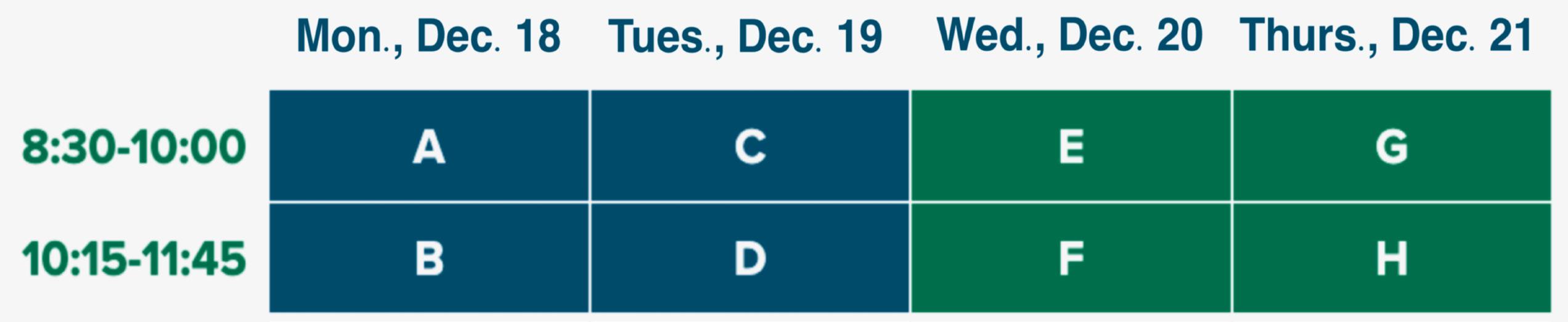
“Since the pandemic, we have noticed fewer teachers giving final exams and it felt like we maybe weren’t using that week for the best,” Dean of Academics Susan Beamish said. “There has been a lot of reflection about what we’ve been doing and following the trends and patterns that we see in the building to really keep the students’ well-being at the front of our minds,”
Teachers are now able to use a 90-minute class period as time for a final exam or for other cumulative activities, like projects or presentations.
“In English class, oftentimes you’ll have a final paper, and this [new schedule] gives time to reflect on that paper and get peer feedback during exam week,” Beamish said. “The goal is for that week to really feel like a wrapping up of the whole semester in all of your classes. I’m excited to see what some of the wellness classes are doing. The goal is to have some sort of culminating activity for all the work that’s been done throughout the semester.”
Many times, semester long classes do not have a final exam, so teachers do not get the
bility in their schedule due to required attendance for classes that would not traditionally have final exams.
“In some ways, the freedom will feel like a bit of a loss to upper schoolers in particular,” Beamish said. “You will probably be in the building more than you were in previous exam weeks. Having two classes back to back might be an adjustment, especially if you have an exam in both of those classes.”
This loss of freedom is in fact being felt by students.
“Let’s say it was the last period of the week, and I have orchestra, which I would not usually have a final in, but I can’t be on break yet because I’m stuck at school not taking an exam,” Violet Weizer ‘25 said. “Being at school when I don’t have an exam is also taking away from my time to study.”
Teachers will also have to adjust to the new schedule, as they may choose to create different exams for each section of the classes that they teach.
“If there are three different calculus
Coaston through questions
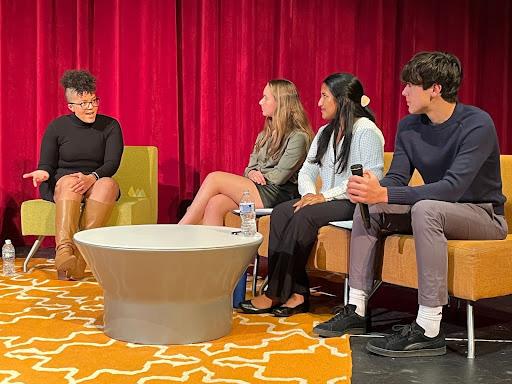
Jane Coaston, New York Times opinion columnist and host of the podcast, The Argument, visited Greenhills for a panel engaging in conversation with seniors from the Campaigns & Elections course. This was Coaston’s second visit to Greenhills and she covered topics ranging from civil discourse to advice for families discussing controversial political topics. I spoke with Coaston, prior to the student-led conversation, on her views of the current political and media landscape.
Izzy Baru: Do you think controversial topics should be discussed in the classroom?
Jane Coaston: “I think so. Often it’s a performance issue. It can be really creative when teachers don’t specifically talk about a topic but rather talk about something that resembles the political issue, for example, pulling a quote from an older piece of liter-
ature for students to discuss. I really want people to feel open and want to talk about important issues. But, I remember growing up and going to high school in Ohio, and an anti-gay marriage bill was passed. All my classmates were so happy about it but I felt like I was dying inside. I wasn’t out yet, but I knew that I was queer, and that I was at this catholic school in Ohio. I knew that this bill wasn’t good. But back then, saying something felt like social suicide in some ways. Do you really want to tell people your most intimate secret in high school? No. Because you can’t separate that classroom from the rest of the school, so, how are you going to have this open conversation without other kids talking about it outside of class?”
IB: What are your thoughts on social media feeding misinformation and people struggling to create their own individual political opinions?

mates in their period.
“I’m hopeful that it takes a little bit of stress off of students,” Beamish said. “Sitting in a gym with 100 kids taking a test can be really stressful, so being able to take that test in your own classroom with the classmates you are used to being around and having your teacher more accessible will hopefully lower stress levels during that week.”
Testing accommodations will be available, however, students with accommodations feel an increase in stress due to the new schedule.
“It’s pretty inconvenient because according to my accommodations, I don’t have to take two tests in one day, but with this new schedule, I’m going to have to do that.” Skyla Shea ‘25 said. “It’s also going to be hard for me to access my accommodations because I’m going to be going from one test to the next test quickly and if I’m not able to finish my test during the class time, I’m going to have to come back later, which is just ten times harder.”
“Diversity is more than a week”
ODEI to provide programming throughout school year
ARYA PRAHBAKER ‘26 School Staff
“Diversity has always been an important part of Greenhills traditions,” said Kelly Williams, Associate Director of Diversity, Equity, and Inclusion. “Although it has taken many forms over the years we hope that this year students will find it a more immersive and exciting experience.”
Greenhills has taken many steps over the years towards creating a more inclusive and diverse school environment. Diversity Week has provided a dedicated time to celebrate and learn about various cultures, backgrounds, and perspectives.
However, over the years, it became apparent that a one hour class is not enough to raise awareness, impact, and understanding for the community. This year, the Diversity Office has decided that bringing up this awareness should not be confined to a single week but should be integrated into events throughout the year.
Williams along with the Diversity Office faculty have worked to improve students’ experience during Diversity Week. Through feedback from students and faculty, they were able to create a more immersive system.
“Based on the feedback we received, the concept of dedicating an additional hour every day for students to engage in diversity-related activities or discussions felt similar to having a fifth daily class, which was both tiring and difficult,” said Williams. “Having the time more spread out makes it easier for everyone to absorb and think about the ideas presented at diversity events rather than just rushing through them.”
The Diversity Symposium has taken different forms throughout the years, including Diversity week. Alexandra Dasilva ‘26 believes that the new form of diversity will contribute to students’ growth and their learning experience.
“I think having Diversity Week being spread out over the entire year is beneficial because now we can apply these principles throughout the year and incorporate activities and events into our daily lives,” said Dasilva. “When Diversity Week was at the end of the day, it was hard to engage in. I feel like it took a part out of my day, instead of adding to it like it was intended too.”
Before the pandemic, the school used to dedicate a full day to Diversity day, similarly to Service Day. But after the pandemic, the format changed into a week for diversity. Ethan Hess ‘26 shares his past experiences with the Diversity Symposium from before and after the pandemic.
“When I was in middle school, before the pandemic, we used to have a full day dedicated to diversity. I enjoyed Diversity Day more because instead of rushing through topics we were able to go around and learn about different topics,” Hess said. “I don’t think,within just an hour, you can get people to fully understand a topic,which is why I prefer having a Diversity day over this new idea.” Nina Olson ‘26 talks about her takeaways from Diversity Week last year and how it helped her shape every day decisions she makes.
JC: “I have a bunch of friends from college, and one of them posted something that I really disagreed with. I realized this is someone I’ve known for a long time and wondered if I should correct them. The answer is never. It gets really complicated, especially with social media. We flatten who we are into an easy, digestible medium for other people. You become a combination of this and that, and it’s like you are performing for an audience. But you don’t have to be the same person. You could be a totally different person 5 years from now. It’s not just misinformation, it’s how people
are conflating who they are on social media.”this open conversation without other kids talking about it outside of class?”
IB: What do you hope viewers will take away from your conversation today?
JC: “For students, you’re allowed to have complex opinions that you don’t need to share. You’re allowed to say that you don’t want to talk about a certain topic. You should be able to feel comfortable having complex opinions. You can change your mind all the time. Don’t be afraid to be wrong and say you were wrong. It’s a mark of confidence.”
“I remember, in the past years, we learned about microaggressions. This taught me more about the topic and how different phrases can be harmful to people,” Olson said. “Now I’m able understand what could possibly be harmful to say that I didn’t know before.”
With a new format of the Diversity Symposium, the Diversity Office hopes to make discussions surrounding diversity more engaging and leave students and staff with a deeper understanding of what diversity means to the schools community.
“Diversity at Greenhills has always been a priority, and educating students on subjects from speakers and during class discussions,” said Williams. “The Diversity Symposium reflects the commitment of our school community to create an inclusive and culturally aware environment that helps students to thrive. As we begin the Diversity Symposium, we look forward to the opportunities and growth it will bring this year.”
IZZY BARU School Editor
CONSTRUCTIVE CONVERSATIONS Campaigns and Elections seniors interview the New York Times’ Jane Coaston about the current polarized American political climate, how to have conversations with those one doesn’t agree with, journalism, reliable sources, and social media. “It was such an honor to be up there with her,” said panelist Lucas Nor ‘24. “It’s not every day you get to talk to someone who works at the New York Times.”
Graphic courtesy
School Thursday, December 7, 2023 The Student Newspaper of Greenhills School Volume 24, Issue 2 New York Times columnist discusses polarizing political climate Graphic by Megan Peng
of Greenhills

“You need to calm down”
Taylor Swift fandom’s unhealthy obession
STOFFEL ‘25
THOMAS
Something makes Swift different from her predecessors. She’s not different in the sense of her songs. They sound like everything else. Her appearance isn’t super recognizable, such as other artists in the industry, but there’s a reason why Swift commands the media in this day and age and why she’s different—her fans.
Swift’s fans are the most dedicated in the past 20 years of almost anything we’ve seen. When I went to see The Era’s Tour movie with my sister, a bunch of teenage girls got up, held hands, and started singing in the middle of the movie theater. Now, you don’t see people scream excitedly at everyday movies. I saw edits of Swift at the Kansas City Chiefs football game on social media, all with adoring comments. This, to say the least, is not normal. After digging deeper, I learned that, on average, the NFL shows nine times during games where she’s in attendance. This is utterly unheard of for a game with nothing to do with singing. This is due to Swift’s fans, or “Swifties,” which gain Swift all the attention. Making a multi-billion dollar broadcasting company show an unrelated celebrity nine times to cater to their obsession is serious power. It’s like if the producers excessively cut to Simon Cowell at a NASCAR race.
I can only compare this intensely dedicated fanbase to a cult of personality. I know that phrase has a negative connotation with cults of personalities like former President Donald Trump’s but through veracious attacks on sites such as Twitter (X) of anybody who criticizes her to Instagram fan pages and edits featuring Swift. (Something dedicated Trump supporters are famous for.) Even people I know, who were called incels for voicing their distaste for Swift’s music. The result of this is a highly tight-knit community that forms a parasocial relationship with other “swifties” over social media sites and harshly defends their beliefs. If this description sounds familiar, it does. Other commonly referenced cults across media do this exact same thing with the most devout of their members. Criticizing nonbelievers? Check. Attacking criticizers? Check. And in this society, we don’t need another cult.
Due to the rise of the internet and the digital age, this fanbase has created a virtual group

that fiercely protects its own and attacks outsiders, akin to tribalism. Social media has made it easier to amass these gigantic para-social tribal gatherings and even create a relationship with Swift herself, exhibited by Swifties, who refer to Swift as “mother.” (Mother? Really? I mean come on).
As a result, we have an unmatched digital fanbase, going to great lengths to consume everything related to Swift, from spending $3,000 on her tickets to stalking her exes online. This is the future of marketing, not marketing the songs necessarily but marketing the person. Social media makes it extremely easy to connect to people, people that may not necessarily connect back, and you can find other like this, creating a community.
Late stage, we can see something like Swift’s fanbase, religious dedication around Swift’s dating life, personal drama, and everything about her to the point where she can re-release an album with minor changes and break sales records. In the future, I would not be surprised to see other artists taking the same route of obsession-based marketing. And I, for one, do not like where this is heading. Music today and where it’s heading has shifted towards something akin to what we would see in politics. A rise in hyper partisanship like Kanye or Taylor, basically the same as Trump or Biden. These us versus them things in society need to stop now. For the sake of casual listeners who like Taylor but don’t like the cult around her, Swifties need to calm down and enjoy her music in other ways less polarizing to the rest of us. The music industry will never be the same after Taylor Swift but the Fans will shape it more than she ever could, For the good, or for the worse.
Midterms are coming, ...and they’re bigger than ever before
It’s a sound you know well. The almost instantaneous silence that falls at the rustling of papers being handed out. It’s funny, the library never looked so big before. You’re surrounded by the people from the “other sections.” Other sections. Other people. New rules. Is that a scantron!? Midterms, finals, reality-checks–whatever you want to call them–are a stark departure from the norm at our school. They’re rigid, there are correct answers, and everyone gets the same one in front of them. No exceptions, no “sui generis,” no wishy-washiness of any kind.
So you could say that we were a little surprised to hear that the school thought it necessary to remove this relic of a bygone era. But what we were more surprised by is that at the same time as they ended this tradition, they decided to add even more.
To be frank, we don’t understand why they did this. It makes no sense. Greenhills has decided to get rid of those bulky exams with all those people, and break them down into individual classes, presumably because teachers love proctoring exams so much. Moreover they’ve decided to require each class to do something with that time. Way to streamline things. We’re sure there were nothing but good intentions behind this change. We’re not criticizing the effort or the good people pulling the strings behind the scenes. We love that after all of the shake ups in administration over the past few years, they feel like they can switch things up. All we’re saying is that the captain of the Titanic had good intentions too.
So let’s handle these issues one at a time: more tests, less breaks, different sections. We love finals as much as the (that’s to say, not much at all). So you can imag ine that the thought of a week of back to back to back to back to back to back to back to back (whoo!) finals makes us want to, respectfully, gouge our eyeballs out. What happened to those breaks? What happened to taking that elective that didn’t have a test? What happened to our time to get our heads above water for a minute, because we may or may not have taken on a little more than we could handle, potentially, and maybe that decision to take that “easy” AP isn’t looking so good right now, but how in the world
“Haters gonna hate” “Swiftie” hate sparks disputes

NATALIE HONG ‘27
The Eras Tour sold almost two million tickets in its first leg alone. Taylor Swift is a billionaire. The Eras Tour concert film is the highest-grossing concert film of all time. So many swifties flocked Ticketmaster that it crashed. 1989 Taylor’s Version sold over one million copies in its first week. All of this has happened within the past year, and the second leg of The Eras Tour has barely begun. Taylor Swift is the greatest artist of all time and she, along with her fans, known as “Swifties” have positively impacted both society and the future of the music industry.

Swift is clearly one of the best musical artists of all time, as well as the fact that she’s an amazing, inspirational person. Swift is currently the third person and first female ever to stay at number one on Billboard’s Artist 100 for over sixty weeks, proving that she never goes out of style. For women in the music industry, she has paved a path like none before. This is a change that the world has needed, and it’s been a long time coming.
In 2009, when Kanye West stole the microphone from Taylor Swift at the VMAs where she won the Best Female Video Award for “You Belong With Me,” he started a feud that would leave her haunted her for years to come. In 2016, Kanye West released a song with negative lyrics toward Swift. In this dispute, later involving Kim Kardashian, Kanye West claimed to have called Swift, asking for her permission, but Swift said she had no idea the extent of the things West would be saying. This is when the first bout of Swiftie hate began. Kanye fans would rally together, attacking her on social media. After this, Swift disappeared from the public eye and social media for a year, but she’s been scheming like a criminal ever since.
One year later, in 2017, Swift reappeared with a bang. She released her single “Look What You Made Me Do,” which is presumably about Kanye West. She showed the world that when haters hate, she has the power to shake it off. When fakers fake, she has


were we supposed to know that it would be this way?
Sorry, got a little carried away there, but the point still stands. Many of us have planned our lives (alright, slow down Mr. Melodrama) around the assumption that we would have a moment to recoup, and study, and maybe even let our shoulders out of our ears for a little bit. This throws a wrench in that. The new plan is a way of creating artificial stress. There’s no reason you should have an exam, or even a project, or even a discussion in fresh or any number of other classes that aren’t built for it. There’s no reason why we should be in this building one second more than we need to be. For students, but for teachers too. Every elective teacher that’s stuck here until 3 on Friday just keeping an eye on us, every scantron punched that didn’t need to be, is a little pain that didn’t need to happen. Not to mention the inconvenience teachers have to go through to write multiple
another one. It’s annoying, to say the least. But it’s not all bad, we get the comfort of our smaller classes, which is good. It’s basically just a weird week of school. Lesson plans for classes without exams? A 75 minute lecture during a school week is already sending students to their breaking points, but 90 minutes during exam week? There’s no way that’s going to work. None of the students are going to be listening; why would you when you’d rather cram for an exam right after? The teachers are going to be stuck with distracted students who have zero regard towards the lesson and would rather take twenty “bathroom breaks” just to get in more study time.
See, the big room was never the problem with exams, teachers do just fine making that gym or library feel small. The problem is the paper. Many classes already do projects instead of tests, and we recognize that format isn’t good for That’s progress, not closing off our experience to the twenty people that happened to be put in the same room as us.

schedules during exam week, the administration decided to give us a little break between “classes.” The 15 minute break between periods doesn’t help at all with academic stress. Since the school is so big on giving students time to adjust and ease into their classes, wouldn’t
The best exam schedule is having all of projects done BEFORE the week you actually take exams, not during it. The whole point is that you can solely focus on studying for exams without having the additional worry of presenting other projects. It’s comforting to know that you’ve over and done with one of the hardest parts of the end of the semester. Having exams and final projects at the same time will only result in students stressing even more and completely disregards the fact that literally no one would want to simultaneously manage two things at once.
Change is good when there’s a reason for it. All classes having midterms, or finals for semester courses, seems fair. Having them shortened seems fair too. It feels like a Greenhills thing to do. We like to be fair, supportive, progressive, learning-oriented, but too often this identity–the core of our school–becomes a brand. The truth is we will have to take tests in our lives. Finals prepared us for that. Shortening tests and adding more projects won’t just be more stressful, it won’t do the job it needs to. Just because it’s on brand doesn’t mean it’s good.
the power to say to females everywhere, “It’s gonna be alright.” Following “Look What You Made Me Do,” she released her album Reputation, which includes the lyrics most directly aimed at West yet. “This is Why We Can’t Have Nice Things” features the lyrics, “It was so nice being friends again
There I was giving you a second chance
But you stabbed me in the back while shaking my hand
And therein lies the issue, friends don’t try to trick you
Get you on the phone and mind twist you,” referring to the infamous phone call. Since Reputation, Swift has released four new albums and has started a project of rerecording her first six albums, which she calls Taylor’s Version. Through this, she has shown women that they are unstoppable, to never let a man get you down and that it’s okay to be mad. This is not a cult, but rather a movement. She boosts feminism while growing the music industry. Additionally, two of the main concepts of her Lover album are supporting the LGBTQ+ community and feminism. Artists willing to take such a stand need to be celebrated, not torn down. Clearly, she put in the work, and since the dispute with West, she’s come back stronger than a 90’s trend.
Critics she’s overrated and basic, but there’s actually something so unique about each of her songs: they’re all personalized in some way. People enjoy songs when they’re relatable, which Swift is, but there’s always a little tidbit of something personal from her life in her songs. In “Fifteen” from Fearless, Swift says, “You sit in class next to a redhead named Abigail,” and in “Midnight Rain” from Midnights, Swift says, “And he never thinks of me, except when I’m on TV.” These little details, along with her wide variety of genres and lyricism make her songs unique to her. Some call her songs “bland” and have branded her fans as “basic white girls,” but she’s come too far to watch some name-dropping sleazes tell her what her words are worth.
Many disputes have come up lately about “Swifties,” regarding how obnoxious they are. Some say that Swifties have gone overboard with The Eras Tour, but fans are just expressing their gratitude and love for such a strong feminist icon. With her new relationship with NFL star Travis Kelce, she has gained even more popularity. Saying that this is ridiculous and saying that a feminist icon is getting too much attention and that her fans have gone crazy, these men are saying that women haven’t earned the right to success and fame. Why do they shake their heads and question how much of this she deserves? Even other celebrities are openly hating Swift and her massive fanbase. People are saying that Swifties “need to calm down,” but actually, these haters are the ones who “need to calm down.” Haters gonna hate, and as Swift would say, “The world moves on; another day, another drama.”
Contrary to some opinion, it’s clear that Swift is the greatest artist of all time and she, and her Swifties have positively impacted both society and the future of the music industry. The way that she deals with so much controversy every day is inspiring. So many people hate on her all the time even though she never did anything to them. All she can do is smile and keep her head held high, and rise above.

it be logical to have a longer rest time between exams? Those 15 minutes do absolutely nothing; before students even have time to process the emotional trauma from the last disaster of an exam, they’re forced to march straight into
PAGE 2 DEC. 7, 2023 Alcove is a newspaper written by students, for the students of Greenhills School. All opinions, views, and statements reflect those of the students working on Alcove and not necessarily the faculty and staff of Greenhills. Alcove is written to inform, encourage, and expand upon the curiosity of the students that Greenhills strives to cultivate. Providing a forum for students to express their individuality, the Alcove reminds you to always read the pine print. Editor-in-Chief Anjan Singer ‘24 Managing Editor, Print Eva Bernstein ‘25 Managing Editor, Online Dhruv Nallamothu ‘25 Art and Design Editor Megan Peng ‘25 School Editor Izzy Baru ‘25 School Staff Mira Jayaraman ‘26 School Staff Arya Prabhakar ‘26 School Staff Lauren Ye ‘26 Opinion Editor Tommy Stoffel ‘25 Lifestyles Editor Bella Young ‘24 Lifestyles Staff Ella Song ‘25 Lifestyles Staff Aiofe Tang ‘26 Lifestyles Staff Natalie Hong ‘27 Sports Editor Dom Schuster ’24 Sports Staff Matthew Streicher ‘24 Sports Staff Neha Narayanan ‘26 Advisor John Lund
Grapic by Megan Peng ‘25
Graphic by Megan Peng

Curtain call
Senior credits school performing arts program for renewing passion for theater
MIRA JAYARAMAN ‘26 School Staff
As the curtains part, casting a warm glow on their face, surrounded by familiar faces in the audience, Dash Mangrulkar ‘24 braces for the bittersweet moment of their final school musical performance.
This is especially sentimental for
Audrey
portrayed as a ste-
century,

think of a white, blonde girl. I knew that those descriptions didn’t fit who I am, so I had to interpret the character in my own way.”
This isn’t the first time Mangrulkar has faced challenges related to the lack of diversity in the theater world, however.
Last year, Mangrulkar made the decision to pursue theater beyond high school and spent this past

Taking flight to Ireland
Sophmore plans to study abroad next school year
MIRA JAYARMAN ‘26 School Staff
The rolling green hills of Ireland will soon re place the busy hallways of Greenhills for August Casteel ‘26, as she travels abroad to experience something she hasn’t done be fore.
“I’ve never been out of the country,” Casteel said. “I’ve always wanted to travel and see what’s outside of Michigan.”
Casteel plans to study in Ireland in the first semester of her junior year, and she chose Ireland specifically for a number of reasons, one of which being her heritage.
“I have a lot of ancestry in Ireland,” Casteel said. “I’m really excited to learn more about my family’s history.”
Another reason Casteel is choosing to study in Ireland is the culture itself. Casteel is an avid reader of Irish literature, especially pieces from poet Seamus Heaney.
Casteel’s idea of studying abroad came to her in the beginning stages of quarantine.
“I had a lot of downtime during COVID,” Casteel said. “That’s when I started to really want to travel and get out of the country.
me, and then I went to these classes and I didn’t feel special at all. Being in a room with other gorgeous singers lowered my self-esteem and I forgot my love for theater for a little bit.”

Despite Mangrulkar’s tough summer, when they returned to campus in September and started to rehearse Little Shop of Horrors, where they were reminded of their love for theater by being around friends and a supportive community.
“I’m so grateful for Little Shop of Horrors,” said Mangrulkar. “Little Shop of Horrors breathed the passion of theater back into me.”
Mangrulkar has worked incredibly hard to improve their performance, singing, and dancing skills throughout the

years.

“They have the most expressive, bright eyes,” said Mangrulkar’s father, Raj Mangrulkar. “They capture your attention and you can see every emotion expressed on their face.”
Choir director and musical director Benjamin Cohen has been working with Mangrulkar ever since their first musical at Greenhills, and has worked with them in a smaller workspace in upper school choir as well.
“I am so appreciative of Dash’s incredible spirit and artistry,” Cohen said. “They have an incredible voice and they are a wonderful performer.”
Mangrulkar and the cast of Little Shop of Horrors perform at the Campbell Center of Performing Arts Dec. 7-9.
‘24 performs in Greenhills productions of “Mmma Mia” as Sky,“White Christmas”(not a Greenhills production, but with Spotlight Players), “Newsies” as Katherine Pulitzer, “The 25th Annual Putnam County Spelling Bee” as Mitch Mahoney, and “Shrek” as Lord Farquaad
during a student’s stay in a foreign country. Casteel is most excited to gain a new perspective of learning in Ireland that isn’t available in Michigan.
“I’ve never been away from home for more than a couple weeks,” Casteel said. “Being away from my parents will be hard to adjust to.”

Casteel was motivated by her goal of studying abroad and researched immensely to achieve it.
“I found this foreign program called Greenheart,” Casteel said. “I had to apply for Greenheart by writing an essay about why I want to study abroad. Once I got in, they set me up with a host family.”
Greenheart is an immersive foreign exchange program that recommends limiting communication with family members
credits. According to Dean of Academics Susan Beamish, a typical student needs around 21 credits to graduate, however, the school accounts for a missed semester and adjusts the required credits for each student. Casteel will only need 19 credits to graduate.
Although Casteel is more than ready to learn in Ireland, the experience comes with many challenges as well.
Casteel brought up the idea abroad to her parents, they than supportive.
“When August first told us that she wanted to study abroad, I wasn’t surprised at all,” Casteel‘s mother said. “She’s always been adventurous and made her own path.”
Casteel’s mother believes that an experience like this will incredibly benefit August’s life, in more ways than one.
“Studying abroad is a life-changing experience,” Casteel’s mother said. “When you go to another country and then come back, you see everything from a new perspective. I can’t wait for August to meet new people and explore the world
Greenheart requires a recommendation letter to be accepted in the program, and this was provided by Casteel’s ninth-
“August first approached me in advisory at the beginning of last year,” Flohr said. “I learned that she wanted to do a study abroad [program], I was more than excited for her. Writing a recommendation letter for August was no problem. She’s a wonderful person and student, and she will do incredibly well in this opportunity and experience.”
Casteel has set up a GoFundMe and linked it on her Instagram account, to help with the funds of traveling abroad.
DEC. 7, 2023 PAGE 3
set.”
reotypical
from
Typically,
is
woman
the mid-20th
Graphic by Aoife Tang ‘26
Clockwise from bottom left: Dash Mangrulkar
Photo Courtesy of Dash Mangrulkar‘24

Poking holes in the sky: Upper School Head on life up in the air
ANJAN SINGER ‘24
Editor in Chief
As the sun rose over the tarmac a young Deano Smith heard a whoosh, looked up and saw exactly where he wanted to be.
“We [lived] literally right on the approach path,” Smith said. “You just look up and there’s a plane coming in.”
Smith practically grew up on the runway, but it was in the planes that his passion really took off.
“My grandmother lived in Georgia, and we would sometimes go visit,” Smith said. “I just loved flying. I flew on DC-3s. We [would] fly into a little town of El Bosque, Georgia. [To get there,] we’d fly from Salt Lake City (where he lived) to Chicago O’Hare and from Chicago O’Hare to Atlanta Hartsfield, [which are] two of the biggest, busiest airports in the world.”
Smith carried his passion with him, so when he saw a flier for a flying club in college, he jumped at the chance.
After his class, Smith took to the air. He took two flights and decided that this was what he wanted to do. He then took a flying class in grad school.
“[The flying class] was a lot of fun, because got to go into more depth,” Smith said. “I got to explore the cool stuff. And I started flying like crazy.”
In his third quarter, Smith took a light academic load to spend more time in the air.
“I was in an airplane every day,” Smith said. “You’re sitting in an airplane with the instructor and it’s a small airplane, a trainer airplane. I’m sitting here and the instructor’s sitting right next to me, and you can feel your instructor [next to you].”
His first solo flight was a little different.
“The instructor gets out of the airplane, and just [told me] ‘okay, you’re ready,’” Smith said. “It’s one of the scariest, most intense, amazing moments in any pilot’s life. I still remember it like it was yesterday.”
It was like any other flight, yet completely different. Smith did the remainder of his training to fly at a busy airport, and got his pilot’s license in less than two months. Today, Smith gets to pass his passion on through his work as a flight instructor and the Greenhills Flying Club.
member. “It’s really interesting because I spend a lot of time driving around Ann Arbor, but seeing it from the air is completely different.”
It’s hard to get that feeling out of your head.
“It’s in your mind all the time,” Smith said.
It’s hard to feed a flying addiction, but Smith found a way.
“My family was not especially well off growing up,” Smith said.
“So worked. I worked in a bowling al- ley, and I started see -
his wife, also a pilot, moved to Maryland where they lived on an airstrip.

“We go flying and he teaches us the ground school stuff to get our license,” said Jacob Perkins ‘25, flying club
ing the money that I made, not even in terms of money but in terms of flying ability. It was like that’s another flight hour, that’s two flight hours, that’s three.”
From that point onward, Smith’s life has been shaped by flying.
“You see the world in a totally different way,” Smith said.
After finishing his graduate studies in Ann Arbor, he and
SCUBA diving in the deep
NALLAMOTHU ‘25
DHRUV
Managing Editor, Online
Imagine the fresh feeling rushing through your body as you plunge into the cold water. Diving deep, you reach the point where most people have to turn back, but not you. You get to dive deeper, exploring the untouched and rare flora and fauna of the sea floor. Swimming around with the fish you are filled with an overwhelming feeling of awe.
Many people go their entire lives without experiencing the beauty of the ocean, but others turn to oxy- gen-producing masks and tanks. These tools are called SCUBA, which stands for self-contained underwater breathing apparatus. Calculus teacher Barbara Rocci has had a passion for SCUBA diving since she was a little girl.
“I have been SCUBA diving since I was 12,” said Rocci.
“My dad was taking lessons and asked if I wanted to join. That was definitely one of the best decisions of my life.”
Rocci has visited many locations including the Caribbean islands, Galapagos, and most recently Indonesia.
“Recently my family and I went to Sulawesi, Indo- nesia,” Roc- ci said.
“That is probably the place I would go back to as often as I can to see all the critters.”
For Rocci, SCUBA diving is an integral part of her life and she tries to get out into the water as much as possible. She shares SCUBA diving with the people she loves most, her husband and her son.
“We try to go at least once a year,” Rocci said. “Most of the time we go to the Caribbean since it’s a lot closer, but when we get a chance we love to go to other destinations around the world.”
Now, Smith rents planes from the University of Michigan Flyers.
“I like flying with a club because it’s ocial. [For example] I’m taking some friends up to Clare, Michigan to get donuts, cause you gotta have an excuse to go fly,” Smith said.
But Smith said sometimes it’s just fun to go up and “poke holes in the sky.”
“You can say, I think I’m going to go over to Richmond and check out the gliders,” Smith said. “Or I’m going to go over to Shamrock, which is an airport that I used to own, just south of Michigan International Speedway.”
Smith owned the airport for ten years and he and his wife planned to retire there.
“It was a lot of work,” Smith said.
“It was just a little grass strip, but it was a public use airport and so we had to maintain certain standards for that. We had a couple of hangers. It was nice because we got to know the local community.”
They had to sell the airport after Smith’s wife was hired by Virginia Tech, but not before fixing it up.
“We were painting hangers, refurbishing stuff, redoing the doors,” Smith said. “We used to do junior hours, where you’d pay juniors to do work and the money would go to the class fund for service, every one of those ten years because there’s always a lot of work.”
Even though it wasn’t exactly what he had thought it would be, Smith enjoyed the experience.
“It was great. When you go out, land, park the airplane, lean back and say, ‘yeah, this is my airport’,” Smith said. “We had a lot of traffic coming in for races. I’d be up at 6 a.m. when the banner airplanes started to fly. The airport was beautiful and I would sit there and watch the sun rise over the runway that I had just mowed. Beautiful day. Beautiful airport. Bring on the airplanes.”
A very important part of diving for Rocci is all the different animals she sees.
“Indonesia had a bunch of crazy animals,” Rocci said. “We saw a blue ringed octopus, who is very toxic if they bite you. We were in the water with basking sharks and sperm whales at some point too, sharks are my personal favorites.”
Although SCUBA diving is growing commercially, it’s becom ing harder to find opportunities because of climate change, increased tourism and destruction of reefs.

SCUBA diving as a sport is pretty niche. Many people only dive once or twice in their lives on a vacation.
“SCUBA diving has a pretty strong large group of people who dive,” Rocci said. “However there are a lot fewer people who seriously are passionate about it.”
Many people get buried in work and need an escape from their daily lives. Rocci uses SCUBA diving as a way to detach from her life here and immerse herself in a whole new world.
“My favorite thing about SCUBA diving is being so removed from my everyday world,” Rocci said.
“There has been a lot of stress and destruction of reefs world wide because of climate change,” Rocci said. “Even though we still go to the Caribbean, it’s a very different place than when I first started diving there. Around 40 years ago, it was an incredibly lush place filled with colorful coral and fish. Now there’s just a lot more dead coral and it’s pretty barren in comparison. The reefs can’t keep up with the pollution and there are too many tourists going and touching everything. It used to be so different.”
Rocci isn’t the only one experiencing the recent changes in the diving world. Lachlan Rae ‘24 agrees that the effects of global warming are prominent.
“The environment is definitely getting a lot worse and harder to find places to dive,” Rae said. “Even in the past five years I have noticed a difference in coral down there.”


Even with the new challenges the environment presents, Rae still tries to dive at least once a year. He picked up the sport about six years ago after his parents suggested he try it out.
“My favorite place I have been so far is Peter Island in the British Virgin Islands,” said Rae.
“When you’re down there you don’t really hear any noises, imagine a nice warm blan- ket around you and you’re just floating in the clouds. That’s what diving feels like to me.”
Being alone in the water, Rae and other divers en- counter many different friendly creatures who most people never get to see. “This one dive we had this nurse shark come with us,” said Rae. “He was like an under- water puppy and followed us. We even got to pet him.”
Although Rae loves the animals and sea life, his favorite part about diving is something that doesn’t have to do with going underwater.

game we played throughout the trip, everyday someone was assigned a weird task and we had to make them do it without them knowing,” Kaplan enough to give them water.”
Helen Kaplan got to hear about this story during one of the

bikes with dif ferent fea tures.

LAUREN YE
‘26 School Staff
In high school, students often find themselves searching for a way to relax or let loose outside of the academic environment.
For most kids, this means sports like basketball, soccer, and more, many of which the school offers. However, this is not the case for Henry Beck ‘26, who has chosen a more unconventional sport. As a competitive cyclist, Beck spends his free time traversing rough terrains on his mountain bike or simply biking on roads or indoors.
Many people enjoy biking as a hobby. Riding on trails, roads, or even as
a mode of transportation can serve many purposes.
However, competitive biking is not as common in the local community. Beck has been competitively biking for three years now. He started when his friend, Huck Ellis, invited him to bike at the DTE Mountain Bike Trails in Chelsea.
“I introduced Henry to biking because I love the culture of the sport,” Ellis said. “I just went to a bike race called Ice Man, where at the finish line there will be thousands of spectators cheering for you. The energy is amazing, and I love the community and the support.”
Beck races with the Wheels in Motion racing team and travels all over Michigan to compete in races. There are about 20 high schoolers on the team in total, along with adults of many ages.
“The farthest I drove for a race this year was six hours to the UP, to Marquette, and I biked in the Ore to Shore Mountain Bike Race,” Beck said. “The closest race is in Vet’s Park, but usually the races are at least 45 minutes away.”
The races can vary by distance, surface, and structure. Courses can range from long trails that traverse through rough terrain to short racetracks on gravel. This requires different types of
“ Mountain bikes have wider tires, flat handle bars for more leverage, and you basically ride it on rough surfaces, trails, things like that.” Beck said. “The main difference between those and gravel bikes is that gravel bikes have narrower tires, you use it on dirt roads, regular roads.”
The difference between competitive cycling and other sports is the mental challenge that comes with biking. It requires repetition, perserverance, and stamina.
“If you want to be a good, you have to put in 20 hours a week, and you sometimes get on the bike for five hours at a time.” Beck said.
Beck’s friend, Ajay Purohit ‘26 says that Beck shows his dedication to the sport and spends a lot of time during the week training and working to get better at cycling.
“He spends a lot of time training,” Purohit said. “When we try and make plans, a lot of times they don’t work out because he says he has practice or he has to train for his races.”
Aside from competitive biking, Beck also bikes in other states while on vacation.
“I biked in Sedona last year, but I’ve yet to travel out of state to bike competitively,” Beck said. “I also biked in California, and that was really fun.”
Among the benefits of the sport, Beck says one of his favorite parts is the social aspect. It allows him to meet and learn from all different types of people.
“I’ve met so many new people from biking,” Beck said. “And it’s cool because people come from all age ranges.
Some of the rides we go on, I’ll talk to someone who’s 70 years old, and then I’ll talk to someone who’s ten.”
Beck’s mother, Kara Bloom, also says that the wide variety of ages and backgrounds come with many benefits.
“The older people are really helpful, they teach him how to ride safely and how to fix their bikes.” Bloom said. “It’s a really close-knit community.”
The sport also comes with its challenges. One of the major obstacles is the fact that competitive biking is self supported. Bikers are essentially biking solo, even if they do race for a team. They travel to races themselves, and the team component only comes in during the race.
“You have to pay for all the equipment and travel,” Beck said. “The team doesn’t pay for it. But you can totally sign up for races and just ride without a team and compete by yourself.”
As a parent, Bloom takes on responsibilities to make sure that the race goes off without a hitch. She has to make sure all the equipment is prepared and ready to race, among other things.
“We have to get him there and make sure that his bike is in working order,” Bloom said. “It’s harder than it sounds. Because you’re riding the bike hard, they do break down a lot, so a lot of times we’re rushing to get something fixed.”
After the race starts, Bloom’s next job is to find a spot to watch the race. Depending on the type of race, she’ll either watch as Beck races on a track or wait for him at the finish line of an 80-90 mile race.
“The parents cheer with cowbells, it’s really fun,” Bloom said.
“They’ll have food trucks there and music playing, it’s a fun sport to spectate.”
Biking has become an integral part of Beck’s life and allows him to relax outside of his academic life.
“Even though biking can be tough, I really enjoy it,” Beck said. “It’s different from other sports I’ve done, but that’s what I like about it.”
Just keep swimming: Sophomore secures several state titles
AOIFE TANG ‘26
Lifestyles Staff
The scent of chlorine and unease lingered in the air, as the swimmers waited on the diving blocks for that one particular sound. A slow crescendoing symphony of racing hearts and deep breaths, conducted by the shared feeling of adrenaline, rippled through the natatorium. In the midst of this orchestra stood Christopher Gregg ‘26, whose swimming journey started in the shallow end of the Barton Hills Country Club pool.
Christopher started to take swimming lessons from a safety standpoint and as a summer activity as a kid. From taking lessons at Liberty, then Goldfish, and loosely attending practices at the Washtenaw Interclub Swim Conference (WISC), his love for swimming started to grow, according to Christopher’s mother, Michelle Gregg. It became clear that swimming was more than a summer activity.
“His summer club coaches were like, ‘Oh where does he swim’,” Michelle said. “I would always say, ‘here.’ But they would be like ‘No, where does he swim yearround.’ And I would say, ‘he doesn’t.’ And they were like, ‘Well he should. He really enjoys it.’”
The transition from viewing swimming as a casual activity to a competitive pursuit was not easy for Christopher.
Christopher dedicates 20 hours per week on swimming, including four to five hours of weightlifting. On top of his rigorous swimming schedule, he has to balance it with his school work and eight hours of sleep each day.
“Sleep is critical because need that sleep to function, otherwise nothing goes well,” Christopher said. “If I have more work to do, I can do it in the morning. Things always go better if I’m well rested.”
Henry Beck ‘26, one of Christo- pher’s friends, sees the dedication that Christopher puts into swimming.
“He’s always been commit- ted to swimming,” Beck said. “He misses holidays and other important things for swimming, so he’s really on the grind. I’ve seen him race. He’s crazy fast, so it’s clear that he trains hard.”
swam the 1,000 yard freestyle.
“The people you meet are just amazing,” Rae said. “I have a dive master and I always meet new people who are as enthusiastic as me about diving.”
“Swimming is brutal because there’s a clock,” Michelle said. “The clock always tells you if you’ve gotten ‘better,’ ‘stayed the same,’ or ‘worse.’ As a parent, we had to try to take the emphasis off of the clock and help him put the emphasis on learning to love the sport.”
“Being able to experience so many places and animals that many people never get to see is so spe- cial.”

Despite the demanding nature for the sport, Christopher’s love for it stayed con- stant.
Christopher’s swimming journey is marked by many achievements, includ- ing earning his first state title at the age of ten, winning the East Coast Championship, securing second place in the Midwest, and qualifying for USA Swimming Fu- tures Championships in Chicago this year.
“We are always proud of him because of the way that he just approaches it with a maturity that I think is well beyond a 16-year-old,” Michelle said.

This year, Christopher attended Speedo Sectionals in Austin, Texas, where he
“He’s a distance swimmer by trait, which is not something they do at the high school level,” Michelle said. “I was nervous because we had not seen him at that level yet. it’s on a big stage at the University of Texas. He dove in and swam that race to perfection. It was this incredible moment of maturity that I was so excited that I got to see.” Not only does he compete in standard pool competitions, he also attends open water races, where he tackles 5Ks and 7.5Ks. One of these was in Pleasant Prairie, Wisconsin, where he qualified for USA Swimming Junior Nationals.
“It was in June and it was cold and windy,” Michelle said. “Open water really isn’t swimmable in Michigan until June or July, so we had very little practice lead - ing up to it, but he dominated that whole race.”
Another one was in Smith Mountain Lake, Virginia, where he won a 5K during Tropical Storm Ophelia.
Be - yond the medals, swimming has taught him valuable life lessons, especial - ly with teammates by learning how to mo- tivate each other. Throughout his journey, he has learned about responsibility and hard work. Swimming has made him physically and mentally tough due to the many roadblocks he has encountered.
“It’s not a lin- ear path, but if you put in the work consistently, you will always go up in the long term, just like a stock market,” Christopher said.
Looking ahead, Christopher sets his sights on college swimming.
 IZZY BARU ‘25 School Editor
PAGE 4 PAGE 5
Tour
Beck:
de
Sophomore pursues competitive cycling
DEC. 7, 2023 DEC. 7, 2023
takes on 20 hikes through 9 states Graphics by Megan Peng ‘25
Sophomore

Festive foods with a twist
Students and faculty share favorite foods to eat during holiday season
BELLA YOUNG ‘24 Lifestyles Editor
Festive holidays bring people together, creating a perfect atmosphere for the joyous union of traditional and creatively altered dishes. Whether it’s the warmth of Christmas, the vibrancy of Chinese New Year, or the dazzling lights of Diwali, students and faculty alike enjoy the oppor tunity to share their favorite foods with loved ones.
Many people enjoy tra ditional hol iday dishes, but others like to add a special surprise to classic foods. Hanukkah, known as the festival of lights, is celebrated with a variety of fried foods. Jacob Resnick ‘24 embraces this tradition by adding a unique twist to classic potato latkes.
first full moon of the year. Usu ally eaten as a dessert, tang yuan is glutinous rice balls stuffed with sweet black sesame, peanut, or red bean filling paired with hot sugar water.

“We have tang yuan, but instead of the usual sweet rice balls, we have savory ones,” Chen said. “They’re usu ally filled with pork, mushrooms, and radish. When they’re cooked right, biting into the rice balls gives a burst of flavor. I like to pair savory tang yuan with chicken or pork broth. I also add chopped-up scallions and cilantro in the broth.”

takes her aloo puri experience to the next level by adding a personal touch.
“I like to pair aloo puri with mango pickles,” says Tewari.
“Mango pickles are spicy, sweet, and sour, so it adds a kick to the potato curry. My sister doesn’t like mango pickles, so it’s more of a per sonal choice. My mom makes this for me and my brother, and during Diwali, it’s extra special.”
er holidays. This dish, a harmonious blend of potatoes, beets, and an array of vibrant vegetables, has become a cherished tradition for Bentley and her family. The roots of this tradition stretch back to Bentley’s childhood, marked by a unique experience living in Venezuela due to her parents’ involvement in the Peace Corps. It was during those formative years that Bentley forged a connection with the culture and cuisine of Venezuela.
“After moving back to America, I grew up with a girl from Venezuela who basically became my sister,” Bentley said.
“During Hanukkah, I make latkes with my whole family,” Resnick said. “I specifically like sweet potato latkes. It’s a small change from classic potato lat kes, but it’s sweet, so it tastes even better. This sounds like a weird combina tion, but I ac tually like some diced ja lapeños in them to add spice and more fla vor.”
nick is not the only one who adds unique twists to their holiday foods. Amanda Chen ’24 and her family have the traditional Chinese dish, tang yuan, during Chinese New Year and the Lantern Festival, a celebration of the
College counseling associate Lili Kadets has found a way to elevate the Thanksgiving des sert table, seamlessly merging two beloved flavors into one dish.
“I love any thing pumpkin, and I also love cheesecake, so why not combine both?” Kadets said.
Christmas morning holds a special tradition for Mike
JacobResnick’s Sweet PotatoJalapenoLatke AmandaChen’s SavoryTangYuan



teresting than your reg ular
pumpkin pie or basic cheesecake.”
LiliCadet’s Pumpkin Cheescake
As Diwali illuminates homes with joy and warmth, Meera Tewari ‘25 indulges in a culinary dish that holds a special place in her heart. Aloo puri, a traditional Indian dish, consists of potato curry (aloo) served alongside crisp-fried bread (puri). For Tewari, this dish is not just reserved for Diwali; it’s a comfort food enjoyed whenever her mom prepares it. Tewari
ing but crafting culinary delights with a playful twist. Some people like to have fun making and designtime to infuse a linary tradi tions.
“My fami ly gets together with our family friends down the street to make Santa Claus pancakes every year,” said Lucas. “We’ve been doing this since I was born, so it’s a really fun tradition. Eating pancakes that have fun designs makes them taste better for some reason. I think it’s just more enjoyable.” Administrative Coordinator Stephanie Bentley makes Venezuelan potato salad for the Fourth of July and oth-
“We would make this potato salad together, and it was delicious. Since then, I have made this dish during holidays with my family. It’s the perfect comfort food.”
These culinary adventures weave a narrative of creativity, showcasing how individuals and families infuse their holiday feasts with a personal touch.

“Holiday foods are always so unique to families,” Chen said.
“A lot of recipes are passed down through generations, but each family might have a special way of making the recipe.
MikeLucas’s Santa Pancakes
It adds a layer of depth to family traditions. Holiday dishes become more than just food— they become a reflection of cherished traditions and the bonds that tie us together in the spirit of celebration.”
“The most wonderful time of the year:” Community members share diverse holiday traditions

Favorite holiday tradition:
“Me and my husband, Josh, watch the Grinch every single year. This year, I bought him a Grinch costume and we are going to make it a new tradition with him dressing up as the Grinch every year.”
Significance of tradition:
“We have watched the orignal Grinch movie together every year. Him dressing up as the Grinch brings sarcastic humor to the holidays. I believe it is a direct representation of what our family is. Our family consists of love, laughter, and dry sarcastic humor, and the Grinch prefectly embodies that.”
Favorite Moment:
“We are throwing a holiday party soon, which will be one of my favorite moments because everyone will be dressing up. Josh will be the Grinch and I will be a Who.”
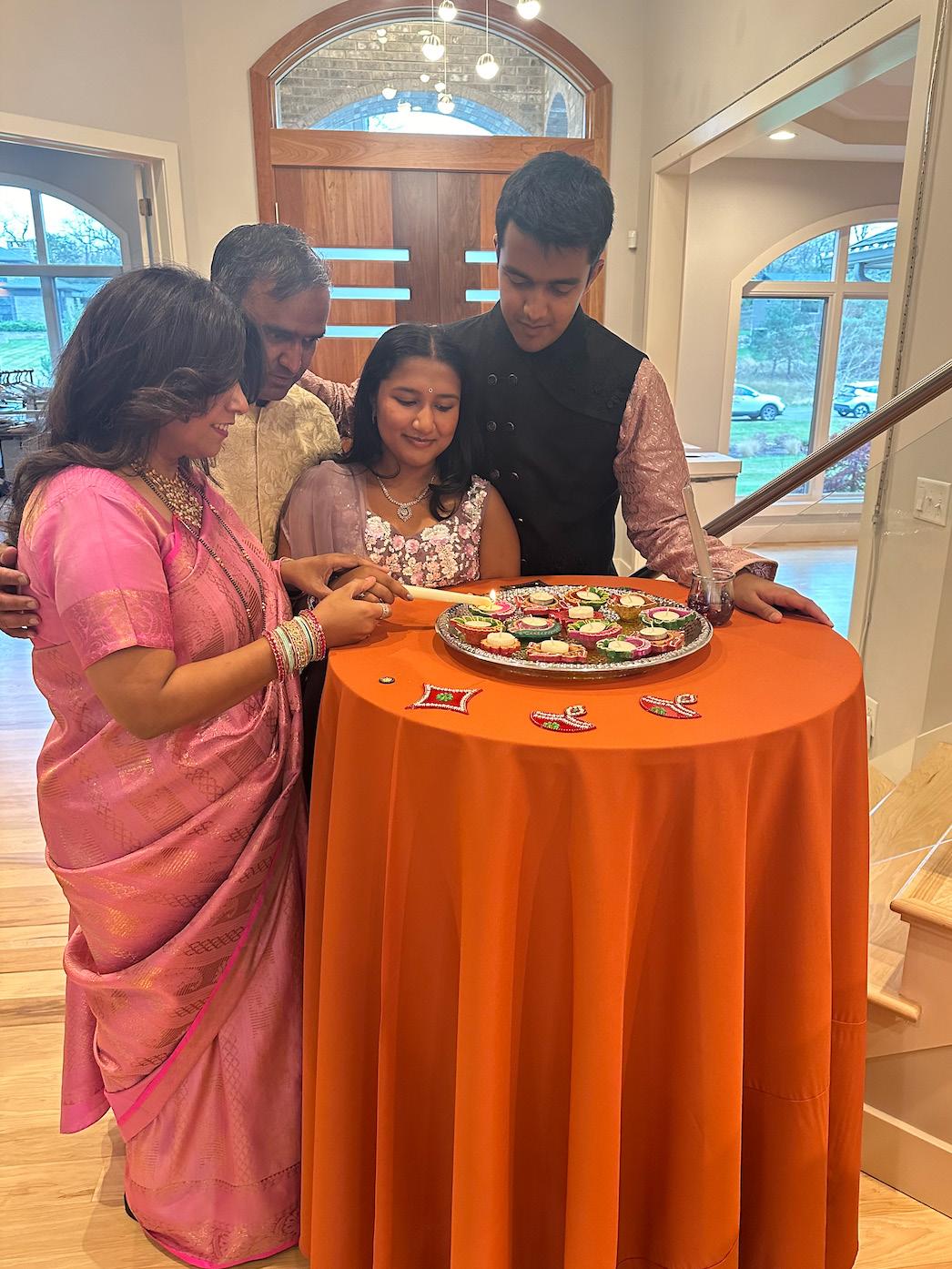
DIWALI
Favorite holiday tradition:
“Lighting up candles and setting off fireworks has always been my favorite tradition during Diwali. The fireworks are super entertaining. ”
Significance of tradition:
“Diwali is the festival of light, so lighting candles brings light to our house. It symbolizes goodness and purity and brings health and prosperity to our family. Fireworks also bring light and scare away darkness.”
Favorite moment:
“Every year, my family throws a Diwali party, and I invite my friends, and I light candles with them. I think this is the best moment because sharing my culture is the best part of these traditions.”

HANNUKAH
Favorite holiday tradition:
“I play dreidel and decorate Hannukah cookies with my kids. We like to get together with other Jewish families and celebrate Hannukah together.”
Significance of tradition:
“Dreidel is a game where we spin the dreidel, a spinning top. Playing this game and other Hannukah celebrations brings my family and the community of Jewish families around us together. For us, Hannukah is a relaxing and fun holiday to bond with each other.”
Favorite moment:
“I love lighting the menorah with my kids because we do it all together. Seeing my kids decorate cookies and interact with other Jewish kids in our community gives me so much joy.”
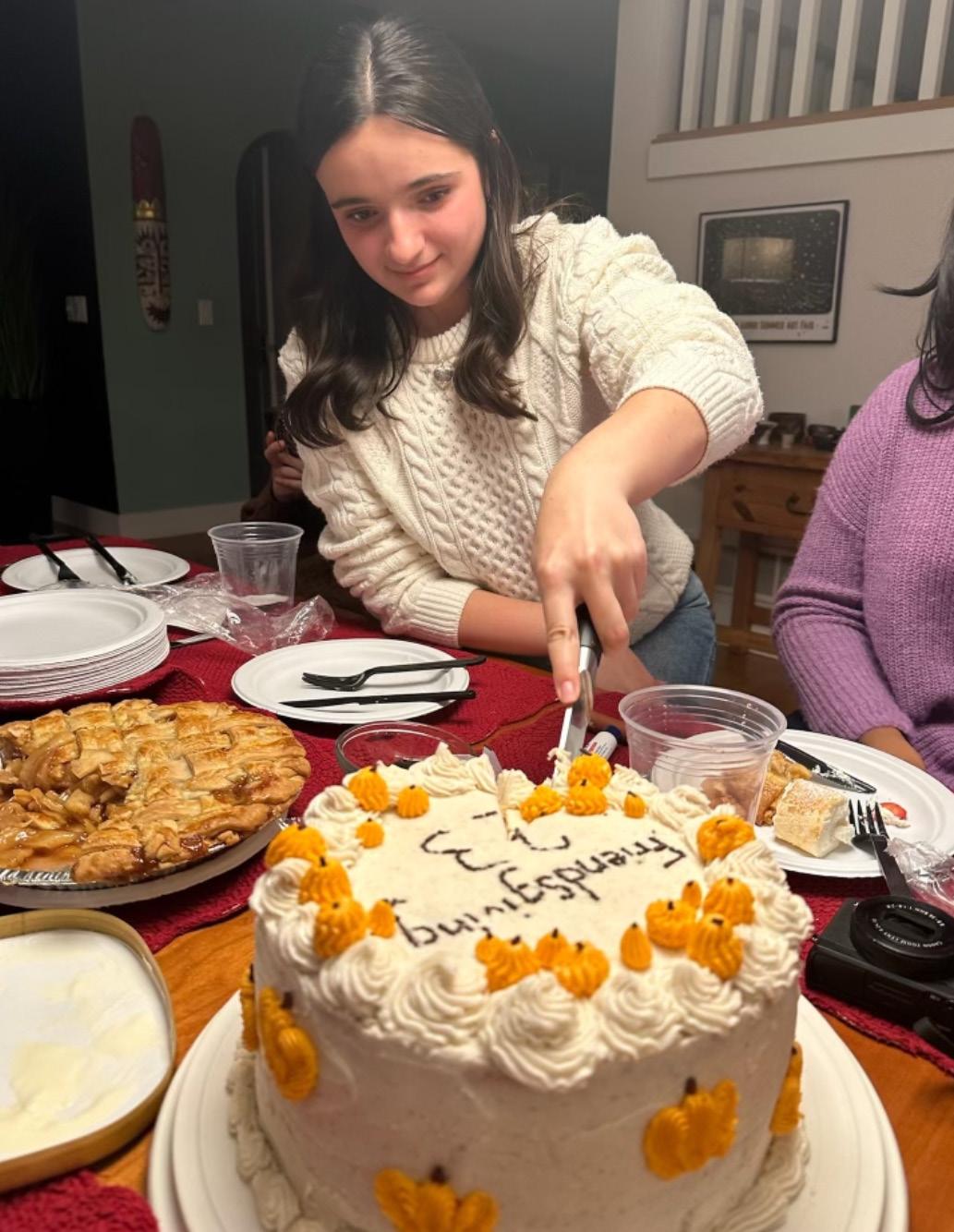
THANKSGIVING
Favorite holiday tradition:
“For the past couple of years, me and my friends have been having Friendsgiving. It’s basically a potluck. We get together for dinner and bring a lot of food.”
Significance of tradition:
“The last day before Thanksgiving break, my group of friends plan a Thanksgiving dinner. During the school year, it’s hard finding time to hang out with friends. Hosting a Friendsgiving dinner lets us spend some time together before getting thrown into the weeks leading up to exams. It’s a chance to bond during the stressful school season.”
Favorite Moment:
“Before sitting down and eating, we usually have to prep the food in the kitchen. During this, we play a lot of music and just goof around in the kitchen.”
DEC. 7, 2023 PAGE 6
Photos courtesy of Yaneli Ruiz-Buss, Parini Rao ‘24, Jonathan Schwartz, Ellie Rodgers ‘24, Graphics by Megan Peng ‘25
Briefs compiled by Bella Young ‘24
College Counselor Yaneli Ruiz-Buss CHRISTMAS
Parini Rao ‘24
S t e phanieBentley’sVenezuelen
PotatoSalad
College Counselor Jonathan Schwartz
Ellie Rodgers ‘24
Meera Tewari’s AlooPuri


Boys swim and dive team more than doubles in size
DOMINIC SCHUSTER ‘24
Sports Editor
The reek of chlorine, steaming humidity, echoing of conversations through the natatorium, water splashing against the walls, welcome to the sport of swimming and diving. A small team but a big part of the winter season sports. A team that went from two wins and five Greenhills members to 11 members from Greenhills alone.
“With the increase in numbers of students at the school it naturally would make sense that the numbers increase,” said Athletic Director Tom Ward. “However, it is definitely impressive to see the team double in one year simply because of one grade.”
The team has 11 members, nine of which are freshmen. A very young team posting very fast times. Of the nine, five of them swam for Greenhills in the middle school program and four are new. This is a team filled with young talent as many of them have posted some of the fastest times in the state. This is talent that is looking to be capitalized upon.
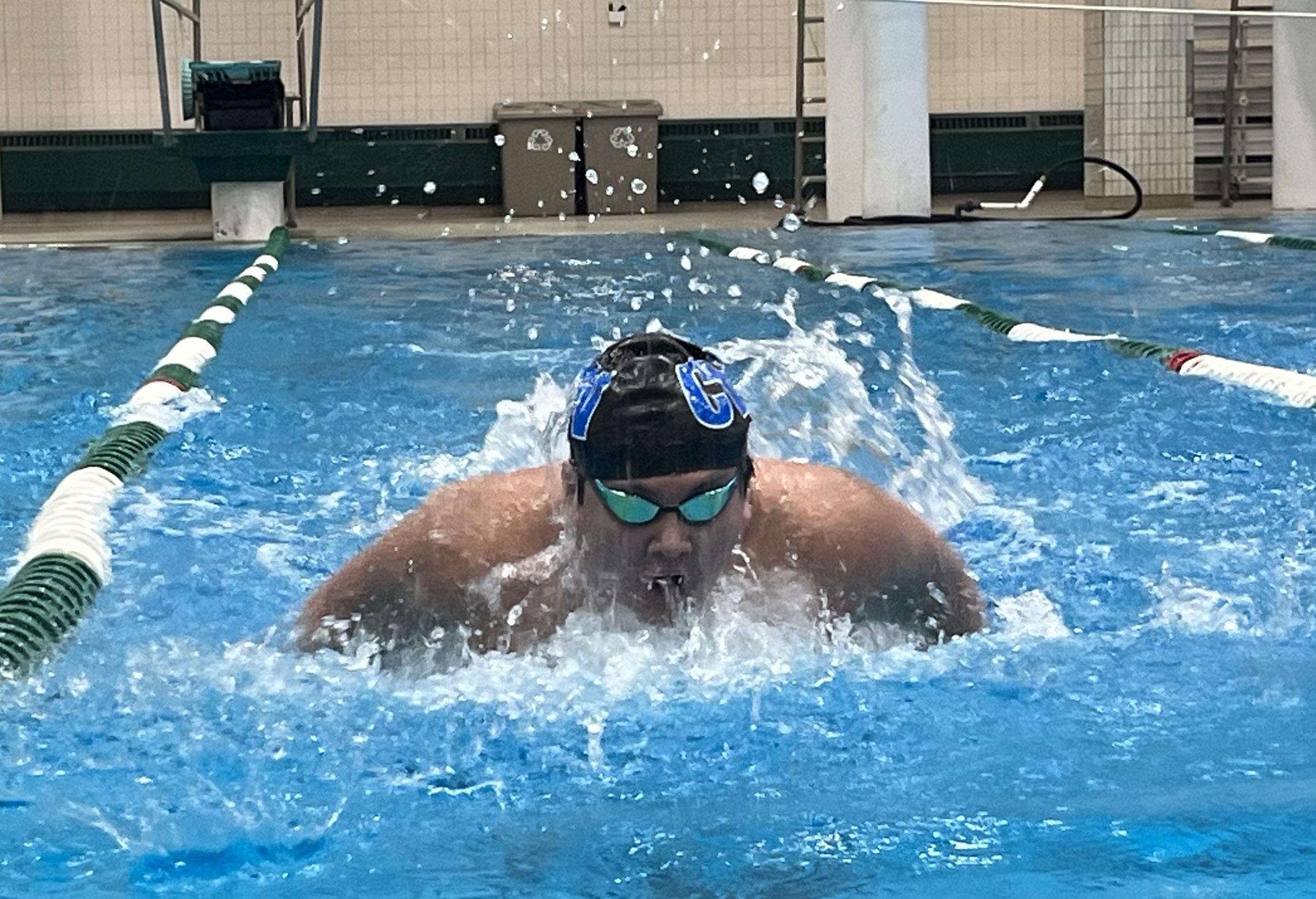
SWIMMING TO VICTORY Manuel Garcia ‘27 swims butterfly at practice. The team’s next meet is Dec. 9 against Fenton. “I think winning states is entirely on the table and this year is one to prove it,” said Tag
“The freshmen look very energetic this year, and I think that this will be exciting to see. Our goal is to get as many people to the [state and Catholic High School League (CHSL)] finals as possible. It will be tough with University of Detroit Jesuit and Detroit Catholic Central who usually dominate the fields, but what I have seen from our freshmen is that their times are very fast,” said captain Jibreel Rehman ‘24. “We have the potential to be one of the fastest teams in program history and we have to keep practicing and see where that takes us.”
This rise in members not only is a shared excitement by Rehman but also by Nico Dettling ‘25. The reason for this excitement is
more people means more opportunities to win.
“I would like to capitalize on all the new people as I think they will help add speed, time, and points to our team,” said Dettling. “Even having more people is good as a lot of them graduated last year so to have more people is always a bonus as we can do better and win more.”
With a young team you would think there are lots of issues. For example confidence, strength, and size to name a few; but Rehman is not scared and believes that this team has what it takes to cause a tidal wave in the table.
“No, I am not scared. It’s good to know that there’s going to be some faster swimmers than past years and I’m excited to see them rise to the challenge.” said Rehman. Fellow captain Yoel Bechar ‘24 also believes that this year is special and will do very well.
Middle School Pickleball Club attracts dozens
New Middle School head brings popular new sport to C&C
NEHA NARAYAN ‘26
Sports Staff
Pickleball, the rising star of recreational sports, has found a home in Greenhills Middle School’s gym, thanks to the leadership of the Head of the Middle School, Mayra Diaz. The Greenhills Middle School Pickleball Club, led by Diaz, has become a bi-weekly highlight, meeting every Tuesday and Thursday during C&C in the West Gym.
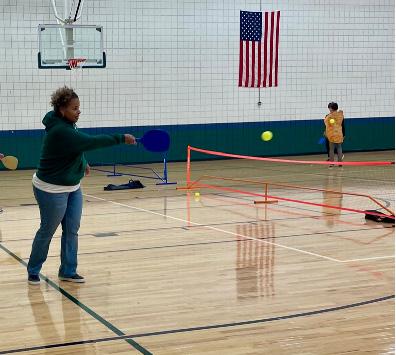
Diaz said.
“I was never athletic growing up and I’m good enough in pickleball, so it makes me feel some level of athleticism,” Diaz said. “I feel accomplished and I think there’s a level of fulfillment in it. Pickleball feels manageable to me.”
Diaz, a recent addition to the Greenhills community, shared her unexpected journey into pickleball. The introduction of pickleball to Greenhills coincided with Diaz’s move to Ann Arbor on July 1st. She had never played pickleball until a serendipitous encounter during a school visit.
“I did my tour of Greenhills, and I was walking around the building,” Diaz said. “I looked in the gym,
and I saw the kids playing pickleball, and I was like, oh, I want to play pickleball. So it’s always been on my mind.”
Stepping out of her comfort zone, Diaz embraced the opportunity to explore and immerse herself in something new. She started playing over the summer and has been committed to playing at her club. Diaz was captivated by the graceful dynamics and found herself in awe of the sport’s beauty. She respected the skills displayed by fellow players, which also fueled her enthusiasm. Diaz’s appreciation extends beyond these aspects as she enjoys playing both doubles and singles. Diaz recognized the importance of having a reliable doubles partner. As her involvement deepened, she realized how essential it was to have a trusted doubles partner, and stressed the importance of this.
“I think pickleball makes you feel safe enough to try it,” Diaz said. “And then from that you just it can grow into something amazing.”
The heart of the Pickleball Club lies in its student-driven character. With a collaborative spirit, club members actively engage in setting up the nets within the gym. Once the nets are in place, the members start playing. Whether it’s engaging in spirited doubles matches or honing individual skills in singles play, members have the flexibility to pair up with any member.
“All my friends joined the club, so I also joined it,” Ryan Almoghaisseeb ‘29 said. “It’s really fun even if you might not be good at pickleball.” Focusing on things she enjoys, Diaz hopes the pickleball club will be an activity the middle schoolers can also look forward to. The creation of the Pickleball Club aligns with her philosophy of trying new things and overcoming the fear of failure.
Approaching pickleball as an “entry-level” player, Diaz finds joy in playing for herself rather than in competition. Despite her initial hesitations, she expressed a desire to play more, even outside of school. This passion has inspired thoughts of Middle School pickleball competitions and tournaments,
Sharing a similar belief to Rehman.
“We are probably going to have a really good freshman relay which always helps,” said Bechar. “Also having more people allows us to be in more events which helps us get more points and helps us get more wins.”
The team is not only looking to get more wins but also to go to states. Both Rehman and Bechar believe that the team will go to states and win a lot of meets this year. This belief is not only shared by the seniors but also throughout the team.
“I don’t think that making it to states is a question anymore,” said Tag Dershimer ‘27. “It’s now just a question of how high can we place in states.”
This is one of the goals the team has set for the season, others including setting new records, winning the CHSL, and setting a new standard for the team going forward. As the team prepares to fully go into the season it will be intriguing to see how the team adapts to the large number of young members and how they are utilized to swim the team to wins.
“We have something special this year and I can’t wait for it to begin,” said Rehman.
The team next swims Fenton Dec. 9 at Fenton High School at 9 a.m.

an idea that the other club members support. Diaz’s vision extends beyond the school gym. She expressed interest in making pickleball an official MHSAA sport, even considering the possibility of bringing the sport to Greenhills at an official level.
“When you try something new for the first time, fear is inevitable,” Diaz said. “You think, ‘I don’t want to mess up. But in that vulnerability, there’s a sense of accomplishment - ‘I may not be great at it, but at least I tried.’ Whether pickleball becomes a defining thing for me doesn’t matter; what matters is that I’ve embraced the opportunity and tried something new.”
PAGE 7 DEC. 7, 2023
GAME ON Middle School Head Mayra Diaz leading the charge on the pickleball court with other club members. “In Pickleball Club, I really enjoy getting to play, and that’s the other reason why I have a Pickleball Club,”
Coming back for more
Senior boys aim for successful basketball season amidst tougher competition
MATTHEW STREICHER‘24
Lead Sports Reporter
Bringing back almost all of their starters this season, the boys basketball team is gearing up for another season with a now-experienced lineup and some underclassmen showing some promise. The team went 8-14 with only two of their starters having any varsity experience. Their season came to an end in a 55-58 loss in districts to a Plymouth Christian Academy team that was first in the Catholic League. They hope to go even further this year with an experienced all-senior lineup. They opened the season on the road with a win against Pinckney, 75-57. Leading the team this year is Lucas Nor ‘24, who had a great season last year combined with Nikola Sarcevich ‘24 who came to Ann Arbor from Serbia and led the team in points last season.

Nor knows that even though the team is pretty young, they can go far.
The start ing lineup of Nor, Sarcevich, Alex Ye ‘24, Ben Formicola ‘24, and Isaac Hess ‘24 took last year to develop as a group.
“I think this year specifically, the sky’s the limit,” said Nor. “The starting five has been playing togeth er for a really long time now and we’ve gotten used to it now. We’re really confident that we can go far and not just win districts, but even win regionals and states.”
Another returning player on the starting lineup is Isaac Hess ‘24, who had a great season on varsity last year. He feels similarly to Nor about the team’s chances this year.

“We can definitely win districts this year. We played one team in the offseason and we beat them, so we feel pretty good,” said Hess. “I think [winning regionals] is definitely possible. It gets tougher because we’ll play Riverview Gabriel Richard and they’re always really good.”
Rebounding
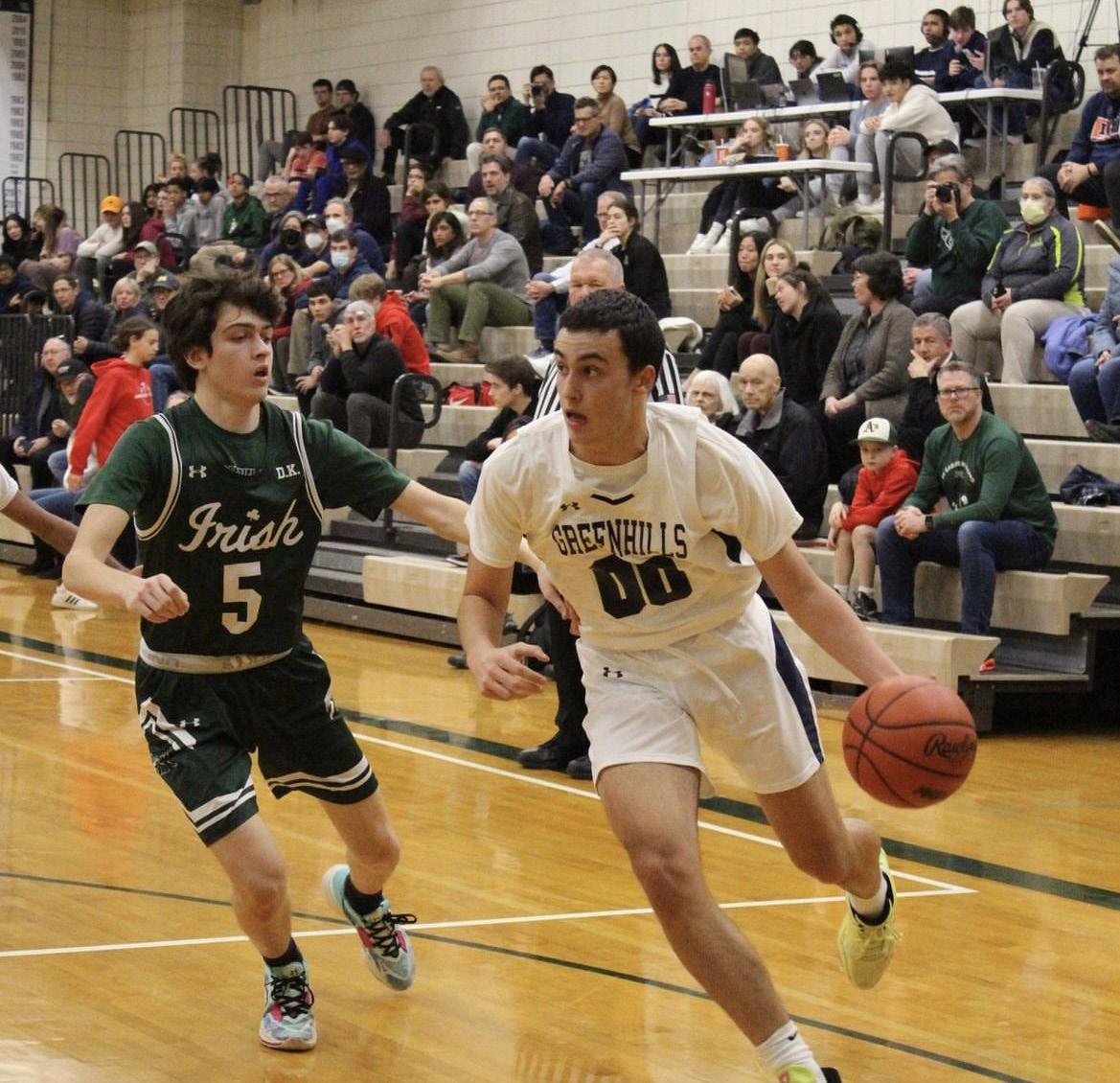
Another big factor for the team’s success is their size, as they find themselves being one of the smallest teams in the division
“The only other team in the division that is the same size as us is Riverview, and everyone else is bigger than us. That’ll be a challenge, but I think we can deal with it.”
It will be another tough opening few games for the Gryphons who are playing against some of the best teams in the divisions. “We put some Division I and II teams in our schedule to start, Pinckney, Adrian, and Skyline, so I’m not sure if the record will reflect the progress we made because the competition is so good. We’ll only grow from it,” said Wright.
Because of the experience of the varsity lineup, the rookies coming up, and the early competition, the Gry phons are looking to have a great sea son.
A big part of the
team this year will be some younger players coming up to varsity. Andrew Wang ‘27 is part of the group expected to make varsity this season.
“[Wang] will probably make varsity, he’s pretty good. He looked great this offseason,” said Hess. Head Coach Andrew Wright is ready for another good-looking season with this line- up that only graduated one senior last year.

“The ma- jority of our team is back, I think our top six shooters and rebounders are all coming back,” said Wright. “We didn’t lose the district game with Plymouth Christian by much, and they went all the way to the regional fi- nals. We opted to play up into the second division, so that is even tougher because we’ll have to play Riverview who we haven’t beaten in a few years.”
New girls basketball coach and captains look to revive team
MATTHEW STREICHER‘24
Lead Sports Reporter
After a 3-16 season last year, the girls basketball team is getting ready to hit the court with some returning starters and without its now-college-playing star.
The squad ended last season with a loss in districts to Clinton 65-20, who were the top team in the region. The team took a hit early in that season when guard Meezan Hamzavi ‘23 went down with a season-ending injury in the third game. Hamzavi now plays basketball for Grinnell College, located in central Iowa. As the 2023-24 sea- son begins, the starting lineup of Katie Mal loure ‘24, Reewin Shi ‘24, Inaaya Naz meen ‘24, Hannah Behringer ‘25, and Alexi Magdich ‘26 is looking to rebound. Malloure said she is excited about this season with the Gryphons even though there are a lot of changes com ing to the team.

“The competition is just gonna get tough er down the road,” said Nor. “If



Sterling stepped down from her coaching position. Filling her place this year is Taylor Parker, starting her first season coaching the team.
“We’re looking pretty good through preseason,” said Parker. “As we’ve started workouts, we saw all these ninth-graders show up and I like all of their skill levels. I think we can build off of that this year.”
even] make a run towards a regional or state title.”
The new team and coach are a big part of that hope, and Schuster says she recognizes the potential of the team.
The incoming freshmen say they are cautiously optimistic and feel excited to be playing on a new team under a new coach.
“We didn’t do so well with our record last year, but we still had a lot of fun. We had some big wins, like when we got to play at Crisler Center, which was re ally cool,” said Malloure. “We can continue to build off of how we’ve been growing as a team.”


Shi said she is ready to lead the team this year alongside Malloure, and is confident that this sea- son will be better than last year.
“As of our first practice where the team was all together, I feel like we can do really well,” said Shi. “I’m feeling happy with our progress.”
Although the team is without some of last year’s top scorers, Malloure thinks the team can rely on some younger players to compensate for the losses.
“[Magdich] is a really great post player, and Hannah Behringer is great at guard,” said Malloure. “I think they’ll really step up this year.” Shi is also seeing some freshmen who are showing promise like Cate Alumkal ‘27 and Libby Schuster ‘27. “I think [Alumkal] and [Schuster] will do really well this year,” said Shi. “A lot of our freshmen and sophomores are looking really good.”
“We have a lot of new players on the team and I think we’re excited to see where this season could go,” said Schuster. “I think [Parker] is ready to turn us into a winning program. I this team can make it to districts, [maybe
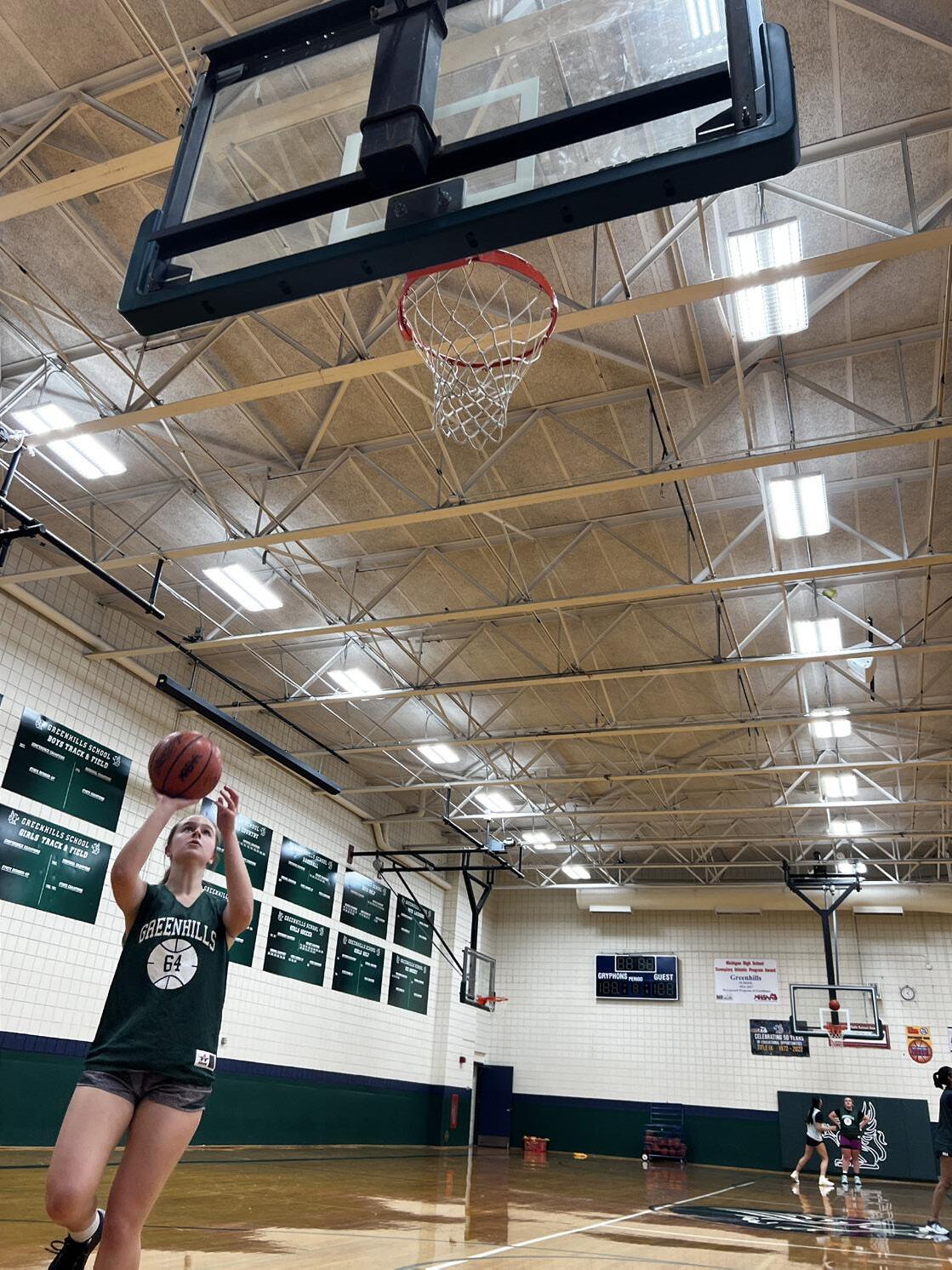
“I think [the season] will go better than it has in previous years,” said Schuster. “We have a lot of talent on the team and I think it will take us pretty far.”



need to be open to learning new things and to learning how to operate on offense and defense. If we can do those things, we’ll go
pretty far.”
A lot of changes have come to the team this year with a new head coach, losing players, fresh talent from underclassmen, and seeing a larger team. Nevertheless, Parker thinks the players are ready to go.
“The players are excited, the coaching staff is also very excited,” said Parker. “All preseason, the kids were really happy and excited to get the season started. We had a lot of girls come out, and I think that everyone is looking forward this season.”


PAGE 8
MISMATCH Nikola Sarcevic ‘24 dribbles by a defender in a game against FGR. “He’ll probably be our best player this year,” said Lucas Nor ‘24.
After last season, former head coach Janelle
DEC. 7, 2023
BOUNCING BACK Katie Malloure ‘24 going for a lay up during preseason practice.
“We’re ready for this season,” said Malloure.
Photo by Matthew Streicher ‘24
Photo by Matthew Streicher ‘24
