

School to adopt new discipline guidelines Gryphon Idol
ANJAN SINGER ‘24Student council has worked alongside Dean of Students Janelle Sterling over the past few months to create and implement new disciplinary guidelines that incorporate more input from students. Sterling and Student council are taking inspiration from similar solutions that have been implemented here in the past and exist at many other schools in some form.
“The basic gist of it when it existed before is that if you committed some offense you would face a committee of your peers and teachers and they would decide what the appropriate response was,” said Sterling. “There was some pushback from students who felt they didn’t want to sit in front of their peers and then deem a penalty for them, so I thought the work that I could ask students to do is behind the scenes and front-loaded. Maybe the work that’s more relevant is to have students help me figure out what that matrix of responses looks like.”
Student council has been working on creating that matrix, clearly defining levels of transgressions and their corresponding punishments.
“[The idea] was presented to us a couple weeks ago,” said student council representative Jonah Kaplan ‘26. “[Sterling] divided us into grades, and each grade was assigned level one, level two, level three, and level four, and we were working to define and make boundaries between each of those levels and then put possible punishments.”
Although student council is in charge of the program at the moment Sterling envisions a broader definition of the word “peer.”
“I feel very strongly that that person should be selected in some way and it would be great if they were selected by their peers,” said Sterling. “I don’t know if the best way to do that is a separate election or just say in that Student council election that [these] members will help out with this. I haven’t quite wrapped my head around that yet, but I don’t want it to be a secret. It’s not, Ms. Sterling’s
having a bad day, so she’s going to lash out at you, it should be easy and transparent to follow and it should also be transparent and easy to know who the students involved are.”
Student council president Jibreel Rehman ‘24 recognizes the need for student council to define the matrix this year, but thinks the responsibility should be left to a different group in the future.
“I don’t think the whole student body

[should decide],” said Rehman. “I also don’t think it should be student council. Student council’s purpose is different than what the discipline matrix implies.”
The essential reason the plan came into existence is not only to involve students more in the decision making process, but to unify responses
to specific issues and eliminate bias.
“If the offense is egregious enough, there’s some language [in the student and family and handbook] that would say at this point, we just escalate to this consequence, but any minor infraction is at the discretion of the teacher or adult that happens to be there,” said Sterling. “I don’t think we’re transparent, and I don’t think we’re consistent.”
To increase transparency Sterling proposed sharing results of the new system at all school assemblies, similarly to the bias report system, where the number of infractions in each category would be shared anonymously. She also recognizes that although that report will be anonymous, students will most likely know who those people are.
“There are always going to be a group of people who will want to know that someone got the hammer thrown at them,” said Sterling. “They’re not always going to get what they want. There will always be someone on the flip side of that who thinks it’s too mean, and they’re not always going to get what they want either. There’s a middle ground in there and Greenhills does a really good job of finding it, but I don’t think that the privacy of someone who does something offensive would be my main concern.”
This would also serve to increase the flow of information between students and adults.
“Students need input in situations like these because they have personal experience with high schoolers and the people in the school, so they have a better idea than teachers about what certain punishments should be,” said Rehman. “Teachers know things that students don’t and students know things that teachers don’t.”
Overall the new system will address blind spots and transparency, especially with regard to small offenses that used to be left to personal discretion.
Gender stereotypes create uneven distribution in classes
ANIKA BERY ‘24 Lifestyles Staff
Despite progress made in the educational realm, data from the academic enrollment office shows that in many Greenhills classrooms there is an uneven distribution between the number of boys and girls
“Some of it comes from broader socialization,” assistant director of diversity Kelly Williams said. “Girls aren’t really socialized towards STEM subjects, but boys are. For example, we have to have initiatives for girls, but not for boys.”
Female participation in the sciences is on an increasingly upward trajectory, especially at Greenhills, however the fields of biology, chemistry, and physics are historically male dominated.
“It’s something I noticed since I was a college student,” advanced physics teacher Alvaro Salcedo said. “Physics is skewed toward men and has been for so many years. The other teachers and I are well aware of this and we try to promote physics for all students, but sometimes our efforts do not yield any results.”
Preconceived notions about what is challenging versus what is easy likely influences students, whether they know it or not.


“Biology is the study of life, it can be seen as the ‘nurturing’ science,” Advanced Biology teacher Julie Smith said. “Sometimes biology is perceived as easy, it’s not as mathy. A lot of society has internalized that this means that more girls can succeed in the field.”
Significantly less female students participate in advanced physics compared to advanced biology, but the reason for this puzzles teachers.
“Regular physics is totally evenly split, girls in regular physics do as well, if not better, then many boys. It doesn’t make sense why more of them don’t continue with the higher levels.” Salcedo said.
Students may choose not to continue with certain subjects for reasons completely unrelated to academic performance. In order to learn effectively it is crucial to have a classroom environment where you can engage with the material and those around you.
“I can definitely feel the difference in being one of the only girls in both jazz and physics,” Ridhi Gupta ‘24 said. “It feels harder to interact and be comfortable with people I don’t normally talk to when it comes time for labs and group work. I don’t want to ask them for help because I do not feel that


there is room to make mistakes.”
Despite teachers’ efforts, there is a culture among students that can make others feel hesitant of their place in the classroom.
“I think that other girls are deterred from these classes because no one wants to purposefully put themselves in an environment where they are often ignored and dismissed by their peers,” Gupta said. “My first year or so in jazz was miserable, but now there are a couple younger girls and the environment is much better. No one is worried about being the only one or afraid of having moments where they are excluded for no reason at all. We are creating a much better foundation for the girls who are coming up.”
Having tangible role models to look up to could lead students to feel less hesitant in trying new subjects and enrolling in the subjects which they are interested in.
“People are drawn to places they can see themselves,” Smith said. “If we don’t see ourselves in the places we want to go, another hurdle is created for us to jump before we even dip our toes into the field.”
Of all the students enrolled in ceramics 70 percent identify as female and 30 percent identify as male. All the visual


arts teachers are female. In contrast, all the physics teachers are male. 78 percent of students in physics identify as male and 21 percent identify as female. In advanced biology, all the teachers are female. 75 percent of students enrolled in the class identify as female while 25 percent identify as male.
The competitive nature of the school also creates subliminal messaging towards students about what they should and should not do.
“The idea of how I can show that I’m the best feeds into the disparities, as a society we’ve socialized boys to be hyper competitive,” director of diversity Nadine Hall said.
“Boys could feel that they have an obligation to participate in areas that are thought of as more challenging.”
There is no lack of encouragement towards students’ participation in different subjects, but there is an underlying cultural stigma that influences our decisions.
“What we know and what we’ve learned from the world around us influences what we think,” said chemistry teacher Reeti Katouch-Rouse. “Here at Greenhills there are significantly less hurdles for students, but we must remain conscious of the influence of our society.”


Students entertain with talent show
MANYA TIJORIWALA ‘26 Lifestyles Staff Rebekah Warren ‘25 took this year’s top spot on “Gryphons Got Talent”. The show included singing, dancing, instrumental accompaniment and a combination guitar, drawing, and Tetris act calling back to last year’s speed AP U.S. History document-based question writing performance.
This year, the prize has been upgraded from a twenty-five dollar gift card to a brand new pair of Apple AirPods.
The idea of Gryphons got Talent was introduced by Maraki Tamrat ‘23 and Austin Andrews ‘23 who wanted a way for students to show off school spirit.
“It came about when we were trying to figure out new ways in which

BLUEBIRDS SING Rebekah Warren ‘25 sings “Somewhere Over the Rainbow”. “It felt nice, I didn’t care if I won or not,” said Warren. “I just wanted to sing and gain an experience because I like taking up opportunities with singing because it helps me deal with my stage fright.”
we could get the student body to promote school spirit,” said Tamrat. “Everyone loves battle of the bands, everyone loves different ways in which we can all come together and kind of celebrate that Greenhills spirit. When I was speaking with Austin Andrews, who was the president at this time, we came up with this idea of a talent show and then came up with the ‘Gryphon’s Got Talent’ tagline.”
Having a talent show at school can be a way to spark innovation, and having an incentive to participate.
“I think Greenhills has really fostered an environment in which you can go out of your way to try new things,” said Tamrat. “Being able to showcase the talent at Greenhills is really great because whether it’s just a sort of hobby on the side or something that you’ve done for ages, being able to go on stage and perform is something that, especially in the Greenhills space, is truly amazing to do. It’s a fun, low-stakes way to just enjoy yourself.”
This year’s Gryphons Got Talent was managed by all of the Student Council, but primarily Jibreel Rehman ‘24 and Nicole Zhong ‘24. Sophia Hazzi ‘26 is a representative on Student Council and the committee that helps plan out events like this.
“Jibreel and Nicole monitored the auditions, and made sure that they were appropriate and fit the criteria of what we needed and wanted in the show,” said Hazzi.
To promote more students’ involvement, the student council approached Gryphons Got Talent with a different tactic this year.
“We thought we would get more participation doing it during assembly then doing it as an after school event,” said Hazzi. “I think it’s a really cool way to get so much action and participation from more students.”
Editor in ChiefThursday, May 2, 2024 The Student Newspaper of Greenhills School Volume 24, Issue 4
Graphics acquired from Canva
Photo by Nicole Zhong ‘24
Please note that the data does not include students who identify outside of the gender binary. Greenhills strives to be an inclusive community for all students. At the same time, the school does not keep official records of how students identify when it comes to categories such as gender identity or religion.
ENTERING THE MATRIX Dean of Students Janelle Sterling and Student Council members Jonah Kaplan ‘26 and Ishan Leahy ‘25 work together to create a new discipline matrix. “There are consequences to actions, and I think most of us realize that, but I don’t think every consequence has to be a puniative one,” said Sterling.
Photo by Dhruv Nallamothu ‘25

With Concordia money woes, comes Greenhills’ potential opportunity


The cross country course was usually quiet, peaceful. A five minute walk into the woods seemed like a journey into an other world. Concrete and fluorescent lights gave way to trees, grass, and sunshine.
The protesters at the new develop ment down the road, who stood in the way of bulldozers and climbed on heavy equipment like a jungle gym were annoying, they blocked the roads with their cars and the police that came with them to keep the peace. However, the time to fight new development wasn’t as the excavators came in, it was back at city hall.
Then one day we didn’t have a cross country course any more, we had a waste land of heavy machinery, dirt, and wood chips. The protesters’ cries, in hindsight, could be seen in a more favorable light.
This is not an environmentalist piece. This is about the fact that before the pro testers who fought against Concordia Pines, the development on Earhart, in 2022, before the bulldozers, before the houses, the school grappled with the question of buying the land to the south of the school. We said “no.”
We shouldn’t repeat that decision.
reductions and property and facility dispositions.
space for students to come to and from school.

Earlier this year Concordia University Ann Arbor announced financial instability, saying that they would be able to stay open through the 2024-2025 school year with some cost reduction measures, likely including staff

EVA BERNSTEIN ‘25
in the state but while looking for the stars we are ignoring issues of size at our doorstep. If we were to purchase Concordia, the pay off would be massive. New buildings that could teach hundreds of more students, new facilities to boost our athletic competition, more
Junior sees future with Apple Vision Pro
Imagine sitting on a couch with a bowl of popcorn to watch your favorite movie. With the tap of your fingers the movie starts, but the picture isn’t quite as big as you’d like, so you press your thumb and pointer fingers together and drag them out, enlarging the scene. Finally, the volume. It’s too quiet, so you twist the digital crown above your right eye clockwise and suddenly you can hear your favorite character’s voice more clearly. Now sit back, relax, and enjoy the show. You may have noticed that you haven’t used a remote and there has been no mention of a TV screen, because you are watching this movie using Apple Vision Pro goggles.
These goggles were announced last year and sparked a lot of conversations surrounding virtual reality and its rising presence in our daily lives. The technology is known as spatial computing, which is an umbrella term for virtual reality that we see as taking place in our physical environment, not just within virtual screens. These goggles are the first of their kind, and are bound to be especially mainstream because they are made by Apple, a company so massive that the U.S. Department of Justice recently sued them for monopolizing the smartphone industry.
With a starting price of $3,499, Apple Vision Pro’s biggest drawback is its price, but this initial model wasn’t made with affordability in mind, but rather to get people excited about what will become more accessible in the future. I tried out the goggles in February and they were truly unlike anything that I had ever experienced. In my free demo at the Apple store, I got the goggles custom fit for my head and then embarked on an immersive journey. I got to set up a floating workspace before my eyes composed of different apps like Safari and Photos and watch a 3D clip from the “Super Mario Bros.” movie. Then came my favorite part: the immersive experience, during which, I watched clips of a professional soccer game from the goal, a MLB game from the left foul line, Alicia Keys rehearsing a song in the studio, and Faith Dickey traversing a canyon on a tightrope. What made these clips special, though, was that it felt like I was in them. I was sitting on top of the goal’s crossbar during the soccer game, coaching first base at the baseball game, being sung to by Alicia Keys during her rehearsals, and standing on the canyon next to Faith
Dickey as she prepared to step on the tightrope.
Apple Vision Pro is not only an incredible experience for consumers, but it also has many real world implications that should not be overlooked. As a school, weshould be getting excited about the many immersive experiences that it offers. I think that these would be especially impactful in language classes. We all know that immersion is the best way to learn a language, but with Apple Vision Pro, students would soon be able to immerse themselves not only in the language, but also the culture.
Let’s say a French class is learning about Parisian culture. With the help of spatial computing, students would be able to fully immerse themselves and walk along the Champ de Mars while looking at the Eiffel Tower. They could even choose the brightness and volume of the environment.
Spatial computing would also open up windows in science class es like Biology and Anatomy and Physiology. Medical professionals are already using Stryker’s new myMako app to visualize specific patients’ surgical plans using Apple Vision Pro, ensuring that they can get the best personalized care possible. This is again made possible by the unique immersive experience that Apple Vision Pro offers. Anatomy and Physiology could use this new technology to look at bone structures and organs, and Biology could use similar technology to view cells and plant structures in 3D like never before. These innovations would create a more exciting and engaging learning environment for students and teachers alike.
be new access for students to study in a number of new places as well as learn in larger classrooms allowing for more hands-on learning. We would have college level athletic facilities including a new track, baseball stadium, sofball
DOMINIC SCHUSTER ‘24
stadium, football stadium, basketball arena, and two turf fields. With this expansion of athletics, Greenhills would increase dramatically where students could not only thrive in a classroom environment but also at an athletic level. Dorms already built on campus would allow for the school to recruit and board kids in and out of state to play athletics and perform in academics at the school. It would not only allow us to expand, but to strengthen our existing offerings. Art spaces, robotics, teachers without classrooms, parking. We already need and have plans in place to expand our physical spaces. The universe has dropped an amazing opportunity in our lap, if we’re brave enough to see the few steps that it’ll take to seize it.
The administration has repeatedly said that our current size is as big as Greenhills will ever be; no more students, no more teachers, no more fields and buildings necessary. They say that it would be impossible to maintain the same feeling and philosophy in the school. There’s absolutely nothing wrong with that, but the door is rapidly closing on ever expanding whether that be by class size, number of grades, or to grow into a different feeling school.
Forever is a long time. This school has existed for more than 50 years, and with any luck it’ll last another 50. Over that time we’ve changed, grown, expanded. We won’t have that luxury anymore if we let this go.
We’re blind, even with VR glasses on
What would you do if you had $3,500?
You could take a week trip to Paris, put it in a savings account, or you could buy an overpriced piece of goggles. The introduction of the Apple Vision Pro goggles has made many excited and many scared. I believe that the Apple Vision goggles are the
ning of
has at the moment will go away and everyone is subject to the internet. This will lead to people not waiting to leave their homes out of fear that they will be recorded without their permission. The Vision Pros not only pose a security threat but also a threat to humanity. In the book The Electric State written by Simon Stålenhag there is a device known as the “telecasters” which are very similar to the Vision Pros. A headset that plays movies, tv, music, and what was supposed to better life on Earth. It instead led to the mind control and downfall of humanity. Everyone who wore one was sucked in and died as a result of being unable to detach from the telecasters.
As Apple works on creating a more accessible and compact version of Vision Pro, we should get excited about all of the opportunities that it opens up, from immersive learning to watching your favorite movies and shows with the tap of a finger. Virtual reality’s global impact is only going to grow, so we might as well embrace it and find out how we can use it for good.
the end of privacy and security.
The goggles are not discrete by any means.
However, rival -

troduced their own version, the Ray-Ban Meta Smart Glasses, which are much more discreet and $3,200 cheaper. Looking like regular sunglasses, these glasses can not only videotape and photograph things, it can also livestream and audiorecord to Meta’s services such as Facebook and Instagram. The glasses also include Meta AI allowing you to access Meta’s version of Alexa or Siri simply by saying “Hey Meta.”
While these glasses cannot do as much as the Apple Vision Pro goggles it is very scary to see how discreet the glasses are compared to the vision pros. Due to this it can be almost guaranteed that Apple is looking into a cleaner, smaller, more discrete version of their vision pro goggles. With this is the downfall of security and privacy.
I can’t stress enough how scary the capability of the goggles and glasses are. It will be near impossible to know if someone is filming you. The privacy and security that humanity
We have written about this, are scared by these books, and yet we continue to push it and ignore the warnings we set for ourselves. The Vision Pros are a technology that is fascinating and feels like it is straight out of a science-fiction movie. But should we leave them in sci-fi before we ruin privacy, security, and humanity?
One day we’ll look back and say “Have we gone too far with these glasses and goggles?” but that won’t be the most important question we ask. It’ll be, “Is it too late?”

-
PAGE 2 MAY 2, 2024
Editor-in-Chief Anjan Singer ‘24 Managing Editor, Print Eva Bernstein ‘25 Managing Editor, Online Dhruv Nallamothu ‘25 School Editor Izzy Baru ‘25 School Staff Mira Jayaraman ‘26 School Staff Arya Prabhakar ‘26 School Staff Lauren Ye ‘26 Opinion Editor Lachlan Rae ‘24 Lifestyles Editor Nicole Zhong ‘24 Lifestyles Staff Anika Bery ‘24 Lifestyles Staff Ana Flemming ‘24 Lifestyles Staff Zara Mian ‘25 Lifestyles Staff Manya Tijoriwala ‘26 Sports Editor Dominic Schuster ‘24 Lead Sports Reporter Mathew Striecher ‘24 Sports Staff Teddy Staebler ‘25 Sports Staff Violet Weizer ‘25 Sports Staff Hugo Andre ‘26 Advisor John Lund
Alcove is a newspaper written by students, for the students of Greenhills School. All opinions, views, and statements reflect those of the students working on Alcove and not necessarily the faculty and staff of Greenhills. Alcove is written to inform, encourage, and expand upon the curiosity of the students that Greenhills strives to cultivate. Providing a forum for students to express their individuality, the Alcove reminds you to always read the pine print.

Quarter century being “One of a Kind”
Teachers who have taught at Greenhills longer than current students have been alive reflect on decades of service
Lifestyles Editor
Committing to anything for over 20 years is a powerful feat – let alone committing to a single institution. Chatting with teachers who have taught at Greenhills for over 20 years is similar to conversing with walking encyclopedias of school history and wisdom. Having been here for at least a third of Greenhills’ history, they have seen many ups and downs – from how education has evolved to the constantly changing faces (and fashion trends) in the yearbooks.
For Eric Gajar, Associate Director of Enrollment Management, his journey from being a stockbroker in downtown Detroit to winding up in a classroom was certainly unanticipated.


“I had graduated as a finance major,” said Gajar. “But I didn’t click with the business I worked for – it was a bad fit. However, I had always coached tennis and been a camp counselor, and something told me that that was just what I liked to do. So I went back to graduate school, got a math degree at the University of Michigan, because you can do anything with math, then got a teaching certificate at Eastern Michigan University. I started teaching part-time at Ann Arbor Public Schools, then Community, and after getting a position here, I really liked it, and stayed. Education was always the right place, it just took me a little while to figure it out.”
GROWING UP WITH GAJAR An array of yearbook photos of Eric Gajar, currently the Associate Director of Enrollment Management, from 1997, 2000, 2017, and 2023. When asked how he would like his students to remember him, Gajar said, “That I knew them as more than just a student in my class – that I knew them in every play, musical, and game, and they have little stories about our waves in the hallway or coming out of the tennis courts.”
Gajar, who started his 29th year at Greenhills this school year, certainly aligned immediately with the Gryphon culture.


NONSTOP NOVAK Catherine Novak, French Teacher, sporting short haircuts and updos for her 2002, 2017, and 2023 yearbook photos. When asked how she would like her students to remember her, Novak said, “I can be a pain sometimes, but I’m fair, and extremely ethical.”
Greenhills, believes that the quality of the faculty and students has not changed.
“Something that has kept me happy here from the very beginning was the dedication of the people who chose to work here,” said Allen. “The vast amount of energy that people put into their teaching always impresses me. As for the students, one of the things I found interesting about them is that many times, they knew I had come from teaching at public schools, so they would ask, ‘Are we your best class ever?’ The thing is, I had good students in public school too. It’s just that now, I have smaller classes, and I had more good students in a smaller class than I ever had before.”
Mark Randolph, Upper School English Teacher and Head


24 YEARS OF BEARD Jeffrey Allen, Department Chair of Modern and Classical Languages, rocking the same beard in his 2002, 2017, and 2023 yearbook photos. When asked about how he would like to be remembered by his students, Allen said, “Could you remember me? Would you remember me? I hope I did something that was memorable for you, and not negatively, even if there were those too.”
more about the caliber of students.
“During my first year of teaching here, after the first marking period, everyone in the class was going to get an A or an A-, and I was horrified,” said Randolph. “I went to Lorne Forstner, Head of Upper School at the time, and said, ‘I’m sorry, but I have to do it. I can see every one of these kids in a major profession or graduate school after college.’ To that, Lorne said, ‘That is what Greenhills is.’ This place has an extraordinary consistency of talent, and it is clear that these students operate at a different level. I mean, I can do things with my students and texts that my colleagues around the country can’t do. For instance, even when I do Chaucer, I teach it in middle English. However, I know professors who need to translate it for their undergradu- ates.”

However, for Catherine Novak, a French Teacher, who is in the midst of her 24th year at Greenhills, there was certainly a bit of a culture shock coming from France.
“I remember my first day teaching, a student came with a can of Coke, and it is known in France that you don’t come into the classroom with drinks,” said Novak. “I asked her, ‘Do you want a hammock too?’ and all the kids just stared at me, then started laughing. That’s when I realized that, culturally speaking, things are way more relaxed here. Students are way happier.”
Regarding students, Jeffrey Allen, Department Chair of Modern and Classical Languages, who is also in his 24th year with

On the other hand, Gajar was able to identify his most meaningful teaching experience.
“One of my favorite stories is there was a kid in my class that was always down on himself about his abilities and what he was going to do,” said Gajar. “I wrote him a note on something, like a test or an assignment, that read something along the lines of ‘Don’t let anything get you down, I believe in you, you got this.’ Years later he came back after he had graduated and got into grad school, and told me that whenever he got bummed out, he would pull out my note. I had no idea.”
For Steven Oestreich, Wellness Teacher and Athletic Trainer, who is in his 34th year with Greenhills, the unique personalities and attitudes of each student are what have kept him smiling throughout the years.
“I had a sixth grade kid who just didn’t like what the instructions were – he just hated them. So he turned around and flipped me right off, and I couldn’t do anything but laugh. He was just a tiny kid, so it was a juxtaposition of sorts. I ended up going to his grad party. I always love graduation – when you see kids you had in middle school up onstage, the journey they’ve made, and who they’ve grown into in the course of their time here.”


Al - though Randolph a distinct memory


REFLECTING WITH RANDY Yearbook photos of Mark Randolph, Upper School English Teacher, from 2000, 2002, 2017, and 2023. When asked how he would like his students to remember him, Randolph said, “I’d like my students to not remember me. A good teacher disappears in the act of teaching, and all that remains is the lesson. It is a self-consuming artifact. There are people who want to be rockstars. I never wanted to be that, I wanted to be a folk singer.”
“Almost every single student, of the thousands of students that I’ve had, have had one moment where they allowed me to teach them and they discovered something. I’ve taken 16 trips to Chicago with the Shakespeare class, four trips to England, and spent almost thirty years coaching tennis. Just being with students and seeing them enthusiastic about something that I’m enthusiastic about is amazing.”


30 YEARS OF STEVE-O A selection of yearbook photos of Steven Oestreich, Wellness Teacher and Athletic Trainer, from 1994, 1997, 2000, 2017, and 2023. When asked how he would like his students to remember him, Oestreich replied, “Tough, caring, but fair. I hope they know that I got their back when it comes down to it – I just get very protective of kids and their experiences.”
Allen and Novak, language teachers who teach both middle and upper school classes, also elaborated on how fascinating it is to watch students spend middle and high school at Greenhills.
“I can see you at 11 years old and I can see you at 18 years old,” said Allen. “I can also see you at 30 years old when you come to visit and say that you are exactly where you should be and I am proud to be associated with you. Whenever Greenhills graduates come back, they give me a kind of reassurance that yes, the things we did here mattered to people, and they’ve gone on to become the kind of people we hope they would become.”
“I know that Greenhills is a great place for students to be, and for most of the students, it’s an extension of home,” said Novak. “Every first day of school, it’s always so exciting to see new students and returning ones that are growing, and doing more incredible things as they get older.”
However, no matter how exciting it is to watch students mature into distinctive individuals, Allen understands that there is an endearing repetitiveness in teaching.
“I think teachers have a way of talking to students that can be very predictable,” said Allen. “I remember at one point, a student was really late for a deadline, and the student came in, probably ten minutes before I was going to leave. She goes, ‘Mr. Allen, I’ve got what you need.’ I say, ‘Well, young lady, what have we learned from this?’ or some other predictable teacher thing. She answered, but then went, ‘You’ll probably have to teach me this again next year.’ And that just perfectly summed up not only her unique way of do ing things, but everything about being a teacher.”


MAY 2, 2024 PAGE 3
YEARBOOK BUDDIES Ann Novak and Steve Oestreich side-by-side in the 1994 yearbook. They are next to each other in many other yearbooks from the 90s.
GREENHILLS Y2K Faculty members Benjamin Cohen, Kristine Topper, Bruce Zellers, Neil Donato, Peter Fayroian, Nadine Hall, Amanda Harper, Jim Lupton, John Nickel, Cathy Renaud, and Barbara Rocci in the 2006 yearbook.
NICOLE ZHONG ‘24
Photos courtesy of Greenhills School, graphics acquired from Canva

Behind the broom
Anne Sartori’s life outside of a workday
As you walk into school each morning and leave each af ternoon, you encounter dozens of familiar faces—students, teach ers, and coaches. Among the vital members of our school commu nity are those whose names you might not recall but whose faces you recognize—the janitorial crew. Anne Sartori is one such invaluable member who ensures the school’s spaces are safe and clean.
“I didn’t have the kill instinct for the corporate world, there was cutthroat competition that needed to happen, but it just didn’t sit right with me and I felt disheartened,” said Sartori.
Before coming to Greenhills Sartori worked in the professional world as an inventory Analyst at Borders Books. After many years she left the corporate industry to join healthcare as a medical courier.


“I kinda liked it,” she said, “but being alone in the car all day gets kind of boring after a while, and I am at the point in my life where I can begin to ease into retirement.” Sartori wanted to leave the hospitals behind and start a new chapter of life. Retirement started to seem more appealing, and one of Sartori’s dearest friends encouraged her to join Greenhills to facilitate the transition.
“One of my closest dearest friends, who I’ve known since my sophomore year of high school, works up at the front desk,” said Sartori. “She called and said, ‘Hey, why don’t you come on over,’” said Sartori, referring to front desk attendant Leslie Gangwere.
Nearly 40 years after their graduation from Pioneer High

Leslie and Sartori are once again together in school halls and laugh with one another on a daily basis.
“We call one another sisters, that’s how close we are,” said Gangwere.
Before moving to the area right next to Ypsilanti High School with her wife and three small dogs, Sartori grew up in the neighborhood across the street from the Big House.
“My greatest memory growing up is living so close to the Michigan Stadium, my mom parked cars,” said Sartori. “She’d give me five dollars so I could get a ticket, a drink, and popcorn and go into the game at halftime with my friends.”
Sartori was a teen back in the 1970s, when regulations were slightly different. She said that a couple friends and her would often sneak in through cut fences in the stadium, and they never got caught. It was the highlight of the year and is one of her most prized memories, second only to her mom’s twice weekly shepherd’s pie dinners.
She went on to attend Olivet College and was a part of both the softball and field hock teams. In 1993, four years after her college graduation, Sartori was inducted into the Olivet College sports hall of fame for her outstanding accomplish in the game of field hockey.
“I wish I would’ve played at Pioneer,” said Sartori, “but because I refused, I just didn’t like skirts, but it my best sport.”
Sartori has only recently left the ics after sustaining a shoulder injury that
Friendships from local restaurant brought Sam Cash here, new ones made him stay
Within the bustling energy of student life and classes taking place along Main Street, Facilities


Staff member Sam Cash works to ensure that the building is in the best shape possible to give the students a clean and focused learning environment. For close to a decade, Cash has served as a cornerstone of the maintenance crew.

“I started working here in 2015,” said Cash. “I’ve been here for a long, long time, and I’ve enjoyed every second of it.” Cash is a part of the night crew, and works from 2:45 p.m. to 10:45 p.m. Although working after school hours, the interactions between students and faculty are one of Cash’s favorite parts of the job.
“I like to say that see the students at the best time possible,” said Cash. “They aren’t stressed about any tests and are just having fun with their friends after they get let out of their last class of the day, which makes me happy to see. Not only the students, but even my brief conversations with the teachers and administrative staff are interesting, and I look forward to those as well.”
MAY 2, 2024 MAY 2, 2024
quired surgery to keep playing as competitively as she would’ve liked. Nevertheless, Sartori’s competitive fire remains kindled as she remains involved in competitions with friends who can play on her level.
“If you have one friend, it should be someone like Anne,” said Gangwere. “Someone who always listens, who makes you laugh, and who pact remains on every person and she encounters. Her energy is gious. She has never ending risma. She knows how to that I’ve attended at our school cleaning us,” said the that ing that


a new event going on. Even when we’re shortstaffed, everything runs smoothly, which is just another reason why I like it here.”
Cash has always been rooted in Michigan. He was born just east of Ann Arbor in the town of Belleville and has worked a few jobs before coming to Greenhills.

“My job at Greenhills is a lot better than my former job,” said Cash. “I used to work as a waiter at the Autbar restaurant, which was in Ann Arbor. At Greenhills, it’s a lot more sociable. There are more oneon-one conversations with different people and I know and get along with just about everyone I work with.” Autbar, however, gave Cash bonds and friends that he has still maintained today, some of whom work alongside Cash at Greenhills.
Their friendship ex tends beyond Greenhills, however.
“We sometimes meet each other over the weekend, and our conversations are so genuine,” said Twarog. “We talk about everything, from the top news to our pets and families. He’s my closest friend here, and I’m so lucky to be able to work with him.”
Facilities staff manager Nick Roggerman, although only have been working with Cash for two years, has also grown to be fond of him as a worker and a friend.
Shining a spotlight Building Services Manager Bill Twarog reflects on 13 years with Greenhills
As students leave campus each day, members of the oper ations department are often just beginning their work. Behind the scenes, they maintain the facilities to ensure that the school building and grounds are ready for students and faculty the next day. One of these people is Bill Twarog, the building services manager, who has worked at Greenhills for 13 years.
“This was 13 years ago,” Twarog recalls. “I was a tempo rary fill-in and it just so happened when that employee was coming back that a position opened and they offered me full-time.”
Part of the challenge of his position is continually ensur ing that the building is ready for the following school day and re mains well-maintained over the course of the school year.
“I make sure that the school is right to hit the road run ning for the following day,” said Twarog. “I always try to make sure that it is as close to the first day of school when all the students come in for the first time as each day down the road and have it as clean and organized as possible.”
Twarog’s duties are often dictated by what kind of events are happening on a particular day or evening. Based on the events, he prioritizes when his team meets to set up or clean up the facilities. Twarog and his colleagues are responsible for everything from go ing to each classroom to empty recycling and garbage to vacuuming and wiping down the tables and cubbies throughout the building to cleaning and sanitizing bathrooms.


chief finance officer. “His showtime is the week of graduation, when they get the building together because a lot of things have to come into play. From setting up a tent to putting the chairs off, everything needs to come together smoothly.”
Working at Greenhills over a long career does not come without funny stories from unique experiences, including se“There were some boys in the bathroom and it was a dare,” said Twarog. “They scurry out of the bathroom and what they were going to do was try to flush an orange down the toilet.”

“I don’t work with Mr. Cash daily, because I indirectly supervise him,” said Roggerman. “I oversee the mainte nance staff as a whole, but regardless, my experience with Sam has always been so pleasant. He’s a very friendly man, and he always does anything you ask him to. He’s more than happy to help and cover for you, no matter how busy his day is. Even though I mostly work during the day and he works in the afternoon, we chat amongst our selves and have fun conversations.”
Roggerman believes that the fa cilities staff as a whole are more than just co-workers to each other.
“Everybody in this crew gets along with each other,” said Roggerman.
“We are like a family. Of course, every department has its struggles, and nobody’s perfect. But overall, as a department, we are motivated to get the job done as effec tively as possible.”


Cash, over the past nine years, has worked diligently to make sure that the building is in its best condition at all times. This has not gone unrecognized by his co-workers in his department.
Alex Lozon sacrificed college degree for time with his grandparents, then he found Greenhills
munity College.
Every year, the senior class on senior release day carries out the traditional senior year prank, which can lead to memorable
“The seniors have to turn in what their plan is for senior prank day and I would say 90 percent of the time they don’t follow what their original plan was,” said Twarog. “One year, they took those plastic Solo cups and they filled them up halfway with water and placed them in the bathrooms. The entire floor was covered with Solo cups with water in them. When you walked into the bathroom, a lot of them got knocked over but kids were trying to avoid the Solo cups to use the restrooms.”
As a member of the Greenhills community, Twarog has also developed strong connections with other faculty and staff members over the years.
“There’s just a lot of teachers that you have that connection with, like Tom Friedlander,” said Twarog.
“He was almost like one of the pioneers of Greenhills. He actually started
Keeping it clean
here as a custodian, then went to school and got his teaching degree and taught here until he retired.”
Many of the friendship have have started at the beginning but have continued to grow
“I would say John Nickel. He is in the front office. He was my boss, but he has always been down to earth. Really good guy to talk to. I mean, there are just a lot of teachers that you have that connection with,” said Twarog.
John Nickel and Bill Twarog have gone back 13 years when he
“I’d call Bill constantly because I’d forget something on my desk, like ‘Hey can you pick this up and bring it to me tomorrow?’” said Bill has always enjoyed help others especially helping the kids at Greenhills

“He really likes working with the kids,” said Nickel.
“Some of the things he sees that can make his life easier and he implements, like for instance, students always are hanging posters, and he was the one asking if we can get them painter’s tape so they don’t take the paint off.”
Twarog has enjoyed being able to see students grow from their middle school years to their high school graduation.
“What I’ve enjoyed because I’ve been here 13 years now is to see the kids grow from sixth grade,” said Twarog. “Just coming into Greenhills, they’re in ASG. Then the next thing you know, they’re in caps and gowns getting their diplomas. It’s amazing when you’re able to see on a yearly basis how they have grown and become young adults. I think that’s ridiculously cool.”
Facilities staff member comes from local elementary school
said. “I was excited when I saw him at Greenhills and learned he was working
“That’s kind of why I went back to that even though I’m not an educator. I’m trying to help keep the schools clean and healthy for the people that do educate and the kids. I know it’s not the most grand job, but I feel like I’m giving back to the community a little bit.”

One of Stock’s first jobs was working on an assembly line in the automotive industry. Compared to custodial work, the assembly line was strictly based on time.
However, social interactions aren’t the only good parts of working in facilities at Greenhills. The most important attribute to have in a job for Cash is that it never gets boring. This is what draws Cash to his job as a part of the facilities staff.
“I just like the vibe of the atmosphere,” said Cash. “I love the fact that things change all the time and there’s always
“My best friends here are [facilities staff member] Bill Twarog and [facilities staff member] Leslie Gangwere. We all came from Autbar, and we all started working here within a couple of months of each other.” Twarog, especially, works as a direct supervisor and close friend to Cash.
“I’ve known Sam since 2011, so it has been around 13 years,” said Twarog. “Sam’s really fun and lighthearted. We both are part of the night crew, and we
“Everybody notices how much work he does and how well he does everything,” said Roggerman. “He knows how to make this place pop and make it look really good for events. He’s an absolute asset to our team, and we are so happy to have him.”
Looking forward, Cash is planning on staying at Greenhills for as long as possible, and is excited to see what the future holds for him within this building.
Before the sun rises every day and you wake up for school, the facilities staff begin preparing the school for the day at 4:00 a.m. Alex Lozon has been a member of this crew for 25 years and has devoted his life to helpup Loclimate you could pretty much go or do anything you wanted,” said Lozon.
“I used to drive to Detroit every day to care for my grandparents as well as being in college at the same time, so I wasn’t able to continue school at that point and time,” said Lozon. “Then a few years later, my grandmother passed away, which was really hard for me.”
While caring for his grandparents, Lozon made many sacrifices including one to his career.
“If I had gone off to a four year

iderate, they have manners and are nice, so any run-ins with students I have is always great,” said Lozon. “That’s one of the main reasons I’m still here today. Before I got this job I had this one really close friend, but unfortunately he passed, so working here has allowed me to make new friends like Steve Oestreich, Nadine Hall, and Mark Randolph.” At Greenhills, Lozon met Mark Randolph who grew up in a similar area to him. Randolph bonded with Lozon over his many adventures and stories along with his knowl-

“There was snow, beaches, and just a lot of variety out there.” Lozon planned on going to college at California State Northridge, but after his grandparents got sick he decided to come back to Michigan with his uncle to care for them while attending college at Washtenaw Com-
I wanted to,” said Lozon. “But then this job came up at Greenhills and I’ve been here pretty much ever since.” During his time at Greenhills, Lozon has found his experience to be up and down, but most of the time he enjoys and appreciates what he does because of others.
“The students here are really cons-
“Similarly to Alex, I also grew up on the west coast so we shared a lot of stories of being southern California,” said Randolph. “ He’s a very knowledgeable guy and really has a deep understanding of life
Before coming to Greenhills, Lozon knew Steve Oestreich in the early 90s when his cousin played in basketball tournaments with him
“Alex has always been an old soul, he knows a lot of things I don’t even know even though he’s ten years younger than me. He’s never really liked the spotlight on him, he liked to work silently and get the job done” said Oestreich. “I think every day that I talk to Alex is my favorite day, he’s a very hard worker and really cares about the students here.”
to drilling wells to custodial work, Jim Stock has worked various jobs throughout his life. Recently, he joined the school’s extensive facilities staff, collaborating with a diverse group of people to keep the school running.
Stock has been working at the school since February. Prior to this, he worked at Haisley Elementary School in the Ann Arbor Public School district for nine years.
“It got to be like family there,” Stock said. “I worked during the day, so dealt with a lot of the children there, and they’re elementary kids, so it’s definitely a different environment here.”
Charlie Rich ‘26 was a student at Haisley when Stock was a janitor there. Every day, the two would cross paths in the hallways, the lunchroom, and the classroom.
and had chil dren.

“She’s the love of my life,” Stock said.

“She’s the hard est-working person I know. She worked several


business.”
Stock entered directly into the workforce when he turned 18. He finished his high school diploma in night school and worked a job during the day.
“I wasn’t very good in school,” Stock said. “I was more interested in getting into the workforce and making money than academics, but if I could go back and change that, I would. Education is probably the most important and I wish I’d gotten a better education and gone to college.”
After a few years of working, Stock attended college courses to further his career but did not pursue a diploma.
“If you’re late three times, you get written up,” Stock said. “You work either until someone comes and relieves you or you hear the buzzer. It’s monotonous work and you don’t really have time to smell the roses, so Stock started custodial work when he volunteered as a teacher’s aide at his grandkid’s “I thought this might be something I’d like to do,” Stock said. “I was doing real rough work, and as I got older, it was taking a toll on my body.”
Payroll and human resources administrator Ruthann Thorne played a key role in hiring Stock. Her daughters previously attended Haisley, where Thorne was able to meet Stock.
“Jim was beloved by the staff at Haisley, as well as the parent community and the students,” Thorne said. “When we had an opening, I really encouraged him to apply here because I knew he would make an immediate positive impact.”
At Haisley Elementary, Stock was the only custodian for the entire school. Here, he is transitioning to being a member of an extensive facilities staff.
“It was time for a change,” Stock said. “I’m still going through the transition. I worked at Haisley for years, and Greenhills is a much bigger school. It’s definitely nicer to have other people around to help me.”
“Mr. Jim was always super nice,” Rich
“I think I missed out on a lot without education because I know now that knowledge is power,” Stock said.
There are two different shifts that come into the building: the day shift and the night shift. Stock works part of both shifts. During the day, he fills in where he can, doing basic maintenance jobs. After 3 p.m., he has five designated
PAGE 5
BERY ‘24 Lifestyles Staff
ANIKA
GLORY DAYS Sartori laughing on the softball field at Olivet College before a game in 1988.
School Staff
TIDYING UP Facilities staff member Sam Cash works to make sure the sixth-grade forum is ready for
students
to learn and interact in. “I really love my job here,” said Cash. “I feel lucky to have great benefits that come with my job and enjoy what I’m doing at the same time.”
ZARA MIAN ‘25 Lifestyles Staff
YE ‘26 School Staff EVERYDAY GRIND “My job is setting up for events as well as making sure the building is ready for the next day, including vacuuming,” said building services manager Bill Twarog. IT’S A LOVE STORY Jim Stock and his wife, Donna Stock, have been married for over 40 years and have two daughters.
lucky to have found my soulmate
early,” Jim Stock said. “I love the
LAUREN
“I’m so
so
‘26
MIRA JAYARAMAN
Photos
graphics acquired from Canva PAGE 4
courtesy of Anne Sartori, Zara Mian, Mira Jayaraman, Jim Stock;

At home, work, and school, faculty families share Greenhills
MANYA TIJORIWALA ‘26
Lifestyles Staff
All parents play the role of teacher, personal chef, chauffeur, and many other pivotal parts in the lives of their kids. However, teaching and being faculty members at their child’s school relates to only a few. For many parents, dropping their kid off in the morning and picking them up after school is a daily routine.
This isn’t the case for six families at Greenhills, who go to school together.
Most students and teachers don’t have to think about turning the corner and finding their parents. For upper school teacher Eric Gajar and Nate Gajar ‘24, this is a reality.
Eric has been with Greenhills for a long time, with all three of his children attending. His wife
Christine Gajar is a nurse at Greenhills, making it an environment where Nate is surrounded by his family.
“It makes certain things easier, because if anything happens, my dad is in the building to fall back on,” said Nate. “Since early last year, my mom has worked here too. I’ve had two reliable resources in the school with me.”
Being a teacher and having three children attending Greenhills helps Eric gain closer connections with his kids.
“It’s fun driving into school, talking to the kids, and then knowing the people that are their teachers and knowing their friends,” said Eric. “It’s sort of an advantage knowing everything about it from the inside.
“There’s a sense of safety as we’re all in one place,” said Ruthann. “There is comfort in knowing if something catastrophic was to happen, I’m on site.”
Separating roles from being a parent with being a staff member comes with effort. Both Clara and Ruthann are able to differentiate between home and school.


DYNAMIC DUO
’27 and Charles Dershimer show what its like being at school together everyday. “I get to see him in all sorts of different ways that I never would have if it were just at home,” said Tag. “It’s been really nice to be able to connect with him through this.”
Although you’re probably a little more involved whether or not you want to be.”
Eric gains new perspectives in terms of teaching and his role as a father.
“I’ve learned about giving my kids more space. It’s been good for me as a teacher to watch what a student goes through,” said Eric. “I see my kids staying up late or worried about something, and it helps me understand what students go through.”
Clara Thorne ‘26 and Ruthann Thorne have had a long-standing connection with Greenhills. Ruthann has been working in Human Resources for three years, but her journey began as a middle school girls basketball coach. Her experience working at school is different from many faculty members.
“My husband has much more parental involvement with communication with teachers since I’ve come on board,” said Ruthann. “In meetings, I say that I’m putting my mom hat on so we can talk about Greenhills through a parental perspective, and I’m taking my mom hat off, so we’re talking about Greenhills through a faculty perspective.”
Clara ‘26 understands that her mom has an important role at Greenhills, and continues to respect her position.
“I think based on her job, it’s crucial that she respects boundaries because of her part in human resources,” said Clara. “It’s important that we set borders on talking about my teachers or talking about classes, as she likes to work closely with my teachers. It’s pretty comforting because Even when she’s at work, she’s still close to me.” Math can be confusing for many, but students don’t normally have their parents teaching them. However, Math and computer science teacher Lisa Flohr and Hailey Flohr ‘27 experience this regularly.
“Both my children going here is the most amazing thing,” said Lisa. “Being able to know what they’re experiencing throughout the day and who their teachers gives us a lot more to talk about because I’m aware of what is happening.”
Lisa taught her daughter Hailey in the classroom, and drawing the line between teacher and mom was a significant shift.
“I feel that expectations are higher for me and I’m expected to do well,” said Hailey. “We make sure not to talk about grades at school and try our best to talk about them at home. There’ve been a few situations where we’ll talk in the mid-
dle of class about something unrelated to school, but other than that it’s been good.”
Spanish teacher Kevin Olson assumes the role of both parent and educator as Nina Olson ‘26 and Eli Olson ‘29 navigate the difficult process of learning a new language. Kevin often talks about his family and personal life in the classroom, ensuring that his children know the information being shared.
“I want my kids to feel comfortable with my close ties to school life.
In my Spanish classes, I create a presentation with my family to introduce myself to my students,” said Kevin. “I always show it to Nina and Eli before I present it just to make sure that the photos are okay with them.”
With the experience of teaching his children, Kevin has learned insightful lessons regarding his children.
“I think it’s important to follow your students’ lead. I come in with ideas of what I think is important, but it’s essential to think about it from their perspective,” Kevin said.“With that framework in mind, we make it work really well.”
For Nina, coming to school and going to Spanish class feels different.
experience
up to me and asking if I’m the one they see in my dad’s slideshow.” Tag said. “But, it’s been really nice because I get to know many people, and I still have this great relationship with my dad.” Allison Kaplan is one of the teachers in the Learning Center and she has two daughters at Greenhills. Hannah ‘26 and Bailey ‘28 love coming to school with their mom.

CLOSE CONNECTIONS Lisa, Cooper ‘30, and Hailey ‘27 have grown stronger relationships with all being together throughout the day. “We’ve gotten closer, talk about more stuff, and are more connected,” said Hailey.

FAMILY TIES Hannah ‘26, Bailey ‘28, and Allison Kaplan pose for the first day of school. “I love them so much,” said Allison. “They’re the most amazing people in the entire universe.” Allison, Hannah, and Bailey have become much closer with being together everyday, exploring the dynamic between student and daughter, and mother and teacher.

“Learning in his class is strange because I have to learn about myself and my family,” Nina said. “But being able to spend more time with my dad is great.”
BEAUTIFUL BONDS Mark, Ella ‘23, Clara ‘26, and Ruthann Thorne celebrate Ella’s graduation and the receiving of her diploma. “I think being in the same school environment is wonderful,” said Ruthann. “I’m so happy to have that.”
Charles and Tag Dershimer ‘27 have strengthened their bond in 8th-grade science class. Charles began teaching here in 2016, after his daughter graduated in 2010.
“I think it’s a great experience for Tag to learn with my colleagues and have a great educational experience,” said Charles.
Being the child of a faculty member is an interesting conversational topic for Tag. He gets to forge connections with other teachers and grow a stronger relationship with his father.
“It’s been a positive experience. I get free snacks, and I know a lot of the teachers well, but it does have drawbacks. I get kids walking


FAST FACTS
YEARS AT GREENHILLS:
I started in 2020, so it has been about three and a half years.
WHERE YOU CAN FIND HIM: Usually within my office. It’s within the IT space, right off the library.
FAVORITE LUNCH: It has to be Sweet and Sour Chicken or Chicken Tikka Masala
Do you prefer Android or Apple?
Apple all day everyday, for everything. With Apple, it’s nice because you know your devices are going to work. There’s no weird updates and there’s a lot less trouble shooting that goes into apple than windows or android, although it is less customizable than windows it just works.
“The key is balance, and balancing that role of learning specialist and mom. There’s many conversations that the girls and I have going into the year,” said Allison. “It’s very important to know my boundaries and to know that the girls are also experiencing their growth.”
Allison has great commitment to maintaining good relationships with both her colleagues and her children.
“I’ve been fortunate that both of the girls have good verbal skills and are able to sound things off with their teachers. I’ve always had great relationships with their advisors. In the past, if there’s a conflict, I try to go in with a question instead of being accusatory.” said Allison. “It is hard because so many of their teachers are my good friends, so obviously there’s a respect that I want to give them. At that point, I have to switch to parent mode and follow both Hannah and Bailey’s lead.”
When Hannah came to Greenhills, she initially had fear, but eventually she became much more secure with the idea of going to school with her mom.
“When I first came here, it was more challenging because I wasn’t sure how people would act.” Said Hannah, “But as I got older, I’ve definitely gotten more comfortable. It’s a lot of fun, going to school with your parents.” Hannah has learned many different things by being around her mom throughout the day.
“Coming here made me more mindful of what I’m doing because I know that there’s a teacher that can go to my mom and report my actions,” said Hannah, “But, there’s a little bit of a nice part because I know that if I do have a problem, I can go to her and just talk.”
Coming to school with your parents can be odd, but very fulfilling in forging a greater connection.
Joe Elliot
What type of music do you listen to?
I’m not too much of a music listener, it’s always just background to me. I just listen to music when I go to the gym. When I’m there it’s basically whatever spotify is recommending at the time. But I usually go for a high beats per minute playlist and just throw that on. It’s typically along the lines of pop or EDM.
What’s a weird tech problem you’ve had to deal with?
I had to talk to someone on the phone for two hours because they were having trouble turning on their computer. It escalated to the point where I had to drive out to where they lived, which was about an hour away, and the problem ended up being that the computer wasn’t plugged in.
PAGE 6 MAY 2, 2024
ACTING UP A STORM Christine, Mitchell ‘17, Nate ‘24, Anicka ‘15, and Eric Gajar, play roles in the school’s production of Shrek. The entire Gajar family attended the play to support the two. “I knew at Greenhills, they could do many different activities. My kids have been athletes and they’ve been in the theater,” said Eric.
GROWING UP AT GREENHILLS Nina ‘26 has been running through the halls of Greenhills school since she was little. Kevin’s children have deep-rooted connections with the school and its people. “The moment I started working here in 2010 I couldn’t wait for my kids to go here because I saw the wonderful educational experience.” said Kevin.
Tag Dershimer
Photos courtesy of Eric Gajar, Lisa Flohr, Kevin Olson, Allison Kaplan, Charles Dershimer, Ruthann Thorne

So long, farewell... Senior captains look back at team memories

Boys Tennis Alex Ye ‘24
“My favorite part of the tennis season is going to Washtenaw Dairy to eat after our matches,” said Alex Ye ‘24. “It’s really fun because we get to spend more time with each other and we can make more inside jokes that help us bond as a team.”
Field Hockey Maddie Miller ‘24
“One of my favorite memories from my senior season was when we played capture the flag outside in the pouring rain,” said field hockey captain Maddie Miller ‘24. “I also loved themed dress up days because it was so cool to walk in the halls and see members of your team dressed up like you.”
Girls Tennis Parini Rao ‘24
“One of the best parts of every season is when we all get together and DIY warm up shirts for states,” said tennis captain Parini Rao ‘24. “I still remember my freshman year, we didn’t even know if we would make it to states, so we made the shirts for regionals. It’s really sentimental to see how much the team has grown and changed since I was a freshman and I’m cherishing my last season on the team.”
Baseball Owen Day ‘24
“Keeping our energy up in the dugout is one of the most important parts of the game even if we are losing, it can make or break a game for us,” said baseball captain Owen Day ‘24. “We were able to [win our second game 5-2 against Bishop Foley] by not sulking and by keeping the energy up.”

Girls Basketball Katie Malloure ‘24
“On the last week of practice we all went out for ice cream together,” said basketball captain Katie Malloure ‘24. “We were all laughing and talking about our last day of practice. Another favorite memory of mine was when we played hungry hungry hippos with cones, then ate cake together and I pied a teammate in the face with my cake.”
Boys Basketball Isaac Hess ‘24
“After one of our games we went to Savvy Sliders with the whole team and that was nice because we usually don’t have the whole team go out to eat together after games,” said basketball captain Issac Hess ‘24. “It was a fun experience and one I will remember.”
Boys Swim and Dive Yoel Bechar ‘24
“I really enjoyed it when we went to Five Guys after our championships,” said swim captain Yoel Bechar ‘24. “The burgers there are amazing and I was hungry after competing so everything just hit the spot.”

Boys volleyball, girls lacrosse debut
HUGO ANDRE ‘26
Sports Staff
While girls have been bumping, setting, and spiking on Greenhills volleyball courts for years, this spring marks the first time the school has a formal boys’ volleyball team in the middle school. In addition, new this spring, girls are cradling lacrosse sticks on formal high and middle school teams.
Seven middle school boys comprise the new volleyball team. The boys are all new to the sport with no prior experience. With the team having no history of playing, head coach Nina Scheinberg ‘11 has been focused on teaching the team how to play.
“We’ve been working on the basics like passing, setting, and serving to train for the game we played, which went a lot better than any of us were expecting,” said Scheinberg. Boys volleyball had one game this season against Emerson that unfortunately ended with them losing, but in the first set the score was 23-25 which is as close as you can get in a game. While this is a heartbreaking loss Scheinberg has high hopes for the future of the team.
“In the future for the team, I’d like to see more players on the team and more leadership from the players who are going to be on the team again next year,” said Scheinberg.
The hope for the future of the team is to keep growing in the size of players and for the players who have experience from this year to step up and teach the new players next year. Furthermore, the athletic department hopes to eventually add a high school boys’ volleyball team. Middle school girl’s lacrosse is the other new sport being added to the middle school this year. The team is small with only 12 players this year who are all new to the sport. The team is coached by new college counseler Jenny Larson
who comes to Greenhills with experience coaching Liggett’s girls lacrosse team.
“Everyone that is playing has never played before so our practices are mainly passing and catching and in the following weeks will add some offense and defense, and so far we are looking pretty good,” said Larson.
The practices this year have been heavily focused on the basics of lacrosse to train the girls in the fundamentals. This year there aren’t any games scheduled for the team so they are just practicing.
“We aren’t playing any games this year because there aren’t many other girls’ lacrosse teams to play, so there aren’t many options,” said Larson.
While this is a first-year step each team must take, the hope for the future of the team is to grow and expand the roster in the following years adding games to the schedule.
In the high school, the girl’s lacrosse team this year is joined with Wixom St. Catherines High School and has only one player from Greenhills on it. The team has 16 players on it and has lost eight games so far this season. Having a record of 0-8 the team would seem discouraged, however, the lone Gryphon Caroline White ‘26 has hope for the remainder of the year.
“We’re looking good so far and do a lot of drills at practice like passing and catching and scrimmaging,” said White. “Most of the team has played lacrosse before but there’s still some new people on the team this year.”
While the team is still fighting for a win it is a great step forward with a new middle school program to one day back up White on the field.
“I’m looking forward to next year when more girls from Greenhills hopefully play on the high school team,” said White.

Cross Country Ava Kittendorf ‘24
“One day we went on a long run and stopped at this wavy field, and we hung out there for way too long doing flips and running around,” said cross country captain Ava Kittendorf. “One of the freshmen realized she had to be back in 16 minutes but we were three miles away from the school, so we literally booked it back as fast as we could while we were laughing and having the best time ever. We didn’t end up making it back on time though.”
Girls Soccer Ava Engelsbe ‘24
“My favorite memory of the season would definitely be getting No Thai with my team after we lost our game,” said soccer and volleyball captain Ava Englesbe ‘24. “Even after our loss, our team was still able to have fun and bond with each other through food.”
Down but not out Lacrosse team battles adversity to reach first win
TEDDY STAEBLER ‘25
Sports Staff
As the 2022-2023 lacrosse season came to a close, the men’s team’s future was uncertain. After an underperforming season, team members were worried about what the next year would be like with 11 seniors graduating, leaving only five upperclassmen on the roster. In addition, some key team members were unsure if they would return. The only thing that was certain for this year’s team was that changes would have to be made. The all-senior captain lineup of Jacob Resnick ‘24, Ben Formicola ‘24, Mike Lucas ‘24, and Charles Branch ‘24 were determined to make their last season a success, but they had their work cut out for them.
“My sophomore year we had
horov, and a late-time goal from Miles Knox ‘25 the team was able to secure its first win. Formicola attributes the win to a motivational first-quarter speech from their coach.
“He talked about how we are all playing for each other and no one player is more important than another,” said Formicola. “This motivated us and allowed us to come together and come back and win the game.
While Formicola credits his coach’s words for the team’s win, Branch suggests that team chemistry is what led to the victory “This year the team’s culture was much more uplifting and supportive than last year,” said Branch. “All the guys are always checking up on each other making sure everyone is good and has a positive attitude. The overall atmosphere allows for success.”

one win, my junior year we had two, it would be great if we get four this year,” said Lucas. “It would set an upward trend for our younger guys and have us seniors knowing we constantly got better.” On the first practice, the gaps left by last year’s teams were glaring. However, the team received a boost from a strong freshman class headlined by left side mid (LSM) Ben Bernstein ’27 and midfielders James Atkins ‘27 and Liam MacDougald ‘27 to help fill them. The influx of talent gave the captains hope for their season.
“The [new players] all act and play way older than their age,” said Formicola. “This gives me a lot of hope for the future of the program knowing we will have good leaders for years to come.”
Despite the captain’s enthusiasm, the team’s season was off to a slow start. After a hard-fought 2-16 loss at Liggett, the team reached a tough part of their schedule and fell to Farmington and hometown rivals Ann Arbor Gabriel Richard, and Huron. To add to the dismal start of the season, star midfielder Peter Prokhorov ‘26 was battling injuries. Not wanting a repeat of last season the team set its sights on the next match, a very winnable away game against Riverview Gabriel Richard. Helped by a pair of goals from John Sadrack ‘26 and now recovered Prok-
With so many upperclassmen from last year’s team gone, Prokhorov praises the team’s ability to fill those gaps and their work ethic.
“We have all worked very hard to improve our overall skill and adapt to the situation we are in this year,” said Prokhorov. All this work that we put in during practice translates to the real matches we play.”
After a rough start to the season, and many injuries across the team, the captains still had faith in the team. Following the win, Lucas credits the team’s mental strength and perseverance throughout the season. “Even though we were losing I still had a lot of hope for our team,” said Lucas. “We had to persevere because we didn’t have many subs, so a lot of guys played through injuries. It took a lot of mental strength for everyone to stick it up and play for the team.”
The team has already exceeded expectations but Prokhorov believes they can be even better, given their success with so many new guys.
“We were not supposed to be this good,” said Prokhorov. “We have a really young team and no one expected us to find any success. Everyone will continue to improve and I’m excited to see how the rest of the season goes.”
PAGE 7 MAY 2, 2024
Photo courtesy of Greenhills School
LOCKDOWN Ben Formicola ‘24 prepares to block an on-goal shot against North Farmington earlier this year. “ I didn’t think we were gonna win”, said Formicola. “We were all kind of in shock.”
Photo courtesy of Alex Ye ‘24
TENNIS TEA TIME The boys tennis team out to eat with head of school Peter Fayorian during a special team dinner as a celebration for winning the state finals.
Photo courtesy of Maddie Miller ‘24
BLACK OUT, STICKS OUT, SHUT OUT The girls field hockey team poses in an all blackout themed photo ahead of their away match against Wixom St. Catherines where they won 3-0.
Photo courtesy of Ava Kittendorf ‘24
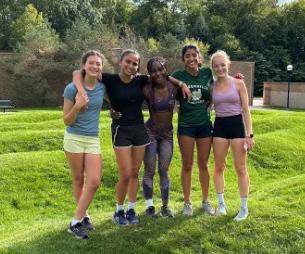
RUNNING OVER THE HILLS AND THROUGH THE WOODS (Left to right) Libby Schuster ‘27, Navya Ashok ‘24, Vic Cunningham ‘24, Anika Bery ‘24, Ava Kittendorf ‘24 photographed after running to the Univerisity of Michigan’s “Wave Field” located on North Campus.
Photo courtesy of Parini Rao ‘24
WINNING IN STYLE The girls tennis team in their custom hand-drawn state finals t-shirts prior to their state final tournament where they ultimately came out victorious with thier second state title in a row and ever.
Photo courtesy of Katie Malloure ‘24
FACE FROSTING Libby Schuster ‘27 (pictured right) and Katie Malloure ‘24 (pictured left) moments after Malloure smashed a cake piece into Schuster’s face as a final fun practice.

Season Summary: Boys golf teed off their season with a loss by one stroke. This loss hit hard for Max Shulman ‘24 as one week later on Sat. Apr. 13 he led the Gryphons to a victory, 23 strokes ahead of opponent Riverview Gabriel Richard, giving the team the number one slot in Division 3. The team has also been helped by Keating Holland ‘27. While a stud on the soccer pitch he appears to show more ability on the fairway, placing eighth at the Barton Hills Invite as the only non-senior to crack the top ten. This victory has reinvigorated the team to continue along with wins left and right as the state championship looms. The team no-doubt has their minds set on another state title and it’ll be intriguing to watch the team perform the remainder of their season and during the state tournament.
Key Players: Max Shulman ‘24 committed to Wooster, is on MLIVE’s top golfers to watch in the state of Michigan, and is ranked as the number five golfer in the state, number one in Division 3; Aidan Drain ‘25 has an 18-hole average of 83 strokes which has led the gryphons to podiums and wins this season; Keating Holland ‘27 ranked as the tenth best in the state for freshmen and number one in Division 3 for freshmen.
Girls Soccer
Record: 4-3-0
Season Summary: Soccer kicks off with one of the strongest starts they have had in a long time. Sitting at 3-2 they have outscored their opponents 23-5 and maintained over 50 percent possession across all of their games. While unranked the team has shown massive potential for the remainder of the season as they not only have four freshmen starting but also have outshot each of their opponents in four of their five games. With four freshmen starting it would be certain that the team would go bust, however, the team has taken this challenge head on and fought against ranked opponents, battling their hearts out regardless of who they were playing. The team plays one final home game against Division 4 Bishop Foley before fin ishing the seasons on the road and heading to the postseason. This team is one to watch as the talent they have shown so far can only improve from here.
Key Players: Cate Alumkal ‘27, Maia McSparron ‘27 lead the team as goalscorers this season with five each; Mia Melen dez ‘25 is a top assister on the team with two assists in two games.
Girls Tennis
Record: 8-0


Season Summary: Tennis began their season this spring with a win over cross-county Dexter High School, winning in a blowout fashion of 9-0. The team, led by captains Parini Rao ‘24 and Maddie Morgan ‘25, is a talented powerhouse. They are a veteran team with experienced seniors and juniors alike,however, the freshmen have also stepped up. Nina Melani ‘27 and Ellie Kim ‘27 have shown that not only do they belong on the court but they own the court dominating each match they have played. This has led them to win five dual meets and two invitationals with large margins. It is no surprise at this point that this team appears to be heading to their third straight state title as they show no signs of letting off the gas pedal anytime soon.
Key Players: Maddie Morgan ‘25 is the defending state champion for singles and is in her third year ranked as the number one singles player; Shangyang Xia ‘25 two time defending state champ and ranked as the number three singles player this year, she remains undefeated as of the release of this paper; Danica Rakic-Dennis ‘26 went undefeated last year at singles and is very likely to repeat again this year; Ellie Kim ‘27 is the undefeated freshman in singles and it is not close, winning each of her matches in blowout victories; Nina Melani ‘27 playing doubles with Lauren Ye ‘26 they both have led the team to their multiple victories as they both
Girls Track and Field
Season Summary: The girls track and field team came off a monumental year last season win ning all their track meets and dominating the CHSL Finals. However, this year a new competion in the form of Jackson Lumen Christi appeared. Lumen Christi is a powerhouse in athletics and were favored to win the majority of the meets, and the CHSL Finals for girls tack and field. However, the Gryphons wouldn’t let this happen without a fight. Captain Lauren Sheffield ‘25 set a school record in discus at 108 feet and 1.25 inches and put up three personal bests this year alone; the girls 4x200m relay also won their event during the Bishop Foley CHSL Jamboree helping lead them to a second place finish. While the team fell ten points shy of Lumen Christi this did not discourage but rather invigorated them as they went on to win the next CHSL meet held at Liggett two weeks later. This team is one to watch as the CHSL Finals roll around as there is no denying that Lumen Christi has a battle on their hands when the Gryphons start to run.
Key Players: Lauren Sheffield ‘27 set school record for discus that was last set in 2021; El eana Zhuang ‘25, Ella Song ‘25, Jayla Johnson ‘25, Izzy Collins ‘25 who are the Girls 4x200m Relay team winning their event during the CHSL Jamboree at Bishop Foley.
Softball
Season Summary: With their first year back, scrambling to put together a team, and only fielding nine players, one could say the softball team has had a rough start. However, no good program, company, player, or thing had it easy from the beginning. While this team did not win their games and lost a heartbreaker to Detroit Cristo Rey, this team is the beginning of Greenhills Softball. Every team has to start somewhere and this team got that out of the way, now they look towards the future as not too long from now this team will be one to watch closely. One in which the heart, passion, and desire are the foundations that built the legacy of this team.
Baseball Record: 6-9
Season Summary: Baseball started the season getting swept by Father Gabriel Richard, followed by a turnaround win against Roeper that ended in extra innings. The team throughout this season has been plagued by injuries, with seven players out at the beginning of the season followed by the hardest of the schedule due up; it is no surprise the team started 2-7, however, the beginning of the CHSL season turned a new leaf for the team as they re-introduced four of their injured players back to the starting lineup. While losing two close games to Waterford Our Lady of the Lakes the team played Bish op Foley the following Saturday splitting with them. This win inspired the team as they embark on what they believe to be “the greatest turnaround ever.” While the team is ranked 41 in the state they show the potential to be number one.
Key Players: Fran Love ‘25 lead-off hitter with the fourth highest batting average on the team with .368 and has a Earned Runs Allowed (ERA) of 1.35 across 20.2 innings pitched; pitcher-only (PO) turned outfielder Charlie Rich ‘26 holds the highest batting average on the team with a .571; Owen Day ‘24 returned questionable from a back injury at the beginning of the season only to turn around and have the second highest average at .435.

Boys Track and Field Season Summary: The boys track and field team came off a year where they won the CHSL Finals here at Greenhills, but after the loss of many star se niors it was sure that the team would be in an off-year. However, the distance team decided they were not going to back down, rather they ran faster and are ranked as the ninth best distance team in Divi sion 3. Being led by star cross country runner and captain Lincoln Cha ‘24 the team is just getting faster. As for sprinting the team is led by fel low captain Liam Dutta ‘24 who propelled the team to a fourth place finish at their first CHSL Jamboree meet. While the team is still running fast it is unclear how the loss of seniors will affect the team in the CHSL Finals.
Key Players: Lincoln Cha ‘24, Mason Stranahan ‘25, Henry Beck ‘27, Royal Seale ‘27 these four are the distance group that have led the team to being ranked in the top ten for distance in the state along with winning the team the most amount of points in each of thier track meets this year.
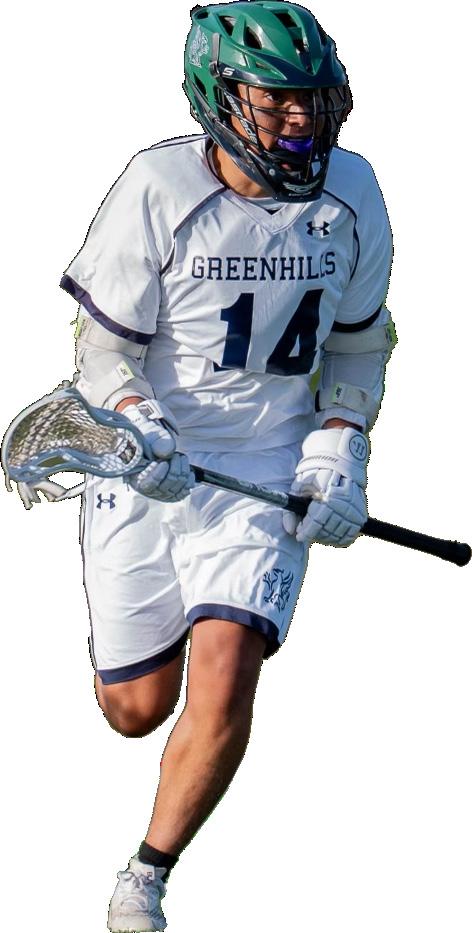
Boys Lacrosse
Record: 3-6

Season Summary: Lacrosse began their season with a loss to Liggett 162, sadly this trend continued as the team is currently 1-4 being outscored 11-68. The team is young and inexperienced, and many of them haven’t played lacrosse before. The team did manage to pull off a 5-4 victory on the road against Riverview Gabriel Richard, following that a victory, four days later, against Allen Park at home the team went on to win 7-6 in the team’s second victory of the year, tying last year’s record. While their chemistry is one of the best in the school their goals against continues to be the worst in the school. However, after losing 11 seniors the team has shown reslience by winning three games, more than last year, and has high hopes for the remainder of the season with the goal of winning more.
Key Players: Peter Prokhorov ‘26 and John Sadrack ‘26 lead the team in scoring and helped grab the teams two wins of the season.
SUPPORT THE GRYPHONS @
The Turf Field (Girls Soccer)
5/2 4:30 PM vs. Bishop Foley
The Track (Boys and Girls Track + Field)

5/7 4:00 PM CHSL Jamboree
5/22 4:00 PM CHSL Championship
The Softball Field (Softball)
5/7 4:30 PM vs. Whitmore Lake
The Turf Field (Boys Lacrosse)
5/6 6:00 PM vs. Ovid-Elsie
5/13 6:00 PM vs. St. Mary Catholic Central
Concordia’s Baseball Field (Baseball)
5/4 2:00/3:30 PM vs. Cranbrook
5/18 11:00 AM/1:00 PM vs. Erie Mason
5/20 4:30/6:00 PM vs. FGR
5/28 4:30/6:30 PM vs. Summerfield
6/1 10:00 AM MHSAA Districts
The Tennis Courts (Girls Tennis)
5/13 4:00 PM vs. Skyline
5/15 9:00 AM MHSAA Regionals
Washtenaw Country Club (Boys Golf)
5/21 6:00 PM vs. Tri-Open
PAGE 8 MAY 2, 2024
Boys Golf Record: 5-1
All photos courtesy of Greenhills School Graphic by Dominic Schuster ‘24


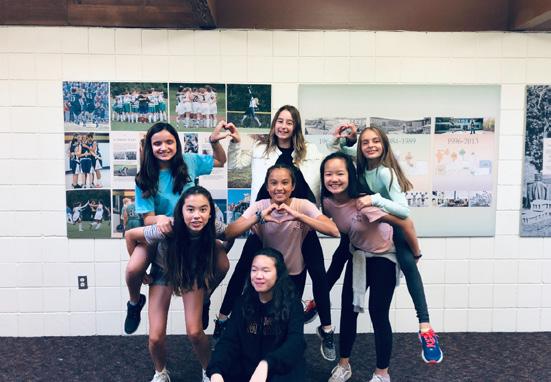


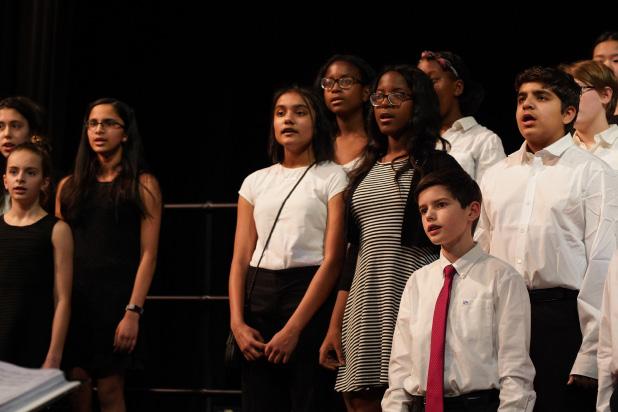


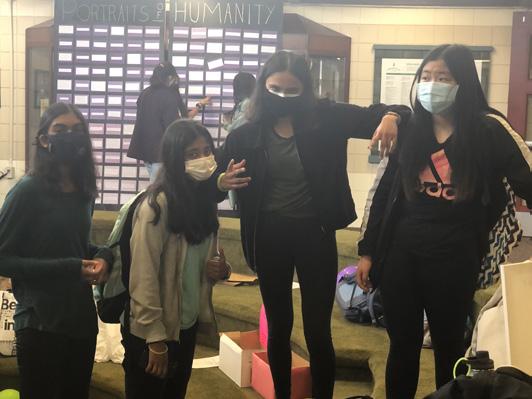


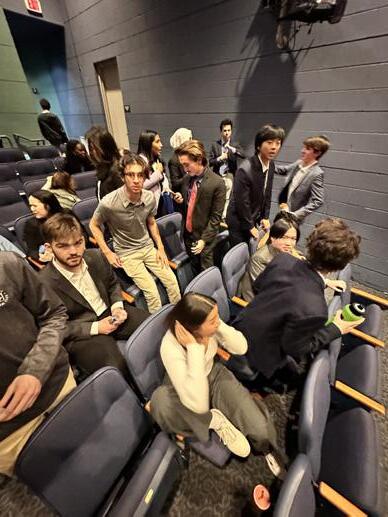





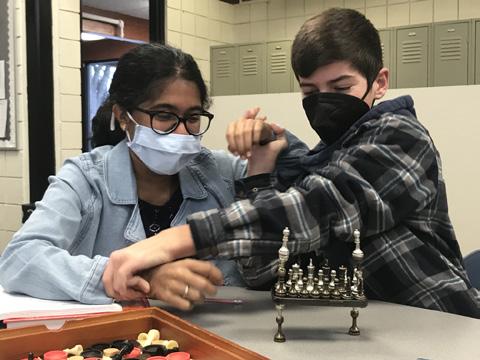





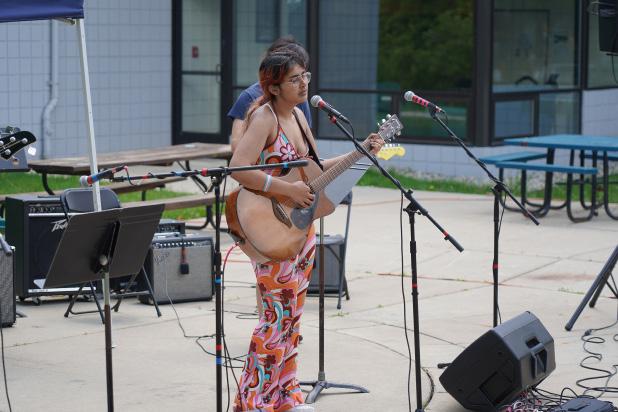


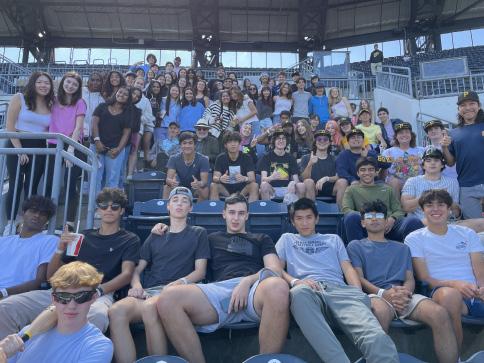


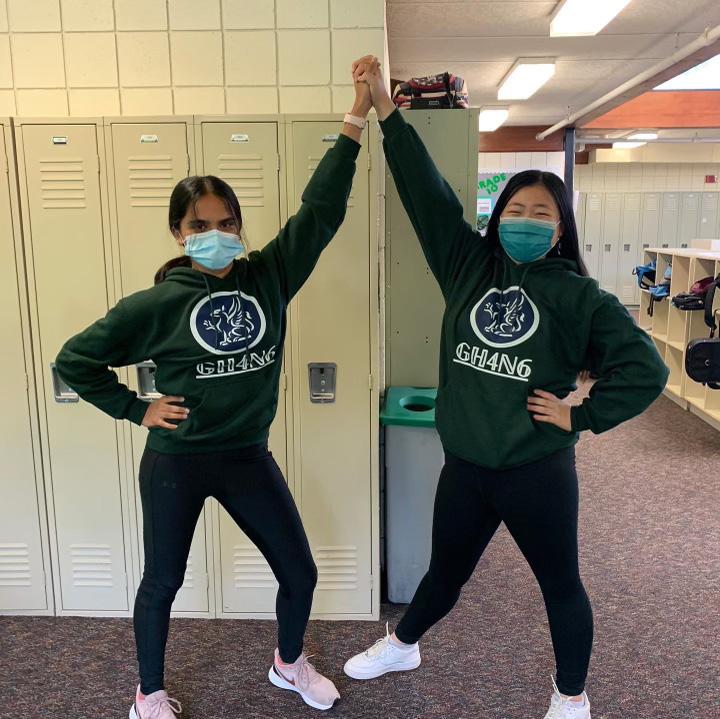


PAGE 9 MAY 2, 2023
Commit to the bit

Anjan Singer ‘24

I’ve written a lot of words over my time at Greenhills, so I’m gonna keep this one short. If we want to be the people our mission statement says we are; if we want to be “curious, creative, responsible citizens” we have to start by committing to the bit. Never half-ass, never think twice, never put off. Always all in. Always now. Always “why not?”, because bit commitment is the closest we can get to pure joy and self-actualization.
I can’t explain why bit commitment is beautiful. I can’t explain why the type of person who spends the last month of high-school creating a counter-yearbook that’s quietly about the monopolistic practices of the yearbook industry and loudly about having a laugh is the same type of person who spends a lifetime trying to serve their community. But what I can say with confidence is that bit commitment makes us better people, or at
least happier ones.
I don’t like to dwell on the neg ative (or perhaps I have to stop myself because I like too much), but I’ve noticed a lack of bit commitment at this school, from students, faculty, and systematical ly. I notice it every time somebody says “It would be funny if…” Every time a teacher has to pass up on a more interest ing subject because the AP test decided that we needed to know about what type of pants Newton wore. Every silence after we’re asked a tough question to which there is no right answer.
But when we do commit to the bit it’s glorious. We get giant Jumbo Joshes (Joshi?) taped to walls, and later on t-shirts planned for the last seven years. We get necklace royale and puppuccinos and affogatos scrawled on every surface. We get taping over not some but all of the Greenhills logos in the school with Red Valley ones, because someone mentioned that might be kind of funny three years ago.
So I guess what I’m really asking of you is to lean in. Lean in to things that are difficult but fun. Lean in everything that makes you you. Lean in to everything that makes Greenhills Greenhills, and cut out the rest
Three steps back, two steps over, one goal in mind

We are a raw bundle of ideas and passion and resources, yet we squander good ideas, good opportunities constantly. I thought this column would be witty and funny and wise, but the more I think about it I don’t have any answers, I just have one question:
Are you going to commit to the bit?
Sports journalism’s impact on my experience at Greenhills
Matthew Streicher ‘24
Throughout middle school and into my early years of high school, I flipped between several different ideas I had for what I wanted to be when I grew up. Almost Every few months I would tell everyone that I wanted to be an astronaut, a scientist, a veterinarian, a zoologist, or something else on the long list. I remember one summer between my freshman and sophomore years I told my mom I wanted to work in hockey. I didn’t quite know what I wanted to do, but I knew I wanted to be close to the game, and that was enough to make it my new calling in life. A few weeks later, my mom showed me a social media post that we had seen on one of the athletics accounts that talked about the brand new sports broadcasting team that had been formed by two kids one grade above me; Austin Andrews ‘23 and Nick Alumkal ‘23. I contacted Aus-

tin and they quickly agreed to have me join the program.
My first experience with working a game was not even a game that Greenhills was playing. I showed up at a football tournament at the Big House, where Austin had managed to get us a space in the press box. Nick and Austin called the game on a public broadcasting website while I wrote notes about the game on a sheet of paper and passed them to Nick, who would work them into his commentary. It was a great introduction to the idea of broadcasting and a great team of people to begin with, and it increased my desire
to make my life’s work more than ever before.
ball season was a huge deal for the broadcast ing team, and as I began my sophomore year, I was thrust into it very fast. Our first broadcast of the season was in the first month of school, and I was working stats. As we neared game time, I remember a feeling of pure happiness as I took in the scene. I remember the music blasting through the speakers, the people filling the stands, and the energy in the air. I couldn’t get enough, and that night turned out to be a pivotal moment in my life as a broadcaster. I still hold that moment in my mind to remind myself what I felt when I was doing something I love, and it has done a considerable amount to keep me tethered to being a broadcaster.

Broadcasting became a huge part of my life in junior year, when I began to get on the mic with Austin to call soccer games in the fall while Nick was playing them. Every experience taught me something, and I kept getting better and better. Soon, I called my own hockey game for the first time, which is something that I will never forget. I was certain I had found my passion, and I still am today.
As I begin to put Greenhills in my rearview, the experiences I’ve had with broadcasting have been extremely important to me. The broadcasting program set me up with opportunities I didn’t think I would ever get, all made possible by the incredibly rare things this school is able to offer. If I could offer advice to anyone reading this, I would say that the extracurricular activities offered by this school can change who you are and who you want to become in extraordinary ways. They give opportunities that you are unable to get anywhere else, and I am so glad that I chose to act on my feelings and join the broadcasting program in sophomore year. I hope that every Greenhills student finds something that makes them feel the way I feel about broadcasting, because I wouldn’t trade what I got from the program for anything.
I struggled writing this column. I couldn’t figure out what words I wanted to use, how I was going to write them, or how to say what I wanted to say. As I struggled I thought about different things I learned from people, from teachers, students, family, friends, even myself, each one taught me something about life and how the world works.
One. Believe in yourself. Easier said than done but if you believe in yourself and I mean truly believe in yourself anything can happen. Seven months ago I never would have guessed I could get into any colleges, I didn’t believe in myself. As the emails came back about which colleges said yes and no it made me realize I was capable of anything I wanted to do, I could do whatever I set my mind to. I just had to believe I could do it. Feb. 4 I sat down and realized that I wanted to do something that was near impossible to do, something that only a select few people get a chance at and I wanted to be one of them.
I set my eye on playing
college football. I believed in myself and wrote a plan out of what I would do to get to that level, mind you that to get to that level most kids start before high school or at least before they are halfway through their senior year of high school.
That’s when I learned my second lesson. A dream is a dream until you get up and do something about it. Everyday I would spend one to two hours working on legs, kick contact, following my steps, and mental well-being. I noticed a change in how I mentally felt and physically felt, I could kick the ball further, harder, and more accurately. I knew this was a long dream but I was going to do everything I could to get it and I learned a third lesson. If you have fun then you’ll never want to give up. I was having some of the best times of my life just being alone with a ball and a field goal post. Each time I would smile as I ran towards the ball. I still hadn’t talked to a coach, not gotten a single chance at kicking for someone, and yet I was having fun. I did not want to give up on this dream of playing college football so I kept at it just having fun thinking that if something came along it would.

dents day and thought “Wow, I totally could play here.” So at the end of the tour I walked down to the head coach’s office and introduced myself. I explained I never had kicked before but would love to play for him if he gave me the chance to. Ten minutes later and he wants me. I felt it, my work was fully paying off. While not a giant division one school they still were a powerhouse at football and they wanted me. In this moment I knew that by believing in myself, chasing my dream, and having fun each time I worked that I had done it. I had an oppurtunity to play football in college. While I will not be pursuing this I wouldn’t change the time I spent working on it , because while doing this I learned about myself. In the end it wasn’t the destination, it was the journey to get there and the friends I gained at Greenhills who supported me that made it all worth it. I thank you for everything you taught me. Without you I never would have learned as much as I did about myself. While I am not pursuing this dream, I had the belief and support to do it, so now I know that if I put my mind to something I will get
March 29, Denison Univer sity. I was there for an admitted stu
High school is short. Draw on the whiteboard.
Nicole Zhong ‘24
A bull. A frog. A jellyfish. Trimalchio’s dinner party. John F. Kennedy. What do all of these things have in common? I’ve drawn them all on the whiteboard.
You see whiteboards every day in high school, and here at Greenhills, most teachers have an array of fun colors (especially Dr. Lund, who has all of ROYGBIV and then some). Far too often you only see equations or announcements on these big things – in a school where academics are of utmost importance, it makes sense. However, whenever someone draws something on a whiteboard, it comes as a splendid surprise, a nice break from the norm, a little piece of eye candy that sweetly catches your attention and makes you pause.

High school goes by in such a whirlwind that it’s the little breaks like this that force you to break out of routine and appreciate where you are, the people around you, and the memory you are actively creating in a space you’re going to be leaving soon. Let me walk you through what I mean. My favorite memory of Latin II of my sophomore year was our discussion of the Cretan Bull. But not an official discussion, like a socratic seminar. I’m talking about an active drawing session where classmates were shouting suggestions on how to perfect the “Bull Daddy of Crete” on the whiteboard. It was 100% a group effort to get him as lumpy as he turned out to
be.
Another time, in Madame Novak’s advisory, we were having a debate about animal sounds, and how they differed in French and English. In English, frog’s say “rib bit,” but in French, frogs say “coa.” How did we choose to commemorate this information? By drawing a frog “coa coa-ing” on the whiteboard.


what you love. You are growing up and leaving as an official, 18 year old adult. However, during these four years, you’re still a kid. You don’t have to be in growing-up mode all the time. Every so often, take a moment to enjoy the dumb things.
A more recent whiteboard memory took place in March, in my Multivariable Calculus II class. There are only nine of us in the class, and after we finished our work for the day, we started discussing what barn animals we would be. That conversation ended up transferring onto the whiteboard, in the form of a “Multi-Animal House.” A certain guy was drawn as a chubby raven, and he personally went up and made the raven skinnier twice. It was the funniest thing I had seen all month. High school is made up of


Some of the fondest memories of high school lie between the cracks. A little drawing session on the whiteboard, a running inside joke within a class (“the sad, athletic middle schoolers”), collapsing over pizza after frantically preparing for Service Day. The seemingly insignificant memories of being young, surrounded by friends, is what I’m going to miss the most.
So, draw on the whiteboard. Bring in cookies to class. Be a little silly. Create those moments that make you feel like you’re in a movie. And take a picture of it, or you’re definitely going to forget.
so many different things – you’ve got
PAGE 10 MAY 2, 2024 Graphics by Megan Peng ‘25
Dominic Schuster ‘24
YOUR CALLING Matthew Streicher ‘24, who dreamed of working in hockey as a kid, calling the 2023 CHSL hockey championship game for the Greenhills-FGR joint team at the Ann Arbor Ice Cube.
FOLLOWING
HERE’S THE KICKER Dominic Schuster ‘24 never played a day of football before but had the dream of playing it one day. Working everyday after school and sports practices that dream finally has an opportunity to come true.
BULL DADDY OF CRETE Created in my sophomore year, Latin teacher Jeffrey Allen had only one thing to say, “do not erase.” MULTI ANIMAL HOUSE We were trying to draw everyone as a barn animal, to draw a “Multi-Animal Barn.” Then someone said they wanted to be a jaguar, so it derailed the plan. COA COA THE FRENCH FROG When discussing what different countries use for animal sounds in advisory, the biggest difference was the frog. “Let us never APUSH out of fear. But let us never fear to APUSH” On my final day of APUSH, I asked the current teacher who her favorite president was – John F. Kennedy. He’s got some good quotes.
Rae
Photo by Nicole Zhong ‘24
Photo by Lachlan
‘24

Kicking through challenges
 Lachlan Rae ‘24
Playing soccer has always been my escape, offering opportunities for self-improvement and a sense of control. I determine the effort I put into practice, my diet, my fitness, how prepared I am with my gear, and as a captain, how I lead and support my teammates.
However, sometimes you don’t have control over everything and face devastating challenges.
At the start of my senior season, I was told that I wouldn’t even play for Greenhills due to a serious knee injury. The risk of dislocating my knee again and possibly tearing my tendons was high, with the added

time, I turned to Pranay Shaw ‘23, a former teammate who faced a similar situation in our 2022 season. Pranay recommended a book for athletes recovering from injuries and shared insights on the mental process of returning to play.
While some individuals cautioned against playing, I appreciated their support in understanding my situation and aiding in my recovery.
Despite these challenges and the need for discipline, the fun and teamwork with friends, teammates, and coaches far outweighed any difficulties. Playing soccer has taught me valuable life skills such as teamwork and perseverParticipating in soccer not only benefits players but also our school, as it allows us to offer a wider range of extracurricular activities. It has given me the chance to meet new people and form lasting friendships, bonding over our shared love for the sport.

challenging
Being a captain on the Greenhills soccer team was both fun and rewarding but came with unique challenges. One major challenge was the feeling of disconnection that would emerge between the team after disagreements or major losses. Despite these challenges, I’ve found that with time and effort, this feeling of disconnection can be overcome. It was an important challenge for the team, uniting us under a common goal and belief in working hard and finding the best course of strategy.
Every time I stepped onto the field, I knew I was representing my team above all else.
Playing soccer throughout my high school years has been incredibly rewarding. It has allowed me to grow as a person and develop important skills that will benefit me in the future. Soccer has not only been a way for me to stay active and healthy but also a way for me to connect with others and form lasting friendships.
Building community through clubs
Moving to a new school in the middle of the academic year can be daunting. It can be challenging to make new friends and adjust to a new environment. I remember feeling the same way when I joined Greenhills in 7th grade. However, my experience at Greenhills has been nothing short of amazing. The teachers and students were so supportive and welcoming that I felt comfortable in no time.
Before joining Greenhills, I got the chance to visit the school and was paired with a Gryphon ambassador. They took me to their classes and introduced me to their friends, who were all kind and welcoming. It was an amazing experience that made me feel relaxed and excited about joining Greenhills. From the beginning, I felt that I was part of the Gryphon family, and that sense of belonging only grew stronger as time went on. Whether I was participating in a class discussion, working on a project with my classmates, or simply chatting with a new friend during lunch, I always felt supported, valued, and respected. Looking back on my time at Greenhills, I can honestly say that it was one of the most transformative and
An accidental good time

I still distinctly remember my first day of Greenhills track practice. I was a spindly freshman who hated running and knew basically no one on the team. Practice was at Whitmore Lake because at that time the Greenhills track was still under renovation. The weather was warm enough for shorts and tank tops, but it was windy, and everyone was milling around talking excitedly. On that day we did a supposedly easy workout. I struggled through my “easy” fast laps, barely hanging on the backs of the upperclassmen, and at the end everyone walked, perfectly composed in my eyes, off the track to their water bottles. I couldn’t believe it, here I was utterly exhausted from what was deemed a light workout, and everyone else was laughing and having the time of their lives. The track season went on, and as time progressed I started to find my place on the team. I kept up in the workouts, was on the state relay team, and could even say that I, a freshman, was close friends with seniors and juniors. I also formed relationships with other people from my grade who I never thought would be my friends. At least once a week our little mixed grade crew would head to bubble tea after long hot days of practice. The friends I made through track were unexpected, but they’ve been some of my most valuable and enjoyable relationships. Track soon ended, but not without fanfare. Six of us girls headed up to Jenison, Michigan for the state meet. Our energy was through the roof and we didn’t sleep until at least twelve despite our race the next day. When the morning came the sun was beating down and there was pollen flying everywhere, but it didn’t matter. Our relay team warmed up, did our handshake, and then took our place in the white tent by the starting line. We didn’t get a personal record or place, but no one even cared. We cheered our other teammates through their races and when the day was over we drove home and stopped to get ice cream and french fries from a random roadside A and W.

TO
rewarding experiences of my life, and I will always be grateful for the friendships, knowledge, and memories I gained during my time there.
the constants in my life. As a senior, I had the opportunity to become a Lead Ambassador. This has been an incredible opportunity to share

After getting situated, I joined some clubs, and Middle School Gryphon Ambassadors caught my eye. I wanted to give other prospective students the same feeling of warmth and acceptance that I had. Now I am a senior, and my active participation in Gryphon Ambassadors since seventh grade has been one of
my unique experience at Greenhills with others. If there’s anything I’m known for, it’s that I’m always talking to people and sometimes a bit loud, but this club allows me to use my enthusiasm to showcase all that Greenhills has to offer. My advice to you is to participate in clubs and put your-

the run- ning routes, the competition, and there are a bunch of freshmen and sophomores easily clipping my heels. I’ve known these younger girls for barely any time at all, but they’ve provided me with a small community that I wouldn’t trade for the world. Don’t count out those kids who are a few years younger, or older, than you. Don’t dismiss activities because you think you could never belong in them. Keep an open mind and talk to everyone and try everything. You might accidentally end up having a good time.
self out there. Participating in clubs is a great way to enhance your high school experience. It helps you dis cover new passions and interests and provides an excellent oppor tunity to meet new friends and de velop social skills. Being a part of a club can help you learn new things, develop new skills, and even im prove your grades. It also gives you the chance to work on projects that you’re passionate about and contribute to your community. Ad ditionally, being involved in clubs can make you a well-rounded can didate for college, demonstrating that you’re not only academically focused but actively engaged in extracurricular activities. So, don’t hesitate to join different clubs that interest you. You never know what you might discover and how it might shape your future. If you want to join clubs, make sure to take advantage of the annual club fair! I usually sign up for way too many (around six clubs) and drop three of them, but this experience of explor ing new things is always worth it.

MAY 2, 2024 PAGE 11
Anika Bery ‘24
THE FINISH LINE Libby Schuster ‘28 and An ika Bery ‘24 after racing the state cross coun try meet at Michigan International Speedway.
Ana Flemming ‘24
AMBASSADOR’S FINAL FLIGHT Ana Flemming ‘24 and Associate Director of Enrollment Eric Gajar discuss the details of the final Gryphon Ambassador event.
Graphics by Megan Peng ‘25
BEND IT LIKE LACHLAN Lachlan Rae ‘24 makes a long pass in the District Quarter Final against Father Gabriel Richard this past fall.
Photo courtesy of Jade Zhang ‘24
Photo courtesy of Greenhills School
Photo courtesy of Max Stranahan ‘26

Wellesley University Wesleyan University University of St. Andrews Princeton University William and Mary College Boston College Hampton University University of British Columbia Northeastern University Schools Accepted Early Action PAGE 12 PAGE 13 MAY 2, 2024 MAY 2, 2024 Schools Accepted Early Decision 6 183 Schools Accepted Schools Applied 138 900 Total Applications 2.3% Accepted to international schools 3 NCAA Athletes 10Applications per capita 50 Regular Decision Early Decision Expected Majors: Biology & Pre-med Psychology Engineering Business Undecided Political Science Economics Astrophysics Music Theatre Pre-Law Neuroscience Environmental Science Computer Science Linguistics Kinesiology Animation Architecture Biochemistry Most Common Favorite Classes Foreign Language ESSU Foundations of Civilizations Film as Lit =Accepted =Enrolling University of British Columbia (Canada) St. Andrews University (Scotland) This year, college commit deadlines have moved later in the season in order to accommodate the FAFSA delay, and many students will not make final enrollment decisions until June 15, 2024. As a result, this list of colleges where students have enrolled will evolve substantially between late April and mid June of 2024. The entire senior class was polled to determine expected majors and favorite classes. 73% of the class responded.

What’s your favorite?
Alcove seniors’ top picks


LACHLAN RAE:
What is your favorite class(es)?
Journalism and Film as Literature
What is your favorite lunch?
Chicken curry
What was your favorite GH out of school moment?
Playing in the state championship for soccer in 2022
Who have been your favorite teachers?
Ms. Sterling, Dr. Lund, and Mr. Huntoon
What is your favorite spirit week event?
Tug of war
What has been your favorite club/sporting event?
Soccer
Any general advice?
It flies by so just enjoy it

MATTHEW STREICHER
ANJAN SINGER:
What is your favorite class(es)?
Journalism (obviously), AP Latin (but really any latin), and Ceramics
What is your favorite school lunch?
No meal has ever topped this one eggplant parm from the first week of PlumSmart lunch in 7th grade
What was your favorite GH out of school moment?
A kind senior encouraged me at one of the first cross country practices a few months after we had just been in lockdown for months.

Who have been your favorite teachers?
Mr. Allen, Dr. Lund, Ms. Norman, and Dr. Salcedo.
What is your favorite spirit week event?
Battle of the Bands
What has been your favorite club/sporting event?
Ethics Bowl, there’s truly nothing like it
Any general advice? Do things that you are excited about and care about, even if it’s hard.

DOMINIC SCHUSTER:
What is your favorite class(es)?
Campaigns and Elections and Economics
What is your favorite school lunch?
Texas toast grilled cheese
What was your favorite GH out of school moment?
Soccer state finals
Who have been your favorite teachers?
Dr. Lund, and Mr. Berkowitz
What is your favorite spirit week event?
Color day or mock rock
What has been your favorite club/sporting event?
Soccer
Any general advice? Have fun

NICOLE ZHONG
What is your favorite class(es)?
English 2 Honors, Advanced Government, and Multi-
variable Calculus 2
What is your favorite lunch?
Grilled cheese
What was your favorite GH out of school moment?
The Chicago trip for Shakespeare on Love
Who have been your favorite teachers?
Dr. Randolph, Mrs. Friendly, and Ms. Rocci
What is your favorite spirit week event?
THEY’RE ALL SO GOOD! Maybe rhyme time?
What has been your favorite club/sporting event?
SLICE, Forensics, STUCO -- I love them equally
Any general advice?
Do what you love and do it well

ANIKA BERY:
What is your favorite class(es)?
Ceramics and ESSU
What is your favorite school lunch?
Chicken and waffles
What was your favorite GH out of school moment?
Cross country states ‘23
Who have been your favorite teachers?
Mr. Wicklund and Ms. Caramagno
What is your favorite spirit week event?
Color day and obstacle course
What has been your favorite club/sporting event?
NONE?
Any general advice?
Ask your teachers for help, and don’t get caught up in the competition

ANA FLEMMING
MAY 2, 2024 PAGE 14
Photos courtesy of Liz Wilson-Hill
What is your favorite class(es)? Film as Literature, Anatomy and Physiology, and African American Literature What is your favorite school lunch? Pasta Wednesday What was your favorite GH out of school moment? The senior class trip to Pittsburgh. Who have been your favorite teachers? Ms. Sterling and Ms.Conti What is your favorite spirit week event? Battle of the bands, specifically when the teachers perform What has been your favorite club/sporting event? Book club Any general advice? Don’t be scared to ask your teachers for advice and step out of your comfort zone.
What is your favorite class(es)? Journalism, Natural History, and Art Photography What is your favorite school lunch? Chicken tikka masala What was your favorite GH out of school moment? Being with the soccer team when they won the state semifinal in junior year Who have been your favorite teachers? Dr. Lund, Ms. Sterling, and Mr. Groff What is your favorite spirit week event? Battle of the Bands What has been your favorite club/sporting event? Loved lacrosse games Any general advice? Chill out about school work sometimes, it’s really never that deep
Briefs compiled by Izzy Baru ‘25
First vote feelings
Abortion rights, international relations top seniors’ concerns heading into election
NICOLE ZHONG ‘24
Lifestyles Editor
Turning 18 is an important milestone for Americans: you are legally an adult, it’s a lot easier to get your driver’s license, and you can open a bank account, to name a few perks. But one of the most notable privileges of turning 18 in the United States is gaining the right to vote. However, being able to vote is both a privilege and a responsibility, with your choice writing history for the next few years. In the current political climate, it is important to know what you prioritize when voting – issues up for debate may affect many communities. Checking in with current high school seniors, all of whom will be eligible to vote in the November pres dential election, it is clear that certain issues take priority in young voters’ minds – and surprisingly, not wanting to vote at all is also gain ing popularity.
“I genuinely don’t know what choice I’m going to make this time – I might even vote for a third party just to send a message.” On the subject of international conflicts, Jack Faulkner ‘24 mentioned the mandatory military draft. Since 1948, almost all male US citizens and male immigrants aged 18-25 are required to register with Selective Service.
“There are so many wars going on right now – Israel-Palestine, Russia-Ukraine, and probably something with Taiwan and China soon,” said Faulkner. “With all of these wars going on, I’m still 17, but at some point, I’ll become draft eligible, and based on the political decisions of the next few years, should I be worried?”
Stitching success
Senior creates a crochet Etsy
shop
MIRA JAYARAMAN ‘26
School Staff
During the global pandemic, while many took up puzzles, making whipped coffee, and binging Tiger King, crafters turned their hobbies into online entrepreneurial endeavors and Amanee Singh ‘24 seized the opportunity to turn her passion for crocheting into an Etsy shop.
“I got the idea on social media,” said Singh. “Everybody was just coming out of the pandemic, and I’ve always wanted to learn how to crochet. I thought it would be a fun and easy way to make money.”
2022 overturn ing of Roe v. Wade, an issue that’s the front across the has been an’s right
“My thing is definitely abortion rights,” said Jade Zhang ‘24.

“Whoever is pro-abor tion. I’m not going to vote for some body who thinks that women shouldn’t have control over their own bodies.” Charlotte Jordan ‘24 was concerned about male politicians having the power to make final decisions over women’s reproductive health rights.
Rayhaan Bhalwani ‘24 was specifically concerned about America’s diplomatic relationship with other countries.

“Countries we decide to fund are extremely important,” said Bhalwani. “Our allies, and who we agree and disagree with in NATO matter a lot. I think this is a standard thing for everybody to look for, because it is basically America’s relationship with the world.”
On the topic of America’s relationship with the rest of the world, immigration was not only on Jenan Hasan ‘24’s mind, but it was emphasized due to her personal connection with an immigrant.
“Immigration issues matter to me because I think the regulations on it are too extreme,” said Hasan.

“My grandparents were immigrants to the United States – my grandparents on my dad’s side speak only Arabic, and some of my mom’s family still lives overseas. I’m really going to be paying attention to each candidate’s immigration policy, and how they treat this humanitarian issue.”


Others plan to take a more retrospective approach when looking at the candidates.
Percentages are according to a Spring 2024 Harvard University Institute of Politics polling of a nationwide sample of Americans aged 18-29. Percentages represent answers to the question of “If the 2024 presidential election were to take place today, who would you vote for?” The distributions of responses to that poll are shown in the percentages illustrated above and are in no way necessarily representing the Greenhills population.
“Everybody should have the right to decide what to do with their own body and not have an old guy tell you what you can and can’t do,” said Jordan. “Abortion is a very big debate right now and it’s one I care a lot about.”
Alongside reproductive rights, Elaina Gress ‘24 dove a little into why issues surrounding both identity and bodies should
“I think it’s important to
look at the past, or what they’ve done beforehand,” said Morgan Mathis ‘24. “If they’ve said racist things on the campaign trail, if they have a history of being bad to women. I feel like for gun violence especially, it’s important to consider their previous attitudes. Look at what they’ve done in the past to see their intentions for the future.”

ue, and that’s something that’s going to happen no matter who I vote for,” said Ali. “I am really considering not voting this year, because I am extremely uncomfortable with where our tax dollars are going, and how violence is going to ensue no matter what.”
Regarding the Israel-Hamas War, Anjana Kanakamedala ‘24 said she had distrust and hopelessness with her vote.
“With the Israel-Palestine conflict, I find that there is a lack of urgency and humanity that Biden has had towards it, and I don’t think Trump would make it better,” said Kanakamedala.
For these candidates in particular, Bella Young ‘24 emphasized just how much past history there is to consider, since Joe Biden and Donald Trump are the oldest can-
“Age is a a big thing – Biden is probably going to drop dead anytime, and Trump is only four years younger than him,” said Young. “I can’t believe these are our only options, again. It’s definitely disappointing because they’re obviously not in their prime – you can make arguments about how sharp they are cognitively. They also were raised in such a far away generation that it’s easy to question whether they have the current generation’s best interests
Max Andre ‘24 said he has given up on following issues and voting
“I don’t think I’m going to vote this year,” said Andre. “I have a lot that I’m worried about, and I don’t want to spend the time researching political candidates and making an informed choice. It’s just so complicated out there right now, and I don’t want to figure it out.”
Luca Singh ‘24 had the same sentiment.
“I’m not even going to vote, because I can’t be bothered,” said Singh. “Hopefully something changes my mind in 2028.”
Singh fully immersed herself in the craft when she decided she wanted to make a business out of it. However, it wasn’t easy in the beginning.
“When I first started, it would take me so long to make just one item,” said Singh. “I would spend multiple hours a day for several days, but now, I’ve practiced a lot and I can get it done in three to four hours.”
Singh’s most popular item in her shop is her bucket hat, with over 70 sales in that item alone. However, Singh’s inventory extends beyond hats, featuring headbands, gloves, stuffed animals, and more. The business isn’t just a way to make money, it’s also a therapeutic hobby for Singh herself.
“It’s really calming for me,” said Singh. “When I’m watching TV, I don’t like to just sit there, I like to be doing something at the same time. Crocheting is perfect for that, and it’s like muscle memory for me now.”
However, managing a shop doesn’t come without challenges.
“It takes a lot more time than I thought outside of school,” said Singh. “I have to make them relatively fast too, so people can get it shipped on time.”
Being a first-time business owner, Singh had to figure out how to manage a business the hard way.
“In the first couple months of opening my shop, I put my prices super low,” said Singh. “I would sell a bucket hat that would take me a week to make for less than $15. I was spending so much time for little money, and eventually, I realized that I was selling myself short. Now, I sell my items for around $25 to $30.”
As the shop progressed, Singh also got busier with the school. The chaos of standardized testing along with heavy courseloads in 11th grade is no easy feat, and Singh was no exception.
“During midterms and finals, and some weeks with a lot of tests, I would have to put my shop on vacation or say all the items were sold out,” said Singh. “It got stressful sometimes, but I always knew to prioritize school over the shop.”
Despite the challenges, Singh’s shop’s success has exceeded her expectations.
“I’ve gotten over 150 sales, which is way more than I ever thought I would get,” said Singh. “I’ve gotten orders from all around the world, even places far away like Australia. People leave a lot of reviews too, and they have been pretty good. I use all the feedback from my reviews to better my shop.”
Singh has not only sold items to people globally, but to local students as well, one of them being Reewin Shi ‘24.
“During COVID-19, crochet items were really popular,” said Shi. “I wanted to buy one anyway, and when I saw Amanee’s shop, it was perfect because I could get a crochet item while supporting a friend’s business at the same time.”
Shi was one of Singh’s many positive reviews, leaving an impact on the shop’s page.
“It came exactly as it was pictured,” said Shi. “It was such a cute addition to my wardrobe.”
Singh’s mother, Neena Tiwana, only helped Singh financially and didn’t play a big part in shaping the business.
“Amanee did everything on her own,” said Tiwana. “I helped her buy the yarn and crochet hook, but that’s it.”
Tiwana is especially proud of Singh for her self-motivation and work ethic.
“I’m inspired by her and how much work she puts into her shop,” said Tiwana. “She took the initiative and was determined to create this on her own.”
Looking forward, Singh is planning to continue to maintain her shop in college and beyond.

MAY 2, 2024 PAGE 15
Joe Biden
Donald Trump
Robert F Kennedy, Jr
Jill Stein Cornell west
WEAVING A UNIQUE PATH Amanee Singh ‘24 crocheting a bucket hat to put on her Etsy shop. “I’m so happy I started this,” said Singh. “It wasn’t easy at first, but it’s really rewarding and one of my favorite hobbies now.”
Illustration by Megan Peng ‘25
Illustration by Nicole Zhong ‘24
Photo courtesy of Amanee Singh ‘24
Our ‘Mr. Golf’
Golf star recruited, hopes to win prestigious award by season’s end
MATTHEW STREICHER ‘24Lead
Sports Reporter TEDDY STAEBLER ‘25Sports Staff
Since he was four, Max Shulman ‘24 has been following in the footsteps of his father by playing golf. He still has videos of himself go ing out to his backyard and hitting balls, getting into the game before he even got into first grade. Shulman start ed competitively playing in middle school, where his love for the game grew, and ever since he began competi tion, Shulman has been working to improve his game and get a little better every day.
Shul man’s father has been a big part of his golfing career from the first time he picked up a club to today. Part of his motiva tion as a player was to achieve something that his dad never man aged to do; play college golf. And now, after all those years, Shulman can finally say he did it. He announced his commitment to play at the College of Wooster this year, another milestone in his golf career.

season. “It’s taken alot to keep grinding, but I’m
Being recruited is something that means a lot to Shulman, and he is still getting used to his new status as a recruit and is looking forward to his next steps.
“It still feels weird,” said Shulman. “It feels like just yesterday when I had my first [high school] practice. Knowing that I’m going to be playing next year is really nice, it feels like all of my hard work paid off. It’s the next step for someone who wants to be a golfer, so this is really cool and exciting.”
By his freshman year, Shulman had al-
ready been practicing and playing golf for years, and his work paid off when he made varsity in his first year on the team. He joined the talented class of 2022 which included Beau Brewer ‘22, Cale Piedmonte-Lang ‘22, and Cam Miller ‘22, who Shulman says helped him in the early stages
“They definitely helped me when the team,” said Shulman. “They really easy for me to fit in, and a good year.”
Shulman’s last high school season is a bittersweet moment for Coach Mike Karr who has overseen Shulman’s improvement as a teammate and as a player these past four “Coaching Max has been a lot of fun,” said Karr. “He is one of the most talented players I have ever coached. Freshman year he came in ready to improve his game and has been a leader on the team ever since.”
alongside those teammates one final time when they competed at states. Today, it is Shulman’s favorite memory from playing on the team.
Despite all of Shulman’s success on the course, it is off the course where his teammates feel his leadership the most. Aidan Drain ‘25 has been appreciative of Shulman’s leadership and guidance.
“He’s a really good teammate,” said Drain. “He gives you small tips and is encouraging without forcing it and saying it too much. It’s great to have a teammate who loves and knows the ins and outs of the game.”
Shulman’s last high school season is a bittersweet moment for Coach Mike Karr who has overseen Shulman’s improvement as a teammate and as a player these past four years.
Although Shulman came into the program very talented, it was his work ethic that stood out to Karr.
“He came in very good but did have flaws in his game,” said Karr. “He had failures and sometimes didn’t play well but he learned from these failures and took a big step sophomore year. He is very serious about the game and works all year round with other coaches to perfect his craft.”

“My favorite moment by far is when we went to states my sophomore year,” said Shulman.
“We knew we were going to win, but [Piedmonte-Lang] made a huge putt at the end of the tournament and we all rushed the green. It was a core memory.
Goalie going for glory
Senior commits to play college field hockey
Maddie Miller ‘24’s love for field hockey began with hating Rec & Ed soccer. Miller began playing at the age of seven and worked her way up though various levels of club playing with the Pinnacle field hockey team. The latest tournament Miller played in was for the Maccabi USA program, where she and her sister Kate Miller ‘26 took home bronze after five days of games.
Maddie Miller has been playing field hockey for ten years, she has played for the schools’ team every year through middle and high school. This past year Maddie Miller was a varsity co-captain. She began playing in middle school due to encouragement from her parents and from the lack of interest and knowledge in the other sports offered at the time.
“Maddie is someone that the team can rely on both on and off the field,” said head field hockey coach Jill Dixon. “From my perspective she is a calm and collected player, a leader by example. She is extremely reliable when it comes to performing on the field, which was a huge piece of our success this past fall.”
Maddie Miller began playing for Pinnacle in seventh grade as a goalie and has continued to play for the club since then. She has attended various competitions and tournaments with this team.
“One of my favorite memories while playing with my club team was when we went to nationals my freshman year and did better than we expected by placing eighth out of 15 teams,” said Maddie Miller. “Then during the beginning of my sophomore year we were ranked number one in the country.”
for field hockey.”
As his senior season nears its end, Shulman hopes to achieve what he could not do last year. He has his sights set on the award given to the top golfer in the state each year, called ‘Mr. Golf.’
“This year I want to be the top golfer in the state regardless of division,” said Shulman. “Ever since my first year of high school, I have wanted to win ‘Mr. Golf’, and this year I feel like it is a real possibility.”
Life in the fast lane Swim team captain reflects on high school career, college recruiting
MATTHEW STREICHER ‘24
Lead Sports reporter
Maya Comer ‘24 almost never ended up becoming a competitive swimmer. When she was six years old, she started lessons at Goldfish Swim School and then participated in the summer swimming program at Dexter Community Aquatic Club where she began to swim competitively. This sparked a competitive swimming career that has continued to this day. A varsity swimmer all four years, Comer began the college recruiting process early, contacting coaches between her sophomore and junior years. In April, she announced her commitment to swim at Grinnell College.
Comer’s first year in high school swimming happened to be the winter of 2020, when school was still online. Swim practices became a way to socialize after being away from others for so long.
“It was a good way to make friends after all the isolation because of the pandemic,” said Comer. “It was my first experience getting back out and talking to people again.”
One of the tougher parts about swimming in Comer’s first two years was that the Greenhills team was co-ed, so she had to compete against the boys team constantly. After the co-ed team split into two separate teams, Comer’s chance to go to states grew, which improved her experience overall.
“Competing with the girls has been really positive for me,” said Comer. “In order to compete at states when we were on the co-ed team, you would have to get the boys state cuts even if you were a girl, which made it really difficult.”
Even with the endless changes throughout her high school career, Comer still managed to form connections with her teammates, including Morgan Mathis ‘24.
Since getting into college Maddie Miller has continued to play with her club and participate in tournaments. Her most recent tournament was through the Maccabi USA program. Maccabi was created to connect Jewish student-athletes over their shared community and love for their sport. The specific game Maddie Miller and her sister played in was the 15th Pan American Maccabi Games held in Buenos Aires, Argentina. They are held every four years in one Latin America country and are sponsored by the Latin American Maccabi Confederation.
“My dad was really involved in Maccabi growing up, he played rugby,” said Maddie Miller. “He tried to get my older brother involved with their ice hockey team but he didn’t make it. Then he got a notification about the games in Argentina. He was very excited and encouraged my sister and I to try out.”

Towards the beginning of sophomore year Maddie Miller realized she would be interested in continuing her field hockey career into college.
“I attended a tournament in Florida over Thanksgiving, during it I had some great games and this motivated me to consider the recruitment process,” said Maddie Miller. “At the time several of my club friends were getting recruited to play field hockey in college and while I knew that I couldn’t play at the division one level, I was pushed by friends and coaches to want to play in college. I went into the whole process very open minded.”
After touring various schools that offered the sport at the D3 level and performing in front of recruiters, Maddie Miller was offered a spot to play at Wellesley college. She accepted and will be attending and playing with the team this upcoming fall.
“Wellesley is the perfect school for me,” said Maddie Miller. “It met all my requirements: on the East Coast, good academics, and being D3
The application process consisted of interviewing with the team’s head coaches and then sending in a handful of highlights from previous games. Both Miller sisters played for the U-16 team, the entire trip was ten days but there was one practice and five game days, the extra days were used to tour Buenos Aires. There were four teams competing in total, three were Argentinian and one was American, the Miller’s team placed bronze.
“There were two goalies, me and another girl, we split the first three games 50/50,” said Maddie Miller. “The last two games I played three quarters and she played one. A really nerve wracking but fun moment for me was during the last game, I was in for goalie and we were tied two to two. Then our team scored and there was only ten minutes left in the game which was extremely intense.
Post-competition, athletes were allowed to travel around the city and visit different restaurants, shops, and tourist attractions.
“I felt so fortunate to have my sister there with me,” said Maddie Miller. “ We got to see some really cool places, like the pink house, and after we walked around we would return to the convention center and hangout with all these other athletes who came from different countries and played different sports than us.”
While Maddie Miller was looking forward to the out of the country trip Kate Miller was slightly hesitant at first. This was mainly due to applying and getting into the program later than Maddie.
“It was just so last minute, it made me unsure I wanted to go,” said Kate Miller. “But I’m glad I ended up going. It was a lot of fun to explore
and I felt connected to my Jewish roots competing with these other girls who are also Jewish.”
“[Comer] had a great balance of focusing on her own swimming and being a leader,” said Mathis. “She was constantly cheering for everybody.”
Even when she couldn’t make certain events or practices because of her involvement in both club and varsity swimming, Comer still supported her teammates.
“I remember that she couldn’t make our banquet for one year, so beforehand she made everyone on the team platters that were handed out, which was really sweet.”
Comer began contacting coaches for recruitment between her sophomore and junior years. She knew what she wanted in her ideal school, and made a list to narrow down.
“The recruitment process has overall been positive,” said Comer. “I created a list of some schools that I was interested in and then some of the coaches reached out thinking I would be a good fit for the team. I spent a lot of time emailing back and forth and doing phone calls with coaches just getting to know each other better and learning more about the school.”
The process wasn’t easy the whole way. Narrowing her list led Comer to have to have some tough conversations and spend a lot of time trying to figure out how to decide on a school.
“There were a lot of difficult emails to write,” said Comer. “If you do get in, but it isn’t one of your top choices, it’s really hard. I needed some friends and family to help coax me through the process of having to tell coaches that their school wasn’t a great fit for me.”
As she looks forward to carrying on her swimming career at Grinnell, there is one thing about swimming that will stay very important to Comer: community.
“I’m hoping that in college, I can get the perfect opportunity to form really deep connections with everyone around me,” said Comer.

MAY 2, 2024 PAGE 16
going to keep working,” said Shulman.
SANDY SITUATION Max Shulman ‘24 clears a bunker during a match in his senior year. “I’ll be able to focus on my practice routine more in college,” said Shulman.
TAKE YOUR MARK Maya Comer ‘24 gets ready to dive in during a meet in her senior season. “In college, I want to be competitive and place well at conference championships,” said Comer.
IZZY BARU ‘25 School Editor
Argentina with Maddie
AT THE READY Maddie Miller ‘24 featured in the center ready to charge out of the goal during a defensive corner. Kate Miller ‘26 flanking her older sister on the right side. “This was a super intense game,” said Maddie Miller. “However I remember it being extremely rewarding in the end, and all of our hard work really paid off.”
Photo courtesy of Maya Comer ‘24
Photo courtesy of Greenhills School
Photo courtesy of Greenhills School
Photo courtesy of Greenhills School