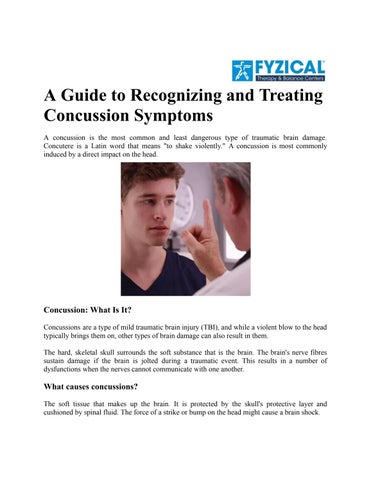
A Guide to Recognizing and Treating Concussion Symptoms A concussion is the most common and least dangerous type of traumatic brain damage. Concutere is a Latin word that means "to shake violently." A concussion is most commonly induced by a direct impact on the head.
Concussion: What Is It? Concussions are a type of mild traumatic brain injury (TBI), and while a violent blow to the head typically brings them on, other types of brain damage can also result in them. The hard, skeletal skull surrounds the soft substance that is the brain. The brain's nerve fibres sustain damage if the brain is jolted during a traumatic event. This results in a number of dysfunctions when the nerves cannot communicate with one another.
What causes concussions? The soft tissue that makes up the brain. It is protected by the skull's protective layer and cushioned by spinal fluid. The force of a strike or bump on the head might cause a brain shock.
There are moments when it literally makes it move inside your skull. Neurological, vascular, and physical damage can all result from traumatic brain injuries. The most typical reasons consist of: ● Falls: Accidental falls are a major source of concussions, regardless of whether they occur from a height or on a slick surface. ● Athletic Injuries: The risk of concussions rises when one plays contact sports like basketball, hockey, football, or soccer. ● Attacks: Violence and physical attacks can cause head injuries that can lead to concussions. The brain may move violently inside the skull as a result of deliberate force being delivered to the head. ● Motor Vehicle Accidents: Concussions can result from abrupt head jolting in car wrecks and other motor vehicle accidents.
What are concussion symptoms? The following are the most typical concussion symptoms: ● ● ● ● ● ● ● ● ●
Headache Vomiting or nausea. Scepticism Momentary unconsciousness. Imbalance issues, lightheadedness, and dizziness Double- or fuzzy-vision. Ears ringing. Noise and light sensitivity Feeling sleepy or exhausted.
Recognizing and Treating Concussion Symptoms The initial rule for identifying a concussion is to take your time and examine the signs of concussion in the victim carefully. When a victim of a concussion wants to continue playing a game or engaging in other activities, it might be challenging to recognize the symptoms right away. All activities must stop for a short while while you perform a head injury assessment if there are any indications or possibilities that a head trauma has occurred.
● Sleep: The Brain's Miracle:
The brain takes time to recover, much like a fragile flower. The key to recovering from concussions is getting enough sleep. Restrict screen time, stay away from physically demanding activities, and give your mind the quiet it needs.
● Consult a professional: The best person to lead you through the maze of recuperation is a professional. Seek advice from a medical expert with experience managing concussions to create a customised road map for recovery.
● Slow Reversion to Normalcy: Healing takes time, and hurrying the process can result in obstacles. Return to your routine gradually, one step at a time, and pay attention to your body's signals.