
Observer
The STudenT Voice of fordham LincoLn cenTer
Former Fordham Basketball Players Charged in Federal Indictment
By CORA COST Sports & Health Editor
Two former Fordham men’s basketball players were implicated in a point-shaving scheme to “fix” National Collegiate Athletics Association (NCAA) basketball games, according to a federal indictment released on Jan. 15.
Elijah Gray and another unknown player referred to as “Person G” were cited in the indictment unsealed by the Eastern District of Pennsylvania. The case charges 26 people with alleged bribery and point-shaving schemes in both NCAA Division I and Chinese Basketball Association (CBA) men’s basketball games from 2023 to 2025.
The indictment implicates “more than 39 players on more than 17 different NCAA Division I men’s basketball teams,” mentioning schemes to “fix” 29 NCAA Division I men’s basketball games.
In a press conference announcing the indictment, U.S. Attorney of the Eastern District of Pennsylvania, David Metcalf, commented on the severity of the case in relation to upholding the integrity of professional and collegiate sporting contests.
“It’s also yet another blow to public confidence in the integrity of sport, which rests on the fundamental principles of fairness, honesty, and respect for the rules of competition. When criminal acts threaten to corrupt such a central institution of American life, the Department of Justice won’t hesitate to step in,” Metcalf said.
for Housing Reform
By MICHELLE WILSON News Editor
CivicReset, a student-led nonprofit that advocates for housing and zoning code reform, was started almost a year ago by two Fordham sophomores facing a problem shared by countless New Yorkers: the city’s staggeringly high rent prices.
Indeed, a number of sources place New York City’s current median rent at around $4,700, over 150% higher than the national average. In order not to classify as rent-burdened, a household should spend under 30% of their income on rent. In New York City, a household would need to earn about $190,000 or
more to meet these requirements, around twice the median household income of $81,228 in 2024, indicating a growing disparity that leaves the vast majority of households rent-burdened.
Farid Sofiyev and Angelo Mazza, CivicReset’s co-founders, are both finance majors in the Gabelli School of Business at Fordham. They began brainstorming what would become CivicReset after struggling to find an apartment off-campus in the spring of last year. Mazza, an Astoria native, had seen this issue affect many families in his home neighborhood.
The scheme, outlined in the unsealed files, was led by a group of six “fixers,” a name given in the indictment to the group who recruited players, placed bets on games in the CBA and NCAA, and paid bribes to the defendants if the wagers were successful.
The scheme is estimated to have started at the beginning of September 2022. Before men’s CBA games, the “fixers” bribed players to underperform, ensuring their teams would fail to cover the game spreads.

‘Heated Rivalry’ Mania Inspires
By MARGO CRAVEN Arts & Culture Editor
Following its November 2025 release, season one of the Canadian sports romance series “Heated Rivalry” has taken social media by storm. Internet discourse surrounding the queer drama has flooded explore pages and its star actors are positioned as representatives of the LGBTQIA+ community.
The spotlight is heavy on young actors Hudson Williams and Connor Storrie, the stars of the series, who quickly shot to fame following the show’s premiere. Beyond their physical appearances, fans are drawn to both the actors’ onscreen
How to Handle Today’s Job Market
By SOPHIA STEPHAN Asst. News Editor
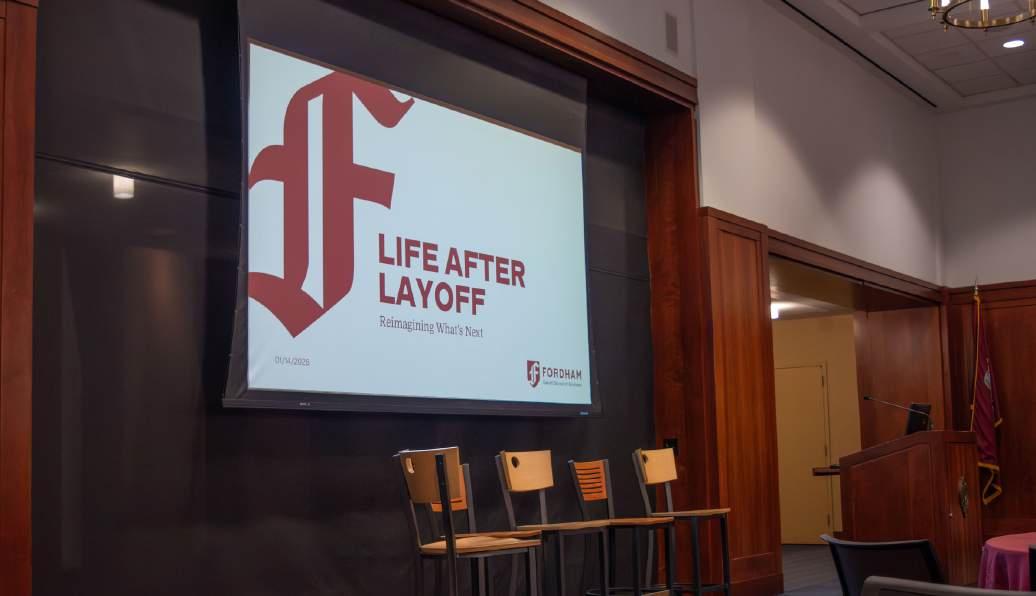
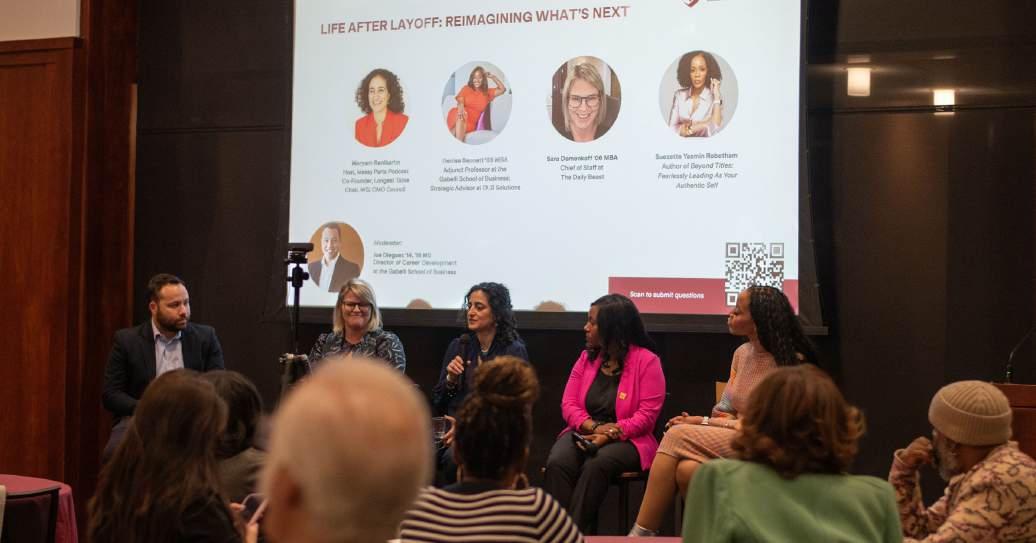
On Jan. 14, the Gabelli School of Business (GSB) hosted Fordham alumni for a discussion about the most difficult aspects of the job market in the 12th-floor lounge of the Lowenstein Center. “Life After Layoff: Reimagining What’s Next” brought working professionals spanning various occupational fields together to answer a question that unified them: How does one navigate job insecurity?
Joe Dieguez, Gabelli School of Business at Rose Hill (GSBRH) ’15 and current director of career development at GSB, moderated the event. Dieguez opened the discussion by explaining the importance of speaking “openly and honestly” about employment difficulties with Fordham community members.
“This is an impactful topic; we want to have a safe space, we want to talk about it more freely,” Dieguez said. “It’s hard to have a conversation about this because it’s not always happy and joyful, but being able to be around people who come from Fordham and graduated from Fordham … we can lean on each other.”
The event featured four panelists, two of whom were GSB graduates: Maryam Banikarim; Denise Bennett, GSB ’08; Sara Demenkoff, GSB ’06; and Suezette Yasmin Robotham. The panelists, currently employed, stressed how crucial resilience and adaptability were to navigating the “pivots” of their variable career paths.
Banikarim, chair of the Chief Marketing Officer Council at The Wall Street Journal Institute, also hosts a podcast, The Messy Parts, on which she speaks to entrepreneurs about their challenging journeys to traditionally-defined “success.” She found that her most successful guests had all exhibited resilience in the face of their employment difficulties.
chemistry and their close off-camera relationship.
Beyond providing queer representation on screen, “Heated Rivalry” is doing more than meets the eye to resist a growing culture of intolerance and normalize queer love stories. Williams and Storrie’s affectionate relationship challenges the performance of masculinity we expect from men.
The two are often seen with arms around each other and giving genuine compliments while maintaining playful banter. The pair even described themselves as “soulmates” in an interview with Cosmopolitan.
see HEATED RIVALRY page 15
“We’re all human; no matter how successful or unsuccessful you are, (being laid off) hurts,” Banikarim said. “But it’s not how you fall, it’s how you pick yourself back up, and that is … what defines people.”
CORRECTION:
A page one story published on Dec. 3 about the voluntary recognition of the Fordham Lincoln Center resident assistants and resident first-year mentors incorrectly reported that the university had formally recognized the union. At that time, discussions had not been concluded. The voluntary recognition was executed on Dec. 18. See page two for update.
COURTESY OF FORDHAM ATHLETICS WEBSITE
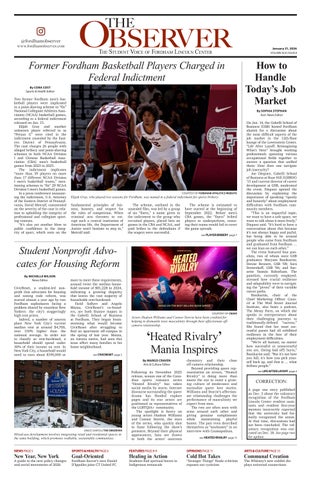
Elijah Gray, who played two seasons for Fordham, was named in a federal indictment for sports bribery.
COURTESY OF CRAVE
Actors Hudson Williams and Connor Storrie have been credited for helping to dismantle toxic masculinity through their affectionate offcamera relationship.
GRACE SANTOLI/THE OBSERVER Mixed-use development involves integrating retail and residential spaces in the same building, which promotes walkable, sustainable communities.
Club Fair Kicks Off New Semester
Clubs gathered to share their goals for the coming months with prospective members
By ABBIE WONG Staff Writer
On Jan. 15, the Office of Student Involvement (OSI) held its second club fair of the 202526 academic year in the Leon Lowenstein Indoor Plaza and the South Lounge of the Lincoln Center (LC) campus.
According to OSI, 500 students — 100 more than last year — gathered to learn about clubs they may have missed in the fall.
Dario Celiku, Fordham College at Lincoln Center (FCLC) ’26 and senior senator of United Student Government LC, remarked on how busy the event was.
“I have never seen this many kids in the (indoor) plaza before,” said Celiku. “I’ve been at these (fairs) and I’ve never once seen it quite like this.”
The beginning of this academic year saw the establishment of several new clubs. The spring club fair provided them the opportunity to showcase how they’ve grown thus far and their goals for the coming semester.
Aashna Jaiswal, FCLC ’27, is the president and cofounder of Women in Law and Leadership (WILL). She expressed her enthusiasm for several new initiatives the club is planning.
“A few events that we’re really excited about this semester are doing an LSAT prep workshop at some point, a headshot event for LinkedIn and a professional clothing swap that we’re hoping to partner with another Fordham club on,” Jaiswal said.
Youth Advocacy Coalition (YAC), another recently-formed club, shared similar anticipation
for the next couple of months.
Jack Forester, FCLC ’26 and treasurer of YAC, looked back fondly on the fall semester. He said their most successful event was their Youth Careers Panel, which the club is planning to expand into a series.
“We invited people from around the city to come talk to students about their careers and their involvement with youth advocacy,” Forester said. “And this semester we’re hoping to continue this while doing more volunteer events and getting more people involved.”
There was significant excitement from the newly formed Figure Skating Club, which was
approved the week before the spring club fair. The club’s president, Summer Panaligan, FCLC ’29, said she was very excited about the amount of people interested in signing up.
“We’ve been very surprised by the turnout because we weren’t really expecting that many people to join. But obviously we’re so happy,” Panaligan said.
Not every club experienced the same excitement, though, as many felt sidelined by their placement in the South Lounge.
Simon Beltran, FCLC ’28, secretary of Catholic Student Fellowship (CSF), said being in the back of the Club Fair was an obstacle to obtaining new members.
“It’s been really hard to be in the back,” Beltran said. “It’s been difficult to get out and show some people who might not have been interested (in CSF) and give them the opportunity to learn more about us.”
CSF was not the only one to note that the divided spaces made outreach more difficult.
Treasurer of the Anthropology Society Mireya Galván, FCLC ’27, noted that her club was “making do” with their placement in the South Lounge.
“The turnout is pretty good considering we were kind of put in the back of club day (and) not the main atrium,” Galván said.
Niamh Cogley, vice president
of the Anthropology Society and Fordham College at Rose Hill ’26, echoed this and shared her opinion on how a different placement could have improved their turnout.
“There are other clubs here that link very well to the Anthropology Society that are in the front area,” Cogley said. “And maybe having more grouping by theme would (have) help(ed) us out a bit.”
Associate Director for Student Involvement Melissa Gazal shared that OSI did start assigning club placements with themes in mind this year.
“For table assignments, we tried something different this year in which we tried to group clubs based on categories as best as we could and then randomly assign the categories to each location,” Gazal said.
Despite such grievances, many still believed that the second semester’s club day was a success. Missy Lalo, FCLC ’26 and the co-president of Filipinos of LC Offering Welcome (FLOW), said she and her other tabling members were having a good time.
“It’s great to see faces come back and talk to us before the semester starts,” said Lalo. “(The club fair) is another reminder that we’re here, and we’re active, and that we’d like to see anyone come in.”
Although it sparked some mild frustrations, there was a general sentiment that the club fair successfully launched many clubs and associations into the new semester as they begin holding their first meetings of the year.
Unions Remain Active On and Around Campus
RAs and RFMs at FLC start the year unionized as other city employees organize for labor rights
By ANA WINSTON Managing Editor
On Dec. 18, Fordham voluntarily recognized the Fordham Lincoln Center (FLC) resident assistant (RA) and resident first-year mentor (RFM) union, according to Associate Vice President for Media and Public Relations Jennifer Petra. RAs and RFMs at FLC are now officially a part of the bargaining unit represented by the Office and Professional Employees International Union (OPEIU) Local 153, along with the RA union at Fordham Rose Hill (FRH).
The recognition was fully executed following discussions between union representatives and the university, which began after the university acknowledged receipt of the RA and RFM’s petition to unionize in November.
Voluntary recognition means that the FLC RAs and RFMs did not have to request a vote facilitated by the National Labor Relations Board to be recognized by the university as a legitimate union.
The FLC RAs and RFMs are joining an existing bargaining unit formed by the unionization of the FRH RAs and RFMs in 2023. The inclusion of FLC staff in the contract is an addition to the standing contract between the FRH RAs — represented by OPEIU Local 153 — and the university. According to Petra, discussions will continue throughout the semester to discuss the FLC staff’s inclusion in the current bargaining agreement, which expires on June 30, 2027.
“We expect to meet with union leaders in late-January or
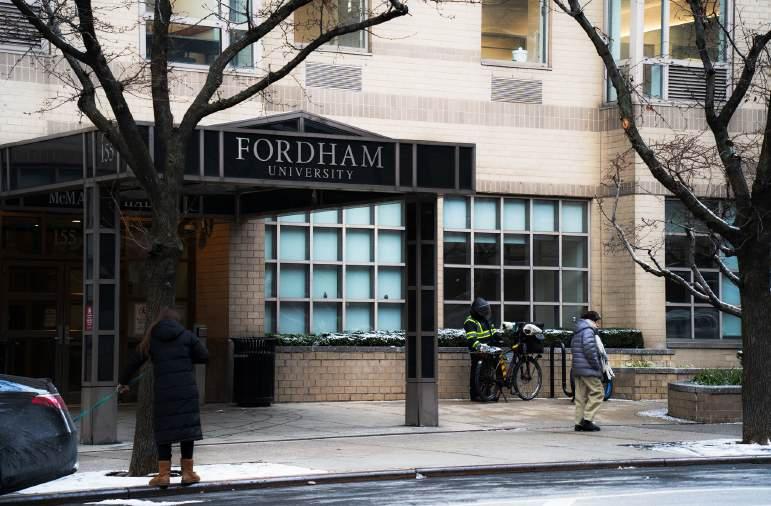
GRACE SANTOLI/THE OBSERVER
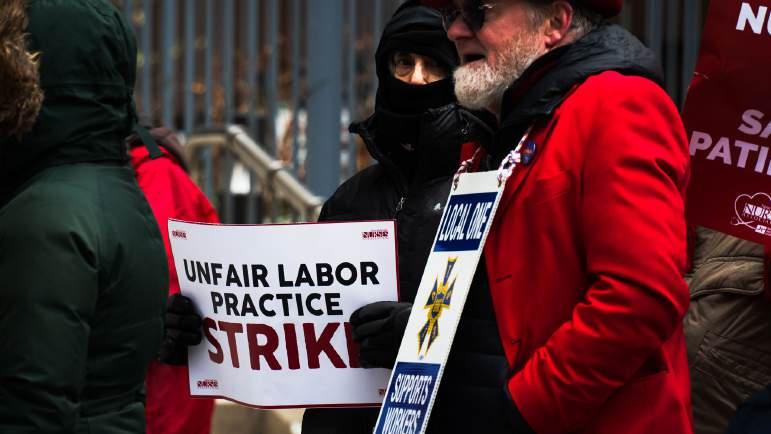
RAs and RFMs at Fordham Lincoln Center are now unionized with FRH RAs, represented by OPEIU Local 153. A block away from McMahon Hall, nurses represented by NYSNA are on strike outside of Mount Sinai West.
February to discuss the differences between the roles on the Rose Hill and Lincoln Center campuses. Through those discussions we anticipate determining if contract amendments will be made prior to June 2027,” Petra said.
The FLC and FRH campuses each have their own Office of Residential Life through which residential staff on their respective campuses are hired. This leads to discrepancies between FLC and FRH, such as the RFM position only existing at FLC.
According to the FLC Office of Residential Life webpage, the difference between RAs and RFMs is that RFMs do not serve
on-duty coverage, remaining on call throughout the night. The varying responsibilities between the two roles result in specific compensations for each position. While both RAs and RFMs receive a meal plan or check, RAs receive a single room paid in full for both semesters, and RFMs receive a single room paid for only one semester. Meal plans are given to RAs and RFMs at McKeon Hall, while meal checks are given to RAs and RFMs at McMahon Hall. Both positions are entitled to a taxed stipend each semester.
Concerns over compensation were one of the reasons that
led the RAs at FRH to unionize, according to an Instagram post from @fordhamraunion posted on Feb. 3, 2023. The compensation for FRH RAs was negotiated during bargaining sessions, which took place from August 2023 to April 2024.
The FLC union’s petition to unionize did not cite compensation as an inciting cause, instead mentioning concerns over disciplinary actions taken towards staff and a desire to establish “an equal working relationship with the Office of Residential Life.”
Fordham’s two-campus model creates a unique circumstance uncommon at other educational
institutions where an employee union is made up of workers at two separate locations and employed by different offices. During the discussions, union organizers and university representatives will discuss how the FLC RA and RFM’s roles will fit into the standing agreement.
“ We expect to meet with union leaders in lateJanuary or February to discuss the differences between the roles on the Rose Hill and Lincoln Center campuses.” Jennifer Petra, Associate vice president for Media and Public Relations
As FLC RAs and RFMs head into the new year having won union representation, New York City nurses, represented by the New York State Nurses Association (NYSNA), are on strike after negotiations between the union and five privately-owned hospitals — four in Manhattan, one in the Bronx — failed to produce a contract. It is the largest nurses’ strike in New York City history. A NYSNA picket line has been active in front of Mount Sinai West on 10th Avenue, just a block away from FLC’s McMahon Hall. As of Wednesday morning, the strike has been going on for nine days. For more information on the nurses’ strike and workers’ unions in New York City, see page five.
GRACE SANTOLI/THE OBSERVER
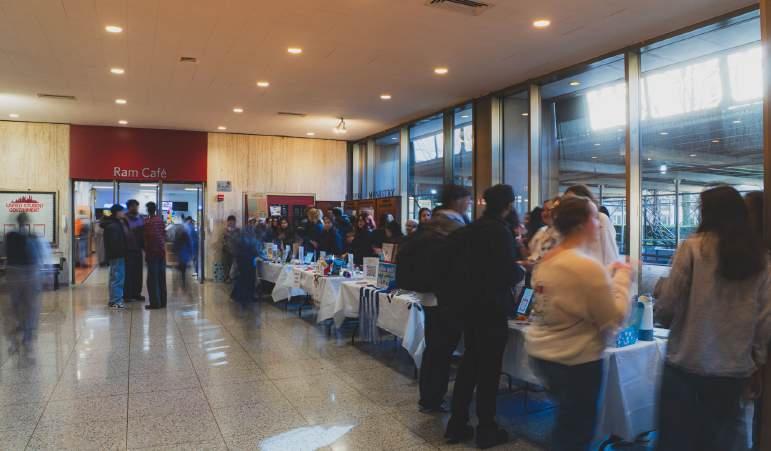
The spring 2026 club fair took place inside the Lowenstein Center Indoor Plaza and South Lounge.
Fordham Students Take on NYC Housing Crisis
Two sophomores started a housing advocacy nonprofit last March to address extremely high rent prices
During his apartment search, Sofiyev consulted his friend, a real estate broker, who told him a large part of the issue is the city’s zoning codes. Across the five boroughs, New York City’s lowest-density districts make up around 45% of the land, while only housing 28% of the city’s population. CivicReset’s solution? Mixed-use development.
Mixed-use development combines commercial and residential spaces in the same building or development area, usually taking the form of a restaurant or business at the bottom of an apartment building.
The two looked to Long Island City as an example of the downsides of low- and high-density housing. The area, which used to have mostly industrial factories and single-family homes, has, in the last two decades, seen a dramatic change in zoning codes leading to an increase in high-density, luxury housing.
“That might seem like a positive, because we’re advocating for more housing units, but the issue is that there’s not enough economic incentives for the developers to make them affordable. So to maximize their profits … they’re not even good quality buildings, but the second part is that they’re luxury units, virtually all of them, and that actually displaces and drives out more New Yorkers than it does bring them in,” Sofiyev said. “It really feels a little dystopian when you walk around and it’s just all these ultra-high-density luxury towers and no people walking around.”
There are some economic incentives for developers to build affordable housing. In 2024, the city implemented the Affordable Neighborhoods for New Yorkers and Affordable Housing From Commercial Conversions programs. These provide tax benefits to developers that include affordable housing units in their buildings, and that include such units in properties converting from commercial to residential use, respectively.
New York City Housing Connect is a city-wide affordable housing program providing units via a lottery system, which developers are encouraged to join through initiatives like the above.
Sofiyev and Mazza believe that mixed-use housing mitigates the problems with low- and high-density housing, promoting community by making neighborhoods

more walkable and increasing the number of units available in lower density areas.
“If you look at Sunnyside, Queens, there’s a lot of buildings that are four to seven stories and then they have stores in the bottom unit. That reduces car inflow and car traffic because people are more likely to just walk downstairs and walk to grocery stores and restaurants. It also helps to build a sense of community, and it’s just a lot more sustainable of a development model,” Sofiyev said.
Sofiyev also said that CivicReset is not anti-landlord, but “anti-huge corporate development that completely ruins everything around it and just price gouges to extreme extents.”
CivicReset’s primary goals are to bring zoning codes into the affordable housing conversation, break them down into comprehensible terms and raise awareness about housing crises in New York City and beyond. It does so primarily through Substack articles and podcast episodes.
The co-founders hope to start hosting events this spring. Their ultimate goal would be to have multiple chapters of the organization in cities across the country and internationally, each run by a student leader who spearheads a small team. This way, each chapter could concentrate on advocating
for specific zoning code reform in a given community. At present, CivicReset’s focus is broad, advocating for New York City as a whole, rather than one specific borough or neighborhood.
Since its inception last March, the non-profit has expanded to recruit three interns and partner with several more senior organizations with similar missions. The interns’ responsibilities are flexible, helping research, write articles and create social media content. Their backgrounds range from George Washington University to Rutgers University and the London School of Economics, extending CivicReset’s reach past Fordham and even New York City.
Sofiyev and Mazza said they were shocked to see the high volume of applications they received from qualified and passionate individuals.
“With interns, we’ve gotten a lot of applicants and honestly, that’s been the most validating part of it because it shows people are interested, students even,” Mazza said. “It’s an unpaid internship … just seeing the interest in younger people made me realize that it’s actually a cause worth pursuing.”
Looking back, both Mazza and Sofiyev said the biggest challenge they have faced so far was
in the development phase: simply figuring out where to begin and how to narrow the organization’s mission, as they are keenly aware that “solving” New York City’s housing crisis is a mammoth task. Reforming zoning code, for instance, must be done block by block; thus, it would be impossible for the two of them alone to tackle all of New York City.
After asking around about what people care about regarding affordable housing in Astoria and on Reddit, the two found that there were no similar student-led initiatives, and that most existing organizations presented zoning code information in incredibly technical, inaccessible language. They then set out to inform people in more comprehensible terms and developed their overall approach, which focuses on supporting affordable housing in various ways.
“Our approach focuses on three key areas: advocating for zoning reform that enables higher-density housing near transit hubs, promoting mixeduse development that creates vibrant neighborhoods and pushing for inclusionary policies that ensure affordable housing remains accessible to all income levels,” CivicReset’s mission statement said.
Mazza and Sofiyev’s two
primary goals for the coming year are scaling and partnerships. The two shouldered the start-up costs of the organization out of pocket and, shortly after, received donations by knocking on doors in Mazza’s neighborhood. This grassroots organizing remains central to the ethos of the organization.
The two did not initially apply for 501(c)(3) status, which provides non-profits with federal tax exemptions and the ability to apply for grants. 501(c)(3) status comes with certain regulations regarding how qualifying organizations can conduct political activity and lobbying. At first, Sofiyev and Mazza were concerned this would limit their freedom of expression, but Sofiyev said they would likely need to apply in the future as the organization grows.
Last week, CivicReset secured partnerships with three new organizations: StriveHigher Inc, a Bronx-based nonprofit focused on educational support; Press Pass NYC, an organization dedicated to supporting student journalism; and Building Culture. Mazza and Sofiyev remarked that they are both particularly excited for their partnership with Building Culture. Building Culture is an architectural design firm currently building a completely walkable city in Oklahoma, with over 30 local businesses already agreeing to participate in the development. While not having perfectly identical missions, Sofiyev said the two organization’s values of sustainable, human-centered development align. CivicReset will publish articles to their Substack spotlighting their partners, while the connection to more senior, established organizations boosts their credibility. They also plan to co-host events in the future.
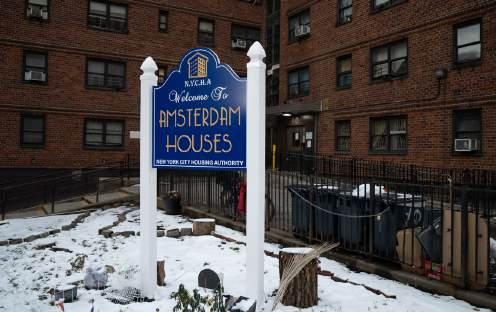
CivicReset also works with Fordham’s Campus Ministry and the Pedro Arrupe Volunteers (PAV), a group of students dedicated to direct service engagement. Campus Ministry has helped recruit volunteers and connect CivicReset with members of the Fordham community. The two co-hosted an event with PAV reading to children at the Amsterdam Houses, a public housing project on the Upper West Side, in November of last year.
As CivicReset approaches its one-year anniversary, Sofiyev and Massa both look forward to continuing to further the organization’s work in 2026.
GRACE SANTOLI THE OBSERVER
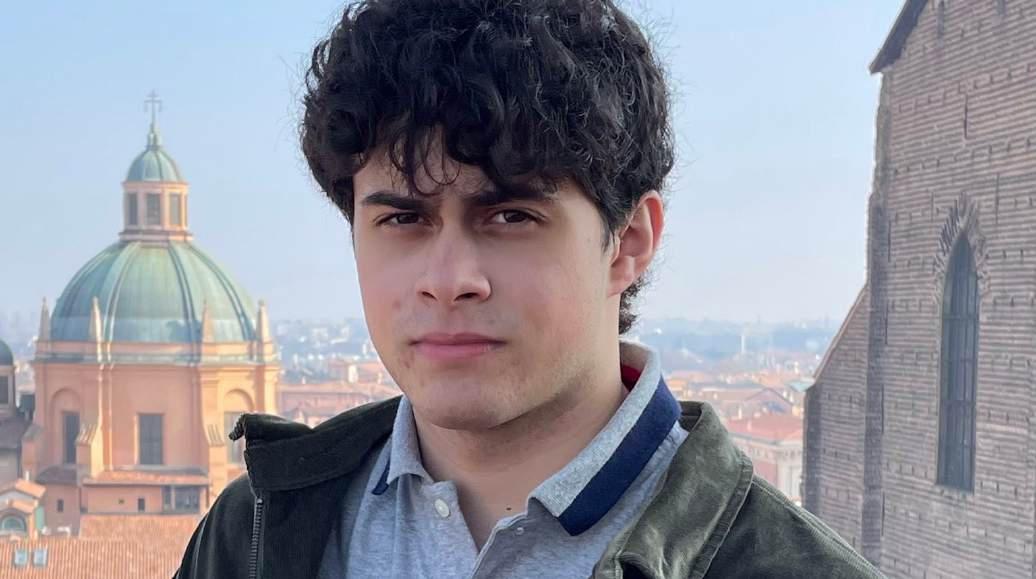
Farid Sofiyev is a Fordham sophomore and finance major who co-founded CivicReset after being faced with unaffordable rent prices in his search for an apartment.
COURTESY OF CIVICRESET
Angelo Mazza co-founded CivicReset alongside his friend Farid Sofiyev almost a year ago.
Gabelli Hosts ‘Life After Layoff’ Panel
Professionals shared their experiences dealing with job cuts and seeking employment
Similarly, Robotham, former senior director of Salesforce’s executive recruiting programs and author of “Beyond Titles: Fearlessly Leading as Your Authentic Self,” acknowledged that an inevitable part of professional life is “grieving the reality of whatever (one’s) experience is … but then very quickly moving to a place of ‘Who am I when this title disappears?’”
When discussing the unpredictability of the job market, the panel emphasized the importance of not taking layoffs too personally. Robotham addressed the fallibility of the higher-ups responsible for letting employees go.
“Some of us were working for people that were managers and not leaders,” Robotham said. “And, so, when folks are making decisions about what heads to go, they aren’t always strategic.”
The panelists recommended compartmentalizing work and personal life as a way to avoid taking career challenges to heart. Bennett, an adjunct professor at GSB and a strategic advisor at her own consulting firm, shared the advice she gave her team when they faced unexpected cuts.
“I lost my whole team, and I remember having to talk and coach them through that. … They said, ‘But I gave so much.’ I said, ‘I know you did — don’t do that anymore,’” Bennett said. “Do what you need to do, do it well and go home, go live your life.”
Banikarim pointed out that the successful individuals she had interviewed on her podcast “worked like dog(s).” In response, Bennett clarified that she is not suggesting people should work less hard, but rather that they manage their workload intentionally to avoid burnout.
“A lot of times when I’m saying (‘Don’t work that hard’), you’re doing stuff that your team or your company does not think is important. So that’s how you end up burning yourself out: You’re not working smart. Show up in your excellence, but stop doing things that your company doesn’t care about,” Bennett said.
Bennett explained that one can learn how to “work smart” by maintaining a stable sense of self independent of employment status. Banikarim agreed that it is important to know “what it is that you want and what it takes to get there.”
“I think really understanding who you are, and the things that make you not so much happy, but satisfied, I think are really, really important,” Banikarim said.
While this panel event was advertised to alumni, the university’s career center has many of the same conversations with current students about job anxiety and market strategies.
Annette McLaughlin, director of Fordham’s Office of Career Services, shared her vast experience with employment reduction as both employee and employer. McLaughlin and the rest of her team remain informed about the ever-shifting job market, connecting with employers “every single day” to get “the real, live information before it hits the news.”
“I navigated four recessions before 2007,” McLaughlin said. “You have to constantly be understanding what the environment is. … Where’s the future going? How can you get that skill set and adapt?” Likewise, Avery O’Rourke, internship program coordinator, stated that the first step in navigating the current market “is being able to identify your skill set and learning how to sell it and communicate it to employers.”
O’Rourke also espoused the importance of adaptability in today’s fast-paced economy.
“I think it’s just kind of watching those shifts and then tailoring skill sets,” O’Rourke said. “Maybe this isn’t the time that I would dive into a nonprofit, maybe I would focus more on something in marketing … (Look) into an industry and (try) something else, because you don’t know what you don’t know.”
McLaughlin and O’Rourke then explained what employers are currently looking for in entry level employees, and said Fordham sets its students up for success with recruitment. They cited the National Association of Colleges and Employers’ eight core competencies as their guide for fostering career readiness: career and self-development, communication, critical thinking, equity and inclusion, leadership, professionalism, teamwork, and technology. They added that employers also now prioritize artificial intelligence (AI) competency and strong Excel skills as “must have(s).”
O’Rourke has recently been encouraging students to include their Jesuit education in applications and cover letters, believing it serves as a positive indicator of how students “show up to work every day.”
McLaughlin concurred, explaining that the Jesuit ethos teaches both personal and professional skills. She added that employers have recently found that “those minimum expectations of etiquette and professionalism are not known.”
“ Do what you need to do, do it well and go home, go live your life. ”
Denise Bennett, GSB ’08
“Employers obviously want to hire people that have the basic skill sets that are required for the job, but that also have the ability and willingness to learn and grow, and that are interested and interesting. And that’s what a Fordham liberal arts education gives you,” McLaughlin said. “We have very interesting students that are very curious and interested in learning and continuing to grow and develop.”
Fordham’s Career Center has recently rebranded itself as the “Career Center for Cura Personalis” to emphasize their commitment to “develop the whole
person in a transformative way (because) the whole person shows up at work.” Their programming will thus continue to be “very intentional (to) meet either mind, body or spirit.”
Discussions with both the “Life After Layoff” panelists and the Career Center revealed a throughline of advice for Fordham community members facing job insecurity and accompanying anxieties: knowing how to distinguish your skillset and figuring out where to apply it.
Banikarim called this process “level-setting,” meaning, “knowing what it is that you want and what it takes to get there.”
“Like anything, you have to be able to tell your story. You own your narrative. And I think that is a mistake a lot of people make when they wait for somebody else to define their narrative for them,” Banikarim said.
Robotham reasserted Banikarim’s point when asked about competing for employment with AI. While saying that she “loves AI,” Robotham made it clear that “AI without humans does not function well,” and that job hunters should remember what they bring to the table.
“Stay true to what your skill set is, and be able to talk about … what it is that you are going to bring in terms of value
to add from your position,” Robotham said.
McLaughlin also addressed how daunting the technological side of the job market can be, where applicant tracking systems can make job hunting seem like “just sending your resume into a black hole.” She then highlighted the three factors she has found most significant in finding a job: timing, experience and connections.
“(People) will always hire people, even though we have AI, even though we have applicant tracking systems. At the end of the day, a human’s gonna make a decision to hire you,” McLaughlin said.
O’Rourke also emphasized the importance of gratitude in persevering through this particularly difficult job market. “Staying adaptable,” “staying motivated” and thinking “glass half full” instead of “glass half empty” are all important; O’Rourke suggests “just (being) grateful to have the glass.”
The Career Center encourages Fordham students and alumni to utilize their many free skills-training services, such as Skills Build AI and LinkedIn Learning, to take initiative in fostering their career readiness. The Lincoln Center Career Office is open from 9 a.m. to 5 p.m. Monday through Friday in G-49.
Fordham alumni posed questions concerning artificial intelligence, enhancing skillsets and competitive recruitment arenas.
LIFE AFTER LAYOFF from page 1
PHOTOS BY WGIANA VISCONTI/THE OBSERVER
A panel discussion with various working professionals was moderated by the GSB Director of Career Development Joe Dieguez.
What You Missed in New York During Winter Break
New government policies, the formation of unions and a two-week nurses’ strike define the first few weeks of 2026
By MACKENZIE COOPER News Editor
As the new year begins, New York City has already seen significant changes, from new governmental policies to the formation of new unions and a two-week nurses’ strike. The city remains a focal point for national and international attention, including the high-profile presence of Venezuelan President Nicolás Maduro and increased visibility of federal immigration enforcement.
Mamdani’s Inauguration and New Policy Changes
On Jan. 1, Zohran Mamdani was sworn in as the 112th mayor of New York City, making history as the first Muslim and South Asian mayor.
Mamdani took his oath on the Quran just after midnight at a private ceremony held at the old City Hall subway station. New York Attorney General Letitia James oversaw the oath. Only a small audience was in attendance, including Mamdani’s wife Rama Duwaji, who held the Quran.
The public ceremony took place later that day when Senator Bernie Sanders swore in Mamdami. Four thousand people attended the event, while thousands more watched from television screens placed around downtown Manhattan.
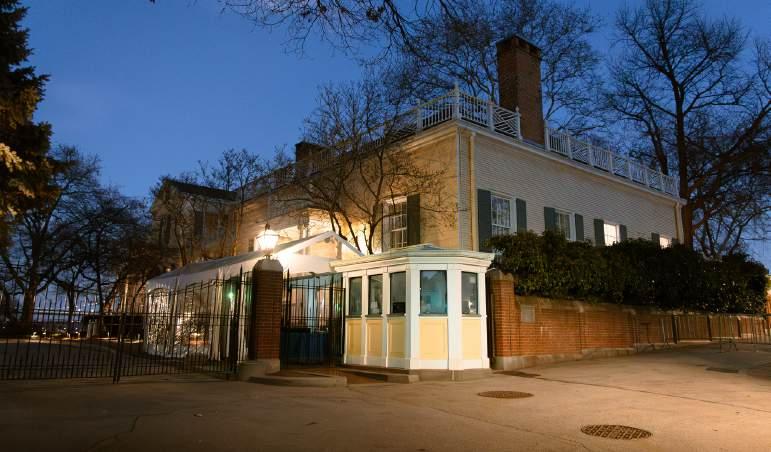
Mamdani and Duwaji have moved into Gracie Mansion, the official home of the mayor of New York City, located on the Upper East Side in Manhattan.
Following Mamdani’s inauguration, his administration immediately announced several significant policy changes, primarily focusing on housing, tenant protection and childcare.
Mamdani and New York State Governor Kathy Hochul released a plan to launch free childcare for two-year-old children in New York City. By the 2028-29 school year, the administration aims to deliver universal child care for all children under the age of five.
On Jan. 16, the Mamdani administration announced a $2.1 million settlement in order to protect tenants. This settlement prompts A&E Real Estate properties to resolve widespread tenant harassment and hazardous conditions across 14 residential buildings in Manhattan, the Bronx and Brooklyn. The agreement requires A&E to correct more than 4,000 building violations and prohibits further tenant harassment.
On Jan. 1, Mamdani issued an executive order revitalizing
the mayor’s office’s protection of tenants. The order reads that the mayor’s office will work to protect the rights of renters and to improve affordability and quality of housing for tenants in New York City.
Before Mamdani took office, the previous administration implemented a series of policies that would go into effect on Jan. 1, 2026. One of those policies includes raising the minimum wage.
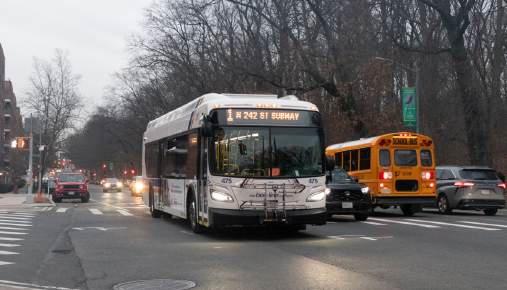
Working minimum wage has now been increased from $16.50 an hour to $17 in New York City, Long Island and Westchester. The transit fare has also increased by 10 cents, rising from $2.90 to $3.
It has been a year since congestion pricing was implemented and studies have shown a corresponding decrease in gridlock. According to The New York Times (NYT), “about 11% of the vehicles that once entered Manhattan’s central business district daily have disappeared.” The NYT also found four benefits to congestion pricing: fewer vehicles, faster traffic and more transit riders, all of which result in a better quality of life. The feedback from the study shows that congestion pricing has proved successful.
New York City Nurses Go on Strike
On Jan. 12, nearly 15,000 nurses registered with the New York State Nurses Association (NYSNA) went on strike. Nurses from major hospitals across New York City, including Mount Sinai and NewYork-Presbyterian, walked out of their jobs after contractual discussions stalled.
According to the NYSNA website, nurses began striking in response to hospitals refusing “to ensure safety for nurses and patients.” The website elaborated on this point, stating that the union is demanding hospitals “improve safe staffing, fully fund health benefits for nurses, and protect nurses from workplace violence.”
The NYSNA held a press conference when the strike commenced, during which Mamdani spoke in solidarity with the nurses.
“In every one of our city’s darkest periods, nurses showed up to work. Their value is not negotiable and their worth is not up for debate,” Mamdani said.
The NYSNA said that Mount Sinai had fired three labor and delivery nurses “on a pretextual basis driven by antiunion animus” the day before the strikes began. In what the
NYSNA alleged to be broader union-busting behavior by Mount Sinai’s management in the past, the hospital had unlawfully reprimanded 14 nurses who had spoken up against workplace violence or discussed unions and contract negotiations with their coworkers.
As of Jan. 18, the nurses’ strike entered its second week. It has made history as the largest nurses’ strike ever in New York City.
The Met Employees Vote to Unionize
Hundreds of staff members at The Metropolitan Museum of Art (The Met) have voted to unionize. Labor organizers and The Met made the official announcement on Jan. 16, marking one of the largest union victories in the museum industry. Employees voted 542 to 172 in favor of joining Local 2110 of the United Automobile Workers.
Back in November 2025, The Met’s employees signed a petition to create a union, representing 1,000 staff members.
The exact terms of the deal have not yet been decided. The Local 2110 represents several other museums and art institutions. The Brooklyn Museum, The Museum of Modern Art, the Solomon R. Guggenheim Museum and The Jewish Museum are a few notable members.
Venezuelan President is being held at New York City Jail
The United States District Court for the Southern District
of New York indicted Venezuelan president Nicolás Maduro on Jan. 3. Maduro was arrested by U.S. forces and extradited from Venezuela to the U.S. to face charges in absentia for narcoterrorism.
Mauduro is being held at the Metropolitan Detention Center in Brooklyn (MDC Brooklyn) while awaiting trial. The facility is known for being a waiting place for detainees before a trial or sentencing.
Mauduro joined other notable detainees at MDC Brooklyn such as Luigi Mangione, the 27-yearold accused of killing UnitedHealthcare CEO Brian Thompson on Dec. 4, 2024. Mangione has been under constant surveillance at MDC Brooklyn pending his trial.
Maduro’s wife, Cilia Flores, was also extradited to New York City and is being held at MDC Brooklyn. Both Maduro and Flores’s next court date will be March 17. They both pleaded not guilty to federal drug trafficking and narcoterrorism charges.
ICE’s Presence in New York City and Recent Actions Spark Protests
Renee Good, a 37-year-old American citizen, was fatally shot by an Immigration and Customs Enforcement (ICE) agent in Minneapolis, Minnesota, on Jan. 7. Since then, protests have taken over the city as civilians clash with federal agents and law enforcement.
The mayor of Minneapolis, Jacob Frey, has actively called for ICE to leave the city, releasing a statement that said, “We are demanding that ICE leave the city and state immediately.”
The momentum from Minneapolis has carried over to New York City. On Jan. 19, anti-ICE protesters crossed the Brooklyn Bridge in a Martin Luther King
Jr. Day demonstration. More than 100 people walked the bridge into Manhattan to commemorate King’s lasting legacy and call out ICE’s presence in Minneapolis and across the country.
Candidates Begin Running for New York's 12th Congressional District
New York State Representative Jerrold Nadler announced that he is not seeking reelection when his term ends in November. Nadler, who has served in the U.S. Congress for over 32 years, said that one of his reasons for stepping down is his desire for generational change within the Democratic Party.
There are 10 people in the running for Nadler’s position. Among them is Jack Schlossberg, John F. Kennedy’s grandson, who has never held or run for a position in office before. Schlossberg decided to run in response to the constitutional and affordability crises brought on by President Donald Trump’s policies.
Another candidate and critic of Trump, George Conway, is a lawyer and former Republican who became a Democrat due to his view that Trump is a threat to American democracy. He is running as a Democrat to help preserve the Affordable Care Act and push for legislation legalizing abortion access nationwide. Cameron Kasky, 25-year-old activist and survivor of the 2018 Parkland school shooting, was also running for Nadler’s congressional seat. He cofounded the gun violence prevention organization Never Again MSD. As of Jan. 14, Kasky decided to withdraw from the race to focus on human rights in
West Bank.
New York’s 12th congressional district elections will take place on Nov. 3, 2026.
Gaza’s
LUCIEN FISCHER/THE OBSERVER
Mayor Zohran Mamdani moved into Gracie Mansion, the residence of the New York City Mayor, on Jan. 12.
MAYA MACKI/THE OBSERVER New policy changes have been implemented in New York City affecting housing, childcare and affordability.
GRACE SANTOLI/THE OBSERVER Hospital nurses protested outside Mount Sinai West to preserve benefits that are at risk in new contracts by hospitals city-wide.
Sports & Health
Daniel D’Ippolito Signs with CT United FC
Fordham soccer player set to join the MLS Next Pro league in CT United’s inaugural season
By CORA COST Sports & Health Editor
For many young athletes, “going pro” is a dream tucked in the back of their minds, but for Daniel D’Ippolito, Fordham College at Rose Hill ’26, it is now a reality.
On Jan. 7, Connecticut United Football Club (CT United FC) announced that D’Ippolito, Fordham soccer’s senior midfielder, signed a contract to play for the team in the MLS Next Pro league.
“It was always a dream, obviously. As a little kid, you dream about playing pro sports, but I’d say just in high school it was always ‘go to college’ and try to play in college, and that was the first goal,” D’Ippolito said.
D’Ippolito started playing soccer for the local teams in his hometown of Somers, New York, and it quickly became a cornerstone of his life growing up. He became a standout player in the state of New York during high school, having been named New York State’s Gatorade Player of the Year his senior year, which led to his recruitment to the Fordham Men’s soccer program. D’Ippolito joined the squad during his first year at Fordham, where he played in 15 games for the Rams.
Having been on the younger side of his rookie class, D’Ippolito saw his game evolve quickly at the start of his career with Fordham, a career that was completed with the national honors of Atlantic 10’s Offensive Player and Midfielder of the Year.
This year, he was named “Atlantic 10 Midfielder of the Year” for the second consecutive season.
“Growing into it, having to be more physical (and) a little bit faster, having to think faster and play faster over the first year really allowed me to adjust,” D’Ippolito said of what helped strengthen his game. “Then, after the adjustment period, hitting my stride with the team and being comfortable on the field with my teammates and my coaches and being able to have success at the end because of it.”
With the Fordham squad, D’Ippolito has found a lot of success on the field and in the classroom. This year, he was named “Atlantic 10 Midfielder of the Year” for the second consecutive season, a member of the College Sports Communicators’ “Academic
All-America” team and was part of the Rams’ 2024 at-large berth to the NCAA tournament.
For Fordham Men’s Soccer Head Coach Carlo Acquista, one of his main priorities is setting his athletes up for success in their careers both on and off the field. Since D’Ippolito finished his degree in December, Acquista has expressed how special it has been to see his player do both at the same time.
“Our job as head coaches or
“ Finally getting the contract offer was the weight off the shoulders . ”
leaders of the program is to bring in the best possible student-athlete first, and I always say if you can combine both and get a big-time job in either side of your career, which is obviously scholastically or in the sport, then I’ve done my job,” Acquista said. “So it is a little extra special that it is the sport of soccer, where (D’Ippolito has) been working his tail off since he was a young kid, and now he has the opportunity to make his career out of it.”
Professional soccer became more of a goal than a dream after D’Ippolito’s sophomore year season at Fordham, when he began receiving opportunities to be seen by professional programs.
“Being a consistent starter after that year, I was like, ‘Oh, this is something I could push for.’ And then after junior year, it became a reality of getting opportunities to go train with teams or getting opportunities to go to pre-season,” D’Ippolito said. “Finally getting the contract offer was the weight off the shoulders.”
Securing the final contract offer with CT United FC is not only a reflection of his skills as a player, but is also the culmination of all the hard work D’Ippolito has put into his game across his career.
“Any player is what you don’t see; it’s the hard work behind the scenes. It’s doing the extra training, watching extra (film), really trying to become the best version of yourself, and Daniel did a great job of that, when people weren’t watching,” Acquista said.
The importance of drive was not lost on D’Ippolito. He was aware of the extra work needed to stand out to professional teams.
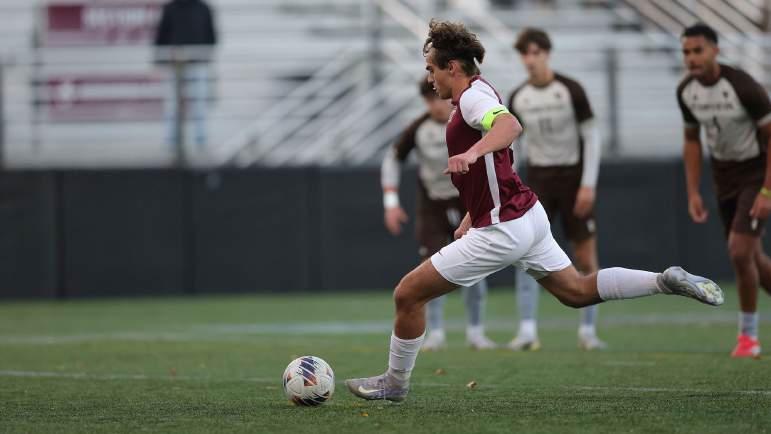
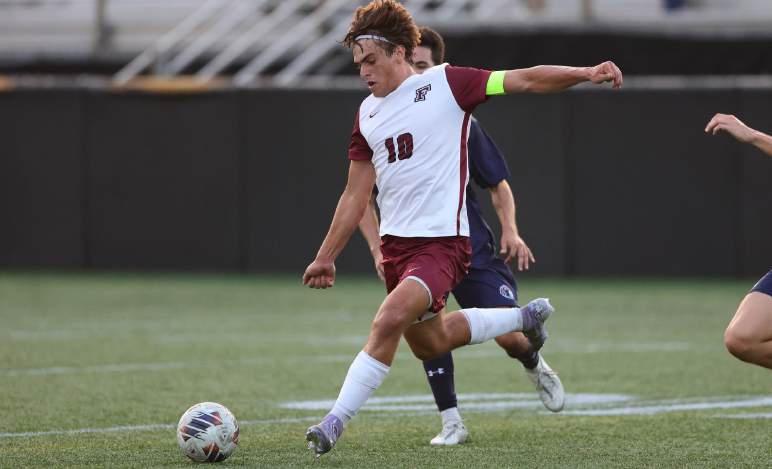
“Having the mentality of constant improvement, of being one percent better every day … trying to avoid comparing yourself to others and just really focusing on each day, each week, at each season,” D’Ippolito said. “Being able to separate yourself from the rest of people is making sacrifices that other people aren’t willing to make.”
D’Ippolito has been a dynamic player throughout his career at Fordham, leading the 2025 squad in points, assists and game-winning goals. He has proven to be a game-changing player.
“On the technical side, he’s got a knack to score goals and a knack to change the game at any
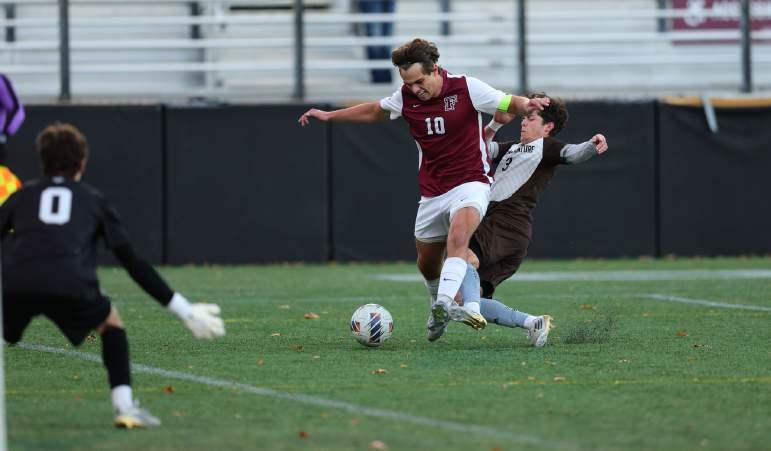
moment, and that’s really hard to teach,” Acquista said.“That’s more of a natural instinct.”
“ On the technical side, he’s got a knack to score goals and a knack to change the game at any moment, and that’s really hard to teach; that’s more of a natural instinct.”
leadership of newly announced Head Coach Shavar Thomas.
“It is the first year as a team, so it’s nice to hop into a group that is brand new because everyone’s kind of in the same position,” D’Ippolito said. “The staff is super excited about getting started, so that is rubbing off on all of us and we are just excited to get started, and I am eager to see and feel what a professional season feels like.”
A spokesperson from CT United FC attested to the club’s excitement to have D’Ippolito as a member of their inaugural squad.
As D’Ippolito transitions from collegiate soccer to professional soccer, he is thankful for his time as a Ram but excited to find his footing with CT United FC.
“I am obviously super grateful to Fordham for giving me the chance to play in college and giving me the platform to be able to move on with soccer in that aspect. And with Connecticut, my goal is to step into the professional realm of soccer and just get used to it, acclimate as fast as I can and try to make an impact within the team, especially with this being the first year,” D’Ippolito said.
2026 marks the inaugural season for CT United FC as a club.
The team expects to kick off play in March of this year under the
“Daniel joins CT United FC as a proven leader with an elite collegiate pedigree from Fordham University, where he served as team captain and established himself as one of the top midfielders in the Atlantic 10,” they said. “He brings a winning mentality and high-level production that will anchor and elevate our midfield. We’re excited to bring on a player who not only delivers results but elevates those around him.”
D’Ippolito joins 16 other athletes from across the world who have signed with CT United FC for their inaugural season in Bridgeport, Connecticut. As D’Ippolito transitions to professional soccer, Coach Acquista reflected on the opportunity D’Ippolito has to continue to impact the program.
“What he’s doing now and what he’s going to do hopefully is going to help this program for years to come,” Acquistas said. “I think he’s going to have a larger impact when he’s gone.”
Daniel D’Ippolito, FCRH ’26
PHOTOS COURTESY OF FORDHAM ATHLETICS
Daniel D’Ippolito, senior midfielder for the Fordham men’s soccer team, appeared in 69 games over the course of his career.
Daniel D’Ippolito was named “Atlantic 10 Midfielder of the Year” for the second consecutive season in 2025.
Daniel D’Ippolito was part of the Rams’ at-large berth to the NCAA tournament in 2024.
Carlo Acquista, Fordham men’s soccer head coach
One Game Closer to the Super Bowl
The Broncos, the Patriots, the Seahawks and the Rams move up in the NFL playoffs
By CORA COST Sports & Health Editor
After shedding blood, sweat and tears, the American Football Conference (AFC) and National Football Conference (NFC) Championship games have been set. This weekend concluded the divisional play in the NFL playoffs.
In the NFC, the San Francisco 49ers faced the Seattle Seahawks, and the Los Angeles Rams faced the Chicago Bears. In the AFC, the Buffalo Bills took on the Denver Broncos, and the Houston Texans took on the New England Patriots.
Entering the weekend, every starting quarterback was under the age of 30 — with the exception of the Rams’ quarterback Matthew Stafford, aged 37.
Although still young, Brock Purdy of the 49ers, Josh Allen of the Bills and Sam Darnold of the Seahawks are no longer the new kids on the block. This season has experienced an emergence of young leaders in the NFL.
Throughout the playoffs, Bo Nix of the Broncos, C.J. Stroud of the Texans, Drake Maye of the Patriots and Caleb Williams of the Bears — who were all drafted in either 2023 or 2024 — have shown to be incredible young, talented leaders in the league. It was an especially notable appearance for the Bears, who, prior to their win in the Wildcard game against the Green Bay Packers, had not won a playoff game since 2010.
Ahead of the weekend play, several teams made incredible comebacks in the wildcard round, especially in the NFC. The 49ers
B Y KAITLYN SQUYRES/THE OBSERVER
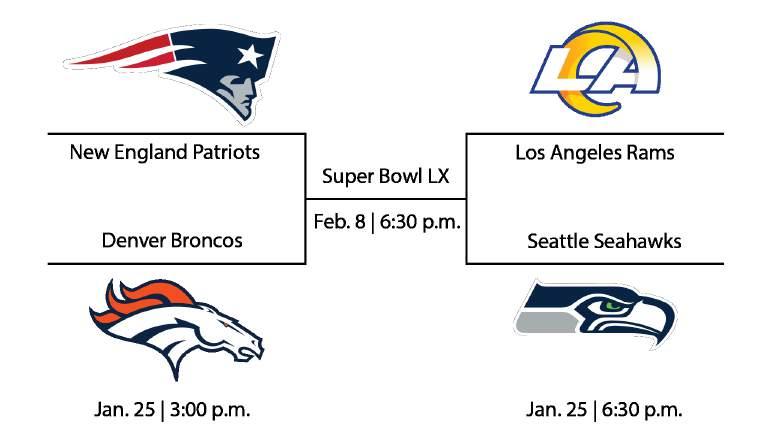
The Broncos will face the Patriots in the AFC Championship game in Denver, while the Seahawks will take on the Rams in the NFC Championship game in Seattle.
had played through injury all season. In their wildcard game against the reigning Super Bowl champions, the Philadelphia Eagles, the 49ers’ star tight end George Kittle tore his Achilles tendon. Despite the setback, the 49ers persevered and beat the Eagles 23-19. While the 49ers have persisted through injury, the Bears, with Williams at the helm, have brought hope back to football in Chicago. The Bears’ defense against wildcard opponents and midwest rivals, the Packers, pushed them to an incredible comeback of 31-27, sending them to the divisional game this past Sunday.
Over the course of the divisional games played on Jan. 17 and 18, there was continued heartbreak, sustained hope and the ultimate defeat of four teams.
The Broncos and the Patriots prevailed in the AFC, while the Seahawks and the Rams won out in the NFC — however, not without a tough fight brought by their opponents. An injured 49ers team, missing a key member of their offense in Kittle, fell to the Seahawks. The Texans will have to come back stronger next year in hopes of a first-time appearance in the Super Bowl, as they fell 28-16 to six-time Super Bowl champions, the Patriots.
Both the Bills and the Bears lost to the Broncos and the Rams, respectively, with key interceptions that changed the course of both games.
The Bears attempted to continue their Cinderella season at home on Sunday. With 27 seconds of regulation remaining, the Bears were down 17-10. Williams turned back 15 yards before throwing an over 50-yard pass to Cole Kmet in the left corner of the endzone, sending the Bears into overtime against the Rams and further proving their fourthquarter strength.
“It was the most special throw I’ve ever seen,” Bears safety Kevin Byard III said. “I’ve seen him do it
so many times this year. … That was insane. It left us speechless on the sideline for sure.”
However, the flame of hope was quickly extinguished with an interception that gave the ball back to the Rams, putting them in a position for Harrison Mevis to score the game-winning field goal and send Los Angeles to the NFC Championship game.
Thanks to a combination of several interceptions thrown by Allen and some key plays put together by second-year quarterback Nix, the Bills and the Broncos’ game was also forced into overtime on Saturday night, where Wil Lutz ultimately kicked the game-winning field goal for the Broncos. Despite their win, the Broncos are going into the AFC Championship game against the Patriots on wobbly legs after the announcement that Nix broke his ankle and that Jarrett Stidham will start in his place. In a postgame interview, Broncos Head Coach Sean Payton explained that he spoke to Nix shortly after the loss.
“I said (to him), ‘Listen, I believe you’re the second quarterback in year two to take your team to a championship game. … This team, all year, has lost key players. We’ll rise up for the next challenge, and we’ll go from there,’” Payton said.
The AFC and NFC Championship games will be played on Jan. 25 at the Empower Field at Mile High in Denver and at Lumen Field in Seattle. The winners of the conference championships will play in the Super Bowl on Feb. 8 at the 49ers’ home, Levi’s Stadium, to see who will take home the Lombardi Trophy.
Former Ram Faces Federal Sports Bribery Charges
Fordham basketball players have been accused of participating in bribery schemes to “fix” NCAA men’s basketball games
Spreads are created by oddsmakers to balance the betting margin so that favorites to win must do so by more than the points outlined in the spread, while the underdog must lose by less than that number.
The “fixers” would then set wagers against teams whose athletes they had bribed to underperform; if the bets were successful, the “fixers” would travel to pay the players bribes in cash.
After profiting off the CBA games, several of the “fixers” turned their sights on NCAA men’s basketball games. They used the same system of recruitment and bribery to “fix” games. These events are alleged to have occurred during both the 202324 and 2024-25 NCAA men’s basketball seasons.
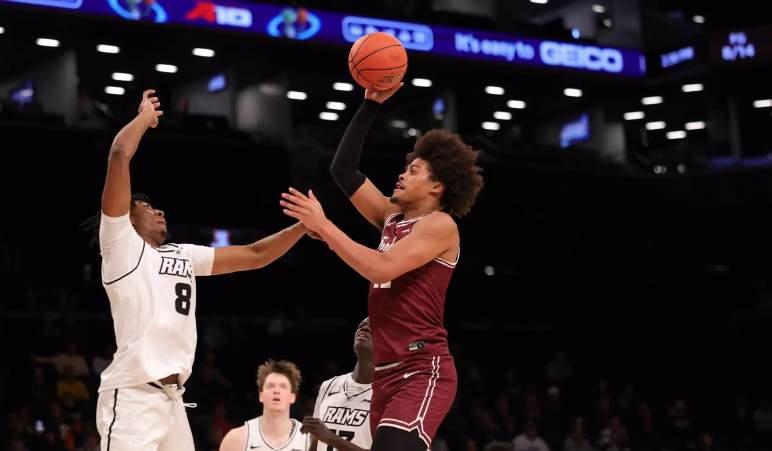
Gray was offered “a bribe of approximately $10,000 or $15,000 to underperform in an upcoming Fordham basketball game.”
Allegedly, “in or about late February 2024,” one of the “fixers”, Jalen Smith, referred to as “Person A” in the indictment, contacted Gray through social media to recruit him to participate in the sports betting scheme during Gray’s second and last season with the Rams. Gray and
COURTESY OF FORDHAM ATHLETICS WEBSITE
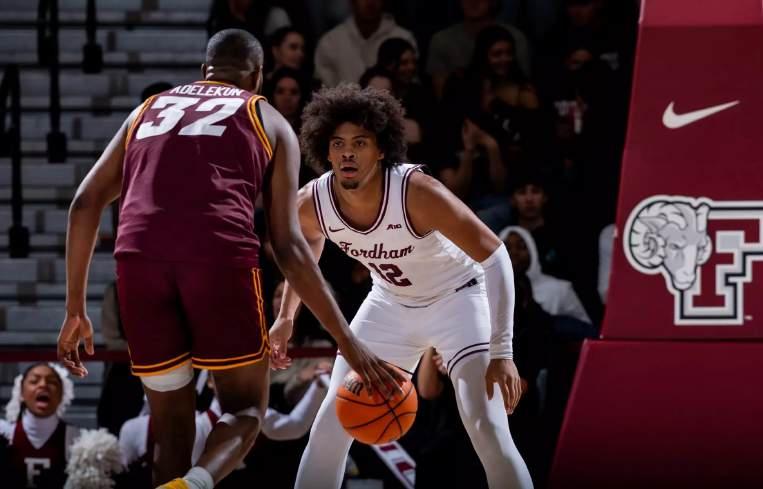
Elijah Gray, who played two seasons for Fordham, was named in a federal indictment for sports bribery.
Smith are said to have already had an established relationship, as Smith was a member of the basketball community in North Carolina where Gray grew up.
According to the indictment, Gray was offered “a bribe of approximately $10,000 or $15,000 to underperform in an upcoming Fordham basketball game,” and understood that the “fixers” would then place bets in order to profit off Fordham’s inability to cover their spread. Gray agreed to not only underperform in the then-upcoming Fordham basketball game against the Duquesne University Dukes on Feb. 23, 2024, but after a follow-up FaceTime call with Smith and other “fixers,” he recruited a
fellow Ram referred to as “Person G” to participate in the scheme. The participants in the scheme then placed wagers on the Dukes leading up to the game on Feb. 23, 2024 that added up to around $195,000. In the majority of the bets placed on the Dukes, Duquesne was favored to win the game against the Rams by 3.5 points.
The scheme for Gray and “Person G” to ensure that Fordham underperformed seemed to be working according to plan in the first half of the game against Duquesne, as the Rams were outscored 32 to 26. However, despite Gray and “Person G” scoring below their averages by three and five points respectively, Fordham
came back in the second half to win the game 79-67. Unable to influence the spread of the game, the wagers on Duquesne for the full game failed. After the scheme proved unsuccessful, Smith reached out to Gray, who responded that he had “tried” and that the Duquesne players were not “hoopin(g),” to which Smith told Gray “you did your job for sure.”
Gray continued to play for the Rams for the rest of the 2023-24 season and the game between the Rams and the Dukes on Feb. 23 is the only game mentioned in Gray’s indictment. At the end of the season, Gray averaged 8.12 field goal attempts per game, a notable difference from the four
attempts he put up during the “fixed” game against Duquesne.
The indictment implicates “more than 39 players on more than 17 different NCAA Division I men’s basketball teams,” mentioning schemes to “fix” 29 NCAA Division I men’s basketball games.
After the conclusion of the 2023-24 season, Gray transferred from Fordham to Temple University and played for the Owls through his junior year. He then transferred once again to the University of Wisconsin-Madison (UW-Madison). Gray was ultimately released from the UW-Madison men’s program in October, with the university citing “events preceding Gray’s enrollment” as the motivation behind his dismissal.
As reported by Sports Illustrated on Jan. 15, Gray entered a plea agreement on Dec. 23, in which he “pleaded guilty to one count of bribery in sporting contests.” His sentencing is tentatively scheduled for March 18. According to the indictment website, the maximum possible sentence for a defendant if convicted on a bribery in sporting contests charge is five years of imprisonment, three years of supervised release and a $250,000 fine.
GRAPHIC
PLAYER BRIBERY from page 1
A Trip to Remember: Photos from GO! Mexico
A recollection of Fordham’s Global Outreach trip to Mexico




“ Being from Cholula, I always felt connected to my culture, but this was the first time I felt connected to my ancestors. ”




Mercy Mino Almonte, FCRH ’27


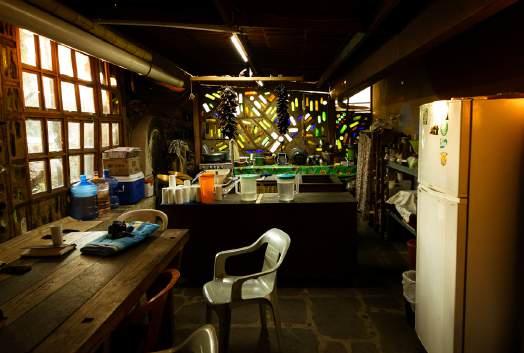
One by one, students, chaperones and members of the community all hugged each other tightly, overwhelmed by emotion in a completely raw response to the experience.


B y LUCIEN FISCHER
Asst. Photo Editor
This past winter break, Fordham students had the opportunity to embark on a lifetime-defining trip to Mexico in partnership with the sustainable farming organization Enlaces Comunitarios Internacionales through Fordham’s Global Outreach (GO!) program. GO! describes itself as a cultural immersion experience that connects students with communities to explore global inequity.
Students worked hands-on with Bamboo Architecture Company, exploring how bamboo, a renewable and ecologically friendly resource, could push toward sustainability in an incredibly unsustainable world.
Guided by Arturo Ortega, the director of Enlaces, students realized the importance of permaculture by working on the farm from sunrise to sunset, sifting through chia seeds, creating cement by mixing mud and hacking through bamboo with a machete to create compost.
Students described the experience to be life-altering. Over the week-long experience, members of the Fordham community woke up together, ate together, explored together, worked together, laughed and cried together, embodying the principles of simple living, solidarity and community that GO! strives to foster.
Students of Mexican heritage noted how being on the trip brought them back to their roots in Mexico, and that simply being there required deep processing and reflection over the course of the trip. GO! Participant Mercy Mino Almonte, Fordham College at Rose Hill (FCRH) ’27 noted, “Being from Cholula, I always felt connected to my culture, but this was the first time I felt connected to my ancestors.”
Toward the end of the experience, Fordham students helped build a temazcal, a Mesoamerican sweat lodge with deep indigenous ties to Mexico. Temazcals are typically used in ceremonies meant to purify the body and mind, often referred to as healing rituals. After using bamboo to build the structure over a day’s work, Fordham students loaded into the packed hut one by one, many wearing light clothing in anticipation of the heat to come.
The temazcal has four stages, often referred to as doors, sequentially representing water, wind, earth and fire. The ceremony started with 13 scalding rocks being placed in the ground inside the sweat lodge. Boiling hot water was poured on the heated rocks to create a thick fog of steam, masking everyone in sweat and precipitation. Many were careful to angle their feet away from the water out of fear of getting burned


from the splash. For each of the four stages, 13 more rocks were added with more boiling water to increase the power of the purification process, so by the fourth and last stage — aptly named fire — there would be 52 hot rocks in the little hut. Each stage began with a call to each individual in the hut, typically a question evoking thoughts of loss and sadness or others of hopes and dreams. Everyone shared what they wanted to let go of, what they wanted out of life, what they were afraid of and who they wanted to be.
Throughout the first stage, participants were clearly uncomfortable but remained strong. By the second, the heat had noticeably grown stronger, yet people opened up more when it was their turn to talk. Some people laughed, others cried and one even passed out, but everyone continued on. Many even decided to put their head down, curling up in a fetal position on the ground as a way of feeling the coolness of the grass amid the steam of the air.
At the third stage, most had acclimated to the intense heat, though it was still overwhelming. When asked by the healer who led the temazcal if they wanted to reduce the number of rocks for the last stage from 13 to seven, everyone refused, instead embracing the heat out of desire for
the full experience of the ceremony. By the fourth and final stage, the little hut was filled with equal parts tears and sweat. In the unbearable heat, many had no choice but to break down and be honest with one another.
After a staggering two hours in the fixture, the ceremony finished. Fordham students were greeted by the afterglow of the sunset over Popocatépetl, Puebla’s own stratovolcano, which overlooked the scene perfectly.
One by one, students, chaperones and members of the community all hugged each other tightly, overwhelmed by emotion in a completely raw response to the experience. At the dinner table afterward, everyone reported that it was one of, if not the best day, of their lives, noting a sense of being reborn together after being emotionally drained by the experience.
The next morning, some stayed up to watch the sunrise over the volcano one last time. The members of GO! had to return to New York City to start classes the following Monday. Many vowed that the effect of the trip would never be lost on them, citing that it was an unforgettable experience that they would take with them for the rest of their lives.
Opinions
No One Wants to Grow Up
The moment you doubt you can be an adult, you can no longer do it

Everyone wants to be a kid. No responsibilities, no stress — not true, but Gen Z nostalgia could convince me otherwise. The second youngest generation is already missing the good old days, including even the worst days of COVID lockdowns. But while longing for the past obviously isn’t exclusive to young people, our generation has shifted nostalgia into something more.
It’s no longer just about aesthetics, music or wonder; young people are nostalgic for the helplessness of childhood. When you can’t get a job, rent an apartment or know what the future will bring, it’s nice to remember a time when those expectations didn’t exist. It’s even nicer to reject those expectations altogether.
This rejection of adulthood can be seen in many ways, the most common being humor. Images comparing our generation to our parents, relatable adult-life TikToks and the “I’m just a girl” trend, for example, are all indicative of a self-inflicted helplessness among young people.
While this helplessness presents as classic self-deprecating humor, it is very different from trends like millennial “adulting.” Whereas millennials made fun of their incompetence at “adult” tasks, Gen Z is entrenched in our refusal; not “I don’t know how,” but “I can’t and won’t.” Young people are rejecting adulthood before it can reject them.

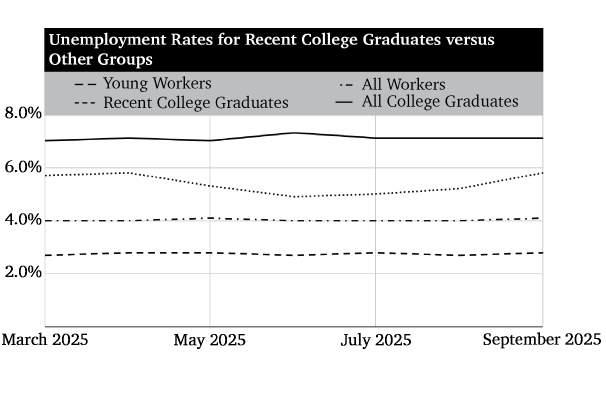
While much of Gen Z’s helplessness is self-imposed, it is also a reasonable response to a bleak-looking future. Without financial independence and opportunity, Gen Z can’t be adults — even if they want to.
In recent years, the job market has been on a steep decline, worsening significantly as 2026 begins. This is particularly true for young people struggling to get internships and first jobs after graduating from college. In September of 2025, the unemployment rate among recent college graduates was 5.8%, the highest since 2021; the underemployment rate rose even further to 41.8%. If that was September of last year, you can imagine how much worse things are now.
In 2026, hiring inflows for workers under 25 have gone down by 45% since 2023. The share of workers under 25 has been declining rapidly, even as highly qualified workers struggle in the job market.
I don’t bring up these statistics to fearmonger, but to provide context for why so many young people infantilize themselves. While much of Gen Z’s helplessness is self-imposed, it is also a reasonable response to a bleak-looking future. A tumultuous political environment, economically unstable nation and worsening climate all contribute to a pessimistic outlook by those my age. Moreover, poor job prospects prevent young adults from reaching financial independence and living on their own. With New York City rent prices, the only two options appear to be living with parents or packing a too-small apartment with roommates. Without the space to discover themselves independently, it is especially difficult for young people to develop into adulthood. Employment and independent housing are only two of many adult achievements Gen Z cannot reach. The compounding effect of these missed milestones only encourages young people to turtle further into childhood.
There is something to be said of
the idea that traditional markers of adulthood — moving out, living independently and a lucrative career — are arbitrary. However, I don’t think that these milestones are necessary to live a meaningful adult life. In fact, some of Gen Z’s rejection of traditional adult expectations can also be a useful questioning of the established norms of adulthood. However, most of the time, I think that young people’s helplessness is more detrimental than useful. By and large, we are still interested in all of these things; we’re just unsure if we can have them.
When, two months ago, I canceled my doctor’s appointment last minute and pretended I didn’t get the voicemail to reschedule; or, throughout the past year, pathologically avoided attending Fordham career events; or decided I didn’t actually need to memorize my social security number — that was not an act of rebellion. It was childish helplessness used as an excuse not to do any better. The real problem with Gen Z’s self-infantilization is that it becomes our reason not to grow into adults at all. It convinces us that we can’t, rather than won’t.
When adulthood becomes an unattainable goal, childhood can feel like a safe haven. But in reality, the self-infantilization of Gen Z is only another form of larger cultural apathy. In this case, helplessness combines an inability to hope for the future with a desperate longing for the past. In Neverland, we don’t have to think about the job market or cost of living; we can just be kids like back when things were, for us, so simple.
The tangible consequences of this immaturity are a society of young people who lack basic social and life skills. Make no mistake, I’m not a grandpa, and this isn’t Christmas dinner — I don’t think knowing how to use a typewriter or rotary phone are very useful skills (and I can’t use them
either). But opening a bank account? Initiating difficult conversations with friends and loved ones? Calling the doctor’s office back after two months without eschewing it as “too awkward”? These are not arbitrary milestones, but basic skills anyone who can legally drive should know.
Furthermore, self-infantilization makes us less considerate of ourselves and others. Children are not as experienced, and so aren’t expected to be as kind or thoughtful as older adolescents and adults. However, when young people adopt a helpless attitude, we often leave these positive traits behind. Caring for others is an emotional burden, but one that is equally as gratifying as it is necessary. Without care, we become solely focused on our needs.
This attitude is evident in snark. I feel, at least, that people my age are extremely quick to judge themselves and others. Be it someone too sincere, too fake, a “pick me” or otherwise annoying, we are always looking to find someone’s insecurity and make fun of it. I fall into this too; I often say something snarky I don’t even believe, just as a joke. But while these comments we all make might be entertaining from a precocious kid, we need to remind ourselves who we are now. We are, more or less, adults, and we have to treat others with maturity.
Even when it feels good, helplessness won’t get us anywhere useful. I don’t think growing up means the end of childhood wonder, asking others for help or even living with your parents (not in this economy). The real important part of adulthood is responsibility and independence — scary, certainly, but necessary to move past what once was. In Neverland, you’ll be happy for a while, but soon, longing for the past will turn into regret for a missed future. That means, sooner or later, it’s time to start growing up.
GRAPHICS BY KAITLYN SQUYRES/THE OBSERVER
Gen Z is taking the nostalgia of older generations to an extreme.
LUKAS RUANO-LUMPRIS Asst. Opinions Editor

KATIE BROSKY Opinions Editor
If I had a nickel for every time I cried as “Heroes” by David Bowie played over the end credits of one of my favorite pieces of coming-of-age media, I’d have two nickels. Which isn’t a lot, but it’s weird that it’s happened twice.
Yes, it’s true. I loved the last season of “Stranger Things,” and I loved the final episode, too. It’s clear, however, that I hold the minority opinion, or that’s what it seems like after a quick scroll on TikTok, where users responded en masse with a wave of instant outrage, directing their hatred toward the series’ creators for “ruining their own show.”
I’ve come to realize that the discourse around “Stranger Things” season five signals something broader than just an outbreak of cynicism. It reflects how quickly we as a society have become conditioned to move from watching to judging, from feeling to dissecting. People’s impulse to so immediately critique media deprives us of the opportunity and the space to experience joy — or any authentic emotion, for that matter.
It’s important to say upfront that criticism itself isn’t the problem. Critique, as a practice, is an absolutely essential part of our culture that has existed for as long as art itself. Criticism is how things improve, and how society learns and grows — without it, art stagnates.
The problem is also not that “Stranger Things” is too beloved a show to receive any criticism. I actually agree with quite a few critiques I’ve seen on TikTok. Yes, I think all signs pointed to Byler — a ship for the characters Mike Wheeler (Finn Wolfhard) and Will Byers (Noah Schnapp) — and their storyline seemed to be quickly written off, handled with little care. Yes, I think it made no sense that the demogorgons, once so central to the show, were somehow absent in the final battle. Yes, I think more characters should have died to reflect the weight of what was at stake. Loving something doesn’t mean it’s beyond criticism.
The ultimate problem at play here is the immediacy with which people take to TikTok to deliver critique. Instead of sitting with a story, we’re pushed to react instantly. In that rush, emotional responses — joy, sadness, nostalgia — often get cut short, replaced by quick judgments and definitive takes before the experience has even had time to settle. And anger, one of the most immediate emotions humans experience, often drives these initial reactions.
When I set out to write this article, I wanted to explore the widespread outbreak of cynicism that seems to have taken over our society. We are living through an incredibly tumultuous moment in the world, and especially in our nation — politically, economically, culturally and socially — and I think a lot of people cope with this by approaching things with a pre-determined sense of hatred, or at the very least, with an instinctive skepticism. The minds of our generation have been trained to respond this way to news and social media, and now that same instinct has bled into the way we engage with media meant for entertainment.
However, as I delved deeper into the “Stranger Things”
You Have To Let It Linger
‘Stranger Things’ fans are experiencing the five stages of grief

discourse online, I realized that the anger, hatred and cynicism weren’t present because those are the only emotions we know how to feel, but because we’ve been conditioned to feel them first. Then, in a world that constantly demands immediacy from us, we instinctively turn to social platforms to share our initial reactions. That rush often makes our responses seem harsher than they truly are.
The problem is not that we feel anger, but that we stop there. We don’t give ourselves the time or the space to sit with something and to feel everything we are meant to feel before rushing to judgment. I think about that scene in “Barbie” (2023), where Ruth Handler (Rhea Perlman) asks Barbie (Margot Robbie) to take her hands and close her eyes, then tells her, “Now feel.” We could all learn a little from this moment. It’s important that we relearn to take our time with media and art.
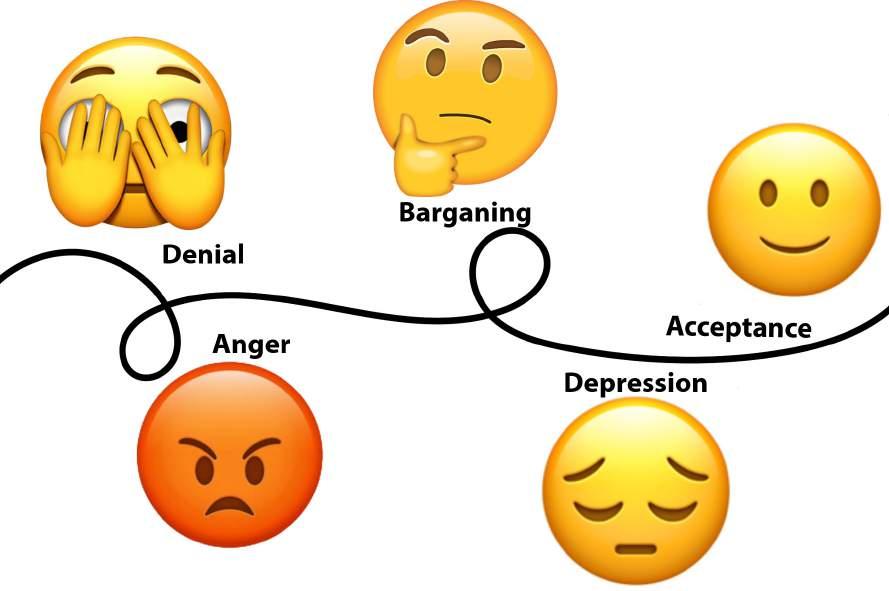
Our relationship to emotion, after all, is not instantaneous. Behavioral science explicitly tells us that feelings unfold in
stages: Think the five stages of grief. We register sensation first, then emotion, then meaning. Often, we don’t fully understand what we’re feeling until time has passed and reflection has had space to occur.
If “Conformity Gate” isn’t the clearest example of the five stages of grief, I don’t know what is. If you aren’t chronically online and don’t know what I mean by “Conformity Gvate,” allow me to enlighten you. “Conformity Gate” is a viral “Stranger Things” fan theory that emerged from viewers noticing continuity errors, awkward dialogue and an ending that felt simply too good to be true. The theory suggests that the show’s happy ending was a fake reality created by the villain, Vecna (Jamie Campbell Bower). Fans believed there was a secret ninth episode yet to be released that would reveal this twist and prove that everything they felt was “wrong” with the final season was actually intentional.
I think that when a series like “Stranger Things” comes to an end, we inevitably experience a kind of grief. For Gen Z,
especially, we’re grieving a show that we’ve grown up alongside of. The young actors were only 11 or 12 when the series began, just as many of us were when we first watched season one, and now they’re 21 or 22, stepping into adulthood at the same moment we are. Because of that parallel growth, the show became more than just something we watched; it became a touchstone that marked who we were at each stage of our childhood. Letting go of it, then, isn’t just about saying goodbye to a piece of media, but to a version of ourselves that existed along with it. The first few stages of that grieving process — denial, anger and bargaining — were unmistakable in the videos and “hot takes” that fans flooded TikTok with. They refused to accept the ending, so they created a new one, one that allowed the story to continue, that kept it from truly being over. They poked and prodded at everything they could find to be frustrated with, at every small inconsistency or perceived misstep. They begged and pleaded with showrunners and actors, insisting that this couldn’t be the
final word, that there had to be something more. When we don’t allow ourselves the time and space to sit with our emotions as a process, the default response is this hostility. The problem arises when this instinctive reaction becomes our final response rather than our first. Expecting fully formed critique the moment a piece of media ends isn’t just unrealistic, it misunderstands the emotional labor that good critique requires.
I’m not saying you had to sob like a lunatic as Prince’s “Purple Rain” transitioned to Fleetwood Mac’s “Landslide,” and I’m not saying that there’s a certain tightness in your chest you should’ve felt as the party put their Dungeons & Dragons binders away one last time. Experience things on your own terms, but don’t let the pressure to judge get in the way of truly feeling everything it has to offer. Vecna’s clock is not counting down the minutes you have to post your “hot take” on TikTok. Listen to the soundtrack on a walk, have conversations in real life, put pen to paper in a journal. Just make sure to let it linger.
GRACE SANTOLI/THE OBSERVER
The original “Conformity Gate” TikTok video has over 16.8 million views.
KAITLYN SQUYRES/THE OBSERVER
For many of us, saying goodbye to “Stranger Things” means saying goodbye to our childhoods.
Recreate Yourself in a Foreign Syntax
To learn a second language is to embark on a journey of self-discovery, empathy and humility

VEE VENNING Opinions Editor
It’s rare that we contemplate the composition of our native language, let alone that of foreign ones, beyond the confines of the English department. Consequently, we tend to harbor this unconscious assumption that every language fits neatly into the others. We view translation as cut-and-dry, matter-of-fact, when in reality, it is remarkably ambiguous.
Constructions that are central to one language have no place in another, and there are many things that simply can’t be translated word for word. It seems a tragedy that so much complexity can exist while remaining wholly unintelligible to the untrained ear. At the same time, it’s a thrilling prospect — an entire world hiding in plain sight.
Alas, our culture demands productivity at every turn, and endeavors that do not directly generate profit are dismissed as superfluous. A hobby is only as good as the side hustle you can make of it. Under this regime of manufactured urgency, days distort into mere collections of hours. Time slips through our fingers, and the weeks and months feel shorter. Naturally, convenience beckons.
It seems as though there is barely enough time to brush our teeth in the morning, let alone aspire to achieve bilingualism. After all, if it can’t be done in a day, why try at all? App developers and CEOs everywhere are making a killing off our haste, swearing up and down that in just 10 minutes a day, you too can, well, fill in the blank.
Duolingo is an obvious manifestation of this, and we’re more than well-acquainted with that vexing, anthropomorphic owl. With over 50 million daily users as of September 2025, the app promises accessible language proficiency through what its developers describe as a “functional approach.” While this mission may seem noble if you can turn a blind eye to the company’s newly instated artificial intelligence-first policy, the hard truth is that language acquisition is just not that simple.
When it seems as though efficiency is valued above all else, let us embrace that which takes time.
Duolingo can be useful, yes, but at its core, it is a supplementary resource, not a comprehensive curriculum. This is because learning a language requires a fundamental understanding of grammar and syntax that cannot be derived from lessons designed for ease and engagement alone. There are simply some things that can’t — and frankly shouldn’t — be boiled down to “bite-size lessons” that “feel more like a game than a textbook.”
Of course, this is not to demonize those who use the app. We are all victims of the industry, and the desire to learn another language is an earnest one. Rather, it is the fact that everything we consume these days, even that with educational intent, comes to us as garish


short-form content, just long enough to make us feel like we’ve done something with our time and just short enough to avoid learning anything at all.
What about ourselves is most worthy of recreation, and what is even capable of it?
When it seems as though efficiency is valued above all else, let us embrace that which takes time. Remember what it
feels like to really strain your mind, not for the sake of survival or financial gain, but for the pursuit of knowledge — for the love of the game. Learning a new language is no easy task, but not everything is meant to be. In not just enduring that discomfort, but relishing in it, we can become more attuned to ourselves.
When speaking our native language, there is so much we take for granted, and even more that goes unconsidered. We rely on conventions that we only unconsciously understand, thoughtlessly slipping into clichés and speaking out of instinct rather than intention. Like
At times, this process is exhilarating, and the satisfaction of finally carrying a conversation or making a joke is entirely unmatched. However, it can also be utterly humiliating. When our native language is no longer the default, our mode of expression is snatched away. Suddenly, we are alone in a room of people. Conversations whiz past without time for comprehension or reply, and the sense of anonymity is so acute you could drown in it. It doesn’t matter what you’re really like because there’s no one there to witness it.
Empathy demands understanding, and the current state of things is too dire to plead ignorance.
For many, this experience is seldom novel, and learning a foreign language is not always an academic undertaking or a New Year’s resolution. In a world rife with genocide and injustice, we must remember that language has always been political. Every day, people are fleeing their homes, sacrificing all that is familiar in hopes of safety and security. For these individuals, learning another language isn’t an option; it is a necessity.
At the very same time, a presidential administration that has constructed its campaign upon growing anti-immigration rhetoric reigns supreme. In March of last year, President Donald Trump issued Executive Order 14224 titled “Designating English as the Official Language of the United States.” In doing so, an order passed by former President Bill Clinton in 2000, “Improving Access to Services for Persons with Limited English Proficiency,” was revoked.
As a result, federally funded agencies are no longer required to take steps to make their services accessible to individuals who lack fluency in English, a demographic that made up 9% of the Census Bureau’s 2023 American Community Survey. This order shows a flagrant disregard for the safety and well-being of millions, and only fuels the growing fire of nationalism and xenophobia in the United States.
It is far easier to dehumanize those we cannot communicate with, to disregard their existence and experiences simply because we refuse to take the time to listen. For those who subscribe to the hateful doctrines of the current administration, this can be deliberate. However, for those who simply haven’t encountered a comparable experience, it can be unintentional.
parrots, we mimic the world around us and pass it off as our own.
Yet, when we speak a second or even third language, we cannot lean on these canons. They are not imprinted upon our psyche, and so every sentence is an act of creation. We become deliberate and innovative; we make do.
Our personality, which typically comes as second nature, must be delicately rebuilt, and to do so demands introspection. What about ourselves is most worthy of recreation, and what is even capable of it? When you are reborn into another rhythm, what carries through?
Empathy demands understanding, and the current state of things is too dire to plead ignorance. It should go without saying that this is not to compare a self-imposed and privileged endeavor to the hardships of millions, but I do genuinely believe that the specific shade of discomfort unique to language learning is one that many Americans would do well to endure. There is all this beauty hiding in the spaces between characters that you cannot yet read, floating in the breath of speakers you cannot yet understand. Weather the urge to succumb to convenience. Engage in that which cultivates your compassion. Revel in the challenge.
PHOTOS BY ANA WINSTON/THE OBSERVER
Fordham’s language requirement is not something to be begrudgingly fulfilled; it is an opportunity to evolve.
In the midst of an onslaught of anti-immigration legislation, learning a second language is resistance against apathy.
Arts & Culture
‘Ken Ohara: CONTACTS’: Photography for the Age of Collectivism
An exhibition at the Whitney Museum of American Art contains echoes of Mayor Mamdani’s call to cooperation
By MADELEINE SIGNORE
Assist. Arts & Culture Editor
On Jan. 1, Zohran Mamdani delivered an inaugural address which valorized compassion, endorsed ambition and invoked the language of cooperative effort in service of an improved urban environment.
Mayor Mamdani’s campaign was premised on the notion that the story of our city could be made infinitely richer through co-authorship. In a soundbite that instantly populated the annals of the internet, he expressed a fervent desire to “replace the frigidity of rugged individualism with the warmth of collectivism.” It feels an appropriate motto for a new mayoral era.
At the Whitney Museum of American Art, collectivism underscores an exhibition highlighting early-career works by Japanese photographer Ken Ohara. The likening of “Ken Ohara: CONTACTS” to a 21st-century mayoral campaign is apt, insofar as both demonstrate a marked optimism about the potentialities of collective action. A collaborative project realized between the years 1974 and 1976 and culminating in the production of 24 photographic contact sheets, “CONTACTS” offers alternative models for photographic practice grounded in the transmission of a single camera among various participants. It is easy to miss the Whitney’s lower-level gallery spaces, which often hide in the shadows of the comparably sensational programming located upstairs; still, I urge visitors not to skip the subtle and intimate presentation on the third floor.
Collaborative artmaking practices have enduringly served as aids in navigating fraught sociopolitical climates.
Born in Tokyo in 1942, Ohara studied photography at Nihon University before relocating to New York City, where he cut his teeth in the studios of Richard Avedon and Hiro. His 1970 work “One,” a project that focused acutely on the human face and
its insights, struck a chord with John Szarkowski, then-curator of photography at the Museum of Modern Art. Szarkowski’s endorsement, deeply empowering for a young creative, catalyzed the artist’s most conceptual endeavor to date; against the backdrop of a fragmented, post-Watergate America, Ohara sought to suture the nation’s social fabric with a participatory art-making strategy.
It takes effort to remove our blinders when we are constantly incentivized to privilege me over we, but the struggle is rewarding.
In “CONTACTS,” that aspiration is realized. Demonstrating tremendous faith in the American postal system, Ohara mailed his camera, preloaded with film, to strangers across the nation. Recipients were instructed to shoot portraits of themselves, their immediate family and members of their local communities before returning the camera to the artist, along with the name and address of the subsequent participant. By 1976, the camera had traversed 36 states, poignantly capturing the likenesses of 100 Americans. Leisure and labor, love and friction, agriculture and industry, the domestic and the public-facing: such are the thematic categories represented in “CONTACTS,” their binaries porous.
Ohara’s project of collective photographic authorship is oft-replicated today, especially in vernacular contexts. There is an argument to be made that applications like BeReal and Aura Frame — by means of which photographs, typically shot on smartphones by amateurs, are collected and presented on a centralized platform — are derivative of the “CONTACTS” concept.
A year ago, I participated in a journalistic project which involved the documentation of my spring break on a lent, analog camera, which I then returned to the project’s organizer. Granted, the tenor of this project was far less sober than Ohara’s. But collectivism and visual art are no strangers to one another;
collaborative art-making practices have enduringly served as aids in navigating fraught sociopolitical climates.
In the mid-20th century, Allen Kaprow’s “Happenings” and subsets of the Fluxus movement engaged communities of creatives in an effort to undermine the primacy of individual authorship which had long dominated the Western Art world, capital A. And the canon of contemporary art, typically defined as that which was produced during and after the 1970s, is rife with participatory projects, including Rirkrit Tiravanija’s 1990 “untitled (pad thai)” and Félix González-Torres’ 1991 “Untitled (Portrait of Ross in L.A.),” which
challenged stigmas around New York’s Southeast Asian immigrant community and the AIDS crisis, respectively.
Real affect feels difficult to come by these days. We are spoon-fed images tailor-made for us by algorithms we cannot begin to understand, the volume of which renders us desensitized to content both delightful and appalling. We employ digital services to more efficiently execute our banal chores, like going to the grocery store or doing the laundry. And we ask the disembodied entity on our computer for aid as opposed to our flesh-and-blood neighbor. In effect, we sequester ourselves away from a rich ecosystem of friends, foes and interlocutors. It is easy to pigeonhole oneself into isolation in the name of productivity, and I would go so far as to suggest that we are relentlessly encouraged to do so by companies for whom our acquiescence is profitable — usually at the expense of our sanity, social skills and lifeforce. At the risk of sounding hyperbolic or cliché, I posit that art, cooperation and art that involves cooperation are salves for this affliction.
“CONTACTS” encourages us to expand the scope of our attention beyond ourselves and to welcome difference. When we lean on the shoulder of a friend, ask challenging questions of our neighbor and listen keenly to their reply, and pass the mic (or the camera), we have much to learn. It takes effort to remove our blinders when we are constantly incentivized to privilege me over we, but the struggle is rewarding. Should we have any challenge along the way, we might look to Ohara (or to Gonzàlez-Torres, Kaprow or Tiravanija) for guidance.
On the subject of “CONTACTS,” Eli Harrison, currently the Whitney’s curatorial fellow, wrote that “Ohara’s project is extraordinary in both its conceptual daring and its humility.” Indeed, humble feels the most appropriate descriptor for the work at hand; its sincerity stuns. Who knew that the average citizen could wield a camera so skillfully? The sheer artistic aptitude of the project’s participants is striking. So, too, is the notion that “CONTACTS” affords us an honest picture of American life in geographies which often escape the scrutiny of fine art. Decentralized, scattered and decidedly stronger for it, Ohara’s vast project testifies to the merits of collaborative effort.
Decentralized, scattered and decidedly stronger for it, Ohara’s vast project testifies to the merits of collaborative effort.
In Mamdani’s affirmation of collectivism and its transformative warmth, we can locate the axioms underpinning Ohara’s artistic approach: selflessness, curiosity and compassion among them. If, on that memorable day in January, you were touched by an inauguration speech lauding the generative capacities of community, “CONTACTS” might strike a chord.
The exhibit is on view until Feb. 8 at the Whitney Museum of American
Art.
PHOTOS BY GIANA VISCONTI/THE OBSERVER
The images’ small scale demands close observation; Ohara’s choice to present the contact sheet in lieu of an individual, large-format image complicates our viewing experience.
“CONTACTS” serves as a realist counterpoint to “Sixties Surreal,” a contemporaneous exhibition located in the upstairs galleries.
The exhibit is located on the third floor of Whitney Museum of American Art.
Confessions of an American Abroad
A student’s reflection on a semester abroad immersed in Spanish culture
By LAINEY COLLIER Asst. Arts & Culture Editor
When I arrived in Madrid for the fall 2025 semester, I expected some cultural adjustment. What I did not expect was how often Spain’s art, daily movements and political history would lead me to make comparisons to the United States, especially during such a time of heightened political tensions back home.
At the Prado Museum, I studied Diego Velázquez’s painting “Las Meninas,” a piece that I first learned about in a high school Spanish class. Seeing it in person induced a strong, inescapable acknowledgment of personal change. Similar moments occurred at famous landmarks like La Sagrada Familia in Barcelona, where facts I once memorized for tests became actual experiences. It was as if I had an out-of-body experience in these moments, with the realization that I had gone from living in a small, rural town in Georgia to existing happily and independently in a foreign country that once seemed so distant and unreachable.
I studied in Madrid through Fordham’s partner program, the Council on International Education Exchange (CIEE), taking five classes split between CIEE’s campus and Universidad Antonio de Nebrija, a local university. Coursework was largely centered around Spain and Europe, like classes on Spanish cinema, European studies and the culture of cuisine. While school immersed me in the diverse regional history and politics, my interactions with younger Madrid locals were limited, as classes were only made up of fellow study abroad students.
Daily life in Madrid required adjustments that went beyond the classroom. For example, Spaniards eat their biggest meal, lunch, at 2 p.m.; siestas can be taken from 4 p.m. to 6 p.m. and dinner preparations start at 8 p.m. or 9 p.m. This contrasts the fast-paced routine lived in New York City. In Spain, one definitely should not go to a restaurant before 8 p.m. — it either will not be open or the workers will immediately smell the tourist on you.
Tapas culture — shared plates of foods like patatas bravas, tortilla, jamón ibérico and croquetas — is everywhere, with portions much smaller than those of American sizes. They lead to long evenings sitting outdoors and socializing. This is where one can adjust to a slower pace in other areas of life.
It is easy to convince oneself that college makes you independent and ready to take on the world, but that is not necessarily true. In a way, living in a foreign country will push you to grow in ways that cannot be anticipated, as being so far from home, surrounded by a different language and people who experience the world differently than you, will take you far outside of your comfort zone.
Language was a culture shock in itself and proved to be one of the most lasting challenges abroad. Even with years of Spanish instruction and some confidence in speaking, once Spaniards detected an accent, they almost always replied in English. There is some sense of understanding, as locals wanted to practice their English just as students abroad wanted to practice their Spanish. That makes the successful Spanish conversations feel dramatically triumphant, especially when Spanish-speaking tourists would ask for directions that led to a conversation entirely in their language.


Going abroad also leads to encountering many Europeans who are bilingual, or even occasionally trilingual — an area in which U.S. education is lacking. Although Americans are required to learn a second language, it usually starts in middle school rather than infancy, and is not enforced enough to ensure students learn it in a way that helps them succeed outside of memorization for tests. In a way, it is embarrassing to realize the subconscious expectation most Americans have that people in other countries will speak English. It shows how often we expect English to be universally spoken rather than making the effort to learn a country’s language.
That perspective was broadened further through travels across Europe. The open borders in the European Union (EU) and Schengen Zone made weekend trips to countries like Switzerland or the Netherlands easy. This displayed an admirable sense of interconnectedness between European countries, something that contrasts with not only the geographical, but the political distance between U.S. states. Although travel costs add up quickly (those claiming that intra-European travel is cheap are lying), these experiences are life-changing and help one understand the connection between members of the EU.
Being abroad also alters the experience of American politics.
Major developments during the fall semester, from the discourse around Charlie Kirk’s death to Mayor Mamdani’s win in New York City to the major disruptions with the government shutdown, felt immediate, yet so
distant. News came either discussed and altered through social media, messaged from home or overheard from chatter between study abroad students. Additionally, concerns about international travel and simple human rights showed how national politics can have personal effects, even when existing six hours ahead and almost 4,000 miles away from your normal life.
Learning more about Spain’s political culture offered comparisons not previously considered. During a visit to the Royal Palace, I learned about the drama surrounding the royal family. In one of the rooms, there is a portrait of the royal family that took 20 years to complete and was unveiled in 2014 — right after King Juan Carlos I abdicated. Public pressure grew after scandals involving corruption and an expensive elephant hunting trip abroad taken during Spain’s recession. Juan Carlos said it was time for a “younger, energized generation”; his son, King Felipe VI, has been distancing himself from his father’s past scandals. While the king is more of a symbolic head of state who works alongside the democratically-elected government, years of U.S. political hostility made the idea of a leader stepping down because the public demanded it feel almost refreshing.
The streets and plazas of Madrid are regular sites of demonstrations, showcasing a culture of public protest throughout the urban community covering issues such as education, labor and housing rights, domestic abuse and violence towards women. However, they also extend beyond national issues. There were multiple rallies protesting Israel’s military action

By SOFIA LAJE Staff Writer
“SOULEYMANE’S STORY” DIR. BORIS LOJKINE (2024)
Streaming on Kino Film Collection via Kino Lorber
Set over two days in Paris, Boris Lojkine’s quietly devastating film follows an undocumented Guinean delivery rider in Paris as he races against time and exhaustion in preparation for an asylum interview that could determine his future.
For fans of: social realism, “Bicycle Thieves,” urban odysseys French, Fula, Maninka with English subtitles
“SORRY, BABY” DIR. EVA VICTOR (2025)
Streaming on HBO Max via A24 Eva Victor’s debut feature centers on a young woman attempting to regain her footing after a deeply destabilizing experience, capturing how humor, awkwardness and detachment become survival tools in wake of trauma.
“Victor inhabits the naked uncertainty that hangs in the air after a punchline, and asks us to join them there.” - Katie McCabe, Sight and Sound
For fans of: “Fleabag,” “Frances Ha” English
“THE BALTIMORONS” DIR. JAY DUPLASS (2025)
Streaming on AMC+ via Independent Film Company On Christmas Eve in Baltimore, a newly sober comedian’s visit with his fiancée’s family is interrupted by a dental emergency that sends him into the city alongside his dentist. As the night stretches on, small talk gives way to honesty, turning an inconvenience into an unexpected connection.
in Gaza, and even a gathering for “No Kings Day.”
Spaniards were curious about the U.S.; many asked me questions shaped by the American media, especially portrayals in Hollywood cinema. These stereotypes came about in both subtle and obvious ways. Locals were generally very welcoming, yet sometimes the negative stereotypes of Americans were proven correct, especially when witnessing “fratty” men chanting “U.S.A.” in the bars. Additionally, a man on a bus once overheard my friends and meI speaking English and was shocked we were from the U.S. because we were “so calm and quiet.” Clearly, some stereotypes, like the loud and obnoxious American, do tend to be true.
The adjustment upon my return to the United States has been gradual. I have returned to Fordham and New York City with a new awareness of pace, public life and political discourse. Although I wish I could have stayed longer, the weariness of living at such a distance meant it was time to come home.
If any Fordham student is considering studying abroad, I have one word: go. There will never be another opportunity to recreate an experience like this at any other stage in life. Amid such uncertainty in the global and political climate, it is valuable to experience how others live. This distance offers the chance not only to see the perspective of other cultures, but to fix American assumptions about language, politics and daily life. You will come back changed — not in a dramatic way, but in quiet and permanent ways that make life that much more rewarding.
“It’s light on its feet but gradually gathers real emotional weight… We walk away from it feeling like we’ve actually been somewhere and felt something.” - Bilge Ebiri, Vulture For fans of: “Before Sunrise” meets “After Hours,” unexpected detours, late-night conversations English
“EEPHUS” DIR. CARSON LUND (2024)
Streaming on MUBI via Music Box Films
Lund’s directorial debut is set during the final game at a soonto-be-demolished baseball field, focusing on casual conversation and the experience of something familiar coming to an end.
“We come to Eephus expecting a metaphor for life and instead we are faced with life itself.” - Bilge Ebiri, Vulture For fans of: humorous melancholy, slice-of-life, America’s favorite pastime English
“MAGIC FARM” DIR. AMALIA ULMAN (2025)
Streaming on MUBI via MUBI Premised around a media crew visiting a rural Argentine town, “Magic Farm” examines how image-making, tourism and digital culture flatten places and people into content.
“The latest bit of mischief by filmmaker Amalia Ulman… it’s about going everywhere and seeing nothing.” - Amy Nicholson, Los Angeles Times For fans of: media satire, “The Curse” meets “The White Lotus,” cultural critique English, French, Spanish with English subtitles
CORA COST/THE OBSERVER
El Palacio Real in Madrid is the largest royal palace in Europe.
LAINEY COLLIER/THE OBSERVER
Living in a new city will change the way you think about the place you call home.
Can ‘Heated Rivalry’ Reverse Hockey Homophobia?
There are currently no openly gay players in the NHL, but “Heated Rivalry” could change that
HEATED RIVALRY from page 1
In the era of the “manosphere,” the importance of normalizing and encouraging connection and affection between men cannot be understated and is essential if we hope to address the so-called “male loneliness epidemic.”
As of 2026, there have never been any openly gay athletes in the National Hockey League (NHL). In fact, the NHL is the only professional men’s sports league in North America to never have a current or retired player come out as queer.
During an appearance on Andy Cohen Live, Williams shared that he has received messages from closeted athletes who felt seen by the series.
“It’s definitely the people who reach out somewhat anonymously, who are like, ‘I’m a professional player and I’m still in the closet.’ … Those are the ones that really just kind of hit you. … This is a fun show, it’s celebratory, but also sometimes it’s just hitting people right in the nerve,” Williams said when asked by Cohen if there were any reactions to the show that had particularly stuck with him.
During the interview, Cohen read a comment from a female fan who praised Williams and Storrie for helping dismantle toxic masculinity both on and off camera.
“There’s a lot of … taboo around exploring physical intimacy with people you just admire and love … especially in Western culture,” Williams said. “I was always frustrated by these kinds of notions, and especially with Connor who I love dearly, it was something I was always adamant (about) that no matter what

Canadian hockey player Jesse Kortuem was inspired to publicly come out after watching the hit queer hockey romance “Heated Rivalry.”
people think or want to infer, I’m always gonna physically express my love.”
For a sport that involves constant physical contact, the professional hockey world could hardly be described as a safe space for physical affection and intimacy between men, regardless of whether it is platonic or romantic in nature.
Throughout season one of “Heated Rivalry,” Shane Hollander (Williams) and Ilya Rozanov (Storrie) navigate the majority of their relationship in secret for fear of their families’ reactions, professional consequences and Rozanov’s ability to return safely to his native Russia.
Characters Kip Grady (Robbie Graham-Kuntz) and Scott
Hunter (François Arnaud) also engage in a secret relationship as Hunter, the captain of the New York Admirals, feared coming out due to the homophobic culture of the NHL and potential career consequences.
Hunter eventually declares his love for Kip publicly, bringing him onto the ice and kissing him for all to see after winning the championship, as Hollander and Rozanov watch separately from their TVs. Immediately afterwards, Rozanov calls Hollander, simply saying, “I’m coming to the cottage.”
In a previous episode, after sustaining an injury during a game they played against each other, Hollander asks Rozanov,
“Will you come to my cottage this summer?” from his hospital bed. Rozanov initially refused, but his mind was changed after witnessing Hunter’s bravery.
Though Hollander and Rozanov may be (unfortunately) fictional, the story of “Heated Rivalry” has inspired real LGBTQIA+ athletes to come out. In a Facebook post on Jan. 13, Jesse Kortuem, a Canadian hockey player, came out as gay. In the post, Kortuem described himself as a “private person,” but credited the series for sparking something in him to speak out.
“To any hockey player, the sounds of the rink and the feel of cold air are unmistakable. The slapshots, the pucks hitting the
Kimberly Bartosik’s Latest Dance Confronts the Uncomfortable Feelings in All of Us
boards, the skates carving fresh ice and the high-pitched clang of a puck hitting the post bring immense comfort. For a long time, however, the rink did not feel like a place where I could be all of me. I felt I had to hide parts of myself for far too long,” Korteum wrote.
“ I want you to know that there is hope and you’re not alone. There is a life and a deep happiness waiting for you on your path. ”
Jesse
Koreteum now plays for the Cutting Edges Hockey Club, an LGBTQIA+ hockey organization based in Vancouver, Canada. He thanked the club for their support, writing, “wearing your jersey that represents both my sport and my community, felt like a bridge being built over a gap I had lived with for decades.”
Koreteum reflected on a decades-long journey to accept himself and his sexuality and his decision to “move past the closeted athlete persona” and find community. He ended the post with a message for other queer athletes who have yet to come out: “I want you to know that there is hope and you’re not alone. There is a life and a deep happiness waiting for you on your path. You will get through this, and it is going to be okay.”
“bLUr” captures the intensity of human emotion and provides a needed space for personal reckoning
By INDIRA BUSH
Asst. Arts & Culture Editor
One main purpose of all art is to convey emotions when words cannot suffice. Choreographer Kimberly Bartosik’s latest work, titled “bLUr,” is an exciting new example of the impact this kind of work can have when done well. Most recently shown at L’Alliance New York for the Live Artery Dance Festival on Jan. 12 and Jan. 19, “bLUr” is 50 minutes of raw emotion and exceptional talent, both through the creative vision of Bartosik and the five dancers’ technicality and emotional vulnerability.
The work explores themes of erotism, violence, care and anxiety, creating an emotional environment very different from anything typically seen in classical concert dance. Bartosik said the dancers would often have to take long breaks when developing the piece due to the difficult nature of the work. Even in performances, she said it can still make her uncomfortable. Despite this, Bartosik sees it as necessary for our time, and its success suggests audiences feel the same.
The piece consists of vivid portrayals of human relationships ranging from the most tender to the extremely damaged. Individual sections, each with their own name and rooted in what Bartosik describes as “body state(s),” act as a framework for the audience through the tumultuous experience.
“Chaos and Panic” opens the piece and immediately awakens
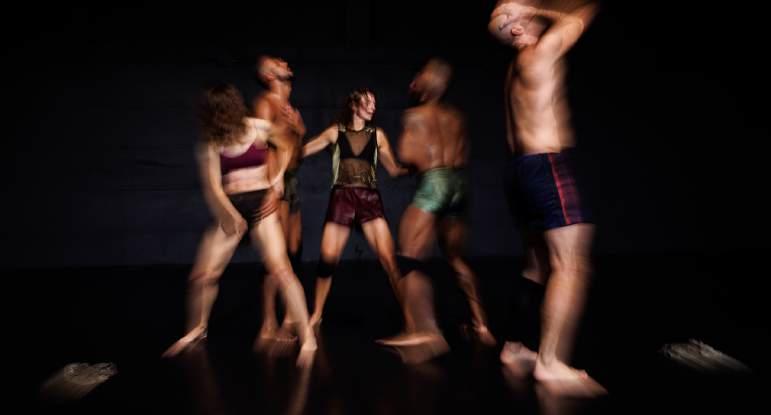
Dancers in “bLUr” show the complex range of human relationships through movement.
the audience to the work’s intensity. The dancers bolt across the room, running into walls and bounding into the audience. They seem both scared of one another and intent on scaring each other.
“Pumping Life Back Into the Body” has a similar energy. The dancers attempt to perform CPR on one another, but they keep “slipping out of place.” They never seem quite able to save one another.
“Vibrating Desire” comes later in the piece, but was one of the first dances that Bartosik developed. Standing close to one another, the dancers vibrate with increasing intensity, sometimes with skin-on-skin contact,
hinting at a level of sexual desire, or sometimes alone in moments of fraught solitude.
The dance moments that make up “bLUr” are complemented by the performance design created by Bartosik’s partner Rick Murray. The stage is lit by two handheld “sun guns” used for lighting movies in the 1960s.
The operators — Bartosik’s own college-aged child and their friend — start the piece with a tender hug, and then pick up their lighting tools.
Bartosik said that the dancers appreciated the tenderness and warmth that the light provided.
Bartosik never set out to become a choreographer, but it
COURTESY OF KIMBERLY BARTOSIK
was seemingly destined to be. She started dancing relatively late at age 15, but achieved a successful career, including nine years with the Merce Cunningham Dance Company. After leaving, she was offered an opportunity to choreograph for the first time, which led her to further recognition, including as an advisor for the Ailey/ Fordham Bachelor of Fine Arts in Dance program.
“bLUr”’s origins were similarly unexpected, originally coming to Bartosik at a 2023 residency, where she was planning to work on something different altogether.
“All this other material started coming out of my body, and it was really intense,” she said.
She traced the source of that movement to an incredibly traumatic experience a few years prior when she witnessed a loved one overdose. Soon, it became clear that she would need to give into her inspirations completely, and “bLUr” was born.
As “bLUr” grew, the message became more and more individual, both as the dancers experienced it in their own bodies, and as different audiences’ perceived it. Bartosik notes that sometimes the interpretations are generational, saying “some people see Vietnam, some people say Gaza, some people see the AIDs crisis.”
“I’m a big believer in reaching an audience where they’re at — not telling them what to feel, but offering the space to feel,” said Bartosik.
After a sold-out premiere at the Fall 2025 Crossing the Line Dance Festival, a small performance in Washington, D.C., and successful showings on Jan. 9 and 12 at L’Alliance New York’s “Skyroom” space, Bartosik plans to bring “bLUr” to new audiences this spring.
Bartosik said that some are reluctant to bring it to their communities, especially with younger viewers, because of the intense nature of the work. Bartosik thinks it’s a needed experience.
“Your generation has been through a lot and you need a space to sort of reckon with it,” she said. It is this space that makes “bLUr” so special — it provides audiences the ability to see and feel emotions they struggle to put into words.
GRAPHIC BY KAITLYN SQUYRES/THE OBSERVER
Kortuem, Canadian hockey player

un & ames


Crossword: Placement Puzzlement
39. Faulkner novel: “___ __ Lay Dying” (2 Wds.)
40. Home to Arizona State University
41. *Display window locale
44. Feds (Hyph.)
45. Sweet term to address one’s spouse (Abbr.)
46. Thunder sound
47. Situate (oneself)
49. Chimney sweep’s target
50. So long, farewell, auf Wiedersehen, adieu
51. State with confidence
54. *User interface, or a hint to part of the starred clues (2 Wds.)?
58. 2022 horror film starring Keke Palmer
59. Get going: “____ your boot”
61. Meat sauce
62. Frog’s companion, in children’s literature

19. Continent where the highest and lowest points on Earth are located
20. *Square up to
22. Shield from view
24. Bowler’s assignment
25. River sediment
26. “Little Women” writer
29. Sunburn salve
30. ____ and hers
33. Cat’s cry
34. *Descriptor for a luxury beach house
37. Waited
63. Major artery
64. Small matter?
65. Comfort and Holiday, for two
66. King Midas and Sisyphus, for two
67. Speak hoarsely

1. Baldwin of “30 Rock”
2. Friend of Stitch

3. R&B artist Bridges
4. Van Gogh subject
5. Maple Leafs’ city
6. Inadvisable way to show up to a surgery
7. Traditional garment for a Scot
8. Word after Christmas or New Year’s
9. Time with a therapist or tutor
10. Patient’s record
11. Shine’s partner
12. One of the Great Lakes
13. Gradually withdraw
21. Remy or Rizzo, for example
23. Chin indentation
25. Put to death
26. “Weird Al” parody: “____ Paradise”
27. Words commonly found between one thing and another (2 Wds.)




28. Punctuation mark often found in academic titles
29. Fellow of fables
30. Man, in Marseilles
31. The proper way to sign a contract (2 Wds.)
32. Surgical support tube
35. Diamond unit
36. Academic record holder?
38. Posters and throw pillows, for example (Abbr.)
42. Partner of Jetsam
43. Camry, Prius and Tacoma, for three
48. Kylo ____
49. Sunflower snacks
50. Soup base
51. Prefix with “bacterial” or “viral”
52. In the near future
53. Common course code for Fordham students fulfilling the language requirement
54. Pillow structure
55. “I could ____ __ horse!” (2 Wds.)
56. Private aid groups (Abbr.)
57. Break up with 60. Coquettish




Maria Von Trapp and Mary Poppins, to Julie Andrews