
Humanities Departments See Budget Cuts

Several humanities departments and the FCLC Honors Program both received significant budget cuts.
By MACKENZIE COOPER News Editor
Several departments in Ford-
ham’s School of Arts and Sciences had their budgets significantly reduced for this year without the department heads being notified, according to several faculty members.
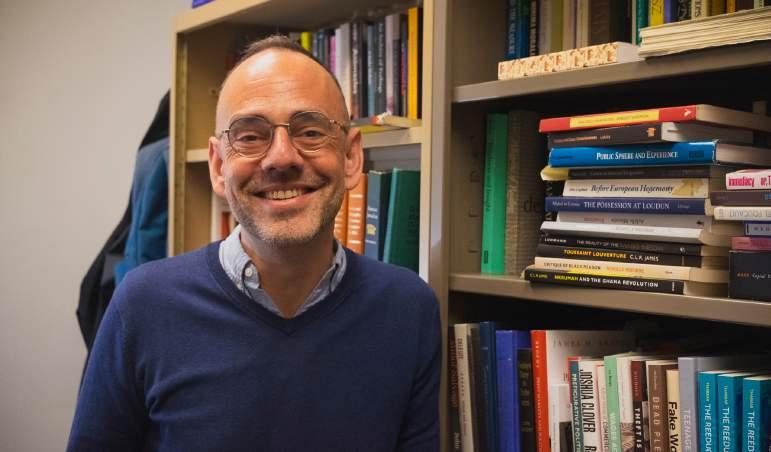
Professor and Director of Fordham College at Lincoln Center’s (FCLC) Honors Program Jordan Alexander Stein also revealed that the FCLC’s Honors Program had its operational budget cut by 60% for the 2025-26 academic year. Included in this budget are payments for instructors, funds to run events and museum fees for educational visits.
The honors program is budgeted through FCLC, and Stein said he has received no communication regarding the reason for these cuts.
“I was not consulted or even told about these cuts until I logged in to my budget software this September,” Stein said.
Fordham Agrees to Recognize FLC RA/RFM Union
By ANA WINSTON Managing Editor
Fordham has agreed to voluntarily recognize the Fordham Lincoln Center (FLC) resident assistant (RA) and resident first-year mentor (RFM) union on Nov. 25, according to union organizers. RAs and RFMs at FLC are now officially unionized with the Office and Professional Employees International Union (OPEIU) Local 153 along with the RA union at Fordham Rose Hill (FRH).
The union authorization cards, signed by 74% of FLC’s
By SOFIA LAJE Staff Writer
When “Lemonade Blessing” premiered in the U.S. Narrative Competition at the 2025 Tribeca Film Festival in June, director Chris Merola, a 2020 graduate from Fordham College at Rose Hill (FCRH), was as abuzz as his surroundings. In an interview before a screening of the film at Rose Hill on Nov. 20, Merola recalled that the loud festival crowd was “very New York.”
“I dissociated through most of it,” Merola said. “(I) pieced together what happened by watching clips afterwards.”
RAs and RFMs, were provided to the university upon request.
The voluntary recognition will be put in writing soon, according to John Edmonds, assistant business manager of OPEIU Local 153.
Voluntary recognition means that RAs and RFMs at FLC are considered a valid union on the Fordham campus without having to vote in an election facilitated by the National Labor Relations Board (NLRB). After voluntary recognition, the union can go straight to bargaining sessions with the university to solidify a new contract.
This means that the FRH RA’s contract will be renegotiated, as the new contract will include both campuses’ RAs.
Om Patel, Gabelli School of Business at Lincoln Center ’27 and a lead coordinator of the FLC RA and RFM union, lauded the university’s decision.
“I think that was a good choice for a lot of the reasons we outlined in our letter that we sent just stating how it aligns with the Jesuit mission of the university,” Patel said. “I think this is a good step forward for them, and it’s also showing leadership.”



er’s request for comment in time
This is not the first fiscal cut at Fordham in the last year. Last spring, Tokumbo Shobowale, Fordham’s chief financial officer, announced new budgetary measures in an email on March 14. These measures included a hiring pause and reduced departmental spending by 10% for the 2026 fiscal year. Shobowale said the cuts were necessary due to an unexpected budget deficit, caused by the uncertainty of future federal higher education funding and the class of 2025’s graduation, which was Fordham’s largest undergraduate class.
“We must take proactive steps to ensure financial stability without compromising the core mission of the University,” Shobowale said.
Stein also serves as the co-director of the comparative literature program at FCLC, which saw, according to him, a 17% cut in their budget. This program is funded through the Faculty of Arts and Sciences (FAS), which has also seen a 17% cut in its budget. Stein was not informed about this cut, either.
The university’s Communications and Media Relations team -
By MICHELLE WILSON News Editor
Over the course of the fall semester, United Student Government (USG) has implemented various new initiatives including a rebranding, increased focus on social media and communications, facilities updates and club collaborations.
USG is comprised of an executive board, senators and seven committees: Facilities; Operations; Diversity, Equity and Inclusion (DEI); Committee on Sexual Misconduct; Humanitarian Needs; Student Affairs; and Media Relations. As the student governing body of Fordham Lincoln Center (FLC), USG’s responsibilities include advocating for student needs, overseeing clubs and coordinating programming.

By JANE ROCHE Editor-in-Chief
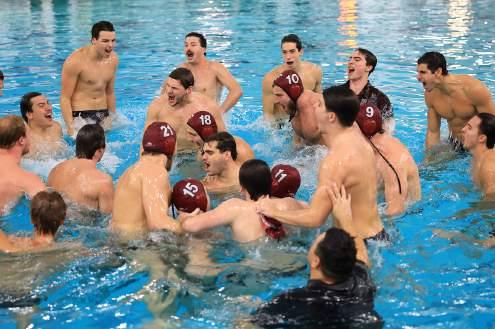
On Nov. 23, the Fordham men's water polo team won its fifth consecutive Mid-Atlantic Water Polo Conference (MAWPC) championship. On Dec. 5, they enter the quarterfinals of the NCAA championship fourth-seeded, in competition for the national title, a feat no team outside of California has ever accomplished before.
The MAWPC victory against George Washington University landed the team in the Fordham history books yet again, as it was the first time the team had taken home the conference title five times. The win granted the Rams an automatic bid to the national tournament.
Brian Bacharach was named water polo’s head coach in May
of 2020. Since then, he has led the Rams to their first-ever MAWPC conference championship in 2021 and their first appearance in the NCAA championship in 2023. The 2024 season was described by The Wall Street Journal as possibly the greatest story in college sports. The Rams went undefeated until their final match in the NCAA championship semifinals, closing out the season with a 32-1 overall record for a nearly undefeated run.
“There was a lot of confidence going into that 2024 championship,” Bacharach said. “I knew they had been through those ups and downs. They had been through those tough moments and knew how to come out on the other side.”
COURTESY OF FORDHAM ATHLETICS
The Rams will face off against the San Jose State University Spartans in the NCAA championship quarterfinals on Dec. 5.
COURTESY OF CHRIS MEROLA
film.
What’s New, New York?
The latest happenings in New York City politics, justice and workers’ movements
By MACKENZIE COOPER News Editor
New York City has experienced various significant events in the last few months. Here’s a recap of some of the most notable moments.
New York Attorney General Letitia James was indicted on charges of bank fraud and false statements to a financial institution on Oct. 9 by the Federal Grand Jury. On Nov. 24, those charges were dropped.
James Comey, former director of the FBI, was also indicted around the same time with similar charges. Comey was charged with obstruction of justice and making false statements to Congress during his 2020 testimony about whether or not he authorized a source to leak information to the media.
Both cases were dismissed by a judge from the U.S. District Court for the District of South Carolina, who ruled that the charges made by prosecutor Lindsey Halligan, interim U.S. attorney, were unlawful. The Trump Administration immediately announced it would file an appeal, but that has not yet taken place. The Department of Justice is still considering adding additional charges against James and Comey.
Zohran Mamdani, New York City mayor-elect, has begun building his transition team ahead of his official inauguration on Jan. 1. The team includes government officials who have already served under previous mayoral administrations.
Elana Leopold, a political strategist who worked for former New York City mayor Bill De Blasio, will serve as the team’s executive director. Maria Torres-Springer, former first deputy mayor of New York City under Eric Adams, will be co-chair of the transition team. Torres-Springer was one of four top officials who resigned from Adams’ administration over its cooperation with President Donald Trump.
On Dec. 1, Mayor Eric Adams announced a $38.9 million settlement with Starbucks. The New York City Department of Consumer and Worker Protection found that the Starbucks Corporation was not compliant with the Fair Workweek Law. This law aims to provide hourly workers — particularly those in the fast food
industry and retail — with more predictable schedules.
Starbucks was violating multiple laws including cutting employees’ working times by 15% without receiving consent, failing to provide regular schedules and prioritizing giving shifts to new hires rather than long-time employees. More than 150,000 workers will receive restoration payments under the agreement. This resolution is the largest worker protection settlement in New York City history.
At Rikers Island, a prison complex located in the East River in the Bronx, 13 prisoners have died in custody in the last year. The 2025 death toll in New York City jails is more than double that of 2024. This comes alongside a
nationwide increase in violence against prisoners by correction officers. According to an investigation conducted by The New York Times, the rate of brutality in United States prisons has been rising for a decade. The report showed that, in 2014, members of staff reported using force against inmates three times a day across the prison system. Then, in 2019, that number rose to seven times a day. Last year, the number rose to 11. The investigation also found that these numbers are not a result of prison overcrowding, increased attacks on guards or the decrease of prisoners being held in isolation. This decrease occurred after the passing of the Humane Alternatives to LongTerm Solitary Confinement Act (HALT) in 2022, which restricts
Fordham YDSA to Expand to FLC
the use of solitary confinement in prisons and jails.
On Dec. 1, a correction officer testified at a pretrial hearing for Luigi Mangione, the 27-year old accused of killing UnitedHealthcare CEO Brian Thompson on Dec. 4, 2024. Mangione has been under constant surveillance at Metropolitan Detention Center Brooklyn while awaiting his trial. Thompson was fatally shot while walking into the New York Hilton Midtown in Manhattan. Mangione was charged with the assassination after sufficient evidence was gathered.
Mangione’s defense team is arguing that certain pieces of evidence should be excluded from the upcoming trial. They have also asked that witnesses testifying be restricted from discussing the contents of Mangione’s journals or characterizing them as a “manifesto.”
On April 1, Pamela Bondi, U.S. attorney general, released a press statement directing prosecutors to seek the death penalty for Mangione. This also stems from Bondi’s overall mission to “revive” and expand the use of the death penalty in the United States. Since 2009, seven states — Colorado, Connecticut, Illinois, Maryland, New Hampshire, New Mexico and Virginia — have outlawed capital punishment. During Bondi’s first days as attorney general, she sent out a memorandum to all government departments regarding the revival of the death penalty.
Mangione’s official trial date has not been set yet, but if found guilty, Mangione will face 25 years to life in prison.
Fordham Young Democratic Socialists of America (YDSA), an unofficial student organization, is branching out beyond Rose Hill to the Lincoln Center campus in the coming weeks
By MICHELLE WILSON News Editor
Fordham’s chapter of the Young Democratic Socialists of America (YDSA), an unofficial student club, will expand from Fordham Rose Hill (FRH) to the Fordham Lincoln Center (FLC) campus.
The first club meeting is planned for next week, and YDSA hopes to have consistent operations up and running at FLC in the coming weeks, according to Matthew Smith, Fordham College at Rose Hill ’27 and founder of Fordham YDSA. Fordham YDSA is a member-run organization governed by a steering committee with two elected co-chairs, where all decisions are made “as democratically as possible,” Smith said.
Fordham YDSA’s expansion to FLC will make it more convenient for FLC members to participate and may encourage more students to join, according to Smith. Fordham YDSA are still looking for a space to consistently meet, either on or off campus, as unofficial student clubs cannot reserve rooms. At FRH, Fordham YDSA has a network of professors and faculty that support the group and reserve rooms for them. Fordham YDSA is currently trying to assemble a similar cohort at FLC.
Smith said he has gauged considerable student interest in YDSA at FLC. He added that he believes many more people would support socialism if they were properly informed about what it really is.
“My elevator pitch would be: Extending democracy from governments and into the workplace
and into all aspects of your life, and ensuring that working people have power, and ensuring that working people control where they work, not the billionaires,” Smith said.
While the Democratic Socialists of America (DSA)’s many chapters have significant autonomy, its overall mission centers around very similar concepts: democracy, anti-capitalism and workers’ rights. DSA is a nationwide socialist organization and the largest in the nation. YDSA is a subsection of DSA with campus and neighborhood chapters. The neighborhood chapters are a recent addition and aim to allow low-income communities and youth who cannot afford to go to university to participate in socialism.
In previous years, NYC-YDSA was not a cohesive organization, and it is only recently that a voluntary confederation of chapters has formed. This year, at a citywide NYC-YDSA convention on Nov. 23, this new cooperation was put into practice. The convention passed various resolutions, including the declaration of two priority campaigns: turning universities into sanctuary campuses and advocating for the Starbucks Worker Union strike. The strike ended on Dec. 1, when mayor Eric Adams announced a $38.9 million settlement with Starbucks after an investigation found that the corporation was violating multiple labor laws.
Fordham YDSA contributed to the “Students Against Starbucks” movement by tabling outside of Walsh Gate at Rose Hill, handing out flyers with information on how students can get
involved. The Starbucks at Rose Hill is not unionized. However, the Starbucks Workers Union had requested that people not patronize any location while the strike was ongoing, a message YDSA supported.
NYC-YDSA is also experimenting with establishing city-level fundraising where chapters can put money into a collective fund and withdraw it when necessary.
Smith said he is “extraordinarily excited” about this prospect and that it would be especially beneficial to chapters with uncertain or no school funding, like Fordham YDSA. Thus far, Fordham YDSA has been operating with the support of the national YDSA and out of pocket, a very limited budget.
Another recent YDSA event is a potluck drive on Nov. 22 where attendees brought socks, underwear, hats and gloves to donate to St. Joseph’s House, a soup kitchen. The event was held in collaboration with Fordham Catholic Worker, an unofficial student group. The group is part of the larger Catholic Worker movement, a social justice movement grounded in faith that was founded in 1933 by Dorothy Day and Peter Maurin. Fordham YDSA is planning another volunteer event at St Joseph’s, a Catholic Worker house, at the end of this semester or the beginning of next, according to Smith.
Fordham YDSA, NYC-DSA and NYC-YDSA, were very involved over the last several months with mayor-elect and DSA member Zohran Mamdani’s campaign. Fordham YDSA had consistent canvassing efforts, while NYC DSA helped recruit around 50,000 of the campaign’s estimated 100,000 volunteers.
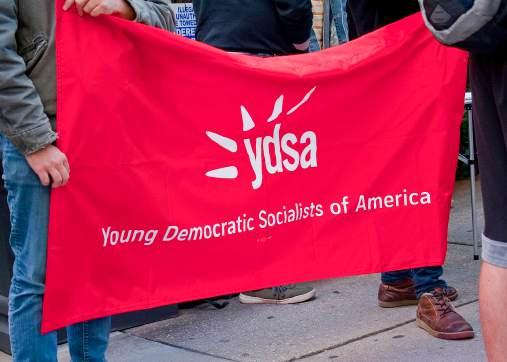
Fordham YDSA has been active on campus since 2023, when Smith started it during his first semester at Fordham. Smith said that, despite receiving initial approval from the United Student Government last year and submitting the required documentation, Fordham YDSA has yet to be recognized by the university.
Smith said Fordham YDSA is concerned that, should they become an official student club, they would be subject to restrictions antithetical to their socialist ethos. He also expressed frustration about the club application process, which he called unnecessarily long.
For example, contraceptive access is a central issue for Fordham YDSA. They passed out free Plan B and condoms outside the Walsh Gate of the Rose Hill
campus on Nov. 17 and Oct. 8, which they also did several times outside both campuses last academic year. The group brings 64 doses of Plan B and many condoms to each tabling event. After an hour, they are always out of Plan B, which Smith said demonstrates student need. Smith added that he is worried that, as an official student club, YDSA would not be allowed to pass out contraceptives.
Fordham YDSA is planning future distributions, where they will continue collecting signatures for their petition demanding Fordham change their policy, which has 354 out of the goal of 400 signatures as of Dec. 1. Along with the Plan B distributions, Fordham YDSA is planning to work with immigrant rights groups and focus on electoralism for the next democratic primaries.
KEI SUGAE/THE OBSERVER
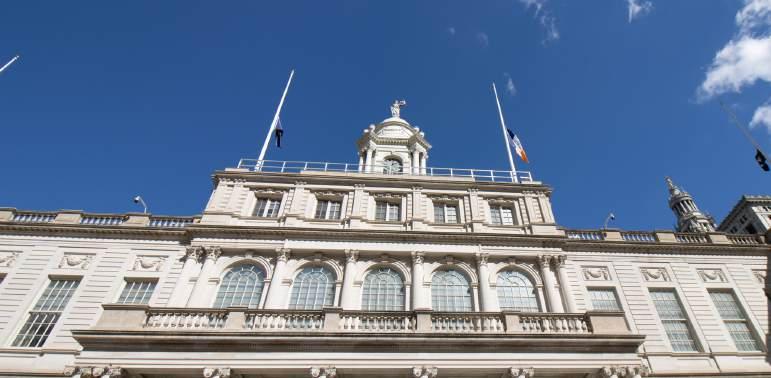
Zohran Mamdani is currently in the process of hiring his new transition team ahead of his Jan. 1 inauguration.
COURTESY OF YDSA
Fordham YDSA is an unofficial student club that has been active on campus since 2023.
FCLC’s Academic Program Budget Cuts
FCLC’s Honors Program and several humanities departments have both received financial restrictions
BUDGET CUTS from page 1
David Hernandez, senior director for budgets and planning for the School of Arts and Sciences, explained that decisions on the overall budget’s construction comes from the Office of Finance and then gets voted on by the Board of Trustees.
According to Hernandez, “(The Honors program) in LC had a 5% reduction in non personnel items. FAS did take a bigger cut. That is because, in part, FAS has a larger budget.” Hernandez also shared that the driving factor behind these budget cuts was to do with the university’s overall fiscal health.
Eric Bianchi, chair of the Art History and Music department, shared that the department have also had their budgets cut.
“Our (department) budget has been cut, in line (so far as I understand) with the cuts throughout the University,” Bianchi said.
“ We must take proactive steps to ensure financial stability without compromising the core mission of the University.”
The cuts to the Honors Program’s budget are part of what Bianchi characterized as a university-wide trend.
The FCLC Honors Program is a small cohort of students who are invited to join in their first year of study. Students receive their letter of acceptance to the program after being formally admitted into the university.
FCLC Honors students have a different set of core requirements than the traditional core. For example, the honors students’ art class is taught at the Metropolitan Museum of Art. They also take a two-part natural science course with a math component, rather than the usual requirement of one natural science and one physical science class.
The FCLC Honors Program is a small cohort of students who are invited to join in their first year of study. Students receive their letter of acceptance to the program after being formally admitted into the university.
When Grace Pak, FCLC ’27, got her invitation to the Honors Program, it helped her to finalize her decision to come to Fordham.
“Applying to Fordham was never really part of my plan,” Pak said. “I got the invitation to the Honors Program, and that’s what really drew me into seriously considering the school because it was a level of rigor that I felt I wanted out of my college experience.”
During a press conference with student reporters on Oct. 16, University President Tania Tetlow addressed questions emphasizing the importance of maintaining quality and expressed her goal of decreasing admissions

rate and improving selectivity. With recent donations towards artificial intelligence research and a new science, technology, engineering and math (STEM) building at Rose Hill, Fordham is investing in STEM to appeal to incoming students interested in such programs. Tetlow said that once Fordham’s STEM programs are more robust, the university may reconsider and instead work on recruiting larger first year classes.
“We do know that something students look to as they’re choosing a school is, ‘How selective is that school?’” Tetlow said. “In the future, as we’re able to build more facilities for STEM, that’s a moment when we might try to
grow the undergraduate population because we know that our applications in STEM are lower than what is typical.”
Tetlow clarified that the humanities will remain a priority for Fordham, which has always been a strength of the university.
“We’ve fallen behind in our investment in STEM, so we need to catch up. But where we can stand out is not becoming a STEM school. That’s not the goal here. It is where we can connect science and technology to our existing strengths — especially the humanities, but also, social sciences, the profession of law, business, and the rest — and so that’s where I think we can be cutting edge,” Tetlow said.
in financial aid, which is not the case.
“The decision to admit a student to the Honors Program is not in any way tied to a decision to offer the student financial aid,” Stein said. “If, for example, admission to the Honors Program came with a full tuition scholarship, it would be very easy to grow the program, and this is something that has been proposed but not something the university seems to be interested in. … It would also, I think, arguably impact things like retention. It would be very hard to walk away from that for many students.”
Tetlow clarified that the humanities will remain a priority for Fordham, which has always been a strength of the university.
At the presser, Tetlow said financial aid is of particular importance to Fordham’s administration, even as the university balances inflationary costs and budgetary constraints.
“Financial aid itself is the biggest priority of the budget, and we give huge amounts of it and so we’re constantly balancing that budget goal versus making sure we are treating the people who work here well and everything else we’re trying to achieve for students.”
Hernandez shared a similar testament to Tetlow, expressing that all the financial changes are made in order to benefit students.
“ We’re selective on the basis of grades and things. It’s actually not that easy to get into Fordham; students have to perform a lot in high school.”
Jordan Alexander Stein, Director of FCLC's
“There have been some changes throughout the University. All to try to mitigate the issues that Fordham and other universities are dealing with, during these times. We are all doing our part to make sure that it impacts students the least,” Hernandez said.
Stein, however, pointed out that, with the rise in tuition at Fordham and the recent budgetary cuts to academic programs, “it would be reasonable to wonder where the money is being allocated.”
Stein echoed Tetlow’s statements on Fordham’s selectivity, particularly with respect to the Honors Program.
“We’re selective on the basis of grades and things. It’s actually not that easy to get into Fordham; students have to perform a lot in high school. Because we have this 19-student cohort and students are taking all of the core classes together in the first year, we’re also sorting for people who we think are going to be team players who will benefit from being in that kind of an environment,” Stein said.
Stein also raised concerns about the misconceptions that admission to the Honors Program constitutes an increase
Stein detailed another misconception about the program that may be held by STEM students: Being a part of the Honors Program could create difficulties for them to fulfill their major requirements.
“We have working agreements with other majors and departments. Part of my job as the program director is to clean up and make sure that people’s honors requirements meet their major requirements,” Stein said.
As the university moves towards heightened selectivity and an increase to its STEM programs, budget cuts have targeted the humanities programs. Department chairs have not been privy to information, leaving the future of their programs unknown.
KEI SUGAE/THE OBSERVER
Jordan Alexander Stein, director of the FCLC Honors Program, says he was unaware of any cuts made to the program’s budget.
DURGA DESAI/THE OBSERVER
University President Tania Tetlow addressed questions relating to school budgets during a press conference with the student press.
Tokumbo Shobowale, Fordham's Chief Financial Officer
DURGA DESAI/THE OBSERVER
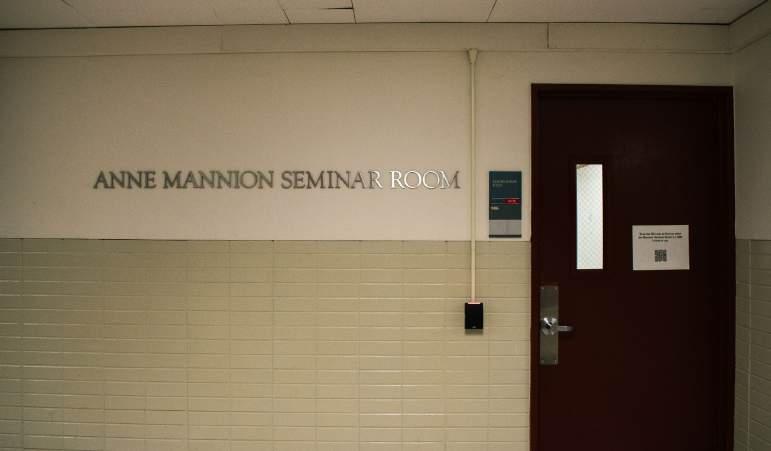
The Anne Mannion Seminar Room is located on the ninth floor of the Leon Lowenstein Building and is where the Honors cohorts meet for all of their classes.
Honors Program
FLC RAs and RFM Union Will be Voluntarily Recognized by Administration
OPEIU Local 153 will represent both campuses’ unions, and a new contract including FLC will be negotiated
Ephram Oliver, Fordham College at Lincoln Center ’26 and one of the members of the RA and RFM union organization committee, said that the voluntary recognition marks a change in Fordham’s attitude towards unions.
“Over time, Fordham has adjusted their response to unionization and I think that’s what we’re seeing with their choice to voluntarily recognize it instead of letting us go to an election, inevitably getting the same results, delaying, delaying,” Oliver said. “We can just go right into negotiations and be operating more in good faith.”
“ I’m looking forward to those cross-campus discussions, and also working more in an equal partnership with Fordham as a whole.”
Ephram Oliver, FCLC '26
In 2017, the unionization of Fordham non-tenure and adjunct faculty under the Service Employees International Union was recognized by the university after former University President Rev. Joseph M. McShane, S.J., stated
that the university would respect the results of an NLRB vote. The Fordham Graduate Student Workers Union, represented by the Communication Workers of America, was also ratified after winning an NLRB election in 2022.
As of July 2024, Wesleyan University was the first and only institution to voluntarily recognize its student RA union, as reported by The Nation. Fordham’s voluntary recognition of the FLC RA and RFM unionization would make it the second case in which a student residential worker union did not have to apply for an NLRB vote to gain recognition.
Edmonds attributed the FLC’s
success with recognition to the FRH RA Union’s negotiations.
“Fordham did not provide voluntary recognition for the RAs at Rose Hill. Throughout the negotiation process, the university negotiators recognized how professional the RA group was in bargaining their first contract. That helped us achieve voluntary recognition at L.C.,” Edmond said.
The Fordham Office of Human Resources’ website states that “Fordham has worked with unions for decades. We appreciate the opportunity to learn from our community and to reach agreements that are economically fair and appropriate for the University
community. Fordham respects and values our union employees and the role that unions play in representing them.”
Out of the 28 institutions that belong to the Association of Jesuit Colleges and Universities, only three have seen unionization efforts from residential life assistants: Boston College, Georgetown University and Fordham. Although the FRH RA Union was not voluntarily recognized, Fordham will become the first Jesuit institution to voluntarily recognize a student residential worker union with FLC.
Ram Café Swaps Burger Joints
Oliver spoke to how the FLC union joining the FRH union’s representation would “bridge the Rose Hill-Lincoln Center divide,” a problem that the university has sought to improve upon by instituting more inter-campus traditions during first-year student orientation.
“I’m really glad that we’re going to be joining the exact same representative union, OPEIU Local 153,” Oliver said. “I’m looking forward to those cross-campus discussions, and also working more in an equal partnership with Fordham as a whole.”
The next step for the Fordham RA Union will be bargaining with the university for a new, FLC-inclusive contract. Oliver believes a contract would help protect RAs and RFMs from unclear communication in terms of employment.
“People are so financially reliant on this job,” Oliver said. “We’re in more of a vulnerable position without the union. So I think, for me, the value of it comes in as being a sort of extra communication channel, where we can have some more accountability and negotiate the terms of our employment.”
The FRH RA Union’s negotiations started in May 2023, two months after the NLRB election was held in March. Based on that timeline, it is likely that negotiations for the FLC union will begin next semester.
This comes after Loyola Marymount University, a Jesuit university in California, invoked a religious exemption from the NLRB’s jurisdiction in September of this year, refusing to recognize its faculty union.
Lincoln Center’s Burgers + Fries dining option is projected to be replaced by Yella’s this spring
By SOPHIA STEPHAN Asst. News Editor
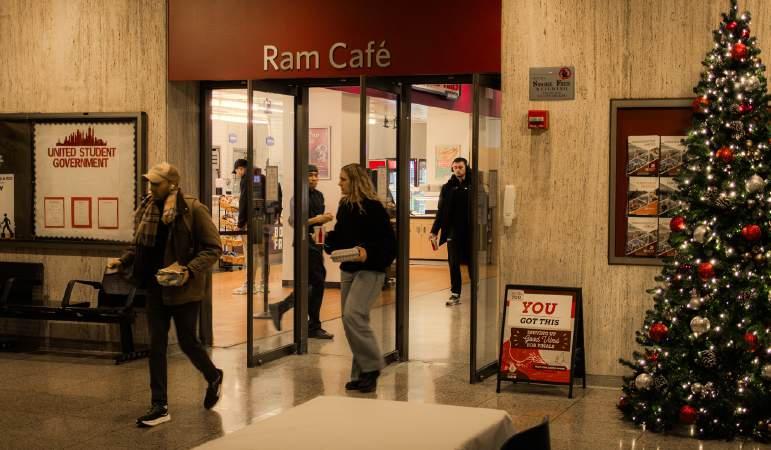
On Dec. 2, the Ram Hospitality newsletter announced that Fordham Lincoln Center’s (FLC) Ram Café, an on-campus dining facility, will be replacing Burgers + Fries with a Yella’s vendor. The change is scheduled for the spring and will feature similar cuisine.
Yella’s, a New Jersey-based chain, created its name and tagline, “Food Worth Screaming About,” in honor of its founder, Frank “Yella” Lorenzo, who was “always yelling and screaming to get people to the dance floor,” according to their website.
Yella’s food is currently served in almost 30 colleges and universities in the northeast. They offer students a variety of burgers, sandwiches, subs, sides and specialty hand-spun milkshakes.
According to Fitzsimons, Yella’s will provide a greater variety of menu options at comparable prices to Burgers + Fries, as well as combination meals that can be used with meal plans.
Orla Fitzsimons, director of Dining Business Operations and Contract Management, noted the popularity of Yella’s on many university campuses. She explained that the change is part
of Fordham’s “ongoing effort to modernize campus dining.”
“Bringing Yella’s to Ram Café allows us to offer students more variety and greater choice, while keeping favorites,” Fitzsimons said. “The changes reflect feedback from the student community about their dining preferences.”
Replacing the well-established Burgers + Fries with a new vendor has drawn mixed reactions from some students.
Seanna Sankar, Gabelli School of Business at Lincoln Center ’28, and Moneeza Saleem, Fordham College at Lincoln Center ’28, are both commuter students who often frequent Ram Café for a quick meal between classes. They both said they were curious as to the reasoning behind the switch.
“I just want to know how different it’s going to be because it’s bare minimum as it is,” Saleem said.
Ram Café is particularly popular among commuter students, according to Saleem and Sankar. Saleem said she is concerned about the possibility of higher prices at Yella’s. She cited having noticed an increase in the price of chicken tenders at Burgers + Fries from last semester, which she was “very mad about,” hence her concern about further changes.
Sankar also expressed a desire to know more about the pricing and quality of the new vendor, saying that she “just (doesn’t) know their process” for preparing food. As a student who does not eat beef, she also hopes that Yella’s will bring more diverse meats
or vegan options. Burgers + Fries offers a vegetarian burger option.
According to Fitzsimons, Yella’s will provide a greater variety of menu options at comparable prices to Burgers + Fries, as well as combination meals that can be used with meal plans. This change follows a larger trend of Fordham upgrading its dining facilities and technology this semester.
On the Rose Hill campus, students can now have their food delivered by seven Starship delivery robots located on campus, courtesy of GrubHub’s partnership with Starship. Through the GrubHub app, students can order a meal from an on-campus restaurant and a robot will deliver it to them anywhere on campus.
At FLC, Argo Tea was replaced
with Saxbys, which opened on Oct. 1. Fordham was forced to replace their Argo Tea trademark after the owner filed for planned bankruptcy in 2021.
Upon hearing that Saxbys would be completely student-run, several students expressed concerns about the future of the former Argo Tea workers. These worries were assuaged upon the university’s confirmation that the employees would remain on campus and be reassigned to another dining facility. Sankar’s first question upon hearing about the changes to Ram Café was if the same people at Burgers + Fries would be operating at Yella’s. Fitzsimons assured that “all Ram Hospitality employees currently employed will remain in the location.”
As the semester draws to a close, a few events and initiatives will temporarily lower dining prices and increase their accessibility on the FLC campus.
Every Wednesday until the end of the semester, the door rates at the all-you-can-eat Community Dining Hall will be reduced to $8 for anyone without a meal plan. Additionally, Ram Hospitality’s traditional Late Night Breakfast will be held on Monday, Dec. 15 at 10:30 p.m. in Ram Café.
Students can also donate unused guest meal swipes to students affected by food insecurity, as part of the Ram Hospitality and Campus Ministry’s “Rams for Rams” Challenge.
Fitzsimons stated that the Yella’s team will be on campus next week to offer giveaways and discounted samples of some of their menu items. More information will be posted in the Ram Hospitality’s newsletter and on their social media.
GRACE SANTOLI/THE OBSERVER
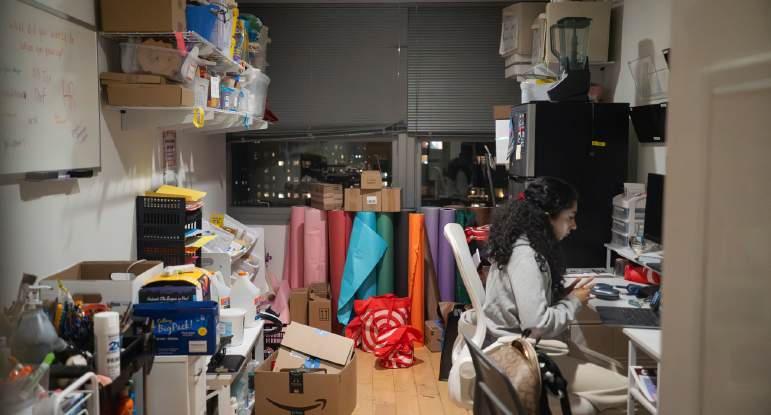
Fordham is the second institution to voluntarily recognize a student residential worker union.
LUCIEN FISCHER/THE OBSERVER
Ram Café’s new addition will be the first Yella’s to open in Manhattan.
Updates on USG’s Fall Semester Initiatives
Here is what you may have missed of Fordham Lincoln Center’s United Student Government’s programs from this semester
USG hosts elections each year for various positions. During the most recent, Daphne Mei, Fordham College at Lincoln Center (FCLC) ’26, ran unopposed for president and was elected. Due to a lack of other candidates, USG did not hold its usual presidential debate.
Following the election, all 11 seats on the executive board and the majority of senator positions were filled, an uptick from previous years, according to Mei. The election also brought with it the integration of a new executive board position: the head of the Media Relations Committee. The committee existed on an ad hoc basis last spring and was voted in by the USG Senate this fall. Mei said this reflects USG’s broader mission to connect more deeply with the student body and improve both internal and external communications.
To this end, USG has begun posting meeting minutes on Instagram for students who are unable to attend general meetings. They are also now hosting monthly “senator tablings,” during which students have the opportunity to voice their concerns to their class’s senator representative. The first, for first-year students, was held on Oct. 30. The next, for juniors and seniors, will be held on Dec. 4 at 11 a.m. in the Indoor Plaza. Additionally, USG is working on starting a town hall event next semester — in collaboration with the Residential Hall Association (RHA), Campus Activities Board (CAB) and Commuter Student Services (CSS) — for students to have an even more concentrated forum to vocalize their needs.
USG also fields requests from students outside of dedicated meetings. Around two months ago, Mei saw a Fordham student’s Instagram story explaining that, as a wheelchair user, they are unable to see their reflection in the Lowenstein Center’s bathroom mirrors, which are only half-length. So, USG reached out to Fordham’s Facilities, and fulllength mirrors were installed in the bathrooms on Nov. 13.
“(The student) didn’t say it in an angry way or an upset way. I think they just said it as, ‘LOL, this is so funny, I can’t use any of these mirrors,’ but I didn’t think it was funny,” Mei said. “I think it’s really upsetting knowing that this person experienced that.”
Mei said she hopes to continue further initiatives to make Fordham more accessible and compliant with the Americans with Disabilities Act.
USG also recently rebranded with a new logo and social media strategy, which coincidentally follows Fordham’s rebranding from this summer and shares a similar emphasis on a fresh, modern look to improve visibility. Their previous logo was only two years old, but according to Mei it had failed to leave an impression on students.
“I feel like a lot of people, like I said, don’t know what USG does or they don’t hear from USG that often. … (Students also) don’t recognize that logo as USG, so we wanted to do something that’s more modern,” Mei said.
USG is working on creating a new website in collaboration with the Media Agency Club (MAC), which they plan to launch in the spring. Mei said an added benefit of working with MAC is that, since the club is relatively new — formed in August 2024 — collaborating with USG helps shine a spotlight on it. The website will consolidate the paperwork necessary for current and aspiring club
leaders and display student proposals and proposal templates.
These changes reflect USG’s larger emphasis on efficiency and communication, which Mei said was lacking in prior years.
“I’ve seen that in previous years, it took forever to get anything done. I feel like it’s a lot of back and forth again with miscommunication (and) just lack of organization,” Mei said.
One specific instance of improvement is the aforementioned proposal template, created by USG’s Vice President Aleasha Wattoo, FCLC ’27. The template gives students a document to refer to if they have a specific initiative they’d like to bring to USG’s attention. USG proposals go through their advisor, the Office of Student Involvement (OSI) and Dean of Students Jenifer Campbell.
“Obviously, that’s a long flow of people that we have to go through. The idea behind (the template) was that we sort of mitigate that process by putting down a lot of the fiscal considerations for any proposals, what it looks like, who would overlook it, the preamble, why it’s necessary,” Wattoo said.
The website is also a necessary component of Ram Perks, a recent USG initiative focused on increasing student discounts for Fordham students. Ram Perks was proposed after the similar Fordham Friendly program went defunct due to the COVID-19 pandemic. USG’s treasurer and chair of the Facilities committee are spearheading the project by coordinating with senators to canvas through Hell’s Kitchen and the Upper West Side.
The members contacted local businesses to see if they would be interested in offering student discounts of 10 to 15%. USG hosted a walkathon for this purpose on Nov. 13 and 15, and is planning a “callathon.” Wattoo said the project is going very well and that their treasurer is looking into expanding it to provide job opportunities with the local businesses.
In addition to collaborating with MAC on the website, USG has prioritized highlighting and working with clubs this semester.
“We are currently in the process of finalizing a lot of these businesses, but we have a good portion that are really interested,” Wattoo said. “Actually, one of the business owners asked us, ‘Why don’t Fordham students work here? They should apply.’ And so I feel like Ram Perks isn’t just opening doors for obviously more customers for these businesses, but also student discounts and job opportunities with Fordham.”
Mei also noted that, while a wide range of businesses have been contacted, USG is screening all interested participants to ensure the businesses’ values are consistent with Fordham’s.
“We’re going to do background research to see if it aligns with our values,” Mei said. “We’re not just choosing any businesses.”
The businesses participating will be featured on USG’s new website, which provides an additional incentive for them to get involved, as it acts as a form of advertisement towards Fordham students.
In addition to collaborating with MAC on the website, USG has prioritized highlighting and working with clubs this semester.
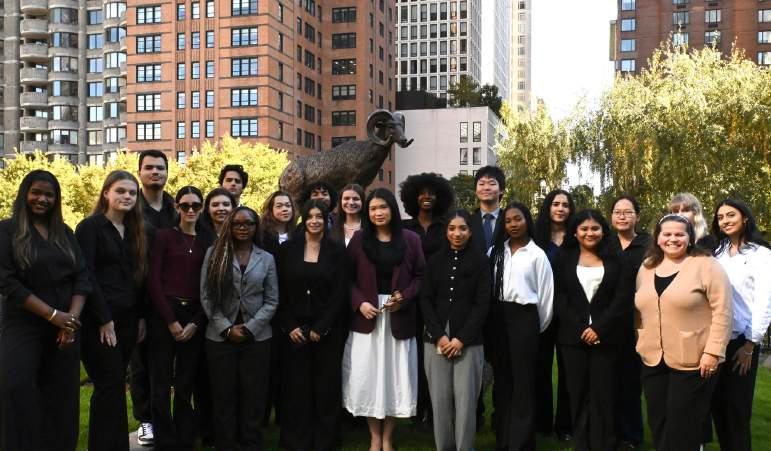
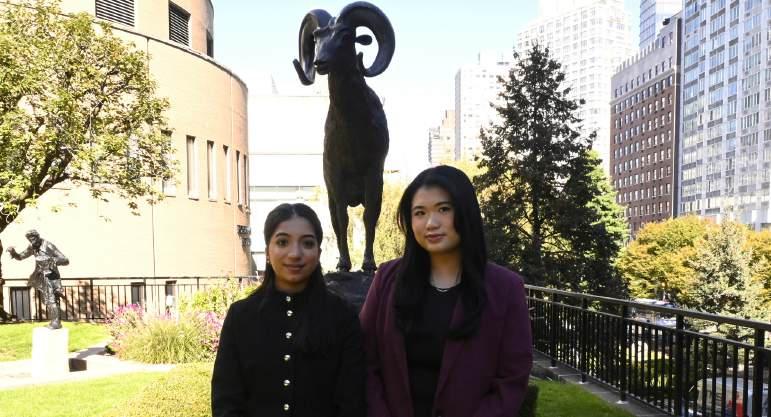
USG co-hosted a discussion panel on Oct. 22, offering advice on U.S. immigration policies and career guidance for students interested in immigration law, alongside two student organizations — the Immigration Advocacy Coalition and the Asian Pacific American Coalition. Mei and Wattoo said they are working on bringing back a networking dinner for club leaders, which dissolved after having to be conducted over Zoom during the pandemic.
USG is also coordinating with CSS and Counseling and Psychological Services to bring the Napping Pod to FLC, as there is one already present at Fordham Rose Hill. Due to budgetary constraints, the project is still pending approval. There is continued discussion over how to clean the pods, which would be done by stu dents, and where to place them, as FLC has limited space. Wattoo noted that the pods would particularly benefit commuter students — who make up around 40% of the Fordham student population — by providing more spaces for them to rest between classes.
Finally, USG works with Fordham’s administration in a number of ways. Last month the President’s Student Advisory Group — representatives from Rose Hill and Lincoln Center’s USG, the Graduate School of Social Work, the Graduate School of Arts and Sciences, the Fordham Law School, the School of Professional and Continuing Studies, and the Graduate School of Gabelli at Lincoln Center — met with University President Tania Tetlow. At the most recent meeting, USG raised their concerns about mirrors in the Lowenstein bathrooms. These meetings
usually occur each month but, as of this year, they are now once a semester.
USG also has four representatives on the FCLC College Council, all of whom have voting power. The council, which meets monthly, is presided over by Dean of Arts and Sciences Jessica Lang and made up of students, faculty and administrators. It oversees the process of adding or removing majors or minors, the ongoing restructuring of the core curriculum and other academic policy decisions. At the most recent meeting, the USG representatives discussed their perspectives on the core language, philosophy and theology requirements. They also expressed student concerns around Fordham not accepting very many advanced placement credits and the strict attendance policy (particularly with respect to mental health days).
Mei and Wattoo said they hope to see even closer collaboration between USG and administration, as the College Council meetings, and those with Tetlow, do not provide enough time to cover everything. They are looking forward to upcoming individual meetings with Lang.
“(Lang) actually did ask our student reps to talk to her individually and set up a meeting with her so she’ll know more about our student experience and not just hearing from the faculty members from the council meeting,” Mei said. “Like I said, those meetings (with administration) are usually an hour or an hour 15, so not enough time.”
This summer, USG worked alongside the Office of Multicultural Affairs (OMA) to establish a First-Generation Committee.
The First-Generation Network, an earlier iteration of the same concept, dissolved in 2024. The network was run with the volunteer contributions of students and two deans, who no longer had enough time.
“I really wanted to make sure that this committee is recognized by an official office, which is the Office of Multicultural Affairs, and making sure that we have the funding and that it will never go defunct because we will always have staff members’ help,” Mei said.
The First-Generation Committee plans events and is hoping to establish a first-generation graduation event. The OMA holds graduation ceremonies for each of their specific committees already; One has not yet been added for the First-Generation Committee because it is so new.
USG will meet with the Office of External Affairs on Dec. 8 to discuss creating a Metropolitan Transportation Authority (MTA) college student discount, in light of recent fare hikes. The proposed project would initially focus on only Fordham students.
“(The idea) was inspired by high schools in New York City where apparently all the high schools in New York City kind of work together to pull in some money and then pay the MTA to give discounts to high school students. We want to do something similar with that, but knowing that there are so many universities in New York City … we wanted to start it with just Fordham,” Mei said.
USG will continue to provide updates on the progress of their various projects through their newsletter and via
social media.
COURTESY OF USG
USG consists of an executive board and senators who coordinate all of its programs and committees.
COURTESY OF USG
Daphne Mei, FCLC ’26, is USG’s president for this year, and Aleasha Wattoo, FCLC ’27, is currently serving as vice president.

Poetry and Psychoanalysis: Incomplete (Re)Presentation
The many prisms through which we view the world and our selves in it beg for closer examination
B y JACK BRUDECKI Fact Checker
I begin this piece with the assumption that there have been — and will continue to be — countless attempts by individuals to understand themselves and how they relate to others. More precisely, I believe that humans have taken extraordinary efforts to represent themselves to the world and the world for themselves. Among these approaches to representation — of the self and of the other, of the interior and of the exterior — I would like to place two rather nebulous categories: psychoanalysis and poetry.
Broadly speaking, the story of psychoanalysis begins with Austrian neurologist Sigmund Freud, who is often described as being the intellectual movement’s “founder.” In their 2023 paper “An Introduction and Brief Overview of Psychoanalysis,” psychiatrists Martin Tarzian and Mariana Ndiro, along with cellular biologist Adegbenro O. Fakoya, write that Freud’s most revolutionary ideas were made manifest through his book with fellow physician Josef Breuer, “Studies in Hysteria.” Tarzian et al. write that it was in this collaboration that “Freud finally derived his groundbreaking theory about ‘The Unconscious,’ proposing that repressed memories and desires influence behavioral and emotional states.”
Also to be noted among Freud’s ideas is his tripartite model of the mind; in his view, the mind is solely composed of the id, ego and superego. Tarzian et al. write that, according to Freud, the id is “the source of our unconscious thoughts and wishes and operates on the principle of immediate gratification,” while the ego “serves as the rational and conscious aspect of the psyche, acting as a mediator between the id’s demands and the realities of the external world.” A touch more slippery to define, Freud’s superego “symbolizes the internalization of societal norms and values,” and is somewhat analogous to a conscience. Setting aside the specifics, Freud’s assertions regarding the structure of the mind are incredibly ambitious: He attempts to reduce — and subsequently represent — all mental experience into three, finely divided components. It is on this task — that of representing experience into a well-structured entity that we may more easily come to grips with— that I wish to focus on in this piece.
I argue that contemporary poetry, in general, concerns itself with this very same quest. In an article published in Poetry Magazine, American poet and essayist Tony Hoagland examines the growing resistance to conventional narrative in contemporary poetry.
“Not only is organized narration considered inadequate to contemporary experience, its use is felt by some to be oppressive, over-controlling, ‘suspiciously authoritarian,’” Hoagland writes. “Because narrative imposes a story upon experience, because— the argument goes—that story implicitly presents itself as the whole story, some readers object to the smugness and presumption of narration.”
This narrative nausea of form and content is best experienced through reading the works themselves. Hoagland centers his essay around Mark Halliday’s “Couples” and Matthea Harvey’s “First Person Fabulous”; I have choices of my own.
Chris Forhan’s “Atonal Breakdown” laments the loss dealt by cognition. He writes of the troubles that subjectivity brings on account of its endless answer-seeking. The motif “I was born happy, not knowing about what” is repeated throughout the poem. Forhan’s inarticulable topos is best summed up through his own stanzas; he writes “flowers — nasturtium, / delphinium, whatever, so sweet, so strange — / when did I begin to see them / as silent accusations against me?”
Flowers cease to be “flowers” — they are entities unable to be grasped fully by the subject. A similar notion is explored by Erika L. Sánchez in her poem “Memories of No Consequence.” Sánchez puts forth images related only by their placement in this work. No link is forged in the poem itself — this task is left to the reader. This presentation, or representation, of the poem’s “raw material” — of the poet’s (almost) unmediated experience — mirrors our own experience of everyday life; meaning is not obvious, let alone graspable in the present.
Articulating this idea more explicitly is “Map” by Polish poet and Nobel Prize winner Wisława Szymborska. Szymborska describes the sensation of looking at a map on a table — a representation that contrarily hides more than it shows.
“I like maps, because they lie. / Because they give no access to the vicious truth,” she writes. “Because great-heartedly, good-naturedly / they spread before me a world / not of this world.”
I find that this crisis of complete representation is equally present in disagreements between different psychoanalytic theories. Returning to Freud, his splitting of the mind into three completely distinct components is one of the most heavily disputed of his ideas. Even Freud’s own students, in the period immediately following his groundbreaking work in the early 20th century, developed models that contrasted greatly with his original ideas.
Swiss psychoanalyst Carl Jung partitioned the mind into three different components: the conscious, that of which we are immediately aware; the personal unconscious which includes our memories, emotions and all that we as individuals have experienced, but are not necessarily actively thinking about; and the collective unconscious. Jung’s collective unconscious posits a shared well of symbols and images that are common to all humans. This model differs greatly from Freud’s emphasis on psychosexual development, instead placing an emphasis on various archetypes in lieu of familial dynamics.
Tarzian et al. summarize Karen Horney’s challenges to the Freudian model, writing that “Horney believed that cultural and societal factors played a significant role in shaping personality, whereas Freud’s psychoanalytic theory focused primarily on the individual psyche.” Horney focused particularly on the role of “basic anxiety,” which she describes as “the feeling a child has of being isolated and helpless in a potentially hostile world.”
Psychoanalytic theories have only grown more diverse following the generation of Freud’s immediate students. Jacques Lacan focuses on the relation between the self and other, with philosopher Adrian Johnston noting in the Stanford Encyclopedia of Philosophy that Lacan
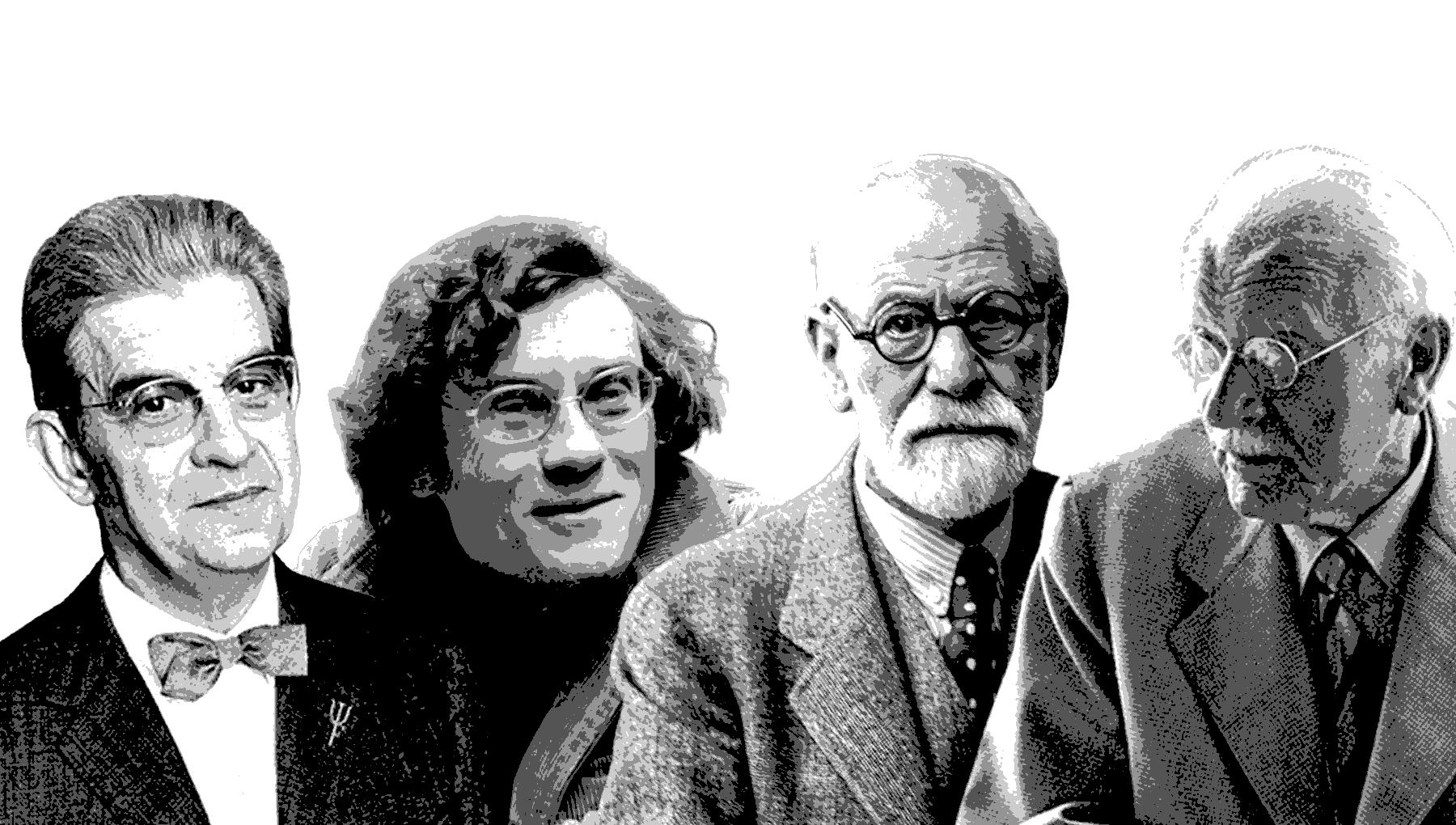
believed “that the imagistic nucleus of the ego is suffused from the get-go with the destinal ‘discourse of the Other.’” Put simply, the ways in which we view ourselves are always shaped by the ways in which others view us.
Johnston also highlights the importance of Lacan’s seminars in the development of psychoanalysis in the latter half of the 20th century. He writes that “from 1964 onwards, Lacan’s audience startlingly increased in both sheer numbers and breadth of backgrounds, with artists and academics from various disciplines across academia joining the more clinically-minded attendees.”
“In his seminars, Lacan deftly maneuvered within and between a multitude of theoretical currents, putting psychoanalysis into conversation with the history of philosophy, phenomenology, existentialism, structuralism, post-structuralism, feminism, and, as already indicated, just about every discipline represented in the university,” Johnston says.
Striding in a different direction is the work of fellow French psychoanalyst Felix Guattari. Continuing the chain of former students breaking away from the assumptions of their teachers, Guattari places social relations at the heart of psychic development. In an introduction to Guattari’s posthumously published book “Psychoanalysis and Transversality: Texts and Interviews 1955-1971,” philosopher and collaborator Giles Deleuze writes that “Guattari early on had the intuition that the unconscious is directly related to a whole social field, both economic and
political rather than the mythical and familial grid traditionally deployed by psychoanalysis.” Indeed, the speed at which daily life now moves has blurred — daresay annihilated — the barrier between the personal and public.
Drawing on this description, I turn back to poetry and its representation of the self — and by virtue of this, all that is not encompassed by the self. Like the thinkers alongside Freud and Lacan, the poets featured in Hoagland’s article and those I selected above are not without predecessors nor contemporaries.
I first think of Donald Allen’s landmark anthology “The New American Poetry: 1945-1960,” mainly with reference to the section covering poets of the Black Mountain School. Named for the college from which the principle figures in the movement hailed, the Black Mountain School likewise prioritizes the individual’s wading through the world above all else, seeking to present the world without “the lyrical interference of the individual as ego, of the ‘subject’ and his soul,” writes Black Mountain poet Charles Olson in his manifesto “Projective Verse.”
Among the selections of Allen’s anthology is “The Third Dimension” by American poet Denise Levertov, wherein she describes the disconnection between her subjective experience and the ability to convey it. Her work begins with the yearning “Who’d believe me if / I said ‘They took and / split me open from / scalp to crotch, and / still I’m alive.” Levertov grieves the impossibility of true one-to-one communication,
lamenting that “Honesty / isn’t so simple: / a simple honesty is / nothing but a lie.”
Honesty — clarity in truthtelling — exists imprecisely for Levertov; there is only so much that can be conveyed from one self to another. Returning to the road I first set out on in this piece, I believe the (nearly) overwhelming diversity of psychoanalytic theories and models — along with the personal struggles to apprehend lived experience as articulated by the countless poems and other works of storytelling — is a site where we gain insight into the manifold nature of knowing ourselves. In other words, the innumerable models of knowing the world — including those not covered here like sociology and cultural anthropology, religions and other modes of spirituality, and varied political structures — point to the personal, individualized nature of what it means to live as an individual, as a subject.
Grappling with this information in its totality, I believe this exercise in enumeration sheds light on the nearly infinite diversity of belief structures there are in the world. Though I have only presented a few — and only on their very surfaces respectively — I presume that continually tapping into and exploring varying — and even contradictory — ideas is an important part of maintaining one’s mental well-being. For every individual bit of information that is represented in words, poetry, images and beyond, there is a counterpart that is buried and hidden. Only through embracing this infinitude may we come close to a lasting mental comfort.
KAITLYN SQUYRES/THE OBSERVER
Busts of Psychoanalysts: Psychoanalysis as an intellectual field is incredibly cosmopolitan and interdisciplinary, allowing thinkers to draw on many different ideas.
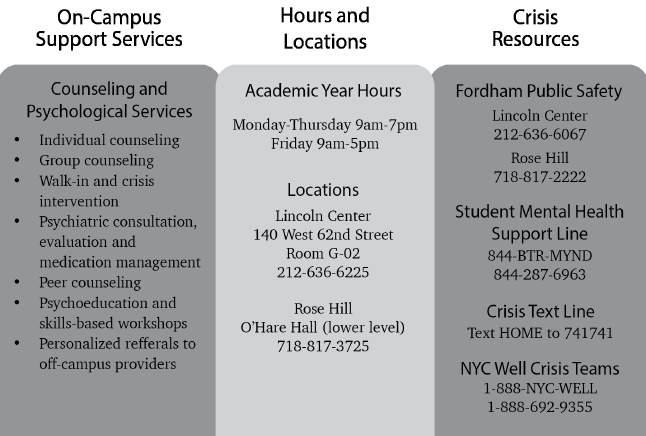
Mental health info: Adding to this approach, one can also pursue dialogue in individual therapy or other talk therapy activities.
By LARA POPOVIC
Copy Editor
Plant Power for Conscious Gains
Plant-based diets help reduce cancer risks and enhance athletic performance
With gym culture on the rise, diets are starting to overwhelmingly consist of chicken, eggs, Greek yogurt and protein powder. However, society’s growing protein craze doesn’t seem to question the expenses that come with building up muscle, whether that be for beauty, hobby or career purposes.
Eating a plant-based diet is not only better for the Earth as it utilizes less water, produces fewer greenhouse gases and boycotts the cruelty of the factory farming industry, it’s also far healthier for your body.
When most people hear the words “plant-based,” they often think of veganism or vegetarianism. However, this is not entirely true. Although both are considered plant-based diets, one does not have to fully omit animal-based products to eat plantbased — their diet simply must consist mainly of plants.
While many assume an athlete can’t get all their protein while being plant-based, this is false as protein from meat originates from plants animals once ate. Science shows that early humans ate mostly plants and that our long digestive tracks and flat, square teeth are designed for breaking them down.
Plant-based protein is packed with antioxidants, phytochemicals, minerals and vitamins that optimize blood supply and your gut biome, ultimately reducing inflammation and enhancing overall body performance. Meanwhile, animal proteins change the bacterial biome living in the gut, causing

Until the 1800s, plant-based diets were known as Pythagorean diets after Greek philosopher Pythagoras, who emphasized the ethical and health benefits of a vegetarian diet.
bacteria to produce inflammatory mediators that increase soreness and delay athlete recovery.
Aside from plant-based diets maintaining body weight and reducing cortisol production, swollenness, soreness and leading to a more speedy recovery for athletes, they also improve blood pressure and cholesterol, along with helping the immune system fight off infections.
In the U.S., among the leading causes of death are heart disease, cancer, stroke and diabetes. Animal product consumption can lead to the development of cancer, along with plaques in the coronary arteries that block blood flow, causing heart problems.
Eating a plant-based diet reduces the risk of heart disease, high
blood pressure, high cholesterol, diabetes, stroke and obesity.
Many global pro athletes are plant-based — Novak Djokovic, Venus Williams and Nate Diaz — with their diet being one of the contributing factors to their success.
Emma Ito, Fordham College at Lincoln Center ’26, is a gym enthusiast, a former combat sports athlete and vegan who loves cooking her own food. “I have also come to enjoy eating healthier as a byproduct of being vegan … I don’t crave junk food as much as I think a normal person would … which translates to performing better and recovering better,” Ito said.
Common sources of plantbased protein are: soy, legumes, nuts/seeds and whole grains. Soy
products include tofu, edamame and tempeh; legumes include peas, lentils and beans; nut and seed products include nut butters, flax seeds, pumpkin seeds and assorted nuts; while whole grains include quinoa and oats. Protein gathered from cow milk can be derived from protein plant milk options. And for athletes who are obsessed with protein powder, plant-based options exist, too. Ito says her favorite source of plant-based protein is “tofu just because it’s so easy … I make pasta sauces with silken tofu … I eat lentils, textured vegetable protein, soy curls. Chinese grocery stores have a lot of vegan alternative meats that are dried and you rehydrate them so I eat those and I make a lot of seitan with vital
wheat gluten because that’s a crazy amount of protein.”
Despite B12 deficiency turning many off plant-based diets, most people, meat-eating or not, are deficient in B12. In animals, optimal B12 production is only natural in the wild, when animals can consume B12-producing bacteria found in soil. In factory farming, animals are kept in unnatural conditions in which the only way they can get satisfactory B12 is through supplements. For people of all diets, the best source of B12 would be from supplements, but it can also be found in certain plant-based sources such as purple laver and mushrooms.
Others, especially male athletes, are concerned about estrogen levels in soy, along with its effects on testosterone levels. However, studies show that eating soy does not deplete testosterone levels. Soy contains naturally occurring plant estrogens known as phytoestrogen that act differently than real estrogen, which is found in meat and dairy products, along with other added hormones.
At Fordham’s Lincoln Center campus, Saxbys offers Just Egg burritos, along with Cold-Brew Fit Frolattes and Matcha Fit Frolattes, both fueled with 22 grams of plant-based protein. At Fordham’s Rose Hill campus, Marketplace’s Turmeric Tofu Scramble contains 22 grams of protein.
While it may be hard for many to make the full switch to eating a plant-based diet, you can always start by slowly replacing animal-based products with plant ones, finding a middle ground that prioritizes your body, the Earth and all sentient beings.
Water Polo Takes Fifth Consecutive Conference Title
The Rams advance to the NCAA championship quarterfinals as the fourth-seeded team in the tournament
The close of the 2024 season saw eight players graduate. Luca Silvestri, Gabelli Graduate School of Business (GGSB) ’26, was one of those seniors before he committed to playing a fifth year of eligibility. He leads the team as one of three captains and was named the MVP of the MAWPC championship game after scoring three times, with seven overall goals in the tournament.
The 2025 season welcomed a young team with a new batch of players, approximately the same amount as the departed group from the previous season.
“These new guys, since the first moment, they were willing to work hard to step into our culture,” Silvestri said.
As the MAWPC All-Conference Team was announced, Fordham’s younger players led the charge. Second-year player Andras Toth, Gabelli School of Business at Rose Hill (GSBRH) ’28, was named MAWPC Most Valuable Player; Alessandro Salipante, GSBRH ’29, earned the MAWPC Rookie of the Year award and Luca Provenziani, Fordham College at Rose Hill ’28, earned First Team honors alongside Toth.
Bacharach’s own name was featured alongside his players. He was awarded Coach of the Year for the fifth consecutive season.
“I recruit talent and I’ve done that since the day I started getting involved in recruiting here. I want as much talent on my roster as I possibly can get,” Bacharach said. “Some coaches recruit what I would call fit for their system … to fit their style that they like to play. I’ve never been that type of coach. … I just want to bring in as much
talent as I can and try to fit and mold that group into what maximizes their strengths and minimizes their weaknesses.”
Silvestri attributes their success as a team to the players’ diverse origins.
Bacharach has recruited an overwhelmingly international roster, with most players hailing from outside the United States.
Silvestri, Salipante and Provenziani are three of the team’s five Italian players, while Toth is one of four players from Hungary. Others come from Malta, South Africa, Germany and Greece — a global market that Silvestri believes strengthens the team’s chemistry and performance.
“Every country, in terms of water polo playing style, has a specific characteristic that is basically the strength of that country,” Silvestri said. “If you put all these cultures together, the final result is going to be a team with different strengths and not only one strength. Our coaching staff has done a great job in the past year and is doing a great job this year to pull all these strengths together.”
Minimizing weaknesses is the next step following the conference championship, according to Bacharach.
“I know we’re talented, I know we’ve got the ability to do it, but you never know what’s going
to happen until you get into it,” Bacharach said. “We didn’t play our absolute best, especially on the offensive end. We made a lot of mistakes that were kind of uncharacteristic of us.”
Bacharach credited the small group of seniors for stabilizing the playing field for the team.
“Those guys settled things,” Bacharach said.
The Rams find themselves in the same position they were last year: headed to the quarterfinals to play against a great team. San Jose State University has one of the best defenses, but the Rams’ striking offense, however challenging, has the capability to counteract it, Bacharach said.
The Rams are familiar with the Spartans’ playing style, having closely beaten them earlier in the season with a tie-breaking goal by Toth in the final two minutes of the game. As the Rams prepare for another close match-up, Bacharach said their focus extends beyond physical play.
“A lot of it’s going to be about emotions, too. I could see the nerves in our guys when we were playing in this conference championship, especially our young guys,” Bacharach said. “So to me, just talking about that and not becoming overcome by the moment. If you do make a mistake, moving on from it and allowing yourself to have those nerves and to ultimately fight through it and be stronger on the other side as a result of it.”
In the event that the Rams advance to the semifinals, they will be in another familiar spot in the semifinals: facing off against the University of Southern California Trojans. The Rams lost to the West Coast powerhouse in the 2024 NCAA championship semifinals in overtime. The Trojans currently stand as the number one seed in the 2025 tournament.
“We have a goal of winning a national championship and doing that from the East Coast, in our sport, has never been done,” Bacharach said.
A position in the NCAA championship finals would be the first for any water polo team outside of California. The Rams enter the tournament with a 25-3 overall record.
The NCAA Water Polo Championship tournament will take place at Stanford University from Dec. 5 to 7.
GIANA VISCONTI/THE OBSERVER
COURTESY OF FORDHAM ATHLETICS
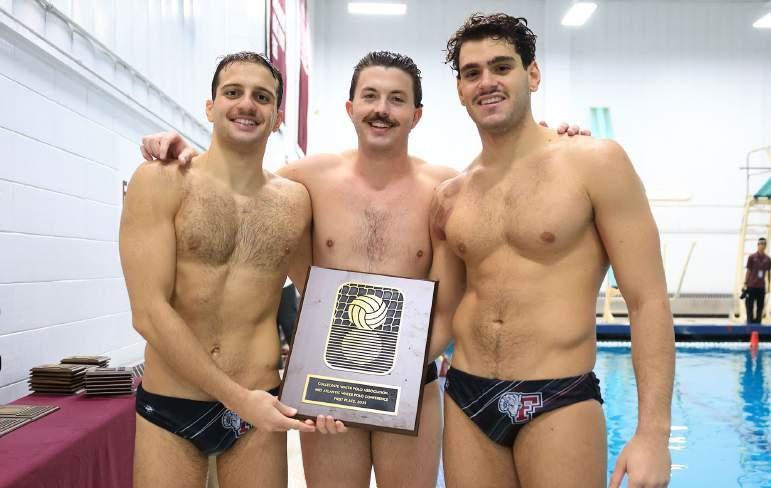
From left to right: Luca Provenziani, Brendan Cassidy and Luca Silvestri are the 2025 Water Polo captains.
WATER POLO from page 1

Where’s a Nice Meal on Thanksgiving Day?
A photographer’s exploration into the meals worthy to celebrate a holiday centered on gratitude


By KEI SUGAE Creative Director
What is a good Thanksgiving without a plentiful meal? The American holiday of Thanksgiving is a day of gratitude towards those in our lives and communities; that gratitude is often mediated by a hearty meal. The holiday’s origins lie in giving thanks for the harvest that the early pilgrims were able to achieve after colonizing and settling in what is now the United States. While there is controversy behind the colonial origins of the holiday, it is still celebrated across the U.S., grounded in its connection to food.
The traditional meal of turkey, mashed potatoes, stuffing and pumpkin pie, usually accompanied by a variety of other foods such as roasted vegetables, green beans, mac and cheese or rolls, is typically shared among families and friends. In recent years, the concept of a “Friendsgiving” has become very popular, where a group of friends will gather to prepare a similar meal in the form of a potluck.
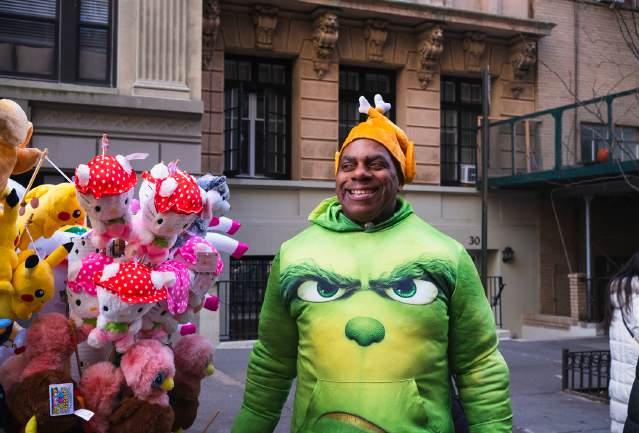
In New York City, the holiday has another layer to it: the Macy’s Thanksgiving Day Parade. It is broadcast nationwide, but in the city where the parade actually takes place, many people go out to see the variety of inflated balloons and various floats that travel from Central Park West and down 6th Ave, all the way to the Macy’s on 34th street next to Harold Square. Many spectators bring out stepstools and children sit on their parents’ shoulders to get a glimpse of their favorite characters, larger than life, floating down Manhattan streets.

And for such an occasion, there must be a way to get some good food in the city to celebrate, even if you are not participating in a family dinner or a Friendsgiving potluck. But on a day when many stores are closed and supermarkets are on reduced hours, what options does one have to get a good meal in this city?

One easy option, if you want to eat at home, is taking a trip to the supermarket in the morning and checking out their hot bar. Whole Foods, in particular, has many of the classic dishes on top of their usual selection. Turkey, mac and cheese, and mashed potatoes are all available, and individual pieces of pumpkin pie, as well as whole pies, are also sold. However, due to its popularity, they tend to run low, but if you are alright trading out birds, they always have their rotisserie chicken for only $8.99.


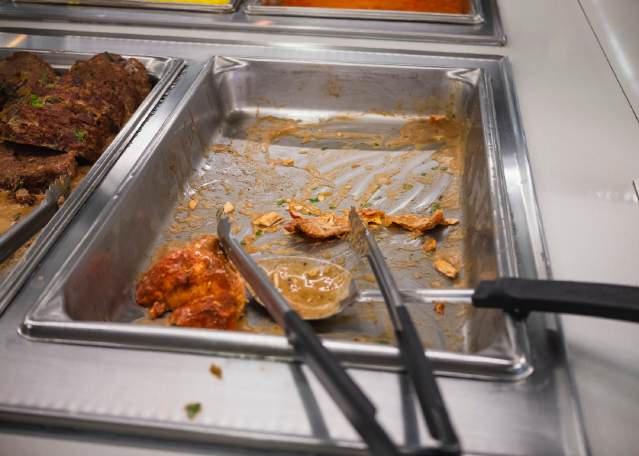
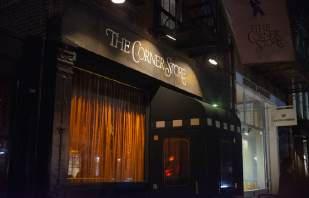
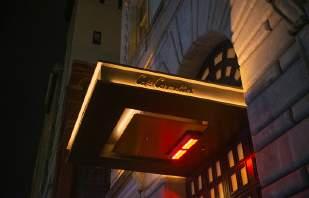
But of course, it’s Thanksgiving, and most people look for a hearty dinner; considering Whole Foods closes at 1 p.m. on Thanksgiving day, it might not be the most convenient option. Luckily, while many restaurants close for the holiday, others take the opportunity to stay open and serve a Thanksgiving dinner.
Many restaurants have special menus just for Thanksgiving when they serve many dishes of the classic holiday dinner. Popular restaurant chain The Smith offered a Thanksgiving meal at their establishments for the price of $88 per person. Other restaurants such as Café Carmellini, The Corner Store and Altair offered Thanksgiving meals, according to an article from Eater.
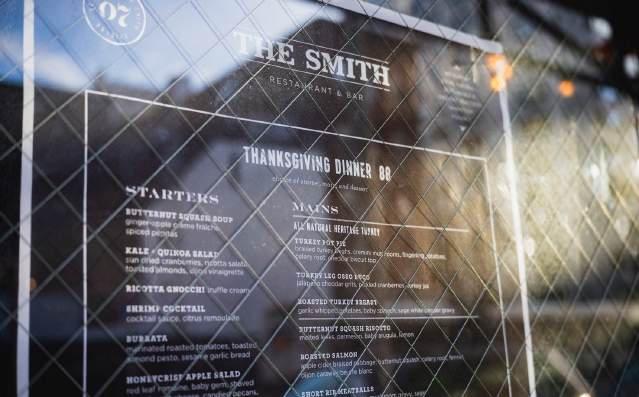
One issue with all of these meals, however, is the price tag. Most of these restaurants had prices above that of The Smith, and many even in the $200 range. Walking around, there were some places with prices that were not as high as these fine dining establishments, but there was very little to be seen under the $40 range. The Westway Diner in Hell’s Kitchen also had a Thanksgiving meal on their menu, but it came at a cost of $42.99, which is not bad comparatively speaking, but nonetheless comes at a barrier for many people who are on a tight budget.


For college students who couldn’t fly home or people who just ended up spending Thanksgiving alone in the city, these prices may be way out of the range of affordability. When the city is facing an affordability crisis, is it possible to find a way to enjoy a meal out without breaking the bank?
Well, while all of America celebrated Thanksgiving, there were many communities who did not partake as seriously. Immigrants, people from international backgrounds and people whose families don’t have the cultural connection to Thanksgiving, might not celebrate as heavily or with the usual traditions. Those who are traveling or working and find themselves in a random city alone on Thanksgiving might also not want to figure out a usual Thanksgiving meal. Chinatown, in Lower Manhattan, had a plethora of restaurants open and continuing to serve affordable meals for those who didn’t mind skipping the traditional turkey and cranberry sauce.
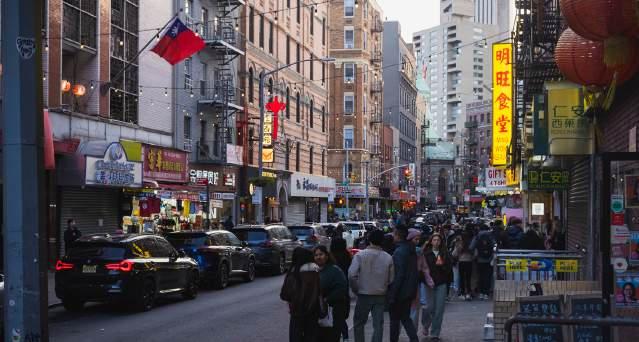
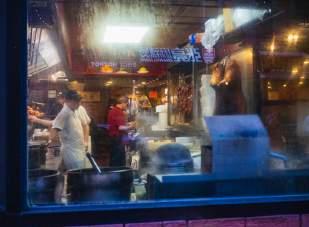


Many popular (typically cash only) establishments such as North Dumpling, Fried Dumpling and 1915 Lanzhou Hand Pulled Noodles & Dumplings were operating business as usual with lines out the door. It may not be your typical Thanksgiving dinner, but compared to the prices one has to pay for a typical Thanksgiving meal, it all becomes worth it. At North Dumpling, their pan fried dumplings — which come in a batch of 10 — are only $4, and their signature chive pancakes were only $3.
However, for many in the city, even that can be out of reach. For those who are less fortunate and are without means to pay for food, there were several places in the city providing free Thanksgiving meals.
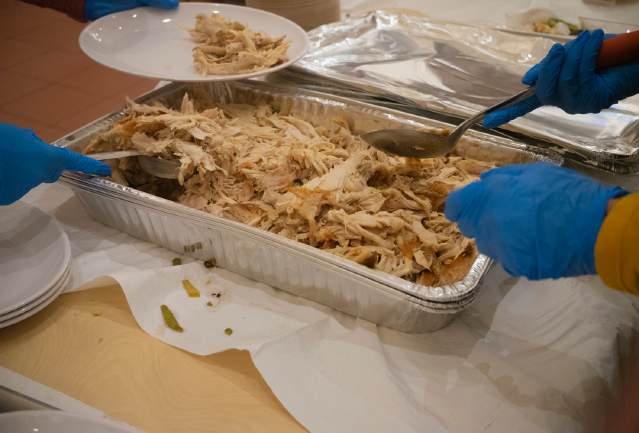
One of the oldest food drives in the city is the Bowery Mission which has been in operation at 227 Bowery since the 1870s. Their operation was well organized with both indoor and outdoor seating options, many volunteers and even hired security personnel were on site.
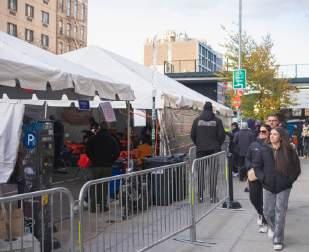
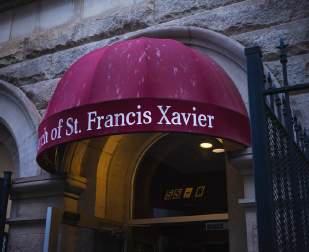
Among other food drives in the city were Xavier Mission on 15th Street, serving food from 12 p.m. to 2 p.m. The Church of the Holy Apostle on 9th Ave also had a food drive serving from 10:30 a.m. to 12:30 p.m. on both Thanksgiving and the following Friday. On Thanksgiving, despite their operating hours, by 12 p.m., they had already distributed all their food and had begun cleaning up. The food drives at these various locations were supported by many volunteers from the community, who perhaps embodied the spirit of giving the best of all.


In Defense of the All-Nighter
Sacrificing

I have spent more sleepless nights writing essays and crafting projects from thin air than I’d like to admit. I’m often stationed at my desk for these marathons, but by nature of their irregularity, I also pull them off in unexpected places — on the floor of other people’s bedrooms, in deserted McMahon lounges and at airport gates. I once came home from a night out and wrote until dawn, listening to my friends snore.
Many college students pull all-nighters, but most would not recommend them. They shudder when the topic comes up, like the phantom of their exhaustion has chilled the air. I know someone who believes that all-nighters make you sick and cautioned me against them, much like a parent telling their child not to go outside with wet hair.
I can’t dispute the medical facts: Sleep deprivation in young people is linked to poor mood, impulsivity, inability to self-regulate and high stress, all of which are symptoms I have consistently exhibited since the age of 13. In the past three years, what I believe to be new side effects have infiltrated my actual dream state — I now experience sleep paralysis, lucid dreaming and auditory hallucinations while barely conscious on a semi-regular basis.
Despite this, I have no scruples with all-nighters. Maybe they aren’t what the doctor ordered, but I recommend them anyway. In fact, I believe that all-nighters benefit the human spirit, even if they harm the body.
In the age of the attention economy, all-nighters are an endurance test we need. Social media use has drastically reduced our attention spans, with platforms like TikTok and Instagram supplying endless feeds of short-form content to keep users engaged. The resulting overstimulation and burnout are often mentioned in the context of students’ declining academic performance and fears of a “post-literate” society.
It seems that people are less inclined than ever to sit with their thoughts in silence and solitude. They struggle to read whole books and watch movies without checking their phones, much less devote extended periods of time to homework. I see a connection between this trend and an overreliance on artificial intelligence (AI), which has come to dominate public discourse concerning the future of labor and education.
Admittedly, it has never been easier to be a lazy student. I could make ChatGPT do my dirty work and be in bed by 8 p.m. We have all the performance-enhancing technology we need to subvert the challenge all-nighters once posed. If we wanted, we could abandon the practice completely, and shirk the consequences of procrastinating forever. The question is: should we?
I encourage fellow slackers to dig deep instead. Endure the full weight of your commitment and make original work, even if you have to sacrifice some shut-eye. Reclaiming time and focus proves that human willpower can conquer technology that has exploited our mental bandwidth for profit. I think of it as an act of protest — one that can feel radically freeing.
When thinking about intense endurance tests, consider the performance artist Tehching Hsieh, whose durational works pushed the limits of the mind and body.
Hsieh subjected himself to sleep deprivation for his “One Year Performance 1980-1981 (Time Clock Piece),” in which he punched a timesheet on the hour, every hour, for one year straight. During the artist’s infamous “One Year Performance 1978-1979 (Cage Piece),” he lived in a locked 9-by-11.5-foot cage with only a bed, basin, pail and lightbulb. He did not read, write or speak to anyone for the entire year. One of his friends visited daily to deliver meals and remove his waste.


All-nighters don’t physically compare to those situations, of course. But they do echo the unnaturalness of Hsieh’s endeavors. When working through the night, your objectives are simple: resist sleep, finish the task. You must do this in relatively stationary isolation and defy normal functions of human life.
Like Hsieh, you are the artist and prisoner of an undertaking that many would never voluntarily choose. Critics dismissed Hsieh’s work as pointless acts of spectacle. They couldn’t make sense of his perspective — that of an outsider with little knowledge of or interest in other artists, who seemed to suffer for suffering’s sake.
My friends and family object to my procrastination and self-induced doom spirals with similar exasperation. Why can’t I pace myself? Have I tried the Pomodoro Technique? Wouldn’t moderating my extreme habits save me a whole lot of grief? These questions bob to the surface during my all-nighters, usually when I feel like I can barely hold my head above water.
Their skepticism is valid. I wouldn’t be writing this if it had changed my behavior, though. I accept that sleepless nights are an inevitable outcome of the way I work — at least for now. (I will come clean and tell you that I started this article during an all-nighter I pulled to write a history paper. It’s helpless.) That is why I feel compelled to mount a defense and to search for a silver lining.
For that, I return to Hsieh. His work granted him a level of control and sovereignty that he said was liberating.
“Doing life and doing art is all the same — doing time,” Hsieh said in an interview for Randian. “The difference is that, in art, you have a form. This approach gives me freedom.”
I argue that an all-nighter can do the same for you, if you approach it like Hsieh would. You may discover the satisfaction of acting in a manner that is transgressive, ill-advised and divorced from reality. All-nighters are punk. All-nighters are Dada. Why submit to an order when all we have is time?
I also believe in all-nighters for a simpler reason: the sanctity of the “college experience.”
As universities reckon with the impact of technology on students’ social lives and motivation, it’s clear to me that all-nighters should never die. Staying up to finish an assignment or prepare for an exam, half out of your mind under fluorescent lights, is a timeless exercise. Are we really going to let AI dependency expunge a tradition that has shaped campus culture for centuries? Is there not something vacuous about an academic life without friction?
You are a college student. Toil!
Furthermore, some of my most treasured memories at Fordham come from commiserating with friends on 15-minute study breaks in the dead of night. Whether you earn a miraculously high grade or take a low blow, the record will fade while the stories live on. It’s worth it to stay up for this sense of fellowship alone.
That said, all of my posturing about the possible spiritual reward of an allnighter assumes you’ll make it to morning. Luckily for the uninitiated, fending off sleep is an inexact science with a lot of cheat codes.
For those of you feeling inspired to attempt your very own all-nighter, here are a few tried-and-true methods that might come in handy.
A friend of mine chased sour candy with Sprite to stay alert on a road trip. A costume design student I met swore by a vile-sounding cocktail of vodka and Monster (an energy drink that could pass for gasoline in both color and composition) — only to be consumed responsibly by those over 21.
If those homestyle fixes don’t sound appealing, you can always opt for overthe-counter goods like 5-hour Energy, caffeine pills or a hot brew.
I’m a minimalist. My must-haves for an all-nighter are water and earplugs. Whichever route you take, you are almost guaranteed to hit the wall between 4 and 5 a.m. I encourage you to maintain your concentration to the very end. When day breaks, you will feel limitless.
PHOTOS BY GRACE SANTOLI/THE OBSERVER Energy drinks and caffeine pills can help you fend off sleep, but true motivation comes from within.
NORA KINNEY Arts & Culture Editor
I usually hit the wall right before sunrise
Your Local Scene Needs You
In a world dominated by streaming, we need to get back to supporting real-life music scenes

GEORGIA BERNHARD Asst. Copy Editor
The ocean of online releases nowadays is absolutely impossible to fully sift through, even for the most dedicated music fans. But why shouldn’t we be happily overwhelmed by the bounty?
But while the music world may have made a move towards openness, this does not guarantee freedom for musicians or listeners.
On one hand, there are some undeniable perks to our new ability to supply ourselves with an endless stream of nearly free music. Scrolling through the songs handed to you by Spotify’s algorithm is quite convenient, certainly more so than going to a record store and needing to buy — yes, buy — each record just to listen to it at all. Gone are the days of saving up for an album that you heard about in a Rolling Stone review, which only disappoints once you finally put the needle to vinyl.
No longer must one, if they seek an alternative to paying the price for records, be compelled to put the work into engaging with a local scene. Now, for better or for worse, all is at our fingertips.
This changed landscape can be seen as beneficial for musicians as well; farewell to pleading for a record deal if you want to record something with more equipment than your four-track tape recorder. Music’s shift to digital and its newfound home on streaming platforms might be more liberating. But the question still remains underneath the noise and excitement of the virtualized music world today: Is the move to streaming depriving both musicians and listeners of a more intimate connection to the art form?
As helpful as these algorithmic features may seem, they force listeners to cede control over their musical consumption.
I’m personally glad that other listeners and I aren’t constrained by our wallets when we want to sample a new record. It’s also ostensibly positive that budding musicians can share their art on a wider scale, without needing a record deal to do anything besides passing around cassettes. With the past financial constraints that limited musicians now out of the way, one pro-virtual argument asserts that music has been democratized. That is, “democratized” in the simplest sense: Online, the people are free to listen and upload as much as they please.
But while the music world may have made a move towards openness, this does not guarantee freedom for musicians or listeners. The power that the music industry has over artists and fans remains; this time, its payoff comes from more than just the sale of a record.
For one, those on either side of the musical equation are now beholden to the motivations of

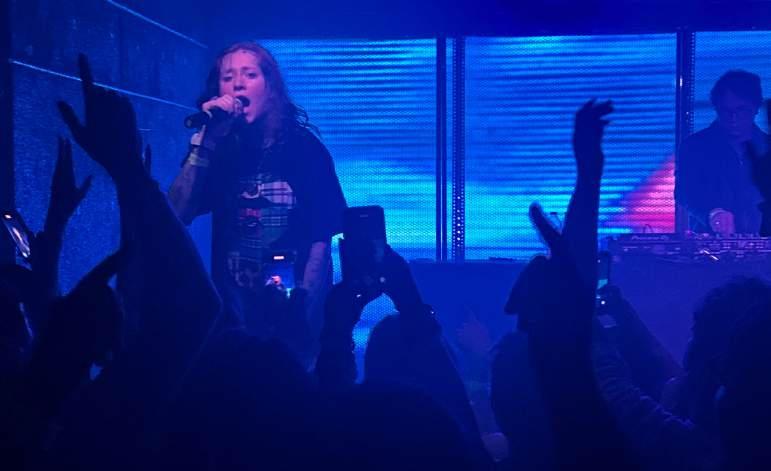

the platforms through which they “democratically” consume or release music. Listeners using streaming platforms are inundated with the platform’s attempts to curate what they hear: the app’s pre-made playlists, the order of results in its search bar, which songs are suggested in autoplay. Additionally, artists who want their music heard are subject to the whims of how the platform decides which music to show listeners. Spotify, for one, is notorious for favoring larger artists in crafting its autoplay suggestions. Oh, and they’re rewarded with about $0.004 per stream of their songs. A ludicrously
unfair payout for all artists, it’s especially brutal for those who lack the cushion of large tours, royalty checks and brand deals that larger artists now commonly support themselves with.
Therefore, when you rely on automatic shuffle or an algorithmically-generated personalized playlist to deliver you new songs and artists, you’re effectively allowing these corporate entities to decide how you listen to music. As helpful as these algorithmic features may seem, they force listeners to cede control over their musical consumption.
A case can be made that the suggestions offered by the algorithm outweigh its outsized
existing. Artistic idolatry in worshipping a golden calf of traditions, old standards and creative influences can sound the death knell of creative potential.
Still, one must have a past in order to have a future. Being connected to any one of the plethora of musical bloodlines serves as an immeasurable benefit to an artist. An artistic future can’t be created if an artist doesn’t know what’s already been done. In aligning oneself with musical histories, one can learn from the pantheon of those who came before them.
This vital connection to the past takes the form of a connection to a current musical community — that is, a scene. The style previously created and the scene of those who continue to be inspired by it, who invent new ideas influenced by said style, go hand in hand. However, the current musical landscape has moved away from the grounding vehicle that is the music scene.
In the past, it was true that the record company dominated the recorded music world. Labels’ choices on who to sign essentially dictated what music reached listeners, at least anything beyond a trunk full of cassettes or CDs in the parking lot of a show. Nonetheless, labels most often signed artists who were discovered in independent scenes.
Musicians were able to develop their craft and form a musical identity in a fertile environment, as artists symbiotically pushed one another to improve and invent. The past of musical styles was both consummated and transformed through communities of people dedicated to carrying the torch of their influences together, charting new territory as encouraged by those around them.
Nowadays, the scene is no longer the beating heart of the music world, with the industry’s motivations serving as the scaffolding surrounding it. Instead, it’s the internet that sits at the center. Artists can get their music out more easily than ever, and listeners can find it for the low price of nothing.
But the new musical landscape is still restrictive, even if the limitations it poses are not as overtly apparent as those of the music industry’s past: The algorithms of the platforms we use to virtually consume music are in charge of what we find, and artists are at the mercy of this reality.
power; in simpler terms, if you found a good artist’s music, who cares how you got there? I myself have encountered some musicians that I wouldn’t have otherwise, if not for their being chosen by the algorithm.
However, our online-focused musical landscape is robbing artists today of something crucial. Now, many develop themselves as artists without the necessary benefit of a connection to a musical lineage or community.
There are a myriad of styles and traditions that have burgeoned throughout the history of music; such an inclination towards new invention is what allows any form of art to keep
This move to virtual poses a potentially more existential threat: Musical bloodlines and communities are fizzling out at a dangerous pace. The artists that would have joined their local scene, who would have contributed to this communal project and reaped the benefits in their own work — now, why should they? One can release music individually to a potentially global audience without the effort of belonging to an artistic community.
One can let their tastes be ruled by streaming platforms. One can be dissuaded by the closing of local venues, or how it may take a few more minutes to find the artists active in their respective scenes than it would to just let the algorithm pick for you. But one does not have to be. We can take the extra moment to find the art that’s happening on the ground, out in the world — and we can reap the rewards of music freed from the corporate demands of streaming platforms. Artists and listeners alike can — should — choose to tap into the scenes that strain their hardest to pump music’s lifeblood.
PHOTOS BY DAPHNE SAKAVELLAS/THE OBSERVER
Instead of entering a local scene as artists would in the past, many emerging musicians today are solely based online.
Streaming appears to offer freedom to musicians and listeners, but the intrusion of platforms’ curatorial power outweighs the ability to easily upload and listen.
Artists and fans alike benefit from canceling streaming subscriptions and diving into a local scene.

ANA WINSTON Managing Editor
Here’s my take: I hate “Subway Takes.” The Instagram show, hosted by comedian Kareem Rahma, features a simple premise: In each minute-long video, Rahma sits on a subway train with someone else and asks them for their unique hot take. He then evaluates whether he “100% agrees” or “100% disagrees,” and together, host and guest debate or further develop the take.
It’s important to know other people’s opinions, no matter how much I disagree with them or critique them.
In my opinion, most of the takes, now almost exclusively offered by people with blue verification checks on Instagram, are uninteresting, wrong, unintelligible or all of the above. That said, it’s hard to pull my eyes away from the dumpster fire that is Subway Takes. That’s because it’s important to know other people’s opinions, no matter how much I disagree with them or critique them.
On Nov. 19, the @subwaytakes Instagram account posted an episode with comedian and actor Rachel Sennott, in which she professed her opinion that “Everyone needs to get addicted to one thing at least once in their life to prove to themselves that they can break an addiction.” After viewing the first few seconds of the video, the urge to swipe out of Instagram consumed me. The take is completely tone-deaf, horrifying in its own naivete to the terrible reality of addiction. I was crestfallen that anyone would even think of saying something like that in front of a camera. However, I kept watching, transfixed by my own disagreement with her.
In an interview with The New Yorker, Rahma defended unpopular opinions offered by comedians on the show by arguing that they were sharing preposterously bad takes on purpose, as a bit. I don’t think that defense is necessary or even true — I don’t think Sennott was joking, and that’s fine. It’s okay for a take to be bad and wrong. After all, Rahma roundly disagreed with Sennott, responding that opioids, for example, are a dangerous addiction that should not be encouraged.
Upon the mention of opioids, Sennott immediately retracted her argument, stating that she hadn’t even considered how her opinion could be applied to other, less agreeable situations. At the end of the video, she conceded that her take was “ultimately wrong and dangerous and bad.” Even though I agreed with her on that (her take was distasteful at best, harmful at worst), I enjoyed watching the video. I appreciated getting a deeper view into Sennott’s mind, and I was glad to see that someone was able to talk her out of such an insensitive opinion. Public debate is beneficial: The video might have discouraged another viewer from being so flippant in discussing addiction.
Subway Takes is, admittedly, a silly show full of absurd takes. A more serious example of a questionable opinion being displayed in public is a recent episode of
The Right to be Wrong
We should all know more about each other’s controversial opinions
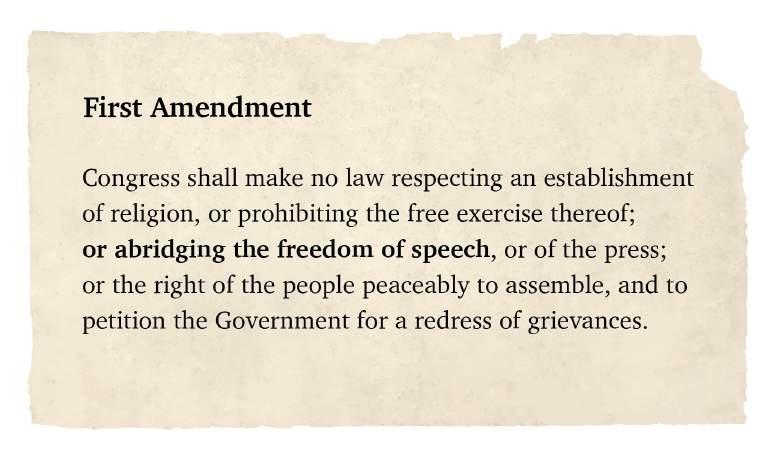
The First Amendment gives Americans the right to free speech: Opinions are included.
“Interesting Times,” a podcast by The New York Times hosted by Ross Douthat. On Nov. 6, an episode was published under the headline, “Did Liberal Feminism Ruin the Workplace?” featuring two conservative critics of contemporary feminism, Helen Andrews and Leah Libresco Sargeant.
I found the debate, moderated by Douthat, reprehensible both in form and in content. The debate was often hostile, as seen in the two-minute promotional clip of the interview, and Douthat asked leading questions that were often ignored by his guests. I disagree with the core opinions: Andrews argues that feminism and wokeness have made workplaces too “feminized,” forcing out masculine “virtues,” while Sargeant argues that workplaces are not suited for women’s inherent qualities — which are different from men’s inherent qualities.
Watching this debate was the antithesis of easy enjoyment, but I thought it was a welcome reprise from my online echo chamber.
My critique is that their gender essentialist views are too simplistic and abstract; they rely on Aristotelian ideas of binary gender to describe contemporary experiences, which creates an irresolvable disconnect between their rhetoric and the real experience of women. They fail to
acknowledge the continued culture of harassment against women that exists in many workplaces across the United States: Only two weeks after the release of the podcast episode, Amber Czech, a welder, was killed by a male coworker at her workplace.
As much as I disliked the debate, I defend the right for all three parties involved, and The New York Times, to release a debate on a premise I vehemently disagree with. I enjoyed dissecting the arguments made by the conservative thinkers, as I came up with defenses to my own feminist views that I wouldn’t have even thought necessary beforehand. The algorithms on the social media sites we use are designed to feed us content we agree with and enjoy uncritically; watching this debate was the antithesis of easy enjoyment, but I thought it was a welcome reprise from my online echo chamber.
In addition, the podcast spurred a wealth of interesting debate in the comment section on The New York Times website and other social media sites. The very title of the episode drew fiery criticism, with commenters arguing that it was harmful to even consider the idea that women could “ruin” a “workplace.” Ariel Dumas wrote a witty satirical piece reaffirming her own ruination of her workplace in The New Yorker. Inspired by Andrews’ and Sargeant’s debate, a wealth of other opinions were published defending women’s right to exist in the workplace without scrutiny or stereotyping.
Platforming Andrews and Sargeant shouldn’t be seen as a move to endorse either of their
have proven that there is no link between childhood vaccines and autism.
Because RFK was given a platform to speak his opinion, everyone knew that RFK espoused the erroneous belief that vaccines cause autism. When he was sworn in as Secretary of HHS earlier this year, greater scrutiny was applied to all the moves he made in his new, influential position. If we hadn’t already known his anti-vaccination views, which came directly from his mouth during interviews, would journalists know to spend more time covering vaccine-skeptical changes to the HHS website’s wording or to report on the new, quietly-appointed second-in-command at HHS, who is also critical of vaccines?
I want her to voice her opinion because I want people to be able to disagree with her and change her mind, just as I’d welcome anyone arguing against my own take in this article.
views, but instead an invitation for others to interact with their ideas through contradiction. I’m glad that other people took that invitation seriously and responded to the “Interesting Times” episode with concise and sharp critiques.
One caveat I’d like to make is the distinction between opinions, disinformation and hate speech.
A debate between two conservative thinkers on a podcast produced by The New York Times is not the same as, for example, political influencer Laura Loomer’s extensive list of endorsed conspiracy theories, which have all been proven factually incorrect. Giving these erroneous claims airtime is dangerous, insofar as spectators might ignore any fact-checking and start to buy into the incendiary conspiracy theories.
It’s also unjust to allow for content creators, like Loomer or anti-feminist Andrew Tate, to profit off of spewing hate towards groups of people based on race, gender, immigration status or sexuality. My point is not to let anyone say anything in the public sphere without regulation — hate speech should be demonetized and deplatformed. However, it’s also important to publicly debunk and delegitimize these theories, which I’d argue are not opinions. It’s important to know what everyone’s beliefs are, no matter how absurd or harmful.
For example, United States Secretary of Health and Human Services (HHS) Robert F. Kennedy Jr. (RFK) has publicly voiced his belief that vaccines cause autism since 2023. It’s important to note, of course, that RFK is factually incorrect — many large-scale studies
RFK’s views on vaccines are important to know if one wishes to understand his tenure at HHS. In order to discourage other people from believing the fallacy that vaccines cause autism, the best plan is not to stop reporting on RFK’s beliefs — rather, the most effective antidote is to repeatedly disavow and argue against RFK in the public forum. Everyone has the right to an opinion, and everyone has the right to disagree; these intellectual skirmishes are effective at enabling spectators to conduct their own research and understand various perspectives of a situation.
As the Trump administration continues to restrict reporters’ movements within the press department at the White House, further illustrating its desire to suppress media coverage critical of the government, it is all the more important to protect everyone’s right to participate in public debate. Words are incredibly powerful, and the right to argue cannot be restricted to one political ideology. That necessarily means that, if you want your voice to be heard, you must hear others’ you disagree with. If I have the right to publish an opinion on the importance of opinions, then Sennott must also have the right to share her opinion that everyone should have an addiction once in their life. That doesn’t mean I have to agree with Sennott — it doesn’t even mean I have to pretend that her opinion is inalienable. I want her to voice her opinion because I want people to be able to disagree with her and change her mind, just as I’d welcome anyone arguing against my own take in this article.
Opinions are almost always particularly personal views, deeply rooted in one’s own experience. That doesn’t mean that all opinions have to be tolerated; however, all opinions have the right to be expressed, inviting pushback through discourse. We must understand that each person has the right to express their own individual takes; only then can we disagree wholeheartedly with them and engage in a good-faith debate.
KAITLYN SQUYRES/THE OBSERVER
KAITLYN SQUYRES/THE OBSERVER
Upholding someone’s right to an opinion also maintains your right to publicly disagree.

Fordham Alum’s Debut Film Marks a Revelation in the Coming-of-Age Genre
Chris Merola’s first feature, “Lemonade Blessing,” is a raw and faith-fractured portrait of early adolescence
Childhood friends, old teachers, Fordham classmates, mentors and possible new collaborators had come to watch Merola’s debut feature, a collision of worlds that he described as “very unmooring ... like every person you’ve ever met in one room ...
“ The character is a puzzle, the way they see the world is the answer to the puzzle. It’s how you put the pieces together. ”
Chris Merola, FCRH ’20
tapping you on the shoulder.”
“Lemonade Blessing” is a coming-of-age comedic drama following John Stantucci, an earnest Catholic high schooler dealing with his parents’ divorce, who develops a crush that fractures his sense of morality and faith. It is a touching, visually stunning film that treats adolescence with honesty and humor.
The ensemble cast draws the audience in further, led by actor Jake Ryan, who takes on the role of John Stantucci with an awkward but endearing touch.
Opposite Ryan is Skye Alyssa Friedman, who delivers a standout performance as his crush, Lilith, a name she has given herself in opposition to the religious ideologies being pushed upon her by her parents. Lilith represents the opposite side of the adolescent spectrum, reacting to the world around her by actively pushing back against it. The two navigate an awkward, enchantingly clumsy courtship, each testing the boundaries of their own identities. Their interactions
become the film’s emotional focal point, revealing how differently teenagers can respond to the same pressures of faith and family, ultimately finding solace in shared discomfort.
The film’s journey, however, began long before film school or festival premieres. It began with a teenager trying to make sense of his faith, who later turned that introspection into art as a college student.
Merola grew up and attended Catholic school in Long Island before making his way to Rose Hill for his undergraduate degree. At Fordham, he double majored in psychology and film and television, a pairing that now inextricably informs the way he writes.
“The way I find a way in is through perspective,” he said.
“The character is a puzzle, the way they see the world is the answer to the puzzle. It’s how you put the pieces together.”
Merola was also embedded in campus ministry early in college, serving as a Eucharistic Minister and running a Christian Life Community (CLC).
“I probably wouldn’t have stayed religious for so long if I had not found a really cool community of people here,” he said.
Eventually, however, Merola’s relationship with faith shifted, as
“ Directors aren’t geniuses, they’re confused human beings trying to be brave.”
Chris Merola, FCRH ’20
did others in the group.
“We all secretly sort of fell out and became atheists around the same time, so my CLC just became more of a secular LC by the time I graduated,” he said.

Still, Merola spoke warmly of Fordham’s spiritual openness, saying it maintains “the principles of what makes Catholicism meaningful and engaging and communal, without a lot of the repressive, autocratic, patriarchal elements that I think made my high school experience a little more difficult.”
That distinction would later become central to “Lemonade Blessing,” which noticeably examines Catholic adolescence with a sense of tenderness rather than immediate judgment.
The most influential habit he developed at Fordham wasn’t religious or academic, but literary. Halfway through college, dissatisfied with repetitive coursework readings, he decided to read 50 pages a day of fiction and nonfiction books. The practice, he said, “was the best thing I did at Fordham for my film career.” It strengthened his self-understanding and deepened his voice, giving him the emotional vocabulary that would eventually shape his filmmaking.
After Fordham, Merola moved to Los Angeles, California to pursue an MFA in film and television production at the University of Southern California (USC). There, he began the earliest draft of “Lemonade Blessing.” The first version wasn’t a screenplay at all.
“(It) was just bullet-pointed memories in a notebook,” he said. “I wanted to explore things that were very pressing and on my mind when I was adolescent, and those things turned out to be my relationship with my mom, with my first love, my relationship with faith, guilt over being a burgeoning sexual person.”
USC provided useful craft training, however, Merola remains skeptical of certain theoretical frameworks within film studies. He does not favor auteur theory, which asserts the director’s creative vision above all others. Merola believes in a collaborative filmmaking process.


“It just kind of feels like the film is its own entity that we’re all discovering, and I just happen to be privileged to know a lot about what it wants to be because I’ve had a lot of time to think about it,” he said. “Directors aren’t geniuses, they’re confused human beings trying to be brave.”
He credits his team for the film’s success, including his cinematographer, Harrison Kraft. A standout technical aspect of the film, Kraft commands the attention of the audience with religious imagery and tight closeups. The camera acts as a mediator, relaying the self-absorption that accompanies adolescence as well as the humor, discomfort and vulnerability. Kraft’s visual sensibility helped Merola articulate the film’s core tension: the way religion can feel both grounding and crushing when filtered through the mind of a teenager desperate to do what is right. The palette of the film felt sincere rather than satirical, evoking the feverish intensity of teenage years.
To hone the language of the film, Kraft and Merola created a “single-frame exercise” for each scene: a mental image capturing its emotional essence, which became a foundational tool throughout production. What emerged from this exercise is a visual language that is as vivid and emotionally charged as the

story it tells.
The film itself is set in 2012, a choice Merola called a “period piece for my generation.” “Lemonade Blessing” explores the tension between personal desire and inherited faith. The film captures the contradictions of growing up religious in the Northeast at a time when adult anxieties about secularization were peaking.
“Gen Z was being raised by late-stage boomers,” Merola said. “The church was loosening its grip on the outside world, and so perhaps for the boomers that were raising their Gen Z kids, they almost felt twice as much of a need to grab their kids and make sure that they
“ The only responsibility you have is to understand yourself and try and represent a part of you, or as much of you as possible in the film. ”
Chris Merola, FCLC ’20
stayed faithful.”
John’s experience mirrors Merola’s own. Raised by a single mother post-divorce, Merola believed she “probably felt the need to be like two parents in one to represent twice as much force in terms of emphasizing” an ethical and religious lifestyle. The film is autobiographical in emotion as well as in detail.
Merola described writing from personal experience as “working with rocket fuel” — intense and powerful, but also often painful.
“I am always reflecting on things, almost to a fault,” he said. “I’m definitely pretty introverted and most of the time when I’m experiencing life, there’s a second person, reflecting on everything and commenting on everything that’s happening. And so it almost felt like an inevitability that I’d have to do something that felt at least a little personal, or else it would have felt deceptive.”
Tonally, “Lemonade Blessing” balances its humor with honesty. Merola expressed his dislike for comedies that “go for the laugh.” Instead, he opted for humor that emerges from truth.
Following its Tribeca premiere, the film then screened at the Mannheim-Heidelberg International Film Festival and the American Film Festival in Poland. After Tribeca, Merola signed with management and partnered with Submarine Entertainment as the film’s sales agent. Still, distribution remains uncertain.
“If we don’t end up with a distributor, I’ll just self-distribute,” Merola said. “I know that (the film will) find an audience.”
To aspiring Fordham filmmakers, Merola advised that “the only responsibility you have is to understand yourself and try and represent a part of you, or as much of you as possible in the film.”
“Craft is something that can be taught ... however, point of view ... comes from your life experiences, how you’re probing them, how you’re conceiving of them, how you’re reflecting on them,” he said. “This is something that is irreplaceable.”
If this debut says anything about his future career, it’s that Chris Merola will continue making films that challenge the viewer, opening
with
into uncomfortable
windows
truths
PHOTOS COURTESY OF CHRIS MEROLA Members of the Fordham community came together to support Merola’s debut feature film.
Merola took inspiration from his own experience of navigating faith as a young man when writing “Lemonade Blessing.”
‘First Language,’ the EP Fordham student Tobias Urban reflects on childhood and identity in his debut music release
By MARGO CRAVEN Asst. Arts & Culture Editor
Tobias Urban’s music career began at just nine years old, when he started taking classical music lessons. Over a decade later, his love for music hasn’t faded. On Oct. 29, Urban released his first extended play (EP), “First Language,” on all streaming platforms.
The EP’s title holds a special meaning for Urban, Fordham College at Lincoln Center (FCLC) ’27, who was raised in New Jersey after being adopted from Colombia as an infant.
“ I think the best thing that we can do as listeners and supporters of musicians is to try to take away the credibility of the follower count, and just listen. ”
“I initially had Spanish as my primary background, but growing up in an American school … I quickly lost touch with that. So I always felt like I was kind of in this in-between space. And the first thing that I really kind of grabbed onto in terms of an identity was music,” Urban said.
Childhood is a major theme of “First Language,” as Urban reflects on his upbringing on the opening tracks “Comfort in You” and “Letters to my Past.”
“A lot of the themes … and the meanings behind a lot of the tracks on the record are about growing up, and … finding peace and finding myself in music. And so it’s like looking back, reflecting on my past in childhood … it was a celebration of that,” Urban said.
In “Letters to my Past,” he sings, “These are the letters to my past. I dreamed when I was young, having fun, of the endless hours and days. And I hoped I would just grow old, I never learned to rest day by day.”
Urban describes his songwriting style as “unorthodox.”
“I’ll be sitting in class or I’ll just be walking on the street and I will just hear a melody in my head. I couldn’t tell you where it comes from. And it happens multiple times a day, most of the time I just forget about it. But (when) I’m like, ‘Okay, this is actually really cool, I like this,’ I’ll take out my phone
… and take a voice memo,” Urban said. “And then I try to work on it. Listen to it again and just sing. And so the melody comes to me first, and the hard part is actually putting the lyrics to it, because I have almost like a full instrumental piece, almost like a karaoke track.”
Urban mentioned the significance of learning to play the piano as a child, which inspired him to write the track “A Boy and His Piano.”
Soulful, jazzy, and upbeat, the song contrasts with the softer, emotional ballad that opens the EP.
Urban passionately sings, “It’s just a boy and his piano, chasing songs he’s never heard. Lookin’ deep into the shadows, findin’ life in every word. Countless hours at the ivories, trading sunlight for a song. Making up some crazy stories, where the broken souls belong.”
Urban draws inspiration from Billy Joel and Elton John, capturing emotion and nostalgia through piano-driven melodies and timeless lyrics.
Urban balances majors in both economics and music, while still making time to write, record and perform music. He is also the president and co-music director of the F Sharps, Fordham Lincoln Center’s only student a cappella group.
In “First Language,” Urban blends several genres in just five tracks. He describes his sound as an “experimental” mix of “pop and soft rock, with elements of jazz and classical,” influenced by his “jazz-oriented” music education at Fordham — which also allowed Urban to meet musical collaborators and close friends, some of whom were even featured on the EP.
“Jazz is a genre where you’re constantly collaborating, meeting and playing with new people,” Urban said. “You have to be open, you have to be social, and that really gave me the connections and the friendships to eventually … have them play on the EP.”
Urban credits his professors, collaborators and resources at Fordham for much of his success with the release of his EP. Several new music rooms opened on the Fordham Lincoln Center campus in 2024, including a recording space for student musicians. Urban was able to record a portion of his EP in the studio.
“Having that space and being able to have rehearsals there, record some of the EP there, it wouldn’t have been possible without it. So, I’m extremely grateful,” Urban said.
Though balancing his

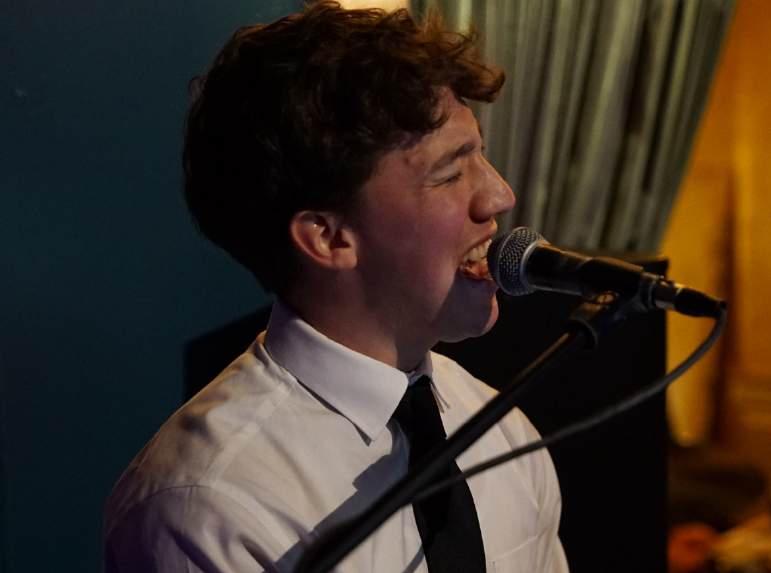
leadership position in the F Sharps, musical career and two majors with no course overlap may seem daunting to most, Urban said staying busy helps him avoid burnout and boredom.
“It’s easy to lose the passion and the drive. I think that having the balance and being able to not solely focus on (one thing) in my academic journey is what makes it all the more fulfilling,” Urban said.
“
It’s easy to lose the passion and the drive. I think that having the balance and being able to not solely focus on (one thing) in my academic journey is what makes it all the more fulfilling.”
Urban’s school days are far from boring, thanks to a jam-packed schedule of both music and math.
“I’ll go to a class and be singing and clapping my hands, tapping my foot, and then I’ll go to a strict lecture where I’m rapidly taking down notes and math formulas … It’s definitely a lot, because you’re working out both sides of the brain with the creative element … and the other side where it’s
very analytical,” Urban said. “But I think overall, besides being overwhelming at times, I found it to be very rewarding, because I’ve been able to do both, (and) I’ve been able to learn a lot.”
When Urban began college, his biggest musical goal was to release an album. One obstacle he didn’t expect was the need for a social media presence to be successful as a smaller artist.
“For musicians these days, you need to kind of be an influencer, and that’s just how it is. You need to have a backing of fans before anyone will even look at you,” Urban said. “It’s unfortunate, but it forces you to kind of catch up with the times”
Despite the challenge, Urban was not deterred and quickly began building a following on Instagram and TikTok, where he gained thousands of followers after a video he made singing a popular Disney song went viral.
He was also featured on the official Instagram of the Broadway musical “Hadestown,” after he posted a cover of the popular song “Wait for Me.”
Urban explained that in 2025, a musician must be more than just an artist — they must also be specialists in marketing and advertising.
“I think it’s somewhat unhealthy because it takes away the passion. Musicians just want to perform. They just want to create. And I think that the industry hasn’t been that accepting of all these musicians starting out,” Urban said. “I think the best thing that we can do as listeners and supporters of musicians is to try to take away the
credibility of the follower count, and just listen.”
Beyond social media, Urban has also utilized the performance opportunities available to him through Fordham, such as open mic nights and jazz concerts, to gain experience and establish himself as a performer. After building his connections, Urban began reaching out to venues around New York City for more opportunities to perform.
Urban described the initial difficulties and slowness of this process, which consisted of “a ton of unanswered emails,” he said. “But once you break in, (the opportunities) just keep coming. It’s been a grind, but once you play, especially if you put on a good show, you’re going to get called back, you’re going to get more opportunities.”
He has performed at New York City venues including Birdland, 54 Below, Lincoln Center, Green Room 42, and Carnegie Hall, and currently serves as a live pianist at Sid Gold’s Request Room, the only live piano karaoke bar in New York City.
His love for performing live started young, through musical theater, piano recitals and even national competitions throughout middle and high school.
Now that he has released his EP, Urban has his sights set on releasing a full-length album in 2026, which he has already started writing.
You can keep up with Urban’s latest releases and performances on Instagram. Stay tuned for an exciting announcement coming in December — you won’t want to miss it.
Tobias Urban, FCLC ’27
Tobias Urban, FCLC ’27
COURTESY OF TOBIAS URBAN
Tobias Urban recorded a portion of his EP “First Language” in Fordham Lincoln Center’s recording space.
COURTESY OF TOBIAS URBAN Urban has been singing and playing the piano since he was nine years old.
COURTESY OF TOBIAS URBAN
Urban boasts a social media following, which he said is crucial to gaining momentum as an up-and-coming artist.
Fordham Talent Lights Up Caveat Theater with ‘Constellations’
A
one-night debut of “Constellations” was filled with comedy, romance and choices that shake reality
By SOFIA CAMMARANO Contributing Writer
Fordham Theatre alumni returned to the stage for “Constellations” on Nov. 21 at Caveat Theater on Clinton Street. The cozy space buzzed with excitement before the show as Milagros Luis, Fordham College at Lincoln Center (FCLC) ’25, and Fabiola Santiago-Ruiz, FCLC ’25, greeted guests and friends. The room hushed as the show’s two stars took the stage.
“Constellations” by Nick Payne was performed by Fordham students during the fall 2024 season as a studio show. Its intricate and charming plot follows Ronald, a beekeeper, and Marianne, an astrophysicist, as they navigate their romantic relationship. The play explores the idea of the multiverse by repeating scenes but with different reactions from the actors.
The show’s two stars — Marco Lizarraga, FCLC ’25, and Alexa Smith, FCLC ’25 — both performed in the fall 2024 studio show. At Caveat, they held the audience’s attention for the entirety of the 85-minute, non-intermission performance. The cast’s experience and familiarity with one another allowed the lines and movement to flow smoothly. At times, both actors would engage with the audience, making them hold props or ad-lib.
Luis directed the studio show on campus in 2024, and revived it for the latest production at Caveat.
“Fordham was my first step into

it, and now this is my second, and I hope to have a third,” Luis said.
This new production allowed her to put her training into action while directing on a real performance stage. Luis hopes to continue building on the foundation she established at Fordham to carve out a name for herself within the industry.
While researching for the play, Luis noticed that many previous productions used blackouts to transition between scenes. She found this to be “disconnecting” and in opposition to the play’s intended meaning.
“Every production that I’ve seen has nothing to do with the
message for the play, and I wanted to do it in a way that was always flowing and growing through branches but never stopping,” Luis said.
When switching between scenes, various lighting effects were used to capture the tone of each version. This simulated the parallels to the choices the characters made.
“This play has also taught me a lot about the relationships in my life and reminds me that every day we have with the people we love is special,” Smith said.
The song “Everything is Romantic” by Charli XCX, which played at the beginning and end
of the performance, captured the magic of falling in love, which can occur in different moments, settings and times.
Although it was open for only one night, the production was professional and skilled.
The many Fordham alumni and friends in attendance created a homey environment that invited the cast to interact and engage with the group throughout the night.
Ruiz, who served as the show’s producer, wants to continue finding exciting and engaging ways to keep theatre alive beyond Fordham.
“I love the idea of immersive theater and interactive theatre where the audiences get different entry points,” Ruiz said. “Nowadays, we consume so much media that allowing for theater to connect with you in different ways really expands the impact.”
She said that this was her “mission” while producing “Constellations.”
“Constellations” reflects the future of Fordham artists holding true to experimental storytelling. The team left an impression on the audience at Caveat, as their artistic choices illuminated the sophistication of human connection. This comprehensive alumni production showcases how Fordham artists have drawn on the techniques and inspiration gained during their time at Fordham Lincoln Center, channeling them into impactful and creative spaces.
Searching for Relevancy in One of Modern Dance’s Greats
The Paul Taylor Dance Company took the stage at Lincoln Center for a special anniversary season
By INDIRA BUSH Staff Writer
In the midst of a busy season, Lincoln Center’s David H. Koch Theater hosted three weeks of performances by The Paul Taylor Dance Company, a name a little less well-known outside of the modern dance community. Taylor’s most beloved work “Esplanade” celebrates 50 years since its premiere this fall.
Alongside Taylor’s original works, the season featured pieces from the company’s two resident choreographers, Lauren Lovette (formerly of New York City Ballet), and Robert Battle (former dancer and artistic director of the Alvin Ailey American Dance Theater), including world premieres from each.
With the “Esplanade” anniversary, this year posed an exciting opportunity to examine what the Paul Taylor Dance Company has to say in today’s context. The program on Nov. 19, featuring “Scudorama,” “Sunset” and of course, “Esplanade,” was an ideal case study.
Equally shocking and thought-provoking, “Scudorama” was a wise choice to open the night. Choreographed during the Cuban missile crisis, its tone can be summed up by the accompanying program note, which asks, “What souls are those who run through these black haze?” The simple answer: four women in all-black unitards, two in bright yellow and one in red, partnered by one man in purple, one in

The
green and one curiously dressed in business attire. The movement that defined the piece could only originate from the sense of distress and lack of control felt in times of global turmoil. In solitary moments, it was unpredictable, all at once exciting and slightly jarring. The partner-work resembled a power struggle with an intriguing lack of tenderness.
Taylor is known for finding his inspiration in everyday humanity. The dancers’ bodies move as bodies do, without any dance prescription. In “Scudorama,” they flop and flail as any human body would, but effortlessly enhanced by the dancers’ athleticism.
The second work of the night was everything tender and graceful that “Scudorama” was not. Taylor was inspired by soldiers and “the sweethearts they leave behind.” The movement’s simplicity, balletic nature and grace made it pleasing to the eye. The men wore military-esque outfits and the women wore flowing white summer dresses. Gentle partnering evoked the longing of lovers separated by circumstance. Despite all this, the subject matter felt out of place and defined by gender roles of decades past. “Sunset” was undeniably heartwarming, but left something to be desired in the search for relevance.

By SOFIA LAJE Staff Writer
“MARTY SUPREME” DIR. JOSH SAFDIE (2025)
Alamo Drafthouse Cinema Brooklyn via A24 - Opens Dec. 25
Josh Safdie’s debut as a solo director introduces Marty Mauser, a volatile 1950s table-tennis prodigy whose pursuit of greatness erupts into chaos.
“A totemic Jewish-American odyssey about where such dreams come from, where they might lead to, and where they’re liable to come apart” - David Ehrlich, IndieWire
For fans of: “Raging Bull,” New York griminess, tireless ambition English
“THE VOICE OF HIND RAJAB” DIR. KAOUTHER BEN HANIA (2025)) Film Forum via WILLA - Opens Dec. 17
Winner of the 2025 Venice Grand Jury Prize, Ben Hania’s latest reconstructs a phone call between Red Crescent volunteers and six-year-old Hind Rajab, offering a devastating look at life under siege in Gaza.
“The most vital film of the decade ... an astonishing blend of dramatization and reality.” - Iana Murray, GQ Arabic with English subtitles
“MY NIGHT AT MAUD’S” DIR. ÉRIC ROHMER (1969) Metrograph via Janus FilmsDec. 12 & 13
A devout Catholic engineer’s chance evening with Maud forces him to wrestle with faith and desire in this French New Wave classic.
For fans of: Catholic guilt,
“Before Sunrise,” winter melancholy, desire vs. virtue French with English subtitles
“LITTLE TROUBLE GIRLS” DIR. URŠKA DJUKIĆ (2025)) IFC Center via Kino Lorber - Opens Dec. 5
After “Sunset,” it was time for the much anticipated show-stopper. When the curtain opened on “Esplanade,” the theater erupted in applause.
“Esplanade” perfectly encapsulates the inspiration Taylor found in everyday life. Simple movements carry multitudes.
In the beginning the dancers walk, run and skip in perfectly choreographed passes.
The middle section of the piece takes a more solemn tone, full of longing between partners. They endlessly gesture and reach for one another. It’s said Taylor was inspired by “family whose members never touch.”
In the third section the dancers are constantly in motion — they fall and run for one another, jumping into one another’s arms when the audience least expects it. They slide across the stage like baseball players. The movement reaches a satisfying ending when just one woman is left with her starring moment on stage.
The inspiration for “Esplanade” may have been less specific than that of the two pieces it followed, but the movement was so natural that the entire question of technique was forgotten, and emotional relatability and warmth took center stage.
It’s possible that not all Taylor works stand the test of time, but “Esplanade” does enough to keep his work among the list of modern dance’s best. More than that, it’s a reminder to the choreographers today that above all, humanity will stand the test of time.
A sharp debut from Djukić captures a teenage girl’s coming-ofage at a Catholic boarding school. “There’s an airy delicacy here that invites comparisons to early Céline Sciamma, but with its own raw, restless edge.” - Guy Lodge, Variety
For fans of: revisiting adolescent diary entries, girlhood, coming-of-age Slovenian with English Subtitles
“THE SECRET AGENT” DIR. KLEBER MENDONÇA FILHO (2025) BAM via NEON - Opens Dec. 11 Filho explores political paranoia with his signature hypnotic, slow-burn style.
“It won’t go to you and hand over its meanings. You have to go to it. ... (‘The Secret Agent’) is one of the year’s best films, and one of the most distinctive.” - Matt Zoller Seitz, RogerEbert.com
For fans of: conspiracy, political thrillers, suspicious glances Portuguese, German with English Subtitles
“THE LEOPARD” DIR. LUCHINO VISCONTI (1963)
Metrograph via Janus Films35mm - Dec. 20
Set during the Risorgimento, Visconti’s epic follows the Prince of Salina witnessing the decline of the aristocracy with stoic resignation in this towering achievement of historical cinema.
“Two-plus hours of engrossing machinations and opulent scenery point the way to the pièce de résistance” - Keith Uhlich, Time Out English
COURTESY OF INDIRA BUSH
modern dance company was founded in 1954 by Paul Taylor, a choreographer best known for taking inspiration from everyday movement. information about the photo runnin.
COURTESY OF CONSTELLATIONS PRODUCTION
Marco Lizarraga and Alexa Smith taking their bows after “Constellations” performance.

un & ames

Crossword: Mousse Crossing

BY JASMINE WHITE

17. Popular major for Fordham undergrads: ____-sci
18. Road sign: “____ ___ work” (2 Wds.)
19. Pot starter, in poker
20. *Place for golfers to enjoy some custard? (2 Wds.)
23. Start to a demand (2 Wds.)
24. It’s neither prime nor composite


25. Fun ____ Games
28. UFO operators (Abbr.)

29. *Field for an attorney specializing in bakery injuries? (3 Wds.)
34. Related to the soft palate
35. ____ vez
36. *Lonely location where one might find the starred clues? (2 Wds.)
41. Campus marchers? (Abbr.)
42. Type of kitchen that is common in New York City apartments (Hyph.)
43. *Iconic French fashion designer with a sweet tooth? (2 Wds.)
47. Degree for Fordham dance majors (Abbr.)
50. Texter’s “You’ve got to be kidding me” (Abbr.)
51. Boo?
52. Nonchalant
54. *Institution where one might study banana splits? (2 Wds.)
58. What a baby’s first word might be
61. Gather audio evidence: wear __ ____ (2 Wds.)
62. Word before boy or girl
63. Passes with flying colors, as a final exam
64. Finished off (2 Wds.)
65. One of four in a pack of playing cards
66. “Je ne ____ quoi”
67. Word with secret or talent
68. StreetEasy listings (Abbr.)

Ramses Takes The Cake!
BY DAMIAN GROVE

Ramses wants to celebrate the end of the semester with his Ramily by sharing a(n) _______________ _______________ from his favorite bakery, _______________. Ramses leaves his apartment at _______________ to make sure that he can secure one of the coveted goods. Since the bakery is _______________ minutes by hoof, Ramses decides to take the subway, which will only take _______________minutes. Ramses is able to select his _______________ treat, and also chooses to pick up a _______________ to give to his friend, _______________. Ramses goes to the register and pays a total of _______________ dollars and makes sure _______________ leave a tip. When Ramses leaves, he trips on a(n) _______________ and his goodies go flying into the air. Miraculously, _______________ happens to be walking in and catches the boxes with their_______________before they splatter on the ground. Ramses expresses his gratitude by _______________ and invites his new pal along to the celebration, to which his friends are very _______________.


1. Woodstock attendee
2. Quantity
3. Olivia and Oscar, for two
4. Derogatory, as remarks
5. Kendrick Lamar album that won a Pulitzer Prize
6. “Break __ ____!” (2 Wds.)
7. Animated jukebox musical film released in 2016
8. Learn about through gossip, perhaps (2 Wds.)
9. It may be hard to prove in court
10. PET or CAT, for two?
11. Ages and ages
12. Fitting
13. Big name in jeans
21. Waits at a red light
22. Fair-hiring abbreviation
25. Memo header (Abbr.)
26. Urkel or Sheldon Cooper, for two
27. Political organization that Alexandria Ocasio-Cortez is a member of (Abbr.)
30. Taproom option
31. Simple card game for two
32. “Coffee ___ ____?” (2 Wds.)
33. “Casual” singer Chappell
34. Photo app that lent its name to an aesthetic featuring scrunchies and Hydro Flasks
36. Pioneering first-person shooter video game
37. ____ a Sketch
38. “Mean Girls” character
Janis
39. Sault ____ Marie
40. Pale purple
41. Some colas
44. Aladdin’s sidekick
45. North American country that celebrates Boxing Day
46. Harry Potter’s owl
47. Start, as a computer (2 Wds.)
48. Decide against taking the subway, say
49. Black keys near Gs
53. Tibet’s capital
54. Lip
55. ____-de-camp
56. “Derry Girls” protagonist
57. Made laugh, to Gen Z
58. ____ Kapital
59. Obama’s signature health legislation (Abbr.)
60. Agnus ____


KenKen®
BY DAMIAN GROVE
and



GRAPHICS BY