The Irish Magazine for the Materials Handling, Warehousing & Logistics Sectors The Irish Magazine for the Materials Handling, Warehousing & Logistics Sectors loaded containers, maximising on-site
The Irish Magazine for the Materials Handling, Warehousing & Logistics Sectors
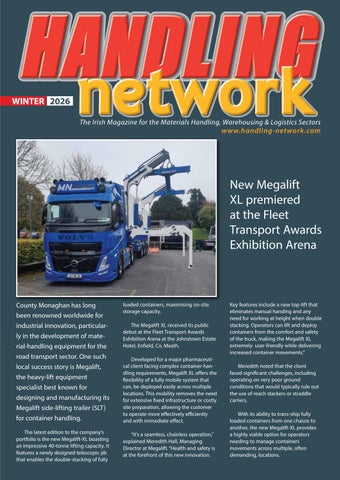
The Megalift XL received its public Exhibition Arena at the Johnstown Estate
Developed for a major pharmaceutical client facing complex container-handling requirements, Megalift XL offers the flexibility of a fully mobile system that can, be deployed easily across multiple locations. This mobility removes the need for extensive fixed infrastructure or costly site preparation, allowing the customer to operate more effectively efficiently
“It’s a seamless, chainless operation,” Director at Megalift. “Health and safety is at the forefront of this new innovation.
New Megalift XL premiered at the Fleet Transport Awards Exhibition Arena
Key features include a new top-lift that eliminates manual handing and any need for working at height when double stacking. Operators can lift and deploy containers from the comfort and safety of the truck, making the Megalift XL extremely user-friendly while delivering increased container movements.”
Meredith noted that the client faced significant challenges, including operating on very poor ground conditions that would typically rule out the use of reach stackers or straddle carriers.
With its ability to trans-ship fully loaded containers from one chassis to another, the new Megalift-XL provides a highly viable option for operators needing to manage containers movements across multiple, often demanding, locations.
The introduction of the Corporate Sustainability Reporting Directive (CSRD) is emerging as a major challenge for the logistics industry, according to the latest Logistics Hall of Fame Trend Survey, conducted in September 2025 in cooperation with the SCHUNCK Group.
Respondents rated the average effort required for implementation at 8.67 out of 10 points, reflecting the scale of the regulatory requirements. Despite this, half of respondents (50 percent) said they had not yet begun work on CSRD compliance, while only 16.7 percent were already in the process.
The CSRD is an EU directive that requires companies to provide more comprehensive and consistent reporting on their environmental, social, and governance (ESG) performance, with the aim of boosting transparency and encouraging sustainable business practices across the EU.
Data availability: the bottleneck of the CSRD Every participant (100 percent) cited data availability and quality as the biggest barrier to reliable sustainability reporting. Other major
challenges included; understanding the regulatory requirements (50 percent), the resources and time involved (33.3 percent), selecting suitable software tools (33.3 percent) and collecting Scope 3 emissions data across the supply chain (33.3 percent).
“The results clearly show that many companies still don’t know how to practically implement the multitude of requirements,” said Thomas Wicke, Managing Director of the SCHUNCK Group. “Data quality, processes, and responsibilities are the key levers – those who start too late risk not only fines but also reputational damage.”
High demand for consulting, tools, and exchange
Unsurprisingly, demand for external support is strong. Half of respondents want professional consulting on CSRD requirements, along with technical tools for data collection and analysis. A similar proportion value opportunities to exchange best practice with other companies. Some even called for a reduction in requirements – a clear signal to policymakers and regulators that the bureaucratic burden is becoming unmanageable for many corporations and mid-sized businesses.
“Pragmatic solutions and greater digital support are urgently needed to translate the CSRD requirements into practice,” added Wicke. “Small and medium-sized enterprises in particular need guidance, standards, and proven
Sustainability reports are becoming a stress test for the logistics industry
tools. We’ve recognised this need and established our own competence centre. The specialists there are developing fully digital CSRD solutions and supporting our clients throughout the process.”
Cyber risks and labour shortages remain relevant – sustainability moves to the forefront
While cybercrime (83.3 percent) and labour shortages (66.7 percent) remain top risks for the industry, the survey shows that sustainability compliance has now moved to the forefront of strategic planning. Companies must increasingly operate not only efficiently and securely, but also transparently and sustainably.
“The CSRD is not just a reporting project – it’s a transformation process,” Thomas concludes. “It forces the industry to rethink structures, data flows, and responsibilities. Those who now see this as an opportunity will gain a long-term competitive advantage.”
Trailers and related exhibits at Solutrans 2025, EurExpo, Lyon, France
The 18th edition of Solutrans, – now firmly established as a global hub for heavy and light commercial vehicles – took place at EurExpo in Lyon, France from the 18-22 November 2025. The event covered key topics including data use and artificial intelligence in the automotive sector, as well as new European regulations driving the energy transition and improving transport safety.
From power-agnostic to fully electric technologies, Thermo King continues to guide transport operators towards a cleaner, smarter, and more adaptable future in refrigerated transport.
But this is just one part of a broader commitment: reducing food loss, decarbonising the cold chain, lowering total cost of ownership and delivering innovative solutions. These include the use of biofuels, enabling emission-free operation through e-axles, ePTO and solar panels, and soon-to-launch, Galway-built eMagine electric reefer unit. This features a fully integrated 19kW battery pack, with an optimal range extender, delivering a 93% reduction in CO₂ emissions.
Ca RRIER T R a NSICol D
Carrier Transicold previewed its upcoming digital marketplace for parts and accessories.
Designed as a comprehensive one-stop shop, it will offer certified Carrier Transicold parts alongside selected products from trusted manufacturers, covering the full spectrum of refrigeration transportation repair needs.
“Our new digital marketplace will give customers a faster, easier way to source the certified Carrier Transicold parts they need,” said Kaan Yavas, Spare Parts Business Unit Director, Carrier Transicold. “Real-time ordering and flexible delivery options streamline the process, helping fleets operate at peak performance and enabling customers to focus on running their business efficiently.”
The Reefer Group brings together French trailer brand Chereau and bodybuilder Aubineau, Spanish trailer producer SOR Ibérica and UK builder Paneltex. Focused on efficient and sustainable cold-chain logistics, the group relies on innovation, cooperation and responsibility to reduce its carbon footprint and support the transition of refrigerated transport.
The integration of British manufacturer Sunswap’s electric refrigeration unit into the Chereau product catalogue was announced at the show. The company also celebrated its FFC Innovation Award for the Chereau Concept Trailer - its vision of a semi-trailer for 2030, which incorporates an aerodynamic kit to limit the tractor’s fuel consumption by up to 2.4L/100km, or extending the range of an electric tractor-unit.
S CH m IT z Ca R gobull
Schmitz Cargobull showcased its extensive range of trailers, services and digital applications, highlighting how modern trailer technology can boost safety, improve payload and reduce operating costs.
Centre stage was the new S.CU dc90 transport refrigeration unit, building on the proven S.CU dc85 predecessor model. It features a newly developed, hermetic 2-stage reciprocating compressor that delivers improved fuel efficiency. Using environmentally friendly refrigerant R454A and offering powerful cooling capacity, the dc90 is designed for temperature-controlled transport with reduced consumption.
T HER mo K IN g
T HE R EE f ER gR oup
K R o NE T R a I l ER
Krone Trailer featured two main exhibits - the Profi Liner and the Dry Liner.
The Dry Liner with plywood side walls incorporates a range of practical equipment elements: a roller door with a clear width of 2,370 mm for fast loading and unloading, an LED cargo area light strip, premium sealing, tear plate floor inserts, 13 pairs of recessed floor-mounted lashing rings, and two rows of slotted lashing rails. The proven Profi Liner also drew attention for its functionality, durability and practicality. Krone’s new Trusted Tyre range, made in Thailand, was also on display.
Kög E l T R a I l ER
The award-winning Kögel tipper body owes its success to a low tare weight, a well-balanced chassis, and a wide, one-piece body. First unveiled at bauma 2025, the base version weighs just 5,200 kilograms. Its wide, deep, one-piece welded body offers excellent stability thanks to its lower centre of gravity. Manufactured from wear-resistant, quenched and tempered steel plate, it is ideal for abrasive materials. A manually or electronically operated cover further ensures reliable load containment.
Kä SS bo HRER
Kässbohrer hosted the third edition of its K-Expert Talks on Electrification, bringing together industry stakeholders to discuss mass adoption of electrified technology across Europe in both road and intermodal applications. Participants included Bump Charge, Combronde Multimodal, Renault Trucks, Volvo Trucks and ZEFES.
“Our common goal is to reach net zero-emission targets,” said Iffet Türken, Business Development Executive. “This transformation requires participation from all stakeholders to identify challenges. Only then we can collectively address them through technology, infrastructure and regulation.”
faymo N v I ll E
The Faymonville Group, a leading manufacturer of special trailers and semi-trailers, invited visitors to explore its latest MultiMAX Plus lowbed semi-trailer and other solutions for heavy transport. The 1 + 3 MultiMAX Plus lowbed is extendable, with ramps, hydraulic widening and excavator trough. A new product line is due for launch soon and will be available in Ireland through Ashbourne Truck Centre.
D-T EC
Delta Trailers and D-Tec showcased a gleaming white D-TEC FV2011 tank trailer and a Combitrailer CT-521-S. Visitors could explore the Quickliner FV2011 with steerable axles for slurry and biogas substrate transport: fast and easy to operate, equipped with D-Tec’s unique steering system, and lightweight at just 6980 kg. The Combitrailer CT-521-S, also lightweight, is designed for maximum control and flexibility. This divisible container trailer offers exceptional versatility for transporting 2 x 20 ft containers.
NooTE boom
Nooteboom Trailers, long know for high-quality, innovative heavy-transport solutions, premiered the new 2-axle EURO-PX3 low loader in Lyon. The EURO-4702(P3) model features pendle axles and 245/70 R-17.5 tyres, giving the trailer a load capacity of 12 tonnes per axle line. When retracted, the trailer remains within road legal dimensions, meaning no special permit is required.
Dymaxa
New European Union Vecto-rules mandate a 10% reduction in CO₂ emissions for new trailers by 2030. Austrian start-up Dymaxa aims to support this with its Aerodymax side-skirts which are durable, flexible, lightweight and easy to fit in under
2.5 hours. Pilot trials indicate up to 5% emissions reductions, equivalent to fuel savings of 1-1.5 litres/100km. The system replaces fragile fibreglass skirts, is estimated to see a return on investment within 6-9 months, and comes with a 3 year warranty. A system was fitted to a SOR trailer at the show.
Da KEN
Daken S.p.A., founded in 1989, specialises in producing high-quality plastic accessories for commercial vehicles and vans. With a focus
UNLOCK EVERY INCH OF YOUR STORAGE SPACE!
Combilift’s range of multidirectional forklifts, pedestrian reach trucks, straddle carriers and container loaders will allow you to maximize the capacity, improve efficiency and enhance the safety of your facility.
on Italian design and market-driven innovation, the company displayed a wide range of accessories: plastic and metal toolboxes, fire extinguisher cabinets, pallet boxes and more. The Daken Locks range was also showcased.
m ulTI - m ov ER
Multi-Mover highlighted its material-handling solutions, including AGVs and powered movers such as electric tugs, bin tugs and bin movers. Available to buy or hire across the UK, from its Burtonon-Trent base, Multi-Mover also designs and builds custom automated guided vehicles and bespoke powered mover systems, tailored to specific logistical requirements across commercial, industrial and healthcare sectors.
Contact Us Today
Handling Network recently spoke with Hilton Campbell, MD of Interroll UK to get an insight into the company and its award-winning products, how he made the move from South Africa, and his plans as President of the AMHSA.
Starting out in South Africa, Hilton achieved a degree in Industrial Engineering which he explains was something of an unknown discipline back then. With his knowledge of manufacturing productivity, material flow, and Kaizen principals, he found himself selling labelling systems in the mining industry. That was until a chance meeting with an Interroll employee awoke an interest in a new industry, more allied to his field of expertise
“He said to me, ‘I work for a materials handling company… we go where the company is and we help them to move boxes around factories and warehouses in an inefficient way.’ I said that sounds like fun...”
A month later, he made the move. “That was 1996, that’s when I first engaged with Interroll… And today, my blood’s yellow!”
Indeed, after nearly 30 years with the Swiss headquartered firm Hilton has covered roles from sales to operations and management, becoming MD in South Africa in 2012 and then MD in the UK in 2019.
The move to the UK office was presumably the most challenging as it uprooted his family, but he says they have coped admirably and were incredibly supportive. “It was far easier for me. We arrived at a weekend and I just turned up at the new office on a Monday and it was the same job, easy!”
That was six years ago and the move has obviously worked out well. Some recent changes include a revamped customer hub which opened last year and included showroom space, a refurbished service centre and new offices. In 2023 the firm launched the High Performance Conveyor Platform designed for courier, express and parcel (CEP) service providers. Also in 2023 Interroll partnered with two autonomous mobile robot manufacturers - Omron and MiR - to launch the LCP AMR Top Module, to offer seamless integration of AMRs with its Light Good Conveyor Platform.
The latest success story was at the 2025 International Forklift of the Year Awards. Interroll won the IFOY “Special of the Year” category with its MCP PLAY conveyor system which the IFOY jury panel said represents “a paradigm shift in conveyor technology.”
The IFOY jury highlighted the system’s ability to control localised items, the seamless merging of multiple lines and
On a Roll with INTERROLL
freely scalable zone sizes as game-changers for the industry. The potential to increase throughput by 100% was significant. They also recognised the value of the system’s open interface, operating without a PLC (programmable logic controller) which significantly reduces IT complexity for the end user.
The MCP PLAY is the smart version of Interroll’s established Modular Conveyor Platform. Interroll bills it as a “decentralised automation solution” because by interacting with MultiControl units at each station of the warehouse, it acts as a single platform to plan, install, monitor, and control the entire operation, connecting to a laptop only when required.
Hilton explains that the hardware that facilitates all this is delivered with coding already embedded, and that although some commissioning is required to set up the particular flow lines each business may require it is pretty close to plug-andplay.
The pre-programmed MultiControl units manage segments of rollers and collect data from photo electric sensors, allowing detailed organization of the entire material handling process with constant monitoring and manipulation of the flow of transported goods.
Data such as rate of revolutions and temperature fluctuation is monitored and the sensors detect totes or parcels on the conveyor, sending tracking ID to the MultiControl card unit. This means that as well as keeping tabs on the equipment itself and informing the best predictive maintenance schedule, the system can also track items, avoid jams, and optimise material flow.
The MCP PLAY offers “Adjust to Gap” to automatically reduce space between items in transit, and “Flowing Merge” for continuous merging without stops. These systems work with sections of the conveyors that can be slowed or sped up to allow items to join or exit without interrupting overall flows.
“I love that analogy of driving a car,” says Hilton. “If you try to cross an intersection, you’re looking to the left and the right and left again. So you’re seeing at what speed these cars are coming…. We do the same with the box. We have the system looking to the left, and we can see there’s a box, and we know how long it’s going to take for that box to get to this junction point. And then we take a decision, go, stop, speed up or slow down, so the flow is seamless. It’s just like you come on to merge on a highway.”
“Our smart products are controlling the manner which these boxes are moving. Until now, it’s been purely stop/start, but now it’s continuous flow, with “Flowing Merge.”
A key for the MCP PLAY is that rollers can run at variable speeds – not just stop or go. Hilton says that smoothing speeds is an important aspect of the system. “We want to take away the stopping and starting completely, because whenever you do that, you have an in-rush of current, and it’s like anything in life, that creates a high peak in your energy.”
Saving energy by avoiding these spikes is an important factor for end users. For the same reason the system does stop when no traffic is detected, thereby eliminating empty running. By only stopping in these circumstances Interroll says the MCP PLAY gives a 30% reduction in energy use compared to a more traditional system, though Hilton says that it has been much higher in some instances.
Going above and beyond is perhaps what Hilton had in mind when earlier this year he became President of the Automated Materials Handling Systems Association. Of his aims, he says “We want to be the strongest voice in the sector. We want to be the body that both end customers and operators come to first for guidance and support.”
Hilton outlines the main objectives of the AMHSA: standards, training, and networking and promotion. He says the AMHSA sits on various forums and bodies regarding industry standards, and takes the matter of improving standards and compliance very seriously, especially when it comes to health and safety.
As part of its aim to raise standards and support best practice, the AMHSA offers a range of training programmes to its members and employees of affiliated businesses. In the bid to boost excellence throughout the industry, Hilton reveals that in 2026 they intend to open their training offerings to all comers with its course “modern automation, where to start and what to expect”.
“We want to be able to give back to the sector by using the collective knowledge and experience that we have and train the up-and-coming young people,” says Hilton. After all, “Not everybody comes out of university knowing they want to go into conveyor automation or mezzanine floors.”
Indeed readers of Handling Network will have had their own journeys into intralogistics, and very few will have started with a childhood vocation. So it is fitting that a man that discovered the industry by chance is now working to open the door to those looking to join and develop the materials handling industry.
Hilton Campbell is also kept busy with his main job as MD of Interroll of course, and he says that in addition to offering award winning products, the firm aims to expand into the Irish market soon.
Text : Johanna Parsons - contributor@fleet.ie
When the major ocean carriers set about reorganising their route networks towards the end of 2024 and forming new carrier alliances, it was generally assumed that costs would fall and operational efficiency would improve. The changes were implemented in February this year and, for a couple of months, the industry went through a difficult settling-in period.
The new schedules have succeeded in improving service reliability. On some routes, vessels are now arriving on time in 80% of sailings compared with under 50% previously. The Gemini consortium, led by Maersk Line and Hapag-Lloyd, which is making far greater use of huband-spoke route systems, has been particularly successful, achieving 92% reliability.
However, operation have not run as smoothly as expected, largely due to the trade disruption caused by the constantly shifting US trade policy. The threat of tariff increases prompted firms exporting to the US to bring forward orders in an attempt to beat the tariffs. This continues to disrupt schedules and has lead to serious congestion at ports and inland terminals globally. Activity at several ports - including Rotterdam and Antwerp- both of which have been under sustained pressure throughout the year, has also been affected by labour
disputes, forcing many vessels to be re-routed.
Looking ahead to 2026, these pressures seem likely to persist, though two additional factors will come into play. Firstly, the volume of new vessels being delivered by Chinese and South Korean shipyards will increase, while the scrappage value of older vessels remains low. Secondly the cessation of Houthi attacks on vessels transiting the Red Sea and using the Suez Canal should allow ships to resume the cheaper and faster routes linking Asia with Europe and the east coast of North America. This should put downward prose on ocean freight rates.
For Irish exporters and importers, there is a clear need to secure rates on their chosen services at the lowest possible level, and on contracts that provide maximum flexibility.
90% of long-distance cargo is sent by ship, are there alternatives?
In recent years, significant progress has been made in developing road, rail and barge systems capable of moving freight long distances at costs and doorto-door transit times that can compete with sea transport. Air freight remains an option, particularly on major Asia-Europe routes, but its cost remains high. Cargo owners should also be cautious about accepting attractive airport-to-airport transit times without considering customs clearance requirements and last-mile time and costs.
Several freight forwarders and ocean carriers now offer Europe-Asia container services using rail. For an Irish exporter the container is typically shipped to Rotterdam and transferred to Duisburg by rail or barge before being placed
Ocean Freight services and rates likely to be disrupted in 2026
on one of a range of services linking to terminals in China.
Duisburg is the largest hub for international rail freight services, though other German locations also participate. Typical transit time between Germany
and China are in the region of 25 to 30 days., compared with approximately 50 days by sea via the Suez Canal.
A rapidly expanding alternative for Asia-Europe traffic is road transport. Two-driver articulated units can complete a central China to Western Europe transit in under a week. Two major factors are driving the growth of this mode for high value goods:
n all transit countries have signed up to the International TIR Convention, enabling fast customs clearance; and n as infrastructure improves - including the Trans-Caspian Sea ferry services and better facilities along the route - hauliers now have more routing options.
Another China-Europe option currently being trialled by Chinese carrier COSCO is shipping via the Arctic Sea. While this route is significantly shorter, ice conditions and other environmental factors remain unpredictable, even during the height of the summer.