Contributors: Cathal Doyle, Sean Murtagh, Paul White, Donal Dempsey, Howard Knott, Johanna Parsons, Charleen Clarke
Photography: Jarlath Sweeney, Paul White, Cathal Doyle, Howard Knott, Newspress, Paul Sherwood, Dallas Dallaghan, Michael Craddock
Administration: Orla Sweeney
Email: enquiries@fleet.ie
Advertising: Mary Morrissey
Email: mary@fleet.ie
Design: Crackerjack Design House
Printed in ireland
4
Presentations of International CV Awards at Solutrans 2025. Lyon Joyce Country Truck Run goes…. ape?!
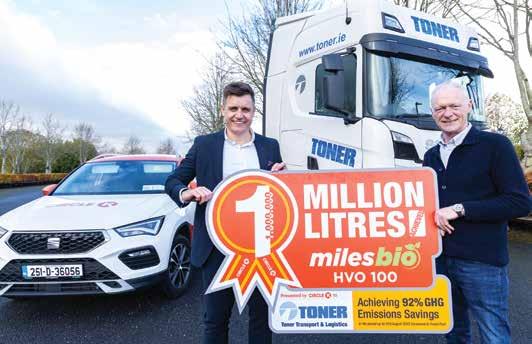
Toner Transport consumes 1 million litres of HVO
iNtErViEW With Raffaele Brustia, RAM Europe
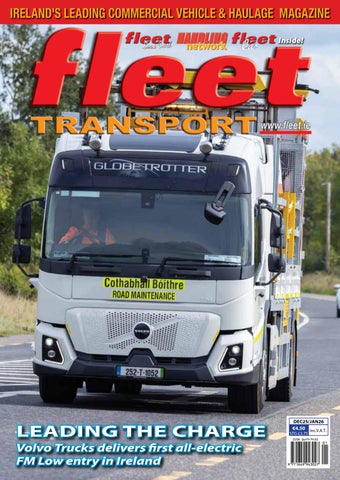
Egis Lagan’s new Volvo FM Electric low entry 14
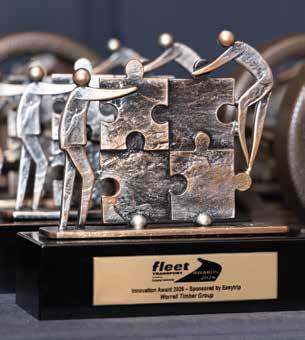
Feature on award-winning on Worrell Timber Group 54 tESt i
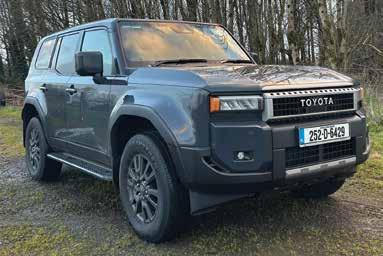
New Toyota Land Cruiser appraised
55 tESt ii
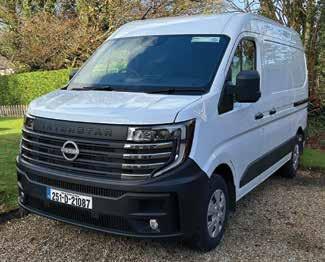
On the road with the new Nissan Interstar
56 LAUNCh PAD i New Toyota Hilux BEV
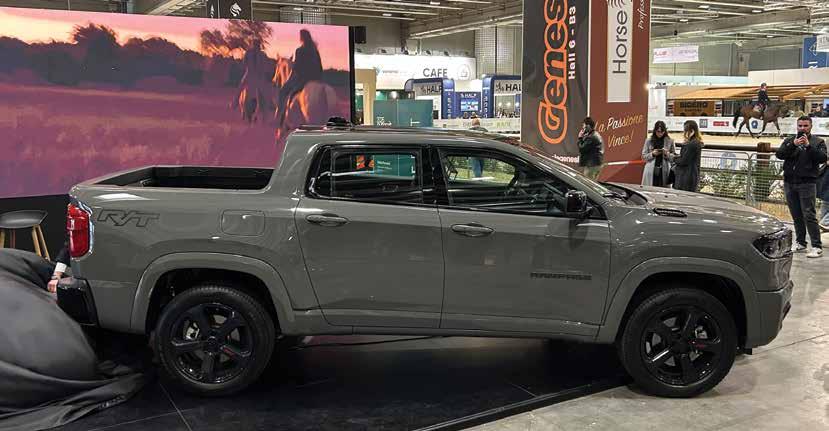
58 LAUNCh PAD ii RAM reveal new Rampage pick-up
60 ELECtrOMOBiLitY DAF ‘Xcels’ on
Connect, Luxembourg 22
i RTX Scotland, SEC Glasgow 28 rEPOrt ii
FTAI Transport Manager’s Seminar, Enfield
Long Mile Road: Frank Fahey Commercials
The lowdown on the hoedown in Lisburn 65
Top Irish honours for Renault 5 Mapon takes over Fleet DATA
Opel Mokka GSE
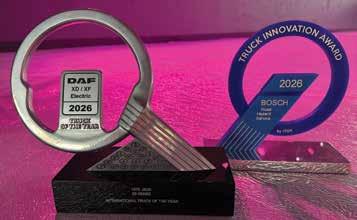
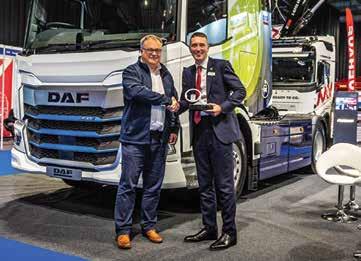
The new DAF XD and XF Electric have been voted International Truck of the Year 2026 (ITOTY) while Bosch has secured the Truck Innovation Award 2026. This marks the third time DAF Trucks has won the coveted title with its New Generation range, following the success of the XF, XG and XG+ in 2022 and the XD in 2023, bringing the award back to Eindhoven once again.
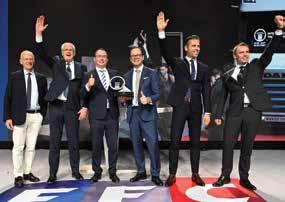
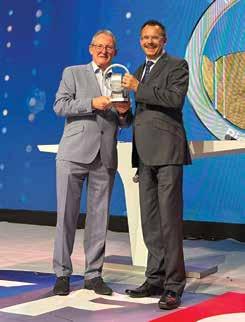
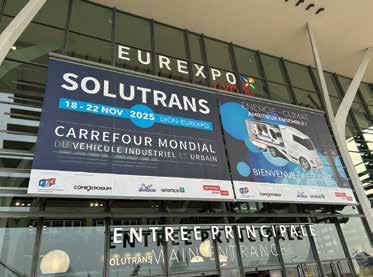
The trophy was presented to Harald Seidel, President of DAF Trucks, during the International Awards Gala Evening at the Solutrans trade fair in Lyon, France, attended by more than 1,300 guests.
With 92 points, the Dutch manufacturer’s heavy-duty electric line-up finished ahead of its rivals in the final count. The diesel-powered MAN D30 PowerLion was a strong contender, while the fully electric SANY e435 became the first Chinese truck ever to make the shortlist for Europe’s most prestigious commercial vehicle award.
DAF XD & XF Electric named International Truck of the Year 2026; Bosch wins Truck Innovation Award 2026
Their range also benefits from the 9% aerodynamic improvement introduced across DAF’s latest generation. The modular vehicle concept, offering a wide choice of battery and axle configurations, was also commended for providing operators with exceptional flexibility.
itOt Y 2026 N OM i NEES
n DAF XD / XF
n MAN D30 PowerLion
n MAN eTGS
n SANY e435
n SCANIA Super 11
At the same event Bosch was presented with the Truck Innovation Award 2026 for its Road Hazard Service, recognised as the year’s most outstanding technology innovation. The trophy was presented on stage to Mouna Romani, Vice President Cross-Domain Computing Solutions for Commercial Vehicles, Bosch, Andreas Motsch, Vice President Sales Commercial Vehicles, Bosch, and Minea Schwenk, Vice President Connected Map Services, Bosch.
This is the third consecutive year that an electric truck has taken the title. Of the five vehicles shortlisted for 2026, three were battery-electric, underlining how the energy transition remains central to the truck industry - even as the internal combustion engine continues to evolve.
During extensive test drives, jury members praised the XD and XF Electric for the refinement of their drivelines and their almost imperceptible gear changes.
The Truck Innovation Award – recognising the profound technological transformation and the energy transition in the automotive industry – is presented by the International Truck of the Year (IToY) jury composed of 25 trade journalists from leading commercial vehicle publications in Europe and South Africa.
Bosch’s “Road Hazard Service” provides road users with real-time information on potential hazards such as fog, heavy rain, accidents, or broken-down vehicles. Since June 2024, the service has been active in millions of passenger cars across Europe, and since December 2024 it has also been available in commercial vehicles from MercedesBenz Trucks.
The system uses anonymised swarm data from these connected vehicles, along with inputs from weather services and road operators, to identify critical situations at an early stage. Vehicle sensors supply information such as temperature, windscreen-wiper activity, and stability control interventions. Algorithms interpret this data to detect risks such as aquaplaning or reduced visibility, and drivers receive timely warnings via the navigation system.
The service forms part of Bosch Connected Map Services, which integrate vehicle data to enhance driver assistance systems such as adaptive cruise control and emergency braking. This allows vehicles to respond more effectively to changing road conditions, lane geometry, and positioning, so that autonomous vehicles can operate more safely, smoothly, and proactively.
With 66 jury points, Bosch finished ahead of the Volvo VNL Autonomous, which is already operating fully autonomously on public roads in the United States. Third place went to Accelera, the new Cummins business segment offering a full portfolio of zero-tailpipe-emission solutions.
ti A 2026 N OM i NEES
n Accelera by Cummins
n Aurora Driver
n Bosch Road Hazard Service
n Einride Autonomous Border Crossing
n Scania DHL Range Extender Project
n Torc Robotics Autonomous Trucks
n Volvo VNL Autonomous
A new brand and model name has been engraved on the International Van of the Year trophy for 2026. For the first time, Kia - with its new PV5 - has been presented with the most prestigious award in the light commercial vehicle industry.
All twenty-six members of the International Van of the Year (IVOTY)
Ford Pro to the fore!
Ford Pro has secured its fourth International Pick-up Award title in the fifteen-year history of the competition with its newly developed Ranger PHEV. It is the first time that a hybrid drivetrain has been honoured by the International Pick-up Award (IPUA) jury, whose members are drawn from the International Van of the Year Award (IVOTY) group.
The overall winner for 2026/27 was selected following an extensive on-road/ off-road test programme held in Bulgaria last month. Several other 4x4 double-cab contenders compete strongly for the top prize, including INEOS, Foton and Maxus - the latter two Chinese brands - all of which impressed the judging panel with their performances during the trials.
In the final tally Ford secured the highest number of marks, with the INEOS Grenadier Quartermaster taking second place and the Foton V9 finishing third.
“In delivering outstanding, class-leading performance with even greater efficiency and lower fuel costs for everyday journeys, the new Ranger PHEV seamlessly combines a 2.3-litre EcoBoost
Newcomer Kia wins International Van of the Year 2026 with
PV5
while Ford Ranger loads up Pick-up Award
jury voted unanimously to elect the PV5 as the 2026 title holder.
The Kia PV5 is a fully electric modular van concept, part of the South Korean manufacturer’s new PBV (Platform Beyond Vehicle) model range, built on a dedicated electric vehicle skateboard type platform, termed E-GMP.S.
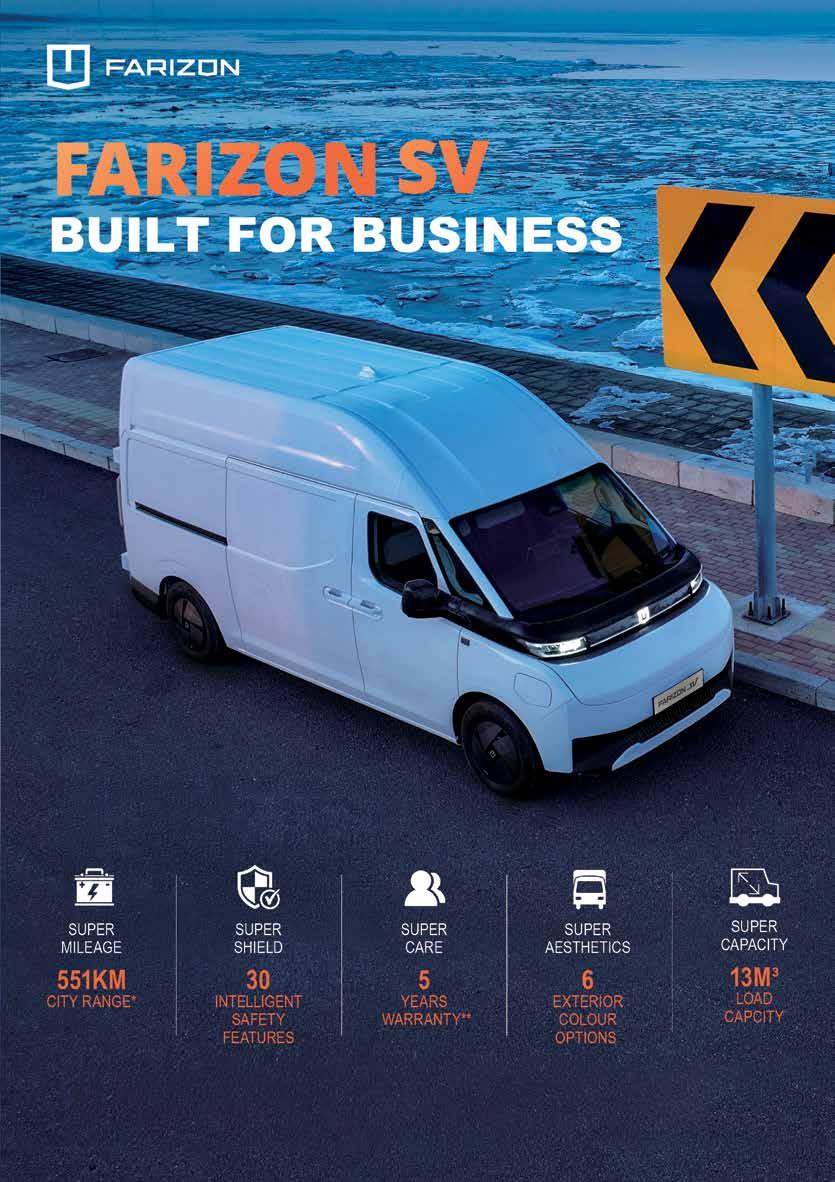
Another newcomer, the Farizon SV from China, finished in second place, with the Ford E-Transit Courier completing the podium positions. The Volkswagen Transporter and latest Crafter along with the MAN TGE, were shortlisted, as were the Ford Transit Connect PHEV and the revised Ford E-Transit.
Both Marc Hedrich, President of Kia Europe, and Sangdae Kim, Executive Vice President & Head of PBV Division at Kia Corporation attended the Solutrans Gala event, and took to the stage to accept the trophy from Jarlath Sweeney, Chairman, IVOTY. He said:
“Well done to Kia on winning the 34th International Van of the Year Award for 2026. The PV5 is the first of a batch of new light commercial models due from the Korean brand in the next few years, so we will hear a lot more from Kia in due course. As we know Kia cars have won numerous accolades, now it’s the deserved turn for its new van division. Interestingly, it was another new brand from Asia as in Farizon with its SV model that secured the runner up spot, and we welcome this Geely Group brand into the European market.”
petrol engine with a 75 kW battery-powered motor. A choice of EV driving modes means you can drive on petrol, battery power, or a combination of the two. And with 281 PS of power, 697 Nm of torque, and up to 3,500 kg maximum towing capacity, there’s no compromise to the iconic toughness and hard-working capability of the Ford Ranger,“ explained Jarlath Sweeney, Chairman of the IVOTY & IPUA.
Hans Schep, General Manager, Ford Pro Europe welcomed the announcement, saying: “We are incredibly proud and honoured that the new Ford Ranger PHEV has been named the International Pick-up Award winner for 2026/27.
Having won with the all-new Ford Ranger in 2024, we deeply value the recognition the jury has now given to the electrified plug-in hybrid model, demonstrating the consistent excellence and innovative spirit that defines the Ranger lineage.
“This is the fourth occasion that the Ford Ranger, in various incarnations, has won this prestigious award - firstly in 2013, then in 2020 and with the title shared with the Volkswagen Amarok
in 2024. Ford is therefore the outright leader in its field, both in terms of IPUA accolades and its continued dominance of the European sales charts,” added Jarlath.
Chris Ruston (right), Commercial Vehicle Marketing Manager, Ford of Europe accepting the IPUA trophy from Jarlath Sweeney, Chairman IVOTY/IPUA for the Ford Ranger PHEV
DDAW Driver Safety Camera
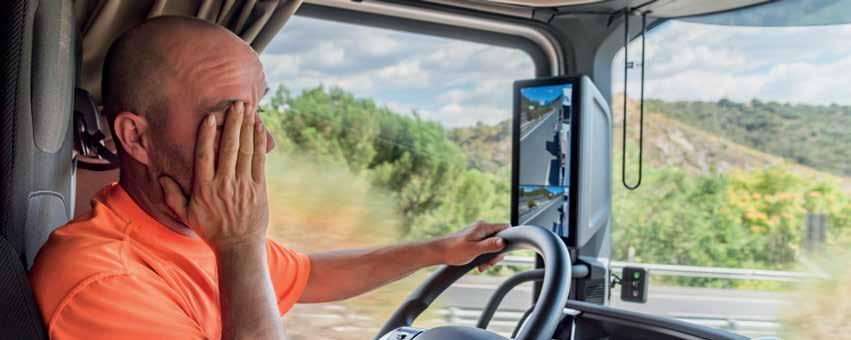
Brigade’s Driver-safety cameras and IP driver distraction cameras are designed to mitigate driver fatigue. Using AI technology, the cameras provide driver warnings against potential issues caused by inattention, distraction and tiredness.
Forward-facing camera:
• Lane departure warning (LDW)
• Headway monitoring warning (HMW)
• Forward collision warning (FCW)
Driver-facing camera:
• Drowsiness
• Distraction
• Yawning
• Mobile phone use
• Not wearing a seatbelt
• Smoking
‘King
Cong’ Gorillla passed fit by Corr na Móna Men’s Shed to take part in Joyce County Truck Run
December 28th – Maam Cross to Cong – ‘Carrying the King to Cong’
Beautifully scenic by day and equally splendorous by night, the Maam Valley in the heart of Connemara will once again play host to more that 100 trucks as they set out on the 5th annual Joyce Country Truck Run. Held on 28th December, it starts out at 5pm from Maam Cross Mart.
“The popular event raises much needed funds for the Corrib Mask Search & Rescue organisation, supporting those brave volunteers who risk their own lives to save others. Their work brings reassurance to local and visiting fishermen to the region for their safety which in turn provides valuable support to local B&B sector,” explained Paddy Rock, main organiser.
As daylight begins to fade over Maam Cross, the hum of V8 engines and the
sound of music signal that the trucks are arriving for check-in at the Mart compound. The lively tunes and flashing lights announce that the convoy is on its way to the gathered crowd, stretched out along the set route.
Down in the Valley, onlookers assemble outside Keane’s Bar to witness the spectacular sight of a snake-like line of trucks, weaving its way through the night lighting up the roadway as they descend.
Then mobile phones will start to buzz to the various ringtones all asking the same question - Where is the Gorrilla? Who is carrying ‘the King’ to Cong? As the bush telegraph word spreads, the convoy makes its way through Corr na Móna, Cloughbrack, Clonbur, and on to finish in Cong, at the Community
One million litres milesbio HVO for Toner Transport
Congratulations to Paul Toner, Toner Transport & Logistics on reaching the significant milestone of
Centre, near the main gates of Ashford Castle, with excitement building up at every stop. By the time the trucks roll close to the ‘The Quiet Man’ village, the one question will be answered - Who’s in possession of King Cong! Which truck is he in?
For further information and to enter, please contact Paddy on 087 2439760 or Ray 087 2898229
Entry fee: €50 per truck – email: Joyce Country Truck Run
Email: joycecountrytruckrun2021@gmail. com
Congratulations to Fleet’s John Armstrong
Congratulations to Fleet’s John Armstrong on successfully completing the Certificate in Logistics & Marketing Level 7, undertaken with ATU Mayo, Castlebar this year.
This Level 7 Certificate analyses how business and non-business professions use logistic and marketing tools in getting their products and services faster
to the marketplace. The programme was delivered on a blended basis. The majority of classes were online, with the addition of compulsory onsite days at ATU Mayo.
John joined the Fleet Publications team last year, working on the Fleet Transport Awards and Fleet Bus & Coach Awards programmes.
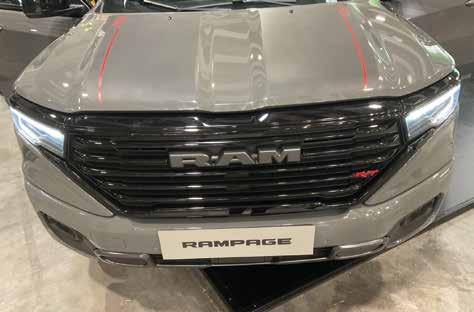
What is Rampage?
This is really a Ram truck. The new Rampage is compact and loadable, with a lot of very good technical features and comes with a new pick-up body design and has a driving style that’s effectively much more like a passenger car. With it we want to cover this white space in the sector of people that would like to have a truck, but effectively are scared about the size of standard versions.
Where did the concept originate?
A South American design, created in Brazil and it’s made in Brazil, based on an existing platform from Fiat that is called Small Wild, and gives us a car that is really fun to drive with high comfort levels that’s expected from such a vehicle
One-to-one
with Raffaele Brustia –Deputy Head of RAM Brand Enlarged Europe
“With Rampage we are pioneers in a new frontier!”
used in the European market ... therefore fitting in very well. It’s in keeping the bold style of Ram, but in a more balanced approach for European needs.
Looking at the pick-up market, the choice is rather low in relation to SUVs. In sales terms there are about 4 million SUVs sold compared to 130,000 pick-up unit sales per year, that’s quite a gap. One of the attractions of SUVs is that it has a higher driving position, with good visibility, good technology with petrol, hybrids and electric power. Can you actually close that gap between SUV and pick-up?
This is exactly what we are thinking about with the introduction of the Rampage, combining its drivability, the level of refinement like a premium SUV, while adding a versatility that is usually provided with a pick-up. And also we are seeing that more people are really in love with outdoor activities, hobbies etc., to carry bikes, surf boards and need a car of this type.
And there is a trend there that’s not been really catered for. And so we think that is the right moment to have a product to offer for those people that are looking such elements. Because most pick-up are still really linked to be workhorses. With traditional body and frame structure on today’s pick-ups usually, many don’t offer the driving comfort that is equal to a passenger car. And so with the Rampage, we combine exactly those two things, versatility and comfort driving.
But the price has to be competitive like an SUV, when you go to the marketplace.
On the price, we have not yet defined it, but for sure we are thinking of striking exactly the right balance between an SUV and the midsize pick-up. This is our reference point. So for sure, we need to put our car in the right space of the market, considering our premium-ness of Ram as a brand, and considering the competition, the extended competition, as we call it, because there is no other real competitor. So we are pioneers in a new frontier!
From a personalisation point of view, do you have some ready-made accessories, for example canopy/ covers, chrome roll bars, side steps, ancillary lights, etc available?
We already have an official catalogue of accessories, as the car is already in production and selling to customers in South America. We have a load bed covers, soft and also rigid. And also, a side step at the passenger area that closes and opens with electrified system. There is side step built into access the load bed. A unique feature is the tailgate warning light in the dash, to alert drivers that that the load door is still down.
What about some power points at the back in the load bay? Some pick-ups have a plug-in system for auxiliaries?
At the moment, no. But the power plug that’s inside the cabin can be used and there are multiple USB ports, up to 6 around the car.
What about the towing capacity?
The towing capacity of this car is not
really for towing heavy loads. If serious towing is needed, we concentrate on our value proposition with the Ram 1500 pick-up. And with the Rampage, due to the fact that we said it’s more urban, and for the technical reason with the unibody, the towing capacity is at the moment rated at 400 kilograms. That allows towing a light trailer with bikes, for example. But we have concentrated more to the payload and having a one-tonne provision with the capability to accommodate Europallet dimensions.
At the moment Rampage has either a 2.0-litre petrol or the 2.2 diesel. Are they Stellantis production engines?
Yes, they are from Stellantis, the gasoline one is the Hurricane 4 engine with four cylinders. And then the diesel is built in Italy and fully developed by Stellantis, with Multi-jet technology, currently available on the Alfa Romeo Stelvio, for example, but with a different calibration.
As you know, there’s a move towards electrification for pick-ups. Some have hybrids, some are moving to electric.
Is this something that’s in your future plans with the Rampage and the 1500?
Not currently but we are taking things step-by-step. But we have announced a range extender application for the Ram 1500, which suits better and meets customer needs at the moment. Having this combination there is no need to recharge, but have the full experience of electrification with that of range extender technology.
The ultimate question is of course, will Rampage be available in right-hand drive?
I wasn’t expecting that question (laughs). At the moment, we plan to have the right hand drive version. This will be also depending on the sales success across Europe once introduced. We know how important the UK and Ireland markets are in terms of pick-up sales, but we are not there yet. Regulations have to be met etc.
With Jarlath Sweeney – editor@fleet.ie
Spend anywhere online & in-sto with Google & Apple Pay
No admin. No postal costs or delays.
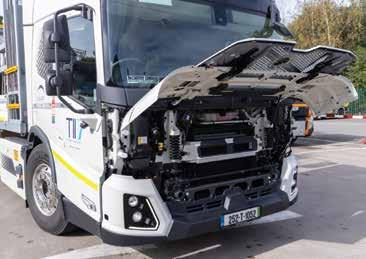
Motorway maintenance specialist Egis Lagan Services has taken delivery of the country’s first Volvo FM Low Entry battery-electric truck, marking a significant step in the company’s journey toward greener operations and sustainable transport.
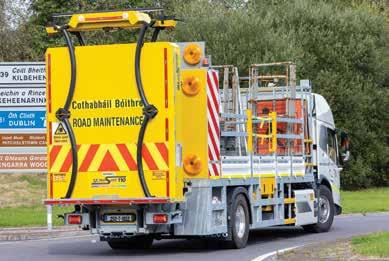
The new zero-tailpipe-emission truck will be used as an impact protection vehicle as part of Egis Lagan Service’s contract with Transport Infrastructure Ireland (TII), carrying out maintenance work on the M8 motorway. Combining near-silent operation with exceptional driver visibility, the FM Low Entry boasts a five-star Direct Vision Standard rating.
For Peter Csabai, Winter Service & Maintenance Manager at Egis Lagan Services, this latest investment is the result of a clear, long-term vision.
“Over the past few years, we’ve been exploring alternative-fuel vehicles to reduce our transport-related emissions,” he explains. “This new electric truck is the latest part of that project. Before placing the order, we trialled two different electric models for two weeks each — and the Volvo came out as the clear winner.”
Egis Lagan Services go green with VOLVO FM Low Entry
bility goals and Ireland’s Climate Action Plan.
“Ultimately, we aim to keep the truck in service for between ten and fifteen years, replacing a diesel truck and
That decision was driven by a mix of performance, reliability, and practicality. By replacing a diesel truck with a fully electric vehicle, Egis Lagan Services expects to eliminate a significant amount of CO₂ over the vehicle’s lifetime — aligning with TII’s sustaina-
eliminating those resulting emissions,” Csabai adds.
B U i Lt FO r th E J OB
Supplied by McCarthy Commercials, the Volvo FM Low Entry 4x2 comes fitted with a flat-bed body built by Swords Auto, complete with a rear crash cushion for impact protection and traffic management duties.
The vehicle is based at the company’s Cahir depot, where it recharges between shifts before heading back onto the M8. Before ordering, Egis Lagan Services and McCarthy Commercials carried out a
Pi ONEE ri N g A C LEANE r F LEE t
detailed route simulation to confirm the optimal battery configuration for its daily work.
The truck is powered by four traction batteries, giving a total of 360 kWh capacity — more than enough for its 100 km operational stretch between Urlingford and Fermoy.
It will be regularly manned by a four-person team, with the FM Low Entry’s flexible interior spec’d in the three-passenger seat configuration. The passenger seats are placed at the back of the cab, not in the view of the driver, to minimise blind spots and contribute to excellent visibility.
“The crew cab design was essential for our needs,” adds Csabai. “Our operatives are working in live lane situations and must always get out on the non-traffic side of the road, which can change depending on which lane is closing. Any vehicle that has a middle console would be an unsuitable obstruction.
“The overall design of the truck is very impressive, making access to and from the cab as easy as possible and the visibility for the driver is first class.”
With its low entry height, excellent visibility, and Volvo Dynamic Steering system, the FM Low Entry makes long shifts safer and less fatiguing for drivers. It’s also backed by a five-year Volvo Gold Contract, ensuring battery performance and peace of mind for the operator.
A COMPANY B U i
Founded in 2013, Egis Lagan Services is a joint venture between Egis Road Operation S.A. - part of the global Egis Group - and Lagan Operations & Maintenance Ltd., one of Ireland’s leading infrastructure maintenance specialists.
The partnership brings together international engineering expertise and local operational know-how. Together, they manage around 350 kilometres of Ireland’s motorway and high-speed dual carriageway network under TII’s Motorway Maintenance and Renewals Contract (MMaRC) Network C.
sections of the M7, M8, and M9, as well as the N25/N40 corridors around Cork. From depots strategically located in Portlaoise, Kilkenny, Cahir, and Cork, the team provides round-the-clock maintenance and renewal services - from winter gritting and emergency repairs to road resurfacing, drainage upgrades, and bridge works.
The company’s workforce includes engineers, electricians, and maintenance operatives, many of whom are on call 24/7 to ensure that the motorway network remains safe, reliable, and ready for Ireland’s travelling public.
The introduction of the Volvo FM Low Entry electric truck is more than a single fleet upgrade - it’s part of a broader commitment by Egis Lagan Services to embrace innovation and sustainability.
As Ireland moves toward net-zero transport emissions by 2050, the
This network covers key national routes including
business is helping lead that transformation at a practical level. Its investment in zero-emission technology, data-driven maintenance systems, and enhanced safety standards positions it as one of the most forward-thinking motorway service providers in the country.
With a clear focus on sustainability, safety, and service excellence, Egis Lagan Services continues to set the standard for modern motorway operationsensuring that Ireland’s national roads are maintained not just for today, but for the cleaner, greener journeys of tomorrow.
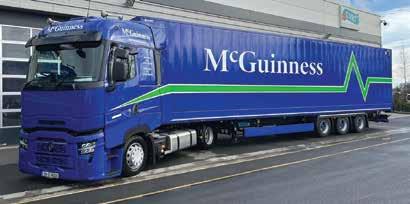
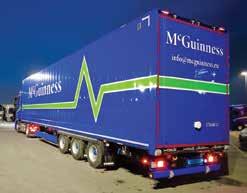
Setanta Vehicle Sales, through its Krone Trailers and Renault Trucks divisions, has joined forces to supply McGuinness - one of Europe’s foremost tour logistics specialists - with a consignment of mega-event trailers and tractor-units.
Based in Dublin, McGuinness is one of Ireland’s longest-established and most trusted tour logistics specialists. The company travels across Europe with major artists, bands and production crews, transporting the full spectrum of touring equipment - lighting, staging, audio systems, backline, and technical infrastructure - safely and precisely from venue to venue.
Joining the fast-expanding McGuinness fleet are 10 Krone Dry Liner steel bodies trailers and 10 brand-new Renault T-High 4x2 trucks.
“Our reputation is built on reliability,” says Mick Dillon, Fleet Manager for McGuinness. “Touring is unforgivingevery load-in and load-out is time-critical, and our trucks often move overnight to ensure the next show is ready to build when the crew arrives. We handle everything from delicate audio gear to high-value staging systems, so the equipment we run has to be robust,
Setanta calls the tune for McGuinness with a score of Krone mega-event trailers and Renault T High trucks
secure and absolutely dependable.
For us, the right trailer specification isn’t a luxury - it’s essential to meet the demanding schedules and loading requirements of modern touring.”
In this respect, the high cube mega trailers are steel bodied with steel rear doors and come equipped with a bespoke ramp carrier, insulated roof and, for flexible loading, Krone’s multi-point keyhole system. All steel parts are shot-blasted prior to priming and then finished with Krone’s KTL powder coating process. A 10-year guarantee against corrosion perforation is provided as standard.
“There is always a strong demand for Krone event trailers,” says John McCann, Head of Trailer Sales for Setanta, “driven largely by their reputation for high quality equipment, tailored to the job. Moreover, the Krone team understands what is required, and for this particular customer, they were able to respond quickly to a tight delivery schedule.”
“McGuinness is part of the live entertainment world,” adds Mick Dillon. “In touring, there is simply no margin for error. Whether it’s an arena, stadium or festival site, our job is to ensure every
piece of production equipment arrives exactly when it’s needed and in perfect condition.
“Once the show ends, we’re straight into a highly coordinated breakdown and overnight move to the next city. Our drivers and crews are among the best in the industry, but they can only perform at that level with equipment that’s equally reliable. Keeping a major tour moving night after night demands nothing less.”
With decades of experience on the road, McGuinness has built a reputation for delivering complex multi-truck tours with absolute reliability, seamless coordination and industry-leading attention to detail.
Toward end of year sales at McElvaney Motors Scania
Marron truck & trailer (Co. Monaghan)
New Scania R660 V8 6x2 Tag Tractor Unit, complete with tipping gear and a host of extras. Wishing Stephen, Jack and the entire team every success with their new arrival.
Butler transport & Warehousing (Co. Monaghan)
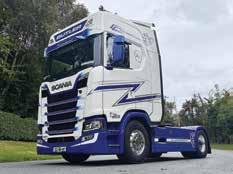
New Scania 460 S Super, finished in eye-catching livery, joins the fleet.
Matthews transport (Co. Meath)
New Scania XT 560G 10x4 Tipper, complete with a Fitzgerald tipper body and a front-to-back cover system
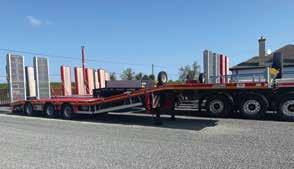
2026 MAX Trailer, 3 axle, Hydraulic lifting floor to gooseneck, safe & easy loading of neck Rear steer axel Double flip ramps with hydraulic side shift Flooring options available, hardwood timber or steel grating
2026 Faymonville 3 axle 9ft wide in stock, fixed bed or extendable, available Now, out riggers, double flip ramps, hydraulic rear legs, full spec
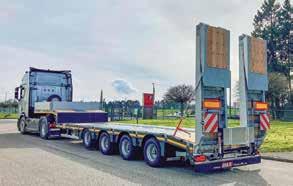
2026 MAX Trailer 4 axle step frame low loader, in stock ready to go, choice of hydraulic ramps or hook on alu ramps, extendable in length, out riggers, container locks, marker boards, etc. Also available with 800mm travel height.
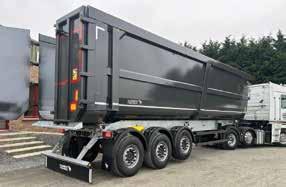
2026 Schmitz steel bulker for scrap metal, in stock available immediately
Seventeen Renault Trucks
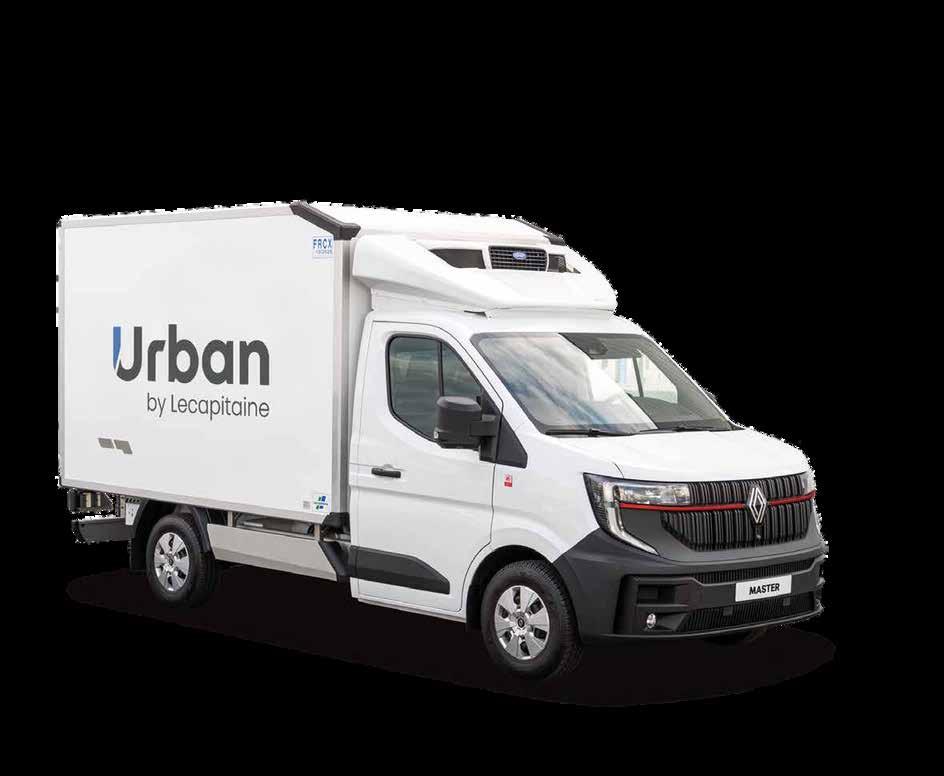
Red Edition Master E-Tech
Electric Vans for DPD Ireland
*Emission-free deliveries nationwide from DPD Depots
Pictured are a selection from a fleet of seventeen new Renault Trucks Red Edition Master E-Tech Electric Vans destined for DPD Depots around the country. Geoffrey Sheridan, Operations Manager at Shaw Commercials, Castlebar, Main Renault Trucks dealer, who supplied the new light commercials, said that these long wheelbase, high roof (L3 H2) panel vans are specified with driver comfort and electric
performance in mind. “All vans coming standard with air-con, rear view cameras and rear sensors for the ultimate driver experience. These vans will be kitted with telematics systems to monitor daily performance and have been ply-lined by Vanguard (Limerick) with Spectrum Signs & Printing (Athlone) providing the distinctive livery.”
Another new MAN TGM for Bathrooms 4U TLI Group well MAN…ed!
Tralee-based
Bathrooms 4 U has taken deliver of a new MAN TGM supplied by Martin Hough at Dennehy Commercials, Main MAN Truck dealers, Dock Road, Limerick.
This 4x2 15-tonne GVW rigid truck is fitted with a bespoke Fitzgerald body, and fully equipped with cameras, windbreaker, and additional lighting for night time
manoeuvring.
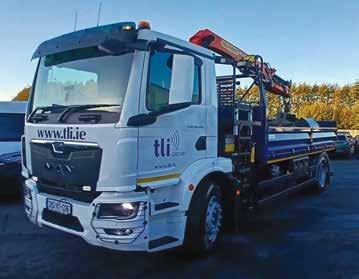
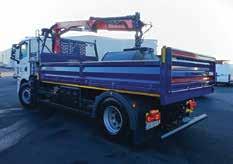
As the 252 registrations draw to a close, another fine example of the MAN Truck marque takes to the road: a TGM 18.290, with Thompson dropside tipper body and Palfinger grab crane, sold to the TLI Group by Martin Hough at Dennehy Commercials, Limerick.
MUTEC TRUCK & VAN CENTRE
Guidance for retroreflective marking on Light Commercial Vehicles (LCVs)
Why Visibility Matters
Approximately 30% of collisions involving Light Commercial Vehicles (LCVs) occur during times of reduced visibility. Vehicles used for roadside operations including maintenance, emergency, utility, recovery, and deliveries, face a higher risk when stationary during their work activity.
To increase the visibility of LCVs used in roadside operations, vehicle owners may consider fitting retroreflective chevron markings to their vehicle. Some vehicle owners have already implemented these markings as part of their own health and safety assessments. Retroreflective materials reflect light directly back to the source, therefore increasing the visibility of a vehicle fitted with markings to approaching motorists. In Ireland the fitment of retroreflective markings is mandatory for Heavy Commercial Vehicles (HCVs) however, their fitment is optional for LCVs.
Make your vehicle stand out
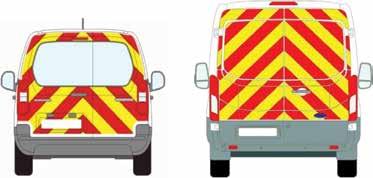
Rear retroreflective markings when fitted to LCVs should comprise of alternate strips of red retroreflective material and yellow non-retroreflective material in a chevron pattern. With this pattern the retroreflective red stripes maximise night-time visibility, where the fluorescent yellow stripes provide good daytime visibility and contrast the red. Each strip should be: -
• At least 150mm wide, and
• Angled between 45° and 60° upwards
Material and Fitment
For maximum visibility during lighting up hours, it is recommended that materials with high retroreflective properties are used for the red stripes in the rear chevron markings. High-grade reflective materials such as RA2, R3B, or ECE 104 Class C should be used.
Chevron markings should only be fitted to the rear and cover as much of the back of the vehicle as possible; they must not be fitted to the side or front of the vehicle. When fitted to the rear of the vehicle they must not obscure any windows, lights, reflectors, sensors, or registration plates. Rear facing door edging / lockers / guardrail strips may be fitted with red retroreflective material.
Maintenance Tips
The effectiveness of retroreflective materials tends to deteriorate over time, so regular maintenance is important. Retroreflective materials should be treated with the same care as high gloss automotive finishes and follow manufacturers recommendations where possible. It is recommended that retro-reflective markings are maintained by keeping them clean, avoiding harsh chemicals, or excessively high pressure / temperature jet washers. Markings that become damaged or where the reflectivity has deteriorated should be replaced.
Remember
• Only red reflective markings are permitted on the rear.
• Temporary Traffic Management (TTM) vehicles should refer to the TTM Guidance Manuals on the Department of Transport Traffic Signs website.
Did you know that 30% of light commercial vehicle collisions happen in low visibility?
Vehicles used for roadside operations, including maintenance, emergency, utility, recovery, and deliveries, face a higher risk when stationary during their work activity.
In Ireland the fitment of retroreflective markings is mandatory for Heavy Commercial Vehicles (HCVs). However, their fitment is optional for Light Commercial Vehicles (LCVs).
Improve road safety and visibility for your LCVs with retroreflective markings. Stay visible. Stay safe.
Further information at rsa.ie.
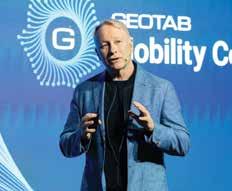
If there was one message to come out of Geotab’s Mobility Connect 2025 conference, held in Luxembourg on October 22nd, it was that telematics is in the midst of an unprecedented sea-change thanks to Artificial Intelligence (AI).
Telematics has long played a central role in fleet management, enabling transport operators to track vehicles, collect basic engine data, and evaluate driver behaviour. Yet for many years, telematics was inherently reactive: fleets used it to understand what had already happened—a harsh braking event, a breakdown, or a collision—after the fact. Decisions were made in response to historical data, and fleet managers were often left piecing together clues from disconnected data points.
At Geotab Mobility Connect 2025, leaders across the industry shared a unified message: artificial intelligence is reshaping telematics into a proactive, predictive, and behaviour-shaping ecosystem. Advances in AI, machine learning, and contextual data interpretation are helping fleets not only understand what is happening in real time but also anticipate risks, prevent incidents, and engage drivers in a more supportive and collaborative way.
Key speakers at the conference offered insights covering executive perspectives, product innovations, real-world case studies, and fleet operator panel to illustrate how AI is driving the evolution from reactive to proactive telematics.
1. Ai as the Catalyst for the Next Wave of telematics
In his opening keynote, President & CEO of Geotab, Neil Cawse described the rapid acceleration of AI adoption globally, noting that industries from healthcare to agriculture are being reshaped by intelligent systems that interpret complex data and make actionable recommendations.
From Reactive to Proactive: How AI Is Transforming the Future of Telematics
Transportation, he emphasised, is uniquely positioned to benefit due to the scale, complexity, and societal impact of fleet operations.
Neil outlined three historical waves of telematics:
Wave 1: Location-Based Tracking — simple GPS dots on a map.
Wave 2: Data Explosion — access to engine codes, driving events, and vehicle diagnostics.
Wave 3: AI-Powered Telematics — where machine learning transforms raw data into connected, contextualised intelligence.
What distinguishes Wave 3 is AI’s ability to connect the dots rather than simply collect them. As he noted, AI is only as good as its underlying data. He pointed to Geotab’s 5.6 million active subscriptions and over 100 billion data points per day that create a powerful foundation for prediction, pattern detection, and contextual reasoning. AI interprets not only how a vehicle behaves but why—based on environmental context, road risk, driver behaviour patterns, and mechanical health.
This transition is especially important in safety, where video has become “the new sensor.” Instead of relying solely on G-force triggers or post-event analysis, AI can now evaluate real-time visual context to detect risks before they escalate.
2. Predictive Collision risk: From Scorecards to insight
The shift from reactive to proactive safety management was central to the session led by engineers Abhinav Vasu and Miguel Fayos. Using fictitious personas of AB, a fleet manager, and Mike, a driver, their role-play illustrated the practical impact of AI-powered predictive risk tools.
Traditionally, fleets relied on driver scorecards based on speeding, harsh braking, or acceleration. These metrics were helpful but superficial. A driver with a “good” score might still face elevated
collision risks due to factors not visible in legacy telematics.
The new Predicted Collision Risk model, trained on data from millions of vehicles, incorporates:
n Driving behaviour patterns using more accurate, context-based event detection
n Vehicle health
n Environmental conditions
n Roadway risk profiles
n Historical outcomes across vast datasets
For the fleet manager AB, the insights were startling: despite good scorecard performance, his fleet’s predicted collision risk exceeded the industry benchmark. This revelation marked a shift from retrospective evaluation to forward-looking risk management, empowering AB to intervene before collisions occurred.
More importantly, AI surfaced the specific behaviours and conditions driving each driver’s risk profile. This precision transforms coaching from confrontational to collaborative, allowing managers to focus on the causes rather than the symptoms of unsafe driving.
3. Video as a Proactive Sensor: go Focus and go Focus Plus AI-driven video telematics is one of the clearest examples of the proactive turn. As Neil Cawse noted, video provides rich context—transforming abstract events into explainable, visual insights. Geotab’s investment in Smart AI and the release of Go Focus and the enhanced Go Focus Plus demonstrate how video intelligence is evolving.
Go Focus uses outward-facing AI to detect potential collisions, tailgating sudden environmental risks, and unexpected road hazards. Drivers receive real-time audible alerts, enabling immediate correction before an incident occurs. Instead of reviewing events days later, intervention becomes instant, personal, and preventive.
Go Focus Plus adds an optional inward-facing camera with privacy-preserving features, including facial blurring, ensuring that AI focuses on
behaviours, not identities. In addition to the above it can also detects phone use, seatbelt violations and driver fatigue or distraction. Again, the emphasis is proactive: warnings prompt drivers to adjust behaviour in the moment, significantly reducing risk while building trust through transparency.
Edward Kulperger, Senior VP, EMEA with Geotab shared survey results that underscore this shift: while 92% of drivers worry about in-cab cameras, the same percentage supports them if they help exonerate them after an incident. AI reframes cameras as driver support tools, not surveillance instruments.
4. Ai, Behavioural Science, and a Culture of Safety
Experts at the conference stressed that technology alone cannot create a proactive safety culture, with a panel discussing how telematics can transform safety emphasising the importance of driver engagement, transparency, and motivation. Attendees heard from companies like Circet and BT describe their journeys, highlighting how they engaged early with drivers and unions, provided clear, consistent communication, utilised customisable scoring systems emphasising the most important safety variables, provided manager and driver training programmes, and focussed on supportive coaching rather than punitive oversight.
Steve Lockington of Geotab Vitality reinforced that the “carrot is more effective than the stick.” Behavioural
science shows that sustainable improvement comes from motivation, recognition, and habit formation, not fear of punishment.
Vitality’s platform transforms predictive risk scores into gamified, personalised goals, rewarding drivers for safe behaviour. This engages every driver—not only high-risk individuals— and prevents the cyclical nature of traditional coaching where drivers regress after short-term improvements.
As Steve noted, proactive safety is about changing behaviour before risky events occur, not just reacting afterward.
5. Predictive Maintenance: Ai Prevents Breakdowns Before they Occur
Beyond safety, the move from reactive to proactive telematics is equally transformative when it comes to maintenance of fleets.
In their session, Franco Vigano and Stefano Peduzzi described how early telematics flooded fleets with diagnostic data that was overwhelming without context.
Fleet managers struggled to interpret fault codes, often resulting in delayed or ineffective maintenance decisions.
evaluate charging strategies and optimise total cost of ownership. Now, rather than reacting to range issues or battery failures, fleet managers can proactively design and manage electrification strategies.
Conclusion: Ai is redefining the Purpose of telematics
Across all sessions of the well attended conference a consistent theme emerged: AI is turning telematics into
AI changes this by creating:
n Breakdown probability scores
n Prioritised service alerts
n Predictive component failure forecasting
n Contextual maintenance scheduling based on fleet-wide patterns
Instead of reacting to breakdowns— or performing unnecessary routine maintenance—fleets can now plan interventions at precisely the right time. This maximises uptime, reduces cost, and enhances safety. Predictive maintenance is not simply a matter of efficiency— it can prevent dangerous roadside situations, protect drivers, and uphold mission-critical operations.
6. Sustainability as a Proactive Strategy
AI also supports proactive sustainability planning. Tools such as EV battery health insights, range prediction, and real-world performance analytics enable fleets to select the right EVs for the right routes, prevent battery degradation,
a proactive, predictive, and driver-centric ecosystem. Where telematics once answered, “What happened?” AI now answers:
“What is likely to happen?”
“How can we prevent it?”
“How can we support drivers before risk escalates?”
“How can we optimise fleet operations for safety, efficiency, and sustainability?”
But this evolution is not simply technological—it is also cultural, requiring engaging drivers, respecting privacy, building trust, and designing systems that empower rather than surveil. Done correctly, AI augments the human experience rather than replacing it. As Neil Cawse summarised, AI acts like “20 interns working for you”—but it still requires human wisdom, leadership, and strategic oversight.
With AI, telematics is now becoming a forward-looking compass—helping fleets operate more safely, sustainably, and intelligently than ever before.
Text: Cathal Doyle – cathal@fleet.ie
Edward Kulperger
The rate of vehicle related fatal incidents at work reported to the Health & Safety Authority continues to be a cause of concern. In 2023, the top trigger associated with reported fatal incidents was “struck by a vehicle/vehicle collision”. These incidents occurred across five broad sector categories, being Agriculture, Construction, Transportation and Storage, Manufacturing, and Waste Management. This rate of incidents points to a need for more effort in managing workplace vehicle risks.
The operation of practically every workplace involves some element of vehicle activity. In some premises this activity will be very apparent, particularly those with their own fleet of vehicles and mobile work equipment, such as trucks, vans or forklift trucks. For other workplaces it may be less apparent and confined to the activities of visiting vehicles, such as collections and deliveries, involving, for example delivery
or collection vans. Some workplace vehicle risks will simply arise from employees travelling to and from work using their own cars. In many businesses employees will travel for work outside of the work premises in their own or in company-owned vehicles. It is probably fair to say that because vehicles are such an inherent element of the activity of many businesses, they can be taken for
Managing transport operations and vehicle risks
granted, and the risks associated with them are often overlooked.
The bottom line is that every workplace should have a section of their safety statement dedicated to a transport and vehicle operations risk assessment.
Vehicle safety in the workplace must be competently managed. Every employer is urged to be aware of the risks arising from vehicle-related activity at their workplace. They should assess what is the level of vehicle activity involved in the running of their organisation, and commit to better managing vehicle movements and operations in their businesses. The size and form of the management system will vary depending on the size of the operation.
A typical vehicle safety management system should address the following:
1. Definition of the policy and rules for the management of vehicles at the workplace and identification of responsible person for managing vehicle safety.
2. Carry out and record risk assessments - this means writing down the most significant hazards, identifying who is at risk and listing the safety precautions which should be in place for all vehicle risks.
3. Determine the training needs of workforce and the preventative maintenance programme required for ensuring ongoing workplace vehicle safety. Any changes to vehicles, workplace or personnel which might have implications for the safety of the system must be allowed for.
4. Employees who may be affected must be kept fully informed of the system and of any changes to it.
5. Details of how acceptable standards for workplace vehicle safety are achieved and should also be included in the site-specific Safety Statement.
This means that workplaces that have risks associated with vehicle operations should have written procedures to control all vehicle operations. The workplace layout should enable safe interplay between vehicles and people and structures. Additional infrastructure such as bollards, barriers, gates, etc. may be required. It might be possible to designate pedestrian exclusion zones. There is a need to control visitors and visiting drivers. Workplace signs to prompt people to follow rules and procedures should be put in place.
The Health and Safety Authority has a broad range of resources on its website to assist businesses to put procedures and measures in place to manage transport operations and vehicle risks. These resources consist of guidance material, e-learning courses, information videos, sample policies, check sheets and posters. These are available to access free of charge at https://www.hsa.ie/eng/ Vehicles_at_Work/
tOP 10 WO rk PLACE t r ANSPO rt SAFE t Y t i PS
n Control entry to your workplace.
n Keep pedestrians and vehicles apart.
n Eliminate vehicle reversing, where possible.
n Provide clearly marked pedestrian walkways.
n Mark and signpost vehicle only areas.
n Make sure all work areas are well lit.
n Keep traffic routes free of obstructions / mark permanent obstructions.
n Provide impact protection to vulnerable parts of the workplace such as lamp posts and columns.
n Provide and wear high visibility personal protective equipment.
n Accompany visitors.
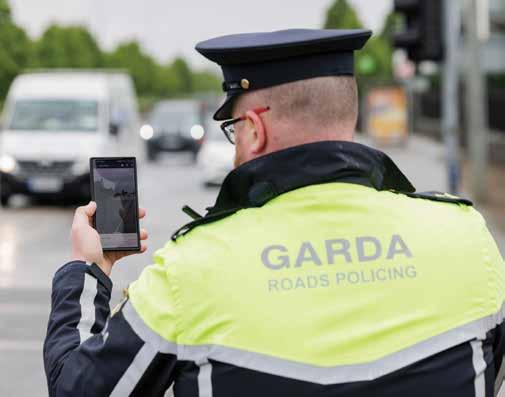
As many as 35,000 fleet and motor trader vehicles are yet to be added to the National Fleet Database (NFD). That’s according to the Motor Insurers’ Bureau of Ireland (MIBI), who warned that these vehicles risk falling foul of the system used by An Garda Síochána to detect uninsured vehicles operating on Irish roads.
If a fleet or motor trader vehicle is not included on the NFD, then it will not show up on the Irish Motor Insurance Database (IMID). That’s the system used by the Gardaí to check the insurance status of vehicles. Which means that as Gardaí are undertaking automatic checks on licensed plates, a vehicle will be flagged as uninsured if it should be listed on the NFD but isn’t. When Gardaí come across uninsured vehicles, their procedure is to generally stop and seize that vehicle on the side of the road.
Should the vehicle have valid insurance in place, it will face the disruption of being halted and delayed mid-journey, before being obliged to prove the existence of insurance cover to law enforcement. After that the owner
will still face prosecution for failing to add their vehicle details to the NFD, risking a court appearance and fines of €500 per vehicle.
By law all vehicles insured on fleet or motor trader policies must be listed on the NFD and Gardaí are now focusing on vehicles who do not comply. This comes as part of the national clampdown on uninsured vehicles.
It is the responsibility of the fleet owner or motor trader to ensure their vehicle details are added to the NFD.
The NFD is maintained by the Motor Insurers’ Bureau of Ireland (MIBI), a not-for-profit organisation, that was established to compensate the victims of road traffic accidents caused by uninsured and unidentified vehicles.
As well as vehicles sold by motor traders, these type of insurance policies are generally used to provide cover to trucks, buses, coaches, taxis, construction vehicles, hire cars, delivery vans, utility and service vehicles, service transport, retail vehicles or semi state vehicle fleets.
Beyond the estimated 35,000 vehicles who are missing from the NFD, details for a further 387,000 fleet and motor trader vehicles have already been added to the database.
“Any fleet or motor trader vehicles that are yet to be added to the NFD are
35K FLEET VEHICLES YET TO BE ADDED TO NATIONAL FLEET DATABASE
Any vehicle not listed risks being stopped by Gardaí and fined
really rolling the dice in a game they can’t win,” said David Fitzgerald, Chief Executive of the MIBI. “The system used by the Gardaí to catch uninsured drivers is completely data driven. Gardaí can identify in seconds if a vehicle has valid insurance in place with a quick scan of a vehicle’s licence plate. But if that vehicle hasn’t been added to the NFD then it will show as uninsured.
“That means the vehicle risks being stopped and seized. Generally people who operate under fleet or motor trader policies have busy schedules, so it is surprising they are willing to risk such delays and legal hassle. Even after that they’ll still have to deal with the consequences of breaking the law, which include a court appearance and significant fines.
“It is only a matter of time before these vehicles get caught, especially as the Gardaí are now placing a special focus on identifying fleet and motor trader vehicles that aren’t complying. Given that it only takes a few minutes to add vehicle details to the NFD, this seems like an unnecessary gamble which the owners and users of those 35,000 fleet or motor trader vehicles may end up paying the price for very soon,” Mr. Fitzgerald concluded.
Anyone wishing to upload their vehicle information to the NFD can do so on nfd.mtpl.ie.
RTX Scotland, SEC, Glasgow – 19/20 November 2025
Following the successful of the Road Transport Expo at Stoneleigh, England, its newest sibling - RTX Scotland - made its debut in Glasgow, bringing together leading truck, trailer, and technology brands with operators of all sizes. The event created a fresh platform to view the latest commercial vehicles and equipment in action; meet key leading suppliers and industry partners; discover new innovations to boost business; and benefit from a topical seminar programme featuring expert speakers on the key issues affecting the haulage sector. And of course, there were ample opportunities to network with transport professionals in a relaxed, friendly setting.
Here’s a flavour of what unfolded at the SEC, Glasgow over the two days. Rob Van Dieten reports.
operations, alongside the former ITOY-winning New Generation DAF XG+530 FTS tag-axle 6x2 tractor, regarded as the benchmark for long-haul comfort and efficiency.
i VECO
DAF t r UC k S
Will Shiers, Editor of Commercial Motor magazine and UK member of the International Truck of the Year (ITOY) jury took to the stage to present the ITOY 2026 trophy to Louis Jones, EV & Connected Services Director, DAF Trucks UK. The accolade followed the joint win for the DAF XF and XD Electric trucks, announced at Solutrans 2025 in Lyon, France just days earlier.
On display was the award winning XD Electric 350 FT 4x2 tractor, representing DAF’s offering for emissions-free,
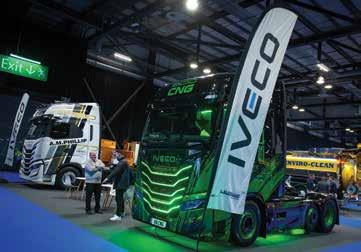
The Fleet Transport Irish Truck Innovation Award-winning IVECO S-Way 500 CNG 6×2 “Force of Nature” made its Scottish debut, turning heads with its hand-painted vivid green splashes,
heavy-duty
glossy black finish, and luxurious interior featuring Alcantara, bespoke bedding, and bold design elements.
RTX 2025 also marked the public debut of the IVECO S-eWay Rigid, the Italian marque’s first eHGV to launch in the UK. It features a modular battery system, taking inspiration from the innovative eDaily. IVECO also showcased its ‘Box Clever’ 7.2t eDaily.
MAN presented a broad range of vehicles, from the 3.5 tonne TGE to the flagship TGX tractor, in both electric and diesel configurations.
With a strong emphasis on sustainability, efficiency and total cost of ownership, MAN highlighted its suite of bespoke aftersales products designed to support every type of operator. A team of experts, including eMobility consultants, were on hand to guide visitors through vehicle options and tailored business solutions.
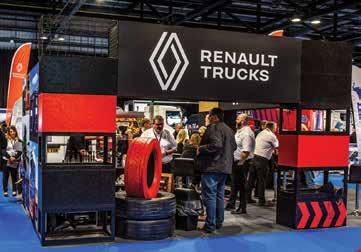
Renault Trucks Scotland was flying the flag for the French brand, with the dealer showcasing a selection that demonstrated the breadth and strength of the brand’s range, from electric urban distribution to long-haul performers.
Centre stage were customer vehicles that reflected Renault Trucks’ close partnerships with leading Scottish operators, including Stuart Nicol Transport’s Renault Trucks T High 6x2 pusher.
Joining the T High on stand was a Renault Trucks D12 Low 4x2 equipped with Hillend Engineering Micro XHD 7m3 food waste body. Ideal for demanding urban operations, this agile 12-tonne vehicle featured a passenger-side vision door with a lower tinted window to enhance direct visibility.
hAN kOO k tYr ES
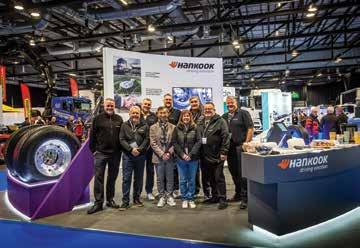
Hankook Tyre UK displayed its latest Hankook and Laufenn commercial vehicle tyre products. Star of the stand was the Hankook e-SMART City AU56, the first EV bus tyre launched in 2024. Developed for electric buses applications, the AU56 delivers low rolling resistance, high durability and reduced noise, while managing the extra weight and torque associated with battery-powered vehicles.
Aq UA ri US it
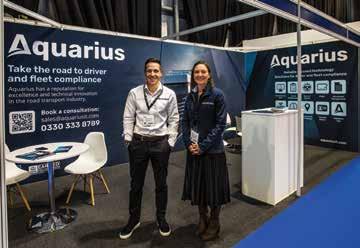
Regular RTX Expo exhibitor Aquarius IT headed north to demonstrate its integrated driver and fleet management solutions, demonstrating how connectivity is transforming compliance for transport operators across Scotland.
Aquarius supports a diverse customer base from the Highlands to the Central Belt - from sole operators to large multi-site fleets. Its award-winning ClockWatcher Elite software, alongside Asset Maintenance and the Aquarius App, is trusted across sectors including seafood logistics, waste and recycling, oil and energy, construction, coach and bus touring, and general haulage.
MAN t r UC k S
rENAULt t r UC k S
FTA Ireland Sustainable Transport Seminar
“Sustainability and decarbonisation must be central to every logistics strategy” - Niall Cotton, CEO, FTAI
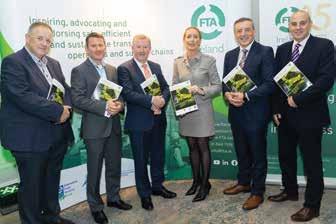
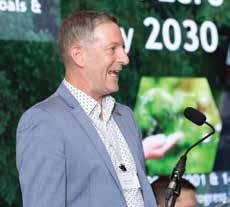
The Freight Transport Association of Ireland (FTAI) Managers Guide to Distribution Costs (MGDC), now in its 7th year, has established itself as the go to guide for the road transport industry in Ireland. This year’s seminar was marked by two factors that were significant in their own rights. The first is that FTAI is celebrating 15 years since its foundation. The second being that this was the first conference for Niall Cotton as CEO. Niall commented on both points in his opening address, where he also thanked the former CEO Aidan Flynn for his work during his tenure of the Association.
Aidan was instrumental in developing many of the policies and initiatives that are now a fundamental part of the FTAI’s work. Over the past 15 years the FTAI has developed highly successful programmes such as Truck Safe, Van Safe, the Logistics Associate Apprenticeship, the Commercial Drivers’ Apprenticeship, and of course the main topic for the seminar, the Managers Guide to Distribution Costs.
Niall then invited Minister of State at the Department of Transport (DOT) Séan Canney TD to officially launch the guide. He began by saying that since coming into his new role he had become more aware of the industry. Congratulating the Association on the guide he noted that: “it is an important document that can be used as a key reference point.”
The Minister continued: “The freight transport and logistics sector continues to find innovative solutions to the challenges you have faced.” Referencing his own Department, he noted the work being carried out to make the application and renewal process for the Road Transport Operators’ Licence more streamlined. The system is in final stage of testing and is due to go live on 10 November, 2025.
Regarding sustainability, the Minister believes: “rather than it being a burden it is now becoming a commercial necessity.” Minister Canney outlined the range of possible grants available to operators to ease the transition to alternatively fuelled vehicles (AFV). Nevertheless, he accepts that “even with government support it will not be possible to transition the entire HDV (Heavy Duty Vehicle) fleet in Ireland to zero emissions in the short to medium term. Interim measures are critical to further our collective efforts.”
Minister Canney recognised the efforts of the FTAI in addressing the skills shortage and their collaboration with his Department on the Road Freight Forum and the Logistics and Supply Chain Skills Group. Speaking further on the skills shortage he commended the Association on their Commercial Drivers’ Apprenticeship in association with the Atlantic Technology University which he described as “a very positive and progressive solution in this area, adding: “I would encourage you all to facilitate active participation in the programme.” In his closing remarks Minister Canney thanked
the FTAI for their professionalism and their engagement with his Department. Niall Cotton presented some findings from the MGDC report. While the report reveals a wealth of data Niall focused on the key points, one of which being that it was generally the larger fleets who responded to the survey. The report noted that the average distance travelled per day is 281 kms with the per annum figure around 85,000 kms. On average overhead costs were found to have increased by 9% compared to 8% the previous year. Nevertheless, while the average figure was 9%, more than half of respondents reported an increased figure of over 10% - whereas the national haulage rate increased by an average of only 4.2%.
On maintenance costs an average 5% increase was recorded with some reporting an increase of 10%. This equates to an average annual cost of just under €10,000 which is an increase of 11% year-on-year. Fuel is always a key barometer of the industry and this year it was found to have increased slightly. However, the cost of fuel per kilometre was down 8% from €0.49 to €0.45 with an average annual fuel consumption of 26.4 l/100km – which equates to 130 litres per day. Many attribute this reduction to the uptake of EcoDriver training which has increased from 63% to 68%. It’s important to note that 100% of respondents are now using some form of telematics to monitor the performance of vehicle, drivers, and to assess performances overall.
Looking to the skills shortage mentioned by the Minister, 83% of
NIALL COTTON
SEAN CANNEY
operators granted wage increases of 5.5% bringing the average for a driver’s salary to €47,349. Nevertheless, the labour market remains difficult, and the report reveals a delay of 29.8 days to fill a driving position. Notably 64% stated that this is impacting operations, with 71% believing it is impeding growth. However, 37% have employed personnel solely to address the issue of Environmental Social Governance. Across all categories’ training provision is down, and Niall commented that “this is something to watch given the increasing compliance requirements.”
Another finding highlighted that needs to be watched is that of cashflow. While respondents reported an average growth in revenue of 8.7%, over 11% said they use invoice discounting to support cashflow, especially through the months of December, January, and February. Finally, 36.4% of respondents raised concerns regarding challenges with succession planning.
Of course, the event is not just about the MGDC, it is also an opportunity to talk to industry and share experiences - both good and bad. Certainly, if one thing stood out from the day it was a willingness by participants to talk openly and collaborate with others, an immense help for those looking to establish where they are positioned on their road to zero.
As explained by Paddy Sweeney, Enprova was set up by the oil industry to meet the targets set by the EU Energy Efficiency Directive. The key points Paddy noted from the report were that more than half of respondents had now moved from exploratory to mainstream with alternatively fuelled vehicles (AFVs), indicating that corporate strategies are more aligning with corporate goals. However, the average satisfaction score post procurement was only 4.8 out of 10. This mostly related to “real world operational hurdles” such as cost and refuelling infrastructure. Nevertheless,
Paddy stated: “the long-term view remains optimistic with over half of the respondents expected to integrate AFVs by 2030.”
Transport is an industry heavily reliant on finance for capital expenditure. Providing an update on their offerings, Head of Transport & Logistics at AIB, Nessa Deveraux revealed some interesting points from AIB’s perspective. Nessa says the MGDC has become a valuable tool and one she uses every week when developing strategy and when assessing applications for funding. She believes this applies especially to tendering, noting that “we have seen a huge upgrades in sustainability and tenders are stronger when they include sustainability.” This is common across many sectors including goods and passenger transport and the Agri segment. Another area Nessa referenced was the growth in Golf Tourism, and for this sector AIB have produced an outlook report that is available on their website.
originally with trials of HVO which was viewed as a bridging fuel, while ATC is now running over 50 BEVs. Some of these trucks are engaged in long haul round trips of 2,600 kms from Venlo (NL) to Ullo, (H). ATC’s progress is commendable though Rainer said the main cost of transitioning is infrastructure, adding that capital expenditure is not the problem. He continued: “without the funding the price would be different, and we must be prepared for when the grants will decrease or disappear.”
The popularity of CNG may have waned for a time, nevertheless Gas Networks Ireland (GNI) continues to expand and improve the network. GNI has two Biomethane injection sites - one in Kildare, and a larger facility under construction in Mitchelstown. There are plans for four more facilities within the next 12 months. It is intended for a total of nine public and two private stations to service the 170 HDVs currently operating in Ireland with additional capacity to fuel approximately 600-700 trucks per day.
Fran McFadden, National Customer Acquisition Manager at GNI believes gas to be reliable source of fuel, and while he accepts it is still a fossil fuel, Bio-CNG does deliver a 90% reduction on carbon emissions. In addition, Fran outlined the availability of grants of up to €10,000 to assist operators make the move to renewable gas vehicles.
Next to the podium was Rainer Hoerbst of ATC, Baldonnell, which specialises in the transport of IT infrastructure for data centres. ATC is now a member of the Arvato group, and is literally charging ahead with its aim to provide services with zero emission transport by 2030. This transition began
In his presentation, Fleet Distribution & Compliance Manager at BWG Foods Ken Leahy was brutally frank. Yet, this is what is really needed to move the argument forward and is of great benefit to other operators as the BWG experience is a real-world case study.
Spar International operates 5,000 vehicles, 800 of which are powered using alternative fuels. That includes 220 battery electric, and 5 hydrogen powered vehicles. BWG is further down the road with AFVs, the main reason for this is it
PADDY SWEENEY _ ENPROVA
NESSA DEVEREUX - AIB
RAINER HOERBST - ATC
FRAN MCFADDEN _ GNI
started earlier. “It’s all about planning ahead, electric vehicles are the way forward, but a multi-faceted approach is needed.”
“In 2023 we bought three BEV Volvos and another in 2025. Today we have just added the first Mercedes-Benz eActros 600 with another two on order bringing the total to seven BEVs. While the Volvo allowed a range of 275 kms the eActros will allow a range of up to 500 kms. As Ken explained: “this is vital because it ensures the truck gets back to the depot where the cost of charging is about €0.20 p/kWh whereas public charging would cost about three times that.” Many operators say that an EV will not suit the type of work they do. Ken added: “any alternative fuelled vehicle is model specific, and we now build routes to suit the truck - not the truck to fit the route.”
However, Ken’s closing remarks were possibly the most salient of the event. BWG has projected the total cost of ownership over a 7-year cycle, calculating that where a diesel truck costs €572,890, a Bio CNG costs €500,200 and a BEV costs €446,100. Ken outlined the BWG experience very well, adding: “I won’t tell you what you need for your business.” He concluded by highlighting a recent significant drop in the price of
BEVs from €450,000 to €370,000. Director of B2B & Card Sales at Circle K, Paul Dixon highlighted where the company is at present, and importantly where it is heading. Paul said in 2024 the total market for fuel in Ireland was 4.4 billion litres. More interestingly Circle K projects that while the market will reduce by 1% per annum, by 2030 the annual volume will fall to 4.2 billion litres. Looking forward Paul said: “Hydrogen is not a priority right now, but we have to look to the future.” He continued: “the now sustainable solution for freight transport is HVO - however, he says it is not the only solution.”
As Assistant Principal Officer with the Road Freight Policy Division within the DOT, Aideen Morrissey is familiar with the issues from both sides of the argument. Aideen stated that: “from the transport sector as a whole the Department is seeking a 50% reduction in carbon by 2030 over 2018.” She believes that passenger car and lighter vehicles will move at a faster pace than HDVs to electrification. Currently ICE vehicles comprise 99.5% of the fleet with gas being 0.34 and EVs registering just 0.14 percent of HDVs. Europe wide HDV sales (over 12 tonnes) accounted for 1.5% whereas LDVs accounted for about 18% of their segment.
The Road Haulage Strategy published in 2022 promotes a modal shift to other means of transport. Here Aideen accepts that a move to rail-freight and cargo bikes has very limited possibilities. Other possibilities may include seeking efficiencies by greater use of logistics hubs and the introduction of a longer trailer trial in 2026. Standards for the Department’s EcoDriving programme were published in September 2024 and Aideen encouraged all training bodies to become approved providers.
There is always great interest in
the Road Safety Authority’s (RSA) presentation of compliance figures from their Head of Enforcement, Justin Martin. Since 2022 the roadworthiness compliance rate at roadside inspections has been improving year-on-year from 51% to a year to date of 56%. Equally roadside tachograph and licensing inspections have averaged a 65% compliance rate year to date since 2022.
Again, by far the most prevalent vehicle fault recorded relates to tyres with almost 1,500 cases in 2024 and year to date just under 1,200 incidents, with brake lights and lighting issues following a close second and third respectively. On tachograph issues failure to take an adequate break, and failure to take a daily rest period were the largest percentage of faults recorded. Regarding cases prosecuted the largest percentage was drivers not being CPC compliant and operators permitting a driver to drive without being CPC complaint.
Justin then moved to explain about the EU Common Formula and the Directive 2006/22/EC implementing Regulation (EU) 2022/685, the aim of which is to further promote the harmonisation of enforcement practices across Member States. The system was launched in April and is going live on 10 November, allowing operator ratings to be shared with the competent authorities in other Member States, while the information will also be available to enforcement officers at the roadside.
Closing the event, Nial Cotton thanked all the presenters for their contribution and thanked all the event sponsors for their continued support. To summarise, he believes that it is now clear that “sustainability and decarbonisation must be central to every logistics strategy,” and concluded by highlighting the importance of operators collaborating to deliver on the targets.
Text: Paul White - paul@fleet.ie Photos: Paul Sherwood
KEN LEAHY - BWG
PAUL DIXON - CIRCLE K
AIDEEN MORRISSEY - DOT
JUSTIN MARTIN _ RSA
Your Driving Force
Any Task, anytime. Discover vans by Mercedes-Benz. Available with our convenient Service plan and three-year Warranty. While you focus on your business, we take care of the rest.
Learn more
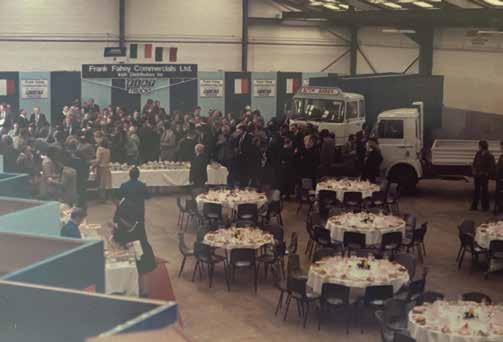
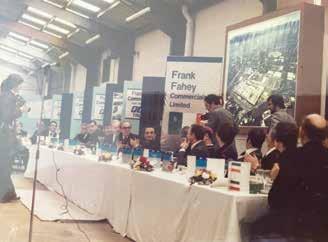
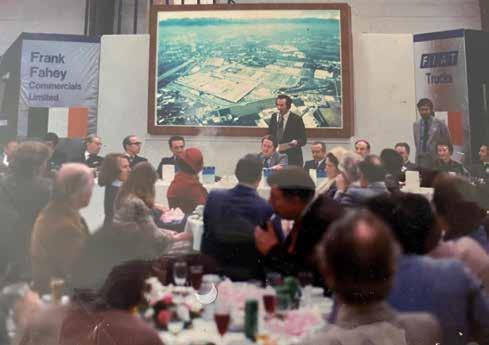
The sixth of July 1977 goes down as a significant milestone in the history of the commercial vehicle industry in Ireland. That date in time marked the commencement of Frank Fahey Commercials as the official distributor of Fiat Trucks and Vans for the Republic of Ireland.
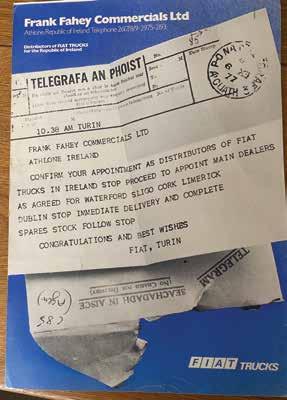
Confirming the appointment, an official telegram stating same was delivered direct from Fiat HQ in Turin, Italy to Frank Fahey Commercials’ newly opened state-of-the-art garage and showroom facility in Athlone. Five main dealers were soon signed up, with the successful partnership over the ensuing years becoming the pinnacle of Frank Fahey’s long and successful career in the motor industry. It was that entrepreneurial spirit that brought him from a small family farm at Lehinch, Hollymount, County Mayo to the junction of the Naas Road and the Long Mile Road in Dublin. Many years of apprenticeship, hardship, salesmanship, health issues and hospitalisation led Frank to graduate from the University of Life - with First Class honours.
The Long Mile Road - Taken by Frank Fahey CommercialsA Memoir
Now in his nineties and living in Dublin, Frank has completed his memoirs. Over twelve chapters the fascinating read chronicles his life and times from his birthplace to retirement, with Fleet Transport having the privilege to review the document and accompanying photographs. Although not as mobile or agile as in his formative days, Frank’s mind remains as sharp as ever, recalling and recounting his early family life, his career path and numerous characters met along the way.
From being a shy teenager venturing out to the workplace, with each opportunity and time served Frank learned from his peers, gaining confidence along the way which he combined with a desire and drive to succeed.
A deep thinker and a businessman through and through, he was ahead of his time in many respects. His ideas and initiatives to gain publicity were unique attracting both attention and sometimes notoriety. A generous employer and mentor.
Deciding at the early age of fourteen to leave school having disliked every day in the two National Schools he attended locally, Frank’s initial foray into the working world as a full time farmer was short lived too. His first career move saw him move behind the counter where he worked for several years in various character building roles for a number of businesses.
Gaining experience from working in general grocers in Ballinrobe to behind the bar in Athlone, Tullamore, Kilcormac (Offaly) and Brownstown (Kildare) Frank was then to find his true career calling…. in the motor trade. As a young, ambitious car salesman employed first by Stathams of Carlow and then by Higgins Galway, he achieved phenomenal results, driven by passion, growing confidence and putting in long hours. “Sell the people what they want and are willing to pay
for” was his philosophy…and it worked. His sales efforts broke national records, with over 350 vehicles turned out at the Ford garage on the Headford Road. Having gained experience through door to door selling in various parts of the country, he was prepared to go out and meet customers at their businesses or homes to seek and secure the deal.
All methods of mobility or carriage was used from bicycle, motorbike, cars and vans, some used for work, others to serve his active social life, he loved Showband dancing.
But it was a long period of ill health that almost put paid to his progress.
As a child Frank suffered from chest infections, missing school days (with glee) but that persistent ailment returned in later life as he was diagnosed with pleurisy,
This illness occurred while working in Kildare, and he was treated at the Jockey’s Hospital at the Curragh Camp.
A crude method of extracting fluid from his lungs was through injecting a big, long syringe into his back without an anaesthetic.
Frank’s travails with pleurisy was followed by a more serious condition when he contracted TBtuberculosis, a prolonged and often fatal disease. This occurred during his employment with Higgins of Galway resulting in many months spent recovering at the Merlin Park Sanatorium. Early treatment did not work before the decision was made to operate and take away a portion of the affected lung. He spent 15 months in Merlin, Galway before being fully discharged and most of this time confined to bed.
of wheeling and dealing in cars, while also becoming an agent for insurance companies.
With the intention of going back to work in Galway, Frank got a call from another brother Tom, a salesman for Punches of Cork wholesalers based in the midlands. He suggested that Frank apply for the vacant sales manager position at the newly formed Athlone Motors. The fledgling firm had an issue relating to its ownership among its directors that had to be sorted out. What transpired was that Frank was appointed as a director and shareholder of the company with agencies for British brands such as Austin, Morris and Hillman, as well as Bedford trucks and vans.
With his shirt sleeves pulled up Frank quickly turned the company around, combining ever increasing new and used sales with an efficient repair and maintenance service programme devised
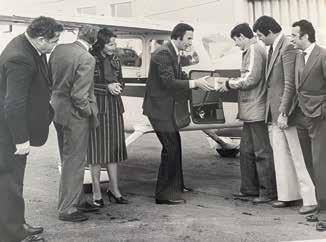
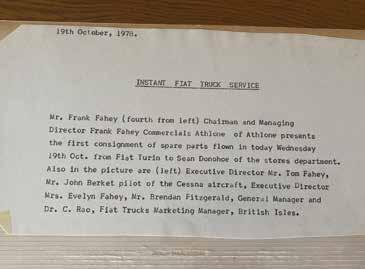
are Frank Fahey, Chairman & Managing Director, Frank Fahey Commercials, presenting the first delivery to Paddy Fox, Spare Parts Division Manager with Brendan Fitzgerald, General Manager; Dr. Rino Roa, Fiat Trucks Turin, and Tom Fahey, Executive Director, Frank Fahey Commercials.
from the General Motors system.
The time spent in recuperation were not wasted as Frank undertook a correspondence course in English and General Knowledge. Further qualifications followed with a Certificate in Effective Speaking & Human Relations from the Dale Carnegie College.
Before receiving his full bill of health he worked in his brother Joe’s garage in Hollymount and did a bit
A later addition to Athlone Motors’ brand portfolio was Vauxhall, which was facilitated through one of the main shareholders being McCairns Motors, the main Irish agent for Bedford commercials but also with close links to Vauxhall. A workshop based branch was opened in Roscommon, which also acted as a sales outlet.
Following the sale of McCairns Motors to the PMPA Insurance group, Frank regained that shareholding. Further business expansion was soon on the horizon with the appointment of the business as agent for Hino Trucks for the midlands and west of Ireland.
Wednesday 19 October, the Cessna landed on the cleared tarmac Frank Fahey’s premises with its first parts delivery from Fiat Trucks HQ in Turin, Italy. Pictured
Always thinking ahead, Frank looked to establish a new premises and secured a suitable large site on the Dublin Road. With careful planning, cautious spending and staged funding, the most modern building of its time was constructed, becoming a landmark for the industry.
Around then the Athlone Motors signs were replaced with Frank Fahey Commercials, with Frank’s strong business acumen and sales success gaining him a reputation as the leading truck and van retailer in Ireland.
It wasn’t long before Fiat of Turin came knocking on his door, with chief negotiator Dr. Rino Rao offering Frank the Italian’s giants truck and van franchises. Fiat Trucks were at the time represented by Finglas Motors (Dublin) and their contract was not to be renewed. Surprisingly Frank’s answer was no, because as he explained: “I was doing well with Bedford and Hino and Fiat commercial vehicles were relatively unknown at the time”.
Well known to drive a hard bargain, Frank had second thoughts and invited Dr Rino back to Athlone to view the newly built but not yet fully finished
garage. The Fiat executive left for Italy impressed and with a proposal from Frank that he wanted the importation and distribution deal for the Republic of Ireland. After several meetings in England and Italy, terms and conditions for the importation and distribution contract were eventually agreed, with a stocking plan in place for new Fiat-Iveco trucks and vans, as well as a wide selection of parts and components. The signing was concluded with the subsequent issuing of a telegram from Turin to Athlone, confirming the appointment. And Frank, never shy of innovative publicity, had the telegram reprinted and inserted in Time magazine, which gained huge coverage from all sectors.
At the official opening and launch, the event received broad national media exposure, with an impressive line-up of customer liveried trucks on display inside and outside the new building.
A more flamboyant public relations campaign in association with Aubrey Fogerty Advertising agency in Dublin ensued. It included Frank appearing on RTE’s Late Late Show, as well as a series of TV adverts in which he starred, with his new HQ as an eye catching backdrop.
Time and money was spent with dealers and customers on factory trips to Turin, which produced dividends but were not always without some stress and hardship as Frank attempted to herd the wayward travellers. Within a short period of time Fiat Trucks had reached the number one sales spot, to the envy of many in the trade.
But the best PR coup of all involved landing his newly purchased Cessna plane, loaded with branded Fiat Trucks parts on the Athlone garage compound. This stage managed exercise was another
example of the innovative thinking needed to stay ahead of the opposition. While the distributorship boasted a wellstocked parts department the Cessna was on hand as the emergency back-up if needed, by facilitating an overnight parts service direct from Italy.
The highly publicised landing on the Athlone garage compound may not have been as it seemed - the plane took off from a landing strip outside Lanesborough rather than Turin, but the stunt proved worthwhile, as it raised customer confidence and firmly put any after-sales doubts at bay. Some trips to Turin did happen subsequently, but without any fanfare.
It was a good time for the fast growing business. As Frank outlines: “the company was making good money, sales were increasing and the dealer network expanding to cover all of Ireland”.
Two sections of the building were leased out, one part to the Industrial Development Authority (IDA) for training young mechanics, and the other to a local bodybuilder, both of which proved advantageous to his business operations.
However it was another bright PR plan that ultimately led to a change in the business landscape, primarily due to the dispute over Aubrey Fogarty’s judgement call, which strained relations between Frank Fahey Commercials and Fiat-Iveco. The following excerpt from Frank’s own book explains in detail.
“A decision was made to build a display unit on a forty-foot semi-trailer and to have it transported by a Fiat tractor-unit to exhibit at shows and all places where people congregated. The first outing was the St Patrick’s Day Parade in Dublin. Our agent, Aubrey Fogarty was supposed to be an expert on display and advertising and had a company in Dublin specialising in the body building. So we instructed him to proceed at a cost of seven thousand Irish pounds. On its way to the Parade it got caught in a crosswind of some kind and it blew the newly built unit off the trailer. With great difficulty they did manage to partially refit and after the event they completed the task and sent us an invoice for €15.000. I maintained that Aubry Fogarty should be responsible for making good the faulty workmanship. However, under the circumstances I was prepared to contribute some of the extra costs involved so I sent Dr. Roa to see him and discuss a settlement.
Fogarty’s reply was to pay the full amount and to consider a discount and if I
didn’t agree to this that he would send the invoice to his solicitor.
I was absolute shocked to think that he would do this after all the business I had put through him and had intended to continue to do so. I decided to let him get his solicitor to take proceedings against Frank Fahey Commercials and I would
defend it. Through no fault of mine this decision proved to be a disaster.
I was certain that he would come to me with a proposal rather than go legal. To my surprise he did send me a solicitor’s civil bill demanding full payment and I confidently just handed it over to my solicitor to defend believing that I was certain to win.
Approximately two months later I got a phone call from Ulster Bank to say that Stubs Gazette had registered a charge against me personally, Frank Fahey Commercials, Fiat Ireland and Fiat of Turin.
What happened was that our solicitor, Barry Flynn, neglected to put in a defence and the judge had no option but to give a judgment in favour of Fogarty.
When I challenged our solicitor he admitted he that it was his fault and even though the courts were closed for Christmas he succeeded in getting Judge Hamilton to come in and hear our case on New Year’s Day. The Judge after hearing the circumstances of the case decided to set the judgment aside and have a new trial.
As far as I was concerned I knew that Fogarty had no option but to agree a settlement and he did. What I hadn’t catered for was the reaction from Fiat of Turin. They were absolutely furious that a judgment was registered against their company for a small amount of money even though it was reported in the press
next day that the judgment was set aside. Because I was so much in the limelight at the time the press made a big story of the registering of the Judgment with the result that Fiat Ireland, Fiat of Turin and the banks were first to react. The next thing the banks started demanding our overdraft to be drastically reduced, Fiat Ireland insisted in sticking rigidly to our ninety days credit and Fiat of Turin sent over their top credit controller to investigate all movements of trucks and spare parts. This completely upset our trading relationship with all the departments in Fiat Ireland and Turin.
If I had realised at the time of the extent of the potential damage I would have fought the case but I was confident that I would overcome the damage. However, shortly afterwards the country was hit by a recession and the sale of trucks and vans in Ireland dropped from 4,000 units a a year to 1,000 in 1982 and Fiat was demanding some of the vehicles back to reduce the amount of their debt.
The truth is that I was beginning to get a bit depressed with the whole thing. With interest rates running at 20%, I decided to offer Fiat 51% percent of the shares and minimise my exposure/risk. After we had agreed a price of half a million pounds, which was a lot of money then, I believed that I could make as much from my 49% of an expanding joint venture as I would from 100% on my own so I was happy. After agreeing the deal, I learned that it was their plan not to make any profit in Ireland by charging the max for the vehicles shipped to Ireland and retaining the profit back in Italy. This was a field I had no experience in and by the time I learned it was too late.”
Yugo cars, an Eastern European marque remodelling old Fiat cars, turned out to be a poor choice, while the contract with emerging brand Kia dissolved before it had properly started, with the fledgling business controlled out of the UK.
Buoyant sales of bicycles, tyres, tubes from Korea, Taiwan and China kept things going along with further property investments. At this juncture Frank explored the market in Europe looking for a manufacturer that could supply a range of trucks and vans similar to what he was accustom to dealing with but there was none available that was not already committed to other importers. Rather than reinvent himself with a business that was under pressure due to the recession, he decided to concentrate in the field that he was familiar with, namely buying and selling property and he also got involved in bridging finance.
Moving on Frank acquired a warehouse that came up for sale on the Naas Road, Dublin. After much investment, it was turned into a showroom, garage and Shell service station, while also facilitating the selling of trucks and vans of all makes.
Some start-up capital funding was provided along the way for budding entrepreneurs, acknowledging where Frank started from on the business route.
Agencies that came and went included that for Edbro trucks, which became an instant sales success until Nissan took over the Spanish brand. It was a similar case for the Leyland franchise following its acquisition by DAF Trucks.
Other agencies, such as that with
Today the Frank Fahey Centre nameplate remains prominent on the Naas Road, even if the majority of the passing traffic is unaware of the significant presence and contribution that Frank Fahey made and paid to the commercial vehicle industry in Ireland.
Text: Jarlath Sweeney - jarlath@fleet.ie
Defence, decarbonisation and disruption dominate 2025 ECG Conference
A record 600 delegates gathered in Amsterdam for the 2025 ECG Conference – now the biggest annual meeting point for Europe’s finished vehicle logistics (FVL) sector. Speakers revealed that the automotive industry is under pressure on all fronts – cost, capacity, regulation, security, decarbonisation, geopolitics. IVOTY South Africa member Charleen Clarke reports from Amsterdam for Fleet Transport.
ECG President Wolfgang Göbel set the tone. Demand is flat across most of Europe, with only Spain and Poland showing meaningful growth. The outlook is “not promising,” he said. This is not just a soft patch in the cycle; it’s structural. Göbel pointed to the Draghi Report, which argues that Europe is losing competitiveness because of high energy costs, slow decision-making, and geopolitical exposure. The report calls for three things: close the innovation gap; decarbonise without killing competitiveness; and reduce dependencies on external powers.
But that agenda collides with economic reality in logistics. More than 80% of FVL companies say they’re willing to invest in greener transport. Fewer than 20% of their customers are willing to pay for greener transport. ECG’s Costs & Confidence Trends Survey shows that providers are still prepared to invest in new trucks – including lower-emission assets – but shippers are not funding the green premium. The result, Göbel warned, is an expectations gap: “regulators and OEMs demand lower CO₂; logistics is told to make it happen; the market won’t pay.”
Göbel positioned ECG not as an observer but as an active lever. The association is pushing on innovation and efficiency (including a new Tech Board to fast-track proven digital tools and a Rail Initiative to address rail bottlenecks), decarbonisation (a single, common emissions calculation methodology for the sector, with version 2 due after multiple pilots), and resilience/security. It is also building a dynamic “Green Cost Calculator” to expose the real cost base of low-emission road transport and accelerate e-truck adoption – a tool that still needs sponsors.
NAtO AND LO gi S ti CS: W h At’S th E DEAL?
Major General Ulf Häussler, Director of the Operations and Planning Division at NATO Headquarters, brought a message that would have sounded out of place at a vehicle logistics event a few years ago: deterrence is now a logistics conversation.
NATO, he said, is undertaking its biggest modernisation since the end of the Cold War. The alliance is responsible
ECG President Wolfgang Göbel
Major General Ulf Häussler
for the defence of one billion citizens and is investing heavily in mobility, readiness and reinforcement capability. That means troops at high readiness, large-scale exercises, and the ability to “defend every inch of allied territory all the time”. This is not just about tanks and jets. It’s about ports that work under stress, rail corridors that can move heavy assets at speed, customs that don’t delay convoys, and logistics providers able to surge capacity under pressure.
t h E MA rk E t i S BE i N g r ED r AWN – FAS t
If NATO is reshaping physical Europe, Chinese automakers are reshaping commercial Europe.
Colin Couchman, Executive Director of Global Light Vehicle Sales Forecast at S&P Global Mobility, described a brutally competitive global demand picture. Consumers are under pressure. Geopolitics and tariffs are rewriting trade flows. Environmental regulation is tightening. Western markets are saturating. Almost all growth over the next decade – 84% of incremental global light vehicle volume – will come from Asia-Pacific, led by India and ASEAN. Western Europe and North America are basically flat.
Europe’s traditional model –high-value exports, diversified production, Russia as an outlet, the US as a buffer – is under assault. The war in Ukraine has removed Russia as a volume sink. US tariff policy is limiting transatlantic flexibility. At the same time, Chinese brands are entering Europe at speed. There are now dozens of active Chinese OEMs with electrified portfolios,
aggressive pricing and extremely fast product cycles; some brands can refresh major nameplates in roughly 12 months. Chinese manufacturers are also localising production in Europe. This undercuts tariff barriers and puts Chinese brands physically inside the European production footprint.
That leaves European OEMs in what Couchman called a “perfect storm”: Chinese competitive pressure, decarbonisation targets, and affordability problems for European consumers. BEV adoption in Europe is slowing, not accelerating, at exactly the moment Brussels expects CO₂ compliance to tighten.
ŠkODA: CONSUME r S, NOt POL iti C i ANS, DEC i DE
Škoda Auto CEO Klaus Zellmer picked up on that theme. He revealed that Škoda’s strategy is “freedom of choice while complying with EU CO₂ regulation”: expand the all-electric range, keep improving plug-in and mild hybrids, and continue offering efficient ICE models. He does not back a hard 2035 “electric only” cut-off for new car registrations in Europe, calling it politically tidy but commercially dangerous. Europe, he said, is not Norway. Norway’s EV boom was driven by heavy incentives for BEVs and punitive taxation on ICE, plus cheap electricity and dense charging. Replicating that across 27 EU states (plus associated markets) when German electricity can cost roughly 2.7 times Norwegian levels is unrealistic without serious fiscal backing.
Zellmer set out the profitability squeeze. Batteries still make up around 37% of the cost of building a fully electric car, which drags EV margins towards
break-even versus ICE. He also noted that Chinese brands already hold around 5.1% share in Europe and are localising production inside the EU. That footprint could drive their share into the mid-teens by 2030.
Chi NA’S OU t BOUND MAC hi NE
Chris Zuo, Executive Vice President of the China Automotive Logistics Association, showed just how fast China is industrialising its export machine. Domestic Chinese brands now command well over 30% of their home market, reaching about 70% share in some recent months, driven by rapid model refresh, aggressive pricing and tech-heavy features. New energy vehicle (NEV) sales – including BEVs, PHEVs and range-extended hybrids – have surged, and China’s total automotive exports have climbed into the millions of units per year. Europe is one of the prime targets, with ports like Zeebrugge, Bremerhaven, Barcelona, Southampton and Amsterdam now serving as gateways for Chinese brands, and Amsterdam positioning itself as an “Electric Vehicle Conversion Centre” and European headquarters hub.
Critically, China is no longer waiting for Western logistics capacity. The fleet of Chinese-owned ro-ro (roll-on/roll-off) vessels is expected to jump from 11 ships in 2021 to 61 ships in 2025, with total Chinese-controlled ro-ro parking capacity forecast to grow from 48,000 to 365,000 vehicle slots over the same period. Rail is being used as a strategic safety valve: dedicated China–Europe block trains are now moving finished vehicles (including BYD cars) to Germany with roughly 40% shorter transit times
Colin Couchman
Klaus Zellmer
Chris Zuo
than sea freight, even using double-deck wagons for commercial vehicles.
Christof Klitz, Special Advisor on Transport Policy at FIPRA, added the Brussels lens. The EU is shifting from a purely green narrative to one of strategic autonomy, industrial sovereignty and security of supply. The Clean Industrial Deal (February 2025) and its sector spin-off, the Action Plan for the European Automotive Sector (March 2025), promise support for connected and autonomous vehicles, €1.8bn to secure battery raw materials, a “Small Affordable Car” initiative, and regulatory simplification. Clean Corporate Fleets – due by the end of 2025 – aims to push corporate fleets toward zero-emission operations.
But industry is pushing back on how that transition is managed. Fleet operators don’t just want mandates; they want standardised emissions reporting, predictable fiscal incentives (capex support, accelerated depreciation, CO₂differentiated tolls), and infrastructure funding. Many argue that top-down quotas risk piling yet another compliance burden onto companies already dealing with ETS2, CSRD and mounting cost pressure.
One regulatory file with immediate, practical impact is the Weights and Dimensions Directive. Both the European Commission and Parliament support allowing loaded open car transporters to exceed current maximum lengths up to 20.75 metres using authorised, including extendable, load supports. This matters because longer authorised equipment
means more cars per trip, better space utilisation and lower CO₂ per unit. Some Member States – including the Nordics, Italy, Belgium, Germany and the Netherlands – are supportive; others remain cautious.
supply chain has been hit by rolling shocks: semiconductor shortages, inland transport crunches, port congestion, spiralling rates, inflation, climate impacts, unstable demand – and yet OEMs are still expected to hit decarbonisation targets, keep customers happy and protect margins.
V
OL k SWAg EN: AU tOMAti ON i N th E YA r D, NOt SC i- F i
Peter Hördlein, Managing Director Vehicle Logistics at Volkswagen Konzernlogistik, took the discussion from geopolitics to ground operations. VW’s AutoLog project is testing automated driving for finished vehicle movements in real compounds, ports and yards.
Instead of trying to make every vehicle fully autonomous, AutoLog builds intelligence into the yard. LiDAR poles and cameras create a live 3D “digital twin” of the site. A cloud-based marshalling system plans safe routes and sends “driving missions” to vehicles via public 5G. Vehicles then move themselves –driverlessly – to loading bays, parking lanes or handover zones. This allows yards to be run for flow and density, not walking distance or shift breaks. The project went live in Volkswagen’s Emden yard in June 2025 and by September had reached full dynamic testing in a high-traffic roundabout, with 17 poles, 25 LiDAR sensors and multiple prototype vehicles operating in real complexity.
rENAULt: r EAL -ti ME CON tr OL, END tO END
François Prince, General Manager at Renault, focused on resilience and visibility. Since 2020, the automotive
Renault’s answer is what Prince called an “extremely reactive and collaborative” model built around control towers. The Vehicle Control Tower is designed as a single source of truth for each car’s journey – from plant release to final delivery – combining GPS, transport management system (TMS) events, predictive arrival scheduling and proactive alerting. The aim is simple: on-time delivery to the end customer, with customer care informed before the dealer (or the driver) starts shouting.
kEY tA k EAWAYS
The 2025 ECG Conference revealed that the sector must decarbonise faster, operate leaner, absorb geopolitical shock, integrate with defence logistics, match Chinese speed, satisfy Amazon-era customer expectations for visibility, and do it all with less bureaucracy and more accountability. Clearly, the era when finished vehicle logistics could quietly sit at the end of the value chain is over…
P OL i CY, LOBBYi N g AND th E r ULEBOO k
Text: Charleen Clarke
Peter hördlein
François Prince
Christof Klitz
The Lyon Eurexpo hosted the 18th edition of Solutrans, the leading trade fair for road and urban transport, held 18 to 22 November 2025.
The biennial exhibition continues to grow in international stature, with innovations from commercial vehicle manufacturers, bodybuilders, and equipment suppliers were very much to the fore across the five halls.
While electrification remained a key focus for most manufacturers at the 2025 edition of Solutrans, hydrogen also made a strong impression, with a number of fuel cell trucks on display from the likes of MAN, Hyundai, and Hyliko. Much of the spotlight centred on world, European and national premieres. Jarlath Sweeney certainly didn’t spare the shoe leather during his visit!
BMC
BMC Otomotiv Sanayi ve Ticaret A.Ş., Türkiye’s largest manufacturer of commercial and military vehicles, celebrated its 60th anniversary last year and continues to expand its international footprint. Its medium-duty truck carries the Nexio badge for the US market, while its light-duty truck is supplied by Chinese brand JAC. Taking centre stage was the so called ‘New One’, the heavy-duty Pro L 1852 4x2 tractor - along with the 1856 variant, both featuring a spacious “Sky Roof” high-volume cab.
Solutrans 2025 –EurExpo, Lyon, France
–18/22 November
This is BMC’s most powerful engine to date: a 12.9-litre Cummins diesel engine that generates 520 hp and 2500 Nm of torque, with the Pro L 1856 version producing having 560hp. Both are paired with a ZF TraXon automated transmission.
rENAULt t r UC k S
On home territory, the French manufacturer showcased a comprehensive and practical vision of transport decarbonisation through its vehicles, services and partner ecosystem.
The Renault Trucks stand provided attendees the opportunity to explore the full E-Tech electric range, from the e-cargo bike and E-Tech Master LCV (including an off-road variant) to the E-Tech D distribution trucks and E-Tech T tractor-units. The Flexisderived range of light commercials will follow in due course.
Exclusively at Solutrans, Renault Trucks displayed the new E-Tech T 585 and the E-Tech T 780, capable of travelling up to 600 km on a single charge, alongside a new e-axle co-developed with Volvo Trucks which weighs just 1tonne.
MAN t r UC k
MAN Truck unveiled the eTGL refrigerated-body truck in a world premiere and gave the hydrogen combustion hTGX in its first showing in France. With a usable battery capacity of 160 kWh, the eTGL offers a range of up to 310 kilometres depending on body type and duty cycle – more than adequate for typical urban and regional distribution work. Fast-charging technology enables the two batteries to charge from 10% to 80% in around 35 minutes.
MAN also highlighted its hTGX hydrogen combustion model. Although not yet economically competitive, it may gain
relevance depending on energy-cost developments. MAN also held a conference titled “Fuelling the Future – without Fossils” to demonstrate that road freight transport can already operate without fossil energy sources.
N EW iSU z U N & F SE ri ES
Alter seventeen years, Isuzu Truck has introduced the seventh-generation N and F series, spanning 3.5 to 14 tonnes, and opening a new chapter for the Japanese brand. In addition to refreshed cab styling and a revised interior, the new range benefits from a host of advanced safety and driver assistance systems. A new 9-speed dual clutch transmission is now available for the 3.5-litre diesel engines. The F series cab is wider, at 2.6m compared to 2.535m for the outgoing model. Model designations have changed to M21 (3.5t), M30 (7.5t) and F12 (11.9t).
Double Cab and Single Cab versions of the popular D-Max pick-up were also demonstrated, including an electric model.
F O r D t r UC k S
Sharing the stand with Ford Pro LCVs in line under the One Ford Vision, Ford Trucks demonstrated the electric F-LINE E and the newly launched F-MAX MkII, underscoring its focus on sustainable, technology-driven transportation.
Emrah Duman, Vice President of Ford Trucks, said:
“At Solutrans, one of Europe’s leading trade fairs, we are proud to stand together with Ford Pro under the OneFord vision. With our New F-MAX and all-electric F-LINE E, we once again demonstrate our commitment to delivering reliable, efficient, and innovative transport solutions to our customers. By combining durability, performance, and technology in our new product line-up, we continue to strengthen our presence in Europe and lead the way toward a more sustainable future in transportation.”
The new generation engine delivers up to 11% fuel savings.
hYUNDA i
Hyundai Hydrogen Mobility (HHM) presented its XCIENT Fuel Cell truck as a solution aligned with net-zero objectives, offering a range of over 400 km, refuelling in just 15 minutes, full-day usability, diesel-comparable payload, low-noise operation and zero tailpipe CO2 emissions.
For the first time, the mass-produced XCIENT Fuel Cell is being equipped with body solutions specifically designed for waste logistics and municipal use. This sets new standards in sustainable heavy-duty transport, combining 100% electric drive with the benefits of green hydrogen.
k i A
Fresh from winning the International Van of the Year title with the PV5, Kia showcased new additions to the light commercial vehicle segment within its all-electric PBV (Platform Beyond Vehicle) line-up. Visitors viewed the PV5 Crew and PV5 Cargo Long (L2H1) models, along with the very PV5 Cargo Long unit that set the Guinness World Record for the longest distance travelled by a light-duty battery-powered electric van with maximum payload on a single charge - 693.38 km.
An additional highlight was the unveiling of the new PV5 Chassis Cab, which will be available with a selection of factory-built bodies from South Korea.
rENAULt VANS
Renault placed significant focus on the new Trafic E-Tech electric, due to enter production at the end of 2026. Featuring 800V technology, it can charge from 15% to 80% in around 20 minutes and offers a range of up to 450 km WLTP (NMC long range battery) or almost 350 km WLTP (LFP standard battery). The electric motor produces 150 kW and 345 Nm. A chassis-cab variant fitted with LeCapitaine fridge body was also revealed.
The new Renault 4 E-Tech Electric Van also made its public debut in a “business” configuration, and featuring two exclusive liveries for the show.
F LE xi S
Flexis, the start-up set up by Renault, Volvo Group and CMA CGM highlighted its latest range of electrified vehicles designed by Renault Vans to make last-mile logistics cleaner, smarter, and more efficient. Visitors met the team, discovered the technology, and viewed three examples from its forthcoming all-electric line-up: the Panel van, Chassis-cab and Step-in van. All are currently undergoing field tests ahead of a 2027 launch. A new partnership with telematics provider Geotab was also announced.
St ELLAN ti S
The Stellantis ProOne stand showcased the breadth and flexibility of its line-up, supported by warranties of up to eight years:
n Citroën ë-Berlingo Van Dangel CustomFit – 100% electric, 4x4 traction, range up to 298 km.
n Peugeot E-Expert CustomFit Enedis – equipped with V2G capablity, a world premiere.
n Opel Vivaro Sportive – a special edition for craftsmen featuring acombustion engine and extended cab.
n Fiat e-Ducato Van CustomFit Sortimo – 100% electric with bespoke flooring and panels, and a range of up to 424 km.
n Outside, the Fiat Ducato Grand Volume and the 100% electric Fiat Ducato Tipper were on display.
JAC M OtO r S
This Chinese manufacturer continues to gain traction across Europe, through supply partnerships with Wrightbus-Rightech (Ulster), BMC (Turkey) and Durso (Italy). It also exhibited its latest electrified light-truck family offering up to 230km range: the iJAC N75 and the iJAC N42 covering 4.2 to 7.5 to 9.0 tonnes, suitable for refuse collection, municipal tippers, flatbeds and refrigerated transport.
i ri S h At S OLU tr ANS 2025!
Pictured from Left to Right: Tony O’Donnell, Refrigerated Truck & Van Body Sales, Atlantic Truck Bodies; Mick Shaw, MD, Shaw Commercials and Martin McGinty, Recovery Truck & Van Body Sales, Atlantic Truck Bodies
JPM
Based in Naucelle, France, JPM designs tipper bodies and flatbeds, primarily for 3.5 tonne GVW vehicles. Since 1966 the company has specialised in robust, reliable and durable bodywork tailored to the needs of diverse professional users. Its steel and aluminium tippers, three-way tippers and flatbeds can be fitted to all major commercial-vehicle brands and equipped with a wide range of accessories.
L ECAP itA i NE
Part of the Petit Forestier Group and based in Saint-Lô, France, Lecapitaine specialises in the design, manufacture and marketing of custom refrigerated bodywork for vans, chassis-cabs and trucks. Its presence in the Irish marketplace is growing following the appointment of Atlantic Truck Bodies (Castlebar) as official supply chain agent.
Text & Photos: Jarlath Sweeney - jarlath@fleet.ie
Intermodal operator Samskip has launched a weekly service focused on the rapid shipment of fruit and vegetables, as well as other temperature-controlled products, linking Morocco with its main European hubs at London and Rotterdam.
Weekly sailings operate from Agadir and Casablanca to Tilbury and Rotterdam. From Rotterdam containers
Samskip service targets fruit and vegetables
can be shipped on Samskip services to over thirty European destinations including Dublin, Waterford and Cork. Samskip expects that the majority of traffic ex-Casablanca will also include automotive parts, chemicals, packaging, and construction materials. To support the route, the company has invested in a new fleet of GPSequipped reefer containers, comprising 750 forty-foot units and 250 forty five foot High Cube Pallet-Wide containers. Equipped with Controlled Atmosphere technology, these containers regulate
oxygen, CO₂, humidity, and temperature, keeping fruit and vegetables fresh for up to forty-five days and ensuring Moroccan products arrive across Europe in optimal condition.
The launch of the Samskip service makes the North Africa-Europe corridor significantly more competitive, not only with other container services but also with additional capacity and routes now being offered by Ro-Ro operators sailing to Southern Spain, but on longer routes to Southern France.
Brittany Ferries posts strong results on Irish routes
Brittany Ferries’ detailed breakdown statement of the 2025 summer season highlights the strong performance of its Irish routes. The company stated: “Ireland continued to demonstrate its strategic significance to the company. Ahead of the introduction of daily departures from Rosslare to Cherbourg, the route had already proved to be the company’s star performer. Passenger numbers rose 37 percent, contributing
to an overall rise of seven percent on Irish routes, nearly 10,000 additional passengers.”
The Bilbao-Rosslare route also continued its upward trajectory, with the company expecting it to surpass the 70,000-passenger mark for the first time by year-end. Encouragingly 20 percent of travellers are now Spain-based, making the northbound journey to Ireland”.
Brittany Ferries’ seven-sailings-
each-way schedule on the Rosslare/ Cherbourg route is being operated with some of the company’s larger vessels to meet capacity requirements. The twice-weekly Rosslare-Bilbao service continues throughout the winter, while the twice-weekly Cork-Roscoff service is suspended over the winter period.
Irish Ferries is maintaining its sevensailings-each-week freight schedule on the Dublin/Cherbourg route year-round.
FedEx and IAG enhance Irish cargo offerings
FedEx launched its four-times-weekly direct freight service from Dublin to Indianapolis on 18 September. Indianapolis is the second largest air hub in the FedEx network, and the company has recently opened a 16,000 sq. ft. cold-chain facility there. This includes three temperature zones: -25°C to –10°C, +2°C to +8°C, and an ambient zone, along with a re-icing room.
IAG Cargo, incorporating the cargo operations of British Airways, Aer Lingus, Iberia and Vueling, has launched a twice-weekly wide-body freighter
service between Dublin and Madrid. The provides enhanced access the IAG’s global cargo network and opens new trade opportunities across Latin America.
IAG is also reintroducing its DublinMiami service with three weekly flights. Across the group, more than 80 weekly wide-body aircraft rotations now operate on routes linking Dublin with North America.
In addition IAG has expanded its temperature-controlled offering following approval of SkyCell’s1500X series containers for use across its network. The
Stena Ro-Ro has launched a new ferry concept. The “C-Flexer” design builds on the company’s earlier experience with the successful E-Flexer class, combining a highly efficient hull form
1500X series offers up to 270 hours of independent runtime, extendable when stored in a cold room or reefer truck, ensuring cold-chain integrity during extreme weather or delays.
Stena Ro-Ro launches new design freight ferry
with engineering provisions for future fuels and an expandable battery hybrid design. Stena plans to market the new design widely across the industry, similar to the E-Flexer, which is now in operation with multiple ferry companies.
The three-deck variant will offer between 3,000 and 3,400 lane metres of garage capacity, while the four-deck version will provide between 4,100 and 4,700 lane metres.
Text: Howard Knott – howard@fleet.ie
Buying a new truck?
Check its safety rating first.
You can now find the safest heavy commercial vehicle for your fleet through Euro NCAP’s five-star rating system.
Once again I had the great privilege and honour of being one of Fleet Publication’s judging team for the Fleet Bus & Coach Awards 2026 and of attending the Gala Dinner and Networking event at the Johnstown Estate Hotel last month. While I’m less familiar with this industry than with the haulage and freight transport sectors, I thoroughly enjoyed both experiences and learned a great deal.
These awards event take place every second year and, over recent events, what I have seen is an industry in a continuous state of development, growing in confidence and ambition. Despite the arrival of several major international players into Ireland, it remains, by and large, very much a family-owned and family-run sector. It’s interesting to reflect that some thirty-five years ago I was involved in discussions aimed at bringing together the representative bodies for the private haulage and passenger transport sectors into a single organisation that could engage more effectively with State bureaucracy and other stakeholders. In the end, the Irish Road Haulage Association (IRHA) emerged as the umbrella body for all haulage interests, but the bus industry remained quite separate. At the time the major concern within that industry was
the fear that existing businesses would effectively be bowled over by foreign operators, not to mention the constant struggle with State-owned companies.
To some extent, the arrival of the “green” agenda - encouraging people to leave their cars at home and use public transport has been transformative for much of the bus industry. A prime example has been the combined effect of a major expansion of the school transport network and the introduction of Local Link services. Operators holding licenses in both areas can achieve much higher fleet utilisation and offer more stable employment to staff. This undeniably strengthens these businesses and positions them to compete more effectively in other areas.
Companies operating longer-distance routes to and from airports and major cities continue to face challenges, though the ongoing Bus Éireann review of its Expressway services may result in the company exiting that market and focusing instead on more local, Statesubverted routes.
One aspect I found a little bit disappointing was the almost exclusive focus on serving Dublin Airport, with far less attention paid to the other Irish Airports. It seems illogical that a fast and relatively inexpensive service can operate between Killarney and Dublin Airport, while no equivalent services run to and from Cork and Shannon Airports. Of course, the real issue is whether such routes could be financially viable given the significantly lower passenger numbers moving through these airports.
Will public transport squeeze out the car in Ireland?
This leads me back to a question I have frequently raised in these columns: is it wise for Government and State agencies to allow Dublin to become even more dominant at the expense of balanced regional development? Would it be worth exploring what level of financial support might encourage operators to provide airport services to these airports in the hope of increasing passenger throughput and attracting airlines to expand services there?
In the tour coach market, although shifts in tourist patterns appear to be driving increased demand for smaller coaches, business generally seems strong. A significant issue, however, is the lack of safe overnight parking for touring coaches - particularly in Dublin, where concert traffic and other events often require coaches to park late into the night or stay over. Once again, it’s surprising that these issues have not been addressed by local councils and their planners.
During our interviews we were struck by the relatively low adoption of alternative fuels - particularly HVO within the non-subsidised sector of the bus industry. Some argue that using buses rather than private cars is already a major step towards addressing climate concerns. However, following the example of the road haulage sector and adopting low emissions fuels more widely would make this argument far more persuasive.
It will be interesting, in two years’ time when the next awards take place, to see whether public transport - and the bus industry in particular - has made significant progress in challenging the dominance of the private car.
For the past few months the Irish Road Haulage Association (IRHA) has raised concerns, warning of a crisis in the road transport sector as operating costs continue to rise. Many, including those in Government thought this was just another trade association whinging. In a plea to Government, the IRHA’s Budget submission looked for assistance to allow the industry to survive and even thrive. Its efforts were in vain, and for their trouble an immediate fuel increase was announced, to be followed in January by a rise in carbon tax. On a separate but related issue, the practical problems associated with employing drivers and recruiting them, particularly from abroad, was not addressed either by Government.
While the placing of Fastway Couriers in receivership generated extensive media coverage, smaller companies have been going out of business for some time now. What makes the Fastway story a little more relevant is, firstly, the number of jobs involved, and secondly the perception in the public domain that the delivery of Christmas goods may be impacted. Something else to consider is that this was a big international company that made a decision to close. In the case of smaller companies, closure often comes more like an emergency. A fuel
O B it UA rY
John Guilfoyle (RIP)
A road haulier, farmer and truck dealer, John Guilfoyle brought a lot of talent to the Presidential office at the Irish Road Haulage Association (IRHA), a role which he served with distinction from 1997-1999. His term began with a difficult work portfolio following the collapse of Bell Lines, the Dublin Port Protest, and the raid by the Competition Authority on the IRHA office. To add to the woes of the nation, the BSE crisis was ongoing and the country was suffering from the fallout
Fastway goes into receivership – are there more to follow?
bill cannot be paid, a breakdown that proves too expensive for the turnover available.
One or two commentators suggested that what happened Fastway was possibly just part of the cut and thrust of the transport/ courier business. One might have thought that with the volume of business being transacted in the Irish economy at the moment this was unlikely. There is some evidence that some of the larger operators are not taking on any more customers this side of Christmas. This could be a real problem as we get nearer to the Festive Season.
By the time you read this, we could have a few more failures. Certainly this is possible in the case of small operators, but could there be another big parcel carrier struggling with increased costs. Service levels are certainly going to suffer as the industry continued to cope with a driver shortage. So where is the Government in all of this? Do they think that these problems will resolve themselves? Or do they expect the consumer to carry the extra costs associated with operating a transport company? Is that the route operators should be taking? Were that the case it would be useful if some of the senior Ministers, or an Taoiseach supported the cause, by saying something like: “we can see the struggles the road transport industry is facing, and we think they should increase their charges to cover this extra expense”. One could say they allowed the energy companies to do this,
of the French truck driver’s strikes during the year. “Enough to be getting on with,” John remarked at the time. One of John’s great abilities was to frustrate people without raising his voice. There was an interview on RTE with the then Justice Minister, John O’Donoghue, where he condemned some hauliers for bringing in illegal immigrants and facilitating people trafficking. Asked for a comment, John said hauliers were not providing a taxi service for migrants and the Minister should watch his mouth. It brought a severe reaction, and a meeting was arranged that evening at Bewley’s hotel, Newland’s Cross.
Minister O’Donoghue stormed
so there is precedent.
Of course, this is pie in the sky, competition is too tight in that sector for any kind of upward movement on rates, plus the price makers are generally not truck or van operators. During the fuel protest in the early 2000s, there was a full review of the road haulage sector. I recall that Alan Dukes was the Transport Minister at the start of the protest. In an RTE interview he was asked if he thought the problems within the transport industry were genuine and were they not charging enough for their services. Minister Duke’s reply still holds through today, “Hauliers” he said, “are often not able to charge what they need. They are price takers, rather than price makers. A series of agents often negotiate contracts, on the basis of what the market will pay. Often the haulier gets what left, not what they need”. While thing have improved somewhat, those elements persist. Hauliers come to the forefront when a pandemic like Covid hits, or a crisis that came in the aftermath of the storms that battered Ireland in early December last year, closing down the country. With Holyhead closed, the rush to get stock into the shops for Christmas became very challenging. Would the road haulage industry have the same appetite for handling another crisis? I’m sure they would step up again if needed, but eaten bread is soon forgotten as we have seen in the past. IRHA President, Ger Hyland is not exaggerating or crying wolf on behalf of the association. Government should listen.
in with a few files under his arm, followed by a number of civil servants. He launched into an attack on those present, John never even looked at him or answered him back, just thanked the Minister for coming.
At this stage, the Minister was infuriated and stood up and said his officials would be in touch and stated that the meeting was over and that the IRHA representatives could leave. John looked over at him and said: It’s our room and we have other business to discuss, so when you’re ready please.”
Minister O’Donoghue left just as fast as he arrived. John is survived by his wife Margaret, sons and daughters. riP. SM
Volvo FH16 Aero.
The Volvo FH16 Aero is a truck for heavy transport assignments, shaped and powered for increased productivity. The aerodynamic design, together with the powerful D17 engine boosts your performance whilst saving fuel. The Camera Monitoring System improves your direct vision. Available with the Globetrotter XXL cab for improved driver comfort. Your efficiency. Extended.
Contact your local Volvo Trucks dealer or visit volvotrucks.co.uk
This is the first of a two-part article examining Auto Enrolment and the ongoing staff and wage inflation issues in road transport. Anyone working at the coal-face of the sector realises that staff retention, recruitment and productivity are now the biggest business challenges facing small, medium and large firms alike. Get it wrong and you could see fleet capacity fall by 30% or more, customer deadlines missed, and the fixed-cost base dragging the business into low or negative margins with a spiralling cash deficit.
If any other strategic industry were facing a crisis of this scale, there would be a Government taskforce in place. Instead we have State departments whose processes delay the ability to get a driver on the road with the necessary permits, visas, licences and DCPCs - a process that can take from 10 months to two years, particularly for non-EU driver. The sad reality is that Irish roads are becoming more dangerous as the quality of drivers diminish in a ‘snatch and grab’ recruitment environment, with many employers forced to prioritise turnover at all costs.
A State-sponsored scheme to properly train new drivers is urgently needed so that progressive and professional transport firms are not left footing the bill to expand a vital category of worker who is central to economic sustainability and genuine road-safety improvement. Looking at the current delays, one could be forgiven for thinking they are almost designed to impede. Combined permits and visas can take 8 to 9 months; add a six-week delay for a PPS number, another three months for a residency card, 10 weeks on average to convert a licence, and a further three months to complete the five required DCPC modules. It’s astonishing to think that Irish industry worries about foreign tariffs when we are more than capable of holding back our own economy.
AU tO E N r OLMEN t i N Bri EF
Passed into law in July 2024 and due to be implemented in January 2026, Auto Enrolment will pass in as follows: It applies to employees aged 23 to
Auto Enrolment and Staff Wage Cost Increases
60. They must remain enrolled for six months before having the option to opt out, but will be re-enrolled every two years if they do.
Employee contributions are deducted from net income and initially invested in a default medium-risk fund, with the option to choose from three risk levels at a later stage. Employees
cannot make Additional Voluntary Contributions (AVCs) under this scheme. If an employee dies in service, the fund - less tax - is paid to their estate. (Death-in-service cover of up to four times salary my apply separately, depending on the employer).
Benefits can be drawn from age 66 with 25% of the fund tax-free and the remainder subject to tax.
Is the scheme good for employees and for the industry? For workers, a pension is unquestionably advisable given the uncertain future of the State’s ability to fund meaningful retirement benefits.
However, the harsh reality for the transport sector is that Auto Enrolment will sharply increase labour costs from January 2026. Employers will not only pay their own 1.5% contribution; they will also come under pressure to raise wages to help staff absorb the cost-ofliving impact of the employee contribution. The real labour cost increase in 2026 could reach 8%. If labour accounts for 40% of a company’s cost base, that represents a potential 3.2% hit to the bottom line unless rates can be adjusted to reflect the added cost.
Auto Enrolment is coming, and it is positive for low paid employees. However its inflationary effect on wages in the already low-margin transport sector will be severe. Government policy is simultaneously increasing wage costs - through the minimum wage and Auto Enrolment - while restricting labour availability through slow and inefficient processes. The inevitable outcome is higher transport costs across the board.
Text : Donal Dempsey - donal@fleet.ie
THE NEXT JOB IS ALWAYS THE TOUGHEST? NOT FOR THE CANTER.
19 CONFIGURABLE VARIANTS MODULAR BATTERY CONCEPT
S (UP TO 70 km)
M (UP TO 140 km)
L (UP TO 200 km)
LOAD CAPACITY: UP TO 16 EURO PALLETS
RANGE: UP TO 200 km
CHARGING FLEXIBILITY: AC MAX. 22 kW & DC MAX. 104 kW
EXCEPTIONAL COMPACTNESS FOR EASY MANOEUVRING IN TIGHT SPACES
Within transport circles the Worrell Timber Group is prominent in timber haulage, its distinctive green livery instantly recognisable - and award-winning too. Most recently the company claimed another accolade at the Fleet Transport Awards 2026, taking home the Innovation Award.
Operating in a specialised field, this family-run business, recognised as consummate professionals, began over thirty years ago. Since then, the company has grown in both size and reputation, undertaking timber management projects nationally and internationally. Worrell operates a mixed fleet of trucks along with a wide variety of trailers and machinery, ranging from log transporters and walking-floor trailers to high-tech, self-propelled chipping machines.
Worrell is a prime example of a company that has reaped the rewards of investing in quality machinery and professional work practices, resulting in highly efficient operating methods. This commitment is evident across all areas of the business - from driver walk-around checks and fleet maintenance schedules to its standard operating procedures for cranes and other equipment. All of this helps reduce the likelihood of issues arising on the road or, more critically, when the drivers are working off-road. Operating off-road, often as a lone worker in remote locations and varying weather conditions, brings its own challenges, and it is here that a task-specific driver and operator training regime is vital.
Worrell Timber Group –Best in Innovation at Fleet Transport Awards 2026
The Fleet Transport Awards Innovation category is becoming increasingly competitive, with the standard rising year on year. It’s worth remembering that modern transport operators have access to a vast range of Information Technology (IT) solutions, along with a generation of staff well able to apply these technologies to specific areas of work and deliver significant results. While some innovations may be industry-specific, that does not diminish their impact.
Although the LogWatch Programme developed by Worrell was designed with the timber industry in mind, it can be adapted and applied to other sectors. As Kenneth Worrell explains: “LogWatch is based on the secure Microsoft Azure platform, which has enabled the system to grow and include more enhanced features”. Many of these features are customer- and supplied-focused enabling full traceability of timber from harvesting through to the end user. Over the five years it took to develop LogWatch, the Worrell Group worked closely with customers and suppliers to ensure the system worked for everyone. This customer-centered approach has been key to LogWatch’s success. While an inclusive development process can take longer, the end results are generally superior with fewer issues emerging when the system goes live. Before a truck is loaded, the supplier is notified of the exact location, date, time, and a unique load identification reference. The customer then receives live updates throughout loading, and final delivery. These updates include all relevant information about the loadparticularly delivery weights, a critical factor in timber transport - and all data cane be accessed on the company’s newly updated website through a secure customer login.
The website enables customers to view all current and historical information relating to any consignment. As Kenneth notes: “From the first phone call to the finished product.” In addition, LogWatch allows customers to order and pay online, an especially useful feature for one-off consignments.
Importantly, LogWatch is fully compliant with the EU’s Renewable Energy Directive (RED III) 2023/2413. RED III requires Member States to undertake spatial mapping of suitable areas for renewable energy deployment, and Worrell’s work in this regard has been highly praised.
Although Kenneth says: “I never thought we would get the system to where we are now,’ LogWatch continues to reveal new features and functions. The company thoroughly deserves recognition for an innovation that not only strengthens its own business, but enhances its customers’ operations as well. Bringing the customer closer reduces the risk of them drifting elsewhere - although, judging by what the Worrell Group does and how they do it, few customers could ever consider moving, as the level of service they receive simply cannot be replicated by other transporter providers.
Text: Paul White – paul@fleet.ie
Pass by any livestock mart around the country and you’ll spot lines of Toyota Land Cruiser 4x4 Commercials of every vintage parked up, most with twin- or treble- axle trailers attached. Whether in the three-door short wheelbase or the five-door long wheelbase version, the Land Cruiser has, for decades, served individuals and businesses across countless operations and applications.
2025 marked the launch of the all-new generation Land Cruiser. After a 15-year run of the previous model, the new model represents the rebirth of an icon, combining modern-retro exterior styling that harks back to Land Cruiser’s classic design heritage, with a refreshed cabin and latest technology. It’s fair to say that there isn’t a single visible element carried over from its predecessor.
Priced from €70,315, the new model is admittedly more expensive than the outgoing model. Nonetheless, demand has been brisk since going on sale, with second hand values also rising, particularly for the 3-door Commercial which has been discontinued in this product line.
Toyota has taken the Land Cruiser’s renowned quality, reliability and durability and elevated them even
Generation Next Toyota Land Cruiser Commercial
further. Built on a new GA-F platform and frame, the new model features a revised 2.8-litre diesel engine and redesigned turbocharger that boasts 204hp and 500 Nm of torque. Matched to a new eight-speed automatic transmission, it delivers dependable power and a smoother, more efficient drive both on and off-road.
It also adds electric power steering, replacing the former hydraulic system, providing better handling off-road, and enabling lane assist to be introduced as part of Toyota’s renowned Safety Sense system.
Towing capacity has been upgraded: the new Land Cruiser can now tow up to 3.5 tonnesmatching that of the Toyota Hiluxmaking it the ideal choice for those requiring a vehicle that can take on the toughest challenges, whether in the country, city or venturing further afield.
At the international launch Chief Engineer Keita Moritsu explained what’s the design philosophy entailed: “We have changed our perception and believe that this Land Cruiser model should be offered as a practical and affordable off-roader. We resolved that going back to our roots would be core to the Land Cruiser brand going forward. The “back to origins” quality is evident in a powerful new design that fuses Land Cruiser’s style heritage with a sharp, contemporary appearance that is timeless and communicates the kind of solid, functional quality associated with the best professional tools. Practicality is designed in, for example with the bonnet’s raised corners and lowered central section that give the driver a commanding view, and the shaping of body parts to help avoid damage in harsh driving conditions. Aerodynamic details have also been included to the benefit of handling stability, brake and engine cooling and airflow management.
Likewise, the cabin has a functional, durable yet high-quality feel, with comfortable seating and generous load space for whatever needs to be carried. Controls are positioned and shaped for quick and intuitive operation and information sources are clear and positioned for at-a-glance recognition. The instrumentation includes a new 9” colour driver’s instrument display and new multi-function dial selector, designed in consultation with professional rally drivers. When moving off road there are padded surfaces to protect knees and shoulders, while the new-design seats provide superior body-holding performance.”
On the road, the new Land Cruiser can seem a touch noisy when pulling off, but once into the higher gears, the engine settles down. At 120km/h on the motorway, the rev counter sits at a relaxed 1,750 rpm. Ride comfort is excellent, with a solid, commanding feel both on-road and off. The suite of high-tech safety and convenience features works seamlessly — though one omission stood out: the lack of a heating element in the exterior mirrors, which is very much needed in the Irish climate, especially for towing. We understand that it wasn’t an option from the factory at the time of manufacture but will be standard on the Mild Hybrid (MHEV) model arriving in February.
Well equipped to handle the harshest terrain on the planet, Land Cruiser has long been the 4x4 Commercial SUV of choice for Irish farmers, utilities and defence forces. This new generation is set to continue that strong tradition. Text & Photos: Jarlath
The Interstar badge is not new to a Nissan large van. In fact the name has featured in the Japanese auto maker’s line-up for over two decades. First introduced in 2002, the original Interstar van was developed through a collaboration between Nissan, Renault - its Alliance and supply partner - and Opel/Vauhall (then owned by General Motors). A facelifted version with updated styling and features was released in 2003, again as a badge-engineered version of the Renault Master, while the NV400 nomenclature was used from 2010-2024.
Like the new fourth generation Renault Master, the 2025 International Van of the Year, the new Interstar is also produced in France and delivers the same reliable performance, strong efficiency and considerable versatility. As is the case with all Nissan vans, the full Interstar range comes with a 5 years or 160,000 kms warranty as standard.
E N gi NES AND P E r FO r MANCE
To meet the diverse needs of the 3.5-tonne LCV segment, this latest Interstar is powered by the proven 2.0-litre diesel engine already used in other Nissan models. Power outputs include 130hp, 150hp and 170 hp, the latter available with an automatic gearbox, while torque of up to 380Nm is available.
The upgraded diesel motor is said to deliver an average reduction in fuel consumption of 1.5 l/100km, with overall consumption as low as 7.4l/100km, allowing customers to travel for longer on a full tank. Buyers can choose between a 6-speed manual or the
Nissan Interstar L2 H2 FWD SV Premium
new, refined and efficient 9-speed automatic transmission.
LOAD C APAC it Y AND Pr AC ti CAL it Y
Offering a long load area of up to 3,855mm (depending on wheelbase), and a class-leading 1,312mm-wide side door, the Interstar’s capacity varies from 10.8 m³ on the L2H2 version to a maximum of 14.8 m³ on the L3H3 version. A 2,500kg towing capacity further broadens its ability to handle demanding workloads.
The new model also benefits from Nissan’s latest design language, featuring distinctive frontal styling that enables a 20% reduction in drag (SCx) over its predecessor - enhancing fuel efficiency and driving range.
Getting in and out is no bother, aided by an unusually shaped, triangular, hard-wearing grab handle, which also acts as a cup or bottle holder.
O N th E rOAD
Comfort behind the wheel is notable: an excellent seating position, strong visibility, and easy access combine with improved manoeuvrability. The turning diameter has been reduced by 1.2metres compared to previous generations, making narrow streets and tight laneways far less of a challenge. Another noticeable convenient feature is the low loading floor area, reducing physical strain, and benefiting both loading tasks and daily entry and exit.
C AB i N & tEC h NOLO g Y
Inside, the Interstar offers a completely redesigned, modern cabin, with a focus on comfort and practicality. Additional storage space of 135 litres and smartphone connectivity through Apple CarPlay and Android Auto enhance the driver’s working environment. The wider and highly versatile interior easily adapts to business needs, effectively turning the van into a portable office.
Safety has taken a major step forward, with features such as Forward Emergency Braking, Electronic Stability Programme, Lane Keep Assist, Traffic Sign Recognition, and several other technologies never before offered on an Interstar.
O N tES t
The model tested was the L2 H2 FWD SV Premium, equipped with 6-speed manual gearbox and retailing at €41.950 (including VAT). It proves a well-balanced choice in both size and power for a wide variety of operations.
The new Interstar’s safety credentials are class leading achieving a ‘Platinum’ rating in the LCV EuroNCAP crash safety programme - an impressive endorsement.
V E r D i C t
With its broad range of derivatives, improved economy, smart packaging, and strong safety profile, the Interstar line-up ensures there is a model suited to virtually any profession. Whether hauling parcels, bakery goods, or undertaking more complex deliveries, there’s an Interstar perfect for your needs, no matter what profession you work in.
Taking a bold step forward and further elevating the already iconic Hilux nameplate, Toyota has created a new niche model, one that is emission free and offering hitherto unheard of levels of smoothness, sophistication and refinement.
At the UTAC Mortefontaine test track near Paris, Toyota introduced the all new Hilux BEV electric, set to revolutionise the most durable 1-tonne pick -up truck in the marketplace. Once the emission free version of the Hilux enters the European marketplace next spring Toyota Professional will have electrified all of its light commercial range. It’s an important addition to an already vital vehicle for the brand. In fact the Hilux model ranked up 30% of Toyota Professional sales in 2024.
With more than 27 million unit sales over its eight generation lifespan, for the ninth incarnation Toyota has adopted a new multi-path strategy for the Hilux range.
The inaugural mild hybrid, the Hilux 48V which was introduced on the outgoing variant is to be further modified with this facelifted version. A Hydrogen prototype was revealed last year too, with a view to launch the complete fuel cell powered unit in 2028. In the meantime, a revised diesel will be introduced.
Along with the front and rear redesign, the Hilux interior gets a makeover too. What has been paramount to Toyota though is that the model’s pedigree relating to quality, durability and reliability remains.
According to Hideaki Hayashi, Project Manager & Deputy Chief Engineer, the new Hilux BEV is perfect for fleets, catering for the forestry, mining, airports and civil engineering sectors. He mentioned that its development took in engineering and design teams from Japan, Australia, and Thailand (where it’s made) with the project mission to ensure that the models reputation remained intact.
Electromobility with Toyota Hilux BEV
To integrate the electrification system on board the new Hilux chassis, which has slightly lower dimensions than the current diesel variant, the ladder type frame structure was reinforced with new design suspension featuring leaf springs.
‘Battery integration and suspension on Hilux BEV - Strengthened for protection, stability and control’
The water cooled 59.2 kWh compact lithium-ion battery packs, consisting of 80 cells, fit neatly within the frame for protection and provides a low centre of gravity for better handling, something we noticed on the on-road and off-road test drives.
A fast charge system can be availed of to charge the electric Hilux from 10 to 80% in around thirty minutes.
Although not tried out on the day, the Hilux BEV can deep water trawl though to 700mm wading depth, without affecting the seals on the battery packs, e-axles or electric motor.
On site at the French test and engineering facility were five new Hilux BEVs plus two Hilux Hybrid 48V versions from the previous generation.
From the get go, Hilux BEV impressed with its acceleration but more so with the gripping steering feel and control, thanks to the adaption of a new electric power system, preferred to the traditional hydraulic type. On the tight corners around the track, handling was superb, due no doubt to the weight of the battery packs underneath. Comfort was supreme.
When on the challenging off-road section, the control and smoothness led to stress free driving like no other 4x4 in any shape or form. An amazing experience, whether behind the wheel or as a passenger.
For this version a specially designed Multi-Terrain Selection (MTS) system was developed, which is a five-mode electronic 4x4
system that automatically adapts vehicle performance to suit different off-road driving scenarios.
The driver can choose various modules or settings, such as Rock; Sand; Mud; Dirt and the so-called Mogul – for bumpy terrain – a first in a BEV! Battery regeneration was not as strong as expected, and only happened with the B – battery button engaged. But overall energy consumption driving on the off-road course was surprisingly low, probably down to the smoothness of the powertrain.
Yes, there are compromises in the range distance, payload and towing capacity compared to standard diesel or more recently introduced hybrid powered versions, but the emission-free pick-up has a role in the marketplace, a growing interest and attraction from a number of operations and applications including those listed below:
Forestry/Wind Turbine Management
AWD; Good ground clearance; Drives average 80km per day; Payload: 600-800kg; Towing occasionally
Airport Services
300km per day - 1 quick charge needed; 300 kg payload; No towing
Mining industry
Transporting employees and equipment underground; 200 km driven daily; 600 km payload
Civil Engineering AWD for on-site movements; 120 - 360 km per day; Towing up to 1,500 kg; On stand by for long periods of time
Curiosity got the better of us and a shorter run in the 48V hybrid was undertaken. A different driving style and experience but in essence offering lower emission levels for a utility type machine and thereby providing a gateway into electromobility for the environmentally conscious company or owner. Actually, the timeline for the introduction of the new ninth generation is that the BEV will be launched first next spring and then the new 48V will arrive a few months later.
range Distance: 240 km WLTP towing capacity: 1,600 kg
Payload: 715 kg
Wheelbase: 3,085 mm
ground Clearance: 207 mm
Dimensions: Overall Length: 5.320 mm –
Load: 1,555 mm
Overall Width: 1,855 mm –Load: 1,540 mm
Overall height: 1,865 mm – Load: 480 mm
h i LU x t i
The lower section of the rear seat folds up to facilitate extra load space
RAM, the all-American pick-up truck brand is about to create a new niche in the segment with the introduction of the new Rampage, a premium style leisure oriented compact 4x4 vehicle, unique in the European market. The Stellantis Group owned brand has established its place across this continent with its 1500 large pick-up model, sold under an importation and distribution licence by KW Auto’s 140 dealerships in selected countries.
Two distinct models make the line-up, the Rampage Rebel with its 2.2-litre diesel power, and the R/T featuring a 2.0-litre petrol engine, with the main target audience being
SUV owners and drivers longing for something else, such as more individually, personalisation and purpose. These Rampage versions are equipped with a nine-speed automatic transmission that has a rotary gear selector and the option for manual shifting via paddles on the steering wheel. In turn, the traction system is always 4x4 automatic, distributing power between the two axles, with the option of reducing the gears (4WD Low) via a button on the centre console.
RAM is ready to introduce Europe’s first premium compact lifestyle pick-up - the Rampage
The vehicle’s set-up, supported by the high ground clearance and tyres, has been designed to offer improved approach, departure and without bottoming out.
Rampage Rebel is designed for off-road and outdoor activities, while the R/T is more sporty with themed features, such as a stiffer suspension springs and dampers, a 10 mm lower ride height, and 19-inch wheels with 235/55 tyres, rounded off by a black roof. Both models will have a catalogue of accessories to embellish and enhance the car further.
From its good looks, tidy dimensions, high levels of equipment and safety fittings, the new Rampage has a lot going for it. When one considers that there are 4 million SUVs sold each year compared to 130,000 or so new pick-ups purchased in Europe, there is a ready made market for Rampage. There is a growing trend too for an all purpose leisure or social type vehicle, catering for the adventurous types that covers their daily and weekend needs.
A unique feature and a first for Europe is a pick-up with a monocoque body, in other words an all in one, full body shell, unlike conventional Double Cab versions which are built on a ladder frame and come with a split passenger and load box area. This design method, is similar to that of the Hyundai Santa Cruise in North America and the Fiat Toro in South America, providing a more refined yet engaging drive.
In fact, the Rampage’s origins can be found in Latin America, the heartbeat region of all pick-ups. With its shared DNA from the Stellantis platform from the Toro and the pedigree from the
legendary RAM off-road technology, a perfect match has unfolded. It will be manufactured and exported from Brazil. Its more compact dimensions, compared to the standard one-tonne pick-ups make it easier to manoeuvre, park and drive.
35.4 litres of smart storage; Harmon Kardon sound system
Maybe another pillar could be included and that is capability, as it can carry over one tonne (1.015kg), while a Europallet can slide into the 980-litre load bed, which by the way has a tail gate warning system when left opened, unlike any other but much needed, (from experience!).
There is only area of the specification that may or may not affect pending purchasers, which is that the towing capacity is rated at 400 kg, well below the standard set by the medium sizes pick-ups it will be competing against. But then again this is a compact pick-up. Its ground clearance is on par, so is not an issue for off road pursuits.
As Raffaele Brustia, Head of RAM & Dodge in Europe explained at the preview event at the Fieracavalli Equestrian Show in Verona, attended by Fleet, the new Rampage’s development was guided by four principles: Force; Capacity; Technology & Premium-ness. He further explained each principle as follows:
Force: Choice of two engines; 2.0-litre, 272hp/400 Nm Hurricane 4 turbo-petrol; 2.2-litre 200hp/450Nm MultiJet turbo-diesel
Capacity: Permanent 4WD; Low gear ratios; Hill descent control; Multi-link front and rear suspension technology: High levels of safety systems fitted; Level 2 ADAC - package includes features as Traffic Jam Assist, Hands-off Detection, and Highway Assist; 12.3” touchscreen
Premium-ness: Quality fit and finish, soft touch interior panels; six USB ports;
“Bringing Rampage to Europe would mark a bold new chapter for RAM. With its uncompromising design, premium features, and powerful performance, Rampage is more than a compact pick-up — it’s a lifestyle statement.
Fieracavalli was the perfect stage to showcase a vehicle that embodies RAM’s core values of strength, capability, premium-ness, and cutting-edge technology, tailored for the European customer.” declared Fabio Catone – Head of RAM brand in Europe at the briefing. S PEC C h EC k i N
system is centred around the 12.3” central display, while a 10.3’ full-digital cluster and Harman Kardon top spec audio system with 9 speakers and a dedicated 6” subwoofer (360 W) complete the on-board experience. In a nutshell, for urban and rural drivers seeking something other than an SUV, the Rampage is an option well worth considering. The perfect crossover between the C-SUV and Mid-sized pick-up.
rAM partners with Fieracavalli 2025 Horsepower blending with horses! RAM Trucks begins a new era, marking its entrance into the equestrian world through a partnership with Fieracavalli, in the vast setting of the Veronafiere, represents an international benchmark for the segment and is the only World Cup’s Italian race.
The rear light cluster features graphics that, when illuminated, resemble the United States flag, with red stripes and the reversing light forming the stars and stripes.
RAM has also joined forces with Scuderia 1918, a leading global brand in this field. As part of the association, over the coming months RAM will provide the Scuderia 1918 team with some of its most high-performance models to support their movements within the stables as well as during official events. Perfectly suitable for these activities, Ram Trucks combine impressive towing power with off-road capability, making riders’ and grooms’ daily routines smoother, more efficient, and ready for peak performance.
The interiors raise the segment standard with premium materials and features, like leather and suede furnishings all round. The infotainment
Text & Photos: Jarlath Sweeney – editor@fleet.ie
In the run-up to its award-winning appearance at Solutrans trade exhibition in Lyon, France, DAF shared further insight into its advanced electric truck range. Alongside its International Truck of the Year 2026 Award (ITOY) winning XD and XF Electric models, the company has developed a comprehensive suite of services to support interested transport operators as they move through the energy-transition process.
This one-stop-shop package is tailored to operators, recognising that logistics companies vary widely in the services they require. The full offering includes everything from driver training to finance, charging-station supply and energy-management systems are available, all supported by an online platform. In essence, DAF has assembled all the key components necessary for a truly emissions-free transition.
To highlight the scale of investment and the breadth of solutions now available, the ITOY Ride & Drive event in Zwolle, east of Amsterdam, also featured case studies from two major fleet operators already on their zero-emissions journey: Remondis, and E. Van Wijk Logistics.
DAF has focussed on delivering a broad range of models within the award winning XD & XF line-up, incorporating new electric drivelines, added functionalities and refined driving
DAF provides a one-stop-shop solution for the transition to Electric Trucks
characteristics. In terms of cab specification, there’s effectively no difference between ICE and BEV versions: class-leading accessibility, visibility, ergonomics, interior space and rest facilities are all retained.
Significant attention has been given to the safety requirments associated with high voltage systems - including servicing, visibility and emergency-service access. For example, strategically positioned cut-off points minimise any risk. Additional support is provided by fully trained technicians at DAF Electric Centres, where sales staff have also undergone specialised training. Parts availability and access to public charging stations (from 20kW to 400kW are also ensured.
PACCAR chargers are especially suited for trucks that charge in the evening or overnight. The 120 kW and 180 kW chargers allow fast charging, ideal for multi-route or multi-shift
operations. The most powerful 400 kW charger can fully charge a vehicle in under two hours or fast-charge two vehicles simultaneously.
To ensure every vehicle is specified correctly, DAF uses the class leading TOPEC sales tool, which assesses all applications. This data, combined with the customer’s operational needs, enables to complete simulations that recommend optimal routes, charging strategies and projected energy consumption. TOPEC is therefore essential in determining the best configuration for maximum efficiency. Transport operators interested in exploring DAF’s electric range can also use the online 3D truck configurator, which includes all XB, XD and XF Electric models.
A key element of the transition is the professional driver. When a BEV truck is delivered, the DAF dealer provides extensive driver training to ensure optimum use of every kilowatt-hour. During handover, all operating details are explained, with a particular focus on starting procedures, driving techniques, and battery charging. Training covers choosing the best times to charge, maximising regenerative braking, and making efficient use of coasting - all aimed at achieving maximum transport efficiency. From then on the change in mindset begins - and there’s no turning back.
Remondis NL
Remondis is a family owned, German multinational company, specialising in recycling, water resource management, public transport and industrial and communal services. Established ninety years ago and headquartered in Lünen; globally, it ranks among the biggest recycling firms. In terms of scale, it has 45,000 employees, operating 1,000 plants and facilities in 30 countries, running 11,500 commercial vehicles. One of its sister companies is Rhenus Logistics. In the Netherlands, Remondis NL employs 2,000 people and runs 265 DAFs mong its large fleet, a small, but growing number of which is Electric. According to Jannes Wolting, Business Development Manager, one of the drawbacks towards the EV transition is with the procurement process, which, he suggests that for electric trucks the contract period should extend up to ten years compared to the current four year terms offered with diesel powered contracts.
Telematics also plays a crucial role in electric commercial vehicles. The new PACCAR Connect online fleet management platform monitors vehicle and driver performance 24/7, helping to maximise profitability. A major advantages is its compatibility with third-party logistics software, allowing fleets to monitor all operational processes from a computer, laptop or tablet. Electric-specific features include detailed reports on energy consumption, battery status and remaining range - essential for efficient route planning.
Drivers also benefit from PACCAR Connect as its mobile service connects directly to the DAF Truck Navigation system. Routes set at head office can be sent straight to the vehicle, while available public charging stations are displayed instantly.
The optional Vehicle Health Module, also available for electric trucks, provides real-time insight into the vehicle’s condition — including dashboard messages and service interval predictions.
“DAF Transport Efficiency — your profitability, our goal”, says Bart Bosmans, member of the DAF Board of Management responsible for Marketing & Sales. “This applies equally to the wide range of trucks and services we offer to support our customers in their energy transition as best we can. This includes attractive rates for the DAF MultiSupport Repair and Maintenance contracts and financing from PACCAR Financial.”
E Van Wijk Logistics
Based at Giessen, the third generation E. van Wijk Group is an international Logistic Services provider with branches in the Netherlands, Germany, Romania, Poland and Ukraine. With 810 employees, it runs 550 trucks, carrying our more than 2,000 shipments per day. Led by Ewout van Wijk, the company’s sustainability journey began ten years ago.
E. van Wijk Logistics entered a field trial with DAF, with the purchase of ten electric DAF trucks (XD & XF models). The company has developed a business case for these trucks, which are charged on-site using both battery power and solar panels. More units are to follow.
“Even if we drive millions of kilometres a year, we take care of the environment by constantly improving our fleet regarding the reduction of the CO2 footprint. For the future, our goal is to join the club of companies within Europe, who have succeeded in reducing their CO2-emissions from transportation and logistics activities by more than 20% within 5 years,” he said.
New Generation DAF XD & XF Electric: Setting the standard -
O P ti MAL EFF i C i ENCY, SAFE t Y AND COMFO rt
DAF Trucks has begun series production of the fully electric XD and XF Electric. Their advanced drivelines, paired with extremely aerodynamic designs, allow for zero-emission ranges of more than 500 kilometres on a single battery charge. They also set new benchmarks in safety and comfort.
K EY TECHNICAL FEATURES
n Ultra-modern PACCAR EX-D1 and PACCAR EX-D2 drive units
n Power outputs from 170 kW (230 hp) to 350 kW (480 hp)
n Three-speed transmission with planetary gear set: low-weight, high-efficiency, comfortable and ultra-fast shifting
n Impressively low energy consumption
n Tailor made modular battery packs
n Configurations with two to five packs: from 210 to 525 kWh
n Zero-emission ranges of 200 to over 500 kilometres
n Smart battery-management system
n Entirely LFP batteries
n Cobalt- and nickel-free
n Long service life, eight-year warranty
n Rechargeable up to 100% without compromising service life
n Outstanding safety
n Suitable for AC charging and DC fast-charging
n First-class body builder friendliness of XD and XF Electric chassis
n 650-V e-PTO available as an option
n Bolt & Play package for side loaders
n Range of axle configurations and cab variants
n DAF XD and XF DNA as standard
n Electric models available as 4x2 tractor units and rigids, and 6x2 rigids with steered pusher or trailing axle
n GCWs up to 50 tonnes
n Day Cab, Sleeper Cab and Sleeper High Cab
n Low cab position combined with large windscreen and low window belt lines for unbeatable direct vision
n DAF Digital Vision System and DAF Corner View for superior indirect vision
n Excellent ease of use and sublime driving comfort
n One-pedal driving
n Subtle blue accents for exterior and interior
Apply now
Closing date: 8th January 2026
that Mechanical Engineering Technician Grade I
The Office of Public Works (OPW) is the lead agency in coordinating flood risk management policy and the flood relief capital programme in Ireland. Flood Risk Management (FRM) Services is the Business Unit in the OPW tasked with discharging this responsibility.
The Mechanical Engineering Field Services Section is a division of FRM Services and is responsible for providing professional services and advice dealing with the selection, utilisation, replacement and maintenance of plant, transport and fixed installations.
The OPW now requires additional staff at Mechanical Engineering Technician Grade I level in its Mechanical Engineering Field Services Section to support the flood risk management programme.
Register your interest by scanning the QR
Reporting to an Engineer Grade II or III (Mechanical), the Mechanical Engineering Technician Grade I will be involved in fleet operations and maintenance of OPW’s vehicles, plant and machinery.
Vacancies currently exist in Newtown, Trim, Co. Meath, Headford, Co. Galway and Mungret, Co. Limerick. A panel will be formed from this competition to fill current and future vacancies that may arise in these locations.
Full details of the role, including specific eligibility requirements, is available on www.publicjobs.ie.
The closing date for receipt of completed applications is 3pm on Thursday, 8th January 2026.
We are committed to a policy of equal opportunity and encourage applications under all nine grounds of the Employment Equality Acts.
DrifterStyle Truck Show 2025 –Eikon Exhibition Centre, Lisburn
Bigger and Better! For the third occasion, the DrifterStyle Truck Show returned to Eikon Exhibition Centre in Lisburn.
As the largest indoor truck show in the UK & Ireland, truck enthusiasts and industry professionals alike enjoyed an unparalleled experience.
DrifterStyle Truck Show 2025 featured an impressive display of trucks from all around Europe, showcasing the best in design, power, and innovation. In addition to the stunning truck exhibits, visitors had the unique opportunity to hear directly from industry leaders who shared the latest insights, making this event a well worthwhile experience for anyone passionate about trucking. Michael Craddock was there to capture the atmosphere.
Edited by Cathal Doyle - cathal@fleet.ie
Renault 5 takes top Irish motoring award for 2026 Volkswagen Transporter collects Irish Van of the Year 2026 accolade
The Renault 5 has been voted as Irish Car of the Year 2026 in association with Continental Tyres. The retro-styled electric hatchback was selected as overall winner from a field of 57 contenders by members of the Motoring Media Association of Ireland (MMAI) at a gala event in The Conrad in Dublin. It marks Renault’s second straight success in winning Irish Car of the Year following the success of the Scenic E-Tech last year, and the sixth year in a row that an electric car has won the prestigious title.
Earlier the Renault 5 had won the Irish Compact Car of the Year title, one of nine accolades awarded by category to the best new cars launched in the last year. The full list of Irish Car of the Year 2026 category winners is:
Irish Small Car of the Year: Hyundai Inster
Irish Compact Car of the Year: Renault 5
Irish Medium Car / Crossover of the Year: Kia EV3
Irish Medium SUV of the Year: Dacia Bigster
Irish Large Car / SUV of the Year: BYD Sealion 7
Irish 7 Seater of the Year: Hyundai Ioniq 9
Irish Premium Car of the Year: Volvo EX90
Irish Performance Compact Car of the Year: MG
Cyberster
Irish Performance Car of the Year: BMW M5
The Volkswagen Transporter was voted as Irish Van of the Year 2026 in association with Continental Tyres while also winning the Irish Panel Van of the Year category. Other van category winners were the Jeep Compass which won the Car Derived Van of the Year title; the Ford E-Transit Custom and Volkswagen e-Transporter were joint winners of the Irish Electric Van of the year award, while the Toyota Land Cruiser won the 4x4 Commercial of the year category.
Mapon Expands into Ireland with Acquisition of Fleet DATA
Latvian fleet management provider Mapon has strengthened its foothold in Western Europe with the acquisition of Galwaybased Envirokind Limited, better known as Fleet DATA. The deal sees Mapon take full ownership of the Irish company, marking another step in its wider European expansion strategy.
Both Mapon and Fleet DATA provide fleet management, GPS tracking, safety camera systems and digital tachograph solutions. The move will broaden Mapon’s customer base in Ireland and add significant local expertise to its team. Fleet DATA founder and managing director Stephen Connell, who established the business in 2012, will now lead Mapon’s Irish operations.
Mr. Connell described the acquisition as “an exciting new
chapter”, saying it will support further growth and allow the company to expand opportunities for clients and staff. Mapon CEO Davis Siksnans said Fleet DATA’s 13 years of industry experience would be “extremely valuable”, noting that previous acquisitions across the Baltics and Nordic countries have delivered strong results.
The Ambassador of Latvia to Ireland, Juris Štālmeistars, welcomed the move as a sign of deepening technological cooperation between the two countries.
Mapon, part of the Draugiem Group, raised €3 million through the Nasdaq Baltic market early last year to support its acquisition strategy. The company now serves over 31,000 clients worldwide.
Tom Dennigan, Continental Tyres Ireland; Seamus Morgan, Renault Ireland; and Mark Noble, MMAI Chairman; with the Renault 5, Irish Car of the Year 2026.
Opel Mokka GSE
a Crossover that will bring a smile to your face
At a time of unprecedented ubiquitousness in the motor industry - more and more cars are sharing chassis, engines and components with each other, and safety requirements are limiting engineers’ scopes when it comes to design - standing out from the crowd is harder than ever.
One tried and trusted method is to have a ‘halo’ version, a special edition model that offers something more than the regular bread and butter variant. Opel is hoping that its new Mokka GSE, unveiled at IAA Mobility 2025 in Munich in September and now driven by Fleet Car in Spain, will bring added desirability to its compact crossover offering.
The portents for this all-electric crossover are good. Firstly, this isn’t just a cosmetic makeover to give the Mokka a sporty appearance, instead Opel has thoroughly re-engineered the underpinnings of the car. Secondly, it’s putting its reputation on the line by creating a rally version of the car, the world’s first rally car developed according to the FIA’s new eRally5 regulations. It will compete in next year’s ADAC Opel Electric Rally Cup, replacing the 136 hp Opel Corse Rally Electric.
A P r OPE r SPO rti N g SE t- UP
So what do you get with the new Mokka GSE? First up is an upgraded
synchronous electric motor that develops 207 kW (281 hp) and 345 Nm torque. That’s compared to the regular electric Mokka’s 115kW (156 hp) and 260 Nm and is the exact same as used in the rally version. It enables the GSE to accelerate to 100 km/h from rest in 5.9 seconds and on to a 200 km/h top speed. What remains the same is the 54 kWh battery, with Opel obviously keen to save weight as much as possible - the Mokka GSE weighs in at under 1.6 tonnes. Drive sensibly and it delivers a WLTP range of up to 336km, though if range is your top priory then this probably isn’t the car for you.
Keen drivers will appreciate other modifications too. The Mokka GSE comes with a Torsen multi-plate limited-slip differential as well as a chassis with specially designed axles and new hydraulic shock absorbers with hydro bump stops. Highvoltage components such as engine, inverter, battery and wiring harness are taken directly from the Mokka GSE Rally version. The steering system, chassis parts and brake components have been enhanced to give a sporty feel, while Michelin Pilot Sport EV 225/40 R20 tyres which are only available for the Mokka GSE adorn aerodynamically optimised 20-inch alloy wheels.
Inside there are special Alcantara GSE Performance seats with integrated headrests, aluminium sports pedals, and the steering wheel is flattened at the top and bottom to give a more sporty feel.
B U t W h At’S it L ik E tO D ri VE?
In a word - fun! We took the Mokka GSE over some twisty and undulating
Spanish roads as well as around the former Grand Prix race track, the Circuito del Jarama. Immediately you got the feeling that this is a proper sporty car, and quite unlike most crossovers to drive. Body roll is minimal, regardless of how enthusiastically you change direction, while the steering is perfectly weighted and pin-point accurate, making it easy to place the car exactly where you want. The Michelin tyres grip tenaciously with only a little squeal of rubber a sign they are being pushed hard. Performance is rapid, though we’ve become so used to fast accelerating EVs that this isn’t the stand out feature of this car.
Noticeable too is the absence of that rather unpleasant solid judder you get from so many electric cars when driven on poorer surfaces. Yes, the Mokka GSE offers a firm ride, but it is the suspension that is carrying the load, not the chassis bearing the brunt as in other EVs.
Overall this is a car that you would take for a drive just for the enjoyment of it. In other words it’s a proper hot hatch. The Mokka GSE is due to arrive in Ireland in Quarter 1 next year, with prices to be revealed closer to the launch date.
Text: Cathal Doyle - cathal@fleet.ie
What were my favourite cars of 2025?
As reported elsewhere in this issue, the Renault 5 won the prestigious Irish Car of the Year 2026 in association with Continental Tyres award at a gala dinner in the Conrad, Dublin hosted by the Motoring Media Association of Ireland (MMAI).
For me this was my favourite car driven in 2025, though actually it didn’t get my top vote for Irish Car of the Year. That went to the Hyundai Inster, for reasons explained below. But the Renault 5 was a car that I fell in love with, not just for its gorgeous retro looks, but because it drives so well. Even if it isn’t particularly rapid, driving it brings a smile to your face. Its compact dimensions are a boon on narrow Irish backroads, on city streets and in tight carparks, and a reminder of how misguided our obsession with ever-bigger cars has become.
I also drove its sibling, the Alpine A290. It’s every bit as entertaining as the 5—arguably more so—and its distinctive design features certainly help it stand out. Whether it’s worth the premium will depend on the buyer, but for me the standard Renault 5 hits the sweet spot.
So why did my ICOTY vote go to the Hyundai Inster? Simply because it feels like a genuine game-changer. With its highly competitive pricing, generous equipment levels and surprisingly roomy interior, it’s a brilliantly rounded small car—even if the looks won’t be to everyone’s taste.
Another car that really impressed me this year was the Kia EV3 for its range capabilities and lovely interior. My choice if I was in the market for a C-Segment car.
I didn’t drive many diesels this year, but one deserves mention. The Mazda CX-80, also available as a PHEV, came equipped with a 3.3-litre six-cylinder diesel—decidedly old-school, perhaps, but still easy to justify. Its refined growl and the ability to cover more than 1,200 km on a tank are certainly appealing features. Beyond the engine, the seven-seat CX-80 is Mazda back at its best, with a lovely interior and genuine space in the third row. And joy of joys, Mazda has kept the physical
controller for the infotainment system. Please, Mazda—never give this up.
If Mazda continues to plough a lonely furrow with its superb MX-5 two seater convertible, it was great to see another brand with a strong convertible heritage make a return to the sector this year. Moreover the all-electric MG Cyberster is a genuinely impressive roadster, not only good looking but a car that handles very well, while those scissor doors are a real headturner.
Volvo’s EX90 was another that made my shortlist of top cars driven this year. Yes, it’s expensive, but the levels of refinement and external noise suppression were as good as I’ve experienced in any car, aided by a superb sound system. A car I’d happily waft around in all day.
So what didn’t I like this year? My biggest recurring frustration has been overly intrusive ADAS safety systems with the Chinese brands being the prime culprits in this respect. Any car that is constantly beeping and pinging at me is not going to find favour. In their defence though, those same Chinese brands are very quick to react to customer feedback, and the brands that have been here a little longer - like MG and BYD - have largely dialled back the worst excesses.
The truth is that while there are few genuinely bad cars these days, many of the models I drove over the past twelve months faded from memory almost immediately. Whether due to widespread platform sharing or the constraints imposed by modern safety systems, it feels as though much of the fun and character is being engineered out of new cars, leaving us with mobile appliances rather than machines to enjoy driving. Sadly, the number of mainstream models launched this year that I would genuinely want to own is very small—and I know I’m not alone in thinking that. Food for thought for the manufacturers?
Text & Photos: Cathal Doyle - cathal@fleet.ie
Renault 5
Hyundai Inster
MG Cyberster
Mazada CX-80
BOOK YOUR VEHICLE TEST
LCV & HCV Testing
Rolling Road Brake Inspections
Tachograph Calibrations
Extended Opening Hours 7am-7pm Mon-Fri
01 4573420 transway.ie
The Irish Magazine for the Materials Handling, Warehousing & Logistics Sectors The Irish Magazine for the Materials Handling, Warehousing & Logistics Sectors loaded containers, maximising on-site
The Irish Magazine for the Materials Handling, Warehousing & Logistics Sectors
The Megalift XL received its public Exhibition Arena at the Johnstown Estate
Developed for a major pharmaceutical client facing complex container-handling requirements, Megalift XL offers the flexibility of a fully mobile system that can, be deployed easily across multiple locations. This mobility removes the need for extensive fixed infrastructure or costly site preparation, allowing the customer to operate more effectively efficiently
“It’s a seamless, chainless operation,” Director at Megalift. “Health and safety is at the forefront of this new innovation.
New Megalift XL premiered at the Fleet Transport Awards Exhibition Arena
Key features include a new top-lift that eliminates manual handing and any need for working at height when double stacking. Operators can lift and deploy containers from the comfort and safety of the truck, making the Megalift XL extremely user-friendly while delivering increased container movements.”
Meredith noted that the client faced significant challenges, including operating on very poor ground conditions that would typically rule out the use of reach stackers or straddle carriers.
With its ability to trans-ship fully loaded containers from one chassis to another, the new Megalift-XL provides a highly viable option for operators needing to manage containers movements across multiple, often demanding, locations.
The introduction of the Corporate Sustainability Reporting Directive (CSRD) is emerging as a major challenge for the logistics industry, according to the latest Logistics Hall of Fame Trend Survey, conducted in September 2025 in cooperation with the SCHUNCK Group.
Respondents rated the average effort required for implementation at 8.67 out of 10 points, reflecting the scale of the regulatory requirements. Despite this, half of respondents (50 percent) said they had not yet begun work on CSRD compliance, while only 16.7 percent were already in the process.
The CSRD is an EU directive that requires companies to provide more comprehensive and consistent reporting on their environmental, social, and governance (ESG) performance, with the aim of boosting transparency and encouraging sustainable business practices across the EU.
Data availability: the bottleneck of the CSrD Every participant (100 percent) cited data availability and quality as the biggest barrier to reliable sustainability reporting. Other major
challenges included; understanding the regulatory requirements (50 percent), the resources and time involved (33.3 percent), selecting suitable software tools (33.3 percent) and collecting Scope 3 emissions data across the supply chain (33.3 percent).
“The results clearly show that many companies still don’t know how to practically implement the multitude of requirements,” said Thomas Wicke, Managing Director of the SCHUNCK Group. “Data quality, processes, and responsibilities are the key levers – those who start too late risk not only fines but also reputational damage.”
high demand for consulting, tools, and exchange
Unsurprisingly, demand for external support is strong. Half of respondents want professional consulting on CSRD requirements, along with technical tools for data collection and analysis. A similar proportion value opportunities to exchange best practice with other companies. Some even called for a reduction in requirements – a clear signal to policymakers and regulators that the bureaucratic burden is becoming unmanageable for many corporations and mid-sized businesses.
“Pragmatic solutions and greater digital support are urgently needed to translate the CSRD requirements into practice,” added Wicke. “Small and medium-sized enterprises in particular need guidance, standards, and proven
Sustainability reports are becoming a stress test for the logistics industry
tools. We’ve recognised this need and established our own competence centre. The specialists there are developing fully digital CSRD solutions and supporting our clients throughout the process.”
Cyber risks and labour shortages remain relevant – sustainability moves to the forefront
While cybercrime (83.3 percent) and labour shortages (66.7 percent) remain top risks for the industry, the survey shows that sustainability compliance has now moved to the forefront of strategic planning. Companies must increasingly operate not only efficiently and securely, but also transparently and sustainably.
“The CSRD is not just a reporting project – it’s a transformation process,” Thomas concludes. “It forces the industry to rethink structures, data flows, and responsibilities. Those who now see this as an opportunity will gain a long-term competitive advantage.”
Trailers and related exhibits at Solutrans 2025, EurExpo, Lyon, France
The 18th edition of Solutrans, – now firmly established as a global hub for heavy and light commercial vehicles – took place at EurExpo in Lyon, France from the 18-22 November 2025. The event covered key topics including data use and artificial intelligence in the automotive sector, as well as new European regulations driving the energy transition and improving transport safety.
From power-agnostic to fully electric technologies, Thermo King continues to guide transport operators towards a cleaner, smarter, and more adaptable future in refrigerated transport.
But this is just one part of a broader commitment: reducing food loss, decarbonising the cold chain, lowering total cost of ownership and delivering innovative solutions. These include the use of biofuels, enabling emission-free operation through e-axles, ePTO and solar panels, and soon-to-launch, Galway-built eMagine electric reefer unit. This features a fully integrated 19kW battery pack, with an optimal range extender, delivering a 93% reduction in CO₂ emissions.
C A rri E r t r ANS i COLD
Carrier Transicold previewed its upcoming digital marketplace for parts and accessories.
Designed as a comprehensive one-stop shop, it will offer certified Carrier Transicold parts alongside selected products from trusted manufacturers, covering the full spectrum of refrigeration transportation repair needs.
“Our new digital marketplace will give customers a faster, easier way to source the certified Carrier Transicold parts they need,” said Kaan Yavas, Spare Parts Business Unit Director, Carrier Transicold. “Real-time ordering and flexible delivery options streamline the process, helping fleets operate at peak performance and enabling customers to focus on running their business efficiently.”
The Reefer Group brings together French trailer brand Chereau and bodybuilder Aubineau, Spanish trailer producer SOR Ibérica and UK builder Paneltex. Focused on efficient and sustainable cold-chain logistics, the group relies on innovation, cooperation and responsibility to reduce its carbon footprint and support the transition of refrigerated transport.
The integration of British manufacturer Sunswap’s electric refrigeration unit into the Chereau product catalogue was announced at the show. The company also celebrated its FFC Innovation Award for the Chereau Concept Trailer - its vision of a semi-trailer for 2030, which incorporates an aerodynamic kit to limit the tractor’s fuel consumption by up to 2.4L/100km, or extending the range of an electric tractor-unit.
S C h M itz C A rg OBULL
Schmitz Cargobull showcased its extensive range of trailers, services and digital applications, highlighting how modern trailer technology can boost safety, improve payload and reduce operating costs. Centre stage was the new S.CU dc90 transport refrigeration unit, building on the proven S.CU dc85 predecessor model. It features a newly developed, hermetic 2-stage reciprocating compressor that delivers improved fuel efficiency. Using environmentally friendly refrigerant R454A and offering powerful cooling capacity, the dc90 is designed for temperature-controlled transport with reduced consumption.
t h E r MO k i N g
t h E rEEFE r g r OUP
k r ONE t r A i LE r
Krone Trailer featured two main exhibits - the Profi Liner and the Dry Liner.
The Dry Liner with plywood side walls incorporates a range of practical equipment elements: a roller door with a clear width of 2,370 mm for fast loading and unloading, an LED cargo area light strip, premium sealing, tear plate floor inserts, 13 pairs of recessed floor-mounted lashing rings, and two rows of slotted lashing rails. The proven Profi Liner also drew attention for its functionality, durability and practicality. Krone’s new Trusted Tyre range, made in Thailand, was also on display.
kög EL t r A i LE r
The award-winning Kögel tipper body owes its success to a low tare weight, a well-balanced chassis, and a wide, one-piece body. First unveiled at bauma 2025, the base version weighs just 5,200 kilograms. Its wide, deep, one-piece welded body offers excellent stability thanks to its lower centre of gravity. Manufactured from wear-resistant, quenched and tempered steel plate, it is ideal for abrasive materials. A manually or electronically operated cover further ensures reliable load containment.
k ä SSBO hr E r
Kässbohrer hosted the third edition of its K-Expert Talks on Electrification, bringing together industry stakeholders to discuss mass adoption of electrified technology across Europe in both road and intermodal applications. Participants included Bump Charge, Combronde Multimodal, Renault Trucks, Volvo Trucks and ZEFES.
“Our common goal is to reach net zero-emission targets,” said Iffet Türken, Business Development Executive. “This transformation requires participation from all stakeholders to identify challenges. Only then we can collectively address them through technology, infrastructure and regulation.”
i LLE
The Faymonville Group, a leading manufacturer of special trailers and semi-trailers, invited visitors to explore its latest MultiMAX Plus lowbed semi-trailer and other solutions for heavy transport. The 1 + 3 MultiMAX Plus lowbed is extendable, with ramps, hydraulic widening and excavator trough. A new product line is due for launch soon and will be available in Ireland through Ashbourne Truck Centre.
D- tEC
Delta Trailers and D-Tec showcased a gleaming white D-TEC FV2011 tank trailer and a Combitrailer CT-521-S. Visitors could explore the Quickliner FV2011 with steerable axles for slurry and biogas substrate transport: fast and easy to operate, equipped with D-Tec’s unique steering system, and lightweight at just 6980 kg. The Combitrailer CT-521-S, also lightweight, is designed for maximum control and flexibility. This divisible container trailer offers exceptional versatility for transporting 2 x 20 ft containers.
N OOt EBOOM
Nooteboom Trailers, long know for high-quality, innovative heavy-transport solutions, premiered the new 2-axle EURO-PX3 low loader in Lyon. The EURO-4702(P3) model features pendle axles and 245/70 R-17.5 tyres, giving the trailer a load capacity of 12 tonnes per axle line. When retracted, the trailer remains within road legal dimensions, meaning no special permit is required.
DYMAxA
New European Union Vecto-rules mandate a 10% reduction in CO₂ emissions for new trailers by 2030. Austrian start-up Dymaxa aims to support this with its Aerodymax side-skirts which are durable, flexible, lightweight and easy to fit in under
FAYMONV
2.5 hours. Pilot trials indicate up to 5% emissions reductions, equivalent to fuel savings of 1-1.5 litres/100km. The system replaces fragile fibreglass skirts, is estimated to see a return on investment within 6-9 months, and comes with a 3 year warranty. A system was fitted to a SOR trailer at the show.
DA k EN
Daken S.p.A., founded in 1989, specialises in producing high-quality plastic accessories for commercial vehicles and vans. With a focus
UNLOCK EVERY INCH OF YOUR STORAGE SPACE!
Combilift’s range of multidirectional forklifts, pedestrian reach trucks, straddle carriers and container loaders will allow you to maximize the capacity, improve efficiency and enhance the safety of your facility. Contact Us Today
on Italian design and market-driven innovation, the company displayed a wide range of accessories: plastic and metal toolboxes, fire extinguisher cabinets, pallet boxes and more. The Daken Locks range was also showcased.
M ULti-M OVE r
Multi-Mover highlighted its material-handling solutions, including AGVs and powered movers such as electric tugs, bin tugs and bin movers. Available to buy or hire across the UK, from its Burtonon-Trent base, Multi-Mover also designs and builds custom automated guided vehicles and bespoke powered mover systems, tailored to specific logistical requirements across commercial, industrial and healthcare sectors.
Handling Network recently spoke with Hilton Campbell, MD of Interroll UK to get an insight into the company and its award-winning products, how he made the move from South Africa, and his plans as President of the AMHSA.
Starting out in South Africa, Hilton achieved a degree in Industrial Engineering which he explains was something of an unknown discipline back then. With his knowledge of manufacturing productivity, material flow, and Kaizen principals, he found himself selling labelling systems in the mining industry. That was until a chance meeting with an Interroll employee awoke an interest in a new industry, more allied to his field of expertise
“He said to me, ‘I work for a materials handling company… we go where the company is and we help them to move boxes around factories and warehouses in an inefficient way.’ I said that sounds like fun...”
A month later, he made the move. “That was 1996, that’s when I first engaged with Interroll… And today, my blood’s yellow!”
Indeed, after nearly 30 years with the Swiss headquartered firm Hilton has covered roles from sales to operations and management, becoming MD in South Africa in 2012 and then MD in the UK in 2019.
The move to the UK office was presumably the most challenging as it uprooted his family, but he says they have coped admirably and were incredibly supportive. “It was far easier for me. We arrived at a weekend and I just turned up at the new office on a Monday and it was the same job, easy!”
That was six years ago and the move has obviously worked out well. Some recent changes include a revamped customer hub which opened last year and included showroom space, a refurbished service centre and new offices. In 2023 the firm launched the High Performance Conveyor Platform designed for courier, express and parcel (CEP) service providers. Also in 2023 Interroll partnered with two autonomous mobile robot manufacturers - Omron and MiR - to launch the LCP AMR Top Module, to offer seamless integration of AMRs with its Light Good Conveyor Platform.
The latest success story was at the 2025 International Forklift of the Year Awards. Interroll won the IFOY “Special of the Year” category with its MCP PLAY conveyor system which the IFOY jury panel said represents “a paradigm shift in conveyor technology.”
The IFOY jury highlighted the system’s ability to control localised items, the seamless merging of multiple lines and
On a Roll with INTERROLL
freely scalable zone sizes as game-changers for the industry. The potential to increase throughput by 100% was significant. They also recognised the value of the system’s open interface, operating without a PLC (programmable logic controller) which significantly reduces IT complexity for the end user.
The MCP PLAY is the smart version of Interroll’s established Modular Conveyor Platform. Interroll bills it as a “decentralised automation solution” because by interacting with MultiControl units at each station of the warehouse, it acts as a single platform to plan, install, monitor, and control the entire operation, connecting to a laptop only when required.
Hilton explains that the hardware that facilitates all this is delivered with coding already embedded, and that although some commissioning is required to set up the particular flow lines each business may require it is pretty close to plug-andplay.
The pre-programmed MultiControl units manage segments of rollers and collect data from photo electric sensors, allowing detailed organization of the entire material handling process with constant monitoring and manipulation of the flow of transported goods.
Data such as rate of revolutions and temperature fluctuation is monitored and the sensors detect totes or parcels on the conveyor, sending tracking ID to the MultiControl card unit. This means that as well as keeping tabs on the equipment itself and informing the best predictive maintenance schedule, the system can also track items, avoid jams, and optimise material flow.
The MCP PLAY offers “Adjust to Gap” to automatically reduce space between items in transit, and “Flowing Merge” for continuous merging without stops. These systems work with sections of the conveyors that can be slowed or sped up to allow items to join or exit without interrupting overall flows.
“I love that analogy of driving a car,” says Hilton. “If you try to cross an intersection, you’re looking to the left and the right and left again. So you’re seeing at what speed these cars are coming…. We do the same with the box. We have the system looking to the left, and we can see there’s a box, and we know how long it’s going to take for that box to get to this junction point. And then we take a decision, go, stop, speed up or slow down, so the flow is seamless. It’s just like you come on to merge on a highway.”
“Our smart products are controlling the manner which these boxes are moving. Until now, it’s been purely stop/start, but now it’s continuous flow, with “Flowing Merge.”
A key for the MCP PLAY is that rollers can run at variable speeds – not just stop or go. Hilton says that smoothing speeds is an important aspect of the system. “We want to take away the stopping and starting completely, because whenever you do that, you have an in-rush of current, and it’s like anything in life, that creates a high peak in your energy.”
Saving energy by avoiding these spikes is an important factor for end users. For the same reason the system does stop when no traffic is detected, thereby eliminating empty running. By only stopping in these circumstances Interroll says the MCP PLAY gives a 30% reduction in energy use compared to a more traditional system, though Hilton says that it has been much higher in some instances.
Going above and beyond is perhaps what Hilton had in mind when earlier this year he became President of the Automated Materials Handling Systems Association. Of his aims, he says “We want to be the strongest voice in the sector. We want to be the body that both end customers and operators come to first for guidance and support.”
Hilton outlines the main objectives of the AMHSA: standards, training, and networking and promotion. He says the AMHSA sits on various forums and bodies regarding industry standards, and takes the matter of improving standards and compliance very seriously, especially when it comes to health and safety.
As part of its aim to raise standards and support best practice, the AMHSA offers a range of training programmes to its members and employees of affiliated businesses. In the bid to boost excellence throughout the industry, Hilton reveals that in 2026 they intend to open their training offerings to all comers with its course “modern automation, where to start and what to expect”.
“We want to be able to give back to the sector by using the collective knowledge and experience that we have and train the up-and-coming young people,” says Hilton. After all, “Not everybody comes out of university knowing they want to go into conveyor automation or mezzanine floors.”
Indeed readers of Handling Network will have had their own journeys into intralogistics, and very few will have started with a childhood vocation. So it is fitting that a man that discovered the industry by chance is now working to open the door to those looking to join and develop the materials handling industry.
Hilton Campbell is also kept busy with his main job as MD of Interroll of course, and he says that in addition to offering award winning products, the firm aims to expand into the Irish market soon.
Text : Johanna Parsons - contributor@fleet.ie
When the major ocean carriers set about reorganising their route networks towards the end of 2024 and forming new carrier alliances, it was generally assumed that costs would fall and operational efficiency would improve. The changes were implemented in February this year and, for a couple of months, the industry went through a difficult settling-in period.
The new schedules have succeeded in improving service reliability. On some routes, vessels are now arriving on time in 80% of sailings compared with under 50% previously. The Gemini consortium, led by Maersk Line and Hapag-Lloyd, which is making far greater use of huband-spoke route systems, has been particularly successful, achieving 92% reliability.
However, operation have not run as smoothly as expected, largely due to the trade disruption caused by the constantly shifting US trade policy. The threat of tariff increases prompted firms exporting to the US to bring forward orders in an attempt to beat the tariffs. This continues to disrupt schedules and has lead to serious congestion at ports and inland terminals globally. Activity at several ports - including Rotterdam and Antwerp- both of which have been under sustained pressure throughout the year, has also been affected by labour
disputes, forcing many vessels to be re-routed.
Looking ahead to 2026, these pressures seem likely to persist, though two additional factors will come into play. Firstly, the volume of new vessels being delivered by Chinese and South Korean shipyards will increase, while the scrappage value of older vessels remains low. Secondly the cessation of Houthi attacks on vessels transiting the Red Sea and using the Suez Canal should allow ships to resume the cheaper and faster routes linking Asia with Europe and the east coast of North America. This should put downward prose on ocean freight rates.
For Irish exporters and importers, there is a clear need to secure rates on their chosen services at the lowest possible level, and on contracts that provide maximum flexibility.
90% of long-distance cargo is sent by ship, are there alternatives?
In recent years, significant progress has been made in developing road, rail and barge systems capable of moving freight long distances at costs and doorto-door transit times that can compete with sea transport. Air freight remains an option, particularly on major Asia-Europe routes, but its cost remains high. Cargo owners should also be cautious about accepting attractive airport-to-airport transit times without considering customs clearance requirements and last-mile time and costs.
Several freight forwarders and ocean carriers now offer Europe-Asia container services using rail. For an Irish exporter the container is typically shipped to Rotterdam and transferred to Duisburg by rail or barge before being placed
Ocean Freight services and rates likely to be disrupted in 2026
on one of a range of services linking to terminals in China.
Duisburg is the largest hub for international rail freight services, though other German locations also participate. Typical transit time between Germany
and China are in the region of 25 to 30 days., compared with approximately 50 days by sea via the Suez Canal.
A rapidly expanding alternative for Asia-Europe traffic is road transport. Two-driver articulated units can complete a central China to Western Europe transit in under a week. Two major factors are driving the growth of this mode for high value goods:
n all transit countries have signed up to the International TIR Convention, enabling fast customs clearance; and n as infrastructure improves - including the Trans-Caspian Sea ferry services and better facilities along the route - hauliers now have more routing options.
Another China-Europe option currently being trialled by Chinese carrier COSCO is shipping via the Arctic Sea. While this route is significantly shorter, ice conditions and other environmental factors remain unpredictable, even during the height of the summer.
Text: Howard Knott – howard@fleet.ie
Fleet Bus & Coach Magazine
D’Alton Street, Claremorris, Co. Mayo, Ireland.
Tel: +353 (0)94 9372819/ 9372826
Email: enquiries@fleet.ie ISSN: 1649-9433
Managing Editor: Jarlath Sweeney
Editor: Sean Murtagh
Contributors: Cathal Doyle, Donal Dempsey
Photography: Jarlath Sweeney, Sean Murtagh, Paul White, Paul Sherwood, Dallas Dallaghan
Administration: Orla Sweeney
Advertising: Mary Morrissey
Design: Crackerjack Design House
International Bus & Coach of the Year Awards
Contents Winter 2026
80 NEWS
Setra wins International Coach of the Year 2026
Aveuro set to enter Irish market
82 rEViEW
Busworld 2025, Brussels
86 grOUP tESt
Coach Euro Test 2025 - Modena, Italy
91 ON tOUr
With the new Wrightbus Contour 92 LAUNCh PAD
New Higer V10 coach launched 94 CONDUCtOrS’ StAND State versus Private PSV providers
95 FLEEt BUS & COACh AWArDS 2026
Alexander Dennis Enviro 100 AEV wins award
Fleet Transport/ Fleet Car/ Green Fleet Management/ Fleet Van & Utility/ Fleet Bus & Coach/ Fleet Trailer & Body Builder/
Directors:
Feature reports and pictures of the all happenings at the biennial Fleet Bus & Coach Awards Gala Banquet.
Disclaimer: Fleet Bus & Coach Magazine management can accept no responsibility for the accuracy of contributed articles or statements appearing in this magazine and any views or opinions expressed are not necessarily those of Fleet Bus & Coach management, save where otherwise indicated. No responsibility for loss or distress occasioned to any person acting or refraining from acting as a result of the material in this publication can be accepted by the authors, contributors, Editors or publishers. The Editor reserves the right to make publishing decisions on any advertisements or editorial article submitted to the magazine and to refuse publication or to edit any editorial material as seems appropriate to him. Professional legal advice should always be sought in relation to any specific matter.
Printed in Ireland
Daimler Bus luxury coach brand, Setra was announced as the winner of the 2026 International Coach of the Year (ICOY) with its Top-Class S516HDH model at Busworld 2025 in Brussels, Belgium.
Elected by the International Bus & Coach Jury of which Fleet Bus & Coach is a long standing member, and following extensive trials at the Coach Euro Test held in Italy during September, the 13.3m Setra Top-Class S516HDH beat off stiff competition from the Iveco Evady’s and Neoplan Skyliner.
Over the two day test exercise, the coaches were driven on a route that took in motorways, some city driving and mountainous sections. The Setra
Top-Class S516HDH, came out ‘top of the class’! Powered by the OM471 engine (510hp) mated to a fully automatic Mercedes-Benz PowerShift transmission, it is fitted with 48 seats. One of the features remarked on by the jury members was that the coach had all the mandatory safety systems, but all were enhanced.
Meanwhile, as part of the Coach Euro Test activities, the International Bus & Coach Jury elected a new President in Gianluca Ventura, an Italian commercial vehicle journalist and editor of Pullman bus and coach magazine. He replaces Tom Terjesen from Norway, who has retired from the position after many years at the helm.
In 2015, Aveuro, the Romanian passenger transport operator set up a separate business to convert light commercial chassis into minibuses for its own usage. In the first few years of production it exported finished buses to other parts of Europe, predominantly based on Mercedes-Benz Sprinters. Now exports account for 80% of production. Since 2024 Avero has
ventured into offering electric buses.
This year more than 800 minibuses will be produced, both diesel and electric powered. The experience gained from being an operator gives the company a competitive advantage, operating over 200 buses on a mix of private hire and school services.
Setra Top-Class S516HDH crowned International Coach of the Year 2026
Aveuro buses venture West
Making its second appearance at Busworld, on display was an array of electric and diesel models, converted from Ford Transits and Mercedes-Benz Sprinter chassis. Anveuro estimates that the range distance is similar on both chassis for electric operation, depending on the battery size. Making its debut at the show was a 7m low floor school bus with capacity for 15 passengers and 10 standees.
Aveuro is a dynamic company and has eyes set on the Irish market, with a plan to enter here in 2026 with the full range, both diesel and electric. More variety for Irish operators to choose from.
Every two years the Bus & Coach industry gathers for the biggest passenger transport show in the world. Traditionally held in the small Belgian town of Kortrijk, a few years ago it moved to a much bigger venue in Brussels. Each show is defined by the trends of the day and challenges facing into the future, for example the move to Euro 6.
Environmental issues continue to be at the forefront. This year many visitors were taken aback at the number of electric coaches presented. At many tourist spots, and at bus depots, conversations have long been about the arrival of electric buses. Most are now of the opinion that while electric city buses have become a feature of life, for electric coaches, well that’s a different story.
However I think after spending a few days at Busworld that those opinions might need to be revised. Nobody expects to see electric coaches in big numbers on European roads next year, but the speed of arrival is certainly increasing.
i ri S h At B USWO r LD Busworld has always been a firm favourite for the Irish Bus & Coach sectors as it is an essential window into the future trends coming in vehicle technology and practice. Government officials and regulators and operators were all well represented.
Busworld 2025 - Brussels
–
A
Bird’s Eye View of the Bus & Coach Sector
David Conway, Chairman of the Coach Tourism & Transport Council (CTTC) led a group of operators to the show, taking in some meetings and presentations. Former CTTC Chair, Willie Martin, spoke at one of the seminars, focusing on driver training and recruitment.
While no Irish distributor displayed at Busworld, many were in attendance with their manufacturing partners. Fleet Bus & Coach met most of them, all generally upbeat and looking forward to a bumper year in 2026. They included: Brian Noone Ltd, (Eerduman, Geyushi), JJ Kavanagh & Sons (Ilesbus), Westward Scania (Irizar), Bartons (Neoplan), Central Bus & Coach Sales (Yutong), EVM (Ferqui, Tremonia, Karsan, Indcar, Carbus, Forveda) Harris Bus & Coach (Higer), OHM Group (VDL), Dermot Cronin Motors (Temsa) Volvo Bus (MCV) and Paramount (UNVI).
Two new Irish liveried vehicles were displayed at the show. A Volvo-bodied MCV coach is destined for Bernard Kavanagh & Sons, Urlingford and a Turas 900S midicoach from Brian Noone & Sons for Furey’s of Sligo. With access for the wheelchair at the back, it is ideal for Local Link services.
MCV
Built in Egypt, as a strategic partner with Volvo Bus, there have been a number of units sold in Ireland. Like other coachbuilders, it is focused on the development and sale of alternative drivelines. To coincide with Busworld, it launched a Hydrogen fuel cell bus with a range of 600 km.
ZF is one of the largest manufacturers of components for buses and. coaches. With 32 thousand employees worldwide, the
German company spends 8% of its annual turnover on research and development. Last year its income was €7.7 billion. At the show it presented new axles and a control unit, expected to reduce running costs.
DA i MLE r B US
Daimler Bus brand, Mercedes-Benz launched an electric inter-city bus, the Intouro. Europeans tend to distinguish between inter-city buses and coaches, whereas Ireland sees them as the same vehicle. The Intouro has a range of 500 km and will be in serial production, ready for delivery by mid-2026. News on the e-Citaro is that operators are confirming that the TCO (total cost of ownership) is on a par with a diesel bus. In terms of coach development, Daimler Bus is standing by its commitment to have an electric coach ready for 2030.
kA r SAN
Turkish manufacturer Karsan now has developed a full electric range in addition to focusing on autonomous bus manufacturing and continuing to roll out deliveries in many cities. Launching the e-ATA Hydrogen with a range of 600 km, one of the advantages of hydrogen is the fast fill aspect - less than 10 minutes in total. Karsan last year appointed EVM as its Ireland & UK distributor.
featured was a Levante body was built on an electric chassis which is expected to be available for sale in the UK by mid-2026. The range distance is 600 km. As per the trucks in the brand, a new 11-litre diesel engine is also available with fuel savings of up to 8%.
i VECO
Over 200,000 Iveco buses and coaches are operating in the world at the moment. Like all manufacturers Iveco is focused on alternative drivelines. Iveco claims to have 12% of the electric bus market in Europe and 29% of “clean” vehicles sold in same continent, mainly due to its multi-energy strategy. A new, improved low-floor e-Daily electric mini-bus was presented.
t EMSA
Over the past five years, TEMSA has introduced seven new models into the market. As the Turkish brand grows in the European market it is also improving its parts supply chain, increasing the number of spare parts and components in stock. Currently 120,000 parts are available. Concurrently remote diagnostics are being rolled out, adding to a reduction in downtime for operators.
coach. Also
SCAN i A
A fully electric Scania tri-axle right hand drive coach was displayed alongside a bio-gas powered Touring
MAN – N EOPLAN
MAN has stated for some time that it would deliver an Electric Coach in time for Busworld 2025. The MAN Lion’s e-Coach
launched can carry up to 63 people with no loss of luggage space. Lion’s e-Coach will be built in Turkey, and serial production will begin mid-2026. MAN is also planning on selling the e-chassis outside Europe. When asked about a RHD option, brand management was coy, but did not rule it out.
A NADOLU iSU z U
Having just taken over SamAuto in Uzbekistan, Anadolu Isuzu, based in Turkey will take time to work through developing synergies between both operations before looking at other takeovers. Updates on the Grand Toro and the Cityvolt were presented. A range of 400 km can now be achieved on the Nova Cityvolt. Anadolu Isuzu’s Novo Ultra model buses are manufactured under the AOS brand,
VDL
VDL shared a stand with the Vanhool brand, now operating jointly under the new brand name, VDL Bus & Coach & VDL Vanhool. The new company will promote both brands, focussing on the delivery of five different models. VDL launched the new Futura 3, with the key focus on safety and fuel economy. Savings of 15% are promised, delivering a significant reduction in operating costs. Other developments on the new Futura include a re-designed climate control system
Y U tON g
Yutong has a strong presence in the Irish & UK marketplaces for many years, but mainly due to some “Brexit” related problems, the Chinese brand was somewhat restricted with supply to the Irish market. All that is now changed and through Irish dealer, Central Bus & Coach Sales, Yutong will be back strongly in the Irish market for 2026, with ample stock available.
h ig E r
Higer bus launched a new V series coaches for the European market. Two high end tour coaches, V12E & V12E Pro, along with the V13E, an inter-city Coach were introduced. All the electric buses have a minimum range of 500 km. An indication of the Chinese manufacturer’s commitment to service European customers is the establishment of a parts centre in Luxembourg. One innovative design element on the coaches is the integration of the wheelchair lift into the steps in the middle door, so it does not impact on luggage space.
i riz A r
With no immediate plans to build an integral electric coach, Spanish bus builder Irizar is approaching this new segment very cautiously. However, it will build on an electric chassis, if any of their customers have such a requirement. Two new electric buses, the Irizar i3 and a low floor version were displayed. Irizar has stated that diesel coaches will continue to be built for many years to come.
Text: Sean Murtagh – sean@fleet.ie
Coach Euro Test 2025 - Modena, Italy
Italy was the venue for the Coach Euro Test 2025, the event that announces the election of the International Coach of the Year (ICOY) 2026 Award. Hosted by Italian magazine, Pullman, the event took place near Modena in the north of the country and took in a test route of almost 500km, which included mountainous routes, city centre driving and motorway sections.
Three coaches competed in the competition: the IVECO Evadys HD 12m, the Setra Top-Class S516HDH and the Neoplan Skyliner. A fourth contestant, an electric coach from Yutong had been entered, but unfortunately the Chinese brand had to withdraw for operational reasons, a pity because the jury were looking forward to seeing how an electric coach would have performed up against a diesel coach. One thing to point out is that none of the coaches presented are to date available in right hand drive (RHD), although some other variants are.
In general this is one of the most versatile coaches on the road in Europe at the moment. It is suitable for school services, day tours, private hire work and three-day excursions. It is tidy in size, making it a lot more manoeuvrable than most coaches (having a similar profile and footprint of a Plaxton Supreme). It stands at 3.4m high, including the air-con box on top. Unfortunately, it is not available in RHD. However there may be light at the end of the tunnel, as representatives from Iveco have said that as an electric version it may be offered in RHD.
The Evadys is powered by an FPT Cursor 9 diesel engine and can run on HVO. The transmission is by Voith (6 speed auto) and from a driving point of view, the all round visibility is good, due to a low windscreen. Although fitted with traditional mirrors, digital cams will soon be optional. It has plenty of power, but some fine-tuning of the engine / gearbox pairing would make it smoother. The luggage space is more than ample: 10.5 m³ underfloor and 1.5 m³ on the racks. That might seem like a small detail, but the design of the interior overhead racks is impressive. In the 13m version 63 seats can be fitted, or two fewer if a toilet is installed . Both the front entrance door and the centre door are wide, making entry easy, with plenty of grab handles. Overall, it’s a very practical coach.
t hr EE CON t ENDE r S
i VECO E VADYS 12m/13m
S E tr A tOP -C LASS S516h D h
As part of the Daimler Bus - Mercedes-Benz family the Setra flagship carries plenty of the marque’s long established DNA. The first Setra built was in 1951, bringing the German coach builder to its 75th anniversary next year. When asked about the development of an electric coach, representatives said confidently that there one would be available from 2030, followed by a hydrogen fuel cell variant.
For the test Setra provided a 13.3 m. version. This variant is their best-seller and is also available in a 14.2 m format. Powered by the Mercedes-Benz OM 471 diesel engine, coupled to an ZF automatic box, all Setras feature LED lighting throughout. The roof is 80% panoramic where fitted, although this carries an additional cost of €10,000. When spending so much money on a coach, the glass roof is a welcome feature for passengers, particularly when touring in mountainous or scenic areas.
From the driver’s point of view, a newly designed dashboard area offers many new and improved features: extra storage space, a better-positioned tachograph, and a more rounded console. Mirror-cams are standard and easy to adjust. Setra has drawn on extensive experience from sister brand MercedesBenz trucks to perfect the digital cams. One advantage of the new design is improved and broader all-round vision.
From a passenger perspective the Setra has ample space. The front entrance is wide, with plenty of grab handles, and the guide seat folds neatly away, aiding entry and exit. With 48 seats, there is generous leg room, and USB charging points are provided at all seats. The centre door is wider than before and a clever design on the toilet door improves accessibility. Overall, an excellent touring coach.
N EOPLAN SkYL i NE r
“Eye-catching” is the best way to describe the Neoplan Skyliner. Since 1967, over 5,500 Skyliners have been built. MAN Truck & Bus has continued develop the model, and this double deck version features the special “Auwärter Edition” equipment to celebrate the brand’s 90th anniversary and the 85th anniversary of the inventor of the double-decker, Konrad Auwärter.
The current Skyliner has a new driveline featuring the MAN D26 engine with its impressive performance: an output of 382 kW / 520 hp at 1,800 rpm, with maximum torque of 2,650 Nm at 930–1,350 rpm, making it one of the most powerful double-deckers in the coach segment. It can also run on biodiesel.
As part of its update for the new GSR 2 regulations, Neoplan took the opportunity to update the driver’s area. For express operations seating can be increased to accommodate up to 96 passengers: however the test vehicle had 81 seats, providing a little more legroom. Carrying such numbers requires lots of luggage space and this tall unit has it, offering 11m³, with easy access for the driver.
The coach is easy to drive, with a very comfortable seating position. The digital mirror-cams are well positioned and visibility through the windscreen and passenger door leaves very little blind areas.
For passengers, the stairs are easy to climb, with plenty of grab handles and the upstairs area features a wide glazed surround that prevents any sense of claustrophobia. Some clever design touches have made the lower deck area slightly more spacious: as one passes over the front axle section, the floor drops slightly to give more headroom. Both entry doors are wide and easy to access.
It used to be said that building a double decker coach required some compromise because of height restrictions: in this Neoplan Skyliner there is no sign of that.
CONCLUS i ON
It is difficult to make direct comparisons between coaches, even after spending two days driving them. Operators will always form their own conclusions based on the type of work and journeys they undertake. One major difference between the coaches tested is the purchase price. The Setra comes in at €520,000, the Neoplan Skyliner at €550,000, and the IVECO at €260,000. If fact you could almost purchase two IVECOs for the price of the Skyliner or the Setra. Operators need to be confident that they are getting a suitable return on the significant investment that a coach represents. Text: Sean Murtagh – sean@fleet.ie
When the best coach operators in the country gather at a venue such as Fota Hotel & Golf Club in Cork, among the subject matters up for discussion include golf, coach tourism and the Irish hospitality industry. These were exactly the topics addressed by Nessa Devereux, Head of Transport & Coach sector at AIB at the launch of the AIB sector paper on Bus and Coach operations.
Colleague Jonathan Clarke was also among presenters, highlighting the obvious synergies between both sectors in outlining how AIB assist clients in business development. Pat Moore, AIB Finance & Leasing specialist was on hand dealing with queries and new business opportunities in a sector that relies heavily on asset finance. Considering a specialist coach can cost in excess of €300,000, its initial life span as a luxury coach may be only five years before it moves to a second and third tier application.
A case study was delivered by Mike Buckley, CEO of Kerry Coaches in Killarney, who specialises in golf tourism. Mike explained that Kerry Coaches now has 100 units ranging from large coach to smaller luxury coaches especially specified for the golf groups that require additional luggage space. He employs dedicated drivers that are familiar with the sport and all the Links courses on the Western seaboard. Kerry Coaches commenced business in the early ‘90s with just one coach, with Mike running his family business Buckley Tours, having returned from UCC with a business degree. Following his father’s passing, he gave up a prospective accounting career
to become Irelands premier golf coach operator.
Looking at the golf/coach tourism sector, some very interesting statistics come to light. For example, Ireland is home to one third of the world’s great links courses. American golfers who are the target market, spend on average three times as much per stay as the standard/average tourist and find Irish green fees that can exceed €500 in peak times actual good value compared to their US counterparts of the same standard. With courses in the South West (Cork & Kerry) having reached saturation levels of use in peak times, there is now a trend towards the North West as an expanding golf tourist area. Add the fact that Ireland is a small island, visitors can take in all the usual scenic spots on the tour while the genuine hospitable nature of staff lends itself to strong market growth into the future.
Opportunity knocks in the Golf Tourism sector
Mike Buckley explained that over the next three years he will put in €9 million of investment so that’s an indication of what’s needed to keep at the top of the game in this very specialist sector. But what are the factors for success in this industry sector? The obvious ones are business acumen, knowledge of the sector, and an ability to meet expanded demand through the use of best personnel and attention to detail. Hard work is also a given and if Mike admits that his love of football and golf take second best to the business, his son John’s success at local and county level makes up for this.
The ability to see the potential in and the wherewithal to develop a market is a unique talent. The positive effect it has for the revenue of golf clubs and rural tourism cannot be underestimated, not least that it brings revenue into rural areas away from cities where
Mike Buckley, Kerry Coaches and Nessa Devereux, AIB
Pat Moore, AIB Finance & Leasing; Mike Buckley, Kerry Coaches; Jonathan Clarke, AIB; Nessa Devereux, AIB; John Flynn, FOTA Resort; Eoghan O’Mara Walsh, Irish Tourism Industry Confederation and Pat Horgan, Head of AIB Business Banking Capital Markets
demand outstrips supply and the cost to safeguard tourists is also dramatically different.
Many premium hotels such as Fota have an on-site course of distinction, but with a small national geographical footprint it’s easy to see why a week’s golf in a range of premium courses can be undertaken from the one location, using luxury coaches with experienced and knowledgeable driving staff. For this specialist work there is a ready supply of staff as it attracts high end early retirees. It’s not unusual to have a retired school principal, bank manager or Garda who boasts a lower handicap than any of their clients on the coach.
Current investment in coaches is coming after a time when investment nearly ceased during Covid, with the financial institutions having to assist companies in a period where operations were paused and no one knew when the market would open again. Some coach manufacturers ran into financial difficulty and some of the driver staff in Ireland switched to road freight, mainly groupage but returned as soon
as the sector built back up again. These days the key issue of sustainability and reaching zero emissions is crucial in developing a coach replacement strategy, with HVO fuel as step one in a process that will over time see electric vehicles become dominant when cost factors and infrastructure concerns are addressed.
Looking at the golf coach sector there are clear opportunities for expansion with high margins on offer if a business is operated correctly. Joint ventures with premium hotels and golf courses can further expand the sector and Ireland’s unique assets of people, landscape and climate all add to this best-in-world experience. It’s also an opportunity to showcase the best of Irish food offerings to an international client base. This is the most beneficial form of advertising any country can hope for.
To give an indication of the value to the economy of Irish tourism, in 2024 the industry earned €6 billion and 35% of that income was from North America. In 2026, the Irish Open will be hosted in Doonbeg, County Clare (a venue that
will surely draw the USA crowd) and then in 2027 the Ryder Cup in Limerick will provide another opportunity to showcase Ireland’s golf courses to the world.
Text: Donal Dempsey – donal@fleet.ie
British bus and coach builder Alexander Dennis (ALD), has won the Vehicle of the Year title at the Self-Driving Industry Awards 2025 for its Enviro100AEV electric autonomous bus.
The award was presented by Cars of the Future at the Turner Contemporary art gallery in Margate, England in recognition of the pioneering role of Alexander Dennis and its technology partner Fusion Processing Ltd in advancing connected and automated bus technology.
The Enviro100AEV is operating a trial passenger service in Cambridge, and at AutonoBus, where it will perform controlled track testing at SAE Level 4 supervised by a trained safety driver located in a remote control room instead of being on board.
The Alexander Dennis Enviro100AEV is the autonomous version of the manufacturer’s “big small bus”, an 8.5m long and 2.35m wide electric vehicle offering room for up to 26 seated passengers in the same style and comfort as larger vehicles.
It has been equipped with Fusion Processing Ltd’s CAVStar® automated drive system which integrates AI and high-performance computing with radar, lidar, and optical camera systems to deliver SAE Level 4 of automated driving to any drive-by-wire vehicle.
Jamie Wilson, Head of Concepts & Advanced Engineering at Alexander Dennis, accepted the award for the manufacturer and said: “This award for our Enviro100AEV is a fantastic recognition of the groundbreaking work we are doing to explore the technical and commercial opportunities for connected and automated vehicle technology in buses. This has been made possible by the technology partnership with our friends at Fusion Processing, whose automated drive system is at the heart of the exciting advances we look forward to continuing to demonstrate to the self-driving vehicle industry over the coming months and years.”
Jim Hutchinson, CEO of Fusion Processing, represented Alexander Dennis’s technology partner and said: “We’re delighted to be recognised for our work with Alexander Dennis on the SAE Level 4 Enviro100AEV. Automated buses represent a genuine game-changer –not least through the up to 20% energy savings they deliver and the significantly enhanced safety they provide. The commercial applications for automated
Autonomous Alexander Dennis Enviro100AEV wins at SelfDriving Industry Awards
buses are incredibly exciting, and we’re eager to see how this technology transforms the market in the coming years.”
Cars of the Future Editor, Neil Kennett, commented on behalf of the 2025 Self-Driving Industry Awards judging panel: “We are delighted to present our flagship Self-Driving Vehicle of the Year Award to The Enviro100AEV by Alexander Dennis and Fusion Processing. The reaction to the unveiling of this all-new ‘small big bus’ at last month’s Cenex Expo made up the judges’ minds. It is best in class, designed and built right here in the UK. Using the Fusion CAVStar automated drive system, two of these buses will go into service within a matter of weeks as part of the Connector project in Cambridge. This transformative trial will demonstrate the safe, practical application of SAE Level 4 automation for enhanced accessibility, reduced emissions, reliable and comfortable public transport.”
The Alexander Dennis Enviro100AEV’s success at the Self-Driving Industry Awards 2025 follows the Vehicle of the Year accolade for the manufacturer’s earlier Enviro200AV autonomous bus at the 2023 edition of the awards.
Text: Jarlath Sweeney – editor@fleet.ie
During October, Wrightbus took its new Contour coach on a demonstration tour around Ireland. Starting in Dublin, the showcase trip travelled to Kilkenny, Cork, Kerry, Limerick, finishing up in Galway, providing operators with the chance to put the new Chinese built coach through its paces.
Fleet Bus & Coach met up with the Wrightbus crew on the Limerick / Kerry border for the last leg of the journey to Limerick.
The test coach is the 12.2m version with 55 seats plus toilet. It is powered by the Cummins X-11 Euro 6 engine producing 400hp. Immediate reactions were that the coach handles beautifully, with plenty of power and the ZF EcoLife
automatic gearbox combining well with the engine to give a smooth drive.
While being taken for a drive in the new coach, to get a feel from the passenger side, the aisle space impressed, notably wider than most. Indeed it’s difficult to see how they have done it, as there seems to be no penalty on the seating area, spacious indeed with three-point seatbelts and USB points for every passenger. Overhead lockers are often small and tight, but not the case with the Contour as extra room seems to have been created here also.
Wrightbus takes to the Hi-Ways and By-ways with new Coach
With regard to the exterior design, it looks smart all round. Digital mirrors can be included when ordering. PSVAR compliant or PSVAR ready variants will be available to meet accessibility regulations, while left and right-hand drive versions are being produced at the same time. Luggage space is ample, at nine cubic metres, but there is a compromise when the wheelchair passenger lift is fitted.
With manufacturing handled by King Long in China, reviving the Contour name from the 1980s is more than nostalgia, as many operators have vivid and positive memories of that coach.
Wrightbus will conduct pre-delivery inspections before vehicles reach customers. The Contour’s “competitive price” and
lead time of six months promises to deliver an edge over some current industry norms, according to Dave Porter, Head of Coach Sales at Wrightbus.
“Coach prices are rising, in cases up to 30% and delivery dates have become a moveable feast. We are building to order, and our lead times are shorter than most of our competitors and are guaranteed. We are also assuring a competitively priced vehicle,” he said.
Wright BUS SECU r ES L A rg E Or DE r FO r B US Éir EANN
Bus Éireann has placed an order for 39 Contour coaches from Wrightbus, to be delivered in the first half of 2026. Based on 12m chassis with Cummins Euro 6 engines and ZF auto boxes, all of the new coaches will be fitted with CCTV and will be PSVAR compliant, if required at a later stage. One of the key guarantees that Wrightbus stated in the procurement process was the short lead time from order to delivery.
Text : Sean Murtagh - sean@fleet.ie
Dave Porter, Wrightbus and Sean Murtagh, Fleet Bus & Coach Magazine
Ciaran McCarthy (left) and Dave Porter (right), Wrightbus
Deliveries of new coaches was challenging for manufacturers in 2025, but Harris Bus & Coach is confident that it will be able to supply coaches from the new Harris V range just launched.
Fleet Bus & Coach got a sneak preview of the new V10 at Harris HQ at the end of November, and were impressed. Harris Bus & Coach concluded 2025 with two Open Days to officially launch two new additions to its Higer coach line-up.
On 12 & 13 December, at its headquarters on the Naas Road, Dublin and ride and drive opportunity for customers was provided to test the new Higer V10 (10m) and the V12 (12m). Both models are powered by 6-cylinder Cummins engines, mated to a ZF 6-speed automatic transmission.
Seat numbers begins at 43 for the V10 and up to 55 for the V12, with some variations available depending on a requirement for a toilet, wheelchair lift or a continental door being fitted.
On taking the V10 for a short test drive, we were very impressed with its high quality furniture and fittings and the smooth drivetrain. And the luggage area is big by any standards.
Shaun McBride, Head of Bus & Coach at Harris Bus & Coach explained that the company had an input into the final design and specifications on the vehicles and that most bespoke requirements can be accommodated.
The driver’s area is well laid out with all the controls conveniently and ergonomically positioned. Bright colours enhance the interior and comfort levels.
This version driven has traditional mirrors, but future models will have an option to have mirror cameras fitted. Harris Bus & Coach is in the process of appointing several Aftersales dealers around the country with additional back-up from mobile crews working out of Dublin.
Shaun added that a steady supply of new Higer coaches will be available from early January and for those ready to go electric, there are some emission free vehicles in stock.
Harris Bus & Coach gears up for 2026 with launch of new Higer V series
If you don’t get an opportunity to see the new coaches in Dublin, a road show is planned for next January and February.
Monday 19th Jan Belfast Crumlin Road Gaol
Tuesday 20th Jan Letterkenny Mount Errigal Hotel
Wednesday 21st Jan Sligo Clayton Hotel
Thursday 22nd Jan Galway Donoghue’s Yard
Friday 23rd Jan Limerick South Court Hotel
Tuesday 17th Feb Killarney Brehon Hotel
Wednesday 18th Feb Cork Rochestown
Thursday 19th Feb Wexford Whitford House Hotel
M E R R Y C H R I S T M A S &
H A P P Y N E W Y E A R
CAPITALFLOW
Fast Fleet Finance
If purchasing in 2026, please reach out to the team!
ron cap 01-
A decision to allow under nines travel free on public transport is welcome for several reasons. The initiative allows the creation of a habit for young people to start using public transport at an early age. Moving people from cars onto public transport will always be a challenge, but this move will help. It may also help change the habits of their parents and very important in the current climate, it will help reduce the cost of living for hard pressed families. So, what’s the problem? Unfortunately, this opportunity is not available to all 9-year-olds. Those using commercial services do not qualify for the scheme as it is confined only to those using State sponsored companies and routes.
The Coach Tourism & Transport Council (CTTC) continues to actively lobby for the inclusion of commercial operators into the scheme. From the time it was announced the council has been contacting Ministers and local politicians, and has also run an extensive media campaign to highlight discriminatory and anti-competitive nature of this proposal. It appears to go against government objectives to reduce the reliance on private cars, in order to relieve congestion and reduce emissions.
In a poll carried out by Amarach on behalf of the CTTC, over 80% of respondents were of the view that the scheme should be expanded to include all bus services. CTTC Chairman, David Conway was confident in the lead into the Budget that common since would prevail and the scheme would be extended to ensure every 9-year-old in the country would be treated the same,
Is the Divide between the State’s own Bus Services and that of Private Operators re-appearing?
*Does the Passenger count at all?
without any discrimination. Speaking after the Minister for Finance delivered the Budget speech he said: “Over €4 billion was spent on transport services and infrastructure, which we welcome very much. I estimate another single million would have covered the cost of extending the scheme to everyone.”
So is this a flawed policy or is it a return to the days when private operators were treated as second class by the State? Hopefully not.
In reality this situation goes way past just private bus operators. It’s about commuters being treated differently, depending on where they live. During the last election, the perceived divide between Dublin and the rest of the country was a big issue for canvassers on the doorstep. In fairness the Government listened, and Dara Calleary was appointed as Minister for Rural & Community Development. One would have thought that he would have been all over this and insisted that the policy be extended to all commuters. What about the Healy Raes and some of the other rural TDs, who claim to be the champions of the “simple country people”? While all these politicians may be showing some levels of support, it is not having an effect on government policy so far. This should be high up on their agendas.
What is a little more intriguing is a subtle difference in the interpretation given by the National Transport Authority (NTA) and the Minister’s office, when commenting on the U9s fare issue. A PQ (Parliamentary Question) sent by the CTTC to the Minister’s office asked:
“To ask the Minister for Transport to
provide data on the number of people who have availed of free fares under the various fare reduction schemes; the cost of such schemes; the budgetary allocation in 2025 for free fares for children under nine years of age; his plans to extend this to commercial bus operators in 2026; and if he will comment on the effectiveness of these schemes; and if he will make a statement on the matter.
The Minister responded extensively, but without directly addressing the U9s issue. However, in the response from the NTA it is clear that the decision not to extend free travel for U9s is Government policy. Possibly discriminatory. Either way, if the NTA is serious about moving people from car to bus or any form of public transport, this policy needs to be reviewed. In fact, there is an argument that the Bus Eireann Expressway services and private inter-city services should be included, as surely any cost incurred here is towards improving the environment.
Most people with 9-year-olds in their lives will have come up with situations where you have to try and make an argument that their young brains can understand. Generally you lose, as their logic is simple and uncomplicated. They don’t understand vested interests; every situation has a simple solution. So how will you be able to answer them when they ask you why they can travel free on one bus but must pay to go on the bus behind it? Let’s see what answer the NTA or the Minister for Transport would come up with to satisfy an enquiring young mind.
Text:
Sean Murtagh – sean@fleet.ie
AWARDS
2026
SPECIALISTS IN BUS & COACH INSURANCE
Passenger transport operators from twelve counties around Ireland were honoured at the Fleet Bus & Coach Awards Gala Banquet, held at the Johnstown Estate Hotel, Enfield, County Meath on Thursday 13 November, in association with JF Dunne Insurance, title sponsors.
Organised and hosted by Fleet Publications, the showcase event, held every other year, acknowledges best practice and customer service excellence, in addition to further raise the profile of one of the most important sectors of the Irish economy.
Compèred by RTE Lyric FM & TV celebrity Marty Whelan, a great night of nostalgia, tributes, music and entertainment were among the highlights of the event.
A number of companies were inducted into the Hall of Fame to mark special anniversaries and many decades of loyal and dedicated service. Among the notable recipients were Glasheen Coaches, Thurles (55 years), Martin’s of Limerick (50 years), Finnegans of Bray
EMBASSY OFFICE PARK, KILL VILLAGE, COUNTY KILDARE Tel: 045 878500 Email: insure@jfd.ie www.jfd.ie
Operators from 12 Counties win top honours at the Fleet Bus & Coach Awards 2026
(50 years) & Roaches Bus Hire, Wexford (40 years).
“J.F. Dunne Insurances are delighted to be involved in the Fleet Bus & Coach Awards as title sponsors. It is so important to recognise the high standards of our bus and coach operators around the country, those providing passenger services to the public and maintaining essential links for communities, workers and students all over Ireland. It is an industry that is taken for granted at times and it is great for those involved to be acknowledged and honoured by the industry and their peers. It is always a very enjoyable night, allowing the operators and those involved in the business, to meet and socialise with each other in a more relaxed environment whilst recognising the industry achievements,” said Carlos Dunne, CEO, J.F. Dunne Insurances, title sponsor.
Complimenting the prize winners, Jarlath Sweeney, Managing Editor, Fleet Bus & Coach said: “Congratulations to all of the prize winners, who thoroughly deserved their awards for their high quality service
SPONSOrS SERVICE EXCELLENCE SINCE 1977
provisions to the public and to tourism visitors. They are the flag bearers for Ireland, providing long lasting memories for our tourists, coming from all over the world. With more and more taking to the bus and coach, it augers well for the industry and shows that the excellent service provided by operators is being acknowledged and recognised. Hopefully these honours will further promote positivity in the industry, which is so important to the Irish economy. Thank you to our Sponsors, Finalists and Attendees for making this event possible.”
Marty Whelan, Master of Ceremonies
Jarlath Sweeney, Managing Editor, Fleet Bus & Coach Magazine
C At E g O rY Wi NNE r S:
Coach Operator Award 2026 -
town/City Service & Local Link
Provider - National
Sponsored by EVM
Winner: Corduff travel (Mayo)
Coach Operator Award 2026town/City Service & Local Link
Provider - regions
Sponsored by EVM
Winner: Nolan Coaches (Dublin)
Coach Operator Award 2026 –inter City/Airport Service
Sponsored by AdTec Aerauto Ltd
Winner: Callinan Coaches (galway)
Coach Operator Award 2026 –regional
Sponsored by JJ Kavanagh Coach Sales & Servicing
Winner: Burkesbus (galway)
Coach Operator Award 2026 – toursNational
Sponsored by Daimler Buses
Winner: Cronin’s Coaches (Cork)
Coach Operator Award 2026 – toursregions
Sponsored by Daimler Buses
Winner: Executive travel Solutions (galway)
Coach Operator Award 2026 –Day tours
Sponsored by Daimler Buses
Winner: Ei travel group (Dublin)
Coach Operator Award 2026 – tour
Organiser & Coach Provider
Sponsored by Volvo Bus
Winner: Leatours (Limerick)
Bus Operator Award 2026 –10 or less Vehicles
Sponsored by Harris Bus & Coach
Winner: keogh Barrett tours (kildare)
Bus Operator Award 2026 –More than 10 Vehicles
Sponsored by Clarke Autowash
Winner: Dave Long Coach hire (Cork)
School Bus Operator Award 2026
Sponsored by Junction 14 Mayfield
Winner: kearney’s of Cork (Cork)
Safety & training Award 2026
Sponsored by Climate Control Systems
Winner: Fitzpatrick Coaches (Monaghan)
Livery & Corporate identity Award 2026
Sponsored by Brian Noone Ltd
Winner: Bartons transport (kildare)
Care for the Environment Award 2026
Sponsored by PTSB
Winner: Collins travel (Monaghan)
investment in innovation Award 2026
Sponsored by Coach Tourism & Transport Council
Winner: JJ kavanagh (kilkenny)
Women in Passenger transport Award 2026
Sponsored by Apex Buses
Winner: Marie Donoghue –Donoghue’s of galway (galway)
rising Star Award 2026
Sponsored by Pelican Bus & Coach / Yutong
Winner: Cian Crimmins – Brigdale Coaches (Clare)
EVENt SPONSOrS
Services to the Passenger transport industry Award 2026
Sponsored by MUTEC Mercedes-Benz Bus & Coach Centre
Winner: tommy Callinan – Callinan Coaches (galway) i ri S h COAC h OF th E YEA r AWA r DS 2026Sponsored by Close Brothers Commercial Finance
irish Coach of the Year 2026 –Mercedes-Benz touismo
irish Midi-Coach of the Year 2026 –temsa MD9
irish Mini-Bus of the Year 2026 – Ferqui
Sunset Mercedes-Benz Sprinter 519
irish Mini-Bus of the Year 2026 (Coach Standard) – Mercedes-Benz Sprinter touring+ ViP
irish Electric Coach of the Year 2026 –higer Azure EVC Electric
irish Low Floor Coach of the Year 2026
– Noone turas Connect Mercedes-Benz Sprinter 517
Judge’s Special Merit Award 2026 –Volvo Bus 9700 Double Decker 4.24m
Entertainment by Electric Twist
sponsored by EVM
Winner: Corduff travel (Mayo)
Jarlath Sweeney, Fleet Bus & Coach Magazine; Danny McGee, Managing Director, EVM (sponsor); Michael Corduff, Corduff Travel; Carlos Dunne, JF Dunne Insurance and Marty Whelan, M.C.
sponsored by EVM
Winner: Nolan Coaches (Dublin)
Jarlath Sweeney, Fleet Bus & Coach Magazine; Danny McGee, Managing Director, EVM (sponsor); Garrett O’Toole, Nolan Coaches; Carlos Dunne, JF Dunne Insurance and Marty Whelan, M.C.
sponsored by AdTec Aerauto
Winner: Callinan Coaches (galway)
Jarlath Sweeney, Fleet Bus & Coach Magazine; Tommy Callinan, Callinan Coaches; Kieran Mulvaney, Managing Director, AdTec Aerauto (sponsor); Carlos Dunne, JF Dunne Insurance and Marty Whelan, M.C.
Winner: Burkesbus (galway)
Sweeney,
&
Jarlath
Fleet Bus
Coach Magazine; Alan Burke, Burkesbus; Jack Kavanagh, JJ Kavanagh Coach Sales & Servicing (sponsor); Damien Burke, Burkesbus; Carlos Dunne, JF Dunne Insurance and Marty Whelan, M.C.
sponsored by Daimler Buses
Winner: Cronin’s Coaches (Cork)
Jarlath Sweeney, Fleet Bus & Coach Magazine; Niall Cronin, Cronin’s Coaches; David Hobson, Mercedes-Benz Area Sales Manager, North East, Scotland and Ireland for Daimler Buses UK Ltd (sponsor), Ann Cronin and Niall C Cronin, Derry Cronin, Cronin’s Coaches and Carlos Dunne, JF Dunne Insurance. sponsored
Daimler Buses
Winner: Executive
Jarlath Sweeney, Fleet Bus & Coach Magazine; David Hobson, Mercedes-Benz Area Sales Manager, North East, Scotland and Ireland for Daimler Buses UK Ltd (sponsor); Claire Spain and Keith Spain, Executive Travel Solutions; Carlos Dunne, JF Dunne Insurance and Marty Whelan, M.C.
sponsored by Daimler Buses
Winner: Ei travel group (Dublin)
Jarlath Sweeney, Fleet Bus & Coach Magazine; David Hobson, Mercedes-Benz Area Sales Manager, North East, Scotland and Ireland for Daimler Buses UK Ltd (sponsor); Keith McDonnell, EI Travel Group; Carlos Dunne, JF Dunne Insurance and Marty Whelan, M.C.
Jarlath Sweeney, Fleet Bus & Coach Magazine; Diarmaid Thompson, Regional & National Account Manager for Volvo Bus UK and Ireland (sponsor); Jim Deegan, Simone Langemann, Business Development Manager, LeaTours;
Carlos Dunne, JF Dunne Insurance and Marty Whelan, M.C.
C At E g O r Y Wi NNE r S
sponsored by Apex Buses
Winner: Marie Donoghue, Donoghue’s of galway
Orla Sweeney, Fleet Bus & Coach Magazine; Marie Donoghue, Donoghue’s of Galway; Declan Fahy, Apex Buses (sponsor); Carlos Dunne, JF Dunne Insurance, Mary Morrissey, Fleet Bus & Coach Magazine and Marty Whelan, M.C.
sponsored by Harris Bus & Coach
Winner: keogh Barrett tours (kildare)
Jarlath Sweeney, Fleet Bus & Coach Magazine; Anton Keogh and Thelma Barrett, Keogh Barrett Tours; Carlos Dunne, JF Dunne Insurance and Marty Whelan, M.C.
Winner: Dave Long Coach hire (Cork)
Jarlath Sweeney, Fleet Bus & Coach Magazine; Vincent Clarke, Managing Director, Clarke Autowash (sponsor); Damien Long, Dave Long Coach Hire; Carlos Dunne, JF Dunne Insurance and Marty Whelan, M.C.
sponsored by Junction 14 Mayfield
Winner: kearney’s of Cork (Cork)
Jarlath Sweeney, Fleet Bus & Coach Magazine; Jacek Jabkiewicz, Zach Allman, Kearneys of Cork; Mary Therese Fitzpatrick, Director, Lidon Group – Junction 14 Mayfield (sponsor); Roy Kearney, Katelyn Kearney-Allman, Kearney’s of Cork; Carlos Dunne, JF Dunne Insurance and Marty Whelan, M.C.
sponsored by Clarke Autowash
C At E g O r Y Wi NNE r S
sponsored by Coach Climate Systems
Winner: Fitzpatrick Coaches (Monaghan)
Jarlath Sweeney, Fleet Bus & Coach Magazine; Chris Kelly, Coach Climate Systems (sponsor); Pascal Fitzpatrick, Gillian Keenan, Daniel O’Reilly Keenan, Fitzpatrick Coaches; Carlos Dunne, JF Dunne Insurance and Marty Whelan, M.C.
sponsored by Brian Noone Ltd
Winner: Bartons transport (kildare)
Jarlath Sweeney, Fleet Bus & Coach Magazine; Pat Barton, Barton Transport; Mark Noone, Sales Director, Brian Noone Ltd (sponsor); Feargal Barton, Bartons Transport and Carlos Dunne, JF Dunne Insurance.
C At E g O r Y Wi NNE r S
sponsored by PTSB
Winner: Collins travel (Monaghan)
Jarlath Sweeney, Fleet Bus & Coach Magazine; Brendan Collins, Collins Travel; Eoin Ryan, Head of Business Development, PTSB Asset Finance (sponsor); Carlos
sponsored by Coach Tourism & Transport Council of Ireland
Winner: JJ kavanagh (kilkenny)
Jarlath Sweeney, Fleet Bus & Coach
David
Dunne, JF Dunne Insurance and Marty Whelan, M.C.
Magazine;
Conway, Chairman, CTTC (sponsor); Jack Kavanagh, Chris Kleszcz (Transport Manager), Laura Kavanagh, JJ Kavanagh and Carlos Dunne, JF Dunne Insurance.
Winner: Cian Crimmins, Brigdale Coaches (Clare)
sponsored by MUTEC Mercedes-Benz Bus & Coach Centre
Winner: tommy Callinan, Callinan Coaches (galway)
sponsored by Pelican Bus & Coach and Yutong
Jarlath Sweeney, Fleet Bus & Coach Magazine; Dale Ogg, Yutong (sponsor); Cian Crimmins, Brigdale Coaches; Carlos Dunne, JF Dunne Insurance and Marty Whelan, M.C.
Jarlath Sweeney, Fleet Bus & Coach Magazine; Tommy Callinan, Callinan Coaches; Gary Green, General Manager, MUTEC Mercedes-Benz Bus & Coach Centre and Carlos Dunne, JF Dunne Insurance.
2026
i ri S h COAC h OF th E YEA r 2026 i ri S h Mi D i-COAC h OF th E YEA r 2026 AWARDS
Winner: Mercedes-Benz tourismo tri-Axle
Sean Murtagh, Fleet Bus & Coach Magazine; David Hobson, Mercedes Benz Area Sales Manager, North East, Scotland and Ireland for Daimler Buses UK Limited and Karl Jennings, Regional Sales Director, Close Brothers Commercial Finance (sponsor).
and
Winner: temsa MD9
Sean Murtagh, Fleet Bus & Coach Magazine; Paul Gardner, Sales Manager UK & Ireland, Temsa; Niall Cronin, Cronin’s Coaches
Karl Jennings, Regional Sales Director, Close Brothers Commercial Finance (sponsor).
S PONSO r ED BY
S PONSO r ED BY
iri S h COAC h OF th E YEA r AWA r DS 2026 AWARDS
2026
i ri S h Mi N i B US OF th E YEA r 2026
Winner: Ferqui Sunset Mercedes-Benz Sprinter 519
i ri S h Mi N i B US OF th E YEA r 2026 – COAC h StANDA r D
Winner: Mercedes-Benz Sprinter touring ViP
Sean Murtagh, Fleet Bus & Coach Magazine; Danny McGee, EVM and Karl Jennings, Regional Sales Director, Close Brothers Commercial Finance (sponsor).
Sean Murtagh, Fleet Bus & Coach Magazine; Declan Fahy, Apex Buses and Karl Jennings, Regional Sales Director, Close Brothers Commercial Finance (sponsor).
Sean Murtagh, Fleet Bus & Coach Magazine; Mark Noone, Brian Noone Ltd and Karl Jennings, Regional Sales Director, Close Brothers Commercial Finance (sponsor).
Sean Murtagh, Fleet Bus & Coach Magazine; Diarmaid Thompson, Regional & National Sales Account Manager for Volvo Bus UK & Ireland and Karl Jennings, Regional Sales Director, Close Brothers Commercial Finance (sponsor).
S PONSO r ED BY
S PONSO r ED BY
AWARDS
Bus & Coach 2026
Hall of Fame
A number of companies reached a significant landmark since the last Awards and Fleet Bus & Coach honoured these companies with a specially commissioned Hall of Fame Award.
Glasheen Coaches, Thurles, County Tipperary celebrating 55 years in business. Pictured is Elaine Glasheen accepting the award from Jarlath Sweeney, Fleet Bus & Coach magazine.
Eugene Finnegan accepted the award on behalf of Finnegans Bray who celebrate 50 years in business.
Pictured is Willie Martin from Martin’s of Limerick which celebrate its 50th Anniversary accepting the award from Jarlath Sweeney.
Roche’s Bus Hire from Ferns, County Wexford celebrating its 40th Anniversary. Pictured is Tommy Roche accepting the award from Jarlath Sweeney.
Welcome/Drinks Reception sponsored by
Jarlath Sweeney; Victoria Goodfellow - Gowan Auto and Brian Maher, Motia ei Travel Group
Executive Travel Solutions
Sarah Comer, Breege Lynch - Irish Citylink
Aisling Hoary, Claire Spain, Peter MoylanLuxury Irish Tours
Feargal Barton, Pat Barton, Colm Shields - Bartons
Kearney’s of Cork
Chris Kelly, Nigel McCloughry - Coach Climate Systems Ltd
Dave Clarke, Richie Egan - Capitalflow
Dale Ogg, Liam Farrelly - Pelican Bus & Coach
Mary Morrissey, Leah Staunton and Orla Sweeney –Fleet Bus & Coach Magazine
John Meade, Mary Therese FitzpatrickJunction 14 Mayfield
David Johnson, Olivia Lawlor, Keith McDonnell, Dervla McKay, Adam Harvey - Go-Ahead Ireland
Seamus Nolan, Salma Nolan - Seamus Nolan Coach Hire
EVM IRL
Niall C Cronin, Paul Gardner, Matheus de SouzaCronins Coaches
Amy Gleeson, Danielle Scanlon, Margaret NolanNolan Coaches
Oisin Roche, Kim Doyle - Roches Coaches
Nolan Coaches
JJ Kavanagh
Shannen Kelly, Robbie Allen – Robbie’s Luxury Travel
Howard Knott, Orla Sweeney and Brian Maher
Cathal Roche, Laura Joyce, Meghan Murphy, Oisin Roche, Shona Byrne, Tommy Roche – Roche’s Coaches
Introducing The Renault Trucks C 8x4/4 E-Tech Tridem Mixer
built for Roadstone Ltd
Introducing Ireland’s first Renault Trucks C 8x4/4 E-Tech Tridem Mixer a fully-electric, zero-emission solution built for Roadstone Ltd and engineered for serious construction work. This groundbreaking mixer proves that heavyduty electric vehicles are not only possible, but practical, powerful and ready for the job site today.
Roadstone’s commitment to sustainable transport sets a benchmark for the industry and highlights the real-world capability of the Renault Trucks electric range. Thinking electric for your next fleet addition? The future is here. Get in Touch today!
FUNDING SOLUTIONS
With extensive experience and knowledge across the transport industry, our team of specialists are committed to finding the right funding strategy for your business.