News
Nepal earthquake response offers lessons for future disasters
the Harvard Humanitarian Initiative’s Resilient Communities Programme, who went to Nepal after the earthquake to help with civil-military coordination. Bollettino said it will be important in the future to consider the challenges and costs of having too many relief teams helping all at once after disasters.
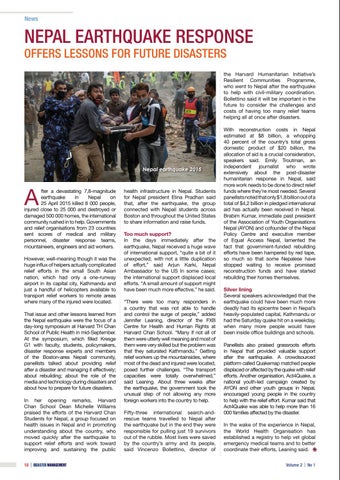
Nepal earthquake 2015
A
fter a devastating 7,8-magnitude earthquake in Nepal on 25 April 2015 killed 8 000 people, injured close to 25 000 and destroyed or damaged 500 000 homes, the international community rushed in to help. Governments and relief organisations from 23 countries sent scores of medical and military personnel, disaster response teams, mountaineers, engineers and aid workers. However, well-meaning though it was the huge influx of helpers actually complicated relief efforts in the small South Asian nation, which had only a one-runway airport in its capital city, Kathmandu and just a handful of helicopters available to transport relief workers to remote areas where many of the injured were located. That issue and other lessons learned from the Nepal earthquake were the focus of a day-long symposium at Harvard TH Chan School of Public Health in mid-September. At the symposium, which filled Kresge G1 with faculty, students, policymakers, disaster response experts and members of the Boston-area Nepali community, panellists talked about providing relief after a disaster and managing it effectively; about rebuilding; about the role of the media and technology during disasters and about how to prepare for future disasters. In her opening remarks, Harvard Chan School Dean Michelle Williams praised the efforts of the Harvard Chan Students for Nepal, a group focused on health issues in Nepal and in promoting understanding about the country, who moved quickly after the earthquake to support relief efforts and work toward improving and sustaining the public
18
|
Disaster Management
health infrastructure in Nepal. Students for Nepal president Elina Pradhan said that, after the earthquake, the group connected with Nepali students across Boston and throughout the United States to share information and raise funds. Too much support? In the days immediately after the earthquake, Nepal received a huge wave of international support, “quite a bit of it unexpected, with not a little duplication of effort,” said Arjun Karki, Nepal Ambassador to the US In some cases; the international support displaced local efforts. “A small amount of support might have been much more effective,” he said. “There were too many responders in a country that was not able to handle and control the surge of people,” added Jennifer Leaning, director of the FXB Centre for Health and Human Rights at Harvard Chan School. “Many if not all of them were utterly well meaning and most of them were very skilled but the problem was that they saturated Kathmandu.” Getting relief workers up the mountainsides, where most of the dead and injured were located, posed further challenges. “The transport capacities were totally overwhelmed,” said Leaning. About three weeks after the earthquake, the government took the unusual step of not allowing any more foreign workers into the country to help. Fifty-three international search-andrescue teams travelled to Nepal after the earthquake but in the end they were responsible for pulling just 19 survivors out of the rubble. Most lives were saved by the country’s army and its people, said Vincenzo Bollettino, director of
With reconstruction costs in Nepal estimated at $8 billion, a whopping 40 percent of the country’s total gross domestic product of $20 billion, the allocation of aid is a crucial consideration, speakers said. Emily Troutman, an independent journalist who wrote extensively about the post-disaster humanitarian response in Nepal, said more work needs to be done to direct relief funds where they’re most needed. Several panellists noted that only $1,8 billion out of a total of $4,2 billion in pledged international aid has actually been received in Nepal. Brabim Kumar, immediate past president of the Association of Youth Organisations Nepal (AYON) and cofounder of the Nepal Policy Centre and executive member of Equal Access Nepal, lamented the fact that government-funded rebuilding efforts have been hampered by red tape, so much so that some Nepalese have stopped waiting to receive promised reconstruction funds and have started rebuilding their homes themselves. Silver lining Several speakers acknowledged that the earthquake could have been much more deadly had its epicentre been in Nepal’s heavily-populated capital, Kathmandu or had the Saturday quake hit on a weekday, when many more people would have been inside office buildings and schools. Panellists also praised grassroots efforts in Nepal that provided valuable support after the earthquake. A crowdsourced platform called Quakemap matched people displaced or affected by the quake with relief efforts. Another organisation, Act4Quake, a national youth-led campaign created by AYON and other youth groups in Nepal, encouraged young people in the country to help with the relief effort. Kumar said that Act4Quake was able to help more than 16 000 families affected by the disaster. In the wake of the experience in Nepal, the World Health Organisation has established a registry to help vet global emergency medical teams and to better coordinate their efforts, Leaning said. Volume 2
|
No 1