International Day for Disaster Reduction
Disaster preparedness and disaster management is everybody’s business
S
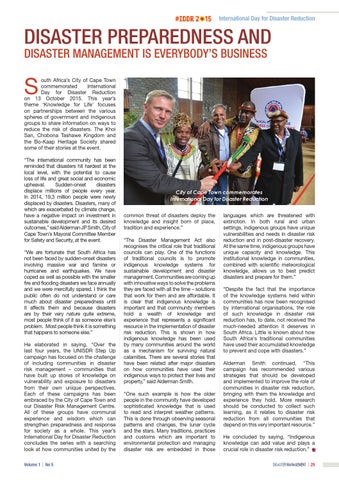
outh Africa’s City of Cape Town commemorated International Day for Disaster Reduction on 13 October 2015. This year’s theme ‘Knowledge for Life’ focuses on partnerships between the various spheres of government and indigenous groups to share information on ways to reduce the risk of disasters. The Khoi San, Chobona Tashawe Kingdom and the Bo-Kaap Heritage Society shared some of their stories at the event. “The international community has been reminded that disasters hit hardest at the local level, with the potential to cause loss of life and great social and economic upheaval. Sudden-onset disasters displace millions of people every year. In 2014, 19,3 million people were newly displaced by disasters. Disasters, many of which are exacerbated by climate change, have a negative impact on investment in sustainable development and its desired outcomes,” said Alderman JP Smith, City of Cape Town’s Mayoral Committee Member for Safety and Security, at the event. “We are fortunate that South Africa has not been faced by sudden-onset disasters involving massive war and famine or hurricanes and earthquakes. We have coped as well as possible with the smaller fire and flooding disasters we face annually and we were mercifully spared. I think the public often do not understand or care much about disaster preparedness until it affects them and because disasters are by their very nature quite extreme, most people think of it as someone else’s problem. Most people think it is something that happens to someone else.” He elaborated in saying, “Over the last four years, the UNISDR Step Up campaign has focused on the challenge of including communities in disaster risk management – communities that have built up stores of knowledge on vulnerability and exposure to disasters from their own unique perspectives. Each of these campaigns has been embraced by the City of Cape Town and our Disaster Risk Management Centre. All of these groups have communal experience and wisdom which can strengthen preparedness and response for society as a whole. This year’s International Day for Disaster Reduction concludes the series with a searching look at how communities united by the
Volume 1
|
No 5
City of Cape Town commemorates International Day for Disaster Reduction common threat of disasters deploy the knowledge and insight born of place, tradition and experience.” “The Disaster Management Act also recognises the critical role that traditional councils can play. One of the functions of traditional councils is to promote indigenous knowledge systems for sustainable development and disaster management. Communities are coming up with innovative ways to solve the problems they are faced with all the time – solutions that work for them and are affordable. It is clear that indigenous knowledge is important and that community members hold a wealth of knowledge and experience that represents a significant resource in the implementation of disaster risk reduction. This is shown in how indigenous knowledge has been used by many communities around the world as a mechanism for surviving natural calamities. There are several stories that have been related after major disasters on how communities have used their indigenous ways to protect their lives and property,” said Alderman Smith. “One such example is how the older people in the community have developed sophisticated knowledge that is used to read and interpret weather patterns. This is done through observing seasonal patterns and changes, the lunar cycle and the stars. Many traditions, practices and customs which are important to environmental protection and managing disaster risk are embedded in those
languages which are threatened with extinction. In both rural and urban settings, indigenous groups have unique vulnerabilities and needs in disaster risk reduction and in post-disaster recovery. At the same time, indigenous groups have unique capacity and knowledge. This institutional knowledge in communities, combined with scientific meteorological knowledge, allows us to best predict disasters and prepare for them.” “Despite the fact that the importance of the knowledge systems held within communities has now been recognised by international organisations, the role of such knowledge in disaster risk reduction has, to date, not received the much-needed attention it deserves in South Africa. Little is known about how South Africa‘s traditional communities have used their accumulated knowledge to prevent and cope with disasters.” Alderman Smith continued, “This campaign has recommended various strategies that should be developed and implemented to improve the role of communities in disaster risk reduction, bringing with them the knowledge and experience they hold. More research should be conducted to collect such learning, as it relates to disaster risk reduction from all communities that depend on this very important resource.” He concluded by saying, “Indigenous knowledge can add value and plays a crucial role in disaster risk reduction.” Disaster Management | 29