The National Disaster Management Centre
The National Disaster Management Centre
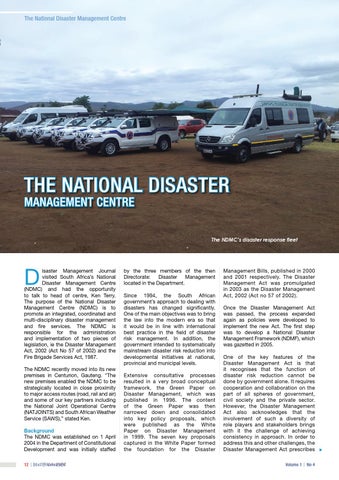
The NDMC’s disaster response fleet
D
isaster Management Journal visited South Africa’s National Disaster Management Centre (NDMC) and had the opportunity to talk to head of centre, Ken Terry. The purpose of the National Disaster Management Centre (NDMC) is to promote an integrated, coordinated and multi-disciplinary disaster management and fire services. The NDMC is responsible for the administration and implementation of two pieces of legislation, ie the Disaster Management Act, 2002 (Act No 57 of 2002) and the Fire Brigade Services Act, 1987. The NDMC recently moved into its new premises in Centurion, Gauteng. “The new premises enabled the NDMC to be strategically located in close proximity to major access routes (road, rail and air) and some of our key partners including the National Joint Operational Centre (NATJOINTS) and South African Weather Service (SAWS),” stated Ken. Background The NDMC was established on 1 April 2004 in the Department of Constitutional Development and was initially staffed 12
|
Disaster Management
by the three members of the then Directorate: Disaster Management located in the Department. Since 1994, the South African government’s approach to dealing with disasters has changed significantly. One of the main objectives was to bring the law into the modern era so that it would be in line with international best practice in the field of disaster risk management. In addition, the government intended to systematically mainstream disaster risk reduction into developmental initiatives at national, provincial and municipal levels. Extensive consultative processes resulted in a very broad conceptual framework, the Green Paper on Disaster Management, which was published in 1996. The content of the Green Paper was then narrowed down and consolidated into key policy proposals, which were published as the White Paper on Disaster Management in 1999. The seven key proposals captured in the White Paper formed the foundation for the Disaster
Management Bills, published in 2000 and 2001 respectively. The Disaster Management Act was promulgated in 2003 as the Disaster Management Act, 2002 (Act no 57 of 2002). Once the Disaster Management Act was passed, the process expanded again as policies were developed to implement the new Act. The first step was to develop a National Disaster Management Framework (NDMF), which was gazetted in 2005. One of the key features of the Disaster Management Act is that it recognises that the function of disaster risk reduction cannot be done by government alone. It requires cooperation and collaboration on the part of all spheres of government, civil society and the private sector. However, the Disaster Management Act also acknowledges that the involvement of such a diversity of role players and stakeholders brings with it the challenge of achieving consistency in approach. In order to address this and other challenges, the Disaster Management Act prescribes Volume 1
|
No 4