sp ices came from India itself, and that most of them were brought there from the East. In 1509 , therefore, Di go Lopes de Sequeira was sent eastward with a squadron of ships to seek out the real sou rce of these much-esteemed commodities. Sequeira visited several ports at the western end of Sumatra and , in September, 1509 , found his way to the g reat spice center of Malacca near the southern tip of the Malay Peninsula. Here the Portuguese were favorably received, but it was not long before their own arrogance and the ho st ility of t he Arab merchants led to trouble . A sudd en attack was made upon the Portuguese , and twenty of their number, who were on sho r e with a quantity of merchandise, were seized and thrown into prison. equeira's fleet was not strong eno ugh to rescue the captives, so a call for aid was sent to Albuquerque. Albuquerque reached Malacca in the summe r of 15u with all the forces which he could assemble. The city was soo n taken; the Mohammedan trade was completely wiped o u t; and Malacca was converted into a Portuguese stronghold and trading port , second only to Goa in importance.
213. The Cultivation ot"Friendly Relations. At Malacca , as in India , Albuquerque showed him se lf a ruthl ess enemy to the Arabs, but he made every possible effort to gain the friendly respect of the other commercia l peoples whom he fo und trading at the port. Among the merchant ships in the harbor of Malacca when the Portuguese attacked the city were seve ral Chinese vessels. Albuquerque treated the crews of these ships with great courtesy; and they carried back to their homeland a favorable report of the Europeans. After the capture of Malacca , Albuquerque sent envoys to the diffe r ent states of Indo-China for the purpose of opening friendly intercourse with their governments. H e sent one envoy to Pegu , a second to Siam , and a third to visit the ports of Cochin China and Tongking. At the same time he ente r ed into comm uni cat ion s with the king of J ava and with som e of the rul ers in Sumatra , who were deeply impressed by the co nqu est of Malacca. As a
A H is tor y of tlte Orie nt res ult of this fri endl y p oli cy th e P or t ugu ese we re a ble t o pu t th em selves on good t e rm s wi t h most of th eir n ew ne ighbors, and M alacca con t inu ed to be visi ted by me rchant v essels fr om all p a rt s of th e F a r E ast.
214. The Molu ccas; Ma gellan. T he possession of M alacca gave th e P o r t uguese contro l of the great distrib u ting center of th e spi ce trade and b ro ught t h em into close contact with the p eopl es of ea s t e rn Asia. Th ey we re now a bl e to get acc urate in fo rm a ti on wit h rega rd to the location of the islands from whi ch m ost of th e spices came; and Alb u q u erqu e, soon after t h e cap ture of Malacca , sent one of his captains eastward with a sq u adron of three ships for the purpo se of exploring the ' ' Spice__Islands" (the Mo lu ccas) and other parts of the archipelago. The s qu adron ma e an extended c r uise, visited a large number of isla n ds, and greatly increased the amount of informa tion which t h e P or t uguese possessed concerning the East Indi es. Impor tant tho ugh this wo rk of exploration was for the P ortugu ese, our r eal inte rest in the little sq u adron arises from th e pr esen ce of a man wh ose later exp loi ts became even more fam ous th a n th ose of hi s comm an d er in chief. On e of the three ship s h a d am on g i ts office rs a young Po r t uguese gentleman nam ed F em ao de M~alhaes - better known in wo rl d history as F erdin a n M agellan-:-
215. The We s tward Rou t e to the In dies. While the Po rtugu ese wer e fin din g th eir way aro und Africa to India and the Spi ce I sla nd s, th e Spa ni a rd s were t rying to discover a ro u te to th e Indi es by sailing westwar d. In 1492, six years afte r Dias ha d r ea ch ed the Cape of Good H ope, Christopher Co lumbus sailed across the Atlantic Ocean and discovered some islands whi ch h e b elieved to be a pa r t of the Indies. olumbus made three la t e r voyages to the lands which he had di scovered , always sea r ching for a path that wo ul d lead him to the wealthy and p owe rful co un t ries of Asia , while other Spanish explorers foll owed him across the Atlantic with the same object. But to th e west of th ese first is lands an unexpected continent rose
Early
European Intercourse 2 33 up before them, blocking their path to the rich lands of the Orient which they wished to rea ch.
In 1493 Pope Alexander VI , in order to prevent conflicts between the Spanish and the Portu guese, iss ued the famous Bull of Demarcation. An imaginary line was drawn from north to so uth a hundred leagues west of the Azores; 1 Portugal was to have excl usive right s of exploration and trade in all nonChristian lands east of this line , while Spain was to have similar rights west of it. At the time this arrangement was made the Portuguese had not yet s u cceeded in r eaching India , and the Spanish were quite pleased with the bargain which, as they thought, would prevent their rivals from u sing the new west, ward route to the Far East. But it was not long after this that Vasco da Gama found his way to Calicut and returned with a rich cargo of spices; whereas the Spanish explorations in America, for some time, led only to the discovery of fre sh lands inhabited by savage tribes.
216. Magellan under the Spanish Flag. For years the Spanish sought in vain to discover a passage through or around the "useless" mass of land which was blocking their path to the Orient. In Septembe r , 1513, two years after Albuquerque had establi bed the Portuguese power at M alacca, Balboa crossed the mountains of Panama and r eached the shore of the Paci.fie, which he called the pouth Sea. Standing on the shore of this new sea, the bold explore r claimed it and all the lands which were washed by its waves as possessions of hi s master, the king of Spain. More than seven years were still to elapse before a Spanish ship found its way into the great ocean which Balboa so boldly claimed ; and when Spanish ships did at last succeed in reaching the P acific, they accomplished the feat under the command of a Portuguese.
F erdinand Magellan (Femao d e Magalhaes), after his ret urn from service in the Far Ea st under Albuquerque, fell into dis-
' In 1494 Spain and P o rtugal agieed to move the line two hundred and seventy leagues farther wesL
2 34
A H is tor y of the Orien t fav o r at th e P or t uguese co ur t. B elieving himse lf to b e unj ustly trea t ed, h e r enounced his allegiance to the king of P ortugal and beca m e a Spanish subject. Magellan felt certain that the Spice I sla n ds which he had visited in 1512 lay on the Spanish side of t h e D emarcation L ine, and the Spanish king, convinced by his a rguments, finally p u t him in command of an expedition to di scove r a westward route to these islands.
217. Strait of M agellan; the Pacific; the Philippines . On Se pt ember 20, 1519, Magellan sailed out of the harbor of San Lu ca r wi t h five ships and two hundred and seventy men on on e of t h e gr eatest voyages in the history of the world. Steering so u t hw estwa rd unt il he r eached So u th Ame ri ca, he sa il ed down th e coast looking fo r a westward passage. L ate in October, 15 2 0 , af te r one of his five s h ips h ad bee n lost by shipwreck, he a rriv ed at th e en t ra n ce to the passage which, in memory of its di scov erer , is n ow call ed t h e t ra i t of M age ll an. A second of his ship s was 1osf - b y dese r t ion - while h e was finding his way through t he diffic ul t st ra i t; bu t M age ll a n n eve r fa l te red, and on ov emb er 28, 1520, h e led hi s rem aining t hr ee vessels safely out of t h e s tr a i t i nto t h e open sea. In st riking co n t rast to th e s t orm y Atl a n t ic whi ch he h ad r ecen t ly left behind him, th e sea whi ch h e n ow ent e red was ri pp lin g gen tl y un d e r the warm r ay s of th e ea rly s umm er s un ; beca use of it s pl easant, peaceful app eara n ce, Mage llan nam ed t hi s new bo d y of water th e P ac ific.
Aft er sailin g nor t hward almo s t t o the equ a t o r , Mage ll an t u rn ed hi s ship s towa rd th e northw est, exp ect in g t o r each t h e Mo lu ccas a t th e end of a s ho rt v oyage. But th e v oyage across th e Pacifi c was mu ch longe r th a n h e h a d calcul a t ed , a n d his course ca r ri ed him so far to t he n o rth t hat h e fina ll y reach ed the Eas t Indi es a con s id era bl e di stan ce n or t h of th e M olu ccas. On March 16 , 1 52 1 , n ea rly four months a ft e r it h a d en te red the Pacific , th e littl e fl ee t a rri ved in th e Philippin es. Th e first stopping p lace was th e sm a ll isla nd of gomonhon , sou t h of Samar ; b u t Mag ell a n found i t diffi cult to sec ur e food h ere, so
Early European lntercou rse 2 35 he sailed southwest to another little island 1 south of L eyte. On this second island the Spaniards found a prosperous Filipino village, from which they were able to secure rice as well as coconuts, oranges, bananas, and other fruits . The people were friendly, and the village chiefs exchanged gifts with Magellan .
2 18 . D ea th of Ma gellan. The Europeans oi those days cared very little about the rights of non-European peop les, so Magellan, before leaving this island, solemnly claimed the ent ire group of islands as the territory of the Spanish king. At t h e same time he named them the Archipelago of Saint L aza rus, in memory of the day on which they had first been sighted . Having heard of the large town of Cebu, about eighty miles away, Magellan took his fleet there. The Ceb u ans were acc u stomed to trading with merchants from Siam and China, so t h ey welcomed these new foreigners and showed themselves q ui te willing to carry on trade. Shortly after the Spanish ships arrived at Cebu, however, 1agellan was killed in battl e while aiding one of the local chieftains in a war against en emies . Magellan's interference in this petty war arose o u t of hi s desire to bring the Filipinos to acknowl edge the supremacy of the Spanish king , and it was not long before the harsh methods of the Spaniards turned the early friendliness of the Cebuans to bitter hostility . As a result of this growing bitterness, t h e people arose against the strangers, killing some twenty-five of their number.
2 19. Circumnavigation of the Globe by the Victoria. T h e Spaniards now decided to resume their search for the Spice Islands. One of their ships was no longer seaworthy, so they burned it and set sail with the two that remained. After touching at Borneo and a number of other islands, they fo un d their way at last to the Moluccas, where they soon exchanged their Spanish goods for a cargo of spices. It was decided t h a t one of the two shi ps s h ould ret u rn to Spain by the way they
1 Limasawa .
A H isto ry of the Orient
b.ad come, while th e other sh01,1ld try to ge t hom e by way of th e Cape of Good H ope. The fir st ship fell into the hand s of the Portugu ese; but the Victoria, under the command of Se bastian del Cano , safely found its way around Africa and r;acbed Spain. On S<!ptcmbe r 6, 1522, the Victoria reentered t h e h arbo r of Seville. One ship and eighteen men were all that remained of the f:xpedition which had set out nearly three years before; bi1.t this ship and it s h andf ul of survivors had circumnavigated the earth for the fi:-:;t time in history and had proved beyond question that the earth is a globe.
220. Mexico a.11,j Peru. I n the same year that Magellan set forth up on Jis great voyage, H ernando Cortez, at the head of a Spanish army, entered the city of Mexico, the capital of the Azt ec emperor Mont ezuma. The Aztec empire was quickly conquered, and the a uthority of Spain soon extended westward to the shores of the Pacific. Five years after Cortez had ~u cceeded in makin g himself master oi the capital of Monte,:uma, Francisco P izarro and two companions fitted out a small lorce for the purpose of sailing down fhe Pacific coast of South :\m erica and conquering any people whom they might finci \here. Pizarro 's first expedition was a failure, and he met many <liflicultie s in b is lat er attempts; but in 1532 he invaded the great empire of the In cas, captured the emperor, and made Peru a provin ce of the Spanish crown.
The se Spanish conquests far across the Pacific affected the Orient in two ways. In the first place, the enormous quantities of gold and silve r which flowed into Spain from Mexico and Peru furnished Europe with an abundant supply of money that could b e exc hanged for the products of the Far East . In the second place, the occupation of Mexico established the Spaniards permanently on the American side of the Pacific Ocean and made it possible for them to follow up the claims which re sult ed from the voyage of Magellan.
221. Spanish Expeditions after M agellan. Imm ediately after the return of th e Victoria to Spain in 1522, Charles I (better
Early
known as Emperor Charles V of the Holy Roman Empire) determined to send a new expedition to the Far East by the route which Magellan had discovered. It was nearly three years, howev e r , before this second expedition was ready to start. In July , 1525 , it sailed from Corunna under the command of Garcia Jofre de Loai sa, who was appointed captain general of tbe fleet and gove~or of the Moluccas. Other prominent officers of th e expedition included Del Cano, who had commanded the Victoria, and Andres de Urdaneta , a soldie r -priest-scientist of high ab ility and character. Loaisa 's expedition was a complete failure; the captain general and Del Cano both died during the voyage across the Pacific , several ships were wrecked , and the remaind er of the fleet arrived in the Molucca only to be capt ured by the Portuguese. After the capture of the fleet Urdaneta remained in the Moluccas \.il1til 1535, becoming thoroughly familiar with the geography of the East Indies and gathering much information which was later useful to his count rymen.
Two other panish expeditions to the Moluccas were equally unsuccessful. In 1526 Sebastian Cabot sa iled from Spain with a fleet that turned back before reaching the Strait of Magellan. The next year aw the dispatch of an expedition from Mexico under Alvaro de Saavedra. This ex-pedition succeeded in reaching Mindanao and tbe Moluccas, where it pick ed up a few survivors of the Loaisa expedition; but adverse winds prevented its return to Mexico , and Saavedra was finally compelled to surrender to the Portuguese.
222. Rival Claims to the M oluccas. These Spanish expeditions , sent out for the purpo se of establishing Spain's authority over the Molucca s, had all been s u ccessf ully opposed by the Portugue se, who now bad many ships and a number of strong ports in the East Indies. Tbe Spanish government claimed that the Moluccas lay on their side of the Demarcation Line , while the Portuguese declared that they bad been tbe first to reach the islands and that the island s lay on the Portugu,;,se
A H istor y of lite Orient
side of the line. Geographical knowledge regarding the eastern regions was not very exact in tho se day s, and th e Spanish we re probably sincere in making their claim. As a matter of fact, however, the Portuguese were right and the Spanish were wrong with regard to the location of the islands. In 1524 two attempts were made to sett le this dispute by negotiation, but both countries insi sted upon their claims and no agreement could be reached. After the failure of the Saavedra expedition, Charles V began to grow discouraged; in 1529 , therefore , h e was willing to agree to a sett lement with Portugal. By the Treaty of Saragossa Spain, for the sum of three hundied and filty- thousand gold ducats, gave up her claim to the Moluc cas and agreed that the Lin e of Demarcation in the Pacifi c should be drawn two hundred ninety-seven and a half league s east of the Moluc cas.
223. Villalobo s in the P hili ppin es . For thirteen years Charles r espected his agreement with Portugal , but in 1542 a fresh expedition was sent out from Mexico to the East Indies. This expedition was under the command of Ruy L opez de Villalobos , who received instructions to avoia the \foluccas and to establish permanent settlements in the We stern I sland sa name which was then generally used for the Philippines. Villalobo s touched at Mindanao , at Sarangani, and at Leyte, and named this last island Felipina in honor of the Spanish crown prince, who later became Philip II. At all the se places the people were hostile , so the Spaniards had difficulty in securing food and found it impos sible to establish a settlement. Finally, Villalobos turned southward to the Moluccas , where, like his predece sso rs, he was compelled to surrender to the Portugu ese.
22 4. Colonization of the Philippines. More than twenty year s passed after the failure of the Villalobo s expedition before the Spani sh government was ready to mak e a fre sh attempt in the Far East. In r 556 King Charles of Spain was s u cceeded by his son Philip II , in whose honor the island of
Early European Int ercourse 239
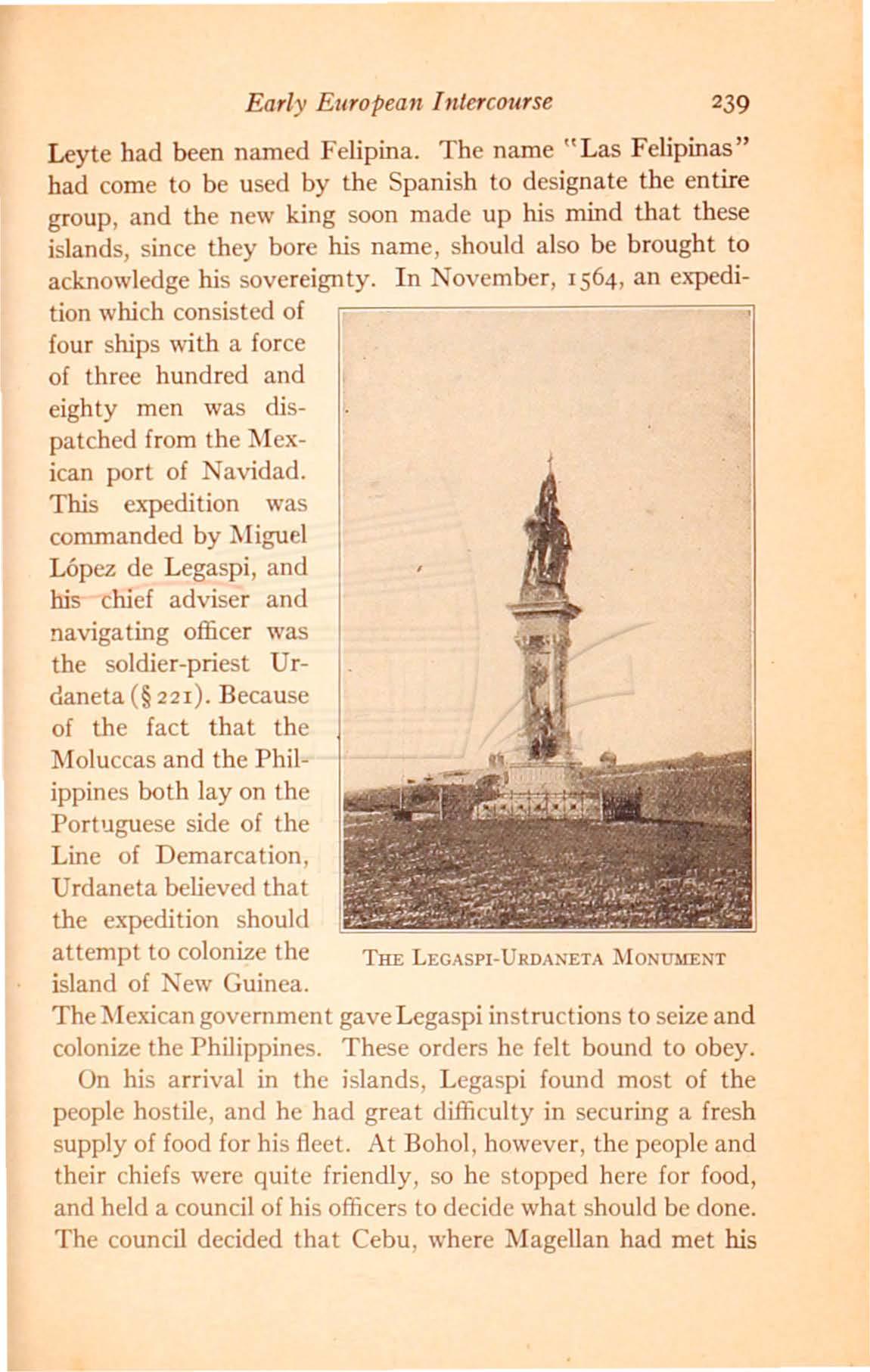
Leyt e b ad b een nam ed F elipin a . Th e name "Las F elipinas" bad come to be u sed by the Spanish to designate th e entire group, and th e n ew king soon made up bis mind that th ese islands, since they bore bis name, s hould a lso be brou ght to acknowledge bis sove reignty . In November, 1564, an expedition which consisted of four ship s with a force of three hundred and eighty men was dispatch ed from the Mexican port of avidad. This expedition was co=anded by Migue l Lop ez de Legasp i , and bis chief advise r and navigating officer was the so ldi er -priest Urdaneta (§ 221) . Be ca u se of the fact th at the Moluccas and the Philippines both lay on the Portuguese side of the Lin e of Demarcation, Urdaneta believed that the expedition should attempt to colonize the island of New Guinea.
The iexican government gave L egaspi instructions to se ize and colonize the Philippines. These orders he felt bound to obey.
On his arrival in the islands , Legaspi found most of the people hostile, and he had great difficulty in sec uring a fresh supply of food for his fleet. At Bohol, however, the peop le and their chiefs were quite friendly, so he stopped h ere for food, and held a council of his officers to decide what should be done. The council decided that Cebu , where Magellan had met bis
THE LEGASPl-URDANETA MONtThlENT
A Histor y of the Orient
death, would be the most satisfacto ry locat ion for a colony, and on April 27, 1565 1 thi s town was attacked and taken by storm . After th e const ru c tion of a fo rt for th e defense of the town , L egasp i felt that h e co uld safely send one of his ships ba ck to Mexico with a repo rt of his success, and fresh forces wer e soon on their way to assist him in the work of c0::.quest ar.d co loniz ation . Forty-four years after Magellan's arrival in th e Philippin es the Spanish at last su cceeded in gaining a p erman ent foothold in the Far East.
QUESTIONS
I. ~'by was western Europe driven to seek new roads to the Orient toward the end of the fifteenth century? Who opened the road? Whal explorations made possible the discovery of a new route to the Far East? What effect did the Portugu ese discovery have upon Lisbon?
,.JI. Sketch the conditions in Indi a at the close of the fifteenth century '-'Why did a conflict arise between the Portuguese and the Arabs ? Wh} do we not have su ch conflicts today? What was Albuquerque's policy I v\lhy was it so important? What was the result of the troubl e between the Arabs and th e Portuguese at Malacca? To what did l\Ialacca owe its importance? \Vhat steps did Albuquerque take to continue this importance ?
III. What route to the Indies did Spain follow? Look on the map and locate the line which was to separate the Portuguese and tbe Spanish possessions. Give a full account of Magellan's career. What was the fate of the Loai sa and Saavedra expeditions sent out by Spain? Why did both Spain and Portugal claim the l\Ioluccas? How was the dispute settled? What were the instructions given to Villalobos? Were the Philippin es on the Spanish side of the line established by the treaty of 1529?
TOPIC FOR DISCUSSION
Compare the Portuguese and Spanish policies in l\Ialaysia with the poli cies of fifteenth-century China.
REFERENCES
CHAPMAN , C E. A History of California. The Spanish Period. SMITH , V. A. Oxford History of India
PART IV. EXTENSION OF EUROPEAN I
N FLUE NC E I N THE ORIENT
( r550-r860)
CHAPTE R XV III
THE GREATNESS AND DECLINE OF PORTUGAL'S ORIENTAL EMPIRE
1565-1580. Friction in the Far East between Portuguese and Spanis h I 5 71. Beginning of regula r voyages by the Manila galleo n 1577-1580. Drake's voyage around the world 1580. Union of Portuguese and Spanish crowns 1595. The Dutch begib to trade in the O rient 1600. Formation of the London East India Co mpany 1602. Fo rmation of the Dutch East Ind ia Company I 64 1. The Dutch take Ma lacca; end of Po rtuguese supremacy
225. Portugue s e and Spani s h. For more than sixty years a fter the voyage o f Vasco da Gama, the Portuguese had little se rious rivalry in their position as the connecting link between t he Far East and E urope. The wa rlike operations of Alme ida and Albuquerque soon drove the Arab me rchants from t he Indian Ocean, destroying their trade between India a nd t he po rts of Egypt and Persia. Magellan's voyage unde r the Span ish flag t hreatened to wea ken the Portuguese pos i tion by esta blishing Spanish co mpetition in the spice trade; but only one of Magellan's ships - the Victoria - succeeded in ret u rning t o Spain with a cargo from the Mo luccas. The next fo ur Spanish expeditions were to ta l fa ilures: eve ry s hip which the SQan ish sent lo the East Indies under Loaisa, Cabot, Saavedra, 2 41
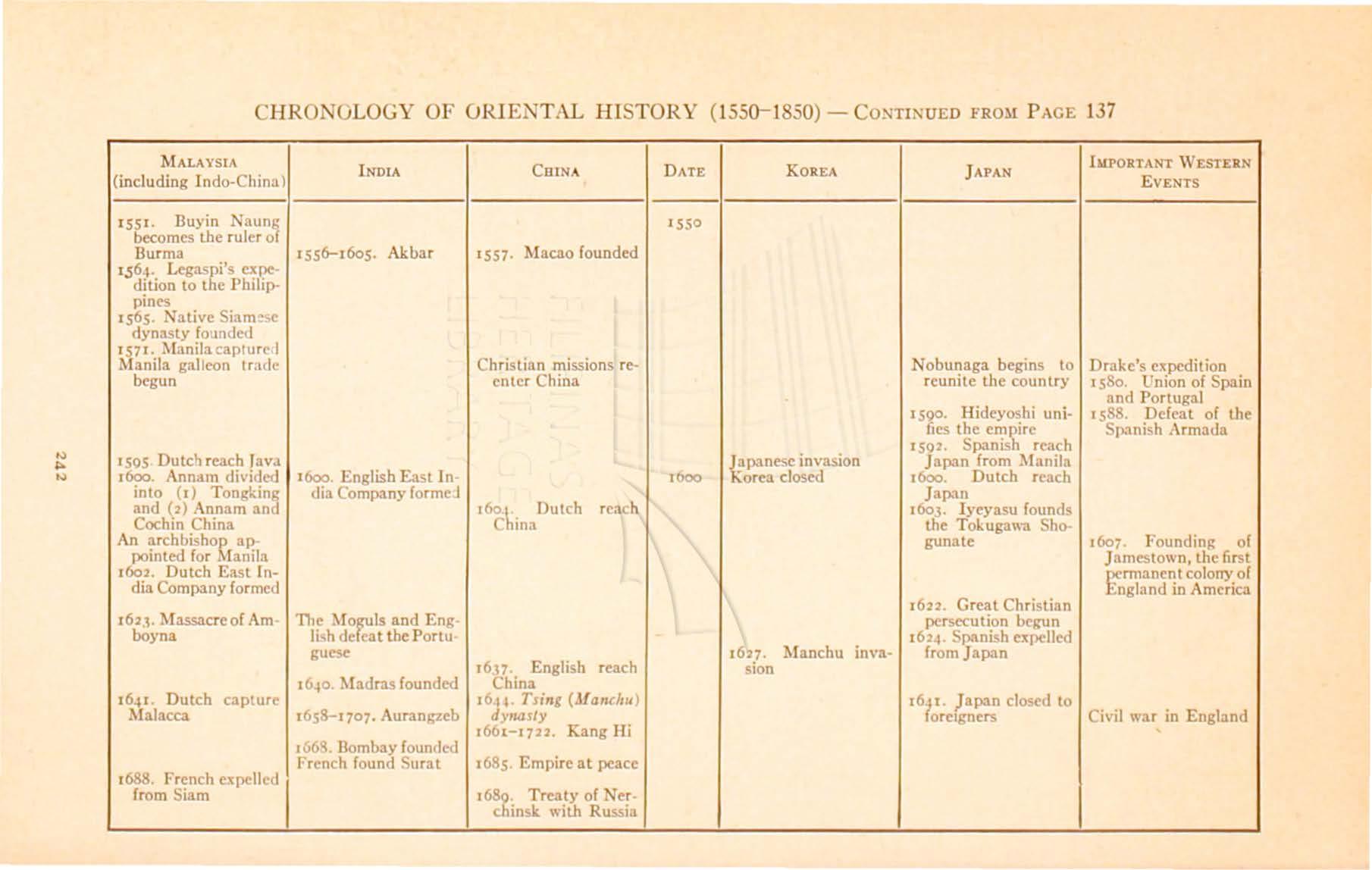
MA LAYSIA INDIA
CornA DATE KOREA J APAN I MPORTANT W ESTERN
(including In do-China) E
VENTS
155r. Duyin Naung becomes the r uler of 1550 Burma 1556-16o5. Akba r 1557. Macao founded 1.564. Legaspi's c.,qJC<lit.ion to the Philippines
1565 . Native Siamese dynasty founded 157I. Manila captu rcd
Christian m issions re-
Nobunaga begins to Drake's expedition Manila galleon Irad e begun enter China reunite the country 1580. Union of Spain
and Portugal 1 soo. Hidcyoshi un i- t 588. Defeat of the 15~~ t~~~ist rcrcach Spanish Armada
1595 . Dutch reach Java
£'panesc invasion Japan from Manila 16oo. Annain divided 16oo. English East I n- 1000 orea closed 16oo. Dutch reach into (1) Tongking dia Company formeJ Japan and ( 2) Ann am and 16chinaDutch reach, 1 6o3. l ycyasu founds Cochm China the Tokugawa ShoAnpoi~~:3ro~0 fr:!in
gunate 16o7 . Founding of Jamestown, the first 16o1. Dutch East Intnr;i'::n~ din Company fo rmed 1622 . Great Christian
162,1. Massacre of Am- 11J~?~~fe~1 : th~t!~f persecution begun boyna 1614 . Spanish expelled gucse 1617. Manchu inva- from Japan 16-17. English reach sion 1640. Madrnsfoundcd China 1641. Dutch capture 16.1.i. Tsing (Mancl,u)
16f;~ei!!~ closed to Malacca 1658-1707. Aurangzeb dyuasly Civil war in England 1661-17n. Kang Hi 1668. Bombay founded French found Surat 1685. Empire at peace 1688. French e:cpcllcd from Siam
16 ~tns'f/~!tili 0f~f;
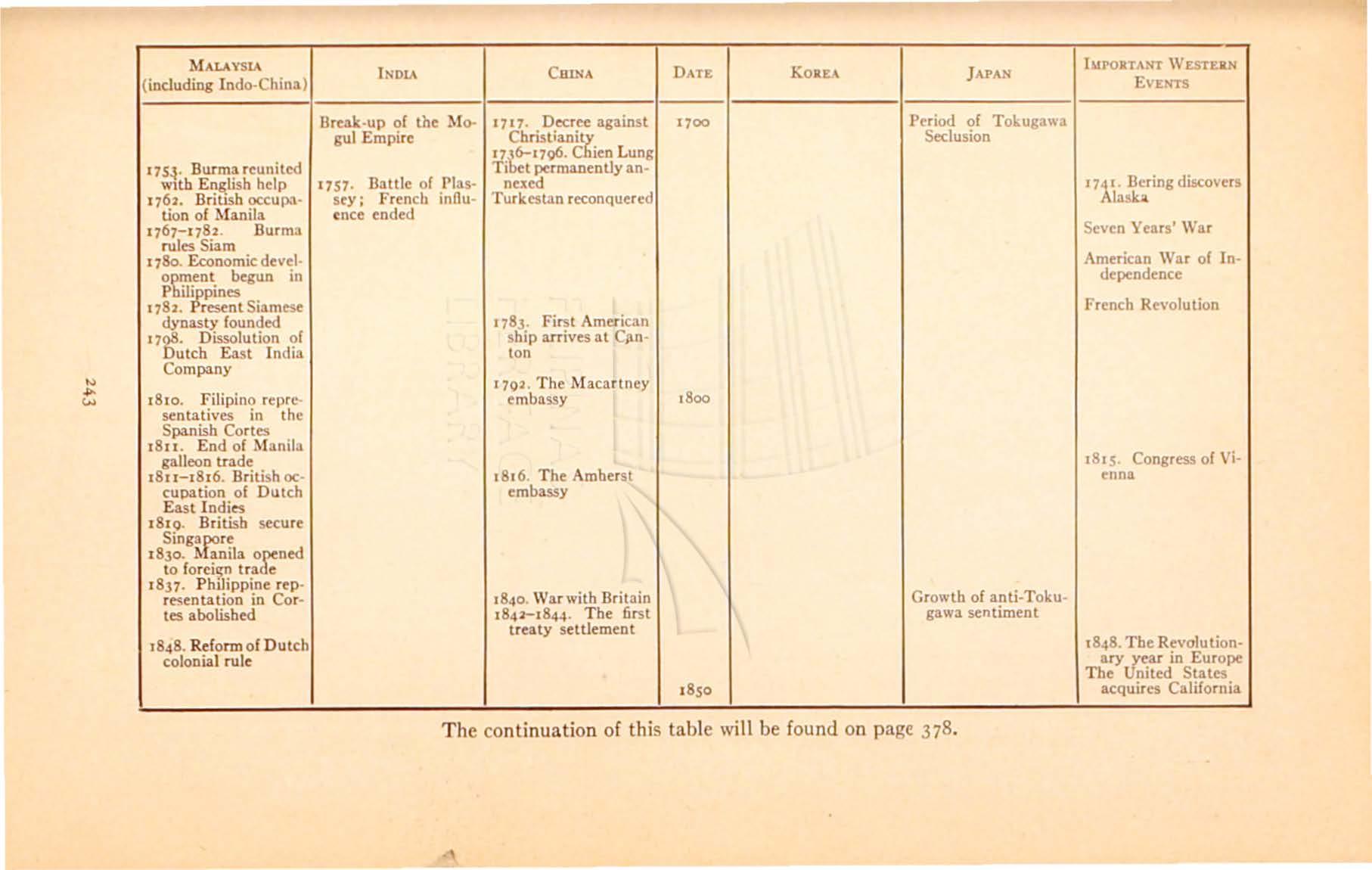
( iDcluding Indo-China)
Break-up o f t.hc Mo- 1717. Decree agains t ,,oo
Period o f Tokugawa gul Empire J7 Ci,~;~;~fiicn Lung Seclusion
175~. Bu r ma reunited wi t h E nglish help 1762, British occup.,.. tion o f Manila 1767-1782. Burma ruJes Siam 178o. Economicdevelfbili~~in!cgun in 1782. P resentSiamesc dynasty founded 11 t~tc~i~~~til~ctY!
Company
1810. F ilipino reprcse ntatives ill the S panish Cortes 18u. End of M a nila galleon trade 1811-1816. B ritish OC· cupation o f Dutch E ast Indies 1810. Bri tish secure Sing~ re 1830. ani la oaened to fo rcic;,n t ra e 1837. P hilippine repres entation in Co rtes abolis h ed
1848. Re fo rm o f D u tch colonia l rule
Titct permanently an, 7Al;i~ing discovers 1757. Battle o f Plas- ncxcd s ey i French in Ou- Turkestan reconquered cnce ended
Seven Yea rs' War
American War of Independence
French Revol ution
1783. First American s hip arrives a t CJmton
r 7Q2. The M acartney e mbassy ,Boo
18 15. Cong ress of Vi1816. The Amherst enna e mbassy
1840. \V ar with Britain
Growth o f a nti-Toku1842- 1844. T he first \ gawa se ntiment t reaty settlement
1848. The Revolutionary y ear in Europe
The United S tates 1850 ac quires Ca lifornia
Th e co n t inuation of t hi s tab le will be found oa page 3 78 .
A H isto ry of th e Orie nt
or Vill a lobo s eith e r fa il ed to reac h th e isla nd or was event ually ca ptured by t h e P o r t uguese.
ot un t il t h e L egasp i expedition reached the Philippines did P ort ugal h ave a European neighbor in the East Indies, a n d t hi s establishment of a pe r manent panish colony in the
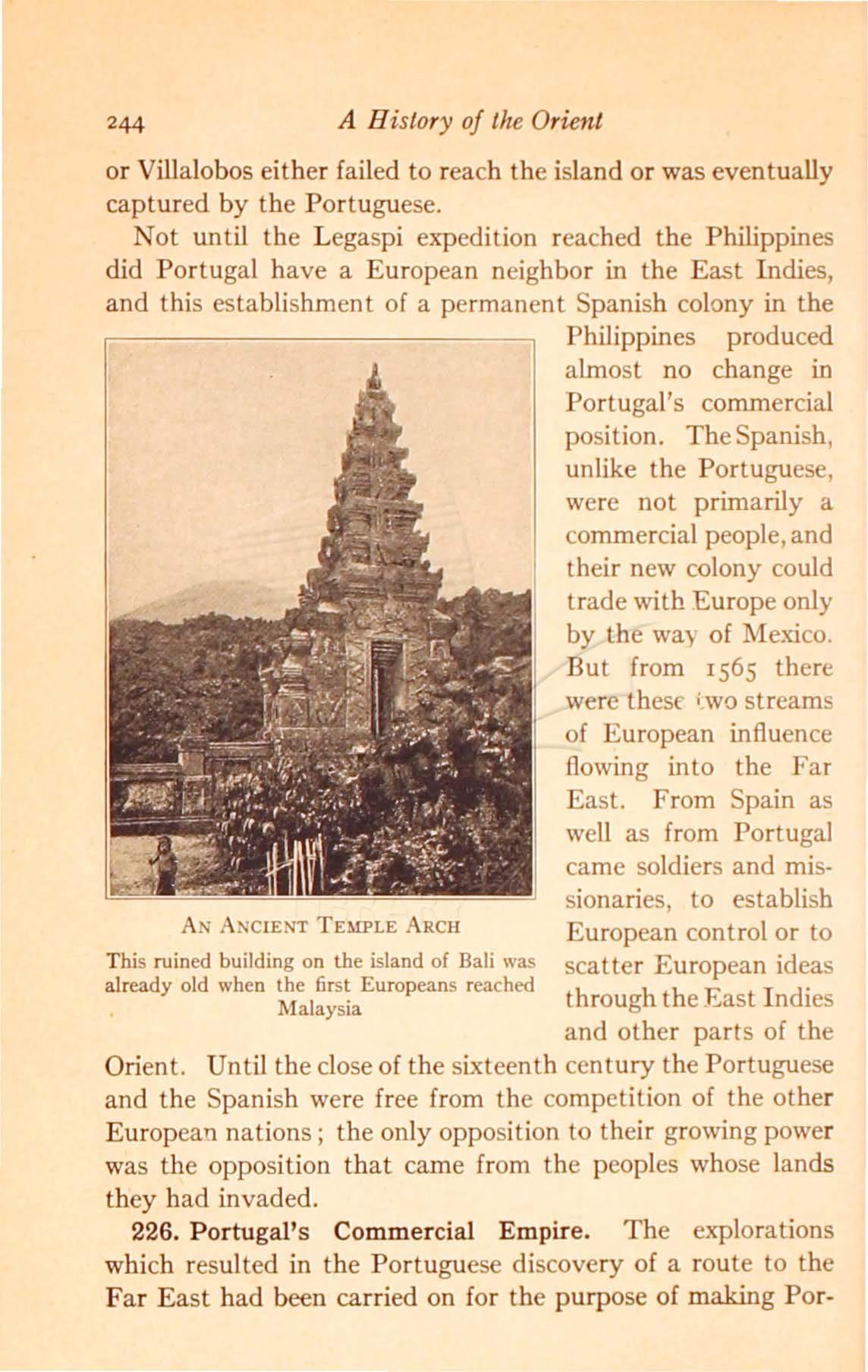
AN ANClENT TEllIPLE ARCH
T his ruined building on the island of Bali was al ready old when the first European s reached Malaysia
Philippines produced almost no change in Po r tugal's commercial position. The Spanish, un like the Portuguese, were not primarily a commercial people, and their new colony could trade with Europe only by the way of Mexico . But from 1565 there were these ; wo streams of European influence flowing into the Far Ea s t. From Spain as weU as from Portugal came soldiers and miss ionaries, to establish European control or to scatter European ideas through the East Indies and other parts of the
Ori ent. Unt il the close of the sixteenth century the Portuguese a nd t h e Spanish were free from t he competition of the othe r Eu ropean nat ions; t h e only oppos i tion to the i r growing powe r was th e opp os iti o n th at came from t h e peop les whose lands th ey h ad invad ed .
226. Portugal's Commercial Empir e . The explorations whi ch r es ul te d in t h e P o rtu guese discove ry of a route to the F a r Ea s t h a d been ca rried on fo r t he purpose of m aking Po r-
Greatness and Decline of Portugal's Ori1mtal Empire 245 t ugal a commercial power; and the achieveme nt s of Albuquerque at Goa, at Malacca, and elsewhere had given the Portuguese complete control over the trade between Europe and the Eastern world . Li sbon, as we have seen, b ecame the spice market of the West; and ships from every seaport rn Europe came there to exchange the goods of the ir own co untries for the products of the Orient. Much of the trade among the nations of the East also passed th rou gh Portuguese h a nd s, or was com p elled to yield to the Po rtu guese some share in th e profits . Persia and Egypt could now obtain spices on ly through the Portuguese, while at falacca every effo r t was made to encourage visits from the Siame e, Chinese, and othe r commercial peoples of the Far East. or did the European conquerors merely enco urage thesP. Eastern merchants to seek their spices at Malacca. Strong methods were employed to exclude all non-Portuguese from direct trade with the islands fr om which the spices came; and the capture of ship after ship belonging to the panish shows how effective ly Portugal policed the Moluccas.
This absolute monopoly o f the spice trade was not achieved by the efforts of private Portuguese merchants. Th e ea rliest explorations had been fitted out by the Li sbon government, and the government retained direct management of the trade as it developed. Royal governo rs and viceroys directed the operations in the Far East; royal ship s patrolled the Moluccas to seize any trespassing outsider; other ships belonging to the king brought home the cargoes of spi ces for Europe; and the royal treasury r eceived the large st share of the profits r es ulting from the comme r ce. Portugal was converted into a great trading company , with the government as its board of directors ; all the energies of the n atio n were devoted to maintaining its great commercial empire, - many times as la rge, in area and population , as the littl e kingdom by which it was contro ll ed.
227. Missionary Work of the P ortuguese . The Portuguese did not attempt to develop colonies in the r egions over which
A History of the Orient
they extended their influence. From the time of Albuquerque, they adopted the policy of maintaining a number of strongly fortified ports as bases for their co=e rcial activities; but the Portuguese at these places were merchants and soldiers, not co lonists. Co=ercial operation s, the patrol of the sea, and the defense of the fortified ports made such heavy demands upon the population of Portugal that few able-bodied men could have been spared for the work of founding colonies. But while the Port uguese made no efforts at colonization, it was not long before they began to undertake mi ss ionary work among the peoples within their expanding commercial empire. In the ea rl y days each expedition and each commercial post had been provided with priests; but th ese priests were charged with the duty of looking after the spiritual welfare of the Portuguese, and made no attempt to win converts. In 1521, however, P o r t ugal came u nder the sway of a new monarch , John III, wh o looked u pon his connection with the Far East as furnishing him with an opportunity for spreading the Gospel of Christ to the uttermost part s of the world. Missionaries were sent to Ind ia, to Malacca , to the islands of the East Indies, and even to regions lying outside the field of Portuguese control. This missionary work grew so rapidly that a Bi s hop of Goa was appointed in 1538. Nineteen years later the Bi shop of Goa was raised to the dignity of an archbishop, who, rivalin g the viceroys in power and dignity, exercised authority over the missionary work throughout the entire Far East.
22 8. T he Portugu ese in Indo-China . The Portuguese had opened diplomatic relations with th e strong states of IndoChina, especially Siam and Burma , as soon as they became masters of Malacca, and it was not long before they bad estabiished trading posts at a number of Siamese and Bumiese ports. In Siam the newcomers appear to have confined themselves to legit imate trading operations , but in Burma the frequent civil wa r s supp li ed them with opportunities for less peaceful activiti es . Hundr eds of P ort uguese advent u re rs took service under
Greatness ana Decline of Portugal's Oriental Empi,re 247 the rival warring kings, and in 1544-1545 a force of Portuguese mercenaries had an important share in capturing and looting the flourishing city of Martaban. Through their participation in these struggies the Portuguese succeeded in gaining, for a brief period, considerable influence in the so uthern part of Burma . Early in the seventeenth century Phili de Brito, a Portuguese soldier of fortune, ro se to be governo r of a small city in southern Burma. Taking advantage of a civil wa r , De Brito assumed the title "King of Pegu" and made an attempt to rule southern Burma as a province of the Portuguese Empire; but his capital was soon taken by the Burmese, and D e Brito was put to death.
229. Growth of Spanish Power in the Philippines. When the Legaspi expedition reached the Philippines the Spaniards were acquainted only with the southern islands of the group, for which reason Cebu was selected as the place for their first se ttlement. This location, however, soon proved to be unsatisfactory. The Cebuans remained hostile to the invaders; it was difficult to secure heri: an adequate supp ly of food; and the Portuguese, susp icious of a Spanish sett lement so near the Moluccas, sent an expedition to destroy the colony. Therefore Legaspi soon transferred his settlement to the northe rn side of Panay Island , while expeditions were sent to explore other islands still farther north. By 1569 the Spanish had established their authority at a number of places north of Panay and had reached the southern part of Luzon. In 1570 an expedition was sent to fanila, at that time an important commercial town ruled by a foharnmedan sultan; the following year Manila was captured and transformed into the Spanish capita l of the Philippines. Strong forces we re now sent to all parts of the islands for exploration and conquest. So energetically was this work carried out that by 1576, eleven years after the Legaspi expedition reached the islands, the Spanish had established their power over as much of the Philfppines as they ever really succeeded ir, ruling.
A History of the Or ient
230. Nature of the Spanish Rule. In t he regions which they brought under their control the Span ish established themselves as lords over a conquered and sub j ect peop le . The Filipinos we re compelled to pay tribute for the support of their conquerors and were often drafted to cut timber for buildings, to work upon roads and other public improvements, or to row t he Spani sh ships. In return for their tribute and their forced labor , t he Filipino s, in spite of the humane "Laws of the Indie s" issued by the Spanish monarchs, received few benefits from the rule of their new masters. Most of the Spaniards in t he Philippine s cared nothing for the welfare of the people under their control, but were interested only in increasing the amo unt of the tribute which the Filipinos could be compelled to pay. The only improvements in the condition of the people were t ho se brought about by the labors of missionaries. Philip II was a devoted supporter o the Catholic Church and was extremely anxious to ?pread Christianity to all parts of his domains; many missionar,ies were therefore sent out to preach the Gospel in his new possession. In 1581 a bishop was a ppointed for Manila , and ten years later there were a hundred and forty priests in the islands. By 1600 the bishop had been ra ised to the rank of archbishop, the number of priests had increased to more than four hundred, and Christianity had become firm ly established. In addition to spreading Christ ianity, t he missionaries tried to help the Filipinos by teaching t hem improved methods of agriculture and other valuable l essons in industry. T h ey opened schools in various parts of the island s, l aying the foundation of a church educational system wh ich culminated, in 1601, with the establishment of a college at Manila.
231. The Trade of the Philippines; the Manila Galleon. Although the Philippines are very conveniently located for co=erce with the neighboring countries, the Spanish gove rnment discou rag ed all attempts to make the new colony a c enter of trade with the Far East. Influen tial people in Spain
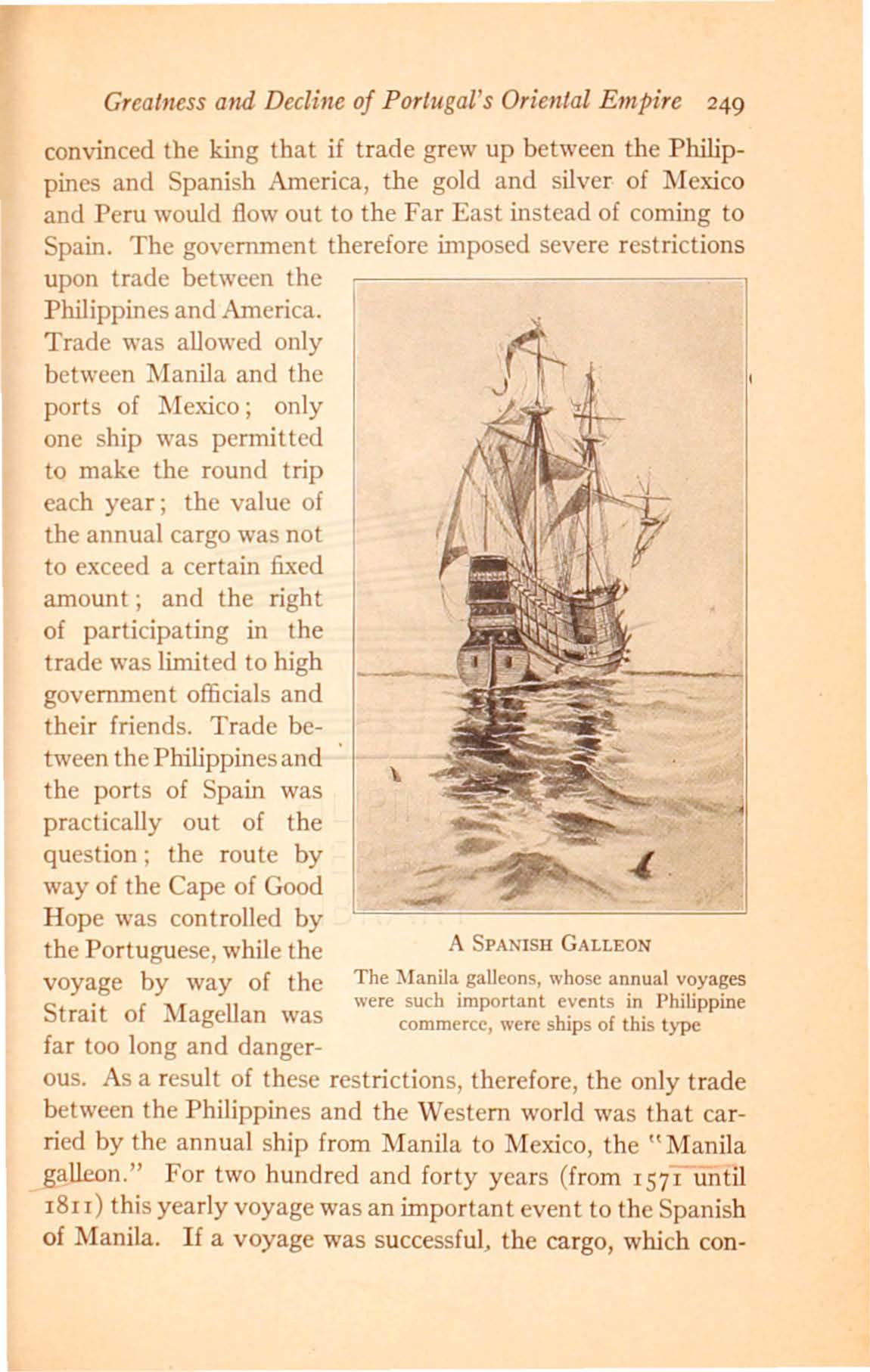
Greatness and D ecline of Portugal's Oriental Empire 249 convinced the king that if trade grew up between the Philippines and Spanish America, the gold and silver of Mexico and Peru would flow out to the Far East instead of coming to Spain. The government therefore imposed severe restrictions upon trade between the Philippin es and America. Trade was allowed only between Manila and the ports of Mexico; only one ship was permitted to make the round trip each year; the value of the annual cargo was not to exceed a certain fixed amount; and the right of participating in the trade was limited to high government officials and their friends. Trade between the Philippine s and the ports of Spain was practically out of the question; the route by way of the Cape of Good Hope was con trolled by the Portuguese , while the voyage by way of the Strait of Magellan was far too long and danger-
A SPANISH GALLEON
The Manila gaUeons, whose annual voyages were such important events in Philippine commerce, were ships of this type ous. As a result of these restrictions, therefore, the on ly trade between the Philippine s and the Western wo rl d was that ca rried by the annua l ship from Manila to Mexico, the " Manila galleon." For two hundred and fo rty years (from 1571 until 18rr) thi s yearly voyage was an important event to the Span ish of Manila. If a voyage was su ccessf ul, the cargo, which con-
A H istory of the Orient
sisted of the finest Oriental products , and often represented an inve stment of a quarter of a million pesos, would be sold in Mexico at a hundred per cent profit. But there were storms, pirat es, and uncharted seas to be feared; hence one could never tell whether the venture would result in a handsome profit or in a total loss. Some of the galleons were lost, but the succe ssf ul voyages resulted in a steady flow of Mexican silver into the Philippines and from there into other parts of the Far East.
232. Spain and England ; Drake. At the time of the Legaspi expedition, Philip II of Spain was engaged in an attempt to reconqu er the rebellious provinces of the Netherlands.' Although England was nominally at peace with Spain, many of the English were aiding the Dutch against the Spanish king, while others were taking advantage of the si_tuation to attack and capture the Spanish treasure-ships ~rrying gold and silver from Mexico to Spain. Not until 1588- did open warfare break out between Spain and England; but in 1577 Francis Drake, one of the boldest English adventurers, set forth with a fleet of five ships to attack and plunder the Spanish colonies along the Pa cific coast of America. Of the five ships with which Drake s tarted only his flagship, the Golden Hind, succeeded in r eaching the Pacifi c Ocean; but Drake raided Spanish towns and plundered Spanish vessels along the coast of P eru until the hold of his single ship was filled with Spanish trea sure . During the summe r of 1579 he explored the coast of North America to a point a little north of the present boundary b etween California and Oregon ; then he stee red so uthw estward across the Pacific and r eturned to Europe by way of the Cape of Good Hope. On his return to England in 1580, Drake wa s accorded high honors by his sovereign, Queen Elizabeth; his ship , the Golden Hind , now shared with Magellan 's Victoria the glory of having circumn avigated the world. At last an
1 See J . H . R obinson, E. P . Smith , and J . H . Breasted, Our World Today and Y esterday, §§ 36r ff. Ginn and Company, 1924 .
Greatness and D ecline of Po rti,gal's Ori en tal Empi re 25 1
English ship had found its way to Far Eastern waters, and England had shown herself to be the equal of Spain and Portugal in the art of seamanship.
233. Union of the Portugue s e and Spanish Crowns. On his return voyage Drake had sailed through the Mol u ccas and even touched at Ternate and other places; b u t his ship was already so heavily laden with Spanish gold and silver that he made no effort to open trade with the people of the Spi ce I slands. Like the other people of western Europe, the E n glis h were obtaining a plentiful supply of spices, at a reasonabl e price, from the Portuguese. So long as this supply was av ailable , there was little reason for the English to face t h e difficulties and dangers which would be involved in direct trade with the Indies; much greater profits could be obtained b y piratical attacks upon the Spanish treasure-ships than co ul d possibly result from entering into competition with the P ortuguese. But in 1580, the same year that saw D r ake's r et urn from this world-encircling voyage, Philip II of Spain seized the Portuguese crown and.placed it upon his own head. This event did not unite Spain and Portugal into a singl e kingd om; throughout his reign Philip kept the administration of the two countries separate and appointed none but Port uguese to official positions in the eastern possessions of his newly acquired kingdom. Yet the fact that the two countries now h ad the same king drew Portugal into Spain's wars with England and Hqlland, with the result that Lisbon was closed to the English and Dutch merchants.
234. Th e Dut ch and Engli s h Invas ion of the Far East. For a number of years England and Holland were able to obtain spices , in small quantities and at a much higher price, through the hands of neutral merchants . The destruction of Philip's "Invincible Armada," in 1588, broke the Span ish naval powe r, and it was not long after this that the Dutch and English determined to send their own ships to the East Indies fo r th e spices which were now so difficult to obtain fr om Li sbo n.
A H istory of the Orient
The Dut ch were the first to act on this decision. In 1595 a Dut ch fleet rounded the Cape of Good Hope and reached J ava, but suffered heavy lo sses on its return. This initial failure did not discourage the hardy mariners of the Netherlands ; within three years they were trading at a number of port s in the island s, and by the year 1602 many Dut ch ships had made profitable voyages to the Indies. So many rival companies were formed for the purpose of engaging in the Eastern trade that there was danger that all would be ruined through bitter competition. In order to prevent this result the various private companies were combined, in 1602, to form the Dut ch East India Company, which for nearly two centuries had complete control of Dutch trade and colonies in the Far East.
The English did not invade the Orient until about five years after the Dut ch. For a while they were content to rely upon the Dutch merchants for their spices; by 1599 1 however, the traders of Holl and had so greatly increased their prices that an association of London merchants was formed for the purpo se of trading directly with the Far East. In the year 1600 the London East India Company received a royal charter from Qu een Efuabeth, and the following year saw the dispatch of five ships to the Indies. The English were far less active than the Netherlanders in developing this trade. Their company had only a small amount of capi tal , all of which was expended in fitt in g out the first expedition; so it was not until 1604 1 after the safe return of the first venture, that a second fleet of three ships was dispatched.
235. The Two Ea st India Companies. Both the Dutch and the English came to the East Indies purely for purposes of ~- Unlike the Portuguese and Spanish ventures, the fleets sent out from Holl and and England were financed by private investment, and the merchants who organized the two companies had no desire either to establish colonies or to spread Christianity and European civifuation among the peoples of
Greatness and Decline of Portugal ' s Oriental Empire 253 the Far East . Yet the two companies foW1d it impossible to separate t r ade from empire-b uil ding.
236 . Th e W eakness of P ortu gal's E as t ern Po ssessi ons. Shortly after their first arrival in the East Indi es a Dut ch naval force invaded Philippine waters, inflicting serious damage upon the local inter-island trade; similar attacks were made at intervals during the next fifty years. Dutch privateers al so made frequent v isits to the Pacific coast of Am erica, where they attacked Spanish shipping, sometimes capt uring the g reat Manila galleon with its ann ual ca r go of E aste rn products. The Dutch and English invasion of the F ar E as t fell with especial severity , however , upon th e Portugu ese . The Philippines lay well to the north of the other E ast Indian islands , while the comparatively small a rea of the Spanish oossessions made i t possible for Spain to defend them again st 'lttack. But the Portuguese were spread across the map of the Eastern world, from the entrance of the R ed Sea to th e Moluccas, more than six thousand mil es away. In addition to b eing thus widely scatte r ed , they were occupying the most advantageous points fo r trade with_ the peoples and n ation s of Asia, a fact that was bound to a rou se the jealous ho stility of both the Dutch and the English.
237 . Attac k s b y ·ilie Du tc h and En glis h . The Portugu ese commercial empire was therefore attacked all along the lin e by the newcomers. In 1602 the Du tch allied themselves with the king of Kandy (in Ceylon) to drive the P or t ugu ese from that island; the following year saw Goa itself, the chi ef Portu~ese stronghold , blockaded for several months by a powerful Dutch fleet. In 16o5 the Portuguese trading post of Amboyna, in the Moluccas, was seized by the H ollande rs, who made this, for severa l years , the headquarters of their Far Eastern trade. In 1619 the Dutch built the city of B atavia near the western end of the i sland of J ava , m aking this new city the center of the ir activities . In 1641, twenty-two years afte r the founding of B atavia, the Dut ch were able to
A
History-of the Orient
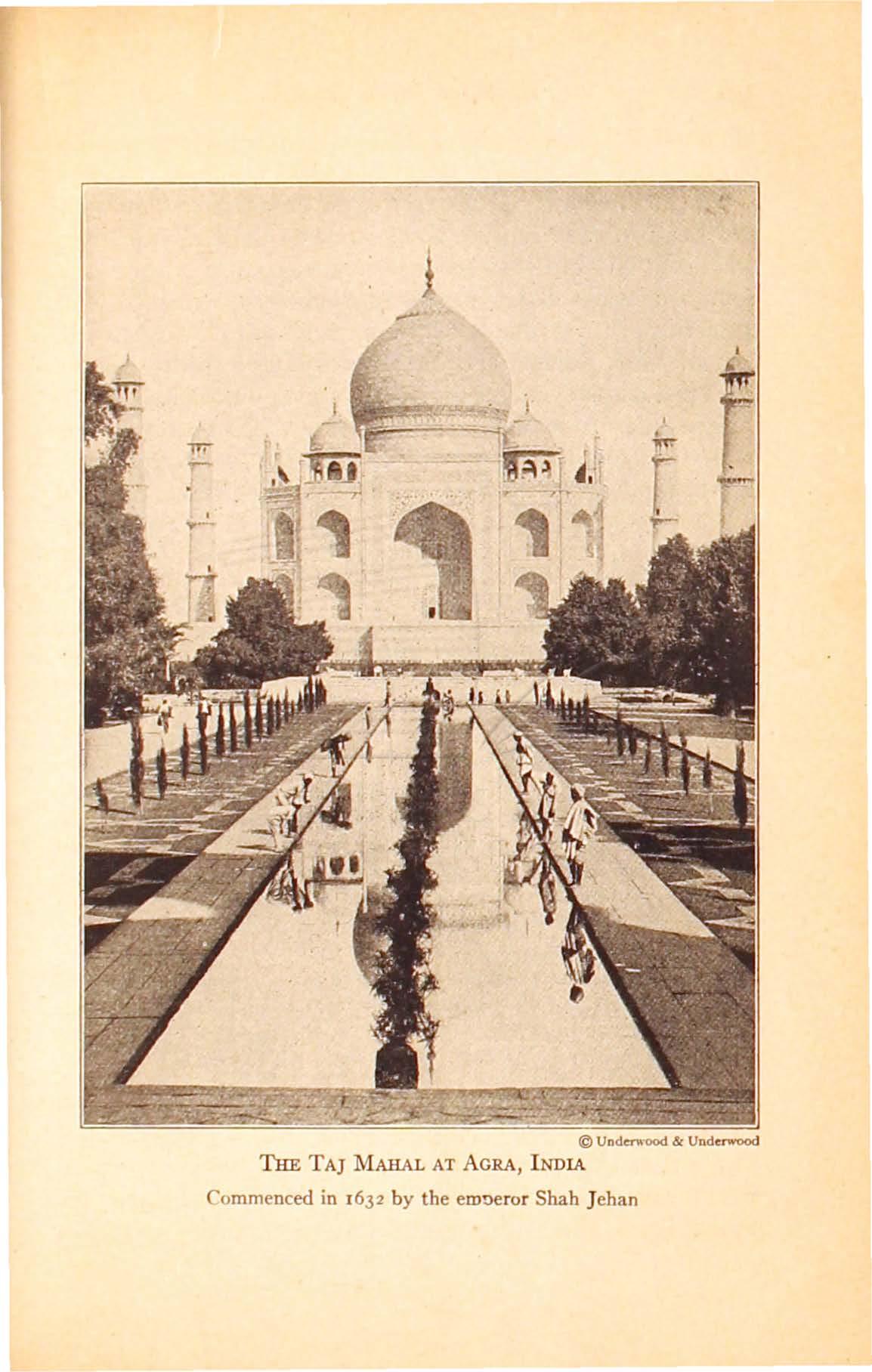
wrest from Portugal the great port of Malacca, which, for a hundred and thirty years, had been second only to Goa as a Portugu ese commercial base . The English attacks upon the Portugu ese position were chiefly directed at the western section of the far-flung line of trading post s; but here they were hardly less destructive than the Dutch attacks farther east. In 161 r the English defeated a Portugue se fleet off Cam bay; in 1615 they gained an even more sweeping naval victory over the Portugu ese in a battle off Surat. A few years later Mocha , at the entrance to the Red sea;-was seized by the English forces; in 1622 Ormuz, near the mouth of the Per sian Gulf, was taken by the Persians and the English. The loss of these two important ports was a severe blow, since it deprived the Portuguese of their control over trade in the Red Sea and the Persian Gulf, 238. Exhaustion and Decline of Portugal. Nor were the Dutch and the English the only enemies against whom the Portugue se were now compelled to defend themselves. As early as 1570 Goa had been attackeci,by the forces of Akbar, on which occasion only the desperate heroism of the Portuguese garrison had saved the city from falling into the hands of the Mogul conqueror. About the same time the growing hostility toward the Portuguese had resulted in similar attacks upon Malacca and other strongholds. Before the ·arrival of European enemies, however, the Portuguese had always been able to defend themselves. With the corning of the Dutch and Engli sh , the anti-Portuguese activities of the local rulers increased. In Ceylon and in the East Indies the Dutch made comm0n ~a u se with those who had come to hate the domination of Portug al , while the English adopted the same policy in India aud in Persia. The result of the struggle was not long in doubt. Even in times of peace Portugal had been compelled to dra.w heavily upon her man power to maintain her vast empire; these constant wars against overwhelming odds soon resulted in complete exhaustion. In 1629 Shah J eban, the grandson of Akbar , captured the city of Hugli and took a
Commenced in 1632 b y the e moero r Shah J ehan
@ Undcn\-ood & Underwood Tm: TAJ MAHAL AT AGRA, lNo lA
A H istory of the Ori en t thou sand Portugu ese pri sone r s, th us giving notice that the downfall of Portugu ese po wer in Indi a was at hand. 1
239. The Commercial Ma stery of the East falls to the Dutch and Engli sh. Th e capture of Malacca by the Dutch in 1641 practically m a rked th e end of Portugu ese power in the East. Some fragm ent s of h e r former greatness still rem a ined , but the se fragm ents gradually fell from the grasp of the exhausted nation. Go a, Daman , and the island of Diu in India , Iacao in China , a nd one h alf of the li ttle island of Tirnor are all that remain today to remind us of t he power which Portugal once en joyed. From th e cap t ure of Malacca , the commercial mastery of th e E as t lay b etween H oll and and England.
QUESTIONS
I. For how long a period were Portugal and Spain without other European rivals in th e Far East? .,Wh y did th e Spanish not become commerci a l riv a ls of th e Portuguese? H ow did Portugal get and maintain compl e t e control over trade between Europe and the Far East? Wh y may Portu ga l at thi s time be compared to a great trading company? D esc rib e th e missionary work of the Portuguese; t h e relations of the Portuguese with Siam and Burma.
II. Trace th e growth of Spanish power in the Philippines to 1576. Wh a t was the Manila galleon? What did Drake accomplish? Wh y did be not a tt empt to engage in trade in the East Indies? Wh en were the crowns of Spain and Portugal united? Show how this affected Portugal, Holland , and England. When was the Dutch East Indi a Company form ed? th e English East India Company? How did they differ from th e Poj tuguese merchants?
III . Wh at was the weakness of the Portuguese commercial empire? Wh ere was it attacked by the Du tch? by the English? Who else joined with the Dutch and English in attacking the Portugu ese? Point out on th e ma p th e present Portugues e possessions in the Far East.
TOPIC FOR DISCUSSION
D isc uss the ways in which the history of the Far East was affected ~uring th e six te enth century by the international rivalries of Europe.
First Ming e mperor expels the Mongols from C hina
Reign o f Hung Wu
Reign o f Yung Lo
Expeditions of Cheng Ho in the Eas t Indies
Portuguese ships reach the coas t o f C hina
Portuguese allowed to se ttle a t Macao latteo Ricci reaches Ca nton
First Dutch sh ips reach ll l acao
E nglish attem pt to open trade at Canton
The rebel Li Tze-ching proclaims himself empe ror China conq uered by the 11 1a nchus
240. A National Dynasty for China. W e have a lrea dy see n in Chapter XI that the expulsion of K ublai Khan's s ucces so rs from the Chinese Empire was accomp li s h ed by a pop ular revolt, a nd that the rebe l le a de r es tab li shed himse lf u pon the imperial throne as the founder o f a new dynasty, to which h e gave the name " Tai Ming." Ever since t h e year 1127, when t he Sung e mperors were driven o ut of the regions lying no rth of the Yangtze River, part or all of the Chinese Empire had been under the domination o f fore ign rulers. But in 1368 the last :Mongol forces were driven beyond the Great Wall , a nd China, fo r the fi rst ti.me in two a nd a half centuries, was reunited under a Chinese emperor. T hi s new nationa l dynast y was to rule the land for nearly three ce nturies; und e r its sway the Chinese Empire except in military power, was to rival t he g reatness which it h a d attained d uring t he H an a nd Tang periods.
241. Interruption of Intercourse with Europe. The ra pid break-up of the fongol powe r re su lted in destroying t he inte rcour se which, fo r mo re t han a cen tury, had exis ted between
A History of the Orient
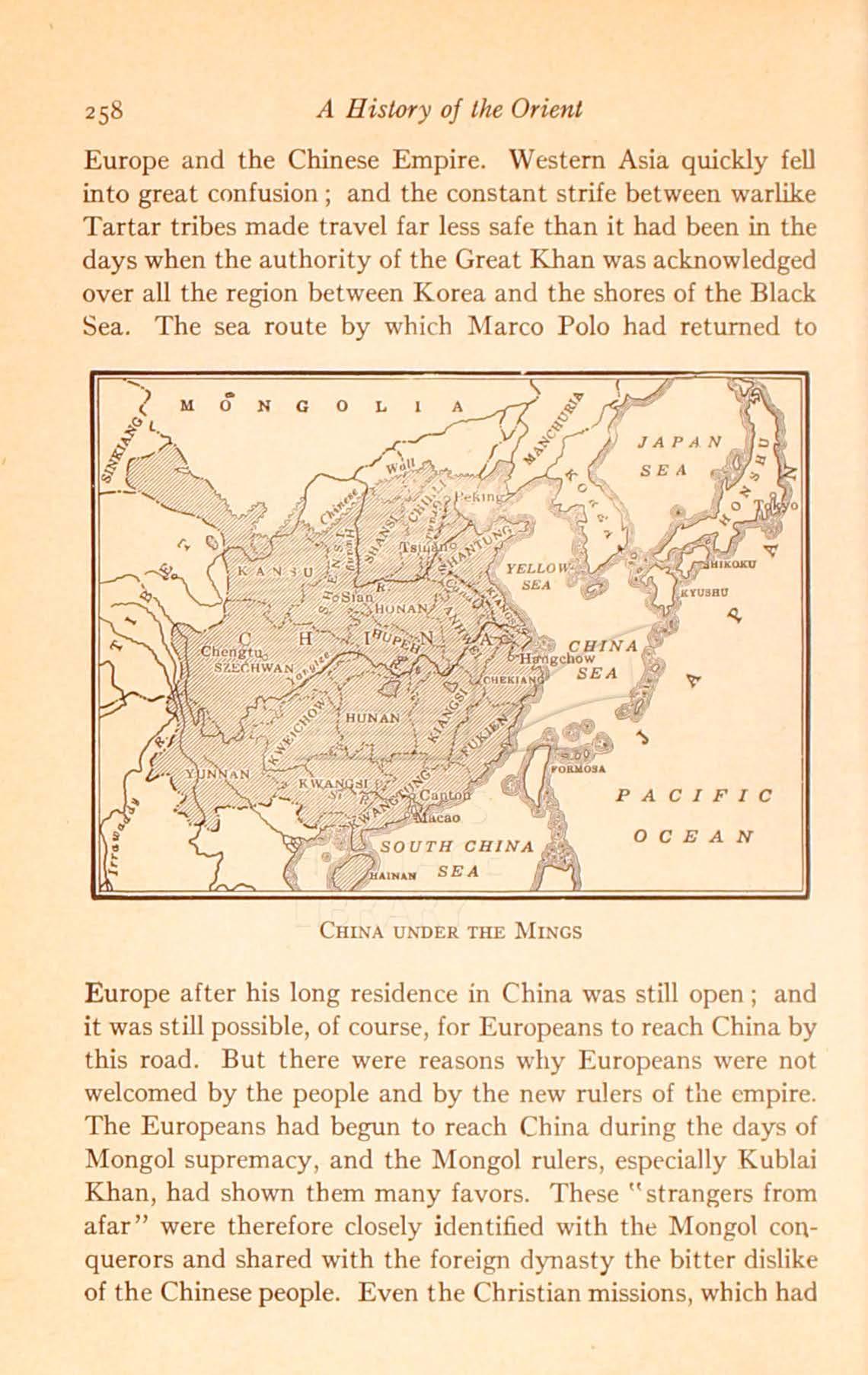
Europe and the Chinese Empire . Western Asia quickly fell into great confusion; and the constant st rife betwe en warlike Tartar tribe s made travel far le ss safe than it had been in the days when the authority of the Gr eat Khan was acknowledged over all the region b etween Kor ea and th e sho re s of the Black Sea. The sea rout e by which Marco Polo had r eturned to
CHINA UNDER THE MINGS
Europe after hi s long residence in China was still open ; and it was st ill possible, of co ur se, for Europeans to reach China by this road . But there were reasons why Europeans were not welcomed by the people and by the new rulers of the empire. The Europeans had begun to reach China during the days of Mongol s upr emacy, and the Mongol rulers, especially Kublai Khan , had shown them many favors . These "strangers from afar" were therefore closely id entified with the Mongol conquerors and shar ed with the foreign dynasty the bitter dislike of the Chinese people. Even the Christian mi ss ion s, which had
China 1t1ui1Ir tlze Ming Empm> rs
heen widely established by J ohn of Monte Corvino and his fellow workers, suffered from the fact that they had rece ived favor and support from the Mongol empero rs. When the Mongols were overthrowu, the Christian religion became the object of widespread popular opposition; in a very short time , therefore, it complete ly disappeared. For the fir t :.e ntury and a
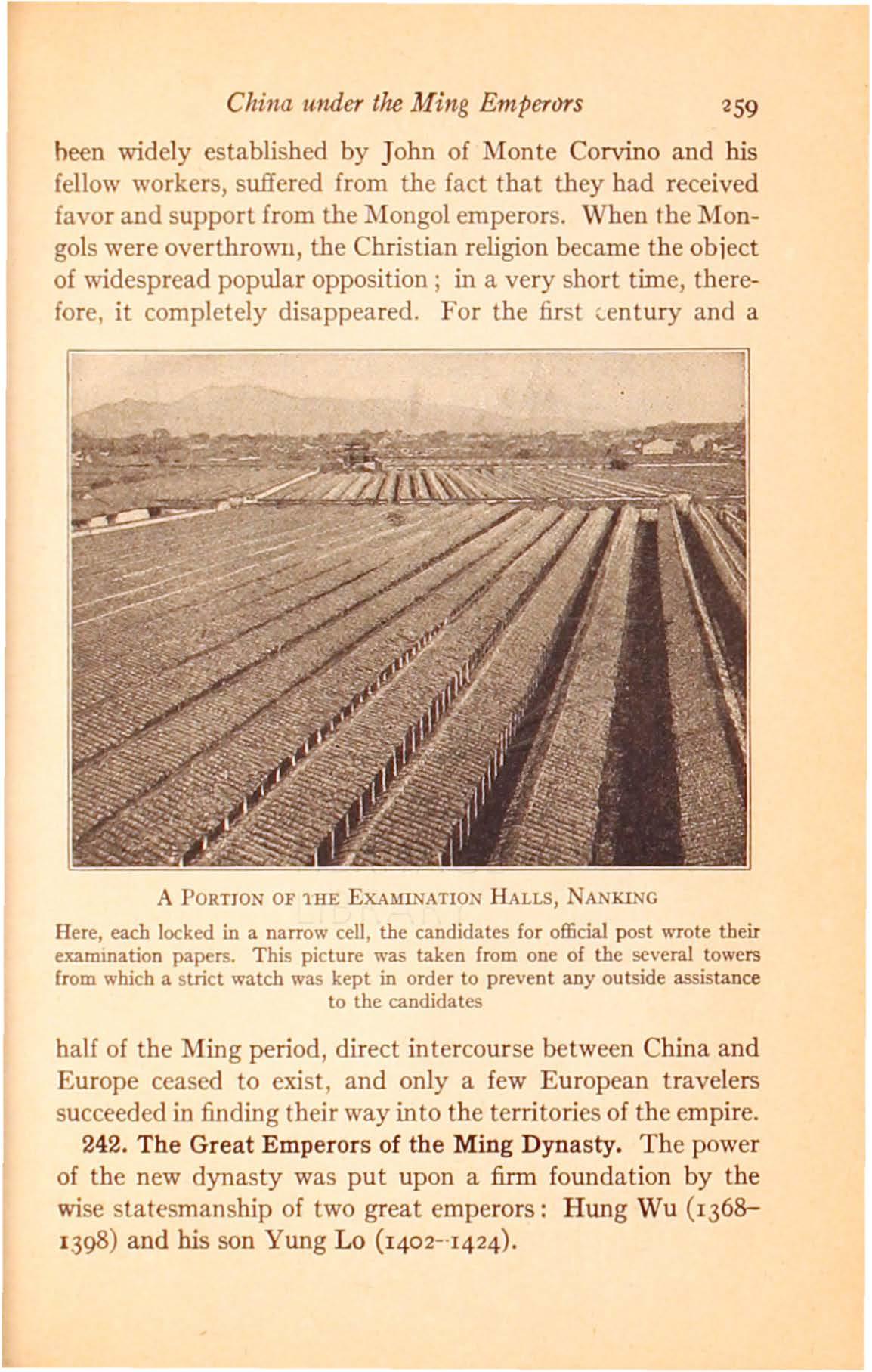
Here, each locked in a narrow cell, the candidates for official post wrote their exammation papers. This picture was taken from one of the several towers lrom which a strict watch was kept in orde r to prevent any outside assistance to the candidates
half of the Ming period, direct intercou r se between Chin a a nd Europe ceased to exist, and only a few European t ravelers succeeded in finding their way into the territories of the emp ire.
242 . Th e Great Emperors of the Ming D ynasty. T h e p owe r of the new dynasty was put upon a firm fo un dat ion by t h e wise statesmanship of two great empero rs: Hun g Wu (136 81398) and his son Yung Lo ( 1402-·1424).
A History of the Orient
Hung Wu, whose success as a reb el leader rai sed him to the imperial throne, began life as the son of a poor laborer; but neither his humble origin nor his lack of education could prevent him from becoming a successful general and a wise ruler. Throughout his long life he always retained his early simplicity of tastes and his deep sympathy with the people from whom he came, while, like all great rulers in history, he strove to give his country such a government that even the poorest sub j ect would be protected in his rights. Fully appreciating the fact that the character of a government depends upon the characte r and ability of its subordinate officers, Hun g Wu made every effort to secure well-qualified men to serve as his representatives throughout the empire. He re sto red the ancient system of civil-service examinations, so that all public officials, being familiar with the teaching of Confucius , would be guided in their actions by principles of j ustice and propriety. In order to prevent the evils of favoritism in local administration - perhaps, also, with the idea of drawing the different parts of the empire more closely together - he introduc ed the policy of appointing officials to positions outside the provinces in which they were born. Knowing that officials often try to hide unpleasant facts from the emperor, he is sued a decree providing severe penalties for those who failed to report any disaster which occurred in their districts. In many of his wise decisions Hun g Wu seems to have been guided by the advice of his empress, who, until her death in 1382, constantly exerted a gentle influence in favor of peace and just ice.
Yung Lo , who came to the throne about four years after his father's death, was not the lawful successor but seized the throne by leading a r evo lt against his own nephew. Although he was usurper , Yung Lo soon showed himself to be such an able and energetic ruler that the Chinese have always regarded him as one of their greatest emperors. It was he, as we have seen (§ 137), who transferred the capital of the empire from
China under the Ming Empe ror s
Nanking to P eking. The r easons for this s t ep can easily b e seen. Only from the north was China in danger of a ttack ; Yung L o wished to be located at a point where h e could watch over the northern frontier and take measures to rep el any threatened invasion by th e T artars. Althou gh the rule of Y ung Lo was not so mild as that of his father, h e s t eadily improved the administration of ju stice and did much to correct various evils in l ocal governm ent .
243. China an d her Ne ig hbor s . Th e Min g p eriod in Chine se history was almost entire ly free from war s of foreign conquest. The first i\ling emperor, after driving the Mongols b eyo nd the Great Wall, followed them into Mongo li a in order to crush their military power, while Yun g L o ca rri ed on wars in IndoChina and in regions outside China's western frontier. But even Yung Lo, who was the most warlike mon a rch of the dynasty, was usually willing to live in peace with hi s neighbors and to devote his energies to the problems of int ernal government. China therefore en j oyed, during the gr eate r p a rt of thi s period, the friendship and respect of the other co untri es in the Far East.
V-l e have already seen (§ 194) how Chin a's pre s tige was established throughout the Malay world by the expeditions under Cheng Ho. After 1415 , Cheng Ho' s expe ditions lost much of their warlike cha r acter; from thi s time, Yung Lo and his successors were willing to depend upon pea cef ul embassies to maintain their influence. Envoy s were se nt to J ava , to Sumatra, and to various parts of Indo -China. Th ese states , as well as Korea and the Lu -chu I slands, sent their tribute-bearing embassies at regular intervals to the Chine se court. Even the J apanese , a l tho ugh some of their lawle ss countrymen frequently indulged in piratical attacks upon the coast of China, were glad to r enew the commercial relations which had been interrupted by the aggressive foreign policy of Kublai Khan. Onl y from one direction was the pea ce of China seriously threatened: in the north , the r egion from
A Hi story of the Orient which the empire had been so often invaded during past ages, the warlike Tartar tribes soon were gathering st rength for a fr esh attack upon the prosperous lands south of the Great W all.
244. Good Government under the Mings. Since the Ming emperors were content to follow a purely defensive policy up on the frontiers, they were able to devote their energies to domestic affairs. In this field much was done to foster the welfare of the Chinese people. Imperial commissioners were appointed to inspect and to improve the waterways throughout the empire; reservoirs and irrigation canals were maintained to provide adequate supplies of water in times of drought, while ri ver channels were dredged and dikes were buil t to guard against the danger of floods. Public granaries were established in all part s of the country, in order to insure a food reserve in case of poor crops. Taxes were revised downward , and the actual burden of taxation was further reduced by employing the army to transport the "tribute rice" from th e provinces to the capital. The need for an abundant s upply of currency was met by the continued us e of paper money, a thing which had impre ssed Marco Polo as such a wonderful device; and the value of these government bank notes was maintained by the provision that seventy per cent of all taxes might be paid in paper money.
245. Prosperity and Culture of Fifteenth-Century China. The dredging of the river s, undertaken primarily as a measure to prevent floods, greatly improved internal transportation. Trade flowed easily between the different parts of the provinces along the coast, and this increase of domestic trade was accompanied by an increase in China's foreign commerce. Arab traders were welcomed at Canton and at the other seaport s, while the merchant ships of China frequented the East Indies and the coasts of Indo-China. At peace with their neighbors and enjoying good government at home, the Chinese now entered upon an era of prosperity s uch as probably had
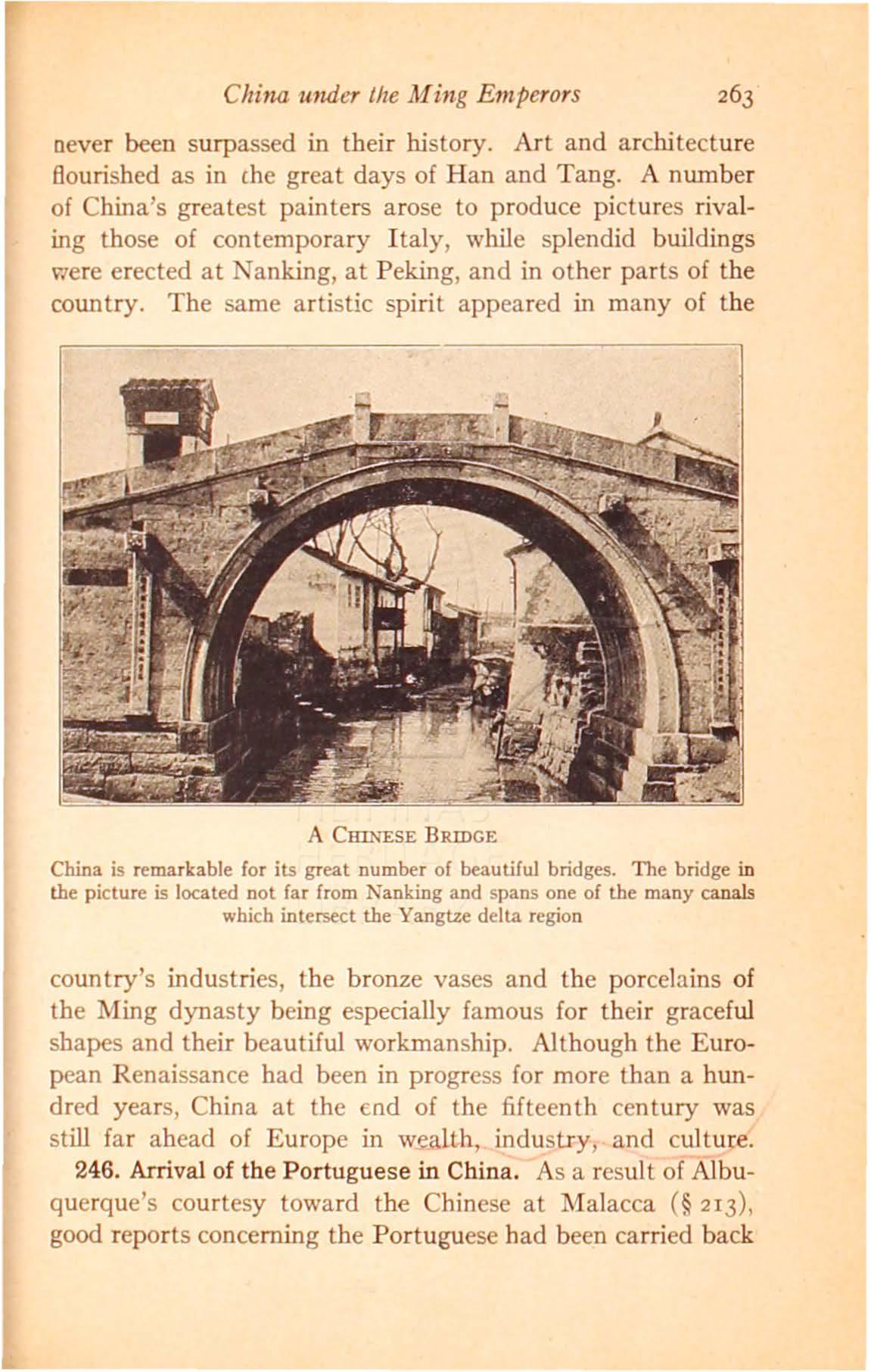
Clzina muier the Ming Emperors never been surpassed in their hi sto ry . Art and architect ure flouri shed as in th e great day s of Han and Tang. A numbe r of China's greatest paint ers arose to produce pictures riva ling tho se of contemporary Italy , while splendid buildings v1e re e rected at an k.ing , at P eking, and in other parts of the country . Th e same a rti stic spirit ap p ea red in many of the
A Cmm:SE BRIDGE
China is remarkable for its great number of beautiful bridges. The bri dge in the picture is located not fa r from anking and s pans one of the many canals which intersect the Yangtze delta regio n
country's indu stri es, the bronze vases and the po rcelains of the Ming dynasty b eing especially famous for th eir gracef ul shapes and their beautiful workman hip. Although the European R enaissance had been in progress for more than a hundred years, China at the end of th e fifteenth century was still far ahead of Europe in wealth, indu s Lry , and culture.
246 . Arrival of t h e Portu gue s e in China . As a res ult of Alb uquerque's co urt esy toward the Chinese a t Mal acca (§ 213), good report s concerning the Portuguese had been carried back
A H isto ry of the Orient
to China; when the first Portugue se ships reached Canton, in 1516, they were therefore favorably r ece ived and bad no difficulty in exchanging their cargoes for Chinese goods. The following year four Portugue se s hip s reached the coast of China bearing an envoy from the viceroy at Goa , and two of the ships, with the envoy, were allowed to proceed to Canton.
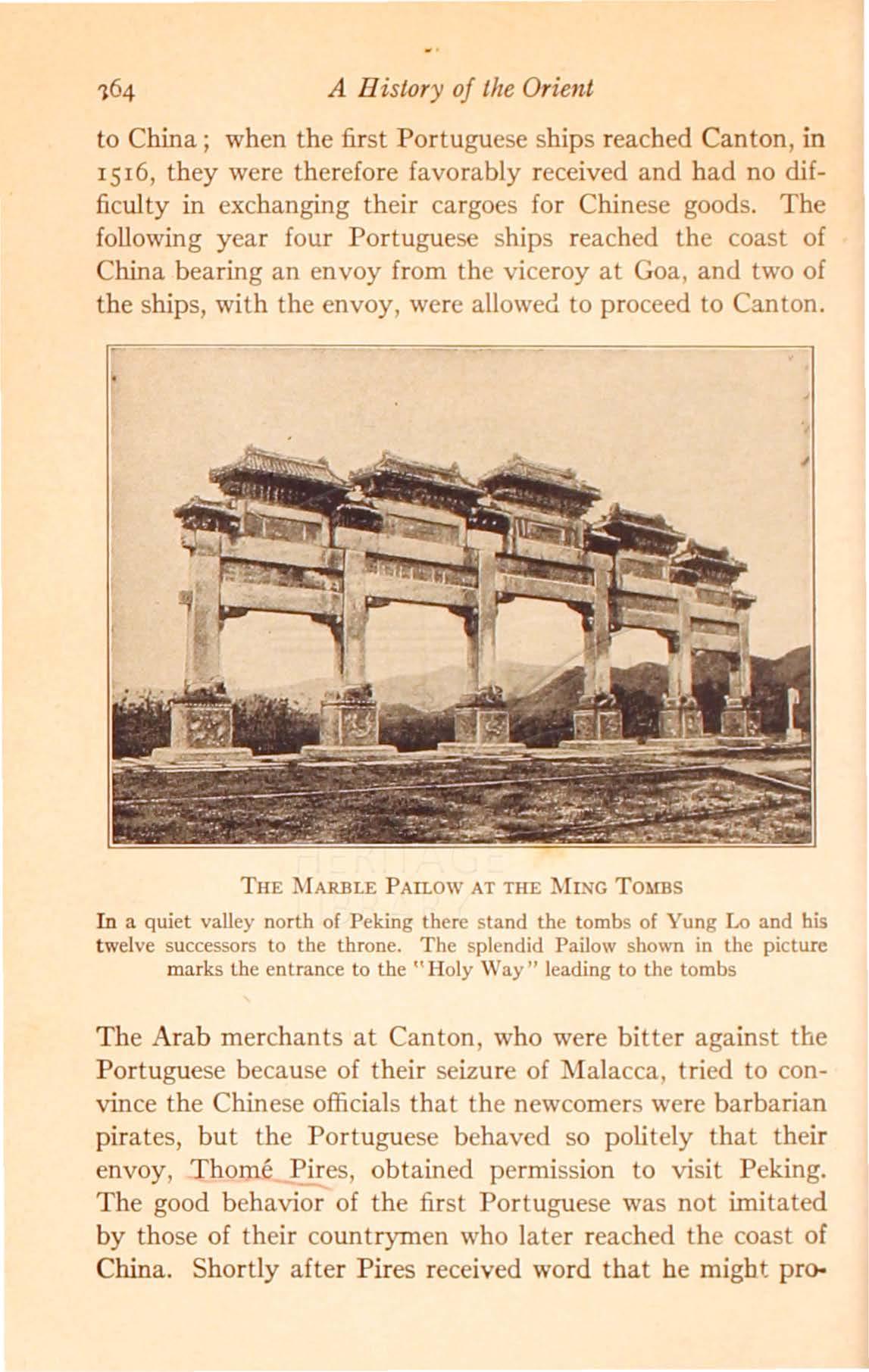
TuE l\IARBLE PAIT.OW AT THE fING TOMBS
In a quiet valley north of Peking there stand the t ombs of Yung Lo and his t welve successors to the throne. The sp lendid Pailow shown in the picture marks th e entrance to the " H oly Way" leading to the tombs
Th e A rab merchants at Canton , who were bitter against the P ortuguese becau se of their seiz ure of Malacca , tried to convince the Chin ese officials that the newcomers were barbarian pirates, but the Portuguese behaved so polit ely that their envoy , Thome Pires, obtained permi ss ion to visit Peking. The good behavior of the first Portuguese was not imitated by those of their countrymen who later reached the coast of Chin a. Sho r tly after Pires received wo rd that he might pro-
China under the Ming Empero rs ceed to Peking, a number oi Portuguese ships under Simon Andrade arrived al San Chuan, an island nol far from Canlon. Andradfcsoon began to act in a very high-handed manner. H e ' landed forces on the island, erected a fort, and altempted to exercise ji:risdiction over the people. The Chinese viceroy at Canton therefore sent an experution against the invader, who was eventually forced to withdraw.
247. R as entm e nt of P ortugu ese Method s. This violation of China's sovereign rights was very disastrous for Pires. On his arrival at Peking , in January , 1521, he was seized as a spy; the following year he was sent back in chains to Canton, whe re he rued in 1523. For nearly thirty years the Portuguese continued their attempts to establish themselves on the coast of China by the methods which had been so successful in I ndia and at Ialacca. Fortified posts were built at Amoy Ningpo, and Foochow as bases for Portuguese trade. ornmercia l towns ~up at these places, and the Portuguese proceeded to treat the people in these regions as conquered people. As usual, the Chinese government was slow in taking measu res against the troublesome outsiders; but in 1545 an expedit ion was finally sent against them, and the Portuguese we re drive n with great slaughter from all three places.
248. Ma cao. The strong measures taken by the impe rial government convinced the Portuguese that it was hardly possible to treat China in the same manner as they had t reated disunited India. The few survivors from the destroyed sett lements took refuge on a small isla,nd at the mouth of the Canton River , and the Portuguese now endeavored to win favor with the Chinese by assisting them in their wars against piracy. As a result of this new policy , they received permi ss ion, in 1557, to erect some buildings upon the neighboring peninsula of Macao, which gradually grew into an impo r tant trading post. T h e Chinese authorities, who now had good reason for believing the Arab assertion that the Portuguese were turbulent ba rbarians, exercised ca reful ove rsight ove r the new sett lement.
A H istory of the Orient
249. Regulation of Foreigner s. Trade between Macao and the neighboring port of Canton was strictly regulated; the Portuguese were forbidden to erect any buildings until they had obtained official permission to do so ; and great care was · taken to prevent any assumpt ion of foreign juri sdiction over Chinese residing at Macao. Following the principles which the Tang dynasty had adopted in its dealings with foreign merchants residing in China , the Chinese government allowed the Portuguese to settle their private disputes according to their own laws; but all criminal cases, or cases involving the interests of Chinese subjects, were brought before Chinese judges and sett led according to Chinese law.
250 . R e in tr oduc tio n of Ch ristianity . The first attempts to reintroduce Christianity into China were made about thirtyfive years after the Portuguese began to arrive at Canton. In 1552 St. Francis Xavi er, who had already spent a number of years as a mi ss ionary in Japan (§ 276), arrived at San Chuan Island with the purpose of undertakin g missionary work among the Chinese. As only a few years had elapsed since the Chinese emperor had been compelled to send hi s army and navy against the Portu guese se ttl ements at Amoy, ingpo , and Foochow, the officials were under strict orders to prohibit any Portuguese from landing in the country. Xavier , who was ill when he reached San Chuan, died a few months lat e r withou t being permitted to se t foot upon the mainland. During the same year a Dominican fri a r succeeded in entering China, whert! he immediately began preaching the gospel; but he was soon arrested and expelled from the country. Spanish missionaries from the Philippines attempted to enter China in 157 5, but were compelled to return to fanila. After the Port uguese had received permi ss ion to establish their settlement at Macao, the door became partly open to the entrance of missionaries. In 1584 two J esuit priests, one of them the famou$ Matteo Ri cci, succeeded in reaching Canton, where they disgui sed th emselves as Bu ddhist s tu dents and r emained for
China u n der the Ming E mperors 207 several yea r s, pe rfecting their know ledge of the C hin ese h nguage and winning a reputation as scientists . Afte r seve ra l years at Canton, Ricci threw off his Buddhist disguise an d adopted the costume of a Confucian scholar. F rom Canton Ricci now proceeded northward , first to the Yangtze vall ey and then to Peking, where, in 1601, he was actually r eceive d in an audience by the Ming emperor W an L i.
251. Ricci and hi s Succe s so r s at P eking . Ricci was a brilliant scholar and a man of great tact. Moreover, he h ad b ecome such a master of the Chinese language that he was a bl e to converse with the educated Chinese abo u t thei r own Co nfucian Classics, as well as about the science of t h e W est . He was therefore able to win respect and tolerat ion fo r himself an d for his religious ideas. This toleration at P eking made i t p ossible for Ricci's fellow missionaries to carry on their teaching in the provinces, and Christianity soon obtained thro u gb o u t t h e empire a stronger position than the one which it h ad lost wit h the overthrow of the Mongols. After the dea th of Ri cci , in 1610 , other able members of the J esuit order s u cceeded in r etaining the continued good will of the Chinese empero rs a nd their officials. About twenty years after Ricci's death a n ot h er Jesuit , Adam ,diaal , rose to be even more i nfluent ia l than Ricci ):iao been. Schaal and a fellow J esuit were appointe d members of the Board of Astronomy ; in this post Sch aal served with such dtstmcticm• that, - after the fall of the Min g dynasty , he was reappointed to the same position by the Manchu government.
2 52. The Du t ch at Canton and Formosa . When the Du tc h reached the Far East they lost little time in following the ir Portuguese rivals to the coast of China. In 1604 three ships of the Dutch East India Company a rrivea";.t Macao, wh er e they requested permission to trade. The Chinese official s at Macao, who had begun to regard a ll new ar ri va ls with su sp icion, were informed by the Po r t uguese t h at the Du tch we re a nation of ferocious pirates, so t h e pe rmi ssion was n ot g ra n te d .
A H istory of the Orient
E ighteen years later, after the Dutch had established their new headquarters at Batavia, a fleet was sent to Macao with inst ru ctions to open trade there by force, if force was neces sa ry. Without attempting to negotiate , the commander of the fleet landed a strong body of troops for an immediate attack upon Macao . The attack was a disastrous failure, and the Portuguese, aided by Chinese forces , drove the Dut ch back to their ships with heavy losses. Repul se d in their attempt upon Macao, the Dutch proceeded northeastward to the Pescadores I slands, the group of small islands lying between "Formosa and the coast of Fukien province , where they established a trading post. A few years later the Dutch gained a foothold upon the large island of Forrno a. In 1630 a settlement was made at Tai-wan, on the west coast of the island , where Fort Ze lan<lia was erected; other sett lement s were made at Kelung, on the northern coast, and at other points . Formo sa was favorably situated for trade with Japan , as well as with the coast of China , and the Dutch remained in control of the island until 1662 , when they were driven out by the "pirate-patriot" Koxinga (§ 321) .
253. Earl y En gli s h Effort s t o op e n Tr a d e. The English East India Company was far behind its Dutch rival in its attempts to open trade with China. In 1623 some of the company's repre sentat ives in the East were strongly in favor of securing a po sition in Formo sa, which would make it possible to control all trade between China and Jap an; but the directors in England objected to the propo sa l. In 1637 several English sh ips , under the command of Captain W eddell, arrived at Canton, b eing the first English 'snips to attempt to open trade with China. Although Captain W eddell had stopped at Goa and had receiv ed from the Portugue se viceroy formal permission to trade at M acao, the Portugue se merchants at that port did everything in their power to cause trouble between the local officials and the Engli sh. Irritated at the long delay in obtaining the necessary permi~ from the
Chin ese officials, the English captain sent two of hi s small boats to explore the channel to Canton, with the result that the local authorities became firmly convinced of his ho tile intention . A few days later a clash occur red, appa rently by accident, between the English ships and one of the forts guarding the river; the fort was bombarded and stormed, and the ships proceeded up to Canton, where they were allowed to exchange their ca rgoes for sugar, ginger, and other Chbese commodities. FollO\ving this stormy ep isode the English made one or two hall-hearted attempts to open trade , but it was not until 1670, twenty-six years afte r the downfall of the Ming dynasty, that the English company act u a lly secur ed a share in the comme r ce of China.
25 4. Th e Ri se of th e Manch us. Throughout the entire period of the Ming rule in China, the Tartar p eop les north of the Great Wall were a constant source of anxiety to the empir e. The ear ly Ming emperors had establish ed their a uthority over the so uth ern port ions of the great region now known as fanchuria, but since the 1ings were not fond of war, no attempt was made to conq uer t h e enti r e r egion. During the latte r part of the sixteenth century a strong tribe, known as the Manchus, began to gain sup r emacy over it s neighbors in the vicinity of the Amur River. The fanchus appear to have been a remnant of the" Kin" Tartars who h ad g iven China so much trouble in the days of the Sung dynasty. From th eir Kin ancestors they had received a certain amount of Chinese civilization, which steadily increased as a r esult of comme r ce which they carried on with peoples living nearer the fronti ers of the empire. After bringing all the northern part of Manchuria under the ir domination, the Manchus b egan to expand toward the south and soon came into conflict with the peoples who acknow ledged the rule of t h e Chin ese emp eror. These peoples appea led to P eking for aid against the agg resso rs; and the Chinese government r esponded by send in g arm ies which, altho ugh they failed to ch eck the progr ess of the
A H istory of the Orient
M anc hu s, served to aro u se in thei r leader a feeling of bitter hatred toward the rulers of China.
255. The Beginning of WBI wit h the Manchu s . In 1618 the Manchu leader, urhachu , drew up a list of grievances against the Mings and iss ued a formal declaration of war. Nurhachu soon succeeded in conquering all the Ming allies in Mauchuria and in overrunning all Chinese territory outside the Great Wall , but this massive barricade and the line of strongly fortified cities continued to block his triumphant progress. In ,626 urhachu died and was succeeded by his son Taitsung, who, shortly after his s u ccession, assumed the imperial title and gave to this newly estab li shed dynasty the name "Tai Tsing" (" Great Pure"). The Korean king, faithful in his allegiance to the Ming emperor, had been giving considerable aid to the Chinese; but in 1627 the Manchus invaded Korea and forced the king to become a vassal of the newly created emperor at Mukden. Despite these successes outside the Great Wall , and despite the nonmilitary character of the Chinese, the Manchus were st ill unable to gain a firm foothold inside the territories of the empire. Although Peking was tom by polit ical discord and intrigue , a strong Chinese army held the pass at Shanhaikwan, China's Thermopylre . 1
256. The Rebellion of Li Tze-ching. As early as 1621, however, popular disturbances in various parts of the empire began to show that the Ming government was losing the respect and support of the nation. These disturbances, which first appeared in the districts at a distance from Peking , steadily increased and spread toward the capital. The lcmg and costly struggle against the Manchus , the destruction of property by the Manchu raids into the northern provinces, and severe droughts in a number of districts all caused widesp r ead suffering and discontent. Brigand lead ers, rec ruiting t h ei r forces from the thousands of desperate, hom eless men,
1 See J . H Robinson , E P. Smith, and J . H Breasted, Our World Today a11d Yesterday, p . 40. Ginn and Company , 19 24 .
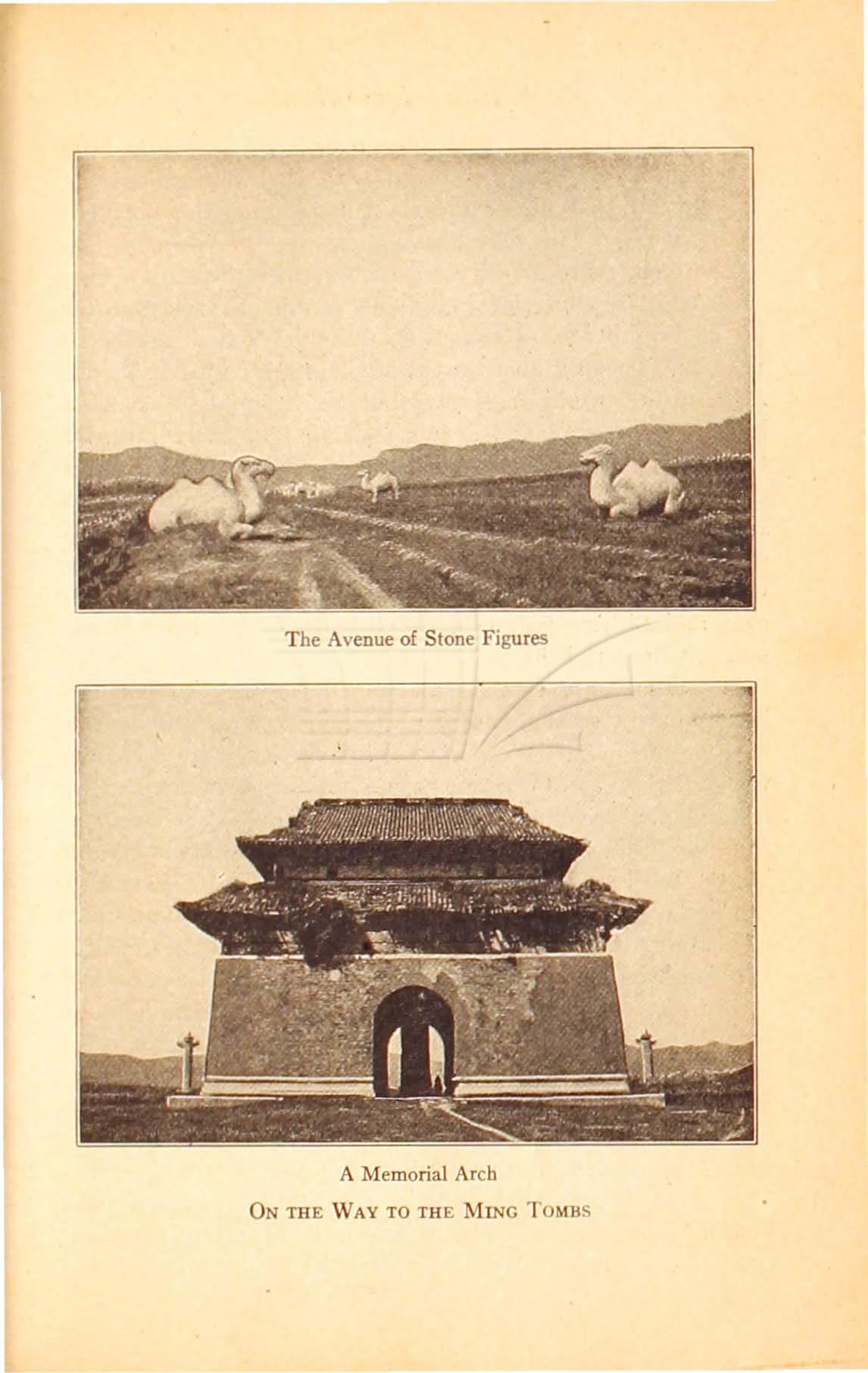
The Avenue of St one Figures
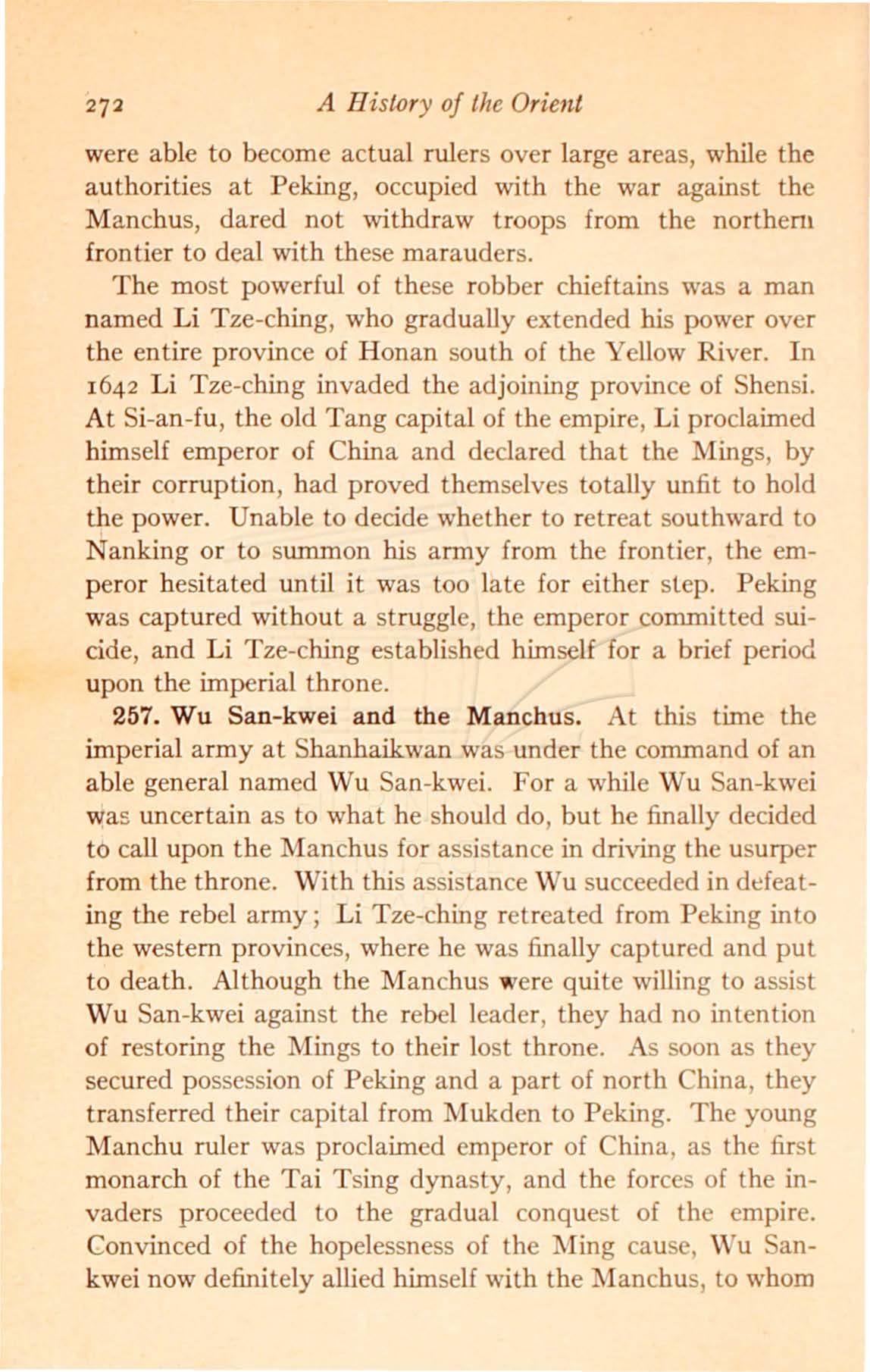
A Memorial Arch ON THE WAY TO THE MING T o~rns
A Histor y of the Orient
were able to become actual rulers over large areas, while the authorities at Peking, occupied with the war against the M anc hus, dared not withdraw troops from the northern frontier to deal with these marauders.
The most powerful of these robber chieftains was a man named Li Tze -ching, who gradually extended his power over the entire province of Honan south of the Yellow River. In 1642 Li Tze -ching invaded the adjoining province of Shensi. At Si-an-f u , the old Tang capital of the empire, Li proclaimed himself emperor of China and declared that the Mings , by their corruption, had proved themselves totally unfit to hold the power. Unable to decide whether to retreat southward to Nanking or to summon his army from the frontier , the emp eror hesitated until it was too late for either step. Peking was captured without a st ruggle, the emperor committed suicide, and Li Tz e-ching established himself for a brief period u pon the imperial throne.
257. Wu San-kwei and the Man chus. At this time the imperial a rmy at Shanhaik.wan was under the command of an able general named Wu San-kwei. For a while Wu San-kwei wa s uncertain as to what h e should do, but he finally decided to call up on the Manchus for assistance in driving the usurper from the throne. With this assistance Wu succeeded in defeating the rebel army; Li Tze-ching retreated from P king into the western provinces, where he was finally captured and put to death. Although the Manchus w ere quite willing to assist Wu San-kwei against the rebel leader , they had no intention of restoring the Mings to their lost throne . As soon as they secured possession of Peking and a part of north hina , they tran sfe rred their capital from Mukden to Peking. The young Manchu ruler was proclaimed emperor of China, as the first monarch of the Tai Tsing dynasty , and the forces of the invaders proceeded to the gradual conquest of the emp ire. Convinced of the hopelessness of the Ming cause, Wu Sankwei now definitely allied himself with the Manchu s, to whom
China unde r tlze Ming E m perors 273
h e rend er ed valuab le se rvic e b y bringing abo u t th e p eace ful submi ss ion of th e wes t ern and southw es t ern prov inces. 1 T he Ianchu s r ewa rd ed him for h is se rv ices by appointing him to rul e as viceroy ove r th e provin ces which h e s u cce ed ed in pacifying.
258 . Comple ti on of the Manchu Conquest ·(1644-1650). Fo r a whil e t h e a dh eren t s of th e Min gs ma in tain ed a r es istance
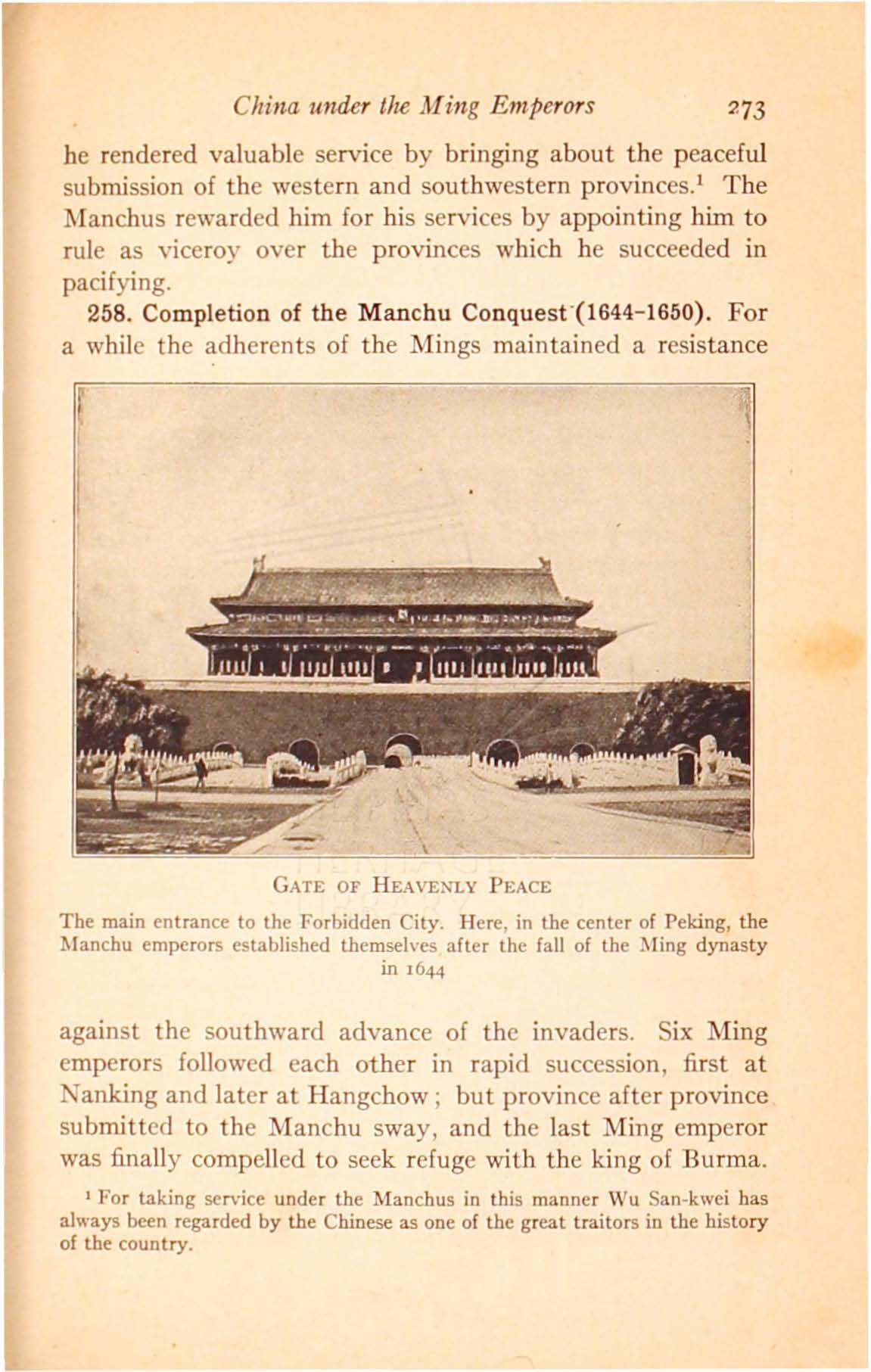
GATE OF HEAVENLY PEACE
The main entrance to the Forbidden City. Here , in the cente r of Peki n g, the 1lanchu emperors establi shed themselves after the fall of the Ming dynast y in 1644
aga inst the southwa rd advance of the inv a d er s. ix Ming empero r s followed each othe r in r apid success io n , fir st at an.king and late r a t H angc h ow; bu t prov ince aft e r province sub mitt ed to th e Ian chu sway, a nd th e la s t Ming emp eror was fina ll y co mp ell ed t o seek r e fu ge with th e king o f Burma .
1 Fo r taking service u nde r t he Manch us in t his manne r \Vu Sa n-kwe i bas always been rega rded by tb e Chinese as one of tbe g rea t tra i t o rs in tbe h ist o ry of tbe coun t ry.
A H istory of the Orient
In 1650 the city of Canton was taken by the Manchus, and th e conquest of China may be regarded as complete. The loyal supporters of the old dynasty still continued the war u pon the sea, but on land the rule of the Manchus was accepted. The rapidity with which the Manchus succeeded in establishing their control over the empire was partly a result of their policy of employing Wu San-kwei and other Chinese officers as their representatives in many of the more difficult regions. Much more important, however, was their conciliatory attitude with regard to the maintenance of the old traditional methods of government. o changes were made in the fundamental laws of the land. No increase was made in the light taxation imposed upon the people. The old system of official examinations was maintained, and the majority of even the highest provincial offices continued to be filled by Chinese officers. In the great administra ive boards at Peking, equality between Chinese and Manchus was carefully maint ained. As far as the people of the country were concemed, two facts alone gave evidence that there had been a change of r ulers: the wearing of the queue was imposed as a symbol of submission, and Manchu troops were stationed at a number of important cities as a precaution against any attempted reb ellion.
After nearly three centuries of good government the Ming d ynasty was overthrown even more quickly than the founder 0f the line had overthrown the Mongols. Few of the Ming emperors were bad rulers; most of them were unusually able m en who strove to secure the welfare of their people. In view of the generally good character of the Ming rulers, the reason fo r the sudden downfall of the dynasty may, perhaps, be found in their failure to recognize that the tribes of the north were n ot inspired by the same pacific ideals as the people of China. Bu t the wisdom and soundness of their government in internal affairs are proved by the prosperity wh i ch the country enjoyed during their rule, and by the fact that the new dynasty
China under the Ming Emperors 2 75 was able to govern the empire with hardly a single change in the administ rative machinery which the Mings h ad organized.
QUESTIONS
1. Wh en was the Ming dynasty establish ed in China? J Wh y was the establishment of the new dynasty followed by the interruption of intercourse with Europe? Describe the government of Hung Wu H ow did the policy of the Ming rulers affect the relations between Ch in a and her Far Eastern neighbors? Tell of the measures taken to increase the material prosperity of China. How do you explain the artistic and cult ural development of China under the l\Iings? I
II . Describe the conduct of the Portuguese in China.~ Why were the Portuguese unable to use successfully in China the same methods tha t they had employed in India? I Locate l\Iacao. • Why was it a good place for a trading post? What restrictions did the Chinese placs: upon the Portuguese at lllacao? What do you know about Ricci? "fell of the Dutch attempts to open trade with China; of the English attempts.
III. Who were the Manchus? Describe the growth of their power. How were the Manchus able to gain a foothold in North China? Why were they able to extend their power so rapidly over the who le empire?
TOPICS FOR DISCUSSION
Were the Ming emperors justified in their attempts to control European merchants and missionaries?
Would China have been more or less prosperous in the sixteenth and ,even teen th centuries if her government had been more militaristic? If Wu San-kwei were alive today. what part do you think h e wo uld now play in Chin ese politics?
REFERENCES
Books listed under Chapters II and VI.
CHAPTER XX
JAPAN , OPEN AND CLOSED , FROM THE FALL OF THE KAMAKURA SHOGUNATE TO THE BEGINNING OF THE TOKUGAWA SECLUSION 1333. 1338- 15 75. 1336- 139 2. 146 7.
S t Francis Xavier and introduc tion of Christianity
Nob un aga begins t he unification of J apan
Hid eyoshi issues the first dec ree again s t Christianity
U nifica tion of J a pan completed by Hideyoshi
Th e K orean War
F irs t Christia n martyrs of J apan
I yeyas u becomes Shogun; beginning of the Tokugawa Shogunate
Th e Shogu ns begin to exterminate Christianity
J a pan closed to a ll European s except the Dutch 259. Decline of the Kamakura Shogunate. W e h ave a lread y s een ( § 9 2) h ow Y oritomo estab li sh ed at K a m ak ura a military organiz a ti on , kn own as t h e Sh ogunate, wh ich act ually exer cised supr em e p owe r in t he gove rnm en t of the J apan ese Empire. Althou gh Y ori to m o's su ccesso r s soon became m e re figur ehead s in t h e h a nd s of a gro up of s ubo r dinate officials, th e Shogunate gav e t h e co untr y a lon g pe riod of honest and effici ent gov ernm ent. In r2 74 a n d in 128r t h e military disciplin e majnta in ed by t h e Sh ogun ate h ad en a bl ed the J apanese to r ep el th e exp edi t ion s of Kub la i Kh an (§ 130). T he half century whi ch fo ll owed th e repul se of t h e M ongols , however, saw a gr a du a l d ecl ine in th e p ower of th e admin ist rat ion at Kamakura. Th e simpl e m ili ta ry li fe of th e ea rl y K amakur a period , which h a d b een s tri c tl y en fo rce d by Y ori tomo a n d hi s first successors, had gradually given way to more luxuriou s
Japan lo Time of Tokugawa S eclusion 277
standards of living introduced from K yoto, while j ealousy and intrigue were taking the place of the ea rli e r harmony among the offi ials of the hogunate. At the same time th e
} APA); AT THE BEGINNING OF THE TOKUGAWA PERIOD
Shogun's vassals in a ll parts of the cou ntry we re b eco ming bankrupt, through their ext ravagan ces, and we re b eginning to long for a civ il war which would enabl e th em to acqui r e fresh possessions b y conqu es t . The long clecl in e of th e Kamakura administ ration en d ed with its overthrow by Emp e ror Daigo II (r3r9-r338). Discovering that Daigo was planning
A H is tor y of th e Orie n t to mak e himself the r ea l r ule r of the empi re, the Sh ogun's offic ia ls attempted, in 1332, to drive him fr om the th rone. Th e K amakura forces entered K yoto and sent the emperor in to exile on the little island of Oki; but Daigo soon succeeded in escaping from Oki and returned to the capital, where he secu red the ass istance of a discontented Kamakura general , Ash ikaga Takauji. In J uly , 1333, the imperial army defeated th e Shogun's forces, the city of Kamakura was destroyed, and th e Shogunate was overthrown.
260 . A N ew Shogunate. Daigo II had hoped that the d est ru ct ion of the Kamakura Shogunate would l eave him compl ete maste r of the empire, but he quickly discovered his mistake. T h e civilian government which he attempted to orga n ize at K yoto was soon tom by the old intrigues between riv a l officia l cli q ues, while the military leaders who had aided him agai nst th e Shogunate were demanding satisfactory rewa rd s fo r t h eir serv i ces. T h e Daimyos of the Kwanto 1 broke ou t in r ev olt, an d Ashikaga Takauji, whom the emperor sent t o resto re o rde r in these provinces, merely utilized his app ointment as a means of putting himself at the head of the discontented D aimyos. R eturning to Kyoto in J uly, 1336 , T a k a uj i forced D aigo to take refuge in the mountainous distri ct so u t h of th e capital. A new emperor was placed upon the thr on e, and in 1338 Takauji was appointed Shogun - the first of th e n ew Ashikaga Shogunate, which was to continue for tw o h undred and thirty-five years.
261. T he R ul e of the Ashikagas (13 38- 1575). For more th an two h und red years the Ashikaga Shogunate was conte m poraneous with the Chine se Ming dynasty; but during t h ese two centuries the internal conditions of the two empires were totally differ ent. China , under the Ming emperors, enj oyed a long period of almost unbroken peace; in J apan, on the other hand, the Ashikaga Shogunate was a period of practi cally un interrupted civil war.
1 T he district around Tokyo Bay; see § oo.
Japan to Tim e of Tokugawa Seclusion 279
262 . The War of Succession (1336-1392). The civil wars began with what is known as the Wa r of Succession. When Daigo fled from the capit a l , the Asbikaga chief, as we h a ve seen, plac ed anothe r empero r up on the vacant throne; Daigo co ntinu ed, however, to claim t h e imp eri al title, and his claim was supp ort ed by all tho se who b ated the Ashikagas. The struggle between the two rival co urt s contin u ed for fifty-six years, from 1336 until 1392. Taking sides with one or the other of the two empe r ors, the Daimyos throughout th e empire proceeded to invade and conq u er the l ands of their n eighbors. In ord er to avo id attack by their stronger neighbors, or to have an exc use for attacking their weake r ones , these lo cal rul ers changed sides with such bewildering r ap idity that the period has been ca ll ed the "Age of Turncoats." In 1392 the last of the "So uth ern" empe r ors, the su ccesso rs of Daigo II , made peace with the Kyoto government, an d th e W a r of Succession came to an end; but the feuda l lord s in the districts far from the capital contin u ed t h e many priv a te fe ud s which bad originated d urin g the d isp ut ed su ccess ion.
263. Relations with China and Korea. During the Shogunate of the third Asbikaga Sh ogun, Yo sbirnitsu (136 7-1 395), important changes in China and in Korea made it possible for the J apanese to r es ume the friendly relations which had b ee n disturbed by the Mongol conquests on the continent. In 1368 Hung Wu expelled the Mongol ruler s from China and establi shed the Ming dynasty , while in 1392 Yi Tai-jo overthrew the old Korean dynasty and ascended the throne as the fir s t monarch of a new line.
Yoshimitsu was very anxious to establish comme r cial relation s with China becau se of the profits which the trade would bring to the imperial treasury . His co un se lors, who were drawn from the "Zen" sect of Buddhi sts, were also strongly in favo r of renewing friendly relation s with the Chinese Empire. Zen Buddhism was Chinese in origin, and the Zen Buddhl sts of J apan, who owed much of their importance to their Chinese
A H istory of the Orient
schola rship, were anxious to keep in touch with the great monastic schools of the Zen order in China. For these reasons Yoshimit su exerted himself to win the good will of the 1ing government. In respon se to Hung Wu 's complaints against J apanese pirates who had been plundering the coast of China, the Shogun arrested a number of the principal offenders and handed them over to the Chinese for punishment. He also adopted the Chinese calendar, acknowledged himself to be a vassal of the Ming emperor, and accepted from Hung Wu
THE KlNKAKUJI , KYOTO
Erected by the Shogun Yoshimitsu
fo rmal investiture as "King of Japan ." Yoshimit su has been bit te rl y denounced by patriotic Japanese writers for hi s subservient attitude toward China, but the friendly relations whi ch he reestablished continued throughout the entire Ashikaga period .
In tercourse between J apan and Korea was reopened by the action of the new Korean government. In 139 2, the year in which he ascended the throne, Yi Tai-jo sent envoys to Kyoto, wh ere Yoshimit su gladly seized the opportunity of entering in to commercial and diplomatic relations . In 1420, as reprisal fo r r aids which J apanese pirates were making upon the Korean coast, a Korean fleet attacked the Japanese island of Tsushima .
Japan to T i me of Tokitgawa Seclusion 28 1
Th e disput e b etwee n th e t wo countries was soon ad ju s t ed, and th e J a p anese, in a dditi on t o sendin g ship s to K or ea , r eceived p ermission to r esid e a t three K or ea n por ts . Ex cept for this sho r t inte rru ption and a simil a r br eak in th e sixteenth ce ntury , inte r co ur se be t wee n J apan a nd K or ea co n t inu ed t o b e fri endly until 1592, wh en Hideyos bi und er took th e con qu es t of the p en in sul a.
264. Luxury an d S uff erin g. Durin g a consider a ble part of th e Ashikaga Shoguna t e, especiall y un de r Y oshimit su and bis imm edi ate su ccesso rs, th e J ap anese capi tal wit n esse d a g reat revival of li te r at ur e and a r t. Th e influ ence of th e Zen B uddhi sts an d th e r enewal of in t er co ur se wi t h Chin a r es ulted in a fr esh in te r es t in Chin ese cul t ur e. Chin ese p a intin g, Chinese p oetry , Chin ese a r c hit ec ture, a nd Chin ese philo so phy wer e all studied and imi t at ed , whil e ev en th e milit a ry l ead er s of J apan b egan to s tudy Chin ese trea tises on wa r in order to perfect th emselv es in t acti cs and s tra t egy. In luxu ry and extra vaga nce Kyoto a t thi s tim e surp asse d ev en th e s t a ndard s which b ad b ee n se t up durin g th e d ays of th e Fujiwara rule. The Sh ogun s th em selv es often ·set an exampl e in was t eful exp end it u re. Th e Kink ak uji , or " Gol de n P a vili on ," which is s till one of th e mo s t delightful sp ot s in th e vi cinity of th e capital , was er ec t ed a t grea t cos t by Y osbimit su , whil e bi s grand son , Yosbim asa, built a n equ a ll y spl en did pavilion whi ch b e ca ll ed the Gink a kuji, o r " Silver P avili on. " The se two b eaut ifu l build~ear witn ess t o th e a r f o f th e p eriod ; but they al so t estify to the wid e diffe r en ce b e twee n th e Asbik aga Shoguns an d th e fi rst Sh ogun s a t K a mak ura . In contras t to th e luxu ry a nd spl endor of th e capital , conditio ns in th e provin ces were prob a bl y worse than th ey bad eve r b een a t a ny oth er tim e in t h e hi s t ory of th e country . The unceasin g private wa rs we re m a rk ed by su ch tr ea chery a n d cru elty t h a t n o m a n kn ew wh om to tru st. The p ea sa nt s we r e cru sh ed unde r a load of t a xes whi ch , in one form or anot h er , oft en took from them the equivalent of seventy per cen t of
A Hi swry of the Orie nt
the ir crop s. Added to this burden of taxation the r e was the constan t danger that war would sweep ove r their community, taking away their few remaining possessions and leaving their rude homes in ruins.
265. The Warring Country . By 1467 the authority of the central administration had almost ceased to exist outside the districts immediately around the capital. In that year a new and more general war broke out between powerful groups of Daimyos, and all pretense of a central government was abandoned. Recognizing the fact that no one paid the s1ightest attention to decrees or instructions, the Shoguns even ceased to send out commands to their vassals . Japan now entered upon the period known in her history as the "Epoch of the
ToE GrnKAKUJI, KvoTo Warring Country."
Throughout the empire
Erected by Yoshimasa , the grandson of Yoshimitsu, in an effort to surpass the Kinkakuji the warrior was supreme, and, although t h e great m ass o f the peasants continued patiently to till the so il , t h ousan ds of their number took up arms and sought an eas ier li veli h ood by becoming soldiers in the service of some p owe r ful D aimyo. Instead of lasting for a brief thirty years, like t h e W a rs of the Roses (1455-1485), 1 which had started a few years earlier in England , this struggle stretched out ove r a full cent ur y befo r e any sign of its end appeared. In Engl an d at this time the r e wen two rival parties striving to gain co n t rol ove r the crown; but in J apan, where the central
1 See J . H . Robinson, E. P. Smith, and J. H . Breasted, Our Wm-14 Today and Y ostuday, § 330. Ginn and Company, 1924.
Japan to Ti me of Tokugawa Seclusion 283 government had become an object of contempt, each separate Daimyo was fighting merely to extend bis own possessions or to p revent his lands from being annexed to the domain of some powerful neighbor.
266 . Arrival of the Portugue s e (15 42). Conditions in Japan were at their worst when, in 1542, the first Portuguese reached the port of Kagoshima, at the southern ext remity of Kyushu. 'The newcomers came for trade, b r inging with t h em Chinese silks, spices from the East I ndies, and a few European products. All these articles found a ready market with the Japanese; but the Daimyo of Satsuma , within who e te rritories Kagoshima was located , was particularly impressed and pleased with the weapons of the foreign visitors. Fi rea rm s were absolutely unknown to the J apanese befo re t his t im e. and the lord of Satsuma was quick to appreciate t h ei r s uperiority to the bow and arrow . Realizing the g r eat military advantage which he would have over his neighbors if hi~ troops alone were armed with these superior weapons , he eagerly encouraged the Portuguese lo continue their t r ade a t Kagoshima and endeavored to discourage the ir visiting the ports of his rivals. But Satsuma offered few products to temp t the Portuguese merchants, while the more northern provinces of Kyushu were rich in the attractions which Kagos h ima lacked . oon , therefore, the Portugue se were carrying their silks , their spices, and their highly dl'sirable instruments of warfare to the northern ports; and the Satsuma Daimyo's earlier friendship for the Europeans gave way to a feeling of bitter anti-foreignism . For just fifty years the Portuguese were without European rivals in th e Japanese trade . I t was not until 1592 that the Spaniard s from Manila made their first effort to develop commercial relations with J apan; and the Dutch and English did not arrive until several year!, late r. During this half centu r y, however , the Port u guese confined their activities to the ports of Kyushu, making litt le effor.t to tra<le with the cent r al or western districts of the empire.
A H i s/d ry of th e Orie nt
267. Nobunaga , Hide yoshi, and I ye ya s u. Al tho ugh the P o rtu guese reached J apan at a time whe n the country was in th e worst stage of diso r der and confusion, the year of their arriva l (1542) saw the birth of the youngest of three great leade r s who we r e destined to end the disorde r and to reunite · th e emp ir e unde r a strong government.
Oda obunaga , the oldest of the three, was born in 1533 and was t h er efo re nine yea rs old when the first E uropeans reached J a p a n . Th e Oda family was descended from the Taira clan, an d obunaga's father was a petty Daimyo in the province of O wari. In 1549 obunaga succeeded to his father's fief. All aro un d him we re powerful neighbors , and it seemed probable th at t h e young Daimyo wou ld soon be robbed of hls small possess ions; b u t he showed, by his choice of capable advisers, t h at h e h ad a wise head on hls young shoulders, and that he wa s we ll a b le to h old what his father had left to him .
T oyotomi Hi deyoshl, three years younger than obunaga, was the son of a peasant. Scarcely five feet tall , and with a face like an ape, H ideyoshi was endowed with an intelligence which made him one of the mo st able statesmen in Japan ese hlsto ry. In 1558 Hid eyos hi , who was then twenty-two years old, attached him se lf to Nobunaga. Tradition says that the sh rewd little peasant had made a tour, carefully st udying t h e characters of different Da imyos , after which he se le c t ed No b unaga as the one most likely to s ucceed - and therefore most worthy of hls services. Whatever may be the truth of t hl s story, the rapid rise of Nobunaga began in the &ame year t hat saw Hideyo shi added to his group of advisers.
Tokugawa I yeyasu, born in 1542, was descended from the Minamoto clan. Thi s was an important fact, for the office of Sh ogun was restrict ed to members of that clan, and Iyeya su was therefore the on ly one of the three who could lawfully as pi re to the Shogunate. Less brilliant than Hideyoshi , IyeyaS11 possessed a high degree of political ability, while he was qui te equa l to eithe r of his great contemporaries in military
Japan to Time of Tokuga wa Seclusion 285 skill. Having been offended by hi s Kwa nto overlord, Iyeyasu in 1560 formed an offensive and defensive alliance with Nobunaga, who by that time h ad extend ed his authority over the en tire province of Owari.
268. The Rise of Nobunaga. On b ecoming t h e master of Owari, obunaga definitely identified him self with the sid e of the cent r al government. In 156 1 h e visited Kyoto and secured the Shogun's approval of his conq u ests; afte r which he proceeded to extend his con qu ests into th e neighboring provinces. In 1565 the Shogun was assassinated by tw o disloya l mini s ters, who put a three-year-old child in the office as th eir puppet . Nobunaga immediately took up arms against the assass in s; three years later he was a bl e to install the younger brother of the late Shogun in the Shogunate and to secure for him self appointment to the post of Vi ce Shogun.
Although nominally a mere subordinate of th e Shogun, Nobunaga was now the actual h ead of th e centra l government, which und er hi s leadership b egan to ass um e fr esh vigor in its dealings with th e feudal lords . Aided by the coope r ation of I yeyas u in the Kwanto, -the Vice Sh ogun brok e th e military power of one D aimyo afte r another. Th e nobles whom h e defeated were ruthlessly put to death, and th eir fiefs were bestowed up on men whose loy a lty co uld b e trusted. By 1582, the date of Nobunaga's death, nea rly one third of the country had been compelled to r ecognize the authority of Kyoto: a start had been made in the unification of th e empire . 269. Hideyoshi. The r e was much still to b e done, however, before the country could be r eunited under a strong cent ralized government; the task of comp leting this work fell to Hideyo shi, the shrewd little peasant who had attach ed him self to obunaga twenty-four years earli er. Nobunaga had b een a soldier, not a statesman; he won his battles by good gene ra lship and hard fighting, and he endeavo r ed to consolidat e hi s conquests by the simp le plan of executin g a ll the d efea t ed leaders v,ho fe ll into hi s h ands. As a soldier , Hid eyoshi was
A H istory of th e Orient scarcely, if at all, inferior to hi s former chief ; but in addition to this he wa s one of the cleverest sta tesm en of the sixteenth century - in J apan or in any other country. Wh ere fighting was necessary , Hideyo s hi fought, usually with brilliant success; but he se ldom resorted to war if peaceful diplomacy cou ld b e u sed to attain hi s purpo se. Hid eyoshi und erstood, mor eover, the art of u tilizing hi s defeated enemies. Unlike hi s predecessor , he almost always spa red the liv es of his opponents, either restoring them to their former possessions or transferring them to new fiefs where they would have little opportunity to make further trouble for him. On a few occasions thi s conciliatory policy proved to be unsuccessful, but m any of H ideyoshi's former enemies were thus transformed into loy a l s u pporters. By 1585, three years after th e death of obunaga, Hi deyoshi had succeeded in extending his authority over a ll J apan except Kyushu and the eastern portions of the main i sland. In 1587 a vigorous campaign, combined with a co n side r able amo unt of wi se conciliation, brought about the s ubmi ss ion of Kyushu. Three years later he brought the Kw a nto and the northeastern provinces un de r his sway, and t h e unifi cat i on of the empire wa s comp lete.
270. The Kor ean Wax . After eight years of diplomacy and war Hid eyoshi had brought all parts of the Japanese Empire und e r hi s control. Bu t now he was faced with a difficult problem : if all the Daimyo s s ubmitt ed to hi s rule, how could he employ hi s so ldi e r s, or h ow find territories with which to r ewa rd hi s loyal followers? In all countries and in all ages governments have attempted to quiet popul ar unre st, or to e mploy the en:>rgies of a dangerous military class, by embarkin g u pon wars of foreign conquest; Hideyo shi und ertook to so lv e his problem by the in vasion and conquest of Korea. Hid eyoshi's dete rmin ation to invade Kor ea was not adopted on the sp ur of the moment . As early as 1578 he had suggested thi s to ob un aga as the step which s hould be taken ltfter the unification of J apan was completed, and h e mentioned
Japan to Tim e of Toku gawa S ecliisim 28 7 the same idea in 1586, just before he started to subdi,e Kyushu . All that he required, therefore, was a pretext for attacking the country, and this pretext was soon found. In 1590 he sent a message to the Korean king , demanding that Korea join him in a war upon China. When the Korean monarch returned a flat refusal to this demand, Hideyoshi declared war upon Korea and prepared for invasion.
271. Early Success and Later Reverses. For a while the invasion of Korea appeared lik ely to re sult in one more brilliant success for Hideyoshi . The first Japanese forces landed at Fusan on May 25, r592; eighteen days later the J apane~e advance guard entered Seoul, which had been hastily evac uated by the Korean king and his court. early two hundred thousand of Japan 's finP-st soldiers had been landed on Korean soil, while Hideyo shi bad in readiness an additiona l force of more than a hundred thousand which could be sent in as reenforcements. The Korean government had utt erly co ll apsed, and the triumphant progress of Japan ese arms was opposed oniy by gathering bands of Korean guerrillas . Yet th e attempted conquest of Korea, the last great undertaking of Hideyoshi 's career, resulted in a complete and disastrous failure . After the first quick success of the J apanese troops, the resistance steadily increased in strength. The guerrilla bands, by attacking every small detached body of Japanese troops, made it impossible for the invaders to send out foraging parties. At the same time the Chinese empero r , responding to the appeals of his vassal, dispatched a powerful army to aid in expelling the J apanese. But the most serious obstacle to the success of Hideyo shi 's enterprise was the fact that the Koreans controlled the sea. In Jun e, while the J apanese army was still advancing victoriously upon the Korean capita l, the famous Korean admiral Yih Sun-sin inflicted a cru shing defeat upon the J apanese naval forces. Thi s defeat was the first of a series of blows which swept the Japan ese ships from the sea and cut off Hide,voshi's forces from their home land.
A History of the Orient
272. End of the Wax. By the beginning of October , 1592, when the fu s t Chinese army reached Korea , the Japanes e were r eady for a truce; with the arrival of the main Chinese army, t h e following January , all hope of Japanese success was at an end. In May a preliminary truce provided that the Japanese forces should retire to the southeastern coast of Korea, and in J une a Chinese mission arrived in Japan to negotiate a permanent peace. The war dragged on, however , with a good deal of desperate fighting between the Korean s and the Japan ese, and i t was not until after Hideyo shl 's death that peace wa s act u all y restored .
273. The Korean Torto is e-Boa t . The Korean naval victo -1ries, which played such an important part in deciding the outcome of the war, were made possible by a remarkable invention known as the tortoise-boat. These strange warships were absol u tely differ ent from anything the Japanese had ever seen The "to r toise-boat " derived its name from a strong roof , like the shell of a tortoise , which completely covered it and prot ected its crew from the mi ssile s of the enemy. The roof, studded with sharp spikes , so that the enemy co uld not come aboard to capture the ship by h and-to- hand fighting, is said to have been covered with iron plates as protection against firedarts . For purpose of attack the tortoise-boat was provid ed with a sharp beak on each en d , while its oars were so arranged that it could be rowed backward or forward with equal speed.
Admiral Yih Sun-sin had a very effective method of employing these ships in his battl es with the J apanese. After approaching close to the enemy's fleet the Koreans would tum and flee as if in a panic. When the J apanese warships became scattered in the heat of the pursuit , the Koreans would suddenly reverse their oars and dart at the nearest enemy ship rear end fust. The J a pan ese weapons would rattle harmlessly u pon the strong shell of the tortoise-boat , while the sharp beak of the Korean ship would tear a great hol e in the side of the J apanese vessel. Thus the J apanese warships were usually
J apan to T ime of Tokugawa Seclusion 289 sunk, one by one, without being able to inflict any injury upon the victorious Koreans.
274 . Power seized by Iy-eyasu . On Septem b er 16, 1598, Hid eyoshi died, l eaving au i.nfant so n named Hid eyo ri as heir to his offices and his vast vossessions; but the r es toration of order in J apan h ad not yet gone so far that poli t i ca l pow er could be handed down, like property, from fathe r to so n. Sixteen years earlie r Hid cyoshi had set asid e th e political claims of obunaga's descendants; now the claims of hi s own son we re set aside by T oku gawa Iy eyas u. For thirty-e ight years Iyeyasu had been the loyal suppo rt er of obunaga and Hideyoshi, during which time hi s possess ions had gradually increased until be controlled almost one seve nth of J a p an . These possessions WP.re l ocated entire ly in the Kwanto , in the cente r of which I yeyas u had constructed the powerf ul fortified city of Y edo - L'tie modern Tokyo.
Hideyo;m, b efo r e his death, appointed I yeyas u and four 0ther po"<Verful D aimyos to act as r egents for th e infant Hid eyori; but it was not long before a conflict brok e ou t b etw ee n Iyeyasu and his fellow regents. In 1600, afte r a brief s truggle, Iyeyasu ove r threw his rivals and made himself sole r egent. Although Hideyori was l eft in full po ssession of his father ' s property, l yeyasu now assumed compl ete contro l over th e government. Securing from the emperor, in 1603, a commi ssion as Shogun , to which post his Minamoto descent made him eligible, I yeyasu began to l ay the fo und at ion s of an administ r ative system which directed the affairs of J apan for more than two and a half centuries.
275. The Tokugawa Shogunate. Lik e Yoritomo, the founder of the Karnakura Shogunate (§ 92), Iy eyasu fea r ed the co rrupting influence of the imperial co ur t . At Kyoto h e buil t a strong castle - the "Ni jo Castle" - in which h e s t ayed when he visited the emperor, and in which h e kept a tru s ty r epresentative to watch ove r the affair s of the capit a l ; but the capital of his Shogunate was esta bli sh ed in his own city of Yedo in
A History of the Orient
the far -off Kwan to. Here the powerful Daimyo s were required to spend seve ral months each year in attendance upon the Shogun; when they left Y edo to return to their fiefs, they were compelled to leave behind them members of their families as hostages for their loyalty. Iyey asu's sons, with whom he was plentifully provided , were put in posse ss ion of g reat fiefs - all in the eastern part of the empire, so that the Tokugawa family
FUJIYAMA
From a print by Hokusai , a famous artist of the late Tokugawa period {Original in Museum of Fine Arts, Boston)
would always be able to unit e their forces against any threatened attack - while a number of powerful lords were connected with the Shogun's family by marriage to I yeyasu's daught ers or nieces.
At the same time Iyeyasu devoted great care to organizing a body of ab le officials to aid in managing the affairs of the Shogunate. An able politician himself, he realized that many of hi s de scendants would probabl y b e very ordin ary men, so he endeavored to create an organization which would not require
Japan to Tim e of Tokugawa Sedusion 291 an extraordinary man at its head. In 1605 he resigned the office of Shogun in favor of his eldest son Hidetada, a rather dull but bard-working man, and spent the last eleven years of his Life in training Hidetada to manage the affairs of his office. Iyeyasu judged correctly with regard to the probable characte r of his successors. Most of them were men of decidedly mediocre ability. But the care with which he had built up the organization at Yedo enabled the Tokugawa Shogunate to be the real ruling force of the J apanese Empire for two and a half centuries after the death of its founder.
276. Introduction of Chri stianity. Christian missionaries reached J apan seven years after the arrival of the first Portuguese traders. In August, 1549 , St. Francis Xavi er and two other J esuit priests landed at Kagoshima. H ere Xavier and his companions were cordially r eceived by the Daimyo of Satsuma, who hoped that their arrival meant the return of foreign trade to his port , but who later issued a decree against the foreign religion when he saw that the merchants' ships still passed by to the ports of his neighbors. From Satsuma the J esuits went to Hirado, ·which had become the chief trading port of the Portuguese. The missionaries were treated so respectfully by the Portuguese merchants that the local rulers · were deeply impressed with their importance, and their religious teaching was given the utmost toleration. After a visit to Kyoto, where he failed to obtain a hearing , Xavier determined to attempt the introduction of Chri~tianity into China, since he believed that the educated J apanese would give respectful attention to anything which came to them from China. In the autumn of 1551, therefore , he returned to India, leaving his companions in J apan to carry on the work in Kyushu. The following year, as we have already seen (§ 250), Xavier arrived at San Chuan island off the coast of China, where he died without being ab le to reach the mainland.
During the thirty years following the departure of Xa•:ier Christianity made s teady progress in some parts of Kyushu,
A H isw ry of tlze Orient
bu t was not so s uccessful in the rest of the empire. ot until 1568 did the missionaries secu re permission to reside and build chur ches in Kyoto; and even then they found that the people of the capital showed little intere st in the new doctrines. In 1581 there were reported to be a hundred and fifty thou and Ch ristians throughout J apan. More than eighty per cent of these were in the island of Kyushu , while nearly seventy per ce n t of them were concentrated in the two small states of Ar ima and Omura, where trade with the Portugue se was mo st act ive. I n the states where the local authorities, anxious to att ract fo reign traders to their ports, showed favor to the fo reign teachers and took sides with them against the Bl.!dd hists, Christianity was able to gain a firm foothold; elsewhere i t made li ttle progress.
277. Nobun aga and the Missionarie s . During the fourteen yea rs of ob unaga's rule the missionaries were able to carry o n th eir wo r k at Kyoto without fea r of persecution. Although th e Vi ce Shogun neve r showed any per onal interes t in the d oct rin es of t h e fo reign religion , he favored the foreign teache rs and extended to them his powerf ul protection. It was N o bu naga who secured for the J esuits, in 1568, a license to pr each ope nl y in the capital. H e showed marked favor to se ve ral of hi s vassa ls who embraced the Christian faith, allowin g t h em to compel their peasants to be baptized . In 158o he even gave the miss ionaries permission to erect a chapel within th e wall s of his new castle on the shores of Lake Biwa.
W e h ave j ust seen that some of the Kyu shu Daimyo s favo r ed the fo reign religion in the hope of attracting foreign t rade to t h eir po r ts; Nobunaga 's friendship for the missiona ries res ul ted from the fact that he and the Chri stians had a co mm on enemy i n Bu ddhism. When Nobunaga first came to K yoto th e political intriguers of the Buddhist monasteries on Hi ye isan (§ 88) were allied with his opponents. From this t im e th e re was deadly hatred betw en obunaga and the mon aste ri es. In 1571 he u tte rl y destroyed the H iyeisan
Japan lo T ime of Tokugawa Secliision 293 religious establi hments and slaughtered all the monks on the mountain; but the other strong Buddhist organizations continued to make trouble for him to the end of his life. Since there was almost equal enmity between the hri st ians and the Buddhist , Nobunaga was quite willing to su pport the missionaries against their enemies - and his.
27 8. Hide yoshi 's Early Treatment of the Missionaries. During the first years of Hid eyoshi's rul e the mis sionaries continued to enjoy government protection and favo r. Wh en the peasant statesman was preparing for the co nquest of Kyushu he treated them with especial courtesy. In May , 1586, he explained to Coelho, a J esuit leader, that it was his intention to divide Kyushu among the prominent Christian Daimyos and to hand over the port of agasaki to the J esuits . As evidence of his good will Hid eyoshi drew up, at Coelho's request, a document granting the missionaries three important privileges: permission to preach in all parts of J apan, freedom from the inconvenience of having soldiers billeted in their houses, and exemption from all local taxation. As a result of Hid eyoshi's statement, apparently con firmed by the grant of these important concessions, the mi ss ionaries had high hopes for the future. They felt fully justified in believing that under J apan's new ruler they we re to enjoy favo rs even greater than those which had been conferred upon them by robunaga.
279. The Anti-Christian Decree of 1587. These hopes were doomed to sudden and bitter disappointment. So long as h e was engaged in subduing the rebellious Daimyos of Kyushu. Hideyoshi heaped favors upon the mi ss ionaries and thei r J apanese friends; but as soon as the st ru gg le had been brought to a successfu l end, his attitude abruptly changed. At midnight on July 23, 1587, Coelho was awakened by a me sse n ge r from Hideyo shi demanding an immediate answer to the following questions: By what right did the J es uits use fo r ce to compel Japanese to become Christian s? Why did they en-
A H is to r y of the Orient
co urage th ei r followe rs to d est roy temp l es? Why did they persec u te the Bu ddhists? Why did they and the other Port uguese eat u sef ul animals such as oxen and cows? Why did Coelho pe rmi t the P or t ug u ese me rchants tc enslave J apanese a nd ca r ry th em to the Indies? W ithout waiting for Coelho 's a n swe r to t h ese questions Hi deyoshi drew up a decree, which was publi sh ed on J uly 25, o rdering all missionaries to leave J a p an wi thin twenty days; any who dared to remain after t h at time wo uld be p u t to death. The merchants, so long as th ey obeyed t he laws of J apan, might contin u e to trade at J ap anese ports; bu t if any merchant dared to bring missio naries t o the count r y his ship and his goods would be confiscated.
280. The Purpo se of Hid eyoshi's D ecree. Like his earlier pro fess ion s of fri endly inte rest, H ideyoshi's stem decree aga ins t t h e J es ui ts was simply a move in the political game whi ch h e was pl aying. So long as his enemies in Kyushu were und efea t ed , h e h ad pretended to favor the missionaries in or de r to k ee p t h e Ch ristians of Kyushu from joining the forces oppose d t o him . Even b efore 1586, however, Hideyoshi had begun t o take n otice of the p olitical activity of the foreigners a n d th eir conve r ts; his visit to Kyushu, where Christianity had its greatest fo ll owing, quickly convinced him I.bat the ad h er en ts of the new religion might easily become a serious d a n ge r t o the centralized govemment.1 Not only was the d ec r ee of J ul y 25 not enforced, but there is every reason for beli eving that Hideyoshi never intended to enforce it. At first the twenty-day period of grace was extended to six months; when the six months had elapsed no move was made toward expelling the foreign teachers . To the end of Hi deyoshi 's life the J esuits were allowed to continue th eir
'Hideyo shi's attitude toward Christianity was similar to the attitude of Cardinal Richelieu, about forty years later , toward the Huguenots in France. See J . H. Robinson , E. P. Smith, J . H. Breasted, Our World Today and Yosrerday, 372. Ginn and Company, r924.
Japan to Tim e of Tokuga wa Seclusion 295 work, but under conditions which int erf er ed with th eir earlier freedom of action. Although they were p ermitted to r emain in the country, they were caref ully watched by Hideyo s hi 's officials, and any attempt on their part to take part in p olitical affairs was sure to bring up on them the puni s hment which had been threatened in the dec r ee.
281. Hideyoshi and the Franciscans. For ju s t half a cen , tury after their ar ri val in 1542, the P ort uguese we re the only foreigners to reach J apan, eit h er as merchants or as missionaries. By 1590 , however , J apanese merchants h ad found their way to the Philippines , and in 1592 the Spanish governor of the Philippines, D e ).farinas, se n t an envoy to J apan to attempt to opeo rclations with the J apanese. This first Spanis h envoy was fr Jowed, a yea r later , by a secon d em ba ssy which included among its members four Franci scan fria rs. ' Hideyoshi, who was anxious to develop trade b etwee n J apan and the Spanish possessions, granted t h e Fr an ciscans p ermis sion to remain at Kyoto on condition that th ey sho uld r e frain from preaching their religion. At this time th e Port ugu ese J es uits were behaving very ca r efully in order to give Hid eyoshi no cause for enforcing his decree of 1587; but the Spanish newcomers had not yet learned that Hi deyos hi was a man whose orders should be taken serio usly. In u tte r dis r egard of the conditions upon which they we re being a llowed to remain in the count ry, they no sooner reached K yoto than they began to erect a church and to preach their doctrines. In 1594 three additional friars arrived from Manila , and the Franci sca ns proceeded to establish a branch mission at Osaka a nd anot her at ~asak i.
282 . Th e First Christian Martyrs of J apan. For the moment Hideyo shi was too bu sy with his Korean W a r to p ay any attention to the Franci scan s; but in 1596 an incident oc-
1 For St. Francis of Assisi and the origin of th e Franciscan friar s see J. H. Robinson, E. P. Smith, and J . H . Breasted, Our World Today and Yesterday, §§ 236, 237. Ginn and Company, 1924
A Hi sto ry of the Orient
curred which brought the full weight of his wrath upon the men who had dared openly to defy his order. The Manila galleon of that year , having been caught in a typhoon which left it in a damaged condition off the J apanese coast, was deliberately towed upon a sand bar by the J apanese who were pretending to help it into a harbor. The local Daimyo thereupon claimed ship and cargo, under the wreckage law, and refu sed to listen to the protest of the Spanish commander. Finding that their protests had no effect , the Spaniards attempted to frighten the J apanese into returning the goods. They produced a map of the world and pointed out the vast po ssessions of the Spanish king , in order that the J apanese might realize the danger of arousing his ho s tility. When the J apanese inquired how the Spanish sovereign had succeeded in bringing so many lands under hi s control, the Spaniards replied that it was quite simple. Missionaries were sent to tho se countries; then, when a considerable number of the people had adopted the Christian religion , soldiers we~e sent to combine with the convert s and to overthrow the government. This conversation was reported to Hid eyoshi, who was informed, at the same time, of the manner in which the Spanish friars had been preaching at Kyoto. The commander of the shipwrecked galleon was allowed to return to :Manila with his crew, but swift and terrible punishment fell upon the Spanish missionari es. The six Franciscans, together with seventeen J apanese Christians:-were seized and, early in 1597, were put to death at Nagasaki. No harm was done to the Portuguese , but a fre sh decree was now iss ued ordering all the Portuguese to depart from J apan, and Hid eyoshi took steps to prevent any further spread of Christianity among the D aimyos and the upper classes of society. The J esuits prepared to obey the new decree , but only eleven out of more than a hundred actually left Japan . The others were carefully concealed by their friends until the death of Hideyo shi made it safe for them to resume their work in public.
ThE F IRST M ARTYRS
Executed , in 1597, a t Nagasaki by the o rde r of I-1.id eyoshi. (Ph o t og raph by the Bu
of
nce, M anila , from an ill us tration in th e C l,ro11 ides of S.
reau
Scie
Grego ry)
A H istory of the Orient
283. The Foreign Policy of Iyeyasu. Wh en I yeyasu rose to pow er and became the first of the Tokugawa Shoguns, he display ed great interest in the deve lopment of J apan's relation s with the outside world. Hideyo shi 's decrees against the missionaries were therefore not enforced, and everything possible was don e to encourage the Portuguese merchants to continue their visits to J apan. But the Portuguese trade at the ports of Kyushu did not satisfy the Shogun ; he was especially anxious to see commercial development at his city of Yedo, where the Portu guese seemed unwilling to come. Even before he became Shogun, I yeyasu took steps to satisfy this desire to see Yed:; become a commercial center. In December, 1598, he dispatched an ambassador to the Spanish governor of the Philippines with a suggestion that the Spaniards use Yedo as a stopping place for the Manila galleon on its annual voyage to M exico. The ~paniards were slow to take advantage of this friendly offer; even when some of them did begin to come to J apan, lyeya su discovered that they were less interested in commerce than in religiou s propaganda. Moreover, the behavio r of the Spanish soon aroused the old suspicion that their missionary enterprise was intended to pave the way for conquest. Thi s renewed suspicion did not lead to any immediate religiou s persecution , but henceforth Iyeyasu kept the missiona ri es und er careful observation.
284. Iyey a su turns to the Dutch and Engli sh. Having been disappoint ed in hi s efforts to develop trade with the Spanish, the Shogun turned hi s attention to the Dutch , whose interest in tr a de was not mixed with any mi ss ionary program. The first Du tch ship r eached J apan in th e sp ring of r6oo; by 16o9 Dutch vessels we re arriving regu larly from their trading stations in the East In dies. But the Net herlanders, like the Portuguese, prefer red to trarle at the ports of Kyu shu rather than bring their goods to I yeyasu's port of Yedo.
Among th e officers of the Dutch ship that reached J apan in r6oo, there was an Engli shman named W.Jll Ad ams, who, be-
Japan to Time of Tokugawa Seclusion 299
cause of his knowledge of shipbuilding and navigation, soon became quite a favorite with Iyeya su. Adams built several ships for his powerful patron, taught him some smatterings of geometry and navigation, and gave him much information with regard to the character of the Portuguese and the Span ish. At the Shogun's request, Adams wrote letters to the Englis h East India Company's officials, urging them to open trade with J apan and advising that they make Yedo th€ir trading port in the country. In 1613 an English ship finally ar riv ed, but , instead of taking Adams's advice as to the place to trade, th e English Company joined the Dutch and Portuguese in trading at the ports of Kyu shu. After ten years of unprofitable trade at Hirado, the English withdrew, thoroughly disgusted with the venture.
285. The failure of Iyeya s u's Co=ercial Policy. I yeyasu's efforts to develop foreign trade did not stop with fr1viting foreign merchants to visit his ports. H e encouraged his Daimyos to build ships and to give J apan an active part in international commerce. During his lifetime, and for several years after his death , J apanese ships were frequent visitors to the ports of Siam and the Indi es. So active did the J apanese become that the agents of the English Company mentioned Japanese competition as one of the principal reasons for their failure to develop a profitable trade, while seve ral J apa nese vessels even made voyages as far from home as the ports of Mexico . Even here, however, Iyeyasu's hope that Yedo would become a great seaport was doomed to disappointment. The only Daimyos who showeJ interest in the development of trade were those of Kyushu; the Kwan to Daimyos did little or nothing to carry out the Shogun's policy.
286. New Decrees against Christianity; the " Great Persecution ." The death of Iy eyasu, on J une 1, 1616, was followed • almost immediately by a change in J apan's policy toward t h e foreigners. On October 1 the Yedo government issued an edict reaffirming Hideyo sh i's two decree s against Chri st ianity;
A H isto ry of the Orient
the following M ay saw the exec u tion of two foreign priests at Nagasaki - the first foreigners to be executed in J apan since the six Franci scans whom Hid eyoshi had put to death in 1597 . Thr ee other mi ssionaries were put to death in the next two year s, but it was not until 1622 that the "g reat persecution " actually began ; from that date every possible m eans was employed to drive the missionaries from the empir e and to force the apostasy of the J apanese converts. Yet the new p olicy of the J apanese government was not caused entirely by r eli gio us differences. At the moment when bitter hatr ed betwe en Catholic and Protestant was plunging Germany into the terrible Thirty Years' War (1618-1648), the J apanese attacked Christianity'b ecau se they feared the ambitio us designs of the countrie s from which the missionarie0 came.
287. The Closing of Japan. ,..The same fea r of foreign aggression led to the gradual abandonment of Iy eyas u 's lib eral commercial policy.I' In 1623 the English gave up their visits to J apan, leaving the trade in th hands of the Spanish, the P ort ugu e\,e, the Dut ch , and the J apanese themselves. In the following yea r a decree was iss ued ordering the deportation of all Span iards, and declaring that h encefo rth only nonChri stians were to go abroad for purposes of trade; even th ese wer<o strictly forbidden to go to the Philippines. In 1636 all Jap anese, Christian or non-Christian , were forbidden to go abroad for any reason whatever ; any J apanese residing abroad who should attempt to return to J apan was to be put to death. At the same time the Portuguese, because of their rep eated violation of the law which forbade any ship to bring mi ssionari es to J apan, were ordered to withdraw. For three years the Portuguese contin u ed to trade at agasaki, but in 16 39 they were finally expelled. In 1640 a Portuguese ship arrived at Nagasaki bearing an embassy which had . been sent to attempt the r estorat ion of trade; the four envoys, together with fifty-seven members of the crew, were put to death, thirt een of the crew being left alive that they might report to
A LETTER FROM THE l!SSIONARIES AT
In view of a demand by the Tokugawa authorities that the missionaries premise not to enta certain parts of Japan, the Franciscan and Dominican friars wrote to their superiors in Manila for instructions. (Photog raph from the original, by the Bureau of Science, M anila)
A
H is tor y of
the Orient
Macao the Shogun 's determination to bar forever all Portuguese from his domains.
288 . J apan's " Window to the West"; the Dutch at D es h ima . Only the Dut ch remained to carry on trade between J apan and the outside world, and even the Dutch were now kept und er close observation. As early as 1637, foreigners of all nationalities were absolutely forbidden to travel into the interior of the country. In 1641, the year after the unsuccessful Portuguese effort to reopen trade, the J apanese compelled the H ollanders to move their headquarters from Hirado to the little island of Deshlma at the entrance to Naga aki harbor. H ere for more tha~ two hundred years the Dutch merchants, trading under conditions which made them practically prisoners, were the only medium through which the Japanese maintained any contact with the Western world. Afterninetynine years of intercourse with the Europeans, Japan, in 1641, closed her once-open door and left only a narrow crack through which her government and people could watch events in other land s. Reunited by the labors of obunaga, Hideyoshi, and I yeyasu, J apan withdrew into the safety of solitude. This solitude was to last more than two centuries, until it was dist u rbed by the representative of a nation whose founders were, in 1641, just beginning to settle along the Atlantic coast of North America.'
QUESTIONS
I. Give the causes for the decline of the Kamakura Shogunate. Why did D a igo II fail in his attempt to establish a strong civil government? Wh at is meant by the" War of Succession"? by the" Age of Turncoats " ? Compare China under the Mings with Japan under the Ashikaga Shogunate. Describe the relations of the Ashikaga Shoguns with Korea and China. Contrast the conditions in the capital and in the provinces . Why is the" ~poch of the Warring Country" a suitable name for the Ashikaga period? How were the Portuguese received in Japan?
1 J amestown, the first permanent English s ettlement in America, was founded in 1607. See J. H. Robinson, E. P Smith, and J. H Breasted, Ozt r World Today and Yesterday, § 476. Ginn and Company , 1924.
II . Describe obunaga's rise to power. H ow much of J apan was under obunaga's control a t the time of his death? H ow did H ideyoshi 's policies diffe r from those of obunaga? What we re the causes of th e Korean War? What advanta ges did Japan have in the war? Korea? Why was the tortoise-boat such an effec tive weapo n? Why was I y eyasu able to se ize the power af ter the deat h of Hideyoshi? Explain why Iyeyasu was a ble to beco me Shogun, while Nobunaga and H ideyos hi we re bo th unable to hold that office.
III. Who introduced Christianity into Japan? W hen? H ow di d 1 ob unaga treat the missionaries? What was Hideyoshi's anti-C hri s tian dec ree? Why did he issue it? Give a brief acco unt of the relations between ~ideyoshi and the Franciscans .'~ \\'hat was Iyeyasu's foreign policy? \\'hy did the successors of lyeyasu change his fo reign policy a nd his policy toward Ch ristianity? Afte r 1640 what Europeans we re s till allowed to trade in Japan? \\'here?
T OPI CS FOR DI SC USSION
\\'ere the Japanese ac ting wise ly when in the seve nteenth centur~ they closed thei r ports to fo reign traders?
lf the English East India Company had es tablished a trading post a t Yedo - as Will Adams advised- instead of at Hi ra do, do you think this wo uld have caused the Tokugawa Shoguns to fo ll ow a diffe ren t fo reign policy?
REFERENCES
Books listed unde r Chapte r VIII.
CHAPTE R XXI
THE SPANISH ISOLATION OF THE PHILIPPINES
) 5 74 l 762. 1780 1 785. 18 10- 1835. Limahong atlempts to seize Manila
Manila captured by the British Founding of the Economic Society of Friends of the Country The Royal Company of the Philippines is chartered The Philippines are represented in the Spanish Cortes
289. Spain's Mis sionary Empire. Except fo r the few scatt e red trading posts which Portugal still held after the decline of h er commercia l greatness, the oldest European possession in th e F a r E as t was t h at which Spain acquired thro ugh the s u ccess ful expedition unde r L egaspi. The Spanish government seem ed to r egard this Eastern possession as an outpost of the Chur ch , a region which was first to be converted and then m a de a h eadquarters fo r t h e great work of Christianizing the Ori ental wo rl d.
Fro m 1565 unti l 1830 , when l\Ianila was thrown open to the m er ch ants of a ll the world, the government of the Philippines was u s ua ll y di rected by the officials of the Church. In m atters affecting relat ions with the other parts of the Orient, as well as in questions of internal administration , the colonial a u t ho ri t ies at fanila and the royal government at Madrid d efe rr ed to the wishes of the clergy . Throughout the whole of t hi s long period, therefore, the Philippines may be regarded as a "miss ionary empire ," while the missionary influence in t h e islands continued to be strong so long as they remained un de r t h e r ul e of Spain.
290. Obstacles to the Growth of Trade. We have already n oticed (§ 231) the r estrictions which the Spani h government imp osed upon trade between i ts insular possessions and
THE F IRST COMPLETE MAP OF TIIE l'mLIPPINES
Engra ved in 1734 by Nicholas de la Cruz de Bogay, a T aga log born in Maaila (Photograph by the Bureau of Scie nce, Manila)
A H istory of the Orient
i ts co lon ies in America. In spite of these restrictions the P hilippines might have enjoyed great commercial prosperity if t h ere had been free trade with the neighboring countries of t h e Far East, but here a lso there were se rious obstacles. The possibility of a valuable co mmerce wit h Japan was destroyed when the missionary ac tivity of the Franciscans(§ 281) caused the J apanese government to fo rbid all further intercourse between J a pan and the Philippines. Spain jealously excl uded the Dutch a nd English merchants from the Philippine ports, partly because they were regarded as dangerous enemies, but chiefly because they we re heretics.
291. Treatment of Chine s e Res idents. The Chinese, who had carried on trade with the Philippines long before the a rrival of the Spaniards, co ntinued to come to the islands as merthants a nd as se ttlers. Indeed, with the se ttlement of t he Philippines by the Spaniards t he possibility of trading with t h e W es t was taken a dvantage of by both the Chinese a nd the J apanese. By 1590 a bout se ven thousand Chinese were rep orted to be in Manila, a nd in the Chinese revolt of 1603 over twenty-three thousand we re reported to have been killed. The J a panese we re not so numerous; in 1619 ove r three t housand were reported. There we re s pecial districts ass igned to them a nd they were given special m issionaries to take care of their Christian instruction. When Japan adopted a policy of isolation(§ 287), t he Japanese population of :Manila disappeared.
Although the industry of the Chinesf imm igrants and th e trade of the merchants cont ributed greatly to t he prosperity of Mani1a the Spanish rulers o f t he islands seemed deter:mined to jeprive their co lony of these benefits. Hea,y taxe s and oppressive regulations we re imposed upon the Chinese, while there we re seve ral massacres in which thousands of Chinese lost their lives. Some of t his opposition to t he Chinese r es ulted from a fear lest their numbers should become so g reat as to threaten the ovr. r throw of Spanish rule . Combined with
The Spanish lsolatio11 of the Philippines 307 tlus fear, h owever , ther e was much dislike of the Chinese on religious grounds; most of the Chinese refu sed to accept the Christian religion, and lhe missionaries were determined that Christianity should prevail in the Philippines.
292. Foreign Attacks u pon the Spanis h P hili ppin es . Although the missionaries, throughout the en tire period of Spanish rule, exercised a powerful influence upon the government of the Philippines, the military officials se ldom had
Tm, CATHEDRAL AT MANILA
One of the oldest buildings in the city
reason to complain of unemployment. For more than three quarters of a century after L egasp i's a rrival in the islands, the Spanish co nqu ero rs constantly faced the danger of foreign attack. In its infancy lhe co lony was threatened by Portuguese expeditions, while in 1574 the Chinese adventurer Limahong almost s ucceeded in making himself master of Manila. During th e first half of the seve nteenth century the Dutch were an ever-present so ur ce of danger; and the Spanish forces were frequently called upon to re sist Dutch invasions or to
A Hiswr y of the Orient
drive away the Dutch ship s which were plund ering the interisland trade. About 1650, however, these attacks came to an end, and the Philippin es for more than a century had little to fear from abroad. Durin g the Seven Years' W ar in Europe (1756-1763) 1 Spain became an ally of France against Great
CHURCH TOWER AT L AOAG, !Locos NORTE
During the period of Spain's mi ssionary empire, the most important building s erected throughout the Philippines were the churches
fanila, where it remained and thirty-four years, undis-
Bri tain, with the result that a British expedition was sent against the Philippines. On October 5, 1762, the Briti sh forces captured the city of 111anila, but they were unable to compel the surrender of the Spanish authorities in other parts of the island s. The treaty of peace, which was concluded the following March , provided for the return of fanila. Thi s restoration was accomplished in Jun e, 17 64, a lthou gh the British lon g continued an illegal occupation of some of the Sulu islands; panish authority was reesta blished at throughout th e next hundr ed turbed by outside attack.
293. Internal Revolt s. Even mor e serious than these outside dangers were the internal struggles which fr equently threat-
1 See J. H . Robin son , E. P. Smitb, and J. H . Bre.as ted, 011r World T oday and Yesterday, § 446. Ginn a nd Company, 19 24.
One of the towers along the northwest coast of Luzon , from which a watch was maintained in order to warn against the approach of Moro ships
Tlze Spanish I so lation of the Phi lippines 309 ened the Spanish authority. Some of t h ese disturbances took the form of religious outbreaks and were caused by the forced conversions to Christianity. Most of them, however, r es ul ted from economic discontent. The Spanish rule was oppressive, and the heavy burdens of taxation imposed up on the people often aroused them to fierce revolts which were supp r essed on ly after much bard fighting. Whenever the Spania rds had no revolt to occupy their attention, there were al ways the Moros against whom they could direct their military operations. These Philippine followers of Iohammed were the most warlike, the best organized, and the most strongly united people of the islands, and were able to maintain a fairly equal struggle against the conquering Europeans. At times the Spanish succeeded in inflicting seve r e defeats upon the Moro forces; but they were never able to conquer the Moro kingdoms,
• which often r etaliated by destructive r aids upon th e r egions under Spanish rule . In 1848 the fig hting power of the Spanish was greatly increased by the acquis iti on of seve ral steam war. ships; and in 1850 they we r e ab le to arrange a permanent peace with the M oro Sultan of Sulu. The Sultan agree d to r ecognize Span ish a uth ority and to refrain from attacks upon the Christian parts of t h e Philippin es ; in return for thi s he was to receive !ill annual s ub sidy from the government at Manila .
PROTECTION AGArNST THE MOROS
3ro
A Hi stor y of the Orient
294. A New Economic Policy. For more than two centuries th e Spanish made almost no effort to develop the natural resources of the Philippines. Dur ing the last quarter of the eighteenth century, however , Spain b egan to adopt a new economic policy with regard to it s colonies. Steps were now taken to enab le Spain to derive from the Philippines economic b enefits similar to those which the English and the Dutch had b een deriving from t heir pos sess ion s in the Orient. In 1780 the governor of the Philippines , acting in accordance with instructions from Madrid , formed an organization known as the Economi c Society of Friends of the Count ry. This society, oy e;Zouraging the introduction of new methods and new machines , did a great deal to improve agriculture and other indu s tri es. Two years later the production of tobacco was made a government monopoly. As the profits from this monopoly · all went into the treasury at Manila, the insular authorities showed great energy in increasing the acreage planted in tobac co, and in improving the methods of cultivation. In 1785 th e Spanish government issued a charter to the Royal Company of the Philippin es, giving it exclusive right s of trade betw een Spain and the Philippine s. The king himself invested large sums of money in this company, from which great pr0fits were expected - but never realized. Various other monopolies were c reated abo u t the same time, which, like the tobacco monopoly, we re intended to provide funds to meet the expenses of government.
295. Benefits of the New Polic y. ot all of these steps were beneficial to the Philippin e people; indeed the monopolies often caused much h a rd ship and aroused popular discontent . But the adoption of this new economic policy led to the introduction of many reforms which were of unquestioned benefit. As soon as the government began to realize that its own prosperity was dependent on the prosperity of the people , measures were taken to improve conditions of living, and to prevent the sp r ead of contagious diseases. The establishment
The Spanish I solation of the Philippines 3 II c,f government monopolies interested in the development of commerce led to the building of better road and a gene r al improvement of communications throughout the islands. The growth of a comme rcial comm unity , whose membe rs were interested in the affai rs of the outside world, fina ll y r es ult ed in the establishment of newspapers and publishing houses.
296 . The Growth of N ational Consciousness. Wh en Spa in first occupied the Philippines the p eop le were divided into a count less numb er of independent gro up . Thi s divi sion, which cont inu ed after the conq u est of the islands, was a great advantage to the conquerors, since they were often ab le to utilize the warriors of one group against a ho stile neighbor , and th e popular anti- pani h outbreaks were usually local and seld om spread beyond the particular district in which they originated . By the close of the eighteenth century this cond ition was beginning to disappear. As a r es ult of the improved means of communication and th e nationalizing influence of educat ion, the old group divisions between peoples who spoke rel ated languages were no lon ger remembered ; l arge numbe rs of the people began to think of themselves as Filipinos in s tead of merely members of their little lo ca l co mmunities . The gro wth of this national consciousness was a id ed by seve ral facts. The new economic legislation brought the governme nt into closer contact with the peop le and gave them a greate r interest in political affairs; increased commercial activity r es ulted in the development of a Filipino" middle class," whose int er ests were much wider than those of rht,humbl e villagers; and the las t years of the cent ury saw the ideas of the Fr en ch R evo lution and of the American R evo lution beginning to reach the current of Filipino thought.
297. A " Nation" or a " Possession "? inc e many of the Philippin e p eop le had Spanish blood in their veins, while many others had adopted Spanish id eas and th e Span ish l angu age, the growing national consciousness was not necessarily antiSpanish. On the contrary, it seems to hav e been combined
A History of the Orient
with a spirit of loyalty to th e Spanish king . Betwe en 1810 and 1835 the Philippin es enjoyed th e right of represe ntati on in the Spani sh Cortes 1 ; but in 1837, d espite the vigoro us prote sts frQrn th e-Philippin es, this right was aboli shed . From thi s time th e spirit of nati ona li sm became a real danger to Spanish authority . The Filipinos had b een proud to r ega rd themselve s as a p a rt of Spain, bu t they were quick to re se nt being treated as a Spanish possession. From about the middle of the nineteenth cent ur y the panish rul er s of the Philippines were therefore co nfront ed by a difficult situation: the effects of Spanish control h ad ca ll ed into existence a Filipino " nation ," and Spain was attempting to rule t hi s nation as a Spanish "pos~on."'
QUE S TIONS
JI. Why can the Philippin es under panish rule be called a" missionary empir e"? H ow did the activi ti es of the Spanish missionaries affect relati ons between the Philippin es and Japan? (See Chapter XX.) H ow were the Chinese treated? By what foreign enemies were the Philippines attacked? What were the causes of the internal troubles?
II . When did the Spanish government begin to adopt a new policy in the administration of the Philippines? What was the purpose of this policy? Wh a t were the results? how how the rule of th e Spanish h elp ed to create a sp irit of nationalism in the Philippines. How long did the Philippines have rep resentation in the Spanish Cortes? What was the effect upon the Filipino s when this representation was abolished?
TOPIC FOR DISCUSSION
Compare the importance of religion, of education, and of ewnomic development as factors in the growth of Philippine nationalism durin11 the Spanish period.
REFERENCES
*BENITEZ, CONRADO. Uislory of /he PJ,ilipphzes.
CBAPMAN, C. E. A H istory of California. Tiu, Spanish Perwd.
• ELLIOT, CHARLES B. The Philippines. LER ov, JAMES A. Tire A mcricans ill tire Plrilippilles.
1 The national assembly of Spain.
CHAPTER XXII
THE DUTCH DOMINATION OF THE EAST INDIES AND THE BRITISH EXPANSION IN INDIA
1619. 1623. 1640. 1641
1662. 1707 . 1757
1798 . 1811-1816 . 1848. 1857. 1858
Treaty between England and H olland , providing for cooperation in the Orient
The Massacre of Amboyna
The English withdraw from the Eas t In dies
The En~li sh es tablish a trading post at fadras
The Dutch take J\falacca and gain supremacy in the Eas t Indian trade
Portugal cedes Bombay to the English
Death of Aurangzeh; decline of the l'llogul Empire
Battle of Plassey ; destruction of French influence in India
Dissolution of the Dutch East India Compa ny
The Dutch East Indies under British rule
Beginning o f reform in the Dutch colonial government
Sepoy ~l utiny in India
End of the E nglish East In dia Company
298 . Nature of the Dutch and English Trade . W e are ac. customed to think of the European countries as th ey a r e today, with their great manufacturing cit ies producing goorlE for export to all parts of the world. But seventeen th -ce ntury Europe was very diffe rent from t h e Europe of th e twentieth century; it was not until nearly two hundr ed years after the Dutch and English fi rs t reachPd the East Indi es th at the modern industrial system began to develop in the W est. In 1600, and fo r n ea rly two cen turies after that date , n either England nor Holland produced much th at co uld be expo rted to the Fa r E ast in exch a n ge fo r Eastern products. ome o f the Eastern goods to b e so ld in th eir h ome m a rket s co uld b e obtained in r eturn fo r a rticles which were co mmon in Europe but rar e in the Ori en t ; some co uld b e bought with th e go ld and silver which were pouring into E ur ope from Spanish
A H istory of the Orie n t
Am erica. B ut the two East India Companies soon found other ways of supplying themselves with the p roducts of the E ast. One method of securing these products was to establish themselves as rulers over parts of the Far East, and to compel th e people to provide the cargoes by paying taxes or tribute t o t h eir conquerors. Thus the Dutch and the English, having first aided the Eastern peoples to overthrow the power of the P o r tuguese, soon proceeded to imitate the Portuguese policy of contro lling all trade between the different parts of the Far East, and began to build up empires of their own in the regions wh er e P o r tugal once ruled.
299. Anglo-Dutch Co operation and Rivalry. The English h a d made their first voyages to the East Indies a5 a protest against the high prices which the Dutch merchants were charging for their spices; yet the two nations often cooperated aga inst t h eir co=on enemy, the Portuguese. At other times, h o wever , the relations between the two Companies were m a rked by bitter rivalry; and the bitterness increased as the po we r of Po r t ugal declined. oon after the Dutch succeeded in expell ing t h e Po r tuguese from the island of Amboyna (1605), t h e English merchants were given permission to establish a t rading post of their own alongside the Dutch "factory." 1 Fo r a numbe r of years the representatives of the two Comp an ies r emained h ere carrying on their rival trade with the Spice I slande rs. In 1618, however, the English combined wi th one of the princes of J ava and attempted to drive the Du tc h from t h e port of J acatra. In the following year the Du tch we re ab le to take revenge for this hostile act; a Dutch fl eet attacked four English ships, sinking one and capturing three.
In 1619 t h e governments of England and Holland, alarmed a t t h ese repeated conflicts between their merchants in the Orie n t, concluded a treaty providing for cooperation in de-
1 "Factory" was the term used in those days for the groups of buildings in whi ch trade was carried on.
The Dutch and the British in Southern Asia 31 5 fense of their co=on interests. Among other things, the treaty ar ranged for a combined Anglo-Dutch fleet of warships operating in Far Eastern waters; this fleet was to prevent all direct trade between China and the Indies , so that the Chinese would be forced to buy all their East Indian commodities
AN EARLY EUROPEAN MAP OF THE EAST INDIES
Reproduced from a map , publi shed about 1730 , by J.B. Homann , one of the leading cartographers of that time from the Dutch and English. The friendly cooperation provided for by the treaty of 1619 did not last long. In 1623 the Dut ch governor of Amboyna arrested and executed the entire English staff of the Company at that port on the charge of conspiring to overthrow Dutch rule in the island. This event, referred to by English writers as the " Massac re of Amboyna,"
I"\ u r A. OJU .ENTA Tllll:l
A H istory of the Orient
put an end to the brief period of good relations, and the former ri val ry between the two Companies was resumed with increased bitterness.
300. Dutch a nd En gli s h in lndo-China. Like the Portugue se, the D utch and English ~oon opened commercial relation s with the states of Indo-China. Dutch merchants arrived at the Siamese port of Patani in 1602 and established a trading post there. Three years later the Dutch factory was attacked and destroyed by Japanese rivals , but the Company reestablished its post and continued for many years to carry on trade at this and at other Siamese ports. Ten years after the arrival of the Dutch, an Engli sh ship reached Patani and an English factory was established. The Engli sh were less successful than the Dutch in their attempts to trade with Siam; in 1623 the Engli sh factory was abandoned, and the English Company made no attempt to reopen commerce with Siam for n early forty year s.
In Burma the Engli sh and the Dutch arrived together . Both Companies received permission in 1619 to open trading posts at a number of Burmese cities. It was not long , however, before they succeeded in making themselves unpopular with t h e B urmese government, with the result that they were expe ll ed from the country. The Dutch merchants never became important in the affairs of Burma ; but here, as in Siam, t h e last half of the seventeenth century saw the Engli sh Company resume trading operations.
DUTCH CONTROL OF THE EAST INDIES
301. The Ea s t Indie s in 1641. With the capture of Malacca by the Dutch in 1641 , the mastery of the East Indies was divided between the Dutch and the Spanish. The great comme rcial emp ire of the Portuguese , which had been established more t h an a cent u ry earlier, now lay in ruins, and Portugal held on ly a few scattered trading posts in India as relics of her forme r powe r . As a res u lt of the "Massacre of Arnboyna " in
Tire Dutch and tire British i n South em Asia
17 1623 and the failure of its trade in Siam, the En gli sh East India Company wit hdrew its r ep r e en t atives almo st ent ir ely from this part of the Orient and confined its commercial operations to the port of Indi a, P ersia, and the R ed Sea. After 1641 the civil war in England occ upi ed the attention of the English p eop le so complete ly that twenty years elapsed before th ey were ready to resume their rivalry with th e Dutch in the Far East.
Between the Dut ch and the panish there were occa ional conflicts but little seriou rivalry. The panish rulers of the Philippines made almost no effo rt to develop trade with other part s of the Far East ; even the trade between the Philippine s and the Spanish possession s in America was re st ri cted to the single annual voyage of the Manila galleon. More-
A J\IooERN J AVANESE PRINCESS
over, the power of pain, A princess of the royal co urt at Djokjakarta in the seventy-six years since Legaspi's arrival in the East Indies , h ad been so exhausted hy a long series of European wa rs that the Spanish government was now content to hold the Philippines and to continue its se lf-a ppointed task of Christianizing the co nquered people .
302. The Rule of the Dutch East India Company. For a while, therefore , the Dutch East India ompa ny was practi ca lly without European rivals in it s trade between Europe
A history of the Orient
and the East Indies; from Ceylon to the Moluccas it s com mercial suprem acy was challenged only by occasional smug, glers and "free traders." Over much of this area the Dutch maintained their influence by means of alliances with local rulers, to whom they gave military assistance in return for special trading privileges . But in some of the islands, particularly in J ava, the Company acquired a more direct "overlord ship "; the local chieftains became its vassals and wert r equired to pay definite tribute in the products of their particular regions. The merchants of foreign countries were jealously excl ud ed from any share in the trade with the islands, thus enabling the Company to set its own price upon European goods in the Far East and upon East Indian goods in Europe; and the co=odities which were received in the form of tribute produced a profit which far exceeded the costs of administration. Many Dutch officials in the islands argued in favor of co lonization and free trade , but the directors of the Company steadily r efused to take any ste p which might endange r its existing profits. Thus the Dutch , having estab. lished their authority, constantly strove to prevent any change in the condit ion of the islands under their rule.
For sli ghtly more than a hundred and fifty years the governm ent of this r egion was exercised by the Dutch East India Company. Although the Dutch Company thought only of trad e, whereas the Spanish rul e rs of the Philippines were chiefly interested in spreading Christianity, there was some resemblance between the Dutch and Spanish treatment of their possession s. eith e r government showed any regard for t he welfare of the people und er their cont rol , while both adopted the policy of strict ly excl uding all other Europeans from their domains.
303 . Oppressive Nature of the Company's Rule. In some respects the Dut ch rule was even more oppressive than that of the Spanish. The direct rule in the Dut ch possessions was intrusted to local rulers or tribal chieftains, who, so long as
The Dutch and the British in Southem Asia 31 9 they produced the amount of tribute demanded by tbe Company, were allowed to m.isgovern tbe people as they pleased. At times when tbe commodities of the islands were selling at high pri ces in Europe, the Company would s udden ly demand fifty or even a hundred per cent additional tribute from their " va sals,' ' thus forcing tbe local rulers to impose a g reatly increased burden upon tbe people. At otbe r times, when the Company had no market fo r the regul a r amount of t h e tribute, large quantities of spices and other goods were destroyed in order to keep them from falling into tbe h ands of tbe foreign smugglers who con tantly endeavored to trade witb tbe island . Peace was tbe sing le benefit which tbe people of the Indies obtained from the Company's rule. The Company was not especia ll y peaceable itself, being a lw ays r eady to go to wa r against any commercia l rival; but wherever it succeeded in estabUshing its authority, it suppressed tbe petty tribal wars which formerly had been so frequent.
304 . The End of the Dutch East Ind ia Company. From abo u t th e year 1700 the comm er cia l activities of the Dutch Company ceased t o produce a profit. In spite of the effo r ts to supp re s sm uggling , t h e people of tbe island s were buying goods from English, French, Danish, and even Dutch smuggler , while the goods brought by the Company's ship s rotted in the warehouses. L ong afte r the decUne of it s trading ope rations, however, the Company contin u ed t o make hug e profit s by selling in Europe the commodities which were r eceived a s trib ut e from its sub j ect peoples. Finally, eve n these profits began to decrease. Money was wasted in futile efforts to ca rry on the decUning trade and in costly wars for t h e extension of th e Company ' s territoria l power. The di r ectors in H ollan d issued to the stockholders dividends much larger than the amount of the actual profits . L arge sums of money were lo t a nnu a lly through the inefficiency and dishonesty of the Company's officers . By 1793 the directors were fo r ced to admit that the Company was hopelessly in debt. Five years later i ts debts and its
A Hi story of the Orient
property were ass umed by the gove rnment of t he Netherlands , and the Dutch East India Company , afte r a hundred and ninety- six yea r s of existence, came to an inglorious end.
305. Five Years of Briti s h Rule. Three yea r s before the final dissolution of the Company , the armies of r evolutionary France had invaded the Netherlands and had annexed that country to the F rench Republic. Since Gr eat Britain was at war with the French , the D ut ch possessions thus became enemy territory whic h Engl and might lawiully attempt to conquer. Most of the island s were quickly seized, but it was not until 18u that t he British captured B?-tavia and established their own government over the entire East Indies. From this date until 1816 , wh en the is land s were handed back to the Ietherlands in acco rciance with the decisions of the Congress of Vienna, the East Indi es were ruled as a province of British India. During thi s pe rioci of five years the administration of the East Indies was in tb.c hands of a very able governor-general, Sir Stamford Raffl es, whom the viceroy of India gave full liberty of action. Raffles attempted to introduce sweeping reforms in the government of the island s, especially by abolishing the "feudal" system of governing by mea ns of the local chiefs; but he had litt le time in which to carry out such revolutionary change s, and the restoration of the territory to H olland put an end to his experiments. 1
306. The Rul e of the Crown. For thirty-two years after the East Indi es were handed back to the Dutch, they were governed as absolutely and as harshly as during the days of the Comp any rule. The king of Holland and his ministers held the powers which formerly had been held by the directors of t he Company; t h e income obtained from the islands merely we nt into the royal treasury instead of going into the t reasury of t he Company. Not until 1848 was the constitution of the Netherland s so amended as fo give to the Dutch Estates-
' H e later founded the begiruuili';S of Briti sh power in Singapore and the MaJav P~nfosula
The Dutch and the British in Southern Asia 3 21
General the power of controlling the management of Holland's colonial possessions; before that date the king had a right to rule these overseas territories as he pleased. Although the condition of the people was not improved by this transfer to royal authority, there were changes in the methods by which they were compelled to produce a profit for their ruler s. Formerly they had been compelled to provide annual tribute in the form of fixed quantities of goods; now the people were required to work for a certain portion of their time at the cultivation of
The style of arclutecture
such commodities as the government wanted. Thi s "c ultur e zystem," as it was called, was applied to the production- of s uch crops as suga r and coffee, for which there was a good market in Europe.
In theory the culture system demanded only one fourth or one third of a laborer's time; in actual practice the people of some districts were compelled to spend practically all their time working upon those crops which we r e intended for export.
307. The Beginning of Reform. Toward the middle of the nineteenth century public opinion in the Nethe rl ands began to ::ondemn the opp ression of the East Indi an people , and some
Bun.DINGS IN THE DUTCH EAST INDIES
is Javanese
322
A H isto ry of the Orient
efforts were made to reform conditions in the islands. Th~ "revol u tionary yea r " of 1848 marked the beginning of a new era for the D u tch East Indies. Since the new constitution of that year gave the Estates-General a voice in the control of the co lonies, the influence of public opinion became much stronge1 t h an it formerly had been. At first any change came slowly, but from that time reforms have been made and the conditioP of t h e islanders has steadily improved. ·
THE GROWTH OF BRITISH INDIA
308. The Britis h and the Mogul s. While the Dutch mer, chants were gaining control over the eastern portions of what had once been the Portuguese commercial empire , the English East India Company de·,oted its energies chiefly to developing trade with India. In 1623 , as we have already seen(§§ 300, 284), the English abandoned their factories in Siam and in Japan, while the same year witnessed their expulsion from Amboyna by the Dutch. For a good many years after that date the English Company made almost no effort to compete with their Dutch rivals in the regions east of India.
In India the English faced a situation very different from that which confronted the Dutch in the Malay world. The Du tch were finding it easy to extend their power over the disunited Mohammedan states of the East Indies , or to secure special commercial privileges by aiding one local chief in war against his enemies; but the greater part of India was now under the sway of the Mogul emperors, who were striving to complete the unification which had been begun by Akbar. Although the English had received from the Moguls a charter granting them the right to trade at Indian ports, they felt a need of fortified ports similar to those which the Portuguese and the Dutch possessed. In 1628, therefore, they fortified thei r factory at Armagon on the east coast of India at fourteG: degrees north latitude; twelve years later , having received a grant of land at Madras some sixty miles south of Armagc-n,
The Dutch and the British in Southem Asia 323 they erected a fort there and established a co=ercial town. For twenty years after the founding of Madras the activities
CJ Mahratta Confederacy la British Territory
Britlab Protected States of the English Company were very feeble; but the Stuart restoration , in 1660, was followed by the grant of a new charter, and the Company began to display fresh energy in the develop-
INDIA IN 1795
A H isto r y of the Orient
me n t of its trade . In r662, when Charles II of England married Cathe rine of Bragan za , the Portuguese ceded to Charles the island of Bomb ay a s part of Catherine ' s dowry . Six years later Charles, h aving no other u se for the island, hand ed it over to th e Company, by which it was conve rted into a commercial and naval base for the Indi an west coast.
About the time the English acquired Bombay, events in India were developing in a manner which was very advantageous for t h e fore ign traders . Shah J ehan, the builder of the Taj Mah a l, was succeeded in 1658 by his son, Aurangzeb, who adopt ed a policy which destroyed a ll hope for the complete unifi cat ion of India. Abandoning the religious toleration whi ch had characterized the wise rule of Akbar, Aurangzeb endeavor ed to force his Hindu sub jects to accept the teachings of Moh a mmed . This policy drove the Hindus to revolt and resulted in the rise of two non-Mohammedan powers within the t e rritc,ry which formerly had ' submitted to Mogul authority : th e Mahratta Confede racy in the Dekkan and the Sikh Confed e racy in northwestern India. Misled by the apparent break -up of the empir e, the Company, in 1685 , undertook to ext end its possessions by force of arms; but a severe defeat by Aurangzeb's arm ies soon proved that the Mogul governm en t was st ill strong eno ugh to repel foreign aggression. After the d eat h of Au rangzeb, in 1707, the power of the Mogul s r apidly d eclined and a number of independent or semiindep endent states began to appea r in the land ; but th e Engli sh , h aving lea rn ed a bitter lesso n , we re determined nor to r ep eat t h eir mistake. More than forty years elapsed, therefore , b efo re they made a fresh effort to take advantage of thi s p oliti cal dissolution.
309. The Eng lis h and the Fren ch . During the sixteenth century and the first half of the seventeent h , all French attempts to develop Far Eastern co= e r ce had failed because n o one in Fran ce h ad any parti cular interest in the matter ; bu t a n.ew F rench company organized by Colbert , in r6 64,
Th e Du/1,/, and tlze British i n S011them Asia
32 5 quickly gave evidence of a more enterprising pirit. In 1668, the year in which the English Company sec ured the is land of Bombay, a French factory was sta rted at Surat, and t h e French oon had additional trading posts at a number of Indian ports. At first the French confined their attent ion to the we t coast of India; but in 1674 they bought the town of Pondicherry, which soon became the most important commercial port on the east coast. ome thirty years after the death of Aurangzeb, the French, whose affairs were now directed by the brilliant Dupl eix, began to intervene in disputes between the various Indian rulers and to acquire a number of valuable places along the east and west coasts. The steady expan~ion of French influence in India was a eriou s matter for the English Company , which found itself in danger of being gradually forced out of the country.
The War of the Austrian Succession (1740-1748), in which France and Great Britain took opposite ~ides, gave the English an opportunity to attack French trade and French colonies in all parts of the world. In India the struggle between the two rivals, which commenced in 1745, ended twelve yea r s late r with the complete destruction of the French power. France retained, and still retains, Pondicherry and a few other trading ports; but from the date of the battle of Plassey, in 1757, he ceased to have any political influence over the Indian rulers. 1
310. The East India Company builds an Empire. B efo re the confilct with the French , the activit ies of the Engli h East India Company had been almost entire ly commercial; during and after this conflict the Company became the ruler of a steadily expanding empire . The methods by which this ernpi,~ was acquired were similar to those already employed so successfully by the Dutch Company in the East Indie s; these methods had been introduced into Indi a by Dupleix , and the
1 For the important events of this struggle, which is really a part of Wes tern history, see J . H . Robinson , E . P. Smith, and J . H. Breasted , Ou World Today ,md J',sterday, §§ 465-473. Ginn and ComDanY, IP2§.
A History of the Orient
English now adopted them with conspicuous success. Whenever two neighboring states became involved in war, the Company allied itself with one belligerent against its enemy; wherever two claimants arose to dispute the s uccession to a vacant throne, the Company aided one claimant against his rival. :::n every case the support thus given was to b e rewarded by the payment of tribute and by the grant of valuable trading privileges . The policy of ruling through tributary princes was adopted for the greater part of the peninsula. But in some parts of I ndia, especially along the east coast and in the Gange s valley , the ompany did away with the local rulers and brought a large area under its direct government. The L ondon directors of the Company often expressed their diapproval of this expansionist policy; but a long line of energetic governors seldom had difficuJ ty in finding an exc use for some fresh extension of their political power.'
311. The Sepoy Mutiny (1857); End of the Ea st India Company. The gradual extension of the Company's dominion was accomplished partly by diplomacy and partly by means of a long ser ies of wars. Two wars were fought against the Sultan of ~~tate in •the northern part of the D ekkan; three were waged against the Mahratta Confederacy, two against the Afghans , two against the Siluis , one against epal, and two against the Burm ese. In addition to these there were numerous minor campaigns against less important foes. To carry on the se wars and to retain its authority over the subjugated areas, the Comp any was obliged to maintain a larg e fighting force. Only about one fifth of its army was composed of European troops; the other fou r fifths were sepoys - Indian so ldiers who were armed and drilled in the European manner. Since the expenses of the wars were met by taxes collected from India , and sin ce the greater part of the army
1 The more important of these governors were Robert Clive, Warren H astings, Lord Cornwallis , Lord WeUesley - whose brother, Arthur Wellesley, later became Duke of Wellington - Lord Amherst, and Lord Dalhousie.
The Du/cit and the British in Southern Asia 32 7 was composed of Indian troops, the extension of Briti h rule in India was accomplished without any burden upon the English p eo ple. For just a century afte r the battle of Plassey had exl)elled it., European rival, the East India Company was thus able to control its growing empire; but in 1857 there occurred an upheaval which threatened to destroy the
AN INCID ENT IN THE STRUGGLE FOR INDIA Mahratta grabs and gaUivats attacking an English ship. (From Mookerji'r lli stcry of Ind ian Shipping)
British po sition in India and which did result in the abolition of the Company 's rule. This upheaval was the Sepoy Mutiny. This outbreak, which was confined to the sepoys in the northern provinces , was checked with the aid of the troops which remained loy al; but the British government was comp elled to send a large force of European soldiers to India before the rebellion was finally supp ressed. Although the government for many years had exercised an increasing degree of supervision over Indi an affairs, the Company h ad been a llowed to retain actual control of the vast areas which it had conquered. After the Sepoy Mutiny the Briti sh .Parliament decided tha t
A H istory of the Orient
the management of the Indian Empire was a task which no longer could be left in the hands of a comme rcial o rganization. In 1858, therefore, the English East India Company was disso lved, as the Dut ch East India Company had been dissolved just sixty years ea rlier, and India became definitely a part of the Bri tish dominion s .
QUESTIONS
R eview the founding of the Dut ch and the English East India Companies. Tell about their riva~. What was tbe nature of tbe Dutch and English trade in the Orient? Describe the rule of tbe Dutch East India Company. When did tbe Company's rule come to an end? Wbo was Sir Stamford Rafiles? Wh at was tbe "culture system" ?
II D esc ribe the early relations between the English East India Company and the ~oguls. How did Aurangzeb's policy prevent tbe unification of India? Wh en and where did the French establish their first factory in India? What policy did Dupleix follow in India? What was the outcome of the rivalry between the French a'!li-..the English? Tell how the Engli sh Company built up an empire in lndi a?W'ho were the sepoys? Wh at change in the government of British India followed the Sepoy Mutiny?
TOPICS FOR DISCUSSION
Explain how increased popular government in the ruling countries ( that is, greater power of the legislature) affected tbe colonial governments of the Dutch East In dies and the Indian Empire. H as thi s same effect been noticed in the history of the Philippines?
REFERENCES
CHIROL, Sm VALENTINE. India, Old and New. DAY, CuvE. The Dutch in Java. Mrns, L.A. British Malaya, 1824-1867.
ToRCHIANA, HENRY ALBERT VAN C. Tropical BoUand.
CHAPTER XXIII
EUROPEAN EXPANSION INTO INDO-CHINA , AND THE INDEPENDENCE OF SIAM
1664. The Dutch East India Company makes a commercial treaty with Siam 17 53. Burma is reunited by Alompra 17 59 Alompra attempts to conquer Siam 1782. Establishment of the present dynasty on the Siame,e throne I 19. The British obtain Singapore 182-1-1826. The first war between Great Britain and Burma , the British obtain Assam and Tenasserim 1862. Th e French secure Cochin China 1867 Cambodia becomes a French protectorate 1885. Conquest of Burma by the British
312. English, French , and Dutch. During these cent uri es of gr owing European influepce, the English, the Fren ch , and the Dutch all took an active interest in the affa irs of Indo-China. At first their interest was ch iefly comme rci a l, but it was not long before their commercial interest led to political interfe rence in various parts of the penin sula. Wa rs an d internal disturbances often made i t possible for the Europeans, by lending support to one of the contending parties, to secure valu able commercial privileges , and European advise rs and European mercenaries frequently helped their fellow nationa ls to obtain special trading ri ghts fr om the governme nt s to which they attached themselves . After the destruction of Portugal 's commercial empire, the Dut ch were the fi rst to sec ure territory and specia l ri ghts in Indo -China. 'The ir ca ptur e of Malacca , in 1641, was fo ll owed by a rapid growth in th eir trade with the iamese ports , and in 1664 the Dut ch Company was abl e to concl ud e a very favo rable t r eaty with Siam. Bu t the Dutch were so fully occupied with the management of their in sular 329
33° A H isto r y of the Orient possessions that they were not able to devote m u ch energy to extending their influence in the neighboring peninsula; moreove r , the last half of the seventeenth century saw the etherlands involved in a series of European wars from which they suffered in much the same way as Portugal had suffered during the preceding century. Active intervention in the affairs of Indo-China, therefore, was undertaken chiefly by the English and the French. For a while these two nations pursued here the rivalry that marked their relations in all parts of the world; but eventually both powers succeeded in laying the foundations of the possessions which they still hold on opposite sides of the peninsula.
313 . Britis h Exp a n s ion in to Burm a . The close of the seventeenth century and the first part of the eighteenth century saw a recurrence of the old struggle between the northern and southern kingdoms of Burma. About the middle of the eighteenth century a strong !U.ler, named,-Al~ra, caine to the throne of north Burma, and in 1753 he succeeded in reuniting north Burma and Pegu into a single state. Alompra received aid from the English East India Company in this struggle, while the Peguans were aided by the French ; Alompra's success, therefore, resulted in a grant of commercial privileges to the English. H aving reunited the Burmese kingdoms, the new conqueror now followed the example of Buyin Naung (§ 155), and in 17 59 attempted the conquest of Siain. For a brief period Siam was again brought under Burmese rule, and when the Siamese regained their independence Burma was able to retain possession of Tenasserim, a narrow strip of land along the western side of the Malay Peninsula.
Although Alompra had received assistance from the English in his war against Pegu, his successors soon found it difficult to keep on good terms with these new rulers of India. Trouble at first arose between the Burmese officia ls and the British merchants over questions of taxation, but it was not long before a t erritoria l q u estion was added to the causes for disagreement.
European Expansion into I ndo-Clrina 33 1
The province of Bengal was separated from Burma by the littie state of As am, lying to the ea t of the Brahmaputra Riv er. At various times in the past Assam had been a part
of Burma , but the Engli sh were determined that it should remain independent now so as to serve as a "bulTer s tate ." When the Burmese, ignoring the Company's prote sts, invaded and annexed Assam, the Engli sh declared war. This first Burmese
lNoo-CHJNA IN 1885
A
Histor y
of the Orient
war ( 1824-1826) was ended by a t reaty in which Burma abandoned her claims to Assam a nd a lso s urrendered Tenasserim t o t he Eni;lish. Twenty-six yea rs afte r the concl usion of the first war, Lord Dalhousie, the English governo r general, found ca use fo r a second attack upon Burma; this time the Burmese state was forced to su rrender all its seacoast provinces. The dissolution of the East India Company, a few years afte r the secon d Burmese wa r, did not bring any relief to the Burmese. In 1885 the viceroy of British India decided that the rule of King Thibaw was a danger to British commercial inte rests. Burma, therefore, was invaded once more, this time with the result that t he en tire kingdom was brought under British sway.
314. Singapore; the Federated Malay States. Fo r cent uries Malacca, located nea r t he so uthern ext remity of t he Malay Peninsula, was the comme rcial metropo lis of the East Indies. Under t he Mohammedan A rabs, under the Portuguese, and under t he Dutch, Malacca had dominated t he t rade of the Malay wo rld. During the Napoleonic wars, as we have seen (§305), t he British seized and held all t he Dutch possessions in the Far East. In 1816 t hese possessions, in cluding the po rt of Malacca, we re handed back to t he et herlands; but th ree years later t he British acquired the litt le island o f Singapore, at the ext reme so uthern tip of t he penins ula, and established here a rival commercial city. Since t he harbor of Singapore is deep enough to acco mmodate ships m uch larger than those which ca n sa fely enter the shallow wate r of Malacca harbor , Singapore soo n o utstripped its ne ighbor in commercia l importa nce. Within a s hort time the t rade of Malacca had so greatly declined t hat t he Dutch wi llingly exc hanged this once important port for t he Englis h trading port of Bencoolen on the so uthwestern coast of Sumatra. Singapore a nd Malacca se rved t he British as a base from which t heir a uthority has extended gradually no rthward until t hey now contro l t he southern part of t he Malay Peninsula as fa r north as t he sixt h degree north latitude. The na rrow s trip a long the S trait of
European Expansion into Indo -China 333
Malacca is known as the Straits Settlements, but th e greater part of this sph e r e of British control, which h as been acq uired between 1819 an d 1909, is included in an a r ea called the Federated Malay States.
Between 1874 and 1888 P er ak, Se lango r, egri Semb ilan, and Pahang became British-protected, each r ece iving a British R esident. Gradually they became British-administe red, and
THE SIR STAMFORD RAFFLES STATGE AT SINGAPORE
Erected in honor of the man who founded the city of Singapo re and gained for Great Britain a foothold on the Malay Peninsula in 1896 they federated themse lv es under a Briti sh Re sident General, but r etained their respective Residents . Thus came into existence the political unit known as the Federated Malay States . Each of the se states is nominally und er the native sultan, behind whom is the British Resident, who wields the real power.
315. Siam and the European Advance . Th e stea dy advance of European influence into the Far East proved l ess disastrous to the Siamese than it did to their Burm ese neighbo rs .
A History of the Orient
Although less powerful than Burma, when the Burmese were united into a single kingdom, Siam was less troubled by internal disorders of the sort which so often made Burma weak. Partly for this reason and partly because a strong mountain barrier lay between them and the expanding British possessions in India, the Siamese were able to avoid the gradual absorption which overtook the Burmese. Yet it would be a mistake to think that Siam was not deeply affected by the coming of the Europeans; W estern merchants arrived at her ports even before they found their way to the ports of Burma, and European adventurers played a prominent part in the internai affairs of the country.
The mo st r emarkable of these W este rn adventurers was Constantine Faulkon , the son of a L evan tine 1 innkeeper. Arriving at Ayuthi a in 1659, Faulkon q ui ckly rose to be the t ru sted adviser and chie f minister of Phra Narai, the king of Siam . For nearly thirty years Faulkon was the p ower behind the throne . At :first hi s influence was beneficial to the country; he advocated a liberal co=ercia l poli cy, en co uraging the D u tch , Engli sh , and French to increase their trade with Siam. L ater , however , Faulkon joined three French missionaries in an attempt to bring Siam under the influence of France. Faulkon and th e missionaries opened correspondence with L ouis XIV , to whom they s uggested the id ea of establishing Fr ench supremacy in Siam as a beginning of a French colonial empire in Indo -China . The French king r esponded by sending s ix warships and fourteen hundr ed sold ie rs to Siam, while vigorous efforts were made to convert Phra arai to Christianity. Th e arrival of this formidable French fo r ce and the activities of th e missionaries soon ro used the fears of the Siamese people; in 1688 a popular revolt drove Phra arai from the throne, killed Faulkon , and expelled the French troops.
316 . Di s or der a nd a N ew Dynasty. The o u tbreak which overthrew Ph ra arai and his foreign adviser probably saverl 1 The Levant is the eas tern Mediterranean region.
Siam from becoming a French possess ion, but it was fo ll owed by a long period of disorder and weakness. A long ci vil wa r, arising out of a disputed succession to the throne, was h a rdly ended when the armies of Alompra invaded the co untry. In 1767, after eight years of fighting, the Bu rmese d es troyed Ayuthia and compelled the Siamese to submit to the rule of a Burmese viceroy. As had been the case two cen t uries ea rlie r (§ 149), the Burmese viceroy was soon expell ed by a p opul a r uprising, and in 1782 Lhe first king of a new dy n asty ascen d ed the Siamese throne.
The new mona r ch, Rama I , was the fo und er of a dynas ty which !::ias ruled Siam down to the present d a y . Sia m now entered upon a pe r iod of good governmen t und er whi ch h e r internal conditio n and h er fore ign r elat ions grea tly improv ed . T h e cap i tal of the count ry was esta bli sh ed at i ts pr ese nt s ite, B an gkok; t ru stwo rth y lo cal officia l s were a ppointed to m a nage affair s in th e p ro vin ces, a n d improvem ent s were m a de in the administr atio n of jus tice th ro ugh o ut the kingdom . The wa r wi th Burm a was bro ught to an e nd in 1792, and in 1809 Camb odi a ceded t o Siam th e fr on tie r provin ce of B a ttambang . In 1826 Siam signed a trea ty o f comme r ce with Grea t Britain , an d sev en y ears la t e r a simil a r t rea t y was co ncl ud ed with the United States. In 1844 th er e was a bri ef disput e b e tween Siam an d Ann a m with r ega rd to Cam b odia; thi s di sput e ended by Ann am's agree in g t o r ecognize Si am's a u t h ority as protec tor of Ca mbodia . Th e first th r ee r eigns o f t h e dynas t y, cov ering sixty-nine years, saw steady im pro veme n t alon g alm os t eve ry line; th e fo ur t h m onarch , R am a IV , co mpl et ed th e work of laying a firm fo un datio n for t h e fu t ure pro spe rity of hi s co untry. In the seventeen y ears of this r eign, 1851-1868, n ew co mme r cial t reaties we re concl u ded with eleven co un t ri es o f t he Western wo rld/ whil e every effort was m ade t o give Siam su ch
1 Great Britain, United States , France, Denmark, the H anseatic t owns, Portugal, Holland, Prussia, Belgium, Italy, and the kingdom of Norway a nd Sweden.
A H isw r y of the Orient a good government that no fo reign powe r would eve r be a ble to find a pretext fo r aggress ive action.
317. Annam; the Beginnings of French Indo-China . In Chapter XII we followed the history of Annam down to the yea r 1600, at which date the kingdom became divided into two rival states. The no rthern state, the capital of which was H a noi , cons isted of the province now known as Tongking; the so uthern state, of which Hue was the capital , included in it s te rritorie s t he modern provinces of Annam and Cochin China . For nea rly two h undred years the two states seldom enjoyed t he b lessings of peace ; sometimes they made war upon each other, but u sually both states were torn by internal struggles between rival claimants to their thrones. In the last part of the eighteenth century a ruler of the southern state was driven from Hue and compelled to take refuge in Siam . At Bangkok t he fugitiv e p rin ce, who is known to history as Gia Long , became acq uainted with a F ren ch missionary bishop who thought he saw in Annam an opportw1ity for France to compensate her se lf for the recent.Joss of her powe r in India. The outbreak of t he Fr ench Revolution interfered with the plan of getting help directly from France , but the energetic bishop gathered a strong body of volunteers from among the Frenchmen in India . With this assistance Gia Long returned to Annam, where, afte r several years of fighting, he succeeded in regaining Hue and in reuniting th e two s tates under a single crown.
Th e assistance given to Gia L ong did not result in any imm ediat e advantage to French interests in the Far East. Until his death in 1820, Gia Long remained grateful for the help which he had re ceived, and employed many Frenchmen in hi s serv ice; b ut France during most of this period was fully occupied by the F rench R evo lution and the European wars of Napoleon. Toward the end of Gia Long 's reign a strong antifo reign pa rty developed in Annam, and hi s su ccessors on th e t hrone adop ted a decidedly anti-French po licy . Despite this
Eitropean Expa11,sion into Indo-China 33 7
hostile policy, the French missionaries were able to continue their religious work in the country, and it was the presence of the missionaries which later made il possible for France to gain a permanent foothold in Indo-Chin a. In 1857 Napoleon III sent an expedition against Hu e to secure reparation for the execution of a Christian missionary. A year later the French
TOMB OF GIA LONG AT HUE
forces seized Saigon, the chief seaport of Cochin China. Un·able to drive the Fr enc h from Saigon, the Annamese government, in 1862, finally signed a treaty surrendering Cochin China to France. In 1863 a French embassy visited Cambodia and concluded a treaty of friendship with that once powerful state. At this time Cambodia was an unwilling vassal of Siam, and the Cambodian king put himself unde r the protection of the French. For a while there was grave danger of war betwee n France and Siam ; but the Siamese king, Rama IV, realizing that Siam had little hope of carrying on a
A H isto r y of the Or ie nt
su ccess ful st ru ggle against a powerful European state, signed a t reaty in 1867 by which Cambodia was recognized as a French protectorate. At last, a fter more than two centuries of disappointment, France succeeded in laying the foundation of a co lonial empire in the Far East. During the next forty
H UE
IThe Chinese call Annam "a carrying pole uniting two bags of rice, Tongking and Cochin China." This photograph, taken from an airplane, gives an idea of the country near Hu e years the growth of this empire absorbed all Annam, brought France into war with China, encroached upon the eastern frontiers of Siam, and made " French Indo -China" greater in area than France it se lf.
31 8. The European Absorption of Southern Asi a. By the midd le of the ninet ee nth century (a few years after the exact midd le of the century) the European powers had laid their h ands upon t he entire so u thern border of Asia. From the
Eitropean Expansion into In da-China 339
valley of the Indus to the easternmost i slands of the East Indian archipelago they had made remarka bl e progress in bringing the people s of southern Asia under their po li t ical and economic control. This European abso rption of so u thern Asia , although it was st ill incomplete, was destined to continue steadily and almost irresi s tibly . Parts of India, northern Burm a, and the greater part of Annam were still independent, but the next half century saw all these region s brought under the domination of the We st . Siam alone of all this great and densely populated zone was able to maintain her po sition as an ind epend ent sovere ign state, and even Siam was compelled to surrender important parts of her territory to the advancing force s oi the We st.
Q UE STION S
Who was Alompra? From whom did,,he receive aid? Why? What foreign conquests did Alompra make? /Tell the story of the absorption of Burma by the British. Wh en was this comp leted? Why did l\Ialacca lose its importance in the East Indi an trade? D escri be the career of Constantine F aulkon. H ow was Siam benefited by the reign of Rama I? ~en a nd how did the Fr ench lay th e foundation of th ei r colonial empire in Indo-China ? ·
T O P I C FOR DI S CUSS ION
I s the independence of Siam due primarily to the geography of the country, to rivalry between France and Great Britain , or to tbe efficiency of the Siamese government?
REFEREN CES
G RAHAM, \V. A. Si-am. HARV EY, G. E. History of Burma.
CHAPTER XXIV
THE MANCHU ATTEMPT TO CONTROL FOREIGN
TRADE AND AGGRESSION IN CHINA
1661. Accession of Kang Hsi 1685. Kang Hi completes the pacification of China
All the ports of China are thrown open to foreign t.-ade 1689. Treaty of Nerchinsk between China and Russia 1717 Kang H si's decree against Christianity 172 2. Death of Kang Hsi 17 36-1 796. Reign of Chien Lung 1792 The Macartn ey embassy to Peking 1840-1842. War between Great Britain and China 1842. Treaty of anking 1850-1865. Th e Taipin g Rebellion 1858-1860. The second treaty settlement between China and the West
319. The Nature of the Man chu Rul e. The Manchu conqu est, although it overthrew the Chinese Ming dynasty and established a line of foreign emperors upon the imperial throne, produced little change in the int e rnal condition of the Chinese Empire. The invaders found in China a well-organized system of government and law ; they adopted this political machinery and, with the assistance of the Chinese themselves, proceeded to administer the affairs of the country as they had been administered by the Mings . Industry , art, literature, and ed ucation w ere undisturbed by the change of rulers , and the culture of China under the first four Manchu emperors continued at the high standard attained under the Mings .
In its foreign policy, however, the Chinese state was completely transformed by the accession of the Manchus to the imperial throne. The peaceful Ming emperors were content to maintain fri endly r elation s with their neighbors so long as these neighbors did not attack their dominions; the Manchus
3 41 were warriors and conquerors whose ambitions wer e fa r fro m sa ti sfied by the acquisition of the Chin ese Emp ir e. Even before the Manchus established th emse l ves at Peking they were the m as t er s of all Manchuria and had brought a large part of Mongoli a und er th eir sway. During th e century and a half after their seizure of th e Chinese cap ita l , th ey purs ued an aggressive policy which extended the fr on tier s of the empire fa r beyond the limits se t by th e Mings.
32 0. Kan g H s i (1661- 17 22). Th e first Manch u emperor, Sh un Chih, held th e imperial pow er for seven t ee n years; the g~1=1art of his reign was occ upi ed in bringing the empire under his sway and in ad ju st in g h armoniou s r ela tions betwe en the victors and the vanquished. In 1661 Shun Chih was s ucceeded on the throne by his eight-year -o ld so n , Kang H si ; fo r a few years the government was carri ed on by a board of regents, but in 1666 th e boy emp eror took the power into his own hand s.
Kang H si, fo r sixty-one years th e mo n ar ch of th e la rges t and most popul ous em pire in th e world, mu st b e r egarded as one of the ·great rul ers in world hi story . Asce nding the throne of China in the same year th a t saw Loui s XIV assume p ersonal direction of th e government of France, h e con tinued to direct the destinies of China fo r seven years after Loui s's death . The greatness of Kang H si does not r es t upon th e size of hi s empire and th e l ength of hi s r eign, but upon hi s so und state sman s hip and good judgmen t . From earl y youth h e applied him se lf wit h equal diligence to the military exe rci ses of the M anchus and to th e study of Chinese philo sophy and lite rat u re . In cha r acte r and ability, as well as in hi s success in securing the we lfar e of hi s people, Kang H si was a fa r greater rule r than his French contemporary . L ouis XIV plunged Fran ce into a se ri es of disastrous foreign wars which, undert a ken merely to sa ti sfy a thirst for glory, lef t hi s country exhausted and burdened with a mountainous debt. K a ng Hsi s uppressed the last upri sings of the Ming s upporter s, and although he undertook
A Hi story of the Orient several campaigns against the turbulent peoples of central Asia, China at the end of his reign was prosperous and well governed. Loui s XIV, reviving the spirit of religious persecution, attempted to exterminate Protestantism among his s ubj ects. Kang Hsi, although he regarded the philosophy of Confu ci us as the b<!st rule of life, respected the different religious beliefs of the peoples under his sway and for many years even conferred favors upon the foreign teachers of Christianity . Only toward the end of his reign did Kang Hsi abandon his tolerant policy toward the Christian religion, and this change, we shall see, was caused by an awakening suspicion with regard to the close connection between the missionaries and the governments of their conquering European homelands.
321. The Last of the Ming Revolt s. The early part of the r eign of Kang H si was occupied in suppressing the last armed r esistance to the Manchu rule. In 1662 the "pirate-patriot" Koxinga, whose naval power had enabled him to defy the Manchus upon the sea, drove Lhe Dutch from the island of Formosa. From this island base of operations Koxinga ravaged the neighboring portions of the Chinese coast and became so powerful that he even attempted to bring the Philippines under his domination. With the help of the Dutch , Kang Hsi's forces succeeded in expelling the pirate leader from the ports which he had occupied on the mainland; but Koxinga and his son resisted for many years all attempts to reconquer Formosa. In 1674 a fresh uprising confronted the young emperor 1 ; Wu San-kwei, whose se,vices to the Manchus had been rewarded by appointment as viceroy over the southwestern provinces of the empire, rose in revolt and soon overran the greater part of outh China. Although a revolt led by some of the Mongol princes added still further to the difficulties of the situation, Kang H si finally succeeded in overcoming all his enemies. The Mongol princes were quickly subdued; in 1679 the death of Wu San-kwei put an end to the outh China revolt; four years
1 Kang Hsi was still only twenty-one years old .
China muler the M anclms 343 rater Koxinga 's son submitt ed to the imperial authority ; and by 1685 peace was r estored throughout the empir e.
322. Kang Hsi and the Europeans. K a ng Hsi 's perso nal relations with the J esuit missionaries at P eking- Adam Schaa l , Ferdinand Verbiest, and their companions - gave him a high r ega rd for these men and for the scientific achieveme nts of the Western world. chaal and Verbiest were both given honorab le employment in th e imp eri a l co urt , a nd their influence at P eking ena bl ed their fellow mi ss ionari es throughout the provinces to obtain very favo r able treatment at the hand s of local officials. This favorable attitude toward Christian missionaries merely contin u ed the conditio n which had exi sted under the last 1:in g emperors, but in othe r respec t s Kan g H si's policy toward the Europeans was more liberal th an the policy of the Mings. H e was firmly convinced that China would be greatly benefited by the increase of comme rcial intercourse with the outside world; therefore , in 1685 h e r epea led the comme r cial r estriction which had been imposed by the 1ing dynasty ( § 249) and threw open to foreign trade all th e seaports of China. It was not lon g, how eve r , be fore th e Manchus discovered that th ere were good r easons for the res trictive policy adopted by their predecessors. Many of the Europeans who came to the ports of China for purposes of trade were men who thought nothing of violating the la ws of their own lands; such men could hardly be expected to show mu ch rega r d fo r the sovereign rights of a foreign co untry . It is not strange that law l essness and acts of vio lence on the part of the outsiders were reported by the officials a long the coast.
323. Kang H si's Decree against Christianity. The growing activity of the missionaries, the steady increase in the numbe r of foreign ships arriving at Chinese ports, and the unruly character of the foreigners a ll combined to awaken the fears and susp icion s of the gove rnm ent officials. In 1717 these suspi cions we r e clearly and ene rget ica lly exp ressed in a r eport drawn up by a military officer stat ioned at Canton. This
A H is tor y of th e Orie n t
office r empha siz ed t h e close connectio n which h a d existed, in th e Philipp ines and in J apan, between t h e E ur opean governm ent s a n d t h eir merchants and miss iona ri es. The refore, in o rd e r t o sa fegua r d the empire against the dange r of invasion he ur ged t he emperor to issue a decree against the further spr ea d of Ch ristian i ty and to restore the old regulations with rega rd to fo r eign t rade. The Grand Council of State, to which th e r epo r t was s u bmitted for consideration, approved the recommendat ions, and the emperor took action as suggested. T rade was again restricted to the ports of Canton and Macao, whe r e it was to be carried on under new and more careful rest rict ions. At the same time a decree was issued forbidding any fur the r teaching of the Christian religion and ordering the deportat ion of a ll missionaries except those who received special permission to remain in the country. Although the new regulat ions with regard to trade were promptly enforced, Kang H si's an ti -Ch ristian decree of 1717, like the anti-Christian decree iss u ed by Hideyoshi a hundred and thirty years earlier (§ 279), was intended merely as a warning to the missionaries. So long as they and their converts refrained from political activity they were allowed to remain in peace, but any Ch ri sti ans who created a disturbance in the country were liable h enceforth to be treated as outlaws and punisbC'd with ex tr eme seve rity.
324. Th e R ussi an Advance in the Far East. The merchants a nd missionaries who came to the ports of China in ships we re not the on ly Europeans demanding the attention of the M anc hu gove r nment. For nearly two centuries after the collapse of t h e Mongol power, land communication between E urope and the Far East had been practically closed ; but the last part of the sixteenth cent u ry saw the old route being reopened by the eastward movement of the Russians. In 1567, just h alf a cen t ury after the Portuguese had begun to arrive at Can ton, a Ru ssi an embassy found i ts way across Asia and m a de an un su ccessful attempt to establi sh diplomatic rela-
A LETTER WRITTEN BY FRIAR FRA NCISCO DE CAPILLAS, AN EARLY SPANISH MARTYR
IN CHINA
During the disturbances attending the Manchu conquest, Friar Franci sco was put to death in Fukien province. In November, r64 7, two months before his death, he " 'rote this report . (Photograph of the original, by the Bureau of Science, Manila )
A H isto r y of the Orient
t ions with the Ming government at Peking. The r eal beginning of Russia's eastward expansion came fourteen years later. I n 1581 a Russian bandit named Yermak crossed the Ural Mountains at the head of a band of <rssacks, and conquered a li ttle state called Sibir, which has since given its name to the vast region known as Siberia. ot long after this notable event Yermak lost his life ma battle against the Siberians, but an ever-increasing number of Russians pressed eastward upon t he path which he had opened. Fifty-five years after Yermak first crossed the Urals, his fellow countrymen had reached the shores of the Pacific Ocean; eight years later, at the moment when the Manchus were establishing themselves at Peking, a band of Russians found its way into the valley of the Amur River and came into direct contact with the new rulers oi China.
325. Treaty of N erchin s k (1 689). By the time Kang Hsi ascended the imperia l throne the Russians had erected a fort at the present site of Khabaroffsk , where the Ussuri River j oins the Amur, and were establishing colonies at various ot h er points in the Amur valley. The Russian advance was resisted by the Chinese, and considerable fighting took place. After the Russians had suffered sev~ral defeats at the hands of the Chinese, a treaty was drawn up by which the boundary b etween the two empires was fixed at the watershed north of the Am u r. This treaty , signed in 1689 at erchinsk, was the first t reaty concluded between China and any European power. W ith slight modifications in 1 2-7 and in 1768, the Treaty of Ne r chinsk was the basis of the relations between China and Ru ssia u ntil 1858 a hundred and sixty-nine years after it was first signed. In addition to providing for trade between the two count ries, the treaty arranged that sub jects of either co un try wh o committed crimes in the territory of the other wer e to be arrested and sent to the frontier, to be handed ove r to the chief local authority of their own country for p un ishment.
The Treaty of erchin k marked a definite check to the territorial expansion of the Russians, but the commerc ia l privilege which were granted to the Czar's subjects soon resulted in a flourishing caravan trade between the two co u ntrie . Peter the Great, who was extremely anxio us to improve this friend l y relation hip "\\;th China, sent an embassy to Peking in 1692 and anothe r in 1719. Both embassies we re
During five centuries of Chinese history this spot was th e cente r o f Chi na's religious life. H erc the Ming emperors, and lat er the l\lanchu rulers , performed annual sacrifices t o the Lord of Heaven
received in audience by Kang Hsi , and the second embassy was permitted to leave one of its members at Peking to act as a permanent envoy to the Chinese court.
326 . Chi e n Lung ( 173 6-17 9 6) . The reign of Yung Cheng, who succeeded to his father's throne in 1722, was almost totally lacking in important events; but in 1736 Yung Cheng wa s succeeded by hi s son Chien Lung. In length of years and in glory of achievement the reign of hien L ung riva led t ha t of his grandfather. T ibet, which bad been occ up ied by a Chinese armv during the reign of Kang Hs i and abandone d d uring the r eign of Yung Cheng, was aga in occ up ied and
A Hi stor y of the Orient
bro ught pe rman ent ly unde r Chinese control; the country was a llow ed to retain its old government, but a Chinese Resident at Lh asa bad supreme oversight over foreign affairs. Turkestan, which had been a Chinese dependency in the great days of the Tang dyna sty, was reconquered in 176o. Even more remarkable than these two achievements was the successful campaign against the Gurkas of epal. In 1790 these warlike peopl e invaded Tibet, whose rulers appealed to Chien Lun g for protection. A Chine se army of seve nty thou sand men, which was sent in respon se to thi s appeal, not only drove the invaders out of Tibet but even followed them across the mountains into epal. Here , in 1792, the Gurka s were so severely defeated that they were compelled to sue for peace and to acknowledge them se lve s vassals of the Chinese emperor. Tweoty-two years later the government of British India found it necessary to send a punitive expedition against these same wa rlike people of Nepal , and the stern resistance which they met in their campaign of 1814-1815 makes it possible to judge the magn itud e of Chien Lung 's achievement in 1792.
In 1796, after Chien Lung' s sixty -yea r reign , the empire had reached limits which have neve r been exceeded at any time in the history of China. Korea , Annam, Siam, Burma , and epal were vassal s tate s, while the direct authority of the Peking government was acknowledged in Manchuria , Mongolia , Ti bet, and Turkestan. In spite of his aggressive and successf ul fore ign policy , it is probable that the reign of Chien Lung served to weaken , rather than to strengthen, the po sition of t he Manchus in China. The Chinese people have never been great ly impressed by the glories of foreign conquest, and they have always resented the increased burden of taxation which accompanies war. Thus the victories of Chien Lung 's armies we re ga ined at the expense of growing discontent within his realm . In every pa rt of the co untry there began to appear sec ret societies which , to t he end of the Manchu pe riod , were to be a co nstant so urce of tro uble and ins urrection; a.'ld this
China under the Manc hus 349 growing weakne ss at home coincided with gro win g trouble betwe en China and the European powe r s.
327 . Foreign Trade at Canton . Even d uring the years wh en all the port s of China were open to foreign comme rce, most of th e European s hip s found it more con ven ient to trade at Canton than at other points along th e coas t ; after 1717, as we h ave see n , Macao and Canton were the only ports to which they co uld come without violating the laws of th e co untry. The r estrictions imposed upon trade by K a n g H si in 17 17 we r e contin ued by his su ccessors; yet th e sixty ye~ of Chien Lun g's reign saw a steady growth in China's co mm er cia l r elations with the maritime countries of the W es t. An everincreasing number of merchant vessels from all the CO]Jlmercial co untri es of E urope made their way to Canton for the p u rpose of sec urin g the tea, silks, and othe r products of the country. Twelve years before the end of Chien Lun g's r ei the various European flags displayed by the snip s m Canton harbor were joined by a new flag. The American R evolution came to an end in 1783; within a yea r afte r th e recogn ition of the United States as .an independent nation, an American ship arrived at the great t r ading port of the Chinese Emp ir e. Throughout this period of comme r cial expans ion the Po r t uguese settlement at Macao steadily declined as a trading po r t. Almost all t h e trade was transacted at Canton, while Macao became a mere residential sett lement where th e fore ign me rchants lived during the months when they were not a ctive ly engaged in business.
32 8. Chin ese Regula ti on of Trade. At Canton the fore igners we r e st ri ct ly s up ervised in all their actions. They were not allowed to bring their wives when t h ey came from Ma ca o fo r the trading season; they we r e p erm itted to r eside on ly in the "facto ri es," which we r e l ocated outside the city walls ; they were fo r bidd en to go in side the walls of the city or to h ave firearms in the factories; twice a month they were a ll owed to leav e the factories for exercise o r vacation, b u t they had to be
A Hi story of the Orient
accompanied on these occasions by an interpreter to act as their guide and protector. Equally strict were the regulations imposed upon their business affairs. A small number of Chinese merchants, usually called the security merchants, were banded together into an organization known as the o-hong. Wh en a ship arrived at Macao it was not permitted to proceed to Canton until it had made arrangements with one of the sec urity merchants to manage its affairs. The security merchant then became r esponsible to the officials for everything, - for payment of customs duties and other fees, for preventing the importation of prohibited goods, and for the behavior of the ship's crew. While each security merchant was especially responsible for the cond uct of individual merchants and ships, the entire Co-hong was jointly responsible for the general conduct of the trade. All orders and regulations affecting foreign co=erce were iss ued to the o-hong by the officials; the Cohong co=unicated these orders to the Europeans and was expected to take any steps necessary to sec ur e obedience.
329. Dissatisfac ti on of the F oreign Merchants. With the steady increase of European interest in world trade, and with the increase in the number of Europeans engaged in trade with China , the regulation s imposed upon foreign co=erce by the Chinese government aroused more and more dissatisfaction among the foreign merchants at Canton. The Europeans complained becau se they were allowed to trade only at a single port , and only with a small group of m erchants at that one port . Th ey comp lain ed because they r egarded the conditions under which they were permitted to trade as disgraceful and humiliating . They declared that the duties, fees, and taxes imposed upon the trade ate up all their profits. Most of all, however, th ey complained because they were not allowed to protest directly to the officials in cases where they had been unjustly treated. Although the dissatisfaction was shared by all the foreign merchants, the British were the most insistent in their demands for improved conditions of residence and trade.
Th ere were two rea ons for th.i s: the English East India Company, which had establis h ed a permanent factory at Canto n in r689, had quickly acquired the most important part of th e trade between China and the W est; and the English , in addition to being the leading comm ercial group at Canton, had the greatest need for an expanding trade. Th e Industrial Revolution ,1 th e effec ts of which were felt by Engl and ea rlie r than by th e other European countries, was already compelling the Engli sh to seek constantly expanding mark e ts fo r their manufactured goods.
330 . The Macartney and Amherst Embassies. In r 792 t he British government se nt to Peking an imposing em b assy un de r Lord Macartney for th e purpo e of securing additional comm e rcial privil eges for British me rchants. The embassy was rece ived in audience by Chien Lung , and ri ch p rese n ts we r e exchanged between the empero r and the am b assado r o f th e Briti sh king , but no changes were made in th e o ld trade restrictions. Shortly after the Maca r tney embassy left P ekin g, in 1793, wa r b roke out in E u rope betwee n G reat Bri ta in and the F rench Republic . D u ring the st ru ggles aga in st r evo lutionary France and against Napoleon , the Bri tis h we re too busy at home to pay much attention to the Chin ese rest ri ctions on trade , but in 1816, the year afte r the fin al d e feat o f Napoleon, a new embassy under Lo r d Amhe rst was se n t to Peking. The Maca r tney emba ssy , although it h ad accomplished nothing , had been polit ely r eceived by the Ch inese ruler ; the Amh erst embassy was not even granted an a udience. A dispute between th e Chinese officials and the British rep r ese ntativ es with r ega rd t o th e ceremony which was to be obse rv ed r es ulted in an order for the ambassador to return to his own land . Th e co mp lete failure of the Amh ers t mis sion is ofte n att ributed to the arrogance of Chia Ching , who su cceeded bis fat h e r upon the thron e in 1796 ; but th e Chinese govern -
' ee J. H . Robinson , E . P . Smith , and J . H . Breasted , Our W orld T oda y a nd !'eslerday , chap . xxxi . Ginn and Company , 1924.
A Hi story of the Orient
ment was thoroughly determined to make no changes in its regulations for the control of trade .
331. Opium. While the fo r eign merchants were becoming more and more discontented with the conditions under which they were allowed to trade at Canton , the Chinese government felt that there were good reasons for making even more stringent regulations to govern the trade. The se people , who had been permitted to enter the country for purposes of peaceful commerce, refused to submit to Chine se jurisdiction and persistently violated Chinese law . But the chief cause for the government' s di ssat isfac tion with the foreigners was the rapidly growing trade in opium.
Opium, which is produced from the juice of the poppy plant, had been known to the Chinese as a useful drug for many centuries before the arrival of the European s, and opium for medicinal purposes was first imported from India in the fifteenth century. The practice of smoking opium mixed with tobacco is said to have originat ed among the Dutch in the island of Formo sa, where this u se was found to be valuable as a means of warding off malaria. From Formosa the smoking of opium with tobacco spread to the mainland of China, where the Chinese gradually began to smoke pure opium. Since the opium- smoking habit was extremely injurious to the people , the govemmentn'nidc rqreated efforts to stamp out this use of the drug .
332. Chinese Attempt s to sto p the Opium Trade. Fin ally, in 1800 an edict was issued prohibiting the importation of opium for any purpose whatever. In spite of these efforts, the importation and use of o ium rapidly incre sed ; the drug was brought from India in foreign s mo st of them English) and was smuggled into the country with the permission of Chinese officials, who received large bribe s from the sm uggl ers. Although this illegal trade was carried on with the assistance of bribed Chinese officials , the Chinese government insi sted that the foreigners were entirely to blame , because they were
China unde r the Manchus 353 bringing th e dru g from India to th e Chinese po r ts; indeed , they looked upon the bribery of the government officers as a good reason for continuing the rule which for bade the officials to have any direct communication with the foreign merchants . The Europeans, on the other hand, insisted that the gove rnment was not honestly trying to stop the trade, that the hi ghest officials at Peking were receiving a share of the bribes, a nd that if China could not prevent her own officia ls from taking p a rt in the trade, the foreigne rs had a perfect righ c to bring in their ships anything which the Chinese peop le were willing to buy.
333. L or d N apier, Britis h Su perint end en t of Trade. Until If 34 r~ ,us~ast In dia Company had a co mpl ete monop0 y o ntish trade with China , but in that year the British government decided to throw open the China trade to all British merchants . Wh en the Chinese a uthoriti es were informed of this decision they replied that a "headman" would have to be appointed by the Bri tish to se rv e as the spoke sman for the British merchants. Wh at the Chinese meant was that one of the British merchants shou ld b e given authority to act as the representative of hi s fellows , but the Briti sh government seized upon this request as a n opportunity for opening direct officia l relations with the government office rs at Canton. L ord Napier, a high office r of the Briti sh government, was sent to ffitu1ra-s s upedntcndent e,f Liade W1tl'i two s ubo rdinafes. The se three officials were to esta bli sh a court with jurisdiction over a ll Briti sh s ubj ects in China , and L ord ap ier r ece ived definite instructions to notify the vice roy at Canton by lette r of hi s a rriva l. But the Chinese authorities re fu sed to a llow the Briti sh thus to modify the l aws of China. Wh en Lord Napi er pro cee d ed from Macao to Canton witho u t tak ing th e trouble to sec ure the n ecessa ry permit to make the trip, and attempted to se nd a l e tter directly to the vice r oy , the viceroy r efu sed to receive the letter and orde r ed that trade with th e Briti sh be s topped until the "ba r barian headman" had withdrawn fro m the factories. Lord Nap ier d ied at
A H is tory of the Orient
M acao sh o r t ly after his forced withdrawal from Canton, and hi s s uccesso rs adopted a mo r e conciliatory policy toward the Chinese a u t h o ri ties; but the conflict between the two count ries co uld not long be delayed. The British were determined to fo r ce u po n China a mo r e liberal commercial policy and to compe l th e Chinese government to recognize Great Britain as Ch ina's equal. The Chinese, on the other hand , were equally dete rmined to make no change in their policy or in their attit u de toward the outside world.
334. Commi s sioner Lin and the Opium Trade. The actual conflict arose out of the opium trade. The abolition of the East In dia Company 's monopoly of British trade res ulted in a ra pid inc rease in the amount of opium smuggling. The imperial government therefore sent a "high commissioner" to Canton with instructions to stamp out the trade . Thi s new officia l, ~ent about bis ta sk in a most vigorous manner. Arriving at Canton in March , 1839, be ordered the fo reign me rchants to deliver up all the opium in their po ssession. When this order was not obeyed, he blockaded the foreigne rs in their factories , shut off their food supply, ordered a ll Chinese to withdraw from their employment, and repeated hi s demand for the surrender of the opium. After some fur , t b e r delay, du r ing which L o rd apier's successor as Briti sh s uperintendent of trade attempted to debate the question , the im p risone d m e rch ants complied with the high commissioner's de m and. M o re than twenty thousand chests of opium were b anded ove r to the Chinese a u thorit ies; the foreigners in the factories we re t h en allowed to withdraw to Macao , while the confiscated op ium was carefully destroyed . Commissioner Lin now attempted to prevent any revival of the trade. H e iss ued a proclamation stating that henceforth no ship would be pe rmitted to come to Canton unless its commander gave a so lemn promise neve r to bring opium to the China coast ; any vio lation of this p ledge would be p unished by the confiscation of the ship a nd i ts entire ca rgo.
335. War with Great Britain. When the n ews of Commi ssioner Lin 's actions reached England the British government decided that this treatment of Briti sh merchants at Can ton 1 was an insult to the national honor of Great Britain . An expedition was therefore dispatched to the Far East. In Jun e, 1840, a British fleet blockaded the port of Canton, and a state of wa r existed between the countries. The Chinese believed then, and still believe, that the British government made war upon them on account of opium; this belief has been shar ed by many neutral historians and even by some English writers, so that the war is often called the Opium The British government, however, insisted fnaftlie seizure of the opium was merely an incident in the long dispute between Great Britain and China; that the real purpose of the wa r was to compel the Chinese government to respect the rights of the British nation, and to guarantee humane treatment to British subjects on hinese soil. The Chinese could offer little resistance to the military and naval forces of their enemy. The war dragged on for more than two years. In the summe r of 1842, however, the British fleet entered the Yangtze River, and in A ugust, 1842, the Chinese government was forced to concl ude a treaty of peace (Treaty of Nanking, August 29, 1842).
336. The First Treaty Settlement (1842- 1844). The Treaty of Tanking was followed during the next two years by commercial treaties with GreJli..B.ri!.ain, with France, and with the U~tates. These four treaties comp letely changed the condition s under which the merchants of the West were to live and trade in China. The British, having defeated the Chinese in war, obtained two things for which the Americans and the French made no demand: an indemnity of $21,000,000 "Mexican" ($6,000,000 of this amo unt being demanded as compensation for the destroyed opium, t h e remaining $15,000,000 for the costs of the war) and the cession of H ongkong , a small
1 Most of the opium was owned by British merchants, and the British supe rintendent of trade was among those imprisoned in the factories.
A H isto ry of th e Orient island n ea r th e m o u t h of t h e Canton Ri ve r . All t he ot he r advant ages o f thi s fi r st t reaty settlement we re enjoyed equally by th e th ree W estern co unt ri es . Canton and fou r other port s - Sh ang h a i, Amoy, ingpo , and Foochow - we re declared op en to fo reign trade and r esidence. At these five "treaty p o rts," as t h ey we r e h enceforth ca ll ed , the foreign powers had th e ri ght of m ain taining consular office rs, wi t h whom the Chin ese local officia ls we r e obliged to comm unicate directly and on a b as is of eq uality . J urisdiction ove r t h e fo r eigners at th ese p or ts was taken from th e Chinese officials and given to th e fo reign cons uls , who we re to decide all cases of c rime , as well as a ll civil disp u tes , in acco r dance with the laws of th eir own lands. 1 The Co-hong at Canton was aboli shed , and China was fo rbi dden to create any similar monopoly at Canton or at t h e ot h er fou r ports. I nstead of being fr ee to levy upon th e tr a d e s u ch customs d u ties a s it plea sed , the Chinese governm e nt was a ll owed to co ll ect only a fiv e per cent tariff on imp orts a n d expo r ts.
337 . M os t- Favored-Na ti on Clau ses . The three foreign powe r s wer e a ll anxio us to p revent t heir rival s from obtaining any sp ec ial advantages fo r t h e future. Each of t h e commercial tr eat ies, t h erefo re, contained a clau se known as a " mo s tfavo red -nat ion cla use ," wh er eby China ag reed that the citizens o r s ubjects of the country s igning the t reaty would be en t i t led to all t h e rights and privilege s gr a nted in the pas t or whi ch migh t be granted in th e future to any other nation . From t h e d ate of this first treaty se ttl ement until the clo se of th e Wo rld W a r , all the t reatie s which have been concluded with Chi na h ave contained this mo s t-favored-nation clau se; con se qu ently every ri gh t t h at h as been sec ur ed b y t h e diplom a t s of on e co un t ry h as be en enj oyed by all the co un t ries havin g t rea ti es wi t h Chin a.
1 T his a rrangement , whereby the government of one country exercises jurisdic ti on over i ts citizens within the territory of anothe r , is known as extrate rritori a li ty.
338. The Continuation cf the Conflict. Although this first treaty set tlement mad e important changes in the conditions of trade and r esiden ce in China, the conflict between China and the West was not fini h ed. Th e Chinese people and the Chine e officials, espec ia ll y at Canton, till rega rded the fo reigners as barbarians and r ef used to acknow ledge the ju tice of the new treaties. On the other hand , many of the foreigners were soon claiming right s which treaties did not give them . ince the American treaty of 1844 co nt a in ed a clau se providing fo r treaty revision at the end of twelve years, the British (by virtue of the most-favored-nation clause in their treaty) claimed the same right. The Chinese governme nt , how eve r , wanted no more treaty negotiation and refused to ap point rep resentatives to discuss the matter. As the Briti sh were especially determined to have ce rt ain ch a nges in their treaty and were willing to fight, if necessary, to sec ur e th ese changes, all that they needed was a satisfactory pr e text fm: wa r . In 1856 the viceroy of an ton provided them with ·th e-neces a ry exc u se: he arres t ed the Ch inese crew of a Chinese-owned vessel, which was flying the Briti sh -flag , and h eld the m e n for trial on ch arges of piracy. The vessel in quest ion ca rri ed the Briti sh flag only by virtue of a permit from the H ong kong government, and its permit bad actually exp ired before the arre t took place; but the British government insisted that the viceroy' s action was a deliberate insult to the natioua l honor and that the insult must be avenged by war. This was merely th e pretext for the wa r ; the real reason was the Bri tisb governmen l's determination to compel an improvement in the existing treaties with hina.
339 . The Second Treaty Settlement (1858-1860). The o utbreak of the Sepoy Iut iny (§ 3u) made it n ecessary for Grea t Britain to send to Indi a the expedi ti on which was intend ed for C hin a, a nd the Chinese wa r w<1S d elayed until 1858. By t his time t he French bad sent forces to ave nge the d eat h of a F rench missionary in the interior of Chin a, so China 's sec ond war with
A H is wr y of the Orient
t h e E urop eans was against t h e combined forces of Great Brita in and Fr ance. T h e allied powers attempted to secure the co operation of R u ss ia and the United States, but these two coun t ries refused to take pa r t in the hostilities, although
A FRAGMENT OF THE RUINED Y UENMING-YUEN
C rumbling walls and shattered columns mark tbe spot wh ere tbis beautiful palace once s tood
their diplomatic repres entatives accompanied the Anglo-French expedition northward in order to take advantage of any opportunity for treaty revi sion. Since the Chinese government was endeavoring at this momeHt to suppress the Taiping Rebellion (§ 343), it offered practically no resistance to the European forces. Therefore the B ritish, French, Russian, and American ministers were able to conclude a series of treaties at These treaties added a number of new ports to those which were already open for trade, pledged the Chinese government to permit and to protect the Christian religion in the empire, and gave the t reaty powers the right to send envoys to Peking . T he Brit ish treaty provided that the formal exchange of ratifi cations, the ceremony by which each government notified the 0t h e1· of i ts acceptance of the treaty, should take place within a yea r at P eking ; und er t h e most -favo red-nat ion clause this
Clzina 1111der Ilie Ma nc/zu,s 359 ri ght was a lso claimed by the other three fo reign powers, T h e Russian minister, coming by the old caravan t r ade ro u te fr om Kiakhta, had no diffic ul ty in reaching the Chinese cap ital ; bu t the American, Brit ish, and French ministers, when th ey a r •· rived at the mouth of the Peiho (the r ive r by whi ch t h ey expected to go to Tientsin and Peki!: 5), were info rm ed t h at t h e river had been fortified against danger of attack by t h e T a ipin g rebels and that the envoys must p roceed to P ekin g by la nd from a po r t some distance no r th of the r ive r m o uth, Th e Am erican minister agreed to this ar r angement, bu t th e Brit ish an d French, attempting to force an ent rance to t he P eih o, we r e repu lsed with heavy losses, In 1860 t h e Bri t is h a nd French avenged this repulse by sending an expedition stro n g en ough to force its way to Peking. The imperial s um me r p a lace (th e famous Y~, comp leted in the r eign of C hi en L ung) was destroyed by the allie5 as pun ishmen t for a Chin ese violation of the flag of truce d u ring the Ang lo-Frenc h a d va n ce, while the Chinese government was fo,rced to r a ti fy t h e trea ti es signed at T ientsin and to agree to seve ra l new cla uses. An a dditional wa r indemnity was paid to cover t h e cos t s of th e expedition; China was forc~d t o cede to Gr eat Bri ta in a p or t ion of Kowloon peninsula (immediately oppos ite th e island of Hongkong) ; and - most important of a ll t h e n ew co n cessions - the four treaty powers r eceived the r ig h t of m a inta ining resident ministers at the Chinese cap ita l.
340. The Imperial M aritime Customs . In 1853, wh en th e Taipings captured Shanghai and overth rew the imp eri a l administ ration at that port, a committee of t h ree h ad b een a ppointed by the fore ign consuls to collect fo r th e C hin ese government the import and export d u ties on fore ign trade. This tempo rary a r rangement worked so sat isfactori ly t h at th e t r eat ies of 1858 provided for t h e permanent organ izat ion of a new customs service unde r foreign man agem en t . Th e n ew cust om s service, t h e Im pe ri al Ma ri time C ustom s, was organized an d direc t ed by a number o f fo r eign officia ls in t h e employ
A H isto r y of
the Orient
o f the Chinese government. At first its activities were confined t o the single port of Shanghai, but gradually it was extended until the trade at all the tr eaty port s was brought und e r its con trol. The efficiency and hon es ty of the Imp erial Maritime Customs r es ulted in l arge r revenues for the central government , and the fact that it was administe red by foreigners put an end to mu ch of the trouble between the Chinese government and the foreign trad ers.
341. Ru ss ia's Progre ss in th e F ar E ast. Even before the Tr ea ty of Nerchinsk (1689) the east.vard advance of the Rus!: ian s had reached the Pacific Ocean ; the century and a hali which followed the concl u sion of that treaty saw a steady expansion of Ru ssian influence throughout Siberia and along the northern shores of the P acific. Early in the eighteenth century this eastward expansion ca rri ed the Russians even beyond the eascern limits of Asia. In 1728 Vitus Bering, a Danish captain in the service of Ru ss ia~ explo red the st rait which now bears his name ; thirteen years later the same fo trepid explorer found his way eastward to the coast of Alaska, thus establishing Rus sia 's first claim to t hi s portion of the American continent. Bering 's discovery of Alaska opened up valuable new fields for trappers and fur traders and resulted in a rapid increase in what was already the chief indu stry of Asiatic Russia. The skins from Siberia and Alaska found a ready market at Kiakhta. H ere they were exchanged with the Chinese for tea, si)_k, por ce lain ware, cotton cloth, and other Chinese product s, for which there was always a demand in Russia. By 1775 the trade at Kiakhta had grown so great that the Rus sian trappers were not able to keep up with the demand for furs; thousands of skins from the Hud son's Bay Company were therefore import ed into Russia, by way of England, and were shipped eastward to Kiakhta , where they were exchanged for Chinese commodities .
342. Th e Ru ss o-Chine s e T r ea ties of 18 58 an d 1860 . Until the middle of the nineteenth century the Russian govern "
China under tlze Manchus
m ent was satisfied with the boundary which had been fixed by its old treaty with China; but Ru ss ia 's defeat by the British and Fr ench in the Crimean War of 1854-1856 1 put an end to Russian expansion toward tbe Mediterranean a nd turn ed the attention of the Czar's government to the affair s of the Far East. While the Crimean War was being fought, a brilliant young Ru ssian officer named Muravieff was sent to the Far East to defend Kam chat ka against a poss ible AngloFrench attack. Muravi eff cultivated friendly relat ion s with the Chinese; taking advantage of China's growing t ro uble with the Britbh and th<:: French, he succeeded in negotiating a treaty at Aigun ( lay 29, 1858) by which the h.inese government agreed that the Amur River , from its sou rce to its junction with the ssuri, should become the boundary between the two empires. A month later Count Putiatin signed a treaty at Tientsin which gave Russia all of the rights that were ~ec ur ed by America, France, and Great Britain in their treaties. Finally, on ovember 14, 1860, l\ Iu ravieff persuaded the Chinese government to cede to Ru ssia the maritime province of Siberia, the region lying. east of the Amur and Ussuri rivers and including the present port of Vladivostok. These treaties were all ratified by the Chinese government. Russia, witho ut any threat of force and without arousing Chinese hostility, thus gained far more than the Briti sh and French were ab le to obtain through their military operations of 1858, 1859, and 1860.
343. The Taiping Rebellion . There already have been references(§§ 339, 340) to the fact that the Chinese government, a l the time of the war against Great Britain and France, was a lso struggling against a rebellion in side the country. The Taiping R ebe llion , which sta rt ed in 1850 in the sout h e rn part of China and sp r ead northward into the Yangtze valley, was the most serious outbreak that had disturbed the peace of the Chinese
1 See J . Tl . Robinson, E. P. Smith, and J . H . llreasted, Ou r World Today and Y es terday , §§ 818-819. Ginn and Company, 1924.
A H istory of the Orient
Empire since the death of Wu San-kwei. The leader of this rebellion , a man named Hun g H siu-ch' uan, was an unsuccessful scholar who, after several failures to pass the literary examinations, had come under the influence of an American missionary at Canton and had received some instruction in the doctrines of Christianity. L eaving the mission before he was ready for baptism, Hung returned to his home, where he formed a society for the worship of the "Supreme God." The new society, which soon had several thousand members, showed such intolerant zeal in destroying temples and smashing idols that the officials of the district attempted to suppress it by force. The soldiers were defeated , and Hung found himself at the head of a growing revolution. Gathering around him all the discontented people of the regions through which he passed, the rebel leader pushed northward toward the Yangtze valley. In September, 1852, he arrived with a powerful army at Changsha , the capital of Hun an province. 344. Establi s hment of the Rebel Capital at Nanking. The strong walls of Changsha__r_esisted all attacks by the rebel army; but here Hung proclaimed himself emperor of China, giving to his dynasty the auspicious name "Tai Ping ," meaning "Great Peace." From Changsha the Taiping army swept down the Yangtze valley, capturing city after city, until finally, in March, 1853, they stormed the city of anking , the anc;ent capital of the early Ming emperors. From Nanking the Taiping emperor sent an unsuccessful expedition northwa rd against P eking and Tientsin, while more successful effo rts were made to extend the Taiping power over the provinces at the mouth of the Yangtze. Hung did not stop at proclaiming him self emperor of China ; h e also proceeded to claim memb er ship in a n ew Christian Trinity. According to his decrees God was the " He aven ly Fath e r ," Christ, th e "Celestial Elder Brother," and Hung H si u-ch 'uan, the "Divine Younger Brother. " After h e had gained control oi Nanking th is deified emperor quickly developed all the char-
China under the M anclms
acteri tics of a de pot , surrounding himself with a numerous harem and leaving to hi s lieutenant s the act ive leadership of th e Taiping armies. The missionaries, who for a while had looked upon the rebellion as a genuine Chri s tian movement,
A "STREET" IN Soocnow
Soochow was fo r a number of years one of the most important Taiping s trongh olds. BecaHse of the many cana ls whlch intersect th e city, it is often called the Venice of China
soon repudiated th e Taiping chief; but the Chinese government long continued to r egard th e rebellion as an eve nt for which the foreign r eligion was re pon sible.
345. The Suppression of the Taipings. The imperial troops in th e Yangt ze valley h a d been swept away by the first triumphant ru sh of the Taiping forces, and more than seven years elapsed before any progre ss was made toward suppressing the rebellion . The representatives of the treaty powers decided to maintain a policy of neutrality in the st ruggle between the
A History of tlze C ricn t government and the rebels. In 1860, however, a young American adventurer named Frederick Townsend Ward , disregarding the co=ands of the American authorities, organized a force to assist the Chin-,,,e in driving the Taipings from the region around Shanghai. Ward 's first s uccessful move was the capture of Sung-kiang, which he accomplished at the head of an "army" consi ::; ting of a hundred IT'.:::n, chiefly Filipinos, and two European officers. After this first victory over the Taipings , Ward rP.crui ted a large number of Chinese soldiers, armed and drilled in accordance with We ste rn military methods. For about two years he led this army against the re bels with suc.b. unf?.iling success that an imperial decree conferred upon the fo1ce the honorab le name of "Eve r-Victorious Army." In Septr.mbu, 1862, Ward died from wounds which he! received in battle, and the Ever-Victorious Anny was rlaced under the command of an English colonel, Charles George Gordon. 1 A few months before Ward 's death Li Hung-chang, who later became one of China's greatest statesmen, wa~ appointed governor of Kiangsu province, the province in which both Shanghai and Nanking are located. Li was l\n energetic official and organized a strong force of " regular " Chinese troops to cooperate with the Ever-Victorious Anny under Ward and his successor. One city afte r another was retaken from the rebels; in July , 1864, Nanking was taken, 9.nd the following May saw the extermination of the last scatte red Taiping forces.
346. China in 1860. For more than two centuries the Man,;:hus had ruled the Chinese Empire, extending its territories i::ven b eyond the boundaries which existed in the great days of the Tang dynasty; in 1860 their pride was dragged in the dust. Before 1840 the imperial government had determined the conditions upon which the foreigner should be allowed to
1 He was killed at Khartum in 1885 . See J . H . Robinson , E. P . Smith. and r. H . Breasted, 011r World Today a11d Yesterday , § 877 Ginn and Company. 1924 .
China under the M anc/tu,s enter the land; afte r 1860 the conditions of foreign r esidence and trade in China were regulated by treaties which China had been compelled to sign at the point of the bayonet. Nearly a hundred and fifty years had elapsed since Kang H si , reversing his ea rli er policy of encouraging fo r eign trade, h a d decided to place r estriction s up on these dangero us visitors from beyond the sea; now the West, taking the matter into its own hands, had forced open the markets which were b ecoming more and more necessary to the economic life of the Western world, or were the Chinese long in making u se of the Europeans , Even while the Western r ep r esentat ives we r e dictating humiliating terms of peace at Peking, th e officia ls in the Yangtze valley were securing W estern assistance against the Taiping rebels.
The forcible opening of China's doors was not pleasing to the Chinese people or to the government; conflicts were to occur between China and the West; but 1860 marks the beginnin g of a new era in the history of the Chinese Empire .
QUESTIONS
I. What was the domestic policy of the Manchus? How did their foreign policy differ from that of the Mings? ·Name a European contemporary of Kang Hsi . In what ways was Kang Hsi a great ruler? Compare Louis XIV and Kang Hsi. Who was the "pirate-patr iot "? From what you have learned in an earlier chapter , and in the presen t one, tell the story of Wu San-kwei and the Manchus.
IT . What was Kang Hsi ' s early policy toward the Europeans? Wh y did he change this policy? When did the Russian outposts reach the shores of the Pacific? Give the chief provisions of th e Treaty of Nerchinsk. What were the results of Chien Lung's military activities in central Asia?
III . Describe the conditions of trade at Canton. Wh y were the Europeans dissatisfied with these conditions? Why did the English take the lead in demanding improved conditions? Tell the story of the Macartney and Amherst mi ss ions .
IV . How did opium b ecome a cause for dispute? What measures did Commissioner Lin t ake for stam ping out the opium trade? Give the most important results of the treaty settlement of 1842-1844.
A
H isto r y of the Orie nt
V. What was the real cause of Britain's second war with China? Outline the results of the second treaty settlement between China and the West. fDescribe the trade at Kiakhta. When and how did Russia get the mariti e province of Siberia? Locate th_is territory on the map.
VI. That was the Taiping Rebellion? ~-fow long did it last? \ \'by was r86o a turning-point in Chinese history? When and under whom did Filipino soldiers fight in China?
TOPIC FOR DI S CU SS ION
Compare the foreign policy of China between r644 and r86o with the foreign policy of J apan between 1540 and r640.
REFERENCES
• D ENNETT, TYLER. A niericans in Eastent Asia.
• MACNAIR, H .F. Modem Chinese [Jistory: Seleaed Reoai11gs.
THE CHINESE EMPffiE IN 1860
CHAPTER XXV
T HE REOPENIN G AND WES TERNIZATION OF JAPAN
1853. Commodore Perry arrives at the Bay of Yedo Ouly 8) 1854. Perry negotiates a treaty with Jap an 1867. Accession of Emperor Mutsuhito 1867. End of the Shogunate (Novembe r 3) 1868. Tokyo becomes tbe imperial capita l 1871. Abolition of feudalism in J apan !873. Repeal of tbe laws against Christianity 18i5. Creation of the 11 Genro-in," the first assembly 1889. J apan r ece iv es a co nstituti on
347. The Tokugawa Seclusion. From 1641, wh en t he Tokugawa government forced the Dutch to leave Hirado and move their commercial headquarters to the t iny island of Deshima ( § 288 ), J apan enjoyed more than two cent uri es of almost total seclusion. The handf ul of Du tch me rchants at Deshima and a few Chinese t r ade r s, who we re s ubj ec t ed to equally strict supervision, we r e t h e on ly con n ec tin g link s between J apan and the o u tside wo rl d. Shu t off fr om all fo reign inte rcourse, except such as was maintained t h ro ug h these Dutch and Chinese merchants , J apan h ad settle d down to a period of unbroken internal peace. The Tok u gawa system, so carefully organized by I yeyas u , enab led t h e Sh oguns to suppress any Dairnyo who might long for a ret u rn to t h e good old days of unrestrained p r ivate wa r , o r who mjght fee l inspired to rebel against the powe rs of the Yedo government (§ 275). The Samurai, the " two-sword " men who composed the milita ry caste of the nation , were kept a lways ready fo r war ; but generation after gene r ation g rew o ld an d rued without having an opportunity to p ractice t h eir profess ion .
Seclusion and peace gave J apan an oppo r tun ity to r ecove r from the bitter internal struggles which had come to an end 367
A H istory of the Orient
only with t h e establishment of Tokugawa rul e. In the absence of war, p eop le turned their minds to the arts of peace. Industry , literature, art, religion , and philosophy occupied the energies of able men who, in former days, would have been engaged in fighting and intrigue. The memory of old local feu ds died out, and sectiona l jealousies were replaced by a new spirit of nationalism. This growth of national spirit was fostered by a change in the r eligiou s ideas of the country. For a while the suppression of Christianity had been followed by a Buddhi st r evival; but it was not long before the influence of Buddhi sm began to be replaced by a combination of Confucianism and Shinto. The social philosophy of Confucius became the basis of J apanese etiquette and morals, while the revival of Shinto recalled the people to the worship of the old natio!lal deities.
Although beneficial to Japan , the results of seclusion am! peac e meant a gradual weakening of the foundations upon which the Tokugawa power had been erected. Two centuries of peace deprived the warrior of the position which he once held in J apanese society. The nonmilitary classes began to look down upon the Samurai and to question the necessity of government by a military organization. ationalism and the revival of the Shinto 1eligion began to awaken a new interest in the empero r, who, as the direct descendant of the Sun Goddess, was regarded as the only lawful ruler of the state.
348. Japan Reopened. Throughout the first half of the nineteenth century the W estern nations made repeated efforts to draw Jap an from her long-continued seclusion. Great Britain . Ru ss ia , and the United States attempted to secure commercial privil eges at J apanese ports, while the Dutch government made efforts to obtain for its merchants at Nagasaki some improvement in the humili ating conditions under which they were allowed to trade. After the close of China's first war with Great Britain the knocking at J apan's closed doors became especially persistent; between 1844 and 1849 seven attempts were made,
THE KORIN WAVE SCREEN
By Ogata Korin, an arti s t of the Koetsu school. (Original in the Museum of Fine Arts, Boston)
37° A H isto r y of the Orient
by Ame ri cans, B ritish , or Dutch , to open official communication with the government of the island empire. All these effo r ts failed; the Tokugawa officials, realizing the weakness of their control over the country, steadily refu se d to take any
PILGRIMS CLIMBING FUJIYAMA
Fujiyama is climbed annually by thousands of Japan ese pil g rim s. Since the country bas been reopened, many foreigners also have ascended J apan's sacr ed mountain
step which might creatifresh difficulties. One of these We s tern powers, however , was unwilling to accept "no" as an answer. In 1848, as a r es ult of the war with M exico, the United States had obtained po ssess ion of California , with it s sp lendid harbor ov an Francisco. By 18..50 California was r eady to be admitted into the Union as a state, while San Francisco had b ecome a flouri shing seapo rt , anxious to develop transpacific trade with the treaty ports of China. Even before this time the American whaling ships in the Pacific had felt the need of a Japanese port at which they might stop for supplies and repairs; now the merchants of San Franci sco wanted the right to sto p at the ports of Japan on their long voyages to the coast of China.
I n 1852, therefore, the pre sident of the United States di sp atched Commodore M . C. Perry to sec ure for American ships
The R eopening and Westernizatio n of J apan 371 the right to call at certain J apanese po r ts. On Jul y 8, 1853, Co=odore Perry and an American squadron - the first . steamships that the J apanese had ever seen - steamed io1Q_ Yedo Bay and delivered to the hogun's officers a letter from President Fiilmore. After a brief stay, Perry and his "b lack ships" proceeded to China, leaving the J apanese authorities to debate their reply; but the following summer he reappea red in Yedo Bay to hear their decision. Despite t h e vigoro us opposition of the Dairnyos, the Yedo autho rities agreed to a treaty which opened Shirnoda and Hakodate to American ships, and which gave to the United tates the right to maintain a con ul at the first of these ports with jurisdiction ove r American citizens. The British, the Russian , and the Dutch followed close upon the heels of Perry. All succeeded in negotiating treaties similar to the one between the hogun and the Americans, and Japan, after two hundred years of seclusion, was once more open to intercourse with the world.
349 . Agi t ati on s ag a in s t the Shogunate . The Shogun and his ministers had concluded these treaties without seeking the approval of the emperor. In so doing, they mere ly assume d t h e same authority as had been exercised two cent uries ea rli er, when a previous Tokugawa Shogun h ad decreed the exp ul sio n of all foreigners from the empire; but the Yedo govern m ent in 1853 no longer enjoyed the unquestioned power t h at h ad been held by Iyeyasu and his immediate successors. L ed by a powerful group of Western clans, the opponents of the Sh ogunate seized upon the new foreign poliq, as an excuse fo r denouncing the Tokugawa tyranny and demanded t h at no foreigne r be permitted to set foot upon the sac red so il of Japan. "Exalt the Sovereign and expel t he ba r ba rian " b ecame the watchword of the I mpe ri alist pa r ty, wh ich in cl ud ed all the enemies of t h e Tok ugawas .
35 0. An ti-Foreig n D emon s trati on s. Th e Sh ogu n n ow fo und himself in a very diffic ul t pos i tion. In h is negot ia t io ns wi t h th e fo r eign powe rs h e h ad assumed t h e t itle "Tycoo n " (" Grea t
A Histor y of the Orient
Prince ") and had posed as the actual emperor of J apan; therefore the W estern governments were su re to hold him directly res pon sib le for any violation of their newly obtained treaty rights . But the Imp eria li s t s, who refu sed to recogniz e the lega lity of the treaties , kept the Tokugawa officials bu sy apo logizing for anti-fo r eign outrages and explaining their inability to maintain order throughout the empire. In r862 a member of the British legation staff was kill ed nea r Yokohama by the reta in e rs of the Sats uma Daimyo , who was on hi s way to Yedo; a year late r the Daimyo of Choshu, whose territories overlooked the Strait of Shimonoseki, fortified the stra it and opened cannon fire upon all foreign vessels a ttempting to pass. Both of these attacks were seve rely punis hed: the first by a British bombardment of K agos hima ; th e second by an international naval attack up on the Shimonoseki forts. M o reove r , the W estern repr esentatives, havin g discovered that the Shogun was not th e re al sove r eign of J apan, were evdeavoring to open direct negotiations with th e imp e ri a l co ur t :i.t Kyoto in order to obtain mor e satisfactory treaty arrange P1 ents.
351. The Accession of a New Empe,-or a nd the End of the Shogunate. In r866 a n ew Toku gawa Shogun fell heir to the difficult probl em s of th e Yedo gov'!rnment. A year later the death of the emperor, Kom ei, bro ught to the th ron e at Kyoto a new emp ero r , the fourteen-year-old Mut suhito. The lead ers of th e pow e rful We stern clans - Satsuma, Choshu, Hizen , and To sa - n ow demanded the Shogun's resignation, to which dem a nd th e Shogun complied on ovember 3, 1867. ine days later, on ovember 12, the following imp erial decree was iss ued: "Tokugawa K eiki's proposal to resto re the administrative authonty to t e perial Court is accepted by the Emperor ." After two hundred and sixty-fo ur years, the last of the Tokugawa Shogun s laid down the power which had been ass umed in r6o3 by the great I yeyasu; after nearly seven hundred y ears the office of Shogun , created by Yoritomo in rr92, ceased to exist.
352. The Meiji Era. The long reign of Empero r Mutsuhito (1867-1912), which is known as the era of Meiji ("E nlightened Rule" ~ , was a combination of conservative re toration and radical 1cform . On the one hand, the leaders of the movement by which the emperor had been restored to power reestablished the o ld institutions created in the sevent h century by the Taikwa reformers(§§ 81, 82); but, on the other band, the Ml!iji reformers, having carefully examined the Wes tern method of government, gradually introduced into J apan sur.h Western politi cal in stit utions as might be expected to st rengthe n the governm ent or to improve the admini tration of the empire. The abolition of the hogunate was followed four years later by the abolition of the old feudal Daimyos. Pensions we re bestowed upon the disposse sed lords as partial compensation for the revenues of which they were deprived, while many of them were later made members of a newly created nobility; but the reformers were determined that the decen tr:ilizing power of feudalism shou ld be completely destroyed. In place of the old feudal divisions governed by the D aimyos, the country was reorganized into prefectures, divisions , and dist ri cts, which were placed under the care of administrative officia ls appointed by the cent r al government.
353. Political Changes of the Meiji Era. These steps merely restored to the emperor the powers which had fallen into tht hands of the old military aristoc ra cy, but the Meiji statesmen soo n began to introduce innovations . In 1868 the imperial court left Kyoto and transferred its headquarters to the Tokugawa city of Yedo , r enamed Tokyo . This move, which freed the emperor from the conservative influence of the old capi tal , was followed by a gradual introduction of new political methods and ideas . The next year the young emperor, in the famous Charter Oath, promised to convoke a national assemb ly ; in 1873 the prohibition against the Christian r eligion was removed; in 1875 the first a semb ly - "Genro-in," or Senate - was created for the purpo e of disc u ssing and de-
A History of tlze Oriimt
ciding q uestions of legi slation . Since the Genro -in was appointed , not elected , the liberal element s oon began to a gitate fo r an elective body of representatives; in 1889, therefore, the new co nstitution provided fo r an Imp rial Diet consisting of two hou ses, t he members of the lower ho u st- being elected by t he people. In theory and in law the empero r was s till the a bs olute ruler of t he erhpi re; b ut the Imp e rial Diet had become
THE AKASAKA PALACE, TO KYO
R es idence of the J a panese crown prince. This palace, co mpleted in 1913, illustrates the e xtent to which modem Japan has bee n influenced by Western ideas. The plans were drawn by a Japanese archi tect who had been educated in France. ( Photograph by Underwood a nd Undenvood)
a n important pa rt of the gove rnment , and the wishes of the peop le , as voiced thro ug h the elected membe rs, often exertPd great influence upon the decisions of the imperia l ministers.
354. Westerniz a ti on of Japan . Even more important than these changes in J a pan's governmental institutions were the West ern id eas of la w, education, industry, a nd commerce which io und t heir way into the country as oon as the new imperial {?;O Vernment had acce pted t he po li cy of free intercourse with
the European world. A national eg_uroion~tem was organized, based upon the school systems of the West. Western styles in clothing and in m-chitecture became popular. R ai lroads, telegraE!is, a govern~e~\t~stal s~em, and a system of nationafbanks were estab s e . Factories grew up, and the factory system began to take the place of the older methods of manufacturing . The feudal military forces were replaced by a modern army organized, armed, and drilled according to Western methods, and a beginning was made in the development of a modern navy. Experts from abroad were employed to assist in all these undertakings; students were sent to Western countries to be educated in W estern sc ience or to become acquainted with W e tern methods; and the people at home were encouraged to acquire all possible information from the foreigners who visited the empire. Slowly at first, but with gradually increasing speed, Jap an was transforming herselfat least in commercial, industrial, and military affairs - into a powerful Westernized nation .
QUESTIONS
jHow did the Tokugawa vule benefit Japan? Why is 1853 an important date in Japanese history i1/What were th e causes of the fall of the Tokugawa Sbogunate?vHow was tl::;Japanese feudal system abolished? What was the Charter Oath? D ribe the changes in government that were made during the Meiji Era . Wbat is meant by the "Westernization" of Japan?
TOPIC FOR DISCUSSION
Compare the Meiji Era in Japan with the reign of Peter the Great in Russia .
REFERENCES
ITo , HIROBUMJ. Commentaries on th e Constitution of tire Empire of Japan . McLAREN , WALTER W . Political H isto ry of Japan during Ike Meiji Era, 186;1912 .
UYEHARA , G. E. Th e Political D eveJo p111e11/ of Japan, 1867-1909.
PART
V.
DEVELOPME
NT OF ORIENT AL RESISTANCE TO THE AG GRE SS IO NS OF THE WEST
(1860-1926)
CHAPTER XXVI
AMERICAN INFLUENCE ENTERS THE ORIENT. THE PHILIPPINES SECURE SELF-GOVERNMENT
1830. Manila is opened to foreign merchants 1869. Completion of the Suez Canal has an,, fmportant.. influence upon the Philippines
1896. Beginning of revolt aga inst Spam 1898 Battl e of Manila Bay; Admiral Dewey destroys the Spanish fleet ( May 1)
Spain cedes the Philippines to the United States (December ro) I 901. William H . Taft becomes the first American civil gove rnor o f the Philippines Ouly 4) ·
1907. The m eeting of the first Philippine Assembly (October 16) 1909. Free trade between the Philippines a nd the United S tates 1916. The Jones Bill ( August 29)
355. Commercial Development. For the Philippine Islands , as for the other regions of the Far East, the second half of the nin eteenth century was a period of change and development. Fir st in imp ortance, because of its influence upon development a l ong a ll lines, was the steadily increasing intercourse with the o ut si de world. The opening of Manila to foreign merchants, in 1830, h ad been followed by a great expansion of commerce and by a demand for further concessions. In 1855 and in 1862 five additional Philippin e ports were t hrown open. The com376
American Influence enters the Orient 377 pletion of the Suez Canal, in 1869, 1 greatly increased trade between Europe and the entire Orient, including the Philippines. The rapid development of commerce with Europe was accompanied by the steady development of the Filipino middle class, which became increasingly interested in political questions.
This growth of co=ercial and political interests soon led to a decline in the influence of the religious authorities, pa rticularly with respect to education. For almost exactly three centuries most of the schoo ls in the Philippin es had been those which the Church maintained, chiefly for the purpose of training Filipinos for the clergy. Now there wa,s a demand for schools in which children should be educated by the State. In 1863 the Spanish government instituted a public-school system which was intended to make it possible for every Filipino boy and girl to receive a primary education. Religious subjects, as well as secular subjects, were to be taught in these newly established schools, and the parish clergy were still to hav~ a voice in the management of school affairs although not complete control of education. From these government primary schools many students, especia lly the children of well-to-do parents, went into the institutions of higher learning, and some even went to foreign countries to complete their education. Thus, in addition to the commercial class, there was growing up a well-educated professional class - doctors, lawyers, teachers, writers - prepared to become leaders in their country.
356 . Liberalism and R eaction. Unfortunately for Spain and for the Philippines, the Spanish government appeared unable to adopt a settled policy with regard to its possessions. A consistently lib eral policy would have resulted in the development of an enlightened and loyal Fi]ipino nation; a policy of firm r ep r ession might have maintained indefinitely the old
1 See J . H. Robinson, E. P. Smith, and J . H . Breasted, Our World Today and Y eslerday, § 847 . Ginn and Company, 1924.
CHRONOLOGY OF ORIENTAL
HI
STORY
( 185 0- 192 1) - CONTINUED FROM PA GE 243
hlPORTA!'l.'T WESTERN (including lndo-China) EVENTS
hD IA CIIINA D ATE K OREA J APAN
pan 1854. J apan reopened 1857. Sepoy Mutiny 1858. Disso lution of the English East lndia Compa ny British Empire in India 1858-186o. The sec1862. Fren ch acquire ond trea ty settleCochin China me nt
186 1-1865. Civi l War 1863. Public-school in the Uni ted States sys tem in the Philip- 186$- Enrl of the .Taipines pmg Rebellion 1866- 18 70. French a nd American attempts to ope n K<.t18
rea
1868-1870. Th e ~u~-
186Q. Suez Canal lingame mission Lion o{ the Sho-1873-1905. War be\ gun.a.Le 187 1. Unification o f tween the Dutch Germany and the kingdom of \ Unification of Italy Achin I 1874 . China pays J apan indemnity 1876. Japan ese treaty and admits Japan's sovereignty over the 1882. C hi nese immi- 1882. Korea opened Lu-cbus 1884. Annam be- gration to America to Western trade comes a F rench pro- suspen ded tectorate 1885. Burma annexed 1885. Li-Ito Conveo• lion relating t o Korea
1889. Constitu tion of Japan promulgated
MALAYSIA
CmsA
18Q4-18g5. ChineseJapanese War
18Q6 . Reforms in French Jndc,.Chinn 18fpli~i:0 ~~e P~Ni: panes
18QS. DcweycapturC!'o Manila
18~t li!~in°~! America
,0 MALAYSlA (incl uding Iodo-Cbino)
1901. Inauguration of American civil governmen t
1907. Popular assembly in the Philiir pines 1909. New ta riff law
1009. India Councils Act
18o8. The "Battle of C.:onch.Sions"; "spht"re:, of ioOucncc"
1 SnQ. The II opc 0 n doo r"
1900. The Do:ters
1916. Jone:.<t Dill Philippine au tonoC'ly
19 10. Co"cmmenl o f India Bill
19 tt . The Revolution 1912. Establishment of the Republic
19i5~!~~zwcnty-onc
1916. Death o f Yuan Shih-klli; gradual b rcak<lown o f rcntral ad minis tration
DATE ,900 1921 KOREA JAPAN
t8Q$- China rccog-1 r8g5. Japan victorious mus the complete O\·erChina; Formosa independence of acquire<.' Korea
h.ll'ORTANT WESTERN CVE...'iTS
1002. Anglo•Ja.pancse Alliance
IQOf J apan dominates I1c;;04-1905. RussoKorea Jarnn ese War; Jop.1.:i go.ins contro l of Manchuria anJ Ko r ea
1910. Korea becomes a pa rt ol the Japa• ncse Empire
1912. Death ol Em• peror Mutsuhito: «:nd or the Meij i Era
' 1914. WorlJ War
1917 . Russia n Revo. lution
1921 . The Washington Confe1cnce
A Hi s tor y of the Orient
absolute power of Crown and Church. Instead of following either policy, the Spanish vacillated between liberalism and reaction : for a while the Filipinos would be led to expect far-reaching reforms and a large amount of self-government ; then these hopes would be disappointed by the appointment of a dictatorial governor and a horde of corrupt officials. This vacillation, which reflected the frequently changing political situation in Spain, had a disastrous effect upon Spanish authority in the islands. The irritation which resulted from the nonfulfillm ent of their hopes caused many of the Filipinos to lose sight of the numerous reforms which actually were instituted, and the harsh methods employed by some Spanish officials created a belief that all the Spaniards were cruel tyrants.
357. Growth of Re vo lutionary Sentiment. The educated leaders of the Filipinos - J ose Rizal, Marcelo H. del Pilar, Graciano Lopez Jaena, and their companions - were persistent in their agitations for reform. Few of these reformers considered, at first, the possibility of gaining complete independence for the Philippin es. Most of them regarded uruon with Spain as necessary and beneficial, but they demanded that th e Filipinos be given representation in the Spanish Cortes and greater rights of self-government. As time went on, however , these men became more and more revolutionary in their belief s. Like the people of England's American colonies, more than a century earlier, they gradually became convinced that it was u seless to look to the home government for the d es ired reform s. Thus their followers began to organize revolutionary societ ie s, the members of which were bound by oaths of obedience, brotherhood, and secrecy.
358. The First Period of Revolution. In August, 1896, the Spanish authorities received definite information with regard to the most powerful of these organizations, the Katipunan . This discovery was followed by the arrest and execution of a large number of prominent reform leaders, but it also led tc the outbreak of open rebellion. From August, 1896, to Aug-ll ,I _
American
Influence en ters the Orient 381
1897 , the rebel s, who had is sued a declaration of independence, maintained the strugg le ; then a peace was arranged, and the rebel lead e rs went into exile with the understanding that the government would inaugurate a new reform policy. But this peace was destined to be merely a temporary truce; the :Spanish h ad no intention of granting the demands of the Filipinos , while the Filipino leaders would be satisfied with nothing short of sweeping reform. The old discontent was soon more bitter than ever , and the rebels only awaited a favorable opportunity for renewing the struggle.
359. The SpanishAmerican War in the FarEast. InA~S , a long controversy between Spain and the United States , arising out of conditions in Cuba, resulted in the outbreak
DR. J OSE RlzAL S . Th e Filipino liberal and patriot; executed in of the pamsh-American ,s96 by the Spanish W ar. On fre night of April 30 the American fleet , under Commodore D ewey, ente red Manila Bay , and the following day the Spanish naval force was destroyed. Even before the arrival of th e American fleet a fresh insurrection was b eing organized by the Filipino leaders . These lead e r s now rej ecte d the co n ciliatory promise s of the Spanish authorities and made commo n cause with th e American s. While a part of the in s urgents cooperated with the American fleet in a blockade of Manila, other rebel forces car-
A H is tory of the Orient
ried on a vigorous campaign against the Spanis h detachmen t.. outside the capital. In the meantime a considerable force o! American t roops was hu rriedly sent to the Philippines to supp ort Dewey. On~3 the land and naval forces of the United States, with a ss is tance from the insurgents, comp elled the Spanish to surrend er Manila .
360. The Ce ss ion of the Philippine s to the United States. Dewey's fleet had b ee n sent to Manila Bay fo r the purpo se of destroying the Spanish warship s ; the success of the American fleet and the collapse of Spain's power in the Philippines led to an important change in America's position in the Orient. France, Germany, Great Brita in, and Russia all held possession of ports a long the Chine se coast, while the busy seaports of J a pan were not far from the important commercial centen. of China; but the nea rest port of the United States was Hon olulu, which had been acquired, after the outbreak of t he Spanish War, by the annexation of Hawaii. In the peace negotiations with Spain , which wer e- concl uded on December ro, 1898, the American government-insisted upon the cession of the Philippines to t he United States.
361. The Attempt to organize a Philippine R epublic. For almost exac tly three and one-third centuries the Philippine I slands had been under t he rule of Spain . At the close of this long period many of the Filipinos had come to regard themselves as a nation , entitled to independence and selfgovernment. When the Ame rican fleet destroyed the Spanish wa rships in the battle of Manila Bay, t he Fili pino leaders had no idea that the United States might demand possession of the islands. They the refore promptly issued a declaration of independence and proceeded to o rganize a government, with :funi]io Aguinaldo as p resident. In Septembe r , 1898, a congress assembled for t he purpose of drafting a constitution . On November 29 a constitution was adopted , and on January 2r, 1899, it was promulgated by Pres:dent Aguinaldo . In the meantime, however, Spain had a greed to transfer the archi·
Amer ica n Influe nce enters tire Orient 383 pelago to the United tates, and Presid ent M cKinley had instructed the commander of the American for ces that the sovereignty of the United tates must be maintained.
362 . The Philippine R evolt (189~1902). Two weeks after the l? r ornulgation of the new constitution, war broke out betw een the revolutionary forces a nd the American a rmy of occupation. The conflict between the Filipin o claims and the claims of the Unit ed States was quite simpl e. The Filipino leaders refused to recognize that Spain had any power to transfer the islands; they asse r ted that by the time the trea ty was 3igned the Spanish authority had been comp lete ly overthrown and that pain therefore no longer possessed an act ual sovereignty which could be surrendered by t reaty. The United tates government, on the other hand, held that the Filipinos had no t 3.ctually gained their independence from Spain ; that · the ,V!Ui<lrawal of the American fo r ces would have been followed by Che suppression by Spain of the s tru gg le lo es t a bli sh a republic; that Spain, at the tim e of the trea ty of p eace, was therefore the actual and legal sove reign of th e island s. As neither side h ad any intention of abandoning it s po sition , war was inevitable. Th e Filipino leade r s look ed upon the affair as a war to maintain th e independence which they had already won from pain; in the eyes of the American government it was an insurrection. For a short time the Filipinos were able to maintain an organized government to direct the operations of their army; but in November, 1899 , the last of their numerous capitals was captured, and the government disappeared. Th e re followed a p e riod of guerrilla warfare in northern Lu zo n and in some of the other islands. With the captu re of Pr es id ent Aguinaldo in March , 1901, rnosc of the r esistan ce came to an e nd ; the last of the guerrilla leaders , howev er, did not finally surrend er until J une , 1902.
S63. Am erican Policy of Liberal R eform . Long before t h e complete s uppress ion of this armed resistance the American authorities had inaugurated a program of fa r -reaching reform,
A History of the Orient
such as the Filipinos had vainly attempted to secure from the Spanish . The educational system was reorganized and made more modern; a new j udici al system was instituted; municipal se lf -government was introduced. These reforms, in which am ple provision was made for participation by the Filipinos, did m u ch to win over the revolutionary leaders. The earlier resentm ent grad u ally died out, and the people of the Philippines sett led down to enjoy the new era of prosperity under Ameri can r ule . In spite of its failure, the Filipino attempt to establish an independent state was important, since it was one of the early signs that the Orient was beginning to resent the domin ation of the Occident. This movement, however, was not di rected against Western ideas or against Western civilization ; it was merely an attempt on the part of the Filipino s to establish their own independent state organized a long W estern lines .
364. Self-Government in the Philippine s . From the very beginning of American rule in the Philippine Islands the Filipinos we re given a share in the management oi public affairs . On Jul y 4, 1901, martial law gave way to a civil government, dnd William H. Taft - subsequently president of the United States - assumed office as the first civil governor of the islands. In the work of administration Governor Taft was assisted by a commission composed of four American all£! three Filipino members. The local , provincial, and municipal governments were placed almost entirely in the hands of Filipino s. For a while the provincial officers were appointed by the civil governor; later they were elected by popular suffrage. The municipal officials, with certain exceptions, were a lso chosen by popular vote. Although the Filipinos still cherished a desire for complete independence, the degree of selfgovernm ent granted to the islands was welcomed for a while by a great majority. As a result of this feeling of satisfaction, Filipino s and Americans were able to cooperate in the task of improving t he social and econorrjc condition of the people.
365. The Demand for Independence. B ecause of their long s tru ggle fo r natio nal emancipation, which commenced under th e Sp anish regime, the Filipir.os were especially prompt in t h eir r esponse to the r:ew na tionalist spirit which swept thro ugh the Or:ent ait<c;:- the close of the Russo-Japanese War. Th eir su cce~dul ;:,articipation in the management of political
affairs convinced them that t hey we re fully capable o f comple te self-government; the wealth a nd prosperity of t he islands we re regarded as entitling the Philippines to independent national existence. The yea r 1906 the refore saw the commencementof a s trong nationalist movement and the fo rmation of political parties with a program calling fo r the es tablishment of Philippine independence.
366. American Concession s. Although the government of th e United States was not prepared to give the Filipinos either com pl ete in dependence or home rule, it was ready to meet the
Americau I11jluence enters the Orient 387 new demands with conciliatory conce sions. By a change in the earlier regulations, the people were given more extensive rights of sell-government in provincial affairs. Far more important, however, was the creation of an assembly, which was to share with the old commission the powers of legislation. On July 3 0 r907, the first general election was Leid for the purpose of choosing the eighty members of the new assemb ly; on October r6 the members gathered at Manila and ente r ed upon the ;:ierformance of their functions. Whil e making these concessions to the Filipino aspirations for self-government the United States government at the same time took steps to create stronger ties between the Philippines and America. Before r909 goods imported into the United States from the Philippines were subject to tariff, but the tariff law of that year provided for the future admission of Philippine products duty free. Duties were also removed on American goods entering the Philippines. This arrangement has resulted in a rapid increase of trade and in strengthening the economic bond between the islands and continenta l United States.
367. The J ones Bill. The first six years after the creation of the Philippine Assembly (1907-19r3) saw occasional friction between the assembly and the commission , which, consisting of four Americans and three Filipinos, constituted the upper house of the Philippine legislature. At this time the policy of the United States was directed by the Republican party, which was opposed to the idea of immediate Philippine independence; but in the presidential election of 1912 the Democratic party, which advocated granting independence to the islands at an early date, succeeded in electing WQ.odrow Wilson . President Wilson was inaugurated in March, 1913, and in October Francis Burton Harrison, the first governor of the Philippines appointed by a Demo cr atic president, arrived at Manila to assume office. In accordance with the policy advocated by the Democrats, the new governor, by adding two more Filipino members to the commission, gave
A H istory of the Orient
the Filipinos a majority i n both branches of t he legislature. As a result of this initial s tep by t he ne w a dmini strat ion t he Philippine s tatesmen became fully re sponsible fo r t he management of the affairs of s tate.
In 1916 an ac t of Congress, co mmonly kno wn as t he Jones Bill, completely reorganized t h e gove rnment of t h e Philippine I slands. This bill , enacted on Augu st 29, 1916, declares in the
Here we see the four figures which have been carved upon the fa~ade of the new L egis lative Building at Manila. The two figures on the left are Lao-tzu and Man u , symbolizing the debt of the Philippine people to China and to India . Thud from the left stands the figure of Ju s tice , symbol of Anglo-Saxon law introdu ced by America. The figure of the Spanish soldier on the extreme right commemorates the Spanish conquerors, by whose achievements the Philippines were brought under the influence of Wes tern civilization
preambl e t hat " it is, as it alway s ha s been, the purpose of the people of the United States to withdraw their soverei~ty over the Philippine I slands a nd to recognize the ir independence as soo n as a stab le gove:nment can be established therein." " For t he speedy accompli shment of s uch purpose," the J ones Bill provi ded a co nstitution for the Philippine government. It es tablished a Philippine legi slature co nsisting of two elected houses : a senate with twenty-fo ur mem bers and a ho use of representatives wi th ninety members. T h e gove rnor general had the power of veto, and the Congress of the United
American I nfluence en ters the Orient 389 States re served the pow er to nullify any law which might meet with the rusapproval of foe United States government; otherwise the legislature had complete l egislative authority, subject only to constitutional prohibitions s uch as are contained in the Constitution of the United States.
It should be noted in connection with the Jones Bill that it represents in its preamble the essential American policy in dealing with the countries of the Far East. The statement that "it was never the.intention of the people of the United States in the incipiency of the War with Spain to make it a war of conquest or for territorial aggrandizement" is in harmony with the trarutional American attitude. The same is true of the policy of helping the Filipino people "in order that by tht: use and exercise of popular franchise and governmental powers they may be the better prepared to fully assume the respgnsibilities and enjoy all the privileges of comp lete independence."
During the remaining years of the Demo cratic regime, which lasted until March 4, 1921, Governor General Harrison adhered to the policy of allowing the Filipinos to exercise full autonomy under the provisions of the new constitution. Since the return of the Republican party to power in the United States, although there has been more American supervision over the affairs of the Philippines, the provisions of the Jon es Bill have not been altered; the Filipinos therefore enjoy more extensive rights of self-government than the people of any other Oriental land under Western control.
QUESTIONS
I. Show how the commercial development of the Philippine I slands fostered the growth of an educated middle class. Describe the policy of the panish during the last part of the nineteenth century. How did this policy serve to sti r up revolutionary sent im ent?
II. How did America gain a possession in the Far East? Wh y was this possession impo rtant for American trade? Why did war break out
between the Americans and the Filipinos? What was the importance of the Philippine republic?
III. What early provisions for Philippine self-government were made by the United States? When was the first Philippine Assembly elected? Wh.it was the J ones Bill? Describe the present Philippine legislature.
TOPI C FOR DISCUSS ION
Discuss the significance of the four figures on the fa!;ade of the Legislat ive Bui lding, and compare the importance of the four influences which t h ey symbolize .
REFERENCES
ELLIOT, CHARLES B. The Philippines.
KALAW, MAXIMO M. Self-Government in t/,e Philippines.
KALAW, TEODORO M. Tlze Philippine Re>olution.
LERov, J AMES A. Tlze Americans in the Philippines.
REYES, J ost S. L egislative H istory of Anzerica's Economic Policy toward tlu "~ilippi,zes
CHAPTER XXVII
CHINA ' S S T RUGGLE AGAINST FOREIGN AGGRESSION AND INTERNAL DISORDERS
1868-1870. 1874. 1876. 188 1. 1885. 1885.
The Burlingame miss ion Dispute between China and Japan because of the Lu-cllu Islands
The Cbefoo Convention between China and Great Britain Treaty of St . Petersburg settles th e Kuldja dispute between China and Russia
The Li -Ito Convention establishes the joint contro l of China and Japan over Korea · Treaty of Tient.sin , between China and France , confi rms France in the possession of T ongking
368. The Trouble s of China. Whil e J apan was making sweeping refo rm s and preparing to becom e a competito r of the Weste rn nations, th e Chin ese were finding it exceedingly difficult to adj ust themselves to n ew conditions. There we re a number of r easons for this difference betwe en the two neighboring countries . China h as a mu ch l a rger population than has J apan, and this population extends over a vastly greater a r ea . The Chinese h ave b ee n so long accustomed to selfgovernment in l ocal affairs th a t it has always been difficult for the authorities at P ekin g to in s titute changes in matters which affect the daily liv es of the people . China had originated much of her a nci ent civilization and was ther efore less willing to adopt sweep in g ch a n ges t h a n were the J apanese, who had merely borrowed this civiliz at ion from the continent . The European nations, who h ad a much greater commercial interest in China than in J apa n , had demanded and obtained fr om the Chinese mo r e extensive treaty rights than t h ey had attempted to secu re from the J apanese. Three of these We stern powers, mo r eove r , held te rri to ri es t h e front iers o f
39 1
A H istor y of the Ori ent which touched those of the Chinese Empire , and they were en d eavoring to expand their possessions. Thu s the years which followed the treaty se ttlement of 1858-1860 were for China years of storm and trouble.
369. Internal Di so rder s . The difficulties of th~ Chinese government were increased by numerous internal disorders . The Taiping Reb ellion, which lasted from 1850 until 1865 was merely the first of a long series of outbreaks and disturbances in various parts of the empire . Some of these internal troub l es were r evo luti ona ry movements stirred up by antiManchu secret societ ie s. Others took the form of anti-foreign outbreaks and were the result of popular disapproval of the new treaty right s granted to the" W estern barbarian s." Still other disturbances were caused by bodies of armed robbers who seized upon the general confusion as an opportunity for unrest rained banditry . Whenever these disorders threatened to interfere with the interests of foreign missionaries or merchant s, the authorities of the cent ral government were immedi ately d elu ged with complaints and demands from the foreign dipl omats at Peking .
370. The Burlingame Mis si on. The second treat settlement ( 185 8-1860) gave to the four foreign powers France . Great Bri tain, Russ ia , and the nited States - t~e right to m aintain resid ent ministers at the Chinese capita l)tf hi s right, which was later extended to all other countries concluding treaties with China, was immediately exercised by all four tr eaty powers , and the Chinese government created a bureau of foreign affairs, the Tsungli Yamen , as a channe l through which the foreign diplomats might communicate with the imp erial authorities. Although it was frequently urged that China ought to send ministers and consuls to look after her in te rests in fore ign land s. the imperial government for several years paid no attention to such proposals. ot until 1868 did the Chinese mak e an effo rt to sec ure a fair presentation of Chin a's wishes and China's difficulties to the governments of
China's Struggles against Fo reign Aggression 393 the Wescern world; when the attempt was finally made, the Chinese spokesman was an American, Anson Burlingame.
Anson Burlingame, who had been appointed United States minister to China in 1861, arrived in Peking in J uly, 1862, a n d soon showed himself a warm friend of China. In Novembe r, 1867, the Chinese government, learning that Mr. Burlingame intended to resign his post, invited him to accept appointment as head of a Chinese :liplornatic mission which was to be dispatched to the governments of all the treaty powers. T hi s invitation was accepted, and the fo11owing February saw the Burlingame rnissio!l depart from Shanghai for San Francisco.
\ In Washington Mr. Burlingame, as repre entative of the Chinese Empire, negotiJ.ted a new treaty with the United States. In London he succeeded in persuading the British government to adopt a more conciliatory attitude in its dealings with China. At Paris the representative of China found the French governrnen t less inclined to make promises; but in Berlin the German government, which had concluded a treaty with China, repeated the assurance that bad been secured from the British. From Berlin, the-mission proceeded to St. Pete rsburg; but here, in February, 1870, the leader of the m iss ion died. In the two years between his departure from Shanghai and his death at St. Petersburg, Mr. Burlingame rende red good service to tbe Chinese government and to the cause of peace in the Far East. For a while, at least, the inlluence of bis diploraatic efforts led the Western countries to adopt a less aggressive policy in their relations with China, with the result tha t the Chinese government had an opportunity to restore orde r at borne.
371. The Uni ted State s and Chinese Immigration. T h e Chinese-American treaty negotiated by Mr. Burlingame in 1868 provided for the free immigration of Chinese into the United States. This provision was a concess ion by th e Chinese government to the government of the United States, whi ch was anxious to secur e an a b undant su pply oi la borers for d ev elop -
A H
istory
of the Orient
ing the reso urces of t h e W estern territories. It was not long, h oweve r , b efore the W ashington autho rities were driven to change t h eir position on the immigration question. American wo r kingmen in the Pacific coast stales were soon complainiug against t h e competition of" cheap Oriental labor." As early a,; 18 76 these complaints were laid before Congress, which passed an act two years later forbidding the immigration of Chinese la borers. This act was vetoed by President Hayes, on the gro und that i t v i olated the terms of the treaty with China; b u t in 1880 an American mission was sent to Peking for the p urp ose of securing a revision of the clause relating to immig rat ion. In a new treaty the Chinese government agreed that t h e government of the United States might "regulate, limit, or su spend su ch coming or residence, 1 but may not absolutely p rohib i t •it." For the next twenty-five years the immigration q uestio n was the cause of frequent controversies between the two countries. In 1882 Congress took,,advantage of the new treaty and "s uspended" for ten years the immigration of Ch inese la b orers. Six years late r , in violation of the treaty p rovisions, a new act of Congress absolutely prohibited Chinese l aborers' coming to the United States. A new treaty in 1894 secured China's assent to this exclusion policy, but in 1904, when the treaty expired, the Chinese government refused to renew it, and the Chinese people, by a boycott of American goods, showed their bitter resentment to the humiliating discrimination against Chinese in America.
372 . R elatio n s with J apan . In 1871, four years after the opening of the Meiji Era, relations between China and Japan were regulated by a commercial treaty signed at Tientsin. In their treaties with the Western countries both China and J apan had been forced to consent to the establishment of "extraterritoriality"; that is, subjects or citizens of foreign countries residing in China or J apan were subject unly to the laws of their own countries as administered by their own con' That is , the corning or residence of Chinese laborers.
China's Stru gg l es against For eign A gg r essio n 395 sula r officials . The tr eaty b etween Chin a and J apan, however , made no such a rran gem ent; each government agreed that it s people, whil e r es idin g in th e territories of th e other, shc uld b e subject to the jurisdiction of the regular lo cal authorities.
The friendly relations established by this treaty we re soon disturbed by a dispute arising out of the murder of some Lu-chuan fishermen who we r e shipwrecked in 1871 on tbe island of Formosa. The Lu -chu I slands, geographically a so u thern continuation of the J apanese archipelago, are inhabited by people closely r elated to the J apanese; the Tokyo government therefore regarded the Lu -chus as a part of th e J apanese Empire and demanded that China pay com p en sation for the murde r of the shipwrecked men. This the Chinese government refused, declaring that the Lu -chu ans were vassa ls of China and that J apan h ad no right to interfere in the matter. In 1874 the J apanese dispatched an expe dition to Formosa to secure by force the satisfaction which China r efused to grant. For a few weeks war b etwee n China and Japan appeared c~rtain, but the Chinese government finally gave way and paid five hundr ed thousand taels 1 to the Japanese government: one hundred thousand taels as comp ensation for the murders, the balance as payment for the expe nses of the expedition. This settlement, which tacitly admi tted Japan's sovereignty over the Lu -chus, was a comp lete victory for the J apanese and soon encouraged them to chall enge China's authority in a new field, Korea.
373. The Opening of K orea . Hid eyos hi 's un success ful attempt to conquer Korea(§ 271) had been fo ll owed by a complete termination of all intercourse between K or ea and J apa n . Soon after this at t ernpc the J apanese had adopted the policy of nonintercou rse with the wor ld; t h e K or ea ns also h ad abandoned relations with all o ut sid e co untries excep t China, whose empero r the Korean king acknow ledged as hi s U7.e rain .
1 A tael is a" Chinese ounce" of silver and is worth about seve nty~five ce nt s in United States currency.
A History of the Orient
When China was compelled by the treaties of 1858-186o to open her doors to the West, some of the foreign powers soon turned their attention to Korea. In 1866 a French expedition made an unsuccessful attempt to obtain satisfaction for the murder of a French missionary in Korea. Four years later the United States endeavored to open the ports of Korea to foreign trade, but this effort also met failure. In 1876, however, a J apar,ese ship, while exploring the coast of Korea, was fired upon by the Koreans . This incident served as a pretext for a J apanese expedition against the "Hermit K,i!igdom." Korea was forced to pay an indemnity and to sign a treaty which opened three ports to Japanese trade . The Chinese government, fearing the influence of Japan, now advised Korea to negotiate treaties with other foreign powers. In 1882 a treaty was therefore concluded with the United States, and the next fo ur years saw the establishment of y:eaty relations with England, Germany, Italy, Russia, and France.
374. The Li-It o Conve n tio n. The Chinese and foe Korean governments considered that these treati.es made no change in the old relationship between Korea and China; Korea was still a "vassal" state, owing tribute and allegiance to China. Most of the foreign powers were willing to recognize this relationship, but the United States and Japan insisted on regarding Korea as an independent sovereign state. The American government believed that only an independent state had the power to make treaties, but Japan took this stand because the Tokyo government was determined to substitute J apanese influence in Korea for that of China. The J apane~e soon succeeded in organizing at Seoul a strong proJ apanese party, which favored the rapid introduction of W estern reforms, and which was opposed by a conservative pro-Chinese party. Conflicts between the two parties created serious disturbances in the capital, causing China and Japan to send troops into Korea for the protection of their interests. ln 1885, taking advantage of the fact that China was at war
C k i na' s S tr uggl es against For eign Aggr essio n 397 with France (§ 378), the J apanese government app roached China with a demand for some satisfactory so lution of the Korean difficulty. Negotiations between Li H ung-chang and Count Ito Hirobumi, J apan's leading statesman, res ul ted in the so-called Li-Ito Convention, which was signed on April 18 at Tientsin. The Li-Ito Convention gave China an d J apan equal rights in respect to Korean affairs. Both governments were to withdraw their armed forces from Korea within fo ur months; if in the future either government should find it necessary to send troops into Korea, i t must give the othe r government "previous not:ce in writing" of i ts intention to take that step. Korea 1.hus ceased to be the vassal of China and became a "joint protectorate " of its two powerfu l neighbors. ine years later this arrangement, as we shall see, led to the outbreak of war between the two "protectors ." 375. Trouble with Gre a t Britain. China had scarce ly settled her Formosa dispute with Japan when she found herself involved in difficulties with Great Britain. British co=ercial intertsts in China were more important than those of any other foreign country, so the British were the first to realize the unsatisfactory character of the existing treaty arrangements. Jn 1874 the British authorities in India, anxious to develop trade between India and the southwestern prnvinces of China, had secured China's permission to send an exploring ei.-pedition into Yunnan by way of Burma. In Februa;:y, 1875, Mr . A. R. Margary, a member of this expedition, was attacked and killed on Chinese soil by a Chinese armed force. The British minister at Peking , Sir Thomas Wade, demanded immediate satisfaction for this outrage and also seized upon the incident as an opportunity for settling the various othe r questions in which Great Britain was interested. In Septembe r , 1876 , after long negotiations between Sir Thomas Wade and Li Hung-chang, an agreement known as the Chefoo Convention settled most of these questions in a manner which was fair to both countries. On account of ob j ections raised by tht:
A H istory of the Orient
Britis h merchants, t h e Chefoo Convention. unfortunately , was not ratified by Great Britain.
In 1885, as we have seen in Chapter XXIII, the British comp leted the conquest and annexation of Burma. Burma h ad been for many years a vassal of the Chinese Empire, but China was now unable to defend her vassal against a Western power. In 1886, by means of a treaty which provided that B urma should continue to send, at ten-year interval s, th e customary "tribute" to Peking , the Britis h government sec ured China's recognition of the annexation. The "dece nnial tribute" was sent once, after the conclusion of this treaty; then the British government repudiated its agreement and discontinued t h e custom.
376. The Kuld j a Di s pute wi th Ru ssi a . In 1863 the Mohammedan tribes of Chinese Turkestan rose in revolt and overth r ew the local Chinese authorities; an ab1e lead er named Yakub Beg put him se lf at the head oUhe movement and set up an independent sfafe with its capital at Ka shgar. On the pr etext that the upri sing threatened.. the peace and safety of Ru ssian territories, the Russian government, in 1871, occupi ed a district known as Kuldja .(o r lli) in the northern part of Chinese Turkestan, promising to restore the district as soon as China was able to subdue the rebels. When Russia gave t his p r om ise she had no idea that the Chinese government wo ul d ever be ab le to restore order in the r ebellious province ; bu t China was not yet entirely lacking in able military leaders. In 1870 Genera l Tso Tsung-tang, who had been suppressing anot h e r M ohammedan uprising in Yunnan, turned his forces toward Turkestan. Tso Tsung-tang's advance was very slow; on two occas ions he halted his army long enough to plant and reap a crop of grain to provide food for its own use. But in the fa ll of 1876 h ereached the western portion of Turkestan; in 1877 Y akub Beg was defeated and the rebellion was suppressed. The time having now come for Russia to evacuate Kuldja in accordance with her promise, t h e Chinese government, in
China's Struggles agains t Fo reign Agg ression 399 December, 1878, sent a special r epresentative to St. P etersburg to secure the Russian withdrawal. More than two years passed before China succeeded in forcing the Russians to keep their promise. The first Chinese negotiator agreed to a treaty giving Russia more than half of the district together with a sum of five million rubles as payment for the expenses of the occupation. This treaty was promptly rejected by the Chinese government, and the unfortunate Chinese offic ia l nearly sufiered the death penalty as a reward for his b lunder. Peking repeated its demand for the restoration of the territory, and the Czar's ministers, having been informed by the Russian governor of eastern Siberia that he had no forces capable of dealing with the Chinese army under Tso Tsungtang, reluctantly gave way. On February 12, 1881, the Treaty of St. Petersburg restored practically the whole district to China; China paid the Russians nine million rubles for their trouble.
377. Th e Fre n ch Ad vance into Ton gkin g. . We have already seen, in Chapter XXIII, that the king of Ann am was forced to cede Cochin China to France in 1862, and that in 1867 t h e French established a protectorate over the neighboring kingdom of Cambodia. Having thus gained a foothold in these southern provinces, the French were soon extending thei r influence into other parts of Annam. In 1866 a French expedition under Fran!;Oise Garnier was sent up the ifekong Rive r for the purpose of discovering a satisfactory trade route into the Chinese province of Yunnan. The upper portion of the Mekong proved to be unnavigable; but Garnier, when he reached Yunnan, discovered another river (the Red R ive r) which seemed to be navigable. In 1873, therefore, Garn ier with a force of two hundred and twelve men was sent to H ano i to secure permission fo r French merchants to use t h e R ed River as a trade route into Yunnan. When the An n amese refused to grant this permission, host ilities resulted; Garn ier with his litt le arm y took H anoi and q uickly conq u ered t h e
400
A Hi s tory of tlze Orienr
greate r part of the R ed Riv er delta , but was later defeated and slain. Following the death of Garni er, the French concluded a tr eaty of peace with Annam in 1874. In this treaty France renoun ced all claims to Garni er's recent conquests and recognized the illllep en dence of the kingdom, but received the ri ght to trade along the Red Riv er and to advise the Annamese governm ent on all foreign questions.
378 . W ar between China and France. The French-Annamese treaty of 1874 was communicated to the Chinese government in May, 1875, at the moment when China appeared to be on th e verge of war with Great Britain over the Margary murder (§ 3 75). Although the treaty infringed upon China' s rights in Ann am, the Chinese were at that time in no position to rai se an objection. It was not long , however, before Annam, alarmed at the growing activity of the French, began to appeal to China for protection. In 1882 the Fren ch took Hanoi by s t orm and forced the Annamese government to conclude a new treaty whi.ch transformed the kingdom into a French p1ot ectorate. Th e Peking government entered a ,;gorous pro• test aga in st this new move, and Chinese forces were sent into Ton gking, the north ern province of Annam. China and France were both anxious to avoid war. In May, 1884, therefore, Li Hu ng-chang and a French officer named Fournier drew up a con vention in which China recognized the Fr ench treaty with Annam and ag reed to withdraw the Chinese troops from Ton!{king . B efore this arrangement could be communicated to the Chin ese military officials in Tongking a clash b etween the French and Chinese forces produced a state of war. Although there was no declaration of war, hostilities continued on land and sea throughout the winter of 1884-1885. On the sea the Fr ench had a decided supe riority , but on land the Chinese su cceeded in inflicting several severe defeats upon their W estern enemy. After several un s ucc essful attempts to open negotiation s, peace was finally re sto r ed by a new Treaty of Tientsin, signed on June 9 , 1885 . either government received any war
China's Struggles against Foreign Aggression 401 indemnity, the Li-Fournier Convention was affirmed, and certain arrangeme!lts were made for trade between Annam and the adjoining Chinese provinces.
379. China's Attempts at R eform . In spite of these various encroachments upon her outlying provinces, China in 1885 still co=anded the respect of the Western world. Japan had made good her claim to the Lu-chu I slands and had s u ccessfully challenged China's ancient position in Korea; but the first of th~se was regarded as a minor affair, while the second had been accomplished by taking advantage of China's troubles with France. Britain had annexed the vassal state of Burma, but had considered it wise to appease China by agreeing to continue the tributary n:issions from the Burmese capita l to Peking. France had con:pelled the Manchus to abandon their suzerain authority over Annam, but the military efficiency shown by the Chinese troops in their operations against tht French had added greatly to China's prestige. Even g reater prestige had been gained in the Kuldja controversy, where Russia - much to the surprise of all W estern diplomacshad been forced to hand ·back most of the disputed territory.
Not only had China recovered from her extreme weakness of 1860 but she even appeared to be adopting a reform policy similar to that of the new Japan ese government. Bodies of soldiers were armed and drilled in accordance with Weste rn methods; a beginning was made in the development of a modern navy; a number of Chinese merchants were encouraged to organize a steamship company and to engage in foreign trade as well as in trade between Chinese ports. Especially important was the creation of the "Imperial Maritime Customs," which, by a more efficient and more honest collection of the tariff on foreign trade, provided the imperial government with a greatly increased revenue from that so urce . However, most of these reforms, instead of being nation -wide like the Meiji reforms in Japan , were lo cal changes carried out by a few energetic provincial officials headed by Li Hung-chang.
TwoVmWSOFTHESUMMERPALACE
Erected several miles outside of Peking , by th e Empress Dowage r Tzu Hsi, to take the place of the palace des troyed in 1860
China's Struggles agains t Fo r eign Agg ression 403
380. The Empre s s Dowager Tzu Hsi . The renewed st reng th of China was due not to these spasmodic attempts at Western reform but to the appearance of a strong ruler at the head of the government. When the Anglo-French forces advanced upon Peking in 1860, the imperial court took refuge at J ehol, north of the Great Wall. Here the feeble Errperor Hsien Feng {,851-18u1) died, leaving the throne to his infant son Tung Chlb (1861-187 5). The mother of the young empero r was t h e famous Empress Dowager Tzu Hsi, one of the most rema r kable women in the pages of history. Tzu H si, who was on ly twenty-six years old when her son ascended the throne, directed the government of China during the next forty-seve n years. Strong-minded and self-willed, she possessed the ability to choose capable subordinates; seldom in the history of China has the country had a body of officials more efficient than those whom she put in charge of affairs. Acting unde r the leade rshi p of the Empress Dowager , these officials resto r ed to the old governmental machinery such energy and effic iency that China was still regarded as the strongest empi re in the East.
QUESTIONS
I. Why could Japan adjust herself to the new conditions mo re eas ily than could China? What was the Tsungli Yamen? What was the attitude of the United States in 1868 toward Chinese immigration? Show how this attitude changed. How did the dispute arise between China and Japan with regard to the Lu-chu Islands? Tell the story of the opening of Korea. Give the terms of the Li-Ito Convention .
II . What change was made in the relations between Burma and Ch im lll 1886? How did the Kuldja dispute arise? How was it settled? What was the Tongking war? Who was Tzu Hsi?
TOPIC FOR DISCUSSION
Have the fo reign powers a lways regarded t heir t reat ies wi th Chin a a s ' 1 sacred"?
CHAPTER XXVIII
JAPAN AS A WORLD POWER. THE END OF KOREA
1894. War breaks out between China and Japan 1895. Treaty of Shimonoseki (April 17)
The Three-Power Intervention by Ru ssia, France, and Germany {Ap ril 23)
190 2. First Anglo-Japanese Alliance (January 30)
1904. Outbreak of the Russo-Japanese War (Feb ruary 8)
190 5. Treaty of Portsmouth (September 5)
1907 . Japan en t ers into secret agreements with Russia and with Fran ce 1910. Annexation of K orea
191 2. Death of Emperor Mutsuhito; end of the Meiji Era
192 3. The great earthquake
381. Japan's New Needs. Wi t hin forty years after Commodore Perry and hi s "black ship s" first appeared in Y edo Bay , the J apanese government began to fee l a need for territori a l expansion. In J apan, as in the W es t , the introduction of modern industrial m et hod s had led to the increased production of manufactured goods and to a r ap id growth of population. Only in one of two ways co uld provi sion be made for this additional population : by emigration or by the expansion of J apan's trade. Bu t both possibilities would be provided if J apan could extend her politi cal co ntrol over Korea and some adjoining portions of the Asiatic mainland. Kor ea possessed valuable mineral re so urces , and the rich plain s of eastern Man ch uri a could produce far more food than was needed for its own spa rse population . Korea and Manchuria, if annexed to the J apanese Empire , would s upply J apan with large quantiti es of food, minerals , and timber in exchange for th e produ cts of J apanese factories , while millions of J apan's surplu s popul at ion could find homes in these new provinces. J apan had other weighty r easons for a growing desire to extend her sway over the Korean peninsula . In the first place, 404
Jap an as a World Power the conq u est of K o r ea would do much towa rd wiping a way the wsgraceful memory of Hideyoshi's wsastro us attempt three centuries earlie r. In the second place, the seiz ur e of the p eninsula would enable J apan to keep any powerful Western co untry - Russia or Great Britain - from establishing it elf at a point dangerously close to the J apanese coast . In the third place, the annexation of Korea, which cou ld be accomplis hed only after a successful war with China, would prove to the Western world that J apan - not China - was the lea ding power in the Orient. Finally, the J apanese governmen t had domestic reasons fo r desiring a successful foreign wa r . Such an event would satisfy the military party, silence the c ritics of the government, and arouse in the people a spi rit of patriotic enthusiasm which would cause them to forget, for a while, the heavy burdens of taxation that had been imposed upon them. 382. Wax between China and J apan. In the sp rin g of 1894 Ko r ea was thro'l'.11 into great confusion by the r ebe lli o us activities of an organization known as the Tong H ak . As a result of this conf usion, the K or ean king appealed to P eking for aid in restoring order. The Chinese government, afte r giving J apan the formal notification r eq uired by th e t erms of the Li-Ito Convention (§ 374), promptly sen t a body of two thousand soldiers to Korea. Before the arrival of the Chinese force the Korean government had succeeded in suppress ing the disturbance, but in the meantime J apan had sent into the peninsula, for the protection of J apanese interests, an armed force of her own. In view of the fact that orde r had been completely r estored, the Chinese government now proposed the simultaneous withdrawal of Chinese and J apanese forces; but J apan responded with a demand that China join h er in compelling the Koreans to adopt such p oliti cal reforms as would prevent any futur e wsturbances. Wh en China r ef used to take a hand in changing the Korean government, th e J ap anese determined to act alone. On Jul y 23 a J apanese force ente red the royal palace at Seoul, impri soned th e anti-J apanese
A H istory of the Orient
que en, and placed a pro-Japane se regent at the head of the gov ernment. Four days later the new regent , in obedience to hi s J apanese masters, declared war against China and r equested J apan to aid him in driving the Chinese from his country . Jap an had already commenced hostilities by destroyin g, on Jul y 25, an unarmed transport which was carrying Chinese reenfor cements to Korea . On the first of August both emperors issued proclamation s declaring that a state of war existed.
The war which followed proved to be an uninterrupted series of J apanese victories. China 's new navy, a lthough p otentially stronger than the J apanese fleet, was so poorly supplied with ammunition that it was quickly driven from the open sea. On land the Chinese so ldiers , ori1.y a small part of whom were s uppli ed with modern weapons, offered even less resistance to the steady advance of Japan 's well-organized army. Crossing the Yalu Riv er and pushrng westward through southern Manchuri a, the J apanese captured, in the early p art of November, the important fortress of Port Arthur. Thr ee month s later , on February 12, 1895, the fortified harbor of W eihaiwei, together with the bulk of the Chinese navy which had fled there for refuge, fell into the hands of the irr esistibl e invader. B eaten and humili ated, China had no alternative but to sue for peace. On March 19, five weeks after the fall of Weihaiwei, Li Hung-chang arrived at the J apanese port of Shimonoseki, intrusted with the task of securing from the victorious Japane se the best possible terms.
383. The Treaty of Shimonoseki. Once more, as in 1885, the plenipotentiaries of the two countries were Li Hun g-chang and Ito Hiroburni . A J apanese attempt to assassinate Li Hun g-chang, which resulted in merely a minor wound for the aged Chinese statesman, delayed negotiations for a brief p eri od, but on April 17 the Treaty of Shimonoseki was forma°Uy concl ud ed. In spite of Li 's best efforts J apan's terms were seve re . China re cognized the complete independence of
Japan as a World Power
Korea, ceded to Japan the Liaotung peninsula together with Formosa and the Pescadores Islands, agreed to pay a war indemnity of two hundred million taels, and opened four new treaty ports to foreign trade. In addition to all these provisions, a most-favored-nation clause in the treaty extended to Japan all the rights of trade, residence, and extraterritorial jurisdiction that had been secured from China by the Western treaty powers. Henceforth J apan, in her relations with the Chinese Empire, stood upon a footing of equality with the conquering countries of the West.
384. The Thr e e-Power Intervention . Although J apan was able to force China's consent to the terms laid down at Shimonoseki, she was not allowed to reap all the fruits of he r triumph. From the very outset of the war, the Great Powers of Europe, although recognizing that a J apanese victory m u st result in the abandonment o: China's claims in Korea, had given evidence of their unwillingness to see any portion of the Chinese mainland transferred to J apan. As early as October, 1894, the British government proposed that the neutral powe r s intervene in the war to secure the restoration of peace upon the following basis : independence fur Korea, the cession of Formosa and the payment of a suitable war indemnity to Japap, and territorial integrity for China. The British proposal was rejected by the other neutrals, but J apan was repeatedly warned that the Western powers would not consent to her permanent annexation of any Chinese te r ritory upon the continent of Asia.
Soon after the co=encement of negotiations at Shimonoseki, the Russian government, which was deeply inte rested in the future of Manchuria, revived the question of joint intervention. Great Britain now refused to take part in any such move, but the German and French governments agr eed to act with R u ssia in the matter. On April 23, six days a ft er the concl u sio n of t h e Shimonoseki t r eaty, t he Ru ss ian, German, a nd Fren ch minis t er s at T o kyo present ed to t he J a panese
A H isto r y of the Orient
foreign office identic ·notes, demanding that J apan, in the interests of peace in the Far East, surrende r her claim to that portion of Manchuria which was ceded to her by the treaty. Tw elv e days lat er, on the advice of the Briti sh government, J apan gave formal notice that the Liaotung peninsula would be hand ed back to China. In returnfor this surrender ol territory, J apan obtained the right to demand an increase of thirty million taels in the amount of the war indemnity.
385. Effects of the War and of the Intervention. Up to the time of China's crushing defeat by the Japanese, the Western governments had continued to look upon the Chinese Empire as a formidable power, capable of playing an active and import ant part in world affairs. The outcome of the war completely destroyed this belief; henceforth China was regarded as a helpless giant - the "Sick Man of the Far East"incapable of offering the slight~ds of the foreign powers. With respect to Jap an the war had ju st the opposite effect . Hitherto the Mikado's empire had been regarded as progressive and interesting but not especially important; now, however, the whole world realized that the J apanese must be considered in connection with all future questions relating to the Far East.
Equ a lly important were the effects of the Three-Power Interv ention, by which the J apanese had been forced to abandon their claim upon the Li aotung peninsula. The loss of Li aotung, although partly compensated by an increased war indemnity , was a severe blow to J apanese hopes. Government and people, resentful of this European meddling in the affa irs of the Orient, began to dream of the day when Asia, with J apan as its lead e r, would be able to defy the powers of the W est. China, on the other hand, soon discovered that the intervening powers h ad no intention of going away emptyh anded. H aving aided China in her hour of distress, the French , Ru ssian, and Ge rman governments lost little time in pointing o ut the concessions which they desired as rewards
Japan as a Wo rld Powe r for their valuable services. The French and the Ru ssians, knowing just what they wanted, soon received their r ewa rds. France obtained the cession of some territory along the uppe r Mekong River, and Russia secured permission to build h er Trans-Siberian Railway across northern Manchuria. The Germans were less prompt in presenting their demands and , for the moment, received nothing.
386. Ru ss ia in Manchuria. In the course of the Chinese Boxer Movement of 1900 (§§ 401-406) the Russians sent la rge military forces into Manchuria and soon gave evidence of a determination to transform the province into a Russian protectorate. While the general peace settlement was being arranged at Peking, the Russian authorities at Port Arthur attempted to force upon the Chinese government a special settlement with regard to Manchuria. When the Chinese appealed to the other treaty powers for protection against Russian threats, the Czar's ministers disclaimed any intention of interfering with China's sovereign rights and declared that the extra troops would be "'ithdrawn from Manchuria as soon as order was restored along the Russian railways. In accordance with this declaration some of the soldiers were recalled by the Ru ssians; but they soon stopped their movement of evacuatio n and began to increase their activities throughout the entire region .
387. Th e Fir s t Anglo- Japanese Alliance (January 30, 1902). The Russian activities in Manchuria were a serious matter for Japan. If fanchuria became a Russian protectorate or a Russian province, the J apanese would find themselves excl u ded from any share in developing the resources which existed the re. In addition to this dange r , there was the possibility that Russian expansion would not stop at the Manchurian frontie r but would continue into Korea. A Ru ssian company was alread:' claiming special timbe r righ ts along the Yalu Rive r (the b oundary between Manch u ria and Ko r ea), while the Russian min iste r at Seo ul was steadily gainin g in fl uence over the K orean
A H isf,ary of the Orient king. The Ja panese felt no doubts as to their ability to deal with Ru ss ia, but the memory of 1895 gave them reason to fear that a war would find J apan fighting not against Russia alone b ut against Russia supported by one or more other European powers. If J apan wished to challenge Russia, she must secUie some guaranty against the possibility that other powers would come into the st ru ggle on the Russian side. Such a guaranty was secured from Great Britain , Russia 's traditional rival and enemy. On J an u a ry 30, 190 2, the fust Anglo- J apanese Alliance was signed at London by Count Hayashi, the J apanese ministe r to Great Britain , and Lord L ansdowne, the British minister of foreign affairs. Thio treaty of alliance provided that if either co untry b ecame involved in a war in defense of their co=on interests in the F ar East, the oth er country would " use its effo rt s to prevent other powers from joining in ho stilities again st its ally ." If, in sp it e of these effo rt s, another power sho uld j oin in the ho st iliti es, the other party to the treaty would come to the assistance of it s ally and they would cond u ct the war in common. Insured against !.he danger of having to face a Europ ean coalition , J apan was now free to pUISue her quarrel with the Russians .
388 . Th e Russo- J apanese War (February 8, 1904 - Septembe r 5, 190 5). In Jun e, 1903, after a year and a h a lf of vigorous military preparation , the J apanese governme nt r eq u este d the Ru ssi ans to furnish inform ation with r ega rd to the date when t h e Ru ssian troops would leave M anc huria. For about eight months the two goveni.ments carried on negotiations concerning their r espective rights and int ere sts in Man ch uria and in Korea. Althou gh the Tokyo a u thorities complained that the. Czar's ministers assumed an arrogant attitude and frequ ently left the Jap anese notes unanswered for long period s, tlie Ru s sia n government seems not to have believed that J apan in . te nd ed to r eso rt to war. The Ru ssian fleet in the Far East was no t concentrated; most of the ships we r e at Pore A r thur, but sevt-ral were icebound at Vladivostok and two wer e lying at
Japan as u World Po we r 4II
the Korean port of Chemulpo. On February 6, 1904, the Jap anese minister at St. P ete rsb urg sudden ly broke off negotiations and left the Ru ssian capital ; two days l a t er the J apanese naval forces appea red at Chernulpo and at P ort Arthur. Th e two Ru ssian ships at Chernulpo we r e destroyed, and serio u s damage was inflicted upon the main fleet at Port Arthur. As a result of these initial naval victories , J apan had con trol of the sea for the r est of the war and could send h er troops anc: supplies across to Korea without fearing the Ru ssian naval forces.
389. J a pa n 's M ili t ary Suc cesses; the P eace of P ort s mouth . J apan's best hope for victory lay in crushing the Ru ssian armies before any great body of reenforcements co uld be sent eastwa rd from Europe to the scene of the war; therefore the J apanese generals constantly fought on the offensive. Kor ea was quickly overrun, and the J apanese armies fo r ced their way across the Yalu River into Man churia. At the same time oth er armies, trar:sported by sea to the southern coast of Manchuri a, landed on the Li aot ung peninsula and besieged the Ru ss ian stronghold of Port Arthur. On J an u ary 2, 1905 , after a de sperate siege , Port Arthur su rr ende r ed; in M arc h the main Ru ssian army was defeated, but not crushed, in the great ba ttle of Mukden; in May the Ru ssian European fleet, \\hich h ad been sent to the Far East to regain control of the sea, was a bso lutel y destroyed in the battle of Tsushima. After this succession of disasters , the rising storm of revolution in Ru ssia forced the Czar to accept President R oosevelt's offers of mediation . In August, 1905, the Ru ssian and J apanese envoys met at Port smouth, New H ampshire, where, on September 5, a treaty of peace was signed.
By the Treaty of Port smo uth J apan gained ce r tain definite benefits. Russia abandoned all right to interfere in the internal affa ir s of Korea , surrend e r ed the so uth ern h alf of Sakhalin I sland, a nd agreed to tran sfe r to J apan the lea se of Port Arthur and the Liaotung penin sula . Th e Ru ss ian government
A H istory of the Orient also consented to surrender to the J apanese the southern two thirds I of the railway between Port Arthur and Harbin.
390 . The Importance of Japan 's Victory. Far more important than all the changes provided in the treaty of _peace was the effect of the Russo-Japanese War upon the peoples of t h e Far East. For more than a century the Orient had been helpless before the steady advance of the Occident. India, Burma, Annam had become possessions of expanding European empi r es; China, Japan, Korea had been forced to open their gates to European commerce: Siam, although independent, h ad seen her territories gradually reduced by the pressure of her European neighbors ; the East Indies, long held by W estern governments, had begun to regard themselves as part of the West. The Orient , feeling that the Western nations possessed some supernatural power which rendered them invincible, had been amazed ·at Japan's audacity in daring to provoke a war with Russia. And now the impos,ible h ad happened! J apan, an Oriental country, had met the mig h ty R u ssian Empire in single combat and had emerged victorio u s! A new spirit of hopeful nationalism spread through those parts of As ia where the people resented the domination of the West. J apan had proved that the European was not invincib le; what J apan had succeeded in doing might also be accomp li shed by any other people. Since J apan had defeated the Ru ss ians by means of Western weapons, by organizing her state along W estern lines, and by adopting the industries a n d the science of the West, this wave of nationalism wag accom p an ied by a new inte r est in Western ideas and Western r efo rm s.
391. "Asia for the Asiatic s ." The ou tcome of the war cau sed a great stir throughout the Far East. "Asia for the As iatics" became the watchword of nationalist groups in every part of t h e Ori ent. J apan was taken as an ideal by the patriot ic leaders in ot h er Eastern countries, and a "Pan-Asian Union," 1 As far north as Kuan--cheng-tzu.
under the leadership of the Japanese Empire, was advocated by the speakers and writers of several countries.
392. J apan a World P cwe r. After the close of its war with China, the Japanese Empire had been recognized as the leading military state of the Far East; the war against Russia secured for J apan unquestioned recognition as a world power. Henceforth the great nations of the West were compelled to regard Japan as an equal and to consider J apanese interests in the adjustment of international problems. The Anglo-Japanese Alliance, first formed in Janu ary, 1902, had been renewed with modifications in August, 1905, just before the commencement of peace negotiations at Portsmouth; in 19II the Alliance was again revised and was renewed for a fresh term of ten years. In 1907 (§414) the Frenclr and J apanese governments arranged a settlement with regard to their interests in the Far East. About the same time the J apanese put aside their hostility toward Russia and reached aa understanding with the former enemy concernin<s their respective spheres of interest in Manchuria and l\Iongolia. The outbreak of the World War found Japan, allied with France and Russia as well as with Great Britain, engaged in the struggle against Germany. J apan's share in the war was confined to the expulsion of the Germans from Kiaochow and from the German islands in the Pacifi c; but the close of the war saw the J apanese statesmen, as the representatives of one of the five principal victorious powers, arranging the terms of the Paris peace sett lement. Today J apan is one of the select group of states that are entitled to permanent seats in the Council of the League of Nations.
393. The Pa ssing of Kor ea . Although J apan's wars against both China and Russia were undertaken for the avowed pu rpose of securing the independence of Korea, J apan's rise as a world power has been accompanied by the disappearance of Korea as an independent state. In the first Anglo-Japanese Alliance the two allies bound themselves to recognize the independence of Korea, but when the Alliance was revised in
A H isto ry of the Orient
1905 , this sti pul at ion was omitted, and in the Treaty of Port smouth Ru ss ia co n ceded J apan's right to a free h and in the peninsula. H aving secur ed this free hand from both Britain and Ru ss ia, the J apanese government, on ovembe r 17, 1905, compelled the Korean monarch to sign away his independence and to accept J apanese suzerainty. For nearly five years Kor ea was a ll owed semi-independence as a "vassal" state ; then, in August, 1910, the Korean monarch was removed from hi s throne, and his kingdom was definitely annexed to the Jap anese Empire.
Since their annexat ion of Korea, now officially known by the old name of "Chosen," the J apanese have endeavored to prov e their fitnes to rule over a subject people. An efficient administration h as been organized; railways and telegraph lin es h a v e b een co n st ru cted; sc hools and ho spita ls have been established; improved methods of industry and agriculture have b ee n introdu ced. Yet the Koreans have not been wholly contented un de r the new regime. J apanese domination has res ult ed in fr eq u ent outbreaks, some of which have been suppressed with considerable violence. Th e last serio us disturbance in Kor ea took place in 1919, and it now see ms possible that th e Kor ea ns, who a r e closely r elated to t h e J apanese, may eventually be ass imil ated into the J apanese Empire.
394. The Cl os e of the Me iji Era . In 1912 the long reign of Emperor Mut suhito ca me to an end. Ascending the throne fourteen years after Co=odore P e rry 's first appea r ance in J apanese waters, Mutsuhito had lived to see r ema rkabl e changes in the empire over whi ch h e ruled . Durin g the fortyfive years of the M eiji Era , J a p an h ad ri sen from almost complete in signifi canc e to be co me one of th e most important countries in th e world. In go vernment and in indu stry, in science and in the art of war, J apan had prov ed to the world that an Oriental country could use, and use successfully, the methods of the W est. The old emp eror was suc cee d ed on the throne by his son Yoshihito , the one hundred and twenty-
JAPAN AT THE CLOSE OF THE MEIJI ERA
A H isto r y of the Orient
t h ird sove r eign in the long line which starts with J immu Tenno . I t can hardly be expected that the era of " Taisho ," as the new reign is called, will equal in achievement the one which p r eceded it; but there is every reason to believe that J apan will never drop back into the obscurity from which she e::merged during the Meiji Era .
395. Japan ' s Ec on omic Progre ss. J apan's position as a world power does not depend solely upon her strong army and navy; behind these outward symbols of national strength li e the rapidly developing industries that have been built up during the last half century. In addition to powerful warship s, the busy shipyards of the empire have turned out hundreds of modern me rchant steamers which now carry Japane se good s to all lands and compete with the ships of other nation s for a sha re in the carrying trade of the world. J apanese cotton mill s v ie with the factories of England and the United States in producing cotton gocds for sale in the Far East , while Japanese merchants are constantly seeking fresh markets for their country's exports. During the World War the expansion of J apanese ind ustry and trade proceeded by leaps and bounds. Great quantities of war material were exported to Rus sia , who was almo st entire ly cut off from trade with her We s tern allies , and at the same time the peoples of the Orient turned to Japan for the manufactured goods which warring Europ e was unable to provide. With the restoration of peace the West ern competitors promptly reappeared in the field , and friction between J apan and China led to a Chine se boycott of Japanese goods; as a res ult of these two facts the J apanese have seen a considerabl e decline in their flouri s hing export trade .
On September r, r923, J apan was afflicted by one of the most terrible catastrophes in the nation ' s history; an earthquake , followed by a rapidly spreading fire which s tarted up from thousands of ruir.ed buildings, destroyed the city of Yokohama and a l arge part of Tokyo . Several hundred thousand lives were lost and an even greater number of people
Japan as a World Power lost their homes; a great industrial district was ruined and many miles of railway were completely destroyed. The J apanese were faced with the tremendous ( ask of rebuilding, and in this they have received aid from the other nations of the world, which have raised money for the relief of the homeless and starving and have offered a generous sympathy. The Japanese people have met their task with a courage which illustrates one of their finest characteristics, and g r eat progress has already been made in reconstruction.
Q UE S TION S
I. How could the possession of Korea benefit Japan? Trace the events leading up to the war between China and Japan. Why was Japan successful in this war? \Vbat did Japan gain by the Treaty of Sbimonoseki? What was the Three-Power Intervention? What was the result of the intervention? \\'hy was China called the" Sick Man of the Far East"? What is a leased port? What valuable concessions accompanied the territories leased from China? Explain: The empire was divided into spheres of interest.
II. What were the Russian aims with regard to Manchuria? Why did Japan want an alliance with Great Britain? What was the dispute between Russia and Japan? \ Vbat important advantage was gained by Japan at the outset of the war? What did Russia give up in the Treaty of Portsmouth? How did the rest of Asia regard the J apanese victory over Russia?
III. Show the steps by which Japan has gained recognition as a worlrl power. How was Korea absorbed into the Japanese Empire? What is Japan's present economic condition?
TOPI C FOR DIS CUSS ION
Is it possible that the outcome of the Russo-J apanese Wa r may prove to have contributed to "world peace"?
REFERENCES
CHUNG, HENRY. Tlte Case of Korea. Cambridge M odert1 Hiswry, Vol. XII (contains the best brief account of the Russo-Japanese War).
CHAPTER X,,"'C
CIDNA : THE REVOLUTION, THE REPUBLIC , AND THE NEW NATIONALISM
18 9 7. T he Germa ns land a t Kiaochow; beginning of the "Bat tl e of Concess ions"
18 98. T he" H undred Days of Reform" Uune to September}
1898. Th e Empress Dowager's coup d'eJal (September 22)
18 9 9. B egin n ing of the open-door negotiations (September} 1900. Siege of the lega t ions at Peking Uune 20 to August 14}
1901. T he Peking Protocol marks tbe restoration of peace after the Boxer outb reak ( eptember 7)
1906. T be emp ress dowager decrees that China shall have a constitution 1908. Accession of Hs uan Tung ·
1911. Th e Ch inese Revo lut io n
191 3. Yu an Shih-ka i becomes p res ident of the Chinese Republic and dissolves pa rli ame nt
1916. D ea th o f Yuan Shih-kai
396. The Lea se of Kiaochow. We not iced in t h e las t ch a p te r h ow Fran ce a nd Ru ss ia r ece ive d from Ch ina ce r ta in concession s as r ewa rd s fo r th eir inte r ven t ion at t h e close of China's war with J a p a n . Germ a ny, th e thi rd o f tile inte rven ing po wers, felt th a t s h e al so s h o ul d r ece ive some compe n sation for he r friendl y ac ti on , but by th e t im e t h e G erman autho ri ties h ad decid ed ju s t wh at they wanted, t h ey fo und t h at Ch ina's gratitud e h ad b egu n to grow coo l. F o r mo r e t h an a year the German r epr esen t a ti ves at P eki ng va in ly attem pte J to convince the Chin e e s t a t esm en t h at, by gr a nti ng Germ any a naval station on th e coas t , Chin a wo uld sec ure a s tron g fr iend who would pro tec t h er agai nst a ll h er en emi es. Th e Chi nese insist ed th a t th e grantin g o f a p o r t t o Germ a ny woul d lead all the oth er pow e rs to d em a nd simil a r co n cess ion s .
In Nov ember , 1897 , th e Ge rm a n gov ernm ent det ermin ed to seize by force what it co uld not obtain by diplomatic negoti a41 8
China: Tlte R evolution and tlte Republic 419 tions. Taking advantage of the murder of two German missionaries in the province of Shantung, it dispatched a squadron of warships to the port of Kiaochow, where a strong force of marines landed and took possession of the town. Four mon ths later, on March 6, 1898, China agreed to lease Kiaochow to Gennany for a period of ninety-nine years.
397. The "Battle of Conc e ssions." The lease of Kiaochow was the signal for an international sc ramble to secu re the remaining good seaports along the Chinese coast. Ru ssia obtained Port Arthur on a twenty-five-year lease. Great Britain secured Weihaiwei, to be held as long as Russia retained possession of Port Arthur, and also obtained a ninety-nine-year lease of an additional portion of the Kowloon P enins ula , opposite Hongkong. France received a ninety-nine-year lease of Kwang-chow-wan, a port in the southern part of Kw a ngtung province.
These leases, which were all extorted from China by displays of naval force, were accompanied by grants of valuable economic concessions. Each count ry obtaining a lease sec ured the right to build r ail r oads and open mines in the proviri ce in which the leased port was sit uated. Wh en a ll the good ports bad been seized, the demands for r ailioad, mining, and other co ncessions continued. The several concession-hunting governments began to divide the empire into "spheres of influence," agree ing among themselves that each would refrain from see king special privileges in those provinces which were recognized as belonging within the special spheres of other power3. H elple ss to defend itself against the concerted action of all these countries , the ancient empire seemed once more to be doomed to de st ruction ; in the Far East and in Europe people spo ke openly of the coming "partition of China." Of all the great W estern powers the United States a lone took no part in the plan s of p a rtition, and it was from this direction that China r eceived assistance.
398 . Am e ri ca's N e w Inte re st in t h e Ori ent. Since the time when the United States took th e lead in opening J apan to in -
A History of the Orient
tercour se with the outside world, American influence in the Orient had greatly declined. But the transfer of the Philippine Islands to American sove reignty marked, as we have seen, the reappearance of the United States as an important factor in Far Eastern affairs. During the thirty years which followed the close of the American Civil War , the people of the United States, occupied with the task of developing the natural resources of their own country , had welcomed the investment of European capital in American mines , factories, and railroads . ow the development of these resources had reached such a point that the Americans , like the Europeans, were seeking opportunities for investing their own surplus capital in foreign land s. This desire to find fields for investment caused the Americans to lo ok with disfavor upon the divi sion of China into "spheres of interest." The hi sto ry of European expansion shows that the step from spheres of interest to prote ctorate has u sua lly been sho rt ; it seemed quite possib1e that the various European governments would soon claim political control over the provinces lying within their respective spheres.
399. Th e Op en - Do or N egotiatio n s. This possibility aroused the American D epartment of State to prompt action. In September, 1899, less than eight months after the Philippines were transferred to the United States, Secretary Hay took steps to secu re for American business an "open door" in China. Notes were addressed to the governments of Great Britain , France, Germany , It aly , Russia, and J apan, requesting assurance that the ships and the merchants of all nations should be given equal treatment within any leased territory or sphere of interest that these six countries had secured in China. Th e notes also requested assurance that these six countries would not interfere with any treaty port or with any existing treaty right s inside their spheres of interest. Each of the governments replied that if all the other powers agreed to do the same, it would give the assurance requested by the United tates. In March, 1900, Secretary Hay therefore infonned the
six gove rnments that satisfactory r epli es h a d been received from all, and that the United States wo ul d h en cefo rth consider them all bound to maintain the policy of th e open d oo r . Although Mr. Hay's note s recognized the existe n ce of foreign spheres of interest , America's stand on the open-door question, by discouraging any further step toward partitioning the Chinese Empire, was an important move i.n the defense of China against the aggression of the West.
400. The " H u ndr e d Days " an d th e Co up d'Et at. The danger of partition led also to vigorous action by the imperial government. Between J une 1 r and September 22, 1898 (the so-called "Hundred Days of Reform") the young emperor, Kuang Hsu, under the in.flu- A SMALL TowER OF THE WINTER PALACE, PEKING ence of a group of enthusiastic reformers , attempted to carry out a policy of complete
The Winter Palace, which is inside the walls of Peking , is the palace where Kuang H su was confined after the coup d'elal reorganization and r eform. The emperor and his advisers hoped that this policy would accomplish two res ul ts: strengthen the empi re and at the same t im e ga in t he good will of the powe rs which we re t h reaten in g China's na ti on a l existence .
A History of the Orient
lf Kuang Hsu had been given time in which to carry out his experiment, the first of these objects might have been achieved; but the \\Testern powers, instead of showing renewed consideration for China, continued to press upon the government with fresh demands for more extensive concessions. By the middle of September the condition of the empire seemed so desperate that the conservative officials, many of whom had acc"!pted the reform program in the hope that it would bring relief from foreign aggression, began to urge the old empress dowager, who had by this time retired from active interest in public affairs, to resume direct control over the government. Tzu Hsi, who had been living in semi-retirement since 1889, made no move to interfere until the emperor attempted to put her in prison; then she acted with her usual energy. On September 22, 1898, she carried out a coup d'etat I which ended the period of radical reform, removed the young emperor from power, and placed the reins of government in her own hands. With the coup d'etat came the adoption J f a new policy for the preservation of the empire. Kuang Hsu had hoped to make China strong by a rapid introduction of Western ideas and Western institutions. The empress dowager and her advisers saw the need for reform, but determined upon reform along more conservative lines; the old traditional institutions of government were to be strengthened and the officials were to be aroused to a more vigorous performance of their duties. In the hope of preventing any further Western aggressions , Kuang Hsu had proclaimed to the world China's readiness to open her resources for development and her ports for trade. The Empress Dowager , although wishing to avoid conflict with any power, determined to command the respect of the West; she therefore gave notice that China, for the present, would not consider any further requests for concessions of any sort.
1 "Stroke of state." See J. H. Robinson, E. P. Smitb, and J. H. Breasted Our World Today a,id Yesterday,§ 588. Ginn and Company, 1924.
China: The R evolution and the Republic 423
401. The Boxers. The empress dowager realized that China ' s refusal to grant additional concessions might l ead to a conflict with some Western power. She therefore made vigorous efforts to reorganize the military defenses of the empi re . The modern-armed troops of the north were strengthen ed and were united under a single command, while the viceroys of cent ral and so uth ern China were instructed to mod ernize the forces under their cont rol , and to take prompt action against any threatened attack up on their provinces. As an ad ditional force for defense against possible invasion , especia lly in the northern provinces , the regular troops of which had been withdrawn for the protection of Peking , Tzu H si d ecree d that t h e old system of local militia was to be r evived, and that militia bands were to be encouraged to organize. By the s ummer of 1899 many of these bands h ad begun to ass ume the highsounding name " I Ho Tuan," o r "Bands of Righteo us H a rmony " ; but sometimes they were called " I H o Chu an," o r "Fists of Righteous H armony ," and it was the seco nd of these names which came to the ea rs of the W este rn er s r esiding in the regions whe re the organizations developed. This name was promptly translated into the English eq uivalent , " Boxer s." '
402. Diplomatic Demands for the Suppres~ion of the Movement. The Boxers, who made no sec ret of their anti-fore ign spirit , soon began to come into conflict with the Chinese Christians , whom they regarded as traitors because of the ir adherence to the foreign r eligion. B efo r e long the Boxer di sturbances began to attract the attention of the foreign diplomatic representatives, who protested against the persecution of the local Christians. In December, 1899, when an English missionary in Shantung province was murdered by some members of the Boxer organization, the British minister was not satisfied with the exec uti on of the murderers; h e and his colleagues at P eking demanded that the imperi al govern-
' The commonly accepted belief that the Boxers were originally a body of rebe!s is an error.
A H isto ry of the Orie nt
m ent t ake measur es to suppress the B oxer movement . Since t he B oxer bands h ad been organized in response to an imperial decree, the government was now in a difficult position. If the fo rei gn demands were granted, the Chinese people, believing that the foreigners already controlled the government, might rise in rebellion against the Manchu dynasty; if the demands were ref u sed, the powers might make war upnn China and partition the empire.
403. The Legation Guard s and the Taking of T a ku. The first five months of 1900 were months of growing fear and suspicion. The diplomats at Peking suspected the imperial government of plotting to exterminate all foreign residents in China; the "Patriotic Bands" suspected the Western powers of p l anning the conquest of China; some of the Western powe r s su spected each other of aiming to use the disorders as an exc u se for seizing a portion of the empire. Gradually the Boxe r movement spread into the di s tri~ts around Peking, and on J une 1 t h e foreign ministers surnniooed bodies of marines fr om the warships lying off the mouth of the Peiho to act as guard s for t h e legat ions. After the summoning of the legation gua rd s, events deve loped with terrible rapidity. On the night of Jun e 3-4 the B oxers , convinced that the invasion of their count ry had act~ally commenced, destroyed several siretches of the railway between T ientsin and Peking. On the evening of Ju ne 9 the British and American ministers telegraphed to th e naval commanders off Taku , asking that reenforcements be sent to P eking before it was too late. In response to this r equ est an international force of two thousand men under the British admiral Seymour left Tientsin the following morning , repairing the damaged railway as they advanced toward the capital. L ater on the same day telegraphic communication b etween the l egations and the outside world was cut; and by J une 13 Admiral Seymour found himself hopelessly blocked by the Boxers, unab le to advance or to retreat. On the morning of the seventeenth the international naval forces off Taku .
Chi1w: The Revolittion and the Republic 4i 5'
in order to reopen communications with the Seymour expeclition, seized the Taku forts. Two days later, when the news of this action reached Peking, the war party seized controi of the government and ordered the foreign diplomats to withdraw from the capital, since China was at war with the outside world.
404 . China ag ain s t the W orld. The notes to the fo r eign legations on the afternoon of J une 19 gave the dip lomats
THE EXTENT OF THE BOXER MOVEMENT
The unshaded portion of the map shows the region in which the Boxers and their sympathizers obtained control at one pe riod or another
twenty-four hours in which to depart from Peking. Early the next morning the German minister, proceeding to the Tsungli Yamen (bureau of foreign affairs) for the purpose of protestin~ against this order, was shot and killed in the street. That afternoon, upon the expiration of the twenty-four hours of grace , the Boxers , with the assistance of part of the impe ri a l troops, began the famous siege of the legations. Fo r eigh t weeks the foreign community at Peking, with the help of the legation guards, defended themselves against the besiege rs.
A H istory of the Orient
On August 14 the long siege was finally brought to an end through the capture of Peking by an international relief force.
405. The "Neutral " Vicero ys and Governor s . \Vhen the government at Peking decided upon war, orders were sent to the provincial officials throughout the empire, instructing them to commence hostilities against the foreigners. But the officials of central and southern China, led by the two Yangtze viceroys and by Li Hung-chang at Canton, refused to obey these instructions, declaring that the movement was a rebellion and that the instructions were not the commands of the lawful government. Although this decision by the powerful provincial officers aided the fqreign governments in rescuing their besieged nationals at Peking , it probably saved the Manclrn dynasty. The "neutral" viceroys and governors demanded as a price for their neutrality that no foreign armies should be landed in their provinces and that no attack should be made upon the imperial family.
In their efforts to save China from destruction the neutral viceroys and governors were aided by the attitude of the United States. On J uly 3, 1900, Secretary Hay dispatched a circular note to all the other govern men ts interested in China, stating that it was the policy of the United States to "preserve Chinese territorial and administrative entity ... , and safeguard for the world the principle of equal and impartial trade with all parts of the Chinese Empire." This declaration of policy was promptly repeated by the othu governments. An agreement signed by the British and German governments on October 16, 1900, by which the two countries pledged themselves not to utilize the present disturbances in China 2s an opportunity for gaining special territorial advantages, was also adhered to by all the other treaty powers.
406 . Th e P eking Pro toco l. The efforts of the neutral officials , although they saved the imperial throne for the Manchus , could not save their country from deep humiliation at the
China: The R evolution and lite R epublic 4 27 hands of the treaty powers. The Peking Protocol, signed o n eptember 7, 1901, after nearly thirteen months of negot iation, forced China to pay dearly for her attempt to throw off foreign domination. The imperial government was compelled to put to death as" rebels" the responsible leaders of the Boxe r movement, to pay an indemnity of four hundred and fifty million taels , and to agree to the permanent maintenance of foreign military forces at Peking. Other foreign troops were allowed to guard the railway between Peking and the seapo r t of Shanhaikwan; the forts at Taku and all other forts between Peking and the sea were destroyed, never to be rebuilt; and a decree was issued making membership in an anti-foreign society an offense punishable by death. In addition to these clauses providing for punishments and for guarantie of future safety, the Chinese government was forced to agree to such modifications in the existing commercial t r eaties as the foreign powers considered desirable.
407 . R eform in the Chinese Empire . The humiliating results of the Boxer movement, following so closely upon China's defeat by the Japanese, · convinced the Manchu government that the empire must adopt new methods if it was to become strong enough to resist foreign aggression. W hen the empress dowager Tzu Hsi returned to Peking after the Boxer settlement, she Therefo re inaugurated a policy of sweeping reforms in education and in the army. After Japan's victory ove r Russia this reform movement was carried on with greatly increased energy. An imperial decree in September, 1905, abolished the ancient system of literary examinations for the selection of officials; the officers of the government were henceforth to be chosen from among those who had mastered the political and scientific knowledge of the West. Schools offering Western education were now estab lis h ed in all parts of the country, while t h ousands of amb it ious st udents went to J apan, America, or Europe to acquire a knowledge of Western s u b j ects. At the same time, the re we r e
A History of the Orient
instituted reforms in the Chinese legal system, with the purpose of establishing a code. of laws similar to those existing in Western lands. On September 1, 1906, the old empress dowager took an even more astonishing step. During the preceding year an imperial commission had been traveling in foreign countries for the purpose of studying constit utional methods of government. In response to the report of this commission, an imperial edict now proclaimed the intention of the government to draft a constitution granting the people a sha re in the management of national affairs. A preparatory period of ten years 1 would be followed by the establishment of an imperial parliament; in the meantime the nation was to be educated for participation in
SCN YAT-S EN, PATRIOT, REFORMER , AND
POPULAR LEADER
its new r esponsibilitie s.
In 1907 numerous selfThe man who probably did most to prepare government societies were for the Chinese Revolution formed to train the people in the duties of citizenship, and the following year saw preparation s being made for the election of provincial assemblies. Inspired by the successful example of Japan, the Manchus were planning to save China from ruin by reform s similar to those of the Meiji Era.
• Thi s period was subsequently shvrtened to seve n years
408 . The Acc e ss ion of H s uan Tung. On ov em b er 1 4 a n d 15, 1908, Empe r o r Ku ang H s u and the o ld emp ress d owager died within twenty=four h ours of each o th er. A fo ur-yea rold child, the empero r .f!s.,rnn Tnn g, was now pl ace d upon the thione, while the infant empero r 's fathe r , P r ince Ch' un , assumed the regency. The new regent and his ad vi se rs, wh o were much more conservative than Tzu H si had been d uring the last years of h er life, soon found themselve, in diffic ulti es. The more progressive Chinese leade r s insisted t h at pa rli ame nt should be called promptly and that i t sho ul d be given r eal powers of control ove r nat ional aJfa iis; at th e same t une the old anti-Manchu spiiit began to result in the develo pment of anti-dynastic movements throughout the country. To make matters worse, the regent, soon after assuming p owe r , h ad dismissed Yuan Shih.-kai, who was the organize r of t h e modem army and the most influential Chinese s uppor t e r of th e dynasty; as the officers and men of Yuan's "model a rm y" were devoted to theiI old leader, the Manch u s co ul d no longe1 r ely upon the army's loyal support in case of troub le.
409 . The R evoluti on · of 19 11. On Octo ber rn, .1,9 a mutiny broke out among the provincia f'tr oops at Wu chang on the Yangtze River. In a few days the provinces of the Yangtze valley and South China we r e in full r evolt, while uprisings against the dynasty were beginning to occ ur in the northern provinces. As the revolution continued to sp read the prince regent turned in despair to Yuan Shih-kai, t h e man whom he had forced into retirement three years ea rl ier; Y u an hesitated for more than a month, but on ovember 15 he finally accepted office as premier, on condition that he sho ul d have absolute command of the iinperia l armies. Altho u gh hh e prince regent resigned his office on December 6 as a concession to the revolutionists, Yuan soon decided that th a dynasty was doomed. On D ecember 28 he advised the 1tcf1~at1on of t h e Manchus as the only possib le solution of the si t u ation, a nd on Feb ruary 12, 1912, his advice was take n ; on th a t da t e a n
43° A History of tlze Orient
edict appeared proclaiming the abdication of the imperial family and ordering Yuan Shih-kai to organize a government suitable to the needs of the country.
410 . The Formation of the Chine s e Republic. On January 1, 1912, the rebelling provinces had organized a republic with its capital at anking and with Dr. Sun Yat-sen as president;
THE EMPEROR'S READING-R001>1 INSIDE THE FORBIDDEN CITY, PEKINC
After the downfall of the empire the Forbidden City became open to sightseers. This picture was tak en in the summer of r9r5 , when Yuan Shih-kai was preparing for a restoration of the empire
b u t on February 7, fivi! day s before the l\Ianchu abdication, t h e Nanking leaders agreed to unite with the north in forming a new republic under Yuan Shih-kai as provisional president . In accordance with this agreement Yuan , on March 10, took the oath of office. A provisional national assembly met at Peking on April 28 and drew up rules for the election of a r egular par liament consisting of two houses: a senate and a h o use of representatives . The regular parliament assembled in P eking on April 8, 1913; a committee was appointed to
China: The R evolution and the R epi,btic 431 draw up a permanent constitution; and, on October 6, Yuan was elected president of the republic.
411. Di sunio n . Although the internal trouble s of tne Chine se R ep ublic cannot be treated fully in any brief histo ry of the Far East, the international effects of those troubles make it necessary for us to give them consideration. Ever since the abdication of the Manchus, China has been torn between two parties which hold confilcting views as to the proper organization of the government. On the one hand are those who believe that the safety of the country depends upon the establishment of a highly centralized government; on the other hand there is a strong party which insists upon the maintenance of provincial autonomy as the only certain guaranty against tyranny. The first of these parties was headed by YuAN SHIH-KAI, THE FmsT PRESIDENT Yuan Shih-kai; the sec- OF THE CHINESE REPUBLIC ond party, known as the Kuo-ming-tang, included Sun Yat-sen and a majority of the southern members of the new parliament. During the summer of r9r3 the r e we re Ku o-ming-tang outbreaks, which were promptly suppressed by Yuan 's military forces; in November , bar ely a month afte r his election as president, Yuan disso lved
A History of the Orient parliament and began to govern the country by himself. The Kuo-ming-tang members of parliament, many of whom had not dared to go to Peking , now assembled at Canton , denounced Yuan as a u surper , and set up a rival government with Sun Yat-sen as president.
In the autumn of 1915 the advocates of strong centralization propo se d that Yuan Shih-kai abolish the republic and assume the imperi a l title. Thi s proposal was submitted to the vote of a carefully selected convention assembled at Peking, by which it was unanimou sly approved. The assumption of the imperial dignity was arranged to take place on J anuary 1, 1916; but the Japan ese opposition and anti-monarchical revolts in the so uthern provin ces ca used Yuan to abandon the proposed change. On June 6, 1916, Yuan died and was succeeded in the presidency by Li Yuan-hung, a loyal supporter of the republic . Under the new president the country was reunited for a while, but in the summer of 1917 the question of China's participation in the Worl d War led to a fresh conflict between the two opposing parties. Parliament was dissolved and the southern members, returning to Canton, once more proclaimed an independ ent government. From this time there have been two governments in China: on.e at Peking, recognized by th e foreign powers, and the other at Canton.
41 2. Tu chu ns an d Anti-foreignism. Yuan Shih-kai was able to control China by means of hi s loyal generals, whom heappoint ed military governors in the most important provinces. Since the death of Yuan, however, the real power has fallen mor e and more completely into the hands of these military governors, or T~ Instead of being able to rule the Tuchun s, the Peking government is always under the control of some Tuchun or group of Tuchuns, whose rivalry for power ha s res ult ed in almost constant civil war. These internal struggles have had an important effect upon China's relations with the outside world. The Chinese nationalists still bitterly resent the special privilege s which the treaty powers secu red
Clzina: Tlz e R evo lu tion and tlz e R ep u bl ic 433 from China during the days of the emp ire and h ave b ee n d emanding that the old t reaty ri ghts b e abo li sh ed an d th at th e foreign powers recognize China as an equal; bu t th e cons t ant disorder within the republic has been a strong argument agains t the possibility of in trusting the protection of fore ign li ves and prop erty to a government which is unable to contro l its own military officials. The Chinese reply that the privi leges enjoyed by the foreigners are the chief cause of a ll t h e d iso r de r s and that China cannot "p~e in order" w1l il sh e is mistress within her own doors. Until11ieTcireign powe r s find some way of meeting these demands, there is dange r t h at the nationalist movement will assume a dec idedly an ti - fo reign aspect.
QUESTIONS
I. Explain the terms "spheres of interest," "open doo r," "mos tfavored nation."
II. What were the Hundred Days of Reform? Wh at was the coup d'etat? What measures were adopted by Tzu Hsi after she took over direc t contro l of th e government? Who were the Boxers? Sketch the story of the Boxe r movement. How did the officials of central and southern China ac t during the Box er movement.? \\'bat penalties we re imposed u pon Ch ina as a result of the disturbance?
III. What was the policy of Tzu Hsi after the Boxer movemen t ? Wbdt were the causeg of the Chinese revolution of 19II? How was th e republic established? What are the causes of dis u rtion in Ch i na? Who are the Tuchuns?
TOPIC FOR DISCUSSION
Compare p•esent conditions in China with (a) conditions in England during the Wars of the Roses, (b) conditions in France be t ween 1789 and 1815.
REFERENCES
SMITH, A.H. Chi,ia in Con vulsio n (2 vols.).
STEIGER, G. N. China and the Occident; the Origin a nd D evelopmen t of the B oxer ,lfovemenJ. Yale University Press , 1927.
CHAPTER XXX
THE NEW LIBERAL POLICY IN THE DUTCH EAST INDIES, FRENCH INDO-CHINA, AND BRITI SH INDIA. SIAM REMAINS INDEPENDENT
1873-1907. 1896. 1907 . 1909 . 1909. 1919. War in Sumatra between the Dutch and the Achinese Anglo-French treaty establishing spheres of interest in Siam Sia m cedes the Mekong valley to F rance
Great Britain extends her influence in the Malay Peninsuls. The India Councils Act Th e Government of India Bill
413. The D utc h East Indie s. Before 1848 the monarch of the Netherlands exercised absolute pow er ove:i; Holland 's colonial pos sessions (§ 306 ) ; but th e new constitution of the kingdom put colonial affairs und er the contro l of 1:he Estates General. By 1870 lib eral id eas h a d begun to exe rcise a st r ong influtnce up on colonial polici es and to sec ur e a steady improvement in the n at ure of Dutch rule in the Far East. The old oppressive method s of gove rnm ent were grad u ally reformed, and the welfare of the p eo pl e was given more se ri o us consideration. At the same time, how eve r , the Dut ch government was engaged in extending its authority ove r additional territories, the most important of which was the state of Achin in Sumatra. The war against Achin, which began in 1873, lasted more th an thirty years. Durin g the fi rst part of this struggl e Achin had some politi ca l organization, but after the beginning of the new century the Dutch we re opposed only by guerrilla bands.
The growing influ ence of liberali sm at home and the heavy cost s of the long Achin war in clin ed the Dut ch government toward the adoption of a conciliatory policy. The spirit of nationalism was met by fre sh reforms in government and by fresh efforts to improve the conditions of the people. Sin ce
Liberal Policy in the East Indies and British I ndia 435 1907, when the guerrilla warfare in Achin came to a close, the Dutch rule bas depended upon good will rather than upon force. A modern system of public education bas been introduced; taxes have been made less oppressive; and the islands have been opened to free trade. The new policy bas been beneficial to the Dutch as well as to the people under their rule, the people have become loyally attached to the government, and the commerce of the islands has become steadily more profitable than it was under the old restrictions. Today the Dutch maintain practically no military or naval force for the retention of their East Indian possessions, but there seems to be absolutely no danger of their losing these possessions by revolution.
4 14 . French In do- China . For about ten years after the Tongk.ing war with China (§ 378) the French made little effort to provide good government for their Indo-Chinese possessions. Swarms of greedy officials, ignorant of local customs and languages, imposed oppressive taxes which roused the people to frequent outbreaks against F r ench rule. In 1896, however, an honest and energetic official , M. Paul Dourner , was appointed governor general. The new governor immediately embarked upon a vigorous policy of expansion and reform. The boundaries of the French possessions were extended westward so as to include the entire valley of the Mekong; the colonial finances were reformed ; and the people of Indo-China began to enjoy the· benefits of an efficient administration of justice. The policy of westward expansion led to some trouble between France and Siam; but Siam, by a treaty signed in 1907, abandoned all claim to the valley of the Mekong. Even before that date the internal reforms bad strengthened the position of the French in the peninsula by removing many old causes for popular discontent.
In spite of this improvement in their colonial affairs, the French statesmen were ~reatly disturbed by the outcome of the Russo-Japanese War. Annam, like other parts of the Fa r
A Hi story of the Orient
East, soon began to stir with the new spirit of nationalism . In response to nationalist demonst r ations France made prompt concessions which, fo r the present, have satisfied the people. But the danger of popular outbreaks was not the only cause fo r French a larm. During the Russo- J apanese War France, although nominally a neut ral , had given a good deal of assistance to Ru ss ia. The J apanese had protested against this unfriendly attitude on the part of France, and the French now feared a J apanese attack upon Indo-China. This fear lasted unt il 1907, when France and J apan reached a general agreement with regard to their interests in the Far East. Two years later a similar agreement was drawn up by France and Great Britain, adjusting their rival claims in the Indo-Chinese peninsula . As a result of these two agreements, which removed all danger of conflict with the British or the Japanese, France has felt perfectly secure in her Eastern possessions. 415. Indian Unrest and British Concessions. We have already seen in Chapter XX II how the suppression of the Sepoy Mutiny was followed hy the abolition of the East India Company's rule in India. Since 1858, when the British government assumed direct control over the tenitories which had been ruled by the Company, the empire of India has steadily expanded. Partly for increased trade and partly for the sake of protection against warlike tribes on the frontiers, the British have extended their authority northward into central Asia and eastward into Indo-China, until they now rule over a population of more than three hundred millions. Because of the many divisions among the people of India, a lew hundred British officials and a few thousand British soldiers, with the assistance of Indian troops, have been able to govern this vast population as a part of the British Empire . So long as there continues to be hostility between Mohammedan and Hindu, so long as the Hindus t hem selves are kept apa rt by the impassable barriers of cas te, t he British will not find it diffic ult to hold the power in a divided land.
Pol icy in the East Indies and British bulia '!37
In spite of these divisions the British gove r nment, even before the end of the nineteenth century, bad endeavored to conciliate the Indi an people by giving them r ep res enta tion in the advisory councils of the provincial governments. After the close of the Russo-Japanese War, when the doctrine of "Asia for the Asiatics" spread through the land, the "nationalists" began to demand a larger share in the government of their country. In response to these demands, new concessions had to be made, and the India Councils Act of 1909 gave the people of India the right to elect twenty-seven of the sixty members who made up the viceroy's legislative council.
416 . The Growing Demands of Indian Nationalism. Although there were some disturbances in India during the World War, the greater part of the people loyally suppo rted the Allied cause; but this did not prevent their taking advantage of the war as an opportunity to secu re more political liberty. In 1915 a Hindu national congress demanded " home rule" for India, and in 1916 the Hindu s and the Mohainmedans were able, through their representative leaders , to reach complete agreement in s1,1pport of these demands. The agreement between the Hindus and Mohammedans, forme rl y bitterly opposed to each other, convinced the Briti sh government that extensive concessions would be necessary. In 1917, therefore, it was announced that the British policy in India would be to grant the people an increasing degree of self-government. In accordance with this announcement the Government of India Bill was passed by Parliament in D ecembe r , 1919. This act rejectee the extreme home-rule demands; but it gave the Indians far more self-government than they had previot:sly enjoyed. A parliament of two houses was created; t~ r house, called the council of state consisted of sixty mrmbers appointed for terms of five years; the l ower chamber, called the assembly , contained one hundred and twenty members elected for three-year terms:- The right to vote for members of the assembly was extendtd to a little more than two per cent
A History of the Orient
of the people. The act also provided for a possible revision of this arrangement in the year 1929.
The concessions made by the Briti sh government have not satisfied the Indian nationalists, who have continued their agitations in favor of complete self-government. The most serious
H e is seated beside the dzark ha, or native spinning wheel, symbol of his teaching that tbe Hindus should spin a nd weave their mvn co tton in tbeir o,vn homes
expression of dissatisfaction has been the "noncoiiperative" movement, organized and led by " Mahatma" Gandhi. The plan of the noncoiiperative movement is to boycott all British manufactur er s, to encourage the old Indian handi craft industries, and thus to make India economically independent of Great Britain. Gandhi, him self a high -caste Hindu , has endeavored to break down caste barriers , to arouse a spirit of brotherhood among all the different religious groups, and to
Liberal Policy in the East Indies and British India 439
keep all violence out of the movement. In none of these object has he been completely s u cce ful. In pite of hi effo rt s there have been everal violent riots which have re ulted in los of lives, while con iderable religiou friction ha marred the good relations between Hindus and Iohammedans.
417 . Siam and her Ne ighbors. Siam, the one state in Indohina that has been abl e to preserve its autonomy, owes her independence, in part, to the position which s h e occ upi es between the British and French territories. Although ia m h ad opened her ports to W estern trade and had adopted many Western reforms (§ 316), this conciliatory policy did not se rve to ward off foreign aggression . The mountainous frontier between iam and Burma lessened the danger of any tro uble with Great Britain in that direction; but the Briti h in th e southern extremity of the Malay Penin ula and the French in Annam were both anxious to extend th ir holdings. In 1893 the French, by blockading the mouth of the :Menarn, forced the Siamese government to sign a treaty ceding to France a ll the territory on the east bank of the Mekong , together with a st rip fifteen miles wide along the west bank . This ste p , to which Siam cou ld offe r no resistance, nearly result ed in war between France and Great Britain, but in 1896 the two W e tern powe r s settled their differences by a treaty guaranteeing the integrity of the remaining portions of Siamese territory. This same treaty divided the kingdom into three zones: the easte rn zone was to be a French sphere of inte r est, the western zone was to be a British sphere , while the cent ra l zone was to be neutral. In 1907 , as we have seen (§ 414), France sec ured ce rtain additional territories on the west bank of the Mekong, Great Britain obtaining as compensation an additio n to her ~phe re of contro l in the south of the peninsula. In 1909 iam ceded to Great Brit ain h e r s uz e r a inty over Kedah, Kelantan, Tringganu, and P e rli s, which b ecame protectorates . A British adviser h as been appointed to each one of the native su ltan s. These four states, together with J oho r ,
A
H isto r y of the Orien t
co n sti t u te today the ot h er M alay states in the Malay Penins ul a p rotected and advised by the British.
In exchange for this new surrender of territory, however, Sia m sec ured one very important concession. H itherto, all for eigners r esiding in Siam had been outside the jurisdiction of t h e Siamese courts; now, in recognition of the reforms whi ch had b een made in the administration of justice, the Bri ti sh and French governments abandoned their extraterritori a l ri gh ts in the kingdom. The other treaty powers su bsequ en tly followed this example, and Siam regained complete sove r eignty within her own doors. Since 1907 she has been in li tt l e danger of any fresh attack upon her independence. Th e growing nationa l consciousness of the Eastern peoples h as di scouraged any return to the old expansionist policy by whi ch colonial empires were established, while the steady improv em ent of Siam's internal administration and the liberal com m ercial policy of her present government provide no excu se fo r foreign aggression. Moreover, Siam is now a member of t h e L eague of Nations and could claim the protection of the L eague against any u nprovoked attack upon her peace.
QUE STIONS
I. Wh at change in the government of Holland took place in 1848? H ow did this change affect the Dutch East Indies? What is the present condition of the Dutch East Indies?
II . Who was Paul DoUII1er? What policy did he adopt? By what t reaties did the French strengthen their position in the Far East? Show how the J apanese victory over Russia affected the French.
III . Explain the weakness of "nationalism" in India. What was the I ndia Councils Act of 1909? the Government of India Bill?
I V. What did Siam lose and gain at the end of the nineteenth century? D o you think Siam will he further shorn of territory or independence?
TOPIC FOR DISCUS SION
Di scu ss the significance of India's membership in the League of Nations.
CHAPTER XXXI
RECENT EVENTS IN THE ORIENT
1914. J apan enters the World War 19 15 T he T wenty-one D emands Oanuary r8) 191 8. American, British, and J apanese forces sen t into Siberia 1921. Th e Opening of the Washi ngton Confe rence (Nove mbe r 1 2) 1924 China concludes a treaty with Soviet Russia (May ) 19?5. Treaty signed at Peking reestablishes diplomatic relations between R ussia a nd J apan (January 20)
418. What we have Seen. In the foregoing ch a pte rs of this book we have traced, often in brief outlin e, the hi sto ry of the people s and th e countries of the Far East. W e hav e followed the rise and spread of civilizations and empires. At times we have see n the forces of Asia strong eno ugh to invade an d co nquer great parts of Europe ; at other time s the empir es of the East have fallen into disorde r and anar chy. W e h ave wat ched the s t eady eastwa rd advance, since the close of the fifteent h century , of a n ew and mod ernized Europe , armed with powerful machin ery of warfare and in spired by th e n eed for an ever-expanding commer ce. We have witne sse d th e growth of European co lonial empires, th e conflicts between riv a l W es tern n a tion s, and Asia 's un success ful efforts to r es ist the progr ess of W estern domination . W e have see n J a pan , a rmed with the weapons and the industrial machinery of the W est, stand forth as the leading power of the Orient , strong enough to wage a successful war against t h e mighty Ru ssian Empire .
419. The World War in the Far East. Th e great conflict that broke out in Europe during the last days of Tul y anC: the opening days of Augu st, 1914 , soon involved a ll parts of the worl d. W e have already noticed how India took advantage of the struggle to demand and secure additional right s of self441
A H isto ry of the Orient government; how J apan, during the war, greatly incr eased her industry and trade; and how the question of participating in the war helped to create disunion in China. In addition to these indirect results of the great conflict, there were other consequences which seriously affected the relations between East and West, as well as the relations between diffe r ent pa r ts of the Orient.
420. J apan' s Entry into the War. On August 15, 1914, J apan, acting as an ally of Great Britain, disRatched an u.1t1matum to Berlin demanding that Germany surrender to J apan the leased territory__gi.Kiao~with a VIew to the eventual restoration of !Jiesame to China." Eight days later, having received no reply to its ultimatum, the J apanese government declared war upon Germany and prepared to take K.iaochow by force. The Chinese government, realizing that any attempt to enforce absolute respect for China's neutrality would draw the country into war with J apan, established a "war zone," which included K.iaochow and the adjoining districts <irShantung province. The German garrison at Tsingtao offered only a brief res istance and on November 7 surrendered to the J apanese. While carrying on their attacf"agal.11St the German strongnold, the J apanese had also occupied the German-built railways in the interior of Shantung. J apan's acquisition of this strong position in Shantung soon led to complications, which will be discussed in a later paragraph.
421. China become s One of the Allie s . On 1-\ugust 14, 1~ the Chinese overnrnent decl ar u on "Germany and Austria- H ungary. Alt ough this step had no real effect upon the outcome of til.e war, it put an end to China's treaties with those two countries and assured China of a right to be heard in the peace negotiations at the close of the conflict. At Paris the Chinese delegates protested in vain against the treaty provisions by which Germany was required to transfer to J apan all forme r German rights in Shantung; finally they refused to sign t h e treaty and negotiated an independent treaty of peace
Recent E vents in the Orient 443 with the Germans . D espite th eir bitter di sappointm ent at Paris , the Chinese gained som e thing from their ent rance into th e war ; the n ew tr ea ti es with Germ a ny and Au s tria did not r estore to th ese co untri es th e ri ght s of extra t erritoriality which th ey had p osse sed und er th eir fo rm er tr ea ti es . H enc eforth Germans a nd Au s tri a ns r esidin g in Chin a were to be sub j ec t -
A GLIMPSE OF UNCHANGE D CmNA
Ou ts ide th e treaty po r ts and away from the railways China changes littl e - or no t at a ll
to_5:hine~aclmini st ered by Chin es e court s. China thus ma~s t a rt t owa rd sec urin g a u t h orit y over the s trangers within h er gat es, whil e th e Germ a n s and Au s trian s - by continuin g to r esid e in hin a u nde r t h e n ew conditi on s - have proved that it is not imp oss ibl e for W es t erners to secur e protection under Chin ese l a w.
422. The Soviet Republi c in Siberia. On e mor e con se quence of the W orld War d ese rves o ur a tt ention becau se of its impo rtant effect upon th e Far East : namely , th e Ru ssian R evo lu-
444
A H isto ry of the Orient
tion. Fo r more than th r ee centuries Siberia has been part of t h e vast Russian Empire and of the Far East; therefore no change in the government of Russia can fail to affect the Orient. \,\Then the Bol sheviki, in ovember, 1917, gained control of revolutionary Rus sia and established the Soviet Republic 1 a great dea l of dis '.:l rder arose in Siberia, where the supporters and opponents of the Soviets fought desperately to gain contro l. In the summer of 1918, while the war was still in progr ess, Amer ican, B r itish , and J apanese troop s were sent into Siberia with the idea of encouraging the Ru ss ians to continue the war against Germany . After the conclusion of the Paris t reaties these troops were gradually withdrawn, and the Soviet R ep ublic established its authority over all Siberia.
423. Soviet Ru ssia and China. When the Chinese Revolution started, in 1911, Czari st Russ ia encouraged the Mongoli an tribes to break away from Chine se control and establish the ir independence. Four years later a treaty between Russia , Ch ina, and Mongolia recognized Chinals suzerainty over Mongo lia but gave to the Czar's government the right of supervising Mongo lia's foreign relations. Aft er the establishment of the Soviet R epublic in Ru ss ia, Mongolia became one of the b attle-ground s of the Soviet and anti-Soviet forces, and in 1921 the Soviet authoritie s, having d efeated their opponents, encouraged the Mongolians to establi sh an ind ependent government patterned upon that of the Ru ssian R ep ublic . Since that time , however , th e Mo scow authorities, in th eir desire to gain the good will of China , have promi sed to withdraw their influence from Mongolia . The Ru ss ian attempts to win China 's fri en dship have gone even farther. By a treaty signed in May, 1924 , the Soviet government abandoned all special rights which Russia, under the Czarist regime, had sec ur ed from China , and t r eated wi t h the Chinese Republic on a basis of absolute equality. Since the conclusion of this treaty there has been a steady
1 See J. H . Robin son, E. P . Smith, and J . H . Breasted, Our World Today and Yesterday,§§ 978"""979, 1062-1063 . Gino and Company, 1924.
R ecen t Events in ilie Orie nt 445 growth of Russian influence in China; Ru ssia sent an am b assado r to Peking, wh ere the other powers we r e r ep resented only by ministers, and has lost no opportunity to impress upon t he Chinese the great difference between Russia's policy a n d th e policies of other nations. The growth of R ussian infl u ence h as caused much alarm to the statesmen of other countries, wh o fear that the Chine e nationalists may be l ed to a lly t h em , selves with the Soviets again t the West.
424. Jap a n a nd th e Sov iets . After the Russo- J apanese Wa r J apan, as we have een, soon abandoned her hostility towa rd Russia and reached an understanding with rega rd to t h e interests of the two empires in China's northern dependencies. Japan received recognition of her special rights in southe rn .rvianchuria and in southeastern Mongo lia, while she a_gree d that northern 1anchuria and the remaining portion of Mo n, golia should tie a-Russian sphere of interest. This ar rangement, which meant the practical exclusion of other natio ns fr om ·a share in the development of Manchuria and Mongolia, r emained in force until the downfall of the Czar's gove r nme nt and the establishment · of the Soviet Republic. T h e s tru ggle between the oviet and anti-Soviet forces in iberia cau se d great anxiety among the Japanese statesmen, who were a fr a id that revolutionary ideas and activities might spread into Ko rea and southern 1anchuria. Therefore , in 1918, when the American , British , and J apanese troops were sent into Siberia, J apa n sent a force much larger than the combined forces of t h e o th er two countries. Although the American and Briti h troops we r e all withdrawn by the spring of 1920, the J apanese forces, which had occupied a number of widely scattered po ints in easte rn Siberia, remained more than two years longer and we re not recalled until the summer of 1922.
Following the withdrawal of the J apanese troops, the supporters of the oviet quickly gained contro l and u nited th e eastern provinces with the Soviet Republic. As t h e J apa n ese have important c01nme r cial interests in Siberia, t h e es t a blish •
A Hi sto ry of
the Orient
m ent of Soviet pow er over the entire count r y made it necessary for J apan to r each so me under s tanding with the Mo scow government. For more than two yea rs rep resentatives of the two governments engaged in prelimin ary negotiations. There were m a ny diffic ult points to be settled, but finally, on January 20, 1925, a treaty was concluded by the J apanese and Ru ssian dipl omatic rep resentatives at Peking . This treaty r esto red economi c and diplomatic r ela tions between the two countries and ( se ttl ed most of the troublesome question s which had arisen. Wheth er J apan and Russia will be able to resume their former fri endly r elations is one of the important problems of the resent day.
425 . Friction between China and J apan. For a sho rt time afte r the close of the Ru sso-J apanese Wa r , the hinese hoped that J apan might be co me the leader of Oriental r esistance to the expanding power of the W est; but J apan, as we have seen, prefe rr ed to look upon herself as a" We stern" nation. Instead of becoming th e leade rs of a united Orient, the J apanese, by their aggressive policies in China, soon became more unpopula r than t h e Europeans. After the outbreak of the World War the relat ions betw ee n the two countries became rapidly worse. Durin g the J apanese operations against Tsingtao the Chinese government vainly protested against the action of J apan in extending her military activities outside the "war zone." On J anuary 7, 1915, two months after the Germans surrendered T singtao, the Chinese government ther efo re iss ued a declarat ion abolishing the war zone, and requested the Japan ese to withdraw their forces from the districts outside the Kiaochow leased te rri tory. The J apanese , who chose to rega1d this decla ration as an unfriendly act on the part of China, now determin ed to secur e a satisfactory sett lem ent of numerou s questions in which J apan was deeply interested .
426 . The Twenty-one D emands. On J anuary 18 , 1915, the J apanese minister at Peking, in an interview with President Yuan Shih-~ai, presented an officia l note containing the so-
r . / Scale o kilome t ers
O 200 000 <---r&x, 1600 2000 'W Cap i 2 in dependen t countries
Recent Events in the Orient 447 called Twenty-one Demands. These demands, or " req uests," were divided into five "groups."
The first group , containing four articles, related to the province of Shantung. Japan demanded China's agreement to any arrangement that Japan might make with Germany concerning the former German rights in the province, hina ' s pledge that no part of hantung and no islands along its coast would be leased or ceded to any other power, China's consent to th e building of a new J apanese railway in the province, and a promise that China would open to foreign trade a number of important towns and cities .
The seven demands in the second group related to J apanese interests in South Manchuria and in Mongolia. China was to extend , to a period of ninety-nine yea rs, the leases of Port Arthur and of the Manchurian railway s already under J apanese management. She was to grant to the J apanese new railway , mining , and landholding rights in Manchuria, and to recognize Japan ' power to veto any railway proposal or foreign loan se cured upon . the railways or the lo ca l taxes of the two provinces . In addition to th es e concess ions , the Chinese government was to employ only J apanese as political, financial , or military advisers or instructors in this part of its territories .
The third group contained two demands relating to the H anyeh-ping Company , the greatest iron and smelting concern in the republic. China was to consent to the conversion of this company into a joint Chino- J apanese enterp rise , in which the Chinese interests were not to be sold without J apan's approval ; moreover , the Chinese government was to pledge itself to ask permission from this company before it allowed the opening of any competing mines in the neighborhood of those controlled by the company.
The single demand in the_iourth group r equested a pledge that the Chinese government would not cede or lease to a foreign power any harbor, bay, or island along the coast of China.
A Histor y of the Orient
The fifth group contained seven demands relating to a great variety of matters. The Chinese central govenfuient was to employ influential J apanese as advisers in political, financial, and military affairs. J apanese hospitals, churches, and schools in the int erio r of China were to have the right of owning land. J ~pan was to have the right to maintain J apanese police in certain parts of China. China was to purchase fifty per cent of h er war munitions from J apan. J apan was to receive certain ra ilw ay co n cessions in the Yangtze valley. Japan's consent mu st be secu red before China employed any foreign capital for indu stria l undertakings in Fukien province. And Japanesa (Buddhist) missionaries were to enjoy the same rights as foreign mi ssionaries from other lands.
Th e Pekin g government objected that some of the Japanese requests co uld not be granted without violating China's existing treaties with the United States and the European powers , and other points were infringements upon China's independence. After lon g negotiations , during which some of the requ ests were withdrawn and othe1s modified , China, on l\Iay 25, gave way to J apan upon the remaining points.
427. The Shantung Qu estion. As a result of the Twenty-one Dem ands, J apan secured a number of important economic and po litical privileges in China, but her action aroused intense anti-J apanese feeling among the Chinese nationalists . When the Pari s Pe ace Conference, in 1919, decided that the German rights in h ant un g should be handed over to Japan, the antiJ apanese feeling in China became even more bitter. The Chine se p at ri ots organized a st rict boycott against all Japanese goods, demanded the immediate return of Shantung to Chin ese control, and threatened a revolution if the Peking authorities agreed to any compromise in the matter. The question of Shantung was finally settled through a treaty signed at Washington during the Washington Conference; with the adju stme nt of this question the danger of trouble between China and J apan has been greatly r educed.
428. The W a shington Conference . On Novem ber 12, 192 1 , the rep re se ntat iv es of nine power - the United tates, Great Brit ain, France , Ital y, J apa n , B elgium , Holland , Portugal, and China - assembled at W ashington in a conference to disc uss the limitation of naval armaments and to cons id er questions relating to the peace of the F a r East. Thi s confe r ence , which continued its deliberations until F ebruary 6, 1922, took action up on a number o f ex trem ely import a nt matter s. The q uest ion of naval a rm ament was ad ju sted by a treaty between t h e five first-named powers , in which those powers ag reed to make no change , for a period of ten years, in th e numbe r and strength of their first-class warships. In the genera l int er es ts of peace in the Far East , the Anglo-Japanese Alliance was forma lly te rminated, whil e four powers - the United States, Great B ritain, J apan, and France - pledged themselves mutually to r espect the territorial integrity of their va ri o us poss ess ions in the Pacific. These same powers a lso agreed that during a pe riod of ten years they would not e r ec t any ne w fortifications o r increase the st reng t h of existing fortifications in their Pacific islands. With a view to a iding China in th e r e to r at io n o f internal peace, t h e nine powers . including China, bound t h emselves to ob erve the principle of the open door; a numbe r o f special treaty rights we r e abandoned; China was to be a ll owed to increase her tariff; and provision was made for later conferences to discuss the abolition of extrate rritori a lity in China. At the same time private negot iation s between the Chinese a n d J apanese delegates r es ulted in an ag r eeme nt whereby J apa n banded back to China Kiaochow and the Shantung railways. The W ashington Conference did not sett le all the probl ems of the Far East; but it attempt ed to mee t and to sett le those problems whic h seemed mo st likely to prove dangerous to the future p eace of the wor ld . Wh en we consider t h e r a pi d increase o{ world commer ce a nd the constant improveme n t in modern mean s of comm unication , we ca n appreciate the fac t that th e world is a mu ch smaller place than it was even twenty
4 50
A H istory of the Orient
yea r s ago. Under modern conditions there can no longe r be sep a rate histories of the East and of the West; all parts of the wo rld a re now drawn together into a s ingle World History . T h e Confe rence at Washington, by its endeavors to adjust the most tro u b lesome of the Far Eastern ques tions , showed that th e statesmen of East and West realize that lhe future peace of t h e wo rl d is a single World Peace.
429 . What of the Future ? Tomorrow , next week, next year will see new chapte rs in the history of the Orient; what will be wr itte n in those chapters? ince the begin ning of time, man's g reatest l onging has been the desire to know th e future. The st udy of history does not enable us to predict lhe course of fu ture events, but a careful examination of the past enables us to app reciate tho e things which are vital in the present an d sho ul d prepa re us to meet without s urprise lhe developm en ts of the future .
QUE S TION S
I. Show how th e World \Var has affected Japan ; China; iberia. D esc r ibe recent relations betw een China :tnd Ru ssia; between Japan and Ru ssia; betwee n China and Jap a n .
II. What was the Washington Conference? What steps did it take on behalf of World Peace? on b ehalf of peace in the Orient?
TOPI C FOR DI SC USS ION
Discuss the statement that " under modern conditions there can no longer be separate hi stories of the East and of the \V est."
REFEREN CE S
/\NESAKI, M. Rdigwus a11d Social Problems of the Oric11t. BUELL, R . L. b1t ematw1t.al Rdatw,is.
HORNBECK, S. K . Co11tcmporary Politics iii t/zc Far East. MooN, P T. ImpcritJism and W orld Polilics
BIBLIO GRAPHY
Section A contains books which are especia ll y suitable fo r a high-school library. All these have been cited in the lists of R efe re n ces that follow the chapters.
Section B contains books which are less eas ily o btained or which are not of s uch general importance as to wa rrant their purchase for a s mall library.
SECTIO A
INDIA
MooKERJI, R . H istory of In dian Shipping. Longmans, Green & Co. , Lo nd o n , 1912.
RAPSON, E. J . Tlie Cambridge Histo ry of l11d ia (2 vols. published). The Mac, millan Company, New York, 1922.
SMITH, \I. A. Oxford History of Ind ia. Clare nd o n Press, Oxford , 1919 .
MALAYSIA AND I NDO-CH1NA
CARPENTER, F. G. From Bangkok to Bomhay. D o ubleday , Page & Co m pan y, Garden City, 1924.
DAY, CuvE. TJ,e Dutch in J ava. The llfacmillan Company, New Yo rk , 1904.
GRAHAM, \V . A. Siam. De la l\I o re Press, London, 1924.
HARVEY, G. E. History of Burma. Longmans, Green & Co., London , 1925 . LANE, M.A. L. Arabian Nights' Entertai,1111ents. Ginn and Company, Bos to n , 1915.
L ARNED, J . N. The New Larned H isto ry. Nichols Publi shing Co., Springfield, Mass., 1922.
MILLS, L. A. British },faJaya, 1824-1867. M ethodist Press, Singapo re, 1925.
ScroMORE, E. R. Java: T/,e Garden of the East. Th e Ce ntury Co., New York, 1 912.
SCOTT, Sm J . G. Burma. T. Fisher Unwin, Ltd ., London , 19 24.
SwETTENRAM, Sm FRANK. Britim MaJaya. Dodd , Mead & Company, New York, 1907.
ToRCIDANA, HENRY ALBERT V AN COENEN. Tr opicaJ Holland The Univers ity of Ch icago Press, Chicago, 1921.
Wmsn:OT, R 0. },faJaya - the Straits Settlements and t/,e Fede r at ed a nd UnfeJeraled M aJay States. Constable & Co., London, 1923.
451
A
Tm: PHILil'PlNES
B EN ITEZ, CONRADO. Histo ry of 1/u, Philippi11 es. Ginn and Company, Boston, 1926.
CHAP MAN, C. E. A Hi story of California. Tiu, Spa1tish Period. The Macmillan Company, New York, 1921.
E LLIOT, CHARLES B. Tiu, Philippines (2 vols.). The Bobbs-Merrill Company, Indianapolis, 1916 .
K ALAW, MAXIMO M. Self-Government in the Philippin es. The Century Co., ew York , 1919.
K ALAW, TEODORO M. Tiu, Philippin e Revolu tion. Manila Book Company, Manila, 1925 .
L EROY, J AMES A. Th e Americans in th e Philippin es (2 vols.). Houghton l\Ii.fflin Company, Bo s ton , 1914.
REYES, Jost S. Legislative Hi story of America's Economic Policy toward 1/u, Philippines. Columbia University Studies in Hi story, Economics, and P u blic Law, o. 240. Longmans, Green & Co., New York, 1923.
Census of the Philippine Islands, Vol. II. Manila Bureau of Printing, 1918.
CHINA
CARTER, T . F. The I nventio1> of Printing ill China. Columbia University Press New York, 1925 .
CARTER, T F. "Periods of Chinese Hi story" (a wall chart). Ginn and Comp any, Boston , 1925.
HI RTH , F. Ancient Hi story of China. Columbia University Press, New York, 1908.
K oMROFF, MANUEL. Travels of Mar co Polo, th e Venetian. Boni & Liveright, New York, 1926 .
Lr UNG Brnc. Outlines of Chinese Hi story . The Commercial Press, Ltd., Shanghai, 1914.
M AC AIR , H .F. Mod ern Chinese lli slory: Selected Readings. Th e Commercial Press, Ltd., Shanghai, 1924 .
Porr, F. L. H. A Sket ch of Chin ese Hi sto ry. Kelle y and Walsh , Ltd ., Shanghai, 1923.
SMITH, A. H . China in Co111mlsio11 (2 vols.) . Fl emi n g IT . R eve ll , New York and Chicago , 1901.
SooTHILL, W . E. The Three Religions of China. Oxford Univers ity Press, New York, 1923.
STEIGER, G. N China and th e Occident; the Origi11 and Dci-dop111c11t ~f the Boxer Movement. Yale University Press, New Haven , 1927.
Y ULE, SIR HENRY. Tiu, Book of Ser Ma rco Polo (trans.). John Murray, London, 1903.
J APAN AND KOREA
B RINKLEY, FRANK, and BARON Krrrncm Hi story of the Japanese People. Geo rge H. D o ran Company, New Yori-, 1920.
Cmma, HEmv. The Case of Korea. Fleming H. Revell Company, New Yo rk, 1921.
CLEMENT, ERNEST W. A Short History of J apa11. The University of Chicago Press, Chicago, 1915.
ITO, HIRODUM-1. Commenta ri es on the Constitution of lite Empire of Japan. Central University, Tokyo, 19o6.
LATOURETTE, K. S. The De1ielop,rw1t of Japan. The Macmillan Company, New York, 1918.
l\IcLAREN, WALTER W. Politiwl H istory of Japan during th e Meiji Era, 18671912. Allen and Unwin, London; Charles Scribner's Sons, New York, 1916.
MURDOCH, JAME S. A History of Japan (3 vols.). Kobe, Tokyo, and London, 1907-1916.
UYEHARA, G. E. The Political De1ielopme11t of Japan, 1867-1909. Constable & Co., London, 1910.
FAR-EASTERN PROBLEMS
ANESAKI, MASABARU, Religio1ts a11d Social Problems of the Orient. The ll'lacrnillan Company, Kew York, 1923.
BUELL, RAYMOND L. fotemalional RelaJioru. The Macmillan Company, New York, 1925.
DENNEIT, TYLER. Americans in Eastern Asia. Th e M·acmillan Company, Tew York, 1922.
HORNBECK, S . K. Contempo rary Politics in th e Fa r East. D. Appleton ~nd Company, Tew York, 1916.
MooN, PARKER THOMAS. Imperialism and World Politics. The Macmillan Company, New York, 1925.
WESTERN HI STORY
ROBINSON, J. H ., s,nTH, E. P., and BREASTED, J H. Our World Today and Yesterday. Ginn and Company, Boston, 1924.
SECTIO B
INDIA
BARNETT, L. D. The A11tiquities of India . P. L . Warn er, London, 1913.
CHIROL, Sm VALENTINE. l11dia, Old and New. The Macmillan Company, New York, 192L
COMPTON, HERBERT. buiian Life in T own and Country. G. P Putnam 's Sons, New York, 1904.
CROOKE, W Natives of Northern 1,uiia Constable & Co., L ondo n , 1907
DAs, T . India in World Politics. B. W. Hu ebsch, New York, 1923.
DICKINSON, G. L. An Essay on tire Civilizations of India, China and Japan. ]. M. Dent & Sons, London, 1914.
DuTT, R. C. The Civilization of I ndia. J . M. Dent & Sons, London, 1900.
A H isto r y of the Orie nt
H OLDERNESS, SIR TH OMAS W P eo ple a,ul Pr oblems of btdia. H enry Holt and Company, ew York, 19 12.
H UNTER, SIR W . W . Brief Histo ry of lite I11d ia1t Peoples. Cla r endo n Press, Oxford , 1921.
!I.BERT, SIR COURTENAY P T lte New Co11stitutio1t of Ind ia. University of London Press, Lond on, 1923.
L ANE-POOLE, STANLEY. Aurangzib ( Rulers of Ind ia Series). Clarendo n Press, Oxford , 1893.
L ANE-POOLE, STANLEY. Bdbar. (Rulers of India Series). Clarendon Press, Oxford, 1899.
L ANE-POOLE, STANLEY. Medieval h uHa. G . P. Putnam's Sons, ew York, 1903.
LoVETT, SlR VER NEY. A Hi sto ry of the I11d ian Natio11alist Movement. J ohn Murray, London, 1920.
L YALL, A. Rise and Expansion of British Dominio11 iii Ind ia. J . Murray, London , 1920.
M ACPHAIL, JAME S M. Asoka ( H e ritage of India Series). Oxford University Press, London, 1918.
MALLE SON, GEORGE B. A kba r ( Rulers of India Series). Clarendon Press, Oxford , 1890.
RAGOZIN , Z . A. Ved ic I11d ia. G. P . Putnam's Sons, ew York, 1902.
RAI , LAJPAl Yo1111g I11dia. B. W . Hu ebsch, ew York, 1917.
RAPSON, E. J . A11cie11t Iml ia.fro,n lite Earliest Times to the First Century A.O. Th e University Press, Cambridge, 1914.
RAYA, LAJP AT. T:ze P olitical Future of Ind ia. B. W . Hu ebsch, New York, 1919.
RHYs- D Avms, T . W . Buddhist Indi a (Sto ry of the Nations Series). T . Fisher Un win, Ltd ., London; G. P . Putnam•~ Sons, Tew York, 1903.
Ro NALDS HA Y, EARL OF ( LA WRENCE J . L. DUNDAS). Ind ia: a Bird's-eye View. H oughton Mifflin Company, Boston, 1924.
SMITH , VINCENT A. Asoka: Tlze Buddhist Emperor of fodia (second edition). Clarendon Press, Oxford, 1919.
SMITH, VINCENT A Early Histo ry of I11dia. Clarendon Press, Oxford, 1904 .
STEPHE NS, H. M ORSE. Albuquerque (Rule rs of India Series). Clarendon Press, Oxford , 1892.
WILLIAM S, L. F. R. " In dia in 1922-1923," in 1923 A111111al R epo rt . Governm e nt Printin g, Calcutta.
Et/111 0/ogicaJ Sig11ifica11ce of Ind ian Boat Desig11s. J . H ornell, 1918.
Th e I ndian A ntiquary-J011rnal of Orie11tal R esearc h. Briti sh India Press, Bombay. Official Censuses of India and Burma.
Publi ca tion s of the Asiatic Society of B e nga l , 1810--1 926.
Publication s of the Indian Arcbreological Survey, 187g-1926.
Publication s of the Madras Mu seum and the University of Madras .
Publications of the R oyal Asia tic Society, Bombay Branch.
MALAYSIA AND L'<DO-ClnNA
ANDERSON, J. EngUsli In tercou rse willi Siam in llz c Sewmlecn/11 Century. Kegan Paul, Trench, Triibner & Co., London, 1890.
BLAND, R. K. llislorical Tombsto11es itt Malacca. H. Marsha ll & Son, London, 1905.
BOULGER, D. C Tlte Life of Sir Stamford Rajjles H. Marshall & Son, London, 1897.
BUCICI.EV, C. B. A11 A11ecdotal History of Si11gapore (2 vols.). Frazer & Neave, Ltd., Singapore, 1902.
CABATON, A. Java, Sumatra, a11d tlte Dutch East Indi es. Charles Scribne r' s Sons, ew York, 1911.
CLIFFORD, SIR Hoen. Furtlrer India. Lawrence & Bullen, London, 1904. Cox, H. Journal of a Residence i11, ilze Burman Empire. \ Varren and \Vhittaker, London, 1821.
CRAWFORD, JOHN. History of the I11dia11 Arclripelago (J vols.). A. Constable & Co., Edinburgh, 1820.
DANVERS, F. C The Portuguese in Ind ia. \V H. Allen & Co., London, 1894.
FRUIN-MEES,\\'. /Jistory of Java (in Dutch) (Vols. I and II ). Batavia , 1920.
GROENE\'ELDT'S Noles on the J\/ alay Archipc/.agofrom Chinese Sources.
LUCAS , ra CHARLES. A 1/islorical Geography of tire British Colo11ies. 19o6. l\lARSDEN , \\'. History of Sumatra.
RAFFLES, Sia THOMAS ST.ULFORD. Tlte History of Jara. London, 1817.
ROCKHILL,\\'.\\'. Noles 011 tire Relalions a11d Trade of Chi11a willt tir e Eas/e m Arcltipclago a11d lite Coast of tire l1ldia11 Ocean during lite Fourlw1tlt Century. T'oung Pao, Leiden. 1915.
ROTH, H LINC. Oriental Silverwork- Malay a11d Clri11ese. London, 1920. Scorr, JA>!ES G. Fra11a a11d To11gki11g. T . Fisher Unwin, Ltd. , Londo n , 1885.
SKEAT and BLACDEN, C. 0. Pagan Races of lite Malay Pwinrnla (2 vols.). Macmillan & Co., London, 1900.
SNOUCK-HURCRONJE , C. The Aclrinese (translated by R. J Wilkin son) (2 vols.). Leiden, 19o6.
WILKINSON , R. J . A llislory of tire Pc11inrnlar Malays. Singapore, 1920.
\V RICHT, A., and REID, T. H . Tlte Jl/alay Peninsula. London, 1912.
Encydopa,die van Nedtrlandsch-lndie (4 vols.). Leiden, 1917-1921. Tire Encydopedia of I slam, 19()8-1919. London. &says rel ating lo Ind ia China (4 vols.). London, 1886-1887. 11 lndian Antiquary" (various volumes), in J ou rn al of Oriental Research. Britis h India Press, Bombay.
J o11mal of the Federated Malay Slates Museum. Kuala Lumpur, 1906- 1921.
Journal of /1,e RO)'al Asiatic Society. London.
Journal of tlte Straits Branch of the R oyal Asiatic Society (1878- 1922), Si n ga pore. One Hundred Years of Singapore. London , 1921.
A H isto r y of the Orient
Papers on Malay Subjects, First and Second Series (21 vols.). Committee for Malay Studies, Federated Malay States, 1907-1g2I.
THE Pmr.IPPINES
B ,RROWS, DAVID P. H isto ry of t/, e Ph ilippines: Revised Edition. World Book Company, Yonkers-on-Hudson, 1924.
BEYER, H. 0. The P/,ilippines before Mage/Ian. 1921-1926.
BLAII<, EMMA H. , and ROBERTSON, ]AME S A. The Philippine I slands, 149F1898 (55 vols.). The Arthur H. Clark Company, Cleveland.
B LOUNT, ] AMES H. T/, e American Occupation of t/,eP1tilippines. G. P. Putnam's Sons, New York and London, 191 2.
BUTTERWORTH, H The Story of Magellan. D. Appleton and Company, New York, 19 24 .
COLE and LAUFER. Chinese Pottery in t1te P1tilippines. Field Museum of Natural History, Chicago, 1912.
FERNANDEZ, LEANDRO H A Brief Hi sto ry of the P/,il ippines Ginn and Company, Boston, 1919.
FOREMA N, JOHN. T1te Phil i ppi11e I slands. Charles Scribner's Sons, New York, 1906.
HA RRISON, FRANCIS BURTON. Tl, e Comer-Stone of P1tilippi11e l,ul epe11detice . Th e Century Co., New York , 19 22.
KALAW , MAXIMO M. The Case for the Filipinos. Th e Century Co., New York, 1916.
LAUFER , B. Th e R elations of t1te C1tinese lo t!,e Phtlippi11e I slands. Th e Smithsonian I nstitution, Washington, D. C., 1907.
MILLER, HUGO H. Economic Conditions in the Philippine;. Ginn and Company, Boston, 1919.
SALEEBY, N. M. Hi sto ry of Szdu. Bureau of Public Printing, Manila.
SALEEBY, N. M. Studies in ,\I oro History, Law, and Religion. Bureau of Public P rinting, Manila, 1905 .
SALEEBY, N. M. Origin of the Mala yan Filipinos. Bureau of Public Printing, Manila.
STOREY, llfooRFIELD, and L1CHAUCO, MARCIAL. The Conquest of the Philippines by tlze United States, 1898-1925. G. P. Putnam's Sons, New York, 1926.
WI LLIAMS, DANIEL R. Th e United States and tlie Philippin e I slands. Doubleday, Page & Company, Garden City, 1924.
WORCE STER, DEAN C . T1te P/,ilippines, Past and Present. The Macmillan Comp any, ew York, 1921.
Census of the Philippines (1903, 1918).
Statement of Actual Conditions in the Philippine I slands. H ouse Document No. 5u, 67th Congre ss (1923).
CHINA
BA U, l\IrnGCHIEN J osauA. Th e Foreign Relations of China. Fleming H . Re vell Comp any , New York, 19 12.
BAU, h NGC BIEN J os euA M odem Democracy in China The Comme rcia l P ress, L td. , S h a n ghai, 1923.
BA u, l\I INGCB.IEN J OSHUA. Th e Op en D oo r D octr i n e i 11 R ela t io 11 l o Chi11a . The 11 acmill an Co m pa n y, N ew Y o r k, 1923.
BLAND, J. 0 ., a n d B AC KBOUSE, E . Chi n a 11 11dc r th e Emp ress D owager . ] . P. Lipp incot t Co m pa ny, Phila de lphia , 19 10
BOULGER, DEMETRIUS C C h i n a P F Co lli e r and So n , 1 e w Yo r k , 1900
CHEN, T A. Chinese M ig r alio 11s wit /, S pecial R eferrnce l o Labor Conditions. U ni t ed S t a t es D ep a rtm en t of Labo r , 1923.
CHENG , Set-YUNG . M odem C hina: a P ol itical S tudy. Cla re ndon Press , Oxfo rd , 1919.
CHUNG, H ENRY. T he Or ie ntal P olicy of th e Uni t ed Stal es. Fleming H Reve ll Co mpany, New York, 1 9 10.
C oULCNG, SAMUEL. E11cydo pedia Si11ica Clare nd o n Press, Ox.ford, 1917, G n.ES, H . A . China a11d the J. Ia m; /m s. Cambrid ge Univ ersity Press, Lo n do n , 1 9 1 2.
G IL ES, H A Th e Civili:alio11 of China H en ry H olt a nd Co mpa ny, N ew Y o rk, I Q II.
GOWEN, H ERBERT H . An Ou tline H istory of China. She rm an, Fre nch and Company, Bos t o n , 19 17.
H AIL, W. J Tsmg K uo-fan and the T aipi11g R ebellion. Y a le Unive rsit y Press, New Have n, 1927.
H m Te , F ., a n d R oCK BII.L, W W. T he C/111 -f on-cl, i of Chau Jukua. St P ete r sbu r g Im perial Academy o f Scie n ces, 19 12.
H ODGKIN, H EKRY T . Ch ina;,. t he Fa mil y of N at io ns. All e n and Unwin , Ltd ., Lon do n , 1923.
L ATOURETTE, K S . Th e D ,.eJi, pmen t of Chin a. H oughton Miffiin Com p a n y , B os t on, 1924.
L EGGE, ] AMES . (t ran sla t o r). Th e Ch i11ese Cl assics. 5 vols . in 8 (2d editio n ) . Cla re n don P ress, Ox.fo rd, 1893- 1895.
l\fo RSE, H OSEA B . T he /11/ erna t ionol R el al ions of the Ch i nese Empire Lo n gman s, Gree n & Co., Lo n do n a nd ew Y o rk , 19 10-191 8.
O vERLAC B, T HEODORE \V F oreig n Fina n cial Cont rol ii, China. New Y o rk, 19 19.
P ARKE R, EDWARD H. Chin a: her H istor y, D i plonwcy , a11d Commerce, f rom the Ea rli est T imes l o the P resent D ay. J o hn Murray , Lond o n , 1917
R USS ELL, B ERTR AND ARTHUR W . The Pr oU em of China . Lo n do n , 1922.
SBIRO KOCO ROPP, R . Anth ropol ogy of Ch i na .
W HEE LER , W . R . Ch i na a nd the World Wa r . The Macmillan Co m pa ny, ew Y o rk , 19 19.
W ILLIAM S, ED WARD T China Y es terda y a nd T oday. Th o m as Y. C ro well Co mpan y, N e w York , 19 23.
WILLIAM S, S W ELLS The Middle Kingdom. C harl es Sc ri b n e r 's So n s, N e w York , 1899 .
Wn.LOUCBBY, W. W. Ch ina at t he Co nference . J o hns Hook.ins Press, Bal tim o r e, 19 22.
A H is tory of the Orient
WILLOUGHBY , W . W. Foreign Rights and Int erests in China. John s Hopkins Press, Baltimore, 1920.
YEN, HAIVKLING L. A Survey of Constit11tio11,al Development in C/zina (Columbia Unive rsity Studies in History, Economics and Public Law, No. 104). Longmans, G r ee n & Co ., New York, 1911.
YuLE, Sm HENRY . Cat/zay and tire Way T/zither. The H akluyt Society, London, 19 13-1916.
Journal of tire R oyal Asiatic Society, North China Branch, S/zangl,a;.
Th e China Review, and New Clzina Review.
Publication s of the Geological Survey for China.
J APAN AND KOREA
AsAKAWA , K. Tl,e Rmso-Japanese Conflict. Houghton Mifflin Company, Bo ston, 1904.
ASTON , W. G. (translator). Nihonji. Kegan Paul , Trench, Trilbner & Co., Ltd ., Lond on, 1896.
BRINKLEY, CAPTAIN F. u Japan ," in Encyclopedia Britannica. London , r9u.
BRINKLEY, CAPTAIN F. Japan and China (2 vols.). London , 1903-1904.
BROWN , ARTHUR J UDSON. The Mastery of the Far East. Charles Scribner's Sons, New York, 1919.
BRYA N, J . I NGRAM. J apan f rom Within. T. Fisher Unwin, Ltd. , London , 1924.
CHAMB ERLAIN, B. H (t ran slato r ) Kojiki. ;rransactions of Asiatic Society of J apan, 1883.
CHAMB ER LAIN, BASIL HALL. Tliings 7apa11ese (5th edition). J . Mur ray , London, 1905.
D'AUTREMER, JO SEPH. T/ze Japanese Emf>ire. London, 1910.
DAVIS, F. HADLAND. Japan F r ede rick A. Stokes Company , London and New Yo rk, 1916.
FUJI SAWA, R. The Recent Aims and Political Development of JaJ>an. Yale Unive rsity Press, New Haven, 1923.
GRIFFIS, W E. T/ze Mikado's Empire Hai per & Brothers, New York , 1913.
GRIFFIS, W . E. Co rea, tire Hermit Nation. Charles Scribner's Sons, ew York , 1904.
GUBBINS, J H. The Making of Modem Japan. J . B. Lippincott Company, Philadelphia; Seeley Se r vice Co. , Lond on, 1922.
H ARA, KATSURA. Intr oduction to t!te History of Japan. G. P . Putnam's Sons, New York and Lond on, 1920.
HAYDEN, RALSTON. tt Japan 's New Policy in Korea and Formosa," in Fo reign A !fairs, March 15, 1924.
HEARN , L AFCADIO. J apan: An Attempt at Interp retation. The Macmillan Compa ny , New York, 1907
H ULBERT, HOMER B. Th e Histo ry of Ko rea. The M ethodist Publishing Hou se, Seoul , 1905.
H ULBERT , H OMER B. Tl,e JaJ>anese i n Korea . Seou l , 1907 .
Hll!B &RT, H OMER B. Th e Pa.ssi11g of K orea. Doubl eday, Page & Com pany, Garden City, 19o6.
I YENAGA, T. 1 he Co11stit11tio11al Development of Japan. J ohns H opkins Press , Baltimore, 1891.
KAWAKAMI, K. K. Japan 's Pacific Policy. E. P. Dutton & Company, New York 1 1922.
LoNGFORD , J . H The Evol11tio11 of Ne-oJJ Japa11. G. P. Putnam's _Sons , New York, 1913.
L ONGFORD, J. H. Japan of the Japa11 ese (2d edi tion ). Charles Sc ri bner 's Sons, ew ,York, 1914.
LONGFORD, J. H . The Nations of Today: Jap an. H oughton MifHin Company, Boston, 1923.
LoNGFORD, J. H. The Story of Old J apa11. Chapman and H a ll , London , 1910.
LoNGFORD, J H. Tlie Story of K orea. Cha rl es Scribner's Sons, ew York, 191 l.
M cGOVERN, \V M. Modern J apa11. T. Fisher Unwin , London, 1920.
M cKENZIE, FREDERI CK ARTllUR. Kor ea's Fight for Freedom. Fleming H . Re\"ell and Company, New York , 1920
l\1URRAY, D. Story of the Notions, J apa11. London , 19 19 .
OKA KURA, K Th e Awak e11 ing of Japan. Th e Century Co. , New York , 1904.
PORTER, R. P . Japa11, - the Rise of a Modern Power. Clarendon Press, Oxfo rd, 1918.
ROC"1IILL , W.W. Chi11a's Int ercou rse with Korea f rom th e XVth Ce11t11 ry to 1895. Luzac & Co., London , 1905.
SAITO, H1 sHO. A Hi story of J apa11. Kegan Paul , TT ench, Trtibner & Co., Ltd ., London, 1912 .
ScoTT, W. J. R The Fo1111datio11 s of J apan. London, 19 22.
TREAT , PAY SON J. Japan and lit e U11iled Stales. Hou ghto n MifHin Company, Bos ton , 192 1 .
YAMADA , NAKABA. Ghe11ko Th e Mo11gol / 11va.sio11 of Jap a11. E. P. Dutton & Company , Te w York , 1916 .
Annual Report on Reforms and Progress in Chosen. Compiled by the Government-General of Cho se n.
The Japan Yearbook. Tokyo.
Publications of the Japan Peace Society.
Publications of the America- J apan Society.
Publications of the American-Japanese R e lation s Committee, In s titute o f Pacific Relations , H onolu lu
The Transactions of the As iatic Society of J apan. Y oko hama.
FAR -EASTERN PR OBLE M S
BANCROFT , HUBE RT H OWE. Th e New Pa cific. Ban cro ft-Whitney Co. , San Francisco, 1912 .
BLAKESLEE, GEORGE H . "The Mandates of the Pacific," in Forei g11 Affairs (Septembe r 15, 1922).
A H istor y of the Orient
BLAND, J DHN OT WAY P . China , J ap an a11d K ore a. Charles Scri b n er's Son s, New Y o r k, 1921.
B UE LL, RAYMOND L ESLIE. J a p anese I 111111igration (World P eace Foundation Pamphlets Vol. Vil, Nos. 5---{i, 1924). World Peace Foundation, Boston.
D ENNIS, ALFRE D L EWIS P . Fo reign P olicies of Soviet Russia. ew York, 1924.
D ouG LAS,Srn R. K . EmopeandtheFa r East. G. P. Putnam 's Sons, New York, 192 4 .
F OSTER, J oHN W American Dipl0111Gcy in the Orie11t. Houghton Mifflin Com• pany, B osto n , 1903.
GIB BONS, H. A The New Map of Asia. The Century Co. , New York, 1916.
G REENBIE, SYDNEY . T he Pacific Triangle. The Century Co., New York, 1921.
G UL ICK, SIDNEY L EWIS . The Ame rica1z,.Japanese Problem. Charles Scribner's Sons, New Yo r k, 1914.
H YNDMAN, HENRY MAYERS. The Awakening of Asia. Boni & Liveright, New Y o r k, 1919 .
K ING-H ALL, STEPKEN. Wes/em Cimliza tion a11d the Far East. Charles Scribner's Suns, New York, r924 .
L AGDEN, Sm GODFREY TEATMAN, The Native Races of the Empire (The British Empir e Se r ies). H enry H olt and Company, New York , 1924.
MILL ARD, THOMAS F . Conflict of Policies in Asia. Tl.e Century Co., New York, 192 4 .
MILL ARD, T HOMAS F. Democracy and /he Eastem Question. The Century Co., New York, 1919.
M ooRE, E. C. West and East. Charles Scribner's Sons, New York, 1920.
O LDHAM, J . H . Chr istianity and the Race Problem. George H. Doran Company, New Y ock, 1924.
P ASVOLSKY, L EO . Russia in the Fa r East. The Macmillan Company, New York, r922.
PITKIN, W ALTER B OUGHTON. Must We Fight Japan? The Century Co., New York, 1921.
SCHO LFIELD, G. H T he Pacific, its Past and Future. J Murray, London , 1919.
Th e Dominions a11d D ependencies of the Empire (Vol. I.) (The British Empire Se r ies). H enry H olt and Company, New York , 1924.
T he P acific Ocean in History. Panama-Pacific H istorical Congress. The Macmillan Company, New York, 1915.
INDE X
Afarked klle rs so1md as in sale, 3.m, far, .isk, ;!CCOunt, Cve, event, lend, hCr, pat~nt, ice, it, Old, Obey, On, COm, use, unite, rUn, tlrn, full, food, fOOt, French une
Achin (il chen'), war against, 434 Adams, Will, 299 Afghllns in India, 172 Aguinaldo (age nal'do), Emilio, 382, 383 ....1unu (i noo),inJapan,8; driven northward, 95
Al~p'po, conquest by J\Iongols, 147 ~exander the Great in India, 34 f. Alompra, unifies Burma, 330; conquest of Siam by , 335 Amboy'na , Portuguese expelled from, 314; massacre of, 315 Anau, excavations at, 9 Anawrata (lln'a rat'a), 166 f. Andra'dt, Simon, driven from San Chuan, 265
.J.ngkOr, building of, 110; destruction of, 16o
Anglo-Japanese Alliance, 409, 413; terminated, 449 vAn'nam', conquered by Shih Huang Ti, 54; reconquered by Wu Ti , 57; made tributary to China , 63; Chinese in , 108; co nqu est by China, 156; independence of. 158; French in , 336 f.; surrender of Cochin China, 337; French advance into Tongking , 399
'1\rab trade , with China, 64, 128 ff., 227; in l\1alaysia, 2 r5 ~rahs, invasion of Indi a by , 44
Ar'yins, migration into India, 22; .. expansion of, 23
AshJkiig!f Shogunate, 278 ff
Asia Minor invaded by Tamerlane, /4~~ka, empire of, 40; and Buddhism, 44
"A tis/' manner of life of, 120 f. ,,R't'tll!f, 137
Au'rangz!b', 324 (!ustraloid, 27
Ava , founding of, 168; wars with Shans, 170
Ayuthia (a yoot'he a), becomes cap ital of Siam, 164 Az't~s, conquest of, by Cortez, 236
Ba'b~ r, founder of J\Iogul Empire, 175
Bic'trl'a-, Persians in, 25 Bllg'dlld, conquest of, by Mongols, _,,{47
~all {ba'Je), native literature in, n4 Bandjarmasin (biin'jer ma'sln), early accounts of, 118 f.
B;_ita'vI!!,, cente r of Dutch commerce, 253 uBattle of concessions," 419 Beh ar ruled by Chandragupta Maurya, 39 --B ombay', cession of, 32 f.
B 6r'neo, Ind onesians in, 32; Hindu influence in, u7, u8; Sumatran and Javanese influence in, 192 ; Madjapahit colonies in, r93; / Chinese in, 205 'Boxers, 423 ff. Brahmanism (brah'm4nlz'm), 24; in Indo-China, 155 Brfini, ea rly accounts of, n8 f. Buddha. See Gau lama Buddha Buddhism (bood'lz'm), founding of, 40; divisions in, 41; Asoka and, 42; introduced into China, 59; introduced into Jap an, 86; Sumatra center of active propagation , 108 ; in Indo-China, 155 Bugis, 221 f. Burlingame (ber'l!ng gam), Anson. ___. 393
A H isto ry of the Ori ent
BO.r'm4 , Ind onesian types in, 30; invasion of Siam from , 163; unification of, 166; intercourse between China and, 167; English and Dutch in, 316; Englis h expansion into, 330 ff.; under Briti sh rule, 332 u Burning of the Book s," 54
BU'yin Naung, n Napoleon of Burma," 170
Cabral (k:i. bra!'), 229
..Cambodia (kll.m btl' de '!), made tributary to China, 63 ; se ttled by Pallavas, It!.18; Chinese in, 1o8 f.; sea t of Indian culture, 109; decline of, 159 ff ; under protection of France, 337
-eanton (kll.n l On), Arab traders at, 64, 128, 22 7 ; foreign trad e at, 349 f.
Cantonese, regain icd e pendence, 54; reconquered by Wu Ti, 57 ><:: aste, 24; absence of, in Buddhi s m, 39
Ce lebes (s~l'e bez), Mohammedan civilization in , 221 f.
Central Asia, early civilization in , 9; invasion of India from , 44; tribes of, 135
Ceylon, Buddhi sm in, 44; Buddhist mi ssio nari es to Burma from, 167; Dutch in , 253
Cbamp:i. , importance of, 109 Chandragupta Maurya, ruler over northern India , 35 f.
Charter Oath taken by Mutsuhito, 373
Chefoo Convention , 399
Chfog H o, 191, 209 f.
Chien Lung (chI ~n loong), 347 ff.
Ch'in dynasty , 21 ; rule of, 52 ff.
China , Mia otzu in, 8; early civilization , r I f.; first emperors, 13; early dynasties, 13-15; se mihi s torical age of, 14; under Ch'in dynasty, 52 ff.; under H an dynas t y, 56 ff .; earliest relatiuns with J apan, 58; Buddhi sm introduced into , 59; age of the Three Kingdom s, 60; und e r Tang dynasty, 63 ff .; Nestorian Christianity introduced into , 66; und e r Sung dynasty, 67 ff.; J apanese intercourse with , 89 f.; relations with J apan , 103 f. ; Arab trade with, 1 28 ff.; Khitans and
Kins in northern, 138 f.; conquests of Genghis Khan in , 139; under the Mongols, 139 II.; Kublai , emperor of, 143 ; influence in Indo-China, 155 f.; influence in Siam, 164 f.; intercourse with Burma, 167; expedition lo J ava from, 183 ff.; ea rl y relations with Malaysia, 202 II.; e,'Peditions to Malaysia, 209; und e r l'lling dynasty, 257 ff .; fifteenth-century pro spe rity , 262 f.; Portugu ese in , 263 f.; arrival of Dutch in, 267 f.; arrival of English in, 268 f.; conquered by Manchus, 272 f.; relati on s with Ashikaga Shogunate, 279 f.; under Kang Hi, 341 IT.; :Ming revolt s, 342; treaty with Ru ss ia , 346; under Chien Lung, 3 4 7 ff.; Ma ca rtney and Amhers t embassies to , 351 ; Opium War, 355; war with England and France, 357 f. ; Taiping Rebellion, 361 IT.; anti-~Ianchu soc ietie s, 392; Burlingame mi ss ion , 393 ; relation with United States, 393 f.; relations with Japan , 394 f.; Li-Ito Convention, 397; Kuldja dispute with Ru ss ia, 398 f.; war with France, 400 ; attempts at reform, 401 ; the Empress Dowager Tzu H s i, 403; war with J apan, 405 ff.; concessions to \Ves tem powers, 41 8 f.; the 11 Hundred Days," 421; coup d'ttat, 422; the Boxers, 423 ff . ; siege of the lega tions, 425; Peking Protocol , 427 ; reform in, 427 f.; revolution of 1911, 429 ; formation of republic , 430; dis union , 431 f.; anti-foreignism, 432 f.; in World ~ 'ar, 442 f.; Soviet Ru ss ia and, 444 ; Twenty-one Demands, 446 f. ; Shantung oues tion , 44 8; at Washington Conference, 449
China-Japanese War , 4o6
Chinese dyna s ties: H s ia , 14; Shang, 14; Chou, 15; Ch'in, u, 52 ff .; Han , 56 ff. ; Tang, 63 ff ; Sung, 67 ff .; Yuan, 143; Ming , 257 ff .; Tai Tsing, 270
Chinese trade, with Parthia and Rome 58; in Sumatra and Java, 204
Chinese writing, 19 f. •
u ChfpangO ," 94
Cbolas, dynasty of, 46, 48, 107
Index
Cbosl!n , origina! name uf Korea , 73; name restored by Yi Tai-jo, 152. S ee al so Korea
Chou Kung (cbo kilng), compilati on of Chou Li by , 15
Chris tianity, disappearance in China , 259; reintrod uced int o China , 266 f. ; introd uced into Ja pa n , 29 1 ff.; d ecree ag ai ns t , in J ap a n . 293 ff .; ne w d ec rees agai nst , i n Japan , 299 f.; d ec ree o f K a ng lli agains t , 3 44
Civil iza ti on , in ce ntral Asia, 9; t wo earl y ce nters of, 9; da wn of Chinese, 11 ; earl y Hindu, 23
Cl ois t e red Em pe rors, 97
Co-b ong (k o M ng), es t a blis hed , 350; abol is hed, 355
Confu cia nism, influ ence o f, 18
CllnfO 'ci us, 16 ff .; Cl assics of, 18
Co rte, ( kOr'tl!z), 236
Cradl e o f th e human race, 5, 7
11 Culture sys tem," 32 1
Dai go IT (da e go), overthrow of K a makura Sh og un a te by , 277
Daimyos (di myoz), 98 f
Dam asc us, conques t of , by Mongols, 147
D ~rius, autho rity in Indu s vall ey, 25
D a to Puti, 1 2 0 , 1 2 1
D ~l' hI Sultana t e, 172
D e marcation , Bull o f, 233
D ewey , Comm odo re, 38 1 Dinh Bo- llnh , 158
Doum e r (dii ma'), Paul , 435
Drak e, Fran cis, 230 f.
Dr.ivJd 'Yi ns , 22
Dupl e ix (du pl ii ' ), 32.1
Dutch, arri va l in China, 267 f. ; in Japan. 2Q8; me rc ha n ts exclu ded fr om Philippin es, 3o6; and En glis h coo perati on and ri va lry, 3 14 ff .; control of Eas t Indi es, 3 16 ff S ee al so Holland
Dutch E as t I ndia Company , rul e of, 3 17 ff , e nd of, 3 19
D;rnas ti es. S ee Chin ese dyn as ti es, Indian dyna s t y, South Indian dynasti es. See al so Shogunate
East I ndia Comµani es, 25 2
East Indies , as a provin ce of Britis h India, 32 0 ; Dutch rule resumed in, 3 20; control by E s tates- General , 3 22
E conomic Society of Friend s of the Country, 3 10
Eng land , atta ck on P o rtugu ese trading posts, 253 ; g ajn s c ontrol of Po rtug uese trad e ce nt e rs , 25 4 ; sends tra ders t o China , 268 f. ; occupati on of J\ Ianila by, 308 ; t reaty with ll olland , 3 14 ; Go ve rnment of Ind ia
Bill , 43 7 ; cess ion s from Siam, 439; a t Was hin g t on Confe ren ce, 449
En g li sh , in J a p a n , 299; merchants excl ud ed fro m Philippin es, 3o6; and Dutc h coo pe rati o n and rivalry, 3 14 ff.; e:-q>ansion int o Burma , 330 ff .
En g li sh E ac t I ndi a Co mp a ny , e xpansion o f, 325 f. ; end of, 328
&a 11/hrop11s, 3
" E poc h of th e Warring Co untry ," 282
Erl a ngga , 1 16
E xam in a ti o n sys te m in China , 60; rce t oration b y Hung Wu , 26o
Faulkon (f61 kiln), Co nstantine, 334
F ed erated Ma la y States, 333
Foreig ners, regu lations of, by China , 266
France, secures Coc hin China , 337; Cambodia unde r protec tion of, 337 f. ; ad vances into Tongking, 399; wa r with China, 400; expa ns io n into Indo-China , 435; ag reements wi th Japa n and Grea t Britain , 436; a t Was hing t on Conference, 449
Franc isc an en voy to Great Khan, 146
Fra ncisca ns in J a p a n , 295 f.
Fre nch in Indi a, 325
FujJwa ras, ri se of th e, 94 f.
ti Fu S3.ng .'' land of , 6 1
Gadja fahda , 186 f. Gandhi, "J\'lahatrna " (g~ n d'he, maha t m4), 438
Ganges valley, as center of civilization , 9 ; occupation by Aryans , 23 Gautama Buddha (gO'l.4 m4 bood'4), 40 ; tea ching s of , 41
A History of th e Orient
G!nghis Khan, conquests of, 139; invasion of K.harezm by, 140
Gforo--in, 373
Germany, intervention in Far East, 407, 409; loss of Kiaochow, 413 ; lease of Kiaochow , 418 £.
Ghazni (guz'ne), supremacy of Sultans of, r72
Ghor. See Afghans GO',!., attack on, 230, 254
Gord on, Charles George , 364 G reat Wall , buildin g of, 53
Greek influen ce on Hindu art, 35
mn dynasty , 56 ff.
HAn , state of, 60
Harrison, Francis Burton , 387, 389
Hay, John, 420 £. HiiyiishI, Count , 410 Hldfyo shI, 285; treatment of missionari es by, 293 f.
Hlns1yanii, a form of Buddhism , 41 Hindu art, influence of Greek art upon, 35; in I ndo-China, 155
Hindu civilization , 23 1-Ilriido, 291, 299 , 302, 367
Hiyeisan (he a siin), monks of, 96, 292 Holland , develops trade in the Far East, 252; treaty with England, 31 4 ; rule in East Indi es, 32off.; war against Achin , 434; at Washington Conference, 449 . See also Dutch Hongkong, cession of, 355 Hsia (shI ii) dynasty, 14
Hu ~ (oll a'). See Annam Hui Sheng visits the land of "Fu Sang"61
Uffuntl'red Days of Reform," 42r r (r Hung Wu , 259 f. Huns, invasion of India by, 44; descendants of H siung-nu Tartars, 53; invasion of Europe by, 135
Hw a ng Ho . See Yellow River
[ Ho Tuan (e ho tu~n), or I Ho Chuan (e ho chusfn), 423 [ mperial Maritime Customs, 359 {nd.ia , t i aborigines" in , 22; caste in, 24; conquests of Alexander the Great in, 34 £.; unification by Asoka , 40; invasion by Turks and Huns 1 44 ; invasion by Arabs, 44; invasion by Mohammedans, 45;
invasion by Mongols, 140; Tamerlane in, 150; influence in IndoChina, 155; Mohammedan states in, 17 2 f.; Mogul Empire of, 175 f.; Moha=edanism in, 216; Hindu revolts , 324; French in, 325; empire of East India Company in , 325; Sepoy Mutiny, 326; part of British Empire, 328; nationalism in , 437 £. See also Southern India Indian dynasty, Mauryan, 39 Indo-China, Ind onesian types in, JO; Pallava trade and settlement in , 49 f. ; building period in, 109: Indian and Chinese influence ir.. , r55 f.; divisions of, 156; influence of Portuguese in, 246 £.
Indones ians (In'do ne'shI ~ns), types of, 28; in Burma and Indo-China , 30; culture of, JI Indo-Scy thians , Buddhi sm introduced • into China from, 59
In'd t1s valley, as center of civilization, 9 ; as cente1 ,>f Aryan dispersal in India, 23; authority of Darius in, • 25; Alexander the Great in, 34 f. I s1am. See Mohamm edani sm Ito Hirobum.i (e to hI ro bu me), Count, 397, 4o6
Iy eyasu (e ya ya su), 284; power seized by, 289; policy of, 298 f.
Jaeua (hii au'ii), Graciano L6pez, J8o ! apan, Ainu in, 8; earliest relations of China with, 58; Buddhi st influence in, 59; early history of, 82; race s of, 83 ; Yamato in , 84; relations with Korea, 85; intercourse with China, 89 f. ; Taikwa reform , 90; Fujiwara domination in , 94 ff.; Cloi stered Emperors, 97; Taira domination , 99 f.; Shogunate in, 100 ff.; relations with China, ro3 f.; Kublai 's expedition against, 145; decline of Kamakura Shogunate, 276; Ashikaga Shogunate, 278 ff.; War of Succession, 279 i relations with China and Korea , 279 f.; arrival of Portugue se in, 283; war with Korea , 286 ff.; Tokugawa Shogunate, 289 ff.; Christianity in, 291 ff.; the ((Great Persecution/' 299 f.; closi ng of, 300 f.; intercourse forbidden with Philippines, Jo6;
reopening of, 368 ff.; agitations against Shogunate, 371 ; Meiji Era, 373; Wes t ernizatio n of, 373 ff.; relations with China, 394 f.; expedition against Korea, 396; Li- Ito Convention, 397 ; war with China, 405 ff., alliance with England, 409 f.; war with Ru ssia, 410 f.; in World War , 442; and the Soviets, 445 ; Twenty-one Demands upon China , 446 f.; at Washington Conference , 449
Java , specimen of ea rli est man found in, 5 ; collection of native literature in , 114; becomes Buddhist , us f.; mixed population of, u6 f.; invasion by Mongol s, 146; Singosari in, 18o f.; Chinese eA-pedition to, 183; inJluence in Borneo and Philippines, 192 fl.; J\lohammedan rulers in, 223 ff.; Dutch East India Company in , 318
Jaya-varman, t to
Jesuits, in J apan, 292 ff.; at Peking, 343
J(mmu Tfono, lirst emperor of Japan, 82
Jobn of Planocarpini (pllln 6 clir pene), 146
Jon es Bill, th e, 387 ff.
Kada se ttled by Arabs, 131 f.
Kamakil'1! Shogunate, 100 ff.
Kama.tan, 9.1, 94
Kang Hsi (kang she), 34 1 ff.
Kao T su, founder of Tan g dynasty, 63; founder of Sung dynasty, 67
K a r' ako'rilm, cap ital of" Mongol Confederacy," 139; visited by papal envoy, 146
Kartanaga1"4 , 1 Bo
KM'lpunlin' , 38o
Kaundin ya-varman, 109 Kawi, reco rd s in, 115 Kaya, 75; annexed by Silla, 77 Ken Arok, 178
Kharl!zm, invasion of, by Genghis Khan, 140 Khitan (ke tan) Tartars , 64 ; in Liaotung p eninsula, 68; driven from China, 70
Kiaochow (kllio chao), capture of, 413; lease of, 419; returned to China, 449
Kins, or n Golden" Tartars, defea t Khitaos, 70; established at Peking, 71 '1i:i Tse (ke tsa}, kingdom founded by, in Korea , 74
KOgury il, made part of Chinese empire, 64 ; founded, 75
KOre '4, Buddhist influence in , 59; conquest of Tang emperor in , 64; kingdom of Silla in, 64 ; kingdom founded by Ki T se in, 74; divided, 75; unifi cation of, 77 f.; Chinese culture in , 78 ff.; relations of J apan with, 85; conq ues ts of Genghis Khan in , 139 ; revo lution in , 151 ; relations with Ashikaga Shogunate, 28o; war with Japan , 286 ff.; Japan ese expedition against, 396; opening of, 396; Li-Ito Convention, 397; China-Japanese intervenlion in, 405 f.; passing of, 41 3 f.
KOxing~, 11 pirale patriot, 11 342
Kuang H su (kwiing shu), 429
Kublai Khan (kiib Ii kan), Chinese e mperor, 14 3 f.; wars of, 144 ff .
Killdj ~, dispute between China and Ru ss ia conce rnin g, 398 f.
Kilng-fil-tzil. See Confucius
Kutei, 118
K wammil,capitalof Japau moved by,95
KwantO, 99, 102, 278, 290
Kyoto, a capital of J apan, 93
Lansdowne, Lord, 410 /4aa-tzu 16
u Laws ~f the Indies /' 248
Laws of the Tan g dynasty, 64
LiaoWng peninsul a, 407, 408, 411. See also Kbitan
Li-Fournie r (le ltir nl ii) Convention, 401
Li Hung-chang (le bung chiing), 364, 397, 400 , 4o6
Li -Ito (lee t o) Convention, .W7
Lin T se-h si (lln t sii she }, attempt to ~top opium trade , 35 4
Litf!ratu re, collection of native :Mala ysia n , 114 f.
L ii-ch ii I sla n ds, king of, as vassal of China, 64; dispute between China a nd J a pan concerning, 395
Lu Pu we i (Iii pii wii), minister under Shih H uang Ti, 52 Luzon, Indonesians in, 32; early sett lements in, 122
M ,!cao, growth as trading post, 265 Macartney, Lord, 35r
M adja p ahit (mad ja pa'et), "7; founding of, 182; first king of, 185; expansion of, 186ff.; gradual b reak-up of, 191 f.
M aga lhaes. Se e Mag ellan
M agellan (m,! j~ l'4n), explorations of, 232 ff . ; death of, 235
M altahltarata ( m'!, ha ba'r'! t'!,), 46
M a hayana, a form of Buddhi sm , 42
M ahendra-varman , Pallava ruler, 47 Mahmud (ma mild) of Ghazni, conquest of Peshawa r by , 45
M ah ratta (mi! rat',!) Confederacy, 324
M a-i (ma e), trade with Canton, 120
M alacca (m~ l~k',!), rise of, 2o6 f.; relations with China, 207; refugees from Sri-Vishaya in , 214; expansion of, 219 f.; Portuguese conquest of, 231; capture by Dutch, 316
M '! lliys' , 28; absorb other typ es, 1o6
M a laysia (m,! lii'sh'!,), Negritos in , 8; races in, 27-33 j H indu culture in, 30; early culture in, 31-33; Palla va trade and settlement in, 49 i.; B uddhism in , 1o8; Arabian trade and culture in , 131 f.; early Chinese relations with , 202 f.; embassies to China, 2 10 f. ; d eclin e of Chinese influence in , 2 rr ; Chinese co n tributions to culture of, 212; A rab trade with , 215; Mohammedanism in, 216 f.
M a n , ea rliest , 5; original home of, 5 f.; earliest migrations of, 6, 7; races of, 8
M anchuria ( mfo choo'rl i!l. migration from , 74; Ru ss ia in , 409
M anchus (man chooz'), ri se of, 269 f.; conquer China , 272 f.
M~nII'~, open to merchants of world, 304; surrender of, 382 u ~1 anila galleon," 249 Marco Polo, 147 ff., 227
Mar'g4 ry, A R., 397 Meiji (mii e je) era, 373 Mexico, Spanish conquest of, 236 Miaotzii in China, 8 ~Iigration, eastward, 6; pressure of , 7; effect of glacial and interglacia l periods upon , 7; into China, I 1 ; Aryan , into India , 22; into Malays ia , 27; into Korea , 73 Mln'dana'O, Indonesians in, 32; Javan influence in, 195 Ming dynasty, 150, 257 ff.; increases prestige of China, 261; intern a l improvement under , 262 Ming Ti (ming te), Buddhism recognized during reign of, 59
Missio nari es, Mohammedan (see Sayyids); Portuguese, in Far East, 246 Mogiil Empire, 175 f.
!.ioham'mM of Ghazni, invasions of India by, 172
Mohammedani sm, introduced into China, 66; sp read into Indo-China and l\Ialays ia 1 215; in India, 216; in Malaysia, 2 r 6 f. ; in Celebes, 221 f.; in Java , 223 ff.
Mohammedans sec ure foothold in India , 45 Mongoloid types, in Malaysia, 28; culture of, 32
Mongol s, conquests of, 138 ff.; intercourse with western Europe, 146 f.; expulsion beyond Great Wall, 150; later , 150 f.; break-up of power of, 257 ff.
Moro s, military operations against, 309 Mo st -favo red-nation clause, 356 Mutsuhito (mii tsii he to), 4r4
Nara, early capital of Japan , 93 Narasimba-varman Kanch i, Pallava ruler, 47 egrito (na gre to) in Malaysia , 8, 27 epal, Buddhism in , 44; conquest by Chien Lung , 348 Nerchinsk (ny~r chlnsk), Treaty of, 346
N~s to'rfan Christianity introduced into China, 66 NTppOn, 9,r.
irvana (nC r vti.'na), doctrine of, 41 6bilnaga, 2841 285; and missionaries, 292
Oghatai (o ga U), invasions of, 142 u Open door/' 420 f.
Opium trade, 352 ff. Opium War, 355 uorang Benjar,1' u8
Pagan, r66; greatness and decline of, 168
Pl!.k cM, founded, 75; relations with Japan , 85
Pl!.llav as, dynasty of, 46, ro7; height of power of, 47; overthrow of, 48; colonization by, 49 f.; early colonies of, 107 f.
ttPan-Asian Union ," 412
Panay (pa ni'), settlements in , 120 f. P Andayas, dynasty of, 46, 107 Pandurafigan, founding of, 109
Par'thI~, Chinese emissary to, 58
Pegu, rivalry with Ava, 168 f. ; Buyin Naung, rult:r of, 170; and Burma united, 330
Peking Protocol, 427
Perry, Commodore M. C., 370
Persi~, e1i.-pansion of power into Bactria, 25; conque red by Tamerlane, 151
Peru , Spanish conquest of, 236
Philip II seizes Portuguese crown, 251 Philippin es, Sumatran and J avanese influence in , 192; Madjapahit colonies in, 193; metal work in, 198; Spanish culture supplants Javanese cultu re , 199; Chinese in, 205, 3o6; M agellan in, 234 ff.; Spanish colonization of, 238 ff.; Spanish conquest of, 247; Christianity in , 248; trade restrictions in, 248 ff.; exclusion of Dutch and English merchants, 3o6; foreign attacks upon, 307; revolts in , 309, 383 ; economic policy in, 310; representation in Cortes, 312; opening of additional ports, 376; publicschool system in, 377; re volutionary sentiment, 38o; revolution in, 38o; Spanish-American ~ 1a r, 381; cession to United States, 382; American policy in , 383 ff.; the J ones Bill, 387 ff.
Phcenician (fe nish'l11n) alph abe t in India, 25 Phra Naret, rouses Siamese against Burmese rule, 164; sends envoy to China, 165 Pilar (pelar'), l\Iarcelo H del, 380 Pires, Thom~ (pe'raz, to ma'), 264 f. Plassey (plas'eJ, battle of, 325 P ondicherry (.~n'dl sMr I), French at, 325 P ort Arthur, 411 Portsmouth, Treaty of, 4n Portugal, cessio n of Bombay by, 324; at Washington Conference, 449 Portuguese, explorations of, 228 f.; war with Arabs, 229; envoys in China , 231; conquest of Mala cca by, 231 ; sup remacy in the East, 243 f. ; loss of co mmercial s uprema cy, 253 f.; send ships to China, 263 f. ; driven from China, 265; allowed in 11acao, 265; arrival in J apan, 283; expelled from Amboyna, 314
Races, distribution of, 8; in China, 12; in India , 22; in l ndo-China and :Malaysia, 27 ff.; in Korea, 73 f.; in Japan, 83 f.
Raden W1djaya, 182 ff.
R1fHes , Sir Stamford , 320 Raja Bonang, 223
Rama I , 335
Ricci (re tche) , Iatteo, 266 f.
Rizal, Jose (re thiil', ho sa'), 38o Rome, Chinese trade with, 58 Roosevelt ( ro'z~ v~lt), Presi dent, 4n Royal Company of the Philippines , 310
Russia, ~1ong o l invasion of, 140; advances in the Far East, 344: treaties with China, 346, 361 ; Kuldja dispute with China, 398 f.; in :l\1anchuria, 409; wa r with Japan, 4 n ; Soviet Republic, 444 Ru sso-Japanese War, 410 f.
Saavedra, Alvaro de, 23 7
Saba. See Sheba St. Francis X1v'ler, 266, 291
Sakhalin (~ k~ Jen' ) Island , 4 n Sakyamuni. See Gautama Buddha
Sam'ar kand', Tamerlane , lord of, 150
S~n skrlt , 23
Sa ragossa (sa 'ra g6s'a), Treaty of, 238
Satsuma (sa t so"o ma) Daimyo, Xavi er received by , 29 r
Sayyid s (si'yids), religious propa ganda or, 131; missionaries and rul ers, 216 ,2 18
Schaal (shiil), Adam , 267
Sc ript , eai:!l Philippine, 124 Seoul (sl! ool), esta b lished as capital, 152
Sepoy Mutiny, 327
Seq ueira, Di ego Lopes de, 23 r
Shah J chii n, 254; builder of Taj Mahal , 256 note Shiing dynasty, 14
Shiins, wars of, 1 7 0
She b;f, early trade of, 126 ff.
Shih Hu ang Ti (shl'. hwiing te), China under, 52 ff.
Shotoku Tai shi (sho t o kii ti she), rege ncy of, 89 I.
Situ K!n g, 13
Shiln, successo r of Yao, 13
Sl~m', rise of, 162; defeat by Cambodia, 163; invasion from Burma, 163; expansion of, 164; relations with China, 164 I.; Dutch arrival in , 3 16; Engli sh in, 316; under Burm ese rul e, 330; French influen ce in , 334; treaties with, 335 ; cessions to Great Britain, 439; ex4 tra territorial rights abandoned, 440
Sibe'rl'! , Soviet Republic in, 444 Sikh (sek) Confederacy, 324
Snl'! , 64; founded, 75; ri se of, 76 f .
S!n'g'!pcire', 114 , 332
S!ng'g'!piira. See Singapo re Singosari (sl'.n go sa're), rise and expansion of, 18o I.
Sou th In dian dynasties : Pandaya, 46; P a ll ava, 46; Chola, 46, 48
Southern Indi a, influence of Phrenician s and Sabean Arabs in , 46; Pandayas of, 46 ; Pallava s of, 46; Chalukyas and Cholas of, 46, 48
"So ulh e m " Sungs, 71
Soviet (so vye t ) Republic, 443 I. ; and China, 444; and J apan, 445
Spain , colonization in Philippines, 238 ff.; conque.•t in Philippines, 247 f.; missionary empire of, 3,,4; war with United States, 381 I.; cession of Philippines, 382
Spanish-American Wa r, 381 f.
H Spheres of interest, u 420
Spice trade, Portuguese control of, 232, 244 I.; Dutch attempts at, 251 I.; English attempts at, 252
Sri-Vishaya (sre ve shii'y;,J, ea rl y clvilization in, 111 f. ; influence on Malaysia, u2; destruction of, 11 4; refugees from, ir, Malacca, 214
Suez Canal, influence on Orien!al trad e, 377 Sulu (soo loo), Sumatran influence in, 118; peace with sultan of, 309 Sumatra (soo ma'tr'}), Ind onesians in, 28; center for propagation of Buddhism, 108; original settlements in, r II f.; invasion by Kartanagara, 181 ; influence in Borneo and Philippines, 192
Siln Y'l,t-s!n, 43 0, 432 Silng dynasty, 67 ff., 119 I.; overthrown by Mongols, 143 f.
Surat (soo rat'), French at, 325
T aft, William H ., 384 "Tai Tsing" (ti tslng) dynasty, 270 T aikwa (ti kwii) reform, 90 I.
T aipin~ (U ping) Rebellion, 361 ff.
Taira (tii er'}), 99 "Taisho" (ti sho) era, 416 Tam'erlane', 150 f. Tamils, 45; literature of, 42
Tang dynasty , 63 II.
Tao Teh Ki11g (tao t!b kl'.ng), 16
T aoism (tao Tz'm). 16
T artars, defeated by Shih Huang Ti, 53; China threatened by, 56; rulers in northern China, 6o; repulse of, 135
Three Kingdoms (in China), 6o
Three Kingdoms of Korea, 75 Three-Power Intervention, 407
Trbet' under Chinese control, 348 Ti!ntsln, treaties of, 358 Timur (ti moor). Sec T ame rlane Tok0giilVi Shogunate, 28o ff.
Tokyo, earthquake at, 417 T6ng Hllk, 405 T6ngklng, made tributary to China, 63; settled by Chinese, 108; French advance into, 399 ti Tortoise-boat, 11 288 Trade routes, 228 Treaty ports, 356, 358 Tuchiins, 432 Turkestan, reconquest of, 348 Turks, invasion of India by, 44 f.; in Asia Minor and Europe, 138; defeated by Tamerlane, 151 Twenty-one Demands, 446 f. Tzu Hsi (tsu she), 403; coup d'etaJ of, 422
United States, treaty with Siam, 335; American ship at Canton, 349; Perry dispatched to J apan, 371; war with Spain, 381 ; cession of Philippines to, 382; policy in Philippines, 383 fl.; Chinese immigration to, 393 f. ; new interest in Orient, 419 f.; uopen-door" negotiations, 420 f.; at Washington Conference, 449
Vedas (va'daz), 24 Villalobos (ve !ya Job/is), expedition of, 238 u Visayan" ( ve sa'yan), meaning of, 122 f.
Wang An-shl'.h, reforms of, 69 f . Wling Kl~n, Korea united by, 78 Ward, Frederick Townsend, 364 Washington Conferepce, 449 f. Wei (wii.), state of, 6o Wei (wii.) valley , dawn of Chinese civilization in, 11
Wiraradja , 181 fl . World War, 441 f.
Writing , earliest, in Borneo and Philippines, 123 f. See also Chinese writing, Script Wu (wu), state of, 6o Wu San-kwei (wu slin kwii.), and the Manchu conquest, 272 f.; revolts against Manchus, 342
Wu Ti (wu te), reign of, 57
Wu Wang (wu wang), first ruler of Chou dynasty, 14; compilation of Clw" Li during rei gn of, 15
Ylikub Beg, 398 Yamato, establishment of, 84; Soga family in, 88 Yao, assumption of imperial title by, 13
Yaso-varman, 110 Yedo, capital of the Tokugawa Shogunate, 289, 36i; new capital of Jap anese Empire, 372 Yellow River, valley of, as center of civilization, 9 Yi Tai-jo (ye ti jo), establishes a new Korean dynasty, 1 51 i resump tion of rel ations with Japan , 28o Yin dynasty. Su Shang dynasty Yokoham4, earthquake at, 417 Yorrtomo , founder of Kamakura Shogunate, 100 ff.
Yoshihito (yo shr he to), 416 Yu , imperial title hereditary witb, 14