

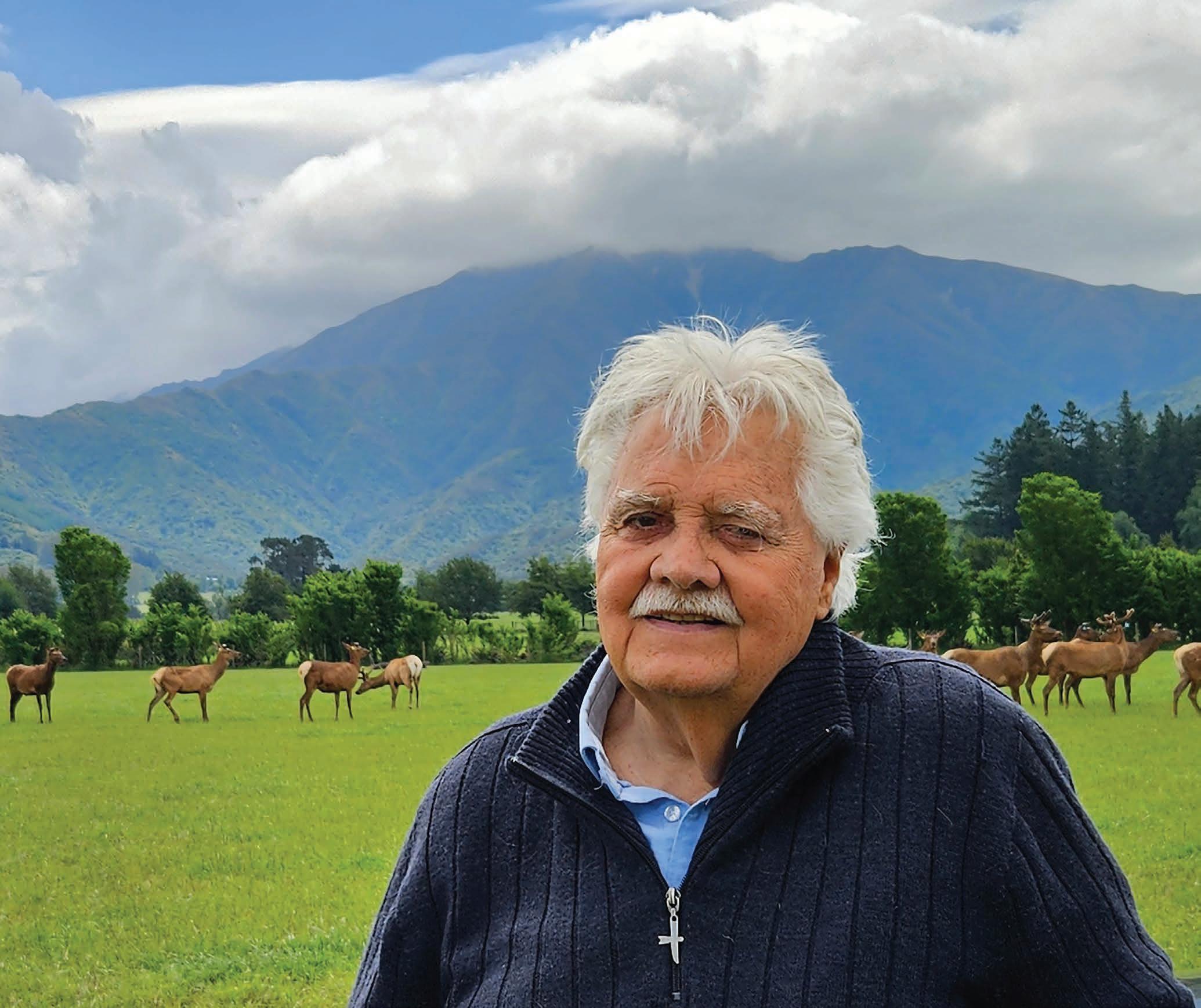


Photo: Annette Scott
EDITORIAL
Bryan Gibson | 06 323 1519
Managing Editor bryan.gibson@agrihq.co.nz
Craig Page | 03 470 2469 Deputy Editor craig.page@agrihq.co.nz
Claire Robertson
Sub-Editor claire.robertson@agrihq.co.nz
Neal Wallace | 03 474 9240
Journalist neal.wallace@agrihq.co.nz
Gerald Piddock | 027 486 8346 Journalist gerald.piddock@agrihq.co.nz
Annette Scott | 021 908 400 Journalist annette.scott@agrihq.co.nz
Hugh Stringleman | 027 474 4003 Journalist hugh.stringleman@agrihq.co.nz
Richard Rennie | 027 475 4256 Journalist richard.rennie@agrihq.co.nz
Nigel Stirling | 021 136 5570 Journalist nigel.g.stirling@gmail.com
Isabella Beale | 027 299 0596 Multimedia Journalist isabella.beale@agrihq.co.nz
PRODUCTION
Lana Kieselbach | 027 739 4295 production@agrihq.co.nz
ADVERTISING MATERIAL
Supply to: adcopy@agrihq.co.nz
SUBSCRIPTIONS & DELIVERY 0800 85 25 80 subs@agrihq.co.nz
PRINTER
Printed by NZME Delivered by Reach Media Ltd
Andy Whitson | 027 626 2269
Sales & Marketing Manager andy.whitson@agrihq.co.nz
Janine Aish | 027 300 5990
Auckland/Northland Partnership Manager janine.aish@agrihq.co.nz
Jody Anderson | 027 474 6094
Waikato/Bay of Plenty Partnership Manager jody.anderson@agrihq.co.nz
Palak Arora | 027 474 6095
Lower North Island Partnership Manager palak.arora@agrihq.co.nz
Andy Whitson | 027 626 2269
South Island Partnership Manager andy.whitson@agrihq.co.nz
Julie Hill | 027 705 7181
Marketplace Partnership Manager classifieds@agrihq.co.nz
Andrea Mansfield | 027 602 4925 National Livestock Manager livestock@agrihq.co.nz
Real Estate | 0800 85 25 80 realestate@agrihq.co.nz
Word Only Advertising | 0800 85 25 80 Marketplace wordads@agrihq.co.nz
Dean and Cushla Williamson Phone: 027 323 9407 dean.williamson@agrihq.co.nz cushla.williamson@agrihq.co.nz
Farmers Weekly is Published by AgriHQ PO Box 529, Feilding 4740, New Zealand Phone: 0800 85 25 80 Website: www.farmersweekly.co.nz
ISSN 2463-6002 (Print) ISSN 2463-6010 (Online)
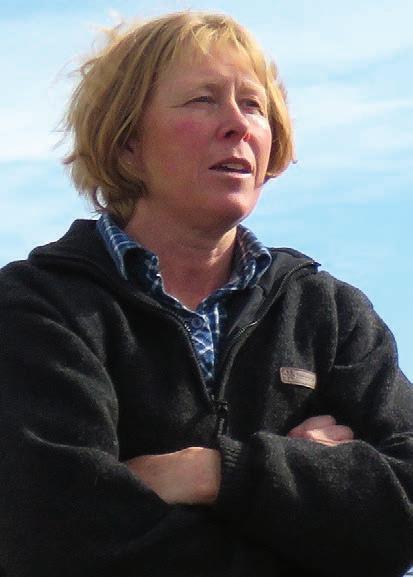
Kerry Harmer is driven by her passion for people, farming and developing young people into an agriculture industry where people are passionate and not afraid to have a say.


The first export shipment of newly developed products made from strong wool could be followed by more, says Wool Source chief executive Tom Hooper. The sale of 8 tonnes of strong wool particles to a Japanese customer was announced last week. Wool Source has spent nearly five years researching the transformation of wool fibre into new products, particles, pigments and powders.
Kiwis are choosing lamb for their Christmas tables this year.
The annual Retail Meat New Zealand Christmas survey of more than 1100 New Zealanders showed 42% of Kiwis prefer lamb for their main Christmas meal, ahead of pork or ham, coming in at 30%, with beef at 13%. Traditional roast meals remain the clear favourite, with 49% of respondents saying they will stick to tradition, although barbecues were chosen by a third of the respondents as their go-to.
Incumbent director Alison Watters and newcomer Michelle Pye have been elected to the board of directors for Fonterra and Canterbury-based candidate Mike Fleming was not successful.
It was a three-way contest for two seats for farmer directors, that of Watters and director Andy Macfarlane, first elected in 2017, who stepped down this time.
After five years connecting New Zealanders with their food and farmers, Open Farms will not run a national open farm day in 2026.
Since launching in 2020, Open Farms has helped 20,000 New Zealanders visit 153 farm events across the country. For 15% of those visitors, it was the first time they had ever set foot on a farm. The pause will allow the Open Farms team to evaluate how to build on the event, said founder Daniel Eb.


Bryan Gibson Managing editor
THIS year has been a good one for our food and fibre sector.
That statement is difficult to write, because when reflecting on 2025 it is hard to look past the challenges and the crises that have marked the calendar.
Last week two Farmers Weekly journalists and two AgriHQ analysts joined me to wrap up the year on the Farmers Weekly Podcast.
I was all set to talk about sell-offs, tariffs, red tape and recessions.
But it became clear I was filtering out the reality – record farmgate returns, fewer regulations and growing export demand.
On the same day of that chat, I attended the New Zealand premiere of the documentary “Not just Fred Dagg, but also John Clarke”, directed by his daughter Lorin.
In it, John talked about the importance of encouragement and giving compliments. He called it the nutrition that keeps a person healthy.
Farmers and growers dedicate their lives to growing the nutritious food that sustains people.
But we can be guilty of serving up views and opinions that are
essentially sugary, empty calories.
They provide us with a quick dopamine hit but are bad for our health in the long run.
So as we look ahead to 2026, here’s something to think about.
The food we produce helps ensure people are healthy and able to live happy and productive lives.
Let’s apply that thinking to what we say and how we say it.
Are you providing the nutrition that people need to be confident, innovative and compassionate?
Or are you providing the sugar rush that leaves them angry and confused?
As always, this last edition of Farmers Weekly for the year features some of the unsung heroes of our industry – those who do the right things for the right reasons, whether anyone is watching or not.
They’re the people building community, facing up to challenges, and nurturing those just starting their lives in food and fibre.
After a big year that featured many things to celebrate, and some things we’d rather forget, it’s great to remember that while challenges come and go it is the people with perseverance, belief and compassion that endure.
Thanks for being a part of the Farmers Weekly community this year. From the whole team, have a safe and joyful Christmas and New Year.

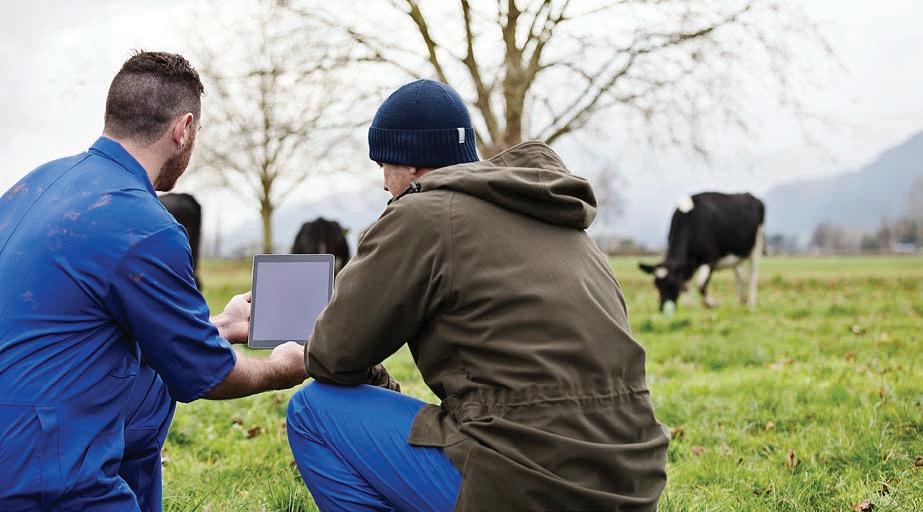
ATHIRD consecutive six-figure loss for nutrient software company Overseer has its auditors ringing alarm bells over its ability to continue as a going concern.
In Overseer’s latest annual report, auditors BDO highlight directors’ concern over the company’s revenue model, which assumes subscription revenue will cover costs. Failing to do so has cast “significant doubt” on its ability to continue operating.
Overseer has reported a $648,000 loss for the year ended June, coming after a $701,000 loss the year before, and a $221,000 loss in 2023.
Overseer CEO Jill Gower confirmed to Farmers Weekly that the loss is significantly greater than the $400,000 loss initially budgeted for.
But she remains confident the company can recoup those losses and reset by exploring new revenue opportunities.
This comes as the company’s gross revenue, largely from farmer subscriptions, dropped from $2.72 million in 2024 to $2.46m in 2025.
Gower oversaw a redevelopment programme in 2023 to incorporate recommendations made after a stinging review in 2021 identified Overseer’s failings in nitrogen loss monitoring.
The software’s subscription was hiked to $680 a year but employee benefits expenditure jumped from $980,000 in 2023 to $1.4m in 2024.
In the 2025 accounts, employee expenses remain at $1.37m, while development expenditure has dropped by $300,000 to $1m.
Gower said engagement with farmer customers and stakeholders has confirmed Overseer’s niche position.
“The current model with all revenue was based on getting regular use. But there are other tools out there now.”
New revenue streams other than more
farmer subscriptions could include charging research institutions and regulatory agencies like councils for the service.
“At the moment we have a subscription model with most of the cost worn by farmer subscribers. That means some entities enjoy benefits without having to put their hands in their pockets.”
She said Overseer is working through a list of potential revenue earning contacts and PWC is consulting on revenue generation opportunities.
AgResearch, Ballance and Ravensdown are the owners of Overseer, but Farmers Weekly queries on the company’s losses were referred to Overseer’s CEO.
Minister for Agriculture Todd McClay told Farmers Weekly that, as with many organisations the Crown has a stake in, Overseer is compelled to live within its means while seeking additional revenue sources.
“MPI is confident they are heading in the right direction.”
Gower confirmed that, six months into the 2026 financial year, Overseer is on target to break even, having made significant staff cuts late in the 2025 year.
Allowable nutrient losses in regional
council catchments are largely based on Overseer calculations, raising the issue about whether Overseer’s failure would impact multiple land use regulations nationally.
Overseer’s role is presently a matter before the Environment Court involving Horizons Regional Council’s proposed Plan Change 2 to its One Plan.
Horizons group manager for science and regulation Dr Lizzie Daly said Horizons has not sought any assurances on Overseer’s future to date.
“The use of alternatives to Overseer has also been considered as part of Plan Change 2 and more generally, including nationally by the Ministry for the Environment.
“Horizons is waiting on the decision of the Environment Court on Plan Change 2, so cannot comment any further at this time.”
A rural professional familiar with Overseer’s use told Farmers Weekly regional councils are likely to be one of the few revenue options left to tap.
“After that, who else is there? Milk processors maybe, but you can’t double charge if farmers are already paying.” They also confirmed Overseer was “too important to fold”, given the millions spent developing it.
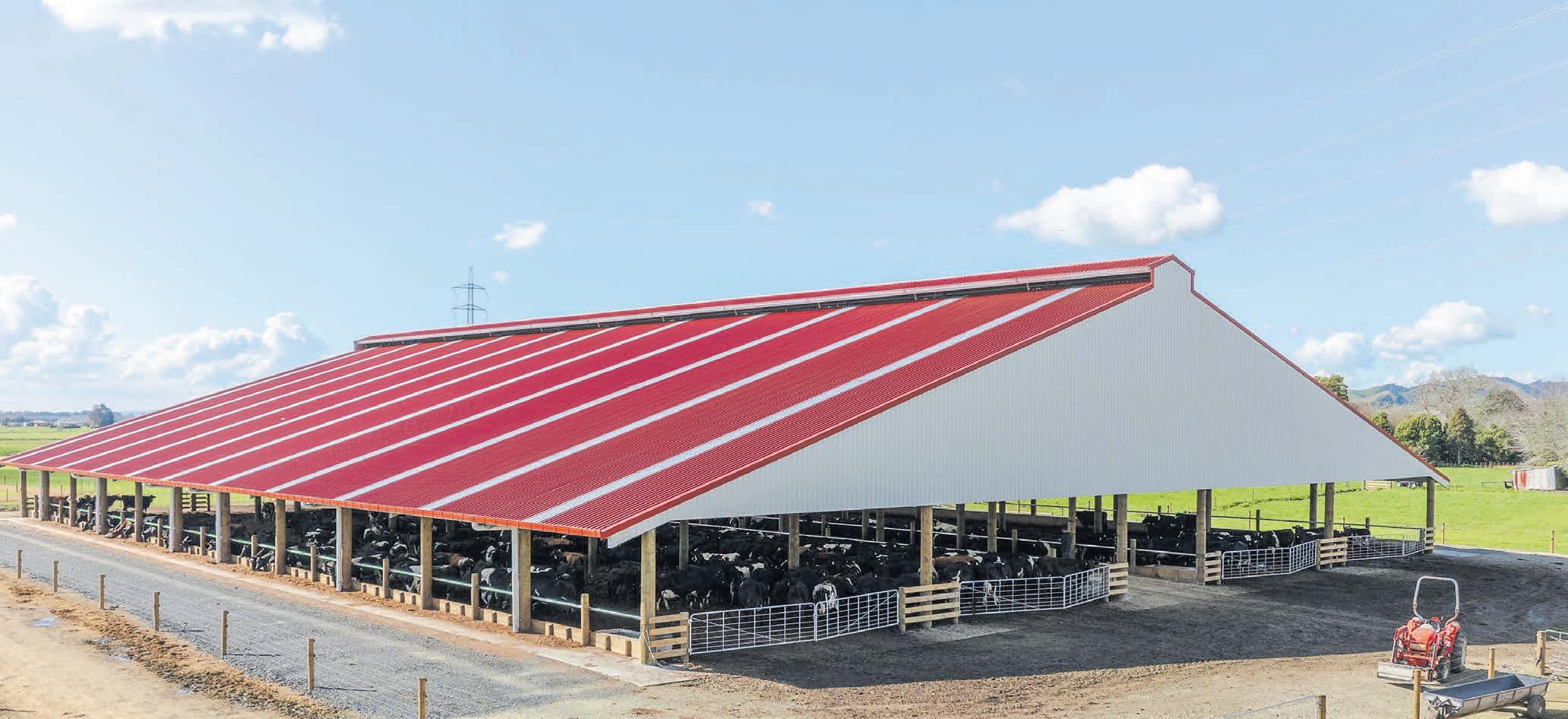



Gerald Piddock NEWS Dairy
IT HAS been a “milestone year” for Fonterra thanks to a strong financial performance, milk price and dividend paid to its shareholders, chairman Peter McBride said at the co-operative’s annual meeting in Christchurch.
“Back-to-back years of a com-
What this means is a more capital-efficient co-op with the ability to invest further in upstream value add opportunities in our speciality ingredients and foodservice businesses.
Peter McBride Fonterra
bined strong milk price and a respectable dividend is something that often eluded us in the past,” he said.
He also thanked shareholders for taking the time to consider the economic rationale behind its divestment decision, which was passed at a special meeting in October.
“Robust challenge and constructive feedback have always been part of what makes this co-op special.
“We get better outcomes as a result.”
McBride called the divestment of Mainland Group the last significant asset sale for Fonterra, signalling the end of structural changes to focus and re-shape the business toward its comparative advantages.
“What this means is a more capital-efficient co-op with the ability to invest further in upstream value add opportunities
in our speciality ingredients and foodservice businesses.”
Looking ahead to 2026, he said there will be a continued focus on getting the basics right.
“In particular we will be working hard on tighter cost management, reducing our cost of quality and improving our manufacturing efficiency.”
There will also be a renewed focus on sustainable growth and new opportunities in its ingredients and foodservice businesses, he said.
McBride said there will be further investments in Fonterra’s value chain.
“Those investments will be within regional New Zealand, where our contribution to local communities will remain significant.”
Fonterra CEO Miles Hurrell said post-investment, they are targeting earnings being back to 2025 levels by 2028, offsetting the Mainland Group divestment.
“We are also targeting a return on capital at the upper end of our 10-12% target, which is above the level the co-op delivers today.
“Essentially, post-divestment we will be a more focused business, with a lower cost base, delivering a better return to farmer shareholders.”
Hurrell said the recent reduction of the milk price forecast from a $10/kg MS midpoint to $9.50/kg MS remained in the middle of the $8-$11/kg MS forecast range
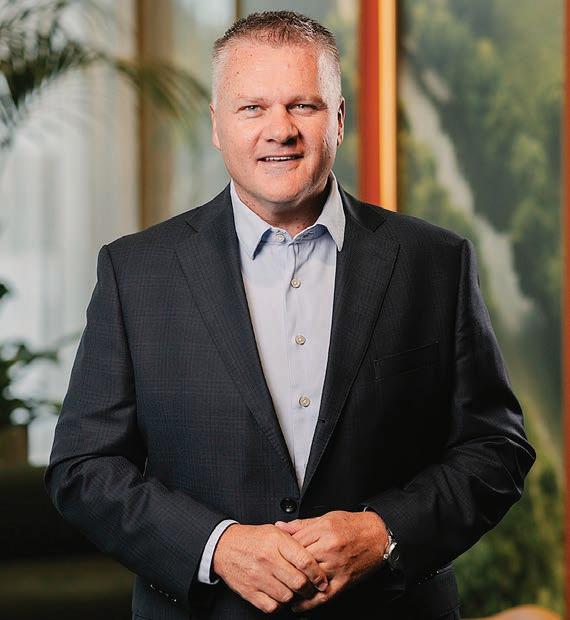
VALUE: Postdivestment, Fonterra will be a more focused business, with a lower cost base, delivering a better return to farmer shareholders, chief executive Miles Hurrell told its annual meeting.
it opened the season with. McBride also paid tribute to retiring director Andy Macfarlane, who has been on the board since 2017, saying he had made a huge contribution to the co-operative’s governance and direction.
“We have valued his support and contribution immensely.”
He also acknowledged the recent director election results with Michelle Pye and Alison Watters being voted onto the Fonterra board.

DAVID Clark has had some of his confidence restored after the government’s proposal to rewrite of the Resource Management Act.
Clark and several other Canterbury farmers are renewing resource consents with Environment Canterbury but say it has imposed new conditions and inflated costs.
Clark and Federated Farmers cite these struggles as an example of how the RMA has become dysfunctional.
The government last week announced it will replace the RMA with a Planning Bill that enables
development and regulates land use, and a Natural Environment Bill that manages resource impacts and protects the environment.
Associated Environment Minister Andrew Hoggard says the new rules will take a simpler, risk-based approach that respected property rights.
He claims the number of consents required will be halved and freshwater farm plans will be the primary tool for managing environmental impacts on farms.
Clark says Environment Canterbury’s overly bureaucratic and litigious interpretation of the RMA was why it needs replacing.
“Spending hundreds of thousands of dollars just to continue farming when you
meet all the environmental rules set by regional councils and have an A-grade environmental compliance audit, is outrageous.”
The proposed changes were welcomed by primary sector leaders as potentially cutting red tape and acknowledging the importance of food production.
They questioned how it will fit with wider local government reform and the need to have intentions matched by legislation.
RMA Reform Minister Chris Bishop said there are currently more than 100 policy statements and plans across 78 local authorities.
Under the proposed changes there will be no Regional Policy Statements and only 17 regional combined plans which will take
two years to develop, not the current seven.
Current consents will be rolled over by two years.
Spending hundreds of thousands of dollars just to continue farming when you meet all the environmental rules is outrageous.
David Clark Farmer
DairyNZ chair Tracy Brown says the new system needs to be enduring to provide certainty so dairy farmers can invest.
“Reducing complexity, fewer consents, greater consistency,
better use of farm plans, and greater controls on when and how land use can be restricted, are things we strongly support,” she says.
Horticulture NZ chief executive Kate Scott says growers want changes that value food production, permit commercial vegetable growing, enable water storage, workable environmental limits and freshwater standards.
Canterbury Regional Council Chair Deon Swiggs says regional councils were best placed to advise government on how to make these proposals work.
He was disappointed the reforms moved away from Treaty of Waitangi engagement and that local voices will be replaced by more centralised decision-making.














Annette Scott PEOPLE Deer
GRAHAM Carr travelled the world looking for somewhere to invest and it was New Zealand that lured him in.
Almost four decades later his influence on the country’s deer industry is immense, his involvement at every level demonstrating his commitment, enjoyment and outreach to the wider NZ deer industry.
“I went all over the world looking for investment, that’s what brought me here to NZ 37 years ago,” the legendary deer industry entrepreneur said.
“It was meat, I saw an opportunity and the potential in lean red meat, that’s the reason I came here and the reason I am still here now, and my original belief in venison is hitting the straps.”
In 1987, with little knowledge of agriculture, let alone deer farming, Carr left the family production joinery business, where he had worked for 22 years, in Yorkshire, England, to pursue his vision.
“I wanted to do something different off my own bat. I looked at stone fruit growing in Santiago
and fish in the Bahamas. Then I read this piece about deer farming in NZ.”
He was inspired by the early pioneers of NZ farmed deer, families such as Acland, Wallis and Elworthy, who became early mentors “and long-time friends, though we have lost a few now”.
“They were a fantastic group of grassroots farmers with huge passion and energy.”
Carr purchased his first deer before even buying land.
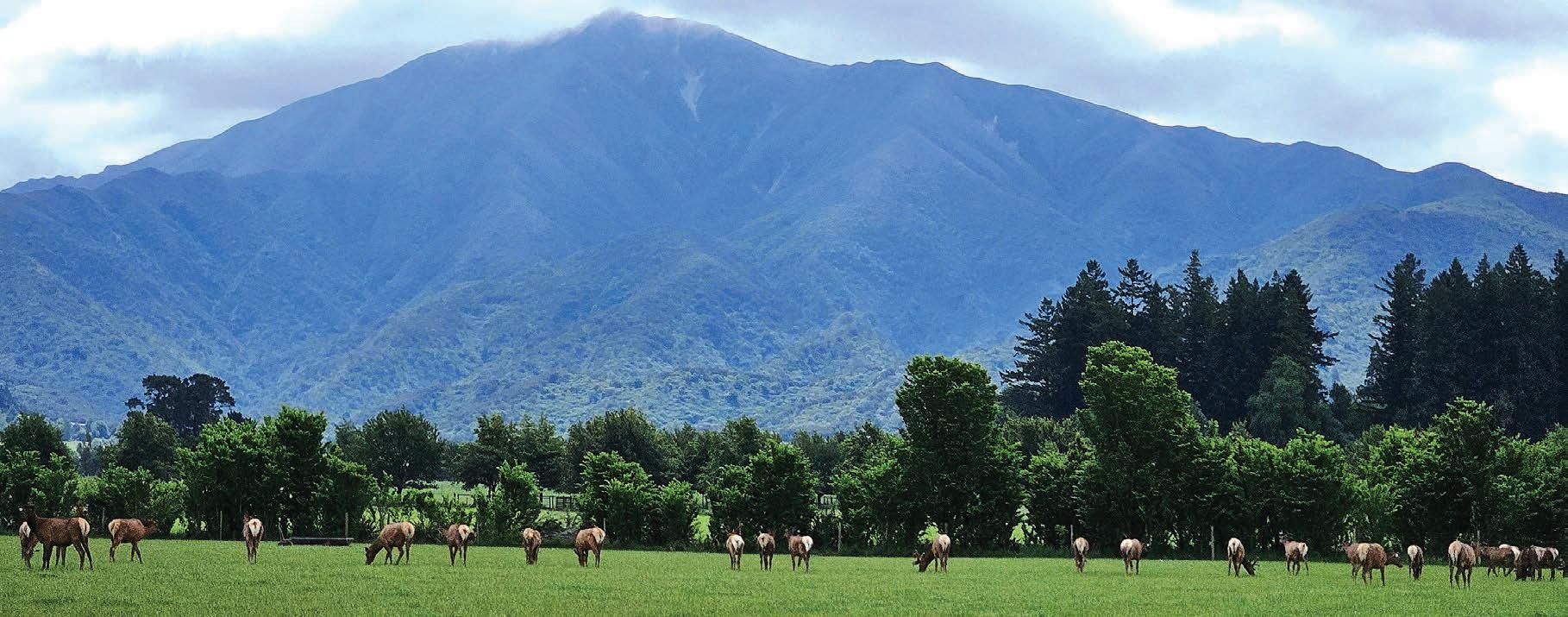
It wasn’t too long, though, before he found the property that would bring his vision to reality, Peel Forest Estate at the foot of Mt Peel, in south Canterbury.
A former sheep and beef property, it was soon deer-fenced.
Thousands of trees were planted, waterways and wetlands restored, more deer purchased, and deer yards and sheds built with caring for both the animals and the environment front of mind.
“I thought I had knocked it into shape but you’re never finished,”
Carr said.
“I’m still planting trees, more avenues, more shelter in the paddocks for the deer, all English you know – oaks, ash, beech, walnut. I am a tree planter and I am very English.
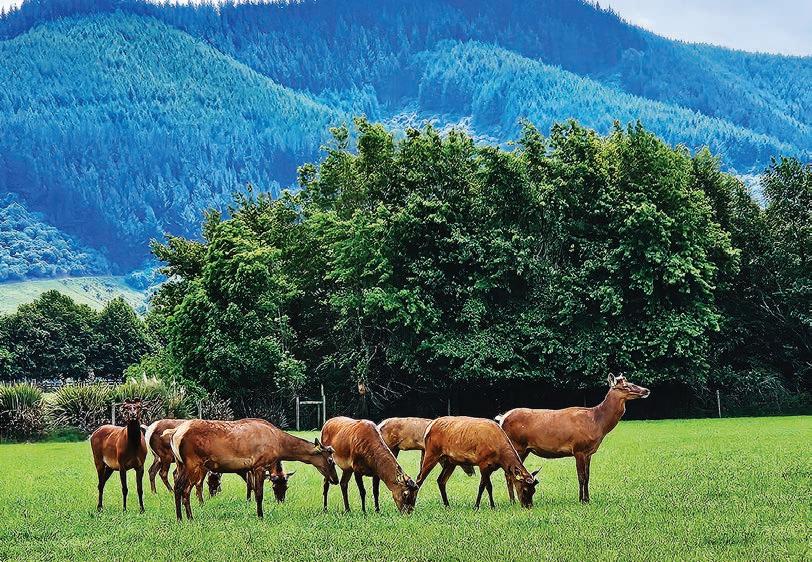
“I have 13,000 deer here now. To be better is always something I have strived for.”
He said Peel Forest Estate thrives in its quest for excellence, where the word “ordinary” is never heard and where good enough just isn’t.
“Excellence is our journey, it’s something you have to work for every day, it doesn’t just happen, it needs focus and most importantly it has to be earned.”
Carr built a high-performing, science-driven operation with a focus on quality and commitment, surrounded by like-minded passionate people, transforming the farm to become one of the most purpose-fit operations in NZ.
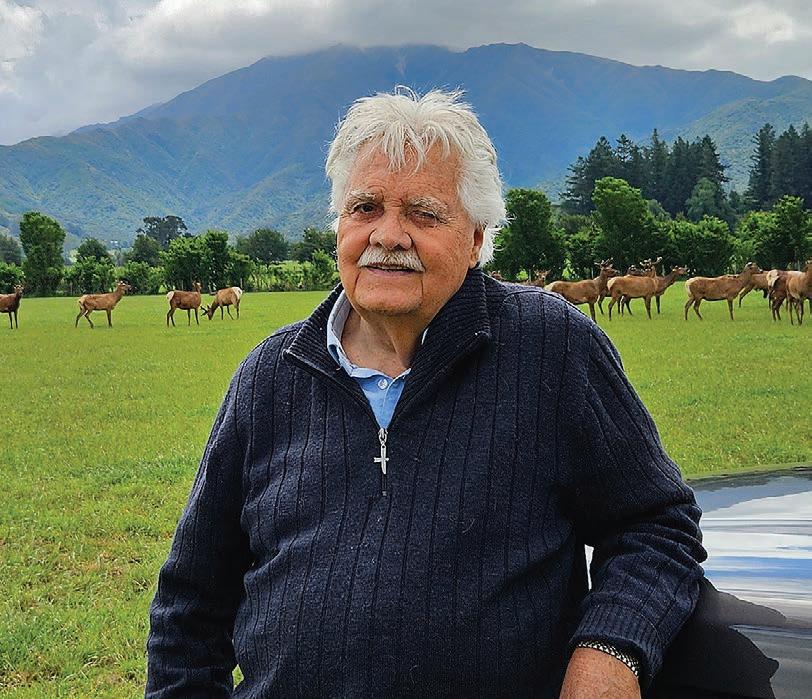
Now in his early eighties, Carr and Peel Forest Estate have become internationally recognised as the world’s largest and premium red deer stud.
He wasn’t a born-and-bred farmer but he had the ability to bring people together, challenge convention and pursue excellence with humility and humour all the way not just for himself, but all those in the industry.
He saw venison had potential as an option to combat obesity in the West. He worked to develop the stud and establish the best possible bloodlines.
This earned him the prestigious Deer Industry NZ 2025 Award for his contribution to the deer industry.
“I am proud of what I have achieved here, the environment, the deer, and everything that goes with it.
“It’s what I wanted to do when I came to NZ, I got addicted.
“It’s humbling to have achieved this award because I have just followed my passion and happily shared what I can to build a better industry for all of NZ.
“It’s brought a lot of satisfaction from everything I have done for the industry.”
Carr’s legacy includes international trips in the early years of the industry, working
alongside other trailblazers to import superior eastern and German red deer genetics with renowned stags such as Zagreb, Sir Yugo and Sir Branko becoming a part of NZ’s breeding foundation thanks to efforts he helped lead.
Excellence is our journey. It’s something you have to work for every day, it doesn’t just happen … it has to be earned.
It took 16 trips to Croatia to capture deer from the famed former hunting ground of Yugoslav leader Marshal Tito.
“I wasn’t giving up; eventually they understood that.”
All the time Carr was importing genetics he was using reproduction technology to spread them throughout the NZ industry.
He also became famous for his fast driving on the autobahns during European scouting missions – and the speed and precision with which he’s helped steer the industry earned him the nickname Fast Carrs and Good Deer.
As an early adopter of highquality genetics, Carr invested in cutting-edge technologies, including embryo transplant
programmes and groundbreaking research on Johne’s disease.
“That was a big milestone for me getting involved to resolve Johne’s disease. It was a major problem for us; it put us out of stud business for three years.
“Johne’s management now has the industry in a very strong position without the disappointment of having it in your herds.
“And of course I couldn’t have done all this without the support of Robyn who looks after the many guests who come here linking the NZ deer industry worldwide.”
An industry leader described Carr’s influence on the NZ deer industry as “invaluable, it’s no exaggeration to say that the industry would not be as advanced as it is today without his dedication and innovation”.
Selling genetics all over the world and recognised as the biggest producer of velvet, selling 20 tonnes a year, Carr has accepted the volatility of the market over the years and always maintained a positive outlook.
“The industry is in a very strong position with venison hitting its straps, coming into its own in health and wellbeing, and while there has been a hiccup with velvet, I think it will correct itself when as an industry we produce less. Once back in balance I believe velvet will be very strong.”
VISION: As an early adopter of high-quality genetics, Graham Carr invested in cutting-edge technologies, including embryo transplant programmes and groundbreaking research on
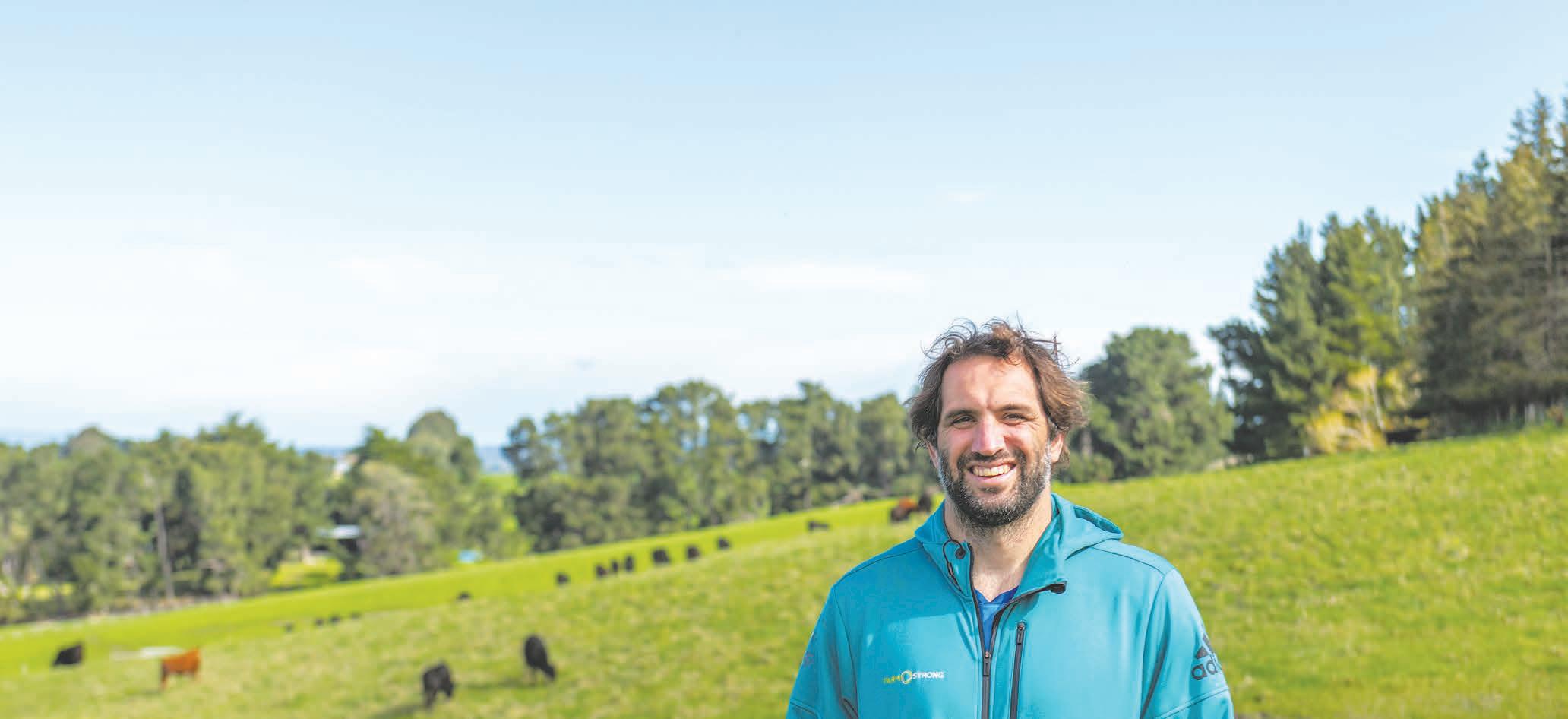
Thanks to everyone who’s got behind Farmstrong this year.

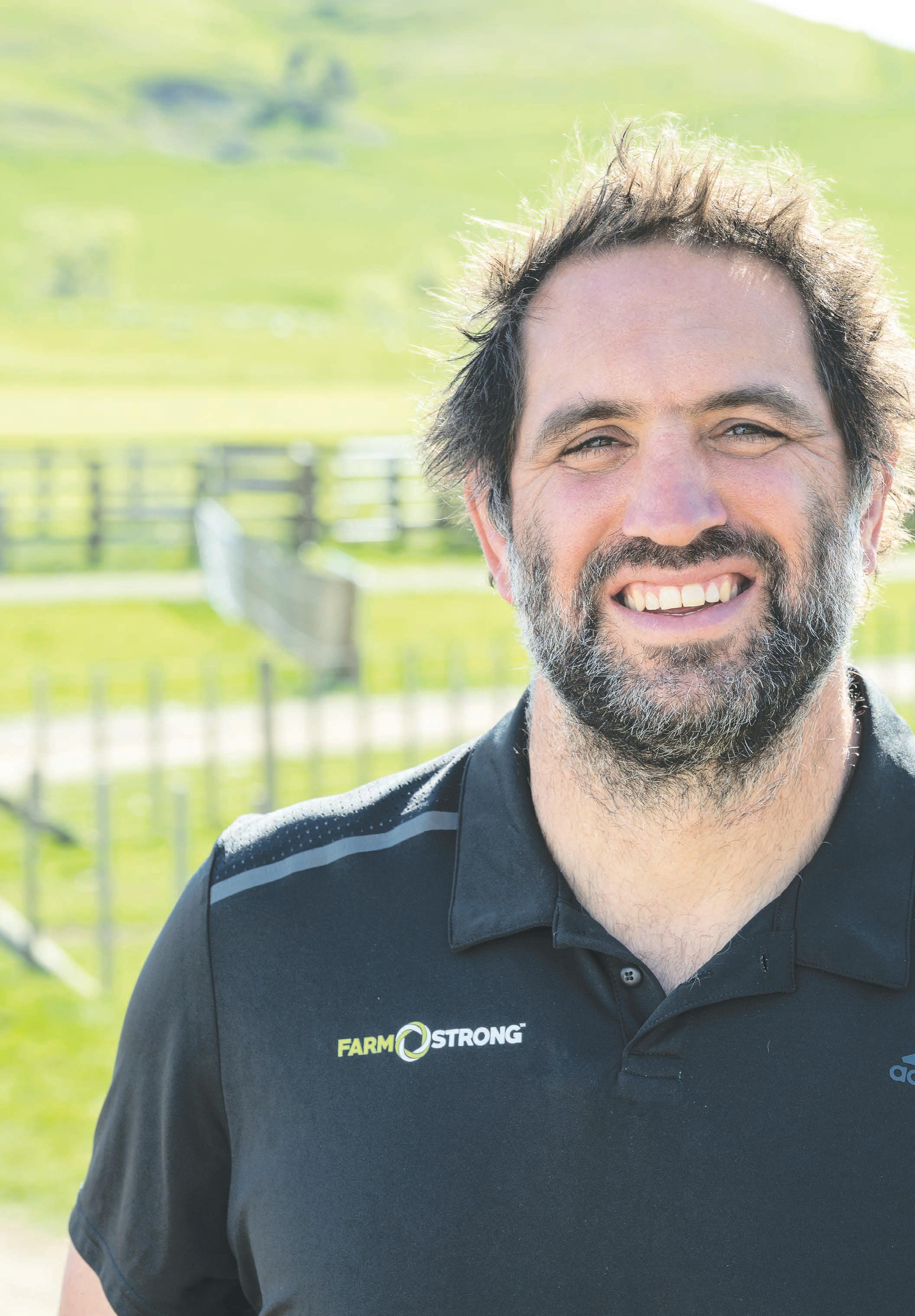
Together we’re making a real difference.
Grab some time this summer to recharge with family and friends.
Sam Whitelock Farmstrong
Ambassador
These dairy farmers are part of the reason that in Northland, kiwi numbers are actually growing.

Hugh Stringleman NEWS Conservation
ORTHLAND Brown
NKiwi outnumber humans by 12 to one on Lodore Farms at Ōkaihau, Bay of Islands – a very rewarding statistic for the longterm conservation work of dairy farmers Jane and Roger Hutchings.
The kiwi population is estimated to be 50 pairs, male and female, living alongside eight Hutchings family members and their employees.
Lodore has about 130 hectares of native bush and wetlands along with 282ha effective dairy platform carrying 680 Ayrshire cows averaging 400kg milksolids a head annual production.
The Hutchings were Northland’s supreme champions in the 2014 Ballance Farm Environment Awards, when kiwi conservation spoke loudly to the judges.
A foundation member of the Puketōtara Landcare Group, Jane has now served six years as a trustee of Kiwi Coast Trust and the past two years as its chair.
When she came north from Nelson in 1985 to marry Roger after meeting him at Lincoln University, the Hutchings family had kiwi in the bush, but no population parameters or targeted pest control.
What followed was the formation of a community pest control area with input from the Northland Regional Council in the Puketōtara River catchment and the professional placement of traps and bait stations.
For more than a decade Jane and Roger have listened to kiwi calling at the same separate sites on the main farm, monitoring over four nights in May to June for two hours, following Department of Conservation protocol.
As kiwi live up to 50 years when in good condition, calling in the pre-breeding season reliably counts towards informed estimates of the numbers of resident birds and their approximate locations.
Pests of eggs and juvenile birds, like stoats, rats and feral cats, have been drastically reduced and no dogs are allowed on Lodore.
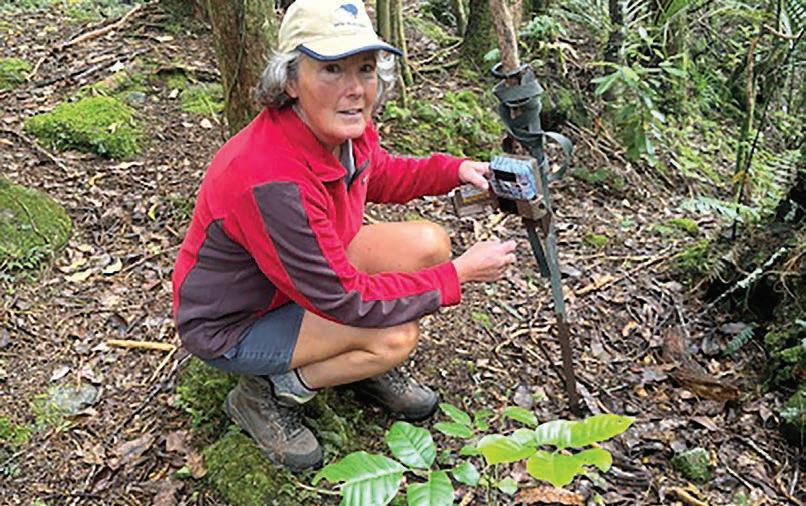
The property has numerous stoat and possum traps, live-capture cages for cats, bait bags and three kiwi houses, more recently enhanced by monitoring with five trail cameras.
For more than a decade Jane and Roger have listened to kiwi calling at the same separate sites on the main farm, monitoring over four nights in May to June.
Although camera batteries will last for months, Jane is very keen to see what has been recorded and swaps the digital cards regularly.
Cats will show up on-camera but prove very elusive and hard to capture in cages.
Jane spends over 20 hours a week on kiwi care and trap resetting on the farm, also helping in a staunch group that runs the Mid-North Rehabilitation Centre, Te Korowai Atawhai o Puketōtara.
Summer is the main season for hands-on kiwi work, when drought can cut the carrying capacity of offshore islands in particular, and emaciated birds need wild-base food with many ingredients that must be mixed in batches and frozen.
Birds in a bad way have been flown free to Palmerston North from Kerikeri by Air New Zealand, to Massey University’s Wildbase Hospital, and returned to their territories when fully recovered. Kiwi can carry debilitating internal and external parasites, eat poisonous karaka berries and get severely dehydrated. That can also be injured by dogs, cats or vehicles on local roads.
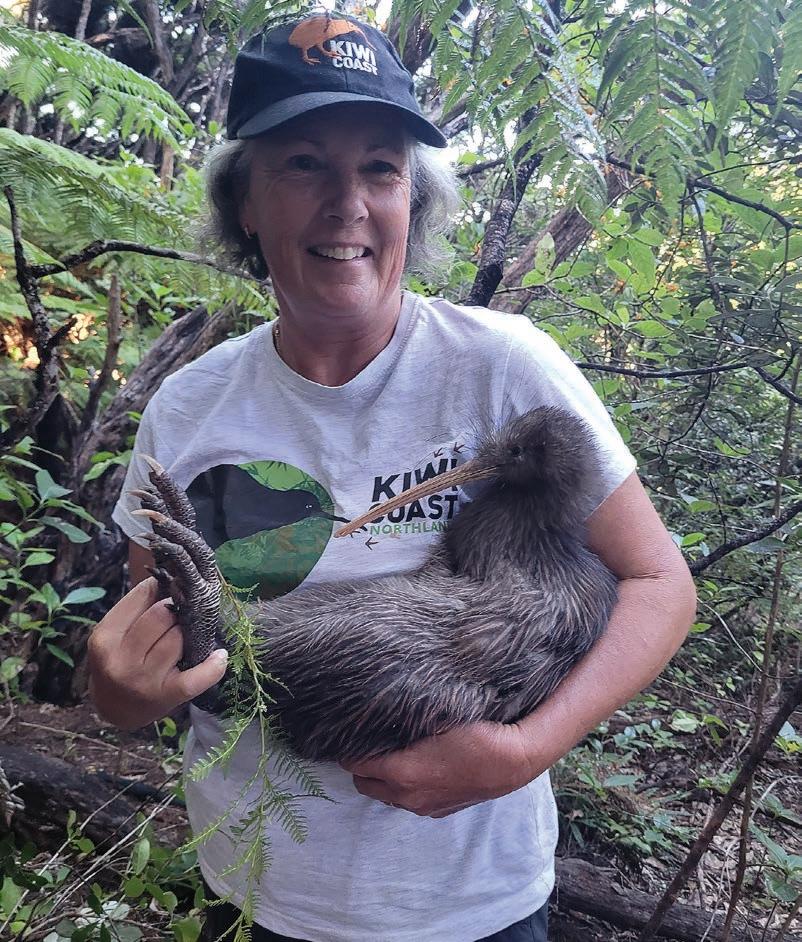
They may come to the rehab centre weighing under a kilogram and leave with healthy weights up to 3kg for the bigger females.
The centre has nine pens, each with a nesting box and native ferns and grasses, and a clinic with three brood boxes for quarantine and intensive care.
Nearly 300 Kiwi Coast affiliates cover 285,000ha of Northland from south of Whangārei to Doubtless Bay in the north, mainly on the east coast and central highlands of the province. They are landcare groups, iwi, sponsors, schools, community organisations and private individuals.
The total trap-catch of pests reported to Kiwi Coast over 12 years nears 1 million, an extraordinary achievement by mainly volunteers.
That has led to Northland having about one-quarter of the national population of kiwi. It is the only

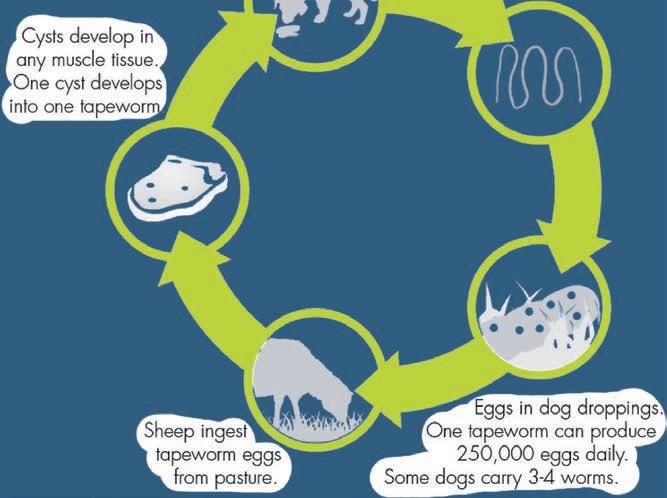

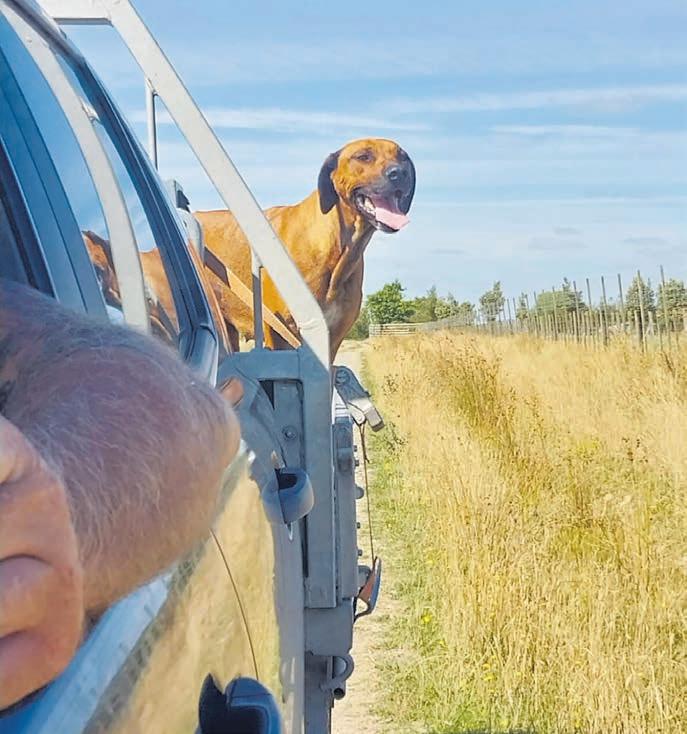
sheep or goats with
monthly, or at least 48 hours before heading near grazing areas, to prevent sheep measles.

region of the country where kiwi numbers are growing.
For example, when Whangārei Heads kiwi conservation group began there were 80 birds and there are now over 1000.
“With funding drying up or being cut in the conservation space, Kiwi Coast is vital to show how things can succeed, by community and hapū driven positive projects,” Jane Hutchings wrote in the Kiwi Coast 2025 annual report.
Consultation is underway to relocate birds from Purerua peninsula, north of the Bay of Islands, home to about 25% of all Northland kiwi, and from pestfree offshore islands where bird population densities are now too high for optimum health.
Kiwi Coast receives generous grants from Northland Regional Council and Foundation North, which help support the efforts of all voluntary groups.
A pair of Wairarapa friends have grown a neighbourly gesture into a thriving carepackage operation.

Rebecca Greaves PEOPLE Community
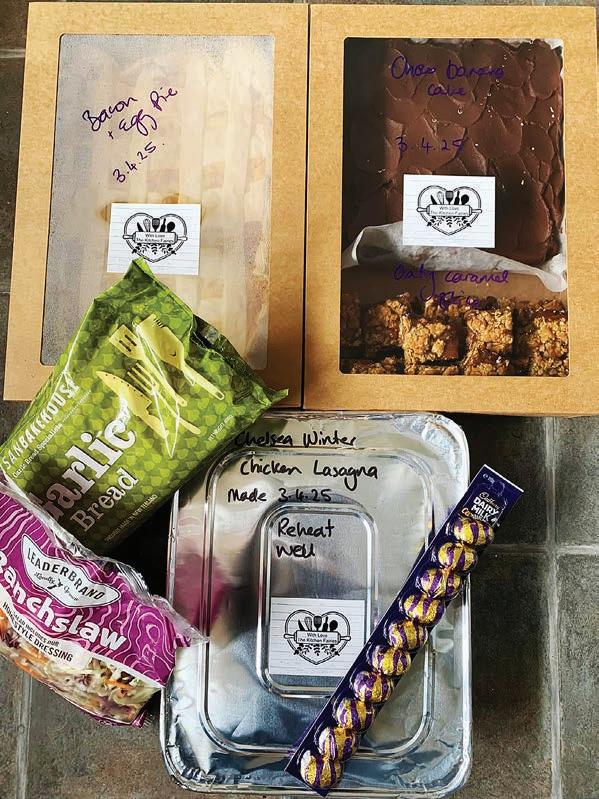
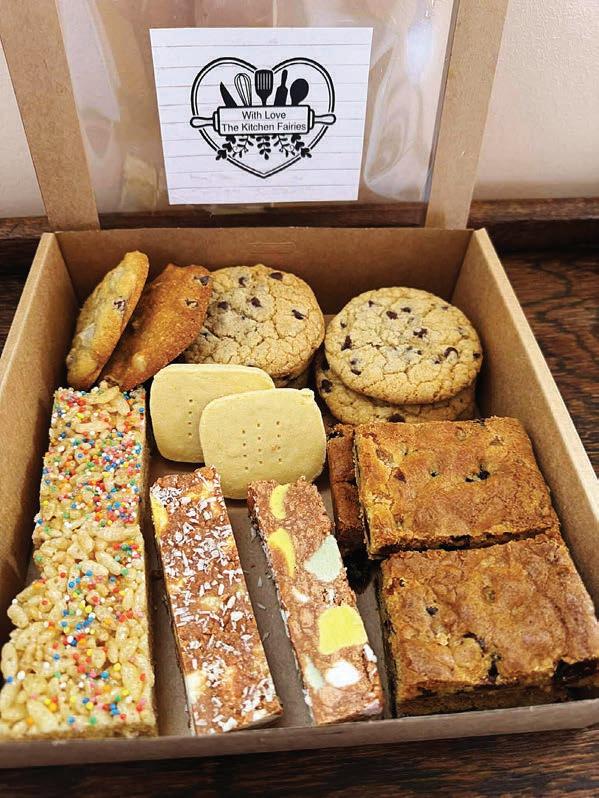
THERE are fairies in the kitchen in rural Wairarapa, spreading kindness and love in the form of homemade meals and baking.
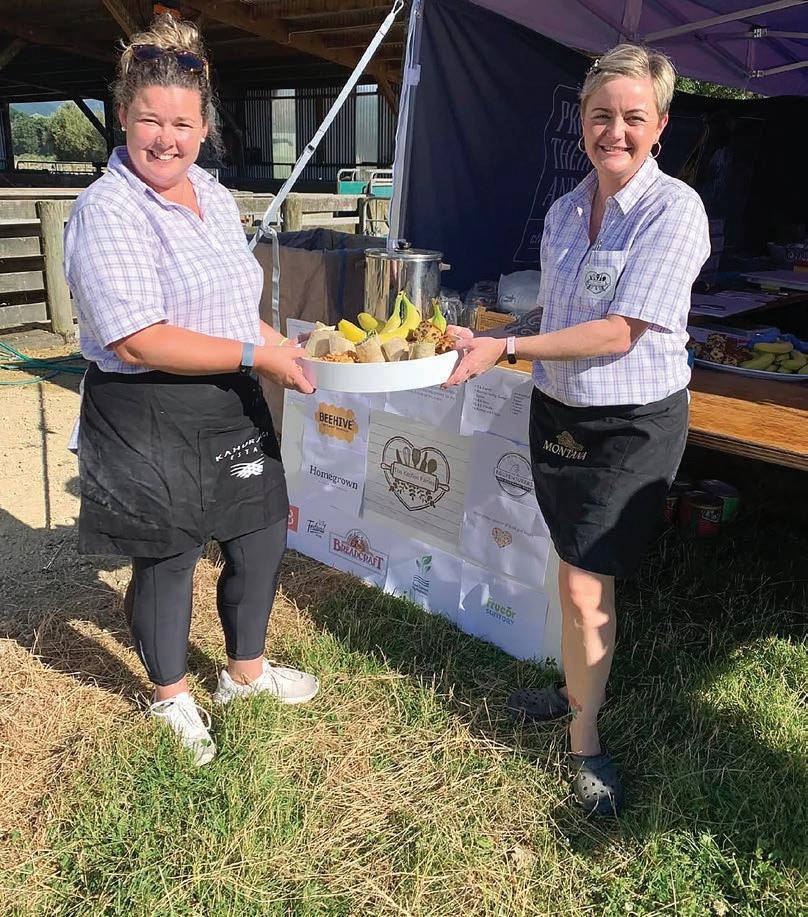
When cyclones Hale and Gabrielle devastated the rural community they lived in, friends Becs O’Neale and Amy Jones swung into action.
Since the cyclones, the women have delivered hundreds of care packages around Homewood, Tinui and Castlepoint, devoting countless voluntary hours to supporting the people around them in the form of nutritious food, made with love.
They have become known as The Kitchen Fairies.
“After the cyclones the roads were flooded, people were driving out in tractors, they had no power. We thought we needed to do something for those people who were affected,” O’Neale said.
Her own property suffered serious damage in Cyclone Hale and one day she came home to a box of Tim Tams and a card on her doorstep, left by the Rural Support Trust (RST).
“It was so nice to think someone out there cared. When I had my son, we were in Ronald McDonald House for a long time and they have Good Bitches Baking there. There was always fresh baking, it was like getting a hug.”
While at playgroup one day they hit on the idea of putting meals and baking care packages together. Soon, people got word of what they were up to, and donations of groceries and meals started. It
snowballed from there.
A community meeting was held at the Tinui Hall one week after the cyclone.
“People were being helicoptered in for that meeting, we couldn’t actually get to people’s houses because of the roads. We had a table, and after the meeting we gave everyone some home baking or simple meals they could heat on the BBQ or gas cooker,” Jones said.
“People were so humbled, it was incredible. They were offering to pay and we said, ‘No, this is us paying it forward, we love you and we get what you’re going through,’” O’Neale said.
“Sometimes you are just in the trenches, trying to survive, but to know that someone cares, it means a lot.”
It’s like giving a warm hug. Our meals are not fancy, but it’s beautiful, nutritious food.
Becs O’Neale The Kitchen Fairies
Jones said their actions also opened the door for people to be more aware of their neighbours, and to check in, regardless of whether there has been an adverse event.
They noticed that the lengthy clean-up and repairs that followed took a toll on people’s mental health, and decided to continue The Kitchen Fairies.
“At the end of the day, you need healthy, nutritious food to fuel you to go again the next day. It’s about mental health, wellbeing and encouraging connection.”
Both women have young families and O’Neale works full-time as a remote travel agent, so Jones has mostly taken the reins when it comes to day-to-day co-ordination of what has become a large operation. As well as being chief
fairy, she drives the school bus.
To put some structure around their processes they have established a committee and are in the process of securing what will become a semi-commercial kitchen in the old Tinui café, which they hope will be up and running early next year.
They were fortunate to receive several grants early on, but those have largely been used up. The friends are committed to continuing, but they have reached a pivotal point, where fundraising has become necessary and outside help is needed. They have submitted an application to become a registered charity.
“Now the community sees the value, they have gotten behind us with fundraising. We are not caterers, but we have done some events for RST and Beef + Lamb New Zealand, and things like Shear4U.”
They encourage people not to be shy, and say the rewards of getting involved are immense.
“People can help in different ways. Maybe they don’t have time to bake but could make a financial donation. Or we invite people to give a few hours of time and come cook with us. If you’re making baking for the kids’ lunchboxes, could you make a double batch and donate half?”
With support from RST, they have been able to cut down on deliveries and fuel costs, and people often nominate worthy recipients, collecting and delivering packages themselves. Packages are delivered for all sorts of reasons – a new baby or a sick family member, or just someone having a tough time who could use a pick-me-up.
Privacy is important, and all nominations are treated confidentially. Often, they don’t even know who the packages are going to.
Long term, their dream is to extend The Kitchen Fairies around
the region. Ideally, they would love to have freezers in communities, which they will keep stocked up, and a “head fairy” for the area, who connects packages with those who could benefit from a little kindness.
For O’Neale and Jones, their why is simple – it’s about being a decent human being, connecting with their community and spreading kindness.
“It’s like giving a warm hug.
Our meals are not fancy, but it’s beautiful, nutritious food,” O’Neale said.
“We are thoughtful in what we do. If someone in the house is gluten free, we make the effort to accommodate that.
“If they have little kids we might include some snack food like mini muffins, and a colouring book. Every package is unique, individual and made with love,” Jones said.
A new platform is capturing the memories of a generation rural NZ owes much to.

Isabella Beale PEOPLE Community
LANDLINES is a platform created to preserve the stories of New Zealand’s elders, or OGs (originals), through written and visual media.
Founder Francine Boer says these are typically people in their early 70s and beyond.
“However, it is not set in stone, it’s more about shared generational experience … and no one feels old – you can be 80 years old, but these guys, they feel like they’re still in their 50s,” Boer said.
“They’re still working just as hard and have the same kind of young mind.”
Boer, based in Kingston, near Queenstown, leads the visual side of the platform, managing videography and photography.
Manawatū-based author and
journalist Carly Thomas creates the written content, and Gillian Swinton manages the social media and marketing side from Lauder, central Otago.
Landlines aims to address the fact that today’s generation is at risk of losing lessons and stories of older, pioneering generations who’ve walked the path before.
“We’re losing a generation that has made New Zealand what it is today, the farmers who mustered their cattle for weeks, the Māori elders who carry the stories of the land in their bones, the bushmen who knew the forests by heart,” Landlines says on its website.
When Landlines was launched in late August, Boer said, she had “no expectations” about how people would respond.
“I thought it was going to be very mellow to start with, but we had a very special story to start off with, of Kerry Eggeling from Haast.”
While he was being interviewed, Eggeling was undergoing chemotherapy treatment, so the
Continued page 10



















































































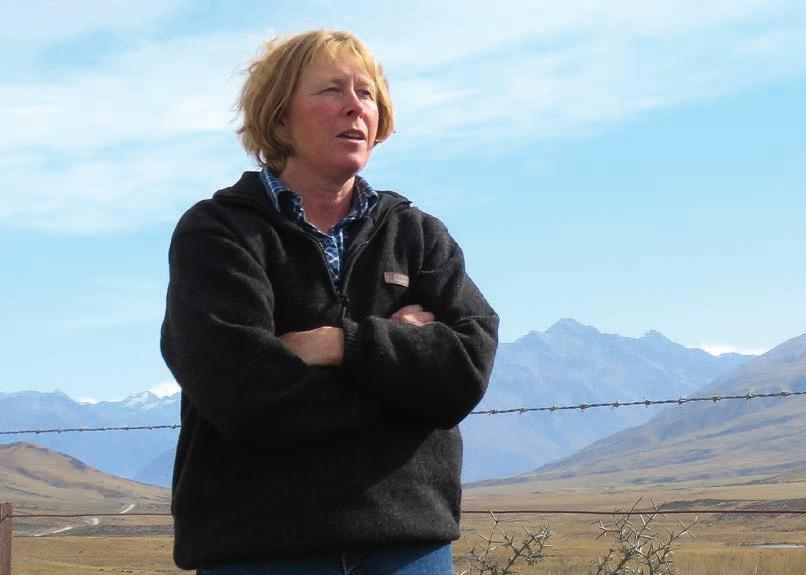
Kerry Harmer heads a catchment group that looks after the 13 Ashburton high country lakes, among her many other leadership roles.
Annette Scott PEOPLE Sheep and beef
FARMING in the “sensitive lakes” area of the Ashburton high country has its added challenges for extensive sheep and beef farmers, as Kerry Harmer of Castle Ridge Station has learned.
She has a finger in many a pie, trying to talk sense around water quality issues that have become an ongoing frustration for farmers and recreationists alike.
Harmer and neighbouring landowners had been “doing stuff for a very long time”. Then, in 2023, a catchment group encompassing the 13 Ashburton high country lakes and 58,000 hectares over four extensive sheep and beef properties was formed. Harmer took on the leadership as chair of the Ashburton Lakes catchment group.
“Long considered an area of significance to the national and local iwi, our catchment is under the spotlight due to concerns of deteriorating lake quality, something we as landowners have been concerned about and are acting upon,” Harmer said.
“While the heat is on farmers, the farmers are only part of the problem.
“It is a multilateral group working on the action plan for the area and everyone has to play a part.
from page 8
Landlines team knew he wasn’t in the best health. By the time the story was published, he had been admitted to hospital in Wānaka. He died in late September.
This really brought home to Boer the importance of capturing these stories.
“With Kerry, it was very sweet; he asked his son to share the story a week before his passing, all over the internet … so I think a lot of people got to see his story before he passed away.”
That first video has since reached 43,000-plus views, with many people being able to hear the story of a man who was renowned on the West Coast.
“We [younger generations] capture everything we see, and our whole life has been documented, whereas the stories of these elders haven’t had that kind of documentation that we have. So everything, their whole lives, are still in their memory bank,” Boer said.
“They’re such hard workers. Our lives, how we work today – I don’t think it’s anything compared to what they had to do to get going in New Zealand. They pretty much made NZ what it is today.”
Funding for Landlines comes
“Farmers are focused on the part we do play; we are working to do better and making sure we are making a difference.
“We could spend millions of dollars on fencing but will it make a difference? That’s what we need to know.
“We have little science at this stage, it’s the model saying so; therefore we need to complete our own research and work to develop practices that will continue to improve our environmental footprint in the basin we all love and care for so much.”
A born and raised townie, Harmer has, however, always loved farming.
“It’s all I wanted to do, go farming. In the mid ’80s I was told agriculture was a sunset industry. It made me more determined, though I thought I would never get a farm so farming wasn’t an option.”
At 17, she left school and started her first job.
“I got my foot in the farming door, working horses half the time and farming half the time; at 17 it was the best dream I could ever wish for.
“With my interest in farming and animals I was always going to go to vet school but then I met [her husband] Paul and I went to Lincoln University instead and became a farm consultant, that was the next best thing because I was helping farmers.
“I always had an interest in people, a social science interest, what makes people tick, and to help people.”
She soon found her multitude of skills and farming knowledge were called on more and more in advisory roles as the pendulum
from a mix of sources, with a focus on long-term sustainability for the team.
“It was really important that with this project, we could earn a decent wage, the three of us.
Sometimes, if passion projects aren’t paid, people put them on the back burner. I want to make sure I can prioritise Landlines at any stage, so I set up a number in my head that I think is fair for everyone, including travel.”
We’re losing a generation that has made New Zealand what it is today, the farmers who mustered their cattle for weeks, the Māori elders who carry the stories of the land in their bones, the bushmen who knew the forests by heart.
Landlines
The team has received funding for two stories through the local council’s Creative Community Scheme. They also collaborate with local businesses to tell community stories.
One story was done alongside
and a member of the Merino NZ ZQ grower reference group.
We don’t live in this environment without thinking about it. We live here all the time and we love and respect it.
swung against agriculture and farming.
In addition to her catchment group role, Harmer is the Federated Farmers Mid Canterbury high country chair, a second run in this job; a trustee of the Mid Canterbury Federated Farmers Charitable Trust; a member of the Land Information NZ (LINZ) high country advisory group; on the committee of the Mid Canterbury Community Catchment Collective;
country lifestyle brand Whistle & Pop. Whistle & Pop founder Bex Hayman’s dad, Graeme Murray, is one of the OGs featured.
“He’s quite a legend, so they sponsored that story.”
They are also supported by Air Chathams, making it possible for the team to cover stories out at the islands.
From nominations to community and personal networks, the Landlines team uses multiple streams to seek out OG stories to tell. Often, the nominations come from face-to-face networking, but anyone can send in nominations to the team.
Boer said the stories are also a way to connect as a community.
“A lot of memories [are shared when] people email or comment in the comment section about their own memories about the same place or the same people share other memories. That’s really cool. And shows their appreciation of what we do, which is quite special.”
Looking to the future, a big dream of the Landlines team is to create a podcast.
“Just a little more of a long-form interview that people can just listen to on the drive in the car, or if they’re working in the shed, they can just listen to the full interview.
consequences is huge in a collaborative working group situation.
“I got a role to help ensure that the farmer voice is heard and at quite a young age I was one of the first women to lead in this way in Mid Canterbury.
“That’s what’s changed in 40 years: young women are stepping up and that’s brilliant; that needs to keep happening, but we also need to keep those young male voices heard.
“Men and women think differently and we need both sides at the table.
“It’s so important if you are hellbent on something you have got to at least have the full story, that’s what drives me.
“I do it because if people don’t know or have the opportunity to understand how to make decisions, how do we move forward?
She is a former Beef + Lamb NZ farmer council and environment reference group representative; a former Lincoln University farms committee member; a school board chair, a pony club coach, a mentor in the Industry Training Organisation (ITO) where she also helped develop the curriculum; a wife, mother, and farmer.
It doesn’t leave much space for “self-time” but Harmer is driven by her passion for people, farming and developing young people.
“What I want is an agriculture industry where people are passionate and believe in what they do and get involved in organisations, keeping the finger on the pulse, not afraid to have a say around the table.
“Farmers have so much knowledge, holistic overarching thinking with unintended
“We don’t live in this environment without thinking about it. We live here all the time and we love and respect it. We are only caretakers, here for a short time looking after it for those who come after us.
“We can’t change what’s happened before us, but we can leave it in the best way we can for the next generation.”
Castle Ridge runs a 15,000 Merino ewe breeding operation together with 800 beef cows and 250 red deer hinds.
The Harmers run a streamlined operation with a dual focus on growing sustainable fibre and food for the world.
“It’s not just a business, it’s a lifestyle. It gives us the best of both worlds.
“We are preserving legacy and land.”
That would be my dream, but I don’t know how I’m going to do that yet.”
Thomas and Boer also plan to work on a pitch for creating a book, “one that people can read or put on their table and get
reminded of the history of New Zealand and their cool people”. Another potential future aspiration for Landlines would be to host writing workshops, in order to get others motivated to write their own family or friends’ stories.

Wh at s h a re d d at a
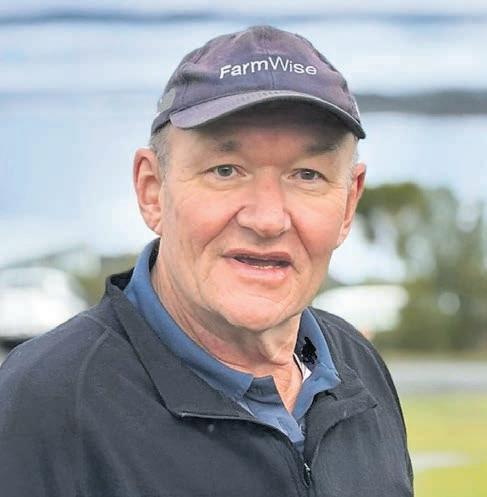
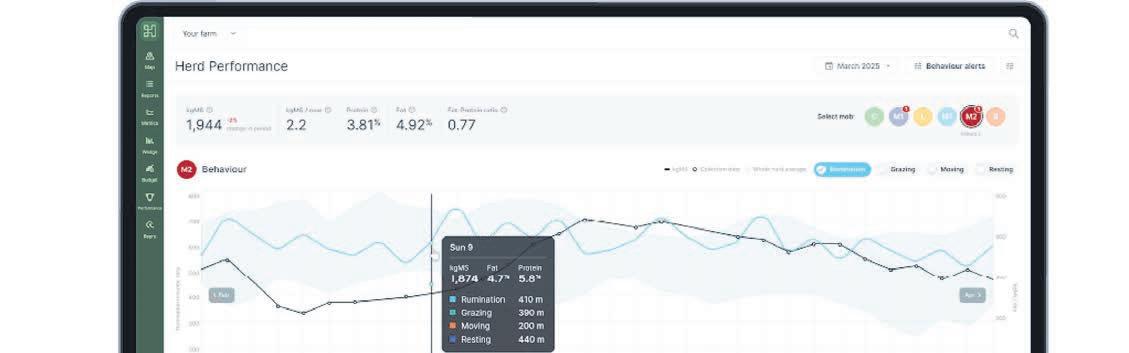
FarmWise consultant Brent Boyce has spent more than three decades helping farmers across the top of the South Island lift performance through practical, peoplefocused decision-making. Brent is known for his collaborative approach and sharp eye for the details that drive farm business outcomes. He now works with a group of Halter farmers, alongside other consultants and vets supporting Halterenabled farms, giving him a unique perspective on how digital tools and on-farm experience come together
What does effective technology adoption look like when a Farm Consultant or Vet is involved?
Technology is evolving ever faster The best implementation of new technology is when an early adopting farmer teams up with a second party (consultant or vet), and they can observe information across more than one business Being able to look at trends or changes in performance (production, profit, pasture, etc) over several enterprises can really speed up information transfer and shorten the time needed to understand the possible gains
With any new tool, everyone’s learning together Having a good network of farmers and colleagues on the same journey makes a big difference That’s when you really start picking things up faster and getting the most out of the technology
You’ve mentioned that Halter data has helped confirm some long-held farming practices What are you seeing, and what do you recommend farmers look into?
Halter has reinforced with actual data a lot of what we already knew – but was often anecdotal at best Case in point is the use of OAD for the first days of lactation Many of my farmers have used this for decades, and now we have real information on it It will be interesting to see the data on how using OAD over mating (for specific non-cycling cows) has affected their mating results for next season
Last week the discussion with m Halter Homies was around the number of short returns coming back, and digging into the data, production and feeding to see w the issues lay Is it farm specific is it climate, is it management, is
it cow condition, or is it a feed or pasture issue? if it was any issues
With the short returns, it was around observing each cows behaviour patterns, and comparing to the previous heat patterns of rumination and movement Was she actually on, or was she just getting caught up in a SAG for a brief period?
You work with Halter farmers and regularly collaborate with other consultants and vets supporting Halter farms. What are some of the insights you’ve uncovered through this shared view of data and farm performance?
I have a group of farmers I call my ‘Halter Homies’ I’ve got a dashboard on my laptop where I can quickly scan across all my Halter enterprises to question ‘why the difference?’ It’s being able to look at trends and changes that occur
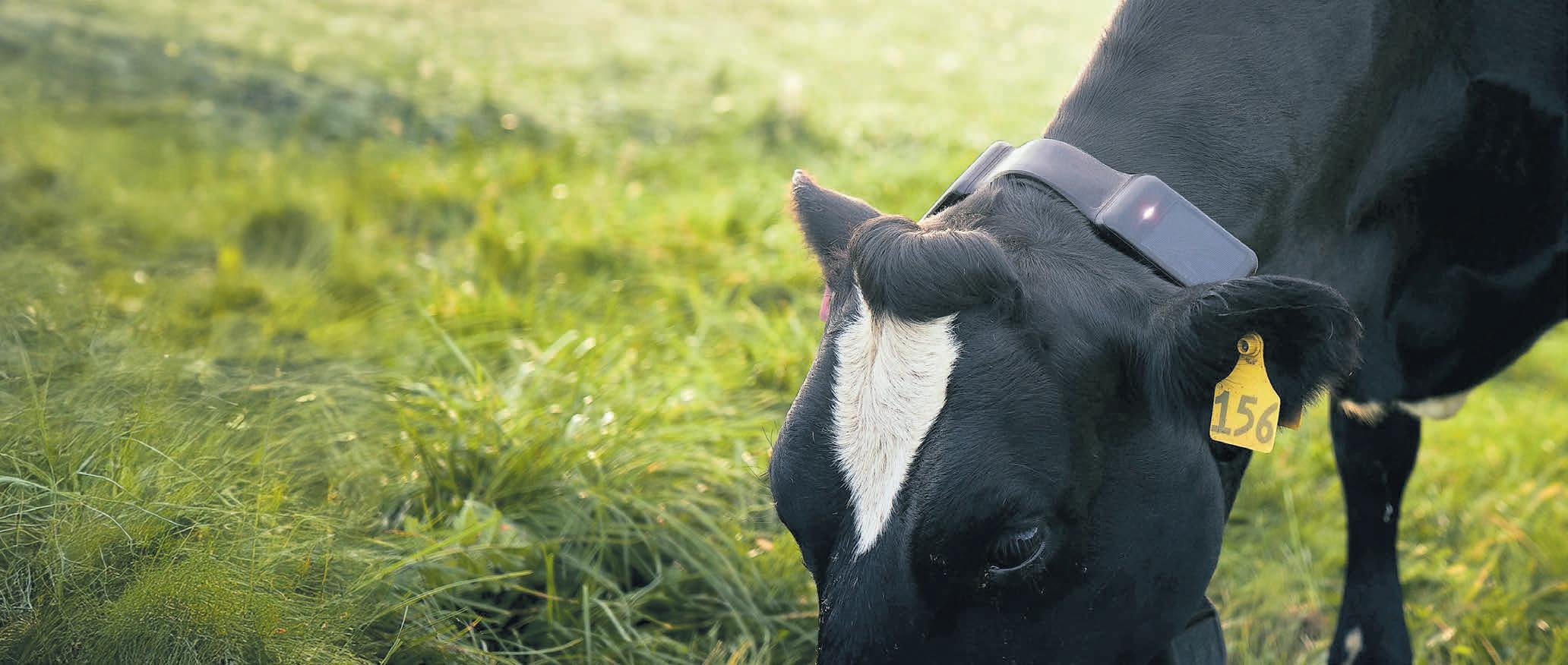
One learning that has really been highlighted is that it can take three days (changes in rumination, production, P:F ratio, etc) for cows to come back after a mistake This can be something like feeding a wagon of poor-quality supplement, not checking the water trough, or a high residual from the last round
Our cows are creatures of habit, and our ability to offer them calm consistency, safe stockmanship and familiarity of routine is still key
What’s the top piece of advice you’d like to pass on to farmers for the next few weeks - to manage or make the most of the seasonregardless of tools?
The focus right now is setting up next season’s profitability by getting the mating right. Thoroughly check the mating data, but also use good stockmanship and observation of the herd during the day Talk to other people and maintain a network of what is happening on other farms –and yes, often this is better through your consultant or vet. Give them access so they can feed trends across your district back to you
Focus on your pasture quality and grazing rotation Be prepared to intervene with the mower if growth rates have proven highly variable Get quality right going into summer –ME (pasture quality) is king. Looking across several farms in each area enables me to pick up looming climatic issues (pasture growth rates and covers) going into dry periods, and the subsequent recovery

The Whites of Ōtāne have had an ‘interesting’ few years, capped by sector recognition of the most welcome kind.
Gerald Piddock PEOPLE On farm
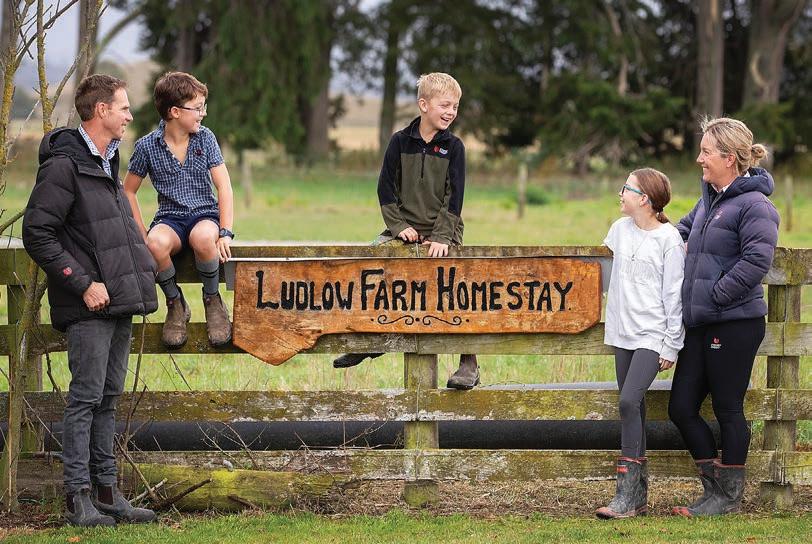
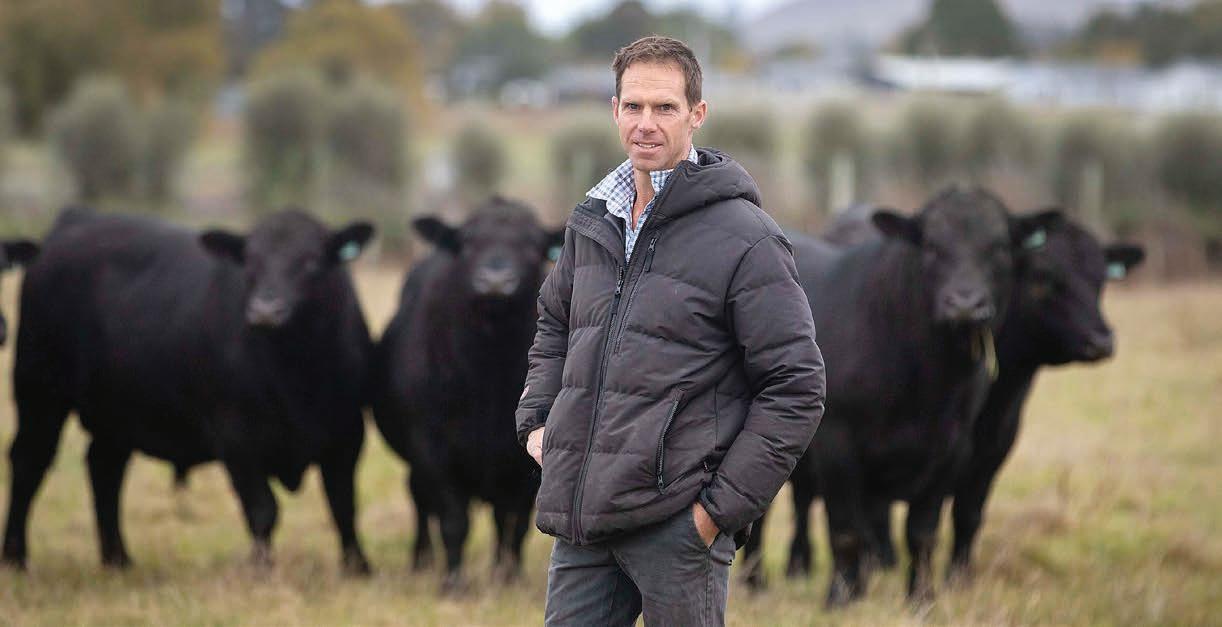
THE past few years have taught Simon and Lou White and family to expect the unexpected when it comes to farming.
Almost three years ago the Hawke’s Bay cropping and livestock farmers had to repair and rebuild following the devastating impact of Cyclone Gabrielle and compounding this was Simon being injured in a tractor accident.
After that low came the highs.
Earlier this year the Whites were named the East Coast region’s supreme winner in the Ballance Farm Environment Awards and then the Hawke’s Bay Farmers of the Year.
Looking back, Simon said the recognition was extremely great, given the challenges they had faced.
They, like other farmers, were bearing the brunt of a surge in onfarm costs when the cyclone hit.
“Then you throw the challenge of the cyclone – and I had a horrific accident as well – we came through some pretty challenging times.
“It was nothing we couldn’t overcome, it was just a matter of good planning and leadership while working through it.”
Their 1015 hectare (900ha effective) farm at Ōtāne finishes bulls and trade lambs as well as growing a wide variety of crops including process vegetables such as peas, beans, sweetcorn and squash for the Japanese markets.
They also grow vegetable seed and arable grain crops such as wheat and barley, working on a
five-year crop rotation system.
Gabrielle hit at a critical time for the Whites as they were close to harvesting 300ha of their highvalue cash crops, which were lost in the deluge.
Their farm received only 120mm of rain, but the Waipawa River burst its banks and flooded a huge area of their farm including that cropping land.
“That was a huge hit for us. You spend a lot to grow the crops and you expect the profits to come back and you pay your costs and live off the rest and you go again next year – but that income didn’t come in.
“We lost the income but then next season we had to finance another growing season to grow that year’s crop. That was tough to handle, but not impossible,” Simon said.
“We had great support from our bank, Rabobank.”
Almost two years later, he said he still gets asked how they got through it.
“Mentally, you have to accept it. The quicker you accept it and move on, the easier it becomes.
“Those situations make you sit down and think, what can I do to make this better?
“Everyone was hit differently,
but in terms of a recovery, you have to use the avenues that are there to help you.”
Those include organisations like the Rural Support Trust as well as neighbours who helped each other out.
“Some of the biggest lessons for me personally was around your mental state. You have to refocus your purpose, goals and think about the people around you. Its not much different to an All Black
team losing and having to refocus for a comeback. If you’re in the right zone, things will happen and you won’t go down that rabbit hole.”
And he could see how that could happen post-Gabrielle, he said.
For Simon, compounding the recovery was the week in hospital following the tractor accident before returning home to recover further.
It left him bedridden for a few days as he recovered from broken ribs, and a fractured eye socket and vertebrae.
“We’re lucky our team on farm are great and kept things running smoothly, and I’m fully recovered now.”
Lou said the cyclone showed what life can throw at you.
“Sometimes things come out of the blue that we don’t expect, life is one big rollercoaster and I think we have to experience the lows at times to make the highs so much more special.”
It also made her appreciate what they had around them, especially the people.
“Don’t be afraid to ask for help when things are hard, take up the offers of support and know
that what goes around comes around. Your time will come to help the people that have helped you.”
The older generation of farmers are also good for advice as many have been through similar adversity, she said.
“Many have been there. It becomes a part of your life story but doesn’t define you.”
Simon said the two awards they received are also a reflection of the generations before them who have also shaped Ludlow Farms.
“We are the fifth generation to farm at Ōtāne and that’s been built up over many decades of hard work before us.”
It gave them good foundations to build and recover from the cyclone’s impact, he said.
Lou said it was amazing to reflect on where they come from since taking over the farm in 2007.
“Simon’s done an incredible job at diversifying, and he does so well to manage so many balls in the air.
“It has been a reflective time and a chance to take five minutes for a stocktake on life. We’re incredibly proud to rise above all the adversity of late.”
We have so much to celebrate thanks to our world-leading farmers!
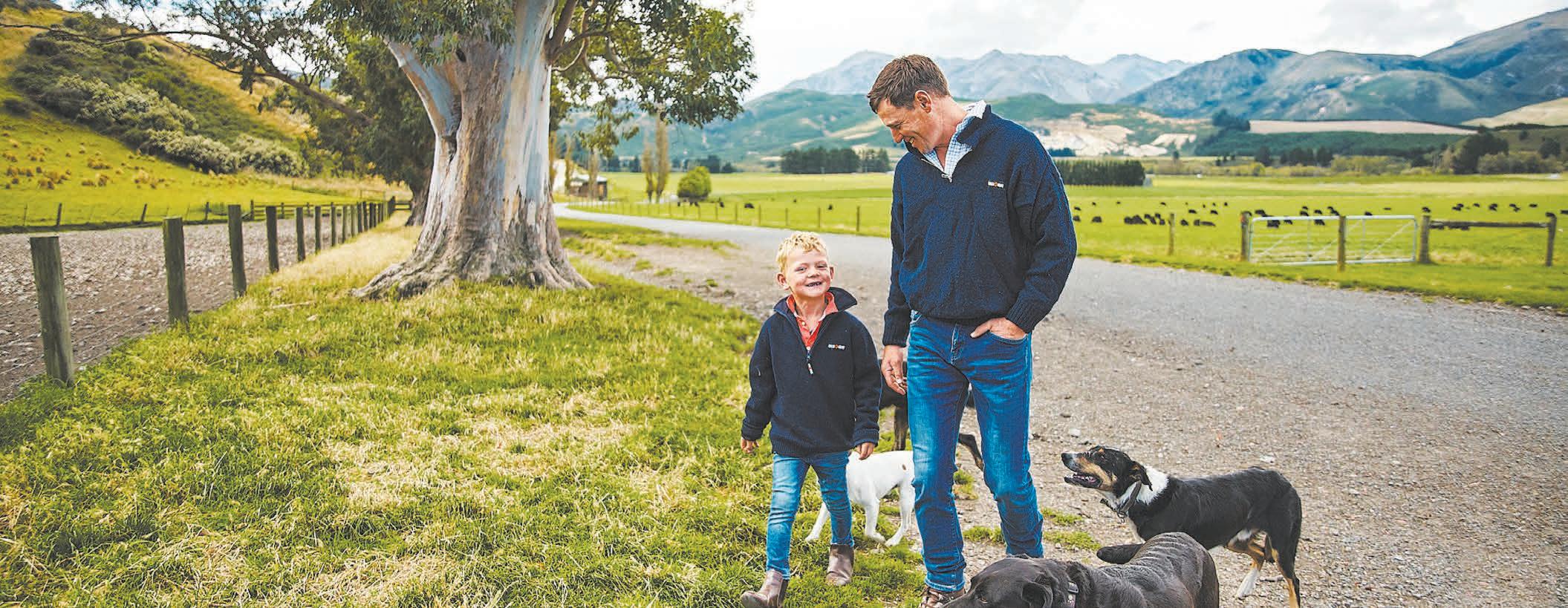
New Zealand’s agricultural sector continues to lead the way, and we’re proud to celebrate the people behind it.
This year B+LNZ’s broadcast partnership for the Women’s Rugby World Cup reached 1.5 million Kiwis, connecting red meat with sport, pride, and performance We think that’s something to celebrate

Here are just a few ways you can get involved in showcasing and supporting fellow farmers:
Celebrate National Lamb Day (15 February)
Celebrate the origins of our world-class food industry, marking the first frozen lamb shipment from Port Chalmers to London. Whether you’re joining us at Waimumu Southern Field Days, firing up the BBQ to salute our food champions, or rocking a National Lamb Day tee and sharing Ag Proud content –every bit counts!



Join us for Out the Gate and the B+LNZ Awards (20-21 May, Christchurch)
Out the Gate, powered by the B+LNZ Farmer Council and Kāhui, is our sector ’s biggest celebration It’ll feature inspiring speakers and practical sessions to help farmers lift productivity and profitability This year ’s event will feature the B+LNZ Awards, recognising finalists across eight categories and announcing the winners


Get involved in Farmer Time for Schools
More students than ever are connecting with farmers through this virtual programme, gaining insights into life on the farm and the journey of food from paddock to plate Learn more at www.farmertime.co.nz
Keep an eye on B+LNZ e-diaries and website (www.beeflambnz.com) throughout the year for more B+LNZ is coming up with more ways to celebrate our sector













































On remote Arapaoa Island, the Radons farm rare paua pearls, run luxury stays, and raise easy-care Wiltshires in a life shaped by the sea.

Rebecca Greaves PEOPLE Farm management
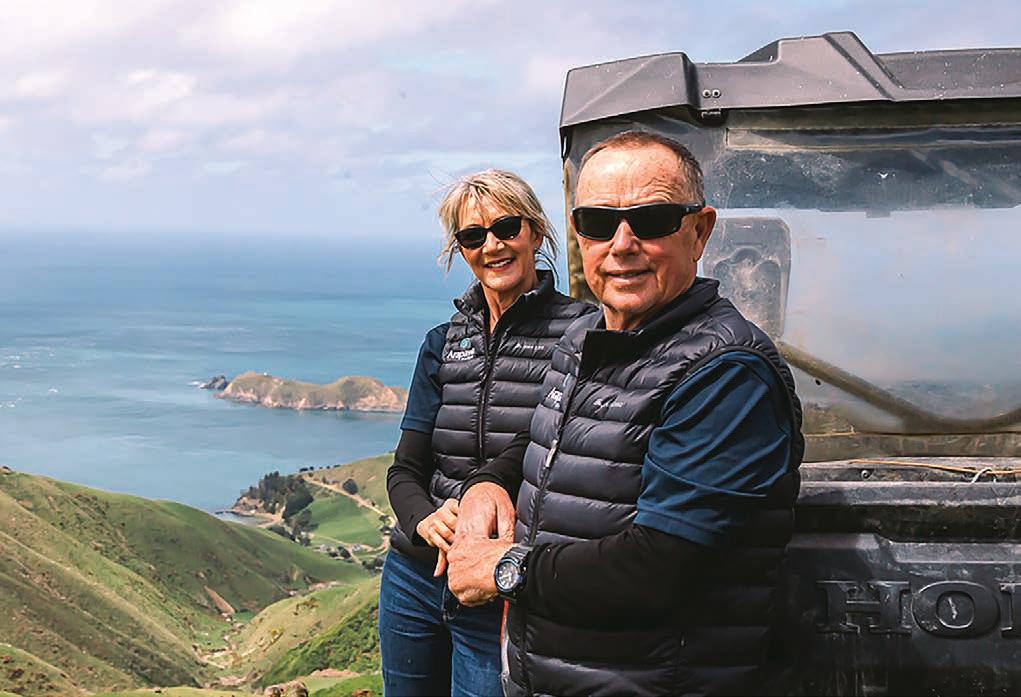
DIVING connected Antonia and Mike Radon and together they fell in love with remote Arapaoa Island in the Marlborough Sounds, where they bought a rugged farm – even though they knew nothing about farming.
Surrounded by the sea, the adventurous couple run Arapawa Blue Pearls and Homestead luxury accommodation alongside their 350 hectare farming operation and Arapawa Wiltshire Stud, which aims to sell easy-care sheep to lifestyle block owners.
They are the only abalone-paua farm in New Zealand to offer tours, and they produce some of the rarest pearls in the world. These are turned into exquisite jewellery.
Every cent I have made in Alaska I have brought back and spent on this farm.
Antonia Radon Arapaoa Island
“We are growing cultured pearls, some of the rarest colours in the world, that’s what our farm revolves around,” Antonia said.
Antonia is originally from New Zealand. Mike, who is from the United States, had always dreamed of having his own abalone farm. The couple raised their three children on the picturesque island, and Antonia cannot imagine ever leaving.
The Radons are deeply committed to the sustainable farming of paua, and have been involved in re-seeding projects, such as releasing 1000 baby paua into the Kaikoura tide pools after the earthquake, to ensure this special exotic species continues to thrive for years to come.
Re-seeding and educating people about paua, using their facility, is something they are passionate about.
Along with the core paua operation, the couple run about 400 Wiltshire breeding ewes and 80 breeding cows, offer accommodation at their lovely homestead and rent out several houses over summer. They host tour groups that come into Picton on cruise ships, with guests catching a water taxi out to the island.
The couple previously ran Romneys but the move to Wiltshires made sense from an input point of view.
“It’s hilly here but the Wiltshires, man do they do well. They are hardy, low input, shed their wool and keep their tails. We are so busy with the pearling and diving business that they have been a breath of fresh air. They are so low maintenance, but you do need good fences,” Antonia said.
“We had given up on the sheep because we couldn’t keep up, and leased the land out.
Then we had a wonderful friend who bought a subdivision off us. He convinced Mike, you must get these shedding sheep. He gave us a handful of ewes and a ram. Then he gave us a few more, next thing we were buying the whole flock. It was a total no-brainer.”
Living on the island means costs that other farmers do not need to contend with, like barging sheep and cattle in and out.
The Radons think ahead and bring in things like building supplies on the barge, then backload with stock.
Antonia left New Zealand at 17, headed for Alaska, where her older sister was getting married. It was a foreign, and often harsh, environment but she grabbed every opportunity with both hands and thrived.
“It was my ticket out of here and it changed my life. Alaska was, and still is, my second home.”
Antonia’s brother-in-law was a diver, her mentor and introduction to the sea. She started out diving for sea urchin, and happened to strike the boom of the industry.
“I saw I could make a lot of money and worked really hard in my twenties to get where I am today.”
When she separated from her first husband, Antonia needed a job, and she needed someone she could trust. Enter Mike, who needed a diver.
“We were just friends, but we had a lot in common. I looked up to him, he was a good diver and I wanted to work with someone I could make some money with.”
Over time, their relationship grew to be more than work colleagues and they decided to return to New Zealand.
They heard of a farm for sale on Arapaoa Island and as soon as they set foot on the island, it felt right.
“We knew nothing about farming. Coming from the States, it was an opportunity of a lifetime, even though it was an uneconomic farm. We had no idea what was under the water, but it drew us. It so happened it was everything we have ever dreamed of.”
Little did they know that the location was probably one of the best places in NZ, if not the world, for paua. The temperature of the Tory Channel provides optimum growing conditions.
It’s a waiting game when it comes to
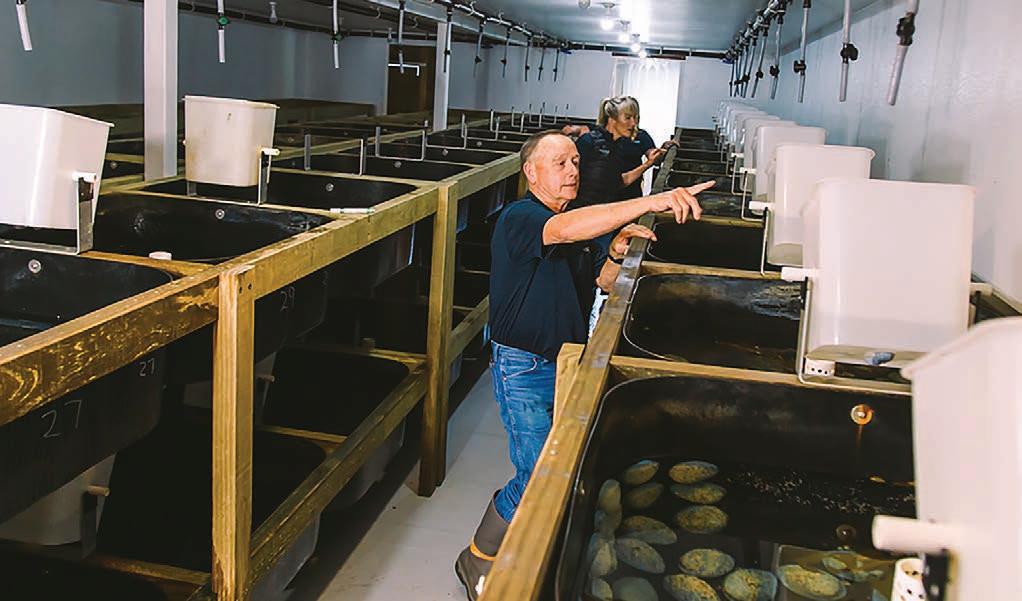
pearls; paua take eight to 10 years to produce one.
In 2001 they harvested their first pearls. Antonia takes them to a jeweller in Blenheim and sells his creations in their farm shop and online.
But Alaska is still what pays. The couple, along with their children, return to Alaska every year over winter for six weeks, when they fish for salmon.
“Alaska has a better return on investment



for us. Every year the whole family drops everything and comes with us. We live on the boat, like a caravan. That’s what kept us afloat during the covid years.
“Thank goodness for Alaska. America has been a land of opportunity for me, and every cent I have made in Alaska I have brought back and spent on this farm. Alaska is a special place, the vastness, the space, the animals. It’s like going back in time. It’s a must visit.”









From Cowdashians to growing your own kai, we choose six Kiwi farming content creators who reward spending time with them online.

Beale PEOPLE On farm
AS NEW Zealand’s agricultural sector continues to evolve, a new generation of farmers are using social media to share their rural lives.
Long hours, wins, tough seasons, and light-hearted moments feature on platforms that give an inside look into the reality of farm life.
These on-farm influencers, or social media content creators, who once worked solely within their paddocks, now connect rural and urban audiences in ways that were previously impossible.
Their content offers everyday insights into activities such as stock management, animal care, harvesting and dealing with weather challenges, helping those living in the city better understand the people behind New Zealand’s primary industries.
Each influencer brings their own perspective and story. Here are six accounts worth following, along with the passions behind their content and where to find them.
Farm Up NZ – @farmupnz (On Instagram, Facebook and YouTube)
FarmUpNZ shows 2024
Ahuwhenua Young Māori Farmer
Ben Purua’s life on a Waikato dairy farm, running a family-owned business. He shares a fun and comedic perspective on everyday farm life, and started his journey on social media with the intent to show the “real side of farming”.
“Not the polished version, not the drama, just everyday life with our cows, our whenua, and our whānau,” Purua said.
“A lot of people don’t realise how much care and heart go into this work. Sharing my journey felt
like a way to open the gate and let people in, to show that farming is about connection, respect, and looking after the land that looks after us.”
Purua said the motivation to grow his social media community is the connections he gains.
“Farming can be isolating, but social media has created a space where we get to share laughs, learn from each other, and show what real, everyday New Zealand farming looks like. If one person watches our videos and feels inspired, encouraged, or just gets a good giggle, that’s enough for me.”
Purua’s posts feature his herd, “the Cowdashians”, alongside everyday moments with his family and the operational routines that shape life on a dairy farm.
Clarke Boys Hunting NZ - @ clarkeboyshuntingnz (On YouTube, Facebook and Instagram)
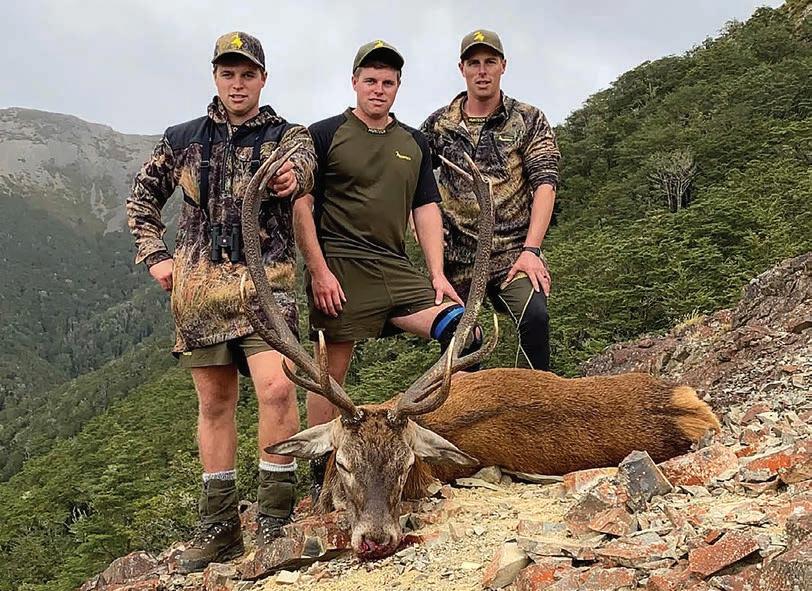
The three Clarke brothers started creating content when Sam (the eldest brother) was away at university. He posted on the YouTube channel so that his younger brothers, twins Noah and Harry, could be part of his adventures while he was away. It also gave his brothers a platform to share what they were doing back home.
The brothers gained a following and continued sharing their lives online. The Clarke brothers have been creating long-form, primarily hunting content on YouTube for over a decade.
“We still prefer the longer style videos that tell a story rather than the short-form content as you see on reels,” Sam said.
The three share their experiences hunting, beekeeping, fishing and farming in rural Coromandel. They also share content that shows their work on their family-run farm, managing land, harvesting food, and all the challenges that come with it.
They are inspired by “the old boys that used to be back on TV like Outdoors with Geoff and Gone Fishing and more recently Matt Watson’s stuff,” he said.
Deanne Parkes - @deanne_ parkes_ (On Instagram and Facebook)
Deanne Parkes is a farmer, life coach, keynote speaker and mental health advocate who shares daily motivation, mindset tools, and the realities of rural life online.
Growing up on a dairy farm and now working on a beef and sheep operation, she speaks with firsthand experience of the pressures farmers face. She has also worked with Farmstrong on reframing everyday habits to improve wellbeing.
Her decision to share on her platform came after her own battle with depression.
“The only stories I could find were from incredible men, but I struggled to relate as a mum with small kids,” Parkes said
The feedback from women – and sometimes men – who say my posts have helped them through a hard moment – that’s what keeps me showing up.
Parkes
mental health
“Once I came out the other side, I wanted to share openly so other women who might be struggling in silence could feel less alone.”
She said social media “can be a harsh place”, but overall, it has been a really positive experience for her, and the positive messages and feedback keep her showing up.
“The feedback from women –and sometimes men – who say my posts or tools have helped them through a hard moment or shifted something in their lives – that’s what keeps me showing up.”
She finds inspiration in creators like Charlotte Heald, Lisa O’Neil and Di Foster, who she says offer honesty, strength and practical wisdom.
Farm Fit NZ - @farmfitnz by Kane Brisco (On Instagram, and Facebook)
Taranaki farmer Kane Brisco has built a strong following online by promoting physical and mental wellbeing for rural communities.
On his platform, he shares practical routines, advice and relatable on-farm content to help farmers stay balanced amid the demands of rural life.
He is an author, having written Tools for the Top Paddock –Lessons for life on the land, and also speaks at events, sharing his tips for keeping well while working on farm.
Owning a gym on his farm, he runs twice-weekly group training sessions for his local community during select months of the year. He has previously featured in Farmers Weekly discussing his
own habits and the routines he uses.
“I was inspired to share things on social media really just for anyone out there that might be struggling or wanting to improve themselves,” Brisco said.
“I think I just wanted to be the someone I didn’t really have when I was struggling with challenges.”
Reflecting on his journey, he said his motivation is to “just keep reaching people and helping them out, whether that’s a laugh, a relatable experience on the farm, or some inspiration to improve their physical and mental fitness”.
He credits the growing number of ag-focused content creators for inspiration, along with social media star Farm4Life for leading the way.
Morgan Milking NZ - @ morganmilknz (On Facebook and Instagram)
Morgan Milk NZ showcases the daily life of husband-andwife team Quinn and Samantha Morgan, young Māori contract milkers and parents who share snippets of life, family, and their contract milking operation.
Morgan’s farming journey happened by chance during the covid pandemic.
Based in Australia with plans to return to New Zealand to become a police officer just before covid, Morgan instead learned the ropes of dairy farming from his cousin while his family was stuck in Perth.
Coming from the city, the Morgans never expected to end up in the dairy industry, but embraced it wholeheartedly.
Soon after, Morgan and his family started dairy farming, and he and Samantha have shared his journey online ever since.
Fully immersed in the industry, they are committed to uplifting other Māori, young farmers, or those changing careers by showing that dairy is a place where they can belong, succeed, and lead.
“For us, success starts with people; our whānau, our team and our community”.
Social media has allowed them to show the real side of farming and the experiences it brings, while “encouraging anyone who might want to give it a go”. Their biggest inspiration comes
from everyday farmers who quietly support their communities, uplifting others without needing recognition.
They credit their first employers and lifelong mentors, Sam and Kate Moore, for giving them their start and for their continuous support.
“They’ve been with us since day one, and they still guide us today, helping shape our journey and the farmers we’re becoming.”
Growing Kai with Nadia - (On Facebook and TikTok)
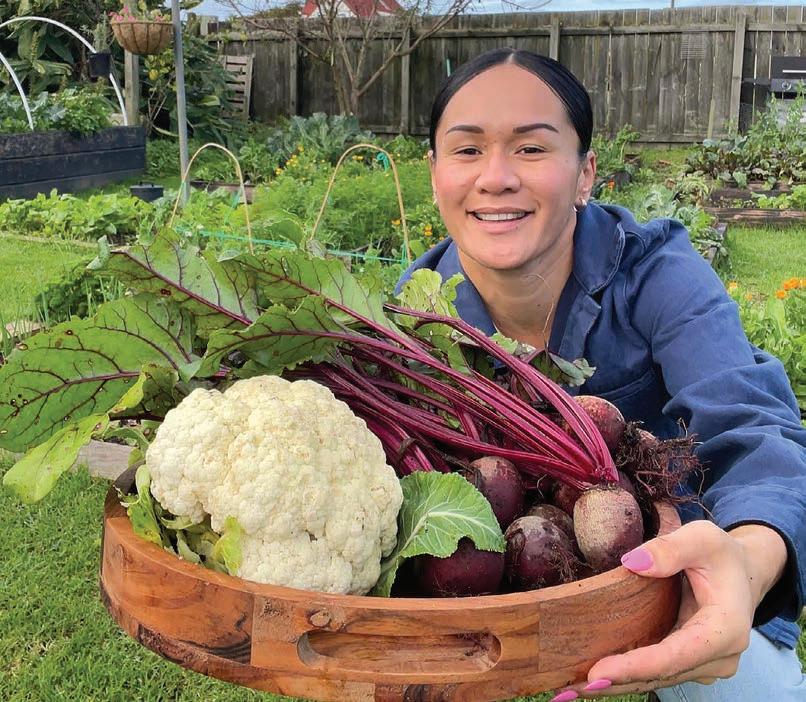
Nadia Nasya has created a platform dedicated to growing kai at home, offering advice on what to grow, and when and how to pass that knowledge on to future generations.
Inspired by her father, Teriki Kopa, she said that her upbringing showed her how caring for the whenua supports our mental health, keeps us grounded and provides nutritious kai for our whānau.
“Sharing online is my way of showing there’s a different way of living, one that connects us to the land and strengthens our overall hauora [wellbeing],” Nasya said.
Stepping into the world of social media has taken her out of her comfort zone, but allowed her to connect with people across the country.
“I see social media as a tool we can use to connect, educate, uplift and inspire, but it should never define who we are.”
Her motivation comes from her children and the healing power of the whenua.
“The messages I receive from whānau who have started their own gardens or reconnected with the whenua reminds me how much the mahi I’m doing is making an impact.”
Nasya draws inspiration from others who are using their platforms to share knowledge and uplift communities. This includes The Māori Gardner page on Facebook, founded by PorkyPig Hawira, a page where everyone can post, learn, encourage and celebrate each other’s wins; NZ Gardener Joel Campbell and That Fulla Rico and “his wahine Tui”, who share knowledge online and help their community in Waima.








and he said he tried to answer the question of what a sustainable business at the bottom of the world looked like.

Gerhard Uys PEOPLE Veterinary
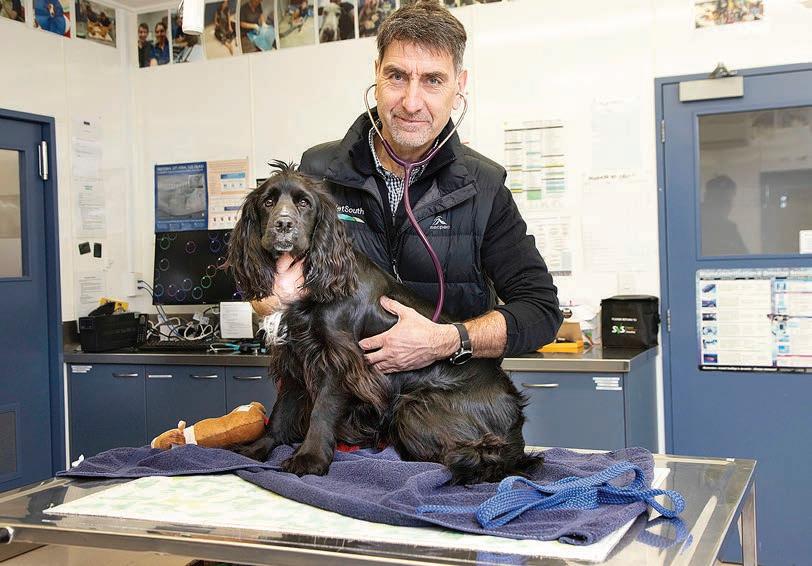
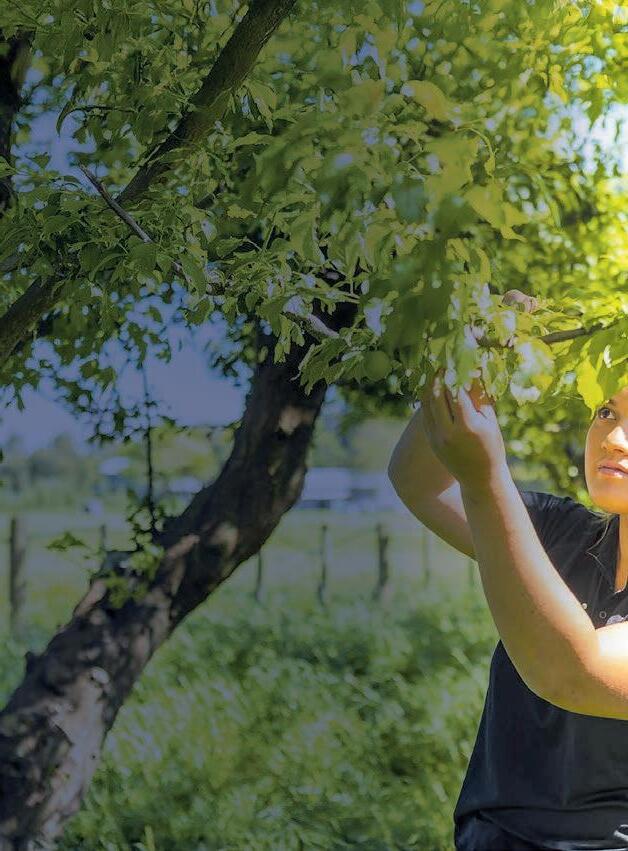
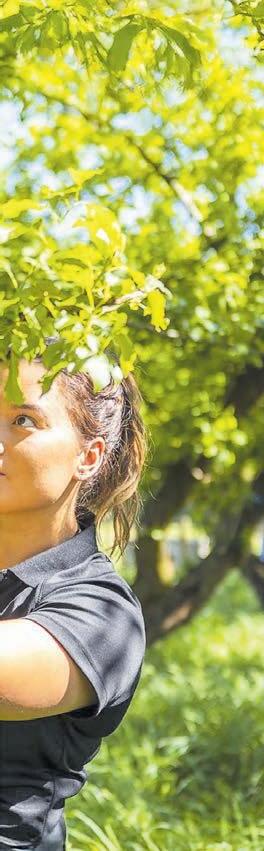
MARK Bryan is stepping back from vet duties in February 2026, not retiring so much as changing tack: he aims to do a Master’s in psychology, focusing on veterinary wellbeing.
Bryan will stay on as director of VetSouth and will provide strategic direction to Comhla and Nexius.
Despite already having a Master’s in epidemiology, as well as having published countless papers and being deeply involved with clinical product trials on drug efficacy, he doesn’t consider himself an academic – though he does admit to a serious fondness for learning.
He also had no aspirations to be a business owner, initially moving to New Zealand from Scotland in the 1990s to pursue his mountaineering passion. It was sheer chance his life took the route it did.
He wanted to be a large animal vet, and wanted to be near mountains, and a post in Winton offered both.
Bryan and wife Keri, who at the time was a doctor at Queenstown Hospital, planned to move back to the United Kingdom after a stint working in New Zealand, but fate intervened.
Within a three-month period, one of the senior vets at the Winton practice had retired, another went on maternity leave and another vet suddenly died.
Bryan was offered a share in the business, and the rest is history.
At that stage many rural veterinary practices were failing,
He knew that he did not like the hierarchical structure he had found in the UK.
Thirty years ago wellbeing wasn’t on anyone’s radar, but his early experiences as a vet, and his own desire to pursue passions beyond work, shaped how he approaches wellbeing.
Early in his career in the UK, he told his bosses he wanted to spend four months of the year mountaineering. When they declined, he simply said he would resign.
He made them a new offer: let him go to the mountains and he’d come back, saving them the trouble of recruiting a new vet.
They agreed.
Today the scale of VetSouth allows the vets and support staff to have real work-life balance, with a development fund they can spend on whatever they think will make them better at their job or benefit them as a person, whether it’s further study, pottery or a gym membership.
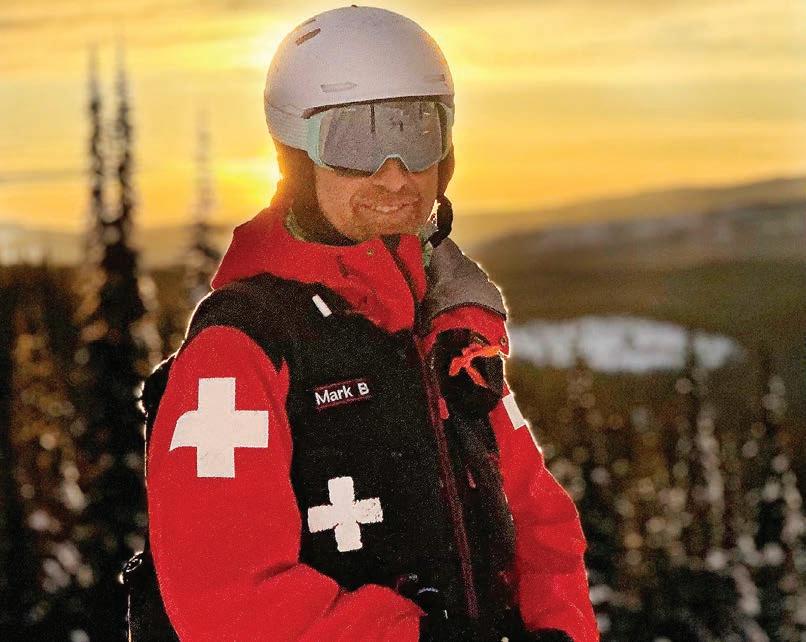
Bryan still takes a few months off every year to ski patrol overseas,
Our job is to employ vets and support staff and to make it as easy as possible [to work], so the good bits outshine the bad.
Mark
Bryan VetSouth
a slightly tamer version than the mountain rescue he was involved in earlier in his life.
He said when he pitched the time off for ski patrolling to the VetSouth board, he angled it as a professional development opportunity.
Many skills might not seem to align with business, but in the end those such as management skills are transferable, he said.
“I would never have survived in the profession if I hadn’t had time off,” Bryan said.
“Our job is to employ vets and support staff and to make it as easy as possible [to work], so the good bits outshine the bad.”
The Winton clinic grew and was merged with a clinic in Gore, and it continued to grow, 20 years ago becoming VetSouth.
Bryan played a key role in VetSouth’s continued growth, using the same approach to develop West Coast Vets and broaden the employee-shareholder model as VetSouth evolved into VetNZ.
In 2023, VetNZ joined with other New Zealand-owned practices to form the parent company Comhla Vet, which now has clinics across the South and North Islands, and in Australia.
Veterinarians traditionally receive no business training.
About 14 years ago Bryan attended an Ice House owner-manager programme. He is still involved with Ice House, not only to learn but to share his experiences with others
Bryan’s work looking into veterinary wellbeing goes handin-hand with his experience of battling M bovis.
The disease was first picked up by a vet in Canterbury, a remarkable feat, said Bryan, considering the disease wasn’t present in the country and wasn’t on anyone’s radar.
When it spread south, it quickly became a Southland problem.

As an epidemiologist Bryan was interested in bovis as a disease.
But a lot of his work has revolved around how the disease affected vets.
Veterinarians had a difficult time when M bovis was first detected, feeling excluded from decisionmaking by the Ministry for Primary Industries.
Not only did vets have to do their job under what were then untested biosecurity rules, but their farmer clients were extremely stressed, too.
Vets had to ramp up communications with farmers, with every phone call becoming a long conversation about how to manage M bovis.
With herds being depopulated, or a farmer just receiving a positive lab result, farmers were stressed and veterinarians were often the people farmers confided in.
“It taught me how important rural vets are in the farming community”.
Come February, Bryan will fully immerse himself in psychology, hoping to untangle why mental health in the industry is tough –and how to improve it.
massey.ac.nz
MPs from different political parties worked together for years to fund water infrastructure now coming online in capital-starved Northland.
THREE new storage reservoirs in Northland are filling with water while attention turns to distribution pipelines and share sales in the water companies.
Te Tai Tokerau Water Trust has delivered five years of planning, consenting and building supervision with over $100 million of capital expenditure, using central and local government loans and the beginning of private equity contributions.
“Now we concentrate on reticulation, commercialisation and repayment,” trust chair and former National Party minister in government Murray McCully said.
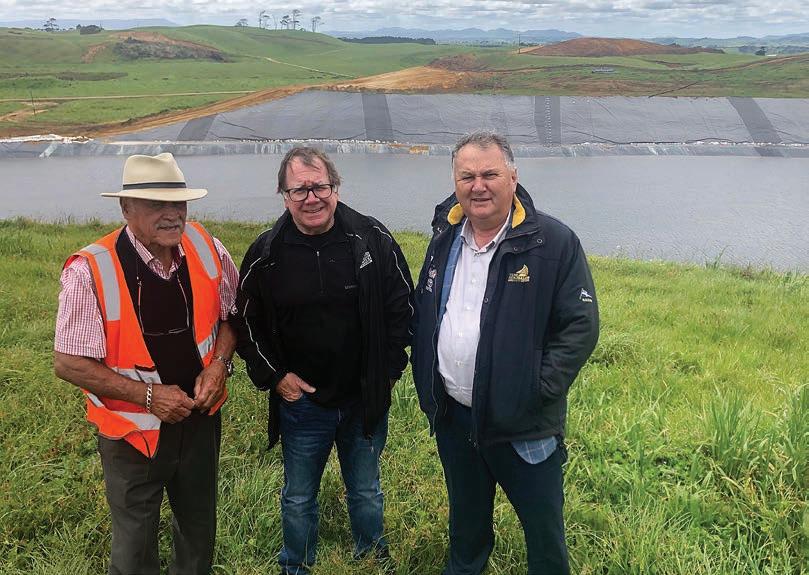
The three schemes, in order of construction, are Matawii near Kaikohe, 750,000 cubic metres in volume; Te Waihekeora south of Dargaville, 3.3 million cubic metres; and Otawere at Waimate North, 4 million cubic metres.
“We have just closed the gate on Otawere construction and selffilling has begun, with water take consents from Waitangi River and Waiaruheiti Stream as back-up if needed.”
One large water user close to the dam is Marsden Farm, with up to 100 hectares of covered kiwifruit vines and citrus plantings planned as it diversifies in the Bay of Islands from its Bay of Plenty home base, attracted by the irrigation water, good soils and land prices.
Another foundation investor in the Mid-North Water Company, Otawere, is Tupu Tonu, the Ngāpuhi investment fund.
Two big themes are now evident in the latest opportunities for Northland irrigation – land use change with intensification to horticulture and early investment by local iwi.
Ngāpuhi was already the largest water user at Ngāwhā, Matawii, with 3ha of hydroponically grown strawberries already producing and a planned 7ha of blueberries
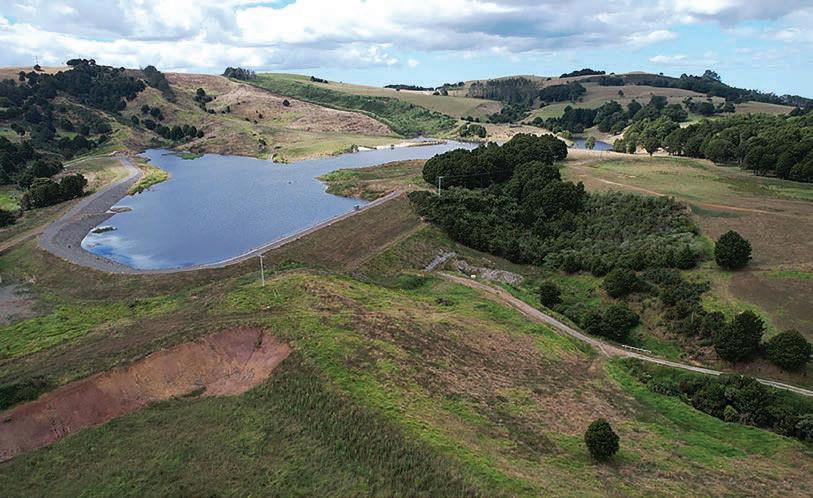
CHANGE: Two big themes are now evident in the latest opportunities for Northland irrigation – land use change with intensification to horticulture and early investment by local iwi.



being managed by T&G Fresh, the produce company.
Over to the west, near Te Kopuru on the Pouto peninsula, Te Uri O Hau has formed Te Tutakitanga orchard development at Red Hill, and has already planted 6500 avocado trees watered from Te Waihekeora.
Another large-scale avocado orchard began planting 30 months ago by Lynwood Avocado Nursery, Whangārei, and principal Stephen Wade said up to 30 canopy hectares will contain 18,000 trees with fertigation and close-density planting of 600 trees/ha in a stateof-the-art orchard development.
Te Waihekeora, on the road to Glinks Gully, is 80m above sea level and doesn’t have rainfall catchment area; instead there are seven pump stations to harvest high flows in local drains and waterways.
The government has approved further expenditure on a 22km pipeline from Te Waihekeora to Dargaville and large commercial water user Silver Fern Farms, which McCully believes should form the terminus of a catchment in the lower reaches of the Kaihu River, and perhaps in future a network extending to the rich Ruawai flats.
A similar pattern is envisaged for the Mid-North, with a pipeline joining Otawere and Matawii, enabling irrigation development for the volcanic soils around Ohaeawai and Pakaraka, and to the south and west of Kaikohe, where orchards have already established.
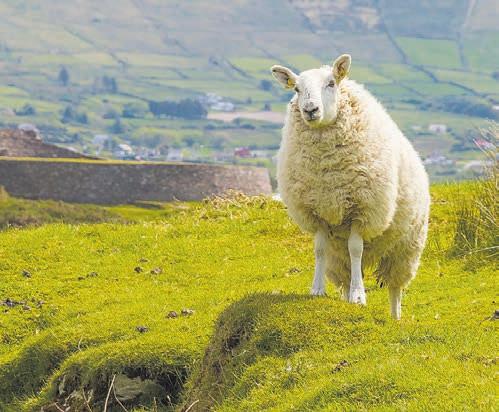
Both inter-connecting pipelines near Dargaville and Ohaeawai will increase the resilience of the irrigation schemes, enabling water to be pumped either way from surplus to need.
In addition, Kaikohe and Dargaville will have enhanced town water supplies.
“Although there were doubters, Matawii and Otawere are filling from run-offs in their catchment areas, but we have 30-year take consents as back-up,” McCully said.
Water users and investors in the three new water companies pay $30,000 a share (with concessionary options) for entitlement of 3000 cubic metres annually, at a daily volume of 30 cubic metres, considered enough water supply for 1ha of orchard types.
Existing land values in the 1980s Ministry of Works irrigation schemes at Kerikeri and Maungatapere, now run by companies owned by users, are at least $100,000/ha higher than nearby dry properties.
The new Tai Tokerau storage schemes have an order of user pricing higher than Kerikeri and Maungatapere because of the need to pay down government and local government loans, although the interest rates are quite low.
Te Tai Tokerau Water has three trustees, McCully, former Labour Party minister Dover Samuels and Kaipara accountant and kumara grower Kathryn de Bruin, and a small staff of executives. All the
groundwork was done by local contractors.
The whole venture has been a collaboration between members of parliament from different parties. Without the long-term commitment and enthusiasm of Shane Jones, Minister for Regional Development and NZ First deputy leader, none of the grand schemes would have eventuated, said those involved.
Storage dams have great prospects in many parts of the country, but Northland has been starved for capital and therefore had the stronger regional needs. McCully said large-scale dam construction is not for the fainthearted, as blowouts at Waimea, Nelson, and Opuha, South Canterbury, have demonstrated. Setbacks came mainly from covid disruptions but geotech engineers and their earthworks contractors put extra care into the underground dam foundations. The fully completed reticulation will lead to much smaller, privately developed and owned on-farm storage dams to further spread the water availability to irrigation demand, he said.
The total command areas for both regional schemes, Kaipara and the Mid-North, is over 3000ha and will deliver a multimilliondollar boost to Northland’s export earnings.



A globe-trotting scientist based in Rotorua studies the interplay among people, trees and a changing climate.
Richard Rennie PEOPLE Forestry
‘GEOGRAPHY” appears as much in Dr Grace Villamor’s CV as it does in her globespanning career pathway in recent years. As a forestry scientist specialising in human geography, her skills and curiosity about how humans interact with their landscapes has seen her working in places as diverse as West Africa, Idaho, China and, most recently, Rotorua.
The Scion scientist today is playing dual roles from her North Island base – working on how to better integrate forestry into landscapes here – while also maintaining a strong international profile.
That comes in her role as one of the lead authors for the next Intergovernmental Panel on Climate Change (IPCC) report, authoring Chapter 3 in the report that makes a global assessment of mitigation, risk, loss and damages
at a global level for policy makers to consider.
The final version is due out in 2028, and Villamor’s work is at the sharp end of the report as countries around the world reel under weather events often intensified by climate change’s impact.
The broad, holistic nature of her research work has its roots back in a forestry degree from the Philippines. There her frustration at policymakers’ failure to pick up on forestry’s value in land management prompted her to complete a Master’s in forestry policy and economics.
Opening her research lens out even further, for her PhD she studied forestry in the context of whole landscapes and human community dimensions.
“It involved looking more at agriculture and the human aspect that really changes the landscapes and interactions.”
Moving to West Africa, Villamor applied land use modelling for climate change and agroforestryrelated research projects there and in southeast Asia, building an extensive portfolio of experience over a decade with development research organisations.
Over that time she has also collected a raft of awards and
recognition from many and varied research organisations, universities and forestry groups.
Time spent in Idaho working with big dairy operators on land use and environmental management convinced Villamor that her heart lay in forestry and drew her to Scion in Rotorua.
“It took me a couple of years to really understand NZ’s forestry context.
“Despite the changes in government and the shifts in funding, I still see so much potential in forestry here.”
She is particularly inspired by the strong connections researchers including herself can enjoy with commercial forestry companies and particularly NZ’s largest forestry company Timberlands, recently rebranded to Kaingaroa Tipu.
“This connection is not easy to find in other countries. Companies here are really interested in new research and new techniques and technologies. Overseas, forestry companies tend to be seen as untouchable for researchers.”
Her work at Scion includes helping better understand how European Union deforestation regulations may affect NZ’s forestry sector.
Industry and the government

Despite the changes in government and the shifts in funding, I still see so much potential in forestry here.
Dr Grace Villamor Scion
here have opposed the rules, arguing NZ’s standards are higher than required, and they will impose unreasonable costs on foresters here.
“Right now, we are seeing a topdown approach, but they [the EU]
HOLISTIC: Forest scientist and human geographer Dr Grace Villamor’s work links landscape use to human habitat, looking at the role forestry can play in making life more tolerable under climate change, and landscapes more resilient.
are open to suggestions from us.”
Her work includes highlighting how NZ practices are over and above those required already. She is also starting to work more closely with farm foresters, with their broad mosaic of land use playing well to her holistic, landscape-focused research background.
“We are seeing the diversification of their land use, which is a good model for resilience. Their combination of native and exotic species, and their work experimenting with species means we can learn from them, which provides information for the large-scale forestry companies.”
Dr Shannon Clarke leads a group of largely unsung heroes contributing to our livestock industry through microscopes and complex computerised technology.
Neal Wallace PEOPLE Genetics
DR SHANNON Clarke’s contribution to helping livestock farmers transform their businesses flies under the radar.
It’s been well documented that, even as sheep numbers continue to decline, total meat production has dropped by only a fraction of that percentage due in part to production gains using breeding technology.
That technology is developed by scientists, statisticians, analysts and animal geneticists, and every sheep and deer farmer will have benefited from its ability to isolate and identify various phenotypes or genetic markers of desirable animal production traits.
It is exacting work, with 3 billion possible genetic markers in sheep alone, but the technology has allowed them to isolate and measure up to 600,000 of the most pertinent.
Clarke is a principal scientist at the Bioeconomy Science Institute based at Invermay near Dunedin
and was recently awarded the McMeekan Memorial Award by the New Zealand Society of Animal Production (NZSAP), in recognition of her contribution to animal production.
Clarke has spent nearly 20 years working in animal science, starting with what was then AgResearch.
Her career has included leading research into meat eating quality breeding values in sheep, low-cost DNA sequencing for genotyping, or an organism’s genetic makeup, and developing low-cost SNP chips, the devices that test for genetic variation.
“We try and come up with tools that capture the performance of genomes that can then predict traits of interests that breeders maybe after,” she said.
The McMeekan Memorial Award is considered one of the most prestigious honours for New Zealand’s agricultural science sector.
Clarke played down her role, saying there were many others who contributed to that work and deserved to share in the award’s accolades.
She attended Taieri College and the University of Otago, where she completed a PhD in photosynthetic research and then postdoctoral research in Wales on plant thermotolerance.
On returning to New Zealand she worked in the Biochemistry Department at the University
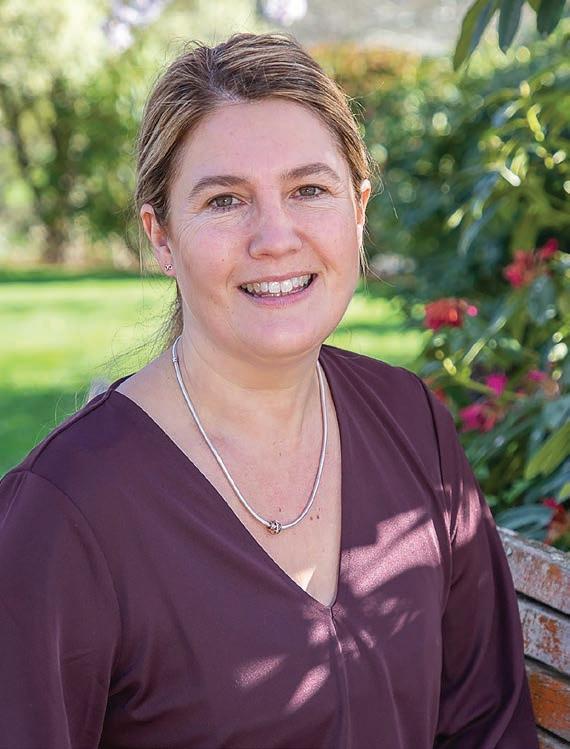
I know of the importance to NZ of exporting ... and I have seen the impact of the animal genomics team.
Dr Shannon Clarke Bioeconomy Science Institute
of Otago, but was drawn back to applied science, where she could see her work was making a tangible difference.
She joined AgResearch in 2006,
CUTTING EDGE: Dr Shannon Clarke, a principal scientist at the Bioeconomy Science Institute based at Invermay near Dunedin, is this year’s recipient of the McMeekan Memorial Award from the New Zealand Society of Animal Production.
Her achievements include establishing breeding values for sheep meat quality traits such as tenderness and marbling.
Made possible with funding from the FarmIQ Primary Growth Partnership, this technology is now integrated into the Beef + Lamb New Zealand Genetics evaluation system.
Work on SNP chip technology has made genomic selection more widely accessible to sheep breeders and has help make NZ sheep farmers the world’s largest user of this technology.
It enables parentage verification and single-gene trait evaluation to enhance breeding efficiency and genetic gain, with the latest chips used widely here and overseas as part of the commercial animal DNA testing business unit, GenomNZ.
and it was while working alongside animal scientists Ken Dodds, Allan Crawford and John McEwan that she switched to animal genetics.
Her grandfather owned a farm but Clarke did not have a rural upbringing. She does, however, appreciate the economic importance to NZ of the primary sector.
She enjoys working alongside sheep and deer breeders and those in the industry.
“I know of the importance to NZ of exporting ... and I have seen the impact of the animal genomics team.”
Clarke said every new trait discovered provides a greater understanding of the phenotype and unearths a mountain of additional data to be sifted through.
Along with work refining production genes, scientists are also looking for traits that predict or reduce methane emissions, the impact of facial eczema and parasite tolerance.
Clarke said the impact of using these tools is cumulative, so a 1-2% improvement in productivity or parasite tolerance can equate to significant financial benefits to farmers.















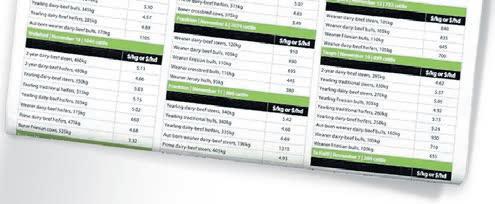


This year 1200 of you became voluntary subscribers - and because of your support we have been able to strengthen our newsroom with a new multi-media agrijournalist, helping us bring you even more content in more ways from a fresh perspective.
We have a lot to celebrate in 2025. Two Farmers Weekly journalists travelled the world meeting the people that buy New Zealand food and fibre products. Their message was clear: demand will continue into 2026 and beyond, so long as we continue striving to be the best at what we do.
As the team at Farmers Weekly continues to navigate the challenges of the media world in 2026, our 1200 Farmers Weekly members have ensured we can keep delivering high-quality, relevant content to you and every reader every week.
To thank everyone who helped us reach 74,000 mailboxes every week and 170,000 readers online every month in 2025, we’ve partnered with enterprising farm-business, Ruanui Station, to give all Farmers Weekly members 10% off their range of lambs wool products over the Christmas and New Year period.
Keep an eye out for an email with your exclusive discount code and more Farmers Weekly member benefits in the New Year We’ll be featuring a new member benefit each month.
Have a safe and happy holiday

Charlie Williamson. Business Development Manager





Using wool sourced from their sheep and beef farm in Taihape, they create a range of New Zealand-made lambswool products, including throws, blazers, and pet beds






Stephen Jacobi, who recently stepped down as head of the International Business Forum, spent almost 20 years advocating for the trade interests of New Zealand’s biggest primary exporters.

TNigel Stirling PEOPLE Trade
HE way Stephen Jacobi tells it, the International Business Forum was the brainchild of meat industry icon Sir Graeme Harrison.
The former ANZCO boss wanted to repeat the success of the New Zealand-United States Business Council, said to have been a key player in restoring trade and political links with the US, which had been under strain since the nuclear ships ban of the 1980s.
“Freshly returned from Washington DC, he saw what could be done with the NZ-US Business Council and launched the idea that something similar could be done for other relationships and trade agreements,” Jacobi recalled.
As executive director of the NZ-US Business Council, Jacobi stepped into the same role for the IBF in 2007, but with a remit to boost trade with Pacific Rim and north Asian countries.
Much of the job was promoting the negotiating priorities for IBF
members – a roll call of some of NZ’s largest businesses, including Fonterra, ANZCO and Zespri, among others.
A top priority for this group was the Pacific Rim trade agreement, originally known as the TransPacific Partnership, now the Comprehensive and Progressive Agreement for Trans-Pacific Partnership, seen as NZ’s best route to a much-coveted trade deal with the US.
[The United States] just didn’t keep up with that and they got what they got.
Stephen Jacobi Jacobi Consulting Limited
Donald Trump dashed those hopes when he withdrew the US from the TPP on the first day of his first term as US president in 2017.
But the agreement lived on and opened the door wider for beef exports to the lucrative but heavily protected Japanese market,
among other smaller gains for NZ exporters.
In other ways, however, it has failed to live up to its early promise.
The protectionist tendencies of some members were never far from the surface as demonstrated by NZ’s case against Canada for refusing to open its dairy markets as agreed – the first legal challenge by one CPTPP member against another.
“Some members don’t quite walk the talk,” Jacobi said.
“While they are committed in theory to a high standard agreement, in practice things are somewhat different.”
There had been hopes the TPP could be a trailblazer for global free trade – a fresh alternative to the World Trade Organisation, which has floundered badly after the successful Uruguay round of multilateral trade talks in the mid-1990s.
However, progress on expanding membership has been painfully slow.
The same model of consensus decision-making that has been becalming the WTO rules the day

in the CPTPP as well, leading to an “institutional paralysis” within the group, said Jacobi.
“There are lots of new members that want to join [but] how are you going to get all these people into an agreement that is efficient and upholds the standards that have been negotiated and send a signal to the world?
“There is no clear way forward on this, it seems to me.”
Emblematic of this is the CPTPP’s equivocation over China. China applied to join in 2021 but is still to start formal negotiations.
Meanwhile the United Kingdom was accepted as the 12th member last year and even tiny Costa Rica has leapfrogged China as the next country to
be formally considered for membership.
Many argue China is incapable of meeting the agreement’s standards, blaming the tepid response to date on ineffectual intellectual property protections, heavy subsidisation of its industries, and repeated use of trade as a weapon in diplomatic disputes.
Jacobi, however, said China would not be the first to trample international trade rules and this should not exclude it from global deals.
Putting it through the paces of a CPTPP application could help bring it back into line with global trade rules: “Tell us what you, China, can do, and if you can’t do it then fine, we will just leave it there for the time being.”
DR BRUCE Thorrold has spent 30 years trying to find solutions to the dairy industry’s most pressing challenges.
The former DairyNZ chief science adviser for DairyNZ had a career that coincided with the industry’s expansion and the subsequent rise of the environmental issues that accompanied this.
He semi-retired in August, having joined the organisation about six months after it was formed, in 2007.
Prior to that, he was at AgResearch and the Ministry of Agriculture and Fisheries – now the Ministry for Primary Industries – working out of its Rotorua office.
“I’ve had a fantastic career. I figured out early on that I like new and interesting ideas, and all of the way through, people have given me the opportunity to get involved in the important issues of the day,” he said.
He is also always mindful of the people in the background
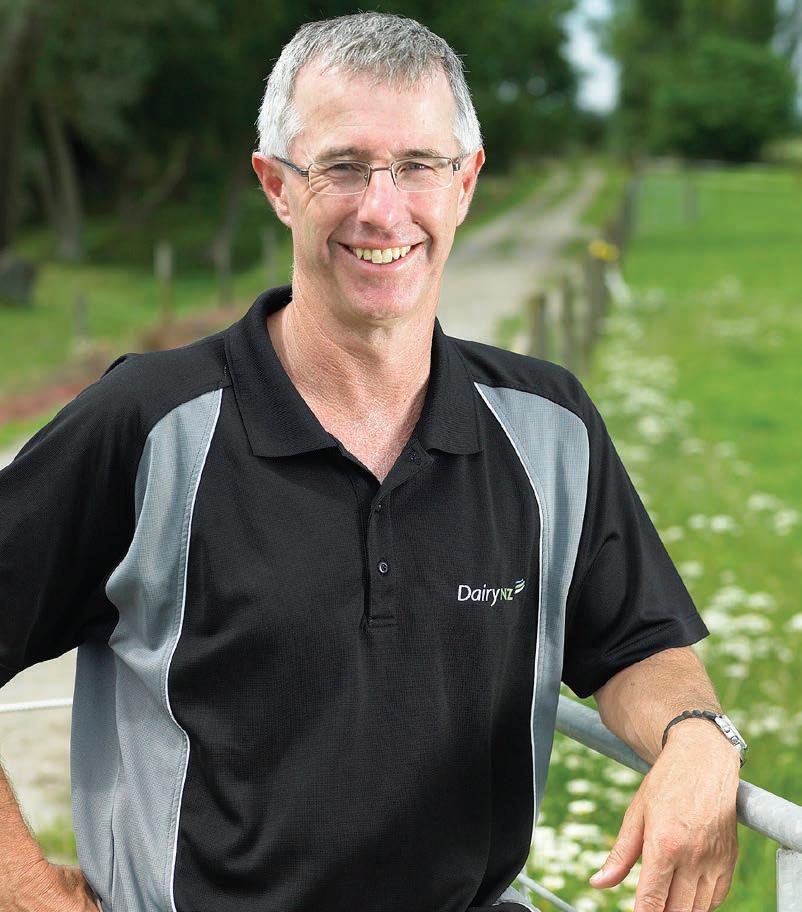
doing the graft to get and verify information and data required for him to make decisions.
“It’s been a team effort and a real privilege to be part of it.”
While finding solutions to freshwater degradation and animal emissions dominated much of the
science DairyNZ has focused on, over time the ongoing drive to increase productivity has emerged as a key focus area, he said.
“That’s driven by better animals, better plants and better fertiliser management. Both of those two themes have been important.
Probably the third theme is herd sizes. When I started it was 140, and now it’s about 440.
“The increase in scale in the sector has relied on and demanded research into efficiency and all of the technology stuff that’s come with that.”
Doing the research is easy. Bringing about change is a lot harder.
Dr
The industry expansion driven by newer, larger farms prompted a lot of the research to make those larger farms work better and be more attractive to work on.
In the early 1980s, work was done showing leaching was occurring from urine patches. That research helped shape what became the cap-and-trade system at Lake Taupō, which Thorrold worked on from a science and policy perspective.
“Out of that sprung that wave –20 years or more – of research into how do you drive that nitrogen footprint down in productive dairy systems.”
That research included Pastoral 21, research into plantain and fodderbeet and the work currently being done on the Lincoln University Dairy Farm around low N systems.
Thorrold can track that shift over his entire working career, he said.
“It’s an interesting story. We have done a lot of great work in pushing the boundaries of productivity and low N footprint.”
Farmer attitudes towards the environment have also changed and there’s been a wide spread of adoption rates.
“Doing the research is easy. Bringing about change is a lot harder. To bring about change you need a combination of all of those levers: social, economic and sometimes economic.”
He also at times had to front –and defend – the industry to media and public.
Thorrold said he takes the view that if there is an issue, the industry has to confront the problem to solve the problem.
“Change is constant, whatever business you’re running – the price of change falls on everybody. I never felt comfortable saying ‘You can’t do this’ to farmers.
“My approach has always been, if there’s a problem let’s face into it, let’s figure out what the problem is and let’s work with farmers to solve the problem in a way that protects all of the things we’re after.”
His mental checklist when approaching these issues asked: does it solve the problem, does it protect the economy and does it protect the viability of farmers?
“If you don’t achieve all of them, it’s really hard to make it happen.”
THREE Southland
hunters are helping families in need access quality protein, and are enhancing the environment by taking deer off the landscape at the same time.
Stu O’Neill, Tim Cook and Wesley Baratcart started Deer to Care three years ago when they hunted so much that they had spare meat left, even after giving some away to family and friends.
The hunting trio recently walked away with the Emerging Environmental Action Award trophy in the 2025 Environment Southland Community Awards.
The judges said they were chosen because of the strong environmental gains they made while also caring for the region’s communities.
“Feral deer have a significant impact in Murihiku Southland, causing damage to native forests and plants, threatening biodiversity and hindering regeneration, as well as impacting farmland,” the judges said.
“Since its beginnings, the group has recovered and processed hundreds of deer each year, turning a potential pest problem into a valuable resource.
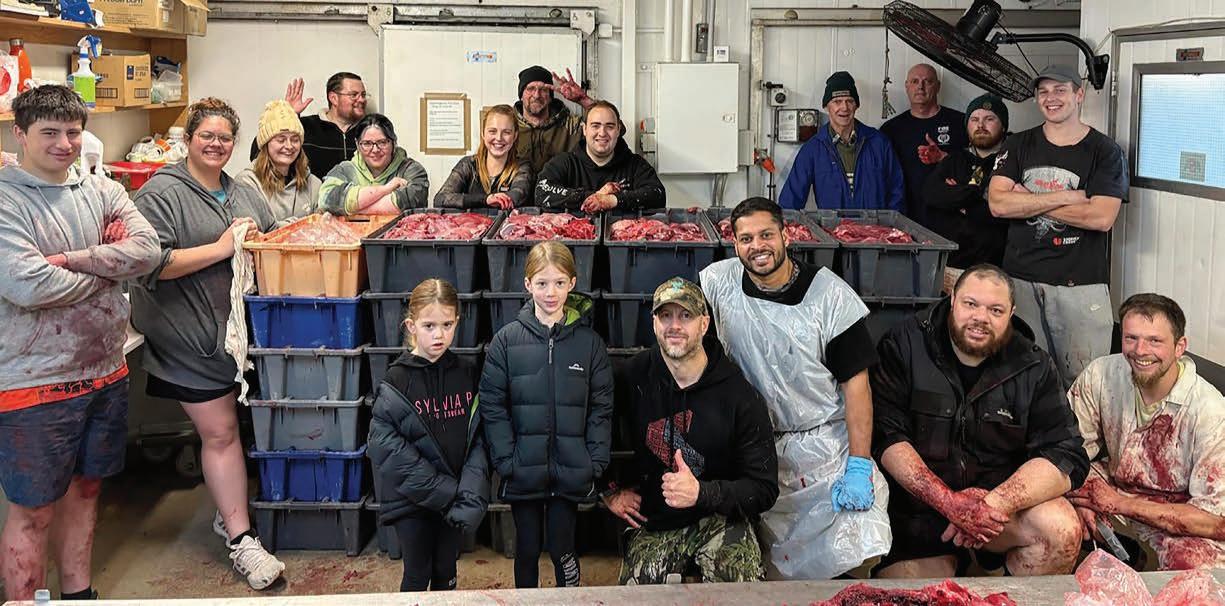
“Each animal removed both lessens browsing pressure on native flora and provides up to 30kg of organic protein.”
They also praised the group’s innovation and professional and strategic approach to their operations.
Baratcart told Farmer’s Weekly he was always aware that there was some food insecurity in Southland, but since beginning the initiative he had become aware of the sheer scale of the needs in the community.
“When you see parents who both
work full-time jobs but still can’t afford quality proteins, you realise that problems are bigger than most people know”.
This realisation changed their perspective.
The group started small, shooting maybe one deer per week. Now, they can get a few deer a week, with at least one of the three out hunting every evening.
Their success rate went up as they got access to more hunting blocks and farms backing onto Department of Conservation land, and because they began using
thermal vision to help them.
Baratcart said thermals are a game-changer and helps the trio do a lot of pest control for forestry.
As well as helping the environment, “with every deer we get we can put 200 meals on the table”.
The trio said the initiative would not be possible without the support of butcher Cory Orlowski from Mighty Meats in Invercargill.
Orlowski not only gives meat the food safety tick after inspecting it, but, at a minimal cost that covers only labour, he also skins the deer and processes them.
The trio are all full-time employed and having a butcher on board means much of the processing is handled by him, although they do as much skinning as they can, which makes Orlowski’s life easier.
They also rely on volunteers, with family and friends often coming to help process deer. Baratcart said they have had as many as 30 people skinning, boning and mincing at once.
“Without the volunteers, and without the people that go out of their way to help us, Deer to Care would never be anything. It’s not possible for Tim, Stu and myself to manage this alone.”
The group goes out of their way to connect with hunting competitions, saying deer shot for competitions are often not used.
They can get as many as 80 deer from a single competition.
With so many deer to handle, a lot of the meat is frozen and distributed at a later stage.
Baratcart said it took a long time to build relationships in the community, but the initiative is now well known.
They primarily donate meat to Women’s Refuge, the Salvation Army and Grey Power, but said they don’t turn away other organisations that are in need, and have nearly 50 charities that they donate meat to.
From tractors to chainsaws and everything in between. Get yourself or your team trained with Primary ITO’s hugely popular vehicle and machinery courses!
From tractors to chainsaws and ever Get yourself or your hugely popular vehicle and machiner
Bite-sized training options include:
Bite-sized training op
• Tractors
• Tractors
• 4WD on and off-road
• • Motorbikes
• Motorbikes
• LUV’s
• LUV’s
• Quad bike
• Quad bikes
• Chainsaws
• Chainsaws
Register your interest by scanning the QR code above
Learn more at primaryito.ac.nz/vehicles, call us on 0800 20 80 20 or email info@primaryito.ac.nz
Register your interest by scanning the QR c Learn more a on 0800 20 80 20 or email info@primaryit
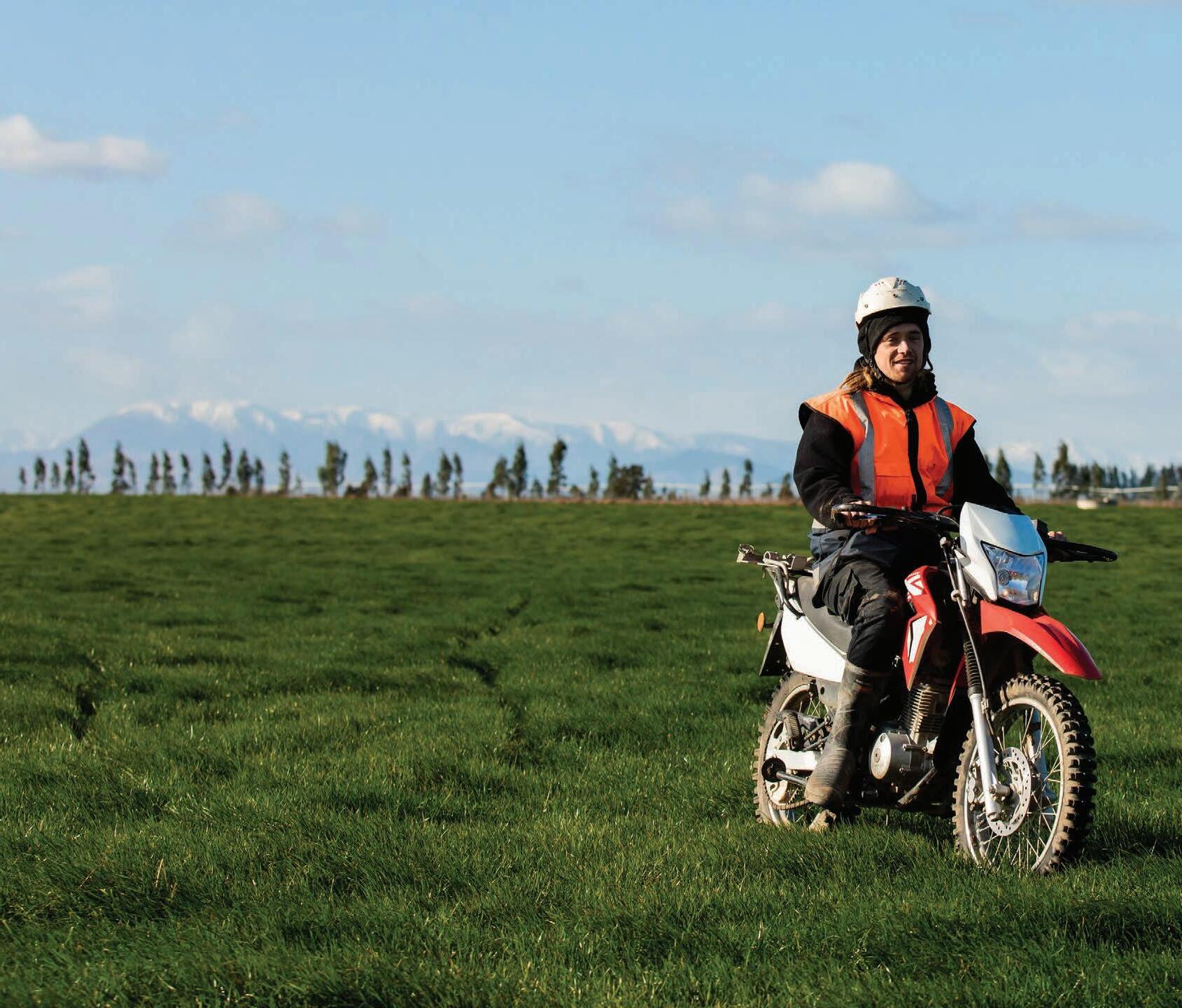
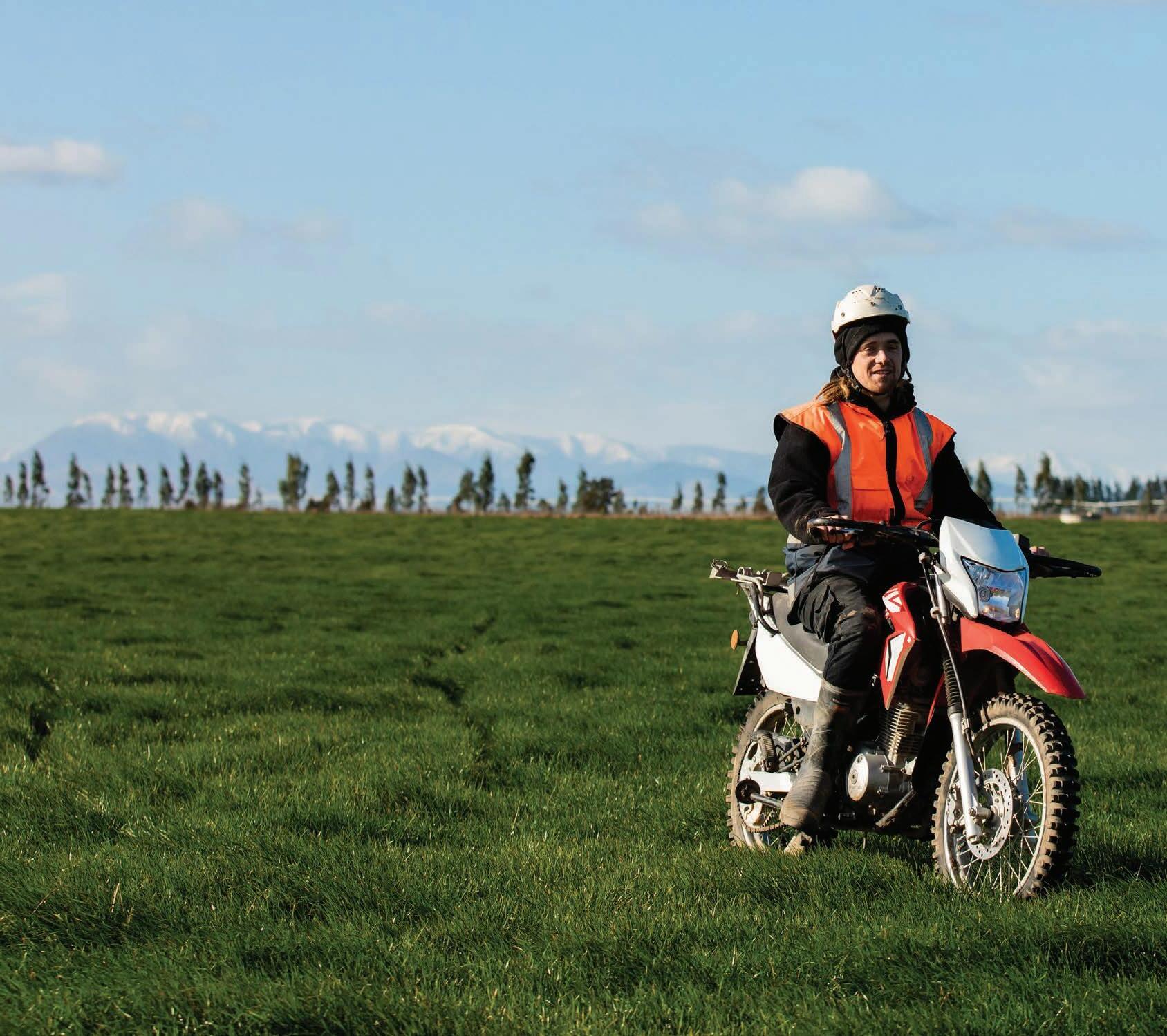

ederated Farmers is welcoming news that the Government will be taking urgent steps to end the spiralling consenting crisis that has been hammering farmers and rural communities.
“This is a really practical and pragmatic step from the Government that will be a relief for thousands of farming families,” says Federated Farmers vice president Colin Hurst.
“Consenting issues have been a hot topic in rural New Zealand, with a lot of people wondering how the transition to new resource management laws will work in practice.
“Farmers have been faced with huge costs and uncertainty, with consenting processes taking months – in some cases years. Quite rightly, they’ve been asking questions.
“Those questions have been answered with confirmation that almost all existing resource consents will be rolled over until the new resource management system is up and running,” Hurst says.
The Government has announced it will immediately roll over all resource consents for two years, with legislation expected to pass under urgency imminently.
A second bill will then ‘freeze’ all resource consents until new regional plans are in place, at which point farmers will have 24 months to apply for any consents they still require. Farmers will still have the same environmental conditions placed on them that their current
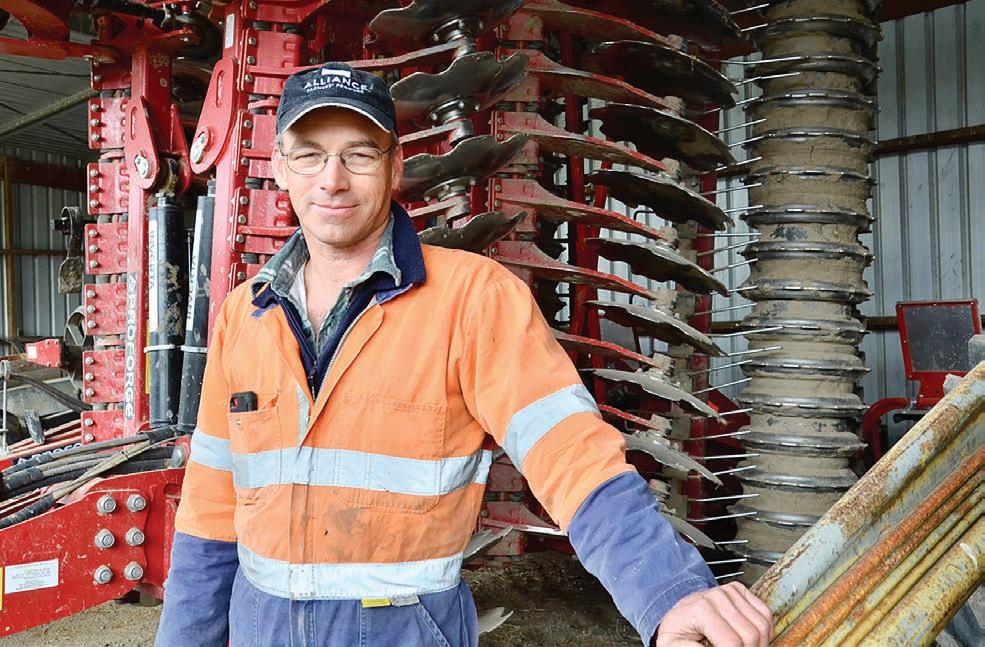
resource consent requires.
“Many farmers and growers will also have Farm Environment Plans, so the checks and balances will remain in place while the new system is stood up,” Hurst says.
A new transitional consenting regime will also be established from mid-2026 so new applicants can benefit from the incoming system, which is expected to be much simpler and lower cost.
“This is a huge win for common sense – but also for Federated Farmers’ grassroots advocacy on behalf of our members. We’re proud to have led the charge on this issue,” Hurst says.
“In early October we hosted a public meeting near Ashburton where hundreds of farmers completely filled a community hall to
voice their frustration on this issue.
“That meeting was the catalyst for Federated Farmers launching a campaign to end the consenting crisis, including an online petition signed by thousands of farmers.
“There is no doubt the coalition Government heard the message loud, and it’s fantastic they’ve moved so quickly and decisively to address farmers’ concerns.”
Hurst says in practice, most farmers won’t need to renew their resource consents for five or six years while the new system is stood up.
Mid Canterbury farmer David Clark is one of many who had anticipated a straight-forward renewal process for an expiring consent to farm.
Instead, he was buried in requests by Environment Canterbury for
CERTAINTY DELIVERED:
Canterbury farmer David Clark, one of many facing a long-winded and costly consent renewal process, says the Government’s consent rollover move is a fantastic outcome.
from farmers in similar situations to us.”
Clark believes the key to bringing real change has been farmers prepared to air their story.
“The RMA and the system of regional councils in this country is broken, and they did not stand the scrutiny of daylight.”
He says farmers will no longer need to waste money consenting under redundant legislation, but there are also adequate checks and balances in place to protect the environment until the new regulations are in place.
myriad reports and the potential for costs to blow out past $250,000.
He went public with his concerns, including on a Federated Farmers podcast.
“Federated Farmers has put in some excellent work on this, especially from vice president Colin Hurst, and it’s a fantastic result.
“What the Government has just announced is an unbelievably good outcome not just for farming but for other sectors across NZ,” Clark says.
“So many farming families have been locked into these long-winded and expensive adversarial consent processes, battling away under the radar and too intimidated to speak out.
“I’ve come under a bit of pressure from some quarters for speaking out but I’ve had tremendous support
New consent applications can still be made during the transition period. These will follow a transitional RMA process, which includes limits on the test for public notification and the scope of effects that can be considered.
“These changes will give farmers confidence to continue investing in their businesses and rural communities, instead of forcing them to tick boxes in a system that’s about to be scrapped.
“No one wins when farmers are forced to waste money on expensive and outdated consenting processes in a system that’s clearly not working for anyone.
“The Government’s announcement gives farmers certainty, reduces cost pressures, and keeps the focus where it should be – on good environmental outcomes, not paperwork.”
MORE:
See Federated Farmers’ campaign at www.consentingcrisis.nz

Release of the Natural Environment Bill and Planning Bill to replace the Resource Management Act is cause for real celebration in the agricultural sector, Federated Farmers says.
“The RMA is the single biggest handbrake on growing agricultural productivity and rural economies. It’s great to see its end come one step closer,” Federated Farmers resource management spokesperson Mark Hooper says.
“When farmers complain about expensive resource consents, unachievable freshwater targets, Te Mana o te Wai, and outstanding natural landscape overlays, these are all things that sit under the RMA legislation.
“Investment, farmer confidence and productivity have been strangled in red and green tape for far too long.”
The Government has this month released two new bills that, once passed into law, will replace the RMA.
“There is lots of good news in this package of law,” Hooper says.
“First of all, under the new law most farmers won’t need a resource consent. Simply by having
a Farm Plan they will be viewed as compliant with environmental regulations.
“This makes sense. Farm Plans can achieve much of the same environmental outcomes as a resource consent, without the need to fork out tens of thousands of dollars on expensive planners and lawyers.”
Investment, farmer confidence and productivity have been strangled in red and green tape for far too long.
Mark Hooper Federated Farmers resource management spokesperson
The Government has estimated their new laws will nearly halve the current number of consents on the nation’s farms.
“Secondly, where a farmer does need a resource consent, there will be a much, much higher bar for these to be notified, which means they’re not opened up for submissions from others.
“When a consent is notified, farmers have to pay for the expensive hearing. This notification cost is what drives consent costs from the tens of thousands of dollars into the hundreds of thousands.”
In addition, there should be far fewer instances of when consultation with iwi on individual resource consents is needed.
Cultural impacts will be assessed when environmental limits are set, meaning the need to assess cultural impacts on every resource consent - sometimes from multiple iwi and hapū - should be a thing of the past.
“The days of farmers effectively having large chunks of their farm confiscated in the form of an SNA - Significant Natural Area, ONLOutstanding Natural Landscape, or SASM - Sites and Areas of Significance to Māori, are also likely to be severely curtailed.”
Where a council effectively confiscates a large part of a farm, there is a requirement to offer relief to the landowner – that could be in the form of payment, rates relief, land swaps or extra development rights.
This will mean this practice is much rarer, and when it does happen,
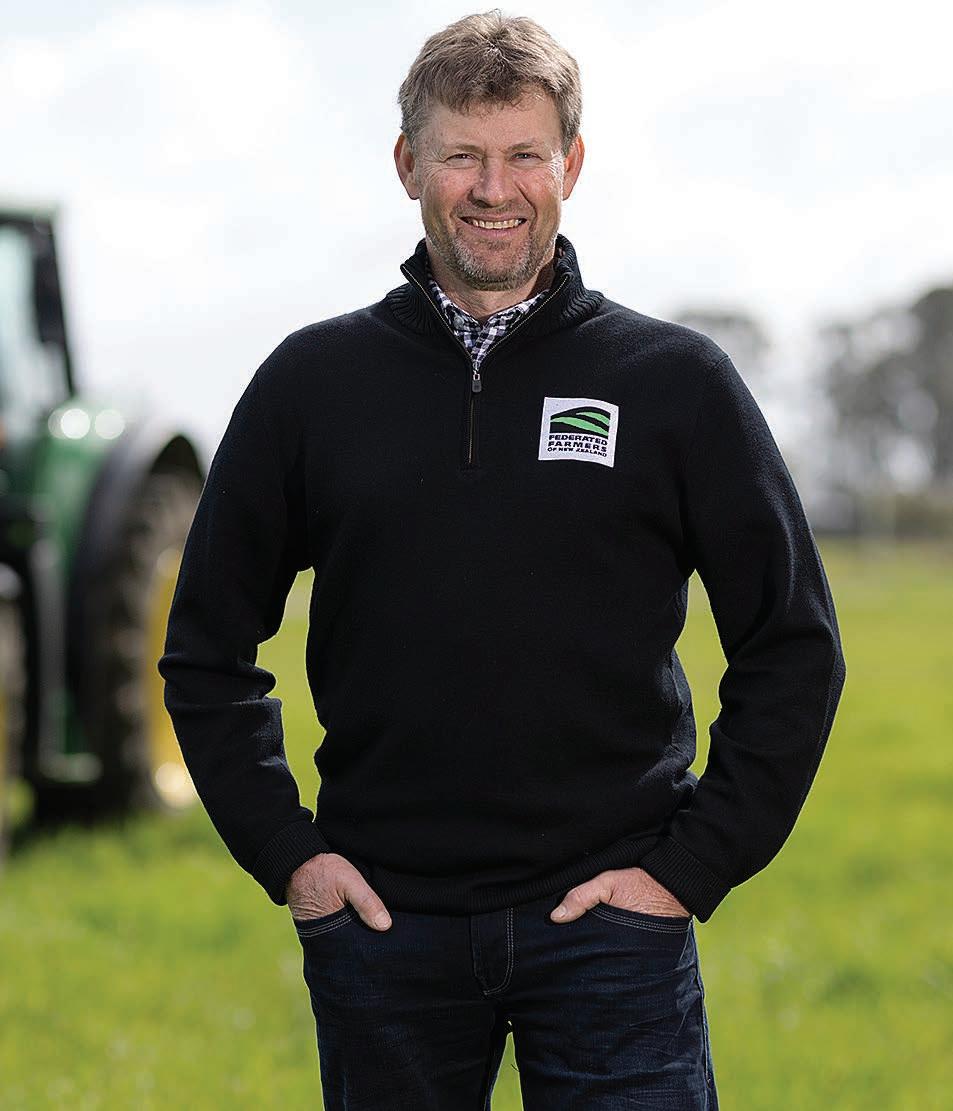
farmers are fairly compensated, Hooper says.
“Federated Farmers will take time to read through the 700 odd pages of legislation and there will be a few areas where we think further work is needed.
REDUCED: The Government has estimated their new laws will nearly halve the current number of consents on the nation’s farms.
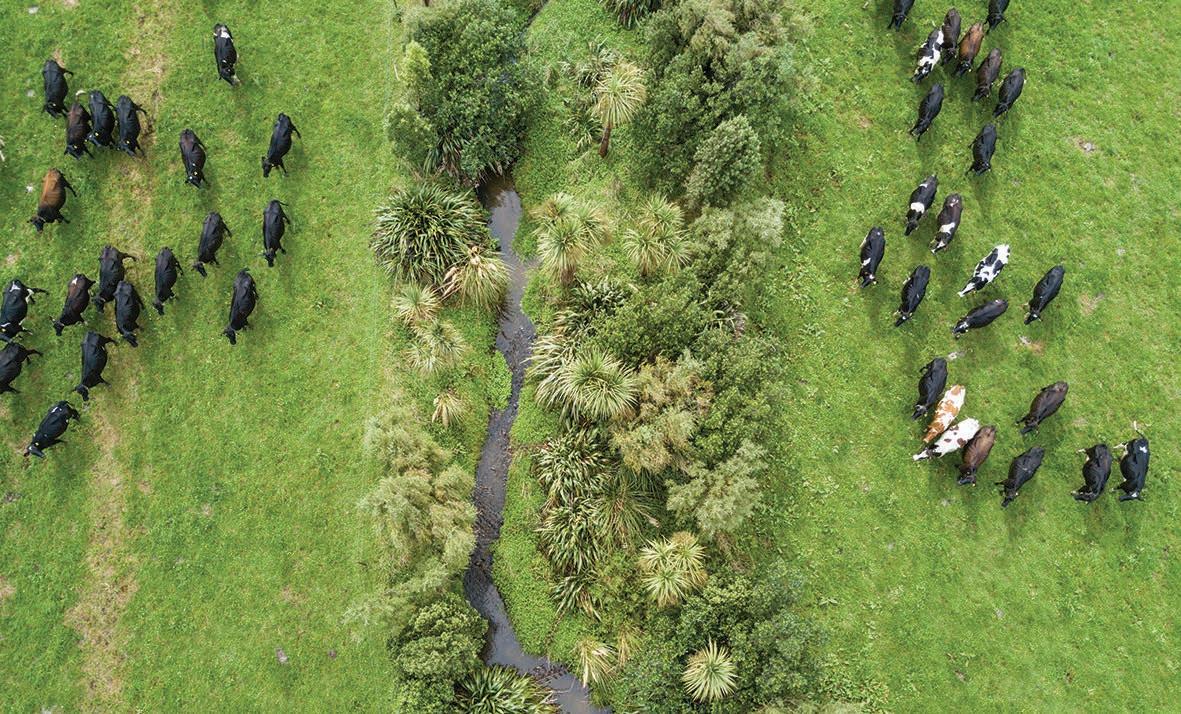
“This is partly what Select Committee is for - to iron out inconsistencies and problem clauses.
“We think the increase in fines and the restrictions on the use of insurance to cover for a breach of resource management rules haven’t struck the right balance in the draft legislation.
“This needs to have more nuance so that when harm is done accidentally, for example an effluent system fails due to poor engineering, this is recognised in the regime.
“Restrictions on the ability to insure against fines should only apply where farmers are wilfully negligent.”
Federated Farmers is also worried
about proposals to allow trading of natural resources, such as nutrient loss or even freshwater.
“It’s near impossible to measure the nitrogen coming off a farm and the Overseer model in particular has been thoroughly criticised for its use in regulation.
“When you can’t even accurately measure nitrogen it’s very hard to trade it.”
The difficulties involved in creating a property right for freshwater are well-known, Hooper says.
“Freshwater falls from the sky and isn’t able to be owned or sold.
“On balance, we think these two bills are a major step forward for New Zealand and will dramatically improve the productivity of farming in New Zealand.
“We will work with the Government over the coming months to address any concerns we have in the laws and look forward to the day the RMA is consigned to the dust bin.”

Pine trees and deer might stir up warm feelings of festive joy for many Kiwis, but for farmers they represent mostly cost, destruction and heartache.
That’s why Federated Farmers has launched a new campaign, swapping ‘The Twelve Days of Christmas’ for ‘The Twelve Pests of Christmas’ to highlight the most troublesome farm pests.
Richard Dawkins, Federated Farmers’ spokesperson on pest issues, says the campaign is about raising awareness of New Zealand’s growing pest problem and hopefully spurring some action.
“Sure, we’re taking a cheeky and playful tone with our messaging, but this is a serious issue that needs some urgent attention from the Beehive.
“These pests and weeds aren’t just a minor nuisance; they’re an
economic and environmental crisis causing serious problems for farmers and conservationists.
“They’re spreading disease, destroying native forests, killing native birds, chewing through farmer’s pasture, and in some cases eating newborn lambs - it’s absolutely devastating.”
To highlight the problem,
Federated Farmers has booked a large digital billboard outside the Beehive and will feature a new pest each day in the lead-up to Christmas.
“Unfortunately, these pests are out of sight and out of mind for most New Zealanders, running rampant through farms and forests, not cities and suburbs,” Dawkins says.
“That’s why we wanted to put them up in bright lights in central Wellington - to make politicians and the public really sit up and take notice.”
Dawkins says New Zealand’s pest

problem is getting worse by the day, and we need a coordinated national pest management plan to protect our farms, forests and biodiversity.
“Pests are costing farmers hundreds of millions of dollars every year in lost pasture, damaged fences and stock losses - but there is a large cost to indigenous biodiversity too.
“And the problem is only getting worse. New Zealand’s pest control systems are severely underfunded and too fragmented to do the job properly.
“Responsibility is scattered across DOC, regional councils, MPI,
On the first day of Christmas, my neighbour sent to me: bush pigs rooting in the field
On the second day of Christmas, my neighbour sent to me: 2 wall-a-bies
On the third day of Christmas, my neighbour sent to me: 3 wild deer
On the fourth day of Christmas, my neighbour sent to me: 4 kill-er cats
On the fifth day of Christmas, my neighbour sent to me: FIVE WILD-ING PINES!
On the sixth day of Christmas, my neighbour sent to me: 6 chewing goats
On the seventh day of Christmas, my neighbour sent to me: 7 T-B possums
On the eighth day of Christmas, my neighbour sent to me: 8 rab-bits breed-ing
On the ninth day of Christmas, my neighbour sent to me: 9 Can-a-da geese
On the tenth day of Christmas, my neighbour sent to me: 10 ducks de-stroy-ing
On the eleventh day of Christmas, my neighbour sent to me: 11 koi carp swir-ling
On the twelfth day of Christmas, my neighbour sent to me: 12 rats a-gnaw-ing

OSPRI and others, but there is no single lead agency with overall responsibility - so we keep going backwards.
“We’re calling for a national pest strategy that unites all the main players under one co-ordinated plan covering all species and land tenures.”
Dawkins says most urban New Zealanders would be horrified if they saw the true scale of the pest problem facing farmers and conservationists.
“For example, I’m well aware of many farmers - like those in the Lawrence area of Otago - who are losing large numbers of newborn lambs to feral pigs coming out of forestry blocks.
“These farmers are heading out during lambing season to find their paddocks strewn with the pickedclean carcasses of dead lambs. It’s terrible stuff.”
And pigs are just one of the 12 pests robbing farming families of Christmas joy.
Other pests on Federated Farmers’ naughty list include wilding pines, possums, feral deer, feral goats, wild cats, wallabies, rabbits, and Canada Geese.
Dawkins says he hopes the ‘The Twelve Pests of Christmas’
NAUGHTY LIST:
The pests billboard near the Beehive in Wellington. The Federated Farmers’ 12 pests aren’t just giving farmers a very un-merry Christmas – they’re killing the mood all-year long.
campaign will spark some serious conversations about the issue.
“If we can get everyday New Zealanders talking about our national pest problem as they stand around a barbeque drinking a beer this summer, then we’ve done our job.
New Zealand’s pest control systems are severely underfunded and too fragmented to do the job properly.
Richard Dawkins Federated Farmers pest control spokesperson
“And if we can get Ministers talking about the issue around the Cabinet table, that’s even better, because they’re who we need to step up and sort this out.
“Farmers are doing their bittrapping, shooting, poisoning, fencing, clearing, monitoring, you name it - but this can’t be solved farm by farm.
“A national problem of this scale requires a national solution - but that will require much more coordination, funding and leadership.”
Farmers tackled the Prime Minister with tough questions about wilding pines, water storage and the future of their local councils at Federated Farmers meetings this month.
Hundreds of farmers turned out to events in Otago, Hawke’s Bay and Waikato to hear from Christopher Luxon and get their concerns firmly on his radar.
Federated Farmers president Wayne Langford says they didn’t hold back with their questions.
“One farmer said to me afterwards that it’s not in every country where people can get face-to-face with the Prime Minister, stick up their hand and get their question answered.
“We appreciate the way this coalition Government has clearly been listening to farming and rural voices – but there’s always more progress to be made.”
At Hastings, carbon forestry, water access restrictions and the regional council’s TANK plan were front of mind.
At Mystery Creek, Waikato farmers highlighted the significant impact Plan Change 1 (PC1) will have on local farms and the economy.
Other issues raised included wilding pines, climate policy,
consenting delays, local government reform, and the challenges of the broken Resource Management Act.
It was a clear reminder of the dayto-day hurdles farmers face.
We’ve got our job to do, which is to get Wellington out of farming, out of primary industries, so that you can crack on and do it.
Christopher Luxon Prime Minister
Luxon said he’s appreciated the regular farmer meetings Federated Farmers has organised with senior politicians over the last few years.
“When I’m sitting down in that round building in Wellington, I get hit with a bunch of thoughts from a lot of people in the bureaucracy,”
Luxon said.
“But I’ve always been a big believer in getting to the frontline, getting past the people that try to get in between you and me, and to hear it straight from you.
“It helps us keep a pragmatic perspective and not creating more bureaucracy that stops you doing what you need to do.”
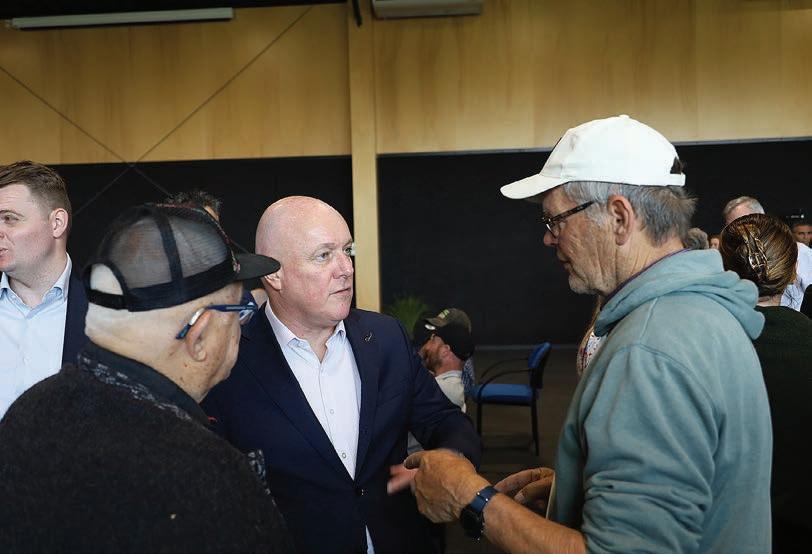
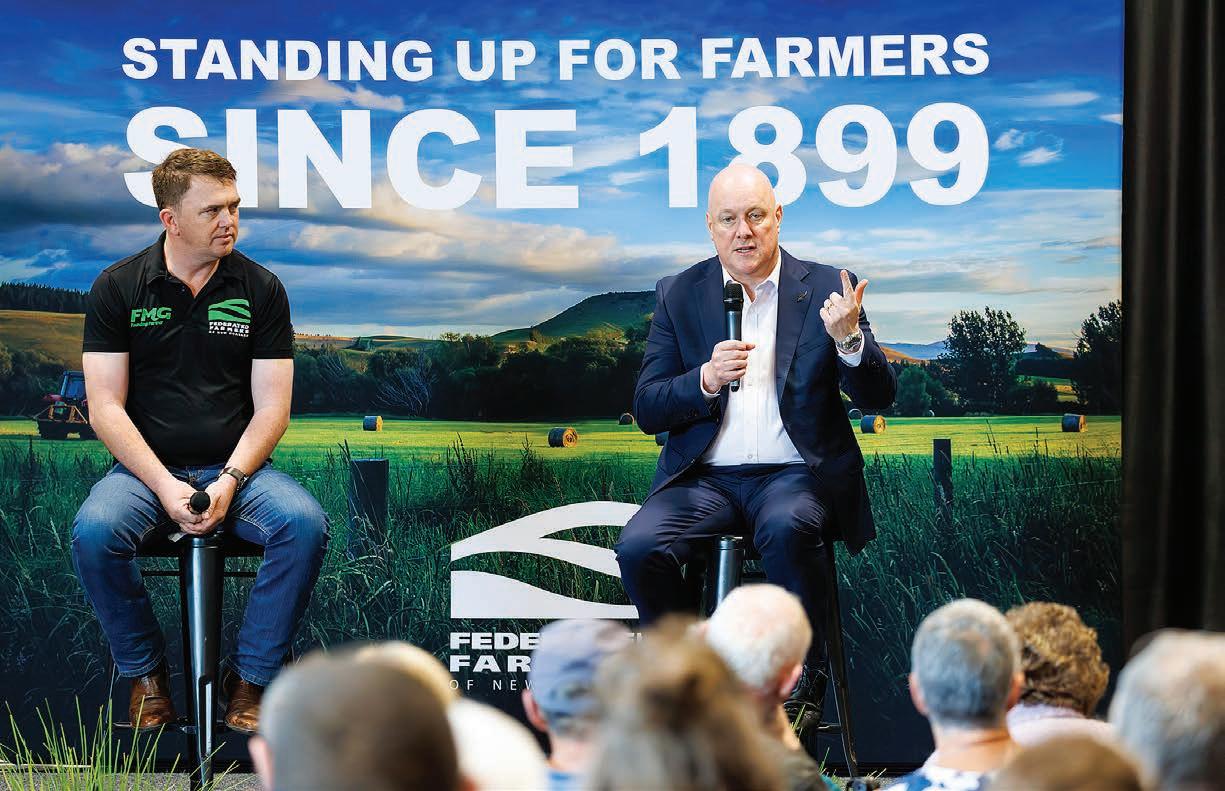
The Prime Minister was quick to acknowledge the huge contribution farmers make to the New Zealand economy.
“We’ve got our job to do, which is to get Wellington out of farming, out of primary industries, so that you can crack on and do it.
“You’re spending 25-30% of your week doing paperwork compliance for a district council, regional council and central government –and we’re going to work to cut that back.”
He referred to Federated Farmers’ 12 policy priorities released before the last election, and the progress his Government has made on meeting those.
“We’ll have a new list for you next year,” Landford assured him.
Facing questions in Hastings on the regional council’s TANK plan and restrictions on stock water access, and at Mystery Creek on Plan Change 1, Luxon suggested councils pursuing these and similar
plans should put them on the “slow burn”.
“Just hold fire, and have a cup of tea. Let the new resource management legislation come in, and the new national standards on freshwater.”
His advice to councils was to make sure what’s proposed in their plans is compatible with this new direction.
“The context of resource planning is about to change in a very good way,” he said, referring to the Government’s release of the Natural Environment Bill and Planning Bill a few days later.
At both meetings, farmers raised concerns about the march of wilding pines across farmed and conservation landscapes – and not just in the South Island.
“Somewhere, we dropped the ball on wilding pines,” Luxon told the Mystery Creek meeting.
“We need to put more money into the system.
“We’ve got fantastic community
volunteers and they’ve been doing some great work across the country.”
Luxon has clearly also heard Federated Farmers’s call for a return of low-impact grazing to Crown land that, since being retired from farming, has seen wilding pines spread.
“I’ve asked Ministers to look very quickly at that. We need to get livestock on some of those properties.”
He said water storage projects in Northland and Nelson have boosted security of supply not just for urban areas but for food production.
“They’re projects that, for me, are of national and regional significance, and so they should be fast-tracked.
“We’ve got to make water storage much more permissible and find a funding structure that supports uptake.”
This is the second year Federated Farmers has held public meetings with the Prime Minister, with last year’s events proving popular too.

C


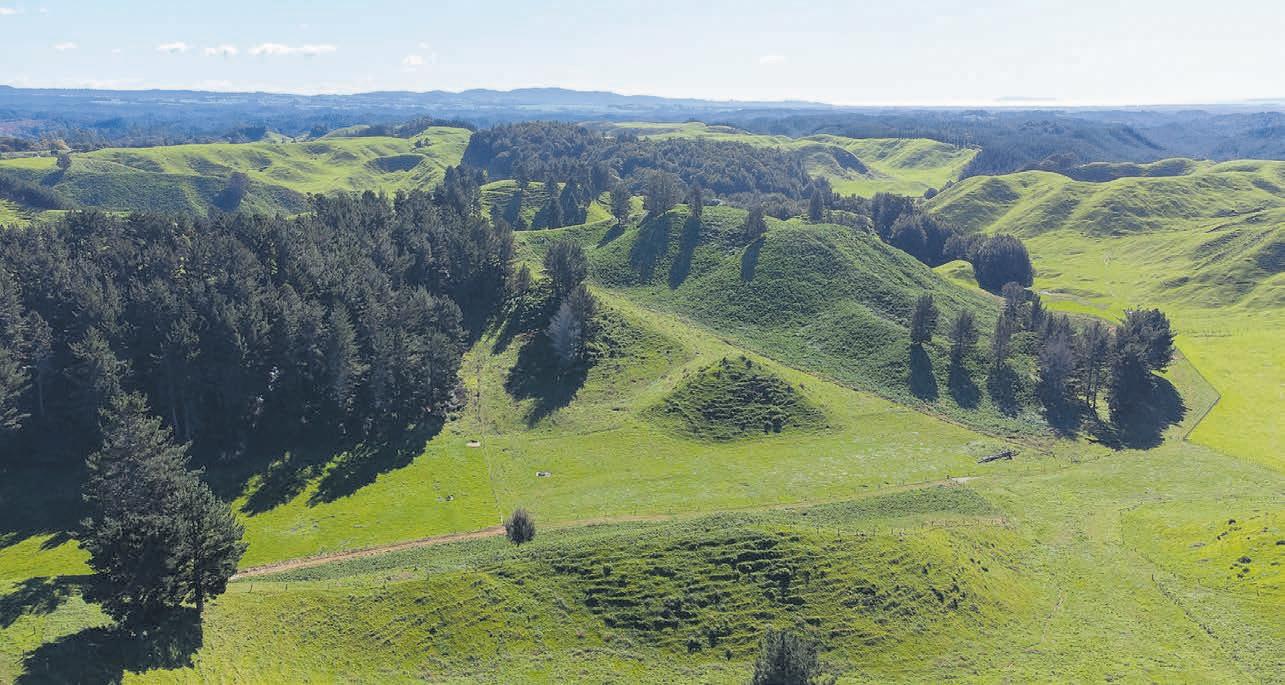
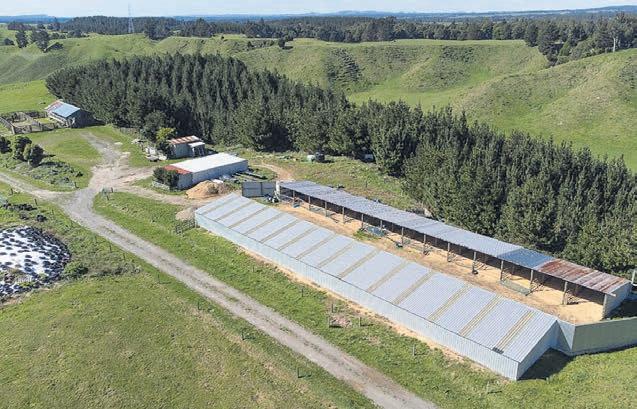
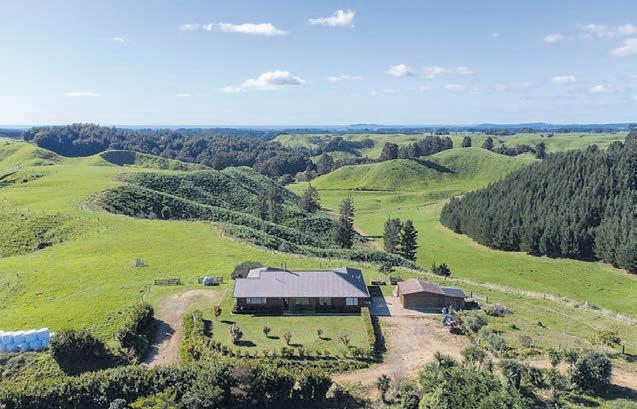

4
2 2
165.3 ha
Comprising 165.3 hectares this well-established property was originally developed for dairy conversion and has since operated as an efficient dairy support unit. It comfortably winters 600–800 dairy cows along with 120 young stock, and produces approximately 25 hectares of winter crop annually The effective farming area totals 145 4 hectares with the remainder in forestry blocks
The land offers mixed contour with extensive mowable areas A well-formed metal race system provides excellent access to 51 well-fenced paddocks with strong pasture growth Fencing is primarily three-wire electric and water is supplied from a reliable farm bore via a 40mm ring main with storage tanks
Infrastructure includes two substantial calf sheds for up to 280 calves partly enclosed stock yards an implement and storage shed, and a new three-bay shed for machinery The modern family home built in 2013, features open-plan living, four bedrooms, double garaging and superb rural vistas just 25 minutes from Rotorua
FOR SALE: Price By Negotiation, plus GST (if any)
VIEW: nzsothebysrealty com/RORU00163
ALAN DUNCAN: M +64 27 478 6393 alan.duncan@nzsir com
SHONA DUNCAN: M +64 27 496 8107 shona duncan@nzsir com
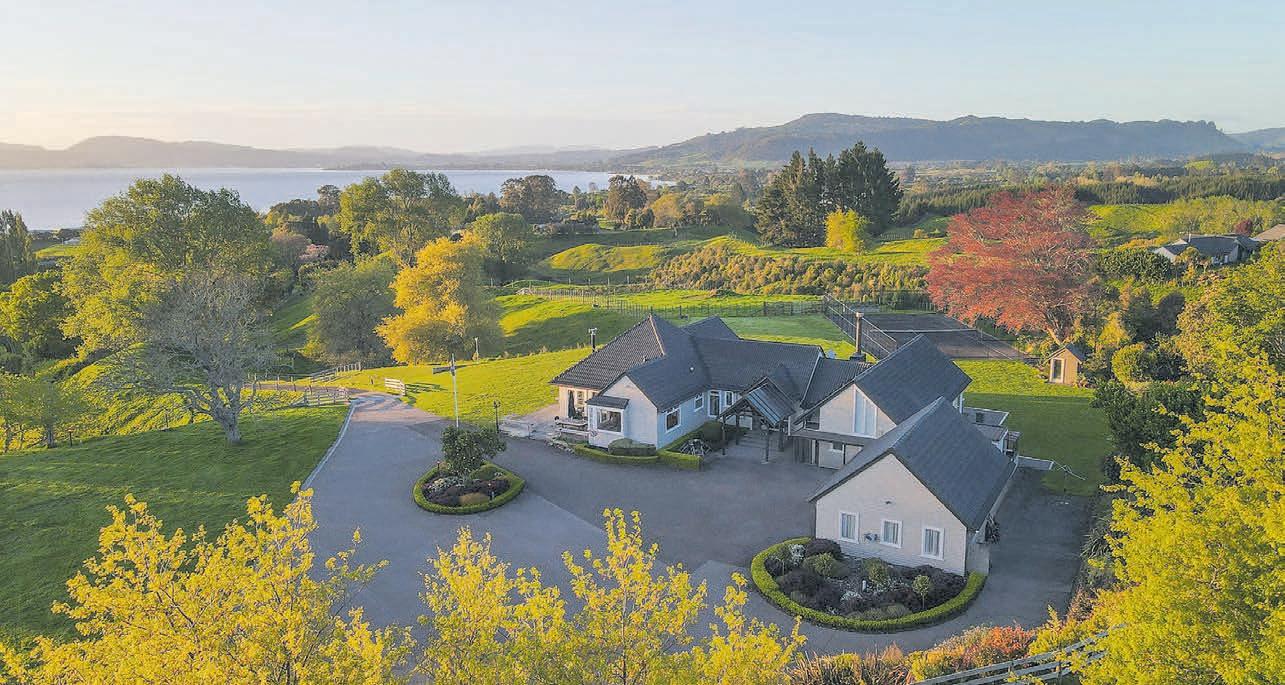
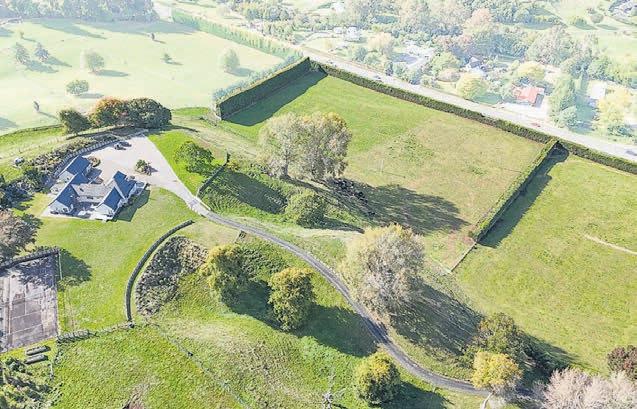
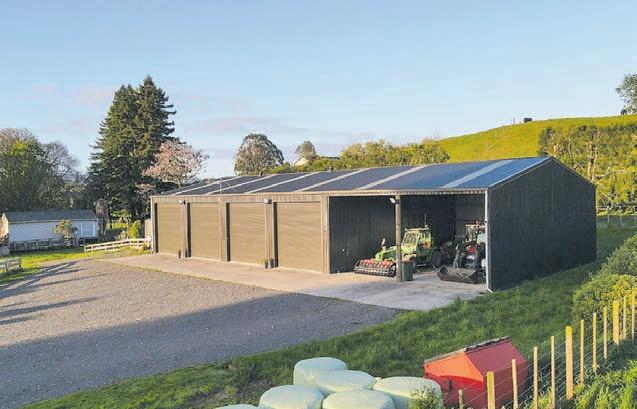
ha
There’s a unique feeling that comes with a truly special property From its elevated 23.2 ha position, this estate captures sweeping views over Lake Rotorua, Mokoia Island and Mount Tarawera. Rolling countryside meets deep tranquillity creating a place to pause and imagine your next chapter
At its heart is a beautifully updated homestead designed for modern family life Open-plan living links the countrystyle kitchen, dining and family room, all opening to a sun-filled deck with lake views Caesarstone benchtops, a walk-in pantry and French doors enhance everyday ease
A separate lodge-style lounge with raked ceiling and open fire offers a space to gather or retreat
The master suite includes a walk-through wardrobe and tiled ensuite Additional bedrooms and bathrooms provide flexibility while a fourth bedroom serves as an office Outside a double garage tennis court, sweeping lawns and specimen trees complement the setting. Quality infrastructure includes a six-bay shed, outbuildings and a private bore
FOR SALE: Expressions of Interest VIEW: nzsothebysrealty com/RORE01710
SHONA DUNCAN: M +64 27 496 8107 shona duncan@nzsir com
ALAN DUNCAN: M +64 27 478 6393 alan.duncan@nzsir com
This is our last rural property editorial for this calendar year, and it’s been a big year. Activity through spring and early summer has set new benchmarks and reshaped expectations for what lies ahead in 2026.
While commodity markets appear to be giving back some of the record momentum of late, there is no doubt that, economically, our export-led recovery has food production firmly back in the national interest. It always was. The dramatic shift in interest rate settings year on year has assisted our primary sector and helped rebuild confidence in support of a growth mindset.
There has also been a significant shift in policy settings out of Wellington this year, with the regulation of large-scale “pasture to forestry” land conversions. This has levelled the playing field in favour of pastoral farming, enabling farmers to compete for growth opportunities and consider their own land-use management options. The full impact of this regulatory change has yet to play through, given the moratorium in force this year under the previous settings. In addition, Hill Country farmers are yet to have the benefit of a full financial year under the improved commodity outlook. In our view, a more regulated forestry market, materially improved interest rates, and confidence in the forward commodity cycle will continue to underpin the Hill Country market in 2026.
In reviewing the season with our senior rural property team, it’s clear the market is now operating across three levels: regional, national, and international. On behalf of our vendors we have experienced a record year, with all three buyer groups contributing to this performance.
Having recently returned from a trip across the Tasman and meetings with international fund managers in Melbourne, there is no doubt that direct foreign investment in New Zealand agribusiness is back on the agenda. However, New Zealand buyers, both regionally and nationally, continue to hold a strong competitive advantage through proven capability and business acumen at scale without any of the uncertainty associated with Overseas Investment Office conditional agreement. The consistent theme across all buyer interest is confidence: confidence to invest, to grow, and to progress strategies, with the business case for dairy looking very favourable on current valuations.
This spring saw the first going-concern dairy enterprise sale to an international fund manager in recent years. This marks a turning point, given that since December 2017, international buyers seeking a controlling interest in New Zealand dairy farm businesses have been largely excluded from the market. The purchaser of these South Otago farms met the Overseas Investment Office benefit-to-New-Zealand test on the strength of proposed irrigation development underpinning future production potential, along with the operation being managed and leased by a New Zealand company. This landmark dairy transaction also attracted strong regional and national buyer interest but ultimately succeeded on the merits of the approved business case and anticipated employment outcomes.
This season marked one of the most decisive periods the rural property market has seen in recent years.”
This season has also been characterised by a dominant theme of “once-in-a-generation” farming portfolios being brought to market. Historically, particularly within dairy the market has struggled to accommodate large-scale offerings due to the quantum of capital required and the cost of finance, which have long been the primary constraints. The exclusion of international buyer interest over the past eight years has also been a defining factor.

While the all-in costs of owning and operating large-scale dairy assets have not materially changed, confidence to secure funding and investment partnerships has. As a result, we continue to bring forward some outstanding New Zealand dairy assets this season, with early 2026 seeing this trend continue through the marketing of a portfolio of high-quality dairy properties in the Manawatū.
In summary, the outlook heading into 2026 reflects a markedly improved and more balanced operating environment in support of food production Forestry is moving toward a more regulated framework supporting Hill Country land use; dairying at scale now has broader and more flexible ownership pathways available; and horticulture and viticulture continue to attract domestic and international investor interest, despite current headwinds within viticulture.
If there was ever a year to reassess business growth opportunities as New Zealand moves beyond this recessionary period, owning productive land remains a strong place to start. We thank our vendors for the confidence and trust they have placed in us to successfully market their properties this season and we look forward to 2026 and the opportunities ahead to build on this momentum.
Whether you are looking to buy or sell your farm or lifestyle property, our True Team is here to exceed your expectations. With the right balance of experience, energy, and local insight on your side, you can move forward with confidence alongside Property Brokers. Call
Conrad Wilkshire, GM Rural for Property Brokers Ltd
Scan to tune in to the latest Land & Lifestyle Market Insights podcast powered by The Country
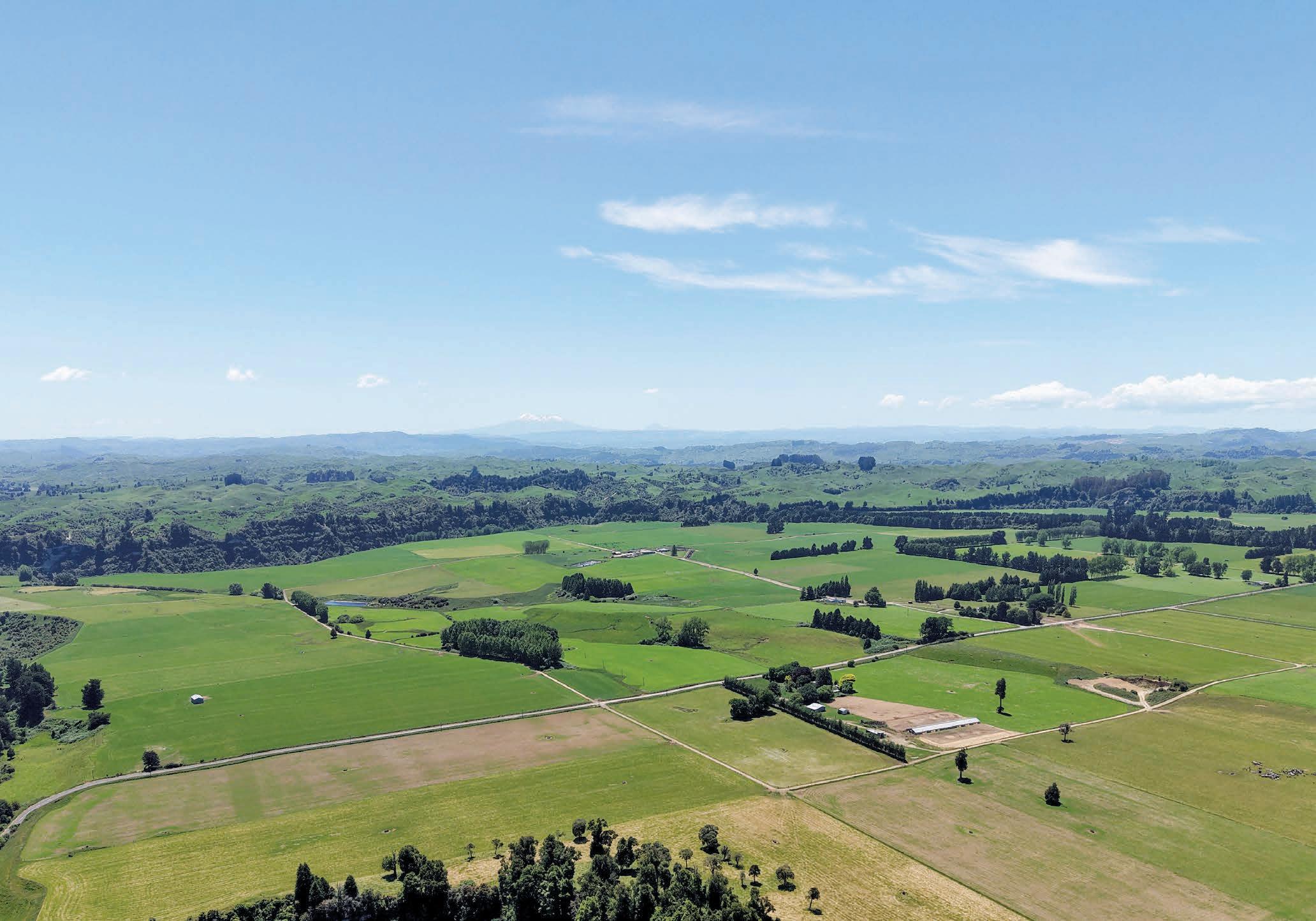

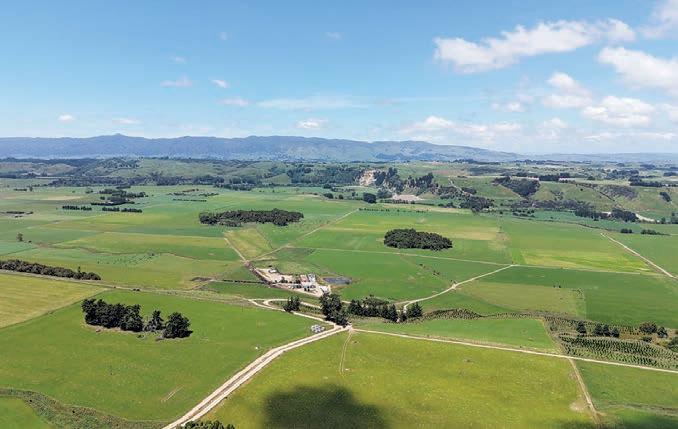
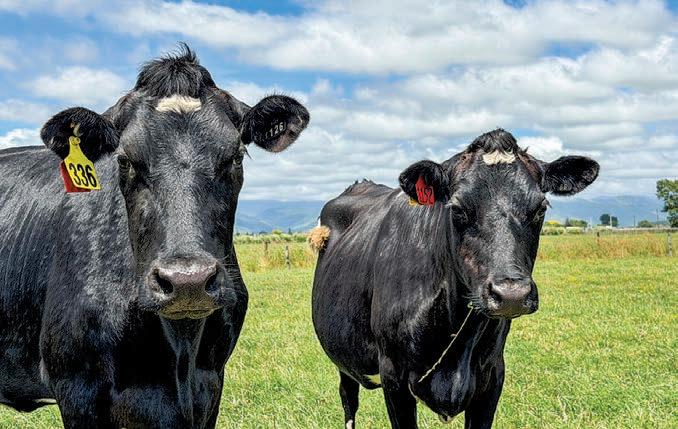
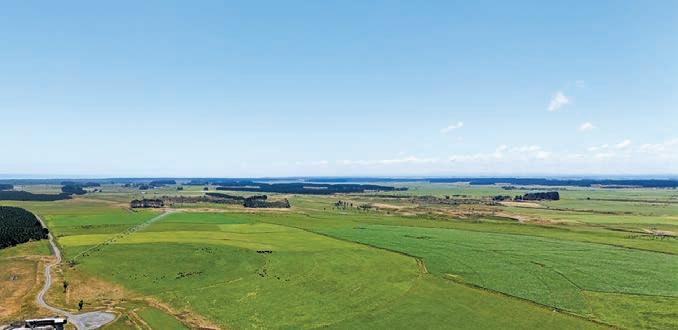


This is a generational opportunity to acquire one of New Zealand’s leading large-scale dairy operations
– a business running 5,250 cows, producing 2,288,760 milk solids across 2,134 hectares.
A fully integrated, medium-input, grass-based system, this business is built around six high-performing dairy farms – Blythe, Grandbend, Te Marama, Tokomaru, Tollbridge and Waihora, supported by the Tahuna drystock unit.
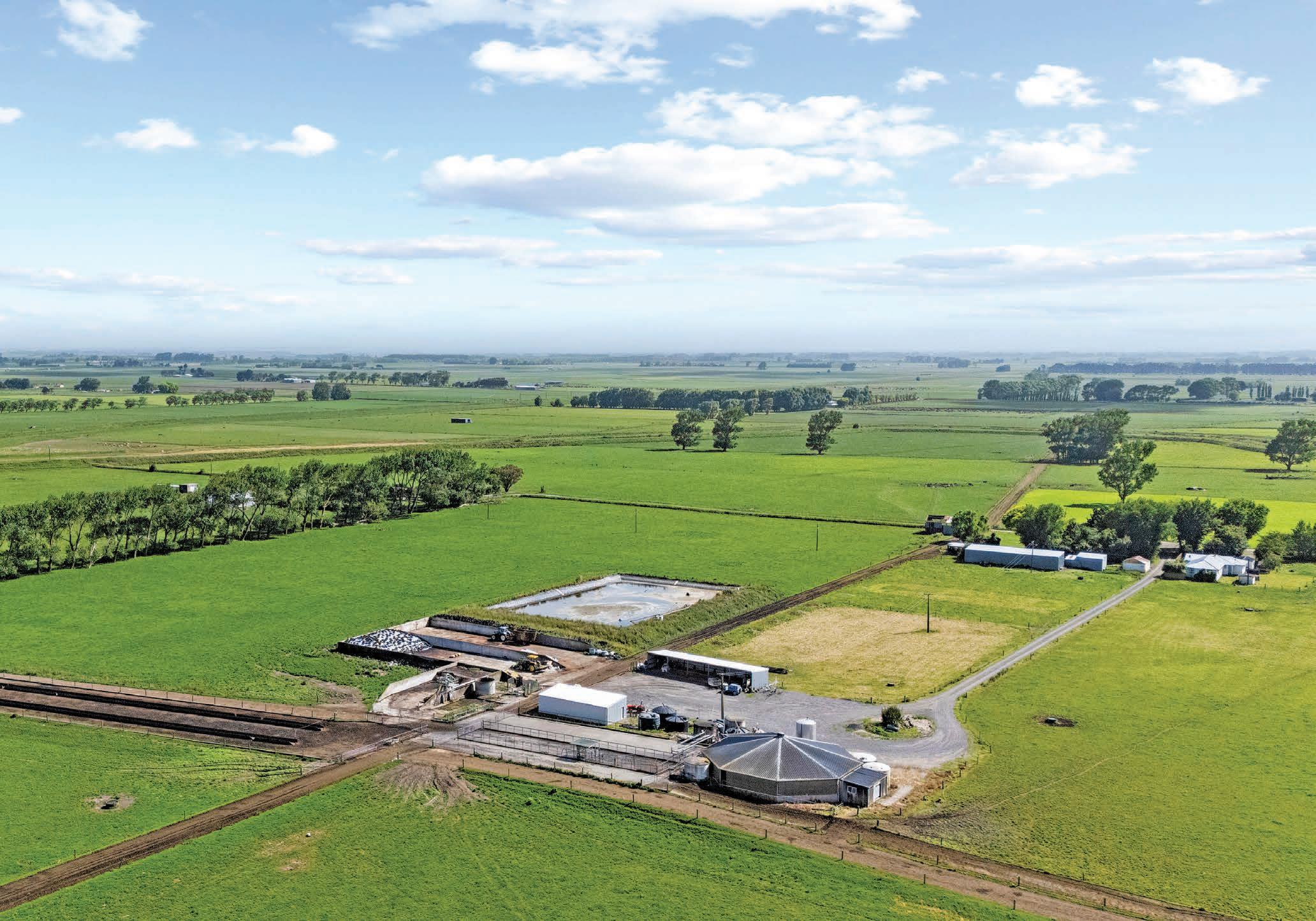

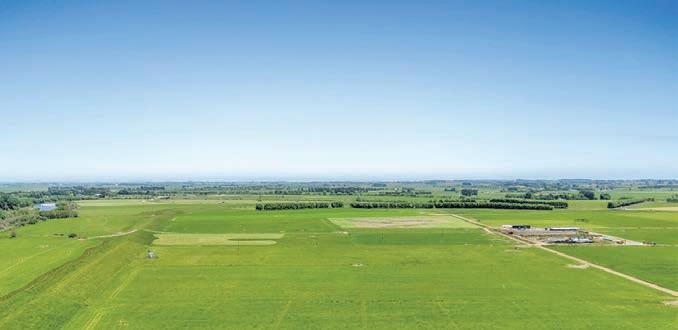





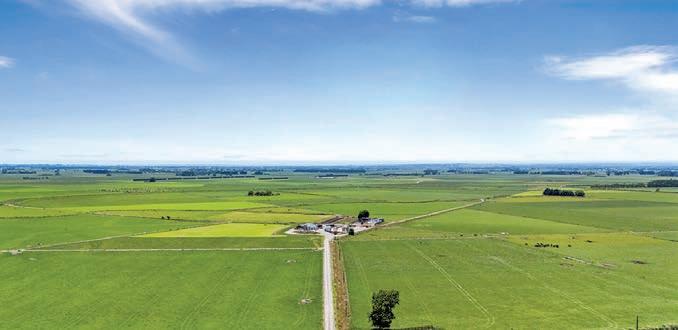
Strategically located across the wider Manawatū and Rangitīkei, the portfolio offers strong environmental attributes, proven output, and substantial development upside. The operation is largely self-contained, delivering total control inside the farm gate.
It is run by a highly capable and stable team, with 33+ staff and a full operating management Many of the employees have long tenure, and the management structure is already in place for a seamless transition. Infrastructure development plans have been prepared to further enhance ease of management, support staff retention, and lift on-farm performance – providing new owners with a clear pathway to future growth. This is a business that ranks its performance into the top 20% profitability. The properties are offered for sale either in their entirety as a complete large-scale operation, as clusters, or individually, and are initially being marketed through non-binding expressions of interest.
A rare chance to secure scale, performance, and potential – a once-in-a-generation farming opportunity.
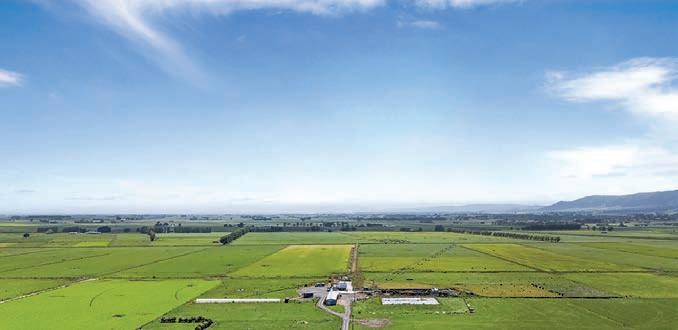

Tender Non-binding expressions of interest by Wednesday 25th February, 2026
View By appointment Web pb.co.nz/FR218384


Blair Cottrill M 027 354 5419 E blair@pb.co.nz
Ted Shannon M 021 833 536 E ted.shannon@pb.co.nz
Deadline Sale
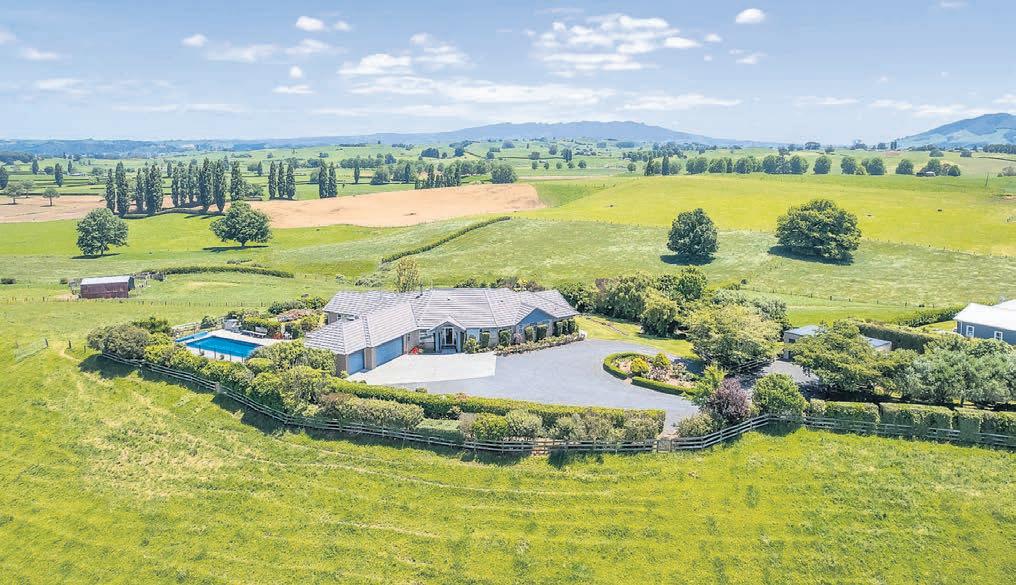



Executive living above, truffle gold beneath A masterclass in rural refinement this five-bedroom residence delivers executive comfort with a rare agribusiness twist. Set in the heart of Kio Kio's coveted countryside, it offers a lifestyle of ease, elegance, and income. The home: Elevated living, inside and out: From the moment you step inside, high-stud ceilings and panoramic rural vistas create a sense of space and serenity Two generous lounges and a high-spec kitchen with butler's pantry cater to both everyday living and effortless entertaining. The home offers five bedrooms, two with ensuites and a well-appointed family bathroom, with a separate toilet plus an additional toilet for convenience.

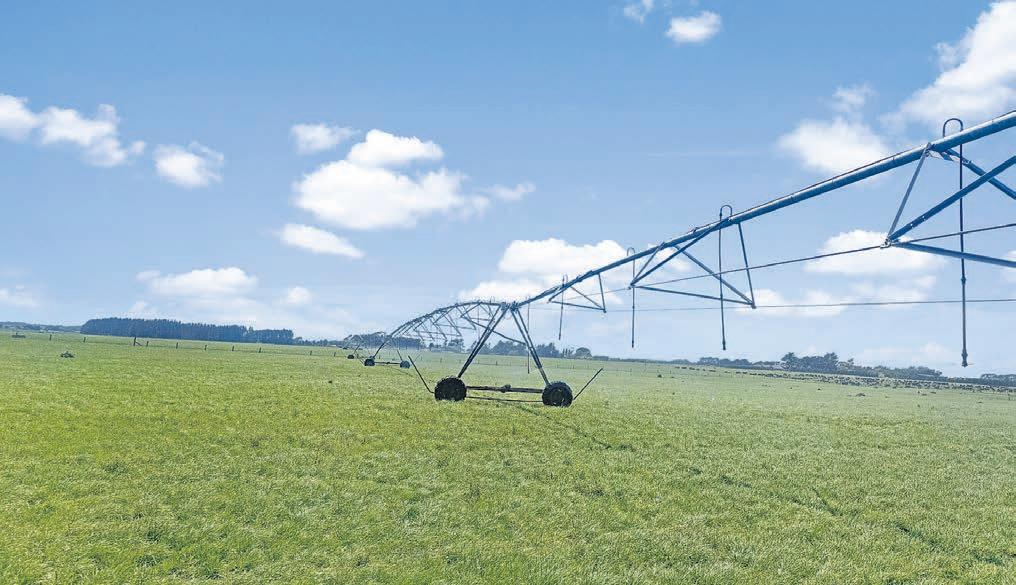
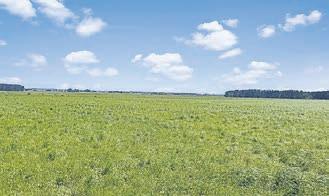
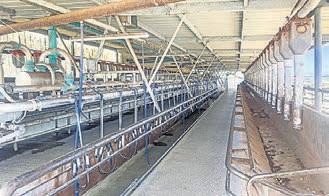
Reliable production
Located minutes from Sanson, 92 Speedy Road is a highly productive dairy unit combining scale, reliability of production and the benefit of additional cash flow from adjoining lease land. The 253 ha freehold, plus 150 ha of lease (50 ha milking platform and 100 ha support) currently peak-milks 950 cows and the property is well supported by two herringbone sheds (32 aside and 36 aside), standoff pads silage pads and two centre pivots that cover approximately 150 ha. The entire area is flat in contour, well serviced by a central race system, has excellent bore stock water a strong fertiliser history, modern pasture species, plus four dwellings.


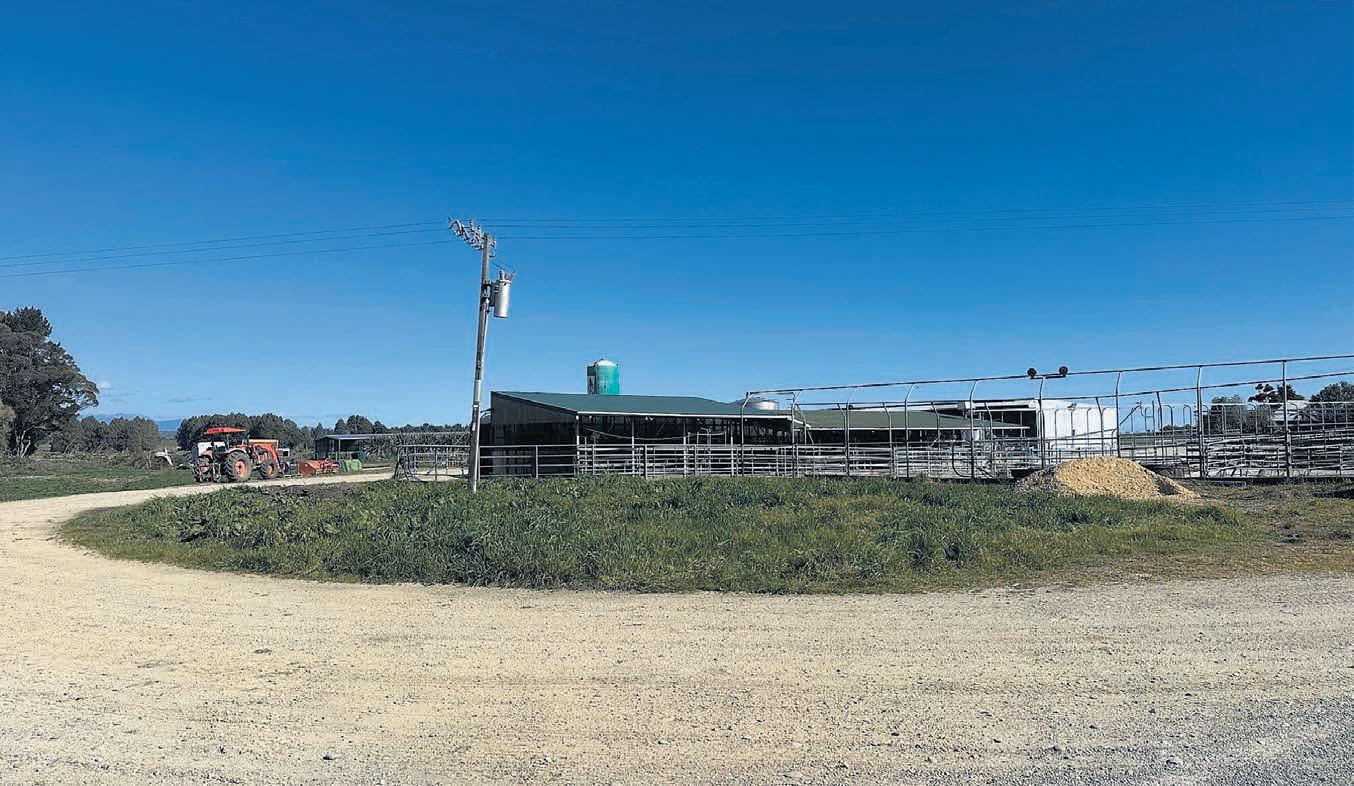
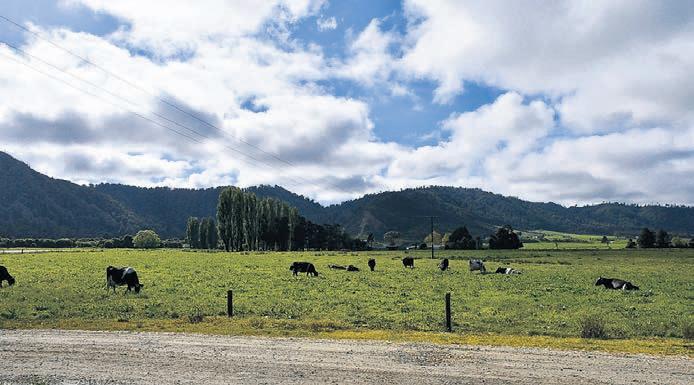
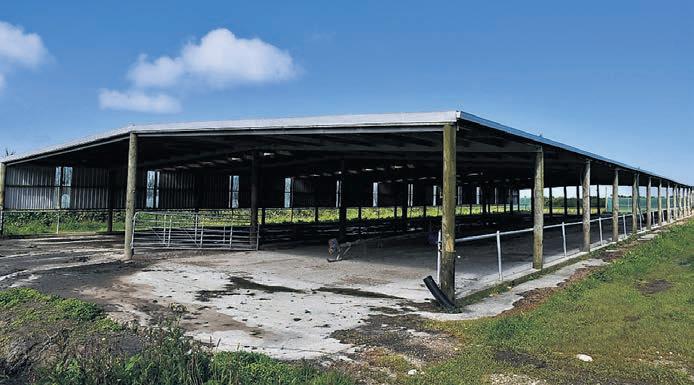
Well-established dairy unit in the reliable Karamea farming district Benefiting from a mild subtropical climate this is a strong grass-growing property with consistent production and excellent year-round performance. The farm is currently operated at a fully self-contained business and includes approx 260 eff ha, with a good mix of soil types supported by a consented herd home and stand off pad Production has averaged 175,436 kgMS in the last three seasons from approx. 430 Friesian/Friesian-cross cows, with the herd fed on grass, hay, silage, and 60–80t PKE if required per annum. Key infrastructure includes a 36 ASHB, multiple implement sheds, a 60m x 20m herd home (320 cows), covered fertiliser bunker. Accommodation comprises a four-bedroom main home with large workshop, a threebedroom second home, and single-man’s quarters. A well-established unit located in a supportive farming community an opportunity not to be missed Offers over $4,950,000 + GST (if any) For Sale From $4,950,000 + GST (if any) View By appointment Web pb.co.nz/WER212521 Paul Murray M 027 256 9967 E paulm@pb.co.nz Gareth Cox M 021 250 9714 E gareth@pb.co.nz


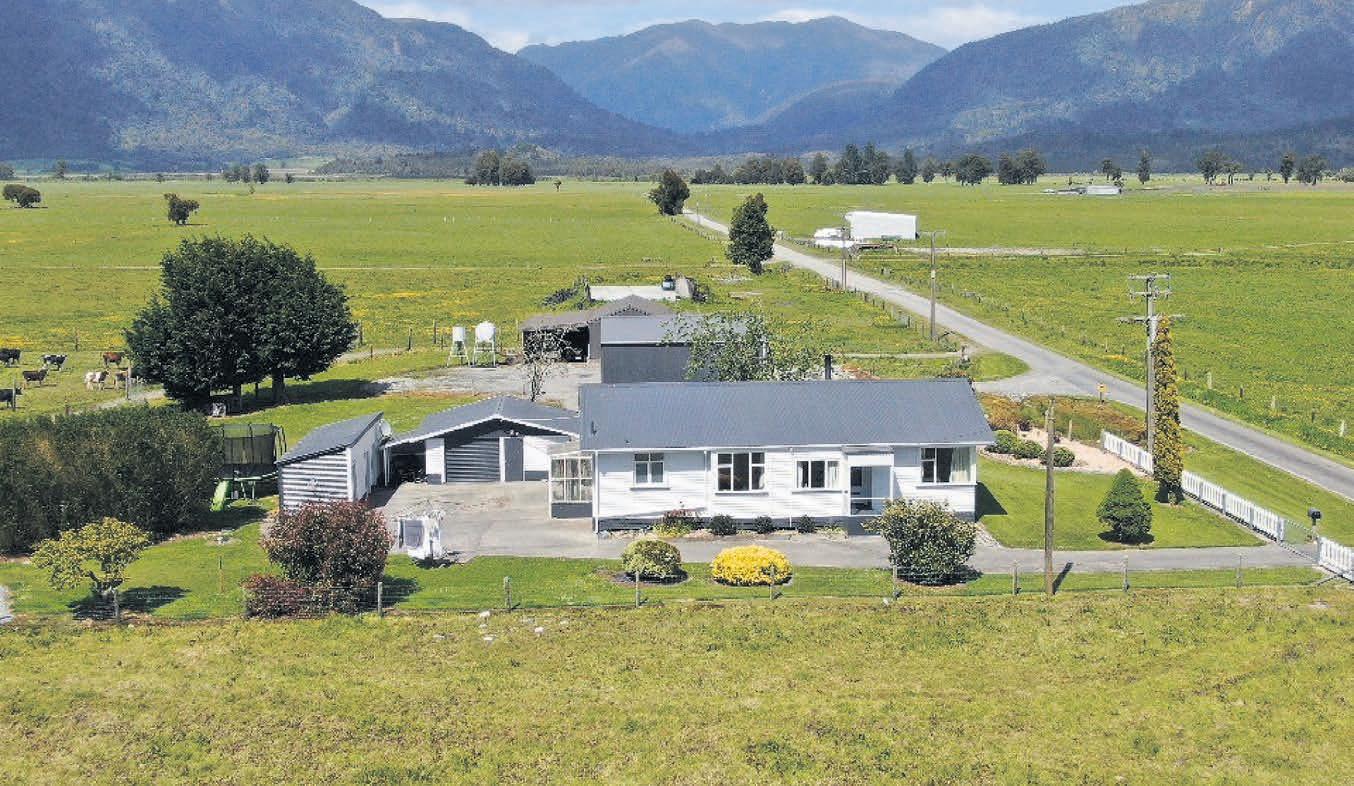
Positioned in the heart of the scenic Kowhitirangi Valley, this productive 187 ha dairy unit (subject to boundary adjustment) offers an exceptional opportunity to secure a well-run, fully self-contained farming operation with strong performance and excellent infrastructure. With 182 ha of effective grazing, the farm winters all cows on approximately 6 ha of swedes, supported by pit silage, grass, and straw. The property is creek-free and thoughtfully laid out, featuring a reliable gravel lane network that provides easy access across the farm The vendor is also offering an additional 18 ha of which 13 ha is effective for lease. Milking is carried out through a well-equipped 30 ASHB dairy shed complete with cup removers, a molasses system, generator wiring and a recently upgraded milk room. Currently supplying Westland Milk Products, the herd of 330 Jersey-cross cows has achieved an impressive five-year average of 131,000 kgMS. Two practical homes provide comfortable accommodation.
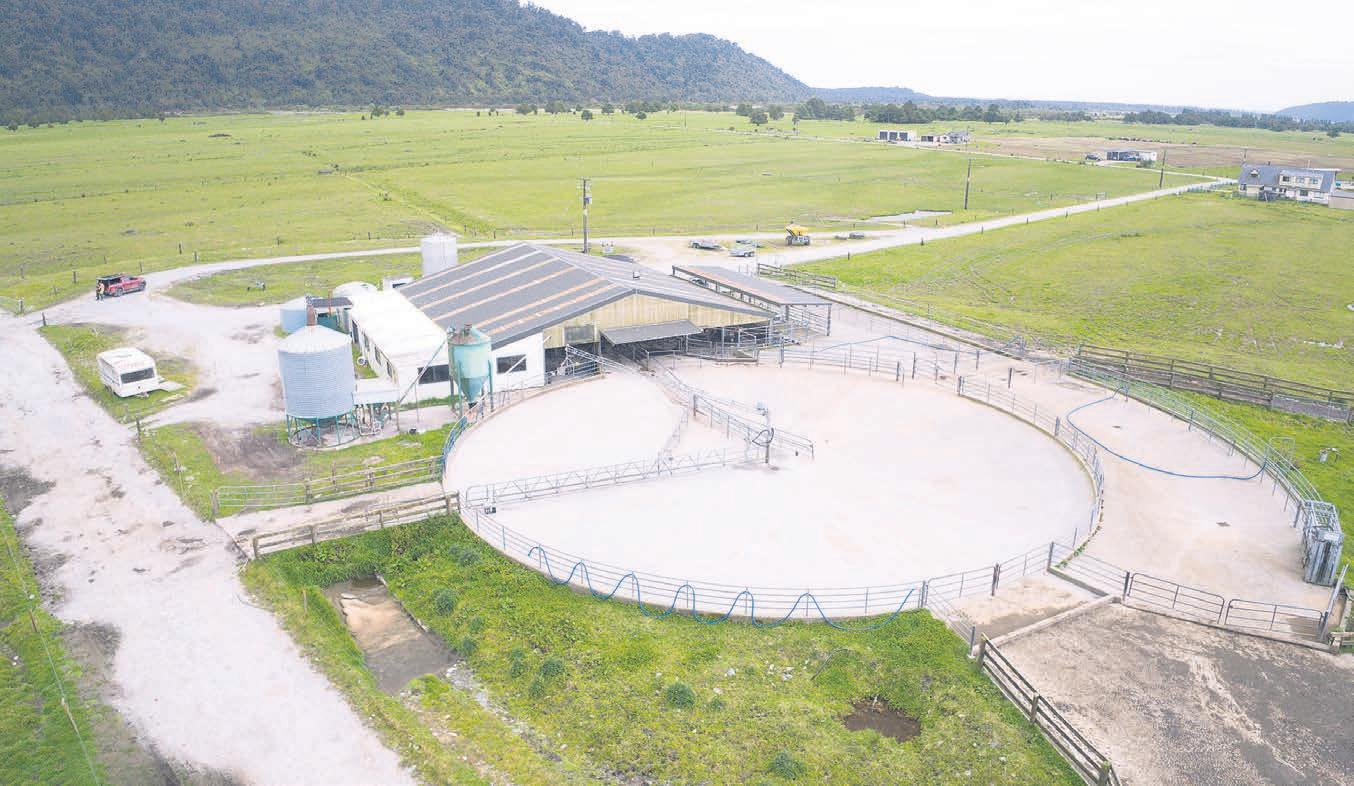
A significant opportunity to secure a large freehold property of 759 ha (approx. 580 ha effective) located on the Waiho Flats south of Franz Josef township in South Westland This well-established dairy unit currently milks 800 cows on a semi self-contained basis, delivering a four-year average of 268,598 kgMS, with historical production peaking at 391,000 kgMS - highlighting genuine upside for the next owner. The farm features an excellent mix of silt and alluvial free-draining soils, is well subdivided, and has an extensive network of all-weather lanes Infrastructure includes a 60-bail rotary dairy shed (built 2003) with a 600-cow circular yard, in-shed meal feeding and DeLaval plant, multiple hay and implement sheds, and cattle yards. Accommodation is well catered for with a four-bedroom home, a twobedroom Portacom, and a two-storey dwelling split into two self-contained homes A significant West Coast dairy asset offering scale and opportunity, ready for its next chapter.
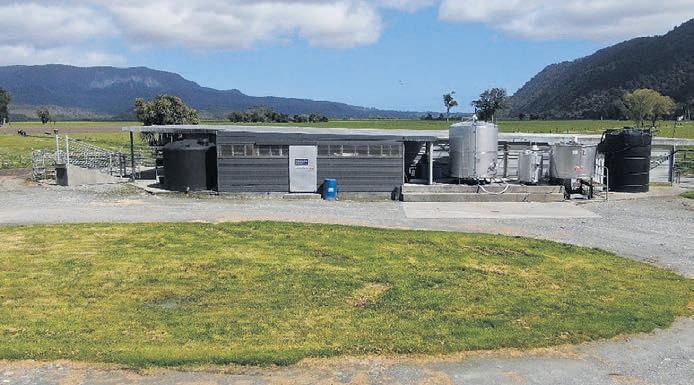

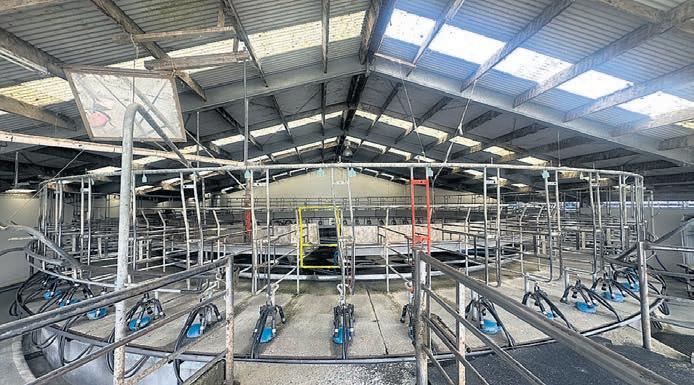
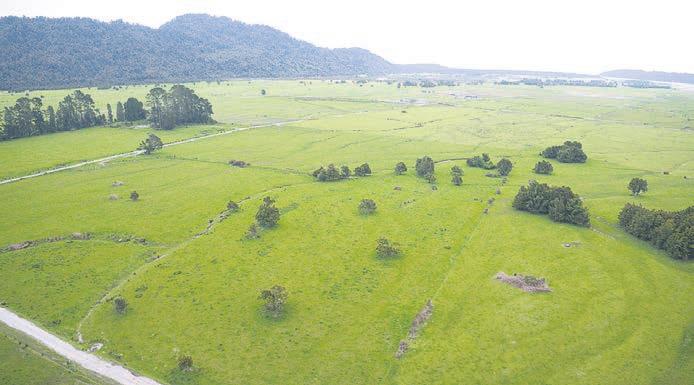
4 13 5 4
Tender closes 12.00pm, Mon 2nd Feb, 2026 (unless sold prior), at Property Brokers Hokitika office 97 Revell Street, Hokitika 7810
View By appointment
Web pb.co.nz/HKR203446
Gareth Cox M 021 250 9714 E gareth@pb.co.nz
Anna Hart M 027 294 9678 E anna.hart@pb.co.nz
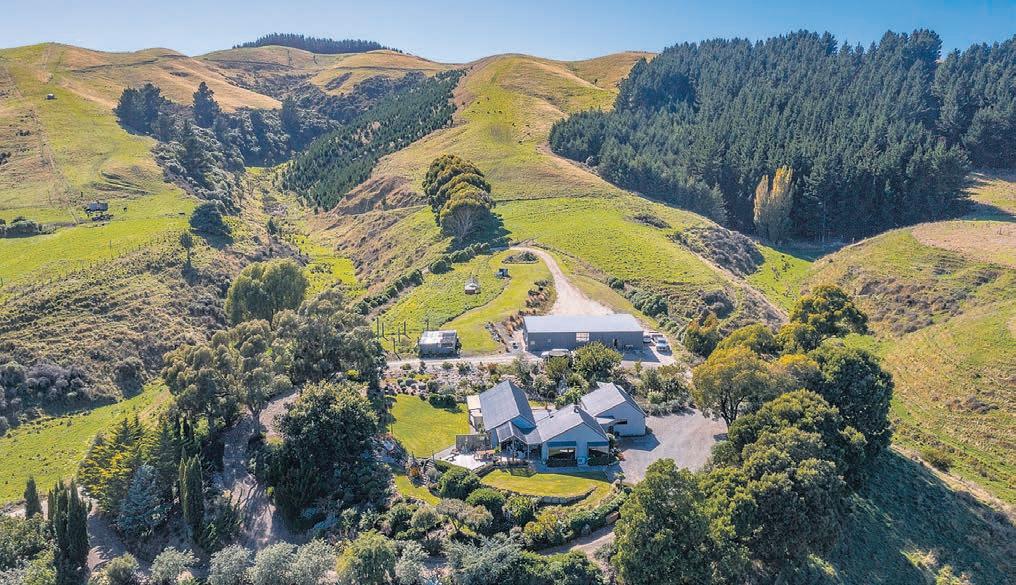
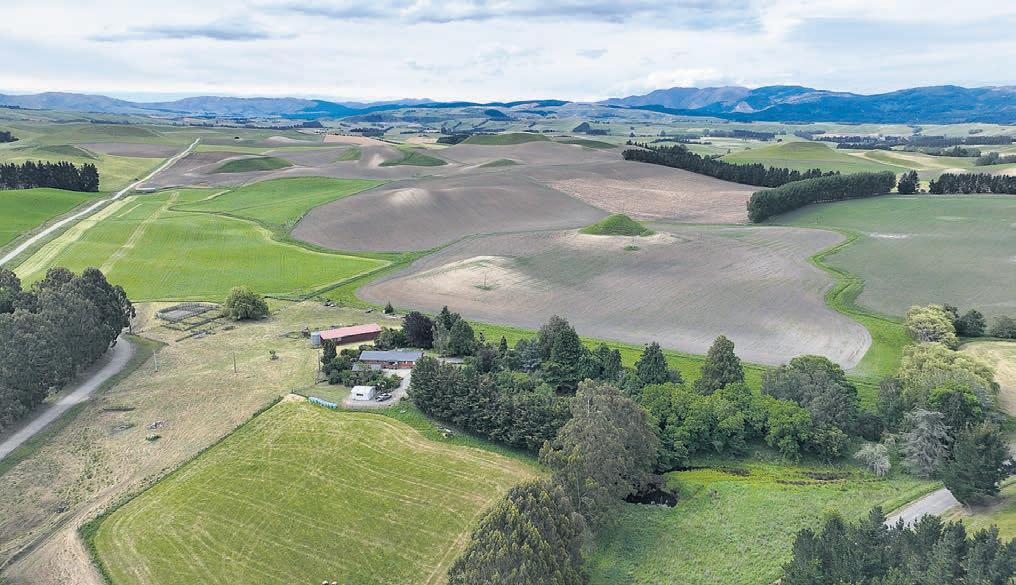
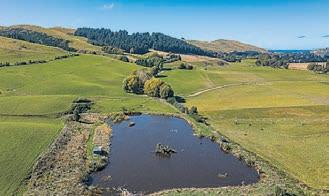
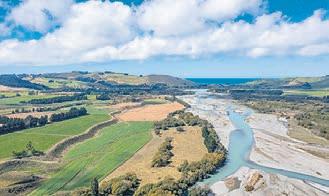
Definitely worth consideration - we're pleased to present 'Cranlea Farm', a 192.08 ha (approx) multipurpose property strategically positioned in the thriving Cheviot area. Importantly an adjacent 125 ha (approx) property is also available for purchase, creating a rare opportunity to secure approximately 317 ha in one strategic location. This neighbouring property has demonstrated proven performance and excellent results, providing confidence in the productive capacity of the combined holding. For astute buyers seeking scale, operational efficiency, and genuine growth potential, this dual-property opportunity represents exceptional value in today's strong rural market
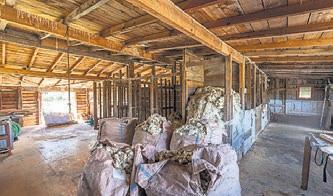
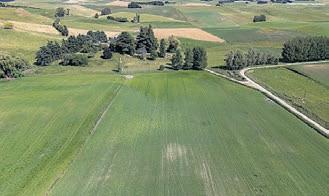
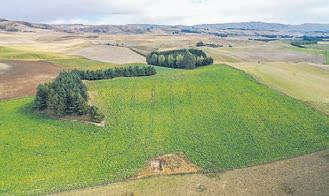
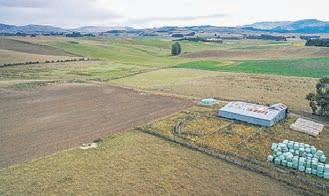
This farm has been dairy support since 2008 and has been wintering up to approximately 2,000 dairy cows on winter crops of kale and fodder beet, plus pasture
Features a comfortable four-bedroom home in a mature setting, good sheds, two sets of cattle yards, good soils, and very good water reticulation.
With history on your side, this farm performs year in and year out and is a prime opportunity to purchase a 269 ha farm in a reliable district.

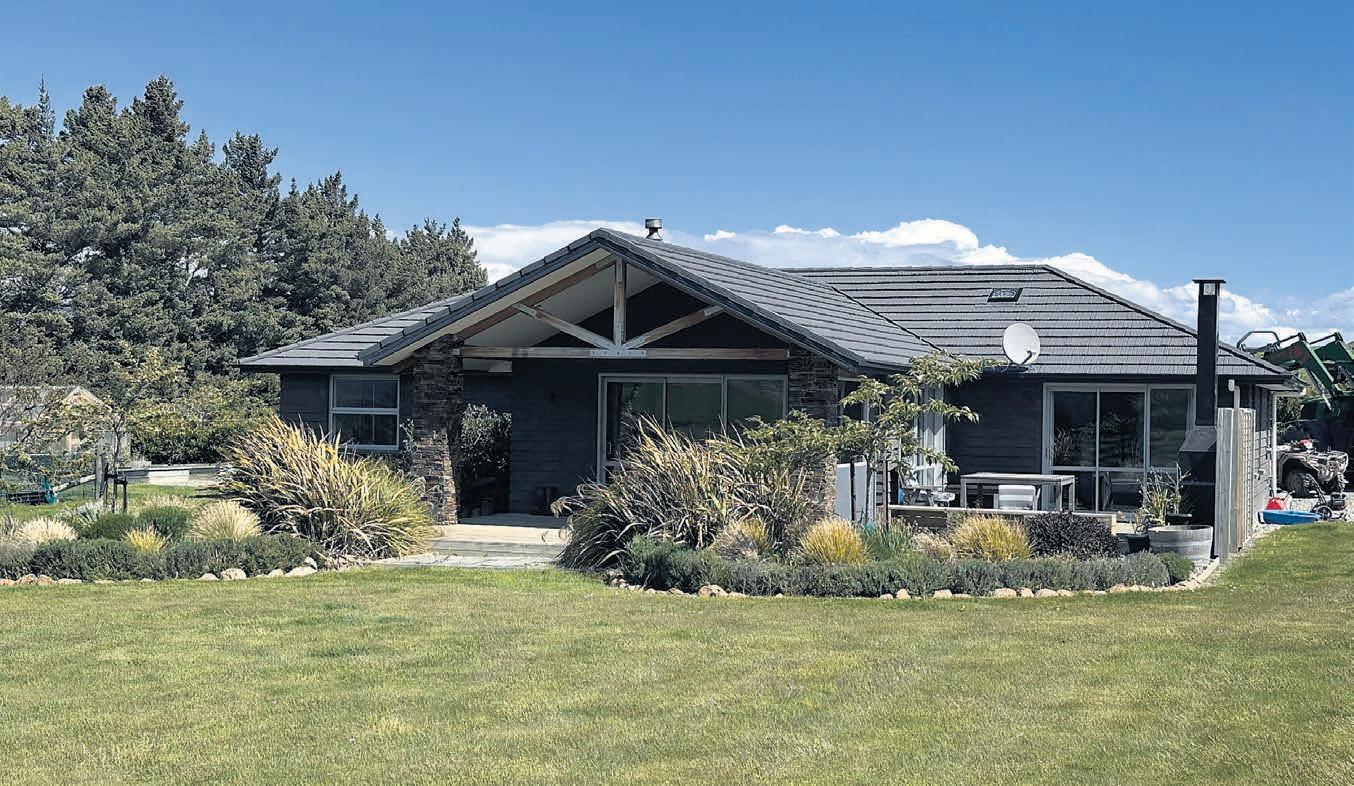
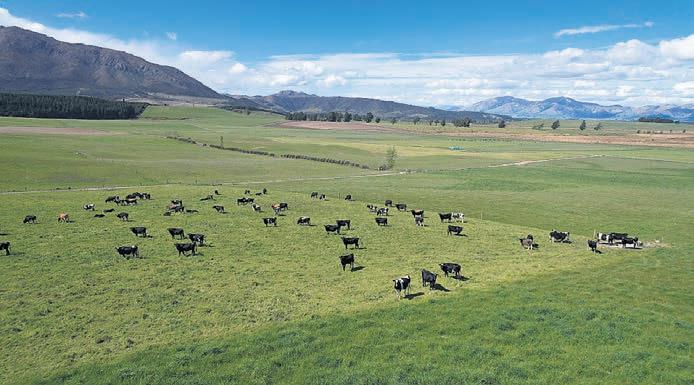
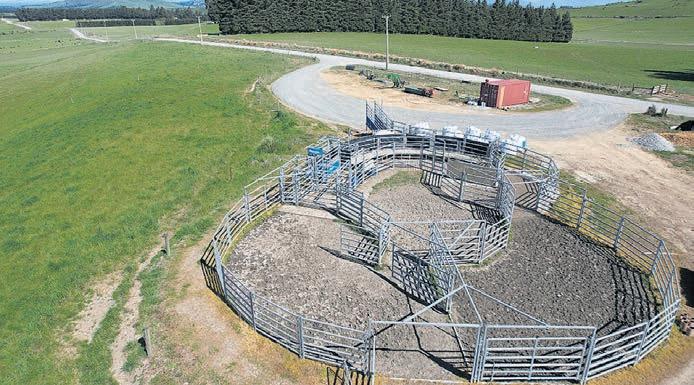
Scale dairy support property with modern infrastructure, developed by the Vendors since purchasing in 2015 The family home and support buildings, all built around 2016, are positioned on Gallagher Road, just 7 km north of Mossburn. The property features mostly flat to easy-contour land with a northerly aspect and an essentially rectangular layout, accessed from both Gallagher Road and West Dome Station Road Set up for efficient stock movement it offers all-weather lane access, quality fencing, a reliable stock water system, and extensive regrassing via winter crops The property successfully winters yearling dairy heifers, rising two-year heifers on crop, and produces baleage, and historically wintered 400 dairy cows during 2014–2019. The home and buildings are modern, well positioned and a feature of the property supported by a large horse arena and significant Te Pari cattle yards Options for purchasing different titles exist. 4 2 2 For Sale From $4,950,000 + GST (if any) View By appointment

pb.co.nz/IR206649
Hay M 027 435 0138 E john.hay@pb.co.nz
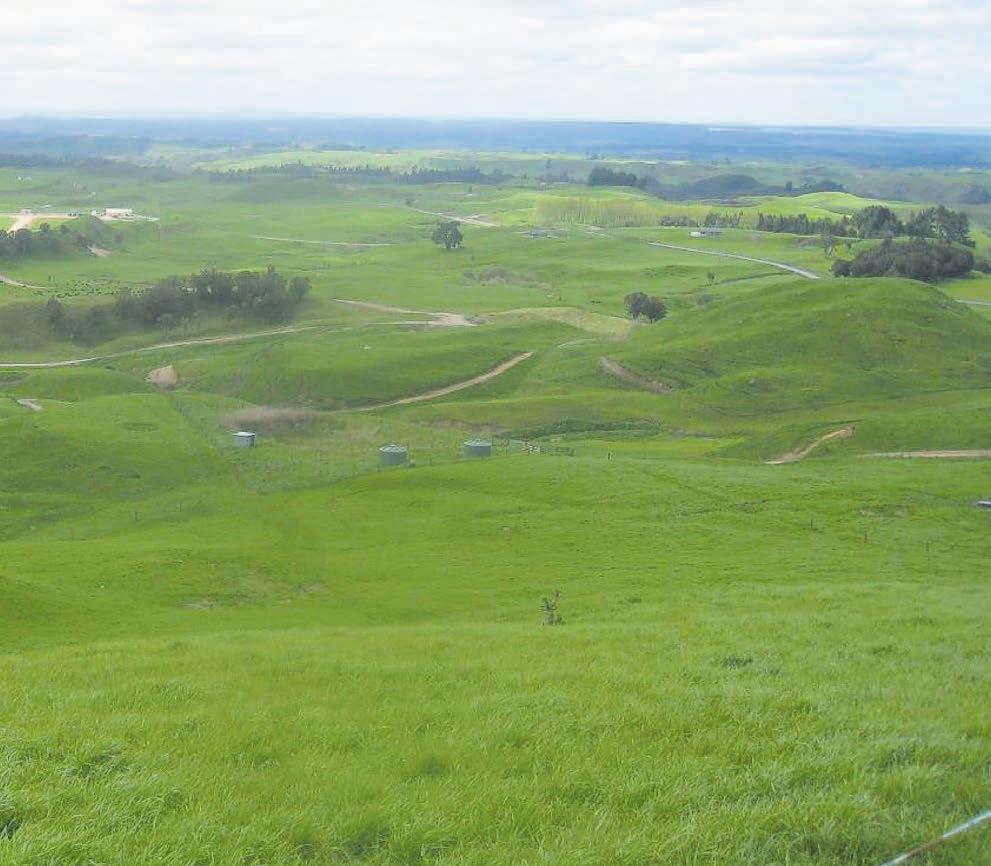
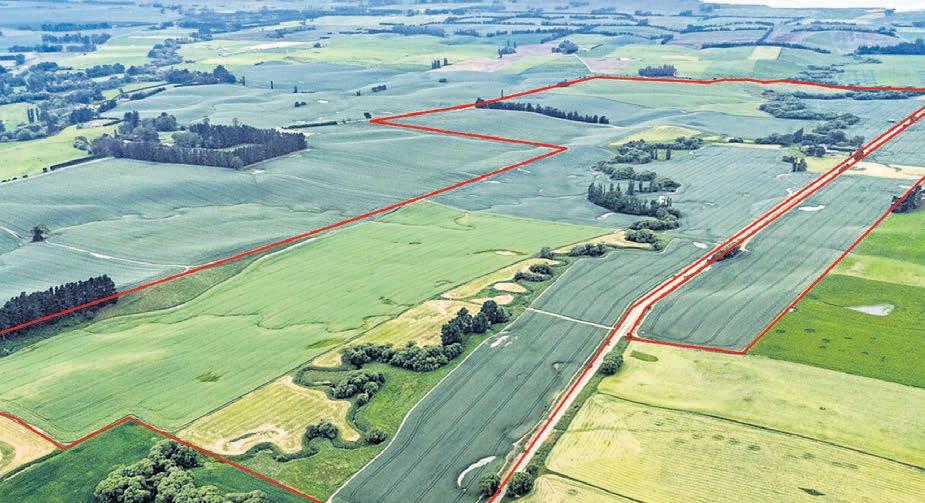
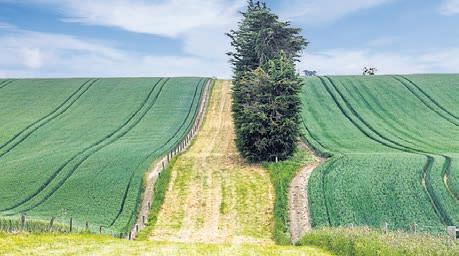
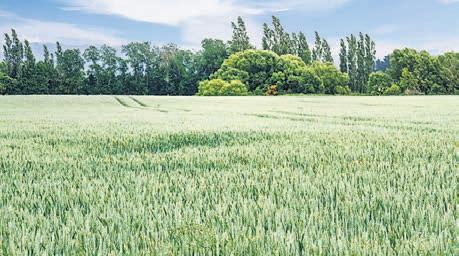


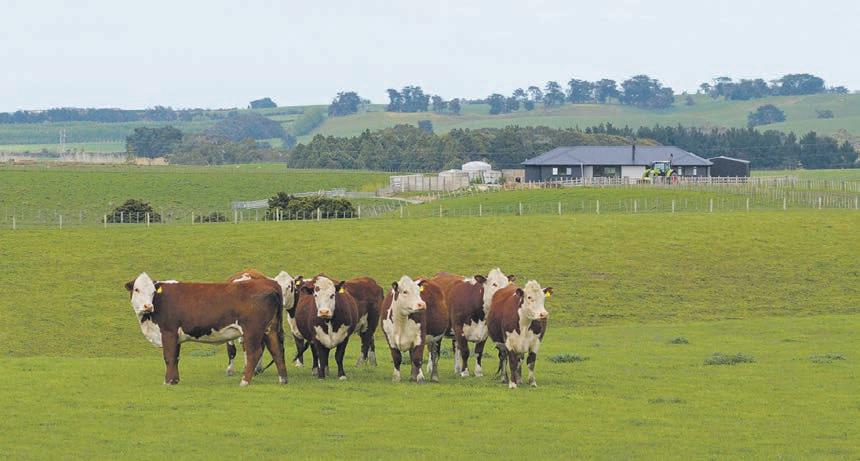
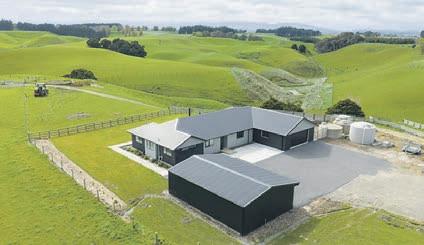
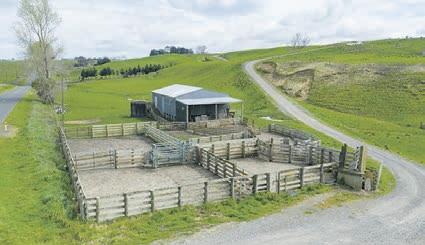

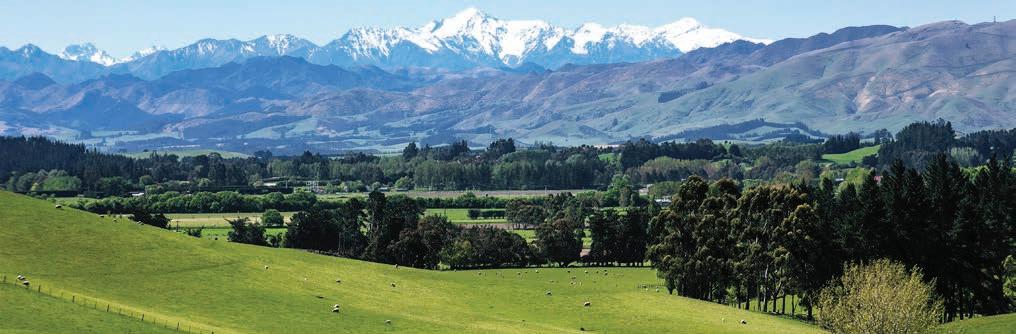

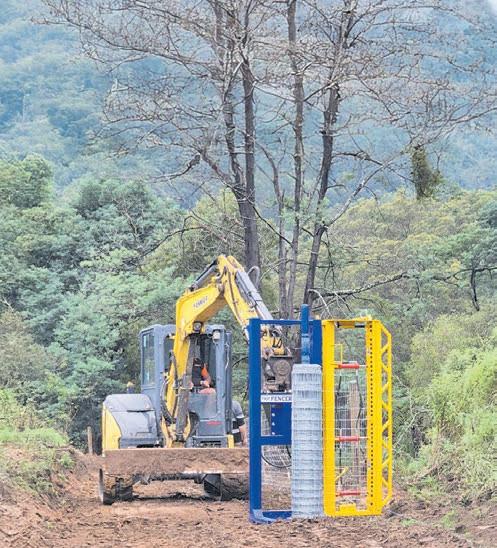

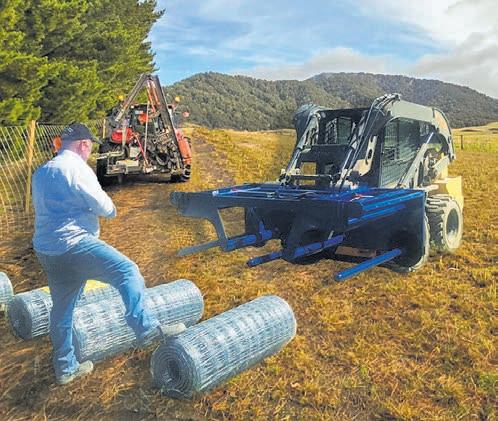




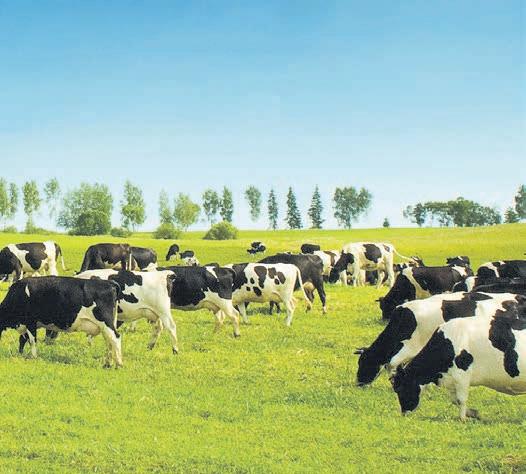











farmersweeklyjobs.co.nz

• Cash payments or agreed trading terms.
• Dressed weight or Hoof purchased valuations.
• Negotiated delivery terms –covering areas Pahiatua to Featherston.
• Minimum consignments of 20 up to 500.

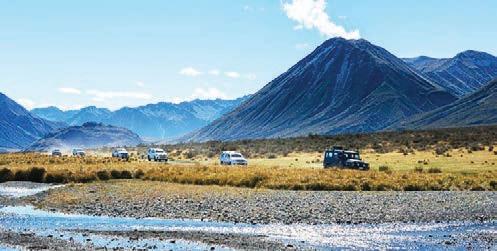












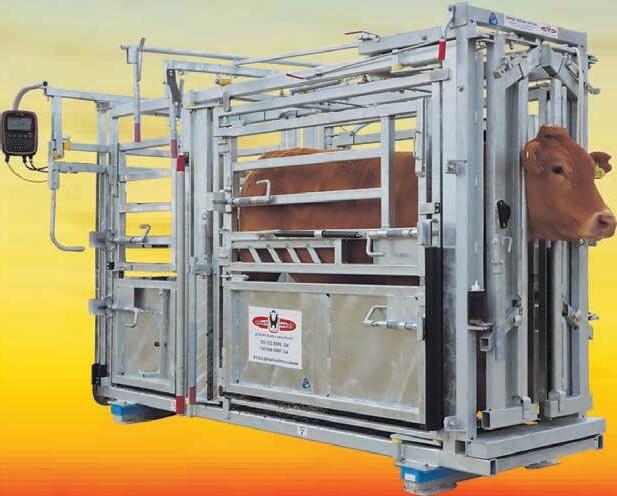







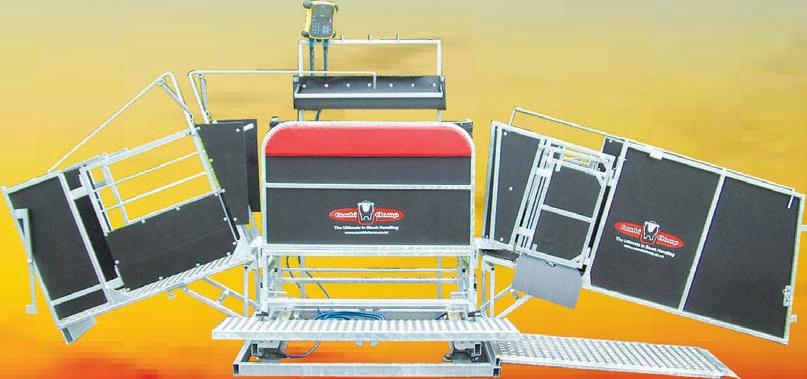








• Made in Germany
• Model DK-AL 3218/35
• Unsurpassed quality and specification
• Electro-hydraulic
• 6 t rated hydraulic ram
• 3.25m x 1.8m deck
• Removeable 350mm alu sidewalls
• Side and rear tipping • 3.5 t GVM (2.5 t payload)
• Trailers & horse floats available $17,995+GST
www.boeckmann.co.nz
robert@boeckmann.co.nz • 021 02255648











WORD ONLY ADVERTISING. Phone 0800
for use in agriculture and horticulture. Growth promotant / stock health food. As seen on Country Calendar. Orders to: 03 322 6115 or info@nzkelp.co.nz
LEASE LAND
MAHURANGI STATION
WAIROA is a 3558ha sheep & beef farm carrying approx 11,000su with further land development underway. The farm has a high portion of easy contoured finishing land as well as higher altitude summer safe and runoff land, plus a good range of wellmaintained farm buildings. The farm is available for a 9-year term from 1 March 2026. Tenders due by 31 December 2025. For more information contact John Bowen, Valuation Eastland, Gisborne. Phone 06 867 0499 john@valuationeastland. co.nz
SHROPSHIRE RAMS available now. Easy lambing, early finishing. Visit www.nzsheep.co.nz/ shropshire to find your local breeder.


HIGH PRESSURE WATER PUMPS, suitable on high headlifts. Low energy usage for single/3-phase motors, waterwheel and turbine drives. Low maintenance costs and easy to service. Enquiries phone 04 526 4415, email sales@hydra-cell.co.nz PUMPS
WILTSHIRES-ARVIDSON. Self shearing sheep. No1 for Facial Eczema. David 027 2771 556.
WHAT’S SITTING IN your barn? Ford, Ferguson, Hitachi, Komatsu, JD. Be it an excavator, loader or tractor, wherever it is in NZ. Don’t let it rust. We may trade in and return you a brand new bucket for your digger or cash for your pocket. Email admin@loaderparts.co.nz or phone Colin 0274 426 936.
NATIVE LOGS WANTED. Salvage logs and Green standing trees, all species. Top prices paid. We acquire all necessary MPI and Council consents. All enquiries welcome. Phone Mike 027 458 5250.
It was the doctor’s last patient consultation of Christmas Eve. A mother came in with her young daughter and asked if he would examine her because she had been showing some strange symptoms, including a significant increase in weight, sickness most mornings and a number of strange cravings. He checked her out very carefully and eventually told the mother that her daughter was unquestionably pregnant. At which news she protested very strongly.
“Don’t be ridiculous, my daughter has never been with a man.” The girl confirmed that this was true and added that she had never so much as kissed a man.
The doctor studied the girl very carefully, then quietly stood up, walked to the window and stared out of it.
Suspecting the worst the mother asked if there was something wrong.
“No, not really,” replied the doctor. “It might just be a coincidence, but the last time this happened a bright star appeared the East.”
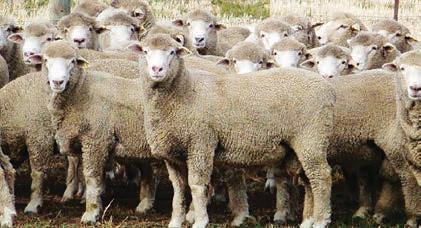


150x BWF
Tuesday 13th January
15mth Beef & Exotic Steer Fair
550x Angus, 250x Hereford/Angus X, 350x Charolais/Simmental X
Thursday 15th January
15mth & Bullock Dairy Beef Steer Fair
100x R3 Bullocks,


Masterton Saleyards | 11am
Total Yarding: 2300 sheep
• 1100 M/A Ewes
• 700 2th Ewes
500 Ewe Lambs No Shearing! No Crutching! No Dagging!
Vendors:
• Black Rock Hills
• Bushfield
Busy Hill Farm Ltd
• Glendryneoch
• McWhirter Farming Co Ltd
Terawhiti Station
T M C Holmes Trust
• Waldheim Farm
Further enquiries to: Rihi Brown 027 404 7514
Friday 23 January, 2026 | 12.30pm
Held at Tuakau saleyards
A/C Waipuna Valley Farms
Comprising 1250 head:
• 850 x 15 month Angus Heifers
• 220 x 15 month Hereford/Angus Heifers
• 180 x 15 month Exotic Heifers
50 x 15 month Hereford
Approx 300-370 kg liveweight Farmed in
large mobs on genuine hill country
Heifers guaranteed empty Cattle renowned for shifting ability
1% buying rebate paid to outside companies by prior arrangement.
For more information:









Tuesday 6th January
Te Kuiti
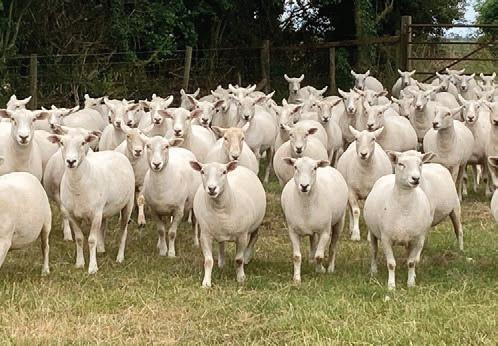
Renowned for their resilience and adaptability, Easycare sheep are a stabilised shedding breed established in the UK 20+ years ago.
2th rams derived from embryos imported to NZ in 2024 from top UK Easycare studs are available this season. These are structurally sound early shedding sheep. Siblings (ewe hoggets) have lambed at 135% and their lambs are shedding at 10 weeks of age.
These are ideal rams to put across Wiltshires or to commence shedding from an existing woolly flock.
For further information phone 027 229 7267 or email: easycaregeneticsnz@gmail.com







Ewes / 2500 5yr Romdale Ewes
A /c McNeil Farming - Tuakau (Capital Stock - Coopdale Ewes) 800 2th Ewes / 600 4th Ewes / 400 6th Ewes / 200 4yr Ewes

A /c McNeil Farming 800 2th Coopdale Ewes


A /c McNeil Farming - Puketoro Station

F R I E S I A N / F R I E S I A N X H E R D
2 2 0 x F r i e s i a n / F r i e s i a n X I n - c a l f C o w s
B W : 1 3 7 , P W : 1 6 9 , 1 0 0 % A n c
D T C 1 0 t h J u l y , A l l A B . T B S t a t u s : C 1 0 , L e p t o v a c c
S C C 7 9 , 0 0 0 A v e p r o d 4 5 0 m / s p e r c o w , 1 3 0 0 m / s p e r h a

960 15mt h Angus Steers - Weight ranged from 430 to 350 kgs


200 15mt h Angus Heifers - Weight ranged from 350 to 280 kgs
A O N C E I N A L I F E T I M E O P P O R T U N I T Y !

• T he 5yr Ewes docked 168%
• T he Angus Bloodlines for the Steers include: Turihaua, Ngaputahi, Totaranui & Seven Hills
• GAP & NZFAP Accredited - AB Free
S e c u r e a g e n u i n e , h i g h - p e r f o r m i n g h e r d
T h r e e d i g i t h e r d c o d e - c o m p l e t e l y c l o s e d h e r d , 1 0 0 %
a n c e s t r y , G 3 p r o f i l e d

• 1 5% Rebate by arrangement
• T he sale will be (Sign Posted) from the Ihungia Road, Te Puia Springs
• Lunch & Light refreshments provided




4 5 0 m s / c o w , 1 0 0 k S C C f o r t h e s e a s o n , O A D f r o m C h r i s t m a s 7 8 % 6 w e e k i n - c a l f r a t e - 6
Low throughput and strong global demand mean farmgate returns will remain strong.

IT’S typical for beef schedules to head south from midspring to early summer. Usually, processing plants slowly become full to overflowing with stock, reducing procurement competition, while export markets soften as they’re aware that New Zealand, and Australia to a lesser extent, has more beef to sell. But, like last year, there’s been hardly any downside in schedules to report yet. So what’s different?
For cattle supplies, the numbers just aren’t like they were for New Zealand processors at the start of the decade. Shortages aren’t widespread here and now, with processors relatively full, and the odd export prime/local trade plant in the North Island reporting wait times to find space. But this has only been the norm for the last fortnight or so.
The national cattle kill in October was the lowest for the month since 2017, down 25% on last year. Weekly data indicates the first half of November was slow too. This kept any price downside through spring to a minimum. Reduced calf rearing two years ago continues to play a significant role.
The largest supply drop was in the North Island, where many
finishers were taking cattle to heavier weights since the cost of yearling replacements was so high. Rain from mid-November onwards has slowed the flow of cattle too. Some of the same was occurring in the South Island, though forward store cattle were targeted by at least one processor in autumn/winter, which would usually be finished in spring.
Cattle shortages were exacerbated by the weakest October cow kill since 2011, as dairy farmers took advantage of the strong milk price forecast at the time.
The national cattle kill in October was the lowest for the month since 2017, down 25% on last year.
The kill will inevitably even itself out to a point next year, considering base cattle numbers aren’t much different to last year, despite the year-on-year deficit in the kill. But realistically, it won’t be until this year’s massive crop of reared dairy calves start hitting prime weights in around two years before the supply cycle swings back in processors’ favour.
The other major element underpinning schedules is the export markets. US imported manufacturing beef prices (which
especially underpin bull and cow schedules) usually weaken in the last quarter of the year. Not only does the volume offered out of New Zealand lift, but US consumer demand slows into their winter, and the US cull cow kill seasonally climbs.
There’s not been any downside this year.
Some of this is due to the Trump factor. The market was thrown off its usual path following the introduction of varying, higher tariffs heading into spring, only for the US to delete tariffs on all imported beef by the end of spring. In loose terms, this has meant US importers can pay 15% more to New Zealand exporters, and their total cost will be unchanged. The low exchange rate has been a bonus for New Zealand exporters too.
Whether the boost from the removal of US tariffs remains is seen as unlikely, as Brazilian beef is expected to rush onto the market at the start of the year. Although, prices aren’t expected to fall over either. Brazil was subject to a 76.4% tariff (50% reciprocal + 26.4% out-of-quota) at the start of November, but this will be zero from January 1, until they inevitably fill their annual quota.
It’s too early to see a clear pattern of how much extra beef is en route to from Brazil yet,
Proudly sponsored by
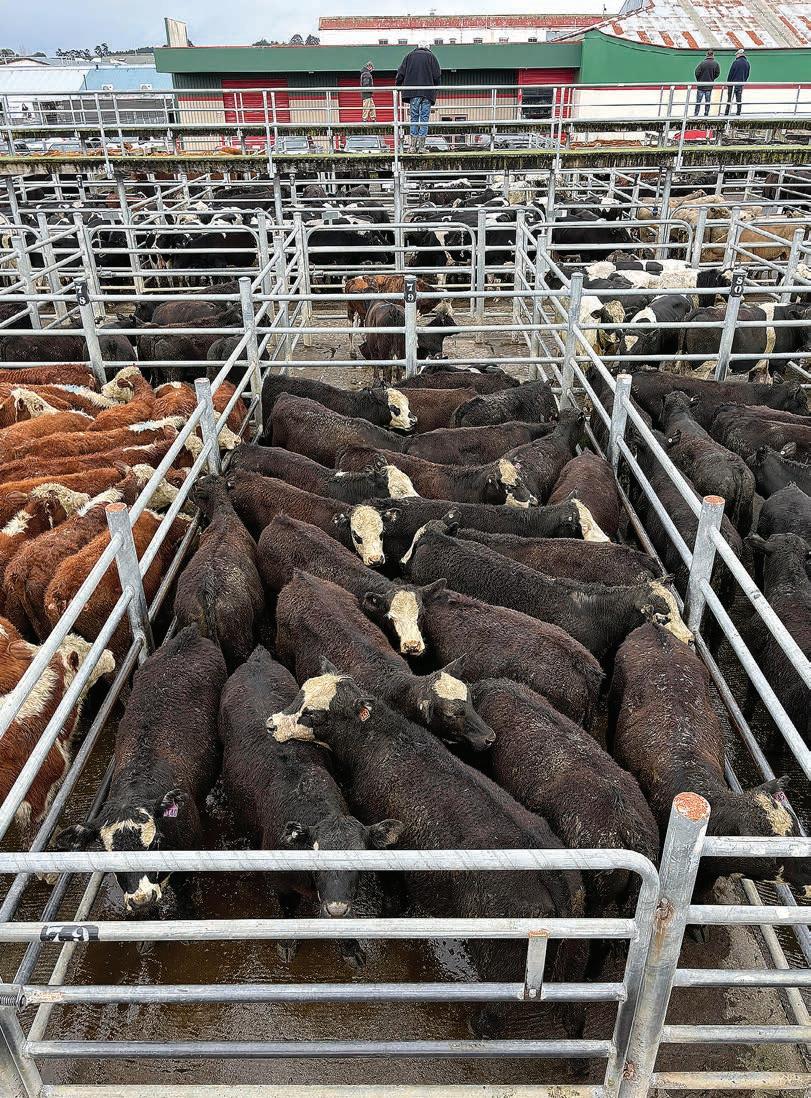
but they were neck-in-neck with Australia as the main beef supplier at the start of this year, when tariffs were at the same setting as they are now. It is worth noting that New Zealand’s manufacturing beef exporters aren’t as reliant on the US, nor China, as they were a few years ago, which takes some pressure off should US buyers pull back. These two markets usually account for 80-85% of manufacturing beef export volumes, but this is down to 70%
this year. The main growth has been into the UK, which, like North America, is facing cattle shortages and high beef prices. In the past, sales to the UK have been minor due to the tiny quota allocated to New Zealand. However, that was changed with the NZ-UK free trade agreement signed in 2023, and has seen total beef sales to the UK jump, especially since winter. More New Zealand beef has been sold into the UK this year than all of 20152024 combined.






1 in 4
1 in 4



These weekly saleyard results are collated by the AgriHQ LivestockEye team. Cattle weights and prices are averages and sheep prices are ranges. For more detailed results and analysis subscribe to your selection of LivestockEye reports. Scan the QR code or visit www.agrihq.co.nz/livestock-reports



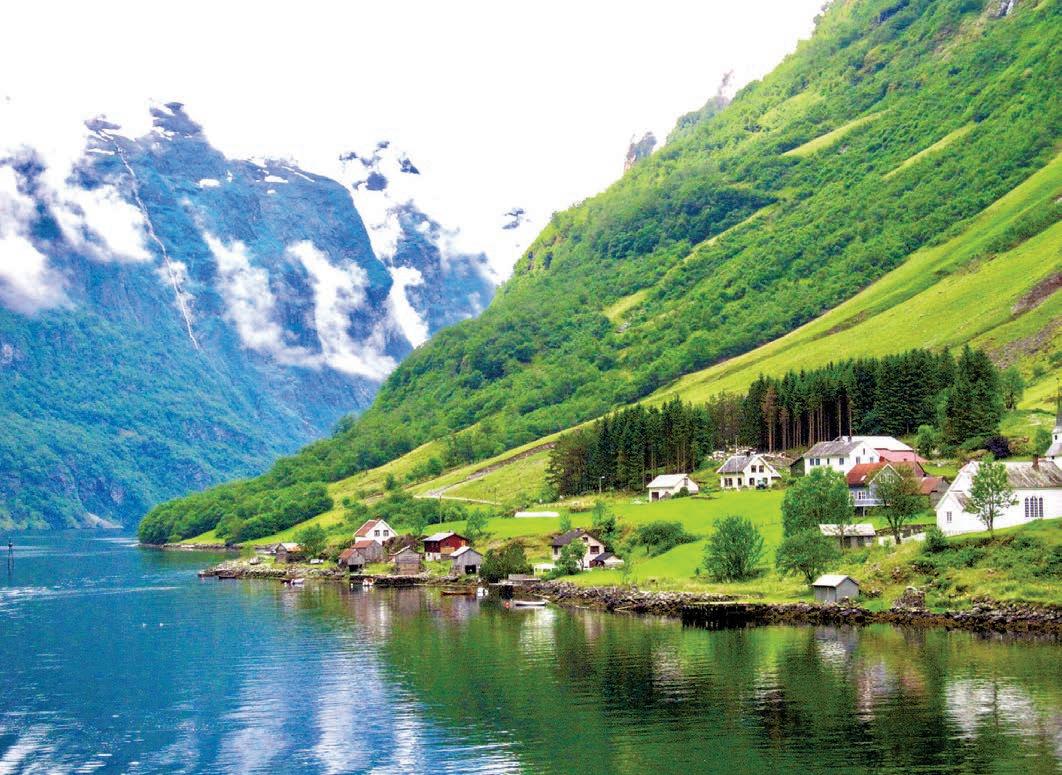











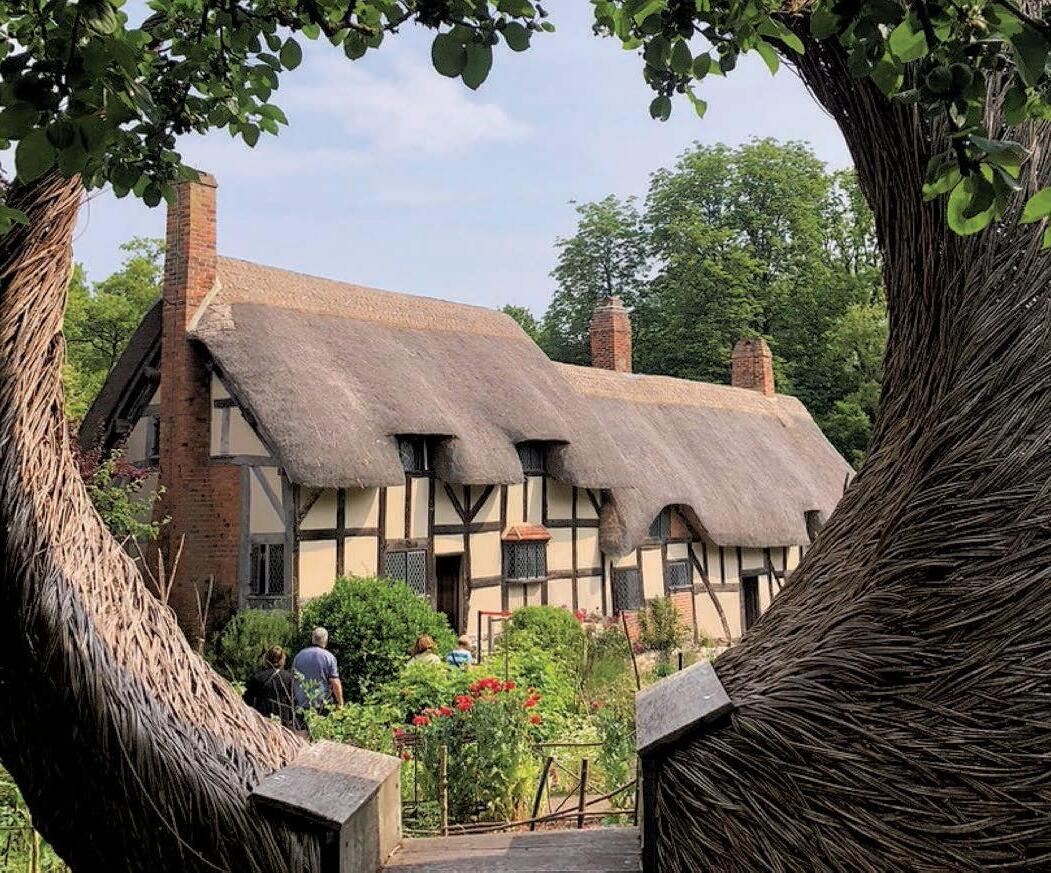




Yearling






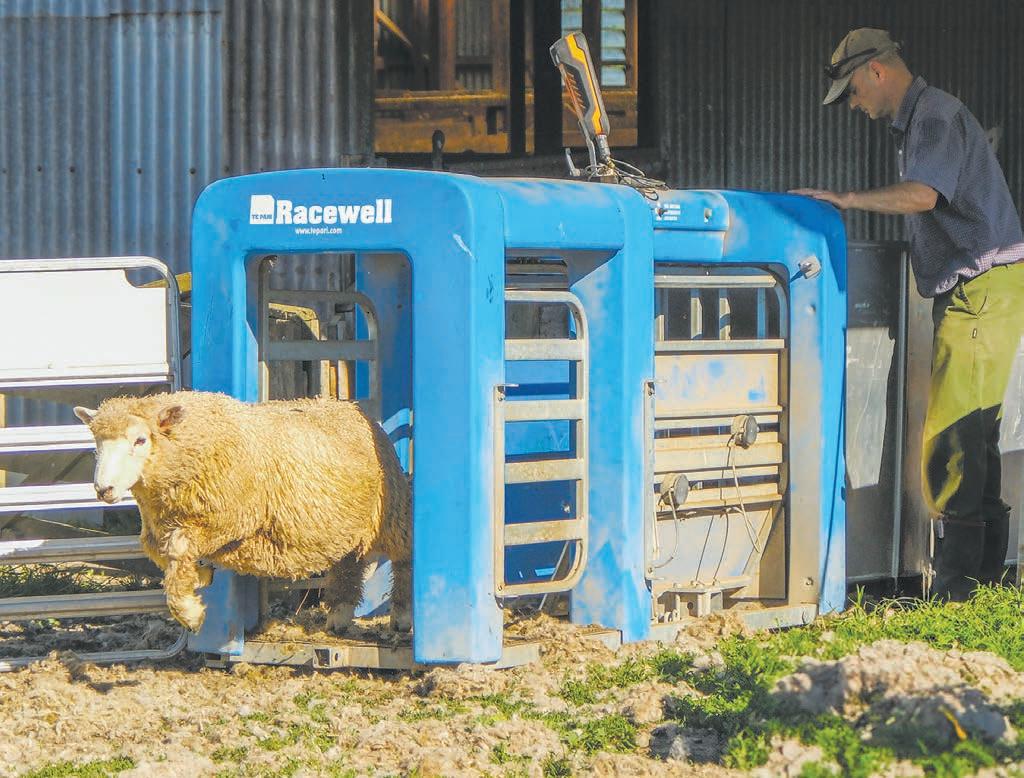



Philip Duncan NEWS Weather
FROM a purely weather forecasting “complaints department” point of view, this year has been mostly positive across the country.
Severe weather events weren’t so extreme for most places (although certainly we got our fair share of damaging wind events back in October) and temperatures were generally closer to normal over winter, and now a hotter than usual end to the year for many parts of the country.
In recent weeks rainfall has been boosted – even in to our driest eastern regions – and that has been a last minute positive as we officially go into the summer months now.
Most years I pick up a theme from many of you about where the weather isn’t going well.
A couple of examples would be how dry it’s been in parts of Hawke’s Bay most of this year, the other being how bleak and cold winter and spring were in Southland.
In more recent weeks there have
been a few southern grizzles about the wind not ending.
But, like I say, from a complaints department point of view 2025 has been much quieter for us with the weather giving New Zealand a lot of variety – helping balance the books climate-wise for many.
Most of 2025 was in “neutral” from a Climate Driver point of view – with nothing out of the ordinary driving our weather.
From a complaints department point of view 2025 has been much quieter for us.
Back in winter the Sudden Stratospheric Warming (SST) event occurred very high up in the planet over Antarctica – and that has sent the polar vortex (the boundary that contains the colder polar air to our south) to become much more loose and wavy – that means that the cold isn’t so tightly packed to our south, and that’s brought weekly wintry blasts to Tasmania and south-east Australia all spring
long, and now every few days into December.
NZ has been on the other side of the cold blasts, with us getting hot nor’westers and temperatures close to (and over) 30 degrees around NZ at times over November and December (above normal heat), but that SST may still fuel more windy westerlies here in NZ this month, and some southern cold changes.
La Nina was only announced a couple of weeks ago, but it may be gone by “early 2026” according to the Bureau of Meteorology. It’s a very short lived La Nina by the looks of it.
What lies ahead
I expect spring-like windy westerlies (with real boosts of summer heat for many) to kick in this week as large storms continue south of NZ.
This will also bring in colder airflows to the South Island at times leading up to Christmas. Higher pressure may increase in the final week of December. But going into January the tropics, the Southern Ocean and the Australia region may be producing rainmakers, thunderstorms and/
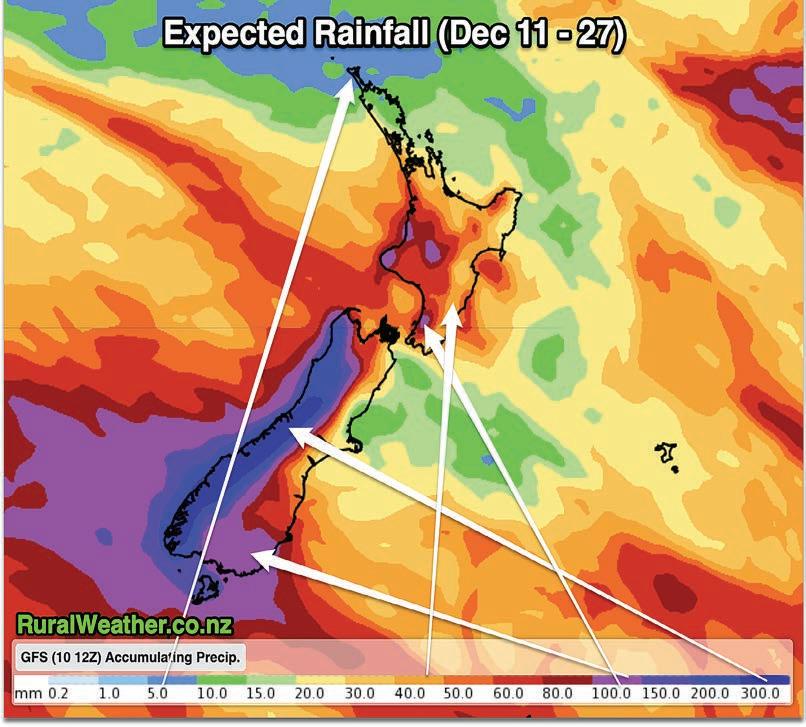
PREVAILING: A westerly theme to the rainfall as Southern Ocean storms appear to be the driving force behind most of December’s remaining wet weather chances. Image: RuralWeather.co.nz
or wind events... but high pressure zones exiting Australia over the Tasman Sea will be the deciding factor on when (and if) we get those unsettled moments here in NZ. Put simply – the mostly
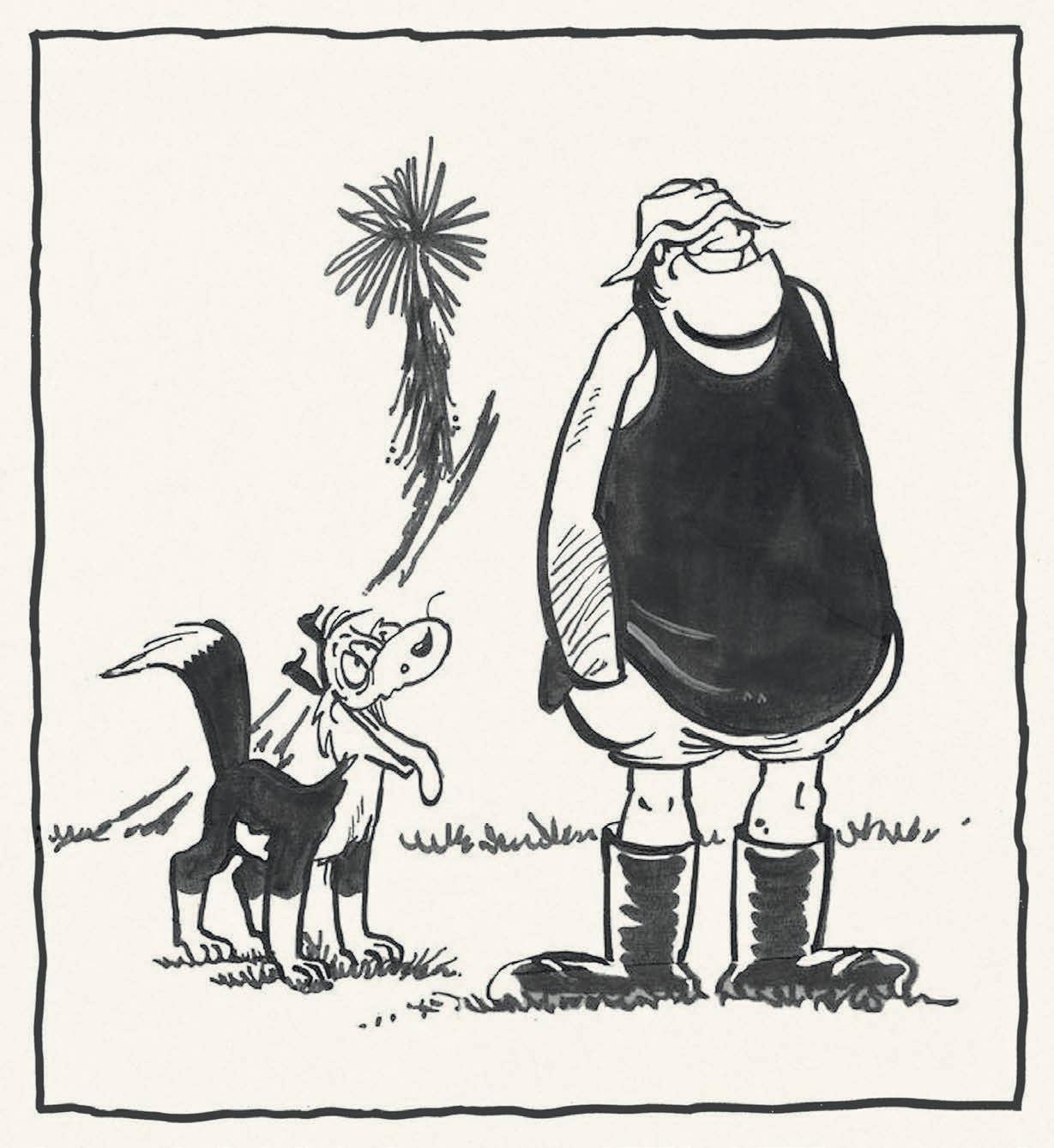
“neutral” pattern we’ve come to know in 2025 may well tick over into 2026. (neutral means anything can happen from any direction, it’s not all driven from one part of the globe).
Classic partnerships in Kiwi farming are few and far between, but here’s one we reckon is worth making a song and dance about
Keep an eye out for these two characters over the next few months, as Ravensdown and Footrot Flats team up to celebrate 50 years ( give or take) of farming in New Zealand. Find out more at ravensdown co.nz/footrot

NZ’s primary sector suppliers to Europe and the United States are having to account for a shift in focus that is affecting market trends.

Neal Wallace MARKETS Trade
CONSUMER markets in the United States and Europe may be large and incredibly complex but they have also shown they are very responsive.
On my recent Meeting the Market tour of the US and Europe, a year after my previous visit, I witnessed a fundamental shift in government priorities.
Top of their list was security of defence, security of energy and security of food.
US President Donald Trump was elected to the White House on a promise of Making America Great Again, which underpins his economic and trade policy and, as we have seen, is impacting the rest of the world.
Alongside reacting to the geopolitical uncertainty, in Europe there is palpable fear about the impact on food and energy of the seemingly never-ending RussiaUkraine war, let alone the risk of the conflict drawing in NATO countries.
This means Europe’s much vaunted environmental regulations have become less of a priority, although European dairy farmers still claim they face suffocating right-to-farm and compliance pressures.
Other changes were noted.
A year ago dairy prospects were promising and meat less so, but a subsequent fall in global meat
production suggests producers should have a year or two of favourable prices.
Last year consumers could afford to be discerning and favour products whose producers reflect their values and concerns, such as climate change and the environment.
While those concerns are still relevant, for many consumers purchasing decisions have been overtaken by price and food security.
The US is emerging as dairy’s dominant global exporter, as the long-term outlook is for production in Europe, New Zealand and the United Kingdom that is either flat or falling, leaving the US as the only producer able to fill that void.
I witnessed a fundamental shift in government priorities. Top of their list was security of defence, security of energy and security of food.
Expansion is underway outside the US’s traditional dairy stronghold state of California, with a 25,000-cow farm and another of 12,000 being built, while two processors are each spending NZ$1.7 billion on new cheese production plants and another producer is spending NZ$2 billion on a cottage cheese and sour cream plant.
After 50 years’ absence, Fonterra is re-entering the UK market on the back of its ingredients and food service strategy, a move that complements its growing ingredients and food service presence in the US.
Interest in diets involving dairy
protein shows no sign of easing. Equally, demand for meat will ensure it remains on family dining tables, although not seven days a week.
The world continues to want beef while Silver Fern Farms and Alliance have receptive and growing markets for lamb, with demand built on our natural farming attributes.
However, you have to search to find lamb in most supermarkets.
Our European red meat customers are well aware of stock numbers, growing conditions and challenges facing NZ farmers, with long-term SFF customer, Netherlands-based Luiten Food, hoping higher prices will lead to more sheep being farmed.
Globally, consumers have woken up to the evidence that heavily processed food is unhealthy and they are looking for food with ingredient lists they recognise and can pronounce.
That shift is most profound with Generation Z, those born between 1997 and 2012, who have a vastly different approach to food than the Generation Y cohort does. They see through claims and waffle. They want real food supported by a real story and if it involves animal fat, that is even better.
Rabobank has calculated that food demand in countries such as the US could fall 1% given the rate at which new-generation weight loss drugs Ozempic and Wegovy are being adopted.
The role of protein in maintaining muscle mass is unlikely to curb demand among users.
Having previously failed to get market traction, alternative protein manufacturers are regrouping with a less ambitious strategy of inching out their own
THANKS FOR HELPING US MEET THE MARKET
market share instead of trying to replace animal protein.
The appearance and taste of these products still requires plenty of work.
Zespri is a true international brand in part built on the success of its northern hemisphere fruit-growing presence, which ensures its branded kiwifruit is present in supermarkets all year round.
Growers in the northern hemisphere are embracing the Zespri model, the assistance and growing advice they are offered and the financial premiums they receive from meeting the required standards.
Wool was a mixed story.
Merino wool is in demand because it has successfully differentiated itself and satisfies customer’s production values, while crossbred wool, loved by those who know about it, still}has
to overcome the challenge that a generation of consumers are oblivious to its attributes.
In the US, where stock-proof fencing is not as extensively used as it is in NZ, Gallagher eShepherd virtual fencing is filling a void – allowing cattle to graze areas difficult to access while also giving farmers new farm management options.
It is an example of NZ’s growing agritech industry, already a significant export industry that reflects how our products and experience are highly regarded internationally.
New Zealand’s primary sector punches well above its weight.
Our farmers, growers, processors and developers are respected and our products desired, but globally we are tiny and our future depends on satisfying the requirements of our customers.
Farmers Weekly would like to thank the partners who make Meeting the Market possible.
Fonterra, Silver Fern Farms, Rabobank, Zespri, Alliance Group, Meat Industry Association, Wools of NZ, Beef+Lamb NZ, NZ Merino, European Union and Gallagher
Exporters now liken China to Europe, a more sophisticated, discerning market demanding more than a deal-making approach.

Richard Rennie MARKETS Trade
CHINA and southeast Asia, which now account for almost half New Zealand’s total exports, are too easily placed in the same vast, undifferentiated category despite their distinct differences.
Within this massive population zone of over 2 billion people, contrasts in political, social, demographic and cultural aspects present opportunities that demand a nuanced, collaborative approach from NZ exporters.
Ultimately China dominates, accounting for about 30% of export volumes.
As a market it has been subject to a lot of scrutiny over its ability to continue to grow and thrive while grappling with challenges that include resource limitations and an ageing population.
Academics have challenged its potential with assorted treatises asking questions like “Will China grow old before it grows wealthy?”
Outwardly that appears a valid question. The country is grappling with record low birth rates, an increasing average age,
and sliding population numbers.
But it is increasingly likely China will become both older and wealthier.
Its latest revised economic growth rate of 4.8-5% would be the envy of many Western countries right now, even if it is about half the average that China experienced in the past decade.
The Chinese government is pivoting the economy away from being the low-value factory of the world, to becoming a technology economy of excellence, focusing on high-tech manufacturing, innovation, quantum computing and artificial intelligence.
This is backed with efforts to recruit the best in overseas talent, with incentives like the “K-Visa” to attract top scientific talent, while also providing a conducive environment for such firms to position themselves in those areas.
The government is encouraging a more structured, strategic development after years of “Neijuan”, or involution that plays out as intense, destructive competition between firms.
The slower growth rate provides a more measured environment to stage the mammoth shift in focus. But it also comes as the economy faces challenges, in part linked to this deliberate shift.
A government-engineered collapse in property values is now tolling at about a 30% reduction in values. It has hit a society that, like New Zealand, puts much of its savings into its houses.
But the government is not backing down from a move inspired by its fear that exposure of China’s “big four” banks to an overheated housing market could lead to catastrophic financial failure.
Meantime households are consuming less, feeling poorer, and getting by in ways many Western households could well relate to.
But the entrepreneurial, innovative Chinese approach to business and making money continues to offer opportunities for NZ exporters prepared to build relationships and do the mahi.
The NZ companies that are succeeding in China are those recognising the value of collaboration with Chinese partners. That could be recognising local companies’ value in helping grow the entire “grass fed” category, as in the case of Silver Fern Farms efforts to offer an alternative “local” grass-fed label alongside its own in the supermarket chiller.
For Fonterra it is developing recipes and formulations for food companies, embedding within their business by offering advice on product improvements and innovations.
For Zespri it may yet be collaborating with local kiwifruit growers keen to meet Zespri’s fruit standard and share the brand’s premium earnings.
In the words of one seasoned primary exporter, the days of simply filling a container with whatever meat cuts were at hand

Its latest revised economic growth rate of 4.8-5% would be the envy of many Western countries right now, even if it is about half the average China experienced in the past decade.
and shipping them off for certain sale are well gone.
They now liken China to Europe. It is a more sophisticated, discerning market demanding more than a transactional, “deal making” approach.
For exporters that can
collaborate and find their niche, the rewards will come.
Chinese consumers regard NZ highly, with over 60 years of export relationships, an FTA and adroit diplomacy keeping those bonds strong and respectful. If Chinese government policy plays out over coming years as intended, the country will become a high-quality, high-tech economy with a social security system that recognises ageing and health care.
With that will come greater inclination among consumers to spend more, including on high quality protein and produce from NZ, a country with long established trade and growing cultural connections.
ALEADING southeast Asia economist says China is now firmly and deeply in the throes of a transition to an innovative knowledge economy, a move not without its hurdles along the way.
Dan Wang, director of the advisory company Eurasia Group, addressed the annual New Zealand Business Roundtable in China breakfast in Shanghai recently.
Her address coincided with the release of the Chinese government’s 15th five-year plan. It clearly signals the Communist government wants the country to pivot into more tech-focused production, which also includes more “indigenous” and original innovation.
This has been apparent in such moves as the “K Visa” programme aimed at attracting young graduate talent in science,
technology, engineering and mathematics (STEM) from around the world.
“We are not just talking about

engineers from India, but top talent from Europe and the United States.”
Meantime part of the cost of this transformation is ensuring opportunities exist for the 12 million university graduates a year with skills increasingly mismatched to the drive for innovation in areas like quantum computing and chip production. They are a generation increasingly facing the prospect of their jobs being filled by automation and artificial intelligence.
Earlier this year the BBC reported on delivery drivers with PhDs and high school handymen with graduate degrees being increasingly common as graduates competed fiercely for lower skilled occupations.
Reports on youth unemployment rates have ranged from 15% to 20%.
“To be very clear this is a war between China and the USA. There is very little room for China to rely on an old engine.”
Playing alongside the shift is the engineered collapse in
the housing market that the government prompted when it saw property values spiralling upwards, overexposing the four main banks.
The resulting surplus is estimated to be 750 million square meters of commercial and residential property.
Prices have dropped about 30% over the past four years in a nation where home ownership represents a key means of saving, and there is little sign the slump is ending any time soon.
With this has come a slump in consumer confidence, exacerbated by the lockdowns and limitations covid bought with it.
“Today the consumer market is quite divided. The premium end is doing well, but if you go into malls in cities, they are quiet.”
“These differences mean we should never focus on the
headline figures for the Chinese economy. They have essentially lost their meaning as most people are not dealing with an ‘average’ market.”
With only a passing reference to the housing market in the latest five-year government plan, Wang said there is no indication the government is wavering from its stance on deflating the sector.
“They are not bailing out on that decision. This downturn will last well beyond 2027.”
She said the pivot to an innovative tech economy is a high-risk one. She likened it to the 1950s “Great Leap Forward”, which also came at a cost for two generations afterwards.
“But there is a plan to put social support in place, including pensions and family support.
“China is on the right track but most people want cash now but the government has decided to push this strategy [for innovation] forward.”
She expects by 2035 China will become a major high-income economy, even with its lower growth rate of 4.5% per annum.
LIVESTOCK farmers could be in for a prosperous few years with current elevated prices for dairy, beef and lamb predicted to remain for another year or two.
That is the consensus of international meat and dairy company representatives and analysts, who said the market is responding to greater demand than supply.
They said this could mean current pricing is the new normal. German sheepmeat importer Sven Jurgens of Jacobsen said lamb is in demand but numbers are declining, which is driving up prices.
“What we now have in my opinion is the new normal,” he said from his stand at the Anuga Food Fair in Cologne.
Cynthia Beretta, the owner of
Beretta Farms, a Canadian cattle farmer, processor and exporter, said it will be 18 months before beef prices ease.
Beretta was also in Anuga and estimated beef prices are at least 20% higher than last year.
“There are no cattle so we’ve got another year to 18 months before we could get any easing in prices.”
It is a similar story for dairy, with higher prices driven by an insatiable global appetite for protein and limited supply.
What we now have in my opinion is the new normal.
Sven Jurgens German lamb importer
Cara Murphy, a senior manager of market intelligence with HighGround Dairy in Downers Grove, Illinois, told Farmers Weekly that demand for protein is expected to continue.
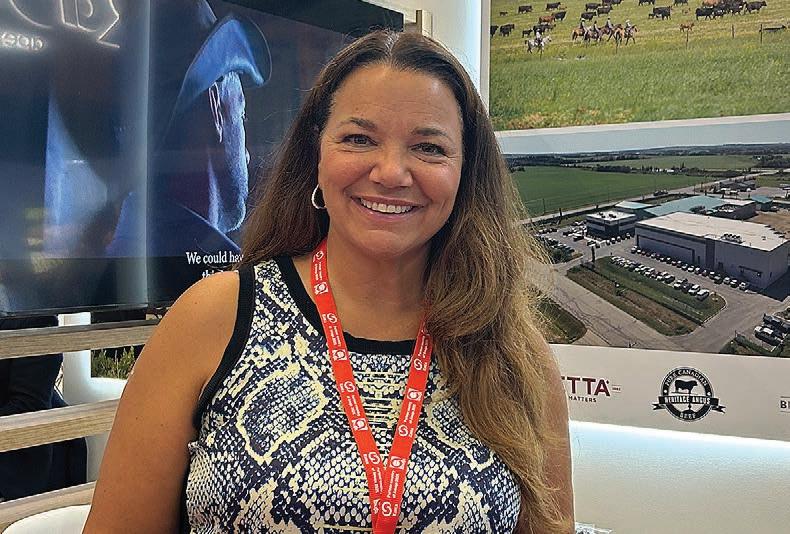
“People cannot get enough of protein and we can’t produce enough of it,” she said.
She is watching closely for any consumer backlash.
Demand for the health attributes of protein was evident at Anuga, where seemingly every beverage and food – plant as well as animal based – promoted its protein content.
Jurgens said he does not see previously low lamb prices being reached again.
There is consensus that consumers will respond to these prices by eating meat less regularly rather than switching to other proteins.
Beretta agreed, saying demand is still high although some consumers are switching to lower priced cuts.
She last saw cattle numbers this low in the 1980s.
John Murphy the commercial manager with Ireland-based Liffey Meats, also did not see lamb prices falling to previous low levels.
Lamb prices are currently about 30% higher than 15 months ago but consumer reaction has not seen a 30% decline in demand, due in part to prices rising gradually rather than in a sudden jump.
Similarly, supermarkets absorbed some of the initial increases to ensure they didn’t burn off demand.
Craig Newton, the general manager of Australia’s Southern Meats, part of the WAMMCO Group, said a dry summer and autumn has seen lower numbers of prime sheep processed.
Numbers through its Goulburn Plant in Victoria were back 40% and the projected national lamb
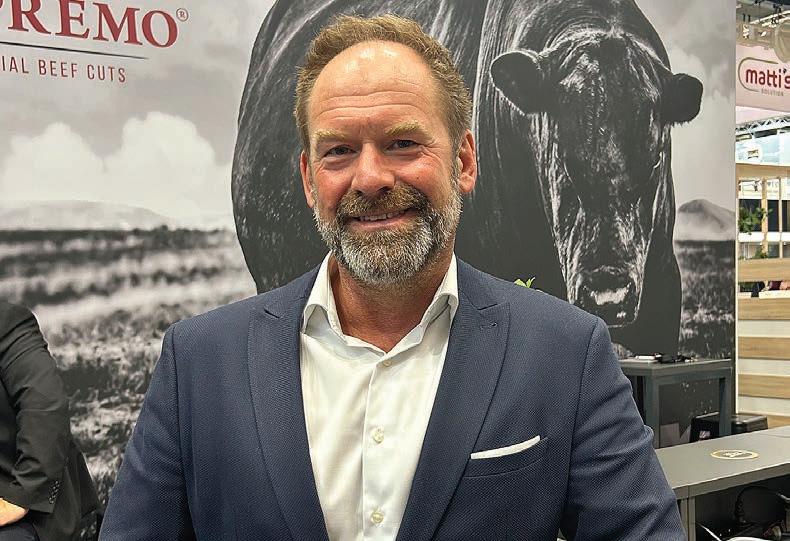
EUROPE’S CHANGING LANDSCAPE
kill this year was 22 million compared to 25 million in a normal year.
Newton, who was part of a large Australian red meat industry contingent at Anuga, also believes current price levels are the new normal.
“Customers realise they have got to pay the money or they will not get the product.”
Jordan Bernard, an account manager with United Kingdombased Pickstock Telford, said UK beef prices reached NZ$16/kg last year but have slipped back to $15/kg.
That reflects the global shortage, but Bernard said the UK red meat market was complicated by access to the market for foreign meat through free trade agreements.
He said UK consumers are increasingly driven by price over provenance.
There appear to be few options to increase animal numbers, especially lamb, but there are signs the United States is ramping up milk production with up to 50,000 extra cows this year.
June production was 4.2% higher than a year earlier, new dairy farms are being established, including one of 25,000 cows, in states away from the traditional stronghold of California, which has water issues.
US dairy processors are investing heavily, with three billiondollar cheese, cottage cheese and sour cream projects underway.
Rabobank US-based dairy analyst Lucas Fuess told Farmers Weekly that environmental constraints mean dairy production is declining in Europe and stable in NZ which leaves the US the only substantial producer where it can grow.
JUST getting the correct regulatory approval is the first challenge for Norwegian meat importer Christian August Lunde.
In a busy year his company, Ultimat, can import between 200 and 600 tonnes of lamb from Silver Fern Farms (SFF), but before he places an order, he has to enter an auction to secure a quota that means he pays a lower tariff of about 6.5%.
“Every year I go to an auction in November to buy quota which gives me a reduced tariff which makes it possible to import meat from NZ.”
Consumers recognise and seek the consistent quality NZ lamb, he said.
He has been a customer of SFF for 30 years and said if he had to pay a full tariff, for beef it would be about 330%, and although less on sheepmeat, it was still significant.
Lunde, speaking to Farmers Weekly at the Anuga Food Fair in Cologne, Germany, said the policy is designed to protect Norway’s domestic sheep and beef farmers, who produce about 90,000 tonnes of beef a year and 60,000 tonnes of sheepmeat. “Norwegians are lamb eaters compared to other Nordic countries,” he said.
EUROPE’S CHANGING LANDSCAPE
The Norwegian government protects its domestic livestock industry to ensure a geographic
spread of domestically produced meat.
Farms are small and typically run cattle, pigs and sheep.
The government restricts numbers on each farm, up to 100 cattle and 200 sheep, meaning about half the country’s 14,000 sheep and beef farmers require a secondary job.
“It’s a very costly policy for the Norwegian government and we as taxpayers,” said Lunde.
Sheep graze on Norway’s mountains from June to September before being housed in sheds from December until late March.
Cattle, which have traditionally been based on dairy breeds, are similarly kept outdoors over the warmer months before being housed.
Beef breeders are starting to introduce beef breed genetics.
After easing for five or six years,
Lunde said red meat sales have recently started to grow by up to 1% a year, driven by a desire for natural food and young people seeking protein.
“We have this workout, fitness, body image trend and these young people need protein so are turning to red meat.”
Consumers in Saudi Arabia want high quality cuts of NZ lamb and buy forequarters, French racks, legs and loin, said Mazan Danob.
He started buying meat from PPCS in the 1990s and the large food importing company he works for, Almunajen Foods, remains a customer primarily for lamb.
It takes up to 5000t a year alongside imported dairy, chicken, frozen foods and seafood.
While Saudi Arabia is a key market for chicken, Danob said
rice.
EW Zealand would be in breach of its free trade agreement with the European Union if it were to leave the Paris Accord on climate change.
That is the view of EU officials who said New Zealand is considered principled on issues such as the environment and human rights, and should it withdraw from the global agreement, questions could be asked.
Farm lobby group Groundswell wants NZ to leave, while ACT NZ believes it should withdraw unless more “realistic, affordable, and scientifically-based” targets are established.
Compliance with agreements such as the accord are a requirement of the NZ-EU free trade agree agreement, which
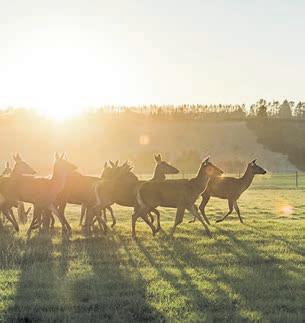
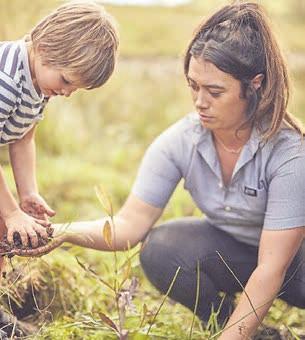
became active on May 1 last year. It allowed 99.5% of NZ exports to immediately be duty free while providing additional quotas and lower tariffs.
The value of NZ meat exported into the EU increased from $1.15 billion in 2023 to $1.39bn in 2025 while dairy rose from $308.8 million to $442.6m over the same period.
New Zealand signed up to the Paris Accord in April 2016 and it requires a 51-55% reduction in emissions below 2005 levels by 2035 and net zero emissions by 2050.
Officials note there is scope for nuanced changes within the parameters of such global agreements.
In response to shifting geopolitical positions, the EU is pursuing policies to provide greater security for defence, energy and food.
That reset also involves broadening the range of its trading partnerships, improving
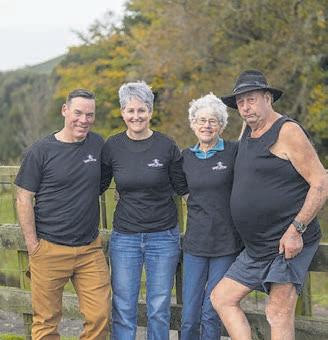
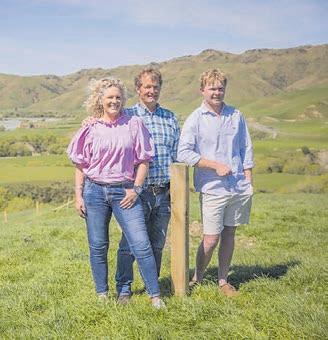
economic security and competitiveness and securing sources of critical minerals.
It recently concluded an FTA with Indonesia, hopes to make progress with India by the end of this year and is working on Mexico and Australia.
It has taken 20 years to negotiate but the EU is close to ratifying an FTA with four Mercosur countries, Argentina, Brazil, Paraguay and Uruguay, for deforestation-free agricultural products.
Over seven years beef imports of 99,000 tonnes can enter the EU with a 7.5% duty of which 55% will be fresh or chilled meat and the balance frozen.
The agreement includes a safeguard clause in case increased beef imports damage or threaten to damage relevant EU sectors, something not part of NZ’s FTA.
For some Mercosur dairy products, zero duties will
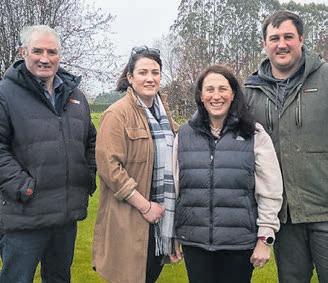
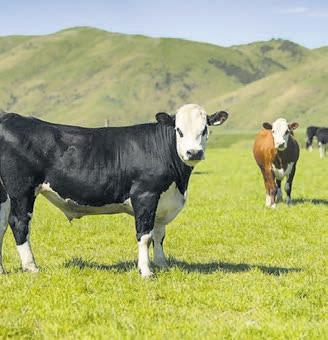
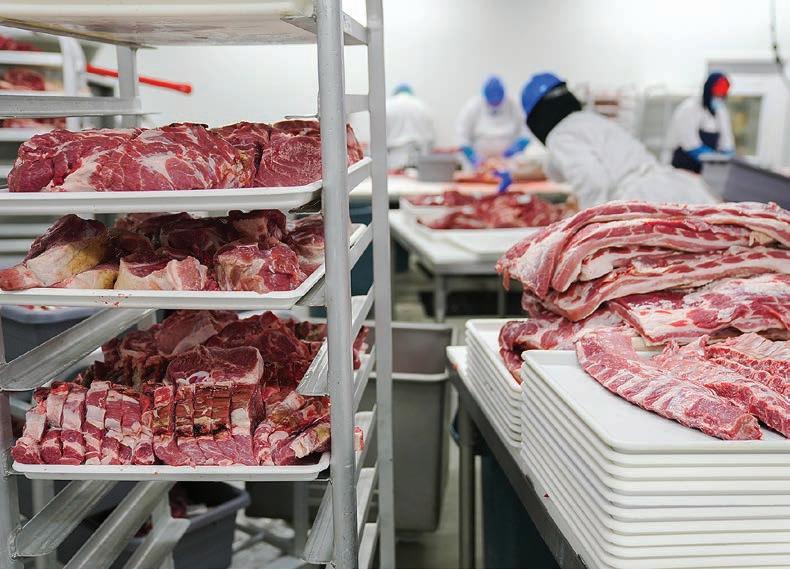
DEMAND: The value of NZ meat exported into the EU increased from $1.15 billion in 2023 to $1.39bn in 2025.
gradually apply within quotas and the agreement will allow 45,000 tonnes of duty-free honey phased-in over five years.
In her state of the nation address earlier this year, European Commission President Ursula von der Leyen said farmers need fair competition and a level playing field.
“This is why we have robust safeguards in our trade deal with Mercosur backed up by funding if compensation is needed.”
The EU is also working with
like-minded nations such as NZ to restore the World Trade Organisation and a rule-based global trading system.
Any exemption for NZ having to comply with the EU’s deforestation policy is unlikely but simpler compliance could be discussed at a meeting later this year of the Trade Committee.
The Deforestation Regulation was to be implemented on January 1 this year but was delayed and will not come into force until the end of 2026.
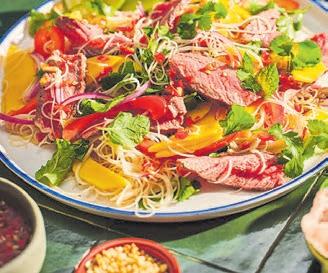
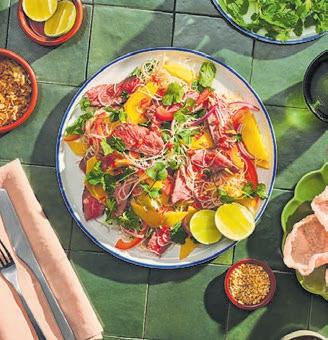
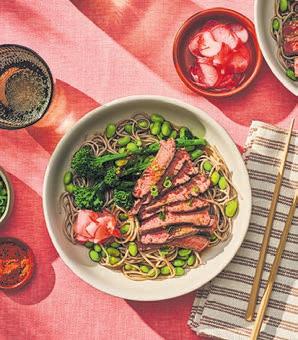
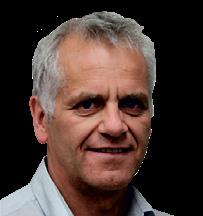
TNeal Wallace in Derbyshire, UK
and fibre
HE early industrialists were practical people.
When the Smedley family established a knitwear factory in 1784, they were drawn to a site alongside a fast-flowing creek on which a water wheel supplied energy to the factory.
Tim Clark, John Smedley Ltd’s technical director, says 241 years later, that heritage remains core to the business as the world’s oldest continuous manufacturer still operating.
Today it employs 274 people across two sites with the factory still occupying the same, albeit significantly modified, buildings at Lea Mills, near Matlock in the Peak District, Derbyshire, United Kingdom.
One of the original buildings was rented from the family of Florence Nightingale, who is credited with establishing nursing as a profession.
The core of its knitwear business is 18.9- to 19-micron Merino wool sourced by The New Zealand Merino Company from 28 South Island properties, a contract that began in 1995-96. These properties adhere to The NZ Merino Company’s ZQRX standard, which includes meeting benchmarks that include sustainability attributes and recognising the interaction between livestock, soil, climate, ecology and community.
John Smedley Ltd was established by Thomas Smedley, a lead miner who started wool combing and worsted spinning. Clark told Farmers Weekly that little more is known about
Thomas Smedley, but two of his eight children, John and Isaac, grew what was a cottage industry into a business making and selling knitted hosiery, with John heading the manufacturing in Derbyshire and Isaac a wholesale business selling it in London. It was tough going, and Isaac was declared bankrupt in the early 1800s.
However, John not only survived but prospered by selling land and working with new wholesalers.
In 1809 he was joined in the business by his son, also named John, who took over in 1827.
John Smedley II proved innovative, and began experimenting with Merino wool in 1834.
The business focused on knitted
Together with NZ Merino we have a fantastic story to tell and we can build our stories into each other.
Tim Clark
John Smedley Ltd
EUROPE’S CHANGING LANDSCAPE
woollen underwear and one of its best selling items was longlegged underpants known as long johns.
Smedley worked 18 hour days and was considered a fair and considerate employer, establishing a hospital for staff.
He was also an early adopter of technology such as steam power.
By the early 20th century John Smedley Ltd had salesmen and agents promoting its wares throughout the UK, India and much of Asia, South Africa, and the Nordic nations.
Today the eighth generation of the family is running the business and what are now its heritage brands.
Manufacturing knitwear consists of 35 individual processes and John Smedley’s product list includes jumpers, cardigans, jackets, polo shirts, T-shirts, loungewear, dresses and skirts. Being a heritage brand, Clark
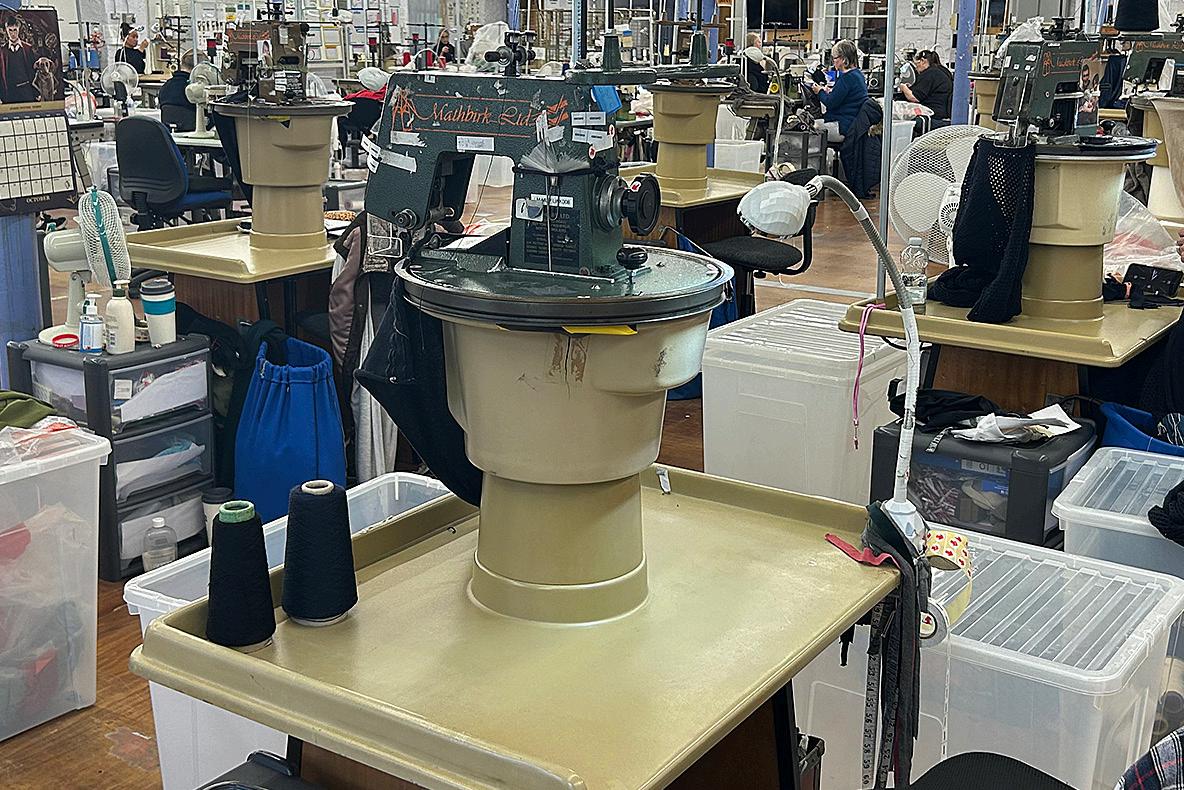
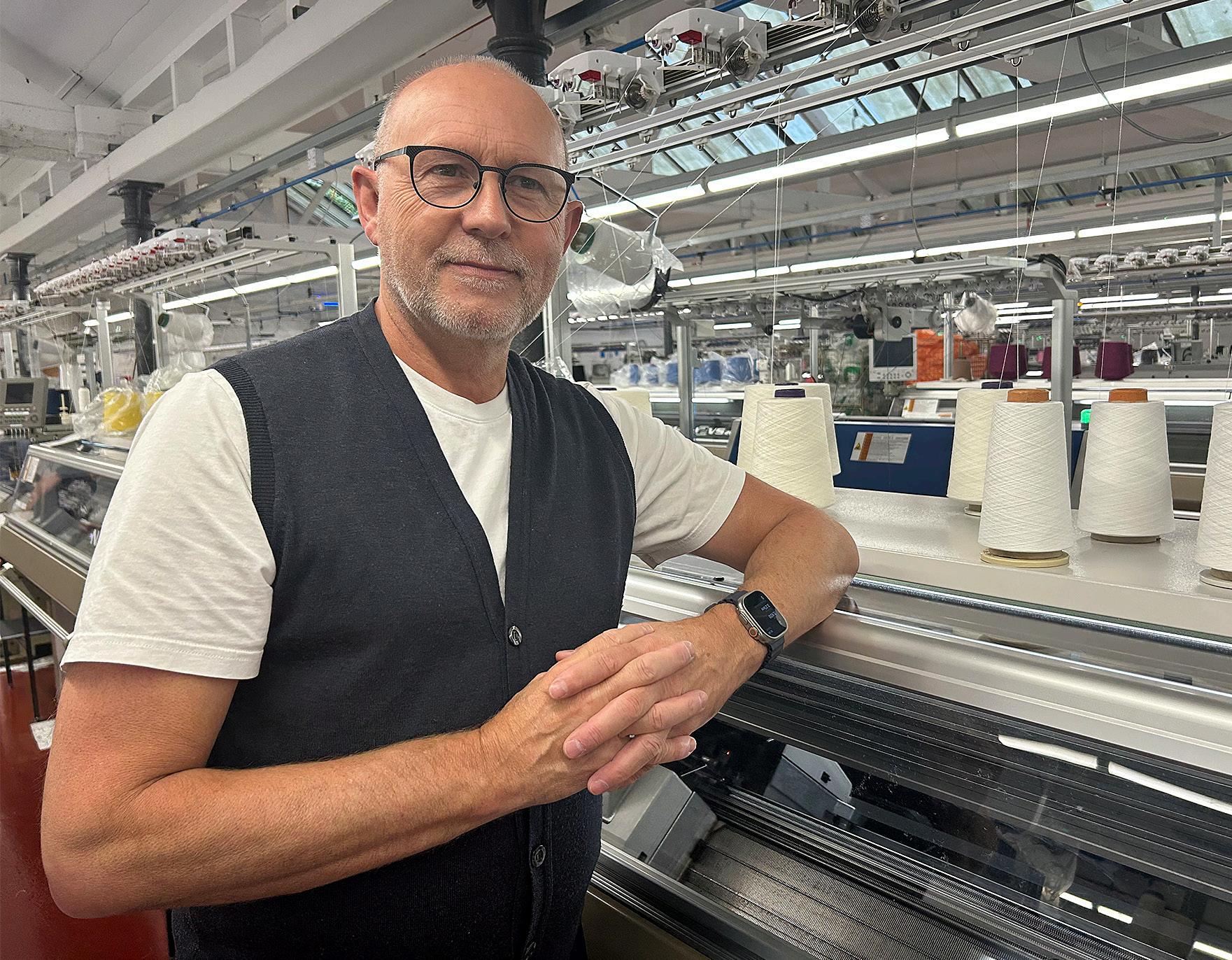
requires adherence to the highest environmental standards, such as in the dye and chemicals used, the efficient use of energy, and environmentally sensitive raw materials including buttons.
“There is a lot of work that goes into it before we make a garment,” said Clark.
“We have to be seen to be doing the right thing and show we are doing the right thing.”
The one product they haven’t been able to replace is the polyester thread used to connect garment panels.
Reducing their environmental footprint is a priority and that is where greenhouse emissions data provided by NZ Merino’s ZQRX standard is so important.
“It shows we are working in the right direction together to reduce our carbon footprint,” said Clark.
“Together with NZ Merino we have a fantastic story to tell and we can build our stories into each other.”
A typical John Smedley woollen garment produces 7.6kg of carbon, which is 32.5% of the company’s initial target of halving greenhouse gas emissions by 2033.
Before being elevated to King, the then Prince Charles and John Smedley Ltd buried a
Neal Wallace in Porto, Portugal MARKETS Food and fibre
THERE was little doubt about where the interests of Pedro Rola’s father lay.
Among the adult calendars hanging on the wall of the Portuguese carpet factory was one depicting various sheep breeds.
Each month the current president of the Portugal-based carpet manufacturer Lusotufo would be educated on the attributes and features of a new breed of sheep.
The third-generation family business was built on respect for wool.
Rola recalled his father would visit farms throughout Portugal and Spain
EUROPE’S CHANGING LANDSCAPE
buying their wool to be turned into carpets.
The company was started by Rola’s grandfather Manuel Marques Rola in the early 1930s as a hand-made cordage industry, known then as Praça.
In late 1935 a rug and carpet factory was established in association with the hand-made cordage industry and traded as Manuel Marques Rola & Filhos.
After Rola’s death in 1936, the company was taken on by his sons Álvaro and David.
In 1952 the company was split, with one son taking on the cordage business and the other rugs and carpets.
Eight years later, the carpet business began manufacturing tufting carpets, with subsequent investments made to expand the type and variety of carpets manufactured, including both loop and cut pile.
These are sold to wholesales.
Renamed Lusotufo, in 2001 it added a spinning mill.
Today 90% of the mill’s yarn production is wool and of that 50% is from NZ. The yarn is sold to carpet manufacturers.
Today Lusotufo is a fully integrated business employing 245 people at its sprawling carpet factory, while its adjacent spinning mill employs 265 people.
wool garment in the grounds of Clarence House, an estate owned by the royal family. Charles was and still is patron of the Campaign for Wool and the test was to promote the fact that wool is biodegradable.
Clark said that after 60 days, when they went to dig up the garment, all they could find was the polyester thread.
The business received a Royal Warrant from Queen Elizabeth II in 2013, an honour that has to be earned.
Following her death, they applied for a new warrant from King Charles, which required answering nearly 190 questions on issues such as water and energy use, waste management and employment practices.
It was received in 2023 and the company is now seeking a similar warrant from Queen Camilla, which requires answering a similar number of questions.
Prince William and Princess Kate are also watching with interest a project involving John Smedley and others in the UK wool industry to educate school children on the value and attributes on the uses of wool.
“We have learnt plenty. We have 241 years of history at John Smedley.”
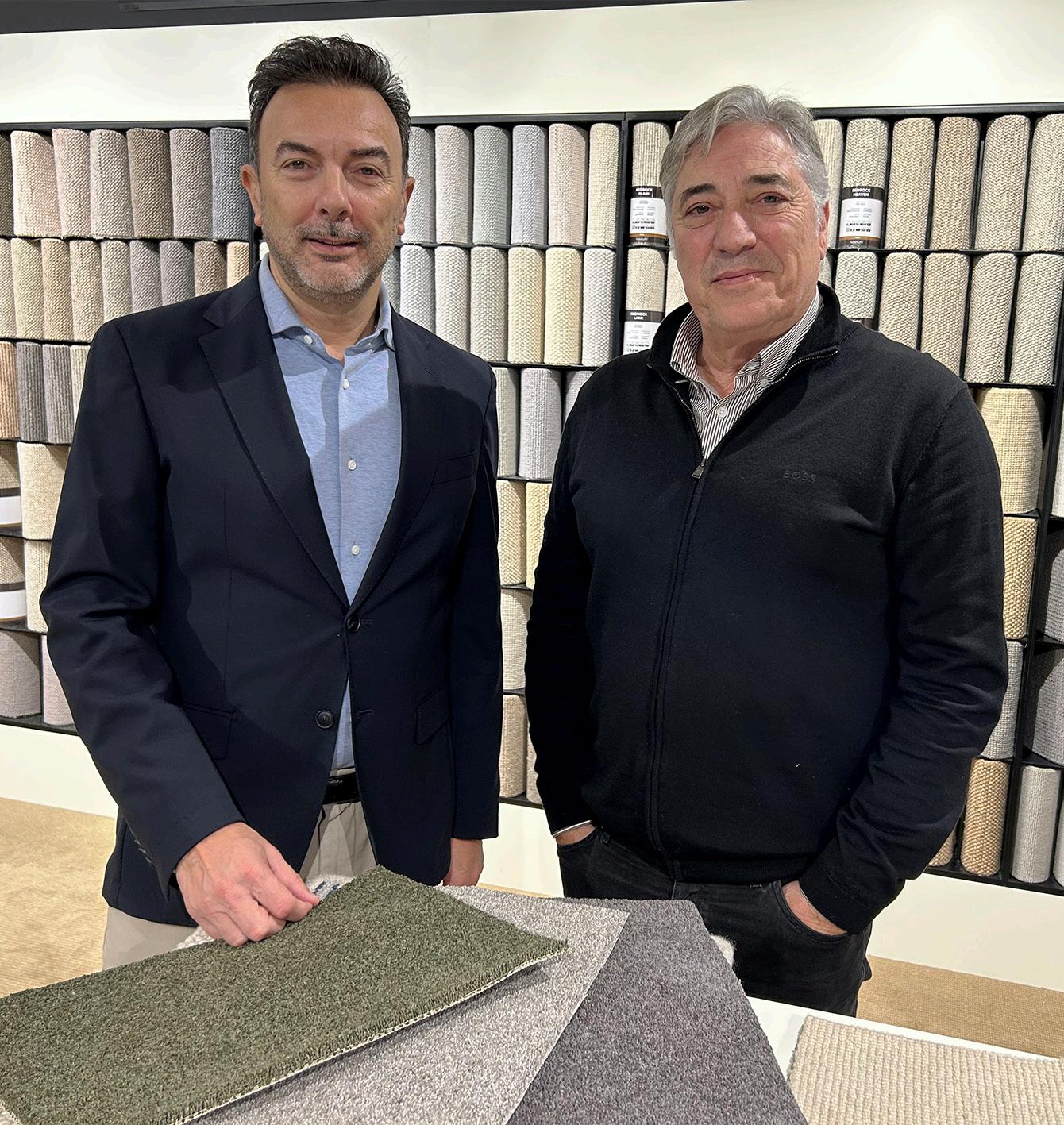
GROWING numbers of Europe’s rich and famous are eating Lumina Lamb from New Zealand.
Alliance Group has recently secured contracts for its specially bred, chicory-finished Lumina-branded lamb with two companies that supply Michelin star and fine-dining restaurants, super yachts and events such as the Cannes Film Festival and Formula One Racing.
Reach Food Group supplies about 1000 markets in the United Kingdom, France, Spain, Greece, the United Arab Emirates and Saudi Arabia, and Selecta 2500 restaurants throughout Italy, Slovenia and Croatia.
Reach Food Group was founded in 2018, and Vennessa Tsui, the company’s commercial director, said it supplies caviar, pork, tuna, lobster, shrimp, Wagyu beef and now Lumina Lamb to discerning customers.
She said those markets require consistently high-quality, uniform-sized product, which Tsui said Lumina Lamb offers.
The clientele frequent these fine-dining establishments in different cities and expect to have the same quality produce every time.
“We find it is the same group of clientele who like to eat out and travel,” said Tsui.
Given those expectations Tsui and procurement manager Mary Curran visited New Zealand to ensure the supply chain met their exacting standards. They said they were taken by the passion and pride of NZ farmers.
“They care and they won’t put just anything into the market which is why we have such consistency,” said Tsui.
Curran, who has had a career in the UK meat industry, said markets require dependable supplies of consistent quality lamb, something Reach can now provide through this Lumina contract.
“Lumina is always available and it is consistent,” she said.
Tsui said Reach tends to follow
its clients, or what they call super brands, and said there is still opportunity in countries such as France and Dubai.
Guido Bruzzo was initially a farmer before seeing an opportunity to supply meat to local fine-dining restaurants. He established Selecta in 1989.
He started with Scottish beef and lamb but had to look for new suppliers following the outbreak of bovine spongiform encephalopathy.
Bruzzo started working with Alliance in the 1990s seeking specialist lamb cuts and now supplies Lumina Lamb to 2500 of the finest restaurants throughout Italy, Slovenia and Croatia.
He said that is provided by the chicory-finished Lumina Lamb, which is enhanced by attributes of being from sustainable, freerange production systems with high animal welfare standards.
“In the meat sector, Lumina was
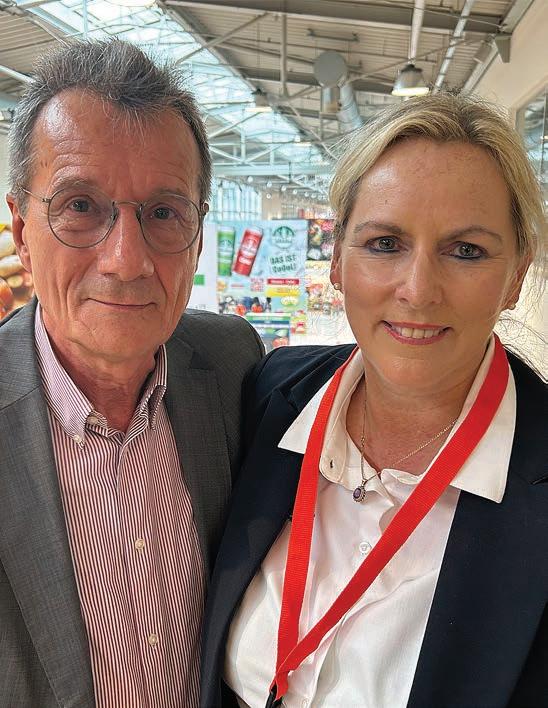
something different. Our clients tasted the product and like it because of its unique selection.”
Helen Scott, Alliance’s director for the UK and Europe, said the chefs love the low melting point of its fat, which gives off a mild aroma and adds to its tenderness.
Based in Bellona, Bruzzo said
Bruzzo employs 220 staff, of whom 120 are in sales, selling about 2600 different items. Meat makes up 28% of what it supplies and fish makes up 30%.


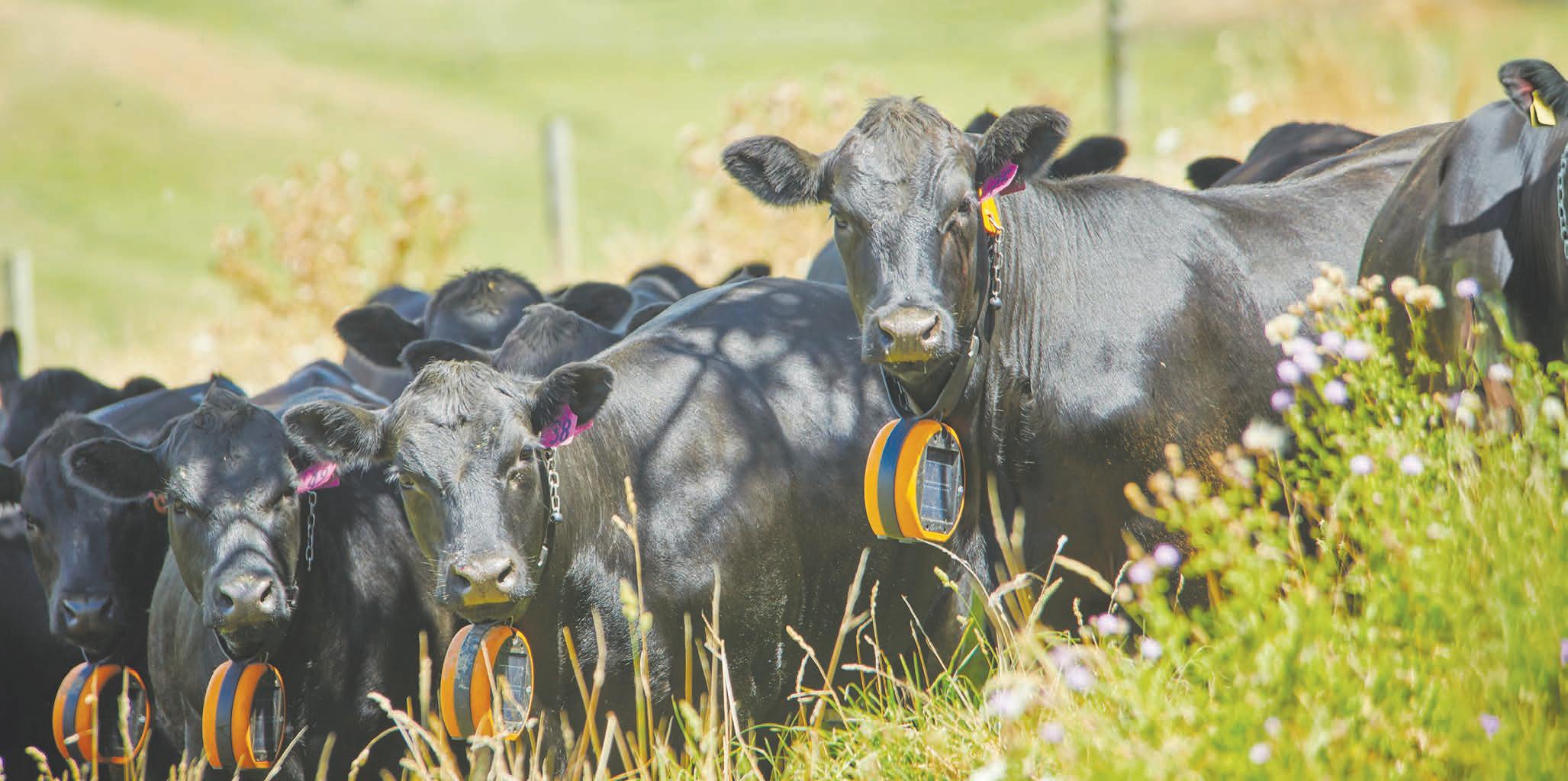




Richard Rennie in Tokyo MARKETS
Horticulture
AN aging demographic and shrinking population may not paint an encouraging picture of Japan as an export destination, but Hawke’s Bay produce company Freshco continues to see growth, margin and opportunity in the country.
With apples, buttercup or kabocha squash and cherries Freshco’s main export produce, Japan has been a long-time export customer. It is valued for its consistency and the trust built up over 35 years with Freshco’s Japanese partners.
Japan country manager Jessica Tisch said the company’s squash business, comprising 12,000 tonnes a year, tends to fly below the radar back home, given the crop’s niche nature.
“Squash is consumed quite differently to how we would eat pumpkin in NZ. It is used as an ingredient, both savoury and sweet, including cooking with a sweet sauce, or sliced in tempura, for example.”
Sixteen years ago, the company
formed the Three Good Men brand for its squash marketing. Investment in the brand includes hosting retail buyers in NZ each year and working to develop retail plans.
“It has helped build a high level of trust between all parties. After an event like Gabrielle, which took out 50% of the crop, there was a lot of sympathy and understanding from our customers, and efforts to help us manage over a very tough season.”
The opportunity is for us to offer more eating occasions. People are looking for more convenience, like prechopped, pre-peeled fruit.
Jessica Tisch Freshco, Japan
Freshco’s apple business includes three proprietary brands, early-harvested Breeze, Sonya and Cheekie, a relatively new variety.
Japanese consumers have been very much occasion eaters for apples, consuming fruit at the
end of a meal, often at the end of the day.
“The opportunity is for us to offer more eating occasions. People are looking for more convenience, like pre-chopped, pre-peeled fruit.”
Freshco has been working closely with its in-market processing partner and the ubiquitous 7-Eleven chain in Japan to get apples processed in that way onto shelf. Its apples are now in 20,000 stores nationally, selling in convenient 80g bags for on-the-go eating.
“For us it is a win-win solution. The larger fruit are perfect for processing and because the apple is peeled, it is a great value-add sales channel.”
On shelf in Tokyo, local apples retail for NZ$3 each, compared to a Freshco offering of four for NZ$5.50, in a smaller size more suited to an older, single-dwelling demographic or families.
“Japanese growers are also facing more challenges from climate change, with heat levels higher, and less winter chilling impacting on crops.”
Rather than disrupt local growing, Freshco has been working with growers to help improve their techniques in
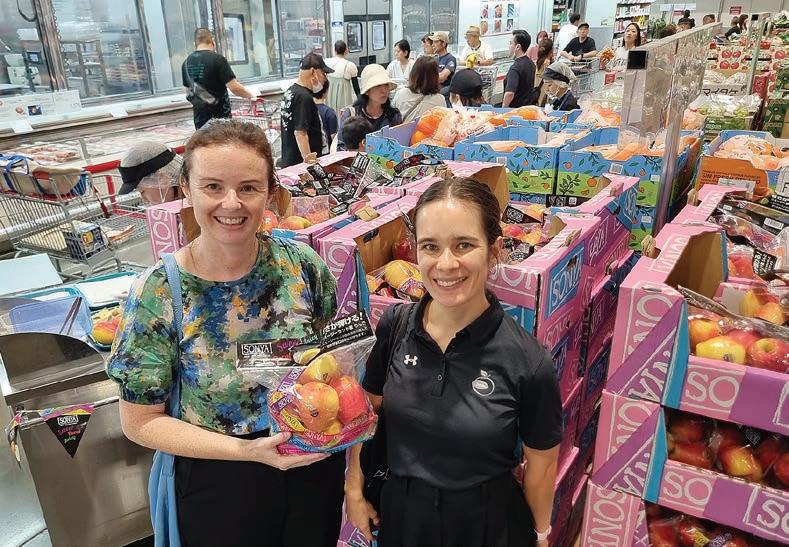
response to these challenges.
“Consumers here like to eat local, and to eat seasonally, so our work really helps to lift the entire market’s prospects,” said Tisch.
NZ apple sales to Japan have grown 60% in the past year, with Freshco having about half the market for exports here.
Japan’s tough phytosanitary standards have deterred other countries from getting a foothold, but the perseverance of NZ exporters has paid off, she said.
“The tariff level under the
CPTPP is also now less than 4%. Zespri paved the way for apples to some extent, increasing consumers’ knowledge of NZ produce, and the nutrient value in our fresh fruit.”
Japan’s food retail outlets are complex and fragmented, with stores holding little stock due to space, making direct retail relationships less common, and with good distributor relationships vital for restocking.
United States retail giant Costco is a valuable customer for Freshco, with the chain’s bulkbuying focus a popular alternative means of shopping for Japanese consumers more accustomed to small, daily local buying.
Richard Rennie in Tokyo MARKETS
Sheep and beef
CONSUMER shifts to leaner cuts and growing awareness of the health benefits of grass-fed beef are helping Silver Fern Farms lift sales volumes in the high-value Japanese market. With over 25 years with the company, going right back to its Richmond days, there is little Yas Kato, Silver Fern’s country manager in Tokyo, has not seen. A longtime Tokyo resident, he appreciates the shift he is now witnessing in tastes.
“People are increasingly aware of the health implications of eating a fattier Wagyu product, especially as they age,” he said. Wagyu beef has strong cultural connections to Japanese consumers, but they are starting to baulk at both its higher price and higher fat content.
Top-end Tokyo supermarket Meidi Ya has A5 grade chilled Wagyu, the highest marbled grade containing about 50% fat, retailing at NZ$17 per 100g. This is alongside Silver Fern Farms grass-fed sirloin in the chiller retailing at nearly half the price.
Japan is a significant market for Silver Fern, among its top three as it is for the entire New Zealand beef sector.
Last year the United States accounted for 36% of national beef exports, China 30% and then Japan, well behind at 7%.
On a per capita basis Japanese consumers sit well behind the likes of their Korean counterparts, averaging about 8kg of beef per person per year, to Korea’s 14kg.
“The impact of price and cost increases has also been significant, both for beef producers here, and for consumers,” Yas said.
Taking longer to finish to full fat marbling means Wagyu cattle naturally take longer to rear.
But Japan relies heavily upon imported grains and feed, which have had heavy cost increases in the past three years with the yen’s devaluation against the US dollar by 30%.
In 2022 Silver Fern experienced the highest ever volume exports to Japan, thanks in part to a shortfall from Australian supply and the ever-increasing cost of local beef.
The ensuing high beef prices saw a drop in volumes for 2023
“but we are seeing people getting used to the higher prices. It’s
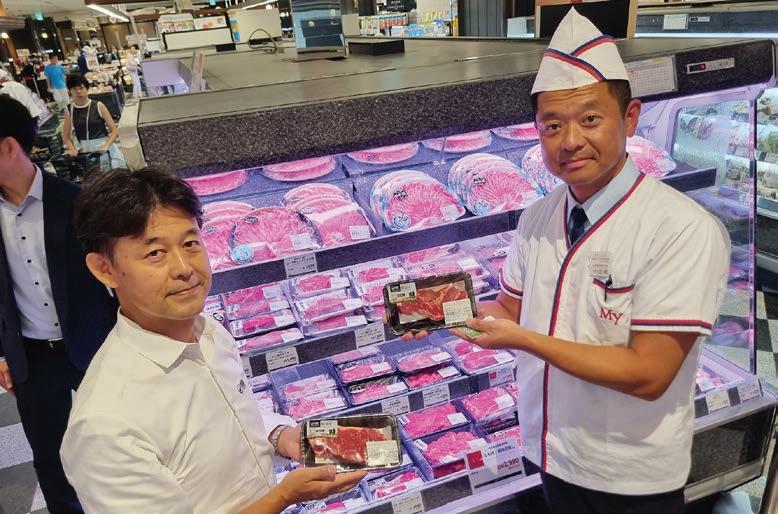
We are now starting to sell more of it, consumers are more open to the idea, the taste and the price point of it.
widespread with 20,000 items having a 50% increase in price over last year.
“For Silver Fern, we are well on track to recover from the slide in 2023.”
The shift in the cost of food has taken many Japanese customers by surprise in an economy that had become almost accustomed
to a deflationary environment as the economy had remained moribund for many years since 2000.
“The government has tried to get companies to increase wages, but wage increases are struggling to meet those price increases.”
Since covid ended, consumers have shifted back to eating out more, with about 80% of Yas’s business coming from restaurants and hotels.
“This is not to say there is no further potential in supermarkets.
US beef has been getting more expensive, almost Wagyu-like prices, thanks to the weaker yen.”
Tokyo’s consumers are relatively new to grass-fed beef, which has typically been consumed in western Japan in cities like Osaka.
“But we are now starting to sell more of it, consumers are more open to the idea, the taste and the price point of it.”
With 40 million potential customers in his native city, Yas has developed a comprehensive pitch for interested supermarkets, food service and restaurant companies to engage them with grass-fed beef.
“After hearing the selling points and then tasting it, almost 100% describe it as ‘very good’.
“In food service we have customers changing to it, on grounds of taste alone.”
THE potential new owner of Fonterra’s consumer brands business has not ventured from the dairy industry since its founding in Laval in 1933.
Lactalis, which is still based in Laval, a 90-minute train trip west of Paris, was established by André Besnier to produce camembert cheese.
It remains a dairy processor 92 years later.
Revenue in 2024 was NZ$62 billion, of which 39% came from cheese, 22% from liquid milk, 16% chilled dairy and 12% butter and cream.
During a visit to the site by Farmers Weekly in early November, Lactalis managers could not talk specifically about the purchase of Fonterra’s consumer
branded business due to the regulatory approval process currently under way.
In October Fonterra shareholders overwhelmingly agreed to sell the co-op’s global consumer and associated businesses, Mainland Group, to Lactalis for $4.22 billion.
The company’s growth strategy has been to buy dairy businesses in different countries but retain local teams to manage them.
A Lactalis spokesperson said the company’s growth strategy has been to buy dairy businesses in different countries but retain local teams to manage their brands, production, distribution and retail networks.
The world’s largest cheese manufacturing company, it
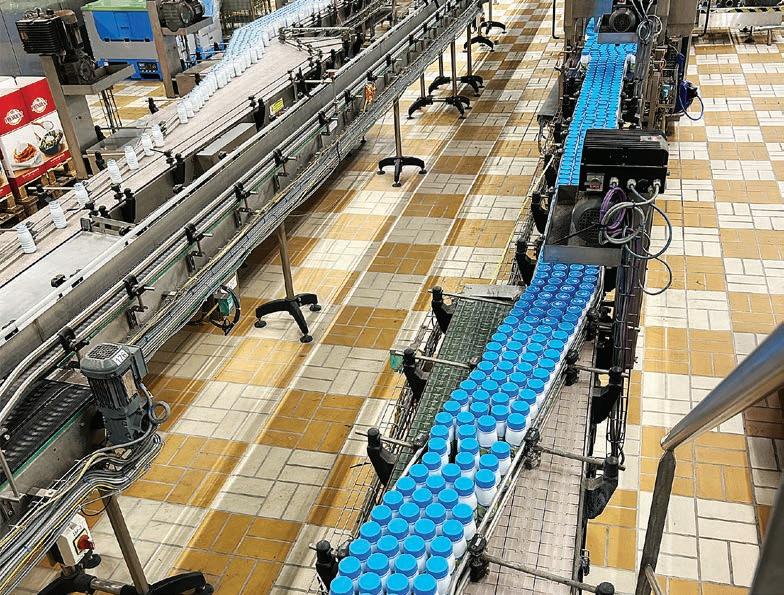


EUROPE’S CHANGING LANDSCAPE
has four international brands: Président, launched in 1968, Galbani, Kraft and Parmalat. It operates 266 processing plants in 51 countries, and its brands are sold in 150 countries.
André Besnier’s son Michel took over the business in 1955 and oversaw the company’s first international expansion into the United States, in 1981.
On his death in 2000, his son Emmanuel took over as chair and accelerated the international expansion with acquisitions throughout Europe, parts of the Middle East, North and South America, Malaysia and India.
That includes a joint venture with Nestlé in selected markets.
Today it employs 85,500 people and handles 22.6 billion litres of milk a year.
In 2023 Europe generated 53% of its revenue, 31% came from the Americas and 16% from Africa, Asia and the Pacific.
In 2024 its Africa, Asia and Pacific businesses collected 3.3 billion litres of milk, which was
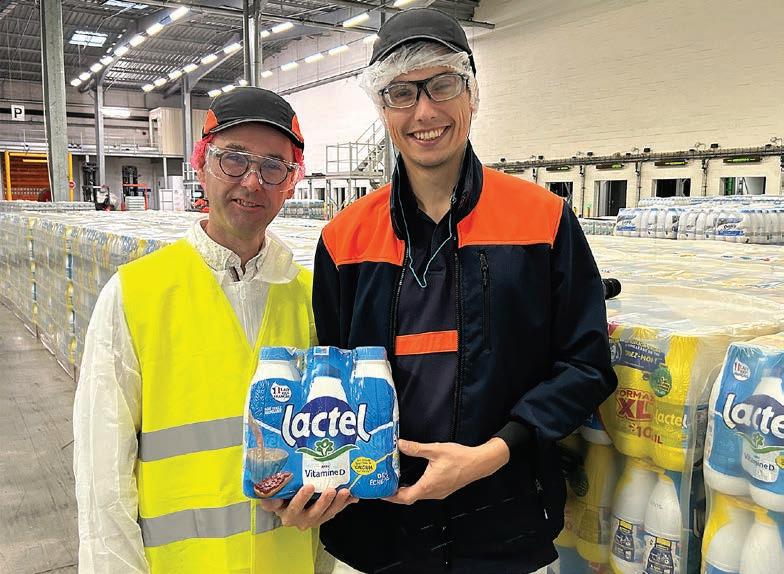
processed in 44 production sites, generating revenue of NZ$9.4 billion.
Europe collected 12.2 billion litres, which was processed through 156 sites and earned $32.1bn in revenue while the comparable figures for the Americas are 7.3 billion litres handled by 66 sites earning revenue of $20.5bn.
One of its plants is at Vitré in Brittany. It employs 420 people
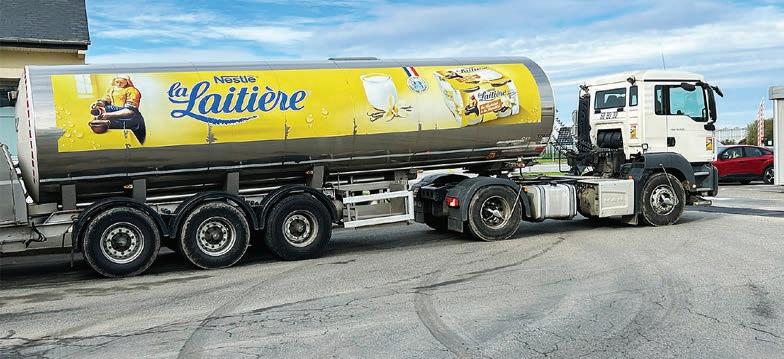
who process 280 million litres of milk a year into a range of UHT milk and cream products for consumption by everyone from infants to the aged.
It is supplied by 450 dairy farmers within a 50km radius who provide milk all year round.
Romain Laforce, the head of operations at Vitré, said production peaks in April with flows 15% greater than the average for the remaining 11 months.
The composition of protein in milk can increase 20% over winter due to a shift in cow diets to feed with more starch and sugar.
The more than 269 million finished products the factory generates are in both bottles, which are manufactured on site, and cardboard bricks.
Laforce said UHT milk is popular in France due to its longevity, and is also exported around the world.
Neal Wallace in Stockton, Illinois TECHNOLOGY
On farm
ANGUS cattle and a piece of Kiwi ingenuity are helping a North American cropping farming couple adopt regenerative farming principles.
Greg and Janis Theron grow crops and farm cattle on 960 hectares of rolling farmland near Stockton in northwest Illinois, about two hours west of Chicago.
Alongside corn, wheat, rye, soya beans and barley, they also integrate cover crops and seed mixes for their 160 Angus cows, 22 replacements and up to 60 finishing cattle.
The third-generation farmer enjoys working with livestock – and that is where Gallagher’s eShepherd virtual fencing comes into play.
About 80ha is pasture and 880ha is tillable for cropping but Theron was uncomfortable with the volume of chemicals
he was using so he adopted a regenerative system that included a greater role for cattle. It fitted Theron’s holistic approach: take care of the soil and it will take care of him.
“I see a major role for ruminant livestock in soil management. They are a key, and eShepherd is brilliant, I love it,” he said.
Illinois is predominantly a cropping state and has few if any permanent stock-proof fences, which are expensive to build.
Previously Theron used Gallagher’s electric fencing system but with a landholding ranging from a few hectares to a few hundred spread across the county, shifting multiple mobs of animals was a time-consuming task.
I like knowing where my cattle are and eShepherd is brilliant.
Greg
Theron
Stockton, Illinois
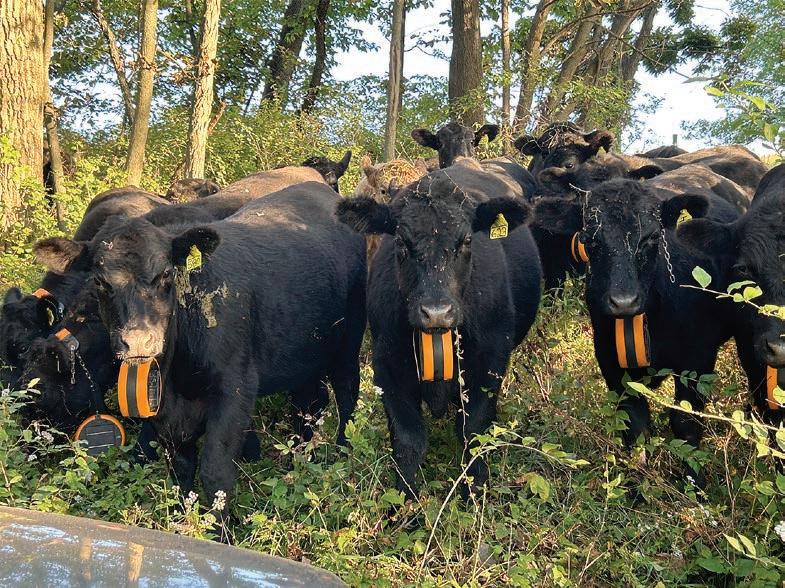
PRAIRIE ROAM COMPANION: Rising one-year steers and heifers are used to clear weeds under a woodlot on Greg Theron’s Illinois farm, where he uses Gallagher eShepherd to contain them.
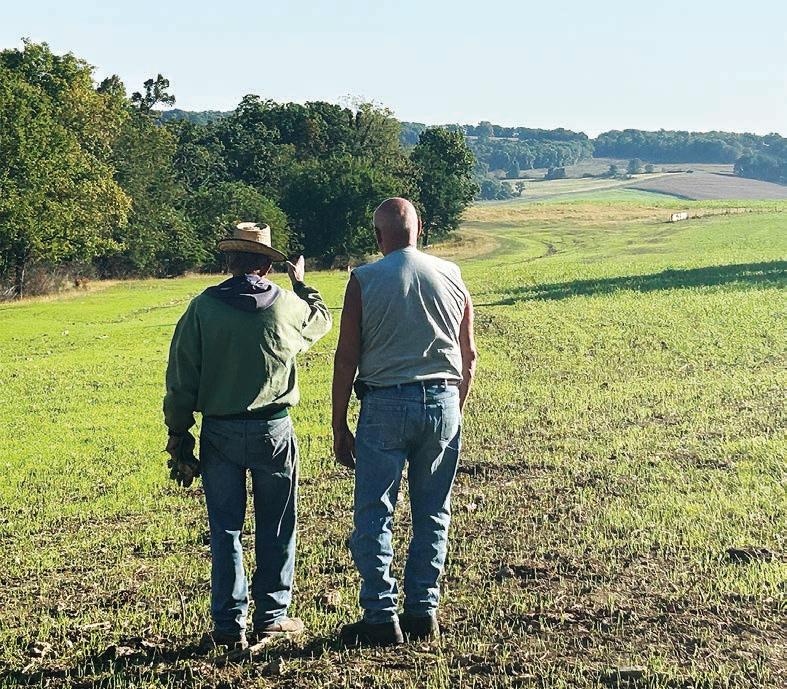
To fully use the cattle manure and natural tilling of their hoofs requires timely shifts when residual cover is not too long or too short.
This is possible using virtual fencing.
Theron has not tilled his land since 2012, does not use genetically modified seed and grows cover crops to feed the soil and his cattle.
Other than low application rates of nitrogen for his corn, he uses no other fertiliser or chemicals, the soil getting all it needs from some dairy manure, diverse seed mixes, crop management and cattle.
“The key to regenerative farming is diversity and making sure everything I do is holistic,” Theron told Farmers Weekly.
A closed herd means he does not use worm treatment, other than for calves.
He is experimenting with the sowing space between corn rows to find the ideal distance to allow cover crops to establish and provide feed for his cattle, which could have additional benefits.
“Corn are wimps. It is one of the least tolerant crops.
“They say the worst weed for corn is another corn, they hate competition.”
All his corn is sold as stock feed and cereals to feed and milling markets.
Theron intends increasing his cattle herd and said he could easily double the number, but for his reliance on leased land and the need to install stock water.
Natural springs that Theron’s ancestors drained to dry the land to grow crops, are being tapped to provide water for his cattle.
Using eShephed’s virtual fencing means from his phone he can manage feed breaks even in inaccessible places, while keep track of each individual animal.
“I like knowing where my cattle are and eShepherd is brilliant.”
For his prime cattle, Theron targets between 630 and 680kg liveweight at 18 to 22 months, which are sold in autumn to regular customers for which he gets about a 10% premium over current market returns.
Theron aims for crop production in the top 10% of the district.
His average corn yield is 6340kg/ha (180 bushels/acre) while the best in the district average over 8000kg/ha.
Having much lower input costs and premiums earned for some crops due to his regenerative practices, he is more profitable
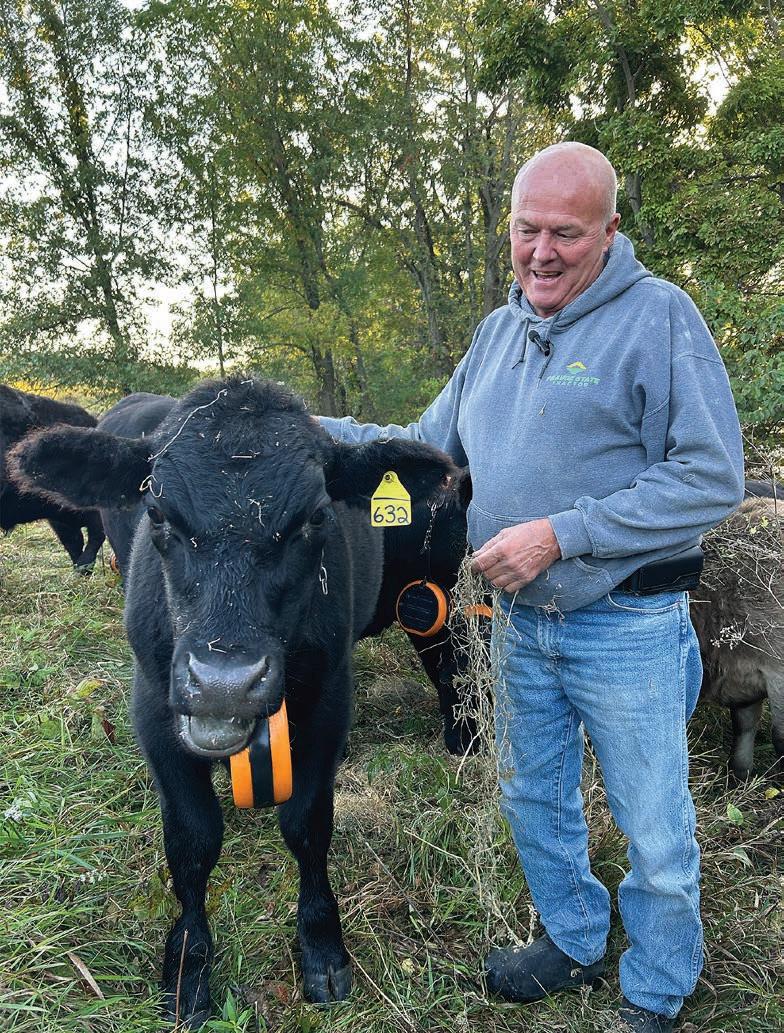
now than under a conventional system.
His average soya bean yield is 1832kg/ha and wheat 2537kg/ha.
Northwest Illinois winters can be cold, with sustained temperatures below 0degC, but summers can be hot, ranging from 17degC to 28degC.
The Therons have two children who are forging their own careers so the couple aim to help settle three young farming couples
on the farm and assist them to continue with regenerative practices.
“We had some tough years but I think we can help people by telling them the mistakes we made.”
Theron doesn’t regret blazing his own path, saying he loves the challenge and at age 68 still bounces out of bed each morning.
“If you hit the easy button all the time, you’ll never evolve.”
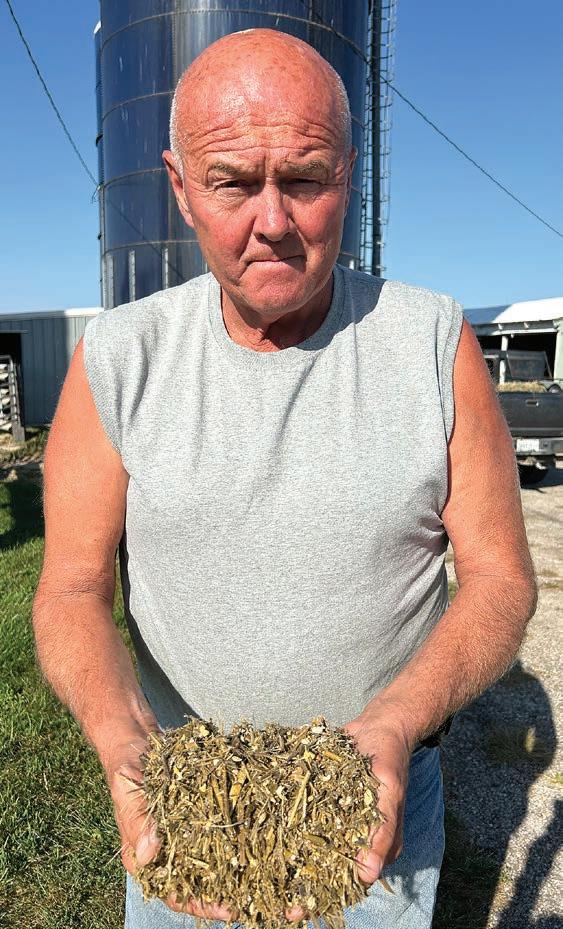
Neal Wallace in Cologne MARKETS
Red meat
ALONG-TERM buyer
of New Zealand meat in the Netherlands hopes the current lift in prices will encourage new generations of farmers onto the land.
Lennert Luiten, the managing director of Luiten Food, is among multiple European buyers concerned at the global decline of sheep numbers, including in New Zealand, and he hopes current high prices may help stem or reverse that decline.
Luiten said he understands farmers have choices but assures them consumers want NZ lamb.
“We hope the current market situation will allow NZ farmers to be more positive about the future so younger generations are happy to take over the family business, to grow their farms instead of selling out.”
Luiten is aware of the impact of forestry on NZ sheep numbers.
“New Zealand has been important in the development of our business and business is growing and our intention is to keep on growing and we need NZ farmers to do that.”
Consumption remains consistent despite higher prices.
“There are no signs at the
moment of a major market correction.
“We see the market staying pretty strong for the coming year,” he said.
Consumers want what he calls “honest meat”, product that matches their values and expectations on animal welfare and environmental management, which he said NZ achieves and which is rewarded with premium prices.
New Zealand has been important in the development of our business, and business is growing.
Lennert Luiten Luiten Food
Luiten is the third generation to run his family’s 87-year import and distribution business from the village of Stompwijk in the Netherlands.
A customer of Silver Fern Farms for 40 years, he sources lamb, mutton, beef, veal and venison, which is sold to customers in Germany, Belgium, the Netherlands and Scandinavia.
One of its customers is Albert Heijn, a Dutch supermarket chain of about 1000 stores.
Luiten initially sought venison from the then PPCS before adding
EUROPE’S CHANGING LANDSCAPE
sheepmeat and beef about 20 years ago. Venison still holds a special place.
Five years ago Luiten encouraged Albert Heijn to stock NZ venison all year round instead of only during the traditional European game season.
Volumes sold have increase four to five fold in the past five years.
“That has worked and a lot of consumers want it and know where to find it and are happy with the quality,” he said.
Luiten Foods was established in 1938 by his grandfather Leo, servicing what was a very localised market.
It was taken over by Lennert’s father, also Leo, and uncle Aad, and is still based in the same village of about 2000 people.
Luiten said the business employs 120 people with some spending their whole careers with the company, which still retains those original family values.
“It’s what we learnt from the older generations, my grandfather, father and uncle, that you do what you promise, you never walk away.”
He started working for the business at age 13, moving to full time after studying at university.
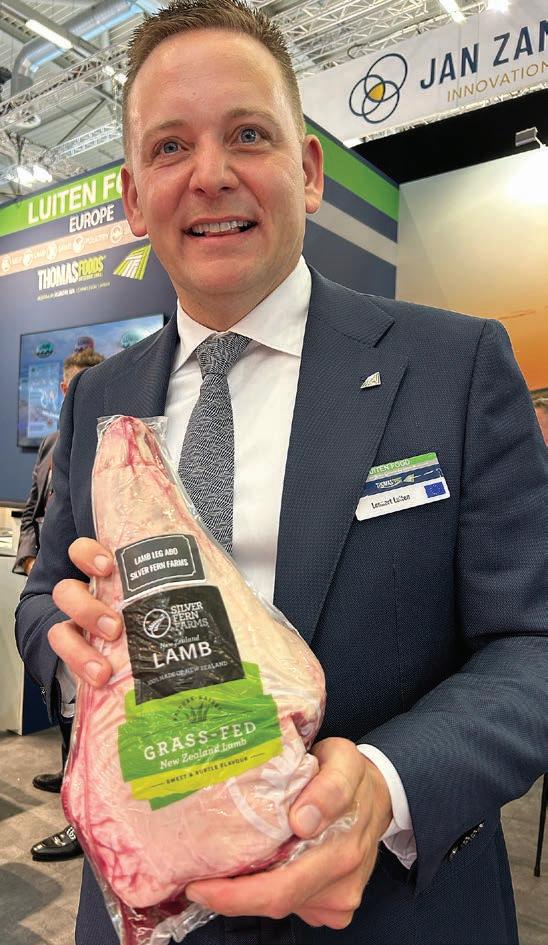
Michael Krasel, from German importer Inter Gusto, said it is crucial younger generations of farmers see a future in farming.
“It is important the next generation is motivated for farming so it is important they have stable prices and that there is consistency.”
He buys up to 2000 tonnes a year of lamb, beef and venison from SFF, which he supplies to wholesalers and restaurants operating in the German, Austrian and Italian Alps, supplying skiers in winter, hikers in spring and autumn and
KEEP IT UP:
Lennert Luiten, the managing director of Holland-based Luiten Food, hopes current high meat prices will stem falling sheep numbers.
summer holidaymakers on the lakes.
Krasel, who operates out of Munich, said the Tyrol region alone attracts between 30,000 and 35,000 skiers a day at its peak. One family in the region operates 14 restaurants.
That includes Restaurant ice Q, which sits 3048m above sea level and was made famous in the James Bond movie Spectre. Hiking is becoming more popular, said Krasel, with groups keen to be close to nature but not wanting to forgo the luxury of nice meal and drink.
Neal Wallace in Utrecht MARKETS
Food and fibre
THE extent at which new-generation weight loss drugs are being used in the United States could reduce its annual grocery spend by about 1%.
About 12% of the population, or 30 million people in the US, have tried Ozempic or Wegovy weight loss drugs, with 8.2 million having them prescribed to them as at November 2024.
Cyrille Filott, Rabobank’s global strategist for consumer food, packaging and logistics, said there are reports that 5% of people in the United Kingdom are on or have tried the drugs. The medicines reduce the urge to eat, with the daily
EUROPE’S CHANGING LANDSCAPE
consumption of calories falling 25-30%.
Research by Cornell University shows households where one family member is using one of these drugs spend about 6% less on groceries in the year they are using it.
This consists of 11% less spent on snacks and 9% less on fast food.
Extrapolating the reduced grocery spend, the Cornell study estimates a 1% annual reduction in grocery spending across the US or a reduction of about NZ$16 billion.
“It has the potential to be a game changer for the food industry in terms of the volume and value of food and what consumers are going to buy,” said Filott.
The drugs are modified from those used to treat Type 2 Diabetes, which people inject.
US officials are currently considering an application for an oral drug, which Filott said could make it more accessible.
Such is the impact, scale of

DISRUPTION:
use, and a wider push by the US government to improve the health of Americans, Filott said there could be a material reduction in food consumption. The drug suppresses hunger, reducing the volume of food consumed and encouraging users to consume more nutrient-dense food for health reasons and to
maintain muscle mass.
He said demand for nutrientdense and protein-rich foods like yoghurt and meat snacks like jerky have increased along with a taste for fresh produce and nutritional bars.
This should benefit sales of whey powder, he said.
“This is generally a protein
story and we should see the category growing.”
There could also be increased demand for ready meals that satisfy the demand for smaller portion size and contain highquality food.
There is another potential food sector disrupter on the horizon, said Filott.
The US government is pursuing policies to avert a looming health crisis, dubbed Make America Healthy Again.
Filott said Health Secretary Robert F Kennedy is considering policies that could benefit healthy, whole foods.
Kennedy supports organics and animal fats and is opposed to ultra processed foods, genetically modified products, the use of artificial fertiliser, oil made from seed and large-scale food producers.
Filott said this stance is already having an impact in the US with companies dropping the use of petroleum-based food colouring and replacing oil seed with tallow in deep fryers.
Neal Wallace in Aalborg PEOPLE
Food and fibre
THEY were a formidable team.
Nanny Glerups was the creative inspiration and sewer and her late husband Ove the engineer, builder and Gotland sheep breeder.
Their patience and trust in each other brought to life handcrafted Glerups 100% wool felt slippers as they constantly pursued the perfect design and production process for what was then still a hobby.
For nearly 20 years they tinkered part time in a shed on their farm in northern Denmark, while Nanny worked a physical education teacher and Ove a thatcher and part-time farmer, running a flock of 300 Gotland sheep.
“From the beginning I aways had a focus of not working against the wool but working with the wool,” said Nanny.
She sought to use wool’s known comfort and temperature control qualities, attributes a growing body of customers also wanted, with orders regularly placed for her to make a pair.
Initially she was making only one pair a day, but there was a problem.
Nanny found that the attributes of Gotland wool allowed the fibre to move and eventually fall out of the slipper.
“Gotland wool is very silky smooth so it moves and works its
way out of the felt,” Nanny said.
“It was necessary for me to find another wool to blend with Gotland wool.”
That fibre needed to provide grip and they initially found that in wool from the United Kingdom, buying one bale at a time as that was all they could afford.
Nanny recalls going to a country fair about that time and getting an order for 200 slippers.
Her production capacity had increased to two a day, with much of the process – compressing the fibres together to make the felt –done by hand.
It would take 100 days to fill the contract.
From the beginning I always had a focus of not working against the wool but working with the wool.
Nanny Glerups Glerups
When Ove reached his early 50s, Nanny said, the physical nature of thatching and the risk of climbing around roofs proved too much.
Demand for Glerups slippers was growing and in 1993 they decided to turn this hobby into a full-time job.
It was still physical work so they contracted a processor to card the wool, but for it to be a viable business, they needed to bring that process in-house.
In 1995 Nanny found a carding machine in the UK, built in 1936, and the couple borrowed the
equivalent of $13,500 to buy it.
Affectionately dubbed The Old Lady, it is still operating today.
“The carding machine was very, very good, a big change for us.”
With aching shoulders and back from years of physical activity, Nanny remained active in the business, overseeing production and quality control while Ove used his building skills.
The difficult decision was made in 2005 to shift manufacturing to Romania due to soaring costs in Denmark. A new factory was built.
Production continued to ramp up and the business grew to the point where in 2013 Ove and Nanny’s son Jesper and sales manager Allan Timm bought into the company and took over the day-to-day running.
The head office is still at the Glerups farm in repurposed buildings.
They started hunting for a reliable and consistent supply of wool, which they found on the other side of the planet, with New Zealand Merino contracted to supply the wool from ZQ certified growers.
Timm said it matters that their NZ suppliers have the same family values and relationshipbased approach as Glerups.
“Our DNA is ‘two feet in the soil’. We remember where we have come from and what the company was founded on,” he
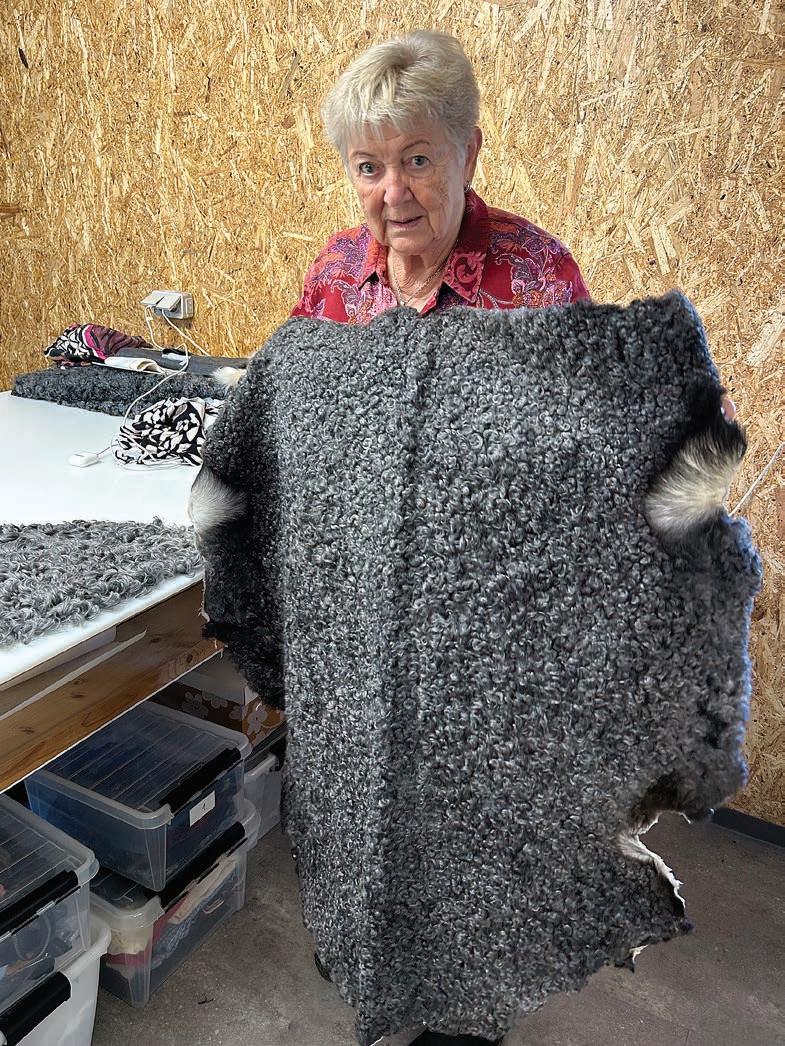
told Farmers Weekly.
Respect for people, animals and nature is also part of their DNA, rooted in the approach of Nanny and Ove.
Timm said they operate a cradle-to-cradle business where nothing is wasted and for which they have earned international certification.
“The certification is proof of what we do, it backs up the facts.”
In the early days boxes were reused and nowadays any that are damaged or broken are shredded to create packaging.
Nanny is still involved, experimenting with new environmentally friendly dye.
Today the company employs about 100 people, including 65 in Romania and the rest in Denmark.
The slippers are sold from Japan and Europe to New Zealand, Canada and the United States, as well as online.
Timm said they are in no hurry.
“After 30 years we are still only scratching the surface,” he said. “We’re not in a hurry, but we are ambitious.”
Richard Rennie in Chengdu NEWS Horticulture
ZESPRI’S recent victory in China in a major plant variety rights case over local orchardists growing its protected G3 SunGold variety also comes at the end of the marketer’s five-year study on where to head with the illegally grown fruit.
A grower vote taken back in 2021 rejected proposals to conduct a collaborative marketing trial with Chinese growers in Sichuan to market their fruit under Zespri’s brand to complement NZ fruit sales. Issues causing NZ growers concern included loss of IP and the perceived quality of China-grown fruit.
But since then crop volumes have only grown.
Now estimated to be up to 7500 hectares throughout China and about 5000ha in Sichuan province, the planted area is closing on New Zealand’s G3 planted area, while estimated production of 41 million trays is comparable to Zespri’s total G3 sales to the market.
This is a clear challenge to Zespri’s market share at certain times of the year, and the NZ industry is under pressure to

We regard Zespri as the gold standard to meet.
Yan Zhiqiang
Chengdu
Kiwifruit Growers Association
revisit the vote as the volumes from China continue to rise.
Sichuan province, with a population of 94 million, is a key kiwifruit-growing region, comprising about 50,000ha of
which 30,000ha is in Red, and the remainder in Gold, including about 5000ha of G3 and most of the rest as the local Jinyan variety.
Zespri’s monitoring project included observing the development of orchard plantings of the illegally imported G3 variety, while also exploring options to ensure fruit quality could be maintained, should a collaboration get the green light. This had included originally identifying 20 orchardists
Richard Rennie in Chengdu NEWS Horticulture
KIWIFRUIT orchardists growing the Zespri G3 variety in Sichuan province are keen to have their fruit sold under the label of the company it was taken from.
A recent China court ruling has confirmed China’s commitment to upholding its newly boosted plant variety protection rules, with the defendant being fined NZ$1.3 million and ordered to pull out his 260-plus hectares of G3 vines. The grower is appealing the judgement.
However, there is tacit acknowledgement within the industry that the cost of taking case-bycase court action rules out ever being able to rein in growers of an estimated 5000ha in Sichuan alone.
For local husband-and-wife growers Mr Chen and Miss Xu, obtaining G3 rootstock presented an opportunity to turn their bare 4ha block of heavy soil into a
kiwifruit orchard. Four years on they say they are still learning the intricacies of the crop and are working hard to meet “NZ standard” fruit.
“The local Red variety – Donghong – and other local varieties are better suited to this soil. But we wish to continue with G3, in the hope we may be able to supply Zespri with it in the future,” said Miss Xu.
Their orchard is one of 20 Zespri included in its recently concluded five-year monitoring and observation programme in the Chengdu region.
A key drawcard for the couple wanting to supply Zespri with G3 to meet counter-seasonal supply to complement NZ supply is the premium Zespri fruit gain in the Chinese market. Typically, the difference can be double what local varieties of Gold fruit get per kg, and 30% above the unauthorised local G3 fruit.
“But we are also very interested in receiving advice from Zespri on ways to improve our crop and our practices.”
They say the G3 is less vulnerable to many diseases than
growing a total of about 1000ha of G3 as possible first candidates to engage with to supply fruit in a collaborative trial.
While Zespri is buoyed by the latest court victory, the high cost of such actions could leave the marketer exposed to an expensive game of whack-a-mole, given the sheer volume of plantings now in the ground.
On a recent Farmers Weekly visit to the province, local growers were well aware of the court victory awarded to Zespri and believed it may slow, but not stop, continued planting of G3 vines.
Yan Zhiqiang is the director of a new packhouse company processing unauthorised G3 fruit alongside local kiwifruit, and also head of the Chengdu Kiwifruit Growers Association.
He told Farmers Weekly his growers emulate Zespri standards, often watching videos on orchard techniques and buying trays at retail to sample and compare to their own.
“We regard Zespri as the gold standard to meet, and middleclass families in China want to buy Zespri fruit. We know Chinese fruit is not as high quality as Zespri’s, but it is still relatively good.”
With the Chinese government recently allowing growers to
increase their area in fruit, including kiwifruit, he sees Sichuan province holding plenty of promise for greater areas of Gold and local varieties of Red fruit plantings.
He believes Zespri’s Ruby Red now coming into China could be a game-changer for Chinese kiwifruit consumption, particularly among younger consumers.
In terms of working under a Zespri label, he said the time is ripe for collaboration.
“The Chengdu government is really supporting growers and farmers and the industry.
“It has a strong budget and the city is a new ‘First Tier’ city, with local government also supporting Zespri coming to Chengdu.”
Regardless of Zespri engagement with local packhouses and growers, the sector is not slowing down on its investment pathway.
Investment at a government level includes nine “agripark” sites around Chengdu focusing on research and sector infrastructure.
local varieties of kiwifruit.
The heavy soils receive organic and chemical fertilisers and approved insecticides.
Psa disease does not affect their G3 as it does the local Red variety.
They say, however, that a key challenge is fruit dropping off vines just prior to harvest.
But they see more upside in G3’s yield potential, harvesting about 37 tonnes of fruit a hectare compared to most NZ orchards’ 45t/ha. To protect fruit and aid ripening, all fruit is bagged on the vine prior to harvest.
They say they have generated a “reasonable” profit to date.
With their hope of being taken into a collaborative partnership dashed when the 2021 NZ grower vote went against a China production trial, the couple are in something of a holding pattern.
“It would depend upon what Zespri was to do for us whether
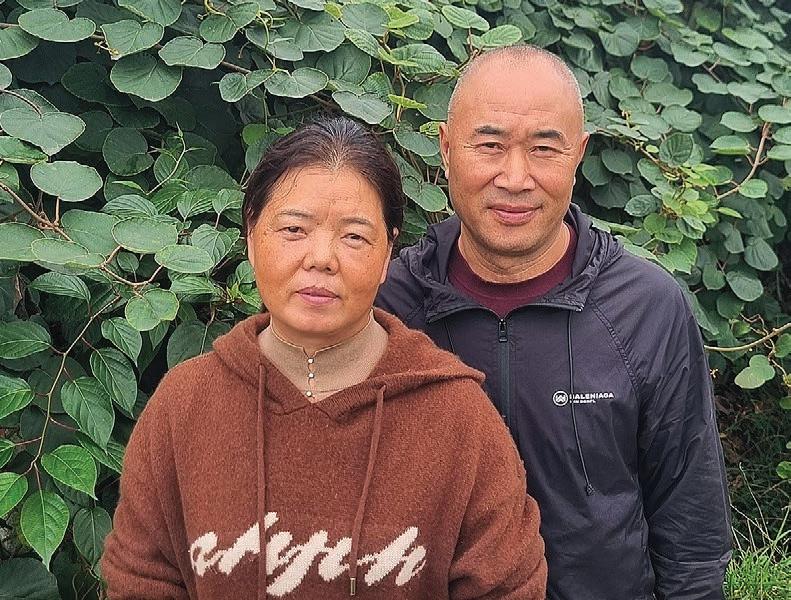
Sichuan orchardist Miss Xu says she and her husband Mr Chen are very keen to continue growing G3 fruit, hoping to collaborate with Zespri to supply out-of-season fruit to complement NZ growers’ produce.
we would commit or not,” said Miss Xu.
For fellow orchardist Zhang Ping, the incentive for planting G3 several years ago on 3.5ha was the potential for co-operation with its source company Zespri.
He closely researched orchard layout and fruit type, opting for Bounty rootstock as better suited to his heavy soil and offering good disease resistance.
As an ex-government employee, he has come to orcharding having had enough of office work, and is keen to leave a legacy for his two
children. He said his income from kiwifruit growing is higher than what he made in the government job.
Being new to orcharding he found plenty of technical support to help him learn to grow kiwifruit better, and said his biggest challenge is finding workers year round, while labour costs have also risen 15% in the last two years.
“Growers are around with lots of expertise, and they are happy to share their information and experience.”
Richard Rennie in
Shanghai MARKETS
Red meat
WORK by Silver Fern Farms to declutter supermarket meat chiller space is starting to pay dividends for it and its retailer customers in the company’s key markets throughout China.
Dave Courtney, Silver Fern’s chief customer officer, said the “perfect store” layout is now in 120 stores across China, better defining the company’s grass-fed market offerings in what can be a notoriously cluttered display space.
“Stores will typically have several different brands of chilled product on offer. We have worked to break down the display space with our retailers to be able to present two grass-fed options to customers to try to cut through the clutter.”
Silver Fern works to present its own grass-fed, predominately beef, products, but also provides space for a viable local grass-fed competitor.
It is a move appreciated by the retailer who may already have strong ties to a local provider they do not wish to usurp with 100% SFF product. The refined
space is aimed to grow the entire grass-fed category for customers to consider.
“They appreciate the fact we are working with them to grow the entire category, not just our own brand.”
The display method has also provided a means for SFF to launch its snack-sized hamburgers aimed at busy households seeking a healthy option that includes Fonterra cheese and quality brisket sourced beef.
They appreciate the fact we are working with them to grow the entire category, not just our own brand.
Dave Courtney Silver Fern Farms
The burgers had a relatively soft launch earlier this year, leveraging off the halo effect the company is generating with its grass-fed promotion.
Sales and logistics staff have also worked hard to ensure that what has been promised retailers will be delivered.
“And that is ringfenced down to a container level, and even if the option comes up to send it to a higher value market, we
remain committed to whatever we undertook to deliver.”
Matt Baker, SFF’s head of China Strategy, said there is a growing awareness about the high fat content in the likes of Wagyu meat cuts.
“You will find a younger consumer may be keener on a product that has a marbling score of 3, compared to say 9-7.”
Meantime the grass-fed products are starting to build a premium that puts them close to those grain-fed products.
“That has been happening over the past 12 months, we are seeing values around 100-120RmB (NZ$25-$30) per kg.”
SFF has also been working with Freshippo, the Alibaba-owned high-tech, high-end supermarket chain, taking specific cuts from the prime steer programme for high-end, high-value grass-fed retailing.
While beef products predominate, Courtney said SFF aims to ultimately include lamb to expand the grass-fed offerings, in a market quite familiar with grass-fed lamb sourced from areas including Inner Mongolia.
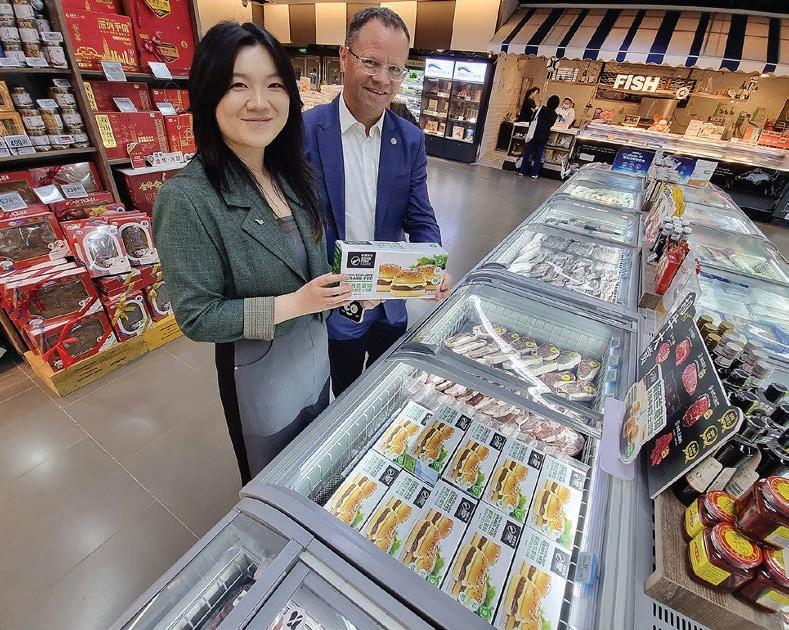
The grass-fed angle carries strong health connotations for Chinese consumers with links to sustainability still only starting to be understood.
With Fonterra pushing harder on its “grass-fed” message, Courtney said there could be potential for NZ companies to collaborate in coming years across food types on that message.
“But it is still only just starting to resonate for consumers.”
Courtney acknowledged the tougher environment food producers have faced in China post-covid, with the days of being able to simply ship a container and sell its contents with ease well past.
“And in the meantime, the
Richard Rennie in Chengdu NEWS
Horticulture
THE growing popularity of Red and Gold kiwifruit among Chinese consumers is seeing a new generation of Chinese orchardists taking their fruit beyond the farm gate, building brands and marketing campaigns around them.
In Sichuan near the provincial capital Chengdu orchardist Wang Yi has leveraged off his organic fertiliser business to develop a 12 hectare orchard planted in Zespri G3.
The G3 orchard complements his Red orchard in the neighbouring district. It is also a demonstration orchard used to trial new methods to share among other growers in the district.
While Wang has established the orchard, he has also worked on building his own kiwifruit brand, Shang Yi, to market the G3 fruit.
“The G3 delivers a 25% lower yield than our local Gold variety
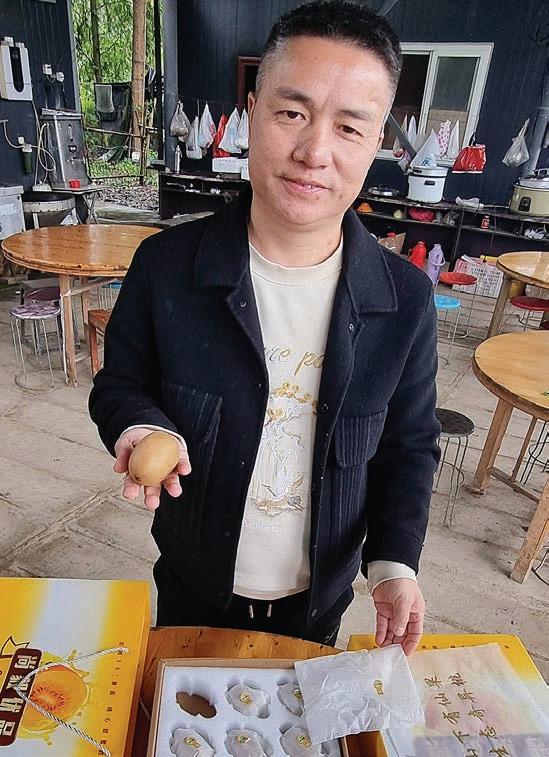
(Jinyan) but it gains a higher price. The local Gold variety’s flavour is not as good as the G3, and locals prefer the G3 fruit, although the G3 is harder to grow.”
Chinese G3 tends to be harvested at a higher Brix (sugar)
OPPORTUNITY:
Sichuan kiwifruit grower and marketer Wang Yi has found a good opportunity with G3 fruit for marketing a high quality, slickly packaged product that appeals to Chinese consumers.
While working on his own brand, Wang said he would welcome the opportunity to co-operate with Zespri, given the higher premium the fruit commands with a Zespri label and the esteem it is held in by consumers. He sees the potential to complement Kiwi growers by being able to fill gaps in their offseason supply with his fruit.
During a recent Farmers Weekly visit to China the China Daily, the official foreign language media mouthpiece for the Chinese government, reported on Zespri’s successful prosecution of a local grower and distributor in the Wuhan courts for the growing and sale of unauthorised Zespri G3 fruit.
level, and at 18% dry matter compared to about 15% in NZ. Typically, the local Gold variety will fetch about half what Zespri SunGold fruit are worth, while locally grown G3 sell at about two-thirds of what Zespri SunGold sell for.
The defendant was ordered to pay around NZ$1.3 million in compensation to Zespri and required to pull out 260-plus hectares of G3 fruit. The grower is appealing the judgement.
The case’s publicity in the China Daily is significant, with the article signalling the Chinese government’s desire to prove it is following up on stricter plant variety protection laws.
average Chinese consumer has become more sophisticated.”
The domestic offering from Chinese producers has also improved significantly.
“Fresh domestically processed product can command a higher price. Demand is still growing, but you have to work a lot harder and smarter now. In many respects it’s no different to selling into Europe in terms of expectations and competition.”
Initially establishing in China through the Primary Collaboration NZ initiative, in 2019 SFF invested in office space and put 18 of its own staff on the ground.
“It’s meant we have more oversight and have also been able to build relationships with retailers here.”
The government has also ramped up its investment in “agri-park” research and infrastructure facilities in Sichuan province, with an aim to attract more investment, and proof of law enforcement boosts that attraction.
Wang said local growers are well aware of the court case and its implications.
He said it is likely it could lead to a slowdown in the planting of G3 in Sichuan.
But it remains likely that the volume of kiwifruit grown in the province – which has long been a traditional growing area for Gold and Red varieties – will only increase.
One packhouse operator confirmed that a previous government policy that would not allow land in Chengdu to be converted from grain crops to kiwifruit has recently been wound back. Along with citrus and blueberries, kiwifruit are now regarded as one of the “big three” fruit likely to attract further investment.
Rennie in Taiwan MARKETS Trade
NEW Zealand trade commissioner to Taiwan Tina Wilson can proudly point to a solid uptick in export growth between NZ and Taiwan over the past five years.
This year marks her last in the post and she leaves with the two countries enjoying solid, if lowkey, trade relations.
Both Wilson and her colleague Chris Langley, the director of the NZ Commerce and Industry Office, believe there is plenty more upside in a market that claims the same sized population and GDP as Australia, NZ’s third largest export market.
Currently Taiwan is placed ninth, and about two-thirds of the $1.6 billion in trade comprises food.
Both countries share an island geography, marked by fault lines and mountains and a native tribal culture, with Taiwan comprising of no fewer
than 16 indigenous tribes.
But the similarities end there.
Taiwan crams 26 million people on a narrow western coastal strip no wider than 40km, with its sparsely populated eastern coast separated by faulted mountains easily as high as Mount Cook.
The two countries’ economies are also almost a reverse image of each other. While NZ generates 80% of its exports from food production, Taiwan has 60% of its exports from computer semiconductor manufacturing.
Thanks to the global race for Artificial Intelligence tech, Taiwan is enjoying a surge in its computer tech exports with GDP expected to grow 5% this year.
“As a market Taiwan very much follows many of the trends in South Korea and Japan, and that includes a low birth rate, among the lowest in the world, and over the past 16 months its population has started to decline, by 50,000 so far,” said Langley.
But that aging population is, like South Korea’s, characterised by “active agers”, senior citizens intent on staying healthy late in life. Good eating and supplements
are a dietary focus, with Taiwanese consuming the highest amount of fruit and vegetables of any population, at about 400kg per capita a year, of which 120kg is fruit.
They are a technically savvy population, value high quality food products and are prepared to pay a premium.
Recognition of NZ as a quality source of food is reflected in this country being the No 1 imported dairy source, No 2 for fruit, namely apples and kiwifruit, and No 3 for meat behind the giants of Australia and the United States.
Wilson said NZ’s quality position is a bonus, but a hard one to protect in a market where extra premium food items are also retailed for gift and occasion purposes, and lower-end food is very cheap.
“It is a good and bad place to be – you are not at the bottom,
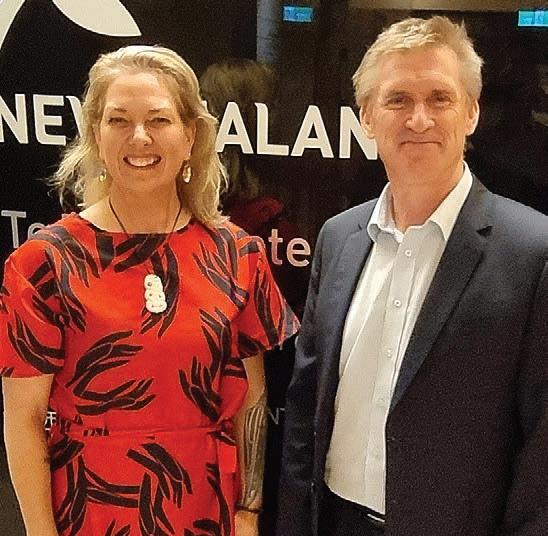
but you can also face a less loyal consumer base.”
A challenge for NZ suppliers is keeping stock levels consistent and full in a high-volume, highturnover market that demands rapid restocking.
“To keep those consumers loyal, you have to be consistent.”
It is an issue reported particularly by meat retailers at a time when NZ’s stock levels are at an historical low point, pinching supply not only for grass market farmers, but export processors.


TEAM EFFORT: New Zealand trade commissioner to Taiwan Tina Wilson and Chris Langley, head of the NZ Commerce and Industry Office, believe there remains plenty more upside in NZ’s trade opportunities with Taiwan.
Langley and Wilson said Zespri has done much to lift its consumer loyalty not only through consistent quality, but now offering kiwifruit all year round, thanks to northern hemisphere supply.
The shared indigenous heritage of the two countries could offer a lever to pull for food exporters, but Wilson cautions linking tribal affiliations, quality food and provenance will involve investment and time to educate the market.
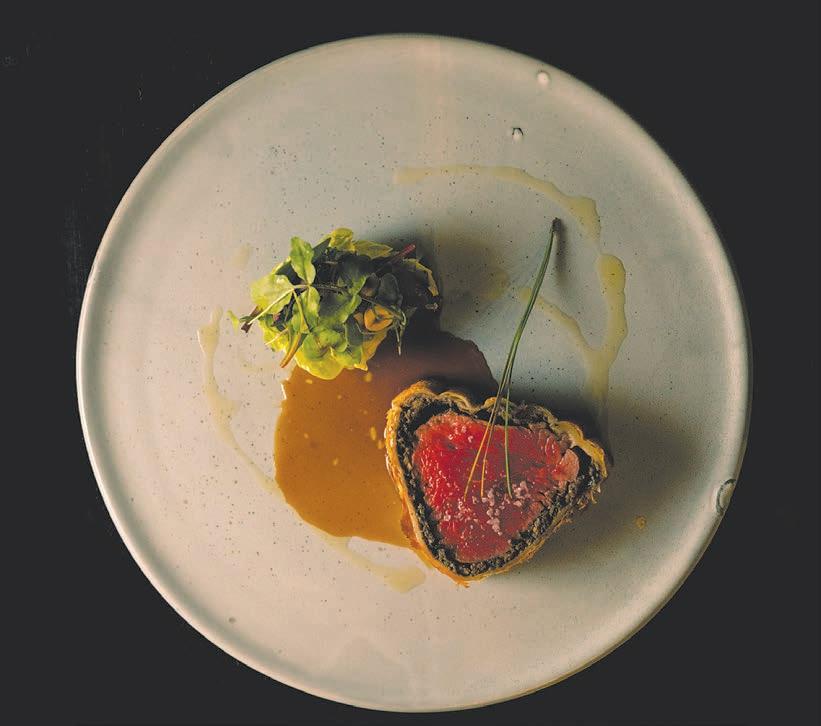
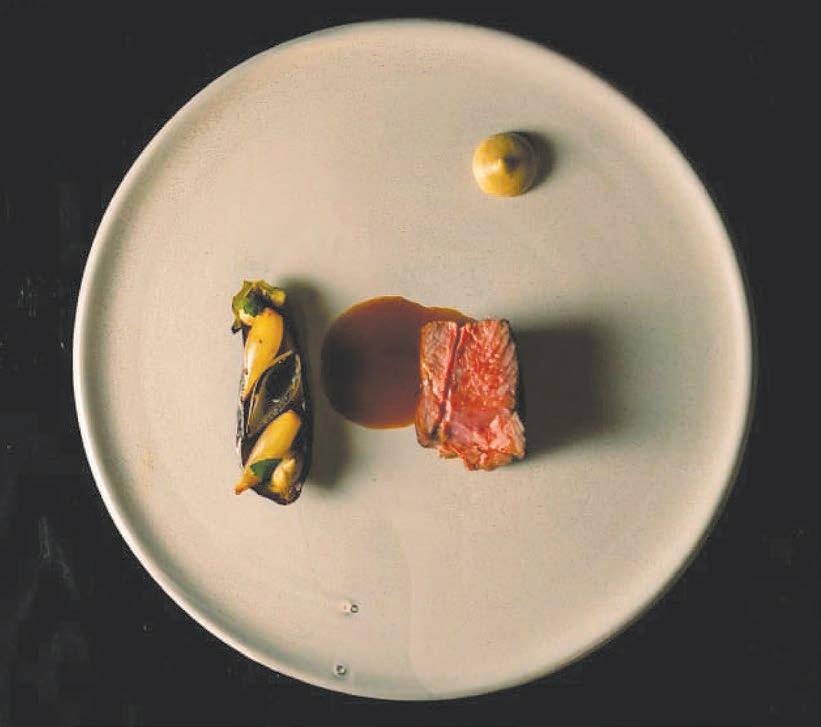
Richard Rennie in Shanghai MARKETS
Dairy
ENDORSEMENT at government level of New Zealand’s grass-fed dairy status sets China up well for deeper marketing development in coming years, says Teh-han Chow, Fonterra’s head of Greater China food service.
The “grass-fed” term was recognised at a formal ceremony involving NZ and Chinese officials at this year’s Chinese International Import Expo (CIIE), where a Fernmark logo to support the NZ grass-fed standard was launched.
“The recognition is important at a consumer level as much as an official level as consumers here will value what the government is endorsing as a positive.
“They see ‘grass fed’ also implies ‘blue sky’ and ‘happy cows’. It is a natural, pristine environment to farm in. If grass is natural, then the environment is too.”
Meantime, 400 different applications a year are being
developed for using Fonterra products in the food service sector. But pressure remains on Fonterra to double down even more in a highly competitive market, working alongside customer companies with specific applications of Fonterra products.
“We now have six application centres across China, with Wuhan being the newest, and have plans for more. It is proving a very solid model for embedding our products with client companies.”
He sees the model also being applied more broadly across southeast Asian countries.
The Chinese market is more dynamic than ever despite an easing in economic growth, demanding a rapid response to shifts in consumer tastes and preferences.
The beverage market highlights this. Bubble tea became a drink trend over six years ago, boosting demand for milk ingredients, which are often used as toppings.
Now coffee has surged in popularity, a market estimated to be worth US$20 billion this year with growth forecasts as high as US$30bn by 2032.
“While not selling liquid milk, the opportunity now is to sell

cream products that are added to coffee in many different flavours.” Fonterra’s decision to retain the Anchor brand in greater China is based on the shared recognition the brand has across
IT’S the farmer’s curse wherever in the world you are: it doesn’t rain for weeks but chucks it down when you least want it. So it was for Greek kiwifruit grower Kostas Kallitsis last month. He was relieved after two days of rain to get a team of pickers back into his 9.5 hectare crop of Green kiwifruit.
His Katerini orchard sits south of Thessaloniki, between the Thracian Sea and Olympus mountains in northern Greece. His family has been growing kiwifruit since 1987 and he supplies Zespri. In 2018 he was one of the first to trial Zespri SunGold. Such was its success, yielding about 50t/ha, he has approval to plant 2ha next year, and hopes to eventually grow 3ha.
His oldest Green vines were on track to yield 25/t a hectare this year, slightly back on the regional average of 30t/ha and what he has produced in recent years. The fruit is also slightly smaller than last year, but the average Brix is 7.5%.
Reliable weather has not required vines to be covered but Kallitsis said the climate is changing, with more heavy weather events, so he will cover his commercial SunGold crop.
Winters can be cold in Katerini, with 1000 to 1200 chilling hours, which Kallitsis said is ideal for Green and will also suit SunGold.
The soil is 60% sand, 40% silt and 1.5% organic matter.
“It’s not the best in Greece, but it’s pretty decent,” he said.
The region has a history of growing apples, olives, grapes, arable crops and vegetables with kiwifruit grown for 40 years, the longest in Greece.
The 36-year-old also grows strawberries and table grapes. Irrigation comes from bores and Kallitsis said local authorities are starting to impose restrictions on its use. It is unclear what that will mean for his orchard.
Like many other European Green kiwifruit growers, Kallitsis is a supplier to both Zespri and other markets.
To supply Zespri, he is required to adhere to the same quality control standards and monitoring as growers in New Zealand, with Zespri taking only his very best fruit.
Twelve years ago, prior to supplying Zespri with Green kiwifruit, he was receiving about €30-40c/kg. Now it is about €1.10/ kg.
Interest in growing kiwifruit, especially SunGold, is reflected in demand for land in Katerini, with suitable bare land selling for €30,000 to €40,000/ha. It costs another €50,000/ha to establish an orchard.
Nikos Adamidis has one of Greece’s oldest kiwifruit orchards, established in 1984 when his father replaced an apple orchard.
Today Nikos Adamidis grows about 12ha of Green kiwifruit in Katerini, which stems from his father’s decision to grow something new.
While continuing to grow Green kiwifruit, next year he plans to increase a 0.3ha trial of SunGold by replacing 3ha of Green.
Adamidis may have only been a Zespri supplier since 2019, but he is devoted to the New Zealand company, saying it provides security and technical support, and helps him manage fruit quality and the timing of harvesting.
SunGold knits perfectly with his orchard management, the maturing and harvesting patterns
They appreciate knowing their product is turning up and is going to work as it should, every time.
Richard Allen Fonterra
company’s ability to leverage scale, logistics and varying bulk products is proving invaluable to customers in the volatile world of global bulk dairy.
“They appreciate knowing their product is turning up and is going to work as it should, every time.”
both consumer and food service sectors in the market.
“We have spent a lot of time and money developing the food service around the Anchor brand, and the Anchor brand now has a very strong halo effect in the food service sector. It adds a premium quality link to customers’ final products.”
Richard Allen, Fonterra’s head of global ingredients, said the
He said the strong growth experienced in protein ingredient demand in markets like Taiwan, Japan, Europe and the United States is still due to strongly lift off in China.
“We are still seeing a strong interest in fats across both food service and ingredients channels in China.
“It is about improving flavour, texture enhancement. For example, the addition of butter improves a product’s desirability, compared to one that uses vegetable fats.”
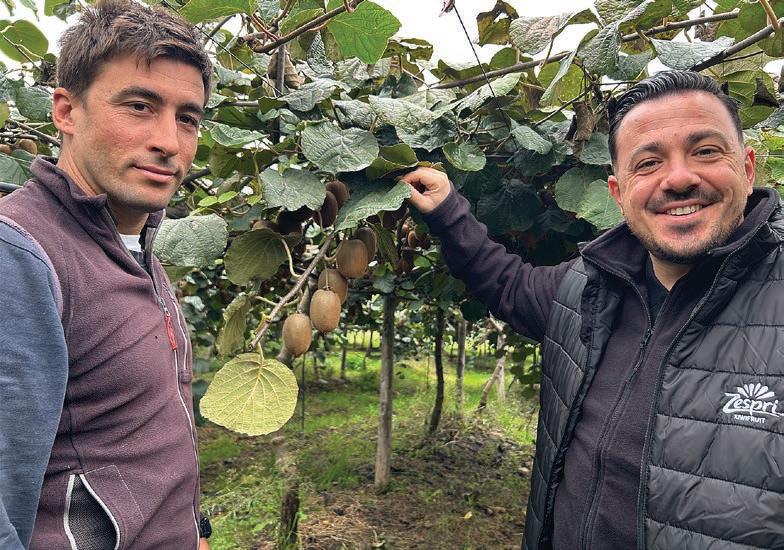
of the two varieties being complementary and allowing better use of infrastructure and labour.
SunGold is harvested in September, a month earlier than Green, and the trial has shown the variety to be extremely reliable, hardy and easy to manage.
“It’s easy to manage the quality and reach harvest specifications if you follow the technical advice.”
His Green crop averages about 30t/ha and SunGold 40t/ha.
It also helps that Zespri pays more for the fruit that meets its standards than other markets, he said.
Thessaloniki packhouse Proto Fruit was established in 1928 as a wholesaler by Nikos
Protofanousi’s grandfather and now the third generation is getting ready to take over – his sons John and Alex.
Each year the packhouse handles 24,000 tonnes of kiwifruit, 11,000 tonnes of cherries and 1500 tonnes of grapes.
Export director Manolis Anastasiadis said kiwifruit comes from throughout Greece, including Zespri, and is exported throughout much of the world but primarily to Europe, the United States, Canada, the Middle East, South Africa, Asia and Brazil.