An Embedded Designers (Personal)


As a six-year old girl, I wanted to design my own car out of round stones, wood and rope, unhindered by practicality issues, just like the characters from my favorite cartoon show the Flintstones. I told everyone that I wanted to be an auto mechanic, and was fascinated by the mechanic’s ability to repair vehicles that were in my eyes extremely complicated.

To everyones’ surprise, my parents supported my quest to become a mechanic, and never doubted my ability to fulfill it. In my little heart, I felt they were proud of me for expressing such an unusual desire.
Perhaps my parents’ continued encouragement over the years gave me the strength to finally quit my management position at the age of 33, and pursue my interests in art and design. Or maybe I had somehow awakened my childhood urge to discover the world around me with curiosity, enthusiasm and wonder. Nevertheless, my decision to quit required guts to say I can do better.
What does it mean to be an embedded design professional, and how can I grow confidently into my role?
The world has evolved, and I’ve changed with it, but I believe my core values have remained intact. They guide everything I do, so in the midst of this big change I feel the need to revisit them and remind myself of the things that matter the most to me. As an embedded designer I want to create my own code of conduct that can accompany me as I test the waters in various contexts. I believe it can be a helpful tool in my pursuit to define my future role as an embedded designer.
According to the Cambridge Dictionary, A code of conduct is ‘a set of rules that members of an organization or people with a particular job or position must
1. They are rules about how to behave and do business, and failure to follow the code can often lead to negative consequences.
I reflected on my successes and failures as a novice designer and took advice from very experienced ones, and crafted 9 codes that are meaningful to me.
1 Cambridge Advanced Learner’s Dictionary, 4th ed. Cambridge University Press, 2022, s.v. “https://dictionary.cambridge.org/dictionary/ english/ code-of-conduct”.

Recognize your ignorance
Tell good stories
Be reflective
Focus your effort where need is greatest
Start where you can
Involve relevant actors in the design process
Seek to understand
Be patient
Engage all your senses
‘Not knowing can be an advantage’, said Nabeel Hamdi. ‘It leaves space to think creatively in search of alternatives’2. He is one of the pioneers in participatory design and planning, and introduces a distinctive code of conduct for urban planners that lays the foundation for a good design practice. A code that inspired me to create my own.
I put immense pressure on myself to research and become knowledgeable before I do anything. Hamdi lets us know that we need to balance the knowing and not knowing; ‘The more I seem to know, the less I seem able to achieve because all that I can see are barriers to progress’3, said Hamdi. I can’t disagree with that.
2 & 3 N. Hamdi, Small Change: the art of practice and the limits of planning in cities, 1st ed., London, Earthscan, 2004, p. 131. & p. 132.
We had just landed in Colombo, checked into our guesthouse, and were greeted by the owner Nevindi. She wanted to inform us about the daily power-cuts. We looked at her with puzzled faces;
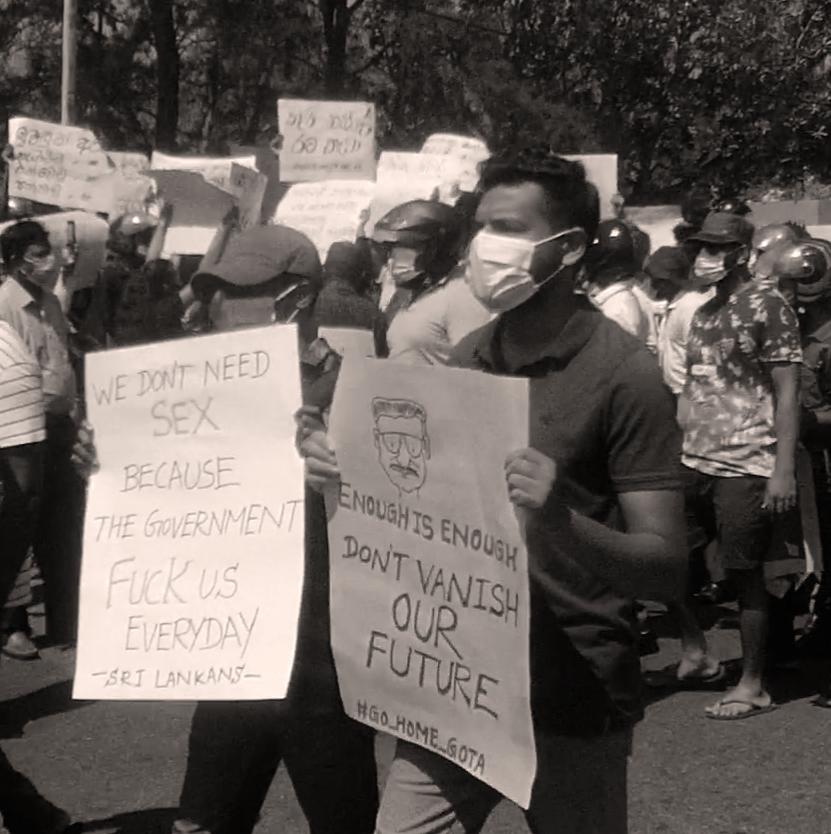
‘Power-cuts’? Yes, Sri Lanka was in big economic and political turmoil; rising food prices, oil shortages and corruption caused huge uproars and protests. But she assured us that tourism was not affected by this, and that we had nothing to worry about.
My privileged Norwegian self had never experienced a power-cut lasting longer than 10 minutes. Half worried, half excited to explore this amazing country, we began planning the next few days.
Our planning was abruptly interrupted when the lights in our room shut off along with internet access.
For the next few hours we had to stay in our room in total darkness, disconnected from the world and unable to move around without flashlights.
I looked at my phone while laying on the bed, and checked the time. It was 18.11. The light from my phone almost blinded me, so I quickly locked the screen, turned to my husband and asked. ‘Should we take a nap?’
This experience reminded me how invisible and embedded infrastructure is, and how the lack of it can deeply affect our normal everyday routines.
Stories like these keep us connected as humans. They keep us interested in the things that matter, and let us pass along lessons.
I would like to get better at telling them.
This whole essay is about being reflective. Reflection can be done in solitude or together with others. Researcher and industrial designer Helena Hansson addresses concerns in her doctoral thesis that ‘the act of reflection is not always accessible for the user/ participant’. She higlights that ‘the consequences of design need to be collectively debated’4, not just judged by the designer alone.
During the #Insti.Invest project I often felt the need to take a pause and reflect on the direction we were taking. Frequent check-ins with our teachers and users allowed us to proceed with confidence and ultimately create value. Reflection takes time, but like Hamdi said, ‘people in a rush don’t stop to think about what they have learnt and what it means’5 .
4 H. Hansson, Designing together: a frugal design approach, Ph.D. diss., Gothenburg, Gothenburg University, 2021, p. 49.
5 N. Hamdi, Small Change: the art of practice and the limits of planning in cities, 1st ed., London, Earthscan, 2004, p. 134.
The latest Intergovernmental Panel on Climate Change (IPCC) report on climate change caught my attention since it insists that architects and designers need to make changes to the way they design in order to lessen the impact of climate change. Designers play a huge role in business, society and the shaping of culture. What is the impact of what I am creating and how is it affecting people and society, non-humans and the climate in general?
There is nothing wrong with making money off design, but in order to avoid cognitive dissonance I believe it’s important to be careful when taking on a project or a client. I want to focus on the causes I care about, and educate myself on how I can address societal challenges as a designer.
Our design challenge for the #Insti.Invest project was to connect students across programmes & build community inside HDK-Valand through the student union Konstkåren. We strategically decided to focus our efforts on something that affected us as students so we could develop our sense of agency. We started in a place we had full power over at that moment.
Hamdi explains the importance of reframing problems and setting them in a different context to avoid paralysis with design6. Some problems are just too complex to solve today. This is why it’s also important to engage with a diverse group of people, so different viewpoints and ideas are developed.
6 N. Hamdi, Small Change: the art of practice and the limits of planning in cities, 1st ed., London, Earthscan, 2004, p. 132.
In ‘Participatory Design’, Toni Robertson and Jesper Simonsen emphasize that ‘If we are to design the futures we wish to live, then we need those whose futures they will be to actively participate in their design’7.

Relevant actors in this case are for instance customers, employees, experts, partners, citizens and government. Problems we address as designers can be very complex, and since I want to design solutions for the long haul, it is important that I do it together
7 J. Simonsen and T. Robertson, Routledge International Handbook of Participatory Design, 1st ed, London, Routledge, 2021, p.1.
Seek to understand systems, networks, people, place, politics and resources.
I think its important to embed yourself fully in all aspects of the design challenge, and seek to discover the often invisible relationships and interdependencies that are undermining positive change.
Researcher and service designer Josina Vink
introduced me to the Iceberg exercise in her doctoral thesis, where the intent of the exercise is to make the norms, rules and beliefs enacted by yourself and others more visible (or tangible), so we may more easily reflect on them and critique them. The root of the problem often comes from these social structures that are overlooked, according to Vink8.
8 J. Vink, In/visible - Conceptualizing Service Ecosystem Design, Ph.D. diss., Karlstad, Karlstad University, 2019, p. 145.
I am highly detail-oriented, which requires time and patience. Not (just) in an aesthetic sense, where I work to make my designs pixel-perfect and of high quality. I mean paying attention to the words I use, the questions I ask and the answers I give.
In a world where hustle-mentality is normalized, I like to take my time with the work I do. This also means that I have to constantly remind myself of the bigger picture. Which is when reflexivity comes in handy.

When my student life started, I was excited to explore the different communities that existed on campus. I soon realized that my desired university experience was not a given, and was highly dependent on my ability to seek out and engage with others. The quietness in the corridors and dimmed lights after 4pm, the cold and empty rooms and the absent smell of coffee were all physical prompts through my senses that helped me realize this.
Vink emphasizes that ‘design is not simply a cognitivist process that takes place in the mind, but rather that design is an embodied experience’9. Vink want to challenge service design literature on the assumption that ‘Design is a cognitive technique’, and propose an alternative assumption that ‘Design is an embodied experience’.
9 J. Vink, In/visible - Conceptualizing Service Ecosystem Design, Ph.D. diss., Karlstad, Karlstad University, 2019, p. 97
Reference List
Cambridge Advanced Learner’s Dictionary, 4th ed. Cambridge University Press, 2022, s.v. “https://dictionary.cambridge.org/dictionary/english/ code-of-conduct”.
Hamdi N., Small Change: the art of practice and the limits of planning in cities, 1st ed., London, Earthscan, 2004.
Hansson H., Designing together: a frugal design approach, Ph.D. diss., Gothenburg, Gothenburg University, 2021.
Simonsen J. and Robertson T., Routledge International Handbook of Participatory Design, 1st ed, London, Routledge, 2021.
Vink, J., In/visible - Conceptualizing Service Ecosystem Design, Ph.D. diss., Karlstad, Karlstad University, 2019.