Feb. 4, 2026

Page 1


The Emory Wheel

Chabad house opens at Oxford College

Last semester, Jewish life at Oxford College turned a new chapter with the opening of Chabad at Oxford, with programming run by Rabbi Mendel Lipskier and Chaya Lipskier. Already, the new Chabad center has held Friday night dinners, holiday events and educational programming, according to Lipskier.

Chabad at Oxford adds to the programming offered at Emory University’s Atlanta campus Chabad center, which opened in 2000. Chabad, a movement of Orthodox Judaism, often operates near or on college campuses to create a space for Jewish students and the larger college community.

Lipskier, who leads Chabad at Oxford, said he hopes the new house will strengthen Oxford’s Jewish community, which he called “underserved.” Prior to the Fall 2025 semester, Oxford students interested in attending Chabad events, like morning services, Shabbat services and holiday events, had to commute 45 minutes to the Atlanta campus.

Emory Hillel and Emory’s Jewish

Across the nation, including at Emory, people have taken to the streets to protest the Immigration and Customs Enforcement (ICE) agency’s killings of Renée Good and Alex Pretti in Minneapolis. In the past seven months, ICE has expanded its presence in multiple U.S. cities, including Atlanta.

Professor of Political Science Jeffrey Staton noted that recently, hostility toward ICE’s approach to immi-

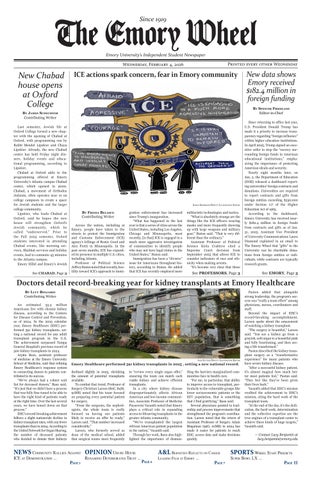
An estimated 35.5 million Americans live with chronic kidney disease, according to the Centers for Disease Control and Prevention, as of 2024. In the 2025 calendar year, Emory Healthcare (EHC) performed 591 kidney transplants, setting a national record for any adult transplant program in the U.S. The achievement surpassed Tampa General Hospital’s previous record of 500 kidney transplants in 2024.

Arpita Basu, assistant professor of medicine at the Emory University School of Medicine, said that refining Emory Healthcare’s response system to connecting donors to patients contributed to its success.

“We’ve always had a robust wait list for deceased donors,” Basu said. “It’s just that we didn’t have a process that was fully fine-tuned to be able to have the right kind of patients ready at the right time. Over the last several years, we have honed down on that process.”

EHC’s record-breaking achievement follows a slight nationwide decline in kidney transplant rates, with 102 fewer transplants than in 2024. According to the United Network for Organ Sharing, the number of deceased patients who decided to donate their kidneys

gration enforcement has increased since Trump’s inauguration.

“What has happened in the last year is that a series of cities across the United States, including Los Angeles, Chicago and Minneapolis, most recently, [is that] ICE is engaged in a much more aggressive investigation of communities to identify people who may not have legal status in the United States,” Staton said.

Immigration has been a “divisive” issue for Americans throughout history, according to Staton. He added that ICE has recently employed more

militaristic technologies and tactics.

“What is absolutely strange are the things like the ICE officers wearing masks and more frequently showing up with large weapons and military gear,” Staton said. “That is very different than the ordinary.”

Assistant Professor of Political Science Kiela Crabtree cited a Supreme Court decision from September 2025 that allows ICE to consider indicators of race and ethnicity when making arrests.

“It’s become very clear that these

declined slightly in 2025, shrinking the amount of potential transplants available.

To combat that trend, Professor of Surgery Christian Larsen (80C, 84M, 91MR) noted that his team focused on preparing every potential patient for surgery.

“From the surgeons, the nephrologists, the whole team is really focused on having our patients likely to receive an offer be ready,” Larsen said. “That number increased considerably.”

Larsen, who formerly served as dean of the medical school, added that surgical teams meet frequently

to “review every single organ offer,” ensuring the team can match each viable kidney and achieve efficient transplants.

In a city where kidney disease disproportionately affects African American and low-income communities, Associate Professor of Medicine Payaswini Vasanth noted that Emory plays a critical role in expanding access to lifesaving transplants in the greater Atlanta community.

“We’ve transplanted the largest African American patient population in the nation,” Vasanth said.

Through her work, Basu also highlighted the importance of disman-

tling the barriers marginalized communities face in health care.

“For me, in particular, that ability to improve access to transplant, particularly to the vulnerable groups like lower socioeconomic patients or the HIV population, that is something that I find gratifying,” Basu said.

Several physicians pointed to leadership and process improvements that strengthened the program’s coordination. Larsen noted that the return of Assistant Professor of Surgery Adam Bingaman (99G, 01MR) in 2024 has made it easier for patients to reach EHC, access data and make decisions quickly.

Since returning to office last year, U.S. President Donald Trump has made it a priority to increase transparency regarding “foreign influence” within higher education institutions. In April 2025, Trump signed an executive order to stop the “secrecy surrounding foreign funds in American educational institutions,” emphasizing the importance of protecting American ideals and security.

Nearly eight months later, on Jan. 2, the Department of Education (DOE) released a dashboard reporting universities’ foreign contracts and donations. Universities are required to report contracts and gifts from foreign entities exceeding $250,000 under Section 117 of the Higher Education Act of 1965.

According to the dashboard, Emory University has received nearly $182.4 million in foreign funds from contracts and gifts as of Jan. 31, 2025. Assistant Vice President of University Communications Laura Diamond explained in an email to The Emory Wheel that “gifts” to the University can be charitable donations from foreign entities or individuals, while contracts are typically research grants.

Pasten added that alongside strong leadership, the program’s success was “really a team effort” among physicians, nurses, coordinators and staff.

Beyond the impact of EHC’s record-breaking accomplishment, Larsen spoke about the amazement of watching a kidney transplant.

“The surgery is beautiful,” Larsen said. “You see a kidney go from a grayish, soft organ to a beautiful pink and fully functioning, and then seeing a life transformed.”

Pasten described the kidney transplant surgery as a “transformative experience” for many patients who have severe kidney disease.

“After a successful kidney patient, it’s almost magical how much better most patients feel,” Pastan said. “They feel like they’ve been given their lives back.”

Vasanth added that EHC’s mission credited the achievement to EHC’s mission, citing the hard work of the transplant team.

“At the end of the day, it’s the dedication, the hard work, determination and the collective expertise are the true engines of a transplant center to achieve these kinds of huge targets,” Vasanth said.

— Contact Lucy Benjamin at lucy.benjamin@emory.edu

Emory Healthcare performed 591 kidney transplants in 2025 , setting a
‘ICE isn’t welcome here’:

SFS holds anti-ICE walkout, community members protest amid nationwide turmoil

At one of the largest protests at Emory University since pro-Palestine protests in April 2023, around 300 community members rallied on Jan. 30 against U.S. Immigration and Customs Enforcement’s (ICE) recent nationwide actions. The demonstration began with student speakers in Asbury Circle, and after about 30 minutes, organizers led protesters in a march through campus to the Haygood-Hopkins Gate near Emory Village.

Emory Students for Socialism (SFS), EmoryUnite! and Sunrise Emory, among other groups, coorganized the event, which followed a smaller protest last week.

Emory SFS organizer Tasfia Jahangir (23PH, 29G) began the protest by condemning an ICE agent’s killing of Renee Good on Jan. 7 and an ICE agent’s killing of Alex Pretti on Jan. 24, both of which occurred in Minneapolis.

This weekend, hundreds of antiICE protests took place across the United States. Alongside Emory’s demonstration, over 100 other Georgia schools held walkouts and protests against ICE on Jan. 30. Additionally, thousands of workers and many businesses participated in a general strike over the weekend. Jahangir said there should be “no business as usual” while ICE raids and killings continue.

Recently, ICE opened a new satellite office in College Park, Ga., about a 30-minute drive from Emory’s Atlanta campus. In addition to the new location, ICE operates another field office in downtown Atlanta. According to WABE, the metro Atlanta affiliate of NPR and PBS, ICE officers have been working out of the College Park space as of Jan. 27, but ICE spokesperson Lindsay Williams declined to disclose the office’s exact location.

Jahangir attributed the high protest turnout partially to the national attention that the deaths of Good and Pretti are receiving. During her speech, Jahangir called these events a “historic moment,” igniting Americans’ willingness to fight for change.

“People are feeling the weight of the situation right now,” Jahangir said. “The killing of Renee Good, Alex Pretti, just shows that under this

regime, nobody is safe. ICE is killing, terrorizing people indiscriminately.”

During the protest, eight Emory students spoke. Anayancy Ramos (28G), who is a Deferred Action for Childhood Arrivals recipient, teared up while describing her experience as an undocumented student.

“As far as I know, I’m the only undocumented graduate student at Emory,” Ramos said. “I hope you know and understand what my journey has been like, and whenever I do try to speak out, I’m met with, ‘You don’t have to worry about that, you’re at Emory.’”

Protesters cheered on Ramos, whose voice wobbled as she told her story, with the crowd exclaiming “shame” on the Emory administration as she spoke.

Ramos urged attendees to remember the power of community and emphasized that while international students may not be undocumented, many still fear for their safety at Emory.

“Silence won’t protect the international students sitting in our classrooms, wondering if an algorithm will upend their lives — silence will not protect me,” Ramos said. “When it’s your turn, who will be there? Who will be there to protect you? So, I’m asking you all to be there for me. I’m committing to be there for you too.”

As Ramos finished speaking, the crowd erupted in a chant, responding to her question with a promise of their own: “We’re here for you!”

After several students spoke in Asbury Circle, the organizers began leading the group of about 300 protesters through campus. Community members marched from Cox Hall, through the Emory Quadrangle and to the Haygood-Hopkins Gate.

“Get out the way, ICE, get out the way,” students chanted to a drum beat.

Perched around the marble Emory University sign, the group gathered for the rest of the protest. Emory National Lawyers Guild President Mary Thomas (27L) continued the series of speakers, imploring students to stand up against the “racists” and “fascists” she said make up the U.S. government.

“Y’all know what scares racists and fascists?” Thomas said. “Everyday people like me and like you. … We are making a statement today that enough is enough.”

Attendee Ugonma Chike-Kalu (29C) said she attended the protest

because she values civic engagement and supports the movement against ICE.

“There’s power in people, there’s power in demonstration and there’s power in movement,” Chike-Kalu said. “When I saw the protest was happening, I knew that was something I wanted to be a part of, just to instigate change.”

Along with caring about community involvement, Chike-Kalu also called ICE’s recent actions “despicable” and “abhorrent,” stating the agency is targeting marginalized communities and people of color.

Kristara Marshall (28C) compared the arrests of both undocumented people and U.S. citizens by ICE agents to those of Nazi Germany and emphasized that she wants the government to shut the agency down.

“ICE should be abolished,” Marshall said. “It’s our responsibility as college students to use the education that we’re getting to speak out against ICE for others who can’t.”

Like Chike-Kalu and Marshall, EmoryUnite! organizer Abigail McElroy (28G) said she wants Emory to do more to support its undocumented and international community members against potential ICE action.

“Emory has been very quiet about everything that’s going on, and I would like them to not, because I don’t want my friends to be deported,” McElroy said. “I don’t think that’s such a crazy thing to say.”

Similar to last week’s protest, participants called for change from both the federal government and the University itself. Chike-Kalu criticized the University for not doing more to support Emory’s substantial international student population, calling their approach to recent ICE actions “callous.”

In Chike-Kalu’s call to action, she was specific that she wanted to see more tangible actions, not just words, from the University.

“I don’t want a statement,” ChikeKalu said. “We don’t need a resolution. We don’t need an Instagram post. We need action. We need policy change, and we need support.”

Contributing Writer Maxine Podgainy (29C) contributed to this reporting.

— Contact Ellie Fivas at ellie.fivas@emory.edu and Amelia Bush at amelia.bush@emory.edu

m a DElinE Shapiro/ExEcutiv E EDitor Around 300 community members chant against ICE.
ElliE Fiva S/EDitorProtestors marched from Asbury Circle to Emory Village.
m a DElinE Shapiro/ExEcutiv E EDitor Speakers led chants and encouraged protestors to hold signs.
ElliE Fiva S/EDitor-in- chiEF
Community members gather in front of Emory University sign to protest against U.S. Immigration and Customs Enforcement activities across nationwide.

Professors discuss legality of ICE actions

Continued from Page 1

phenotypical markers of race and also markers of ethnicity, so perhaps how people are speaking, what language they’re speaking, these types of things have become used for ICE to make raids,” Crabtree said.

For Crabtree, these factors draw on Americans’ broader fears about ICE’s recent expansion and its implication on public safety.

“I’ve certainly heard from people and read stories about folks who are afraid to leave their homes, afraid to go about their daily lives because of the threat of ICE in their communities,” Crabtree said.

Minnesotan Will Barrett (28C) expressed concern about potential violence from protestors and ICE agents during demonstrations against the agency’s actions. He

attributed his fear to the fact that ICE agents now receive less training than in previous years, due to manpower concerns. Barrett connected the violence currently unfolding in Minneapolis to protests that took place in 2020, in the aftermath of George Floyd’s death.

“We have a lot of people in the city right now who aren’t trained in de-escalation,” Barrett said. “Even in 2020, police got training in de-escalation that’s greater than that of an ICE agent, and we still saw that continue to escalate for about a month before everything calmed down.”

Crabtree urged students, researchers and universities to stay up to date on this issue and reflect on how it may impact their communities.

“I’ve certainly heard from people and read stories about folks who are afraid to leave their homes, afraid to go about their daily lives because of the threat of ICE in their communities.”

— Assistant Professor of Political Science Kiela Crabtree

Chabad opening excites

Oxford Jewish community

Continued from Page 1

Student Union (JSU) already offer community programming centered on Jewish culture. However, Lipskier said that since these organizations do not have a physical space around Oxford, they do not foster the tightknit community that Jewish students desire.

Oxford.”

Arad Ganir (26Ox), who has attended JSU events in the past, said the opening of the Chabad center has brought new liveliness to the Oxford Jewish community.

“It’s very important to remain informed about what is happening, and I say particularly as perhaps we may face similar challenges in our own community,” Crabtree said. “We can’t assume that this is an issue that won’t concern us, regardless of where you stand on the issue.”

“The pressing need is to have some sort of building [for the] Jewish community or spaces for Jews at Oxford College,” Lipskier said. “Whatever the need was, it was always filled satisfactorily. But now we’re able to invest more and create something and have a community built.”

— Contact Frieda Belasco at frieda.belasco@emory.edu

Carly Weiss (26Ox) mentioned she has largely been uninvolved with the on-campus Jewish community because she “didn’t really see much advertisement for it.”

“There’s not that many [Jewish] organizations on the Oxford campus,” Weiss said. “There is the Jewish Student Union, that’s pretty much about it.”

Weiss said she hopes the new Chabad chapter will equalize access to Jewish programming between the Oxford and Atlanta campuses, especially with a new physical space for Oxford Jewish students.

“Emory is all about equal opportunity when it comes to the Oxford and Atlanta campuses — they are always saying ‘different campuses, equal opportunity,’” Weiss said. “But I feel like that’s not entirely true when there’s not a space for the Jewish Student Union on this campus, but there is in Atlanta.”

Weiss cited the travel time to Atlanta as the main reason she and her peers do not attend many Chabad events there. She believes that the new Chabad chapter will improve accessibility for many Oxford students.

“I know people who are less religious than me that definitely would be down to do Shabbat dinners if they didn’t have to drive,” Weiss said. “It’s like an hour with traffic from

“The Chabad house here, being open and it being more formal, rather than just sitting in the side room of the dining hall, is going to feel a lot more unique and special,” Ganir said. “Just based off of the first one that we’ve had this semester, it was already a ton of fun.”

““There’s not that many [Jewish] organizations on the Oxford campus. There is the Jewish Student Union, that’s pretty much about it.”

Ganir noted that JSU’s events lacked “energy” compared to Chabadhosted events at the Atlanta campus.

“The energy in Atlanta was a lot better for Shabbat, like, more of what I was looking for,” Ganir said.

Both Lipskier and Ganir are hopeful that Chabad at Oxford will help strengthen Oxford’s Jewish community.

“We’re hoping that we can create a space where Jews can come and build a community and feel proud about their identity,” Lipskier said.

Ganir mentioned the new center will encourage Jewish students to be more involved with their culture.

“Having a Jewish presence at Oxford would be incredible because there are a ton of uninvolved Jewish students here,” Ganir said. “I keep hearing from other students that they would love to get more involved in Jewish life, but they never had an excuse to.”

— Contact James Schechner at james.schechner@emory.edu

Emory receives less foreign funding compared to peer institutions

Continued from Page 1

Emory has received over $20 million each in contracts from Swiss and Japanese sources, making these countries rank highest and secondhighest in gifts and contracts on the dashboard summary. Entities in the United Kingdom and Saudi Arabia have also separately contributed

nearly $15 million in contracts to the University. Emory also holds a little over $4 million in contracts with Israeli entities.

Over the past few years, proPalestine protesters have called on Emory to cut its ties to Israeli entities due to the ongoing conflict in the Middle East. The Georgia chapter of the Council on American-Islamic

Volume 107, Issue 2 © 2026 The Emory Wheel

Alumni Memorial University Center, Room 401 630 Means Drive, Atlanta, GA, 30322 Business (404) 727-6178

Editors-in-Chief Spencer Friedland and Ellie Fivas spencer.friedland@emory.edu ellie.fivas@emory.edu

Founded in 1919, The Emory Wheel is the financially and editorially independent, student-run newspaper of Emory University in Atlanta. The Wheel is a member publication of Media Council, Emory’s organization of student publications. The Wheel reserves the rights to all content as it appears in these pages, and permission to reproduce material must be granted by the editor-in-chief.

The statements and opinions expressed in the Wheel are those of the authors and do not necessarily reflect those of the Wheel Editorial Board or of Emory University, its faculty, staff or administration.

The Wheel is also available online at www.emorywheel.com.

Relations has also called on Emory to disclose all its ties to Israel and to divest endowments from Israel.

In addition to contracts, Emory has received over $2 million in gifts from Italy, Malaysia, Canada and Switzerland.

While Qatar is the top foreign funder of U.S. universities, contributing over $6.5 billion nationwide, Emory holds only $256,750 from sources associated with the Gulf state.

Compared with peer private universities, Emory has received less total funding from international sources. Carnegie Mellon University (Pa.) has received $2.9 billion in funding from foreign countries, and Johns Hopkins University (Md.), Georgetown University (D.C.), Northwestern University (Ill.) and Duke University (N.C.) all hold over $1 billion in foreign funding.

Additionally, Rice University (Texas) received under $4 million in foreign funding, and Wake Forest University (N.C.) received under $20 million. Tulane University (La.) acquired nearly $50 million from abroad.

Emory holds over $12 million in funding from China, the vast major-

ity of which is held in contracts. In 2019, Emory fired two Emory School of Medicine professors after they failed to disclose grants they received from institutions in China. One of the professors, Li Xiaojiang, was part of the Thousand Talents Program, which the first Trump administration deemed a threat to national security. In 2020, Xiaojiang pleaded guilty to filing a false tax return and was sentenced to one year of probation on a felony charge.

Alexander Cooley, a political science professor at Barnard College (N.Y.), said the new dashboard offers a “crude snapshot” of how gifts and contracts could affect universities in

an interview with Inside Higher Ed. In the April executive order, Trump emphasized the importance of disclosing where universities receive funding to defend higher education institutions from foreign influences.

“It is the policy of my Administration to end the secrecy surrounding foreign funds in American educational institutions, protect the marketplace of ideas from propaganda sponsored by foreign governments, and safeguard America’s students and research from foreign exploitation,” Trump wrote.

— Contact Spencer Friedland at spencer.friedland@emory.edu

m a DElinE Shapiro/ExEcutiv E EDitor Emory Universty community joined in protesting the killings of Alex Pretti and Renee Good.
— Carly Weiss (26Ox)

The Emory Wheel Opinion

ICE is on Emory’s doorstep — and it is time to act

In one of the largest campus protests in recent memory, 300 students marched from Asbury Circle to the Haygood-Hopkins Gate with a clear message: there will be “no business as usual” as long as U.S. Immigration and Customs Enforcement (ICE) continues to raid, detain and kill people with impunity. The protest came days after ICE confirmed the opening of a new satellite office near College Park, just 30 minutes from Emory’s Atlanta campus, indicating the federal government’s intention to continue expanding ICE raids in our backyard.

Georgia holds the fourth most ICE arrests across the nation in 2025, with more than 8,500 individuals arrested in the last year alone, all part of President Donald Trump’s push to deport and detain more immigrants. As ICE’s presence increases in metro Atlanta, Emory’s administration faces a narrowing window to take action to protect its most vulnerable community members. Without immediate, enforceable policy, the University is complicit in attacks on its community members’ rights and safety.

Immigrants, documented or not, are integral parts of metro Atlanta and communities across Georgia. As of November 2025, nearly 500,000 immigrants without legal status live in Georgia. Over 200,000 of these people have lived in the United States for more than 20 years, and 240,000 Georgia children live with at least one undocumented parent. Immigrants, with and without legal status, make up nearly one-fifth of Georgia’s labor force and support industries that power Atlanta’s economic growth — these people are engrained in Georgia communities, the economy and culture. Without them, Atlanta is not the same city. When ICE broadens its reach, it does not “keep our city safe” as Rep. Buddy Carter (R-Ga.) claims. The federal government’s actions are destabilizing families, eroding the workforce and removing people whose

lives are already rooted in this state. ICE is increasingly targeting bystanders, lawful residents and dissenters. In Minneapolis, federal agents fatally shot two U.S. citizens, Renee Good and Alex Pretti, within weeks of each other. While Atlanta has not yet seen coordinated mass operations at the level demonstrated in Minnesota, the new satellite office could be only the beginning of new infrastructure for such enforcement in Atlanta. In May 2024, Governor Brian Kemp signed HB 1105 into law, requiring local police to notify federal authorities when undocumented immigrants are arrested and therefore embedding immigration enforcement into everyday policing. Other state policy furthers the intermingling of ICE and local policing by prohibiting cities and counties from limiting cooperation with ICE, effectively banning sanctuary policies and forcing compliance with federal detainer requests. This means any interaction with local police — a traffic stop, a call for help, a minor violation — could result in deportation, deterring immigrants from report-

ing crimes or seeking protection.

The Emory administration should be well aware of the threat ICE poses to community members, particularly international students, faculty and staff. In April 2025, ICE terminated visa records for one student and three alumni under Emory’s immigration sponsorship to complete post-graduate training. There was no explanation or appeal by ICE — the students went from legally authorized to deportable overnight.

In December 2025, the University Senate passed a resolution demanding Interim University President Leah Ward Sears (80L) adopt a policy that would prohibit employees from voluntarily sharing information regarding immigration status with federal authorities. The University Senate passed the resolution 33-3, endorsed by the American Civil Liberties Union (ACLU) of Georgia and Georgia National Association for the Advancement of Colored People, with a deadline to implement protections by the end of the 2025-26 academic year. The resolution followed a similar October 2025 Student

Government Association (SGA) referendum, where 89.3% of voting students thundered their support for a similar policy. Emory has failed to formally respond to this irrefutable evidence that the student body, faculty and staff oppose ICE’s actions and is imploring the University to do so too.

Emory’s silence does not shelter students: It exposes them. Without policies barring information sharing with federal authorities, students do not know if community members can voluntarily provide their locations, schedules or protest participation history with ICE. Every day, international students face fears of ICE terminating their visas. The threat of ICE forces even U.S. citizen students to weigh advocating for their community against potentially jeopardizing their safety. Students should never have to choose between safety and silence — and Emory should listen to their clear cries for protection.

Emory must act immediately against the threat of ICE on multiple fronts. Sears must enact the policy outlined by the University Senate’s resolution as soon as possible, barring

employees from sharing information that could lead to its own community members being deported. Ignoring overwhelming student consensus signals that student safety ranks below institutional convenience. Students should not live in fear of when they could turn the corner and run into ICE. To combat this, the Emory Police Department (EPD) should publicly provide a clear policy on campus access for ICE — even though the University is mandated to comply with state law, communication with community members can make them feel safer on their own campus. Students, faculty and staff have a right to know what protections exist and what procedures EPD will follow if ICE attempts entry. Columbia University (N.Y.) and other institutions publicized such protocols, requiring ICE to present judicial warrants — not administrative warrants — before accessing residence halls, classrooms or other non-public spaces. Sustaining pressure and building networks is how students and other community members will get through this uncertain era of federal government surveillance. International students should prioritize Know Your Rights training, which student organizations such as Emory National Lawyers Guild and Emory Students for Justice in Palestine have hosted. Additionally, make use of free resources: Emory Immigrant Legal Assistance provides monthly legal consultations on immigration issues. Those who cannot risk direct action can fund organizations like the International Rescue Committee in Atlanta, ACLU of Georgia or Georgia Latino Alliance for Human Rights and build community networks that make campus safer for everyone. Students voted for protection. The University Senate passed its resolution. Emory’s administration now faces a simple ultimatum: protect its community or abandon it.

eLLie Fivas editor-in-Chief

Siya Kumar News Editor

Jacob Muscolino News Editor

Irene John Asst. News Editor

Eileen Zhu Asst. News Editor

Carly Aikens Editorial Board Editor

Mira Krichavsky Asst. EB Editor

Ethan Jacobs Opinion Editor

Cayden Xia Opinion Editor

Joshua Glazer Asst. Opinion Editor

Crystal Zhang Asst. Opinion Editor

Hunter Buchheit A&L Editor

Emory University.

University, Atlanta, GA, 30322.

spenCer FrieDLanD editor-in-Chief

MaDeLine shapiro exeCutive editor

Catherine gooDMan Managing editor

WiLL peCk Managing editor

JaCk rUtherForD Managing editor

LaUren Yee Managing editor

Amelia Bush A&L Editor

Clara Hilsman Asst. A&L Editor

Mia Hamon Asst. A&L Editor

Sammy Brodsky Sports Editor

Chloe Nam Sports Editor

Sophie Bergman Asst. Sports Editor

Sonia Liew Asst. Sports Editor

Ivana Chen Illustration Editor

Sasha Emmerich Deputy Illus. Editor

Saba Faisal Deputy Illus. Editor

Tiany Guo Asst. Illus. Editor

Sage Buchris Deputy Photo Editor

above editorial represents the majority opinion of The Emory Wheel’s Editorial Board. The Editorial Board is composed of Editorial Board Editor Carly Aikens, Shreyal Aithal, Editorial Board Assistant Editor Mira
Eliana Liporace, Pierce McDade, Niki Rajani, Meiya Weeks and Crystal Zhang.
ellie fivas/editor-in-Chief
Emory community members march through campus toward the Haygood-Hopkins Gate at Jan. 30 protest.

With Uhuru, Emory’s unilateral decisions deteriorate trust

An institution may choose to rename a building for many reasons, including to avoid controversy, memorialize a prominent figure or simply rebrand. However, in the case of Emory University’s “Uhuru House,” which the University renamed in Summer 2025, the administration gave no clear explanation for the change.

Previously known as the Black Student Alliance House, Uhuru is one of Emory’s several themed housing options focusing on creating a space for “authenticity, reflection, and connection.” While the house has always been open to all students, it has historically been a space for Black students to host events, gather and find community on campus. While some may find the decision to rename the house to Uhuru seemingly inconsequential, in reality, this choice has contributed to a growing dearth of trust between students and the University.

Uhuru means freedom in Swahili — a touch that I am sure the Emory administration thought the student body would appreciate, but in reality, fails to wholly represent Emory’s diverse African diaspora. Rather than being explicitly called a “Black” space, “Uhuru” is African in origin and specifically, the term has linguistic roots in Southeast Africa.

Names have power: While the material conditions of the Uhuru House may remain the same, and the name change does not bar Black students from using the home as a gathering space, Uhuru does not capture the rich Black community at Emory, isolating some students who previously felt at home there.

In the wake of Emory renaming the building, some community members feel personally threatened, slighted or caught off guard by the decision. Right now, marginalized groups are looking toward Emory to honor our concerns and desires, but instead, the University has opted to diffuse the identity of one of the few safe spaces for Black students on campus.

What appears to be a minor cosmetic alteration to a nondescript building actually marks a shift in our University’s attitude toward student wellbeing, belonging and equity — instead of community-based decision-making that incorporates the hopes and ideas of students on campus, Emory has resorted to imposing policies made by a handful of higher-ups onto its community.

Although Emory did not publicize its rationale for renaming Uhuru, the decision appears to be one of the school’s attempts to brace itself against anticipated scrutiny from a federal government looking to eliminate Diversity, Equity and Inclusion (DEI) programs in higher education. I assume our administration concluded

that the U.S. government might perceive housing with “Black Student” in the title to be racially exclusionary and therefore discriminatory.

In fact, you can find “Black” on a list of words that President Donald Trump’s administration is using to purge federal funding from “woke” initiatives and organizations, including universities. Along with that unofficial list, Trump’s hostility toward universities with affirmative action policies or programs that propagate “woke” ideologies is well-recorded. Thus, the University’s fears of retaliation from the federal government for seemingly “woke” initiatives are not unfounded.

Whether subtle or not, actions such as changing a historically and culturally significant building name reads as hostile.

I do not claim to be privy to the University conversations that determine how to address complex political or social issues, nor do I believe that our administration acts with ill intent when making decisions. University President Leah Ward Sears (80L) said herself that Emory is not just changing the names of buildings and programs to be in compliance with federal demands — however, I struggle to believe that with the Uhuru House’s new name.

Trust between students, faculty and the University is rapidly deteriorating in the wake of a litany of the administration’s controversial actions because there has been little to no communication with the Emory community. Altering the Black Student Alliance House’s name is not the only way in which Emory has recently alienated its students and staff. Emory ended its DEI programs in September 2025. Additionally, several departments across Emory faced a hiring freeze in 2025, which former University President Gregory Fenves justified by claiming that Emory was attempting to “create financial capacity” in the face of potential future federal funding cuts.

It is frustrating that the bulk of these contentious decisions lacked meaningful dialogue between the administration and the students, faculty and staff who live, learn and work at Emory. When Emory acts in fear of retribution from Trump rather than from a place of care for its community, it sows disillusionment between students and those in charge. Therefore, when the University unilaterally changed the name of a building that served as a safe space for Black students last semester, it felt shady in light of other recent deci-

Don’t be a bystander in your own life, ditch GenAI

sions. A GroupMe chat filled with students from our community expressed displeasure — not necessarily because the change was explicitly offensive, but because Black students naively had expected a reaffirmation of the University’s prioritization of DEI after the Board of Trustees appointed a Black woman as our new interim president. Whether subtle or not, actions such as changing a historically and culturally significant building name reads as hostile, especially amid this tense political climate.

Students feel safe on campus when the actions of those responsible for their well-being reflect their concerns and hopes. Emory’s recent actions feel as though the adults in the room are dictating the appropriate direction for our University’s future while relegating our community’s voices to the kids’ table.

It is infantilizing when the Emory administration performatively listens to student opinion, only to factor none of our feedback into its decision calculus. The result is a divided community in which students are constantly disappointed by or pushing back against institutional decision-making.

I cannot fault Emory, or any university, for making decisions that prioritize its survival. Any institution’s primary goal is to exist for as long as possible and serve as many people as possible. Given this imperative, I try not to be too disappointed when entities with incentives that are adversarial to my beliefs fail to uphold my standards. What rubs me the wrong way, however, is when the University that flaunts commitments to serve my community reneges on those very statements the moment things get tough.

When Emory shutters DEI programs and declares free tuition for lower-income families and the end of need-blind admissions in the same breath, it feels as though efforts to make certain members of our community feel welcome are no longer a priority. As a Black student aware of Emory’s history involving slavery and racial discrimination, I find this show of apathy toward inclusivity to be disappointing.

If Emory’s mission to cultivate a community in which all members feel secure, heard and respected rings true, the administration must make decisions in collaboration with those affected. If the University has any interest in maintaining the faith of its community, it would be wise for administrators to descend from their ivory tower and solicit student and staff opinions before rolling back the umpteenth initiative and compromising the small things that make Emory feel like home.

— Contact Hope Habia at hope.habia@emory.edu

Over the past decade, investment in and use of generative artificial intelligence (GenAI) tools, the exciting new frontier of technological innovation, have skyrocketed. Enterprise AI tools have extraordinary abilities to streamline workflows and complete menial tasks, improving efficiency across industries. However, a large subset of GenAI development has been concentrated on creating consumer-facing features, such as the rapid improvement of picture and video generation capabilities by models like OpenAI’s Sora.

These features are superfluous gratification machines with little practical application for increasing our quality of life. In our never-ending quest for convenience, humans have often mechanized processes to improve efficiency. However, AI represents a dangerous tipping point where we are directly trading our autonomy for small conveniences and the improvemet in efficiency is no longer worth the innovation.

Consumer GenAI features like media generation are amusing if not particularly useful, and it is easy to believe that they are innocuous. However, GenAI use has already created an incalculable amount of harm across several metrics. The vast majority of AI deepfake media is nonconsensual pornographic content. In fact, Grok, the built-in chatbot on Elon Musk’s platform X, recently generated and posted sexual imagery of children.

Beyond the staggering amount of rare earth materials, water and electricity required to build and operate data centers, many rural communities no longer have clean or reliable running water due to sediment buildup caused by nearby data centers. Financial experts are also concerned about the circular financing that is defining AI investment, with the industry becoming increasingly “bubble-like.” We cannot continue to overlook and make light of the countless ways in which GenAI is actively degrading our collective quality of life.

To make matters worse, GenAI models are only able to generate text and media because they are trained on hundreds of thousands of existing books, movies, articles and images — much of it copyrighted, and all of it scraped without permission from the original creators.

In many cases, AI parent companies also collect all of your prompts to feed back into their models with almost no privacy policies or regulations available to individual consumers. Therefore, on top of the immense harm GenAI is causing to communities worldwide, it is being built with mountains of stolen human content.

All of these sobering truths about the nature of GenAI should be greatly concerning, but they pale in comparison to the most vital reason to avoid GenAI usage: Tasking a chatbot to write an email, solve a math problem or write an essay results in brain atrophy.

The Massachusetts Institute of Technology has conducted an initial study linking the use of GenAI to decreased critical thinking abilities and prefrontal cortex activity. The human brain is like a muscle that we must exercise regularly, but the more we cognitively offload responsibilities to AI, the more we risk losing the abil-

ity to manage them ourselves. I understand how convenient GenAI use is in daily life, and I will not pretend I have not used it. However, we must also recognize the long-term consequences of that convenience. You cannot do well on a test if GenAI did all your homework for the class. You cannot defend your argument if GenAI wrote your paper. You cannot perform your job duties if GenAI aced the classes that earned your degree. We must ask ourselves: What is this convenience even worth? Is it really so arduous to do an assignment for the class you signed up for to earn a degree in the field you chose to study at the school you applied to? We have convinced ourselves that effort is oppressive, but constantly racing to finish our work to have more leisure time robs us of intellectual development and our passion for creation.

GenAI might not appear to be anything new — from developing agricultural practices to industrialization, humans throughout history have strived for heightened efficiency to improve our lives. However, these developments have always been in the service of freeing ourselves from physical labor to allow us to spend more time on intellectual development and human expression. AI is a near-total reversal: chatbots generate writing, art and music while humans get stuck schlepping water in buckets just to be able to flush their toilet. GenAI is not benefiting us — it is placating us like the cheese on a mousetrap.

As students at a premier research institution like Emory University, we are exceptionally privileged to have the opportunity to engage with and learn from some of the greatest minds in various fields.

American poet Joseph Fasano questions modern students in “For a Student Who Used AI to Write a Paper,” writing, “what are you trying / to be free of? / The living?” What Fasano inquires about is the defining dilemma of our time: We are trying to make our lives as streamlined and low-effort as possible, but nothing will remain after we have eliminated the need for our intellectual labor, our art, our writing and our conversation. These are not the burdens we have convinced ourselves they are — our lives are enjoyable because we have these activities, not in spite of them. Next time you have an essay you do not want to write, remember that even though making GenAI do your tasks might make your life easier, it is also making it duller. The convenience of passively observing your life is not worth it.

— Contact Caitlin Williams at caitlin.williams@emory.edu

JaCk sutton/deputy photography editor
Emory administration renamed the Black Student Alliance House to “Uhuru House” in Summer 2025.

Reducing Venezuela to oil misses the point

In the middle of the night my crying mother shook me awake, repeating “Lo sacaron,” — they removed him — in between sobs. These were not cries of sadness or pure happiness. They were tears of hope — something my fellow Venezuelans and I had not felt in years.

On Jan. 3, I was shocked by the news that after years of oppression and censorship in Venezuela, U.S. forces captured Venezuelan President Nicolás Maduro, finally removing him from office. It had felt like forever since any movement made progress against toppling the aggressive regime.

Many, including teenagers like myself, had died trying. All hope of regime change seemed lost, especially after the rigged election of 2024, when the government barred candidates like Maria Corina Machado — one of the regime’s biggest opponents and 2025 Nobel Peace Prize winner — from running.

But now, nearly 20 years after my mother fled the country for her safety, my mother — along with nearly 8 million Venezuelans scattered across the world in diaspora — finally feel something they have been looking for: hope.

Many critics have condemned U.S. President Donald Trump’s removal of Maduro, believing the President’s true motivation for the military action was his imperial ambition and attempt to tap Venezuela’s oil reserves. But these critics fail to recognize that the Venezuelan people have waited 30 years for the Chávez-Maduro regime to fall.

Social media personas, particularly creators on platforms like TikTok and

DOOLINO KNOWS BEST

Instagram, have portrayed the removal of Maduro as a black-and-white issue — that either people are against the forced removal of Maduro or supportive of Trump’s actions in Venezuela — without accounting for the genuine experiences of those who survived Chavismo.

Led by former President Hugo Chavez, Chavismo is the socialist political project which gradually concentrated power in the state and completely reshaped Venezuelan society.

As a member of the Venezuelan diaspora, I want people to recognize Venezuela’s current situation as a complex, multi-layered situation, capturing the Venezuelan sentiment that this event is both a dangerous precedent for U.S. power and, at the same time, a rare moment of hope for Venezuelans who lived through this repressive regime.

My mother — along with nearly 8 million Venezuelans scattered across the world in diaspora — finally feel something they have been looking for: hope.

Those who are supportive of Maduro’s capture, like the millions of Venezuelans who fled the country, have faced global backlash on social media. Backlash, including comments that liken Trump to Maduro and claims that one dictator has been traded for another — mischaracterize that our support after Maduro’s ousting from power means an acceptance of Trump and his actions.

While there has been a rollback of human rights in America under

Trump’s administration, equating his actions with a regime that has devastated Venezuela — persecuting political opponents, kidnapping and repressing human rights — is too extreme.

These comparisons are insensitive at best and feel like an attempt to delegitimize the sliver of hope that the removal of Maduro has given Venezuelans. This binary narrative and black-and-white public reaction omits crucial nuance — that Maduro’s removal creates optimism and still fear in the hearts of Venezuelans.

The pundits who reduce Mudaro’s removal to only U.S. interest in Venezuelan oil, do not consider the lifechanging implications that the removal of Maduro means for Venezuelans. Despite Trump’s decision to take over Venezuela’s oil industry after capturing Maduro, for many Venezuelans, oil is the least of their concerns.

For the past three decades, the country’s oil has been nationalized under state control and sold to Cuba and China for attractive prices, earning corrupt Chavista politicians billions of dollars and offering little economic benefit to ordinary citizens. What many Venezuelans care more about is having their rights restored and protected. So, while this is about oil for Americans, this news is more about reclaiming their country after the Maduro regime destroyed it for Venezuelans.

To be very clear, governments should not be forcibly removing the leader of another nation. Such actions are a clear violation of international law and are morally objectionable. In this case, though, without intervention, it is unlikely that any other international body would have intervened in Venezuela.

If it were not for Trump’s opera-

tion, the Maduro regime, with its coldblooded killing and corruption, would have continued. Since the start of the Chavismo movement in 1999, the Venezuelan people have lost all their sovereignty.

Emory University students must look beyond the two political extremes in the media and try to understand the real Venezuelan perspectives.

The removal of Maduro, while illegal, has still provided Venezuelans with hope for political change we otherwise would not have gotten. Our hope does not mean that other Venezuelans and I are supportive of Trump or his actions regarding Venezuela. Just because there is celebration over Maduro’s removal does not mean Venezuelans as a whole praise Trump, which starkly contrasts with the media’s binary interpretation.

The fight for democracy and Venezuelan liberty is not over. Despite major political changes finally occurring in Venezuela, the handling of the aftermath of Maduro’s removal by politicians in Venezuela and Trump has been concerning. Most recently, Trump has praised Delcy Rodríguez, the former vice president of Venezuela and current interim president. Following Maduro’s capture, Trump referred to her as a “terrific person” who will “make Venezuela great again.” These statements ignore the fact that Rodriguez is a long-time follower and supporter of Maduro and will do anything to uphold his regime

While Trump’s removal of Maduro has given some hope to Venezuelans, many of his subsequent actions have been disappointing and have shattered some of the wishes Venezuelans had for meaningful change.

The journey towards a freer, more democratic Venezuela has only just started. But now, Venezuelans have something they did not have before: the possibility for a better future. So, instead of assuming the ideological positions of Venezuelans based on American partisanship, Emory University students must look beyond the two political extremes in the media and try to understand the real Venezuelan perspectives that fill the gaps in between.

To hear a wide range of nuanced perspectives, I encourage students to seek out diverse media and to listen to Venezuelan voices online in the coming months as the political situation develops.

Because of safety concerns and travel restrictions, I have not been able to return home to visit my beautiful country and see half of my family since 2016. I have struggled to renew my passport, and I faced xenophobia when living as a Venezuelan in Colombia. I have had to rebuild my life twice, first in Colombia and now in the United States. I have been given a sliver of hope with Maduro’s capture. The hope is that one day, I can visit my family without fear or restrictions.

Two things can be true at once: I can be happy and hopeful that Maduro is gone, but I can still be concerned over Trump’s blatant violation of international law.

— Contact Sabrina Tomei at sabrina.tomei.gonzalez @emory.edu

Dear Doolino, my friend’s obsession won’t FIZZ-le out!

Dear Doolino,

My friend is addicted to Fizz. All they do is talk about their ranking.

How do I cure them?

Sincerely, Chronically Offline

Dear Chronically Offline,

First of all, I would like to congratulate you on your pseudonym. In a world where everyone seems to be glued to a screen of some sort (besides me, of course — I am currently writing this by quill and scroll and will rely on The Emory Wheel’s hapless laborers to digitize it), the fact that you have been able to avoid this online insanity is admirable.

I am sorry to hear that, unlike you, your friend has fallen victim to the hellish mob mentality borne from anonymous online forums.

To those of you who are blissfully unaware, Fizz is an online social platform where students post anonymously in pursuit of being ranked first on a scoreboard and receiving “fizzups” — each providing a dopamine hit similar to the rush some Emory University students chase at Tongue & Groove on Thursdays.

It is easy for students to become obsessed with Fizz, devolving into creatures that sometimes post

upwards of fifty times a day using low-effort tactics in order to accrue Fizzups and karma.. The thing about karma, however, is that while it can be a means of signifying your internet prowess, it often also comes back to bite you. If your friend is resorting to spreading cruel rumors on Fizz — something that, unfortunately, often garners upvotes — then they should watch out for this karma. But thankfully, it isn’t too late for the Fizzobsessed. I personally carry a deep distaste for all things Fizz, so I will try my very best to save your friend from this dark corruption.

You could attempt to trick your friend into carrying out a Fizz addict’s worst nightmare: touching grass. Sometimes, all it takes to rescue one’s mind from the swirling cesspit of social media is a grounded interaction with nature. You can lure them out of their stinking cave of unwashed laundry with the promise of staging a dramatic situation sure to earn them more than their daily Fizzup quota. Once they have exited their bedroom, they will likely hiss and shrink away from the sun like a vampire as their eyes adjust to the light for the first time in months. While they are caught off guard, you should strike. Swoop into action, gently grasp their hand and drag their palm to the earth in an artistic, circular arc. If all goes as planned, they will recognize the beauty of the earth around them and disavow the most abominable things manufactured by man, including anonymous online

sasha eMMeriCh/deputy illustration editor

platforms designed to bring others down. Take this moment of vulnerability and run with it. Delete every unnecessary app on your friend’s phone. Go to a Sunrise Emory meeting. Do something impossible for most privileged Emory students and take a vow of silence, decentering yourself from the narrative. By the end, you and your friend will be enlightened beyond belief and fully ready to lead a pure, Fizz-free life.

Now, obviously, the situation that I have just described is only an ideal. Unfortunately, Chronically Offline, we do not live in a utopia. There is a chance that your Fizz-addicted friend will not fall for your grass-touching plan. That is perfectly alright. Like every student organization this week when Emory closed campus, you must

simply improvise, adapt and overcome (and curse at the sky a little while you are doing so).

Maybe Fizz has fully corrupted your friend and no amount of love and care can save them. In that case, abandon love and care and pick up a much sharper weapon. We sometimes have to give part of ourselves to the darkness for the greater good. In this dire instance, there is only one thing to do, Chronically Online: Make a Fizz account and outrank your friend. You will have to become the very thing you despise, posting every 30 milliseconds to accrue karma as fast as you possibly can.

You have to grab people’s attention, so you will need to spread misinformation. Take inspiration from past posters and spread the news about Emory University’s supposed new policy requiring students to register for extra exams to avoid failing their classes.

Take advantage of the dwindling but still present wide-eyed innocence of the freshmen and use your platform to traumatize them for life. If you fully commit to corrupting yourself as much as you are committed to helping your friend, you are sure to shoot to No. 1 on the Fizz leaderboard in record speed.

Once you beat your friend, you can shatter their illusion that everyone’s problems are solved by gathering Fizz karma and gaining validation from strangers online. The second you reach first on the leaderboard, delete your Fizz account in front of your friend.

This shows that you have achieved ultimate enlightenment — you have the power but do not need it for true happiness.

There is only one caveat I must give you, Chronically Offline: There is a chance that you could lose yourself along the way.

No matter what happens, you must not let yourself get sucked into the shiny purple world of gossip and upvotes. It will be tempting, but you are strong. Resist, young Emorian, resist. Rage against the dying of the blue light. If you are able to enter the Fizz-verse and retain your humanity, your friend is sure to see the truth and do the same.

You certainly have an arduous task ahead of you, Chronically Offline. Fizz can lead to addicting spirals and cycles, and for overworked, exhausted college students, it can certainly be a tempting outlet. However, the beauty of being a college student is that you have time to learn and grow. It is good that you are recognizing the toxicity of your friend’s addiction now and not in your thirties, when your life is much more set in stone than in your college years.

Take advantage of your brain’s neuroplasticity (ah, I remember when I had a brain) and seize the moment for personal growth. Stay strong, smash your cell phone with a hammer and always remember: Doolino knows best.

— Find Doolino six feet under the University Quadrangle.

The Emory Wheel Arts Life

Bernstein leaves footprint on Emory film Discovering perfect Sinaloan style chicken at Pollo Primo

On Wednesday nights in Goodrich C. White Hall, the lights dim as a projector hums and a roomful of Emory University students and Atlanta cinephiles eagerly lean forward in their seats. Figures flicker to life on screen, illuminating the audience.

This semester, Goodrich C. White Professor of Film and Media Matthew Bernstein curated the spring selection as part of Emory’s Cinematheque, a free weekly film series hosted by the Department of Film and Media. This spring, the theme is “Farewell Favorites” in honor of Bernstein, who will retire this summer.

After earning his bachelor’s degree from the University of WisconsinMadison in 1980, Bernstein returned for his PhD in 1987.Bernstein arrived at Emory in 1989 to teach film history and criticism. In 2006, Bernstein began serving as department chair, a position he held for 15 years.

Growing up on Long Island as a baby boomer, movies were woven into the fabric of everyday life. Two movie theaters stood across from each other on Bernstein’s hometown’s main street. Classic movies often ran on independent New York television. Throughout his childhood, Bernstein cherished watching films with friends and family.

“Movies were always a favorite thing for me to do,” Bernstein said. “There were movies that I would go see three or four times in the theater, because I would get so excited about them and want to experience them.”

What began as a casual hobby soon became something deeper for Bernstein. The repetition of returning to the same stories and scenes trained him to look beyond the surface and into films’ broader meanings. That instinct followed him to college, where his path toward film studies became apparent. In 1977, Bernstein took an introductory film course. The most modern film they watched was “Singin’ in the Rain” (1952), over 20 years old at the time. Despite the lack of contemporary movies, he was nonetheless enthralled by every film.

“I was just so passionate about learning how to analyze the visual and audio grammar of film, and then to realize one could teach film on a college level,” Bernstein said.

Although Bernstein majored in English, film studies’ combination of sound, narrative and visuals enticed him. He continued on to earn an MFA in film at Columbia University School of the Arts (N.Y.), where he worked on student films. Through this experience, Bernstein learned he did not want to be a filmmaker.

Soon thereafter, he sought his PhD at the University of WisconsinMadison. The professors he studied under left a lasting imprint on his teaching style at Emory.

“They did something that I’ve always taken to be a fundamental principle of teaching, which is understanding where your students are coming from,” Bernstein said. “Understanding what is it students need to know.”

“I frankly can’t believe I get paid to do this, right? Films are my love. They’re my passion.”
Matthew Bernstein

Since arriving at Emory in 1989, Bernstein has taught generations of students to analyze what is on screen — to look beyond the plot and characters into the mechanics and meanings of each film. Films, he teaches, are like artifacts, never isolated from the world that produced them.

“Films are a product of the time in which they’re made,” Bernstein said. “They bear the hallmarks of a society and a culture’s ideas.”

For Bernstein, analyzing film’s cultural context begins with conversation. Inside the classroom, his teaching centers on conversation rather than lecture, creating space for students to test collaborative ideas aloud and become effective communicators.

“My other philosophies of teaching involve creating an environment where students are comfortable speaking up, expressing their ideas and trying to create a constructive dialogue, so that at a certain point, the students are talking to each other, and I’m just refereeing,” Bernstein said.

According to his students, Bernstein brings his philosophy to life through his teaching. Daniel Rosen (26C), a former student of Bernstein’s, praised his professor’s infectious enthusiasm and knowledge in the classroom, highlighting how he continually updates his curriculum to reflect current events in film.

“He continues to be so passionate about it, and he loves it so dearly that he is still as interested in the things that are going on today as the things that were going on in the period that he studies,” Rosen said.

Beyond the classroom, Rosen credits Bernstein with crafting a broader film community at Emory, fostering genuine support within the department.

“He’s created a culture of film at Emory that is really welcoming and warm,” Rosen said.

Siena Lonsdorf (27C), another former student, pointed to Bernstein’s personal impact on her life. After Lonsdorf decided on a career in film, Bernstein provided her professional development coaching.

“He’s opened many doors for me to ask people about their careers and really encouraged me to get in touch with people,” Lonsdorf said.

That encouragement reflects Bernstein’s deep enthusiasm for his profession. He describes that passion as inseparable from the films he studies and teaches.

“I frankly can’t believe I get paid to do this, right?” Bernstein said. “Films are my love. They’re my passion.”

Over his decades at Emory, Bernstein witnessed the film and media department’s dramatic growth, from a small program into a robust department with monumental advances in film studies, media studies and production. As his retirement looms, Bernstein does not foresee stepping away from film. He plans to continue writing and finishing long-standing book projects. He and his wife will embark on new travels, anticipating attending film festivals in California and Colorado. He will give guest lectures, introduce films to the curious and continue to remain active in local film organizations. What Bernstein will miss most, however, is not the syllabi or the screenings, but the students.

– Contact Clara Hilsman at clara.hilsman@emory.edu

I have a particular respect for restaurants that make one thing and make it well. Pollo Primo, a chicken joint on Moreland Avenue, earns that respect and proves my longheld theory: that less is more. With no distractions and no filler, Pollo Primo offers flame-grilled chicken, a few well-made sides and three tasty signature drinks.

I visited Pollo Primo on a chilly Wednesday night with the sole purpose of investigating how good chicken can really be. Cooked “Sinaloan style,” Pollo Primo’s chicken draws from the cooking traditions of Sinaloa, a state in northwestern Mexico known for its cuisine’s bold flavors and unapologetic relationship with cooking over fire.

Chef Duane Kulers, also of the temporarily closed Supremo Taco, marinates the birds in citrus, morita chile and a blend of fragrant spices that linger long after the meal ends. Each chicken is spatchcocked — flattened by cutting down the breast — to ensure even cooking and maximum surface area for charring over the flame grill.

The result of Pollo Primo’s signature style is a beautifully seasoned quarter ($7.50), half ($13.50) or whole bird ($23.50), dripping with juices and lacquered with blackened spice and smoke.

For a few dollars more — which I absolutely recommend splurging on — the chicken becomes a full meal, including house-made flour tortillas, fluffy jasmine rice, impeccable stewed beans, pico de gallo and both red and green salsas. Patrons can also add guacamole, the soup of the day or esquites — a type of Mexican street corn — and if they have even an ounce of foresight, should save room for the fresh-fried churros.

Packed with customers even in the middle of the week, my dinner companions and I took refuge on Pollo Primo’s spacious outdoor deck, unbothered by the cold thanks to the intoxicating aromas and excess heat radiating from our food’s plastic containers. We each ordered a quarter-bird meal, shared a side of esquites and passed around two iced agua frescas. Words fail to describe the euphoria that followed. Experiencing Pollo Primo for the first time during my last semester living in Atlanta felt like getting left behind from a school field trip. I was almost angry at my friend —

who had been once before — for not grabbing me by the shoulders and insisting I drop everything to eat here immediately.

I hardly needed a fork to dig into the tender dark-meat chicken, which was smoky and slick with rendered fat pooling at the bottom of the container. The chicken paired incredibly with my portion of stewed beans, which were so creamy they functioned like a sauce, tying together the rest of the meal. Two hot, impossibly soft flour tortillas sat in the corner, eagerly soaking up chicken juices. The esquites, bright with lime, carried their own smoke-kissed depth from a stint on the grill, serving as a perfect addition to the improvised tacos I assembled from everything on my plate.

The agua fresca — called “jamaica” on the menu and made from hibiscus — was clean, bright and floral, cutting through the richness of the meal. One sip from my friend’s drink made me regret not ordering my own.

At $12.50 for the chicken meal and $17.50 with esquites, the affordability of Pollo Primo was almost shocking. Even more shocking was that the plate came piled so high I was still able to take leftovers home. I made the classic mistake of overindulging and had no room for churros. Next time, I am ordering everything, packing it into a cooler and eating for a week.

If you are the type to crave variety, visit during lunch for the occasional specialty dish like chicken tinga, pork carnitas, barbacoa or burritos, featured day-of on their Instagram. You should probably come at lunchtime anyway, if only for the absurdly generous lunch deal: a quarter bird, tortillas, rice, beans, pico, salsas, guacamole with chips and a drink — all for $15.

In his debut memoir, “Kitchen Confidential: Adventures in the Culinary Underbelly” (2000), revered late chef Anthony Bourdain wrote, “Good food is very often, even most often, simple food.” Pollo Primo is the embodiment of the simple and delicious fare he spoke of, a far cry from your typical Tex-Mex and in my opinion, much better.

Unadorned with cheap queso sauce or salsa from the bottle, quality preparation lets Pollo Primo’s ingredients speak for themselves — and you should listen.

– Contact Fiona Ferguson at fiona.ferguson@emory.edu

Goodrich C. White Professor of Film and Media Matthew Bernstein speaks at Cinematheque.
Cherie Zhou /stA ff iLLustr Ator

Spilling the beans: Uncover underrated campus coffee options

e ditor - in -C hief , e xe C utive

e ditor , m A n A ging e ditor

As Emory University students bundled up and attempted to stay warm inside during brief snow showers last weekend, an opportunity arose for us brave editors to venture out into the cold and seek something that our community sorely lacks: a definitive ranking of all coffee options on campus.

For a school that barely enrolls 16,000 students, Emory boasts an impressive excess of coffee shops, with many going underutilized by the student body. By our count, at least 10 coffee options call our campus home, and yet, students continue to flock to the nearest Kaldi’s instead of exploring more exciting options.

Calling on our General Education Requirement math and science classes, we evaluated each coffee option based on three factors: overall quality and taste of coffee, location ambience and menu variety. To make our study uber-scientific, we ordered the same sample at each shop: a hot latte with almond milk, no flavors added.

Next time you crave a coffee fix, reject the urge to buy your umpteenth Kaldi’s iced matcha or, god forbid, pay Starbucks a visit — instead, visit one of these top recommendations for campus caffeine addicts.

by setting an essential scene. My best friend’s childhood bedroom was a place of fantasy and absolute wonder — candy flowed from the drawers, a white tulle canopy encased her bed and the walls were a comforting, yet equally striking, mint green. As such, when I enter Summit Coffee at Emory Village, where the dishware, walls and menu all reflect this peculiar shade of blue-green, I feel at ease in its familiarity.

Irrespective of my childhood nostalgia, Summit Coffee is an excellent choice for students looking for a lively place to chat with friends and enjoy an average cup of joe. My almond milk latte was a bit acidic, unexpectedly clinging to the tongue, but nonetheless a perfectly solid drink. The menu also boasted creative seasonal offerings like the “Snow Day” — a vanilla iced coffee topped with blueberry cold foam. In addition, the pastry case houses at least one vegan option. It really is the simple pleasures.

Costa Coffee, Goizueta Business School — 7.5/10

As a personal rule, I try to avoid the Goizueta Business School — too much networking going on for my post-graduation unemployment to handle. But still, I would return to the pearly gates of business student heaven just to grab another drink from Costa Coffee. The shop’s signature burgundy to-go cup

Dancing Goats – 8/10

Tucked away on the second floor of the Rollins Public School of Health, it is easy to forget that Dancing Goats exists as an option for coffee on campus — but this should not be the case. Dancing Goats, which sells Kaldi’s Coffee following a merger between the two companies, offers a calming, welllit and comfortable space to sit and sip on your drink of choice.

As I indulged in the almond milk latte, I found it to be one of the best I tasted across campus, with the almond milk providing a slight sweetness that balanced the coffee’s light bitterness. In addition to drinks, the menu offers fresh pastries, sandwiches and quiches — all hearty study session pick-me-ups.

When surrounded by masses of diligent graduate students and researchers, it is easier to enter a focused workflow at the mellow Dancing Goats than at the bustling Kaldi’s. I found myself getting lost in time in the cafe while drafting my senior thesis chapters, despite having many more coffee shops to sample that day. Emory students from all schools should swing by Dancing Goats more often, especially if they seek solitude from the center of campus.

Alas, this cafe’s hours made it difficult to visit on a whim. There is limited information about the shop online, mirroring its hidden location on campus. Open only Tuesday through Saturday from 10 a.m. to 4 p.m. and Sunday from 12 p.m. to 4 p.m., Golden Drops Cafe does not allow for a morning coffee run or a late afternoon study session. However, the coffee is worth navigating these perilous straits for — the El Salvadoran brew is far and away better quality than other campus options. Their menu is coffee-forward, but still boasts several spectacular food items, including their guava empanadas. Golden Drops has the potential of being my top pick on campus with their quaint shopfront and excellent coffee, but I, like many Emory students, lack the patience to deal with their sometimes inconvenient hours.

Kaldi’s Coffee in the Emory Student Center – 7/10

During my first few months at Emory, I did not even know a second Kaldi’s existed in the Emory Student Center (ESC). But once I discovered it, the ESC Kaldi’s quickly became one of my favorite study spots.

The high-top window tables offer a great view of the campus canopy, and the lime green walls and decorations brighten the frequent overcast weekdays.

The menu, although lacking a student body favorite – the Kaldi’s egg bagel – is still robust and offers tasty lunch options, including açai bowls or smoothies. However, the almond milk latte I ordered was disappointing. Its taste was a bit too sharp for my liking. So, while the ESC Kaldi’s ranks highly in terms of its cheerful ambiance and menu variety, perhaps look elsewhere on campus if you consider yourself a self-proclaimed coffee connoisseur.

Kaldi’s Coffee at The Depot — 6.5/10

A prime option for any Emory student with time to kill waiting for an open table, Kaldi’s Coffee at The Depot shines in our review less for its coffee quality and more for the lovely ambience the shop carries.

comfort zone and get out of the monotonous Starbucks coffee routine.

In all fairness, the Starbucks latte was OK. While the almond milk was oddly sweet — almost cereal-like — the espresso’s flavor was clean, smooth and inoffensive. It was a cup of coffee you could drink every day for the rest of your life without complaining, but also without much satisfaction. The menu variety was the same as all nationwide Starbucks, and though I will not deny enjoying a chocolate croissant from time to time, its unchanging offerings encourage me to look elsewhere. In terms of ambience, all the shop’s chairs were filled with community members, creating a buzzing environment. So, while it may please some to study in Emory’s Starbucks, you might struggle finding a spot to do so.

Banjo Coffee Company – 5/10

To call Banjo Coffee on the first floor of the Robert W. Woodruff Library a coffee shop is an insult to coffee shops everywhere. However, if you do not mind the low hum of the grab ‘n’ go refrigerator or the assortment of medicine for sale at the register, you can actually procure a decent cup of coffee— or in this case, a decent almond milk latte. With a nice layer of foam and a light flavor, the latte hit all the necessary requirements.

thing comforting about going up to the self-service machines with the white mug and pouring in as much steaming brew as you want — something you cannot do at coffee shops on campus. And, you can come back for as many mugs as you like and splash as much milk as you need from the nearby fridge to tone the bitterness down. As a senior, I had not been to the DCT for months before this scientific endeavor. However, grabbing some coffee at the DCT with friends while listening to 2000s pop music blare and eating a plate of hash browns and bacon healed my jaded upperclassman soul. What the DCT coffee lacks in quality, it makes up for in nostalgia. It may not be great coffee, but if you need a little caffeine ahead of a long day, the DCT continues to do the trick.

Honolulu Coffee – 4/10

Following the recent renovations, Cox Hall is a sleek, convenient place to grab a midday meal on campus, but Honolulu Coffee is not the place to go for coffee and a quick bite. The menu is limited mainly to a few stale egg sandwiches and the same açai bowls available at the ESC Kaldi’s. My almond milk latte had an acrid taste, making me even less sympathetic toward Honolulu’s drink options.

I would like to preface this review

warmed my hands as I braved the cold walk back across campus and tasted the balanced almond milk latte. Slightly sweet and nutty but not overpoweringly so, my drink was the perfect beginning to a chilly January day. Like the pressed suits and smart briefcases of its frequent customers, the shop’s decor is clean and uncomplicated — while the cafe lacks the homey vibe of Kaldi’s Coffee at The Depot, its simplicity makes it a strong option for a midday study session. Compared to other cafes on campus, I must praise Costa Coffee for its plethora of seating, both indoor and outdoor.

On warm days, students can even take their drinks to the lawn, a seating option that earns the location points. The menu is simple but satisfying for an on-the-go college student with plenty of vegan options as well. So, maybe you will catch me at Costa Coffee — I will not stay for long, only enough time to secure one of the best cups of coffee on campus.

Golden Drops Cafe, Michael C. Carlos Museum — 7.5/10

I had high hopes for the Golden Drops Cafe tucked on the top floor of the Michael C. Carlos Museum. Most students do not venture up the marble stairs of the museum often enough to be frequent customers of the shop, making it a chill spot to sip and study in peace.

Any cafe is bound to be busy, but The Depot loses a point for how crowded it gets during peak hours. My latte was a good attempt at a chic indie drink, but ultimately it was too bitter and lacked the richness that any good coffee drinker seeks in a standard latte.

The Depot’s menu rivals that of all other campus coffee shops, both in variety and food quality. Dare I say, the best reason to frequent this coffee shop is for a change of pace in lunch options from the good but unvarying menus of Cox Hall.

While I reviewed the shop in freezing weather, I recalled how pleasant the sun felt on my face as I studied outside on The Depot’s patio seating last fall, enjoying a slice of chocolate chip banana bread. Even on the morning I visited The Depot, students huddled over laptops in comfortable leather booths and waited out the cold over OK cups of coffee, but an even better atmosphere.

Starbucks, Emory Bookstore — 5/10

While this ranking may come as a surprise to some Starbucks fanatics, I am staunchly opposed to choosing this coffee option over Emory’s many other caffeinated gems. Sure, Starbucks rises above some subpar coffee shops, but ultimately, you pay for a copy-and-paste latte that you can find in nearly any city across the world. I challenge you to breach your

Banjo suffers from a severe lack of atmosphere, but not a lack of options. Unlike many other places on campus, Banjo offers an array of food items: blueberry bagels, caramel coffee cake and house-pressed paninis, to name a few. However, it is hard to hold the joint responsible for its lackluster appeal — I do not think the library’s first floor casts anyone in a kind light.

Dobbs Common Table – 5/10

What is not to love about Dobbs Common Table (DCT) coffee? Some might say the incredibly bitter taste, which is true, but there is also some-

When Cox Hall is quiet and somewhat deserted, the ambiance of Honolulu Coffee is peaceful. But during the weekday rush of the frenzied lunch hour, Cox Hall is the place to avoid if you want to meet someone for coffee or coast through assignments. Consider checking out other coffee shops if you crave a latte, but if all stores on campus are closed, Honolulu Coffee certainly makes for a decent back-up.

– Contact Ellie Fivas at ellie.fivas@emory.edu, Madeline Shapiro at madeline.shapiro@emory.edu and Catherine Goodman at catherine.goodman@emory.edu

Summit Coffee Emory Village – 8/10
eLLie fivA s/editor-in-Chief
Honolulu Coffee sits in the center of Cox Hall.
Banjo Coffee Company’s grab-and-go coffee fuels students.
Kaldi’s Coffee in the Emory Student Center offers ambiance.

My 5 favorite songs about growing up

In “Little Women” (2019), one of my favorite films, the formidable Jo March (Saoirse Ronan) kneels on the wooden floor and buries her sullen face into her older sister’s striped skirt. “I can’t believe childhood is over,” she admits, gazing into the distance. Her sister, Meg March (Emma Watson), responds, “It was going to end one way or another.”

This striking exchange carries additional poignancy this week. Tomorrow is my 22nd birthday, and if popular culture has taught me anything, it is all downhill from here. In “The Substance” (2024), a fading star uses a fictitious drug to create a perfect, youthful version of herself. In “Friends” (1994-2004), Rachel Green (Jennifer Aniston) laments her 30th birthday while the gang reflects on their own fearful reactions to the milestone. And, of course, in “Little Women,” adulthood lingers on the horizon like a dark, brooding storm.

Across film and television, youth remains a prized possession. In these depictions, to grow old is not a privilege, but a ritual that exposes our ordinariness, our inability to swim against the rough current of time. In music, this pessimism persists, but so does a keen acceptance and welcome perspective.

From Taylor Swift’s exploration of adolescence to John Mellencamp’s fable of early adulthood, singer-songwriters have long shed light on life’s one constant. So, on my birthday eve, I present five treasured tracks about growing up — because if SZA doesn’t have it all figured out yet, why should I?

‘20 Something’ by SZA (2017)

More often than I care to admit, I have wondered with dismay whether these are truly the best years of my life. Competing for scarce jobs, navigating new friendships and losing family members as I stumble through my early 20s has been a far cry from the riotous, enviable decade pop culture promised. But as clinical psychologist Meg Jay from The Atlantic affirms, this expectation “says more about Americans’ idealization of youth” than it does about what it means to be young nowadays.The R&B and neosoul powerhouse, SZA, does the opposite. With her music, particularly her debut album “Ctrl” (2017), she captures exactly what it feels like to be young today: overwhelmed, unstable and tentatively hopeful.

The closing track, “20 Something,” finds SZA facing the final moments of her 20s. As her thick soprano glides atop a crisp electric guitar, the singer aches to do more, to be more and to know more while still clutching her youth with a clenched fist. “How could it be? Twenty-something / All alone, still not a thing in my name / Ain’t got nothin’, runnin’ from love, only know fear,” she sings. In the midst of SZA’s anxiety, the simplified production centers the track — no violent drum beat signals the end of adolescence, no piano calls for stillness, no synthesizer distorts reality. “20 Something” is neither a glamorous nor a cathartic take on a tumultuous decade. In its unadorned complexity, the track is a true representation of early adulthood — a prolonged time of often subtle beauty.

‘Landslide’ by Fleetwood Mac (1975)

With such grace and maturity threaded through every line, it is difficult to imagine that Stevie Nicks wrote “Landslide” at just 27 years old. Perched on the precipice of profes-

sional and personal change, Nicks peered through her window into the snow-covered Aspen mountains. In under 10 minutes, she composed what would become one of Fleetwood Mac’s most popular ballads and one of my favorite tracks on the passage of time. Despite her relative youth, Nicks imbues “Landslide” with the melancholic maturity of a weathered woman. Her raspy voice rests atop the sparse soft-rock instrumentation like a thick fog sits on tall tree branches. Only Lindsey Buckingham’s steady guitar picking cuts through the haze. Nevertheless, what is most striking about “Landslide” is Nicks’ performance. In her solemn yet unceremonious storytelling, Nicks transports the listener: She invites us to sit at her side, to glance across the blanketed hills and find our reflection staring back. “Can I sail through the changin’ ocean tides / Can I handle the seasons of my life?” she croons, drawing “life” into several syllables. The words do not rush from her lips, but instead cling to her mouth as if they, too, are scared to be sent out alone. Even as Nicks wallows, she wavers — acceptance, perhaps even optimism, seeps in. In the final moments, Nicks finds comfort in the uncontrollable. “And if you see my reflection in the snow-covered hills / Well, the landslide will bring it down / Oh-ohh, the landslide bring it down,” she sings.

‘Stoned at the Nail Salon’ by Lorde (2021)

Although Lorde seems to have forsaken her own advice with the critical introspection of “Virgin” (2025), some elements of her prior album “Solar Power” (2021) remain poignant. In particular, “Stoned at the Nail Salon” emerges as one of the strongest and strangest explorations of change in her bountiful discography. “Got a wishbone drying on the windowsill in my kitchen / Just in case I wake up and realise I’ve chosen wrong,” Lorde admits at the onset of the track. In her typical fashion, Lorde draws upon unusual imagery to muster unconventional wisdom. Yet unlike on “Ribs” (2013), “Green Light” (2017) or “What Was That” (2025), what Lorde locates on “Stoned at the Nail Salon” is not loss — it is ambivalence. She approaches her mid-20s with caution, hesitant to revel in any joy but desperate for contentment. On “Stoned at the Nail Salon,” Lorde is aimless. “Well, my hot blood’s been burning for so many summers now / It’s time to cool it down, wherever that leads,” she sings. Through her language, Lorde ties a familiar knot in the listener’s stomach. Yet, even as she crafts unease, she attempts to dismantle it. “’Cause all the beautiful girls, they will fade like the roses / And all the times they will change, it’ll all come around,” Lorde muses. “’Cause all the music you loved at sixteen you’ll grow out of / And all the times they will change, it’ll all come around,” she later adds. With these gentle warnings, Lorde confronts her own fear of fading away. Over and over, Lorde approaches harsh realizations, only to dismiss her anxieties with the defeated refrain, “I don’t know / Maybe I’m just / Maybe I’m just stoned at the nail salon again.” In this lonesome game of cat-and-mouse, Lorde captures the sense of dread and doubt that develops as time passes.

‘The Circle Game’ by Joni Mitchell (1966)

In an iconic scene from “Uptown Girls” (2003), 22-year-old Molly Gunn (Brittany Murphy) takes 8-year-old Ray Schleine (Dakota Fanning) on a spinning teacup carnival ride. As the girls whirl round and round, the neon lights of the fairground paint streaks

in the sky.

Although shielded by strands of blonde hair, their dark eyes find one another in a calming clash of the past and present. “The Circle Game” by Joni Mitchell offers a similar collision of comfort and unease. The bright folk-rock production creates a lullaby-like tone, similar to Nanci Griffith’sreflective “Goodnight to Mother’s Dream” (1994) or The Chicks’ wistful “Godspeed (Sweet Dreams)” (2002). Like the carnival lights, the bright instrumentals warm the track, but like the fast-whirling ride, Mitchell’s lyrics are unrelenting. In just under five minutes, Mitchell charts the growth of a young boy into a young man, dancing between omniscience and willful ignorance to capture every angle of adolescence. She watches from a distance, singing, “Yesterday a child came out to wonder / Caught a dragonfly inside a jar.” Then she enters the scene, singing, “We’re captive on the carousel of time / We can’t return, we can only look / Behind from where we came.” The shifting perspective enables Mitchell to appear as both a fellow captive and wise commander. This duality surfaces in the final verse, in which Mitchell foresees the boy’s final chapters. “So, the years spin by and now the boy is twenty / Though his dreams have lost some grandeur coming true / There’ll be new dreams, maybe better dreams and plenty,” she sings. With these remarks, Mitchell returns to the chorus once more, if only to remind the listeners of her own mortality: She, like all of us, will go around and around in “the circle game.”

‘22’ by Taylor Swift (2012)

Although “22” is not by any means my favorite Taylor Swift song, I would be remiss if I did not include the popular 22nd-birthday track in this edition of Cat’s Collection. In all sincerity, I have not been able to listen to “22” since my senior year of high school. As a member of the Class of 2022, the anthem played tirelessly at spirit events and graduation parties.

But alas, here we go again. “22” begins with fast-paced guitar strumming and pronounced percussion, dropping the listener into a rowdy evening in 2012: “It feels like a perfect night / To dress up like hipsters / And make fun of our exes / Uh-uh, uh-uh,” she sings. With cheeky lines like these, “22” feels like a time capsule of when angst met aesthetic on Tumblr, when Carly Rae Jepsen’s “Call Me Maybe” (2012) dominated the charts and when Lena Dunham’s sitcom “Girls” (20122017) premiered on HBO. Although some of Swift’s references may have expired, the sentiment remains timeless.

On “22,” Swift captures the absurdity of young adulthood. “We’re happy, free, confused and lonely at the same time,” she sings, recounting the puzzling nature of this time. On one hand, she is young, wild and, if you believe the rumors, dating Harry Styles. On the other hand, she is changing, an often uncomfortable act.

As in many tracks on “Red” (2012), Swift’s voice retains the traces of her Nashville twang even as the track yields pop production, revealing a struggle to redefine herself so early in her career. As Swift admits, “It’s miserable and magical, oh, yeah.” In her early 20s, Swift faced career-defining decisions and public scrutiny. While such celebrity qualms may not be relatable, her forced optimism and occasional self-deprecation strike a universal nerve — or, at the very least, mine. I don’t know about you, beloved reader, but I am “feeling twenty-two.”

– Contact Catherine Goodman at catherine.goodman@emory.edu

Feb. 4, 5:30-7:30 p.m.

Feb. 5, 2:30 p.m.

The Ethical Future of AI & Entrepreneurship

Emory Jazz Fest 2026: Lecture/ Demonstration with Denise Thimes

Feb. 9, 2:30-8:30 p.m.

Feb. 12, 5:30-7:30 p.m.

CROSSWORD

The Hatchery

Naomi Molnar: Memory of a Larger Mind — Artist’s Talk & Poetry Reading Callaway Room S420

Brian Goldstone, Author of “There Is No Place for Us: Working and Homeless in America.” PAIS Building, Room 290

Schwartz Center for Performing Arts: Emerson Concert Hall

Ethan Fauss emerges as anchor for men’s basketball team

Junior forward Ethan Fauss has become a central offensive force on the No. 7-ranked Emory University men’s basketball team, helping to drive the Eagles’ success this season. Fauss led the team in scoring in three of their last five games, including a careerhigh 29-points against the University of Rochester (N.Y.), 22-points against New York University (NYU) and a game-high 19 points in Emory’s ninepoint win over Case Western Reserve University (Ohio). Simply put, Fauss is a force to be reckoned with on the court.

Fauss started playing basketball at around five years old. A taller kid, Fauss said he started off as a center, but over time, he experimented with playing different positions. Fauss was a chameleon: He said he fit himself into the roles that his high school team needed, when they needed them.

“I have played every position in the book,” Fauss said. “As I moved into high school, I started playing more wing and then a little bit of point guard here and there when my team needed

it because we were a smaller school. We didn’t have a lot of options.”

As he progressed through high school, Fauss started thinking about playing in college. He said he chose Emory because he felt drawn to the people he met during his visit to campus.

“I just really loved the coaching staff when I came and I met them, and I love the idea of being in Atlanta,” Fauss said. “I met probably seven or eight different people that were all completely different in their personalities. And I really liked that about Emory.”

While Fauss has been especially integral to the team this season, his rise has only been because of the mental and physical work put in over his entire Emory career. He went from averaging 9.1 minutes per game in his sophomore year to 31 minutes per game this season. Fauss said his personal growth stems from tweaking his pre-game routine and preparation to be less ritualistic and more relaxed.

“One thing I’ve done in the past that didn’t work for me was I tried to really overemphasize everything,” Fauss said. “I’ve taken a different approach

this year, of being more laid back and letting things come as they come, and that’s been super successful for me.”

Junior forward Spencer Hall, who has played alongside Fauss since the start of their Emory careers, emphasized Fauss’s growth in confidence on the court. While Fauss has always been a strong offensive presence, Hall said he has become a more wellrounded player this year.

“He’s much more confident on the court, understanding what it takes to win in college basketball,” Hall said. “His defense has taken huge strides, both protecting the rim and guarding on the perimeter. He was always super skilled offensively, but he’s putting it all together and becoming a full package.”

With his younger brother Eli Fauss joining the team this year as a freshman forward, Fauss has also found more motivation to prioritize the team and step up as a leader. Fauss said he wants to help his brother and the other freshmen grow in the way seniors did for him as a younger player.

“I’ve been through so much stuff in the two and a half years that I’ve been here that I want to share with him,” Fauss said. “I end up sharing with everyone to help all of those guys grow.”

Fauss and his brother have competed in basketball together their whole lives. As siblings, Eli Fauss said the two have naturally competitive tendencies, but that does not take away from his older brother’s ability to balance being a supportive sibling and a good teammate.

“He expects more out of me as a teammate, but at the same time, he wants to help, wants to see me succeed,” Eli Fauss said. “On the court, he really pushes me … and wants to see me help benefit the team in a winning aspect.”

With his younger brother and roommates on the team, Fauss is constantly surrounded by basketball. When he’s on the court, he channels

all his focus into the game. However, Fauss emphasized the importance of balancing basketball with life. He said senior guard and forward Jair Knight has been someone who helps him in that regard.

“Since day one, he’s been someone I can lean on,” Fauss said. “He’s taught me a lot in terms of the game of basketball and how to understand it at a college level and how to balance academics and athletics and the pressure that comes with that.”

Fauss began this season with an ankle injury, which forced him to sit out of the first four games of the season. He came back for the Eagles’ game against Guilford College (N.C.) on Nov. 22, where he was the secondhighest scorer with 20 points across 33 minutes.

Eli Fauss said that, at the start of the season, the Eagles were not sure how the season would unfold after a loss in their third game, but his older brother’s recovery and performance against Guilford provided great motivation and momentum for the team.

“Ethan came back his first game and helped lead us to a comeback victory against Guilford, and he played arguably the best game of his career

at that point in time,” Eli Fauss said. “That was a huge morale boost … because it showed the true potential of our team.”

Fauss’ performance against Case Western on Jan. 23 was emblematic of his growing impact on this strong season for the Eagles. In addition to leading all scorers, he equaled junior guard and forward AJ Harris with a team-leading nine rebounds and added three blocks, contributing on both ends of the court. He also had a career-high five steals in the NYU game on Jan. 18 and made five three-pointers.

As the season continues to progress, Fauss said the team is aiming to win the University Athletic Association (UAA) and national championships, but said he wants to take the season game-by-game and make an impact in each one.

“We want to win the UAA and we want to win the national championship,” Fauss said. “Personally, I just want to enjoy it as much as I can, this ride that we’re on, and try to make a difference in every game.”

— Contact Alex Waryn at alex.waryn@emory.edu

Women’s basketball holds strong record at midseason

At the season midpoint, the Emory University women’s basketball team has positioned itself as one of the most solid teams in Division III, sporting a 12-5 overall record despite a 2-4 mark in the competitive University Athletic Association (UAA).

Averaging 75.9 points per game, the Eagles have showcased their offensive power, but head coach Misha Jackson believes the team is still scratching the surface of its potential.

“We’re doing really well … but I think we can still be doing better,” Jackson said. “I don’t think we’ve hit our peak yet.”

Despite early season hundred-point games, Jackson said that the Eagles are not interested in only having their best games in November. Instead, the team is looking toward even bigger wins for the rest of the season.

The Eagles’ offense has been efficient, fueled by unselfish ball movement and perimeter shooting. According to Jackson, the team’s scoring ability — especially from beyond the arc — has been its biggest strength so far.

“Our scoring ability, having so many weapons — especially from the perimeter, the three-point shooting — is a big, big piece for us,” Jackson said. “Our strength is definitely our scoring in the way we share the ball.”

Leading that success is standout freshman guard Tatum Olson, who has quickly become one of the most impactful players in the country. Olson leads the team in scoring, averaging 15.2 points per game, and is shooting an impressive 49.4% from threepoint range, putting her near the top of national rankings. Her immediate impact has been evident throughout the season, something Jackson called “phenomenal” given Olson’s first-year status.

Olson credits the team’s success this season to their collective mindset.

“When we’re at our best, it’s when we’re all passing the ball around, taking great shots and being unselfish,” Olson said. “There’s just so much talent on the floor.”

The Eagles’ philosophy emphasizes paint touches and kick-outs for open looks, maximizing their versatility.

Junior guard Alexandra Loucopoulos, an All-UAA First Team selection last season, continues to be a dominant presence on the floor. In the Eagles’ first home UAA game against Case Western Reserve University (Ohio), Loucopoulos scored a career-high 30 points, earning UAA Athlete of the Week honors.

Freshman Mia Strazza has also become a team leader as the team’s starting point guard, running the offense and setting the tone through her communication and poise. She said the team is at their best when everyone

is playing relaxed and in sync.

“When we’re just having fun and when we stick together and communicate at a high level, we’re a top team in the country,” Strazza said.

In the frontcourt, junior guard and forward Mary Mullinax has led the rebounding effort, leading the team with 117 boards. Mullinax’s scoring may fluctuate, but Jackson said her rebounding has a crucial impact on the game and the Eagles’ success.

“She’s been so steady and consistent,” Jackson said. “If her points have been off, Mary has still been rebounding. … She rebounds, she passes and she scores.”

Despite the strong start, Jackson said rebounding consistently, securing the ball and playing connected remain points of emphasis in practice. Jackson encourages her players to stay engaged with one another, whether through a high-five after a mistake or quick communication during play.

“At times it’s easy to look internal when you mess up and you drop your head or something like that,” Jackson said. “We want to make sure to connect to talk about it, like, ‘How do we fix it?’ and then move on. By connecting and acknowledging it, it allows you to move on.”

The Eagles’ growth will be especially important as they navigate the toughest stretch of their conference schedule. Although they have had mixed results in UAA play so far, there

are still eight games remaining for them to gain some ground on their opponents. Since only regular-season standings determine the UAA’s automatic NCAA tournament bids, every game down this next stretch matters. The Eagles face pivotal upcoming games, including matchups against Washington University in St.

and

8, but Strazza said the team’s confidence remains high.

“We know what it takes to win, and we know what we have to do,” Strazza said. “That’s also really important going into the second half of the season, just sticking together and doing what we have been doing.”

— Contact Gabby Sanders at gabby.sanders@emory.edu

Louis (Mo.) on Feb. 6
the University of Chicago on Feb.
Courtesy of ethan fauss
Junior forward Ethan Fauss dribbles past a defender.
emerson farrar/a sst. Photo editor Freshman guard Tatum Olson shoots from outside the arc during a home game against Randolph-Macon College (Va.).
Courtesy of ethan fauss
Ethan Fauss scans the court against Case Western on Jan. 23.

San Francisco showdown: Wheel staff weigh in on Super Bowl LX

The New England Patriots and the Seattle Seahawks will face off in Super Bowl LX at Levi’s Stadium in Santa Clara, Calif. on Feb. 8. The game marks just the fourth time the two teams have faced off since their Super Bowl XLIX matchup in 2015, where the Patriots emerged with the 28-24 victory. The Emory Wheel staff have made their picks on who will hoist the Lombardi Trophy in this championship rematch.

New England Patriots

Cayden Xia, Opinion Editor

In my entire life, I have only seen one football game in its entirety: Super Bowl XLIX, where the New England Patriots obliterated the Seattle Seahawks. As a native Bostonian, I have to root for my home team, and will be two-for-two in football predictions as the Patriots will once again prove triumphant in this East-West derby. However, my geography isn’t the only reason I’m leaning towards the Patriots for this upcoming Super Bowl.

I am absolutely one of those clueless spectators who judge the mascot more than the team. On the one hand, we have Pat Patriot, a Revolutionary War minuteman who symbolizes resilience, bravery and winning. He is a soldier from a city that has a rich history as the heart of the American Revolution. On the other hand, we have a team represented by a bird in a city famous for its gloomy weather and for being the Starbucks capital. I’m no biologist, but I’m pretty sure a soldier can beat a bird.

I have the confidence that the Patriots will win based on the expert analysis done by my friend. He, a weekly football enjoyer, is also a native Bostonian and a die-hard Pats fan. When I asked for his unbiased prediction and analysis of the game, he responded with, “Defense is locked in and Drake Maye reverts back to normal.” The Patriots will be seven-time champions while the Seahawks will be three-time runners-up, permanently cementing the Pats as the greatest NFL team of all time and once again proving the superiority of all Boston sports teams.

Siya Kumar, News Editor

I’m supporting the Patriots for one reason and one reason only: my family friend, who really likes the Patriots, is hot. I pray that he does not look up my name and find this, because that would be hard to explain. If the Patriots win, his day will be made. He, unfortunately, is the type of man whose day is ruined when his favorite sports team loses. Go sports!

Lauren Yee, Managing Editor

The good old days are back. My NFL MVP Drake “Drake Maye” Maye has arrived to deliver us from evil. No fan has suffered as much as I have in the Patriots’ long drought between Super Bowls. I would like to see the underdog win in America for once.

Amelia Bush, Arts & Life Editor

I have never been a fan of viewing organized sports. Or any sports, really, outside of watching ice skating at the Olympics. In fact, it was only on Jan. 29 that I realized that the Kansas City Chiefs were not in the Super Bowl. Moreover, they did not even make the

playoffs. I say this to assert that I have no real experience in the realm of football. My knowledge starts and ends with who is performing at the halftime show — thank you, Bad Bunny. However, if I had to predict something, it would be that the Patriots will, no, must win. Because, despite knowing nothing about football, I once met one of the Patriots’ former defensive coaches on his honeymoon in Hawaii after their 2017 victory against the Atlanta Falcons — a honeymoon he could only take because he won. And I may not understand the sport, but I do love a good love story.

Mack Young, Contributing Writer

I hate to say it, but New England will be the region of champions once again. As someone who was born in Massachusetts in the 2000s, I experienced the Brady dynasty — and as a non-Pats fan, it wasn’t fun. Now, the Patriots will win the big game once again this year. This shouldn’t surprise anyone given their elite defense, which, led by defensive coordinator Aden Durde and head coach Mike Macdonald, allowed only 16.4 points per game. Their defense has dominated this postseason, holding the 49ers to just six points while their offense put up 41.

The Patriots’ defense has given the offense room to take over — and Drake Maye has made it happen (shoutout to his wife Ann Michael Maye’s baking). In the playoffs, Maye has been clutch, including his 28-yard run that set up the go-ahead field goal in the AFC title game.

The Seahawks may have a better defense, but the Patriots have a defense that can compete with Seattle, and the Super Bowl often comes down to the quarterback. Maye has shown more poise in critical moments than Darnold. The Seahawks have dominated this postseason so thoroughly that Darnold hasn’t faced many close games. Maye has faced more adversity throughout the season and almost always risen to the occasion. Last season, when Darnold was on the Viking the lights were too bright in the Wild Card round — he was sacked nine times and lost 27-9. This is Maye’s first postseason, but he’s already shown he can be clutch when needed. In a battle of quarterbacks on the biggest stage, I’m taking Maye over Darnold, with history on my side.

Many of my fellow pick-makers and football fans across the country will be rooting for the Seahawks this year due to an overwhelming sense of Patriots fatigue. The Patriots have been a constant force in the AFC throughout most of my lifetime, and it seems almost unfair that they have

returned to championship-contending status almost as quickly as the key figures of the Tom Brady-Bill Belichick era moved on to newer, fresher opportunities.

This game might not be billed as a powerhouse quarterback matchup, but there is plenty to talk about regarding the two signal-callers. Many have asserted that New England has found its true heir to Tom Brady in Drake Maye after his MVP-caliber season. Maye will fall short, though, as Sam Darnold is destined to complete his career comeback in his first year with Seattle.

Throughout his career, he has been labeled a draft bust, has played for five teams in the past six seasons and was kicked to the curb by the Minnesota Vikings after a weak performance in last year’s postseason. While the Vikings settle for J.J. “Nine” McCarthy and his other former teams watch the big game from home, Darnold has risen above them.

Darnold became just the second quarterback in NFL history with consecutive 14-win seasons, following none other than Brady himself. A California native, Darnold is going to march the Seahawks into Santa Clara, lead his team to victory and stake his claim as the true “Next Tom Brady.”

At some point, we must stop pretending the Patriots are elite just because someone told us they are. The Patriots beat fewer teams with winning records than the lowly Giants did during the regular season. They lost to the pitiful Raiders and their quarterback Geno Smith yet are somehow being crowned contenders. Come on. We’re supposed to act like this run means something?

Drake “Drake Maye” Maye being an MVP favorite is insane. In the AFC Championship, he had 86 passing yards, while he has coughed up five turnovers in his last three games. He had fewer passing touchdowns in the playoffs than turnovers, and we’re considering naming this guy the most important player in the NFL?

The NFC Championship game between the Seahawks and Rams was the real Super Bowl. Overtime touchdowns, missed field goals, last-minute defensive holdups — every Rams vs. Seahawks game this season was cinematic. They battled until the clock ran out every single time. Meanwhile, the Patriots beat the Broncos by a whopping three points even with their backup quarterback, while Bo Nix was out due to an injury. In that game, there was the same number of missed field goals and punts combined as points scored. That’s pee-wee football.

The Patriots did not prove they are elite. They proved how easy it is to look elite without beating anyone.

Seahawks have played against much tougher competition, proving their consistency. On this front, the Patriots just do not compare. While my predictions may not be the most sophisticated, I still believe it’s not even a question who will win Super Bowl LX, because how can a team win while having almost an entire country rooting against them?

Sammy Brodsky, Sports Editor

Ever since system quarterback

Brock Purdy and the San Francisco 49ers bested my Philadelphia Eagles in the Wild Card Round of the playoffs, I have disassociated myself from anything football related. I’ve hidden away my Eagles merch, avoided watching the following rounds and changed my ringtone from “Fly Eagles Fly” to “Here Come The Sixers.” This leaves me with zero interest in giving my take on the coaching duel, battle at the line or any intangibles that make up this meaningless matchup. With all that being said, the New England Patriots are led by a second-year quarterback who will likely end up as the runner-up for the MVP award, while also being helped by a strong defense and a new star wide receiver in Stefon Diggs. This is the exact situation that the Eagles were in just three years ago in Super Bowl LVII against the Kansas City Chiefs, where they ended up losing 38-35 due to an incorrect holding call by the officials.

I say all of this to explain that while I lack the desire to dive deep into anything NFL related, I have determined that Drake Maye is on an identical career path to Super Bowl LIX MVP Jalen Hurts, meaning that by the transitive property he will fall to the Seahawks, and on Feb. 8, Seahawks kicker Jason Myers will kick a gamewinning field goal with little to no time left, and Super Bowl LX will conclude. Seahawks fans, congrats on your second Lombardi Trophy. Patriots faithful, congrats on winning Super Bowl LXII. Go Birds.

Sonia Liew, Asst. Sports Editor

Honestly, I am no avid football fan, but I will catch the occasional Sunday Night Football game. This season, though, I became far more invested than usual, thanks to the Chicago Bears and Caleb Williams’ weekly Hail Marys. Once the Bears were eliminated, my motives shifted from supporting a team to rooting against one.

More specifically, I am hoping that the Patriots lose. Regardless of whether or not you follow the NFL, everyone knows the Patriots’ reputation (they are a bunch of cheaters). Even in retirement, Tom Brady is unfortunately an unavoidable part of that legacy. How could anyone root for a team that arguably fielded one of the most arrogant quarterbacks of all time? Watching him and the Patriots collect Super Bowl rings every season growing up got old, and I definitely do not want to see history repeat itself this year.

From a more technical standpoint, the Patriots’ path to the Super Bowl makes their success much less impressive. They had one of the easiest regular-season schedules in the league, and they were not tested much in the playoffs either. In contrast, the

Unlike a lot of people, I actually feel pretty neutral about the Patriots. Despite the dislike I feel towards Tom Brady (retiring twice is something that only he would do) and Bill Belichick (he used to struggle with drafting young talent, but seems to be working on that), they aren’t even part of the team anymore. And yet, there’s something refreshing about the Seattle Seahawks that the New England Patriots just can’t seem to replicate.

With their powerhouse defense, the Seahawks are more than capable of limiting Drake Maye’s offensive abilities and hopefully adding to the 15 times he’s been sacked this postseason. While Maye has demonstrated accuracy as a quarterback, Seahawks offensive coordinator Klint Kubiak’s offense highlights Darnold’s best qualities and his six more years of NFL experience. Plus, we can’t ignore the rumors that the Patriots have had the easiest path to the Super Bowl. Their strength of schedule in 2025 was 0.429, the third lowest in the league. I believe when it comes down to it, the Seahawks are on a different level than the Patriots.

Ari Mayblum, Staff Writer

Sam Darnold has a career record of 0-4 against the New England Patriots, including his infamous “seeing ghosts” game where he registered five turnovers in a 33-0 MNF loss to the Patriots in 2019. However, the Seahawks’ star quarterback won’t be seeing ghosts on Super Bowl Sunday. After reviving his career and leading the Vikings to a 14-win season a year ago, Darnold signed a contract to become Seattle’s signal-caller. Fast forward just 11 months, Darnold and the Seahawks have been firing on all cylinders with just one team left standing between them and their second Lombardi Trophy.

That team is the New England Patriots. Head coach Mike Vrabel deserves immense credit for transforming a 4-13 squad to 14-3 AFC champions in just one season. Second-year Patriots quarterback Drake Maye has taken a major leap in his performance, recently being named a finalist for the 2025 NFL MVP. Nevertheless, I’d be naive not to highlight New England’s path to Super Bowl LX. The Patriots faced the weakest regular-season opponents since the 1999 St. Louis Rams. In the playoffs, they faced an injuryridden Los Angeles Chargers unit, an underwhelming CJ Stroud-led Houston Texans and the Denver Broncos quarterbacked by Jarrett Stidham who hadn’t recorded a pass attempt in over two years prior to the AFC Championship.

Now, they are tasked with facing a Seattle offense that ranks third in the NFL in points per game, as well as the second rendition of Seattle’s Legion of Boom which ranks first in points allowed. Make no mistake, in the rematch of Super Bowl XLIX, the Seattle Seahawks will be victorious, and it won’t be particularly close.

ivana Chen/illustrations editor

Sports The Emory Wheel

Men’s basketball builds momentum at midseason, ranked No. 7

The Emory University men’s basketball team has established solid momentum halfway through its season, reaching the No. 7 ranking in Division III. The Eagles have an overall record of 14-3 and are 4-2 within the University Athletic Association (UAA).

The team’s first loss came at the hands of Trinity University (Texas) in their second game of the season during the Midway Tournament in Chicago. After the early setback, the Eagles

responded with a 13-game winning streak, the second-longest winning streak in program history.

Much of the Eagles’ success this season stems from the dynamic duo of senior guards Ben Pearce and Jair Knight, who both earned spots on the Top 100 Watch List for the 2026 Bevo Francis Award, given out annually to the player with the best season in small college basketball. Pearce and Knight are two of 20 players on the list from DIII. Additionally, Small College Basketball selected Pearce and Knight for the Trevor Hudgins Award Top 25 Watch List.

Despite the individual accolades, Pearce said the team’s success this season has stemmed from strong chemistry and contributions across the roster.

“It’s been probably the best that it’s been in my four years,” Pearce said. “Nobody’s really pressed about individual stats or accolades. We all really just want to compete and win and play well as a team, and so that feeling is really good, and everybody is happy for each other.”

Like Pearce, Sophomore forward Liam Mullins said the team’s connection and focus this season has been key so far, adding that those qualities will

be especially important for the team down the stretch.

“We have a strong culture,” Mullins said. “If we just focus on what we’re doing and continue the path that we’ve been going down, we’re going to be unstoppable and make a run this season and the postseason.”

While the team is confident, given its strong start, Pearce said the team recognizes they have more work ahead to reach their lofty goals by the end of the season.

“The best part is that everything’s still right in front of us,” Pearce said.

“We understand that even though we’re winning these games, and of course we want to win every game, we just want to get better as it goes and be able to play our best basketball when we get into March and get into the NCAA tournament.”

Freshman guard Gus Fried echoed Pearce’s emphasis on long-term growth over short-term results, saying the Eagles’ mindset already proved useful after their loss to Trinity in November.

“You can either allow that to dictate the rest of your season and influence it in a negative way, or you can use it as a rallying cry to try to make sure that doesn’t happen again,” Fried said.

“We talked a lot as a team on the bus ride back, the plane back, and just decided we didn’t like that feeling and we wanted to make sure that it didn’t happen again.”

The team’s competitive mindset runs throughout the roster, but particularly through their veteran leadership. Fried praised senior guard Tyson Thomas as a central voice, calling him the “heart and soul” of the team as he consistently steps in during difficult moments to lift his teammates’ spirits.

“He’s been a great example for how to be a great teammate, a great leader and overall he’s been a great person for me to look up to,” Fried said.

As the team enters an intense stretch of conference play in the second half of the season, Pearce said that the upcoming competition will be fierce, but the team is handling them each game one at a time.

“As we get closer to the end of the season, and hopefully start to see a conference championship within reach, that’ll probably be the most exciting,” Pearce said. “At the same time, we have to handle each game and each weekend at a time.”

On Jan. 30, the team suffered its first UAA loss on the road against Washington University in St. Louis (WashU) (Mo.), falling 89-74. WashU went on an early 15-0 run and built on that momentum through the second half. Pearce’s 21 points were unable to close the early deficit, marking the end of Emory’s 13-game winning streak. Just a few days later, while still on the road, the Eagles lost their second consecutive game 74-64 to the University of Chicago (UChicago), on Feb. 1.

The Eagles will return home for a pair of pivotal rematches to avenge their UAA losses, beginning with WashU on Friday, Feb. 6, before taking on now-No. 1 UChicago on Feb. 8. Both games present opportunities for the Eagles to defend their unbeaten home record and bounce back in conference play. With the second half of conference play underway, the Eagles remain well-positioned in the UAA standings as they continue their push toward the postseason.

— Contact Olivia Marrale at olivia.marrale@emory.edu

Men’s tennis looks to build momentum ahead of spring season

After placing third in the University Athletic Association (UAA) Championships and reaching the NCAA Elite Eight last spring, the Emory University men’s tennis team is heading into this spring looking to build on the 2025 momentum.

The Eagles had a solid fall season with a notable 56-16 singles record and 26-12 doubles record. Sophomore Ruilin Feng stood out in singles with a 10-0 record, while senior captain Dean Kamenev also made a mark with an 8-4 record. Feng took home the ITA Cup singles championship, while the doubles pair of Kartik and Johnstone took home the doubles title.

Additionally, the doubles pair of freshman Matthew Johnstone and sophomore Ajay Kartik had a perfect 9-0 record, while Kamenev and Kartik were also undefeated at 3-0.

As the spring season ramps up, head coach John Browning said the groundwork the team laid in the fall set the tone for the season ahead.

“You lay that foundation for team culture and team identity, and that’s the framework that you use,” Browning said. “If it’s done well, then it kind of springboards you into the spring.”

While the team has an established veteran presence, that culture is especially important for a roster that is onboarded in a large freshman

class.

While they may lack experience, the freshmen Eagles played a key role in the team’s success in the fall.

Johnstone emerged as a strong player, earning a 6-1 singles record and forming a dynamic doubles duo with Kartik. Freshman Daniel Kim also had an impressive 5-1 singles record, contributing key wins from the start.

“[The freshman] provide this energy that can just lift the program up,” Browning said. “When you combine their energy level with the veterans that we have, it was fairly seamless in terms of developing the right kind of culture and the right identity.”

In his second year as team captain, the veteran Kamenev has proven to be a leader for the underclassmen both on and off the court. On the court, Kamenev is an extremely skilled player, tying the program record for career singles wins with 53. Off the court, his consistent work ethic and unselfish approach have set an example for the younger players, according to Browning. He also noted that Kamenev’s development as both a player and a leader is evident in his commitment to putting the team first.

“I just saw him understand the importance of doing things the right way, but more importantly, being unselfish,” Browning said. “When you see a kid like that transform and understand and put the team ahead of any of his individual needs, that’s

when you feel the most proud.”

Kamenev said that during the preseason, one of the team’s main priorities was assimilating new members to establish a cohesive environment.

The captain said he embraced this responsibility.

“The biggest challenge was integrating the [seven] new freshmen,” Kamenev said. “Making sure the team culture was good and they understood our kind of way of going about things, and I think we definitely accomplished that in the preseason.”

As the team has also made building a good culture a point of emphasis this season, Browning said they were also working on solidifying their doubles pairings, where the crucial matches can serve as the tiebreaker in matches where teams split the singles games. Kartik said the team had some difficulties with doubles matches last year and has been looking to improve in this facet.

“When we played some of the better teams, if we had won the doubles point it would’ve been a lot easier to beat those teams,” Kartik said. “This year we’re spending a lot of time focusing on doubles. Our coach is putting a lot of time into watching our matches from last year and figuring out which doubles teams to put together.”

Looking ahead, the Eagles face a demanding spring schedule that will test the team’s progress as they face top NCAA Division III teams. After

they begin the spring season on Feb. 7, the Eagles will take on nationally ranked competitors including Case Western Reserve University (Ohio), Denison University (Ohio) and Johns Hopkins University (Md.), all of which place in the NCAA Division III top-15. Kamenev said the chance to face highly-ranked teams is both exciting and offers the Eagles a shot at redemption.

“I’m excited to play any of the top-

10 DIII schools because then you get to see how you compare to the competition,” Kamenev said. “Playing Case [Western] this year is gonna be exciting because we’ve lost to them the last three times when we really felt like we should have won and luck just didn’t go our way. So I’m really excited about them.”

— Contact Lily Wise at lily.wise@emory.edu

Courtesy of Jair K night
Junior guard and forward Jair Knight dribbles around a defender in a game against the University of Chicago (UChicago) last season. The Eagles will play No. 1-ranked UChicago on Feb. 8.
TENNIS
merson farrar/a sst. Photo editor Sophomore tennis player Ruilin Feng prepares to return a serve.

Turn static files into dynamic content formats.

Create a flipbook
Issuu converts static files into: digital portfolios, online yearbooks, online catalogs, digital photo albums and more. Sign up and create your flipbook.