‘A very rocky time’: Emory leadership turnover outpaces all peer institutions
By irEnE John Asst. News Editor
Emory University has experienced significant leadership changes over the past year, with five schools that need to seek permanent deans. During this academic year, three deans have departed from their roles, in addition to the appointment of Leah Ward Sears (80L), who is serving as interim university president.
Across the nation, university administrations are facing funding instability from the federal government. In the past year, U.S. President Donald Trump has moved to freeze federal funding for many universities and colleges, resulting in heightened pressure on administrators and contributing to uncertainty within higher education.
The Emory Wheel compiled data on Emory and its similar peer institutions’ leadership turnover since 2000, based on their status as private universities, class size and their U.S. News and World Report Best National University ranking. Among the universities analyzed, presidents at peer institutions served an average tenure of 11.9 years. Those universi-
By ElliE Fivas Editor-in-Chief
Since the beginning of President Donald Trump’s second term, about one year ago, U.S. Immigration and Customs Enforcement (ICE) agents have increased their presence nationwide. On Jan. 7, an ICE agent shot and killed Renee Good in Minneapolis, sparking nationwide outrage.
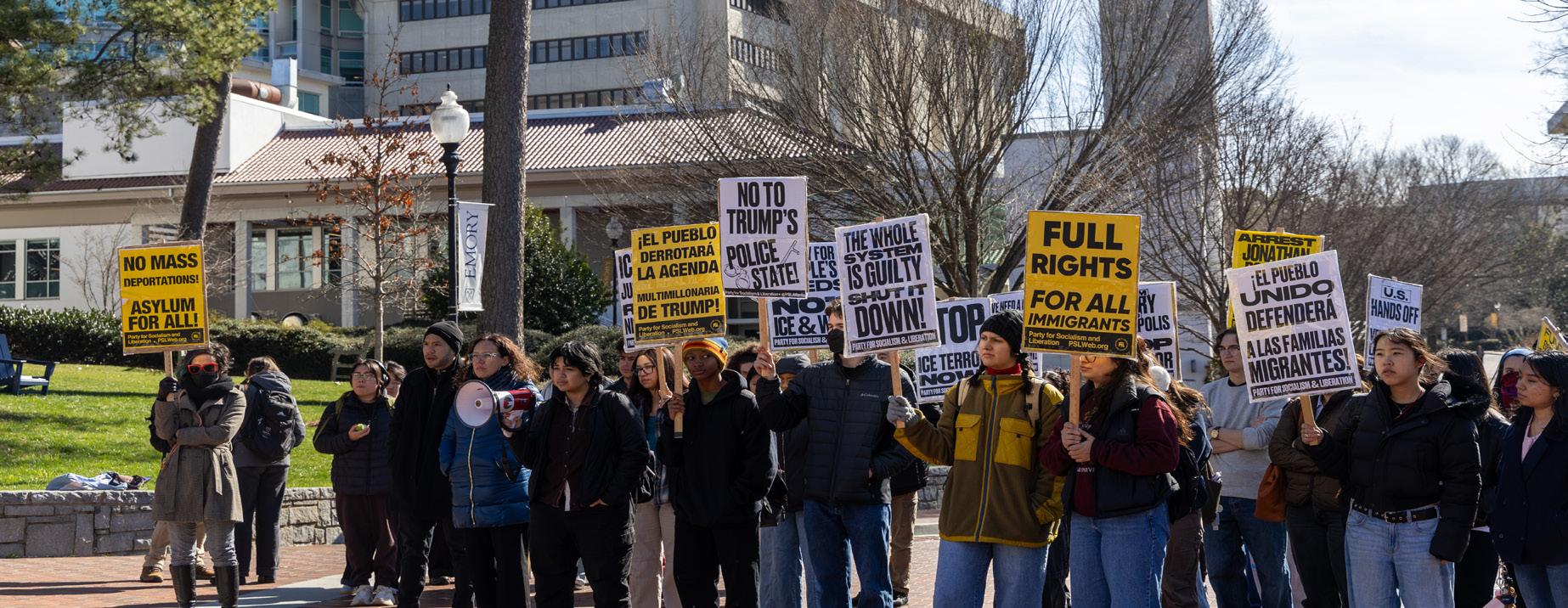
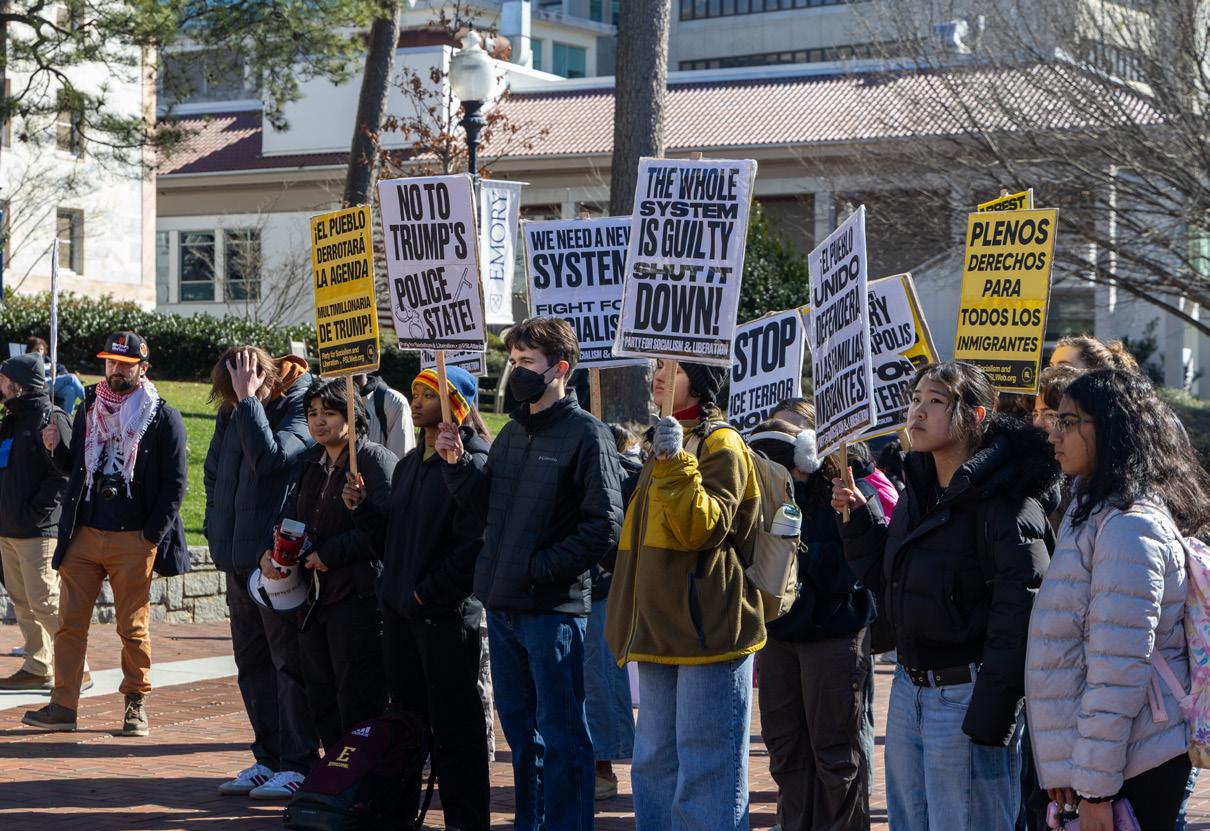
This reaction has spread to Emory University, where about 70 community members gathered in Asbury Circle on Tuesday to protest against these recent actions by ICE. Emory Students for Socialism (SFS) organized the event with speakers from Sunrise Emory and the Atlanta branch of the Party for Socialism and Liberation.
According to Emory SFS organizers Tasfia Jahangir (23PH, 29G) and
ties had an average of 2.8 presidents since 2000, with most tenures lasting over a decade.
In comparison, Emory has had four permanent presidents with an average tenure of 7.75 years served. After former University President Gregory Fenves transitioned to the role of chancellor on Sept. 1, 2025, the University will have to find a permanent replacement.
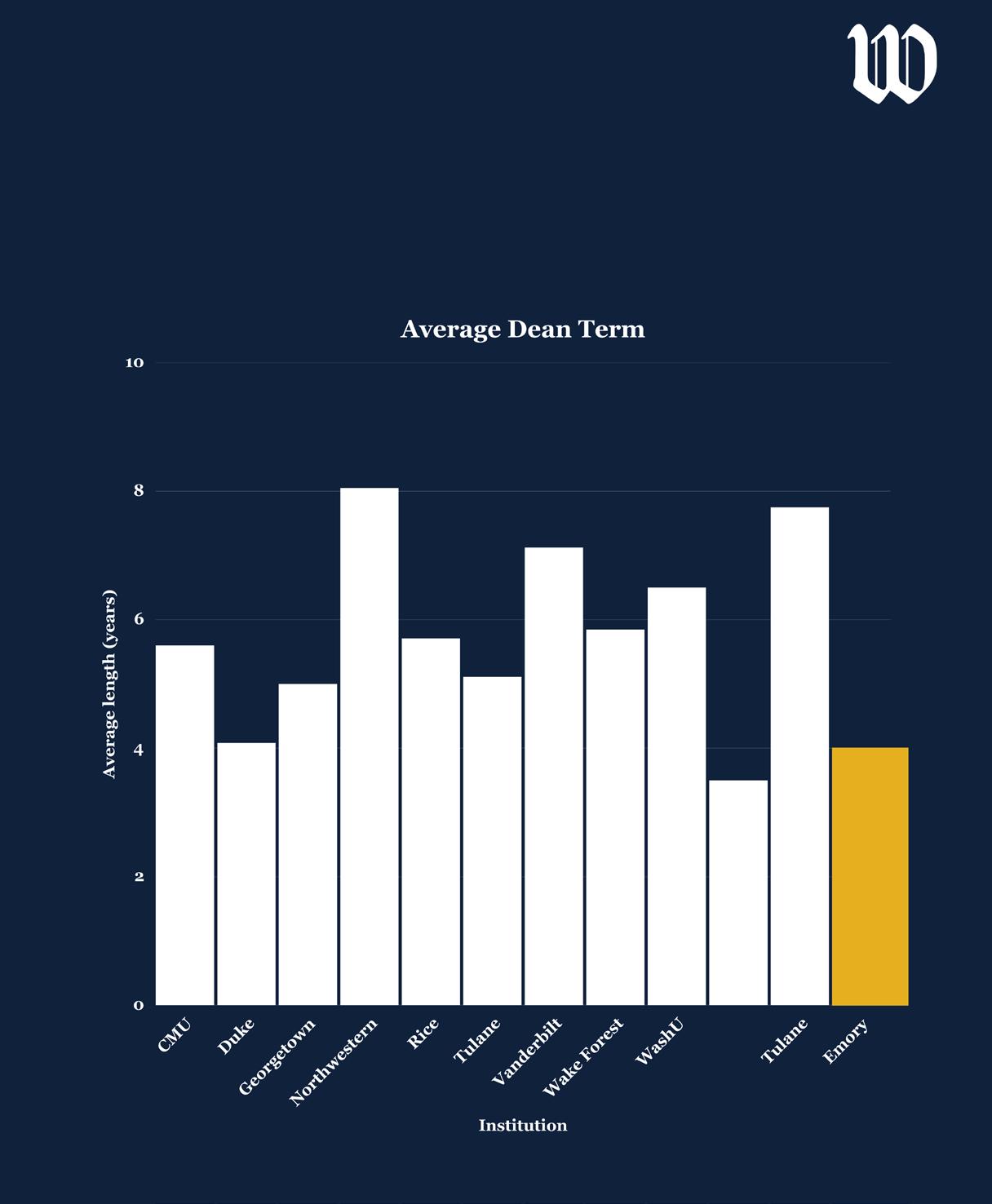
Additionally, several of the University’s schools have cycled through different deans over the past two decades. Emory College of Arts and Sciences (ECAS), Oxford College and Nell Hodgson School of Nursing deans are currently serving in interim positions. Likewise, the Candler School of Theology and the Goizueta Business School will have to find new leaders as Mary Lee Hardin Willard Dean of Candler School of Theology Jonathan Strom and Goizueta Dean Gareth James will be stepping down this summer. The average tenure of current Emory dean appointments, excluding interim positions, across all schools is just under 2 years served when including interim deans and 3.6 years served when excluding them. Among Emory’s 10 peer
universities, the average tenure for deans, excluding interims, is 5.89 years served.
Of all universities surveyed, Northwestern University (Ill.) deans, excluding interims, had the longest average tenure of deans at 8.05 years served. In comparison, Duke University (N.C.) had the lowest average tenure outside of Emory at an average of 4.08 years served.
Candler has to find a new dean as Strom is stepping down from his role as his two-year term is expiring this summer. Like Strom, James is stepping down after this semester. James is departing Emory to become the next dean of the University of California, Los Angeles’s Anderson School of Management.
Following Barbara Krauthamer’s resignation from the role of ECAS dean due to “personal reasons” on Jan. 2, Interim Dean Joseph Crespino has been leading ECAS. Crespino joined Emory in 2003.
Before Krauthamer, former ECAS Dean Michael Elliot departed in 2022 to become the president of Amherst College (Mass.). Crespino is the sixth person to serve as interim or permanent dean of ECAS since
2000, with the average tenure being five years.
Interim Nursing School Dean Lisa Muirhead took over for former Dean Linda McCauley (79N), who was Emory’s longest-tenured dean. McCauley served since 2009 and retired at the end of 2025. Before McCauley, former Nursing School Dean Marla Salmon held the position from 1999 to 2009, leaving to become the dean of the University of Washington School of Nursing.
Out of the Emory deans currently serving, Emory’s Laney Graduate School’s dean has served the longest, with Dean Kimberly Jacob Arriola (01PH) currently serving her fifth year in the role. She replaced former Laney Dean Lisa Tedesco in 2020, who led Laney for 14 years.
At the Rollins School of Public Health M. Daniele Fallin has served as the James W. Curran Dean since 2022. The next year, Emory University School of Law named Richard Freer as its dean. Freer has been part of the law school faculty since 1983, replacing Mary Anne Bobinski, who completed a five-year term as the law school’s leader in 2024.
Tony Torres (29C), introduced the demonstration and said that, in part, Good’s murder motivated the protest, along with other recent nationwide events. The protest on Emory’s campus was one of 12 student dem-
onstrations in the Atlanta area.
“We are living through a moment of profound crisis,” Jahangir said. “Our fundamental rights are under attack on every front, from our workplaces to our neighborhoods, from
our schools to our home.”
Jahangir also emphasized the connection between anti-ICE sentiments and Martin Luther King Jr. Day, which was on Jan. 19, highlighting King’s legacy of fighting oppression.
More recently, Emory School of Medicine Dean Sandra Wong began her term in March 2024, joining Emory from Dartmouth Hitchcock Medical Center (N.H.). Former School of Medicine Dean Vikas Sukhatme stepped down after serving for five years.
In addition to dean turnover, this November, Emory promoted Badia Ahad to a two-year term as provost and executive vice president for academic affairs, after a national search that “failed,” according to Sears. Ahad formerly served as Oxford College dean before becoming provost, and began in the role in August 2023. Following Ahad’s transition, Senior Associate Dean for Academic Affairs and Professor of English and American Studies Molly McGehee filled the open role of interim Oxford College dean.
In an email to The Emory Wheel, Associate Director of University Communications Rachel Smith wrote that Emory is continuing its search for its next administrative leaders.
“Each leadership transition is
“Dr. King devoted his life to fighting what he called ‘the three evils of society,’ what I call the three evils of capitalism, racism, war and poverty,” Jahangir said. “These same evils define the agenda that we are up against today.”
After Jahangir and Torres kicked off the demonstration, they invited Anayancy Ramos (28G) to share her experience with citizenship status. Ramos is a Deferred Action for Childhood Arrivals (DACA) recipient, which means that, although Ramos’ undocumented immigrant parents brought her to the United States as a young child, she is permitted to stay in the United States through the DACA program. Ramos implored the crowd to stand up for immigrant rights, especially in the context of a heightened presence of
Emory alum Jason Esteves hopes to become next Georgia Governor
By Malk El-aBtah Asst. Social Editor
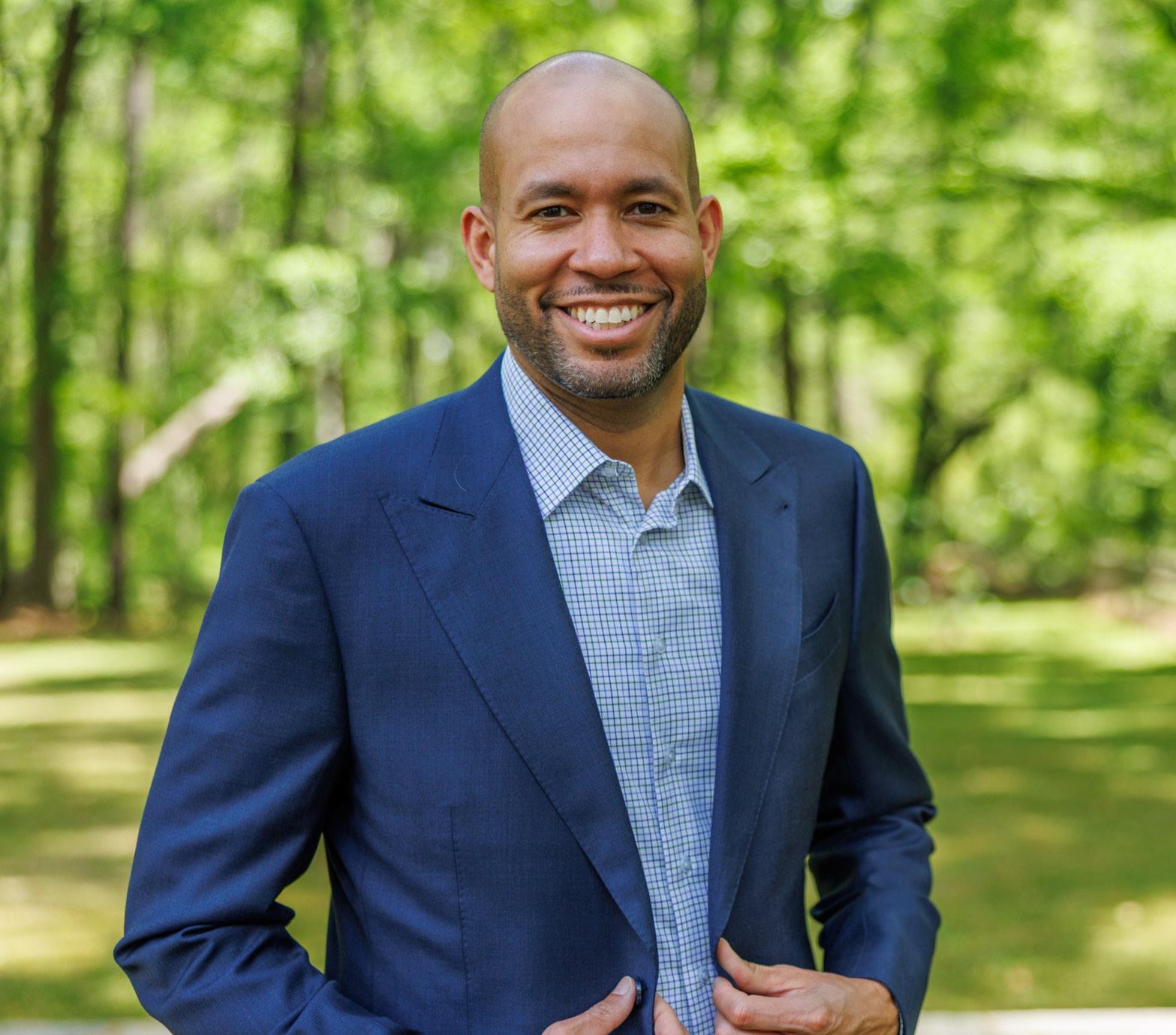
Before spending time in the Georgia State Senate, Jason Esteves (10L) roamed the halls of Emory University’s School of Law. Now, Esteves is aiming for the state’s highest office after announcing his campaign to become Georgia governor last year.
In an interview with The Emory Wheel, Esteves explained that his time at Emory played a formative role in shaping his approach to leadership and public service.
“It's at Emory Law where I really started to be involved in student organizations and student government,” Esteves said.
Standing in Esteves’ path to the November general election is a Democratic primary which includes, former Atlanta Mayor Keisha Lance Bottoms, former Lieutenant Governor Geoff Duncan and former DeKalb County CEO Michael Thurmond.
If elected, Esteves said he hopes to develop practical solutions to expand economic opportunity and strengthen Georgia’s public services, with his campaign prioritizing cutting the cost of living, expanding healthcare access and protecting reproductive freedom.
“My focus is on making sure that people can afford to live in the state,” Esteves said. “That we have a high-
Continued from Page 1
unique, and we are taking the time needed to find the best leaders through careful search processes,” Smith wrote.
The five vacancies in Emory’s dean positions are indicative of the high-pressure environment in the University’s administration, according to Robert Paul, who served as ECAS dean from 2003 to 2010.
“There’s no doubt that there are much greater pressures on university administrators than there was before, coming from the federal government, from funding cutbacks and from increased scrutiny,” Paul said.
Since January 2025, Trump has moved to freeze federal funding for higher education.
While these cuts affect universities nationwide, they particularly harm institutions with large medical and research programs like Emory, according to Former Vice Provost for Graduate Studies and Laney Graduate School Dean Donald Stein. The former dean stated that one of the “primary factors” in the hiring
quality, accessible healthcare system and that our kids are getting the education that they deserve.”
Associate Professor of Political Science Andra Gillespie explained that reaching out to voters will be key for Esteves to stand out.
“You got to hit the doors,you got to introduce yourself to people, you got to tell people what you stand for, and you got to ask them to show up to vote for you,” Gillespie said. “He and any other of these candidates is going to have to make the case to the voters directly.”
Esteves said he hopes to reach voters by expanding his campaign beyond traditional party lines.
“If we stay laser focused on those kitchen table issues, issues that the people across the state talk about when they’re eating their meal with their family,” Esteves said. “We can build that coalition that it’s going to take to win, but it’s going to require me to stay focused.”
However, Gillespie emphasized that Esteves’ messaging alone cannot overcome Georgia’s Republican lean, having not voted had a Democrat serve as Governor since 2003.
“In really polarized environments, it really comes down to which side does the better job of getting their people to turn out to vote,” Gillespie said. “The national climate could help Democrats generally, but you still have
process for a dean was how much federal funding a prospective dean could bring in.
“When I started as graduate dean, I had 12 or 14 people on my staff,”
Stein said. “The basic criterion and science for being hired is, ‘What's the possibility, or how many grants are you bringing with you?”
Paul also suggested that the University’s reliance on external candidates to fill senior positions may have contributed to a more unstable leadership.
“Even though there were national searches, quite often, the successful candidates were people from within the institution, like me,” Paul said.
“That gave them a sense of the history of Emory, of its ethos, of the way things work around here, of traditions.”
Due to its rank within the mid20s of all U.S. institutions, Emory is often viewed as a “stepping stone” in the hierarchy of higher learning, according to Paul. Without longstanding ties to the university, Paul said external hires may be more
to overcome the numerical disadvantage in the state.”
Masse-Martin NEH Professor of Political Science Zachary Peskowitz emphasized that even if Esteves secures the Democratic nomination, the general election in Georgia will be tough for Esteves.
“We’ve had Republicans win some statewide elections, Democrats win some statewide elections over the past few cycles,” Peskowitz said. “It’s really going to come down to perceptions of the Democratic and Republican nominees.”
Peskowitz also highlighted that a smaller portion of the electorate will ultimately decide the race, as midterm elections typically see fewer voters turnout. Another point Peskowitz makes is that the outcome of the race will likely hinge on a relatively small portion of undecided voters.
“There’s a good chunk of voters, maybe 10-20% of the electorate, that are going to be responding to things like the state of the economy and their perceptions of the policy positions and the competence and trustworthiness of the candidates,” Peskowitz said.
When discussing the election in relation to Emory students, Esteves highlighted the critical role voters play in shaping Georgia’s future.
“The only way to influence elections is to use your voice, not only in the ballot box, but to also advocate for the positions that are most important for you.”
Esteves added that his campaign offers a positive future for all Georgians.
“The main thing I want students to know is that their voice matters and that elections matter,” Esteves said.
inclined to leave.
“If you’ve come in from somewhere else and you're there for a while, there's no reason why you shouldn't go somewhere else and also be there for a little while as you rise through the academic administration ladder,” Paul said.
University Senate President Noëlle McAfee said that the changing landscape of higher education could require more universities to hire from a “finite” pool of candidates, due to “turmoil” in higher education.
“I’m really hoping that a lot of these searches will look and explore who’s here already, that people who’ve been at Emory for a decade, two decades, will apply for those positions, because we really do need some stability,” McAfee said.
Stein stated that long-term leadership stability depends on faculty engagement within administrative decision-making. He cited a trend of decreasing support within University faculty, adding that administrators can “take advantage” of an indifferent faculty and “act accordingly.”
According to Stein, when faculty contribute less to University decisions, the administration may act “unilaterally,” without having faculty feedback to base decisions on.
As the University continues its search for its next president and for vacant dean positions, McAfee said the process could serve as a stabilizing opportunity.
“This is a very rocky time,” McAfee said. “It could turn out to be positive if we promote people who are already here at Emory with very strong research portfolios.”
Considering the implications of national changes, Stein emphasized that Emory’s challenges are part of a larger upheaval affecting academia.
“In this day and age, there’s so much instability and changing what constitutes higher education,” Stein said. “This has become much more realistic, much more of a national issue than a local issue. It’s directly affecting Emory, and it’s been a long time in coming.”
— Contact Irene John at irene.john2@emory.edu
“I have a vision for the future of this state, one that ensures that no matter where you live in the state, you have the opportunity to thrive,” Esteves said. “That vision is one that gives people something to vote for, not just something to vote against.”
— Contact Malk El-Abtah at malk.elabtah@emory.edu
University Senate demands Emory enact confidentiality policy
By ElliE Fivas Editor-in-Chief
The University Senate released the results from a Dec. 2 vote on a resolution that demands Interim University President Leah Ward Sears (80L) and the Board of Trustees prohibit Emory University employees from voluntarily providing certain sensitive information to federal or out-ofstate authorities.
Of the 39 University Senate members who voted, 33 voted in favor of the resolution, 3 voted against and 3 abstained. The University Senate is a body composed of representatives from Emory students, post-doctoral students, faculty and staff who advocate to Emory administration on behalf of the community. The body can recommend policy changes to the University president and the Board of Trustees, but does not have the power to enact resolutions unilaterally.
If Sears implements the resolution, Emory employees would be banned from voluntarily sharing information relating to involvement in “expressive activities,” immigration status and sex and gender identity with federal or out-of-state authorities.
Firstly, employees would not be allowed to voluntarily share information that could be used to impose legal penalties on a student, faculty or staff member who has participated in activities protected by Emory’s Open Expression Policy or the First Amendment.
Additionally, Emory community members would be banned from providing information that could help identify or apprehend a student, faculty or staff member for “immigration detention, removal or deportation proceedings.” This could also include information that may be used to prosecute a community member for immigration-related offenses based on their participation in activities protected by the First Amendment, according to the resolution.
The resolution stated that this includes a ban on sharing information that the federal government could use to terminate or reduce grant funding.
Lastly, Emory employees would not be permitted to share information that could be used to help investigate the sex or gender of an Emory
student, faculty or staff member.
Emory Student Government Association (SGA) student leaders, including SGA Elections Board Chair Elizabeth Brubaker (24Ox, 26C), SGA President Tyler Martinez (26C), SGA Executive Vice President Zoe Grotjan (24Ox, 26B), SGA Vice President of Student Experience Michael Krayyem (26C), SGA Second-Year Legislator Asmaa Ali (28C), Oxford Student Government Association (OxSGA) President Jack Steffen (26Ox) and OxSGA Voting Representative Lucianna Marquez (26Ox) sponsored the resolution. Campus uncertainty, Emory’s discontinuation of Diversity, Equity and Inclusion initiatives in September 2025, the lack of University response to the results of an October 2025 Emory SGA referendum and national political pressures on universities influenced the University Senate’s decision to pass the resolution, according to the resolution.
“Emory is currently experiencing a period of leadership transition under Interim President Sears, making it essential that University leadership demonstrate steadfast commitment to student rights, transparency, and academic integrity,” the resolution reads.
In October 2025, 1,428 (17.6%) of Emory’s 8,102 eligible undergraduate students voted in an SGA referendum related to this resolution, which proposed a similar policy to prevent University employees from sharing sensitive information with the federal government. Of the voting students, 1,275 (89.3%) urged the University to adopt this policy. The University Senate’s resolution emphasized that the Emory administration has not formally addressed the outcome of this student referendum vote.
According to the resolution, the American Civil Liberties Union of Georgia and the Georgia National Association for the Advancement of Colored People have endorsed this policy.
The University Senate demanded that Sears implement this new policy by the end of the academic year. The University did not provide a comment on this resolution by press time.
— Contact Ellie Fivas at ellie.fivas@emory.edu
GEmalK/wiK imEDia commonS
Emory University School of Law alumni Jason Esteves (10L) began his campaign to become Georgia governor in 2025.
Community responds to recent ICE activity across the country
Continued from Page 1
federal agents in cities like Atlanta.
“I want to use my voice whenever possible to advocate for those who don’t have my privilege,” Ramos said. “A lot of the people that are in detention centers right now are also people that don’t have a voice, who don’t have people that know how to look for them.”
Ramos said that, although the increased presence of ICE in cities across the United States is daunting, she has pushed through that fear to still take action to support her community.
“I'm scared for my family,” Ramos said. “I'm scared for my community members, but I don't let that fear paralyze me. I use that instead as motivation to do something.”
Sunrise Emory Member Maya Vizuete (28C) also spoke, highlighting the connection between environmental justice and anti-fascism. In
addition, Zachary Hammond (23Ox, 25C) commented on the anniversary of U.S. President Donald Trump’s second term inauguration.
“Those things are everything that Trump stands for: racist attacks on immigrant communities, aggression and the kidnapping of Venezuela’s president, as well as aggression against Greenland and Iran, and the Big Beautiful Bill,” Hammond said.
Professional Tutor and Developmental Editor at the Emory Writing Center Robert Birdwell, a member of the Emory chapter of the American Association of University Professors (AAUP), also spoke at the event. Birdwell said the Emory AAUP chapter has been working to support and defend academic freedom, shared governance and Diversity, Equity and Inclusion policies.
“Let’s call on the Emory administration and voters to proceed to take a stand against this illegal violence, this terrorism against Americans
Alumni Memorial University Center, Room 401 630 Means Drive, Atlanta, GA, 30322 Business (404) 727-6178
Editors-in-Chief Spencer Friedland and Ellie Fivas spencer.friedland@emory.edu ellie.fivas@emory.edu
Founded in 1919, The Emory Wheel is the financially and editorially independent, student-run newspaper of Emory University in Atlanta. The Wheel is a member publication of Media Council, Emory’s organization of student publications. The Wheel reserves the rights to all content as it appears in these pages, and permission to reproduce material must be granted by the editor-in-chief.
The statements and opinions expressed in the Wheel are those of the authors and do not necessarily reflect those of the Wheel Editorial Board or of Emory University, its faculty, staff or administration.
profiling people of color and dissenters,” Birdwell said.
Ramos also called on Emory's administration to support community members affected by the rising presence of ICE. According to Ramos, she sought assistance from Emory services as an undocumented student in the past, but she said that she has not been adequately supported by the University.
“Let's call on the Emory administration and voters to proceed to take a stand against this illegal violence, this terrorism against American people of color and dissenters”
— Robert Birdwell, Professional Tutor and Developmental Editor at the Emory Writing Center
“I’ve gone to various administrators asking for more help, whether it be mental health resources, legal services,” Ramos said. “And I’ve always been told, ‘No, we can’t do that.’”
Following the protest, attendee Jude Barcik (29C) reflected on the monumental nature of the current U.S. political events. She emphasized the importance of being a part of a community that acknowledges current events and will “stand in support” against violence.
“It’s really scary living through a
period of history that you know is going to be referenced in textbooks later as a period of terror,” Barcik said.
Attendee Cyrus Ebrahimi (29C) said he decided to join the protest because of his previous experience volunteering and learning about people’s stories in the immigrant communities. Ebrahimi said he wanted others to recognize the importance of being “united” in the fight against “injustice.”
“All this alienation and hostility against immigrants, against refugees, is just unreasonable,” Ebrahimi said.
“It’s really just distracting us from the elites who really run everything.”
Throughout all of the speeches at the event, each speaker emphasized the crucial role of community in political organizing. Ramos said she hopes that other Emory community members will become more
involved in organizing and lean on their neighbors to make a change.
“You don’t have to do it alone,” Ramos said. “You can do it along with organizations that have systems in place to protect yourself, to protect your neighbors, to do more for your community.”
With the number of ICE agents rising nationally, the protest at Emory was focused on the local impact of federal policies on Atlanta and Emory community members. Birdwell ended his speech with a message to federal agents in Atlanta and nationwide.
“We’re here to say with one voice that the Emory community, this campus, is our state, our pocket of democracy,” Birdwell said. “And ICE isn’t welcome here.”
— Contact Ellie Fivas at ellie.fivas@emory.edu
Emory Libraries cancel Elsevier journals due to rising costs
By saMara Goyal Contributing Writer
Recent federal funding cuts have impacted universities nationwide, with decreased funds for academic programs reaching all the way into the classroom — and even the libraries. At Emory University, librarians annually reevaluate academic journal subscription fees. Assistant Dean of Education for Data Science Education at the Nell Hodgson Woodruff School of Nursing Roy Simpson said this process included noting any increases in fees and other changes to the library budget.
This year, Emory’s libraries had to reduce access to Elsevier, a major academic publisher with over 3,000 journals that specialize in science and healthcare, because Emory did not receive additional funding to cover the subscription fee increases, according to Former Associate Vice Provost and University Librarian Lisa Macklin.
“Emory, much like other institutions of higher education, is in a period of budget austerities, and the way that library collections work is that for subscriptions, we have market increases every year,” Macklin said. “This year, we did not receive any additional funding to cover those market increases, so in order to balance our budget, we have to cancel something.”
Emory’s libraries have saved approximately $655,000 from reducing Emory’s access to Elsevier’s collection, according to Macklin.
Macklin explained that the Emory librarians decided to decrease Elsevier access after reviewing data on journal costs and usage that the library collected from publishers. Subject librarians and informationists reviewed and further narrowed down the list before they asked the Emory community and faculty to provide input. The negotiation yielded a condensed collection of 590 journals from Elsevier that is better suited to Emory’s research and teaching needs, according to a state-
ment released by Emory Libraries to faculty members.
Former Dean of the School of Nursing Linda McCauley (79N) also noted that rising subscription costs have been a consistent issue in academia.
“Subscription services have gone up, and [Emory libraries] are constantly evaluating usage and the balance between making sure that for large programs of study, there’s sufficient resources available for the large number of users, and in smaller areas, that there is some coverage,” McCauley said.
The Elsevier reduction is not the University’s first time ending subscriptions to major journals. In 2024, the library discontinued Wiley journals services to reduce costs. However, the content from those journals remains available to the Emory community through an expedited article delivery service.
Macklin explained that expedited article delivery allows Emory community members to access journal articles without a full subscription, reducing some of the impact of ending the journal services. Expedited article delivery allows the library to pay a flat fee of $30 per article, which can sometimes be more cost-effective than purchasing a full journal subscription and is faster than interlibrary loan.
“It’s still a much faster way of getting the articles and a much less expensive way of getting the articles,” Macklin said. “That ability to make that request for an article will appear in menus for the journals that we’ve canceled.”
McCauley also highlighted how rapid technological development increased the availability of academic resources.
“Technology actually is allowing us to have greater access than we’ve ever had before,” McCauley said. Furthermore, Simpson predicted that the increase of generative arti-
ficial intelligence (AI) in academia will change future access to academic scholarships.
“It is very important that students and faculty seek that knowledge of understanding how the world is changing with the AI models for access to knowledge,” Simpson said. “It makes me anxious … to see all this just change right before my eyes.”
Similarly, Macklin mentioned how generative AI has been integrated into academic publishing.
“Large publishers are licensing their content … to generative AI companies because it is a good, robust data set,” Macklin said. “We may be seeing over time more generative AI responses that are relying on that published journal literature.”
However, Simpson emphasized that human knowledge will always be necessary to create journal content.
“Generative AI comes out of data,” Simpson said. “It produces information, but it’s not knowledge … It will never think as beyond the human mind.”
— Contact Samara Goyal at samara.goyal@emory.edu
Siya Kumar/nEwS EDitor Protest speakers discussed the impact of U.S. President Donald Trump's foreign policy on undocumented students.
Siya Kumar/nEwS EDitor Students listened to Students for Socialism organizers Tasfia Jahangir (23PH, 29G) and Tony Torres (29C) lead chants.
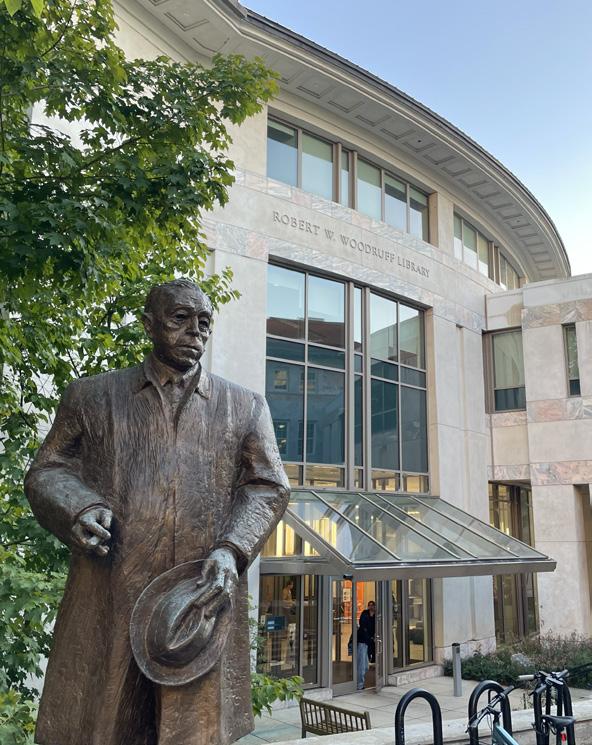
JacK Sutton/DEputy photoGraphy EDitor Emory Libraries saved $655,000 from canceling the subscription to Elsevier, a major journal publisher.
Trump’s capture of Maduro raises questions among Emory professors, students
By JaMEs schEchnEr
Contributing Writer
On Jan. 2, U.S. President Donald Trump ordered American military forces to capture Venezuelan President Nicolás Maduro from his home in Caracas, Venezuela. The U.S. Department of Justice charged Maduro with narco-terrorism, drug trafficking and two other federal crimes. Maduro is currently being held in a federal prison in New York City, with his case being tried in New York.
Trump’s capture of Maduro has triggered international reactions, raising questions about the action’s constitutionality and ethics. Some figures, such as Spanish Prime Minister Pedro Sánchez, accused Trump of being flagrantly in “violation of international law in Venezuela.”
The intervention in Venezuela has led Emory University professors and students to debate its legality, precedents and implications for the United States and Latin America.
Senior Associate Dean of Faculty and Professor of Modern Latin American History Thomas Rogers expressed concern that Trump’s removal of Maduro may violate international agreements. While Rogers called Maduro not a “good leader,” he maintained his belief in the importance of world leaders abiding by international laws.
“It’s really dangerous to suggest
that the ends justify the means when the means include completely contravening settled international agreements and law,” Rogers said.
Associate Professor of Latin American and Caribbean Studies
Pablo Palomino highlighted that Trump’s intervention could exacerbate existing political instability in Venezuela. According to Palomino, U.S. intervention in foreign countries has historically yielded further political instability.
“Through history, all these illegal interventions, all these violations of international treaties and international law committed by the U.S. have been in support of local political actors, often the local military against a government that was perceived as a threat or as unfriendly with the United States,” Palomino said. “Typically, you have a change in the government, but not necessarily leading to a stable one.”
However, Palomino indicated a key difference between Trump’s justifications for intervention and justifications employed by U.S. leaders in the past. He explained that Trump does not apply the language of freedom and democracy to defend his intervention. Breaking from this historical trend, Palomino said, erodes the values of American democracy.
“Traditionally, all the U.S. policies in Latin America, the good ones, the bad ones, the violent ones, the peaceful ones, they were always dressed in
Crime Report: Arrest for other agency, criminal damage
By GEorGE sEGall Crime Report
The Emory Wheel regularly meets with Emory Police Department (EPD) Records Manager Ed Shoemaker (87G, 90G) and uses EPD’s public crime log to inform the Emory University community about recent crime on and around Emory’s campuses.
To report a crime, contact EPD at 404-727-6111 or police@emory.edu.
Arrest for other agency at Woodruff Memorial Research Building
EPD received a call at about 7:40 a.m. on Jan. 14 about a male in a seventh-floor lounge of the Woodruff Memorial Research Building. The building is primarily a lab space for healthcare research and is generally not open to the public, according to Shoemaker. The caller indicated to EPD that the man did not appear to be an Emory University student, faculty member or related research personnel.
After sending three officers to check the facility, EPD sent located the male and established that he was not affiliated with Emory and had no reason to be in the building. Following standard operating procedure, EPD identified the male with appropriate information systems and found an active arrest warrant from DeKalb County.
Once EPD confirmed the warrant’s validity, they took the man into custody, searched him and found nothing suspicious. EPD then transported him to the DeKalb County Jail and handed him over to the appropriate authorities.
Shoemaker pointed out that the caller had “good situational awareness” and encouraged Emory community members to contact EPD if something does not look right.
“We’re well equipped to determine whether folks belong where they belong or are where they don’t belong, more to the point, and to take appropriate steps,” Shoemaker said.
Criminal damage to property at Emory Clinic Lowergate East Parking Deck
the language of expanding democracy, freedom, … even if the acts did not match that rhetoric,” Palomino said. “The novelty of the current administration in the U.S. is that those trappings, that actual belief in the function of the U.S. in the region, is gone.”
“Yes, it is worth celebrating the end of Maduro’s dictatorship and presidency, but in a terrorist attack, the way it was performed, I don’t think it was justifiable,”
— Glenda Vega (28C), Emory LSO Political and Social Justice Chair
Emory’s Latinx Student Organization (LSO) President Angel Sosa Llanos (26C) criticized the broader history of U.S. imperialism in Latin America. Sosa Llanos called Trump’s intervention a “warning sign” and cautioned that it may set a “dangerous precedent” for the security of other Latin American countries in the face of Trump.
“The actions conducted by the Trump administration fall in line with a larger theme and pattern of inter-
U.S. federal authorities captured Venezuelan President Nicholás Maduro, charging him with multiple federal crimes.
vention that has been used by the United States in order to intervene and rule over Latin America,” Sosa Llanos said.
Emory LSO Political and Social Justice Chair Glenda Vega (28C) emphasized the loss of around 100 lives during the recent military action in Venezuela.
“Yes, it is worth celebrating the end of Maduro’s dictatorship and presidency, but in a terrorist attack, the way it was performed, I don’t think it was justifiable,” Vega said.
Sosa Llanos said among Venezuelan and Latin Americans, attitudes toward the Trump administration are mixed, and he has observed many celebrating Trump’s capture of Maduro.
“Some people might be in the stage where they are just celebrating the
fall of Maduro more than they are raising concerns about Trump’s intervention and potential future interventions,” Sosa Llanos said.
Despite the celebrations, many are still concerned by Trump’s actions and rhetoric, especially when considering the possibility of future interventions in Latin America and beyond. Rogers shared his concern that there may soon be an increase in incursions of the U.S. military in Latin America.
“There’s the prospect, the possibility of intervention in other countries that the United States objects to for one reason or another,” Rogers said.
— Contact James Schechner at james.schechner@emory.edu
Emory community reacts to recent safety incidents on campus
A dispute occurred at about 7:00 a.m. on Jan. 15 between two parties in the employee parking section of the Lowergate East Parking Deck, where many Emory Hospital and Clinic employees, patients and visitors park.
The caller reported that as they pulled into a parking spot on Level 3 of the deck at about 6:53 a.m., another vehicle pulled in directly next to her.
The owner of the other vehicle rolled down their window and started arguing that the caller had allegedly taken their parking spot. The complainant did not know the other party, but described them as a female around 50 to 60 years old.
The caller entered the Emory Clinic next to the parking deck to drop off her belongings.
When she returned to her vehicle, a red Hyundai Elantra, she noticed a new white scratch on the right rear side of her vehicle. The caller told EPD she believed the unknown party had keyed her car before leaving the parking deck.
The complainant reported that a male wearing an Emory shirt witnessed the dispute, but the caller did not know their identity. EPD has assigned the case for investigation.
Theft by
taking at Eagle Hall Parking Deck
An Eagle Hall student resident reported missing property to EPD shortly before 7:00 p.m. on Jan. 19. The student told EPD that they believed an unknown individual entered the parking deck attached to Eagle Hall between 3:00 p.m. on Jan. 18 and 11:00 a.m. on Jan. 19 and stole the resident’s scooter.
The scooter is a ZT3 Pro model in black and grey, has a small bag attached to the front and a water bottle holder. The student told EPD that the scooter is worth about $700.
The student was able to track the scooter to its last known location, at an unknown ping in Midtown Atlanta. EPD will continue to investigate the situation.
— Contact George Segall at george.segall@emory.edu
By siya kuMar News Editor
Content Warning: This article contains references to gun violence.
Beginning on Jan. 21, Emory University plans to implement a new safety policy requiring community members to use their EmoryCard to unlock academic and office buildings on both the Atlanta and Oxford campuses, according to an email statement Emory Police Department (EPD) Chief Burt Buchtinec sent out to the Emory community on Jan. 14. The University is introducing the new policy in response to recent national news, including a shooting at Brown University (R.I.) on Dec. 13, 2025.
In an interview with The Emory Wheel, Buchtinec explained that he hopes the new policy will deter potential safety incidents at Emory.
“All of the things that we’re doing are to create layers of safety, to protect our community, whether faculty, staff, students, and even the visitors that come to the patients at the hospitals, and all of that,” Buchtinec said. “All of it is to build layers for safety.”
Assistant Vice President of the Office of Critical Event Preparedness and Response Sam Shartar emphasized that collaboration was vital to forming the policy.
“The goal of that is to have a dialogue, just feedback, so we can have good conversation,” Shartar said. “It’s not about pointing fingers. It’s figuring out how do we work together
to accomplish what we want to get done.”
Shartar also emphasized that the new changes are meant to improve the campus experiences of students.
“Everything that we have put together in the layers of security all had one goal in mind, and that was to increase the safety of our community, and that’s the driving force behind all of it,” Shartar said.
Nova Mu (28C) expressed support for the new policy but shared skepticism about its effectiveness.
“It was a nice measure to take, but a lot of the times, people hold doors for other people anyway, so does it really make a difference if they make it card-access?” Mu said. “But I mean, at least they’re trying.”
Jun Ryoo (27C) said the recent national events have made him more cautious on campus.
“The news came out nationwide, so obviously a lot of people are alert right now,” Ryoo said. “I’m still trying to be more aware of my surroundings.”
Similarly, the Student Bar Association (SBA) issued a statement on a recent safety incident at the Emory School of Law in which a community member posted social media comments that caused “concern” and “uncertainty,” according to an email statement from School of Law Dean Richard Freer. SBA is a student organization that supports students and advocates for the “needs of the student body,” according to the statement.
The statement demands for the
University to investigate alleged issues in the security protocol that has been in place since Jan. 11, and provide attendance flexibility to students who feel unsafe coming to campus in light of these safety concerns.
“If students feel that the environment and culture of our campus actively inhibits their ability to heal, we believe that policy adjustments must be made to support those students until the culture effectively changes,” the statement reads.
The statement also shared access to other University resources that students can access if needed.
Additionally, on Jan. 16, police responded to a suspicious individual on the roof of the Emory Point CVS near the Centers for Disease Control and Prevention. EPD issued an allclear alert for the emergency later that day, but EPD said the investigation is still active.
Assistant News Editor Eileen Zhu (27Ox) contributed to reporting.
If you or someone you know is struggling in the aftermath of gun violence, you can reach Emory’s Counseling and Psychological Services at (404) 727-7450 or https://counseling.emory.edu/ or the Substance Abuse and Mental Health Services Administration Disaster Distress hotline 24/7 at +1 (800) 985-5990.
— Contact Siya Kumar at siya.kumar2@emory.edu
chEriE Zhou/Staff illuStrator
The Emory Wheel Opinion
Dear Doolino, help me rush toward greatness!
By Doolino Campus OverlOrd
Dear
Doolino,
How do I make the top house for rush? My whole life depends on it!
Sincerely,
Fratty First-Year
I know that rush week is coming. I can smell it. Around this time of the year, Emory University’s campus seems to emanate a pungent stench of body odor, likely from the hordes of young men releasing pheromones powered by their pure, instinctual desire to enter the second closest thing to a cult (if you want to know what the closest thing is, check the underground tunnels).
It appears that you, like many others, would like the distinct honor and privilege of having a designated group of people you can call “bros for life.”
DOOLINO KNOWS BEST It will be a sausage fest, in many senses of the phrase.
Many people overthink rush when entering the system of old traditions and intimidating stares. It is quite easy to feel as though you will be judged, humiliated and ridiculed. I am not here to tell you that these fears are invalid — after all, I myself have never gone through the experience of rushing a fraternity. I prefer my company to sip on prosecco while discussing an array of famous literature and philosophical documents related to human mortality, not choke down stale beer in a basement while making asinine jokes about anything remotely phallic.
However, if this is how you would like to choose to spend your days at Emory, so be it. I will do my absolute
best to help you. After all, charity cases have always been of interest to me.
To start off, you must take the pressure off yourself. While it is easy to picture rush as the be-all and endall that determines the rest of your life, that is simply not the case. No matter what happens, consider that you can find brotherhood in many places.
I heard that the Emory Fencing Club is taking members, and, after all, when has brotherhood not had its tiffs? At least in that club, you can attack your brother with a sword when he angers you, as opposed to certain fraternities where your only path to revenge might be sabotaging a first date. Personally, I find physical exertion and sharp weapons to be much more cathartic.
Additionally, if you end up not finding your forever home in a fra-
Siya Kumar News Editor Jacob Muscolino News Editor
Irene John Asst. News Editor
Eileen Zhu Asst. News Editor
Carly Aikens Editorial Board Editor
Mira Krichavsky Asst. EB Editor
Ethan Jacobs Opinion Editor
Cayden Xia Opinion Editor
Joshua Glazer Asst. Opinion Editor
Crystal Zhang Asst. Opinion Editor
Hunter Buchheit A&L Editor
Clara Hilsman Asst. A&L Editor
Mia Hamon Asst. A&L Editor
Sammy Brodsky Sports Editor
Chloe Nam Sports Editor
Sophie Bergman Asst. Sports Editor
Sonia Liew Asst. Sports Editor
Ivana Chen Illustration Editor
Sasha Emmerich Deputy Illus. Editor
Saba Faisal Deputy Illus. Editor
Tiany Guo Asst. Illus. Editor
Sage Buchris Deputy Photo Editor
ternity, imagine how much free time you will have on your hands. You could pick up a new hobby or explore Atlanta.
If the city is not quite your style, I could even take you on a tour of my home, the underworld! I would be happy to assuage your grief about not getting the fraternity you want by showing you how much better you have it than the poor souls being tortured below. The possibilities are endless.
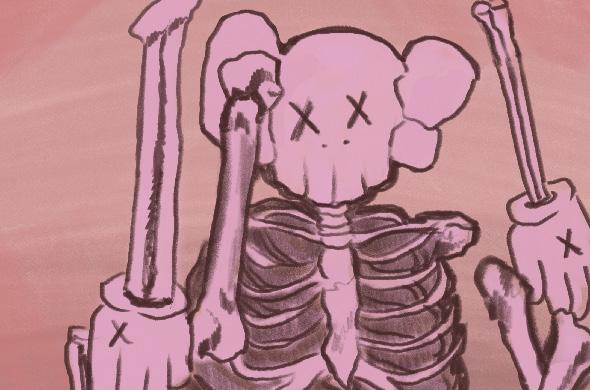
The next thing to remember is how insignificant the events during fraternity rush really are. I truly cannot think of two better descriptors for the process than “chill” and “dumb,” and I am a skeleton with a remarkably advanced lexicon.
Most of the events are nothing more than a less-than-thrilling game of cornhole or a back patio chat with young men who simply want to shoot
the breeze.
I can almost certainly guess that at least one fraternity is hosting a night almost entirely devoted to barbecuing. It will be a sausage fest, in many senses of the phrase. Do not be afraid, Fratty First-Year. Shoot some hoops in the gym. Flip a burger or two. That is truly all the training that you need for these events.
about this matter in terms of ranking. Emory’s Greek Life should never be about obtaining the most clout, or, as you youngsters like to call it, “aura.”
It should be about finding your future home. Your future brothers. That is something that goes deeper than any number on a hypothetical scoreboard.
Listen to your heart, Fratty FirstYear, and choose the brotherhood where you truly feel as though you belong. That is the true “top house.” I would also implore you not to listen to a certain platform called Fizz. Those braindead, screen-glued imbeciles are stealing my brand: Only I can mock Emory students and get away with it.
At the end of the day, you will find the place that is meant for you. At the end of rush, each fraternity participates in a tradition called Run the Row. In this tradition, a bunch of dudebros in ill-ironed suits will run down Eagle Row to their new homes. It is sweaty, chaotic and somewhat beautiful. That will be you. However, you have to turn away from outside influences and truly focus on the people around you. These are the people who will throw potato chips at the TV screen while watching a football game and grieving Emory’s lack of a team.
Finally, I would like to harken back to your original question. You asked me how you could acquire the “top” house for rush.
I would encourage you not to think
These are the people who will drive you home late at night and will pick you up time and time again after each inevitable college heartbreak. These are your brothers. Look for them. And always remember, Doolino knows best.
— Find Doolino six feet under the Quadrangle
Disha Kumar Senior Copy Editor
Malia Yap Copy Editor
Aimee Zhang Copy Editor
Alaina Crotty Asst. Copy Editor
Ginna nebriG/Staff illuStrator
Students, do not let Waymos self-drive our lives
By JorDan aBDo COntriButing Writer
Last week, I was running outside on a beautiful day in Atlanta’s suburbs by the East Beltline. I felt energized until I came to a crosswalk, looked at a car and saw no one behind the wheel. I was in disbelief, doing a double-take and refused to cross the street, distrusting the car's ability to not run me over.
Since this encounter, I have noticed many more self-driving Waymo cars around Emory University’s campus and across Atlanta. This abundance of self-driving vehicles strikes me: Waymos should not be all over our roads. The vehicles threaten the livelihood of human drivers and diminish the everyday human interactions that form communities.
Despite Waymo’s technological advances and media buzz in pop culture through music videos and celebrity endorsements, its self-driving vehicles are a threat to the labor force and humanity’s well-being.
If self-driving cars replace the thousands of people who drive cars and trucks for a living, many workers will lose their jobs, destabilizing the workforce during a time of massive upheaval across sectors.
Furthermore, the intrusion of artificial intelligence (AI) onto the roads will harm humanity’s wellbeing: Like the intrusion of AI into the arts and other parts of the workforce, these robots being on our roads erode the benefits of daily interpersonal connections between real people.
Waymos and other self-driving cars will undoubtedly create labor issues because of the direct replacement of actual drivers, adding to rising unemployment rates caused by AI. According to statistics from 2022, 12.3 million working Americans are employed in the transportation industry.
From Uber, Lyft and DoorDash drivers to truckers and bus drivers, our country’s mobility depends on these workers, and Waymo is beginning to replace these jobs.
Further, many of these Americans can be classified as working class, meaning that the rise of this technology is disrupting the livelihood of people who have to work hard to survive in today’s challenging economy.
As a young adult soon to enter the workforce, AI’s rapid evolution in our society worries me. With private technology companies like Waymo expanding AI’s reach in our daily lives, we no longer get a say in what
our future looks like. By allowing Waymo to test its vehicles on Atlanta's streets, our city is contributing to the rapid rise of an AI-dominated future, creating even more fear about how far AI-powered technology will keep intruding on our daily lives.
As Waymos replace important moments of human connection, daily life risks becoming increasingly transactional and emotionally detached. When people ride with Waymo, instead of interacting with a driver in a vehicle, they sit silently and alone.
Instead of a delivery driver bringing your food to your door, in Atlanta and other cities, food is now often delivered by a robotic machine.
These small interpersonal interactions with drivers are important because human presence enhances our well-being and comfort.
Relying on machines for tasks people once performed risks normalizing isolation and missing out
on spontaneous human connection, especially for those who already experience loneliness.
Although Waymos may have widereaching negative consequences, it is true that human drivers are not perfect. There are many instances when pedestrians and drivers act unpredictably on the roads — in Atlanta alone, there are tens of thousands of car accidents every year. But, Waymos are not equipped for handling precarious situations.
For instance, in San Francisco, two men got in front of a woman’s Waymo and harassed her, asking for her number and shouting inappropriate comments. The Waymo is programmed to stop when it detects an object in front of its path, no matter what that object is.
Consequently, the woman was left in a dangerous situation, stuck in a stationary car and relying on illequipped AI software to protect her from strangers. If her vehicle had a driver or if she were in control of the vehicle, they could have evaded the potentially dangerous situation. Waymos are not equipped to solve problems like humans.
Much of driving exists in a gray area that relies on human judgment, intuition and reaction. AI is better suited for the black and white — straightforward driving scenarios with predictable conditions. We need to urge our local leaders to put a stop to self-driving vehicles before experiences like the incident in San Francisco become commonplace — especially in densely populated cities like Atlanta.
As students entering the workforce on the cusp of this technological transformation, we should reflect on how technologies like Waymo's self-driving cars shape our daily lives and take an active role in determining what our future will look like.
Atlanta’s streets should not be used as testing roads for companies' profit.
A human driver offers what no AI system can: the ability to respond to unexpected situations. Drivers also offer moments of human connection that self-driving cars can never replace.
As concerned Atlanta residents, we should send emails to the Atlanta Department of Transportation and Atlanta Regional Commission expressing concerns about Waymo and how it impacts our city. We should also stop ordering Waymos and choose other rideshare services instead, or opt for public transportation options. Atlanta’s streets should not be used as testing roads for companies' profit without public input. Maintaining meaningful interactions in daily life matters, and we must push for transportation that prioritizes humanity over the development of AI.
— Contact Jordan Abdo at jordan.abdo@emory.edu
Emory's increases in surveillance should not go unnoticed
By trey longneCker COntriButing Writer
Emory University’s decision to require EmoryCards to enter all academic and office buildings probably appears to most students like a slight inconvenience. University students already need their cards to access many buildings on campus, particularly outside of workday hours, and to enter residence halls and libraries at all times, so most students and faculty are accustomed to carrying their cards with them. But the new policy, along with the Emory Police Department (EPD)’s related plan to increase its presence on campus, will have impacts far beyond personal inconvenience, such as violations of student privacy.
The increases in campus surveillance will not accomplish EPD’s ostensible purpose of fostering “safe spaces” because its response to the threat of violence is disingenuous, and because increases in law enforcement can create fear rather than safety.
The permanent requirement of EmoryCards to access all buildings on Emory’s campus is too immense of a decision for administration to undertake unilaterally. If there are specific threats to Emory, then locking down buildings may indeed be justified, but only for the duration of that threat. Otherwise, by adopting the posture of constantly occupying a state of emergency and amping up security, EPD claims the ability to massively impact campus culture and shutter dialogue.
The language of EPD’s recent
announcement is vague, and the security changes arrive at an odd time. The year 2025 was a record low for gun violence. In 2025, there were fewer mass shootings in the U.S. than in any year since 2020, and overall shooting deaths decreased by 14%. EPD’s decision could be based on a recent tragedy, the December 2025 shooting at Brown University (R.I.) that killed two students and injured nine others in an unsecured lecture hall. This was a tragedy, but it is unfortunately a hardly unique event.
The 2023 Michigan State University shooting and the 2023 University of Nevada, Las Vegas shooting, two incidents where men unaffiliated with the universities entered and killed students and faculty, should have inspired the same response from the EPD years earlier. If the rationale for this decision is “recent tragedies at universities across the country,” as the email puts it, the decision should have come much sooner.
Conversely, if the rationale for increased security were Emoryspecific threats, the decision might well be justified. EPD Chief Burt Buchtinec’s community email announcing the change makes an explicit reference to last year’s Aug. 8 shooting at the Centers for Disease Control and Prevention (CDC), where an anti-vaccine extremist killed a police officer, as a reason for the increased security.
However, this is a flimsy rationale. For one, this attack was not directed at the University. Thus, while the CDC is absolutely justified
in increasing security on its facility, Emory has less of a reason to do so. While the CDC’s proximity to Emory is somewhat worrying, if the CDC shooting were the reason for Emory’s increased security measures this semester, Emory should have already addressed these concerns in a way that responds to the nature of the attack itself: anti-vaccine and antiCDC rhetoric. If Emory is susceptible to attacks on medical research, then the response should directly address that fact. It might call for measures such as increased security around buildings related to medical research, but not necessarily changes around the entire campus.
EPD has conflated national and local threats into a nebulous state of emergency to make a decision seem obvious when, in truth, it is controversial. An additional element unrelated to gun violence is likely mixed within this state of emergency: the April 2024 pro-Palestine protests. Although the community-wide email did not address these protests, many other universities have attempted to use similar unrest to increase student surveillance.
EPD also increased surveillance in the wake of these protests, adding additional lighting and cameras. For many students, an attempted increase in surveillance will inevitably be seen as an attempt to curb dissent, particularly in relation to growing protests against Immigration and Customs Enforcement (ICE). With ICE’s hostility to protestors instigating violence across the nation, any such attempt today to increase surveillance is less believable than ever
as a means of increasing safety. Following EPD’s new security measures, it is unlikely that those who saw police violence against demonstrators in April 2024 will feel safer due to increased security on campus. It is unlikely that anyone who has seen the videos of an ICE agent shooting Renee Good or any of the many documents of the continued, systematic violence against demonstrators, immigrants and people of color in recent months will feel better with more police on campus.
EPD is not ICE, of course, but the message underlying the announced increase in surveillance — that every person must keep their identification on them at all times — is undeniably similar to the logic of ICE.
The restrictive lockdown of Emory spaces is much more spiritually aligned with ICE’s xenophobic logic than one that welcomes all people into the university.
At a time when ICE is ramping up efforts to track, arrest and deport people for reasons of so-called safety, this increase in demands for campus identification will feel eerily similar for many demonstrators, interna-
tional students, and people of color at Emory. Emory’s increased security measures are an attempt to separate the university from the world and create an environment that is hostile to campus protests.
The restrictive lockdown of Emory spaces is much more spiritually aligned with ICE’s xenophobic logic than one that welcomes all people into the university. If one visits Emory’s website today, we see headlines that read “Expanding access to an Emory education” and “Community beyond the classroom.” Decisions to lock down Emory’s campus do precisely the opposite: They decrease access to Emory and remove classrooms from the wider community, going against Emory’s mission of expanding knowledge for all.
As security measures increase on campus, I hope Emory will do something to assuage the many concerns that arise from increased surveillance. These might include a commitment to students’ privacy and right to protest as well as safety. But given the sheer amount of security cameras and keycard checks Emory already has in place, such a commitment would only slightly allay the suffocating feeling that I get whenever I walk on this already hypersurveilled campus. Whenever I pass one of those blue Emergency Call boxes, I am indeed reminded that we are living through a constant state of emergency. But, the police are not going to help us out of this one.
— Contact Trey Longnecker at trey.longnecker@emory.edu
tiany Guo/aSSiStant illuStration editor
The Emory Wheel Arts Life
Leave with more: Find unique tastes at your DeKalb Farmers Market
By Fiona Ferguson C ontributing W riter
Listen, I get it. You’re broke, probably tired and the last thing you want to do after pulling an all-nighter in the library is think too hard about food. The predictability of the Dobbs Common Table or the low-effort comfort of a microwaved ramen packet feels tempting, but easy has its limits, and boredom is one of them. Instead of defaulting to another pre-packaged meal, there is a far better option a 15-minute drive away from Emory University: Your DeKalb Farmers Market (YDFM). YDFM is not just a grocery store — it is an exercise in scale. As you enter, the sheer volume of food is almost comical. Produce bins stretch in every direction, overflowing with passion fruit, guavas, winter melons and rambutans. There are cacao beans, fresh turmeric roots and dried ancho chiles sold in bulk, alongside unfamiliar versions of familiar items — for instance, the unique Arkansas Black apple that uncannily carries the taste and texture of a pear.
The market began in 1977 as a small produce stand, gradually growing over the years to fill its current 140,000-square-foot warehouse in Decatur, Ga. Robert Blazer, YDFM’s founder, maintains ownership with his wife and son. According to Rough Draft Atlanta, Blazer appreciates Atlanta’s diverse com munity for its support of YDFM, claiming that he didn’t promote the market through advertising, instead depending on word of mouth and the premium quality of the products themselves. When customers of different cultural backgrounds requested niche ingredients and items, Blazer provided them, gradually building connections across various groups and generations.
Internally, the market functions around understanding and teamwork, focusing on people first. YDFM embraces diversity and cultural exchange, valuing employees’ origins with name tags listing the languages they speak.
Operating as a hub for the community’s various cultural backgrounds, the market’s aisles feel like live catalogues of global pantry essentials. Shoppers push carts piled high with ingredients from every corner of the world. Where many grocery stores gesture vaguely toward “international foods” stacked indiscriminately on the same shelf, YDFM stocks the actual building blocks for international cooking — curry pastes, vinegars, masa harina and an expansive variety of rice. Not to mention, the
Khushi Agarwal on culture, community
By Mia HaMon
A sst . A rts & L ife e ditor
Meet Me at Kaldi’s is a recurring column in The Emory Wheel. Every other week, Assistant Arts & Life Editor Mia Hamon selects a random Emory University student and invites them to Kaldi’s Coffee at The Depot for a casual conversation.
after taking an introductory course, falling in love with the curriculum and the general nature of the subject.
market boasts hundreds of containers of spices piled high, suggesting that genuine cooking starts here.
As Emory hosts international students from over 100 countries, the market offers products from over 180 — bringing satisfaction to the homesick cravings that any student may have. While campus dining serves up what I can only assume are focusgrouped approximations of “global cuisine,” YDFM supplies items shipped directly from the countries of Emory’s student body, bringing a piece of students’ homes all the way to Decatur.
For the MicroFridge-limited dorm-dweller, prepared foods are everywhere and impossible to ignore at YDFM. Hot and cold cases hold flavorfully spiced curries, lemon pepper rotisserie chickens, Afghan rice dishes, soups stacked deep and wide, chicken pot pies and perfectly crimped quiches. Towering layer cakes and pastries sit artfully behind glass, with individually packaged slices calling to patrons who fail to “only get one item” on a shopping mission. Nearby, deli counters slice meats to order as a neighborhood butcher shop would, sitting across from an entire section devoted to yogurt, an aisle featuring dozens of homemade pastas in every shape and a wall of freezers stocked with colorful stacked sorbets.
Shopping here flips the usual grocery store dilemma. At big box chains, you are stuck choosing between 30 brands of the same jarred salsa or salad dressing.
At YDFM, the struggle is choosing between 15 dressings you did not know existed, while craving them all. The market disrupts the usual triangle of quality, price and selection by offering all three at once. Since items are sourced directly and usually priced by weight, a full cart expands beyond what a typical shopper would expect. Six bags of groceries set me back about $75, stocking my fridge and pantry with fresh produce and dried staples that would cost far more elsewhere.
The greatest joy of YDFM, though, is discovery. Each visit presents dozens of opportunities to try something new — a fruit you have never tasted, a spice you cannot pronounce, a prepared dish you did not plan on buying but cannot leave behind. Here, grocery shopping stops feeling like a chore and becomes an invitation to explore.
You might come for basics and leave with something unexpected, and in a place like YDFM, that is the point.
– Contact Fiona Ferguson at fiona.ferguson@emory.edu
Less than two years ago, Khushi Agarwal (28C) landed in the United States for the first time. With two suitcases in hand, she stepped onto Emory University’s campus, apprehensive and anxious for the next four years. Because her parents could not obtain their visas in time for move-in, Agarwal embarked on the international journey from India to the United States alone. After she arrived, Agarwal felt the weight of being a world away from her home in Jaipur, India. Facing culture shock within an unfamiliar environment, she worried about the little things, such as navigating Walmart’s mazelike aisles alone and the silly thought of pizza for dinner, while longing to return home.
“Everything was so overwhelming, I cannot describe it in words,” Agarwal said.
Despite Agarwal’s desire to return to the comfort of her family and her home, she heeded her mother’s advice to make the most of her experience. Now, almost two years into her Emory journey, Agarwal continues to seek support from friends from home who are also pursuing degrees in America and facing the same bittersweet transition.
Although she had not visited campus, Agarwal applied to and chose Emory because her college counselor insisted the school would be a great fit, especially because of her interest in scientific research.
As a sophomore majoring in biology and psychology, Agarwal explores the intersection of the humanities and the sciences. Similar to many students, Agarwal came to college with a general idea of what she wanted to study but was unsure exactly where her passion lay. Biology initially drew her interest because of her mother, who formerly practiced medicine. In high school, Agarwal explored biology through high-level science courses, intensifying her interest in the subject. Unlike biology, Agarwal stumbled into her second major, psychology,unintentionally
At Emory, Agarwal has pursued several research projects at the intersection of the humanities, psychology and biology. With work spanning across three separate fields, Agarwal is committed to her future in research and academia. Although she values all of the work she undertakes, her time with Rollins School of Public Health Distinguished Assistant Professor in Global Health Joshua Jeong remains her favorite. With the help of Jeong, Agarwal qualitatively reviews caregivers from Tanzania’s interviews with Jeong to explore how paternal caregiving impacts early childhood development.
“Taking those interviews and talking to those caregivers back in Tanzania and seeing what they have to say has really shown me how privileged I am,” Agarwal said.
Along with her multiple research positions, Agarwal plans events for Emory’s Asia Global Collective, where she and other members focus on socio-political topics surrounding Asia, including subjects related to India. For Agarwal, being exposed to an environment where she can freely discuss concerns involving her home country and the surrounding area gives her a sense of connection to her home oceans away.
Despite relishing in the independence that comes with college, Agarwal admitted that she falls back into homesickness quite often, especially during her favorite holiday, Diwali. She cannot replicate at Emory the days of festivities, decorations and indulgence that went into the holiday when she was at home.
Between sleepless game nights and devouring loads of ras malai — sweet, spongy dumplings popular in India — Agarwal admitted that her desire to return home for the holiday diluted the celebrations that occur at Emory.
“Back home, [Diwali] was a whole holiday,” Agarwal said. “So we used to get like 10 days of break from school, and the festivities used to start 10 days before the actual day.”
Another sticking point for Agarwal was the limited intercultural mingling at Emory. She feels there is a lack of diverse companionship, and she wishes the school would work to emphasize the value of perspectives beyond one’s own as early as orientation. Agarwal recounted finding her unlikely best friend after attending
a Chinese Undergraduate Student Association meeting during her first few days on campus. From this unexpected friendship, Agarwal found herself enjoying a variety of East Asia-inspired hobbies and dishes, including reading Chinese manhua, a type of comic book, and enjoying pho with friends.
“I never had pho before coming to Emory and now pho is my favorite dish,” Agarwal said.
As an international student, Agarwal’s concerns expand beyond those of a typical domestic student. She disclosed that she often worries about her family and their safety at home, particularly during recent military skirmishes between India and Pakistan. As her family went into a lockdown last May, Agarwal was still oceans away.
“Tensions within Asia also concern me because I am very far away from my family,” Agarwal said.
Furthermore, Agarwal expressed her concerns for her future as an international student in the United States amidst the revocation of thousands of student visas and growing fears about student safety following the shooting at Brown University (R.I.) on Dec. 13, 2025. Increasingly, Agarwal finds herself unsure of how to navigate her environment.
“The shooting of the Brown University students during the finals was one devastating news that I could have heard in my life,” Agarwal said. “I was so badly shaken up by that that I couldn’t focus on my exams.”
Agarwal works to make peace with the unpredictability of life as a college student, but admits it has not been easy. However, despite her concerns as an international student, Agarwal looks at her time at Emory with fondness. With a slight gli nt in her eyes, she recalled her favorite memory from her first-year, when last winter Emory had its first snow in years. Between drinking hot chocolate and playing in the snow, Agarwal cherishes this memory.
“That was a surreal experience,” Agarwal said.
As a testament to Agarwal’s character, she finds the positive in every situation. Instead of cursing the weather for its fickle nature, she made snow angels and embraced its rarity.
– Contact Mia Hamon at mia.hamon@emory.edu
Cherie Zhou/stA ff iLLustr Ator
Written by Catherine Goodman
Hunter Buchheit
Amelia Bush
Alex Gerson
Album of the Year
Grammy Awards
Read our predictions for which artist is most likely to take home the most coveted award of the night
1 . 2 . 3. 4 .
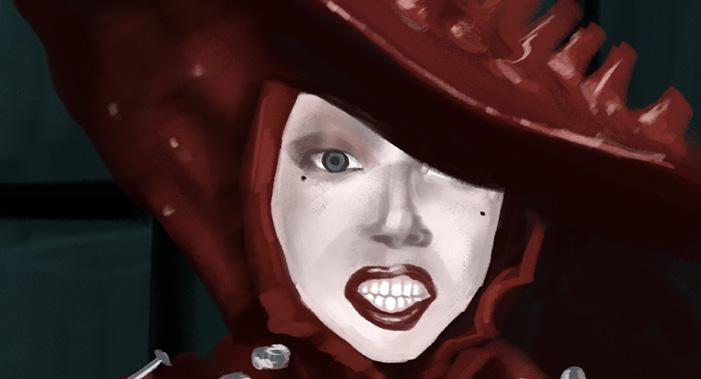
‘MAYHEM’ by Lady Gaga (2025) Despite accruing 45 Grammy Award nominations — and 14 wins — Lady Gaga has never received the coveted award for album of the year. Gaga’s “The Fame Monster” (2009) lost to Arcade Fire’s “The Suburbs” (2010); “Born this Way” (2011) lost to Adele’s “21” (2011); and “Love for Sale” (2021) lost to Jon Batiste’s “WE ARE” (2021). Although “MAYHEM” is not Gaga’s strongest album, the record finds Gaga at her most versatile, focused and celebratory. The album, despite its gothic imagery and fascination, hones in on the transformative power of music, the absurdity of life and the medicinal properties of movement. The question remains as to whether “MAYHEM” will finally find Gaga standing on the Grammys stage, holding the trophy in her hands by the end of the night. Based on the previous winners, including Taylor Swift’s musing “Midnights” (2022) and Beyoncé’s eclectic “COWBOY CARTER” (2024), the Recording Academy’s voting committee revels in a concept-driven project — one that not only shares an artist at their best, but at their most performative. Taylor Swift framed “Midnights” as a collection of sleepless nights, where she forsook sweet dreams for melancholic melodies. Beyoncé’s “COWBOY CARTER” served as act two of her trilogy and retold the history of Black contributors to country music. Like her contemporaries, on “MAYHEM,” Gaga does not settle for scattered, catchy tracks. Rather, she opts for a cohesive, ambitious narrative about mortality, desire and fame. Gaga’s commitment to an eerie aesthetic, chilling production and campy lyricism sets her apart: As the singer states in the music video for “Abracadabra” (2025), “the category is dance or die.”
‘DeBÍ TiRAR MáS FOToS’ by Bad Bunny (2025)
Bad Bunny’s success appears to know no bounds. As the most-streamed artist on Spotify in 2025, a three-time Grammy winner and the upcoming headliner for the 2026 Super Bowl halftime show, he reigns dominant in the music scene. Despite his superstardom, Bad Bunny’s loyalty to his homeland, Puerto Rico, shines through his work and serves as a defining feature of his album “DeBÍ TiRAR MáS FOToS” (2025) — a stunningly emotional, danceable work that well-situates the Puerto Rican for winning his first album of the year award. Throughout the record, Bad Bunny weaves together different kinds of love, spinning together love for his home, love for his partner, love for his family and the memories he has made. On the swooning “VOY A LLeVARTE PA PR” (2025), Bad Bunny employs his signature, seductive voice as he promises to take his lover to his homeland, reinforcing his desire to return to Puerto Rico. On “EL CLúB” (2025), he sings over a swaggering beat and deep, punchy bass. He masterfully shifts from thinking about his ex’s whereabouts to reminiscing about the brevity of time: “2019, un pestañeo y ahora estamo’ aquí / 2020, la última ve’ que yo fui feli’ / 2022, la última ve’ que yo te vi,” he sings. For Bad Bunny, “DeBÍ TiRAR MáS FOToS” is both a love letter and a thesis, wherein he hones his craft with an album that carries emotional depth and unrelenting longevity. Although his status as a Spanish-language artist may put him at a disadvantage in the context of past Grammy winners, his resounding success — and solid contributions to the musical world — may push him toward making history at the Grammys this year.
‘GNX’ by Kendrick Lamar (2025)
With 22 previous Grammy wins, Kendrick Lamar is no stranger to extensive success. And in 2018, Lamar made history by winning a Pulitzer Prize in music in 2018 for his album “DAMN.” (2017), becoming the first non-classical and nonjazz artist to win the award. Known for his clever wordplay, societal critiques and innovative instrumentals, Lamar continued his streak of lauded albums with the surprise release of “GNX” (2025) last November. “GNX” encompasses the lyrical prowess and slick instrumentals that reinforce Lamar’s longevity as one of the most effective and unique rappers of this generation. In “squabble up” (2024), he doubles down on his convictions, confidently rapping over a heavy-hitting, unconventional beat. On the immensely catchy, slickly romantic “luther” (2024), Lamar joins SZA to create a track that honors the late producer Luther Vandross and leans into the groovier side of the record: “If this world was mine, I’d take your dreams and make ’em multiply,” Lamar sings over a subtle, entrancing beat. Although “GNX” lacks the lyrical impact of Lamar’s previous works, it makes up for it with pure unabashedness, as the rapper finally takes a step back to appreciate the mountain of work he manufactured. By dissecting his own fame and protecting his peace while building and releasing tension with a razortongued edge, Lamar crafts an album that sits at the peak of his power. However, “GNX” falters in comparison to his previous works, as the album leans more heavily into well-deserved bragging than overarching societal insights. And given Lamar has not yet won album of the year, “GNX” does not appear to be the record to finally earn him the most-coveted award.
After a 15-year hiatus, the hip-hop duo comprising brothers Pusha T and Malice returned to rap with a brilliant, incisive 13-track record. Last nominated for the Grammys in 2003 for a feature on Justin Timberlake’s “Like I Love You” (2002), Clipse received four Grammy nominations of their own this year, solidifying their ascendancy.
“Let God Sort Em Out” (2025), produced entirely by Pharrell, progresses from grief to rage to utter elation.
The opening track, “The Birds Don’t Sing” (2025) featuring John Legend, is a fiercely vulnerable ode to the brothers’ late parents, including evocative rap verses and a compelling chorus performed by Legend. Recalling his father’s character, Malice exclaims, “You lived for our fishin’ trips, damn, I had a dad / Mine taught discipline, mine taught structure / Mine didn’t mind when he had to pull a double.”
Legend is one of many collaborators on this album. Tyler, The Creator, Nas and Kendrick Lamar all joined the brothers on this project, adding their individual perspectives and artistic styles. The second track is a cutting collaboration with Lamar, “Chains & Whips” (2025). Throughout this spirited track, Pusha T mocks his observers’ jealousy, Malice relishes in the failure of his enemies and Lamar warns, “I don’t f*ck with the kumbaya sh*t.” “Chains & Whips” illustrates the sheer beauty of this record: It is a testament to the transformative, healing power of art.
In another Grammys cycle, “Let God Sort Em Out” might be a clear contender for the esteemed album of the year prize — but this year, the competition is steep.
Song of the Year Best New Artist Record of the Year
Read our predicted winners for the remaining “Big Four” categories, which recognize excellence in production, songwriting and newfound stardom
‘Abracadabra’ (2025) by Lady Gaga, Cirkut & Andrew Watt, songwriters (Lady Gaga)
Lady Gaga has no qualms about leaning into spectacle. From her faux-bloody performance during the 2009 MTV Video Music Awards to her 2010 red carpet meat dress, Gaga is a master of image, even when it is controversial. With her single “Abracadabra” (2025), Gaga returns to the same kind of spectacle that served as a hallmark of her early career, using her synth-pop arsenal to craft a track reminiscent of the rip-roaring songs of her debut album, “The Fame” (2008).“Abracadabra” begins with a muted chorus, luring the listener in while foreshadowing the propulsive, powerful verses to come. Immediately, Gaga steps into brooding lyrical territory, painting an evocative picture of a woman seeking to seduce someone into dancing. With threatening lyrics that evoke the darkness of other Gaga tracks, such as “Judas” (2011), “Abracadabra” tells an enrapturing and head-bobbing tale of midnight lust: “Hold me in your heart tonight / In the magic of the dark moonlight,” she sings. The beat is punchy, and Gaga’s voice is more masterful than ever. She begs for love, hoping her spellbinding incantations will lead to it: “Like a poem said by a lady in red / You hear the last few words of your life,” she sings. During the infectious and intense chorus, Gaga repeats the word “abracadabra” with such conviction that to call it an indelible earworm would be a grave understatement. The song is instantly danceable, serving as a revival of the dark dance-pop that defined Gaga’s early career. And the track stands apart from contenders in its meticulous and vigorous production, highlighting Gaga’s mastery of the genre while serving up a deliciously dynamic track that the Grammys will certainly name song of the year.
‘luther (with sza)’ by Kendrick Lamar (2025)
From rap feuds to the Super Bowl performances, Kendrick Lamar had a sincerely successful two years. His popularity culminated in multiple Grammy wins, including record of the year for his scathing track “Not Like Us” (2024). In 2026, he is likely to snatch the title yet again: not for a vengeful diss track, but for a light, romantic hip-hop ballad made beautiful with star collaborator, SZA. The two have been frequent collaborators for over a decade — starting with “Babylon (feat. Kendrick Lamar)” (2014). Lamar even brought SZA on stage at the Super Bowl LIX halftime show to perform “All the Stars (with SZA)” (2018).Unlike song of the year, record of the year recognizes more than songwriting: The category recognizes the performance, production and engineering of a track. Produced by a collection of contributors, including the multiple Grammy-winning artist Jack Antonoff, “luther” is a feat of creative collaboration. The track begins with an acoustic guitar riff, brushed by reverb, and glides into a compressed sample of “If This World Were Mine (with Luther Vandross)” (1982) by Cheryl Lynn. Following the quick sample, explosive drums and Lamar’s rhythmic rapping flood the track. “Hey, Roman numeral seven, bae, drop it like it’s hot / If this world was mine, I’d take your dreams and make ‘em multiply,” he muses, declaring his devotion to his love. Lamar repeats his refrain as the production amplifies — orchestral instruments float in the background while the drums beat on. Entering in the chorus, SZA’s crisp soprano counters Lamar’s subtle tone. The two continue side-by-side for the remainder of the track, often completing each other’s lines. The artists approach one another with reverence and excitement, a stellar combination that makes for a stunning, Grammy-deserving track.
Olivia Dean
In years past, the winner of the Grammy’s best new artist category appeared clear-cut. Olivia Rodrigo broke the internet with her ballad “drivers license” (2021) and Chappell Roan captivated crowds with her stage presence and singles.
And once again, the choice to win the prestigious award could not be more clear.
From opening for Sabrina Carpenter, to performing on SNL, to releasing her hit album “The Art of Loving,” 2025 was Olivia Dean’s year, emerging as a breakout artist through her stellar performances and touching lyrics.
On “I’ve Seen It” (2025), Dean depicts love blossoming, recognizing the juxtaposition of life’s temporal nature with the never-ending essence of love. “The more you look, the more you find / It’s all around you all the time,” Dean sings. Dean shapes a timid form of peace, one reminiscent of the infamous line in “Love Actually” (2003), “If you look for it, I’ve got a sneaky feeling you’ll find that love actually is all around.” With “Man I Need” (2025), Dean showcases her hit-making powers with her catchy post-chorus that repeats “Mm, talk to me, talk to me / Be the man that I need, baby.”
While KATSEYE has a large fanbase, their music lacks lyrical depth; Lola Young’s music remains largely unknown beyond her breakout hit “Messy” (2024) and Alex Warren’s “Ordinary” (2025) is more annoying than interesting.
But Olivia Dean is fascinating — fascinating in her lyrics, in her range and in her performance. This combination of superlatives makes her not only a clear choice, but the only choice to win best new artist.
‘Let God Sort Em Out’ by Clipse, Pusha T & Malice (2025)
Predictions 2026
5. 6. 7. 8.
‘Man’s Best Friend’ by Sabrina Carpenter (2025)
Although Sabrina Carpenter appeared to fall from a shattered sky in 2024, landing with sparkling pumps and a perfect bombshell-blonde blowout on a spotlit stage, the pop starlet produced work for 10 years before her breakthrough. In fact, this is only her second year as a Grammy nominee. In 2025, Carpenter won best pop solo performance for “Espresso” (2024) and best pop vocal album for “Short n’ Sweet” (2024). A year later, Carpenter is sure to take home another gilded prize — however, it will not be for album of the year.
“Man’s Best Friend” (2025) is a humorous, divinely catchy collection of songs that showcases Carpenter’s growth. She transforms shy, sexual innuendoes like “My honeybee, come and get this pollen” from “Espresso” to expressive imagery like “Tears run down my thighs” from “Tears” (2025), she amplifies the folk-infused elements of “Please Please Please” (2024) on the Americanainspired “Manchild” (2025) and she finds her footing on soft ballads such as “Don’t Worry I’ll Make You Worry” (2025) — a clear descendant of “Don’t Smile” (2024).
Despite Carpenter’s improvement, “Man’s Best Friend” offers a glimpse, though not a full realization, of her talent. On the record, Carpenter inserts sexual lyrics in peculiar places, which sometimes lessen the emotional tenor of her tracks. Additionally, Carpenter oscillates between country pop and Scandinavian disco, resulting in a disjointed sonic experience. Nevertheless, Carpenter need not be dismayed, after over a decade of perseverance, her day will certainly come
Snubbed:
‘MUTT’ by Leon Thomas (2025) Etsy witches beware — Leon Thomas is a true master manifester. “[I] Feel like I just got off the stage at the Grammys,” are the first words spoken on “HOW FAST” (2024), the opening track of his 2024 album, “MUTT.”
Although he is not a confirmed performer, Thomas has been nominated for six Grammy awards this year, including album of the year and best new artist.
After two decades in the entertainment industry, including on the Nickelodeon sitcom “Victorious” (2010-2013), Thomas has finally emerged as a major force in R&B music. His sophomore album “MUTT” is a bit meandering, but captivating at its peaks.
“LUCID DREAMS (feat. Masego)” (2024) offers an atmospheric track filled with subtle yearning; “ANSWER YOUR PHONE” (2024) demonstrates Thomas’s vocal talent on a power ballad; and the title track features the earworm-hook, “She said, ‘Take your time, what’s the rush?’ Oh / I said, ‘Baby, I’m a dog, I’m a mutt’.”
Although a striking sonic collection, “MUTT” reveals moments of weakness. Thomas remains committed to experimental elements throughout the record, but at times falls prey to his creative aspirations.
For instance, on “DANCING WITH DEMONS” (2024), an introductory sequence states “That boy is extremely dangerous / his powers are far too great for someone without a heart” — a cringe-inducing verse that detracts from the spirit of the song.
Despite a few missteps, with “MUTT,” a true star has been unleashed.
‘CHROMAKOPIA’ by Tyler, The Creator (2024)
While “CHROMAKOPIA” (2024) by Tyler, The Creator may be unlikely to win big at this year’s ceremony, it is not because his album is the worst of the bunch.
“CHROMAKOPIA” was released over one year ago, and in the time since, Tyler toured the world, starred in a critically acclaimed movie and released another full album.
So, forgive preoccupied Grammy voters if “CHROMAKOPIA” has not been at the front of their minds lately.
But those who choose to revisit Tyler’s eighth studio album will not be disappointed. “CHROMAKOPIA” is, surely, the rapper’s most personal and mature album to date. Ironically, Tyler wears a mask over his face in almost all the promotional content, despite being the most vulnerable and raw he has been in his career.
Throughout the album, Tyler raps about his fears and insecurities — namely, his lack of a father figure growing up and how this manifested into apprehension regarding his future as a parent.
Even with its serious themes, “CHROMAKOPIA” is still imbued with Tyler’s signature sense of unabashed fun and creativity. From the blaring horns and thumping drums on “Sticky (feat.
GloRilla, Sexyy Red & Lil Wayne)”(2024) to the pure bravado on “Thought I Was Dead (feat. ScHoolboy Q & Santigold)” (2024), there is never a dull moment on “CHROMAKOPIA.”
While Tyler might not leave the Grammys a winner, it is certainly not because “CHROMAKOPIA” lacks quality.
‘SWAG’ by Justin Bieber (2025) Editing is an art form. Coco Chanel once famously advised that before leaving the house, everyone should remove one item from their outfit. Yet Justin Bieber, a longtime star whom Scott “Scooter” Braun (04C) discovered in 2008 on YouTube, failed to master this art on “SWAG” (2025). Spanning 21 tracks and including a sequel dubbed “SWAG II” (2025), the album, while genius, is more often excessive and disjointed. Tracks like “DAISIES” (2025) and “GO BABY” (2025) highlight a softer side to Bieber, one that, while occasionally unveiled, remains mostly hidden throughout the record. Bieber’s true lyrical talent reveals itself when he writes from pure, genuine emotion and stumbles when intending to write catchy hits. Confusing tracks like “STANDING ON BUSINESS” (2025) show “SWAG” on its creative decline, as this track is not a song but rather an interpolated clip of Bieber’s viral standing on business meme and comedian Druski commenting on the event. While comical, as the duo would surely make for an entertaining podcast, the humorous track feels out of place on the record. “DEVOTION” (2025), a standout track that features Dijon, is thematically reminiscent of Dijon’s “Skin” (2018). Mimicking Dijon’s soulful, scratchy sound, Bieber’s vocals in the track feel secondary to the overpowering swinging beat. Bieber clearly gained inspiration from Dijon on other tracks, like “GLORY VOICE MEMO” (2025). On this track, Bieber’s vocals are more powerful, balancing the song. Spanning ten tracks too long, “SWAG” as an album could have benefited from critical editing. It is a project that did not need a part two, let alone a nomination for Album of the Year.
Read about the artists, albums and songs who did not recieve a Grammy nomination but nonetheless deserve recognition
‘Virgin’ by Lorde (2025) for album of the year
Nothing grasps an audience quite like sexuality — something singer-songwriter Lorde knows well, seeing as her most recent album’s cover art features an X-ray scan of a pelvis, complete with an IUD, zipper and belt buckle. But in “Virgin” (2025), Lorde’s sensual themes extend beyond just the cover and title, encompassing the project without limiting it. Despite its abounding depth, the record was missing from this year’s Grammy nominations. While the voting members did not award “Virgin” any nominations — let alone the highly sought-after album of the year award — the record remains a striking project. It is uncomfortable and captivating, never shying away from the darkness of human interaction. On tracks like “Clearblue” (2025), Lorde embraces the harsher aspects of romantic love and womanhood. With a hollow voice and no instruments, Lorde mimics the numbness she feels, singing, “After the ecstasy, testing for pregnancy, praying in MP3.” If Michelangelo’s marble “David” (1504) exemplifies the ideal man, Lorde’s “David” (2025) illustrates the dangers of over-idealizing a man. “If I’d had virginity, I would have given that too,” Lorde sings, baring her soul both to the world and the man who used her. “Virgin” encapsulates the human experience as messy yet manageable, unpredictable yet unlimited. Lorde builds a record that thrives in its bitter rawness. “Virgin” features a profound, cohesive depth otherwise lacking in the 2026 nominations cycle.
‘So Close To What’ by Tate McRae (2025) for album of the year While Tate McRae received her first Grammy nomination for her song “Just Keep Watching” (2025), written for “F1: The Movie” (2025), McRae received no nominations for her most recent album, “So Close To What” (2025), despite being significantly more compelling than her nominated single. On “So Close To What,” McRae reduced her sonic range but expanded her thematic range tenfold. The album contains danceable singles “It’s ok I’m ok” (2024), “2 hands” (2024) and “Sports car” (2025), but still incorporates sentimental tracks. With “Purple Lace Bra” (2025), McRae fights hypersexualization, expressing her frustration with being viewed only as a sex symbol. Beginning with a darker tune and a gripping cello melody, the track abruptly switches to a hyper, digitalized McRae. As McRae questions, “Did my purple lace bra catch your attention? Uh,” the warm tone and removal of the previously drawn-out cello instantly drawing the listener in. “Purple Lace Bra” does not see McRae at her most original, but rather at her most provocative. McRae dazzled audiences with a spellbinding VMA performance of “Sports Car,” and with the chorus in a spoken whisper, McRae seduces the listener. Sonically and thematically, the record is cohesive, popular and fun. After years in the music industry, McRae has finally found her stride — it is a shame the Grammys are still two steps behind.
ROLE MODEL for best new artist
It has been nine long years since a man won the best new artist award at the Grammys, yet in 2026, the man who could have snagged the title failed to gather any nominations. ROLE MODEL, took the internet by storm with the release of his hit song “Sally, When The Wine Runs Out” (2025). While the now-famous bridge will forever echo throughout teenage girls’ cars, it is ROLE MODEL’s performance that stands out. At each festival or arena, ROLE MODEL invited a new “Sally” to the stage. Including a laundry list of celebrities, from Natalie Portman to Bowen Yang, ROLE MODEL created a pop-culture moment, one that showcased his own growing stardom and appeal while including his fans. ROLE MODEL, however, is anything but a one-hit wonder. On “The Dinner” (2024), he strums his guitar while longing for home; on “Slipfast” (2024), he matches his words to his tune. ROLE MODEL does the seemingly impossible — he captures the intangible, holding fleeting memories in his solid chord progressions and wistful lyricism. Using simplistic yet heartfelt comparisons to showcase love, on “Something, Somehow, Someday,” ROLE MODEL evokes peace in the listener. With a characteristic cohesion reminiscent of Olivia Rodrigo’s “SOUR” (2021), which won her best new artist in 2022, ROLE MODEL’s chart-topping year makes him worthy of at least a nomination for the same award — and his charming voice and personable lyrics mark ROLE MODEL as one to watch.
‘That’s So True’ by Gracie Abrams (2025) for song of the year Gracie Abrams loves to chase a feeling: Be it hopeless yearning, somber sweetness or sour acceptance, she constantly strives for more: more passion, more freedom, more poetry. And on her 2024 song “That’s So True” (2024), Abrams’ aggressive zeal shines, a risk that pays off as it awarded Abrams her first No. 1 hit on Billboard’s Streaming Songs chart. While popularity alone cannot, and should not, carry a song to a Grammy nomination, the genius of Abrams’ track does not lie in its cultural traction. On “That’s So True,” Abrams uses her signature, fast-paced style and pairs it with an intense guitar and layered vocals to create a passion-filled, inescapable atmosphere. “That’s So True” represents everything her music stands for: “Smiling through it all, yeah, that’s my life,” she sings. From endless “Ooh’s” to passive-aggressive quips, Abrams’ lyrical talents synergize with her emotional voice. She strives for a feeling so poignant she struggles to describe it, instead asking, “Don’t you know the vibe? Don’t you know the feeling?” It is rare to find an artist who can contrast their bitterness with a bubbly sound without sacrificing tonal cohesion. A whirlwind of emotion and an accumulation of Abrams lyrical talent, “That’s So True” is fun and quirky, yet profound and relatable. As one of last year’s defining tracks, “That’s So True” is more than worthy of a Grammy nomination.
MUSIC
Madison Beer finds beauty in pain, connection in complexity on ‘locket’
By JacoB Muscolino n e W s e ditor
Since releasing her first independent album in 2018, Madison Beer has found global success by etching the universal themes of hardship and resilience into the fabric of every song she pens.
However, Beer has failed to have a clear mainstream pop album breakout like her contemporaries Tate McRae and Sabrina Carpenter, despite her similar sound and production style. Now, with her third studio album, “locket,” released on Jan. 16, Beer continues her trend of vulnerable songwriting by unlocking her emotions for listeners in a record that will revolutionize Beer’s future career trajectory. Through providing the world a glimpse into her insecurities as she dissects complex feelings of sorrow and surmounts trauma, Beer secures her place in pop as a force to be reckoned with.
The record opens with the glittering synths and angelic vocal ad-libs of “locket theme,” lifting listeners into a serene dreamscape.
Beer begins the album by reflecting on a recent heartbreak, a recurring motif throughout her discography. However, rather than harping on the past, Beer reveals her personal epiphany that closure comes from within and that moving on is a selfled journey.
Ornate lyrics and crystal-clear violin chords frame this realization as Beer seals her secrets, mistakes and insecurities inside the image of a locket: “My protection’s so divine and now I see (I see) / Pain on a necklace, set it down, I’m weightless / Everything that I could ever need is within me,” Beer sings. “locket theme” is musically simple, yet ends triumphantly with Beer evoking
CROSSWORD
ACROSS 1. Stereotypical teenage feeling
Needing scratching
Acquire
Singer Janelle
Supercharger
Uno, in English
Recoils, as in fear
Bikini top
It comes before a date
Hopi homes
Inheritor of a large fortune 27. ___ of thumb
The Catcher in the Rye protagonist 32. Red resident of Sesame Street
operatic vocal tones and successfully displaying her as dominant rather than meek.
The subsequent tracks, “yes baby” and “angel wings,” showcase Beer’s quiet yet consistent strength in the face of hardship.
Dim vocals float over an electric pop background, and Beer’s voice pulses like a heartbeat on “yes baby.”
Here, Beer reclaims and embraces her sexuality and power, recognizing her self-worth with a tender, wistful force. On “angel wings,” Beer encourages her listeners to revel in the complexities of their own relationships, noting that people can seem like angels at one moment and present insurmountable challenges in the next. While these tracks add cohesively to the work, they are too simple to add anything meaningful to Beer’s discography, unlike “locket theme.”
For tracks that are oriented earlier on in the album’s run, they weigh heavily on the rest of an otherwise fascinating breakthrough for Beer.
Fortunately, “locket” regains its strength on one of its most memorable tracks, “you’re still everything,” which finds Beer lamenting about a feeling of bleak emptiness from a love foregone on the record’s climactic ballad. The combination of yearning lyrics and distant, heartfelt piano notes solidifies this track as Beer’s premier melancholic masterpiece.
In a similar vein as “Reckless” (2021) and “Good in Goodbye” (2020), she is lethally transparent. However, “you’re still everything” stops the listener in their tracks with brooding harmonies superior to any power ballad she has produced thus far. Beer is explicit and sincere in her feelings, acknowledging the nonlinear path of moving on from heartbreak: “How am I nothing to you, while you’re still everything to me?” Beer sings. The
11. University of Michigan chant
12. Register, as for a class
13. Playfully mocked
18. Eager
22. Soft cheese
23. Golfer’s target 24. Stately trees
25. Move (over)
26. Capital of New Mexico
28. “Yo!”
29. Ideal society
30. ___-Manuel Miranda
31. Radio settings
35. Buddy
36. FDR’s successor
37. “___ there, done that”
38. Titanic’s doom
39. Fourth-yr. students
40. Yearly Met event
41. Awake at a late hour
42. React to pollen, perhaps 43. Laid in the sun
44. Bounces back
45. Earl ___ tea
46. Hires in charge of hiring
50. Crypto artworks
51. Florentine farewell
52. “¿Cómo ___ usted?”
56. She/___
57. Trauma ctrs.
58. Historical period
59. Fishing aid
60. Espie
sentimental soliloquy encapsulates the kind of hushed pain Beer hopes to heal from.
As the titular oxymoron suggests, Beer revels in contrasting feelings on “bittersweet.”
The song’s vocals oscillate between whistle tones and vibrato, with the track closing with a final chorus that feels like a grand act of self-forgiveness. On “bittersweet,” Beer brings listeners close to her heart and encourages them to revel in self-growth: “I lay awake thinkin’, ‘How did I let you go?’ / Gettin’ away unscathed for so damn long / I got away, took my time, I’m okay alone,” Beer sings. “bittersweet” is a sonic breakthrough for Beer, who has previously struggled in writing compelling hooks. Between clever lyricism and experimental electric pop sounds, Beer takes a leap of faith that is well worth the risk, considering “bittersweet” is her first track to chart on the Billboard Hot 100.
On “complexity,” Beer turns “baggage” into “beauty” and speaks strongly to a partner who previously made her feel weak and unloved.
This core practice of surmounting life’s complications through deep introspection follows Beer to the album’s final track, “nothing at all.” This conclusion flawlessly reflects Beer’s fears of fleeting love and the uncertainties of forever: “I’m afraid of getting better / I’m afraid it gets too good / ’Cause it can’t last forever / Even though I wish it could,” Beer sings.
While growing up and leaving youth behind is often unnerving, Beer urges listeners to rejoice in defiance of an unsettling future in this hyperpop song.
On “locket,” Beer provides a conclusion to the pain that haunted her previous records. On her extended
play, “As She Pleases” (2018), Beer lost her childlike innocence, and on “Life Support” (2021), she contemplated personal grief and on “Silence Between Songs” (2023), she experimented with jazz and electronic pop influences to guide her path to healing. In her past records, Beer struggled to find the words to illustrate her pain, but on “locket,” Beer not only defines it but discovers relief in understanding her complex feelings: This makes “locket” a particularly special addition to Beer’s discography.
With “locket,” Beer reframes her past albums’ themes of heartbreak, sorrow and disenchantment by presenting the beauty in shedding the
pain of her past. “locket” is cohesive where it is discordant, it is complex where it is simple, it is haunting where it is enchanting. This contrasting nature reflects Beer’s ardent pursuit of pop excellence — a quest she graces breathtakingly throughout “locket.” She memorializes the selfdoubt, missteps and difficult ordeals of her youth while cherishing her inner child and treasuring t he mixed emotions that mark her memories. She engraves and remembers these complex feelings as if they are a locket forever around her neck, a talisman that she proudly wears.
– Contact Jacob Muscalino at jake.muscolino@emory.edu
Break a Leg
By etHan altsHul Crossword Desk
Photo M A niPuLAtion by hunter buChheit/A rts & Life editor
SWOOP’S SCOOP
Stefanski brings coach of the year experience
Continued from Back Page
Since retiring, Ryan had been working as an NFL analyst for CBS Sports, leaving the role to rejoin the Falcons.
Ryan, a four-time Pro Bowler and one-time MVP, is arguably the greatest player in Falcons history and a potential Hall of Famer. He led the Falcons to five playoff appearances, including a trip to the Super Bowl in 2017, and holds franchise records with 59,745 career passing yards and 347 career touchdowns.
On Jan. 17, with Ryan at the helm, the Falcons hired former Cleveland Browns head coach Kevin Stefanski as their new head coach. The Browns fired Stefanski on Jan. 5 following a disappointing 5-12 record in the 2025 season. During his tenure, Stefanski earned NFL Coach of the Year in
What Trae Young trade means for the Hawks
By Tvisha Jindal Contributing Writer
The Atlanta Hawks ushered in a new era on Jan. 7, when the team agreed to trade four-time All-Star Trae Young to the Washington Wizards in exchange for guard CJ McCollum and forward Corey Kispert. The deal marked the end of Young’s eight-year tenure as the face of the Hawks franchise and signaled a decisive shift in how Atlanta plans to build their roster moving forward.
Young’s impact on the Hawks is undeniable. He leaves Atlanta as the franchise’s all-time leader in assists and three-pointers, having helped guide the team to three postseason appearances, including a surprise run to the Eastern Conference Finals in 2021.
Despite his individual achievements, Atlanta has struggled to translate Young’s star power into sustained team success. In the past couple of seasons, the Hawks have been hovering around the NBA playoffs, largely attributable to their inconsistency as they come into the midseason ranking 18th offensively and 16th defensively.
Young’s availability has also been a growing concern. He missed significant time before the All-Star break with a right MCL sprain and later a right quad contusion, appearing in just 10 games this season and preventing the Hawks from establishing any continuity with him in the lineup.
While the move surprised many fans, it was not entirely unexpected. Young’s representatives and the Hawks front office had been exploring trade possibilities for weeks
before the deal was finalized. Young’s looming contract commitments include a salary that is approaching $49 million annually.
That figure poses long-term financial challenges for the Hawks, a team that still requires depth, and this move will allow them to reset their player payroll cap while maintaining a competitive roster in the short term.
With McCollum, the Hawks acquired a veteran scorer and playmaker capable of stabilizing the offense without monopolizing it. He comes to the Hawks averaging 18.6 points per game this season, and has put up 17 points per game in his five games since joining the team. Kispert, meanwhile, adds bulk and positional versatility on the wing, currently shooting a career 38.2% from the three-point line.
Unlike Young’s ball-dominant style, McCollum’s ability to play on or off the ball opens the door for a more balanced offensive system. Returns earlier in the season, such as an 18-16 record without Young compared to 2-8 with him, suggest Atlanta may benefit from distributing responsibility more evenly, allowing multiple players to initiate the offense rather than relying on a single star guard.
But perhaps the most significant impact of the trade lies beyond the box score. Moving Young’s heavy contract provides Atlanta with greater financial flexibility, allowing the front office more room to maneuver in future free agency periods.
With McCollum on an expiring contract and Kispert under teamfriendly control, the Hawks are better positioned to adjust their roster as younger players with untapped
2020 and 2023, breaking the Browns’ 17-year playoff drought in 2020.
Despite the Browns’ recent struggles, he quickly emerged as one of the most popular candidates on the coaching market.
In Atlanta, Stefanski will be heading into a more stable, yet still uncertain, quarterback situation.
The Falcons hope Stefanski can improve their offense, which ranked near the bottom of the league in scoring in 2025. While Cleveland’s offense struggled late in his tenure, much of that was due to ongoing quarterback dysfunction rather than coaching.
In Atlanta, Stefanski will be heading
into a more stable, yet still uncertain, quarterback situation, with Penix Jr. entering his third season coming off an ACL injury. While Cousins steadied the offense to keep the Falcons in the division race, the starting quarterback remains undecided. The new coaching staff will evaluate Penix Jr.’s recovery and weigh their quarterback options before determining who will open the 2026 season as the starter.
As the Falcons enter a pivotal offseason, the combination of young talent, leadership change and Ryan’s return to the franchise signals a reset in Atlanta. With Stefanski now in place, the focus shifts to whether he can translate the Falcons’ potential into sustained success and end their long playoff drought.
— Contact Gabby Sanders at gabby.sanders@emory.edu
Men’s track and field begins season, eyes UAA indoor title
By Max shiMBo Contributing Writer
After a successful 2024-25 season, the Emory University men’s track and field team is looking to continue their momentum as they race into this season. The team is looking for redemption after placing second at the University Athletic Association (UAA) Indoor Track and Field Championships and 20th at the NCAA Indoor Championships last year.
steps to prevent injuries by addressing the needs of individual athletes.
“Recovery is essential, and everybody’s body is different,” Mersky said. “If one person needs to take a step back and just do a bike workout instead, they could. All the coaches have been really great about that this year. That’s helped us tremendously.”
potential, such as guards Dyson Daniels and Nickeil AlexanderWalker, continue to develop. That flexibility could prove crucial as league analysts increasingly warn against teams remaining stuck in the NBA’s “middle class” — competitive enough for the play-in tournament but without a clear path to contention. This move positions the Hawks for a soft reset rather than a full rebuild.
While Atlanta could have demanded more in return for a perennial All-Star, the move was a necessary recalibration away from a top-heavy team.
The post-Young era presents expanded opportunities for Atlanta’s emerging core. Players like forward Jalen Johnson and center Onyeka Okongwu now have a runway to grow into larger roles. Johnson has been showing promise, averaging a teamhigh 22.8 points per game. Okongwu has been a star center for the Hawks defensively, also showing consistent offensive improvement across the last six seasons and currently averaging a career-high of 16.4 points per game.
This trade is a reset for the Hawks, not a retreat. Now, the team enters the second half of the 2025-26 season with a more balanced roster, newfound financial flexibility and clarity on long-term direction. Whether this move pays immediate dividends or lays the groundwork for future success, Atlanta’s basketball identity is evolving, and the end of the Trae Young era, for better or worse, has set up a new chapter.
— Contact Tvisha Jindal at tvisha.jindal@emory.edu
The Eagles started their 20252026 indoor season on Dec. 5 at the Birmingham Indoor Icebreaker in Birmingham, Ala. They had a solid performance, as three athletes placed within the top five in their events and several others took home top-20 finishes. The team carried this momentum to the Samford Invitational on Jan. 16, also in Birmingham, where they saw two individual athletes place within the top five.
Even so soon in the season, many freshmen have set promising marks.
Junior sprinter Andrew Burchett said that he’s excited to witness how the freshmen continue to perform.
“I’m a very big fan of a lot of the folks in that class,” Burchett said.
“The way that they handle themselves, the way that they cheer each other on, the way that they aren’t afraid to go at other people in practice and really compete.”
The upperclassmen are doing more than just voicing their confidence in the freshmen class’s abilities. Freshman jumper Robert Bright said that the upperclassmen, including senior Steven Ditelberg, have also given him advice about matters on and off the track.
“He’s helping me talk with people so I can figure out where I want to go with my career, and he’s making sure I have the skills to do that,” Bright said. “On the track, as pole vaulters, we all coach each other because it’s a super technical event, so that’s always helpful.”
With the Feb. 28 UAA Indoor Championships moving closer, the Eagles hope to claim victory this season. Bright emphasized how crucial it is for the team to stay injury-free, given the scarcity of breaks throughout the season.
“In the fall semester, approaching winter break, a lot of people were starting to get stress injuries,” Bright said. “The most important thing for us is just going to be managing our workload in order to prevent injuries.”
Freshman sprinter Lucas Mersky said that the coaches have taken
Another component crucial to the team’s success this season is cultivating a positive team culture. Within the team’s tight-knit environment, athletes in specific event groups share even tighter bonds, which Bright said is beneficial during competitions.
“It’s always nice to know when it comes down to that sort of stuff that you have some dogs in your corner.”
- Andrew Burchett
“We’re sometimes competing with each other, which we also do in practice, forcing everyone to be our best,” Bright said. “Approaching the end of meets, when our [4x400 meter relay] goes up, … we’ll have the whole team standing outside the track cheering them on as they run.”
Similarly, Burchett said that the “48-ers,” composed of athletes who double in the 400-meter and 800meter events, are united by their strenuous workload.
“You need somebody that’s going to go out there and can compete, regardless of being on heavy legs,” Burchett said. “Not to gas up the folks … in the 48-er event group, but they’re some dogs, and it’s always nice to know when it comes down to that sort of stuff that you have dogs in your corner.”
As the season picks up pace, the Eagles are staying confident, with some athletes even aiming to qualify for the NCAA Championships. Mersky said he would be excited to go, especially since they take place at a familiar venue in his home state of Wisconsin.
“It’d be amazing to go back there and compete,” Mersky said. “My friends and family have already discussed coming up, and that’d be amazing. I would love a chance to compete in front of all of them on the biggest stage.”
— Contact Max Shimbo at max.shimbo@emory.edu
Courtesy of Wikimedia Commons/erik drost
Former Atlanta Hawks guard Trae Young runs out for warmups ahead of the 2022 All-Star Game.
The Emory Wheel
Sports
Women’s track and field gears up for 2025-26 season
By alex Waryn Staff Writer
The Emory University wom -
en’s track and field team is off to a strong start after a successful 202425 indoor season. Last season, the team saw then-graduate student Nikki Boon win the national championship in the indoor pentathlon, the first person in program history to do so. Additionally, the Eagles also earned two individual titles at the University Athletic Association (UAA) Championships.
The team began its 2025-26 indoor season on Dec. 5, competing at the Birmingham Indoor Icebreaker in Birmingham, Ala.
In the distance events, junior Hannah Riley came in first in the 800-meter, with sophomore Aaliyah Jalloh and senior Payton Sullivan coming in at third and fourth, respectively. Freshman sprinter and hurdler Kelsey Coley earned a 10thplace finish in the 60-meter hurdles preliminaries and freshman thrower Caroline Henry took first in the weight throw.
On Jan. 15 and 16, the team picked back up after winter break with the Samford Invitational, again in Birmingham, where they had numerous top-20 placements during the tournament.
“Everyone just loves running on the team and enjoys being out there and training hard.”
- Cameron Gupta
Junior distance runner Cameron Gupta said that at this point in the season, the team is still getting used to competition, but emphasized that
the team is motivated for the months ahead.
“After winter break, it’s an adjustment getting back into it,” Gupta said. “But everyone just loves running on the team and enjoys being out there and training hard, so everyone is excited.”
As the season ramps up, the team is setting its sights high. Sophomore jumper and sprinter Amaya Grant said that she is aiming high for her-
self and for the team.
“My personal goals going into this season are definitely to try and make it to nationals and help my team win our UAA conference,” Grant said.
“But my personal goal would be to get a personal record for myself.”
Grant said that not only are these runners, jumpers and throwers individually driven, but they also form a supportive team that leans on one another throughout the season.
Being a jumper herself, she said that the jumpers, specifically, are close both on and off the track.
“We aren’t just teammates, we’re friends outside of track,” Grant said.
“We really grew [together], even though we’ve only known each other for such a short period of time.”
Gupta echoed this sentiment, saying that her teammates’ support is essential to her, even in what can be perceived as an individual sport.
“Distance running … is normally seen as an individual sport, but it is such a team sport,” Gupta said. “Being able to race alongside your teammates is really motivating, and it definitely encourages me to push myself harder.”
“For me and the other seniors, we’re definitely feeling nostalgic, but also very happy to be able to run our last seasons.”
- Madison Tiaffay
Entering his seventh year, head coach Linh Nguyen leads the team with the help of four assistant coaches and three volunteer coaches, including Boon. Senior mid-distance runner Madison Tiaffay said the coaches are very supportive and have helped her develop as an athlete and individual over the years.
“I can’t say enough good things about them,” Tiaffay said. “They’ve been very amazing, have helped me grow as a runner in person over my four years.”
With a strong coaching staff and a roster full of experience and depth, the team looks to come out stronger than ever. Looking ahead, Tiaffay said she is most excited to get into the season and is feeling bittersweet about competing in her final college season.
“People are excited,” Tiaffay said. “For me and the other seniors, we’re definitely feeling nostalgic, but also very happy to be able to run our last seasons.”
— Contact Alex Waryn at alex.waryn@emory.edu
Falcons bring back franchise legend after another missed playoff entry
By GaBBy sanders Contributing Writer
The The Atlanta Falcons finished their 2025 NFL season with an 8-9 record, extending their playoff drought to eight seasons. Despite closing the year on a four-game winning streak, capped off with a victory over the New Orleans Saints, the Falcons were edged out in the NFC South tiebreaker by a tiebreaker the Carolina Panthers held over them.
The season featured a late playoff push and standout performances from running back Bijan Robinson, who ranked fourth in the NFL in rushing yards, and tight end Kyle Pitts Sr., who set career highs in both receptions and touchdowns.
Additionally, Robinson set the Falcons’ single-season record for yards from scrimmage with 2,298 yards. However, the Falcons experienced setbacks due to quarterback inconsistency, with backup Kirk Cousins having to step in for the injured Michael Penix Jr. starting in Week 11.
Just hours after their win over the Saints, the Falcons fired head
coach Raheem Morris and general manager Terry Fontenot. The Falcons let Morris go after just two seasons, while Fontenot spent five seasons with the team. Despite assembling promising offensive and defensive talent, the front office has yet to turn the Falcons into a consistent winning franchise.
Despite assembling promising offensice and defensive talent, the front office has yet to turn the Falcons into a consistent winning franchise.
After firing the past regime, the Falcons hired franchise legend and former quarterback Matt Ryan as the team’s president of football. In this newly created role, he will oversee the head coach and general manager roles and evaluate candidates for each position.
Courtesy of natalie sandloW
Senior mid-distance runner Madison Tiaffay hustles around the track last season.
Courtesy of Wikimedia Commons/a ll-Pro r eels
Falcons quarterback Michael Penix Jr. lines up in shotgun formation for a snap against the Washington Commanders during week four of the 2025 NFL season.