Content Warning: This article contains references to murder.
Seven months after Emory University adopted an updated Open Expression Policy, the University Senate Committee for Open Expression found that the administration violated the updated policy.
In September, the Emory School of Medicine fired a professor for social media posts, but the University declined to comment on who was fired as they do not comment on personnel issues.
In an article in The Atlanta Journal-Constitution, former School of Medicine Associate Professor Anna Kenney confirmed that she was the professor terminated after she posted “good riddance” in reference to the assassination of right-wing political figure Charlie Kirk. Additionally, Kenney called Kirk’s ideology “disgusting.”
After an investigation, the Committee for Open Expression issued an opinion finding that the medical school did not sufficiently consider the Open Expression Policy in terminating Kenney. The committee’s opinion included excerpts of Kenney’s termination letter sent by
By Irene John and Thomas Zhang Oxford News Chair & Contributing Writer
As Oxford College Dean Badia Ahad prepares to become Emory University’s next provost, members of the Oxford community reflected on the legacy she has made during her two years leading the campus. For many students, Ahad’s presence was more personal, going beyond her administrative responsibilities as dean.
Jacey Mok (26Ox), who worked as Ahad’s social media intern, recalled their monthly meetings to plan and record content. She said Ahad is “beloved” on campus.
“She was always really open to hearing about the student scoop and what students were up to, and especially what students were concerned about,” Mok said. “It was very clear that she cared deeply about students and she cared about interacting with students.”
Oxford Advising Support Center Academic Advisor Matthew Brittingham (23G) emphasized that Ahad always advocated for Oxford in her role as dean.
“She has done a very good job of being very understanding with faculty and their concerns and raising those concerns to people at the Atlanta campus,” Brittingham said.
her department chair.
According to the termination letter, the medical school fired Kenney because her posts violated “Emory’s conduct expectations and applicable policies,” including the Standards of Conduct Policy and Social Media Guidelines.
The letter mentioned that Kenney’s comments could have incited others to violence and caused distrust from parents and patients alike. Additionally, the letter said Kenney’s social media posts did not align with Emory’s values, caused community “distress” and risked reputational harm to the University.
“Your social media statements concerning the murder of another human being were inflammatory, inappropriate, and wholly inconsistent with Emory’s values and mission,” the opinion reads.
In response to the termination, the Committee for Open Expression reviewed the background of Kenney’s social media posts, her termination letter, Emory’s Open Expression Policy and drew on existing First Amendment legal precedents to evaluate her firing.
Emory’s Open Expression Policy states that the University should give “substantial consideration” to First Amendment protections before
Content Warning: This article contains references to gun violence.
When an active shooter killed a DeKalb County police officer near Emory Point, an apartment complex located near Emory University's Atlanta campus, this summer, the Emory Police Department (EPD) aimed to improve safety for the campus community.
Assistant Vice President of University Communications Laura Diamond wrote in an email to The Emory Wheel on Oct. 3 that EPD has plans to increase its personnel, but also wrote that the University has “hosted several high-profile speakers and events,” which may result in students seeing more EPD officers.
After the events of this summer, some students remain shaken by these instances and are concerned about their safety on campus.
Leila Buchan (26C), who lives at Emory Point, was in the apartment complex during the August shooting and said the incident shocked her.
“I didn’t really think anything of it until I started hearing it,” Buchan said. “The gun sounds were going off like crazy. It was like boom, boom, boom, boom, boom.”
Buchan said she has noticed an increase in security on campus and near her apartment since the incident. For instance, she said she observed the presence of an armed
guard outside the Emory Point CVS at all hours, and said there were more EPD patrol cars in the area than previously.
The August shooting was not the first safety scare around Emory Point. On Sept. 19, 2024, a worker fired a gun at one of his coworkers in “a limited-access kitchen area of a leased business.” Additionally, on Nov. 30, 2024, the CVS at Emory Point reported two male subjects armed with a handgun who attempted to rob the store. Buchan said that she does not always feel safe at Point. During all these incidents, the University issued emergency warnings to community members via text.
“Point, for some reason, does happen to be a victim of a lot of situations that occur,” Buchan said.
Rhea Sharma (27C) also lived
Brittingham added that Ahad worked to change the school spirit at Oxford.
“When she first started, there was a larger proportion of students who their vibes were ‘I’m mostly here to get to Emory, rather than here to enjoy Oxford,’” Brittingham said.
“Her decisions in steering Oxford in certain directions really helped just improve the general vibes, in relation to the interest that the students that we were getting, their interest in experiencing Oxford as Oxford.”
Oxford College Director of Career and Professional Development
Adelaide Richardson emphasized Ahad’s focus on student-centered initiatives.
“Students had mentioned that they wanted something to be able to have experience related to pre-health,” Richardson said. “She met with the leaders of Piedmont Newton, and that’s how we came up with the 492R internship course.”
The 492R internship course, which encompasses all disciplinary internships, now provides an opportunity for a cohort of Oxford students to shadow healthcare professionals at Piedmont Newton Hospital.
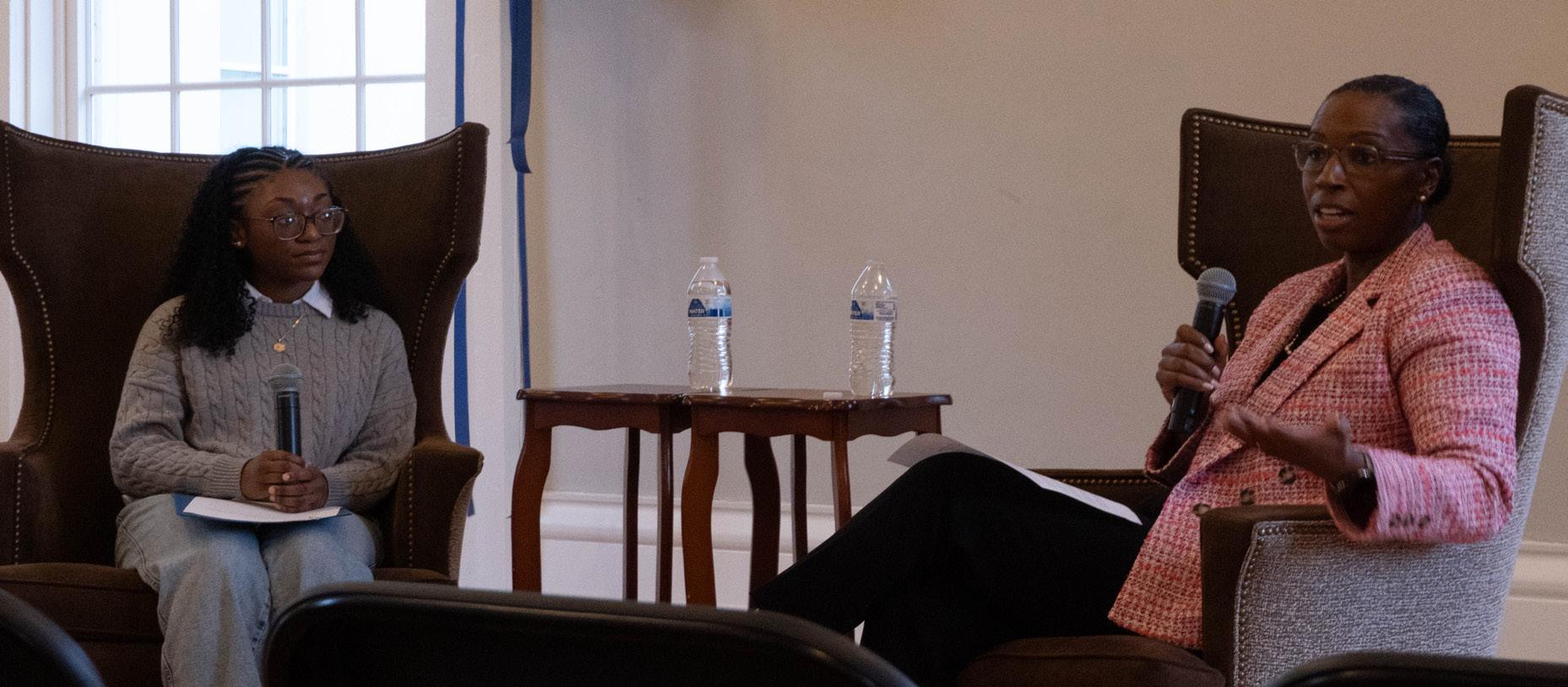
On Oct. 20, Madison Forsythe (26Ox) interviewed Ahad about her time at Oxford and the transition toward a larger role at Emory University in a fireside chat at Oxford College’s Phi Gamma Hall, for an audi-
ence of about 15 community members.. During the discussion, Ahad called herself a “servant leader,” emphasizing how Oxford belongs to everyone in the community.
“I don’t ever enter into a leadership role thinking about my own ambitions or my own sense of advancement or the mark I want to make on a place because Oxford isn’t my college,” Ahad said. “Oxford belongs to all of us.”
Ahad characterized her transition to provost as a “leap.”
at Emory Point over the summer. Although she was not in Atlanta when the shooting occurred, she said she still felt shocked and scared by the event. Sharma said the incident came as a shock, as safety was a top priority for her in choosing to live at Point.
“The reason why we picked Point and why we normally feel really comfortable there is because it’s so close to campus and it’s really safe generally,” Sharma said. Sharma said that after the shooting, it has been difficult to trust that another incident will not occur.
“I don’t view [Point] as the safest place anymore,” Sharma said.
An incident at the Robert W. Woodruff Library on Sept. 27 caused similar fears to resurface when stu-
“I never in a million years thought I’d be here at Oxford with you all,” Ahad said. “I certainly never thought I’d be any provost, much less a provost at Emory. I couldn’t have scripted my life’s journey by any stretch of the imagination.”
Nate Occilien-Similien (26Ox) highlighted his excitement to see what Ahad would do as provost.
“She’s been great to me as a dean at Oxford, and I can’t wait to see her on the Atlanta campus,” OccilienSimilien said.
Forsythe mentioned that she was initially skeptical about why Oxford selected her as an interviewer, but expressed that Ahad motivated her to do the job.
“Being another Black woman on campus, and getting to interview Dean Ahad in that position really gave me the motivation to go through with it,” Forsythe said. “Before I formulated the questions, I took my time to do research more about Dean Ahad’s story.”
As Oxford prepares for a new chapter, those who worked with Ahad say her impact will continue to last.
“The culture at any institution is filtered down,” Richardson said. “She was an example of how we all should be. At the end of the day, we are all here to serve the students. She was a perfect example of that. A daily reminder that, yes, we are indeed here for the students and not for ourselves.”
— Contact Irene John at irene.john@emory.edu and Contact Thomas Zhang at thomas.zhang@emory.edu
Cherie Zhou/Contributing illustrator
Cherie Zhou/Contributing Photogra Pher
Madison Forsythe (26Ox) interviewed Oxford College Dean Badia Ahad about her leadership.
Emory, Atlantans take to streets for 'No Kings' protest
By ellIe FIvas and sIya Kumar Editor-in-Chief & News Editor
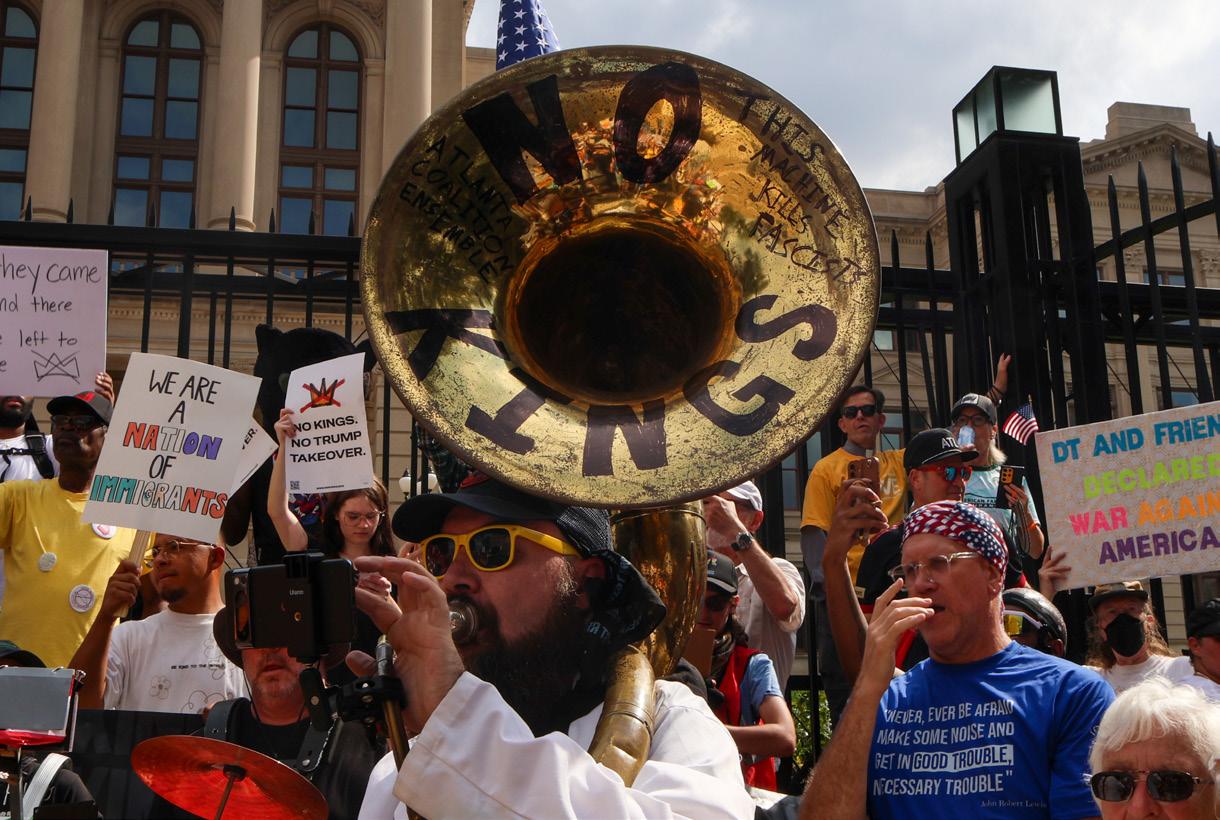
Underneath the Georgia State Capitol’s Gold Dome, demonstrators marched, sang and danced along the streets of downtown Atlanta to join in on the nationwide “No Kings” protests on Oct. 18. Thousands gathered at the Atlanta Civic Center and many turned out for smaller demonstrations across the city, including at the Joseph Maxwell Cleland Atlanta VA Medical Center near Emory University.
Organizers estimated that across the United States, nearly seven million Americans assembled for “No Kings” protests on Oct. 18, with local news outlets reporting the demonstrations in Atlanta drew between 10,000 and 12,000 attendees. “No Kings” is a nationwide movement that opposes U.S. President Donald Trump’s “authoritarian power grabs,” particularly regarding the administration’s policies on immigration, federal funding and healthcare appropriations. In June, millions of protestors gathered at the first occurrence of “No Kings” demonstrations, including thousands in Atlanta.
The American Civil Liberties Union (ACLU) of Georgia, Indivisible Georgia Coalition and other progressive organizations coordinated the Oct. 18 “No Kings” rally, which started at the Atlanta Civic Center and ran from 10 a.m. to 12:30 p.m.
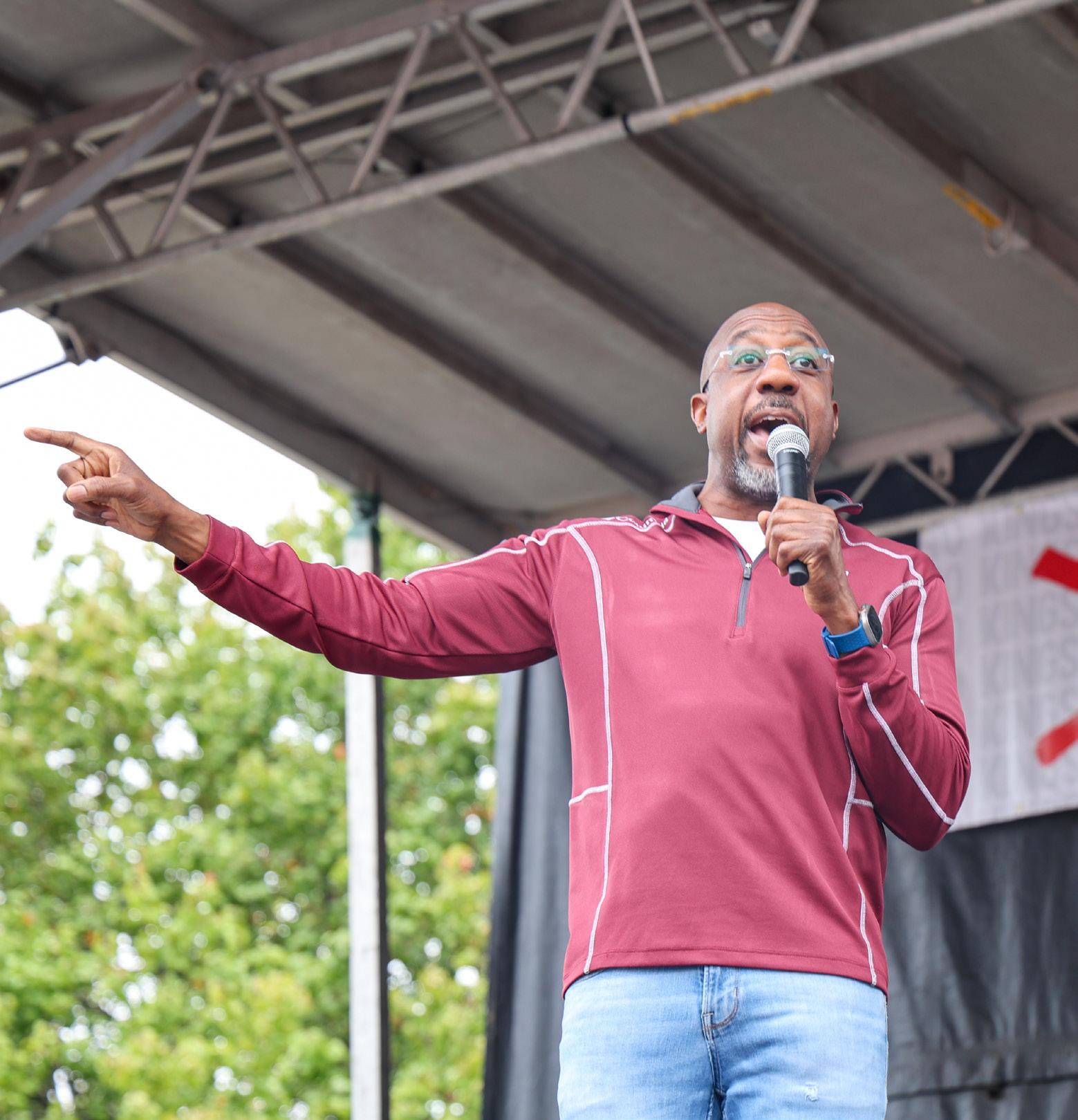
Sen. Raphael Warnock (D-Ga.), former Georgia House of Representatives Minority Leader Stacey Abrams and ACLU of Georgia Executive Director Andrea Young spoke at the rally. Young opened the rally by denouncing the Trump administration, saying the government has attacked the First
Amendment with its policies.
“We defend free speech in the courts, in the legislature, in the streets,” Young said. “The Trump regime is attacking and punishing any speech that does not support their corrupt agenda.”
With protest signs and American flags in hand, attendees listened as Warnock addressed the crowd at the Atlanta Civic Center after Young.
The senator condemned many of the Trump administration’s policies and reiterated his dedication to Georgians amid the ongoing government shutdown.
“You have my promise,” Warnock said. “I’m going to keep fighting for Georgia — I'’m going to keep fighting for all of our children.”
“This is an important moment for us to come forward, not just within Emory, but then also just the Atlanta community at large."
— Saharla Mohamoud (28C)
After Warnock, Abrams took the stage and emphasized the importance of standing against the overreach of the Trump administration to protect democracy.
“If there are 10 steps to autocracy and 10 steps to authoritarianism, then Atlanta, I’m here to tell you that there are 10 steps to freedom and power,” Abrams said.
Abrams highlighted the power of peaceful protests in creating lasting political change.
“I believe in a nonviolent revolution because it works,” Abrams said.
“It is the only thing that has ever truly consistently worked.”
Emory students, faculty and community members were among the thousands of Atlanta protesters on Saturday. Saharla Mohamoud (26C), who is an organizer for Emory’s chapter of Students for Socialism, said she attended the protest because she sees community demonstrations as powerful.
“This is an important moment for us to come forward, not just within Emory, but then also just the Atlanta community at large,” Mohamoud said.
In addition to students, Emory alumni also took to the streets on Saturday to protest the Trump administration. Catie Spencer (98C) said she attended the protests to defend democratic values.
“I feel that our freedoms are being threatened as a nation, and our political processes are being undermined,” Spencer said.
Attendees at “No Kings” also called out the Trump administration’s attacks on higher education nationwide. Spencer said it was “disheartening” when Emory announced the end of its Diversity, Equity and Inclusion (DEI) programs and offices in September, linking the decision to pressure from the federal government.
“All I can figure is that the CocaCola pockets aren’t deep enough, and that therefore they felt, to get federal funding, they had to submit to Trump’s policies,” Spencer said. “That’s just so opposed to what Emory always was, which is a place of free thought and welcome to everyone.”
Pam Hartley, a former Emory Healthcare employee and another protester at the Atlanta Civic Center, echoed these concerns about higher education, calling Trump a “bully”
and urging Emory leaders to be role models for their student bodies by standing up for their values.
“You have my promise. I'm going to keep fghting for Georgia — I'm going to keep fghting for all of our children.”
— Sen. Raphael Warnock (D-Ga.)
“Universities should know more than anyone that we can’t go back down this road that we worked so hard to get out of,” Hartley said. “When they’re kissing the ring, it’s really depressing.”
At about noon, the rally ended, and the crowd, with many in extravagant costumes, began marching down the streets of Atlanta toward the state capitol.
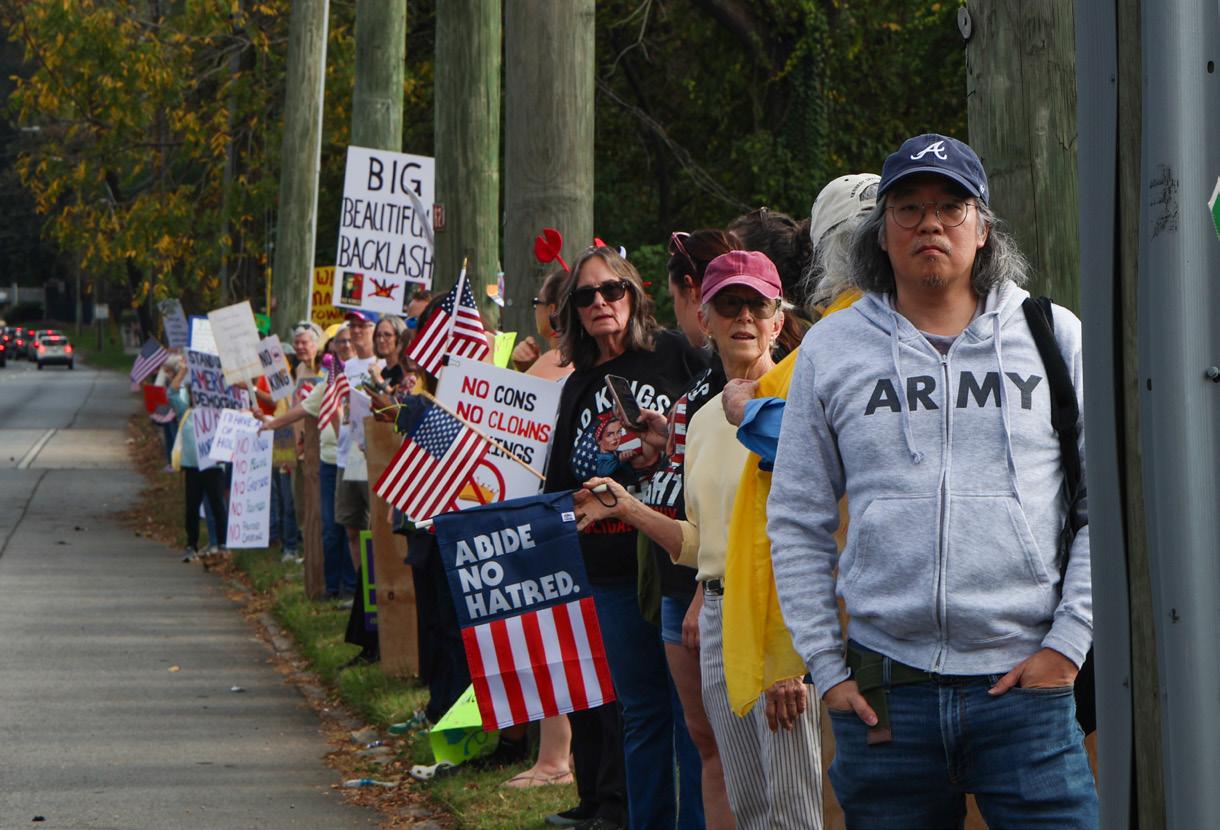
About one mile away from Emory’s Atlanta campus and just down the road from the Clairmont campus, hundreds more local community members and students demonstrated against the Trump administration at the VA Medical Center around 3 p.m.
Lilian Bryan, a resident of Decatur, Ga.,
emphasized the importance of staying engaged and aware of current events.
“Be well informed and listen to a variety of news, not just the news that tells you what you want to hear, … so that you know where the truth lies,” Bryan said.
Bryan, born in Nazi Germany, said she was “terrified” by the current state of American politics.
Emory student Lucy, who declined to share her last name for fear of retaliation from the federal government, mentioned that she felt the impact of the Trump administration’s policies after the University terminated all DEI programs and offices in September.
“Emory is always talking about being like a bastion of knowledge and inclusivity, and I just feel like that decision was extremely contrary to what our student body stands for and believes in,” Lucy said.
Lucy noted how seeing people united at the protest made her feel hopeful.
“When I showed up, I was fighting back tears, because it’s just really heartening to see people coming out and all these people honking,” she said. “It’s such an important thing that we come out and do this.”
— Contact Ellie Fivas at ellie.fivas@emory.edu and Siya Kumar at siya.kumar2@emory.edu
administering any disciplinary action against an Emory community member. The committee found that the medical school had not fully considered open expression protections in their decision to terminate Kenney.
“There is no evidence that this was done in this case,” the opinion reads. “The professor’s termination letter does not mention any consideration of Open Expression rights, and nobody mentioned Open Expression rights to the professor at any point in their disciplinary process.”
As a private university, Emory is not obligated to abide by First Amendment protections.
However, Committee for Open Expression Chair and Professor of Law Sasha Volokh emphasized that because the policy is based on First Amendment principles, the University’s actions should align with how public universities handle free speech issues.
“[Federal courts] have been ruling on cases like this for decades, so we know what the law would be if it were a professor at Georgia State or UGA, where the First Amendment applies,” Volokh said. “It’s a balance between the professor’s free speech interests and the interests of Emory.”
According to the committee’s investigation, in two separate interviews, Kenney told the University that her Facebook account was hacked and denied posting “good riddance.” However, according to her termination letter, technology experts established that nothing tampered with her account.
The committee found that the
only “potentially valid reason” for Kenney’s firing was this claim of being “hacked,” but they believe that the statement was “unlikely to have been a deliberate lie.”
Regarding Kenney’s potential violations of Emory's Social Media Guidelines, the committee wrote that, in their view, the rules are “not binding.”
“Violation of Emory’s Social Media Guidelines cannot be the basis for termination, because these guidelines do not present themselves as being mandatory; and if they did, a termination cannot be based on the failure to provide a disclaimer in a context like this one, where a disclaimer would serve no useful purpose,” the opinion reads.
All members of the Committee for Open Expression who voted did so in favor of the opinion. One of the members who supported the opinion was Emory Student Government Association Speaker of the Legislature Sohan Bellam (26C).
“The University had a chance to say what they did and did not want in the policy in a months-long process,” Bellam said. “For them to just violate it, it questions what the point of this policy is, if it has no ability to protect the Emory community.”
The committee’s opinion on the termination reflects a similar sentiment to Bellam’s.
“This incident represents not only a failure of the University to respect Open Expression, but also a failure to respect the procedural requirement to consider Open Expression,” the opinion reads.
Representatives from the Committee for Open Expression
attended the Oct. 21 meeting of the Faculty Council, a University governance body composed of faculty representatives from each school, to share their findings about Kenney’s termination.
During the meeting, Faculty Council and University Senate President Noëlle McAfee introduced a motion to urge Sears to “reconsider” Kenney’s termination in light of the committee’s opinion and asked Sears and other administrators to follow the Open Expression Policy. The Faculty Council voted to pass the motion 17-0.
Volokh said that since the University Senate is an advisory body, they have no authority outside of presenting their opinion about Kenney’s firing to Emory’s administration. Likewise, the Faculty Council lacks any formal power to compel the University to act.
“What Emory should not be able to get away with is to try and take the credit for having a pro-free speech policy,” Volokh said. “It would be better to not have a free speech policy at all, so that everyone understands where we stand, rather than to have a free speech policy on paper, which the administration routinely ignores.”
If you or someone you know have been affected by homicide or murder, you can reach Emory’s Counseling and Psychological Services at (404) 727-7450. You can reach the Emory Police Department at (404) 727-6111 or the Atlanta Police Department at (404) 614-6544.
— Contact Ellie Fivas at ellie.fivas@emory.edu
Students discuss the efects of recent campus safety scares
Continued from Page 1
dents and employees evacuated the building after reports of an armed individual in the building. Although police confirmed after half an hour that there was no threat, students have continued to ponder not only their own safety, but also whether Emory’s safety procedures will be effective in protecting them in the future.
Both Sharma and Buchan received notifications from Fizz, an anonymous app students can use to share messages, on Sept. 27 about the library scare. The University did not issue an emergency message during the police response to the library.
While Buchan was not in the library during the event, she said the lack of communication was worrisome.
“I would’ve wanted to know details, being like we’re investigating this, we’re taking these steps and then I would’ve felt fine,” Buchan said.
Justine Germain (28C) was in the library during the incident and said students showed little urgency during the evacuation as no one made any announcements or explained what was happening, leaving her unaware of the reason for the commotion.
“There wasn’t really any sort of panic, so I just thought it was a drill,” Germain said.
Germain also expressed confusion that the University did not send out an alert immediately, considering the number of students in the library.
“They didn’t send anything out for an active shooter, where most people hang out in the library,” Germain said.
Sharma said that despite these incidents, the campus feels largely safe, as all dorm buildings require key cards, and some require you to scan in after hours. In off-campus housing, there are also safety precautions similar to those in the residential halls on campus to ensure that only residents and selected personnel have access.
“You need a code or key fob to enter any of the doors, so you can’t get into any hall, where there's access to residential doors, without a key fob,” Sharma said.
With these developments, the University is committing to increasing EPD activity around campus to prevent future incidents. Buchan expressed hope that in doing so, Emory will become safer and that the University will become better at communicating safety concerns with students.
“Regardless of the situation, you should alert people being like, ‘Hey, there’s this thing going on. We just want to let everybody know,’” Buchan said. “Instead of someone having to find out through a social media app, and then not knowing any detail whatsoever.”
If you or someone you know is struggling in the aftermath of gun violence, you can reach Emory’s Counseling and Psychological Services at (404) 727-7450 or the Substance Abuse and Mental Health Services Administration Disaster Distress hotline 24/7 at +1 (800) 985-5990.
— Contact Inaara Lalani at inaara.lalani@emory.edu
Political Science faculty panel describes Spring 2026 courses
By Fern BIswas and Clara hIllman Contributing Writers
Students and faculty gathered in the Anthropology Building on Oct. 20 to hear professors from Emory University’s Department of Political Science preview their Spring 2026 courses, many of which were focused on multicultural political perspectives. During the event, professors described their classes, often tying political theory and history to modern-day issues.
Associate Professor of Political Science Alexander Bolton began the talk with an overview of his upcoming course, POLS 494: Research Topics Seminar in Political Science: Power, Politics, and Law in the U.S. Executive Branch. The course will focus on current legal and political controversies and their relationships
to presidential power.
Bolton emphasized the connection between contemporary political issues and “timeless” debates about presidential power. He posed questions that would guide classroom discussions around the legality of presidential decisions.
“Where does this presidential power come from?” Bolton asked. “Can the president do that? Often, on the flip side, there’s this question of, can Congress prevent presidents from doing this?”
Associate Professor of Political Science Andra Gillespie followed Bolton’s discussion by describing her course, POLS 346: African American Politics. Gillespie highlighted that the purpose of the class is to understand the different perspectives of history and politics.
“There’s a history in the United States of marginalization that sug-
Alumni Memorial University Center, Room 401 630 Means Drive, Atlanta, GA, 30322 Business (404) 727-6178
Editors-in-Chief Ellie Fivas and Spencer Friedland ellie.fvas@emory.edu spencer.friedland@emory.edu
Founded in 1919, The Emory Wheel is the fnancially and editorially independent, student-run newspaper of Emory University in Atlanta. The Wheel is a member publication of Media Council, Emory’s organization of student publications. The Wheel reserves the rights to all content as it appears in these pages, and permission to reproduce material must be granted by the editor-in-chief.
The statements and opinions expressed in the Wheel are those of the authors and do not necessarily refect those of the Wheel Editorial Board or of Emory University, its faculty, staf or administration. The Wheel is also available online at www.emorywheel.com.
gests that people who are coming from other backgrounds may have been treated differently on account of their racial identity,” Gillespie said. “What we’re trying to get at in the course of these classes is understanding … how that history is actually going to give people a different outlook.”
Gillespie mentioned that she was “pleased” with the number of ethnically and politically diverse class offerings.
Many panelists described the importance of having racial and ethnic diversity in the political science department’s class offerings.
Associate Professor of Political Science Luis Martinez introduced POLS 331: Latin American Politics, a course that examines the region’s historical and current political situation.
Martinez mentioned that a large component of the class “has to do with the role of gender in politics.”
To illustrate this issue, Martinez described the political system in Ecuador and how men and women cast ballots separately. One of his research projects focuses on revealing gendered voting patterns and the difficulty women experience in obtaining political positions.
Associate Professor of Political Science Judd Owen closed the event with an introduction to his classes on political philosophy — POLS 385: Political Science: Might and Right and POLS 490R: Advanced Seminar: Plato’s Republic.
Owen emphasized the importance of understanding the history of political science and applying them to contemporary issues.
“This is the area of political science in which we ask the big questions, the foundational questions, the perennial questions that have arisen
over the course of human history,” Owen said.
Assistant Teaching Professor of Political Science and Director of Experiential Learning Matthew Baker, who organized the event, highlighted that the panel was meant to give students more insight into the political science department at Emory.
“It was just designed to give students some introduction to four faculty members that are teaching classes in the spring, some old and some new, and for them just to learn a little bit more, get a preview of what they might expect in the spring,” Baker said.
Maria Machioni (28C), an international studies and business double major, mentioned that she enjoyed how political science professors are involved in research surrounding contemporary issues.
“It was cool to see that so many professors are very involved with what’s going on currently,” Machioni said.
Santiago Pailhe (28C), a double major in political science and philosophy, politics and law, mentioned that he enjoyed the variety of class topics in the political science department.
“It’s refreshing to find classes that engage with politics outside of the U.S. in such a very detailed and comprehensive manner,” Pailhe said.
“I really like the balance between research-based modern classes and theory-based political theory and philosophy classes.”
He also emphasized the importance of hearing about the research that political science professors do at Emory.
“It was very insightful for me as a political science major to get a sense of what the current professors in Emory are doing, what the
current research interests are, and some meaningful conclusions from the research,” Pailhe said.
“It was cool to see that so many profesors are very involved with what's going on currently."
— Maria Machioni (28C)
Avery Uffelmann (25Ox, 27C), studying anthropology and human biology and international studies, mentioned that events like the panel are helpful for garnering “more interaction and involvement” within the political science department.
Uffelmann added that the event helped students connect with professors.
“There are professors and people that are in the department who are putting forth the effort to put on events like these and they are willing to support them in their goals,” Uffelman said.
Ryan Wang (25Ox, 27C), a data science and political science major, reflected on how the event gave him an opportunity to connect with peers and faculty in the department.
“It’s a good way to bring the political science community together,” Wang said. “We got a chance to interact with other political science majors. We got a chance to ask the faculty questions, maybe get involved in some of the opportunities that they have for students.”
— Contact Fern Biswas at fern.biswas@emory.edu and Clara Hilsman at clara.hilsman@emory.edu
The Emory Wheel O inion
Regulate
Content Warning: This article contains references to suicide.
Artificial intelligence (AI) is embedded in every aspect of our modern lives — it writes our essays, trades our stocks, diagnoses our diseases and curates the media we consume. Emory University’s Spring 2026 Course Atlas offers artificial intelligence (AI)-themed electives in almost every discipline, from computer science to finance to English. With roughly 90% of college students reporting they use AI tools, and the inclusion of AI in courses themselves, it is clear that AI has moved beyond the realm of science fiction and into reality. Emory must play its part in deciding the future of this transformative technology as it threatens our own.
As the lines between human and algorithm blur, we are at a critical juncture: Emory students must recognize AI’s ballooning, exponential growth. As such, our community should advocate for governmental regulations that limit AI’s capacity for exploitation and harm, while fostering its potential to advance innovation and public good. The time for passive spectatorship has passed if Emory is to train responsible technology leaders who will usher humanity forward.
AI’s rapid advancement has transformed many industries for the better. For example, in healthcare, machine learning models can detect cancers earlier than humans and aid in drug development. In environmental science research and response, predictive algorithms help track pollution patterns and map wildfire spread. Additionally, AI manages
tedious data analysis and streamlines administrative processes. These innovations demonstrate the technology’s capacity to improve lives.
However, without guardrails, the same technologies that diagnose diseases can be weaponized for profit and exacerbate already pressing issues. The electricity needed to power vast networks of large language models, a type of generative AI, may prove unsustainable as climate change progresses. Projections by the University of California, Berkeley have found that by 2028, AI could consume as much electricity as 22% of all U.S. households. Currently, much of this energy is from nonrenewable sources, which further contributes to carbon emissions and environmental strain.
Before using ChatGPT, students should be aware of the impact of just a single inquiry. Data centers require vast amounts of water for cooling during processing, with large centers using up to 2.1 million liters of fresh water a day. As our supply of natural resources rapidly diminishes, we need to ensure data centers transition to renewable sources of energy. Technology is meaningless without a thriving Earth to use it in.
Ethical failures in AI management also impact users’ emotions. The exploitation of loneliness fosters onesided relationships that have proven harmful to users’ mental health, even before the introduction of sexual content. For instance, Character.AI currently faces a lawsuit that alleges a chatbot played a factor in a 14-yearold boy’s suicide. When machines are designed to imitate affection without regulation, the boundaries between
user and algorithm dangerously blur.
Beyond emotional parasitism, generative AI also has a nonconsensual pornography problem — it has been used to humiliate or blackmail celebrities, politicians and journalists.
There has been a disturbing rise in AI websites and applications that utilize image generation to create fake nude photos of someone with only a photo of their face. A reported one in four teenagers say they have seen content generated by these websites, often of someone they know. It is disconcerting to imagine the impact of an unregulated digital landscape in which sexual crimes and revenge pornography can occur at the tap of a button, further perpetuating the rampant amount of misogynistic content on the internet. Despite existing
federal legislation intended to stop the distribution of coercive imagery of minors, the government should target not just the exchange of images, but their generation.
As AI redefines society, regulations must safeguard democracy. Without enforceable regulation, AI’s rapid evolution will continue to outpace humanity’s ability to control it. In order to properly regulate AI, governments need to enforce transparency and accountability from technology companies at both the state and federal levels. The government should require that companies disclose the data they are using to train models, the energy consumed to power them and safeguards in place to protect users’ privacy and the environment. The government should implement independent oversight bodies to audit AI systems before their release to ensure they meet ethical benchmarks.
Change must also occur on a local level: Emory supports programs such as the AI.Humanity Initiative and the Center for AI Learning. Additionally, the University joined the U.S. AI Safety Institute Consortium, demonstrating an acknowledgment of the presence of AI on college campuses and a commitment to building a smarter and safer future.
However, even at an institution that claims to prioritize ethical AI usage, many students use ChatGPT and other generative AI bots for their coursework or to simplify their daily lives without recognizing the risks that come with reliance on such tools.
To address this, students can start by reading OpenAI’s Terms of Use before sharing personal information,
attending lectures at the Center for AI Learning to hear experts discuss ethical AI development and supporting organizations like the Algorithmic Justice League, which fights bias in AI systems.
Furthermore, members of the Georgia Public Service Commission are up for election on Nov. 4. Democratic challengers Alicia Johnson and Peter Hubbard, who advocate for green energy, are running for seats responsible for approving power plants, renewable energy initiatives and data center construction. With low projected voter turnout, even a few votes can make a difference by ensuring that the commission enacts much-needed reforms. This is particularly important as the DeKalb County Commission recently extended a moratorium, or temporary suspension, on data centers applications until Dec. 16. Technological progress should not come at the expense of humanity or democracy, but complement them. AI has the potential to further revolutionize our world, but it may do more harm than good if we fail to properly regulate it. It is time to stop asking what AI can do and start focusing on what it should do.
If you or someone you know is having thoughts of self-harm or suicide, you can call Student Intervention Services at (404) 430-1120 or reach Emory’s Counseling and Psychological Services at (404) 7277450. You can reach the Georgia Suicide Prevention Lifeline 24/7 at (800) 273-TALK (8255) and the Suicide and Crisis Lifeline 24/7 at 988.
eLLie Fivas editor-in-Chief
Siya Kumar News Editor
Jacob Muscolino News Editor
Carly Aikens Editorial Board Editor
Ethan Jacobs Opinion Editor
Cayden Xia Opinion Editor
Hunter Buchheit A&L Editor
Amelia Bush A&L Editor
spenCer FrieDLanD editor-in-Chief
MaDeLine shapiro exeCutive editor
Catherine gooDMan Managing editor
WiLL peCk Managing editor
WenDy peLayo Managing editor
JaCk rUtherForD Managing editor
LaUren yee Managing editor
Sammy Brodsky Sports Editor
Chloe Nam Sports Editor
Ivana Chen Illustration Editor
Sasha Emmerich Deputy Illus. Editor
Saba Faisal Deputy Illus. Editor
Sage Buchris Deputy Photo Editor
Jack Sutton Deputy Photo Editor
ivan Wang | Business Manager Business/Advertising
Esther Fu Social Editor
Clément Lee Senior Editor
Alex Gerson Deputy Editor
Angela Chan Copy Chief
Disha Kumar Senior Copy Editor
Malia Yap Copy Editor
Aimee Zhang Copy Editor
tuation and libelous content. Submissions refect the opinions of individual writers and not of
or Emory University. Send emails to emorywheelexec@gmail.com or postal mail to The Emory Wheel, Drawer W, Emory University, Atlanta, GA, 30322.
The above editorial represents the majority opinion of the Wheel’s Editorial Board. The Editorial Board is composed of Editor Carly Aikens, Shreya Aithal, Ananya Jain, Mira Krichavsky, Wayne Liang, Eliana Liporace, Pierce McDade, Niki Rajani, Robyn Scott, Noah Stifelman, Ilka Tona, Meiya Weeks and Crystal Zhang.
SASHA EMMERICH/DEPUTY ILLUS. EDITOR
Wednesday, October 22, 2025
Look beyond the label, approach language courses with an open mind
By WiLL CarraWay ContriButing Writer
Having studied the French language for five years before college, it only seemed logical that I would continue with the language to satisfy the intercultural communication general education requirement. Last year, however, after taking a French course during my first year, I quickly noticed that I was not challenging myself. Instead of using the requirement as an opportunity to expand my global horizon, I was simply satisfying it with a language I already knew.
In order to truly reap the benefits of Emory University's language classes, I realized that I had to embrace what was hard. So, when Fall 2025 course registration arrived, I elected to push the boundaries of my comfort zone and enrolled in an elementary Mandarin class. However, as I left my first class in Mandarin, I was engulfed in a realization that I had failed to respect the true difficulty of language learning.
This new experience prompted a serious bout of self-reflection. Overwhelmed by an unfamiliarity that I had not experienced since beginning French nearly six years prior, I considered turning away from my new endeavor on multiple occasions. However, learning a vocabulary so unrelated to any language I have studied before in an entirely new writing system reminded me of how wonderfully lucky I was to even be in such
a class in the first place. Never again would I be surrounded by such a multilingual community or in an academic setting that fosters such a connection through language. Emory students must approach language learning with an open and intentional mind, ready to confront the challenges it poses. In shifting our perspective in such a fashion, we can transcend the requirement, connecting on a far deeper level with language and with our community in an exceptionally active form of cultural engagement.
It is no wonder that Emory requires language study. Although our brain’s capacity to form and understand foreign sounds and grammatical systems declines sharply after we turn 10, we are uniquely poised to overcome this psychological barrier as Emory students living on a campus brimming with linguistic diversity. For Emory students who take a plethora of other time-consuming courses, it can be easy to see language classes as needlessly difficult, work-heavy and even irrelevant requirements. This perspective, while understandable, fails to account for the true purpose of learning a language. By diminishing these classes to simply barriers to graduation rather than valuable opportunities to expand our cultural understanding, many students do not give language learning the chance it deserves. If we do not understand the diverse communities in the world around us, we will be significantly disadvantaged when trying to make an impact in that world.
Taking a language class only because Emory requires it is a disservice not only to the language but also to yourself and your time in college. By offering courses in 17 non-English languages and admitting a linguistically diverse class of students, Emory is investing in a rich multilingual community both in and outside of the classroom. We should be treating language courses as a way to connect with the Emory community, while simultaneously recognizing and respecting the sensitivity and dedication required to fully engage with a language. In that, we can transform the requirement into an opportunity for self-reflection, connection and personal growth.
I have experienced the transformative process of language learning, and,
although it has proved an immense challenge, it has changed my worldview immeasurably. My journey to bilingualism began in an eighth-grade French class. Excited by the opportunity to learn a new language, I fought my way through the complicated spelling and difficult pronunciation in introductory classes. As the years and classes progressed, vocabularies unfamiliar to me transitioned from gibberish to words with real meaning and consequence, and I found myself seeing the world differently. I began to understand cultures far removed from my own. In my very first French class, I learned that “bonjour” means hello. Then, as my experience with the language developed, I applied that vocabulary in a
cultural context. The greeting holds immeasurable importance in French culture, and failing to acknowledge the presence of a shopkeeper or cashier with a simple “bonjour” is extremely disrespectful. This cultural misunderstanding forms the backbone of an extremely pervasive stereotype — that the French are rude, specifically to Americans.
In reality, when Americans fail to greet French shopkeepers, cashiers or hosts, they are beginning their interaction with open disrespect, which is unlikely to be met with amity. After learning French words in their cultural context, I was able to draw real connections between language and cultural norms, thereby breaking down my previously stereotype-founded beliefs and building an intimate understanding of Francophone culture only accessible through language and direct cultural interaction.
My experience with language changed my life. It changed how I view the world around me in ways nothing else ever could, catalyzed by approaching language with an open mind. So, with spring registration on the horizon, consider investing time and energy into learning a new language, perhaps even one with which you have no experience. Not because you have to, but because you can. I promise it will change your world, too.
— Contact Will Carraway at will.carraway@emory.edu
The graveyard of the Nobel Prize's forgotten scientists only grows
By CayDen Xia opinion editor
October is one of my favorite months. It is not only a time of prime apple picking and pumpkin spice drinking but also something much more exciting for scientists and journalists alike: Nobel Prize season.
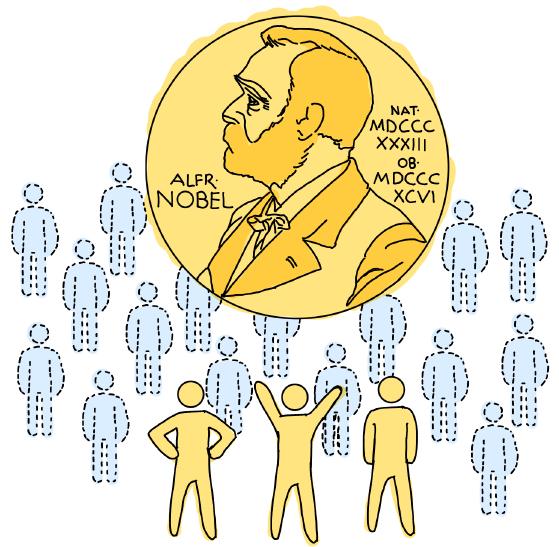
These prestigious awards honor individuals who have made “discoveries that have conferred the greatest benefit to humankind” in categories of peace, literature, chemistry, physics, economics and physiology or medicine. Alfred Nobel, the wealthy chemist who invented dynamite and founded the prestigious prize, left in his will a three recipient limit for each prize. This rule was not an issue in the early years when the Nobel Committee only recognized one or two people in each category. But today, nearly every science prize is split among three people.
The increase in awarded prizes reflects a growing trend in science: The field is no longer a one-man team. Instead, science necessitates a vast global collaboration in which ideas are built on top of one another. Herein lies the issue with the Nobel Prize: although hundreds of scientists may have contributed to a discovery, only three can earn the honor of fame and riches, keeping the other scientists out of the public eye. By continuing to honor a select few, the prize reinforces an outdated myth of lone scientific genius rather than reflecting the real collective, slow progress that defines contemporary research.
Even though there are fundamental issues with its awarding, I am not calling for the abolition of the prize nor changing the terms
so that more than three people can win. Recognizing 100 people is not only impractical but also against Nobel’s will. However, I wish that the Nobel Foundation would recognize the other scientists it chooses not to include in the awards for a particular discovery. By not, at the very least, spotlighting their contributions, the selected laureates are portrayed as the sole pioneers, overlooking the rest of the community whose work built up and innovated the discovery.
There is no better example of this exclusion than that of Rosalind Franklin, the photographer of Photo 51, an X-ray picture of the structure of DNA. Her photograph provided the critical evidence needed for James Watson and Francis Crick to elucidate DNA’s double helix structure. Yet Franklin’s contributions went
uncredited when the discovery was published in Nature in 1953.
The prize reinforces an outdated myth of lone scientifc genius.
Franklin passed away before Watson, Crick and Maurice Wilkins won the Nobel Prize in 1962, meaning she could not have won the Nobel as it can not be given posthumously. However, the Foundation never formally recognized her work. Even today, her contributions are relegated to a single sentence in the biography of one of the three 1962 laureates,
CAYDEN XIA/OPINION
Watson and Crick, Maurice Wilkins. Thankfully, her story has some justice. Her name is revered by biology students and scholars alike, though this widespread recognition did not occur until nearly 50 years after her initial discovery. But, this story is symptomatic of the larger problem with scientific awards: By only spotlighting the laureates, it erases the importance of the contributors.
Franklin's story is not an isolated case. Behind every Nobel-winning discovery lies a network of scientists whose names the public will never hear. In 2023, the Nobel Foundation awarded the Prize in Physiology or Medicine to Katalin Karikó and Drew Weissman for their discovery of mRNA modification, which was crucial to COVID-19 vaccine development. However, this left Pieter Cullis, who led research on the lipid-based delivery system that later resulted in the Pfizer and BioNTech vaccines, out of the conversation.
Another example is Feng Zhang, a researcher who showed how CRISPR, a gene-editing tool, can be used in eukaryotic cells. His research paved the way for gene therapies that could treat illnesses such as sickle cell diseases. Yet, when the Nobel Foundation awarded chemists Jennifer Doudna and Emmanuelle Charpentier the 2020 Nobel Prize in Chemistry for their discovery of gene editing, Zhang never received any recognition from the Foundation. Given the Nobel’s tendency to award discoveries only after their real-world impact is proven, it is striking that they overlook the scientists who helped realize that impact when doling out the honors.
Even though many of these scientists lack well-deserved recognition, I am not suggesting that they were
robbed of a Nobel nor that the laureates who received the honors are undeserving of their prize. However, I wish the Nobel Foundation would recognize the work of scientists whose research underpins these discoveries that have had such a fundamental impact on our lives.
While their omissions do not dismiss the achievements of the laureates, they do shape how the public views scientific progress. Long gone are the days of Albert Einstein and Werner Heisenberg, whose theories may have been primarily a product of their own genius. By simplifying scientific discoveries to merely a few heroes, the Nobel narrative obscures the modern-day reality that most innovations depend on extensive collaboration, replication and refinement. In doing so, it not only overlooks deserving scientists but also pushes the idea that individuals should seek glory, not community, when striving toward scientific discovery.
The Nobel Prize is the most prestigious and widely recognized global honor for many of its categories. Since the prizes have such a large cultural impact, the Foundation should publish essays or digital archives that recognize key contributors to each awarded discovery, not just the three awardees, so that the public gains a greater appreciation for the collaborative nature of science. This gesture best exemplifies Alfred Nobel’s original vision for the prize and reflects the 21st-century modality of science. True prestige, therefore, lies not in exclusivity but in acknowledging everyone who moves innovation forward.
— Contact Cayden Xia at cayden.xia@emory.edu
EDITOR
IVANA CHEN/ILLUSTRATION EDITOR
The Emory Wheel rts i e
Melody and memory: Alumni band Several Dudes returns to Emory
By CAtherine GoodmAn M anaging E ditor
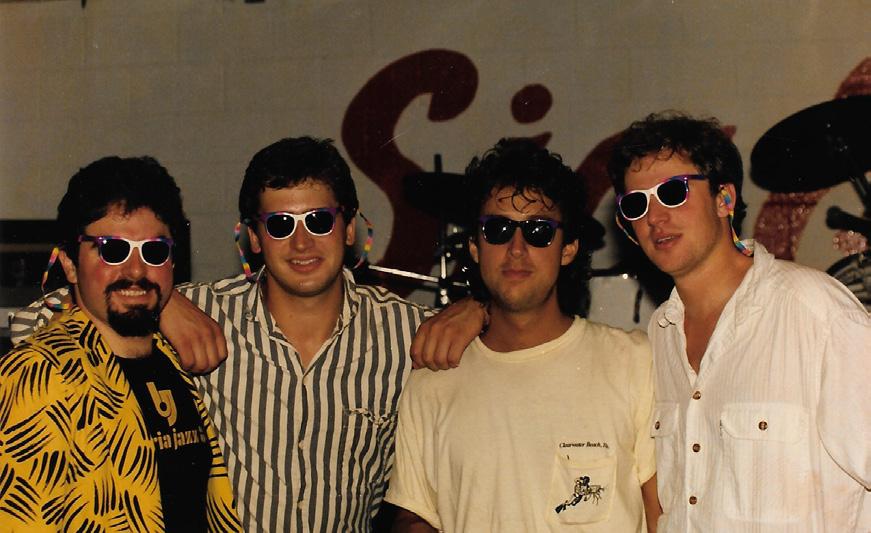
When Jonas Goldstein (91M 99MR) saw the distinctive strut of Nick Stevens (89L) walking past the Emory University School of Law in 1987, he was struck by serendipity. Goldstein jerked his steering wheel to the side and hopped the curb, jumping out of his car to reunite with his former Duke University (N.C.) jazz ensemble member — and the guitarist of a rival student music group. On the side of Clifton Road, the pair came to a quick decision: They had to start a band.
Stevens soon recruited his classmate, the long-haired Kevin Green (89L), to play the drums. Through mutual friends, Green found Devon Engel (88C), pitcher for the Emory baseball team and lauded bass player. With all the members assembled, the four-piece rock ‘n’ roll band set out to play their first gig at the law school. However, the quartet had a serious problem: They had no name.
The four men struggled for hours to make the pivotal decision until Stevens sliced the tension with a joke that stuck. He looked around the room and saw “several dudes.” The next day, the band took the stage under that same qualifier: Several Dudes.
From that night on, Several Dudes sank their teeth into the Emory music scene, playing venues across campus, including McDonough Field.
Comprising members from colleges across the University, Several Dudes bridged the gap between various coalitions of the Emory community. Through word of mouth, flyers and staple guns, the band drew a large audience wherever they played. In the thick crowd with sloshing cups, students of all years and schools mixed and mingled.
“The University actually should have been paying us,” Goldstein said. “It was great because these groups of people who would not normally interact [were].”
In addition to playing over 100 shows, including the medical school’s Cadaver Ball and senior banquet, Several Dudes embedded themselves into the greater Atlanta area.
According to Engel, the band played every stage they could find — from bars in Little Five Points to Center Stage Theater in Atlanta.
Often, the band would finish a show at 12:30 a.m. and Goldstein would trade his guitar for scrubs, leaving the stage to take the “graveyard shift” at Grady Memorial Hospital.
Between 1992 and 2015, Several Dudes went on hiatus as the members dispersed across the United States — from Georgia to North Carolina to Arizona. Around 2010, Goldstein tracked down the group’s cassettes on eBay and began to remaster the tracks. Through diligent research, he learned how to salvage disintegrating tapes, fixing degraded glue by
By Arts & Life stAff
Grab your costumes and candy: Halloween is almost here. From trickor-treating to carving pumpkins, this spooky holiday offers a rich selection of time-honored traditions. But for the Arts & Life staff, no act is more compelling than watching the perfect Halloween film. Read below to discover our suggestions — if you dare.
‘Practical Magic’ (1998)
In “Practical Magic,” there is nothing scarier than romance. If you are not counting the demon you accidentally made with your sister, that is. After accidentally murdering ex-boyfriend Jimmy Angelov (Goran Visnjic), sister witches Sally (Sandra Bullock) and Gillian Owens (Nicole Kidman) resurrect him to avoid jail time. This plan goes awry when the malicious Jimmy returns as a powerful spirit set on possessing Gillian and haunting the Owens’ house.
baking the tapes at 175 degrees for eight hours. Over hundreds of hours of work, Goldstein fell back in love with their old music, listening to the songs that he and Stevens wrote at the Waffle House on Cheshire Bridge Road late at night.
While in medical school, Goldstein realized the particular importance of songwriting as a creative outlet — and he did not want to play in another cover band.
“They want to take people who have all these varied interests and are all creative and all these other things and then admit them to med school and tell them that they can’t do them anymore,” Goldstein said.
During his extensive remastering project, Goldstein dreamed of getting the band back together, but soon after, serendipity struck him again. While out with his cousins at a bar in Asheville, N.C., Goldstein spotted Stevens across the room.
“I yelled across the room, ‘Nick Stevens,’” Goldstein said. “And we decided, ‘We got to do this,’ and he was all in.”
In May 2014, Goldstein set out to publish the remastered tapes on streaming platforms and celebrate with a benefit concert. During the band’s first five years, from 1987 to 1992, Several Dudes saw a revolving door band of talented musicians, such as bassist David Pretlow (92C), who joined after Engel graduated; saxophonist Andy Greider; and established Atlanta musician Barry Richman.
Ten years ago, when Goldstein sounded the reunion alarm, players from Colorado, New Jersey, North Carolina, Florida and Georgia all answered the call to return. In 2015, the band released “ReAnimation” (2015) and played in Little Five Points.
Green flew in from Canada the morning of the reunion concert and went straight from the airport runway to the drum set, striking the drumheads and cymbals for the first time that night on stage with no prior rehearsal. Engel met a couple of the musicians during the live set. Yet, despite minimal practice, they “locked in and grooved.”
“It was amazing,” Engel said. “I’ve
Despite the title, “Practical Magic” is less about sorcery than it is about sisterhood — between Gillian and Sally, Sally’s two daughters and the women in the town who learn to shed their prejudices against the peculiar family. In addition to the harrowing and heartwarming plot, the film offers a spellbinding soundtrack. As a saturated landscape unfolds across the screen, Gillian sings along to “A Case of You” (1971) by Joni Mitchell from behind the steering wheel; when the adult sisters dance around the kitchen sloshing their frozen alcoholic beverages, Harry Nilsson’s “Coconut” (1971) envelops the scene in a soft, silly hue, and when Sally runs to her lover under the golden sun, “This Kiss” (1998) by Faith Hill bursts in the background. If this playlist is not enough to inspire a watch, we have discovered something truly spooky this Halloween: your poor taste.
- Catherine Goodman, Managing Editor
Halloween costumes come from the Celtic festival of Samhain, during which participants would wear costumes and light fires to ward off evil spirits. But seldom do we think about what goes on under the bright street lights and happy faces during Halloween. “Blue Velvet” explores that notion, peeling back the layers of peaceful American life. In the opening sequence, Bobby Vinton’s rendition of “Blue Velvet” (1963) plays as a man waters his lawn. The initial serenity becomes dark and sinister as he suffers a stroke. Vinton’s song becomes increasingly distorted as the camera zooms into the grass, revealing beetles climbing onto each other. David Lynch, known for transporting viewers into often surreal and dreamlike worlds in films such as “Eraserhead” (1977) and “Mulholland Drive” (2001), is no stranger to the dark and terrifying. “Blue Velvet” follows college student Jeffrey Beaumont (Kyle MacLachlan),
played thousands of gigs, probably, in my life, and just the feeling on the stage that night was electric.”
Following this show, the group decided to continue playing together every other year in a different city. But in 2018, tragedy struck.
Several Dudes lost Stevens in a cycling accident, quieting the pulse of the band.
“That was pretty much the end, we thought,” Engel said.
Despite Stevens’ tragic passing, Several Dudes kept playing to honor Stevens and keep his “spirit alive” by writing new music. The band possessed more than just memories; they had the melodies and lyrics their brother left behind. The group got back together in 2019, just before the COVID-19 pandemic, which gave Several Dudes time away from their professional lives for remote music-making.
“Something that started off as being inspired to honor Nick totally became something that was incredibly fun for us,” Engel said. “Which is very appropriate … because he was always a guy that made everybody feel good about themselves and feel better.”
In 2022, Several Dudes released an album called “Our Brother Nick” (2022). The title track incorporates an opening riff that Stevens created alongside Goldstein and Engel just three weeks before he passed. Atop an energetic ’80s rock groove, the group sings, “With arms wide open / Let’s raise a toast to a moment of memory.”
In addition to paying homage to their friend, “Our Brother Nick” offers a sunlit portrait of Atlanta. The opening track, “Dawn of the Dudes” (2022), finds Stevens lounging in Piedmont Park, cruising in a Cadillac down Ponce de Leon Avenue and strolling through Little Five Points.
The vestiges of life in the Southern metro press against the pulsing rhythm, reflecting profound gratitude for the city of their youth. These warm days hold a special place for the band: Their first song played on the radio was “Southern Afternoons” (2015).
“I don’t think we could have done this band anywhere else,” Goldstein said.
On Oct. 25, Several Dudes will perform in the Homecoming and Family Weekend at Emory. As with all funds the group makes from music, they will direct all proceeds from this performance to their cycling safety and advocacy fund.
“Coming back to campus and playing is going to be like visiting your childhood bedroom,” Green said. “Familiar but surreal.”
Almost 40 years later, the band will assemble yet again to serenade the red roofs and towering pines on the steps of Goodrich C. White Hall — where Engel said he “spent a lot of time sleeping.” Although missing Stevens, Several Dudes relish in their homecoming.
– Contact Catherine Goodman at catherine.goodman@emory.edu
who returns home to Lumberton, N.C. and finds a severed and discolored ear in a vacant lot. Sandy Williams (Laura Dern), the daughter of detective John Williams (George Dickerson), discovers that the ear might be connected to singer Dorothy Vallens (Isabella Rossellini). Dennis Hopper provides one of the most convincing performances in film history as the psychopathic antagonist Frank Booth, whose obsession with ’60s ballads such as “Blue Velvet” amplifies his character’s complexity. The film eventually transcends from simple, American small-town peace into a morbid nightmare. As the film progresses, viewers discover that the suburban myth is not what it seems with depictions of human and drug trafficking, corruption and psychological trauma. Beaumont becomes corrupted by the sinister world around him, and we are too. While not a traditional Halloween movie like “Scary Movie” (2000), “Blue Velvet” is not for the faint of heart. In fact, after watch-
ing, there is a chance you may never want to go trick-or-treating again.
- Clement Lee, Senior Editor
‘The Rocky Horror Picture Show’ (1975)
Picture this: It is Halloween night, and you have no plans — just a box of candy from CVS and a random cape you found deep in your closet that you have not worn since one of the Bushes was president. Do not think of yourself as aimless, because you have unlocked the perfect situation to waltz into your local cinema and not just watch, but experience, “The Rocky Horror Picture Show.”Halloween movies that do not spark goosebumps on the viewer’s skin, allowing them to sit back unperturbed, commit injustices against the spooky holiday. “The Rocky Horror Picture Show” wakes up viewers, inviting them to dress up as their beloved characters and dance
‘Blue Velvet’ (1986)
CourtEsy of Jonas g oldstEin
Alumni band Several Dudes formed at Emory in 1987.
Several Dudes performed at Law Rocks Phoenix in 2024.
ait in ud i re ects on ife at mory
By miA hAmon
M usi C & l iv E a rt d E sk
Meet Me at Kaldi’s is a recurring column in The Emory Wheel. Every other week, Music & Live Art Desk Mia Hamon selects a random Emory University student and invites them to Kaldi’s Coffee at The Depot for a casual conversation.
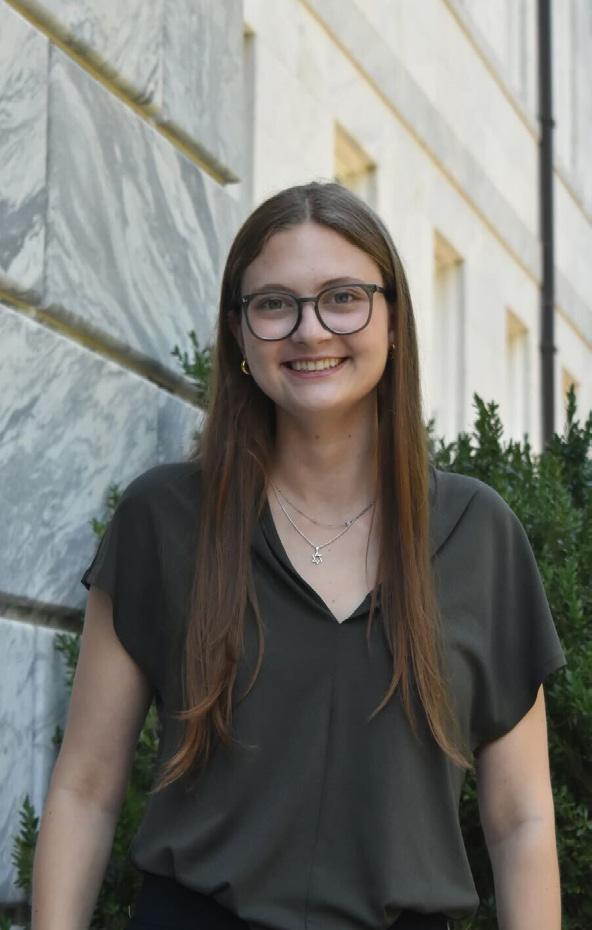
The steady quiet that emerges after a restful break can feel both intimidating and soothing. Nevertheless, on the day that classes resumed after fall break, Caitlin Ludwig (27C) brought an authentic, peaceful energy that radiated throughout Kaldi’s porch as she prepared to share her story.
Ludwig beamed while talking about Georgia’s warm weather, but emphasized her love for her chilly hometown, Cleveland. She reflected on her childhood and explained her admiration for Cleveland’s full four seasons, sports culture and Jewish community.
Majoring in Anthropology and International Studies, Ludwig said her career interests reflect her desire to work with people.
Initially, Ludwig thought about becoming an attorney; however, her time at Emory University has exposed her to different areas of study and broadened her occupational scope.
Ludwig spoke of her time at Emory with adoration and joy. She nervously laughed when thinking back to the night before her first ever day of class, when her curiosity to explore campus with her friend Lola Cooke (27C) quickly turned sour.
During the annual First Day Festival, Ludwig decided to map out their daily routes to class. As the new friends passed the Robert W. Woodruff Library, Ludwig felt a spark of curiosity and decided to explore the building.
After ascending to the library’s tenth level, the pair began to go down the stairs, stopping at each floor. However, the two soon found themselves lost in the stairwell of Stacks Tower, panicking as they ran up and down multiple flights of the building, trying to find an exit.
“We ended up walking down all 10 flights of stairs, and we couldn’t find the exit,” Ludwig said. “It was really scary and that definitely freaked me out. But it was quite an adventure.”
Nothing represents the first year experience like getting lost in the library. And although frightening at the time, Ludwig remembers this story fondly, grinning while recount-
ing her and her friend’s simple mistake. As the oldest child of her family, Ludwig sees herself as someone with a caring and maternal spirit.
Ludwig said she fits many of the stereotypes surrounding eldest daughters, but rather than being ashamed of those attributes, she is proud of them. As an Atlanta-based nanny and summer camp counselor, Ludwig expressed that being the oldest child energizes rather than exhausts her.
“I spend a lot of my free time, or chosen time outside of school, with kids,” Ludwig said. “And that’s something I’m really passionate about.”
Now an upperclassman, Ludwig also finds herself indirectly acting like the eldest daughter in her various leadership positions.
“Something that I really had to come to terms with was that if you change your mind about who you want to surround yourself with or what you want to do, it doesn’t devalue the time that you’ve already spent with other people”
—Caitlin Ludwig (27C)
Ludwig is a senior U.S. politics editor for the Emory Political Review, a member of the Pi Beta Phi sorority and an advising fellow for Matriculate Emory — a college advising program for high-achieving, low-income high school seniors across the country.
Ludwig emphasized the transformative nature of her work with Matriculate. Prior to her role as an advising fellow, Ludwig was not aware of the hurdles that many college applicants face, such as scholarship processes and citizenship issues.
“Right now, I’m working with a student who’s a refugee, and so her status is so different because she’s not eligible for all of the different financial aid options,” Ludwig said. “To see everyone’s stories is really impactful.”
Reflecting on her first year, Ludwig brought a mature perspective as she spoke about her past leadership roles, majors and friendships.
“It’s totally normal to change your interests and change the people that you surround yourself with over time,” Ludwig said. “Something that I really had to come to terms with was that if you change your mind about who you want to surround yourself with or what you want to do, it doesn’t devalue the time that you’ve already spent with other people.”
Concluding the conversation, Ludwig shared a favorite Emory memory, which took place during an evening class with her now-favorite teacher, Anthropology Professor David Nugent. According to Ludwig, Nugent wants his students to learn “in the best way,” often bringing food for his students during his evening classes.
One day, Ludwig decided to pay forward Nugent’s generosity.
During a break in class, Ludwig and a classmate rushed to the Eagle Emporium to grab a pint of Ben & Jerry’s ice cream.
Ludwig recounted how his face lit up when they brought Nugent the treat.
“For the rest of the class, he just ate it out of the pint,” Ludwig said. “He had to pause because he got brain freeze.”
In just a year, Ludwig will move on from Emory, but she will carry a better understanding of human nature and global conflicts with her.
As a true people person, Ludwig hopes to engage in non-profit and social work after graduation, furthering her mission to change the world through working with the people who live in it.
– Contact Mia Hamon at mia.hamon@emory.edu
DIVVY THAT DIME
ents of fn n i iter y it t ese pod sts
By LAyne Levine C ontributing W rit E r
When I was 12, my dad sat me down one night and declared that we would spend every Monday night talking about money. From then on, I learned about investing, debt and budgeting — three words no middle schooler ever wants to hear. I dreaded these Monday night lessons, but looking back, my dad gave me the most valuable wealth of all: financial literacy — pun intended. In recent years, the “finance bro” trope has taken over college campuses. Their accessories include Excel spreadsheets, Wall Street internships and Patagonia vests. While finance bro’s Rolex watches and Amex Platinum Cards can make finance seem exclusive and unattainable, — it is not. The more you hear financial terms, language and news, the more approachable finance becomes.To get comfortable with money, I recommend listening to podcasts, which combine accessibility and personality. You can learn anywhere — on a walk, between classes or while doing chores — and still absorb complex ideas. Many financial podcasts use humor, storytelling and current events to make compound interest or credit scores sound less like lectures and more like conversations with a nerdy friend. To help make “cents” of finance, listen to these four business podcasts.
$0.01: ‘The Best One Yet’ (2018-)
“The Best One Yet” is a daily podcast that breaks down three recent stories in business, finance, economics and pop culture in about 20 minutes. Hosts Nick Martell and Jack Crivici-Kramer make complex corporate news fun and digestible. With humor and clear objectives, they explain each story’s relevance, helping listeners engage in business conversations. “The Best One Yet” transforms elaborate thoughts into relatable tidbits, making it a great starting point for finance. For example, to examine the cost of living alone in a major city, Martell and Crivici-Kramer analyzed the spending habits of Carrie Bradshaw (Sarah Jessica Parker) from “Sex and the City” (1998-2004). Through pop culture references, the hosts examined rent prices, brunch costs and designer style and discovered that the lifestyle of Bradshaw is becoming increasingly unrealistic in the modern era. Whether making a creative comparison or presenting a deep dive on how knitting trends might signal a recession, the duo’s witty and clever points make for a unique, enjoyable listen.
$0.02: ‘What’s News’ (2015-)
Luke Vargas and Alex Ossola host The Wall Street Journal’s daily news podcast, “What’s News,” which features the biggest and most market-moving stories in business, finance, global affairs and politics. “What’s News” may not have you on the edge of your seat, but its short, precise stories get the job done. With twice-daily releases on weekdays and weekend market rundowns, “What’s News” helps listeners stay up-to-date on all things Wall Street. The episodes explain breaking developments and economic shifts, demonstrating how current events affect markets. The weekend rundowns offer a more comprehensive analysis of the current market themes, why the weekday stories matter and prepare the listener for the next week. The format strikes a valuable balance: immediate news and reflection. You receive a pulse check during the week and a thorough recap on the weekends, making
you informed enough to follow sudden shifts in the market, earnings reports or political developments, yet grounded enough to see how minor shifts affect the whole economy.
$0.03: ‘Masters in Business’ (2014-)
Let us be real — when we have an hour to spare, we would rather scroll on TikTok than hear a deep dive on macroeconomics. In “Masters in Business,” host Barry Ritholtz talks to leading figures in finance, economics and investment. A former lawyer turned market strategist, Ritholtz is the founder and Chief Investment Officer of Ritholtz Wealth Management, a financial planning and asset management firm. With that mix of legal, economic and investment-market experience, Ritholtz brings analytical depth and practical insight to every episode.While Ritholtz’s conversations can fee dense and, at times, somewhat inaccessible, this podcast is worth the time and effort. Like the unpredictable market, Ritholtz’s topics vary from investment strategy to booming tech stocks to income-generating foreign equities. Listening in on these discussions as a beginner to finance can feel like decoding a foreign language, but that discomfort is part of Ritholtz’s appeal: Rather than simplifying finance to make it trendy, he invites listeners to stretch their understanding. The more you listen, the more the dots connect. From market trends and portfolio construction to behavioral finance, the show starts to feel like watching a puzzle come together. Soon, you will recognize how investors weigh risk and reward and anticipate pressing questions — like how someone handled volatility, modified their strategy amid uncertainty or what shaped their investment decision. And while it may not be the most fun, Ritholtz succeeds in his primary goal: educating the public.
$0.04: ‘The Ramsey Show’ (2021-)
With an approachable attitude, Dave Ramsey teaches personal finance by providing tough-love advice on “The Ramsey Show.” The podcast centers around practical money management, behavioral change and financial empowerment, where Ramsey teaches listeners to commandeer their finances and build lasting wealth. What sets “The Ramseys Show” aart is the callin format that allows real people to share their financial struggles or victories, which adds emotional depth and relatability to the podcast. Rather than discussing abstract theories or corporate headlines, the show offers anecdotes from individuals facing budgeting struggles, which enables Ramsey and his team of co-hosts, including George Kamel, Rachel Cruze and Ken Coleman to respond with specific, actionable advice. One caller might question whether to buy a home, while another might ruminate on a career change.
The diversity of these stories allows for a holistic look at financial life: it is not just about numbers but about habits, emotions and choices. Although a lengthy two-hour listen, each minute packs a punch of advice that you will not find anywhere else.By listening to these podcasts, you will learn more than you may think possible: a new term, a market story or a spark of inspiration. Once you make it a habit, it becomes addictive — and you will never see a Patagonia vest the same way again.
olivia Piri/staff illustrator
CourtEsy of Caitlin ludW ig Caitlin Ludwig (27C) works at Emory Matriculate.
isco er ma ic murder music ith spoo y mo ies
through the theater aisles to Richard O’Brien’s disco and pop rock music. Fortunately for a first-time viewer, the punk-era ghouls welcome viewers into a line dance with the song “Time Warp” (1975), in which they instruct and sing, “ With your hands on your hips / You bring your knees in tight.”
Tim Curry plays Dr. Frank-NFurter, a mad scientist hailing from the galaxy of Transylvania with flamboyant and comedic charm. He sports drag-inspired makeup and fishnet stockings, defying social norms of that time. Curry leads the ragtag cast of vampires, aliens and meta-humans through a feverish trance, bursting with horror motifs from haunted houses to murder mysteries. Between Dr. Frank-N-Furter’s salacious and Dracula-esque outfit, the punk rock maid attire of Magenta (Patricia Quinn) and ancient Greek-inspired gold boxers that just barely conceal Rocky Horror (Peter Hinwood), there is no shortage of iconic costumes to choose from as you enter this world of fandom, drag, horror and melodrama that is “The Rocky Horror Picture Show.”
- Jacob Muscolino, News Editor
‘Clue’ (1985)
Nothing is quite as terrifying as a family game night, especially if the game is Clue. The board game-inspired film may not have the bloodiest, most gruesome murders, but it has something better: humor. In the film, Mr. Boddy (Lee Ving) invites six eccentric strangers to his secluded mansion, but he never appears at the table. A classic whodunit situation follows as the mansion staff die one by one and the strangers search for the killer. “Clue” offers all the elements of a Halloween film: an eerie, atmospheric house, a dark and stormy night, blackmail, spooky scenes and a
murderer on the loose. Where another film might fall prey to cliche jump scares and slasher scenes, “Clue” pivots, focusing on comedic timing instead. With each chandelier crash, blackout, secret passage and dead body, the witty butler, Wadsworth (Tim Curry), always has something to say — or do. Whether dragging the crowd from room to room, dramatically re-enacting the potential murderer’s actions, making poignant jokes about the political climate or leading Mrs. White (Madeline Kahn) up a staircase — only to drop her — Wadsworth stands out as an impeccable character. For every murder, there is melodrama, and for every possible ending, there is an alternative choice. “Clue” keeps viewers on their toes with exemplary suspense. While still holding the allure of a Halloween film, both in setting and plot, the preposterousness offsets the fear.
- Amelia Bush, Arts & Life Editor
‘Hocus Pocus’ (1993)
As October approaches, the indulgence of seasonal activities emerges: We begin racing through corn mazes, picking apples, carving pumpkins and, in rare cases, even casting a spell that awakens a trio of 17th-century witches. Most of us, if not all, have never engaged in witchcraft and many doubt its existence.
However, after watching “Hocus Pocus,” you may be convinced — I was, at least. “Hocus Pocus” unfolds in Salem, Mass., a town notorious for executing alleged witches, adding to the movie’s mysterious ambience. After moving to this peculiar town, the main character, Max Dennison (Omri Katz), begrudgingly takes his little sister Dani Dennison (Thora Birch) trick-or-treating, ignoring the town’s history of supernatural occurrences. That night, Max discovers Salem’s dark magical history after
4. Bohemian 5. ___ Jones 6. Between 7. Mexican money
8. Titular neighbor in a Ghibli movie
9. Archeologist’s project 10. Messy, as clothes
11. Nick Fury portrayer L. Jackson
12. Veer suddenly 16. Made a mistake
18. Stun gun
22. Pushed back on, as an argument
26. Defame
27. Use wings
28. Singer Addison
29. For experimental reasons
30. Post-Civil War pres.
31. Voice above baritone
33. Largest Nebraskan city
37. Singer DiFranco
38. “Get a move on” . lippery fsh
40. Circle part 41. Everlasting
43. Cake coating
44. River mammal
45. Tricked
46. Pass on
47. Japanese dumplings
50. Actor Cavill
53. Defensive structure
54. Go back
56. Currency introduced in 1999
57. Numbered rds.
59. Every 61. Charged particle
accidentally casting an age-old spell, reviving the Sanderson sisters — three evil witches who tormented the town centuries before. Max’s night turns into a whirlwind of concealment, conflict and collision. With elements of both humor and horror, “Hocus Pocus” hones its approachability to audiences. Nostalgia and fear ease the audience into the uncertainty of the Halloween season and pose the timeless question: “Is magic real?”
- Mia Hamon, Music & Live Art Desk
‘Girl Vs. Monster’ (2012)
My favorite Halloween movie, hands down, has to be “Girl Vs. Monster.” A Disney Channel Original Movie, the movie portrays Skylar Lewis (Olivia Holt), a 15-year-old girl whose strict parents mysteriously refuse to let her go out on Halloween until she is 16. Skylar soon discovers the purpose of this peculiar rule: Rather than mold doctors, her parents are monster hunters. When Skylar was a child, her parents trapped the monster targeting her since birth, so, unlike her best friends, she has never known fear. During the film, Skylar especially wants to go out on Halloween because her love interest, Ryan Dean (Luke Benward), invites her to sing with him at his Halloween party after the lead singer of his band injures herself by falling down the stairs. However, in Skylar’s efforts to escape her house, she causes a power outage. Subsequently, all of the captured monsters escape her parents’ high-tech holding facility — which looks like a Big Green Egg grill and a water boiler had a baby.
One of the monster escapees is Skylar’s personal fear-gobbling monster Deimata (Tracy Dawson). So Skylar, who now feels 15 years’ worth of fear alongside raging hormones,
must defeat Deimata to rescue her parents and the world from all of these monsters running rampant. The best part is by far the end, though, when Ryan faces his incredibly romantic fears, which you will have to watch to find out.
- Sasha Melamud, Sports Feature Desk
‘Monster House’ (2006)
As the months get colder and college students scramble to find a Halloween costume, I feel a pang of nostalgia for my childhood. During that time, I spent my Octobers curled up on the couch with a burning pumpkin-scented Yankee Candle, flipping through classic kids’ channels such as Disney, Nickelodeon and Cartoon Network on TV. Cartoon Network was the weird channel in my household, with popular sitcoms like “The Amazing World of Gumball” (2011-2019) and “Regular Show” (2010-2017) causing my mom to worry about my social development. Cartoon Network is also where I first watched “Monster House.”
From its eerie yet realistic animation style to the terrifying plot, “Monster House” is one of those childhood movies that will traumatize you well into adulthood. The plot is simple: Nebbercracker (Steve Buscemi), an old man, lives in a decrepit home and has a reputation for scaring children off his lawn and stealing their lost belongings. Meanwhile, a group of neighborhood kids, DJ (Mitchel Musso), Chowder (Sam Lerner) and Jenny (Spencer Locke), discover that Nebbercracker’s house is sentient, and the pre-pubescent trio embark to put the house’s soul to rest.
After a wild journey of acceptance and grief, the film arrives at a wholesome conclusion between the kids and the old man.If you are like me, your yearly Halloween must-watch list features a mix of horror and sentimental
childhood favorites. “Monster House” charms in its ability to inspire a nostalgic yet spooky feeling, cementing it as a true Halloween classic.
- Arabella Taylor, Contributing ‘It’s the Great Pumpkin, Charlie Brown’ (1966)
Nothing conjures up memories of elementary school Halloween parties quite like “It’s the Great Pumpkin, Charlie Brown.” Just hearing the opening notes of “Linus and Lucy” (1964) by Vince Guaraldi takes me back to sitting in my kindergarten classroom with a little paper cup full of popcorn and M&M’s, watching in awe as Snoopy (Bill Melendez) flew through the air and chased down the infamous Red Baron. From iconic lines to its classic hand-drawn animation, the made-for-TV movie is 25 minutes of pure nostalgia.
The light and fun plot follows Charlie Brown (Peter Robbins) as he attends a Halloween party that Lucy (Sally Dryer) hosts, Snoopy as he attempts to complete his mission as a World War I flying ace and Linus as he prepares for the arrival of the benevolent — and definitely, 100% real — Great Pumpkin. There are no real stakes here, other than the Great Pumpkin potentially snubbing Linus’ pumpkin patch, but that is exactly what makes the film so comforting. It is impossible to worry about tests and term papers when you are watching Snoopy soaring through the sky on top of his dog house or Charlie Brown cutting way too many holes into his ghost costume. If you need a quick pick-meup after midterms or a palate cleanser between two horror movies, grab a fuzzy blanket and give “It’s the Great Pumpkin, Charlie Brown” a watch. I promise it will not disappoint.
- Katie Weaver, Contributing Writer
By ethAn ALtshuL
Crossword Desk
S orts The Emory Wheel
Serving aces: Tennis teams start their seasons on a high note
By Sonia Liew Contributing Writer
The Emory University men’s and women’s tennis teams are starting their seasons with momentum after strong performances last year, setting a promising tone for the rest of the year. Last season, the women’s team saw its return to the NCAA Final Four for the second time in three seasons, and they finished in second place at the University Athletic Association (UAA) Championships.
The men’s team returned to the Elite Eight for the 33rd consecutive season and had third-place finishes at the Intercollegiate Tennis Association (ITA) National Team Indoor Championships and UAA Championships.
The men’s team picked up 14 wins across the Spartan Fall Invitational on Sept. 19 and 20, building momentum in the start of their season. At the ITA South Regional Championships earlier in October, the Eagles swept both the singles and doubles titles, with Emory players facing each other in both finals.
In this past weekend’s singles match, senior Dean Kamenev started out strong, winning the first three games against sophomore Ruilin Feng in the first set. However, Feng rallied to win the set 7-6 and took the second set with a score of 6-3 to claim his first individual regional title. Kamenev said facing his teammate was a lot of pressure, but playing against tough competition helped sharpen his skills.
“It’s always tough to play your own teammate with the balance, being respectful and also wanting to win,” Kamenev said. “The competition against your teammate is always out of love and it was fun.”
In the doubles matchup, sophomore Ajay Kartik and freshman Matthew Johnstone claimed the title over senior John Lasanajak and freshman Daniel Kim in the doubles final. Their wins at the ITA South
Regionals secured their spots in the ITA Cup this past weekend, where they clinched both the singles and doubles championships. Feng defeated the reigning national champion Advik Mareedu from ClaremontMudd-Scripps (Calif.) in three sets, making him the fourth in program history to win the championship. Kartik and Johnstone also won their doubles match, making them the third in program history to win the title.
This season’s roster mixes experienced upperclassmen with promising new talent, some of whom have already contributed to program milestones. The team looks to build on this momentum and chemistry heading into the rest of their season, with head coach John Browning leading the team in his 27th season with the Eagles. Browning is one of the few coaches in NCAA history to win a national team championship both as
a player and as a coach, and understands the importance of a flexible coach who is willing to adapt to a dynamic team’s needs.
“I’m so passionate about [coaching] because you’re always trying to get better,” Browning said. “Every year I’m trying to change things. Obviously, keep the core elements that are successful, and that’s the team is always number one, supersedes all individual pursuits.”
Kamanev, captain of the men’s team, said while tennis is not traditionally considered a team sport, it is important to be selfless and help each other improve.
“But for me, what’s most important is keeping people accountable, making sure that everyone’s coming with the right mentality every day to practice to get better,” Kamanev said.
The women’s team has also seen a strong start to its season. Led by coach Bridget Disher in her fourth
season as head coach, the women’s team had a successful debut at the ITA South Regionals from Sept. 26-28. The Eagles swept both singles and doubles, with an all-Eagle standoff in the final matches. In the doubles match, seniors Emily Kantrovitz and Iris Berman defeated senior Izzy Antanavicius and freshman Erika Olson in straight sets.
In singles, Antanavicius took on Kantrovitz in a hard-fought match that lasted over two hours, with Antanavicius ultimately claiming the singles title. Antanavicius said having a strong team allows for all her teammates to be able to push her to improve.
“That’s one of the best gifts that you could have for teammates in general,” Antanavicius said. “Every single person on the team is able to push me and really push my limits on the tennis court as a person, as a player, as a competitor in every way.”
At the ITA Cup this past weekend, the Eagles fell short of the titles, with Kantrovitz and Berman losing in their semifinal doubles match against a duo from Claremont-Mudd-Scripps, while Antanavicius was defeated by Fiona Lee of the Massachusetts Institute of Technology after three sets.
Despite these losses, the team has high expectations for the spring season and the NCAA tournament as they continue to improve after a strong run last year. Disher said the team’s ability to keep raising the bar during the season is what fuels their improvement.
“They want to be out there, they want to be fighting and they want to be winning,” Disher said. “Sometimes that’s something that can’t be taught, but it’s something that is definitely strengthened when each and every player brings that.”
As much as the players are working to improve, Antanavicius said Disher’s adaptability and willingness to adjust practices and her coaching to support the progression of the team’s abilities is also an important factor in their development.
“Every year is extremely different because of that,” Antanavicius said. “She’s listening to us and taking that feedback and changing our practices, how we go into matches, and literally anything she’s willing to change, to improve our quality on this team.”
Looking toward the spring season, the Eagles are hoping to make a strong run, especially after they were so close to winning the national championship last year. Disher said these early successes have come from the unified energy of the team, and they set a high standard for the rest of the season.
“We can’t just have that energy from one or two people,” Disher said. “It has to come from everyone, and it’s really unique and rare to see that from the beginning.”
— Contact Sonia Liew at sonia.liew@emory.edu
Hawks enter new season with revamped roster, high expectations
By GaBBy SanderS Contributing Writer
After falling short in the play-in tournament in back-to-back seasons, the Atlanta Hawks spent the offseason fine-tuning their roster into a group that could make noise in a weak Eastern Conference.
Atlanta finished the 2024-25 season with a record of 40-42, with the squad’s main problem being their inconsistency, especially against weaker teams. The Hawks dropped several games to struggling opponents, including multiple losses to the lowly Washington Wizards. Fixing that inconsistency will be crucial if Atlanta wants to move beyond mediocrity this year.
The Hawks will also be without several key contributors from recent seasons. uard ogdan ogdanovi , who was one of Atlanta’s most reliable scorers off the bench, was moved before last season’s trade deadline. His shooting and veteran presence were key pieces of the Hawks’ offense in recent seasons, helping the team reach the Eastern Conference Finals in 2021. The team also moved on from starting center Clint Capela in
a trade that sent him back to the Houston Rockets after a five-year stint in Atlanta.
The Hawks open this season tonight at home against the Toronto Raptors with an improved roster built around All-Star veteran guard Trae Young. The star point guard led the team in points last season, with 24.2 per game while leading the league in assists, averaging 11.6 per game. With even more new scoring options, Young may finally have the supporting cast to make a run in this year’s postseason.
The team’s most anticipated new addition is ristaps or i is, ho the Boston Celtics traded as part of a three-way deal with the Brooklyn Nets. The 7-foot-2-inch center provides an upgrade for Atlanta on both sides of the floor. o ever, or i is injury history may influence the Hawks’ coaching staff to manage his minutes carefully. He will join returning forward Jalen Johnson and 2024 first overall pick Zaccharie Risacher, whose athleticism and size made him one of last season’s breakout rookies.
The team also improved its depth with the additions of guards Nickeil Alexander-Walker and sharpshooter
Luke Kennard. Known for his consistency and durability, AlexanderWalker should bring immediate value to the Hawks. He played in all 82 games for the Minnesota Timberwolves last season, averaging 9.4 points per game. Additionally, Atlanta selected forward Asa Newell with the 23rd pick in this year’s draft. The Hawks have high expectations for Newell, regarded as one of the top prospects in his draft class.
Under head coach Quin Snyder, the Hawks are becoming more dangerous defensively to complement their elusive offense. Last season, they saw the rise of guard Dyson Daniels, nicknamed “The Great Barrier Thief,” who made history as the youngest player ever to reach 200 or more steals in a single season. Daniels won the Kia NBA Most Improved Player award last season and was named to the Kia NBA All-Defensive First Team. With defensive playmakers surrounding oung and or i is, the a ks look like one of the most balanced teams in the East.
Now, with a stronger defensive core and a deeper bench, the Hawks have a real chance to finish among the top contenders in the East. If the
may
Courtesy of Izzy A ntA nAv ICIus
Senior Izzy Antanavicius and freshman Erika Olson high-five after a point during the 2025 season.
Courtesy of WIk ImedIA Commons
Atlanta Hawks point guard Trae Young sizes up a Washington Wizards defender during the 2024-25 season.
After injury and transfer, Cubeddu soars to new heights at Emory
By Theo norkin Contributing Writer
Coming off back-to-back University Athletic Association championships, the Emory University men’s soccer team has shown no signs of slowing down this season. The team currently has a remarkable 11–0-2 record, earning them a third-place national ranking amongst Division III schools. A huge key to the team’s success has
been the addition of graduate forward Ignacio Cubeddu.
As an undergraduate, Cubeddu played at Amherst College (Mass.). He played in 46 total matches, scoring eight goals and tallying 11 assists.
Cubeddu also was a part of Amherst’s four separate national title game appearances. Amherst lost the first three, but finally took the trophy home in 2024.
Cubeddu was out for the 2024 sea-
son due to an ACL tear, but he was still thrilled to see his teammates pull through after several years of falling just short. He said he even appreciated the time off, which allowed him to see the parts of his mentality that were not as sharp and needed to be taken more seriously.
“Just being more composed, realizing that less is more and loving every moment that I get on the field, not taking it for granted,” Cubeddu said.
Cubeddu decided to come to Emory for his fifth and final year of eligibility. He credits Emory’s academics, campus and, most importantly, talented soccer team with motivating him to play here.
“I didn’t want to go somewhere and play and not do well and not compete,” Cubeddu said. “Emory was good at soccer, great academics, beautiful school, beautiful campus, a lot of nature, which really resonated with me.”
Traditionally, the Eagles have been a possession-dominating team, playing from the back and being more composed on the ball. However, the addition of Cubeddu, who is a dangerous attacker, has made the team much more well-rounded and successful. Cubeddu leads the team this season with 11 goals and 28 points. He also scored a career-high four goals in a 5-0 victory against Sewanee: The University of the South (Tenn.). He became the sixth player in Emory history to achieve this feat.
“To have him score four goals in one match was pretty incredible,” said senior midfielder Josh Grand. “We knew what he was capable of, but to see that done in an important match for us was pretty jaw-dropping.”
Cubeddu’s talented scoring ability has stood out across the country, as he was named United Soccer Coaches
Division III Player of the Month for September. Many of his teammates have taken notice as well, including sophomore forward Jake Breitegan.
“His footwork and his finishing ability, along with his confidence, make him the most dangerous player on the field in any standpoint,” Breitegan said. “He’s always looking for the ball, always wanting to get it at his feet, take players on.”
“His footwork and his fnishing a ility, along ith his confdence, make him the most dangerous player on the feld.”
— Jake Breitegan
In addition to being a star player, Cubeddu has embraced becoming a role model for the Eagles. With all of his experience and team-first mentality, many of the younger members of the team look up to Cubeddu.
“Every day that I’m on the field with him, I get better as a player,” Breitegan said. “He’s just a great guy to have come up and put his arm around you. When you hear a player of his skill level tell you ‘good job,’ it means more than you think.”
Coming into a new program with a different style than he was used to at Amherst, Cubeddu did not want to take over and try to change the system. Instead, he said he has worked hard to fit in with the ethos of the team and be a leader by example.
“If I were to come in and try to change things, I think that would create some frictions,” Cubeddu said. “For me, it was just embracing the culture that they have, being a good
teammate and talking on the field, and now that’s going to lead to better things.”
Cubeddu has certainly succeeded at his leadership role, as the players on the team take notice of his work ethic and determination. Cubeddu follows a strict diet, which helps him stay focused and recover. He also does extra work after practice and visualizes before every match. Grand said he and his teammates take note of Cubeddu’s actions and use it to motivate themselves to be better.
“I don’t think I’ve ever seen anyone with the diet, the determination and the focus during my time at Emory as he has,” Grand said. “It definitely gets everyone else in check when…you see him eating his sardines from a can and just doing wind sprints after practice.”
The Eagles have dominated this season without a single loss on their record, and they have recorded remarkable team stats, including a 46-to-9 goal ratio and recording 231 more shot attempts than their opponents. Cubeddu said they have all the elements of a great team, and also enjoy playing together.
“The talent is there, the mindset’s there, the guys are hungry this year and the coach gives us the freedom to to play our game,” Cubeddu said. “We’re having fun, we’re doing well.”
For Cubeddu, it is especially important to enjoy his last college season. He said staying focused on his primary goal has helped to keep him motivated in his final season.
“I want to win, I need to win,” Cubeddu said. “It’s a national championship or nothing for me. That’s the mentality I really want to have.”
— Contact Theo Norkin at theo.norkin@emory.edu
Running towards victory: Women’s cross-country season of to a strong start
By Laura JaBLonover Contributing Writer
The Emory University women’s cross country team is striding into the 2025–26 season following a strong 2024–25 season. Last year, the Eagles placed seventh at the NCAA Division III National Championships, tying for the best finish in program record. The team has carried last year’s success into this 2025-26 season, opening the season with two third-place finishes at the Kennesaw State Stan Sims Invitational on Aug. 29 and the Queen City Invite on Sept. 12. At both the Paul Short Run and the Georgia Tech Invitational on Oct. 3, the team took sixth place.
Most recently, the team showcased their efforts at the Chattanooga Intercollegiate meet, taking first place and holding nine of the top 10 spots on the leaderboard. Junior Cameron Gupta finished in first with a time of 22:15.48, sophomore Davis Johnson finished in second with a time of 22:23.31 and senior Madison Tiaffay finished in third with a time of 22:27.60.
Freshman Ayla Cooke, who led the team in the 5K at the Stan Sims and Queen City invitationals with an 11th and 26th place finish, respectively, said long training weeks are physically difficult, but the positive environment her and her teammates try to maintain keeps the team motivated.
“Every morning, we all greet each other and are all very excited to see one another,” Cooke said. “Even on the hard days, you look forward to
being with everyone, and the conversations we all have can be really motivating and excite each other to keep going.”
Cooke added that the team has a shared motto: “Embrace the suck.”
She explained that the team’s workouts are specifically designed to
emulate the hardest parts of the race so that they know what they are able to do before a competition.
“When you’re able to be in a hard workout and push yourself mentally, that is another way of training, in addition to just the physical aspect,” Cooke said. “Knowing that you’re
capable of doing even the hardest parts can really help you.”
Junior Elizabeth Csikai said the team has gotten off to a fast start by maintaining a positive team dynamic, especially during difficult training sessions.
“We’re always pushing and encour-
aging each other to stick together in a pack when doing tough workouts,” Csikai said. “Knowing that everyone is there to work hard and improve pushes us.”
In the upcoming weeks, the team will prepare for the rigorous and intense meets ahead. On Nov. 1, the team will participate in the University Athletic Association Championships in Edwardsville, Ill. The next week, on Nov. 15, the Eagles will compete at the NCAA South Region Championships before heading to the NCAA Championships on Nov. 22, where the team will have the opportunity to surpass their successful finishes from last season.
Freshman Ashley Clyman said the team environment has shifted from lighthearted to become more serious as the team gets closer to nationals.
“Currently, everyone is very focused with the ‘eye on the prize’ mentality,” Clyman said. “Although the team still jokes around and fosters a ton of positivity, we know when to get serious and lock in.”
Similarly, Cooke said that during the preseason, the goals the team had for each meet seemed a lot further away, but now they are a lot more in the present. However, she said the team is still preserving their encouraging team atmosphere.
“Everything’s upcoming, so it’s really focusing on sharpening our skills for what’s to come,” Cooke said. “It pushes us knowing that you are all cheering for one another and so you’re never alone. You always have everyone else by your side.”
— Contact Laura Jablonover at laura.jablonover@emory.edu
Courtesy of emory AthletICs
Freshman runner Ayla Cook races at Kennesaw State Stan Sims Cross Country Opener on Aug. 29.
Courtesy of m A dIson sChulte medIA
Graduate forward Ignacio Cubeddu shushes the crowd after a goal at the George W. Woodruff Physical Education Center