Back in Time_SAMPLE

Page 1


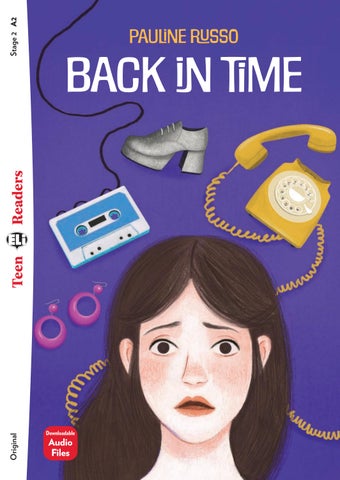
Pauline Russo Back in TIMe

In this reader:

21st-century Skills

2030 Agenda

A2 Key

Simple Story

Glossary

To encourage students to connect the story to the world they live in.

A2 level activities.

A brief summary of the paragraph.

Explanation of difficult words.

Picture Caption

A brief explanation of the picture.

Audio start stop

These icons indicate the parts of the story that are recorded.

Pauline Russo Back in Time

Teen Readers

Teen Eli Readers

The ELI Readers collection is a complete range of books and plays for readers of all ages, ranging from captivating contemporary stories to timeless classics. There are four series, each catering for a different age group: First ELI Readers, Young ELI Readers, Teen ELI Readers and Young Adult ELI Readers. The books are carefully edited and beautifully illustrated to capture the essence of the stories and plots. The readers are supplemented with ‘Focus on’ texts packed with background cultural information.

Back in Time

Pauline Russo

Illustrated by Caterina Baldi

ELI Readers

Founder and Series Editors

Paola Accattoli, Grazia Ancillani, Daniele Garbuglia (Art Director)

Graphic Design

Emilia Coari

Production Manager

Francesco Capitano

Photo credits

Shutterstock

© 2026 ELI s.r.l. P.O. Box 6 62019 Recanati MC Italy

T +39 071750701

F +39 071977851 support@elipublishing.com www.elipublishing.com

Typeset in 12 / 17 pt

Fulmar designed by Leo Philp

Printed in Italy by Tecnostampa - Pigini Group

Printing Division

Loreto - Trevi - ERT296.10

ISBN 978-88-536-4815-0

First edition: March 2026 www.eligradedreaders.com

Main Characters

susan

susan’s ‘mum and dad’ in thE 1970S

JamEs graham

Before you read

Reading A2 Key

1 Choose the correct word, A, B or C, to complete the text.

Susan is 14 years (1) __________, and she lives in a small town near Glasgow, in Scotland. She and her (2) __________ sister, Fiona, who is eight, live with (3) __________ grandmother, Anne. One morning, Susan wakes up and discovers she has gone back in time (4) __________ the year 1974! She has taken the place of her grandmother, (5) __________ was also 14 that year. Susan soon finds out that life is (6) __________ different in 1974. For everyone, she is now her grandmother as a young girl. She can’t tell (7) __________ who she really is, and that can be difficult sometimes. How (8) __________ this happen, and how will she get back to her own time? 1

Speaking in Pairs

2 Do you wear a school uniform? If the answer is yes, describe it. If the answer is no, describe what you usually wear when you go to school.

Vocabulary

3 Write the names next to the photos.

Crossword – School Uniform

4 Complete the crossword with the parts of the school uniform numbered in the picture.

5a

Speaking in Groups

21st-century Skills

6 Read the following extract from an online article by the BBC and discuss it in small groups. Use a dictionary, if necessary.

‘We feel we've lost our kids to smartphones' T V personalities Matt and Emma Willis said they wanted to be a part of a new Channel 4 documentary because they felt they had "lost their kids" to smartphones. The series is a social experiment on the impact of smartphones and social media on children. Experts monitored pupils at The Stanway School in Colchester and their behavioural changes as they gave up their phones for 21 days.

Harry said that he used his phone for "at least 9 hours a day" before taking part in the documentary, "looking at YouTube, gaming and texting". He described the moment he had to give up his phone: "It was dreadful. It's like a part of me is missing and something that I need in my life is now in a box for 3 weeks." But by the end of the 21-day experiment he said he was "more interactive" and it had made him realise he had to be careful what he was looking at online".

Scarlett said she found life without a smartphone "really good" and she now turns it off at 9pm to give her wind-down time before bed. Scarlett said she enjoyed taking part in the programme. "When I had no phone, I was completely fine - I concentrated during lessons, I understood, I was more sociable, I was kind to people, I came downstairs and helped my family... we played board games every night." She now believes "smartphones should be banned for children under 16".

Jessica said she now thinks, "Is there anything else I could do?" every time she reaches for her phone. Jessica didn’t believe she was addicted to her phone before she took part. She did miss talking to friends online, but soon realised she did not miss apps like TikTok and Instagram.

John Player, the head teacher at The Stanway School said “Staff noticed a considerable difference in the students after the experiment.”

Source: www.bbc.com

Why not try this experiment yourself, even just for a day? Do you agree with Scarlett that children under 16 should not have smartphones? Why? Why not?

is not a real town in Scotland.

2 Chapter 1

A Surprise for Susan

‘Where have you been, Susan?’ shouted Susan’s grandmother. ‘You’re late again! I tried to call you many times, but you didn’t answer your phone.’

‘I know, Gran. I’m sorry. I forgot to charge1 my mobile before I went out.’

‘That’s no excuse2 ,’ said her gran - for the millionth time!

Susan knew there was no excuse. Her gran always told her to keep her mobile phone charged, especially if she was going out with her friends. It was even more important now that she and her sister, Fiona, were staying with their grandmother, who was now a widow3 . When their parents died in a car accident 6 months before, they were living in the centre of Glasgow, but she and her little sister, Fiona, had to leave their home and school and move to Calderton, a small town near Glasgow, and make new friends.

1 charge to put electricity in something

2 excuse a good reason for doing something

3 widow a woman whose husband has died

Calderton

She loved her grandmother, but she was stricter 1 than her mother. Susan knew she was wrong, but she didn’t want to say that to her gran.

‘It’s only 10 o’clock, Gran, and it’s still light outside. Can’t I enjoy myself?’ she said angrily2 .

‘You’re only 14,’ her gran said. ‘Calderton isn’t a big city like Glasgow, but it’s still dangerous for you to be out in the park. When I was your age, I didn’t go to the park with my friends at this time in the evening. What were you doing anyway?

Just talking about boys or watching videos on your mobile, I suppose.’

‘My mobile wasn’t working, remember? I was chatting to my friends. Anyway, Gran, it’s not fair3 . You were a teenager in the 1970s. Nowadays all my friends can stay out late when it’s still light. I’m a teenager, not a wee primary school kid, like Fiona,’ and she pointed to her 8-year-old sister, who was just coming out of her bedroom because she heard her gran and Susan arguing4 .

‘What’s happening?’ Fiona asked. ‘You woke me up. I have to get up early for school tomorrow!’

‘wee’ is a Scottish word meaning ‘little’.

1 strict severe

2 angrily in an angry way

3 fair (here) right

4 argue to discuss in an angry way

The ‘duvet’, sometimes called a ‘continental quilt’, only became popular in the UK in the 1970s, but it was used in other European countries long before then.

‘I know,’ answered Susan. ‘Sorry! Nothing is happening. It’s just Gran being difficult!’

‘I’m not being difficult!’ said her gran. ‘I just want you to be safe – and you have to get up early for school in the morning, too.’

‘I’m going to bed then!’ said Susan, angrily, and she ran into her bedroom and slammed 1 the door behind her.

The next morning, Susan woke up early. She sat up in bed and, as always, turned to look at her posters on the wall behind her. What a surprise she got when she saw that, instead of Taylor Swift, her favourite singer, there was now a poster of David Bowie!

How did that get there? she thought. Someone has changed my poster.

She jumped out of bed, then saw that the room was different too.

Where’s my desk? And my computer?

She looked at the brightly coloured sheets and duvet on the bed, the orange and brown flowery

1 slam to close in a noisy way

Susan gets a surprise!

Chapter 4

Saturday

Susan groaned 1 when she woke up the next morning and saw the orange wallpaper in her bedroom.

I’m still here! she thought. But at least I don’t have to go to school today.

She jumped out of bed and pulled back the flowery curtains. It was a beautiful day. She got dressed quickly and put on a pair of Adidas trainers with stripes that she found at the bottom of the wardrobe.

I can’t believe Gran had the same shoes as I have, she thought. I love all these vintage2 clothes!

When she went into the kitchen, her ‘mum’ was putting on her jacket.

‘I’m going to the supermarket, Anne. What time are you meeting Sharon?’

‘We’re meeting at her house in half an hour and then we’re meeting our friend, Carol, to go shopping for something to wear to the disco tonight.’

‘I’ll give you some money to get something nice,’ she said, and then she looked down at

1 groan to make a noise showing you aren’t happy 2 vintage styles from the past > Saturday shopping with friends.

Platform shoes first came out in the 1930s, but platform shoes, boots and sandals were only really popular in the 1970s and worn by both men and women.

Susan’s trainers. ‘Perhaps you can get a nice pair of shoes too.’

Susan smiled and agreed with her.

‘OK, I will. Thanks, Mum!’

Susan and Sharon met Carol outside the record shop, as planned. While Sharon was inside, asking about the new Wings single, Susan and Carol talked about the clothes they wanted to buy for the disco that night. Carol told Susan that her boyfriend, Bobby, lived next door to James Smith.

‘James told Bobby that he really likes you, Anne,’ she said, smiling. ‘You must buy something lovely to wear.’

‘Really?’ said Susan. ‘He is nice.’

When Sharon came out of the shop, smiling, with her record in her hand, they walked along the Main Street to look in the shop windows.

‘My mum told me to buy new shoes,’ said Susan.

‘Look at those great platform sandals1 ,’ said Carol, pointing to a pair of brown sandals that seemed to have a 10 cm high block of wood under them. 1 platform sandals

Susan was shocked when she saw them.

‘I can’t dance in those sandals,’ she said.

‘Of course you can. Let’s go inside, and you can try them on!’ said Sharon.

Susan bought the sandals, and all three girls found some beautiful clothes to wear that night. Before they went home, they decided to go to the local café for an ice cream. As they chatted about school, fashion and boys, Susan realised that she also chatted with her own friends about the same things, but one thing was different. There were no mobile phones in the 1970s, so nobody was distracted 1 by messages on their phones! The young girls just sat and talked to each other. They didn’t look at photos and videos on TikTok or Instagram, and they didn’t take selfies!

As they walked home, carrying their paper carrier bags2 , they made plans to meet outside the school later.

Sharon came to Susan’s house after dinner so they could walk to the school together. Susan’s ‘mum’ offered to take them there in the car, but Susan refused3 .

1 distract to take away attention

2 carrier bag

3 refuse to say no

Plastic shopping bags were introduced into Europe in the 1960s, but were not popular until the 1980s. Before that, shops usually used paper bags.

‘It’s OK, Mum,’ said Susan. ‘It’s a lovely evening, and it’s still light. It will only take us half an hour to walk there. We have lots of time.’

‘OK, but I’ll come and get you after the disco, at 10.30.’

‘We can walk home, Mum. Don’t worry.’

‘No,’ said Susan’s ‘mum’. ‘It will be too late to be out on your own, and it gets dark at 10 o’clock. Sharon’s mum will agree with me.’

‘Yes, Anne,’ said Sharon. ‘My mum doesn’t like us to be out late in the evening. We don’t usually do it. Why do you want to walk home this time?’

Susan remembered what her gran said about not being allowed to stay out late in the evening, so she had to agree with her ‘mum’ and Sharon.

‘OK, Mum. We’ll see you outside the school at 10.30.’

When Susan and Sharon arrived at the school, Carol and Bobby were already standing outside. It was only 7.20, so James and Graham weren’t there.

‘You two go inside. We'll meet you in the assembly hall,’ Susan told Carol and Bobby. ‘We’ll wait here for James and Graham.’

The boys arrived 10 minutes later. When Sharon saw Graham, she smiled and whispered1 to Susan,

‘Graham looks very nice. I think I’m going to enjoy the disco this evening!’

Susan agreed that the tall, fair-haired teenager was very good-looking.

‘Have you never seen him before?’ she asked.

‘No. He goes to St. Patrick’s High School –James told me - but since his mum is a teacher at our school, he’s able to come to the disco here.’

When they went into the hall, it was full of young people. Both boys and girls were wearing brightly coloured clothes with big flowers and crazy designs. Some girls wore long flowery skirts or flared trousers, and boys wore bell-bottomed trousers2 or jeans. Susan loved it. The school assembly hall looked like a disco, with coloured flashing3 lights and loud music. She knew all the songs because her gran often played them while she was cooking in the kitchen. She thought the 1 whisper to speak in a quiet voice

2 bell-bottomed trousers: trousers with wide legs at the bottom

3 flashing lights going on and off all the time

In Scotland, historically, children went to either Catholic or Protestant schools, depending on their religion. This is still the case, but pupils of other religions can choose which school they want to go to.

1970s were so much fun. But she also missed her gran and felt a little sad.

Will I never get back home again? she thought. They all had a great time at the disco and danced together to almost every song. Susan was sad when the DJ played the last song at 10.30. When they all left the school assembly hall, she saw her ‘mum’ sitting in her car across the road.

‘We must go out again sometime, Anne,’ said James. ‘All four of us, of course,’ he added, looking a little embarrassed.

‘I’d like that. What do you think, Sharon?’ Susan said, turning to Sharon, who was standing behind them with Graham.’

‘Yes, I’d love to – we’d love to,’ said Sharon quickly. ‘What about tomorrow? Anne and I are going to the cinema tomorrow afternoon. Why don’t you come with us?’

Susan didn’t remember making plans with Sharon for the next day, and certainly not to go to the cinema. She saw Sharon staring at her, so she said, ‘Ah, yes. We’re going to the cinema. Come with us – if you like,’ she said, hopefully.

‘Oh no, I’m sorry,’ said James. ‘We’ve already made plans to go to a friend’s house to watch a film. He has a colour television.’

‘Ah OK, what a pity,’ said Susan, disappointed.

‘What about next Saturday?’ said Sharon. ‘We could go into Glasgow city centre on the bus. They have great record shops there. And we could go to Wimpy for a hamburger.’

Graham and James smiled, and both spoke together.

‘It’s a date1 !’ they said.

‘I’ll see you two at school on Monday,’ James said to Susan and Sharon.

The boys walked towards home, and the girls started to walk across the road to the car.

‘Do you really want to go to the cinema tomorrow?’ asked Susan.

‘We can go, if you want. I don’t know what’s on, but I’ll check the newspaper to see if there’s a film that we both like,’ said Sharon.

‘OK. It’s a pity that the boys can’t come with us,’ said Susan.

‘Yes,’ answered Sharon. ‘But we have a date for next Saturday. That will be fun!’

‘Yeah, it will be great,’ said Susan, with a big smile on her face.

1 date (here) an appointment for a romantic meeting

Wimpy was the first burger restaurant in the UK and the most popular in the 1970s, before becoming Burger King at the end of the 1980s.

When they got into the car, Susan’s ‘mum’ saw their smiling faces.

‘You two look really happy,’ she said. ‘Did you enjoy the disco?’

‘We had a great time!’ the girls said at the same time.

‘And we are meeting the boys next Saturday too,’ added Sharon.

‘Well, that’s very nice,’ said Susan’s ‘mum’, and she drove off.

After they took Sharon to her house, Susan and her ‘mum’ went home. Susan was very tired, so she told her mum she was going straight to bed. But when she got into bed, she was too excited to sleep. She thought about James and the disco. She loved being in the 1970s. They had so much fun. She was so happy that she and Sharon were going to Glasgow with James and Graham next Saturday.

What will I wear? she thought. I must look in Gran’s wardrobe tomorrow to see if she has something nice that James will like.

She was still smiling as she fell asleep.

Disco dancing.

Reading A2 Key

1 Complete the text with the correct answer, A, B or C.

When Susan got up on Saturday morning, she got dressed and put on her (1) __________ She went out to meet Sharon at (2) __________. Sharon wanted to buy (3) __________ at the record shop. The girls bought some new clothes for the disco, then they went to a local café to have an ice cream and (4) __________. That evening, Susan and Sharon went to the school disco (5) __________ and met Carol, who was standing outside the school with her (6) __________. Susan and Sharon had a great time at the disco with James and Graham, so Sharon asked the boys to go to the cinema with them the next day. Unfortunately, they said they couldn’t because they had plans to go to (7) __________. Susan was disappointed, but then they all agreed to go out together the following (8) __________.

1 A sandals B trainers C boots

2 A the supermarket B the record shop C her house

3 A a single B a cassette C an album

4 A take selfies B watch videos C chat

5 A by car B on foot C by bus

6 A brother B classmate C boyfriend

7 A a friend’s house B the city centre C Wimpy for a hamburger

8 A Monday B Saturday C Sunday

Writing

2a In Chapter 4, we see that Susan is now enjoying herself in 1974. What does she love about the 1970s?

2B Imagine you are Susan. Write in your diary about the lovely day you spent with your friends from the 1970s.

Crossword

3 Look at the photos 1-8 that show words from Chapter 4 and insert them in the crossword.

Listening

4 Listen to the start of Chapter 5 and decide which of the following sentences are true (T) or false (F).

1 Susan woke up late on Sunday morning.

2 Susan’s ‘mum’ was making roast beef for lunch.

3 The box of cornflakes was completely empty.

4 Susan’s ‘mum’ said she was going to the shops the next day.

5 Susan had no homework to do.

6 Susan’s ‘mum’ asked her to take the peas out of the freezer.

Fashion in the 1970s

At the start of the 1970s, the hippie fashion from the end of the 1960s was still popular. Both boys and girls wore flared or bell-bottomed jeans and trousers, tight flowery shirts with large collars and multi-coloured T-shirts. It became more acceptable in the 1970s for women to wear trousers, but many women still wore mini-skirts, popular in the 1960s, or long colourful skirts and dresses in a light material.

The Polyester Decade

Polyester is a man-made fabric1, invented by DuPont in the 1930s. It became more popular in the 1970s because it was light and cheap, and it could be used to make all types of clothes. It was also easy to wash, and it wasn’t necessary to iron it.

1 fabric cloth, material

Hippie

A person, typically from the 1960s and 1970s, who doesn’t accept the normal values of society and wears unconventional 1 clothes and has long hair.

Looking Cool in Platforms

One of the most popular styles of the 1970s, platform shoes, sandals and boots were worn mainly by younger women. With the arrival of disco music in the 1970s, platform shoes also became popular with young men who went to discos2 at the weekend. It was also a popular choice for 1970s rock stars!

Task

1 unconventional different from others

2 disco (discotheque) a club for disco dancing

What style of clothes and shoes do you wear? Do you like the sort of clothes they wore in the 1970s? Discuss with a partner.

1970s Music

The 1970s was one of the most important musical decades1, when rock, glam rock, punk rock and disco music were all popular. The music of some of the most popular bands of the 1970s – like Pink Floyd, the Rolling Stones and Genesis - is still loved by different generations today. A major event at the start of the 1970s was the break-up of The Beatles in 1970. Paul McCartney formed a successful new group called Wings, and the other three Beatles – John Lennon, George Harrison and Ringo Starr also continued to have success.

Hard rock

Heavy metal music became very popular in the 1970s, with the music of Led Zeppelin, Black Sabbath and Deep Purple, who later influenced other bands like Judas Priest and Motorhead.

Glam rock

Glam or glitter rock was most popular in the UK in the early 1970s. Singers wore outrageous 5 clothes, makeup, hairstyles, and platform-soled boots. Performances were theatrical and had a hard rock sound, with guitars being dominant, but were a mix of rock and pop. The most famous artists were David Bowie, Roxy Music, Queen and Elton John, among others probably better known in Britain.

Progressive rock

Progressive rock, most popular in the first part of the seventies, originated from the late 1960s blues-rock and was played by bands like Yes, Genesis, Pink Floyd, Jethro Tull and Supertramp – who wanted to change the standard song structures of rock music, with verses2 and chorus 3. It included elements from classical, jazz and world music and had words based on fantasy or abstract 4 ideas.

1 decade ten years

2 verse a group of lines in a song or poem

3 chorus a group of lines repeated in a song

4 abstract not ordinary

5 outrageous something that shocks people

Growing up in the 1970s

Life was very different fifty years ago, but it certainly wasn’t boring. More time was spent outdoors: children played football or went roller skating in the street. People spent less time watching television: there was no 24-hour TV, and children’s programmes were only on a Saturday morning or in the early evening. People listened to the radio more, and families played cards together, or board games like Monopoly, Scrabble and Cluedo.

Fun and Games

Clackers was a popular game in the early 1970s. Two hard plastic balls on pieces of string tied at the top were ‘clacked’ together. However, they were soon banned countries because children were injuring themselves while playing with them.

Simon - The Start of Electronic Gaming released in 1978, this was a memory game with flashing lights and sounds. It was so popular that it has been rereleased 2 many times over the years.

1 ban to stop, not allow

2 re-released sold in shops again

Saving the Environment… in the 1970s!

In the 1970s, people started to become more worried about pollution, conservation and how human activities harm the environment. Groups like the Conservation Society, Friends of the Earth and the Green Alliance played an important part in telling people about the need to protect the environment. Governments at that time were slow to make changes but there was some progress. From the Department of the Environment in 1970, to the Green Party in 1973, the first few years of the 1970s saw environmental problems

in British society. In the USA, the first Earth Day was held on 22nd April 1970.

In the 1970s, many still remembered the shortages1 during the Second World War. People only bought the food they needed, so there was less waste: in the UK now 7 million tonnes of food and drink are thrown away every year. Clothes were mended when they became worn2 or had holes in them. At the end of the decade, clothes started to become cheaper, and from the 1980s, people began throwing them away and buying new things: however, more and more people are now starting to reuse things.

1 shortage not having much food or other things

2 worn no longer perfect, well-used

Energy

Coal and oil were mostly used to produce electricity and heat homes – not very environmentally friendly! People were careful about not wasting energy in those days, even though there were fewer electrical items in the home then. Since 1970 the use of electricity has increased by almost 54%!

Recycling

Now, most countries recycle plastic, paper, metal and food waste, but in the 1970s everyone threw all their rubbish into one bin. The only thing to be recycled was glass: bottles that were used for milk or other drinks were washed and reused. Some companies encouraged buyers to recycle glass soda bottles by paying 2 or 3 pence for each one returned to the shop.

Task

Which items do you and your family recycle at home? What do you do with your old clothes? Do you repair worn clothes or do you buy new clothes instead?

Teen Readers

Stage 1

• Maureen Simpson, In Search of a Missing Friend

• Charles Dickens, Oliver Twist

• Geoffrey Chaucer, The Canterbury Tales

• Janet Borsbey & Ruth Swan, The Boat Race Mystery

• Lucy Maud Montgomery, Anne of Green Gables

• Mark Twain, A Connecticut Yankee in King Arthur’s Court

• Mark Twain, The Adventures of Huckleberry Finn

• Angela Tomkinson, Great Friends!

• Edith Nesbit, The Railway Children

• Eleanor H. Porter, Pollyanna

• Anna Sewell, Black Beauty

• Kenneth Grahame, The Wind in the Willows

• Elizabeth Ferretti, Animals and Us

• Lynn Bulmer, The Lost Coin

Stage 2

• Elizabeth Ferretti, Dear Diary…

• Angela Tomkinson, Loving London

• Mark Twain, The Adventures of Tom Sawyer

• Mary Flagan, The Egyptian Souvenir

• Maria Luisa Banfi, A Faraway World

• Frances Hodgson Burnett, The Secret Garden

• Robert Louis Stevenson, Treasure Island

• Elizabeth Ferretti, Adventure at Haydon Point

• William Shakespeare, The Tempest

• Angela Tomkinson, Enjoy New York

• Frances Hodgson Burnett, Little Lord Fauntleroy

• Michael Lacey Freeman, Egghead

• Michael Lacey Freeman, Dot to Dot

• Silvana Sardi, The Boy with the Red Balloon

• Silvana Sardi, Scotland is Magic!

• Silvana Sardi, Garpur: My Iceland

• Silvana Sardi, Follow your Dreams

• Gabriele Rebagliati, Naoko: My Japan

• Sarah Gudgeon, The Yellow Sticker Girl

• Grace Lani, Riri: My South Africa

• Sarah Gudgeon, The Kid from Kabul

• Grace Lani, Tribal Voices, the Awá

• Silvana Sardi, The Wonders of Water

• Elizabeth Ferretti, Football Crazy

• Pauline Russo, Back in Time

Stage 3

• Anna Claudia Ramos, Expedition Brazil

• Charles Dickens, David Copperfield

• Mary Flagan, Val’s Diary

• Maureen Simpson, Destination Karminia

• Anonymous, Robin Hood

• Jack London, The Call of the Wild

• Louisa May Alcott, Little Women

• Gordon Gamlin, Allan: My Vancouver

• H.G. Wells, The War of the Worlds

• Lisa Mary Vecchione, Baseball Dreams

• Lisa Mary Vecchione, The Country Stars

Pauline Russo Back in Time

When Susan’s parents die in a car accident, her life changes when she and her sister have to go and live with their grandmother. However, her life changes even more when she wakes up one morning and finds herself in 1974! Life is very different in the 1970s. Find out how she is able to live the life of a 14-year-old teenager in a time she knows very little about. Can she keep her secret? Will she ever get back to her own time?

In this reader you’ll find:

- How people lived in Scotland in the 1970s.

- Focus on: music, fashion, technology and the environment in the 1970s.

- Glossary of difficult words

- Comprehension and grammar activities including A2 Key style exercises and 21st-century Skills activities

- Final test

Turn static files into dynamic content formats.

Create a flipbook
Issuu converts static files into: digital portfolios, online yearbooks, online catalogs, digital photo albums and more. Sign up and create your flipbook.