ECODOMICS. I S S U E 2 . A U T U M N T E R M 2 0 2 3 A MAGAZINE FOR ECONOMIC STUDENTS BY ECONOMIC STUDENTS
Want to learn about the current economic climate ?
An article about money supply and BOE’s role as central bank written by Oliver MacGonigal
Find out about how some students got involved with economics outside the classroom this summer!
3 4
Melissa Ursachi’s take on whether ‘economic growth is driven by supply or demand?’
This term we recognised Amartya Sen and his theories on poverty
Lectures , talks and programmes to dive deeper into the world of economics
Economic Indicators:
11 12 13 6 7 8 9 10 14
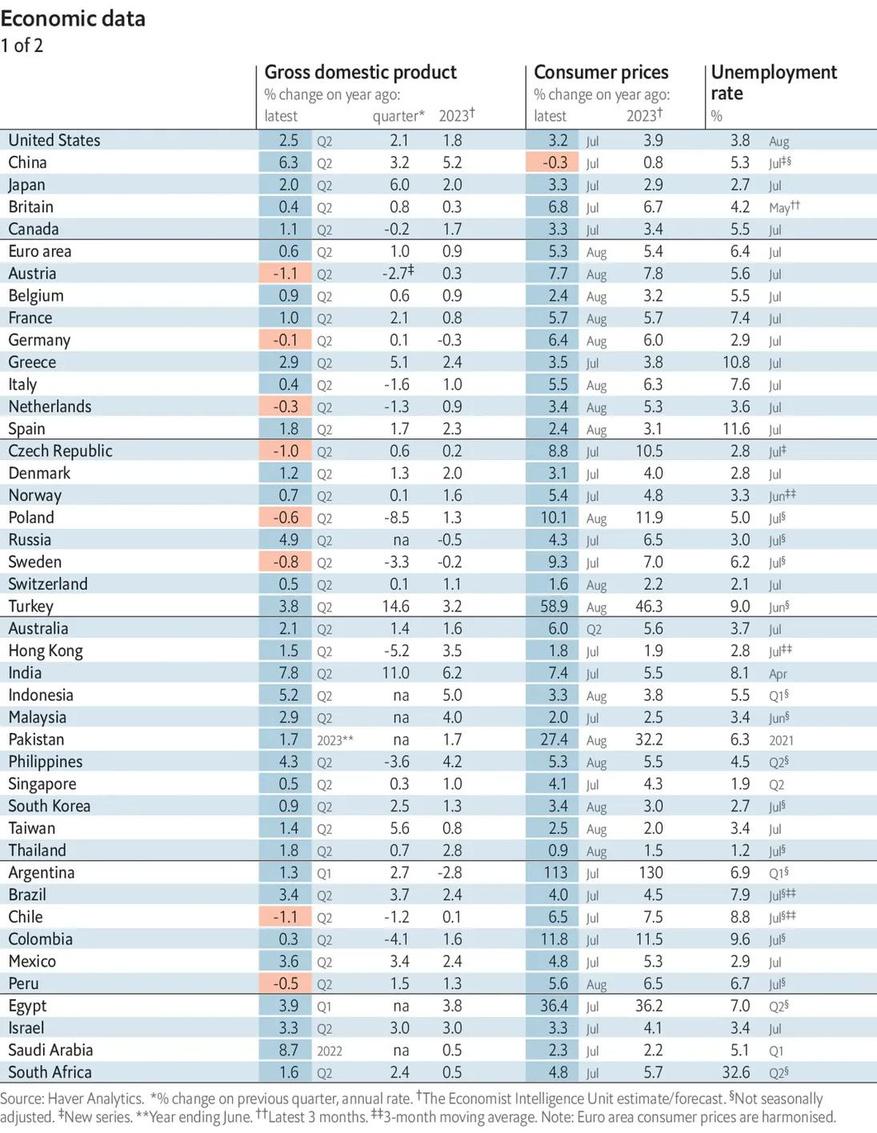
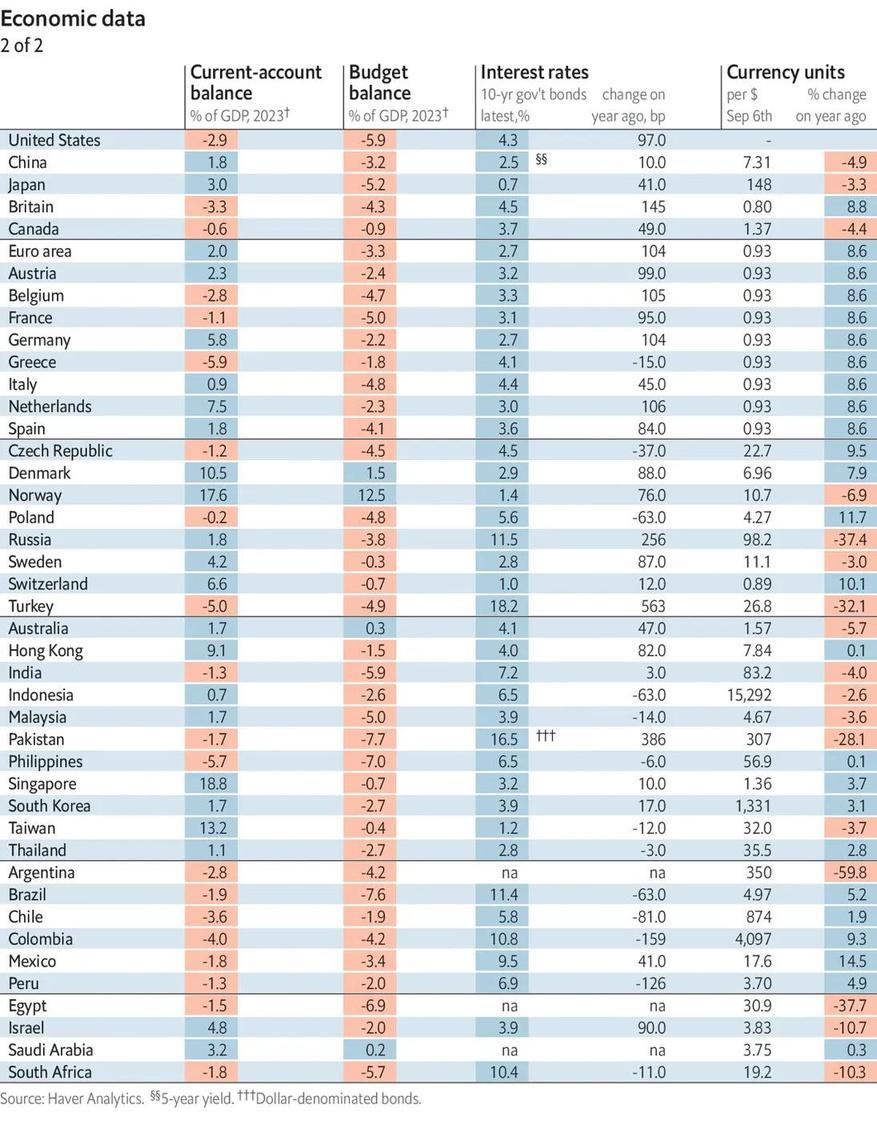
The world economy continued to do slightly better than expected, with economists revising their forecasts for growth this year in the US, Japan and the UK. Inflation has been falling and has been coming in below market expectations recently. Britain is no longer a global economic outlier as its post-pandemic economic performance has significantly improved according to the Office for National Statistics.
GDP has increased and is now above the prepandemic levels seen at the end of 2021. The ONS originally said the economy was still 1.2% smaller than its pre-lockdown size in the final three months of 2021 The ONS now says GDP was 0.6% higher than before the pandemic.
This data relates to growth more than 18 months ago, and does not change the picture of an economy which, at best, is growing sluggishly.
House prices have fallen by 5.3% annually in August, taking the average property value to £259,153, this is the biggest annual percentage drop since July 2009.
Nationwide also said house prices are now typically around £14,600 below their August 2022 peak.
Financial markets think that interest rates are at or near their peak, but they do not expect a return to the very low rates seen before the pandemic.
The US remains the growth outlier among rich economies. Its economy, while slowing, continues to show decent growth while inflation has decreased more than in Europe, to just 3.2%
The QTM is the idea that there is a strong link between the general price level and the amount of money in circulation within an economy. An expansion of the money supply would reduce the overall purchasing power of money meaning more money is required to purchase the same good or service, in turn increasing the general price level creating inflation QTM can be expressed as an equation which links together the money supply, velocity of money (how fast money is transferred between parties), the average price of transactions and the total number of transactions. This is seen in figure 1 below:
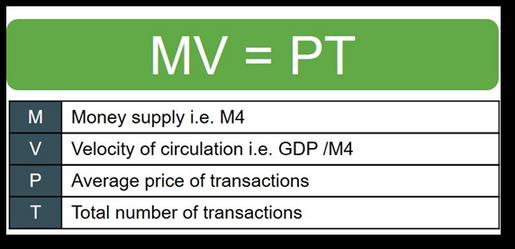
*M4
The QTM was further developed and advocated by Milton Friedman (the founding father of monetarism) He argued that for central banks to maintain price stability and achieve target levels of inflation, the quantity of money must rise in line with economic output (GDP). If money growth exceeds economic output, then there will be high inflation
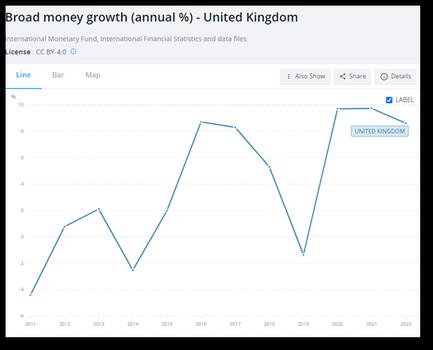
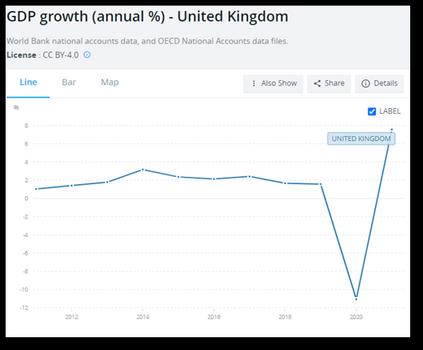
In 2020 COVID sent UK households, and some members of the government, into lockdown. This hit the economy hard with an 11% fall in GDP. Increasing fears by the BofE that the economy would experience major industry decline in sectors such as hospitality led them to create £450bn of new money through the purchase of illiquid assets from banks – also known as quantitative easing (QE). QE is used as a policy to stimulate demand in the economy and has effectively been used in the past (in 2009) to meet inflation targets and prevent deep recessions. However, there can be negative effects of QE. When governments buy illiquid assets such as bonds, bond prices increase, in turn lowering interest rates because there is an inverse relationship between interest rates and bonds Lower interest rates reduce reward for saving, leading households to spend more in the economy, increasing aggregate demand (AD). This leads to demand-pull inflation. Therefore, QE can cause inflation. Furthermore, following the QTM QE can be effective if the rate of new money expands in line with national output however, in 2020, UK broad money growth (money supply including notes and coins in circulation and bank accounts) was up 9.7% (figure 2) whilst GDP was down 11% (figure 3). The BofE’s disregard for the QTM implies that their QE scheme would be inflationary.
Another inflationary impact of the BofE’s QE can be seen through asset price inflation- mainly housing. During the lockdown period, there was an unusual 19.7% increase in Nationwide's house index from 2020 to Q1 2022. This is consistent with the theory that economies implementing quantitative easing (QE) often see inflated asset prices. Rising house prices generate a positive wealth effect for homeowners, boosting consumer confidence and leading to increased spending. This surge in consumer spending stimulates national output and creates demand-driven inflationary pressure on goods and services.
In October 2022, UK CPI inflation hit its peak at 11 1% Andrew Bailey, Governor of BofE, argues that 80% of the inflation was caused by exogenous factors like the energy price increases from the Russia Ukraine War, if this was the case then how come, given that in 2023 energy prices have fallen from their peak, the UK’s inflation rate has not fallen back down to similar levels as that of other leading nations? QE
The BofE’s disregard of QTM in their 2020 QE scheme can be seen to have played a major role in the UK’s high inflation levels. The BofE seemed to have exaggerated the effects of COVID and the QE schemewhich was aimed at keeping certain sectors afloat - ended up creating heightened demand for goods and services along with house price inflation Whilst counterarguments may say that inflation was spurred on by other factors like supply chain disruptions or tight labour markets, the BofE’s use of QE certainly has made inflation higher than it needs to be which has had adverse effects on vulnerable households who now struggle with everyday living costs Moving forward, perhaps the BofE needs more diverse views on its monetary policy committee with monetarists who will understand the consequences of deviating too far from the QTM model and who will also stop the BofE from printing till the ink runs out
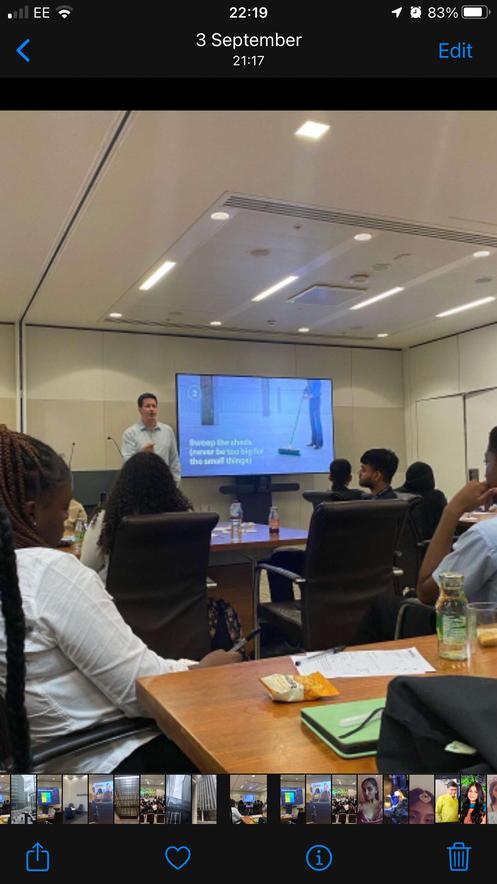
From the 10th July - 12th July, I completed a 3 day work experience/insight programme with Deloitte called ASPIRE.
Through participating in ASPIRE, I feel that it has helped me develop massively. We engaged in talks on skills we will need for the future. While all the advice was helpful, the one that stood out for me the most was learning how to communicate effectively. Paul Gurney covered this with us, where he discussed top tips on how to prepare for public speaking and that with communication, listening to others’ ideas is just as important, or even more so, than saying your own. I also thoroughly adored his first talk to us about his journey to where he is today, and I found it truly inspiring to hear about his adventures around the world, as I hope to travel the same amount in the future.
Further, I was fully engrossed in Alexis Rose’s talk and her words “Don’t think you’re different from other people … opportunities are for you too” will stick with me while I venture through my working life. Additionally, her ideas, along with Katie Goodman’s, on combating Imposter Syndrome through reconstructing your own personal thoughts and always aiming to be your authentic self, particularly resonated with me. Our penultimate talk was carried out by Dwayne Fields. I found myself wanting to hear more and more about his life: from trekking to the North Pole, (even though once he arrived it wasn’t as exciting as he thought), to his new project, “WeToo” with young people. The way he told these stories were both humorous and captivating. It was nice to see someone come from a disadvantaged background (and especially someone who is also Jamaican) climb to where he is now.
However, I must say that my favourite part of the programme was when we presented to the Deloitte partners! Although, initially it was nerve racking, once my team and I got up there and presented our ideas, it felt very rewarding to share what we had worked on. I answered questions asked by the partners, and was surprised with my ability to answer them the way I did. After we finished our pitch and sat back down, I felt very proud of my team.
This summer I had the privilege of attending a weeklong programme, run by “Sponsors for Educational Opportunity” otherwise known as SEO London, which aims to demystify the city through visiting banks such as Nomura, Barclays, ICG and Blackstone. We were also split into groups to work on a project which would tackle a social issue of our choice and we would present this on the last day of our programme.
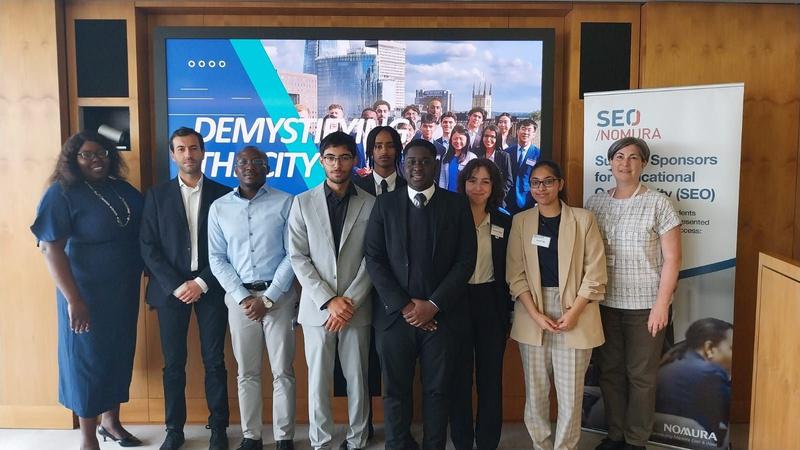
I found our day at Barclays useful as we networked with employees from different divisions. I appreciated hearing from the investment banking division who mentioned what they liked about their job but did not sugar coat the pressures and long hours that they faced. Attending both Blackstone and ICG helped to build on my basic understanding of private equity firms and how they invest in mismanaged private companies or properties to then restructure them, so they are highly profitable when selling them. At Blackstone, we had the opportunity of going through a case study on whether we would buy the company or the real estate. It was a great way of seeing how private equity firms can add value to a mismanaged company or property. At ICG, I participated in the mock interviews and created an elevator pitch about myself. While I was nervous at first, it turned out to be the highlight of my day at ICG.
The last day then arrived. It was time to present our project at Nomura. Our project was aimed at preventing people from falling victim to scamming. We chose this cause because we believe that scams are a growing issue as technology is becoming more advanced. Unfortunately, some people may exploit those who are not as tech-savvy and these groups tend to be the elderly or impressionable youths. So, our mission was to raise awareness, especially to these vulnerable groups about how these scams operate. We planned to do this through working with institutions such as schools and holding our own sessions in different venues across the UK. After considering how we would run our initiative, we created a thorough budget on how we would effectively utilise the money if invested by the panel of judges, putting a certain amount of money towards advertising, travel reimbursement, catering, etc. The thought of presenting in front of a panel of judges was intimidating at first, but through our teamwork, we ended up winning third place.
Over the summer holidays, I sought out work experience at E.ON for a week in their office located in Nottingham. E.ON is a European multinational energy company that operates in copious aspects of the energy industry. This involves providing retail energy services to residential and commercial customers and formulating renewable energy solutions for businesses.
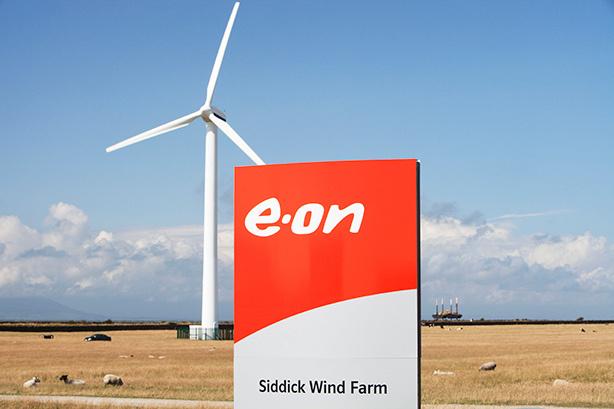
Creating access to renewable energy for a myriad of businesses in the UK is vital. Renewable energy technologies have become increasingly cost-competitive with fossil fuels. As the cost of renewable energy decreases, businesses and consumers benefit from lower energy bills. E.ON has played a key role in reducing the overall cost of living for their customers and businesses contributing to increased disposable incomes and business profitability.
During my time at E.ON I was introduced to innovative softwares such as Microsoft PowerBI and Matillion, by the Data Architecture team there, who assist the company in visually representing and forecasting their n in sales and quantifying their effect on the c whole. Fortunately, I was allowed to join me conferences during my time there where I r insight into several different roles within the how they all contribute towards battling the global warming. I was thoroughly interested the opportunity to understand the funding renewable energy projects. These projects o constructions of solar, wind farms and hydr plants. E.ON collects investments from vario capitalists and shareholders, such as The Va and BlackRock to grow and nurture new me renewable energy. Over the course of the w knowledge on why these investments are in as implementing the use of renewable ener mitigate climate change.
Furthermore, this will ensure reduction in e damage associated with fossil fuel extractio combustion. These benefits translate into long-term economic gains by avoiding the costly consequences of extreme weather events, health-related expenditures, and damage to natural resources.

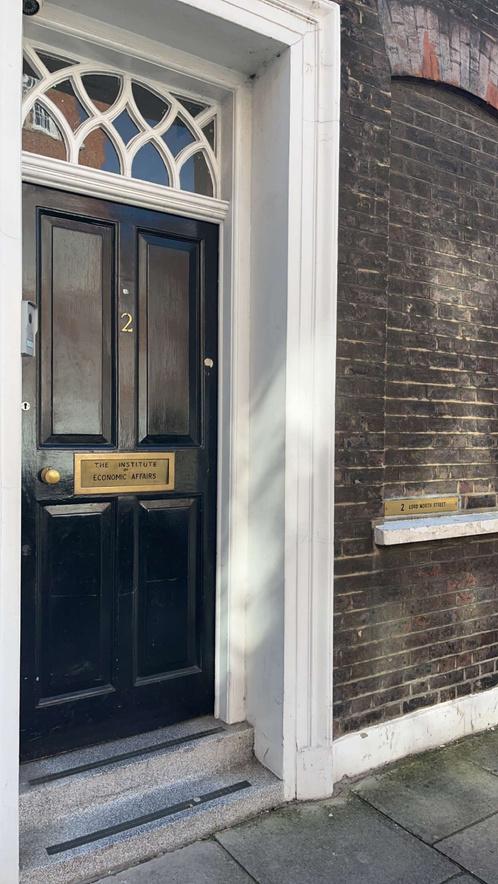
From the 3rd to the 7th of July 2023, I completed the Future Thought Leaders’ programme at the Institute of Economic Affairs (IEA).
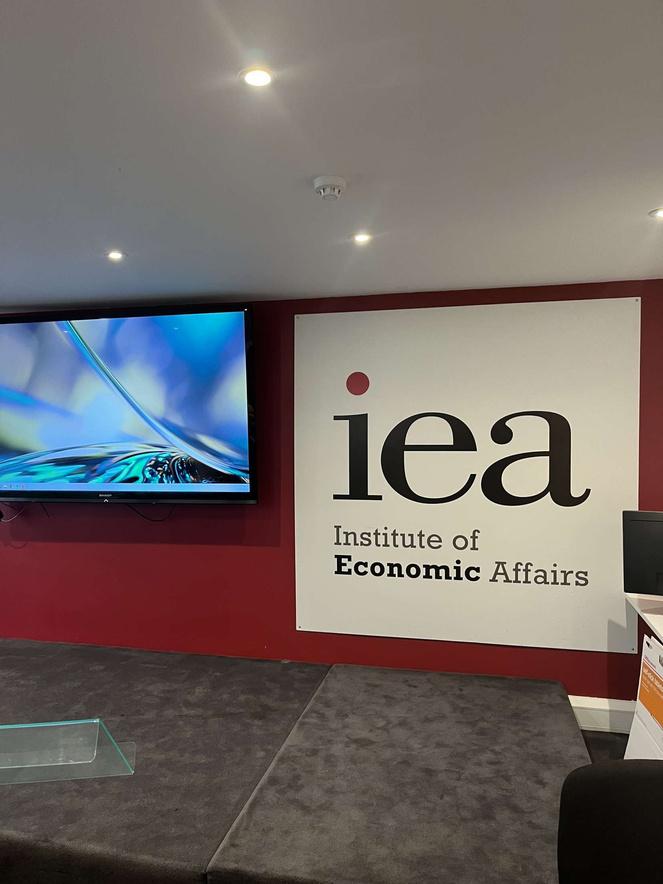
Participating in the IEA Future Thought Leaders’ Programme was an invaluable experience, where I was able to enhance my theoretical knowledge of economics We engaged in various talks which were presented by expert economists at the IEA on current economic affairs such as ‘The Free Market Perspective on Climate Change’, which I found particularly enjoyable as it highlighted the important contribution of economic theory in tackling climate change issues Having read through all the scheduled talks for the first day prior to the programme day, there was one talk that I was looking forward to hearing the most. Mark Littlewood (Director General, IEA) delivered this particular talk, where he shared his top tips on ‘How to win a debate’ and as someone who enjoys public speaking, this piqued my interest
Afterwards, Dr Stephen Davies (Head of Education, IEA) provided us with an insight as to what the role of the IEA as a free market think tank was. Before the programme, I had limited background knowledge as to what the IEA actually did What I found that was most interesting about think tank organisations, including the IEA, is that they all serve a specific purpose and aim to improve their respective sectors within the UK economy by influencing policy and producing cutting-edge research and analysis.
Dr Kristian Niemietz (Head of Political Economy, IEA) delivered a captivating talk where he presented his argument as to why Social Healthcare Insurance systems are more effective than a tax–funded health system like the NHS. This talk gave us all the opportunity to engage and discuss our own views on the motion being made, and better understand different perspectives on the issue. After Niemietz concluded his argument, I chose to support the motion and so agreed with his judgement as to why Social Healthcare Insurance systems are superior to the NHS.
However, my favourite part of the five-day programme was undoubtedly at the end of the week when we debated current affairs. At the start of the week, we were all assigned into debating teams and were given a statement relating to a particular current affair. Our motion was ‘The UK should pursue industrial policy’, and hence the other team argued against the statement. The process of conducting research to prepare for the debate, as well as discussions of these concepts with my peers, gave me the chance to develop my knowledge base on the topic. Despite being a strong public speaker, the feeling of making a pitch to the audience on a topic that I’m not particularly knowledgeable in can be quite daunting Despite this, I was able to address the questions I was faced with, using the knowledge I had gained over the week. The rest of my team also delivered their pitches to a very good standard which led us to getting the majority vote from the audience for the stronger case, so I was quite pleased with my teams’ efforts
In late July I visited the US with the Sutton Trust. We stayed at Yale University and this was our rendezvous point following our daily coach rides that led us to visit four states and eight universities. The purpose of this residential was to understand and experience what it would be like to study in the US and the style of university befitting my character and persona.
We arrived at 11pm at Pauli Murray College inside Yale, for a 5am start the next day where we would attend the Boston Fair at Harvard College. This was similar to a UCAS fair, but was for prospective university students in the States. There were around 35 representatives from 20 universities from liberal arts colleges including, but not limited to, Pomona, Amherst and Williams as well as private research universities including Harvard, Princeton and MIT. I learned about different criteria of admissions, clubs and communities, financial aid offered, the range of opportunities abroad and the style of students who study there.
The next day we spent at Yale University where an admissions officer named Keith Light delivered an encouraging talk emphasising the importance of curiosity and determination to be victorious in our academic struggle. He later spoke about the importance of authenticity and honesty in the lives we choose to lead, addressing us as people and not students, which I found to be quite thoughtful. This led us to the Yale Art Gallery where I saw original paintings from Monet and Van Gogh. I began to understand that an American education would build me as a person as well as a student.
As the week passed we continued to visit diverse institutions including Amherst, Smith, Wesleyan, Brown, Connecticut college and my personal favourite: Columbia University. One night there was a talent show between all the groups in NYC where our team won 1st through singing and dancing. On the day we visited Wesleyan we later stood at the "Top of the Rock" on the Rockefeller Centre. On one side was the Empire States building towering over the concrete jungle Jay-Z based his song off and on the other side was Central Park, where we had lunch on the final day. Our visit to the MET marked the end of my venture in the States.
This opportunity, that I was fortunate enough to go, was the highlight of my year so far.

Economic growth is influenced by both demand and supply forces. However, depending on the individual economic setting and conditions, the relative importance of demand and supply might fluctuate.
It can be argued that if there is no demand, there will be surplus supply. Without demand, consumers will not purchase goods and services from businesses, meaning businesses will not make a profit and workers will not get higher wages.
While this does indicate that the economy is primarily reliant on demand, excess supply indicates the possibility of economic expansion. Excess supply could be a result of overproduction of a good or service, or it could indicate that prices are excessively high, among other things.
As a result, an economy is controlled by demand, because firms should respond to demand and produce what people want.
On the other hand, if there is a lack of supply, either in goods such as natural resources used in production like metals, then businesses will not be able to meet demand. This shows that supply is as crucial, possibly even more important in constructing an economy, as if there is a shortage of supply then regardless of the quantity of demand, it will not be met, which can lead to other problems such as necessities being overpriced.
So, a balanced link between demand and supply is required for long-term growth. Businesses produce goods and services in response to demand, which is met by supply. When both are in tune, economic growth occurs.
Melissa Ursachi Some food for thought , heres Melissa Ursachi's take on:This term’s economist is Amartya Sen, a Nobel prize winning economist, who has made significant contributions to welfare economics, development economics and social choice theory He was born in Santiniketan, India and attended the University of Cambridge Currently, he is an Economics and Philosophy professor at Harvard University, and has previously taught at the LSE

One major idea he had was to not only measure the number of people in poverty, but the extent of the poverty they were in too, hence giving a deeper understanding into the state of the economy. He theorised that poverty was not only based on income or wealth, lack of opportunity is in fact a larger factor. He believed that solely raising average incomes in developing countries was almost useless if people still struggled with health and education (if you want to find out more about this, he has written a book titled “Development as Freedom”). This may act as a constraint, as people may want to develop and escape poverty, but due to a lack of opportunities like higher paying jobs or schooling, it is not feasible. Hence, trapping them in a cycle. This research into welfare economics and development economics, nicely links to what year 2s are currently learning about Poverty and Inequality in Theme 4.
WANG TAO IS THE HEAD OF GREATER CHINA ECONOMICS AS WELL AS THE HEAD OF STRATEGY
WANG TAO IS THE HEAD OF GREATER CHINA ECONOMICS AS WELL AS THE HEAD OF STRATEGY AT THE BANK OF AMERICA. HER AREAS OF RESEARCH INCLUDE CHINA’S LONG-TERM ECONOMIC AT THE BANK OF AMERICA. HER AREAS OF RESEARCH INCLUDE CHINA’S LONG-TERM ECONOMIC GROWTH, MONETARY POLICY AND SUPPLY CHAIN SHIFTS. SHE ALSO GAINED A PHD IN GROWTH, MONETARY POLICY AND SUPPLY CHAIN SHIFTS. SHE ALSO GAINED A PHD IN ECONOMICS AT NYU. ECONOMICS AT NYU.
Expand your vocabulary:
Substantiative Freedom: The real opportunity to lead a life you value and have reason to value
- Tanika Simon-ThomasSocial Choice Theory: an economic theory that considers whether a society can be ordered in a way that reflects individual preferences
There's something for everyone, whether you want to learn more about the myriad of policies our government has been utilising or even how artificial intelligence is involved in economics:
Lectures/Talks:
AAKASH MANKODI
Tuesday 10th October
Formerly a student at St Dominic's who now works for the bank of England, is coming back to speak with students about his career journey and current economic issues Chapel students will be invited to attend closer to the date of the talk
Good jobs, bad jobs in the UK labour market:
Thursday 9th November, 6:30PM - 8:00PM
In person and online event: Sheikh Zayed Theatre, Cheng Kin Ku Building, LSE
Exploring how due to the worldwide cost of living crisis and possible recession, governments will likely focus policies on poverty and employment The UK is used as a case study, when looking how we can define and measure deprivation in the labour market
wANT MORE lseTALKS? hERE IS A LINK FOR ALL THEIR UPCOMING PUBLIC EVENTS: https://shorturl at/hoOP3
Programmes:
UBS Work Experience:
Monday 23RD October - Wednesday 25TH October
3 Day Hybrid Work Experience (1 Day in person, 2 days online) where you learn about the different jobs in one of the world’s largest wealth management firms
Applications Close: Friday 22ND September 2023
Apply on the “Speakers for Schools Experience” Website
Migrant leaders:
aims to equip every young migrant regardless of their background, with the leadership mindset and capabilities they need to capture opportunities to fulfil their potential offers work experience opportunities enhances employability skills such as personal branding applications open all year round
the loneliest economy: Is it moral for companies to use behavioural economics to target consumers? ON YOUTUBE, I STUMBLED UPON A VIDEO CALLED THE ‘LONELINESS ECONOMY’ AND I WAS INTERESTED TO SEE WHAT IT WAS ABOUT IT IS DISHEARTENING TO SEE HOW CORPORATIONS USE BEHAVIOURAL ECONOMICS TO TARGET THOSE WHO ARE VULNERABLE BY MARKETING THEIR PRODUCTS AS A SOLUTION TO THEIR LONELINESS WE HAVE HEARD OF THE NEGATIVE IMPACTS OF SOCIAL MEDIA, AND IT IS INDEED A BIG CONTENDER WHICH PROFITS FROM THE LONELINESS ECONOMY FOR A LOT OF PEOPLE, WE ENJOY THE SENSE OF FAME FROM OUR LIKES AND FOLLOWERS BUT EVERYTHING ABOUT IT IS SIMPLY SHALLOW AND FAKE ANOTHER SIMILAR MARKET WHICH THRIVES FROM LONELY PEOPLE ARE DATING APPS LEARNING ABOUT HOW DATING APPS ARE PROGRAMMED TO ALTER PEOPLE’S DOPAMINE LEVELS SO THAT THEY CONTINUE USING THE APP MADE ME REALISE HOW SINISTER THEY ARE BEHIND THIS DISGUISE THAT THEY ARE HELPING PEOPLE MEET SOMEONE NEW FURTHERMORE, THEY LURE PEOPLE INTO PAYING A SUBSCRIPTION, PROMISING THEM THAT IT WILL BOOST THEIR PROFILE WHICH MAY NOT BE GETTING AS MANY MATCHES BECAUSE OF THE APP’S ALGORITHM THAT ENSURES THAT THIS HAPPENS BUT THE MORE EFFECTIVE PLATFORMS ARE THE LIKES OF TWITCH, AND IT IS FASCINATING TO SEE THE IMPACT OF PARASOCIAL RELATIONSHIPS AND HOW SOME CAN USE THIS TO THEIR ADVANTAGE BY SELLING THEIR MERCHANDISE OR PRODUCTS IF ANYTHING, TECHNOLOGY HAS HELPED OUR MONEY DRIVEN SOCIETY TO PROFIT FROM LONELY PEOPLE WHO SIMPLY WANTED TO FORM MEANINGFUL CONNECTIONS https://youtu be/KOpCtUvruy0?si=StewajfZOm99B3Kw
Are you in Y1 and want to be apart of the magazine organisation team?
Did you know that key economic data is updated and published each week by The Economist magazine? Go to the LLC and pick up the college’s copy and check it out:
 Edited by: Mahi Kapadia
 Tanika Simon-Thomas