
‘Everything Is Copy’
By Jim laderLet me tell you about the very creative and successful. They are different from you and me. They may struggle, at the beginning of their careers, to find their metier or their voice, but once success arrives, subsequent endeavors can fall into place more easily for them. That is because of the other successful, influential people who enter their sphere. At the same time, the cre ative and successful work incredibly hard, knowing that the next triumph is nev er guaranteed.
Those are the overarching impressions one takes from Kristin Marguerite Doidge’s recent work, “Nora Ephron: A Biography,” which provides a highly readable portrait of Ephron, the prolific novelist, essayist, playwright, screenwriter, and filmmaker whose death, in 2012, brought to an abrupt end a career that had shown no signs of slowing down.
The baby girl born on May 19, 1941, in New York was blessed with a fair measure of good luck. She did not have to overcome great odds or adversity in order to grow up to be Nora Ephron. The eldest of four daughters whose parents were established playwrights and screen writers, Nora was raised in Beverly Hills, where she graduated from high school before going on to Wellesley College.
Her first job was in the Kennedy White House, on the staff of Pierre Salinger, the press secretary. Having always aspired to be a writer, she worked for five years as a reporter for The New York Post and for nearly two decades as an esteemed colum nist and associate editor at Esquire. In what feels like short order and a logical progression, she came to write books, plays, and screenplays, which in turn led to her being a successful director and producer of movies. Her prolific output includes such highly acclaimed films as “Silkwood,” “When Harry Met Sally,” “You’ve Got Mail,” and “Sleepless in Seattle,” along with many other easily rec ognized titles.
In addition, Ephron was almost disarmingly smart and clever (not the same thing), widely admired by legions of fans, and genuinely loved by a wide circle of notable friends. Who wouldn’t love someone who declares, “You can never have too much butter, that is my belief. If I have a religion, that’s it”?

Communism, the Musical
By Judy d’mello‘Iwas born in Romania in 1950. My bio is, of course, a little different,” Sanda Weigl said, her Eastern European accent undimmed after 30 years in America. “Let’s put it like this, because my father was German Jewish and my mother Romanian Jewish . . .”
And so began Ms. Weigl’s extraordinary story of growing up in the midst of Communism and racist politics, persecution, antisemitism, of people desper ately hiding something in order to survive, of Bertolt Brecht, Gypsies, labor camps, an East German rock band, and, finally, freedom — really, it’s the stuff of Hollywood biopics.
fascist state. He survived and after his release became a professor in Bucharest, Romania’s capital. Ms. Weigl’s mother was his student, and the pair married — “Back then it was not a problem; today, we can’t do that,” she said, laughing. Ms. Weigl was born two years after the Romanian Communist regime was formalized, and her father was perse cuted once more — this time for being a psychiatrist, a profession considered too bourgeois. He lost his university job, and his wife wasn’t allowed to work either, so the family had to find ways to scrape together a living, Ms. Weigl said.
East End Eats
Sel Rrose Is a Winner
By Kurt Wenzel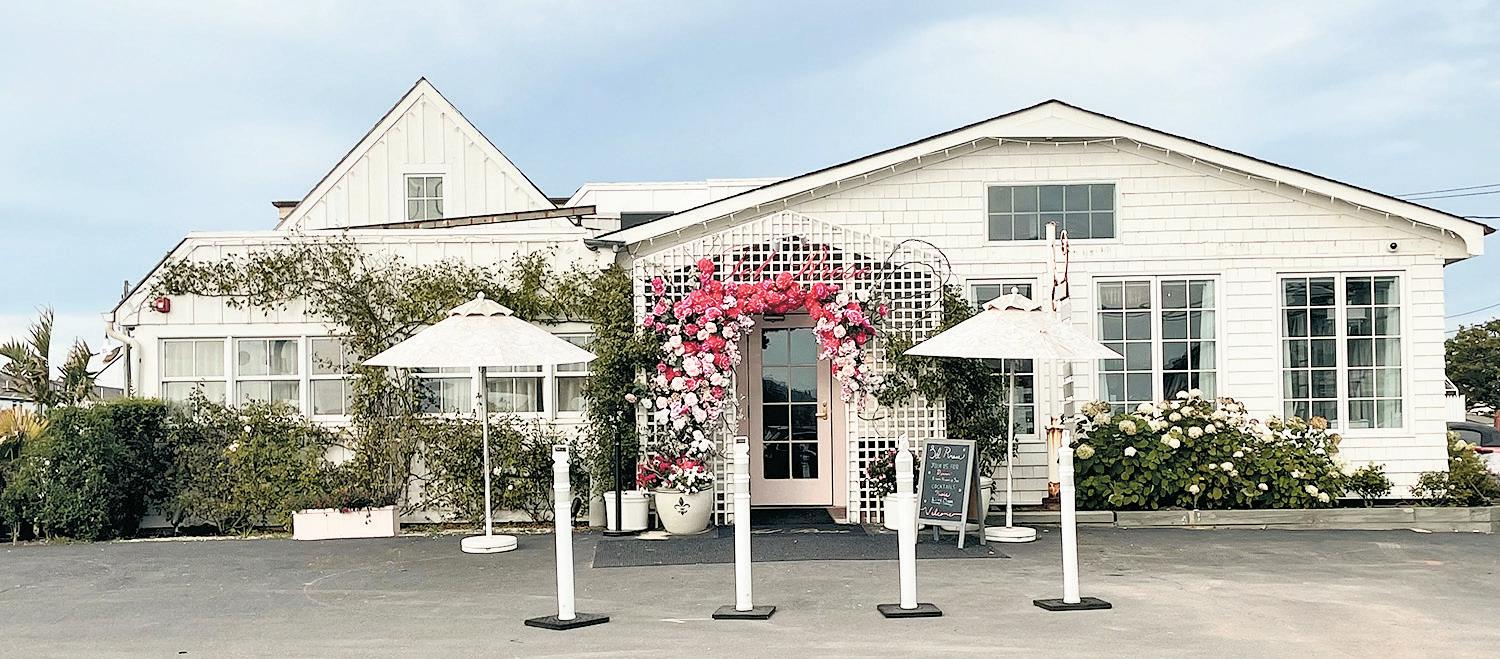
Opening in 2019, nearly in the very teeth of Covid, Montauk’s Sel Rrose restaurant hasn’t had an easy beginning. However, with good food, a sophisticated cocktail and wine list, and three years already under its belt, it looks like a winner that’s here to stay.
Located just off Montauk Highway, Sel Rrose somehow seems like it’s been here forever. The East End location is the restaurant’s second itera tion, with the owner, Kristen Vincent’s, original version on Manhattan’s Lower East Side. The decor is not easy to define, but lands somewhere between beachy Hamptons and nouveau French country. The barn-style dining room is framed in brass grid fixtures and sports a large mural by Candice Kaye Designs. In summer there is outdoor seating as well, but Continued on C5
But she found a different medium to tell her story: Singing Roma — Gypsy is largely considered a slur now — music that she heard on the streets of Romania as a child. Her show, “The Little Commie Girl: One Story, 15 Songs,” will be at The Church in Sag Harbor on Friday, Nov. 18, and Nov. 19 at 6 p.m.
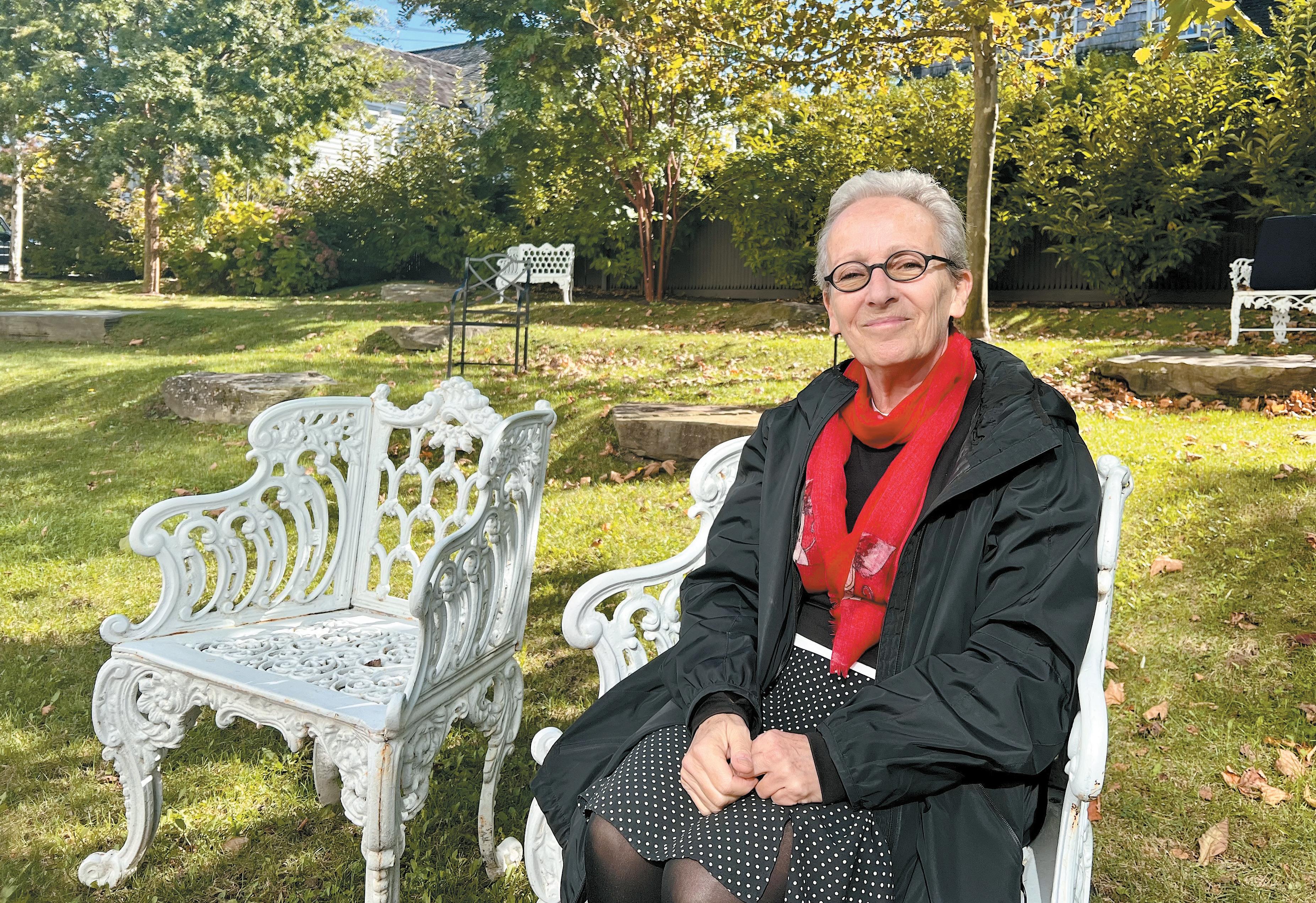
Two weeks ago, on a crisp, autumnal day, Ms. Weigl was seated in the quiet garden of The Church, having agreed to share her epically existential story. Soft-spo ken, of diminutive stature — “I think I’m 4 feet 11 inches” — with chic, closely cropped hair, she announced: “But I cannot tell you too much about my story because that’s what I’m going to be performing in the show.”
Okay then, how about just the highlights?
Her father was a “very left-wing” psychiatrist and intellectual who emigrated from Germany to Romania in the 1930s right after Hitler came into power. Unfor tunately, shortly thereafter, a fascist government took over in Romania, instituting a policy of harsh, perse cutory antisemitism. Her father was thrown in jail along with other Jews, Gypsies, and enemies of the
“In all the Communist countries, the politics and the system was racist and antisemitic. So, this was something my parents really tried to protect me from, and they went so far that they didn’t even tell me that I’m Jewish,” she continued. “But of course, it came out.”
She was about 10 when she found out about her Jewish heritage, and she was angry at the discovery because it made her different. “I didn’t want to be different than the other children. I kept asking myself, ‘What do I have that’s different? Why am I not like you?’ So that’s why I was angry. At first, I was in total denial. I said this myself: ‘My father is Jewish but my mother is not Jewish, because my mother is Roma nian,’ “ she explained.
She took to walking the streets alone, as a way to exercise and think. “But I was singing, singing, singing all the time,” she said. Near her family’s house was a police station where Gypsies were often held. “I learned all the songs because there were all the Gyp sies around me on the streets. That’s how I learned their songs. On the street.”
In 1963, age 13, she moved with her family to East Berlin, to join her father’s first cousin Helene Weigel,
“I think we were the only case in the history of Communism to move from one Communist country to another — deliberately. And Romania was actu ally selling the Jews at the time. They were getting money from relatives abroad who wanted to recon nect with their families.” A rich relative in New York had offered to pay for Ms. Weigl’s family to be transported to the United States, but her father decided to move them instead to Berlin, then a restrictive society behind the Iron Curtain, the most famous frontier of the Cold War.
By 17, her passion for Roma music had won her a gold medal at Dresden’s International Song Festival, but the next year, when Soviet tanks rolled into Czechoslovakia, she joined a subversive student group to protest the occupation. She was arrested and jailed, but her sentence was eventually reduced to forced labor in a pharmaceutical factory.
“I wanted to sing, of course, but I couldn’t perform in public, I couldn’t record or anything. But there were other musicians who were also in this situation.” She joined a rock band, which performed in underground venues for several years and even enjoyed a num ber-one hit. But in 1977, at the age of 27, she was declared an enemy of the state and expelled from the Eastern Bloc.
Landing in West Berlin, she found work as a singer at the Schiller Theater, where she collaborated with the celebrated playwright and actor Klaus Pohl, whom she ended up marrying. The couple, who have two adult daughters, moved to New York in the 1990s, after stints in London and other European cities. They live part of the year in Sag Harbor.
Opinion The Life of a Supreme
By Kurt Wenzel
ll Things Equal: The Life and Trials of Ruth Bad er Ginsburg,” written by Rupert Holmes, runs now through Nov. 27 at Bay Street Theater. It is a bo nanza for R.B.G. fans, playing as a summation of her extraor dinary career. It is, above all else, a celebration. Others, looking for more nuanced theater, may find it want ing. It is less a play than an exercise in performance as autobiography, and, at times, less autobiography than hagiography.
The play is set exclusively in Bader Ginsburg’s chambers at the Supreme Court. Though they are never seen, the jus tice is apparently speaking to a small group of young women, telling them her life story in hopes of inspiring them. And the story is indeed inspiring. Strikingly similar to last year’s single-woman play at Bay Street, “Becoming Dr. Ruth,” “All Things Equal” follows the trajectory of a pix ie-sized but highly determined Jewish woman as she battles male prejudice and antisemitism, and who triumphs through sheer moxie and intelligence.
The state of the art and of giving
Early deadlines approach for the holiday
Michelle Azar stars as Bader Ginsburg, and gives a very good performance, replicating her subject’s unique voice octave and quiet confidence. Speaking directly to the audi ence, the justice tells us that she was born in Brooklyn in 1933, a precocious and highly talented student. Her mother died before she graduated from high school, and Ruth did not deliver a valedictory speech in order to stay home and console her grieving father. It was a manifestation of moral character that would follow her her entire life.
Her mother, the play tells us, squirreled away $4,000 for Ruth’s college fund — a considerable sum at the time. She attends law school at Harvard and Columbia, graduating first in her class. This success puts the world directly at her feet, of course. . . . Um, actually, no. Bader Ginsburg cannot seem to find a job. This is the late 1950s and the big law firms — almost any law firms — are still not hiring women.
She works as a law clerk, and later as a professor at Rutgers Law School, where she is not paid the same as her male col leagues, because, she is told, “your husband has a very good job.” She moves on to the A.C.L.U., arguing six cases of female discrimination before the Supreme Court between 1973 and 1975, winning five of them.
It’s this section of Mr. Holmes’s play that becomes a bit monochromatic, as Bader Ginsburg begins a lengthy enumer ation of her many legal victories. There are some helpful audio and visual aids that try to bring life to these cases — but as happens with law, they often hang on matters of legal minutia. After a while, the play becomes simply a laundry list of success, and there is a self-satisfied air both to the text and Ms. Azar’s performance of Bader Ginsburg, who eventually refers to herself as the GOAT (greatest of all time). This, to my understanding, runs counter to the justice’s notorious humility.
Eventually we move on, watching on video as President Clinton appoints her to the Supreme Court, where she moves the needle on justice for women and other minorities, and becomes “notorious” for her fiercely argued decisions.

But we knew all this anyway, didn’t we? Never in “All Things Equal” does the playwright try to show us a multidi mensional person. A blemish or two would have colored the picture a bit. Was there no price for all this hard work and
extraordinary achievement? Was she the perfect mother? Per fect wife? Friend? Any regrets, R.B.G.?
And what of her refusal to retire? In “All Things Equal,” the justice reminds us how she endured a decade-long strug gle with cancer at the end of her career. Many of us remember how frail and weak she would seem during public appear ances, and how insistent the whispers that she retire became during President Obama’s second term.
Instead she hung on, passing away during President
A
Trump’s administration. Her seat was quickly filled by Amy Coney Barrett, which paved the way for the overturning of Roe v. Wade. Naturally the playwright completely lets Bader Ginsburg off the hook. “I swore to fight for justice till my last dying breath,” she states here as a defense, then weakly offers, “I thought Hillary would win.” better play would have raised the question how Bader Ginsburg, who dedicated her life to women’s issues, could let‘A
on C6 NOVEMBER 10, 2022 Continued on C4
Continued
C2
C5
Books Food Visual Arts Culture CARTS & LIVING
Bertolt Brecht’s widow, who was then the director of the Berliner Ensemble.
Continued on C4
With her singular interpretations of the folk and Roma songs of her childhood in Romania, Sanda Weigl has performed worldwide, including at Joe’s Pub in New York and alongside Nina Hagen in Berlin. Next week, she’ll perform at The Church in Sag Harbor. Judy D’Mello
Michelle Azar speaks to the audience directly as Ruth Bader Ginsburg in “All Things Equal” at Bay Street Theater in Sag Harbor. Courtesy of Bay Street Theater
Sel Rrose in Montauk looks like it’s been here forever and that it’s here to stay. Jane Bimson
The Art Scene

Indigenous
Voices By Mark Segal
In commemoration of Native Ameri can Heritage Month, Bay Street Theater in Sag Harbor is presenting “Views From Shinnecock,” an exhibi tion of photographs by the artist and filmmaker Jeremy Dennis, and a screening of “Amplifying Indigenous Voices,” seven short films created in response to the question, What does reciprocity mean to your community?
The films will be shown on Sunday at 5 p.m., after which a reception will be held in the theater’s lobby, where Mr. Dennis’s photographs will be on view through Dec. 31. “Views From Shinne cock” explores indigenous identity, cultural assimilation, and ancestral prac tices of the Shinnecock Indian Nation.

The film program includes “Ma’s House,” Mr. Dennis’s documentary about Ma’s House & BIPOC Art Studio, a communal space on the Shinnecock Reservation that features a residency program, an art studio, a library, and pro grams for tribe members.


Tickets for the film program are $15 and will support Ma’s House. The exhi
bition is free and will be open daily from 11 a.m. until showtime.
“STAND” and Speak “Christopher Knowles/STAND”, an exhibition of work by the American multidisciplinary artist, is at the Water mill Center through Dec. 1. The show, which covers the artist’s career from the 1970s through the present, includes drawings, typings, paintings, sculpture, and sound work.
Mr. Knowles will be at the center this evening at 6 as part of its Viewpoints conversation series. The event will fea ture a performance by the artist, followed by a discussion about his prac tice with Lauren DiGiulio, an art historian and curator whose research focuses on contemporary visual art and performance.

Mr. Knowles’s work has been exhib ited in the 2006 Whitney Biennial and at the Museum of Modern Art, the Tate Modern in London, and the Palais Gal liera in Paris, among many others.
Tickets, which can be secured online, are $25.
Vertical Geometry
“Archipelago Anthology,” a show of cityscapes and selected other work by the East Hampton artist Carl Scorza, is at the Lucore Art Gallery in Montauk through Nov. 30. A reception will happen Saturday from 4 to 7 p.m.

Mr. Scorza obtained studio space on the 92nd floor of the World Trade Cen ter’s North Tower in the early 1990s. While that afforded him a long view of the city in all directions, he subse quently worked from a studio on Governor’s Island, from which he looked up and out at looming skyscrapers.
The artist’s interest in vertical geom etry has also found expression in paintings of bottles arranged on table tops and in bars.
Contemporary Craft “Selected by Make,” the latest offer ing from Make Hauser & Wirth, a space in Southampton dedicated to contem porary crafted objects, features a blend of functional and decorative works by Derek Wilson, Jochen Holz, Sue Paraskeva, and Liam Lee.

On view through Dec. 23, the exhibi tion includes Mr. Wilson’s functional designs for domestic tableware, Mr. Holz’s molten glassware and vessels, Ms. Paraskeva’s hand-thrown porcelain tableware, and textiles by Mr. Lee.
Trees, Trees, Trees

In conjunction with the Southampton Arts Center’s current exhibition, “A Celebration of Trees,” the exhibition artist Amy Wickersham will lead a workshop on the abstraction of trees on Saturday afternoon at 3. Participants will make collages that explore the pat terns, movements, colors, and meaning of trees. The cost is $35, $30 for members.
“Trees of Africa,” a program of two readings from the work of the nature writer Peter Matthiessen, plus a selec tion of short films about Africa’s majestic trees, is set for Saturday at 6 p.m.
A guided tree walk at Bridge Gardens in Bridgehampton will happen Saturday at 2 p.m. The latter two programs are free, but registration, by calling Julia King at 631-283-3195 ext. 122, is required for the tree walk.
Political Cartoons
“Drawing the Line,” an exhibition of more than 80 ink drawings by Van Howell, is at the Lyceum Gallery on the Suffolk County Community College’s Riverhead campus through Nov. 18. Mr. Howell, an illustrator and graphic designer who lived on the East End for many years, will be on hand to speak about his work at a reception on Satur day from 2 to 4 p.m.



His political cartoons have been pub lished in The Wall Street Journal, The New York Times, and The Guardian. Before he moved to London in 2001, several dozen cartoons and film festival caricatures appeared in The Star.



The Riverhead exhibition is Mr. Howell’s first solo show since 1966.
Heilmann Honored
Mary Heilmann, who divides her time between Bridgehampton and New York City, and Brice Marden will be honored at Dia’s annual fall benefit in New York City on Monday evening at 6. The event will begin with cocktails, followed by a seated dinner. Tickets start at $2,000. More informa tion is available from Ella Strauss at 212-293-5513.


Longo in L.A.
“Sea of Change,” an exhibition of work by Robert Longo, will open tomorrow at Pace Gallery in Los Ange les with a reception from 6 to 8 p.m. and continue through Dec. 17. The show will include works on paper mounted on aluminum from 2022, a new video, and a selection of sculpture, marking the first time Mr. Longo’s sculpture has been presented in Los Angeles in more than 20 years.
It’s Grant Season for Arts Orgs
Among the arts organizations receiv ing money from recently announced New York State Council on the Arts grants were several East End institu tions. The dozen recipients account for a total of $180,000 of the $32 million allotted among more than a thousand cultural organizations in the state.
The Byrd Hoffman Watermill Foun dation and the East Hampton Historical Society each received $30,000, Bay Street Theater and Guild Hall each received $20,000, and receiving $10,000 each were the East End Arts and Humanities Council, the Hamptons Doc Fest, the Hamptons International Film Festival, the Parrish Art Museum, the Southampton Arts Center, the Southampton History Museum, the Southold Historical Society, and the Westhampton Beach Performing Arts Center.
The Council on the Arts was estab lished in 1960 by Gov. Nelson Rockefeller to advance “New York’s creative culture by convening leaders in the field and providing organizational and professional development opportu
nities and informational resources,” according to NYSCA. These grants will “increase access to vital arts funding in local communities and will provide crit ical support to organizations still in recovery.”
According to Mara Manus, the coun cil’s executive director, “Throughout the pandemic, arts organizations had to furlough staff and cancel programs, resulting in a loss of audience outreach and community support. Still facing many challenges, these organizations will benefit from the recovery support provided by the . . . grants to continue their innovation and development in the coming year.”
With the support of the governor and the State Legislature, the council will provide a record amount of funding for the 2023 fiscal year. These allocations are in addition to a previously announced $150 million in capital grant opportunities and part of $90 million in budgeted operational, partnership, and program funding. Additional grants will be announced at the end of the year.
The East Hampton Star, November 10, 2022C2
Jochen Holz’s “Pink body gastropod blue and yellow speckled arms | Amber gastropod with two speckled arms,” freeblown colored borosilicate glass, is at Make Hauser & Wirth in Southampton. Dave Watts
Carl Scorza’s painting “Hudson River View” is part of a new show at the Lucore Art Gallery in Montauk.
2023 SUBSCRIPTIONS NOW ON SALE631-725-9500 baystreet.org Don’t miss out! FALL FOR BAY STREET THIS FALL! VIEWS OF SHINNECOCK FEATURING THE WORK OF JEREMY DENNIS ON VIEW NOV. 1–DEC. 31 PHOTOGRAPHY EXHIBITION AN EVENING OF SWING! CELEBRATING THE GREAT AMERICAN SONGBOOK DECEMBER 17 @ 8 P.M. JUDY CARMICHAEL: LET’S SWING AMPLIFYING INDIGENOUS VOICES FOLLOWED BY A TALKBACK WITH JEREMY DENNIS NOVEMBER 13 @ 5 P.M. RECIPROCITY PROJECT FILMS NOVEMBER 3–27 ALL THINGS EQUAL The Life & Trials of Ruth Bader Ginsburg a play by Tony Award-Winner Rupert Holmes
The East Hampton Historical Society has won a $30,000 grant for the 2023 fiscal year from the New York State Council on the Arts. Durell Godfrey



TC3 he East Hampton Star, November 10, 2022 www.bgfa.com | info@bgfa.com | 212.813.9797 Detail: Winold Reiss, 1886-1953, Mask Over the City, ca.1925 Ink, wash and graphite on paper, 19 3⁄4 x 14 7⁄8 inches Detail: Zsolnay (Hungarian), Poppy Vase, ca. 1900 Eosin-Glazed Ceramic, 21 inches tall NOVEMBER 11-14 | PARK AVENUE ARMORY EXHIBITING D’Ascenzo • Diedrich • Dimock • Hoffman Klimt • Lachaise • Levy • Lipchitz • Löffler Lovet-Lorski • Marin • Moser • Paley • Peche Reiss • Storrs • Tiffany • Yellin • Zorach • Zsolnay
Bits and Pieces
Celebrating Ellington
The Church’s Reflections in Music concert series, which is directed by the Shelter Island composer Bruce Wolos off, will return to Sag Harbor on Saturday at 7:30 p.m. with “Reflections on Ellington,” a concert and dance party featuring Art Baron & The Duke’s Men.

The program is devoted to music by Duke Ellington, the composer, pianist, and bandleader who, with his creative partner Billy Strayhorn, created one of the most impressive bodies of work of any 20th-century composer. The first half of the evening will focus on Elling ton’s concert music and sacred music; the second half will be a dance party with sparkling drinks and sweets.
Art Baron & The Duke’s Men was formed by Mr. Baron, a trombonist who was chosen by Ellington to join his orchestra when he was only 23. The group has performed and recorded with Stevie Wonder, James Taylor, Cab Cal loway, B.B. King, and many others. Tickets are $40.
Building Knowledge
Water Mill’s Parrish Art Museum will celebrate the 10th anniversary of its Herzog & de Meuron-designed build ing with “Architecture Trivia Night,” tomorrow from 6 to 8 p.m. Hosted by Maziar Behrooz, the principal of MB Architecture in East Hampton, the eve ning will invite participants to test their knowledge of local, national, and inter national building design.
The questions will be provided by professional architects and regional his torians, including Susan Horowitz, director of preservation projects for Hamptons 20 Century Modern, and Mr. Behrooz. The event is open to teams of two to four players.
Gift baskets and prizes will be awarded to the winning teams, and snacks, beer, wine, and beverages will be on offer. Tickets for adult teams are $30 to $60 per team of two to four; $10 to $20 per team of Parrish and AIA members and students. Spectator tickets are $16, $10 for senior citizens, $5 for students, and free for members and children.
Wine and Roses
The Southampton Cultural Center’s Wine and Roses fund-raiser, originally set for Oct. 1 but postponed due to inclement weather, will be held Satur day evening from 6 to 10.

The evening will feature cocktails, dinner, wine, live entertainment, and a silent auction, which is live on the cen ter’s website. Performers are Danny Bacher, a singer, saxophonist, and song writer; Sara Moulton Faux, an opera singer; Konstantin Soukhovetski, a pia nist and composer, and the A&G Dance Company.

Eight stage-side tables for four are $1,000; 10 gallery tables for four are $700. Individual tickets, which do not include seating, are $125, $50 for young professionals and students.
“Surviving PTSD Through Art,” a multimedia exhibition of art and video by a Vietnam War veteran, John Melillo, that reflects on his experience there, is on view at the center through Nov. 20.
Screenwriters Lab






Next Year’s HamptonsFilm Screen writers Lab, which will take place April 14 through April 16, is now taking sub missions. The initiative fosters emerging talent by pairing selected fel lows with established writers and creative producers for a weekend of one-on-one mentorship.
Fellows will receive advice on their feature-length projects in a series of individual and group sessions. Other events include nightly salons, roundta ble discussions, master classes, and socializing with industry guests, board members, lab alumni, and members of the local artistic community.
A submission link to filmfreeway.com is on the HamptonsFilm website. The
early deadline is Nov. 17; subsequent deadlines are Dec. 8, Dec. 22, and Jan. 17.
A Mega Raffle


Our Fabulous Variety Show’s Mega Month Online Raffle is now live through Dec. 30 on the performance company’s website. All tickets will be entered into one pot, and winners will be picked each day in December, with a grand prize to be announced on Dec. 31.
Prizes include gift certificates to Book Hampton, the Golden Pear, T.J. Maxx, Sen in Sag Harbor, Gubbins in East Hampton, Citarella, the Westhampton Beach Performing Arts Center, White’s Apothecary, and many others.
Proceeds will help students pay for classes, and will also support competi tions, show production fees, workshops, and excursions, as well as the group’s scholarship fund.
Tickets, available on the website, are $10 for one, $25 for three, $50 for seven, and up to $1,000 for 150.
Classical Latin
Francisco Roldan, a classical guitarist who has performed internationally as a soloist and in chamber music, will pres ent a recital of music from Latin America at Southampton’s Rogers Memorial Library on Sunday at 3 p.m.
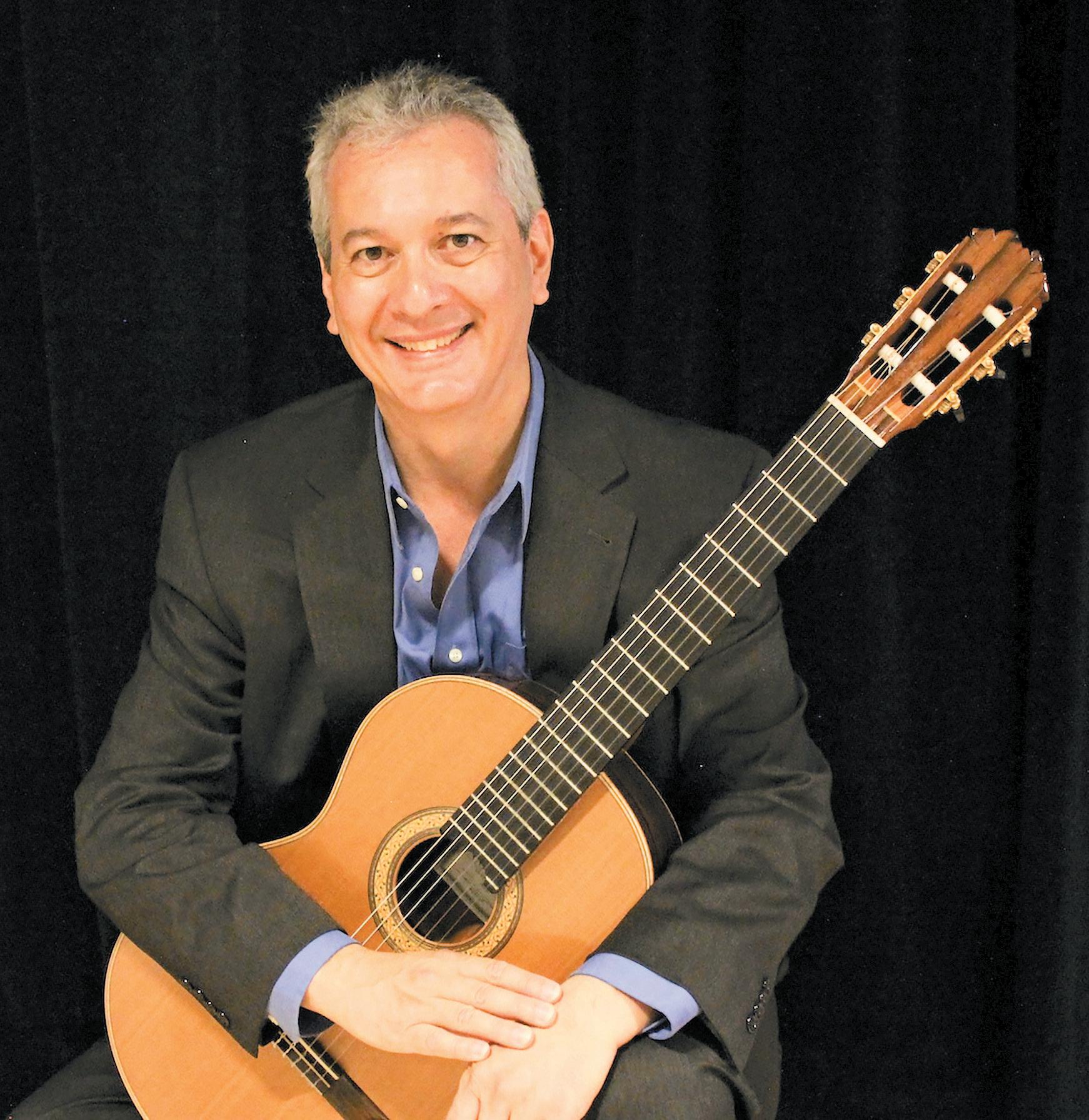
Mr. Roldan is the executive director of Musica De Camara, a not-for-profit organization based in New York City whose mission is to promote Latin American/Hispanic composers and musicians. His program will include music from Argentina, Cuba, Colombia, the Dominican Republic, Paraguay, Puerto Rico, and Venezuela.

Weigl Offers Communism, the Musical
Continued from C1
It’s a great story, but how good is her music?
Hers is a beautiful voice, rich and sweet, melodic and beguiling. Her music sounds inventive and strikingly original, with a tough edge that does justice to the sorrow in her ballads, filled with centuries-old lore of margin alization and migration.

But she’s a true cabaret artist, so there’s exuberance, too, in her Romany music. Watching her performances on YouTube, she appears to live up to her nickname — the Downtown Gypsy Queen of New York — singing with unencumbered clarity in shows across the U.S.
Over the years she has performed regularly at Joe’s Pub and the Cornelia Street Cafe in Manhattan, and at major events such as the Forum International in Monterrey, Mexico, the Ringling International Arts Festival (curated by the Baryshnikov Arts Center), the Jewish Music Festival in Krakow, Poland, and the 2009 Nobel Prize cele bration in Stockholm, Sweden, where
She has also performed alongside Nina Hagen, the German pop star, and met Angela Merkel when the former chancellor of Germany visited New York. Her work has been lauded in The New Yorker, which said it combined “tasteful restraint and occasional pugnaciousness.”
And now, Ms. Weigl comes to the East End for the first time, to perform with her longtime musical collaborator, Shoko Nagai, a pianist, accordionist, improviser, and composer.
Such a wildly nomadic woman who sings about Gypsy folklore and per forms in Romanian, English, and German. It meant there was only one big question left to be asked: Who is Sanda Weigl? Romanian? German? American?
She paused and then smiled. “I feel Romanian through my music,” she said.
The big, existential mystery remained unsolved. Perhaps it will be answered during her show next week.
‘All Things Equal’: The Life of a Supreme
Continued from C1
the future of their reproductive rights hang on a political hunch.
It must be mentioned how unflappa ble Ms. Azar is as a performer. On the night I attended, a scarf fell off her head, an earring flew off, an errant shoe blocked her sliding chair, and finally an elderly gentleman in the audience spontaneously spoke aloud to her, as if the play were a conversation.
All of this left Ms. Azar completely unfazed, and if her portrait of R.B.G.
doesn’t reach the heights of Tovah Feldshuh’s Dr. Ruth last year, it is likely because she has less to work with here. In the end, “All Things Equal” is the work of a playwright utterly besotted by his subject, and intent on raising the already legendary justice to Olympian status.
Someone could have reminded Mr. Holmes that even the gods were flawed, and it’s their failings rather than their superpowers that continue to fascinate us.
The East Hampton Star, November 10, 2022C4
she sang at the request of Herta Muller, the Romanian-born Nobel Prize winner for literature.
HAMPTONS • NEW YORK CITY • GREENWICH, CT • 631-283-6600 • CITARELLA.COM THE ULTIMATE GOURMET MARKET Thanksgiving Entertaining! SIMPLE & DELICIOUS Order complete feasts, à la carte specialties, and exceptional ingredients.
Francisco Roldan, a classical guitarist, will perform Latin American music at the Rogers Memorial Library in Southampton. Ashley Wren Collins
Open for the Holidays! Now Booking Holiday Parties! Closing for the Season December 18 541 East Lake Drive, Montauk 631-668-4272 • inletseafood.com Open Thursday-Monday Closed Tuesday-Wednesday Lunch starting 12 • Dinner from 4:30 Catering Dates Available for Parties, Weddings and Other Special Events
Sanda Weigl will bring her story through song to The Church next weekend.
News for Foodies
By Jennifer LandesHoliday Pie Plus
Guild Hall is presenting a special hol iday edition of its Stirring the Pot series at the new Sag Harbor location of Caris sa’s Bakery on Saturday.
Florence Fabricant, a New York Times food and wine writer, will inter view Carissa Waechter, the bakery and eatery’s co-founder and pastry chef, and one of her other bakers as they make a Thanksgiving pie. Those attending will be able to taste the outcome. They will also be entered into a drawing to win a pie and receive a Thanksgiving-themed gift from Citarella.
The cost is $100, or $75 for members. Tickets can be purchased on the Guild Hall website with a $7 service fee.
The bakery is also taking orders for holiday sides and desserts online via Toast for pickup at its Sag Harbor or Pantigo Road locations. Cranberry chut ney, mushroom and creamy cauliflower soups, pork sausage or vegetable stuff ing, smashed potatoes, roasted brussels sprouts, and market salad are the choices for sides. And in case you were wonder ing about its dessert, the bakery has apple pie, apple cider cheesecake pie, pumpkin and squash pie, cranberry and mixed berry meringue pie, flourless chocolate cake, and sorbets and gelatos.
Manna Mondays
On Monday, Manna at the Lobster Inn will bring back its educational pro gram Manna Mondays. Jack Farley and Tommy Clune of Sebonac Inlet Oyster Farms will discuss their Peconic Tonic Oysters. Donna Lanzetta, the chief executive officer and founder of Manna Fish Farms and the Manna Companies and Jesse Matsuoka, a partner in the restaurant, will discuss the launch of the Manna Seafood Blockchain, of which he is vice president. Complimentary appe tizers and beverages will be served during the presentation.
The program is free and starts at 6 p.m. There are happy hour specials and regular dinner service during and fol lowing the talk.
Restaurant Week Continues
There may be some real signs that the post-pandemic population explo sion in the off season has finally abated. To wit, the fall edition of Long Island Restaurant Week, which runs until Sunday, has several more participants than in recent outings. South Fork restaurants in this go-round include Cove Hollow Tavern in East Hampton, Elaia Estiatorio and Jean-Georges at Topping Rose House in Bridgehamp ton, Page at 63 Main in Sag Harbor, Calissa in Water Mill, as well as Bamboo, Manna at the Lobster Inn, Plaza Cafe, Saaz, Southampton Publick House, and Union Sushi and Steak in Southampton.
Restaurants must offer a three course dinner at any one of three price points: $27, $37, or $44, and some have opted to offer two or all three tiers (Manna, plus a two-course lunch), and most are not holding back. For example, the Plaza Cafe is offering some of its menu classics with luxury items like pro sciutto wrapped shrimp atop mushroom risotto as an appetizer and flat iron steak or horseradish-crusted cod as entrees in its $44 menu. Its lobster and shrimp shepherd’s pie is being offered in a half portion with a $20 supplement in addi tion to other options. Jean-Georges has a tuna tartare appetizer and Faroe Island salmon in its mix of offerings for $44.
Cove Hollow’s $37 menu looks cre atively interesting along with the more regular participants such as Elaia, Calissa, Manna, and Union. All menus include dessert and most are on the Long Island Restaurant Week website along with Saturday night limitations, i.e. most specials are cut off after 6:30 p.m. that evening.

Thanksgiving Day on Deadline
By Jennifer LandesThere are many options to dine in and dine out this year, but for some businesses ordering deadlines are loom ing. One new one is the Cookery, which now has a store in the old Simply Sub lime space on Springs-Fireplace Road in East Hampton. It has a number of options to make a Thanksgiving feast memorable, but orders must be placed by Monday. It will have a limited number of heritage turkeys to roast too, in various sizes, but those must be ordered today.
A sampling of the Cookery’s other offerings start with soups. They might include creamy cauliflower, leek, and potato; vegetable and bean, or spicy seafood gumbo. Appetizers are roasted fresh figs with gorgonzola, shrimp cocktail, chicken or shrimp cashew spicy dumplings, Burmese crab cakes, and vegan vegetable samosas. In addi tion to turkey gravy, traditional stuffing, mashed potatoes, and orange and cranberry sauce, there are several vegetable sides to choose from. These are caramelized sweet potatoes, brus sels sprouts with roasted garlic and leeks, spinach and chard, a field green
and micro sprout salad, and sauteed wild mushrooms with Cipollini onions. Rolls are offered herbed or gluten-free with a side of Sag Harbor hot honey butter.
Dessert options are just as bounteous, with two cheesecakes, including pump kin swirl, a brown butter sugar cake, olive oil almond cake, pumpkin sweet potato pie, cranberry raspberry tart with charred apples, pumpkin frangipane with berries, and tiramisu.
Nick and Toni’s, which will be closed on the holiday, has a Thanksgiving at home a la carte option. The East Hamp ton restaurant’s ordering deadline is Friday, Nov. 18. Starters are baby kale salad and an artisanal cheese plate. Entrees are a turkey braciola stuffed with wild mushrooms, Parmigiana-Reg giano, and herbs or a butternut squash and ricotta lasagna with spinach, moz zarella, and, tomato. Sides and add-ons are a Newlight bakery sourdough boule, roasted brussels sprouts, sweet potato puree, roasted mushrooms, sausage and leek stuffing, vegetarian stuffing, and gravy. Halsey Farm apple crostata, bour bon chocolate pecan or pumpkin pies, almond biscotti, and tartuffo make up dessert. Each menu item serves two

Carissa’s new Sag Harbor location will host Guild Hall’s Stirring the Pot get-to gether devoted to holiday pies on Saturday. The bakery will also offer a number of Thanksgiving options to preorder.
people with more servings for dessert.
All orders must be placed by 4 p.m. on Friday, Nov. 18. Pickup will be between 3 and 5 p.m. on Nov. 23.
Also due by Friday, Nov. 18, are Thanksgiving takeout orders for Town line BBQ. The Sagaponack eatery has a Southern-accented holiday menu with a smoked turkey with apple cider gravy, collard greens, cornbread, sweet potato
puree, orange cranberry sauce, corn bread stuffing, roasted brussels sprouts with shallots and bacon, and Townline’s classic mac and cheese. Dessert is a Jack Daniel’s chocolate pecan pie. Serving sizes vary. Pick up is on Nov. 23 between 1:30 and 5 p.m. Orders should be placed by phone at 631-537-BBQ1.
Look for additional holiday offerings in next week’s paper.
East End Eats: Sel Rrose Is a Winner
many won’t want to miss the handsome oval bar or sui generis interior.
There is an inventive beverage pro gram at Sel Rrose which includes a number of very good cocktails. We had a Heavyweight Daquiri, which included both regular and overproof rum, and a pamplemousse margarita, which is a fancy way of saying that grapefruit is added to the recipe. Both were wellmade and quite delicious.
Sel Rrose also sports a number of “nat ural” wines. Defining what exactly the term means is complicated, but in a nut shell it is the idea that nothing should be added or taken away during fermenta tion. We tried one by the glass, an aligoté, which arrived characteristically cloudy in the glass and fizzy on the palate. This paired well with a first-course appetizer of Pernod oysters Rockefeller. This is a dish that can get away from chefs, as they often bury the oyster in a mound of spin ach and cheese. But the chef, Shawn Hewitt, gets it just right, limiting the proportions to highlight some very good local oysters.
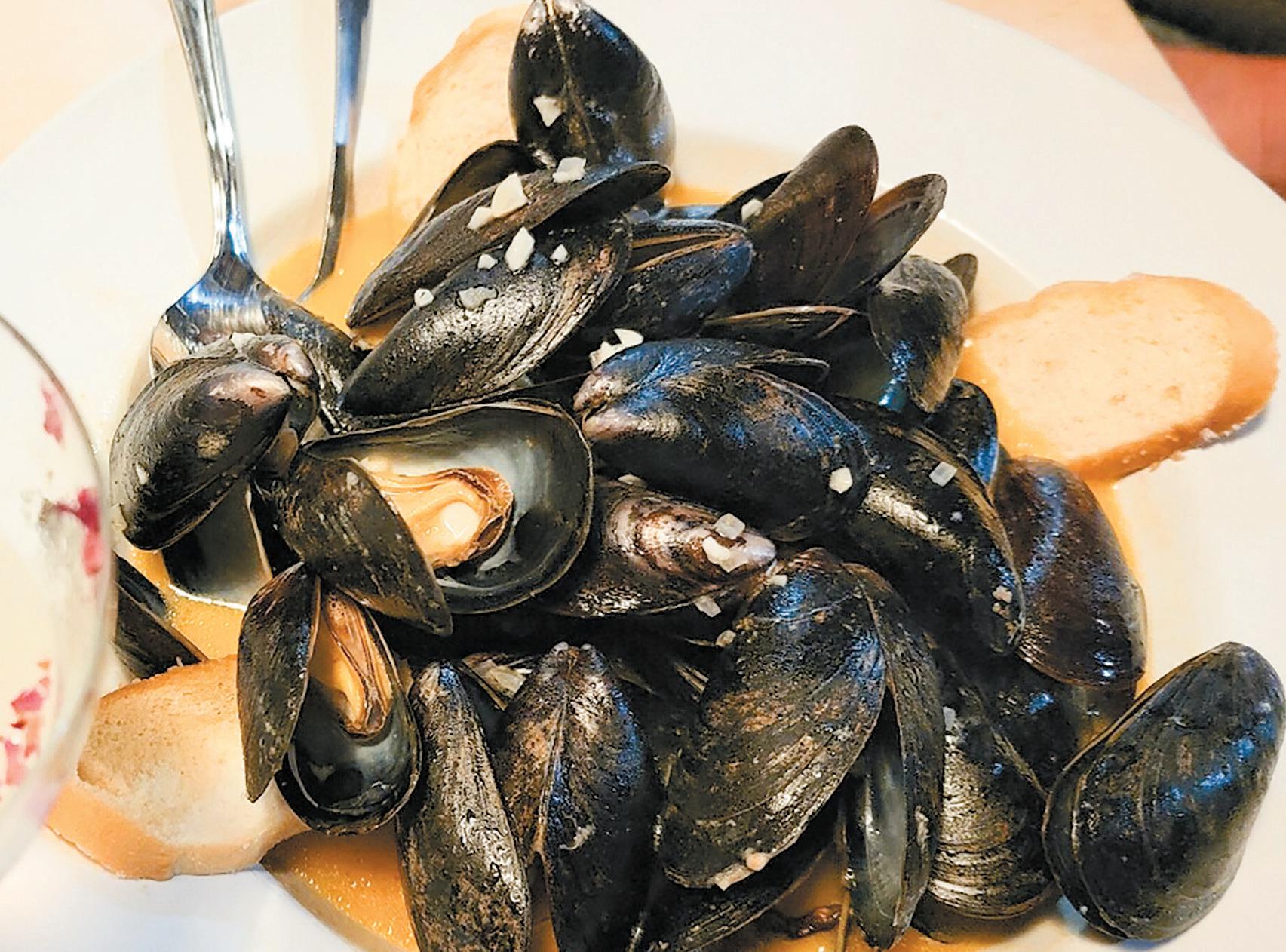
The Thai coconut curry mussels were even better, served in a thick, ultracreamy broth with lemongrass, ginger, and cilantro. The mussels are served with a spoon, which is good news since you may want to sample the broth-like a soup once the mussels are gone.
The Angry Octopus was a little small, served as a brace of three-to-four ounce segments. Furthering the disappoint ment was how good it was, the very tender meat accompanied by just the right amount of chili oil for a kick.
For entrees, the braised short ribs looked spectacular and were surrounded by some nicely crisp root vegetables, but the meat itself was a bit chewy. Grilled swordfish was better, very fresh tasting and served with a light cream sauce. The meat was cooked to a per fect medium with a nice char from the grill. (The chef, it seems, is inordinately
Checking in at 26 bucks, the Sel Rrose burger better be good, and it is. It’s a hearty size, served with cheese, bacon, and a “secret sauce” that will have you skipping the ketchup.
A side of truffle fries could have used more truffle flavor, but displayed a nice starchy texture.
For dessert we shared a very good cinnamon and ginger crème brûlée, deliciously creamy with the classic burnt sugar shell on top.
Sel Rrose can get busy, and could probably use someone at the front door, as the bartender is forced into triple duty — seating, serving drinks, and backing up the server. Still, everything holds together, and drinks, wine, and food all arrive with precise timing.
There is an extensive raw bar at Sel Rrose, and with deep pockets you can do some serious damage with massive shellfish plateaus and caviar. In fact, with so many great small plates — there were at least three more we were inter ested in trying — and an array of raw shellfish, it begs the question if Sel Rrose’s menu isn’t best explored through grazing.
Though closed Tuesdays, Sel Rrose is planning to remain open all winter. And why not, with a uniquely stylish restaurant and mostly excellent food? In a market characterized by transience, it feels here to stay.
C5The East Hampton Star, November 10, 2022
proud of his mashed potatoes, which accompanied both the swordfish and the short ribs . . . and most other entrees.)
Continued from C1
Sel Rrose’s Thai coconut curry mussels were served in a thick, ultra-creamy broth with lemongrass, ginger, and cilantro. Sid Williams Sel Rrose
4 South Elmwood Avenue Montauk 631-771-0070
Monday, Wednesday, Thursday, & Friday, 5-10 p.m. Sunday, brunch, noon-3 p.m., dinner 4-9 p.m.
No life, of course, is without its chal lenges and low moments. Ephron’s parents both became serious alcoholics, damaging her relationships with each of them. Her relationship with Delia Ephron, the sister with whom she often collaborated, was occasionally fraught, though ultimately loving and support ive. She married and divorced twice, before entering a 25-year marriage with the author, screenwriter, and producer Nicholas Pileggi that became an endur ing love affair.
know.” She was expert at mining her own life for material. “Everything is copy,” she liked to say. Perhaps the best-known example of this practice is “Heartburn,” her novel, and later the screenplay, based on her marriage to and divorce from her second husband, the journalist Carl Bernstein, but it is far from the only one.
Especially moving is Ms. Doidge’s treatment of Ephron’s final six years, when she refused to disclose a serious medical condition to all but a few inti mates, out of fear that doing so would imperil support for what she was then working on, or planning to work on, next. Her final movie was “Julie & Julia,” a 2009 comedy-drama based in part on a memoir by Julie Powell, a New Yorker who set for herself the goal of preparing, in 365 days, all 524 recipes in Julia Child’s seminal cook book “Mastering the Art of French cooking.” (Powell, portrayed in the Ephron film by Amy Adams, died on Oct. 26 at her home upstate. She was 49.)
Ephron could have been the poster child for the timeless admonition by teachers of writing to “write what you
If there is a shortcoming to the flesh ing out of Ephron’s life story, it is perhaps that there is not more descrip tion or summary of at least certain of her works. Plenty of readers may have read or seen them all, but many others have not. Since Ephron’s life and her novels and screenplays were so intertwined, more attention to the works could only have strengthened this well-researched book (which is based on Ms. Doidge’s master’s thesis at the University of Southern California).

Literary biography can be tricky. In general, we seek to read about the lives of celebrated people. That can include the authors of our favorite books or films. The catch is, however, that those authors’ lives are not always intrinsically interesting, and rarely as absorbing as the books and movies they have writ ten. (The rare exception may be Hemingway, whose life was arguably a more engaging tale than many of his novels.) Ms. Doidge’s work will no doubt be appreciated by Ephron’s friends and by aficionados of her work. Ultimately, however, no biography can do Nora Ephron better justice than her own extraordinary creative output. People will be talking about her books and movies long after they cease dis cussing her life.

I would be remiss if I neglected to mention a production issue with this book. Although the volume contains a generous quantity of candid photos from throughout Ephron’s life, the qual ity of these photos is nearly unfailingly poor. Whether that is because of the original snapshots or because they are not printed on glossy paper, as is often done, the result is a letdown. It’s diffi cult to imagine that Ephron herself, who had a keen eye and lofty standards, would not be slightly disappointed.


—

Jim Lader, who owned a weekend home in East Hampton for many years, has reviewed books for The Star since 2009.
Nora Ephron had a house in East Hampton.

STARWORDS . . . SHERIDAN SANSEGUNDO The East Hampton Star, November 10, 2022C6 Last Week’s Solution Across 1. King Kong and Donkey Kong 5. Many college profs 9. Sneaker securers 14. Wheelchair access 15. Non-clerical 16. Pale with shock 17. “Dido’s Lament,” for one 18. Cube inventor Rubik 19. Frodo’s home (with “The”) 20. The first hint 23. Tell it like it isn’t 24. Suffix for Japan or Taiwan 25. Movie promo 27. It’ll soon be here 32. Sore 33. Moody music genre 34. Rooms in una casa 36. Now 39. __ domini 41. __ one mind: disagreeing 43. Sunscreen ingredient 44. Greek letter that looks like a sideways M 46. Dance named for a horse’s gait 48. “Delicious!” 49. Monster loch 51. These are long gone 53. You’ll be needing this 56. Harry’s pal Weasley 57. Assn. 58. What that loud annoying noise meant 64. L.A. Philharmonic conductor emeritus Zubin 66. Plant fuel 67. Suffix for buck 68. Actor Sean who played Samwise in “The Lord of the Rings” 69. Nick and Nora’s pooch in “The Thin Man” movies 70. Dorky sort 71. Meddled 72. Take the lead 73. Oxbridge professors Down 1. Many a Moroccan 2. __-mutuel (type of betting) 3. Ruler of Qatar 4. Dark suit? 5. Common 1 14 17 20 27 33 39 44 53 57 64 68 71 2 28 54 3 29 49 4 24 40 65 21 34 45 58 5 15 18 41 50 6 30 46 55 66 69 72 7 31 51 59 8 25 35 60 22 32 42 56 9 16 19 36 47 10 26 43 52 67 70 73 11 23 48 61 12 37 62 13 38 63 Grid 22 6. Fabled race loser 7. Actress Merrill of “BUtterfield 8” 8. “King of Ragtime” Joplin 9. Denouement 10. Hibachi residue 11. They’re already here 12. Spooky 13. Scornful look 21. Concorde, et al. 22. Nest egg fund: abbr. 26. Breakfast restaurant chain 27. Black, Red, and Yellow 28. Upscale hotel chain 29. They call for log fires and cocoa 30. Drain nuisance 31. Rankle 35. Guitarist’s chance to shine 37. Share a border 38. Thanksgiving vegetables 40. Harbinger 42. Like top restaurants 45. Oregon Shakespeare Festival locale 47. “No __!” (“Consider it done!”) 50. Encl. to an editor 52. Far from the coast 53. Julius Caesar, for one 54. “Am not!” retort 55. Spanish snacks 59. Three-piece suit component 60. “I’m so hungry I could __ horse!” 61. Crossword cookie 62. Shabby 63. Silent okays 65. Three-piece suit go-with Winter’s Coming
Kristin Marguerite Doidge
Long Island Books: ‘Everything Is Copy’ Continued from C1
631-604-6470 199 Pantigo Rd., East Hampton smokinwolfbbq.com Indoor Seating * Carry-Out * Catering Woodsmoked Barbecue Ribs * Chicken * Brisket * Pulled Pork Salads * Seafood * Sandwiches Vegetarian Options Barbecue & More! Open 6 days Tues.-Thurs. — 11am - 8:00pm Fri. & Sat. — 11am - 8:30pm Sun. — 11am - 7:00pm Art Never Sleeps Daily updates of Gallery Listings and Virtual Events. easthamptonstar.com/arts We’re celebrating 30 Years! Join us in giving back to the local community by donating to the Springs Food Pantry! Drop off your non-perishable food items to: 512 Three Mile Harbor Road, East Hampton Monday – Friday from 9am - 5pm October 17 – November 19 wordhampton.com | 631.329.0050 | Keep up wit h what ’s happening in t he Ham ptons. Even when you ’re in Manhat t an. The Star ’s Manhat tan Home Deliver y guarantees The East Ham pton Star at your door Friday morning: Just in time to plan your weekend! Call: 631 32 4 0002 Email: subscriptions@ehstar.com Online: www.east ham ptonstar.com/subscriptions Or fill out t he coupon below and mail it to us
“Nora Ephron: A Biography” Kristin Marguerite Doidge Chicago Review Press,
$30
Protested Call Ends Whalers’ Season
By christopher GanGemi at the


Standing
of theedge
field after the Pierson Whalers just lost the Class C Long Island field hockey champion ship, 2-1, to the Carle Place Frogs on Nov. 2, Brian Tardif, Sag Harbor’s ath letic director, was shaking his head saying, “That’s a tough call to make at that part of the game.”

He was referring to a goal scored by Meredith Spolarich, a senior, which had been annulled by the referee, Maureen Allmendinger, with just over a minute to go in the game.
After playing in its end nearly the entire second half and going down 2-1 at 11:23 of the third quarter, Pierson had managed to push down into the Frogs’ zone with just minutes to play and was awarded a corner.
Maddie Cohen, one of six starting seniors for the Whalers, made a solid pass to Spolarich, who smartly shot the ball into a defender’s foot, drawing Pier son’s ninth corner play with only 1:35 remaining in the game. Miachesca Gangemi, a senior, then inserted the ball into play to Spolarich, who shot hard from the top of the circle. Gangemi swatted at the deflection, and the ball ricocheted back off the Frogs’ goalten der to Tahnie Sullivan, another senior, who drove the ball into a defender’s foot.
Thus, with less than a minute to go, Pierson had its 10th corner and its last chance to tie the game.
Gangemi and Spolarich have started on the Pierson varsity team since eighth grade. Co-captains, they were the only two players to touch the ball on the final corner play of their high school field hockey careers. “That was such a sym bolic play,” said Kim Spolarich, head coach of the Whalers. “They were cap tains on and off the field, played with their hearts, led by example, and always had unbelievable control of the game.”
Gangemi inserted the ball to Spola rich who handled the hard pass cleanly,
quickly set her shot, and unleashed a bullet before the Carle Place defender was within four feet. Her shot skipped low along the turf and hit the back of the goal with a loud thud.
The Whalers were jubilant, but their jubilation quickly turned to confusion and shock when, seconds later, All mendinger, who had taken up a position at the endline, waved off the goal.
“The ball came out of the circle but never went back in,” Allmendinger said after the game. “She shot from outside the circle.” No conference was held with the other two referees on the call.
A minute later, the game was over, leaving the Pierson team dumbfounded, angry, and emotional.
Neither co-captain was interested in speaking about the controversy. But both were reflective about their years spent as Whalers. “Field hockey has been my favorite part of high school. It has given me my fondest memories and best friends. My heart belongs to this sport and my teammates who have been with me through all these years,” said Spolarich.
Speaking of the six departing seniors, Gangemi said, “The six of us are sad to be moving on but know that Pierson field hockey isn’t defeated. We leave behind an incredibly talented group of players.”
Early on, the talk in the stands was of the weather, not the officiating. The gametime temperature was 73 degrees, with pure sun and a light wind.
Pierson took an early lead, dominat ing the first few minutes of play with multiple corner opportunities.
At the 9:30 mark, Elena Merola, a senior, drew a whistle just outside the Carle Place circle. Spolarich, with a quick start, drove into the penalty circle before getting off a low shot through traffic that possibly deflected off a Frog before beating the goaltender and hit ting the back of the goal. The Whalers were up 1-0.
The goal Pierson’s Meredith Spolarich scored on this shot was annulled by the referee, who said it was “shot from
to tell a different story.
For the rest of the first quarter, a stalemate ensued. Sullivan stood out for the Whalers. “Her speed and ability to carry the ball down the wing was an important aspect of our success all season,” Coach Spolarich said.
For the Frogs, Olivia Docyk, a senior midfielder, led the way. It was an endto-end, hard-fought, disciplined, and exciting game.
Despite her early goal, Carle Place seemed afterward to neutralize Spola rich, keeping the ball from the center of the field. When she did handle the ball, she was crowded by Frogs. Carle Place tied the game at the 11:25 mark of the
second quarter when a penalty circle scramble led to a goal by Mia Babino, a senior.
The momentum had shifted. With five minutes to go in the first half, play was largely in the Whalers’ half of the field. It remained so for the entire second half. A shot from outside the penalty circle deflected by Pierson’s goalie, Cali Wilson, a sophomore who had seven saves in the game, led to a corner for Carle Place. The Frogs con verted with a goal by Marisa Terrone, a senior, to take a 2-1 lead at the 10:05 mark of the third quarter.
The Whalers’ defensive corps was taxed, with Eva McKelvey and Lily Perello, both juniors, kept busy. Wilson came up with a couple of key saves to keep it close, but the Whalers couldn’t generate offense until the final ill-fated minutes.
Coach Spolarich and her assistant, Heidi Wilson, immediately protested the game. Photo evidence showed that the younger Spolarich had indeed scored her second goal of the contest from inside the circle.
“What everyone has been telling us is that we cannot question a judgment call, and anything within the circle is
considered a judgment call,” Coach Spolarich said.
It would be too simplistic to say that the botched call cost the Whalers the game. However, it likely would have been decided during a 7-on-7 overtime period.
“We can’t blame it all on the offi cials,” said Coach Spolarich. “If we had scored earlier, we wouldn’t have been in that position.”
Carle Place prevailed 2-0 in its matchup with the Section IX cham pion, Rondout Valley, on Sunday in the New York State Class C regional championship.
He Ran to Feed Montauk’s Needy
By Jack GravesPeter Ciaccia, who for almost two decades until his retirement in 2018 organized and directed New York Road Runner events, including the New York City Marathon that was run throughout the city’s five boroughs Sunday, had two goals in mind on the Verrazano Bridge — crossing the 26.2-mile race’s finish line, and raising as much money as he could through his Need 2 Feed gofundme effort so that the Montauk Food Pantry could continue to feed more than 200 needy families and homebound people.
“Food insecurity should not exist in this country,” the slim 69-year-old long-distance runner said as he and a dozen other volunteers were filling tablesful of bags with food at the St. Therese de Lisieux’s Parish Center’s basement last Thursday under Alice Houseknecht’s direction.
Ciaccia and his wife, Gillian — also a Montauk Food Pantry volunteer — have lived in Montauk year round since 2018.
Cashin Qualifies for State Meet
By Jack Graves Cashin,Dylan
an East Hampton High School junior who led the girls cross-country team to a league champi onship this season, qualified to compete in the coming state meet by finishing fifth in the county Class B 5K at Sunken Meadow State Park Friday.
According to her coach, Diane O’Don nell, she was in the hunt for two-thirds of the race, there being “about 10 girls hoping for a qualifying spot,” but the pack began to spread out “coming down Cardiac Hill,” with about a mile to go. Sayville, which was the winning team, and the next five individual qual ifiers, Cashin being one, are to vie in the state meet at Vernon Verona Sherrill High School near Utica this Saturday. “In 2019, our whole team went,” said O’Donnell. “There wasn’t a season in 2020, and last year Sayville won and we didn’t have anyone qualify.”

While East Hampton was fifth among five teams running in Friday’s Class B race, it had done well to get there, said O’Donnell, who added that the qualify ing “B” teams all had sub-23-minute 5K averages.
Teammates of Cashin’s who followed her over the finish line were Ryleigh O’Donnell, Zion Osei, Emma Tepan, Briana Chavez, and Riley Miles. Leah Fromm did not run because of shin splints. O’Donnell will have all of them
back next fall. Cashin, O’Donnell, Tepan, Miles, and Fromm are juniors. Osei and Chavez are sophomores.
In other postseason news, East Hampton’s girls swimming team placed seventh in the county meet Sunday, and Jane Brierley, a senior, who had some time ago qualified for the state meet in the 100-yard breaststroke, bettered her previous best time in winning the county championship in that event. A fellow senior, Cami Hatch, qualified Sunday for the state meet in the 100 backstroke.
Craig Brierley, East Hampton’s coach, is to take Brierley, Hatch, Ava Castillo, Lily Griffin, and Lizzie Daniels (as an alternate) to the state meet in Rochester later in the month.
Turning to golf, Trevor Stachecki, a senior, and Nico Horan-Puglia, a junior, were top-10 finishers in the county’s individual golf tournament, and thus are to compete in the state tourney in Elmira in June. East Hampton lost by five shots to Commack in the county’s team tournament on Nov. 2, Rich King, the team’s coach, said in an email.
East Hampton’s boys cross-country team, which was the runner-up to Westhampton Beach in league compe tition, losing out by 2 points to the Hurricanes in the last dual meet of the season here, did not qualify any runners for the state meet, but, nevertheless,
ran well, its coach, Kevin Barry, said Sunday.
Diego Rojas, a junior, was the team’s top runner, followed by Liam Knight, a freshman, Liam Fowkes, a junior, Juan Torres, a freshman, Wyatt Smith, a sophomore, Brayan Rivera, a junior, and Owen Robins, a junior. “Just about all of them ‘P.R.’d,’ ” Barry said. Mike Gil bert, one of the team’s top runners, also a junior, did not compete Friday, nor did Isaiah Robins, who had shin splints.
Rivera, who often leads East Hampton’s pack, “had a good plan, but Cardiac did him in.”
Barry added that Westhampton’s Max Haynia, who holds a Sunken Meadow course record at 16 minutes and 22 sec onds, ran more than a minute slower Friday, not having to worry about the competition. He is one of the favorites to win the state meet, Barry said.
The fact that food insecurity does exist here inspired the New York City Marathon’s former race director to put together a virtual 5K during the pan demic that raised $12,000 for the food pantry in 2020, and to recently set a food pantry fund-raising goal of $20,000 — what it takes to stay afloat each month — that as of Monday evening had totaled $40,271.

Though he hadn’t run New York in 21 years, having been too busy as the New York Road Runners Club’s presi dent of events — “a totally full-time-plus job” — Ciaccia finished, as he knew he would, though 75-degree heat and high humidity had caused him and his fellow runners to throw out their race plans in favor of surviving. “You walk and run . . . you can’t race at your normal pace, it’s better under those conditions to take it easy — it’s safer.”
While typically 10 percent of mara thon race fields required some type of medical aid (there were some 50,000 participants Sunday), “more than 5,000 were attended to yesterday by the New York Road Runners’ robust medical team,” he said.
A 9-minute-per-mile runner, Ciaccia’s pace slowed considerably as the mara
thon progressed. Asked what his time was, he said he didn’t know. “I’ll tell you what I’ve told others who’ve asked me the same question: I wanted to have a GOOD time, and I did. For me, it was an emotional experience. I was stopping to talk to volunteers and pose for photos . . . it was a lot of fun.” The main reason he had run, of course, was to raise money through his gofundme Need 2 Feed effort in the food pantry’s behalf. The support it had received had been very gratifying, he said.
When told by this writer last Thurs day that his son lived on Lafayette Avenue in Brooklyn, at the 8-mile mark, Ciaccia brightened. “It’s like the Tour de France there, like the mountain stages, with everyone so close and
cheering you on . . . it feels like that.” Some seven or eight miles farther along, he continued, “it’s steep and very, very quiet as you come onto the 59th Street bridge, and then, coming down onto First Avenue, there’s a roar that builds — it’s like entering an Olym pic stadium! You get excited and run fast, not giving any thought as to how you’ll feel at mile 20.”
Ciaccia’s goal Sunday was to “finish upright,” and he did. His “dear friend,” Meb Keflezighi, reportedly the only marathon runner to win an Olympic medal and New York and Boston (and who set a masters record at the Shelter Island 10K in 2015), was waiting for him.
NOVEMBER 10, 2022 C7 SPORTS & OUTDOORS
FIELD
HOCKEY
outside the circle.” The photograph seems
Kate Tardif
Peter Ciaccia and a dozen other volunteers filled bags for the Montauk Food Pantry last Thursday.
Durell Godfrey
Dylan Cashin will run in the state cross-country meet this Saturday near Utica. Craig Macnaughton
Late Breaking News between print editions available online 24/7/365
Searching for Scallops
By Jon M. DiatLast Thursday afternoon, four days before the official Monday sunrise opening of bay scallop season in state waters, I decided to do an exploratory trip for the highly prized and savored bivalve.
Sadly, I had low expectations. The prediction of another poor season has been widely publicized in various media channels, including by yours truly.
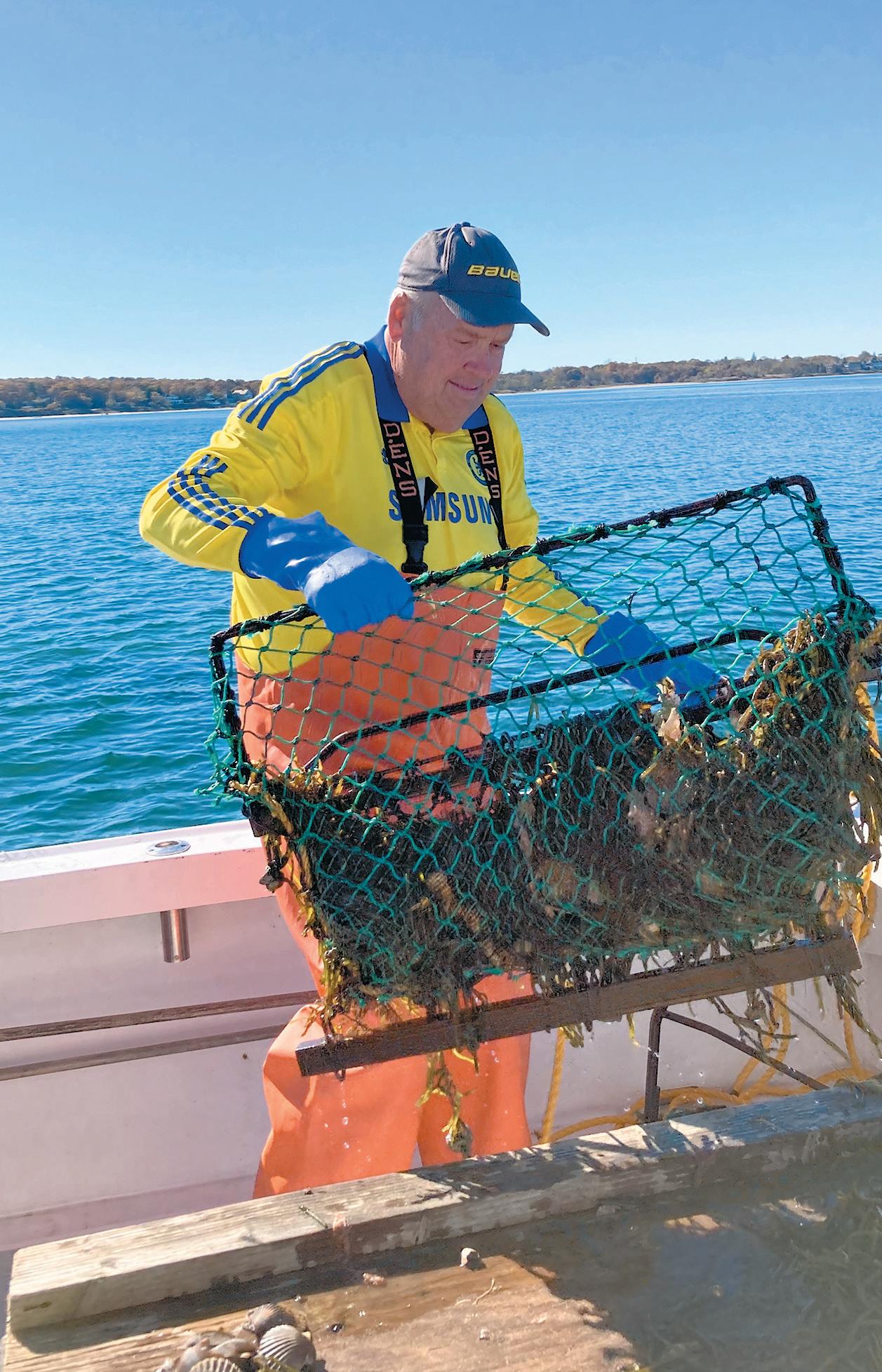
To top it off, marine scientists from the Cornell Cooperative Extension’s marine program recently confirmed that they found only 18 adult scallops in the 20 locations they monitor spanning the entire length of the Peconic Bay estuary system — from Flanders to Orient Harbor — a distance of nearly 25 miles. Yet, despite the dire news, I still wanted to drop my dredges overboard the Rock Water, my 30-foot Novi. In many ways, it was more a matter of tra dition to do at least one trip, regardless of the forecast. For the record, in nearly 50 years I have never missed the chance to go out at least once in the pursuit of scallops, and I was not about to stop this year.
I scratched out nearly a bushel of scal lops in three hours of hard work on opening day last November. It was a banner catch, considering I only caught
three measly scallops the year prior.
Heading to the northeast outside of the breakwater that protects Sag Harbor, I dropped two dredges into the crys tal-clear water not far from the sandy shoreline of Havens Beach. I had an incredible view of the hard, sandy bottom 12 feet below the waterline of my boat.
Standing along the rear starboard deck at my external helm station, I could easily see the intermittent strands of seaweed mixed with the broken shells of long-expired clams, whelks, slipper shells, and scallops. It was like taking an excursion on a glass-bottom boat in the Caribbean.
Back in the main cabin, making small talk with two friends who joined me on the excursion, we reminisced about the long-lost better days of scalloping where commercial baymen could easily retain a limit of 10 bushels of scallops a day (recreational folk are allowed one bushel).
We did about three tows in the area, each about 10 minutes in length. We plucked out a few mature scallops on each drop, along with an equal number of bugs — juvenile scallops that were spawned back in early June. It was a relatively decent sign of life.
Moving farther west on our explor atory trip, the catch improved. There were more healthy large bay scallops that we caught in our nets. Our last tow resulted in over two dozen nice-size scallops that would ultimately be returned to the water. It was a positive sign.
We mutually decided that it was worthwhile to return on Monday when the season officially opened. We all wanted to enjoy a fresh scallop dinner.
Monday morning dawned warm and breezy. The temperature was a balmy 67 degrees in the pre-dawn darkness, reminding me of when the scallop season used to commence in the middle of September. It was T-shirt weather.
Heading back to where we had found a decent population of scallops a few days earlier, we prepared to drop the dredges into the 60-degree water.
“Put them in,” I hailed from the main cabin to Robert Cugini, a dear friend from Seattle who also spends parts of the year with his wife, Mary, at their house off Brick Kiln Road in Sag Harbor. “Let’s see how it goes.” The sun had just broken over the horizon to the east.
A few minutes later, after bringing in the three dredges we were rewarded with about 35 legal-size scallops. It was a nice start.
Over the next few hours, we ended up with a hefty bushel. There were also a nice number of bugs.
Ultimately, I was glad that I stuck to tradition and went out on the bay. Good habits are hard to break.
Over at Tight Lines Tackle in Sag Harbor, the owner Ken Morse was plan ning to wade for scallops at low tide at a secret spot he is familiar with along Great Peconic Bay when his shop is closed on Wednesday.
“I hope I get a few,” he said on Sunday morning, standing behind the glass display case adorned with an array of new fishing reels. “The water is still
very warm, so I’m going to go in my shorts and sneakers.”
The bay scallop season in waters under the East Hampton Town Trust ees’ jurisdiction will open on Sunday at sunrise. Residents holding a town shell fish permit can continue to harvest them until sunset on March 31.
While I await news of his scalloping outing, Morse was wide-eyed in extolling how good the fishing has been lately. “The striped bass bite has been excellent from shore the past few days at the cut at Mecox and Georgica, but other areas along the ocean beach have been great too,” he said.
Morse also took advantage of his day off to wet a line late last week with some friends aboard the Elizabeth II out of Montauk, with Capt. Paul Bruno.
“Oh my God, I’ve never seen such great fishing,” Morse said. “We kept our limit of sea bass, and returned well over 100 bass over three pounds after we reached our limit of seven fish per person. It was literally nonstop fishing, I kid you not.”
Morse said that it was nearly impos sible to keep a baited green crab on the bottom before it was instantly inhaled by a hungry sea bass. “It was epic fish ing. And the blackfish we also caught were all large, between five and eight pounds. It was a trip I will never forget.”
Morse also observed that the waters from the Montauk Lighthouse to Shag wong Point were boiling with swarms of striped bass feeding on the surface of the water.
“It was an incredible thing to see so many stripers on the feed,” he added.
“All I can say is that I was very fortunate to have enjoyed such a great day on the water.”
Good on you, Ken. You deserved it.
—
Fishing tips, observations, and photo graphs can be sent to fish@ehstar.com.

The East Hampton Star, November 10, 2022C8
THE STAR WEEKLY SINCE 1885 Amagansett - Bridgehampton - East Hampton - Mecox - Montauk Napeague - North Haven - Northwest - Noyac - Sagaponack Sag Harbor - Springs - Wainscott - Water Mill EASTHAMPTONSTAR.COM 153 MAIN STREET, EAST HAMPTON, N.Y. 631-324-0002 2023 JANUARY 2023 SUN MON TUE WED THU FRI SAT 5 12 19 26 3 10 17 24 31 4 11 18 25 2 9 16 23 30 6 13 20 27 7 14 21 28 1 8 15 22 29 $15 each in Red, White and Blue 19" wide x 26" high Available at The Star office, 153 Main Street, East Hampton or call 631-324-0002 We Ship ANYWHERE! (Postage extra) BIG, BOLD, CLASSIC! The 2023 East Hampton Star Calendars have arrived! Supplies are limited: Once they’re gone, they’re gone! Get yours today!
The Star’s fishing columnist enjoyed a better-than-expected catch on opening day for scallop harvesting in state waters on Monday morning. Robert Cugini