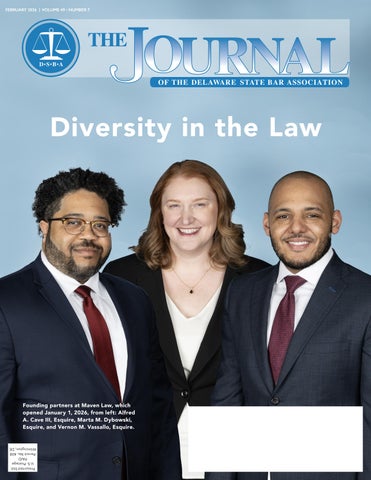

Diversity in the Law
Founding partners at Maven Law, which opened January 1, 2026, from left: Alfred A. Cave III, Esquire, Marta M. Dybowski, Esquire, and Vernon M. Vassallo, Esquire.

DSBA BAR JOURNAL
PRESIDENT
EXECUTIVE
Karl G. Randall
EDITOR-IN-CHIEF
Laina M. Herbert
EDITORIAL BOARD
Jason C. Powell
Adria B. Martinelli
Kristen S. Swift
EXECUTIVE COMMITTEE LIAISON
Ian Connor Bifferato
EDITORIAL ADVISORY COMMITTEE
Valerie A. Caras
Claire DeMatteis
Victoria R. Sweeney
Holly O. Vaughn Wagner
BAR JOURNAL ADVISOR
Richard A. Forsten
EDITOR
Danielle Bouchat-Friedman
The Bar Journal is published and distributed by the Delaware State Bar Association
704 North King Street, Suite 110 Wilmington, DE 19801
P: 302-658-5279
F: 302-658-5212 www.dsba.org
© Copyright 2026 by the Delaware State Bar Association. All Rights Reserved.
The Bar Journal is the independent journal of the Delaware State Bar Association. It is a forum for the free expression of ideas on the law, the legal profession, and the administration of justice. It may publish articles representing unpopular and controversial points of view. Publishing and editorial decisions are based on the quality of writing, the timeliness of the article, and the potential interest to readers, and all articles are subject to limitations of good taste. In every instance, the views expressed are those of the authors, and no endorsement of those views should be inferred, unless specifically identified as the policy of the Delaware State Bar Association.
The Bar Journal is published monthly with a combined July/August issue.
All correspondence regarding circulation, subscriptions, or editorial matters should be mailed to:
Editor, DSBA Bar Journal
Delaware State Bar Association
704 North King Street, Suite 110 Wilmington, DE 19801 or emailed to: dbouchatfriedman@dsba.org
Letters to the Editor should pertain to recent articles, columns, or other letters. Unsigned letters are not published. All letters are subject to editing. Send letters to the address above, Attention: Editor, Bar Journal. The Bar Journal Editorial Policy is available upon request.
7 Nominations Sought for Law Day Awards
Call for Executive Committee Nominations 22 Recap of the Dr. Martin Luther King 2026 Annual Breakfast & Statewide Day of Service 24 Are You Curious About Leading a CLE Through the DSBA? 26 Loving the Law: A Legal Look at Rom-Coms 28 All’s Fair in Love and ADR
33 Nominations Sought for First State Distinguished Service Award

PRESIDENT’S CORNER |
BY DAVID A. WHITE, ESQUIRE
Honoring Dr. King Through Service, Unity, and the Rule of Law
As President of the Delaware State Bar Association, I was honored to attend the 2026 annual Dr. Martin Luther King, Jr. Breakfast and Statewide Day of Service at the Chase Center on January 19, 2026. Each year, this gathering serves as a powerful reminder that Dr. King’s legacy is not confined to history books or commemorative speeches, but lives on through our collective commitment to justice, equality, and service to others. This year’s event was especially meaningful, bringing together community leaders, public servants, nonprofit organizations, Delaware lawyers and judges, students, and volunteers from across the state in a shared spirit of reflection and action.
The morning began with the annual breakfast program and insightful keynote comments from noted authors and commentators Leah and Richard Rothstein, who offered a moment to pause and reflect on the enduring relevance of Dr. King’s words and work, which focused on practical, actionable steps each of us can take to help reverse institutional segregation and build more equitable communities.
Dr. King challenged our nation to live up to its founding ideals, calling on each of us to confront injustice not with indifference, but with courage and compassion. Sitting among hundreds of attendees, I was struck by the diversity of the room and the sense of shared purpose that united us. The program underscored that the pursuit of justice is not the responsibility of any single profession or institution, but a collective endeavor that requires sustained engagement from all sectors of society.

For members of the legal profession, Dr. King’s legacy carries particular resonance. Lawyers everywhere are entrusted with upholding the rule of law, safeguarding constitutional rights, and advocating for those whose voices may otherwise go unheard. Dr. King understood the law as both a shield and a sword—capable of protecting fundamental freedoms, but also in need of reform when it perpetuates inequality. His work reminds us that legal expertise must be paired with moral clarity and a commitment to fairness if it is to serve the public good.
Following breakfast, the Day of Service brought Dr. King’s vision into tangible focus. Volunteers dispersed throughout the state to participate in a wide range of service projects benefiting individuals and communities. Service projects were held at the Sunday Breakfast Mission, Emmanuel Dining Room West, Blood Bank of Del-
marva, Food Bank of Delaware and the Ronald McDonald House.
In addition to the service projects, training was held at the Sussex County Courthouse on How to Draft a Will for a Small Estate, to help empower seniors by providing them with peace of mind and security for the future. An Expungement and Pardon Clinic was also set up at the Delaware State Bar Association office to offer a second chance to members of our community and help clear eligible criminal records and remove barriers to employment, housing and education. Each activity reflected Dr. King’s belief that “everybody can be great, because everybody can serve.” The energy was inspiring, as individuals of all ages and stations worked side by side, united by a shared desire to make a positive difference in the community.
Participating in the Day of Service reinforced an essential truth: service is not a one-day event, but a lifelong responsibility. For the Delaware State Bar Association, service is woven into the fabric of our mission. Through pro bono representation, community education, mentorship, and civic engagement, Delaware lawyers strive to expand access to justice and strengthen public trust in the legal system. Events like the MLK Day of Service remind us why this work matters and challenge us to renew our commitment to it throughout the year.
The legal profession has a unique role to play in advancing the ideals Dr. King championed. Access to justice remains uneven, and many individuals and families
face barriers to legal representation that can have profound consequences for their lives. As lawyers, judges, and legal professionals, we have both the privilege and the obligation to use our skills to help close those gaps. Whether through pro bono service, policy advocacy, or community outreach, we can help ensure that the promise of equal justice under law is more than an aspiration—it is a reality.
Equally important is the role of listening and learning. Dr. King emphasized the importance of understanding the lived experiences of others and recognizing the dignity inherent in every person. Events like the MLK Breakfast create space for dialogue, reflection, and connection across differences. They remind us that progress requires not only action, but empathy and humility.
As I left the Chase Center for my service project, I felt a renewed sense of purpose and optimism. The challenges we face as a society are complex, but gatherings like this affirm that there is both the will and the capacity to meet them together. The legacy of Dr. Martin Luther King,
Jr., endures not because we commemorate him once a year, but because we strive, day by day, to embody his values in our work and our lives.
On behalf of the Delaware State Bar Association, I am grateful to Leah and Richard Rothstein, our generous program sponsors, organizers, volunteers, and participants who made this year’s MLK Breakfast and Statewide Day of Service such a meaningful experience. May it inspire all of us—within the legal community and beyond—to continue building a more just, inclusive, and compassionate Delaware, worthy of Dr. King’s enduring vision.
Social Events
Sections & Committees
CLEs at Member Rates
David A. White is the 78th President of the DSBA. He is a former Superior Court Commissioner and former Managing Partner of McCarter & English, LLP. From March 2021 to November 2024, he served as Chief Disciplinary Counsel, an Arm of the Delaware Supreme Court. He is currently working as a Professional Neutral at Delaware ADR (www.delawareadr.com).

JASON C. POWELL, ESQUIRE
“What a long strange trip it’s been…”
The recent passing of Bob Weir, the co-founder of the Grateful Dead, got me thinking about a lot of their music, their past concerts that I attended, and also about the Dead’s1 longtime lawyer. The Grateful Dead can be hard to describe but they are an Americn musical band formed in California in the 1960s and were prolific tourers, in various iterations, for the 60 years that followed their formation. They made a lot of albums. They produced a lot of merchandise. They toured all over the world. They
made a lot of money and produced a ton of revenue. And behind all of that money and all of those deals were contracts. Contracts prepared by an attorney named Hal Kant, the Dead’s long-time attorney. Preparing and negotiating contracts is not necessarily what I remember about Hal Kant. Rather, I remember that he would not present, or even consider, a contract that went beyond two to four pages. How could that be?
Yes, “Peace Love and Rock n’ Roll” but the magnitude of the Dead’s prolific generation of revenue cannot be under-
stated. And their deals were not done by handshakes, or by trading t-shirts and grilled cheese sandwiches in the parking lots of their concerts but, rather, as a part of doing business.2 Business formulated into contracts—but no lengthy or wordy documents, contracts not extending beyond a few pages.
My introduction to Hal Kant came about 20 years ago when I read an interview with him published in a legal publication. Two things stuck out in that article I read. First, I was reminded that the Dead was, in fact, a business. He reorganized them into a corporate structure and “managed” the band’s intellectual property.3 Second, that the Dead’s attorney strived to keep the band’s contracts between two and four pages long. I seem to recall him saying that if a contract was in excess of four pages, it should not even be presented to him. I remain puzzled yet impressed with this general rule he abided by in guiding this very successful band.
One tour by a musical act can generate millions of dollars from a multitude of sources. Licensing deals and co-branding all permeated the Dead’s business as they continue to endure and grow in popularity. The complexity of these deals and their legal nuances must mandate a contract that is dozens of pages long. Right? Not so, apparently, for the Dead. In writing this article, I tried to locate an actual contract for the Dead—one of these famous 2-4 pagers. I was unable to do so. I also did not readily find anything much in the way of lawsuits regarding the Dead and their various business pursuits. Does that mean that these contracts, as brief as they were, worked? The lack of litigation and documented cases seems to indicate as
such, but I suppose anything is possible.
Brevity can work, just ask our judges. Any CLE I have ever attended that has any member of the judiciary as a panelist evokes comments on brevity. As judicial officers, reading persuasive filings seemingly daily, they would also be the arbiters as to legal writings. Heavy caseloads and time constraints beg for brevity. Chief Justice Roberts once stated that he had never put down a brief and then said, “I wished it had been longer.”
There are many things I suppose that you could learn from the Grateful Dead and it may be ironic that brevity is one of them. The irony rests in the fact that the band, during their live performances, could take a 3-4 minute song and stretch it into a “jam” in excess of 30 minutes, or even longer. But this was the band, playing its art form without the active advice of its counsel during performances. Behind the scenes, while the band was playing shows that lasted for hours, Hal Kant, Esquire, was whittling down contracts and moving away from boiler plate provisions as he represented the Dead for over three decades. Hal Kant died in 2008. The Dead continued to tour for decades beyond his death in various forms. Who knows what will happen with the business side of the Dead now that Bob Weir has recently passed, but the long strange trip will most likely continue and it remains to be seen how lengthy the underlying contracts will be.
Notes:
1. The Grateful Dead is colloquially known to its fans as the “Dead”.
2. The Dead’s tours were famous for creating a whole community and culture proliferated by “Dead Heads” who would also engage in a sort of economic community by trading and bartering goods like homemade t-shirts and food to support their expenses while traveling with the Dead’s tours.
3. As part of this management, the widescale bootlegging and reproduction (and trading) of the Dead’s concerts was essentially allowed, if not encouraged.
NOMINATIONS SOUGHT FOR LAW DAY AWARDS
The Delaware State Bar Association and the Awards Committee are seeking nominations for the Liberty Bell Award, the Community Service Award, and the Myrna L. Rubenstein Professional Support Recognition Award to be presented at the 2026 Law Day Luncheon in May 2026. Below are the criteria for these awards.
LIBERTY BELL AWARD
The Liberty Bell Award is given annually to an individual, who is not a judge or lawyer, who has rendered outstanding service to his or her community. The award is designed to promote a better understanding of government, a greater respect for the rule of law or a deeper sense of individual responsibility which contribute to the effective functioning of our governmental institutions.
COMMUNITY SERVICE AWARD
The Community Service Award recognizes annually a member of the judiciary or the Delaware Bar who has rendered meaningful service to the community and who has contributed significant time and effort to the greater Delaware community. Nominees should have demonstrated a commitment to leadership and service in activities that enrich and strengthen our community over a substantial period of time.
MYRNA L. RUBENSTEIN PROFESSIONAL SUPPORT RECOGNITION AWARD
This Award recognizes long and dedicated service to the Bench and Bar of the State of Delaware, to the Bar Association, and to the Members thereof, which has contributed in a significant way to them and to the high ideals of the legal profession.
Bar Journal Editor Jason C. Powell is the managing member of the Powell Firm, LLC. He can be reached at jpowell@delawarefirm.com . All opinions expressed are solely his own.
Nominations should be submitted to Karl Randall, Executive Director, DSBA at krandall@dsba.org. The deadline for nominations is February 27, 2026. Please include: The name, firm, and title/occupation of the Candidate; name and contact information (firm, address, email, phone, and fax) of the individual nominating the Candidate; and a brief statement of the reasons the Candidate is deserving of the Award.
Women Who Rule CLE
This engaging seminar caps off Women’s History Month and features conversations and unique insight from some of the women who have courageously shattered the glass ceiling and forever changed the legal landscape in the state of Delaware. 1 p.m. 31 March


Vice President-at-Large
Vice President, New Castle County
Vice President, Kent County
Vice President, Sussex County
Vice President, Solo & Small Firms,
Vice President, Solo & Small Firms,
Vice President, Solo & Small Firms,
Frederick H. Mitsdarfer III
The Honorable Eric M. Davis
Tayler D. Bolton
Commissioner Emily A. Ferrell
Robert Kleiner
Brenda R. Mayrack
Zachary S. Stirparo
Anthony V. Panicola
Members-at-Large, elected
Claire M. DeMatteis
Arthur Dent
Richard A. Forsten
Roger D. Landon
Wali W. Rushdan, II
Members-at-Large, appointed
Karl G. Randall
Executive Director
CALENDAR OF EVENTS / CLE s
February 2026
Wednesday, February 11, 2026 • 9 a.m. - 12:20 p.m.
Social & Speed Networking Meetup sponsored by the Small Firms and Solo Practitioners Section
For tickets, visit www.eventbrite.com/e/1980011110532?aff=oddtdtcreator
Wednesday, February 11, 2026 • 5:30 p.m.
Delaware’s New Statutes for Life & Death Planning DSBA Office
Thursday, February 19, 2026 • 9 a.m. - Noon CCLD CLE DSBA Office
Thursday, February 26-28, 2026 • Save the Date Women & The Law Retreat Hyatt Dewey Beach
March 2026
Tuesday, March 10, 2026 • Noon - 1:30 p.m. Navigating Custody Proceedings Impacted by Domestic Violence DSBA Office
Thursday, March 19, 2026 • Save the Date Real Estate and Fraud Delaware Tech, Georgetown campus
Dates, times, and locations of events and CLEs may occasionally change. Please consult the DSBA website for the most up-to-date information at dsba.org.
DSBA STAFF HOLIDAY
OUTING
On Tuesday, December 23, DSBA staff members took a half day and headed out for some fun. The team walked to Wilma’s on Market Street and enjoyed an afternoon of duckpin bowling paired with tasty food and drinks. Cheers to another busy and successful year!

OF NOTE
Condolences to the family of Gary Carl Linarducci, Esquire, who passed away on December 27, 2025.
Condolences to the family of Rory Colton Godowsky, Esquire, who passed away on December 28, 2025.
Condolences to the family of Matt Lunch, Esq., whose wife, Nancy Bartoshesky Lynch, passed away on December 31, 2025.
Condolences to the family of Gerald I.H. Street, Esquire, whose wife, Diane Street , passed away on January 9, 2026.
Condolences to the family of David Jay Haley, Esquire , who passed away on January 12, 2026. The family has requested that any donations in his honor be made to DVLS.
If you have an item you would like to submit for the Of Note section, please contact Danielle BouchatFriedman at dbouchatfriedman@dsba.org.


Pictured at right, from left to right: Deidre Sadler-Crew, Karl Randall, Aqueelah Harris, Danielle Bouchat-Friedman, Alison McLaughlin, and LaTonya Tucker.
Technology Tips From the Young Lawyers Section
The executive board of the DSBA Young Lawyers Section is happy to share each of their tried and true (and perhaps hard-earned) technology tips. We hope that these help you in your practice as well!
Tips:
■ When working with cloud-based document management systems (e.g., OneDrive, Google Drive, or iManage), regularly confirm that your documents are backed up and version-controlled. This ensures that no work product is lost during sync errors or connectivity issues.
■ Utilize secure password managers to organize and protect your credentials across multiple platforms. Strong and unique passwords, paired with multi-factor authentication, are essential for maintaining client confidentiality.
■ Take advantage of keyboard shortcuts and automation tools (such as Outlook Rules or Microsoft Power Automate) to streamline repetitive administrative tasks. Even small efficiencies can add up over time and improve productivity.
■ Keep software—including antivirus protection and operating systems—up to date. These updates often include security patches that protect against emerging cyber threats.
■ Consider creating subfolders in your Outlook inbox to organize emails by case, client, or organization, making important messages easier to locate when needed.
■ Finally, remember that technology evolves faster than regulations. Periodically review firm policies, ethical opinions, and bar guidance regarding technology use to ensure compliance and responsible practice management.

Tayler D. Bolton
Tayler is a corporate governance litigator at Bernstein Litowitz Berger & Grossman LLP. Her practice is primarily focused in the Delaware Court of Chancery, and she has continuously been recognized by Super Lawyers as a rising star since 2023. Tayler resides in Pike Creek and enjoys travelling and spending time at home with Jayden and Noam, her mini schnauzer and her Siberian cat.
Tips:
■ Ever close a browser tab and immediately realize you still needed it? You can use Ctrl+Shift+T (or Cmd+Shift+T on Mac) to reopen a closed tab.
■ Outlook search supports connectors like “AND” and “OR,” but only if you put them in all caps.

Robby Erickson
Robby Erikson is an associate in Block & Leviton LLP’s shareholder litigation practice and Treasurer for the DSBA Young Lawyers Section. Robby clerked for Chancellor Kathaleen St. J. McCormick of the Delaware Court of Chancery from 2022 to 2023. Robby grew up in the Midwest and now lives in the Philadelphia area with his wife and their three-legged cat, one-eyed-cat, and pug.
Tip:
■ When using Artificial Intelligence (AI), keep in mind that it, by design, responds to your prompts with a tone exhibiting a high degree of confidence so as to gain your trust. Always double check the answers.

Keegan J. Hicks
In addition to being a Co-Vice-Chair for New Castle County of the Young Lawyers Section of the DSBA, Keegan spends his workdays advising on transactional matters as an associate in the Corporate Advisory group at Richards, Layton & Finger. Keegan is originally from Salt Lake City, Utah, and now resides in North Wilmington with his wife and two boys.
Tips:
■ AI summarization tools can assist in quickly understanding lengthy documents. However, these summaries should be reviewed against the original text to ensure accuracy.
■ As AI tools rapidly evolve, lawyers should keep up to date on the ethical guidance and court rules defining their use in practice.

Michael H. Walter
Michael is a corporate litigation associate at Bayard, P.A. and serves on the executive board of the DSBA Young Lawyers Section. A resident of Philadelphia, he enjoys discovering new restaurants and exploring the city’s museums.

Let’s Talk About Keeping the Peace in Your Relationships This Valentine’s Day

Valentine’s Day is upon us and while the cards and dinners are sweet, the stuff that really makes love last is peace. Not the fake “never fight” kind, but the real deal—where you and your partner (or your coworkers) can disagree, breathe through it, and still feel safe and connected. Peace turns relationships into a soft place to land instead of a battlefield. Let’s chat mostly about romance because that's where the heart stuff hits hardest, but I’ll include some work parallels as well. In romantic relationships, peace is everything. It lets you be vulnerable, laugh freely, support each other’s dreams, and just enjoy being together without constant tension wearing you down. When fights or frustrations dominate, stress builds,
anxiety creeps in, and even your physical health takes a hit. But peaceful bonds? They protect you. Strong, supportive relationships lower depression risk, ease stress hormones, boost immunity, and even add years to your life. One big analysis of hundreds of thousands of people found that people with solid social ties (romantic included) had about a 50% better shot at survival—comparable to quitting smoking.¹
The Gottman Institute's decades of research on thousands of couples established why some thrive while others struggle. About 69% of problems are “perpetual”— ongoing differences in personality, values, habits, or dreams that don't vanish no matter what. Happy couples don’t “fix” them all; they manage them with softness,
curiosity, and understanding instead of criticism or gridlock. They keep negativity from spiraling and focus on repair.²
So how do you actually build and hold onto that peace with your partner? Here are some real, everyday strategies that make a difference:
Talk like you’re on the same team and skip the blame game. Use “I feel” statements to share honestly without pointing fingers—like “I feel overwhelmed when plans change last minute” instead of “You’re always so unreliable.” Set up check-ins (maybe weekly over coffee or a walk, no phones) to air things early: “How are we feeling about us?” It catches sparks before they become fires.
Listen deeply and show you get it.
When your partner talks, put everything down and really hear them. Reflect back what you hear: “It sounds like you're frustrated because the day was chaotic and you needed more support.” That validation alone can melt defensiveness and make them feel truly seen and cared for.
Let go of needing to “win” or change them.
For those perpetual issues (one’s neat freak, the other's laid-back; different sleep schedules, money views), accept it’s part of who you are. Drop rigid “shoulds,” lean into compromise, humor, and shared values like kindness or respect. Understanding their underlying dream or need often softens things way more than arguing facts.
Sprinkle in daily positives.
This is a big deal. Relationships thrive when positive moments greatly outnumber the tough ones. Gottman found happy couples have about five positive interactions (a sweet text, hug when you walk in, genuine “thank you,” laugh, compliment, affectionate touch) for every one negative during conflict and even higher outside of fights. Those little boosts build a buffer, so when tension rises, the relationship rebounds faster.³
Repair quickly when things go off track.
Disagreements happen, but masters of relationships fix them fast. A gentle “I’m sorry I snapped,” a soft touch, “Can we try that again?” or even a silly joke can de-escalate. What matters most is trying to repair things early, before negativity has a chance to build.
Protect your own inner calm first.
If you’re stressed, tired, or triggered, pause before reacting. Take deep breaths, step away for a minute, do a quick selfsoothe (walk, journal, whatever grounds you). When you manage your own emotions, you don’t dump them on your partner, and interactions stay steadier.
When you manage your own emotions, you don’t dump them on your partner, and interactions stay steadier.
Change doesn’t happen overnight, but steady practice pays off—couples who use these tools consistently feel less distressed and more connected.
Now, flip to work—peace there might not sound romantic, but it makes a huge difference in your day-to-day happiness and energy. A harmonious team means less drama, more collaboration, and actually getting stuff done without burning out. Studies show that positive workplace relationships boost job satisfaction, cut stress, and even tie into better health outcomes—like lower risks of depression or heart issues. When colleagues feel respected, productivity climbs because people share ideas freely, help each other, and stick around longer instead of jumping ship.
Here are some simple ways to bring more peace to your workday.
Communicate clearly and kindly—listen without jumping in, address mix-ups one-on-one and soon so they don’t fester.
Respect people’s space and roles; don’t hover or push your way into everything. When conflicts pop up, aim for win-win: ask questions to get their side (“What would help here?”), compromise where it makes sense, and stay curious instead of assuming bad intent.
Sprinkle in appreciation.
Say “thanks” for the little things, shout out good work in meetings, or just be friendly in the morning. It builds goodwill fast. And keep your own cool: if something frustrates you, pause, breathe, maybe step away for a minute. Responding thoughtfully beats snapping every time.
Look, friend, peace in both romance and work takes effort—it’s not passive. But it’s worth it. You end up with deeper connections, way less stress, and more room for joy. This Valentine’s Day, maybe skip the over-the-top pressure and just focus on
being kind, listening better, and choosing understanding. Start small today: send a sweet text appreciating your partner, or thank a coworker for something they did. Watch how it ripples.
You’ve got this. Love rooted in peace lasts.
Notes:
1. Holt-Lunstad, J., Smith, T. B., & Layton, J. B. (2010). Social relationships and mortality risk.
2. Gottman, J. M., & Silver, N. (1999). The Seven Principles for Making Marriage Work.
3. Gottman Institute. The Magic Relationship Ratio.
Jim Deel serves as the Executive Director of the Delaware Lawyers Assistance Program (DE-LAP), where he leads efforts to address the growing mental health and substance use crisis within the legal profession. Through confidential support, advocacy, and access to treatment, Jim works to reduce stigma and offer meaningful pathways to recovery for attorneys and judges facing mental health challenges, addiction, grief, and burnout.
With over two decades of experience spanning the criminal justice, behavioral health, and public safety systems, Jim brings a trauma-informed, multi-disciplinary approach to DE-LAP services. A U.S. Marine Corps veteran and former Department of Corrections employee, Jim has spent his career bridging gaps between legal, law enforcement, and clinical communities. He served on multiple advisory boards, including Wilmington University’s Human Trafficking and Behavioral Science departments, and continues to provide education and training on disaster mental health, de-escalation, and crisis intervention across Delaware.
Through his leadership at DE-LAP, Jim remains a steadfast advocate for healthier, more resilient legal professionals and systems.
You can contact Jim at (302) 610-8234.
ODC Update: 2025 Year in Review
BY JESSICA L. TYLER, ESQUIRE
Ihope everyone enjoyed a relaxing and wonderful holiday season, and that your new year is off to a great start. In this annual column from the Office of Disciplinary Counsel (“ODC”), I provide a statistical snapshot of ODC’s work in the prior year.
First, to the newest members of the Delaware Bar: I echo the congratulations and encouraging comments of my predecessor and your current DSBA President, David White, in last issue’s President’s Corner article. I had an opportunity to introduce our Office to you all in December. I shared that ODC is an approachable resource and Arm of the Delaware Supreme Court, here to help you succeed through educational CLEs and the Ethics Hotline. In his article, Dave shared: “Upholding the Delaware Lawyers’ Rules of Professional Conduct is not simply about compliance, it is about cultivating a professional identity rooted in honesty, fairness, and public service.” I agree and ODC is eager to help you navigate the Rules and to fulfill its role to protect the public, the integrity of the Delaware legal profession, and the administration of justice. I am excited for the opportunities that await you. The Delaware Bar is full of resources and people willing to share their time and wisdom with you. Reach out when you need help or advice.
Here is ODC’s 2025 snapshot:
Ethics Hotline 2025: Another big year!
Each resolved Ethics Hotline matter is potentially one less disciplinary complaint filed. The Ethics Hotline provides informal, non-binding guidance to lawyers (not legal advice) regarding compliance with the Delaware Lawyers’ Rules of Professional Conduct. Calls or emails to the Ethics Hotline should relate to a lawyer’s contemplated, prospective conduct. Ethics Hotline calls and emails are not viewed as requests for legal advice and the guidance provided does not establish an attorney-client relationship. All guidance given by ODC is confidential, but the lawyer seeking guidance from ODC through the Ethics Hotline may waive confidentiality in any subsequent disciplinary proceeding related
to the conduct on which the guidance was provided and on which the lawyer is named as a respondent in a subsequent disciplinary proceeding.
Here are the numbers: 146 in 2025, 171 in 2024, 136 in 2023, and 98 in 2022.
To reach the Ethics Hotline, please call ODC at (302) 6513931 or email ARMS_ODC_EHOTLINE@delaware.gov.
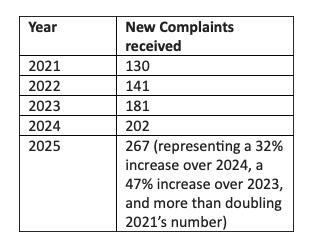
New Filings of Disciplinary Complaints: A New Record
After a jurisdictional screening, ODC initially evaluates a complaint pursuant to Rule 9(a) of the Delaware Lawyers’ Rules of Disciplinary Procedure to determine if there is a reasonable inference of misconduct. While the number of incoming complaints has significantly increased, there has been no proportionate increase in professional misconduct. Most complaints are dismissed at either the evaluation or the investigation stage because the information is insufficient to raise a reasonable inference of misconduct.
ODC is eager to help you navigate the Rules and to fulfill its role to protect the public, the integrity of the Delaware legal profession, and the administration of justice.
Continuing Legal Education & Speaking Engagements: In 2025, my colleagues and I spoke at 15 seminars, including presentations in traditional CLE settings, at Inn of Court meetings, and for the new Delaware Bar admittees.
Disciplinary Matter Dispositions: In 2025, ODC disposed of 208 pending disciplinary matters.
Public Discipline: In 2025, one non-Delaware lawyer was disbarred and one Delaware lawyer was placed on interim suspension.
Private Discipline:
In 2025, one Delaware lawyer received a Public Admonition with Conditions.
Disability Inactive:
In 2025, one Delaware lawyer was placed on Disability Inactive status.
Resignation:
In 2025, one Delaware lawyer resigned as a member of the Delaware Bar.
Unauthorized Practice of Law Referrals: In 2024, ODC received 10 UPL referrals.
Rule 1.15A(d) Overdraft Notices: In 2025, ODC received 35 Overdraft Notifications from financial institutions.
Best wishes to all for a happy and healthy 2026. We are here if you need us!
Jessica Tyler is currently Chief Disciplinary Counsel for the Supreme Court of the State of Delaware. Ms. Tyler started with ODC as a Deputy Disciplinary Counsel in 2022. She came to the Court from her position as Shareholder with the law firm of Marshall Dennehey Warner Coleman & Goggin, where she practiced civil litigation defense in the firm’s Wilmington office. Before entering private practice, Ms. Tyler served as a law clerk to Judge Mark D. Buckworth and Judge Jay H. Conner (ret.) in Delaware Family Court. She can be reached at jessica.tyler@delaware.gov.


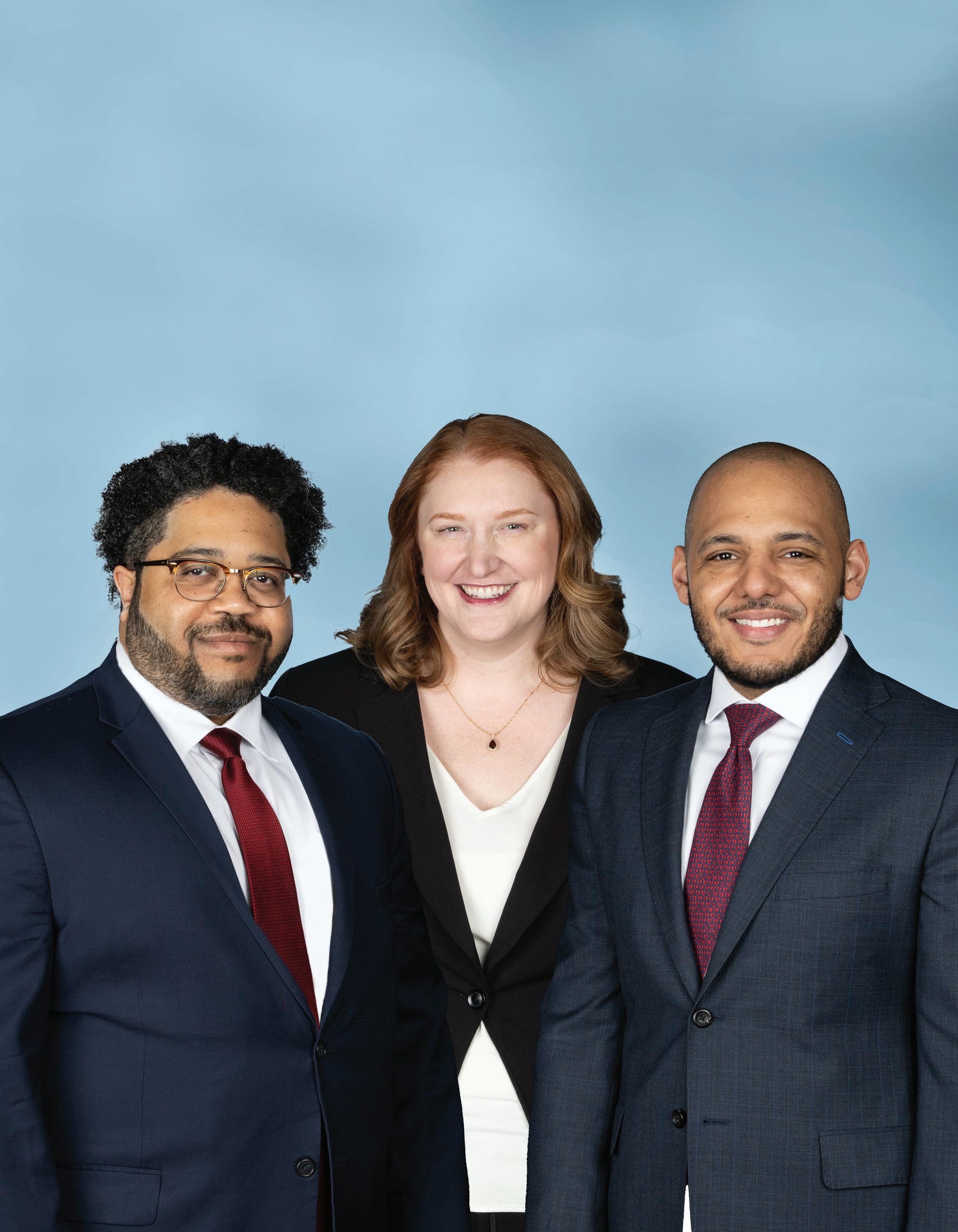
Making History, & Making Maven
Q&A with the founding partners at Maven Law, which opened January 1, 2026, from left: Alfred A. Cave III, Esquire, Marta M. Dybowski, Esquire, and Vernon M. Vassallo, Esquire.
CURATED BY DANIELLE BOUCHAT-FRIEDMAN PHOTOGRAPHY BY DICK DUBROFF/ FINALFOCUSPHOTOGRAPHY
QTalk about where you went to law school and where you’ve practiced.
AVernon: I’m Delaware through and through. I grew up here, went to school here, and built my professional life here. I went to Delaware Law School, sat for the Delaware Bar, interned at the Delaware Superior Court, clerked in the Delaware Family Court, and have practiced exclusively here. Alfred: I went to Delaware Law School, which gave me a great foundation and connected me to the local legal community. After graduating, I clerked at the Court of Common Pleas for Chief Judge Smalls, which was an invaluable experience that taught me how courts operate and helped me develop a deeper appreciation for the judicial process. From there, I worked at a workers’ compensation firm, Delaware Volunteer Legal Services, and practiced at two different family law firms before deciding to start my own. Each of these experiences taught me something different, but they all reinforced why I do this work. Marta: I loved law school so much, I went three times. I earned my Juris Doctor from New York Law School in New York, New York. After law school, I worked at JP Morgan for the Private Bank servicing the DC and Philadelphia markets. While working at JP Morgan, I attended Widener University—Delaware Law School where I earned an LL.M. with a concentration in Corporate Law. In 2017, I entered private practice, working at a boutique firm in Wilmington that specialized in Estate Planning and Estate Administration. In 2023, I earned an Estate Planning certification from the Graduate Tax Institute at Villanova University—Charles Widger School of Law.
QIntroduce us to your firm. What type of law does your firm practice, where is it located, and when did it open?
AVernon: I’m one of the founding partners at Maven Law, along with my partners Marta M. Dybowski and Alfred A. Cave, and we officially launched on January 1, 2026. We’re a boutique firm focused on family law, estate planning and administration, asset protection, Chancery Court litigation, and mediation. We’re located in Hockessin, at 726 Yorklyn Road.
QDid you always envision yourself starting/leading a law firm?
AVernon: It was always a part of my life plan. If you ask my friends, they will probably tell you that I was talking about this back in law school. I always said I wanted to start a firm with a group of friends one day. Although I never had a timeline in mind, now felt like the right time. Making the move seemed like the next logical step and path forward in my career. Alfred: Honestly, no. When I started out, I was focused on learning the practice of law and becoming the best advocate for my clients. Starting my own firm wasn’t something I had mapped out from day one. But as I gained experience and developed my own approach to practicing the law, I realized I wanted the freedom to build a firm that reflected my values. I was fortunate enough to find friends who shared similar values, and the idea of Maven Law grew organically from that desire. Marta: I always envisioned myself owning and running a law firm. Two and a half years ago, I jumped at the opportunity to open the Marta Firm, LLC. I was a true solo practitioner, as I opened with one assistant and a dream. I added an associate, Laura Giardina, Esquire in September 2025. When the opportunity arose to add partners, I took a leap of faith.
QWhat was the impetus for opening your own practice?
AVernon: Honestly, you sit around with your friends, eating tacos and drinking margaritas, joking about the idea long enough until someone says, “yeah, let’s do it” and you think yourself, yeah, why not? What’s stopping me from taking the same leap that the greats before us took. I was also getting to a point in my career where I wanted more control over the day-to-day decision making and overall direction of the firm. Alfred: Maven Law came from wanting to practice on my own terms and build something that reflected my vision for the legal profession. I started the firm with friends, which made the leap feel less daunting and more exciting. We share a common vision for how we want to practice law. Starting our own firm gave us the opportunity to establish those values from the ground up rather than fitting into someone else’s structure. Sometimes you need to take control of your career trajectory. This felt like the natural next step after years of learning from others. Marta: I wanted the autonomy to serve clients with greater flexibility, efficiency, and personal attention. Opening my own practice allowed me to align my work more closely with my values while delivering high-quality, client-focused legal services.
Q What makes your firm different/ stand out?
AVernon: What makes our firm stand out is not any single feature, but the purpose behind how it was built and what it stands for. From our name to our firm culture, Maven Law reflects a modern approach to practicing law grounded in collaboration, shared responsibility, and respect for every role within the firm. No one works for anyone here. We work together, learn from one another, and hold ourselves collectively accountable to our clients and our community.
Our name was chosen with intention. We wanted to move away from the traditional convention of naming a firm after its partners and instead adopt something that represents a shared identity. A “maven” is an expert or trusted guide, which aligns with how we view our role as lawyers and what we strive to be for our clients. The name speaks to preparation, judgment, and depth of knowledge, but also to something larger than any one person. It is a name our entire team can stand behind.
Equally important is the recognition that none of this was built in isolation. Our firm exists because of the people who trusted us early on, the mentors who invested their time and judgment, the judges and attorneys who gave us our first internships and clerkships, and the judges who took the time to explain how to do something correctly or, at times, ripped us to shreds in court when we needed it. We are here because of a legal community that challenged us, supported us, and ultimately welcomed us. That gratitude shapes how we practice and how we define success. Alfred: What makes Maven Law different is our commitment to making sure clients never feel lost in the legal process. We’re a boutique firm, which means we can give every case the focused attention it deserves, and we pair our legal expertise with a modern, client-focused approach. We also balance compassion with precision, understanding that family law and estate matters are some of the most personal and emotional issues people face, while bringing trial-tested skill and decisive advocacy when it's needed. Whether we’re negotiating a settlement or litigating in court, our goal is always to deliver practical solutions that protect our clients’ rights and provide long-term stability. It’s about more than just winning cases, it’s about being a counsel our clients can trust at every stage of life.
QHow did you choose your partners/staff?
AVernon: When it came to choosing partners, much of it happened organically. Al and I had already worked together at another firm, so making the next move together felt like a natural progression rather than a leap. Marta was already a close friend, and over time, what began as half-serious conversations about working together became a real possibility. We are very different people with different perspectives, and that difference is exactly why the partnership works.
Because Marta had prior experience running a firm, she stepped into the role of managing partner. We built Maven Law using her existing infrastructure as a foundation, which allowed us to start from a place of efficiency rather than reinventing systems.
As for staff, when Al and I left our prior firm, we offered our team the opportunity to come with us. Some did, some chose different paths, and some stayed. Marta’s staff remained in place when we launched, and from the outset we knew we would need additional support. We turned to familiar faces, trusted colleagues, and professionals who believed in the vision and wanted to help bring it to life.
QWhat challenges did you face and overcome to get to this point?
AVernon: One challenge I did not anticipate was dealing with disappointment. In moments where I expected a simple congratulations or expression of support, I was instead met with caution or skepticism. It was not something I had fully accounted for at the outset.
What stood out to me was where the encouragement came from. The most enthusiastic support came from my clients. Their confidence in the move and
their willingness to follow me into the next chapter reinforced something I have always believed: if you consistently do good work and show up for people, they will show up for you. From that point on, I never doubted that this would work. That experience reinforced an important lesson. Not every step forward is met with the same enthusiasm. What matters is trusting your preparation, your foundation, and your team.
Another challenge was bringing together two very different practice areas under one roof. The demands of a litigation-heavy practice and a transactional-heavy practice are not the same. Quite frankly, it took a lot of patience. Alfred: As a black attorney, I’ve had to navigate spaces where I was often one of the few who looked like me, which came with pressures to constantly prove myself and overcome assumptions about my capabilities. It helped finding mentors who truly understood my experience. Building credibility meant working harder to earn the same respect. But each challenge was an opportunity to prove that we belong at every table, including the ones we build ourselves. Marta: We overcame the challenges of growing in a competitive legal landscape while adapting to constant changes in the law and client expectations. By staying client-focused and embracing innovative and diverse thinking, those obstacles became the foundation of our firm’s success.
QWhat lesson(s) or advice would you share with someone who tells you they might be ready to start their own practice?
AVernon: I would tell them to stick to the basics. Before taking the leap, make sure you understand the practice of law, how cases actually move, how to manage clients, and how to show up for them. Those decisions affect people in real time. I would also encourage them to learn the fundamentals of accounting and firm operations. You do not need to be an expert,
“Diversity in the law is essential. We serve people from every background, and the profession is strongest when it reflects the communities it represents. It’s not just about skin color, it’s about understanding clients’ social class, traditions, customs, and religion. ”
–Vernon M. Vassallo, Esquire
but you should understand how to read a profit and loss statement and a balance sheet so you can manage cash flow and make informed decisions. Just as important, build a strong network and support system. You cannot do it all on your own. Alfred: My advice is simple: don’t wait until you feel 100% ready, because that day will never come. There will always be another reason to wait, more experience to gain, more money to save, more connections to make. At some point, you have to trust yourself and take the leap. That said, be strategic. Build relationships before you need them and cultivate a network of colleagues, potential clients, and mentors who believe in you. Don’t do it alone if you don’t have to. Starting Maven Law with friends made the process less isolating and more energizing and we could lean on each other when things got tough. The freedom to practice law on your own terms is incredible, but it comes with real responsibility and hard work. Trust yourself, prepare as best you can, and go for it. Marta: Have a great mentor (or two). It is helpful to have someone you can reach out to who has opened their own firm.
QWhat are your short-term and long-term goals for your practice?
AVernon: Short term, we would like to expand our presence to Kent and Sussex Counties. From there, we will have the infrastructure in place to bring on attorneys in other people-focused
practice areas such as immigration, employment, criminal, and personal injury law. Longer term, we’re looking at expanding into the tri-state area … and then we’ll work on taking over the world.
Marta: In the short term, our goal is to continue delivering exceptional client service. Long term, we aim to expand and grow our firm to include additional practice areas such as criminal law and immigration law. Our longer term goal is to expand into the tri-state area.
QHow important is diversity in the law?
AVernon: Diversity in the law is essential. We serve people from every background, and the profession is strongest when it reflects the communities it represents. It’s not just about skin color, it’s about understanding clients’ social class, traditions, customs, and religion. These are the traits that a lawyer has to take inventory of and be receptive to different views. Afterall, you never know who will knock on the door asking for help.
Alfred: Diversity in the law is essential. The legal profession can’t truly serve everyone if it doesn’t reflect the communities it serves. When you have diverse perspectives, especially from voices that have historically marginalized, you get better outcomes by bringing different insights and lived experiences. Representation matters profoundly. When clients see an attorney who looks like them, it builds trust and
breaks down barriers to accessing justice. For young Black students considering law, seeing someone who looks like them succeed can be transformative…it was for me. Diversity strengthens the profession by challenging assumptions, examining systemic biases, and ensuring justice is something we actively fight for on behalf of all people. We can’t have a fair and equitable legal system without diversity. We not only need to be present but leading the way.
Marta: Diversity in law is exceptionally important. Not only diversity as we traditionally understand it, but also diversity in thought, experience, and background. Diversity in law is important because it brings broader perspectives that lead to more thoughtful, creative, and effective legal solutions. A diverse legal profession better reflects the communities it serves, which builds trust and improves client advocacy.
QDo you think Delaware has embraced diversity in the law? If yes, how? If no, what needs to improve?
AVernon: Early in my career, I remember hearing about the challenges surrounding diversity in the legal profession. But one of the first cases I worked on left a lasting impression. As the judge took the bench, I looked around the courtroom and realized that everyone in the room was diverse, from the judge and court security officer to the lawyers, law clerk, and litigants. It wasn’t planned; it simply
reflected the reality of the room.
In my view, Delaware has never shied away from discussions around diversity and has done a strong job of embracing it. More importantly, the State has followed through with diversity-focused initiatives, including internships, clerkship programs, and other efforts designed to create meaningful opportunities within the profession.
Delaware’s legal community is tightknit and supportive. While there is always room to improve, those qualities have helped foster mentorship, access, and inclusion across the profession. Alfred: Delaware has made progress in
embracing diversity in the law. I’ve seen positive steps like diversity initiatives, more intentional hiring efforts, and meaningful conversations about inclusion, but there’s still significant work to do. The reality is that when you walk into most courtrooms and law firms in Delaware, the lack of diversity is still visible, particularly in leadership positions, and that affects who gets opportunities, mentorship, and access to the networks that help young attorneys thrive. What needs to improve is moving beyond performative efforts to sustained action: not just hiring diverse attorneys, but retaining and promoting them, creating environments
where they can succeed without working twice as hard for the same recognition, actively mentoring young minority attorneys into leadership roles, and addressing the pipeline issue by supporting programs that expose minority students to law early and make legal education more accessible. Delaware has the potential to be a leader here, but real change requires commitment beyond good intentions. It takes accountability, investment, and a genuine belief that diversity makes us all better.

Alfred A. Cave III, Esquire, and Vernon M. Vassallo, Esquire.
Get Involved in DSBA Leadership!

The Delaware State Bar Association is looking for a number of talented members to join the 2026-2027 Executive Committee and lead the DSBA to continued success.
The following positions on the Executive Committee of the Association must be filled for the year 2026-2027: Vice President-at-Large; Vice President, New Castle County; Secretary; Assistant Secretary; Treasurer; Assistant Treasurer; Six Members-at-Large
Note: The Vice President, Kent County and the Vice President, Sussex County will be those persons selected by, respectively, the Kent County Bar Association and the Sussex County Bar Association.
The Nominating Committee wants to consider all interested candidates. If you are interested in serving on the Executive Committee or would like to recommend a candidate, please send your name or the candidate’s name along with a CV and at least one letter of nomination to Karl Randall, Executive Director, by email at: krandall@dsba.org or by mail at: Delaware State Bar Association, 704 North King Street, Suite 110, Wilmington, DE 19801 by February 6, 2026.
WE NEED YOUR HELP TO FIND STRONG LEADERS FOR THE FUTURE!
The Nominating Committee consists of:
Charles J. Durante, Chair
Kate Harmon, Vice-Chair New Castle County
Sarah T. Andrade (2025)
Barzilai K. Axelrod (2025)
Joshua B. Brooks (2026)
Nicholas J. Caggiano, Jr. (2025)
Shae L. Chasanov (2025)
Thomas H. Kovach (2025)
Kathleen A. Murphy (2025)
Brionna L. Denby (2026)
Kendeil A. Dorvilier (2026)
Shauna T. Hagan (2026)
Ryan J. Maerz (2026)
Juan E. Martinez (2026)
Noelle B. Torrice (2026)
J. Clayton Athey (2027)
Kent County
Nicole M. Faries (2025)
Justin K. Weeks (2026)
Tetra Shockley (2027)
Roxanne M. Eastes (2027)
Anthony Flynn, Jr. (2027)
Julie O’Dell (2027)
Misty A. Seemans (2027)
George R. Tsakataras (2027)
Elise K. Wolpert (2027)
Sussex County
Timothy G. Willard (2025)
Asim Earnest Gulab (2026)
Tom Carney (2027)
DR. MARTIN LUTHER KING, JR.
Annual Breakfast & Statewide Day of Service
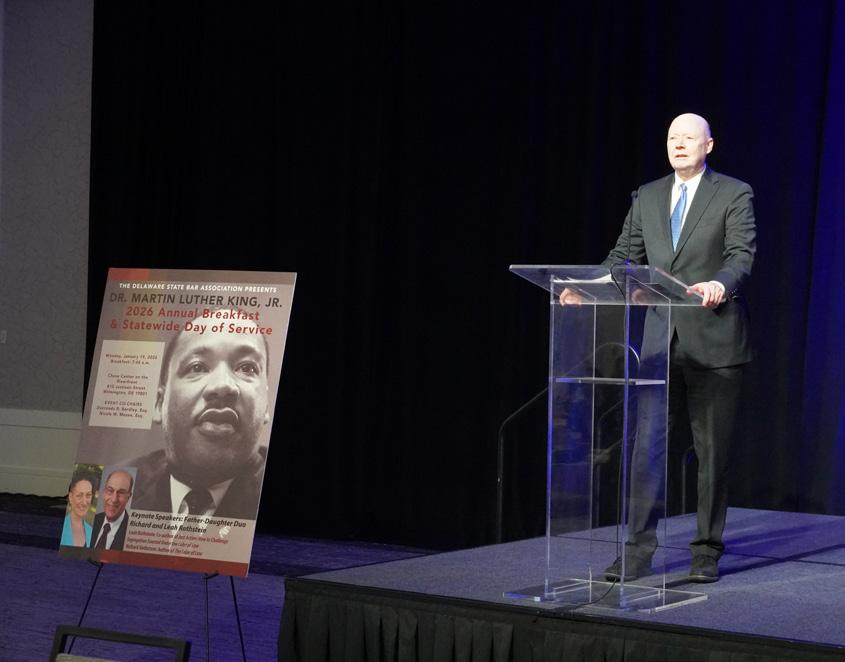
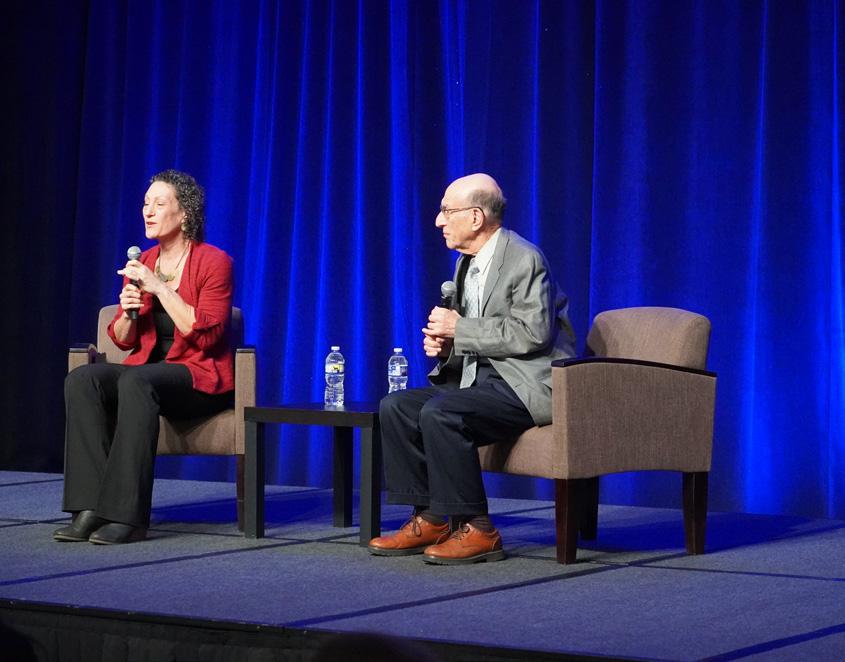
The DSBA and MLK Breakfast & Statewide Day of Service Planning Committee hosted their annual Breakfast and Day or Service Event to a large crowd at the Chase Center. This year’s keynote speakers were father-daughter duo Richard and Leah Rothstein, who discussed the history of institutional segregation in this country and the journey of taking actionable steps to build more equitable and inclusive communities. Thank you to all of our generous sponsors for helping to make this event a success!




Monday, January 19, 2026 | Chase Center on the Riverfront See photos from the service projects on page 38!
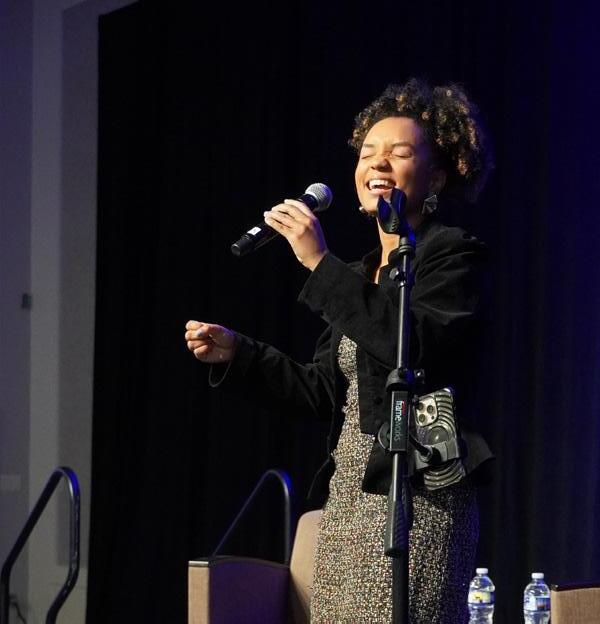
1. Keynote speakers Richard and Leah Rothstein discussed the history of institutional segregation in this country and the journey of taking actionable steps to build more equitable and inclusive communities. 2. The Invocation was delivered by George E. Evans, Esquire. 3. DSBA President Dave White. 4. Maya Belardo, The Princess of Jazz. 5. MLK Event Committee Co-Chair Dorronda R. Bordley, Esquire. 6. The Honorable Collins J. Seitz, Jr., Chief Justice of the Supreme Court of the State of Delaware. 7. Governor Matt Meyer.
REV. DR. MARTIN LUTHER KING, JR. 2026 Breakfast & Statewide Day of Service





SPONSORS







SPONSORS



Are You Curious About Leading a CLE Through the DSBA?
BY ALISON MCLAUGHLIN, CLE COORDINATOR
Have you ever considered leading a CLE on a topic you find interesting and informative, but felt unsure where to begin or overwhelmed by the process? My goal is to demystify how a CLE comes together at the DSBA—and, more importantly, to show how I can help make the process straightforward and manageable.
As the new CLE Coordinator for the DSBA, I am excited to connect with our
members and to help bring engaging, practical, and timely programming to every section of the Delaware Bar. I am always open to new ideas and welcome suggestions at any stage of development—even if they are just a spark or not yet fully formed. I am also eager to help connect members who may want to collaborate on programs that span multiple sections, particularly smaller sections that could benefit from increased attendance and a shared workload.
Ideally, we would love to hear from all sections of the Bar. There are always new cases, legislative developments, and practice updates that may significantly impact how law is practiced in Delaware—often in ways that are helpful for attorneys outside a particular specialty to understand. With busy schedules, many attorneys do not have time to track developments across every practice area, making section-led updates an invaluable way to stay informed. And because all DSBA CLEs are recorded
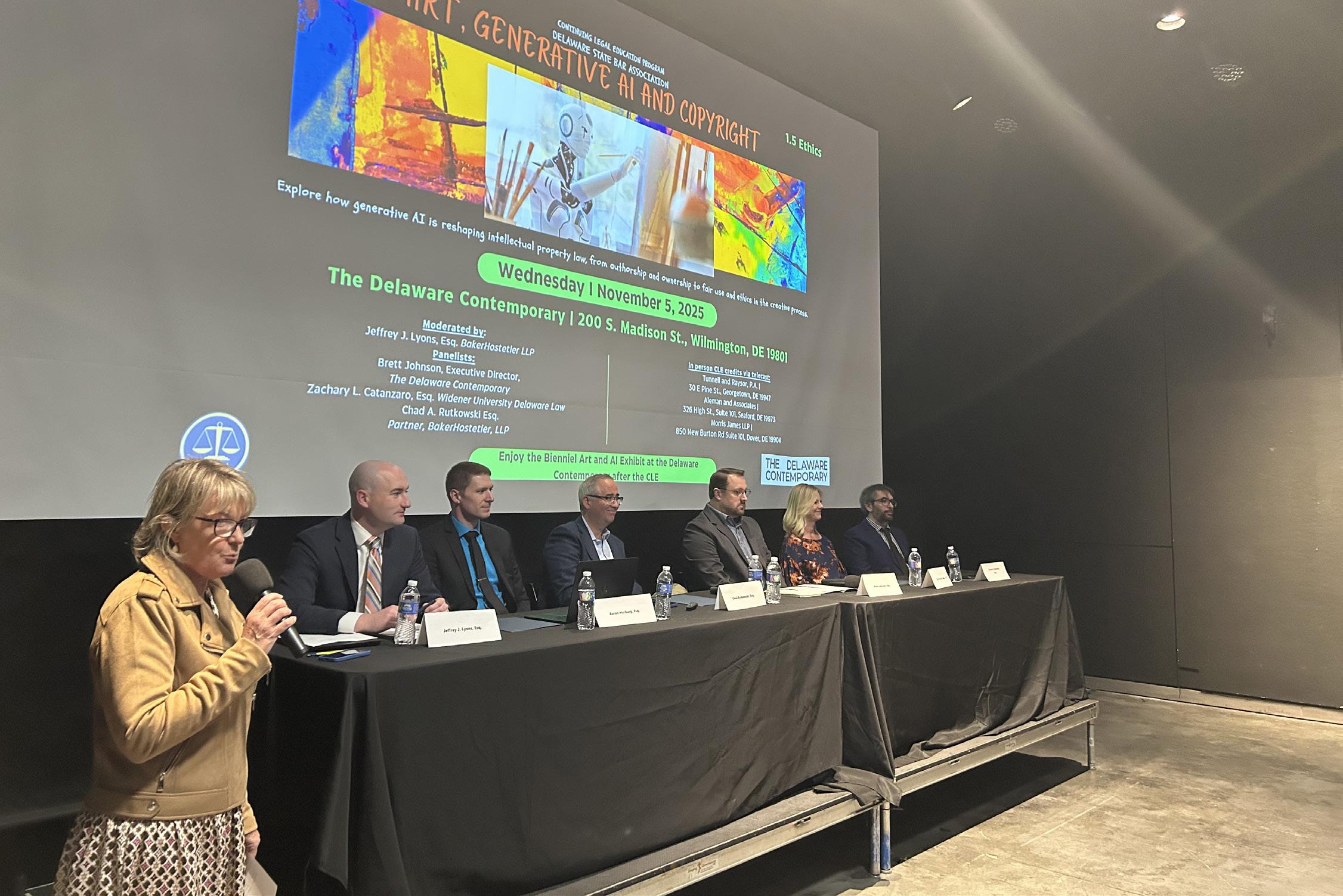
The Art, Generative AI and Copyright CLE, which was held in the fall at the Delaware Contemporary.
and housed in our online video library, your audience extends well beyond those attending in person.
Recent and upcoming CLEs highlight the range of topics and perspectives we aim to offer. Programs such as Inside the Process: Understanding Delaware’s Legislative System provided insight into legislative drafting, effective lobbying strategies, and the perspective of an elected official, Senator Bryan Townsend. The Evolving Face of Immigration Law examined current policy changes, their real-world impact, and how attorneys can support the Delaware community. Our Art, Generative AI and Copyright CLE, held at the Delaware Contemporary, brought together IP attorneys, a college professor, and a curator to discuss how artificial intelligence is reshaping the art world. We also have an upcoming Justice for Animals CLE that will explore animal welfare law, agribusiness and environmental impacts, constitutional and statutory protections, and emerging family law and tort issues involving animals.
So, what does it actually take to put on a CLE? Once you bring an idea forward, we will work together to develop the agenda, speakers, and a brief outline of the content. I assist with submitting the program for approval to the Delaware Supreme Court’s CLE authorities, including drafting the required two- to three-sentence descriptions for each presentation to ensure the program qualifies for CLE credit. After approval, the DSBA handles marketing, registration, and all logistical details. Presenters simply need to provide materials for attendees—such as slides, case summaries, or relevant articles or resources. The lift for presenters is relatively light, yet the benefit to the DSBA and your colleagues is significant. And yes, presenters also earn additional CLE credit beyond what they would receive for attending.
I hope this overview helps ease any uncertainty about leading a CLE. I am here to support you every step of the way and would love to hear your ideas or brainstorm possibilities. Please feel free to reach out at any time—I look forward
to working with you to continue providing excellent continuing legal education to the Delaware Bar.

Alison McLaughlin joined the DSBA team as Continuing Legal Education Coordinator in May 2025. She and her husband relocated to Wilmington, Delaware, from the Washington, DC area and are both proud alumni of the University of Delaware. Alison brings a strong background in alumni engagement, adult education programming, and event management, and is enthusiastic about developing a robust and meaningful CLE program that serves DSBA members and the broader legal community. She can be reached at AMcLaughlin@dsba.org.
Upcoming CLEs With the DSBA
1. Justice for Animals: Wednesday, February 4 at Widener University Delaware Law School
2. Delaware’s New Statutes for Life & Death Planning: Wednesday, February 11 at DSBA
3. The Evolving CCLD: New Rules, Best Practices, and Cross-Designation Explained: Thursday, February 19 at DSBA
4. Navigating Custody Proceedings Impacted by Domestic Violence and Child Abuse: Tuesday, March 10 at DSBA
5. Real Estate and Fraud: Thursday, March 19 at Del Tech, Georgetown Campus
6. Best Practices in the Court of Chancery: Friday, March 27 at Wilmington University
7. Women Who Rule: Tuesday, March 31; location TBD
8. Workers’ Compensation: Tuesday, May 5 at Riverfront Events
9. Fundamentals of Law Practice Management: Date and location are TBD
10. Bench and Bar Conference: Thursday, June 11 at the Chase Center (Dates, times and locations subject to change; visit dsba.org for up-to-date information.)
Loving the Law: A Legal Look at Rom-Coms1
BY HOLLY VAUGHN WAGNER, ESQUIRE
If you’re of a certain age, there’s a good chance that 1989’s Say Anything brings to mind the iconic scene in which John Cusak’s Lloyd Dobler holds a boombox high above his head to blast Peter Gabriel’s “In Your Eyes” in an effort to win back the love of Ione Skye’s Diane. 2 And if you’re like me, you’re now a little less naïve about the realities of romance in the real world, including when a “grand gesture” is unwanted attention. I wondered: could it be that Lloyd Dobler is a creep?
To answer this question, I rewatched Say Anything. As is often the answer, it depends. It depends on how one might view Diane’s non-response to Lloyd’s eight phone calls—she doesn’t tell him directly to stop calling, but her silence certainly implies a desire that he stop— and how much importance is placed on where he performs his gesture. I misremembered the boombox scene as Lloyd standing in Diane’s front yard, only a few feet from her bedroom window, close enough to be unnerving. It turns out that he stands in a nearby park. A quick read of Delaware’s stalking statute suggests that Lloyd may be in the clear. A solid argument can be made that his conduct, while unwelcomed, wouldn’t
cause a reasonable person to fear for her physical safety or suffer significant mental anguish or distress.3
I began to wonder about legal questions in other romantic comedies. Is possible that legal issues lurk in lots of lighthearted love films? I grabbed a box of tissues and queued up the Roku, ready to conduct a completely unscientific study to see what I might find.4
My next movie was How to Lose a Guy in 10 Days, 5 starring Kate Hudson as Addie and Matthew McConaughey as Ben. Before they meet each other, Addie decides to do all the things women do wrong to chase away a potential love interest and use the experience to write a magazine article. Ben offers to prove he can make any woman fall in love with him, to prove he knows how to communicate with women and therefore deserves to lead a diamond company’s ad campaign. Both have ten days to achieve
I wondered: could it be that Lloyd Dobler is a creep?
their goals.
Surely both Addie and Ben will commit a few crimes or violate a contract to win their challenges, I told myself. Addie asks a friend to pretend to be a therapist, a misdemeanor in Delaware.6 Otherwise, to my surprise, there were very few legal issues.
The movie is, however, chock full of ethical problems. Both characters repeatedly lie and manipulate each other. The Delaware Lawyers’ Rules of Conduct probably never contemplated prohibiting fake crying when a plant dies, but lawyers are required to be truthful in their statements to others.7
I was starting to think maybe romantic comedies don’t have as many legal issues as I thought, and then I turned on Sweet Home Alabama 8
Reese Witherspoon plays fashion designer Melanie, who lives in New York City and is newly engaged to Andrew. Unfortunately, she’s still married to her high school sweetheart Jake, who’s back home in Alabama. She has to go home
to get Jake to sign divorce papers. He signs them, but we learn at Melanie and Andrew’s wedding that she didn’t sign them. We are led to believe the wedding can go forward if she just signs the paperwork as she’s walking down the aisle.
Melanie is a terrible person for a rom-com protagonist, a character that the audience traditionally roots for. Not only does she out a closeted gay friend, insult every person in her hometown, and intentionally hide her marriage to Jake from Andrew, she also commits a number of legally questionable acts, both civil and criminal. She:
▪ Breaks into Jake’s house with a spare key. The responding police officer decides she’s within her rights to enter the house because she and Jake are still married. I’m not so sure it’s that easy.
▪ Is arrested for dumping a tractor in a fish pond years ago. We aren’t told how long it’s been since she dumped the tractor, so we don’t
know if there’s a statute of limitations issue.
▪ Takes all of Jake’s money from a joint account they shared. This one may be on Jake for continuing to use the joint account without an enforceable stipulation or court order preventing Melanie from emptying the account.
▪ Blackmails Jake to make him sign divorce papers.
▪ Assaults Candice Bergen by punching her in the face.
That’s a lot to unpack. I’ll focus on the “just sign the divorce papers” trope common to rom-coms and other fiction. It rankles the lawyer in me every time a character can’t get divorce until their estranged spouse signs a document, usually unnotarized and in a transaction for which only the two spouses are present. If forced, I’ll concede that explaining the nuances of process serving and service by publication would not move the plot along, but I don’t have to like it. And just
how did Melanie and Andrew get a marriage license without showing her divorce decree? I’m left thankful that I don’t have to take Melanie as a client and clean up her mess.
I closed out my unscientific study by rewatching the much-loved Rob Reiner classic, a film often cited as the one of the best romantic comedies of all time: When Harry Met Sally…9
Watching Billy Crystal’s Harry and Meg Ryan’s Sally spend years as friends and finally admit they’re meant to be together, I refused to believe I’d find any legal questions presented in the film. And guess what, I was right.
Unless you consider that wagon wheel coffee table a crime.
Notes:
1. Warning: spoilers ahead.
2. Crowe, C. (1989). Say Anything . 20th Century Fox.
3. See 11 Del. Code § 1312 (Stalking).
4. I didn’t include an examination of consent issues presented in many rom-coms. It’s a worthy discussion for another day.
5. Petrie, D. (2003). How to Lose a Guy in 10 Days Paramount Pictures.
6. See 24 Del. Code § 3520 (Penalties).
7. Del. Lawyer’ Rules of Prof’l Conduct R. 4.1.
8. Tennant, A. (2002). Sweet Home Alabama . Touchstone Pictures.
9. Reiner, R. (1989). When Harry Met Sally… Columbia Pictures. Before his and Michele Singer Reiner’s tragic, untimely death in December 2025, Rob Reiner was responsible for two much-loved romantic comedies: When Harry Met Sally… and The Princess Bride.
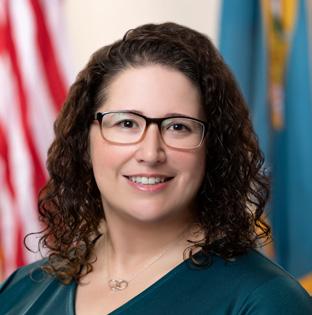
Holly Vaughn Wagner is Deputy Director of the Division of Legislative Services, where she drafts legislation, researches policy matters, and promotes Oxford comma awareness. She can be reached at holly.vaughn_wagner@ delaware.gov.
All’s Fair in Love and ADR
BY HON. VIVIAN L. MEDINILLA (RET.)

The sentiment “All is fair in love and war” originated with English poet John Lyly, who wrote in his 1579 novel Euphues: The Anatomy of Wit , “the rules of fair play do not apply in love and war.” What is the meaning of this phrase? Cursory research suggests the phrase means that in intense pursuits of romance and conflict, the normal rules of behavior go out the door. People may use any means to get what they want, including cheating or deception, as the end
justifies the means. Sadly, a five-minute glance at the news or a cheesy reality show about finding love in ten episodes suggests Lyly’s sentiment has survived the test of time.
Oddly, this phrase uses the words fair, love, war, as if they belong together. They don’t. War is ugly. It’s defined as a state of usually open and declared armed hostile conflict between states or nations.1 Nobody wants it. We avoid it at all costs. Love, on the other
hand, well, love is love. Defined as a strong affection for another arising out of kinship or personal ties such as the maternal love for a child, or an attraction based on sexual desire such as the affection and tenderness felt by lovers, 2 we long for it. We spend our lives searching for it. If we’re lucky, we find it (or it finds us.) If not so fortunate, most idealists (i.e., lovers, not fighters,) just keep searching.
In our professional lives, however, we are not looking for love or gearing up to enter hostile nations. Instead, our quest is for justice. Does love, war, or fairness play into how we find it? Does it—justice—require us to engage in war? And is Tina Turner’s inquiry right on the money? What’s love got to do with it?3
Afterall, when we answered the call to law, we understood that the profession’s nature is an adversarial one. In law school, we learned to stand our ground against our opponents to argue, allege, defend, prosecute, object, etc. We read cases ad nauseam. Orchestrated with the same set of notes—issue, rule, analysis, conclusion, if they were played to a drumbeat, the score would be a death march. The author memorialized each side’s version of the truth, influenced the reader through wordsmithing, and ended the masterpiece by declaring the obvious victor. Regardless of the area of law, the length of the opinion, or the thickening of the plot, the endings were always the same: only one side wins. No twists. No surprise endings. So, as law students, we quickly learned that both sides of the “v” marched into battle accepting that their fate was not theirs to choose. Instead, the outcome of their gladiatorial fight would be decided by a tribunal to declare victory or defeat with a thumbs up or down. Today, we know there is a better way.
Alternative Dispute Resolution (ADR), especially mediations, are about compromise and resolution, and dare I say, fairness. Attorneys shed the battle gear, stop banging their chests, and consider burying the hatchet. Our words to resolve conflict do not create images of pummeling each other. Instead, we call for the sides to engage in “the dance” of negotiations, to “lean in,” and “embrace” an alternative stance. No longer in fight mode, the parties come to trust that with the right pace and space, they will reach agreement, commit, and say yes. And it is in those private moments between the parties—found only in the
confidential space of a mediation—that they find it—justice, when both sides agree to take a deep breath, engage, and stop fighting. And they own their version of justice.
Of course, litigation avoidance is also driven by other factors such as costs, risks, and the need to bring closure or peace of mind to the dispute. So, what’s love got to do with it, Ms. Turner? Like love, the ability to reach compromise takes trust. It takes a special someone to persuade a litigant to slow down their march, pivot, and follow their lead instead. My valentines, my friends, have that special gift.
I teach an ADR class at the Widener University Delaware Law School (DLS). Like my predecessor, Yvonne Takvorian Saville, Esquire—who taught for a decade prior—I invited some of Delaware’s finest to mold the young legal minds at DLS. My guest lecturers included Hon. Francis J. Jones, Hon. Joseph R. Slights, III (Ret.), Hon. Bernard Conway (Ret.), Hon. David A. White (Ret.), Prof. Yvonne Takvorian Saville and Prof. Donna DiPietro. They shared their individual perspectives on ADR with a common message conveyed to the students: Reputation is everything. Don’t be a bully. Don’t be that lawyer. Be a good advocate but don’t be a jerk about it (some may have used different words in class to get the point across, and if my lecturers are reading, you know who you are!)
For professionals who wish to specialize in ADR, especially mediations, the ones chosen to participate are asked to do so because they have established a good reputation (I speak of my friends here, not myself). Entrusted to guide the parties towards their definition of fairness and justice, the best mediators also have a special sauce that cannot be taught.
At the outset, the best mediators are and have always been decent people. They are not bullies. Because they were not those lawyers then, the parties today choose them to enter the confidential
space of their disputes because the mediator will treat the conflict with the respect it deserves and not impose judgment upon those litigants that seek assistance in resolving it. Once trusted to enter spaces reserved only for those within the privileged confines of attorney and client, an effective mediator brings innate skills to do right by the parties and be efficient in getting a deal done. Whether their mediation styles are assertive, evaluative, facilitative, or a combination thereof, it matters not. In ADR, like a great relationship, there is trust and r-e-s-p-e-c-t (Ooh! Yet another great song)!
Also, like the best relationships, akin to a good friend and partner, a great mediator knows when to share and commit. Whether they presided over battles in the courtroom, mediated cases, or marched into battle against a formidable opponent, an experienced mediator is willing to offer unique perspectives from decades of experience. It is not the experience that matters. No one wants to hear a war story that has no relationship to one’s dispute. Rather, it is the ability to convey how past experiences will impact the litigant’s current battle that counts. A skilled mediator makes it relevant. And like a good partner, even at impasse, the best mediators see it through to the bitter end, at times coming up with creative solutions that are nonexistent in traditional litigation.
In seeking justice, where do we draw the line when all’s fair in our legal wars? In Delaware, civility and professionalism are values that draw that line clearly. Our own sense of war and fairness have their place in what we do every day. But when we speak of love, in our small community, relationships are everything and reputation matters. I thank my guest lecturers for driving home the most important lesson that showing off legal battle scars may make for good locker room stories, but zealous advocacy will only go so far. A successful attorney knows when to engage in conflict resolution and avoid war. Next time someone proposes ADR, consider saying yes. Your decision may change your professional reputation for
the better. Lean in and let’s dance. You might even enjoy it.
Notes:
1. https://www.merriam-webster.com/dictionary/war
2. https://www.merriam-webster.com/dictionary/ love
3. MLA: Turner, Tina. “What's Love Got to Do with It.” Private Dancer, Capitol Records, 1984.
A Few Excerpts From a Student’s Final Paper
Hon. Vivian L. Medinilla (Ret.)
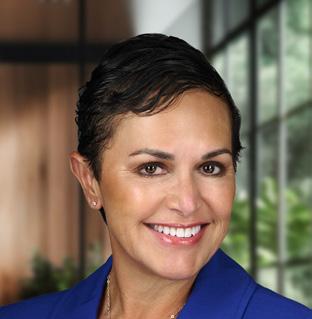
FCIArb, a former Judge of the Delaware Superior Court, now focuses on alternative dispute resolution and litigation at Weiss, Saville, Medinilla & Houser, PA. Appointed in 2013 as the Court’s first Latina judge, she brings over 30 years of legal experience in both private practice and the judiciary. She presided over hundreds of jury and non-jury trials involving mass torts, asbestos, product liability, medical negligence, and complex commercial disputes. Bilingual in English and Spanish, she holds ADR certifications from Pepperdine Caruso School of Law, the National Judicial College, and Duke Law’s Bolch Judicial Institute focused on Mass Tort litigation. She is a member of AAA/ICDR, and a Fellow of both the Chartered Institute of Arbitrators (CIArb), and the Academy of CourtAppointed Neutrals (ACAN). Her career also includes senior executive leadership in Delaware’s child welfare system, founding a multilingual civil litigation firm, and serving in national roles with ABA and NAWJ.
A mediator’s job is incredibly difficult. It requires patience, grace, the ability to juggle personalities, emotional dynamics, time, and expectations—all while maintaining neutrality. Contrary to what I thought prior to taking this class, a mediator’s role is not just facilitating; mediators are strategists, risk managers, and the calm voice in the room when everyone else is spiraling. They must balance empathy with objectivity, adapt to shifting dynamics in real time, and guide discussions toward resolution without imposing their own agenda. Mediation is an art of control without domination, requiring both intellectual agility and emotional resilience. . . .
. . . . I learned the art of reframing—taking an otherwise hostile statement and converting it into something more civil and neutral to keep discussions productive. . . . I also learned to ask better questions; ones that elicit dialogue and invite deeper, more meaningful responses, rather than shutting the conversation down. In addition, I learned how to manage impasse and build rapport. . . .
I am walking away from this class as a better communicator, a more self-aware future lawyer, and someone who genuinely appreciates the art of resolving disputes. This was the most informative, fun, and engaging class I have taken so far. I learned valuable skills and lessons that I will carry far beyond law school, and I am grateful for every exercise, every mistake, every speaker, and every moment that made me rethink how I approach conflict—not just as a future lawyer, but as a person.
—Warren Sokolo, JD Candidate, Class of 2027, Staff Editor of the Delaware Journal of Corporate Law and a Teaching Assistant, Legal Methods I and II.

Published!
For i nformation on s ubmitting a rticles for publication in the Bar Jo urnal , contact Danielle Bouchat-Friedman at dbouchatfriedman @dsba.org.
Delaware State Bar Association Insurance Program

The Delaware State Bar Association Insurance Program, advised and administered by USI Affinity, offers a proprietary, comprehensive Lawyers’ Professional Liability program. Along with other business insurances to attorneys and law firms in Delaware.
As a leading insurance broker for Lawyers’ Professional Liability, USI Affinity has been protecting Lawyers for over 50 years. We understand the business and the risks that attorneys and law firms face every day.
Lawyers Professional Liability
The DSBA Insurance Program Lawyers
Professional Policy offers proprietary savings and coverages specifically designed to mitigate risk and close gaps in coverage.
Directors and Officers Liability
Directors & Officers
Liability insurance protects the past, present, and future directors and officers of a law firm from losses arising from “wrongful acts”.
Employment Practices Liability
EPLI coverage can be specifically designed to help protect the personal assets of a privately owned firm’s directors and officers, as well as the financial well being of the firm itself.

Sweet Reading

The Land of Sweet Forever
By Harper Lee (Harper, 2025)
Any list of the great American novels has to include To Kill A Mockingbird and the heroic tale of attorney Atticus Finch defending a wronglyaccused black man in the deep south during the Great Depression. If you haven’t read that book, stop this review, go read it, and then come back here. Published in 1960, the book quickly became a best-seller and won the Pulitzer Prize the following year. In 1962, the movie version won Gregory Peck the Oscar for Best Actor.
Yet despite the success and acclaim, the author, Harper Lee, only published one more novel during her lifetime, Go Set A Watchman , which tells the story of a grown up Scout Finch (the 6-year old daughter of Atticus Finch and narrator of To Kill A Mockingbird ) returning to the fictional Maycomb, Alabama, 20 years after the events of the first novel. Although originally marketed as a sequel, it is now understood that Go Set A Watchman was the original draft for what would become To Kill A Mockingbird . Lee published no other fiction during her lifetime.
But now, with The Land of Sweet Forever, readers are treated to eight short stories Lee wrote before the publication of her great novel, as well as eight short and pithy essays and non-fiction pieces that were published at various times after her novel, including her description of visiting the movie set for To Kill A Mockingbird .
It is the short stories, though, that steal the show. All of them have the same easy, first-person narrative style that made her novels such a pleasure to read. Yet at the same time, a sadness creeps in because there are only eight stories, and one


All of [the short stories] have the same easy, first-person narrative style that made her novels such a pleasure to read.
is left wondering what more could have flowed from Ms. Lee’s pen. Several of the stories specifically reference the fictional Maycomb, Alabama, where her two novels are set, and so, one is left to ponder, could Lee have created a more complete universe in much the same way that William Faulkner wrote about the fictional Yoknapatawpha County?
If there is anything that Harper Lee’s writing teaches, though, it is write what you know. All of her stories, whether set in Maycomb or New York City, bring a sense of biography with them (Lee grew up in the small town of Monroeville, Alabama, 2020 population, 5,951; went to college and studied law in Alabama, before moving to New York City in an effort to become an author). With Lee’s short stories (all told in the first person, save the last), you feel as if you are sitting with the writer, who is telling you the story, a story somehow related to her own life. The stories, all written before To Kill A Mockingbird , nevertheless feel connected to it, as if Lee was creating the backstory for the people and events of her novels. At the same time, though, the stories all stand on their own, and one need not have any familiarity with Lee’s later work to enjoy them.
But if the short stories steal the show, that doesn’t mean the essays and non-fiction pieces aren’t enjoyable and interesting in their own right. Growing up, Lee and Truman Capote lived next door to each other for a few years as children and remained lifelong friends. He recommended the literary agent to whom she took her first manuscript for what would become her great novel, and the agent, after purchasing the draft manuscript, started Lee down the rewrites and editing that resulted in To Kill A Mockingbird . Included among her essays is a short sketch about Capote
and perhaps his most famous work, In Cold Blood . There is also, as mentioned earlier, a description of her visit to the set of To Kill A Mockingbird and of meeting Gregory Peck. She found his performance inspired and concludes in her essay: “I know what Gregory Peck, gifted and consummate professional, brought to the part—he included himself.” There is a short article about having to spend Christmas in New York, away from her family in Alabama; but, it snowed on Christmas Day that year in New York, which worked to restore her spirits.
For the last entry in the book, there is a short letter from the July, 2006 issue of O, The Oprah Magazine, that begins: “Do you remember when you learned to read, or like me, can you not even remember a time when you didn’t know how?” She then recounts how scarce books were in her small hometown, but that she already knew how to read when she started first grade, and has been reading her whole life. This letter, in turn, ties back to the second short story in the book, entitled “The Binoculars,” where the six-year old narrator is chastised by her first grade teacher for already knowing how to read. Lee always wrote what she knew.
Richard “Shark” Forsten is a Partner with Saul Ewing LLP, where he practices in the areas of commercial real estate, land use, business transactions, and related litigation. He can be reached at Richard.Forsten@saul.com.

BY SUSAN E. POPPITI, ESQUIRE
Savoring Our Semiquincentennial, Part Two
Our 250th anniversary feasts began in New England with clam chowder and Parker House rolls. This month, our travels bring us to Pennsylvania, one of the original Middle Colonies. What better way to spend Valentine’s month than in The City of Brotherly Love and its surrounding region?
While The Birthplace of America is famous for many foods, especially The Cheesesteak, I decided to explore Pennsylvania Dutch cuisine. My research led me to J. George Frederick’s The Pennsylvania Dutch and their Cookery, which includes hundreds of recipes along with the history of the Pennsylvania Dutch from the Palatinate region of Germany, their settling in America by invitation of William Penn, and their role in the Revolutionary War.1 When describing why he wrote the book, Frederick explained:
…The Pennsylvania Dutch provided a far greater proportion of the bone and sinew of American tradition and value than the small size of their territory would indicate…The first gourmets of America were the Dutch – the first dining club in the New World was organized in Philadelphia in 1732, a city which was then set up as a center for good food and has never lost that character. The special attention paid to Dutch cookery in this book is richly deserved, as all educated gourmets know, for next to the cookery traditions of old New Orleans and a few other southern points, the Dutch regional cookery genius ranks highest. Washington and Lincoln both praised it, and it would be a serious loss if no one did for Dutch cookery what others have done for other regional cookeries.2
It was difficult to select only a few recipes to highlight, but one had to be scrapple. After all, an entire chapter—“Ways with Philadelphia Scrapple”—is dedicated to the dish. “Scrapple is the most nationally known of all Dutch foods. But very few—even of the Dutch themselves—have ever eaten scrapple in any other way than plain fried.”3
PHILADELPHIA SCRAPPLE CROQUETTES
• 1 cup scrapple
• 2 eggs hard boiled
• 1 cup cooked rice or mashed potatoes
• ½ cup cracker or bread crumbs
• 1 teaspoon minced parsley

• Salt, pepper
• 1 egg, beaten
1. In a wooden or earthen bowl, mix well the scrapple, the rice or potatoes, the hard-boiled eggs, chopped fine.
2. Season with parsley, salt and pepper. Shape into croquettes with beaten egg and breadcrumbs, fry in deep fat.
3. Serve with horseradish sauce, or with fried tomatoes.4
Susan E. Poppiti is the owner of Susan Poppiti Math Tutoring LLC. Susan holds a WSET (Wine and Spirit Education Trust) Level 3 Award in Wines with Merit. You can contact Susan at spoppiti@hotmail.com and find a searchable collection of her “Judicial Palate” articles at cucinadipoppiti.com.

Next, I decided to feature oysters in homage to the many oyster houses in the Cradle of Liberty. “They are very fond of oysters, and throughout all Dutch cities and towns there has for a century or more been a great plenty of ‘oyster restaurants,’ the prime favorite being fried oysters…”
PHILADELPHIA
FRIED OYSTERS
• 50 prime oysters
• 2 eggs beaten
• Mayonnaise dressing
• Cracker or fine dry bread crumbs
• Salt, pepper
1. Make a batter of the eggs, well beaten,
seasoned with salt and pepper, and using some of the strained liquor of the oysters.
2. Pick the oysters out of the liquor and roll in the crumbs, then in fresh mayonnaise; then in batter; then again in crumbs. Pat them with your hand to firm the crumbs.
3. Lay upon a platter and fry in hot fat. Serve at once with catsup or lemon slices, and Dutch butter pretzels or water crackers.6
While in Philly, let’s pay tribute to Founding Father, Benjamin Franklin. Our first ambassador to France, Franklin said about wine: “Behold the rain which descends from heaven upon our vineyards; there it enters the roots of the vines, to be changed into wine; a constant proof that God loves us, and loves to see us happy.”9 To stay with the French theme, I suggest a Beaujolais pairing with the scrapple for its lightness and acidity. I would do a French Sauvignon Blanc, like Sancerre, for the oysters to lend some crisp, citrusy notes. Looking forward to our March tastes and travels…
Notes:
1. Frederick, J. George 1882-1964. (1935). The Pennsylvania Dutch and their cookery: their history, art, accomplishments, also a broad collection of their food recipes. New York: The Business Bourse.
2. Frederick p. 7, 9.
3. Frederick p. 167.
4. Frederick p. 167-168. For the Dutch Horseradish Sauce: 1 egg, ½ cup horseradish, ¼ cup cream (or milk), 1 teaspoon flour, 1 tablespoon butter, ½ teaspoon salt, ¼ teaspoon paprika. Freshly grate the horseradish root and cook until smooth in a glass or earthen vessel together with the flour, salt, butter and paprika. Keep stirring the mixture. Add the yolk of the egg and keep stirring rapidly while placing it to the rear of the stove to simmer for one half minute. Serve with meats, etc. as elsewhere indicated. Frederick p. 191.
5. Frederick p. 171.
6. Frederick p. 174.
7. Frederick p. 193-194.
8. Frederick p. 203.
9. https://fi.edu/en/science-and-education/benjamin-franklin/7-things-benjamin-franklin-never-said#:~:text=In%20 a%20circa%2D1779%20letter,loves%20to%20see%20us%20happy.%E2%80%9D (from the Franklin Institute).
For something sweet, a shoofly pie is a must. Its rich, sweet yet savory molasses filling can cure the winter blues. As Frederick wrote, “Good pie is almost an American invention, and the Dutch had a big finger in that pie invention!...They made pies with unique filler materials, and they dared even to make pies out of dried apples and peaches…In the Saturday Evening Post April, 1935, Edwin Leferre brings out the fact that the Dutch were the creators in America of the fruit pies so popular today and deserve credit for making pie the great American dish that it is.”7

DUTCH SHOOFLY PIE
• 1 cup molasses
• 4 cups flour
• ½ cup butter and lard
• ½ teaspoon salt
• 2 cups sugar
• 1 teaspoon baking soda
• ½ teaspoon cream of tartar
1. Dissolve the molasses in 1 cup of water. Mix all other ingredients and form into crumbs.
2. Pour molasses mixture into pans lined with pie crust, then spread the crumbs evenly on top.
3. Sprinkle with cinnamon and bake in moderate oven. 8
POSITIONS AVAILABLE
BROCKSTEDT MANDALAS FED -
ERICO LLC, a distinguished Delaware law firm and three-time Top Workplace award recipient, is seeking a skilled attorney to join our Dover office. We are looking for a candidate with at least 3-5 years of experience in litigation and transactional work, interested in the fields of land use, zoning, and administrative law, with excellent writing ability, interpersonal skills, and courtroom presence. The key responsibilities would be to represent clients in land use, zoning, and administrative applications and hearings, as well as any litigation arising therefrom, with a primary practice focus in Kent and Sussex counties. The successful candidate will have a Juris Doctor (JD) from an accredited law school, be active membership in the Delaware State Bar, and have proven experience in litigation work. BMF offers a competitive compensation and benefits package, including health, dental, and vision insurance, 401(k) retirement plan, opportunities for professional development and career advancement, a collaborative, supportive, and growth-oriented work environment. If you’re ready to make an impact with a respected firm that values excellence and innovation, we encourage you to apply. To apply, please email your resume and salary requirements to cmosher@lawbmf.com.
LEWES LAW FIRM seeking to hire an associate with 1-2 years minimum experience to join our practice focusing on real estate transactions, estate planning and probate. Competitive salary and full benefit package. Immediate placement available. Send resume to bbenson@ bonniebenson.com. Phone inquiries 302644-7181.
MACELREE HARVEY, a well-respected mid-sized regional law firm established in 1880, is seeking established Delaware-barred attorneys to join our team. Our firm provides exceptional legal services to both local and national clients across litigation, family law, land use, trusts and estates, and business law.
We are seeking attorneys with 5 or more years of practice experience with a strong client base who are motivated, detail-oriented, and thrive in a collaborative environment. Become part of a firm where talented attorneys thrive—supported by strong leadership, excellent technology, and a culture that empowers attorneys to build and grow their practice.
MacElree Harvey is also looking for a motivated associate admitted to the Delaware bar with prior family law experience looking to assist with a vibrant and growing family law practice in Delaware.
If this sounds like the right opportunity for you, please reach out to Nicole Castafero at ncastafero@macelree.com
TYBOUT REDFEARN AND PELL seeks to hire an Associate Attorney with experience in the areas of civil and workers’ compensation matters. We offer the opportunity to handle your own case load while working in a fast-paced environment. Develop your career in a firm that has been around for more than 50 years and that is dedicated to helping you succeed. The candidate should be licensed to practice law in the State of Delaware. Salary is commensurate with experience. Please send all inquiries to: Christine P. O’Connor, Esq. at coconnor@trplaw.com.
MELUNEY ALLEMAN & SPENCE is seeking to add an attorney to its corporate and commercial litigation practice. The candidate should be a member of the Delaware bar with 1-3 years of experience. The candidate must be an excellent writer and researcher and be detail oriented. Salary will be commensurate with experience, and the attorney will work in the firm’s Lewes, Delaware office. Please send resume to Heather. Alleman@maslawde.com
FRANKLIN AND PROKOPIK, P.C., is currently seeking to add attorneys in workers’ compensation and general liability defense in their Newark, DE office. Delaware bar required (or willingness to sit for the Delaware bar). Experience in workers compensation or liability a plus, but all experience levels are encouraged to apply, as F&P is willing to train the right candidate(s). Competitive salary, health benefits, 401(k), and hybrid flexibility. Please send all inquiries to Brianna O’Donnell at bodonnell@ fandpnet.com.
WILMINGTON OFFICE OF
WHITE AND WILLIAMS LLP, a large multi-practice law firm, is seeking an attorney with 1-3 years of experience to work in the areas of product liability, insurance coverage, and commercial litigation. DE Bar admission required. We offer a competitive salary, an excellent benefits package, and the opportunity for professional growth. Please send your resume to Recruiting@whiteandwilliams.com for consideration.
ASSOCIATE OPENING: Newark office seeking attorney to work in Family Law practice and to grow with the firm. Competitive compensation and benefits package included. DE bar required. Please send cover letter and resume to Walstrom Law c/o Megan Walstrom at Megan@Walstromlaw.com.
OFFICE SPACE
WILMINGTON FURNISHED LAW OFFICES - AVAILABLE NOW
Three adjoining professional law offices are available on a month-tomonth or yearly basis. Each fifthfloor office comes fully furnished. Located near Hotel DuPont. Offices come in three configurations: 700, 1,500, and 2,250 square feet. Owner/ Manager is on site. Surface lot available near office. Includes large conference room, kitchen, 24/7 access, (also formerly office of Governor/ Mayor John Carney). Full service $20 / Sq. Ft. Located at 1201 Orange Street. Contact John@TrustWilliams. com or call our business manager Karen at (302) 575-0873.

STATEWIDE DAY OF SERVICE PROJECTS
JANUARY 19, 2026
The MLK Day of Service empowers individuals, strengthens communities, bridges barriers, creates solutions to social problems, and moves us closer to Dr. King’s vision of a “Beloved Community.” On this day, Americans from every walk of life, of all ages, races, colors, ethnicities, national origins, genders, and backgrounds, celebrate Dr. King through service projects throughout their communities. Below are just a handful of photos of the volunteers at several project sites who decided to spend their time to give back.
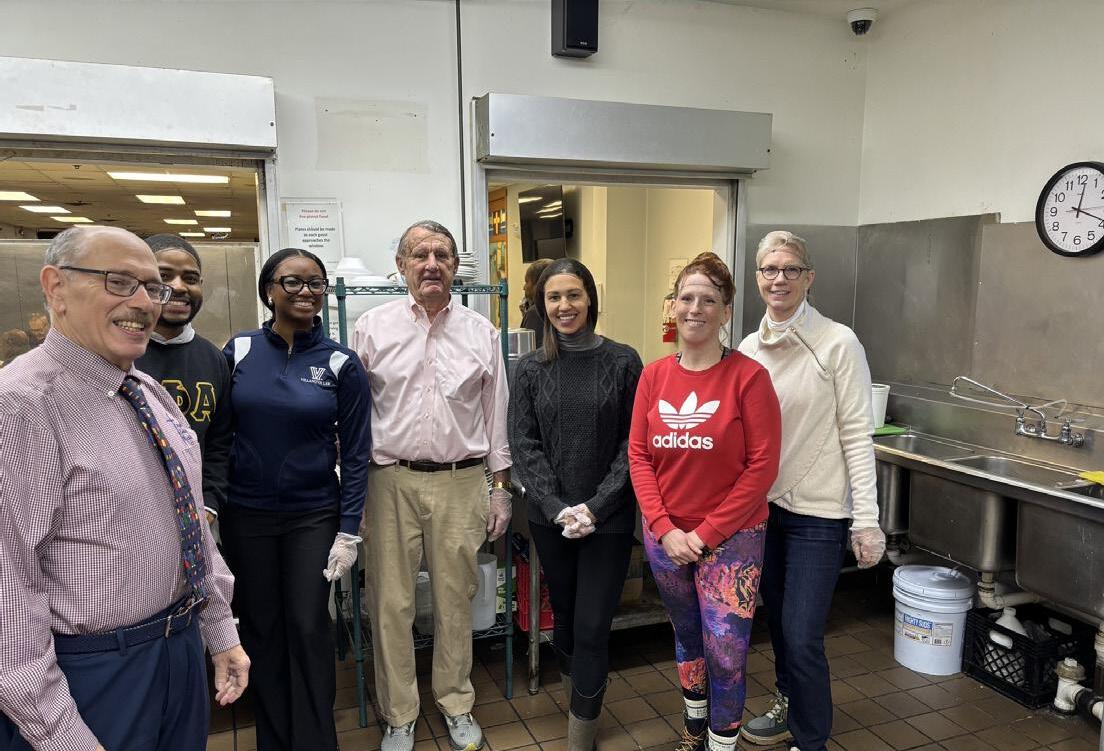


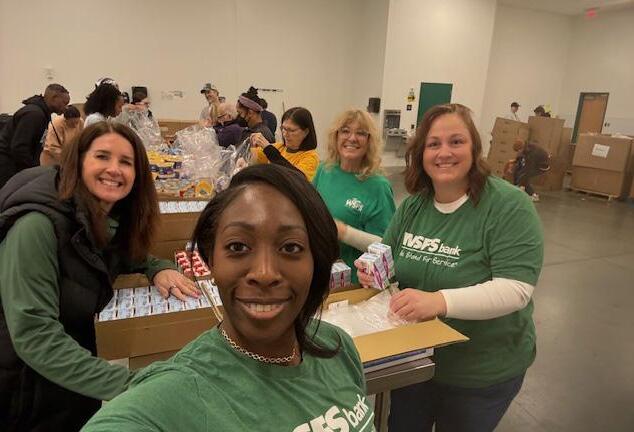
Clockwise from top left: Sunday Breakfast Mission volunteers (left to right): Rev. Thomas J. Laymon, Sr. Pastor at Sunday Breakfast Mission; Jelani Bryant, 1L at Delaware Law School; Kendeil Dorvilier, Esq.; William “Bill” Sudell, Esq.; Rachelle Pownall-Brown; Misty Seemans, Esq.; Hon. Kathleen Miller; Volunteers at the Food Bank of Delaware (Milford); Volunteers at Friendship House; Volunteers at the Food Bank of Delaware (Newark).
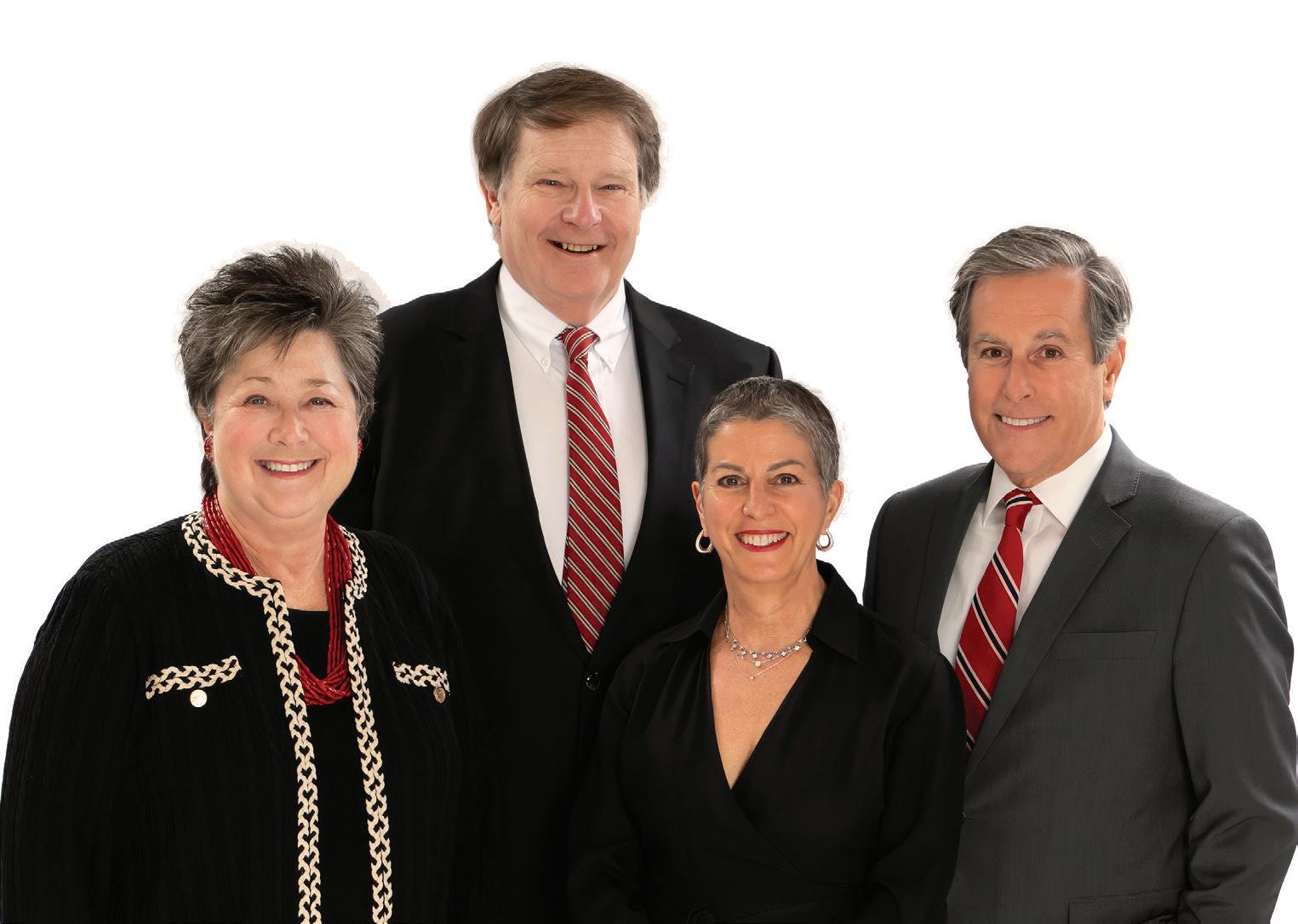


Best Practices in Delaware Family Court
Join Wilmington University for the second program in a new series on professionalism and excellence in Delaware legal practice, featuring insights from the judiciary, court staff members, and experienced practitioners.
What to Expect:
Best Practices: Practical insights on effective advocacy and courtroom excellence
Ethics in the Delaware Courts: Essential guidance on professional responsibility and ethical practice
Sage advice: Candid stories, real-world anecdotes, and guidance from the bench, court administration, and experienced practitioners about what works, what does not, and how to distinguish yourself as a member of the Delaware Bar