JANUARY 2026 | VOLUME 49 • NUMBER 6
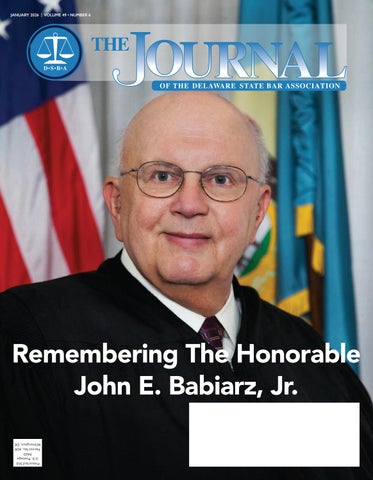
Remembering The Honorable John E. Babiarz, Jr. Presorted Std. U.S. Postage PAID Permit No. 408 Wilmington, DE
DSBA BAR JOURNAL JANUARY 2026 | VOLUME 49 • NUMBER 6 PRESIDENT David White EXECUTIVE DIRECTOR Karl G. Randall EDITOR-IN-CHIEF Laina M. Herbert EDITORIAL BOARD Jason C. Powell Adria B. Martinelli Kristen S. Swift
FEATURES
EXECUTIVE COMMITTEE LIAISON Ian Connor Bifferato
22 In Memoriam: John E. Babiarz 26 Two Bills Fighting to Combat Our Two-Tiered Justice System 30 Professional Headshot Dos and Don’ts
EDITORIAL ADVISORY COMMITTEE Valerie A. Caras Claire DeMatteis Victoria R. Sweeney Holly O. Vaughn Wagner BAR JOURNAL ADVISOR Richard A. Forsten EDITOR Danielle Bouchat-Friedman
11 Nominations Sought for Law Day Awards
The Bar Journal is published and distributed by the Delaware State Bar Association
20 2025 DSBA Awards Luncheon
704 North King Street, Suite 110 Wilmington, DE 19801 P: 302-658-5279 F: 302-658-5212 www.dsba.org
21 2026 Women and the Law Retreat Save the Date 24 Dr. Martin Luther King 2026 Annual Breakfast & Statewide Day of Service Announcement 25 Call for Executive Committee Nominations
© Copyright 2026 by the Delaware State Bar Association. All Rights Reserved. The Bar Journal is the independent journal of the Delaware State Bar Association. It is a forum for the free expression of ideas on the law, the legal profession, and the administration of justice. It may publish articles representing unpopular and controversial points of view. Publishing and editorial decisions are based on the quality of writing, the timeliness of the article, and the potential interest to readers, and all articles are subject to limitations of good taste. In every instance, the views expressed are those of the authors, and no endorsement of those views should be inferred, unless specifically identified as the policy of the Delaware State Bar Association. The Bar Journal is published monthly with a combined July/August issue. All correspondence regarding circulation, subscriptions, or editorial matters should be mailed to:
33 Nominations Sought for First State Distinguished Service Award
COLUMNS 4
President’s Corner
18
Beyond the Law
6
Editor’s Perspective
32
Book Review
12
Tips on Technology
34
The Judicial Palate
16
Let’s Talk: DE-LAP at Your Service
38
The Last Word
Editor, DSBA Bar Journal Delaware State Bar Association 704 North King Street, Suite 110 Wilmington, DE 19801 or emailed to: dbouchatfriedman@dsba.org Letters to the Editor should pertain to recent articles, columns, or other letters. Unsigned letters are not published. All letters are subject to editing. Send letters to the address above, Attention: Editor, Bar Journal. The Bar Journal Editorial Policy is available upon request.
For Advertising Opportunities Call (302) 658-5279, ext. 1102 Email: dbouchatfriedman@dsba.org Read The Bar Journal online at www.dsba.org
DEPARTMENTS 8
Side Bar
9
Calendar of Events
9
Of Note
36
Bulletin Board
ON THE COVER: The Honorable John E. Babiarz, Jr. CREDIT: Eric Crossan
DSBA Bar Journal I January 2026
3
PRESIDENT’S CORNER | BY DAVID A. WHITE, ESQUIRE
Welcoming Delaware’s Newest Lawyers: A Tradition of Excellence, Civility, and Service
O
n December 4, 2025, I had the privilege of addressing more than 150 of Delaware’s newest lawyers at the PreAdmission Conference, all of whom are exceptional individuals who successfully completed one of the most rigorous and thorough bar admissions processes in the nation. To each of you I extend my hearty and sincere congratulations. Your admission to the Delaware Bar is an achievement of extraordinary significance, and one that reflects not only your intellectual ability and perseverance, but also your character and fitness and commitment to uphold the highest ideals of our profession. Passing the Delaware Bar Exam is no small feat. It demands months of focused preparation, study, sacrifice, and self-discipline. Many of you balanced fulltime jobs, family commitments, financial pressures, and the emotional weight that accompanies working toward a career goal that can feel both intensely personal and overwhelming. Yet you persisted. You showed grit, resilience, curiosity, and the ability to marshal complex ideas under pressure. These qualities will serve you well in every chapter of your legal career. But admission to the Delaware Bar signifies something even deeper than academic accomplishment. It welcomes you into a legal community renowned for its collegiality, professionalism, and devotion to the ethical practice of law. This is a bar with a distinct identity—one that has earned national respect and trust precisely because its members do not simply know the law but strive to practice it with 4
DSBA Bar Journal | www.dsba.org
integrity and humility. For decades, Delaware lawyers have embraced a culture where civility is not an aspiration—it is an expectation. You will see this culture reflected in the courtroom, where lawyers address the Court and each other with respect; in conference rooms, where difficult negotiations are conducted without acrimony; and in the many ways we show up for clients, colleagues, and the public with honesty and care. We believe deeply in the value of clear communication, candor, and professionalism. These principles are not ornamental. They are the foundation of trust—trust between lawyers, trust between the bench and the bar, and trust between our profession and the community we serve. As you begin your careers, you are joining a bar that is more than a professional network—it is a community that supports and challenges its members. You will find mentors, like me, who remember what it felt like to be in your shoes, and who will generously offer guidance, insight, and perspective. Seek them out. Seek me out. Ask questions. Invite feedback. You will find Delaware lawyers are at their best when we learn from one another and help one another grow. The Delaware State Bar Association (“DSBA”) stands ready to support you in that growth. Our Sections, Committees, and CLE programs exist to connect a diverse group of lawyers across disciplines, practice sizes, generations, and all three (3) counties. I encourage each of you to get involved early and often. Engage with Sections that align with your professional
and personal interests. Attend DSBA’s excellent and engaging CLEs not just for credit, but to stay intellectually curious and informed. I also welcome you to join the many DSBA initiatives that help improve access to justice, strengthen professional ethics, support lawyer well-being, or enhance diversity, equity, and inclusion in the Delaware Bar and legal community. You are entering the profession at a time of remarkable change. Technology, artificial intelligence, shifting client expectations, and evolving regulatory landscapes are transforming the practice of law at a rapid pace. With these transformations come new challenges—but also extraordinary opportunities. As new lawyers, you bring perspectives shaped by contemporary legal education, modern tools, and fluency in emerging issues. Don’t underestimate the significant value you will add by your participation. Your adaptability, creativity, and fresh thinking will help drive the legal profession forward. Yet even with all the developments shaping the future of law, some principles remain timeless. As Delaware lawyers, we are custodians of a legal tradition that prizes professionalism and ethical conduct above all else. Upholding the Delaware Lawyers’ Rules of Professional Conduct is not simply about compliance, it is about cultivating a professional identity rooted in honesty, fairness, and public service. Clients will trust you not only because of your legal knowledge, but because you demonstrate empathy and trustworthiness. Judges will trust you because your
word is sound and your advocacy is principled. Your colleagues will trust you because you treat them with respect—even when you disagree, even when the stakes are high, even when the pressure is intense. Ultimately, your reputation will be built not just on what you accomplish, but on how you conduct yourself along the way. As you embark on this next chapter, I encourage you to embrace four commitments that define Delaware’s legal community: First, commit to civility. It is the hallmark of the Delaware Bar, and it will serve you well in every professional relationship. Second, commit to continuous learning. Be teachable; open to new ideas, new technologies, and new approaches. The law evolves, and so must we all. Third, commit to service. Remember that the privilege of practicing law carries with it a responsibility to ensure access to justice to those who may not have the resources. Volunteer your time. Take on pro bono matters. Use your knowledge to help those who cannot help themselves.
Finally, commit to integrity. Your credibility is the most valuable asset you possess. Guard it fiercely. Remember, Delaware is small. To all of the newly admitted lawyers to the Delaware Bar: Welcome. We are proud of you. We are grateful for the energy, talent, and dedication you bring to this profession. And we look forward to the mark you will make—on your clients, on the practice of law, and on the State of Delaware. Congratulations on this milestone, and welcome to the Delaware Bar, a legal community that is honored to count you among its members.
David A. White is the 78th President of the DSBA. He is a former Superior Court Commissioner and former Managing Partner of McCarter & English, LLP. From March 2021 to November 2024, he served as Chief Disciplinary Counsel, an Arm of the Delaware Supreme Court. He is currently working as a Professional Neutral at Delaware ADR (www.delawareadr.com).
SOME OF THE WAYS
DSBA MEMBERSHIP
BENEFITS YOU! The Bar Journal DSBA’s monthly publication features columns from the DSBA President, as well as regular articles on ethics, technology, practice tips, profiles, and news. Subscription is included with your membership.
Social Events
DSBA Events and Socials connect you with other attorneys, members of the Bench, and others in the community.
Sec t ions & Committees
DSBA membership allows you to participate in the Association’s many Sections and Committees. These active groups provide leadship opportunities and a great forum to share ideas, improve your practice and help shape the legal profession.
CLEs
at Member Rates
Every year, the DSBA offers quality CLE seminars live at our office in the heart of dowtown Wilmington and webcast to Kent and Sussex Counties.
WWW.DSBA.ORG
BUILDING BUILDING BUILDING RELATIONSHIPS RELATIONSHIPS RELATIONSHIPS 1980
for for
for
2022 2022
2025
OVER OVER 40 OVER 40 YEARS YEARS 40 YEARS OVER FOUR DECADES
|S U |STAFF | ME R MMA A NN ENT E NTACCOCI ACCOCI AT AT EP E|E |RPA M PA RT ARTNE NE NENT R R|ACCO SU PP C PO PO I ATE RT RTSTA PART FF PL PL NACE EACE R ME S UPPORT NN T TS E SE RVICE RVICE STAFF S S PL ACE ME N T S E RVICES
215.981.5455 215.981.5455 kruza.com kruza.com 215.981.5455
kruza.com
DSBA Bar Journal I January 2026
5
EDITOR’S PERSPECTIVE | BY LAINA M. HERBERT, ESQUIRE
Don’t Just Stand There firms’ retention and promotion efforts and erodes the public’s confidence in the legal profession.5 Moreover, “[b]ullying is also fundamentally irreconcilable with the tenets of justice, equality, and dignity that a lawyer is expected to uphold as ‘an officer of the legal system and a public citizen having special responsibility for the quality of justice.’”6
Y
ou have likely discussed bullying with your children, empathized with a friend whose grandchild was being bullied at school, or reflected on your elementary school days when you (or one of your classmates) was the victim of bullying. When, if at all, have you thought about addressing and preventing bullying in the legal profession?
yers found that one in four lawyers had experienced bullying over a one-year period, with the experience being more frequent among younger lawyers, female lawyers, lawyers with a disability, lawyers of color, and LGBTQ+ lawyers.2 If the results of the Study are in any way applicable to the Delaware bar, then this is one “tradition” that Delaware should abandon post haste.
The results from the Bullying in the Legal Profession Study,1 initiated by the Illinois Supreme Court Commission on Professionalism (“Commission”), which surveyed the prevalence and impact of bullying in Illinois’ legal profession, are both eye-opening and unsurprising. The Study conducted of more than 6,000 Illinois law-
Bullying can negatively impact a lawyer’s emotional and physical wellbeing and the quality of their day-to-day practice.3 It can cause the lawyer who is bullied to feel less productive at work and lead to them changing practice areas or jobs, or even leaving the legal profession entirely.4 Bullying also undermines law
6
DSBA Bar Journal | www.dsba.org
Given the long-term impacts of bullying on lawyers and the legal profession, and with a focus on leadership as the key to combatting bullying, the Study recommends: (1) implementing anti-bullying policies in all workplaces where lawyers practice; (2) instituting regular and customized workplace training against bullying; and (3) enforcing anti-bullying standards in courtrooms and litigation activities.9 In addition, the Study recommends Bar associations should continue to educate lawyers, raise awareness about the ramifications of bullying and why our profession should take steps to eliminate bullying, and offer anti-bullying support.10 Recognizing that “[t]here is no one right way to respond to a bully,” the Study also discussed steps each of us can take to address bullying in the workplace.11 According to Liane Davey, author and an organizational psychologist who consults with businesses and law firms about
© istockphoto.com/Feodora Chiosea
According to the Study, a majority of the bullying incidents occurred with at least one other person present (62%), and an even larger number of bystanders (79%) ignored the bullying, did not react, and/or walked away.7 Some lawyer bystanders took positive action against the bullies, by either attempting to diffuse the situation (19%), defending the target verbally (12%), and/or by telling the bully to stop (5%), while others joined the bullying (7%) or bullied the bully (close to 1%).8
teamwork and effective management: “Having conflict, getting critical feedback, being challenged—all of that is part of a vibrant, innovative, high-quality law firm.”12 That said, according to Davey, “[w]e need to be able to have uncomfortable conversations without feeling unsafe.”13 Bullies in law firms can be not only “the rainmakers who have impunity because of their importance to the firm’s bottom line,” says Davey, but also “the administrative assistant or office manager ‘who is protected by the loyalty they have earned from influential people.’”14 The latter, according to Davey, “can be particularly insidious because they manage effectively and leave their managers in the dark about how they treat other people.”15 When an individual is being bullied, Davey suggests they use “direct, objective statements to impose boundaries” on how they expect to be treated and document every encounter.16 “If bystanders shut down an attempt at bullying, it tends to stop,” according to Davey.17 Recognizing the positive impact bystanders can have on quelling bullying, the Commission created a “Bystander Tip Sheet,” which recommends actions bystanders should take when they witness bullying.18 First, the Tip Sheet recommends bystanders intervene in the moment, which can include interrupting the bully, identifying the behavior as wrong as it is occurring, and publicly supporting the person who is being bullied.19 Second, after the incident, the Tip Sheet recommends talking privately with the person who was bullied and discussing if and/or how they would like to respond.20 Third, depending on your relationship with the bully, the Tip Sheet suggests speaking with them privately to share that the bullying made you uncomfortable and discussing how such behavior not only undermines the person who was bullied, but the organization, and the profession.21 Finally, the Tip Sheet recommends following any policy that your organization may have regarding reporting bullying. If there is no such formal policy in place, then the Tip Sheet suggests the bystander consider reporting the behavior, bearing in mind both the severity of the bullying and the
target’s wishes.22 Following the Study, the Commission launched a “Stand Up to Bullying: 6-Day Challenge for Bar Association Leaders” to address and prevent bullying in the workplace,23 which, according to the Commission’s June 10, 2025 press release “is believed to be the first of its kind issued to the legal profession in the U.S.,” and “can be completed by individual lawyers or bar association leaders at any time.”24 In an article discussing the Study, Susan Humiston, Director of the Minnesota Office of Lawyers Professional Responsibility and Client Security Board, recognized: “One of the most notable pieces of information from the study . . . was how frequently bullying occurred in front of others (62% reported being bullied with others present) but most often witnesses either ignored the behavior or did not react (72%).”25 “We should not continue to be bystanders to the problem,” Humiston concluded.26 Next time you witness bullying, what will you do? Notes: 1. Scharf, Stephanie A., and Roberta D. Liebenberg. 2024. “Bullying in the Legal Profession: A Study of Illinois Lawyers’ Experiences and Recommendations for Change.” Illinois Supreme Court Commission on Professionalism. https://civility.wpenginepowered.com/wp-content/ uploads/2024/10/2Civility_BullyingReport_Full_FN.pdf (“Bullying in the Legal Profession Study” or the “Study”). 2. Keckley, Andrea. May 30, 2025. “Workplace Bullying Can’t Be A Rite of Passage For Attys.” Law360. This article provides a high-level summary of the Study, and I commend the entire Study to you. 3. Bullying in the Legal Profession Study at 6, 12, 52. 4. Id. at 52-54; see also Gordon, Erin. Look What You Made Me Do: Confronting Heartbreak & Harassment in Big Law, 2024 (an eye-opening account of the author’s experiences as a target of repeated bullying in a large law firm that lead her to leave the legal profession). 5. Bullying in the Legal Profession Study at 4. 6. Id. (quoting “Preamble: a Lawyer’s Responsibilities.” Ill. Sup. Ct. R. Preamble, Para. 2); Principles of Professionalism for Delaware Lawyers, section A, https://courts. delaware.gov/superior/pdf/principles_of%20_professionalism_for_lawyers.pdf (“A lawyer should develop and maintain the qualities of integrity, compassion, learning, civility, diligence and public service that mark the most admired members of our profession. A lawyer should provide an example to the community in these qualities and should not be satisfied with minimal compliance with the mandatory rules governing professional conduct. These qualities apply both to office practice and to litigation. A lawyer should be mindful of the need to protect the standing of the legal profession in the view of the public and should bring these Principles to the attention of other lawyers when appropriate.”). 7. Bullying in the Legal Profession Study at 39.
Strategies for Dealing With Bullies in the Legal Profession Jeanne M. Huey, a trial lawyer with nearly three decades of experience in business litigation, mediation, and arbitration, offers the following strategies for dealing with bullies in the legal profession.28
1. Master Emotional Detachment and Communication. Because bullies thrive on eliciting emotional responses, Huey suggests “master[ing] emotional detachment when confronted with aggressive or condescending behavior.”29 Specifically, “[s]taying calm, composed, and focused on the substantive issues of the case demonstrates professionalism and denies the bully the satisfaction of a reaction.”30 2. Develop Strong Legal Skills. “Redirecting the conversation to substantive issues demonstrates your focus, command of the matter, and competence—all of which act as effective shields against bullying.”31 Through meticulous research, writing, and courtroom preparation, attorneys can build a reputation that commands respect. 32 Over time, your reputation for competence and professionalism will precede you, which will reduce the likelihood of your opponents engaging in unprofessional behavior directed towards you.33
3. Leverage Procedural Rules Strategically. “Federal, state, local, and even court rules, scheduling orders, or agreements between counsel may provide procedures to hold a bully accountable for unprofessional behavior.”34 Having a strong command of these tools and using them judiciously “can be powerful equalizers in the face of unprofessional conduct by opposing counsel.”35
4. Seek Mentorship and Prioritize Self-Care. Finally, Huey suggests cultivating relationships with mentors and peers as a buffer against bullying.36 Trusted mentors can not only offer advice, share strategies for handling difficult situations, but also intervene on your behalf.37 Networking with peers through membership in bar associations (and the related sections or committees) or other specialized practice organizations allows you to seek support and help others through these shared connections and networks.
CONTINUED, P G. 10 >
DSBA Bar Journal I January 2026
7
SIDE BAR
EXECUTIVE COMMITTEE
COMMUNITY NEWS
David A. White President
Ian Connor Bifferato President-Elect Francis J. Murphy, Jr. Vice President-at-Large Jennifer Ying Vice President, New Castle County Liam N. Gallagher Vice President, Kent County TBD Vice President, Sussex County
Photo courtesy of Wilmington University.
WILMINGTON UNIVERSITY HOSTS RIBBON-CUTTING FOR NEW SCHOOL OF LAW BUILDING
W
ilmington University recently hosted a ribbon-cutting celebration for its new three-story, 52,000-square-foot School of Law building on its Brandywine location at 10 Beaver Valley Rd., in North Wilmington.
Designed to expand access to student-centered, practice-ready legal education, Wilmington University’s facility features a majestic three-floor atrium with expansive windows and a welcoming main entrance and reception area. It contains four auditorium-style lecture rooms and two additional classrooms, designated areas for a law library, law review, and private study areas. Ample parking accommodates students, faculty, staff, and guests. The building also features two courtrooms designed to replicate the look, feel, and technology of Delaware’s District Court and state courts, providing students with realistic practice environments. Students will participate in mock trials and moot courts, mirroring actual courthouse settings, so graduates entering appellate or trial practice in state or federal courts will already be familiar with the courtroom. “This building exists for our students to inspire pride, elevate the learning environment, and turn education into service,” says Wilmington University President Dr. LaVerne Harmon. “Every space was designed for hands-on learning and reflection on putting knowledge into practice, so graduates can stand with confidence in courtrooms and their communities. Our School of Law expands opportunities in the legal profession through high-quality, affordable education. This student-centered philosophy mirrors the Wilmington University mission and will guide how this facility is used every day.” “This facility is more than a building; it’s a commitment to our students,” says School of Law Dean Jan Jurden. “You feel proud the moment you walk in—a comfortable, beautiful atmosphere that makes the experience richer. It’s built for students, a place where real conversations and hard questions can thrive. To me, it’s a magnificent world of learning and an incubator for future lawyers and judges.” 8
DSBA Bar Journal | www.dsba.org
Leroy Tice Vice President, Solo & Small Firms, New Castle County Jeffery Young Vice President, Solo & Small Firms, Kent County Stephen A. Spence Vice President, Solo & Small Firms, Sussex County Mae Oberste Secretary Michael J. Hoffman Assistant Secretary Frederick H. Mitsdarfer III Treasurer Crystal Carey Assistant Treasurer Mary Dugan Past President The Honorable Eric M. Davis Judicial Member Christopher L. Damon Assistant to President Thomas P. McGonigle Legislative Liaison Tayler D. Bolton Commissioner Emily A. Ferrell Robert Kleiner Brenda R. Mayrack Zachary S. Stirparo Anthony V. Panicola Members-at-Large, elected Claire M. DeMatteis Arthur Dent Richard A. Forsten Roger D. Landon Wali W. Rushdan, II Members-at-Large, appointed Karl G. Randall Executive Director
CALENDAR OF EVENTS / CLEs
OF NOTE
January 2026
Condolences to the family of Blaine Townsend Phillips, Esquire, who passed away on December 3, 2025.
FREE CLE at the Sussex County Courthouse
Condolences to the family of Scott Holt, Esq., whose father, Gerald C. Holt, passed away on December 10, 2025.
Friday, January 9, 2026 • Noon - 2 p.m. How to Draft a Will for a Small Estate in Delaware Tuesday, January 13, 2026 • Noon - 1:30 p.m. Navigating Custody Proceedings Impacted by Domestic Violence DSBA Office
If you have an item you would like to submit
Wednesday, January 14, 2026 • Noon - 1:30 p.m. Second Chances—Expungements and Pardons
for the Of Note section, please contact Danielle Bouchat-Friedman at dbouchatfriedman@dsba. org.
Free CLE at the DSBA Office
Monday, January 19, 2026 • 7:45 a.m. Dr. Martin Luther King, Jr. 2026 Annual Breakfast and Day of Service DSBA Office
February 2026
Thursday, February 26-28, 2026 • Save the Date Women & The Law Retreat Hyatt Dewey Beach
Dates, times, and locations of events and CLEs may occasionally change. Please consult the DSBA website for the most up-to-date information at dsba.org.
OUT & ABOUT
PRE-ADMISSION CONFERENCE
O
n Thursday, December 4, DSBA staff members provided support during the Pre-Admission Conference, which is sponsored by the Commission on Continuing Education of the Supreme Court of Delaware. The Pre-Admission Conference is mandatory for all passing applicants, as it is a session of the Court and attendance is a prerequisite to admission. At the Pre-Admission Conference, new admittees sign the roll of attorneys, remit payment for the admission fee, confirm the name of their movant, and sit for a professional photograph.
Pictured at right: LaTonya Tucker, left, Director of Bar Services and Membership, and Aqueelah Harris, Accountant.
Step up to the mic!
Organizing a program or a CLE Seminar is a great way to get exposure and engage with the DSBA! Email your ideas to Alison McLaughlin at amclaughlin@dsba.org.
DSBA Bar Journal I January 2026
9
BULLYING CONTINUED >
“Bullying is also fundamentally irreconcilable with the tenets of justice, equality, and dignity that a lawyer is expected to uphold as ‘an officer of the legal system and a public citizen having special responsibility for the quality of justice.’”
Snapshot of the Key Findings Sexual orientation 29% of gay or lesbian lawyers were From the Bullying in the Legal •bullied in the past year as compared to Profession Survey27 25% of heterosexual lawyers
The harm
The prevalence
• 54% of those bullied experienced a negative change in emotional well-being (such as anxiety, loss of self-confidence, and other negative feelings and reactions)
Although bullying impacts lawyers from all backgrounds, bullying disproportionately impacts female attorneys, attorneys with disabilities, attorneys of color, younger attorneys, and LGBTQ+ attorneys.
Gender
• 38% of female lawyers were bullied at work in the past year, compared to 15% of male lawyers
Disability
• 38% of lawyers with an impairment that substantially limits a major life activity were bullied in the past year, compared to 23% of lawyers without that level of disability
Race and ethnicity
• In the past year: 36% of Middle Eastern/North African lawyers were bullied 35% of Black/African American lawyers were bullied 34% of Hispanic lawyers were bullied 32% of multiracial lawyers were bullied 28% of Asian American lawyers were bullied 23% of white lawyers were bullied
Age
• 39% of lawyers aged 25 to 35 were bullied in the past year; lawyers in this age group were more likely than others to report that they had been bullied • The likelihood of being bullied decreases for each increasingly older group of lawyers • 12% of lawyers aged 66 to 75 were bullied in the past year
10 DSBA Bar Journal | www.dsba.org
• 29% of lawyers who are gay, lesbian, or bisexual were the target of verbal bullying related to their sexual orientation, while 3% of heterosexual lawyers were verbally bullied related to their sexual orientation
The behavior
The seven most reported types of bullying behavior were: 1. Verbal intimidation, such as insults, name-calling, or shouting 2. Harsh, belittling, or excessive criticism of work 3. Demeaning nonverbal behaviors 4. Imposing unrealistic work demands 5. Behind-the-back malicious rumors 6. Improperly taking credit for work 7. Not receiving important work information Lawyers also reported being subjected to cyberbullying, physical intimidation (throwing objects, invading space, and stalking), and physical contact (inappropriate touching, pushing, or shoving).
The bullies
Lawyers reported being bullied at work by lawyers within their organizations, especially by those who hold powerful positions, as well as by lawyers outside their organizations (e.g., opposing counsel) and judges. • 33% of lawyers identified the bully as a lawyer external to their organization • 31% of lawyers identified the bully as a lawyer within their organization who was in a more senior or high-level position. • 14% of lawyers said they were most recently bullied by a judge.
Lawyers suffered negative professional, emotional, and physical effects from being bullied.
• 39% of those bullied felt less productive at work • 20% of those bullied experienced a decline in physical health • 18% of lawyers said they had left a job practicing law because of bullying Workplaces without appropriate anti-bullying standards, policies, and procedures are more likely to lose female lawyers, LGBTQ+ lawyers, lawyers of color, and lawyers with a disability due to bullying.
The response
Only 20% of lawyers who were bullied in their workplace reported it to a supervisor, upper-level attorney, or human resources manager. Common reasons for not reporting bullying behavior include not wanting to be perceived as weak or a “complainer” (34%), fear of the bully’s status (27%), the belief that the employer would not do anything (27%), and concerns regarding loss of work or job (16%). 52% of those who did report the bullying to their employer rated their employer’s response as either “not sufficient” or “totally unsatisfactory.” • Only 22% of lawyers said that their employer committed to taking appropriate action against the bully. • Only 18% of lawyers said that their employer committed to promptly investigating the complaint.
8. Id. 9. Id. at 62-68. 10. Id. at 68-69. 11. Id. at 69-70. 12. Persky, Anna Stolley. June 1, 2025. “Pushed Around. Bullying is a problem in the legal profession. How can the cycle be broken?” ABA Journal, Vol. 111, No. 3, 36-43. https://www.abajournal.com/magazine/ article/pushed-around/. 13. Id. 14. Id. 15. Id. 16. Id. 17. Id. 18. Illinois Supreme Court Commission on Professionalism, “Stand Up to Bullying Challenge: Bystander Tip Sheet.” https://civility.wpenginepowered.com/wpcontent/uploads/2025/10/Bystander-Tip-Sheet.pdf. 19. Id. 20. Id. 21. Id. 22. Id. 23. Illinois Supreme Court Commission on Professionalism, “Stand Up to Bullying: 6-Day Challenge for Bar Association Leaders.” 2025. https://civility.wpenginepowered.com/wp-content/uploads/2025/06/ Bar-Associations-Stand-Up-to-Bullying-Challenge.pdf. 24. Illinois Supreme Court Commission on Professionalism Launches Bullying Prevention Challenge for Lawyers and Bar Associations. The Bar News, June 10, 2025. 25. Humiston, Susan M. “Bullying in the legal profession.” Bench + Bar of Minnesota, Oct. 2025. https:// lprb.mncourts.gov/Pages/bba1025%20-%20Copy.pdf. 26. Id. 27. Bullying in the Legal Profession Survey at 10-12. 28. Huey, Jeanne M. Four Strategies for Young Lawyers to Combat Bullying. American Bar Association, Dec. 31, 2024. https://www.americanbar. org/groups/litigation/resources/newsletters/ethicsprofessionalism/four-strategies-young-lawyers-combat-bullying/. 29. Id. 30. Id. 31. Id. 32. Id. 33. Id. 34. Id. 35. Id. 36. Id. 37. Id.
Editor-in-Chief of the Bar Journal, Laina M. Herbert is Senior Counsel at Grant & Eisenhofer P.A. She can be reached at lherbert@gelaw.com and additional information about her is available at www.gelaw.com.
NOMINATIONS SOUGHT FOR LAW DAY AWARDS The Delaware State Bar Association and the Awards Committee are seeking nominations for the Liberty Bell Award, the Community Service Award, and the Myrna L. Rubenstein Professional Support Recognition Award to be presented at the 2026 Law Day Luncheon in May 2026. Below are the criteria for these awards.
LIBERTY BELL AWARD
The Liberty Bell Award is given annually to an individual, who is not a judge or lawyer, who has rendered outstanding service to his or her community. The award is designed to promote a better understanding of government, a greater respect for the rule of law or a deeper sense of individual responsibility which contribute to the effective functioning of our governmental institutions.
COMMUNITY SERVICE AWARD
The Community Service Award recognizes annually a member of the judiciary or the Delaware Bar who has rendered meaningful service to the community and who has contributed significant time and effort to the greater Delaware community. Nominees should have demonstrated a commitment to leadership and service in activities that enrich and strengthen our community over a substantial period of time.
MYRNA L. RUBENSTEIN PROFESSIONAL SUPPORT RECOGNITION AWARD
This Award recognizes long and dedicated service to the Bench and Bar of the State of Delaware, to the Bar Association, and to the Members thereof, which has contributed in a significant way to them and to the high ideals of the legal profession.
Nominations should be submitted to Karl Randall, Executive Director, DSBA at krandall@dsba.org. The deadline for nominations is February 27, 2026. Please include: The name, firm, and title/occupation of the Candidate; name and contact information (firm, address, email, phone, and fax) of the individual nominating the Candidate; and a brief statement of the reasons the Candidate is deserving of the Award. DSBA Bar Journal I January 2026
11
TIPS ON TECHNOLOGY
A STEP-BY-STEP GUIDE TO VETTING YOUR LAW FIRM’S CLOUD VENDORS
T
BY WILLIAM R. DENNY, ESQUIRE
he email arrived on a Tuesday morning with a cheerful subject line that should have been a warning: “Exciting News About Your Practice Management Account!” A solo practitioner in Wilmington, we’ll call her Sarah, was halfway through her coffee when she opened it. Her cloud practice management provider—the system housing every client file, every time entry, every trust account record for the past five years—had been acquired by a legal technology vendor she’d never heard of.
Sarah’s coffee went cold as she scrolled through the new terms, realizing she had no idea where her data currently lived, no understanding of what the original contract said about such transfers, and no plan for extracting five years of client files if she decided to cancel the service and switch to a new provider. She’d signed up for the service three years ago, impressed by the slick demo and reasonable pricing, and hadn’t thought about it since. She’s not alone. Most attorneys treat cloud vendors like utilities— sign up once, pay the bill monthly, 12 DSBA Bar Journal | www.dsba.org
and assume everything’s fine until it catastrophically isn’t. But the Delaware Lawyers’ Rules of Professional Conduct don’t give us that luxury. Rule 1.6(c) requires reasonable efforts to prevent unauthorized disclosure of client information. Rule 1.1 requires technological competence. “Set it and forget it” doesn’t cut it. Here’s your practical guide to conducting annual cloud vendor audits that will help you sleep better and stay compliant. Inventory Your Vendors Before you can audit your cloud vendors, you need to know who they are. This sounds obvious, but most firms are shocked when they actually inventory their cloud dependencies. Start by listing every cloud service that touches client data: practice management systems, document storage, email, e-discovery
platforms, legal research tools, client portals, accounting software, backup services, and video conferencing systems. Don’t forget to include any services used informally or without approval. That associate who uses public AI tools such as ChatGPT for research and drafting?1 The paralegal using Google Docs for collaboration because your document management system is clunky? The partner who stores files in personal Dropbox? They’re all your vendors now, and your responsibility. Create a spreadsheet with columns for: vendor name, what data they access, contract renewal date, last security review, and current risk level. You’re going to return to this spreadsheet every quarter, so make it maintainable.
© istockphoto.com/Daria Guseva
The first 11 paragraphs were corporate pablum about “exciting synergies” and “enhanced capabilities.” Paragraph 12 mentioned that all client data would be migrating to new servers in a different jurisdiction within 30 days. Paragraph 13 noted that the terms of service were being modified, with highlights including expanded rights to use customer data for “service improvement and AI training purposes.”
Review Those Contracts Now comes the fun part: finding your contracts. If you’re like most small firms, your vendor agreements exist as PDFs buried in email folders, clickwrap acceptances you vaguely remember clicking through, or paper files that might be in the storage room behind the broken copier. Retrieve them all. For cloud services, you need to review specif ic provisions that determine whether you’re compliant with your ethical obligations: Data locat ion clauses: W here is your data physically stored? If it’s outside the United States, you may have additional compliance obligations, particularly if you handle government contracts or regulated data. The contract should specify not just where servers are currently located, but whether the vendor has the right to relocate data without notice. Sarah’s provider buried a unilateral relocation right in section 8.4(c) of the original agreement. She’d never read section 8.4(c). Subcontractor and third-party rights: Does your vendor use subcontractors for hosting, security, or data processing? Does it need your consent before engaging new subcontractors, or can it outsource freely? Many cloud providers use Amazon Web Services or Microsoft Azure as infrastructure providers, which means that your data has at least two links in the chain—and potentially more. Security and encryption standards: What specific security measures does the contract require? Look for commitments about encryption in transit and at rest, access controls, securit y monitoring, and incident response. Vague promises about “industry-standard security” are red flags. You want specific commitments to defined standards like SOC 2 Type II compliance or ISO 27001 certification. Termination and data retrieval procedures: This is where Sarah’s nightmare scenario becomes reality
for many attorneys. What happens when you leave the service? Can you export data in usable formats, or are you locked into proprietary systems? How long does the vendor retain your data after termination? Will the vendor provide assistance with migration, or just give you a data dump and wish you luck? The contract should specify data export formats (ideally industrystandard formats like CSV, PDF, or JSON), timelines for data deletion after termination, and whether there are charges for data extraction. Business associate agreements: If you handle any healthcare information, you need a HIPA A business associate agreement. If you handle financial data, you may need specific security certifications. Make sure these addenda are in place, not just referenced in the master agreement. Vendor AI training clauses: Many cloud vendors reserve rights to use customer data for “service improvement” or “AI training.” This could expose sensitive information unless explicitly restricted in your contract. Review these clauses carefully and prohibit any use of client data for model training. Helpful resources include ABA Formal Opinion 477R (on securing client data) (www.americanbar.org/content/ dam/aba/administrative/professional_responsibility/ethics-opinions/abaformal-opinion-477.pdf ) and NIST Cybersecurity Framework (www.nist. gov/publications/nist-cybersecurityframework-csf-20). Audit Your Contracts Once you understand what your contracts say—or should say—it’s time to actually talk to your vendors. Yes, talk. Not just accept their marketing materials. Create a standard vendor security questionnaire (VSQ ) that you send annually to every vendor handling sensitive client data. These should include questions related to network security, application security, data storage security, policies and procedures, access ma nagement, v ulnerabilit y management, physical security, security
incident response, security assessment, capacity management, backup and recovery, and disaster recovery and business continuity. The vendor’s responsiveness to these questions tells you as much as the answers themselves. A vendor that takes three weeks to respond and provides vague, evasive answers is a vendor to worry about. A vendor that responds within 48 hours with detailed, specific information and offers to schedule a call to discuss concerns is probably doing things right. Note that large vendors will usually not respond to questionnaires but will refer you to their Trust Centers that host all of their security policies and certifications. Watch Out for Warning Signs Sometimes the audit reveals it’s time to leave. Watch for these red flags: T he v a n i s h i n g ve ndor : You r primary contact has left and nobody returns your calls. Small cloud providers sometimes slowly implode while customers keep paying monthly bills to nobody in particular. The feature creep: Your simple document storage provider is suddenly offering AI-powered contract analysis, blockchain integration, and crypto payment processing. Mission creep often signals that a company is flailing financially and adding features desperately rather than maintaining core security. The certification gap: The vendor used to have SOC 2 certification, but it lapsed and the vendor is “working on renewal.” Security certifications are expensive and time-consuming, so letting them lapse suggests either financial problems or a deprioritization of security. The price whiplash: A sudden dramatic price increase—or decrease— signals instability. Mature, healthy cloud providers have predictable pricing changes. Wild swings suggest distress.
CONTINUED >
DSBA Bar Journal I January 2026
13
TECHNOLOGY
CONTINUED >
borderline useless. The new provider’s contract specified data formats, includes quarterly security reports, and requires 90 days’ notice before any material changes.
The terms of service treadmill: If you’re receiving modif ied terms of service more than once a year, the vendor probably doesn’t know what it is doing. Stable companies establish reasonable terms and stick with them. Test Your Exit Plan Here’s practical advice that could save you someday: Test your exit strategy before you need it. Right now, today, try to export a complete client matter from your practice management system. Actually do it. Can you get all the documents, emails, time entries, billing records, and notes in a format that you could reasonably import elsewhere? If the answer is no, then you don’t have a practice management system—you have a data hostage situation. Do this test annually for every critical system. Set a recurring calendar reminder. The test takes an hour. The alternative is discovering during a crisis that you can’t actually switch vendors, turning vendor negotiations from “we’re dissatisfied and considering alternatives” to “please don’t destroy our firm.” This isn’t paranoia—it’s basic professional competence. Sarah eventually moved to a new practice management provider, but only after spending three weekends manually extracting and reformatting data because her old provider’s “export” function was 14 DSBA Bar Journal | www.dsba.org
She a lso set a calendar reminder for her annual cloud aud it. So shou ld you. Because the next cheerful acquisition email is already being drafted somewhere, and it’s heading for your inbox eventually. The coffee might go cold, but at least you’ll have a plan. Note: 1. Entering client data into public AI systems can violate confidentiality obligations under Rule 1.6.
William R. Denny is a partner at Potter Anderson & Corroon LLP in Wilming` ton, Delaware, where he has a business and litigation practice, focusing on commercial and corporate transactions, vendor management, mergers and acquisitions, data privacy and security and information technology.
Open Call for Articles! Do you have a great idea? For more information on submitting articles for publication in the Bar Journal, please contact Danielle Bouchat-Friedman at dbouchatfriedman@dsba.org.
STAY ON TOP
of your CLE Credits w i t h D S B A!
A complete list of DSBA CLE seminars is available on our website at www.dsba.org. Delaware State Bar Association 704 N. King Street, Suite 110 Wilmington, DE 19801 (302) 658-5279
Complimentary Complimentary access access to to the the legal legal research research platform, platform, Decisis, Decisis, is is provided provided to to all all DSBA DSBA members members
Scan Scan the the QR QR code code and and start start using using Decisis Decisis (a (a $1,740 $1,740 value) value) today! today!
DSBA Bar Journal I January 2026
15
LET’S TALK: DE-LAP AT YOUR SERVICE | JIM DEEL, EXECUTIVE DIRECTOR
Reconnec t With the Why W hy do I do what I do? A s the year winds down, most lawyers focus on the practical work of closing out one calendar and preparing for the next—files, finances, compliance, and dead line s. T hat work matters. It keeps practices running and systems functioning. B u t y e a r ’s end a lso creates a pause we rarely get. In that space, a different question has a way of surfacing: Why?
I
n his book Let Your Life Speak, Parker J. Palmer writes, “Before you can tell your life what you want to do with it, you must listen to your life telling you who you are.”
That line lands differently depending on where you are in your career. Early on, it feels aspirational. Later, it can feel confronting. 16 DSBA Bar Journal | www.dsba.org
This moment offers a chance to reconnect with the “why” that f irst brought us here— so the new year isn’t entered by default, but on purpose. Most of us did not choose this profession casually. That choice often began as something deeply personal: a desire to create change, to right a wrong, to give voice to those without one, or to continue an honorable family profession. Bright-eyed and focused, pen in hand, we once explained why we believed we were qualified—and
called—to pursue the law. Kayta S. Cronin, in her article “The Intentional Pursuit of Purpose,” notes that nearly every aspiring attorney answers the question, “Why do you want to pursue a career in law?” as part of the law school application process. Applicants pour their hopes, values, struggles, and resolve into those personal statements. They describe who they are and what they hope the law will allow them to become. But soon after starting law school, attention shifts. Core aspirations give way to immediate concerns—competition, rankings, prestige, and external validation. Over time, that internal sense of self and purpose can be slowly choked out. By the end of three demanding years, what once felt clear can become faint, buried under expectations and pressure. We take those first steps fueled by passion—but something often happens along the way. Steve Jobs captured this reality when he said, “You have to be burning with an idea, or a problem, or a wrong that you want to right. If you’re not passionate enough from the start, you’ll never stick it out.” In the legal profession, passion is not excitement. It is endurance. It is the willingness to keep showing up when the work is heavy, the system imperfect, and the outcomes uncertain. Over time, many lawyers begin to sense that what feels exhausting is not simply the volume of the work, but a
growing distance from the reasons they entered the profession in the first place. That distance raises an important question—not about what we do, but about who we are while doing it. When we talk about the true self, we are not talking about personality, preferences, or career stage. We are talking about something deeper and more stable. Parker J. Palmer describes the true self as the core identity that exists before external expectations, professional roles, and cultural pressures take hold. He writes that vocation is not something we invent, but something we are called to through “the truth of who we are.” In other words, the true self is the part of us that remains consistent even as our roles, titles, and circumstances change. In the legal profession, the true self is expressed where our values, abilities, and sense of responsibility align. It is revealed not by what impresses others, but by the work we are willing to carry when no recognition is attached. When we remain connected to that inner compass, the work retains meaning. When we drift from it, even success can feel hollow. Losing sight of the true self does not happen all at once. It happens gradually—through accommodation, overextension, and silence. Reconnecting with it is not about abandoning the profession, but about remembering who we were before the profession began shaping us. When that connection weakens, the effects show up in subtle but predictable ways.
■ Passion becomes obligation ■ Purpose becomes performance ■ Work becomes identity rather than
expression Burnout is often attributed to workload, but more often it comes from work that has drifted too far from who we are. Reconnecting with the “why” doesn’t mean abandoning responsibility; it means realigning it. A ns wering “why” is not about
justifying a career choice. It is about remembering what first lit the flame— and deciding whether it is still worth tending. For those who recognize themselves in these reflections and would benefit from a confidential conversation, the Lawyers Assistance Program is available as a resource. Our work is grounded in support, not discipline, and in helping legal professionals reconnect with their values, well-being, and sense of purpose. Reaching out is not an admission of failure—it is often an act of professionalism and care.
LOOKING TO
GROW AND
BUILD YOUR
CLIENT BASE?
Jim Deel ser ves as the Executive Director of the Delaware Lawyers Assistance Program (DE-LAP), where he leads efforts to address the growing mental health and substance use crisis within the legal profession. Through confidential support, advocacy, and access to treatment, Jim works to reduce stigma and offer meaningful pathways to recovery for attorneys and judges facing mental health challenges, addiction, grief, and burnout.
Join the online DSBA Lawyer Referral panel at www.dsba.org. Opting in is simple and free to all DSBA members.
With over two decades of experience spanning the criminal justice, behavioral health, and public safety systems, Jim brings a trauma-informed, multi-disciplinary approach to DE-LAP services. A U.S. Marine Corps veteran and former Department of Corrections employee, Jim has spent his career bridging gaps between legal, law enforcement, and clinical communities. He served on multiple advisory boards, including Wilmington University’s Human Trafficking and Behavioral Science departments, and continues to provide education and training on disaster mental health, de-escalation, and crisis intervention across Delaware. Through his leadership at DE-LAP, Jim remains a steadfast advocate for healthier, more resilient legal professionals and systems.
DSBA Bar Journal I January 2026
17
Beyond the Law
D
CURATED BY DANIELLE BOUCHAT-FRIEDMAN
o you have a life beyond the law? We are looking for submissions from members of the bench and bar who have a passion beyond the law. It might be extreme sports or it could be the arts. If you are interested in being featured or know of someone who we should feature, please email Danielle Bouchat-Friedman at dbouchatfriedman@dsba.org.
Q&A
with Maria Aprile Sawczuk, Esquire, corporate bankruptcy attorney and multi-sport athlete How long have you been participating in this activity? I started in triathlons about 12 years ago. I had a couple injuries so I dropped the running and have been Aquabike racing (a swim-bike race) for the past 10 years. What inspired you to start this activity? I was dating someone who was doing them so I thought, I can do that, too! I was not an athlete growing up; I was always picked last and I did theatre and drama. 18 DSBA Bar Journal | www.dsba.org
© istockphoto.com/dorian2013
BEYOND THE LAW
How do you train? Normally, when I’m not battling injuries I train four to five days a week for one to two hours a day. I am not a morning person, so I will go after work and ride my bike inside. Does it help you unwind after a stressful day? YES! It is a great stress reliever. When is your next big event? I am having surgery soon to deal with my hip, but hopefully I will be ready to compete this summer in the Michigan Titanium event, which offers a 2.4-mile swim and a 112-mile bike ride.
What has been the coolest thing you have experienced since starting this activity? This August, I swam across the Bosphorus Strait from Asia to Europe! I jumped off a boat with 4,000-5,000 other swimmers and swam against a strong current in a closed off shipping lane. It took me about an hour and 45 minutes to swim four miles. What would you say to someone who is considering taking up this activity? Just sign up for one and start training! It is important to learn how to swim properly, so get a coach. Get our there and do it; there are short ones that are fun and good for beginners.
What do you enjoy most about competing?
© istockphoto.com/dorian2013
The medals (#idoitforthebling). I am all about the participation trophy!
DSBA Bar Journal I January 2026
19
DSBA EVENTS
2025 DSBA Awards Luncheon
Tuesday, December 2, 2025 | Riverfront Events / Hyatt Place
T
he Annual Awards Luncheon was held at Riverfront Events in Wilmington, Delaware on Tuesday, December 2, 2025, where over 100 DSBA members and guests celebrated the presentation of the awards. This year, DELREC also gave out two awards during the ceremony. Congratulations to all the award recipients!
Top row: Group photo of the winners; Government Service Award winner Karen J. Taylor with the Honorable Craig A. Karsnitz. Middle row: Young Lawyers Distinguished Service Award winner Kinsey N. Lenehan, Esquire with Greg Ladner, Esquire; Distinguished Mentoring Award winner Richard H. Morse, Esquire with Daniel G. Atkins, Esquire; The Honorable Jan Jurden presented the Honorable Karen L. Valihura with the Women’s Leadership Award. Bottom row: Daniel L. Herrmann Professional Conduct Award winner Patricia B. Schwartz, Esquire with Megan S. Greenberg, Esquire; Camile Logic poses with student Mia Castaneda Ocampo and Betsy Renzo, Esquire as she received the DELREC Teacher of the Year Award; The Honorable William L. Chapman, Jr. received the DELREC Champion of the Year Award.
20 DSBA Bar Journal | www.dsba.org
DSBA Bar Journal I January 2026
21
IN MEMORIAM
The Honorable John E. Babiarz, Jr. 1941 - 2025
BY THE HONORABLE JEROME O. HERLIHY PHOTOGRAPHY PROVIDED BY ERIC CROSSAN
The Honorable John E. Babiarz, Jr. (first row, second from left), in 2009.
22 DSBA Bar Journal | www.dsba.org
I
t is an honor, a sad one, to offer comments about John Babiarz, my friend for over 50 years, during 20 of which he was also a judicial colleague.
John’s overriding dedication was to his wife, Linda, and their two daughters. He was also a public servant. With a father who was a mayor of Wilmington and State cabinet secretary, John grew up in a public service atmosphere. John took his job seriously, but he never took himself seriously. His proper judicial demeanor and outstanding judicial writing made him an outstanding jurist, esteemed by his colleagues and by the Bar. His presence and humor were integral to the Court’s camaraderie. John loved trying cases, especially non-jury ones where he could ask questions. Once, when automobile sales associates testified, he inquired what they talked about when leaving price negotiations to speak to their supervisors or other sales personnel. “Nothing about the price” was the unsurprising answer. John loved the law and had an insightful
legal mind. He loved his work and learned to speak “truth to power,” occasionally ruffling feathers. He was always willing to assist colleagues by picking up trials, even after the Court adopted an individual civil case assignment system. John disliked death penalty cases, primarily on moral grounds. But he also believed them to be too much of a burden on the judicial system and attorneys. Nevertheless, he fulfilled his constitutional oath by presiding over capital trials. On the civil side, one of his many opinions dealt with an adjoining landowner’s liability, if any, for failing to maintain the adjoining sidewalk. As happened from time to time, there were four differing Superior Court opinions addressing the issue. John’s was one. I do not recall how he ruled; ultimately the Supreme Court settled the issue. There’s much more that could be said, if given unlimited opportunity. At the top of the list would be this: John Babiarz was an ardent Eagles fan. With
optimism and humor he pronounced at the start of every NFL season that the Eagles would go undefeated. He relished the Super Bowl wins. John, your family, friends and colleagues are better off because you were among us. You are missed. Godspeed to a family man, friend and classy colleague.
The Honorable Jerome O. Herlihy (Ret.) was admitted to the bar in December 1966. He served as Deputy Attorney General from January 1967 to June 1969, Counsel to Governor Russel Peterson from June 1969 to December 1970, and Chief Deputy Attorney General from January 1971 until September 1974. He ran a private practice until February 1989. He was a Superior Court Judge from 1989-2013, and part-time Superior Court judge presiding over the Court’s Drug Diversion Court from 2013-2016.
Get Published! The Editorial Board welcomes submissions from attorneys and other professionals who wish to share their expertise on law-related topics in the DSBA Bar Journal.
For information on submitting articles for publication in the Bar Journal, please contact Danielle Bouchat-Friedman at dbouchatfriedman@dsba.org.
DSBA Bar Journal I January 2026
23
TH E D E L A WA RE S TAT E B A R A S S O C I AT I O N P R E S E NT S
DR. MARTIN LUTHER KING, JR. 2026 Annual Breakfast & Statewide Day of Service DATE/TIME Monday, January 19, 2026 Breakfast: 7:45 a.m.
LOCATION
Chase Center on the Riverfront 815 Justison Street Wilmington, DE 19801
Keynote Speakers: Father-Daughter Duo Leah & Richard Rothstein Leah Rothstein: Co-author of Just Action: How to Challenge Segregation Enacted Under the Color of Law Richard Rothstein: Author of The Color of Law 24 DSBA Bar Journal | www.dsba.org
Get Involved in DSBA Leadership! The Delaware State Bar Association is looking for a number of talented members to join the 2026-2027 Executive Committee and lead the DSBA to continued success. The following positions on the Executive Committee of the Association must be filled for the year 2026-2027: Vice President-at-Large; Vice President, New Castle County; Secretary; Assistant Secretary; Treasurer; Assistant Treasurer; Six Members-at-Large Note: The Vice President, Kent County and the Vice President, Sussex County will be those persons selected by, respectively, the Kent County Bar Association and the Sussex County Bar Association.
The Nominating Committee wants to consider all interested candidates. If you are interested in serving on the Executive Committee or would like to recommend a candidate, please send your name or the candidate’s name along with a CV and at least one letter of nomination to Karl Randall, Executive Director, by email at: krandall@dsba.org or by mail at: Delaware State Bar Association, 704 North King Street, Suite 110, Wilmington, DE 19801 by February 6, 2026.
WE NEED YOUR HELP TO FIND STRONG LEADERS FOR THE FUTURE! The Nominating Committee consists of: Charles J. Durante, Chair Kate Harmon, Vice-Chair Sarah T. Andrade (2025) Barzilai K. Axelrod (2025) Joshua B. Brooks (2026) Nicholas J. Caggiano, Jr. (2025) Shae L. Chasanov (2025) Thomas H. Kovach (2025) Kathleen A. Murphy (2025)
New Castle County Brionna L. Denby (2026) Kendeil A. Dorvilier (2026) Shauna T. Hagan (2026) Ryan J. Maerz (2026) Juan E. Martinez (2026) Noelle B. Torrice (2026) J. Clayton Athey (2027)
Kent County Nicole M. Faries (2025) Justin K. Weeks (2026) Tetra Shockley (2027)
Roxanne M. Eastes (2027) Anthony Flynn, Jr. (2027) Julie O’Dell (2027) Misty A. Seemans (2027) George R. Tsakataras (2027) Elise K. Wolpert (2027)
Sussex County Timothy G. Willard (2025) Asim Earnest Gulab (2026) Tom Carney (2027) Delaware State Bar Association 704 N. King Street, Suite 110 Wilmington, Delaware 19801 (302) 658-5279
DSBA Bar Journal I January 2026
25
FEATURE
Two Bills Fighting to Combat Our Two-Tiered Justice System
I
f two people commit the same crime in Delaware, their lives may move forward in radically different directions based purely on their financial means. And not because one was pro se and one hired an attorney. Not because one had a public defender. Not because one got a sweetheart plea and the other didn’t. All things being otherwise equal, one person who is wealthy will be far less impacted by our justice system than another person who is financially struggling, purely from their ability to pay fines and fees imposed during the life of their case. While fines and fees are a mere inconvenience to people with means, to those who cannot pay, these costs can negatively impact their lives long after their criminal case is resolved. The good news is that some of this may be about to change. Fines and fees are often talked about in one breath, but they are very different concepts. Fines are intended to “punish.”1 Some convictions mandate minimum fines, but most give judges broad discretion.2 “Fees” are not intended to punish—they are intended 26 DSBA Bar Journal | www.dsba.org
to fundraise.3 For example, in 2007 our state legislature passed a law allowing courts to charge a “Court Security Fee” of up to $10 on each initial civil filing and on each criminal, traffic or delinquency conviction.4 The intent was explicit: “[f]unding through the State budgetary process does not presently provide adequate court security resources.”5 No one was hiding what they were doing— they didn’t want to fund vital government services through the general state budget, so they came up with a workaround. In 2023, that one fee paid for over 30 full time positions in the Judicial Branch.6 Unfortunately, Delaware is not just funding court bailiffs through fees—over the last 20 years our legislature has funded EMT services from fees added to traffic (Title 21) violations,7 state police positions and local law enforcement overtime through civil violations and criminal convictions,8 translation services from seat belt violations,9 and a plethora of other fees,10 some of which the legislature has thankfully eliminated in the past five years.11 In addition, our courts have added fees on their own accord12—
most convictions in Superior Court come with a “prosecution fee” of $100, derived from fees managed by the prothonotary.13 It may be hard to believe, but in the Court of Common Pleas defendants have a financial incentive to waive their right to a jury trial because not waiving to bench will cost them a $135/charge “Jury Trial Fee,” but defendants who waive to bench only have to pay a $55/charge “Non-Jury Trial Fee.”14 These fees are charged regardless of whether the defendant has a trial, and whether a defendant gets charged the “Non-Jury” fee versus the “Jury” fee is largely dictated by which box they check on their arraignment form at their initial appearance in the Court of Common Pleas.15 Our judiciary retains a portion of all the fees it charges (that are not earmarked per code), totaling $1.2 million in fiscal year 2024.16 It doesn’t even stop there. For some services that local police provide, primarily executing subpoenas, defendants are charged “sheriff” fees that can total hundreds of dollars.17 Everyone wants their pound of flesh.
© istockphoto.com/BrianAJackson
BY MERYEM DEDE, ESQUIRE
courthouse, but as lawyers, we should ensure it doesn’t start at the courthouse. Currently pending in our legislature are two bills that would make strides towards that goal. HB132 29 would eliminate three statutory fees, including the Court Security Fee previously mentioned, and fund the vital services those fees support through the state’s General Fund instead. HB13330 would create a system by which defendants can request a “hardship waiver,” such that almost all of their fines and fees31 would be waived. To ensure these “hardship waivers” would not gridlock our courts with laborious hearings, the bill spells out factors that would qualify defendants for a presumption of hardship—almost all of which are simply that another government agency already found that the defendant needed financial assistance. If the bill passes, then defendants on SNAP benefits, Social Security Income, Veteran’s benefits, or who are represented by public defenders will no longer be saddled with paying an outsize share of our government services. Currently, the total imposed fees (fundraising) is many times larger than the amount of total imposed fines (punishment). In fact, for Fiscal Year 2024, our courts collected $7.4 million for the state’s General Fund in “fees and costs,”18 but only $1.9 million in “fines.”19 In submissions to counties and municipalities, the disparity between fines and fees is not quite as stark, but our courts still collected roughly double in fees what they collected in fines.20 This is not surprising. In courts where we have public defenders,21 our Office of Defense Services reports that it represents 85% of defendants.22 Understandably, when judges have the discretion to choose not to give a fine to someone without financial means to pay it, they often decline to impose it. However, the bulk of the financial obligations imposed on defendants in Delaware are “fees” that happen outside the conscious control of individual judges. The ramifications of a fines or fees assessment can be significant. When a defendant cannot pay these expenses,
many of our courts issue bench warrants (capiases) for “failure to pay.”23 This quite directly instills a fear of our justice system, as people know that with a warrant against them any police or court contact can lead to their arrest. In some cases, most notably with “probation before judgment,” defendants may be unable to finish their formal sentence until they can pay court costs.24 Lastly, defendants otherwise eligible for an expungement by statute cannot get one if they have outstanding fines and fees,25 and it’s well understood how a criminal record can affect a person’s employment prospects. This issue doesn’t just stop at the courthouse—for defendants who become incarcerated, they must pay to stay in touch with loved ones through incarcerated phone and tablet fees,26 must pay to access healthcare through incarcerated healthcare copays, 27 and even pay to be monitored through expenses like a home phone for home confinement or a monthly fee for GPS monitoring.28 This system may not stop at the
We currently have a two-tiered criminal justice system in Delaware where some people are deeply impacted and some much more easily move forward. As Delaware lawyers, saying this should make us uncomfortable. We can either react to that discomfort by denying what’s happening or acting to change it. I invite you to join in the fight for change. Notes: 1. Fine, Black’s Law Dictionary, (2nd Ed.) (“To impose a pecuniary punishment or mulct. To sentence a person convicted of an offense to pay a penalty in money.”); see also Anne Teigen, Assessing Fines & Fees in the Criminal Justice System, National Conference of State Legislatures (2020), https://documents.ncsl. org/wwwncsl/Criminal-Justice/Fines-and-Fees_v02. pdf [hereinafter Assessing Fines & Fees] (“Fines are monetary punishments for infractions, misdemeanors or felonies, and are intended to punish offenders and deter others from committing similar offenses. Fees . . . ‘are itemized payments for court activities, supervision, or incarceration, charged to defendants.’”). 2. Compare e.g., 21 Del. C. § 4177 (driving a vehicle under the influence; mandatory fines), with 11 Del. C. § 4206 (Sentence for misdemeanors; discretionary fines). 3. See Assessing Fines & Fees, supra note 1, at 1. 4. S. Substitute 1 for S.B. 75, 144th Gen. Assemb., Reg. Sess. (Del. 2007), https://legis.delaware.gov/ BillDetail?legislationId=18203. 5. Id at synopsis.
CONTINUED >
DSBA Bar Journal I January 2026
27
TWO BILLS
CONTINUED > 6. See Del. Crim. Leg. Sys. Imposed Debt Study Grp. Final Rep. at pg. 23-24 of 86 (Dec. 7, 2023), available at https://legis.delaware.gov/ TaskForceDetail?taskForceId=446 [hereinafter Study Grp. Final Rep.] (“The Court Security Fee covers 31.5 ASF FTEs in the Judicial Branch as well as other operating and one-time costs related to court security.”). Notably, through annual budget requests this money has been partially “switch-funded,” so our judiciary’s dependence on this one fee is lower now than it was in 2023. 7. 11 Del. C. § 4101(j); see also H.B. 315, 147th Gen. Assemb., Reg. Sess. at synopsis (Del. 2014) (“Increased costs, without corresponding increases in revenue, have eroded the financial stability of volunteer ambulance companies.”), https://legis.delaware. gov/BillDetail?legislationId=22990. 8. 11 Del. C. § 4101(h); see also H. Substitute 1 for H.B. 143, 146th Gen. Assemb., Reg. Sess. (Del. 2011), https://legis.delaware.gov/ BillDetail?legislationId=21506. 9. 11 Del. C. § 9418. 10. See Study Grp. Final Rep. supra n.6 at App. D. 11. See H.B. 244, 151st Gen. Assemb., Reg. Sess. (Del. 2021); S.Bs. 282, 283, & 284, 152nd Gen. Assemb., Reg. Sess (Del. 2024); Campaign to End Debtors’ Prison, Successes to Date, https://finesandfeesde.org/progress-to-date-2. HB244, SB282, SB283, SB284. 12. 10 Del. C. § 8504 (a “court may, in its discretion, make a reasonable allowance for any service not expressly provided for in [chapter 10].”). 13. Super. Ct. Cr. R. 58; see also Study Grp. Final Rep. supra n.6 at pg. 25 of 86 (“This is a $100 fee assessed in Superior Court . . . On a defendant’s itemized sentencing order, these fees show up simply as “PROSECUTION FEE ORDERED”). 14. Ct. Com. Pl. Cr. R. 58; see also Study Grp. Final Rep. supra n. 6 at pg. 25 of 86 (Court of Common Pleas’ Jury Fee and Non-Jury Fee). 15. Ct. Com. Pl. Prior Plea of Not Guilty Form (10-C), available at https://courts.delaware.gov/ Forms/Download.aspx?id=14718. 16. See 2024 Annual Report and Statistical Information for the Delaware Judiciary, Fiscal Overview, pg. 12, [hereinafter 2024 Judiciary Report] (“Figures include funds authorized in the Budget Act for the Court of Common Pleas and the FY 24 Fee Increase Spending Plan (HB 195, Sections 41 and 48).”) and H.B. 195, 152nd Gen. Aseemb., Reg. Sess. at Section 48 (Del. 2023) (“Revenue generated from court fees and costs associated with court rules shall be
deposited [into an account earmarked for the Judiciary], until the balance of the account is equal to [$1.2 million].”). 17. See graphic. 18. Delaware code uses the terms “fee,” “cost,” and “assessment” relatively interchangeably—these are all “fees” under the common definition and as used in this article. See e.g., 11 Del. C. Ch. 41. 19. 2024 Judiciary Report, supra n.15 at pg. 12. 20. Id. 21. Justice of the Peace Courts have no public defender representation in Delaware; almost all charges for which JP Courts have jurisdiction do not carry a threat of incarceration. 22. Kevin O’Connell, Gideon v. Wainwright at 60: This is Why it Matters For Delaware, Delaware Online (Mar. 10, 2023), https://www.delawareonline.com/story/opinion/2023/03/10/gideon-vwainwright-at-60-this-is-why-it-matters-for-delaware/69993481007/. 23. See Study Grp. Final Rep. supra n.6 at “Delaware Judicial Branch Current Assessment and Collection Practices” pgs. 55-62. 24. See Natalie Jackson, Too Loud or Too Strict: Noise Ordinances in Newark Evoke Frustration From Students, The Review (Dec. 2, 2025), https://udreview.com/too-loud-or-too-strict-noise-ordinancesin-newark-evoke-frustration-from-students/; see also Probation Before Judgment in The Justice of The Peace Court Questions And Answers “All persons entering into PBJ must comply with the following: . . . Pay a monetary penalty and/or court costs.”), https://courts.delaware.gov/help/proceedings/ jp_crimpbj.aspx.
Connect with
DSBA Like: Delaware State Bar Association
25. 10 Del. C. § 4372(l). 26. Study Grp. Final Rep. supra n.6 at 83-84 of 86. 27. Id. at pg. 80 of 86 (“$4.00/inmate-initiated sick visit). 28. See 11 Del. C. § 4121(u).
Follow: Delaware State Bar Association
29. H.B. 132, 153rd Gen. Assemb., Reg. Sess. (Del. 2024), https://legis.delaware.gov/BillDetail/142165. 30. H.B. 133, 153rd Gen. Assemb., Reg. Sess. (Del. 2024), https://legis.delaware.gov/BillDetail?L egislationId=142176. 31. Except for the Victims’ Compensation Assistance Program Fee. Id., at H.A. 2.
CLE at HOME
DSBA CLE ONLINE View an online CLE seminar ANYTIME, ANYWHERE.
View the full online CLE catalog at www.dsba.org/cle.
28 DSBA Bar Journal | www.dsba.org
Meryem Dede is executive director of Tide Shift Justice Project, a nonprofit that works on Delaware criminal legal system and good governance issues. She also cocoordinates the Campaign to End Debtors’ Prison (“CEDP”), which advocates for decriminalizing poverty and fines and fee reform in Delaware. She began work with CEDP when she was a Delaware public defender. Meryem can be reached at mdede@tideshiftjustice.org.
www.dsba.org
MARTA M. DYBOWSKI ALFRED A. CAVE, III and
VERNON M. VASSALLO ARE PLEASED TO ANNOUNCE THE FORMATION OF
LAURA GIARDINA Associate Attorney
RENEE D. DUVAL Of Counsel
PRACTICING IN THE AREAS OF FAMILY LAW, ESTATE PLANNING AND ADMINISTRATION, ASSET PROTECTION PLANNING, CHANCERY COURT LITIGATION, AND MEDIATION 726 YORKLYN RD SUITE 300 HOCKESSIN, DE 19707 (302) 304-3300 MAVLAWS.COM DSBA Bar Journal I January 2026
29
FEATURE
Professional Headshot Dos & Don’ts With Dick and Pam Dubroff of FINALFOCUS Photography
F
BY DANIELLE BOUCHAT-FRIEDMAN
or many professionals, the prospect of getting a headshot is a painful thought. However, for Dick and Pam Dubroff, transforming that anxiety into an enjoyable—and even fun—experience has become their life’s work.
With 40 years of experience behind the lens, their business specializes in providing business headshots for the corporate community. Operating out of an expansive 4,000 square foot studio just a stone’s throw from downtown Wilmington, the couple provides headshot services to more than 20 plus law firms every year. Dick handles the technical aspects of lighting and Pam manages styling and post-production. Together they help to make their subjects feel comfortable. “Most people do not like getting their picture taken, but after the shoot we often hear how much fun it was,” says Pam.
DO ■ BRING OUTFIT CHOICES. “What you wear is important,” says Pam, “because it shows your character and style.”
Stay away from bold patterns or anything too trendy; your photo will have better longevity. Men should bring a few tie choices.
■ COME AS YOU ARE. Show up for your photoshoot as you typically look, with your hair and make up done. Pam will help with hair and makeup touch ups, and anything else can be tweaked afterwards in Photoshop.
■ PROVIDE INPUT. While you are selecting your favorite photos, don’t be afraid to speak up and give your opinion. ■ KEEP ACCESSORIES SIMPLE. Over accessorizing will compete with your face. ■ MEN SHOULD HAVE A FRESH SHAVE. You want to avoid extensive retouching of stubble, unless that is the desired look.
TOO MUCH STUBBLE
30 DSBA Bar Journal | www.dsba.org
POOR COLLAR FIT
TOO MANY ACCESSORIES
DON’T ■ GET A FRESH HAIRCUT. Dick and Pam often tell clients that if they are going to schedule a haircut, to do so at least 10 days before the shoot.
■ WEAR CLOTHES THAT FIT POORLY. Men’s shirt collars should be sized properly and suit jackets should fit, rather than be too snug.
■ EXPECT TO LOOK FLAWLESS (at the cost of reality). “We have no issue brightening someone’s smile or diminishing minor imperfections, but we want to avoid over-editing. We want you to look like yourself on your best day,” says Pam.
■ BE NERVOUS. “Most people do not enjoy the thought of having their picture taken, but once they are here, start to relax and see the finished product, they will comment that it was much more enjoyable than they expected”, says Dick.
The couple recommends having your headshot updated every three to five years. They archive every photo, making them easy to access if a client ever requests to review the photos again. “We provide excellent customer service and dependability, which is why so many firms have been with us for so many years”, says Dick. BOLD PATTERN & COMPETING HAIR
HAIR IS TOO FLAT
JUST RIGHT!
DSBA Bar Journal I January 2026
31
BOOK REVIEW | REVIEW BY RICHARD A. FORSTEN, ESQUIRE
Super Reading
W
e all know people who are easy to talk to, who are enjoyable to talk to, and who make us feel at ease. But what is it that makes this so? How is it that some people, in almost every conversation, make us feel like a good friend (while others leave us wanting)? What gives them the almost-instant ability to connect, which so many of us struggle with? These are the questions that journalist and author Charles Duhigg sets out to answer in his book Supercommunicators, How to Unlock the Secret Language of Connection, and answer them he does.
Supercommunicators, How to Unlock the Secret Language of Connection By Charles Duhigg (Random House, 2024)
Duhigg begins his study with the story of Jim Lawler, a young CIA operative stationed in Europe whose job it was to try and recruit employees and others associated with foreign embassies to become spies for the United States. Lawler wasn’t particularly good at it. At one point, Lawler thought he was making progress with a receptionist at the Soviet consulate until one of his superiors told him she was a KGB agent trying to recruit him. After a year of absolutely no success, a colleague mentioned that a young middle eastern woman, Yasmin, who worked in her country’s foreign ministry, was in town on vacation visiting her brother. Lawler “bumped into her” and struck up a conversation. It turned out her brother was always busy and not available for sightseeing. Lawler took her to dinner and they talked more. Lawler explained that his company (an oil company based in Texas) was looking for a consultant in her country. It was part-time work, but Yasmin seemed like she would be a good fit. Yasmin was excited by the chance for extra income and the two toasted her new job. Lawler was excited too—he had recruited his first spy. Except that he hadn’t. Back at the office, his boss told him that he had to be forthcoming with the woman and let her know what he was looking for. Yasmin could be jailed or killed if her country found out what she was doing. Lawler kept meeting Yasmin, waiting for the right moment. Finally, at dinner one night, Yasmin expressed shame and disappointment in her government. It was shutting down newspapers and prohibiting free speech. Women were forced to wear hijabs in public. Sensing the time was right, Lawler came clean. He apologized for misleading her, but the job offer was real. Would she work for the CIA? And help to make a difference? Yasmin was horrified. She started crying. Lawler knew that he had lost her. He asked her for one final dinner together, and they met at a fancy restaurant. She was glum. He tried to cheer her up. As dessert was winding down, Lawler had nothing left to lose and so he was honest with her. He wasn’t good at his job. He hadn’t recruited a single spy the whole year he had been stationed in Europe.
32 DSBA Bar Journal | www.dsba.org
He knew he was going to be fired any day. Yasmin looked even sadder. She began to cry. Lawler apologized. He hadn’t meant to upset her further. Then Yasmin looked at him and said, “I can do this.” Lawler wasn’t sure what she meant, but Yasmin agreed to become a spy for the CIA upon return to her home country. For the next 20 years, she was one of the best sources in the region, and her government never discovered what she was doing.
Ironically, one of the most important tools for being a good commu nicator is to be a good listener. But what had happened? How did Lawler go from complete failure to total persuasion? The answer is “connection.” Lawler connected with Yasmin when he shared his own story and feelings, and he created a bond—and it was that bond which caused Yasmin to take on the dangerous work. Of course, it’s not quite as easy as two people simply sharing stories. One has to listen to what the other person is saying, one needs to be respectful, and, perhaps most important of all, one needs to understand what the other person (or persons) wants from the conversation. Not surprisingly, when speakers are at cross-purposes, communication is not going to be “super.” Duhigg’s book is full of stories and examples, all designed to help readers become better listeners. Ironically, one of the most important tools for being a good communicator is to be a good listener. The afterward to the book may be the most interesting, most important, and, in retrospect, the most obvious part of the book. Duhigg tells the story of the “Grant Study,” a long-term study conducted by Harvard University and officially known as the Harvard Study
of Adult Development (it was initially funded with a large donation from William T. Grant, the founder of Grants Department Stores). Grant wanted Harvard to study what made people happy and successful in an effort to help his stores hire better managers. The study has been ongoing since it first started in 1938. One of the key findings, if not the key f inding, is that the most important factor for happiness and success is strong relationships. The stronger and deeper, the better. Not romantic relationships per se, but strong family bonds, strong bonds of friendship, strong community ties. Those who worked on their relationships and friendships, and who sought out such bonds, and recognized their importance, were far happier and successful than those who did not invest in relationships but prioritized their careers or other aspects of their lives at the expense of family and friends. Put another way, connecting with others not only can make one a better communicator, but it can make one’s life better as well. The key to being a “super” communicator, it turns out, may be focusing on one’s relationships with others. Connecting with others not only leads to better communication, but to a better life. .
Richard “Shark” Forsten is a Partner with Saul Ewing LLP, where he practices in the areas of commercial real estate, land use, business transac tions, and related litigation. He can be reached at Richard.Forsten@saul.com. DSBA Bar Journal I January 2026
33
THE JUDICIAL PALATE | BY SUSAN E. POPPITI, ESQUIRE
Savoring Our Semiquincentennial
T
hroughout 2026, the Judicial Palate will be a culinary celebration of the 250th anniversary of our Declaration of Independence. I will explore recipes associated with the 13 original colonies, which become our 13 original states…grouped by region. Our travels start in New England with New Hampshire, Massachusetts, Rhode Island, and Connecticut. Then, I will head south to what were known as the Middle Colonies: New York, New Jersey, Pennsylvania, and Delaware. My exact route is not firm at this point. I may circle back up to New England or head south to Maryland, Virginia, North Carolina, South Carolina, and Georgia. What is certain is that I plan to seek out recipes consistent with the region and the season.
For a wintry New England meal, let’s begin with Fannie Merritt Farmer’s seminal 1919 tome, The Boston CookingSchool Cook Book.1 Of the hundreds of recipes, I decided to share Farmer’s creamy clam chowder and Parker House Rolls (of the famous Boston hotel) followed by a Newport poundcake.
• 1 quart clams • 4 cups potatoes cut in ¾-inch cubes • 1½ inch cube fat salt pork • 1 sliced onion • 1 tablespoon salt • 1/8 teaspoon pepper • 4 tablespoons butter • 4 cups scalded milk • 8 common crackers 2
1. Clean and pick over clams, using one cup cold water; drain,
reserve liquor, heat to boiling-point, and strain.
2. Chop finely hard part of clams3 ; cut pork in small pieces and
34 DSBA Bar Journal | www.dsba.org
try out4; add onion, fry for five minutes, and strain into a stewpan. 3. Parboil potatoes five minutes in boiling water to cover; drain,
and put a layer in bottom of stewpan, add chopped clams, sprinkle with salt and pepper, and dredge generously with flour; add remain-
ing potatoes, again sprinkle with salt and pepper, dredge with flour, and add two and one-half cups of boiling water.
4. Cook 10 minutes, add milk, soft part of clams and butter;
boil three minutes, and add crackers split and soaked in enough cold milk to moisten.
5. Reheat clam water to boiling-point, and thicken with one
tablespoon butter and flour cooked together. Add to chowder just
before serving. (The clam water has a tendency to cause the milk to separate, hence is added at the last5.)
© istockphoto.com/MSPhotographic
CLAM CHOWDER
© istockphoto.com/MSPhotographic
PARKER HOUSE ROLLS
•
1 cup butter (scant)
• 2 cups scalded milk
•
1½ cups flour
• 3 tablespoons butter
•
1 teaspoon vanilla extract
• 2 tablespoons sugar
•
5 eggs
• 2 teaspoons salt
•
1½ cups powdered sugar
•
1 teaspoon baking powder
• 1 yeast cake 6 dissolved in ¼ cup lukewarm water
1. Cream the butter and vanilla, and add flour gradually. 2. Beat the yolks of the eggs until thick and lemoncolored, and add sugar gradually. 3. Combine mixtures, add whites of eggs, beaten until stiff, and sift over baking powder. 4. Beat thoroughly, turn into a buttered deep cake pan, and bake one hour in a moderate oven9.
Wishing you a Happy New Year and Best Wishes in our 250th! Notes: 1.
Farmer, Fannie Merritt. The Boston cooking-school cook book. Boston: Little, Brown, and Company. Retrieved from https://library.si.edu/digital-library/book/bostoncookingsc00farm.
2.
Vermont Common Crackers are similar to oyster crackers and can be purchased through The Vermont Country Store.
3.
I interpret the “hard part” as the tougher part of larger chowder clams, like Quahogs. Alternatively, you could use smaller Littlenecks to avoid chopping.
4.
What I thought was a typo turned out to mean to render or slowly heat.
5.
Farmer p. 143.
6.
A small yeast cake is equivalent to 2¼ teaspoons of active dry yeast.
7.
A paring knife can be used to score the dough.
8.
Farmer p. 58-59.
9.
Farmer p. 520. Interestingly, Farmer’s regular pound cake contains mace and brandy.
Susan E. Poppiti is the owner of Susan Poppiti Math Tutoring LLC. Susan holds a WSET (Wine and Spirit Education Trust) Level 3 Award in Wines with Merit. You can contact Susan at spoppiti@hotmail.com and find a searchable collection of her “Judicial Palate” articles at cucinadipoppiti.com.
Looking to find good work/life balance? Work with Master Certified Life Coach
Eric M. Doroshow
• Flour
1. Add butter, sugar, and salt to milk; when lukewarm, add dissolved yeast cake and three cups of flour. Beat thoroughly, cover, and let rise until light; cut down, and add enough flour to knead (it will take about two and one-half cups). 2. Let rise again, toss on slightly floured board, knead, pat, and roll out to onethird inch thickness. 3. Shape with biscuit- cut ter, f ir s t dipped in flour. Dip the handle of a case knife7 in flour, and with it make a crease through the middle of each piece; brush over one-half of each piece with melted butter, fold, and press edges together. 4. Place in greased pan, one inch apart, cover, let rise, and bake in hot oven 12 to 15 minutes. As rolls rise they will part slightly, and if hastened in rising are apt to lose their shape. Parker House Rolls may be shaped by cutting or tearing off small pieces of dough, and shaping round like a biscuit; place in rows on floured board, cover, and let rise 15 minutes. With handle of large wooden spoon, or toy rolling-pin, roll through centre of each biscuit, brush edge of lower halves with melted butter, fold, press lightly, place in buttered pan one inch apart, cover, let rise, and bake 8.
Member of the Bar for 49 years Free consultation
ericd@dplaw.com www.ImagesInspired.net DSBA Bar Journal I January 2026
35
© istockphoto.com/VeselovaElena
NEWPORT POUND CAKE
BULLETIN BOARD POSITIONS AVAILABLE
ATTOR NEYS – FULL-TIME & PART-TIME SMYRNA & DAGSBORO, DE The Norman Law Firm seeks two attorneys (full and part-time) to assist with New Home & Commercial Real Estate closings for a National Builder client. 2+ yrs exp preferred; will train right candidate. Attorneys with a book of business encouraged to apply. Competitive salary, health benefits, 401(k), annual bonus. Hybrid flexibility – some remote days. Work/ home balance valued in culture with reasonable hours expectation. Apply: Email Steve Norman at snorman@ thenormanlawfirm.com. THE DELAWARE HOUSE OF REPRESENTATIVES DEMOCR ATIC CAUCUS seeks to contract an attorney to assist the caucus by drafting legislation, doing legal research, and attending committee meetings and f loor sessions of the House. Admission to the Delaware Bar required. For more information, contact House Attorney Karen Lantz at karen.lantz@ delaware.gov. TYBOUT REDFEARN AND PELL seeks to hire an Associate Attorney with experience in the areas of civil and workers’ compensation matters. We offer the opportunity to handle your own case load while working in a fast-paced environment. Develop your career in a firm that has been around for more than 50 years and that is dedicated to helping you succeed. The candidate should be licensed to practice law in the State of Delaware. Salary is commensurate with experience. Please send all inquiries to: Christine P. O’Connor, Esq. at coconnor@trplaw.com. 36 DSBA Bar Journal | www.dsba.org
BROCKSTEDT MANDALAS FEDERICO LLC, a distinguished Delaware law firm and three-time Top Workplace award recipient, is seeking a skilled attorney to join our Dover office. We are looking for a candidate with at least 3-5 years of experience in litigation and transactional work, interested in the fields of land use, zoning, and administrative law, with excellent writing ability, interpersonal skills, and courtroom presence. The key responsibilities would be to represent clients in land use, zoning, and administrative applications and hearings, as well as any litigation arising therefrom, with a primary practice focus in Kent and Sussex counties. The successful candidate will have a Juris Doctor (JD) from an accredited law school, be active membership in the Delaware State Bar, and have proven experience in litigation work. BMF offers a competitive compensation and benefits package, including health, dental, and vision insurance, 401(k) retirement plan, opportunities for professional development and career advancement, a collaborative, supportive, and growth-oriented work environment. If you’re ready to make an impact with a respected firm that values excellence and innovation, we encourage you to apply. To apply, please email your resume and salary requirements to cmosher@lawbmf.com. MELUNEY ALLEMAN & SPENCE is seeking to add an attorney to its corporate and commercial litigation practice. The candidate should be a member of the Delaware bar with 1-3 years of experience. The candidate must be an excellent writer and researcher and be detail oriented. Salary will be commensurate with experience, and the attorney will work in the firm’s Lewes, Delaware office. Please send resume to Heather. Alleman@maslawde.com
MACELREE HARVEY, a well-respected mid-sized regional law firm established in 1880, is seeking established Delawarebarred attorneys to join our team. Our firm provides exceptional legal services to both local and national clients across litigation, family law, land use, trusts and estates, and business law. We are seeking attorneys with 5 or more years of practice experience with a strong client base who are motivated, detailoriented, and thrive in a collaborative environment. Become part of a firm where talented attorneys thrive—supported by strong leadership, excellent technology, and a culture that empowers attorneys to build and grow their practice. If this sounds like the right opportunity for you, please reach out to Nicole Castafero at ncastafero@macelree.com. LEWES LAW FIRM seeking to hire an associate with 1-2 years minimum experience to join our practice focusing on real estate transactions, estate planning and probate. Competitive salary and full benefit package. Immediate placement available. Send resume to bbenson@ bonniebenson.com. Phone inquiries 302644-7181. OFFICE SPACE
W IL MINGTON FUR N ISHED LAW OFFICES - AVAILABLE NOW Three adjoining professional law offices are available on a month-tomonth or yearly basis. Each fifthfloor office comes fully furnished. Located near Hotel DuPont. Offices come in three configurations: 700, 1,500, and 2,250 square feet. Owner/ Manager is on site. Surface lot available near office. Includes large conference room, kitchen, 24/7 access, (also formerly office of Governor/ Mayor John Carney). Full service $20 / Sq. Ft. Located at 1201 Orange Street. Contact John@TrustWilliams. com or call our business manager Karen at (302) 575-0873.
CONFERENCE ROOMS AND SPECIAL EVENT SPACE AVAILABLE THE DELAWARE STATE BAR ASSOCIATION
2026
DELAWARE LEGAL DIRECTORY The Delaware Legal Directory is the only comprehensive up-to-date listing of all Delaware attorneys and judges with contact information for the Delaware Court System, Firm Administrators, and related offices frequently contacted by legal professionals.
TWO WAYS TO FIND THE INFORMATION YOU NEED
DELAWARE STATE BAR ASSOCIATION 704 North King Street, Suite 110, Wilmington, DE
Perfect for depositions, arbitrations, and committee formation meetings Visit www.dsba.org for more information about rentals and to reserve a conference room or event space.
The Online Legal Directory, available on the DSBA website, allows DSBA members to quickly access up-to-date information for all Delaware judges and attorneys through an easy-to-use online portal with robust search options.
Questions? Call (302) 658-5279
Still want a Printed Legal Directory? DSBA Members, staff, and non-members may easily order a Printed Directory online through the DSBA website (for a fee) with multiple delivery options. Visit www.dsba.org to place your order.
WWW.DSBA.ORG
DSBA Bar Journal I January 2026
37
THE LAST WORD
DSBA Happenings Breakfast With Santa
O
n a chilly and snowy Saturday morning in December, the DSBA office was bursting with Christmas spirit. DSBA members, children and grandparents gathered in the CLE room, which the DSBA staff transformed into a winter wonderland, to enjoy a catered breakfast, homemade pancakes, a hot cocoa bar, crafts, and of course, a visit from Santa and Mrs. Claus. Judge James G. McGiffin Jr. and his wife Kathleen Doyle reprised their roles, bringing smiles to children’s faces. Thank you to our event sponsors for helping make the event a magical one!
38 DSBA Bar Journal | www.dsba.org
DSBA Bar Journal I January 2026
39
Extending Our Gratitude
Wilmington University School of Law thanks the members of the Delaware Bench and Bar who have shared their time, insight and experience as part of the WilmU Law Mentor Program. Your commitment is shaping the next generation of legal professionals while strengthening our legal community.
“The mentor program at WilmU is unparalleled and one of the material benefits of attending WilmU Law.” DSBA Member
Join Us.
Be part of something extraordinary. Support the next generation of attorneys by becoming a WilmU Law mentor. Reach out to lawopd@wilmu.edu for more information.
WilmU is a registered trademark of Wilmington University. All rights reserved. © Wilmington University 2025