The Chania Town News
The people who live in Crete’s most interesting city
Douglas Bullis
Atelier Books Ltd. Co.
Postnet 18
P. Bag X-1672
Grahamstown/Makhanda
Eastern Cape 6140
South Africa
atelierbooks@gmail.com
Copyright © 2025 by Douglas Bullis, all rights reserved.
The right of Douglas Bullis to be identified as the author of this work has been asserted by him in accordance with the Copyright, Designs and Patent Act of 1988. All rights reserved.
Nearly all of the images herein were taken by the author. In the few cases where images do not belong to the author, in some cases the provenance was not recorded at the time they wee recorded since there was no thought to assemble them into a book. Douglas Bullis has made all reasonable efforts to trace rights holders to copyrighted material used in this work. In cases where these efforts have not been successful the author welcomes communications from copyright holders, so that the appropriate acknowledgements may be made in future editions. If you are the originator or owner of any illustration in this book that is not given credit, please contact the author through the publisher.
ISBN 978-1-998965-04-5
Cretan Wine
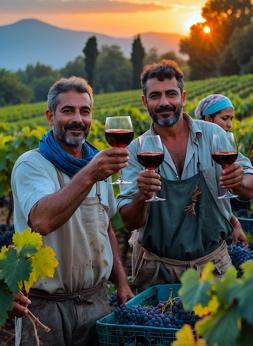
I was up before dawn. Pale buildings, pale leaves, pale light. Mist on the hills, dew on the grass, breath in the air. Autumn smells of moss, thyme, burnt weeds, wild garlic, basil, dill.
I neared the kitchen. The smell of lamb and bread merged with the acridness of a pigsty and the sweetness of a bower of mallows. The table was gouged from years of sliced loaves. Somebody threw me a glass. I caught it in midair and filled it from an unglazed wine pot on the table. They cheered. Later I was told that everyone had a glass thrown to them before they sliced their first piece of bread for the day.
in the village. Coarse salt in metal dishes. Lamb boiled in whole spices. Trays of olives. Apples.
As they filled their mugs, they spoke of the long day ahead.
Someone muttered that so-and-so was planting vineyards. Someone else responded that vineyards always got planted when there is hope in the future, while olives go during times of doubt.
The wine was musky and tart. It went well with the traditional grape harvest breakfast. Hard-boiled eggs mounded in bowls. Square trenchers of barley and rye. Bowls of honey and yogurt. Wedges of ripe graviera cheese, the best
A moustached old man in a weather-beaten hat made a doll for his grandkids out of a pine cone, with dry grass for hair and chickpeas for eyes.
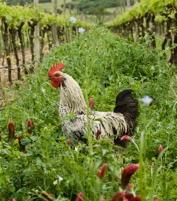
We all trooped outside and hopped aboard a tractor cart. Red-faced old men cradled pink-faced granddaughters. Everybody waved good-bye to the rooster flapping his wings and making a grand show of himself. He would have been more subdued had he known he was dinner tonight.
The cart slipped through olive groves into the dawn. A quarter-hour ride took us to the first vineyard, a small holding on a ridge. Venus, that so brightened evenings last spring, was rising now in the fall. Someone recited stars stories, half ancestry, half locale. One constellation chased another, which turned with a raised stick. A neighboring town name was slipped in, then the nickname of a landlord they all loathed. Boys’ eyes widened as they heard their surroundings turned into tales.
We rocked and tumbled against each other as the cart lurched in the ruts crossing a dry stream bed. As we ascended the fog thinned, delicately revealing mist’s spirit of place — how things seem far even when near; how shadows find their density as the mist thins; how mist curves and folds and vees in unison with the land; how grey unveils day’s pastels; how the spring nestles itself in grass modesty; how the stream lives moments as seasonlessly as it lives centuries; how we experience ourselves that way when we become what the stream is to the sea.
When we feel the land’s foldings as though they were our own, from hill to hollow to grove to pool, winding and coiling and descending and joining; until one day, now careless of self as of knowing and end, we come to know that I is not a me, I is a We.
It was the first time I had a thought that did not come from my mind.
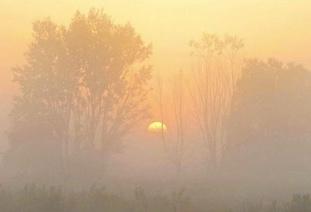
We passed rows of trees, hollows and copses and gullies and fords. We lifted over the gravelly crest of a hill, saw a sudden strange vagueness, a shape that wasn’t but was, a life jelling mist out of its own breath, then dimensioning to being and acquiring humanity. I squinted, looked sharply, saw one ... two ... three ... fivesixseven, maybe more.
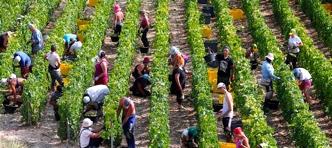
The locals knew the familiar mounds, the stones in heaps, the grass-haired posts, the bower where we would sleep after lunch. Its ferns were now spiderweb droplets dappled with dew. We got down from the cart, twisted our waists to take the aches out of our backs. One of the men shook a vine with a stick, spattering dewdrops in a scatter of flung silver. The women threw down the kalafia καλαφια baskets for the grapes and handed our lunch hampers to the children to put in the shady grove where we would eat.
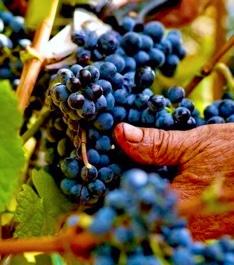
Everyone chatted as we arrived at our allotted rows. Our rows were distinguished from others by blue paint on the end posts. Someone bent down to strip off a few grapes. He nibbled a few. ’The grapes are ready’ he informed me, ’when the skin breaks easily as you bite them. But the smart farmers let them ripen a week or two longer to reach their full sweetness.’ He wiped his hands on the dew-wet grass.
He taught me every imaginable detail about grapes that day. Since vine leaves turn color nearest the ripest fruit, I should look for the prettiest leaves as I paw through the maze. The more grape clusters to the bunch, the better the wine. He pointed out some mouldy grapes near the ground that ’smoked’ when he nudged them with a stick. ’Don’t breathe it or you will catch a cold this winter. If you see vine leaves punctured from a hailstorm, pass them by; their clusters will be ragged and the grapes too small.’
Two to a row, each with a καλαφια hooked into our elbows, we moved surprisingly quickly. Vine leaves trembled. Insects scattered wildly. Within minutes our sleeves were dew-soaked to the shoulders. My hands acquired a purple stain that didn’t wash out for days. Painful fissures opened on my fingers.
The work was coldest during that first row of the day, but there was the promise of warmth amid the colours gelling out of the mist. The work became not quite so cold, then not quite so uncomfortable, then not so bad. My back still ached as I groaned down for low fruit. Swallows skreeked as they devoured insects above the field-edge grasses. Day colours emerged first along the ridge tips even as the valleys were still misty with the descending greens of autumn, bursting and ripe and poised for the turn.
Four thousand years of experience understood in a glimpse.
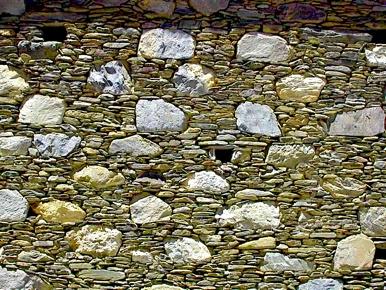
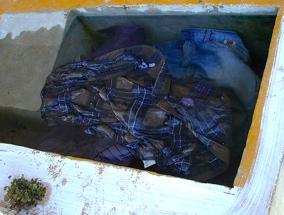
I rose from my cutting to survey the long rows ahead. Signs of a poor region abounded. House walls made of broken rather than cut stone. Some were whitewashed, most not. A communal bread-oven loomed on a mound, its smoke-dark fire pit under a dome crusted with ashes. Carved stone laundry basins lined a wide spot in a stream; in one of them was a tangle of shirts that had been left to soak overnight.
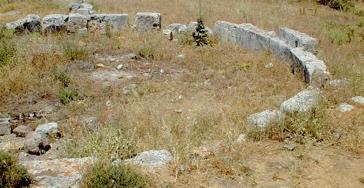
Nearby was a circle of stones that marked an aloni αλόνι or threshing pad for barley. In the distance was the grass-edged meander of a seasonal rivulet so small that no matter how hard or long the rain, it would remain always a rivulet thanks to the water-draining porosity of Crete’s limestone geology.
I mused at the notion of a stream fated by the land to go nowhere. Then I looked at the people around me.
Gathering the grapes, a silent kouvalias κουβαλιάς plodded up and down the rows. A wide-mawed kofini κοφίνι was strapped to his back. He reached the ragged line of grape cutters and muttered, “El-laaa” as he bent to one knee. A flurry of kalafia καλαφια basket passed over the rows and were upended to into his κοφίνι. “Ka-laaa,” he rose as the baskets were passed back to their cutters. He wiped his forehead with his sleeve and leaned into his trudge. The huge basket now creaked under its load.
The harvest cart was stained from years of broken fruit. It smelled of mould and grape must and manure. His shoes sagged over the ladder rungs as he centred each foot before giving the rung his full weight.
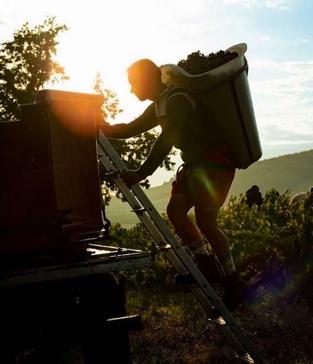
At the top, he grunted, “Hoof-laaa”, dropped his left shoulder sharply and thrust forward from the waist, hurling the grapes into the cart in a blur of purple. He stepped down as carefully as he did going up. His long trudge back was as silent as before.
Lunch time passed in a flurry of wildly waving spoons and deep quaffs of wine, followed by a long snooze in the grove. A few older folks poked out the soft parts of their bread and then used the crust-rings to play toss-pin against a twig stuck in the grass.
When I awoke I was enervated from too much exertion early in the day and too much wine in the middle of it. I followed the lead of the others by hopping up and down while waving my arms in giant angel-wing flaps. A dog came up to me, wagging its tail in short wiggles, letting me know it wanted to be friends.
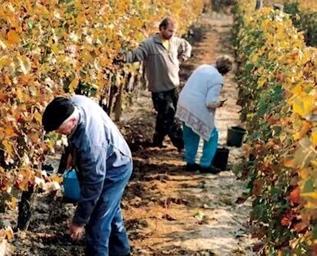
Work in the heat of the afternoon went slower as cutters gossiped and told stories. I watched the work styles of the others. Some took it easy, standing up periodically to rest their hands on a vine stake and enjoy a long look around.
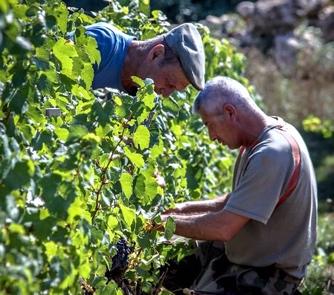
Others buried themselves in the leaves and never seemed to emerge. Somebody started an overly long story they already knew. Their eyes rolled and they gazed at the sky as he droned on and on.
Some knelt as they worked each plant, then rose to go on to the next. Others stayed bent all the way down the row. Some complained. Others laughed. Still others sang. The kalafia filled at about the same pace no matter what they did.
My soreness was gone by late afternoon. Everything seemed distilled — colours, smells, pleasure, laughter, life. Then the field’s owner arrived towing a cart with two large flagons of wine.
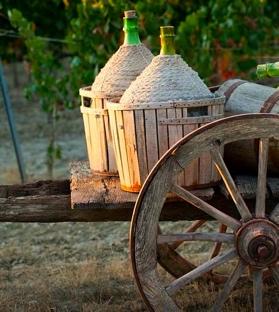
His shout, ’Pollliii kalllaaa’ πολλλιιι καλλλααα was the signal to stop. Plastic glasses were filled, the froth blown off. They squinted through the brown crimson into the sun.
It was their first taste of last year’s wine, still grapey and, to outsiders who don’t know Cretan wine, too maderised and sweet.
III
’Too maderised and sweet’ is a taste that goes back at least as far as the sixteenth century. The scholars of Oxford labeled it vinum Creticum and averred it came from Monemvasia in the Peloponnese. They were wrong by two centuries and two hundred kilometres. In 1420 the Venetian Senate referred to Cretan wine as ’from Malevyzi Μαλεβύζη on Candia [Heraklion].’ That tongue-tangler of a word Μαλεβύζη became ’Malmsey’ by the time it hit England’s shores.
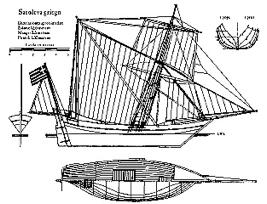
The Arsenali shipyard in Venice designed a special vessel for wine transport — the rakesailed sacoleva σακολέβα. Its wineglass-shaped hull became the FedEx of the wine trade.
In 1554 a Venetian accountant with the nicely euphonic name of Leonardo Loredan totted up the totals of Crete’s wine trade:
The city Candia and its province make 14,000 butts of wine. Of this, 200 butts of moscatti go to Flanders because it is not of too good quality; 500–600 butts of liatici are exported to Venice and elsewhere. Chissamo [Kissamos] and apokorona make about 2,000 butts for Flanders. The rest is logade and cozzifalli, which are sent to Flanders, Venice, Constantinople, Alexandria, Messina, and Malta.
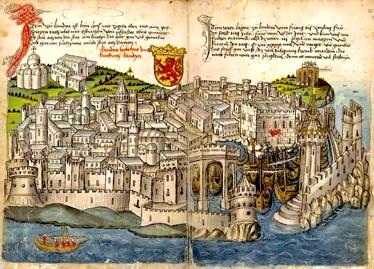
Since a butt was 104 British imperial gallons, the above export was roughly ten million of today’s bottles. No wonder the Venetians designed the sacoleva σακολέβα to get it to market as quickly as possible.
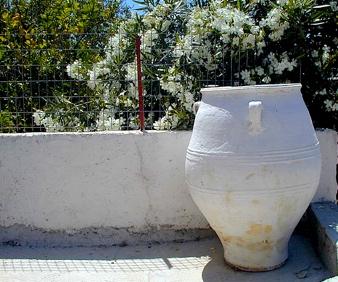
Even the fastest boats on the Mediterranean had their limits. During Crete’s era of Venetian suzerainty, the island’s wine was stored in pithoi and shipped in amphorae. Both containers allowed enough oxygen to seep in to turn the wine to vinegar once the sugars had converted to alcohol.
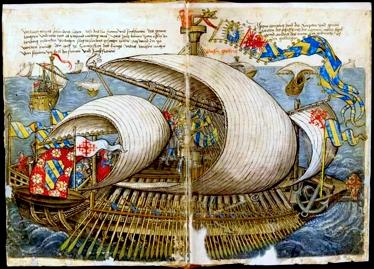
While the sacoleva sliced like a dagger through the modest wavelets of the Mediterranean, it was no match for the merciless whiplashes north of the Bay of Biscay. Wine for Northern Europe suffered the ignominy of being offloaded in Jerez or Lisbon to wallow northward in carracks built for the ingots and lumber of the Age of Discovery, not the silks and spices of the Age of Merchants.
In the sixteenth century it was discovered that wine shipped in airtight oak casks from Madeira to Britain would turn brown and become smoke-flavoured and sweet without turning to vinegar — a chemical reaction called maderisation, induced in an airless container crossing warm seas.
The Cretans from Malevyzi Μαλεβύζη near Rethymnon hit on a technique of hastening the process by deliberately heating the wine before transport. They experimented until they found a formula that enhanced the wine’s longevity without ruining its flavour. During the grape harvest large cauldrons heated the
... Celia
Thy baths shall be the juice of July-flowers
The milk of unicorns and panther’s breath, Gather’d in bags and mixed with Cretan wines ...
... Malmsey had all but vanished from the export records by 1700. (No one recorded what happened to the unicorn milk and panther’s breath.)
IV
Someone handed me a second glass and it was gone as quickly as the first. No one wanted to be the first voice to break the glow. Then there was a grunt and a backslap as we teamed up on the last of the rows. The καλαφια were collected by the children and stacked in the cart. The men hacked off olive branches while the women gathered vine branches with broad leaves. The children levelled the grapes in the cart. The men angled the olive branches across the top of the load and the women crisscrossed the vine branches above them. Everyone hopped on, giving the grapes a pre-crush the owner didn’t seem to mind.
My eyes drifted over Crete’s countryscape like fingers over a first love. Everyone here had walked these lands till their feet hurt, found every recess and hilltop, knew the water sources trickling out of their moss dens, how the olive tree fattens from grape must to 60°C for several days. The cooked version became the export of choice due to its long storage life compared to uncooked wine from the same region. In a viticultural version of form follows function, British popular taste shifted to the sweet wines of Malvasia.
All this faded with the coming of the cork around 1600 (the same date that gave us opera). Wine tastes changed from amohora-transported and sweet to bottle-transported and dry. Despite Ben Jonson’s early clickbait in Volpone ...
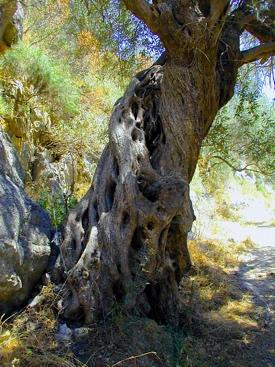
finger-thin seedling to lightning-riven old sentinel still bearing fruit in spite of its gaunt centuries.
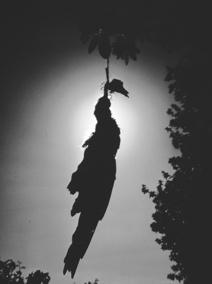
A wrinkled face with a towering shock of white hair strangled out a tune reminiscent of a sneezing walrus. Another man unwrapped a pouch of snails he’d collected while going down the rows. He now counted them as others opined on how to properly sauté them with garlic. Two little girls marvelled over the remains of a swallow’s nest they found. A boy faced into the wind as the tractor ploog-plooged down the road. He threw a rock at a scarecrow, a dead raven that had been hung from a tree.
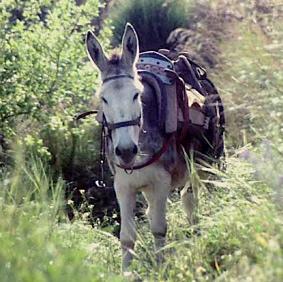
We descended into the afternoon sounds a Cretan hill-slope hears — hisses and rock clacks from a plow blade cutting through a fallow field. A mule balking and snorting as a farmer lurches through a tight corner. Laughs and howls and oofs and curses. Knotted caws as startled ravens tipped into the air low on their wings. Chimes from a chapel roiled over hill slopes of sheep bells. Splattery buzzes hummed out of flower cups to whirr their way back to the hive. Curt phrases swelled to screeches and back to silence as a married couple work too closely at a disagreeable task. The silvery song of shepherd’s pipes wafted in and out of the zephyrs.
Then came the sounds of the patiri πατύρι, the hamlet where local girls will tread the grapes. The map of Crete is freckled with the names of such hamlets. Duty and dwelling dot the landscape with place names and walking times till the map can bear no more. Clans prefer nearness to their fields over nearness to other clans.
Cretans still navigate landforms with names coined in Minoan times — Zakros, Praisos, Syvritos, Gournia, Malia, Knossos. On the road or along the old trails that thread chapel to chapel, each place-name is only a few dozen to a few hundred paces distant from the next. Each name has its own heritage of legend and lore, about which the further locals venture from their hamlet, the less they know.
Cretans still navigate landforms with names coined in Minoan times — Zakros, Praisos, Syvritos, Gournia, Malia, Knossos. On the road or along the old trails that thread chapel to chapel, each place-name is only a few dozen to a few hundred paces distant from the next. Each name has its own heritage of legend and lore, about which the further locals venture from their hamlet, the less they know. The spring where moss clings to stones, making them bright green. The muddy place in a gully where moles rustle between fallen chestnut leaves. The meadow of lone pines and dry grasses. The slump in the earth where a stream hisses its protest at a patch of stones. Places named after flowers, others after herbs.
Even so specific a name as a place where the herb ybright might be gathered to use for making faces fair. There is no songline significance to these; they are simply the identities of getting around.
Hamlets named by swampy groves, hamlets where stonecutters work, hamlets where itinerant ironmongers once set up their bellows on market days. Place-names for the best fields, place-names for the worst. Names for the hamlet where goat-cheese makers lived, for the crossroads where people took the left path in the spring and the right path in the fall. The churches where a single baptism anoints all the children born that year.
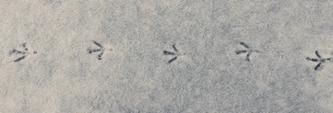
As I mused over these things, a plover landed nearby and left its food search in dust prints. Fingers over a first love. At the πατύρι I heard sounds of water sloshing into barrels to swell the wood into an impenetrable seal. Thin chirpy conversation rose from the sheltered bowers where the girls were patima πατιμα, treading grapes in concrete crushing basins.
The girls had hiked their skirts thigh-high and were now thigh-deep in purple. They walked slowly in a circle, executing a leftward swivel of the foot at each step to shred the skins — one of the many harvest movements that found its way into Cretan country dances today.
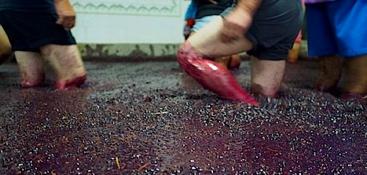
Someone told me that the grapes were crushed three times. The first treading yielded the sweetest juice and the lightest color. The second crush squeezed juice from the leftover mash by putting boards on it and weighting them with large stones; this yielded semisweet, more deeply coloured juice. The last squeeze saw the hamlet’s five biggest men, all brothers, hop on the boards and jump up and down, which yielded a last thick juice of dark color. Red-faced from exertion and wine and wind, the five were stocky and short-legged, hence their clan nickname, “Lowpisser.”
The skins and seeds will then be scraped into a barrel partly filled with sugar water. There it will ferment for a month into a juice which is then distilled in an antique alembic into raki.
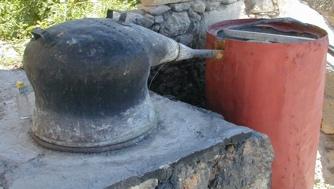
A winemaker is an οινοποιός, oinopoiós, the root for oenologist today. The οινοποιός’s skill decides the proportion of the various wines from different fields to blend to achieve a particular taste and shelf life of wine. Wild yeast is already on the grape skins so there is no need to waste money on storebought powders. Cretan yeast is a slow fermenter that takes two months or more to finish. The οινοποιός will visit the barrels every week, put his ear to them and listen for a faint hissing. Upscale οινοποιός employ a physician’s stethoscope.
The most skilled οινοποιός have mastered the rarefied art of wedding wines. For those, especially fine grape clusters are set aside during harvest in a year when a child is born. Those few clusters will be made into a few bottles of wine to be aged until the child marries. The bottles will be opened for their wedding toast. With two or more decades of bottle time, it will be the smoothest wine they will ever taste. A popular tradition has it that the first swallow of wedding wine is as propitious as the arrival of the first swallow in spring marking the end of winter.
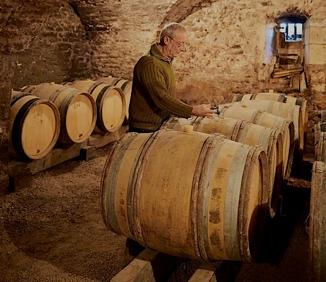
When the barrels are at last silent the οινοποιός performs a final φίσίμα fisima by blowing into the barrel-bottom dregs with a rubber hose to bestir a final fermentation from residual sugars in the dregs. When the barrels grow again silent the wine is done.
Hours later, after a bracing wash in a bucket by the well, I thought, “After a day like this, I know life.” Each glance around me all through the day had revealed the immensity to be had in a moment. It was at this epiphanic moment that a friend came up and nodded in the direction of the taberna, saying, “Muse all you want, but we don’t know the half of things, and never will.”
of lamb just in from the kitchen, this being the one stuffed with olive oil and rosemary.
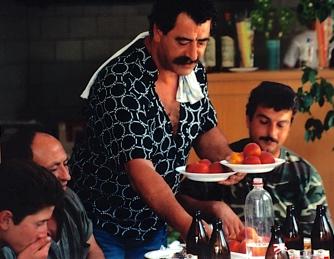
Dinner was a din-filled, truly abandoned time. Motions, gestures, laughter, ripostes, smells, wine tumblers filled the moment they were emptied, fresh-baked bread falling apart at the knife, stubby hands, slaps on the back, full bellies patted. After an hour of this I gasped, “Enough! No more!” Then
We went out into a cool night dappled with dew. The matted grass was necklaced with spiderweb funnels. The hasp on the wine-cellar door fell away. The door opened with a dull scrape. Bins and barrels appeared, dim in air thick with wine smell. Dusty barrels, speckled with mould and tiny mushrooms. Barrels with the tart, musty smell of wine that’s been in them for years. A cooper’s initials were carved into the end of a spigot. Someone dipped a wine-thief into the bung hole at the top of a barrel. It emerged streaming earth-hued droplets that turned dusky in my glass. We walked from one barrel to another, savouring not from the seductive goblets the experts extol, but plain, no-nonsense, water tumblers.
The wine was true Μαλεβύζη — brownish-red, tannic as a leatherworks, rich in the scents of the earth turned into the
ere was a moment of silence, of the marriage of taste and scent, then a thin whistle as one of them sipped in a little air, filling his palate with the wine’s musk. ’Might as well enjoy it while you can,” he said, “you go to your ghost in God’s good time no matter how much you pray.’
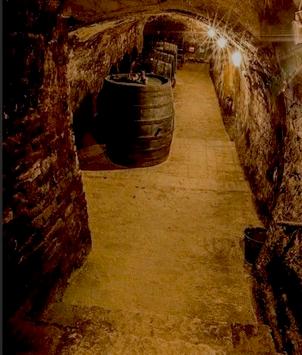
Slowly, taste by taste, the years receded like the aches in my bones. The light became ghostly. The details of faces diminished as they acquired a crispless mystical quality. Daytime clarity melted into edgeless shapes. Features became essences. Eyes glittered with feelings that cannot be felt in daylight. Candle flames trembled from gusts of laughter.
Laughter that drowned all the sounds that accompany mist and cold and daylong labor. Laughter, the vowel-pocked rivulets of words, the embrace of life that shouts up at Icarus, ’Hey! Why are you going? Come back! You can see everything you want with the light that you have.’
I realised I had no need to look in the mirror and say, ’Farewell, basket, the vintage is in.’
The linger of candle smell after they are snuffed out.
That was how this began.
What is the ’Real’ Crete?
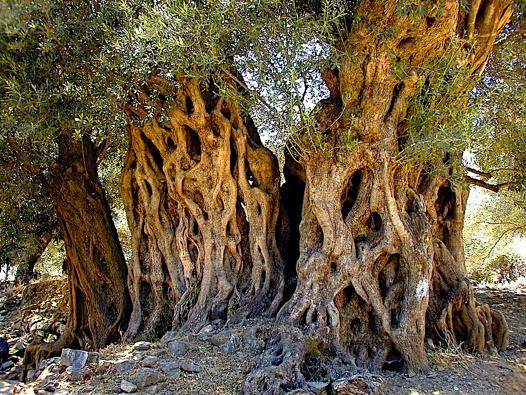
Crete’s craggy geography is renowned for its mythic Minoan civilization; its tumultuous history; its hardy, feisty people. The Mediterranean Diet so beloved of nutritionists and cookbook writers may not have originated on the island, but Cretans are among its longest-lived practitioners. Travel writers ransack their vocabularies to paean the island’s rugged mountains, balmy beaches, and photo-perfect seaports. The island is a fount of print articles, podcasts, academic research papers, and wide-eyed first-timers TikToking their glee.
But what is the ‘real’ Crete?
Is it the mythical Crete, the birthplace of Zeus, the land of the Minotaur trapped and killed in the Labyrinth, or Mount Dikte, haunt of Olympian gods and mystical beasts?
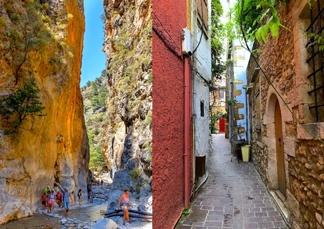
That image of Crete nearly fell by the wayside as the myths faded into obscurity when archaeological facts came out. Praise be to the legions of historical novelists for puffing life into ancient balloons so they may loft again.
The Renaissance mystique of Diana the Huntress beloved of painters through the ages is a fiction that can be traced to a historical fact. The role model for Diana was no huntress with a bow and sandals, she was a Cretan villager named Diktynna (called Britomartus by Romans). Her story was so highly regarded in her own time that a shrine to her on the Rhodópou Peninsula was a popular pilgrimage from Mycenaean times to the end of the Roman Empire.
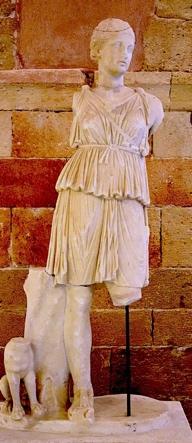
Thanks to Strabo (10.4.12) we know that the word diktyon
δίκτυον means ’net’. Instead of violently beating animals to death with sticks and spears as men did when they got hungry, Diktynna devised a net to snare them. A kri-kri mountain ibis in a wood-staked pen too tall for it to leap over soon attracts a mate, which gets in thanks to a convenient ramp on the outside. Before long Diktynna was feeding her village all year long. She bequeathed us a word so obvious that it is surprising how seldom it is used: gatheress.
Is the ‘real’ Crete the mediagenic tourist magnet fabled for its quayside cafes, memory-making balcony views over harbours, quaint towns filled with narrow lanes lined with restaurants and trinket shops? Is it the island’s fabulous hiking, deep chasms, scent of wild herbs, the jangling of sheep bells on grassy slopes? Its whitewashed chapels that dot the countryside. Its mountainous spine and cove-pocked coast?
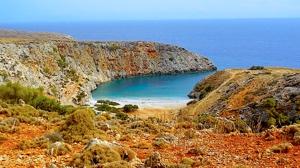
Is the ‘real’ Crete the longest continuously inhabited island with its own unique civilization? Is it the agricultural hothouse that has provisioned the millennia with olives, honey, barley, and tomatoes ever since the first Minoan boats sailed to Egypt 3900 years ago? Is it the agricultural cornucopia of polytent hothouses that today produces a fifth of the Common Market’s vegetables? Is it the center of modern scientific research papers in astronomy, archaeology, botany, soils science, drip irrigation, geology, and fisheries management?
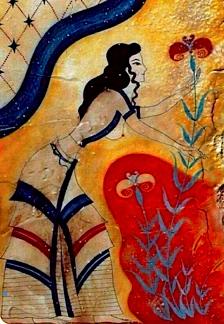
Is the ‘real’ Crete the iconic Minoan sevenflounced skirt that benchmarks the origin of the sewn and structured garment as we know it today? While the rest of the women around the Mediterranean made do with variations of the rectangular tent we know mainly by way of the toga, Minoan women were a parade of bouquets.
In truth, Crete is all of these. But in this recital of Crete’s civilization in fragments, there has been a key omission: the people.
Who are the Cretan people — or as they refer to themselves, Kritis? What do they do all day long? What are their jobs, their pastimes, their worries, their rules for good living? How do they raise their children? What do they think about each other, the mainland Greeks, the hoards of summer tourists, their futures in an era fraught with the environmental omens of rising sea levels and tinderbox wildfires?
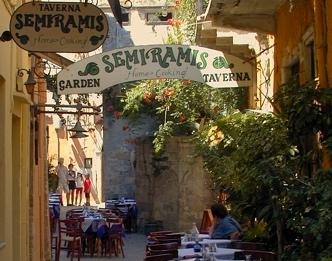
There is a predictable generation gap between Zorba the Greek and today’s young professionals who shun the mythic Crete in favor of advanced degrees in Athens and abroad. But while those young people are serving “Real Cretan Food” in touristtrap cafes as they earn the money for next semester at school, what do they really think about you?
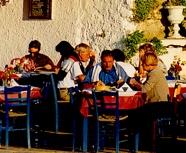
The panoply herein makes for entertaining reading, but it is a pallid facsimile of everyday life — the smells, the sights, the fleeting facial expressions that unmask inner thoughts, how children play, how elders walk, how Cretans manage to enjoy themselves despite life around them changing too quickly and too much.
Go there and spend three months talking to everyone you can. People in blogs aren’t nearly as interesting as the ones sitting next to you.
You won’t know until you ask.
Honey Moon Room
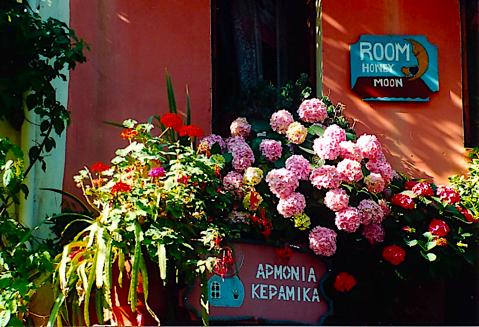
I found the flat of my hopes in an old Venetian building in the yesteryear Topanas Quarter. The two-floor flat was above a gift shop owned by a charming, plumpish woman named Maria. The sign on the street billed it as ‘Room Honey Moon.’ The notion of a bachelor renting a flat with that appellation conjured an image of arriving alone with a backpack at an inn in the Cotswolds and asking for the bridal suite.
Maria confided that a writer residing there for three months would bring in many more euros than newlyweds who stay three days. The building was a wedding gift to Maria and her husband Tassos. They passed their honeymoon and most of their marriage there. They raised their two boys in the building, then moved to the suburbs when the boys were early teens who needed private rooms of their own.
Maria offered to take down the sign if I wished I said, 'No, I’ll have a honeymoon with Xania.' She beamed. The rental was off to a good start.
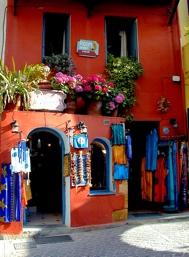
The flat’s upper balcony looked down on Odos Zambeliou or ‘Street to the Spring.’ It is a threadneedle lane that wriggles its way downhill to Chalidon Square. The fourteenth and fifteenth century Venetian traders who built townhouses along the lane platted them with just enough width to accommodate oxdrawn delivery carts — the only way to transport cumbersome building materials and furnishings in those days.
Below my balcony and to the right a broad street named Odos Domeniko Theotokópolous descended half a kilometre to the sea.
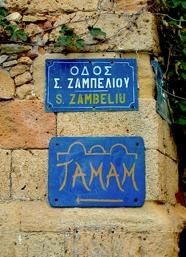
Theotokópolous was the patronymic of the sixteenth century painter El Greco. He was not born in Xania, nor did he ever live there. His Venetian colonial parents were driven from Xania in a Cretan rebellion between 1526 and 1528. He arrived on Earth in 1541 and eventually found his way to Spain in 1577.
That doesn’t stop AirB&B agents with rentals on Odos Theotokópolous from
claiming ’El Greco slept here’ in their online pitches. By their claims, dear Domeniko slept in more beds than Napoleon.
Stroll down to the sea on this street and the colours of the buildings resemble those you see in El Greco’s early paintings. Squint your eyes and you can easily imagine you are walking around and meet him with an easel in his hand.
My days began with Xaniá’s love affair with bells. Every quarterhour sounded like a competition between March of the Marionettes and a union protest at an iron works.
Despite these tintinnabular exhortations, morning-time Xaniá bestirred itself slowly. The only predawn sounds were the swifts skreeking their arcs across the sky and the cats in yet another yowly territorial dispute. At eight a.m. the streets below were all but empty despite the boisterous sun. Here, an old woman carried a rustling basket of breads. There, a boy trudged his way to school, book pack strapped to his shoulders, his oversize sports shoes going galumph, galumph. A few minutes later some imbecile braaaaked by on an unmuffled Vespa. A rooster skrawked.
Once a week Xaniá’s sole remaining καράκλας karáklas man hollered his raucous rounds as he advertised his armload of fresh-cut rushes gathered before dawn from a swampy spot in the Klathissos River on the western edge of the city. Yioryio by name, he repaired brooms and wicker chairs. As the Topanas Quarter is the ritzier side of town, he started at our end where his rushes would be the freshest.
The empty balconies that greeted him suggested that forbearance is part of the karáklas job description.
Myriads of wash lines on the balconies and roofs fluttered in the morning. The breezes that came with the heat of afternoon would have them rippling like pennants on a yacht. But now, still dripping, they smelled redolently of olive oil and rosemary.
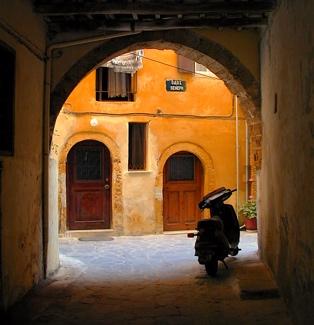
Olive oil soap is ubiquitous and inexpensive in shops and open-air markets. A mother can dab a baby’s face with this soap. A workman can lather off the grime of a plumbing repair. A laundress can swizzle silks and cottons in the same water.
Elegant upmarket olive soaps come prettily wrapped in marbled paper that looks like the endpapers of an antique book, yet the soaps are humbly priced at about a Euro.
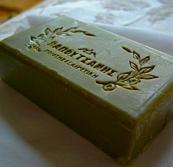
This soap, wrapped gifty or plain, is an example of how Xaniá refuses to let itself be institutionalised despite the spending hoards that throng through every summer. Starbucks has an outpost on Chalidon Square, but a discerning ear hears no Greek. Seattle’s cutesy concoctions may dazzle the TikTok chatterboxes, but they don’t cut much ice with Cretan palates fine-tuned on four centuries of cafe élleniko thick enough to float a spoon.
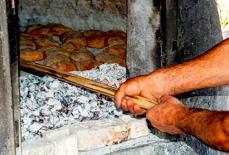
When I wanted bread I would stop by Yorgos’s αρτοποιείο, bakery, hail out a ’Yasas’ and choose from an assortment of ψωμί psomi (breads, and be sure to aspirate both the ’p’ and the ’s’) still hot and yeasty from the oven. No industrial additives besmirch Yorgos’s psomi, nosiree. I watched him work from one till ten in the morning through every step of the αρτοποιός
(artopoiós psomioú) art, from scooping flour from a cardboard barrel to pulling crackling loaves out of the oven with a flat wooden paddle.
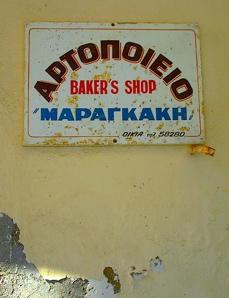
Armonia Keramika’s day commenced when Maria’s wind chimes were hung up to announce the event, to the accompaniment of the cats Capuleting and Montaguing over the newly altered territorial claims mandated by the shop doors having been opened.
On day Maria called me down to present me with a psomi. It was about eight inches in diameter, an inch or so thick, and made mostly of barley flour (as is quite a bit of Kriti bread). Dozens of olives had been pressed into the dough before baking.
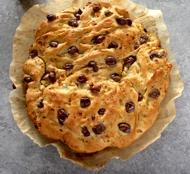
She had purchased it from Yorgos, one of the last traditional bakers left in Xaniá. His oven dated from the fifteenth century. It was a wood-fired affair that looked like a vision of Hades by Hieronymous Bosch as filtered through the wit of Walt Disney’s 1930s-era animators.
Whenever I stood in his shop perspiring profusely in the hot Mediterranean morning, the volcanic heat radiating into the room made me think that before my very eyes lay the door to perdition.
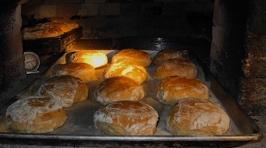
But if this was perdition, what came out of it was paradise. His fresh loaves yeastily advertised themselves on the shelf. A dozen mottled browns would waft their sourdough smells like morning mist off a pond. Nut-brown crusts were coated with oatmeal on the top and almond dust on the bottom before baking. The almond dust was to keep the loaves from sticking to the oven when they first went in. Plain round buns were a fragrant brown.
Back in my second-floor kitchen with the loaf Maria brought, I didn’t quite know what I was supposed to do with this psomi from the heavens. I called to Maria downstairs in her shop. She tromped up the stairs, broke the bread into chunks on a wooden platter, crumbled a layer of feta over them, drizzled olive oil over that, anointed the whole affair with fresh oregano and basil from the planter boxes just out the windows, and pronounced, ‘Πόλη εύηευστο.’ Poli eviefsto — very tasty. That was the understatement of the day. The loaf was embedded with slivers of sun-dried tomato to add piquancy to the olives baked into the crust. The loaf inside was freckled with marjoram. It crackled fragrantly as I munched chunks of it dipped in Ηλίας Λάδα, ilias lada, olive oil.
I had bought the ilias lada directly from a barrel at the Mom & Pop shop just across from Yorgos’s bakery. The same shop sold home-made (and probably home-stomped) Cretan wine, also directly from the barrel. From what I’d seen of it, one sip would stain your teeth for life.
The only thing missing from Maria’s psomi feast was a chunk of γραβιέρα graviéra cheese, the local gruyere-style cheese that’s the best bread-extender the Cretans have come up with.
I wrote graviéra on my shopping list. Plus tomatoes, so fresh and scented they all but leap out of the bin into your basket. Plus capers. Plus several kinds of olives. Plus a slab of feta.
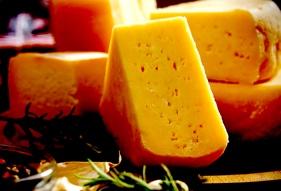
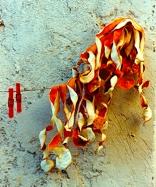
Plus oranges for dessert, to be peeled the way Kriti children love to peel oranges in lunchtime contests, strung out in as long an unbroken strip as they can.
Morning Mundanities on Odos Zambeliou
Odos Zambeliou, Οδός Ζαμπελίου, is one of the main routes that navigate the labyrinthine Topanas quarter. Today it is paved with cobbles of granite, a vast improvement over the miry rutways urban streets were for centuries. Even today a few of the old palaces have mud scrapers at the side of the door to demuck one’s boots.
The Topanas Τοπανάς was the wealthy merchant district in Chania’s Venetian heyday from the middle of the thirteenth century until the Turks overran the city in 1645. Odos Zambeliou marked the boundary that separated the worry-free wealthy from the wannabe wealthy. The arched portal leading out of town to the left of my balcony dates from the 1400s.
So quiet was the quarter that I would awaken to silence. The first arrival of the day was the newspaper deliverer. She was a stout girl of maybe fifteen to eighteen. In the cool mornings she wore enough jackets atop jerseys to look like a blue serge bowling ball. The papers were pathetically skimpy little things; the ad base must have been atrocious. She rolled them into tubes stuffed like cinnamon sticks into a sheet metal box on the back of her Vespa. The whole affair looked like it would tip over backwards the moment a gear was engaged.
Then silence again until Chania bestirred itself in earnest around 8:30.
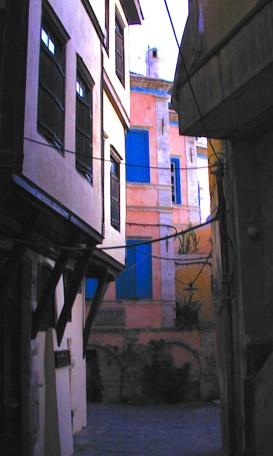
Most Topanas buildings are narrow, varicoloured, tri-floor Venetian townhouses, soft-textured and soft-hued with a cramped floor plan that makes one think of life in a telephone booth.
Interiors are gloomy with featureless. Shadowless light. Steep stairs. Balconies barely wide enough to accommodate a table and two chairs. They are childproofed with large flower pots out the windows too big for a toddler to climb over.
The Old Harbour ended in the Mediterranean on the north and merged into the Splantzia or Turkish quarter to the east.
To the northeast was Kastelli, a jutting outcrop with a sweeping vista of the sea, atop which Chania’s 8,000 years of continuous civilisation began.
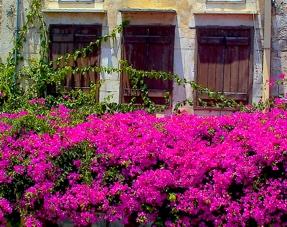
Xaniá Old Town is a warren of alley-like streets merging into tiny little plazas with newspaper/cigarette/chewing gum/ lotto-ticket kiosks surrounded by townhouses. Descriptiondefying tints of pastel. Windweathered windows with cats sleeping on the sills. Flower pots frothing bougainvillea, stavesacre, geraniums.
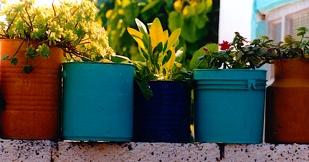
Soft mottled surfaces. Cats hissing at each other. Lemon trees. Gnarled vines trellised into overhead sunshades. Cobblestone lanes so narrow outstretched arms touch both walls.
Elderly widows dressed in black. Cats doing nothing in particular. Mandolin music drifting from second-floor windows Cylindrical chimneys venting wood-fired ovens. Oranges on window sills. Scents of fresh bread. Balcony clotheslines dripping onto cobbles.
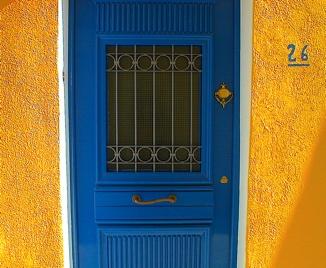
Dwelling doors of Cretan blue and marigold ochre.
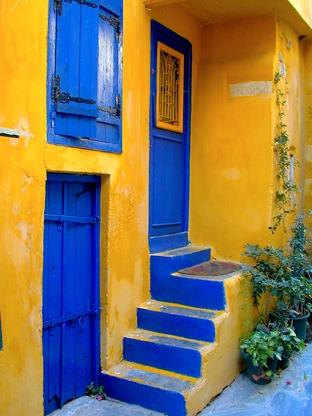
Bicycles lain against walls. Thick impastos of whitewash. Children screeching to the sound of a bouncing ball. Dignified old gents who acknowledge a 'Yasou' with lips as compressed as the Sphinx.
And still more, **sigh**, cats.
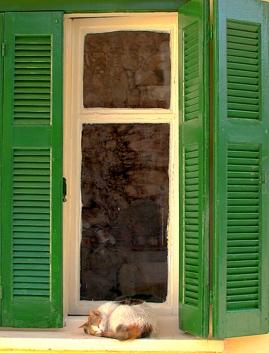
Unsurprisingly, Crete’s most ubiquitous postcard theme is cats. If you want to see visiting coffee-table book editors roll their eyes and grimace, propose 'Cretan Cats.'
On the other hand, given all this battle-honed claw power, I never saw a dog loose from a lead.
Today a group of workers showed up at the unearthly hour of 8:00 to make a show of progress on a seemingly endless cobblestone repair on the street below. Now it was 8:15 in the morning. The workers below were half tapping and half arguing into place the myriad cobblestones of a re-paving job that had been going on since I arrived. The fruits thus far were about twenty metres of the left half of Odos Zambeliou looking like a proper street.
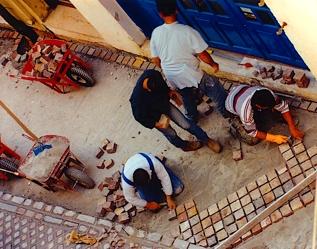
It was hard to tell if what lay below me was one supervisor and four workers or four supervisors and one worker. Every stone had to be emplaced with as much discussion as possible.
Today one of the Zambeliou dwellers abruptly interrupted the discussion with a grumpy cantata of shout-filled, handwaving, finger-pointing locutions so staccato they sounded like a bankruptcy auctioneer on fast forward. Why did these workers insist on waking up all Xaniá by discoursing and taptap-tapping thus at the unholy hour of 8:15 in the morning, and on a Tuesday at that? Hadn’t they ever heard of rubber hammers in their profession? Bricklayers use them all the time.
The gentleman applied a truly munificent eloquence to so brief a point.
Naturally, all work halted. The nearby balconies lined with housewives and children in a display of civic solidarity on the side of their neighbour.
The discussion ended with the workers agreeing to tap more humbly until the time to break for lunch, followed by the union-mandated nap through the hottest part of the day and a wine-sluggish return to work about five.
Have you ever wondered why medieval towns took so many centuries to build?
II
The Room Honey Moon was at the far western or 'high' end of Odos Zambeliou. Beyond it the Odos abruptly tee-boned into the Cavalierotto Santa Catherina Bastion. Below and to the left was a splendid wall of blue morning glories surrounding a former merchant palace.
It was inhabited by a reclusive widow in her eighties living out her dwindledown days being attended to by a daughter who had opted for filial duty over uxorial bliss. Every morning she brought a hamper of prepared meals. Every evening she took away the dishes.
The Santa Catherina portal didn’t exit the town any more.
The Bastion’s fourteenth- and fifteenth-century exoburgi farmer’s market declined in the sixteenth century as the Venetians took stock of Turkish intentions in the eastern Mediterranean and decided this would be a good time to prepare for the probable. Today the portal leads to the massive fortress walls the Venetians built to fend off the Turks.
Build they did. A fortress two miles in circumference embraces Xaniá Old Town, roughly twenty metres wide across the parapet and fifteen metres straight down to the now-empty moat — today dotted with modest little onion and artichoke patches tended by citizens who pay a small fee to rent their plot. In Crete, there is an adage to the effect of, 'You can take the family out of the farm, but you can’t take the farm out the family.’
The Venetians did not think petite. Their mindset evidenced itself eloquently in the massiveness of the old fortress walls. Think of them as living with a huge bedmate in a small bed.
The Venetians built them brick by brick using local peasant labor extracted at sword point from Crete’s interior mountain villages, even if it meant their crops would rot.
The phrase 'brick by brick' doesn’t convey any sense of what it must have been like working in one of those press gangs. Pretty as the Topanas quarter may be, it was built by wealth accumulated
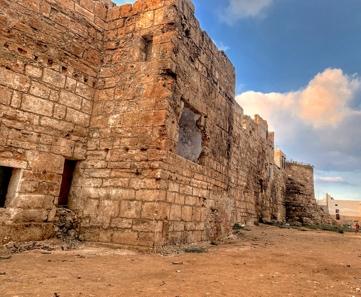
by exploiting inland Cretans the same way Caribbean slaverunners maltreated their chattel of Africans.
'Brick by brick' can’t hint at the dust that would have been always in the air. The pipestem legs of gruel-fed men. The knee-high mud when it rained. The flyblown donkey piles in the road. The yells of the workers when someone got hurt. The squalid rat-squirming reed shacks in which the wives and children alternately seared and froze during the year. The smells of cooking fires at night. The children tapping oxen along with sticks while staying warily clear of the lurching, yawing wagons sagging from bricks or broken limestone to fill in the wall’s surface made flat enough to trundle cannon wherever it was needed.
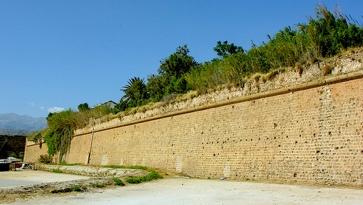
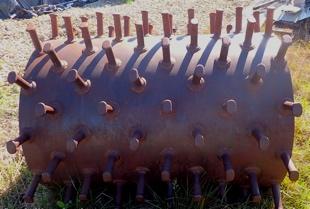
Those words don’t convey that the surveyor’s technique for levelling the tops of the embankments was to sightline along two pots of water with a string stretched between them. Or that the clay sealing layer that topped the fill was simultaneously compacted and made flat by driving herds of sheep or goats along it for days on end — a technique that has been passed almost without alteration into our own time in the form of water-filled cylindrical earth tampers used in highway construction whose outside surface is dozens of steel knobs which compact and smooth the soil the same way the sheep did, and is called a sheepsfoot roller for that reason.
Much of the rampart is now broken down. Turkish cannon started it. Modern merchants continued it. Gates were removed to accommodate autos that are wider than farm carts. In the early 1900s the thrifty civic fathers flattened the Piatta Forma and used the brick to make a large square on which they built a proud new agora public market. History evolves from market to market. War and revolt reset the prices.
Clippety Clop
The fabled clickety-clack of railway travel now having vanished into the linear screech of welded ribbon-rail, one of the few surviving rhythms of pre-petrol conveyance is the clippety-clop of six horse-drawn carriages in Xaniá.
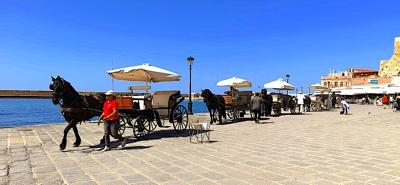
Every afternoon and evening the plaza around Chalidon Fountain and Karaoli ke Dimitriou ring with the clippety-clop of iron horseshoes on stone cobbles. Yet another tourist family or swain courting a girl are enjoying the ride of their lifetime. The image library of Xaniá’s dictionary is too diverse to distill into a few pages, or perhaps even a book. But at least one page must be devoted to carriage rides and the horses that propel them.
The carriages arrive around eleven in the morning. Six teams are especially trained and licensed to act as public conveyances at hire. No budget-aware Xaniote would pay the multi-euro fee for a perambulation through the Old Town’s back lanes. They walk those lanes every day.
Carriage rides proceed at a pace so leisurely they invert the Tortoise and Hare story. The Tortoise is the carriage and the Hare is any local resident who wants to get where he or she wishes in as little time as possible. In the Xaniote variant of the tale, the Hare easily laps the Tortoise four or five times before the Tortoise returns to its starting post.
Xaniá’s carriage-ride parking lot is exotic even for Crete. It is located between Akti Tombazi that edges the eastern jetty and Masjid Kücük Hassan — the Mosque of the Janissaries — the harbour’s comeliest piece of architecture.
The horse-and-carriage teams arrive from their owners’ stables out on the southern edge of go-go-go modern Xaniá — which is indistinguishable from any other Greek city given urban Greece’s unfortunate architecture, worse traffic, and residents who wouldn’t be caught dead taking a tourist-trap carriage ride for the fun of it.
On the other hand, a carriage ride through Xaniá Old Town is a FUN tourist trap. So is Disneyland — but in Xaniá you don’t have to wait hours in line for five-minute ride that one endures in Disneyland.
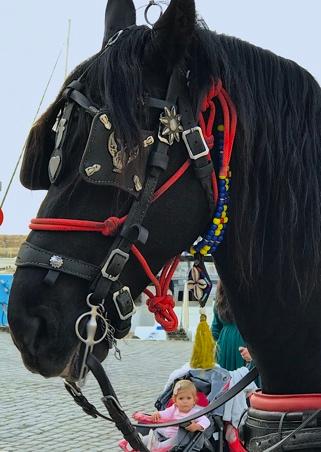
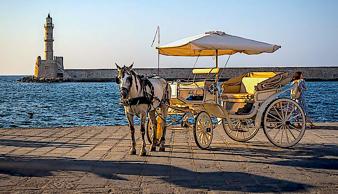
Kitschy or not, the clippety-clop carriage rides are among Old Town’s busiest attractions. At any time between noon and seven in the evening you can be strolling the harbour esplanade (avoiding the phalanx of cafe touts as you would a phalanx of lances), all the while admiring the water-hued pastels of Xaniá’s Venetian architecture. Suddenly before you looms a line of six gaily painted carriages with riders holding their horses’ bridles, huge spidery wheels, bench seats that can accommodate a family of four. Given the quality of the grooming, the owners devote as much time to their curry combs as they devote to banking the Euros they bring in.
One horse is a palomino, two others are chestnut roans with tâches (white patches) between their eyes. Another is an aging grisaille dowager, still beautiful and still reliable but clearly in line for pasture.
The eye-popper of the lot is a jet-black bucephalus of pure muscle with the chunky forelegs and pyramidal hooves of the Shire breed in England or Clydesdales in Scotland. His forelegs are tree trunks of hair bred to plough the loamy mud of tidal flats in northern England and the polders of Holland and Belgium. Those muds are thick, gooey, and deep. The lithe legs of thoroughbreds would sink to their bellies in the stuff.
This particular horse is a model of the well-groomed steed. His owner must spend hours on the plaited mane and a tail whose braid reaches his fetlocks. Any horse lover would swoon at the beauty — a reaction seen in every child who pats his nose and begs to sit on his back.
The carriage owner explains for the umpteenth time that all riders must be seated in the carriage. Whatever budget-aware parents might have planned with their cellphone calculators in the morning, guess who ends up in the carriage seat blowing the daily budget to smithereens?
The route taken by these carriages rounds the Chalidon fountain to pass eastward along Karaoli ke Dimitriou.
One becomes an eardrum expert on the demographics of the carriage trade in Xania. They pass so close that passersby might as well be security cameras recording the expressions on their faces as Germanic bottoms try to fit into seats made for Cretan ten-year-olds, while leggy Nordics hug their knees to chests. The loveliest memory of all is the ring of iron shoes on cobbled stone.
It’s not Chania: it’s Χανιά
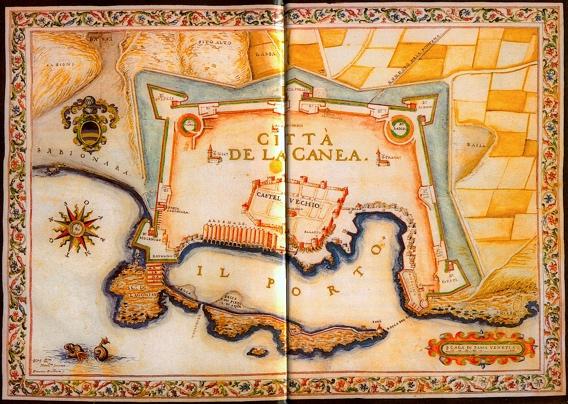
Why does the Χανιά Old Town look more like Italy than Crete?
From 1285 to 1639 Χανιά’s ladle-shaped harbour was a major Venetian port. Cretan labor built the harbour; Venetian commerce sent home the wealth it created. The Venetian model of subjugating a distant populace to prosper a populace at home initiated waves of wealth for a few at the cost of poverty for a multitude, a dissonance that still roil the theories of prosperity today.
Venice converted Crete from a bucolic backwater into a bulwark whose stone-hard esplanades and arsenals smoothed into the eye-candy strolls of today. The island’s two main harbours Χανιά and Κάντια (Candia, today’s Heraklion) were the foci of an ellipse that looped Byzantine Constantinople in the Northeast, Antioch and Acre in the the Levant, Alexandria in Egypt, Andaluciá in Spain, Barcelona in Catalonia, Marseille in Provence, and Genoa/Pisa. Trade within that ellipse amassed enough wealth to raise Venice from a soggy cluster of islets to promulgating the mandates of Mediterranean power.
Many lines of type have been set to opine the consequences, and many eyelids have drooped amid the volumes of conclusions. The Xaniá Town News sees its namesake city as a centuries-old art gallery filled with timeless people gazing into the mirror of changing times.
Constantinople
For a millennium Constantinople was the largest trade entrepôt in the eastern Mediterranean and the largest religious entrepôt of Byzantine Orthodoxy.
During the era of Xaniá’s rise, Constantinople was starting to wilt. Trade and Turks were coequal predators. To the Venetian patricians, the city’s greatest asset was its trade links to Samarkand, a forty-day caravan journey to the east.
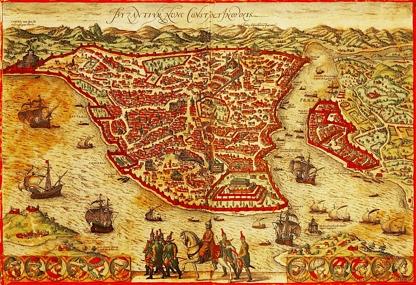
But Samarkand, too, was in decline. A merchant city built on the markups of the Silk Routes trade, Samarkand was the western terminus of a webwork of roads serving Sogdia, Bactria, Kushan, Persia, Gandhara, India, Tibet, China. A romantic litany that was unromantic to live in.
Samarkand survived as a terminus of southerly trade to Persia and northerly to Rus and the Viking-controlled Baltic lands. The Vikings surprised everyone by shifting from predators to profiteers when it dawned on them that predating Irish and French priories was small change compared with the wealth to be had from schmoozing Samarkand sultans.
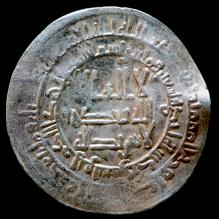
Constantinople’s lifeline to India and China declined to extinction in the 1400s as Central Asia was overrun by Mongols. Silk Road caravans were outflanked by the more hazardous but more profitable Silk Sea ships, which debarked not in Constantinople but Alexandria to the south. Constantinople had also seen two vital manufactures slip from its grasp: silk weaving and paper making. When Samarkand wilted, Constantinople withered.
In 1453 the Turks overran the city. They looted its wealth but left its merchants alone. Even uncouth heathens know who replenishes the money they loot. Venetian traders saw 1453 as a hiccough. Xaniá barely noticed.
Constantinople’s most calamitous loss was not its trade capital, but the loss of its intellectual capital. Nearly every significant work of thought and art produced by ancient Greece survived in original documents in the monasteries and libraries of Byzantium. The works of philosophy and mathematics known to northern Europe between the time of Cluny to Aquinas were Arabic translations from Greek produced during the great Beyt-al-Hikma era of Muslim scholarship in Baghdad. From Greek to Arabic in Damascus and thence from Arabic into Latin in Andaluciá, Aristotle and Plato might just as well been debating in Cordoba.
Greek scholars in Constantinople could read doom on the horizon as clearly as they could read glyphs on parchment. They fled west with donkey loads of scrolls. They bequeathed the Renaissance an intellectual heft that reinforced the arts after the mathematics of perspective were formulated.
An eighth century silver dinar found in the Viking Vale of York hoard in Durham, England bears the mint mark of Sultan Isma'il I (892-907) — an eloquent glint from the Volga-trade wealth. Courtesy of the York Museums Trust.
Levant
Crete’s central trade arc sailed to the Levant of Antioch and Acre. History ladles out a more piquant tale than the pieties ladled out by Saint Paul.
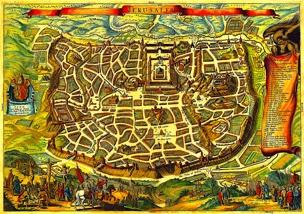
Knights in iron led by princes in peacock feathers had the Levantine wool pulled over their eyes so adroitly that the reliquaries of European chapels boasted enough bits of weathered wood for three True Crosses and enough glass phials of Mary’s Milk to nourish entire orphanages. That Mary’s milk didn’t spoil was taken as a miracle. Mary’s Milk is a colloid of water, glycerine, and powdered white dolomite from the Sitti Mariam grotto a few minutes’ walk from Bethlehem.
The disciples of Galilee fished for souls. The merchants of Jerusalem fished for suckers. Crete welcomed them both.
Alexandria
To the south, Egypt had been a trade destination since the time of Minoan Knossos. Minoan drinking vessels buried during the catastrophic earthquakes and Mycenaean invasion of the island emulate those depicted in Egyptian palace frescoes painted centuries earlier. Two thousand years later the Silk Sea trade route from Guangzhou to Cochin to Aden to Alexandria replaced the overland route.
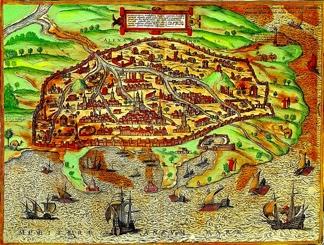
Alexandria in Civitates Orbis Terrarum by Braun & Hogenberg 1572. In eastern Mediterranean seas Venetian mariners in their billowy three-masted vessels would have been easily distinguished from angular dhoni-rigged Levantine vessels. Vessels with both sails and serried ranks of oars were preferred by pirates because they could make headway directly into the wind.
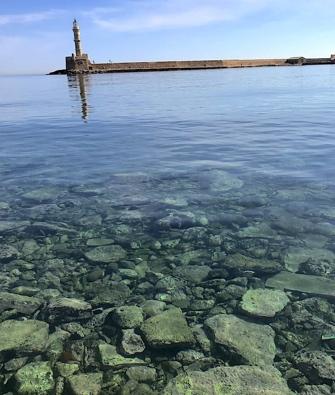
Over the centuries a stony shoal on the north side of the harbour was gradually walled off from the sea with thick wavedefeating ramparts save for a narrow access channel dredged to a navigable depth on the western end. The landmark lighthouse which signals the harbour entrance is a glory of seventeenth century maritime architecture, refurbished in he mid 2010s to is ancient glory.
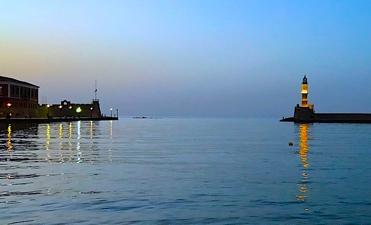
Today the bustle of Χανιά’s Arsenale repair depot and ship chandlery have dwindled to sailing vessels winched out of the water onto trunnions for a barnacle scrape and new coat of paint. The bristling warships have been replaced by grandiose yachts and a contingent of local fishers whose sword against the sea is a boat roughly the size of a compact car with a prow and stern attached.
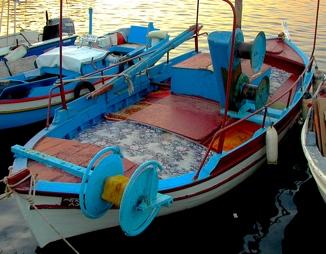
The water is lucidly clear and trash-free. Fishing boats appear to levitate above a bottom so clear one can see fish darting insouciantly between the fish hooks and anchor chains. Stone bulwarks rise about four feet above the tide line to an esplanade of large rectangular slabs.
These slabs are living history, trodden smooth by galleyslave agony in one century, sweating shipbuilders the next, entrepôt merchants the century after that, and volta promeneurs today. The walkway is about twenty meters wide, lined with dozens of street cafes and restaurants featuring downscale cuisine at upscale prices. Occasionally the dishes are indeed ’real Cretan’.
The tables are shielded by awnings which are rolled back in the evening to reveal magnificent moonscapes over the harbour. Inside, these eateries are furnished with bamboo and wicker chairs, tasseled cushions, glass-top or cloth covered tables, fresh cut flowers, and in the evenings, battery operated LEDs that flicker like the candles. The different premises are bordered off from each other with potted palms, ficuses, bamboo screens, and mutual disinterest.
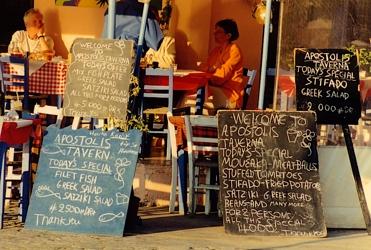
I soon settled on a convenient scribbling spot, the Kyma Cafe, Κύμα Καφενείο. The name Κύμα meant ‘wave’. The reason for such an anodyne name is Cretan shrewdness. The Greek tax authorities have keen noses for the whiff of undisclosed gain. Chaniote Χανιώτη cafe owners deodorise their balance sheets with a rose-water of changing identities and bookkeeping so intricate that it is referred to as the Triantáfyllo system. Τριαντάφυλλο is the Greek word for ’rose’, literally ’thirty petals’. The term describes the layers concealing an average cafe’s true recipients of false profit-and-loss statements.
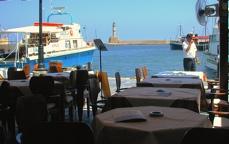
The Κύμα was on the west side of the harbour, out of the sunset’s glare. It was secluded enough to work without being disturbed, yet gave a full view of the arc of the harbour. Directly across the water was the town’s architectural piece de resistance, the Mosque of the Janissaries — more accurately but less elegantly known as the Masjid Küçük Hasan. This lovely shaped but unlovely named mosque has been gentrified into an exhibition centre for Cretan crafts. Exhibitions change biweekly. Cretan domestic and trade crafts are so true to the soul of the land they are worth a three-week layover just to appreciate how deeply creative vitality runs on this island.
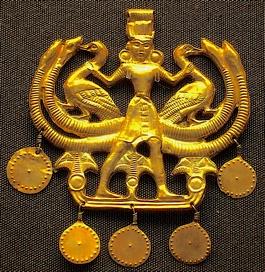
The original model for this modern edition of a Minoan-era Snake Goddess might have been worn as a brooch, a garment clasp, or the pendant on a necklace. The double-tiered headdress, oversized gold earrings, and Egyptoglyphic foot stance all point to deified womanhood. The symmetry of large masses around a central column suggests the quasi-mystical labrys or double-headed axe. The central figure would be the Mother Goddess, reinforcing the Minoan validation of feminine wisdom as true power. The geese symbolise marital fidelity, since geese were thought to mate for life. The four snakes represent life, death, nature, and rebirth.The three winged creatures at the knees represent bees, whose honey and wax were key calorie sources in daily life. Bees were also thought of as exemplars of mutual dependency and social support. A society that lived close to nature’s processes, Minoan ornamental art depicts animals and insects as being on par with and inextricably linked to human welfare. It is noteworthy that such this potent goddess associates with animals, not other humans.
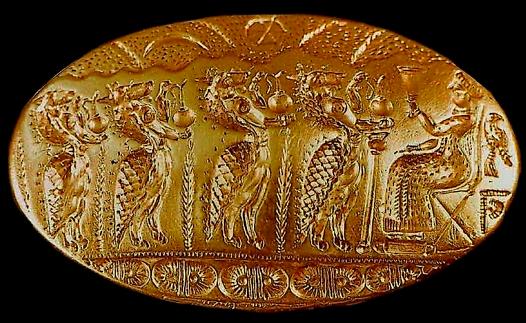
Upper face of a Minoan-era gold ring in the Athens Archeological Museum. The significance of the scene is speculative. One interpretation is four emissaries from the nether world disguised by animal masks are presenting ritual obeisance gifts
Fanfare for the Common Cafe
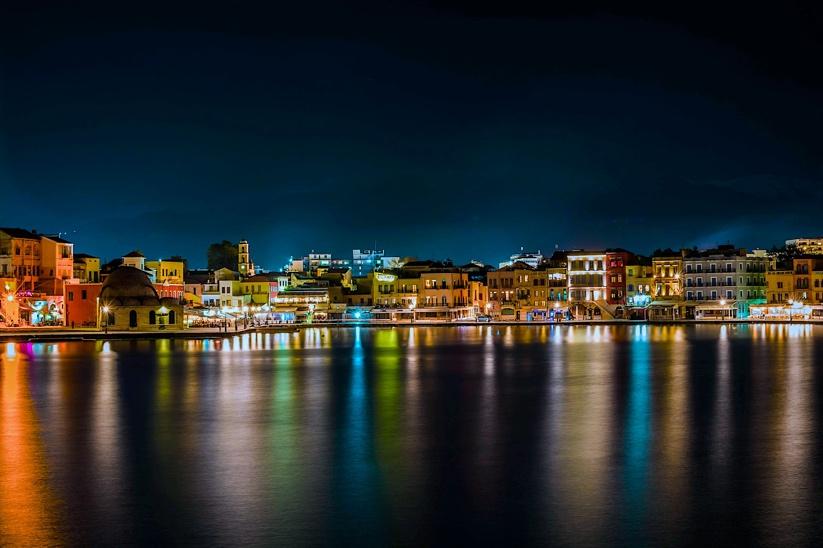
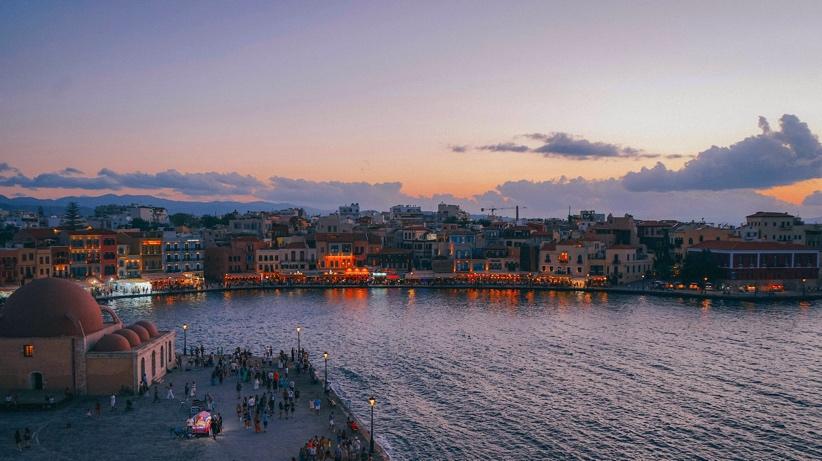
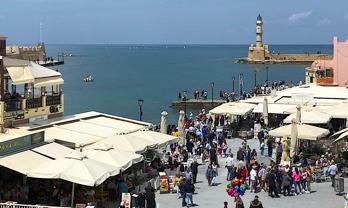
Chania’s Old Harbour is history in a bell jar — a fifteenth through seventeenth century Venetian colonial outpost that in its heyday comprised a commercial entrepôt in the west harbour and ship repair facility to the east. The north side is a long sea wall with thick wave-defeating ramparts adorned with a recently refurbished lighthouse at the end.
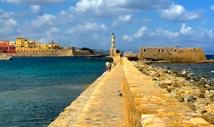
A sea lane to open water lies between the lighthouse and the Firkas Fortress to the west.
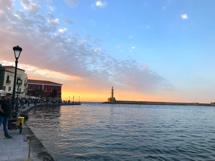
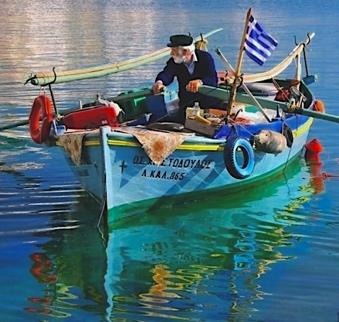
The harbourmaster has the daunting task of accommodating both grandiose yachts and a contingent of local fishers whose sword against the sea is a boat the size of a compact car with a prow and stern attached.
The ancient stocks and hangman gibbets which enforced morals when political appointees ruled the roost have been replaced by rubbish bins for plastic, glass, and paper.
The western, touristy part of the harbour is about the size of a small college campus. The quays are a droplet-shaped semicircle of stone ramparts rising about a metre above the tide line.
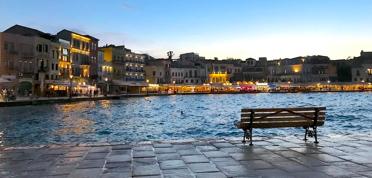
These stones are a pedestrial history text, trodden smooth by galley-slave agony in one century, sweating deckhand labourers the next, merchant wagons the century after that, and global flâneurs today.
The promenade is about twenty metres wide, lined with dozens of cafes and restaurants featuring mainly taberna dishes at Cordon Bleu prices.
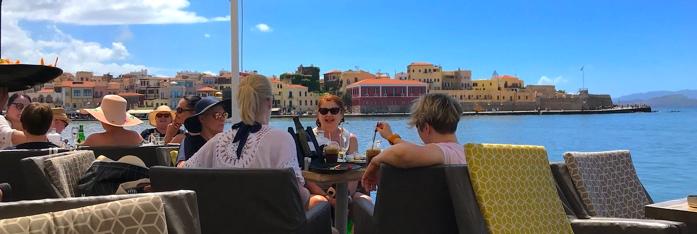
The restaurants are shielded by broad-striped canvas awnings that are rolled back in the evening to reveal magnificent moonscapes over the harbour. They are furnished with bamboo and wicker chairs, fluffy cushions, glass-top or linen-covered tables, fresh flowers, and oil lamps in the evenings. The different premises are bordered off from each other with potted palms, ficuses, bamboo screens.
I soon settled on a convenient scribbling spot, the Κύμα Καφενείο (Wave Cafe). Quayside Καφενείον regularly change names as aspiring newbies try their hand at milking tourist Euros. On subsequent visits my old haunt changed its name and staff three times over twenty years, though the
interior decor and kitchen and bar were as familiar as ever. I was never able trace down the staff I had come to know while jotting my first notes there.
The Κύμα Καφενείο was on the west side of the harbour, out of the afternoon sunset’s glare. It was secluded enough to write in obscurity behind potted plants, yet open enough to fully embrace the nonstop parade.
Directly across the lagoon lay the town’s architectural piece de resistance, the Kücük Hasan Masjid — also known with less élan as the Yali-Tzamisi Mosque. Local lovers of euphony call it the Mosque of the Janissaries.
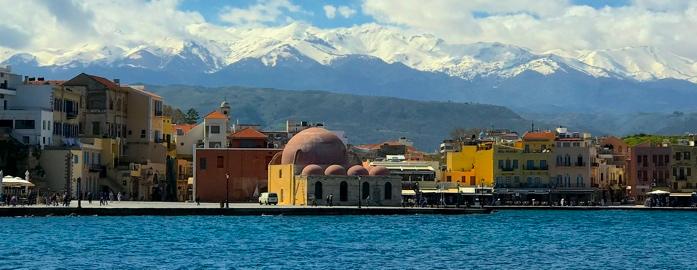
This lovely-named but unlovely-shaped masjid is now a municipal art gallery focused on Cretan culture. The frequent exhibitions of children’s art from local schools are the best introduction to Crete’s future that a free admission can buy. The mosque’s mammiliform domes contrast with the fussy, vertiginous Venetian architecture of the rest of the waterfront. The buildings are painted in Italianate pastels of ochre and blue and pale yellow, with Grecian-blue wooden window frames and lacy curtains wafting in and out in the breezes.
These buildings are four hundred to six hundred years old and show it. There is a sweet dilapitude to their facades, a dowager-past-her-prime look made all the more charming by no two buildings being repainted in the same decade and shapes that were not quite square even when new.
The cafes and restaurants have ’house’ music that tries to make up for their absence of distinguished decor. The
specialised in Cretan love songs. That attracted a clientele that convinced me to make it my home.
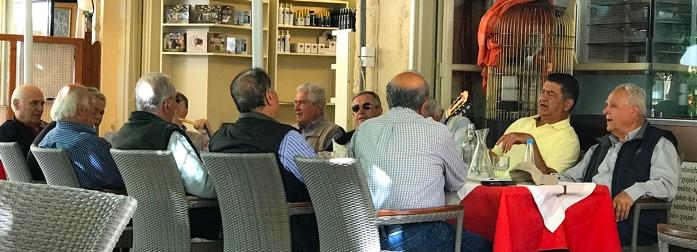
During the morning shift at the Κύμα, three people were on board: co-proprietors Teodos and Iannis, plus Teodos’s amour Anna in the kitchen. Another Anna, dubbed II, relieved Anna I at around 4:00 so she could take care of her baby.
Anna II was the Κύμα’s premier confectionist. While Anna I was slim as a toothpick, willowy, and walked as though she had been a zephyr in a former existence, Anna II was well weighted towards the middle, dark-eyed, dusky, and moved like a dowager in search of lost youth.
Iannis generally came in around 6:30 a.m. and worked till 4:00 p.m. He then took three hours off and came back till the
last customer went home. Teodos turned up at about 11:00 a.m. and worked straight through till midnight. Except for an occasional backgammon match with one of the harbourside regulars, neither had more than a few minutes off their feet at any time during the day.
The two Annas fared little better, except that they divided the day more evenly so Anna I could turn the back rows of the Κύμα into an impromptu day-care center from four to seven in the afternoon. Other cafe mothers knew about the Κύμα’s Moppet Welcome Mat and by five p.m. the place looked like Naptime in Totland.
Iannis
I soon befriended one of the owners, a man in his early thirties named Iannis. He was at the career stage where the magnet of serving tables for the rest of his life repulsed more than it attracted. His income was at the level where marriage was out, a permanent home was impossible, and — the ebb and surge of the Mediterranean cafe-economy being what it is — even a fixed country was out.
After a few days of repeat visits, he brought me the customary gratuity of a thimble glass of raki along with the bill. I declined, mentioning that I don’t drink.
'That’s a rarity in a place like Xaniá,' he replied. 'Many tourists come for the express purpose of getting commode-hugging drunk where the neighbours won’t see.’
’I’m a writer. If I don’t have clarity, I don’t have a job.'
He confided, 'To tell you the truth, I don’t drink, either.’
'Now it’s my turn for the Why?'
customers. After a few years they owned their own cafe. I asked myself what they had that I didn’t. Truth is hard to face.'
'Wish wears a thousand masks, and denial can find a thousand excuses. Add them together and you’ve got the gods.'
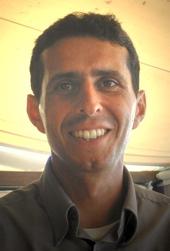
'When I first got into the cafe business, I saw people like me who became very successful. They started like me serving
’You’re telling that to a Greek? We have been at it thirty-five-hundred years.’
We were interrupted by the approach of a Roma woman in an old-fashioned handpropelled wheelchair. She was dressed in black. A black scarf covered her hair. I had noticed her a few times before as she made the rounds of the cafe tables. I admired how adroitly the woman manoeuvred the wheelchair with one hand while proffering cello-wrap packets of hand tissues with the other.
A handful of customers occupied the tables facing the quay, sipping tall glasses of iced cappuccino.
The customers pretended she did not exist. Her face implacable granite, she wheeled to the next cafe.
I watched her progress to the end of Restaurant Row. She gleaned many avoided glances but no sales. As she returned
to circuit the quay in the other direction, I stepped forward and bought five packets. She tucked the bank note into her sleeve, said nothing, wheeled on.
Iannis was watching.
‘You just bought more tissues than she sells all day,’ he informed me.
’How many is that?’
’I asked her one time,’ Iannis replied. ’She held up four fingers. She is not allowed to speak with a gadjo male.’
‘Why does she do it?’
‘She’s not there to sell tissues. She’s there to keep her eye on the chaj, the unmarried girls who sell those glittery balloons and long-stemmed roses. ’They work in pairs. An unmarried Romani must never be out of the sight of a married Romani. Next time you are on a stroll, pass the back lane behind the Mosque. She holds court with the Romani balloon and rose sellers there when she’s not selling tissue packets. She’s the Matroana, the matriarch of the Roma clan that lives in windowless delivery trucks that park near the Sabbionara Bastion. The young girls who sell the balloons and roses hand their money to her after each round of the quay. She feeds them packet meals wrapped in newspaper. She is as truculent
with them as with you. I have never seen any of them smile. Around ten at night their phrals, the word for “brothers,” come along, take their money, and escort them back to their trucks for the night.’
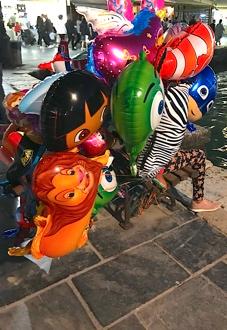
’I strolled past one of those trucks last week. The back doors were open, The interior was lined with carpets, including the walls. The only furnishings were cushions and sleeping mats.’
’The girls start off with ten roses or balloons in the morning. They have to give their fathers ten Euros when they go home. Count the roses or balloons and you know how their day is going. The average Roma family has ten members and earns about six thousand Euros a year. That’s what Teodos and I pay to rent this cafe for a month.’
’Their language is an archaic form of Hindi.’
’So is their culture. Fathers set the rules of patriarchy, but mothers do the enforcing. A girl’s husband is chosen for her by the time she is eleven.’
A saxophone solo shimmered from across the harbour, sounding like Branford Marsalis at the bottom of Atlantis.
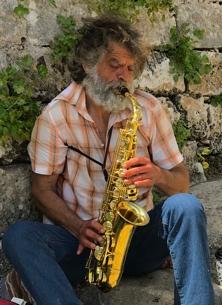
The water was like trembling glass. Tables were littered with empty beer bottles and pistachio shells. A teenboy’s arm draped over a teengirl’s shoulder as her arm clasped his waist. A mountainous carton of popcorn led around a tot.
’Iannis, if you are not a natural businessman at heart, what are you?’
He was silent a long time, then said, ‘I wish I knew. Running a cafe is all I know. It takes so much time and money, I can’t be anything else.’
A portly foursome stopped before the menu on the quay. Dowagerish and ample, the two women wore long dark skirts and their men wore white office shirts. They would spend quite a bit wherever they lighted. With thirty other cafes competing for every appetite and thirst, timing was critical.
Iannis scooted over them and began his pitch — in German.
Mystery Boat
I went back to jotting notes. The dumpiest fishing boat I have ever seen was easing away from the quay in front of the kaphenion next to the Κύμα. This kaphenion had the look of a tourist trap putting on airs of minor mob connections, so it was hardly surprising to see this piece of motorised flotsam in front of it. Lacquered brass and teak it was not. The hull paint could have been vastly improved by any five-year-old. The gunnels were weather-beaten poles weighed down with yellow fish net. There was a canvas sunshade over the afterdeck lashed to angle iron so rusty it looked like just after the explosion in an action movie. There was a loudspeaker lashed to the mast,
a couple of red jerrycans for fuel on the quay, a rudder held together by the type of stamped metal hinges one sees on the cupboards in the cheaper class of motel room. The whole thing reeked of diesel and fish.
But when it started up and pulled away from the quayside I couldn’t believe the transformation. The motor — the motor! — this thing’s motor purred with a low, throaty, finelymeshed rumble that sounded more like a big Maserati than the godforsaken wreck it pushed through the water. With a burbling snort like a cross between leopard and drag racer, it hurled that entire shuddering hull of flotsam and junk from dead stop to harbour speed within seconds. It traversed the harbour like an arrow. Once outside the jetty it opened up into an unmuffled raspy tiger-on-the-prowl roar that sounded like a hydroplane racer at full throttle. I don’t know what was below the waterline, but it sure wasn’t what was above it.
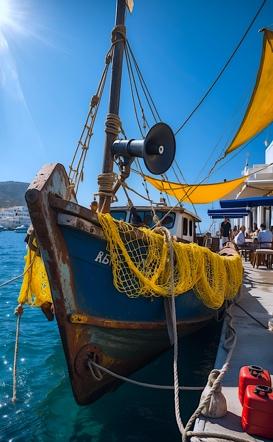
I looked in astonishment at Iannis, who had returned to my table.
’Smuggler’s boat,' he said.
’Where do you think Libya gets its Marlboros?'
Café Concert
An elderly gent wandered in. He strummed on a loutro, the Hellenic ancestor to the lute.
Unfortunately, his ’Never on Sunday’ had the effect of ’Never At Any Time, Especially Right Now.’ Offkey, off-beat, voice like a kazoo, three tables away he smelled like an empty ouzo bottle.
Two British women at a table nearby gave him a sum and shooed him away. A pity. Compared with the nose rings and tattoos that make much of the midday quayside crowd, he was the most interesting character to pass all morning. After turning away this man as socially unacceptable, the woman
went back to her Daily Mail whose headline screamed in dissonant assonance, ’Mauler Mutilates Maid’.
I went back to the laptop. Two kids were playing hide-andseek amid the cafe chairs and potted palms. They were a study in the energy levels of face and voice that come with fantasy and spontaneity, one moment horseys and the next moment kitties, the gurgly incantations of tots miming adults, inventing games in which the rules change according to the mood of the moment, the instant inventions of kid play, kid laughter, kid flailing feet and kid akimbo arms, hide-and-seeking among the tables and elders and teapots and tabletop flowers and strollers and umbrella-shaded infants, all against background music of Cretan love songs. The sun was getting low by the time this pair’s mother gathered them up and swept off to home. Afternoon came alive in front of my eyes. The volta promenade’s self-writing stories were back on parade. The harajuku hairdos of young teens under the influence of TikTok’s highs. Deltoid hunks with their sleeves rolled up. The contented trudge of forty years of marriage. Silver hair and golden bangles. The tentative handholding of a second date. A jacket slung over a shoulder and a daughter hanging on a sleeve. Fishing smacks from East Harbour exited the lighthouse into the open sea beyond. In a hour or two they would be setting their yellow arcs of floats and hooks while back in the harbour the volta walkers would be settling into their floral cushions and florid menus.
The self-writing stories wee already on parade — styleconscious brushes at the hair, flip-flops, tattered cut-offs. A toddler’s pace turned his parents to toddlers too. A young man accessoried his hair like an electrocuted broom, with black tight pants, black tight shirt, a black leather shoulder bag, stride like a hammer on an anvil, and all made elegant by a single gold earring.
Amid these a Lotto-ticket seller made his rudderless rounds.
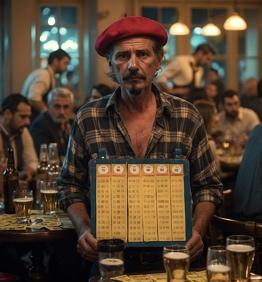
Iannis returned to my table.
'Are young Cretans religious?' I asked. 'I have seen only one pappas your age since I’ve been here.'
'Most young Greeks won’t have anything to do with the Orthodox Church. Orthodoxy has too many rules. Too many forbiddens. Too many excludeds. Too many againsts.’
‘The old folks knew tougher times.’
‘The old folks don’t know anything about the world we live in, while we know far too much about theirs. That is why most young Kritis just want to enjoy life. Get a good job that doesn’t demand a lot of work. Have all the sex we want and not have babies. Go on holidays as often as we can. It’s the European way. A lot of young Kritis want it that way here.’
'Why do young Cretan women still wear so much black?'
'When things change in Kriti, they are careful not to show it. If you really want to how young Kriti women are different, don’t look at their clothes. Look at how many times they go to the health and dental clinics. Why should they end up a toothless old crone just so Kriti can keep its image as the last old soul of Europe?’
’Do any quayside strollers ever ask what you think of them?’
’Kritis of today wonder why visitors can’t see us for what we really are. Real Crete is not down here in the cafes of the Old Harbour, it is out there in the Chalapa district and Nea Chora where everybody’s got a nice kitchen and a bedroom for every kid.’
To the signboard out front came two menu dawdlers. Each tapped their finger on the same item. Iannis smiled as he went out to greet them.
They dawdled no further and walked on. Iannis returned with no expression on his face.
’How many times a day does that happen?’ I asked.
’For every two couples that walk away, a third couple comes in.’
’You said it cost you six thousand Euros a month to operate a cafe like this.’
‘That is just the rent. We have to pay for the entire year in advance, even though we are closed four months in the winter. Then we have to hire people, buy food and drinks, pay insurance, electricity, the water, the cleaning crew at night.’
’I see how many tables fill and empty through the day, and have some idea of their bills. It doesn’t add up to seventy-two thousand Euros just for the rent. How do you get by?'
'This is mid-May. Things are slow. During the high season from June to the second week of September, the quay is packed all day long.’
’That is why I leave on May 30.’
’You cannot imagine what goes through my head at the end of an August day when we have never left this place while all the Hoorah Henrys and soccer yobbos are bellowing for beer and bitching about the bill. They go off to the beach while we stay here mopping the floors and cleaning the toilets. By 2020
we had worked five years to save enough to start our own kaphenion. Then Covid came along and wiped us out.'
'Why did you come back?'
'What choice do I have? I haven’t got a degree and I don’t know a politician. At the end of October, we are so exhausted we can’t face it any more. Teodos and Anna go to their family home in Salonika for the winter. By the end of November the quay is a ghost town.’
’And you?'
'I return to my family in Sitia on the eastern end of Kriti. I read a lot about New Age ideas — soul migration, reincarnation, nature mysticism. But it is easier to read about those things than living the way you need to achieve them.’
’Ownership kills the soul the same way it kills the mind. Where do you get the money to start over?’
'Relatives. In Greece the banks won’t loan to restaurants operated by people who haven’t lived in the area all their lives. And even more especially to restaurants that still need money after three seasons.'
Judging from the number of half-built shells at prime locations that I had seen along the highways, I could see the indirect effects of this. The rusting reinforcing rods sticking out of the unbuilt sections on top of a business were awaiting enough profits from the first floor to build the second floor.
'We Kritis have seen a lot of people come and go. Two thousand years of occupiers and a lot of pirates in between. We know how to take care of ourselves. But it makes for a tightfisted people. We would never go on the credit-card binges that northern Europeans go on. Kritis use a credit card only when absolutely necessary, and then don’t use it again till the balance is paid off.'
’Maybe that mindset is why Kriti has survived for so long.’
Down by the Docks
The perfect time to escape the crowds of the old Venetian quarter is also the perfect time to watch the local fishers depart at dusk.
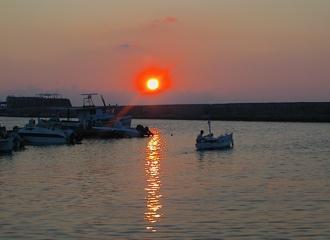
Into the tumid orange-hued sun and murk-hued clouds. Leaving the upscale cafe waiters concealing their cigarettes behind their serving trays. Leaving the local boys slicking back their hair and the local girls studiously ignoring boys who slick back their hair.
Past the polished brass door frame of the Ariadne nightclub whose rooftop restaurant maître d’ greets returning yachtsmen with the names of their vessels.
A brief stop for provisions at the cashew-and-raisin seller with his seventeen kinds of snacks, each packet clearly marked with its price but not its contents.
Then past the kiosk vendor taking his ease in front of his tiny cabin filled with stacks of cigarettes, breath-sweeteners, fingernail clippers, fake Rolexes, condoms, bubble gum.
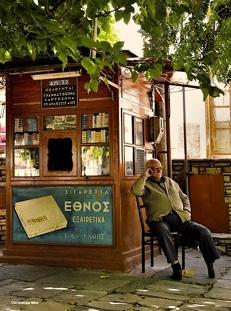
Past the brilliantly restored sixteenth-century Venetian Admiralty headquarters whose crevice-pocked parapets shelter Xaniá’s hoards of nesting swallows.
Past the budget cafes for local workers whose autos are illegally parked nearby. The hawser-worn quayside bollards steadying local fishing smacks and dories boasting home-port names in Greek. The piles of fish nets and floats with no one there to load them.
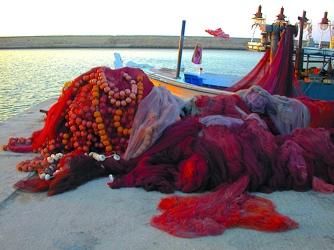
Past the old Venetian Arsenali, seven cavernous, barrelvaulted, shipbuilding/repair facilities that underwrote four centuries of Venetian rule linking Adriatica to Alexandria.
Past the fish-gear vendor where local boaters buy their floats and ropes and choose from fearsome arrays of fish hooks jabbed into cork-topped tubs.
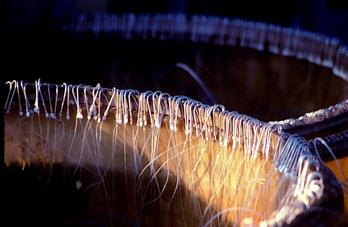
Past a man just in from the sea carrying two weighty plastic sacks of mullets and pomfrets. Huge fish. Joyously fat fish. Their still-wet-fins and vee-shaped tails still struggling against the sides of the sacks.
He greets two friends at a nearby bench who are carving up a skate for bait. How could I tell them that a skate of that size — the diameter of a household frying pan — would bring a minor fortune in Hong Kong or Macau, where cooks broil a skate to an amiable greasiness and diners remove the
cartilaginous bones with their chopsticks before diving into the cream-coloured flesh. From baitfish in Crete to a rare delicacy in Causeway Bay is a study in which Flightradar24 identifies so many 747 silhouettes as cargo-only flights.
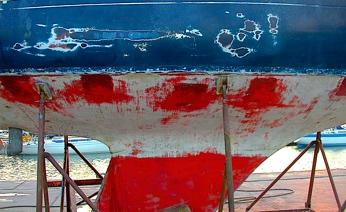
Past the paint daub geometries of the debarnacling pad where weather-pummelled boats are hoisted onto ricketylooking trestles for a hull scrape and new paint. The unfinished result on one hull was a swodge of red splats here, blue splurts there, every color clashing with every other other as they vied for the available space the hull and keel offered.
Had I blundered onto an unheralded art form one could dub ’neonautic expressionism?” Or was it a paint salesman’s demo patches of the brands best matching the size of the boat owner’s hull with the size of boat owner’s budget?
Past the local-trade cafes with their meals of fish chunks and braised meat served on blue-and-white plates with chips on the rim, washed down with beer straight from the bottle.
Past the glissine East Harbour water so clear that tiny fingerlings dart just beneath the surface, oblivious to the boats with nets above that will one day clench them as they gape at being out of water, today’s lithe blue-striped silver bodies doomed to one day adorn chipped plates in a dockside cafe.
Only then did I find them. The squat, unkempt boats with grip-polished wood tillers and old tires for bumpers. Blunt prows against waves, blunt sterns to veer the winds, steel-pipe gunnels on which to bowline-knot the nets.
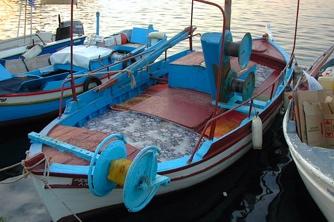
Men who come to these boats have forearms as tough as olive trees. They wear dark trousers and thick-soled boots and roll their sleeves above the elbows.
One of those men nodded a curiosity-laden ’Yasou’ me as I jotted these notes on a bench. Note-takers must be an uncommon event in this quarter of the Xania harbour.
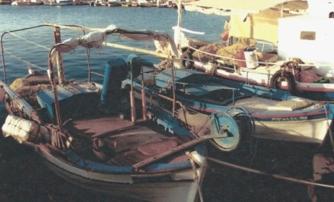
Marika 740 proclaimed the prow on the boat he boarded. It could just as well be called ’Everyboat.’ The owner of Marika 740 was a hook fisher rather than a net fisher. Spanning the mid-deck was an open bay for his hooks, leaders, and weights. There was a gaffing trident whose shape and purpose have not changed since Poseidon. A knob-ended stick to stun slithering octopi, and a line to dry them on till supper.
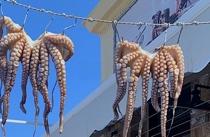
grumped as he regarded the state of his dusty deck dotted with windblown debris and the remains of a catmangled fish head.
Nearby lay Giorgios 388, whose wood crate on the foredeck was littered with broken shells and barnacles, the sign of an owner who specialised in mussels harvested from shallows. No motor transom was needed on a boat built for scraping over shallows.
He pulled the rope mooring his boat to the iron rings set in the wood planks of the dock. The boat eased toward him. He stepped aboard, knowing which way it would lurch from his weight. He
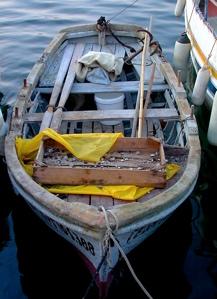
Above, swifts rapiered through a sky turned sullen by the dusty scirocco winds from Libya.
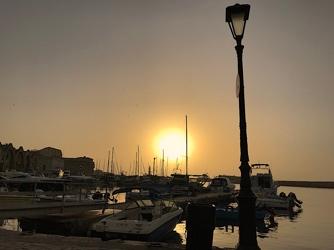
Tasks turned into sound daubs as the owner of Marika 740 tidied his boat. A five-litre plastic jug with the top cut off splonked into the water, tipped over, sank in a series of glurks. He hauled it out of the water in splops of drips followed by the ssssss of being slurshed across the foredeck. An over-theside squeeze of a sponge brought a spatter of spinks.
Rinse after rinse he splashed his boat clean in silver slurs of sound. A sponge swipe here and dab there to celebrate his now-lustrous deck.
He lifted a piece of plywood off a hatch (painted blue, of
course?). The motor murked gloomily below. Its flywheel housing was a half-moon Its flywheel housing was a half-moon of grime atop a labyrinth of fuel feeds and coolant hoses, metallic tabs connected with springs.
Three stately gulls gazed down from their soar, barely flicking the pinnate feathers that tilt their wings as they veered along the wind shears of a cooling sky.
In the restaurant beyond an accordionist played a jouncy tune, accompanied by someone klinking a spoon on a beer glass. The dockside cats became miraculously purry now that appetisers could be begged.
A couple of docks away a posh two-master with a tail plate proclaiming Houston erupted a CD-and-Bose cloud of Mendelssohn’s Midsummer’s Night Dream from the cabin. The effect in these surroundings was a lace doily on a bollard.
Cocktail ice clinked into glasses. The smell of scotch merged with the smell of fish. A man emerged to polish a capstan with a dab of Brasso on a cloth. Made a quick tour of his deck. Took no interest in the fleet of workaday craft nearby. Went back below. Locked the hatch from inside.
Skreeking swallows trilled the sky.
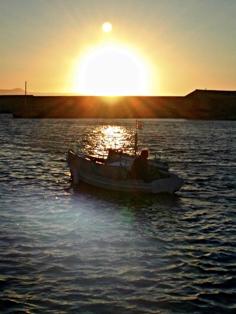
There is no brass to polish on Marika 740. No telescopes on swivels. No smart pennants thrumming on masts.
Xaniá’s back-bay fishers have only rope and hooks and nets and what they know of the sea.
They fish to feed their kids. They were before Poseidon. What use would be glitter?
Sunday Morn
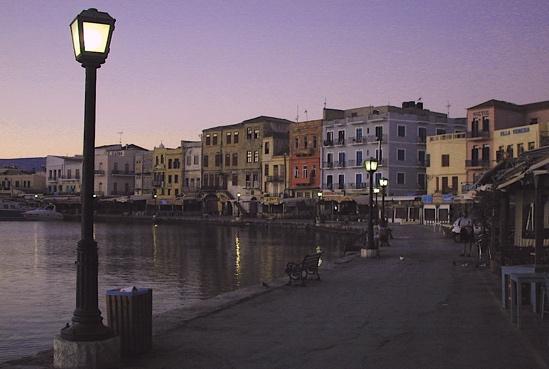
Sunday morn in Xaniá is like living in a Canaletto.
The bells of the Agios Trimartiri basilica have a stride to them as they chime the morning service. A bass and four treble tones lope across the sky, as if to remind us that we needn’t trudge our way to salvation when we can skip-rope-rhyme our way there.
Named after Eisodion of Theotokos, Άγιος Εισοδίων
Θεοτόκου, in Plaza Athinagora near Chalidon Fountain, the basilica is lopsided with two tower pillars but only one tower. The incongruity is reinforced on the inside by three processional aisles in lieu of a central one. For all its ancient look, the building was completed only in 1860. Even bereft of matching tower, it readily earns its appellation Basilica: it looks like what it is: the seat of an achbishop. Quite a step up from the soap making shops this square hosted during the Turkish overlordship.
Yioryio, the καρεκλάς wickerwork chair restorer, bellows his trade along the far side of the square. He carries a long spindle of reeds over one shoulder. His craft is so-named because he repairs καράκλα — the wickerwork chairs as familiar to Xaniote homes as geraniums in brightly painted tins.
Indeed, I am sitting on one as I track his connect-thebellows path along Plaza Athinagora. He stops to gaze unhappily at a man removing buds from the stems of freshly harvested chamomile. Then I notice that the man’s chair is a plastic kareklás replica that will never need repair.
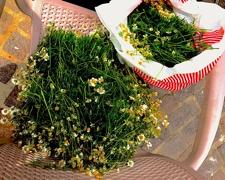
Glimpses of other people’s realities are kafe éllénikos for the imagination. Selecting which impression to jot down during a glance which spans dozens of them is as demanding as waiting for the magic moment in a photograph.
The morning tremors of azure and nimbus high above the basilica of Ágios Trimartiri paint moments as rich as Xaniá’s dessert-case cornets filled with honey and cream.
The coif of a dowager crossing the square becomes sunlight weaving silver into grey.
A young woman strides her way across the square in her first Grand Entrance of the day.
Two grandparents ice-cream their way through brunch with the grandkids, who luxuriate in being the centre of attention and promptly overdo it on the scene-stealing.
The bravado of youth turns pouty when an uninvited kiss is dismissed with a frown.
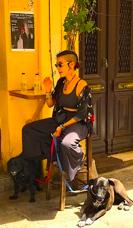
A tattooed Goth in metallic blacks defies motherhood’s earth tones and subtle pastels.
A pale blue skirt is made ensemble-perfect by an ecru blouse.
An obese man trenchers his way through a steak, washing it down with catsup and a beer, inviting questions of how on earth he developed that way.
Oval Ariadne eyes behind a riverine cascade of hair.

Two Eurosvelte blondes devastate a trophy hunter’s Visa card on their way to premature vapidity.
A political opiniondispenser admonishes to one and all while twirling his komboloi beads, then goes back to his newspaper when he sees no one listening.
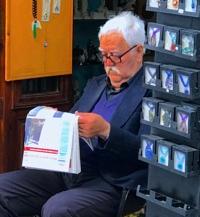
A chemise waterfalls to the waist in vertical torrents of white. Matte gold looks better than glitter on dusky-eyed beauties. Two overly floral ladies have frumped before their time.
The look on the face of a shy boy in a yellow beanie when he discovers he no longer needs a stroller.
A couple, she in an aloe-coloured skirt and cactus-coloured blouse; he bearded and with square-shaped shoulders, bright white shirt and black pants. She with the averted eyes and fingers over the lips of a woman listening unwillingly; he with crossed arms and an I’m-in-charge air. Everyone knew it wouldn’t last.

A shawl drapes chastely over a throat to stream back over the shoulders.
Iridescences in an earring adorn a cascade of pouring wisps.
The cafe music is like an accordion on fast-forward, so riotous it is in perfect harmony with the garments waltzing to it — garments of pink and tangerine, hems of woven gold, emerald green and royal blue, black and silver lined with imperial blue.
A woman at ease with her charm reveals it through the steadiness she radiates with her eyes.

Others see her shape, form, garments, colours. But her inner feelings are carefully concealed. She knows her gaze makes her more mysterious than the mere steadiness it conveys. It is difficult to say why she is so memorable — is it the way she shapes our thoughts by what she does not give us to see? Or is it the way her magisterial directness draws our attention to the secrets that make woman a mystery?
The bells of Ágios Trimartiri lope across the sky again. Noon. The assembled glimpses have been a riot of analogies untamed by thought, a half-aware/half-asleep dreamtime become real. Passersby weave a tapestry of purpose so blended with their strides that life, self, the embers of memory, the fire of life, the amazingness seen in the wonder of a child, the truths in the ephemeral — all these become One.
’Every weaver knows,” my friend Mihalis once told me, “that many carpets can come from one loom.
All this and a kafe èlleniko between eleven and noon.
Market Day
In any Cretan town, if you want to find the local open-air market but don’t know where it is, follow in reverse direction the route of the women carrying full bags in both hands.
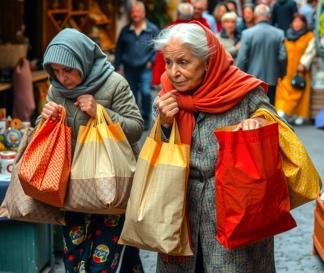
In ten minutes, you are there.
Tee-shirted men fill market baskets with the daily orders of their WhatsApp clientele. Grizzled elders from the country vend pine-scented retsina from the backs of their pickups. A country couple whose sole offering is a bowl of sun-dried olives and four eggs.
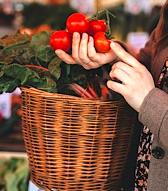
Tangerines jumble in bins alongside piles of fresh herbs tied by the stems with tiny rubber bands.

A brazen haired woman selling padded bras chats with a demure lass holding up tomatoes so ripe you smell them five metres away
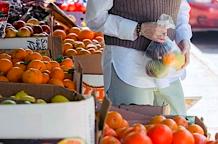
Romaine lettuces twice the size of anything ever seen in a supermarket. A dozen different grades of garlic in wooden crates, priced according to potency. Wooden kegs filled with elaiólado
ελαιόλαδο (olive oil), spigots still dripping from the last sale into a buyerprovided bottle.
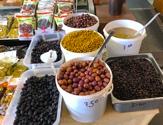
Bath soap made of pure olive oil at one Euro the bar. Its scent is so delicate it is almost not there, yet it lingers all the day even after you wash your hands. Lather your socks in it and for the rest of the day your sandals smell like salad.
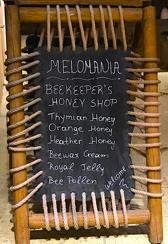
politís melioú
honey-seller’s ornate advertisement
Romani women with their chestnut-hued skins and with large round earrings flounce in floral dresses. Their brilliantlycoloured densely-patterned multi-layered ensembles match the liquidity of their vowels as they extol their bins of yesteryear cast-offs by flinging them high into the air shrieking ’Euro!! Euro’ — the most exotic of all imaginable thrift sales. A Romani without colours is like a ballet studio without barres.

There are vendors of gilt-framed mirrors and screwdrivers and jars of roadside chamomile fading by the minute in the sun. ’Bananas Kriti’ at two Euros the kilo whose texture is like sawdust yet pack a flavour like perfumed honey. Rows of potted plants (phyta, φυτά — the Origin of the Species, right there courtesy of Linnaeus) in little clay pots.
Two supple-waisted, enigma-eyed teen girls extoll the virtues of their raisins and prunes and dried chickpeas and almonds and pistachios that smile from their splitlengthwise shells like something out of The Little Shop of Horrors. Not to mention the fruity bite-sized gumdrops dusted with confectioner’s sugar that smell and taste like a distillate of roses. Is it humanly possible to leave such a fetching sight without buying at least a dozen? (Two, if truth be told.)
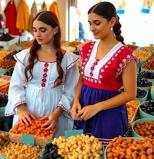
But eventually, pocket finally depleted of Euros, we must. One walks home with both hands laden with stuffed plastic bags, just like the frumpy ladies in florals who reverse-guide us there. On the way back to our room all we can think about is the full plate whose potential contents inspired us from the moment we first round the corner and lay eyes on this jampacked opera house of purchasing humanity.
The lucid eyes and lipless mouths of fish netted just hours ago.
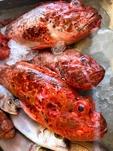
The women with their spindle-wheeled shopping carts. The harried mothers with kids. The dutiful sons off-loading potato sacks with knot-armed heaves. The old gents wearing opennecked shirts under antique double-breasted suits. Smartalecky studs with godawful sunglasses. Cats staying clear of the elephantine thunder of shoes
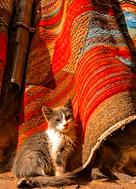
Bewondering little girls with pony-tails gathered by a rubber band. Smells of mustard and rosemary and oranges and underarms. With this encyclical of sensuality flooding across our vision and nose, is it any wonder that all we can think about is how to exit this overstuffed cantata of olfactory music and get down to why we went there in the first place.
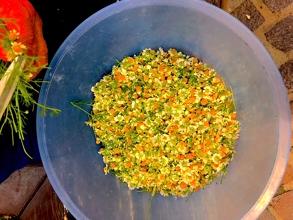
Which duly arrives in the form of a first nibble from a plate full of olives and cheese cubes and crusty psomi still warm from the bakery — a nibble that is reason enough to nudge us from hunger pang into the ecstasies of the tongue, the imagined delight that beyond the dreaded door of demise lies an eternity of what resides on the plate before use right now.
Why wait?
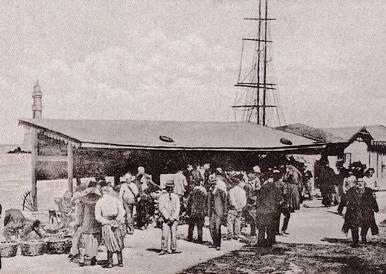
Xania fish market near the Kücük Hasan masjid, c. 1910.
Skéti Glyka
The armspan-wide lane named Odos Isodion, Οδός Ισωδίων, off Chalidon Plaza is lined with outdoor tables serving coffee and nibbles by day and meals by night.
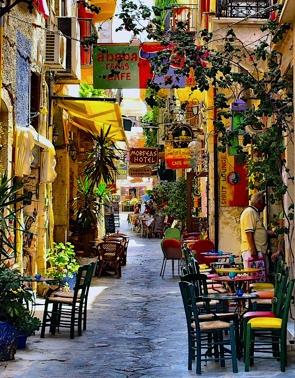
Xaniá is labyrinthed with threadneedle lanes like Odos Isodion. They are vertiginous delights to the eye but disasters to the waistline.
Cretan food is among the tastiest and healthiest on the planet — albeit so laden with olive oil and tomatoes simmered to the consistency of yoghurt that our bathroom scale screams for mercy after every shower.
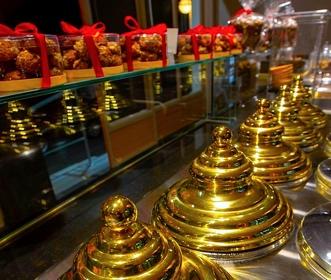
Xaniá Old Town is auto-free. The only exempted vehicles are provisioners’ delivery vans and service providers like electricians and plumbers whose business names are painted onto their vehicles. Even those vehicles may enter the area only between 07:00 and 09:00 in the morning. Police bicycle patrols make sure the rules are obeyed. Woe betide the tourist in a rental car who blunders into the forbidden zone in search of a hotel.
At the Chalidon Plaza end of Odos Isodion a trio of gelati parlours waylay visitors with children. How convenient, then, that there is also a pharmakeio φαρμακείο on the corner for succor when the inevitable sucrose load arrives at their youthful livers.
Twenty metres up the lane leading to Basilica Trimartiri, there is a cafe named Skéti Glyka, Σκήτη Γλύκα. The name translates to ‘minimally sweet.’ Inside, the glossy shelves beg to differ. They are lined with aesthetically fetching nibbles that are Skéti Glyka’s version of Japanese netsuke.
In a town whose zaxaroplasteio, ζαχαροπλάστειο, pastry shops are filled with look-alike offerings of baklava and creampuff cornets, Skéti Glyka is Xaniá’s version of the Kiyomisu Pagoda in Kyoto.
Only a baker in whose veins flows the kindred soul of Hiroshige could come up with the pagodas on Skéti Glyka's shelves.

Good as they are, however, they are mere amuse bouches compared with the truly inspired concoction that awaits once you take a seat. Imagine for a moment an art form consisting entirely of fluid in a cup.
Skéti Glyka’s hot chocolate is not the insipid cloy served up when one orders hot chocolate by the corporate calorie constructors of Starbucks and its ilk.
Skéti Glyka’s chocolate is made of hand-ground bars of the 90% pure chocolate for which cocoa-bean worshippers gladly hand over their souls. The result is chocolate that swirls across the tongue like liquid palladium. The umami is so rich it is a desecration to finally give in and swallow it.
The Greek ’Skéti’ translates to ’minimally’ in the dictionary. ’Glyka’ means ’sweet’ and is the root of the word ’glucose’.
But ’minimal’? How does one compare opulent Byzantine church vestments with saffron-clad monks in Osaka? ’Skéti’ is not the greasy sweetness of chemical-factory sugar. It is an enveloping fullness of perfumed ambrosia that makes one think of life inside a honeycomb during orange blossom time.
As I sipped one of these taste-bud cantatas, one of the four bearded men who prepare and serve Skéti Glyka's marvels emerged from a door next to my table. He carried a ring of entwined seed stalks, field blossoms, and truly inspired roses. He stood on a chair, reached as high as his arms could stretch, and hung its string over a night light extending into the slender lane.
He was lithe for a man in his salt-and-pepper years — as indeed were the other three Skéti Glyka owners at the table next over who were leisuring their way through cafe élleniko.
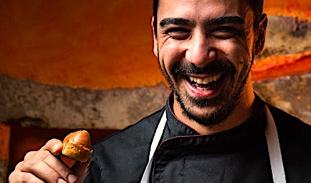
The floral ring mystified me. Such wreaths are traditionally placed on doors in the week leading up to Orthodox Easter, which took place a month ago. On Easter Monday the Saviour has duly risen so life can get back to normal. The wreaths are taken down and thrown away. (Fishermen's wives once had a tradition of casting them out to sea, but that custom waned when tut-tuts about pollution arrived).
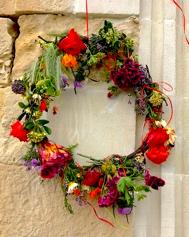
His name was Giannis. I asked why he was putting a wreath up a month late.
‘We are not especially religious. We want to look at something prettier than a street lamp.’
Giannis Chatziioannou, Skéti Glyka
I pondered the implications of that, then made a minute examination of the profuse details of daily life on Odos Isodion to see what else might be prettier than a street lamp.
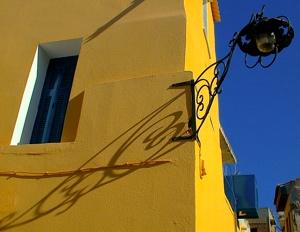
Xaniote lanes become gracious when one pays attention to their shifts of light and shadow on the walls. The windows and balconies and potted plants dramatically change with sun angles and sky light.
Looking first one way then the other along the three-meter chasm a hundred metres long, four tabernas and two kitchens limned the light with tables. Add Aphrodite House Hostel across the way and the Morpheas Hotel adjacent, the Kurkoya
knick-knack shop just past, the Pharmakion on the corner, the potted bamboos, the blossoms in vases on the tables, the lemon-and-honey coloured stone walls, the balconies with wrought-iron railings rusting away because so few sit on balconies any more, the locked doors which open to mundanity or transcendence depending on what we hope to find.
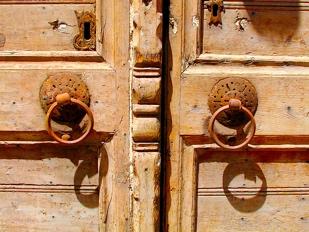
To these add scallop-edged awnings, the slithering electrical cables linking the lane’s lights, the vertiginous drainage assemblies, the geometries of paving stones and fussy florals of chair cushions. These sum to a concerto of colour and shape conducted by the baton of the wandering eye.
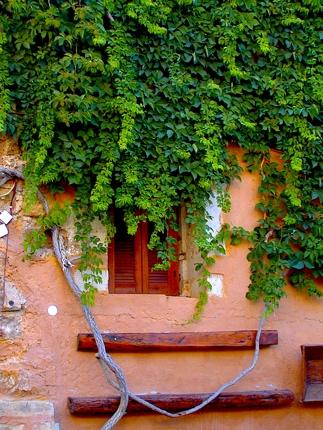
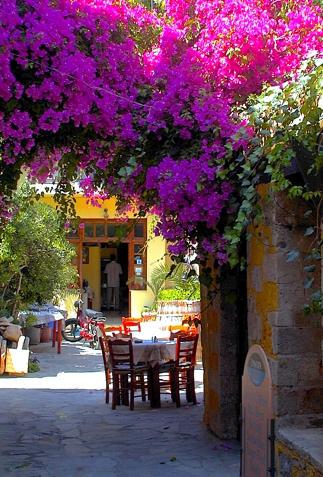
Menu of the Hands
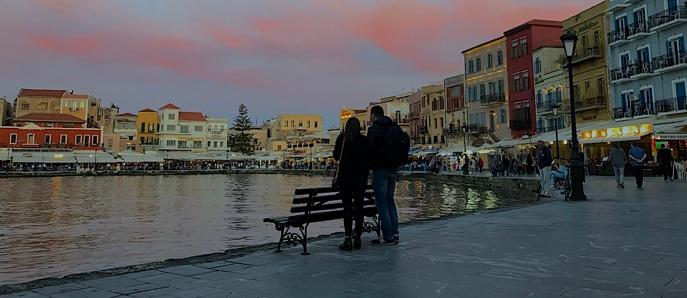
Of the twenty-odd καφενείο that line Xaniá’s harbour, most employ shills whose duty is to inveigle people inside. But if the passing parade is not yet hungry, how do they inspire a pang?
For the first time all day, the air is cool enough to meander. The harbour volta promenade in the dimming hour of day is a
people-watcher’s paradise. The cafe shills have their work cut out for them. Their pay is a percentage of the meals they sell, so they become a made-for-YouTube study in the smoke and mirrors of marketing to the tourism boom.
In the cafe next door, about ten metres from my table as I scribble while pretending not to notice, a fellow whose name badge identifies him as Minos is actually an Albanian named Erjon. His name translates to ’Wind.’
Erjon merges the jut-jawed bludgeoner with the accessorybloated fashionista. The jut-jawed part includes his opening set of, 'Bienvenue, mes amis.' if the party looks French. If that doesn’t connect, he tries 'Guten Tag.' Failing that, 'How’s your hungries today?’ is a safe fall-back phrase. The cafe shill’s term for the culinary identity of Americans abroad is ’fastfood’.
The trinket-fixated fashionista reveals itself in so many gold rings he looks in training for brass knuckles. He wears the cafe shill’s trademark floral shirt unbuttoned to the level of his chest hair, plus pegleg black trousers. His pointy-toed shoes look purpose-built to stomp cockroaches in a corner. A glittering array of gold chains completes a look that begins higher up in a glittering array of gold fillings.
youngsters, knowing the all-powerful words 'pizza' and 'Coke' directed to the younger ears, followed immediately with 'wurst' to the ample, 'cotelet d’agneau' to the slender, and 'awesomeburger' to any kid wearing a backward baseball cap.
Plus the linchpin phrase for this climate at this time of day, 'ice-cold beer.'
All these are delivered in Crete’s ratatat declamations that turn items on a menu into Demosthenes orating the sea.
It is hard to avoid him. His modus operandi is to confront rather than invite, using a slurry of strides and arms spread so wide he is hard to get past. He specialises in families with
Surprisingly, most people take a bit of convincing. How convenient, therefore, that the establishment’s menu is but two paces away, toward which he insists them with a grand flourish of wrist. Page after page flick past their eyes. He extolls the catch of the day (not specifying where caught or on which day),
the swordfish (carp cooked in butter), red snapper meunière ('real meunière — fresh butter and lemon, not the same butter the fish is cooked in') and the octopi, which mere hours ago were drying in the sun on the other side of the harbour. Flies and all.
That is the fish page. The à la carte page takes several minutes. The drinks and desserts — well, they could consume another five minutes, but he seldom gets to those because by now the head of the foursome or fivesome or sixsome has taken on the wan look of a snake charmer whose snake is taking over, and the entire group slides to the first available table, rather reminiscent of the way a good cook slides an omelette off a buttered pan to exactly the space between the fried potatoes and the parsley sprig on the plate.
But now a magical transformation comes over him. He mentally changes hats from shill to server. His face becomes a magniloquent Eurobabble of words about food —and when it comes to food, Euros can really babble.
As he recites the day’s specials, his hands take over. It is astonishing how he turns into a trapezist with the locutions of his hands. He doesn’t describe the dishes, he cooks them in their imaginations. He fills the table before them with fingerflung ingredients that magically enter saucepans. His fingers pluck a chicken, dice a tomato, crack an egg, drizzle olive oil, toss a salad, soothe a sizzle, brush aside excesses of thyme. His palms are culinary oratory. They paint tastes on tongue tips, savour the salt on the back of the palate, then slip away to the
next bite. They split an artichoke, baste slices of eggplant in garlic butter, finger-snap the mind’s eye through a plate full of chips.
The main course arrives on a serving tray of fingertips, first flat, then cupped, then spread, then open — biftek, roast lamb, souvlaki, gyro. They tremble a moussaka, conjure a boureki, shake a cluster of asparagus, hint grandly of green beans, fava beans, cucumber, radish. They grip into tight balls as one fist pounds the table while the other shakes the stuffing out of the air — et voila, a full roast game hen arrives before their mind’s eye.
Then he spigots a beer, suggests a wine, trills out vintages fast-as-that, and finally cathedrals into a prayer-temple of, 'You perhaps would like a local wine, a good Cretan red wine, made just outside of Xaniá itself.' (Indeed it probably was.)
Then the hands soften. They cajole. They ease. The fingertips yield. They permit. They forgive. After all, having honoured the due diligence of nutrition, who is so crass as to naysay the frisson of sin?
Dessert, in other words.
His hands become a tranquillity of parfaits, a sign of the cross over a sundae. They forgive the caramel, while not forgetting the benediction of chocolate.
Thus the poet of the calorie. When he presents the bill, it is a florid frame around a forgettable fantasy.
If there is no higher dimension to our dailiness, the bill attests, then why did we invent perfume?
Poetry?
Piccolos?
Maria’s Book
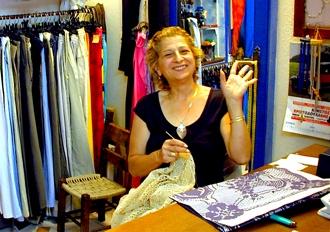
Maria was quite the reader. What else was there to do in a little byway trinket shop during a tourist district’s slack hours?
I wanted to buy her a nice prezzie of some kind for all the little niceties she’d done — watering my balcony plants while I was gone, buying me a fragrant βασιλικός vassilikos (basil) plant for my table, bringing me some gooey στιφτος stiftos (incalculably caloric bread twists with nuts and honey inside) every Monday. Not to mention her cheery Καλή μέρα, Ντόγκλας, Kali Mera, Dooglahs, every morning when she arrived.
But today, Maria complained of abdominal cramps. I went up to my room and made her some chamomile tea from the fresh-picked buds that a contingent of sweet old ladies in black purvey in front of the Post Office.
Later she said was feeling much better. She confided that she was going through 'the change' and that I had given her the one folk remedy Cretan women believe in.
Then she asked slyly why I, a man, would be drinking chamomile? I told her because it helps me sleep. But she knew I
was fifty-five and I surmised that she was convinced that males go through the menopause, too, for which chamomile works just as well.
It turned out that Cretan etiquette deems that a kindly deed be reciprocated with a gift. The next morning as I was upstairs tickety-ticking away on the laptop Maria arrived in her decisive, outta-my-way-I-got-work-to-do manner. Soon after the clangorous wind chime went up at the entrance notifying everyone that Αρμονία Κεραμικά, Armonia Keramika, was now officially open for the day. Her voice bellowed up the stairs, 'Dooglahs, Ellah! Ελλαχ!'
Now, by the dictionary Ελλαχ means 'come here.' It is one of the dozen or so words that once you get the hang of how it is used, is a passport to Cretan apprenticeship. Ελλαχ is so redolent with undictionaried meanings that its import was more in the way it is said than the literal meaning. A few others are Καλά Kala! ('Good! Fab! Great!'), Ορεα Orea (‘Nice' beautiful, lovely, fine'), and Ορίστη Oristi ('Please?' or 'How’s that?' — the French equivalent being comment?).
Ελλαχ! was the locution I’d hear from the neighbourhood mothers below my balcony wondering where the dickens the kids are.? Voiced with more coo, it was the word Maria used when her husband Tassos was around and she needed a hand.
Ελλαχ! is also the word screeched by tots who want Mommy NOW!
It was the word used by henna-haired Anna several doors down where she held court with several gossipy black-garbed dowagers in front of her own little trinket shop.
Anna was teaching her little boy, about five, to ride his bicycle. Gripping the tiny handlebars for dear life, tiny feet flailing on tiny pedals, he would wobble his way half-coasting and half-propelling down the Zambeliou decline past the gauntlet of mothers encouraging 'Bravo! Bravo!' to the corner where Anna was crouched on her knees, calling Ελλαχ!
Ελλαχ!
This scene alone could bring a lifelong bachelor to pine for matrimony.
So when Maria called me, I ellah’d my way down the steep wooden staircase. Maria presented me with a gift-wrapped slab, which, given its shape, was either a book or a very large bar of soap.
Now, Xaniotes don’t throw a fizzy little ribbon around a piece of tissue paper and call it a gift wrap. This package came slathered in velvety green-brown paper with a banded sateen surface pattern that would not have looked out of place over the shoulders of an archbishop. The ribbon, circled and bow-knotted twice, was a finger-wide cerise strip with a wood-grain weave, pasted down fore and aft with an ellipsoid sticker from the shop Βιβλιοπωλείο Ξαρτοπωλείο, Bibliopoleio Xartopoleio. The whole affair made me think of Aldus Manutius’s book bindery
back in the days when the craft of the book was being turned into the art of the book.
I hesitated. One of the customs of my childhood was that you never open a package when it is given to you. If you are disappointed by what lies inside the giver will see it in your expression.
Not so in Crete. They prefer something more like a striptease on fast forward. So off came all that luxurious wrap and ribbon (me feeling like I was desecrating an altar) and there inside was Maria’s personal Nobel Prize nominee, Yannis Ritsos’s Iconostasis of Anonymous Saints.
I riffled through the pages.
Maria beamed.
She then recited several passages that she had committed to heart.
I could see why she loved him. Page after page of deliciously complex prose, prose like poetry, poetry like myth, the events and thoughts of his characters like the cultural personas of Greece — the benevolently serving, the emotionally supportive, the transactional self-server, some who speak through the music of the heart and others who speak through the dust of their years.
Yannis Ritsos was a panurge all his own. His pages could better be termed Remembrances of Things That Always Are instead of Proust’s cookie-tin of things past.
Indeed, even though his book was written in the past tense, it was really the past that is present in the future, for the past and the future merged in his lovely imageintoxicant style:
‘... or those white moths fluttering around the light bulb in the dining room and the poor creatures kept falling on the table and often even into the dinner dishes; and once Father got furious and threw his napkin into the soup and strode into the hallway and started smoking, puff-puff, and cursing away, and Mama started to weep. Gingerly, she picked up the napkin and laid it on the tray, and though she was still mutely weeping, she used her finger to remove the moth soaking wet from the soup, looking sad. ... And I said to myself when I grow up and become (by all means) a great poet, I’ll put many moths in my verses, birds, even owls (but not Athena’s owls, of course—they’re for the philosophers), even magpies, and many, many butterflies, and pigeons, the white ones and the grey and the speckled ones, as well as the carrier-pigeons (and the non-carrier too!), especially the carrier-pigeons holding a child’s letter in their beaks to post to God, or a letter from a soldier, carried by these pigeons unscathed high above the fires and the bullets, all the way to his mother or his sweetheart; or those other pigeon-doves with an olive branch in their beak, or the doves which have moulted because of all those traps, until Picasso rescued them and they grew all downy again; or these flirtatious pigeons which come and leave their droppings here on my terrace and I can see them through the large glass door of my balcony and I smile at them as they kiss one another on the mouth. I, a seventyfive year-old child, here on my couch, smiling still more as I watched these pigeons on my terrace kissing beak to beak.’
I was stumped by an adequate response to a book like this. It had to be a book, assuredly, anything else would have been an altar without a candle. So I waited till her husband Tassos had the weekend duty at Armonia Keramika and asked him what kind of books she liked.
He opened a little cabinet where they kept the utilitarian items like the screwdriver to pry the door when the lock hangs up (live with a family and you learn these things) and the sugar packets for coffee and the tray of loose beads to replenish the bracelets that sold, and so on.
In there was her library. I was astonished. No heavingbodice-in-gold-foil reader was this Maria! Her taste ran to George Seferis, Nanos Valaoritis, Odysseus Elitis, Katerina Gogou, and the tragically brief comet of Maria Polydouri whose intense love affair with Kostas Karyotakis ended in his suicide.
And how could she neglect Nikos Kazantzakis?
I decided nothing else would do than something by Gina Barriault or Amy Tan. A Cathy Bates film on video would have been nice, given Maria’s ampleness and the comforts of seeing a role model who’s made good, but Maria and Tassos don’t have a VCR.
So I went to the bookstore and asked what they had. The best of the lot turned out to be Isabel Allende.
Maria and Isabel are now friends for life.
All this from a cup of chamomile tea.
Delivery Hour
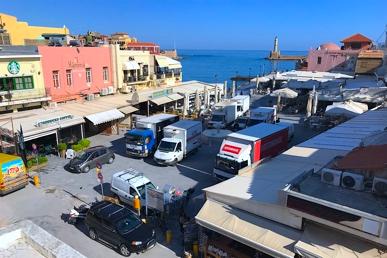
Kaphenion Crescent — the Akti Koundourioti and Akti Tombazi quays that necklace Xaniá’s Old Harbour — are bereft of eventide’s strolling masses at ten in the morning. A few old folks walk their dogs. A father escorts his teen daughter to her first job.
A lost-looking backpacker with a foam rubber mat rolled alongside his sleeping bag consults Lonely Planet while considering the hotel names emblazoned above the balconies.
With names like Villa Venezia, Nostos, Amphitri, Casa Leone, Lucia — and just out of view the Contessa in an old pasha’s palace so authentic it even has pewter inserts on the rosettes on the doors, while just down from it, the Delphino with its magnificent Venetian courtyard with fountain — this clearly isn’t the backpack part of town.
Have you ever wondered when and how these places get their food, beer, tableware, bed linens — and employees?
The trucks arrive in droves starting at 7:30 a.m. Muscular hulks driven by muscular men. The side door of Delta Ice Cream’s blue and yellow refrigerator truck rolls back in a froth of icy mist. Out
come five-kilo plastic tubs with snap-rim tops — Rum-Raisin, Mango Dreme, Pineapple Delite, Apricot Sunrise. (Now you know what kind of assignments Greek junior ad writers get.) Out from the hissing door they come, by tens, dozens, all onto a cart
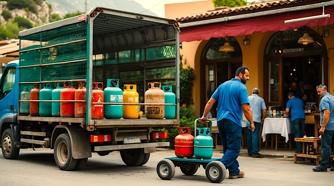
with four chubby wheels that the driver manoeuvres — with delicate aplomb, all things considered — between the glasstopped cafe tables and the wicker chairs with fussy floral-print cushions and the potted ficuses and the occasional early-riser tourist grumpily reading the morning financial reports with a frown and a cappuccino.
Bottled propane deliveries are a lesson in variant delivery styles for what must be consumerdom’s least pliant commodity,
a steel cylinder filled with explosive gas. They roll it across the stones where it pendulums to a stop in a series of diminuendo clangs.
Another deliverer with full-arm tattoos and a denim vest manoeuvres lopsidedly by on his moto, two gas cylinders strapped to his backpack while he grasps a third with the left hand and balancing it on his lap while he steers with the right hand and brakes (occasionally) with the right foot. Flair is everything in the delivery world.

By 10:30 the quayside is lined with trucks, from the mincing Fiat of the candied sweets purveyor to muscle-bound Mercedes with windshields like the pectorals of a gym rat above the three-pointed star of its bellybutton and moat-sized fenders for hips. (Do vehicle designers really intend these effects?).
Judging by Xaniá’s parade of trucks and dozens of workers who arrive, deliver, tot up the bill, and vanish in the space of two hours, the distribution infrastructure in Crete’s island economy is a snappy affair. In Monday’s slender distribution envelope of nine to noon we examine the minutiae of Exclusive Distributorship Xaniá as a link in the larger economy of Service Industry Xaniá, itself but a part of Tourism Sector Xaniá, all of which is a modest but vitally cashy sector of Cretan Economy. Approach the composition of a Caravaggio this way and you could apply for a Ph.D.
Crete is ever larger ripples of economy each growing deeper as they fatten outward from the central plonk of a Euro in the till. Keep coming back, you’re doing more for the place than you know. While one contemplates this felicitous glance at the tourist’s contribution to the island’s majestic but tangled history, another ice cream van arrives. There’s a brief Monty Python interlude in the form of a car of tourists franticking its way between the logjam of Diahatsu Hijets and Hiace minivans, apologising out every
window at being so lost at so bad a time. You almost expect them to distribute alms.
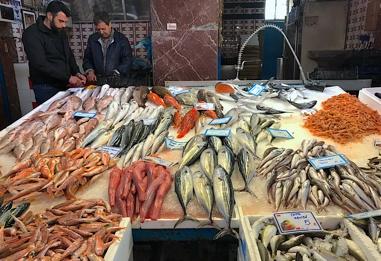
Then another Delta frigo truck arrives, as spotlessly clean as the last, this time carrying fish. It is trailed by an Econovan from Japan groaning to the depths of its wheel wells with gallon tins of tomato paste (pizza, sir?) and plastic gallons of mayonnaise (tuna sandwich, sir?) and sacks of pre-cut potatoes (fries with that order, sir?), all of which is enough to refresh your enthusiasm for a tomato-and-feta Greek salad at half the price of a pizza and beyond price when compared with the cost to your stomach lining of a tuna pizza with fries. Wavering between the unloading hulks is a man pushing a steel dolly with fat tires with a freon canister strapped to it. He lithes his athlete-waisted way past the driver of a flatbed filled with watermelons getting back inside with a clunky slam of the door and another man carrying big plastic shopping bags stuffed with flowers for the lunchtime tables. A bumblebeeyellow NatoExpress truck with half a dozen self-locking reefer
doors delivers yet more ice cream, this time the popsicles that comes in sheaths and conical wrappers but are delivered in cardboard boxes the size of a wine carton.
Lifting massive cardboard boxes effortlessly over their shoulders, draping plastic laundry-bags of linens over one arm and brandishing a clipboard fluttering delivery records in the other, a wheeled dolly in each hand or several cases of bottled soft drinks under one arm and a crate of oranges under the other, legs like thousand-year oaks, tummy abs so sharply etched you could play a round of baccarat on them.
These are Monday’s short-sleeve shirt business-daybiceps that on Sunday’s volta don body-aware tee-shirts to sidle down the quay with a bunch of buddies, all looking as ill-prepared for the consequences of their virility as the girls they pass who are wearing artillery-bosom turtle-necks with the cross hanging amidst the décolletage from a thin chain.
You wonder why they don’t heigh out to the end of the Rodhópou peninsula, get naked, and do what their Diktynnean ancestors did under the full moon and flickering bonfires.
It is spring, you know.
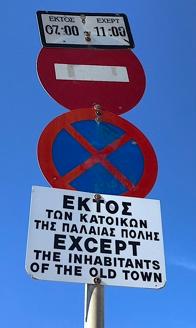
Vasso
Vasso was a bespectacled, fortyperhapsish woman who owned a tiny cafe three doors down Odos Zambeliou from my two-floor flat above the trinket shop Armonia Keramika. Each morning I would gaze down on her small contingent of omelette-and-toast nibblers from my balcony.
Vasso didn’t live above her business like many locals. The upper floors had been turned into one of those bedspread-sized room-with-communal-shower ’rooms to let’ — ενοικιαζόμενο δωμάτιο (enoikiazómeno domátio) that serve as lifebuoys to latecomers during the overbooked high-season. For some reason most of her renters were workingclass Danes. After a month observing her Nescafé sippers poring over their free Kriti Gold Shop street maps and underlining all the tourist must-sees except the Kriti Gold Shop, I could confidently state that Danish working men weren’t into sartorial statements, while
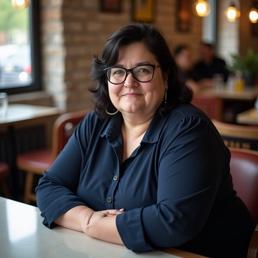
while their wives doted on petitepetal florals so reserved they made Laura Ashley seem daring.
My late-afternoon colloquies with coffee in Maria’s shop had turned into something of a get-acquainted session for Vasso and myself. We had gotten to know one other’s likes and dislikes rather more than each other.
I didn’t know what she thought of me, but I observed her to be a pharmacopoeia of tinctures that could be applied to the betterment of Cretan men. These came out with such pithy irony that I wondered if any of her male acquaintanceships had ever progressed to the dinner-and-movie stage.
One afternoon Maria suggested that since I was keen to sample the best of Cretan cuisine, wouldn’t it be a good idea for the four of us to go over to Chania’s harbourside Antigone Restaurant for dinner together.
'I will even close the shop early,' she confided, eyes avoiding mine as she spoke, 'So we will have lots of time to enjoy the food.'
Vasso looked at me and I at her. Whatever the Kriti slang for 'Setup City' might be, it was written all over her eyes.
Antigone occupied an auto-free corner at the east end of the harbour. The water is so shallow at that end that only local fishing smacks docked there.
The outdoor tables faced a sunset scene to gladden the heart of any yachtsman. Dozens of masts speared the sky. Unfortunately, this evening the only hint of sunset was few rosehued cloud tops in a bilious orange sky filled with scirocco dust blown in from Libya. I thought of Ruysdael on a dyspeptic day.
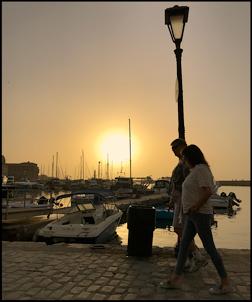
In one of those enigmatic nautical allusions which seafaring Cretans adore, the afterdeck of a sawn-in-half boat had been mounted on a corner wall, looking as though it was hurled into view by a cinderblock tsunami.
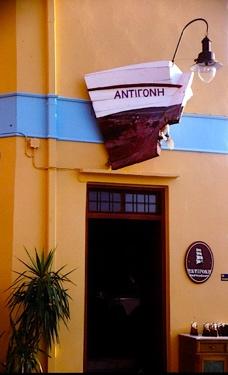
'I’ve seen some wonderful sunsets in Xaniá,' I ventured as we settled into our seats, ’but tonights isn’t one of them.’
'Cretan women aren’t interested in sunsets, Douglas,' Vasso replied. 'Have you ever seen a Cretan woman with nothing better to do than look at a sunset?’
Maria clucked her agreement and lit a cigarette, waving out the match with big sweeps of her wrist.
'But why?' I asked 'Sunset is the most beautiful time of the day. The workday is over. Time to relax and enjoy life.'
'YOU can relax and enjoy life, Douglas. But for a woman it’s the beginning of her second day. Her first day is breakfast, cleaning, shopping, and washing. Her second day is supper, bathing the children, making the beds, feeding the animals. The men are down at the raki shop.'
'Hm. That’s not entirely what I’ve seen, Vasso. I’ve seen more men in their workplaces than sitting in the raki shops.'
'So what were they doing, this what you call work?'
'Some were sweeping out and tidying up their shops. Others were washing grime off their hands in the auto repair places. Out in the country I see men herding their sheep to the pens for the night.'
'Have you ever seen a sheep that couldn’t find its pen by itself?' she hooted. 'Why do you think most shepherds are bachelors?'
’Bachelors? Most shepherds are old enough to be grandfathers.'
’They are bachelors because sheep don’t ask questions.'
I wasn’t sure this dinner was getting off to the right start.
Tassos interjected diplomatically, 'In all our years of marriage, Dooglahs’s question about sunsets has never come up. This is why we Kritis like to meet foreigners. Tell us, Maria, do you like sunsets?'
His was a valiant attempt at changing the subject, but Maria shook her head and lit yet another cigarette. 'I haven’t seen a sunset since before the boys were born,' she bassooned in a nicotinic exhale. 'Then after they grew up and went off to university, we opened the shop. Now I can’t close it till around nine or we might miss a sale. I’m certainly not going to lose a sale so I can see a sunset.'
Vasso apparently hadn’t yet scored her goal and was lining up the kick.
’Douglas, Cretan women don’t like the sunset because sunsets are the menopause of the day.’
'Vasso, how would you know? You are too young for the menopause.’
'Douglas, I am but a simple Kriti girl without a thought in her head.'
'Kriti, yes. Simple, maybe. Thoughtless, no. Your comparison of sunset with menopause isn’t a metaphor. A metaphor has to be subtle, but also sharp. Yours was a metathree.'
A laugh of delight exploded from her. 'No, Douglas, it was a metaFIVE. The fifties are a marvellous decade for a man, he’s at the peak of his life. But Cretan women hate the fifties. Menopause is the beginning of a long, long night. A long, long night is also what lies ahead after sunset, correct? My point was really a metafive, don’t you see?'
'Many times I looked down from my balcony as Maria and Tassos lock the door, then walk arm in arm down Odos
Theotokopolou till they vanish in the dark. Moments like that give life its loveliness.’
'Pfui, Douglas. Such sentimentalism! Do you always let your feelings lead you around like the nose ring leads the bull?'
’Sentiment is the nose ring of compassion.'
She was silent for a moment. 'Knight to queen pawn four,’ she finally said.
She flickered her glance back to me. “Do you play chess? You are good at it, perhaps?’
'Depends on what you mean by “good,” Vasso. If I stop trying to win what’s on the board, I win everything that’s not on it.'
The server arrived with thinly sliced tomatoes in olive oil, capers, and marjoram. Tassos, never one for formalities, began to spear them two at a time with his fork until Maria nudged him with her knee.
At a nearby table a tot was starring in daddy’s minicam epic. A mother walking the quay guided her early-teen daughter through what to her seemed a phalanx of stares, while her mother saw tables of people waiting for their meals. A seventyish couple trudged a slow promenade; it must have taken decades to perfect the symmetry of their steps.
Vasso followed my eye as I watched the couple vanish into the volta. 'Fifty years married if they’re a day,' she said. 'Marriage is s-o-o-o-o awful. Take my word for it.'
'When were you married?'
'Never.'
'Then how do you know marriage is awful?'
'Wives. You hear the same complaints over and over and eventually you see the trend.'
'So the tree of life ends up a prong of dried dust.'
'Douglas, I said that marriage is soooo awful. What I didn’t say was that affairs are soooo nice. No kids. No spats. Lots of good times. There’s a beginning, a middle, and it doesn’t take fifty years to get to the end.'
I didn’t know what to say. Or rather, I did, but didn’t think this was really the right place to say it.
'Vasso, do all Cretan women speak so bluntly?'
'Two steps forward and one step backwards, Douglas. You never know where you are with a Kriti woman.'
From somewhere behind me, a monologuist was extolling in the American flat 'A' locutions that make me think of Seattle.
…I don’t think I’m too dominant, but, like, y’know ... in a dominantpassive relationship ... part of it is, in most cases, it ... isn’t, y’know, as common or big-time respectable as, generally speaking, the way men dominate ... so I, y’ know, think it’s horrible how ungrownup they are. Here we are in Greece and my guy friend still thinks like an incel ...
Blessed relief came in the form of a four-year old toddler blowing fiercely on a whistle.
Vasso had been listening, too. 'Kriti families are matriarchies,' she informed me.
'I know.'
’How? You’re not Kriti.’
'Maria. Two boys and a husband and all three of them affable. Clearly not raised by an American. Also she ordered everyone’s dinner when we arrived.’
Maria assented with a wave of her cigarette. Tassos laughed and rolled his eyes. Given that during the day Odos Zambeliou in the environs of Armonia Keramika was peopled by Maria, two women art-glass shop owners, Vasso in her cafe, an Irish woman who painted Byzantine icons of the Virgin in Majesty, a grim matron in black named Auntie who owned the Hotel Irena, and Anna the Shriek whose piercing 'Ellahh!!' in search of her son was worthy of a Madam Mao epic; it was clear that Tassos had learned that working at his job was the best thing that could happen to ten hours a day.
The waiter arrived with plates of fish, chicken, lamb, and beef.
Maria wasted no time on requests. 'The lamb’s for Tassos,' she announced as she set the plate before him, 'The fish is for me.'
I would have preferred the fish, but Maria’s twenty-five years of motherhood had made their stamp. She placed the chicken plate before me and gave Vasso the beef.
I wondered if there was a sly message in these selections. 'Douglas,' Vasso explained, 'we women of Kriti, it is we who decide what our men eat. What they do. What they think. There’s nothing more useful than a man brought up so ignorant he doesn’t know he is ignorant. We do this by telling them they know everything.'
I had a feeling I was in my first training session.
'If men are so ignorant, why are Cretan women working day and night shifts at home while the men are taking it easy in the raki shops?'
She pursed her lips and looked away. I was clearly being positioned somewhere between cretin and village idiot.
'Douglas, you can’t believe anything you see in Kriti, even if you see it with your own eyes. I give you an example. What do you think when you see the men twirling their komboloi beads all afternoon in the taberna?’
'I see self-interest congratulating itself. But that is everywhere, not just in Kriti. Visit a computer club or a poodle show and all people talk about is the virtues of computers or poodles. If you really want to see a set of blinders, talk to an AI consultant. Mention Versailles and he’ll have never heard the word, yet there he is, admiring himself in the Hall of Mirrors. '
'So don’t you think, Douglas, that maybe men are the poodles in the poodle show and women are running the show?'
Tassos chuckled and rolled his eyes again; Maria responded by kneeing him again.
'Vasso, how many poodle shows have you seen in Kriti?'
Blank look.
'I ... don’t think … there are any. Poodles are not really the Kriti’s idea of a dog.'
'If you haven’t seen a poodle show, how do you know what happens there? I don’t think a poodle show is the right image for Cretan women. To me, you are a white feather on the water.'
'Oristi?' she said. 'What?'
'When you see a white feather on the water, you don’t need to see the heron to know it is there.'
She darted a glance at me. Lingered it. Darted away. 'So strange an image, Douglas. It says nothing. It says everything.’
We had been talking so intensely that evening had settled in without our noticing. Half an hour after sunset is Xaniá’s finest hour. A handholding couple went by, so neat and trim they must have been accountants. High skreeks of sky-arcing bats. Middle-aged dowagers preoccupied with proper hair. Middleaged men preoccupied with having some. Wine-heavy workers at the end of their day. A bleach-blond with a wrist of gold bangles. A skip-rhyming girl all angles and hair. The oversize purses of ladies who dress in dark colours. A struggle of elders trailing a package tour guide. A daughter bearing proudly a
red purse. A woman whose husband was in a wheelchair. He, not she, was wheeling it.
Seattle arrived again, a piccolo shriek above the violincello diners pizzacating favourite recipes:
... Dutch guys, they’re cool ... but my guy thinks TikTok is breath mints for brains … never heard the word “commitment” … ya think I’m kidding myself about him and commitment? …
I longed for the four-year-old and his whistle.
Vasso ended her long silence. 'Douglas, that was the first intelligent thing I have heard from the mouth of a man. I think maybe you have something in your cellphone besides selfies.'
'Perhaps, Vasso. But we are ignoring our hosts this evening.’
I turned to address Maria, but she had lit another cigarette — in between the fish and the eggplant.
I switched to Tassos. 'Tell me a bit about yourself,' I said. 'Have you been working your present job all your life? What is your job? You never talk about it.'
'Not so much to talk about, Dooglahs. Thirty-two years I was in the Greek army. I was even in Huntsville, Alabama! Six months there. Wah, ah kin even tawwk a li’l ‘Merican Suth’ner.'
'No, Tassos,' Maria interrupted, 'not your Alabama good-oldboy jokes. Please!'
He ignored her. 'What happens when you give a hot dog to a good-ol-boy?' he asked me. I shrugged.
'The good-o’-boy says, ‘Hot daymn! Thayt’s the only paht of the dawg we don’ eat whar ah cum frum.''
Maria kneed him again. This had happened so often I was beginning to wonder if they should switch sides.
'Pshoosh, Tassos, what will Dooglahs think of us?
I answered, 'I think Tassos can do a better Southern accent than I can!'
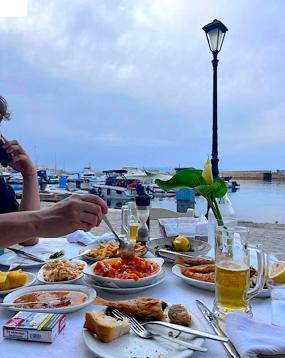
'Tassos had a good time in Alabama,' Maria reflected. 'But I didn’t. We were still living in the Honey Moon Room then. The boys were ten and twelve. Every day some shirt lost a button or new shoes had to be bought. And then cooking. Cooking. Cooking. Cooking. There wasn’t enough money for souvlakis or giros in those days. I was soooo sick of cooking.'
'But we saved a lot of money that way,' Tassos added. 'Everything went to the boys. We wanted them to get the best education in Greece. We didn’t want them to have to serve thirty-two years in the army like me, just to survive. Kriti is a pretty postcard, Dooglahs, but good jobs are few and life is as hard as its hills.'
'Did the boys turn out the way you wanted?'
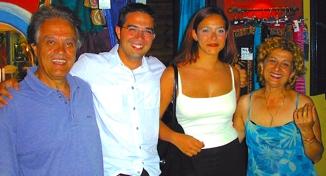
'They are the finest young men,' Tassos grinned. 'Constantine is a dentist in Salonika. Zacharios is in computerrepair school here in Xaniá. He can get a good job anywhere, all his life. He even has a girl friend.'
Maria added, 'Putting children through school was very hard, Dooglahs. But sooo worth it. When they come to visit, they are always so tall, so handsome. They always bring something nice for their mother. That is more than we could do when we were children, Dooglahs.'
'And neither of them will have to go into the Army,' Tassos said. 'No man should have to live that life.'
'Tassos, I don’t understand something. The Venetians were thrown out of Xaniá in 1645. That was before most of Europe had the borders of today. What use is there in holding on to such long-ago memories?'
'We Kritis have too much yesterday and not enough today, Dooglahs. We don’t have time to think ahead.'
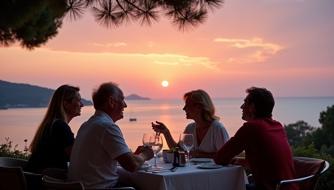
I pondered the difference between a tourist’s life of endless leisure versus the Cretan countryside life of endless work.
Magma had been rising over on Vasso’s side of the table, and now it erupted.
'Douglas, you wonder why we Kriti women have decided to run the show? We are mothers. We do think ahead! We have seen our men fight the Greeks. Fight the Romans. Fight the Venetians. Fight the tax collectors. Fight the tour group operators, fight the football teams, and fight each other. And for what? Pfft! A postcard picture with a huge moustache and a dagger in his belt.
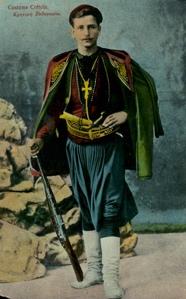
’So we take over the purse strings. We decide the marriages. We do the shopping. We plant the gardens. Then we give them to know they are not allowed in our territory between the end of breakfast to when dinner is served. Douglas, those men in the cafes have been sent there. It’s our form of kaphenion-arrest so we can keep our eyes on them.’
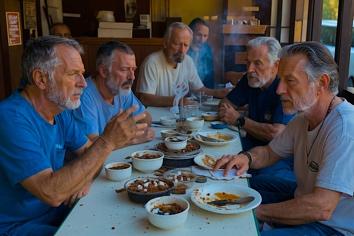
I reflected on the tedious rites kaphenion idlers devised to pass their hours. Furious clacks from backgammon tokens. Lustreless gestures that decorate their conversations. Pallid bonding rituals of bead-twirling and real-estate talk. The blank looks on so many faces that mutely stare into the exhaust fumes. I thought of the tribesmen in the highlands of Irian Jaya, whose howling hunting rites wearing huge codpieces made of yellow gourds brought in less food than the fruits and vegetable plots of their women.
Vasso snickered a final nail in the coffin of the Cretan male’s dignity: 'Just look at their clothes, Douglas! Would a man in those clothes interest a woman? Pfui!'
It was hard to disagree on that point. Sartorial distinction was not the Cretan strong suit, so to speak. Workmen preferred that great sump-pump of the human shape, the denim. On more formal occasions, the Cretan men’s suits were so lumpy their idea of tailoring must have evolved in donkey-blanket days.
'Vasso, I agree with what you say about the way the men dress.'
I won’t say that she beamed in triumph, but she surely was satisfied with her presentation.
'Yet what about the way Cretan women dress? They go in for blacks and not brights. Sombers rather than hues. Plain rather than bold. Basic basic, in other words.’
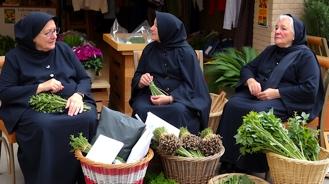
'Douglas, a Kriti woman isn’t made by paring down to the least needed. She is made by adding to nothing until the perfect her is there. In the old days Kriti women made do with very little because they had to. Today we make do with very little because we want to. We are well-dressed inside, not outside.
'Vasso, does it pain you that you won’t know the happiness of children like Maria and Tassos?'
'Kriti women, Douglas, have long memories. Kriti men remember their enemies. Kriti women remember false stories.'
'So your only choice is to marry no one?’
'I will marry the man who gives up his life for me. Why should I give up my life for him? Your image, white feather on the water? I like it. But Douglas, I am not a feather. I am the water.'
Dinner finished, Vasso left for home. Maria and Tassos walked me back to the Honey Moon Room.
'I hope you did not think Vasso is too harsh, Dooglahs,' Tassos ventured. 'She speaks strongly but has a good heart.'
'When I listen to someone, I listen for what they don’t say.'
'So ... what didn’t she say?' Maria asked.
I knew my answer would go straight back to Vasso.
'I think she wants your happiness, but doesn’t want the arguments that happen on the way.'
'You two are going to be friends, Dooglahs.'
Why pay a preacher when epiphanies are free?
Musical Chairs
dýo ellinikoí kafédes steamed before Vasso and myself as we mock-played a chess match on a redchecked tablecloth in a tiny-table cafe in a tiny outdoors plaza under a waxing Virgo moon. Zephyrs of evening were ending the heat of the day, just as zephyrs of common interest were ending the awkwardness of our first dinner with Maria and Tassos.
As different as we were in every other regard, in chess we had found a way to learn about each other. The agreement was that there were no pieces on the table because neither of us owned a chess set. I said that a certain square with a sugar cube on it was my knight protected by an invisible pawn and she said her salt cellar queen was safeguarded by two invisible bishops four squares diagonally away. We had agreed to eliminate the king and both rooks under he theory that playing only on the diagonal was more challenging than using ranks and files. By unspoken agreement, she always won the game.
I always won the memories.
It was hard to concentrate this evening in the little plaza. Two men behind me were clattering through a hot backgammon match with furious hurls of dice and phrases that made Vasso frown. A tot of a girl two tables away burbled the cafething names she was learning on Mommy’s lap.
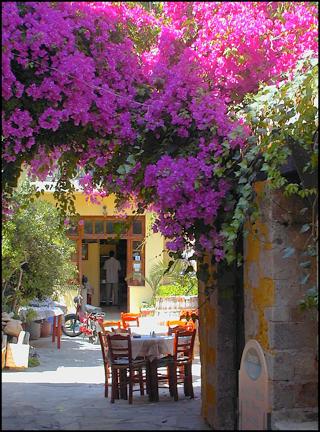
Three musicians were playing stringed instruments, fingers like nightingales. A guitar, lyra, and laouto tiptoed through a melody, the players intent on keeping to their individual counterpoint rhythms. From somewhere came the slithery sounds of a tambourine. A teaspoon clanked on a tabletop lamp. Someone in the audience hummed a quivering love song in a voice like a sobbing mouse. Multiple conversations were going in the background, turning the whole scene into an animated cartoon.
A nearby wall bore the anything-goes haste that lurks behind the prettily smoothed plaster of old stone houses bombed to shards during the 1944 bombing raid that were now being furbished into high-season rentals.
I pointed to it. ’What does that wall say about history?’
’Is that a question or an answer-in-waiting?’
’I want to know why they used so many different kinds of stones. Some are river-smoothed. Others look picked up after a rock slide.’
’The men who gathered those stones only had one donkey. It was after the war. A man with a donkey could repair a lot of bombed-out houses. By the time the overworked donkey died, he would have enough money to open a small shop. That is why there are so many tiny shops on Xaniá’s back lanes.’
’Once they plaster the wall, no one will ever know.’
’Kritis think of history books as plaster. We are not palaces and princesses like the Knossos confections of Arthur Evans. Knossos is three percent fragments of mosaic and ninety-seven
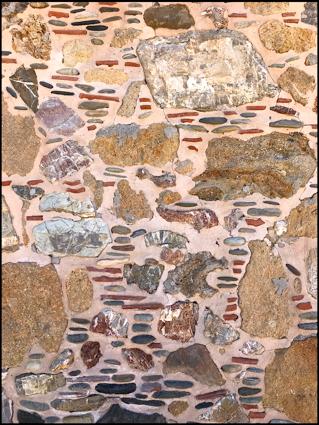
percent fantasies of a Brit. Why do you think there are so many bare bosoms.’
’What happens if the owners don’t plaster the wall?’
’Two things. The tourists won’t shop there, and the wall will eventually crumble from the rain.’
The music was like porcelain and everything seemed in miniature. Lamplit faces a liquor of the eyelids’ languors. The balcony above was decorated with painted gourds that looked like Christmas on a tendrilled vine.
Cruettes of vinegar and oil awaited the first salad. Clear glass ashtrays. Fresh-picked wildflowers. A tiny lamp with amber-coloured oil. Potted ficuses and oleanders separated the tables. Slate paving stones. A string of winking lights on a wrought-iron balcony.
The musicians’ voices were a cheer-laden lacework that echoed off the chasmy clapboard walls of old Turkish-era Splantzia houses three floors high, their windows shuttered with rough-hewn wood.
Stone quoins on house corners built back in lumbering delivery cart days. The gloomy dark of unoccupied TripAdvisor rentals. Near our table some bougainvillea petals had fallen to the stones, still radiant from their weeks of having stored sunlight.
'I remember my own discovery that I had ventured out onto the long plateau of adulthood,' I replied. 'After youth’s monster danced, the demon in me died.'
She looked at me, then at the chessboard, then back to me.
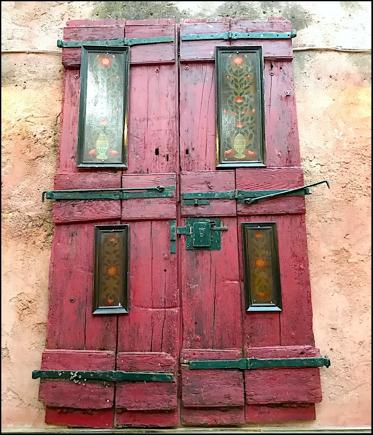
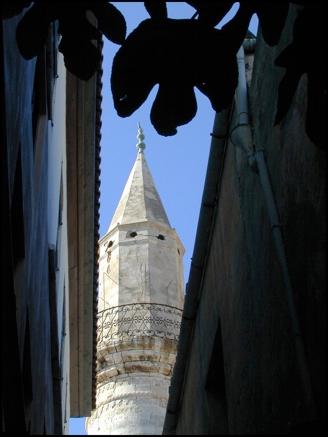
'Your move,' she said. ’And mind that the pepper grinder is a knight.’
’Whose?’
’You decide, but don’t tell me. I’ll find out where you go with it.’
The musicians had strong vigorous beards and strong vigorous hands, legs crossed at the knees. They plucked with their fingers the same way they watched their strings with their eyes. Songs of lissajous harmonies and sliding scales. Halts and slithers and major chords dwindling to minors. One voice like the dying gasp of a sheet-metal shop sang lustily of life beyond the windows of houses with fig leaves out the windows.
'So young,' Vasso said, 'yet even now singing about their jobs and their futures.'
'If they do their investments as well as they do their music, the economy of Kriti will be in good hands.'
She frowned at that. Better stick to philosophy, I thought.
So I added, ’Music is not beautiful because it is beautiful. It is beautiful because it lights the way.’
She leaned back in her chair and gave me a look as dimensionless as light seen through an umbrella.
’There you go again with the white feather on the water.’
So intent on their style were they, the posh plucks that gave their lyra its mournful air, they were startled at the end when everyone softly applauded and Vasso in her garment of green greener than green presented them from the vase on our table a single yellow rose.
Rodhópou and Diktynna
By now Vasso and I had settled into an amiable mix of mental regard and verbal fun that did not include an affair. I had to agree with her when the subject sighed across the question marks between us: 'Marriage is boring. Affairs get mouldy. One-night-stands are a glass half-full. Friendships last longer than all of them. Take your pick, Douglas.'
It turned out idyllic that way. Every week we tried a new restaurant. Every week we waddled home to different beds. This week dinner was at the Fortezza. From the tourist brochures I knew the Fortezza to be an old fortification-cumcustoms station strategically located in the middle of the long seawall that protects Xaniá harbour.*
'Skip lunch,' she advised me.
'That good?'
'Or that bad. Let’s find out.'
We crossed the estuary on a shuttle boat from near the Maritime Museum. A little sign above a tin cup stated
Tips graciously accepted
Around us, Xaniá’s modest contingent of crab potters phutt-phutted their way to sea.
Above us was nothing — utterly nothing — between the sky-piercing yacht masts and the end of the galactic reach.
The sun was nearing the horizon over the Rodhópou ridge. Vasso’s eyes followed my gaze.
'In June the sun sets behind Diktynna’s ancient temple as seen from here,' she said. 'It is a sacred time for Kriti women. At the end of a day the hero on the blazing chariot will come home to us.'
'I read that the name Diktynna came from a mountain deity even older than the birthplace of Zeus on Mount Dikte in the millennia before Greece.’
Lay aside your Greek gods and everything you learned about them. We are Kritis. We are the Minoan soul dancing with snakes in our hands. Our gods were a thousand years before Odyssean gods. Those were a thousand years before Roman gods, and they a thousand years before Christian gods. To sailors before Homer, Diktynna’s temple was the safest harbour in the Mediterranean. I myself have walked the stones of the sheltering cove amid the temple ruins. Once it was a haven from the storms of the sky that mariners endured. Now it is a haven from the storms of the soul we women endure.’
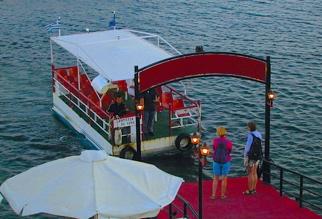

The little ferry bumped against the landing. I put a tip in the tin cup. It was pointedly ignored. There is that portion of Cretan economy which prospers gratuitously from tourists and therefore refuses to accept them.
Vasso pointed to a stairway. 'Let’s watch sunset from the roof terrace. We can come down for dinner later.'
The sun over the Rodhópou was matched in majesty only by the loping peaks of the Lefka Ori mountains to the south. From our vista, they loomed luminous across the southern sky.
’My feet yearn for the Lefka Ori the same way a mountaineer’s feet yearn when sighting Kanchenjunga from Darjeeling.’
’I feel little for lofty skies, but much for quiet shores. Why does loftiness attract you?’
’It is exalting that my will can take me so high, and humbling that the only choice I have once there is to descend.’
I gazed across the harbour toward the Kastelli’s flowerfalls of bougainvillea, and thence to the Lefka Ori looming like eminences in fading light. The last patches of snow were dusted with pink deposited by a scirocco from Sahara that had seared through a few days ago, rattling the window shutters and emptying the streets. I imagined the streams, the clear air, the dappled groves, the bells of the flocks, the tranquillities of rivulets, the majesty of vistas on high. Yet I’d been up amid those
peaks, and I knew not to take their mysticism seriously. The ground is rocky. The wind relentless. The flowers wither before their time. The higher you go, the skinnier the goats.
’Everything looks good from a distance,’ I muttered, distracted now by the sadness of knowing I would soon leave.
’With you I’ve been standing on a peak, Vasso. The light is radiant. But in three days I must descend.’
’Do you grieve?’
’Of course.’
Vasso was regardful of my mood and let silence wave its wand of healing. Finally I spoke.
'Why did the story of Diktynna come out of an inhospitable place like the Rodhópou instead of the fertile valleys of the Lefka Ori?' I asked. 'There’s no water on the Rodhópou. Fertility goddesses usually inhabit a spring or a large tree, where the symbolism is so apt.'
women would show men their fertility goddesses. They would whisper erotic words in the men’s ears. Then they would show ceramic phalluses to them.
They would pour milk into the phallus to sanctify the sexuality of springtime. Why do you think there are so many children born in January? For we Kriti women, Diktynna is the deity we claim as our own.’
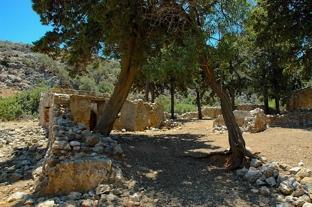
'Douglas, Diktynna wasn’t a fertility goddess. She was the mother who provides. Earth Woman in green turns Life Woman in red into Sky Woman in blue. Before their annual pilgrimage to her after the first flowers of spring, ancient Kriti
The one time I tried to go out to her temple, I asked a Kolimbari vegetable seller where to find the road. She told me it was off-limits, inaccessible and dangerous, forbidden to tourists. I thought it rather severe a reply.'
’No Kriti woman wants a man to go out there, Douglas. Men are thinkers, and thinking doesn’t respect anything very long.'
You need to be sure of yourself if you pursue a friendship with Vasso.
'The vegetable seller was trying to keep you away from our sacred ground. How could you male hunters possibly understand a female provider? Men hunt to kill. We capture to keep. There’s a lot of beliefs from the old pagan gods in Diktynna, just like there’s a lot of the old pagan gods in the Orthodox religion.'
'Helios the sun god was hagiomorphed into St. Iliya, who
rides a chariot pulled by four horses. I’ve seen his shrines in high mountains.’
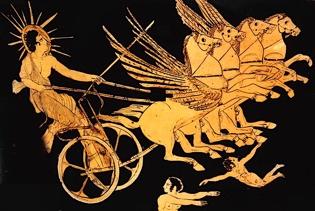
What Vasso was telling me wasn’t news. The Diktynna legend had shown up sporadically in academic journals I’d consulted, usually as the fulcrum of some pedants’ squabble over theories whose validity no one could possibly know but whose importance was somehow related to tenure.
’I have read that the beliefs that became the Diktynna legend probably evolved during Neolithic times. The pragmatic camp of mythologues has it that a particularly resourceful clan woman — perhaps a woman who had suddenly become a widow — had to provide food for her children. The ideological camp has it that there was a tribal
pattern of matriarchy among adventurous women, which inspired them to trap wild goats in a corral. The goats
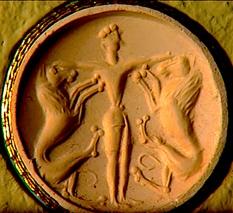
would then breed. It was they who invented Crete’s matriarchy. No one really knows which legend is true, but once it started, the legend’s evolution followed the standard pattern of human-to-deity stories all over the world.
'Take your pick or invent your own,' Vasso replied. 'You can’t think your way to the gods. You have to live your way there.'
'Vasso, if I am a good man in your eyes, aren’t you really seeing yourself? We are the god in each other, but can see it only in the mirror. If you see the god in me, I see the goddess in you.’
’Douglas, you must remember that Diktynna heeded no man.’
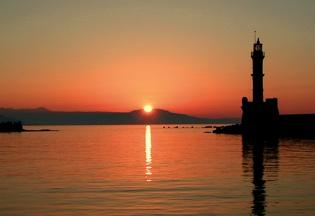
The redding sun was nearing the Rodhópou ridge. We had been pingponging these ideas while we enjoyed the balmy air and unencumbered sky. Everything around us felt as one. Oneness seemed everywhere. The gull was one with the thin laminae of the air,. The whale song was one with the sound threads of the sea. The shout heard across epochs was one with the solace only silence can hear.
'Still, I wish I could go out there,' I said. 'Just to feel the unbroken wind, the spareness of the earth she haunts, the immensity of the sky she sees. I would do the same as I do in Asia, where I never stand on the peak of a hill, even after all the effort of climbing it.’
'Why?'
'The gods reside there. Local people know there are things we should simply let be and not mark with our stamp.'
’And we women of Diktynnean times, Douglas, we never step on cinders.'
'Why?'
’That’s our secret.’ She laughed. ’There are things known to us that must never be said.’
’That sounds like a placebo — if you think they work, they do.'
'How would you explain Diktynna?'
I paused. Those hot fire-sermon eyes of hers, that look I had seen before when I was nearing her barbed wire. This was a good time to fall back ten and punt.
'Hm. Knight to queen pawn four, wasn’t that our last play?'
She laughed. 'You remembered! Yes, it was. We were so awkward with each other that night! We never did end that match. So what is your move now?'
'Castle to king pawn five. Check.'
'Check?'
'Because tales of Diktynna’s hunting prowess would have been spread by her neighbours. It would have been hard for them not to stand in awe of a woman who corralled kri-kri and turned them into goats that gave milk. The Rhodopou is one of the wildest, rockiest, treeless, most desolate, colourless, birdless, goatless, sunbaked, wind-burned barrens in all Kriti. Diktynna had to be good to get a meal out of the place.
But when she died and could no longer provide a living reality to counter the impulse to embellish, her story would have passed into local lore, then to tale, then legend, then myth, then deity, then goddess, and finally the goddess of the hunt.
’Three thousand years wore the rough edges off Minoan prehistory, until Diktynna became Diana. When the Venetian aristocracy got wind of the Diktynna story, the aristocracy was like the middle class of today, obsessed with self-image and convinced that money makes a good one.
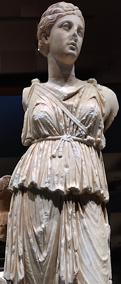
The wealthy women of Venice told their artists to transform Diktynna into the elegiac icon of what they fancied themselves to be — Diana. Stately, majestic, pallid of face and elegant of mien, eye-shadow just so, and unimaginably remote from the unbathed, lumpen-shaped, scantclothed, probably guttural amazon who learned the art of leaping over the searing, razory stones of the Rodhópou to ensnare enough kri-kri to feed a family. When I asked the vegetable seller how to get there, I gave her the standard explanation that I was interested in the archaeology of the place. I should have told her the truth: I wanted to pay my respects.'
'Bishop to bishop pawn four. Check blocked. You would have been disappointed. A rental car isn’t strong enough to take you out there. At the end of the road you have to walk another four kilometres on a track. There’s no shade. And when you get to the temple all you see is a flat terrace littered with ruins.’
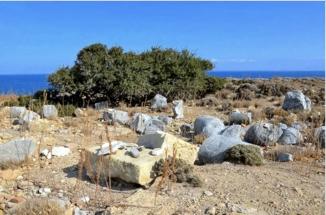
’The Roman temple was tumbled by earthquakes and the wind. Local farmers went out on boats and took away the stones to build wind shelters in the sea cove below. But removing the stones did not remove the goddess. For we Kriti women, Diktynna helps us feed the spirits we cannot see. She puts into us the goddess we are. Even as we change, the
goddess within us will not. Diktynna is a magnetism radiating from the Rodhópou. We all get pulled towards it and are arranged within its order.’
'Is doubt a magnetism, too?'
'Yes, but doubt lives in sky gods. Look what happened to Daedalos.'
'Knight takes bishop on bishop pawn four. Daedalos happens to any of us who tries to fly too high. We let our selfgod get so big we think we’re a sky god.’
'Queen blocks knight,' she said. 'The only god in a man is his sperm. His groin is the perpetuity he wants in his head. He needs the power of woman to bring his sky down to earth. Woman is his oasis from the lies of his logics, his political systems, the way he orders his life so he never knows what is true. He’s got a hundred logics, but doesn’t know if any of them are true. He invents gods to help him live with his lies. Men cannot otherwise survive.'
Those hot eyes of hers, the heat of her goddess days out on the Rhodópou. She wanted so very much to be more than herself, yet to be it within something very much larger.
'How many times have you been out there?'
'Every year since I was fourteen.'
'Vasso, is it possible in chess to checkmate each other with a single move?'
'I’m no expert, but I doubt it.'
’The last move was yours. You won the game.’
’And you?’
’I win the memory of the moves.’
We finished our coffees. Xaniá across the water was a Christmas-tree toytown spanning the entire eyeful of view, a glittering string of ephemera between the immense tremble of the stars and immense tremor of the sea.
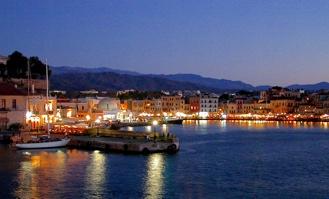
There was a heart-lurching, mind-tremulous, eye-sighing moment as the sun flicked below the sleeping goddess of the Rodhópou. It was a moment when thought stopped, reminding me to pay attention to everything else.
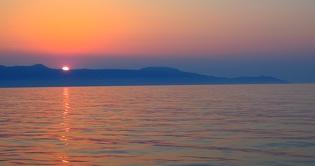
Evening inked into another night on the Aegean. In three days I would leave. My ambition of seeing the shrine of Diktynna would be a glimpse from an airplane window. I wanted to cry out to the sun, 'No! Don’t go!
Please stay!'
'Shall we to dinner?' Vasso asked.
'Diktynna must know a vast peace out there in her sleep.'
'Men may yearn for their heights, Douglas, but Diktynna brings them home to us.'
'I’m going to miss this place.'
'We’re going to miss you.’
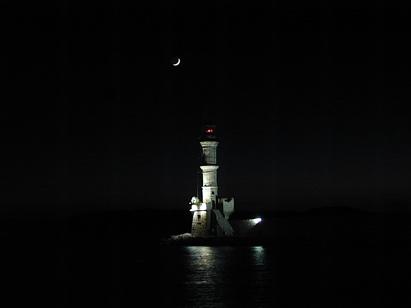
Volta Hour
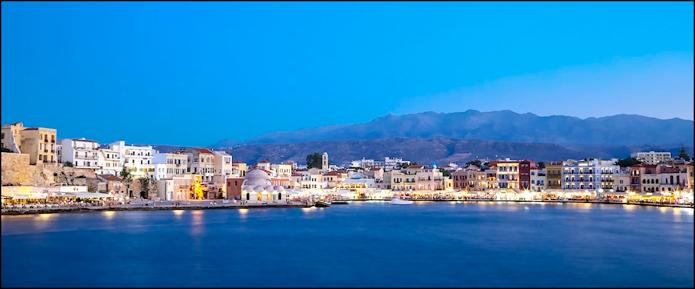
By 7:00 in the evening everybody is strolling the volta, that beguiling European custom of promenading up an appetite by checking out the restaurant menus and everyone else’s fashion taste. Xaniá’s twenty metre wide granite-paved esplanade is a volta stroller’s delight as they semicircle the harbour In the swelter of late day, the Chalidon Fountain’s resident
balloon seller galumpfs along the quay. He is a level of slovenliness one more likely expects in an auto dismantler’s yard. Half his shirt-tail is tucked in and the other half free. A pot-belly billows out over his belt. A missing shirt button reveals a bellybutton full of hair and skin squames that makes one think of a dustbunny from hell. He holds a wad of strings
tightly in his fist, flight being ever the hazard in the helium balloon business.
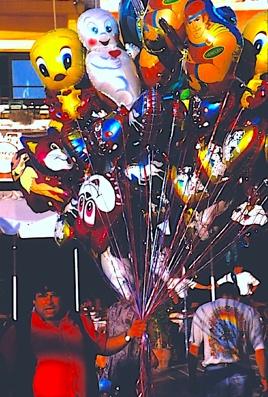
Imagine seeing him as a child looking up into that towering colossus of inflated plastic puffpastry polypropyloluminescent purple blimp-edged yellow-TweetyBird world of sky-eyed Ghost-buster pearlescent metallic Bugs Bunny painted-on TVtoon Ditsy Dolphin spraycan-blue big red hearts Hotwired chaos-and-hot-metallics, all wildly overinflated and equally overpriced.
Is there any wonder why he is irresistible to children?
As he bloats along the quay, a bunch of kids arrive on those too-small-for-them flailing-knee bikes like the ones in the scene in ET when the kids’ bicycles sail off into the moonrise. Today, thanks to a collusion of convenience between the adolescence products industry and airline marketing departments, those kids and their bicycles are miraculously transported from Spielberg to Xaniá. They circle around the balloon seller and then are gone, knees grotesquely flailing, a fleeting fragment of B movie in 3D.
The only thing the airlines haven’t mastered is lofting those kids into the rising moon. Restaurant shills are said to light candles before their favourite saints, wishing the airlines the best of success.
Preferably soon.
The dissipating heat of late day triggers Eurospandex high season. The artifice of the casual wear industry fits in perfectly with the quayside-kaphenion Musak of scratchthroated Louis Armstrong and oleaginous Dean Martin.Nothing is what it appears to be. The haze colours of a hot day empty themselves
first of heat and then of hue. The entire quayside scene becomes a cornucopia of self-writing stories set into motion with a glimpse.
From out from the mammothries of NederNord malldom spews a tourist army of strollers and whirlygig kids’ beanies and vegetarians from Scandinavia, babybuggy eversomarrieds, budding Brunnhildes stuffed into white denims like a can of Redi-Whip about to detonate.

Visions like these merge with the local gypsygirl rose-sellers in their lovely drapey dresses swishing past a polkadot parade of Brits on a bridge-tourney tour.Pipesmoking Norwegians with Everett Koop beards. Running shoes so spotless they must be washed after every use.
Amid these, like an installation art revival from the 1960s come four ageing bandanna-coiffed Dutch hippies wearing armless tunics and tie-dyed tee-shirts (tie-dye, still?).
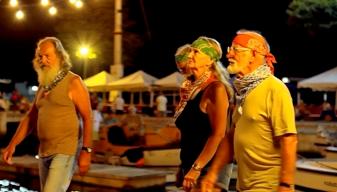
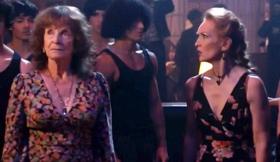
Two older women in prints dour askance at tanktop tattoos in jazzclub black.
A pair of lost-soul backpackers carry their flitebags on their heads as they pore over a map with the Chatzimichali Ntaliani hostels circled in red, proving that shoestringers, too, aspire to drift aesthetically upward.
They pass a cluster of imaginatively haircutted blacks from south of the Sahel.
A girl delivering dinners plows aside all before her in a Door Dash courier style combining Kamikaze with Artemis.
A respectable couple frumps along in respectablemarriage’s frozen familiarities.
Premature tarts and ponytail teens troll for a ping on their TikToks.
Creosote-bush office girls word-poison everyone around them because that is the only way they know how to cope.
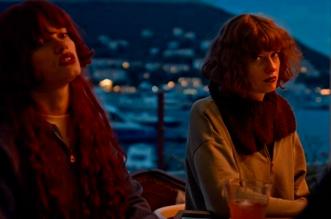
Do-right daddies carry their little girls on their shoulders with their legs around daddy’s neck.
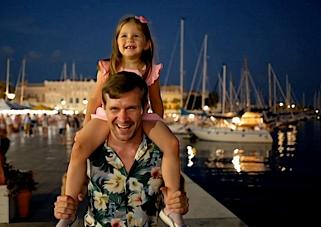
(One of these days some self-anointed evangelical happyclappy will write a bestseller decrying the shocking phallicism that diverts young children from the joys of Jesus.)
All this scribbled down in thirty seconds at a cafe table. Imagine then the whole extraordinary cavalcade of Xaniá at dusk, the Good-God-Aniline tourwear industry writhing out over buttocks and bosoms that makes you wonder what they think in those garment company focus groups in between ketamine hits as they divine ways to turn the lowly thread into a sales sensation.
Spring Rain
A thunderstorm in Crete pales the most elaborate fireworks show in everything but hue.
The sky was filling with white pillars towering mightily above the scuds and wisps above my favourite park bench in ∆ημοτικός
, the Xaniá Municipal Garden.
The perfect moment of a good book in my hand, splash of the nearby pond fountain in my ears, a treescape of a myriad greens, sky-high and cloud-perfect.
The late day’s heat was like a shirt under a steam iron. Fitful breezes smelled of rain. The air was not yet moist enough for a squall, but there was enough humidity in it to crackle frumbustiously up there on high. Once a nimbus has reached the high-altitude lightning stage, the outcome is inevitable.
Others saw too. Young lovers strolled quietly towards the exits, holding hands. The little fruit and ice cream and cello-pak stands were closing their wooden shutters, the coffee kiosk tables now pined for customers.
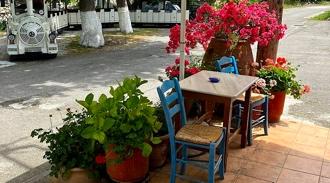
The little Dotto Train that carts legions of schoolkids on tree-identification tours curled in a cul-de-sac like a snoozing snake. Giant pithoi erupted with bougainvillea.
Park workers in their faded blue uniforms put away their rakes and mowers and gathered in a shed to sharpen the blades of their grass edgers and limb trimmers.
The horn-blaring dramas of Papandreiou Street fronting the park were oblivious to the drama of the sky. Indeed, the street had plenty of its own theatrics: the ranking hierarchy of a family on a passing scooter was the youngest sitting on the handlebars with the eldest just behind holding on to him, father holding the eldest with one hand while accelerating, steering, and braking with the other; the daughter behind him holding onto his belt; and mom on the back balancing precariously as she held a market basket in each hand. The
daughter held a flower. And well she might! Not one of them wore a helmet.
All around me, brilliant-winged birds fled the windless calm that precedes a rain. Green havens of trees. Cloudpurple skies. Flower-hued butterflies. Tall grasses fanning around the rim of a pond. The illumination towers of the nearby Elena Venizelou athletic field slipped in and out of shadow, sun-clad one moment, dark the next.
Kids crowded around an ice-cream kiosk. From the pleasant smile on the seller’s face but no cups being filled, it appeared there was a funding shortfall under discussion. Money or no money, it never hurts to burnish one’s image in the hope that with enough smiles, a one-scoop order might magically become two scoops in the cup.
Two confiding girls sat on a table top, legs kicking back and forth in the air beneath.
Far above the cloud’s murky bottom, a patch of blue revealed a white thunderhead breathtakingly high in the tropopause. Up there dwell the immense anvils of storm that can turn the view from the windows of a long-haul flight into a glimpse of majesty only slightly short of the beatific.
Up there, too, is the icy stratosphere wind that chills the nimbus top until it writhes helplessly in its own heat beneath. Excess energy seethes towards its destined doom. Too much power meeting at last its limit is what makes storms out of the simple air and water of a warm day in the sun. The sun wafts the earth’s tendrils of humidity upward until they become a blanket of white. When the sun reaches its greatest intensity in midafternoon, the rains are conceived. The sun cools but the huge heat engine of water vapour does not. The urge of its ascent is so great that the cloud literally explodes into the sky.
But then it reaches something it cannot thrust aside: the steely will of the stratosphere. It has no choice but to flatten into an anvil, the tapered end showing the way of the winds.
The air at that level, where the horsetail cirrus lives, where pilots know their passengers are watching a movie and they can enter heading corrections into the autopilot and leave the only evidence of their passage to radar operators and the observers of contrails — that is where the air is least hospitable to feisty little nimbus that got out of hand seven miles below.
The moist heat rising from beneath still continues to push, but by then the cloud can hold no more. It condenses and begins to fall. The falling weight of rain crashes through the vapour still rising. Lightning begins as the cloud tears itself to shreds trying to rise and fall at the same time. The immense piles of anvilhead are utterly riven by heat’s inability to control itself. Horizon to horizon, cloudtop across cloudtop, molten luminosities and teeth-jolting thunder merged first into sunset’s peach-colored light and then into a darkness which didn’t stop trembling until the last of the heat was gone.
Rain poured onto the little Xaniá park. Rain as titanic as the sea. The feel of it could be called a caress if there wasn’t so much of it. Rather, it was an engulfment. I sheltered under a tree and felt the power of the storm bathe the world around. A storm like this can transform an afternoon in Xaniá into something approaching sensual incandescence. Nature hath no beauties like those of its most diaphanous events.
Then came the loveliest moment. Big fat droplets slowed their pour from the sky, mist so thick I could hardly see the light towers of the athletic field. Birds huddled in the deep branches. Glistening leaves. A fig tree fat with new fruit. At that moment a bird flew onto the bare limb of one of the trees and proceeded to flick its wings, shake all over, pluck at its chest and back parts, flick its wings again, and shake all over several more times.
It was taking a shower!
After a few moments of utterly refreshing bliss, the little bird flew back into the branches to wait out the storm with the rest of the flock.
Mihalis’s red Audi hadn’t been washed in months. Parked on the streets west of the Old City, there was such a layer of dust on it I couldn’t really be sure it was red till I came near.
Dust flew as he opened the door for me. ’This thing belongs to the most meticulous weaver in all Kriti?’ I mused.
'We’re going into the mountains to pick herbs and roots to dye wool. Four days ago there was rain in the Omalos Plateau. Today the flowers will be full.’
He added, 'I’m going to pick my brother-in-law’s cousin Manoulis on the way. He needs a ride to his fishing place.'
His route passed a restaurant so nondescript I would not have given it a second glance.
'That’s the Akrotiali Taberna.’ He
Time Immemorial
Why Cretan carpets keep their colours
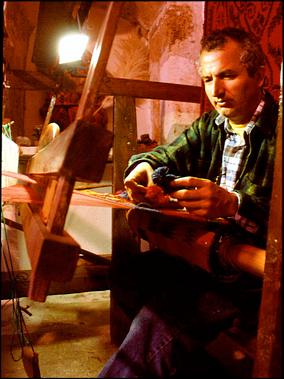
pointed to a corner cafe on a back street I hadn’t walked before.
’Every morning the owner goes down to the fishers as they come in. He buys the fish while they are still wet in the boat. They’re so fresh that after he closes that night he sells what he didn’t use to the restaurants nearby for the next day.’
We passed an octagonal-domed Orthodox church with a large graveyard next to it. Everyone wore sundaybest clothes.
'Orthodox Kritis visit the family graves on the anniversary of a family member’s death. 'A Kriti soul doesn’t want to leave Kriti. Their spirit sticks around, we say.
Children are baptised with their grandparents’ names so traditional family names live with their ances-
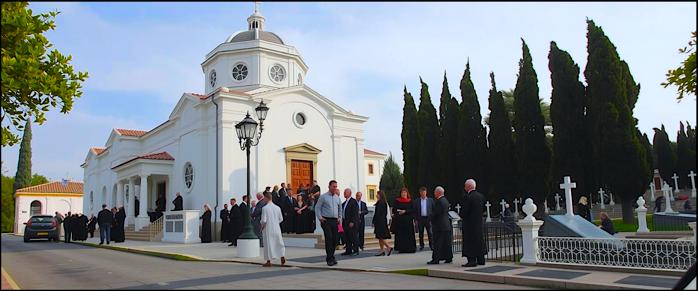
tral souls. The more we revere our ancestors, the less dead they are.’
’Do lingering spirits ever reveal themselves as ghosts?’’Many houses have ghosts. People will see something moving out of the corner of their eye and they say it’s the ghost in the room.’
'Have you ever seen a ghost?'
'Not seen. But met, yes. My father always carried a small wooden cross with him. It somehow got lost when he died. No one could find it. Then one day my foot stumbled against
it in a room that everyone walked through. My mother said the spirit of my grandfather had put it there for me to carry it on.’
I reflected on the implications of this. We know the physical world because it makes itself known via electromagnetic transmission — visual light, radio, X-rays, electrical current, magnetic fields. An entity that does not make or respond to electromagnetic energy cannot be seen or touched. Yet most of the universe is shaped by an invisible energy astronomers can detect but not define. If an invisible energy is OK for
astronomers, who’s to say there is no such thing as a Cretan ghost?
’In Greek Orthodoxy, is Jesus suffering on the Cross, or the glorious Son ascending into the Rapture?’
’Neither. Jesus is usually depicted as the Pantocrator or Ruler of the Universe, cradling a book in his left hand, or a scroll with the message in Aramaic that translates to, “I am the beginning and the end.”’
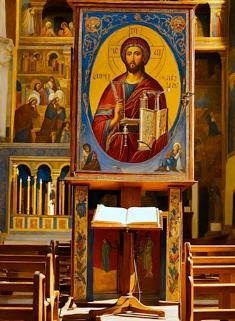
Xania is small as European cities go. Soon we were well out of it. On all sides the great rock fish called Crete rose from the sea, its rocks riven by the entropic wither of timewind.
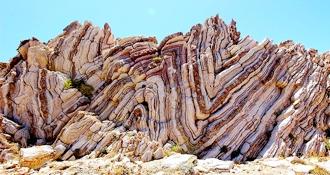
Tumultuous uplifts thrust everywhichway by tectonic swerves. Speckled white villages high on the scraggly slopes beloved by goats. Black basalt and grey gneiss. Rugged crevasses. High sun on a windless sea. Fleeting instants of glimpse, gone as soon as they were seen.
The rich crimson of a lone poppy.

A glorious artichoke luxuriating its blue:
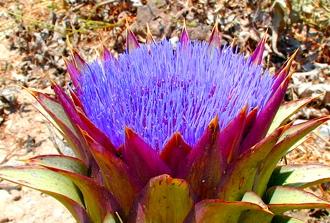
Directions to a monastery:
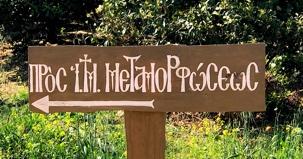
A windweathered door whose address was a rosette:
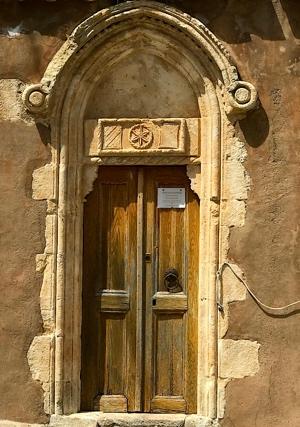
Fleeting instants of glimpse, gone as soon as they were seen.
I opened my notebook and quickly scribbled impressions.
'Why you always taking notes, Dooglahs?'
'Some day I’m going to be too old to travel any more. Then I’ll read my notebooks and all this will come back. The smells, the colours, the feel of the wind. This day. Friends like you. Reading the notebook from my first visit to Crete brought me back three decades later. That was the year of the first Anek ferries from Piraeus to Xaniá. I remembered shocking the cafe patrons in Xaniá by eating an entire lemon, rind and all, to fight off a cold. A week later I found myself hitchhiking on the
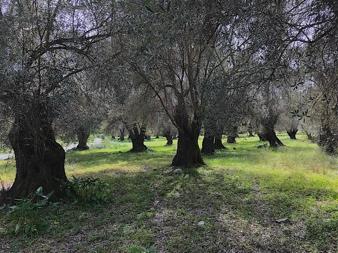
road to Paleochora and passed some people picking olives. They invited me to learn about olives. I went through a whole notebook in one day.’
He laughed. 'Such a two-for-the-price-of-one life you live, Dooglahs!'
We crossed a bridge. The stream beneath splashed through a deep vertical-sided crevice with stones on all sides.
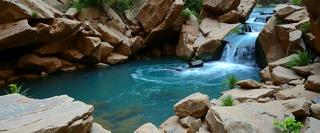
A fault in the earth’s crust was splitting the planet there, little different from the Grand Canyon or Victoria Falls in Zimbabwe except for a billion years. Where the water eddied in a pool, it was clear, inviting a swim. I reflected that the word 'potable' came from the ancient Greek word ποτάμος, potamos, for 'stream'. When the geographer Strabo first described the Fertile Crescent between the Tigris and Euphrates, he called it Μεσοποταμία, ’Mesopotamia', for 'Between two rivers'. Strabo’s stories about Africa described huge animals that lived in the water, which he gave the name ιπποπόταμος, hippopotamus, the 'horse of the river'.
It seemed that in the world of words, ancestors learn from forebears, and in turn coin both the future and a word for it, forecastors.
I realised my ruminations were neglecting my host.
’Mihalis, how did your mother teach you to weave?'
'One thread at a time.'
He didn’t crack a smile, but the laugh-lines of his eyes were on high-beam.
'I should have expected that, but you got there first.'
'You still have a little bit left to learn, Dooglahs. Maybe in two thousand years you can become apprentice Kriti.'
'What happened before one thread at a time?'
'She started by showing me how to card the wool so it makes good yarn. It takes time to learn how to pull the wool fibers out so they make an even, strong thread. Women hold a three-pronged roka stick under one arm while they pull tufts of the wool and feed them into the whirling spindle with the other hand. In olden times the women would spin while walking to market or church. Watching their spindles whirl in time to their walking pace taught me how to not waste time.'
'You work at your loom twelve hours a day. Is that because you want to or because you have to? Your prices are reasonable. Most people would raise their prices so they could have more time off.'
'Dooglahs, I was wrong.'
'About what?’
'It’s going to take you three thousand years to become apprentice Kriti, not two. If I raise my prices just because I
can, then I would think about cheaper wool. Then I would think about a machine-powered loom. Then I would think about plastic fibres instead of natural. Then I would think about chemical dyes instead of natural. Then I would stop going high in the mountains to gather the plants that colour my yarn. Then I’d think about hiring people so desperate for money they work long hours for next to nothing. Then I’d think about licensing my designs to some venture capitalist in Palo Alto. Then I’d think about using a factory in China so I could make enough money to buy a Ferrari. Then I’d hire a marketing consultant to do my designing for me. Then I would pay a TikTok influencer to put my picture in the fashion blogs and tell everybody I am a celebrity brand. Pretty soon the name ‘Mihalis’ would be on everybody’s boobs and butt and I’d be living with three twats on a yacht instead of Odos Zambeliou with Anya.'
'I am impressed by your command of the fashion world zeitgeist.'
’Dooglahs, look at my carpets. They are Kriti. Made by a Kriti. In fifty years the yacht will be in a scrapyard, and my
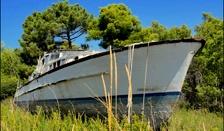
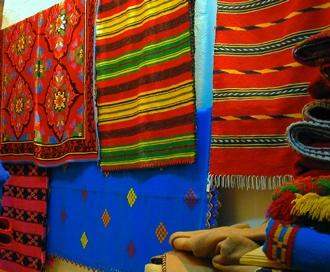
Kriti carpets will be as vivid as they day they were made.’
The morning painted high slopes with hues almost electric in their comeliness. Upwind breezes. Fantasies of sails amid isles of thyme.
Shapes of the cacti stood out as magnificent creations untamed by geometries, untouched by logics.
Spare here, blossoming there, growing the way their cells divide, their urge to flower rising from a plan no one knows.
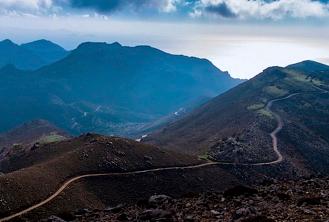
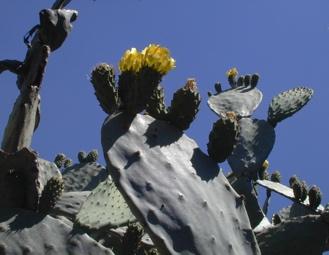
’We are going to the Omalos Plateau,’ Mihalis told me. ’Today I gather the flowers and roots to dye the wool in my carpets.’
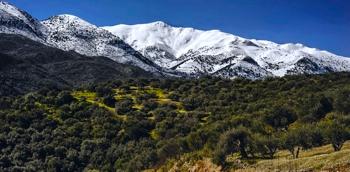
'Where do you get your wool?' I asked. 'There are so many sheep on Crete they could support ten thousand weavers like you.'
'From my cousins. They shear twice a year. You should come with me next time. Kriti is the only place in Europe shearing is done the old way, with hand shears. No electric clippers like Corsica and Spain.’
'Name the day and I’ll be there.’
'I buy all my wool from them. They give me special price.'
'Do you give them a special price on your carpets?'
'Of course! This is Kriti! One price for family. Another price for friends. Then the price for other Kritis. And then …’
he took his hands off the steering wheel and spread them very far apart ... 'the price for tourists.
I went back to gazing out the window, jotting quickly without looking at the paper. As always, many notes were lost amid tangled snippets of scribble.
Two boys hurled honey-coloured stones to herd a gaggle of goats. Leaf shadows trembled the ground. A copse was rimmed with seed pods about to burst.
'I send the wool to a man who cleans and combs it,' he continued. 'Three times. Then he spins it in a machine. When I get the yarn back Anya and I wind it onto an anemi. The word means “wing” because it is made of four pieces of wood that, when they whirl around, look like angel wings.
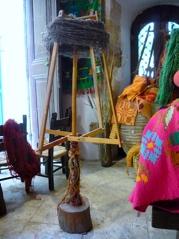
’I learned the Kriti legends from my grandmother while she was turning the anemi. She told me stories of Kriti from years and years ago. Even today, when women chat around the loom, they like to recall those stories, word for word from, time out of mind ago.’
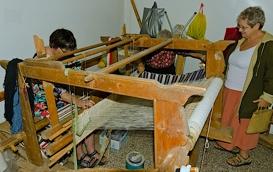
'If women do the weaving, why did you learn it?’
'Women weren’t always the weavers. Men were. But the Venetians took away so many men to row their war galleys that women had to work the looms.
’In Venetian times the weavers were mostly mountain people. They tended the sheep and cattle and had a lot of time on their hands in between harvests. But the Venetians took away so many men that weaving came down to the lowlands. Women took it over. That is when vegetable dyes became important. Coastal people wear brighter colours than mountain people.’
’That’s interesting. Flowers have fewer colours on the coast; most of them are yellows.’
’That is why we going to Omalos. The colours of the flowers in my basket will become the colours in my carpets. You will see many more shades of blue.’
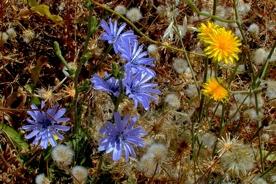
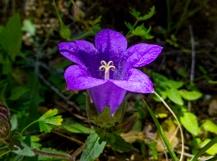
Mihalis guided his Audi adroitly through an ascending road of hairpin turns. He had traveled this road many times before.
'My mother started me weaving simple things like the προσώνυμη prosónymi that women use to cushion their shoulders when they carried water jugs home from the well.
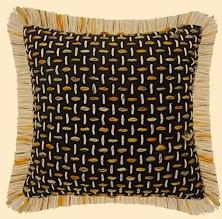
Then she taught me how to make my colours out of plants. She learned it from her γιαγιά, her grandmother, who learned it from her γιαγιά, and so on. Xaniá was so small that when my γιαγιά wanted flowers for yellow, she would walk a hundred meters beyond today’s 1866 Square at the end of Chalidon Street to pick her flowers. She also collected the sticks she used to boil it. We still boil our dyes on the roof of our house — directly above my loom three floors above.
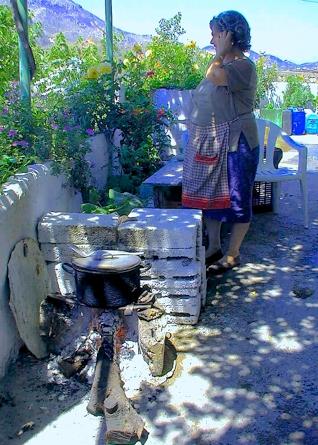
’She knew how dry the wood had to be to build the fire to the right heat to get the best colours. When she picked oregano for green she would wait till just before it dropped its petals because then it is the most strong, like the body of a woman is most strong just before she has a child.'
’How long will colours stay vivid before they fade?’
'Maybe twenty washings. Longer if people use olive oil soap instead of chemical detergent. Right now we have twelve colours that can survive many washings. Those colours come from roots, bulbs, and dense vegetables like beets and carrots. Flower colours are fragile, except for the lily family. We can use eight flower petal colours if we know the carpet will be a wall hanging.’
I recalled, ’In pottery, colours applied to unglazed bisque are much weaker than the colours when the pot comes out of the kiln. How do plants respond to the heat of boiling water?’
’Plant colours are full of tricks. Dyed wool seldom looks like the plant the dye comes from. Beets don’t give beet colour when we boil the wool, it comes out orange. Madder root gives different reds depending on how long we boil it — cinnabar red, brick red, raspberry, tomato red, or the Tuscan Red of roof tiles after years in the sun. Walnut shells make different browns but take a lot of boiling. Onion skins give pale orange and yellow. If we want a vivid yellow we wait for goldenrod to flower. If we want purple we boil up avocado skins we have saved up and add a spoon of iron sulphate from the Apoteek. There is a type of fern that grows near Ayia springs — where Xaniá gets its water — that gives a green unlike any other plant.’
We reached the pass leading to the
, the Omalos Plateau. The far hills of the southern ridge gauzed one blue while the sky above glazed another.

I scribbled details in the passing scenery as I listened to Mihalis’s stories of roadside plants that we passed.
'Pale yellow dyes comes from young almond leaves,' he said as he pointed to a small grove of tightly pruned trees. 'Their pale green leaves become turn the wool flaxy yellow after boiling. The bluish colour in my yarns comes from and indigo-hued plant called lulaki. The heart-shaped-berry of the chisos bush requires a kilo of berries to colour twenty skeins of wool. Mulberry leaves, leaves, ferns, and ακονιζία, akonizia, ‘stinky plant’ — all give different greens.’
We ascended beyond the creekside-hugging chestnuts, through meadow-basking junipers, then above those into hillsides of windswept low grass. We crested a hill and glimpsed the Ormos Almirou, a gulf on the other side of the Volos Peninsula, a sudden immensity of blue and boats and piled-high clouds, as gorgeous as art only better.
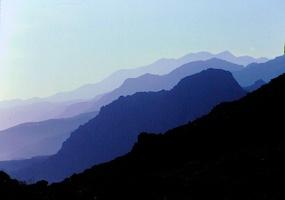
The complex yet serene landscape of high-country Crete sped by, a miscellany of white oleanders and red poppies, reed-lined creeks, bamboo windbreaks around orchards to keep the wind from shaking off the fruit, piled-high purples of bougainvillea, hay bales for donkeys stacked against the walls. Solar heaters. Courtyards of thickly-bunched mulberry leaves, a children’s swing roped to a branch.
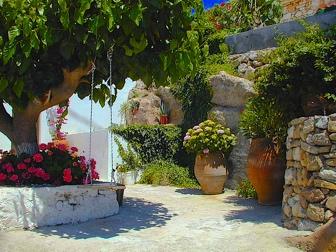
White plastic chairs in the cafes. Yellow blossoms. Loamy limestone soil. Water-washed conglomerates. Tile roofs. The vertiginous flowers of aloes. Shotgun-pelleted road signs. Cypress sentinels delimiting the borders of a churchyard. I emerged from a reverie about why olive leaves have
silvery undersides when Mihalis put his foot on the brake and steered toward a man with a cane and what appeared to be a tackle box, sitting on a folding chair at the side of the road.
'My cousin Manoulis,' Mihalis announced. ’I’m giving him a ride to his fishing lake.’
The man who opened the door was what everyone, especially parvenu postcard photographers, thinks a Kriti should look like. Elderly, craggy, bearded, floppy hat, stolid clothes, lace-up boots. He looked me straight in the eye the moment he got in. There was something odd about his appearance that I couldn’t quite put my finger on.

The formalities lasted as long as, 'Manoulis, this is Dooglahs,'
'Dooglahs, where you from?' he replied. 'You look like tourist. You gotta be from somewhere that ain’t here.'
I was agog. His was the most flat-a, the = da South Chicago accent I had heard in years!
'Let me ask you that question! Where did you learn to talk like Al Capone?'
'Same place Al Capone learned to talk like Al Capone,' he shot back. 'So you tell me where it was, you brought it up.'
’Chicago South Side. I once had a girlfriend from Calumet Heights. What do you call the Chicago Bears?’
’Dem Bums.’
’And the Chicago Cubs?’
’Dem Bums, all da same to me. Got off the boat in Jersey City in 1951, caught the first train to anywhere but Naw Yawk. Never looked back. Ran out of money South Side. It’s a mess now. Thirty years selling ice cream so I could come back here and go fishin’. So why you here?’
I briefly went through my here-to-study-olive-irrigation recital.
He heard me out then turned to Mihalis. 'I tell ye, Mihailo, these tourists, every year dey getting crazier. First da Dutch, dey talk like frog gargling asphalt. Den da Finns, dey sound like two guppies fucking. Den da Spanish, somebody smashing windows. Now dis damfool yankee shows up wanting guided tour to olive trees.’
Mihalis laughed. I blushed.
'So where do you go fishing?' I asked. 'There’s only one lake in all of Kriti.'
'And that’s just where I goes, too! Everybody thinks like you. Dey think everybody goes dere. That’s why nobody goes dere. Seen it! So I got da place to myself. Y’see, laddie, I figured it out one day when I was in the fish market of Kavalios on the edge of the lake. I saw men buying a lot of fish dere. It’s like dis, laddie: men don’t buy fish. Women buy fish. Dey da ones who do da cookin’. So I asked myself, “Why dose men buying fish if dere’s a lake full of fish right in front of dem?” So I answered myself, “Because da trick of fishing is not how to sit dere for hours and hours waiting for someding to tug on your string, but to dink up a good explanation why you didn’t catch nothin’ while you on yer way home.” So da men, dey tell their wives dey goin’ fishin’ and instead they go down to the taberna. On da way home, dey buy a fish. Seen it!’
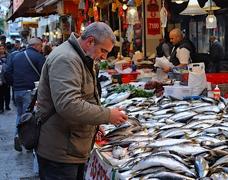
’So what were YOU doing in the fish market?' He sucked in his breath and looked out the window gritting his teeth. Then it dawned on me what was so out-ofcontext about his appearance: he had all of his teeth. He cleared his throat. 'Y’see, laddie, it’s dis way. How many years does it take a man keepin’ up his poles and hooks and contraptions to decide it’s a lot easier to let da fish seller do the fishin’? I heard a dousand fishermen tell me what I should stick on de end of de hook, how to do it, when, and why. Dey know why fish eat, what dey eat, when dey do it, when dey don’t, and dey got half a dozen reasons for each one. Dey read magazines tell dem all dis. Dey can tell me where fish sleep, when dey wake up, what dey do when weather’s bad. Dat’s when I ask how it is dey know so much about catching fish and so little about cookin’ ‘em. Y’see, lad, de facts is where you find dem. If dey ain’t cookin’ fish, dey like as not ain’t catchin’ fish. And I tellya another ding ....' I looked over at Mihalis. 'Was this your idea?'
'Anya’s. She said you’ve been around Xania too long.'
'Inform Dear Anya,' I intoned in my best stuffedshirtese, 'that I have a perverted sense of justice and a long memory.’
Groves of wild figs floated by. Horsetail ferns marked a shallow pond. An elderly widow had made a kitchen sink out of a plastic wash tub under a water spigot. A restaurant sign proclaimed its specialty, τυροπιτάκια tiropitakia hot cheese pies. Groves of chestnut trees. A huge plane tree erupted above a stony slope, proclaiming the presence of a spring. A devotional shrine of broken pottery with wilted flowers.
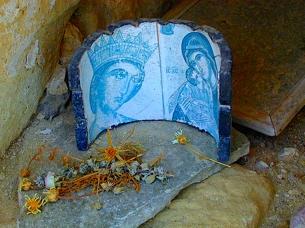
'Mihalis, what do plastic bottles dangling on strings from a fence mean?' I asked, pointing one out.
'The field’s been sprayed, so don’t go in there. Trees with white trunks have been painted with a lime-wash to keep beetles from boring into them.’
’And the yellow plastic sacks hanging from olive trees?’
’They catch flies and other insects that would otherwise ruin the fruit. There is sugar and ammonia at the bottom of those sacks. The insects go after the sweet smell, then suffocate on the ammonia.'
'Makes me dink of marriage,' Manoulis muttered from the back seat.
He tapped me on the shoulder. ’Lissen, laddie, it takes about two weeks of marriage to discover dat beauty mark
you fell in love with is really a wart. It says right dere in de Bible dat taking a long look at a neighbours wife is as natural as him taking a long look at yours. So if you’re both smart you throw out the Bible, have a little tra-la-la wit your neighbour’s wife, den go buy each other a beer.’
Mihalis glanced at me out of the corner of his eye, bemused at how I must be taking all this all in. He decided this was a good time to change the subject.
’There is a rare plant called Aristolochia cretica, Kriti birthwort. It only grows in one isolated valley. It produces flowers of deep magenta that look like hairy saxophones. Flies are attracted to the odour of the flowers. Once they crawl in, the hairs keep them from escaping. The next day, the flower withers, releasing the pollen-covered flies, which then fly to another birthwort. There they fall for the deception once again. That’s how the birthworts pollinate each other.’
’Just what I said,’ Manoulis muttered from the back seat, ’Forget de Bible and have fun.’
’So,how long were you married?’
’Two weeks.’
’Seems kind of brief.’
’Ran out of ice cream flavours.’
’Las Vegas of the Loons,’ I muttered. Mihalis giggled.
’Mihalis, I notice that here in the north the olive trees are pruned short, but in the south they grow tall.'
'In the north the owners knock the olives off the branches with a stick. They only want green olives. Green olives make the best oil, black ones the best eating. In the south they let the ripe olives fall into nets they spread on the ground. The owners have a lot of other things to do during olive time, so they only come to get them every couple of weeks or so. Some of the olives spoil. That’s why you sometimes get a foul, ashy taste that makes you want to spit it out.'
I returned to the visual torrent before me, the swayback donkeys and stones on corrugated sheet metal roofs, pondering what effect this rocky terrain’s development of few wheeled vehicles had on the shaping of its economy, and from its economy, its mentality.
High up on ridge crest a man was grafting new branches onto an old olive trunk.
'Mihalis, I heard that farmers use goats to clear olive groves of underbrush. Do they do that for the same reason that wine makers weed vineyards? So the roots get all the rain that falls?'
'No, they do it so they can find the olives.'
Manoulis snorted a laugh in the back seat. I’m sure I must have been beet red.
'The best olives come from limestone soils,’ he continued. 'It’s the same with limestone making the best wine,' I replied, scribbling Mihalis’s fact in my notebook.
The passing cornucopia was making me lose interest in talk. The delightful word τριαντάφυλλο, triantáfyllo, for the rose, meaning 'thirty petals.' Flowerpots made of old cheese forms.
Giant πιθοί pithoi whose shape has descended unchanged from Minoan times are today filled with rainwater because olive oil comes in bottles. I wondered why the taller the olive the more silver its leaves.
Then I noticed long lines of water-retaining terraces on the slopes of far ridges. I stopped writing to consider them. Terraces.
Multiple terraces, layering the hills like rice paddies layer tropical valleys.
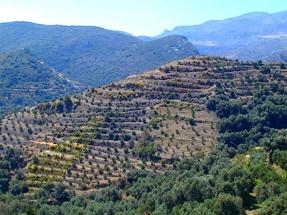
What had I read about terraces? Oh yes! In a drawing that showed how certain terraces stairstep down a hill in even ranks while others zigzag, the caption stated no one was really sure why one form was chosen over another.
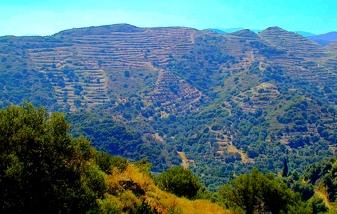
It was this simple identity with the earth that impressed me most about the landscape of Kriti. The things that people invent with landforms that can’t be explained by those who do not survive by knowing the ways of the land. I was here not for the whys. I was here for the thinking underlying those whys. The simplest way to make steps ascending a wall.
In these glimpses lasting only a few seconds between tree clumps blurring the side of the road, written so subtly as to be near invisible, was Kriti’s eonic rural growth pattern. Archeologists have pieced it together from flimsy bits of
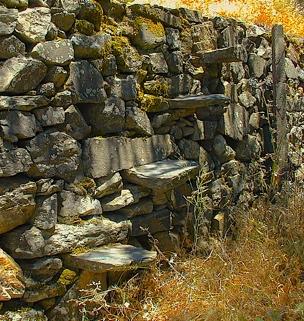
evidence like those terraces up there, the sequential rows of rocks heaped across the high vee of a stream’s origin to stop the soil from eroding and thus hold its water.
The whys and whens of the ancient farmers’ choices of stairstep or zigzag are mere guesswork based on what today’s farmers do. Farmers, those dolmens of civilization who change the least throughout its passing.
Farmers, who built those terraces. Who rebuilt them. Who occupied and abandoned centuries just as they occupied and abandoned terraces. Leaving the the land during the empty humanless times of war or famine or the men being dragooned off to die in the whipsting hell of life pulling an oar. Stone upon stone from time out of mind ago reveal minds made of many minds.
Terraces and granary walls which were the origin of the agricultural surpluses that made Crete the sea commerce centre of the Mediterranean. The olive and hive that inevitably attracted the wars and invasions that snuffed the lives of the men who built the terraces, but not the terraces themselves. All of these writing each its own hour in the Mediterranean wind.
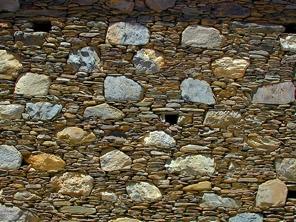
Fruits of a glance from the window of a car.
The archeologists learned, too, from old ruins. Urbs and urbanity made of Minoan and Mycenaean minds. Here and there a single stone totally unlike its surroundings that signified a dark time had passed during which a needy farmer had used what he could of a fallen temple that in its day must have been a cultural jewelbox. Building steps to ascend a terrace wall using the roof tiles of an abandoned house. Using this column or that lintel as the cornerstone of a goat stable.
Scattering fragments of these till now we see them as not great edifices of polity and religion but as clues to the density of ancient populations. The temples where the first donkey trails were laid. The slopes where those donkey trails braided their way to the olives and vineyards on the hills, and down to the chestnuts and fertile soils by the streams. Their crossing points turned into μετόχια metochia family hamlets that to survive had to be virtually self-sufficient, producing their own milk, cheese, eggs, meat, fruit, vegetables, grains, medicinal herbs.
These in time becoming hamlet clusters so that marriage wouldn’t separate the daughters from the mothers.
Hamlet clusters that became villages.
Villages that attracted even more donkeys.
Donkeys that made even more trails.
Trails for the people now descending from the hills’ gaunt heights not just to baptise their children but, in time, to exchange a hen or lamb for a knife or water pot.
There, the first markets. At the beginning but a few fruits lying in the shade; and from that lineage came the towns that so dot the map today. And from those towns the men like Mihalis and Tassos and Iannis, and the women like Maria and Vasso, and now Anya too, without whom nothing meaningful will ever occur much less endure. The ways they interpreted the wilt unto death as the hope for salvation.
He wasn’t a man with a woman and a loom. He was the immensity of civilisation’s garb. A continuity embracing embroidery and appliqué, tapestries and tunics, the millefiori drape of the Japanese junihito, Byzantine vestments and the ninety-nine names on a cheddar. The farthingale and jacket and dalmatica and pinafore. Pre-Columbian loincloths. Kuba cloth in natural tones and kinte cloth in dyed. Scraps of painted linen from before the Pyramids. The dazzling inventions of Iris van Herpen.
The man at his loom is a thread in the wisdom of the weave, the weave of the garment that is this world. Just as carved African masks were but parts of larger costumes made of beads and grass and skins and shells, intricately assembled to distill rituals now vanished with their wearers into windweathered antiquity.
In our costumes we villagers gather before the flickering fires of our ideals, amid the music and rhythm of our dance, the faces of our bewondering children, the moaning priests of our distant myths, the smell of grass fires and cooking food. Dogs racing through the dust. Our dozen upon hundreds of humankind’s vividly hued garments cladding the multitudes of our tribe. Faces of friends now mythical beings, our bodies
now spirits, secular turned sacred, known becoming unknown, as our dayworn selves vanish into the safety of the imaginary.
But for the children and the dust and the dogs, what difference was there between all these and the man sitting beside me? The colours of night amid vivid garments and music, the principles behind the glass populace of Chartres, the painted stuccos of Dunhuang, the intricate woodcraft of Tōdai-ji in Nara, the wooden saints in Kriti shrines, the marriage of garment and ritual. The chrondic threads of the human loom are not the shadows of forgotten ancestors, they are the celebrations of things to come.
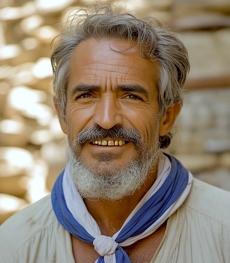
Groves of Episkopi
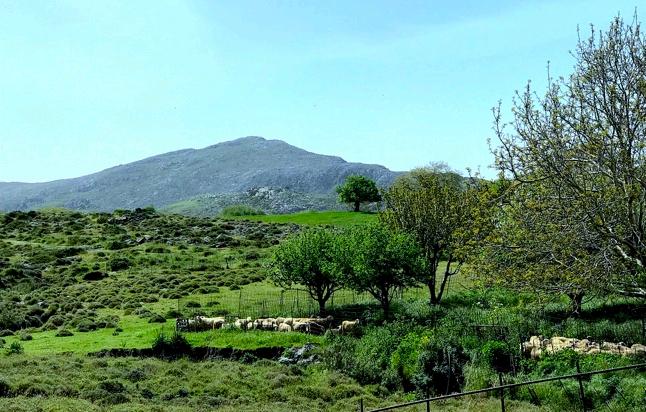
Two days earlier Mihalis had suggested, 'Dooglahs, will you like to go to a sheep shearing?'
My eyebrows jumped at the chance. ‘Such a good idea!' I said. 'When?'
'Sunday at my cousins’ near Episkopi. They shear the sheep, I weave their wool.’
Sunday’s Homer sailed no wine-dark sea. He sailed silvergreen olive groves. Upwind breezes conjured Polyphemus from the Vamos peninsula’s dawn hazes and scents. Psiloritis loomed its white flanks beyond mists of foothills. Legends loom from hazes like these: Zeus loomed from Dikta as Diktynna loomed from Rhodopou.
Two little boys hurled stones at a beehive in a tree, then fled as fast as they could. When they grow up they will hurl political slogans or marketing pitches, then flee the consequences. Leaf shadows tremble on the ground.
Ten men greeted us. They huddled around Mihalis, a cousin in one form or another to them all. They slapped each other’s backs. They shook hands with me and muttered a polite ‘Yasou.’ Being highland shepherds who seldom ventured down to the coastal plains and its towns, none of them knew more than a few phrases of English. My Greek was not much better.
The men wore stolid work-faded pants. Rolled-up sleeves. Thick-soled boots for olive-country’s gummy soils. Mihalis wore suspenders — dandyish for this part of Crete, but then, he is from Xaniá.
The rest went in for mute, uninflected colours. Short-clipped hair. A few beards. The terse talk of men who know their work. Laughs. A cough. Quick puffs at cigarettes tucked between twigs of an olive tree.
The sheep cowered at the far end of a pen, as far as they could get from the men.
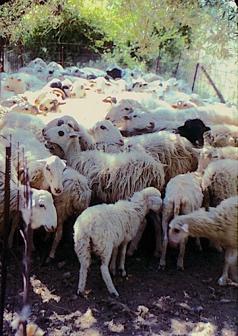
When the men came, they grabbed the rams by the horns, the ewes by the ears, pulled the young ones away from the mothers, lifted the biggest ones — the ones that can put up a fight — clean into the air.
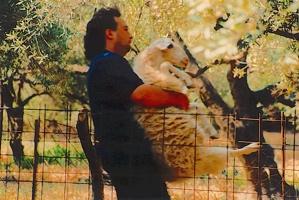
Styles of working with sheep revealed each man’s character like opening moves in a chess match.
A teenager with an unruly shock of hair and missing bicuspid lifted his sheep off the ground with one arm under the throat and the other gripping the wool of a back leg. He was at the age when he needed to prove himself with talk, but no one else was interested in motorcycles.
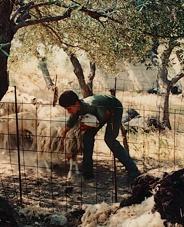
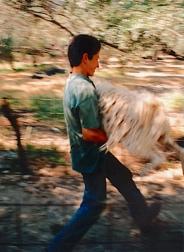
Mihalis was gentle, lifting them up by the front feet and urging them forward, the same way he was teaching his year-and-a-half son to walk.
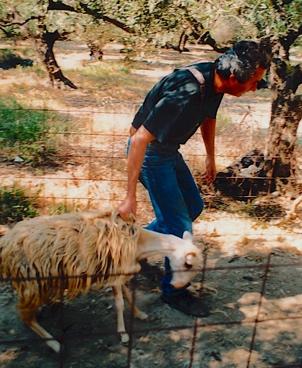
Another man’s style was to reach from behind and grab a hind leg, then pull it up with a twist to one side so the sheep lost its balance and fell. Another held the sheep by its hooves then carried it like a suitcase to flop it down on a mat of justcut wool. Another dragged his sheep by the horns as though he was pulling a vacuum hoover around the house. Bells clanged ferociously on the one sheep out of ten that had them, each a different tone so their owner would know who was who up there in the hills.
The sheep had no choice. Some went easily. One pawed the dust in feint of threat. Most simply bleated. The young ones struggled the most. The older ones who’d been through this several times sullenly endured the indignity of it all.
One or two at a time they were brought into the shearing circle. There two men grabbed them by their back fleece and hind feet and upended them onto the grass. Ploof, down they went. The shock knocked the last of any resistance out of them. One man held their front and back hooves together while another looped a cord around the hooves and knotted it to clench the struggling hooves. This was no place for a Boy Scout.
Shearing was methodical. Four men worked in pairs. They knelt on a thick mat of fresh-cut wool, one pulling the fleece while the other man sheared. The shearers wielded broadbladed garden-trimming shears with no pins. Instead, a loop around the back provided the springiness. The blade tips were wedge-like to part the thick wads of wool. The basic sequence
was to pull the long fleece on one flank to reveal the soft belly wool, start the cut there, then snip from the belly up into the heavier fleece on the flanks.
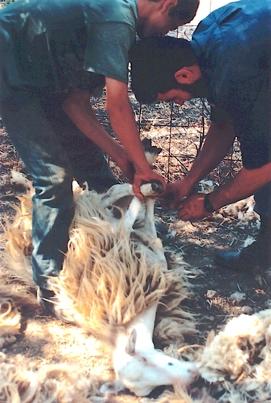
They rolled the wool tufts out of the way, then trimmed the other side the same way. Then to the thick fleece on the back and hind quarters. Finally the neck and forelegs. The final touch was to tighten the bells a notch to fit the nowskinny necks.
One of other teams started with the belly and worked up the flanks in precise windrows, rolling back the wool as he went, so when he reached the short hair on the top of the back, his mat looked like a woolly waffle. A third pair started
anywhere and seemed to go anywhere, tufts flying as they pawed each snip aside.
The wool fell away in greasy clumps, stringy and long on the sides, sheer on the belly and chest. Some was black, but most was dirty gray. Despite the sharp tips on their shears, no
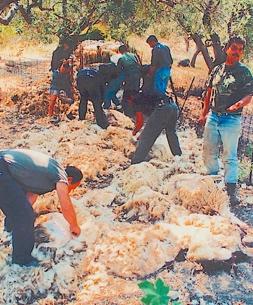
one used them in anger or frustration. There was no piercing bleat that meant real pain, even as the men worked around the jiggly udders and floppy testicles. The only time a tip was
used with intent was to pry out a blood-gorged tick and snip off its head. If a sheep got too agitated the shearer calmed it by holding together its ears. No one kicked a protesting animal. No one cursed the sheep he worked on.
There was a detached nonchalance to their work reminiscent of a barber calmly chatting with a mother as her little boy howls and squirms through a haircut.
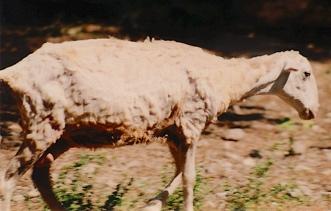
When each sheep was released, it invariably scrambled away in panic a dozen or so metres, then shat.
This done, it looked around, bleated, sniffed the first green plant it saw, then forgot everything as it took a nibble. They clustered in their troupe again, looking like haircut day in boot camp. In five minutes they were mindlessly munching
the largesse of green that surrounded them. The flock’s owner had fenced off this grove months beforehand, so the springtime carpet of marjoram and oregano would be fresh on shearing day.
Breezes coming down the valley piled the wool against olive trunks and a fence. Fresh-cut wool is the most unpromising raw material the Cretan economy produces. It has an unpleasant greasy feel from its lanolin, more so on the white softness of the belly fleece nearest the skin; less on the sides where it had been worn off by the bushes. Black wool has less lanolin. When the grease got too thick on the men’s hands, they washed it off with a squirt of dish detergent and water from a plastic bottle.
Men without decor, these. Their idea of ornament was a pack of cigarettes in a shirt pocket. Their only machismo was a cigarette dangling from their lips as they worked.
Towards the end, as the sheep queue wound down to a four from the seventy-odd they began with, one man stood to take a breather. Another joined him. It was their first relaxation in several hours. Jokes began, hands on branches, thumbs in belt loupes. Laughter like gusts in a storm. They teased the teenager about screwing sheep since he was too young for girls. He bragged he was built for a donkey. Two hssts came from among the men still shearing and the boy shut up.
One of the men picked up a sizeable bundle of herbs he had gathered and stored under an olive tree. Little nubs of
green olives grew at the tips of twigs. When he got home he would dry the herbs on a cookie sheet in the sun, then sell them to an elderly widow who would package them in cellophane packets to sell to the tourists in Xaniá. That was about the extent of these men’s connection with Crete’s second-largest city, thirty kilometres away.
This being Sunday, they skipped the usual wine-bibbing shearman’s feast down at the taberna in favour of meal at one of their homes.
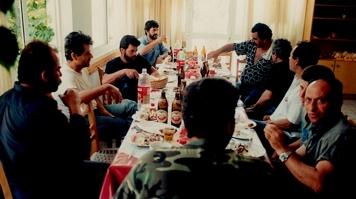
Several left early to pay a courtesy call on their family graveyard. Men like these believe the souls of their fathers — and their grandfathers, their grandfathers’ fathers, and the fathers before those — never really leave.
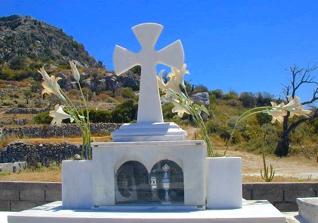
Let the pappas preach where souls go. What hovers in the eight thousand years of this sacred soil, in the groves and villages and springs and gullies and wind, is the soul of Kriti. The photographs of the grandparents on the wall will one day fade; family memories will not. Spirit sticks around, they say, and with that they end the discussion.
One has to divine what they feel. As Cretan women guard the secrets of Diktynna by giving false directions to men who seek her, Cretan men turn taciturn when talk turns to the meaning of soul.
From what they do admit upon question, we take leave of this life to enter a chiaroscuro of still-existing pasts. The birth soul that was baptised into them might go where the pappas says it goes, but the Kriti soul remains in Kriti.
If I told these sheep shearers in the groves of Episkopi that their beliefs originated in the misty verses of the Upanishad principle that body departs but deed remains, they would look me up and down, snort, and light a cigarette.
The Indo-European tongue gave as many words to Greece as Greece has given to us. The pre-Sanskritic word for three, ti, arrived in ancient Hellas as tria (today tris), thence into Latin and French as tri, crossed the Channel and Atlantic as three, and east of the Rhine as drie.
Vassa for rain became vascular, the vessel for blood.
Nāma became νομα (noma), became name. Bheh became φήμη (fimi) became fame.
Spring shearing was over. The ground was dotted with tufts of unweaveable discard. Pale purple sage flowers; bright yellow sourgrass. In the days before electricity the airy and fibrous flowers of the stickyweed were dried into wicks for oil lamps. The lavender blossoms of the bodichess weed were the high-caste weed of the island; it grows only where the soil is acidic enough for olive trees. White houses speckle far hills. Barren slopes ascend to the peaks of the Lefka Ori. There is a gap in the range where the road to Sfakion cleaves.
Buzzing cicadas. Plain shirts. Wool for Mihalis.
Cretan men and women in time immemorial. Spirit sticks around, they say.
Irini’s Orchids
We wanted to find a flower expert to show us the wild orchids of Crete. The rarest orchids grow in hard-to-find enclaves of a particular soil within narrow altitude bands. When you do find them they are smaller than a columbine; some as petite as a lily of the valley. Gazing down on them from hip height they are demure little pips. Kneel to gaze a handspan away and their outer petals of delicate blue, pink, and white part to reveal tiny little tongues whose stamen colours distinguish commoners from rarities — hues that span the saturations from palled to pastel to phorescent. Violet tints, mauve hues, shades of scarlet to burgundy, dotted with barely discernible specks of yellow pollen. Imagine Botticelli’s maid emerging from a seashell the size of a pea.
Our web search for orchid experts led us an organisation devoted to matching expert guides and knowledgeable tourists. Most requests are for hikers. Calls for orchid experts are few in a country which promotes its vigorous hiking trails — in part because long-haul walkers are generous as well as gregarious.
Our guide was named Irini, a tall, slim, raven-haired woman with the long nose, taut high cheeks, slender lips, and smooth complexion in which young Cretan women seem to have a monopoly. Irini felt honoured by us, and we by her.
Most of the time Irini is stuck with troupes of outdoorsy types from Scandinavia and Germany who can hike the fetlocks off a mountain goat but whose flower awareness dotes on the big and the yellow. Since Cretans have chased goats up and down those mountains for millennia, Irini can nimbly lead a pack of hikers yet have enough time to do a little wildflower spotting on the side.
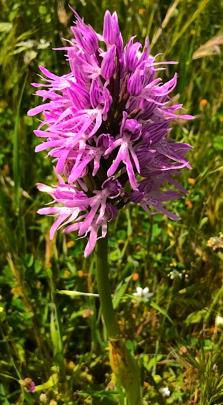
Irini knew a high, secluded meadow utterly slathered with flowers. We had never seen so many in so small a place! An Alpine meadow in June is a tepid affair compared with a Cretan meadow in May. We gave up counting after Irini identified thirty-six species in a patch the diameter of a pizza plate. She was in posie heaven. So were we.
Within an hour Irini led us to three rare specimens that took her long minutes to accurately identify using her orchid identification guides. A few were so seldom reported that they weren’t in the botanical apps on her cell phone.
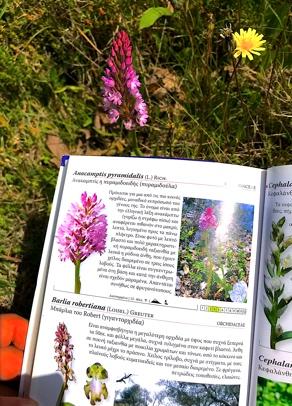
Inspecting a plate-sized patch of wildflowers from six inches away reveals treasures you completely miss from two feet away. Kriti rewards a meadow visit with majesties no larger than a thumbnail.
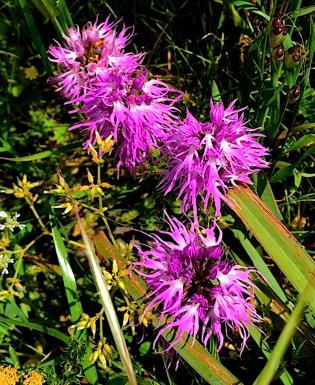
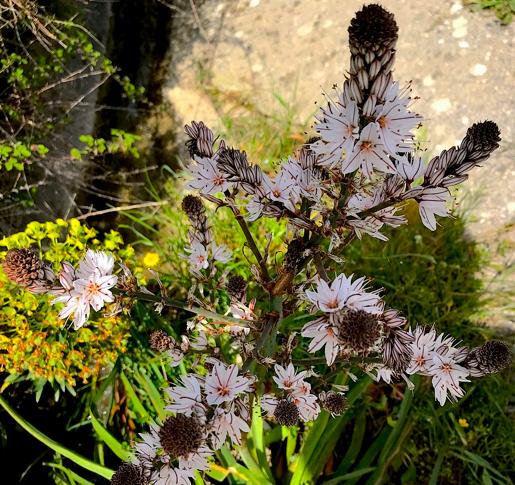
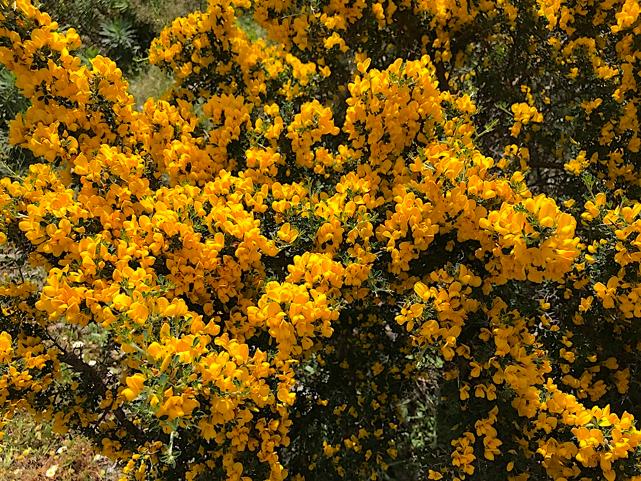
On the return drive to Rethymnon, Irini stopped an a revered old monasti named Arkadi. It has occupied its site since the fourth century. Legend has it that when St. Paul was shipwrecked on the south coast of Crete he converted a horde of heathen by nonstop talk-talk-talk till everyone gave up in exhaustion and converted just to have some peace and quiet in the community.
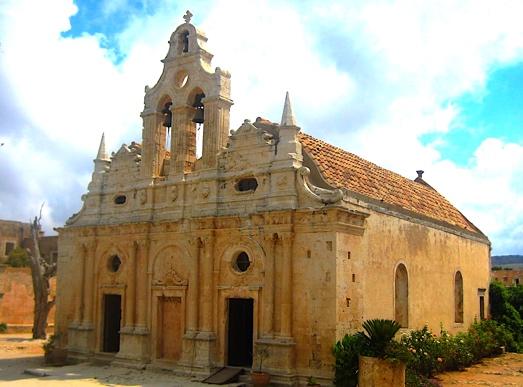
Arkadi has a special place in Cretan history. In November 1866 as the Ottoman Turks were about to overrun the village, the entire population squeezed into the refuge of their monastery church. The defenders, led by Konstantinos Giaboudakis, knew the doors would hold for only so long against Turkish battering rams, and what would happen to the women and children once those doors fell. He led a squad of monks to the monastery’s powder room and lit the fuse.
Of the approximately 960 people inside, 864 were killed by the explosion, including all the women and children. To hear
Cretans tell the tale, some 1,500 Ottoman soldiers also died from the blast.
Inside the now-rebuilt church Irini introduced us to the four remaining monks. Beards to their waistlines, faces gullied from a lifetime of tending their flocks both sheep and human, countless hours hoeing their gardens under the blazing Cretan sun, their days are work, prayers, midday meal, prayers, work. They rise at four and sing liturgy till seven. In the evening they sing the liturgy from four till they go to bed at seven.