To subscribe, change your address, or check on your current account status, go to www. mysvcmag.com and click on About Us, email futureplc@computerfulfillment.com, call 888266-5828, or write P.O. Box 1051, Lowell, MA 01853. LICENSING/REPRINTS/PERMISSIONS
Sound & Video Contractor is available for licensing. Contact the Licensing team to discuss partnership opportunities. Head of Print Licensing Rachel Shaw, licensing@futurenet.com
MANAGEMENT
SVP, MD, B2B Amanda Darman-Allen
VP, Global Head of Content, B2B Carmel King MD, Content, AV Anthony Savona
Global Head of Sales, Future B2B Tom Sikes Managing VP of Sales, B2B Tech Adam Goldstein
VP, Global Head of Strategy & Ops, B2B Allison Markert, VP, Product & Marketing, B2B Andrew Buchholz
Head of Production US & UK Mark Constance Head of Design, B2B Nicole Cobban
FUTURE PLC
130 West 42nd St., 7th Floor, New York, NY 10036
CYNTHIA WISEHART
Editor SVC
One of our more popular stories in our daily Pro AV Today newsletter this month was, unsurprisingly, a fail. Everyone loves a fail unless it’s happening to them.
The fail was set in South Korea, which also got my attention because of my own experience with the World Expo in Taejon, South Korea in (gulp) 1993. Technical fails were a way of life then in a country that was just emerging, technologically speaking.
In this recent incident, attendees at the Cheomseongdae observatory and heritage site in South Korea didn’t get the light show they were hoping for thanks to a projector malfunction. The Korea Heritage Service, alongside Gyeongju City, had spent 1 billion won (about $700,000) on a projectionmapping show to coincide with the 2025 APEC forum. Instead of the expected show, the observatory dome was filled with super-sized renderings of “Shutting down” and “Display mode”.
The malfunction forced attendees waiting for a fix to eventually leave to engage in social media blowback (we didn’t have that in 1993).
What we did have at Expo 1993 was also a domed attraction, but with a film projection system. It failed to black obviously. The thing that stands out in my memory was that even all those decades ago, the content was so realistic that sitting in the ride vehicle in the dark, I thought for a brief moment, “How will I get back?” From space.
Fails are kind of a reminder that in our industry, we have always been pioneering stuff. If I think back over projects I was on decades ago, engineers were doing things with technology that would still dazzle today. Things that predicted a future that dazzles us now. In my experience, because our industry was so unregulated (especially then) and because these advancements happened in countries that were even less regulated, most of my colleagues were akin to magicians. I still see that spirit today. I still meet people who invent for a living—who live to make things work. I see that happen in small, irritating saves and big gestures of software development. It’s funny how a fail reminds me of just how unique AV really is and how resourceful so many of you are. That’s what I’m thinking about headed into 2026. Hope it’s been a prosperous 2025, even if it’s been messy and hard, and
Email cynthia.wisehart@ futurenet.com
Website https://www.svconline. com/circuit
Instagram https://www.instagram. com/svconline/ X (formerly Twitter) @SVC_Online https://x.com/ SVC_Online
d&b audiotechnik presents the CCLi Compact Cardioid Line Array
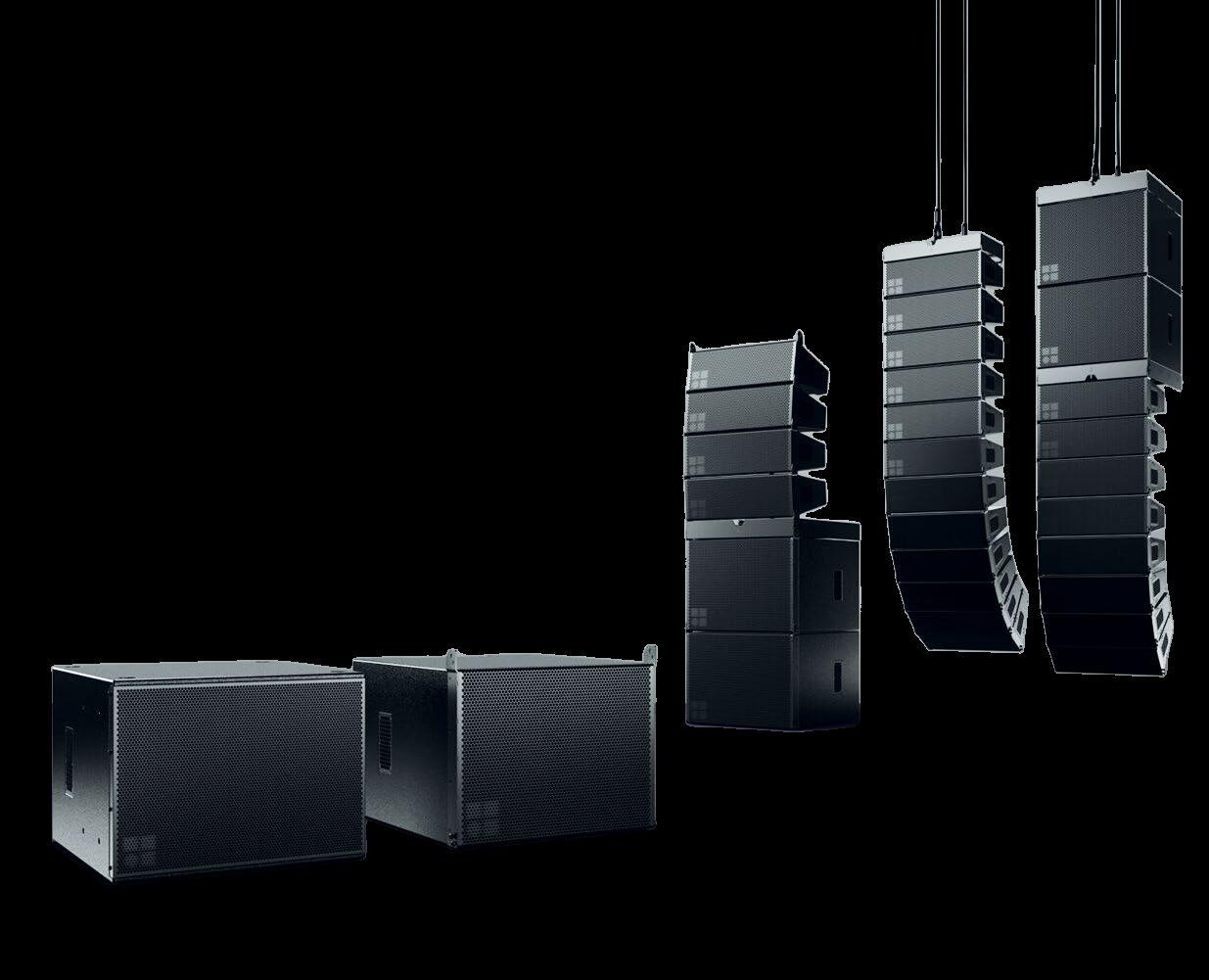
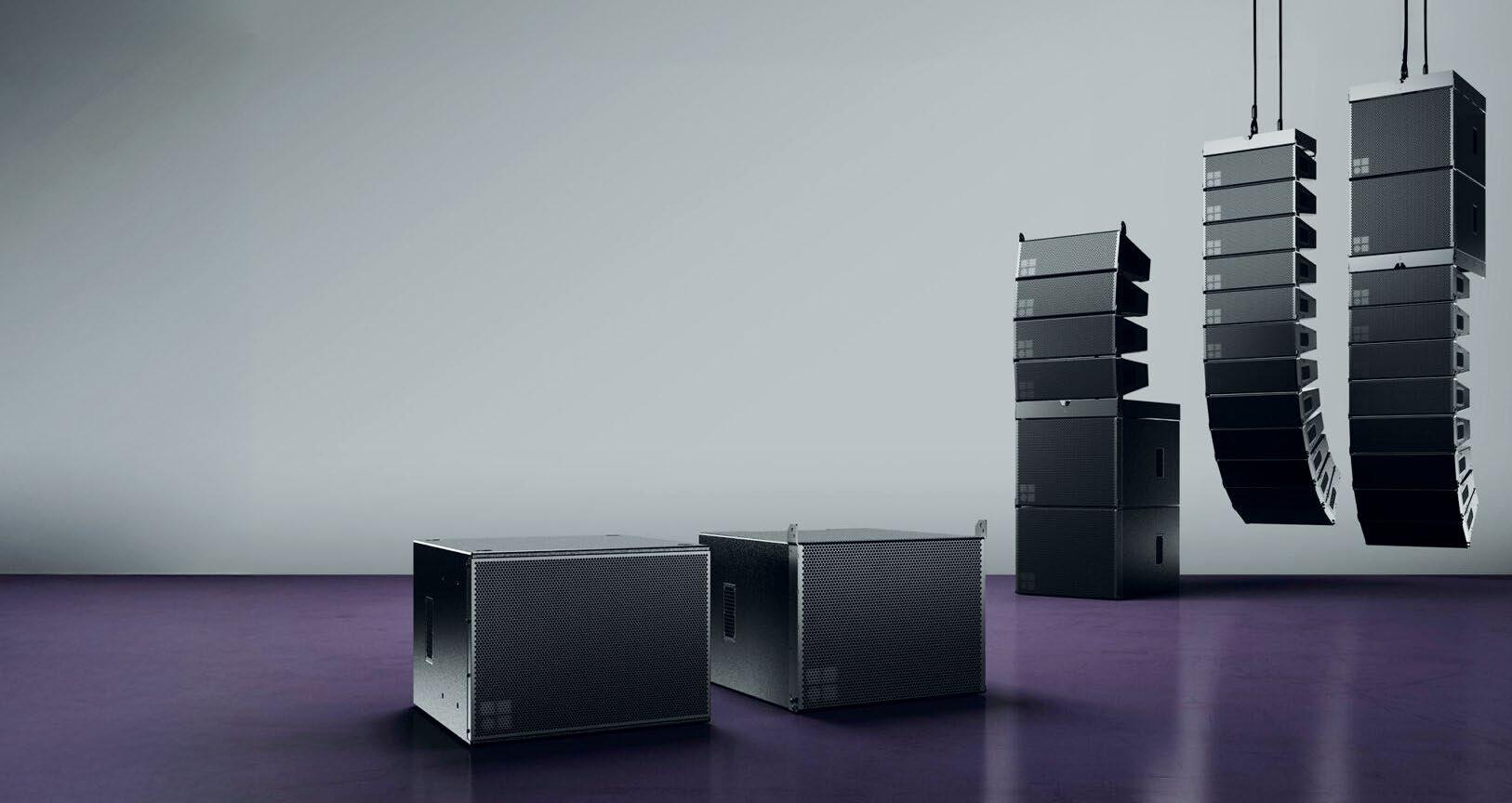
1At this year’s Inter Bee show in Japan, d&b audiotechnik introduced the CCLi Compact Cardioid Line Array, designed specifically for installed applications. Building on the success of the CCL system, which was launched in January 2025, CCLi offers the same technical advantages and acoustical properties, while adding distinctive features tailored for fixed installations.
The CCLi system provides exceptional performance, compact dimensions (209 x 593 x 355 mm) and a sleek design, making it ideal for system integrators, consultants and venue owners who are looking for an innovative, powerful and subtle installation solution. It offers broadband directivity control (down to 60 Hz) with low-frequency cardioid behavior to focus acoustic energy onto the intended audience areas. This reduces unwanted low-frequency reflections from the side and rear walls, minimizing reverberation in acoustically challenging spaces.
CCLi is a versatile solution for installed applications, where the accuracy and extent of directivity control, power density, elegant design and cost-effectiveness are key, including multi-purpose venues, theatres, houses of worship, clubs and more. https://tinyurl.com/3wwsfxp3
Pro AV Today Most Read Stories
Writer DEREK WILEY Associate Content Director
Shanling releases a portable CD player for the modern age
2
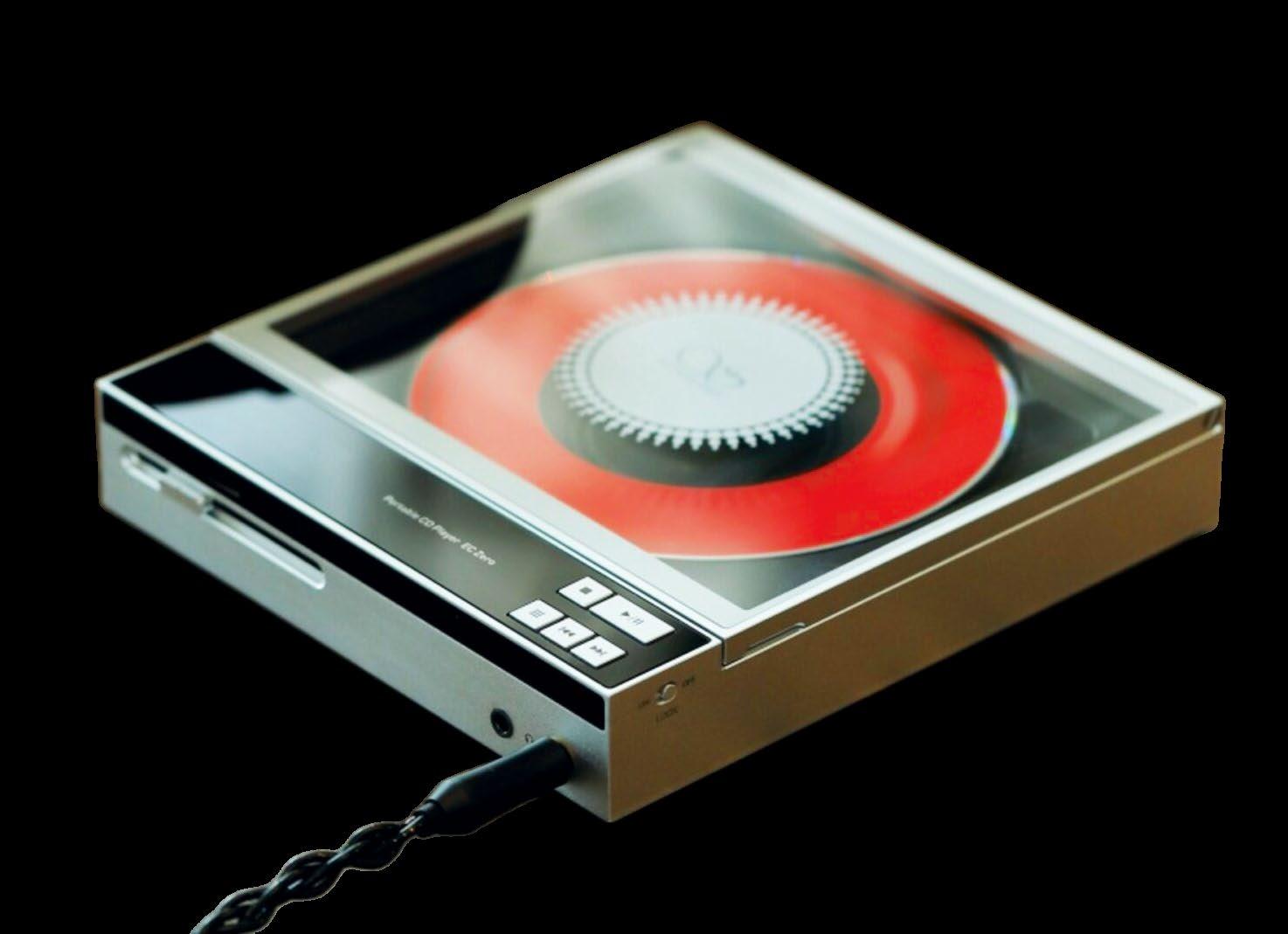
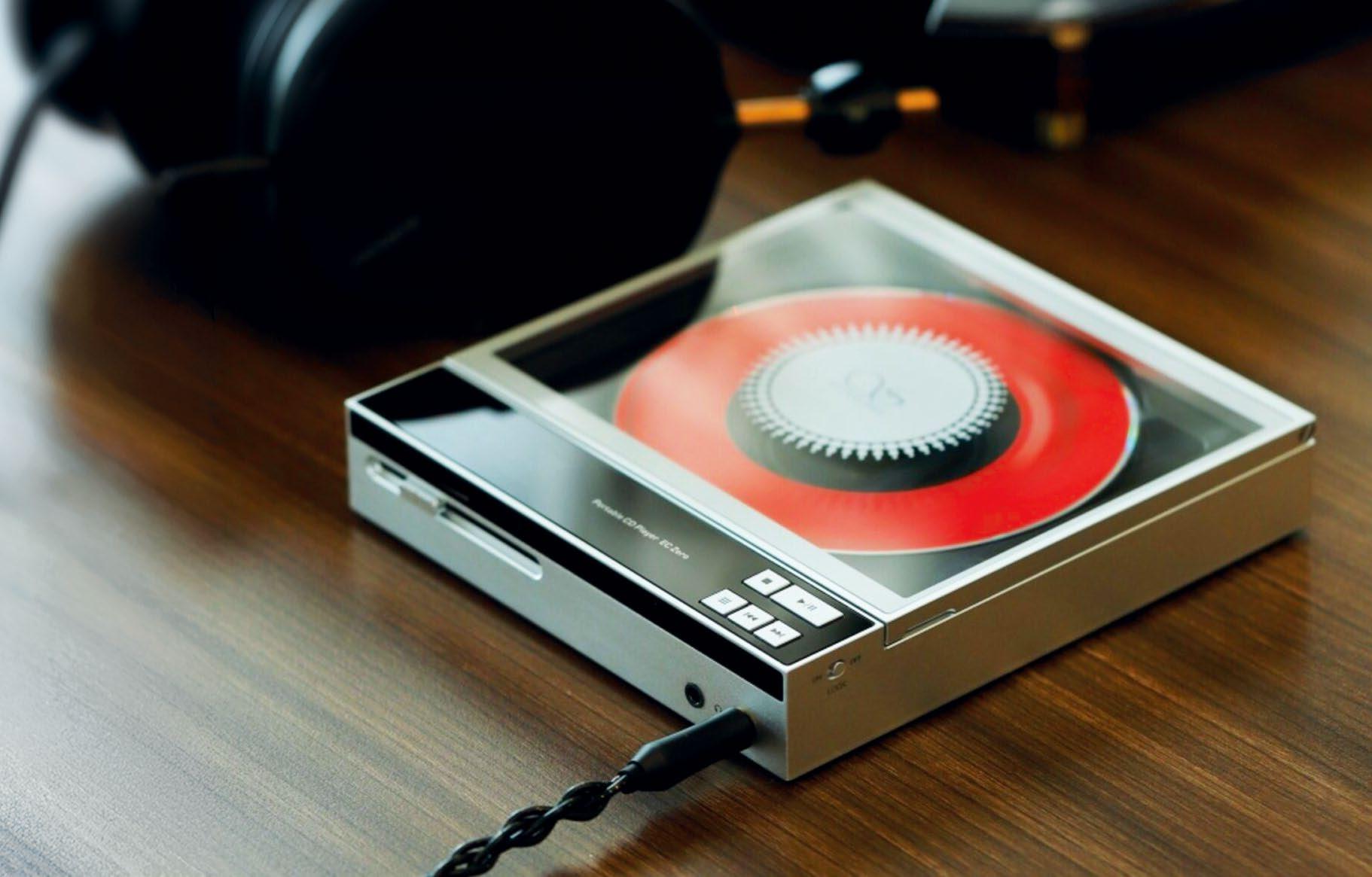
The popularity of physical media may not be what it was 20 years ago, but the resurgence of vinyl records and Blu-ray means that there is a market for those seeking high fidelity and a little retro charm. Shanling has launched an inventive portable CD player that looks to bridge the old school with the new by introducing features such as CD ripping, wireless Bluetooth playback (as well as wired), and plenty of details for hi-fi lovers.
Speaking of Bluetooth, the EC Zero AKM CD player makes a case for its inclusion by supporting the AptX codec, bumping up the wireless audio quality significantly. Of course, for purists, a headphone jack is available. Connectivity options include a 3.5mm line out, a 4.4mm balanced line out, an optical SP/DIF, and two USB-C ports. When operating off battery, Shanling claims about 10 hours of playback. https://tinyurl.com/2pbxbm65
PRO
Swiss Army Knife debuts three new EDC multitools
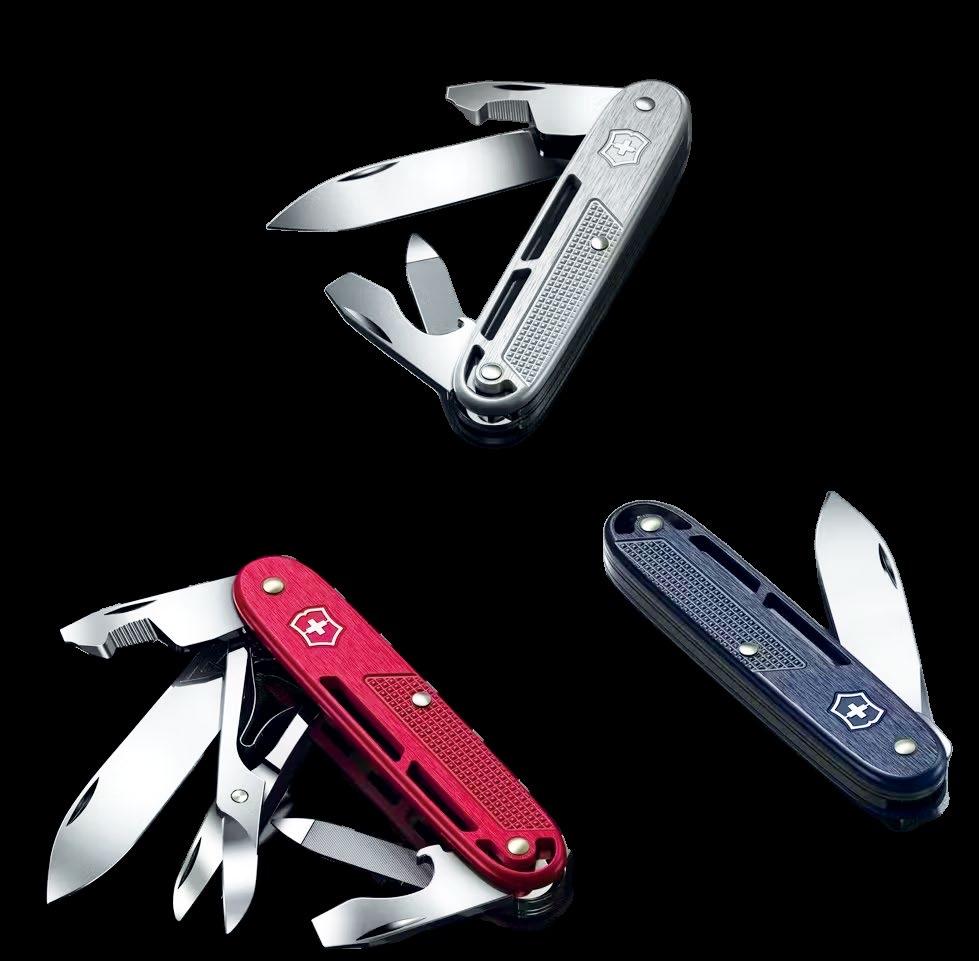
Victorinox, manufacturer of the iconic Swiss Army Knife, has expanded the line with the addition of the new Alox Refined Collection. Crafted from aluminum oxide (hence ‘Alox’), the collection is made up of three models: the Synergy X, Synergy, and Onefold.
The flagship Synergy X is the main attraction of the collection, featuring 10 tools for a variety of practical, everyday applications while still maintaining a small profile. The EDC knife’s tools include 3- and 7-mm slotted screwdrivers, a box opener, wire stripper, and of course, a locking blade. The Synergy X measures 3.7 x 0.8 x 0.9 inches while closed, and is available for $96.
Slimming things down a bit, the $78 Synergy omits its big brother’s pair of scissors in exchange for a reduced price point, while the Onefold takes things all the way down to bare bones by comprising a single lockable folding blade for $56.
https://tinyurl.com/4djfpdrk
Amazon takes up arms against illegal Fire TV Stick streamers
5
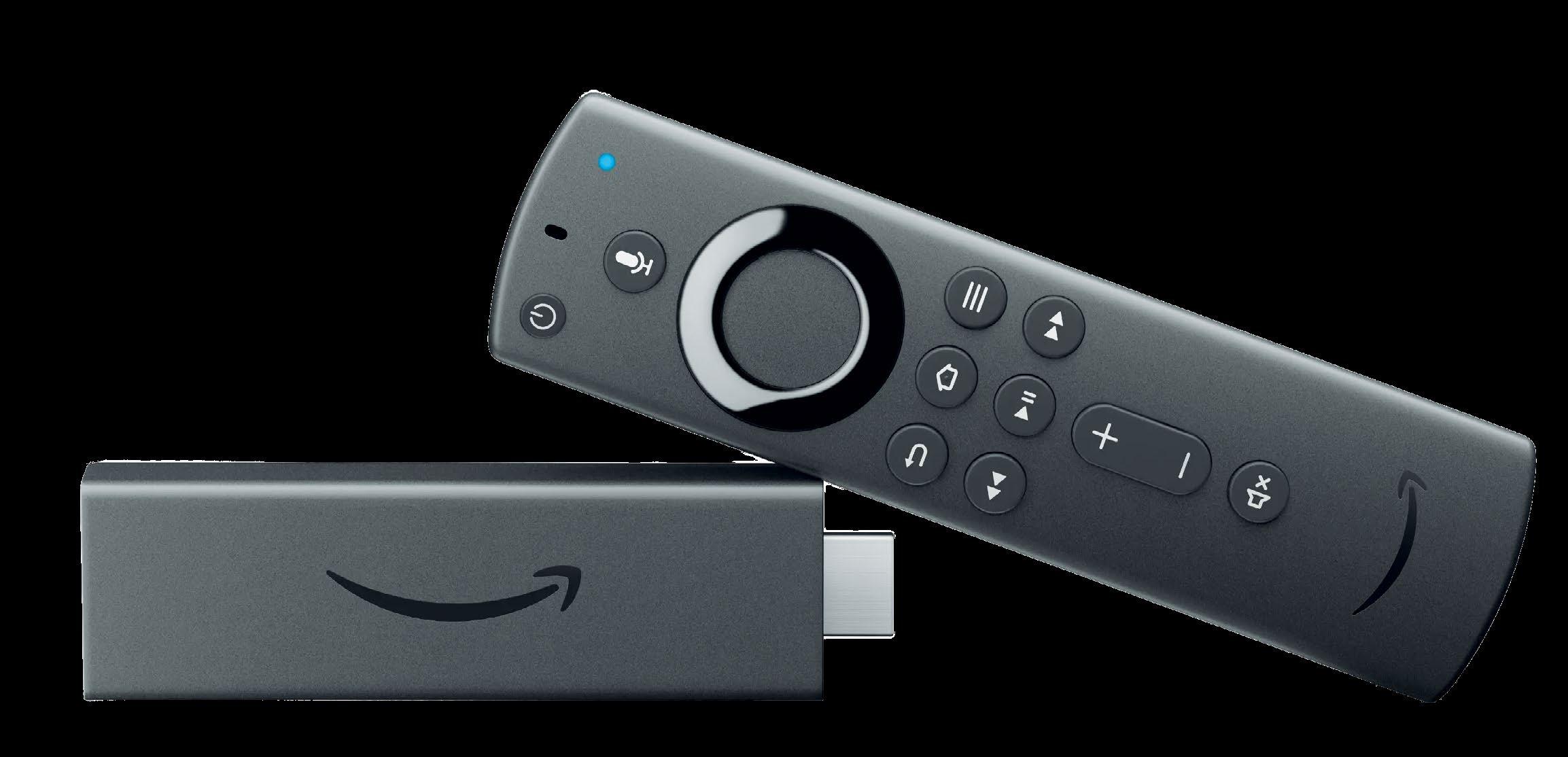
Amazon has rolled out a new anti-piracy system via software update to its complete line of Fire TV decides to combat illegal streaming. Fire TV Stick streaming devices have been a popular choice for those looking to illegally stream sports, as well as TV and movies, via a process known as sideloading. Through sideloading, users have been able to add apps to Fire TV Sticks that are not available on the official Amazon app store.
While Amazon has actively curated its app store to ensure any illicit
third-party apps were not available, this new system rollout keeps any third-party apps from being able to operate on Fire TV hardware. According to TechRadar, this strategy was co-developed with the antipiracy group, the Alliance for Creativity and Entertainment (ACE). This approach will safeguard Fire TV devices against users who attempt to use a VPN as a workaround.
https://tinyurl.com/5n93ej45
M-Cube brings videowall and LED displays to Soho House at Milan Fashion Week
6
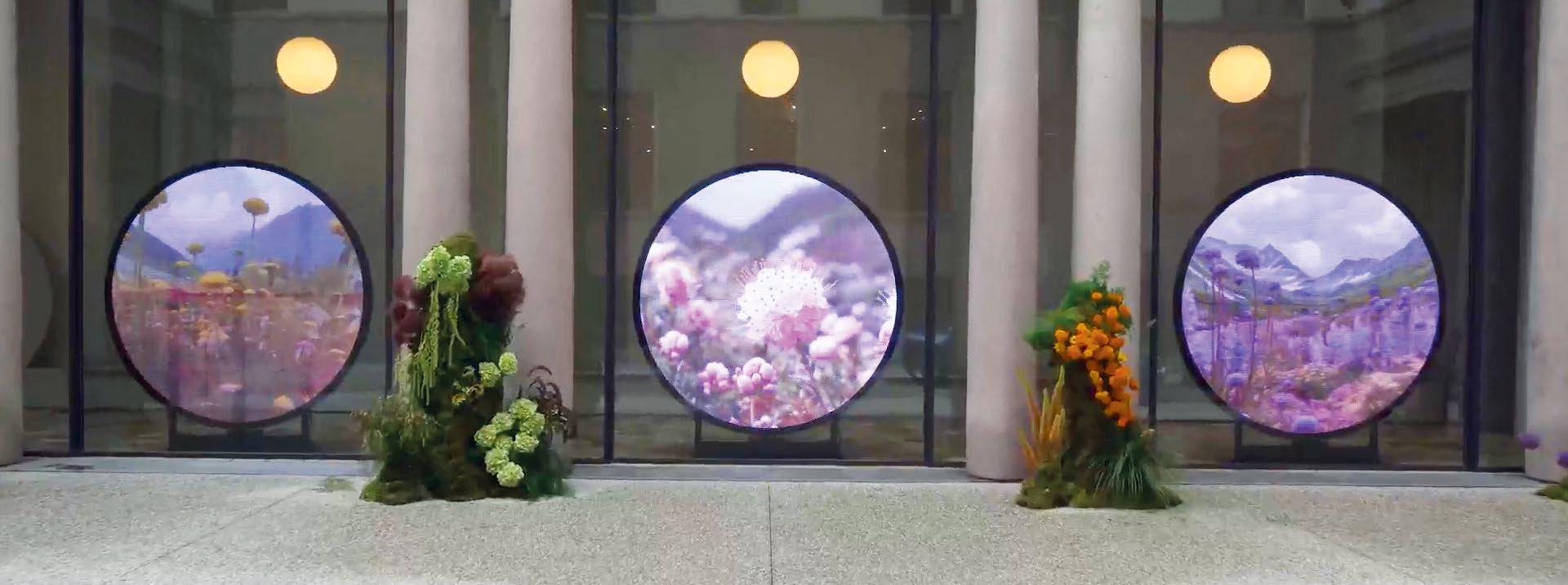
This year’s Milan Fashion Week saw M-Cube partner with Soho House Cities Without Houses to deliver a digital experience for the High in Bloom event held at Garden Senato.
M-Cube designed and installed a series of bespoke digital touchpoints, including a large LED wall, custom LED strips, and three transparent circular LED displays. Each element was engineered to align with the garden’s pathways and greenery, creating a subtle interplay of light, texture, and movement. The displays acted as focal
points that supported the event’s atmosphere rather than dominating it, transforming light into a storytelling tool.
Visual content, produced in-house by M-Cube and supported by AI tools, was tailored to the Soho House brand aesthetic while remaining sensitive to the venue’s organic environment. The result was a cohesive digital layer that enhanced the sense of exclusivity and connection central to the High in Bloom experience.
https://tinyurl.com/2txw5c58
Vatican Live
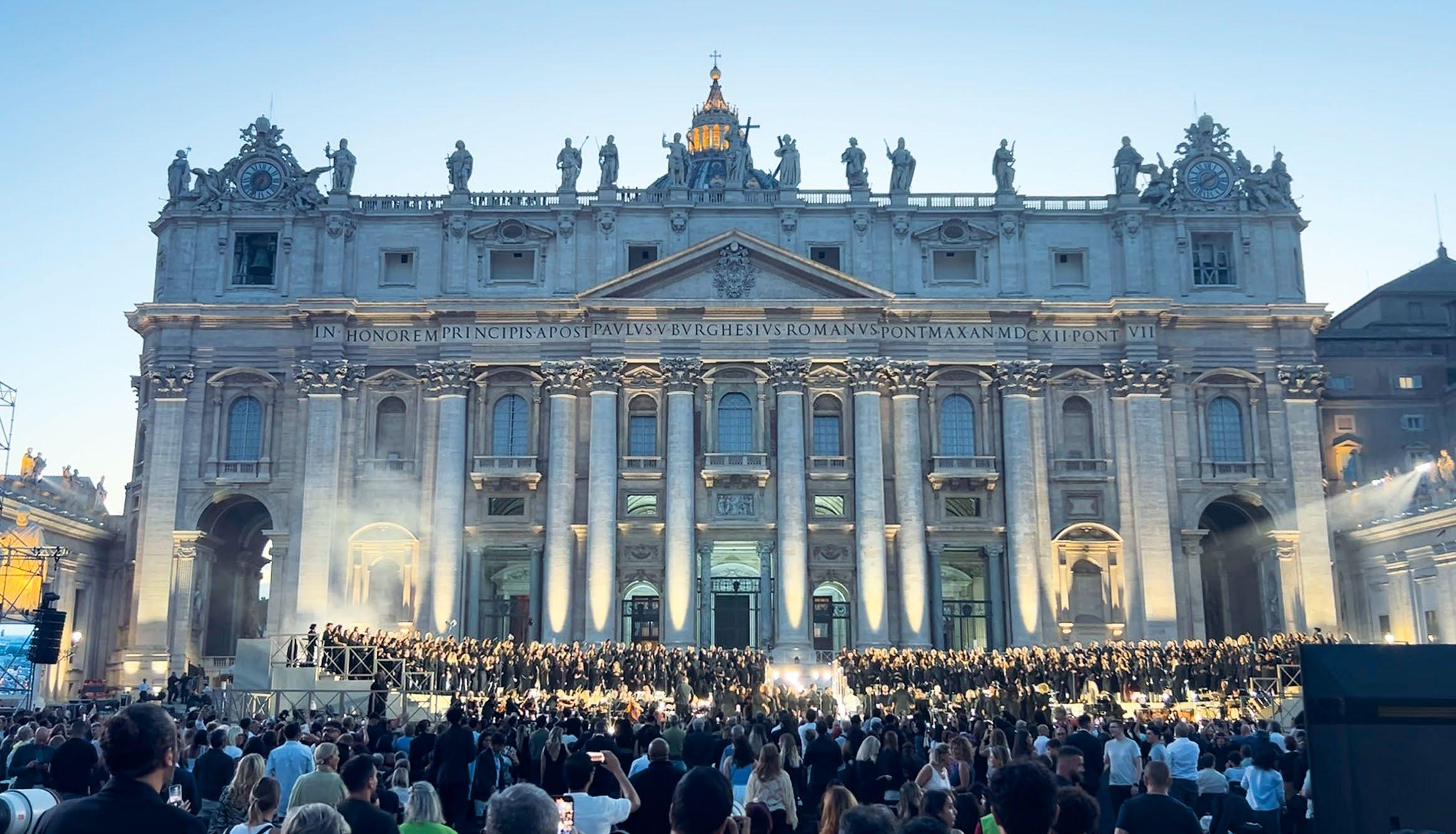
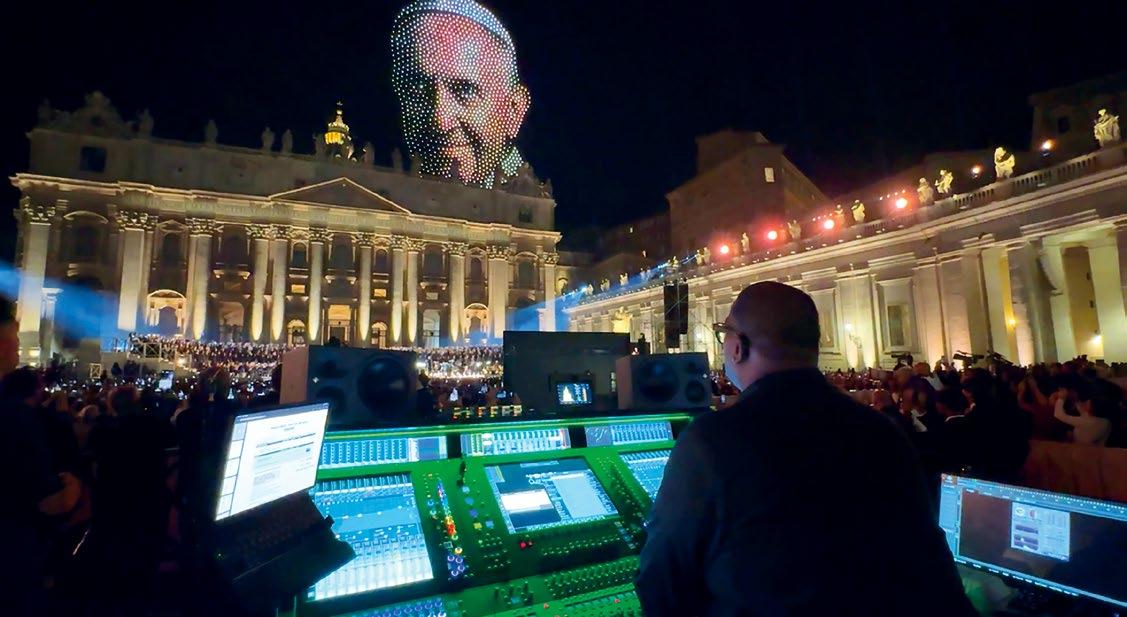
On September 13, Rome’s Vatican City hosted Grace for the World, the first-ever music concert held in St. Peter’s Square, reportedly drawing more than a quarter of a million people to the venerable plaza.
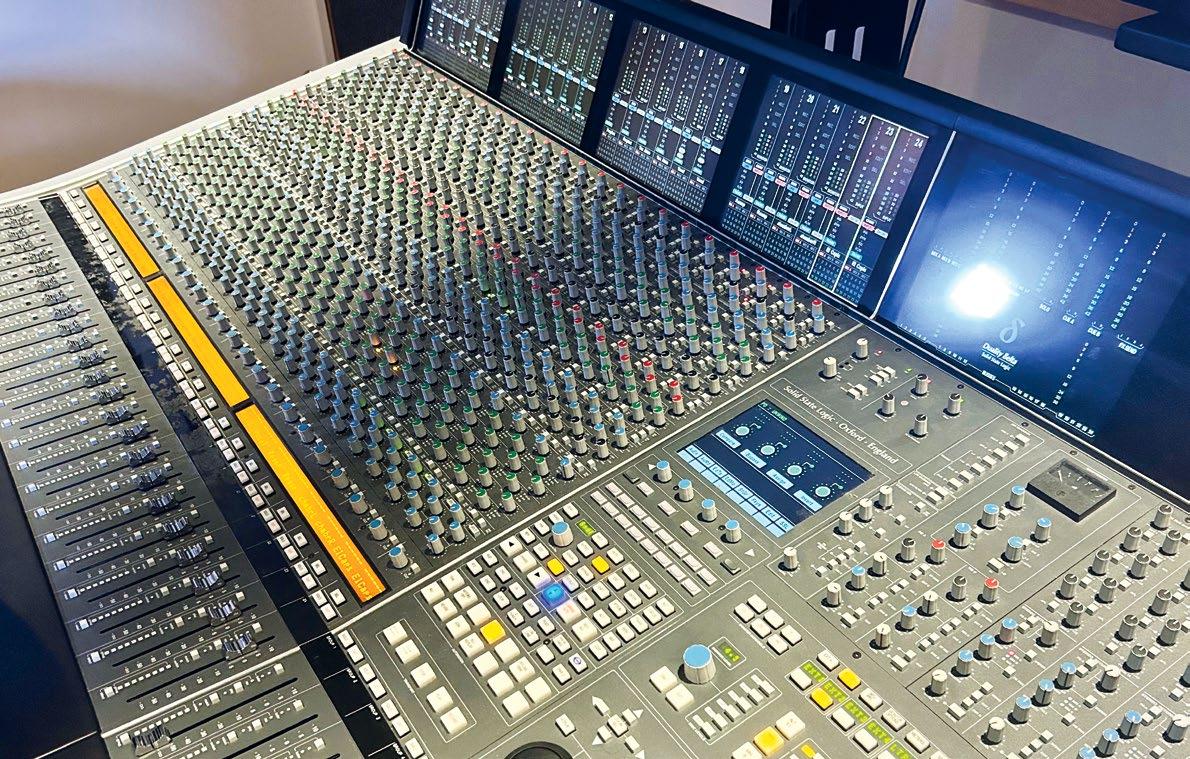
Also streamed live on Disney+, Hulu, and ABC, a massive worldwide audience tuned in to witness uplifting musical messages delivered by a star-studded lineup, including co-directors Andrea Bocelli and Pharrell Williams, along with John Legend, Jennifer Hudson, Jelly Roll, Karol G, and others. And making sure that all of the music performed at this historic event came through crystal clear was a pair of DiGiCo Quantum852 consoles, at front of house and monitors, provided by the Berlin, Germany office of Clair Global.
“This was more than a concert, it was a true event, and the broadcast put it on a level with a world-class awards show,” observes Jeremy Peters, who works from Clair Global subsidiary Sound Image’s Escondido, California office, and who served as the production’s audio co-designer with audio supervisor Michael Abbott.
Peters says he turned to the DiGiCo Quantum852, the desk he says that he and FOH engineer Kyle Hamilton have been using religiously since it was introduced. He likes its analog feel, but also how it puts so much information at his fingertips. “For the monitor person on a show like this, that’s critical,” he says, noting that the monitor input count was nearly maxed out. And while he’s a fan of the Quantum processing, especially Mustard, Peters
says it was the console’s flexibility that made it work. “This show was by far more ins and outs than I have ever had to manage. Normally, on an event like this, you’d likely have two monitor engineers, two house engineers, a dialog mixer, and so on. But, here, it was one front of house guy and everything else was coming through me on stage.”
The Quantum852 offered Grace for the World’s FOH engineer, Kyle Hamilton, the processing he needed to manage all of the individually mic’ed instruments on stage, which particularly helped control the impact of the percussion instruments in the reverberant space. In fact, he says, it all came down to management. “The Quantum852 was on it, one hundred percent,” he says. “The multiple worksurface layers, the routing flexibility — it let us what we had to do to corral that massive infrastructure. The workflow let us do multiple things at the same time, because everybody needed something different — often at the same time! So that flexibility was huge. Any other desk just wouldn’t have been able to handle it.”
Setting the Stage
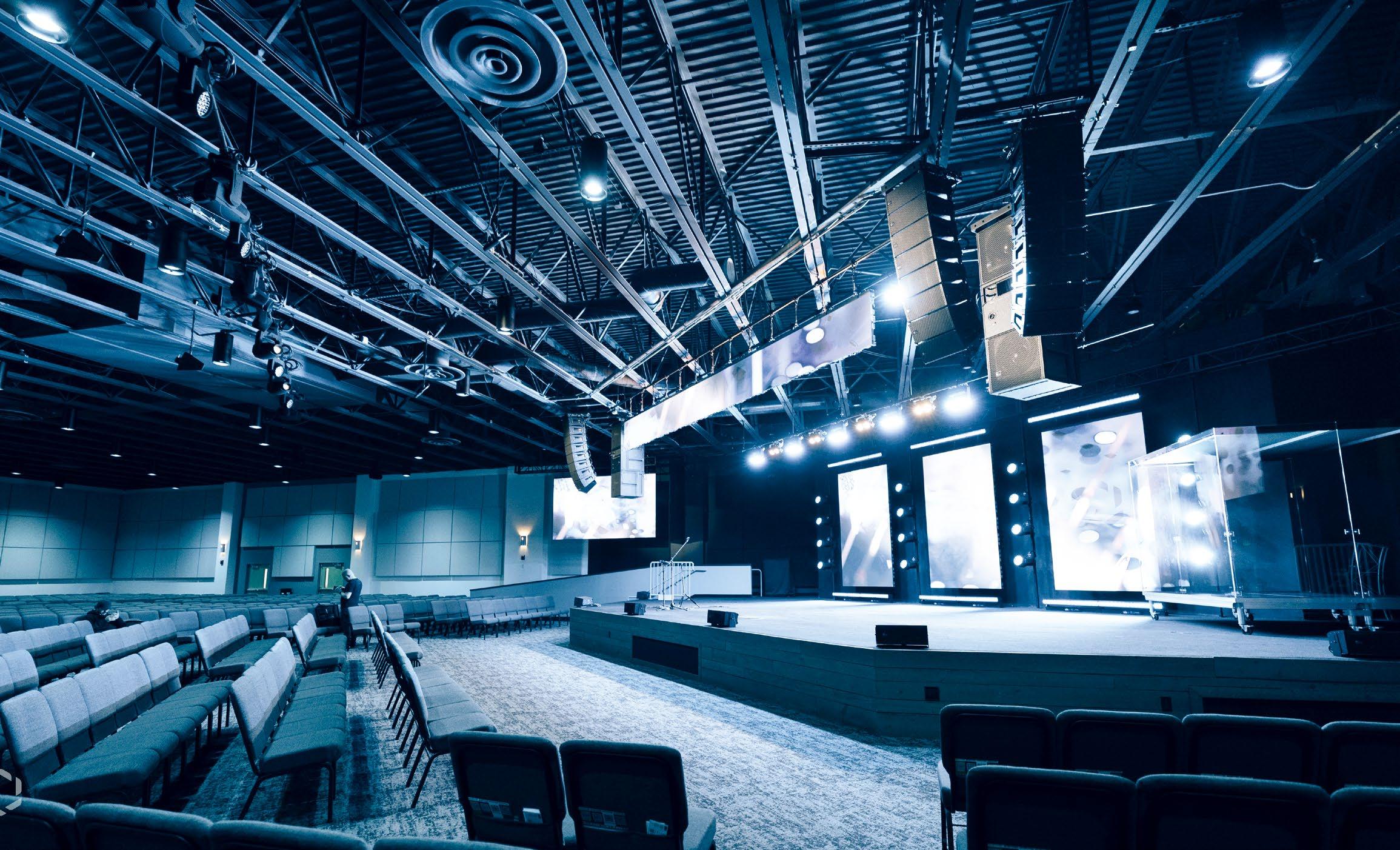
At Calvary Church in Aurora, Colorado, it was time to replace an 18-year-old setup that had reached the limits of its performance and transform the 1,400-seat sanctuary into a space defined by clarity, balance, and intelligibility.
“Everything was just outdated,” says Thatcher Sanders, design lead at Octane AVL. “They had a pretty expansive production system that was still running well in their other rooms, but in the main sanctuary, they were ready to dream big. They wanted to host a full band, record, and make sure people could hear clearly from front to back.” Octane AVL delivered a comprehensive technology upgrade that included new audio, lighting, LED, and visual systems, with a Meyer Sound LINA installation as the centerpiece.
The team modeled and tuned the system using Meyer Sound MAPP 3D. “Chris Greely, our audio engineer, and I went back and forth to make sure coverage and weight loads would work,” says Sanders. “It’s a diamond-shaped room with a long throw and parallel surfaces, so we put a lot of thought into coverage and reflections,” adds Jonah Mann, Octane AVL marketing & design.
One of the first steps was addressing the acoustics. “They didn’t have much acoustic treatment before,” Sanders explains. “Everybody always says, ‘Let’s make it dead,’ but we prefer to say, ‘Let’s control it.’ We installed four-inch broadband panels across the walls to shape the sound instead of kill it.”
The new system comprises four hangs of eight LINA very compact linear line array loudspeakers with six ULTRA-X20 compact point source
loudspeakers providing front fill coverage. Low frequencies are powered by six 900-LFC compact low-frequency control elements, three per side in cardioid configuration. System management and optimization are handled by Galileo GALAXY 816 and 408 Network Platforms.
Identical eight-box LINA arrays were used for both the main and out-fill hangs. “It’s the same array everywhere, so you get phase coherence across the entire room,” says Sanders. “It’s a very unique system. Chris, our engineer, even experimented with left-right stereo placement across the pairs so there’s complete stereo coverage everywhere in the room.”
“It’s night and day,” says pastor and worship leader Ian Dizon. “Our old system had a lot of reflections and dead spots. With the new one, the clarity is remarkable. Every instrument is clear, and the low end through the subs is amazing. The room feels like it’s a different building.”
Dizon, who has served at Calvary for 18 years, says the change has reshaped both worship and confidence among the volunteer-driven production team. “Because there’s more clarity, there’s not a fight between volume and intelligibility anymore,” he explains. “In the past, if we couldn’t hear something, we’d just turn it up—but then the reflections would get worse. Now people can still hear themselves singing, but in a way that encourages them to sing. It’s the perfect balance.
“We thought we might outgrow this building soon, but now it feels like we’ve given it new life,” Dizon says of the investment that has more than paid off.
Hyper-Immersive
Cincinnati-based Crossroads Church has built its reputation on creating immersive worship experiences that draw people deeper into the message of the Gospel. So when the techforward congregation opened its eighth location this Easter— they knew conventional audio wouldn’t suffice. The result: the first house of worship to combine an L-Acoustics L Series concert sound system with L-ISA Immersive Hyperreal technology, creating a true 360-degree spatial audio environment in the 1,560-seat auditorium.
HouseRight, a national house of worship integrator, designed and installed the system, which pairs L Series loudspeakers with A Series out-fills and X Series surrounds. The configuration creates a fully immersive sound space for worship services, concerts, and theatrical productions.
The system features five L-Acoustics L2D enclosures as the Scene arrays, with far left and right Extension arrays of A10i. Six KS28 subwoofers are flown in two cardioid hangs of three boxes behind the center L2D, bolstered by groundstacked SB15 subs. Thirteen coaxial X8i spread across the stage lip provide spatial front-fill, while A15i systems handle out-fill duties.
Luke Hesher, HouseRight General Manager, Church Relations, says the Crossroads installation was unique in deploying 28 X8i speakers as a comprehensive immersive surround system. “The speakers positioned beside and behind the audience spread sounds and effects throughout the whole
space, creating a very dynamic environment and stretching the sound stage much wider than a traditional house system,” he says.
Luke Stickford, Site Audio Engineer for Crossroads Dayton, is finding that L-ISA technology functions as an instrument itself in the church’s music. Placement of vocals and instruments imparts a new dimension to the worship experience.
“I’ll take a vocal mix with reverb from the console into L-ISA and place the left and right channel as far back and as wide as it can go in the spatial field, as to engage a portion of the surround system,” he explains. “During larger parts of a song, I’ll ride that fader, and what it gives you is this really cool, massive vocal feel.”
Instead of simply delivering new content through a conventional PA system, the L-ISA system itself becomes part of both the music and the message thanks to its ability to position objects in a sound field.
“For instance, one of our creative team members will have a vision for a production, and they’ll say, ‘I want this script element coming from the left rear,’” Kendall explains. “The process before L-ISA was cumbersome and difficult to execute. What we’ve found now is that it’s just so much easier to achieve almost anything like that.”
“In a sense,” he concludes, “we’re perpetually a creative startup looking for fresh experiences every week, and L-ISA makes that a much more intuitive process.”
Excellence in Worship
Church on the Queensway, a prominent Toronto church, long known as “the church to watch” in the greater Ontario region, has installed a d&b audiotechnik SL-Series XSL line array system. Designed and integrated by Soundbox, a full-service audiovisual provider, the comprehensive upgrade also includes KSLi-SUB subwoofers and Y-Series and 10S-D Series point source enclosures.
Church on the Queensway is a large house of worship, seating approximately 3,000 parishioners and their aged sound system was no longer meeting the needs of their Sunday services, Christmas and Easter Theatrical productions which have been described as “Broadway-level,” or top touring Christian acts who frequently perform at the Church.
“Our old system was point source. It needed to throw audio over 100 feet to reach the entire room and balcony, which resulted in inconsistent coverage and poor intelligibility in some areas,” described René Barrow, Queensway’s Technical & Media Director. “We found ourselves blasting the people in the front to reach those in the balcony. This wasn’t ideal. Add to that, intelligibility declined in the mid to upper areas of the of the balcony which was particularly troubling with speaking events.”
“My objectives for the upgrade were to even out coverage throughout the space, improve vocal intelligibility in the balconies, and to provide a rider-ready system,” said Barrow. “Our new solution also needed to provide remote monitoring capabilities, be physically light enough to address load concerns, and not cause line of sight issues for the projection screens.”
Barrow contacted Soundbox, a long-time partner of Church on the Queensway. Gerben Vanden Heuvel, Soundbox’s senior sales and designer for installs, arranged a shoot-out between the recommended replacement loudspeaker system by the current manufacturer and a d&b XSL system with KSL subs. “It wasn’t a slight difference; sonically d&b was the obvious choice,” Barrow noted. “Plus, the boxes were lighter, the hang wouldn’t impede screen viewing, and it allowed for easy remote monitoring via their R1 software. d&b ticked all the right boxes and that was the game changer for me.”
“Since the church has no downtime and has service every Sunday, we meticulously planned for a rapid installation,” said Gerben. “We hit the ground running on Monday morning, ripped the old system out, put the new system in, and tested and tuned in time for Sunday. With the designs from d&b’s ArrayCalc, we knew where every box needed to go and the angles that needed to be set. d&b’s easy rigging hardware made flying the new system a breeze. And then the ability to pull the ArrayCalc settings into ArrayProcessing made the initial tuning surprisingly fast, taking just an hour and 45 minutes. Everything worked beautifully.”
Most importantly, the d&b system solved the coverage problem for the congregation. “No matter where they are in the room, everyone loves the way it sounds,” shared Barrow. “Even all the way up in the back of the balcony, it now feels like you’re listening in the room and not outside the room. You can hear everything, and it doesn’t have to be loud.”
The exceptional pattern control and full-bandwidth cardioid technology found in the XSL line arrays and KSL-SUB subwoofers also solved critical problems for the church’s high-level theatrical presentations. “The church often has 20 or more performers with wireless headsets on stage,” added Gerben. “The rear-rejection behind the PA is just mind blowing. They can now have performances with much higher gain before feedback and the performers all think it’s incredible how much quieter the stage is.”
The new d&b SL-Series system has been well received by visiting ministries and musicians.
“Not long after the installation, we baptized our new d&b rig by putting it through its paces with the Billy Graham Evangelical Association, who held a massive concert and speaking engagement,” shared Barrow. “Our Church Worship Band, The Afters, and TAYA (of Elevation Worship projects) all performed. Our new d&b audiotechnik system sounded beautiful, capable, powerful, and clean.”
“I love it,” concludes Barrow. “Vocals sound crisp, clean and natural, and it’s the same for instruments. It all just takes less processing for everything to sound big and beautiful.”
Church Overhaul
Jessamine Christian Church (JCC) in Nicholasville, Kentucky prides itself on being an establishment where people from all walks of life can come together to find hope and a sense of belonging. Recently, JCC found itself in great need of AV repair, as their existing system was experiencing network issues. The church approached AV integrator JCA Media seeking assistance with severely pressing network issues. But as discussions evolved, it became evident that their needs extended far beyond simple network repair. The church was on the cusp of a significant sanctuary renovation and required a comprehensive overhaul of their entire audiovisual and lighting systems in order to fully support their contemporary worship style and robust schedule.
The sanctuary’s architecture, with its combination of drywall and wood, created an inconvenient decay time for sound, which highlighted the need for a comprehensive acoustic treatment plan. The church also required an integrated control system for various AV and lighting elements, including power management for their stage gear. For JCA Media, the choice to install LynTec power control was clear, as the company has a long history of using LynTec’s power control solutions to manage complex lighting and audio needs.
Aesthetic integration was another critical factor, as interior designers were involved from the outset, demanding solutions that not only performed flawlessly but also blended with the newly renovated space, particularly concerning ceiling-mounted fixtures and cabling.
For the audio system Martin Flexpoint Mains were installed, specifically chosen for their high-power capabilities to accommodate the church’s contemporary worship style and louder worship nights. They also integrated Danley TH212-I-C subs, taking on the role of building the custom sub bunkers and frames beneath the stage grill to ensure optimal
placement and performance.
Martin monitors were deployed across the stage, and an Allen & Heath SQ-6 was selected for the front-of-house console, providing comprehensive capabilities for mixing. A critical integration point involved LynTec utilizing a LynTec PDS 12 Relay via contact closure, controlled by RTI, to power all independent audio circuits within the stage floor boxes, ensuring efficient on/ off control for all audio gear.
In terms of video and projection, two Epson projectors were installed, an EB-PU2213B 13K Lumen Laser Projector and an ELPLL08 Long Zoom Lens, with Da-Lite 23695 UTB Contour (65”x139116”) 133” Diagonal Screens placed on either side of the main stage wall. A Blackmagic ATEM 2 was chosen for handling all camera inputs and video outputs throughout the facility, streamlining video production.
JCC’s network and security infrastructure were also completely modernized. The entire network is built on Ubiquiti equipment, encompassing 20 access points and three 48-port switches. For security, 24 Ubiquiti cameras provide comprehensive surveillance, and a fully loaded NVR with approximately 42 terabytes of storage offers over 30 days of retention for all camera footage. An RTI system provides custom control for turning various systems on and off throughout the facility.
“This recent installation stands out as a testament to exceptional design and execution, entirely powered by LynTec products,” noted Alex Peake, project manager at JCA Media. “Their comprehensive product line was instrumental in enabling us to innovate thoughtfully, ensuring the solution wasn’t merely different for the sake of it, but aligned with the church’s unique and evolving needs. We also carefully thought about the need to future-proof the church while ensuring there will be room to grow.”
RF Refresh
Revolution Church, a multi-campus ministry in Georgia with a 20-year history, has upgraded its main broadcast campus in Canton with Sennheiser’s Spectera bidirectional wideband wireless audio ecosystem. This upgrade has solved longstanding challenges with radio frequency (RF) density and provided a superior audio experience for its worship and ministry teams. The new system not only delivers exceptional sound quality but also offers the reliability and flexibility needed to support the church’s diverse and dynamic production schedule.
With locations currently in Canton and Jasper, “Revolution Church exists to love Jesus and to help people grow in their faith,” shares Brian Damerow, Production and Creative Minister at Revolution Church. Damerow has proudly overseen broadcast and technical teams for more than 13 years. The church serves thousands of people weekly and helps lead a global church planting network. As of late, Damerow was facing the fact that the existing gear was beginning to show its age, experiencing occasional dropouts and becoming increasingly difficult to manage in a crowded RF environment. The Canton campus, which serves as a broadcast hub for other locations and online services, required a robust and future-proof solution.
Damerow approached the upgrade with a deep sense of stewardship. “I personally give to this church, and so I also know that my money is going towards these investments,” he explained. His goal was to find a system that was an investment for the foreseeable future, not just a temporary fix. “Trying to have redundancy and resiliency in all of our mission-critical systems is always a goal.” Spectera checked all the boxes and more, and, with the help of the team at Integrated Production Solutions (IPS) Nashville, the system was installed.
The decision to deploy 16 new Spectera bodypacks was a direct response to the nuanced needs of the church. Damerow and his team were particularly drawn to Spectera’s ability to pack a high density of channels into a single TV channel, a critical feature as the RF landscape becomes more complex.
The system’s bidirectional capabilities also offered unprecedented versatility. Revolution Church notably deploys a variety of handheld microphones from the evolution wireless G3/G4 300 and 500 series for events.
The easy installation and simple setup process were a revelation. While the team had allocated days to configure the new system, they had it up and running in just 20 minutes. “It was so straightforward, that the whole team was pleasantly surprised at the simplicity of the install,” Damerow recalled.
To ensure maximum reliability, the church configured a four-antenna setup, taking full advantage of the system’s built-in redundancy. They chose to use MADI for the primary audio input for its low latency, with a Dante network as a redundant failover.
The impact on the ministry and its production team was immediate and transformative. The most striking improvement was the audio quality. The worship team — a mix of professional and volunteer musicians — experienced a profound difference in their in-ear monitors (IEMs). Damerow described the sensation as “taking the blanket off of our in-ear mixes” as they were able to hear a much wider frequency range and more detail than ever before. This newfound clarity boosted the confidence of the musicians and vocalists, giving them the freedom to perform at their best, which in turn lead to a noticeable improvement in the overall sound for the congregation.
“I had very high expectations for Spectera,” Damerow concluded. “And they were all met or exceeded. It’s certainly the solution going forward, and we would recommend Spectera to any other houses of worship as well.”
New Skills
Since 1973, Young Nak Church of Los Angeles has been a guiding light for thousands of Koreans and Korean-Americans in the city’s downtown neighborhood. Offering services in both Korean and English, it has, over its past five-plus decades, become one of the most prominent Korean churches in the US.
Earlier this year, Young Nak Church took on a new kind of illumination, in the form of nearly three dozen new elektraLite lighting fixtures in the church’s sanctuary. These were installed by the church’s longtime systems integrator, Orange County-based Solid Sound Solution, which had recently added lighting system design and installation to its services in a serendipitous move that saw the company, which specializes in live sound systems for church clients, becoming fully proficient in lighting just as YNC needed them.
“Ironically, I think the main challenge of this project was in communicating to the church leaders that Solid Sound Solution would be able to provide lighting services for them at the same level that we have done for them with audio for years,” says Troy Choi, the company’s founder and president. “As a company long recognized as an audio specialist, we’ve enjoyed an excellent reputation in that field. But in lighting, we had to build credibility from the ground up, one installation at a time.”
In addition to his lead crewmembers Sung Kim and Sky Kang, and freelance lighting designer Emma Boisselle, Choi also credits vendor elektraLite’s
Norman Wright and Brandon Tsaptsinos, plus Steve McNeil at elektraLite rep firm Mac West Group, as huge helps in that endeavor. “elektraLite has been an invaluable partner,” he says. “From the time when I knew almost nothing about lighting, Norm patiently taught me and guided me.”
In fact, elektraLite makes up 80 percent of the entire lighting installation for the Young Nak Church project, which features five new Aero moving head fixtures, 15 Stingray Profile Cast RGBW, 10 Stingray Fresnel RGBW, and five Stingray Fresnel VW (“Variable White”). These were chosen to achieve the church’s mandate to create a single lighting solution that could best illuminate all three of the celebration types in its 1,400-seat, 30-foot-high sanctuary: one a conventional Mass, another a contemporary service with drums and electric instruments, and a third a hybrid of both types.
“They go from very traditional to rock concert every week,” says Choi, who for two decades previously did tour sound for artists and events including Herbie Hancock, Toto, La La Land in Concert, Coachella, and the LA Philharmonic. “Plus, they have a lot of events, and also rent the space out, so they really needed a lot of flexibility,” he says. He further adds that since the completion of the YNC project last April, which also saw the renovation of the sound system’s console, wireless microphones, and monitors, the sanctuary has already hosted three major concerts, all of which received excellent feedback on color consistency, clarity, and operational reliability.
PTZ Cameras
PTZ cameras are the AV workhorses of so many Pro AV applications, as well as crossover applications such as live events and worship that take advantage of powerful PTZ options developed for broadcast. Here are some recent new releases and some proven standards.
Writer CYNTHIA WISEHART Chief Editor
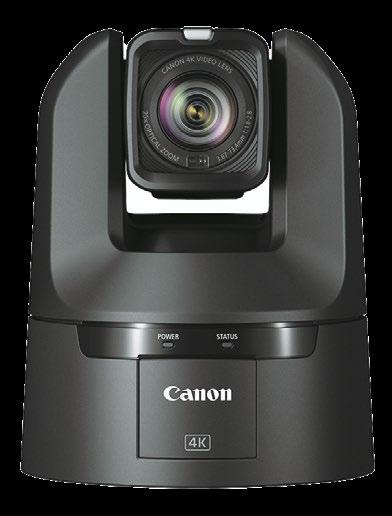
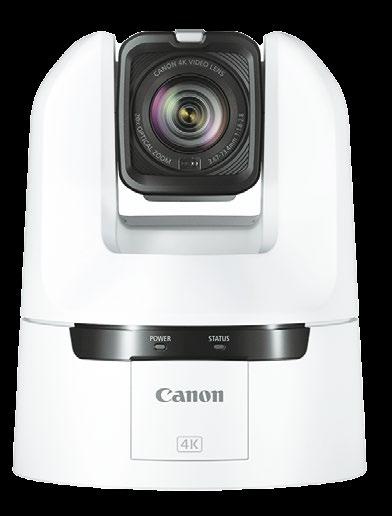
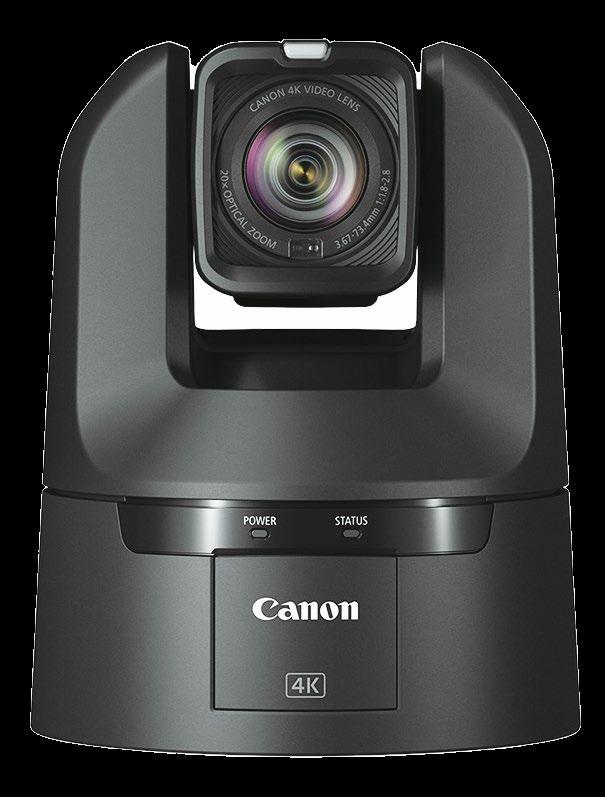
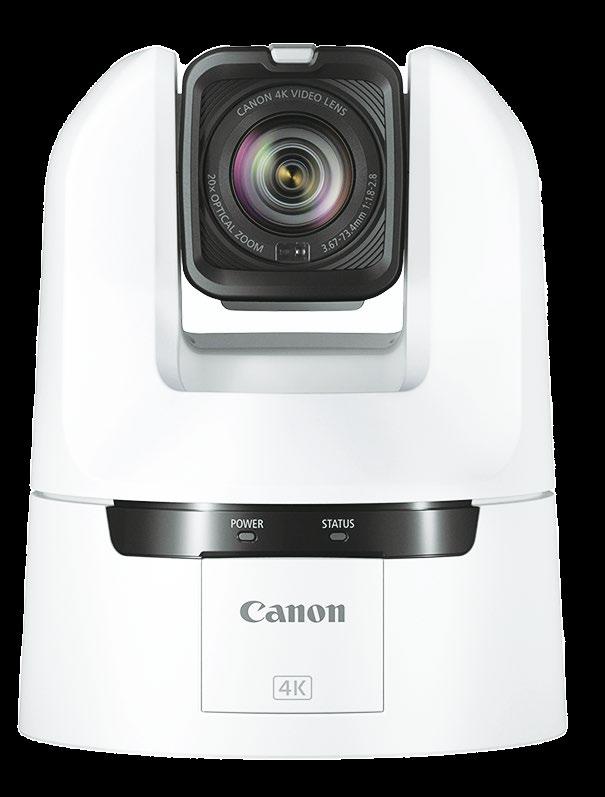
In November 2025, Canon launched the new Canon CRN400 and Canon CR-N350 PTZ cameras, designed to bridge the gap between its CR-N300 and the CR-N500 models. The new cameras shoot in 4K 60p imaging with a 20x optical zoom, extendable to 40x advanced zoom in Full HD. Both feature a 1/2.3” CMOS sensor and the DIGIC DV7 Image Processor and possess a vertical crop option, which allows users simultaneous output of a 9:16 crop of the full image. The CR-N400 is positioned for broadcast applications requiring a 4K SDI-based workflow as it features 12G-SDI and 3G-SDI connectivity, Genlock, and Timecode. The CR-N350 is intended for users who only require 4K over HDMI/IP, or Full HD over its 3G-SDI terminal.
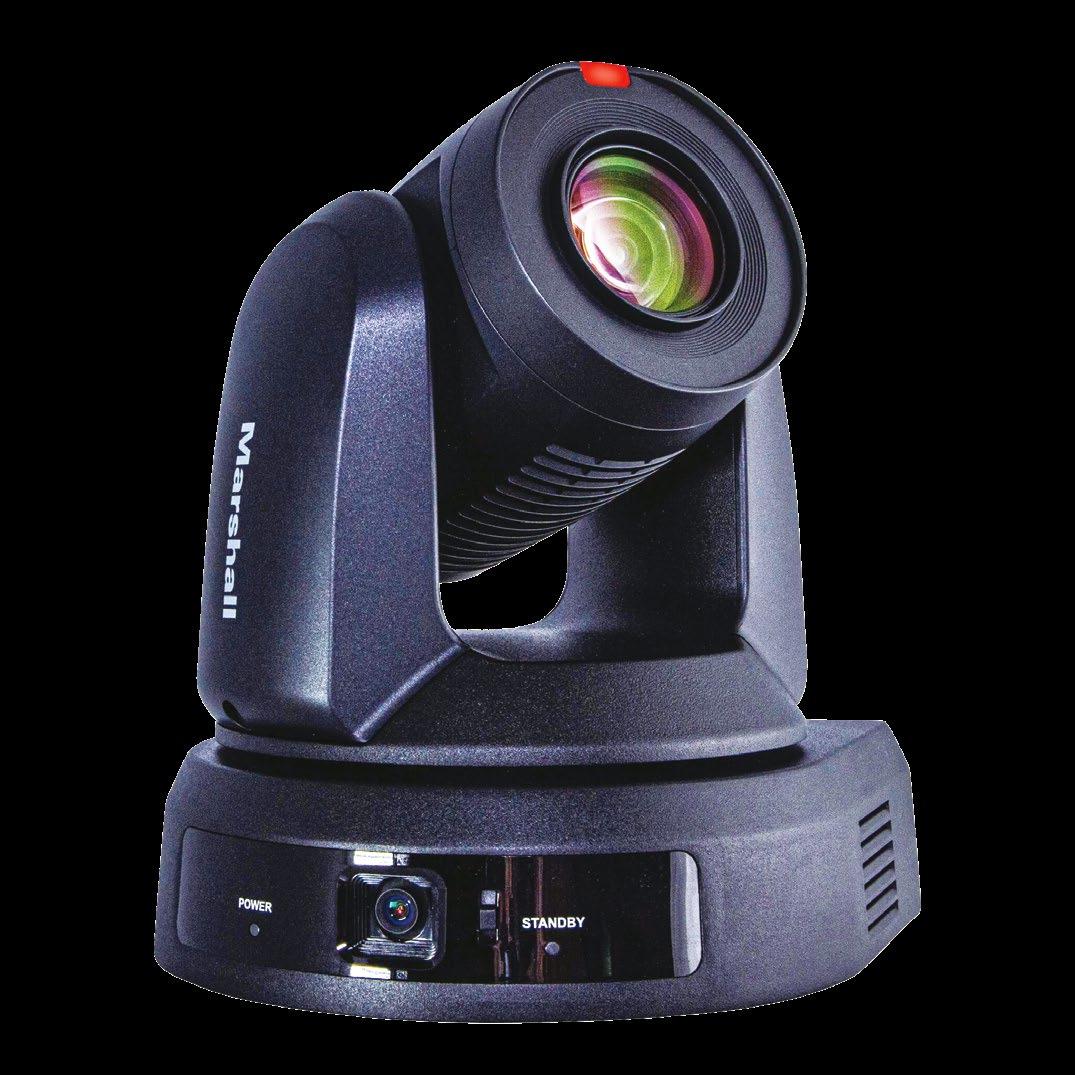
At IBC 2025, Marshall Electronics launched its first dual-sensor/dual-lens, PTZ/POV Marshall CV625. This latest addition to the CV600 line of cameras brings both a PTZ and a POV wide-angle into a 4K tracking camera to provide simultaneous closeup and wide views as well as picture-in-picture outputs. The CV625 features a 25X optical zoom, while its 8-Megapixel 1/1.8-inch sensor captures footage up to UHD60 with 4K auto tracking. The camera’s panoramic POV image can be output as picturein-picture or separately. Program outputs include 4K HDMI/RTSP streaming, Full HD 3G-SDI, Ethernet, and USB 3.0.
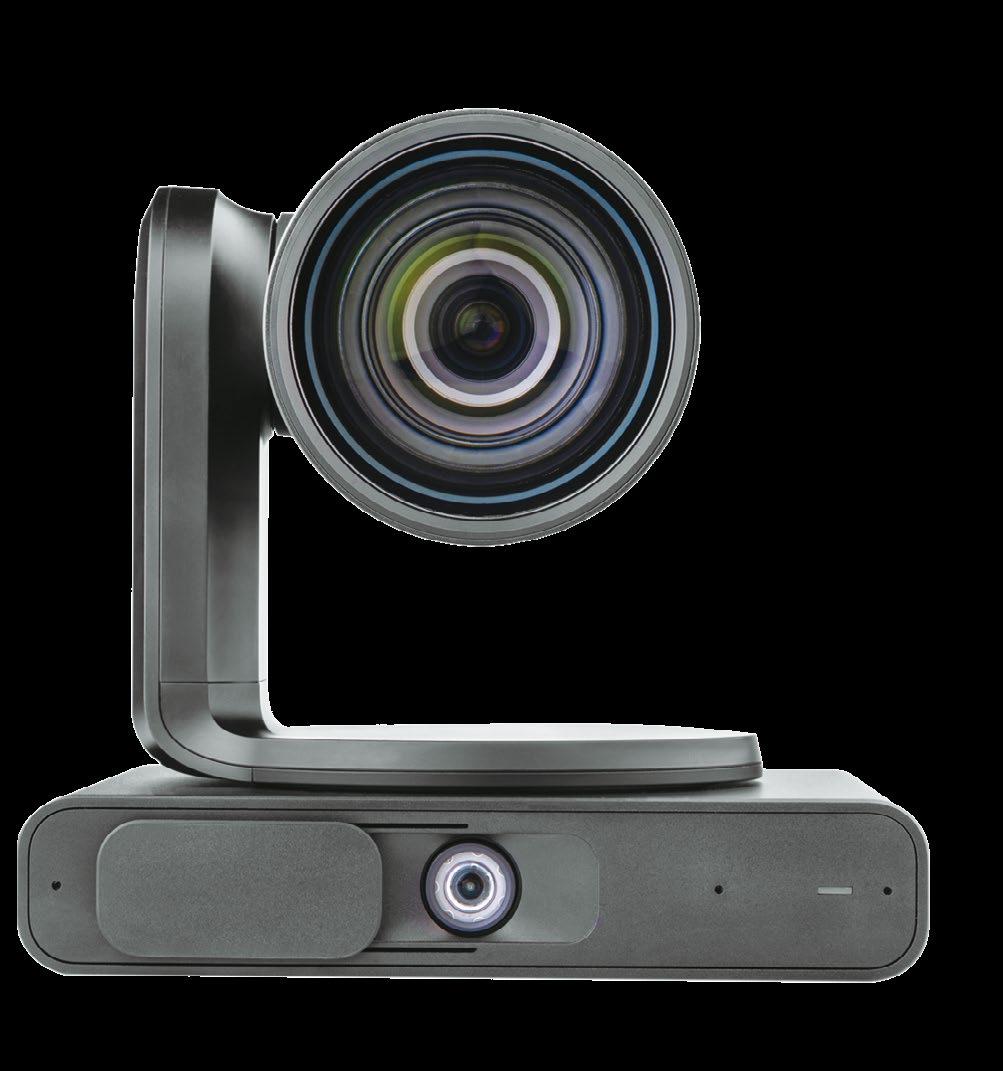
Launched in 2025, the Kramer KAC−CAM−70 is a Microsoftcertified dual 4K lens PTZ video camera for medium to large meeting spaces. Featuring a 12x optical zoom close−up lens, a second wide-angle 119° DFOV panoramic lens, and an integrated microphone array for direction assistance, the KAC−CAM−70 is designed to keep track of meeting attendants, even in large spaces. AI features include auto−framing, speaker tracking, and smart gallery. A wide−angle sensor allows the KAC-CAM-70 to capture a complete room view, and is designed to complement Kramer’s solution bundles for medium−large Microsoft Teams Rooms.
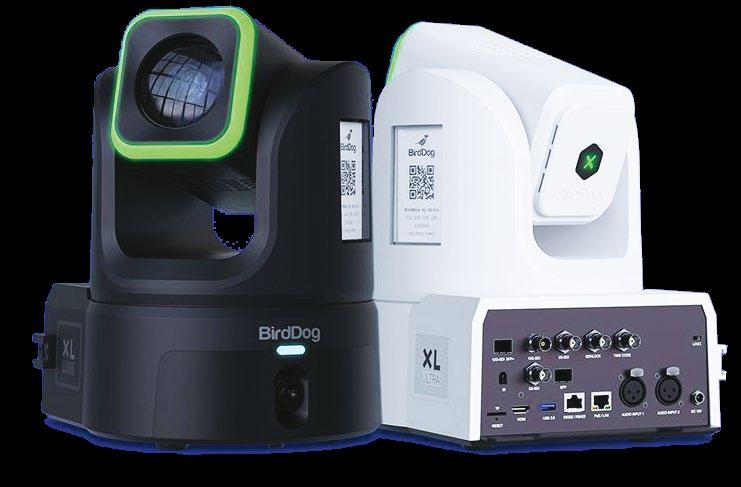
As seen at IBC 2025, the new BirdDog XL Ultra PTZ camera features a 4/3-inch CMOS sensor and a second, built-in 100° panoramic camera powered by a 1/1.8-inch sensor. Both cameras shoot in 4K60, are independently controllable, and can output at the same time. Built for professional broadcast, AV, and virtual production, the XL Ultra includes a 20x optical zoom and an AI tracking engine that BirdDog says delivers “human-like” camera motion. Full NDI support means the XL Ultra can stream in NDI High Bandwidth and NDI|HX simultaneously, allowing operators to deliver feeds to remote contributors, backup systems, or live web platforms.
Canon CRN400 and CR-N350
BirdDog XL
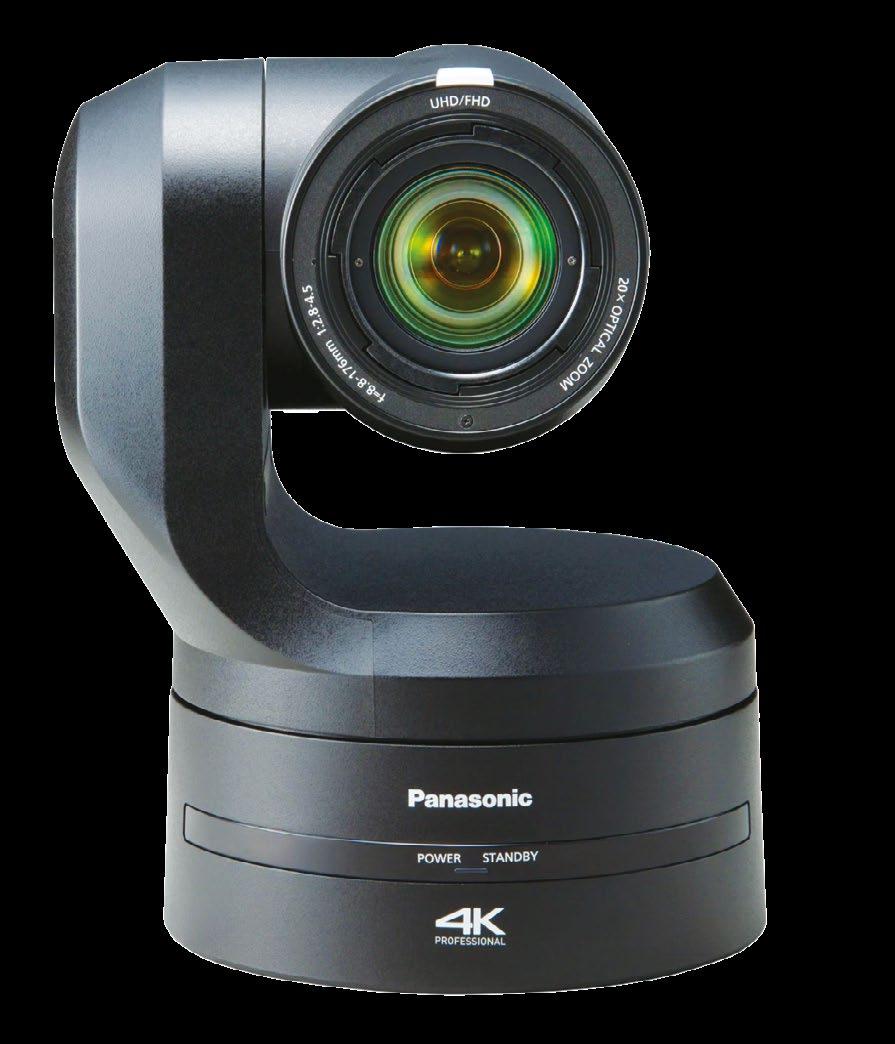
Designed for broadcast, streaming, and live events, the Panasonic AW-UE150AW/AK 4K integrated camera builds upon the functionality of 2018’s AW-UE150W/K. The new PTZ camera comes equipped with a 1-inch sensor that Panasonic claims delivers a wide dynamic range. Notable enhancements include an improved Optical Image Stabilizer with internal mechanisms to minimize image shake during pan and tilt operations, and upgraded synchronization of pan, tilt, and zoom. A built-in optical low-pass filter reduces luminance and color moiré when filming monitors or LED walls. The AW-UE150AW/AK 4K features Tally indicators in red, green, and yellow for broadcast environments, and supports NDI High Bandwidth for IP transmission.
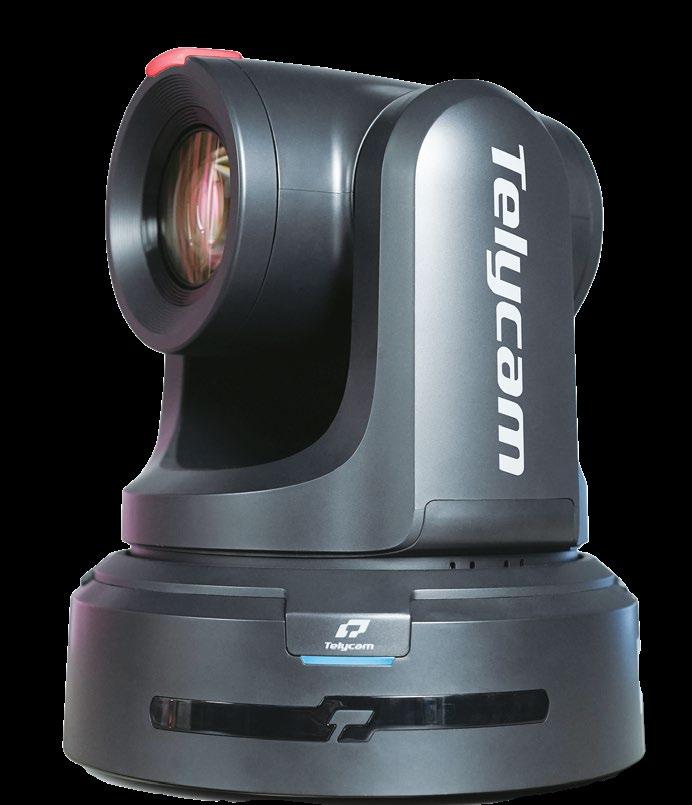
In February 2025, the Telycam Explore XE 4K PTZ camera shipped at a competitive price for a broadcast-quality camera. Featuring a 1-inch Sony sensor, 20x optical zoom, and PDAF for fast and precise auto-focus, it offers broadcast quality and features in a model optimized for pro AV connectivity and use cases. 4K video at 60 fps can be output over HDMI or NDI HX3, with 4K at 30 fps available over USB Type-C and 1080p60 over 3G-SDI. Additional key features include native AIpowered auto-tracking; a built-in variable ND filter; local recording to a microSD card; dual tally lights; and POE+ support.
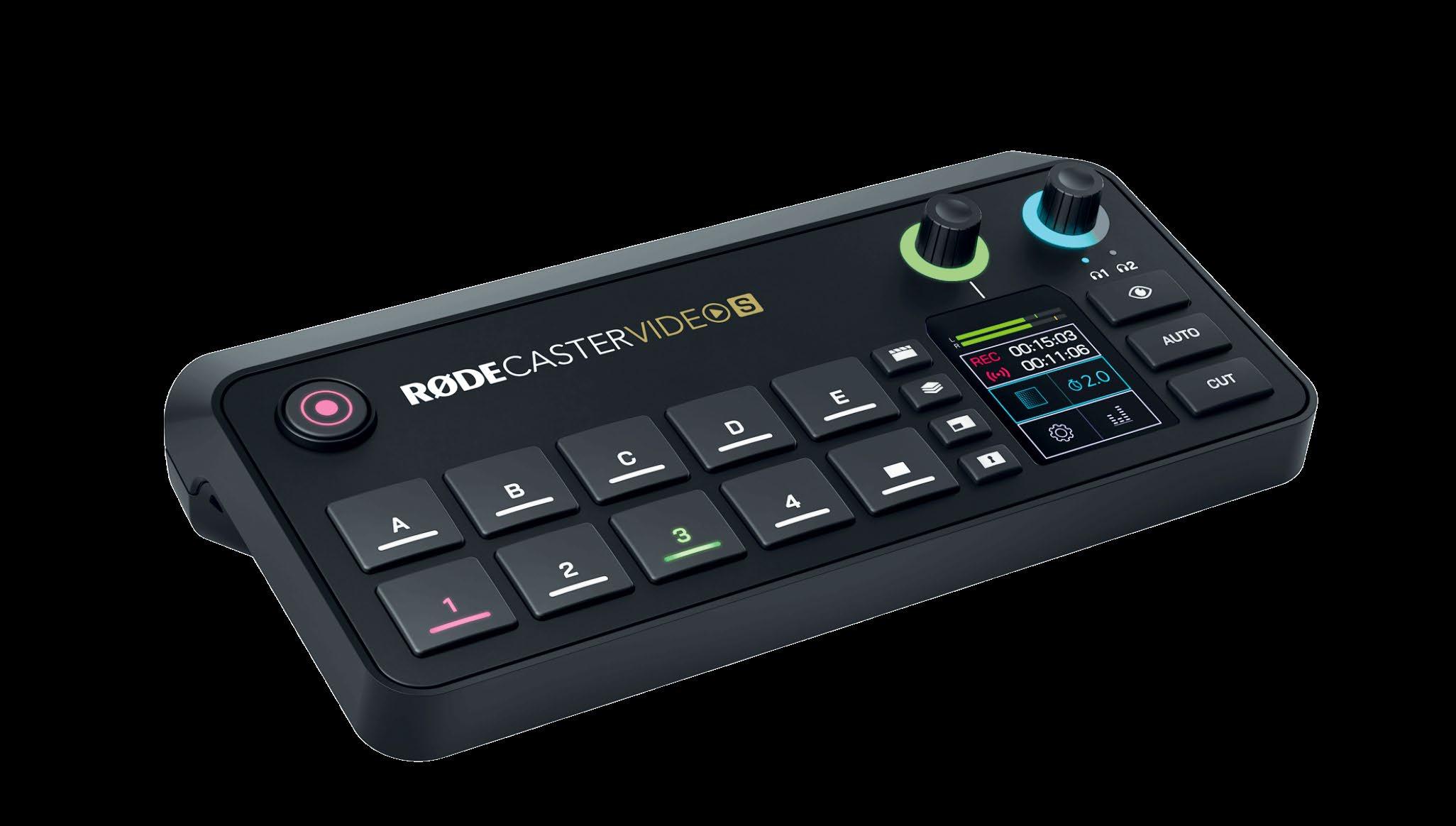
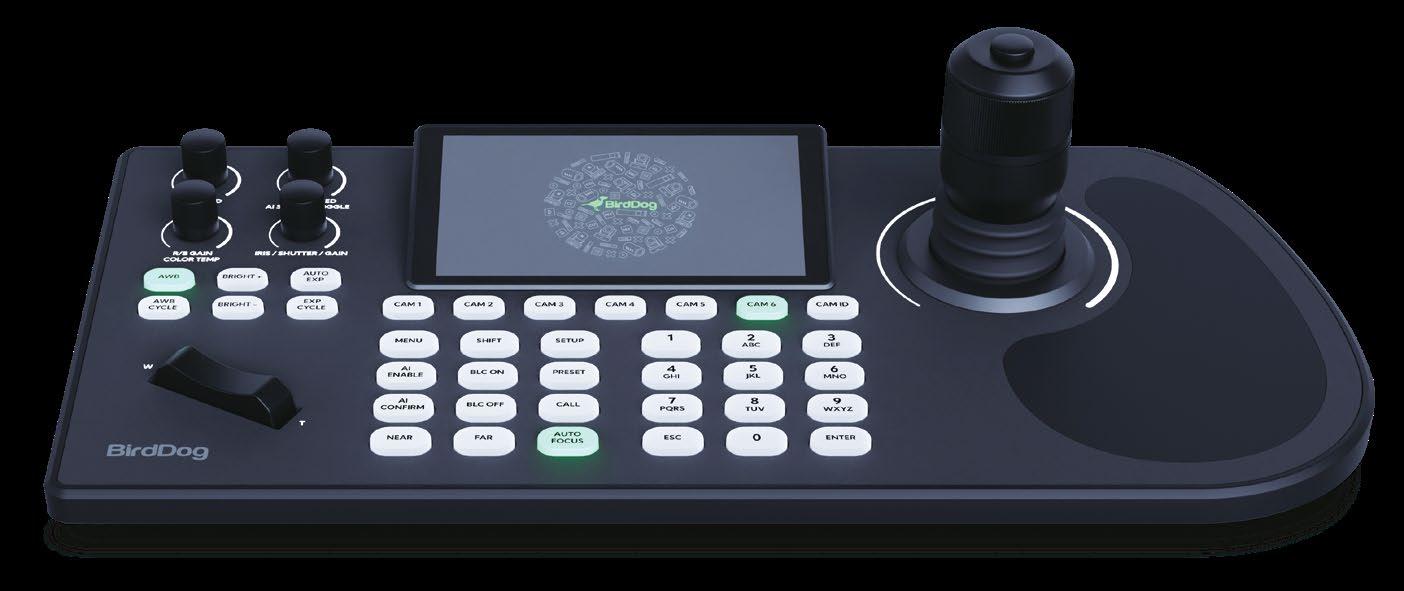
The BirdDog Technologies KBD switcher has a full-color display, offering live previews of up to four camera feeds at once, or full-screen monitoring of a single source. Super Fine Mode gives operators control over PTZ movements. An updated interface offers faster access to pairing, exposure, and protocol settings. The tactile switching dial lets operators scroll and select cameras quickly, with live tally indicators for easy visibility of on-air status. The redesigned joystick and zoom controls give feedback for long-form operation. Built-in NDI capability allows discovery and control of any NDI-enabled PTZ camera on the same network with zero configuration. It also provides native RS-232 and RS-422 support for both new and legacy environments.
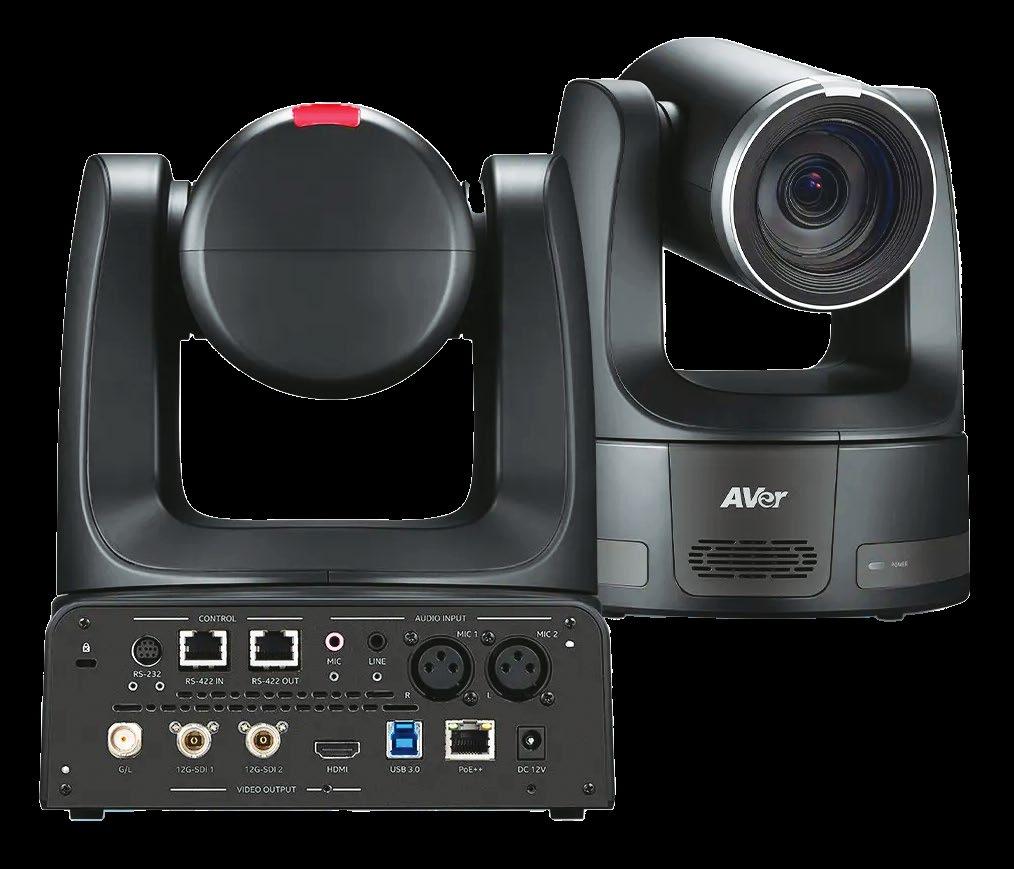
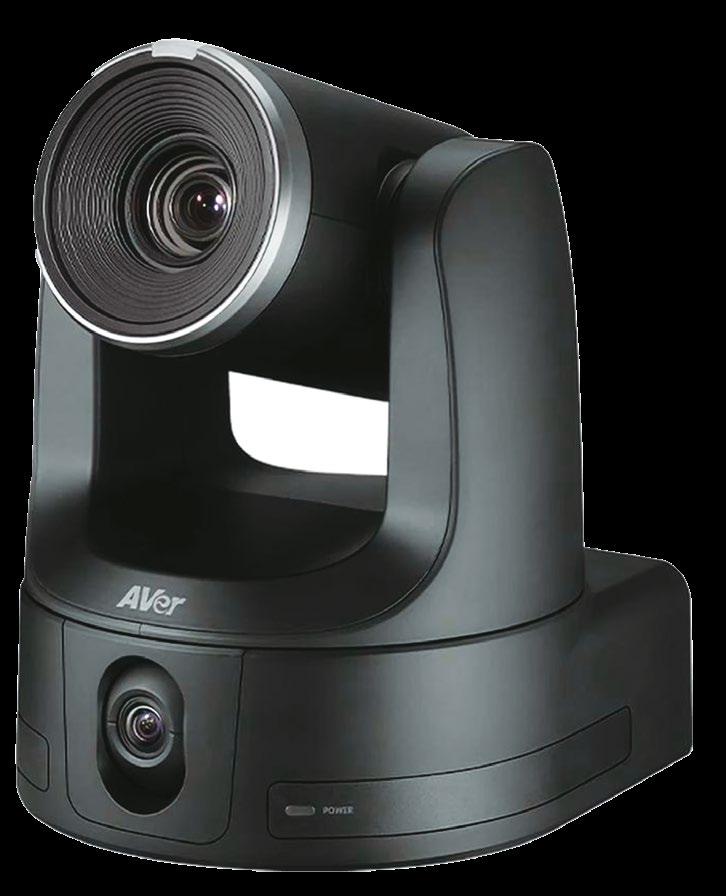
Two of AVer’s PTZ cameras have been honored with 2025 Best in Market Awards from SVC’s sister publications. The AVer TR615 4K AI Auto Tracking PTZ camera is designed for professional broadcasting, live streaming, and live event production. It features a 1-inch Sony Exmor RS CMOS sensor and AI-powered tracking technology. Built-in 19X optical zoom and 12X digital zoom positions the TR615 for applications where close-ups are paramount. Video is captured in 4K/60fps, and AI tracking options include Presenter Tracking, Zone Tracking, and Hybrid Tracking, each powered by a different algorithm to keep the desired subject in frame and focus. The TR615 supports multiple output formats, including dual 12G-SDI, HDMI, USB, and 3G-SDI, along with Genlock for multi-camera synchronization and XLR input for professional audio. Dante AV-H is supported for easy integration into AVoIP networks.
AVer TR615
Telycam
TECH SHOWCASE Routers and Switchers
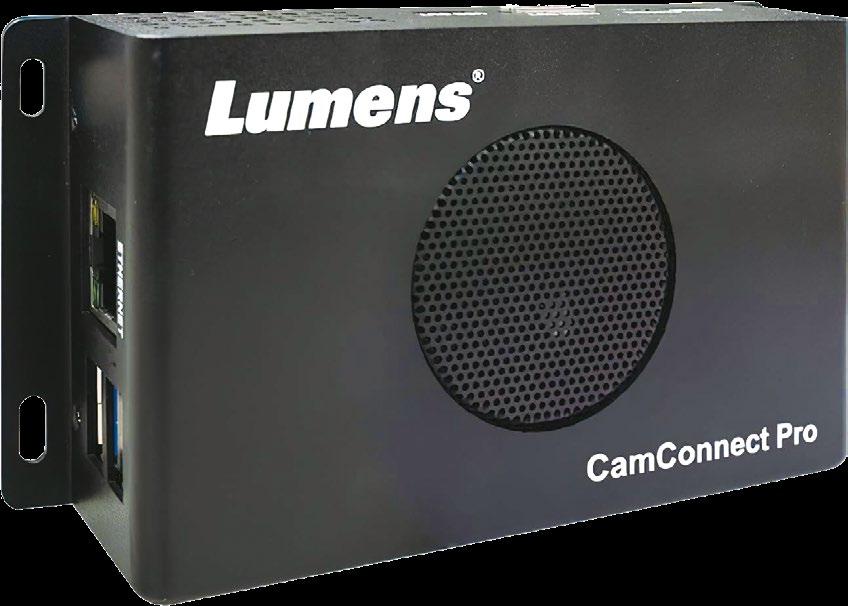
In July of 2025, Lumens launched two new partnerships with its CamConnect Pro system, allowing its voice-tracking camera technology to integrate with Sennheiser’s TeamConnect Ceiling 2 as well as Televic’s D-Cerno 2.0. These
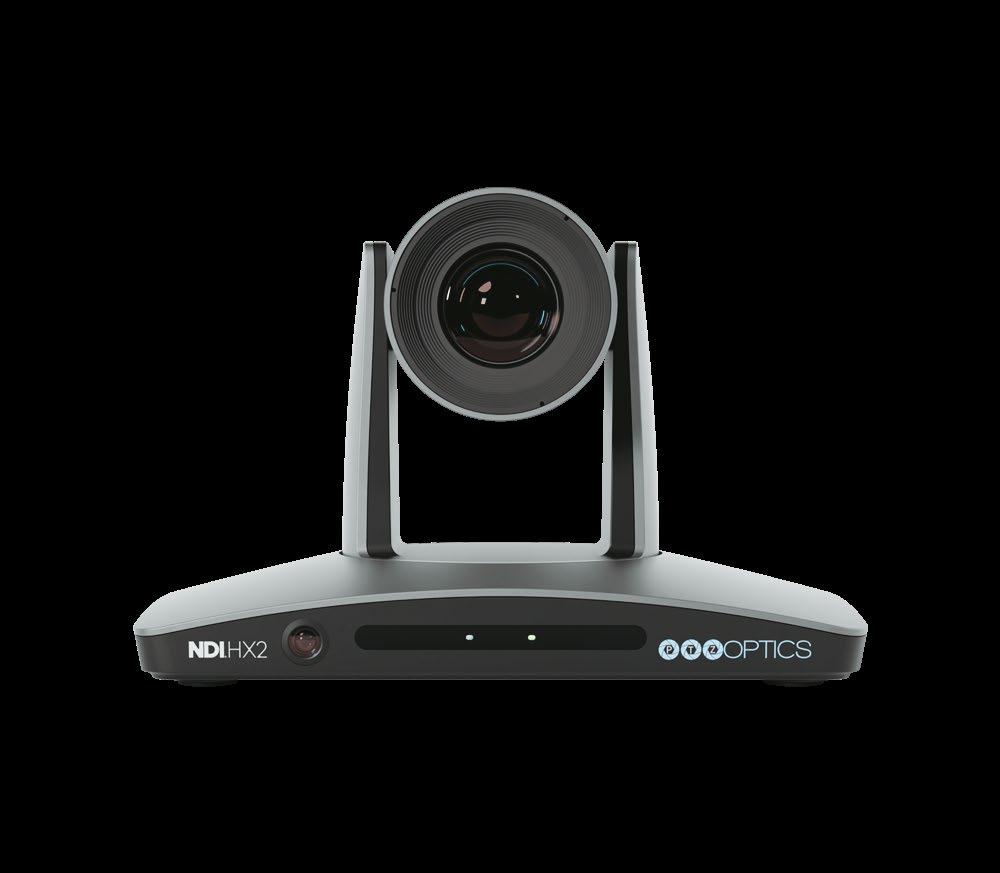
AVer TR535N is an NDI PTZ with 30X zoom capability and wideangle view. It features a dual-lens design, including a wide-angle lens and a 4K PTZ camera, to create a broad field of view while maintaining the ability to zoom in for detailed close-ups. Also taking a 2025 Best in Market win, the PTZOptics SimplTrack3 streamlines high-quality conference and lecture productions without a camera operator. It offers automatic motion tracking up to 55ft, 20X zoom in 1080p at 60fps, 270° rotation, and a 59.5° field of view. Connectivity is simplified through USB 3.0 and Power over Ethernet (PoE), allowing a dual-sensor camera to be powered with a single Ethernet cable. With auto-tracking and auto-framing, SimplTrack3 switches between tracking individuals and framing groups, ideal for conferences, stage productions, and classrooms. Its smart technology focuses on the subject, ignoring distractions, with easy toggling and manual PTZ control options.
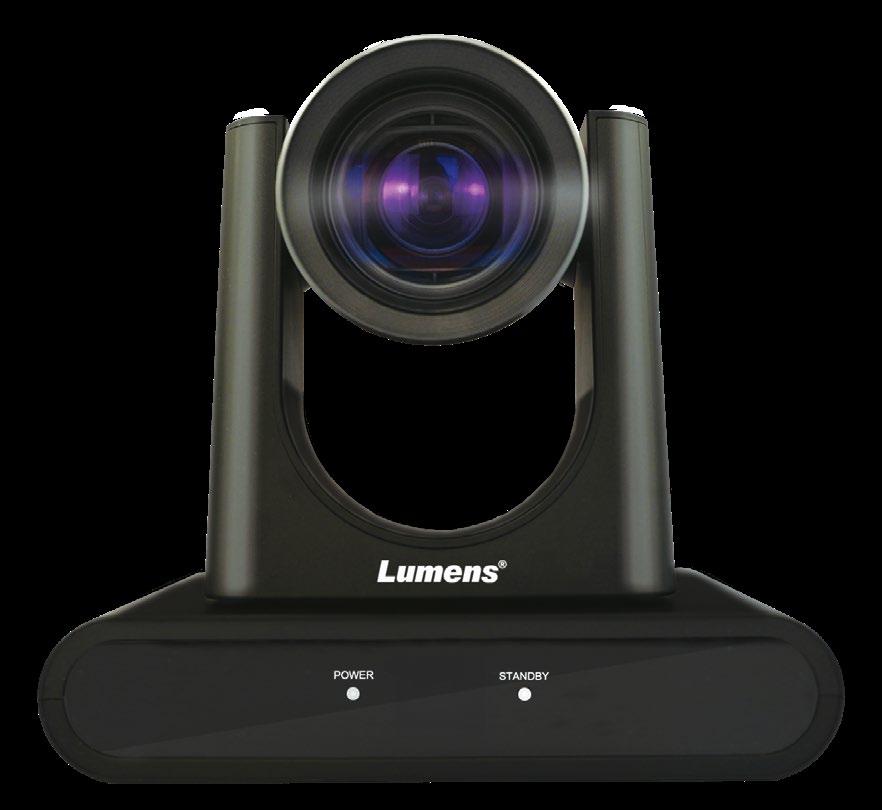
Equipped with a professional 1/2.8 inch image sensor, the Lumens VC-R31 HD is designed to handle all lighting conditions with a sharp lens, intelligent white balance, and autoexposure mode. The camera is designed to handle skin tones, high contrast, low contrast, and mixed lighting conditions, especially in video conference settings. Based around a Sony sensor, VC-R31 is a 12x zoom camera with simultaneous HDMI, USB, and IP outputs. It can stream secure, low-latency video to local networks and global streaming services, including lecture capture systems. The camera is compatible with Lumens’ CamConnect Pro voice tracking system, making it ideal for automated multi-camera meeting rooms and video studios. The unit can be powered using the supplied adapter, or via PoE. Its 72.5° maximum horizontal field of view makes it suitable for installation in small spaces requiring a wide-angle lens or in larger event spaces where the camera’s 12x zoom enables it to tightly frame an individual at a distance of 12 meters (40 feet) or more.
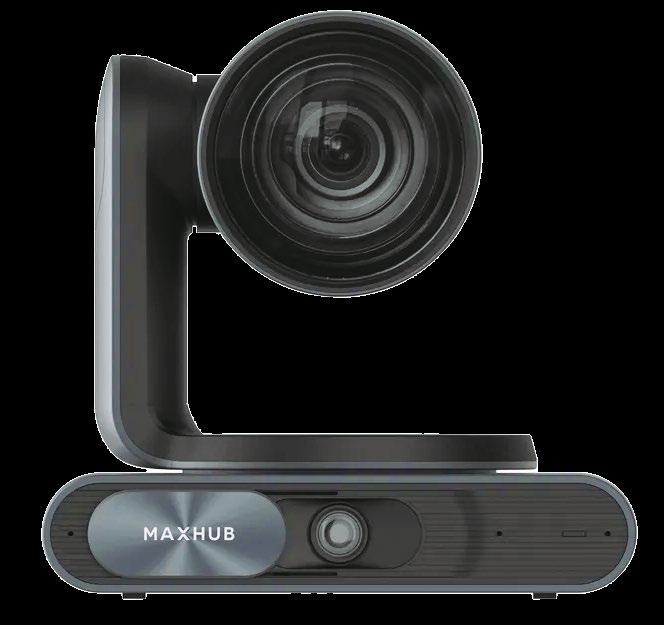
The MAXHUB UC P30 Dual-Eye Tracking camera is certified for Microsoft Teams. With its dual-eye 4K 8.42M pixel camera design, the panoramic camera detects every movement in the meeting room, supported with AI framing and tracking, and 4K video streaming. The UC P30 is equipped with a 12x optical zoom coupled with a 90-degree Field of View (FOV) secondary camera for tracking. This configuration provides clear image quality for every participant—even when zoomed in. The UC P30 supports Manual Pan of up to ± 170 degrees and Tilt of up to +- 90 degrees and provides an LED indicator to inform participants that the camera is in use. The system also includes an electric privacy cover. The camera has USB 2.0 and 3.0 ports, coupled with HDMI, RJ45, and RS232 connectivity, plus PoE and an integrated mounting kit for various configurations, including ceiling mount.
VC-R31 HD
UC P30
TECH SHOWCASE Routers and Switchers
PTZOptics Hive is now available and compatible across much of the PTZOptics range. It’s a unified software platform that merges camera control with real-time recording. The platform comes with a suite of framing tools, as well as remote control with sub-300ms of latency. Users can organize and save an unlimited number of presets, which can be sorted by category or shot type for quick access. Hive supports RTMP streaming, individual local input and output/stream recording, and NDI Outputs for IP transmission. Hive allows users to control and color-correct the feeds from multiple sources, then output up to 4K at 60fps via NDI to systems like vMix or OBS for local camera switching.
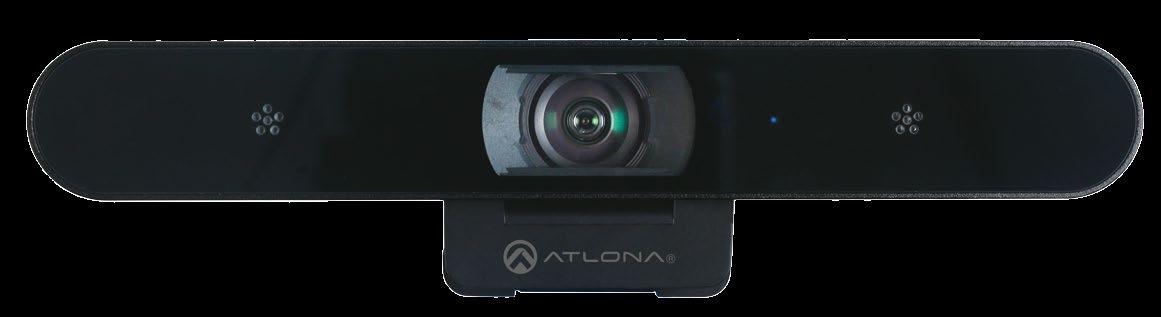
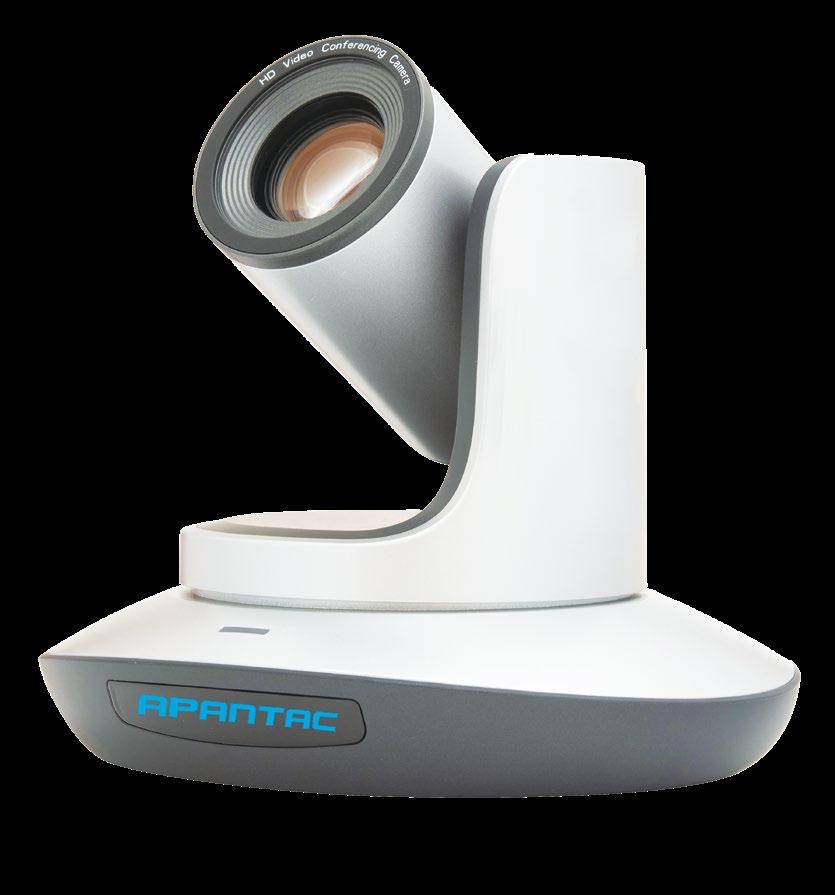
camera designed for use in video conferencing, distance learning, huddle rooms, and small to medium-sized meeting spaces. Universal PC and Mac compatibility through standard UVC 1.1 drivers enables simple, plug-and-play operation with popular soft codec conferencing and UC platforms. The camera’s USB interface provides video and audio connectivity as well as power to the device. The 12.8” CMOS camera delivers resolutions up to 4K at 30 Hz, with a 110° wide horizontal field of view and a 4X digital zoom; a dual-element microphone array provides a 16foot audio pickup range. Autoframing for up to six participants is supported, as is manual positioning. Designed to capture video up to 1080p and provide 3G SDI, HDMI, USB 3.0, and HD video over IP, the Apantac AP-1080P-PTZ-20x MT HOOD NDI incorporates the NDI HX protocol into its capabilities. This technology allows video and audio sources to be shared bidirectionally across a network. The camera supports NDI|HX, USB, IP, HDMI, and SDI outputs. Control options include standard IP VISCA, serial, TCP/IP, and Pelco-P/D control protocol.
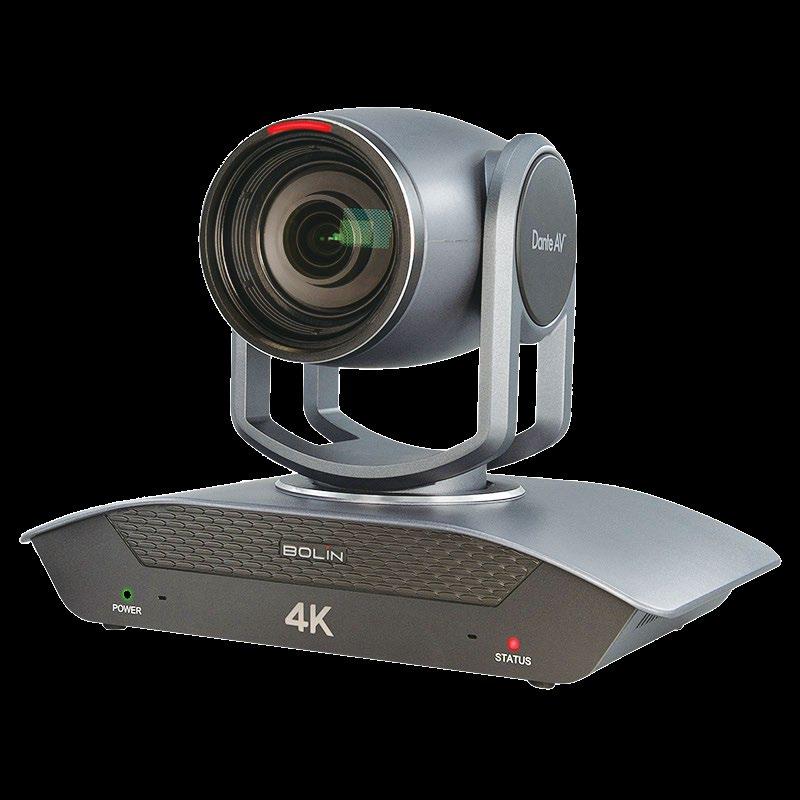
cameras offer simultaneous hardware and software codec streaming to multiple endpoints, providing total flexibility in network bandwidth and image quality selection.
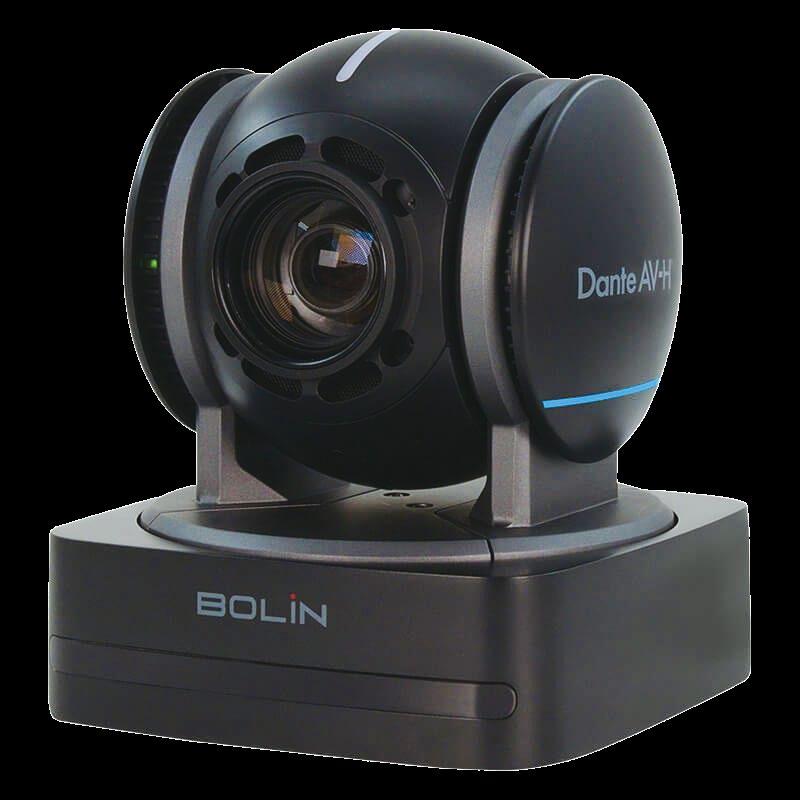
Using either the new D412UH (4K) or D220UH (HD) cameras, the user can designate a Dante AV Ultra or Dante AV-H stream depending on the output locations. The company also offers the Bolin D2-210H and 220H AV-H cameras based on the software implementation of Dante AV-H.264. Bolin puts equal attention to NDI, and supports it across its product line, bringing support for the latest NDI 6 to its indoor and outdoor PTZ cameras, the KBD-1020D PTZ controller, and ED40N decoder. NDI 6 embeds WAN connectivity into Bolin’s product line, bringing greater flexibility to remote production applications and setups. Additionally, Bolin PTZ cameras offering NDI HX3 support include the company’s N2-210X, N2-220X, N6-420X, N7-220X, R9230NX, and EXU-230NX.
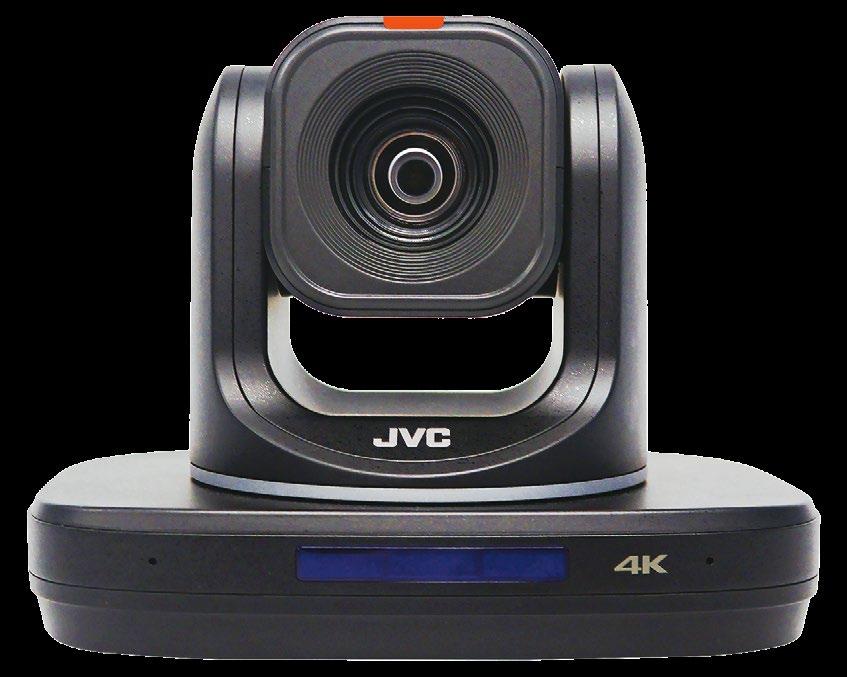
JVC KY-PZ510 Series CONNECTED CAM PTZ has NDIenabled options and serves for challenging capture situations with a super-wide horizontal angle of view (80 degrees) and focal length of 21.8 to 261.8 millimeters. Included are AI-enabled advanced SMART auto-tracking operations.
Atlona Captivate ATCAP-FC110
Bolin D220UH
JVC KY-PZ510 Series
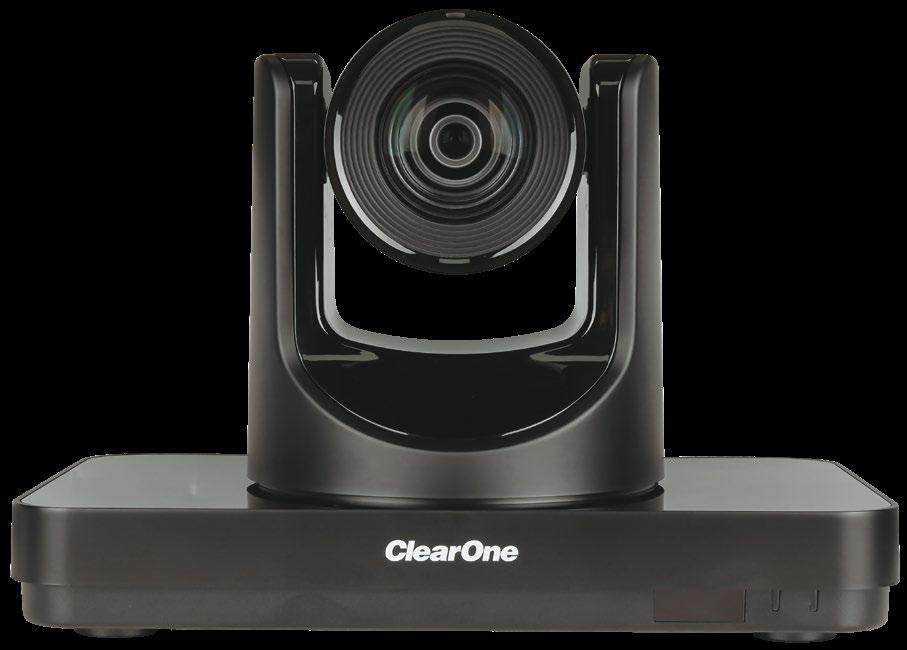
The ClearOne UNITE 260 Pro 4K Ultra HD camera features both a 20X optical zoom and 16X digital zoom. The camera features an AI-based smart face-tracking mode that keeps a selected presenter in the frame as they move about the room. With dual video outputs HDMI and IP, the camera supports a hybrid environment: streaming content while simultaneously showing it live where the presentation is occurring. Camera functions can be controlled by USB, Ethernet, RS-485, and RS-232.
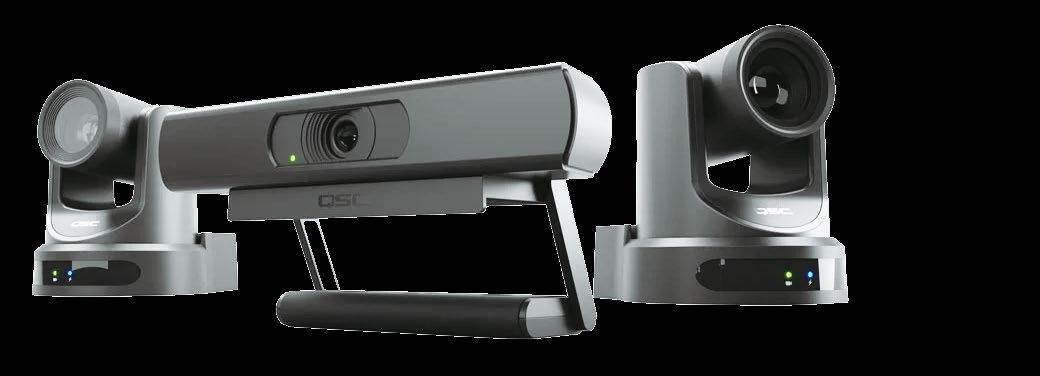
The QSC NC Series includes three models. The Q-SYS NC-110 is the first fixed-lens, ePTZ camera available from Q-SYS, featuring a 110° horizontal field of view (hFOV) with digital zoom capabilities for smaller, wider rooms. The Q-SYS NC-12x80 (12x optical zoom, 80° horizontal FOV) and Q-SYS NC-20x60 (20x optical zoom, 60° horizontal FOV) both offer motorized pan, tilt, and zoom (PTZ) functionality to enable a broader range of room layouts, sizes, and purposes. In addition, all NC Series cameras include hardware to allow mounting above or below displays. As native Q-SYS devices, options open up for routing and delivery, including simplifying streaming to standard IT
with Q-SYS Core Nano or Q-SYS Core 8 Flex to expand software-based audio, video & control into smaller collaboration spaces.
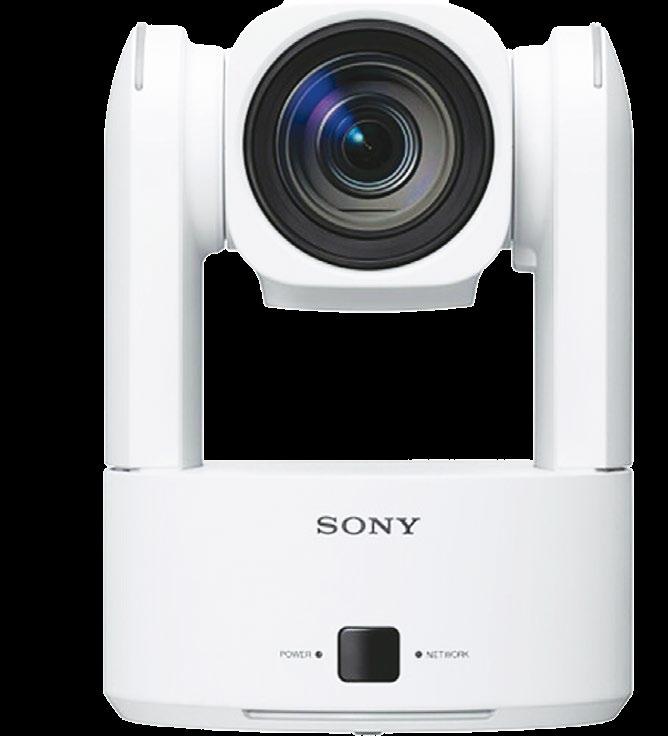
Sony Electronics has released a flagship 4K 60p pan-tilt-zoom (PTZ) camera model with an integrated lens, the Sony BRC-AM7. Incorporating PTZ Auto Framing technology, which uses artificial intelligence (AI) technology for advanced recognition, the camera facilitates accurate and natural automatic tracking of moving subjects. These innovations enable simplified high-quality video production for broadcast, live event, and sports productions.
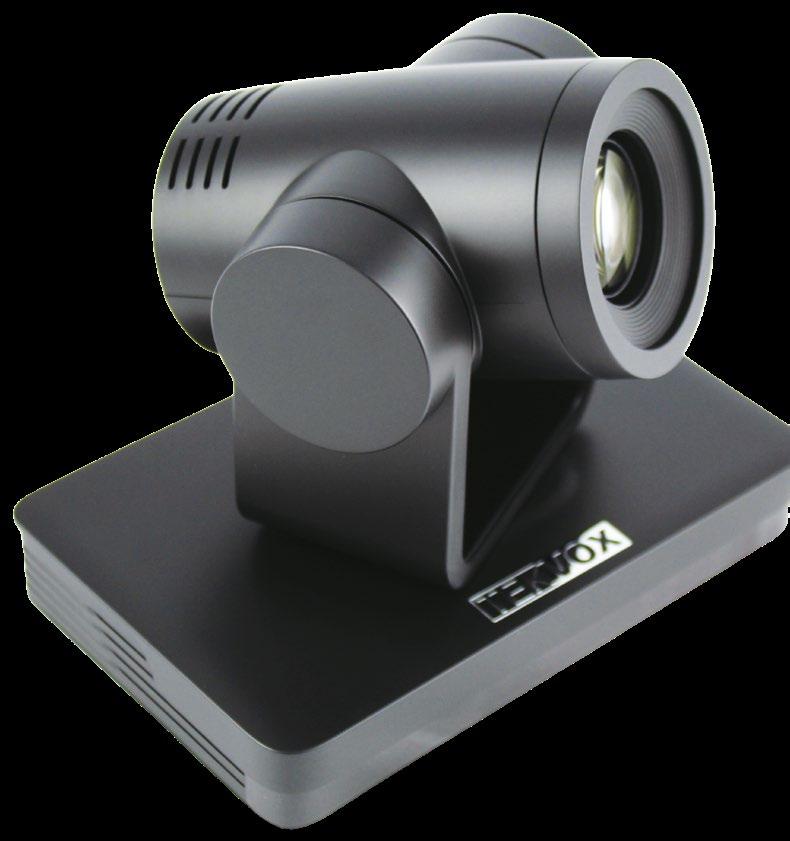
The TEKVOX UV570 PTZ auto-tracking camera features 20x optical zoom, supports PoE, and requires no on-site configuration. This nextgeneration auto-tracking camera is the perfect option for educational environments, boardrooms, and lecture halls – any HyFlex, streaming, or video-conferencing application that requires a camera to follow a presenter. With support for full HD (1080p @ 60Hz) resolution, its AI-driven auto-tracking algorithm keeps presenters in view at all times without needing any on-site configuration or calibration.
The system also includes a built-in gravity sensor to auto-adjust and re-orient the image when the camera is mounted upside-down on the ceiling.
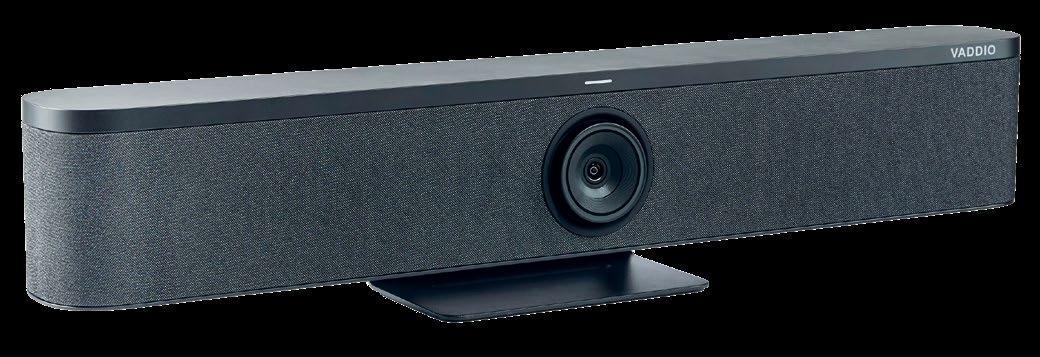
The Vaddio Venture VideoBAR is all-in-one 4K video conferencing with both manual PTZ and ePTZ control and tracking, up to 5X digital zoom with 110° horizontal field of view. It offers three modes: Speaker Framing, Participant Framing, and SmartGallery. The camera can focus on and frame a single presenter in the space, utilizing the 6-element beamforming microphone array to precisely pinpoint the speaker’s position. It can also accurately frame a group of coworkers. Additionally, the articulating camera lens with dual motors provides smooth pan and tilt adjustments of up to ±15°, enabling the camera to frame the action in the room without relying on ePTZ cropping abilities. Simultaneous outputs provide 4K signals from HDMI and USB 3.0, and full HD signals via IP streaming..
Vaddio Venture VideoBAR
Sony BRC-AM7
QSC NC Series
TEKVOX
Routers and Switchers
What was once a choice between analog composite, component, and VGA has become the United Nations of digital signal formats, all requiring flawless translation and sorting from source to destination. Requirements of routing and switching devices have grown exponentially along the way, and they have had to become very smart machines. As shown here, modern manufacturers
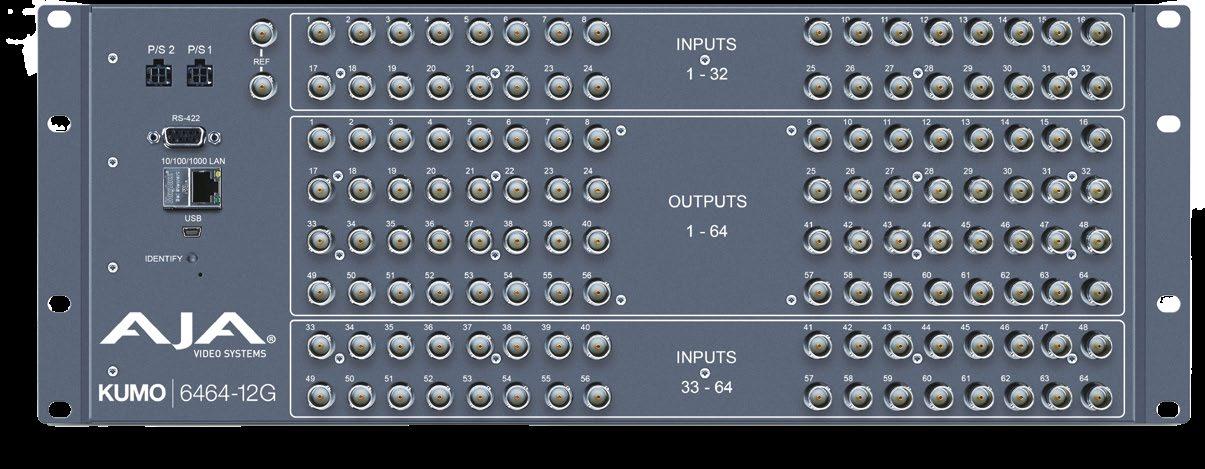
LILES
Contributing Editor
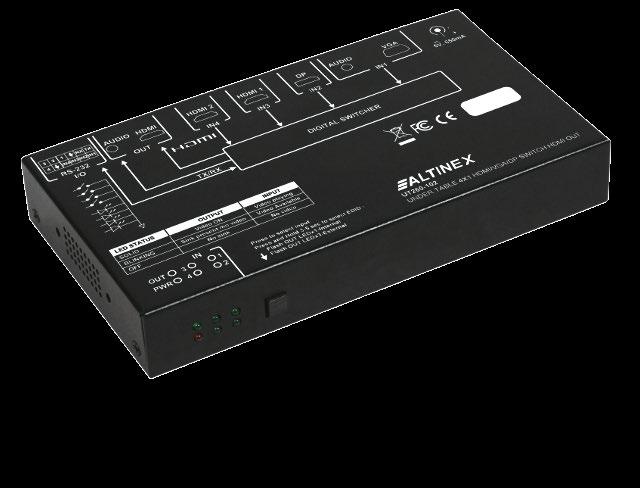
with creativity and innovation. Expanding the capabilities of the KUMO 6464 while maintaining a compact 4RU AJA Video Systems KUMO 6464-12G provides ganged dual and quad port routing control for higher HD signals up to 8K/UltraHD2. Features include eight salvos per router, twenty presets, an embedded web server, and support for external control by as many as 32 AJA control panels. can switch among HDMI, VGA, and Display Port in auto-switch mode or by remote contact closure and RS-232. Its HDMI output also provides deembedded analog sound. The most recent source input can be automatically switched to the output, a feature especially useful in classroom environments. LED driver connections allow remote input indication, and the RS-232 interface can also be used for configuration.
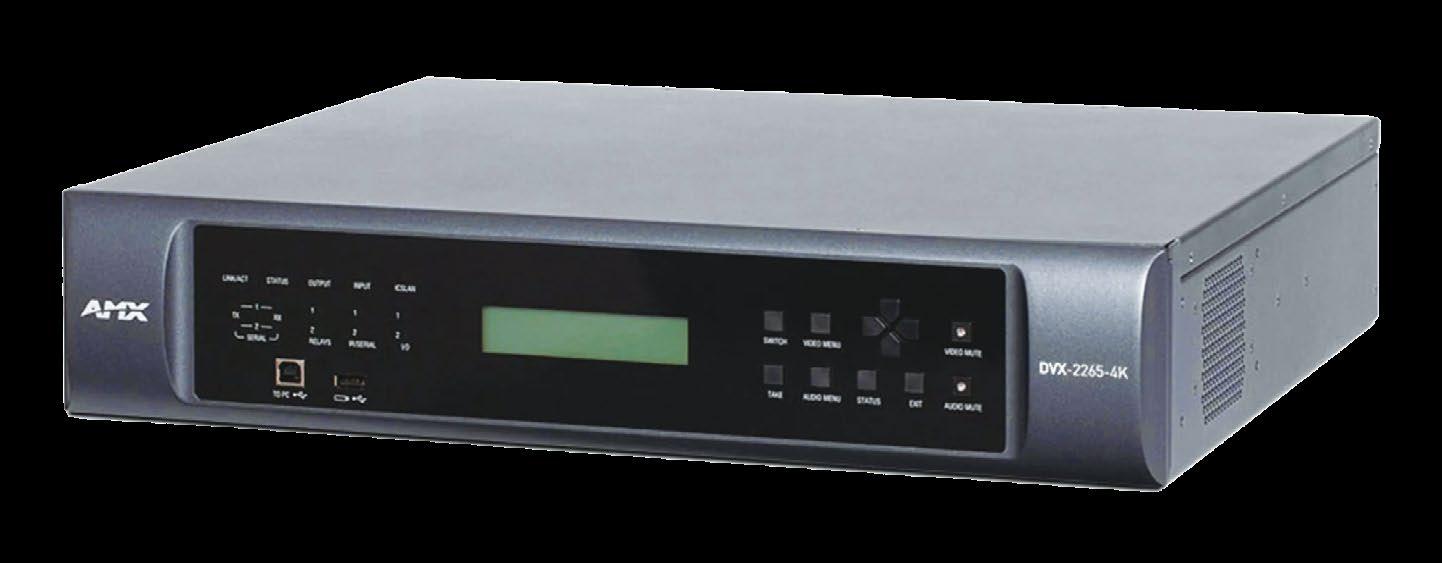
A 120-watt Crown DriveCore amplifier, audio processing, and feedback suppression are featured in the AMX DVX-2265-4K presentation switcher. The IN/OUT audio interface includes Dante and analog, while DXLink provides compatibility with other AMX units and standard HDBaseT devices. Outboard control capability extends to the HTML5 Web Interface with built-in status and troubleshooting features.
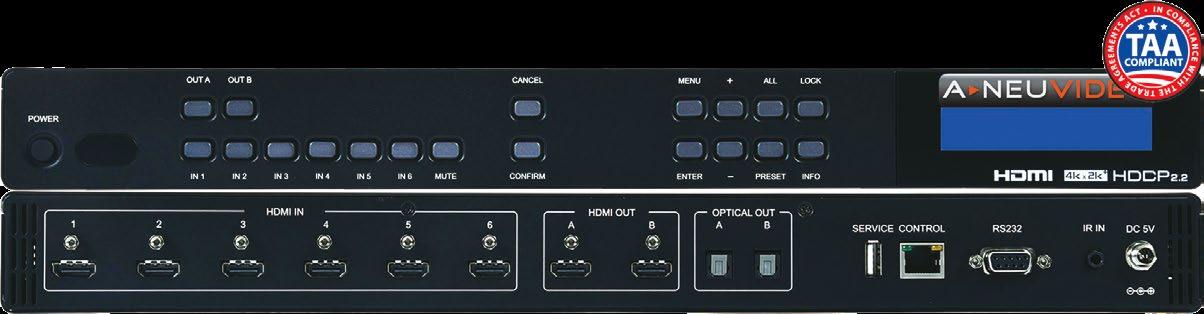
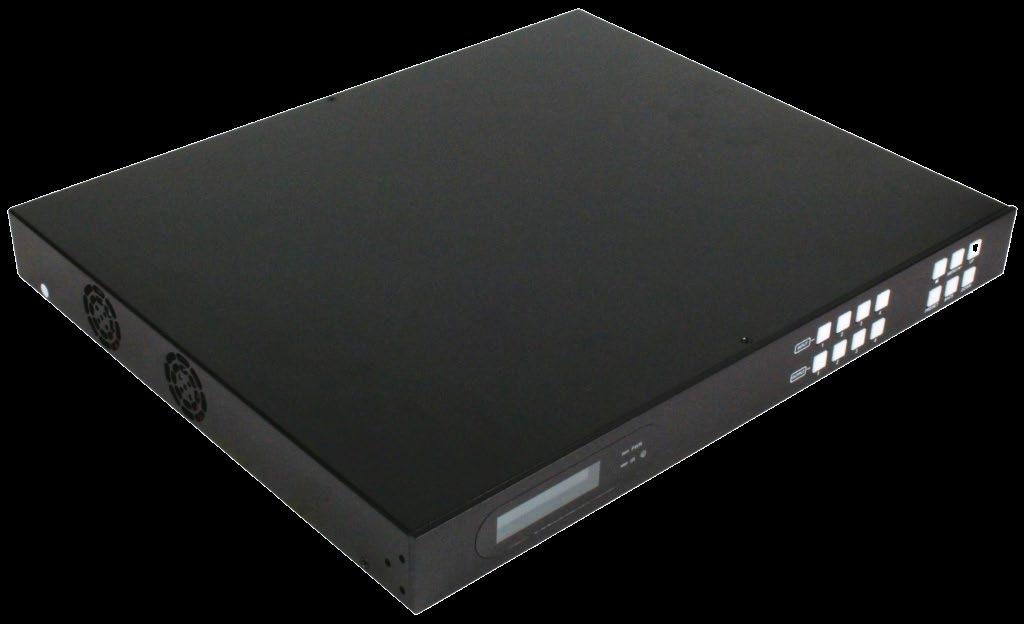
The A-Neuvideo ANI-62HDRH matrix switcher and scaler can freely show a range of six input sources on two 4K UHD HDMI displays, and de-embed HDMI sound to optical digital audio. Handling video resolutions up to 4K/60 (4:4:4, 8-bit), the switcher exhibits high-level EDID capability and simplifies operation with six configurable presets. Operational modes include front panel controls with associated LCD, RS-232, Telnet, WebGUI, and IR remote.
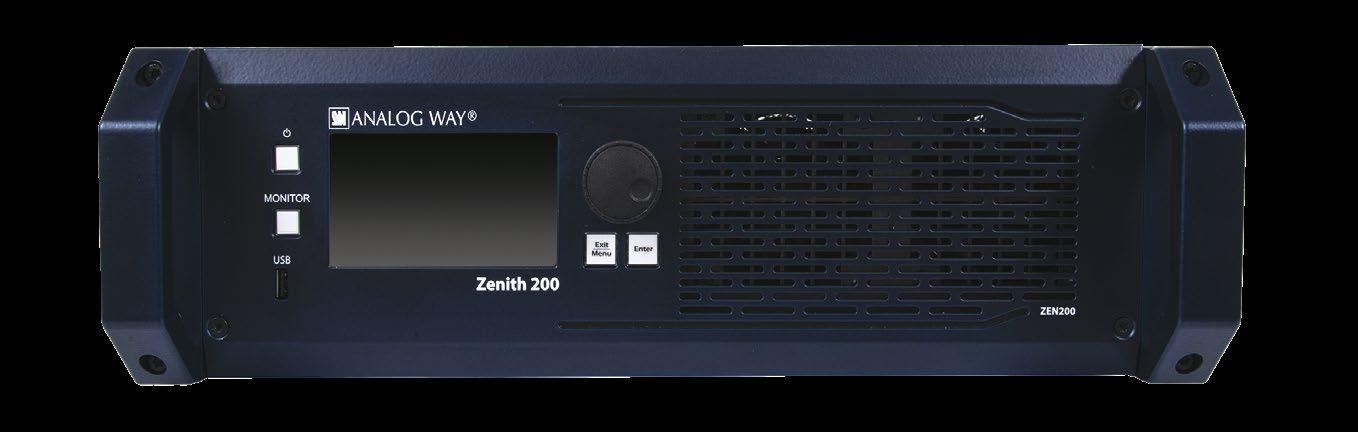
Multi-screen presentations pose a challenge for the most seasoned lecturers, but the Analog Way Zenith 200 4K60 presentation switcher and videowall processor can make it look easy. With 16 inputs and 6 outputs, the 2RU unit offers sophisticated video effects and an HTML5-based user interface. This device can mix and split layers while putting a live or still image background on all PGM outputs.
Routers and Switchers TECH SHOWCASE
Equally at home in a single rack space or on a shelf, the Apantac Mt Hood HDM2.0-8x8-UHD-A matrix switcher with audio breakout handles resolutions up to UHD@60Hz (4:4:4) and offers four presets. There is an LCD module on the front panel for control, but in addition, there is a LAN port and RS-232 serial control capability. On the back are stereo and optical audio breakout ports.
Functionally sophisticated for commercial use yet operationally straightforward to suit high-end home theater, the Aurora Multimedia ASP-882S 8x8 4K60 HDMI matrix switcher de-embeds digital and analog audio on each output. It also offers more output flexibility with 4K-to-1080p downscaling and ARC audio from the connected displays. Control capability includes front panel OLED screen and IR remote along with RS-232, LAN, and Web GUI.
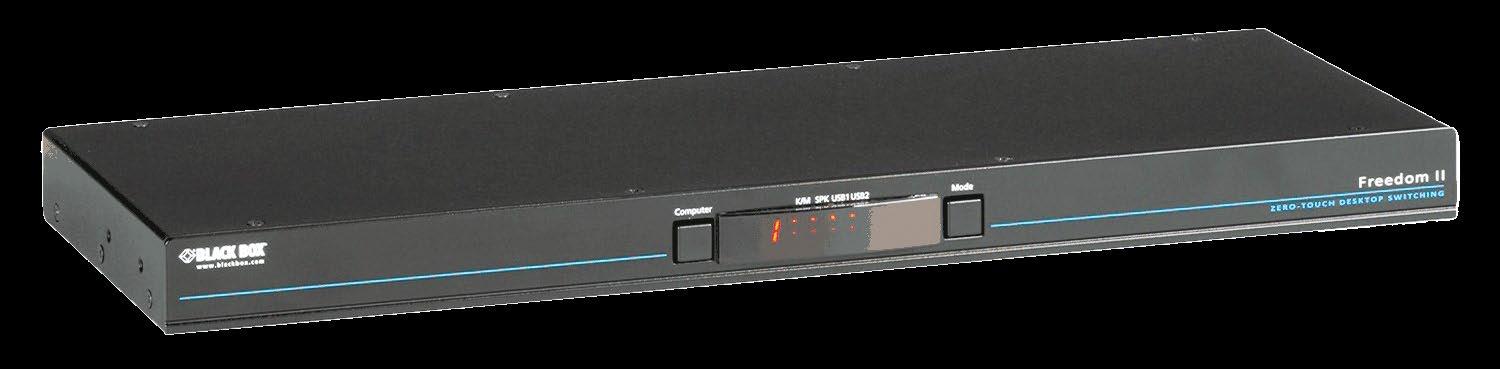
In response to increased demand in multimonitor environments, the Black Box Freedom II KM switches allow an operator to Glide-andSwitch, sweeping the mouse across as many as eight displays to select a function on any of them. While keeping simultaneous access to all AV sources, peripherals can be seamlessly shared, and files cut and pasted between all displayed devices.
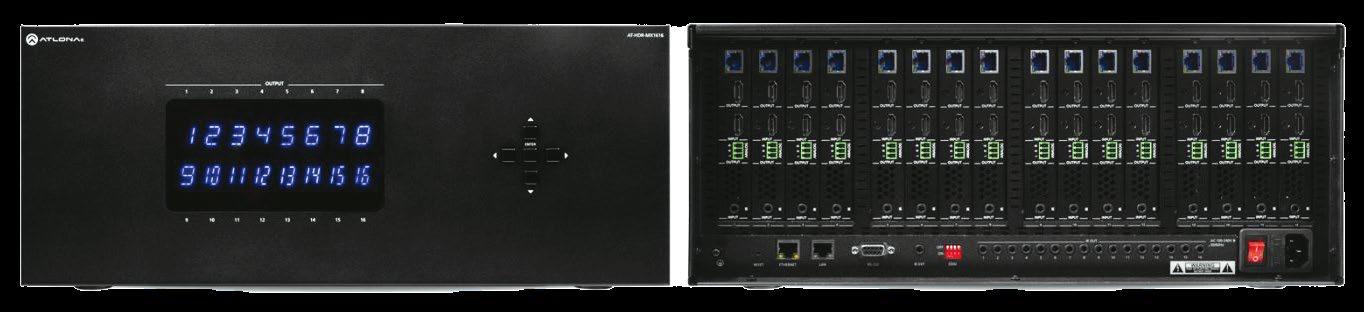
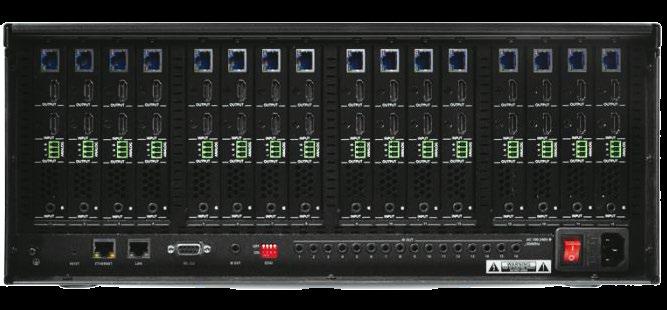
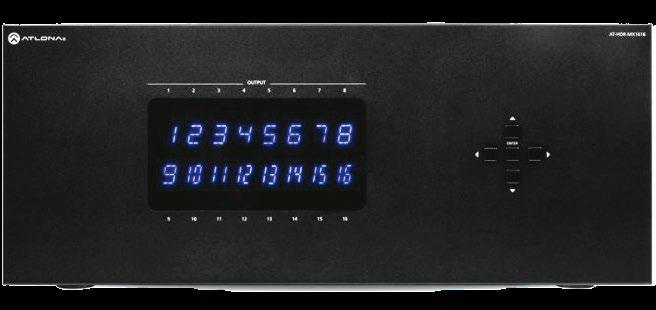
For versatility in switching long range signals, the Atlona AT-HDR-MX1616 HDR HDBaseT matrix switcher supports a mirrored HDMI output for each HDBaseT output. Through the power of HDBaseT, there is substantial extension of not only video and sound but Ethernet, control signals, and power for distances up to 330ft. At the same time, de-embedded audio is sent to unbalanced stereo analog outputs.
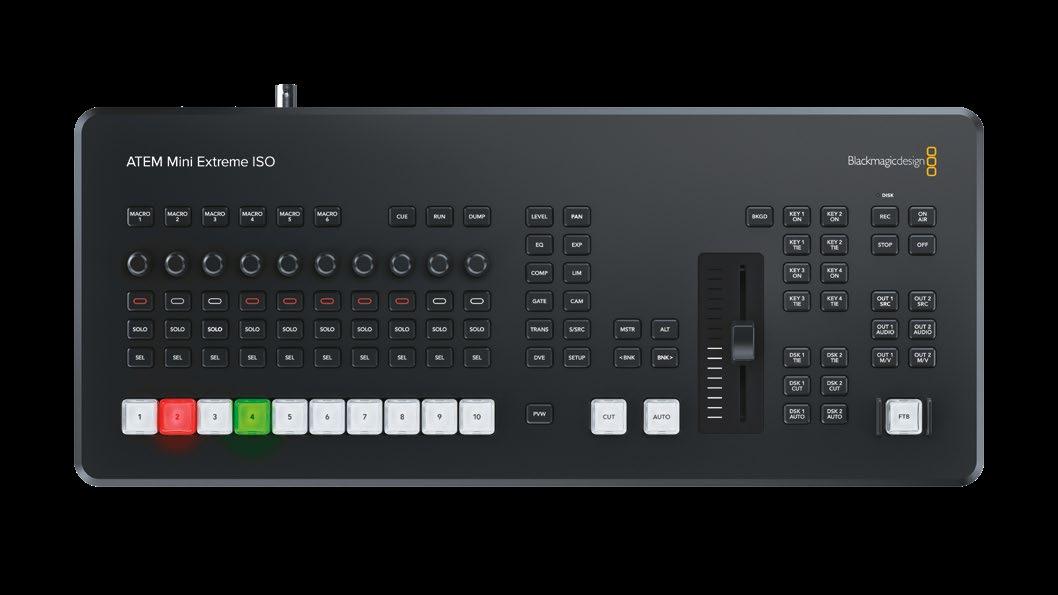
The Blackmagic Design ATEM Mini Extreme ISO G2 is a production switcher that packs maximum function into minimum control surface real estate. Directly connectable to rack gear or by Ethernet network, this switcher features eight standards converted HDMI inputs that can be routed to any of three HDMI outputs. There is also an integral streaming engine. Despite the unit’s small size there are also XLR audio inputs.
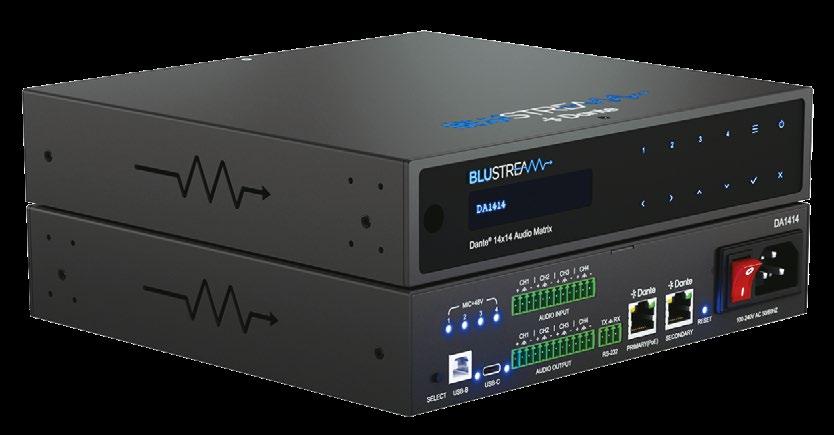
Video signals have no monopoly on the matrix switching market, and the Bluestream DA1414 audio matrix applies 8-band parametric equalizing, volume control, Dante/AES67 support, analog sound, and USB. There is even phantom power on mic and line level inputs. Power includes PoE+ on the primary LAN connection, and the system can be operated from the front panel, RS232, TCP/IP, and WebGUI.
Apantac HDM2-0-8x8UHD-A
Aurora ASP-882S
Black Box Freedom II
Bluestream DA1414
Blackmagic ATEM Mini Extreme ISO G2
TECH SHOWCASE Routers and Switchers
At NAB and InfoComm 2025, the Evertz Fiber X-LINK debuted as the latest expansion of the NEXX processing and routing line, a massive 12G-SDI solution for live events, stadia, and other large-scale applications that Evertz also envisions as a building block to future ST 2110 workflows. By connecting three powerful NEXX routers together, users can create a single 960x960 IO unit, which Evertz claims as the largest 12G-SDI router the industry has ever seen. As with its predecessor X-LINK, users can link routers together or connect to external devices without affecting IO.
The Extron DTP3 IN2004 Series of scaling switchers unites routing, signal translation, and extension in a single chassis unit. The DTP extension runs video, sound, and control up to 330ft. on CAT 6A to a variety of DTP endpoint units. Among the formats carried are 4K/60 @ 4:4:4, HDCP 2.3, and HDR video. High-end scaling and audio embedding/ de-embedding are featured along with mirrored DTP and HDMI outputs.
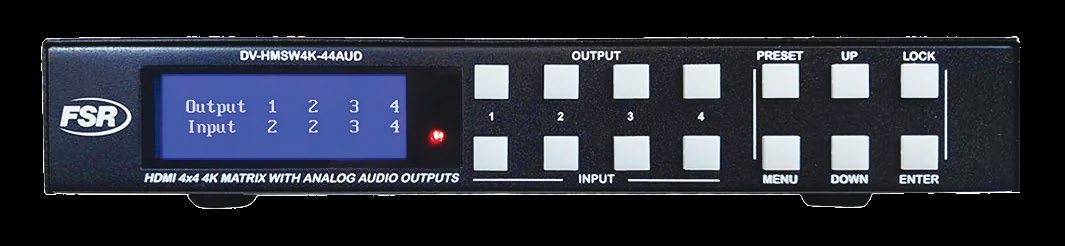
One way to get multi-function matrix switching into a tight space is the FSR DV-HMSW4K-44AUD,
FSR DVHMSW4k44AUD
and this 4x4 HDMI switcher features coaxial digital audio as well as analog audio outputs. There is also a 4K to 1080p downscaling function that provides simultaneous 4K and 1080p displays. At home on the desktop or wall-mounted with supplied mounting ears, the unit is controlled through front panel buttons, IR, RS-232, and TCP/IP.
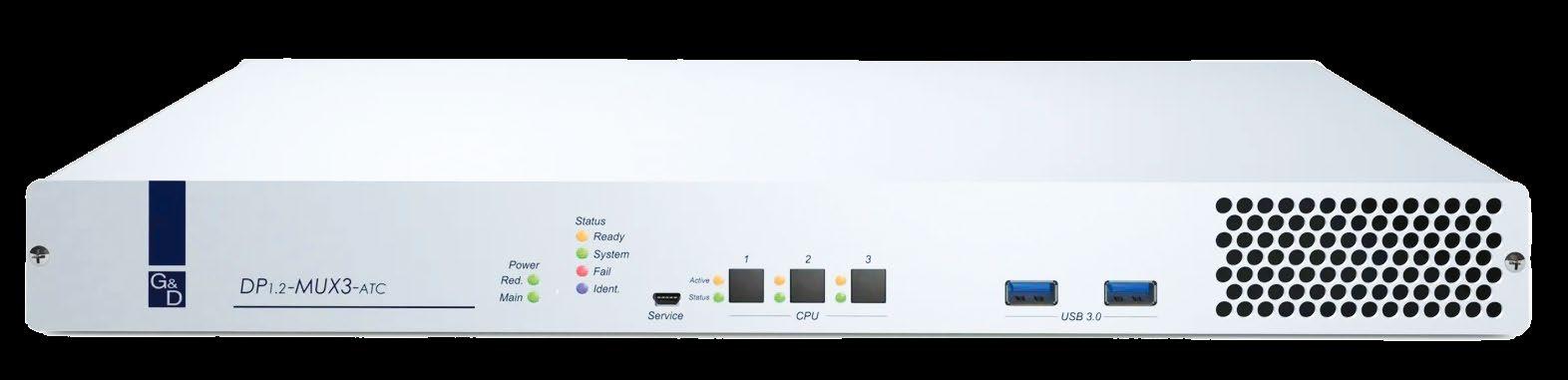
Operating three computers from a single console via DisplayPort1.2 is the G&D DP1.2-MUX3ATC KVM switch. The operator may use the front panel buttons, custom configurable key combinations, the integrated EasyControl tool, XML remote control, or a serial control unit connected to the RS-232 port. Switching includes unidirectional embedded audio, and the unit has redundant internal power packs.
GTB-
HD4K2K-848BLK
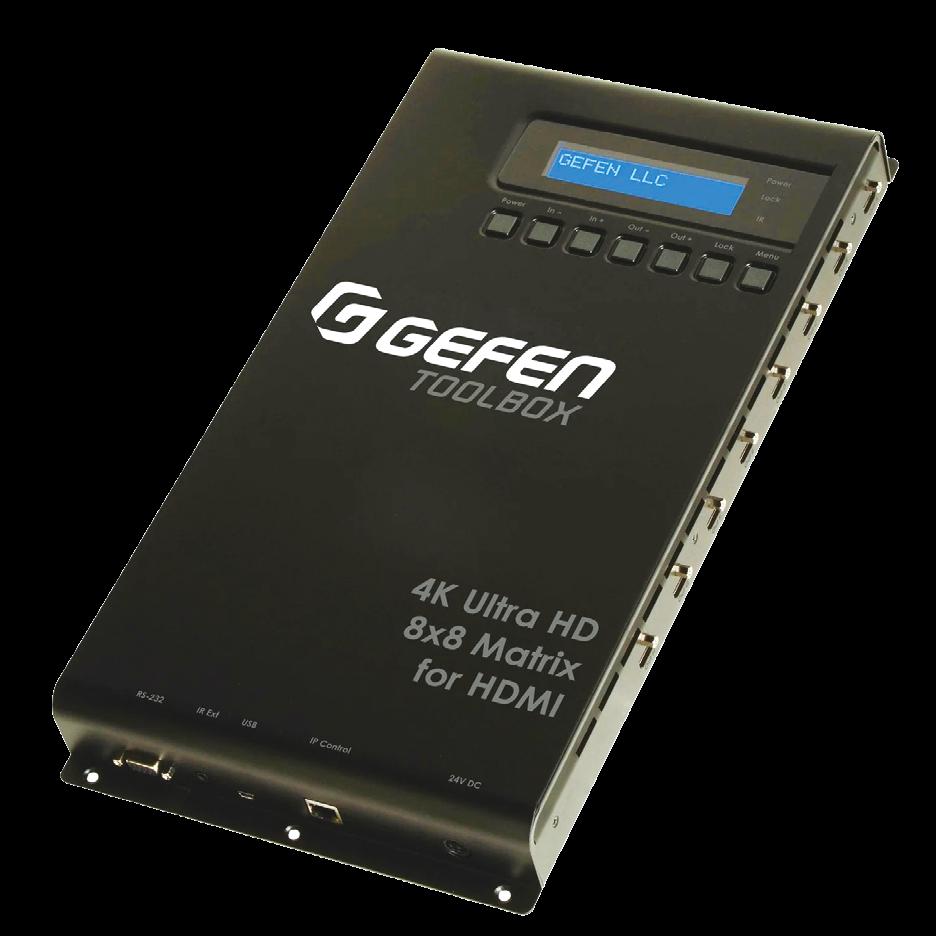
A space saving tool with advanced functionality is the Gefen GTB-HD4K2K-848-BLK, a ToolBox 4K Ultra HD 8x8 HDMI matrix switcher. Video
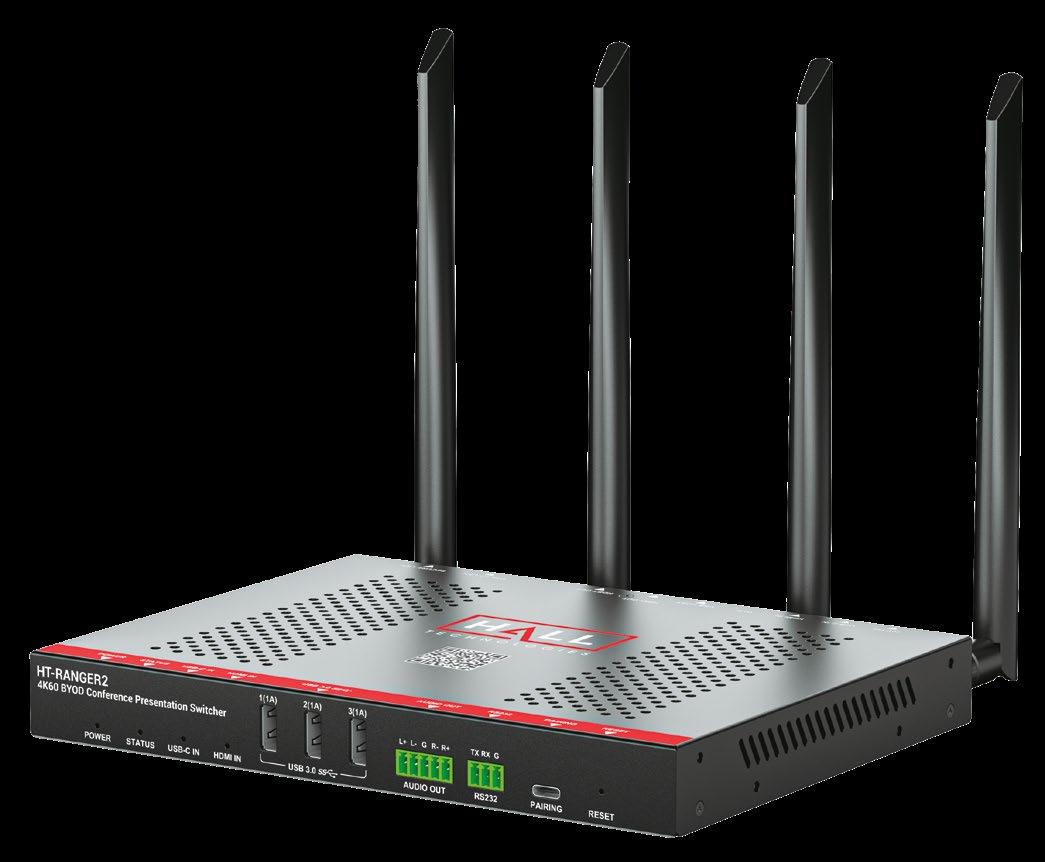
resolutions as high as 4096x2160 and 3860x2160 are supported along with EDID management as well as 7.1-channel LPCM and HBR digital audio in TrueHD, Dolby Digital Plus, and DTS-HD Master Audio formats. Gefen Syner-G software can be used for initial IP configuration. BYOD on small conferences can present some interesting last-minute technical challenges, and the Hall Technologies HT-RANGER2 is designed to handle just such situations. In addition to wirelessly interfacing through AirPlay, Miracast, Smart View, and HT-VOYAGER, the unit can hardattach on HDMI and USB-C ports. Each user has full-screen or dual-view mode presentation capability, and the system provides an automatic signal switching feature.
Hall Technologies HT-RANGER2
Extron DTP3 IN2004
Evertz Fiber X-LINK
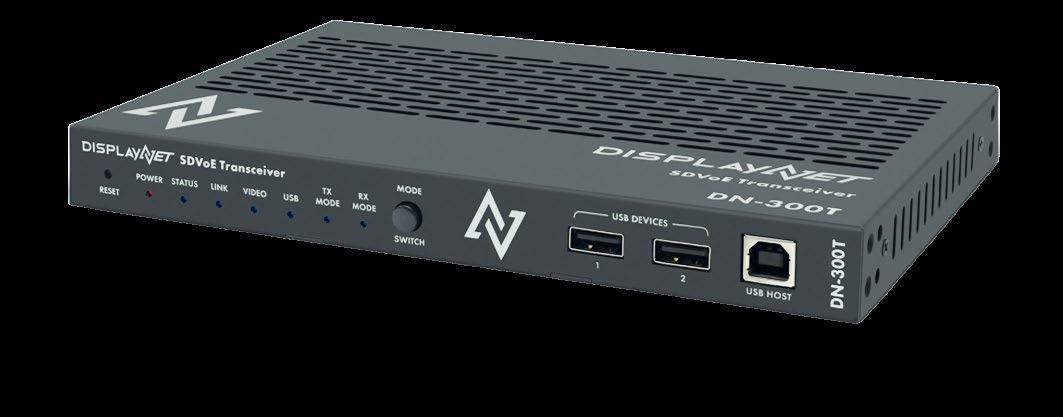
DN-300 Series
The Ultimate AVoIP Platform
The Future of AV Distribution is Here
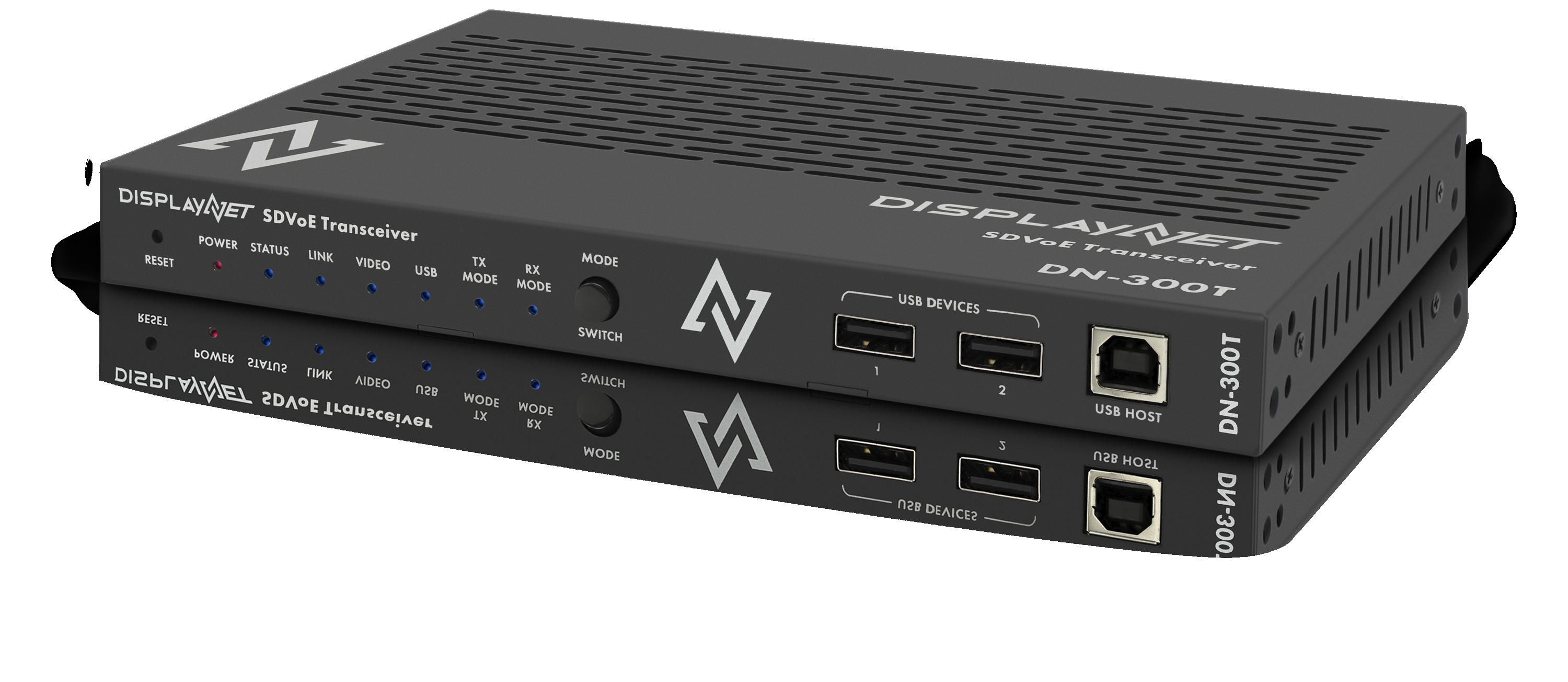
The DisplayNet DN-300 Series delivers an unprecedented level of AVoIP performance, versatility and reliability— at a price point that defines the industry benchmark for value. Based on the latest SDVoE technology, the DN-300 Series provides 4K/60 (4:4:4) video distribution with limitless scalability, zero-frame latency and zero image artifacts.
These units offer unique features that provide system designers with exceptional versatility:
Switchable Transmitter / Receiver operation
Bi-directional Transceiver mode (DN-300T)
Dual (copper / fiber) 10G network interfaces
Long Range: 100 meters (copper), 30 km (optical)
Auxiliary H.264/5 video output streams
Powerful network security features
PoE+ support
Silent, fanless operation
Ultra-compact, rackmountable case
Versatile KVM Routing
DN-300H: USB HID device instant switching
DN-300T: full-bandwidth USB 2.0 routing
DisplayNet also provides software-defined MultiViewer and Advanced Video Wall engines that power a wide range of applications without the expense and complexity of ancillary products. A highly intuitive web-based UI and API greatly simplifies setup and installation, as well as integration into third-party control systems.
Contact us today to see how DisplayNet can move your next AV system into the future.
sales@dvigear.com
(888) 463-9927
www.displaynet.com
TECH SHOWCASE Routers and Switchers
with all DN-300 Series models, with features including PoE+ support, and dual (copper/fiber) network interfaces for distances of up to 100 meters (328 ft.) with CAT-6A twisted pair and up to 30 KM (18.6 miles) with single-mode fiber. The unit includes auxiliary H.264/5 video output streams that provide support for viewing source thumbnails and for remote viewing/recording with resolutions up to 1080/30p.
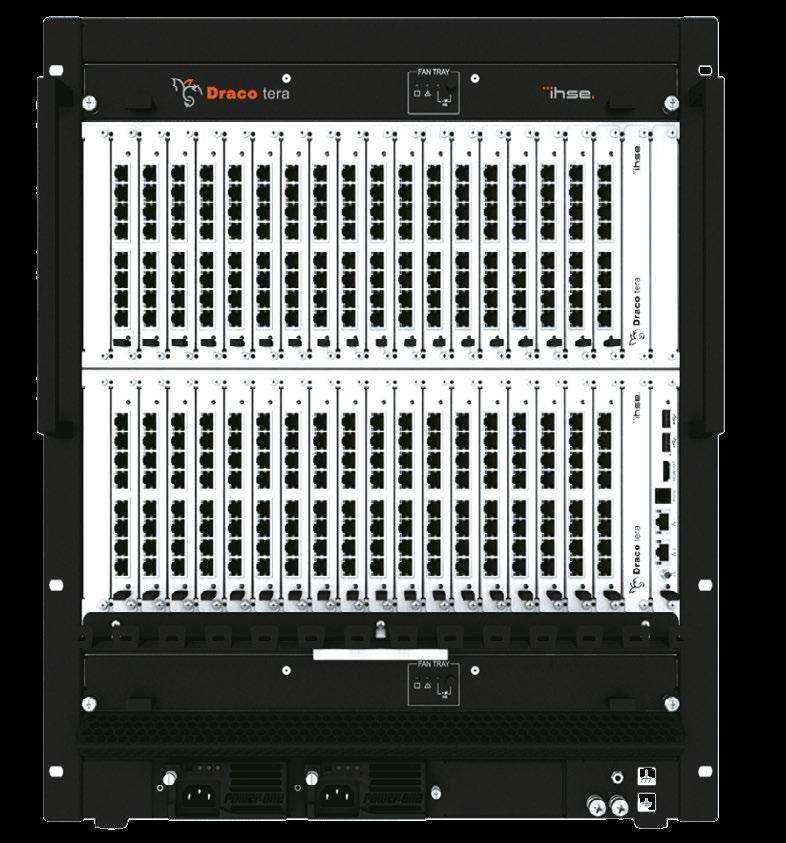
Designed for large facilities and long reach signal applications, the IHSE Draco tera enterprise modular matrix system can switch and route HD video, multi-channel audio, and data over Cat X, multi-mode or singlemode fiber optic cable. Each of its scalable 576 I/O ports may be configured as an input or output. This capability, along with fully redundant power and hot swappable modules, enables multi-port redundancy for highly critical operations.
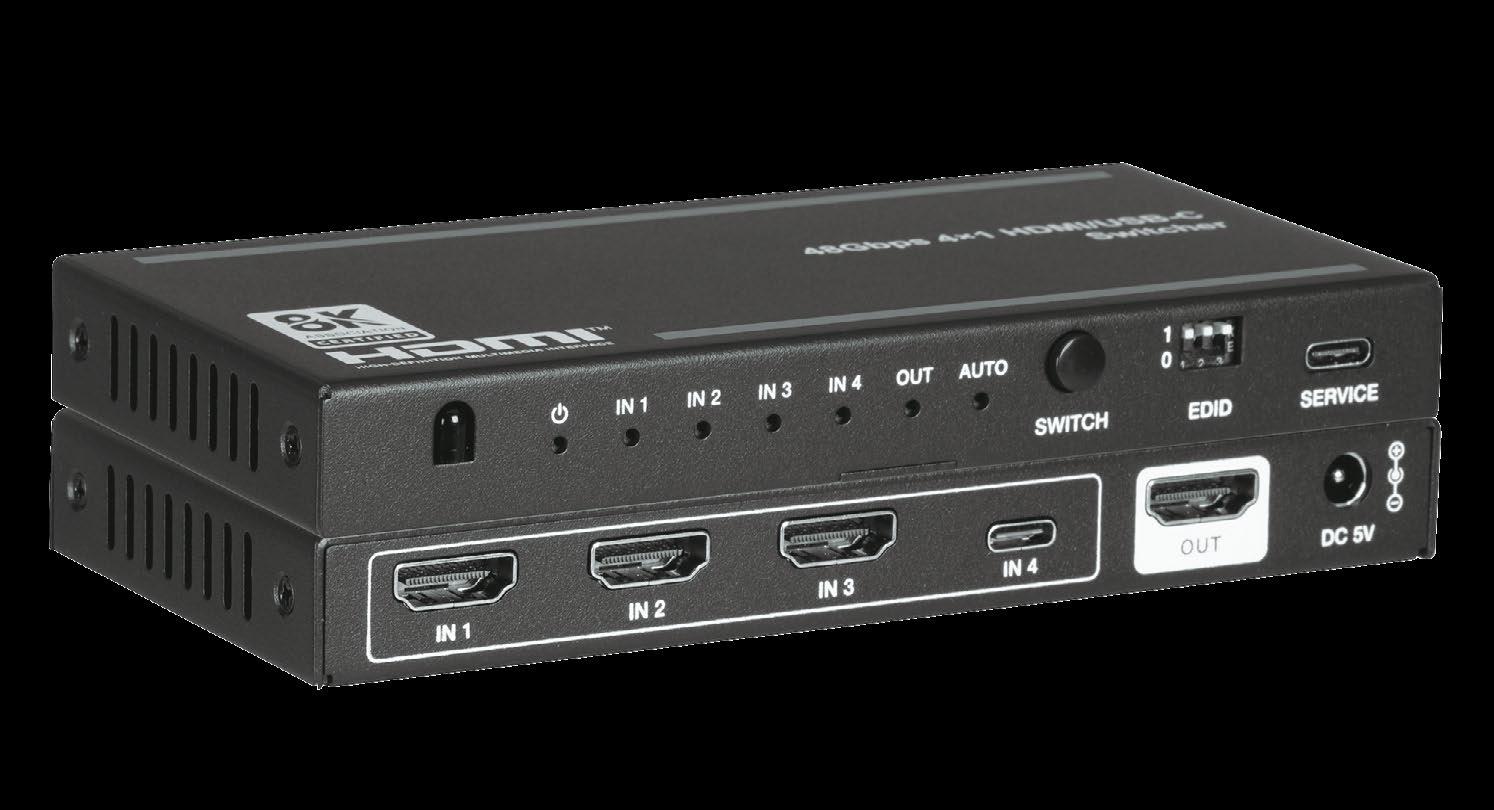
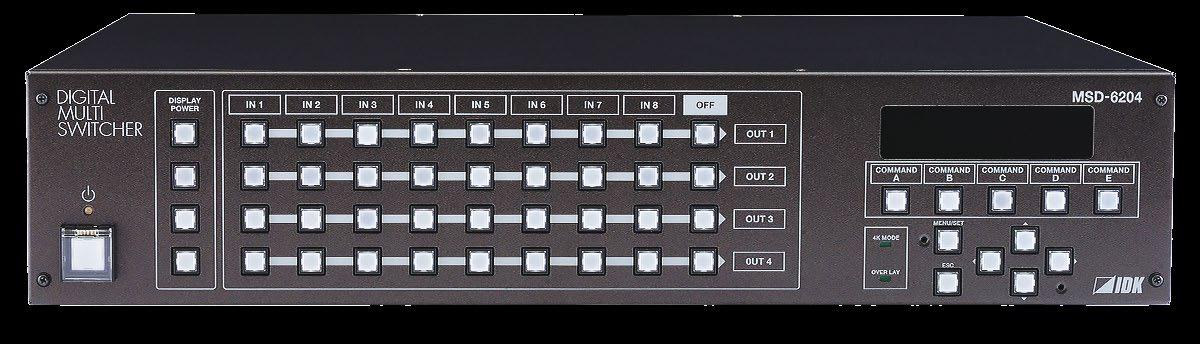
The IDK MSD-6204 Digital Multi Switcher can physically interface with a very wide range of old and newer format connections from analog composite through HDMI to HDBaseT including PoH. Offering up to eight inputs and four outputs with scan conversion, the system offers Dante output as an optional extra. External devices can be controlled via RS-232C, LAN, CEC, or contact closure. At the other end of the physical footprint scale is the small KanexPro SW-4X1HDUSBC HDMI/USB-C 4x1 switcher. Its three HDMI inputs and one USB-C input feed a single HDMI output with video signal resolutions up to 8K/60 from HDMI and 8K/30 from the USB-C input. Audio support includes HDR10, HDR10+, Dolby Vision, and multichannel sound. A 3-pin DIP switch on the front panel can be set for EDID, and there is a front panel service port for firmware updates.
IHSE Draco tera enterprise
IDK MSD6204
Routers and Switchers TECH SHOWCASE
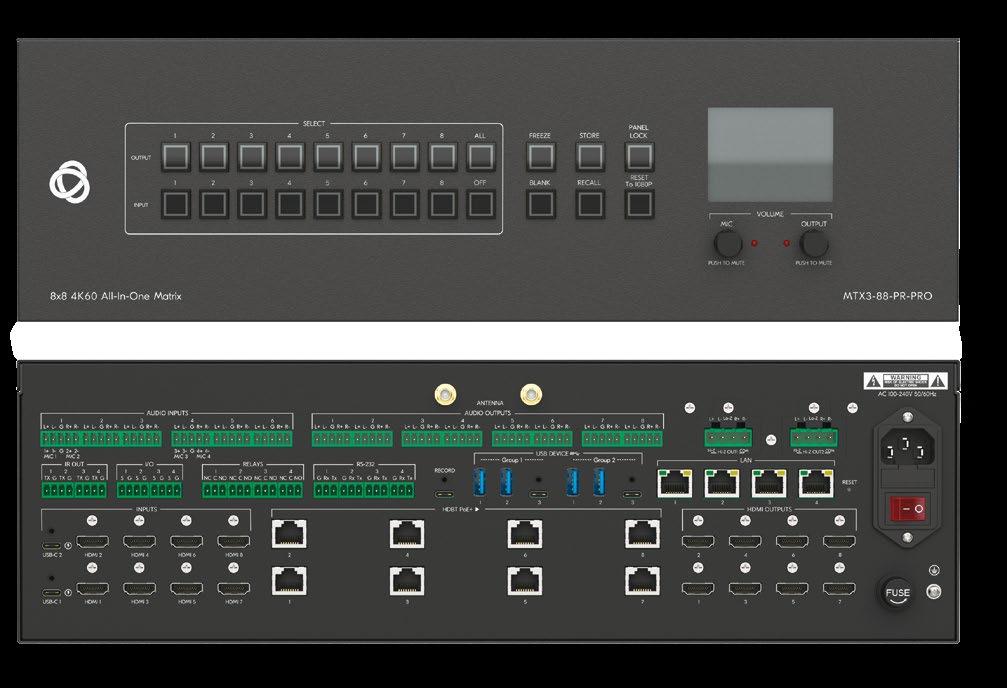
A new level of versatility in multisource presentation routing has been introduced with the Kramer MTX388-PR-PRO 8x8 4K60 all-in-one hybrid presentation matrix switcher. This 3RU device offers 8 bi-directional HDBT 3.0 ports, 2 USB-C ports, scaling, and integral video test patterns and overlays, as well as a network output streamer/encoder (H.264/5). On sound, it has DSP and Dante in addition to a dual-zone amplifier and wireless presenter input.
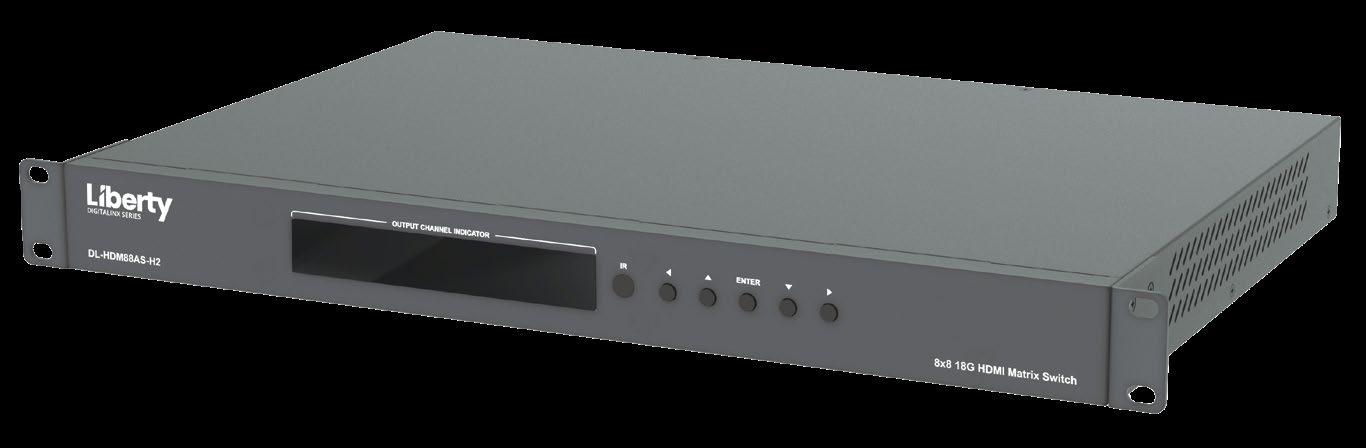
If a smaller, single RU 8x8 matrix is required, the Liberty AV DigitaLinx Series DL-HDM88AS-H2 8x8 HDMI 2.0 Matrix Switch is available with automatic 4K to 1080P downscaling and digital/ analog audio de-embedding on all outputs. It
and WebGUI operation.
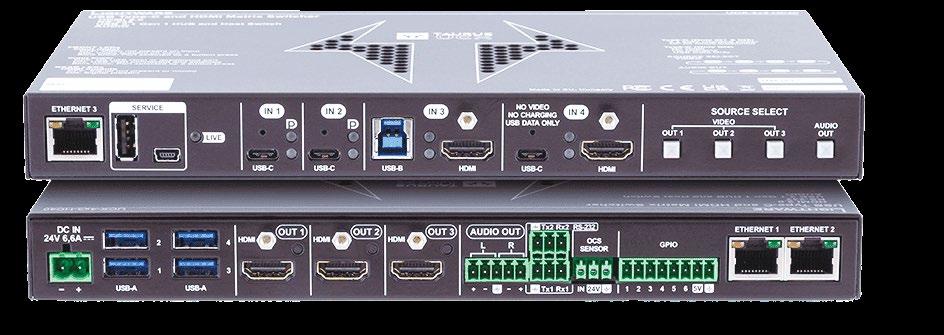
presenters and collaboration members to use their phones and other USB-C interface devices to use this unit for 4K A/V and control signals. Participants can easily connect with cameras, speakerphones, and touchscreens. Outputs have CEC, and to deal with low batteries on phones or other BYOD equipment, there is also USB-C charging. Peripherals connect on USB-A type connectors, and there is a DANTE/AES67 network connection for output to an external sound system.
rack space, or being mounted under a desktop, this tiny unit can be operated via the front panel buttons or remotely controlled through IR remote or on a 9-pin serial terminal. Stable output is assured through re-clocking and equalization on the outputs.
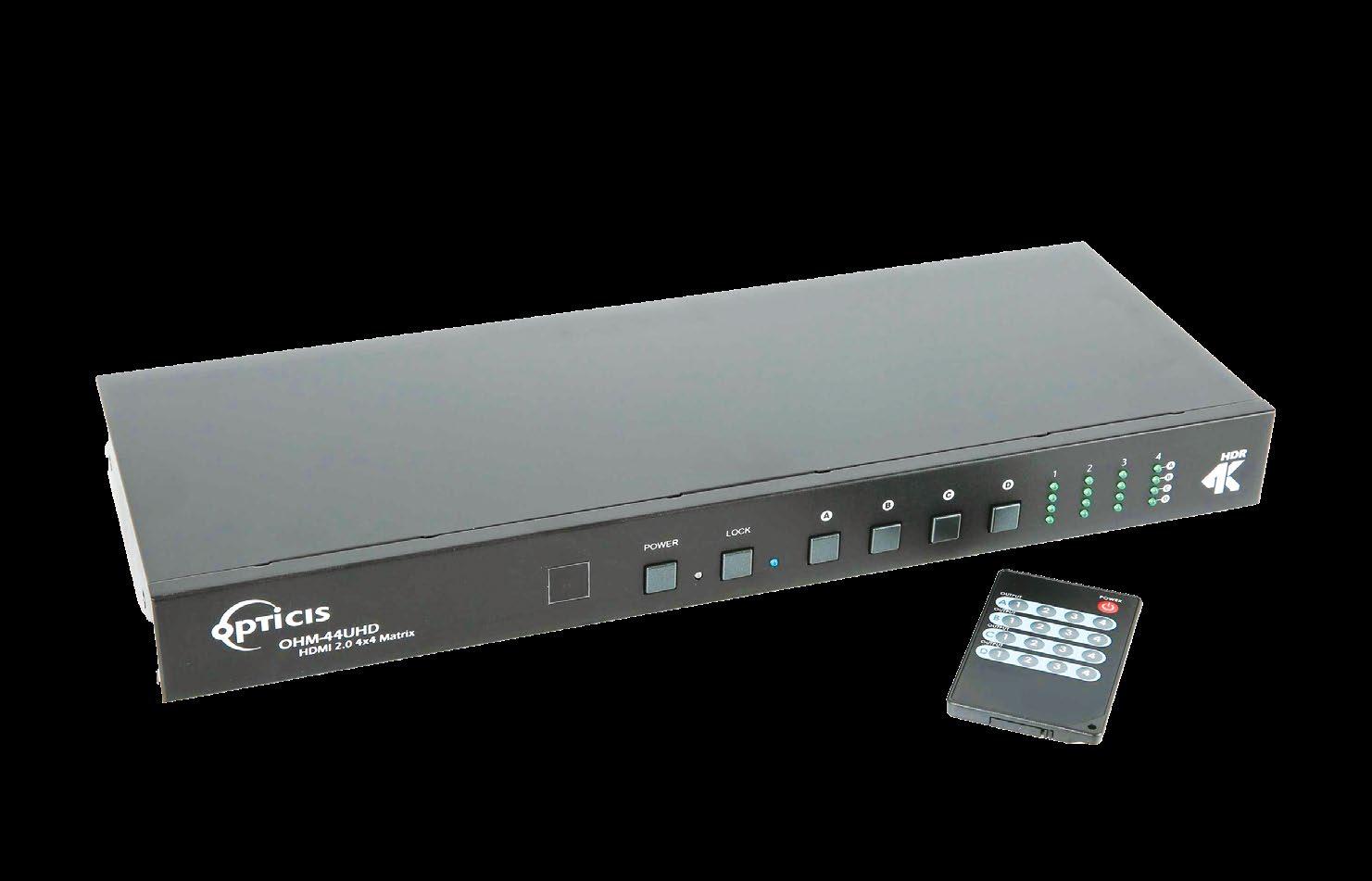
Devices with source resolutions up to 4K/60 can be switched in the Opticis OHM-44UHD HDMI 4x4 matrix system and controlled through front panel buttons, RS-232, Telnet, WebGUI and IR remote. Through the WebGUI interface users can store and recall up to four routing presets. Multiple internally stored EDID configurations can be selected in addition to those downloaded and stored from connected displays.
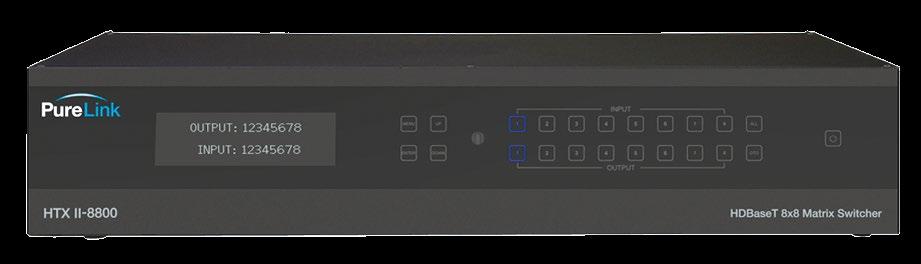
Fitting into a single rack space and handling 8x8 HDMI inputs with 2 HDMI outputs, along with 6 HDBaseT outputs, the PureLink HTX II-8800 has PoC on all HDBaseT outputs. Also onboard is a sophisticated audio switching matrix 16
Routers and Switchers
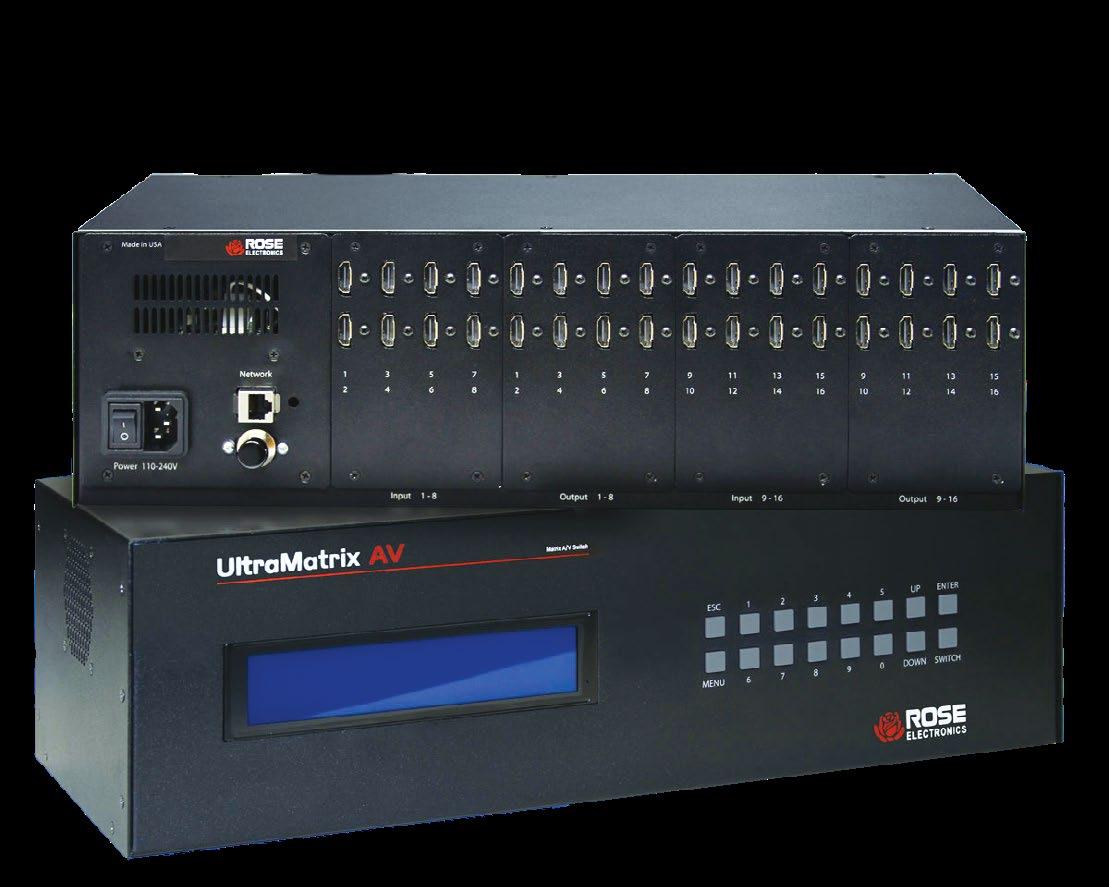
A reliable and proven 16x16 matrix system for 1080p signals is the Rose Electronics UltraMatrix AV HDMI, also supporting 7.1 digital multi-channel audio. Among the features is Learn Mode which inputs EDID information from any output display and remembers it. The 3RU device can be controlled via front panel, remote matrix switching software, optional IR controller, or serial connection. One variant includes a LAN card for TCP/IP operation.
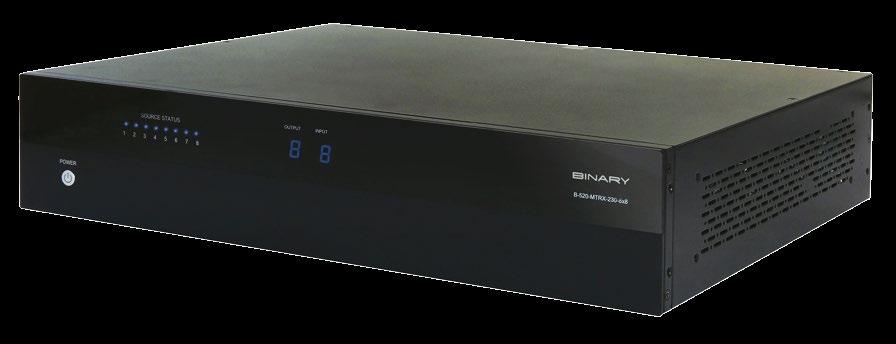
The Snap One Binary B-520-MTRX-230-8x8 has simultaneous HDMI and HDBaseT outputs for local displays and signal reach as far as 230ft. with bi-directional IR control. Receivers can be powered from the switcher through powerover-cable (POC) and there is Ethernet, RS-232 control, and IR routing with shielded Cat5e/6 cable recommended. The 520 Series is certified for compatibility with Control4 automation and networking.
A single rack unit device with 4x4 source/display capability is the Tekvox MUH44T-H2 4x4 HDMI matrix switcher with support for 4Kx2K/60 and 1080p 3D resolution video. Included with it are four PoC-capable HDBaseT receivers for a location up to 230ft. away. In addition to the front panel buttons, the switcher can be operated through bi-directional IR, RS-232, and TCP/IP.
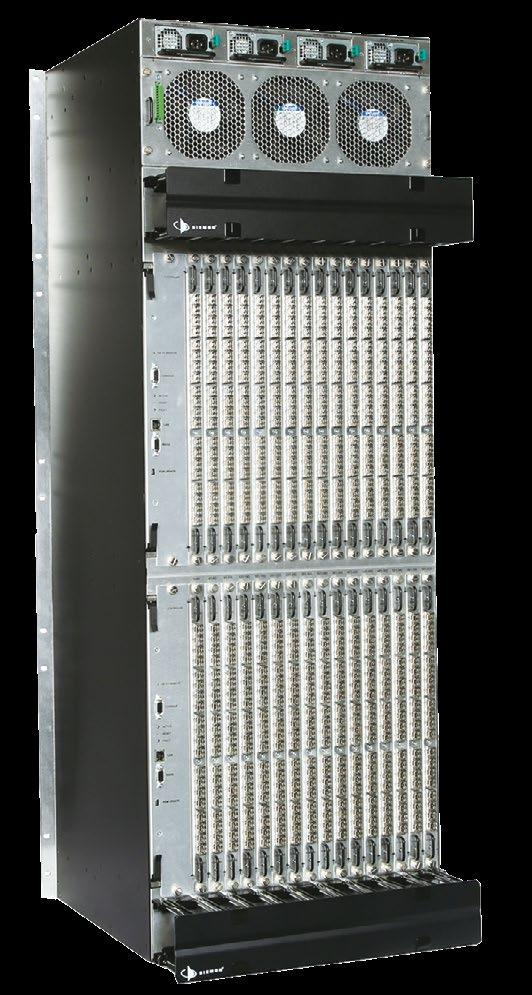
For major league switching in very large facilities, the Thinklogical VX640 matrix switch can be configured for up to 640x640 switching through installation of modular, hot-swappable 20-port data cards. Redundant power supplies and control cards assure operational reliability, and stable, re-clocked signals can be sent nearly 50 miles. Control ports include RS-232 serial and LAN with closed contact alarm connections on a 12-position terminal block.
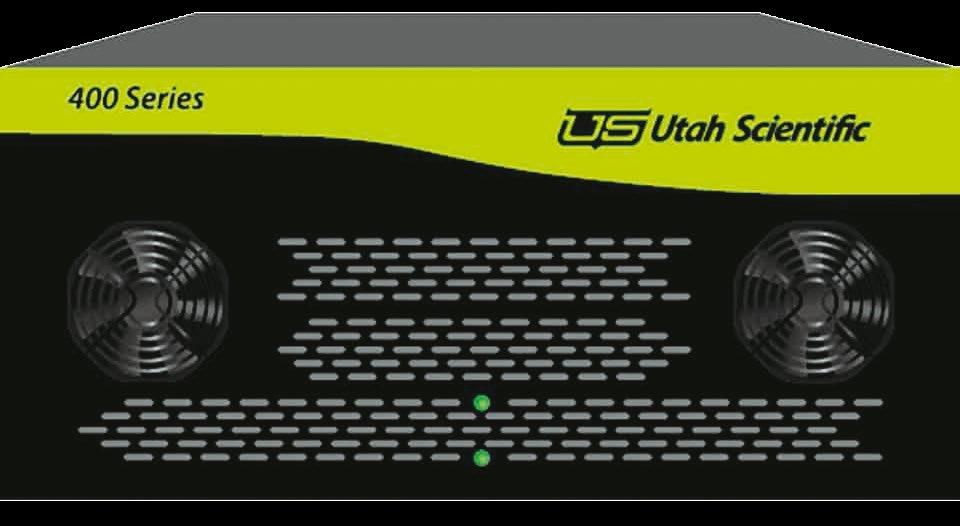
Modular design and
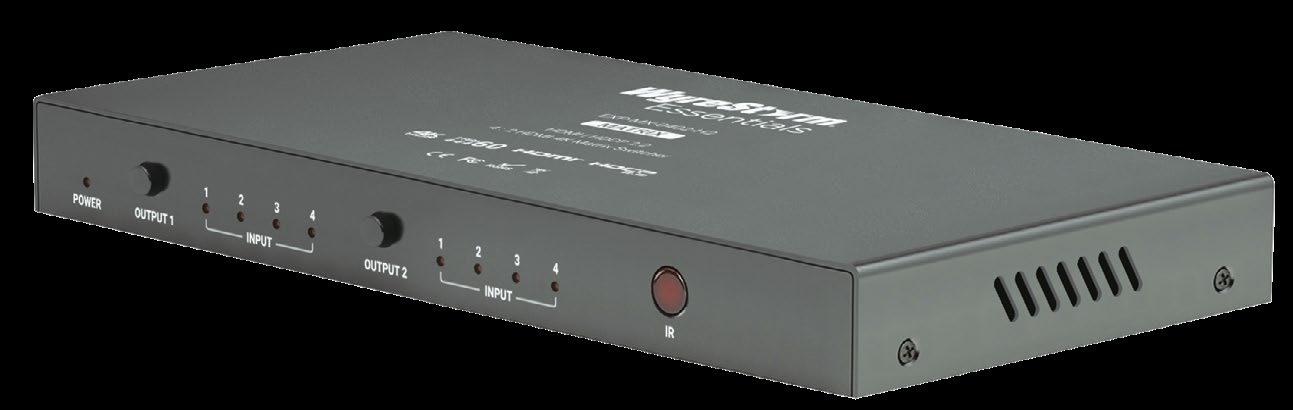
Utah Scientific UTAH-400 72R router to handle any signal, including fiber and analog formats, perform audio embedding, de-embedding, and synchronize incoming signals to a common reference through hot-swappable cards. All of this is done with redundant power feeds to all modules and a common set of I/O cards for any frame size. For much smaller, space-saving matrix applications, the WyreStorm EXP-MX-0402-H2 applies 4x2 switching in a unit that can fit almost anywhere. Its integral auto scaler allows simultaneous feeds to 4K and 1080p displays, while it also provides analog and digital audio deembedding, ARC, and CEC triggering. The unit is controllable on front panel buttons and via a rear RS-232 connection.
Rose Electronics UltraMatrix AV HDMI
Tekvox MUH44TH2
Utah Scientific 400 Series
Audio Mixer Basics
AWriter ERIC WENOCUR Lab Tech Systems
udio mixers are a big topic, spanning everything from passive combiners to huge recording and live music consoles. Not to mention virtualized mixers in DSP. If you’re combining two audio signals together, you’re mixing. The topic is so large that this introductory article will take two parts.
If I were entering the pro audio or AV world today, and especially if I spent time in physical music stores or on vendor websites, a “mixer” might suggest those small or medium-size digital boards made by companies like Allen & Heath, Soundcraft, Behringer, and the like, that are everywhere in studios, schools, churches, performance venues, and corporate events.
But long before digital mixing of any kind, there was (and still is) analog, which is where the basic principles were established. Or perhaps “dreamed up” is a better term, since the earliest
mixers were often hand-made by audio engineers who needed to perform a specific task, such as recording music in the 1950s, when magnetic tape became a practical reality.
In the earliest days, recording was monophonic, and the mixer was used to combine some quantity of microphones into the final signal going to tape. Analog mixers increased in complexity as music recording moved from documenting live performances to productions with mics, electronic instruments, and effects. Likewise for sound reinforcement and other uses. But the underlying principles have remained mostly the same.
Simple Analog Mixers
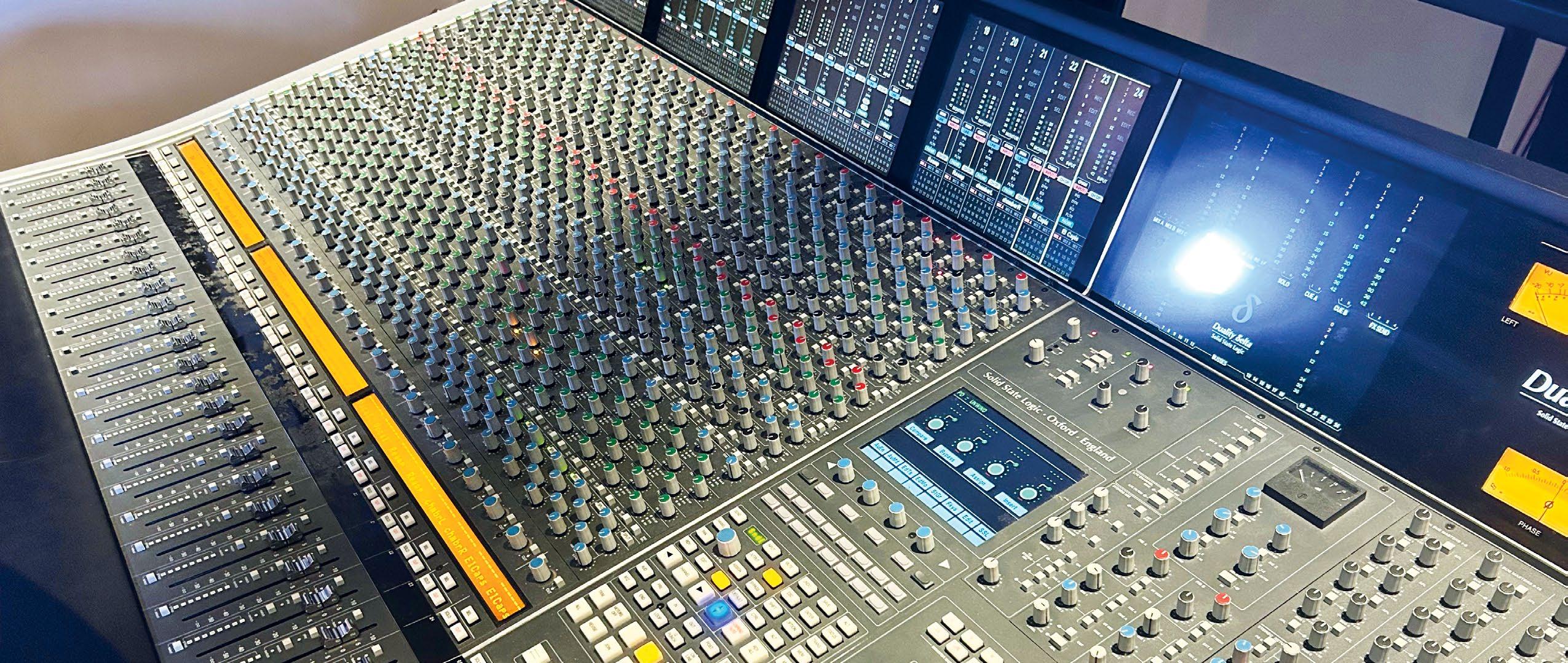
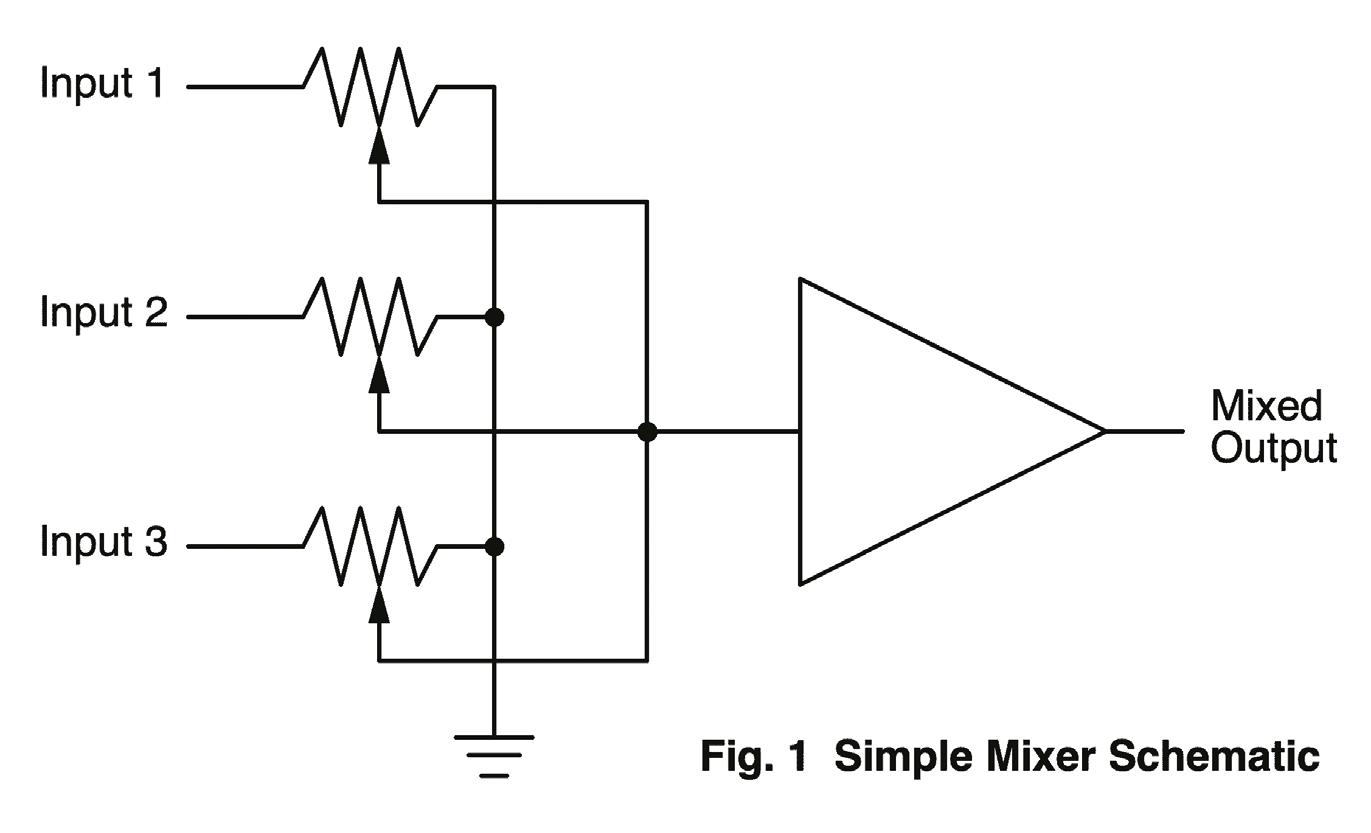
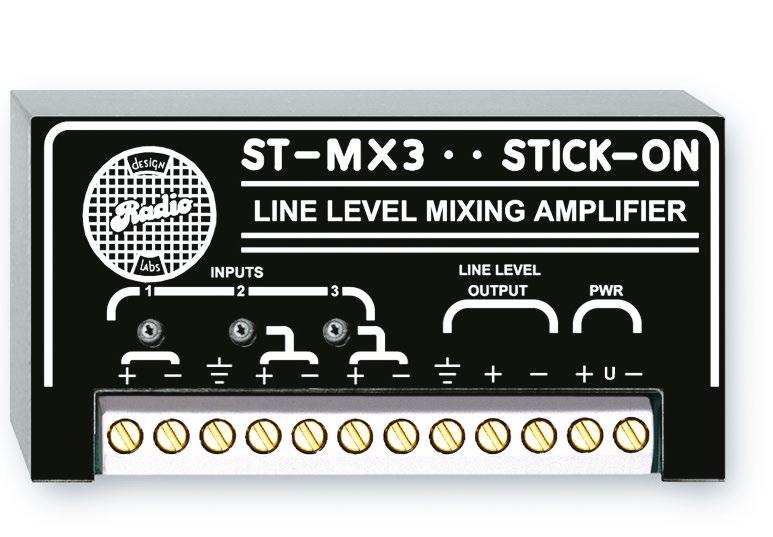
In its simplest form, an audio mixer might consist of a few pots (potentiometers; variable resistors) that adjust the level of several input signals, perhaps followed by a combining amplifier. Sometimes that’s all you need (Fig. 1). Add a second output and some more pots for panning, and you have a stereo mixer! Some commercial analog mixers for utility purposes are not much more than that (Fig. 2)
On a small mixer used for music or speech, each input channel might also have a microphone preamp, and maybe a simple equalizer to adjust bass and treble content. Channel levels can be controlled by rotary or linear pots (faders), and there’s probably a master level control for the final mix. It’s also helpful to have some meters that indicate the actual signal level in the final output stage.
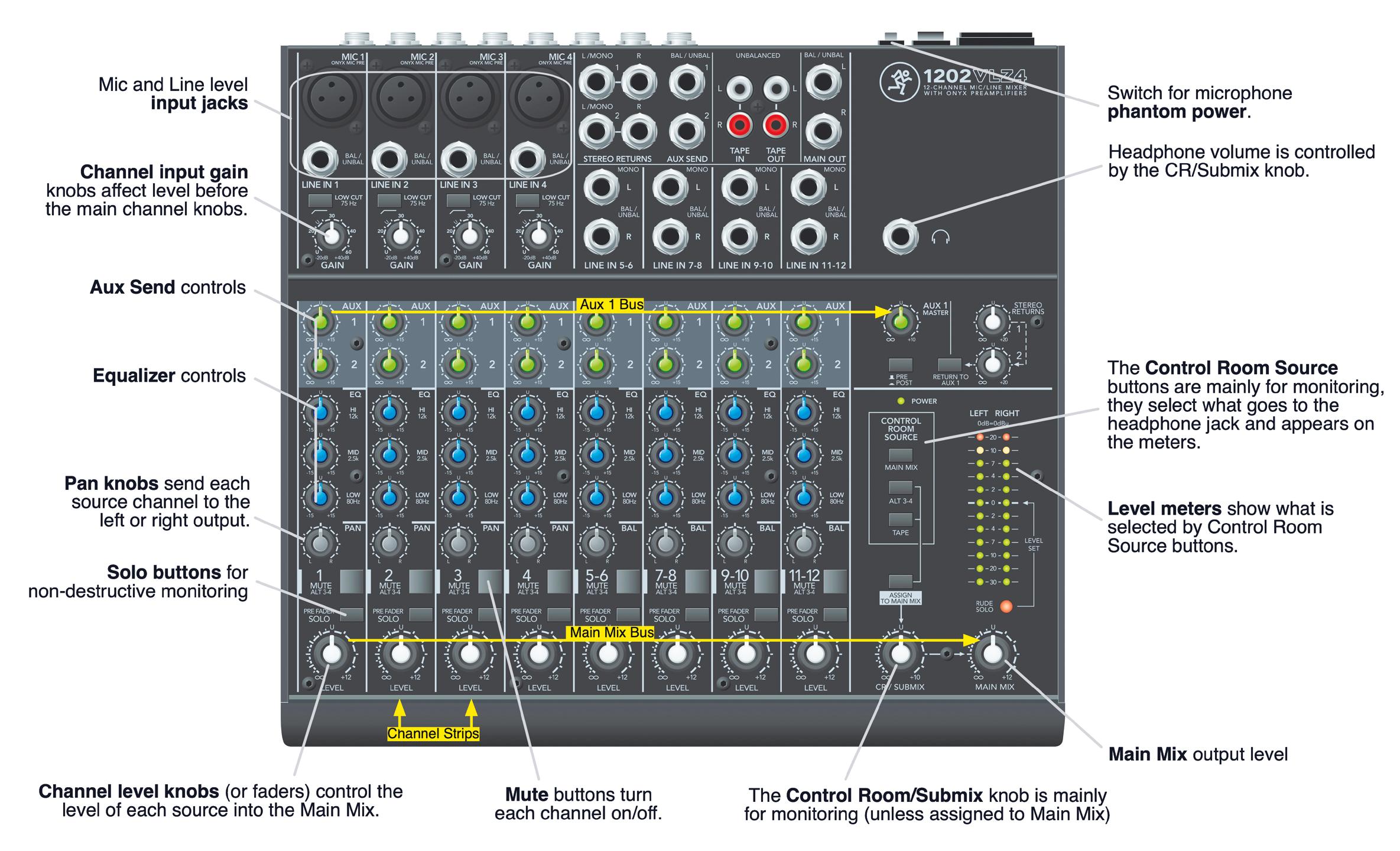
A bus (or buss) in electronics is a common point where signals combine, and this term is often used when talking about mixers. The primary output from a simple mixer might be the Main, Program, or Stereo mix bus. When source channels are “potted up,” they are added to the bus. As it
Fig. 1
Getty Images
happens, the physical arrangement of channel strips and controls in most analog mixers provides a nice visual clue to the signal flow (Fig. 3) . Or, to use a plumbing analogy, the bus is like a drainpipe, with each channel strip being a sink that empties into the drain.
When the idea arose to add artificial reverberation (or other effects), it became necessary to add aux buses. An aux (auxiliary) bus is just another mixing bus, but it gathers signals from individual sends on each channel strip so that a unique mix can be sent to an effect device. Returning to plumbing, an aux send is like a “tap” that lets some audio from the channel flow into the aux bus. This allows a desired amount of any input channel signal to be
sent to the reverb or other device.
A large analog mixer might have many aux buses, some of which are used to create monitor mixes for musicians in the studio or on stage. Because each aux bus has its own sends on the channel strips, there could be several unique monitor mixes. Again, the physical layout can often imply the signal flow.
The taps for some sends may be taken before the main fader (pre-fader), while others are taken after (post-fader). The former is useful for monitor mixes, so if the engineer changes the channel level in the main mix, it does not affect what the musicians hear. Conversely, a reverb send would typically be post-fader, so that when the instrument’s level is changed in the main mix, its reverb level follows.
The underlying assumption here is that the operator is “mixing” with the channel faders on the main stereo bus, say for sound reinforcement, a recording, or the audio for a broadcast or streaming feed. Aux buses are independent of that primary mix and available for other purposes. Arguably, this arrangement is as much historical and practical (regarding control panel layout) as anything, and digital mixers have gone in a
different direction.
In most cases, each mix bus, whether main or aux, has a master level control. These ensure that the combined level of all the contributing channels does not overload the final bus output stage. They also allow for useful functions, like fading the entire mix in or out.
Other Mixer Functions
Mixers designed to take signals from microphones will include a preamp on some or all input channels, with a control for adjusting the preamp gain. Mic output levels can vary quite a bit, so preamp adjustments are important. Using too much gain with a strong mic signal can overload the preamp, causing distortion. Conversely, if the mic level is very low, bringing up the gain may introduce an undesirable amount of noise (hiss). That noise is not a malfunction; it’s an inherent byproduct of amplification. (For more on audio levels, see https://www.svconline.com/needtoknow/ analog-audio-interfacing)
Mixer mic preamps typically also have one or more switches to apply phantom power to the mic inputs. Phantom is a DC voltage used to power condenser microphones that uses the same mic
Fig. 2 Fig. 3
SKILLSET Audio Mixer Basics
For more visit svconline.com/author/eric-wenocur
cable wires as the audio. Note that plugging other devices into mic jacks when phantom is on can do some damage!
Because analog mixers have many stages of amplification and attenuation, designers try to optimize for both good noise performance and sufficient headroom (available signal level before overload). This concept of “gain staging” is also important operationally. For example, if the main fader on a channel is set too low, it may be necessary to bring up the level at the mic pre or the bus master, adding unnecessary noise.
A good starting point is to set channel and bus master faders for “unity” gain (usually the 0 mark), and use the preamp trim to get a good level for that input. The same is generally true for line-level inputs. Under nominal conditions, with appropriate equipment connected together appropriately, I like to see controls sitting comfortably in the middle of their range. If you have to turn a control drastically up or down, look for a problem before leaving it that way.
This is not the place to go into detail about equalization, since that’s a whole topic in itself. Suffice it to say that onboard EQ can include various types of fixed and variable filters, parametric equalizers, etc., depending on the cost and intended usage of the mixer. Analog mixers may also include analog processing such as compression, or digital effects (internally interfaced to the analog circuits).
In addition to channel faders, most mixers have mute (or on/off) buttons on channel strips and sometimes output buses. Mute is important because it removes the audio instantly, and without disturbing fader settings. Whether aux sends can be pre- or post-mute depends on the mixer design (and does not always match pre/post-fader). Pan controls, as the name suggests, allow a channel signal to be placed “panoramically” between the left and right buses.
Most mixers also have some facility for monitoring the audio signals entering and leaving the mixer. The simplest might be a headphone jack that lets you hear the main mix. Going further, the monitor section may have outputs to feed speakers, and the ability to listen to different buses or other mixer sections. Metering is also usually part of the monitor section. As a rule, monitor sections are independent of the output mixes, but in some cases, monitor signals can be routed to other buses as well.
The last key function to mention is solo. Solo buttons may appear all over a mixer and allow the
operator to monitor signals at that location without disturbing primary signal flow (sometimes called non-destructive). Solo is technically just another bus (or pair of buses), but is really key to keeping things sounding good and under control in live situations. In addition to hearing and adjusting individual mics or instruments, engineers can, for instance, listen to the monitor mixes going to musicians.
Solo may also be called PFL (pre-fader listen) and AFL (after-fader listen), depending on where the solo signal is derived. In many cases solo is mono, since it’s picking up a single point in a signal path, but mixers may also have “solo-in-place,” which, for stereo, keeps the soloed signal in its correct location in the stereo field.
Over time analog mixers have acquired other new functions, such as on-board USB interfaces for computer connection. And some manufacturers include different routing configurations, such as output matrix mixing, or alternative buses when the mute button is pressed (Mackie’s classic “Alt 3-4” arrangement). The best way to find out about a mixer’s routing and control functions is to consult the block diagram
Specialized Mixers (Analog or Digital)
The description above covers fairly generic mixer functions. A mixer with some or all of those functions could be used for mixing a band on stage or in a studio, covering meetings and conferences,
podcasts, live streams, location video recording, you name it. But as uses for audio have evolved, some specialization has occurred to address particular needs.
For starters, recording large ensembles (or small groups with many microphones) requires lots of input channels. So the large “mixing desks” (aka consoles) often seen in music studios have a lot of channel strips. Even if outboard mic preamps and processors are used, it’s likely their signals will come through the console for recording and/or monitoring.
Plus, as music recording moved from straight documentation to creating a whole from individual parts, in order to record instruments on separate tracks (of a DAW or tape machine), many outputs are needed. Rather than doing this with lots of aux sends, more mix buses were added so that channel strips can directly feed recorder tracks using the main channel fader.
Mixing multitrack sessions within a DAW is very common, but if you want to mix all those tracks, plus countless outboard effects, through the console, many channels are needed. This applies whether the desk is analog or digital, but digital mixers can have a lot of channels without needing as many physical controls (coming in Part Two).
Another place to find very large mixing consoles is in film “dubbing stages.” As with music, creating the final movie soundtrack is a process of mixing dozens or hundreds of individual tracks—in this case, music, dialogue, and effects—while watching
Fig. 4
the visuals. In production parlance, a “dub” is a copy. In this case, dubbing (aka re-recording) comes from the days when the source tracks were played from sprocketed magnetic tape that ran in sync with the film, and the resultant mix was “rerecorded” onto a final tape. (“Stage” is a Hollywood term for a place where film production happens.)
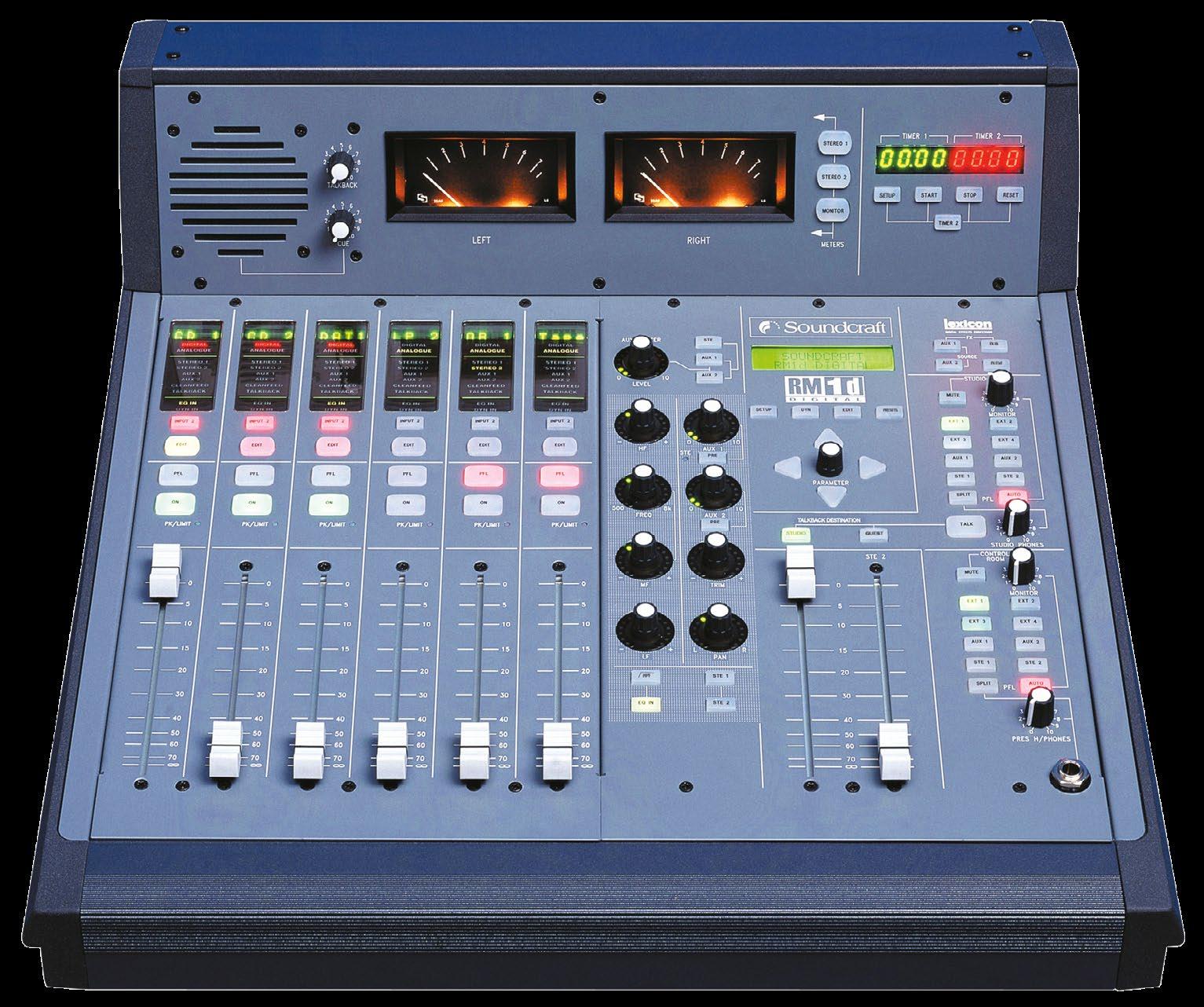
Then again, one of the oldest uses for mixers is live radio, and those have their own special attributes. Often, the actual mixing for radio is minimal, with one or two voice mics and some music and commercial playback. But before computerized automation, radio “board operators” (often the on-air talent) had to cue up and control playback of vinyl records, tape and CD players, “cart” machines (cartridge tape loop players), and electronic file players. (Fig. 4)
So conventional radio desks have few buses, but they’re configured in particular ways that allow the operator to cue (hear) and start the next audio clip without disturbing the on-air mix. There may be very few controls, and they are arranged to facilitate reliable on-air results. In many cases, the
Audio Mixer Basics
familiar layout remains even if the guts of the mixer are now mostly software.
Yet another purpose-evolved mixer is for DJs. Here the aim is easy control of certain parameters, like cross-fading between music cuts, and fast access to effects and audio clips. DJ mixers may have just a couple faders, with a variety of other controls sprinkled around. Some have turntablestyle playback controllers built in, or the ability to run lights and other outboard equipment during shows. Dance DJs rely heavily on cue/solo functionality to create seamless transitions between music beats and cuts.
Coming Next
One obvious trait of analog mixers is the large number of controls. They can look intimidating until you realize that every channel strip is just a repeat; the knobs and buttons do the same things. Although servicing one can be a major hassle if every one of those knobs (and underlying mounting nuts) must be removed to get inside!
The key point is that every knob and button
is mounted to a circuit board and carries either actual audio or a control signal for audio. This is a control-per-function environment that does not support virtualization or delegation. Making adjustments on the fly while recording a final mix sometimes required multiple people working together with well-rehearsed moves.
Mix automation for analog boards arrived in the 1970s with the advent of either motorized moving faders or digital capture of fader positions. In both cases, the fader moves were recorded during consecutive playbacks and then recalled when the final mix was recorded. A further development captured the position of every control on the board, which allowed them to be reset to a previous state (by manually turning while watching a display that showed the target position).
Digital mixers make it possible to adjust many parameters from a small collection of controls, recall settings, and many other functions. Part Two will delve into the advent and state of digital mixers, with the pros and cons that they bring.
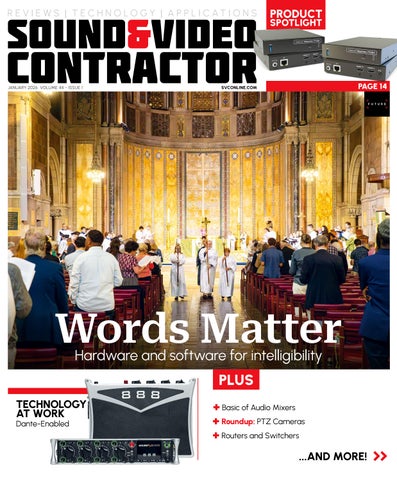
WORDS MATTER
Hardware and software for intelligibility
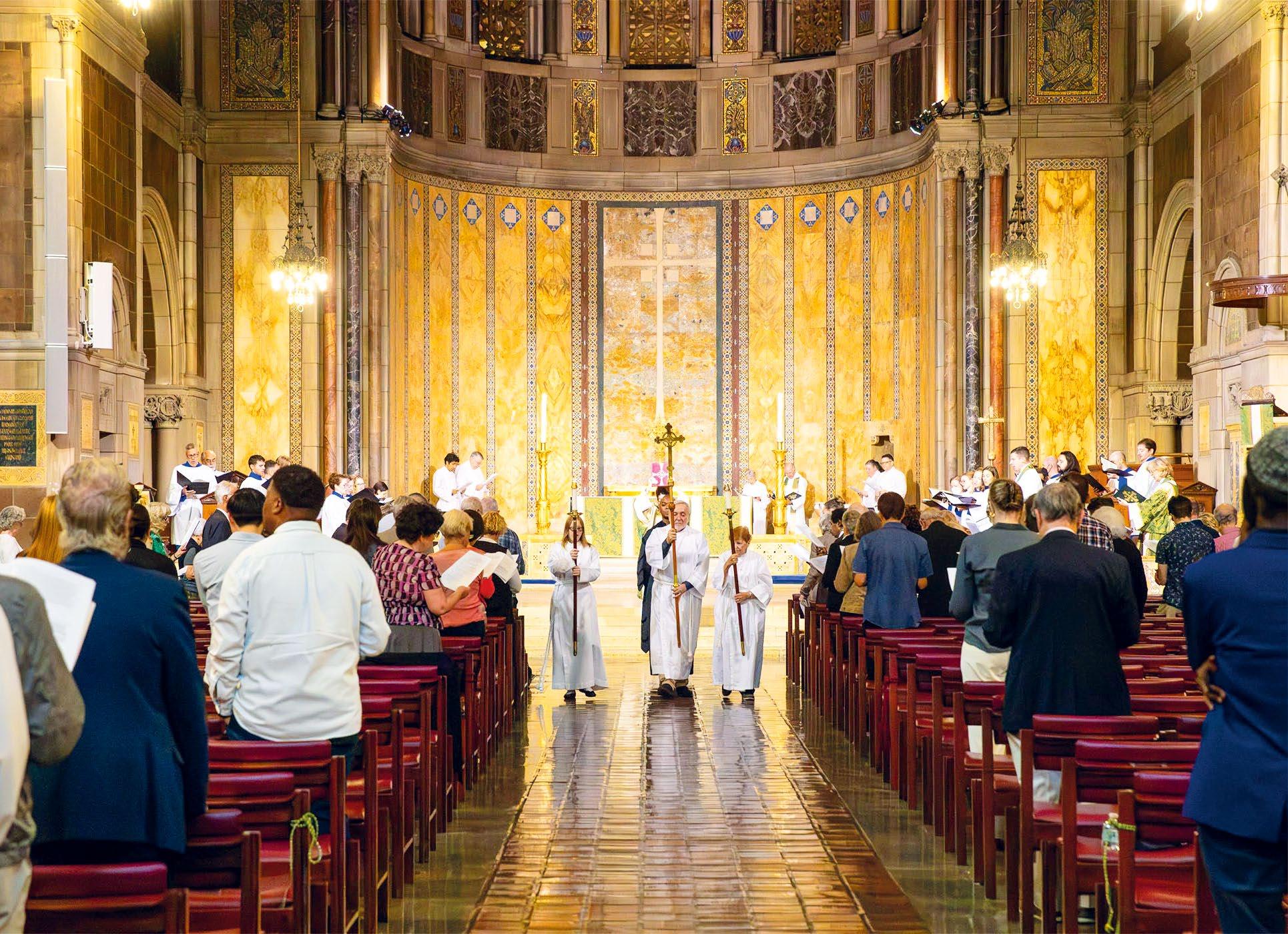
There is perhaps no greater role for AV in worship than to support intelligibility. There are many obstacles to that mission—poor acoustics, historical buildings, modern buildings, styles of worship, congregational demographics, budgets, glass, and many more. Here are some recent examples that demonstrate how intelligibility was created through a combination of hardware, software, and expertise to produce results that transcend technology.
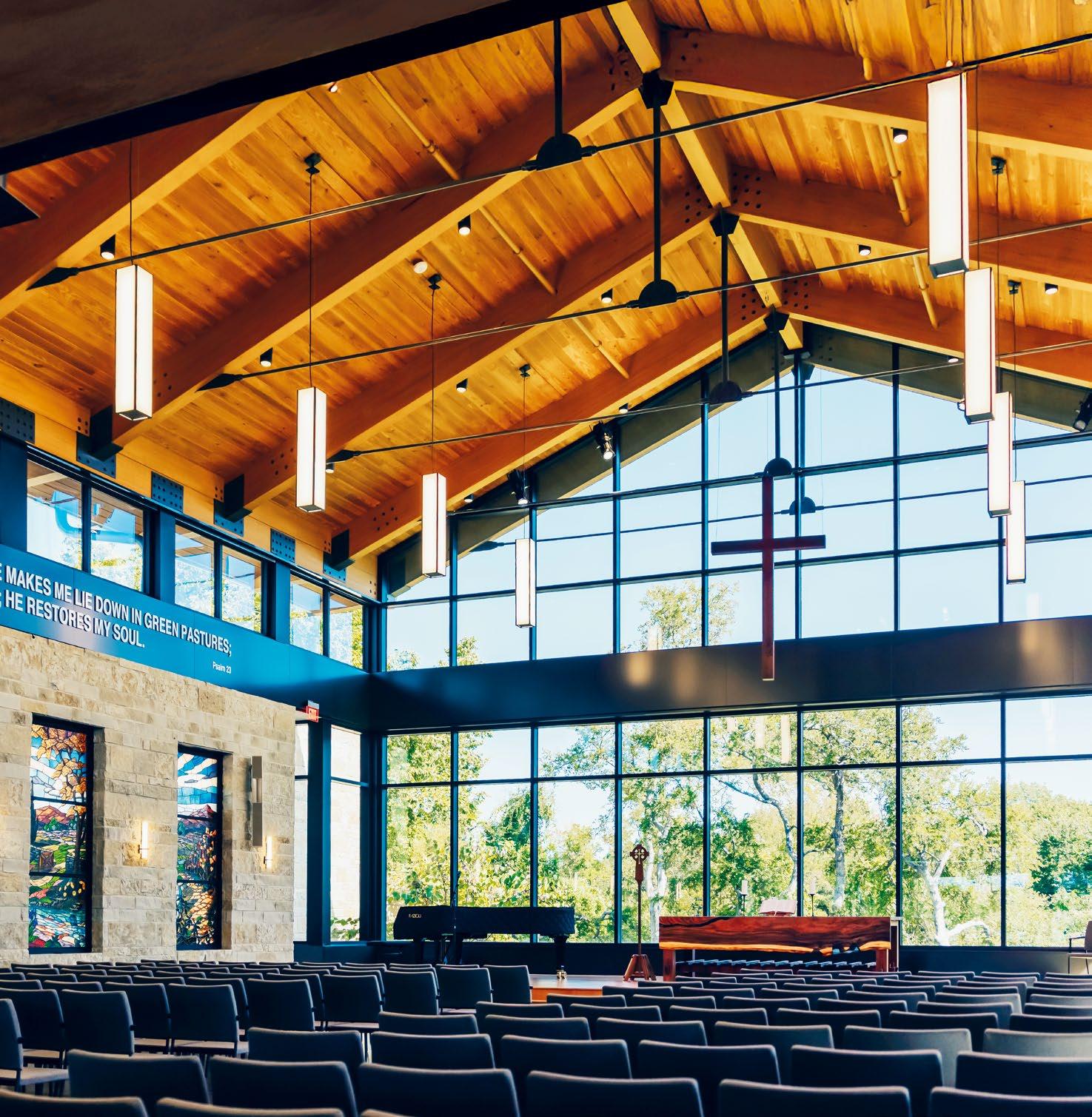
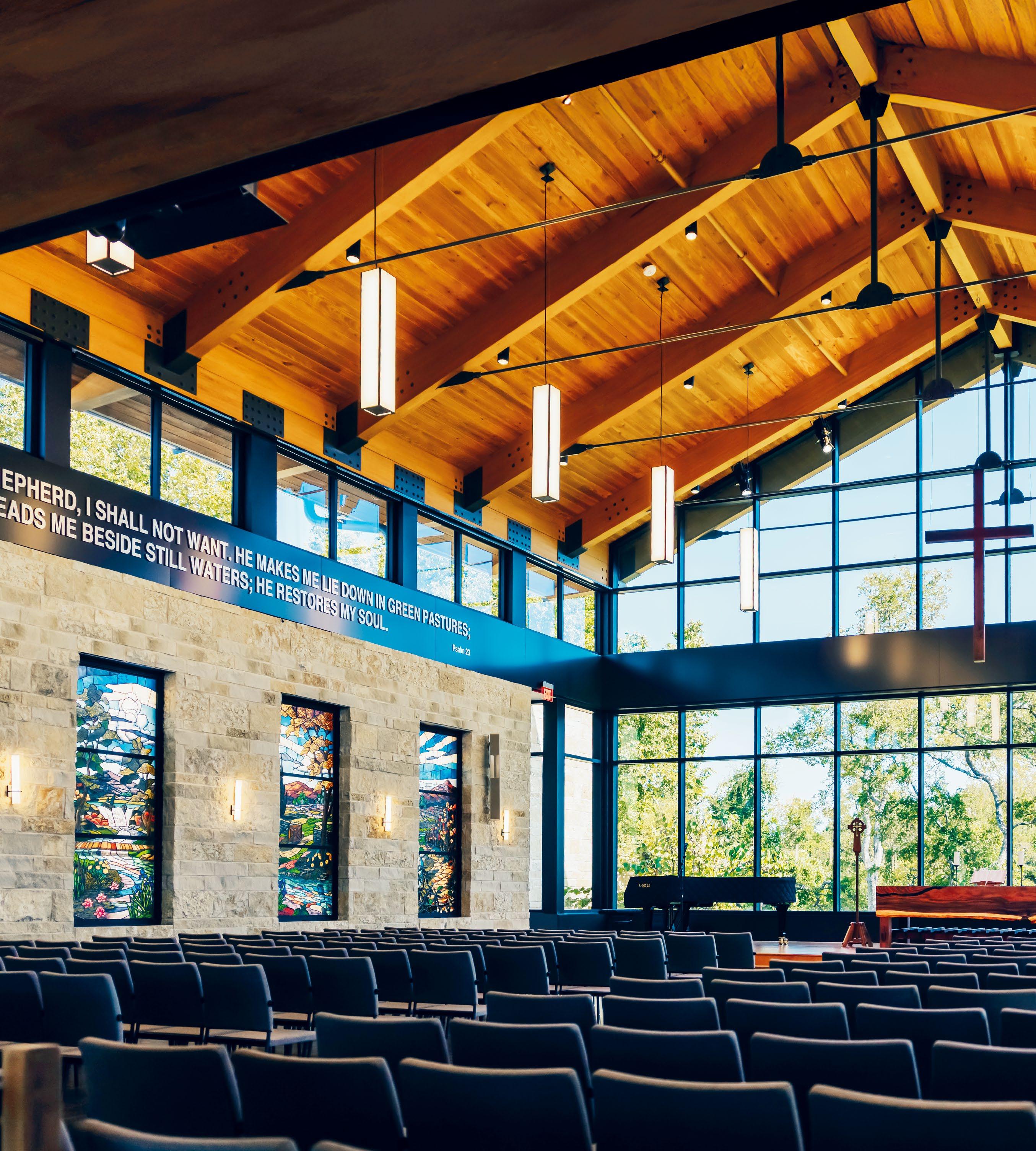
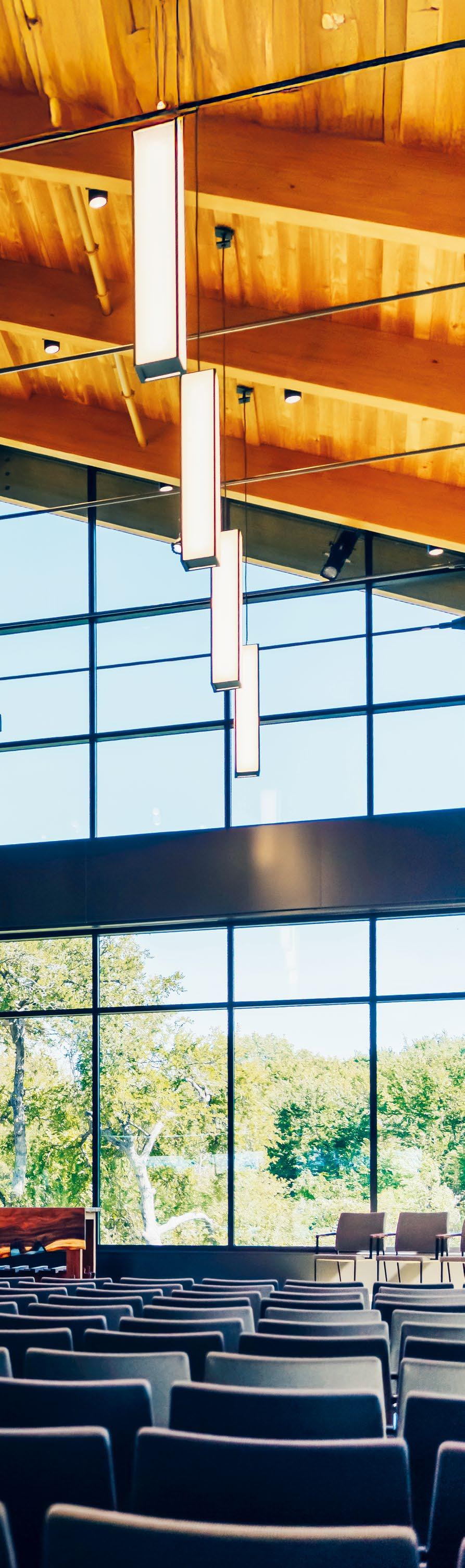
Hasley Chapel, a new worship space nestled in the northwest corner of St. Andrew Methodist Church’s campus in Plano, Texas, was built with both visual and aural aesthetics in mind. Designed by Dallas-based architectural firm GFF, with audio system specification and installation provided by local integrator Clear ProAV, the picturesque chapel overlooking a pond and wooded area now routinely hosts a mix of traditional worship services, weddings, memorials, small conferences, and other events.
Compared to the church’s primary worship hall, which hosts both contemporary and traditional music services, Hasley Chapel is more intimate, seating 120 people on the main floor and featuring a balcony that can accommodate a modest choir or audience overflow. But despite its diminutive size, the space presented some sizable challenges, says Clear ProAV Systems Designer Chad Fuller.
“The look and feel of the chapel is beautiful, but there are a lot of reflective surfaces,” Fuller observes. The area behind the stage is all glass, while the stone side walls have windows, and the building has a high-pitched roof. “It’s a traditional design, but with a modern take, and the aesthetics are huge. So everything we did, especially with the audio portion, had to fit into that. We really had to think about the system design from an ideal performance and coverage perspective, but in a way that would not detract from the beauty of the room.”
Hasley Chapel’s solution came in the form of two colinear L-Acoustics Syva enclosures as the main left and right components of the PA. The Syva are RAL color-matched to visually melt in with the gray stone interior side walls where they are mounted, helping obscure the overt presence of audio technology in the room.
St. Andrew Audio Manager Ryan Mansfield appreciates how the loudspeakers don’t stand out. “We also have two discreet Syva in our main building that we use for a side front-fill area, to bring the image down in our sanctuary,” says Mansfield. “They’re very visually unobtrusive and
offer great coverage for that space.”
Six ultra-compact X4i coaxial enclosures are used for front-fills, installed within the second step of the stage at the front of the room. Clear ProAV coordinated with GFF to get the architectural clearance to insert the speakers behind custom screens. For low-end reinforcement, a pair of L-Acoustics Syva Sub and Syva Low enclosures on each side of the stage round out the frequency spectrum. These were chosen for their ability to deliver a solid low-end presence from a lowprofile cabinet. Furthermore, two L-Acoustics X8 are surreptitiously mounted to a ceiling beam in the balcony, up with the lighting fixtures, providing coverage for that area when it seats a choir or churchgoers.
With so much glass and stone throughout the venue, sound reflections were obviously an initial concern, but the L-Acoustics systems offered Fuller and his team control in terms of speaker placement, dispersion, and tuning. With no sound-dampening treatments done to the room, Clear ProAV needed to be very specific about system deployment, and L-Acoustics Soundvision design software offered both the contractor and client a high level of confidence in the final design prior to the construction and system integration taking place.
“We were able to work with the architect during the chapel’s early planning stages to mitigate some potential issues,” says Fuller. “For example, we were able to request that the glass in the balcony be angled just a touch to avoid bad reflections bouncing back toward the stage. Soundvision was instrumental in helping us determine where we could position our loudspeakers.”
“The chapel has pretty decent acoustics, and can be used without reinforcement, but the Syva system adds a nice extra bit of clarity and presence, helping everything feel even more natural,” explains Mansfield. “It can be used quite sparingly to make the room sound nicer, but it’s also great when we push it as well. Everything is easy to use and sounds beautiful.”
The majestic Cathedral of St. Helena is a cornerstone of the Helena, Montana community. Last fall, an upgrade designed and installed by Montana Pro Audio overcame the inherent acoustic challenges of the highly reverberant 116-year-old church to achieve what is described as unprecedented vocal clarity and intelligibility for its congregation. As preserving the cathedral’s historic aesthetic, which features stone walls and
scagliola columns, was paramount, it required specialized mounting and integration, with a customized paint and finish solution from d&b.
For the church, the audio upgrade wasn’t merely an improvement: “If people can’t hear well in the cathedral, they can’t understand the message of the gospel, and they can’t respond in faith,” explained Father Marc Lenneman, Pastor/Rector of the Cathedral. “This audio upgrade was absolutely necessary and the easiest money I’ve ever spent.”
Built in 1908, the Roman Catholic Cathedral of St. Helena evokes the “awe and beauty of European cathedrals,” with architecture, tile flooring, stone walls, scagliola columns, stained glass windows, and a nave ceiling estimated at 60 feet high, creating that highly reverberant environment.
The previous sound system, installed in 1985, attempted to remain unseen by hiding speakers within chandeliers, a creative solution for its time, but one that offered poor clarity and sound quality. Montana Pro Audio faced a daunting task of achieving high intelligibility in the space. To achieve the desired results, Montana Pro Audio utilized a distributed audio approach, “We opted to use more speakers with less amplitude,” describes
Aaron Fisher, business development manager for Montana Pro Audio. “By having the sound emanate from more points within the space, we ensured consistent coverage and intelligibility.”
The proposed d&b audiotechnik solution features xC-Series cardioid columns (6 x 24C, 2 x 24C-E, and 10 x 16C) and xS-Series point sources (14 x 4S and 2 x 5S). Having seen the effectiveness of column loudspeakers in similar European churches, Father Marc was immediately receptive to the xC-Series based design.
Prior to the installation, a critical step in gaining acceptance for the audio upgrade was winning over the congregation. Father Marc insisted on the congregation buying into and “understanding what they were planning...after all, this was their church and the money they donated.” Montana Pro Audio demonstrated this by switching between the existing system and a subset of the planned system.
“I began speaking the psalm from our most recent mass and switched over to the new system. There was shock, everyone gasped, then they started clapping,” Father Marc recounted. “We also demonstrated the system with a cantor and organist, and after that, there was no clapping, it was silent. The beauty of the human voice
lifted in prayer to God, so clearly and beautifully augmented so that everyone in the cathedral can hear, helps others pray. That’s the purpose of our cathedral, and that’s what the power of a good sound system can do.”
Once the sound quality and intelligibility challenges were addressed and the church agreed to the proposed solution, the next objective to solve was to keep the installed loudspeakers unnoticeable. To achieve this, Montana Pro Audio worked closely with the d&b audiotechnik Custom Solutions Team, which specializes in fabricating special hardware, weatherization, and unique aesthetic features.
“d&b’s custom shop was the key to preserving the cathedral’s appearance,” said Fisher. “They were able to provide the loudspeakers and hardware in a custom vintage white color that matched the hand-painted columns resembling marble. The custom shop did such a great job; if you don’t know what you’re looking for, you can’t even tell there are speakers in the space.”
While the system design and color matching were relatively straightforward, the physical constraints of working within a historical building with areas affected by past structural damage
(a 1935 earthquake and a train derailment in 1989), proved to be the most challenging aspect of the installation.
“The installation process was quite difficult,“ commented Fisher. “Running wire to each speaker involved going into the basement and drilling up into the interior cavity of each column for every speaker location. This required connecting nearly eight feet of drill bit extensions together.” In addition, the unique shape of the pillars posed another challenge that necessitated custom hardware to create a flat surface for mounting the speakers.
Once the cabling was run and the hardware mounted, the rest of the installation process went smoothly thanks to d&b audiotechnik ArrayCalc software. “The accuracy of ArrayCalc software for design and time alignment is remarkable,” said Fisher. “It made the tuning of the system seamless and efficient. We were able to turn the system on and get it going very quickly once the physical installation was completed.”
With the new audio system fully functional,
congregation feedback has been consistently positive. “People are so thankful that they can hear clearly now, regardless of where they are in the cathedral, from the main level, to fill areas like chapels, the altar, and the choir loft,” said Father Marc, who also noted that during record attendance at Easter, “even people standing outside the great front doors could still hear, thanks to speakers in the narthex.”
The new system has also impacted Father Marc’s preaching: “With our old system, there was such a lack of clarity, people constantly said they couldn’t understand what I was saying,” shares Father Marc. “I was forced to speak slowly and deliberately, but now I feel I can communicate more naturally and dynamically, knowing that people can understand me. Now even when there’s the normal distraction of little kids or other people around them, people do not lose the message, and that makes all the difference in the world.”
The “heard but not seen” objective of the audio upgrade was also successful. “Our bishop wasn’t
present when the installation occurred,” said Father Marc. “I sent him photos, and he asked, ‘Where are the speakers?’ and I thought, ‘Perfect. Mission accomplished.’ Even my mother doesn’t know where the speakers are. She can’t find them.”
Victory Christian Fellowship, a 1,000-capacity church in New Castle, DE, had struggled for decades with intelligibility and uneven coverage despite upgrades to consoles and acoustical treatments. The church’s 70-foot-wide by 100-foot-deep sanctuary hosts contemporary Christian worship, touring artists, large conferences, and major productions, including Christmas plays and a New Year’s Eve celebration that fills every seat. According to Tyrone Dinkins, the church’s media director and a classically trained musician, the previous system couldn’t keep pace.
“The speakers were just tired,” says Dinkins. “It became more of an assault on my ears than a pleasure to listen to. No amount of EQ could bring
back the clarity that was missing. Even a simple classical guitar performance was frustrating because the midrange just wouldn’t articulate correctly. It was time for a real upgrade.”
Dinkins, who holds multiple music degrees and brings a performer’s ear to every decision, turned to DBS Audio Systems and personally led a competitive evaluation process. “What really convinced us was hearing Meyer Sound systems in other venues, and knowing DBS Audio was installing them at the Academy of Music [in Philadelphia] and other world-class spaces,” he explains. “If Meyer Sound is good enough for those environments, we knew it would deliver for us.”
DBS Audio President Dave Brotman, who has worked with Meyer Sound systems for more than 30 years, recommended a point source solution based around ULTRA-X80 versatile point source loudspeakers. “The old system had two delay zones with no time alignment, creating one giant reflection,” says Brotman. “No matter what they
Discreet Clarity
Known for its architectural grandeur and rich heritage, St. Bartholomew’s Church in New York City needed a new sound system that could meet modern performance standards without compromising its architectural beauty. To achieve this balance, the church worked with manufacturer’s representative AudioPros, design consultant Salas O’Brien and AV integrator IVCi to deploy an audio system using EAW AC6 ADAPTive Column Loudspeakers.
The church’s design made for a challenging acoustic environment. The existing loudspeakers were aging columns that failed to deliver consistent clarity across the entire area. The goal was to provide even coverage throughout the sanctuary while keeping acoustic energy off the walls and ceiling, The speakers also had to disappear visually into the architecture.
The team installed four custom
tried at the console, they couldn’t correct the massive underlying issues.”
The new system comprises left and right mains of ULTRA-X80 loudspeakers, supported by two 2100-LFC low-frequency control elements, four ULTRAX20 compact pointsource loudspeakers as front fills, and two delay zones of ULTRAX40 compact point-source loudspeakers (two in each zone). Processing is managed by a Galileo GALAXY 816 Network Platform.
To guarantee optimal results on the compressed installation timeline, Brotman collaborated with Meyer Sound’s Director of System Optimization, Bob McCarthy, who developed the system design. “Bob’s expertise ensured everything was precisely aligned from the start,” Brotman notes. “The ULTRA-X80 is like a PANTHER in a trapezoidal box. Paired with the 2100-LFC sub, the result is the most musical low end coupled with the fidelity of a PANTHER in the new ULTRA-X80. We weren’t sure
we could even get the subs in at first, but with careful measurements, we slid a 2100-LFC under each stage platform with just a quarter inch to spare, and they complement the ULTRA-X80s beautifully.”
For Victory’s senior pastor, Dr. Gary Whetstone, the change has been profound.
“The difference is like night and day,” he says. “The purpose of preaching is for people to hear, understand, and engage with the word, and this system finally allows that to happen. Our congregation isn’t just hearing volume, they’re hearing clarity—and I haven’t heard a single complaint since the install.” Dinkins adds that the impact extends behind the scenes. “Our engineers really enjoy it because they’re remixing in a different way. They have true control.”
Even the congregation is responding in ways beyond words. “Watching people interact differently with the sound was more telling than what they would say,” says Dinkins. “You can see the smiles. That says it all.”
color-matched EAW AC6 loudspeakers in a single front-facing vertical array, with two satellite speakers covering the balcony and one covering the chancel. The AC6s eliminated the need for subwoofers and maintained a minimal visual footprint.
Using EAW’s Resolution software,
the team was able to model the system with precision. “The real-world results matched the design perfectly,” explains Ben Boeshans, associate VP of acoustics and technology at Salas O’Brien. “The mappings mirrored reality, which is exactly what you want during commissioning.”
DANTE ENABLED
TECHNOLOGY AT WORK Dante-Enabled
Powering Marathons
Games Done Quick (GDQ) has become a reliable fixture in the gaming and charity worlds, operating semiannual “speedrunning” marathons for gaming competitors that raise millions for causes like the Prevent Cancer Foundation and Doctors Without Borders. With more than $50 million raised to date, GDQ has honed its events to a well-oiled logistic and technical machine, combining live performances in hotel ballrooms with real-time Twitch streams viewed by millions.
However, managing this intricate setup has not always been seamless. As Jason Deng, Director of Technology at GDQ explains, “Our primary show is unique in that we have to serve both an online audience, streamed on Twitch. tv, and an in-person audience at a hotel ballroom. We also provide CCTV so that anyone staying at the hotel can watch the event on their in-room TVs.” What’s more, each marathon runs 24 hours a day — for an entire week straight.
This dual-delivery setup, coupled with GDQ’s reliance on volunteers to manage critical AV workflows, created challenges that their prior solutions weren’t designed to address. That’s when GDQ turned to Dante AV to simplify and elevate their workflows.
Before adopting Dante AV, GDQ relied on a mix of video specifications and connectivity technologies that demanded significant resources and effort to manage. For video transmission, their go-to solution came with notable limitations. “With NDI, we needed to set up a PC in the ballroom and another PC to capture the signal at the hotel’s CCTV location,” Deng said. This configuration required multiple machines and technicians, and it was prone to signal degradation and artifacting if there were any network disruptions. These limitations, combined with the need for user-friendly systems that volunteers could easily manage, highlighted the need for a more robust,
streamlined solution.
GDQ’s previous experience with Dante for its audio networking made the transition to Dante AV remarkably smooth. “Most of our audio flow already ran through the Dante platform, so we were quite used to that system,” Deng said. When the opportunity arose to incorporate Dante AV, GDQ deployed a solution that drastically simplified their video workflow: a single AJA Dante AV 4K-T transmitter in the ballroom, and a Dante AV 4K-R receiver at the hotel’s consumption area.
Based on the Dante AV Ultra codec, these devices deliver 4K60 4:4:4 HDR video with ultra-low latency and visually lossless quality over standard 1GbE networks. They support SDI and HDMI inputs and outputs, which helped GDQ streamline their SDI cabling.
“With AJA’s Dante AV-enabled gear, we deployed a single hardware solution—a source in the ballroom and a receiver at the hotel’s consumption area. It was essentially plug-and-play,” Deng said.
GDQ’s reliance on volunteers to operate its AV systems made ease of use a critical factor in technology selection. “Since this is a charity fundraiser, we rely heavily on volunteers to manage audio and video,” Deng said. “It’s important that we use software and equipment that are volunteer-friendly.”
For that, the team used Dante Controller, a centralized management platform that provides a clear visual interface for routing AV signals.
The impact of Dante AV on GDQ’s events has been transformative. One of the most notable outcomes is the reduction in technical overhead. “Before Dante AV, we needed two technicians and three machines to get a signal from the ballroom to the hotel CCTV,” Deng said. “Now, with Dante AV, we only need one technician and a plug-and-play AJA Dante receiver and transceiver.”
TECHNOLOGY AT WORK Dante-Enabled
State-of-the-Art Stadium
AT&T Stadium, located in Arlington, Texas, is a global icon of modern sports and entertainment venues and the home of NFL’s Dallas Cowboys. The stadium’s massive 160-foot-wide HD video board, mobile app integrations, and Wi-Fi network not only provide fans with an unparalleled experience but also set a new standard in sports stadium technology, reinforcing its image as a high-tech venue.
Originally a CobraNet installation, the stadium’s AV team undertook a massive three-year project to convert the entire stadium over to Dante audio.
“CobraNet was end-of-life, and we were already having issues sourcing replacement parts, so the migration was a need, not a want,” said Richard Bratcher, audio consultant at AT&T Stadium and owner of Caprock Professional Services. “As the de facto audio standard in pro AV, it was a nobrainer for us to migrate the stadium to Dante.”
The first year involved replacing all of the stadium’s amplifiers with Dynacord IPX10:4 units. The IPX series offers advanced 96 kHz high-resolution digital signal processing for the highest performance, internal analog-todigital conversion with ultra-low latency, and a superior signal-to-noise ratio.
The 4-channel, Dante-enabled 2500-watt IPX10:4 amplifier can run in either 48- or 96 kHz, including FIR Drive.
Year two encompassed remodeling the south side of the stadium, including suites, clubs, corridors, concessions, and more, while year three involved the north side. All existing BSS DSPs were replaced with Dante-enabled BLU-806DA DSPs coupled with BLU-120 and BLU-326DA I/O expanders. The Soundweb London BLU-806DA offers configurable I/O, configurable signal processing, and a high bandwidth, fault-tolerant digital audio bus. The processor features Dante audio with primary and secondary ports for fault tolerance, with control through a separate Ethernet port. The BLU-806DA also includes support for integration with Dante Domain Manager.
All Dante channels feed into a Solid State Logic (SSL) System T console for mixing and production. System T bridges the gap between commonly found DAW and controller setups. Its digital audio handling and advanced production workflows, including Dolby Atmos, are complemented by SSL production tools optimized for immersive music production, providing multi-format immersive and object signal paths. Full SSL dynamics and EQ are available on every channel and bus, along with 3D panning, DAW control, Dynamic Automation, Dante integration, and an inbuilt effect rack.
Gary French, AT&T Stadium’s A1 audio engineer, says that working with Dante offers seamless, low-latency audio networking, allowing him to manage complex audio setups efficiently with high-quality, uncompressed sound over standard IP networks.
“Working with the Dante-enabled SSL console is a game-changer for me,” said French. “Its flexibility and ease of integration make managing even our most complex audio setups a breeze.”
The stadium’s massive AV network is separate from the data network, but the stadium uses the SSL HC Bridge SRC when content needs to be shared between them. HC Bridge SRC provides 256 bi-directional channels of sample rate conversion for Audio-over-IP (AoIP) networks. HC Bridge SRC facilitates connecting audio between devices running at different sample rates or in different clock domains on Dante (48 and 96 kHz), AES67 or ST 2110-30 networks. The two network connections can be to physically or virtually separate networks, providing control isolation between two sets of equipment where an AoIP discovery and control ‘firewall’ is required.
“Dante has proven invaluable at the stadium because it delivers higher quality audio with greater flexibility and scalability, all while simplifying integration and control across various devices and platforms,” said Bratcher. the effort.”
Dante-Enabled TECHNOLOGY AT WORK
Broadcast Support
Introduced to NBC Sports in 2016, Dante has become the backbone of their audio and communication systems, revolutionizing how the network handles large-scale, complex productions. Dante empowers the network to push the boundaries of live broadcasting—from intercom systems to audio mixing, playing a crucial role in delivering seamless audio experiences for NBC Sports.
In 2016, the NBC Sports communications team made a decision to deploy a completely new technology for their intercom backbone. The OMNEO technology, developed by RTS Intercom Systems, combined Dante for audio networking and AES70 for control data.
Afterwards, the communications team, led by John Pastore, NBC Sports’ Senior Director of Broadcast Communications, began integrating more Dante into their workflows, not just in their intercom systems but their audio systems as well.
Fast forward to today, where, for certain events, NBC Sports has rolled out 10 Dante-enabled audio systems engineered for reliability, flexibility, and ease of deployment. The setup for these types of events have included over 350 Dante-enabled devices, such as announcer consoles, analog-to-Dante converters, and high-density audio console I/O units.
The system has also at times featured 11 RTS Intercom systems that incorporated 140 Omneo keypanels, all tightly integrated with Dante to enable audio sharing between consoles, intercom systems, and engineering endpoints.
In Stamford, Connecticut, the NBC Sports Broadcast Operations Center produces coverage of events year-round. The Stamford facility has, at points, featured 100 Dante-enabled announcer consoles, and 18 high-density audio console I/O units, all integrated into the audio network. Fourteen Production Control Room intercom systems have used Dante as primary RTS trunking, enabling a dynamic and responsive production environment.
NBC Sports’ Broadcast Operations Center now operates a vast Dante network of roughly 500 devices. But that figure only scratches the surface— the network includes numerous high-channel-count consoles and converters, totaling 10,000 Dante sources and 12,000 Dante destinations. The footprint continues to grow rapidly, as new control rooms come online, and legacy pointto-point audio interfaces are replaced with Dante. “That number will go up substantially,” said Pastore.
This expansion is largely driven by the organization’s move to a Field Acquisition Unit (FAU) production model, with Dante playing a critical role in enabling this shift. The Stamford facility now includes 12 production control rooms, 15 audio control rooms, and two submix rooms—with additional buildouts happening on a regular basis. Under the FAU approach, mobile units deployed to events handle only signal acquisition, while core production tasks—video switching, audio mixing, graphics and replay are centralized at the Operations Center.
The transition from analog to Dante is especially evident in the Communications Machine Room, where legacy analog intercom systems now operate side by side with their Dante-based counterparts. Traditional racks filled with analog patchbays and multipin analog patch panels are steadily being replaced by modern setups featuring RTS Intercom ODIN frames and Cisco network switches.
Managing a Dante network of this scale requires advanced management and monitoring tools. To handle network segmentation, clocking, and the management of multiple subnets, NBC Sports deployed Dante Domain Manager. “Dante Domain Manager has been the only way we’ve been able to scale to meet our needs,” said Dave Meehl, NBC Sports’ Broadcast Communications Engineer.
Given the complexity of the network and the number of operators involved in daily operations, the team needed to simplify some of the more intricate tasks. To achieve this, they deployed EVS’s Cerebrum broadcast control system, which makes API calls to Dante Domain Manager via Dante’s Managed API. This allows for real-time route changes without operators needing to interact with Dante Controller.
To further optimize operations, control rooms across the facility are equipped with Densitron touch panels. These panels provide operators with intuitive XY routing capabilities, but with restricted access to only the sources and destinations they need. This approach limits the scope of control, reducing the risk of accidental changes. “Tech managers and engineers are predominantly dealing with sources we’ve exposed via the Dante Managed API in Cerebrum,” said Paul Dryden, NBC Sports’ System Design Engineer. “The control side of things is critical, and we couldn’t do this without Dante’s Managed API.”
TECHNOLOGY AT WORK Dante-Enabled
Secret Weapon
In the summer of 2025, the sprawling slopes of Naeba Ski Resort in Niigata, Japan, once again became home to FUJI ROCK FESTIVAL’25, the nation’s largest outdoor music festival. For three days, the mountains pulsed with sound, light, and the energy of tens of thousands of festival-goers. But in 2025, the reach of FUJI ROCK FESTIVAL’25 extended far beyond the mountain valley. The footage was meticulously edited and streamed live worldwide through Amazon Prime.
It was a logistical and engineering challenge on a massive scale: multiple stages, simultaneous performances, multi-day coverage, and the need to maintain absolute quality and sync for an audience that expects nothing less than a world-class viewing experience. For the hear of this operation, the ADTECHNO Dante AV Ultra-enabled DAV-01 Series was selected.
NOUVELLE VAGUE is not your average production company. They operate n00b.st, a state-of-the-art LED virtual production studio in Tokyo, and provide live streaming and technical services for terrestrial TV programs, music festivals, esports tournaments, corporate events, and more.
From their founding, they embraced IP-based workflows and quickly became early adopters of Dante networked audio. Yamaha Dante-enabled mixers, Dante Domain Manager (DDM), and a philosophy of full digital signal flow have been core to their operations for years.
“When we built our studio, we decided that we wouldn’t have a single analog signal path,” explains Ikeda, Vice President of NOUVELLE VAGUE.
“No embedding or de-embedding back to analog. From input to output, it had to stay digital. That was our standard.”
With that approach already applied to audio, the next logical step was to extend it to video. And that’s where Dante AV Ultra came into the picture.
“If you can unify the whole process on Dante, you simplify everything — and
you improve quality at the same time.”
FUJI ROCK FESTIVAL’25 presented the ideal — and most demanding — proving ground for the DAV-01.
The Amazon Prime coverage required multi-day recording and live streaming from several stages. Each feed needed to be perfectly synced and delivered for both live audiences and post-event editing.
The team used the DAV-01 to take 3G-SDI output from replay machines, convert it into Dante AV Ultra, and feed it into the existing 1GbE network. From there, the audio was routed to Yamaha Dante-enabled mixers for editing and mixing before being sent to the broadcast output.
Midway through one performance, an unexpected burst of audio noise hit the broadcast chain. In most setups, this could have triggered a frantic search through multiple devices and cable runs, potentially risking minutes of dead air.
With the DAV-01, the resolution was almost immediate.
“We looked at the front-panel monitor and saw right away that the problem was in the SDI input feed,” says Ikeda.
“That meant the issue was upstream, not in our network or processing chain. We restarted the replay machine, and it was fixed in minutes.”
By integrating the DAV-01 into their workflow, NOUVELLE VAGUE was able to achieve full digital integration with simplified cabling and hardware. Ikeda credits the DAV-01 with unlocking high-quality 4K production over 1GbE, while allowing the team to immediately identify and isolate any faults in the chain.
“Honestly, we almost don’t want to tell anyone about it — it’s that good,” Ikeda laughs.
“For anyone already working with Dante, it’s the ultimate upgrade. The learning curve is almost zero, and the built-in monitoring tools are invaluable in the field.”
Dante-Enabled TECHNOLOGY AT WORK
Dante Enabled
The Buttermarket music venue in the UK’s town of Shrewsbury recently received a d&b audiotechnik system with Dante at its distribution core.
Integrator 22live completed the installation over a two-week period. The system design comprises d&b VP for the main left/right system supported by YP designed to cover a balcony neglected by the previous installation, and d&b’s xS range of installation-specific cabinets designed to cover the entire venue, powered by installation amplifiers including 40D and 5D.
Alongside the d&b loudspeaker system, 22live specified an Allen & Heath Avantis front-of-house console with Dante card, which is designed to enable a Dante network to be deployed across the venue, allowing for integration of existing Dante-enabled devices and providing digital returns to the amplifiers.
The front-of-house position in The Buttermarket is mobile, so a touring style front-of-house rack was supplied, which is designed to act as a Dante hub and control rack with an onboard PC for access and control of both d&b audiotechnik R1 and Dante controller.
The Dante network is designed to allow for digital tie lines to be sent to the existing in-house Midas M32, which can now be deployed as a monitor console, without the need for analog infrastructure. The system also operates with analog redundant fall-over, which also provides an analog option if visiting consoles are not Dante-enabled.
In week one, 22live completed the new infrastructure works without removing the existing system so that the venue could continue to operate over the weekend. The bulk of the work was then completed in a five-day period in week two.
Carl Aitken, technical manager, The Buttermarket, said: “We’ve also hosted a number of artists at The Buttermarket who chose to bring in their own d&b systems, and from those experiences, it became clear that d&b was the best choice for our venue.”
Aitken added: “The Avantis upgrade has meant I have been able to focus more on the creative side of mixing rather than dealing with the limitations of the previous FOH console.”
AtlasIED C-T4
The C-T4 series wall controller features a 4.3-inch programmable touchscreen, a capacitive touch volume slider, programmable action buttons, and a built-in PIR motion sensor. With plug-and-play integration into the Atmosphere ecosystem, the controllers allow for configuration of zones, sources, recalling actions, and more. The built-in motion sensor can activate specific behaviors on the processor based on room occupancy, supporting automation and energy efficiency. All four C-T4 models are 2-gang devices that support daisy-chaining over distances up to 1,000 feet. They come in black and white and with and without Bluetooth audio.
Audinate Dante Device Link
The Audinate Dante Device Link is an extensible connector device, allowing parameters such as gain, equalizer settings, phantom power enablement, and fault detection to be managed through Dante Director. Audinate has continued to expand the Dante Device Link’s features with the addition of scene-based system configurations for swapping Dante rooms among presets, new configuration templates for accelerating system deployment, and the ability to recover or replace AV system configurations in the case of system outages or device failures. For existing systems, Dante Director’s cloud service features can be integrated via an available API.
Clockaudio Dante Transporter
Ideal for boardrooms and conference rooms, Clockaudio Dante Transporter (CDT 100 MK3) is a Dante communication product that combines audio and control transport. The CDT 100 MK3’s four audio inputs feature gain control and high pass filters, and multiple units may be daisy-chained (maximum of 6 units on a single CAT-5). Phantom Power is provided for each mic input, and Open API is supported for interfacing with Control Systems. An under-table mounting design makes for easy installation. It’s Dante Domain Manager ready.
Dante-Enabled
Sound Devices 888
The compact 888 was designed as the smallest Dante-enabled portable mixer-recorder on the market. With eight ultra-low-noise, 8-Series microphone preamplifiers, 16 channels, 20 tracks, multiple powering methods, and support for multiple USB control surfaces, the 888 can be easily tailored to a range of workflows. An updated processing architecture and multiple FPGAs enable the 888 to be fully routable: any physical input may be sent to any track, bus, or output. Many features have carried over from the Sound Devices’ Scorpio, such as the new 8-Series preamplifier design, 2 SD card slots, internal 256GB SSD, and dual L-Mount battery charging and powering. Alternatively, the 888 can be powered using a smart battery, NP-1 battery, or an in-line power supply via its TA4 DC input. The fully featured timecode generator contains its own battery to hold timecode for up to four hours after powering off.
AtlasIED Atmosphere 8-Zone Signal Processor
The Atmosphere AZMP8-DW is a powered (1200 Watt) 8-zone audio processor and the heart of an Atmosphere audio control system. DSP and algorithms support custom solutions for a wide variety of spaces. Dante networked audio provides audio distribution to other Dante-enabled devices. A built-in message player, virtual wall controllers, learning ambient noise sensing, Tilter Filter, auto-gain, GPIO, bell scheduler, and room combine are among the additional features. An on-wall form factor replaces the need for a traditional equipment rack. The integrated locking cabinet is provided with room for peripheral devices such as a network switch or music streamer. The AZMP8-DW utilizes amplifier power-sharing technology that allows for efficient use of available power and avoids system overdesign due to traditional amplifier power ratings. The AZMP8 can produce 1200W of total power, with each output channel being software assignable anywhere between 5-600W. The AZMP8-DW is compatible with all seven of the Atmosphere wall plate accessories for control, remote audio input, and ambient noise sensing.
BREAKING NEWS Clockaudio USA
In December, Clockaudio (UK) Ltd, announced the launch of a new distribution operation in the United States. This strategic expansion marks a significant milestone in the company’s global growth and commitment to serving customers worldwide. “We’re excited to partner with Clockaudio USA’s team and have a proper distribution base in the United States closer to our American customers,” said Tina Hallington, Financial Director of Clockaudio (UK) Ltd. “This partnership reflects our shared vision for quality, innovation, and customer-focused excellence.” As part of this transition, distribution operations will shift from Canada to the United States to better serve the growing American market. This important move will facilitate the logistics by having all the products
shipped domestically and ensure even faster delivery times across the US.
“This is the best path for the business,” said Robert Moreau, Managing Director of Clockaudio North America. “By relocating distribution to the U.S., we are positioning ourselves to respond more effectively to the increasing market demands while continuing to provide our Canadian customers with the same high level of service, directly from our manufacturing facility in the UK.
Clockaudio USA will be based in Minnesota and includes a solid team with years of experience and expertise in microphones, audio hardware, and software integration. They will play a key role in supporting Clockaudio (UK) Ltd’s advance into the expanding U.S. market.
CLASSIFIEDS
To Advertise here, contact Zahra Majma at zahra.majma@futurenet.com
STAGE POCKETS
FIBER CABLES
FLYPACKS & ROAD CASES
Analog Way Picturall + Planar DirectLight Ultra
The Contemplative Commons at the University of Virginia, Charlottesville is a full-resolution, pre-recorded, custom showcase of awe-inspiring nature scenes from around the globe, complementing the building’s natural design elements. It is intentionally designed to be both a dynamic, multi-window piece of artwork and an architectural element, as the light of the screen reflects on the building’s surfaces.
The Contemplative Sciences Center creates opportunities for mind-body practices for well-being, insight, and compassion in all aspects of life–social, emotional, physical, and professional. The first-floor Commons exemplifies that mission, with an AV and lighting design by Apeiro Designs, New York.
The Picturall Quad Mark II was a logical choice for the installation, offering easy content loading, flexible windowing, and custom options that are simple enough for non-AV people to use. The Planar DirectLight Ultra Series LED videowall is in 16 x 24-foot portrait mode with 3840 x 5940 resolution and 1.2mm pixel pitch. Planar also provided the custom trim and mount and gave the screen an ERO matte coating for extra robustness in a high-traffic area; a remote power supply simplified the installation.
Aidlin Darling Design was design architect for the building, with VMDO Architects serving as architect of record. Pavion was the AV integration contractor.