A Challenging Year for



Gary Arlen
George Winslow
Phil Rhodes

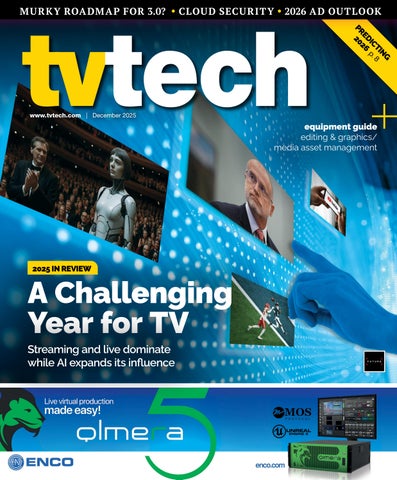
Gary Arlen
George Winslow
Phil Rhodes
After spending the last month talking to analysts about the 2026 ad market, I was struck by the economic wild cards that could upend their generally rosy projections. Who knows what will happen with tariffs? Interest rates? Inflation? Consumer confidence? The economy?
Worst of all, it’s not just a question of economic uncertainty. As one analyst put it, companies face the certainty that bad economic policies will have consequences.
The same might be said for the investments, particularly in technology, that station groups need to make to put their businesses on a more sustainable path. In the recent Q3 2025 earnings calls, much of the talk revolved around a big bump in political advertising in 2026 and the opportunities that deregulation will open for industry-wide consolidation. Both will help. Consolidation will obviously help station groups reduce costs, strengthen their ad sales and increase their clout in retransmissionconsent negotiations. But dealmaking and deregulation aren’t going to reverse the decades-long shift of ad dollars and consumer spending towards digital and streaming.

Let’s make the unlikely assumption that the entire broadcast industry is consolidated into one big station group that gobbles up all the local TV ad revenue, about $14.5 billion in 2025, according to BIA Advisory Services. That would amount to only 1.1%, barely a rounding error, of the $1,313 billion of revenue Meta, Alphabet and Amazon will see in 2025, according to Marketscanner and S&P Global Market Intelligence.
Consolidation, in short, isn’t going to give broadcasters the kind of market clout they need to compete with Big Tech. Nor does it change their reliance on stagnant or declining business models.
S&P Market Intelligence projects that local TV advertising will grow only about 1.5% a year between 2025 and 2030, and the prospects for retransmission revenue from the rapidly imploding pay TV industry aren’t much better.
To reverse these trends, broadcasters have been investing in technologies and programming that will strengthen and change their current business models. In Q3 earnings calls, several CEOs noted that investments in streaming, local sports rights, original programming and efforts to offer advertisers cross-platform buys produced better-than-expected core advertising results.
Broadcasters have also widely rolled out NextGen TV/ATSC 3.0, which will open up a host of new business opportunities, and the Federal Communications Commission is moving to make it easier for stations to make the transition to the new broadcast standard. But regulators seem unwilling to mandate 3.0 tuners or provide a firm transition date, which means that broadcasters will need to make some hefty investments to drive consumer adoption and reap the benefits of NextGen TV.
That raises what may be the biggest uncertainty for broadcasters’ future. Will they spend their money on dealmaking, racking up big debts that could make it hard to invest in new technologies and business models? That approach had catastrophic consequences for the radio industry in the 1990s and early 2000s. Or will they find a way to balance dealmaking with tech investments? How they address that uncertainty is certain to have a big impact on their future.
George Winslow Senior Content Producer george.winslow@futurenet.com
Vol. 43 No. 12 | December 2025
FOLLOW US www.tvtech.com x.com/tvtechnology
CONTENT
Content Director
Tom Butts, tom.butts@futurenet.com
Content Manager
Michael Demenchuk, michael.demenchuk@futurenet
Senior Content Producer
George Winslow, george.winslow@futurenet.com
Contributors: Gary Arlen, James Careless, Fred Dawson, Kevin Hilton, Phil Rhodes
Production Managers: Heather Tatrow, Nicole Schilling
Art Directors: Cliff Newman, Steven Mumby
ADVERTISING SALES
Managing Vice President of Sales, B2B Tech
Adam Goldstein, adam.goldstein@futurenet.com
Publisher, TV Tech/TVBEurope Joe Palombo, joseph.palombo@futurenet.com
SUBSCRIBER CUSTOMER SERVICE
To subscribe, change your address, or check on your current account status, go to www.tvtechnology.com and click on About Us, email futureplc@computerfulfillment.com, call 888-266-5828, or write P.O. Box 8692, Lowell, MA 01853. LICENSING/REPRINTS/PERMISSIONS
TV Technology is available for licensing. Contact the Licensing team to discuss partnership opportunities. Head of Print Licensing Rachel Shaw licensing@futurenet.com
MANAGEMENT
SVP, MD, B2B Amanda Darman-Allen VP, Global Head of Content, B2B Carmel King MD, Content, Broadcast Tech Paul McLane VP, Head of US Sales, B2B Tom Sikes VP, Global Head of Strategy & Ops, B2B Allison Markert VP, Product & Marketing, B2B Andrew Buchholz Head of Production US & UK Mark Constance Head of Design, B2B Nicole Cobban
FUTURE
130 West 42nd Street, 7th Floor, New York, NY 10036

of the publisher. Future Publishing Limited (company number 2008885) is registered in England and Wales. Registered office: Quay House, The Ambury, Bath BA1 1UA. All information contained in this publication is for information only and is, as far as we are aware, correct at the time of going to press. Future cannot accept any responsibility for errors or inaccuracies in such information. You are advised to contact manufacturers and retailers directly with regard to the price of products/services referred to in this publication. Apps and websites mentioned in this publication are not under our control. We are not responsible for their contents or any other changes or updates to them. This magazine is fully independent and not affiliated in any way with the companies mentioned herein.
If you submit material to us, you warrant that you own the material and/or have the necessary rights/permissions to supply the material and you automatically grant Future and its licensees a licence to publish your submission in whole or in part in any/all issues and/or editions of publications, in any format published worldwide and on associated websites, social media channels and associated products. Any material you submit is sent at your own risk and, although every care is taken, neither Future nor its employees, agents,subcontractors or licensees shall be liable for loss or damage. We assume all unsolicited material is for publication unless otherwise stated, and reserve the right to edit, amend, adapt all submissions.
Please Recycle. We are committed to only using magazine paper which is derived from responsibly managed, certified forestry and chlorine-free manufacture. The paper in this magazine was sourced and produced from sustainable managed forests, conforming to strict environmental and socioeconomic standards.
TV Technology (ISSN: 0887-1701) is published monthly by Future US, Inc., 130 West 42nd Street, 7th Floor, New York, NY 10036-8002. Phone: 978-667-0352. Periodicals postage paid at New York, NY and additional mailing offices. POSTMASTER: Send address changes to TV Technology, P.O. Box 848, Lowell, MA 01853.

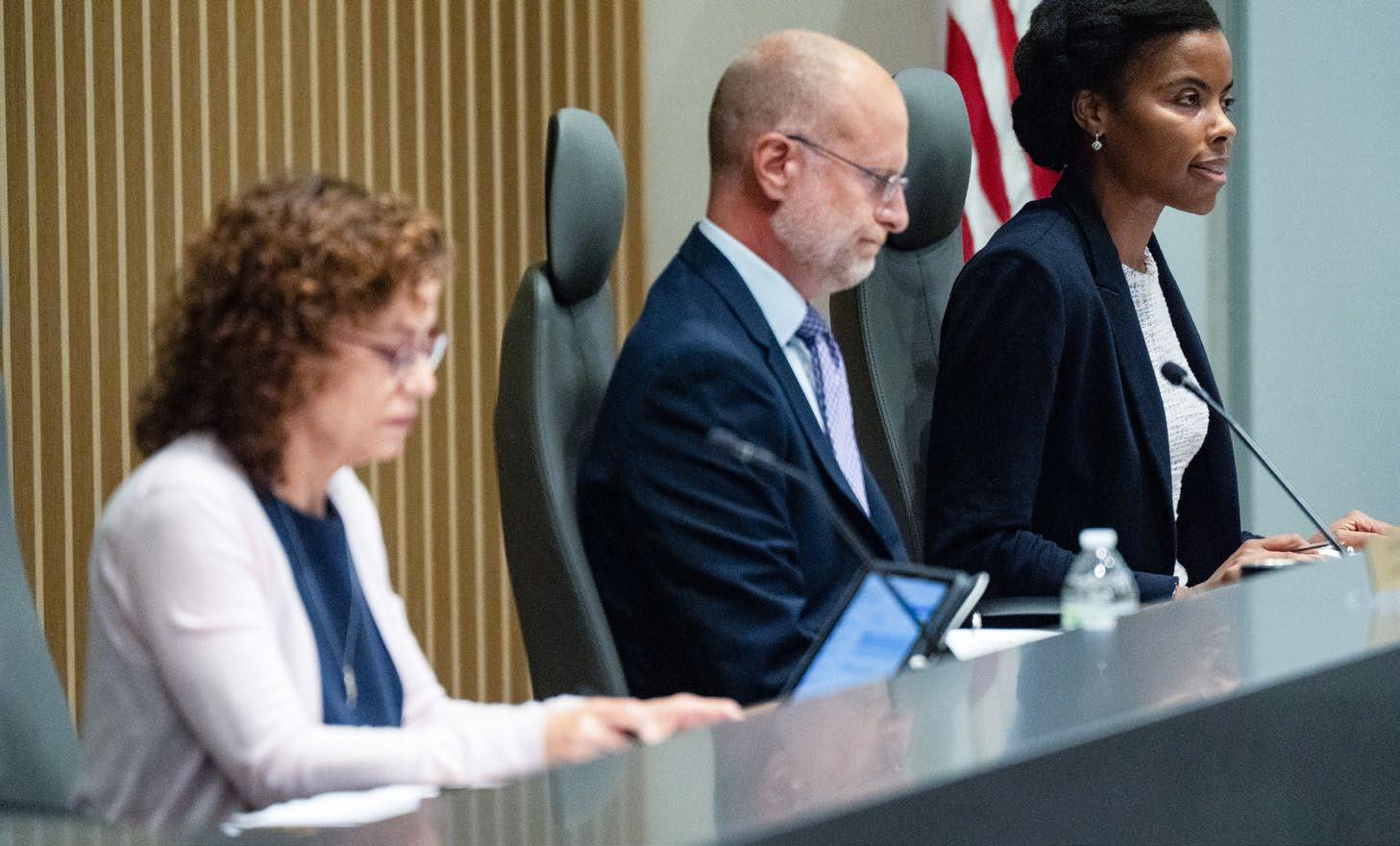
In response to recent controversial efforts by the Federal Communications Commission to investigate broadcasters for airing biased news coverage, a group of seven former commissioners and chairs, plus additional senior-level former staff, last month submitted a sternly worded petition to the agency slamming its attempts “to mold the speech of private broadcasters to the FCC’s own view of what is correct.”
The petition asks the agency to rescind the news distortion policy, which has “significantly chilled and otherwise altered the content of broadcasters’ speech, undermining First Amendment values.”
The petition is in response to several highly controversial in vestigations by the FCC into allega tions of “biased” news coverage from ABC, CBS and NBC by President Donald Trump and assertions by FCC Chair Brendan Carr that the regulator has the power to punish broadcasters and potentially even remove broadcast licenses from stations violating “public interest” and “news distortion” rules.
Jimmy Kimmel regarding the assassination of conservative activist Charlie Kirk.
The news distortion policy also provided the basis earlier this year for threats against CBS News during the lengthy FCC review of the Paramount-Skydance merger.
Skydance won approval for the merger after it agreed to end Paramount’s DEI efforts, paid $16 million to settle a libel suit filed by Trump and promised to name an ombudsman to ensure unbiased coverage at CBS News.
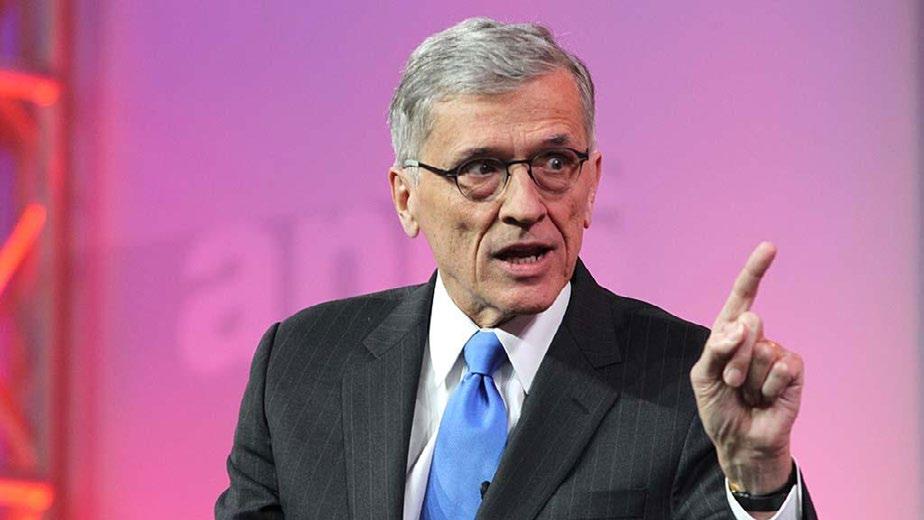
“As the Supreme Court has made clear, the government has no legitimate role in un-biasing or balancing the media,” said Fowler, the FCC chair from 1981-87 under Republican President Ronald Reagan. “The news distortion policy allows the government to threaten censorship of speech it doesn’t like; it cannot stand.”
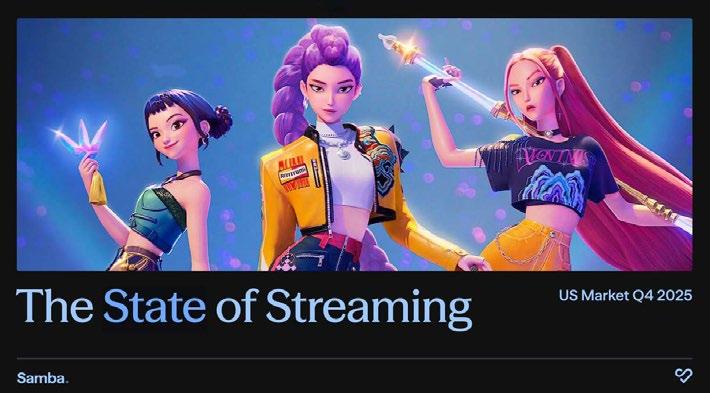
Television viewers are spending more time watching streaming content than linear TV, but sports continues to be a bright spot for broadcasters, according to the findings of a Samba TV market report.
The report, “The State of Streaming U.S. Market Q4 2025,” finds viewers spend 60% of their time watching streaming content, while 40% is spent viewing linear television. It notes that the split “serves as the foundational metric for content production and media buying strategies.”
The petitioners are a bipartisan group of former FCC chairs, commissioners, and other senior leaders who served the agency between 1981 and 2017: Andrew C. Barrett, Rachelle B. Chong, Ervin S. Duggan, Mark S. Fowler, Dennis R. Patrick, Alfred C. Sikes, Thomas E. Wheeler, Christopher J. Wright, Kathryn C. Brown, Jerald N. Fritz and Peter Pitsch. The petitions were represented by Protect Democracy, TechFreedom, Andrew Jay Schwartzman and Gigi Sohn.
That controversy became particularly heated after Carr used the policy to accuse ABC and Disney of news distortion and threaten ABC affiliates’ licenses for airing controversial comments by late-night host
“The Commission should focus on ensuring that all Americans are connected and have access to information and ideas—not imposing on broadcasters its vision of what presentation of the news is correct,” added Wheeler, who served as chair under Democratic President Barack Obama from 2013-17 and also joined in the petition. “The news distortion policy is being used by the current FCC leadership as a tool of speech coercion and that abuse will not stop until the agency repeals it.”
“The FCC has no business policing free speech,” said Conor Gaffney, counsel at Protect Democracy, a not-for-profit that works to combat authoritarian threats. “It is not for the federal government to decide what is ‘biased’ any more than it is for the government to decide what is ‘news.’ The Supreme Court has ruled time and again that policing speech is not the government’s job.”
In a rollout that will further heighten the competition between streaming services and local broadcasters, Prime Video is deploying location-based interactive video ads in the U.S.
The location-based interactive ads allow advertisers to tailor their national TV commercials with location-specific content, such as local pricing, nearest dealership information, or local agent details.
This feature also allows advertisers to transform a single TV commercial into thousands of variants based on ZIP codes or tens of variations based on states without creating multiple creative assets. Advertisers can customize both messaging and clickthrough URLs for their ads through the Amazon DSP Video template.
“We have officially crossed the chasm where no one single platform within streaming or linear commands a dominant share of the audience,” the report says.
However, there are several segments where streaming appears to have the upper hand. When it comes to shows available on both linear and streaming, the report finds 67% of viewership of those shows is via streaming. Further, programming that premieres on linear TV and is available 24 hours later on demand is mostly streamed, according to the report.
Linear television remains strong when it comes to sports and other major cultural events. NFL playoff games and the Super Bowl dominated linear viewing, accounting for the top five broadcasts. Excluding sports, top linear programs included “The 96th Academy Awards,” the inauguration of President Donald Trump and “60 Minutes,” the report says.

The solution will be particularly important in attracting national ad dollars and national advertisers that invest in TV advertising but struggle to effectively communicate their local value proposition, Amazon said. The solution enhances creative efficiency and delivers a more relevant viewing experience for Prime Video’s audience, bridging the gap between national campaigns and local relevance, the company said.


Time again for a look into the future as to what we can expect in 2026. Of course, I am not a clairvoyant, and you may agree or disagree with my list. But I hope my predictions—based on my perspective from covering the industry—give you something to think about:
No. 1: U.S. broadcasters muddle through another year of incremental steps towards a 3.0 future. With no date certain for 1.0 shut-off and the freedom to make the switch whenever they think best, the tiptoe towards NextGen TV will continue.

of cloud and their own private storage.
No. 6: “Hybrid” will be the word to watch in 2026, whether it refers to media storage, production or distribution.
No. 7 : Media Exchange Layer (MXL) will continue to garner industry attention and support for its development, as broadcasters and other media creators look to one day leverage softwaredefined media workflows that streamline operations and address interoperability issues.
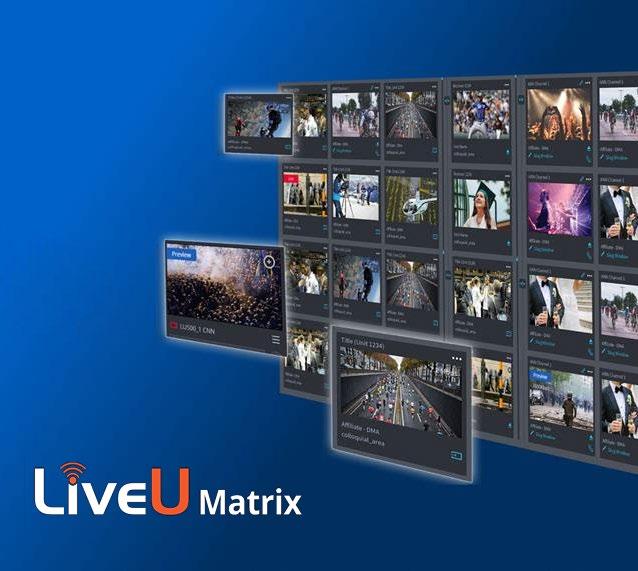
The European Broadcasting Union (EBU) has awarded LiveU a five-year contract to deliver 24/7 live news content through its Eurovision News Exchange.
The exchange project is the next step in an ongoing transition from a previously satellite-only system towards IP-based contribution and hybrid distribution. The Eurovision News Exchange will rely on LiveU Matrix for delivery of its members’ live signals throughout Europe and beyond, LiveU said.
“The project marks a decisive step for the broadcasting industry, as major public service media embrace cloudbased IP workflows for faster, more sustainable and cost-efficient live news delivery,” said Emilio San Pedro, EBU’s head of Eurovision News Exchange. “LiveU’s Matrix platform enables us to connect Europe’s leading broadcasters better than ever and ensure seamless, future-proof live news delivery for audiences everywhere.”
The project connects all members with LiveU technology, extending to more than 60 public service newsrooms in Europe and globally, the company said.
No. 2: The Digital Rights Management (DRM) faceoff between the ATSC 3.0 Security Authority, some viewers and some CE companies over 3.0 content will be resolved—most likely leaving all sides a bit disappointed but for different reasons.
No. 3: Agentic AI makes its presence felt in the broadcast back office. Workflow efficiency has been the mantra of TV production, news and distribution for decades. With the help of agentic AI, many back-office processes will be more fully automated.
No. 4: 5G Broadcast proponents in the U.S. broadcast industry will continue to make their case but won’t find the success they seek.
No. 5: Re-evaluation of the role public cloud plays in media workflows will continue. Some media organizations will decide to repatriate their valuable content from the public cloud in favor of using a combination
No. 8: Stations and station groups will begin to get their arms around the best that the “creator economy” has to offer, especially when paired with the content they already create, leading to a variety of benefits for broadcasters—perhaps most importantly, occupying more mindshare among younger members of the public.
No. 9: The funding nightmare public broadcasting is living through will have a bit of a silver lining for the rest of the industry, as displaced technical workers and engineers will create a talent pool commercial broadcasters can tap to help address their engineering aging crisis.
No. 10: The Department of Transportation-funded Broadcast Positioning System (BPS) will demonstrate the strength of the solution as a relatively affordable backup for GPS—especially when it comes to precise timing—and will turn heads among those responsible for national security.
That’s a wrap. Here’s wishing everyone a great 2026!
The project includes a phased rollout—currently in its pilot phase with 15 members—of LiveU Ingest for cloud recording and shared content workflows across both primary and backup channels.
Easing ownership rules, NextGen TV progress and AI’s impact highlight busy period
By Gary Arlen
Three issues dominate television’s outlook as this tumultuous year concludes: The fate of NextGen TV (even as the FCC tries to boost its implementation), ownership and consolidation at all levels and the significance of broadcasting itself in a video landscape that is now fragmented by streaming media usage.
While 2025 fomented an array of technology, business and regulatory highlights, many of these controversial developments will grow in importance in the years ahead. Most notably, artificial intelligence tools are exploding into production and operations. At the same time, IP-based video production is transforming production workflows.
Collectively, the year’s progress has set the stage for more near-term industry upheavals—especially given the turbulent political environment.
The Federal Communications Commission’s notice of proposed rulemaking in late October calling for “less regulation” of NextGen TV sent a mixed message. It would not require broadcasters to simulcast ATSC 1.0 and 3.0 signals and would not mandate 3.0 tuners in new TV sets. Nor would it set an end date for the current ATSC 1.0 transmission. Nonetheless, the agency’s official statement curiously contends that its plan “will accelerate the nation’s ongoing transition” to ATSC 3.0. (See Doug Lung’s coverage, p. 19.)
FCC Chair Brendan Carr has characterized 3.0 as “the future of broadcasting,” offering “new ways” to deliver services such as interactive programming, enhanced video and audio formats and other data services through its internet protocol-based transmission system.
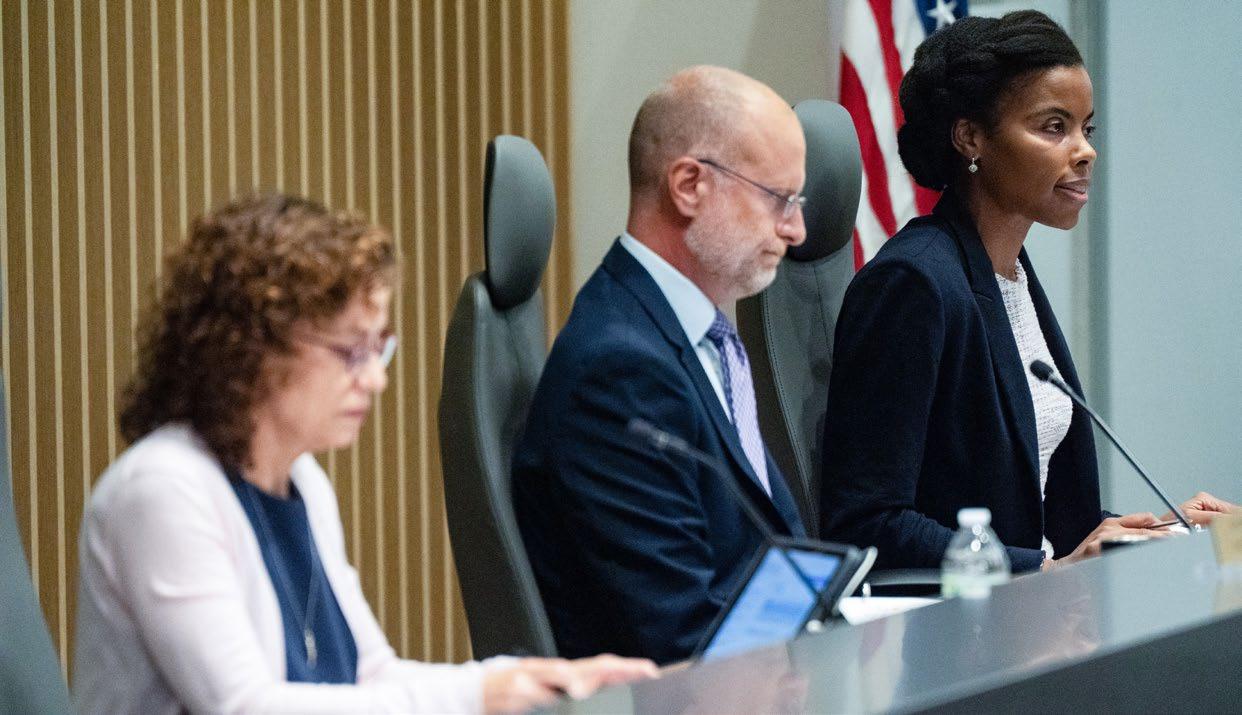
“Television is moving to an IP-based format that supports features and functionalities that will allow broadcasters to compete more effectively with digital platforms, both on content and economics,” Commissioner Anna Gomez added, acknowledging the “very complicated questions” of this transition. “First and foremost is the issue of timing.”
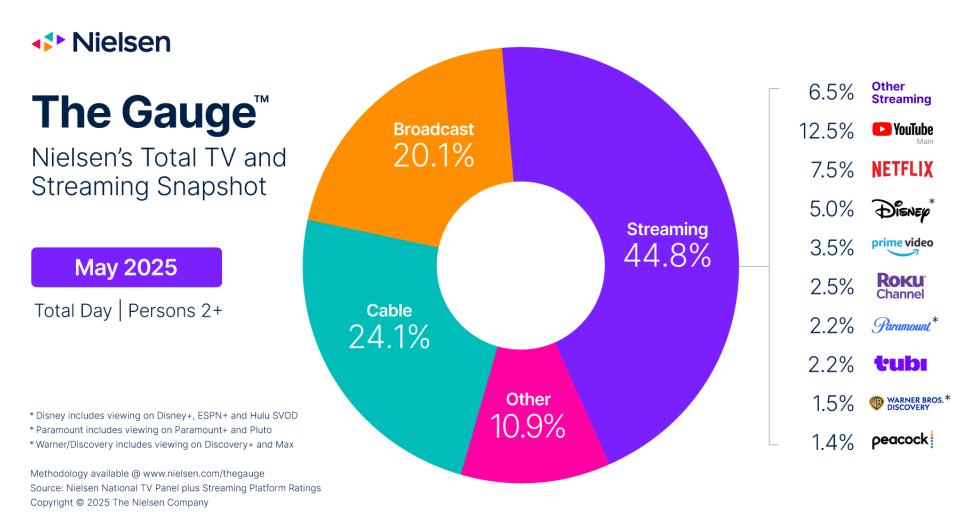
Although FAST, SVOD and other online video formats have been growing rapidly since the pandemic, May 2025 marked the first time that their combined share of total television usage surpassed the collective viewing of broadcast and cable.
Throughout the year, ATSC 3.0 hurtled on a roller coaster of developments. On the international front, Brazil declared its broadcasters will use the physical layer of the ATSC 3.0 standard as its “DTV+ television format of the future.” Commercial service is targeted for the FIFA World Cup next year; meanwhile, stations in Rio de Janeiro and São Paulo are running experimental transmissions, with a station in Brasilia expected to launch soon. Globo TV plans to offer enhanced capabilities, such as 4K and 8K content.
Among other NextGen projects during the year: the Run3TV applications platform got a boost when NBCUniversal became an investor in the ATSC 3.0 Framework Authority (A3FA), which supports the technology for local services.
An ongoing consolidation effort is bubbling among station owners as well as technology providers. Beyond the marquee deals—such as the prolonged saga of Skydance (which climaxed with its takeover of Paramount Global, including CBS and cable networks)—there is the proposed alliance of Sinclair Broadcast Group with Tegna, which would potentially
create the nation’s largest station group. Meanwhile, Tegna was in talks with Nexstar Media Group about joining forces. And Sinclair was also flirting with Gray Media.
Adding to the merger fantasy and frenzy was the FCC’s signaling that it may review its national ownership cap, which now limits the reach of a station group to 39% of U.S. TV homes. Separately, the 8th U.S. Court of Appeals ruled in July to vacate the “Top-Four Prohibition” in July. That restriction prevented a single entity from owning more than one of the four most-watched television stations in a local market. Many analysts expect that lifting the regulation will generate local-market juggling, which could be used to blend station newsrooms and ad-sales groups. Thanks to the relaxation of regulations on the audience reach of broadcasters, media companies and their technology and content suppliers are entering a new age of consolidation.
Although FAST (free ad-supported streaming TV), SVOD (subscription videoon-demand) and other online video formats have been growing rapidly since the pandemic,
May 2025 marked the first time their combined share of total television usage surpassed the collective viewing of broadcast and cable, according to Nielsen’s monthly report “The Gauge.”
Nielsen’s analysis showed 44.8% of viewing was via streaming platforms (notably YouTube and Netflix), while 20.1% was on broadcast channels and 24.1% on cable channels. (“Other” accounted for the remaining 10.1% of viewers’ attention.)
The online migration came as program networks accelerate their online presence. Fox One debuted as a streaming service that includes all of Fox’s cable channels; Disney expanded its ESPN cable brand to an online app; and CNN (via its parent Warner Bros. Discovery) introduced a similar standalone app.
Now the comparable hype involves artificial intelligence, which is weaving its way into countless aspects of our lives.
When the dust settles, some analysts contend that venerable networks such as MTV could be shuttered under Paramount’s new Skydance ownership.
“Free services have been a major driver of streaming’s overall success,” according to Nielsen’s analysis. But the shifting environment—and viewers’ dismay about increasing costs for multiple streaming services—is likely to alter the lineup in the years ahead.
Two decades ago, toward the end of the internet/web bubble, a cheeky prediction from Silicon Valley proclaimed “IP on Everything,” suggesting internet protocol was integral to the emerging Internet of Things and other services that would all become connected.
AI is seeping into media creation and delivery, from creative workflow and production to home displays. Skeptics are already voicing concern that it is reshaping news production, trust and ethics, deriding the AI onslaught as “virtual saturation” and predicting “AI fatigue” among customers and providers.
Yet, as Jeff Zellmer, executive vice president of digital operations for Fox TV Stations, told TV Tech earlier this year, “AI represents a massive shift in culture and technology.” He and other station and group officials cited the range of tasks AI can enhance or generate, ranging from real-time, multilanguage translations to workflow management.
Among the capabilities are hybrid-generated content creation, such as automated sports highlight reels, that could devise video packages within seconds after live action. Ad
targeting and other personalized features are also likely—and will inevitably face challenges from privacy advocates.
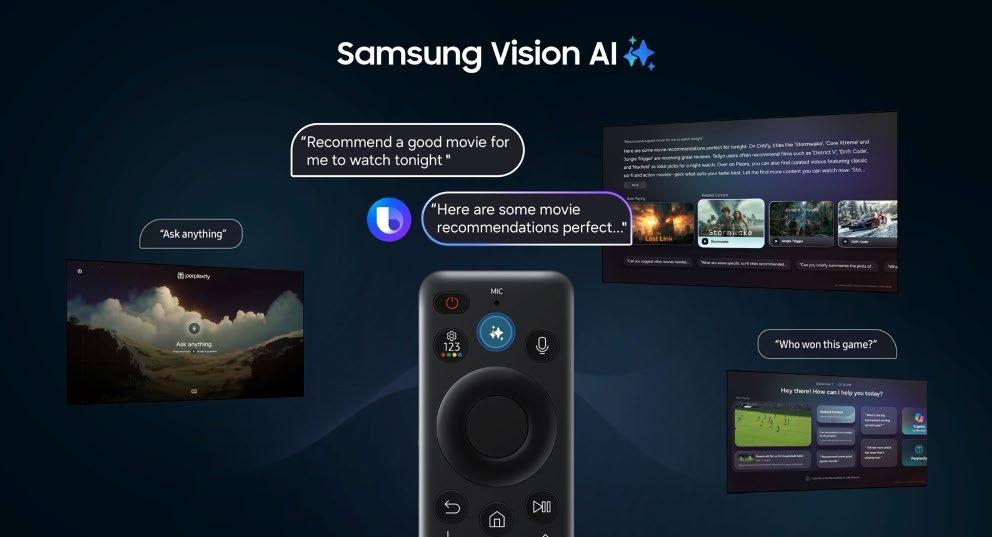
AI is also finding its way into TV displays. For example, at CES, Samsung demonstrated a voice remote control that creates personalized responses, including custom picture settings. Another Samsung feature is an AI button on its remotes that can offer the ability to live translate from a show’s native audio language into subtitles for another language. Can synthesized real-time dubbing be far behind?
Although many of 2025’s media tech issues had a political component, perhaps none was as transformative as the federal rescission package that eliminated more than $1 billion from public media funding and wiped the 58-year-old Corporation for Public Broadcasting out of existence.
Since CPB was a significant funding source for the Public Broadcasting Service and member stations, the impact was quick and vast. Many local and regional public broadcasters almost immediately announced plans to cut their staffs by up to 40%, and some said they will slash budgets, including purchase of PBS programming.
“Without federal funding, local stations are eliminating or reducing local programs, including local history programs, community event coverage, agricultural programming and local public affairs programming, among others,” Kate Riley, president and CEO of America’s Public Television Stations, said in October.
A few stations will go dark in June 2026. WPSU-TV at Pennsylvania State University sought to transfer its operating assets to WHYY, a Philadelphia public media organization; but the Penn State Board of Trustees rejected that plan.
New Jersey PBS, that state’s only public TV channel, will also go dark in June. It plans to continue producing a nightly news program on digital platforms via a broader operations deal with WNET-TV in New York City.
Public broadcasters vowed to tap other funding streams, especially corporate sponsorships, individual donations and member station fees. ●
Gary Arlen has covered and analyzed new media and telecommunications developments from Washington since the Nixon administration.
advertising is expected to

Political spending will spike next year, but stations will struggle to reverse a longstanding shift away from local TV
By George Winslow
In most years, a graph of annual local TV ad spending is about as predictable as an electrocardiogram of a reasonably healthy patient in a doctor’s office. Revenue spikes upwards on even-numbered years as a pulse of political advertising pumps into the system and declines in odd-numbered years between the regular cycles of midterm and presidential elections.
Not surprisingly, analysts and top station executives predict a similar pattern for 2026, which will see a burst of spending around the midterm elections, the Winter Olympics and the FIFA World Cup. BIA Advisory Services, for example, predicts the $14.51 billion in local TV over-the-air (OTA) ad revenue in 2025 will grow 25.5% to $18.18 billion next year.
Smoothing out the spikes of political advertising, S&P Global Market Intelligence’s Kagan Research predicts a cumulative annual growth rate of 1.48% between 2025 and 2030 for TV station ad revenue.
Even so, most analysts readily admit that the prognosis for a healthy ad market over the next year or two is particularly uncertain. While the rollout of NextGen TV and industry-wide consolidation could boost revenue several years down the road, they are unlikely to have a major impact on the 2026 ad market, which could easily be derailed by a variety of economic issues.
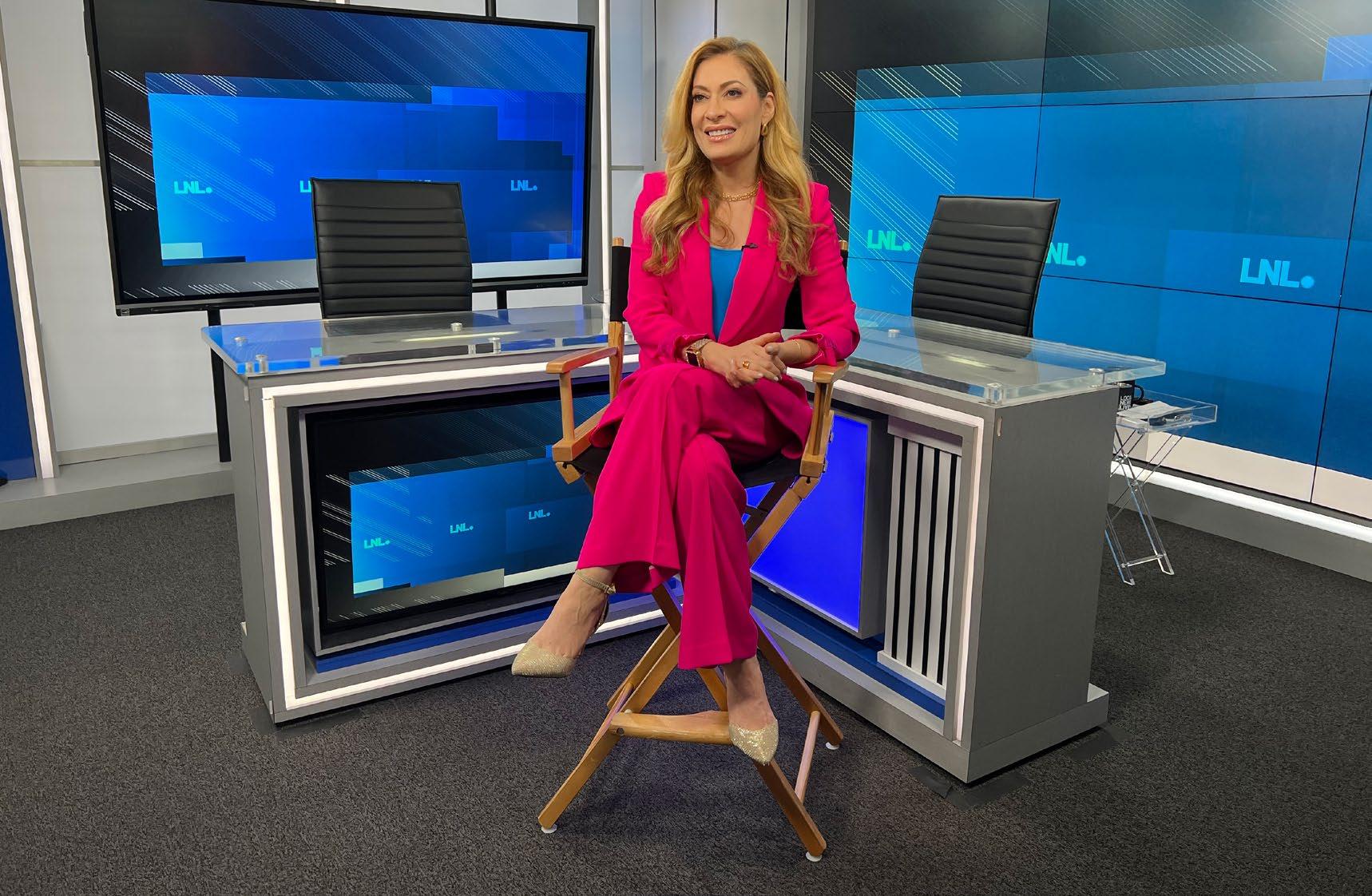
“Who knows what will happen with tariffs?” Rick Ducey, managing director of BIA Advisory Services, explained. “Who
knows what will happen with inflation and interest rates? Who knows about employment… and consumer confidence and AI spending, which has been a key driver of the economy?”
“The economy is really a big wildcard,” added Brian Wieser, principal at Madison and Wall and a financial analyst of the global advertising, technology and marketing services sectors. “Unless you believe that everything economists have said in the last 100, 200 years is wrong, there are real risks. And it’s not just uncertainty. It’s the certainty that bad economic policies have consequences.”

Even political advertising, which has been reliably breaking records year after year for de-
cades, is potentially more volatile than ever. Ducey noted that the Supreme Court’s upcoming decision in the National Republican Senatorial Committee v. Federal Election Commission case, challenging existing spending limits, could increase or tamp down political advertising. Likewise, efforts to gerrymander congressional districts in Texas, California and other states could also have a major impact on spending.
“In terms of political advertising, we are anticipating about $3.8 billion next year, up about 10% from the last midterms,” Justin Nielson, head of Kagan Research at S&P Global Market Intelligence, said. “That is not as high as it was in 2024 but relative to the midterms, very healthy.”
BIA is predicting a slightly higher $4.2 billion local OTA TV political ad spend.
Tariffs are another wildcard. “Tariffs have had an impact in terms of consumer spending, but not to the point where it’s made a huge difference in terms of the advertising marketplace,” Nielson said. “Advertising has still been coming in pretty heavily,” and some industries like auto are seeing a spending rebound
An even bigger worry is the longer-term shift of ad dollars from linear TV and local TV to digital and streaming.
Excluding political from the 20206 numbers, “we actually have a year-over-year decline [in core OTA TV ad revenue] because dollars are shifting to CTV and digital,” noted Senan Mele, vice president of forecasting and data analysis at BIA. This decline would actually be worse, he added, without the beneficial impact of the Olympics and other special events in 2026 like the World Cup.

“Agencies and advertisers want to be able to report the ROI on ad investments and it’s easier to do that with a digital platform compared to TV over the air,” he concluded.
Reversing that trend is a major priority for broadcasters, both with better measurement tools and revamped cross-platform sales strategies.
“Advertisers want to make sure that they’re reaching folks no matter where they are, and they want a very cohesive plan,” Ronna Steber, senior managing vice president at Gray Media, said. “So, we’ve worked really hard to be able to offer them complete plans, linear, digital, social” while deploying better measurement and analytics to “make sure that those ad campaigns are delivering on all the analytics that the advertisers want.”
“While digital spend is going up and spending is shifting away from linear media like radio and TV, some of that shift now goes back in their pockets because they’re selling different inventory,” Ducey added. Efforts by local broadcasters to acquire more sports and boost original programming have helped their ad sales, he added.
“We want to make sure that we bring in unique content to the viewers, and that’s really helping us,” Gray’s Steber said, pointing to
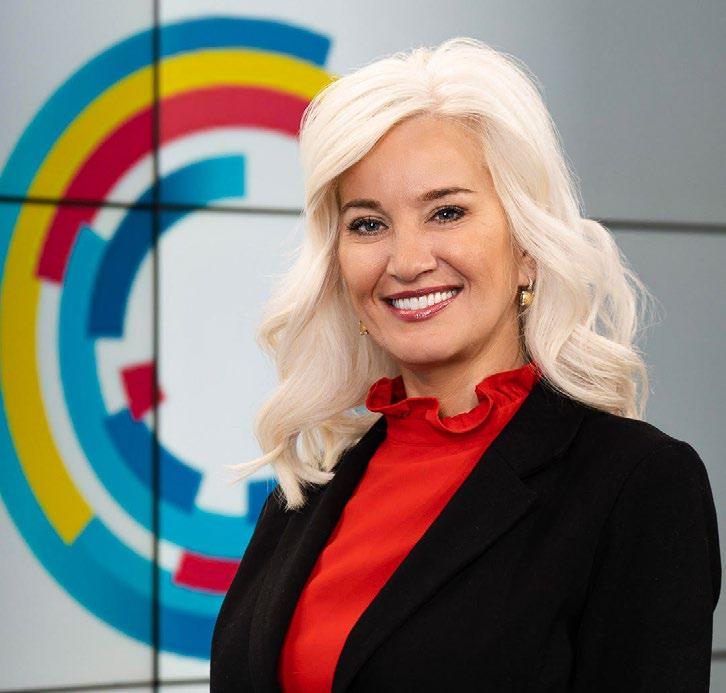
efforts like the programming produced by its InvestigateTV unit and the content available on its Local News Now 24/7 free streaming channel. “People are hungry for content that’s unique.”
Analysts, however, had mixed reactions to broadcasters’ hopes that the rollout of ATSC 3.0, broadcast ownership deregulation and a wave of M&A activity will have much of an impact on 2026 ad revenue.
Most noted that ATSC 3.0’s impact is several years away, given the limited penetration of sets, and were skeptical that deregulation and the creation of larger station groups would immediately strengthen their ad business.
“It certainly won’t help them compete with bigger platforms,” Wieser said. “Marketers are shifting away from television because of what digital platforms can offer…The reality is that with less fragmentation you may even have less diversity in the business model, which is a surefire way to amplify the current trends [of ad market share losses]. Size isn’t what’s causing budgets to shift.”
Mele at BIA agreed that consolidation in itself won’t reverse shifts towards CTV but added that it “could help with ad revenue at a station level in specific markets because… there will be fewer sellers.”
Even so, analysts at BIA and other firms highlighted some positive trends.
“The two big highlights for me in terms of positive impact to the ad market have been local sports rights in certain markets and their increasing ability to offer a full suite of linear, digital and social packages to advertisers,” Nielson said. “Being able to offer [a unified, one-stop] advertising business model and investing in local programming is producing an encouraging ROI.” ●
Next year’s generally bright local TV ad forecast includes some notable risks broadcasters will be watching closely:
1. Economic Uncertainty: A bust in AI spending, higher inflation, tariffs, job cuts, interest rates, declining consumer confidence and even foreign wars are among the many factors that could derail already sluggish economic growth.
2. Political Ad Boom: Broadcasters are betting heavily on a big haul from political ads, but an upcoming Supreme Court case, redistricting efforts that could produce less competitive races and the shift to CTV could reduce growth.
3. Regulatory Hopes and Realities: FCC ownership-rule changes could lead to a
wave of swaps and mergers that could strengthen ad sales efforts in specific markets, but a Trump administration proposal to limit pharmaceutical ads could devastate a lucrative category.
4. Bellwether Industries: Beyond the political sector, analysts believe q uick-s ervice restaurants (QSRs in ad parlance), auto, legal services and pharma could be strong categories in 2026.
5. Shift to Digital Media: Even with the political advertising boom, the longer-term shift to digital media might reduce core advertising in 2026 and beyond unless stations adopt new business models and strategies. George Winslow
By Phil Rhodes
Many industries have seen big-ticket hardware turn into software. Switchers, though, demand a combination of real-time performance and sheer bandwidth that has only recently become achievable in software, and has taken a while to begin affecting the high end.
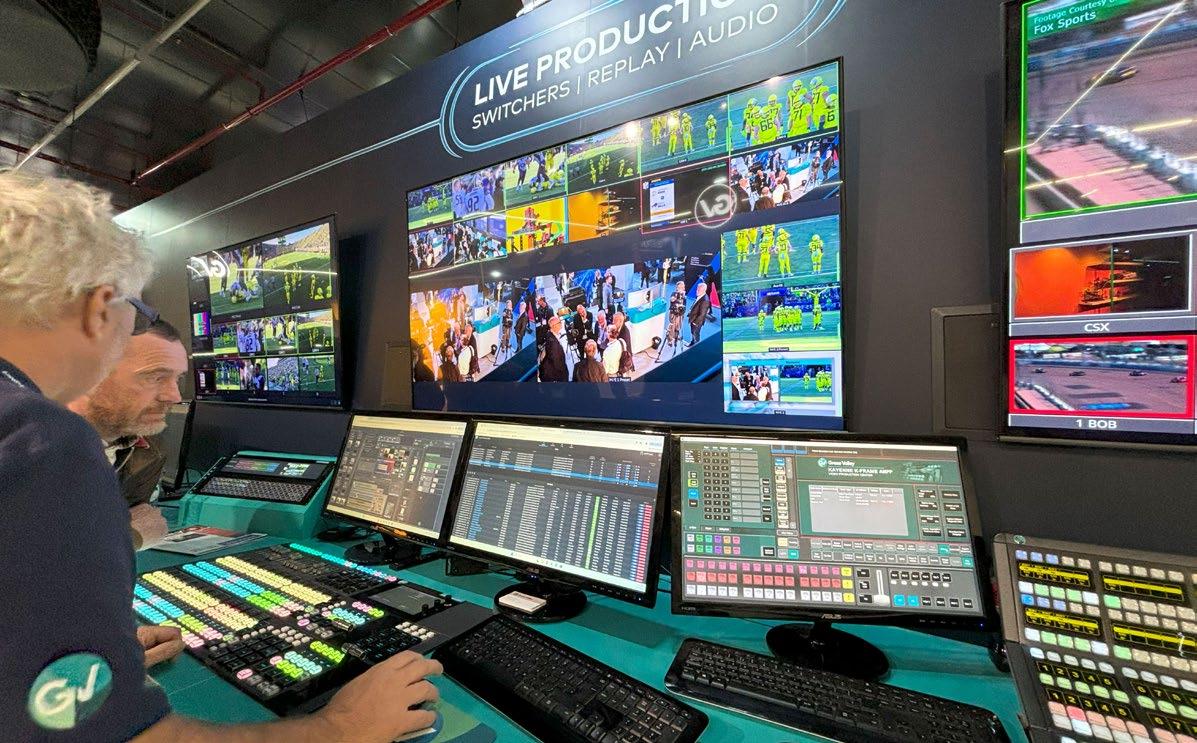
Greg Huttie, vice president of production switchers for Grass Valley, said the company’s designs have long relied on both silicon and code. “Every production switcher we’ve ever put out has software involved in it one way or the other,” Huttie said. “Across the board, I’ve got hardware engineers and software engineers. The world is becoming hybrid.”
That world, though, interfaces with working practices which change slowly.
“When you talk to a vision mixer or technical director, they’re basically piano players,” Huttie said. “They have a tactile feel. I sat in director’s chairs for many years, and there’s a trust level—even though I’m calling something, my technical director is in my head, lingering on shots he needs to linger on but also knowing the rhythm of the show I’m putting out. They don’t look at the keys.”
That kind of experience, Huttie continued, is increasingly in demand on shows at every scale.
“There is a growing trend where you place yourself further downmarket—not in finished features or functions, but as a smaller piece of that Grass Valley hardware,” he added. “We just delivered 48x24 in a K-Frame XP and won awards at IBC and NAB. We saw that a lot of folks want the power of a production switcher, but they wanted to reduce headcount…going for that single seat.”
Increasingly, software-defined implementations more easily fulfill the demand for a wider range of options, as Huttie explained by reference to Grass Valley’s cloud-integrated Event Producer X with its Maverik X switcher.
“I think a better place for that single seat isn’t really for sports but events, news,
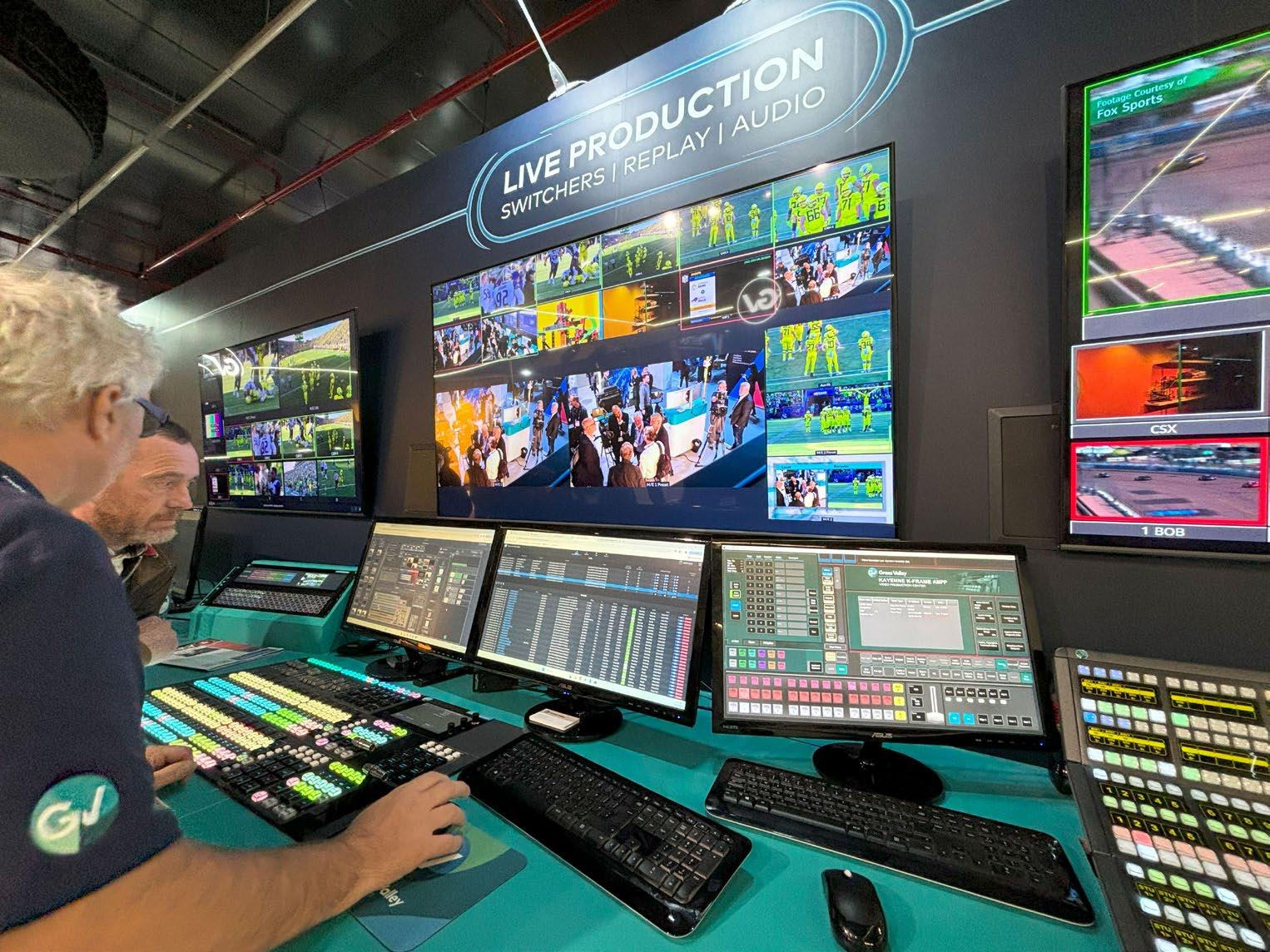
corporate,” Huttie said. “Event Producer X couples things together and makes it less burdensome on body count, though we’re not advocating that you reduce your body count.”
Software-definition has implications which reach further than feature set or scalability, according to Deon LeCointe, director of networked solutions at Sony.
“Everything we build now has to have some connectivity involved,” he said. “They have to be not only hardware for on-prem, they have to be software for cloud, SDI and IP.”
Even the comparatively recent move toward IP, though, faces unexpected pressures. “The prevailing logic is that if you’re building a new facility, or renovating, you have to take a hard look at implementing IP,” LeCointe said. “Three years ago, I would have said that the question still comes to mind.”
That idea, though, might no longer quite be universal. “When the pandemic
happened, REMI became required for dayto-day operations, and it accelerated the conversation around IP tech moving toward cloud tech,” LeCointe said. “People were saying, ‘Can we skip IP and go to the cloud?’”
The answer, he said, was often no, not least because of the media industry’s uneasy relationship with metered-data exit fees.
“Cost was a pretty big roadblock,” he said. “Then, the challenge of not having all your live production elements in the cloud—replay, graphics switcher elements, video shading— that just hadn’t gotten there yet.”
Given the interaction of so many complex technological considerations, LeCointe emphasized, Sony has kept things flexible.
“We opt for more of a customer choice philosophy,” he said. “M2L-X is our softwarebased switching platform, which can be deployed on the public cloud or on a COTS [commercial off-the-shelf] server. We’re not trying to delve into the minefield about where customers want to deploy.”
A combined interest in quick, flexible scalability and cloud as a choice rather than a requirement, then, seems like the mood of the moment, according to Satoshi Kanemura, president and chief operating officer of For-A America.
“Everyone likes a 100-input big switcher, and that’s driven mostly by the technical director’s opinion,” Kanemura said. “Nowadays, what they’ve found is that sort of big event is once or twice in a year, but most operations need 20 to 30 inputs with 2 ME.”
Doing that the old way takes effort, Kanemura said. “When they increase or reduce the system, adding hardware, rewiring, recabling… they have to manage such a change,” he said. “So, software-defined is becoming a very big buzzword. One or two years ago, many people jumped into the cloud: ‘Cloud’s going to solve everything, it’s easy to increase or decrease the operation.’ What they found was that…even if they shrink the application, still using the cloud, that charge is coming every month.
“Now they’re coming back to the on-premise solutions,” Kanemura continued. “People who can’t afford a big switcher with 100 inputs can go toward software-defined. For-A Impulse can do anything a customer wants—switcher, multiview, frame sync or you can put only multiview into the server and that can be shared into the three rooms. Then, the next day, you can change it to all HDR-SDR conversion parts.”
For-A’s market position in Japan has granted it a unique position with regard to AI and the vexed issue of training data. “Now [that] cable revenue is down, most broadcasters are looking for new revenue from streaming,” Kanemura said. “They do the production in a 16:9 format, then want to trim down to 9:16 for cellphones. You can crop using AI to track the main player into the center of that 9:16… it’s that kind of AI engine.”
Making that happen has allowed For-A to leverage its relationship with NTV. “Their en gineers and For-A’s got together to collaborate to build the AI,” Kanemura said. “To make a good AI, you have to give more and more data, but most AI in the market is not specified to the broadcast market; it’s more generic data they put in. [But] NTV has 70 years of archives—that AI knows how to cut, zoom, and understands the sort of scene. It’s a more broadcast-friendly AI engine.”
With or without AI, running a switcher on a workstation or server raises issues around the sort of real-time responsiveness that users
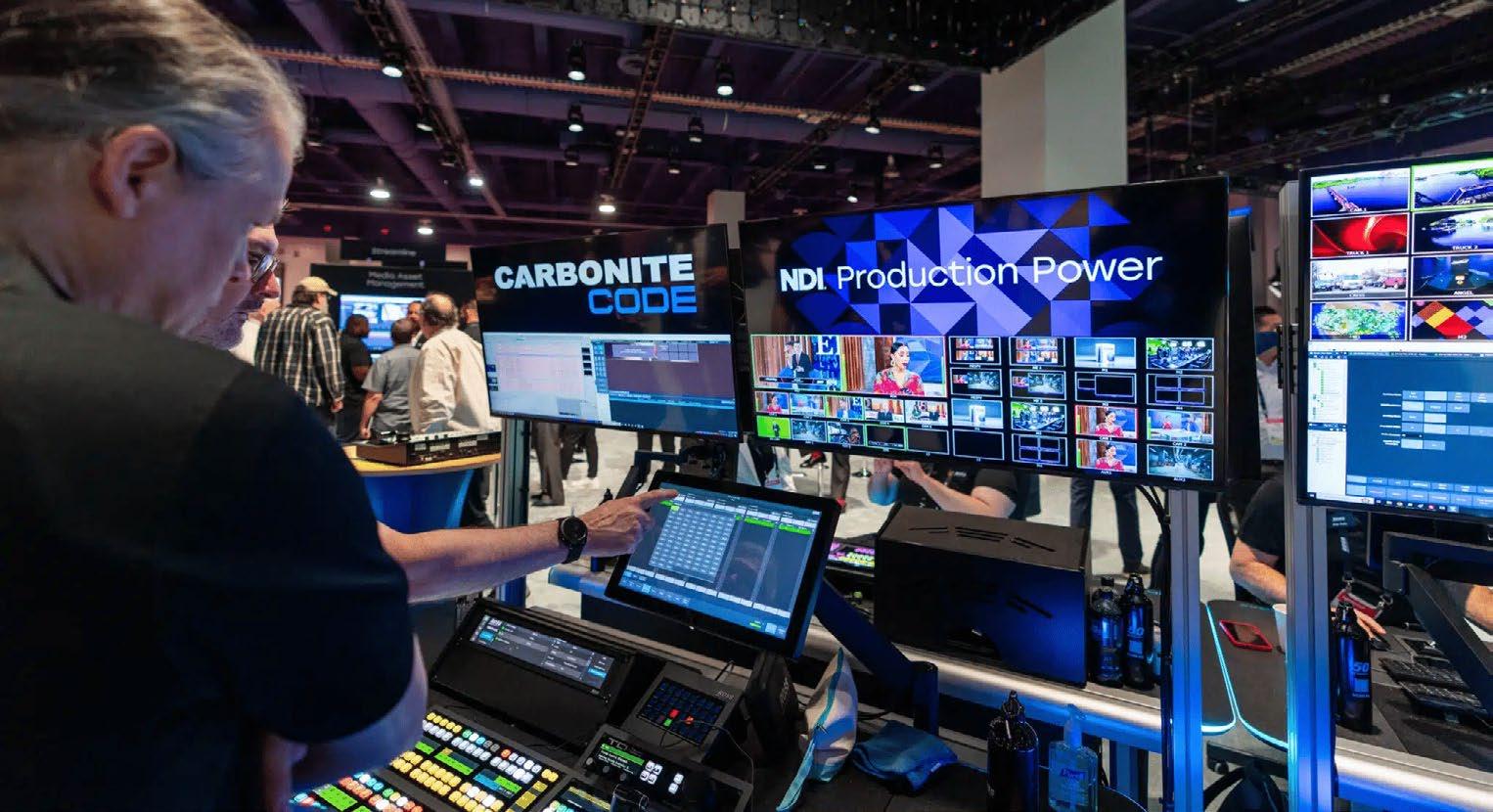
expect. Les O’Reilly, director, switcher product management at Ross Video, described how the company has accommodated that change within an existing product line.
“The Carbonite family has shipped over 12,000 switchers,” O’Reilly said. “Carbonite as an operator user base was massive… and Carbonite Code launched at NAB 2024. It’s a Carbonite switcher, but instead of on an FPGA [field-programmable gate array], it’s running it on a GPU [graphics processing unit], a software-based switcher that can do some things that are different, but it still operates like a Carbonite.”
The bounds of the underlying hardware are necessarily imposed in a rather different way than the input and bus counts of a conventional switcher—though Ross’s experience in graphics has influence here.
“You have processing headroom you will run into in a software switcher,” O’Reilly explained. “In our XPression world, we have a software 3D renderer, all done in the GPU,
that you’re still rendering faster than your frame rate.”
Implementing that in a switcher running on COTS hardware, O’Reilly continued, gives users an easily-understood performance metric. “If you’re at 90%, you’re rendering 10% faster than real time,” he said. “If I see 103%, 104%, it’s telling me I’m not rendering 60 frames per second any more, I’m rendering 57. We give them the keys to the kingdom, let them build their shows and figure out what they can and cannot do.”
O’Reilly’s approach to AI’s role in the future of production switchers is pragmatic.
“I want our industry to introduce practical uses, otherwise the joke is that when a company does its keynote, the Discord group takes a drink every time they mention AI,” O’Reilly joked.
Ross’s approach leans toward making the switcher a directable part of the show itself. “We have a speech analysis tool that allows you to direct your show while talking,” O’Reilly said. “We had it on the floor—you could come up and direct it—ready one, take one, put one on the left split, two on the right—and since then we’ve refined and applied that to other products.”

Despite all this advancement, O’Reilly cautioned, the exigencies of live television have maintained the demand for traditional hardware. However, making changes acceptable to highly experienced users is, as always, a consideration.
“FPGAs keep getting bigger, badder and faster,” he said. “We’re constantly adding features and functionality, and we have to get the operator and the user to come along on the journey. So, yes, we absolutely can’t stay locked in the past, but we have to bridge to the future.” ●
Threat protection is a serious part of any organization’s network, storage or active workspace—especially if you’re invested in the cloud. While the basics are somewhat easy to follow or prescribe, the real-time monitoring and any aggressive corrective actions can be challenging for the individual(s) whose tasks in the organization include both IT administration and security, plus cloud-services management.

that ranges from a platform of managed services to the specific software stack required to run serverless functions.
erations and (real-time) runtime to provide continuous visibility, protection, simple and continuous detection and proactive response.
Some of the groundwork for building a modern cloud-security program is provided in the following, as outlined by a familiar cloud-support trendsetter who specializes in providing cybersecurity in an era of change and movement toward the cloud, regardless of business model.
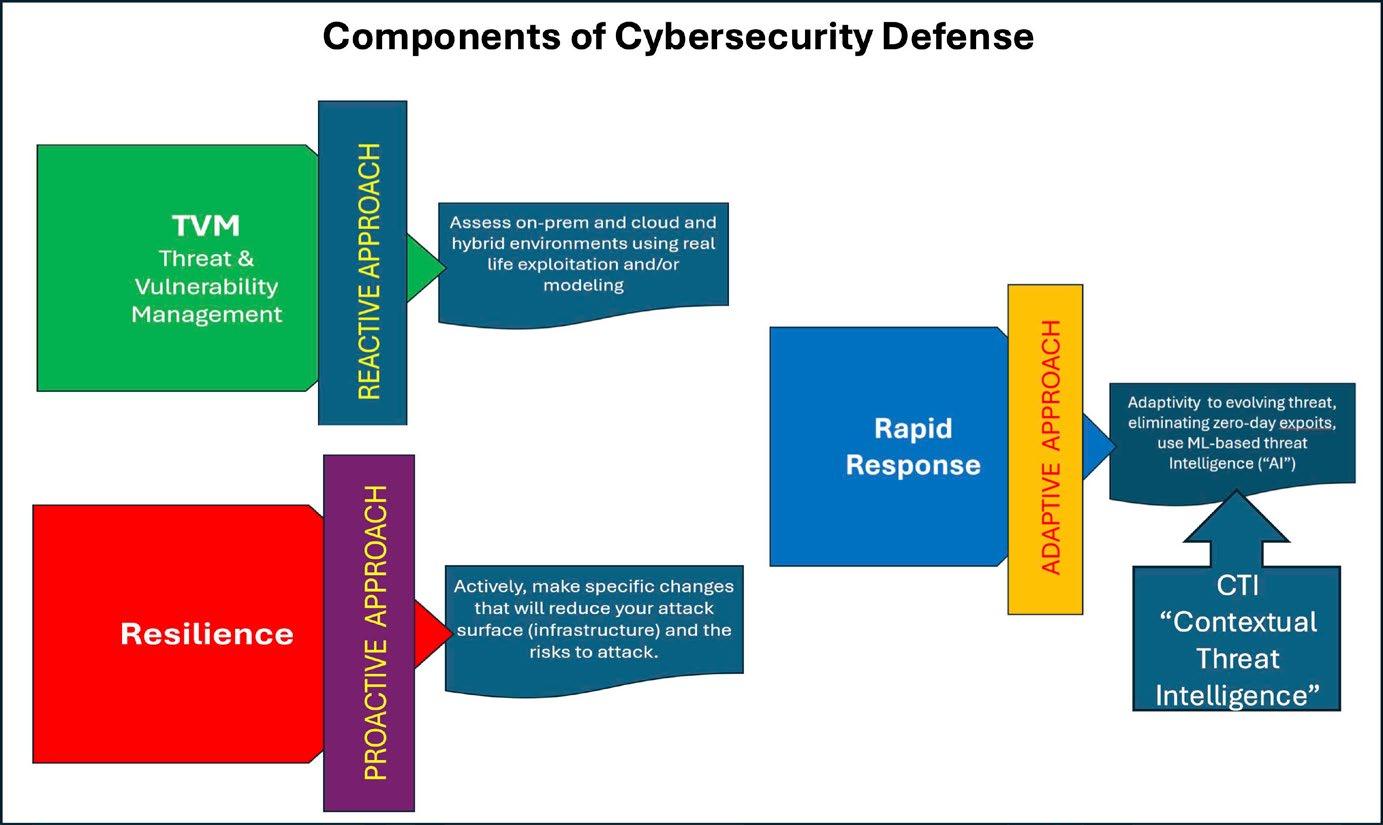
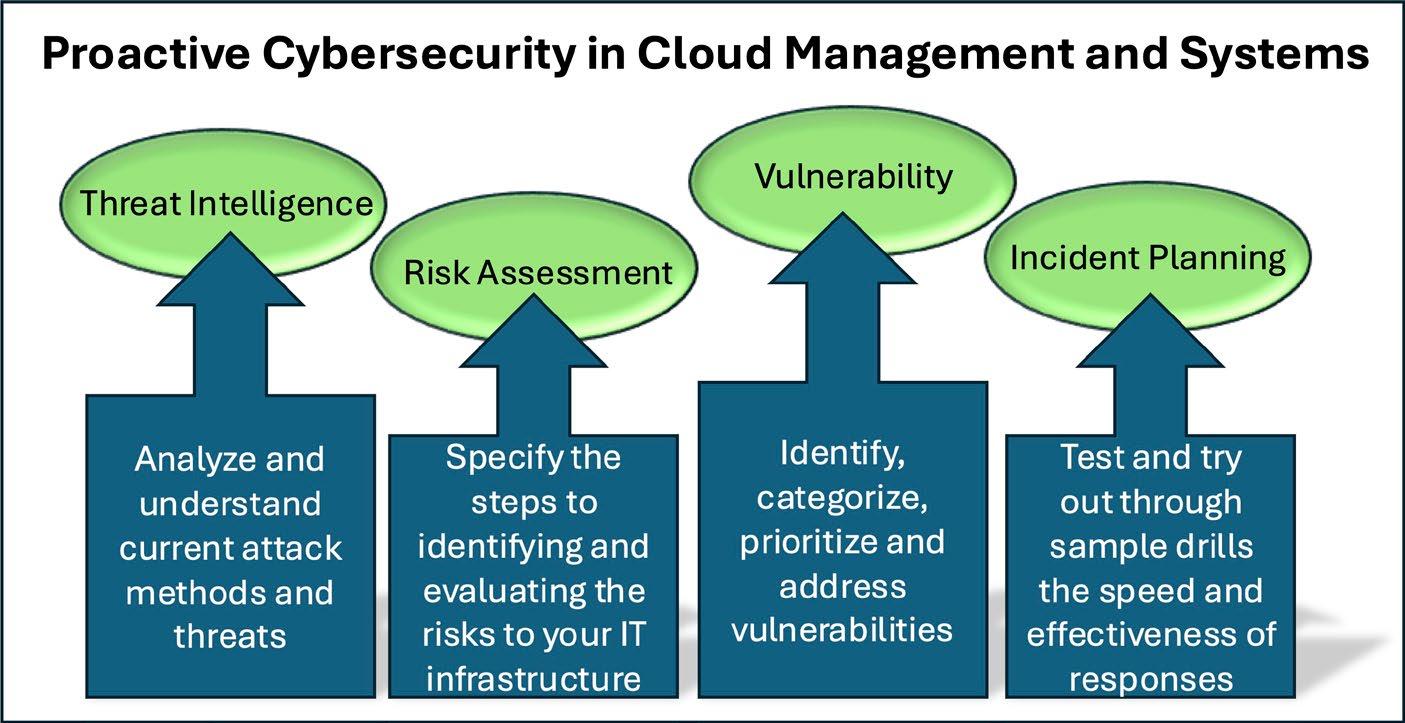
One option is to take a proactive approach to cybersecurity (Fig. 2), which is critical to reducing risks and being prepared to address or prevent breaches. Examples follow:
That is, it can or will become overwhelming to control without some secondary support or a built-in solution integrated by the cloud provider. Simply expecting an ISP to handle this is not a good answer.
Being prepared is essential in the current cloud environment. Fig. 1 gives some of the suggestions for this preparedness from a Reactive, Proactive and Adaptive perspective.
Breaches in security can and likely will become unmanageable without appropriate planning and active, real-time monitoring alongside aggressive enforcement of IT policies and practices.
In computer programming, a runtime system or runtime environment is a subsystem that exists in the computer where a program is created, as well as in the computers where the program is intended to be run.
A cloud runtime is the environment where cloud applications and services execute—including the operating system—language support and other necessary software. Furthermore, it is a commercial term (such as Google’s Cloud Run)
Noting that, a serverless platform is a cloud-based service that automatically manages the underlying infrastructure, allowing developers to deploy and run code without provisioning, scaling or maintaining servers and otherwise is a cloud-computing execution model that allocates machine resources on an as-used basis. Examples of serverless applications include chatbots, task schedulers and Internet of things (IoT) applications.
Typically, in the serverless environment, any server management, configuration, scaling and billing activities are abstracted from the end user—i.e., the complex, underlying details are hidden and simplified, so the user need only interact with a higher-level, easier-to-understand interface.
One core solution to ensure adequate security precautions is to establish a unified platform that spans across development, op-
One part of understanding and preparing for cloud security involves some of the actual code-centric and application development, such as understanding Container Runtime Security, a key aspect of Kubernetes (as an opensource container orchestration platform, with cloud computing services) and security. This prospect focuses on safeguarding containers (e.g., Docker) during their execution.
When active, operational containers are most vulnerable to malicious activity since traditional security tools weren’t designed to monitor running containers. Runtime security is the only way to secure cloud-native applications at scale and in today’s environments, the use of AI and machine learning will necessitate runtime automating the processes for modeling of a healthy activity built against a model.
“Modeling” is the process of creating a representation of normal, safe behavior—for applications and services, especially when running in a cloud-native environment. Such a representation serves as a baseline to identify and detect deviations or anomalies that might indicate security threats.
When the system has an established model, and then uses continuous monitoring and lets software make comparisons of the runtime activities of applications and services against the established model, teams can then identify and respond to unauthorized actions, privilege escalations and other potential incidents. Major cloud-service providers offer managed Kubernetes
services that simplify infrastructure management, allowing organizations to build and run modern applications on a hybrid or multicloud environment.
Most security teams lack the time, experience or context to effectively handle and react to a deluge of security alerts that could come from various security tools or practices.
As DevOps and engineering teams rely more on cloud technologies to achieve faster development cycle times, they may often prioritize development deadlines over security issues.
While they fundamentally understand the needs and values of security, they often don’t deem it highly important or may end up wasting their time and resources remediating vulnerabilities that seem impactful but don’t present an active risk in production. The organization’s administration should consider utilizing
a tool set that correlates threat intelligence, business impact and data sensitivity to provide an accurate representation of active risk.This approach can then help in enabling alignment between DevOps and security teams as to which security issues to prioritize and when. Avoid centralizing into one workstream that is sandwiched between DevOps, engineering (implementation/operations) and security teams. Avoid manifesting risks and mitigate the risk of a breach, since the func-
tions of each workgroup then isolate (silo) the interdependency of each job function or task.
In the current age of cloud, one where all of your teams’ efforts are likely focused on innovation, it is crucial to leverage a solution (team, outside party or vendor) that can manage every stage of cloud detection and response for you.
To maximize the investments in a security solution, those teams (internal or external) must have the expertise to leverage activities fully. If you don’t already have those teams in place (and properly structured), then look for a solution provider that can function as a partner and who you can rely on to guard your cloud assets 24 hours a day, 365 days a year. ●
Karl Paulsen, CPBE and SMPTE Fellow, is a retired CTO. He can be reached at karl@ivideoserver.tv or at TV Tech.


Proposed rules would give broadcasters flexibility, but a lack of direction for devices, rights management and MVPDs risks slowing adoption
In late October, the FCC voted to give U.S. broadcasters more freedom in determining how to manage the transition to ATSC 3.0 and the shutdown of ATSC 1.0 services. Since broadcasters have a strong incentive not to disenfranchise existing viewers, this makes sense.
The proposed rules (the Fifth Further Notice of Proposed Rulemaking or “5FNPRM”) are not clear on what steps, if any, the FCC will require from other partners, such as receiver manufacturers, to expedite the transition. It also raises questions about the current use of content protection (digital rights management) and whether that complies with broadcast requirements in the Communications Act.

broadcasters in an ATSC 1.0 shutdown. With this in mind, I’ll look at some of the main topics in the 5FNPRM. The National Association of Broadcasters’ transition proposal has been widely covered, so I don’t plan to focus on it here.
The proposed rules would eliminate the requirement for a station transitioning to ATSC 3.0 to simulcast its programming on an ATSC 1.0 guest station. However, if a station voluntarily chooses to simulcast, then the ATSC 1.0 signal must cover the ATSC 3.0 station’s community of license and be located in the same DMA.
content is in high definition or better. This would allow more ATSC 1.0 guest stations on a single ATSC 1.0 host.
The proposed rules in the 5FNPRM add MPEG-4 video encoding as outlined in ATSC standard A/72 Part 1, but for multicast streams only. As I wrote in my September 2024 column, “Revisiting MPEG-4 for ATSC 1.0 Lighthouse Stations,” converting an HD stream from MPEG-2 to MPEG-4 and adding an MPEG-2 simulcast in SD makes more efficient use of spectrum in some cases and would allow reception on older devices, which may not support better than SD resolution in any event.
While the proposed rules offer positive steps towards a transition to ATSC 3.0, they also highlight the challenges and risks to
All “substantially similar” language has been deleted, which implies the ATSC 1.0 simulcast on the guest station could be in standard definition even if the ATSC 3.0
Without the “substantially” similar rule, as we approach ATSC 1.0 shutdown, I suspect most stations will be happy with only an MPEG-2 simulcast of their HD stream. A better option to preserve quality would be to allow use of MPEG-4 on the primary as well as multicast streams. That would allow more HD content on the remaining ATSC 1.0 host stations.
The proposed rules do not include any new rules for receive devices. The text of the order raises questions concerning ATSC 3.0 tuner requirements, including benefits and costs of adding an ATSC 3.0 tuner to TV receivers and allowing only an ATSC 3.0 tuner, no ATSC 1.0 tuner.
The Consumer Technology Association contends the marketplace is working and an ATSC 3.0 tuner mandate is unnecessary. NAB argues that manufacturers do not want to include ATSC 3.0 tuners until there is more consumer demand, and most consumers will not demand ATSC 3.0 until broadcasters “offer something they cannot get without it.”
Until viewers have ATSC 3.0 receivers, broadcasters will have difficulty stopping or even reducing ATSC 1.0 services, thus limiting their ability to offer new and improved ATSC 3.0 services.
The FCC asked for public input on the timing of a tuner mandate if a mandate is adopted; warning labels on TV receivers that do not have ATSC 3.0 tuners; and NAB’s proposal to “make broadcast services available to a consumer in the same or fewer steps needed to access any other video content on the same device.” The CTA said the FCC does not have authority to mandate user interfaces and micromanaging them would be “bad policy.”
The FCC noted consumer complaints about the impact of digital rights management on reception of ATSC 3.0 signals.
“As this DRM encryption program has been deployed and stations have begun to encrypt 3.0 signals that previously aired without encryption, however, many viewers have been unable to watch certain 3.0 signals on equipment they purchased specifically for that purpose,” the commission said in its notice. “This has led to thousands of consumer comments in this docket opposing the use of encryption on free OTA broadcast signals, many filed by early adopters of ATSC 3.0 technology even before the Commission’s most recent Public Notice.”
The proposed rules do not include any mention of DRM, but the text asks for comments on several aspects of DRM. These include the costs and requirements of incorporating DRM and whether those factors are deterring market entry. The commission asks whether decryption keys/capabilities and related licenses are available on reasonable and nondiscriminatory (RAND) terms.
The concept of DRM itself is questioned by consumer groups and others, alleging “that
in practice “[t]he use of DRM, private device certification and internet return-path dependencies renders ATSC 3.0 transmissions legally and functionally distinct from traditional broadcasting.”
The FCC notes that the Communications Act defines “broadcasting” as “the dissemination of radio communications intended to be received by the public, directly or by the intermediary of relay stations.” One of the three criteria the FCC has used to determine a lack of this intent is “the programming is encrypted in a way that “makes it unusable by the public” and that is not “enjoyable without the aid of decoders.” The commission asks whether current ATSC 3.0 encryption administered by A3SA and implemented by broadcasters constitutes “broadcasting” within the meaning of the Communications Act.
While the proposed rules offer positive steps towards a transition to ATSC 3.0, they also highlight the challenges and risks to broadcasters in an ATSC 1.0 shutdown.
In my reading of the commission’s full text on DRM, I have the impression the commission may not be opposed to DRM itself as much as the way the current encryption is handled. At this stage in the ATSC 3.0 transition, if the FCC decides the current A3SA implementation is not legal broadcasting, is it possible to change to another content protection scheme without breaking existing ATSC 3.0 receivers?
If content protection is not allowed, what impact will that have on the availability of popular content on free ATSC 3.0 channels? ATSC 3.0 offers the option of having some content protected and other programming in the clear. One possibility is the FCC would require at least one program stream to be unencrypted with more valuable content, such as live sports, ending up transmitted on a different, encrypted program stream.
The 5FNPRM devotes several pages to how a transition to NextGen TV will impact
MVPDs (distributors of broadcast content via cable, internet, satellite or other means to viewers). The Advanced Television Systems Committee (ATSC) created Recommended Practice A/370 “Conversion of ATSC 3.0 Services for Redistribution,” which describes how to convert ATSC 3.0 signals to an ATSC 1.0-compatible transport stream. The 5FNPRM raises questions about the costs of this conversion and the impact on small cable companies. A suggested alternative is for the broadcaster to provide an ATSC 1.0-compatible feed directly to the MVPD, but is this practical in all cases? ATSC 3.0 provides services, such as multilanguage audio and higher data rates, that are not compatible with many cable TV systems.
For more details, refer to the 5FNPRM. In my opinion, depending on the timing, many of the questions it raises may become moot as MVPDs move away from transport-based distribution to IP distribution, where, given sufficient bandwidth, transport of IP based ATSC 3.0 programming will be much easier.
Transitioning to new standards is risky. Look how long it took to complete the analog shutdown after DTV broadcasting started. During that transition, broadcasters had a second channel, receivers were required to include DTV tuners and were widely available in all sizes before analog was shut down, and low-cost converter boxes were widely available with NTIA-mandated performance. So far, none of those conditions apply to the ATSC 3.0 transition.
How can broadcasters accelerate the transition? The FCC’s proposed simulcast rules appear to allow one ATSC 1.0 host to carry a dozen or more channels in MPEG-2 SD. The loss of quality might encourage people to invest in an ATSC 3.0 receiver, if they are widely available, or they may simply move most viewing to streaming services or the omnipresent FAST channels.
For technically-challenged viewers, adding a set-top box could be difficult. What is the best way to get ATSC 3.0 capability into the homes of ATSC 1.0 viewers? Given the advantages ATSC 3.0 provides, would it make sense for broadcasters to fund a receiver or simple settop box option for consumers that need it? It may be necessary to set up a Geek Squad-like service to aid viewers having trouble with the conversion. Is that even possible? ●
Comments welcome! Email me at dlung@transmitter.com.
Rise

At this point you don’t have to imagine this scenario anymore: A breaking news segment airs live, showing dramatic footage from a city center.
Within minutes, the clip is shared across social platforms, picked up by online outlets and debated by millions, including key on-air talent. Hours later, doubts emerge as to whether the footage was real or manipulated. Where did it come from? Suddenly, the broadcaster is thrust into a crisis, facing not only public skepticism but potential regulatory scrutiny. The talent is embarrassed; the viewers lose trust.

Content provenance in broadcasting refers to the systematic documentation and verification of a media asset’s origin or creation context, and subsequent edits or transformations throughout its lifecycle. While simple labeling might indicate where a clip was sourced or who produced it, provenance goes further. It creates a tamper-evident chain of custody, often using cryptographic methods like blockchain, that can be traced and audited at any point.
Authenticity website (C2PA.org) provides more specific technical details. Provenance is especially important for video, where deepfakes and synthetic media can be nearly indistinguishable from authentic footage. By enabling traceability, broadcasters can defend against misinformation and build trust with audiences.
C2PA has emerged as a leading standard for embedding provenance information in digital media. C2PA’s framework allows for interoperable metadata and cryptographic signatures, making it possible for broadcasters, platforms and creators to verify the authenticity and history of content across systems. The standard is open and extensible, supporting a range of media types and workflows and even different industries beyond media.
Media industry adoption is accelerating, with several major broadcast organizations piloting provenance-enabled workflows in news and other content production. These initiatives often demonstrate clear potential benefits such as faster verification of user-generated content and enhanced viewer transparency.
Academic research is also contributing, with universities and consortia developing algorithms for media integrity verification and studying the impact of provenance on audience trust. Complementary efforts include the rights management standards and emerging watermarking technologies, which can work alongside provenance standards to further secure the broadcast value chain.
This isn’t a hypothetical. This is a growing daily reality in today’s media landscape. While we have dramatically increased the speed and reach of content distribution, we have also amplified risks of hurting our credibility.
According to an October Gallup poll, public confidence in mass media has dropped to near-record lows, with only 32% of Americans expressing “a great deal” or “quite a lot” of trust in news reporting. This erosion of trust is clearly a reputational issue. It directly impacts audience loyalty and ultimately, advertising revenue.
In this column, I explore the urgency of content provenance, define its core concepts in broadcast terms, review current standards and industry momentum and make the case for urgent adoption.
The technical foundation of provenance includes:
• Metadata Embedding: Attaching detailed, standardized metadata about content origin, production, and edits directly to media files.
• Cryptographic Signing: Using digital signatures to ensure that provenance information cannot be altered without detection.
• Verification Infrastructure: Systems that allow recipients—whether internal teams, syndication partners or even viewers—to validate provenance claims. This can be a complex analysis or as simple as a warning in a player app when provenance cannot be confirmed.
• Lifecycle Tracking: Recording every transformation, edit or redistribution, maintaining an immutable audit trail.
The Coalition for Content Provenance and
Broadcast operations are complex, built on decades of legacy technology and workflows. Integrating provenance requires compatibility with existing asset management systems, editing suites, and distribution pipelines. Many broadcasters rely on proprietary technologies and custom automation, making interoperability a significant challenge. Transitioning to provenance-enabled workflows often involves both technical upgrades and workflow change, which can slow adoption.
Editorial teams operate under tight deadlines and adding provenance checks can be perceived as a bottleneck. Provenance systems must be as frictionless as possible, automating metadata capture and verification without impeding creativity or speed. Infrastructure costs such as servers and storage are another concern, especially for smaller broadcasters. However, cloudbased solutions and open standards are helping to lower the barriers. “Provenance as a Service” will certainly arise at some point.
Effective provenance requires robust governance: clear policies on what data is captured, who can edit or verify, and how disputes are re-
solved. Broadcasters must balance transparency with confidentiality, especially when handling sensitive or proprietary material. Regulatory requirements are evolving, with new laws in the EU, U.S. and elsewhere beginning to mandate traceability for certain types of content.
In an era of media skepticism, provenance offers a powerful tool for rebuilding trust. Viewers are more likely to engage with and share content that is demonstrably authentic. Provenance-enabled broadcasts can display “verified origin” badges or offer interactive traceability features, strengthening audience confidence.
Regulators are increasingly scrutinizing broadcasters’ ability to verify the authenticity of news and public affairs content. Provenance systems can automate compliance reporting, reduce the risk of inadvertent misinformation and protect organizations from costly litigation.
Content provenance potentially opens the door to new business models. Distribution partners and advertisers may pay a premium for verifiable, tamper-proof media. Beyond compliance, provenance helps broadcasters manage strategic risks. In the event of a content dispute or crisis, having an immutable record of origin and edits provides legal and
reputational protection. It also enables rapid response to misinformation, helping broadcasters get ahead of the narrative.
I argue that the future is one where every piece of broadcast content is accompanied by a verifiable, machine-readable provenance record. Newsrooms collaborate across borders, sharing clips with rapid assurance of authenticity. Audiences can check the origin and edit history easily, while regulators and advertisers have confidence in the integrity of your content.
Provenance-native pipelines will be built on interoperable standards like C2PA, integrated into asset management systems and distribution platforms. Automation can handle the heavy lifting, capturing and signing metadata at every step without slowing down production.
Here is how to get started:
• Assess Current Workflows: Map out existing content creation, editing, and distribution processes to identify the best integration points for provenance.
• Pilot Provenance Solutions: Start with targeted pilots in high-risk areas, such as
breaking news or user-generated content.
• Engage with Standards: Participate in industry groups like C2PA, contribute feedback, and help ensure interoperability with partners.
• Invest in Training: Educate editorial and technical staff on the value and operation of provenance systems.
• Establish Governance Policies: Define roles, responsibilities and escalation procedures for provenance verification and disputes.
• Monitor Regulatory Trends: Stay ahead of evolving compliance requirements. This is an area of rapid change.
Content provenance is no longer theoretical. As technologies like Generative AI rapidly improve, it’s necessary to counterbalance the risks in this fast-moving media environment. By investing in provenance today, broadcasters can secure their reputations and build lasting trust with audiences. The technology and standards are here and the time to act is now. ●
John Footen is a managing director who leads Deloitte Consulting LLP’s media technology and operations practice. He can be reached via TV Tech.


AI Studio assists broadcasters and streamers in transforming their content libraries into short-form assets by leveraging generative AI to find and extract key moments from these massive archives, automating short-form workflows. The new offering enables users to deliver a steady feed of clips that engage audiences across owned and social platforms, such as TikTok, YouTube and Meta.
AI Studio eliminates bottlenecks, such as manual clipping and disjointed operations, by orchestrating end-to-end content workflows, enabling operators to deliver dynamic, immersive experiences while maximizing library value. The solution turns trending topics into action for marketing teams, streamlining promo and content workflows that attract new subscribers, lift retention and guide viewers to owned-and-operated platforms. www.quickplay.com
Link Electronics has partnered with Aberdeen Broadcast Services to provide a real-time, dual-stream translation and captioning service. Using advanced Automatic Speech Recognition (ASR), Automated Machine Translation (AMT) and AI, the low-latency service is fast and efficient. Aberdeen measures contextual accuracy, not simply wordfor-word transcription. Drawing on years of testing and refinement with human editors, Aberdeen’s ASR delivers greater than 98% contextual accuracy. A wide range of languages are available.
The service is carried over IP for ease and economy. In addition to embedding captions and translations, the cloud-based service can simultaneously send out real-time translations with authentic voice dubs and captions to personal devices for in-person audiences. www.linkelectronics.com/product/aberdeen
Yealink has joined the NDI ecosystem with the availability of its SmartVision 80 premium intelligent PTZ cameras— its first product to receive NDI certification. The company is among the top certified partners of Microsoft and Zoom, with products and solutions for Microsoft Teams and Zoom rooms.
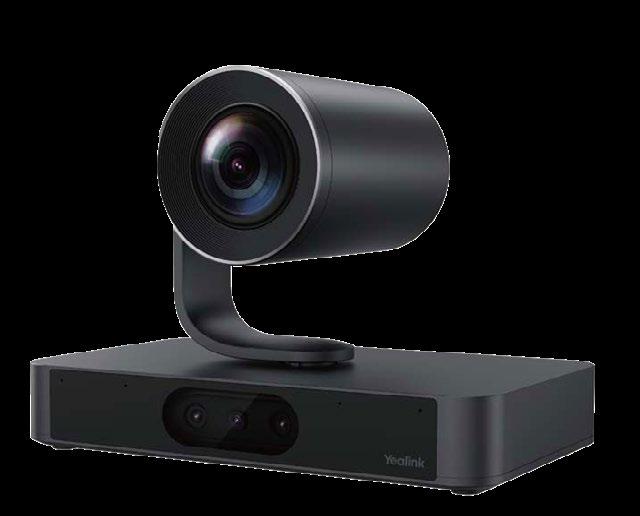
SmartVision 80 combines AI-driven video features with premium PTZ performance to deliver seamless, intelligent meeting experiences. With NDI certification, the camera integrates effortlessly into broadcast, streaming and production workflows. www.yealink.com/en/product-detail/smartvision80
The Z-HD6500-S1 UHD/HD production system—Kokusai Denki’s third 4K model—borrows design elements from the company’s Z-HD6500 multiformat HD camera, and has been reinvented as a full-featured native 4K camera. It includes the same ⅔-inch UHD-native sensors as Kokusai Denki’s high-end SK-UHD7000, ensuring uniform image quality across different production environments. Its RGB three-chip technology, with 8.3 million effective pixels per sensor, results in sharp, vibrant images.
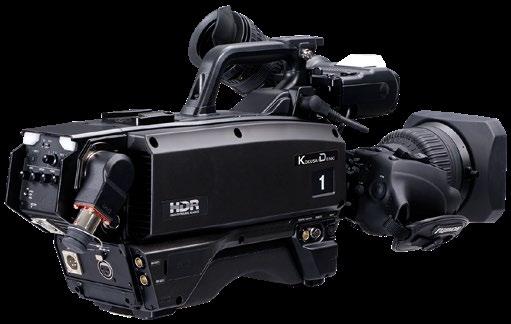
The Z-HD6500-S1 incorporates native 4K global shutter technology to eliminate artifacts such as banding and flickering, optimizing performance within houses of worship, event centers and broadcast studios utilizing LED lighting and displays.
www.kosukaidenki.us
MediaXBook is an AI-powered marketplace designed to put idle operations centers, inactive cloud time and other underutilized production capacity to work at generating revenue. With an addressable market exceeding $500 billion in global media and creator production, NECF’s platform introduces what it is calling the first AI-driven trading desk for media capacity.
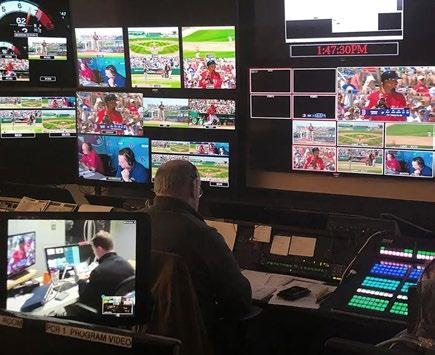
MediaXBook automatically identifies and matches unused resources across the globe—from temporary satellite capacity to specialized production talent—with companies that need them, enabling cost reduction and unlocking entirely new revenue streams for content owners and distributors.
www.necfglobal.com
Slapshot’s professional-grade AI camera tracking tool is designed to deliver precise camera solves and dimensionally accurate point clouds in a fraction of the time taken by traditional methods. Built specifically for VFX artists working in 2D compositing, this new tool offers precise camera tracking that’s fast, simple to use and production-ready.
The tool makes high-quality camera tracks accessible for all types of creators, regardless of expertise in 3D workflows. It excels at the kinds of shots that make up the bulk of real-world compositing work: background replacements, screen comps, sky swaps and cleanups where precision matters, but speed is everything.
www.slapshot.ai

Sony Electronics has unveiled what it calls “the industry’s first camera authenticity solution compatible with video (C2PA standard-compliant).” Through initiatives and verification experiments, Sony said it has validated the authenticity of video content in collaboration with the Research & Development Department of BBC, the U.K.’s public broadcaster. In addition, the company works closely with the C2PA (The Coalition for Content Provenance and Authenticity).

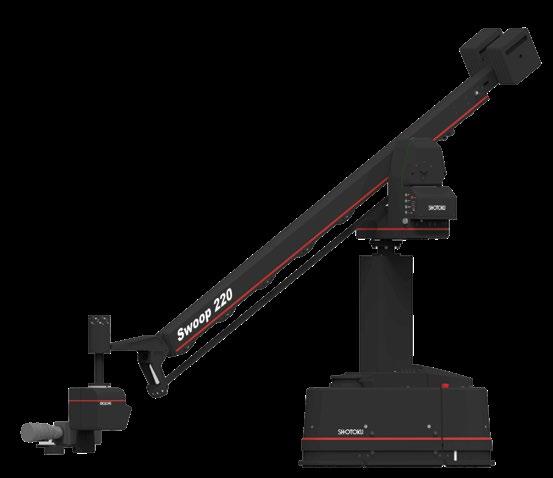
Swoop is designed to replace manually operated cranes and jibs, which typically require one or even two dedicated operators and cannot be tightly integrated into robotic camera systems.
The range launches with two sizes: Swoop 140 and Swoop 220, representing a boom arm reach of 140 centimeters (4 feet, 7 inches) and 220 centimeters (7 feet, 3 inches). Both versions enable production directors to create and precisely repeat sweeping shots with confidence and ease.
Sony said its camera-authenticity solution verification site enables verification of still images and videos, confirming that content was captured by a Sony camera rather than AI-generated. The system can also detect 3D depth information in video content, enabling highly accurate verification that videos are of actual, existing subjects. In addition, a trim function that allows for extraction and verification of only necessary portions while maintaining signatures enables rapid authenticity verification, even for large-capacity video files. www.pro.sony/ue_US/home
The Atom Two Rainproof is a self-contained POV camera measuring 1.165x1.165x1.338 inches (29.6x29.6x34 mm) and weighing 1.94 ounces (55 grams), including lens and stereo microphone. The camera has an integral 4.5-mm lens providing a 90-degree field of view, making it well-suited for many POV camera applications, from body-worn referee cameras and goal mounts to the masts of racing yachts and minidrones.
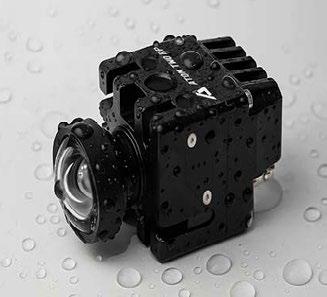
The environmental protection built into the Atom Two Rainproof protects it against anything the weather can throw at it, all the while delivering a stunning output. Image quality is assured thanks to its global shutter, eliminating the very visible distortions and artifacts produced by rolling shutter cameras. The Atom Two is the smallest camera with a global shutter on the market today, the company said. www.atom-camera.com
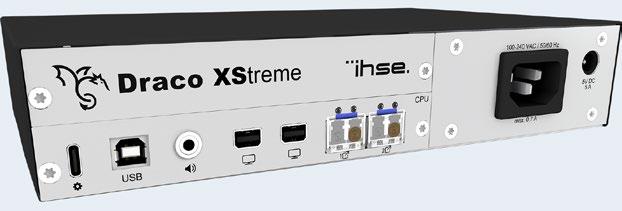
The Draco XStreme series is a new line of KVM extender products based on a new hardware platform and represents a fundamental shift in design, combining cutting-edge performance with maximum flexibility and long-term sustainability, according to IHSE.
XStreme supports video resolutions from full HD up to 8K and is engineered for seamless integration with both proprietary and future IP-based transmission technologies. At the heart of this platform lies the JPEG XS codec, co-developed with the Fraunhofer Institute for Integrated Circuits. The first of its kind in KVM, the Draco XStreme series enables visually lossless video with no frame drops, up to 16 bits of deep color, HDR support, less than 1 ms. per frame of video transmission latency and frame rates of up to 480 fps all on JPEG XS, a widely accepted codec standard in AV and broadcasting. www.ihse.com/us
Swoop also offers two base options to match production needs and budgets. The SmartPed robotic base (Swoop SP) provides complete freedom of movement across the studio floor with remotely controlled X/Y positioning. Alternatively, a manual base delivers a cost-effective solution for situations where manual relocating of the base between shots or shows is all that’s required.
www.shotoku.co.uk
PAINT 10.2
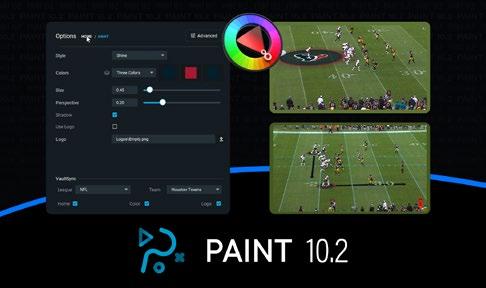
PAINT 10.2, the latest update for Chyron’s telestration platform, adds support for SMPTE ST 2110 IP workflows, expanding branding automation and refining telestration tools to enable maximum efficiency in fast-paced sports production. The latest features fuel the company’s evolution of PAINT to become a unified solution for illustrated replay, tactical breakdowns and live broadcast graphics.
New ST 2110 support enables the ingest and output of uncompressed video over IP. This capability future-proofs PAINT and integrates it into modern broadcast infrastructures. PAINT, which supports both SDI and ST 2110 environments, gives broadcasters the flexibility needed to operate across traditional and next-generation workflows.
www.chyron.com/paint-10-2-sports-telestration
TVU Networks has launched TVU MediaMesh, designed for cloud-based live production. Traditional live production, whether on-site or remote, has long been constrained by fixed infrastructure, dedicated equipment and rigid routing, limiting both scale and flexibility. Currently only about 1% of live productions have fully migrated to the cloud due to the complexities of connecting sources, routing signals and integrating multiple applications. TVU MediaMesh addresses these challenges by introducing global shared memory for live video, simplifying connectivity and drastically reducing configuration time.

As the foundation that powers TVU’s software-as-a-service applications for the world’s largest live events from routing and AI indexing to production and playout, MediaMesh now opens its APIs, enabling customers and partners to build, innovate and shape the future of live production. TVU MediaMesh is available now, including on the AWS Marketplace, enabling customers to deploy instantly.
www.tvunetworks.com

Bitmovin Observability is a new stand-alone video data solution that delivers real-time insights into video playback. The solution enables video providers to easily instrument video playback, provide proactive viewer support and gain new visibility across both content and advertising playback.
Originally a feature within Bitmovin Analytics, Bitmovin Observability has now been launched as a solution in its own right. Unlike generalpurpose observability platforms, it provides observability tailored for video playback. With its deep session-level insights, advanced error debugging, incidents screen with alerts and award winning monetization telemetry, the platform has been designed specifically for real-time monitoring, making it ideal for enterprise streaming services alongside high-profile events such as sports.
www.bitmovin.com
Camera Corps, part of the Videndum group, has launched a new underwater camera system. Developed to cover aquatic sports in demanding conditions, the camera can be submerged up to 19.68 feet (6 meters).

It joins a suite of specialized cameras, broadcast robotics and motion-control systems engineered to meet the demands of live production across sports and entertainment. The suite now features UHD resolution and 18x zoom across both tracking and PTZ models, offering enhanced clarity and precision for professional aquatic sports and other challenging broadcast scenarios. Notably, the new head has also been engineered with acoustic sensitivity in mind. Underwater noise can be a genuine issue, and this unit operates quietly to avoid distracting athletes or interfering with the competition environment.
www.cameracorps.co.uk
With BATON
Interra Systems has added ORION stream recording support and seamless integration with BATON Media Player, a combination that lets broadcast engineers and operations teams perform frame-by-frame debugging of monitored streams with ease and precision. Integration of ORION with BMP lets users move seamlessly from real-time monitoring in ORION to frame-accurate playback and deep inspection in BMP, speeding up analysis of the causes of errors and quality anomalies.
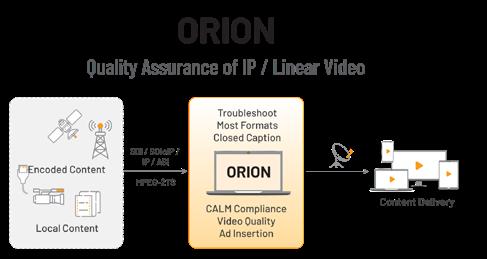
Fujifilm’s Fujinon FLA30x7.8 is a portable zoom lens for ⅔-inch sensor broadcast cameras. It boasts a highest-in-class 30x zoom, covering the focal range from 7.8 mm to 234 mm and its compact (190-mm), lightweight (1.7-kilogram) design enables high mobility and versatility for production. When receiving auto focus commands from the camera, the lens shows minimal focus breathing and operates quietly, made possible by the rear-focus mechanism design. LA30x7.8 also features a newly developed drive unit with high-resolution, 16-bit encoders designed for extremely accurate position detection and control in virtual and remote production, helping to streamline production operations.
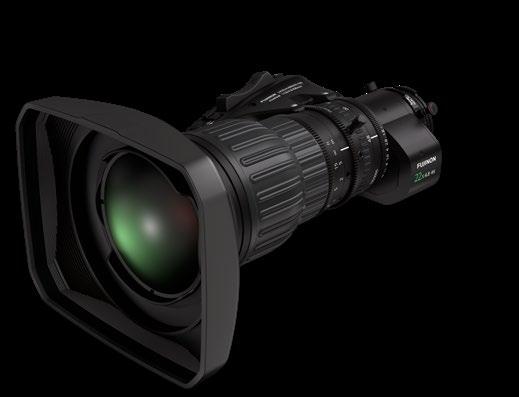
The new recording feature allows users of ORION, the company’s real-time monitoring platform, to capture segments of monitored streams, particularly around error events. Each recording includes a buffer of 5 to 6 seconds before the error occurs and continues until the issue is resolved or for a user-defined duration. Recordings can also be triggered manually, scheduled or initiated during ad transitions, offering flexible options for capturing critical stream data. www.interrasystems.com
A newly developed drive unit for the LA30x7.8 features high-resolution, 16-bit encoders for extremely accurate position detection of zoom, focus and iris in virtual and remote production, which contributes to the streamlining of production operations.
www.fujifilm.com/us/en
The Ninja TX GO is a new HDMI monitor-recorder that combines a brighter screen, advanced monitoring tools, professional codecs, camera control and cloud connectivity and is built for HDMIbased cameras. With its 5-inch, 1,500-nit HDR touchscreen, Ninja TX GO offers a monitoring experience superior to built-in camera displays, Atomos said. It features professional tools such as EL Zone, waveform, vectorscope and focus peaking, giving content creators complete on-set control over framing, exposure and color accuracy.
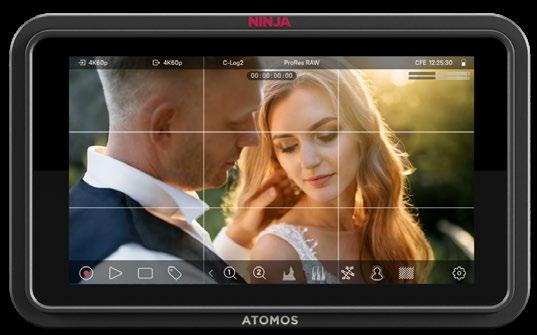
Ninja TX GO records directly to CFexpress Type B or external USB-C SSD storage and supports Apple ProRes, ProRes RAW, Avid DNx and H.265/H.264 formats, providing flexibility across postproduction workflows. With RAW-capable HDMI inputs, it can record up to 6Kp30 RAW.
www.atomos.com

Wohler has added three Secure Reliable Transport (SRT) connections to its new iVAM2MPEG monitor. The enhancements include CALLER and LISTENER modes, monitoring of encrypted SRT streams, and the ability to select STREAM-ID for multistream endpoints. The advanced MPEG stream analyzer is now also directly available via the front panel, in addition to the web interface.
Support for CALLER and LISTENER modes now enables operators to initiate or accept SRT connections according to workflow. The unit can also monitor encrypted SRT streams, giving customers confidence when observing secured contribution and distribution feeds. For workflows that carry multiple SRT streams over a single IP/port, operators can now select and monitor the desired stream using its STREAM-ID, reducing setup friction and simplifying multi-program confidence monitoring.
www.wohler.com/software-downloads
inside of Avid, including color, final online and output of the master.
Robert M. Malachowski Jr., ACE BFE
Supervising Editor for “The
Voice”
LOS ANGELES—I’m the supervising editor for NBC’s “The Voice,” which is produced by MGM Television and recorded on the Universal Studios lot. I was the first editor hired on the show 15 years ago, and I’ve been on every episode since—that’s 700 episodes and nearly 1,100 hours of broadcast programming over the last 15 years.
We use Avid as our editing solution. The major advantage of using Avid is we start and finish everything in Avid. From offline to final online to color, everything is done inside of that.
Right now, we have about 35 editors, including about eight to 10 assistant editors. I think another dozen producers and story producers are also all accessing the media, all able to see everything, and they’re all remote. And I don’t mean we have some in Burbank and some in L.A. We have people in North Carolina; we have people in Virginia. We’ve had people in Maine and Japan; we’ve had people all over the world working on our show.
Having one, unified program that handles all of that has been absolutely beneficial and the cornerstone of our being on the air. I don’t think there’s any other production that hits the Avid hardware and software nearly as hard as we do.
I’m on Media Composer with the Symphony option and so are two of my online editors. The reason for that is we start and finish everything on “The Voice”
We use a lot of image stabilization. Those save our show because it’s a huge concert, and those cameras jiggle, and there’s nothing worse than seeing your artist or your coach jiggling around. I’d say easily between 600 to 900 stabilizations will be done in a twohour episode.
We also use the “Animatte” effect in Media Composer for multiple reasons. We don’t like to break the fourth wall by showing camera people running through the audience, so we use that to duplicate audience members to hide cameras. We want viewers to be engaged in the performance, and if you see some guy running across the stage with a camera, that kind of pulls you out of it. Avid gives us the proper tools to maintain our illusion, to maintain the mo
ment, without having to go to an external program.
Every episode of “The Voice” is a challenge because of the nature of the show. In an average twohour episode, we introduce 13 to 15 new “characters,” if you will. Each story needs to have a life of its own, but we have to have some type of uniform feel to the show so when you turn it on, you recognize “The Voice” for what it is.
Our editors are constantly striving to give enough individuality to each of the story pods to showcase each artist individually, as well as maintain a high level of editorial status and make sure that editors are also as creative as possible, but without going completely astray.
We know our audience has faith in what we do and what we say about our show is real.
When the first note comes out of an artist on stage—with the coaches’ backs to them in their chairs—that is the first time coaches hear them or see them when they turn. The audience sees our artists in their stories beforehand, but the coaches don’t get any of that information. It is legitimate; that’s the first note that the coaches ever hear. ●
Robert M. Malachowski Jr., ACE BFE, is an Emmy Award-winning editor and longtime, active member of the Television Academy, American Cinema Editors and British Film Editors who has worked within the production/ postproduction field for the past 35-plus years. He can be reached at RobertM.TheVoice@gmail. com.
More information is available at www.avid.com.
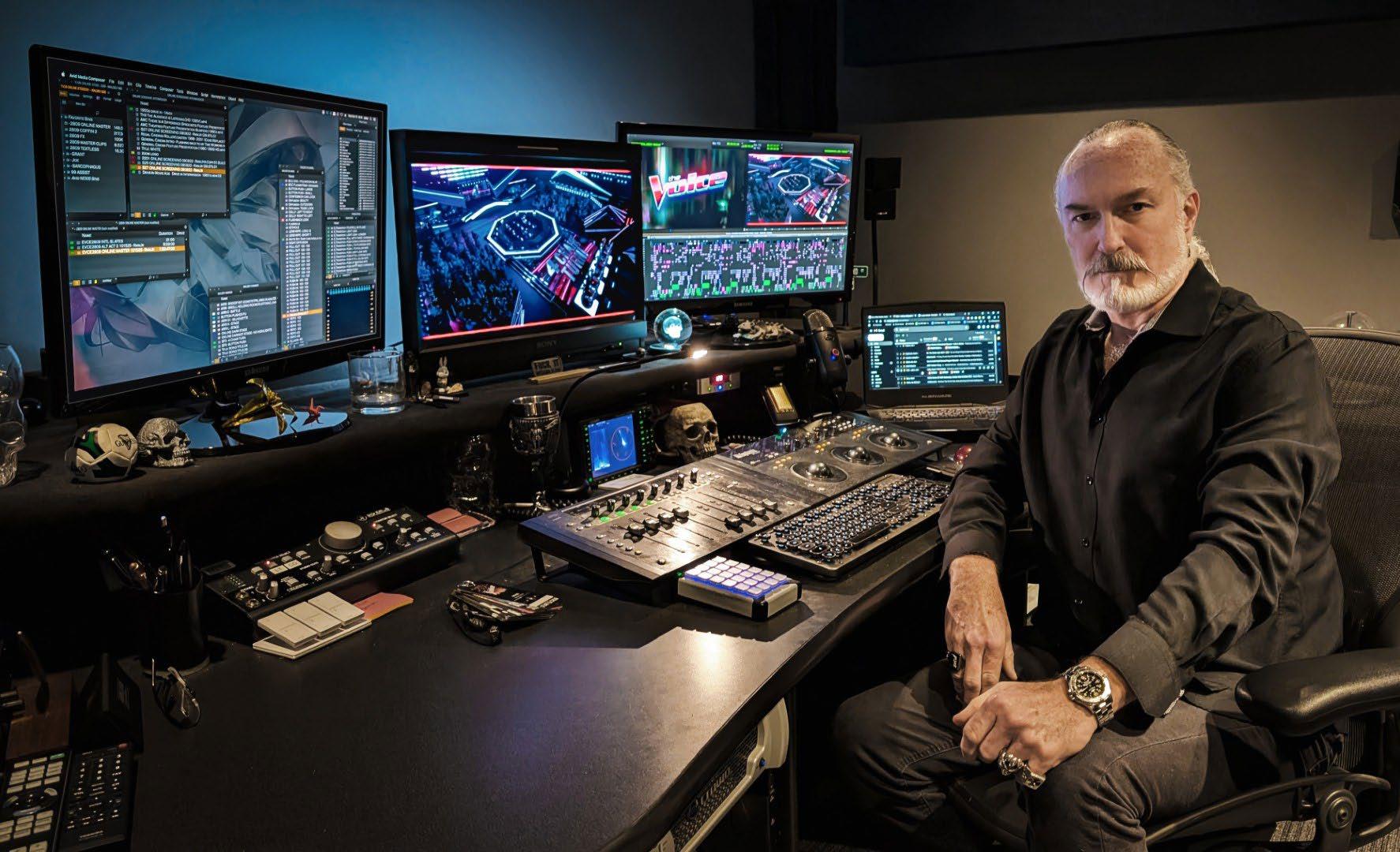
groupwide consistency in how files are received, cataloged and validated.
Jim Lange Content Distribution Center Manager Hearst Television
ORLANDO, Fla.—I started my first TV job in 1985 in the Orlando market at WESH TV, loading 2 inch carts into an ACR25 for commercial playout and news playback on ¾ inch tape. At the same time, Florical Systems released its first product, TimeShifter. Since then, I moved on to Betacart, live shot acquisition and master control while Florical stepped up the technology with ShowTimer and AirBoss.
Forty years later, we’re both still here—my employer, Hearst Television, which acquired WESH in 1998, operates 35 stations nationwide. Every day, we manage the flow of syndicated shows, network feeds, commercials and promos that need to reach the air without fail.
My current role is to make sure that content is prepared, validated and delivered to our stations in a way that is both reliable and efficient. Ingest and media asset management sit at the center of this process, and over the past two years, we’ve transformed how we handle them with Florical.
We began rolling out Florical’s ingest and asset management module in 2024 with the goal of creating a stronger foundation for how content enters our ecosystem—whether that content is coming in from distributors, agencies or internal production teams. By putting ingest and asset management in place first, we were able to establish
Earlier this year, we completed the next phase of that transition, moving our stations onto Florical’s AirBoss automation for playout. Having the ingest and assetmanagement tools already in place made that transition much smoother, because the content feeding automation was already standardized and predictable.
Stephanie Sobiech, our content coordinator, is on the front line every day, handling program and promo distribution and working directly with incoming feeds from Pathfire, PitchBlue, Extreme Reach, OTSM and our networks. With Florical, she no longer has to manually track whether a file is complete or in the right format; the system validates incoming content automatically and flags any problems before they reach the air chain. That has freed her to focus on
higherlevel coordination instead of chasing technical errors.
Commercials and syndicated programming represent another critical part of our workflow, and Florical has helped us bring real efficiency to that process. At Hearst, we operate on a “touchonce, distributetomany” model.
A single program or commercial may need to be delivered to 25 stations, and Florical’s workflows allow us to handle that with economies of scale. The content is ingested and validated once, then mapped and distributed to all the stations that need it. Our dedicated commercial preparation and approval team depends on these workflows every day to ensure spots and shows are delivered consistently groupwide. Instead of repeating the same steps, they can focus on confirming the content is correct and ready, knowing the distribution piece is handled efficiently
The benefits extend to house

keeping, as well. Because the system manages distribution centrally, we can avoid duplication and unnecessary storage at the station level. At the same time, archived content remains accessible through AWS, so if a station needs to pull material back, it can be retrieved quickly without adding complexity to the local workflow.
Since completing the rollout, the biggest change I’ve seen is consistency across the group. Whether it’s Stephanie managing syndicated feeds, the commercial team approving spots or operators checking final playlists, everyone is working under the same ingest and distribution standards. We’ve reduced manual errors, shortened turnaround times and freed people to spend more energy on coordination and quality control rather than on chasing missing files.
Looking forward, the metadata foundation we’ve built with Florical puts us in a strong position for the next phase of automation. AIassisted workflows that can reconcile traffic logs, detect anomalies, and even selfcorrect ingest issues will depend on having robust and consistent metadata. For us, that future starts with the reliability we’ve already gained from Florical’s ingest and assetmanagement tools. ●
Jim Lange is content distribution center manager for Hearst Television, overseeing daily programming delivery, distribution and asset management workflows. He can be reached at JLange@ Hearst.com.
More information is available at www.florical.com.
Todd Mason CEO Broadcast Management Group
WASHINGTON—When I started Broadcast Management Group, our goal was simple: to make highend broadcast production accessible anywhere, without compromise. Over the past few years, that vision has evolved into something much bigger: a fully connected, cloudenabled production ecosystem that supports everything from major network shows to global corporate communications. At the heart of it all is Grass Valley’s AMPP ecosystem, which powers every aspect of our operation.
Our new network operations center, aka the “BMG Cloud Control Center” in Washington, D.C., represents a complete rethinking of how we deliver media services. It’s not just a facility; it’s our private cloud, where all of our production, playout and media asset management (MAM) systems live. Grass Valley’s AMPP and Framelight X are at the core of that infrastructure, providing the flexibility, scalability and reliability that today’s broadcast clients demand.
means our engineers in D.C. can shade cameras anywhere in the country. It’s an incredibly powerful way to unify our operations and deliver consistent quality across every production.
When people talk about cloud production, they often think of lightweight tools or “good enough” solutions. That’s not what we do; we’re handling Tier 1, broadcastlevel productions that demand reliability, redundancy and performance. AMPP gives us that a virtualized plat
clients—everything from control rooms and studios to podcast and streaming setups. What ties all of it together is our AMPPpowered private cloud. Whether a client wants a fully local setup, hybrid workflow or completely remote operation, we can spin it up instantly through AMPP.
A great example of this in action is our work with UBS Financial. They were consolidating offices in New York and wanted a new studio and control room, but without the overhead of
That’s a massive leap from where they were, relying on portable drives to store nearly 30 terabytes of content a year. Now, every asset is searchable, secure and immediately accessible, not just in New York but potentially across UBS’s global offices. That’s what the future of live production looks like: Instantaneous, global and flexible.
We’re applying the same model for VPM, a PBS affiliate in Virginia, by building an entire broadcast facility, all Grass Valley cameras and AMPP Asset management.
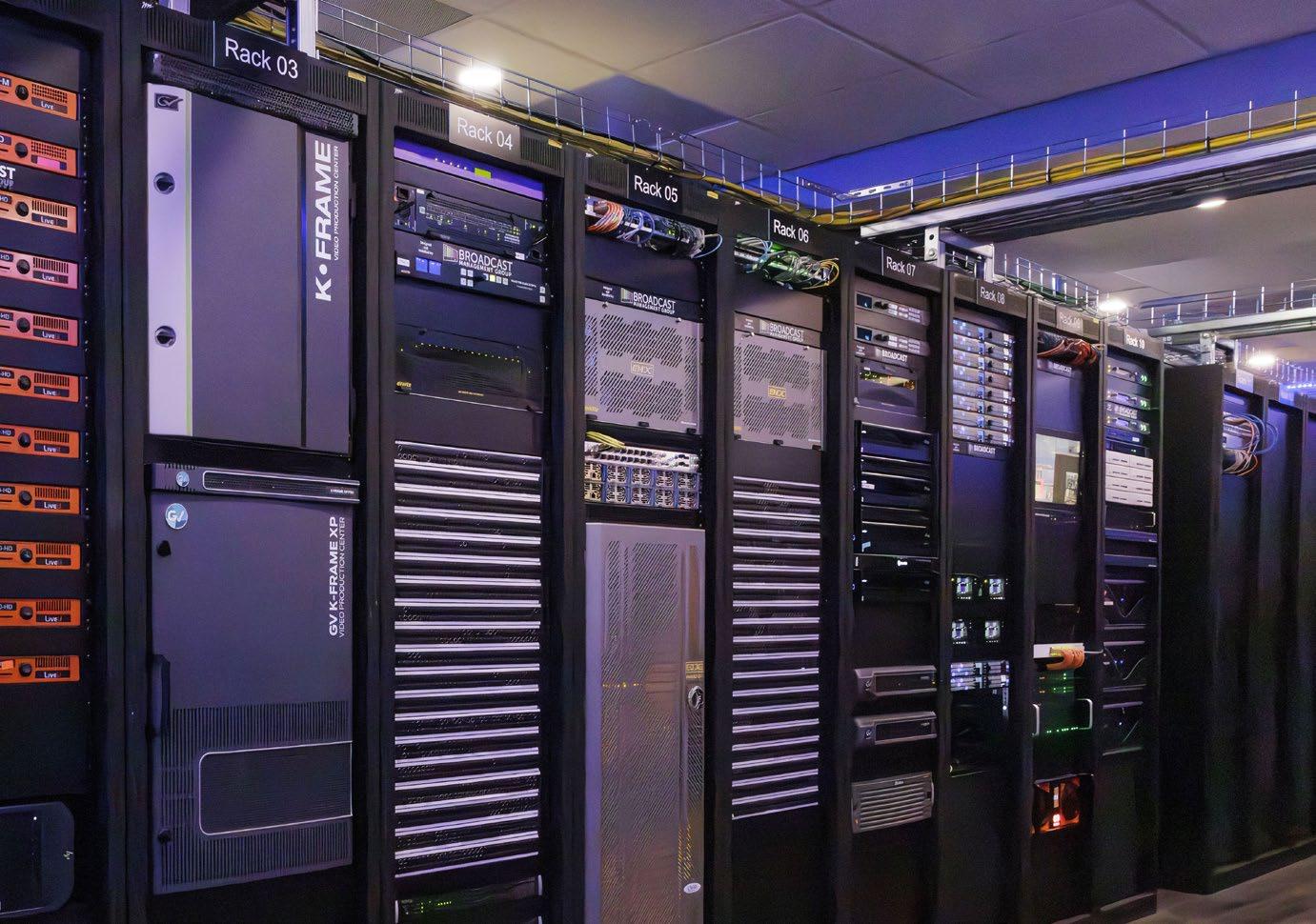
form that combines the horsepower of traditional infrastructure with the agility of the cloud. It’s the operational heartbeat of our entire company.
Inside the NOC, our Grass Valley KFrame switchers anchor the control rooms, and every one of our mobile trucks uses Grass Valley LDX cameras for live capture. We’ve also built a centralized video shading room powered by GV Creative Grading, which
We run two main business lines: live production and managed broadcast services. On the live side, we package major news, sports and entertainment events for networks nationwide. On the managed services side, we design, build and operate facilities for
maintaining all their own backend infrastructure. We rebuilt their systems from the ground up and connected everything directly into our NOC. Their editing workstations, playout channels, and storage all reside in D.C., powered by Grass Valley AMPP and Framelight X. Their editors log in remotely and can cut files in real time, even while shows are on air and more video is being recorded.
Grass Valley has been an exceptional partner in this journey. Their technology gives us the backbone to support enterprisegrade operations while scaling effortlessly for creative demands. Together, we’re proving that cloud production doesn’t mean compromise, it means opportunity. With AMPP and Framelight X, we can deliver broadcastquality production from anywhere, for anyone, at any scale. And that’s exactly where the future is headed. ●
Todd Mason is founder and CEO of Broadcast Management Group (BMG), a leader in cloud-based broadcast and media production. With over 30 years in the industry, he has pioneered such innovations as the first private cloud broadcast facility and the industry’s first Cloud Network Operations Center (NOC). He can be reached at tmason@broadcastmgmt.com
More information is available at www.grassvalley.com.
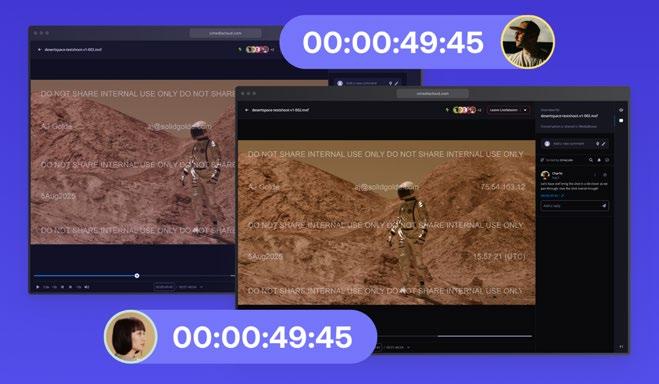
Ci streamlines media workflows, with AI-powered metadata logging and metadata extraction including C2PA content authenticity certification, enabling fast search and reliable verification. The platform also offers scalable storage management, native AWS S3 integration, and lifecycle policies to automate bulk archive and restore operations. Real-time collaboration is enabled through the LiveSession feature, offering synchronized playback and annotation for internal and external teams. With robust watermarking, SSO integration and customizable permissions, Ci keeps assets protected while simplifying user management—so users can focus on creating, not troubleshooting.
Newer features include Ci’s LiveSession, which offers two powerful ways to bring the screening-room experience to distributed teams. Whether users need quick approvals or secure team discussions, Ci’s LiveSession adapts to user needs and workflows.
https://cimediacloud.com
Dalia, an agentic AI built on 30 years of media-engineering expertise, unifies the Dalet ecosystem through a single, natural language-powered dashboard. Users simply ask: “Find all promo videos from the 2025 World Series” or “Generate Spanish highlights for Game 7.” Dalia listens, interprets and executes.
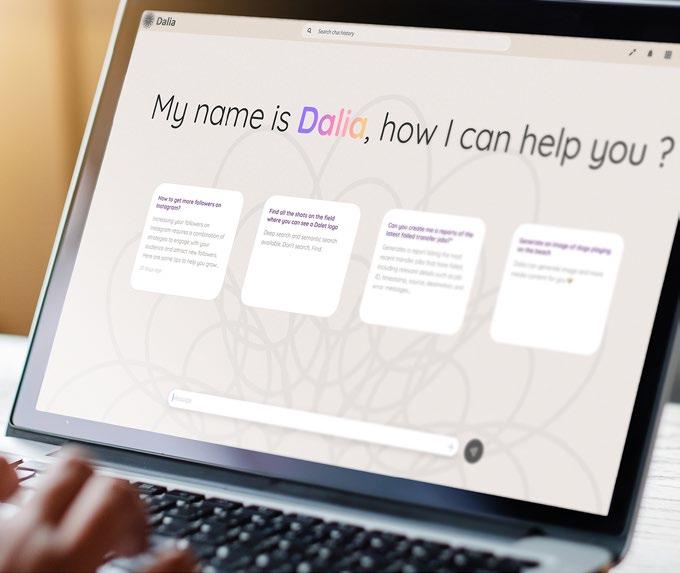
Built on Dalet’s core architecture, Dalia is media-aware and natively integrates with Dalet Flex, Dalet Pyramid, Dalet InStream, Dalet Brio and Dalet Amberfin, automating the full range of workflows. By combining simplicity with enterprise-grade power, Dalia removes the trade-off between ease of use and performance, bridging existing infrastructure with next-gen AI to boost productivity, creativity and ROI. www.dalet.com/products/dalia/#features
Bitcentral’s Fusion Hybrid Storage (FHS) delivers the performance broadcasters need to move quickly without compromise. By combining the reliability and speed of on-premise infrastructure with the scalability and flexibility of the cloud, FHS ensures large files, spotty connections and tight deadlines never stand in the way of getting stories to air.
Built on Chyron’s advanced render engine, PRIME is a premier real-time graphics platform that offers fast, frame-accurate performance for live news, sports and entertainment. Its modular architecture supports 2D/3D graphics, data-driven storytelling, touchscreen interactivity and XR, all within a unified production environment.
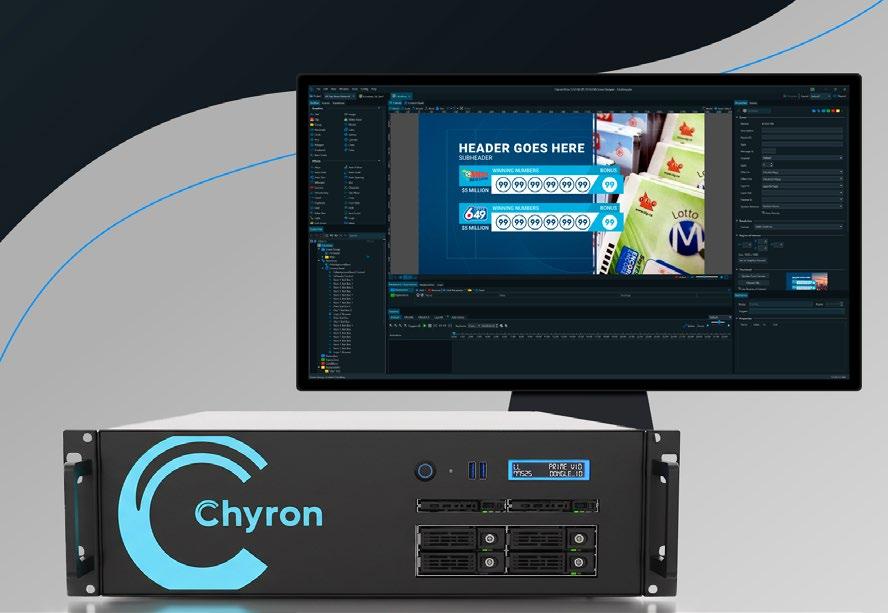
Whether integrated into traditional control rooms or hybrid IP workflows, PRIME empowers creative teams to design, animate and deliver compelling visuals with unmatched speed and reliability. PRIME is seamlessly integrated across Chyron’s ecosystem, from CAMIO newsroom workflows to Chyron LIVE and Virtual Placement.
https://chyron.com
Carbonite Code is a software-based production switcher purpose-built for NDI workflows. Designed to meet the evolving demands of a growing community of live production professionals, Carbonite Code combines the production power of Ross Video’s Carbonite range with the efficiency and low latency of NDI video transport technology.
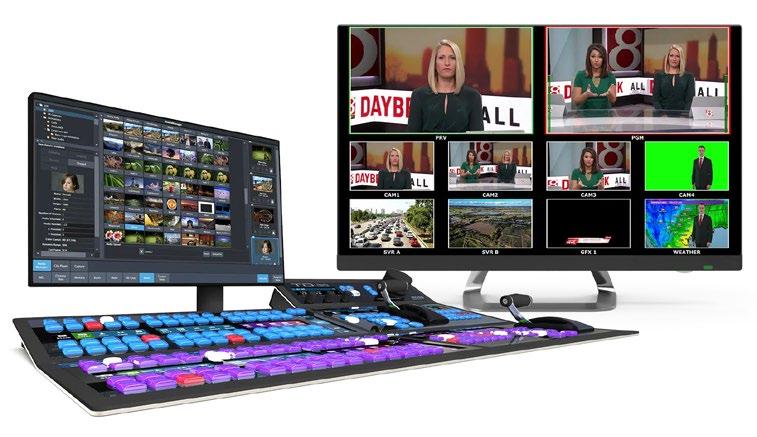
Carbonite Code features advanced CPU and GPU processing power in a software-based system, giving users the ability to leverage low-latency NDI while seamlessly integrating into an expanding ecosystem of devices. It also features three powerful Carbonite MEs, each with six full Keyers; video-signal monitoring using the three standard MultiViewers within Carbonite Code; and RAVE Audio mixer, offering a 48-channel mixer with six Aux Mixes. Carbonite Code is compatible with the full range of TouchDrive control surfaces for more tactile control. www.rossvideo.com
Instant access to current projects and on-demand cloud retrieval keeps teams productive, while built-in disaster recovery safeguards valuable archives. FHS lowers costs, accelerates workflows and provides peace of mind that storage won’t be the bottleneck in breaking news. For forward-thinking broadcasters, FHS aligns with today’s pace of news, turning storage into a strategic advantage with speed and flexibility. https://bitcentral.com/fusion

some details to iron out, but overall, I’m very pleased with the improvements to our workflow.
Aaron Smith, Executive Producer
Graveyard Carz” Co-founder, The Division
SPRINGFIELD, Ore.—In 2007, I began filming Mark Warmer restoring an Mopar Muscle Car and the “Graveyard Carz” series began. Shortly thereafter, Warmer and I cofounded production company The Division, focusing on reality television, and today “Graveyard Carz,” a reality show chronicling the restoration of Mopar Muscle Cars that are often deemed beyond repair, is the longestrunning series on MotorTrend’s linear network.
Over the years we’ve learned a lot, particularly when it comes to streamlining workflows and increasing efficiency. We’re a small crew, handling virtually everything inhouse: shooting, editing, mixing, color correction, producing, mastering, delivering and social media. (I even do voiceover for the show.)
Previously, our post workflow was hampered by the fact that any lastminute edits involved changing multiple projects and tracking multiple changes across multiple versions. In moving to DaVinci Resolve Studio, I was most excited by team collaboration via Blackmagic Cloud. My hope was that I could colorcorrect while my fellow executive producer, Jeffrey Osborns, could mix in a proper DAW [digital audio workstation], like DaVinci Resolve’s Fairlight. Even more, I hoped that our talented editor and animator Nick DeAngelo would be able to add broll—all simultaneously. We still have
While the move to DaVinci Resolve Studio and Blackmagic Cloud was an essential step forward, I thought why not streamline further by bringing editing into production (vs. just post) for larger, multicam shoots with an ATEM Television Studio HD8 ISO switcher?
I knew the ATEM ISO model shined when used with DaVinci Resolve for postproduction, so why not direct and capture episodic shoots in a live production style, with preedited segments enhancing efficiency, while maintaining the flexibility to further edit in post?
For these shoots, we record onto the local hard drive, saving the .DRP file (i.e., a DaVinci Resolve Project file) along with it. This enables us to switch cameras and direct the shoot in a “live” style while maintaining the flexibility to edit afterwards. The ability to edit with proxies
and then switch to Blackmagic RAW at the push of a button for final grading is unique. This can be a fast and appealing workflow if you don’t mind working with multiple cameras in the sync bin.
Now, we can preedit larger segments while making sure we have coverage of the action. We use headsets to communicate during the shoot, with the ATEM operator informing the crew which camera is being used or how to adjust a shot. While this live directing approach is something we’ve done without a switcher, it’s a terrible waste of resources when it’s so easy to have someone simply push buttons and edit the segment live. It gives the editor a huge leg up when they have a large segment. Additionally, it’s much more pleasant for a producer to watch something that appears to be edited. It’s also possible to mix cameras in this workflow, and even to process the resulting
.DRP in such a way as to produce a classic multicam clip, if that workflow is more appealing.
As an independent production company, we have leveraged social media for promotion from the very beginning—so using the ATEM for multicam live streams is also exceptionally valuable to us. We’ve used it to live stream on social media platforms, and I am confident we will continue to do so. ●
Aaron Smith is the executive producer of “Graveyard Carz” and co-founder of The Division, an independent production company based in Springfield, Ore Its flagship reality series, Graveyard Carz, still keeps the lights on and keeps the crew out of the pool hall––albeit not necessarily out of trouble. For more information about The Division, contact asmith@divisiontv. com or visit www.divisiontv.com
For more information, contact Blackmagic Design at 408-954-0500 or visit www.blackmagicdesign.com.
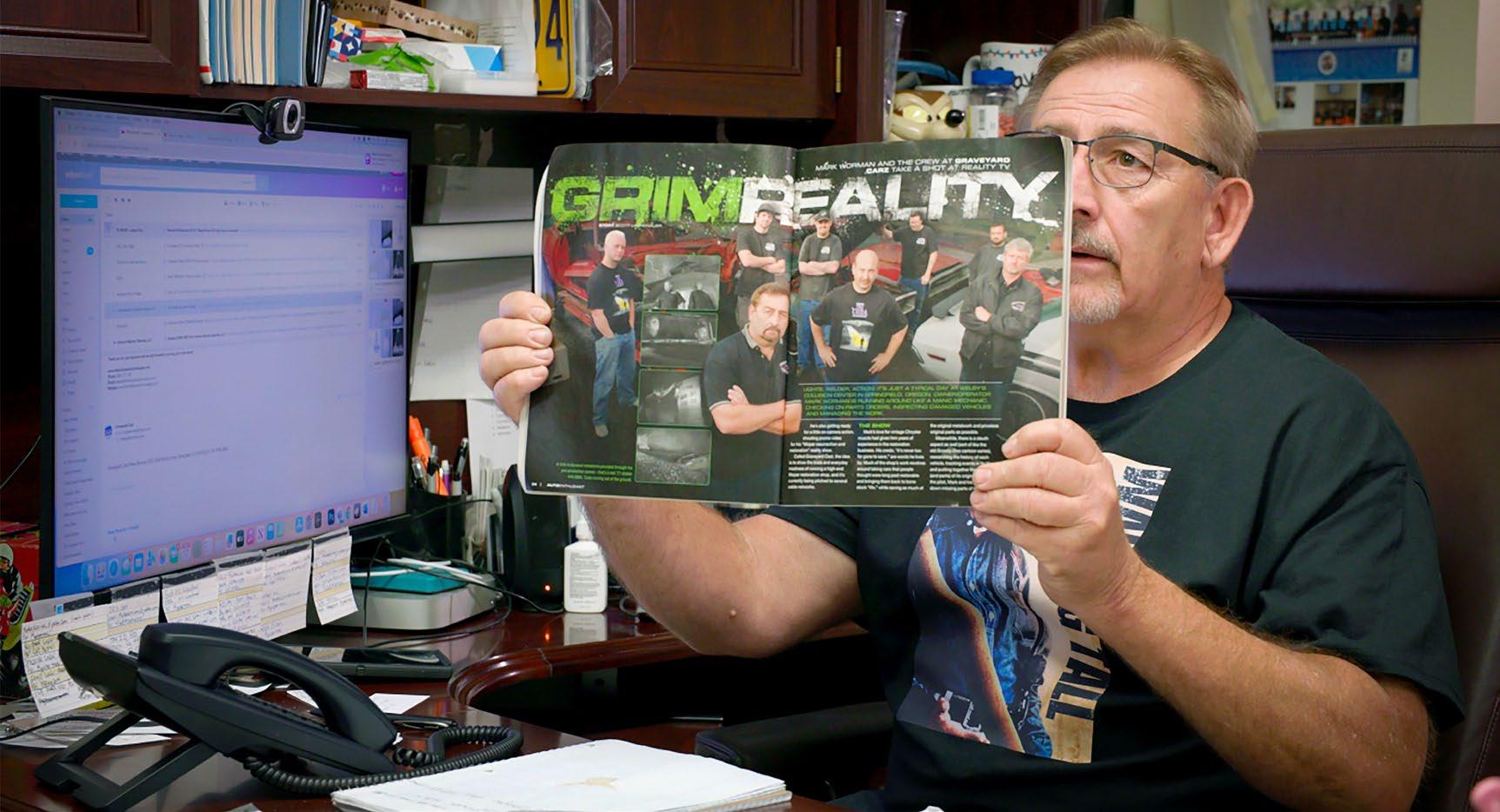
Ashley Ross Principal Product Manager Sky Group
LONDON—As Europe’s largest media company, Sky Group delivers premium content at a scale few media companies can match. Operating across multiple markets has meant managing a patchwork of siloed systems, inconsistent tooling, different operational practices and varied compliance requirements, preventing us from fully leveraging economies of scale.
Our challenge required not only a technically innovative approach to futureproof Sky’s content supply chain, but also a longterm strategic solution that would unify operations across the Group.
In short, we needed a radical shift onto a single platform.
To address this, we built MediaMesh, a unified cloud platform that centralizes QC, enrichment, conversion, and distribution at scale. The MediaMesh architecture—an APIdriven, modular framework—brings together a curated ecosystem of inhouse built microservices and products from leading industry partners, each selected for their ability to solve specific pain points. For this project, we partnered with several companies, including SDVI, whose Rally platform provided the base layer that integrates with new and legacy tooling to retrieve metadata and media from dispersed systems and storage, in order to orchestrate content through the Group platform.
Telestream’s Qualify serves as
the automated quality control (QC) function at ingest, validating assets against Sky’s technical standards before proceeding further. Through close collaboration with operations, years of QC data were audited to optimize a system that flags issues early and reduces false positives compared to legacy tools, significantly minimizing manual review effort and downstream issues.
AWS ran AI to identify onscreen subtitles and spoken language to automatically identify localization requirements to fasttrack downstream dubbing and subtitling efforts. This language detection has also allowed Sky Italia viewers to filter content by precise audio language, unlocking new levels of discoverability and personalization.
Codemill’s Accurate.Video platform not only plays back content, but provides a collection of audio controls, the ability to enable/disable subs and dubs for review and can present different timebased markers along a timeline (e.g., segmentation points, QC errors, sections needing localization).
We also deployed TMT Insights’ Polaris, which provides
operations with a single platform identity, abstracting them from the multiple backend services, to streamline their operational practices. The Polaris UI provides visibility into metadata, endtoend monitoring, workflow anomalies, prioritizes task management for steps requiring human intervention, communication threading and launching specialized functions such as editing tasks, various exports and ad hoc workflows. These functions help operations meet critical SLAs with confidence, reduce touchpoints, and speed up time to air.
Whether it’s ingesting content from over 300 content partners, enriching it with metadata and access services, or distributing it to platforms like Sky Glass and NOW, MediaMesh ensures every step is automated, observable, and streamlined. And the elastic scalability allocates sufficient system resources to meet the changing business demands.
To deliver a platform as ambitious as MediaMesh, we had to rethink not just our technology stack, but our internal capabilities. This meant evolving from a traditional broadcast engineering mindset to a software-first
organization. TV engineers retrained as software engineers, embracing cloudnative development and modern DevOps practices. This transformation has not only accelerated delivery but fostered a culture of continuous improvement and innovation.
By centralizing workflows, we can develop and deploy features once, rather than duplicating effort across multiple systems, delivering consistent benefits across the entire group. This streamlines internal investment and speeds up our timetomarket when delivering new features. Today, MediaMesh processes more than 2.7 million assets annually, equating to more than 10 million minutes of content, and manages around $2 billion worth of media across our ecosystem.
As we continue to evolve MediaMesh, we’re exploring new ways to enrich content, streamline compliance, and personalize viewer experiences across markets. The platform’s modular design ensures we can adapt quickly, whether it’s integrating new services, responding to regulatory changes or supporting future product launches. MediaMesh has laid the foundation for a more agile, scalable and collaborative future at Sky, and we’re excited to build on this momentum to shape nextgeneration content processing. ●
Ashley Ross is a principal product manager at Sky Group, Europe’s largest media company, where he has held leadership roles over his 18-year tenure at the company. He can be reached at Ashley.Ross@sky.uk.
More information is available at www.telestream.net/.
Israel Alejandro Master Control Manager WFMZ-TV
ALLENTOWN, Pa.—Owned by Maranatha Broadcasting Co. , WFMZTV is an independent station based in Allentown, Pa., that also operates Maranathaowned MeTV affiliate WDPN-TV Philadelphia. We are a unique operation, airing more than 10 hours of local news daily, covering the northern tier of the Philadelphia DMA and 12 total subchannels across our stations.
As sponsorships have become more graphicsintensive, we realized that our old automation was showing its limitations. Managing playout and graphics across multiple facilities and monitored channels also became increasingly inefficient with our existing system. We needed a cohesive platform from a single vendor that could handle automation and graphics with ease.
Imagine Communications offered exactly that. We adopted the company’s ADC automation and Versio Graphics solutions, deploying the automation across three sites: our main studios in Allentown, a disaster recovery site, and a separate onsite disaster playout server at the MeTV transmitter site in Philadelphia.
With the Imagine solution, we gained a unified workflow that aligned perfectly with how we already created content. The builtin Adobe After Effects integration was especially valuable.
Once we chose Imagine and went online, the benefits were immediate. Our syndicated content comes from sources such as
Extreme Reach and Pitch Blue. For years, we segmented shows manually, a slow process of recording and segmenting each program by hand.
That changed with Imagine’s Motion feature, which reads BXF metadata from syndicators to segment programs automatically. Even when issues arise, we can reingest and resegment within minutes. The improvement in efficiency and reliability has been tremendous.
Versio Graphics has also transformed how we engage with our viewers. We now use a wide range of onscreen graphics, Lbars, snipes and more in our newscast and sponsored snipes on various channels. Each month, we partner with a local client for an awareness campaign tied to that month’s theme.
For Hispanic Heritage Month, for example, we created educational snipes with rotating facts about Hispanic history and culture. The system randomized which fact appeared, keeping
content fresh and engaging.
We realized another example of the system’s flexibility when our Reading, Pa., newsroom celebrated the 30th anniversary of its “Berks Edition” newscast. Using Versio Graphics, we created a dynamic onscreen bug that animated from our standard logo to reveal the anniversary emblem. With the dynamic branding feature, the automation recognized when the Berks Edition newscast was live and automatically switched to the special bug, no reprogramming required.
That same efficiency extends to our weather channel, which runs nearly 300 graphics, all based on a single Adobe After Effects template that lets us quickly swap in client logos and publish updates. The process saves hours of production time and keeps every graphic consistent with our design standards. Versio Graphics made it easy to maintain, even with the many updates we manage each week.
Earlier this year, the platform
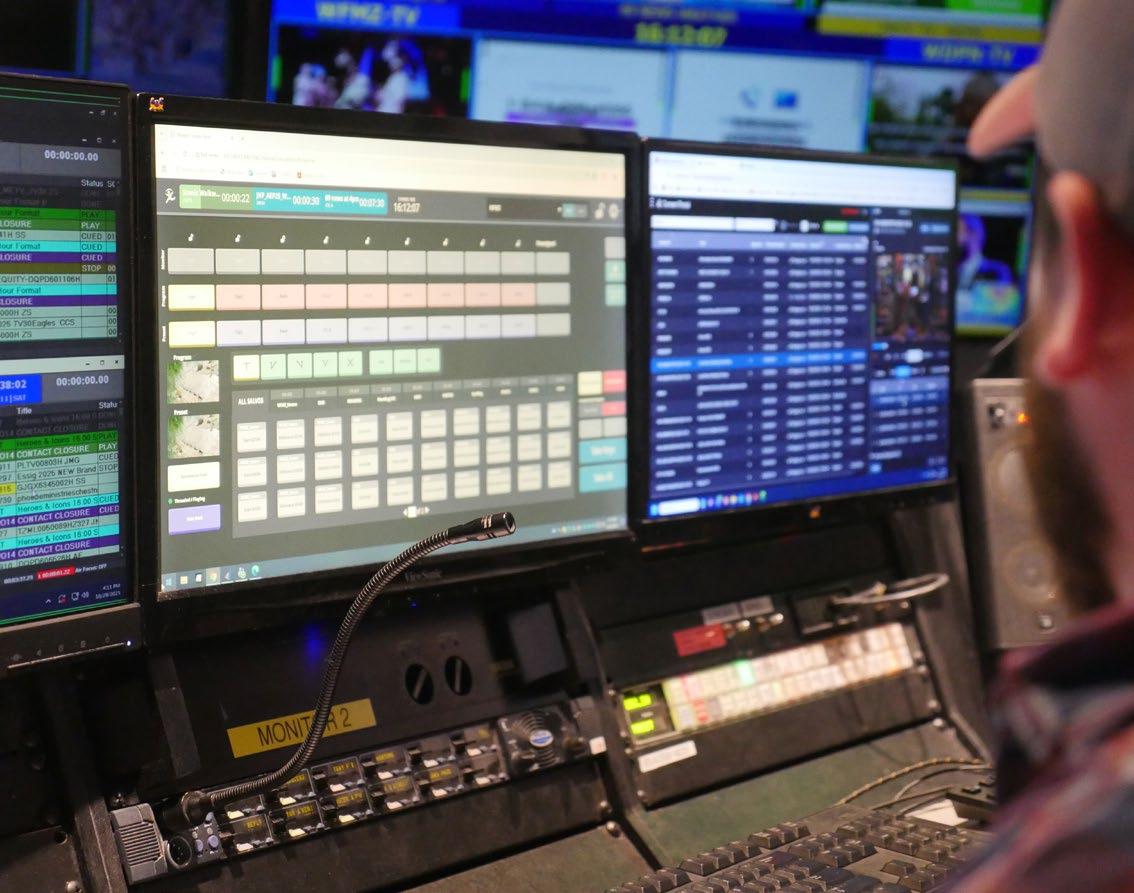
played an instrumental role in overhauling our weather channel, enabling us to replace a complex system of external machines and contact closures. The system’s new “play from folder” feature lets us integrate video playback directly into the graphics engine, turning what could have been a costly rebuild into a quick, affordable transition.
Choosing Imagine for our operations was absolutely the right move. Versio Graphics and ADC automation have brought reliability, flexibility, and creativity to everything we do. Viewer feedback has been overwhelmingly positive and Imagine’s support team has been outstanding. Whether troubleshooting or tracking down the source of issues, they’ve always been responsive and professional, even during latenight calls.
As an independent station preparing to celebrate our 50th anniversary during Thanksgiving week of 2026, we continue to chart our own path, guided by a forwardlooking management team that’s always planning for growth. Our infrastructure gives us room to expand, and with Versio Graphics and ADC automation at the core, we’re wellpositioned to keep innovating and delivering highquality local content. ●
Israel Alejandro is the master control op manager for WFMZ-TV and WDPN-TV in Allentown, Pa., and an Emmy Award-nominated technical director and SBE-certified television operator. He can be reached at israela@wfmz.com
More information is available at https://imaginecommunications. com/.
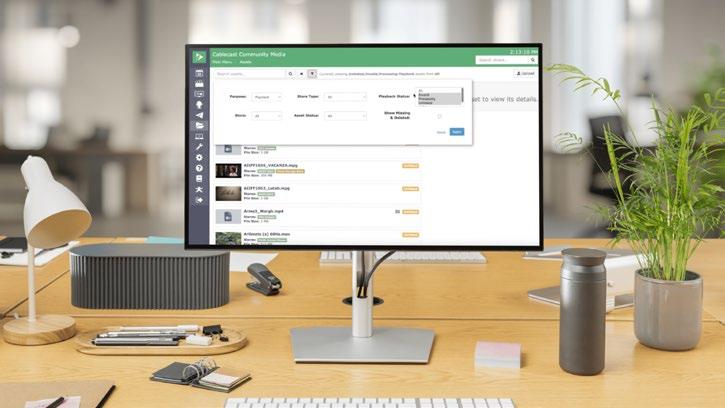
SAM (Smart Asset Manager) has been serving as a virtual assistant for Cablecast video automation workflows since 2022. Included with Cablecast VIO video servers, SAM reduces user effort—and potential user error—for the predictable parts of file management. It copies content from the video server to other locations, such as a NAS, SAN, or the cloud.
Directed by rules-based automation, SAM can automatically move content to archive storage after a specified period of time, retrieve assets from the archives when they are needed again for the program schedule, or backup media files to a designated file store for safekeeping. It can even automatically delete content after a specified period of time, so aging episodes of ongoing syndicated series aren’t taking up valuable storage space. www.cablecast.tv/automation-collection/ cablecast-vio-4
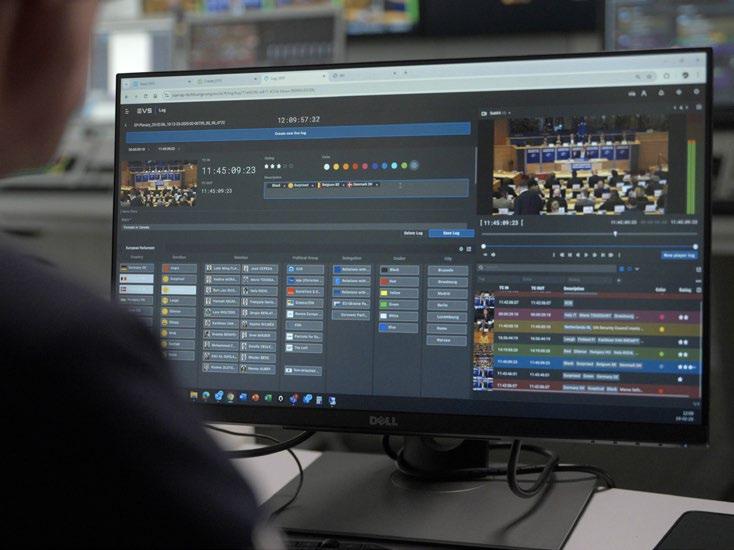
EVS’s media-asset platform for next-generation news production, VIA MAP, empowers news production operators, editors and journalists to create and deliver stories faster, smarter and with greater agility. The comprehensive platform combines live production, distribution, archiving and monetization into a single workflow, streamlining the entire news-delivery process.
Built-in AI capabilities such as speech-totext, facial recognition and automated metadata enrichment accelerate editing, search and content management, ensuring speed and accuracy under pressure. As a cloud-native and highly flexible platform, VIA MAP scales easily to meet peak demands during breaking news or major events, providing a reliable foundation for modern, end-to-end news production. https://evs.com/via-map
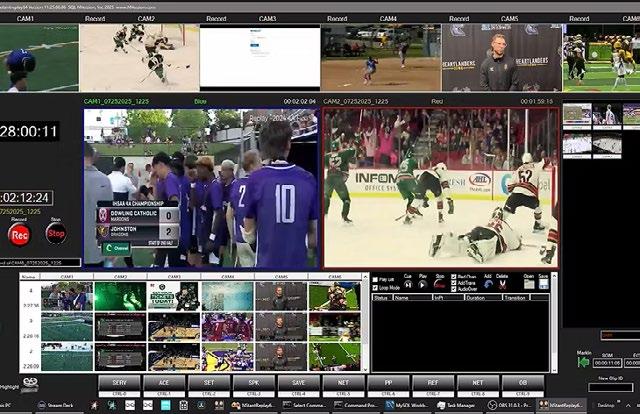
NStantReplay is a software and hardware-based solution designed to replace costly external systems and clunky workarounds with a streamlined, professional-grade replay experience. From clip capture to slow-motion playback, everything happens inside one fast, intuitive interface engineered specifically for real-time execution. With multicamera input and precision playback, it’s ideal for local coverage, pro broadcasts and fast-paced live events.
Key capabilities include: multicamera support with seamless angle switching; real-time playback, slow motion and highlight-clip stacking; frame-accurate GUI jog/shuttle controls, inclusive hardware panel and optional touchscreen monitor; designed for full production switcher integration or standalone operations; flexible I/O platform supporting four, six or eight camera feeds with two outputs; and integrated SDI video and audio output. www.nverzion.com/nstantreplay


For possible inclusion, send information to tvtechnology@futurenet.com with People News in the subject line.
The National Association of Broadcasters has named Josh Miely vice president of technology, programming and education. In his new role, he will support NAB’s work on educational initiatives and projects alongside John Clark and Sam Matheny in NAB’s technology department. Miely transitions from the NAB Show production team, where he was vice president of content design and development. He has also served as NAB’s director of radio operations.

ULRICH VOIGT
Riedel
Riedel Communications has hired Ulrich Voigt as director, live production solutions, taking over leadership of its SimplyLive business from Luc Doneux, who will leave Riedel on Jan. 1. Voigt is charged with further integrating the SimplyLive product family into Riedel’s overall live video strategy and driving additional growth. He comes from Vizrt, where he was global head of product management and cloud transformation and a member of its executive management team.

Technology solutions provider Diversified has named Paul Lidsky its new CEO, tasked with guiding its next stage of growth, driving market expansion and enhancing service delivery across its global footprint. Lidsky, who had been board chair since 2023, has more than four decades of leadership experience in IT solutions and technology services. Prior to Diversified, Lidsky was CEO of Core BTS; president and CEO of Datalink; and CEO of Calabrio.
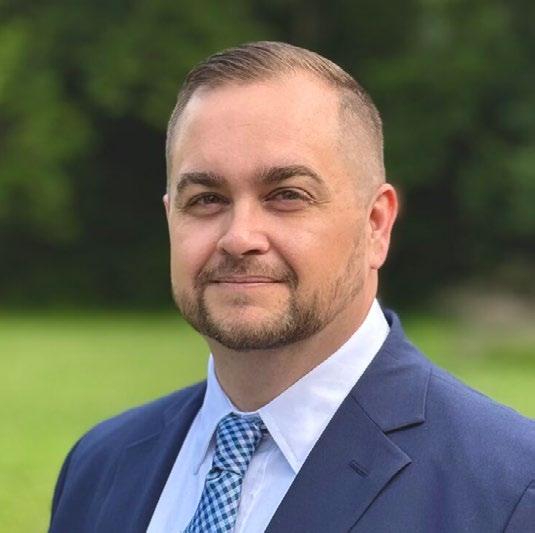
DANIEL PARSONS
E.W. Scripps
E.W. Scripps has hired Daniel Parsons in the new role of chief information security officer. He wil lead enterprise security strategy, responsible for protecting the integrity, availability and confidentiality of digital content, newsroom systems, intellectual property and consumer data. Parsons had been vice president of cyber defense at NBCUniversal. He has also held cybersecurity roles at U.S. Bank, General Electric and Walmart.

Operative Media has named Mike Napadano its new CEO. Napadano has been with ad technology provider Operative since 2019, most recently as chief customer officer. Prior to that, he was chief technology officer of Disney ABC Television Group chief technology officer from 2017 to 2019. A 25-year ad tech veteran, prior to Disney he was senior vice president and CIO for sales, research and analytics at NBCUniversal.
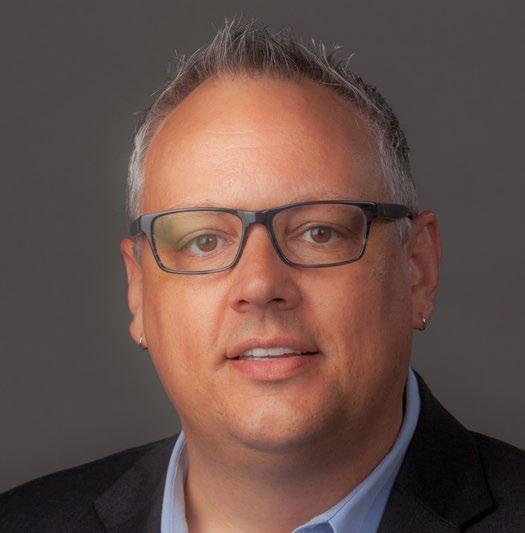
Lawo has tapped Mike Wright as vice president of sales, North America. A veteran strategic sales leader who has held roles at Appear, EditShare, Tektronix/ Telestream and Grass Valley, Wright will be tasked with spearheading Lawo’s commercial strategy in North America, focusing on expanding its market presence, strengthening customer awareness and driving brand awareness across key verticals.
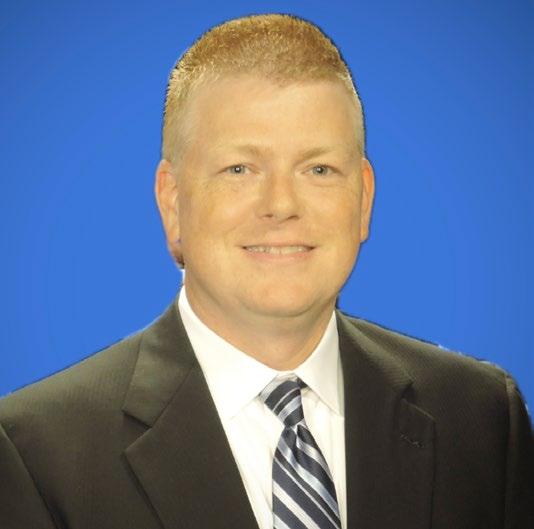
Sinclair has named Mark Martin vice president and general manager of KOKH-KOCB Oklahoma City and KTUL Tulsa. He most recently was director of sales at Nexstar Media Group-owned KFOR-KAUT Oklahoma City. Previously, Martin had been a GM or sales manager with Sinclair stations in Kansas City, Oklahoma City and Milwaukee, where he was known for his strategic thinking, team-building and ability to lead through change.
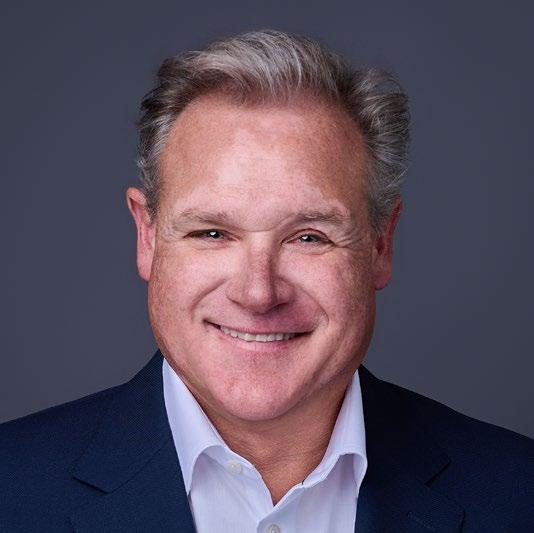
G Morgan has joined Globecast, a provider of broadcast, media and entertainment managed services, as executive vice president of sales, Globecast Americas. He will lead sales strategy and customer engagement across the region. Most recently with Amazon Web Services, Morgan will focus on expanding the company’s footprint in cloud-based playout, connectivity and IP distribution services while supporting customers in their own digital evolution.