Discern magazine (ISSN 2372-1995 [print]; ISSN 2372-2010 [online]) is published six times a year in print, with six bonus digital issues, by the Church of God, a Worldwide Association, as a service to readers of its LifeHopeandTruth .com website. Free electronic subscriptions can be obtained at Discern’s home page: LifeHopeandTruth.com/Discern Contact us at info@DiscernMag.com
Church of God, a Worldwide Association, Inc., P.O. Box 3490, McKinney, TX 75070-8189; phone 972-521-7777; fax 972-521-7770; info@cogwa.org; LifeHopeandTruth.com; cogwa.org
Ministerial Board of Directors:
David Baker, Arnold Hampton, Mike Hanisko, Joel Meeker (chairman), Larry Salyer, Leon Walker and Lyle Welty
Staff:
President: Jim Franks; Editor: Clyde Kilough; Editorial content manager: Mike Bennett; Managing editor: David Hicks; Senior editor: David Treybig; Graphic designer: Elena Salyer; Associate editors: Erik Jones, Jeremy Lallier; Assistant editor: Kendrick Diaz; Copy editor: Becky Bennett; Social media: Hailey Brock
Doctrinal reviewers:
John Foster, Bruce Gore, Peter Hawkins, Don Henson, Doug Johnson, Chad Messerly, Larry Neff
The Church of God, a Worldwide Association, Inc. has congregations and ministers throughout the United States and many other countries. Visit cogwa.org/ congregations for information.
Donations to support Discern magazine and LifeHopeandTruth.com can be made online at LifeHopeandTruth.com/donate or by surface mail to Church of God, a Worldwide Association, Inc., P.O. Box 731480, Dallas, TX 75373-1480. The Church of God, a Worldwide Association, Inc. is organized and operated as a tax-exempt organization in the United States according to the requirements of IRS 501(c)(3). Contributions are gratefully acknowledged by receipt.
Unsolicited materials sent to Discern magazine will not be critiqued or returned. By submitting material, authors agree that their submissions become the property of the Church of God, a Worldwide Association, Inc. to use as it sees fit.
Upon hearing of the recent death of a devoted servant of God and longtime friend , I dug into the Discern archives to rerun this column from nearly 10 years ago. Florante Siopan, the grandfather in this account, left a remarkable legacy for his family, church, community and, I hope through this brief remembrance, you the reader.
When I accepted the invitation to their homes for a Saturday night barbecue, little did I anticipate walking away so deeply impressed with a life lesson that I’d be writing about it years later.
Their homes—three modest dwellings on a small lot separated only by a common courtyard into which some 20 or so of us were crowded—housed a growing clan spanning three generations.
The barbecue on this warm evening in the Philippines consisted of bite-size chicken pieces on bamboo skewers, slow cooked over scattered coals in an aluminum pan, not a big gas grill like I was used to. But with rice, vegetables and fresh fruit for dessert, the meal proved more than satisfying and undoubtedly healthier than I was used to!
Being wealthy without money
Later that night in the quiet of my hotel, I realized what was so impressive about that evening. And a couple of weeks later, back home in the United States, I urged the congregation I pastored to ponder a universal truth. This story wasn’t really about a sing-along, but about a law of life at work:
It doesn’t matter how little money you have, if you do the right things, you will be rich—rich in the things of life that really make you happy.
A close-knit, loving family has to rank near the top of the list of life’s greatest treasures.
As the eating slowed, the excitement grew as one of the youngsters rolled out a big black box and began connecting various wires. Seeing my curiosity, the grandfather began describing a family tradition. “We don’t have much money for entertainment. We could never afford the luxury of going to a movie. But a few years ago we all decided we could save for this karaoke machine and enjoy singing together.”
And enjoy it we did, as they did nearly every Saturday night. As usual, Grandpa started it, crooning his favorite Frank Sinatra love song while bouncing a little grandchild on each knee. From then on—for the next three hours!—we sang and laughed with gusto. There were solo performers, husband-and-wife teams, lively little kids, shy big kids, duets, trios and occasionally everyone joined in.
Like on an oldies radio station, the hits just kept on coming. Who cared that no one had a great voice? What we had was fun!
Here was a family that had little money, but overflowed with love, affection, contentment and happiness. No matter their ages, they all obviously enjoyed one another. And they didn’t keep it for themselves. Anyone they invited (as they often did) to join their cookout and karaoke quickly found themselves drawn into that atmosphere.
I’ve known people who would give all of their physical wealth to have what these folks had.
A culture of caring
Such family bonds aren’t accidental. This family was blessed to have a patriarch and matriarch who understood the most important laws of life and who had the wisdom to live by them and instill them in the next generations. What I was seeing in their karaoke party was really a culture of caring. It was a microcosm of their family’s way of life—spending time, working, communicating, playing, facing challenges, solving problems, surviving . . together.
This Filipino family had amassed one of life’s greatest treasures, real riches worth searching and working for!
Clyde Kilough Editor
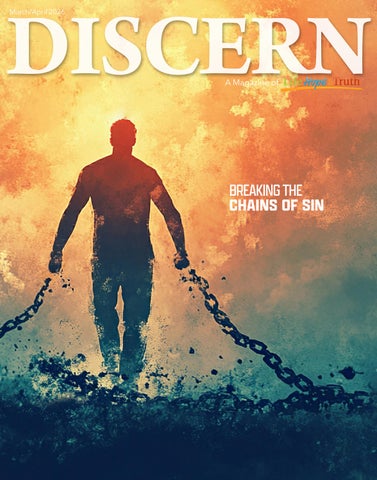
BREAKING THE CHAINS OF SIN STRIKING THE FIRST BLOW
David’s prayer of repentance can help us understand how we can escape the chains of sin and restore our relationship with our merciful God.
By Clyde Kilough
David was in deep trouble. It began with adultery and worsened as he plotted to cover up Bathsheba’s resulting pregnancy. In desperation, he sank to a horrible low, arranging to have her husband Uriah killed. Now, months later, he was reeling after God exposed his sins through His prophet Nathan.
Paul later described the reality David was facing: “Do you not know that to whom you present yourselves slaves to obey, you are that one’s slaves whom you obey, whether of sin leading to death, or of obedience leading to righteousness?” (Romans 6:16).
David was caught up in the worst kind of slavery, the bondage of sin, and every ploy he contrived to deal with it only twisted the chains tighter.
David’s story is our story
Have you ever found yourself there? If you are aware of what breaking God’s law means, the answer is yes. If you grasp the biblical truth that your mind is fundamentally “enmity against God; for it is not subject to the law of God, nor indeed can be” (Romans 8:7), the answer is yes.
No one, not even one as powerful as the king of Israel, is above God’s law or immune to his or her own human nature. We have all sinned (Romans 3:23),
and sin’s chains drag us to pain and suffering, and eventually to death.
What happened to David? How did he break those chains and recover to the point that God could describe him as “a man after My own heart, who will do all My will” (Acts 13:22)? Most important, what can we learn from his story?
Many are familiar with the 2 Samuel 11 and 12 account of David’s sins. Far too many have missed, however, the most important part of the story, how he restored his relationship with God. That’s found in Psalm 51, David’s prayerful summary of his spiritual journey after God confronted him through Nathan.
God preserved David’s thoughts in this psalm, not to humiliate him, but to serve as a model to help us understand what deep repentance means. This is critically important, because repentance is the first strike of the hammer that begins to break the chains of sin.
Let’s consider four vital principles David’s prayer reveals about fervent, heartfelt repentance. Please open your Bible to Psalm 51 to read the verses referenced.
1. Own the sin!
Adam and Eve were the first to reveal a fatal flaw in human thinking. That is, our auto-response when sinning is to hide from God. We tend to avoid taking ownership of our sin and its impact.
Shame can do that. So can fear or the discouragement that comes from repeatedly stumbling and committing the same sin. Whatever the reason, we cannot escape a fundamental spiritual law at work in life: when “you have sinned against the Lord . . . be sure your sin will find you out” (Numbers 32:23). As David
painfully learned, we cannot hide from or outrun the consequences of sin.
God loved David enough to give him one last chance to come out from hiding from himself and his sin. Finally, with brutal honesty, David owned up: “For I acknowledge my transgressions, and my sin is always before me. Against You, You only, have I sinned, and done this evil in Your sight—that You may be found just when You speak, and blameless when You judge” (Psalm 51:3-4).
We can begin overcoming only after we stop rationalizing, excusing and minimizing our sin! David did not soften his sin by calling it “a mistake” or “a problem.” He labeled it “this evil.”
It would be easier to focus on the hurt he caused Bathsheba, Uriah or even his baby who was going to die, but David didn’t mention them. Instead, he went straight to the heart of the matter—he had sinned against God.
What does that mean for us? Owning our sin means we acknowledge to God that we are pleading guilty for Christ having to die in our stead to pay the penalty for our sin!
This understanding deeply personalizes the impact of sin. Peter drove home this point in his Pentecost sermon when, explaining the life and death of Christ, he told the crowd, “Therefore let all the house of Israel know assuredly that God has made this Jesus, whom you crucified, both Lord and Christ” (Acts 2:36, emphasis added). They didn’t argue or say, “I wasn’t there, you can’t blame that on me!”
Rather, “when they heard this , they were cut to the heart, and said to Peter and the rest of the apostles, ‘Men and brethren, what shall we do?’” (verse 37). They took ownership! And Peter’s answer was simple—“Repent, and let every one of you be baptized in the name of Jesus Christ for the remission of sins; and you shall receive the gift of the Holy Spirit” (verse 38).
God sacrificed His Son so that we might be pardoned. When God sees in us a humble, broken and contrite heart that is committed to changing, He will give us every chance possible.
Yes, owning our sin is painful, but without it we cannot move on to break the chains of sin.
2. Run—not from God, but to God!
Once David stopped running from God and acknowledged his sin, he knew the way forward was to run to God. He remembered God’s nature and cast himself before God’s throne of mercy. His first statement in Psalm 51 was, “Have mercy upon me, O God, according to Your lovingkindness; according to the multitude of Your tender mercies, blot out my transgressions.”
Repentance is based and built upon hope and trust in God. David said in verse 9, “Hide Your face from my sins, and blot out all my iniquities.” He trusted God would do that.
He said in verse 12, “Restore to me the joy of Your salvation, and uphold me by Your generous Spirit.” He trusted God would do that.
He said in verse 14, “Deliver me from the guilt of bloodshed, O God, the God of my salvation, and my tongue shall sing aloud of Your righteousness.” He
trusted God, the God of salvation and righteousness, would do that.
David knew God and believed in God’s mercy and love. He knew he did not deserve it, but he also knew God was open to redeeming him and giving him another chance. He was able to pray, “Make me hear joy and gladness, that the bones You have broken may rejoice” (verse 8), because He knew God disciplines to heal, not to harm; to save, not to destroy.
Please download our booklets Getting to Know the God of the Bible and God’s Gift of Grace. When you know God, as David did, you will have the confidence to run to Him, not from Him, even when you are struggling with sin!
3. It’s not just about pardon, it’s about change.
Why is it, do you think, that God is willing to work with and forgive sinners, even when we struggle with the same sins, sometimes for years?
The answer is, true repentance is about changing our lives, not just being pardoned. God doesn’t just want to pardon us. He wants to create a new person. But He also knows that He’s dealing with people who are weak in many ways, and that we need more than one chance if we are going to truly change our lives.
David knew this. “Create in me a clean heart, O God,” he prayed. He knew he needed a totally new heart, a spiritual heart. “And renew a steadfast spirit within me” (verse 10). He also knew he needed God’s intervention and help to make it happen.
We cannot make just a few tweaks or adjustments to human nature and be okay. It needs to be replaced because, contrary to modern philosophy, the human
heart is not basically good (Jeremiah 17:9). Paul strongly worded it this way in Romans 8:7-9:
“Because the carnal mind is enmity against God; for it is not subject to the law of God, nor indeed can be. So then, those who are in the flesh cannot please God. But you are not in the flesh but in the Spirit, if indeed the Spirit of God dwells in you. Now if anyone does not have the Spirit of Christ, he is not His.”
Only by the help of God’s Spirit can we overcome the flesh and stop walking in sin.
David came to understand what God was really looking for in us. “For You do not desire sacrifice, or else I would give it; You do not delight in burnt offering. The sacrifices of God are a broken spirit, a broken and a contrite heart—these, O God, You will not despise” (Psalm 51:16-17).
Remember, God sacrificed His Son so that we might be pardoned. When God sees in us a humble, broken and contrite heart that is committed to changing, He will give us every chance possible. Rituals don’t break the chains of sin, but a broken spirit and heart will.
4. It’s about what you are, not just what you’ve done.
David made what may seem to be a strange statement when he observed, “Behold, I was brought forth in iniquity, and in sin my mother conceived me” (verse 5). Was he somehow dragging a sin of his mother into the narrative?
No. David’s statement was an expression of his discernment of sin’s impact on his life from the time it began. It seems that he was digging deeply into his own mind, pondering, “How did I even get to this state of sin? If I’ve known God’s law all my life and have had a strong relationship with Him, how could this have happened?” This introduces something important to understand in order to grasp our deep need for God’s help.
David was not excusing his behavior; rather, he was recognizing how deeply this world’s sinfulness had affected him. Like Adam and Eve, we all have eaten from the tree of the knowledge of good and evil, and a lot of evil is ingrained into our character before we are even old enough to understand it.
That’s why Paul wrote in Romans 7 that “evil is present with me, the one who wills to do good. For I delight in the law of God according to the inward man. But I see another law in my members, warring against the law of my mind, and bringing me into captivity to the law of sin which is in my members” (verses 21-23).
All this, he recognized, was because, “I am carnal, sold under sin” (verse 14).
David saw that he needed to repent not only of his sinful deeds, but of his sinful nature! That’s why he prayed fervently, “Create in me a clean heart, O God, and renew a steadfast spirit within me,” and, “Behold, You desire truth in the inward parts, and in the hidden part You will make me to know wisdom” (Psalm 51:6). He needed God’s help to deeply know himself, and to change his nature.
As John put it, “If we confess our sins, He is faithful and just to forgive us our sins and to cleanse us from all unrighteousness” (1 John 1:9).
We take a huge step forward in breaking the chains of sin when we comprehend this truth: not only do I do carnal things (that is, act according to sinful, fleshly desires), I am carnal—that is my nature! That awareness should stir us to attack the root cause of sin. We begin to focus on asking God to help us change our complete nature, not just stop this or that particular sin.
You can be freed from sin!
There are certainly other factors involved in completely breaking the chains of sin. Our article “ Seven Steps for Overcoming Sin” outlines some of these key elements. Thousands of people have also found our booklet Change Your Life! very helpful.
But deep, genuine repentance is the foundation and the necessary first step to turning your life around. Psalm 51 stands as a powerful testimony that no matter what chains of sin may bind us, nothing is too strong for God to break. He stands ready to respond to any sinner who cries out to Him in genuine repentance, as David did. D
CHANGE YOUR LIFE!
The ultimate example of love was Jesus Christ’s giving His life so we could live. The willingness to sacrifice is an essential aspect of real godly love.
By Mike Bennett
The Epitome of Love
Ihave always been moved by the stories of people who were willing to risk their lives for other people— sometimes for ones they didn’t even know.
For example, consider the story of Ahmed al-Ahmed, who saved many lives when he rushed to wrestle a gun away from one of the shooters targeting a Hanukkah celebration at Australia’s Bondi Beach Dec. 14, 2025.
“‘He said he’d do it again,’ Ahmed al-Ahmed’s [lawyer] Sam Issa said Monday [Dec. 15] after speaking to his client in hospital. ‘But the pain has started to take a toll on him. He’s not well at all. He’s riddled with bullets. Our hero is struggling at the moment’” (Newsweek.com).
Then there’s the 2013 story of William Ayotte, a 71-year-old Canadian who heard a scream outside.
“‘I went to my front door and opened the door and I looked outside and about 40 feet away was a bear mauling a woman,’ he told the Winnipeg News Station CTV. ‘The bear had the woman by the head and was wagging her around in the air, and I couldn’t believe what I was seeing, so I was thinking I’ve got to do something.’ So, Ayotte grabbed a shovel, ran up to the bear, and hit it square in the eye” (BBC.com).
And I still remember the story of the selfless hero of a 1982 plane crash.
“There they floated. Scared. Traumatized. Six people had just survived the crash of Air Florida
Flight 90 into a bridge over the Potomac River in Washington, D.C., in January 1982. They hung on to the jet’s damaged tail section in the freezing water.
“Five of them would live because the sixth, one-by-one, would hand them a life ring attached to a rope hanging from a helicopter. When the copter came back a sixth time, the man had slipped into the water to his death” (PalmBeachPost.com).
These are amazing and poignant examples of deep concern and care for others, even above concern for self.
No greater love
God the Father and Jesus Christ displayed the ultimate in selfsacrificial love—a love that surpasses our comprehension (Ephesians 3:19).
“For God so loved the world that He gave His only begotten Son, that whoever believes in Him should not perish but have everlasting life” (John 3:16).
As Jesus said the night before His ultimate sacrifice:
“Greater love has no one than this, than to lay down one’s life for his friends” (John 15:13).
Jesus was willing to die for His friends. And this love was not limited to those who were already friends and followers. The apostle Paul explained:
“For when we were still without strength, in due time Christ died for the ungodly.
“For scarcely for a righteous man will one die; yet perhaps for
a good man someone would even dare to die.
“But God demonstrates His own love toward us, in that while we were still sinners, Christ died for us” (Romans 5:6-8).
We can be deeply thankful for such love. But He is God, and that level of love seems so far beyond what we can show. How does God’s love relate to how we are to love?
What is love?
The introduction of Shannon Bream’s book The Love Stories of the Bible Speak says:
“What is love? It’s not what the world tells us, or whatever our emotions tell us it is. We can only truly understand and share love in its purest form if we allow God to show the way” (2023).
Love in the Bible
Love is mentioned in the Bible a lot: 361 times in the New King James Version! The books that contain the most mentions are:
• 1 John, 36.
• Song of Solomon, 30.
• Psalms, 29.
• John, 26.
• Proverbs, 18.
• Deuteronomy, 16.
The first mention of love is in Genesis 22:2, a passage that prefigures the awesome sacrifice God would later give.
God said to Abraham, “Take now your son, your only son Isaac, whom you love, and go to the land
of Moriah, and offer him there as a burnt offering on one of the mountains of which I shall tell you.”
This foreshadowed the greatest act of love—the sacrifice of God’s beloved Son to pay the death penalty we deserved in our place.
God never intended for Abraham to actually sacrifice Isaac, and He hates the idea of human sacrifice (Deuteronomy 12:31; Jeremiah 7:31). But He sought to know if Abraham, His friend, could act out and begin to grasp the depth of love that God Himself would show for all of us. Meditating on Abraham’s experience can help us gain a deeper understanding of God’s unfathomable love.
Of course, the words translated “love” in the Bible have a range of meanings, as the English word does today. And the Bible doesn’t shy away from describing wrong and harmful love. But the overwhelming message is that there is a supreme love that is the essence of what God is, what He wants us to be, and what leads to beautiful, meaningful and satisfying relationships.
The Bible itself is a love story, and the main character is the perfect example of love.
What real love is not
It’s interesting that Paul’s famous Love Chapter lists as many things that love is not as things it is. Some of the polar opposites of love too often show up in so-called love stories today.
Jealousy and illicit desire may be the stuff of romance novels and rom-com movies, but they are not signs of real love.
The Amplified Bible puts the list of things love is not this way:
Love “is not jealous or envious; love does not brag and is not proud or arrogant. It is not rude; it is not self-seeking, it is not provoked [nor overly sensitive and easily angered]; it does not take into account a wrong endured. It does not rejoice at injustice” (1 Corinthians 13:4-6).
Other versions of verse 6 say “love does not delight in evil” (New International Version) and “is never glad with sin” (International Standard Version).
What real love is
The Love Chapter also lists these positive traits:
“Love suffers long and is kind . rejoices in the truth; bears all things, believes all things, hopes all things, endures all things. Love never fails” (1 Corinthians 13:4, 6-8).
Suffering, bearing and enduring again highlight the self-sacrificing quality of godly love. And all of this without fail—in the footsteps of our unfailing God.
Another love chapter
The apostle John uses love 21 times in 1 John 4 alone. Consider the great summary he gives in verses 7-9 and 18-21 about God’s love and what His love should inspire us to do.
“Beloved, let us love one another, for love is of God; and everyone who loves is born of God and knows God.
“He who does not love does not know God, for God is love.
“In this the love of God was manifested toward us, that God has sent His only begotten Son into the world, that we might live through Him” (1 John 4:7-9).
God not only sets the example of love, but He defines Himself as love! And that should inspire us to act in love toward God and our fellow man.
“There is no fear in love; but perfect love casts out fear, because fear involves torment. But he who fears has not been made perfect in love.
“We love Him because He first loved us.
“If someone says, ‘I love God,’ and hates his brother, he is a liar; for he who does not love his brother whom he has seen, how can he love God whom he has not seen?
“And this commandment we have from Him: that he who loves God must love his brother also” (verses 18-21).
To follow God’s example of love, we can’t put limits on whom we will love. As Jesus said in Matthew 25:45 about those who did not serve others, “Assuredly, I say to you, inasmuch as you did not do it to one of the least of these, you did not do it to Me.”
Sincere and fervent love
Godly love is not put-on or shallow.
Both Peter and Paul emphasized the sincerity of godly love:
“Since you have purified your souls in obeying the truth through the Spirit in sincere love of the brethren, love one another fervently with a pure heart” (1 Peter 1:22).
Paul expands on this: “Love is to be sincere and active [the real thing—without guile and hypocrisy]” (Romans 12:9, Amplified Bible).
This article can only scratch the surface. The subject of love is an overarching theme of the Bible and God’s plan. Take the time to study about it further in our articles “God Is Love” and “Fruit of the Spirit: Love .” D
From Seed to Harvest Lessons on Spiritual Growth
In His Kingdom parables, Jesus likened spiritual growth to that of a seed. What can we learn from this agricultural process?
By David Treybig
Every year, growers around the world engage in an impassioned competition—the quest to grow the largest pumpkin on earth. From the fertile valleys of California to the greenhouses of Europe, to the warm fields in Kyogle, New South Wales, Australia, enthusiasts invest enormous effort into producing pumpkins that now approach 3,000 pounds (1,360 kilograms).
Some growers will pay hundreds of dollars for a single seed that has a proven “giant” lineage. Why? Because they know that within that small, pale shell lies extraordinary potential—the blueprint to produce something massive and impressive.
It’s astonishing to consider that such immense potential is locked inside something that fits on the tip of a finger. Yet this natural phenomenon mirrors a spiritual truth Jesus Christ used to describe how the Kingdom of God will grow.
How Jesus used seeds to teach about the Kingdom of God
In Mark 4:26-29, Jesus compared the Kingdom of God to a man scattering seed. The seed sprouts and grows, even though the farmer “does not know how.” God designed growth—both physical and spiritual—to be mysterious and miraculous.
Jesus used another example in verses 3032, likening the Kingdom to a mustard seed. Though tiny, it grows into a plant large enough for birds to rest in its branches. Something small and unimpressive at first can become something great.
Spiritual growth often begins the same way—with a small stirring of conscience, a moment of clarity while reading Scripture, or a quiet reflection during a difficult time. These moments may seem small, but they contain enormous potential.
God plants the seed— where spiritual life begins
It is crucial to understand that spiritual awakening does not occur by human effort. Jesus said, “No one can come to Me unless the Father who sent Me draws him” (John 6:44). God
initiates the process by softening a person’s heart so His “word” (Luke 8:11) can take root.
Our Christian life does not begin because of our brilliance or moral insight. It begins because God chooses to plant His truth in a prepared mind. Like a seed that carries the blueprint for life, God’s Word brings spiritual possibility—the opportunity to culminate in a spiritual harvest where the individual eventually becomes a member of God’s eternal family.
This is a miraculous process that humans cannot duplicate. Only God can open our minds and begin His transforming work within us.
The condition of the heart—the soil in Jesus’ parable
A seed’s potential is extraordinary, but its growth depends heavily on the soil into which it is planted. Jesus, in His parable of the sower (Matthew 13:3-9, 18-23), describes four types of soil, representing four kinds of hearts.
1. Hard soil, the compacted ground of the wayside, represents a heart that doesn’t understand God’s Word. The seed cannot germinate, and spiritual growth doesn’t begin.
2. Shallow soil, with its rocks and stones, describes the heart of a person who initially receives God’s Word with joy but gives up when difficulties arise.
3. Crowded soil describes a heart that is fertile, but filled with weeds—worries, distractions and the pulls of the world— that choke out spiritual growth.
How spiritual growth occurs
4. Good soil symbolizes a heart that listens, understands and applies God’s message. Only this soil produces lasting fruit.
This parable reminds us that while God initiates spiritual life, we bear responsibility for maintaining the condition of our spiritual soil. We must guard our hearts from hardness, rootlessness and distraction.
We must cultivate humility, attentiveness and a willingness to change. Just as a gardener prepares the soil—removing stones, breaking up hardness and clearing weeds—so we must continually prepare our hearts to receive God’s instruction.
Once a seed is planted in good soil, proper conditions become essential. Without water, light and protection, even the most promising seed will wither. Spiritual growth follows the same pattern. Paul described this process as “the washing of water by the word” (Ephesians 5:26). God’s Word cleanses us and provides direction, correction and encouragement. It provides the nourishment needed for spiritual growth.
God also established His Church—the Church Jesus founded—to help nurture our spiritual growth. The Church of God continues to teach and practice the same doctrine established by Jesus and the apostles. It serves as “the pillar and ground of the truth” (1 Timothy 3:15), guiding, teaching and supporting God’s people as they mature spiritually (Ephesians 4:11-14).
Additionally, Jesus promised that the Holy Spirit “will guide you into all truth” (John 16:13). Just as sunlight enables photosynthesis— transforming light into life—so the Holy Spirit illuminates Scripture, convicts us of sin and empowers us to change.
The Word of God, the Church Jesus founded and the Spirit of God work together to sustain spiritual growth. Without this combination, we cannot grow as God intends.
Daily habits that enhance spiritual growth
Like plants, spiritual growth thrives with consistency. A plant that receives water one day and then none for a long time will struggle and possibly die, even if planted in good soil. The same is true spiritually. Prayer, Bible study, obedience and fellowship act like spiritual rain
and sunlight. These steady habits nourish our faith and strengthen our conviction.
Neglect, however, weakens spiritual growth. Someone who rarely prays, seldom studies the Bible, or avoids fellowship with spiritual brethren will struggle to grow. Conversely, steady spiritual habits build strength, resilience and stability.
Removing spiritual weeds—overcoming sin and distractions
Every gardener battles weeds. These noxious plants steal nutrients, block sunlight and choke healthy plants. Spiritually, weeds represent sins, worldly distractions, anxieties and misguided priorities.
Jesus warned that “the cares of this world” and “the deceitfulness of riches” can choke
the Word and make it unfruitful (Mark 4:19). These weeds grow quickly if left unchecked.
Repentance is God’s method of weed removal. It is not a one-time event but a continual practice—removing wrong thoughts, habits and attitudes before they grow into something damaging. Without constant vigilance, a spiritual garden can become overgrown in a short time.
How trials can strengthen spiritual roots
While plants thrive under optimum conditions, they often develop their strongest roots during stress. Wind, heat or drought can force roots to go deeper. In the same way, God uses trials to develop spiritual strength. James wrote that the testing of our faith “produces patience” (James 1:2-3). Trials can increase endurance, maturity and trust in God. Paul encouraged Christians to be “rooted and built up in Him” (Colossians 2:6-7). Deep roots equip us to withstand life’s storms. Without trials, our roots would remain shallow.
Pruning and discipline— how God shapes us
Jesus used another agricultural image in John 15:2, explaining that God prunes the branches of His people “that [they] may bear more fruit.” Pruning can seem harsh or painful, yet a skilled gardener cuts away not only dead branches but even some live growth so the plant’s energy is directed toward producing better fruit. Likewise, God uses discipline, correction and life experiences to shape us. Though the process can be uncomfortable, the result is greater spiritual maturity and improved fruitfulness.
Producing spiritual fruit
Every seed has a purpose: to grow, mature and eventually produce a harvest. Spiritually, God
intends that we grow in our capacity to reflect His character and bear the fruit of righteousness.
As we mature spiritually, our lives increasingly reflect the fruit of the Spirit—love, joy, peace, patience, kindness, goodness, faithfulness, gentleness and self-control (Galatians 5:22-23). These qualities show Christ living in us and reveal the impact of God’s ongoing work.
The final harvest
In agricultural terms, harvest is the culmination—the moment the grower has anticipated from the beginning. Spiritually, the ultimate harvest occurs at the end of the age when God gathers those who have faithfully grown in His way. Jesus said, “The harvest is the end of the age” (Matthew 13:39). Revelation 14:15 portrays God reaping the mature harvest of His people—those who have allowed Him to complete His work in them.
This final harvest represents completion, reward and the fulfillment of God’s purpose for every believer.
Letting God complete His work in you
From seed to harvest, God’s pattern for spiritual growth mirrors the natural cycle He built into creation. It begins with His initiative—planting the seed of His Word into a receptive and responsive heart.
Growth continues through Bible study, prayer, obedience, fellowship with fellow believers and the power of the Holy Spirit. Trials strengthen us, pruning refines us and faithful perseverance leads to spiritual fruit.
Just as pumpkin growers tend their plants daily—watering, feeding, weeding and protecting them—we, too, must intentionally cultivate our spiritual lives. God provides the power, but we must cooperate with His work.
If we do our part, we can be reassured by Paul’s words to the Philippians, “He who began a good work in you will carry it on to completion until the day of Christ Jesus” (Philippians 1:6, New International Version).
For further study, read our booklets Change Your Life and Where Is the Church Jesus Built? D
The Comparison Trap Why We Fall In—and How to Get Out
In a world that tempts us to constantly compare ourselves to others, how can we break free from this vicious and harmful cycle?
By Monica Ebersole
The messages are all around us— on every social media app, every streaming service, every advertisement. One moment we’re going about our day; the next, we’re bombarded with a subtle but persistent message: that we lack something someone else has. This message is designed to provoke a response—a feeling of inferiority that marketers conveniently promise to resolve with various products and services. While it can often be easy to recognize this manipulation if we are looking for it, the emotions it stirs within us are very real.
Like many harmful mindsets, the temptation to compare ourselves to others is a slippery slope.
What may begin as casual comparison online can quickly spill over into our personal lives, affecting how we view friends and family. And while some degree of comparison can motivate us to work harder to achieve our goals, it often causes much more harm than good—especially when it becomes an obsession.
The true cost of comparison
Paul recognized the pitfalls of comparison. He wrote, “For we dare not class ourselves or
compare ourselves with those who commend themselves. But they, measuring themselves by themselves, and comparing themselves among themselves, are not wise” (2 Corinthians 10:12).
Spending our lives measuring ourselves against other people or their possessions is a foolish misuse of time and energy.
So, why is comparison so tempting? Because it comes naturally in this society under the sway of our adversary. Marketers, social media companies and others understand our vulnerabilities. They know precisely how to exploit and profit from the insecurities each of us carries.
But ultimately the devil doesn’t promote all this just to make
us feel bad about ourselves. His purpose is far more sinister. He knows that when foolish comparison becomes a habit, our spiritual well-being suffers. We can become prideful or discouraged— or both.
Pride can be born from comparison and takes root when we measure our worth against others. When we allow Satan to lure us into constant comparison, he can lead us down a discouraging and dangerous path. This can cultivate harmful traits in us, such as:
• Amplified insecurity
Comparing ourselves to others often causes us to question our own abilities and, if we allow it to go far enough, our own sense of worth. After all, if we focus on the fact that there’s someone
out there who’s better than us at everything—if we fixate on the fact there’s always someone who has something we don’t—we’re naturally going to question our own value and ability to contribute. The more we compare ourselves to those around us, the stronger this feeling becomes.
At its core, insecurity is often rooted in the fear that we have nothing unique or special to offer. When this fear takes hold, we typically respond in one of two ways: we either resign ourselves to it, or we overcompensate in an attempt to prove our value.
• Excessive competitiveness
The mental competition we participate in when we compare ourselves to others is an interesting one. It’s largely internal, taking place in the minds of those who
engage in it. And it’s addictive. Before we know it, we can easily find ourselves sizing up each person we meet, mentally ranking them against ourselves.
It’s also exhausting. Maintaining this constant, unspoken competition takes a real toll. Striving to stay “ahead” in an imagined hierarchy of our own making is deeply fatiguing and yields little reward.
What’s more, it’s never-ending. There will always be someone new to compete with, or some new area in which to compare ourselves. And perhaps worst of all, it prevents us from fully enjoying our friendships and robs us of the closeness those relationships could otherwise offer.
• Covetousness and envy
When endless competition fails
to produce the satisfaction and reassurance we crave, other dangerous mindsets can quietly take root: covetousness and envy. Though closely related, the two are distinct from each other. Covetousness arises when we desire what someone else has; envy follows when dissatisfaction begins to distort how we view others.
While this is a natural, human response, covetousness and envy pose great dangers to our emotional and spiritual health. Learn more in our online article “ Thou Shalt Not Covet ” and blog post “Fighting the Works of the Flesh: Envy.”
The Bible associates a particular ugliness with the sin of envy For example, James 3:16 states, “Where envy and self-seeking exist, confusion and every evil thing are there.”
What should we do?
For those who struggle with comparison, these patterns—and the damage they cause—are likely all too familiar. Recognizing the cycle is the first step; breaking it is the real challenge.
Imitate Christ
Measuring ourselves by others and comparing ourselves among ourselves is natural, but problematic. No matter how impressive or admirable an individual may be, every person we compare ourselves to is still an imperfect human being.
Except for one—the most important one. The only person Scripture calls us to measure ourselves with is Jesus Christ. He is the example we are to grow to become like.
We are encouraged to imitate Jesus Christ and walk as He
walked (see our Discern series, starting with the article “ Walk as He Walked ”). The problem isn’t comparison itself—but who we choose to compare ourselves to.
When we focus on comparing ourselves to Christ rather than to others, pride can give way to humility, and discouragement can be replaced with hope. Striving to emulate Jesus Christ produces lasting fruit in our lives, such as:
• Security and a sense of purpose
G od knows us and cares for us intimately. King David captured this love and care beautifully in Psalm 139, noting that God knows our “sitting down” and our “rising up” and is “acquainted with all [our] ways” (verses 2-3). He formed our inward parts and covered us in our mother’s womb (verse 13).
When we see how much God cares for each of us, we can realize that we don’t need to search for worth or compete to be special or unique in His eyes. We can feel secure in knowing that God the Father and Jesus Christ love us. They created us for a specific purpose, and They desire for us to be sons and daughters in the sooncoming Kingdom of God (see our online article “Becoming Sons and Daughters of God ”).
Furthermore, when we understand God’s plan for us and the role that He wants us to play in it, we begin to see that our lives have a truly great purpose! A purpose that can’t be seen by focusing on ourselves or measuring ourselves against others in this physical life. When we feel ourselves being lured back into the comparison trap, keeping this perspective can help us resist temptation.
• Contentment and peace
Breaking the constant cycle of
comparison allows us to finally breathe, finding peace and contentment in the life we have been blessed with. (For more on contentment, see our article “ What’s the Real Source of Contentment? ”)
The warning against covetousness in Hebrews 13:5 underscores the importance of being content with what we have, reassuring us that our Father and Elder Brother will provide for our needs and will never leave or forsake us.
• Genuine happiness for others When comparison no longer governs our thinking, we become better friends and sources of support for those around us. Free from the need to compete, we can rejoice sincerely in the successes of others—even when they receive blessings and opportunities that we ourselves desire.
This freedom enables us to truly esteem others better than ourselves, to put their welfare and needs ahead of our own. This mindset directly challenges the natural inclination toward comparison and rivalry (see “ The Meaning of Philippians 2:3: Esteem Others Better? ”).
Guard against the trap
The temptation to return to the trap of comparison will always beckon. Yet when old habits resurface, fixing our eyes on Christ—making Him our only measure—reorients our perspective and strengthens our ability to resist.
In doing so, we can live with purpose, contentment and genuine joy for others as we strive to follow the example of Jesus Christ. D
The Day I Met My Own Worst Enemy
As a new Christian, I knew that Satan and his society were major enemies. But I hadn’t fully seen the enemy who had the power to destroy me—my own worst enemy.
By Bill Palmer
Ihadn’t been a Christian long. I was working my way through college with a part-time job when I was shocked by some bitter news. It was the day I met my own worst enemy.
Meeting my own worst enemy
This moment came when I was eating lunch in the college cafeteria. I was sitting among several other students who worked at the same place. Because I was in my second year in that work, I had a supervisory position.
I overheard one of those students refer to me as a “drill sergeant.” I was very surprised, so I questioned her comment. But another student spoke up, agreeing with what she had said.
This was a distressing revelation to me.
My self-perception had been entirely different. In my mind, I was too soft and a little weak as a leader, not a
harsh taskmaster. In this brief moment, I understood that I had deceived myself.
As I thought more about it later, I began to realize that I was my own worst enemy. Knowing about Satan, I had previously thought of him as my worst enemy.
The “roaring lion”
Satan the devil is truly the enemy of all humanity. From the time of his rebellion against God (Isaiah 14:12-15), it has been his goal to thwart God’s plans, and that includes destroying us.
He began by deceiving Eve, luring her into disobeying the Almighty God (Genesis 3:1-6). He even attempted to destroy God’s plan of salvation for humanity by trying to lure Jesus into sin (Matthew 4:111; Luke 4:1-13).
Satan continues in his quest, walking about “like a roaring lion, seeking whom he may devour” (1 Peter 5:8).
Yet the Bible shows he does not have unlimited power to destroy us. He can do only what God allows.
This is clear in the first two chapters of the book of Job. In two instances, God allowed Satan to test Job’s commitment and faithfulness. But in neither case was Satan allowed to destroy Job.
Satan does not have the power to destroy you or me. But we do! Each of us has the capacity to make wrong choices that, unless repented of, can lead to eternal death. In that sense, we can be our own worst enemies.
Faithful in little
My aggressive approach to leadership in my youth might not seem extraordinarily sinful. Could it really be dangerous to my spiritual life?
I came to the conclusion it could be. I recognized that my harsh treatment of others may well have caused offense among my fellow students.
Christ warned His disciples about causing offenses. Using a memorable image, Jesus said that whoever offended even “one of these little ones” would have been better off “if a millstone were hung around his neck, and he were thrown into the sea” (Luke 17:2).
God clearly cares about how we treat other people, so even this seemingly little sin was a serious matter for me to address.
And I saw that this hidden sin was only the tip of the iceberg, so to speak. I realized that if I had been so wrong about this, there might be other sins I had hidden from myself.
I knew then that I had to change, and that meant I had to repent.
Repentance and your own worst enemy
Repentance is an ongoing key to the Christian life. It is not a one-time event, but a lifelong commitment.
Unfortunately, repentance is not possible until we first begin to see ourselves as we really are.
That is difficult for all of us, and it is impossible without God’s help.
That’s why God, through His prophet Jeremiah, spoke of the human heart as being “deceitful above all things, and desperately wicked,” and then asked, “who can know it?” (Jeremiah 17:9). God quickly answered the question, saying “I, the Lord, search the heart, I test the mind” (verse 10).
Our sins and faults are secret because we so easily deceive ourselves. King David understood this human tendency. Though he was “a man after [God’s] own heart” (Acts 13:22), his life story includes one of the greatest examples of self-deception.
While king, David not only committed adultery with the wife of one of his soldiers, but also arranged to have that soldier killed in battle (2 Samuel 11). It wasn’t until the prophet Nathan confronted David with his sins through a parable that David was able to comprehend the enormity of what he had done (2 Samuel 12:1-15).
This incident is illuminating in another way. David was not ignorant of God’s law. He knew that adultery and murder were wrong. But somehow, in his own situation, he could not see himself objectively.
“Truth in the inward parts”
Th is experience inspired an emotional and inspiring poetic prayer. David spoke to God, acknowledging, “You desire truth in the inward parts” (Psalm 51:6) and asking for God’s cleansing (verse 7).
David also knew that he needed help to recognize the sin in his heart. Another of his compositions reflects this understanding: “Who can understand his errors? Cleanse me from secret faults” (Psalm 19:12).
Ironically, it’s often easy to spot the sins of family members, friends, coworkers and associates. What isn’t so easy is seeing our own (Matthew 7:3). Like David, we need help.
The Helper
That help comes from God’s Holy Spirit. Jesus promised that “the Helper, the Holy Spirit” (John 14:26) would “teach you all things, and bring to your remembrance all things that I said to you.”
That Spirit helps us remember the teachings of Jesus— words that guide us through life. The Spirit also gives us discernment, helping us understand “the things of God” (1 Corinthians 2:11).
Only when our hearts are open to truth, real truth, will we begin to see ourselves as we are. Only then will we be able to repent of our sins. After all, how can you repent of something you cannot see?
God wants us to see. He is looking for sons and daughters to worship Him “in spirit and truth” (John 4:23). But I have an enemy—and so do you—who does not want me to see.
Examine yourselves
G od not only provides His Holy Spirit to open our minds, He also gives us another tool to be used with the Spirit. That tool is self-examination.
The apostle Paul wrote to the church at Corinth just before Passover, exhorting members to look at themselves closely:
“Therefore whoever eats this bread or drinks this cup of the Lord in an unworthy manner will be guilty of the body and blood of the Lord. But let a man examine himself, and so let him eat of the bread and drink of the cup” (1 Corinthians 11:27-28).
Self-examination should not be limited to the days and weeks leading up to the New Testament Passover service . Christians should always be willing to look at themselves honestly with the help of God’s Holy Spirit.
Tips for self-examination
If you’ve never tried to examine yourself, you may feel at a bit of a loss as to how to proceed. Here are a few tips:
1. Ask God for humility. We will never see ourselves clearly if we resist the truth. Humility enabled David to see himself in Nathan’s parable.
2. Ask God for guidance and resolve as you begin to examine your character. No matter what you do as a Christian, you need God’s guidance, and you need the strength to see the task through.
3. Study the Bible, specifically thinking about how it applies to you. Consider how you might have reacted to tests and trials recorded in Scripture, and consider how the heroes of faith would have handled situations you have encountered.
4. Consider asking friends and family, those who know you best, for an honest evaluation. This can be tricky, because you don’t want to put them on the spot, nor do you want to embarrass yourself publicly. Among the individuals closest to you, choose two or three of high character, and ask them privately. Give them time to think it over before telling you. I met my own worst enemy because two friends were willing to tell me the truth.
Confronting my own worst enemy
That day in the cafeteria was a wake-up call. I had come face-to-face with the only enemy who has the power to destroy me. I had, in effect, seen my reflection in the mirror.
It was painfully clear that I really did not understand who I was deep down. I began to look at myself more closely, but to this day, more than 40 years later, I continue to discover “secret faults.” I must remain vigilant.
Thankfully, we can go to God and He will be there to provide the help we need to overcome and change (Hebrews 4:15-16; Isaiah 41:10; Romans 8:37).
What about you? Have you met your own worst enemy, and are you ready to confront that enemy with God’s help? D
What Does the Biblical Zion Mean to Us?
Zion appears 160 times in the Bible. What does it mean in history and prophecy? What is its spiritual and eternal meaning for all people?
By Mike Bennett
The meaning of the biblical name Zion may be vague in most people’s minds, but that’s not because they haven’t heard it. It continues to be used in church names and place names.
But the main place you hear about Zion today is in the news, where there are violent and impassioned feelings about Zionism. It’s in the news because of the bitter conflict over the land of the Middle East. In this world, Zionism has become a dangerous and divisive word.
But this article isn’t about Zionism or the political movements of this world, except to say that the true biblical hope for Zion is not a political or racial movement. The spiritual and
eternal meaning of Zion gives real hope to all races and peoples.
What does the Bible say about Zion?
The first mention of Zion
The word Zion appears 160 times in the New King James Version.
The first mention shows it as synonymous with the City of David:
“Nevertheless David took the stronghold of Zion (that is, the City of David)” (2 Samuel 5:7).
David had grown up near Jerusalem in Bethlehem, so he had probably long wanted to fulfill what God had asked the tribe of Judah to do hundreds of years before—to drive out the pagan Jebusites.
In 2 Samuel 5:6-9 we learn that the Jebusites had taunted David. They felt secure in their stronghold, and they had hundreds of years of history in their favor—the Israelites hadn’t defeated them in all that time! They had the advantages of the high ground and strong fortifications. They also had a water shaft that gave them access to water even if they were under siege. But by climbing that water shaft, David’s men were able to take the city.
What does Zion mean?
What, specifically, was Zion, and what does the name mean? The New Bible Dictionary says:
“The Jebusite city . . already bore the name ‘Zion’ (the meaning of which is uncertain, perhaps ‘dry area’ or ‘eminence’) at the time of David’s capture, after which it was also called ‘the city of David’ (cf. 2 Sa. 5:6-10; 1 Ki. 8:1). The name ‘Zion’ became, or remained, synonymous with Jerusalem as a whole” (p. 571).
It seems that the original meaning of the name is less important than what it came to stand for. So let’s look at what Zion should mean to Christians today.
God’s love for Zion
The Bible says in many places that Zion is important to God. It’s called His holy hill:
“Yet I have set My King on My holy hill of Zion” (Psalm 2:6).
In Psalm 87:2-3 we see more about what God thinks of Zion:
“The Lord loves the gates of Zion more than all the dwellings of Jacob.
“Glorious things are spoken of you, O city of God!”
God loves the gates of Zion—where everyone comes in to worship at God’s festivals. It’s now more than the city of David—it’s the city of God!
Zion in prophecy
Bleak end-time prophecies describe the Great Tribulation and another captivity of descendants of the 12 tribes of Israel. But when Jesus Christ returns, He will bring all the tribes of Israel back to the Holy Land.
Zechariah 2:6-11 describes this great second exodus, as well as God’s plan for all nations:
“‘Up, up! Flee from the land of the north,’ says the Lord; ‘for I have spread you abroad like the four winds of heaven,’ says the Lord.
“‘Up, Zion! Escape, you who dwell with the daughter of Babylon.’
“For thus says the Lord of hosts: ‘He sent Me after glory, to the nations which plunder you; for he who touches you touches the apple of His eye . . .
“‘Sing and rejoice, O daughter of Zion! For behold, I am coming and I will dwell in your midst,’ says the Lord.”
Notice verse 11:
“Many nations shall be joined to the Lord in that day, and they shall become My people. And I will dwell in your midst. Then you will know that the Lord of hosts has sent Me to you” (emphasis added).
God will bring the Israelites back to the Holy Land, but His plan is not just for the tribes of Israel. Many nations shall become God’s people!
Peace will spread through the teaching of God’s beneficial laws.
“Many people shall come and say, ‘Come, and let us go up to the mountain of the Lord, to the house of the God of Jacob; He will teach us His ways, and we shall walk in His paths.’
For out of Zion shall go forth the law, and the word of the Lord from Jerusalem” (Isaiah 2:3).
Zion will play an important role in the Millennium as God’s capital and headquarters. Zion as a physical location is very important.
Zion as a spiritual reality
Zion also refers to a spiritual reality, the Church of God. Peter described the spiritual Zion in 1 Peter 2:4-6:
“Coming to Him as to a living stone, rejected indeed by men, but chosen by God and precious, you also, as living stones, are being built up a spiritual house, a holy priesthood, to offer up spiritual sacrifices acceptable to God through Jesus Christ.
“Therefore it is also contained in the Scripture, ‘Behold, I lay in Zion a chief cornerstone, elect, precious, and he who believes on Him will by no means be put to shame.’”
Jesus Christ is that cornerstone, and we are being built into a spiritual temple on the foundation of the apostles and prophets. The job of members of the Church is to be a holy priesthood, offering spiritual sacrifices now.
Our obedience, our prayers, our example, our participation in the work of the Church—these all make the Church the beloved spiritual Zion now, and prepare us to be part of the spiritual Zion forever.
Hebrews 12:18-24 compares Mount Sinai, the site of the Old Covenant, with the blessing of coming to the spiritual Mount Zion, the Church and the New Covenant.
Here Mount Zion represents the heavenly New Jerusalem.
New Jerusalem: a city built by God
This is the city Abraham longed for as he and his family lived in tents, waiting “for the city which has foundations, whose builder and maker is God” (Hebrews 11:10).
And not only Abraham, but all those who have died in faith look for this wonderful eternal city.
Verse 16 says: “But now they desire a better, that is, a heavenly country. Therefore God is not ashamed to be called their God, for He has prepared a city for them.”
The New Jerusalem is part of the vision that inspired Abraham and the other men and women of faith. It can inspire and motivate us, and keep us going through the challenges and troubles of this age.
Consider a few passages about this eternal, spiritual Zion that God wants us to be a part of.
“Now I saw a new heaven and a new earth, for the first heaven and the first earth had passed away. Also there was no more sea.
“Then I, John, saw the holy city, New Jerusalem, coming down out of heaven from God, prepared as a bride adorned for her husband.
“And I heard a loud voice from heaven saying, ‘Behold, the tabernacle of God is with men, and He will dwell with them, and they shall be His people. God Himself will be with them and be their God.
“And God will wipe away every tear from their eyes; there shall be no more death, nor sorrow, nor crying. There shall be no more pain, for the former things have passed away” (Revelation 21:1-4).
Verse 4 has long been one of my favorite verses—the longing of my heart for myself and for all who have experienced the pain and suffering that permeates this world. Someday suffering will no longer plague us! This is the essential starting point of a new era of real peace, joy and satisfaction!
Verse 7 adds, “‘He who overcomes shall inherit all things, and I will be his God and he shall be My son.’”
From beginning to end, the Bible is all about family. Our loving Father wants us to be part of His family! So often in this world we feel alone. But God reassures us that we do belong—that we have a cherished place with Him forever as His beloved children!
Revelation 21 and 22 contain more descriptions of this mind-boggling city that we will call home. This eternal, spiritual Zion will fulfill the deepest hopes and dreams of all of humanity. Study more about it in our article “New Jerusalem .” D
Sports Gambling
The Bondage Behind the Glitz
Sports gambling ads make betting look fun and easy. But is there a darker reality behind the glitz of sports betting? Is the thrill of sports gambling really worth it?
By Eddie Foster
The legalization and mainstreaming of sports gambling has brought a shadowy pastime into broad daylight. Now it is being popularized with flashy advertising and the promise of big payouts. Should Christians embrace or reject the lure of sports gambling?
The commercials often show actors, retired athletes and other celebrities having a field day gambling on sports. Though we likely don’t have the extra millions that celebrities can throw around on wagers for point spreads and winner picks, the ads make it seem fun and easily accessible to the masses.
However, consider the saying at the end of these commercials: “Gamble responsibly.”
Perhaps that would be more honestly reworded: “What are you prepared to lose today?” Is it possible that sports gambling has an intended dark side full of devastating consequences?
We might think, “But the commercial was so great! And the beautiful celebrities are having so much fun!” We, in the other 98 percent, could score some big payouts too, right?
What is sports gambling?
Sports gambling is the pastime of placing wagers on the outcomes of sporting events.
Bettors try to predict game results, point spreads or other nuances of a sport (such as how many fouls a basketball team will commit in a game) and wager money on specific outcomes. If
their picks are correct, they win money based on the odds set by the bookmaker.
These wagers can be made at an actual casino. However, today most bets are made through sports gambling apps and websites.
The ease with which money— both small and large amounts— can be bet on sporting events has contributed to the booming popularity of sports gambling.
Beyond phony commercials, a real problem exists
Sports gambling, like any form of gambling, is a horribly destructive addiction that hurts many people. According to NCPGambling.org , it’s estimated that 2.5 million people in the United States have a serious gambling problem, while 5 to 8 million are considered to have a mild to moderate gambling problem.
For example, in December 2024 a family sued a well-known sports gambling agency after a father lost over $1 million of their savings. His wife claims he stole money, including funds from their children’s savings accounts, to fuel his gambling addiction. Reports indicate that over a four-year period, he gambled a staggering $15 million on sports (“Dad Allegedly ‘Stole Money ’ from His Spouse and Kids to Gamble on DraftKings, Lost Nearly $1M in 4 Years: Suit ,” People.com).
In 2023, American gamblers wagered a staggering $264 billion across all forms of gambling (“Gambling Addiction Statistics and Facts 2025”). On average, the typical sports gambler loses 7.7 cents for every dollar he or she bets (“ Sports Gambling ”).
Sports gambling heavily favors “the house,” leaving bettors chasing the fleeting thrill of winning. This pursuit is driven by dopamine, the brain’s pleasure chemical, which causes us to remember pleasure pathways and seek bigger wins when smaller ones lose their appeal (GamblersHelp. com.au).
Like other addictions, this cycle leads to increasingly more risky betting, often resulting in devastating consequences, such as losing life savings, homes, investments and more.
In a Sept. 23, 2024, Atlantic article titled “Legalizing Sports Gambling Was a Huge Mistake ,” Charles Fain Lehman points out: “The rise of sports gambling has caused a wave of financial and familial misery, one that falls disproportionately on the
most economically precarious households.”
“ The Financial Consequences of Legalized Sports Gambling ,” a study updated in 2025, found “a significant increase in average bankruptcy rates, debt sent to collections, auto loan delinquencies, and credit card delinquencies” in states that have legalized sports gambling.
According to QuitGamble.com, in sports betting, 86 percent of the revenue comes from 5 percent of the players.
“Growing evidence attests that the most vulnerable are the young, who are clueless about the peril, and the poor, who are least able to afford it” (“Confidence Game,” National Review, January 2026, p. 32).
Lehman writes, “The costs of gambling concentrate among those least able to pay, setting
back those who most need help. That dollar that could have gone to buying a home, getting a degree, or escaping debt instead goes to another wager. Such behavior is irresponsible, but it’s hard to blame bettors alone when companies make their profits by pushing them to bet more.”
The lawsuit mentioned above accuses the sports betting company of “actively” participating in the gambler’s addiction “by targeting him with incentives, bonuses, and other gifts to create, nurture, expedite, and/or exacerbate” the problem.
People who continue in such a high-stakes financial game, despite disastrous consequences, are addicted. But somehow, it is still celebrated, encouraged and becoming increasingly mainstream.
Image
The Bible and money
The Bible has a lot to say about both the use and the misuse of money. Consider the following scriptures and how they shine the light of truth on the realities of sports gambling:
Matthew 6:24: “No one can serve two masters; for either he will hate the one and love the other, or else he will be loyal to the one and despise the other. You cannot serve God and mammon.”
Chasing physical wealth (mammon) for the dopamine rush, or the feeling that comes with the possibility of it, is not allowing God to be the main driving force of our behavior.
Proverbs 27:23: “Be diligent to know the state of your flocks, and attend to your herds.”
When we let the dopamine rush control us, it is very easy to miss how deep in the hole we are getting with each lost bet. This is a wanton disregard for our family finances in search of addictive pleasure.
1 Timothy 6:10: “For the love of money is a root of all kinds of evil, for which some have strayed from the faith in their greediness, and pierced themselves through with many sorrows.”
Gambling offers the deceptive promise of getting rich quickly with little personal effort. The allure of easy money can be so enticing that it blinds us to the hard reality: Chasing big wins often costs more than we can afford, leaving most people with nothing in return except more problems than they started with.
In contrast, there are many wise ways to build wealth, such as working harder, adding to our education and making smart investments. Consistently
choosing a scheme that over time always loses money is not following God’s wisdom.
Addiction is not rational, but fighting it can be
Of course, someone suffering from gambling addiction may be thinking, “I know all of that. I just can’t stop.”
But there is help and hope. Even in ancient times, people were able—with the help of God and His people—to come back from a variety of unwanted habits and behaviors that were making them miserable (1 Corinthians 6:9-11).
If we are addicted to sports gambling, it can be difficult to open our eyes and clearly see the irrationality and destructive spirit behind this compulsive behavior. However, it’s never too late to recognize the problem, seek help and find hope for a better future free of the shackles of gambling. Consider going through the following barebones checklist if you are ready to move forward and put gambling in your rearview mirror:
• Admit to God that it is an addiction, not just a bad habit. Then, acknowledge openly to yourself and God that your addiction is a sin, as it breaks the 10th Commandment against covetousness (Exodus 20:17). Repentance always begins with the first step of confessing wrong and wanting to change (1 John 1:9).
• Get help. One time-tested method of fighting addiction is to find a loving and encouraging accountability partner. With gambling, this trusted person
may need to have access to our financials and Internet usage so that we are not alone in the fight anymore (Ecclesiastes 4:9-12). One of the greatest resources God has given us is loving friends and family who deeply care about us and will get in the trenches and help us fight addiction.
• Keep going. Like many addictions, your war with gambling may involve setbacks and occasional relapses. However, don’t let failures discourage you and drag you down. Instead, learn from them and keep getting back up (Proverbs 24:16). Breaking free from addiction takes hard work, effort and persistence, but the reward of true freedom is worth the struggle.
All that glitters is not gold
Sports gambling, despite its flashy commercials and celebrity endorsements, is like any other addiction—destructive. But it can be defeated with God’s help and with determination on our part. God is always there to help us if we ever fall prey to flashy predators. He can help you see through their state-mandated disclaimers and recognize what is really the case: “Oh, by the way, this may completely ruin your life.” Thankfully, we have a loving God who wants to help us overcome life-controlling addictions and instead live a fulfilling and abundant life. To learn more about the problem of gambling in general and dealing with addiction, read our online articles “Gambling ” and “Confronting Addiction .” D
Answers to Your Biblical Questions
Q:In your blog post “Abel’s Blood Cries Out,” it says that Abel’s blood is not really crying out. But it is crying out and God hears it! What gives you the right to say what God wrote with His own hand in the Torah isn’t true?
A:We appreciate your concern. We certainly didn’t mean to imply that any of the words of the Bible are not true. Abel’s blood cries out as God said. But what does this mean? Hebrew, like all languages we are aware of, allows for both literal and figurative expressions. When a literal meaning is not possible, we should consider the possibility of figurative or symbolic language. Since blood does not literally have a mouth or a voice, and since the Bible says the “dead know nothing” (Ecclesiastes 9:5), we conclude this is intended as figurative language.
Jesus Himself explained that He used figurative language on occasion. He told His disciples, “These things I have spoken to you in figurative language; but the time is coming when I will no longer speak to you in figurative language, but I will tell you plainly about the Father” (John 16:25).
The use of figurative language and symbolism in no way takes away from the absolute truth of all of God’s words. See more in our article “ Sanctify Them by Your Truth ” and our blog post “Your Word Is Truth .”
Q: Q: A: A:
Maybe it was called Easter [in Acts 12:4 in the King James Version] because Herod was a pagan and celebrated it?
Thank you for your message about our article “Easter in the Bible? Translation Error!”
In Acts 12 Herod the king refers to “Herod Agrippa I, the nephew of Herod Antipas who murdered John the Baptist, and the grandson of Herod the Great who had the children of Bethlehem put to death in his search for Jesus” (NKJV Study Bible note on Acts 12:1-3).
Though he was an evil man, we know of no evidence that he kept a precursor of Easter. (The name Easter is from the Anglo-Saxon language in northwestern Europe and was not in use in the Middle East in the first century. See more in our article “Origin of Easter.”)
How do we know that in Acts 12:4 the Greek word pascha should be translated as Passover? The main way we know is that the same Greek word is translated as Passover in every other case in the King James Version (28 times). And it is correctly translated as Passover in the New King James Version and the vast majority of other translations of Acts 12:4.
I have enjoyed the Bible Study Course and quizzes. I am done with the course. What now?
We’re glad to hear that you enjoyed the Bible Study Course
If you would like to continue your studies, we recommend you take a look at our Journeys . Our Journey Starter Pack consists of four guided tours that cover the following topics: Knowing God, the Problem of Evil, the Plan of God and the People of God.
We also have three additional Journeys that cover The Fruit of the Spirit , The Armor of God and The Seven Churches of Revelation . Like the Bible Study Course and everything else on our website, these resources are completely free.
Wonders of GOD’S Creation
The Deal With Seals
Breathing, we can all agree, is important. And lungs, we can all agree, are important for breathing.
Unless of course you’re a harbor seal plunging over a thousand feet into cold, dark water that can crush a person with more than 30 atmospheres of pressure.
God gave the harbor seal collapsible lungs to deal with the pressure of deep dives into such inhospitable depths, while avoiding the bends (decompression sickness) when coming back up. As the seal expels the air from its lungs, its body begins constricting its blood vessels and slowing its heart rate from about 100 beats per minute to a mere 10. Protected by a thick layer of blubber and drawing from oxygen stored in the blood and muscles, a seal can hold its breath for up to 30 minutes at depths that would quickly prove fatal to any human.
And when it’s time to surface? The whole process reverses while the seal goes back to breathing air like the rest of us.
Pictured: harbor seal (Phoca vitulina richardii)
Text by James Capo and Jeremy Lallier
Photography by James Capo
Jesus Exposes the Danger of Man-Made Traditions
The Pharisees attacked Jesus’ disciples for not performing ritual handwashing. Why were they so fixated on this—and what does Jesus’ response teach us?
By Erik Jones
After some of His followers were offended and left Him (John 6:66), Jesus remained in Galilee for an extended period. He avoided Jerusalem and the surrounding areas because He knew the Jewish leaders were seeking to kill Him (John 7:1).
However, avoiding Jerusalem didn’t mean He could fully avoid the Pharisees. A group of Pharisees closely trailed Him—meticulously watching for any issue they could use against Him. They had already failed to paint Him as a Sabbath-breaker, so they tried to find another way to discredit Him.
The best they could do was the issue of ceremonial handwashing.
The issue of unwashed hands
At a group meal, these Pharisees “found fault” when they noticed Jesus’ disciples eating with “unwashed hands” (Mark 7:2). Their issue wasn’t about hygiene. They weren’t concerned about the disciples’ health and wellness.
Their issue was with the disciples’ failure to wash their hands “in a special way, holding the tradition of the elders” (verse 3). The Pharisees viewed these rituals as mandatory for becoming ceremonially pure.
However, there was no law in the Bible that required people to ritually wash their hands in a specific manner before eating. It sprang entirely from the “traditions of the elders”—the body of oral traditions that developed
during the roughly 400 years between the Old and New Testaments.
The Old Testament did contain certain washing requirements, but they applied only to the priests in the context of temple service (Exodus 30:17-21). These regulations didn’t apply to the general population, and certainly not to Jesus’ disciples.
One of the characteristics of the Pharisees’ teachings was elevating the oral traditions of Judaism to be equal in status to the laws of God.
Jesus’ response to the accusation
Instead of addressing the specific accusation, Jesus used their accusation to address the bigger issue.
Quoting from Isaiah, He said: “This people honors Me with their lips, but their heart is far from Me. And in vain they worship Me, teaching as doctrines the commandments of men” (Mark 7:6-7).
He went on to point out that their error was not only teaching man-made doctrines, but also “laying aside the commandment of God, you hold the tradition of men . . .
“All too well you reject the commandment of God, that you may keep your tradition” (verses 8-9).
Their form of religion had a deeper spiritual problem:
1. They elevated their traditions to the same level of authority as God’s law.
2. They used their traditions to finagle their way out of obeying the laws of God they didn’t want to keep.
God’s law very clearly instructed His people not to “add to it” or “take away from it” (Deuteronomy 12:32).
The Pharisees were guilty of simultaneously doing both.
Jesus gave an example. He noted how they would use tradition to sidestep their duty to honor and care for their parents. Through practice of the Corban tradition—declaring money “dedicated to God”— they created a loophole to avoid fulfilling their Fifth Commandment obligations to care for their parents (Mark 7:10-13).
These practices rendered the Word of God “of no effect” in their lives (verse 13).
The danger of misusing influence
The fact that they believed this way was problematic enough, but Jesus’ reason for rebuking them so sharply was the fact that they were influencing others to follow their misguided approach.
Instead of leading people to genuinely obey God, they deemphasized His law and concealed its true intent under layer upon layer of invented tradition.
Jesus later exposed how they would travel great distances to make converts, only to turn them into the same spiritually distorted people they were (Matthew 23:15).
This highlights the bigger principle of leadership accountability.
God has always required leaders and teachers to be extremely careful to exercise influence responsibly and faithfully.
In the Old Testament, God expected leaders—priests, prophets, judges or kings—to teach His law precisely, without additions, subtractions or substitutions, and to govern their own lives by it (Deuteronomy 17:18-20; Ezekiel 34:2-4).
Jesus modeled leadership excellence in both teaching and example—and expected His disciples to do the same. He epitomized total fidelity to the Father, without even the tiniest deviation or embellishment (John 5:30; 6:38; 7:16; 8:28; 12:49-50).
Doctrinal and personal integrity later became a recurring theme the apostles stressed to other leaders (James 3:1; Titus 2:7-8; 1 Peter 5:2-3).
The Pharisees serve as a cautionary example for modern leaders to maintain strict fidelity to Scripture and display integrity in both teaching and example.
Back to the handwashing issue
After rebuking them for their elevation of man-made tradition over Scripture, Jesus addressed the specific issue of handwashing: “There is nothing that enters a man from outside which can defile him; but the things which come out of him, those are the things that defile a man” (Mark 7:15).
He then elaborated further: “Do you not perceive that whatever enters a man from outside cannot defile him, because it does not enter his heart but his stomach, and is eliminated, thus purifying all foods?” (verses 18-19).
Jesus taught that this hyperfixation on ritual and physical cleanliness as a spiritual issue was unscriptural. He also showed what is truly important. A small amount of dirt accidentally entering the digestive system does not spiritually defile a person. As Jesus noted, the digestive system was designed to naturally process and eliminate small impurities, which we all inevitably encounter.
This was not a teaching against good hygiene. The Bible teaches the importance of good hygiene and sanitation (see “Health Science and the Bible”).
It’s also not about unclean meats. Some attempt to twist Jesus’ statement in verse 19 to claim that biblically unclean meats are now “purified” and fine to eat. However, this interpretation completely ignores the context: ceremonial handwashing, not clean and unclean meats. For a deeper explanation of this false interpretation, read “Did Jesus Cleanse All Meats? ”
Jesus highlights the bigger issue
Jesus then pointed out that the far more serious issue, for the Pharisees and those they taught, was not the defilement of hands, but the defilement of character Jesus described this in detail: “What comes out of a man, that defiles a man. For from within, out of the heart of men, proceed evil thoughts, adulteries, fornications, murders, thefts, covetousness, wickedness, deceit, lewdness, an evil eye, blasphemy, pride, foolishness. All these evil things come from within and defile a man” (verses 20-23).
The Pharisees were hyperfocused on minuscule traces of dirt, while Jesus was focused on the gigantic issues of character. Instead of obsessing over a specific handwashing ritual, they should have been teaching people to cleanse their lives of deeply rooted sins. Their invented traditions did not draw them closer to God. Believing that righteousness comes from washing one’s hands in a specific manner blinded them to recognizing and addressing the real sinful characteristics deep within them.
Beware of modern man-made traditions
Although we may not face the Pharisees today, the tendency to elevate human tradition over Scripture remains a significant challenge. Much of modern Christianity continues to hold to beliefs and practices that are foreign to the Bible and, in many cases, contradict it.
For instance, the observance of Sunday, the celebration of holidays like Christmas and Easter, the belief in the immortality of the soul , infant baptism , and images of God and Jesus are all examples of traditions developed by men.
These false ideas obscure deeply rooted biblical truths. Jesus’ strong rebuke—“in vain they worship Me, teaching as doctrines the commandments of men”—is just as relevant to modern Christianity as it was to the Pharisees 2,000 years ago.
Take Jesus’ warnings seriously. Don’t assume everything you’ve been taught in your church is grounded in Scripture. Diligently examine God’s Word to learn His mind and will—and cling tightly to it.
To truly follow Christ, we must be willing to abandon unbiblical traditions and instead .
Walk as He walked. D
Are All Traditions Wrong?
Although this article may seem opposed to traditions, it is important to understand that Jesus’ words in Mark 7:7-8 were not a condemnation of all traditions. Rather, He was addressing toxic traditions—those elevated above Scripture or in direct contradiction to it.
By contrast, traditions that do not conflict with Scripture can be healthy and beneficial for individuals, families and the Church. Healthy traditions promote unity, stability and order.
The apostles established traditions within the Church and urged believers not to dismiss them (1 Corinthians 11:2; 2 Thessalonians 2:15; 3:6).
Traditions are often established for situations where the Bible does not provide a specific command. In such cases, such as the order of songs, prayers and messages for Sabbath services, Church leadership strives to develop practices that closely reflect biblical principles and that, over time, prove to be healthy and unifying.
As long as such traditions do not contradict biblical truth or become elevated above Scripture, Christians can honor them.
O Jerusalem
It has the richest and most complicated history of any city in the world—thousands of years of it. It has been the scene of millennia of conflict, though its name is translated city of peace. It is considered holy by three of the world’s major religions, who have all battled for ownership.
The streets of Old Jerusalem
I have had the privilege of walking the streets of Old Jerusalem a dozen times. When I’m in Jerusalem, historical scenes flood my mind. I imagine Abraham holding a knife over Isaac on Mount Moriah, the Temple Mount. I see soldiers stealing into the city and conquering it so King David could make it his capital. I envision Solomon praying at the dedication of the first magnificent temple.
Some good kings and even more wicked kings ruled here. Isaiah and Jeremiah warned the wicked and prophesied destruction and restoration for the city. Many prophets were murdered because of their admonitions.
Jesus and Jerusalem
Jesus the Messiah, the promised Savior, was born a few miles from Jerusalem’s walls. He cleansed the temple of money changers and taught crowds there. He healed a paralytic, gave vision to a man born blind, and raised Lazarus from the dead nearby.
Then Jesus was arrested in the Garden of Gethsemane, tried in the city and crucified just outside the walls. Buried nearby, He was resurrected three days and three nights later.
On the following Pentecost, Jesus’ gathered disciples were given the gift of the Holy Spirit in Jerusalem and the New Testament Church was born.
Quite a history for a town only a third of a square mile in area!
“O Jerusalem, Jerusalem”
Jesus lamented: “O Jerusalem, Jerusalem, the one who kills the prophets and stones those who are sent to her! How often I wanted to gather your children together, as a hen gathers her chicks under her wings, but you were not willing!” (Matthew 23:37).
As punishment for its wickedness, over the centuries the city was attacked by Egyptians, Edomites, Arabs, Ethiopians, Assyrians, Babylonians and even by Judah’s sister nation of Israel.
Utterly destroyed by Nebuchadnezzar in 586 B.C., the walls were rebuilt years later by Nehemiah in just 52 days. The new temple that was constructed was so simply built it made people weep who had seen Solomon’s opulence. Yet it became more glorious, because the Son of God entered it.
Future world capital
Yet the most glorious chapter of the story of Jerusalem is yet to come. Jesus proclaimed that He would return from heaven “with power and great glory” (Matthew 24:30). His feet will once again stand on the Mount of Olives (Zechariah 14:4). He will rule the Kingdom of God from the city, making it His capital.
Then this prophecy will be fulfilled: “For unto us a Child is born, unto us a Son is given; and the government will be upon His shoulder. And His name will be called Wonderful, Counselor, Mighty God, Everlasting Father, Prince of Peace. Of the increase of His government and peace there will be no end, upon the throne of David and over His kingdom, to order it and establish it with judgment and justice from that time forward, even forever. The zeal of the Lord of hosts will perform this” (Isaiah 9:6-7).
I hope you have the chance to visit Jerusalem and drink in its rich history. If not in this life, in the life to come.