Discern magazine (ISSN 2372-1995 [print]; ISSN 2372-2010 [online]) is published six times a year in print, with six bonus digital issues, by the Church of God, a Worldwide Association, as a service to readers of its LifeHopeandTruth .com website. Free electronic subscriptions can be obtained at Discern’s home page: LifeHopeandTruth.com/Discern Contact us at info@DiscernMag.com
Church of God, a Worldwide Association, Inc., P.O. Box 3490, McKinney, TX 75070-8189; phone 972-521-7777; fax 972-521-7770; info@cogwa.org; LifeHopeandTruth.com; cogwa.org
Ministerial Board of Directors:
David Baker, Arnold Hampton, Mike Hanisko, Joel Meeker (chairman), Larry Salyer, Leon Walker and Lyle Welty
Staff:
President: Jim Franks; Editor: Clyde Kilough; Editorial content manager: Mike Bennett; Managing editor: David Hicks; Senior editor: David Treybig; Graphic designer: Elena Salyer; Associate editors: Erik Jones, Jeremy Lallier; Assistant editor: Kendrick Diaz; Copy editor: Becky Bennett; Social media: Hailey Brock
Doctrinal reviewers:
John Foster, Bruce Gore, Peter Hawkins, Don Henson, Doug Johnson, Chad Messerly, Larry Neff
The Church of God, a Worldwide Association, Inc. has congregations and ministers throughout the United States and many other countries. Visit cogwa.org/ congregations for information.
Donations to support Discern magazine and LifeHopeandTruth.com can be made online at LifeHopeandTruth.com/donate or by surface mail to Church of God, a Worldwide Association, Inc., P.O. Box 731480, Dallas, TX 75373-1480. The Church of God, a Worldwide Association, Inc. is organized and operated as a tax-exempt organization in the United States according to the requirements of IRS 501(c)(3). Contributions are gratefully acknowledged by receipt.
Unsolicited materials sent to Discern magazine will not be critiqued or returned. By submitting material, authors agree that their submissions become the property of the Church of God, a Worldwide Association, Inc. to use as it sees fit.
For millennia, we humans have perfected many clever techniques for dodging ethical dilemmas, and Judea’s Roman governor Pilate was a master. When Jesus backed him into an uncomfortable moral corner, it seems he instinctively went to his escape options— rationalization, relativism and deflection.
Jesus had just told him, “I have come into the world, that I should bear witness to the truth. Everyone who is of the truth hears My voice.”
With those words He had cracked open a window of opportunity for Pilate to learn profound, life-changing concepts—if Pilate was interested. After all, doesn’t everyone want to know “the truth”? Well, not always. Truth can be prickly. Once we know it, we can be forced into some awkward choices.
Pilate slammed the window shut. He asked, “What is truth?” Then he walked away.
Why “truth is fallen in the street”
Today we have modern variations on that theme:
• “What’s true for you isn’t necessarily true for me.”
• “Who’s to say what’s right or wrong?”
• “Truth is relative.”
• “Perception is reality.”
• “No one can know the truth for sure.”
• “It’s all a matter of perspective.”
• “You speak your truth, I speak mine.”
righteousness stands afar off; for truth is fallen in the street, and equity cannot enter.”
God obviously has a different, more definitive, view of truth than most of us humans.
What do you mean, do the truth?
Do you seek God’s truth?
If so, finding it will depend on how you respond to another statement Jesus made. It came on the heels of perhaps the most famous scripture in the Bible, John 3:16, yet seldom do you hear this part emphasized.
“But he who does the truth comes to the light, that his deeds may be clearly seen, that they have been done in God” (verse 21).
• “There are no absolutes.” Such notions promote the idea that truth doesn’t exist, or they muddy the water by implying multiple “truths” can coexist, elevating individual perceptions to the level of truth itself, suggesting that truth is individual rather than universal, or that truth can shift over time or is subject to interpretation.
Accepting these ideas as truth leads us to believe that we should not judge anyone else’s moral behavior. You should “follow your heart” for determining your own actions.
It’s another aspect of how Isaiah’s words describe our modern world: “Justice is turned back, and
“He who does the truth.” What does that mean?
Jesus’ point here was that truth is something to do. Truth is something to act upon, to live by, the core governing element of our lives. When the window of opportunity opens for us to learn God’s truth, we have to be willing to act upon it—to do the truth!
The truth of God tests us in two ways: 1) it challenges us to be open to it and 2) it challenges us to do it. Jesus was saying that only in those ways can we come to the light of God.
Yes, truth—God’s truth—absolutely exists. Humanity typically avoids it, self-defines it, claims ignorance of it or dismisses its importance, but that doesn’t make it go away.
With this issue, we here at Discern enter our 13th year of sharing the truth we have learned, and continue to discover, from God’s Word, how it works in life and how you can do the truth.
No one need be exasperated, disillusioned or fearful of truth. Jesus promised that amid all the conflicting opinions in this muddled world He can lead you to make sense of it all. It just depends on whether you will search for, and do, the truth!
Clyde Kilough Editor
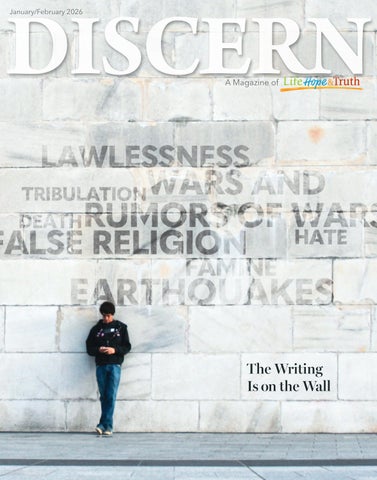
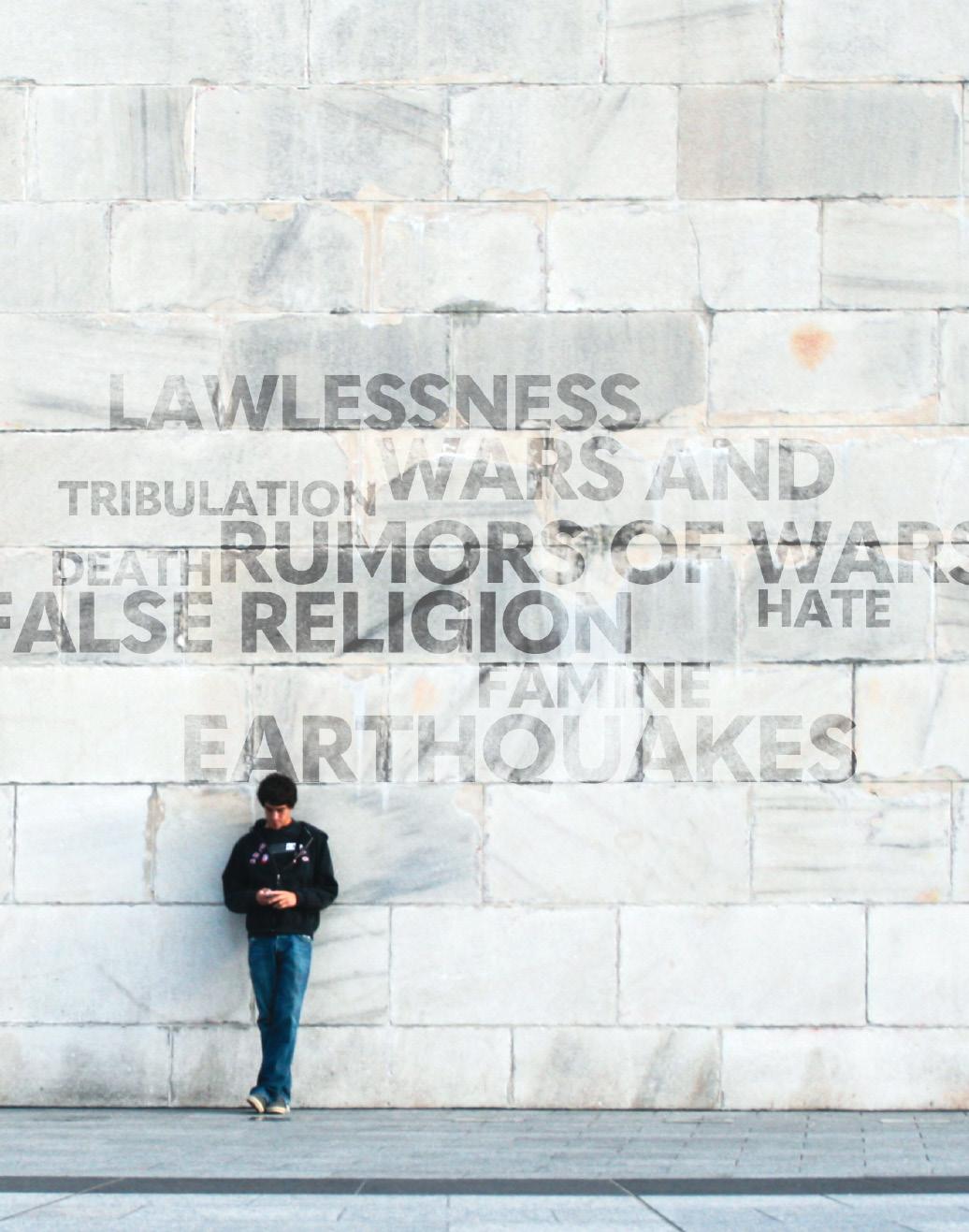
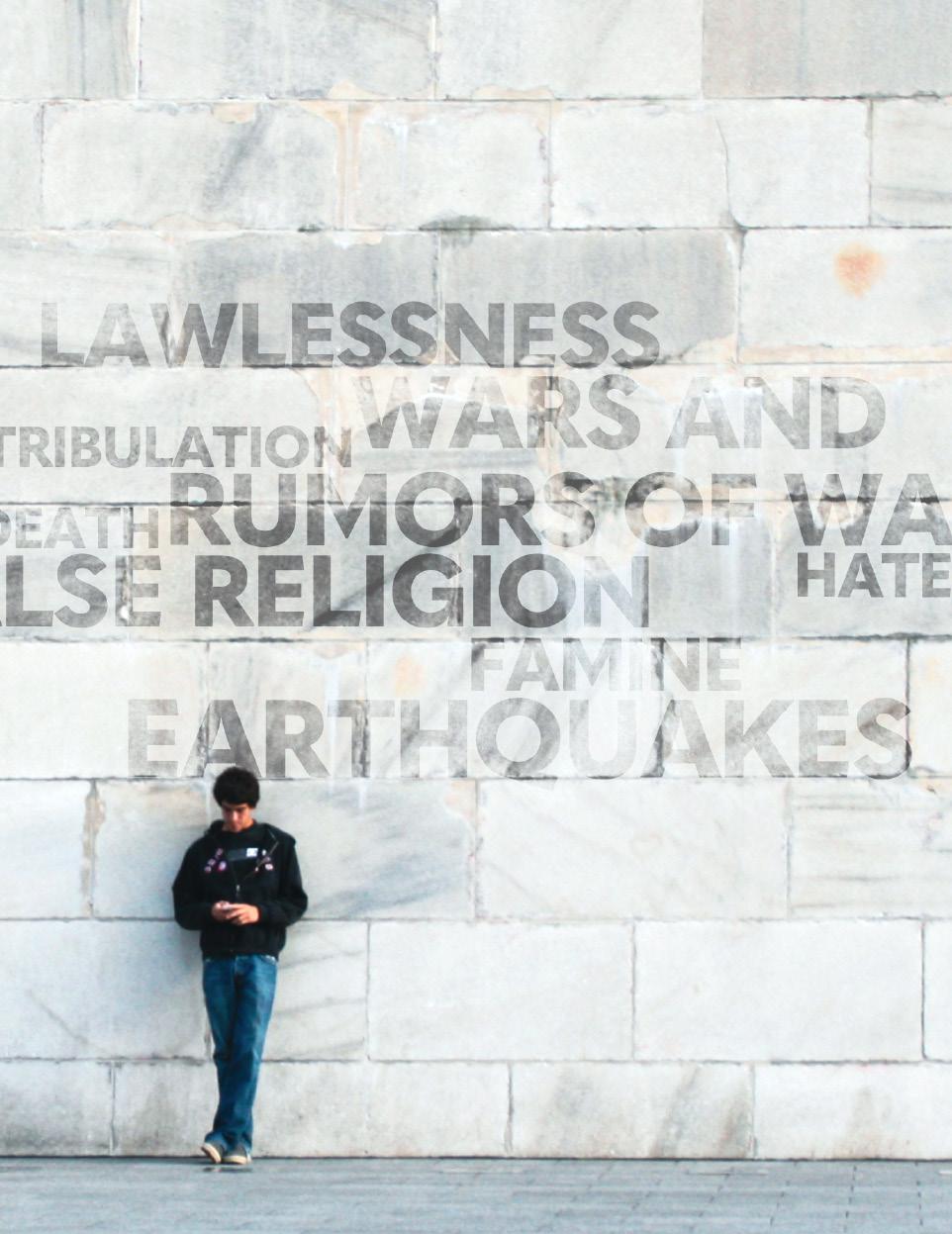
The Writing Is on the Wall
Ancient prophecies occurred exactly as God predicted. End-time prophecies will too. When God gives a warning, we must understand—and heed!
By Mike Bennett
Decades after King Nebuchadnezzar looted and burned God’s temple in Jerusalem, his descendant, King Belshazzar held a great feast. Though his city was under siege, he was seemingly unconcerned, sure the walls of Babylon were impregnable.
“In his drunken bravado he thought of a novel way of entertaining his guests. What about those beautiful golden goblets and bowls from Solomon’s temple . . . ? Why not use them?” (The Expositor’s Bible Commentary, note on Daniel 5:1-4).
“They drank wine, and praised the gods of gold and silver, bronze and iron, wood and stone” (Daniel 5:4). His audacity, idolatry and pride followed the pattern Nebuchadnezzar had set (Daniel 3:1-7; 4:30). And the true God had had enough.
What was the handwriting on the wall in the Bible?
“In the same hour the fingers of a man’s hand appeared and wrote opposite the lampstand on the plaster of the wall of the king’s palace” (Daniel 5:5).
This supernatural phenomenon terrified the king. He could read the letters that were written, but he couldn’t understand what they meant for him. Neither could his astrologers and wise men.
Eventually, Daniel was called.
“Mene, Mene, Tekel, Upharsin” meaning
After reminding everyone what God had done to humble Nebuchadnezzar’s pride (verses 20-21), Daniel told Belshazzar, “You have lifted yourself up against the Lord of heaven.” God was fed up with his ego and sacrilege (verses 22-23).
Then Daniel explained the handwriting on the wall.
• Mene meaning: numbered. It was repeated for emphasis. Daniel explained, “God has numbered your kingdom, and finished it” (verse 26).
• Tekel meaning: weighed. Daniel said, “You have been weighed in the balances, and found wanting” (verse 27).
• Upharsin meaning: divided. This is the plural form of the word peres. Daniel explained, “Your kingdom has been divided, and given to the Medes and Persians” (verse 28).
This prophecy, like many others, outlined sins and consequences. Belshazzar’s sins, and Babylon’s sins, led to this dramatic impending punishment.
The prophecy fulfilled
“That very night Belshazzar, king of the Chaldeans, was slain” (verse 30).
History records that the Medo-Persian soldiers, having diverted water from the Euphrates River, were able to sneak into Babylon through the riverbed on Oct. 12, 539 B.C.
The clear fulfillment of this and other prophecies should alert us to pay attention to the prophecies that apply to our times.
What’s written for us? And are we seeing the handwriting on the wall?
Signs of the end times
An instance of a supernatural hand writing on the wall is recorded only once in the Bible, but prophetic warnings are found throughout the Scriptures. Many of them are aimed at end-time audiences, and they are just as serious and frightening as the message to Belshazzar.
One such pivotal prophecy was spoken by Jesus Himself. After He prophesied the utter destruction of the centerpiece of Jerusalem—the renovated temple—His shocked disciples asked, “What will be the sign of Your coming, and of the end of the age?” (Matthew 24:3).
Jesus’ answers should be as alarming to modern readers as the handwriting of a disembodied hand was to the Babylonians.
And so humanity continues barreling toward the precipice of the limits of God’s patience with sin and evil.
After warning about religious deception, Jesus said, “And you will hear of wars and rumors of wars. See that you are not troubled; for all these things must come to pass, but the end is not yet.
“For nation will rise against nation, and kingdom against kingdom. And there will be famines, pestilences, and earthquakes in various places.
“All these are the beginning of sorrows”—literally, of birth pangs (verses 6-8).
They would be followed by tribulation, persecution and martyrdom. “There will be great tribulation, such as has not been since the beginning of the world,” Jesus said (verse 21). Imagine—worse than the horrors inflicted by any of the evil despots of history!
In these terrifying end-time events we can discern echoes of the messages God wrote on the wall long before.
Our days are numbered
O ur modern world has continued to follow the pattern of rebellion against God and His laws that has led to the destruction of previous civilizations. This time God warns, “Unless those days were shortened, no flesh would be saved” (verse 22).
Human extinction became possible when we began to unleash the unthinkable destructive power of the atom in 1945. Since then, new weapons of mass destruction have multiplied, including chemical and biological agents.
And now the nuclear risk is proliferating again. It never went away, but the chance of nuclear war by error or diabolical design is exploding today.
“East Asia is where the world’s fastest buildups are unfolding, in China and North Korea. A dangerous proliferation cascade may be about to break out, right in the shadow of Hiroshima. It would likely start in South Korea, and spread first to Japan. It might not stop there. The decades-long effort to keep nuclear weapons from
spreading across the planet may be about to collapse” (Ross Andersen, “The New Arms Race,” The Atlantic, August 2025, p. 28).
According to Dan Smith, director of the Stockholm International Peace Research Institute, the new nuclear arms race will have “much more risk and uncertainty” than during the Cold War era.
“The coming nuclear arms race is going to be as much about AI, cyberspace and outer space as it is about missiles in bunkers or on submarines or bombs on aircrafts. It’s going to be as much about the software as about the hardware” (“Risk of Nuclear War Grows Amid New Arms Race,” DW.com).
The perceived danger of not having nuclear weapons could soon lead nations like Iran, Saudia Arabia, Turkey, Germany and Poland to seek their own arsenals.
With each new member of the nuclear club, and with the rising possibility of terrorists using weapons of mass destruction, the sense of our days being numbered becomes more real.
Our actions have been weighed and found wanting
Why is all this happening?
“God is a just judge, and God is angry with the wicked every day” (Psalm 7:11).
God’s laws are clearly recorded in the Bible. And the consequences for obeying and for disobeying are also spelled out in chapters such as Leviticus 26 and Deuteronomy 28.
For example, God warned, “But if you do not obey Me, and do not observe all these commandments” (Leviticus 26:14), a long list of painful, terrifying and devastating curses will come (verses 16-39). (See our online article “ Why Is Our Modern World Under Ancient Curses? ”)
So the punishments for sin, though sometimes delayed (Ecclesiastes 8:11), do not have to be a surprise to people today, even as they should not have been a surprise to Belshazzar (Daniel 5:22).
But God knows that humanity has succumbed to Satan’s deception (Revelation 12:9). Thus, “every way of a man is right in his own eyes” (Proverbs 21:2). But not so in God’s eyes. The verse continues, “But the Lord weighs the hearts.” And in His justice, God also weighs our actions (1 Samuel 2:3).
Jesus compared the end time to the days of Noah (Matthew 24:37). Before the Flood, God weighed humanity and found that “the wickedness of man was great in the earth, and that every intent of the thoughts
of his heart was only evil continually. And the Lord was sorry that He had made man on the earth, and He was grieved in His heart” (Genesis 6:5-6).
Jesus warned of the time before His return, “And because lawlessness will abound, the love of many will grow cold” (Matthew 24:12).
The apostle Paul also listed selfish and evil end-time attitudes that will weigh heavily on God’s scales of justice:
“For men will be lovers of themselves, lovers of money, boasters, proud, blasphemers, disobedient to parents, unthankful, unholy, unloving, unforgiving, slanderers, without self-control, brutal, despisers of good, traitors, headstrong, haughty, lovers of pleasure rather than lovers of God” (2 Timothy 3:2-4).
Can anyone say these attitudes are not hallmarks of our age?
And so humanity continues barreling toward the precipice of the limits of God’s patience with sin and evil. In the end, God warns of the day of His wrath, the day of the Lord (Isaiah 13:9).
“I will punish the world for its evil, and the wicked for their iniquity; I will halt the arrogance of the proud, and will lay low the haughtiness of the terrible” (verse 11).
See more about the sins of our age in the article “ Why Is God Angry With America? ” Though America is on the leading edge of some of these sins, in fact, God has weighed all nations and has found all wanting.
Our divided world will be defeated
Ian Bremmer, president and founder of Eurasia Group, sees our world as defined by division and disruption. He wrote:
“We’re entering a uniquely dangerous period of world history on par with the 1930s and the early Cold War
. The more immediate danger is the unraveling of the world’s security and economic architecture leaving many spaces—both countries and crucial domains like cyberspace, outer space, and the deep seas—ungoverned and undergoverned, wide open for rogue actors to increasingly operate with impunity.
“Nature abhors a vacuum” (“ Welcome to a World Defined by Polarization, Instability, and Disruption”).
Prophecies of the end-time world depict a divided world, when “nation will rise against nation, and kingdom against kingdom” (Matthew 24:7). As we saw in 2 Timothy 3, “Men will be lovers of themselves.”
Even the 10 “kings” who will support the end-time
beast power will be united for only a short time in their evil rampage (Revelation 17:12), and they will have underlying divisions, like iron and clay (Daniel 2:42-43).
But in the end, the divided kingdoms of this world will be replaced by the unified and permanent Kingdom of God. “He shall reign forever and ever!” (Revelation 11:15).
All the bad news of today’s world will be replaced by the truly good news of the world to come. You can study this in detail in our free booklet The World to Come: What It Will Be Like
Christians called to watch
Christians can be encouraged by this knowledge of God’s plan and the sure outcome of peace beyond the end-time storms.
But, in the meantime, we are called to watch. After outlining the panorama of end-time events, Jesus said:
“But take heed to yourselves, lest your hearts be weighed down with carousing, drunkenness, and cares of this life, and that Day come on you unexpectedly.
“For it will come as a snare on all those who dwell on the face of the whole earth.
“Watch therefore, and pray always that you may be counted worthy to escape all these things that will come to pass, and to stand before the Son of Man” (Luke 21:34-36).
We are called to watch as world events fulfill the biblical prophecies. We are called to read the writing on the wall, to recognize the signs of the times, and to be ready.
Those who hear the warnings and heed—who recognize the evils that are propelling our world toward destruction and prayerfully overcome their personal sins—who are “purified, made white, and refined” spiritually—will be wise and be given understanding (Daniel 12:10).
In times that induce “perplexity” and “fear,” Jesus said to “look up and lift up your heads, because your redemption draws near” (Luke 21:25-26, 28). “When you see these things happening, know that the kingdom of God is near” (verse 31).
God wants you to understand. To gain a broader overview and deeper understanding of His prophetic plan, dig into our free 76-page booklet How to Understand Prophecy D
Telling the Truth in a World Full of Lies
The news is filled with half-truths. Social media reflects this trend in alarming ways. It seems everyone lies. Are some lies okay?
By Bill Palmer
You receive a friend request on Facebook, but you know it’s fake because you are already friends with that individual, and you’re aware of others being scammed by such “friends” begging for money for an emergency.
You read a news article or health advice on one website, then a contradictory post on another, so you know at least one is untrue. Fake news and dangerous advice often spread faster than the truth.
You click on a YouTube video because of its title or description, but then realize it was deceptive clickbait, designed just to get views.
You look over a friend’s résumé, seeing several places where he has “stretched the truth.”
Why do these things happen so often? Are some lies okay? Is honesty always the best policy?
The prevalence of deceit
How common is lying today? Research on the subject is somewhat mixed. One University of Massachusetts study found that 60 percent of respondents could not avoid lying for even 10 minutes.
A study at the University of Wisconsin–La Crosse, however, determined that most of the respondents (75 percent) told between zero and two lies daily. Most of these lies, according to the researchers, were “inconsequential.”
One possible reason for the discrepancy is that both studies relied on self-reporting. In the first study, the subjects were videotaped in conversation, then later interviewed about those conversations.
Some of the participants of this study were surprised at their own deceit. This finding highlights our human ability to gloss over our own bad behavior, or even to deceive ourselves about what we have done.
The reasons people lie
The University of Wisconsin study provided a list of reasons people lie. The most common reason, accounting for 21 percent of the lies told, is “to avoid others” (for example, telling someone that you can’t talk because you’re late for a nonexistent meeting).
Other reasons included “to protect one’s self” (14 percent), “to
impress or appear more favorable” (13 percent), “to protect another person” (11 percent), “for personal benefit or gain” (9 percent) and “for the benefit of another person” (5 percent).
Quite a few of these might seem to fit the “inconsequential” label. Perhaps they even seem noble. But is that right? Are any lies inconsequential?
Is there any good reason to lie?
Everyone recognizes that fraud and malicious lies are harmful. But modern Western culture accepts some deceit as necessary. That’s why the Wisconsin researchers labeled the lies told by the majority of respondents as inconsequential. A more commonly used term is “little white lies.”
Is their premise correct?
Not according to Scripture. God condemns lying throughout the Bible. The Ninth Commandment prohibits bearing false witness, or in modern terminology, committing perjury (Exodus 20:16).
Some might argue that this commandment is restricted to testifying in a legal setting. The people of Israel, however, understood the law as far more comprehensive, encompassing all manner of deception.
The prophet Hosea, for instance, used the word lying in a series of words representing several of the commandments: “By swearing and lying, killing and stealing and committing adultery, they break all restraint” (Hosea 4:2). Lying in less formal settings must be included in the commandment.
Most significantly, in the Sermon
on the Mount, Jesus spoke of the spiritual intent of the law as going beyond the letter. For example, unchecked anger could be viewed as murder; and lust, as adultery (Matthew 5:21-22, 27-28).
Changing the focus
As Christians, we should recognize the pervasiveness of deceit in the world, but since we can’t change other people, our focus should be on changing ourselves. Even if we don’t tell malicious or selfish lies, do we tell lies that seem more “noble”? Do we lie “to protect another person” or “for the benefit of another person” we care about?
It’s easy to think such lies are “inconsequential.” They aren’t. Lies, even so-called “white lies,” break God’s law and thus incur the death penalty (Leviticus 6:2; Revelation 21:8). God hates “a lying tongue” (Proverbs 6:16-17). He wants us to love truth (see “ The Love of the Truth ”).
And consider that even white lies can have unforeseen consequences. Perhaps your spouse asks you, “How do I look?” You certainly don’t want to be rude in any way, but neither should you lie. If you really care, you’ll think about your spouse’s likely encounters throughout the day and respond truthfully.
If the shirt is wrinkled or the dress isn’t flattering, what will your spouse’s boss think? And what will happen to your relationship if the boss, or others, make more truthful remarks?
Solomon addressed this issue with a profound truth: “Faithful are the wounds of a friend, but the kisses of an enemy are deceitful”
(Proverbs 27:6). A true friend tells the truth, using tact, so that his or her friend is better prepared to meet life’s challenges.
Speaking the truth in love
The apostle Paul urged the church in Ephesus not to be “tossed to and fro and carried about with every wind of doctrine” (Ephesians 4:14), but to “walk worthy” (verse 1) of their calling.
He exhorted the congregation that they should be “speaking the truth in love” (verse 15). The truth here is spiritual truth, but the expression offers us a key to any truthful expression we utter.
We should always strive to speak the truth in love. That means, first, telling the truth, not a “white lie.” More than that, it means considering the needs of the other person, as well as the tone and approach we adopt.
Solomon provided another insight. After writing that “lying lips are an abomination to the Lord, but those who deal truthfully are His delight” (Proverbs 12:22), Solomon pointed out an important technique for remaining truthful.
The key is keeping our mouths shut more often. Solomon stated it this way: “A prudent man conceals knowledge, but the heart of fools proclaims foolishness” (verse 23).
Admittedly, none of this is an easy or a simple task. It is, however, necessary for us to “walk worthy” of our calling as Christians.
Who can know the human heart?
Unfortunately, there is another question we need to consider. Do
we see life’s events objectively and truthfully, or do we deceive ourselves? Would we be like the subjects in the University of Massachusetts study—surprised by our own lies?
Speaking to the people of the kingdom of Judah during its final years, the prophet Jeremiah addressed the problem of selfdeception. He had the daunting task of proclaiming God’s message to a people often unwilling to listen (Jeremiah 1:19).
Through Jeremiah, God bluntly stated, “The heart is deceitful above all things, and desperately wicked.” Immediately after this, He asked a striking question: “Who can know it?” (Jeremiah 17:9).
He provided the answer in the very next verse. God knows our hearts. He searches hearts and tests minds. God knows, but we don’t, and we can’t without His help.
Why is there so much deceit in the world?
Jesus identified the source of deceit while teaching at the temple. Some of those listening to Him believed (John 8:30-31), but apparently their belief was superficial.
When Christ told the group, “You shall know the truth, and the truth shall make you free” (verse 32), they objected. In their minds, they had always been free because they were descendants of Abraham (verse 33).
The climax of this confrontation came when Jesus explained that they were, in a spiritual sense, children of the devil, and that the devil is a murderer and “a liar and
the father of it” (verse 44). They could not know the truth because they were deceived by the devil. The same is true for most of humanity. Satan “deceives the whole world” (Revelation 12:9) and has done so since he deceived Eve (2 Corinthians 11:3). That is why there is so much deceit in the world.
How you can walk in truth
If Satan “deceives the whole world,” and if our own hearts are “deceitful above all things,” what hope do we have to walk in truth? Fortunately, we have the answer in Scripture. That answer comes in John’s Gospel, which provides an extensive account of Christ’s teaching on the night of Passover immediately preceding His crucifixion (John chapters 13-16).
During this instruction, Jesus spoke of going away (John 14:2-4), an allusion to His impending death.
Thomas told Jesus that the disciples did not know where Jesus was going (verse 5). In response, Christ said, “I am the way, the truth, and the life. No one comes to the Father except through Me” (verse 6).
Jesus didn’t just claim to know the way, the truth and the life. He is the way, the truth and the life . We begin to discern truth, and we begin to know it, when we build our lives on the foundation of Christ’s life and example.
Ultimately, Jesus “desires all men to be saved and to come to the knowledge of the truth” (1 Timothy 2:4). When that wonderful day comes, there will be no more lies. Deceit will be a thing of the past. D
Teaching Children to Stand Up for God Without Putting Others Down
This world will influence our children. How can Christian parents counteract bad examples while teaching their children to be faithful, yet merciful?
By Jason Hyde
Daddy , why did the coach call Johnny stupid?
Mommy, why is that lady cursing at the cashier?
Dad, why are those two men kissing?
Mom, what did that lady mean when she said she hates Muslims?
Cue parental groaning.
Children are naturally curious. At times, this means they will ask sincere but potentially awkward questions about the actions of others.
While children have always been exposed to social and cultural practices, the modern world accelerates this exposure through social media, YouTube and a seemingly endless supply of memes and reels.
What are parents to do? How do parents teach the truth about right and wrong with clarity, at an age-appropriate level, while also preparing children to live, work, function and thrive in a society often at odds with truth?
The state of civilization
Parents face many scenarios that are challenging to explain to a child. This should not surprise us. The Bible tells us we can expect civilization to become increasingly corrupt:
“But know this, that in the last days perilous times will come: For men will be lovers of themselves, lovers of money, boasters, proud, blasphemers, disobedient to parents, unthankful, unholy, unloving, unforgiving, slanderers, without self-control, brutal, despisers of good, traitors, headstrong, haughty, lovers of pleasure rather than lovers
of God, having a form of godliness but denying its power. And from such people turn away!” (2 Timothy 3:1-5).
People will embrace lifestyles and choices that produce conflict and decay. Morality will often flee the public square. Civilization is not so civil after all.
The cultural and moral failings of families, communities and nations bring natural consequences. See the article “The Writing Is on the Wall” in this issue for more information.
A parent’s job— protect and prepare
This society can have a direct impact on children. Children must learn to navigate and survive in these conditions.
Parents may feel a knee-jerk reaction to protect their children by trying to shield them from awareness of evil.
Parents must wisely and properly protect their children. This requires active and engaged parenting. The online world is an area of particular concern. There are useful tools available to help. Forbes recently offered a review of apps parents can use to manage their children’s screen time and keep them safe online.
However, a parent’s role is not limited to protecting their children from danger. Parents must also prepare their children to navigate and succeed in a world that is immersed in sinful behavior and deceived by Satan (Revelation 12:9).
There is a need to guide children. God determined that parents should fill this responsibility.
Parents, embrace your responsibility. Convey biblical standards while modeling a spirit of mercy and compassion.
“And these words which I command you today shall be in your heart. You shall teach them diligently to your children, and shall talk of them when you sit in your house, when you walk by the way, when you lie down, and when you rise up” (Deuteronomy 6:6-7).
This is a lofty challenge. God asks parents to prepare their children to faithfully mature and thrive even in a corrupt society.
Getting started
Parents’ efforts to teach their children begin with their personal example. God reminds parents to “love the Lord your God with all your heart, with all your soul, and with all your strength” (verse 5, emphasis added).
Parents should diligently seek guidance and direction from the Bible. The “Christian Conversion” section on Life, Hope & Truth provides several constructive articles on how to apply the Bible’s instructions to daily living.
In addition to setting a righteous example, parents should proactively teach the truth of the Bible. Solomon wrote, “My son, hear the instruction of your father, and do not forsake the law of your mother” (Proverbs 1:8).
Parents have a responsibility to teach. Proverbs 1-3 highlights this clear expectation.
Teaching the Bible
Teaching the Word of God is vital for preparing children to correctly discern truth and error. Where do parents start?
Here are some key elements for parents to emphasize:
1. Teach awe and respect for God. Parents should introduce children to the
greatness of God. Make clear to them the loving, holy character of God.
David noted: “One generation shall praise Your works to another, and shall declare Your mighty acts . . . They shall utter the memory of Your great goodness, and shall sing of Your righteousness” (Psalm 145:4-7).
This includes appreciation of the inspired Word of God and its practical relevance (2 Timothy 3:16-17).
2. Teach virtue and morals as defined by Scripture.
Parents should share Jesus’ summary of the law of God: love God and love your neighbor (Matthew 22:36-40).
The Bible teaches that love is bound up in the commandments of God. John wrote, “For this is the love of God, that we keep His commandments” (1 John 5:3). Th is means avoiding lying and stealing and hating others, which is likened to murder (1 John 3:15). It includes upholding the biblical standard of sex only within marriage between a man and a woman as God ordained. (For further study, see God’s 10 Commandments: Still Relevant Today.)
Parents should convey morals that are shaped by the commandments of God. This includes a determination to live by “every word that proceeds from the mouth of God” (Matthew 4:4).
3. Teach children to love mercy.
Mercy is an incredible gift that enables a positive relationship with God and serves as a root for kind, warm, healthy interpersonal relationships.
Jesus encouraged, “Therefore be merciful, just as your Father also is merciful” (Luke 6:36). Parents should make this personal in the lives of their children.
Explain the significance and power of mercy by highlighting God’s mercy toward us. Set them an example of mercy. Teach them to build a practice of mercy toward siblings, friends and schoolmates.
4. Teach right judgment without condemnation.
Children must learn to discern between right and wrong, truth and error, and what is moral and immoral. There are clear standards in the Bible that define these categories.
However, parents should ensure that discernment and right judgment do not morph into arrogance and condemnation.
Jesus’ own example is compelling. “When He saw the multitudes, He was moved with compassion for them, because they were weary and scattered, like sheep having no shepherd” (Matthew 9:36; see also Luke 23:34).
Parents should demonstrate judgment regarding behavior and choices without selfrighteously condemning others.
Dealing with others’ wrong choices
These elements should then be applied when teaching children to evaluate situations around them.
Humans have consistently chosen a life of sin (Romans 3:23). The choice to sin separates one from God (Isaiah 59:1-2).
The Bible warns against participating in such behavior. Paul instructs, “Take no part in the worthless deeds of evil and darkness” (Ephesians 5:11, New Living Translation). There is a clear divide between what is right and wrong. This applies to our thoughts, words and actions.
While avoiding evil, parents should instill a biblical view of other people. Children need to learn to identify and avoid sin, while still showing respect and honor to all people (1 Peter 2:17). Human beings are made in the image of God. Therefore, each person has incredible value and astonishing potential (see our booklet God’s Purpose for You).
Parents must teach children to see others through this lens. Jesus’ example of compassion when He observed failings in others can serve as a guide.
Taking action
Paul warns, “But evil men and impostors will grow worse and worse, deceiving and being deceived” (2 Timothy 3:13). The conditions in the last days (verses 1-5) will grow exponentially worse.
How are children to thrive and succeed in this world?
The Christian duty is to endure bravely and truthfully despite the conditions around us. Paul encourages, “But you must continue in the things which you have learned and been assured of, knowing from whom you have learned them, and that from childhood you have known the Holy Scriptures, which are able to make you wise for salvation through faith which is in Christ Jesus” (verses 14-15).
There are times when children will need to stand up for truth. Parents should model how to do this without being arrogant or obnoxious.
Jesus was often quiet—neither quarrelsome nor defensive—yet He never compromised. Parents should model the “quiet and peaceable life in all godliness and reverence,” which is “good and acceptable in the sight of God our Savior” (1 Timothy 2:2-3).
Parents should reinforce our need to obey God’s law even above man’s law (Acts 5:29), while embracing mercy and compassion. As Paul reminds, “As much as depends on you, live peaceably with all men” (Romans 12:18).
Teach children the truth, teach them how to live it without demeaning others, and then lovingly encourage their active connection with God through His Bible.
Continue in the things
The beginning of this article highlighted situations children may encounter. These present opportunities for parents to both protect and prepare their children.
Parents, embrace your responsibility. Convey biblical standards while modeling a spirit of mercy and compassion.
Encourage children to resolutely, faithfully and compassionately “continue in the things which [they] have learned” (2 Timothy 3:14). D
The Art of Dying Well
Plenty of modern self-help books talk about the art of living well. But as Christians, we ought to be equally concerned with dying well.
By Jeremy Lallier
Almost 10 years ago, a dear friend and mentor of mine died of complications from ALS. He was a pastor, and his death sent shockwaves through a small community of believers who knew and loved him.
(I say, “who knew and loved him,” but this is redundant. To know him was to love him. It was impossible not to.)
In the days and weeks that followed, my social media feed was flooded with fond memories and tearful goodbyes for a man who had impacted so many lives during a relatively short time here on earth. I remember the gist of those comments, but I don’t think I could recite any of them from memory—with one exception.
In a sea of other heartfelt reflections and condolences, a mutual friend offered a few short words—but they turned out to be indelible ones, still etched into my memory almost a decade later:
“He showed us how to live and how to die.”
In the storeroom of my mind, wherever the permanent, unforgettable things are stored, that phrase is carefully preserved in the precious box of sentences that have changed how I look at the world. Every so often, I pick it up to inspect it again—to turn it over and feel the weight of it in my hands.
How to live. How to die.
Three requirements for dying well
As a Christian, I spend a lot of time thinking about that first part. How to live. That’s why we’re here, isn’t it? To “live godly in Christ Jesus” (2 Timothy 3:12).
I don’t spend as much time thinking about how to die. Dwelling on death (especially my own) is unsettling,
and I’d rather commit to thinking about it later. (Preferably much later and at a very unspecific time.)
But that’s foolish. Death is guaranteed. “It is appointed for men to die once” (Hebrews 9:27), regardless of how uncomfortable we are with thinking about it—which is exactly why we must think about it.
Everyone dies.
Not everyone dies well
So what’s the secret?
The art of dying well requires three things from us. That’s all—just three. They aren’t even complicated things—but then, they aren’t easy things either.
First, we must accept that death— our death and the deaths of those we love—is both unavoidable and unpredictable.
Second, we must understand the future in store for us after our death.
Finally, we must live in a way that both embraces and prepares us for that future.
1. Accepting the inevitability of death
It would probably be easier to think about death if we knew when it was coming. If I knew I only had five years left, maybe I could start coming to terms with it now— making plans, engaging in more self-reflection, coursecorrecting where it’s needed.
But I don’t know. For me—for any of us—death could come tomorrow or in a decade. It could come in the form of a terminal diagnosis or a tragic accident or it could happen peacefully in our sleep.
We don’t know. We can’t know. But we have to live each day without knowing whether it’ll be our last— which ultimately means we ought to live each day as if it might be.
Because . . . it really might be.
The self-reflection and course correction can’t wait.
2. Understanding what comes after death
But coming to terms with our own mortality is helpful only when we place that mortality in its proper perspective: Death is not the end .
It’s the end of this physical life, yes, but not the end of God’s plan for each of us.
God’s people know that at the return of Jesus Christ to the earth, “the dead in Christ will rise first” (1 Thessalonians 4:16). And not just rise—“the dead will be raised imperishable, and we shall be changed” (1 Corinthians 15:52, English Standard Version, emphasis added).
And not just changed, but transformed in the most unbelievable way. As children of God, “we shall be like Him, for we shall see Him as He is” (1 John 3:2).
Death is not an end, but an interlude—nothing more than a temporary pause on the way to this incredible future. And because we see that future—because we believe in it and see it as something more real, more concrete than even the physical life we’re living right now—we make the choice to live differently today.
3. Embracing and preparing for the future
God’s people have a long history of dying well, precisely because they treat God’s promises as being more tangible than the life in front of them. Their desire to be part of that future prompts them to live as if it’s already here, making sure their lifestyle lines up with what God expects from them.
And that is how you die well.
The cause of your death is irrelevant.
The age at which you die is irrelevant.
The amount of time you have to prepare for that death is irrelevant.
What matters—the only thing that ultimately matters—is living right now, today, in a way that prepares you for the future that’s waiting for you.
The apostle Paul died well because he committed himself to “forgetting those things which are behind and reaching forward to those things which are ahead” while he pressed toward “the goal for the prize of the upward call of God in Christ Jesus” (Philippians 3:13-14).
And as his death approached, he was able to say with confidence, “I have fought the good fight, I have finished the race, I have kept the faith. Finally, there is laid up for me the crown of righteousness, which the Lord, the righteous Judge, will give to me on that Day” (2 Timothy 4:7-8).
Dorcas died well when she left behind a legacy of “good works and charitable deeds which she did” (Acts 9:36).
Jesus died well, “knowing that the Father had given all things into His hands, and that He had come from God and was going to God” (John 13:3).
And that’s just scratching the surface. Hebrews mentions countless others who died well—who “were tortured, not accepting deliverance, that they might obtain a better resurrection. Still others had trial of mockings and scourgings, yes, and of chains and imprisonment. They were stoned, they were sawn in two, were tempted, were slain with the sword. They wandered about in sheepskins and goatskins, being destitute, afflicted, tormented—of whom the world was not worthy” (Hebrews 11:35-38).
My friend and mentor died well too—not because of the manner of his death, but the manner of his life. A terminal diagnosis with a merciless disease didn’t change who he was or how he lived. Till the end, he continued faithfully pastoring and serving the people of God, trusting that a crown of righteousness was also laid up for him.
Joining the ranks of strangers and pilgrims
What about you?
Will you die well?
Dying well is an art, but it’s not an impossible goal.
It’s not about when or how it happens. It’s not about how much money we have or how long we live or how influential we are.
It’s about pursuing a future that means more to us than anything this world has to offer—and about working with God until we’re the kind of people who belong in that future. And in that process, we will join the ranks of all those who came before us:
“These all died in faith, not having received the promises, but having seen them afar off were assured of them, embraced them and confessed that they were strangers and pilgrims on the earth. For those who say such things declare plainly that they seek a homeland. And truly if they had called to mind that country from which they had come out, they would have had opportunity to return. But now they desire a better, that is, a heavenly country. Therefore God is not ashamed to be called their God, for He has prepared a city for them” (Hebrews 11:13-16).
(Read more about that future in our booklet God’s Purpose for You: Discovering Why You Were Born )
The crown of righteousness
You’re going to die one day.
Whether or not you die well is up to you.
Christ will give the crown of righteousness to Paul—and “not only to me but also to all those who have set their heart on waiting for [Christ’s] appearance” (2 Timothy 4:8, Common English Bible).
The crown will be given to my friend who finished his race.
The crown will be given to countless Christians who came before him, living their lives in preparation for the homeland God promised them.
And the crown can be there for you too. D
Why
You Shouldn’t Use Marijuana—Even If It’s Legal
Support for the legalization of marijuana has reached an all-time high—even as studies sound the alarm about its dangers. Here’s why you should not use it.
by Kristen Brunner
The emergency room doctor wrote: “Patient reports that she was smoking marijuana, then began to feel nauseous, complains of abdominal pain and vomiting. CT and ultrasound ordered, evaluate liver, gallbladder, pancreas.”
As a sonographer, I have seen multiple patients come into the hospital for marijuana-related maladies. Many are repeat patients, who come into the emergency department routinely for the same issue.
They don’t seem to realize the damage that they are inflicting on their bodies by continued use of marijuana.
What is marijuana?
Marijuana comes from the cannabis plant, which contains the mind-altering chemical THC. It is the most widely used illicit drug. The number of Americans who use marijuana almost daily
surpassed those who drink alcohol that often, according to a 2022 study (“Changes in Self-Reported Cannabis Use in the United States From 1979 to 2022”).
There are multiple slang names for the drug, including “pot,” “weed” and “Mary Jane.”
“Marijuana is smoked using pipes, bongs, paper-wrapped joints, blunts and other devices . . [and] can also be consumed through dozens of different products including e-cigarettes, candy, brownies and other baked goods, capsules, beverages and many more” (“Marijuana and Lung Health ”).
The legal landscape
At the federal level, use and possession of marijuana is still illegal in the United States. However, 87 percent of Americans support its legalization—either for medical use only or medical and recreational use (Pew Research).
That public support has caused a dramatic shift at the state level. As of July 2025, 24 states and the District of Columbia have legalized both medical and recreational marijuana.
The legalization trend has been seen in other countries as well. About a dozen countries have legalized its recreational use, including Canada, Chile, Germany, Luxembourg, Mexico and South Africa.
A burgeoning industry
The U.S. marijuana industry has grown from $12.7 billion in 2016 to almost $43 billion in 2024—and is projected to keep climbing.
“More than a decade after states
began legalizing recreational marijuana, businesses are enticing customers with unproven health claims, while largely escaping rigorous oversight” (New York Times, Jan. 25, 2025).
Lynn Silver, M.D., a senior adviser for the Public Health Institute, is very alarmed. “The industry has been very effective at transmitting this idea of cannabis as a safe, natural wellness product. There’s little awareness of just how much the product has actually changed, of how industrialized and increasingly hazardous it’s become” (ibid.).
Increased potency
Ironically, at the same that marijuana has become more mainstream, it has become more potent and dangerous.
The Yale School of Medicine reports, “Over the last several decades, the THC content of cannabis has changed substantially. In 1995, the average THC content in cannabis seized by the Drug Enforcement Administration was about 4%. By 2017, it had risen to 17% and continues to increase. Beyond the plant, a staggering array of other cannabis products with an even higher THC content like dabs, oils, and edibles are readily available— some as high as 90%” (“Marijuana: Rising THC Concentrations in Cannabis Can Pose Devastating Health Risks ”).
More are using
Use of marijuana has dramatically increased over the last couple of decades. The 2023 National Survey on Drug Use and Health reported
22.3 percent of Americans 12 and older say they used it in the past year, 16 percent in the past month. Young adults have the highest percentage, with 25.2 percent using marijuana in the past month.
But even older adults—65 and older—are increasingly using marijuana. A JAMA Internal Medicine article reported the percent of users in that group jumped from less than 1 percent in 2005 to 4.2 percent in 2018 to 7 percent in 2023.
Health risks of marijuana
The expanding legalization of marijuana—and its promotion by the marijuana industry and popular culture—have led many to assume using it is harmless fun that doesn’t hurt anybody.
Many people—especially young people—no longer see it as risky behavior. But the reality is very different.
Here are a few examples of marijuana’s negative effects on the body:
Lungs: Like tobacco smoke, marijuana is an irritant to the throat and lungs. A 2022 study that looked at chest CT scans of marijuana smokers and tobaccoonly smokers found that rates of emphysema and airway inflammation were significantly higher in the marijuana smokers.
Smoking marijuana has been found to cause chronic bronchitis and injure the cell linings of the large airways. Marijuana smokers can have “symptoms such as chronic cough, phlegm production, wheeze and acute bronchitis,” among other symptoms. “Marijuana can harm more than just the lungs and
Is using marijuana really compatible with being a holy, sanctified, pure child of God who has been called out of the world?
respiratory system—it can also affect the immune system and the body’s ability to fight disease” (“Marijuana and Lung Health”).
Heart: The CDC reports that “marijuana can make the heart beat faster and can make blood pressure higher immediately after use. It could also lead to increased risk of stroke, heart disease, and other vascular diseases” (“Marijuana and Heart Health ”).
In June 2025 Heart, the journal of the British Cardiovascular Society, published an analysis of the medical data of 200 million people between 19 and 59. Those who used cannabis had a 29 percent higher risk for heart attacks and a 20 percent higher risk for stroke.
Brain: Studies show that
marijuana has “an immediate impact on thinking, attention, memory, coordination, movement, and time perception.” Marijuana has also been proven to negatively affect brain development. Young people especially are susceptible to the drug’s harmful effects and can suffer permanent brain damage and permanent IQ loss (“Cannabis and Brain Health ” and SAMHSA).
Marijuana can impair a user’s ability to drive safely. When smoked, the drug stays in a person’s system even longer than alcohol and can impair the user’s driving ability up to four hours. Cannabis edibles can impair driving even longer, up to eight hours.
According to a study published
in the American Journal of Public Health, crash fatalities involving cannabis rose from 9 percent in 2000 to 21.5 percent in 2018 (“ Trends in Cannabis Involvement in Motor Vehicle Crash Fatalities ”).
Mental health issues: A growing body of research is also finding that young people who smoke marijuana are at an increased risk of developing certain psychiatric disorders, including delusions, paranoia, schizophrenia and other forms of psychosis.
A 15-year Swedish study, for instance, “found that those who had tried cannabis by age 18 were 2.4 times more likely to be diagnosed with schizophrenia than those who had not and the risk of this diagnosis increased
with the frequency of cannabis use” (“Cannabis Use and the Risk of Developing a Psychotic Disorder ”).
Some studies have also looked at violence and marijuana use. For example, “A Review of Cases of Marijuana and Violence ” presented “14 cases of violence with chronic marijuana users that highlight reoccurring consequences of: marijuana induced paranoia (exaggerated, unfounded distrust) and marijuana induced psychosis (radical personality change, loss of contact with reality).”
Reproductive issues: A study reported in the September 2025 issue of Nature Communications found that marijuana can damage unfertilized eggs in female ovaries. Researchers are concerned that this could lead to infertility, miscarriage and possible genetic defects in babies.
Marijuana use by pregnant women can cause stillbirth, preterm birth, and growth and development issues. And mothers who use marijuana while breastfeeding can pass THC and other chemicals on to their babies, thus affecting brain development.
This is not an exhaustive list. For example, marijuana use has also been associated with certain types of cancer (“ Cannabis and Cancer ”).
The bottom line is this: Every system in your body interacts with the other systems. You cannot damage one organ without damaging others as well. The human body has a remarkable ability to repair and heal itself—to a certain point. If we repeatedly engage in behavior that assaults our health, eventually we will
reach the point where our bodies are permanently damaged.
Addiction: Marijuana is much more addictive than many people believe. A February 2025 JAMA article leads with the blunt statement, “The facts are clear: cannabis is addictive, its use is on the rise, and those affected by cannabis use disorder face a heightened risk of premature death.” It reports on a study that followed more than 100,000 people diagnosed with cannabis use disorder (i.e. addiction to cannabis) and found their rate of death to be 6 times the rate of the general population (“Evidence of Elevated Mortality in Cannabis Use Disorder ”).
What about medical marijuana?
The FDA has approved a few medications derived from marijuana for specific illnesses, but this in no way means that self-prescribed “medical marijuana” is safe. Developing medications from the whole marijuana plant or its crude extracts has challenges. It can contain hundreds of unknown active chemicals. As well, it can be difficult to get accurate and consistent doses.
Spiritual effects of marijuana
Clearly, the use of marijuana is detrimental to our physical health, but is this at all related to our spiritual health? Consider a few relevant passages.
• 1 Corinthians 6:19-20. The context is sexual immorality, but we can apply this to other kinds of immorality
and destructive behavior as well: “Do you not know that your body is a temple of the Holy Spirit [which] is in you, [which] you have from God, and you are not your own? For you were bought at a price; therefore glorify God in your body and in your spirit, which are God’s.”
• Romans 12:1-2: “I beseech you therefore, brethren . . present your bodies a living sacrifice, holy, acceptable to God, which is your reasonable service. And do not be conformed to this world, but be transformed by the renewing of your mind.” We are to use our bodies in service of God’s plan and will. If this is not our focus, then we need to reevaluate our priorities.
• 1 Thessalonians 4:4: “That each one of you know how to control his own body in holiness and honor” (English Standard Version). We must have self-control.
Is using marijuana really compatible with being a holy, sanctified, pure child of God who has been called out of the world?
How to stop using marijuana
If you now believe that you should stop using marijuana, how do you break this habit (or even addiction) that has become ingrained in your life?
You must be willing to put in the work to overcome this. You have to want to stop more than you want to continue. Prayer, fasting and Bible study are essential tools if you are to overcome addiction.
You can also seek counsel with a minister or trusted friend who will
hold you accountable. Therapists and support groups can also be an encouraging resource.
Don’t put yourself in situations where you are likely to face additional temptation. If your group of friends is likely to be engaged in this behavior, you need to be willing to remove yourself from this situation so that you won’t feel additional peer pressure to sin.
Here are a few articles that can help:
• “Confronting Addiction .”
• “Freedom From Addiction .”
• “ Smoking.”
• “ There’s a Proverb for That: ‘I’m Addicted. Help Me!’”
Finally, we must always keep this in mind: We have a merciful Father who wants us to repent and turn to Him, and He will help us in doing so. Notice these verses:
• 1 Corinthians 10:13: “No temptation has overtaken you except such as is common to man; but God is faithful, who will not allow you to be tempted beyond what you are able, but with the temptation will also make the way of escape, that you may be able to bear it.”
• 1 John 1:9: “If we confess our sins, He is faithful and just to forgive us our sins and to cleanse us from all unrighteousness.”
Breaking habits and overcoming addiction take immense work, but when you are successful, your physical health—and your spiritual health—will be immeasurably improved.
Given the growing body of research regarding the risks of marijuana—and biblical admonition—we urge our readers to completely avoid using marijuana. D
Lessons From the Rise and Demise of King Solomon
The Bible is filled with words written by and about this ancient king. What key lessons does God want us to derive from his life?
By David Treybig
We humans are fascinated by the lives of the rich and famous. Whatever the latest activity or opinion of a celebrity, athlete or media influencer, people want to know everything about it.
This fascination isn’t new. Long before social media and tabloids, the Bible recorded the story of a man whose fame spread across nations, whose wisdom drew rulers and scholars from around the world, and whose wealth was unmatched in his day. That man was King Solomon.
But this famous king suffered from a condition that still plagues humanity. It is highly contagious, affecting both rich and poor, and it is lethal to having a good relationship with God.
Thankfully, Solomon’s ailment is well documented, and his own writings can help us recognize and avoid it.
Solomon’s contributions to the Bible
In terms of knowledge and wisdom, Solomon was well qualified to
Image supplied by Tanuha via Adobe Stock
contribute to the writing of the Old Testament. The Bible says, “He spoke three thousand proverbs, and his songs were one thousand and five” (1 Kings 4:32).
Concerning wisdom, God answered Solomon’s request for an understanding heart to discern between good and evil. In response to this humble petition, God said, “I have given you a wise and understanding heart, so that there has not been anyone like you before you, nor shall any like you arise after you” (1 Kings 3:12).
Some of this ancient king’s wisdom is recorded for us in the book of Proverbs. It has been estimated that at least 650 of the proverbs in this book were written by Solomon ( Adam Clarke’s Commentary). His writings also include Ecclesiastes and Song of Solomon.
A wonderful beginning
When Solomon became king, he “loved the Lord, walking in the statutes of his father David” (1 Kings 3:3). One of his first acts as king was to offer a thousand burnt offerings to God.
When God appeared to him in a dream and asked him what he wanted, Solomon asked for wisdom
to do the job he had been given (verse 9). Pleased with his humility, God not only granted him more wisdom than any other human past, present or future, He also gave Solomon what he had not requested: riches and honor (verses 10, 13).
During his lifetime, Solomon became the very picture of prosperity, wisdom and fame. Rulers from surrounding nations, including the queen of Sheba, traveled great distances to hear him speak and to witness the peaceful prosperity the citizens of his kingdom enjoyed (1 Kings 10:4-9, 24).
Solomon’s humility was a key element that facilitated his wonderful beginning relationship with God and the admiration of others.
Documenting this important concept, Solomon wrote, “By humility and the fear of the Lord are riches and honor and life” (Proverbs 22:4, emphasis added throughout). The psalmist likewise declared, “The fear of the Lord is the beginning of wisdom” (Psalm 111:10).
Solomon knew the principle well—and for a time, he lived it.
Solomon’s demise
Solomon also understood how God’s favor could be lost. In Proverbs 11:2 he wrote, “When pride comes, then comes shame; but with the humble is wisdom.”
Solomon realized that we humans have hearts that can lead us astray. During his dedication prayer for the newly completed temple, Solomon asked God to hear and forgive “when each one knows the plague of his own heart” and comes to Him in prayer (1 Kings 8:38-39).
Tragically, Solomon failed to heed his own warnings. He succumbed to the plague in his heart.
As one who had extraordinary wisdom and knowledge, Solomon surely knew the guidance for kings God had given (Ecclesiastes 1:16). Years earlier, Moses had written that a king of Israel should not “multiply horses for himself” or “wives” or “silver and gold” (Deuteronomy 17:16-17).
Solomon ignored all three of these directives.
• Horses and chariots: Solomon developed a lucrative enterprise, importing horses and chariots for his own nation and also to sell to neighboring nations (1 Kings 10:26-29).
• Wives: Solomon “had seven hundred wives, princesses, and three hundred concubines; and his wives turned away his heart” (1 Kings 11:3).
• Wealth : Each year Solomon received 666 talents of gold, roughly $2 billion in today’s value (1 Kings 10:14). Though God had blessed him with immense wealth, he continued to tax the people at a rate they considered a burdensome heavy yoke (1 Kings 12:4).
In his old age, Solomon’s wives were particularly instrumental in his demise, as they “turned his heart after other gods.”
Continuing, the passage notes, “And his heart was not loyal to the Lord his God, as was the heart of his father David” (1 Kings 11:4).
Solomon’s lack of loyalty to God was evidenced by the pagan temples he built for his wives and his participation in the worship of those pagan gods (verses 5-10).
Solomon’s punishment
Because of his disobedience and disrespect for the God who had
given him all his wisdom, wealth and fame, God brought two forms of punishment upon Solomon.
First, God said He would tear away part of Solomon’s kingdom and give it to his servant (verses 1113). This occurred when Solomon’s son, Rehoboam, began to reign. Due to his harsh rule, 10 tribes revolted under the leadership of Jeroboam to form the northern kingdom of Israel (1 Kings 12).
Second, God raised up adversaries to Solomon (1 Kings 11:14, 23, 26). The peace of his early reign dissolved.
Solomon’s paradox
It is perplexing for us to understand how Solomon went astray. How could the wisest man in history make such foolish choices?
This contradiction is the basis for what some psychologists call Solomon’s paradox—the tendency to give wise advice to others while failing to apply it to ourselves.
Solomon displayed exceptional wisdom when judging others’ disputes (1 Kings 3:16-28). Yet in his personal life, he ignored his own counsel and made unwise choices.
For instance, he had earlier written, “The righteous should choose his friends carefully, for the way of the wicked leads them astray” (Proverbs 12:26).
But Solomon surrounded himself with ungodly influences. It seems prolonged exposure to idolatry wore down the wisest man in the world. Solomon did not fully follow God. He was influenced by his foreign wives, and he built high places to the pagan gods for them (1 Kings 11:5-10).
Many years later, during the first century, Paul expounded on the importance of not spending an excessive amount of time around people who will negatively influence us. He wrote, “Do not be unequally yoked together with unbelievers. For what fellowship has righteousness with lawlessness? And what communion has light with darkness?” (2 Corinthians 6:14).
The lesson is clear: having wisdom, knowledge, wealth and fame do not guarantee loyalty to God.
Solomon’s self-diagnosis
The book of Ecclesiastes is believed to have been written by Solomon in his latter days as he reflected on his life and the mistakes he had made. In the second chapter of this book, he reflects on his experiments on how to have a successful life.
It seems that he tried everything, including laughter, enjoying excellent food and drink, accomplishing great building projects, success in business, listening to beautiful music, the acquisition of wealth, and the collection of treasures from around the world.
Yet his verdict was bleak: “Then I looked on all the works that my hands had done and on the labor in which I had toiled; and indeed all was vanity and grasping for the wind. There was no profit under the sun” (Ecclesiastes 2:11).
Despite his unparalleled riches, Solomon discovered that material success doesn’t automatically equate to spiritual success. He found that without God, life is meaningless—“all is vanity” as he described it (Ecclesiastes 1:2).
Solomon’s final advice
In the closing words of Ecclesiastes, Solomon summed up the most important wisdom he could provide future generations:
“Let us hear the conclusion of the whole matter: Fear God and keep His commandments, for this is man’s all. For God will bring every work into judgment, including every secret thing, whether good or evil” (Ecclesiastes 12:13-14).
After a lifetime of seeking fulfillment in almost every imaginable way, Solomon realized that obedience to God is the only source of lasting meaning.
Lessons for us
1. Humility is essential. Solomon began well because he approached God humbly. We must do the same.
2. Guard your heart. Even the wisest can fall if they allow wrong influences to take root.
3. Wisdom must be lived, not just spoken. Knowing the right path is meaningless without walking it.
4. Material success is empty without God. True purpose comes only from fearing God and keeping His commandments.
Let’s learn from Solomon’s paradox. Instead of ending in compromise, let’s finish strong in wholehearted obedience to God.
For further study, read our free booklet God’s Purpose for You D
New Alliances Against American Dominance
Alliances and the old world order are being shaken and rebuilt with different power players and different rules. Does the Bible show what’s coming next?
By Isaac Khalil
President Xi Jinping extended a warm welcome to more than 25 world leaders to commemorate China’s Victory Day parade, marking the 80th anniversary of the end of World War II.
Prominent attendees at the military parade included Russian President Vladimir Putin and North Korean leader Kim Jong Un. While India did not attend the parade, President Narendra Modi did attend the earlier Shanghai Cooperation Organization (SCO) meetings. These gatherings drew global attention to China.
A display of China’s military might
China used this opportunity to show off its military might and advancements. China has the immense resources and wealth required to build and sustain a military that rivals the U.S. As the second most populous nation—recently surpassed by India—it has the largest number
of active military personnel (2 million) and seemingly the determination to deploy them.
As President Xi drove across the tarmac where his troops were assembled, they shouted, “Justice will prevail. Peace will prevail. The people will prevail.” This was repeated often and even displayed overhead by banners hanging from helicopters.
Two aspects of the military parade were particularly striking. First, the impeccable discipline and perfect unison of thousands of troops marching in lockstep, with expressionless faces, demonstrated unwavering loyalty to their leader.
The second striking aspect was the rapid advancement of China’s military. For the first time, China displayed its new triad nuclearcapable missile, named for its ability to be launched from air, land or sea—a capability also possessed by only Russia, India and the United States.
Alongside China’s nuclear arsenal, the parade featured hypersonic and antiship missiles, fighter jets, helicopters, and sea and land vehicles, including tanks, drones and energy weapons.
It was all designed to send a message to the United States.
A meeting of defiance
At the parade, President Xi Jinping declared, “Today, humanity again has to choose between peace and war, dialogue and confrontation.” He asserted that China stood “on the right side of history and the progress of human civilization.”
He portrayed China as a guardian of peace, committed to treating all nations as equals.
During the SCO meetings, President Xi echoed China’s mission to foster “mutual trust” and “mutual benefit,” while opposing “hegemonism and power politics” and the “Cold War mentality, bloc confrontation and bullying practices.”
However, China’s aggression toward Taiwan serves as a counterpoint to these claims. The messaging was clearly aimed at the United States, which China and its allies view as a declining power they are actively working
to challenge, particularly in military power, trade and U.S. dollar dominance. President Xi portrayed China as the victor that saved the world from Japanese tyranny during World War II, yet, of course, it was the United States that defeated Japan, facilitating the liberation of China and other nations.
Now, China stands with other Eastern nations—an alliance some have dubbed the axis of upheaval—in defiance of the United States.
U.S. reaction
The SCO bloc comprises 10 member states— China, Russia, Kazakhstan, Kyrgyzstan, Tajikistan, Uzbekistan, India, Pakistan, Iran and Belarus—as well as 14 dialogue partner nations. In total, they represent 24 percent of the earth’s landmass, 42 percent of the world’s population and about 23 percent of global GDP. It is a formidable bloc established to counter U.S. dominance.
President Donald Trump has attempted to reassert U.S. power and drive a wedge between the three main nations—China, Russia and India.
First, he imposed tariffs as high as 145 percent on China in the first half of 2025, with the aim of bringing China to the negotiating table for a trade deal.
Then he threatened to sanction Russia while enticing it with a rare earth minerals deal to end the Ukraine war.
He then attempted to separate Russia and India, imposing 50 percent tariffs on Indian
goods to discourage India from purchasing Russian oil, and thus funding its war against Ukraine.
However, this strategy backfired. It has fostered closer cooperation among China, Russia and India, as they attempt to circumvent U.S. sanctions and mitigate the impact of tariffs by redirecting trade away from the United States.
This shift was vividly illustrated by the jovial interaction of Indian Prime Minister Modi, laughing alongside President Putin and President Xi, marking India’s first high-level visit to China in seven years.
Another photo from these events sparked the ire of President Trump, who wrote, “Please give my warmest regards to Vladimir Putin, and Kim Jong Un, as you conspire against The United States of America.” President Trump then asked the EU to impose 100 percent tariffs on India and China.
As the post-WWII world order dominated by the United States seems to be racing toward a bumpy end, Bible prophecy offers insight into the new world that is emerging.
Emergence of Asian and European power blocs
Following World War II, the world entered a bipolar era. The United States and the Soviet Union competed ideologically and militarily throughout the Cold War.
The Soviet Union’s collapse in 1991 ushered in a unipolar world, with the United States serving as the sole superpower and wielding unparalleled economic, military and cultural influence.
In the past couple of decades, a multipolar world has been emerging, featuring rising powers such as China, India, Russia and the European Union. These power blocs are challenging U.S. dominance on the global stage, and this has only escalated with the current tariff war.
Why is this occurring?
Because of our sins. Breaking God’s laws has consequences, and this is especially true for nations that God has given both wealth and access to the wisdom of the Bible.
Because of their sins, God warned He would hide His face from those He has blessed and “many evils and troubles” would come upon them until they would acknowledge, “Have not these evils come upon us because our God is not among us?” (Deuteronomy 31:17).
God is withdrawing His blessing from our nations, especially the English-speaking nations that have received great blessings because of God’s unfailing promises to Abraham.
The Bible shows that Abraham’s blessings were passed down to Isaac and then to his son Israel, who placed his name on Joseph’s two sons, Manasseh and Ephraim (Genesis 48:13-20). Israel promised that Ephraim, the younger son of Joseph, would become a “multitude of nations” and Manasseh would be a “great” people.
A careful study of prophecy and history shows these blessings were fulfilled in the modern nations of the United Kingdom and many of the Commonwealth nations (Ephraim) and the United States of America (Manasseh). (This surprising prophetic key is detailed in our free book The United States, Britain and the Commonwealth in Prophecy.)
But as these nations’ sins increase, we are seeing the blessings being removed.
Daniel prophesied of three power blocs arising at “the time of the end” (Daniel 11:40-44):
The king of the South: A coalition, primarily composed of Islamic nations south of Israel, will form. This group will launch
an attack on Europe, referred to as the “king of the North,” prompting a powerful counterattack (verse 40). The historical conflicts between Catholic Europe and Islamic forces will resurface in the end times.
The king of the North: A power bloc will emerge north of Israel in Europe, representing the final revival of the Roman Empire, also known as “the beast.” It will consist of 10 nations or groups of nations and will oppose Christ at His return (Revelation 17:12-14).
We are currently witnessing Europe rearming and preparing for war in response to Russian aggression and pressure from the United States to assume greater responsibility for its own defense. Though Europe remains leaderless at present, a charismatic figure will eventually unite with the false prophet to lead this coalition (Revelation 13:11-18; 19:20).
Armies from the north and east: Following the conflict between the king of the North and the king of the South (Daniel 11:40), troubling news from the “east and the north” will challenge the king of the North, leading to widespread destruction (verse 44). This bloc will likely be led by Russia (north of Israel) and China (east of Israel).
The battles will include a formidable 200-million-man army from east of the Euphrates River (Revelation 9:14-16). The army’s scale suggests significant contributions from the world’s most populous nations, China and India.
In the end, the “kings from the east” (Revelation 16:12) will join with all the armies of the earth (Revelation 19:19) to battle the returning Jesus Christ. He will easily defeat them all, bringing the long-awaited Kingdom of God to the earth.
These events show the world is in a dire state, which can spark fear and anxiety when we see these events happen. Yet the Bible urges followers of Christ not to be afraid (Luke 21:9), assuring us that God will protect His faithful followers during these challenging times.
You need to learn more about what is coming and what you should do. Download our free booklet How to Understand Prophecy today. D
Answers to Your Biblical Questions
In Ezekiel 38 and 39 and Revelation 20:78, are Gog and Magog people or places? If they are nations, then which nations are they today?
The prophecies of Ezekiel 38 and 39 are to occur shortly after the return of Jesus Christ. This means that the future invasion from the north by Gog and Magog will take place in the early part of the Millennium (the first thousand years of Christ’s peaceful rule). That army will be destroyed by an earthquake, by sword and by fire.
In Ezekiel 38:14-16 God says, “Therefore, son of man, prophesy and say to Gog, ‘Thus says the Lord God: “On that day when My people Israel dwell safely, will you not know it? Then you will come from your place out of the far north, you and many peoples with you, all of them riding on horses, a great company and a mighty army. You will come up against My people Israel like a cloud, to cover the land. It will be in the latter days that I will bring you against My land, so that the nations may know Me, when I am hallowed in you, O Gog, before their eyes”’” (emphasis added).
Q:How would you respond to a scientist who believes in evolution?
First, in any situation where you disagree with someone, it is good to consider if the other person is really wanting a response from you and, if so, how you can avoid a fruitless argument or just seeming to be disagreeable. Our article “6 Biblical Ways to Disagree Without Being Disagreeable” can help.
It’s important for each of us to know why we believe in the Creator God, but it is not possible or necessary to try to convince everyone else.
Still, we believe that the facts of science and the wonders of nature support belief in an intricately and intelligently designed universe.
Q: A: A:
From these verses, we know that this event has not yet happened. Who then is Gog in modern times? You can study this in our blog post “Does Ezekiel 38 Predict an Imminent War Between Russia, Iran and Israel? ” It provides information regarding the timing of Ezekiel 38 and 39.
Our article “Russia in the Bible” also provides the timing of Revelation 20:7-9, another prophecy that refers to Gog and Magog coming up against God’s faithful people. However, Revelation makes clear this conflict will occur at the end of the Millennium. This army will be stirred up by Satan to attack the saints and Jerusalem, but it will be devoured by the fire from God.
There are many scientists who believe that science proves there is a Creator. In our article “A Science Teacher’s Arguments Against Evolution” a chemistry professor shares two arguments against evolution: the laws that govern nature and the complexity of nature. He explains these in more detail in the article.
And there are many other aspects of this subject. We have dozens of articles related to creation and evolution. Here are a few suggestions:
• Creation vs. Evolution .
• Creation vs. Evolution Resources .
• Three Rational Proofs God Exists .
• Does God Exist? (free downloadable study guide).
I had a question about one of the articles I read on being a good husband. You explained well how the husband should treat the wife. One of the ways is to try and understand her. I just need more explanation on that.
We commend you for thinking deeply about how you can better understand the woman you chose to dedicate your life to. There is no deeper relationship among human beings than that achieved by a husband and wife in marriage. We see in Genesis that God made man and woman as the pinnacle of His creation and then united them as husband and wife (Genesis 1:26-28; 2:24).
We say in our wedding ceremony, “There can be no greater human joy than to have a happy marriage,
filled with giving and sharing.” However, we know that, regardless of one’s approach to marriage, it always involves blending two different personalities—with their own unique experiences, biases and hopes for the future—into one unit. This is no easy undertaking.
Marriage problems are often the result of a husband and wife not following the two principles outlined by the apostle Paul in Ephesians 5:
“Husbands, love your wives, just as Christ also loved the church and gave Himself for her, that He might sanctify and cleanse her with the washing of water by the word, that He might present her to Himself a glorious church, not having spot or wrinkle or any such thing, but that she should be holy and without blemish. So husbands ought to love their own wives as their own bodies; he who loves his wife loves himself” (verses 25-28).
Likewise, “Wives, submit to your own husbands, as to the Lord. For the husband is head of the wife, as also Christ is head of the church; and He is the Savior of the body. Therefore, just as the church is subject to Christ, so let the wives be to their own husbands in everything” (verses 22-24).
In these verses, the Greek word is the same for both “submit” and “subject,” and it means to be subordinate to. Paul tells us that both husbands and wives are to be subject to Jesus Christ, and that a wife is to submit to her husband.
Of course, this implies that husbands are loving their wives with the kind of love the Bible often speaks about. As husbands, how can we expect our wives to submit to us if we are not making the effort every day to show them how much we love them, honor them and appreciate them?
The apostle Peter encouraged husbands to “dwell with them [wives] with understanding, giving honor to the wife as to the weaker vessel, and as being heirs together of the grace of life, that your prayers may not be hindered” (1 Peter 3:7, emphasis added). Understanding often comes by doing.
Paul wrote a defining chapter on love: 1 Corinthians 13. Notice how he describes love:
“Love suffers long and is kind; love does not envy; love does not parade itself, is not puffed up; does not behave rudely, does not seek its own, is not provoked, thinks no evil; does not rejoice in iniquity, but rejoices in the truth; bears all things, believes all things, hopes all things, endures all things. Love never fails” (verses 4-8).
If you haven’t already, read the article “How Great Marriages Work .” Applying the three keys outlined in this article will go a long way in helping you to understand your wife. After reading this article, you can scroll down for links to many related articles.
Q:
What is karma? I was treated unfairly. I don’t believe in revenge, but I would like to get a clear picture of karma.
We’re sorry to hear that you have been mistreated.
Karma is an idea that originated in the East, through Buddhism and Hinduism. According to Britannica.com, “Karma, in Indian religion and philosophy, [is] the universal causal law by which good or bad actions determine the future modes of an individual’s existence.”
The Bible teaches that mankind’s actions are judged by God, not some nameless ancient idea called karma. We see evidence of this in 2 Corinthians 5:10, which states, “For we must all appear before the judgment seat of Christ, that each one may receive the things done in the body, according to what he has done, whether good or bad.”
The Life, Hope & Truth website contains an article that will help answer your question. See “Is Karma in the Bible? ”
Q:A: A:
Can you explain how to worship, why to worship and when to worship?
Our world contains a vast array of worship practices, and with such diversity, it’s essential to ask these questions as we strive to worship God properly. Fortunately, we have the inspired Word of God to guide us in the how, when and why of worship.
Basing our worship on God’s Word is the key to finding the correct path in a world filled with all types of worship—some good and some misguided. As John 4:24 tells us, “Those who worship Him must worship in spirit and truth.”
We have extensive material on the subject of worship. See:
• What Kind of Worship Does God Want?
• When Is the Sabbath Day?
• Private Worship Toward God .
• Worship God With All Your Heart .
If you have questions, submit them at LifeHopeandTruth.com/ask-a-question
Wonders of GOD’S Creation
Train Engineering Is for the Birds
The world’s first high-speed rail line was also one of its most annoying—at least for anyone living near the route’s tunnels. As bullet trains hurtled through the tunnels of Japan’s Tokaido Shinkansen, they would build up incredible atmospheric pressure, erupting out of the exit with a deafening sonic boom.
In the late 1990s, engineers were able to solve the problem by taking notes from the kingfisher—a bird designed by God to dive into the water at speeds up to 25 miles an hour, without their beaks causing so much as a ripple. (Their bodies make a splash—but by then it’s already too late for their prey!)
By building the next generation of Shinkansen trains with a front that mimicked the kingfisher’s beak, engineers were able to build a much quieter train— and in the process, one that required less energy and traveled faster than its predecessor!
Pictured: common kingfisher ( Alcedo atthis)
Text by James Capo and Jeremy Lallier
Photography by James Capo
Jesus’ Surprising Approach to Evangelism
Jesus’ perspective on spreading the gospel differed from that of many churches today. What was His approach to evangelism, and should it be applied today?
By Erik Jones
After feeding the 5,000, Jesus dismissed the crowd and sent His disciples across the sea by boat. That night, during a storm, He came to them walking on the water
After He got aboard, “immediately the boat was at the land where they were going” (John 6:21).
Jesus rebukes the crowds seeking Him
The next morning, after not finding Jesus on the side of the sea where He fed the 5,000, a group came to Capernaum and were shocked to see Jesus. Unaware of the miracles responsible for His presence, they asked, “Rabbi, when did You come here?” (verse 25). Instead of answering, Jesus addressed their motivation for seeking Him: “You seek Me, not because you saw the signs, but because you ate of the loaves and were filled” (verse 26).
Through His ability to perceive thoughts and motives, Jesus discerned that these people were looking for another free meal, rather than genuinely seeking to learn. Their motive was physical—and He called them out on it.
He then delivered some direct and challenging teachings that made many of His listeners uncomfortable (verses 29-66).
• He said those following Him should sincerely believe Him, not just follow for a free meal or to witness a spectacle (verse 29).
• He plainly revealed that He wasn’t just a great human being, but came down “from heaven”—a declaration of His divinity (verses 32-35).
• He explained that truly following Him meant symbolically eating His flesh and blood—a reference to the Passover symbols He would introduce later on (verses 51-58).
Many who had considered themselves His disciples became offended, and as a result, “many of His disciples went back and walked with Him no more” (verse 66).
This didn’t surprise Jesus. He knew some of these followers didn’t fully believe or had followed Him for the wrong reasons.
Modern evangelism vs. Christ’s approach
Jesus’ approach to evangelism may be surprising to modern churchgoers.
Many who claim to represent Jesus today focus on filling churches and “saving souls,” striving to lead as many people as possible to profess faith in Him and avoid what they teach would be an eternity suffering in hellfire. This mindset has led many modern churches to drastically reshape their approach in an effort to attract larger crowds.
Megachurches—and even many traditional denominations—have relaxed dress standards and adopted ultracasual worship formats that often resemble high-energy rock concerts or motivational seminars, all designed to make attendees feel comfortable. The underlying idea is that if people feel comfortable, they’ll keep coming back.
Yet these methods stand in sharp contrast to Jesus’ approach.
Jesus did not seek to attract followers at any cost. He didn’t carefully tailor His message to be the most palatable and nonthreatening to the widest audience. As noted earlier, He often deliberately questioned His followers’ motives and taught challenging truths, knowing some would turn away as a result.
In another instance, He told His disciples that He intentionally concealed the meaning of His teachings from the masses by expressing them in parables (Matthew 13:13; Luke 8:10).
Boldly correcting false ideas and veiling His meaning—this is hardly a strategy to grow a following and win souls.
This highlights how Jesus’ approach to evangelism differed significantly from what is seen in much of modern Christianity.
Let’s take a closer look at how He shared His message—and how His example shapes how the gospel should be preached today.
3 facts about Jesus’ approach to evangelism
1. Jesus wasn’t seeking numbers, but committed disciples.
In the era of the megachurch, it may sound surprising, but Jesus wasn’t trying to attract as many followers as possible. This is clearly shown in John 6, where He turned away those who followed Him for purely physical reasons. He sought disciples who followed for the right spiritual reasons—those who truly believed.
After many turned away from following Him, Jesus was left with a smaller but more deeply convinced and committed group of disciples (verses 66-69).
We see another example of Jesus doing this later in His ministry.
When “great multitudes” began following Him in Perea, He didn’t try to maintain the large following at all costs. Instead, He once again spoke uncomfortable truths that caused many to turn away. He emphasized that being His disciple required far more than merely listening to Him; it required a total lifelong commitment , regardless of the cost (Luke 14:26-33).
Jesus was not looking for numbers, but for those willing to fully commit their lives to Him. In other words, He was looking for quality, not quantity.
2. Jesus didn’t try to save everyone then. The driving force behind many modern evangelical efforts is the desire to convert as many people as possible to save them from hell. Churches often describe this mission as “winning souls for Jesus.”
But Jesus didn’t take this approach. If He had been in a mad drive to save as many as possible, He would have done all He could to maintain the large crowds He attracted—not drive them away.
The reason He didn’t take this approach is revealed in the words He spoke to those following Him for a free meal: “No one can come to Me unless the Father who sent Me draws him” (John 6:44). He later said one could be a true disciple only if it was “granted to him by My Father” (verse 65).
According to Jesus, the Father grants spiritual enlightenment to a relatively small number. If that is true—and it surely is—then the idea that God would condemn everyone He has not called would make Him cruel and unjust .
Very much to the contrary, the Bible reveals Him as a loving and merciful God “who desires all men to be saved and to come to the knowledge of the truth” (1 Timothy 2:4).
Though beyond the scope of this article, the Bible reveals God has a systematic plan to make His calling available to all people—a plan that neither leaves anyone out nor compromises His eternal standards.
You can learn more about that plan in the following articles: “ What Happens to Those Who Died Without Hope? ” and “ What Is the Great White Throne Judgment? ”
Jesus’ approach can be understood only within the framework of this plan.
He wasn’t trying to convert everyone then, but focused on finding and developing the relatively small group that the Father was calling. The majority of His teaching and personal time was devoted to this small, dedicated group of disciples.
3. Jesus’ message remained consistent and uncompromised.
Perhaps the most striking aspect of Jesus’ approach to evangelism was His speaking style. He spoke “as one having authority” (Matthew 7:29). His message wasn’t a carefully crafted “feel good” appeal, nor was it a “hellfire and brimstone” message designed to terrify people into belief.
The message He preached with authority was consistent and centered on the good news
of the coming Kingdom of God and called for a genuine response of belief, repentance and change (Mark 1:14-15).
It was a positive message—proclaiming that a better world is coming—but it also carried a sober warning: people must change and align their lives with God’s ways. It was a message that inspired a transcendent vision and moved people to action.
Although His purpose wasn’t just to shock or offend, He didn’t hesitate to “cry aloud, spare not” (Isaiah 58:1)—boldly speaking truths that made people uncomfortable and challenged their preconceived ideas.
The evidence of who God was calling could be seen in the relatively small group that responded—those who believed, repented and committed their lives to Him. Jesus then gave this group deeper teaching, guidance and personal care.
Finding the message today
We live in a world filled with religious noise and confusion. The most successful preachers and churches are considered to be those that carefully craft messages designed to fill pews—focusing on comfort and appealing to people’s emotions, as well as their desire for entertainment and community.
Yet these modern approaches stand in stark contrast to Jesus’ approach. He wasn’t focused on filling seats, entertaining or just making people comfortable, but on pointing people toward a vision of the future that required sacrifice and change in the present.
He didn’t promise comfort, limitless blessings or wealth to those who responded, but a spiritually abundant life that would also include trials, struggles and sacrifice.
His message continues to be proclaimed by His Church today, following the principles He established, while also using modern media to reach a broader world. Through this magazine—and many other efforts— the Church of God seeks to help people understand Christ’s words and . . .
Walk as He walked. D
Remembering Marathon
Seventeen miles northeast of Athens, Greece, are two tumuli, large artificial mounds of earth, 2,500 years old. They are situated on the site of one of the most important battles of ancient history, which occurred in 490 B.C.
“Remember the Athenians”
Two years earlier the mighty empire of Persia, under Darius the Great, had begun an invasion of Greece. Darius’ first attempt, while partly successful, ended with the destruction of his fleet in a storm.
He vowed revenge. According to the historian Herodotus, Darius ordered one of his servants to repeat to him three times before dinner each day: “Master, remember the Athenians.”
The honored dead
The Athenians lost 192 men; the Plataeans, 11. These honored dead were buried under the tumuli, which yet stand, one now 40 feet high for the Athenians, and a smaller one for the Plataeans.
They are monuments to the courage and fortitude of the Greeks, recounted in numerous memorial orations, still remembered two and half millennia later.
The Persian troops regrouped and returned, finally landing at Marathon. About 9,000 Athenians and 1,000 allies from the city of Plataea rushed to face the invaders, estimated by ancient historians to be between 200,000 and 600,000 strong, with as many as 100,000 on the field.
After several days of waiting in the face of the enemy, the Greeks charged down the hill, their heavily armored hoplites crushing both wings of the more lightly armed Persian army, causing them to flee in panic.
After the battle, the Persian dead were reported to be 6,400 on the field, in addition to the fleeing troops who drowned in marshes to the north. This stunning victory marked the turning point of the first Persian invasion of Greece, which failed. Greek independence and democracy were saved.
Would I be long remembered?
As my wife and I walked the field at Marathon, a question came to my mind. Would I be long remembered? If so, for what?
God makes some startling promises in His Word. “A good man deals graciously and lends; he will guide his affairs with discretion. Surely he will never be shaken; the righteous will be in everlasting remembrance” (Psalm 112:5-6).
Everlasting? That is the word God inspired to be written and preserved.
“Those who are wise shall shine like the brightness of the firmament, and those who turn many to righteousness like the stars forever and ever” (Daniel 12:3). Forever and ever.
The lives and actions of those faithful to God will be remembered longer than the Greeks of Marathon, and for better reason: for their faithfulness to the perfect will and plan of the eternal God.
Joel Meeker
Who are the people responsible for this magazine?
Discern, a magazine of Life, Hope & Truth, is sponsored by people around the world who collectively make up the Church of God, a Worldwide Association. But what is unique about this church? What sets it apart from the hundreds of other churches around the world?
In this booklet, you will learn:
• What is the Church of God, a Worldwide Association, like?
• What is its history?
• What are its beliefs and how are they practiced?