In 2011, Helen and I attended the 150th anniversary celebration of the birth of the Anglican Church in Central Africa. In 1861, the first missionary bishop of the Anglican Communion, Charles Frederick Mackenzie, traveled up the Zambezi River to begin God’s work as bishop “to the tribes dwelling in the neighborhood of Lake Nyasa and the River Shire.” All the first Christian converts were freed slaves. This Anglo-Catholic mission movement, The Universities Mission to Central Africa (UMCA), was the result of passionate addresses made by David Livingstone at the Universities of Oxford, Cambridge, Durham, and Dublin.
On this day of celebration in 2011, we joined thousands of people from six different countries, representing the 26 dioceses that had been birthed by the UMCA. The thenArchbishop of Canterbury, Rowan Williams, presided and preached before an exuberant crowd gathered in Magomero, Malawi, the site of the first mission station.
We still remember his challenge to us that day: “You are Eucharist.”
Williams saw a Church working with the poor, the marginalized, and hurting, and he connected that outward missional focus to their Anglican identity. Like them, for us as Episcopalians, the Eucharist is our truest identity as the people of God. It is both a sign and an act of Christ’s grace and hospitality to a diverse people who are brought together as one. Williams’s challenge that day was for us to see that this sacramental celebration must become, in each of us, a living sign and continuation of the Eucharistic act—embodying God’s hospitality, sacrifice, and missional care in the world.
So, to Be the Church is “To Be Eucharist”—not only celebrating the sacrament but also embodying its transforming power in our daily lives as individuals and a community of faith. It is not the frequency of celebration, the number of participants, or even the exact rite that matters most. Instead, empowered by our common worship, we go out to confess our dependence on God’s grace and form a community around God’s mercy that is liberated from violence and guilt. In this way, the Church becomes a continuing sign of Christ’s hospitality, as we are called to be Eucharist in daily life and action.
You are Eucharist, YOUcharist, will be our theme for Convention 2025.
Together, we will explore how we in the Diocese of Lexington can be a sign of Christ’s healing and forgiving presence in the world. As the Episcopal branch of the Jesus movement, this is what we do. We live out this Eucharistic hope by proclaiming the Good News of God in Christ, striving for peace, justice, and reconciliation, and rebuilding broken communities. For You to be Eucharist is to reflect the incarnational mission of God in Christ. This is your identity and vocation. Williams said, “The Church’s act of Eucharist is a call to become agents of healing and reconciliation, forming the “Beloved Community” and embodying Christ’s ongoing mission in the world.”
So go: Be Eucharist. Be the Church and Be the Change.
Pages 44-47
Pages 38-41
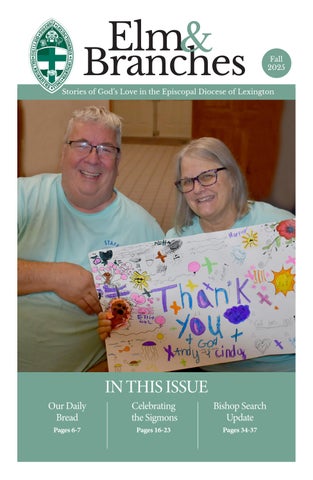
Cover photo: Andy and Cindy Sigmon are retiring after 34 years of leadership at the Cathedral Domain. Read their story — and tributes to their ministry— on pages 16-23.
Editorial Team
Publisher: Bishop Mark Van Koevering
Editor: Richelle Thompson
Writer: Carrie Graves
Designer: Amy Svihlik
Elm Branches &
In this issue
4-5 | Honoring the Ministry of Bishop Mark 6-7 | Communion Bread
8-9 | Embracing Morning Prayer
10-11 | New Ministry Lights the Way 12-13 | Preparing for Convention 14-15 | Around the Diocese
16-23 | Andy & Cindy Sigmon: Thanksgiving
24-25 | Praying for Pilgrimage
26-27 | New School for Mission 29-29 | Education for Ministry
30-31 | Local Authors
32-33 | Transformation and Mental Health
34-37 | IX Bishop Search
38-41 | Meet the Newly Ordained 42-43 | Virtual Curacy
44-45 | New Domain Cabin 46-47 | Summer Camp
STAY CONNECTED!
Subscribe to the diocesan email newsletter by scanning the QR code. Follow us on Facebook and Instagram at diolexky. Visit diolex.org for resources and stories
Change of Address
Please send address changes to: Diocese of Lexington
Attn: Elm & Branches 225 Walton Avenue Suite 120 Lexington, KY 40502
Dear People of the Diocese of Lexington,
It is rare to witness firsthand the transformative power of faithful leadership. Under the guidance of Bishop Mark Van Koevering, we have not only seen transformation—we have felt it. His vision, compassion, and unwavering commitment to our Diocese have planted seeds of renewal and resilience that are already bearing fruit.
From the moment he arrived, Bishop Mark faced unprecedented challenges, including the global COVID-19 pandemic. With grace and clarity, he led us through uncertainty, offering comprehensive guidelines, supporting parishes in going online, and creating opportunities for shared worship and prayer. His leadership was not only practical: it was pastoral, offering comfort and strength when we needed it most.
But Bishop Mark’s legacy reaches far beyond crisis management. He initiated a prayerful, inclusive process to discern a shared Diocesan Vision, engaging clergy, lay leaders, and congregations in meaningful dialogue. This vision became the foundation for strategic planning that has already led to:
• Greater transparency in governance
• Restructuring of the Executive Committee
• Strengthened financial sustainability
• A reduction in parish assessments
• Increased support for Shared Ministries and the Cathedral Domain
• Expanded leadership development and vocational discernment
• A renewed focus on discipleship and Scripture
• Deepened ecumenical partnerships across Kentucky
These are not just administrative changes. They are signs of a Diocese growing in faith, unity, and purpose. Bishop Mark’s leadership has helped us weather storms—literal and figurative— including devastating tornadoes and floods. Through it all, his faithfulness has been a beacon of hope.
Now, we have an opportunity to honor Bishop Mark’s legacy and ensure that the good work he began continues to flourish. We invite you to honor his legacy by making a gift in his name in support of the Diocesan Endowment Fund, which will provide lasting financial support for diocesan ministries and initiatives. Your gift will help nurture the seeds he has sown and empower future generations of disciples and leaders.
You may also choose to contribute to the annual Bishop’s Appeal, which supports immediate and ongoing diocesan work. Tax-deductible donations can be made online via the QR codes or by mailing a check to:
Episcopal Diocese of Lexington PO Box 610
Lexington, KY 40588
Please indicate your preferred allocation—either to the Endowment Fund or the Bishop’s Appeal. If no preference is noted, your gift will support the Bishop’s Appeal.
As the Carpenters once sang, “We’ve Only Just Begun.” Let us continue this journey together, inspired by Bishop Mark’s example and committed to the future of our Diocese.
With gratitude and hope, Gary Dehner, on behalf of the Executive Council
The Bishop’s Appeal Endowment
Faith communities bake, then break
bread
By Madeline Queen
Some traditions start quietly—in a home kitchen, with the smell of bread in the oven and the thought of sharing it with friends. For Church of the Ascension in Frankfort and Holy Trinity in Georgetown, baking communion bread has grown into something far more than a Sunday task. It’s a way to bring a piece of home into worship, to turn flour and water into a visible act of love, and to place before God the work of human hands and hearts.
At Church of the Ascension in Frankfort, the tradition began in January 2024 from something simple: a hobby in the kitchen. Parish Administrator Chris Keffer began experimenting with different recipes until they found “the one”—a 1930s Depressionera sourdough, made with discard starter so nothing is wasted. This is bread that carries the spirit of resourcefulness and care, with a flavor that speaks of time and tradition. Chris later adapted the recipe to be vegan so more people could share in it, though it’s not gluten-free just yet. Once a month, these golden loaves replace the standard wafers for Holy Communion, adding a homemade touch to the liturgy. Visitors often ask for a bit of the starter to take home, and Chris is always happy to share.
A similar spirit has taken root at Holy Trinity Episcopal, Georgetown. The community’s bread ministry began in March 2024 during a vestry retreat, as members dreamed up ways to draw more people into
7- 8 oz warm water
1 pkg dry yeast
6 tbsp honey
INSTRUCTIONS:
the heart of worship. “When people are able to make the bread at home, from their own supplies, and then bring it into the church,” said the Rev. Karen Booth, rector at Holy Trinity, “they’re making a very tangible offering that can be brought up to the altar.”
At Holy Trinity, volunteers sign up for two-week shifts, baking two loaves at a time—one for each Sunday’s service. The recipe (provided below), first used by Karen during her seminary days at Sewanee, is simple, forgiving, and delicious.
“Everybody loves doing it, so we never have a problem getting people to sign up,” she said. Each week, about 50 worshippers break bread made for them, with their faces in mind and their names in the baker’s prayers.
For both churches, these loaves aren’t just bread. They’re a bridge between home and altar, between ordinary kitchens and holy spaces, and a reminder that communion is truly a shared meal, lovingly prepared by the body of Christ for the body of Christ.
Communion Bread Recipe
In all things, be at prayer
1½ tbsp vegetable oil
½ tsp salt
1 cup all-purpose white flour
12/3 cups whole wheat flour
Yield: 2 loaves
Stir water, yeast, and honey until yeast dissolves, and set aside for a few minutes to activate. Then, stir in oil and salt.
Beginning with bread flour, then the wheat flour, add the flour gradually until the dough begins to pull away from the side of the bowl. You may mix by hand or with a mixer and dough hook attachment. If needed, add more wheat flour or water one tablespoon at a time.
Using wheat flour, turn the dough out onto a lightly floured smooth surface. Knead dough until slightly tacky. Add wheat flour as needed to keep from sticking. Cut dough into the correct number of balls based on the size of the batch and put them in lightly oiled bowls. Cover and let rise in a warm place until doubled in size (1-2 hours).
Leave the balls in their bowls until ready to bake. Flip balls onto a cookie sheet or baking stone and press down with the palm of your hand until it is about ½-inch thick. Using an oiled serrated knife, cut the shape of a cross almost through each round. Bake at the top of the oven at 325-350°F for 15-20 minutes until golden brown. Cool completely on a wire rack before wrapping them up.
“Morning Prayer is a doorway for lay leadership. We say the laity are vital — this is how we live it.”
The Rev. Laurie Brock
Fifth Sundays at St. Michael’s: Reclaiming Morning Prayer
By Carrie Graves
At St. Michael’s, Lexington, the fifth Sundays have taken on a new rhythm: Morning Prayer—on purpose, and for a purpose.
When General Convention drew most of Kentucky’s clergy to Louisville last summer, St. Michael’s rector, the Rev. Laurie Brock, found it difficult to find clergy to fill in on Sunday morning. So, she opted for the congregation to do Morning Prayer at St. Michael’s. The response was good—so much so that the parish decided to make it a practice. Beginning in January 2025, St. Michael’s committed to celebrating Morning Prayer on every month that includes a fifth Sunday.
of our siblings use every week. Choosing Morning Prayer lets us stand with them.”
For Laurie, the decision is both theological and practical. Theologically, it reclaims a beautiful, ancient pattern of common prayer that many newer Episcopalians have never experienced—Morning Prayer as the primary Sunday service—and that longtime members remember fondly. Practically, it helps the parish prepare for the very real seasons when a priest may not be available due to vacation, illness, or pastoral emergencies.
“Morning Prayer is a tangible doorway for lay leadership,” she said. “We say the laity are vital—this is how we live it.”
In choosing to have Morning Prayer as the primary liturgy, St. Michael’s joins with smaller congregations across the church and in the Diocese of Lexington where layled Morning Prayer is the weekly worship.
“We talk about all the ways we are church,” Laurie said, “but parishes with regular clergy rarely model the very form of worship many
The shift has energized ministry planning, Laurie said. St. Michael’s new director of music, Kaleb Hilton, is exploring pairing psalms, canticles, and hymnody in ways that fit the parish’s voice and welcome the wider community. The parish is also discerning a next step: inviting licensed worship leaders and lay preachers to officiate and preach on some fifth Sundays, with clergy present as
ABOUT ST. MICHAEL’S
Founded in 1955 on the “holy hill” of southeast Lexington, St. Michael’s is a welcoming community with long-time Episcopalians, newcomers, seekers, and neighbors. The parish is known for its open embrace—“Come as you are,” their invitation reads—celebrating diversity, affirming LGBTQ+ people in every aspect of leadership, and hosting community groups from the arts to addiction recovery. Members range from founding families to new residents. Since 2010, St. Michael’s has been led by the Rev. Laurie Brock, an Alabama native, author, and avid equestrian whose ministry blends deep joy, pastoral care, and a vision for the church’s future.
"Annunciation,” a painting by thirteenth-century artist Giotto di Bondone worshipers. “It opens space for a different experience of worship,” Laurie said, “and that’s very much in St. Michael’s DNA.”
Underneath the liturgical choice is a larger invitation to the diocese. Laurie hopes more congregations—large and small—will “flip the script” on assumptions that bigger is always better, or that the Eucharist is the only way to worship on Sundays.
“Our smaller churches are doing discipleship in innovative, authentic ways,” she said. “When we practice those ways together, we learn who we really are—and we get ready for the church we’re becoming.”
Laurie admits she has a soft spot for the canticles of Morning Prayer, especially
the Magnificat. “Mary’s song is not sweet background music,” she reflected, “it’s in-your-face, God-daring us—are you faithful enough to stand at the manger of an incarnate God who upends the world?” For her, praying the Magnificat is a reminder that worship should shake us awake to God’s justice and joy.
And St. Michael’s is sticking to its commitment even when the calendar offers a challenge—like this year, when the First Sunday of Advent falls on a fifth Sunday, a day rich with symbolism as the beginning of the new church year. St. Michael’s will gather for Morning Prayer, honoring both the season and their chosen practice.
Repurposed candle wax shines the “Light of the World”
By Tiffany Keffer
For years, Church of the Ascension in Frankfort has been working to figure out the best way to recycle and reuse the retired wax candles from our sanctuary in a respectful and reverent manner. Until now, these leftover wax pieces have been properly stored in their boxes waiting for a purpose. Ascension recently launched a new initiative, called the “Light of the World,” as a way for retired wax candles to shine new light.
Retired sanctuary candles are carefully taken to my home, cleaned and processed, and melted down before being reformed or poured into usable containers and returned to the church with a renewed purpose. I am able to reuse all the wax from the candles, only discarding the wick. The wicks are collected and burned completely, as is appropriate for disposal of sacred and blessed items that cannot otherwise be repurposed.
The first repurposed candles were poured into molds, creating sculptures of Mother Mary and Jesus. These candles are given to the clergy, who will give them to people in the church and community who may be in need of condolence or celebration in their lives.
The second component of the project involves refilling tea light candles in Ascension’s Lady Chapel. I was able to repurpose not only the wax but also the tins for these little candles. Only the wicks must be purchased. Ultimately, this project will lower the cost of replacement prayer candles for years to come.
The last project is something Ascension hopes to share with other churches in the diocese. We have small glass votive candles for a wider distribution. These glass candles will have the church name on the label,
indicating where the retired wax came from. Additionally, we intend to add a brief note highlighting the significance of the retired wax, its origins, and its purpose in sharing the light of Christ with the community. We hope to collect leftover wax from other faith communities in the diocese and then trade the votives with other churches as a tangible example of our love and support for one another.
I have always felt a special call to sacred items, relics, and tangible articles of faith, but was unsure why until this project came full circle. For me, the most important aspect of the project is handling blessed items with reverence and respect for their sacred purpose.
Tiffany Keffer is a member of Church of the Ascension, Frankfort. If your faith community is interested in learning more or participating in The Light of the World Project, contact her at mrskeffer@yahoo.com.
Bishop Mark Van Koevering with Tiffany Keffer, who founded the Light of the World ministry.
YOUcharist 129 th Convention gathers
The Diocese of Lexington will gather for its 129th Convention on November 14-15 in Newport. Conventions are a time for delegates from our faith communities and clergy to come together to pray, build relationships, and conduct the business of the diocese.
The theme of this year’s convention is YOUcharist. This theme springs from a sermon by former Archbishop of Canterbury Rowan Williams, when he challenged the congregation: “You are Eucharist.” As Bishop Mark Van Koevering explained in his letter on page 2 of Elm & Branches “Williams’ challenge that day was for us to see that this sacramental celebration must become, in each of us, a living sign and continuation of the Eucharistic act—embodying God’s hospitality, sacrifice, and missional care in the world.”
highlights of the day will be hearing about some of the experiments in the diocese that have emerged from our strategic plan.
“We want to share and celebrate some of the really exciting and innovative things that are happening around our diocese,” said Kat Luchtefeld, the diocese’s missioner for operations and finance. “We continue to see our diocese at the forefront of some of the experimental adaptive responses to the changing world that we are in.”
The 129th gathering will also be a time of celebration and thanksgiving. This will be the last regular diocesan convention with Bishop Mark, who is retiring at the end of May. It will also be the last diocesan convention with Andy and Cindy Sigmon as leaders of the Cathedral Domain. The diocese will celebrate the ministry of Andy and Cindy on Friday evening, with a “picnic banquet” a la camp style.
During convention, “we will explore how we in the Diocese of Lexington can be a sign of Christ’s healing and forgiving presence in the world,” said Bishop Mark.
Guided by this theme, the convention will begin at St. Paul’s, Newport, where we’ll start with some business and then end the day with worship. On Saturday, Nov. 15, convention will reconvene at the Newport Aquarium reception hall. One of the
Northern Kentucky faith communities are excited to host convention—for the first time in several year, said the Rev. Matt Young, rector of St. Paul’s.
“We’re looking forward to welcoming convention deputations and guests to the river,” he said. “With the church, convention site, and the main lodging venue all in the same block, we think this is a unique opportunity for people across the diocese to network and get to know one another.”
Of note
• Northern Kentucky hosts: Attendees are encouraged to come early or stay an extra night. There are lots of places to visit and things to do, from hanging out at Newport on the Levee (in the same space as the Newport Aquarium) to checking out the National Underground Railroad Freedom Center just across the Ohio River. For more ideas about things to do, visit: www. meetnky.com/explore-northern-kentucky/
•Convention Eucharist: All are welcome to attend the convention eucharist, which will be held at 4:30 p.m. on Nov. 14 at St. Paul’s, 7 Court Place, Newport. If you’re a musician interested in participating in the eucharist, contact Christopher Koon at stpaulsmusicdept@outlook.com.
•Celebration of Andy & Cindy Sigmon: The diocese is hosting a “picnic banquet” on
Friday, Nov. 14, at the Newport Aquarium. Guests may register to attend by clicking the QR code. The event will have a Domain camp vibe, with comfort food, singing, and (weather permitting) games.
•Childcare/Adult care: Childcare will be provided, with advance registration. The diocese will also provide a small reimbursement for delegates who have to pay for adult/senior care. Contact Kat at katl@diolex.org to learn more about the reimbursement.
•Prayer room: The Daughters of the King will host a prayer room at St. Paul’s for people who feel called to pray during—and for—convention.
•Volunteers: If you would like to volunteer for convention to help with hospitality and arrangements, please email pauls.church@fuse.net
AROUND THE DIOCESE
From Harrodsburg to Rwanda and back, with love and prayers
St. Philip’s, Harrodsburg, is known in Mercer County for our monthly community meal. But you may not know that St. Philip’s has another important outreach ministry that is far from our community and connects us with a congregation in Africa.
Several years ago, St. Philip’s priest at the time, the Rev. Jim Winborn, asked that we pray for Ntunga Parish and the Rev. Martin Sebudandi in Kigali, Rwanda. Fr. Jim met Fr. Martin in 1998 when he was assigned to the Diocese of Kibungo in Rwanda. The two quickly became friends and have continued to support each other, in prayer and may other ways.
St. Philip’s prayerful relationship progressed, and Ntunga Parish formally became our companion church. St. Philip’s was looking for a recipient for our Advent offering, and Ntunga Parish was a natural choice. During the year, members of St. Philip’s continue to specify monies to be sent to Ntunga Parish. Ntunga Parish has been able to make needed repairs to their church building.
Our two churches might be very far from each other, but we feel very connected through our prayers and support for each other.
— Jamie Wince
Resurrection, Jessamine County, serves the community
The Church of the Resurrection in Jessamine County has been busy living out the mission to BE the Church. Over the summer, Resurrection members showed their support for the LGBTQ community during a local Pride parade. In the spring, they held their first Vendor Fair, a fundraising event designed to support the church’s outreach ministries, including the Jessamine County Food Pantry and World Central Kitchen.
Held at the church’s outdoor pavilion, the event brought together local vendors and community members for a day filled with fellowship, shopping, and good food. Resurrection’s own talented chefs fired up the grill to provide lunch for everyone, while volunteers staffed an information table to share more about the church and its ministries—including pavilion rentals, which help support the church year-round.
Through this outreach project, the church became a visible expression of Christ’s love— building relationships, offering hospitality, and encouraging all who came to experience unity, generosity, and spiritual growth.
Martin Sebudandi
Keith Gilles (right) stands with fellow St. Andrew’s member Jerry Kohls. Jerry took an honor flight in September with Keith serving as volunteer leader.
Honoring our veterans
By Richelle Thompson
When Keith Gilles retired from a career as a hospital administrator, he wanted to find a way to give back. For Keith, a longtime member of St. Andrew’s, Fort Thomas, that gratitude soon found expression in volunteering with Honor Flight Tri-State, a nonprofit organization that takes veterans to Washington, D.C., to visit the memorials dedicated to their service and sacrifice. These flights are completely free for veterans.
Since 2019, Keith has served as a volunteer on about 15 honor flights, accompanying veterans from the Cincinnati airport to Washington, D.C., and then serving as a bus leader/tour guide through the memorials. Although Keith did not serve in the military, his father retired from the Air Force, and Keith feels a deep sense of gratitude to America’s veterans.
board a chartered flight to Washington.
The schedule is full: stops include the Marine Corps Memorial, Arlington National Cemetery, the Air Force Memorial, the World War II Memorial, and finally the Vietnam Wall. Often, the veterans witness the changing of the guard and get to lay the wreath at the Tomb of the Unknown Soldier in Arlington.
IN ACTION faith
The day ends with a surprise: “The veterans know there’s a ceremony, but they don’t know that there’s going to be 1,000 to 1,500 people at the Welcome Home celebration,” Keith said. “I remember one Vietnam vet told me, ‘When I came home, nobody gave a damn I was alive except my mother and father. I didn’t have anything like this.’ And I said, ‘Well, it’s much too late, but I’m glad we were able to honor you today.’”
Keith encourages others to find a new way to serve and to put their faith in action.
For Keith, this ministry is a way to live out the baptismal call to honor the dignity of every person.
Honoring our veterans is a way for Keith to give back and to serve others.”That is what our Lord asks us to,” he said.
The day of the Honor Flight begins long before dawn. Veterans and their guardians arrive by 5 a.m. and share a breakfast, prayer, and music. After the Pledge of Allegiance, they
“Get involved if you are so inclined. It’s a powerful thing,” Keith said. “And if you’re a veteran, sign up for an Honor Flight. You are worthy. It’s a very meaningful day and a way for us to thank you for our freedom.”
Faith in Action is a new series highlighting stories of Episcopalians putting their faith in action. Nominate someone—or yourself! Contact richellet@diolex.org.
On this Holy Mountain
Celebrating the Ministry of Andy and Cindy Sigmon
By Richelle Thompson
When Andy Sigmon was just ten years old, he sat at camp watching thenDirector Glenn Adkins at work. Glenn was patient, steady, and deeply devoted. Andy remembers thinking, “I want that job someday.”
That dream—spoken around Lake Moody and carried in his heart—would shape the course of his life. Decades later, alongside his wife Cindy, Andy fulfilled that childhood calling, as together, the Sigmons have guided the Diocese of Lexington’s ministry at the Cathedral Domain with love, grit, and laughter for thirty-four years.
“For 34 years, we’ve gotten to see the very best in the youth of today, when most people want to believe the worst. That’s this job in a nutshell,” said Andy. “We love these kids and would adopt most of them if their parents would let us. It’s a personal ministry for us and always has been.”
If young Andy had his way, his path might never have crossed with the Domain. When Andy’s parents wanted to send him to camp, he didn’t want to go. He thought he would hate it. Instead, he fell in love—with camp and with the Domain. “Some of my best friends in the world right now are people that I met when I was a camper,” said Andy. The Sigmon love story is just as entwined with camp as Andy’s dream. Cindy’s first introduction to the Domain was St. George’s Day when she and Andy were dating. When they married in 1979, they spent part of their honeymoon as counselors for Senior Conference—on opposite sides of camp. Cindy joked, “I stayed on one side of the camp, and he stayed on the other. Not many people are dumb enough to spend their honeymoons that way.”
But it was the start of a marriage—and a ministry—shaped by shared sacrifice and joy.
By the time Andy became director in 1991, the camp was struggling. “There was a letter from the state threatening to shut the camp down,” Andy recalled. Water was being pumped unfiltered from a spring, and facilities were in disrepair.
Andy’s contractor background proved invaluable. Over the years, he fixed broken pipes, installed water filtration systems, patched up cabins, and built new ones. He
oversaw the construction of the dining hall, cabin renovations, and countless projects that shaped camp into what it is today. Cindy, meanwhile, quietly kept everything running: registration, housing, schedules, and even sweeping and making beds before she was ever on payroll.
“Dad has a sign on his desk that says, ‘Do you want to talk to the boss or the person in charge?’ Mom was the person in charge,” said Sarah Smith, one of Andy and Cindy’s daughters. “She kept the whole thing running.”
Together, Andy and Cindy stabilized the Domain, ensuring not just its survival but its flourishing.
A key to that flourishing was their work to get the camp accredited. Of the tens of thousands of camps in the United States, less than 2,500 are accredited by the American Camp Association, Andy said. In large part, that’s because accreditation is tough to attain: camps have to pass more than 300 standards, including food service, health care, staffing, safety, and quality of the programs. At least every three years, ACA professionals visit the Domain to verify compliance—and each time, the Domain passes with flying colors.
For Andy and Cindy, camp has always been about more than cabins and programs. It’s about transformation. They’ve seen campers become priests and bishops and watched unchurched kids find Christ for the first time.
One camper, Hilary Jarvis, came to the Domain without much connection to church. She fell in love with the community and returned home to bring her mother and grandmother into the church. She’s now an active member at Christ Church Cathedral and serves as a dean for Girls Camp. “That’s a God moment,” Andy said. “This is a seedplanting ministry.”
Cindy added, “We’ve had campers for three and four generations of families. It’s amazing how this ministry lasts through the years.” For instance,
when Cindy was a rookie counselor in 1979. In the years since, both Ann’s daughter and grandson have attended camp.
“That’s three generations of campers that I have experienced and enjoyed and loved,” said Cindy.
The Sigmons raised their own family on the mountain that many call “just like heaven.” Their daughters remember blizzards that cut power for weeks, tornado clean-ups, and middle-of-the-night knocks on the door.
“There are a lot of great memories and lots of fun things that happen at camp, but it isn’t always fun and games,” said Sarah. “There are early mornings and late nights, but both of my parents endure them because of their servant leadership. There is literal blood, sweat, and tears from the Sigmon family in this beautiful place that is “just like heaven,” but it was a ministry Dad felt called to do, and we followed because of the trust we had in him and God’s purpose for him.”
Over the years, Sarah and her sister Katie Sigmon Berner witnessed their parents’ resilience. “Anybody who can survive working at camp has real life skills,” said Katie. “Patience, grace, giving second chances—we learned all of that from them.”
Katie and Sarah also saw how hard their parents worked to make the Domain a safe and sacred place for all. Kevin Richardson, a member of the pop band, Backstreet Boys, grew up going to summer camp at the Domain. At the height of the Backstreet Boys fame, Kevin got married at the Domain.
“We knew he was getting married here, but we weren’t allowed to tell anybody—not even our closest friends,” said Katie. “Dad and Mom wanted to keep the Domain a safe place for Kevin, a place where he could go and be himself.”
Asked about their guiding philosophy at the camp, Andy didn’t hesitate: “Leadership through love.” Cindy added, “And remember, there are always two sides to every story. Make sure you get the whole picture before you do a knee-jerk reaction. It’s amazing what can happen when we’re willing to sit down and talk with each other.”
This style of compassion and leadership created a camp where young people weren’t told they were the future of the church—they were empowered to be the church right
now, leading worship, bearing the chalice, and shaping worship services.
The Sigmons leave behind new buildings, safer systems, accreditation with the American Camp Association, and thriving attendance. But more importantly, they leave behind relationships—thousands of campers, counselors, clergy, and friends who know the Domain as home.
As Sarah put it, “Even when they’re gone, the cabins and dining hall will still carry their fingerprints. And the spirit they built will continue.”
With more than three decades of experience, they have a few words of advice for future leaders: “Don’t be afraid to change things,” said Andy. “We’ve always joked that if we do something once, it’s a tradition. But sometimes, things need to change and keep evolving and growing.”
And, said Cindy, “I would tell them to remember that in the midst of all the busyness, to sit back and enjoy some of the miracles that go on around this place all the time.”
Sarah has a hope for her parents, as well. She can recall being a high school student when Glenn Adkins, the Domain director when her dad was a kid, came to speak with Senior Conference.
“He shared so many memories of that place and how he got it off the ground,” said Sarah. “He said he was thrilled with how far the place had come since that time. When I look to the future, my hope is that mom and dad can do that down the road too— sharing the history and seeing the progress.”
In retirement, the Sigmons plan to spend more time with family, especially their grandchildren, and get involved in the local church at their new home in North Carolina. And, they’ll also be able to take summer vacations!
No matter the span of time or distance, the Domain will continue to carry their spirit. Because once upon a time, a ten-year-old boy dreamed of running camp—and of making a difference in the lives of young people and guiding them in their spiritual journey. Together, Andy and Cindy turned that dream into a ministry of love and a legacy that will echo for generations.
A Heartfelt Farewell to Andy and Cindy
For decades Andy and Cindy Sigmon have poured their hearts into Cathedral Domain. For almost forty years, Andy has guided the camp as director, while Cindy has served as Diocesan Youth Missioner and as a co‑leader in mission to children and families. Together, they have embodied the mission of this remarkable place: to nurture and sustain all people with God’s empowering love.
This December, Andy and Cindy will retire, closing a beautiful chapter of ministry that has shaped generations. Their daily presence will be missed beyond measure, but their legacy will forever remain a living part of the Domain. Many of you understand through very personal experience just how special Cathedral Domain is. Nestled in the scenic mountains of eastern Kentucky, the 800 acre camp provides a rare blend of rugged adventure and quiet sanctuary: rock climbing, hiking, and campfires, alongside the amazing wood gothic Cathedral, a dining hall, and cozy meeting rooms where fellowship comes alive.
For generations, campers and guests have found belonging, joy, healing, laughter, friendship, peace, and God at the Domain. And for generations, Andy and Cindy’s love and steadfast commitment have made it a home for countless kids and families. Their ministry has touched lives in ways words cannot fully capture. They have shown up year after year with compassion, wisdom, creativity, and unwavering faith. They celebrated first time campers, cheered on hesitant teens, supported families, and walked beside countless people on their spiritual journeys. They have been, and always will be, mentors, encouragers, and friends.
Now as they retire, there is gratitude that fills our hearts forever. Though their daily presence
Butch Clements, Chair
The Rev. Deacon
John Brennan
Stephanie Huber
Elise Hyder
Emily Juengle
Cate Jylkka
will be deeply missed, their legacy is woven through the cabins, the stones of the trails, the songs around campfires, and the spirits of those who came seeking community and found it.
To honor Andy and Cindy’s years of service, the Cathedral Domain Camp and Conference board asked them what would be most meaningful. Andy and Cindy replied, “This ministry was never ours alone. We were blessed with the support of so many wonderful people over the years, and we are deeply grateful for each of them. In truth, we were simply continuing the good work of the three directors who came before us, and we hope that in our time we remained faithful to the visions first set forth by Father Alexander Patterson and Bishop William Moody. Our deepest wish is that this 100 year old ministry continues on for another 100 years and more.”
The board would like to share that something very special is in the works at Cathedral Domain—an initiative designed to ensure the impact and memory of the Sigmons and previous directors will live on for generations. It will be a lasting tribute to the past leaders, a quiet promise to carry forward their passion and spirit.
While the details remain under wraps for now, know that it is born of love, respect, and a desire to safeguard the very heart they have tended—a place where all are welcome, where God’s love is found and shared. Stay tuned for more details to come!
As we honor their retirement, we also give thanks. Thank you, Andy and Cindy, for years of service, love, faith, and joy. Your legacy is alive, and soon, in a beautiful and intentional way, that legacy will be enshrined so that the Cathedral Domain continues to be a place of belonging, healing, growth, and God’s empowering love for years to come.
Donovan McCoy
Sam Razor
The Rev. Deacon
Rebecca Saager
Greg
Many people have been touched by Andy and Cindy Sigmon’s ministry. We asked them to share some memories.
I attended Senior Conference at the Cathedral Domain in the mid-1970s with Andy. He loved this place, and he always said it was his dream to become the manager. They always say, “Be careful what you wish for because it might come true.” Well, his dream did come true, and this has been such a blessing to the Cathedral Domain and all who have attended camp and events there over all these years. For Andy and Cindy, this is not a job; it is their ministry. God knew what he was doing when he brought Andy and Cindy to the helm. It has been amazing to see all the structural additions and enhancements that these two have brought to the facilities. However, for me, what I am most grateful for is the love and spiritual guidance they have given to thousands of children who have passed through. My daughter and son attended mini camp through Senior Conference, and both worked on Summer Staff for multiple years. I believe they are the people they are today in part because of that unconditional love and guidance.
Diane Bonfert
Those of us who know Andy and Cindy Sigmon know that they have made a great impact in the lives of many young people and helped make the Cathedral Domain an all-season Conference Center. In retirement, I wish this wonderful couple many happy years and continued friendship with me and all those whose lives they have blessed!
Buddy Vaughan
Because of Andy and Cindy, coming to the Domain always feels like “coming home.” You see it in the campers on their first day when they arrive at a conference or mini-camp. For them, maybe part of it is seeing the Sigmons’s dogs: Chip riding in one of the golf carts; Mufasa sunning himself in front of the dining hall. But mostly, it’s the joy on these campers’ faces when they see Cindy and Andy like they would a favored aunt and uncle. You can’t invent moments like that.
What’s equally striking is the quiet authority both of them inspire. Campers follow their guidance not because they must but because they want to do so. You can’t invent that, either. Andy and I first met in 1975 when we ran against one another for president of the Diocesan EYC (“Episcopal Young Churchmen”, as it was then). He won by a single vote. I lost an election; I gained two lifelong friends in him and Cindy. I wouldn’t have it any other way.
Kevin Matthews
I first met Andy Sigmon in the mid-1970s at Senior Conference and also knew his siblings as campers. Then, I met Cindy, his beloved wife. A few years later, we began volunteering together as camp counselors before the diocese was blessed by Andy and Cindy moving into servant leadership that is ministry at its heart. What many may not know is that they could have taken a comfortable early retirement if Andy had instead chosen to utilize his pilot’s license, raise Belgian draft horses, or build custom log homes. Instead, they sacrificed personal comfort to raise Sarah and Katie on the mountain, to drive countless miles to Lexington and back, to feed snowed-in “New Year in the Spirit” participants, and to offer the love of Christ to thousands of children, youth, and adults. Across more than three decades, a conservative estimate would be 20,000 camper/retreat visits with early rising and late bedtimes and mid-sleep interruptions for weather threats, campers who needed medical attention, or calls regarding family emergencies off the mountain. During their tenure, structures have been built or renovated, national camp accreditation gained, camper scholarships increased, new camps and events added—and all with the same open arms of welcome and acceptance.
Mary Bolin
During our Trinity Parish Weekend at the Cathedral Domain, Fr. Jason Leo shared about how, over the summer, a camper told him he was having a rough time at home and how he was so happy to be coming back to camp for his second year. The camper said he felt safe at Domain. After hearing this and reflecting on Andy and Cindy’s ministry to thousands of campers, my heart drifted to Matthew 6:21: “Where your treasure is, there your heart will be also.” Andy and Cindy both invest so much of their time, heart, and spirit into these campers. Their treasure lies in bringing love, hope, and fun into the campers’ lives. It’s been a joy watching all the campers run up to Andy and Cindy throughout the summer, giving them hugs, asking silly questions, or just saying hi! They gave me so many opportunities to learn and grow as a Christian. I attended summer camp, Happening, and served as summer staff for two years. Through these opportunities, I was able to learn about leadership, hard work, and faith. They’ve equipped me with the tools to help others and be a servant of Christ.
Renee Hyder
I have been coming up to the Cathedral Domain every year (besides COVID) since 2012, from a first-time Co-Ed camper to this past summer as a college graduate, to help volunteer at Senior and Junior Conferences. Andy and Cindy have seen me and countless others grow up during that time, and now, as they retire, I am proud to call them my friends. Andy and Cindy will be the first to tell you that the campers are the heart and soul of the mountain, and that is absolutely true. However, Andy and Cindy have worked harder than anybody I know to keep camp thriving and ensure that it is an inclusive space for kids from all over to come and make lifelong memories. Both he and Cindy are incredible role models who have inspired me a lot over the years. They choose to see the best in people, even when the rest of the world might not. They realize that each kid has a unique story and that we should try to understand their perspectives rather than being upset over every outburst. One bad action does not make a bad kid. That is a mindset that has stuck with me ever since I first started counseling several years ago.
Lincoln Combs
The National Memorial for Peace and Justice is a sacred space for truth-telling and reflection about racial terror in America and its legacy. The memorial includes 805 hanging steel rectangles, representing each of the counties in the United States where a documented lynching took place.
Praying for Pilgrimage
By Becca Kello
The first time I visited the Equal Justice Initiative’s National Memorial for Peace and Justice, I spotted the Warren County, Kentucky, marker first; it was eye-level, only about three rows into the long rows of the human-sized bronze box sculptures, each one engraved with the names of those who were lynched. Quickly, I realized that every county I had ever lived in had a marker dedicated to those who were lynched upon its soil.
As I continued to walk through the Memorial, I had to reckon with the truth that if lynching was universal across the five states my life’s journey had taken me to, then there is no doubt that, in some way, the racism and hatred that made systems of lynching possible undoubtedly shaped me as well.
A few years before my visit to the Memorial in Montgomery, Alabama, I read James Cone’s The Cross and the Lynching Tree. It was deeply impactful, and it allowed me to come to a new understanding of the cross. Cone wrote, “A symbol of death and defeat, God turned [the cross] into a sign of liberation and new life. The cross is the most empowering symbol of God’s loving solidarity with the ‘least of these,’ the unwanted in society who suffer daily from great injustices. . . But we cannot find liberating joy in the cross by spiritualizing it, by taking away its message of justice in the midst of powerlessness, suffering, and death. . . The lynching tree is the cross in America. When American Christians realize that they can meet Jesus only in the crucified bodies in our midst, they will encounter the real scandal of the cross.”
My visit to the Memorial was a tangible experience of the real scandal of the cross: that Christ’s crucifixion is far more than an inevitable event for the Son of God, but the wrath of humanity that demands control and hates with precise violence.
Let us pray: Almighty God, whose most dear Son went not up to joy but first he suffered pain, and entered not into glory before he was crucified: Mercifully grant that we, walking in the way of the cross, may find it none other than the way of life and peace; through Jesus Christ our Lord. Amen.
I have been lucky enough to make a few pilgrimages in my life; I’ve been twice to the Camino de Santiago, and I’ve learned that those of us who go never return unchanged. And that is my prayer for those of us who will make pilgrimage in October to Montgomery and Selma: that we will return deeply changed.
We will encounter what the scandal of the cross has to say to our world that has been and is so deeply desperate for hope. We will explore the Legacy Sites of Equal Justice Initiative, spend time in prayer, reflection, and discussion, about the ways in which we have been shaped and how we want to be changed as we return from this pilgrimage.
The Rev. Canon Becca Kello serves as Canon Missioner. Contact her at beccak@diolex.org.
A group from the Diocese of Lexington made pilgrimage to Montgomery and Selma, Alabama, in mid-October. Read about their journey at https:sholink.to/DioLexPilgrimage
Rest, refuel, PREPARE Diocese launches Base Camp: A School for Ministry
By Jennifer Woodruff Tait
Quick—pop quiz. Without grabbing a Book of Common Prayer (or Googling it), who are the ministers of the church, and what is its ministry?
OK, now you can look (at the catechism on page 855 of the Book of Common Prayer):
Q. What is the mission of the Church?
A. The mission of the Church is to restore all people to unity with God and each other in Christ. . .
Q. Through whom does the Church carry out its mission?
A. The church carries out its mission through the ministry of all its members.
Q. Who are the ministers of the Church?
A. The ministers of the Church are lay persons, bishops, priests, and deacons.
Base Camp: A School for Mission is a new formation initiative in the Diocese of Lexington that strives to make that mission a reality and to help form those ministers, both lay and clergy.
The name we’ve chosen to give this initiative was inspired by a book called Radical Sending by J. Fletcher Lowe and Demi Prentiss. Fletcher and Demi ask us to view the church as a refueling station, the kind where mountain climbers rest, refuel,
and prepare to move on to the next stage of their journey.
Demi visited the Diocese of Lexington in August for a Base Camp launch, meeting with people from across the diocese, both lay and clergy, at Our Saviour, Madison County, to discuss how we can carry out the ministry of restoring all people to unity with God and with one other.
To some degree, everything Base Camp may become is still in flux, but there are some guiding principles.
1) Base Camp emphasizes the ministry of all the baptized. I firmly believe that we are all commissioned by our baptism to spread the Gospel of Jesus Christ to a hurting world (check out the promises that we make, or that are made on our behalf, at baptism on pp. 302-303 of the Book of Common Prayer.)
2) Base Camp focuses on making disciples and growing Christian leaders in the diocese, both lay and clergy. Wherever you are on your journey of faith, we hope to eventually either create or connect you with formation that will “refuel” you for the next stage of your climb.
3) Base Camp supports, and does not replace, formation efforts already underway throughout the diocese. Does your church have a great Education for Ministry group or participate in Life Cycles or have wonderful adult formation on Sunday morning? We want to help you out and spread the news! And, if your faith community doesn’t have something like this but wants to start, we want to help you get going and connect you with others in the diocese who can mentor and support you.
4) Base Camp will eventually also help those who want training for licensed diocesan ministries. We hope to make such training—in local faith communities and diocesanwide—more clearly part of our larger initiative to grow disciples and leaders.
The Rev. Jennifer Woodruff Tait is the Coordinator for Base Camp. Contact her at profjenn12@gmail.com.
Oct. 4: 1-3:30 pm on Zoom Discipleship for the Vestry
Nov. 10, 17, 24: 12-12:45 pm on Zoom Lunch and Learn: The Ministry of the Baptized in Daily Life
Spring events focused on: - Training for diocesan licenses - Missions and evangelism - Curricula for Christian formation in the local church - Prison Ministry
Representatives from nine faith communities attended the launch event of Base Camp, led by Demi Prentiss, an author and well-known speaker across the Episcopal Church.
An Invitation to Go Deeper: EfM in the Diocese of Lexington
By Carrie Graves
As soon as Jim Ware starts talking about Education for Ministry (EfM), you can hear the smile in his voice. A lifelong church servant who has filled roles from verger to acolyte director to church facilities manager, Jim calls himself a “recovering Baptist.” He spent decades as a bank examiner, but the role that inspires him these days is as the diocesan coordinator for EfM and being able to gather people around scripture, story, and shared reflection.
Education for Ministry (EfM) is a lay formation program from the School of Theology at the University of the South (Sewanee). It’s built around small seminar groups (typically 6–12 people) who journey through four years—Old Testament, New Testament, church history, and theology/ ethics—one year at a time. The heart of EfM is theological reflection: learning to look for God’s movement in daily life and in the
world, together. Since 1975, more than 120,000 people worldwide have taken part.
The Diocese of Lexington has long participated in EfM, but the COVID-19 pandemic dealt a harsh blow, and many EfM groups locally and across the country stopped meeting. But Ware kept the flame burning, leading two EfM groups at Christ Church Cathedral. Since last spring, Jim has been rebuilding that fire—reconnecting with former mentors, welcoming newcomers, and sketching on-ramps that make it easier to say yes. His goal is to make it easier for participants from neighboring congregations to form a seminar together— meeting in person within a region, on Zoom, or some of both—so interest (not ZIP codes) drives where EfM can grow
Jim Ware
next. “I can’t do it alone,” he said, “but I can help people find each other.”
Just as Jim is revamping the DioLex approach, the churchwide EfM program has also refreshed its offerings. The longtime Reading and Reflection Guide (once called the Common Lessons book) has moved onto an online learning platform and contains curated readings, videos, podcasts, and tools mentors can use week by week. Along with the updated course platform and materials, EfM announced a new program called EfM: Wide Angle, a oneyear on-ramp that offers the seminar experience with a lighter workload— helpful for people discerning whether to commit to the classic four-year path or for graduates who want to continue in community.
Build a group. We’ll help.
contribute to the Diocese of Lexington; it is part of his own ongoing call. He first enrolled simply wanting to know more about scripture and the church, and he found himself drawn deeper into Christian community than he expected. “I thought I was just signing up for a class,” he recalls, “but it became a way of life.” He even went through the program twice—once with the original “red binders” (a former version of the text written and edited by Sewanee School of Theology faculty) and again when the materials shifted to textbooks— because he wanted to experience firsthand how the program was changing.
EfM seminars can be formed by one congregation or by several congregations linking arms—meeting locally or online. If you’re curious (or if you’ve been waiting for the nudge to start a group in your area), reach out. Jim is glad to answer questions, connect interested folks across parishes, and support prospective mentors.
Talk with Jim for five minutes, and you’ll hear both candor and hope about formation through EfM. There’s candor because he recognizes that mentor recruitment takes work; people’s schedules are full; and any diocesan effort has to feel genuinely welcoming across parish lines. But he remains ever hopeful: the new tools lower barriers, and the seminar table—whether in a parish hall or on a screen—still does what it’s always done.
Contact: Jim Ware at jorieware@gmail.com
Learn more about EfM: theology.sewanee.edu/ education-for-ministry
That willingness to keep showing up, to learn again alongside others, is what shaped his call to leadership. “Early on, I thought I might be a deacon,” Jim said. “But I realized I don’t need a collar to do God’s work. Right now, this is what I’m called to do.” For him, serving as EfM coordinator is less about administration and more about walking with people as they discover God’s presence in their own stories.
“EfM changes lives,” said Jim. “It helps people see God’s movement in their stories and in the world.”
For Jim, EfM is not just another way to
He has watched scripture come alive for people who assumed the Bible was only for experts; he’s watched quiet folks find their voice, and longtime volunteers name their ministries with new joy and depth. Jim sees EfM as a gentle engine for lifelong faith formation, instilling compassion for others and equipping seekers to be more authentic followers of Christ.
BOOK CLUB Spotlight on DioLex Authors
LAURIE BROCK
Author: Laurie is rector at St. Michael’s, Lexington Book: Souvenirs of the Holy: Encountering God Through Everyday Objects Published in October by Broadleaf Books and available from various online booksellers. Laurie is also a contributing writer for Forward Movement’s newest Advent devotional, A Light Upon My Path. It’s available through Forward Movement and other online booksellers.
What inspired you to write this book?
I'd been working on some essays for a magazine about holy things (icons, crosses) and began noticing how we too often (and unhelpfully) divide so much into sacred and secular, as if God isn't present in all things. I wondered how seeing the holiness in everyday objects in our lives may help us better see God in the daily routines of our lives.
How does your book reflect your relationship with God?
What conversation do you hope your book will spark in churches, small groups, or families?
I hope that it reminds us that God is in all places and in all moments of our lives, not just within the four walls of our churches. I hope it creates space for conversation around materialism, —why we love the things we love, what things can teach us, and even how things can be a barrier to deeper connection with God, ourselves, and others.
What role does community play in your writing?
I love seeing God in the ordinary. Seeing God in breathtaking sunsets or a particularly moving church service is almost easy. Seeing God in a pair of garden shears or a castiron skillet? That invites me into a place where I have to be willing to be surprised, even challenged. God is both ordinary and extraordinary, mundane and remarkable. Experiencing God in that depth and breadth is true holiness to me.
St. Michael's is so supportive in my writing. Being a writer means that I spend time writing, researching, and promoting my books. I can't thank St. Michael's enough for the prayers, support, and time they lovingly grant me when I'm in the midst of major book work. I also am so appreciative of many churches—mainly those in our mountain regions—in our diocese who ask me to come speak, who have used my books as devotions, and who have reached out to support me as well.
ROB SLOCUM
Author: Rob is the priest-in-partnership at Church of the Ascension, Mount Sterling Book: Joy to the World! Devotions for Advent, Christmas, and Epiphany. Published in September. Available from Church Publishing and other online booksellers.
How did writing this book influence your faith journey?
Dorothy Day once said that writing is prayer. That's my experience, especially in terms of devotional writing. I feel close to both the meaning of my life and the presence of God when I'm writing. My devotional writing is rooted in my daily experiences of life (everything I have known, loved, and shared) and my reaching beyond myself to know God better and try to put my yearning and discerning into words. In this process, I feel that I'm most fully myself and also most fully open to God's movement in my life. I'm most independent in terms of my ability to choose freely from all kinds of experiences and thoughts for my writing, and I'm most dependent on inspiration from beyond myself that will surprise me. Writing can take me in unexpected directions. I enjoy sharing this creative and surprising process with others.
others. I started writing seasonal reflections to help parishioners explore the depth, beauty, and deep meaning of the seasons in our church year. Some of the examples that illustrate my reflections are drawn from church life, and other examples may be surprising. I hope these writings will spark individual and group reflections that are dynamic and powerful, pointing to discoveries in the many ways that God is with us and shows up for us in all kinds of places and situations. We can find the extraordinary of God in the ordinary of our daily life.
I hope the devotions of Joy to the World! will help those who read and hear these reflections to find God active in their lives and world, especially in the seasons of Advent, Christmas, and Epiphany.
What conversation do you hope your book will spark in churches, small groups, or families?
In my first theology class at seminary, my professor asked the question, "How do we know God?" Years later, I continue to work and play and pray with that question, and I hope my reflections will prove helpful for
I believe the book will adapt easily to individual reflection and spiritual practice or group study in a parish or family. Each devotion includes a passage of scripture, my reflection, questions to ponder, and a prayer. Each devotion is my invitation for the reader to reflect and pray with me.
Are you an author? Share your published work with us so we can highlight it in our “Book Club.” Contact Richelle Thompson at richellet@diolex.org
Called To Transformation Exploring resources, imagining possibilities
By Jenny Grant
Representatives from the Diocese of Lexington joined participants from five dioceses for a Called to Transformation workshop in Canton, North Carolina, Sept. 29-Oct. 1. This is the first time the workshop has been held in person since before the COVID-19 global pandemic.
The world has changed a lot in that time, but Episcopal Relief & Development’s commitment to working together for lasting change has not. The opportunity to bring Called To Transformation back, renewed and reinvigorated, to support the work of Episcopalians and beyond is something we were thrilled to do. We were especially excited about partnering with the Episcopal dioceses in the Appalachian region—a resilient area with so many gifts to share.
We chose to host the workshop at Lake Logan to support Episcopal Camp and Conference Centers as well as a place deeply impacted by Hurricane Helene in 2024. The site was the perfect launching place for Called To Transformation and the Appalachian Eco-Region. Each participant in the workshop completed an ABCD 101 module online to lay the foundation for our time together. Over the course of the two and half days, participants engaged in activities and discussions to move from theoretical knowledge to practical application of ABCD principles. There was also time for worship, fellowship and rest. Episcopal Relief & Development, along with the team from the Episcopal Church, plan to continue coaching and supporting the creation of an ABCD Community of Practice. The mindset shift takes time and buy-in from everyone in a community. It is important
ABOUT CALLED TO TRANSFORMATION
Called To Transformation is an Asset Based Community Development (ABCD) workshop designed for communities of faith. As a methodology for development, ABCD invites practitioners to start by asking, “What do we have?” vs. “What do we need?” Called To Transformation was developed through a partnership between Episcopal Relief & Development and The Episcopal Church. The foundation of ABCD is the premise that we all have Godgiven gifts. It takes traditional models of development that rely on outside institutions for support and turns the focus back onto the individuals in a community as the starting place for transformation.
to evaluate what is already happening across the diocese to celebrate what should continue and adjust what may need to change. Often, ABCD is already occurring in a place organically, and we hope Called To Transformation provides a framework and more support to deepen engagement.
We look forward to walking this journey alongside the Diocese of Lexington and others committed to sharing their gifts to bring their communities closer to what God intended for the world.
Jenny Grant serves as the Manager, Faith and Community Engagement, for Episcopal Relief & Development.
Mental Health and the Church Story of Jonah offers important lessons
By Emily Badgett
Unfortunately, in the twenty-first century, there is an ever-growing epidemic of suicide deaths, and that is just one portion of the mental health crisis. Thankfully, the most recent edition of The Anglican Theological Review focuses on mental health and the church. I was honored to be among the many incredible writers who address one of the most important spiritual issues of our time.
Mental health is such a complicated issue, and it gets even harder when we start talking about suicide. I knew early on that my call as a priest was to bring light to the unique role of the church in the mental health crisis.
The church has unique, God-given gifts to promote healing. One of those natural gifts is interpreting, preaching, and teaching scripture in ways that bring about healing and not shame. In my article, I talk about Jonah, this kooky Bible story of a man trapped in a whale and yelling at a bush. But what most people don’t see—and most biblical commentators fail to address—is that Jonah is really wrestling with suicidal ideation.
To be clear, clergy, and by extension, the wider church, are not diagnosticians. But when we see lines like Jonah 4:9, “But God said to Jonah, 'Is it right for you to be angry about the bush?’ And [Jonah] said, ‘Yes, angry enough to die,” or Jonah telling the sailors to throw him into the roaring sea in the very beginning of the book (Jonah 1:12), we see that this weird story has an even deeper meaning. The short Book of Jonah becomes a biblically based model for pastoral care for someone experiencing suicidal ideation. The boat, the whale, and the booth all become
An altarpiece in Klosterneuburg, Austria, by Nicholas of Verdun depicts Jonah in the belly of a whale.
places for Jonah to process his emotions. In psychological terms, these places are “holding environments,” a concept that originates from child psychology and describes the healing power of being held physically or emotionally, especially during a crisis. The easiest example is to think about a parent holding a crying baby in their arms. When we look at Jonah, God is trying to hold him like a loving parent.
When one environment doesn’t work, God picks Jonah up and plops him in a new one. Following the example of God in Jonah, how can we, the church, function as holding environments for people, especially those experiencing suicidal ideation?
The model is right there in scripture.
The Rev. Emily Badgett serves as assistant to the rector at Good Shepherd, Lexington. If you are interested in learning more about mental health and the church, contact her at at emily@gslex.org.
The article is behind a paywall, but you can access it by scanning the QR code if you’re a subscriber to the Anglican Theological Review or connected to an institution with access to JSTOR or Sage Journals (The University of Kentucky offers free access to staff, faculty, and students.)
From the Standing Committee A Sacred Journey: Calling the IX Bishop of Lexington
With gratitude for the Spirit’s guidance, our diocese is moving faithfully through this season of calling the IX Bishop of the Episcopal Diocese of Lexington. This is a sacred journey, rooted in prayer, listening, and trust in God’s hope-filled future.
Prayerful Tasks and Milestones
• The Standing Committee engaged the Rev. Gia Hayes-Martin from the Diocese of Southern Ohio to serve as our search consultant.
• Search and Transition Committees were prayerfully discerned and called to serve in June.
• In July, the Standing Committee, Search, and Transition Committees gathered for a two-day retreat—a Spirit-filled time of prayer, discernment, and planning.
• The Standing Committee developed a search and transition budget, along with a compensation package for the new bishop, for approval by the Executive Council.
• Listening sessions and surveys have been completed, offering a wide range of voices and insights. From these, the Search Committee is now creating the diocesan profile, a snapshot of our identity and our hopes for future leadership, to be published in October.
• The Transition Committee is preparing for the transition of our new bishop and for the celebration of Bishop Mark’s ministry.
• Looking ahead, the election of our new bishop will take place at a special convention on Saturday, May 30, 2026, at Christ Church Cathedral.
A Season of Prayer
As this journey unfolds, we invite every congregation and household to hold the committees, candidates, and our whole diocese in prayer. We trust that God is preparing the right leader for this next season of ministry together, even as we give thanks for the faithful ministry of Bishop Mark.
Gracious God, you call your Church into new seasons of faith and service. Bless our Standing Committee, Search and Transition Committees, and all who labor with open hearts in this holy work. Guide us by your Spirit, and prepare us to welcome with joy the bishop you are raising up for us. Through Christ our Lord we pray. Amen.
IX BISHOP SEARCH TIMELINE
2025
October: Diocesan Profile published, application period opens
March 18: Search Committee submits slate to Standing Committee
March 25: Standing Committee announces slate, petition period opens
April 8: Petition period ends
April 22: Standing Committee announces final slate
Week of May 11: Meet-andGreets with bishop nominees
May 30: Electing Convention at Christ Church Cathedral
October 24: Bishop Ordination, pending consent
Duties of a Bishop
From the Search Committee for the IX Bishop of the Diocese of Lexington
What do bishops do, anyway? As we search for a new bishop for our diocese, we wondered if you’ve ever wondered about this question. As a matter of fact, the Book of Common Prayer has the answer! The Catechism in the back of the Book of Common Prayer describes all four orders of ministers in the church (laity, priests, deacons, and bishops), and here’s what it has to say about the ministry of a bishop:
“The ministry of a bishop is to represent Christ and his Church, particularly as apostle, chief priest, and pastor of a diocese; to guard the faith, unity, and discipline of the whole Church; to proclaim the Word of God; to act in Christ’s name for the reconciliation of the world and the building up of the Church; and to ordain others to continue Christ’s ministry.”
How exactly do bishops do this? The ordination vows of a bishop help us understand. During the ordination service, the priest who is about to be consecrated as a bishop is asked these questions:
1. Will you be faithful in prayer, and in the study of Holy Scripture, that you may have the mind of Christ?
Bishops are asked to be people of prayer, who have a regular prayer life and seek in their prayers to become more like Christ every day. They are also asked to be people who are deep in the Word of God, reading it devotionally and also studying it intellectually.
2. Will you boldly proclaim and interpret the Gospel of Christ, enlightening the minds and stirring up the conscience of your people?
Bishops preach, of course—especially at Diocesan Convention and when they make their annual visitations to each faith community. When they preach, they are to preach Christ crucified, interpret the scriptures so that we may better understand how to follow him, and, sometimes, convict us to do better. Bishops are also often active in the public square, speaking out about issues of concern to Christians.
3. As a chief priest and pastor, will you encourage and support all baptized people in their gifts and ministries, nourish them from the riches of God’s grace, pray for them without ceasing, and celebrate with them the sacraments of our redemption?
Bishops are called to lead all baptized Christians by encouraging and supporting their individual gifts and ministries toward the benefit of God’s kingdom. They are also called to actively pray for their dioceses, the Anglican Communion, and the universal church. Bishops also celebrate the sacraments with parishioners of their dioceses, especially the sacraments of confirmation and ordination for which they have unique responsibility.
4. Will you guard the faith, unity, and discipline of the Church?
Bishops have a special responsibility to maintain the doctrines of the Christian faith in accordance with its affirmed historic creeds. As part of this responsibility, bishops are to work towards maintaining the unity of the church and resisting division and schism. Finally, bishops participate in ecclesiastical discipline through the application of the church’s canons when a member of its clergy is accused of misconduct.
5. Will you share with your fellow bishops in the government of the whole Church; will you sustain your fellow presbyters and take counsel with them; will you guide and strengthen the deacons and all others who minister in the Church?
Bishops, when consecrated, join the House of Bishops, where they have voice, seat, and vote. The House of Bishops is one of two governing bodies of the Episcopal Church, and the presiding bishop is its president. A bishop also cares for and maintains a close working relationship with the clergy serving in their diocese. They communicate effectively and support clergy in their particular roles. Bishops preside at services of confirmation, reception, or reaffirmation, as well as at the ordinations of deacons and priests. A bishop also has particular oversight of deacons and how they serve within the diocese. Equally important, a bishop seeks to strengthen faith communities for the good of the church.
6. Will you be merciful to all, show compassion to the poor and strangers, and defend those who have no helper?
A bishop is charged with the apostolic work of leading, supervising, and uniting the church. The bishop must be a leader who emulates Jesus Christ to everyone. They must be concerned not only with their diocese and the wider church but with the plight of all the children of God, striving to bring God’s will to earth, as in heaven.
Please join us in prayer for our diocese throughout this process.
For the Election of a Bishop
Almighty God, giver of every good gift: Look graciously on your Church, and so guide the minds of those who shall choose a bishop for this Diocese that we may receive a faithful pastor, who will care for your people and equip us for our ministries; through Jesus Christ our Lord. Amen.
AQ& “Make Them Deacons in Your Church”
This summer, the Diocese of Lexington celebrated the ordination of three transitional deacons, and in December, God willing, they will be ordained as priests. We asked them to share a bit about themselves.
Anna Baumann
I am married to Bryce, an organic vegetable and flower farmer. We have lived on the farm since 2023, in what we’ve heard is one of the earliest timber frame houses built in Madison County. Bryce’s parents, Carla and Lothar—a retired public health nurse and high school teacher, respectively—also live on the farm and help keep things going. We have two children: Jack is 13 and Molly is almost 11. They are the best and dutifully roll their eyes when I say things like that. We also have two kittens (brothers), Harry and Marv, and an Australian Shepherd, Cutter, who loves and belongs to every person he’s ever met. I grew up in Atlanta, and have three siblings who live in Reno, Atlanta, and Nashville with their wonderful families. My parents, Mary and Steve—a retired Episcopal priest and psychologist, respectively—will be moving closer to my sister in Atlanta within the next year. They are all dog and cat lovers. I am blessed by this loving family and extended pet network.
Tell us about your vocational journey. Looking back, it is much easier to wonder about how, all along, God has been calling me into ordained ministry. In the living of it, there was a lot of (deeply valuable) dancing around. Throughout my youth, I thought I
would be an early childhood educator out of love for children. In undergrad, I studied English literature and gender studies, for love of humanity. In my twenties, I answered the call to do children and youth ministries and to live for a while in intentional Christian community serving vulnerable populations. In graduate school, I studied global poverty and inequality, trusting somehow that it would shape my service, which I was coming to understand involved the church.
When my Bryce and I married, a crisis on the farm led to the slow work of rebuilding the business from the ground up, so instead of going to seminary, I went to work doing policy research and communications work for a more thriving, equitable Commonwealth. Then, the COVID-19 pandemic had me reflecting (along with people everywhere) on the preciousness of our time to do the things that scare and call us. So, with the support of family and community, I jumped into formal discernment in the Diocese of Lexington. Here I am, God. Send me!
What does your ministry include?
Since ordination to the diaconate in June, I served as a visiting deacon at Trinity, Danville, my sending parish. In August, I began my new call as a deacon at Church of the Resurrection in Nicholasville, to become priest-in-charge in December after ordination. Currently, I serve on two diocesan committees: the Convention Planning Committee and the Bishop Search Committee.
I think a big part of my ministry right now is having a learner’s heart: being curious, getting to know folks and the church, actively listening and noticing and receiving all the grace God is pouring out through all the beloved people who are shaping me for ordained ministry.
What spiritual practices strengthen you? I recently completed the 19th annotation— the Exercises of Saint Ignatius of Loyola on extended (nine-month) retreat in daily life. That experience had me regularly gobsmacked with God’s goodness, particularly that God wants to be, and is available to us, in loving relationship and dialogue through prayer. We have so many rich and life-giving prayer traditions, such as inhabiting scripture imaginatively, contemplative prayer, and the colloquy. The Exercises build prayer muscles, so to speak.
Through the Exercises, the Examen became a really important daily practice for me: going over the last day with God, laying my significant thoughts, emotions, and desires before God, listening, and asking for the graces I need to live in God’s love. I think I have lived at times as if God isn’t interested in this “nitty-gritty” level of my human experience. It’s been transformative to realize through practice the nitty-gritty
Fast Five: Five Fun Facts
Favorite ice cream flavor: Coffee
Latest read: Circe by Madeline Miller. It uses Roman myth to explore themes of motherhood and movement toward rather than away from our limited, vulnerable, blessed humanity.
Last concert: Patty Griffin at the Lyric Theater in 2019
Must-see TV show: Call the Midwife Hobbies: Making bouquets, pulling weeds, cooking simple stuff like salads, soups, and one-pot meals without recipes, walking in the woods, listening to music and making Spotify playlists, listening to comedy podcasts, watching movies and TV with my family, and reading romance novels
level at which God is lovingly working our transformation.
When I’m feeling particularly spiritually bereft, a practice that has always most reliably strengthened me is, as Rev. Dr. Randy Woodley puts it, going into the woods, quitting my grumbling, and listening.
Bruce Cory
I am unmarried and an only child, so my family is just me, my mother, and my father. My mother is a crisis intervention counselor with the 988 Suicide and Crisis Line. My father is a farmer raising beef cattle. The only pets I currently have are the tetra and corydoras catfish in my aquarium.
I have lived mostly in the Ohio and Kentucky area. I lived in Chillicothe, Ohio, during my childhood and teen years. My undergraduate and first graduate programs were completed in Dayton, Ohio. I worked 13 years in Cleveland Heights, Ohio, and lived in Mayfield Heights. When I first moved to
Kentucky, I lived in Corbin, but now I live in Barbourville.
What does your ministry include?
I am currently serving with St. John’s Episcopal Church in Corbin. For my full-time work, I am currently an associate professor of Spanish and Humanities at Union Commonwealth University.
As I am not a full-time transitional deacon, my ministry is a bit limited at St. John’s. I assist with the regular worship of the community on Wednesday evenings and Sunday mornings. On Tuesday, I support a community meal that feeds between 25-40 people in the community with a hot meal. I also support other members of St. John’s in their outreach ministries. I feel a strong call to serve smaller, rural, underserved congregations.
The service of ordination to the priesthood will be held Dec. 6 at the Cathedral Domain. Forr more details, visit the diocesan website at www.diolex.org/calendar
Melanie Yankey
I live in Lexington and work full-time as the Administrative Assistant for the Diocese of Lexington. I have two children. My son John is a pilot based in Columbus, Ohio, where he lives with his partner, Mary. My daughter works as a paralegal in Covington and lives in Newport. I have grand-pets: dogs Ellie & Fufu, cats Nugget, KitKat, Ernest Hemmingway, and Edgar Allen Poe, and horses Ajax and Belle.
Tell us a bit about your vocational journey. Looking back, I can see that vocational ministry has been calling me throughout my whole life. I felt a call when I was young, but ordination wasn’t something I even thought possible as a woman. By the time I found my way to the Episcopal Church—which does ordain women—my circumstances had me feeling too old and too unqualified for ordained ministry. Nevertheless, I continued to feel drawn in that direction. Being inspired by the testimony of local clergy, I took the leap of faith into the formal discernment process in 2019. Every day is another opportunity to take a leap of faith and do the next right thing.
What is your role now?
Currently, I serve as a transitional deacon at Holy Trinity Episcopal, Georgetown. So far, my ministry has included proclaiming the Gospel on Sundays, preaching occasionally, facilitating a study of the Apocrypha, playing in the ukulele band at the Lava Lava Luau VBS, blessing of the pets, hosting the Rev. Jim Sichko, socializing for a good cause at Boots and Pearls, and more. Come check us out at Holy Trinity in Georgetown!
How do you think the institutional church could support discernment to meet the needs of a changing world?
I think we need to build trust. This isn’t necessarily about people needing to put more trust in the institutional church, but that the institutional church needs to
Fast Five: Five Fun Facts
Dream vacation: A trip to the Mediterranean and all the countries it touches. A trip to Italy in 2022 has me yearning to see more of the world!
Last concert: James Taylor and Bonnie Raitt. My favorite concert was Maroon 5 for my fiftieth birthday.
Must-see TV: Severance, Handmaid’s Tale, White Lotus, Fallout
Ideal weekend: I look forward to weekends where I can hunker down at home and tear into a project, but I also love hanging with my friends and family. Favorite food: Garden vegetables, chips, and chocolate
have some faith in believers. The rooms of recovery have taught me that when we share our story, God speaks. Nothing is more powerful than when someone says, “One thing I do know, though I was blind, now I see” (John 9:25). It would be great if the church could connect people with their story and their story with the story of Jesus and then trust them to share it. I am excited about the opportunities available in the diocesan Base Camp with doing just that.
What spiritual practices strengthen you?
Accountability and connection are important for me. I like to pray and study scripture, but I need to check in regularly with someone about my own thoughts, behaviors, and motivations. I also tend to isolate, so I make myself go out with friends and meet with my 12-step group regularly.
Who are some of your spiritual mentors?
I can’t name them all, but my family members have taught me everything about the love of Jesus. My Al-Anon sponsor, Linda M., has been keeping me honest for a decade, and the Rev. Peter Doddema was my first priest as an Episcopalian and was an exemplar of pastoral care during some of my darkest days. Every clergy person I have served with in my discernment has been a treasure trove of wisdom. We are blessed in this diocese!
For centuries, newly ordained priests learned their craft in traditional curacies— essentially apprenticeships alongside seasoned rectors in large parishes. But in many dioceses today, those opportunities are few and far between. Some congregations struggle to afford even one full-time priest, and new clergy often find themselves serving alone, isolated, and without the daily mentoring that once shaped generations of pastors.
Faced with this reality, Berkeley Divinity School at Yale designed a bold response: Virtual Curacy. Funded in part by a grant from Trinity Wall Street, the two-year program blends online mentoring, monthly cohort gatherings, and in-person retreats to provide the guidance, support, and spiritual grounding that new clergy need in a rapidly changing church.
“We designed a program not just for practical training, but for visionary thinking about the future,” explained Brandon Nappi,
Members of the first Virtual Curacy cohort, including three from the Diocese of Lexington.
executive director of leadership programs at Berkeley Divinity School. “It’s not enough to train folks well for the church of the twentieth century. We have to train folks for the twentyfirst century and beyond into a future we can’t even anticipate.”
When the Diocese of Lexington heard about the opportunity, there was no hesitation. Within hours of learning about the program, the Rev. Canon Amy Chambers Cortright and Bishop Mark Van Koevering encouraged our three transitional deacons to apply. They were all accepted, making Lexington the only diocese with three representatives in the inaugural class of eleven.
“We were very excited about Yale’s Virtual Curacy as an opportunity to provide substantive mentoring and support for our newly ordained,” said Canon Amy. “We appreciate the experimental nature of the project in a changed and changing church, and we’re grateful that such an opportunity could be available virtually while also
providing periods of in-person relationshipbuilding with peers.”
The Rev. Anna Baumann, a participant in the program, sees the initiative as both pragmatic and Spirit-led. “Traditional models of training new clergy are not working in many contexts,” said Anna, who is serving as a transitional deacon at Church of the Resurrection, Nicholasville, and will become priest-in-charge there after her ordination to the priesthood in December. “Instead of despairing, the folks at Berkeley Divinity School have heard the Spirit’s call to try something new. I feel so much care in this program—a space where I can truly ask any question that arises.”
The need for such innovation is urgent, said the Rev. Bruce Cory, a transitional deacon serving St. John’s, Corbin, and one of the participants in the program. “Traditional models for the first two years of ordained ministry have relied on placing new clergy as curates in parishes with a senior clergy person. As fewer congregations can afford that, providing mentorship and support for newly ordained clergy, particularly those serving alone in isolated areas, will become more and more important.”
to keep moving forward,”
Another key component of the program is community. Launching with an inperson retreat enabled participants to build relationships that continue with regular online meetings.
At the retreat over the summer, the virtual curates, mentors, and leaders ate meals together, prayed together, and discussed the challenges and opportunities of serving as a priest—from mundane details like including copyright notices for hymns to profound topics like the role of Augustine in modern theology.
“It’s like this treasure trove of wisdom and knowledge... The program makes this important time of formation accessible to people in all kinds of situations.”
The Rev. Melanie Yankey
This mentorship is already bearing fruit for another Diocese of Lexington participant, the Rev. Melanie Yankey. Her mentor is the Rev. Arlette Joseph, executive vice president at Church Pension Group.
“There's nothing like experience to teach you something. But the next best thing is to talk to somebody who does have the experience,” said Melanie, who serves as executive assistant for the Diocese of Lexington and as transitional deacon at Holy Trinity, Georgetown. “It gives me a person to talk to, to ask questions and confide in. And it is giving me confidence—confidence to make a mistake and be okay with it and confidence
“It’s like this treasure trove of wisdom and knowledge,” said Melanie. “We have lots of fantastic clergy in our diocese, but they’re busy. And I’m busy. The program reflects that reality and makes this important time of formation accessible to people in all kinds of situations.”
For Anna, the program offers a space “where I can truly ask any question that arises. It’s so affirming to know that, even when things feel new and challenging, we are in a community with deep wisdom, humor, and grace.”
The diocese’s virtual curates received substantial support. While the two-year program has a price tag of $18,000 per person, generous scholarships from Trinity Wall Street and Berkeley Divinity School, along with support from the Diocese of Lexington, completely covered the costs.
For Melanie, the investment is a sign of the diocese seeking creative ways to support and form church leaders. “I give kudos to the Diocese of Lexington for seeing a need and reaching out to find a way to meet that need,” she said. “When you’re a small diocese, you’re nimble and creative. They saw it as a great opportunity, and they wanted to make it happen. I’m really grateful for such a willingness to do things differently and explore new opportunities.”
Mary T. Yeiser poses at the new Yeiser Cabin with some of her family, including Spencer and Therese Yeiser Smith, her son-in-law and daughter, and grandchildren Oliva and Jackson Smith.
Accessible Cabin Opens at the Cathedral Domain
By Madeline Queen
The Cathedral Domain has always been a place where youth come together, build friendships, and grow in their faith surrounded by God’s creation. This summer, the Domain took an exciting step forward with the construction of a new handicapaccessible cabin on the boys’ side of camp.
For the last three years, the boys’ side has filled up so quickly that they’ve run out of room during several sessions. The new cabin helps solve that problem, while also opening the door for even more campers to join in the life of the Domain.
“We’re really proud of this addition,” said Camp Director Andy Sigmon. “It helps us welcome a whole new community of
kids who may not have been able to come before.”
A Lasting Gift
Mary T. Yeiser, a member of Emmanuel, Winchester, helped fund the construction of the new boys’ cabin in memory of her late husband, Jerry.
Several years ago, Mary approached the bishop with a desire to make a gift that would have a lasting impact. “I wanted it to be something that would endure,” Mary said. The bishop suggested Mary direct the donation to build a new cabin at the Domain, where space for boys had long been limited.
As plans unfolded, Mary realized how fitting it was. Jerry served as dean of Boys’ Camp from about 1999-2005 and cherished the time he spent mentoring campers.
Mary said. “It’s where our children grew up in faith, and now, our grandchildren. That makes this gift even more meaningful.”
An Invitation to Join In
One of the ways the Domain continues to thrive is through the support of churches in the diocese. For example, St. Hubert’s, Lexington, takes pride in helping maintain its namesake cabin, said Andy. He hopes more churches will get involved with maintaining and caring for a cabin.
Jerry Yeiser
“He would have loved this,” she said. “He went all out for camp—costumes, feasts, everything. It was a special time for him.”
In fact, Jerry began the practice of “knighting” the boys who were graduating into Junior Conference—a cherished tradition that continues today.
“The Domain was always special to us,”
If your faith community doesn’t have a cabin already, there’s always the chance to “adopt” one, Andy said. It’s a hands-on way for churches to stay connected to the Domain, make sure cabins are kept up to standards, and directly support the campers who call those cabins home each summer.
As the Domain continues to welcome more youth each year, gifts like the one from Mary, along with the support of faith communities and individuals from across the diocese, help ensure that the Cathedral Domain will always be a place where every camper can find belonging, community, and joy.
Jerry Yeiser instituted a now-cherished camp tradition of “knighting” boys who were graduating to Junior Conference.
Summer Camp on the Mountain
More than 500 children and teens attended camp at the Cathedral Domain this summer, growing closer to God and one another. Campers explored the theme of “Another Way: Be Still and Know that I Am God” through teachings, crafts, games, and worship. Counselors, deans, and summer staff—many of whom were campers themselves at one point—offered love, support, and guidance to the campers. One counselor came as far away as Germany, and a camper traveled from Spain—a true testament to the enduring love of the mountain.