NORTH CENTRAL TEXAS COLLEGE
QUALITY ENHANCEMENT PLAN
NORTH CENTRAL TEXAS COLLEGE
NORTH CENTRAL TEXAS COLLEGE
CONTENTS TABLE OF CONTENTS
1
SECTION I : EXECUTIVE SUMMARY
2
SECTION II : DEVELOPMENT PROCESS AND TOPIC IDENTIFICATION
4
Topic Identification SECTION III : PROGRAM AND STUDENT LEARNING OUTCOMES
QEP Goals for Instruction and Support Services
7 8 11
SECTION IV : LITERATURE REVIEW AND BEST PRACTICES
12
SECTION V : IMPLEMENTATION PLAN
18
Instructional Implementation and Program Content Structured Support Services Implementation
18 20
SECTION VI : TIMELINE
24
SECTION VII : ORGANIZATIONAL STRUCTURE
26
SECTION VIII : RESOURCES
30
Budget Justification
32
SECTION IX : ASSESSMENT
34
SECTION X : REFERENCES
38
SECTION XI : APPENDICES
40
Appendix A: QEP Topic Selection Email for Open House Sessions Appendix B: QEP Topic Submissions Appendix C: Career and Technical Education Program and Enrollment Data Appendix D: NameIt! Student Naming and Logo QEP Competition Appendix A: QEP Topic Selection Email for Open House Sessions Appendix E: Curriculum Map Appendix F: Sample Course Lesson Appendix G: First Destination Survey Appendix H: Aspire to be Hired Canvas Module Appendix I: Employability Skills Rubrics - in Canvas (LMS) Module Appendix J: Employability Skills Course Guide Appendix K: Career Coach Assignment Chart Appendix L: Completion and Career Services Center Newsletter Appendix M: QEP Aspire to be Hired Course Syllabus Appendix N: Pre and Post Student Survey (Awareness and Articulation Assessment) Appendix O: Aspire to be Hired Student Seminar Evaluation
NORTH CENTRAL TEXAS COLLEGE
SECTION I
North Central Texas College’s (NCTC) Quality Enhancement Plan, Aspire to be Hired, focuses on students’ employability skill development through evidence-based training modules embedded into the course curriculum and structured support opportunities. The program promotes students’ marketability and preparedness by 1) building their awareness of the importance and impact of employability skills, 2) improving their ability to articulate these skill sets, and 3) offering opportunities to apply professional skills and knowledge. The overarching goal of NCTC’s QEP Aspire to be Hired is to remove barriers and reduce the skills gap to improve students’ long-term employability. NCTC’s QEP will promote students’ employability and professional skills through embedded instruction in students’ courses and in co-curricular activities. Aspire to be Hired will also address gaps in awareness and articulation of employability skills and the practical experience of skill application.
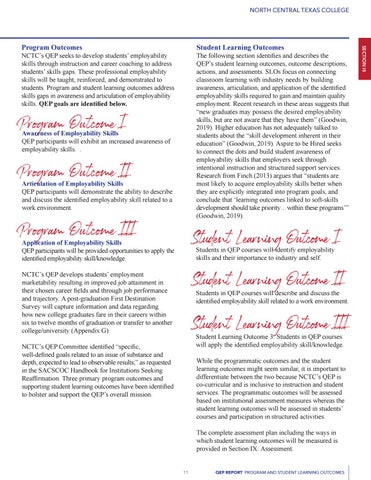
Program Outcome 1
Program Outcome 2
Program Outcome 3
Student Learning Outcome 1
Student Learning Outcome 2
Student Learning Outcome 3
Awareness of Employability Skills QEP participants will exhibit an increased awareness of employability skills.
Students in QEP courses will identify employability skills and their importance to industry and self.
Articulation of Employability Skills QEP participants will demonstrate the ability to describe and discuss the identified employability skill related to a work environment.
Students in QEP courses will describe and discuss the identified employability skill related to a work environment.
Application of Employability Skills QEP participants will be provided opportunities to apply the identified employability skill/knowledge.
Students in QEP courses will apply the identified employability skill/ knowledge.
Aspire to be Hired was piloted in the Summer 2021 in courses within the departments of Industrial and Engineering Technology, Public Administration and Management, Computer Information Technology, and Human Services and Hospitality. QEP REPORT EXECUTIVE SUMMARY
2
NORTH CENTRAL TEXAS COLLEGE
SECTION I
3
QEP REPORT EXECUTIVE SUMMARY
NORTH CENTRAL TEXAS COLLEGE
PROCESS AND TOPIC IDENTIFICATION SECTION II
Following these meetings, a Comprehensive Local Needs Assessment Procedure Manual for internal NCTC usage was developed to access the data and findings. These findings informed the scope and focus of the QEP by highlighting skill development needs and implementation practices. Meeting participants emphasized that written and verbal communication were not of the quality needed to represent their company or industry, and candidates often did not demonstrate this skill during the job interview stage and were not hired. Participant feedback showed that demonstration and modeling of quality communication, customer service, and professional work ethic are critical points needed by technical student graduates to enter their chosen careers. Stakeholders stated, “students are not receiving employability skills training early enough and throughout their time at NCTC. Career Services are not reaching Career and Technical Education students early and often enough to develop quality employment-ready skills that could help students as they work toward program completion and full-time entry into the local workforce.” The soft skill emphasis was not as robust as most NCTC Career and Technical Education students’ technical skills.
NCTC’s QEP is a product of systematic and regular assessment and the strategic planning process. At the time of its development, the college was also in the process of finalizing the 2020-2025 Strategic Plan. NCTC 2020-2025 Strategic Plan’s overall theme focuses on improving students’ engagement and achievement through curricular and co-curricular methods leading to equitable opportunities for success and positive and impactful change. Aspire to the Hired helps to fulfill an important part of the college’s mission and values.
History and Demographics
In Fall 2019, a Local Trends and Gaps Analysis was conducted throughout the NCTC service area to include Cooke, Denton, Montague, and Young Counties through a partnership with Hanover Research. The survey provided an analysis of relevant student and labor market data with the primary goal to help NCTC establish the community’s needs and understand where its programs are meeting labor market needs as well as what gaps exist. A secondary goal of this report was to provide an initial analysis of the college’s retention data and post graduation performance among students who have been flagged as at-risk due to academic or socioeconomic factors.
According to the survey results from community stakeholders (primarily employers, workforce agencies, and community-organization representatives participating in the survey), the top soft skills/employability skills that are needed for students were: communication; critical thinking; ability to learn/teachable/coachable; teamwork; and punctuality. Stakeholders repeatedly highlighted the need for graduate job-seekers to communicate effectively. Thirty-one of the 70 responders identified communication as the top soft skill needed to succeed in the workforce. The majority of the 70 responders identified communication in the top three needed soft skills. Producing teachable graduates correlates with communication skills as they need to be active listeners and communicate effectively with supervisors and colleagues to perform job tasks appropriately. Comprehensive Local Needs Assessment participants explained the need for graduate job-seekers to perform effectively on a team as a leader or participant and to utilize critical thinking and problem solving within their job duties. Stakeholders emphasized the importance of initiative and adaptability attributes, and an employee who utilizes critical thinking and problem solving skills. Professionalism was identified as essential due to poor customer service and work ethic in the current pool of employment candidates.
Analysis recommendations include information based on an assessment of workforce demand indicators for Cooke, Denton, Montague, and Young Counties and student success data. Major recommendations from the Comprehensive Local Needs Assessment included: • Focus on an additional 18 high-priority occupations and one new occupational cluster for wholesale and retail trade. • Offer a core set of programs at all locations targeting universally sought-after professions, but tailor other offerings to county-specific needs. In October 2019, as a response to the Local Trends and Gaps Analysis provided by Hanover Research, NCTC conducted multiple Stakeholder Meetings by utilizing the Comprehensive Local Needs Assessment model. The assessment asked, “How can North Central Texas College ensure effective collaboration occurs between community stakeholders to make sure students are receiving the necessary skills to be successful in the workforce?” Responses included enhancing communication between employers, establishing aligned education to career pathways for students, establishing effective work-based education experiences for students, and establishing seamless technical program alignment between school districts, community colleges, and universities to prepare students for multi-entry and exit points to careers. QEP REPORT DEVELOPMENT PROCESS AND TOPIC IDENTIFICATION
The Comprehensive Local Needs Assessment gives a clear picture of the local employer and community 4
NORTH CENTRAL TEXAS COLLEGE
The following employability skills were chosen as the bedrock for the QEP in response to the Community Local Needs Assessment for the Local Trends and Gaps Analysis and national data from the National Association of Colleges and Employers (NACE) and the Perkins Collaborative Resource Network. The QEP consistently defines these skills in student learning outcomes, rubrics, course outline guides for the classroom, and structured support services for workshops, individual coaching, and virtual learning opportunities. Career and technical divisions will identify which of these employability skills they will implement into their specific programs. Flexibility in employability skill implementation allows faculty to provide more focused training in skills that meet their industries needs.
During the open house sessions, each topic was presented and discussed with feedback from all participants. When discussing soft skills, a faculty member shared the following observation:
Campus-Wide Involvement
The development and discovery phase for Aspire to be Hired was guided by the Provost and incorporated broad-based and multifaceted communications across all campuses, gathering input into topic selection. All college employees received an email describing the requirements of a Quality Enhancement Plan in October 2019. Included in the email was a “Call for Topic Recommendations.” All faculty and staff were encouraged to send ideas for increasing student success and improving the institution’s overall quality (Appendix A). The Provost’s office received twenty-four suggested topics from fourteen employees across the district (Appendix B).
Following the college open houses, NCTC leadership created a committee to lead the remainder of the processes associated with the QEP and its development. This committee was approved by the Administration to move forward with their work.
Narrowing the Topic
In order to reduce the number of topic choices, the college conducted a survey in mid-November 2019 and collected 124 responses, representing 30% of the full-time employees. Three themes emerged: • Writing Right: Increasing students’ abilities to write in appropriate and meaningful ways across the curriculum. • Establishing a process to ensure that online class success is similar to face-to-face class success. • Focusing on soft skills and critical thinking in the curriculum for job seeking graduates. 5
QEP REPORT DEVELOPMENT PROCESS AND TOPIC IDENTIFICATION
SECTION II
The next step was to conduct a series of QEP Open Houses scheduled across the district to present and discuss the narrower topics, provide information to the college body about the QEP, provide further insight into specific areas of interest, and identify the possible associated impact of each. These open houses met on all six NCTC campuses and online between November 18 and November 26, 2019. The topic submissions’ authors explained the three developed themes and reasoning behind each.
member experience with NCTC graduates. NCTC must respond to the needs identified in this study. Therefore, Aspire to be Hired was developed, in part, as a direct response to the research and seeks to serve NCTC students and local employers through the intentional professional development of students to meet the identified needs of these local employers.
NORTH CENTRAL TEXAS COLLEGE
PROCESS AND TOPIC IDENTIFICATION SECTION II
NCTC QEP Committee
Committee members were selected based on the division and department, as represented at the district level. Having a broadbase of involvement and input gives the program multiple perspectives, feedback, and support to provide a holistic student experience.
QEPCOMMITTEE Melinda Carroll
Vice Chancellor of Enrollment Management
Debbie Sharp
Vice Chancellor of External Affairs
Debbie Huffman
Dean of Instruction for Career and Technical Education
Susan Svane
Division Chair for Information Technology and Computer Science
Dr. Rochelle Gregory
Division Chair for English, Speech, Foreign Language
Maggie Row
Institutional Effectiveness Instruction Liaison and English Instructor
Amy Klohn
Senior Director of Completion and Career Services
Donna Uptergrove
Senior Director of Grants and Institutional Advancement
Daphne Riddle
Director of Career Services and QEP
QEP REPORT DEVELOPMENT PROCESS AND TOPIC IDENTIFICATION
6
NORTH CENTRAL TEXAS COLLEGE
ethical decision-making, teamwork/collaboration, professional spoken and written communication, and problem solving, and offering structured support, NCTC will improve its retention and completion rates.
Throughout the topic identification process, the QEP Committee worked with college constituents to determine the best plan of action to ensure the final QEP topic would improve students’ abilities to implement and articulate their personal soft-skill development and employability. Faculty and staff members were involved in researching best practices in academic and industry literature to determine the specific methods and activities to be used in this project.
Based on the QEP proposal, literature and research review, and stakeholder feedback, the committee determined that the QEP implementation should begin within the Career and Technical Education programs. Implementation would begin in one division, led by an instructional dean and would then scale to other career and technical programs, supervised by other instructional deans. The QEP would adapt to include any new programs added to the career and technical education offerings, and programs with higher enrollment would be targeted to begin first. Career and Technical Education programs and enrollment data are listed in the table below (Appendix C).
Additionally, Student Services’ representatives gathered research and resources on identifying employability skills and utilizing structured support services to enhance the student learning experience. Best practices learned from this research were incorporated into the QEP’s development. By enhancing the students’ professional development experience, focusing on skills such as
Table 1: Career and Technical Education Enrollment Data
7
QEP REPORT DEVELOPMENT PROCESS AND TOPIC IDENTIFICATION
SECTION II
Topic Identification
NORTH CENTRAL TEXAS COLLEGE
AND STUDENT LEARNING OUTCOMES SECTION III
reinforced, and mastered in their Career and Technical Education programs. These “implementation points” ensure that the QEP content is being provided a minimum of three times for a career and technical degree program. Certificate programs and skills awards will seek to implement one QEP lesson per semester. (Appendix F)
In summer 2020, once the QEP director was officially appointed and program development had begun, the QEP Committee sought student input and involvement in the implementation process (to align with the QEP’s commitment to broad based institutional support) and created a contest for students to name the program and design the logo. The Provost sent an email to all students inviting their submissions:
• Implementation Point I Introduction will be provided early in a program or in a course that is part of an Occupational or Workforce Skills Award to build employability skill awareness. Introduction can include awareness, articulation, and/or application of skill.
NCTC Students-
“ Here’s your opportunity to NameIt! Students can leave their mark on NCTC History by naming our newest program, and help us market it to the NCTC community. The program is being developed to increase student’s Employability Skills…both in, and out of the classroom! Specific employability skill sets and activities will be embedded into NCTC curriculum for our job seeking graduates!”
• Implementation Point II Reinforcement will ideally be implemented in the middle of the program and build on students’ ability to articulate, describe, and discuss the importance of employability skills to employers. Awareness and application can also be a part of that reinforcement. • Implementation Point III Mastery/Application will be taken towards the end of a pathway/program to ensure the application of an employability skill has been offered.
The committee reviewed thirteen student submissions for the name of the program and a logo. The committee selected a cyber security student's submission, “Aspire 2 Hire.” The committee revised the title to “Aspire to be Hired,” and the NCTC Marketing Department developed the logo and enhanced it to meet publishing standards (Appendix D).
In addition to QEP course implementation, students will receive structured support services from the Completion and Career Services Center. Career and Technical Education students in QEP courses will be assigned to career coaches and will receive consistent outreach and resources starting in their first semesters. Faculty members will require students to attend career coaching sessions. Coaches will provide in-person and virtual professionalism training that include career development and career readiness opportunities.
Aspire to be Hired focuses on teaching, fostering, and demonstrating professional employability skills to students through intentional instruction and career development coaching. Aspire to be Hired addresses employability skills gaps, gaps in awareness and articulation of employability skills, and practical experiences of skill application. To reduce learning gaps, overcome obstacles, and increase student success, the blanketed approach of teaching, coaching, and modeling employability skills supports creating a culture of employability where students become aware early of their personal responsibility to develop themselves professionally. The primary goal of Aspire to be Hired is to remove barriers and reduce the skills gap for long-term student success.
The QEP Committee constructed a timeline to provide a framework for the plan’s timely development, implementation, and program launch. The time periods, phases, and accomplishments are listed in the table on the following page.
Targeted courses are identified through curriculum mapping (Appendix E). These courses 1) are required for most, if not all, students in a particular program, 2) begin early in a degree plan, and 3) align with employability readiness, i.e., EPA Cert Prep, Technical Customer Service, Capstone. Faculty have “implementation points” at which the employability skills will be introduced, QEP REPORT PROGRAM AND STUDENT LEARNING OUTCOMES
8
NORTH CENTRAL TEXAS COLLEGE
TIME PERIOD
PHASE
ACCOMPLISHMENTS
SUMMER 2019
Pre-Development Phase
-- Reviewed QEP requirements and updates
FALL 2019
Topic Selection Phase
-- Broad based, system wide participation in topic selection -- Hold open forums on all NCTC campuses -- Selected QEP topic
SPRING 2020
Early Development Phase
-----
SUMMER 2020
Early Development Phase Continued
-- Hired QEP director (Sept. 1, 2020) -- Began planning beta launch for fall -- Identified course for beta, EECT 1300
FALL 2020
Development Phase
------
SPRING 2021
Finishing Phase
-- Finalized program outcomes -- Developed course activities and assignments with corresponding data rubrics -- Developed Canvas (LMS) course content -- Finalized all structured support activities and program alignment -- Finalized literature review and best practices -- Continued Beta continuation in EECT 1300, ITSE 2380, HART 1356
SUMMER AND FALL 2021
Submission of QEP to SACSCOC
--------
Narrowed the focus of the topic Determined academic programs for pilot Defined structured support role Began drafting QEP mission and programmatic goals
Began drafting student learning outcomes Began drafting QEP narrative Narrowed down program and course implementation Conducted “NameIt” student contest for QEP name and logo Designated QEP faculty liaison to assist with course redesign and activity/assignment development, rubric development -- Launched Beta in EECT 1300, ITSE 2380
Finalized QEP narrative Finalized student learning outcomes Conducted pilot in summer sessions Scheduled Fall in-service for employees and faculty Scheduled WeLLcome Back week activities on all NCTC campuses Submitted to Board of Regents for approval Submitted QEP to SACSCOC
9
QEP REPORT PROGRAM AND STUDENT LEARNING OUTCOMES
SECTION III
Table 2: Development and Implementation Timeline
NORTH CENTRAL TEXAS COLLEGE
AND STUDENT LEARNING OUTCOMES SECTION III
The student learning outcomes (SLO) for NCTC’s QEP, Aspire to be Hired, describe the knowledge, skills, and behaviors students will demonstrate after the program.
These learning outcomes address the awareness, articulation, and application of employability skills using a multifaceted approach to implementation and assessment.
Table 3: Employability Skills
SKILLS
KNOW THEM, TALK ABOUT THEM, USE THEM!
QEP REPORT PROGRAM AND STUDENT LEARNING OUTCOMES
10
NORTH CENTRAL TEXAS COLLEGE
Student Learning Outcomes
The following section identifies and describes the QEP’s student learning outcomes, outcome descriptions, actions, and assessments. SLOs focus on connecting classroom learning with industry needs by building awareness, articulation, and application of the identified employability skills required to gain and maintain quality employment. Recent research in these areas suggests that “new graduates may possess the desired employability skills, but are not aware that they have them” (Goodwin, 2019). Higher education has not adequately talked to students about the “skill development inherent in their education” (Goodwin, 2019). Aspire to be Hired seeks to connect the dots and build student awareness of employability skills that employers seek through intentional instruction and structured support services. Research from Finch (2013) argues that “students are most likely to acquire employability skills better when they are explicitly integrated into program goals, and conclude that ‘learning outcomes linked to soft-skills development should take priority…within these programs’” (Goodwin, 2019).
Awareness of Employability Skills QEP participants will exhibit an increased awareness of employability skills. .
Articulation of Employability Skills QEP participants will demonstrate the ability to describe and discuss the identified employability skill related to a work environment.
Application of Employability Skills QEP participants will be provided opportunities to apply the identified employability skill/knowledge.
Students in QEP courses will identify employability skills and their importance to industry and self.
NCTC’s QEP develops students’ employment marketability resulting in improved job attainment in their chosen career fields and through job performance and trajectory. A post-graduation First Destination Survey will capture information and data regarding how new college graduates fare in their careers within six to twelve months of graduation or transfer to another college/university (Appendix G).
Students in QEP courses will describe and discuss the identified employability skill related to a work environment.
Student Learning Outcome 3: Students in QEP courses will apply the identified employability skill/knowledge.
NCTC’s QEP Committee identified “specific, well-defined goals related to an issue of substance and depth, expected to lead to observable results,” as requested in the SACSCOC Handbook for Institutions Seeking Reaffirmation. Three primary program outcomes and supporting student learning outcomes have been identified to bolster and support the QEP’s overall mission.
While the programmatic outcomes and the student learning outcomes might seem similar, it is important to differentiate between the two because NCTC’s QEP is co-curricular and is inclusive to instruction and student services. The programmatic outcomes will be assessed based on institutional assessment measures whereas the student learning outcomes will be assessed in students’ courses and participation in structured activities. The complete assessment plan including the ways in which student learning outcomes will be measured is provided in Section IX: Assessment. 11
QEP REPORT PROGRAM AND STUDENT LEARNING OUTCOMES
SECTION III
Program Outcomes
NCTC’s QEP seeks to develop students’ employability skills through instruction and career coaching to address students’ skills gaps. These professional employability skills will be taught, reinforced, and demonstrated to students. Program and student learning outcomes address skills gaps in awareness and articulation of employability skills. QEP goals are identified below.
NORTH CENTRAL TEXAS COLLEGE
REVIEW AND BEST PRACTICES SECTION IV
teamwork, and punctuality. Direct responses from employers at the meetings or via the survey included:
Recent high school and college graduates launching their careers in the latter half of 2020 found themselves entering the worst job market in generations as COVID-19 decimated entire sectors of the economy. With the businesses shuttered, job fairs canceled, and unemployment reaching a record high, these new workers faced stiffer competition than ever before. As workers set foot into the labor market, they may have asked: “Do I have what it takes to succeed in the American workforce?” In good job markets and bad ones, a person’s qualifications for employment are generally defined by a combination of their education, experiences, and competencies--the skills, knowledge, and abilities that are essential to success on the job. (Golodryga, 2020). NCTC conducted a preliminary study in the Fall 2019 semester in the form of a robust Comprehensive Local Needs Assessment, in compliance with the federal Carl D. Perkins V Grant guidelines. Six community stakeholder meetings, including local employers, workforce agencies,community-based organizations, P-12 and higher education, and parents of college students, were held in October (237 attendees, including 18 students) and two Career and Technical Education student focus groups (32 attendees) in November. NCTC developed and launched online community surveys (69 responses) and online student surveys (306 responses) in November 2019. Findings from these surveys indicated that more emphasis was needed on instructing and developing soft skills/employability skills with our college students.
During the literature review phase of the NCTC QEP project, the importance of the NCTC QEP topic was affirmed by the Georgetown University Center on Education and the Workforce study, Workplace Basics: The Competencies Employers Want, that showed that workers need more than just their educational credentials to qualify for jobs that pay well, keep those jobs, secure promotions, and boost their earnings on the job (Georgetown University Center, n.d.). The study also revealed the five most in-demand competencies across the labor market. These five include the following employability skills: communication, teamwork, sales and customer service, leadership and problem solving, and complex thinking (Georgetown University Center, n.d.). Each of these competencies is key to workers’ abilities to contribute in the workplace. These competencies are especially critical for workers in competitive job markets. Job posting data have shown that these general competencies are universal and timeless, while other specific competencies continually fall in and out of favor.
Stakeholders attending the meetings and participating in the community survey strongly emphasized that written and verbal communication were not of the quality needed to represent their company or industry. The lack of this skill was often detected during the job interview stage and resulted in some candidates not being hired. The ability to demonstrate and model quality communication, customer service, and professional work ethic is an essential component for success. The soft skill emphasis is not as robust as most NCTC Career and Technical Education students’ technical skills.
Additionally, the QEP Committee also reviewed J. Casner-Lotto and L. Barrington’s 2006 publication, “Are They Really Ready To Work? Employers’ Perspectives on the Basic Knowledge and Applied Skills of New Entrants to the 21st Century U.S. Workforce,” in which they presented a report card for two-year colleges based on a survey of over 400 employers across the United States that showed the urgent need for improved skills in communication, collaboration, critical thinking, work ethic, and social responsibility. This study remains
The top soft skills/employability skills needed for students according to the survey results from community stakeholders (primarily employers, workforce agencies, and community organization representatives participating in the survey) were communication, critical thinking, coachability, QEP REPORT LITERATURE REVIEW AND BEST PRACTICES
12
NORTH CENTRAL TEXAS COLLEGE
skills embedded into the course curriculum and supported by structured support services in the Career Services department.
The QEP Committee also relied on research from Melissa Stange’s 2020 article, “Preparing Students for Digital Era Careers” that reported that, out of 3700 executives nationwide, only 18% believe that technical skills are the most important and that graduates should be more forward-thinking and posses change-oriented mindsets, leadership qualities, and collaborative skills, that are acquired through real-time experiences in unstructured environments that invite students to learn from failure and embrace change. (Stange, 2020).
• • • • • • • •
Professional Communication Problem Solving Critical Thinking Emotional Intelligence Ethical Decision-Making Teamwork/Collaboration Interpersonal Skills/Professionalism Leadership
The QEP Committee also relied on research about best practices for articulating employability skills, embedding course content, and project assessment.
This literature review informed the committee’s commitment to the comprehensive planning process. The committee selected the following employability
13
QEP REPORT LITERATURE REVIEW AND BEST PRACTICES
SECTION IV
relevant because developing these employability skills is still highly valued by employers in 2021.
NORTH CENTRAL TEXAS COLLEGE
REVIEW AND BEST PRACTICES SECTION IV
V. Indrasiene et al. (2020), in “The Critically Thinking Employee: Employers’ Point of View,” conducted a phenomenology of 28 managers in the labor industry and identified three hierarchically interconnected categories related to critical thinking: 1) the importance of deciding to act, 2) making verified and assured decisions, and 3) making innovating decisions for operational improvement. Indrasiene et al.’s study identified the specific critical thinking skills employers want and employees need. This study identified managers’ perceived challenges with locating skilled employees who possess these critical thinking skills. This research offers a vocabulary and rationale for promoting critical thinking in workforce industry education and collecting industry leaders’ reactions and responses.
Professional Communication Communication is a critical competency because workers need to communicate with clients and colleagues to complete collaborative tasks, fulfill clients’ needs, and adapt to changing demands and priorities. While different jobs involve varying combinations of written and oral communication and different balances between expressing (speaking and writing) and interpretive (listening and reading), communication is in high demand in every occupation. The following articles provide additional evidence for the value of communication in the workplace. According to S. Majid et al. (2021) in their article, “The Importance Of Soft Skills For Employability And Career Development: Students And Employers’ Perspectives,’’ students rated communication near the bottom of importance while employers ranked it at the top. Data was based on questionnaire results from 188 business management students from four universities across India. This research suggests that students need to understand how career attainment and advancement rely on strong communication skills. N. Fajaryati et al. (2021) argued in “Instrument Development For Evaluating Students’ Employability Skills” that communication, teamwork, problem solving, and technology utilization are the most required soft skills employers seek. Including communication training into the curriculum to apply these communication skills in real-life situations increases students’ understanding of how strong communication improves their career success.
In “Strategic Skills: Closing the New Talent Gap” (2016), J. Chartrand, C. Fife, and S. Flander identified the increasing “strategic” skills gap that employees, managers, and emerging executives need in the growing labor market. These researchers outline the four characteristics that “balanced leaders” possess in the workforce: • The ability to engage in critical thinking by gathering information and evaluating the evidence and alternatives to make sound, informed decisions. • The ability to collaborate well with others and foster communication that inspires a shared vision and achieves common goals. • The ability to draw upon prior knowledge and research to examine situations and problems and make novel and inspired connections to perform successfully in new situations.
Problem Solving and Critical Thinking Problem solving and critical thinking are more critical than ever for the success of both workers and employers. As robots and computers handle a more significant percentage of manual tasks, workers spend more time on higher-order tasks requiring interpretation, creativity, and flexibility. Problem solving and critical thinking allow workers to identify challenges, create solutions, and measure results. The QEP Committee reviewed the following articles to gain additional insight into problem solving and critical thinking in the workplace.
• The ability to build and organize a cohesive team that is motivated toward collective performance and cohesiveness. This research is essential for the project because it offers a rationale and vocabulary for career and technical educators to incorporate when building critical thinking and interpersonal skills into their curricula.
N. Wyman (2015) advocated in “The New Employability: Steering Our Students Toward Rewarding Techniques: Connecting Education and Careers” that students have basic employability, communication, problem solving, and time management skills that will lead them to successful careers. A recent survey of 1,400 hiring managers found that the most valued skills in potential hires were problem solving, learning quickly, and handling change. Offering an innovative curriculum with considerable technical and employability skills addresses these needed real-world workplace skills. QEP REPORT LITERATURE REVIEW AND BEST PRACTICES
L. M. Murawski (2014) noted the characteristics of a skilled critical thinker in the higher education classroom and how those skills are beneficial in the workplace. Murawski emphasized that this skill must be taught directly in higher education coursework and cannot be viewed as an educational byproduct.
14
NORTH CENTRAL TEXAS COLLEGE
Teamwork Teamwork skills, like persuasion, social perceptiveness, and service orientation, allow workers to collaborate with others in the interest of completing shared tasks and meeting mutual goals. The collaborative demands and the overlapping nature of workplace roles have increased teamwork as an essential competency. A. Finley (2021) noted in “How College Contributes to Workforce Success: Employer Views on What Matters Most” that 54% of employers say ethical judgment and reasoning is an essential skill, but only 41% responded that “recent grads are very well prepared” to engage in ethical decision-making, which leaves a preparedness gap of 14%. Additionally, 62% of employers responded that collaborating in teams is very important, but only 48% believe recent graduates are very prepared to do so, leaving a preparedness gap of 14%. This study identifies the gaps between the importance and preparedness of employability skills for graduating students, lending credence to the early and often rule of introduction, instruction, and assessment of these skills throughout their educational work.
C. D. Hatch and S. Stephen, in “The Effectiveness of Social Responsibility Courses in Higher Education” (2015), studied the integration of individual and corporate social responsibility (ISR and CSR) instruction into the core curriculum at Butler University through community outreach partnerships. The curriculum strives to promote students’ understanding of personal and social responsibility, foster ethical decision-making, encourage civic-mindedness, develop intercultural and interpersonal skills, and enhance students’ overall learning. The research found that students perceived the curriculum to be beneficial and shaped students’ understanding of ethical business practices and decision-making. Hatch and Stephen’s 2015 study provided justification and modeled how other higher education institutions can integrate social responsibility and inclusive ethical decision-making into career and technical education programs.
Interpersonal Skills/Professionalism According to the Perkins Resource Collaboration Network, interpersonal skills encompass various additional employability behaviors, including teamwork, customer service, leadership, conflict resolution, and social responsibility. Straw, Hart and Harland (2011) further identified communication as an interpersonal skill. Still, other entities separate professionalism from interpersonal skills. Many categories of “employability skills” overlap and are not always separate or distinct. However, there is consensus that strong interpersonal skills and a high level of professionalism positively correlate with success in the workplace. Research (Klein) further suggested that “...[due to] the complex and dynamic nature of interpersonal [skills]… such training should focus on specific, optimal social skills, and not on increased general sensitivity or insight.” This research further suggested that communication and relationship-building are critical components in building interpersonal skills.
M. Jones et al. (2016) interviewed 51 recruiters who stated that 21 two of the most desirable characteristics of new hires were trustworthiness, honesty, ethics, and cooperation, outranking high grades (number 19) and work experience (number 17). Emotional Intelligence Choudhary and Sharma (2011) defined Emotional Intelligence as self-awareness, self-confidence, self-control, commitment, and integrity: “Research has shown that over 80% of the competencies that differentiate top performers from others are in the domain of Emotional Intelligence...according to Harvard Business Review (2003), managing emotions is anything but soft…” (Institute for Health and Human Potential, 2021). The Center for Creative Leadership has found that the primary causes of derailment in executives involve deficits in emotional competencies: difficulty in handling change, inability to work well in a team, and 15
QEP REPORT LITERATURE REVIEW AND BEST PRACTICES
SECTION IV
poor interpersonal relations, all of which impact overall productivity (Institute for Health and Human Potential 2021). This research also indicated that leaders hold three critical abilities: high emotional intelligence, 1) personal accountability, 2) non-judgmental active listening, and 3) non-avoidance of difficult conversations and holding others accountable.
Ethical Decision-Making Every employee is an investment, and employers benefit when assessing whether a prospective employee will make wise and moral work decisions. Employees benefit from learning the importance of making ethical decisions on the job. Instructing and coaching students to develop forethought in considering possible outcomes and developing a deeper understanding of the importance of analyzing possible consequences at varying degrees equips students to become more ethical and socially responsible. Ethical decision-making and social responsibility represent higher-level thinking and processing of information that improves the likelihood of success.
NORTH CENTRAL TEXAS COLLEGE
REVIEW AND BEST PRACTICES SECTION IV
and how to articulate those skills. NCTC's QEP outcomes are directly related to addressing these challenges. Intensified intentional instruction and coaching to specifically identify employability skills and the understanding of faculty and coaches of the need to assist students in connecting classroom experience and career application will improve students’ awareness of their professional development, as well as support their ability to describe and discuss, not only the skill but their level of attainment and practical application of skills. Improvement in awareness and articulation of skills will more fully develop career readiness and improve job applicant performance.
Leadership Leadership is the culmination of professional behavioral skills employed at a high level. Leaders develop through challenges and by persisting through difficult situations. Leadership skills cannot be acquired outside of adverse or distressing situations. On the other side of a challenging experience, leadership skills are gained by having led others through it. Leadership requires strong communication, integrity, emotional intelligence, critical thinking, the desire to lead, and the assertion to step out into the role of a leader (Watson, 2010). Definitions and focus of leadership skills vary as widely as career fields and fields of study. However, consistent across research are adaptability, collaboration, vision, and commitment to the mission. “Leadership requires lifelong learning because the implementation of a vision often requires knowledge or skills that the team, including the leader, may not possess” (Watson, 2010). Three different instructional strategies that enhance students’ leadership skills and technical knowledge include 1) academic research training, 2) academic and industry partnerships in research, and 3) learner-centered courses. Other instructional strategies, such as degree or certificate programs in leadership, do exist, but they do not show evidence of strengthening students’ technical knowledge (Watson, 2010).
J. G. Tomasson et al. (2019) addressed these challenges in their publication, “Can Students Be Taught To Articulate Employability Skills?” Tomasson et al.'s research explored how to teach students to articulate their employability skills in the workforce. They found that students who completed classes using the embedded Situation, Task, Actions, Results (STAR) format could adequately articulate their skill. In “Encouraging Students To Draw On Work Experience When Articulating Achievements and Capabilities To Enhance Employability” (2019), Denise Jackson and Susan Edgar (2019) similarly stated that training students to articulate their skills to employers enhances students' employability. A professional portfolio is one way to achieve this goal.
Consequently, it can be assumed that cross-curriculum leadership training is beneficial to students in developing leadership skills to benefit career success. This research further suggested that apprenticeships provide positive leadership training: “Despite many of these styles put forward to explain what leadership constitutes, some elements can be associated within conceptualizing leadership, such as leadership being a process, leadership influencing others, leadership influencing groups of people, leadership involving common goals, and so on (Rayiramkandath, 2017). Based on this understanding, ‘leadership’ can finally be understood as the “process whereby an individual influences a group of individuals to achieve a common goal” (Rayiramkandath, 2017). Various functions of a leader are carried out through the leadership process that influences the individual employees to perform through the influence of the leader” (Rayiramkandath, 2017).
Embedded Course Content The QEP Faculty Task Force will support the instructional implementation by outlining the sequence in employability skills and embedded them into courses through signature assignments. The following research provided some best practices for embedding into the courses. K. N. Tang (2019) in “Beyond Employability: Embedding Soft Skills In Higher Education” discussed the effectiveness of embedding soft skills into academic coursework to improve students’ employability skills. A. Hassan, M. Maharoff, N. Z. Abiddin, in “The Readiness of Lecturers in Embedding Soft Skills in the Bachelor’s Degree Program in Malaysian Institutes of Teacher Education,” study embedded soft skills in higher education course work to determine whether lecturers were prepared to embed soft skills into core courses and sought to uncover potential issues with such a practice.
Articulating Employability Skills Many of the required skills for employment are inherent in higher educational processes. Students often lack an awareness of the transferability of these skills QEP REPORT LITERATURE REVIEW AND BEST PRACTICES
G. A. Meeks noted in “Critical Soft Skills to Achieve Success in the Workplace” how research studies found 16
NORTH CENTRAL TEXAS COLLEGE
on the skills of 1) self-management, 2) teamwork, 3) business and customer awareness, 4) problem solving, 5) communication and literacy, 6) applied numeracy, and 7) applied information technology. This assessment included an “employability self-evaluation” that can be taken multiple times to monitor a student’s progress instead of a simple pre-and post-test. In addition to this, Solent used portfolios, which it sees as a “shift away from comparison and achievement” and allows for a “more individualized approach.” These portfolios were tailored to an existing, real-world job posting and include a student reflection on his/her speaking and reading test results, a CV, and an academic essay. The authors assured that portfolios can be scaled up or down to keep them from being “assessment-heavy,” deepening the student grouping.
Assessment Method Aspire to be Hired focuses on specific student learning outcomes and student success. It is being implemented in the Career and Technical Education courses’ curriculum and through structured support services. The assessment method needs to consistently measure access to employability skill instruction and training, engagement with professional employability training, career readiness improvement, and areas of increased need. Assessments are provided consistently and continuously to address awareness, articulation, and application of specific employability skills in instruction and structured support.
In “Metrics for Students’ Soft Skills,” V. Devedzic et al. characterized soft skills as “easy to notice” but “hard to measure” and brand existing assessment methods as “vague.” They summarized these existing methods in four distinct steps and counter with a method they call GRASS (Grading Soft Skills). Their method included both quantitative and qualitative assessment, which must include “a variable being measured (of a certain feature/component of a specific soft skill)” and “a score/ rating scale for the given variable, corresponding to the pre-specified levels of performance.” The authors offered concrete steps on how to identify critical components of each soft skill to measure, as well as how to apply GRASS metrics, including “benchmarking.”
In “Embedding Key Transferable Employability Skills for Lifelong Success through Blending and Innovative Portfolio to Complement Traditional Assessment,” J. Hooker and J. Whistance outlined the results of Southampton Solent University’s efforts to assess the employability skills acquisition of ESL students through both traditional assessments and an electronic portfolio. Solent focuses
17
QEP REPORT LITERATURE REVIEW AND BEST PRACTICES
SECTION IV
that the most significant gaps existed in communications skills and conceded an integrative approach was needed in higher education institutions to address this gap and affirmed the importance of having lecturers involved in delivering and assessing soft skills and a solid system for measuring learning outcomes in coursework. Meeks proposed and piloted a 24-hour soft skills workshop for faculty and concludes her workshop with a follow-up assignment to solicit feedback on incorporating these skills into the classroom.
NORTH CENTRAL TEXAS COLLEGE
PLAN SECTION V
The QEP implementation is a five-year process, including the pilot implementation phase during the 2020-2021 academic year. This process’s components involve intentional and strategic change management within the interconnected network of the college through partnership, collaboration, data review, and continuous assessment and evaluation. Modifications in instructional pedagogy and methodology and structured student support services will occur throughout all areas during the implementation period.
Over the past three years, NCTC has utilized data, current research, and feedback gathered from faculty, staff, and service area stakeholders to determine barriers that impede student success and gainful employment. The institution has strategically and carefully analyzed system-wide data to determine the design context and the actions needed for successful program implementation of the following goals over the next five years:
Instructional Implementation and Program Content Development
Implementation in career and technical education programs provides direct and intentional instruction of employability skills to students within the curriculum by instructors with industry-specific knowledge and skills. The QEP will begin in one career and technical division for pilot and launch and then later will scale-up to additional divisions and employability skills.
QEP REPORT IMPLEMENTATION PLAN
18
NORTH CENTRAL TEXAS COLLEGE
INSTRUCTIONAL IMPLEMENTATION Fall 2020 BETA (2) PROGRAM
SUMMER 2022
Faculty division chairs in Farm and Ranch Management, Equine Science, and Horticulture will appoint faculty to the Faculty Task Force during Summer 2022. The QEP director will meet and begin training faculty for Fall 2022 implementation.
-- Computer Information Systems & Technology (CITE) -- Heating, Ventilation, & Air Conditioning (HVAC)
SPRING 2021
Faculty division chairs in Industrial & Engineering Technology, Computer Information Systems & Technology, Human Services & Hospitality, and Public Administration & Management will appoint faculty to the Faculty Task Force during Spring 2021. The QEP director will meet and begin training faculty for Summer 2021 implementation.
BETA (3) PROGRAM
-- CITE -- Database Management -- HVAC
HVAC Welding Machining Industrial Mechanics Criminal Justice Business Management Accounting Cosmetology Esthetics Barbering Game Development Networking
PROGRAM LAUNCH
-- Fire Science -- EMT -- Allied Health Programs
PROGRAM SCALE-UP
-- Farm & Ranch Management -- Equine Science -- Horticulture
SPRING 2023
FALL 2021
------------
-- Fire Science -- EMT -- Allied Health Programs
The QEP Director will meet and begin training faculty for Summer 2023 launch.
Faculty division chairs in Registered Nursing, Licensed Vocational Nursing, Surgical Technology, and Radiological Technology will appoint to the Faculty Task Force during Fall 2021. The QEP director will meet and begin training faculty for Spring 2022 implementation.
PROGRAM LAUNCH
PROGRAM SCALE-UP
Associate Degree Nursing Licensed Vocational Nursing Surgical Technology Radiological Technology
FALL 2022
SUMMER 2021
-------------
-----
Faculty division chairs in Child Development will appoint faculty to the Faculty Task Force during Fall 2022. The QEP director will meet and begin training faculty for Spring 2023 implementation.
The QEP director will meet and begin training faculty implementing QEP assignments in Fall 2021.
PROGRAM PILOT
PROGRAM LAUNCH
PROGRAM LAUNCH
-- Farm & Ranch Management -- Equine Science -- Horticulture
PROGRAM SCALE-UP
-- Child Development
SUMMER 2023 PROGRAM LAUNCH
HVAC Welding Machining Industrial Mechanics Criminal Justice Business Management Accounting Cosmetology Licensed Vocational Nursing Surgical Technology Radiological Technology
19
-- Child Development
QEP REPORT IMPLEMENTATION PLAN
SECTION V
The following table provides a timeline of instructional QEP course implementation and scale plan.
NORTH CENTRAL TEXAS COLLEGE
PLAN SECTION V
Canvas, the NCTC Learning Management System, is utilized by QEP faculty to provide a platform to access rubrics, utilize a course guides, build a repository of course content and support materials, and collaborate with other faculty in creating program-specific lessons and assignments that build employability skill awareness, articulation, and opportunities for application. Collaboration for curriculum design between academic deans, division chairs, and faculty members supports comprehensive and consistent content development within the programs/pathways.
• Create three content/assignments that introduce, reinforce, and assess each identified employability skill related to specific programs. • Provide additional training to program colleagues. • Meet two times per semester. • Host one career development event per semester. Canvas Course Aspire to be Hired: QEP Faculty Course has been designed to provide for collaboration and guidance. The Canvas’ course goal is to provide a repository of employability skill content, idea prompts, discussions, announcements and deadlines. It is also the official housing location for all Aspire to be Hired signature assignments, official rubrics, and the QEP course guide, which provides the framework for content/assignment requirements to meet the program outcomes. (Appendix H).
Two semesters prior to scale-up into the new programs, the instructional dean and division chairs will begin meeting to choose which of the identified employability skills will be implemented, identify faculty for content development, and build rubrics and curriculum maps. One semester before the scale-up, identified faculty will be introduced to the QEP Faculty Task Force led by the QEP director and the instructional liaison for QEP outcomes and procedures. Faculty will begin building program-specific content and preparing for implementation into courses.
Rubrics Rubrics were created by instructional deans, division chairs, a faculty liaison, and the QEP director to provide a consistent measure to be used throughout all Aspire to be Hired implemented courses. One rubric will be created for each employability skill. At this time, rubrics have been created for four of the eight employability skills being used for Aspire to be Hired, including ethical decision-making, problem solving, professional communication, and teamwork/collaboration. Additional rubrics will be built as programs add employability skills. The rubric provides a 3-point scale of Above Average (3), Average (2), Below Average (1), and No Submission (0). The rubric’s goal is to measure students’ understanding of specific employability skills (not assessed individually but as a part of a student’s ability to demonstrate the employability skill), and the program outcome of articulation. (Appendix I).
Support for instructional implementation is provided through multiple methods. Focus is given to providing space for collaboration, communication, and guidance while allowing instructors the flexibility to individualize and adapt employability skills lessons to their specific program pathways. Faculty Task Force The QEP Faculty Task Force is critical in creating relevant and applicable employability skill content for instruction. This task force will be populated by program faculty, division chairs, QEP faculty liaison and a career coach. Division chairs will choose faculty to create Aspire to be Hired lessons/assignments aligned with the needs of their programs/pathways. Following the initial act of content creation, faculty will remain on the task force to provide career development opportunities, feedback, continuous monitoring, and suggestions for QEP effectiveness. Faculty will be appointed to the task force the semester before program implementation and added to the QEP Faculty Canvas course. A career coach is assigned to the task force and will be responsible for coordinating task force meetings and career events. The Faculty Task Force will:
Employability Skill Course Guide Division chairs, the QEP faculty liaison, and the QEP director will create a course guide of employability skills to assist faculty in meeting the QEP program outcomes (i.e., intentional instruction towards awareness, articulation (describe and discuss), and application). The course guide will provide a consistent outline for structure and allow for flexibility to meet program needs (Appendix J).
Structured Support Services Implementation The Career Services Center will set goals and program objectives to align with the QEP’s mission and program outcomes. Career Services will provide training and
• Participate in kick-off meeting and training, recorded, and available in Canvas course.
QEP REPORT IMPLEMENTATION PLAN
20
NORTH CENTRAL TEXAS COLLEGE
discussions, Power Half Hour seminars, and leadership development activities. The campus events calendar, department and institution social media, and the monthly Completion and Career Newsletter (distributed to all first-year students) will provide notification and information on upcoming career development programming (Appendix L). Canvas provides multiple opportunities to engage students in their career development. The CareerLab in Canvas is a public course that will provide resources to students, faculty, and staff. The course will include career development and exploration articles, videos, resource pages, and links. Additionally, Career Services will partner with the NCTC Advising department and include a module in the All Student Advising group in Canvas. All currently enrolled NCTC students will be participants in this group. The Career Service module within this group will provide job postings (through CareerLion by Handshake), career exploration and development resources, resume resources, and other college and community resources. All module content will be reviewed and updated monthly. The First-Year Experience course will include a Career Development module with an Aspire to be Hired assignment. All first-time-in-college students will register for this course.
Course-Assigned Career Coaches Each career and technical education program and course section will be assigned a designated career coach. Students will be assigned to a career coach during their first course that delivers Aspire to be Hired content. The career coach will outreach and engage with faculty and students to facilitate co-curricular employability skills training. Coaches will be mindful and adaptable to meet students where they are to provide relevant career development training. Career coaches will connect with faculty and students to provide multifaceted services. Division chairs will create curriculum maps that identify the courses in which their chosen employability skills will be implemented each semester. Career coaches will be assigned to each class/faculty to partner in providing employability skill training. The QEP director will collect relevant student enrollment data and assign students to career coach rosters. Career coaches will utilize rosters to outreach to students, as well as track student appointments, activities and services. Outreach will provide students with relevant opportunities and resources. Career coaches will utilize Canvas, email, text messaging, and personal contact information to connect with faculty and students. Each career coach completes the NCTC Student Coach Training certification and will continue to enhance, research, and develop their knowledge and skills to provide accurate and relevant training to students and graduates. Career coaches will provide employability skill-specific workshops, videos, resources, and skills coaching.
Career coaches will utilize a multifaceted approach to provide structured yet flexible services to meet faculty and students where they can receive services. Below are examples of the career development platforms that students can receive either in-person or virtually. • Individualized Career Coaching • Presentations, Workshops, and Seminars • Virtual Career Development - Skills 2 Succeed Academy (30 modules) - Student Lingo - Candid Career (74 professional employability modules; 8 NACE competency modules) - Purepost - Purepost Knowledge Center (30 modules) - CareerLion by Handshake - StrengthsQuest Assessment and Coaching - SkillsBuild by IBM (15 modules) - What Can I Do with This Major? - NCTC Career Services YouTube
Career Services Employability Skills Programming Career Services will provide workshops and seminars consistent with the employability skills being taught each semester. Awareness of specific employability skills, as well as the importance of employability skills, is encouraged through live and virtual training that supports current course content. Various Career Service events that support skill articulation and application will be scheduled each semester, such as employer panel
• CareerLab on Canvas • Career Fairs and Events
21
QEP REPORT IMPLEMENTATION PLAN
SECTION V
resources for career coaches to increase professional career development, specifically focusing on employability skills training. Career coaches were previously assigned program areas of specialty and tasked with researching career fields to provide relevant and accurate career development support for the programs assigned. Additionally, career coaches have chosen specific employability skills from the QEP’s identified skills to research and develop career services content. (Appendix K).
NORTH CENTRAL TEXAS COLLEGE
PLAN SECTION V
College-Wide Awareness Activities
Comprehensive Local Needs Assessment data indicated employers desired increased engagement with students and that students benefit from experiential learning opportunities. QEP task forces will provide collaboration and interaction between stakeholders, build communities dedicated to the professional development of students through cross-collaborative events and training. Leadership opportunities will exist for students through participation in and collaboration with professionals.
With the development of Aspire to be Hired, awareness of career services will increase across the institution. Faculty in targeted courses will be required to integrate career services presentations in their classroom and partner with career services and Aspire to be Hired task forces to provide specialized career development directly to current students. Examples include career coaches providing a resume development workshop in the classroom, partnering with faculty and local employers to provide mock interviews to the entire class, and providing immediate feedback to students on portfolio, resume, and interview skills.
The QEP will also rely on task forces, managed through the Career Services Center, to bring additional stakeholders into the conversation.
Task Forces
Career Services staff will increase engagement and collaboration with Student Services partners: advisors, Success Coaches, counselors, Enrollment Guides, recruiters, dual credit advisors, the Office of Student Life, Alumni Services, Comprehensive Local Needs Assessment committees, and EDI representatives. Career coaches will participate in FAQ sessions provided through advising, teach First-Year Experience courses, provide additional career development support for all FYE instructors, and participate in Student Services events, alumni “Lunch and Learn” presentations, and various awareness activities.
The QEP’s success will depend significantly on creating a culture of employability. Implementation of multiple QEP task forces seeks to create broad-based institutional and community support, engagement, and commitment by all stakeholders. The QEP task forces allow for active engagement in the professional employability training of students by faculty, employers, community members, and staff. Each task force provides a platform for a specifically interested population while providing opportunities for cross-collaboration. Task forces will meet regularly, deliver career development programming, and provide a connection between students and employers. Task Force members will be added as Aspire to be Hired scales into additional programs. The Professional Partners Task Force will include local employers and professionals. The Ambassador Task Force will include students and alumni.
Career Services and the QEP director will increase participation, presentations, and awareness opportunities in Instructional Council, at In-Service events, and at instructional, support service, and leadership meetings. The QEP will provide the following college-wide awareness activities and resources. • First Year Experience (with an Aspire to be Hired module) • All Student Advising Group in Canvas (with an Aspire to be Hired module and resources) • Welcome Back Week, a community and wellness resources event for all NCTC students • Completion Center Monthly Newsletter • Instructional Council updates and presentations • District Leadership presentations • Faculty and Staff In-Service • Advisory Committee presentations • Faculty In-Service presentations • Staff In-Service presentations • Instructional Program Preview QEP REPORT IMPLEMENTATION PLAN
22
NORTH CENTRAL TEXAS COLLEGE
Ambassador Task Force The Ambassador Task Force will engage students and alumni to provide leadership opportunities and connect them with industry professionals. This task force will consist of students from included programs and pathways, students seeking leadership opportunities, students seeking increased career readiness skills, graduates seeking leadership and training opportunities, and career coaches. Students will be recruited from various programs and groups on campus to represent their interests and share career development opportunities with a broader audience. Students will remain on the task force post-graduation as alumni, and alumni will be recruited in partnership with the Alumni Coordinator. A vital component of the Ambassador Task Force is interaction with the Faculty and Professional Partners Task Forces. The Ambassador Task Force will:
• Began recruiting members in Summer 2021.
• Begin Spring 2022.
• Kickoff in Fall 2021.
• Meet at least two times per long semester.
• Meet at least one time per long semester.
• Identify at least one member to participate in Faculty and Professional Partner meetings.
• Provide at least two career events per long semester.
• Identify at least one member to participate in the career presentation of other task forces.
• Offer career development opportunities, including job shadowing, career panels, mock interview sessions, and employer expectations training.
• Present at least two Peer Career Development opportunities each semester. • Participate in the Student Leadership Conference. • Partner with Career Coaches in career development presentations.
23
QEP REPORT IMPLEMENTATION PLAN
SECTION V
Professional Partners Task Force In response to the Comprehensive Local Needs Assessment mentioned earlier, the QEP will increase and improve communication with external constituents. The Professional Partners Task Force will connect the college with community partners to provide training and opportunities to students and graduates. This task force will be populated by local employers, community partners, various professionals from the college, and a career coach. Employers will be recruited from Advisory committees, NCTC Foundation department, and career services employer partners. Community members will be recruited through agencies engaged with Career Services and other student support departments and Foundation partners. NCTC Human Resources, college leadership, and industry professionals will be internally recruited. The Professional Partners Task Force will:
NORTH CENTRAL TEXAS COLLEGE
SECTION VI
North Central Texas College has established a logical calendar of all QEP: Aspire to be Hired activities and tasks to be implemented from the first-year pilot (2020-2021) through the submission of the five-year report for review by SACSCOC in Fall 2026.
ACTIVITIES
IMPLEMENTATION TIMELINE BY TASK TIMEFRAME
CAREER SERVICES OUTREACH Provide career service presentations to all CTE sections
X
Assign career coach to each program
X
Host career events for students in job fairs and networking
X
Develop employability skills resources for classroom use Meet with faculty & Professional Partners Task Force
X
X
X
X X X
X
X
X X
X
Meet with Ambassador Task Force
X
X
X X X
X X
X
X
X X X
X
X
X
X
X
X
X
X
X
X
X
X
X
X
X
X
X
X
X
X
X
X
X
FACULTY DEVELOPMENT Offer QEP professional development opportunities
X
X
Review Canvas course, assignments, rubrics
X
X
X
X
X
X
X
MARKETING Create and distribute Aspire to be Hired marketing materials
X
X
Update QEP section on college website Update CSC section on college website w/ resources
X
X
X
X X
X
X
X
X X
X
X
X
X X
X
X
X
X X
X
ASSESSMENT Coordinate Pre/Post Student Survey of Employability Skills
X
X
Retrieve/Review results from QEP embedded assignments
X
X
X
Email/Review results from First Destination Survey
QEP REPORT TIMELINE
X
X
X
X
X
Consult with faculty about internship feedback Review CSC Seminar Surveys
X
X
X
X
24
X
X
X
X
X
X
X
X
X
X
X
X X
X
X
X X
X
X
X X
X
X X
X
X
X
NORTH CENTRAL TEXAS COLLEGE
SECTION VI
25
QEP REPORT TIMELINE
NORTH CENTRAL TEXAS COLLEGE
STRUCTURE SECTION VII
The QEP will be administered by the QEP Director, Daphne Riddle, under the direction of the Vice Chancellor of Enrollment Management, Melinda Carroll. The Provost, Dr. Bruce King, provides additional direction, and the Senior Director of Completion and Career Services,
QEP REPORT ORGANIZATIONAL STRUCTURE
Amy Klohn, and Institutional Effectiveness and Instructional Liaison, Maggie Row, provide additional support. The following table shows the institutional organizational structure directly related to the QEP.
26
NORTH CENTRAL TEXAS COLLEGE
not limited to, outcomes assessment measures and co-curricular activities related to the QEP.
The QEP Director also serves as the Director of Career Services for NCTC. Reporting directly to the Senior Director of Completion and Career Services and the Vice Chancellor of Enrollment Management, the QEP Director is responsible for managing and executing the QEP. The QEP Director has full authority and autonomy to administer related activities, including allocating project resources. The Director also chairs the QEP Implementation Team and works collaboratively with the QEP task forces. Additional responsibilities of the QEP Director include:
• Oversees data collection and document management for academic and instructional areas to ensure timely report submissions, including establishing deadlines, periodic follow-ups, and maintaining communication. • Ensures accurate tracking and communication of the outcomes assessment cycle to the college’s outcomes assessment management tool, TracDat. • Assists in preparing outcome alignment and rubric creation in the college’s LMS system, Canvas related to the QEP.
• Assist faculty with curriculum redesign for targeted courses. • Monitor and evaluate QEP activities to ensure all goals and objectives are being reached within identified timelines.
QEP Committee
The QEP Committee will assist the QEP Director with the ongoing development, implementation, and assessment of the QEP. The committee will offer recommendations as needed. The committee will be chaired by the QEP Director and includes the individuals listed below.
• Provide ongoing supervision and professional development opportunities to staff and faculty working with the QEP. • Prepare required monthly, quarterly, and annual reports to be submitted to NCTC, the THECB, and SACS, including the QEP Impact Report.
COMMITTEE
• Monitor the effectiveness of the QEP activities and assist in institutionalizing new best practices and improvements to ongoing operations. • Create, implement, and supervise all structured support career services.
Administrative Support
An Administrative Specialist supports the QEP Director to assist with budget, travel, scheduling, and other areas of need.
Institutional Effectiveness Liaison
The Institutional Effectiveness Liaison and Chair of IIE, Professor Maggie Row, works directly with the QEP Director and QEP Committee to support data analysis, reporting, tracking, and assessment. Major responsibilities related to the QEP include: • Supports academic faculty, deans, the QEP Director, and other administrators/staff in annual program and unit review and assessment (e.g., planning, implementation, data analysis, reporting, use of results). Support includes training, consultation, professional development opportunities, and the development of resource materials for the Quality Enhancement Plan. • Provides coordination, accountability, and advocacy for institutional assessment efforts including, but 27
QEP REPORT ORGANIZATIONAL STRUCTURE
SECTION VII
QEP Director
NORTH CENTRAL TEXAS COLLEGE
STRUCTURE SECTION VII
QEP Ambassadors Task Force
QEP Faculty Task Force
Composed of students and alumni to engage with other task forces and career services centers, ambassadors will assist in career events and host peer career development seminars. The goal will be to have ambassadors from various groups and student communities and career and technical education students.
The Faculty Task Force is responsible for developing and maintaining a repository of instructional content and grading rubrics in Canvas (LMS). Faculty members will remain on the task force to provide programmatic feedback and participate in student professional development events in collaboration with the Career Services Center.
TASK FORCE
TASK FORCE RICHARD WALKER
Accounting Economics TERESA LAMAN
Business Management ANDREKUS DIXON
Criminal Justice
DR. CHERYL FURDGE
Public Administration and Management Chair
SUSAN SVANE
ZACH OUCHLEY
Engineering Technology HVAC
DALE ROBERTS
STUDENT LIAISON
Welding WILL HILL
Computer Information Systems and Technology ZEBEDEE KING
Cyber Security DONNIE WILLIS
Networking
RECENT GRADUATE SHANNON SOLOMON
Career Coach
JACOB TIPPING, NAMEIT!
Winner/Alumnus
QEP Professional Partners Task Force
Composed of local employers, community agency partners, and internal professional representatives, professional partners will host career development seminars, including mock interviewing and informational interviews. The goal will be to recruit employers from career fields that represent career and technical education programming and professionals that can provide students with networking opportunities, professional feedback, and mentoring.
DEBBIE HUFFMAN
Dean of Instruction for Career & Technical Education
MIKE BORDEN
STUDENT-ATHLETE
Computer Information Systems Chair
MIKE BRUCIA
Machining
STUDENTS TO REPRESENT VARIOUS AFFINITY GROUPS
DARRELL SMITH
JESSICA PILCHER
Esthetics
STUDENT TO REPRESENT OSD
Human Services and Hospitality Chair Industrial and Engineering Technology Chair
NCTC NATIONAL SUCCESS AND LEADERSHIP SOCIETY STUDENT
TRIO STUDENT
STEPHANIE LINDSEY
Cosmetology/Barber
TERRENT PERKINS
CAREER AND TECHNICAL EDUCATION STUDENTS
JERRELYN GAINES
Career Coach
TASK FORCE
DESIREE DRATTLO
Success Coach
LOCAL EMPLOYERS FROM RELEVANT CAREER FIELDS
LINDA JANOE
Business Systems Information Faculty
COMMUNITY PARTNERS FROM LOCAL AGENCIES, I.E., CHAMBER OF COMMERCE, SMALL BUSINESS DEVELOPMENT, HUMAN RESOURCES PROFESSIONALS
DAPHNE RIDDLE
Director of Career Services and QEP
MANUEL TREVINO
PROFESSIONALS FROM WITHIN NCTC
Database Management
QEP REPORT ORGANIZATIONAL STRUCTURE
28
KAY SCHROEDER
Senior Director of Human Resources AMY BROWN
HR Generalist DAISY GARCIA
Director of Equity, Diversity, and Inclusion MARK COURTS
Career Coach
NORTH CENTRAL TEXAS COLLEGE
• Provide consistent and continuous career readiness support to students in QEP: Aspire to be Hired programs.
Increased programming in the Career Services Center will provide parallel services for Aspire to be Hired instructional implementation. The Completion and Career Services Center will be responsible for developing and delivering student structured support services included as a significant component of the QEP. The roles and responsibilities of the career coaches are as follows:
• Manage virtual career development platforms that support QEP employability and career readiness efforts. • Provide in-person and virtual training opportunities to assist students in accessing virtual career development platforms.
• Provide workshops and seminars to faculty and staff on employability skills and the QEP goals.
• Support, market, and collaborate in the ongoing implementation of QEP: Aspire to be Hired across all Career and Technical Education programs.
• Coach students through individual sessions, training workshops, and informational seminars to develop employability/professional skills that increase employability and sustainable employment behaviors.
The following table demonstrates career coaches’ roles and scope and the support they offer faculty and students.
• Support faculty through classroom collaboration and co-curricular support services.
FACULTY & STUDENT SUPPORT
Career Coaches are assigned to each faculty implementing an Aspire to be Hired employability skill module.
Coaches will provide support to faculty in those courses through classroom seminars and workshops, as well as relevant career events and artifact evaluations.
Coaches will work with faculty to provide their requested support services within the course, as well as providing adjacent and relevant coaching, resources and support to students.
Each student enrolled in an Aspire to be Hired implementing course will be assigned to a Career Coach roster.
Coaches will outreach to students with relevant opportunities, resources and structured support services. Students will be contacted no less than once per semester by the assigned career coach.
Career Services Center will implement the IRB approved Seminar Evaluation for all presentations, workshops and seminars provided.
IT Service and eLearning
Library and Learning Resources Team
The IT Services team will be responsible for the support and internal maintenance of all technology and web-based programs utilized by the QEP. NCTC’s eLearning staff will support instruction by researching and providing technologies that enhance learning, service, and efficiency and are reliable, maintainable, usable, and accessible.
The Library and Learning Resources Team will be responsible for developing auxiliary services to support students in Aspire To Be Hired courses. This team will also implement activities that require QEP students to access information resources. Membership will include the Director of Library and Learning Resources and library staff. 29
QEP REPORT ORGANIZATIONAL STRUCTURE
SECTION VII
Aspire To Be Hired Career Services Team
NORTH CENTRAL TEXAS COLLEGE
SECTION VIII
and benefits for the QEP’s administrative team are included in the QEP budget. Staff compensation has been included to provide stipends for faculty assisting with course redesign. In addition, funding has been included to cover the cost of the Aspire to be Hired’s professional development activities, including guest speakers, travel funds, and the cost of workshop series and forums.
Over the past two years, NCTC has researched, analyzed data, defined goals and objectives, and developed activities to enhance the employability skills of our students. Faculty, staff, administration, business/industry, community leaders and organizations, and the Board of Regents support the goals of Aspire to be Hired. They will provide sufficient human, financial, and physical capital to sustain the proposed project over the next five years. Personnel, professional development, and implementation/assessment comprise a majority of the budget. Aspire to be Hired will use existing classrooms, lecture halls, and computer labs to carry out the project. Office space and technology was provided to the QEP Director. Aspire to be Hired faculty will have access to workspace and computers to develop their courses.
The QEP budget also includes some of the support services costs provided to Aspire to be Hired students, including costs attributable to academic and student support such as career services, academic advising, libraries, computer labs, and tutoring services. Other departmental support staff will assist the director, faculty, and advisors with their duties to provide the needed support and outreach to Aspire to be Hired students.
NCTC recognizes that implementing the QEP will require a significant commitment from faculty. Salaries
The following table is an overview of the QEP Five-Year budget plan, with detailed categories.
BUDGET ITEM
YEAR 1
YEAR 2
YEAR 3
YEAR 4
YEAR 5
TOTAL
QEP Director
$61,000.00
$61,000.00
$61,000.00
$61,000.00
$61,000.00
$305,000.00
Administrative Assistant
$8,000.00
$8,000.00
$8,000.00
$8,000.00
$8,000.00
$40,000.00
Faculty Stipend
$4,700.00
$10,000.00
$5,000.00
$2,000.00
$2,000.00
$23,700.00
Student Success Coach
$48,752.00
$48,752.00
$48,752.00
$48,752.00
$48,752.00
$243,760.00
TOTAL PERSONNEL
$122,452.00 $127,752.00 $122,752.00 $119,752.00 $119,752.00 $612,460.00
TOTAL FRINGE
$33,000.00
PERSONNEL
$33,000.00
$33,000.00
$33,000.00
$33,000.00
$165,000.00
PROFESSIONAL DEVELOPMENT Activities/Speakers/ Conferences
$5,000.00
$4,000.00
$3,000.00
$3,000.00
$3,000.00
$18,000.00
Travel
$3,500.00
$3,500.00
$3,500.00
$3,500.00
$3,500.00
$17,500.00
$8,500.00
$7,500.00
$6,500.00
$6,500.00
$6,500.00
$35,500.00
Marketing Materials
$1,500.00
$2,000.00
$2,000.00
$2,000.00
$2,000.00
$9,500.00
College Awareness Activities
$1,500.00
$1,500.00
$1,500.00
$1,500.00
$1,500.00
$7,500.00
TOTAL PROMOTION
$3,000.00
$3,500.00
$3,500.00
$3,500.00
$3,500.00
$17,000.00
$500.00
$500.00
$500.00
$500.00
$500.00
$2,500.00
Workshops
$5,500.00
$4,500.00
$3,500.00
$3,000.00
$2,500.00
$19,000.00
TOTAL CLASSROOM ENGAGEMENT
$6,000.00
$5,000.00
$4,000.00
$3,500.00
$3,000.00
$21,500.00
TOTAL PROFESSIONAL DEVELOPMENT PROMOTION
CLASSROOM ENGAGEMENT Materials
TOTAL QEP REPORT RESOURCES
$172,952.00 $176,752.00 $169,752.00 $166,252.00 $165,752.00 $851,460.00 30
NORTH CENTRAL TEXAS COLLEGE
SECTION VIII
31
QEP REPORT RESOURCES
NORTH CENTRAL TEXAS COLLEGE
SECTION VIII
Travel
The institution is dedicated to providing the resources necessary to meet the program objectives. Resources and budget items are broken down into specific sections based on the general category. Below is a categorical description of the proposed costs for each section.
Local travel is allocated for Aspire to be Hired staff and faculty to travel between campuses and to local employer events. Mileage expenses associated with faculty and staff travel between campuses to and from meetings and workshops associated with the QEP project will be at the college reimbursement rate of .50 cents per mile. Some meetings and workshops will be offered virtually, which has reduced the amount needed for local travel. The total allocation for local travel for the five years is $4,050.
Personnel
The following personnel are needed to achieve the QEP goals and objectives. This section of the budget reflects staffing and the college’s financial commitment. Salary rates are based on NCTC’s current established salary schedule. Personnel will support the QEP’s implementation, development, and ongoing program activities.
Activities/Speakers/Conferences
Aspire to be Hired will host forums and workshops throughout the duration of the program directly related to program’s goals and activities. The QEP Director and the QEP Implementation Team will organize a variety of on-campus workshops during the Fall 2021 In-Service for a cost of $1,000. On-going training for faculty and staff will take place. During the first year, bi-monthly workshops will be held for Career and Technical faculty to strengthen instructional delivery, pedagogy, and the integration of employability skills into their coursework at a cost of 6 x $500 = $3,000. Additionally, NCTC Professional Day in October 2021 focused on employability skills at the Aspire to be Hired Forum for all faculty and staff at a cost of $2,000. In the following years, $13,000 has been budgeted to conduct an annual Aspire to be Hired Forum for all faculty and staff, and guest speakers throughout the year to present information related to employability skills. The five-year total cost will be $18,000.
Aspire to be Hired Staff for Management and Coordination The QEP administrative staff will consist of one QEP Director at 100% time and Career Coach at 100% of their time throughout the five years necessary to implement the QEP. The total salary will be $548,760 for the five year period. Aspire to be Hired Faculty Stipends The Aspire to be Hired faculty on the implementation team will receive a stipend to assist the QEP team with developing the employability skill modules and course redesign. These modules and the course redesign strategies will then be shared with other faculty. There are a total of fifteen Career Technical Education Aspire to be Hired faculty in Summer 2021 were compensated for course redesign at $315 each (total of $4,725). In Year 1, there will be six Health Sciences, eleven Allied Health, nine agriculture, and one child development Aspire to be Hired faculty who will be compensated for this course redesign at $315 (total of $8,505). In Year 2, an additional ten faculty will be compensated for course redesign at $315 each (total of $3,150). There will also be a faculty liaison who will provide leadership to all the Aspire to be Hired faculty throughout the five years and will be compensated at $590 per semester at $1770 per year for a (total of $8,850). The five-year total will be $23,700.
a. Year 1-2-4: Institute on Quality Enhancement and Accreditation. QEP Director to attend QEP related sessions. ACTIVITY/EXPENSE
SACSCOC Institute on Quality Enhancement and Accreditation
Professional Development
Professional development includes workshops and seminars related to career development, student engagement strategies and best practices. The institution will invite experts in the field to conduct these workshops. In addition, faculty & staff will attend conferences on related QEP topics to gain a better understanding of the workforce and how employability skills are needed to be successful in the workforce. Expenses will include airfare registration, lodging, and food. QEP REPORT RESOURCES
$1550
Registration (per person)
$475
Hotel ($189 per night, 3 nights)
$600
Meals ($55 each)
$175
Airfare
$300
TOTAL $1550 X 3 YEARS
32
AMOUNT
$4650
NORTH CENTRAL TEXAS COLLEGE
ACTIVITY/EXPENSE
SACSCOC Annual Meeting
e. Year 4: Workforce Development Institute. American Association of Community Colleges. One Career Services staff or QEP faculty task force members will attend. The Workforce Development Institute emphasizes workforce development strategies, including reskilling, employment competencies, managing successful job fairs, and more.
AMOUNT $1475
Registration (per person)
$400
Hotel ($189 per night, 3 nights)
$600
Meals
$175
AACC Workforce
Airfare
$300
Registration (per person)
$300
Hotel ($189 per night, 3 nights)
$600
Meals
$175
Airfare
$300
TOTAL:
$4125
TOTAL $1475 X 3 YEARS
ACTIVITY/EXPENSE
$4425
c. Year 2: National Association of Colleges and Employers. One Career Services staff or QEP faculty task force member will attend. ACTIVITY/EXPENSE NACE
AMOUNT $375
Hotel ($189 per night, 3 nights)
$600
Meals
$175
Airfare
$300
TOTAL:
$4350
Promotion. Marketing and promotional information will be created for awareness, communication, and outreach throughout the QEP, as related to program goals and activities. A variety of materials will be specifically created for programing activities and student and community outreach. Marketing and College Awareness Materials. Printing, postage, office supplies, marketing materials, and other supplies and materials will be needed to support the implementation of the QEP. The five-year total cost will be $9,500. Marketing and advertising of the QEP will be needed within the college and community. A variety of media will be used, including banners, printed materials, and other on-campus promotions. Additional incentives will be developed to achieve college-wide engagement throughout the five-year QEP implementation period. The total five-year cost will be $7,500.
d. Year 3: National Career Development Association. One Career Services staff or QEP faculty task force members will attend. The Global Career Development Virtual Conference offers significant training, best practices, and trending topics in career services, exploration, and development. ACTIVITY/EXPENSE NCDA
AMOUNT $3050
Registration (per person)
$450
Hotel ($189 per night, 3 nights)
$600
Meals
$175
Airfare
$300
TOTAL:
$4575
$2750
The five-year cost of attending regional, state, and national conferences will be $17,500.
$2900
Registration (per person)
AMOUNT
Classroom Engagement. To support student engagement program goals and objectives, classroom presentations and related activities will be provided by Career Services. General supplies and materials will be needed to conduct the workshops for faculty and staff. In addition, Candid Career, a career development platform, will be purchased. This platform provides many career development videos that include the NACE competencies, which are the field standard for employability skill training. The total cost for these materials for the five years will be $21,500.
33
QEP REPORT RESOURCES
SECTION VIII
b. Year 1-3-5: SACSCOC Annual meeting. QEP Director to attend and participate in QEP related sessions.
NORTH CENTRAL TEXAS COLLEGE
SECTION IX
The QEP assessment and institutional effectiveness plan includes a detailed review of program and student learning outcomes connected with structured support services and in-depth institutional research. The planning and evaluation consist of multifaceted programming, strategic planning, and operational analysis.
collected directly from student performance in courses, faculty and staff artifacts such as syllabi (Appendix M) and student data rosters, as well as summative data from student surveys and artifact development. Quantitative data will be continually and regularly analyzed to ensure the QEP is meeting program and student outcome goals. An important component of assessment will be qualitative data gathered from discussions within task forces, committees and department meetings, and student evaluations. Employer feedback will be sought following career events, hiring events, or experiential learning opportunities.
The college gives credibility to ongoing, integrated, institution-wide planning and assessment. The competencies, objectives, and outcomes are established by the faculty and staff and are fulfilled through the curriculum and services provided to students. The NCTC Institutional Effectiveness Guide for Formal Evaluation and Reporting provides an internal assessment guideline. Data is collected on an ongoing basis (semester and annual) and entered into TracDat. Instructional units contribute results and analysis to an annual assessment report. All data and reports are continually available to the college community via the Office of Research & Reporting. Each evaluation unit is responsible for analyzing successes/failures and creating action plans to affect improvement.
Assessment methods will include rubics used consistently across programs and divisions; Institutional Review Board (IRB) approved pre and post surveys (Appendix N); seminar evaluations (Appendix O); the First Destination Surveys, and support services internal skills and readiness assessments. Additional assessment includes mock interview structured review and resume reviews by career coaches, regular and collaborative review of employer responses to internships, internal student enrollment data and rosters, and activity and engagement reports. Student usage data to be collected from virtual platforms, including Candid Career (skills development), Purepost (portfolio development), Purepost Knowledge Center (professional development), SkillsBuild (skills development). Additional career development platforms will include Skills 2 Succeed Academy, CareerLion by Handshake (online job board), Clifton StrengthsQuest code assignments, What Can I Do With This Major? (WCIDWTM) quarterly usage data, Career Cruising skill assessments, and Student Lingo. All these virtual platforms are available on the college website and are free to students.
Programmatic Assessment The QEP Committee created a robust and multifaceted assessment plan to monitor effectiveness and support continuous improvement. Continuous and consistent assessment, with critical data review and implementation of changes in response to data, will be a hallmark of Aspire to be Hired. Assessment is structured to deploy at various identified points within the Aspire to be Hired implementation map to include surveys, success measures, engagement rates, and activity tracking. Assessment of the QEP is intentionally comprehensive, as it includes measures of overall program goals that are supported by student learning outcomes, and the impacts of the proposed actions and activities.
All Career and Technical students will be encouraged to create a professional portfolio and participate in the First Destination Survey. Professional resume development and portfolio creation is provided for in the Purepost career development platform. Digital portfolios can be housed in the student “passport” and accessed by career coaches, and employers. Assessment tools allow for students to have multiple opportunities for success.
Assessment occurs at the student, course, and programmatic levels. Formative and summative data is collected throughout the QEP. Regular review is planned to occur in the QEP Committee and task force meetings. The QEP Committee is dedicated to adapting Aspire to be Hired to meet students needs and assure value added for student success
Listed on the following pages are the program and student learning outcomes with their supporting assessment methods, measures, benchmarks (final criteria in program Year Five), and feedback are listed and described.
The initial assessment plan and development have been completed; however assessment will be adaptable to ensure accurate and appropriate data is being retrieved. Initial data has been compiled, in part, from historical career services data and pilot data including pre-surveys and graded QEP assignments. As indicated, data will be QEP REPORT ASSESSMENT
34
NORTH CENTRAL TEXAS COLLEGE
ASSESSMENT METHOD Curriculum Map
PO 1 Awareness of Employability Skills: QEP participants will exhibit an increased awareness of employability skills.
PO 2 Articulation of Employability Skills: QEP participants will demonstrate the ability to describe and discuss the identified employability skill related to a work environment.
PO 3 Application of Employability Skills: QEP participants will be provided opportunities to apply the identified employability skill/knowledge.
Career Services Calendar
Career Development Platform Data
Seminar Evaluation of Career Development Workshops (Lykert Scale)
Career Events
MEASURE
BENCHMARK
FEEDBACK
Direct
100% of CTE Programs will implement a QEP assignment
-- Deans -- Chair -- QEP Director
Indirect
10 Career Development activities will be provided each 16-week semester for students
-- Career Coaches -- Sr. Director of Completion Center & Career Services -- QEP Director
Indirect
40% of students will utilize at least one Career Development platform
-- Career Coaches -- Sr. Director of Completion Center & Career Services -- QEP Director
50% of students will identify as more knowledgeable on workshop topics.
-- Career Coaches -- Sr. Director of Completion Center & Career Services -- QEP Director
2 Career events will be offered each 16-week semester
-- Career coaches -- QEP Director -- Sr. Director of Completion Center -- Professional Partner Task Force
Indirect
Indirect
Compare Course and Degree Plan Data for participating CTE programs
Direct
85% of CTE programs will offer sections with embedded QEP content.
-- Office of Research & Reporting -- Faculty -- Division Chairs -- QEP Director
Portfolio Platform Data
Direct
25% of CTE students will produce a professional portfolio.
-- Career Coaches -- Faculty -- QEP Director
100% of Students participating in Mock Interviews will receive a structured review
-- Career coaches -- QEP Director -- Sr. Director of Completion Center -- Professional Partner Task Force
Mock Interview Structured Review
Indirect
35
QEP REPORT ASSESSMENT
SECTION IX
PROGRAM LEARNING OUTCOME
NORTH CENTRAL TEXAS COLLEGE
SECTION IX
STUDENT LEARNING OUTCOME
ASSESSMENT METHOD
SLO 2 Students in QEP courses will describe and discuss the identified employability skill related to a work environment.
SLO 3 Students in QEP courses will apply the identified employability skill/knowledge.
FEEDBACK
Indirect
-- QEP Director -- eLearning -- Faculty Institutional Research
Participation
Direct
CTE syllabi will demonstrate introduction of Aspire to be Hired employability skill lessons and assignments in 100% of CTE programs and embedded into program curriculum.
-- QEP Director -- Chairs -- Faculty
Career Service Seminar Evaluation
Indirect
90% of students enrolled in a targeted course will indicate satisfaction with seminar
-- QEP Director -- Career Coaches
Course Rubric Outcomes
Direct
80% of Students will receive 2 or better in each category.
-- Faculty -- Chair
Career Coaching Sessions
Direct
35% of CTE students in targeted courses will receive a coaching session
-- QEP Director -- Career Coaches -- Faculty Task Force
Course Assignment
Direct
100% of CTE programs will provide an -- Faculty Aspire to be Hired employability skill lesson/assignment that assesses the -- Division Chairs application of skill in at least one course.
Portfolio Development
Direct
25% of CTE students will demonstrate portfolio development as evidenced by digital portfolio development
-- Faculty -- Career Coaches -- QEP Director
Direct
85% of CTE students in targeted programs will apply employability skills through participation in mock interviews, resume reviews or other career development activities.
-- Career Coaches -- Faculty -- QEP Directior
Practice
QEP REPORT ASSESSMENT
BENCHMARK 70% of students will be able to identify the connection between marketable skills and industry standards
Pre and Post Test Employability Skill Survey SLO 1 Students in QEP courses will understand employability skills and their importance to industry and self.
MEASURE
36
NORTH CENTRAL TEXAS COLLEGE
SECTION IX
37
QEP REPORT ASSESSMENT
NORTH CENTRAL TEXAS COLLEGE
SECTION X
Casner-Lotto, J. (2006). Are they really ready to work? Employers’ perspectives on the basic knowledge and applied skills of new entrants to the 21st century U.S. workforce. conference board--partnership for 21st century skills. https://files.eric. ed.gov/fulltext/ED519465.pdf. Chartrand, J., Fife, C., Flander, S. (2016). Strategic skills: closing the new talent gap [White paper]. Pearson Education. https://us.talentlens.com/content/dam/school/global/TalentLens/us/whitepapers/strategic-skills-closing-the-new-talent-gap.pdf. Choudhary, P.K, & Sharma, A. (2011). Emotional intelligence a path towards organizational success. Enhancing organizational growth through innovation and creativity: issues, opportunities and challenges, 11, 108-117. Devedzic, Vladan et al. “Metrics for students’ soft skills” (2018). Applied measurement in education, vol. 31, no. 4, Oct. 2018, pp. 283–296. EBSCOhost, doi:10.1080/08957347.2018.1495212. Droms, C.H., Stephen, S. (2015). “The effectiveness of social responsibility courses in higher education.” Journal of Learning in Higher Education, 11 (2). Retrieved from https://digitalcommons.butler.edu/cob_papers/257. Fajaryati, N, Budivono, Wiranto & Akhyar, M. (2021). International conference on science education and technology (icoseth). Instrument development for evaluating students’ employability skills. 2020 Journal of Physics: Conference Series 1842. Doi: 10.1088/1742-6596/1842/1/012035. Finley, A. (2021). “How college contributes to workforce success: employer views on what matters most.” Association of American Colleges and Universities. https://www.aacu.org/sites/default /files/files/ research/AACUEmployerReport2021.pdf. Georgetown University Center on Education and the Workforce. (n.d.). Workplace basics: the competencies employers want. Georgetown University McCourt School of Public Policy. https://cew.georgetown.edu/cew-reports/competencies/. Golodryga, B., & Boxer, S. (2020). Class of 2020 entering worst job market since Great Depression. CNN. https://www. cnn.com/2020/05/20/us/bad-job-market-graduates-coronavirus/index.html. Hassan, A., Maharoff, M., & Abiddin, N.Z. (2014). The readiness of lecturers in embedding soft skills in the bachelor’s degree program in malaysian institutes of teacher education. Journal of education and training studies, 2, 138-143. DOI:10.4172/2151-6200.100071. Hooker, J., & Whistance, J. (2016). Embedding key transferable employability skills for lifelong success through blending an innovative portfolio to complement traditional assessment. Practitioner Research in Higher Education, 10(1), 156–175. Indrašienė, Valdonė et al. (2020). “The critically thinking employee: employers’ point of view,” Entrepreneurship and Sustainability Issues, VsI Entrepreneurship and Sustainability Center, vol. 7(4), pages 2590-2603, June. https://ideas. repec.org/a/ssi/jouesi/v7y2020i4p2590-2603.html. Institute for Health and Human Potential (2021). Executive Summary: The business case for emotional intelligence [White paper]. ROI for Emotional Intelligence. https://www.ihhp.com/white-papers/. Jackson, D. A., & Edgar, S. (2019). Encouraging students to draw on work experiences when articulating achievements and capabilities to enhance employability. Australian Journal of Career Development, 28(1), 39–50. https://doi. org/10.1177/1038416218790571. Jones, M., Baldi, C., Phillips, C., & Waikar, A. (2016). “The hard truth about soft skills: what recruiters look for in business graduates.” College Student Journal, 50(3), 422–428.
QEP REPORT REFERENCES
38
NORTH CENTRAL TEXAS COLLEGE
Majid, S., Eapen, C. M., Ei Mon Aung, & Oo, K. T. (2019). The importance of soft skills for employability and career development: Students and employers’ perspectives. IUP Journal of Soft Skills, 13(4), 7–39. Meeks, G. A. (2017). Critical soft skills to achieve success in the workplace. Walden Dissertations and Doctoral Studies, 4077. https://scholarworks.waldenu.edu/dissertations/4077/. Murawski, L.M., (2014). Critical thinking in the classroom…and beyond. Journal of Learning in Higher Education, 10 (1), 25-30. https://files.eric.ed.gov/fulltext/EJ1143316.pdf NACE: Standards and Protocols for the Collection and Dissemination of Graduating Students Initial Career Outcomes Information for Undergraduates. (2019). National Association of Colleges and Employers Board of Directors. Perkins Collaborative Research Network. (2020). National Initiatives. https://cte.ed.gov/initiatives/employability-skills-framework. Rayiramkandath, R. (2017). Role of leadership in building an organizational culture and effectiveness. SIBM Pune Research Journal, Vol XIII, 20-25. Stange, M. (2020). Preparing students for digital era careers. Inquiry, 23(1), 1-10. Straw, S., Hart, R. and Harland, J. (2011). An evaluation of the impact of STEMNET’s services on pupils and teachers. Slough: NFER. Tang, K. N. (2019). Beyond employability: Embedding soft skills in higher education. Turkish Online Journal of Educational Technology - TOJET, 18(2), 1–9. Tomasson Goodwin, J., Goh, J., Verkoeyen, S., & Lithgow, K. (2019). Can students be taught to articulate employability skills? Education + Training, 61(4), 445–460. https://doi.org/10.1108/ET-08-2018-0186. Watson, J. & Lyons, J. (2010). An analysis of literature of the development of leadership skills in engineering and related doctoral programs. American Society for Engineering Education, 15.138.1-11. Wyman, N. (2015). The new employability: steering our students toward rewarding. Techniques: Connecting Education & Careers, 90(6), 22–25.
39
QEP REPORT REFERENCES
SECTION X
Klein, C. (2009). “What do we know about interpersonal skills? A meta-analytic examination of antecedents, outcomes, and the efficacy of training.” Electronic Theses and Dissertations, 2004-2019. 3950 https://stars/library.ucf.edu/etd/3950
NORTH CENTRAL TEXAS COLLEGE
SECTION XI
The appendices section contains details, data, and additional information essential to the development, implementation and management of the QEP. Each Appendix is labeled and linked to the associated section and information that is referenced in the document. Appendix A
curriculum; establishing a process to ensure that online class success is similar to face-to-face class success; and focusing on soft skills and critical thinking in the curriculum for job seeking graduates.
QEP Topic Selection Email for Open House Sessions In October 2019, the Provost sent out a campus-wide email that invited all faculty and staff to submit possible QEP topics for the upcoming accreditation cycle. Below is a sample from the campus-wide communication that illustrates the college’s commitment to broad based institutional support.
In November 2019, the college hosted and invited faculty and staff to attend open forums to discuss the top three topics and give their feedback and input. Below is a sample from the campus-wide communication that illustrates the college’s commitment to broad based institutional support.
In total, 124 responses were gathered from across the college. Announced in November, the top topics selected were Writing Right: Increasing students’ abilities to write in appropriate and meaningful ways across the
QEP REPORT APPENDICES
40
November 18th, 2:00-4:00pm
Gainesville – Room 810
November 19th, 9:30-11:30am
Bowie – Room 122
November 19th, 2:00-4:00pm
Graham – Room 2B
November 20th, 11:00-1:00pm
Corinth – Room 257
November 20th, 4:00-6:00pm
Flower Mound – Room 208
November 25th, 6:00-8:00pm
Denton – Room 111
November 26th, 10:00-11:00
Online zoom.us/j/645754110
NORTH CENTRAL TEXAS COLLEGE
• Focus on equality among learning outcomes in the classroom • Focus on the Core Competencies of “social responsibility” and “teamwork” • Development of Learning Communities for Students • Establishment of a Service Learning Department • Career Services Center to ensure students are headed on the right path towards employment
• Career Services and Employment Placement for Students
• Create a more diverse academic environment on all campuses by hiring more racially and culturally diverse faculty and staff
• “Wright Right” Increasing student’s abilities to write in appropriate and meaningful ways across the curriculum
• Identifying first generation students early and get them connected to the institution before classes start
• Focus on soft skills and critical thinking in the curriculum for job seeking graduates
• Connecting students, faculty, staff and community members in a human connection • Increase efforts among African-American Students to increase student success
• Using Inside Track in the Classroom for faculty members • Work-to-education through internship programs and marketable skills
41
QEP REPORT APPENDICES
SECTION XI
Appendix B
QEP Topic Submissions: QEP Topic Selection All faculty and staff across the college district were encouraged to submit related topic suggestions for increasing student success and improving overall quality of the institution for the upcoming QEP. A detailed description of QEP parameters and guidelines was sent district-wide, with a timeline and several follow-up reminders. This is a sample of the responses that illustrate the diversity of topics and broad based institutional input.
NORTH CENTRAL TEXAS COLLEGE
Appendix C SECTION XI
career and technical students are reaching the job market without effective professional employability skills. Broader research indicates that a fair amount of career and technical students will enter the job market prior to degree completion. Below is a chart that reflects the Career and Technical Education enrollment with disaggregated data from Fall 2020 and Spring 2021.
Career and Technical Education Program and Student Enrollment Data The QEP Committee determined program implementation would begin in NCTC’s Career and Technical Education programs. Based on the Comprehensive Local Needs Assessment research, employer and stakeholder feedback CTE ENROLLMENT BY PROGRAM
FALL 2020
SPRING 2021
NCTC STUDENT HEAD COUNT
8989
7827
TOTAL CTE ENROLLMENT
2244
1941
COMPUTER INFORMATION TECHNOLOGY (CITE, Cyber Security, Database Management, Networking Technology, Game Design & App, Web Development)
417
371
PUBLIC ADMINISTRATION AND MANAGEMENT (Accounting, Business Management, Criminal Justice)
352
304
INDUSTRIAL & ENGINEERING TECHNOLOGY ( Electrical Technician, Engineering Technology, HVAC, Industrial Mechanics, Machining, Welding)
439
376
HUMAN SERVICES & HOSPITALITY (Cosmetology, Esthetics, Barbering)
86
82
ASSOCIATE DEGREE IN NURSING
217
169
LICENSED VOCATIONAL NURSING
133
92
SURGICAL TECHNOLOGY
69
49
RADIOLOGICAL TECHNOLOGY
124
118
FIRE SCIENCE, EMT
232
229
ALLIED HEALTH PROGRAMS
52
41
AGRICULTURE MANAGEMENT (Farm & Ranch Management, Equine Science, Horticulture)
116
101
7
9
CHILD DEVELOPMENT PROGRAM
Appendix D
NameIt! Student Naming and Logo QEP Competition The QEP had broad based institutional support from its onset. The college launched a naming and logo competition in September 2020 with submissions from students, faculty, and staff. The winning submission, selected by the committee, was NCTC Sophomore and AAS – CyberSecurity student Jacob Tipping had the winning submission: Aspire To [Be] Hire[d]
QEP REPORT APPENDICES
42
NORTH CENTRAL TEXAS COLLEGE
SECTION XI
43
QEP REPORT APPENDICES
NORTH CENTRAL TEXAS COLLEGE
Appendix E
Curriculum Map
Curriculum mapping identifies courses that align and connect with employability readiness throughout each program. The table provides examples of Career and Technical Education program curriculum mapping.
SECTION XI
CURRICULUM MAP
PROGRAM | DATABASE MANAGEMENT
I = INTRODUCE
E = EMPHASIZE
R = REINFORCE
PROGRAM MISSION STATEMENT | Ethical Decision Making in Database Management
QEP REPORT APPENDICES
44
A = ASSESS
NORTH CENTRAL TEXAS COLLEGE
SECTION XI
PROGRAM | DATABASE MANAGEMENT
I = INTRODUCE
E = EMPHASIZE
R = REINFORCE
PROGRAM MISSION STATEMENT | Professional Communication in Database Management
45
A = ASSESS
QEP REPORT APPENDICES
NORTH CENTRAL TEXAS COLLEGE
CURRICULUM MAP SECTION XI
PROGRAM | DATABASE MANAGEMENT
I = INTRODUCE
E = EMPHASIZE
R = REINFORCE
PROGRAM MISSION STATEMENT | Teamwork/Collaboration in Database Management
QEP REPORT APPENDICES
46
A = ASSESS
NORTH CENTRAL TEXAS COLLEGE
I = INTRODUCE
E = EMPHASIZE
R = REINFORCE
A = ASSESS
PROGRAM MISSION STATEMENT | Problem Solving in Database Management
47
QEP REPORT APPENDICES
SECTION XI
PROGRAM | DATABASE MANAGEMENT
NORTH CENTRAL TEXAS COLLEGE
Appendix F SECTION XI
outcome 2: Students in QEP courses or receiving career services structured support will demonstrate ability to describe and discuss the identified employability skill in relation to a work environment.
Sample Course Lesson Below is an illustrative example of a course assignment related to ethical decision-making. Student learning
First, read and select one of the ethical dilemmas below. Scenario 1: Our IT tech told me he'd noticed that one of my subordinates is using his work laptop to book clients for his side business as a photographer. While he is using his work laptop from home in the evening to book clients and we had no specific policies against personal use of company facilities, I am concerned. I approached the employee to discuss the situation. He told me he'd written the emails on his own time from home and that since the company is requiring that he use his own cell phone and internet service at home, it really comes out even. I'm still not sure though that this is ethical. Scenario 2: You’re about ready to sign a big new client to a contract worth over $50,000. Your boss is under a lot of pressure to increase sales. He calls you into his office and tells you his job is on the line, and he asks you to include the revenue for your contract in the sales figures for the quarter that ends tomorrow. You know the contract is a sure thing but the client is out of town and cannot possibly sign by tomorrow. What do you do? Scenario 3: The manufacturing cost of the widgets your company makes has dropped by 50%. One of your customers, Sam, tells you he knows this because he is best friends with your company’s VP of production and asks you for a discount on his order. Your boss okays a discount. Your other customer, Sue (who is one of your best friends and knows nothing about the drop in manufacturing costs), places the exact same order for widgets as Sam. Do you offer her a similar discount? Do you tell her about the drop in manufacturing costs? Scenario 4: My boss told me that one of my employees is among several others to be laid off soon and that I'm not to tell my employee yet or he might tell the whole organization which would soon be in an uproar. Meanwhile, I heard from my employee that he plans to buy a new house. What should I do? Next, write a 250-word response to the scenario. For your response, you should include the following: 1. An explanation of how you'd respond to the scenario and which ethical test you'd apply based on the ones outlined here: Understanding Ethical Decision-Making: Lesson. 2. Specific examples and explanations that support your decision. 3.
Alternative viewpoint(s) that "play devil's advocate" to demonstrate other considerations/factors.
After you've completed your discussion, reply to at least 2 classmates' postings. Rather than seeking to change someone's mind, seek out more information, clarification, elaboration. Evaluation: Include or edit if inaccurate for your course: The rubric for this assignment is available to review by following these directions.
QEP REPORT APPENDICES
48
NORTH CENTRAL TEXAS COLLEGE
Appendix G
• 5 pt Likert scale to measure relationship of employment to degree/program completion • Employer: Location, Job Title, Hire Date • 5 pt Likert scale to measure employment satisfaction • Starting salary of FT Employment: Salary amount expected, Salary amount less than expected - Received a bonus: Sign-on, Year End • 5 pt Likert scale to measure salary satisfaction • Did you utilize the NCTC Career Services Center: Yes/No
• Graduation/Completion - Fall 202X - Spring 202X - Summer 202X - Fall 202X
• 5 pt Likert Scale to rate Career Services Center service • 5 pt Likert Scale to measure relationship of services received to gaining employment • Additional education - Accepted to University- Name of University - Additional Training- Where training is being received - Apprenticeship- Location - Continuation at NCTC- Degree/Program - Continuation at other community college- Name of institution - Not seeking additional education or training
• Degree/Program of Study: - Drop Down of Degrees/Programs • Extra-Curricular Participation: Student Life, NSLS, NCTC Honors,TRIO, Elite Team, Athletics, Equine Show Team, Other • Participation in Experiential Career based Learning: Co-Op, Internship, Professional interaction, Career Services, Aspire to be Hired
• Entrance into Military or other Service
• Was employment gained through any of these activities (was employer introduced through experiential learning opportunity) Y/N
• Drop Down Branch - Rank, Reserves or National Guard Entrance - PT, Mission service • Other volunteer service - Organization, Assignment location, Role/title
• Types of Employment gained after graduation/ completion: FT, PT, Contract, Freelance, Entrepreneurial, Temporary, Not seeking employment, Still seeking Employment
• Optional: Gender, Race/Ethnicity, Cumulative GPA at completion
Appendix H
templates, assignments, course activity, resources, a repository of course content and support materials, collaboration with other faculty, and aligned grading rubrics are in the Canvas modules.
Aspire to be Hired Canvas Module All faculty who are instructing a QEP targeted course are members of the Aspire to be Hired Canvas Group. Modules,
49
QEP REPORT APPENDICES
SECTION XI
First Destination Survey NCTC will utilize an internally created First Destination Survey to capture information and data regarding how new college graduates fare in their careers within six to twelve months of graduation or transfer to another college/university. The First Destination survey will be developed using the NACE data and will be shared across institutional programs, as appropriate. Below is a sample of the questions, approval is required by NCTC Internal Review Board.
NORTH CENTRAL TEXAS COLLEGE
SECTION XI
Appendix I Employability Skill Rubrics- in Canvas (LMS) Module To promote consistent and meaningful evaluation of students’ artifacts, faculty are provided a rubric to assess their understanding of each employability skill. ETHICAL DECISION-MAKING RUBRIC Criteria
Potential areas to be considered when grading
Student will apply ethical decision-making skills to connect choices,actions, and consequences to their chosen career field
-- Consider outcomes before making decisions -- Connect actions to consequences -- Can describe and discuss importance of ethical decision making within chosen career field -- Define ethics
PROBLEM SOLVING/ CRITICAL THINKING RUBRIC Criteria
Potential areas to be considered when grading
Students will integrate the skills needed to reach sound conclusions, decisions, positions, and/or solutions in real-world situations.
-- Ability to identify and analyze information from multiple sources -- Utilizes logic and judgment to make an informed decision -- Can describe and discuss problem solving related to chosen career field -- Awareness of importance of problem solving in real-world situations
POINTS 3
2
Potential areas to be considered when grading
Students will perform tasks that indicate understanding, consideration of different points of view, and collaborative work with other to achieve a shared goal or purpose.
-- Prioritize shared responsibilities -- Respectful ideas and different viewpoints -- Maintain collaborative working relationships to achieve a shared goal or purpose. -- Can describe and discuss importance of teamwork
0
Average
Below Average
Did not Participate
Student excels at ethical decision-making skills by connecting choices actions and consequences for their chosen career field.
Student meets the criteria for applying ethical decision-making skills.
Student is unable to apply ethical decision-making skills by connecting choices, actions, definition, and consequences.
Student did not attempt assignment.
POINTS 3
2
1
0
Above Average
Average
Below Average
Did not Participate
Student excels at problem solving and can reach sound conclusions, decisions, positions, and/or solutions in real-world situations.
Student meets criteria of problem solving in real-world situations.
Student is unable to reach sound conclusions, decisions, positions, and/or solutions in real-world situations.
Student did not attempt assignment.
TEAMWORK/COLLABORATION RUBRIC Criteria
1
Above Average
POINTS 3
2
1
0
Above Average
Average
Below Average
Did not Participate
Student demonstrates excellent collaborative skills, understands teamwork, considers different points of views, and can work with a team to achieve a shared goal or purpose.
Student meets criteria of teamwork skills.
Student is unable to work effectively in a teamwork environment.
Student did not attempt assignment.
COMMUNICATION RUBRIC
POINTS 3
2
1
0
Criteria
Potential areas to be considered when grading
Above Average
Average
Below Average
Did not Participate
Students will demonstrate effective spoken and written communication skills sufficient for use in a professional setting.
-------
Student shows excellent skills of effective spoken and written communication in a professional setting.
Student criteria of effective spoken and written communication skills
Student is unable to demonstrate effective spoken and written communication skills.
Student did not attempt assignment.
Clear and effective sharing of ideas Organized manner of idea expression Professional delivery of message Utilization of active listening skills Appropriate non-verbal behaviors Understanding of the importance of clear communication in a professional setting
QEP REPORT APPENDICES
50
NORTH CENTRAL TEXAS COLLEGE
Appendix J
PROBLEM SOLVING: COURSE GUIDE Problem solving for Aspire to be Hired, QEP Requirements: This module will meet the following QEP Prorgam Outcomes: Intentional Instruction OF Problem Solving • Email course Syllabus to driddle@nctc.edu • Syllabus will show the incorporation of the Aspire to be Hired Employability Skills being taught Awareness of Problem Solving • During this course instructors will need to explain to students the importance industry places on the development and display of problem solving as a professional employability skills in the attainment and progression of the student’s career. This needs to include: 1. WHY problem solving is important 2. How they may use it on the job 3. Benefits of problem solving to employer and student Articulation of Problem Solving • During this course instructors need to develop a student’s ability to describe or discuss their problem solving abilities • Students need to be able to discuss the following: 1. How might an employer ask you about your Problem Solving abilities? 2. Explain one situation where you used problem solving skills effectively. 3. How does problem solving impact the workplace, employers and employees? Application of Problem Solving • Provide an opportunity for the student to apply problem solving to a real-world situation
SLO: Student will integrate the skills needed to reach sound conclusions, decisions, positions, and/or solutions in real-world situations.
51
QEP REPORT APPENDICES
SECTION XI
Employability Skills Course Guide The course guide provides a consistent outline for student learning outcomes. The following is an example of the Problem Solving Course Guide.
NORTH CENTRAL TEXAS COLLEGE
Appendix K
SECTION XI
Career Coach Assignment Chart Each career coach is assigned to a set of program specialties, employability skill focus area, and task force participation. The following chart lists each designated area.
QEP REPORT APPENDICES
52
NORTH CENTRAL TEXAS COLLEGE
Appendix L
July 2021 Newsletter
Register for Fall 2021! Schedule a virtual advising appointment with your Success Coach or Advisor here: http://www.nctc.edu/counseling-advising/index.html Or text us at (940) 202-7814
Looking for a Job? • Visit the NCTC Student Advising Canvas Course for current job openings. The canvas module is listed under NCTC Career Services and Job Services in the Advising Canvas page. • You can also visit the “Jobs” section of Career Services on the NCTC app. • CareerLion job board offers hundreds of local employers and positions just for students and recent grads. Career Services Center is excited to announce the addition of a digital Resume and Portfolio builder to students and alumni that will support the creation of professional documents that break the barriers of getting you in the door at the employer of your choice! Welcome to PUREPOST and PUREPOST KNOWLEDGE CENTER! Visit our website, take a look and schedule an appointment with a Career Coach to get started creating a Professional Portfolio now, so you can get into the career your working so hard to attain. Visir our Website here: https://www.nctc.edu/career-services/index.html
Power Half Hour
Hosted by Career Services Topic: Ethical Decision Making July 17th l 2PM l YouTube Live
HAVE A FUN AND SAFE 4TH OF JULY!!
NCTC Career Services on YouTube
https://www.youtube.com/channel/UCtQ_35gkQnUufDkINqD73EA
@CCatNCTC @CCatNCTC @CCatNCTC @NCTCCompletionCenter
FOLLOW US ON SOCIAL MEDIA!
For more information, please call the Completion Center at (940) 498-6449 or text us at (940) 202-7814
53
QEP REPORT APPENDICES
SECTION XI
Completion and Career Student Newsletter The Completion and Career Services Newsletter is distributed to all first-year and Career Services’ students on a monthly basis to provide notification and information on upcoming career development programming. Sample from July 2021.
NORTH CENTRAL TEXAS COLLEGE
SECTION XI
Appendix M Selection from Course Syllabus To meet the project’s outcomes (Program Outcome 1), the following syllabi provide a brief description and identify the Aspire to be Hired requirements of assignment completion, survey completion, and career coaching outreach. Below is a selection from a course syllabus that illustrates how the QEP lessons are integrated and embedded into the curriculum.
success through instruction and application of specific Employability Skills in a directed and intentional way so that students are better equipped to succeed in the workplace. There is significant research that identifies vast “skills gaps’ ‘, as well as “awareness gaps” and “articulation gaps” of job seekers in regards to career preparedness. NCTC desires to equip students, through intentional instruction and targeted support services, with professional employability skills that will give them an edge in the job market.
Course Title: Cooperative Education, Business
The Aspire to be Hired program provides students with increased marketability and preparedness through building awareness of the importance and impact of employability skills, improved ability to articulate these skill sets, and opportunities to apply professional skills and knowledge. The overall goal is to remove barriers and reduce the skills gap for long-term student success. As part of this course, students will be required to submit at least one (1) Aspire to be Hired! assignment related to one of the following identified employability skills:
Course Description: Career related activities encountered in the student’s area of specialization are offered through a cooperative agreement between the college, employer, and student. Under supervision of the college and the employer, the student combines classroom learning with work experience. Directly related to a technical discipline, specific learning objectives guide the student through the paid work experience. This course may be related if topics and learning outcomes vary.
• Ethical Decision-Making
Assignments and Grading Criteria
• Teamwork/Collaboration
• Co-Op Forms (10%)
• Professional Communication
• Completion of Work-Study hours with required documentation (Weekly Log) (50%)
• Problem Solving
• Resume (10%)
Students enrolled in this course are also required to complete a student survey.
• Future Goals Paper (10%)
• The survey will be assigned to students via the Canvas Course by Research and Reporting.
• Co-op Experience Paper (10%) • Aspire to Hire: Ethics Assignment - Level III (10%): This is a 2-3 Page paper that will include the analysis of ethics in a career field and articulation of a personal experience applying concepts learned in the program
• For in-person sections, class time will be provided for students to complete the short survey. 15 minutes should be sufficient. • Meet with a Career Coach who will provide supporting career development training to Business Management students. The Career Coach for the Business Management program is Shannon Solomon (ssolomon@nctc.edu).
ASPIRE to be HIRED! Assignments & Requirements. This course is part of the Aspire to be Hired program. The goal of this program is to intentionally and thoroughly prepare students for career attainment and
QEP REPORT APPENDICES
54
NORTH CENTRAL TEXAS COLLEGE
Appendix N
Student Learning Outcomes: Student Learning Outcome 1: Students in QEP courses will understand employability skills and their importance to industry and self. Student Learning Outcome 2: Students in QEP courses will describe and discuss the identified employability skill related to a work environment.
ETHICAL DECISION MAKING : PRE-SURVEY SET Having ethical decision-making skills means that you make professional decisions that connect choices, actions and consequences to prioritize the benefit and well-being of coworkers, customers and employers.
1. Which of these class sections are you enrolled in? Select all that apply. 2. How important do you believe ethical decision-making is in your current/future employment? Not at al important
Somewhat important
Important
Very important
Extremely important
3. How many opportunities do you expect to be provided to you to develop ethical decision-making skills from this course work and/or course activities? No Opportunities
More than 5 opportunities 3-5 opportunities to ETHICAL DECISION MAKING to develop ethical develop ethical decision-making skills decision-making skills
1-2 opportunities to develop ethical decision-making skills
: POST-SURVEY SET
Having ethical decision-making skills means that you make professional decisions that connect choices, actions and consequences to prioritize the benefit and well-being of coworkers, customers and employers. 4. If you were in an interview, how would you explain your ethical decision-making abilities? 1. Which of these class sections are you enrolled in? Select all that apply.
2. How important do you believe ethical decision-making is in your current/future employment? have strong profes5. In your opinion, how important is it to employers that their employees sional communication skills? Not At All Important
Somewhat Important
Important
Somewhat Not at al important Very Important important Extremely Important
Important
Very important
Extremely important
3. How many opportunities do you expect to be provided to you to develop ethical
6. Please share the reasons for this opinion
decision-making skills from this course work and/or course activities? No Opportunities
1-2 opportunities to develop ethical decision-making skills
3-5 opportunities to develop ethical decision-making skills
7. How much time do you spend, outside of course activities or assignments, to personally
More than 5 opportunities to develop ethical decision-making skills
develop your professional employability skills? 0-3 Hours per semester
12+ Hours per month
03 Hours per month
0-3 Hours per week
More than 12 hours
peran semester 4. If you were in interview, how would you explain your ethical decision-making abilities?
12+ Hours per week
I never work independently to improve 5. In your opinion, how important is it to employers that their employees have strong profesmy employability or professionalism
sional communication skills? Not At All Important
Somewhat Important
Important
Very Important
Extremely Important
8. How likely are you to utilize the Career Services Center to assist you in personalized career development? Not likely at all
Somewhat likely
Likely
Very Likely Extremely Likely for this opinion the reasons 6. Please share
7. How much time do you spend, outside of course activities or assignments, to personally develop your professional employability skills? 0-3 Hours per semester
12+ Hours per month
03 Hours per month
0-3 Hours per week
12+ Hours per week
More than 12 hours per semester
I never work independently to improve my employability or professionalism
8. How likely are you to utilize the Career Services Center to assist you in personalized career development? Not likely at all
55
Somewhat likely
Likely
Very Likely
Extremely Likely
QEP REPORT APPENDICES
SECTION XI
Pre and Post Student Survey (Awareness and Articulation Assessment) All students in QEP targeted courses will receive a Pre and Post Survey for assessment of employability skill instruction. The pre and post surveys are related to
NORTH CENTRAL TEXAS COLLEGE
Appendix O
related to Student Learning Outcome 3: Students in QEP courses will apply the identified employability skill/knowledge.
SECTION XI
Aspire to be Hired Student Seminar Evaluation All students in QEP targeted courses will receive a survey for assessment of employability skills in coursework and structured support career services. The pre and post survey is
Below is an example of the questions asked (responses are Likert scale and multiple choice).
SEMINAR TITLE Seminar Presenter Strongly Agree
Strongly Disagree
Was the seminar applicable to your needs? Would you recommend this seminar to other students? Was the content/materials interesting, engaging and well-organized? Too Short
Right Length
Too Long
Introductory
Intermediate
Advanced
Given the topic, was the seminar :
In your opinion, was the seminar: Additional comments, suggestions, ideas, etc.:
Are there other topics you would like to see in a future Career Services Seminar?
QEP REPORT APPENDICES
56
NORTH CENTRAL TEXAS COLLEGE
Date Submitted | August 1ST, 2021
Quality Enhancement Plan | North Central Texas College 1525 W. California Street | Gainesville, TX 76240 © 2021 All Rights Reserved
nctc.edu