Sign up for our New Newsletter
Dairy St r Milk Break
Email andrea.b@dairystar.com to sign up.
DAIRY ST R “All dairy, all the time”™
Volume 21, No. 6
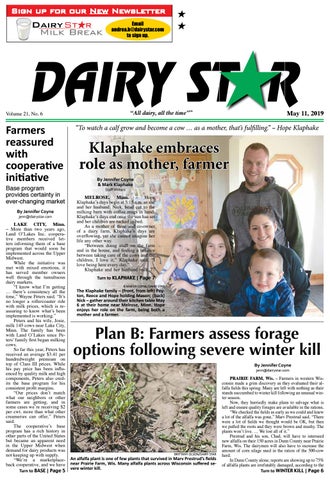
Farmers reassured with coopera�ve ini�a�ve
Base program provides certainty in ever-changing market By Jennifer Coyne jenn@dairystar.com
LAKE CITY, Minn. – More than two years ago, Land O’Lakes Inc. cooperative members received letters informing them of a base program that would soon be implemented across the Upper Midwest. While the initiative was met with mixed emotions, it has served member owners well through the tumultuous dairy markets. “I know what I’m getting … there’s consistency all the time,” Wayne Peters said. “It’s no longer a rollercoaster ride with milk prices, which is reassuring to know what’s been implemented is working.” Peters and his wife, Josie, milk 145 cows near Lake City, Minn. The family has been with Land O’Lakes since Peters’ family rst began milking cows. So far this year, Peters has received an average $3.41 per hundredweight premium on top of Class III prices. While his pay price has been inuenced by quality milk and high components, Peters also credits the base program for his consistent prot margins. “Our prices don’t match what our neighbors or other farmers are getting, and in some cases we’re receiving $2 per cwt. more than what other creameries can offer,” Peters said. The cooperative’s base program has a rich history in other parts of the United States but became an apparent need in the Upper Midwest when demand for dairy products was not keeping up with supply. “We’re a marketplaceback cooperative, and we have Turn to BASE | Page 5
May 11, 2019
“To watch a calf grow and become a cow … as a mother, that’s fulfilling.” – Hope Klaphake
Klaphake embraces role as mother, farmer By Jennifer Coyne & Mark Klaphake Staff Writers
MELROSE, Minn. – Hope Klaphake’s days begin at 5:15 a.m. as she and her husband, Nick, head out to the milking barn with coffee mugs in hand. Klaphake’s days end once the sun has set and her children are tucked in bed. As a mother of three and co-owner of a dairy farm, Klaphake’s days are overowing, yet she cannot imagine her life any other way. “Between doing stuff on the farm and in the house, and nding a balance between taking care of the cows and the children, I love it,” Klaphake said. “I love being here every day.” Klaphake and her husband milk 77 Turn to KLAPHAKE | Page 7 JENNIFER COYNE/DAIRY STAR
The Klaphake family – (front, from le�) Peyton, Reece and Hope holding Mason; (back) Nick – gather around their kitchen table May 6 at their home near Melrose, Minn. Hope enjoys her role on the farm, being both a mother and a farmer.
Plan B: Farmers assess forage options following severe winter kill By Jennifer Coyne jenn@dairystar.com
BRITTANY OLSON/DAIRY STAR
An alfalfa plant is one of few plants that survived in Marv Prestrud’s elds near Prairie Farm, Wis. Many alfalfa plants across Wisconsin suffered severe winter kill.
PRAIRIE FARM, Wis. – Farmers in western Wisconsin made a grim discovery as they evaluated their alfalfa elds this spring. Many are left with nothing as their stands succumbed to winter kill following an unusual winter season. Now, they hurriedly make plans to salvage what is left and ensure quality forages are available in the rations. “We checked the elds as early as we could and knew a lot of the alfalfa was gone,” Marv Prestrud said. “There were a lot of elds we thought would be OK, but then we pulled the roots and they were brown and mushy. The plants won’t live. … We lost all of it.” Prestrud and his son, Chad, will have to interseed new alfalfa on their 150 acres in Dunn County near Prairie Farm, Wis. The dairymen will also have to increase the amount of corn silage used in the ration of the 500-cow herd. In Dunn County alone, reports are showing up to 75% of alfalfa plants are irrefutably damaged, according to the Turn to WINTER KILL | Page 6
Page 2 • Dairy Star • Saturday, May 11, 2019
DAIRY ST R www.dairystar.com
ISSN 020355 522 Sinclair Lewis Ave. Sauk Centre, MN 56378 Phone: (320) 352-6303 Fax: (320) 352-5647 Published by Dairy Star LLC General Manager/Editor Mark Klaphake - mark.k@dairystar.com 320-352-6303 (ofďƒžce) 320-248-3196 (cell) 320-352-0062 (home) Ad Composition Nancy Powell 320-352-6303 nancy.p@dairystar.com Amanda Thooft 320-352-6303 amanda.t@dairystar.com Consultant Jerry Jennissen 320-346-2292 Editorial Staff Andrea Borgerding - Associate Editor (320) 352-6303 • andrea.b@dairystar.com Krista Kuzma - Assistant Editor (507) 259-8159 • krista.k@dairystar.com Jennifer Coyne - Assistant Editor (320) 352-6303 • jenn@dairystar.com Ruth Klossner (507) 240-0048 cowlady@centurylink.net Danielle Nauman (608) 487-1101 danielle.n@dairystar.com Danna Sabolik - Staff Writer (320) 352-6303 • danna.s@dairystar.com Maria Bichler - Copy Editor 320-352-6303 Advertising Sales Main Ofďƒžce: 320-352-6303 Fax: 320-352-5647 Deadline is 5 p.m. of the Friday the week before publication Sales Manager - Jeff Weyer (Northern MN, East Central MN) 320-260-8505 (cell) jeff.w@dairystar.com Mark Klaphake (Western MN) 320-352-6303 (ofďƒžce) 320-248-3196 (cell) Laura Seljan (National Advertising, SE MN) 507-250-2217 fax: 507-634-4413 laura.s@dairystar.com Jerry Nelson (SW MN, NW Iowa, South Dakota) 605-690-6260 jerry.n@dairystar.com Mike Schafer (Central, South Central MN) 320-894-7825 mike.s@dairystar.com Amanda Hoeďƒ&#x;er (Eastern Iowa) 320-250-2884 • amanda.h@dairystar.com Amos Denman (Southern WI) 563-608-6477 • amos.d@dairystar.com Megan Stuessel (Western Wisconsin) 608-387-1202 • megan.s@dairystar.com Deadlines The deadline for news and advertising in the Dairy Star is 5 p.m. Friday the week before publication. Subscriptions One year subscription $35.00, outside the U.S. $110.00. Send check along with mailing address to Dairy Star, 522 Sinclair Lewis Ave., Sauk Centre, MN 56378. Advertising Our ad takers have no authority to bind this newspaper and only publication of an advertisement shall constitute ďƒžnal acceptance of the advertiser's order. Letters Letters and articles of opinion are welcomed. Letters must be signed and include address and phone number. We reserve the right to edit lengthy letters. The views and opinions expressed by Dairy Star columnists and writers are not necessarily those of the Dairy Star LLC.
The Dairy Star is published semi-monthly by Dairy Star, LLC, 522 Sinclair Lewis Ave., Sauk Centre, MN 56378-1246. Periodicals Postage Paid at Sauk Centre, MN and additional mailing ofďƒžces. POSTMASTER: Send address changes to Dairy Star, 522 Sinclair Lewis Ave., Sauk Centre, MN 56378-1246.
North America dealers. A glance at what’s inside
Dairy Proďƒžle brought to you by your
We have seen producers kick it into high gear with the warm weather and the ďƒželds ready for planting. This also includes all the dairy farming women who are moms, too. With Mother’s Day May 12, we wanted to highlight two moms who also work hard on their dairy farm. Hope Klaphake embraces her life as dairy farmer and mom on her family’s 77cow organic dairy near Melrose, Minn. Klaphake talks about how she balances doing chores while also getting kids to school and other activities. Despite the hectic schedule, Klaphake loves the lifestyle and having her family surrounding her while going about her By Mark Klaphake work. Read about her story on the pages 1 and 7 in ďƒžrst section. Despite Jane and Becky Remiger not growing up on farms, they have taken on their farm Editor duties with zeal on their 140-cow dairy near Wood Lake, Minn. The mother-in-law/daughter-in-law duo talk Helplines about working together as a family and what new traditions they have created that are different from how they grew up. Read their – Minnesota Farm & Rural Helpline, story on page 10 in ďƒžrst section. May is also a busy time for farm tours. On May 2, Crimson 833-600-2670 x1 Ridge Dairy hosted 300 fourth graders from 11 Dodge County – Rural Mental Health Counselor schools to learn about agriculture during the 40th annual Farm (MN), 320-266-2390 City Day. Jim and Shelly Grosenick were happy to welcome all – Iowa Concern Hotline, 800-447-1985 the youth and their teachers to the dairy. Read about the day on – Avera Farmer’s Stress Hotline (SD), 800-691-4336 pages 23, 25 in ďƒžrst section. The last month has been a busy one for Mark Berg. After a – Farm Center Helpline (WI), 800video he posted on Facebook about the state of the dairy economy 273-8255 went viral, he has done numerous interviews with local and – National Suicide Prevention Lifeline, national media outlets. We also talked to Berg and his parents, 800-273-8255 Tom and Penny, who milk 200 cows near Pine Island, Minn. Turn – Farm Aid Hotline, 800-327-6243 to page 3 in second section to read about the impact the video has made.
GENTLE HANDLING, MINIMAL LEAF LOSS
MM 300 MERGE MAXX
ÂŽ
MERGER
• Floating head provides clean, consistent pickup over irregular ground • Large-diameter gauge wheels minimize dirt and stones • Pickup design gently handles crop to reduce leaf loss Ĺ? &URVV FRQYH\RU SURGXFHV XQLIRUP Ä XII\ EHWWHU IHHGLQJ ZLQGURZV 9’6â€? pickup working width
ODUJHU ZRUNLQJ ZLGWKV DYDLODEOH DW VHOHFW GHDOHUV
D & D Farm Supply Arcadia
Komro Sales & Service Durand
Cherokee Garage Colby
Lulich Implement Mason
Kalscheur Implement Cross Plains
Lindstrom Equipment Mondovi
East Side Farm Equipment Monroe
INVEST IN QUALITY ÂŽ
KuhnNorthAmerica.com
Steinhart's Farm Service Platteville
Frontier Ag & Turf Osceola New Richmond
Visit your local Wisconsin KUHN dealer today!
Carl F. Statz & Sons Waunakee
Dairy Star • Saturday, May 11, 2019 • Page 3
It’s all inside... Columnists Ag Insider
Pages 8-9 First Section
Value it
Page 27 First Section
Prairie Farm
Ramblings from the Ridge
Plan B: Farmers assess forage options following severe winter kill
Page 30 First Section
Hillsdale
Melrose
Cashton
Third Section: Pages 4 - 5
First Section: Pages 38-39
First Section: Pages 15 - 16
Kids Corner: The Roske Family
Weihrouches host Jackson County event
From Our Side of the Fence
First Section: Pages 1, 6
Veterinary Wisdom
Bayeld
Douglas
Page 31 First Section
Iron
n
Ashland Sawyer
W as
Burnett
hb
ur
Making Cents of Dairy
Page 32 First Section
Polk
Come Full Circle
Price
Madison
Legislators answer dairy producer questions at Capitol
Rusk
Barron
First Section: Pages 12 - 13
Taylor St. Croix
The “Mielke” Market Weekly
Pages 10 - 11 Second Section
Viroqua
Johnson, Linehan exhibit top cow at Wisconsin Spring Spectular Jersey Show
Pierce
Pepin Buffalo
Second Section: Pages 26 - 27
Country Cooking
Dunn
Page 29 Second Section
Chippewa
Marathon Clark
Eau Claire Trempealeau
Page 33 First Section
Wood
Lebanon
Jackson
Farm City Day gives kids up-close experience
Adams
La Crosse Monroe
First Section: Pages 23, 25
Juneau Vernon
ford
Richland
Sauk
Craw
Iowa
Zone 2
Gays Mills
Rileys host Crawford County Dairy Breakfast
Fond Du Lac Columbia
Dane
Grant Lafayette
Green
Dodge
J
on
rs
e eff
Rock
First Section: Pages 34 - 35
Janesville
Crafty cows in limelight at dairy breakfast
For additional stories from our other zone, log on to www.dairystar.com
First Section: Page 28
NOW is the Time to Save on Fans! Optimize your barn ventilation for better animal comfort and improved energy savings. All GEA fans are on special right now as you prepare for the summer heat. You can add a monitoring control and automatically manage your sprinkler, curtain, and lighting systems...and save even MORE! Get a quote from your local GEA barn equipment dealer today! OFFER ENDS MAY 31, 2019
Page 4 • Dairy Star • Saturday, May 11, 2019
Potential...
When others see dirt, you see results! Happy Mo�er’s Day!
We’re here to assist you in reaching this potential. For your last minute feed, fertilizer, and chemical needs, give us a call.
FIRST CROP ISN T FAR AWAY - LET US HELP
HAY CUTTING PARTS
ATTACHMENT
RENTALS•SALES
• TIRES•V-BELTS • BALER TWINE • HYDRAULIC HOSES
GILLY S GREENHOUSE NOW OPEN Nothing says Happy Mother s Day like a beautiful hanging basket! Flower & vegetable packs & Ûats also available.
15% OFF IN-STOCK LAWN SEED TRIMEC $27.99 2-4D GALLON RED, MINK, OR • Rock Buckets WAS 34.99 $15.99 GOLDEN ROD MULCH WAS 18.99 • Tree Pulller TRIMEC PLUS 3 BAGS/$8.49 CRABGRASS CONTROL LANDSCAPE • Rock Trailer FABRIC $4.99 BULK $40/YARD and many other attachments! $34.99 20 lb. Propane Refills RELAX AFTER THE WORK WITH OUR
GRILLS • GLIDERS • PATIO FURNITURE
FISHING - 20% OFF ALL IN STOCK LURES & ACCESSORIES
As always, fill 3 & get your 4th fill FREE!
THE MOST EFFICIENT MEMBER OF YOUR FLOCK. Raising poultry requires practical equipment. Equipment that can stand up to tough daily chores while giving you the functionality to switch attachments in a snap. That’s what you’ll get with Massey Ferguson® equipment. It’s built with decades of input from farmers like you, so you know you’re getting the most durability and efficiency for your poultry operation.
WE TAKE FLY CONTROL VERY SERIOUSLY AND SO SHOULD YOU!
Flies are more than a nuisance, the little biting blood sucking insect causes pain, transmits diseases, can decrease milk production & quality as well as decreasing weight gain. Feeding a fly control is HUGE! Feed it & forget it. It does the work itself. Other preventative steps include keeping everything clean, prevent manure build up around barns, fences, under feed bunks, hutches & manure pits. We’ve got some great deals on feeds & lick tubs that will help you protect your precious investment.
MANAGE YOUR CALF SCOURS TO KEEP YOUR BABIES HEALTHY.
www.masseyferguson.us
VISIT US TODAY. WE’LL HELP YOU FIND
Stop in and talk to our staff about a regiment to put your calves on track to live up to their potential
Gilman Co-op Creamery
Dealer Imprint Area
(320) 243-7411
Open M-F 7:30-7, Sat. 7:30-5, Sun. 8:30-1
www.lakehenryimplement.com
Good service - fair prices - every day
WWW.GILMANCREAMERY.COM
©2018 AGCO Corporation. Massey Ferguson is a worldwide brand of AGCO Corporation. AGCO and Massey Ferguson are trademarks of AGCO. All rights reserved. MF18TK006FC
- INTRODUCING -
BEE
inc.
23661 Hwy. 4, Lake Henry, MN
Gilman, MN 320-387-2770
FEED & FARM SUPPLY STORE
Implement
THE RIGHT MODEL FOR YOUR OPERATION.
LINE
GOLD
CLEANS & KILLS FAST!
PRE & POST
MORE COST EFFECTIVE THAN IODINE!
› Triple Action ingredient system
CLEANS & KILLS
› Proof of fast kill with wide strains of S. aureus
3X FASTER THAN IODINE!
DIP FOAM SPRAY
› Demonstrated >5 log kill on 8 key pathogens
› Gentle to skin with 4% (pre-dip) and 8% (post-dip) emollients
› Economical Concentrate formula
FAST. EFFECTIVE. AFFORDABLE. IODINE-FREE. FOR MORE INFO - CONTACT ONE OF THESE DEALERS...
Advanced Dairy Systems
Athman Dairy Inc.
D&D Ag Supply
9 State Rd. 29 • Spring Valley, WI 54767 (715) 772-3201
238 Main Street North • Pierz, MN 56364 (320) 468-2494
133 Atlantic Ave. NE • Pennock, MN 56279 (320) 599-4466
Anderson Dairy Systems, Inc.
Champion Milking Systems
East Central Dairy Supply
1312 13 1/2 Ave. • Barron, WI 54812 (715) 537-3300
23218 350th Street • Albany, MN 56307 (320) 845-4156
2195 Hwy. 23 • Mora, MN 55051 (320) 679-1029
Eastern Iowa Dairy Systems 105 3rd Ave. NW • Epworth, IA 52045 (563) 876-3087
Fuller’s Milker Center, Inc. 423 U.S. 61 • Lancaster, WI 53813 (608) 723-4634
Gorter’s Clay & Dairy Equipment 1400- 7th St. SE • Pipestone, MN 56164 (507) 825-3271
Lang’s Dairy Equipment, Inc. 2337 Millennium Rd. • Decorah, IA 52101 (563) 382-8722
Leedstone
24260 Cty. Rd. 27 • Plainview, MN 55964 (507) 534-3161
Leedstone
2545 80th Ave • Woodville, WI 54028 (715) 698-4370
Professional Dairy Systems
1449 Homecrest Ave. • Wadena, MN 56482 (218) 632-5416
Tri-County Dairy Supply, Inc.
4107 N US HWY 51 • Janesville. WI 53545 608-757-2697
United Suckow Dairy
12687 Hwy 18 & 52 • Postville, IA 52162 (563) 864-7417 210 N. Industrial Pkwy • West Union, IA 52175 (563) 422-5355
Dairy Star • Saturday, May 11, 2019 • Page 5
ConƟnued from BASE | Page 1 to align our product with the market,” Pete Kappelman said. “We can’t take more milk than what we can protably process.” Kappelman is the senior vice president of member and government relations at Land O’Lakes. Kappelman’s children also dairy farm near Manitowoc, Wis. The program was introduced in the Upper Midwest in 2015 and went into affect soon thereafter. “Farmers expand at varying rates, and, traditionally, conversations about those expansions never took place, and we would have milk showing up at our door,” Kappelman said. “This program is more or less a formal conversation to talk about every farm’s business plan.” A base for each farm was established with production history and takes into consideration any plans for expansion. Additionally, each milk shed also has a base. Every year, member-owners work through their business goals with the
“Our priority is to be in a positive position to maximize the value of milk and earnings per hundredweight for our owners.” PETE KAPPELMAN, LAND O’LAKES
cooperative and make necessary adjustments to their allocated base. “It gives an idea where we’re at as a farm and where we want to be,” Peters said. “As a young farmer, I want to put up more facilities and have more cows when the time is right. I haven’t expanded because of the market, but Land O’Lakes has kept an opened mind and acknowledged my goals.” Kappelman agreed. “The industry will continue to have fewer producers with more cows. Those numbers can grow, but traditionally that growth has been haphazard,” he said. “We started these conversations because we want to know what’s happening on the farms. Our priority is to be in a positive position to maximize the value of milk and earnings per hundredweight for our owners.” Outside of any planned growth, the cooperative allows for a 1% increase in
Before
production from each dairy under the base program. “We never canceled out anyone’s plans for expansion because we didn’t want to put them in that awkward position,” Kappelman said. “We’ll take every drop of milk that is produced, but we have to plan for it.” For Peters, he and his family has found other ways to increase production without increasing herd size substantially. “We are able to increase production by feed quality and genetics. Six years ago, we changed our breeding philosophy to focus on components and it makes a difference as we strive to improve our farm,” Peters said. “Also, if we’ve requested more to our base, it hasn’t been much, but we’ve got it because our milk shed base has increased.” Additionally, Peters has beneted from the program when his herd saw a bout of Salmonella. He was able to le a grievance. “I didn’t lose my base pounds of milk, which was really helpful,” Peters said. “If I lost the base, then I’d be asking how and when could I request it back.” Given the operating climate dairy farmers have experienced the last ve years, there was rst hesitation about the purpose of the base program. In watching the program unfold in the current markets, trust has been renewed between the organization and its member owners, Kappelman said. “We have family farmers under a lot of stress, and we want to be as big of a partner with them going forward as we can,” he said. “More than anything, we’re creating certainty and allowing our farmers to plan for the future, knowing our partnership ensures protable growth.” As the industry continues evolving, Peters’ greatest concern is accommodating the potential of up and coming dairy farmers. “There are a lot of young farmers doing a good job managing cows, and as farmers get better at what we’re doing, we’re becoming more efcient,” Peters said. “If the program stays in place, it will have to be ne-tuned to address this.” The cooperative continues evaluating the base program and its place in the industry as it garners the attention of other organizations.
Warmer days ahead! Keep your barn cool with
NCF 52” Panel Fans
• Durable and innovative 6-blade design • Heavy-duty galvanized frame • Unique and flexible mounting systems
Heavy-duty, Extremely EfÄcient Fan for Quiet Dairy Barn Ventilation 320-836-2284 1-888-276-1751
29033 Co. Rd. 17, Freeport, MN In St. Rosa www.arnzenconstructioninc.com
712-722-3626
SERVICE AFTER THE SALE Q-Catch 8500V Vet Squeeze Chute
COMPLETE BARN SOLUTIONS
Cowpower 1050 hyd. chute
Easy Cattle Handling
After
WHATEVER YOUR DAIRY NEEDS Irish Ridge Dairy Millville, MN
Updated 2x8 parlor with Dematron 75 Milk Meters
Call us to help you make your dairy operation more efficient.
PINE ISLAND, MN • 800-233-8937 BEATRICE, NE • 800-342-5657 SIOUX FALLS, SD • 800-705-1447 MENOMONIE, WI • 715-235-5144
www.midwestlivestock.com
Page 6 • Dairy Star • Saturday, May 11, 2019
ConƟnue from WINTER KILL | Page 1
Willmar, MN • 320.231.1470
EXPANDING OR REMODELING YOUR LIVESTOCK OPERATION? LANGE AG SYSTEMS SPECIALIZES IN:
Ŷ NEW FACILITIES
_
NO JOB TOO BIG OR TOO SMALL
Ŷ RETROFITTING & REMODELING Ŷ TURNKEY PROJECTS Ŷ BARN DESIGN Ŷ INSTALLATION, MAINTENANCE & REPAIRS
ƋƵŝƉŵĞŶƚ tĞ KīĞƌ͗ ͻ sĞŶƟůĂƟŽŶ &ĂŶƐ ͻ sĞŶƟůĂƟŽŶ ŽŶƚƌŽůƐ ͻ WŽƐŝƟǀĞ WƌĞƐƐƵƌĞ dƵďĞƐ ͻ ƵƌƚĂŝŶ ^LJƐƚĞŵƐ ͻ DĂƩƌĞƐƐĞƐ ͻ tĂƚĞƌĞƌƐ ͻ ^ƚĂůů ƋƵŝƉŵĞŶƚ ͻ ,ĞĂĚůŽĐŬƐ ͻ DŝƐƟŶŐ ^LJƐƚĞŵƐ
Lange Ag Systems is proud to offer Grain Bags, Silage Bags & Bunker Covers from Up North Plastics and Feed Fresh Silage Covers & Custom Size Bunker Covers from Raven!
t ^ >> E t Θ h^ 'ͳ ' Θ < >>z Zz E '' Z^
www.LangeAgSystems.com I E LD SE RVICES, I NC. D&H FDarrin Herickhoff 320-760-0848 Helping Your Crops Thrive…“The Natural Way”
• Liquid Manure Handling • Solid Manure Handling • Trucking • Pushing & Packing www.dhfieldservices.com
Target Your Customers!
Advertise Online at www.dairystar.com If you would like to advertise, call 320-352-6303 for more information.
EQUIPMENT ON HAND!
Tag #U03380 2015 Case IH Magnum 240, CVT, 4 RMV, 3600 hours............................. $129,900 (A)
Tag #U04184 2015 Case IH Maxx130, 40K CVT, Loader, 625 Hrs........................ $76,900 (C)
Tag #U04047 2009 Case IH RB454, 540 PTO, netwrap, 10,000 bales .............. $16,900 (C)
2008 Case IH RBX564, 1000 PTO, net/twine, 10,600 bales ........... $17,900 (C)
Tag #U04213 2015 Case SV280, Cab, HVAC, E-H Controls, 1900 hrs ................... $27,900 (C)
Tag #U03368 2014 Gehl V400, Cab, Heat, T-bar, 2 Spd ..................................... $29,000 (A)
Tag #UU01792
ALLENTON, WI 262.629.4104 COLUMBUS, WI 920.623.9000
www.farmersinc.com
BRITTANY OLSON/DAIRY STAR
Most of an alfalfa eld is damaged because of winter kill on Marv Prestrud’s farm near Prairie Farm, Wis. Prestrud has already changed his raƟon for his 500cow dairy to account for the alfalfa loss. University of Wisconsin Extension. While a small percentage of the killed or injured plants are due to management of the elds, most is because of weather events beginning in December and lasting until the last snowstorm in April. The winter season began mildly with December rains coating relatively uncovered ground. Then, the ground thawed a bit before it rained again in January and was followed by a quick freeze. As winter set in, a blanket of snow and ice was atop of alfalfa elds. “Those stands affected in the rst stage of winter were a lot of older stands,” Luke Daninger said. “We’ve walked elds and those without enough stubble that weren’t able to send carbohydrates down to the roots for winter are hurting more than others.” Daninger is a senior crop advisor with Ag Partners Cooperative. He works with farmers in southeast Minnesota and western Wisconsin. Alfalfa elds were not spared after the deep freeze of January. A spring snowstorm, which arrived about three weeks ago, came after much of the established snowfall melted. Not only were the grounds bare, but temperatures also dropped to 24 degrees Fahrenheit, Daninger said. “If elds were stressed from the rst force, this second one took a lot of stands out,” he said. “In the last two weeks, elds are dead that were greening up a month ago. In some cases, we’ve gone backwards and plans are changing.” Both Minnesota and Wisconsin farmers experienced winter kill, but elds in the Badger State were arguably impacted more because of the lighter soils. In the 48 years Prestrud has dairy farmed, this is the biggest loss he has experienced with his forage crop. When Prestrud noticed how vast the winter kill damage was, he immediately cut back on haylage in the ration. The Prestruds are going to interseed alfalfa into last year’s new seeding and plan to harvest more corn silage this coming fall. “Our hay supply is already really tight,” Prestrud said. “We’re going to increase the corn silage in the ration and by mid-summer hopefully have a new crop of alfalfa on hand from the interseeding.” The Prestruds considered planting Italian ryegrass, oats or peas, but realized those commodities will be in tight supply given the conditions other farmers are also working through. By purchasing more protein and supplementing corn silage for energy, the Prestruds will manage without much alfalfa crop. For Jeremy Anderson, planting no-till Italian ryegrass is the solution for his 50 acres damaged from winterkill. Anderson and his family – dad, Den-
nis; wife, Dulcie; and daughters, Roslind, 18, and Riley, 17 – milk 180 cows and run about 250 acres of alfalfa near Hager City, Wis. “Last year, we fertilized good and took fourth cutting early, and had plenty of regrowth,” Anderson said. “The only elds that were pretty bad were in their fourth year and we were already debating if we should keep them. We have some of the better looking hay … 3 miles north of here there’s no hay. It’s all dead.” If time allows this planting season, Marvin Prestrud Anderson would like to reseed alfalfa and Dairy farmer plant barley as a cover crop to harvest at the boot stage for a feed supplement. The family has 220 bales of haylage remaining and recently purchased 10 large square bales of grass hay that will be used for heifers. “Our feed inventory is good, and we have a little extra because we don’t have as many cows as we had last year,” Anderson said. This is the second time Anderson can remember going through a detrimental bout of winter kill. However, in 2013, his elds fared worse with only 20 acres surviving. “We lost everything,” Anderson said. “We had to buy hay, and planted and fed oats and barley, but we did get milk out of the cows.” As Anderson and Prestrud go ahead with a plan B on their alfalfa elds, they are already looking forward to better times. “I dread this time of year,” Anderson said. “We try to plan and it can be tough. We just hope we get the best alfalfa we can every year.” Prestrud agreed. “It will be hard to recapture the loss this year, but if we get a good stand established we’ll be ne,” he said. There are many options to consider when farmers decide what the best course of action may be for their alfalfa stands. Triticale and Italian ryegrass mixes are often used as emergency forages, as well as sorghum-sudangrass. If forage inventory is aplenty, farmers may want to consider seeding down new crop or ip the eld entirely. “Some options are cheaper up front, but then more costly in the long run, and vice-versa,” Daninger said. “It’s important to work through the scenarios with your nutritionist and agronomist. Every farm is different and we need to make a plan tailored to the farm.”
Dairy Star • Saturday, May 11, 2019 • Page 7
ConƟnued from KLAPHAKE | Page 1 cows with their three children – Reece, 9, Peyton, 7, and Mason, 4 – on their organic dairy farm near Melrose, Minn. For the past 12 years, Klaphake has taken pride in milking the herd morning and evening, and also overseeing the care of the family’s youngstock. Previously, Klaphake worked in a nursing home. “Nick had 25 cows at the time and I would chat with him while he milked,” Klaphake said. “One day, I asked if I could milk, and now I’m out here every day, all day.” While Klaphake and her husband begin milking together, Klaphake retreats to the house around 7 a.m. to help get the children ready for the day. After they are picked up by the school bus, Klaphake helps nish chores before she and her husband return to the house for breakfast together. “In the morning, we talk about what needs to all get done for the day,” Klaphake said. By 4:30 p.m., the children return home and the family starts evening chores. When Klaphake nishes milking, she gets dinner started, and soon after the family winds down for the night. “Farm life is repetitive, but it’s my life,” Klaphake said. “When I can sit down on the couch at the end of the day, I feel good. We accomplished all we wanted to get done that day. And, if we didn’t, tomorrow is another day.” As Klaphake’s children have grown, she has taught them responsibility on the farm. Both the older girls feed calves in the evenings during the school year, and also in the mornings during the summer. They also help their mother bed the animals with clean, dry straw.
JENNIFER COYNE/DAIRY STAR
Reece and Hope Klaphake feed heifer calves grain and hay May 6 on the family’s organic dairy farm near Melrose, Minn. Hope prides herself in teaching her children responsibility and work ethic as they help care for the farm animals. “The best part of my job is watching our kids mature and being able to teach them the meaning of work,” Klaphake said. Providing the children with responsibilities has also taught them good morals and to help one another. Klaphake is often in the milking barn when her daughters feed the calves milk. “Reece has taught Peyton what to do and they help each other out. As they’ve gotten older, things have gone smoother, and I know the calves are taken care of,” Klaphake said. “Sometimes I’ll hear them bicker, but they know they have to gure it out on their own.”
PREMIUM AUTOMATIC WATERERS
Likewise, Klaphake enjoys watching her son begin to understand farming by watching herself and her husband. “Mason is always asking a million questions and that’s really neat,” Klaphake said. Klaphake will also help with eldwork, and mostly enjoys raking and baling hay. However, her favorite responsibility on the farm is tending to the calves and heifers, and then watching her daughters pick up on certain characteristics of what makes an animal not feel well and need extra attention. “To watch a calf grow and become a cow … as a mother, that’s fullling,”
Klaphake said. When Klaphake devoted her life to the farm, she dove in headrst. She and her husband married a couple years later and then started a family shortly thereafter. Klaphake’s ability to both be involved on the farm and raise children is in part due to the support system the family is surrounded by. Klaphake’s parents, Bruce Trotten and Jonel Walz, and her in-laws, Neal and Karen Klaphake, have always been available to watch the children or offer advice and guidance. “We’re pretty lucky with family,” Klaphake said. “My parents were saviors when they would come and watch the kids when they were younger so I could be outside on the farm.” On Sundays the family tries to get away for a short cabin stay at Klaphake’s in-laws. Both farming and parenthood are hectic careers, and Klaphake strives for easy communication between her and her spouse to keep their working relationship and marriage strong. “Balancing house chores, the barn and cows can be stressful; it’s a lot of work,” Klaphake said. “We talk to each other a lot and make time for date nights off the farm.” Whether its chore time and the children are helping or they are watching hay being made, Klaphake values every day she is able to spend being both a mother and a dairy farmer. “I never imagined 15 years ago that I’d be here today, but it’s become second nature to me,” Klaphake said. “With all of life’s ups and downs, I thank God I’m here.”
Housing the Future When you buy Calf-Tel, you can be confident it will last a lifetime... and then some. For decades, Calf-Tel® has set the standard for superior durability and efficiency, making your investment in calf housing systems one that grows with each generation of calves it protects. Backed by success and people that know how to raise healthy calves, Calf-Tel promises – and delivers – a wise investment. Outdoor Hutches
Group Housing Indoor PensGroup
Indoor Pens
Group Housing
Housing
Ritchie manufactures a complete line of livestock watering products with the highest specifications in the industry. From a single horse Stall Fount to a fountain that waters up to 500 head, Ritchie fountains are top quality. Plus, every Ritchie fountain is backed by our 10 year limited warranty. For more information contact us at:
Carlson Wholesale - 800-669-4038 www.carlsonwholesale.net @carlsonwholesale
Dealer logo For more information, or the name of your nearestand dealer, call contact here
1-800-669-4038 or
tim@carlsonwholesale.net or chad@carlsonwholesale.net
Page 8 • Dairy Star • Saturday, May 11, 2019
Perdue sees DMC as an improvement over MPP Beginning June 17, enrollment begins for the Trade event, Mulhern said the Section 232 tariffs on Dairy Margin Coverage program at county Farm steel and aluminum nullify the beneďƒžts of USMCA. Service Agency ofďƒžces. “While the MPP program “We’ve got to get these retaliatory tariffs lifted to get got maligned and dairy didn’t fare quite as well in USMCA passed,â€? Mulhern said. “We are a very, very the 2014 program as people would have productive; very, very efďƒžcient industry; hoped, this (DMC) is a great program, we need to ďƒžnd markets for the products Ag Insider certainly in the 250-300 cow range,â€? said we’re producing and that will be our Agriculture Secretary Sonny Perdue. “I salvation.â€? would encourage all dairy producers to pay attention, it will be really good.â€? No consensus on USMCA During a meeting with Democratic Online tool available leaders, President Donald Trump urged Dairy farmers wanting to learn the lawmakers to ratify the U.S.-Mexicomore about the Dairy Margin Coverage Canada Agreement. After the White program and how it ďƒžts into their business House meeting, Senate Minority Leader plan can now evaluate different coverage Charles Schumer said the trade deal levels using a web-based tool. The new needs more protection for labor and the DMC decision tool assists producers environment. By Don Wick in calculating total premiums costs and Columnist administrative fees. This program was US-China trade negotiations at critical developed by the USDA and University point of Wisconsin. Trade talks between the United States and China have taken place in Beijing and Washington, D.C. MPP repayment options in recent weeks. U.S. Treasury Secretary Steven Dairy farmers who had coverage under the old Mnuchin is optimistic a deal could be reached within Margin Protection Program are eligible to get back a month. Agriculture Secretary Sonny Perdue is some of those premiums. Farm Service Agency also optimistic about that timeframe. “It’s sooner Administrator Richard Fordyce said there are a rather than later for us because you’ve heard the couple options available to dairy farmers. “There’s an cries about the challenges out there in ag country; ability for them to get a cash repayment from those it’s real.â€? Perdue said. “Farmers have a lot of faith premiums that they paid in at a level of 50% or if they and optimism, but, they’re really hurting.â€? Chinese want to take the dollars that they paid in premiums President Xi Jinping may visit the White House in under the old program and apply them to premiums in June and there is speculation that a new trade deal the new program, they’ll get 75% value of the dollars could be signed during the visit. paid as a credit for the premium.â€? Eligible dairy farmers will receive a letter from FSA, outlining their Dairy Innovation Hub Bill introduced options. A bill has been introduced in the Wisconsin legislature to establish a Dairy Innovation Hub at UWSupport for USMCA Madison, UW-Platteville and UW-River Falls. The National Milk Producers Federation CEO Jim proposal earmarks nearly $8 million for the project. Mulhern is urging action on the U.S.-Mexico- If approved, each campus would be able to determine Canada Agreement. During a Farmers for Free how to best use the money. The goal is to improve
LED LIGHTING Fuller’s Milker Center is a preferred Trade Ally with Focus on Energy
land and water resources, human health and nutrition, animal health and welfare and farm businesses. The Dairy Innovation Hub concept came out of the Dairy Task Force 2.0 effort. Labeling debate continues The Food and Drug Administration received thousands of public comments about the labeling of plant-based beverages with dairy terms, like soy milk or almond milk. The Plant-Based Foods Association reviewed the public comments and found 76% oppose labeling restrictions. National Milk Producers Federation Senior Vice President Chris Galen said the comment period was to determine if consumers understand the nutritional difference between milk and the plant-based products. In addition to the FDA, bills have been introduced in Congress to prevent the alternative products to be labeled with dairy terminology. Farm stress survey Financial issues, farm/business problems and the fear of losing the farm are just a few factors impacting farmer mental health. That is according to a national poll sponsored by the American Farm Bureau Federation. The survey said two in ďƒžve rural adults think stress and mental health have become more of a problem in rural communities in the past ďƒžve years. Nearly half of the rural adults surveyed are personally experiencing more mental health challenges than one year ago. There is also a stigma attached to mental health and a need to overcome it. USDA outlines production costs Many farmers and ranchers were operating in the red this past year. According to a new USDA report on production costs, fertilizer was the biggest operating cost for Northern Great Plains corn farmers last year totaling nearly $94 per acre. For wheat farmers, fertilizer was also the biggest operating cost at $27 per Turn to AG INSIDER | Page 9
THE NO COMPROMISE FABRIC STRUCTURE DAIRY, MACHINERY & HAY STORAGE
Commercial Agri Buildings
Sales & Installation WE ALSO SELL REPLACEMENT TARPS!
Single and Truss Arch available from 20’-120’ wide Flo-CoatŽ Galvanized Steel Tubing Supplied by Allied Tube & Conduit Heaviest gauge steel in the industry Pre-engineered truss buildings
NELSON’S AGRI STRUCTURES
Dean Nelson • Central and Northern Minnesota • Grove City, MN • 320-857-2633, Cell 320-699-3297
RIVERSIDE HOOP BARNS, INC.
US Hwy. 75 At IA/MN Stateline • Steen, MN • 507-392-2870 • Fred A. Tilstra & Sons
LANGE CONSTRUCTION & CONCRETE
Duke Lange • Swanville, MN • 320-290-0859
LAKESIDE HOOP STRUCTURES, LLC
Eastern Minnesota and Wisconsin • Harris, MN • 651-248-6302 • Craig Moline
ASK US ABOUT GOVERNMENT FUNDING FOR HAY STORAGE
LED Long Day Lighting
Parlor LED Lighting
X Limited time INCREASED rebate incentive X We work directly with FOCUS ON ENERGY X Can assist in completing documentation X Provide a stand behind Warranty
Save up to 50% with rebates
MuellerŽ Falling Film Chiller • All stainless steel outer jacket • All stainless steel MuellerŽ Temp-PlateŽ heat transfer surface • Designed for maximum refrigeration efficiency • Designed for low operating costs • Designed to cool varied milk flows • Compact design Helps cool your incoming milk instantly while saving money on energy costs! Russ Pierson
SALES & SERVICE
MUELLER SALES & SERVICE Glencoe, MN • 320-864-3556 OR 888-205-0974
THE MILK COOLING SYSTEMS SPECIALISTS™
Dairy Star • Saturday, May 11, 2019 • Page 9
ConƟnued from AG INSIDER | Page 8 acre. Seed was the most expensive line item for soybean farmers at nearly $57 per acre. For cow-calf operations, feed was the biggest cost; $514 per cow per year. The feed bill was also the biggest cost for dairy farmers in the Heartland region, at $9.46 per hundredweight.
Management Incorporated. Hardin will be tasked with leading the dairy checkoff’s environmental sustainability strategy. Hardin previously served as vice president of external affairs and chief sustainability ofcer for Corteva Agriscience.
ABA sees increase in ag lending According to the American Bankers Association’s annual farm bank performance report, U.S. farm banks increased agricultural lending by more than 5% in 2018. The farm loans totaled $108 billion. More than 94% of farm banks were protable last year. Asset quality remained healthy and the number of non-performing loans was at a fraction of 1%.
Trivia challenge Approximately 3 billion pizzas are sold each year in the United States. That answers our last trivia question. What is the most popular day for pizza consumption each year? We’ll have the answer in the next edition of Dairy Star. Don Wick is owner/broadcaster for the Red River Farm Network, based in Grand Forks, North Dakota. Wick has been recognized as the National Farm Broadcaster of the Year and served as president of the National Association of Farm Broadcasting. Don and his wife, Kolleen, have two adult sons, Tony and Sam, and ve grandchildren, Aiden, Piper, Adrienne, Aurora and Sterling.
Hardin moves to DMI Former USDA Deputy Secretary Krista Hardin is the new Executive Vice President for Global Environmental Strategy at Dairy
LETTERS TO THE EDITOR
Where have all the farmers gone? Where have all the farmers gone? This is a play on an old song of “Where Have All the Flowers Gone” by Pete Seeger. The decline in farm families affects all aspects of life, from the farm families in the village parish, the local pub, the creamery and the small town ball team. The farmers still farming are aging and nobody is there to take over. Is bigger better? I am not sure it is. The bigger you are, the less personality the cow has; all she is a number. I am a retired herdsman after 20 plus years of dairy. When I started milking in 1991, there were 44 dairy farms in my township. I counted last fall. There are 13 left. The land does not change. Most of the elds are the same size. The rows are always the same. The swaths of hay and grain are consistent also. Are we striving to be better, or are we striving to survive the bank? I believe modern agriculture is designed to shrink rural life and turn the personalities into conforming numbers. We do not have the character who drove through the straw stack. We do not have the character that milked 45 cows at noon and took the afternoon off to watch the kids play ball despite work that should be done. We do not have the character that lives life to its full. Farming now is just survival.
DHIA: Now MORE than ever
Find OPEN r e n o o s s cow Each extra day open costs between $3-$5
WILL IT BE YOU?
$500 VISA Gift Card will be given to the 400,000 Milk Pregnancy sample run at a Minnesota DHIA Lab
Convenient, fast, non-invasive, and cost effective. CONFIRM IT WITH MILK! Minnesota Dairy Herd Improvement Association 307 Brighton Avenue South Buffalo, MN 55313 1.800.827.3442 www.mndhia.org
Bob Suszka Grand Forks, N.D.
LETTERS TO THE EDITOR
Dairy Star Newspaper welcomes letters to the editor. Every letter for publication must be 500 words or less, contain the author’s signature, address and telephone number. We reserve the right to edit for clarity and brevity. Letters can be mailed to Dairy Star, Letter to Editor, 522 Sinclair Lewis Ave., Sauk Centre, MN 56378 or e-mail: mark.k@dairystar.com.
Incorrectly roasted soybeans? Guess where your feed dollars are going? Our soybeans have the energy, protein, amino acids and bypass protein for your cows!
KLC Farms Roasting, Inc.
Preferred By Bovines Everywhere
1-877-738-2326 Visit www.roastedbeans.com
Quality
Consistency
319.679.2281 | Hills, IA
stutsmans.com
Page 10 • Dairy Star • Saturday, May 11, 2019
Farm moms trade town living for rural roots
Remiger women embrace life on dairy By Danna Sabolik
danna.s@dairystar.com
WOOD LAKE, Minn. – Jane and Becky Remiger are found in the parlor most mornings, milking together. Neither woman grew up on a farm, but was introduced to dairy through their husbands and has embraced life on the farm. Jane and Steve Remiger farm with their son, Patrick, and his wife, Becky. They milk 140 cows and run 800 acres near Wood Lake, Minn. They also have a beef nishing business with males born on the farm and purchased. Jane grew up a preacher’s daughter, but was exposed to farm life in her younger years. “I grew up in a farming community, so I understood the lifestyle,” Jane said. “We would walk bean elds and de-tassel corn.” She met Steve before she went to college and they were married soon after. They raised two children on the farm. “It’s a unique way to raise your children,” Jane said. “The kids are always with you. From sitting in an infant carrier to helping you carry small feed pails as toddlers, they’re just always with you.” Becky also did not grow up on a farm, but has embraced the life as a wife and mother. She grew up JERRY NELSON/DAIRY STAR the daughter of two teachers in Plainview, Minn. She Jane (leŌ) and Becky Remiger dairy farm with their husbands near Wood Lake, Minn. Neither woman grew and Patrick met at North Dakota State University in up on a farm, but have embraced life on the farm. an agricultural engineering class. Becky milks with her mother-in-law and feeds the calves while also working part time at Lakeview’s early childhood program. Tate, 10 and Shelby, 7. They are grateful they can ex“She always made a real homemade birthday The women enjoy working with each other. perience the farm while growing up. cake on our birthdays,” Becky said. “She used a form “I started milking more this winter when we lost “Growing up a town kid, it’s different being out pan and would decorate with Strawberry Shortcake or our full-time help,” Becky said. “It’s been an adjust- on the farm,” Becky said. “I always wanted to be a Winnie the Pooh, so I try to do that for my kids.” ment to be in the barn more as it makes the day a little farm kid, so raising my kids out here is great.” The kids see their Grandma Jane almost everylonger. I’d like the farm to still be here for my kids, so The kids have 4-H projects and other responsi- day, and have a great bond with her. The family plants I do what I have to do.” a big garden at Steve and Jane’s place, which the kids bilities on the farm. Jane also enjoys working with her daughter-in“They denitely have a lot more responsibility are very involved in. law. “They help with the weeding and harvest and than their peers do,” Becky said. “We don’t get to “I’m just impressed, we both are not early morngo on vacations like I did maintenance all summer long,” Becky said. “That is a ing people, but Becky has growing up, but they also great experience and memory for them to have.” stepped up to help during Becky also enjoys gardening with Jane and has have a lot of other opporthese down times while gettunities that I didn’t have learned how to can. They start tomatoes and peppers ting three kids off to school in the greenhouse and then harvest and can a lot of the growing up.” and getting her chores done For Mother’s Day, produce they grow together. before work,” Jane said. As a seasoned farm mom, Jane’s advice to other the family likes to do someBECKY REMIGER, DAIRY FARMER “The plus side is that you moms was to let the kids run the farm how they like. thing special for the day. can catch up on all the go“When the kids came back to farm with us, there “When the kids were ings on.” younger we would have a steak fry at home or go to were some things they wanted to do differently, and Becky is thankful for her in-laws, and recognizes the park and spend the day there,” Jane said. “We try you just have to keep your comments to yourself the sacrice they make on the farm every day. to do something fun. This year, if the weather is nice I sometimes,” Jane said. “It’s a hard life. We hope we “In this market, it’s hard,” Becky said. “Every- suspect the men will be in the eld.” can get through the current industry downturn, bething Steve and Jane do on the farm is for us and now Mother’s Day can be tough for Becky; she lost cause we love it. And the grandkids love it, too. There our kids.” her mom a few years ago to dementia. To honor her is denitely a future desire for hard-working dairy Patrick and Becky have three kids – Cole, 12, memory, she tries to keep traditions alive. farmers.”
“I’d like the farm to still be here for my kids, so I do what I have to do. ”
MAKE YOUR NEXT PROJECT
BRENTON BUILT
IN STOCK! Basket feeder, slant bar manger, hay rack for sheep.
Hay Saver Round Bale Feeder Locally made!
Contact us for sheep and goat milking parlors Dairy Facilities & Beef Confinements are Brenton Buildings Specialty, from • New Freestall Construction 50 cow expansions to multi-million • General Contracting dollar facilities click below to see what • Material only or Turn-Key Packages Brenton Buildings can do for you.
BRENTON BUILDINGS 206 W Center St., Monona, IA 52159
563-539-4450
FAX: 563-539-4545 • www.brentonbuildings.com
IN STOCK Heavy duty fenceline feeder ready to work! Tarter Heavy and light weight hinge gates Tarter and Marweld Gates & Headlocks
715-644-2350 Chippewa Valley Dairy Supply
6053 CTY. HWY. G • STANLEY, WI 54768 • Andrew Zimmerman
Good news on the horizon for industry Bozic said milk production is down, milk prices recovering By Krista Kuzma
krista.k@dairystar.com
ROCHESTER, Minn. – At a time when dairy producers are struggling, Marin Bozic said he could deliver good news about the economy of the industry – global milk production is slowing and prices are recovering. Bozic, assistant professor in the department of applied economics at the University of Minnesota, presented “Economic Realities of the Dairy Industry in 2019� at the Upper Midwest Dairy Industry Association and the Iowa Association for Food Protection spring meeting April 17 in Rochester, Minn. The U.S. dairy herd has been decreasing the last few months, Bozic said. Milk futures are in the $16 range into 2020. “Prices will be better and that’s good news, but we also need to be aware of what’s going on in our countryside,� Bozic said. Over the last four years, net return on farms after labor and management has either been $0 to a loss of $0.03 per hundredweight. “It’s no wonder we’re seeing a lot of exits,� Bozic said. In Minnesota, 10% of dairy farms hung up the milkers in 2018 while in Wisconsin that number stood at 8%. The national average is around 7%, Bozic said. While Bozic predicts the number of involuntary exits to slow as milk price strengthens, he also sees a second wave of herd dispersals coming. “As cattle prices recover, some
“The higher [percentage] of U.S. milk production is now made by dairies that are not last generation.� MARIN BOZIC, UNIVERSITY OF MN
people who were able to wait and not exit but were thinking about it will sell because the cattle are their retirement,� Bozic said. “I think we will still see elevated exit rates in 2019 and perhaps 2020.� This is not a new story for the industry. Bozic said every decade, the average farm size doubles, production increases and the number of dairy farms shrinks. The farm size category that is growing the fastest in the United States is farms up to 2,000 cows, Bozic said. Farms with up to 200 cows peaked in 1997, farms up to 500 cows peaked in 2000 and farms up to 1,000 cows peaked in 2005. “We have to recognize now that
large farms are agribusinesses. They’re not just large farms. We’ve moved beyond just family ownership,â€? Bozic said. With the change in farm sizes comes a change to the industry’s cycle, Bozic said. “The higher [percentage] of U.S. milk production is now made by dairies that are not last generation,â€? he said. During the 1990s and 2000s, the industry could rely on dairy retirements to balance the supply with the demand. “When you have a higher [percentage] of milk produced by dairies that consider themselves businesses that don’t have a critical issue of family transition ‌ with a more corporate structure, then the only way they exit is involuntary. Otherwise they will be here. All of this together means if we have to balance the supply and demand, more of it may have to come from involuntary exits than has been in decades past,â€? Bozic said. Nine out of 10 dairy farms have less than 200 cows, but they contribute less than a quarter of the U.S. milk, Bozic said. More than half of the milk supply is from dairies that have over 1,000 cows. “We are seeing consolidation and that consolidation is growing. It’s not just a U.S. phenomenon,â€? Bozic said. This has meant exit rates at a pace the industry has not seen since 1986, the year of the federal herd buyout program, Bozic said. These exits have been driving the increase in the block to barrel cheese spread, which has been increasing since 2017. U.S. population growth is also slowing. “The bottom line is our cows are getting better at a faster rate than we are making babies or taking new immigrants in the United States,â€? Bozic said. It leaves two choices – increase domestic consumption or export more. “If neither works, then you have to send cows to McDonald’s,â€? Bozic said. In the political realm, Bozic thinks the president and the country’s leadership is shifting its U.S. foreign policy strategy. Bozic has predictions of how this will impact dairy. He believes the United States Mexico Canada Agreement will go through this year and free trade will resume. In 2020, Bozic predicts free trade will happen with Japan and Great Britain. He also predicts 2020 to potentially bring free trade with China for a short period of time, until after the elections. So, what can producers do? Bozic said they should enroll in the Dairy Margin Coverage. “This is too big of an opportunity to pass. This will be extremely good for producers to increase their income. I think DMC is going to be a game changer,â€? Bozic said. Although it might have a few unintended consequences such as putting more pressure on mid-sized farms between 300 cows and 2,500 cows, Bozic said. Bozic also mentioned the Dairy Revenue Protection program as an available source for producers. “Over 10% of the U.S. milk is now protected by DRP ‌ and it’s growing by 1-2 billion pounds every week. About 4,000 producers are participating,â€? Bozic said.
Dairy Star • Saturday, May 11, 2019 • Page 11
LED LIGHTING Sales & Installation “We originally installed the LED lights to replace old burnt-out lights but have since replaced some working lights because of the better lighting and energy savings.We really like the LED lights, and are planning on converting all the lights to LED.� ZIEGLER’S SAVED OVER 50% WITH REBATES!
STEVEN ZIEGLER, ZIEGLER DAIRY FARMS, MIDDLETON, WI LED Lighting installed December 2018 • Parlor and Freestall barn
Parlor LED Lighting
LED Long Day Lighting
SAVE MONEY WITH LED LIGHTING AND ENERGY REBATES!
fullersmilkercenter.com
No one knows your equipment better.
Keep It Genuine.
Your AGCO Parts Dealer has the quality OEM parts you need when you need them. Everything you need from hardware, chain and batteries to tillage, belts and cutting parts are available from your AGCO Parts Dealer. Along with the help of our highly trained service personnel at AGCO Parts to make it allParts comeDealer together, you can rest easy. Stop your AGCO Your AGCO hasso the quality OEM parts youinto need when you Parts Dealer and get the partsyou andneed services need tochain “Keepand youbatteries in the Field� need them. Everything fromyou hardware, to this season. Find out more at AGCOParts.com. tillage, belts and cutting parts are available from your AGCO Parts Dealer. Along with the help of our highly trained service personnel at AGCO Parts Š "($0 $PSQPSBUJPO "($0 UIF "($0 MPHP BSF SFHJTUFSFE USBEFNBSLT PG "($0 $PSQPSBUJPO
DEIKE IMPLEMENT CO.
P.O.Box 834, Waverly, Iowa 50677 • email: information@deikeimplement.com
Store Hours: Monday-Friday 7:30-5:00 Saturday 7:30-noon
www.deikeimp.com Sales Phone: 319-352-3731 • General Phone: 319-352-1117 USED TRACTORS - Low rate ďŹ nance Available White 8524 24-30 central ďŹ ll, t.wipers, shutoffs .........$67,900 AGCO 8785, cab, 32-sp, Cummins .............................$32,500 White 8222 12-30 ex frame, t.wipers, low acres .......$39,900 NH T9.560, 16 spd PS, duals, guidance ....................$172,800 White 8202 12-30, 2013, 1-owner, dig. monitor .........$39,900 Case 930, 3 pt., West. Loader. ......................................$5,750 White 6100 12-30, liq.fert, trash wheels .....................$11,500 JD 420 2-cyl, sharp, 3 pt, sickle mower, 2nd owner......$6,250 Bobcat 72â€? seeder, 2014, 3 pt. or skidloader, little use .$5,350 Kubota M7-171 4x4, 24-sp. PS, 625 hrs, loader .......$131,900 HARVEST EQUIPMENT Kubota BX2660, 4x4, hydro, deck, loader ...................$11,950 AGCO R65, tilt, monitor, 285 hp Cummins,chopper....$89,500 NH TC21D 4x4, hydro, deck. loader ..............................$9,975 Gleaner 8000 30’; 800 30’ and 25’ Flex Heads ...................Call Kubota L5240, 4x4,cab, hydro,frt.snowblower ...........$27,900 Gleaner 830 and 630 Hugger Cornheads ...........................Call CIH 1660, bin ext, 963 head, 1020 20’ ex .................$17,900 Farmall Super C recond, 1 remote, sickle mower..........$4,250 Allis 9695 FWA, powershift, wts ..................................34,500 MISC. EQUIPMENT Allis 9650, FWA, wts ............................................... Coming In Bobcat 72â€? Soil Conditioner, gauge wheels ...................$7,350 Allis 9170 duals, 18-sp, 2wd.......................................$21,900 New Snowblowers, Blades, Pallet Forks, Bale Spears ........Call TILLAGE & PLANTING EQUIPMENT NEW Sunower and Landoll Tillage ...................................Call Landpride 7’ no-till seeder, demo ...................................$9850 JD X485, JD X700, low hours ...........................................Call White 8816 16-30 central-ďŹ ll, trashwheels .................$64,500 Kubota RTV900, RTV1100 ...................................... Coming In White 8824 24-30, central ďŹ ll, liq.fert., 1-owner .........$84,500
Page 12 • Dairy Star • Saturday, May 11, 2019
Legislators answer dairy producer questions at Capitol
Transportation, exports, hemp, broadband focus of rst annual event By Stacey Smart Contributing Writer
MADISON, Wis. – Dairy farmers attending the rst ever Dairy Day at the Capitol April 10 in Madison, Wis., had the opportunity to ask questions of state legislators during a special panel discussion led by John Holevoet, director of government affairs for the Dairy Business Association. Panelists included Representative Gary Tauchen, Senator Jerry Petrowski, Senator Jeff Smith and Representative Dave Considine. Considine, a former dairy goat farmer and retired school teacher from Baraboo, Wis., is the Assembly Committee on Agriculture ranking minority member. Smith, a hobby farmer from Eau Claire, Wis., is the Senate Committee on Agriculture, Revenue and Financial Institutions ranking minority member. Petrowski, a dairy farmer for eight years who also grew ginseng and raised steers, chairs the transportation committee. Tauchen, the As-
sembly Committee on Agriculture chairman, has farmed all his life and runs a 1,200-cow, 2,500-acre operation with his brothers in Shawano County and was one of the founding board members of the Professional Dairy Producers of Wisconsin. Helping low-commodity prices The panel agreed the most important actions to take are to look at coming up with new product ideas for dairy, exporting cheese to Asia, encouraging diversication in areas such as industrial hemp, nding opportunities to sell Wisconsin cheese out of state, continuing investment in research that will pay dividends to Wisconsin agriculture and increasing usage of milk focusing on places such as schools and prisons. “Ten years ago, there was no marketplace for hemp, but that’s changing,” Considine said. “We have 700 processing centers applying through the Department of Agriculture, Trade and Consumer Protection this year, which is a sev-
STACEY SMART/DAIRY STAR
Dairy farmer and cheesemaker Tom Crave, of Crave Brothers Farm, engages with panelists about current pressing maƩers in the industry at Dairy Day at the Capitol April 10 in Madison, Wis. Crave milks 1,500 cows in Waterloo, Wis., en-fold increase. Localized production facilities will ignite small-business growth in our rural communities again, which is not only exciting, but it’s a good thing for farmers, too.” Although panelists recognized there are no quick xes or silver bullets to pull the industry out of its current state,
trade was cited as a big part of the long-term answer as they placed urgency on taking advantage of export opportunities. Lawmakers are also evaluating ideas to implement from the Dairy Task Force 2.0, which was started by former governor, Scott Walker, to identify both short-term and long-term solutions to help the
dairy industry. “Agriculture is such an important part of our economy in Wisconsin,” Petrowski said. “We need to focus on whatever we can do to help with the sustained run of low prices.” Turn to CAPITOL | Page 13
A WINNING COMBINATION... PROVIDING THE ULTIMATE IN COW COMFORT THE INDUSTRY’S MOST PROVEN MATTRESS SOLUTIONS PASTURE MAT™ enjoyed by over 3 million cows worldwide
COWCOON - THE HYBRID COW STALL • utilizes a flexible polyethylene tube across the bottom portion of the stall loop that acts as a shock absorbe • reduces stress on the cow while continuing to ensure proper positioning
PACK MAT all the benefits of deep bedding while using up to 70% less sand
COMFORT MAT™ the undisputed best foam mattress on the market
Please contact us to learn more or to locate your nearest dealer. 1.888.337.6265 | sales@promatinc.com www.Promatinc.com
facebook.com/promatinc
@Promat_inc
Dairy Star • Saturday, May 11, 2019 • Page 13
Con�nued from CAPITOL | Page 12 More revenue to repair rural roads “Acquiring more money for transportation requires legislator votes, and I think we’re all in agreement that we need more money for transportation,” Petrowski said. “Transportation funding is carrying close to $5 billion in debt. The answer is we need to not only decrease our debt, but we also need to increase local road aids.” Currently, small towns receive a small stipend to offset costs. The amount has increased over the years, but Petrowski said it is still not enough to get rural roads xed. Ensuring roads are properly maintained according to schedule can more than double the lifespan of a 30-year road, he said. But, he said some townships do not even have enough money for maintenance, which means they will not have money to reconstruct. “The more money you invest in transportation, the more money you get,” Petrowski said. “That is why bigger cities like Milwaukee receive more money. A huge increase in transportation aids is probably what we need. Long-term sustainability and viability in the transportation fund is critical to making this happen. Lifting caps on local government and allowing them to make decisions that are best for their towns would also be benecial.” When looking for ways to improve transportation, Petrowski said he put together a small panel of senators and came up with three pages of ideas. For example, shifting sales tax for auto and auto-related parts into transportation was one idea the group came up with to raise revenue. Attracting, retaining young people on farm and in agribusiness “When it comes to farm succession, we have evidence that we’ve lost a lot of farms because the transition plan is not made far enough in advance,” Considine said. “I discovered I was in that boat with my own farm. I know of young people who wanted to farm but couldn’t because no plan was in place for them to do so. We need to get people out to farmers and offer them this kind of assistance. It needs to be worked out so families don’t ght over money. Giving young people the opportunity to farm is critical to the industry’s future.” Providing driver licensing for non-citizens who work on Wisconsin’s dairy farms was also mentioned
“When it comes to farm succession, we have evidence that we’ve lost a lot of farms because the transition plan is not made far enough in advance.”
STACEY SMART/DAIRY STAR
Rep. Gary Tauchen, (from le�) Sen. Jerry Petrowski, Sen. Jeff Smith, Rep. Dave Considine and director of government affairs for the DBA, John Holevoet, talk with Wisconsin dairy farmers about issues cri�cal to the dairy industry during Dairy Day at the Capitol April 10 in Madison, Wis.
Nail heel warts.
Hoof-Zink E-Z Liquid hammers heel warts better than copper sulfate. This simple to use footbath solution is proven more effective at controlling heel warts than copper sulfate. Plus, HoofZink E-Z Liquid is made with zinc so it is safe to spread your land.solution is proven This simpleon to use footbath
more effective at controlling heel warts than copper sulfate. Plus, HoofZink E-Z Liquid is made with zinc so it is safe to spread on your land.
REP. DAVE CONSIDINE
as another important initiative for sustaining the industry’s workforce. “Having a driver’s card would not give undocumented employees the right to vote,” Smith said. “This issue is not about voting. Rather, it helps us know who’s here and that they’re going to be safe on the road.” Members of the panel also commented on the value of a well-trained workforce, highlighting the sophistication of today’s technical schools and the excellent training they provide as being helpful to farms and other businesses in the dairy industry. “The apprenticeship program is another great tool for the industry,” Tauchen said. “We have had quite a few apprenticeships that have come to our farm and worked for several months, and we want to continue improving and expanding this program.” Reliable broadband access was another area identied as needing improvement. It was noted that businesses in rural areas have had trouble adding things as basic as security cameras because of broadband issues. Viewed as much more than an avenue for gaining information online or sending emails, the legislators perceive broadband as the means for automating businesses and farms. “The next generation of farmers can’t do anything unless they have broadband access,” Smith said.
www.hoof-zink.com
Page 14 • Dairy Star • Saturday, May 11, 2019
MANURE SEASON IS UPON US! Thinking of a different spreader? Protwin® Side-Discharge new KUHN Knight PS Spreader The 242 ProSpread® apron box spreaders are noncommercial spreaders that provide an affordable option for producers without sacrificing quality.
Excellent maneuverability and control on all types of terrain.
ng and Ma eedi nu F t re s e
ou
PARTS & SERVICE
To help with your breakdowns!
The Only Dedicated TMR Mixer Service Truck In Minnesota
WE REPAIR IT!!! No Matter What
COLOR FEEDER MIXER Roger, Terry, Luke and Joe
l
so wwave a a w.d barn, we have y.com airylandsuppl
Manufactured by
Dan, Mike and LaShana
h
ion .
If y
Sizes Range From 285-550 Bu.
12” Vertical Pumps and Lagoon Pumps AVAILABLE
Minnesota’s L
HYDRA-SPREAD
ing Dealer nd l Ha
ar g
This is, quite simply, the most advanced, bestbuilt manure spreader you’re ever going to see. Now, do you need one this tough? Well, that all depends on how often you like to buy them.
Steerable Series Spreaders
ut
SB Series
Dairyland Supply
IS IN SAUK CENTRE, OFF I-94 ON THE CORNER OF HWY. 28 & 71 SOUTH
Dairy Star • Saturday, May 11, 2019 • Page 15
From Our Side Of The Fence How does double cropping benefit your dairy?
Dave Stelter Wood Lake, Minn. Yellow Medicine County 300 cows How long have you been double cropping? I began double cropping in 2007 by planting triticale in the spring. In 2012, I started planting rye in the fall on the ground where we had chopped corn for silage. Why did you decide to start double cropping? I wanted to increase the number of acres of forage harvested from our limited land base. I saw it as a way to boost the value of our land and make better use of the nutrients from the manure that we had applied. What crops do you plant and when do you plant them? In the spring, I will plant a blend of triticale and ďƒželd peas. After I chop that off, I will follow it with BMR forage sorghum. If I have an old stand of alfalfa, I will take off the ďƒžrst cutting and then interseed it with Italian ryegrass or a forage sorghum. I will plant rye in the fall after corn silage chopping. Why do you choose those crops for double cropping? Our choices are somewhat limited by how far north we live. I make my choices based on the time of the year and if the crop is adapted for cool season or warm season. Rye is good to plant in the fall because it can survive our harsh winters. I think there is a sugar in sorghum that drives feed intakes. How do you feel double cropping beneďƒžts your farm? It adds value to our land by producing additional feed for our lactating cows and our youngstock. I think double cropping helps cut down on weeds in general. We have had a lot fewer problems with water hemp since we started double cropping. And always having something growing on the land has helped reduce soil erosion. What is a lesson you have learned about double cropping? You have to know the labels on the herbicides you use. Generally speaking, the sooner you can do something, the better. It’s imperative that you chop a small grain crop for silage when it’s in the boot stage. And planting a crop sooner gives it a better chance to get a good start. Tell us about your farm. Our 300 Holsteins are milked three times a day and have a rolling herd average of 29,500 pounds of milk. We farm 720 acres but harvest about 1,400 acres because of double cropping. My father, Dennis, is 86 years old and still helps out with calf care. Our youngest daughter, Sadie, is a sophomore at Southwest Minnesota State University in Marshall where she has been the starting point guard for the past two years. Sadie is majoring in agronomy and ag business and comes out to the farm to help whenever she can. We got rid of our last hogs 1.5 years ago so we could fully concentrate on the dairy.
Mark Hernke Cannon Falls, Minn. Goodhue County 700 cows How long have you been double cropping? We have been double cropping six years. Why did you decide to start double cropping? We were having problems with erosion. Cover crops were becoming more popular, and we had read about them being successful so we decided to try it. It was also a way for us to get more feed for our heifers. What crops do you plant, and when do you plant them? We plant winter rye after we chop corn silage. The following late spring or early summer, we harvest the winter rye and then no till soybeans in so we are able to get three crops in two years. Why do you choose those crops for double cropping? The ďƒžrst two years we used winter wheat, but we were having a problem with it overwintering. We switched to winter rye for the last four years. It’s hardier for the Minnesota winters. We keep the seed in our shed so we get it planted within 24-48 hours after chopping because the ground is still soft and moist. We like to be as close as we can behind the chopper. How do you feel double cropping beneďƒžts your farm? We now have less erosion and better soil health from all the roots that stay in the ground to help build soil structure. We are also able to make more forage for our cattle on fewer acres. What is a lesson you have learned about double cropping? The type of crop we plant was a lesson because we realized we needed something hardy for Minnesota winters. We also learned how good it is for the soil. After the ďƒžrst year, we dug it up and that soil was like a garden. There were nice sized particles and the roots growing helped loosen and condition the soil. We also learned that timing is important. The sooner it gets into the ground the better. Having 3-5 inches of growth helps over the winter and gets it up faster in the spring. Tell us about your farm. I farm with my brother, Dave, and cousin, Rahn. In addition to our cows, we have 2,000 acres where we plant corn, soybeans, alfalfa, peas, sweet corn and cover crops. We are the third generation on the dairy. We love the area and the community.
Sign up for our New Newsletter
Steve Moll Freeport, Minn. Stearns County 90 cows How long have you been double cropping? We ďƒžrst began in 2013, so six years. Why did you decide to start double cropping? We wanted to increase our feed inventory and improve soil fertility. A guy at the local elevator told us about it, and after talking about it for a bit, we thought it would work well. What crops do you plant, and when do you plant them? We plant winter rye in the beginning of October, and then chop it in the spring at the leaf stage for cow feed or in the boot stage for heifer feed. Then, in the ďƒžrst week of June, we replant those ďƒželds with BMR forage sorghum in 30-inch rows. We’ll chop it like corn silage in the fall. We keep that rotation going as needed. Other times, we’ve used winter rye and corn silage. After we chop corn, we apply liquid manure and then the rye. The sorghum buys us a couple more weeks for planting. Why do you choose those crops for double cropping? Winter rye is some of the best feed for the cows because it’s high in digestibility. We can blend it with haylage, and it’s cheap to grow. We choose sorghum because of the tonnage. I get about 15-20 tons on sand. It’s a good quality forage with the BMR trait, and we get 90-100 pounds of milk with it. I can get good feed that costs me $17 per acre to plant. Both rye and sorghum are good feeds and reasonably priced. How do you feel double cropping beneďƒžts your farm? I haven’t had to go to a hay sale since we started, and I used to purchase three to ďƒžve semi-loads. We’re able to increase milk production by planting highly digestible forages. Also, it seems we’re getting better yields because of improved soil fertility. The longer we do it, the more we see it pay off. What is a lesson you have learned about double cropping? Make sure to have your equipment ready because springtime comes quickly. If you get in late, it doesn’t work. You have to be willing to start spring ďƒželdwork early. Tell us about your farm. I farm with my dad, Steven Sr., my wife, Jackie, and our two kids, Morgan and Payton. We raise our replacements. We run 350 acres of land and double crop about 60-80 acres of that most years.
DairySt r Milk Break Email andrea.b@dairystar.com
Turn to OUR SIDE | Page 16
Trusted People. Trusted Feed. Star Blends has been helping Midwest farm families by providing, high-quality feed, dairy nutrition, and commodity contracting for more than 20 years. Our state of the art mill can accurately blend anything from a custom SUH PL[ WR FRPSOHWH IHHG VSHFL¿F WR \RXU IDUPœV QHHGV 2XU H[SHULHQFHG VWDႇ DUH UHDG\ WR GHOLYHU WKH KLJKHVW TXDOLW\ IHHG at an economical price, assist in balancing diets, or work with your private nutritionist or dairy consultant. Contact Star Blends at: 800-462-4125 or StarBlends.com
Page 16 • Dairy Star • Saturday, May 11, 2019
ConƟnued from OUR SIDE | Page 15
Brady Voth Goodhue, Minn. Goodhue County 650 cows How long have you been double cropping? Four years. Why did you decide to start double cropping? We decided to start double cropping because it is a good source of feed for heifers and having the cover crop is benecial to the soil. What crops do you plant and when do you plant them? We plant winter rye after we chop our silage corn in the fall. We then harvest the rye mid to late May, spray and kill it and then plant alfalfa. Why do you choose those crops for double cropping? We chose rye because it really tons up well, it’s a very hardy plant and grows well in this area. How do you feel double cropping benets your farm? Double cropping benets our farm because it helps with erosion, gives us an opportunity to haul manure after the rye, and we usually plant oats with our alfalfa, so we get two big crops of feed along with a cutting of just alfalfa. What is a lesson you have learned about double cropping? We have learned the sooner you plant rye in the fall the better erosion control and the sooner you can harvest it in the spring to get the next crop in. Tell us about your farm. I farm with my parents. The farm has been in our family since 1877. We milk in a double-12 parallel parlor. Most of our cows are housed in a 6-row freestall barn with sand bedding. We run 650 acres of land consisting of silage corn, alfalfa and rye.
Ralph Petersheim Viroqua, Wis. Vernon County 80 cows How long have you been double cropping? I’ve been double cropping for 40 years. Why did you decide to start double cropping? I was raised in southeast Pennsylvania. The farm we rented was in the Chesapeake Bay watershed area, so we had to use cover crops. We soon realized that those cover crops could be turned into high quality forage for our dairy. What crops do you plant and when do you plant them? We have used rye, triticale and barley. We also use a lot of BMR sorghum, sudan and forage sorghum. We plant summer annuals in early June and cereal grains starting late August, and have planted as late as Thanksgiving. Why do you choose those crops for double cropping? High yields of high quality forage. Because of the quality of these forages, we use less alfalfa every year. I am actually considering not using any alfalfa in our dairy ration beginning in 2020. How do you feel double cropping benets your farm? I want to always have something growing in my soil. I feel with continual root growth we have healthier soil. Also we don’t use as much herbicide and use no pesticides. It is also a huge benet to have highly digestible, high sugar forages. What is a lesson you have learned about double cropping? My dad always said that if you plant short season varieties early they will yield with longer season varieties, and I have found that to be true. That in turn allows you to get cereal grains established earlier in the fall. We plant an 87-day grain corn that consistently yields over 200 bushels per acre. I have also learned that the summer annuals, with their higher sugar content, are better for soil microbials, thus enhancing soil heal th. Tell us about your farm. My wife, Sheila, and I own 456 acres and rent about 100 more. We have three of our six children involved part time on our farm and we milk and show registered Holsteins. We sell cows, service age bulls, and market 400 to 500 big squares of hay a year. 2019 is our 24th year of farming in Wisconsin, and we feel blessed to be here.
Jack Herricks Cashton, Wis. Monroe County 600 cows How long have you been double cropping? We have been double cropping for around 10 years. Why did you decide to start double cropping? We need to dedicate 50-60 acres for summer manure spreading. There will be one or more cuttings of hay harvested from these acres. This ground becomes nutrient rich and we were drilling rye into it by early to mid-September to get a root system and cover established before the end of the growing season. We need a substantial amount of low to medium quality forage for heifers raised in a freestall barn. One of those years when things didn’t go according to plan because of excessive rainfall this rye was still intact at the end of May. It was huge and we decided to harvest it for ryelage. Now we plan on doing it every year. What crops do you plant and when do you plant them? Early on we would plant corn after rye for silage. Now we plant corn after rye for grain. Why do you choose those crops for double cropping? This works better for us because the corn silage after rye would never be in sync with the rest of the silage corn and it would necessitate two heats of corn silage harvest. The corn grain after rye is high moisture, but stores well in a bunker. How do you feel double cropping benets your farm? Providing additional forage to feed our herd and keeping roots growing in the soil. What is a lesson you have learned about double cropping? Be exible. Have fertile soil and cut the rye earlier rather than later if you think the corn may be moisture challenged. We always plant the corn the same day the rye is harvested. No-til, of course. Tell us about your farm. Our farm has provided for my family for over a century. Dairy has always been the economic driver. Today, my wife and I are the senior generation along with our son and daughter and their spouses and two nephews.
PeterMark Hendrickson Menahga, Minn. Wadena County 80 cows How long have you been double cropping? We started in 2013. Why did you decide to start double cropping? We were forced to when the Army worms ate a bunch of corn crop. It was an emergency crop at rst, but then there was a silver lining. We planted sorghum and other crops to get a little feed. We liked these alternative crops, so in 2014 we planted more. They’re cheap and make good cow feed. We know we get more tonnage on less acres than a rotation between alfalfa and corn silage. What crops do you plant, and when do you do plant them? We plant triticale and peas in the spring. Then, we harvest that crop and spread manure before planting sorghum sudangrass or millet in June or July. Then, I’ll plant winter rye or triticale in the fall. Why do you choose those crops for double cropping? Triticale and peas are cool season crops, so they grow well this time of year. In the summer, small grains don’t like the hot and dry weather. You have to determine what crops to use with what kind of weather you deal with. How do you feel double cropping benets your farm? We’re getting more tonnage at a lesser cost than the old fashion way of farming. It’s a tangible you can see with the feed costs. We also know soil health is better. You’re always farming, and there are no breaks like there is when you’re planting corn and before you harvest it. Double cropping gives you more options, too. We can spread manure throughout the summer and not only in the spring. What is a lesson you have learned about double cropping? You never know until you try it. We once tried sudangrass with hay underneath it. We planted at smaller rates than normal. It looked crazy, but made a heck of a hay eld. Tell us about your farm. My wife, Lynn, and I have four children – Ryan, Sarah, Bradley and Jill. They all contribute on the farm. Ryan graduated and is back working with me. We farm 325 acres and close to half of that is double cropped. The other half is hay and corn.
BERGMAN Automatic AGRi-Speed HITCH 1
2
3
Stray voltage can develop at any time on any dairy. Have you noticed the following symptoms in your herd? • Increased somatic cell count • Poor reproductive performance • Decreased milk production
E A SY a s 1 - 2 - 3 Simple drawbar mount Easy to operate day or night PTO compatible Increases efÀciency, only need 1 person
Gilman Co-op Creamery FEED & FARM SUPPLY STORE
Your dairy may have stray voltage! Contact us today and we’ll give your dairy facilities a thorough stray voltage checkup!
• Fast, reliable, safe • Easily pulls more than the D.O.T. allows on the highway • Available for pick-ups, choppers, tractors, wagons, etc.
www.bergmanmfg.com Gilman, MN • 320-387-2770
CA-May19-1B-JW
• • • •
STOP THE SHOCKS
Stray Voltage Consulting Over 30 years of experience 605-695-3328 • www.strayvoltageconsulting.org
Dairy Star • Saturday, May 11, 2019 • Page 17
Your Leader in Forage Protection Are you ready for the Haying Season?
WE ARE! NET WRAP TWINE & ACID
Net Wrap
Poly Twine
48” x 9840’ 48” x 13200’ 51” x 9840’ 51” x 12100’ 64” x 7000’ 64” x 9000’ 64” x 9700’ 67” x 9000’
BALE FILM
3X Super Wrap (1 mil) 3X Super Wrap (1.2 mil) 3X Super Wrap (1.5 mil) 3X Super Wrap (20”) SunÄlm Gold Heritage 5
30” x 5000’ 1 mil
20000/110 SB 20000/110 Solar 20000/130 DB 7200/170 SB 9000/130 SB 9600/170 DB 6500/210 SB 4000/350 SB 4000/440 SB 4000/550 SB 3800/600HD SB 2850/800 SB
Sisal Twine 9000 7200 16000 d 20,000 Binder , 26,000 Binder
SILAGE SHEETING
Silage Sheeting/6 mil
THE ORIGINAL
COVER
ALL PRODUCT IN STOCK!
24 x 100 24 x 150 24 x 200 24 x 1200 32 x 100 32 x 150 32 x 200 32 x 1200 40 x 100 40 x 150 40 x 200 40 x 1200
66 x 150 50 x 100 66 x 200 50 x 150 66 x 1200 50 x 200 50 x 1200 80 x 100 80 x 150 60 x 100 80 x 200 60 x 150 80 x 250 60 x 200 80 x 300 60 x 250 80 x 1000 60 x 300 60 x 505 100 x 100 60 x 1200 100 x 150
100 x 200 100 x 250 100 x 300 100 x 1000 120 x 200 120 x 250 120 x 300 120 x 500 120 x 800 132 x 250 132 x 500
www.bluelakeplastics.com
320-333-9255 Sauk Centre, MN
We accept Visa & MasterCard
DEALERS WELCOME!
Page 18 • Dairy Star • Saturday, May 11, 2019
Top Performers
Barn upgrade helps Gibbses boost production Nathan and Bridget Gibbs Rollingstone, Minn. Winona County 184 cows Tell us about your farm. We milk 165 Holsteins and Jerseys, and raise all our youngstock. We farm 550 acres of corn, soybeans and alfalfa. What is your current herd average, butterfat and protein? Our Holsteins are at 30,245 pounds of milk
with 1,222 pounds of fat and 870 protein. Our Jerseys are averaging 22,148 pounds of milk with 1,111 pounds of fat and 717 pounds of protein. Combined, the herd is averaging 29,055 pounds of milk with 1,205 pounds of fat and 848 pounds of protein. How many times a day do you milk? If you do not milk 3X a day, have you tried it in the past? We milk three times a day at 2:30 a.m., 10:30 a.m.
KRISTA KUZMA/DAIRY STAR
Nathan and Bridget Gibbs have a rolling herd average of 29,055 pounds of milk with 1,205 pounds of fat and 848 pounds of protein for their mixed Holstein and Jersey cow herd of 184 head on their dairy near Rollingstone, Minn.
KRISTA KUZMA/DAIRY STAR
A double-8 parallel parlor is used to milk the Gibbses’ herd on the dairy they bought in 2013.
and 6:30 p.m. In the past, we tried milking every 10 hours. That was miserable because it was the two of us doing all the work. Now we have two employees who do most of the milking along with other
chores. Do you contract your milk? Has it been successful for you? We do not contract our milk. We tried it for a short time in the past, but we didn’t
follow it closely enough. We feel it’s only a valuable tool if you do it all the time and watch it regularly. Turn to GIBBS | Page 20
Buy Direct From The Manufacturer and Save! The Toughest Freestalls on the Market Guaranteed Not to Bend
• 10 gauge tubing; 2 3/8” outside diameter, Hi Tensil Galvanized Steel • Heavy 1.9” - 9 gauge top rail with extra heavy 1/4” thick clamp, 6 1/4 lbs • 2 - 40” Extra Heavy galvanized angle iron brackets, drilled for 8 lags or bolts • Variety of lengths & sizes can also be custom made Our stalls are to Àt your stall unmatched in • 30” - 34” wide opening, easy for cows to get quality, durability, up (custom sizes too) and workmanship • Various types of mounting like the Elevated Dual Rail System available • Thousands in use; stronger than poor imitations • Brisket Board Adapter Clamps available, fastens to bottom of Freestall Loop
One Piece Polythylene Construction
LEGEND SOFT BED MAT
• Simple low maintenance • No thin top cover to break down and tear • Specialized urethane foam underlay which does not pack over time like crumb filled beds • Fully molded and reinforced top mat for stability and added hygiene • Simple and fast installation • 5 year warranty
LEGEND GROOVED ROLL • Proven for extreme durability • 5mm stainless cable inlay • Guaranteed NEVER to stretch • Grooved top for traction • Can be used with automatic & skid steer scrapers • 10 year warranty
Heaviest In The Industry
CS-60 Comfort Stall
WE BUILD OUR STALLS RIGHT!
Take a look at our tubing with unequaled corrosion protection! Clear Organic Coating Chromate Conversion Coating Hot-Dipped Uniform Zinc Galvanizing
Interior Coating
Cold Formed Steel Providing High Tensile-Yield Strength
Freudenthal Tubing has been engineered for your speciÀc requirements where strength and corrosion resistance are critical design factors.
GREAT Corrosion Protection!
Diagonal Feed Thru Panel Made to Order
We Carry A Complete Line Of Stall & Stanchion Clamps At Low Prices. CALL FOR THE ONES YOU NEED!
Poly Square Calf Huts
5’ Wide x 6’6” long
AUTO RELEASE PANELS
Complete Line Of Ritchie Watering Fountains • Top Quality Materials • Smart Design • Built to Last COMPLETE WATERER PARTS ON HAND
Fresh Water On Demand 24 Hours a Day
Heaviest, Strongest, Custom Cattle Gate on the Market!
• 2-3/8” 10-gauge O.D. Hi-tensile galv. • 2-3/8” curb post reinforced with a 3”x18” 5 gauge steel rust guard • HD 6-1/2 lb. top rail clamp • Easy installation • Weight per stall - 100 lbs.
UNMATCHED BY ANY OF OUR COMPETITORS.
THE HEAVIEST BUILT IN THE DAIRY INDUSTRY.
Freudenthal MANUFACTURING 715-748-4132 • 1-800-688-0104 • W. 6322 CTH O • MEDFORD, WI 5445
Visit our website: www.freudenthalmfg.com
Dairy Star • Saturday, May 11, 2019 • Page 19
Bongards’ Creameries
Has been a quality market for MN dairy farmers for over 100 years. MN producers provide one of the country’s most distinctive brands of cheese that is still made using the same Old World craftsmanship and has been combined with cutting-edge technology to produce cheese that delivers unforgettable taste with unparalleled quality. MN Dairy farmers and Bongards, quality that stands the test of time. We offer a competitive base price, premiums, and the best Àeld representatives in the industry. 13200 Co. Rd. 51 Bongards, MN 55368 (952) 466-5521 Fax (952) 466-5556 110 3rd Ave. NE Perham, MN 56573 (218) 346-4680 Fax (218) 346-4684
Pleased to be a
“
For our show cows and fresh cows, we love Udder Comfort. -Matt Boop, Heart & Soul Holsteins
Millmont, Pennsylvania (below) as Ms Andis Goldwyn Astra-ET was named Grand Champion of the Junior Holstein Show at the New York Spring Carousel in Syracuse. Matt also had the Reserve Champion of the Junior Show and Champion Bred-and-Owned with his Heart & Soul GoldChip Rosanne-TW
Does your milking equipment need maintenance? We service all dairy equipment! Give us a call to schedule a visit. 1010 Hoeschler Dr. • Sparta, WI 54656
DAIRY EQUIPMENT INC. Celebrating over 40 Years in Business
Congratulations to organizers and participants on a great show!
Phone: 608-269-3830 Toll Free: 1-888-863-0227 Email: prestonde@prestonde.com
2019 NY Spring Carousel Sponsor
“
Udder Comfort gets results-exceeding our expectations since we started using it over a decade ago. It’s the key for getting udders soft and pliable.
-Andrew Vander Meulen,
Avonlea Genetics Brighton, Ontario (below) with Avonlea Premier Chocolate Chip-ET-EX94 Grand Champion Jersey 2019 NY Spring Carousel HM Champ 2018 World Dairy Expo
(Above) Underground Bccas Blair-Red, exhibited by Jonathan and Alicia /DPE RI 2DNÀ HOG &RUQHUV 'DLU\ %DWDYLD 1< EHLQJ SUHVHQWHG ZLWK WKH %HVW 8GGHU $ZDUG VSRQVRUHG E\ 8GGHU &RPIRUW 7KLV VHQLRU \HDU ROG ZDV *UDQG &KDPSLRQ RI WKH 1RUWKHDVW 6SULQJ 1DWLRQDO +ROVWHLQ 6KRZ DQG WKH 5HG :KLWH 6KRZ LQ 6\UDFXVH
7RS SKRWR &KDPSLRQ OLQHXS LQ WKH 1RUWKHDVW 6SULQJ 1DWLRQDO +ROVWHLQ 6KRZ O U *UDQG &KDPSLRQ +ROVWHLQ 8QGHUJURXQG %FFDV %ODLU 5HG VKRZQ E\ 2DNÀ HOG &RUQHUV 5HVHUYH &KDPSLRQ +ROVWHLQ &XUU 9DOH $EVROXWH $GRUHG 5HG (7 H[KLELWHG E\ &HGDU /DQH )DUP &DOLIRQ 1HZ -HUVH\ DQG +RQRUDEOH 0HQWLRQ +ROVWHLQ 9DOH 2 6NHQH *ROGZ\Q .DUPLOOD (7 DOVR H[KLELWHG E\ 2DNÀ HOG &RUQHUV Photos by Randy Blodgett We are amazed by our customers of all production sizes and management styles around the world. We are glad to be part of the journey and the joy, the competition and camaraderie, the independence and collaboration, pulling together through ups and downs. We’re proud to be part of this great dairy community with a common love for the amazing dairy cow. Her comfort is our passion! #WeLoveCows #ComfortMatters #OnlyTheBestWillDo
1.888.773.7153 toll free uddercomfort.com
For external application to udder only, after milking, as an essential component of udder management. Wash and dry teats before milking. Follow us on Facebook @UdderComfort
Page 20 • Dairy Star • Saturday, May 11, 2019
ConƟnued from GIBBS | Page 18 you protable. The rst is good cow health. We like to get fresh cows off to a good start. The second is high milk quality, which means always watching and striving for a better somatic cell count and PI count. The third is striving to be as efcient as possible. We try to do this by having the max number of cows per full time employee, using down time to its maximum and using less equipment over more acres.
Describe your housing and milking facility. Cows are housed in a four-row barn. We have two groups. Group one is made up of our second lactation and older cows. They have gel mats bedded with sawdust. Group two has our 2 year olds and the Jerseys. This group has waterbeds, bedded with sawdust. The herd is milked in a double-8 parallel parlor. What is your herd health program? Herd health is done every other week. Bovashield Gold is given around 30 days fresh. J-Vac is given three times a year and at dry off. Entervine-D is given 10 days before dry off. At dry-off, cows get J-Vac and Scour guard 4KC. What does your dry cow and transition program consist of? Dry cows and heifers are housed in our old milk cow barn 2 miles from the dairy. Close-up cows are moved to the main dairy 10 days before calving. Once the close-up cows are at the dairy, they get the same TMR as the rest of the milking cows. What is the composition of your ration? What has been one of your most recent changes that has been successful for you? We feed corn silage, haylage, earlage, cottonseed and a protein mineral mix. We have recently
MINNESOTA A & C Farm Service, Inc. (TMR Mixer Dealer) Paynesville, MN Fluegge’s Ag, Inc. Mora, MN Gorter’s Clay & Dairy Equip. Pipestone, MN
KRISTA KUZMA/DAIRY STAR
Cows in the older lactaƟon group rest on gel mats bedded with sawdust on the Gibbses’ dairy near Rollingstone, Minn. added Harvextra alfalfa to increase the digestibility of our haylage.
from 46 inches to 49 inches. We also made the stalls longer to increase lunge space.
Through the years you have been farming, what change has created the biggest jump in your herd average? In 2013, we purchased a neighbor’s barn and parlor that was built in 1997. Our old freestall barn was built in the ‘60s. It was dark and the stalls were not as big as we would have liked. Our current barn is open and bright. For the older cows, we widened the stalls
What role does genetics play in your production level, and what is your breeding program? We have been 100% A.I. for the last 16 years. Cows are mated and updated quarterly. We choose bulls for milk, fat and protein, and are positive on all other traits. Cows are bred using activity monitors and checked by the vet at 33 days bred. Hard breeders and low net merit
Call or see your local dealer for complete details!
Hammell Equipment Inc. ChatÀeld, MN Eitzen, MN Harmony, MN Rushford, MN Midwest Machinery Co. (Full Line) Glencoe, MN Glenwood, MN Howard Lake, MN Princeton, MN
Midwest Machinery Co. (Forage Boxes Only) Alexandria, MN Sauk Centre, MN Werner Implement Co., Inc. Vermillion, MN Wingert Sales & Service Plainview, MN
cows are bred to beef. What type of improvements would you like to make that would increase your rolling herd average even higher? We are in the process of a genetic audit to sort our top cows to use elite bulls. Lower end cows will be bred to Angus. Adding more fans to the barn to keep cows cool in the heat. Improving our transition area for the close up cows. List three management strategies that have kept
WISCONSIN Johnson Tractor, Inc. Janesville, WI Price Equipment Sales, Inc. Bloomington, WI Ruf’s Farm Service Inc. Darlington, WI
Tractor Central Arcadia, WI Cameron, WI Chippewa Falls, WI Durand, WI Granton, WI Menomonie, WI Mondovi, WI Sheldon, WI West Salem, WI Westby, WI
What would you say are the three most important factors for you that helped you attain your current herd average? 1. Good employees. We look for longevity in our employees and try to treat them well. One of our employees has been with us six years while the other has been working here two years. 2. Our activity and rumination system. We have been able to catch sick cows earlier. They will drop in rumination before they drop in milk or give any other physical signs. It has also helped get our animals pregnant. We can see heats overnight or others we would have missed by only watching. It also frees time up for as since we don’t have to have someone watching for heat or training someone to do it. It also means fewer shots. 3. Attention to detail. Keeping up with the details helps with overall health, which helps our bottom line.
IOWA Engel Agri Sales Sac City, IA SOUTH DAKOTA Pfeifer Implement Co. Sioux Falls, SD Puthhoff Repair Sales & Service, Inc. Salem, SD
Dairy Star • Saturday, May 11, 2019 • Page 21
See our complete inventory with pictures and descriptions at at:
www.mmcjd.com
Visit one of our 17 locations in Central Minnesota! (1) = GLENCOE
L
EL
E ST
LOW RATE FINANCING AVAILABLE
L
A DE
EL
E ST
L
A DE
EL
E ST
A DE
320-864-5571 4561 Hwy. 212
(2) = HOWARD LAKE 320-543-2170 5845 Keats Ave. SW
(3) = STEWART 320-562-2630 78412 Co. Rd. 20
184,900
JD 9520RX, 2016, 1193 hrs., #143518
$
JD 8245R, 2016, 676 hrs., #144535
369,000
$
134,900
JD 7210R, 2015, $ 814 hrs., #141371
Over 1200 items with pictures updated daily • Go to www.mmcjd.com
(4) = ST. CLOUD 320-252-2010 1035 35th Ave. NE
(5) = GLENWOOD 320-634-5151 1710 N. Franklin
(6) = SAUK CENTRE 320-352-6511 1140 Centre St.
(7) = ALEXANDRIA 320-763-4220 5005 Co. Rd. 82 SE
(8) = PAYNESVILLE 320-243-7474 725 Lake Ave. S.
(9) = PRINCETON
763-389-3453 3708 Baptist Church Rd.
(10) = LITTLE FALLS 320-632-5469 16069 Hwy. 27 E.
(11) = WADENA 218-631-2311 62505 US Hwy. 10
(12) = AITKIN 218-927-2140 1120 2nd St. NW
(13) = BAXTER 218-829-5356 7045 Foley Rd.
(14) = ELBOW LAKE 218-685-4438 110 2nd St. NE
(15) = MORRIS 320-589-2011 23604 State Hwy. 9
(16) = BENSON 320-843-2610 380 Atlantic Ave.
(17) = MADISON 320-598-7575 516 1st St. E
ARTICULATED 4WD TRACTORS 2 Case IH STX440, 2001, Power Shift, Duals, 5949 hrs., #156666 ...................................................................................... $89,500 17 JD 9370R, 2015, Power Shift, Duals, Guidance-ready, 968 hrs., #154699 .................................................................................... $219,500 7 JD 9470R, 2016, Power Shift, Duals, Guidance-ready, Heavy Duty Gudgeon, 847 hrs., #158093................................... $259,500 6 JD 9570R, 2017, Power Shift, Duals, 750 hrs., #150670............ $355,900 1 JD 9410R, 2014, Power Shift, Duals, 1561 hrs., #146677.......... $219,500 15 JD 9520R, 2015, Power Shift, Duals, PTO, Guidance-ready, Heavy Duty Gudgeon, 922 hrs., #158096................................... $289,500 14 JD 9630, 2009, Power Shift, Triples, Guidance-ready, 3918 hrs., #151999 .................................................................................... $154,900 14 Ford 9680, 1995, Duals, 5385 hrs., #158661 .............................. $36,000 MOWER CONDITIONERS 4 JD 835, 2014, #152233 ............................................................... $24,200 4 JD 946, 2008, #150133 ............................................................... $14,430 10 JD 630, 2014, #153621 .............................................................. $20,900 10 JD 820, 1994, #150306 ..................................................................$4,750 17 New Holland H7460, 2013, #144344 ....................................... $21,900 7 JD 535, 2005, #139187 ............................................................... $14,000 12 JD 630, 2015, #156597 ............................................................... $21,900 5 JD 946, 2014, #157889 ............................................................... $23,900 PULL-TYPE SPRAYERS 4 Hardi NAVIGATOR 4000, 2010, #158476 .................................. $17,900 2 Hardi RANGER 2000, 2014, #155294 ........................................ $20,500 10 Redball 580, 2006, #151074 ..................................................... $18,900 10 Blum 750, 1979 ............................................................................... CALL 1 Fast 9613, 2016, #157612 ......................................................... $29,900 15 Wil-Rich Blumha, #148336 .........................................................$5,500 15 Top Air TA1200, 2008, #155358 ................................................ $16,650 9 Fast 9518, #158292 ................................................................... $25,900 5 Hardi Commander 1200, 2002, #150043 ................................ $14,900 RAKES 7 Frontier WR1212C, 2015, #157757 .......................................... $13,000 5 H&S AR2112, 2018, #152083 .......................................................$6,900 ROUND BALERS 4 Gehl 1465, Pickup: Regular, Twine Only, PTO: 540, Width of Bale: 4 Feet, #150085 ........................................................................................$5,100 2 New Holland BR7090, 2010, Pickup: Mega Wide, PTO: 1000, Width of Bale: 5 Feet, 8254 Bale Count, #155760 .................... $22,000 2 JD 458 Silage Special, 2011, Pickup: Mega Wide, Wrapping: Both Twine and Surface Wrap, PTO: 1000, Width of Bale: 4 Feet, 13444 Bale Count, #157883 ..................................................................................... $22,900 10 New Holland BR780, 2004, Twine Only, PTO: 540, Width of Bale: 5 Feet, 3000 Bale Count, #152119..............................................................$9,900 10 Massey Ferguson 2846A, 2012, 1390 Bale Count, #155473..... $24,900 7 JD 535, 1989, Twine and Surface Wrap, PTO: 540, Width of Bale: 5 Feet, #151310 .........................................................................................$8,325 7 JD 569, 2014, Pickup: Mega Wide, Both Twine and Surface Wrap, PTO: 1000, Width of Bale: 5 Feet, #157756 .................................. $34,500 7 JD 854 Silage Special, 2016, 250 Bale Count, #156233 ............ $47,900
L
EL
E ST
6 JD 569, 2017, Pickup: Mega Wide, Surface Wrap Only, PTO: 1000, Width of Bale: 5 Feet, 6050 Bale Count, #143801 ........................ $38,000 6 JD 460M, 2018, Pickup: Mega Wide, Wrapping: Both Twine and Surface Wrap, PTO: 1000, Width of Bale: 4 Feet, 4500 Bale Count, #152787 ...................................................................................... $35,500 6 JD 468, 2012, Pickup: Mega Wide, Wrapping: Both Twine and Surface Wrap, Width of Bale: 4 Feet, 9500 Bale Count, #153396 .............. $28,900 6 JD 854 Silage Special, 2016, Pickup: Mega Wide, Both Twine and Surface Wrap, PTO: 540, Width of Bale: 4 Feet, Precut Knives, 6000 Bale Count, #151149........................................................... $31,300 6 JD 854 Silage Special, 2014, Pickup: Mega Wide, Surface Wrap Only, PTO: 540, Width of Bale: 4 Feet, Precut Knives, 7250 Bale Count, #151186 ...................................................................................... $29,500 6 JD 560M, 2018, 6018 Bale Count, #155709 ................................ $42,500 12 JD 568, 2010, Pickup: Mega Wide, Wrapping: Twine Only, PTO: 540, Width of Bale: 5 Feet, 5422 Bale Count, #149676 .................... $25,500 12 JD 330, 1986, Pickup: Regular, Twine Only, PTO: 540, Width of Bale: 4 Feet, #158328 ..............................................................................$2,500 9 JD 468, 2009, Pickup: Mega Wide, Both Twine and Surface Wrap, PTO: 1000, Width of Bale: 4 Feet, 19500 Bale Count, #158356 ..... $15,500 11 JD 535, 1992, Twine Only, PTO: 1000, Width of Bale: 5 Feet, #151750 .........................................................................................$7,200 11 JD 535, 1990, Twine Only, PTO: 540, Width of Bale: 5 Feet, #151751 .........................................................................................$6,500 8 JD 854 Silage Special, 2013, Pickup: Mega Wide, Both Twine and Surface Wrap, PTO: 540, Width of Bale: 5 Feet, Precut Knives, 9600 Bale Count, #151147........................................................... $25,500 8 JD 569 Premium, 2014, Surface Wrap Only, PTO: 1000, Width of Bale: 5 Feet, 12000 Bale Count, #148146 ...................... $26,900 14 JD 569, 2013, Pickup: Mega Wide, Both Twine and Surface Wrap, PTO: 1000, Width of Bale: 5 Feet, 10900 Bale Count, #153558 ..... $26,500 14 JD 535, 1993, Pickup: Regular, Twine Only, PTO: 540, Width of Bale: 5 Feet, #155784.......................................................$4,520 SELF-PROPELLED SPRAYERS 10 AgChem 1074, 2009, Boom Width: 100-Foot, Tank: Stainless, 3650 hrs., #158291 ............................................................................................ CALL 10 JD 4920, 2004, 4600 hrs., #157917 ............................................ $69,500 16 Case IH 4430, 2013, Boom Leveling, Tank: Stainless, Tire Width: Narrow, Guidance-ready, 2655 hrs., #154198 ......................................... $209,500 8 JD R4038, 2018, Boom Width: 120-Foot, Nozzle Spacing: 20 in, 495 hrs., #150887...................................................................... $339,000 14 JD R4038, 2017, Hydraulic Tread Adjust, Guidance-ready, 508 hrs., #143961 .................................................................................... $346,500 14 JD R4038, 2018, 101 hrs., #155379 .......................................... $340,200 TRACK TRACTORS 4 JD 9520RX, 2016, Track Size: 36-inch, 1193 hrs., #143518 ....... $369,000 17 JD 9520T, 2002, 6337 hrs., #155678........................................... $79,500 17 Case IH Steiger 600 Quadtrac, 2013, 2581 hrs., #155242 ..... $239,500 17 JD 9530T, 2008, Track Size: 760mm/30-inch, Guidance-ready, 3782 hrs., #154119.................................................................... $149,500 7 JD 9570RT, 2015, Track Size: 760mm/30-inch, PTO, Rear 3-Point Hitch, Guidance-ready, Hydraulic Pump: Big, 874 hrs., #144568 ......... $329,500 7 JD 8360RT, 2012, Track Size: 400mm/16-inch, PTO, 1657 hrs., #148436 .................................................................................... $219,500 7 Challenger MT855C, 2009, Track Size: 760mm/30-inch,
3266 hrs., #146086.................................................................... $176,900 6 Case IH QUAD 500, 2011, 2950 hrs., #155272 ......................... $189,000 1 JD 9620RX, 2017, Track Size: 36-inch, 483 hrs., #150671 ......... $459,500 1 JD 8345RT, 2015, Track Size: 760mm/30-inch, PTO, Rear 3-Point Hitch, Guidance-ready, Hydraulic Pump: Big, 830 hrs., #154561 ......... $249,900 15 JD 8310RT, 2013, 1444 hrs., #155283 ...................................... $202,900 16 JD 9570RX, 2017, Track Size: 36-inch, 380 hrs., #150666 ......... $439,500 16 JD 8370RT, 2018, Track Size: 625mm/25-inch, Rear 3-Point Hitch, Guidance-ready, Hydraulic Pump: Big, 434 hrs., #153841 ......... $319,000 5 JD 9510RT, 2014, Track Size: 36-inch, 1526 hrs., #142684........ $239,500 14 JD 9560RT, 2014, Track Size: 760mm/30-inch, Guidance-ready, Hydraulic Pump: Big, 3082 hrs., #153333 .................................. $213,000 14 JD 9630T, 2010, Track Size: 760mm/30-inch, Guidance-ready, 3400 hrs., #158487.................................................................... $159,000 14 JD 9620RX, 2018, 202 hrs., #155383........................................ $469,000 14 JD 8320RT, 2018, 19 hrs., #155376 .......................................... $299,500 3 JD 8370RT, 2015, Track Size: 450mm/18-inch, PTO, Rear 3-Point Hitch, Guidance-ready, Hydraulic Pump: Big, 804 hrs., #152168 ......... $279,500 3 JD 9560RT, 2014, Track Size: 36-inch, Guidance-ready, 1992 hrs., #153954 .................................................................................... $239,000 WINDROWERS 4 JD 2320, 1981, Platform Size: 12, Conditioner: Rubber/Urethane, ............ #150888 .........................................................................................$4,900 10 Claas 1400, 2012, Head: Hay Head, Platform Size: 50, Conditioner: Impeller, 2045 hrs., #157916................................... $93,500 6 JD W235, 2014, Conditioner: Steel, 653 hrs., #135622 ............. $129,500 6 JD W260, 2016, Conditioner: Rubber/Urethane, 591 hrs., #140978 .................................................................................... $149,500 6 JD 994, 2005, Conditioner: Steel, #145340 ................................. $13,500
STEEL DEALS
COMBINE PLATFORM 7 JD 635F, 2006, #140683 ............................................................. $11,900 ROW CROP TRACTORS 4 JD 6145R, 2016, 145 hp, 231 hrs., #142472 ............................. $114,500 16 JD 6175R, 2017, 175 hp.,182 hrs., #145241 ............................. $128,000 17 JD 6175R, 2017, 175 hp., 419 hrs., #144524 ............................ $139,000 10 JD 7200R, 2012, 200 hp., 2780 hrs., #154425 .......................... $110,000 11 JD 7210R, 2015, 210 hp., 790 hrs., #141370 ............................ $134,900 16 JD 7210R, 2015, 210 hp., 814 hrs., #141371 ............................ $134,900 10 JD 8245R, 2016, 245 hp., 676 hrs., #144535 ............................ $184,900 SELF-PROPELLED FORAGE HARVESTER HEADS: ROTARY 6 JD 688, 2011, #140930 ............................................................... $23,500 6 JD 710, 2007, #115310 ............................................................... $33,000 6 JD 770, 2011, #138381 ............................................................... $29,700 6 JD 7300, 2003, 5093 hrs., 3640 cu. hrs., #140932....................... $68,000 6 Claas JAGUAR 890, 2002, 2749 hrs., 2290 cu. hrs., #133756 ..... $96,000 TRACK TRACTORS 4 JD 9520RX, 2016, 520 hp., 1193 hrs., #143518 ........................ $369,000
L
A DE
EL
E ST
110,000
JD 7200R, 2012, $ 2780 hrs., #154425
L
A DE
EL
E ST
128,000
JD 6175R, 2017, $ 182 hrs., #145241
189,000
CIH QT500, 2011, $ 2950 hrs., #155272
A DE
114,500
JD 6145R, 2016, $ 231 hrs., #142472
Page 22 • Dairy Star • Saturday, May 11, 2019
2014 Kuhn Knight 8124
ABRAHAM’S FARM REPAIR
2013 Used Kuhn Knight 8141
1,000 PTO, New hammers, gone thru shop, very good shape $21,000
r Call us fo & New ts s U ed Par
1,000 PTO, Very good condition, Call for details $39,000
W.H. Lien Inc.
N8974 Pole Grove Rd. • Hixton, WI
715-963-4211
WE CAN REPAIR YOUR SILOS AND UNLOADERS
Bill Abraham - Over 20 years experience
320-864-6821
Sales & Service of New & Used Farm Machine ry
Leave message
Tri-Fender™ Post Dip Protect your investment with dependable results •
1% optimized iodine-based
•
Superior skin conditioning
•
Use as a dip or spray
DPA makes whole milk powder purchase
Dairy Pricing Association, Inc., a Capper-Volstead cooperative in Taylor, Wis., has completed its rst purchase of whole milk powder for distribution to humanitarian causes overseas while simultaneously removing milk from a saturated market to boost farmgate milk prices. “We are excited to bring this high-quality full-fat American dairy product to people in dire need of nutritional assistance outside of the United States,” said DPA President Tom Olson. “We decided on utilizing whole milk powder for donation to Christian Aid Ministries (CAM) because it removes milk from the market in its entirety, and therefore we are not just providing an outlet for the nonfat byproduct of butter manufacturing.” On April 15, DPA secured 41,887 pounds of 28.5 percent milkfat powder manufactured by Michigan Milk Producers Association in Ovid, Mich. The whole milk powder is destined to be distributed through Christian Aid Ministries to those in need in Haiti, Liberia, and Nicaragua. A group of DPA’s dairy producer members are currently contributing to the co-op with a $0.15/cwt milk check assignment, and those monies are specically earmarked to secure more whole milk powder for distribution. DPA is also circulating a petition asking USDA Secretary Sonny Perdue to amend the Dairy Production Stabilization Act of 1983 to let any dairy producer voluntary divert $0.02/cwt. from their existing dairy checkoff funds to support DPA’s efforts to purchase more dairy products to feed families in need while stabilizing dairy markets. For more information about Dairy Pricing Association and further updates, visit their website at dairypricing.org, call (715) 284-2590, or follow them on Facebook.
Dairy Farmers of WI Board election under way
TSR
PARLOR
www.delaval.com
Contact one of the following dealers to learn more: IOWA Kramer Bros. Monticello, IA 319-465-5931 Prairie Land Ag Supply Inc. Rock Valley, IA 712-476-9290 United-Suckow Dairy Supply West Union, IA 563-422-5355 Postville, IA 563-864-7417
WISCONSIN Advanced Dairy/Bob’s Dairy Supply Spring Valley, WI 715-772-3201 Ederer Dairy Supply Plain, WI 608-546-3713 Joe’s Refrigeration Inc. Withee, WI 715-229-2321 Mlsna Dairy Supply Inc. Cashton, WI 608-654-5106 Professional Dairy Services Waunakee, WI 608-849-5043
Mondovi Dairy Systems Inc. Mondovi, WI 715-926-5777 West Salem, WI 608-769-2113 The Scharine Group Inc. Whitewater, WI 800 472-2880 Mt Horeb, WI 800-872-3470 MINNESOTA & SOUTH DAKOTA D&D Ag Supply Pennock, MN 320-599-4466
East Central Dairy Supply Mora, MN 320-679-1029 Farm Systems Melrose, MN 320-256-3276 Watertown, MN 605-886-7401 Sioux Falls, SD 800-284-0015 S&S Dairy System LLC St. Charles, MN 507-932-4288 Professional Dairy Systems Wadena, MN 218-632-5416
is a registered trademark of Tetra Laval Holdings & Finance S.A. and “DeLaval” is a registered trade/servicemark of DeLaval Holding AB © 2019 DeLaval Inc. DeLaval, 11100 North Congress Avenue, Kansas City, Missouri 64153-1296. www.delaval.com
Dairy farmers in eight Wisconsin Milk Marketing Board (WMMB) d/b/a/ Dairy Farmers of Wisconsin districts have until May 24 to vote for candidates for eight open seats in the current election. The Wisconsin Department of Agriculture, Trade and Consumer Protection (DATCP) mailed ballots to eligible dairy producers in the affected districts this week. The following candidates, listed by district, are certied as eligible: District 3: Lincoln, Oneida, Price and Taylor counties. Nominee – Mark Leder – Gleason District 6: Chippewa and Eau Claire counties. Nominees – Jaclyn Backhaus, Boyd, and Douglas Danielson, Cadott District 9: Shawano and Waupaca counties. Nominees – Donald Robaidek, Pulaski, and Jeff Strassburg, Wittenberg District 12: Portage, Waushara and Wood counties. Nominees – Ken Heiman, Marsheld, and Steve Pankratz, Marsheld District 15: Adams, Juneau and Monroe counties. Nominee – Mary Cook, Wilton District 18: Kenosha, Milwaukee, Ozaukee, Racine, Sheboygan, Washington and Waukesha counties. Nominee – Dean Strauss, Sheboygan Falls District 21: Crawford and Vernon counties. Nominees – Gail Klinkner, Viroqua, Kevin Wallaser, Desoto, and Danika Wehling, Westby District 24: Dane and Jefferson counties. Nominees – Virgil Haag, Mount Horeb, and Tina Hinchley, Cambridge Eligible producers who have not received a ballot by May 10 can request a ballot by contacting Debbie Gegare, Market Orders program coordinator, at 608-224-5116 or Debbie.gegare@wisconsin.gov. Completed ballots must be signed and sent to WI DATCP, Marketing Order Program, P.O. Box 8911, Madison, WI 53708-8911. The ballots must be postmarked on or before May 25. Unsigned ballots will not be counted. To view candidate biographies and for more information on the DFW election, visit www.wisconsindairy.org/ elections. Elected producers will serve three-year terms starting July 1, 2019. DATCP administers elections for Wisconsin commodity marketing boards. To learn more about the market order boards, visit https://datcp.wi.gov/Pages/About_Us/MarketingBoards.aspx.
Dairy Star • Saturday, May 11, 2019 • Page 23
Farm City Day gives kids up-close experience Event provides students with taste of dairying By Stacey Smart Contributing Writer
LEBANON, Wis. – Crimson Ridge Dairy in Lebanon, Wis., was buzzing with activity on May 2 when 300 fourth
graders from 11 Dodge County schools came to tour the farm and learn about agriculture. Sponsored by the Dodge County Farm Bureau, the 40th annual Farm City Day put students face-to-face with cows, calves,
STACEY SMART/DAIRY STAR
Veterinary technician Kathleen Hafemeister shares cow facts and animal health informaƟon in the freestall barn during Farm City Day May 2 at Crimson Dairy Ridge in Lebanon, Wis.
STACEY SMART/DAIRY STAR
Farm City Day hosts Jim and Shelly Grosenick with their son, Tucker, milk 250 cows near Lebanon, Wis. Not pictured is their daughter, Maddy.
heifers, chickens, bunnies, lambs and more. The event provides an interactive, hands-on learning opportunity that features stations set up throughout the farm to educate area youth about different aspects of dairy farming and agriculture. “Kids love to learn about agriculture,” said Megan Love, a teacher from John Hustis Elementary School in Hustisford, Wis. “A lot of my students grow up around farms so it’s cool for them to understand what goes on there.” Farm City Day took place from 8:30 a.m. – 1:30 p.m. with kids arriving all morning in overlapping shifts. Held on
a different farm every year, the event places agriculture in reach of a generation that often has little farm exposure, helping them gain an appreciation for and understanding of dairy farming. Not only is Farm City Day the rst time that many of these kids step foot on a dairy farm, but it is also the rst time for some of the teachers, as well, including Love, who visited her rst farm last year at the event. “I found it very interesting,” Love said. “I was surprised how much milk each cow produces every day and how the milk gets to the bulk tank.” Crimson Ridge Dairy is owned by fourth-genera-
tion farmers, Jim and Shelly Grosenick. “I want kids to know how a farm works and not be afraid to ask questions,” Shelly said. “This farm has been in our family for 131 years, and I like to share the farm and our heritage with others. Establishing a personal connection from farmer to consumer is important to me. We need that personal link in order for dairy product consumption to go up.” Students visited the milking parlor and milk house to learn about the milking process and how milk gets from the cow to Turn to FARM CITY | Page 25
Page 24 • Dairy Star • Saturday, May 11, 2019
FAST. CONSISTENT. VERSATILE.
From Field to Farm
SL 100 SERIES PROTWIN SLINGER ÂŽ
The Penta line of Dump Trailers are designed to get your crop from the ďŹ eld to your farm. Ranging in size from 1050 Cubic feet to 2475 Cubic feet there is one ready for you. Farmer focused features like better visibility in the box and the unique reverse tilt for better ďŹ lling, all built as tough as you.
ÂŽ
SIDE-DISCHARGE SPREADER
• All-new discharge provides more consistent, even spreading • Exclusive twin-auger design eliminates material bridging Ĺ? ([WHQGHG DQG VLPSOLÄ&#x;HG VHUYLFH LQWHUYDOV VDYH WLPH DQG PRQH\ • Versatility to handle the widest variety of materials 1000, 1400, 1800 and 2400 gallon capacities
Farm Feeding
INVEST IN QUALIT Y
KuhnNorthAmerica.com m
ÂŽ
The best quality feed needs the best quality mix. Penta TMR Mixers are designed, tested and farm proven to deliver the best mix on the market. Our Hurricane Auger allows forage to circulate faster through the mix for quicker processing and mixing times.
From farm to field
Stop in or contact us today for all your equipment needs! We carry a large selection of new and pre-owned LQYHQWRU\ WR ÄşQG WKH PDFKLQH WKDW EHVW VXLWV \RXU need. Our service and parts department with helpful, IULHQGO\ NQRZOHGJHDEOH DQG H[SHULHQFHG VWDII LV KHUH for everything repair and maintenance.
The Penta (Hagedorn) line of Manure Spreaders allows you to make the best use of your organic nutrient resources. The Hagedorn Spreaders processes the manure ďŹ ner with the best spread pattern. This lets your ďŹ eld make better use of this rich resource.
(507) 451-3131 (800) 385-3911 Visit our website at www.northlandfarmsystems.com
USED SKIDSTEERS
‘16 Mustang 2100RT, JS, D, 17� Tracks, Lift Cap 2100/3000, C/H/A, 2 spd, 390 hrs. - $45,250 ‘14 Gehl RT175, ISO switchable ctrls, D, 12� tracks, 1750 lift cap., C/H/A, 2 spd., 232 hrs. ..................................... $41,900 (9) Gehl R220, many options .................Start at $26,900 ‘16 Gehl R190, Gehl Ctrls, C&H, 2 Spd ........................................ $27,900 Gehl 4840, H Ctrls, D, 1900 Lift Cap, SS, New Engine with Warranty, 4200 hrs. ................................... $14,800 ‘78 Gehl 2600, T-bar ctrls, G, 750 Lift Cap ................................. $2,900 ‘14 Mustang 2600R, H&F ctrls., D, C&H, 2 spd., 2600 lift cap., 1576 hrs .. $28,500 ‘16 Mustand 2200R, Dual H Pilot ctrls, D, 2500 lift cap, C/H/A, 3300 hrs .... $25,900 ‘16 Mustang 2100RT, NXT3, ISO/Dual H Ctrls, C/H/A, Folding Door, 2 Spd, 550 hrs ...................................... $39,500 ‘07 Mustang 2076, JS Ctrls, D, 2200 Lift Cap., C/H/A, 2 spd, 2650 hrs...... $22,700 ‘08 Mustang 2076, Dual JS Ctrls, C/H/A, SS, 1200 hrs .............................. $27,500 ‘06 Mustang 2066, dual lever/ft ctrls, D, 2000 lift cap., C/H, 1341 hrs.. $20,900 ‘13 Mustang 2054, H/F Ctrls, D, 1650 Lift Cap, C&H, 231 hrs ..................... $24,500 ‘99 Mustang 2050, T-bar ctrls, 1650 lift cap., D, 4623 hrs., C&H, SS, 4623 hrs .................................... $11,900
2250 Austin Rd. • Owatonna, MN 55060 nfs@northlandfs.com
USED SKIDSTEERS ‘15 Mustang 1900R, H/F ctrls, D, 1900 lift cap, 2 spd, 875 hrs ...... $29,000 ‘16 Mustang 1900R, H&F Ctrls, D, 2100 Lift Cap., C&H, 2 spd, 2727 hrs . $25,800 ‘15 Mustang 1900R, H Pilot Ctrls, C&H, 2 Spd, Sound Reduction Package, 2378 hrs. ................................... $25,750 ‘16 Mustang 1500R, H/F Ctrls, Cab & Heat, 2717 hrs................. $23,500 ‘16 Mustang 1500R, H/F ctrls, D, 1500 lift cap., C&H, 2585 hrs..... $22,500 ‘15 Mustang 1350R, H/F ctrls, D, C&H, 1450 lift cap., C&H, 1263 hrs..... $25,000 ‘02 Bobcat 773 H/F Ctrls, D, 1850 Lift Cap, C& H, 1185 hrs .......................... $18,300
USED TRACTOR
USED TMRS/MIXERS
‘04 Penta 5600, 600 cu. ft., EZ 2000V scale, corner door ......................$13,500 ‘08 Penta 5620HD, 600 cu. ft., 8� rubber ext., right corner door ................$23,500 ‘07 Penta 2410 Electric Stationary Mixer, 2 spd, No Motor ...........................$8,500 Knight 3300, 260 CuFt, 3 auger discharge ........................$6,900 Knight 2300, 260 cu. ft., 3’ discharge .................................$6,900 ‘05 Kuhn Knight 3130, 300 cu. ft., scale w/remote, 2 ft., LH disch............$10,500 Automatic ATG1800B, 1800 bu./hr., 54� blower, 4 cut rolls, load auger $8,500 Agrimetal Feed Cart 542, 54 CuFt .$1,100
MANURE HANDLING Pik Rite 1190, 550 bu., top beater, hydra-push..................................$14,500 ‘91 Balzer Manure Pump, V6, 8’ pump, 2 pt. hitch, rmt. ďŹ ngertip ctrl .........$4,200 ‘00 Balzer Manure Pump, V6, 8’ vert. manure pump ...............................$4,500 Jamesway Manure Pump, 6x8, 8’ pump, 2 pt. hitch, double agitation ..........$5,500 Houle 8’ pump, double agitation.....$5,300
HAY & FORAGE
MANURE HANDLING
‘16 Anderson Hybrid X, 11,500 bales, remote start and steer - $26,900 ‘14 H&S 660, Upper Beater, Hyd Drive Apron, Variable Spd - $22,850 ‘72 JD 4320, 2wd, Quick Hitch - $15,000
USED TMRS/MIXERS
‘11 Kuhn Knight VTC 1100, LH slide tray, rear door, 2 scales, mounted to ‘12 Peterbuilt 367 w/40,619 miles, 66,000 GVW, 10 spd., hyd. drive, 1100 cu. ft. - $114,000 ‘07 Penta 8020, 800 cu. ft., corner door in front and rear, 2 spd...................$17,900
Kuhn Knight RS160, 570 CuFt, Spread width 30’, Vert. Beaters, Dual Apron ..................................$33,000 ‘10 Kuhn Knight 8141, 4100 gal. ..$38,500 ‘12 Kuhn Knight 8141, 4100 gal., hyd. lid ........................................$35,800 ’08 Kuhn Knight 8132 Frt And Rear Splash Guards.............................$17,000 Kuhn Knight 8124, 2400 gal., 500 bu., front and rear splash guards .......$14,900 ‘09 H&S 560 .................................$14,500 ‘03 H&S 310, 310 Bu..................... $5,700 ‘14 Hagedorn 5440, 440 CuFt, 550 Bu ....................................... $12,900 Hagedorn 277, 270 cu. ft., 420 bu.........................................$12,900 Meyers M350, 350 Bu, End Gate ....$8,500
’12 Kuhn GMD600GIIHD Disk Mower, 7’10� Cut, 6 Disc ...........................$7,100 Kuhn GMD600 Disk Mower, 7’10� Cut, 6 Disc............................................$7,800 ‘13 Kuhn GMD600 Disc Mower, 10� Width..................................... $7,750 ‘13 MF 1329 Disc Mower, 9’2�.......$4,800 Land Pride Disc Mower - 5 disc ........$750 Vicon CM2200 Disc Mower, 6 Disc $2,900 NI 5209 Mower Cond., 9’ Cut .........$8,800 Gehl 860, 1210 hay head, 3038 CH$4,200 ‘96 JD 930 Mower Cond., 11’6� Cut, Impeller Cond .............................. $5,750 JD 1360 Mower Cond, 10’, 6 Disc w/Flail Conditioning ............$7,800 ‘96 JD 1290 Mower Cond., 9’ cut, 2 Rubber Cond. Rolls ....................$3,500 ‘06 NH 1475 Mower Cond, Rubber Rollers, Lights ............................$12,800 Farm King Y550R Finishing Mower, 5’, 3 blades, 3 pt hitch ......................... $850
HAY & FORAGE ’03 H&S BF12HC Rake, 12 Whl High Cap ...........................$7,950 ’08 H&S X12 Rake, 12 Whl ............$7,800 ‘05 H&S BF14HC, 14 Wheel Rake, Wind Guards .................................$9,750 ‘12 Vermeer WRX12 Rake, 12 Whl HI Capacity ...................................$5,900 ’15 Kuhn GF222T Tedder, 8’6� Working Width, 2 Rotor, Pull-type...............$3,150 ’12 Kuhn GA300GM Rotary Rake, 7’3� Raking Width, 10’6� Windrow .......$3,800 NH 144 Merger, Ground Driven ......$2,900 Miller Pro 7914 Merger, 9’ Pick – Up, 14’ Meger, Hyd Drive ............... $4,500 AS IS ‘82 NH 851 Rd Baler, 5 x 6 bales ...$1,850 ‘93 JD 535 Rd Baler, 5 x6 bales, twine .............................................$7,750 New Idea 4865 round baler............$6,900 ‘08 Meyer 6222 Forage Box, Front & Rear Unload, 22’ Box, Carted Running Gear XT2200L, hyd drive .................... $24,500 Case IH 600 Blower, 60� ................$3,900 ‘15 H&S BW1000 Bale Wrapper, 6’ Bales, Remote Start & Steer, Lights ........$21,000 ‘09 Haybuster H1100 TILT II Tub Grinder w/corn hopper...............................$34,500 ‘06 Haybuster 2650 Tub Grinder, Self Loading, .............................$15,500 Highline 6800 Bale Processor, Processes 6’ Round Bales ..............................$7,900 Bale King Vortex 3000 Processes Full Size Round Bales ....................$6,800
MISCELLANEOUS Berlon BSC, lifts full rd. bales ......... $450 ‘98 Buffalo Scraper 53300010, 3 yd ............................................ $6,900 Snow Push, 10’ wide ................... $1,800 Buhler YC8520 Snowblower, 7’, hyd. rotation ...................................... $2,700 Notch MB84 Snow Bucket, 84� ... $1,175
Dairy Star • Saturday, May 11, 2019 • Page 25
ConƟnued from FARM CITY | Page 23 the store. The Grosenicks ship their milk to Dairy Farmers of America and said it is used to make all kinds of products from cheese and ice cream to uid milk and cream cheese. Veterinary technician Kathleen Hafemeister discussed cow facts and animal health, while Dodge County’s 2019 Honey Queen Holley Schwartz spoke about honey and beekeeping. Ellen Bohn, Shelly’s mother and program assistant for Dodge County, manned the farmers’ market station to talk about the products Shelly grows and sells. The kids also learned about farm safety, dairy products, nutrition and crops, and had the chance to enjoy cottage cheese mixed with fruit, milk, cheese sticks and yogurt at the snack station. The Grosenicks milk 250 cows
PHOTO SUBMITTED
Maddy Grosenick hangs out with calves on her family’s farm, Crimson Ridge Dairy, near Lebanon, Wis. The dairy hosts school tours for students to learn about agriculture.
twice a day in a double-8 parlor and farm 400 acres, placing an emphasis on double cropping. They also experiment with non-traditional crops, for example, planting less corn and more sorghum. In addition, Shelly has a large garden and cans jams, jellies, salsa and pickles that she sells along with fresh fruits and vegetables at area farmers’ markets under the name Crimson Kitchen and Gardens. She also uses these ventures as an opportunity to promote dairy products. “Many foods are interconnected, and I’m a big believer in linking food and connecting different aspects of what we grow and produce,” Shelly said. “I like to give people a true food experience.” The Grosenicks’ two children, Maddy, 6 and Tucker, 4, are actively involved in the farm and raise their own chicks. Maddy also grows owers and Tucker grows vegetables to sell at the farmers’ market. “We come full circle here,” Shelly said. “From cows to crops to fruit and more, our philosophy is, ‘Waste not, want not.’ We focus on creative efciency in all areas to maximize sustainability and decrease wasted resources while ideally riding out the changing tides of the dairy economy.” Shelly’s former teacher, Gregg Birkholz, from Trinity-St. Luke’s Lutheran School in Watertown, Wis., has been coming to Farm City Day for years. “I want to give kids an appreciation for how hard people work to give us the food we eat,” Birkholz said. “It’s good for them to know what it takes for a gallon of milk to get to their refrigerator. It’s also interesting to learn about everything beyond dairy that’s tied into agriculture – from bees to goats to maple syrup.” Children could also participate in the “Name a Calf” contest. Students were in-
Les Kuehl
Repair Service YOUR CENTRAL MINNESOTA GOLIATH REPAIR SERVICE!
30+ YEARS EXPERIENCE • Sealed silo parts & service All parts • Best chains on the market needed to service your • Used and rebuilt unloaders Goliath • Stainless steel roofs Unloaders • Stainless steel conveyor chains Call for early maintenance specials
STACEY SMART/DAIRY STAR
A student pets a calf during Dodge County’s 40th annual Farm City Day May 2 at Crimson Ridge Dairy in Lebanon, Wis. Three hundred fourth graders from 11 Dodge County schools came to tour the farm and learn about agriculture. vited to write their name idea on a slip of paper to be entered into the special drawing. The winning name was FeFe – a suggestion that came from Mountain Top Christian Academy in Horicon, Wis. Other names entered into the drawing included Buttercup, Ruby, Mufn, Charger, Mozzarella and Pickle. According to many of the students, the calf station was their favorite part of Farm City Day. The bunnies were also a hit. Greg Obermiller, of St. John’s Lutheran School in Lomira, Wis., said, “So much of Wisconsin history is based on agriculture and dairy, and I love for the kids to have the knowledge that Farm City Day provides. I enjoy giving students an opportunity to ask questions of
people qualied to answer.” Retired dairy farmer, Daniel Guenterberg, hosted Farm City Day in the mid-1980s and has been volunteering at the event on and off ever since. Guenterberg is one of the directors of the Dodge County Farm Bureau and said the format of the event has changed little over the years, instead, it is today’s farm technology and automation that is different from years past. “Promoting the farm is more important than ever before,” Guenterberg said. “I like to talk to young people. If you can tear them away from their electronics, you can teach them a lot. It’s nice to see them interact with the presenters and build a lasting connection to the farm.”
The new DeLaval VMS V300 milking robot ™
99.8% Attachment rate
Up to
7500 lbs milk per day
Up to
50% faster attachment time
10
%
Higher capacity
Not afÀliated with the Harvestore brand
320-760-2909
Eve. 320-762-1827 No Emergency Charges--Ever!
Plain, WI (608) 546-3713
Waunakee, WI (608) 849-5043
www.delaval.com is a registered trademark of Tetra Laval Holdings & Finance S.A. and “DeLaval” is a registered trade/servicemark of DeLaval Holding AB © 2018 DeLaval Inc. DeLaval, 11100 North Congress Avenue, Kansas City, Missouri 64153-1296. All facts and figures are the result of more than two years of data collection from more than 20 test and pilot farms, actual results may vary and are not guaranteed. www.delaval.com
Page 26 • Dairy Star • Saturday, May 11, 2019
USDA extends deadline to certify crop production for payments The United States Department of Agriculture extended the deadline to May 17 from May 1 for agricultural producers to certify 2018 crop production for payments through the Market Facilitation Program FSA News & Notes which helps producers who have been signicantly affected by foreign tariffs, resulting in the loss of traditional exports. USDA’s Farm Service Agency extended the deadline because heavy rainfall and snowfall have delayed harvests in many parts of By Ryan Brunn the country, preventing Stearns Co. Exec. Dir. producers from certifying acres. Payments will be issued only if eligible producers certify before the updated May 17 deadline. The MFP provides payments to producers of corn, cotton, sorghum, soybeans, wheat, dairy, hogs, fresh sweet cherries and shelled almonds. FSA will issue payments based on the producer’s certied total production of the MFP commodity multiplied by the MFP rate for that specic commodity. Producers can certify production by contacting their FSA ofce or through http://www.farmers. gov. U.S. Secretary of Agriculture Sonny Perdue launched the trade mitigation program to assist farmers suffering from damage because of unjustied trade retaliation by foreign nations. FSA implemented MFP in September 2018 as a relief strategy to protect agricultural producers while the administration works on free, fair and reciprocal trade deals to open more markets to help American farmers compete globally. To date, more than $8.3 billion has been paid to nearly 600,000 applicants. The MFP is established under the statutory authority of the Commodity Credit Corporation Charter Act and is administered by FSA. For more information, contact your FSA ofce or visit http://www.farmers.gov/MFP. Farm Service Agency is an Equal Opportunity Lender. Complaints about discrimination should be sent to: Secretary of Agriculture, Washington, D.C. 20250. Visit the Farm Service Agency Web site at: www.fsa.usda.gov/ for necessary application forms and updates on USDA programs.
Tell the advertisers you saw their ad in the Dairy Star!
Monahan
HOOF TRIMMING Since 1997
Trimming commercial and show cattle
We use a hydraulic upright chute for less stress. “Our two man crew allows us to complete the job in a timely manner with less disruption of your herd’s daily routine.”
Call Dan at
507-272-3447
Dairy Star • Saturday, May 11, 2019 • Page 27
Kalepp’s Whitewashing Family Owned and Operated
Serving WI & IL Dairy Farmers Since 1960
It’s black and white; you do great work, you’ll always have great customers. Call or Email for more details Toll (866) 208-4820 or Cell (920) 296-1440 Home (715) 343-1455 Email: gkalepp@gmail.com Find us on:
Craigslist
We Offer the Following Agricultural Services:
Barn Lighting, Sheds, Fans, Trenching, Irrigation, Homes & More!
.M. ELEC E.A Bob Meyer TRI . B Master Electrician, Owner Lic. #CA03435
Gary & Ethan
keys live that would be a great destination for some sportsmen and women to hunt and ďƒžsh? There are many people looking for a rural spot to hunt or even just to run their dogs. This could be a possibility for you to think about. Do you have empty buildings that would be able to store someone’s camper or boat in the off season? Would your barn work to be converted to have weddings or parties? What do you have that has value? This could be just a little more income. As farmers, we are unique. We have things, stuff and opportunities that urban folks don’t. Use this to your beneďƒžt and value it. Others do and will pay for the chance to experience what you have to offer. Tina Hinchley, her husband, Duane, and their daughters, Anna and Catherine, milk 240 registered Holsteins with robots. They also farm 2,300 acres of crops near Cambridge, Wisconsin. They have been hosting farm tours for over 20 years.
C
Every once in a while, I am honored to be invited to be on a farmer panel to share what we do at our farm through agri-tourism. The last week in April, I was a part of Making More From Milk, a multi-day experience offered by Global Cow and Global Dairy Outreach. This event included visits to processors and retailers, marketing seminars, and concluded with a step-by-step cheese making opportunity. I was part of an afternoon panel of farmers that included Bryan Voegeli and Carrie Xander, who discussed how their milk from their Brown Swiss herd was used to make Yodelay Yogurt. Anna By Tina Hinchley Lankmark spoke of how Farmer & Columnist she and Anna Thomas Bates, began making cheese from sheep milk. John and Kim Koepke told of how they began to have cheese made from their milk. Everyone of these farmers were giving details of all that goes into making a quality product and the marketing that goes into getting it to the consumers. The early mornings to go to the Farmer’s Markets, giving out samples at grocery stores, and just pounding the pavement to keep the dairy products on the shelves for people to purchase and add more money to their income on the farm. They all are making more from their milk, and have invested a lot of time and money to become successful with their delicious dairy products. They all said it is hard work, but very satisfying to sell something to others that means a lot personally to them. They all have their heart in it and are very passionate about their endeavors. I don’t make cheese or yogurt, and I don’t go to the farmer’s markets or hand out samples at the grocery stores. What I sell is the farm experience. Farm tours add income for our family. We also sell a few other little things that help us earn a few extra dollars during this very ďƒžnancially stressful time. We sell goat milk soap. Since I have to milk the few goats we own at times, I freeze the milk and make soap when I have time. It has to cure to make sure the pH is at a safe level because the process is using lye. It is very easy and people will spend money on items that are handmade. Jams, Jelly, pickles and honey are also items people purchase while at our farm. Do you have extra vegetables from your garden? Or surplus fruit from your trees or bushes? We all know many zucchinis and tomatoes can come from a few plants. Extra eggs? You don’t have to go to the farmer’s market if you have enough trafďƒžc in front of your farm. Set up a table and put out a sign. A few years ago, we started skinning and tanning our sheep hides when they were processed. We also skinned a couple of calves too. Making something good from a bad situation, seemed to lesson the loss. Hides can sell as a whole product, but also with some creativity, they can be made in to purses, belts and key chains. Calf hides are a unique product that bring value and some added cash. It is important to look around your farm, what do you have that others would be willing to pay you something for. Do you have a stream with ďƒžshing opportunities, a wooded area, where the deer and tur-
" %
Need an Electrician?
!
Value it
E lectric Cell:
320-761-1042 Serving Central Minnesota
Don’t Fiddle Around With Your Advertising Dollars!
DAIRY ST T★R
522 Sinclair Lewis Ave. • Sauk Centre, Centre MN 56378 (320) 352-6303 • Fax: (320) 352-5647
Page 28 • Dairy Star • Saturday, May 11, 2019
Crafty cows in limelight at dairy breakfast
Contest helps promote Rock County annual event By Stacey Smart Contributing Writer
JANESVILLE, Wis. – Wisconsin’s busy dairy breakfast season is just around the corner. That means Rock County’s creative folk are pulling out their paint brushes and art supplies to work on creating a cow like no other for the annual Crafty Cow Contest. Artists of all ages and skill levels go all out painting, costuming or whimsically transforming plywood cow cut-outs into eye-catching works of art. Some are painted with country or farm scenes while others are more educational in nature. Some cows look lifelike; some are more cartoonlike. But one thing is for sure, the creations are some of the savviest around. The Crafty Cow Contest – a product of a Rock County Dairy Promotion Council brainstorming session – began in 2013 as another means of promoting the annual breakfast on the farm. The herd of wooden cows parades around the farm that hosts Rock County’s dairy breakfast each year. “The contest has become a popular part of the break-
fast and given a boost to attendance,” said Sandy Larson of Larson Acres in Evansville, Wis. Larson is in charge of the contest which is promoted through Facebook and press releases in local newspapers. The number of entries is limited to 25 on a rst-come, rst-serve basis. The pre-cut, wooden cow cutouts are available one to two months in advance of the breakfast and can be purchased at a rate of $25 for individuals and $50 for businesses. Larson said the cutout template used to change year to year but has now remained the same for several years. From individuals to families, groups and businesses, the contest attracts an impressive mixture of fresh talent every year along with a couple of returning artists. Art teachers and students, 4-H clubs, banks and feed stores are among the participants. Few entries are created by farmers themselves. “Someone from the host family usually does one too,” Larson said. “It serves as a keepsake of the day.” Cut from a sheet of plywood, every cow is identical in shape but unique in design – each one a colorful master-
PHOTO SUBMITTED
Rock County’s annual dairy breakfast features wooden cow cutouts that are painted, costumed or transformed into works of art as part of the CraŌy Cow Contest. The contest began in 2013 as another means for promoƟng the breakfast. piece and tribute to one of Wisconsin’s most recognizable animals. Materials of all kinds adorn the cows – from owers to collars, hats, baskets and more. “Anything goes,” Larson said. “We’ve seen mosaics, three-dimensional designs – you name it. Cows are also often named according to their theme.”
whimsical ones, like a Disneythemed cow, for example,” Larson said. “Therefore, the most artistic cows are not guaranteed to win.” Cash prizes are awarded to rst, second and third place. The three winning cows are then presented at the Rock County Fair in the Ag Business Council tent. Larson has also been able to keep a few
“The contest has become a popular part of the breakfast and given a boost to attendance.” SANDY LARSON, DAIRY FARMER
Winners of the contest are decided on by breakfast attendees. People can vote for their favorite by placing a ticket in the milk jug sitting next to the cow they like best. Some cows look like they were painted by professional artists; however, the ones that seem like clear winners do not always come out on top. “Kids tend to vote for
of the cows, which she uses as educational tools on her family’s farm when giving tours or hosting school groups. When the breakfast is over, contestants can take their cow home with them to display during dairy month. Now in its 43rd year, the Rock County Dairy Breakfast will be held Saturday, June 8 at Den-Bar Dairy, owned by Den-
nis and Barbara Kersten. The 195-acre farm, located at 4522 W. Mineral Point Rd., Janesville, is home to 60 milk cows. Due to last year’s uncooperative weather, the Kerstens decided to host the dairy breakfast for the second year in a row. Held from 6:30-11 a.m., the morning on the farm includes an all-you-can-eat pancake breakfast, kids’ interactive learning area, petting zoo, music, crafters, dairy recipes, farm tours, tractor wagon rides, kids’ games and of course, the Crafty Cow Contest. Tickets are $6 for adults and $2 for children 10 and under. About 100 farmers volunteer to help at the breakfast that draws a crowd of anywhere from 4,000 to 5,000 people. “The Crafty Cow Contest is an activity that adds something colorful and fun to the breakfast and is a nice way to draw people in,” Larson said. “It’s really fun to see all of the cows on display.”
PHOTOS SUBMITTED
The winners of previous contests include – (from leŌ) rst place winner in 2013, rst place winner in 2018, second place winner in 2018 and second place winner in 2015. ArƟsts of all ages and skill levels can parƟcipate in the CraŌy Cow Contest. Breakfast aƩendees vote for their favorite cows, and cash prizes are awarded to rst through third place.
ATTENTION FARMERS... Are rocks, re-rod or holes showing in your bunker silo?
Dairy Equipment By
WE CAN RESTORE YOUR BUNKER TO LIKE NEW CONDITION! BUNKER SILO RESTORATION/REPAIR WITH JETCRETE Approximately 1” of steel reinforced material added to bunker walls.
• High pressure water blasting of walls for excellent bonding. • 6 gage heavy duty wire mesh installed • Jetcrete -phnuematically applied concrete.
SILO RELINING WITH “JETCRETE”
BARN WALL & BASEMENT RESTORATION WITH “JETCRETE” B (Limestone, rock, block & concrete wall)
GUARENTEED BEST PRICING
SERVING IA, MN, WI, IL AND SD CONTACT:
800-866-7327
Specializing In: • Hot Dipped Galvanized Gating • Fiberglass Gates • Crowd Gates • Parlor Stalls • Free Stalls • Parlor Floors• Parlor Remodels
www.stormsweldingmfg.com 952-466-3343 • 513 W. Lake St., Cologne, MN
Dairy Star • Saturday, May 11, 2019 • Page 29
Shade, heat stress in dairy cattle Spring sunshine is often a welcome sight especially after a cold, snowy winter and spring oods. The sun brings the light and warmth we need for plants to grow so we can shed the dark and dreariness of winter. However, sunshine in hot weather can add an extra heat load on heat stressed cows that do not have shade. The consequences of heat stress on lactating dairy cows is well documented and includes reduced milk production and pregnancy rates and increased lameness, days open and death rates. Heat stressed dry cows have shorter gestation periods, calves with lower birth weights and lower milk production. Heifer calves from heat stressed cows also produce less milk after growing up and freshening. Cows attempt to manage heat stress by reducing their dry matter intake, increasing respiration rates and sweating By Kevin Janni more. Animal care givers know they can help cows manUniversity of MN age heat stress by providing shade, plenty of fresh drinking water, increasing air velocities past the cows and providing cooling with misters or sprinklers. This article is focused on the importance of shade for lactating and dry cows. High producing cows generate more metabolic heat than lower producing cows. A cow producing 85 pounds of milk per day produces 13% more body heat (4,600 BTU/hour) than a cow producing 70 pounds per day (4,100 BTU/ hour). A cow producing 100 pounds of milk per day produces 26% more body heat (5,150 BTU/hour) than a cow producing 70 pounds per day (4,100 BTU/ hour). The amount of solar energy we get varies hourly as the sun rises and sets each day. On average, Minnesota gets between 167 and 188 BTU per hour per square foot. The peak can be as much as 317 BTU/hour per square foot. The amount of solar energy a cow standing in the sun can absorb depends on the time of day and her orientation in relation to the sun. A cow can easily absorb 1,600 to 3,700 BTU/hour. A cow can almost double her heat load by standing in the sun which makes heat stress likely in warm and hot weather. Shade, which can dramatically reduce the solar load, is usually the rst recommended practice to implement when dealing with heat stress. A chamber study done almost 10 years ago monitored individual cows in chambers where the average temperature-humidity index values (THI) were around 79.6 and the air velocity was 2.2 mph. A THI of 80 was at the line between mild-moderate heat stress and moderate-severe heat stress. The researchers created hot and humid conditions with an air temperature of 84 degrees and 69% relative humidity. They created hot and dry conditions with air at 95 degrees and 23% relative humidity. Without a solar load (under shade)
the cows had respiration rates around 72 breaths per minute (bpm) when the conditions were hot and humid. Respiration rates were 96 bpm when conditions were hot and dry. When cows were given a solar heat load of 174 BTU/ hour per square foot, which is common in Minnesota, their respiration rates increased. The cows in hot and humid conditions with the solar load had an average respiration rate of 114 bpm, and the cows in hot and dry conditions had average respiration rates of 107 bpm. Respiration rates above 85 bpm are considered at the moderate-severe heat stress level. Severe stress is at respiration rates of 120 bpm and above. Individual cows respiration rates varied but all increased when the solar load was added. Results from a lactating cow thermoregulation model that estimates a cow’s respiration rates are shown in Table 1. Higher producing cows have higher respiration rates which indicate they are more susceptible to heat stress. Adding a solar load causes large increases in respiration rates ranging from 14 to 29 bpm. Higher producing cows will have larger increases in respiration rates. The results also show that providing more air velocity past the cows can reduce respiration rates by 10 to 28 bpm which can help reduce heat stress. Solar heat load is an important contributing factor to heat stress in dairy cows. Shade can help reduce the solar heat load and remains one of the rst recommendations to help lactating cows and dry cows manage their heat load in hot weather. Well ventilated barns and pole sheds are good options for providing shade. There are numerous shade structure options available from building suppliers. When providing shade, it is important to provide plenty of shade for all of the animals at the same time without crowding, 20 to 40 square feet per animal is recommended.
Milk production
85 pounds per day
100 pounds per day
Air velocity (mph)
No solar load
Solar load
No solar load
Solar load
6
53
72
62
85
3
12
58
48
84
62
69
56
98
70
Table 1. Modeled lactating cow respiration rates (breaths per minute) for a 1,320-pound cow at two milk production levels (85 pounds per day or 100 pounds per day) and three air velocities (3, 6 or 12 mph) when THI is 75. Solar load was either 0 or 158 BTU/hour per square feet.
Are you giving your calves and animals the love and attention they need?
At Foreston Creamery we can help! COW/CALF
ASSORTED FEEDS
COW/CALF/BEEF
Munson 39% • Calf 36% Calf, chicken, hog, Foreston’s Calf Starter horse, sheep, rabbit, Munson Intense Calf Foreston’s Calf Grower 16% dog, cat, bird seed 38/13% • 38% Dairy 16% Dairy • Milk Replacers
MINERALS
Free Choice • 16% Range • Horse Lactation ...and more
BEEF MINERALS ADM Famo Purina Wind & Rain
LICK TUBS
THERE IS STILL TIME FOR BABY CHICK ORDERS! We have feed and programs to help your babies grow.
Famo 18% and 20% natural for all livestock
CHICKENS (broilers & layers)
Famo 30% • Mintrate Mastergain w/fly control
on t s e For
FARMERS CO-OP CREAMERY
YOUR ONESTOP SHOP CO-OP!
MEETING YOUR ANIMAL FEED NEEDS & MORE! FORES T ON, MN • 320-294-57 11 • M-F 8-5PM • S AT 8-NOON WWW.FORES TONCREAMERY.COM
DUCKS • PHEASANTS • GEESE TURKEYS • GUINEAS
CHICKEN FEED
COMING SOON - TRANSITION FEEDS Foreston egg mash 20% and 18% starter • organic
Page 30 • Dairy Star • Saturday, May 11, 2019
Trees and their secrets As I walk outside on the sunny days of late, I pause to take notice of the budding trees. They fascinate me. The speed at which their buds pop, emerge to become bitsy leaves, and then owers that perfume the entire yard – it is a thing of wonder. It’s as if you could park a chair and watch the entire process happen right before your eyes. The invitations are sent out to the bees of the area, and they come in droves to sing to the sweet-smelling crabapples, the Wolf Rivers, and Prickly Ash trees. The buzzing is so strong it sounds like they could lift the tree up and take it to their hive with them. The different shades of leaves color the yard – the deep magenta of the red maple, the light green of her maple cousins, the dark green of the lilac, and the perfect tree green of the apple trees. The variety in leaf sizes and shapes lends them to sciencebased conversations in the difference of tree species. Standing sentry in the yard is my old friend, the
A comfy
monstrous catalpa tree or, as she’s lovingly called, The Bean Tree. The last tree to bud out, she reminds us to be patient, and that it is always worth the wait. This tree has long been the central focus of the yard. There are many memories woven into her bark. The scrapes of bark peeled off from shoes of young bodies shimmying up the trunk to prove their agility and fearlessness to the children on the ground. She has absorbed tears from sibling ghts, collected giggles from games of hide-and-seek, listened to the retelling of Snow White as we plucked her fragrant white owers and long beans to be part of our reenactments. She has years of secrets kept in her bark, whispered by frustrated children, certain they had the worst parents and siblings ever. Her shade beckons picnic lunches on the table, or in the eagle’s nest of the playset. She has witnessed little boys showering her with their newfound potty-
is a
Cow
Productive
Cow
SAWDUST
& WOOD SHAVINGS
GET IT BY THE
TRUCK LOAD
First Load Only 299 $
Offer Ends May 31, 2019! *Must be within 80 miles of the sawmill.
Aspen Plantation LLP in Browerville is your area source for quality animal bedding. Our sawmill produces truckloads of fresh, green moisture content bedding every week - all year long. • Increase the comfort of your animals • Affordable bedding alternative • Decrease your labor - we deliver direct • Rapid absorption - high volume
REGULARLY SCHEDULED DELIVERY AVAILABLE Call or Text for pricing & availability. Other terms may apply.
33054 223rd Ave. • Browerville, MN 56438
218-631-6493 www.aspenplantation.com
training skills. She has welcomed steaming pies and cold ice cream delivered to the table after a long hot morning of work, as the men rest for a moment, thankful for her refreshing shade. She has stood strong through decades of strong summer storms. She has swung toddlers in their swings, been a backdrop for a Ramblings from the Ridge blanket and books for an afternoon siesta. She is an umbrella of leaves when the raindrops begin to fall on a humid summer day. She’s also a friend to the birds and dogs, with branches offering the ideal perch for hummingbirds to take a break between sips of nectar and a cool By Jacqui Davison spot for pups to nap on Columnist the ground at her roots. Trees help us mark time. The passing of seasons revolves around the budding of leaves, the act of pollination, the changing of the leaf colors, and for most trees, their stark nakedness against the winter landscape. We use them to note the growth of ages and heights, of ourselves and our children. We have pictures taken with them for all of life’s monumental moments – birthdays, rst communions, proms, graduations, engagements, weddings, pregnancies, and births – as life’s cycles continue. We plant trees to help us mourn a death and celebrate life and, speaking from experience, sometimes those are one in the same. We give them as wedding gifts, tokens of remembrance, or as we rejoice the beginning of a new stage in our lives. This way, life continues long after we are gone, anchoring a rm connection to the future. I have a lilac tree given in honor of my mom in my yard. I can’t pass by to hang out my laundry without thinking of her and her love of all things green and growing. It pains me when I see the arms of an outstretched secret keeper trimmed to nothing but a pole. No way to shelter themselves, or animals, from the wind, rain. My logical side understands that those branches were getting dangerously close to a power line, but my emotional side weeps. I’ve been to known to air my sadness over the cutting of a landmark tree in town to my children; lamenting over the loss of shade to the children that played under it, or the mere sad sight of it as we drive. I recently read the wonderful, heartwarming book wishtree by Katherine Applegate. I admit, it makes one think about trees in an even more human manner. Written from the perspective of an oak tree named Red, it gives insight to how a tree may view the things coming and going around them, for hundreds of years. Red has wisdom, and though he should only share it with the animal, he breaks the rule and speaks to two children one night. Lessons of love are taught as you turn the pages: ‘It is a great gift to love who you are.’ ‘Nature is not always pretty, or fair, or kind. But sometimes surprises happen. And Samar, every spring night, reminded me there is beauty in stillness and grace in acceptance.’ Applegate’s words are a terric read-aloud for any age of child, encouraging us to appreciate the gifts our trees give and nd lessons of acceptance within their branches. Take a break from the busyness of spring planting. Perhaps pack a picnic lunch, then, instead of making another round with the planter around that island thicket of trees and brush in the middle of the eld, stop the tractor and get out. Sit on the ground, listen to the birds that chatter around you, embrace the abundance of life, and listen. Maybe, if you are quiet enough, the tree will tell you tales of another farmer, or another family, that years ago sat in that very same spot. Perhaps they too were praying for a good crop, for a healthy family, for the tree itself to grow fast enough to have the perfect swinging branch. Trees have witnessed it all. Jacqui and her family milk 800 cows and run 1,200 acres of crops in the northeastern corner of Vernon County, Wis. Her children, Ira (12), Dane (10), Henry (5) and Cora (toddler), help her on the farm while her husband, Keith, works on a grain farm. If she’s not in the barn, she’s probably in the kitchen, trailing after little ones, or sharing her passion of reading with someone. Her life is best described as organized chaos – and if it wasn’t, she’d be bored.
Dairy Star • Saturday, May 11, 2019 • Page 31
A fresh pen
e t he p v l o s rofi ou y tp g in Research Commitment
Proprietary technologies
zle uz
He lp
I had the opportunity to ll in for an absent herdsman lled out a surgery report and emailed it to the farm, sense. Our practice’s veterinarians like to get into the and perform his daily fresh pen examinations. The the herdsman, my ofce and the other veterinarians in fresh pen on a semi-regular basis to understand what rst thing I did was to print a report of fresh cows with our practice. Following this, I emailed my fresh pen is typically done, to offer help in rening practices low milk production. Next, I walked over to the fresh report to everyone as well, recorded treatment notes and protocols, to help train farm workers, to offer pen and walked in front of the locked up the whiteboard in the hospital and left suggestions on how to improve processes involved to Veterinary Wisdom on reduce the various risks and to assess outcomes of the cows. I quickly looked at each animal’s a note in the ofce. alertness, hydration and amount of feed As you can see, there were a lot of fresh pen work. The School of Veterinary Medicine steps in the process. There were also at the University of Wisconsin has created a document in front. As all good cow people know, it is pretty easy for trained eyes to pick out steps that others on the farm performed that is great for evaluating what is happening in the animals that do not appear to be feeling that I did not necessarily see. There are a fresh pen. It includes everything from the design of good. As I walked, I also looked at my list variety of risks here, too. First, there is a the work ow, design of the pen, to specic diagnoses so I would be sure to spend a little more risk of missing a sick animal. This is not a and treatments, and to results and outcome. This time looking at the animals that were big deal if she is mildly ill but could be if tool and others that may be available to your farm’s low producers. Then I looked at the rear there is something serious. Second, there veterinarian can help him or her to rene your fresh ends while noting udder ll, rumen ll, is a risk of treating an animal that really pen processes to hopefully help your farm be more uterine discharges and feces. Armed with needs no treatment. The risk here is the productive, protable and safe in the future. It may my recorded observations, I performed cost of the treatment, the time it takes to also be valuable for farm owners or managers who do By Jim Bennett physical examinations on a few animals. treat, the safety of the employee and the not typically work in the fresh pen to step in and work Columnist I developed treatment plans for each cow, and the potential negative effects with the staff on a regular basis. Managers can learn and relayed them to J, one of the farm of the treatment on the cow. Third, these the same kind of things the veterinarian might, and workers who would be administering the treatments. I sort of risks apply to the cows needing treatment, too. they also can show employees they understand how had diagnosed left displaced abomasum on two cows We typically assume that needed treatments have complicated and sometimes difcult daily tasks may be. today, and I asked J to move them to the hospital so I only good effects, but in Nobody is perfect could surgically correct the displacements later. Next, reality almost any treatment and no fresh pen routine I examined a couple of other cows that were not in the has a potential negatives, N Nobody b d iis perfect f and d no is perfect. Mistakes will fresh pen because J had told me they needed attention. as well. There is also the happen on every dairy. One was a cow that was on antibiotic treatment for risk of giving wrong or fresh pen routine is perfect. pneumonia and the other had clinical mastitis. I inappropriate treatments. Mistakes will happen on every However, with careful risk analysis, proper monitoring, recommended treatment plans for both. Then I went Fourth, there are risks to all training, oversight and the to the hospital pen and moved one of the surgical the animals that are locked dairy. right tools, hopefully the candidates into the chute. up. Perhaps they need to lie mistakes will not have large It was easy for me to get the cows restrained. down or get a drink. Maybe And, because they have a simple home-built chute the examination techniques result in decreased dry consequences and everything will ow smoothly. that allowed me to remove one or more berglass rods matter intake. Fifth, there are risks of adulterating Getting in there once in a while to look things over on the right side, I could easily and safely perform the milk and meat if strict withholding requirements are can be helpful. Bennett is one of four dairy veterinarians at surgeries by myself even though one of the cows was not met. clearly not happy about what I was doing. I treated This is complicated even when done on a farm Northern Valley Dairy Production Medicine Center in both cows with antibiotics after surgery but had to like this one where things are organized, people are Plainview, Minn. He also consults on dairy farms in change the treatment plan on one because I discovered trained and the proper equipment is in place. Yet the other states. He and his wife, Pam, have four children. some complications once she was opened up. Next, I post fresh period is critical for most dairy cows, so Jim can be reached at bennettnvac@gmail.com with lled out the hospital record for both cows; then, I doing the best we can to get them through makes comments or questions.
.
RationFlex Lactation SolutionsSM farm-specific customization
Let’s solve the puzzle together.
Value-added products for all phases
Call 866-666-7626 Email AN_DairyHelp@adm.com Visit ADMAnimalNutrition.com
Commodity procurement & market expertise
Committed to helping you find solutions.
Price risk management
On-farm consultation
Advanced ration balancing models for exacting nutrition
Page 32 • Dairy Star • Saturday, May 11, 2019
Baby calves and bacteria When I was a young dairy farmer, I always thought role. To his credit, he gave us as long as we needed to the three hardest parts of dairying were getting cows nd a new grower. He and his wife along with a few pregnant, controlling mastitis and raising healthy employees did fairly well raising our calves, mostly baby calves. Getting cows pregnant has become in hutches. They also raised calves for several other easier with ovsynch protocol, tail chalk and cows dairies in the area. During the severe winter of 2017moving more in a freestall 18, we ooded them with environment verses a tiestall way too many heifer calves. I’m not convinced i d anyone h has All the work burned them facility. Controlling mastitis I’ has improved greatly it all figured out when it comes out. As soon as I heard their with dry cow teat sealant plan to cut back, I started therapy, auto takeoffs in the to raising healthy calves, looking at other options parlor, and three-time-a-day because I knew it was milking. I’m not convinced especially in large numbers. something I didn’t want to anyone has it all gured out manage. when it comes to raising The rst and last people healthy calves, especially in large numbers. About 16 I talked to were Seth and Kaia, because they were months ago, our baby calf raiser told us he was cutting already raising our calves from 8 weeks to 12 months back and wanted us to nd someone else to ll the of age. They were denitely interested, so off we went
ALL SEASON - EVERY SEASON We’ve Got You Covered!
WHEEL LOADERS
COMPACT LOADERS
SERIES 2000/3000/4000 The compact class is one of the most successful series ever built by Schäffer. They have been specifically developed for use in confined spaces. No compromises were, however, made as regards reliability and ergonomics. A wide range of equipment and attachments made the machines extremely versatile.
SERIES 4000/5000/6000 Z-Kinematics produce high breakaway forces and an unrivalled lifting height in this class: up to 3400 mm. The rear swing axle design safeguards excellent grip even in challenging terrain. Compact and powerful Schäffer wheel loaders
ATTACHMENTS
BALE WRAPPER
• Variable chamber • High output • Versatile for difficult conditions
Fully automatic, compact machine allows for one operator to transport, wrap, and stack bales
ROUND BALER
SPREADERS • 10-25 ton carrying capacity • Limited lifetime apron chain warranty
SILAGE PRODUCTS TWINE
NET
FILM
WE CAN SHIP!
W2020
V660
The one and only manufacturer for all crop baling products
Tillage Equipment • High working speed up to 15 km/h. • Gear disks for safe penetration into the soil and intensive mixing. • High quality rubber mounting for optimal working angles of the disk. • Precise deep guiding with optimum soil compaction. working angles of the disk. • Precise deep guiding with optimum soil compaction.
• Small Grains • Alfalfa • Grass Seed • Corn • Cover Crops • Sorghum
Ask why Cordex is the best performing net wrap on the market!
- SALES Mervin Beachy (641) 381-0054 -SERVICE Daniel Showalter (330) 853-8073
late last winter to tour calf barns and facilities. We knew hutches were the gold standard, but also knew we didn’t want to go that route because of calf raiser burnout. The good part was they needed to build baby calf barns from scratch, and they could Making Cents of Dairy build them the way they wanted as long as they had a calf raising contract from us to obtain nancing. The one stipulation I wanted in the contract was that only calves from our dairy would be raised there. We worked it out so the Angus cross calves born at our dairy By Dave Vander Kooi and sold at day one to Columnist my daughter, Kia, and her husband, Aaron, would also be started at Seth and Kaia’s. When Seth and I talk on the phone we have to refer to his Kaia, and my Kia, to keep the Ks straight. Fast forward to November 2018: the calf barns are built, and we start lling them with calves. The barns are straw bedded, naturally curtain vented cold barns. Each pen is set up for nine calves in group housing with nine headlocks with bottle feeders, an exterior dry feed bunk, and heated automatic waterer in back serving two pens. We ll a pen almost daily, so we use removable individual crates in that new pen for the rst ve days of their lives. The rst ll in the pens went fairly well, but then scours and pneumonia hit. Seth and Kaia had also built a separate milk house type building next to the two calf barns. It contains a boiler for hot water, pasteurizer, stainless milk replacer mixing tanks, a bathroom, and large roll up doors for vehicles. They made every effort to do things right and yet things were not going well. Kaia started running pre and post bacteria counts on the colostrum going through the pasteurizer. Both were coming back higher than we liked. We went back to the dairy and started changing hoses, inations, and other things on the fresh cow bucket milkers. We also changed the wash routine for that equipment as colostrum is very hard to remove from rubber and even stainless steel. We power washed the calf receiving pens at the dairy, and alternate them every other day. In between we clean out the straw, disinfect with a special citrus bleach, and put fresh barn lime down on the oor. After all this and a few changes to some valves on their mixing vat, the bacteria counts dropped dramatically, and the calves are doing a lot better. Seth also installed the fresh air tubes in the barns now which should help with the 30day pneumonia issue. Another crazy thing we learned running the bacteria tests on the colostrum was how fast bacteria multiplies in warm milk. Our veterinarian said bacteria doubles every 20 minutes in warm milk. Now we put the colostrum immediately in a freezer, because before when we placed 10 gallons in a refrigerator, it warmed up the whole refrigerator for a few hours. We hardly lost any calves, but we had way too much stress, and drug costs were out of line. All of us involved have the same goal to raise strong healthy calves with no antibiotics. I think we are getting there. I just wish there was a cookie cutter formula to raise baby calves. Vander Kooi operates a 1,800-cow, 4,500 acre farm with his son, Joe, and daughter-in-law, Rita, near Worthington, Minn. Send him feedback at davevkooi@ icloud.com. Follow him on Instagram, @davevanderkooi.
Don’t let your cows fall! Get your concrete scabbled and prevent an accident!
Smith’s of Wisconsin
Serving the Midwest over 30 yrs. REFERENCES AVAILABLE UPON REQUEST
1-800-525-9364
Scabbling makes grooves in your concrete 2” wide and 3/16” deep so your cows ALWAYS have traction.
Find value in thinking about opportunities
At rst I thought I would write my column about struggles versus opportunities. My idea was something along the lines of a person should take advantage of opportunities to expand horizons, go outside of their comfort zone and learn new things when chances come along. Even when there are roadblocks and struggles, seize the day and go for it. This type of advice is certainly put out there a Come Full Dairy Circle lot during graduation speeches and when people are thinking about what is next in their life. I decided to delve a bit further into the topic, however, when our son, Leif, was home over the weekend. We started talking about the concept of opportunity cost in a conversation about the microeconomics course he is nishing up this semester in college. I asked if he knew how to dene it and he readily came up with a good denition. It is a relative cost. The opportunity cost of choosing one possibility is the value of the possibility you gave up. So what you sacrice, not what you choose, is the opportunity cost. By Jean Annexstad I started thinking about all kinds of examples in Columnist farming and life where the opportunity cost concept is valuable for making decisions. I realize that an economist’s idea is to include cost analysis and actual numbers with the concept. But I tend to think in words more than numbers. In my own little world of calfraising, for example, switching calves off their bottles and onto buckets sooner yields more time and less work for me. I don’t really think about labor saved in terms of payment for my work. However, an opportunity cost in doing this might mean that a calf will get sick, and I’ll have to switch her back to a bottle or that some of the calves will be very vocal in protest to being switched to buckets at too young of an age. Then I’ll have to listen to a lot of calf noise during feeding. That, to me, is the opportunity cost of this scenario: are those two annoyance costs actually worth the saved time in having calves drink from buckets sooner? Yes, usually. Maybe another all-too-common example on typical dairy farms makes this concept clearer. We have too many heifers to replace the cows in our herd that are culled, and we cannot obtain a price for excess springing heifers that is higher than what it costs to raise them. An opportunity cost is to breed a percentage of the herd to beef bulls so that we can sell the young offspring at a premium to buyers who will raise them for beef. We save the expense of raising heifers we likely will not need. The opportunity cost is not having the larger group of heifers in case disease or some other tragedy would leave us without an adequate number of replacements. Is the tradeoff worth it? Since we have committed to using beef semen to breed the lower genomic portion of our herd, we hope so. It has been many years since we have needed all of the replacement heifers we are raising. What about opportunity costs in other life decisions? Our three college students have made choices for how to spend their summers using the concept, perhaps without actually thinking about it. Matthias chose to apply for an agronomy internship to gain important technical knowledge and skills outside of his main area of study, and he will also gain income. The timing didn’t allow for a study abroad trip this summer, so that is an opportunity cost. Leif chose to spend a part of the summer doing a study abroad opportunity in Norway. He will gain a new experience in a different county, college credits and will spend a fair amount on the trip cost. For the rest of his summer, he will work on our farm and make money. He will need to nd an internship next summer, so maybe that is his opportunity cost. Emily will do the same study abroad experience and then have an internship at Dairy Marketing Inc. in Rosemount, IL. She will gain new experiences and contacts in her eld and make money at the internship. She will spend money going to Norway, but gain an international experience. She said she will miss helping to train and show cows, so that is her opportunity cost. So you can see that thinking about opportunity cost in detail can be vital to making good decisions in life and in farming. It has value in the discussion and examination of the details in choices that we make. Maybe the clearest benets are that it takes some of the emotion out of the toughest decisions and can help negate second guessing. Jean dairy farms with her husband, Rolf, and brother-in-law, Mike, and children Emily, Matthias and Leif. They farm near St. Peter, in Norseland, where she is still trying to t in with the Norwegians and Swedes. They milk 200 cows and farm 650 acres. She can be reached at jeanannexstad@gmail.com.
505 West Main Street Marshall, MN 56258
Phone: 806-346-2362 :HVW 0DLQ 6WUHHW
alan@stuhrenterprises.com
The Stuhr Transition-Nutrition Solution
Both research and practical on-farm application demonstrate the consistent results producers see when feeding ANION BOOSTER™ and GLUCOSE BOOSTER™ in the pre-fresh and the early fresh cows. The Stuhr Transition- Nutrition Solution is proven at the University and on the dairy to provide a palatable source of anions and an effective source of glucose precursors to help prevent Hypocalcemia and Ketosis.
For More Information go to: stuhrenterprises.com
Dairy Star • Saturday, May 11, 2019 • Page 33
OMNIFOUNT SERIES O • Easy to maintain and clean • Large access panel for ease in maintenance • Heating elements are located directly under the stainless steel trough for exceptional performance and overall heat coverage • Cable heater provides extra valve and supply line protection • Durable insulated with energy efficient polyurethane foam • 304 Stainless steel trough for guaranteed long life • Built in anchor pocket, mounts securely to
See us at Booths 82-83
concrete pad • UL/CUL approved
V&M Distributing 800-648-6507
Visit us on the web:
www.vandminc.com
E-mail: ritchieinfo@vandminc.com • See us on Facebook!
FIBERGLASS FENCING • GATES • FREESTALLS • FEED RAIL • FEED LOTS New additive in our paint now prevents & protects against the growth of mold & mildew.
Fiberglass freestalls offer a heightened level of comfort which can lead to an increase in milk production!
NEW PRODUCTS:
• All Solid Rail Fencing has a 20 year UV coating to prevent slivers, Colors available • Show Fencing & Pasture fencing • Cattle Panels & Continuous Fencing • 1’’ & 1-1/4 Electric Fence Post UV Protected •13% Chrome Post for Head Locks & Feed Rail • Guard Rail and Fiberglass posts. • Lifetime warranty on our fiberglass products from rusting and rotting
“We installed our posts and 5 wire fencing in spring for our cattle receiving/training pen. Post and fencing were easy and quick to install & fiberglass is long lasting. We want to keep our farm natural looking so this product works well for us and the cattle.” Morris and Debra Weyer, Bethany, MO
Ventilation for Calves
“We have had the freestalls in for about 2 months. We installed them ourselves, they were simple to install. Cows likes the flexibility that the stall has. Should have a long life span.” - Tom & Mark Simons, Farley, IA, Farnear Holsteins 50 FREESTALLS “These gates are very simple to take apart, like calf huts, only bigger. We put 1-3 calves in a pen, which gets them accustomed to group housing. Ventilation is better for the calves having an open pen.We are very happy with our investment in the gates.” Top Deck Holsteins-Westgate, IA, Jason, Derek, Justin Decker
Hwy. 76 • Harpers Ferry, IA
563-586-2023
www.tjsfencingcompany.com Email: tjfence@acegroup.cc
FAMILY OWNED FOR OVER 30 YEARS!
Page 34 • Dairy Star • Saturday, May 11, 2019
Dairy promotion a family tradition
Rileys to host Crawford County Dairy Breakfast By Danielle Nauman danielle.n@dairystar.com
GAYS MILLS, Wis. – A longtime family tradition of promoting the dairy industry led Jody and Paulette Riley and their adult children, Justin and Kaitlyn, to volunteer to serve as the hosts for this year’s annual Crawford County Dairy Breakfast June 1. “We’ve always recognized the importance of educating consumers about the dedication of farmers and processers to provide a safe, wholesome and secure food supply for families,” Paulette said. “Events such as the Crawford County Dairy Breakfast can help people of all ages and backgrounds understand how food travels from our farm gates to their plates.” Hosting the dairy breakfast has been something the Rileys have been considering doing for several years. “There was always hesitation about moving the event away from Prairie du Chien, (Wis.), the county’s largest city,” Jody said. “However, after our daughter Kaitlyn was selected as Alice in Dairyland last year, we knew that the breakfast would be held on her nal weekend as Alice. It seemed like a unique send-off to have her nal event take place where her story rst began.” The Crawford County Dairy Turn to RILEYS | Page 35
PHOTO SUBMITTED
The Rileys – (from leŌ) Kaitlyn, Jody, PauleƩe and JusƟn – are looking forward to sharing their farm and sharing their dairy story with the public during the Crawford County Dairy Breakfast June 1 in Gays Mills, Wis. The event will be Kaitlyn’s nal event ending her year serving as Alice in Dairyland.
Professional design. effective drainage.
Reasonable rates. ¢ per foot
80
FOR 4 INCH TILE
Bill Pasche, Sales & Design Cell: 320-293-6951 bill@agtechdrainage.com
Gene Mensen, Sales Cell: 320-429-1036
gene@agtechdrainage.com
Brad Herickhoff, Owner Office: 320-351-4872 Cell: 320-293-0882 brad@agtechdrainage.com
Motorized or Manual Options
* Prices are subject to prices of material, depth and quantity.
Sam Lange, Sales & Site Manager S Cell: 320-232-3102 sam@agtechdrainage.com
Mark Machart, Sales Cell: 320-429-4633
mark@agtechdrainage.com
CA-Aug17-1B
PRICES STARTING AT:
Custom Àt to your new or existing building
Price includes design, survey, material & installation*
Highest UV inhibitor and lock stitch style sewing for longer curtain life Get the full value of air quality control curtains at the touch of a button
minutes
Dairy Star • Saturday, May 11, 2019 • Page 35
ConƟnued from RILEYS | Page 34
025( 237,216
12: :,7+
THAN EVER!
We now offer more options with both wood frame and now steel frame buildings.
Lester Buildings Dealer
■ Dairy Buildings
■ Dairy Buildings
We specilize in a variety of dairy projects, and have built facilities that ranged in size from small to large.
■ Cattle Sheds
Give Us A Call Today And Let Us Bid Your New Expansion Dairy Facility! ■ Confinements
■ Hog Buildings
PHOTO SUBMITTED
514 Main St. • Hull, IA 51239 www.hoksdsconst.com HOKSBERG Phone 712-439-1101 & DE STIGT Dennis:712-470-3147 HOKSBERGEN Fax: 712-439-1116 CONSTRUCTIO & DE STIGTER hoksdsconst@yahoo.com CONSTRUCTION, INC.
The Riley family milks 70 head of registered Jerseys on their dairy farm near Gays Mills, Wis. One herd favorite is Riley Jamaica Marsha VG-86 who is sƟll an acƟvely producing member of the herd at 9 years old. Breakfast has drawn crowds of nearly 2,500 people in the past, and the Rileys are working hard to prepare their farm for the onslaught of guests. “We’ve been doing a lot to enhance the cosmetics of the farm, things we typically don’t have time for,” Jody said. “We used the breakfast as an excuse for a new machine shed.” Like all farmers in western Wisconsin, the weather is creating challenges for the Rileys not only in their daily chore routine and in terms of crops but also the preparation work for the breakfast. “We have an excellent group of committee members, family and friends that are helping us prepare for the breakfast,” Paulette said. “Everything from coordinating shuttles to nding tables or to coming out and helping at the breakfast.” In addition to an all-you-can eat pancake breakfast, visitors to the farm can enjoy entertainment, games and
“We hope people will recognize how hard we work for each gallon of milk, wheel of cheese or avor of yogurt that they can simply pick up at a grocery store.” JODY RILEY, DAIRY FARMER
door prizes during their time at the breakfast as well as the chance to view the Jersey cows. The Rileys milk 70 registered Jerseys on their 200-acre farm near Gays Mills, Wis., which they purchased in 1995. The herd is milked and housed in a tiestall barn and is fed a TMR that consists of hay, corn, corn silage and a protein mix. The cows go out to pasture as weather permits. Jody and Paulette run the farm, and both Justin and Kaitlyn help when their work schedules allow. As long-time Jersey breeders, the Rileys have worked to build their herd and are now proud to say the entire
herd is home-bred carrying their prex. One of the current herd favorites is Riley Jamaica Marsha VG-86. Marsha has captured production awards at their parish show and has been named supreme champion at the Crawford County Fair. She is still in the herd at 9 years of age and has many daughters and granddaughters. Another current herd favorite is Riley Austin Raeanne, a 7 year old that is still being shown and producing well for the Rileys. An all-time favorite cow of the Riley family was TM Julian Alexis EX92 who was purchased by Justin when she was a calf. Alexis has garnered showring titles, including being named the reserve grand champion at the 2008 World Dairy Expo Junior Show. Her sister, TM Hallmark Autumn EX-93, was the all-time highest producing cow in the herd for total fat, protein and milk. When making mating decisions, the Rileys focus on using purebred Jersey bulls and have begun using the A2A2 milk gene as a selection tool when choosing sires to use in their herd. They also try to use bulls positive for DPR. They also try to use bulls that have Jersey udder indexes over 20 points. Working to promote agriculture and the dairy industry has been a family activity for the Rileys, and they are looking forward to the opportunity to share the story of dairy with the public. “We are fortunate to have so many choices in the grocery stores, but those who do not understand the nutritional differences between dairy products and dairy alternatives may be overwhelmed or misled by clever marketing strategies,” Paulette said. “Dairy is a healthy, sustainable option for families, and, by sharing our farm, we want to help them feel condent in that purchasing decision.” The Rileys hope people will get a personal sense of what being a dairy farmer entails. “We hope people will recognize how hard we work for each gallon of milk, wheel of cheese or avor of yogurt that they can simply pick up at a grocery store,” Jody said. “We want them to notice the care we give our animals; that we work in sunshine, snow and rain to keep them happy and healthy. Often times they receive better nutrition and healthcare than we do.”
CS 22-25 HP
FREE MOWER
*
with CS or CK2510 Tractor and Loader Package
0
%
UP TO
Financing*
60 Months
UP TO
2600
$
Cash Back* (T-L-B )
Meet the compact and powerful KIOTI® CS Series. With an ergonomic workstaƟon, Ɵght turning radius, and hydrostaƟc transmission, hard work has never been so easy, or fun. Top this deal oī with KIOTI’s 6 year unlimited hour* industry leading warranty and you can’t beat it. Learn more about the CS Series and this oīer at your authorized KIOTI Tractor Dealer. Oīer available April 1, 2019 – June 30, 2019. Cannot be combined with any other oīer. Rebates and/or Įnancing based on the purchase of eligible equipment deĮned in promoƟonal program. Pricing and rebates in US dollars. AddiƟonal fees including, but not limited to, taxes, freight, setup and delivery charges may apply. Low rate Įnancing does not apply to rebate programs. Cash in lieu program cannot be combined with few mid-mount mower program. CK10 and DK10SE rebates cannot be combined with free mid-mount mower program. Financing is subject to credit approval. 6 Year Warranty for Non-Commercial, residenƟal use only. 6 Year Warranty applies to CS, CK10, DK10 and NX model KIOTI tractors and must be purchased and registered between September 1, 2016 - June 30, 2019. Oīer valid only at parƟcipaƟng Dealers. Oīer subject to change without noƟce. See your dealer for details. © 2019 KIOTI Tractor Company a Division of Daedong-USA, Inc.
A&C Farm Service, Inc. Jct. Hwys. 55 & 23 • Paynesville
320-243-3736 www.acfarmservice.com
Page 36 • Dairy Star • Saturday, May 11, 2019
Compeer Financial is proud to sponsor
Women In Dairy Jennifer Zumbach Coggon, Iowa Delaware County 280 cows
Family: Married to Dave Zumbach. We have four kids: Karl, 8, Will, 6, Anna, 5, and Neal, 3. Tell us about your farm. I farm with my parents, David and Donna Kunde, and two younger brothers, Michael and Daniel, at Kunde Jersey Farm. We milk 280 registered Jerseys, raise our heifers and breeding bulls, and feed out our steers. We farm several hundred acres of corn, hay, beans and rye. I help with my husband’s family farm where we feed out over 1,000 Holstein steers annually and run 1,000 acres of crop ground. What is the busiest time of day for you? From 4 p.m. until 9:30 p.m. is a rat race. I feel like I am on the clock. The kids get home from school at 4 p.m. Waking Neal up from a nap, getting others to change clothes, grab homework, not get distracted and jump in the truck to get to the farm is the toughest battle of my day. Then, getting them back in the truck at the farm to head home and not having them run in four directions instead of the house, then supper, showers and bed. When you get a spare moment, what do you do? I enjoy baking, making pies, designing notecards, gardening, canning, entering a local recipe contest, volunteering through 4-H, singing at church and running. This winter, I sewed quilt tops for our
Your hopes. Your dreams. WE’RE READY.
Agriculture isn’t just a market we serve. It’s what we’re founded on. It’s who we are. Whether you have one acre or one thousand, our team members from Illinois, Minnesota and Wisconsin share an unwavering commitment to making your hopes and dreams very, very real. Let’s get started today.
Learn more at compeer.com. (844) 426-6733 | #CHAMPIONRURAL Compeer Financial, ACA is an Equal Credit Opportunity Lender and Equal Opportunity Provider. ©2019 All rights reserved.
Check it off your list. Your cows will thank you!
Proper calcium supplementation 100% compliance 100% of the time
church. We met each Thursday to nish quilts for Lutheran World Relief, totaling over 100 this year. Tell us about your most memorable experience working on the farm. When I was 4, I had frequently gone to the pasture with my dad, mom and uncle to get cows and sometimes calves that were born. One day, they were chopping hay, and I saw a cow had calved, so I thought I’d go get it. I didn’t recognize the warning signs she was showing me (pawing at the ground and snorting at me). As I got closer, she took off running after me. I got part way up the hill when she caught me, knocked me down and pawed my cheeks before returning to her calf. Learned that protective lesson early on. What have you enjoyed most about dairy farming or your tie to the dairy industry? Denitely the people. I have been blessed to be part of many activities through the Jersey breed and dairy industry. The support, knowledge, kindness and love shown throughout those things is incredible. How do you stay connected with others in the industry? Mainly through some Facebook groups and breed association meetings. Who is someone in the industry who has inspired you? The late Anne Perchard, of Jersey Island, and Christy Ratliff, of Kansas, have inspired me most. I met Anne in 1999, and she ran her own farm. She faced challenges in her life, but she was purely special, kind and gracious. Her service to the Jersey cow around the world will continue to live on. I admire Christy’s determination and condence. She was named AJCA Master Breeder this past year. What she has been able to accomplish in the show ring and beyond to this point is impressive. She knows what she’s looking for, and she will work to get it. On top of that, she’s a great person and someone to learn from. If you could give a tour of your farm to a prominent woman in today’s society, who would it be? Candace Owens. Her knowledge and conviction is incredibly inspiring. I’d like to share what we do on our farm daily with her and chat about her work. What is the best vacation you have ever taken? My husband and I went to Rome for our honeymoon. We had to reschedule it because a month before we were to leave, we were shocked to nd out he had kidney cancer. It was enclosed in the kidney, so once they removed it and he recovered for a few months we were able to go. What are some words you like to live by? “It is well with my soul,” and “My cup runneth over.”
The Best Fly is a Dead Fly! But Better Yet is NO FLY. Achieve the Yoder Effect for your Dairy when flies are no longer an annoying nuisance! Apply a fly parasite program – fly parasite use is recommended in the Practical Organic Dairy Farming Manual – Page 124
Have these silent but deadly fly killers patrol your grounds at night, killing off potential flies. Totally safe. RumiLife® CAL24™ nutritional supplement
Useful Farm Products P.O. Box 4350, Homosassa Springs, FL 34447
www.dairyflyparasites.com or email: usefulfarm@gmail.com 888.333.1783 // www.genex.coop © 2018 Genex Cooperative, Inc. All rights reserved.
A-19208-18
Call 1-888-771-3276
Dairy Star • Saturday, May 11, 2019 • Page 37
Inquire to save a life
Bruni leads suicide prevention training
By Danielle Nauman danielle.n@dairystar.com
t ĄĄcĂ&#x;ĂŞÄ„ÂłĂ?cĂ&#x;§ĄĄĂ&#x; Ă”Ă˜cĂ&#x;/: Ă&#x;Ă‚Ă‚Ă‚Ă‚Ă‚Ă‚Ă‚Ă‚Ă‚Ă‚Ă‚Ă‚Ă‚Ă‚Ă‚Ă‚Ă‚Ă‚Ă‚Ă‚Ă‚Ă‚Ă‚Ă‚Ă‚Ă‚ lĂŞtĂœcÄ„Ä„Ä„ ĂœĂœtÄ„cĂ&#x;êĄ³„cĂ&#x;³äĄ³Ă&#x; Ă”Ă˜cĂ&#x;/: Ă&#x;Ă‚Ă‚Ă‚Ă‚Ă‚Ă‚Ă‚Ă‚Ă‚Ă‚Ă‚Ă‚Ă‚Ă‚Ă‚Ă‚Ă‚Ă‚Ă‚Ă‚Ă‚Ă‚Ă‚Ă‚ lêä§cÄ„Ä„Ä„ ĂœĂœÂ Ä„cĂ&#x;êĄ³³cĂ&#x;ĂŞÄ„ĂŞÄ„Ă&#x; Ă”Ă˜cĂ&#x;/: Ă&#x;Ă‚Ă‚Ă‚Ă‚Ă‚Ă‚Ă‚Ă‚Ă‚Ă‚Ă‚Ă‚Ă‚Ă‚Ă‚Ă‚Ă‚Ă‚Ă‚Ă‚Ă‚Ă‚Ă‚Ă‚ lÂłĂœÂ cÄ„Ä„Ä„ ĂœÂ Â Ä„cĂ&#x;êĄ³êcĂ&#x;ÂłtĂŞÂ Ă&#x; Ă”Ă˜cĂ&#x;/: Ă&#x;Ă‚Ă‚Ă‚Ă‚Ă‚Ă‚Ă‚Ă‚Ă‚Ă‚Ă‚Ă‚Ă‚Ă‚Ă‚Ă‚Ă‚Ă‚Ă‚Ă‚Ă‚Ă‚Ă‚Ă‚ lĂŞÄ„Â cÄ„Ä„Ä„ ĂœĂ¤Â Ä„cĂ&#x;ĂŞÄ„Ä„tcĂ&#x;ꧠĄĂ&#x; Ă”Ă˜cĂ&#x;/: Ă&#x;Ă‚Ă‚Ă‚Ă‚Ă‚Ă‚Ă‚Ă‚Ă‚Ă‚Ă‚Ă‚Ă‚Ă‚Ă‚Ă‚Ă‚Ă‚Ă‚Ă‚Ă‚Ă‚Ă‚Ă‚ l³„§cÄ„Ä„Ä„ ĂœĂœÄ„Ä„cĂ&#x;ĂŞÄ„Ä„ĂœcĂ&#x;ÂłÂ ĂœÄ„Ă&#x; Ă”Ă˜cĂ&#x;/: Ă&#x;Ă‚Ă‚Ă‚Ă‚Ă‚Ă‚Ă‚Ă‚Ă‚Ă‚Ă‚Ă‚Ă‚Ă‚Ă‚Ă‚Ă‚Ă‚Ă‚Ă‚Ă‚Ă‚Ă‚Ă‚ lÂłĂ?§c ĄĄ
t ĄĄ
ĂœÂ Ä„Ä„cĂ&#x;ĂŞÄ„Ä„Â cĂ&#x;ê„êäĂ&#x; Ă”Ă˜cĂ&#x;/: Ă&#x;Ă‚Ă‚Ă‚Ă‚Ă‚Ă‚Ă‚Ă‚Ă‚Ă‚Ă‚Ă‚Ă‚Ă‚Ă‚Ă‚Ă‚Ă‚Ă‚Ă‚Ă‚Ă‚Ă‚Ă‚ l³ä cÄ„Ä„Ä„ /Ă mm™Ă? m@™
ĂœÂ Ä„Ä„cĂ&#x;êĄĄäcĂ&#x;ä³ĄĄĂ&#x; Ă”Ă˜cĂ&#x;/: Ă&#x;Ă‚Ă‚Ă‚Ă‚Ă‚Ă‚Ă‚Ă‚Ă‚Ă‚Ă‚Ă‚Ă‚Ă‚Ă‚Ă‚Ă‚Ă‚Ă‚Ă‚Ă‚Ă‚Ă‚Ă‚Ă‚Ă‚ l§tcÄ„Ä„Ä„ ,Ă’Â?ZÂ?¤„
ĂŞÄ„ÂłĂœcĂ&#x;§êĂ&#x; ÂŤĂĂ”Ă˜cĂ&#x;/: cĂ&#x; -cĂ&#x;/oAĂ”Ă&#x; ĂÂĄÂźoĂ”cĂ&#x; ĂœĂ¤Ä„Ä„cĂ&#x;êĄĄäcĂ&#x;äĂ?Ă¤ĂœĂ&#x; Ă”Ă˜cĂ&#x;/: Ă&#x;Ă‚Ă‚Ă‚Ă‚Ă‚Ă‚Ă‚Ă‚Ă‚Ă‚Ă‚Ă‚Ă‚Ă‚Ă‚Ă‚Ă‚Ă‚Ă‚Ă‚Ă‚Ă‚Ă‚Ă‚Ă‚Ă‚ lĂ?tcÄ„Ä„Ä„ AÔÝoĂ˜Ă˘Ă&#x; ARĂ&#x;AÂŚfĂ&#x; ĂââÔA\Ă&#x;/oAfĂžcĂ&#x; oAâÂ?‘ Ă?ĂœÂ Ä„cĂ&#x;ĂŞÄ„Ä„Ä„cĂ&#x;ätÄ„Ä„Ă&#x; Ă”Ă˜cĂ&#x;/: cĂ&#x;Ă‚Ă‚Ă‚Ă‚Ă‚Ă‚Ă‚Ă‚Ă‚Ă‚Ă‚Ă‚Ă‚Ă‚Ă‚Ă‚Ă‚Ă‚Ă‚Ă‚Ă‚Ă‚Ă‚Ă‚Ă‚ lĂ? cÄ„Ä„Ä„ oĂ”cĂ&#x; Â’Ă”Ă&#x; ¥ŸÔoĂ˜Ă˜ÂŤĂ”cĂ&#x; Ă⍥Aâ’\Ă&#x;0ŸĂâĂ&#x; -ÂŤĂ˜Â’Ă˘Â’ÂŤÂŚÂ’ÂŚÂ† Ă?ĂœÂłÄ„cĂ&#x;³§§äcĂ&#x;„ĄĄĂ?Ă&#x; Ă”Ă˜cĂ&#x;/: Ă&#x;Ă‚Ă‚Ă‚Ă‚Ă‚Ă‚Ă‚Ă‚Ă‚Ă‚Ă‚Ă‚Ă‚Ă‚Ă‚Ă‚Ă‚Ă‚Ă‚Ă‚Ă‚Ă‚Ă‚Ă‚Ă‚Ă‚ l „cÄ„Ä„Ä„  tĂŞÄ„cĂ&#x;³§tĂŞcĂ&#x;Â„Ä„Ă¤ĂœĂ&#x; Ă”Ă˜cĂ&#x;ĂŞ: Ă‚Ă‚Ă‚Ă‚Ă‚Ă‚Ă‚Ă‚Ă‚Ă‚Ă‚Ă‚Ă‚Ă‚Ă‚Ă‚Ă‚Ă‚Ă‚Ă‚Ă‚Ă‚Ă‚Ă‚Ă‚Ă‚ lê„c ĄĄ /Ă mm™Ă? m@™ ,Ă’Â?ZÂ?¤„
l䧠cĄĄĄ
@™™Ă?à Šd@ĂžĂ?{ŠÒĂ?dmĂ @Â?™ÖĂ?Š¤Ă?ŠÍÒĂ? @Ă–ĂžÂ? m@Ă–mĂ?|¤@¤ZÂ?¤„y $âÂ?oĂ”Ă&#x;ÂĄA\Â?Â’ÂŚoĂ˜Ă&#x;AĂťA’›AR›oĂ&#x;}ÂŤĂ”Ă&#x;›oAĂ˜oĂ&#x;AÂ›Ă˜ÂŤĂ‚Ă&#x;0ĂR™o\âĂ&#x;âĂ&#x;\Ă”of’âĂ&#x;AŸŸÔÝA›ÂĂ&#x; A››Ă&#x;}ÂŤĂ”Ă&#x;foâAÂ’Â›Ă˜Ă‚ / Â?ĂœĂœÂƒĂœs²Â?²
LOOKING TO ADVERTISE? Iron
In Northern Wisconsin Call: Vilas Megan Stuessel Flo ren ce 608-387-1202 Oneida megan.s@dairystar.com Forest M
Rusk
ar
Lincoln Taylor
or Brown
G Green Lake Fond Du Lac
ow oc nit
Calumet
Ma
o
ag
eb
nn Wi
Sh
Vernon
ford
Waushara
ga n
Adams
La Crosse Monroe
un
ee
Outagamie O
Jackson
Juneau
Crawford & Grant Counties in Wisconsin Call: Amanda HoeĂ er 320-250-2884
Waupaca
Ke
Portage Wood
tte
Buffalo
te
Shawano
Clark
Eau Claire
et
Oconto
Marathon
ue
Pepin
Menominee
Chippewa
rq
Pierce
Dunn
Ma
St. Croix
in
Langlade
eb oy
Barron
Price
Richland
Sauk
Craw
Iowa
Columbia
Dane
Grant Lafayette
Green
Dodge
gto n Milwaukee Ozaukee
Polk
Sawyer
Wa sh in
Burnett
Do
n
Ashland
wa
BayÀeld
Douglas
Trempealeau
mitting suicide. A less direct approach would be to open up a conversation to ask them if they have been unhappy lately, enough to think about ending their life or giving up. The most important thing is to not shame the person. Another myth is that confronting a suicidal person will make them angry and increase the risk of them committing suicide, which Bruni said is false. “You can’t plant the idea of suicide in someone’s mind,â€? Bruni said. “Don’t be afraid to ask them if they are contemplating suicide. Talking about it normalizes their feelings and helps lessen their anxiety. Ask, ask, ask. If you can’t ask, then ďƒžnd someone who can.â€? Bruni urges people not to wait to ask someone if they are thinking about suicide. “If you’re in doubt, don’t wait,â€? she said. “If the person is reluctant to talk, be persistent. Talk to the person alone in private and allow them to talk freely while you listen. Remember that how you ask the question is less important than the fact that you ask it.â€? Many people believe only an expert can prevent a suicide. But, talking to people who may be suicidal can help prevent the suicide from occurring. “You need to take every sign seriously,â€? Bruni said. “Some signs are very direct like someone coming right and saying they are going to kill themselves. Others are very indirect such as a person saying you won’t have to worry about them much longer.â€? Some signs speciďƒžc to farmers are lowered standards, neglecting cattle and repairs needed. Persuading someone to get help in order to stay alive and listening to their problems by giving them your full attention is important. “Remember that suicide is not the problem they are dealing with, it is what they view as a solution to a perceived insolvable problem,â€? Bruni said. “Do not rush to judgement; just try to offer hope in any form.â€? Part of the persuasion phase of QPR is asking the person if they will let you get them help. That ďƒ&#x;ows into referring. Suicidal people often believe they cannot be helped, and sometimes the best referral is to take someone who is suicidal directly to someone who can help them. Get a commitment from them to accept help, and then make arrangements for help. Bruni said almost all efforts to persuade someone to live instead of attempt suicide will be met with agreement and relief. “Never forget, your willingness to listen and to help someone can rekindle hope and make all the difference in that person’s life,â€? Bruni said.
t ĄĄcĂ&#x;ĂŞÄ„ÂłĂ?cĂ&#x; ttĂ&#x; Ă”Ă˜cĂ&#x;/: Ă&#x;Ă‚Ă‚Ă‚Ă‚Ă‚Ă‚Ă‚Ă‚Ă‚Ă‚Ă‚Ă‚Ă‚Ă‚Ă‚Ă‚Ă‚Ă‚Ă‚Ă‚Ă‚Ă‚Ă‚Ă‚Ă‚Ă‚ lä³ cÄ„Ä„Ä„
hb ur
DANIELLE NAUMAN/DAIRY STAR
Sauk County Public Health Nurse Jody Bruni leads a QuesĆ&#x;on, Persuade, Refer suicide prevenĆ&#x;on training session April 23 in Loganville, Wis. The training was geared speciďƒžcally towards farmers dealing with depression and contemplaĆ&#x;ng suicide.
tĂ?Ä„Ä„cĂ&#x;ĂŞÄ„ÂłĂ?cĂ&#x;Ăœt Ă&#x; Ă”Ă˜cĂ&#x;/: cĂ&#x;:AÔÔAŒâÞĂ&#x;Ă‚Ă‚Ă‚Ă‚Ă‚Ă‚Ă‚Ă‚Ă‚Ă‚ lä §cÄ„Ä„Ä„  „Ă?Ä„cĂ&#x;ÂłÂ§ĂœtcĂ&#x;„ „êĂ&#x; Ă”Ă˜cĂ&#x;/: Ă&#x;Ă‚Ă‚Ă‚Ă‚Ă‚Ă‚Ă‚Ă‚Ă‚Ă‚Ă‚Ă‚Ă‚Ă‚Ă‚Ă‚Ă‚Ă‚Ă‚Ă‚Ă‚Ă‚Ă‚Ă‚Ă‚Ă‚ lÂłĂ?c ĄĄ /Ă mm™Ă? m@™ lÂłĂŞĂœcÄ„Ä„Ä„ tĂ?Ä„Ä„cĂ&#x;êĄ³ cĂ&#x;täĄĂ&#x; Ă”Ă˜cĂ&#x;/: cĂ&#x;:AÔÔAŒâÞĂ&#x;Ă‚Ă‚Ă‚Ă‚Ă‚Ă‚Ă‚Ă‚Ă‚Ă‚ lê§ĄcÄ„Ä„Ä„ ›AAĂ˜Ă&#x;Â§ĂœÄ„cĂ&#x;ĂŞÄ„Ä„tcĂ&#x;³§„tĂ&#x; Ă”Ă˜cĂ&#x;/: Ă&#x;Ă‚Ă‚Ă‚Ă‚Ă‚Ă‚Ă‚Ă‚Ă‚Ă‚Ă‚Ă‚Ă‚Ă‚Ă‚ ,Ă’Â?ZÂ?¤„ /Ă mm™Ă? m@™ l§Ă?cÄ„Ä„Ä„ ,Ă’Â?ZÂ?¤„ t ĄĄcĂ&#x;ĂŞÄ„ÂłĂœcĂ&#x;§êĂ&#x; Ă”Ă˜cĂ&#x;/: cĂ&#x;:AÔÔAŒâÞĂ&#x;Ă‚Ă‚Ă‚Ă‚Ă‚Ă‚Ă‚Ă‚Ă‚Ă‚Ă‚Ă‚ l䧠cÄ„Ä„Ä„ ›AAĂ˜Ă&#x;t§ĄcĂ&#x;ĂŞÄ„Ä„ĂŞcĂ&#x;êê§ĄĂ&#x; Ă”Ă˜cĂ&#x;/: Ă&#x;Ă‚Ă‚Ă‚Ă‚Ă‚Ă‚Ă‚Ă‚Ă‚Ă‚Ă‚Ă‚Ă‚Ă‚Ă‚Ă‚Ă‚ " Ă&#x; /§Ą§ĄcĂ&#x;ĂŞÄ„Ä„tcĂ&#x;³§§tĂ&#x; Ă”Ă˜cĂ&#x;/: Ă&#x;Ă‚Ă‚Ă‚Ă‚Ă‚Ă‚Ă‚Ă‚Ă‚Ă‚Ă‚Ă‚Ă‚Ă‚ l³ä§cÄ„Ä„Ä„ t ĄĄcĂ&#x;ĂŞÄ„ÂłĂ?cĂ&#x;Ă?Ă? Ă&#x; Ă”Ă˜cĂ&#x;/: cĂ&#x;:AÔÔAŒâÞĂ&#x;Ă‚Ă‚Ă‚Ă‚Ă‚Ă‚Ă‚Ă‚Ă‚Ă‚ läê§cÄ„Ä„Ä„ ››Ă&#x;Â?ÂŤĂĂ”Ă˜Ă&#x;Â›Â’Ă˜Ă˘ofĂ&#x;AĂ”oĂ&#x;ĂŽ\ĂââoĂ”Ă&#x;Â?ÂŤĂĂ”Ă˜Ă?Ă‚ t ĄĄcĂ&#x;ĂŞÄ„ÂłĂ?cĂ&#x;ÂłttĂ&#x; Ă”Ă˜cĂ&#x;/: cĂ&#x;:AÔÔAŒâÞĂ&#x;Ă‚Ă‚Ă‚Ă‚Ă‚Ă‚Ă‚Ă‚Ă‚ Ă‚lĂ¤ĂœÂ cÄ„Ä„Ä„
W as
LOGANVILLE, Wis. – Asking a question can often times save a life, according to Jody Bruni, a public health nurse in the Sauk County Health Department. Bruni spoke at a Question, Persuade, Refer suicide prevention training session geared towards helping those struggling with thoughts of suicide in the agricultural community April 23 in Loganville, Wis. “QPR is not counseling or a form of treatment,â€? Bruni said. “This is you being able to offer hope to someone. If you know your resources, you can provide positive action for somebody.â€? Depression and suicide are becoming a big issue in the dairy industry community as more and more farmers are struggling with the continued low milk prices and increasing input costs. Bad weather makes growing and harvesting crops difďƒžcult if not impossible. “For farmers, facing foreclosure or losing your farm is a big one,â€? Bruni said. “Not only have you lost the farm for your family, you think about all the family history and the future generations. You feel like there is so many people you’ve let down.â€? Debunking myths about suicide is a ďƒžrst step in helping people become more comfortable about having a discussion about suicide. “We need to talk about it and take the stigma away,â€? Bruni said. “If I had ďƒžve minutes to talk to you about suicide prevention, I’d talk to you about connecting, empathy and talking about it.â€? According to Bruni, connecting with a person and showing empathy towards what they are feeling, as opposed to showing sympathy, is one of the ďƒžrst steps towards helping someone struggling with thoughts of suicide. “Empathy and sympathy are very different,â€? Bruni said. “Empathy fuels a connection, while sympathy drives a disconnect.â€? Bruni said empathy means staying away from judgement while recognizing emotions in others and communicating that recognition. “We often times try to ďƒžnd a silver lining,â€? Bruni said. “We want to make things better. ‌ You can’t take their pain from them, but you can hear them.â€? One common myth about suicide is that no one can stop it, but, according to Bruni, that is not the case. “The fact is that if people in a crisis get the help they need, they will probably never be suicidal again,â€? Bruni said. Those living in rural areas often face a lack of access to healthcare. According to Bruni, many farmers in Wisconsin would qualify for healthcare access through the Badgercare program. However, many times farmers are either unaware the program exists or are unwilling to accept the help. And, many family doctors lack the training or the resources they need to properly address mental health issues. “I went to nursing school in the 1990s, and you were either trained in health or you were trained in psychiatric work,â€? Bruni said. “The mind and the body were separated. Now they’ve learned how both are connected.â€? In questioning someone suspected of having suicidal thoughts, Bruni said you can be direct, asking the person outright if they are thinking about com-
In Southern Wisconsin & Northern Illinois Call: Amos Denman 563-608-6477
Jefferson Waukesha
amos.d@dairystar.com
amanda.h@dairystar.com
DAIRY ST R
Page 38 • Dairy Star • Saturday, May 11, 2019
Keeping dairy in the breakfast
Weihrouchs host Jackson County event By Danielle Nauman danielle.n@dairystar.com
MELROSE, Wis. – Youth and enthusiasm for the dairy industry is what prompted Jason and Shelby Weihrouch to add hosting the Jackson County Dairy Breakfast June 1 to the growing list of big events in their lives in the past year. “There was a scheduling conict for the original host farm, and, if no one else could host it, the breakfast would have been held at the fairgrounds,” Jason said. “It’s just not a dairy breakfast if it’s not held on a farm.” Jason and Shelby were married last November and are now milking about 40 cows on Jason’s family’s Melrose, Wis., farm. Before Shelby joined the operation, Jason’s herd consisted of primarily Brown Swiss with a couple of Holsteins. Shelby brought with her ve Holstein cows and ve Holstein heifers, adding Mahoney-East Holsteins to the Eachibon Swiss herd. DANIELLE NAUMAN/DAIRY STAR The herd has a rolling herd average Shelby and Jason Weihrouch review herd records on their 40-cow dairy in Melrose, Wis. The Weihrouches are looking of 18,200 pounds of milk, and their forward to hosƟ ng the Jackson County Dairy Breakfast June 1. current bulk tank average is 60 pounds of milk per cow with 4.3% fat and 3.4% Turn to WEIHROUCHES | Page 39
Dairy Star • Saturday, May 11, 2019 • Page 39
ConƟnued from WEIHROUCHES | Page 38 protein tests. While production is important to both Jason and Shelby for paying the bills, they enjoy breeding and working with high-type cattle and participate in type-trait classication programs for both breeds. Their Holstein herd was scored in March, and the Brown Swiss herd will see the classier in June. The herd is fed a ration based on dry hay, silage, grain, protein and top dress for the high-end cows. “We just want to make a better cow,” Jason said of their breeding philosophy. Jason handles the mating decisions
EX92. Jason and Shelby like exhibiting their cattle at local, state and national shows. They met at World Dairy Expo when Jason worked for the group of exhibitors that Shelby had her cattle stalled with. The Weihrouches are looking forward to welcoming the public and fellow dairy farmers to their farm next month which draws a crowd of around 1,700 people. This year marks the 38th year the event has been held in the county. In addition to a breakfast of pancakes, sausage, cheese, yogurt, milk and cranberry juice, the event will feature an artisan ag and farmers market tent along with wagon rides, games for kids, a scavenger hunt, tractor displays and others. The dairy judging contest will be making a SHELBY WEIHROUCH, DAIRY FARMER return to the dairy breakfast for event attendees to try on the Brown Swiss, and Shelby makes their hand at dairy cattle evaluation. the decisions for the Holstein segment Getting ready to welcome hundreds of the herd. of people to the farm can be challenging, Both tend to focus on udder traits and the Weihrouches said the weather in their mating decisions. Jason places this year is adding to the challenge. a lot of emphasis on body depth and “It’s making it hard to get stuff width throughout especially rump done outside,” Jason said. “You can width. Shelby uses high-type Holstein clean around the barn in any weather, bulls, but insists they must be positive but there’s only so much you can do for milk. They use bulls from a wide- outside in the rain.” cross section of A.I. organizations. As is typical of most western Current herd favorites include Wisconsin farms this spring, the Eachibon Bliss C Beulah EX-92 as a 5 Weihrouches are dealing with plenty year old. Beulah has been a cover girl of mud and are praying for some dry, on the New Generation Genetics sire sunny days to let Jason get his planting catalog. The favorite Holstein is also a done amidst the breakfast preparations. 5 year old, Mahoney Atwood Adeline “The dairy promotion committee is
“I’d like people to leave with a positive connection to our farm and the dairy industry.”
Celebrating
L Lasting Solutions for your L Livestock, Soils and Plants Years of Growing Strong
AG R I z DY N AMI C S
going to be helping get things ready,” Shelby said, noting that soon they will be deciding the location for the tent as well as making decisions about the logistics of where all of the events will be staged around the farm. According to Jason, if the weather is nice, the plan is to park cars at a neighboring farm and have wagonrides to the Weihrouch’s farm. If it rains in the days leading up to the dairy breakfast, vehicles will be parked at the nearby Melrose-Mindoro High School and guests will be bussed to the farm. “They’ll make a decision and announce it on the radio and their Facebook page that week,” Jason said.
They are looking forward to sharing their farm with the public. “We want people to see that being a small farm is OK,” Jason said. “The dairy industry is challenging right now, and pretty much everyone knows that.” Shelby is looking forward to hosting the breakfast as a way to educate the public, debunking some of the myths that plague the dairy industry. “I’d like people to leave with a positive connection to our farm and the dairy industry,” Shelby said. “We need to educate more about dairy products especially with the false-labeling issues these days.”
www.dairystar.com HARMS MFG. LAND ROLLERS
Hydrostatic & Hydraulic Repair
• Repair & Sales • Troubleshooting • Hose Assemblies
• Design • Service Calls • Cylinders
Skidsteer Attachments For Sale www.stoens.com
16084 State Hwy. 29 • Glenwood, MN 56334
12’ - $6,800 14’ - $7,300 16’ - $7,800 24’ - $14,800 32’ - $17,500 42’ - $20,500 Other Sizes From 8’-62’ JD 7000 Corn Planter 2 Row, 3PT. - $1,800 Fertilizer Available - $350 Per Row
320-634-4360
Toll Free 866-634-4360
715-234-1993 petestrailersales.com
Out of Sight,Out of Mind
MANURE STORAGE
ted *Formula nic a rg O for Use
Support livestock with minerals and remedies. Dyna-Min™ for trace minerals, binds molds and mycotoxins Pasture, Prairie & Range Licks™ A selection of 4 complete ŞųåĵĜƻåŸØ å±ÏĘ ƵĜƋĘ ± ÚĜýåųåĹƋ ±×{ ų±ƋĜŅ Aqua-Nox™ for parasites and stressed animals For Healthier calves, starting from day one. Neema-Tox™ Super Start Calf Bullets™ Ketonic™
™
Limber Res-Q Equi-Essentials™ Buckeroo Trail Blazer™
UNDERBARN SLATTED FLOOR MANURE STORAGE SYSTEM
Also Available:
x Bunker Silos x Feed bunks x Grain Storage x Water Tanks x Cattle Guards x Foot Baths
1-800-325-8456 quadagrimill@gmail.com *Always Check With Your Certifying Agency
LIKE US ON FACEBOOK!
Visit us on the web: www.wieserconcrete.com
Page 40 • Dairy Star • Saturday, May 11, 2019
Take-off arms: Drop-down or non-drop-down
5VCNN CPINGU Œ QT Œ
%QPĆ‚IWTCVKQPU VQ UVCNNU
8GTUCVKNG FGUKIP VQ Ć‚V [QWT HCTO GEA has taken rotary parlor innovation to a new level with the heavy-duty DairyRotor T8000 series. The new low-proďŹ le cabinet design — engineered for fast, smooth cow ow on and o the platform — can be paired with two dierent undercarriage options. Let our team help turn your rotary parlor vision into reality with the DairyRotor T8000.
Your Local GEA Milking Equipment Dealers: Centre Dairy Equipment Sauk Centre, MN 320-352-5762 • 800-342-2697 Central Ag Supply, Inc. Baraboo, WI • 608-356-8384 Juneau, WI • 920-386-2611 Eastern Iowa Dairy Systems, Inc. Epworth, IA • 563-876-3087 Fitzgerald, Inc. Elkader, IA • 563-245-2560
Fuller’s Milker Center, Inc. Lancaster, WI • 800-887-4634 J. Gile Dairy Equipment, Inc. Cuba City, WI • 608-744-2661 Leedstone, Inc. Melrose, MN 877-608-3877 • 800-996-3303 Glencoe, MN 320-864-5575 • 877-864-5575 Plainview, MN 507-534-3161 • 800-548-2540 Woodville, WI • 866-467-4717
Midwest Livestock Systems Menomonie, WI • 715-235-5144 Pine Island, MN • 800-233-8937 Sioux Falls, SD • 800-705-1447 Beatrice, NE • 800-742-5748 Monroe WestfaliaSurge / Koehn, Inc. Monroe, WI • 608-325-2772 Preston Dairy Equipment Sparta, WI 608-269-3830 • 1-888-863-0227
Sioux Dairy Equipment, Inc. Rock Valley, IA 712-476-5608 • 800-962-4346 Colton, SD Service 800-944-1217 Edgerton, MN Chemical Sales 507-920-8626 Tri County Dairy Supply, Inc. Janesville, WI • 800-822-7662