Sign up for our New Newsletter
Dairy St r Milk Break
Email andrea.b@dairystar.com to sign up.
DAIRY ST R “All dairy, all the time”™
Volume 21, No. 4
Hopeful for higher prices
April 13, 2019
Kelleys keep families happy scoop by scoop
Fond du Lac farmstead Sharp outlines predictions in the creamery makes over 350 ice dairy market cream avors By Krista Kuzma krista.k@dairystar.com
SIOUX FALLS, S.D. – Sarina Sharp gave dairy farmers a glimmer of hope during her presentation, “Better Times Ahead?” March 27 at the Central Plains Dairy Expo in Sioux Falls, S.D. “I am as optimistic about prices as I have been in years. I think we are through the worst of it and will see much better times ahead,” said Sharp, dairy market analyst for Daily Dairy Report. During her presentation, Sharp addressed international and domestic dairy markets along with feed markets. On the domestic market side, Sharp said she needed to look back before looking ahead. “It’s been a pretty rough four years,” she said. “You are not alone, and we’re setting the stage for a recovery.” Within the last year, there has been a reduction in the country’s dairy herd by about 79,000 head, Sharp said. “Dairy cow slaughter is at unprecedented highs. We are setting new records every week,” Sharp said. Despite the shrinking dairy herd in the United States, milk production has not decreased yet. “I think we will start to see those numbers change a little bit. Culling is going to remain high even as milk and springer prices start to recover,” Sharp said. Dairies across the country are shutting their doors, she said. The most trouble is in areas with extremely hot weather conditions and where producers are losing their premiums. “The pain is widespread. It is not limited to one area,” Sharp said.
Turn to SHARP | Page 6
By Stacey Smart Staff Writer
FOND DU LAC, Wis. – Ice cream is often a food that brings families together. Karen Kelley can attest to this as owner of Kelley Country Creamery in Fond du Lac, Wis. Kelley serves the popular frozen treat to hundreds of thousands of customers every year. Seeing how ice cream helps people take a break from busy lives to reconnect with their families is one of the greatest joys of her occupation. Turn to KELLEY | Page 5
STACEY SMART/DAIRY STAR
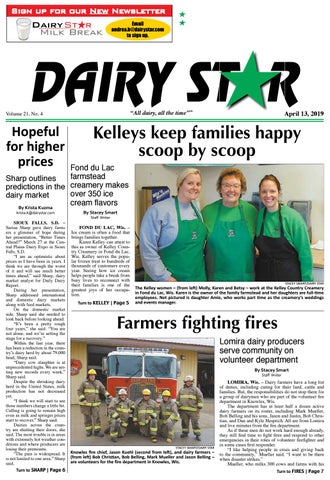
The Kelley women – (from leŌ) Molly, Karen and Betsy – work at the Kelley Country Creamery in Fond du Lac, Wis. Karen is the owner of the family farmstead and her daughters are full-Ɵme employees. Not pictured is daughter Amie, who works part Ɵme as the creamery’s weddings and events manager.
Farmers ghting res Lomira dairy producers serve community on volunteer department By Stacey Smart Staff Writer
STACEY SMART/DAIRY STAR
Knowles re chief, Jason Kuehl (second from leŌ), and dairy farmers – (from leŌ) Bob ChrisƟan, Bob Belling, Mark Mueller and Jason Belling – are volunteers for the re department in Knowles, Wis.
LOMIRA, Wis. – Dairy farmers have a long list of duties, including caring for their land, cattle and families. But, the responsibilities do not stop there for a group of dairymen who are part of the volunteer re department in Knowles, Wis. The department has at least half a dozen active dairy farmers on its roster, including Mark Mueller, Bob Belling and his sons, Jason and Justin, Bob Christian, and Dan and Kyle Hesprich. All are from Lomira and live minutes from the re department. As if these men do not work hard enough already, they still nd time to ght res and respond to other emergencies in their roles of volunteer reghter and in some cases rst responder. “I like helping people in crisis and giving back to the community,” Mueller said. “I want to be there when disaster strikes.” Mueller, who milks 300 cows and farms with his Turn to FIRES | Page 7
Page 2 • Dairy Star • Saturday, April 13, 2019
DAIRY ST R www.dairystar.com
ISSN 020355 522 Sinclair Lewis Ave. Sauk Centre, MN 56378 Phone: (320) 352-6303 Fax: (320) 352-5647 Published by Dairy Star LLC General Manager/Editor Mark Klaphake - mark.k@dairystar.com 320-352-6303 (ofďƒžce) 320-248-3196 (cell) 320-352-0062 (home) Ad Composition Nancy Powell 320-352-6303 nancy.p@dairystar.com Amanda Thooft 320-352-6303 amanda.t@dairystar.com Consultant Jerry Jennissen 320-346-2292 Editorial Staff Andrea Borgerding - Associate Editor (320) 352-6303 • andrea.b@dairystar.com Krista Kuzma - Assistant Editor (507) 259-8159 • krista.k@dairystar.com Jennifer Coyne - Assistant Editor (320) 352-6303 • jenn@dairystar.com Ruth Klossner (507) 240-0048 cowlady@centurylink.net Danielle Nauman (608) 487-1101 danielle.n@dairystar.com Danna Sabolik - Staff Writer (320) 352-6303 • danna.s@dairystar.com Maria Bichler - Copy Editor 320-352-6303 Advertising Sales Main Ofďƒžce: 320-352-6303 Fax: 320-352-5647 Deadline is 5 p.m. of the Friday the week before publication Sales Manager - Jeff Weyer (Northern MN, East Central MN) 320-260-8505 (cell) jeff.w@dairystar.com Mark Klaphake (Western MN) 320-352-6303 (ofďƒžce) 320-248-3196 (cell) Laura Seljan (National Advertising, SE MN) 507-250-2217 fax: 507-634-4413 laura.s@dairystar.com Jerry Nelson (SW MN, NW Iowa, South Dakota) 605-690-6260 jerry.n@dairystar.com Mike Schafer (Central, South Central MN) 320-894-7825 mike.s@dairystar.com Amanda Hoeďƒ&#x;er (Eastern Iowa) 320-250-2884 • amanda.h@dairystar.com Amos Denman (Southern WI) 563-608-6477 • amos.d@dairystar.com Megan Stuessel (Western Wisconsin) 608-387-1202 • megan.s@dairystar.com Deadlines The deadline for news and advertising in the Dairy Star is 5 p.m. Friday the week before publication. Subscriptions One year subscription $35.00, outside the U.S. $110.00. Send check along with mailing address to Dairy Star, 522 Sinclair Lewis Ave., Sauk Centre, MN 56378. Advertising Our ad takers have no authority to bind this newspaper and only publication of an advertisement shall constitute ďƒžnal acceptance of the advertiser's order. Letters Letters and articles of opinion are welcomed. Letters must be signed and include address and phone number. We reserve the right to edit lengthy letters. The views and opinions expressed by Dairy Star columnists and writers are not necessarily those of the Dairy Star LLC.
The Dairy Star is published semi-monthly by Dairy Star, LLC, 522 Sinclair Lewis Ave., Sauk Centre, MN 56378-1246. Periodicals Postage Paid at Sauk Centre, MN and additional mailing ofďƒžces. POSTMASTER: Send address changes to Dairy Star, 522 Sinclair Lewis Ave., Sauk Centre, MN 56378-1246.
North America dealers. A glance at what’s inside
Dairy Proďƒžle brought to you by your
Help us keep our paper free Free. Who doesn’t love something that’s free, especially when it’s a beneďƒžcial resource? We hope you ďƒžnd the content – both editorial and advertisements – of Dairy Star valuable. The Dairy Star staff takes pride in the fact that we can provide the paper to dairy farmers in our coverage area free of charge, thanks to our wonderful advertisers. Without them it wouldn’t be possible. However, there is one more step in keeping the paper free. That’s where you come By Mark Klaphake Editor in. In February, you should have received a letter with a subscription form in the mail. Every few years, we have to verify with the post ofďƒžce the number of subscriptions that are requested by our readers. This determines our postage and helps us keep expenses at a reasonable rate. So, although the paper is free, we still need you to ďƒžll out a subscription form. It is also important to our advertisers that we keep our list of dairy farmers current. If you have already sent the letter back to us, thank you! If you haven’t, don’t fret. There is still time to get it in and keep you on our subscription list. There are a few ways you can send in your information. The ďƒžrst is to ďƒžnd the subscription form mailed to you in February, ďƒžll it out and mail it back to us. The second is to email Nancy at nancy.p@ dairystar.com. In the email, include your name, phone number and address along with a request to either continue receiving the paper or to discontinue receiving it. Please state whether or not you are a dairy farmer. If you have lost your subscription letter or you prefer not to email, give us a call at 320-3526303. Ask for Nancy and she will take care of you. If at any time you have suggestions or comments about the paper, we want to hear them. Email or call Mark at mark.k@dairystar.com or 320-248-3196. Your stories are the ones that help keep the paper successful, for which we are very grateful. As always, we will continue to strive for the paper to be a valuable resource, a free publication and in tune with our slogan, “All dairy, all the time.â€? – The Dairy Star Editorial Team
UNIFORM, FLUFFY WINDROWS
Visit your local dealer or our website for details!
UP TO $1,500 OFF SELECT ROTARY RAKES Offer Ends: June 28, 2019
GA SINGLE-ROTOR ROTARY RAKES • Masterdrive gearbox for increased reliability and toughness during intense use • Double curved tine arms provide clean raking and increased forward speed Ĺ? /RQJ Ä H[LEOH WLQHV WRXFK FURS MXVW RQFH QHDWO\ OLIWLQJ DQG GHSRVLWLQJ LQWR ZLQGURZ Ĺ? 6XSHULRU UDNLQJ TXDOLW\ FUHDWHV Ä XII\ IDVW GU\LQJ ZLQGURZV ZLWKRXW URSLQJ INVEST IN QUALITY ÂŽ
10'6" – 14'9" raking widths
D & D Farm Supply Arcadia
Komro Sales & Service Durand
Cherokee Garage Colby
Lulich Implement Mason
Kalscheur Implement Cross Plains
Lindstrom Equipment Mondovi
KuhnNorthAmerica.com m
East Side Farm Equipment Monroe
Steinhart's Farm Service Platteville
Frontier Ag & Turf Osceola New Richmond
Visit your local Wisconsin KUHN dealer today!
Carl F. Statz & Sons Waunakee
Dairy Star • Saturday, April 13, 2019 • Page 3
It’s all inside... Columnists Ag Insider
Pages 8-9 First Section
On-farm recycling, who knew? Page 27 First Section
Prairie Du Sac
Amery
Ramblings from the Ridge
First Section: Pages 15 - 16
Page 30 First Section
Veterinary Wisdom
Women in Dairy: Brenda Elsinger First Section: Page 36
First Section: Pages 37 - 38
Bayeld
Douglas
Page 31 First Section
Lomira
Breunigs breed, exhibit national champion rabbit
From Our Side of the Fence
Iron Ashland
Sawyer
W as
Burnett
hb
ur
n
Making Cents of Dairy
Price
Page 32 First Section
Fond du Lac Polk
Come Full Circle
Fond du Lac farmstead creamery makes over 350 ice cream avors
Rusk
Barron
Taylor St. Croix
The “Mielke” Market Weekly
Pages 10 - 11 Second Section
Argyle
Pierce
Penny is the queen of longevity at Flanagan Farms
Dunn
Pepin Buffalo
Second Section: Pages 8 - 9
First Section: Pages 1, 5
Chippewa
Marathon Clark
Eau Claire Trempealeau
Page 33 First Section
Wood Jackson Adams
La Crosse Monroe
Juneau Vernon
South Wayne
Zone 2
LASA strives for conservation, stewardship First Section: Pages 34 - 35
ford
Richland
Sauk
Craw
Iowa
Fond Du Lac Columbia
Dane
Grant Lafayette
Green
Dodge
Rock
n
so
er
ff Je
Lomira
Lomira dairy producers serve community on volunteer department First Section: Pages 1, 7
For additional stories from our other zone, log on to www.dairystar.com
NOW is the Time to Save on Fans! Optimize your barn ventilation for better animal comfort and improved energy savings. All GEA fans are on special right now as you prepare for the summer heat. You can add a monitoring control and automatically manage your sprinkler, curtain, and lighting systems...and save even MORE! Get a quote from your local GEA barn equipment dealer today! OFFER ENDS MAY 31, 2019
Page 4 • Dairy Star • Saturday, April 13, 2019
Book Your Seed, Fertilizer, Chemicals & Minerals NOW!
Les Kuehl
Repair Service
COME SEE US FOR ALL YOUR SPRING NEEDS
YOUR CENTRAL MINNESOTA GOLIATH REPAIR SERVICE!
Gates • Fencing • Feeders • Skid Loader Attachments • Gardening Seed & Supplies • Calf hutches • Batteries • Tools • Boots & Apparel • Feed • Hay • Rock Wagons
4-H FAMILIES
We will help you raise award winning animals Come see us now to learn how!
MULCH
Buy Your Chick Feed at Gilman Creamery and SAVE $$$ on your Chicks!
35%
Save on these April Deals!
$
1
Off
Off Per Gallon on
ALL BULK AND ND JUG OILS! 21-In. Gas Push Mower 4685939
$
$
Car Care Products *Excludes Batteries
100-ft. Plastic Safety Fence
18999
6767966
$
1999
50
REBATE on Miraco A3100 DS Waterers
30+ YEARS EXPERIENCE
3 Bags for
Or Buy Bulk and SAVE!
• Sealed silo parts & service All parts • Best chains on the market needed to service your • Used and rebuilt unloaders Goliath • Stainless steel roofs Unloaders • Stainless steel conveyor chains Call for early maintenance specials
8
$ 49
All Your Spring Gardening & Yard Needs!
GREENHOUSE COMING SOON! Upcoming Events
Blackstone grilling with our own Adam, April 20th - 11 am to 1 pm Learn how to make your summer grilling more entertaining!
Gilman Co-op Creamery
FEED & FARM SUPPLY STORE
Not afÀliated with the Harvestore brand
Easter Bunny here April 20th 11 a.m. to 1 p.m.
320-760-2909
Eve. 320-762-1827 No Emergency Charges--Ever!
Gilman, MN 320-387-2770
Open M-F 7:30-7, Sat. 7:30-5, Sun. 8:30-1 Good service - fair prices - every day
WWW.GILMANCREAMERY.COM
Achieve Healthier Cows & Calves
Pure 3000 Chlorine Dioxide Technology
Mouth-Piece Vented Triangular Liner There’s a reason 25% of the cows in the U.S. are milked with Impulse Liners!
A HIGHLY EFFECTIVE WATER INJECTION SYSTEM
DUAL GERMICIDE CHLORIDE DIOXIDE
REDUCES: • Respiratory Issues • Scours • Crypto • Salmonella • E-coli
Available in a 12mm Milk Tube!
THE PREMIER GERMICIDE ON THE MARKET
TOUGH TIMES CALL FOR PRIME
PROTECTION
HIGHLY EFFECTIVE AGAINST • Prototheca • Staph Aureus • Mycoplasma
AVAILABLE IN: 5, 15, 30 and 55 gallon drums and 265 gallon totes.
SAVE UP TO
$1/GAL.
over Iodine
USE
PRE & POST
9 EMOLLIENTS Ultimate teat conditioning
GREEN COLOR
Max Protection until the next milking
for High-Vis Marking
FOR MORE INFO - CONTACT ONE OF THESE DEALERS... Advanced Dairy Systems
Athman Dairy Inc.
D&D Ag Supply
9 State Rd. 29 • Spring Valley, WI 54767 (715) 772-3201
238 Main Street North • Pierz, MN 56364 (320) 468-2494
133 Atlantic Ave. NE • Pennock, MN 56279 (320) 599-4466
Anderson Dairy Systems, Inc.
Champion Milking Systems
East Central Dairy Supply
1312 13 1/2 Ave. • Barron, WI 54812 (715) 537-3300
23218 350th Street • Albany, MN 56307 (320) 845-4156
2195 Hwy. 23 • Mora, MN 55051 (320) 679-1029
Eastern Iowa Dairy Systems 105 3rd Ave. NW • Epworth, IA 52045 (563) 876-3087
Fuller’s Milker Center, Inc. 423 U.S. 61 • Lancaster, WI 53813 (608) 723-4634
Gorter’s Clay & Dairy Equipment 1400- 7th St. SE • Pipestone, MN 56164 (507) 825-3271
Lang’s Dairy Equipment, Inc. 2337 Millennium Rd. • Decorah, IA 52101 (563) 382-8722
Designed to handle higher flow rates and provide better fit onlarger inlet claws.
IMPULSE AIR = BETTER PERFORMANCE!
Leedstone
24260 Cty. Rd. 27 • Plainview, MN 55964 (507) 534-3161
Leedstone
2545 80th Ave • Woodville, WI 54028 (715) 698-4370
Professional Dairy Systems
1449 Homecrest Ave. • Wadena, MN 56482 (218) 632-5416
Tri-County Dairy Supply, Inc.
4107 N US HWY 51 • Janesville. WI 53545 608-757-2697
United Suckow Dairy
12687 Hwy 18 & 52 • Postville, IA 52162 (563) 864-7417 210 N. Industrial Pkwy • West Union, IA 52175 (563) 422-5355
Dairy Star • Saturday, April 13, 2019 • Page 5
ConƟnued from KELLEY | Page 1 “When people come here, they forget about their cell phones,” Kelley said. “Instead, they live in the moment. They talk to each other and try one another’s ice cream avors and just enjoy being together.” The creamery’s ice cream is made with Grade A milk from the family’s farm which is just down the hill. Formulating the ice cream mix from their farm’s milk is a big part of what makes the ice cream so special. “Using our own milk allows us to zero in on more specics,” Kelley said. “It’s how you make your ice cream unique. For example, we pasteurize the milk, but we don’t homogenize it. This keeps fat globules in their natural state which helps with digestion. People who are lactose-intolerant or have dairy allergies, Crohn’s disease or even diabetes tell us this is the only ice cream they can eat.” Kelley and her husband, Tim, have ve grown children – Amie, Betsy, Heidi, Molly and Clark. Tim and Clark, fth- and sixth-generation farmers, respectively, run the 65-cow, 200-acre Oak Lawn dairy farm, which has been in the Kelley family for 158 years. The Kelleys pasture their cows when weather permits, which Kelley said is important for milk quality and taste. The creamery makes more than 350 avors of ice cream, including up to 20 seasonal varieties. Between 20-25 avors are available at any one time, and avors change on the y. The one exception is Leo’s butter pecan, which was named after Kelley’s father-in-law. “It’s our most popular avor,” Kelley said. “And, we always make sure it’s on-hand.”
STACEY SMART/DAIRY STAR
Karen Kelley hands a customer ice cream at Kelley Country Creamery in Fond du Lac, Wis. The creamery makes more than 350 avors of ice cream and will serve 2,000 customers on a busy summer day. Kelley Country Creamery opened its doors on May 13, 2010, serving 70,000 customers that rst season. Since then, Kelley said business has at least tripled. The creamery was featured on “Good Morning America” after being voted it to have the best ice cream in America in 2013. May through October is their busiest period, and, on summer nights, it’s not uncommon for the line to go out the door 100 people deep. The creamery serves around 2,000 customers on a typical summer weekend day. Attending conferences and seminars on value-add options, Kelley said
STACEY SMART/DAIRY STAR
The Kelleys milk 65 cows on their farm in Fond du Lac, Wis., which is located near the creamery. A porƟon of the milk is used to make the creamery’s ice cream.
she explored ideas such as bottling milk and making cheese before deciding to make ice cream. “I always enjoyed ice cream,” she said. “It’s a happy food loved by people of all ages.” Getting the creamery up and running was a four-year process. Kelley researched and learned about ice cream making, including taking courses at the University of Wisconsin-Madison. When considering value-added opportunities, Kelley recommends seeking the help of relevant trade organizations. “Visit their websites, become a member, go to their conventions,” Kelley said. “Building your network is so important.” The creamery employs 30 people, including three of Kelley’s daughters. Betsy and Molly work at the creamery full time, while Amie works part time as the creamery’s manager of weddings and events. Brides and grooms looking for a spin on the traditional wedding cake can enlist Kelly Country Creamery to make individual ice cream desserts for their guests, such as diamond-shaped ice cream gems, chocolate marble tulip cups or three-tiered mini wedding cakes. The Kelleys also make custom ice cream cakes and pies for every occasion. The Kelleys enjoy inventing new avors and are not afraid to experiment with bold creations. For example,
blue cheese pear is a wild combination of pear-avored ice cream, caramelized pears and Gorgonzola blue cheese crumbles. Maple bacon is made with local maple syrup and caramelized bacon from a local meat market. “We’re a creative family,” Kelley said. “And oftentimes, we nd ourselves ahead of the trends.” The perfect breakfast ice cream might be barnyard bash, made with maple walnut ice cream and pieces of pancakes, wafes, French toast and walnuts. Moo luau is a summer seasonal that satises the craving for a sundae with its banana split and vanilla ice creams loaded with strawberries, bananas, pineapple, chopped nuts, a chocolate swirl and Maraschino cherry halves. While robin’s egg, a blend of vanilla malt and speckled malted eggs, is a tempting Easter treat. Even with all the avors to choose from, Kelley’s favorite is vanilla. “You have to have a good vanilla in order to make the rest,” she said. The creamery’s ice cream is not found in grocery stores or other retail locations. Kelley was offered national distribution following her appearance on “Good Morning America,” but she declined. “It’s so special to come here and eat our ice cream right where it’s made,” Kelley said. “The ice cream is fresh, and the quaint atmosphere can’t be duplicated. You lose some of that unique experience when your ice cream is available everywhere. We do have a couple wholesale accounts, but for the most part, the only place you’ll nd our ice cream is right here at the creamery.” Located less than one mile from Interstate 41, the creamery’s primary customer base stretches a 150-mile radius. Many of their customers are local, but the creamery does attract ice cream-lovers from all over the country and even faraway places like Germany and Japan. “I’ve met a lot of wonderful people,” Kelley said. “That’s what keeps me going.” Most people discover the creamery by word of mouth, but Kelley also uses her website, Facebook and Instagram to promote the creamery. The creamery features outdoor seating, including picnic tables and a sun porch lined with white, wooden rocking chairs – the perfect spot to enjoy an ice cream cone while soaking up the countryside and pondering what new avor the Kelleys will come up with next.
COMPLETE BARN SOLUTIONS WHATEVER YOUR DAIRY NEEDS 20,000 gal Mueller Silo with Nimbus Control System Hammink South • Bruce, SD
3000 gallon Mueller Tank Brad and Dale Stiller Mazeppa, MN
Call us to help you make your dairy operation more efficient.
PINE ISLAND, MN • 800-233-8937 BEATRICE, NE • 800-342-5657 SIOUX FALLS, SD • 800-705-1447 MENOMONIE, WI • 715-235-5144
www.midwestlivestock.com
Page 6 • Dairy Star • Saturday, April 13, 2019
ConƟnued from SHARP | Page 1
Willmar, MN • 320.231.1470
EXPANDING OR REMODELING YOUR LIVESTOCK OPERATION? LANGE AG SYSTEMS SPECIALIZES IN:
Ŷ NEW FACILITIES
_
NO JOB TOO BIG OR TOO SMALL
Ŷ RETROFITTING & REMODELING Ŷ TURNKEY PROJECTS Ŷ BARN DESIGN Ŷ INSTALLATION, MAINTENANCE & REPAIRS
ƋƵŝƉŵĞŶƚ tĞ KīĞƌ͗ ͻ sĞŶƟůĂƟŽŶ &ĂŶƐ ͻ sĞŶƟůĂƟŽŶ ŽŶƚƌŽůƐ ͻ WŽƐŝƟǀĞ WƌĞƐƐƵƌĞ dƵďĞƐ ͻ ƵƌƚĂŝŶ ^LJƐƚĞŵƐ ͻ DĂƩƌĞƐƐĞƐ ͻ tĂƚĞƌĞƌƐ ͻ ^ƚĂůů ƋƵŝƉŵĞŶƚ ͻ ,ĞĂĚůŽĐŬƐ ͻ DŝƐƟŶŐ ^LJƐƚĞŵƐ
Lange Ag Systems is proud to offer Grain Bags, Silage Bags & Bunker Covers from Up North Plastics and Feed Fresh Silage Covers & Custom Size Bunker Covers from Raven!
t ^ >> E t Θ h^ 'ͳ ' Θ < >>z Zz E '' Z^
www.LangeAgSystems.com ALL PRICED AND READY TO GO!
8124 Knight 3030, Knight Knight 8141 8014 370 H&S 3 Auger ‘13, Big 3050 Slinger w/upper 1,000 PTO 2014, Discharge $12,500 1,000 PTO, Beater $3,800 20,000 $7,600 28L26 Tires $ $7,600 $36,000
W.H. Lien Inc.
N8974 Pole Grove Rd. • Hixton, WI
715-963-4211
Celebrating
Sales & Service of New & Used Farm Machine ry
Repair vs. Replace
Electronic Dairy Board Repair Service
Specializing in: WestfaliaSurge, BouMatic, & DeLaval pulsators & Takeoffs, circuit boards, Mueller milk tank circuit boards. Call: (c) 406-590-7764
www.circuitÀxer.wixsite.com/ boumaticboardrepair
L Lasting Solutions for your L Livestock, Soils and Plants Years of Growing Strong
AG R I z DY N AMI C S
ted *Formu la nic a rg O for Use
Support livestock with minerals and remedies. Dyna-Min™ for trace minerals, binds molds and mycotoxins Pasture, Prairie & Range Licks™ A selection of 4 complete ŞųåĵĜƻåŸØ å±ÏĘ ƵĜƋĘ ± ÚĜýåųåĹƋ ±×{ ų±ƋĜŅ Aqua-Nox™ for parasites and stressed animals For Healthier calves, starting from day one. Neema-Tox™ Super Start Calf Bullets™ Ketonic™
Limber Res-Q™ Equi-Essentials™ Buckeroo Trail Blazer™
There are still people trying to make it through this downturn, especially in places like Texas, Sharp said. “A lot of producers are in a bear hug with their lender – nobody can let go without somebody getting hurt. They are waiting. It is coming. I think we’ll start to see dairies leave there as well,” she said. Recent blizzards and bouts of cold weather and ooding will also bring milk yields down. “Growth in milk production is likely to be slow and non-existent throughout the year, and, as a reminder, at growth is a victory because demand continues to grow,” Sharp said. As milk and cow prices rebound, there will be another wave of herd dispersals, Sharp said. “People [were] looking to retire but didn’t want to when springer values were the lowest they’ve ever been. As the price and assets come back to healthy levels, we’ll see people who are exible and will sell out given the opportunity,” she said. Sharp expects expansions in the next few years as well. Dairy processing will shift as milk output goes down. “We have more processing capacity, slower amount of milk production, regional decits that’s adding up to less milk powder and nally it is adding up to very slow growth in cheese,” Sharp said. Cheese production continues to grow year after year but so does demand. Processors have been making more cheese barrels to move excess milk quickly during the last few years. “If you are in an oversupply milk market, your processor is doing you a favor by making barrels so they don’t have to dump milk. Barrels can be cheap but have a thin margin so they’re not ideal choice for processors to make,” Sharp said. As milk output slows and processing capacity increases, cheesemakers are able to move away from making barrels. Milk powder stores are down from a year ago, another good sign for a potential rebound in the milk price. Demand for butter is excellent, Sharp said. “Butter is healthy again. That’s helpful,” Sharp said. Sharp anticipates better milk prices over the next 18 months, but she is also cautious. “Markets don’t ever go straight up for very long so I’m not saying we’re straight up from here, no worries, close your eyes and make as much milk as you can. It can get rocky and there are some unknown concerns, particularly the global economy,” she said. Internationally, Europe’s milk production is down from one year ago. In January, Europe’s milk supply saw a 1.2% decrease in January, which equates to about 355 million pounds of milk, Sharp said. “You can start to see that impacting global milk prices and especially can see
it in global milk powder production,” she said. There have also been decits in New Zealand and Australia. South America also saw milk production drop, especially in Argentina, which was down 8%-9%. China is also most likely lower in milk production. “It’s hard to know exactly what is going on with milk production in China, but if you look at their import volumes it seems likely they have a milk production decit,” Sharp said. “Overall Chinese demand for imported dairy products is on the rise and that is good for everyone.” However, Sharp is nervous about China’s decrease of whey imports from the United States. “We are losing ground there as well, and there are other suppliers who are really ready to pick up that business. Europe is taking that market right now,” she said. Europe could also impact the U.S. market in another way. “Europe is also trying to win protection for geographical indications for common cheese names. It’s going to cost us a lot of effort and consumer rebranding. … We will lose sales if they manage to get this in their favor,” Sharp said. “This is one part of their free trade strategy.” Another concern is Mexico raising tariffs on U.S. cheese. “There are rumors Mexico could enact a tariff on milk powder as well to get people’s attention. That would be devastating. We are still growing our cheese market in Mexico, but not nearly the amount we were before these tariffs were put into effect. The longer these tariffs, the longer we lose. Now new suppliers [from other countries] are reaching out to Mexico,” Sharp said. In the feed markets, Sharp does not think there will be a lot of change in the number of corn versus soybean acres planted. “With $9 corn and $4 beans, it doesn’t make anyone super excited to plant one crop over the other. I think farmers will generally stick with their crop rotations,” she said. Sharp called trade a wild card. “If China starts to import corn, which historically they have not done, that could really put a big tailwind in the corn market. That’s a big if. There are rumors they will. They have a lot of corn to chew through before they start moving ours,” she said. Soybean stock is large and exports are down because China has not bought as much as promised. “Every day that goes by that we don’t have a trade deal we get one day closer to the South American harvest. So, China will be turning its attention there, and we won’t get this back,” Sharp said. “No matter what happens with the trade deal I think there are plenty of beans in the United States, and it will stay that way for awhile.”
OLSEN IMPLEMENT, INC. “Serving you for 66 Years”
P.O. Box 28 • 2015 Hwy. 9 West • Osage, IA 50461
641-732-4301
quadagrimill@gmail.com *Always Check With Your Certifying Agency
‘13 SunÁower 1435 Disc, used, 23 ft.
$22,500
Dairy Star • Saturday, April 13, 2019 • Page 7
ConƟnued from FIRES | Page 1 sons, has been on the department for 32 years and served as rst assistant chief for 25 of those years. Bob Belling has been a volunteer reghter with the Knowles Fire Department for 41 years and served as re chief for 26 years. Milking 70 cows, he farms with his sons Jason and Justin, both of whom have followed in their dad’s footsteps and are also members of the department. “I do it because I like to help others,” Bob Belling said. “You never know if your own family might need help like this some day.” Bob Christian, who runs a 1,500-cow dairy with his dad and brothers, has been with the department for 13 years, and, like the others, he takes pride in serving his community. Fitting reghting into an already jam-packed schedule may seem overly ambitious, but these humble heroes do whatever it takes to get the job done. “You nd a way to make it work,” said Jason Belling, a 17-year member of the department. Jason Kuehl is the department’s re chief. He took over for Bob Belling eight years ago and has spent a total of 21 years on the department. Kuehl and Bob Belling are also rst responders with the Brownsville Emergency Medical Service. Kuehl works at the implement dealer next door to the re station. Although not a farmer himself, Kuehl has been involved with agriculture his entire life. The department sits in the middle of farm country, and its rural location lures a unique set of individuals to serve on its ranks – active dairy farmers, retired dairy farmers, those who grew up on farms, mechanics for various ag dealerships and so on. While the number of farmers on the department has shrunk over the years, the department’s connection to the industry is still strong. Even today, nearly all of the department’s 25 active guys have direct ties to agriculture. This farm-oriented re department is unique. Well-versed in farm rescue training, silo res and other farm-related emergencies, the Knowles Fire Department frequently helps other departments in the state when these types of crises arise. “Because there are less and less farmers on most re departments, there is limited knowledge in how farms work,” Bob Belling said. “We’re rich in that experience so we get called in for these types of emergencies. Silo res don’t happen often. The last one we were at had 4-5 departments onsite, but none of the reghters had ever been in a silo before. As farmers, we do that kind of stuff every day, so we can provide
a lot of help in that area.” Knowles is an unincorporated village in the town of Lomira, and the department, which is privately owned, serves portions of the towns of Leroy and Lomira, providing one-third coverage to each. “In Lomira, we share duties with the Lomira village and Brownsville departments,” Kuehl said. “In Leroy, coverage is split with the Brownsville and Kekoskee re departments.” The department responds to res of all kinds – from those occurring in barns to homes to businesses. They also respond to other types of emergencies and are one of the rst on the scenes of accidents and disasters – including car crashes, damaging storms and other catastrophes. Rescuing people and animals from hazardous situations and providing basic medical attention are key aspects of the volunteer reghter’s job description. “I like the adrenaline rush and satisfaction of providing help as quickly and efciently as possible,” Jason Belling said. “You try to save as much as you can.” The department averages 50-75 calls per year and has had 19 calls so far this year. Bob Belling has been on 40 calls already in 2019, most of which have been rst responder calls. The department holds training every Tuesday. The state requires each reghter to attend 12 training sessions per year, usually once a month. At the Knowles Fire Department, this schedule is adjusted to accommodate farming seasons. Therefore, farmers on the department might complete 7-8 trainings in the winter and fewer in the spring and summer months. Fireghters must be state-certied before entering a re, which requires 96 hours of training. “The camaraderie is what I enjoy most about being a reghter,” Christian said. His fellow reghters agreed. “Building memories with our neighbors and other guys on the department is one of the things I like most about this job,” Mueller said. Bob Belling has enjoyed the experience. “As a reghter, I’ve gained a lot of friends throughout the state that I never would’ve met otherwise,” he said. “The chance to create lasting friendships is a bonus of this work.” Serving on the Knowles Fire Department is a family tradition passed down through the generations, where brothers serve alongside brothers and fathers serve alongside sons. Nearly all of the reghters have family members who have served on the depart-
STACEY SMART/DAIRY STAR
Volunteer reghters organize a truck in Knowles, Wis. The department is experienced in farm rescue training, silo res and other farm-related emergencies, and are oŌen called upon by other re departments for their experƟse in these areas. ment at one point or another. The longevity of the reghters at this particular department is much higher than the norm. The national average for a volunteer is four years Kuehl said. Knowles has 14 men with more than 20 years of service, and about six men have been there for 10 years. “Over 75% of our nation’s reghters are volunteers,” Kuehl said. “Every re department needs more volunteers. It’s a constant struggle to ll these positions, especially in rural America.” With a population of approximately 900 people, Kuehl said Lomira does not have the tax base to support a full-time department. “The cost to the taxpayer would be phenomenal if we had to hire reghters,” Kuehl said. Willing to take on much more than the average person, these brave dairy farming remen donating their time to the re department perform seless acts of courage whenever they are called upon. Who better to tackle the demands of reghting than guys familiar with dangerous, hard work and comfortable responding at the drop of a hat in any and all elements? Happy to help others, a farmer might be the ideal reghter. “We’re lucky to have the farmers on our department,” Kuehl said.
Page 8 • Dairy Star • Saturday, April 13, 2019
Dairy situation is “urgent” Wisconsin Senator Tammy Baldwin has the new Dairy Margin Coverage program. This is organized a bipartisan group of her Senate colleagues part of an awareness campaign that will be launched and are asking USDA to take immediate action on later this month. the implementation of the dairy title of the new Dairy Task Force 2.0 offers farm bill. In the letter to the Agriculture recommendations Department, the lawmakers said “the Ag Insider The Wisconsin Dairy Task Force situation for dairy farmers is urgent. 2.0, created last year by the Wisconsin Although Dairy Margin Coverage is Department of Agriculture, Trade and effective as of January 1, 2019, the Consumer Protection and the University government shutdown delayed action of Wisconsin System, has passed nearly on 2018 farm bill implementation for 50 recommendations. The wide-ranging over a month. During that time, dairy list includes the return of Wisconsin’s farmers continued to face market Beginning Farmer and Farm Asset instability and are struggling to survive Owner tax credit, develop an intern the fourth year of sustained low prices.” program to encourage young people to go into production agriculture, and Peterson seeks action on dairy title encourage dairy farmers to seek local House Agriculture Committee By Don Wick ofce and zoning boards. Chairman Collin Peterson said he Columnist is concerned about the time frame Evers to speak at cheese industry to implement the new Dairy Margin Coverage program. Listening to farmer feedback, conference Wisconsin Governor Tony Evers will speak at Peterson said the June timeline is too long. Sign-up for the program begins mid-June. “If they wait until the Wisconsin Cheese Makers Association industry June, there could be farmers giving up their ghosts conference April 18 in Madison. Evers is expected by then, even if the program is retroactive.” Peterson to address the current challenges facing the dairy said USDA can’t speed up the implementation, they industry and opportunities for the dairy processing have to go through a process. Peterson does not sector. Legislative priorities for the dairy industry want this confusing farmers. “I’m afraid farmers will also be outlined. will look at this, not sign up for the highest level and then, they’ll end up spending money and not Farm credit leaders address appropriations getting anything out of it.” A letter has been sent subcommittee The nancial challenges in agriculture were to Agriculture Secretary Sonny Perdue urging USDA to prioritize the implementation of the highlighted in a recent House subcommittee dairy provisions in the new farm bill. More than hearing. Compeer Financial President and CEO 70 House Democrats and Republicans signed off on Rod Hebrink offered his perspective on the farm economy. “The crop and livestock sectors we serve this letter. are best described as ‘struggling,’ impacting farmers of all ages, experience levels and sizes.” Hebrink New DMC planning tool The Farm Service Agency is producing an said economic downturn has been particularly hard online decision tool for dairy farmers considering on dairy farmers. Farm Credit Services of American
President/CEO Mark Jensen also highlighted the tight margins within agriculture. Lawmakers asked the panel of farm credit leaders about a variety of topics, ranging from hemp production to rural development. No action was taken. Road trip to promote USMCA Farmers for Free Trade is planning a 3,500 mile RV tour across 11 states to drum up support for the U.S.-Mexico-Canada Agreement. This road trip begins in Pennsylvania April 12 and will continue during the two-week congressional recess. Organization co-founder Brian Kuehl said the tour will highlight the importance of U.S. agricultural trade with both countries. “Canada is the largest export destination for U.S. food and ag products, and Mexico is our number three trading partner,” Kuehl said. “We’re really worried about the ability for Congress to pass the USMCA. Farmers are stuck in the middle, urging to get the bill through.” Kuehl goes on to say the whistle-stop tour is designed to include a variety of events and attract a wide scope of people. The Wisconsin stop will be in LaCrosse on April 24. Dairy groups join USMCA coalition The Pass USMCA Coalition has added eight new organizations to its ranks, including the National Milk Producers Federation and U.S. Dairy Export Council. This coalition is urging Congress to support the U.S.-Mexico-Canada Agreement. New genetics tool Holstein USA has launched a new program called Holstein Marketplace Sires. Bulls available through this program must meet specic criteria for production, health, longevity, pregnancy rate and calving ease. Holstein Marketplace Sires is designed to connect Holstein breeders with these Turn to AG INSIDER | Page 9
Bongards’ Creameries
Has been a quality market for MN dairy farmers for over 100 years. MN producers provide one of the country’s most distinctive brands of cheese that is still made using the same Old World craftsmanship and has been combined with cutting-edge technology to produce cheese that delivers unforgettable taste with unparalleled quality. MN Dairy farmers and Bongards, quality that stands the test of time. We offer a competitive base price, premiums, and the best Àeld representatives in the industry. 13200 Co. Rd. 51 Bongards, MN 55368 (952) 466-5521 Fax (952) 466-5556 110 3rd Ave. NE Perham, MN 56573 (218) 346-4680 Fax (218) 346-4684
ATTENTION FARMERS... Are rocks, re-rod or holes showing in your bunker silo?
Made in USA
WE CAN RESTORE YOUR BUNKER TO LIKE NEW CONDITION! BUNKER SILO RESTORATION/REPAIR WITH JETCRETE Like us on Facebook for your chance to win a prize!
Approximately 1” of steel reinforced material added to bunker walls.
• High pressure water blasting of walls for excellent bonding. • 6 gage heavy duty wire mesh installed • Jetcrete -phnuematically applied concrete.
1-800-887-4634•(608) 723-4634
SILO RELINING WITH “JETCRETE”
John, Jim & Dave Fuller 423 U.S. Hwy. 61 North • Lancaster, WI
www.fullersmilkercenter.com
BARN WALL & BASEMENT RESTORATION WITH “JETCRETE” B (Limestone, rock, block & concrete wall)
GUARENTEED BEST PRICING
SERVING IA, MN, WI, IL AND SD CONTACT:
800-866-7327
Dairy Star • Saturday, April 13, 2019 • Page 9
ConƟnued from AG INSIDER | Page 8
genetics with those dairy farmers looking for more options for semen. Organic Valley CEO resigns George Siemon has stepped down as chief executive ofcer of Organic Valley. Siemon was one of seven founders of the company that started in 1988. Chief Business Ofcer Bob Kirchoff has been appointed the interim CEO. Herrick joins IDFA staff Matt Herrick has joined the International Dairy Foods Association as its senior vice president, executive and strategic communications. This is a newly created position. Most recently, Herrick was the communications director for the Rockefeller Foundation. During the Obama Administration, Herrick served as the communications director at USDA and press director for the U.S. Agency for International Development.
PDPW ofcers elected Jay Heeg of Colby was reelected to another term as president of the Professional Dairy Producers of Wisconsin. Katy Schulz of Fox Lake was reelected vice president and Dan Scheider of Freeport, Ill. was reelected secretary. Janet Clark of Eldorado is the new PDPW treasurer. Trivia challenge USDA Undersecretary Bill Northey previously served as Iowa’s agriculture secretary. That answers our last trivia question. What country leads the world in per capita milk consumption? We’ll have the answer in the next edition of Dairy Star. Don Wick is owner/broadcaster for the Red River Farm Network, based in Grand Forks, North Dakota. Wick has been recognized as the National Farm Broadcaster of the Year and served as president of the National Association of Farm Broadcasting. Don and his wife, Kolleen, have two adult sons, Tony and Sam, and ve grandchildren, Aiden, Piper, Adrienne, Aurora, and Sterling.
Olsgard Silo Bagging
DHIA: Now MORE than ever Make culling decisions easier Cow
Milk
Prod. Index
Due Date
Cur SCC
BR
Apple
48
55
1-06
798
-
Molly
72
65
-
373
DNB
Meg
78
65
-
3940
-
Have this list on your phone or folded in your pocket next time you need to find cows that are candidates for culling. Using tools, such as Production Index (Prod Index), you can compare cows on a consistent basis using $Value based on milk, fat, protein, and SCC. Minnesota Dairy Herd Improvement Association 307 Brighton Avenue South Buffalo, MN 55313 1.800.827.3442 www.mndhia.org
Official Ag-Bag Dealer of Northeast Iowa WE CARRY IN STOCK: Silage Bags • Bunker Covers • Oxygen Barrier • Bale Wrap • Net Wrap • Tire Sidewalls
SERVING FARMERS SINCE 1982 JOHN OLSGARD
563-380-5248
Located in Cresco, IA
Don’t Fiddle Around With Your Advertising Dollars!
522 Sinclair Lewis Ave. • Sauk Centre, MN 56378 (320) 352-6303 • Fax: (320) 352-5647
Brad Putz • Putz Dairy
ed t s a o r r u o y Getting KLC Farms is t a s n a e b y o s
E L P SIM
Pull in unload and reload in just 15 minutes. Every day we have a high quantity of high quality soybeans. Our soybeans have the energy, protein, amino acids and bypass protein for your cows
KLC Farms Roasting, Inc.
Preferred By Bovines Everywhere
1-877-738-2326 Visit www.roastedbeans.com
Quality
Consistency
New Vienna, IA
“We know Roll-O-Matic curtains last because we have them on other buildings, so it was an easy decision to choose them again for our calf barn. We like having the motors on the curtains for raising/lowering because it has made it easy to keep the barn at the correct temperature and keep out the draft. The crew was also good to work with.”
Custom Àt to your new or existing building Motorized or Manual Options Highest UV inhibitor and lock stitch style sewing for longer curtain life Get the full value of air quality control curtains at the touch of a button
Calf barn 450 feet
minutes
Page 10 • Dairy Star • Saturday, April 13, 2019
LETTERS TO THE EDITOR
We don’t need a wall irect Buy D VE! A and S
We Manufacture!
ABRAHAM’S FARM REPAIR r Call us fo New & ts s U ed Par
WE CAN REPAIR YOUR SILOS AND UNLOADERS
Bill Abraham - Over 20 years experience
320-864-6821 Leave message
CANOLA MEAL CORN GLUTEN FEED CORN DISTILLERS GRAINS CORN STARCH LINSEED MEAL FLAX SEED OAT HULLS RICE HULLS SOYBEAN MEAL SOY BEST SOYBEAN HULLS SOY FLOUR SOY PLUS
AMINO PLUS SOY ISOLATE WHEAT MIDDS WHEAT GERM MEAL BEET PULP CASEINATES CHEESE SCRAPS SAW DUST FOOD BY-PRODUCTS LACTOSE NONFAT DRY MILK SUGAR/DEXTROSE WHEY PROTEIN POWDER
I came across an article titled, “Dairy Producer’s Don’t Need A Wall,” written by Mike Opperman of Farm Journal Milk magazine. Opperman asks, “What do you think about immigration reform? Let me know.” So, I did Feb. 21. I wrote a letter to the editor, but they never ran it. I sent two e-mails asking if they would run my letter, “Victims of a Crime.” I received no response. I even mentioned I didn’t know why they wouldn’t, because I agreed with Opperman 100 percent; dairy farmers don’t need a wall. The mission of Farm Journal Milk is to connect with large dairy producers – those with 500 or more cows – and provide them with the information and resources they need to run their operation and continue to expand. I have no problem with that as long as, when dairy farmers expand, they don’t break immigration laws. They say there’s no such thing as a victimless crime. It seemed like Opperman thinks employers who hire illegal immigrants and the illegal immigrants are victims. Opperman said every dairy farmer he’s talked to in the last two-plus years wants to have an accurate way to identify immigrants. There is; it’s called EVerify. In 2012, the U.S. Citizenship and Immigration Services retained the services of Westat, a social science research rm to evaluate the E-Verify program. The report said E-Verify is an accurate and robust tool and provides recommendations for how USCIS could improve the program’s already strong accuracy rate.
Opperman mentioned the E-Verify system then said there’s no existing system that will identify a person as fraudulent. I think Mike is misleading people by saying that, and that is wrong. These dairy farmers could use E-Verify. They simply choose not to. They are not the victims. The dairy farmers who are honest and choose to obey the law are the victims. In order to compete against dairy farmers who break immigration laws, I’m having to work 100 hours a week. I cannot afford to hire help because of the overproduction caused by dairy farmers hiring illegal immigrants. They are overproducing and driving the price of milk down. Opperman illegal immigrants are good people who are longing for a better way of life. I don’t think they are the victims. Americans who would like to have a good job are the victims. Many Americans who work two or three jobs and still have to get on government welfare in order to pay rent. They will never realize the American dream of home ownership. There’s not much of a middle class left because of illegal immigration. The exploitation of foreign workers has wrecked havoc on middle class Americans. What about the Americans who are longing for a better way of life and the American dream? They too are the victims. We don’t need a wall. The only way to x this problem is to put employers who are committing a crime by breaking immigration laws in jail and seize their assets. Joseph Schindler Dairy farmer Red Lake Falls, Minn.
Minnesota Milk looking at root of problem On behalf of the Minnesota Milk board, I’d like to thank the Dairy Star for their coverage of Dairy Day at the Capitol March 13, including Sadie Frericks’ “Dairy Good Life” column. We had over 60 attendees, which is normal, but a big feat after the terrible winter and prices we’ve all been experiencing. As Sadie noted, you’d be surprised how a little effort and a 15-minute meeting can change votes for the benet of dairy farmers. We hope you come next year. I serve on the Minnesota Milk Policy Committee, where we talk about both state and federal issues. After an hour discussion, we directed our contract economist Dr. Marin Bozic, our cooperative staff and Minnesota Milk staff to research and promote information about the block-barrel spread. While complicated, Bozic brought this to our attention at both the Feb. 14 policy and Feb. 28 board meeting as something disproportionately hurting Minnesota and surrounding states. Even with the new farm bill, Minnesota has suddenly gone from a leading milk price state to falling way behind. We believe this has a lot to do with 40 percent of our cheese being Italian, yet 0 percent of that being gured into our Class III price. It seems like each time a barrel of cheese hits the CME, our milk price goes down. For more background information on the block-barrel spread, read or listen to this podcast by T.C. Jacoby & Co, https://www.bit. ly/2JE2zYJ. I would kindly ask the editor of this paper to
give more attention to the issue. According to Bozic, it is less than $0.50/cwt. of impact, but we all lived through a time where $0.10/cwt. to $0.30/cwt. more in every milk check would mean the difference in a lot of neighbors staying in business or not, and bills getting paid. We ask you to ask your cooperative about what we can collectively do about the situation. Proposed solutions include adding Italian style cheeses into the price formula, taking barrels out or nding some other mechanism for Class III. Lastly, we cannot encourage you enough to call your legislators, especially now. Call your representative and senator and say, “I’m ___, a dairy farmer from ___, and I want you to support HF 1418 and HF 1419 (for the representative) or SF 1698 and SF 1699 (for the senators).” This conversation could represent millions of dollars re-entering our Minnesota dairy industry. As written (subject to change), either bill would provide about a $0.30/cwt. one-time payment for the most recent 12 months of production. One is linked to participation in the Dairy Margin Coverage program and the other to conservation programs. You can nd your representatives’ information here: https://www.gis.leg.mn/iMaps/districts/. Rick Smith Adams, Minn. Minnesota Milk treasurer
LETTERS TO THE EDITOR
Dairy Star Newspaper welcomes letters to the editor. Every letter for publication must be 500 words or less, contain the author’s signature, address and telephone number. We reserve the right to edit for clarity and brevity. Letters can be mailed to Dairy Star, Letter to Editor, 522 Sinclair Lewis Ave., Sauk Centre, MN 56378 or e-mail: mark.k@dairystar.com.
Target Your Customers!
The Dairy Star is sent only to DAIRY FARMERS!
8
If you would like to advertise in the DAIRY STAR, call 320-352-6303 for more information.
Net farm income hits historic low Minnesota dairy community not surprised by data By Jennifer Coyne jenn@dairystar.com
For the rst time in decades, Minnesota’s agriculture economy hit a historic low with a median net farm income of $26,000 reported in 2018, according to a study published by the University of Minnesota Extension and Minnesota State Centers of Excellence for agriculture. Of the farms surveyed, those both organic and conventional dairy farms reported a median net farm income of $14,697 – a negative 65% change since last year. The median net farm income of solely convention dairy farms was a mere $11,722. The report blatantly depicts the disastrous situation the dairy industry is going through. “It’s no big surprise income was low and everyone is short on cash,” Nathan Converse said. Converse is a farm business management instructor with Central Lakes College in Morrison County. He and his colleagues compiled the data from dairy farms across the state in a comprehensive analysis published by the University of Minnesota’s Center for Farm Financial Management. The data was then used in the most recent report by Extension and Minnesota State. Every year, farmers use the data to benchmark how their dairy farming operations compare to their peers’ farms of similar size. It also allows farmers to see how their dairy ranks with a percentage of farms represented in Minnesota Department of Agriculture reports. In the 2018 report, about 13% of all dairy farms in Minnesota were represented with 30% of the state’s larger herds – greater than 100 cows – depicted in the data set. “This type of data helps us look at areas we’re doing really well with on farms and also areas of opportunity,” Converse said. “It’s a way for say a 150-cow dairy to compare with another 150-cow dairy. And, it provides important data about the dairy economy.” Last year’s data reects the fourth consecutive year dairy farmers dealt with low or negative margins and the crisis families are facing. “In our minds, we know family living costs … you can’t live off $15,000,” Converse said. “The report accurately portrays what is happening right now.” On average, every dairy cow was raised and milked on a loss of $208.70 for the farmer. At the same time, feed costs rose $0.33 per hundredweight from the three-year average, but the milk price was down 7% from the year prior at $16.44 per cwt. “The trend we’ve seen is feed costs continue to rise as milk margins remain the same, that includes grown feed like silage and forage and also purchased proteins,” said Converse, referring to the $8.06 per cwt. feed cost in 2018. “We knew feed costs were higher, but to see those values on paper was a surprise.” The ripple effect of the poor margins has been staggering. “The economy is putting a strain on
all of the industry – vendors and farmers,” Converse said. Dairy farmers spent $0.89 for every dollar earned on operating expenses, which was the highest operating expense ratio since 2009, Converse said. “After bills are paid, that doesn’t leave much for debt or the cost of living,” he said. This led to a capital debt repayment margin of negative $47,179, meaning farmers were short more than $47,000 in paying all bills and servicing debt. “We know government programs will help slow the bleeding, but it’s going to take more to heal the balance sheets,” Converse said. “There has been a huge loss of working capital, and we need a decent income to x that.” Of the 55 dairy farmers Converse works with, he sees many making management changes on their dairy operation to facilitate small prots. The same is true for other farm business management instructors across the state. “The biggest thing we’re looking at are ways we can improve,” Converse said. “Cost control is a big part of that.” Many are reevaluating on-farm expenses, such as feed costs, and nding ways they can eliminate unnecessary overhead without sacricing health and production of the herd. Converse has seen dairy farmers optimize their rations by putting up high quality forages and purchasing minimal additives. Other areas of cost control on the farm include prepaying on bulk delivery if it is an option for the farm, replacement heifers and labor. “Everyone’s looking at what they need and what they can afford for hired help,” Converse said. The dairy economy has also forced farmers to limit or defer capital purchases. “Others are trying to restructure their debt and get a lower monthly payment,” Converse said. While these options reduce costs on the farm, opportunity remains to turn a prot through better management and diversication. In terms of herd management, for example, dairy farmers are improving their breeding efciency so cows are bred back at lower days in milk. “There are also a lot of people raising crops and steers, custom harvesting or trucking,” Converse said. “These are all ways to create a revenue stream without adding capital expense.” The overarching trend reected in the data set is farmers are becoming more efcient and rening their cost structures to weather the low milk prices through diversication, technology and small management changes. While this trend will only continue to grow, the prosperity of the dairy industry will rely heavily on the markets, Converse said. “Milk price is the greatest inuence of what the future of dairy will be,” he said, emphasizing the importance of an export market. Until market prices improve, dairy farmers will continue to be faced with a double-edged sword – one that hinders the industry but provides stability for families. “We’ve seen consolidation of the industry, and I think that pace will only intensify in the long run,” Converse said. “Farmers need more cows to raise their net farm income.”
Dairy Star • Saturday, April 13, 2019 • Page 11
Cut Your Refrigeration Needs in Half with an Accu-Therm Plate Cooler! Made in USA
Joe Digman Digman Dairy Dickeyville, WI
“Several years ago we installed a plate cooler in our old set up and immediately noticed a difference in how fast it cooled the milk. It was obvious we were saving energy, so it was an easy decision to put one in our new facility. Additionally we like how we get multiple uses out of our water, by being able to reuse the water to water the cows.” Like us on Facebook for your chance to win a prize!
www.fullersmilkercenter.com
FOOT BATHS
keep your cattle clean and your labor costs low.
Also Available:
OPTIONS:
• With or without epoxy coating • Fork pockets • Cover • Floor mat
x Bunker Silos x Manure Storage x Feed Bunks x Grain Storage x Water Tanks x Cattle Guards
1-800-325-8456 LIKE US ON FACEBOOK!
Visit us on the web: www.wieserconcrete.com
Page 12 • Dairy Star • Saturday, April 13, 2019
DAIRYING IN TOUGH TIMES
Looney bears markets, anticipates better futures By Jennifer Coyne jenn@dairystar.com
PRINCETON, Minn. – Tim Looney’s grandpa has never seen market conditions last as long what his grandson is going through, but the advice he gives holds true for the young dairy farmer. “I was around when Grandpa and my uncle were making it through 2009,” Looney said. “I wondered how they made it on $9 milk, and Grandpa says we have to keep ghting because if we give up, we’ll never make it.” Looney, 28, farms with his uncle, Dale Shelley, in a 50:50 partnership on their 120-cow dairy in Mille Lacs County near Princeton, Minn. When Looney graduated high school in 2008, he began his dairying career on the family farm and took full ownership of his grandfather, Ron Shelley’s, share two years ago. To weather the poor milk prices, Looney has worked with his uncle to eliminate unnecessary costs on the farm, such as labor, feed and time. He has also placed a renewed focus on milk components over production to turn a better prot on the milk check. For many years, Looney and his uncle milked in a tiestall barn. Last year, they purchased a neighboring farm’s double-6 parallel parlor and remodeled the milking barn with the updated equipment. Cows enter from the east end into a holding area, which once held a majority of the 60 tiestalls. Once they make
JENNIFER COYNE/DAIRY STAR
Tim Looney milks 120 cows in an equal partnership with his uncle, Dale Shelley, on their farm near Princeton, Minn. Looney and his uncle have eliminated unneccessary costs on the farm, such as labor, feed and Ɵme, to withstand the low milk prices. it through the parlor, cows exit to the north and retreat to one of two bedded pack barns. With the parlor, Looney and his
uncle are able to milk twice as many cows in the same time it took in the tiestall barn. They are also able to complete milking without much additional help.
“We talked about putting in a parlor for a while,” Looney said. “We were Turn to LOONEY| Page 13
PACK MAT – the sand saver We agree, sand provides excellent cow comfort and Promat’s Pack Mat can make it even better! All the benefits of deep bedding … but with 50-70% less sand Huge reduction in sand laden manure and equipment issues Payback in under one year based on sand savings alone
1.888.337.6265 | sales@promatinc.com www.Promatinc.com facebook.com/promatinc
@Promat_inc
Dairy Star • Saturday, April 13, 2019 • Page 13
ConƟnued from LOONEY | Page 12 approved for nancing, but then decided to wait.” By holding off the investment until 2018, Looney and his uncle could purchase the used parlor without any nancing for the purchase and made investments to get it operational. They also and then put up two 40- by-70-foot bedded packs. “Our lender was all for it; he was behind us,” Looney said. “Dale has kids still at home who might be interested in farming one day, but with the tiestall barn, no one was interested in milking. Now, it’s easier to milk.” With more time available, Looney has put a renewed focus on nutrition. Previously, Looney bred and fed for production, but when his cooperative altered the way in which the milk check is comprised, Looney worked with his nutritionist to improve butterfat content. “To get more, you have to make more, but we’ve found that’s not always true,” Looney said. Within a year, the Holstein herd went from a 3.8% butterfat test to 4.2%. “For a while it didn’t matter what we did, nothing moved. We were sticking all this money into the feed, but then, with the snap of a nger everything changed,” Looney said. “We nally found the perfect ration.” The dairy farmer also makes sure feed is always available for the cows by remaining on a strict feeding schedule. Last year, Looney worked with his stepfather, Mike Anderson, to harvest baleage and purchase bedding. This collaboration gave Looney quality feed to put up, as well as provided a nancial cushion. “He set a price, but I didn’t have to put money up front,” Looney said. “If I had to let a payment slide to pay for something else, he stood behind me. And I know he could’ve asked for almost two times as much at the hay auctions.” As Looney prepares for spring eldwork, he plans to work with his stepfather again this year. He also hopes to sell corn, soybeans, oats and hay as a way to diversify his income. “I’ll take what we need for the herd, but sell the rest,” said Looney of his cropland. “Financially, this gives us a little extra spending money as a backup.” Looney and his uncle remain steadfast in certain management practices to help the farm stay viable in the ever-changing industry. They perform routine maintenance on milking equipment, make their own repairs on machinery, and make sure they optimize cow comfort with clean, dry bedding. While Looney is candid of the struggles he encounters, he is hopeful of a better future in dairy farming. “It’s tough and sometimes, as a young guy, you get pushed into the corner,” Looney said. “It’ll come
full circle. We might not see $25 milk again, but we’ll get at least $20.” At the end of the day, Looney still nds joy in dairy farming and continuing in these tough times is more than a decision for himself. Like many young farmers, he has a family legacy he would like to uphold. “I’ve been on the farm since I was 18 months old and Grandma would bring me out to the barn while I was at daycare,” he said. “I’ve got my grandparents who would be disappointed if I quit ghting. I can’t give up.” JENNIFER COYNE/DAIRY STAR
Tim Looney explains how cows enter the milking barn and then retreat to the bedded pack barns aŌer milking April 8 on his dairy farm near Princeton, Minn.
320-251-5090 800-728-5091 141 28th Avenue South Waite Park, MN
We Know Water from the Bottom to the Tap
Ask about a farm irrigation system today!
Well Drilling
We can’t predict the weather so having an irrigation well and system in your fields is like having insurance.
Certified Testing Lab Water Treatment Sprinkler Systems Pump Service and Repair
rm We drill fa s ell w n o ti irriga d! n u ro r yea
Commercial and Residential
FEED WITH THE BEST TO BE THE BEST. Mix and feed with the fastest, most consistent vertical mixer on the market. Feeding a Total Mixed Ration with an NDEco ensures every bite has a consistent mix of proper nutrients, will optimize milk production and provide better herd health.
JENNIFER COYNE/DAIRY STAR
Tim Looney examines his DHIA records on his dairy farm April 8 near Princeton, Minn. Looney has improved his buƩerfat content to capitalize on the premiums for milk components.
trautcompanies.com
www.NDEco.com | 888.336.3127
If your current system is in need of repair or if you are considering replacing or installing a new irrigation system, call Traut Companies today!
Page 14 • Dairy Star • Saturday, April 13, 2019
K N I H T
! G N I R SP
! P M U P IT PU
MANURE HANDLING MADE EASY
Power PTO Pumps Powerful To Handle H Liquid Manure
Artex Spreader with cyclone beaters.
VERTICAL PIT PUMPS!
Manufactured by
HYDRA-SPREAD
Delivers Performance
Tanks T k SSpread d All T Types Of Liquid Manure
HEADER SERIES EXTENDABLE PIT PUMP
Minnesota’s ou
l
ut
If y
h
ion .
ing Dealer
Lagoon Crawler
ng and Ma i d e nu Fe t re es
nd l Ha
La rg
Freestall Tilting Alley Scrapers
so wwave a w.da barn, we have y.com airylandsuppl
EYS Separator: A Separator ahead of its time...
The EYS Screw Press Separator easily separates solids from liquid portions of fibrous manure. It’s ideal for quickly and effectively turning manure into a valuable and marketable end-product. Features include: • Quickly dewaters manure • Reduces lagoon maintenance • Increases lagoon storage capacity • Various configurations available for individual dairy requirements • Increases crop production by reducing solids on grass lands
Forward Products’ Manure Scrapers come in widths from 5-feet to 10-feet wide. The standard frame mount is designed to connect with the universal quick-tach system used by all skid steer manufacturers. Forward Products Manure
Headlocks in stock!
SAUK CENTRE, OFF I-94 ON THE CORNER OF HWY. 28 & 71 SOUTH
Dairy Star • Saturday, April 13, 2019 • Page 15
From Our Side Of The Fence How has your manure management plan changed?
Carl Wolf Addison, Wis. Washington County 1,000 cows Describe your farm. Our family farm has been in operation for 170 years. My dad and his brothers farmed in separate facilities early on but realized if they joined together they could help each other and have time with their families. Each of the 10 family members has a stake in our farm. Some work with our herd of 1,000 cows and the youngstock. Others work with the 3,300 acres of crops we grow to feed our cows. Our maintenance team also ďƒžxes whatever is needed. Our fathers and uncles work behind the scenes or in the ofďƒžce. The end result is excellent cow care, high quality food for the cows which makes the best and most nutritious dairy products for the consumer. Describe your manure storage. We place great value on our manure to fertilize our next generation of crops. We follow our nutrient management plan. We have invested heavily in concrete storage ponds to capture and store these nutrients so we can apply them at the right time in the right amount according to our crop needs starting with a soil sample. Each structure is evaluated on a daily, monthly and yearly basis. We hold onto these nutrients during the cold and wet times of the year so we have about 12 months of storage. How do you clean your dairy barns and explain your manure ďƒ&#x;ow system. We clean each pen three times a day. We use a skidsteer and tire scraper when the cows are at the parlor. The sand laden nutrients are ďƒ&#x;ushed through a large pipe at the end of each pen to our settling lanes where the sand is separated and reused after it has gone through our cleaning process. The nearly sandfree nutrients gravity ďƒ&#x;ow into stage one storage. Then the water is sucked off from the top into stage two storage. It is stored here until it is needed back into the barn to ďƒ&#x;ush out the next pen of nutrients from the cows. Describe the process of emptying your manure storage and application. When the crops need nutrients to grow, we check our NMP ďƒželd maps which tell us nutrient sample history for each ďƒželd, soil tests, soil types, ďƒželd slopes and other things. We check the weather. We also work with a nutrient applicator. They use a large hose to pump the nutrients to the ďƒželd up to 6 miles away from the farm. We agitate our nutrients in storage. By doing so, we have a consistent product going to each ďƒželd. We are able to vary the rate of application for each crop in each ďƒželd by using GPS, remote controlled pumps and auto steer. This precise application helps keep the nutrients feeding the crop which protects ground and surface waters. How has your manure management plan changed through the years? We used to do all the planning and application of nutrients. We found we needed extra help with testing and taking more samples. With the extra help, we are able to follow all the new rules and regulations. We also got more help with our NMP to make it organized and easier for everyone to understand. By working as a team, we are able to volunteer in civic organizations. How do you manage manure application with the challenges of a late or wet spring? We have had great leaders before us. They have taught us that it is better to invest in a plan for more storage because these nutrients are so valuable we would be foolish to waste them. So, when the challenges of weather come throughout the year we can wait until the time is right to apply our nutrients at the correct rate in the correct ďƒželd.
Josh Roos Amery, Wis. Polk County 140 cows Describe your farm. Our farm started in 1884 when my ancestors came over from Sweden. Today, it’s a seventh-generation farm. In 2005, we built a compost barn. After building that, we expanded from 40 to 120 cows. We continued to milk in our 42-cow stanchion barn until 2012 when we built our parlor, a double-9 swing. Describe your manure storage. We pile the compost right outside the barn on a gravel pad. The only daily manure we have is the lane along the feed alley so we spread that every morning. How do you clean your dairy barn and explain your manure ďƒ&#x;ow system. We clean out our compost barn twice a year, in the spring before planting and in the fall after harvest. We use our payloader and skidsteer. The compost area is 50- by 250-feet and is 4- to 5-feet deep when we clean it out. It usually comes out to about 2,500 yards of manure at cleanout time, and weighs about 1 ton per yard. Describe the process of emptying your manure storage and application. When it’s time to haul it to the ďƒželd, we use the manure spreader if the ďƒželd is within 1 mile from the farm, or we use the truck to haul it and pile in the ďƒželd if over 1 mile. The compost is fairly low in nitrogen, but high in phosphorus and potassium. We try to cover the ďƒželds that are being seeded down into alfalfa or ďƒželds that are alfalfa being switched over to corn with the compost to best utilize it according to its N, P and K values. We typically spread at a rate of 20 ton per acre, sometimes heavier if necessary. How has your manure management plan changed through the years? In the last 14 years, we’ve learned a lot about compost barns, mostly through trial and error. After a few years and some mastitis issues, we changed the way we till the pen and clean out the barn. When we clean, we leave a foot or so around the walls, and spread that out after the barn is cleaned. This helps establish a base and start the composting process. We also modiďƒžed our tiller from Danish teeth to bigger shanks from an old digger. This helps us get down about 12-18 inches into the pack, adding air and helping to compost better. Another important thing we’ve learned is to not add sawdust too early. Having the right sawdust to manure ratio is important to generate heat and break down. If the compost is managed well in the barn, it will have a better value after it’s in the ďƒželd. How do you manage manure application with the challenges of a late or wet spring? We try to get our manure spread in the fall or trucked to the ďƒželd after the ground is frozen in the winter. Last year, we didn’t get time to haul it out, so this spring we have about 5,000 ton to spread. My dad and I bought a bigger manure spreader this spring, a Kuhn PS 160. That has helped us get the pile down and get us caught up. We also started getting separator solids from a bigger farm 6 miles away for our ďƒželds, so we have another 4,000 ton of that to spread. Another thing we have done to help efďƒžciency and save time is work with our neighbor. He helps us haul our piles with his two spreaders, and we help him with our spreader and load with the payloader. This helps us both get the work done on the nice days instead of making ruts in the ďƒželds on the wet days.
Turn to OUR SIDE | Page 16
Trusted People. Trusted Feed. Star Blends has been helping Midwest farm families by providing, high-quality feed, dairy nutrition, and commodity contracting for more than 20 years. Our state of the art mill can accurately blend anything from a custom SUH PL[ WR FRPSOHWH IHHG VSHFL¿F WR \RXU IDUPœV QHHGV 2XU H[SHULHQFHG VWDႇ DUH UHDG\ WR GHOLYHU WKH KLJKHVW TXDOLW\ IHHG at an economical price, assist in balancing diets, or work with your private nutritionist or dairy consultant. Contact Star Blends at: 800-462-4125 or StarBlends.com
Page 16 • Dairy Star • Saturday, April 13, 2019
ConƟnued from OUR SIDE | Page 15 Andy and Lyn (not pictured) Buttles Lancaster, Wis. Grant County 1,200 cows Describe your farm. Our farm is located in the beautiful rolling hills of the Driftless region in the southwest corner of Wisconsin. Together with our outstanding group of employees, we milk about 1,120 registered Holsteins, 60 registered Jerseys and about a dozen registered Brown Swiss. We farm about 1,800 tillable acres and utilize another 600 acres of pasture for young stock. Describe your manure storage. We built our main manure pit two years ago. It is cement lined and holds approximately 11 million gallons. How do you clean your dairy barns and explain your manure ow system. We clean our barns by scraping with a skidsteer three times a day. In our old barn, the manure is scraped into slats over a 3- by 3-foot cement channel with a box scraper in it. In our new barn, the manure is scraped into slats over a round bottom channel with a manure auger. The manure then enters reception pits. From the reception pits the manure is pumped with piston pumps to the manure pit. Describe the process of emptying your manure storage and application. We try to empty our pit in fall when possible. We hire outstanding custom manure applicators to do the bulk of our manure application. We follow our nutrient management plan to determine manure application rates. For the closer elds, we have the manure applied with a low-disturbance manure injector attached to a drag hose. For the farther away elds, we either utilize tankers with injectors or some other combination of equipment depending on the distance from the farm. A manure boat is the best way to agitate our pit. How has your manure management plan changed through the years? Our new pit has really helped us to do a much better job of managing our manure. It has allowed us to do a better job of applying manure when eld conditions are appropriate. We are also in the process of trying to reduce tillage and add more cover crops in our cropping systems. We are trying several ways of balancing manure with less tillage. We also want to do more composting with some of our solid pack manure. How do you manage manure application with the challenges of a late or wet spring? Unfortunately, last fall the weather was pretty tough. Because of all
Josh Engelmann Waverly, Minn. Wright County 1,200 cows Describe your farm. I farm with my brother, Chris. We milk 1,200 cows, raise our own replacements and farm 2,000 acres of cropland. Describe your manure storage. We have two earthen lagoons for the manure from the dairy barns that hold 15 million gallons. We also have a manure separator to generate solids for bedding the milk cows and the replacement heifers. We have stacking pads for storing the solid manure from the heifers until it is hauled to the eld. We also have a 3-million gallon earthen runoff basin to collect the runoff from the open heifer lots. How do you clean your dairy barns and explain your manure ow system. The dairy barns are scraped three times per day. The manure is run through the manure separator before it goes to the lagoon. The heifer lots are scraped once per week, and the manure is stacked until we can haul it on the eld. Describe the process of emptying your manure storage and application. Manure is pumped from the lagoons two times a year. The majority of the manure is removed after fall harvest, with a small portion removed in spring. The lagoons are agitated using an agitation boat. The manure is injected in the elds utilizing a drag hose application system. Liquid manure is applied to the elds closest to the dairy, and the solids are applied to the elds further away from the dairy. How has your manure management plan changed through the years? We utilize certied advisors to determine manure application elds and rates. All manure is tested for nutrient content, and all elds are tested for nutrient needs. This allows us to use the nutrients as efciently as possible. How do you manage manure application with the challenges of a late or wet spring? We wait until the elds are dry to apply manure. If needed, we will plant an earlier variety of corn if it gets too late.
the rain, our pits were fuller than normal plus we did not get as much manure out as we would have liked to. Because of this we will be pumping more manure this spring than we like to.
Does your milking equipment need maintenance?
alan@stuhrenterprises.com
The Stuhr Transition-Nutrition Solution
Give us a call to schedule a visit. 1010 Hoeschler Dr. • Sparta, WI 54656
Celebrating over 40 Years in Business
Phone: 806-346-2362 :HVW 0DLQ 6WUHHW
We service all dairy equipment!
DAIRY EQUIPMENT INC.
505 West Main Street Marshall, MN 56258
Phone: 608-269-3830 Toll Free: 1-888-863-0227 Email: prestonde@prestonde.com
Both research and practical on-farm application demonstrate the consistent results producers see when feeding ANION BOOSTER™ and GLUCOSE BOOSTER™ in the pre-fresh and the early fresh cows. The Stuhr Transition- Nutrition Solution is proven at the University and on the dairy to provide a palatable source of anions and an effective source of glucose precursors to help prevent Hypocalcemia and Ketosis.
For More Information go to: stuhrenterprises.com
AUTHORIZED DEALERS IN IA, MN & WI
ENERGY EFFICIENT METAL BUILDINGS & COMPONENTS Over 50 years of metal building experience!
Increase Ef¿ciency By Feeding TMR!
Whirlwind Steel and St. Rosa Lumber will work together to provide you with durable, cost-effective and low maintenance building options for all your agricultural needs.
Built to Stand Up Against Tough Weather!
320-836-2284 1-888-276-1751 29033 Co. Rd. 17, Freeport, MN in St. Rosa
Build with the Best!
www.strosalumber.com
KM Electric Charles City, IA 641-364-2103 Hanson Silo Lake Lillian, MN 320-664-4171 Hartung Sales & Service Freeport, MN 320-836-2697
TMR Feedcarts Stationary TMR Mixers Round Bale Unrollers
Free Brochures! 1.800.436.5623
Melrose Imp. Melrose, MN 320-256-4253 Anibas Silo & Eq. Arkansaw, WI 715-285-5317 Maki Farm Svc LLC Curtiss, WI 715-613-7308
Dairy Star • Saturday, April 13, 2019 • Page 17
Is whole milk perfect for calves? Maybe not. WHOLE TRUTH MILK
THE
According to the National Research Council (NRC)1 and the U.S. Department of Agriculture,2 whole milk is deficient in many vitamins and minerals needed for proper calf growth and development. PERCENTAGE OF NRC-RECOMMENDED1 TRACE MINERALS AND VITAMINS IN WHOLE MILK
66%
6%
3%
4%
30%
MANGANESE
ZINC
COPPER
IRON
COBALT
IODINE
Whole milk has been the gold standard in calf feeding for many generations. When it comes to whole milk feeding, it can be hard to distinguish facts from fiction. But one fact holds true – you expect your calves to perform. Whole milk can lack thee al necessary vitamins, minerals and optimal eet protein-to-fat ratio your calves need to meet modern-day performance demands. Calves are expected to achieve weaning growth goals sooner, have faster rumen development ment and grow more efficiently. These expectations tions are beyond what whole milk alone can provide. ovide. Incorporating new technologies into the lactating actating total mixed ration is commonplace – it’s time ime to look at whole milk through the same lens ns to help your calves get the right nutrition at the right time, every time.
Myth: Whole milk contains all of the nutrients calves need
0.7%
MODERN CALVES NEED MODERN MILK
100%
16%
51%
VITAMIN A
VITAMIN E
VITAMIN D3
MODERNIZE WHOLE MILK TO MEET TODAY’S BUSINESS GOALS
A quality calf starter can help offset these nutritional gaps, but most calves will not consume enough starter in their early days of life.
Myth: Whole milk provides a consistent meal every time
Fortify to make up for what is missing Calf Solutions® Whole Milk AddVantage® is a whole milk fortifier that can add vitamins and minerals to bring whole milk in line with NRC guidelines. Other ingredient options include larvicides for fly control, and lasalocid and decoquinate for protection against coccidiosis.
WHOLE MILK
Whole milk used for calf diets is often sourced from cows whose milk is not able to be sold to consumers. This milk is often lower in quality and has an inconsistent nutrient profile.
AddVantage
®
The largest swings in whole milk quality are milk solids – ranging from 5 to 14 percent. With this variation, whole milk could be more or less nutrient dense on any given day. INCONSISTENT WHOLE MILK SOLIDS CAN SLOW PERFORMANCE
5%
LESS
WHOLE MILK SOLIDS
14%
MORE
Balance for consistent nutrition
BalanSure
INCONSISTENT MILK SOLIDS
WHOLE MILK SUPPLEMENT
®
GROWTH ®
Calf Solutions® BalanSure® is a whole milk balancer that can add a higher level of protein with minimal fat to encourage lean growth.
HEALTH CHALLENGES & DAYS TO WEANING
Myth: Feeding more whole milk yields faster growing calves Even when whole milk nutrient levels are in check, protein and fat levels can fluctuate significantly. This variation makes it more difficult to manage whole milk for a consistent protein-to-fat ratio. • Optimal protein-to-fat ratio: 1.0 to 1.4 • Protein level variation: 23 to 41 percent
Extend to help with milk shortages
21-18 Whole Milk Extender ®
• Fat level variation: 22 to 38 percent
Whole milk supply can vary considerably. Calf Solutions® Whole Milk Extender can help stretch the whole milk supply while adding vitamins and minerals, which are often missing in whole milk.
A HIGHER PROTEIN-TO-FAT RATIO SUPPORTS FASTER CALF GROWTH
®
®
®
<1.0
1.0
1.4
SHORT, FAT CALVES
MODERN CALF GROWTH
A HIGHER PLANE OF NUTRITION
HIGHER FAT
HIGHER PROTEIN
To calculate the protein-to-fat ratio, divide the percent of protein by percent of fat. For example, whole milk with 28 percent protein and 28 percent fat would have a protein-to-fat ratio of 1.0. National Research Council. 2001. Nutrient Requirements of Dairy Cattle. 7th ed. Natl. Acad. Press, Washington, DC. U.S. Department of Agriculture, Agricultural Research Service. 2008. USDA National Nutrient Database for Standard Reference, Release 21. Nutrient Data Laboratory Home Page, http://www.ars.usda.gov/ba/bhnrc/ndl.
1 2
Visit wholemilktruth.com or call 855-227-9104 for solutions to bring your whole milk to the next level.
Page 18 • Dairy Star • Saturday, April 13, 2019
Top Performers
Genetics, housing drive production at Zabel Borgschatz Dairy LLC Zabel Borgschatz Dairy LLC Don and Anne Borgschatz and family Plainview, Minn. Wabasha County 160 cows What is your current herd average, butterfat and protein? Our rolling herd average is 28,682 pounds of milk with 4.03% butterfat and 3.2% protein. How many times a day do you milk? If you do not milk 3X a day, have you tried it
in the past? We have always milked two times a day. Do you contract your milk? Has it been successful for you? We have used StewartPeterson’s Market 360 program for the past eight years. We feel we have at least broken even with it. Describe your housing and milking facility. Our milk cows are housed in a threerow sand-bedded freestall barn originally built in 2006. This includes a three-pen maternity
KRISTA KUZMA/DAIRY STAR
Anne and Don Borgschatz milk 160 cows on their farm, Zabel Borgschatz Dairy LLC, near Plainview, Minn. The herd averages 28,682 pounds of milk with 4.03% buƩerfat and 3.2% protein. area. We doubled it in 2015. We milk in a double-9 herringbone parlor. We use the old barn attached to the parlor as the holding pen for milking and a hospital pen. KRISTA KUZMA/DAIRY STAR
The raƟon at Zabel Borgshatz Dairy consists of haylage, dry hay, a base mineral mix, powdered corn, coƩonseed and corn silage.
What is your herd health program? We do herd health
checks every other week with Dr. Jim Bennett of Northern Valley Production Medicine Center in Plainview, Minn. We also use Northern Valley’s vet technician to maintain herd vaccination programs. The hoof trimmer comes at least once a quarter.
What does your dry cow and transition program consist of? We dry treat all cows and use a teat sealant. Our cows are dry 50-60 days. When cows are close to calving, they are Turn to TOP PERFORMERS | Page 20
CALL YOUR LOCAL GEHL DEALER TODAY! MINNESOTA
• A&C Farm Service Inc. Paynesville, MN • Aldrich Tractor Verndale, MN • Arnold’s St. Martin, Willmar, Kimball, MN • Caledonia Implement Company Caledonia, MN • Mid-Central Equipment Henning, MN • Northland Farm Systems Inc. Owatonna, MN
IOWA
• Baumler Implement West Union, IA • Reiser Implement Waukon, IA
SOUTH DAKOTA
• Lake County International Madison, SD
EXTRA SKID AND TRACK LOADER COVERAGE COMES STANDARD Since 1973, Gehl has pushed skid loader innovation forward. Today, Gehl continues the tradition with a complete line of skid loaders and track loaders designed with productivity and efficiency in mind. Purchase a new Gehl Skid or Track Loader and receive an included 2 year / 2,000 hr XPRT total (full machine) extended coverage plan. Don’t wait, visit your closest Gehl dealer.
WISCONSIN
• Lindstrom Equipment Mondovi & Menomonie,WI
ZZZ JHKO FRP
Dairy Star • Saturday, April 13, 2019 • Page 19
New Construction or Remodeling Stray voltage can develop at any time on any dairy. Have you noticed the following symptoms in your herd? • Increased somatic cell count • Poor reproductive performance • Decreased milk production
Give us a call!
Your dairy may have stray voltage! Contact us today and we’ll give your dairy facilities a thorough stray voltage checkup!
STOP THE SHOCKS
Stray Voltage Consulting
Paynesville, MN 320-243-7815
Over 30 years of experience 605-695-3328 • www.strayvoltageconsulting.org
www.borklumber.com Sales@BorkLumber.com
12,000 cows, 160,000 SCC, 7 years with Udder Comfort
“It’s a simple preventive routine.” — Jake Benson
D&J DAIRY, HEREFORD, TEXAS Doug and Jake Benson 12,000 crossbred cows (2x) 65 lbs/cow/day 4.5F 3.5P 160,000 average SCC Dairy Quality Center Sustainability Certification “From the ice cream kids eat, to the milk they drink, we take pride in producing a quality product. Udder Comfort™ is a good tool for quality management: Easy to use, no milk withdrawal, and the best for edema reduction. It’s a simple preventive routine. Our employees like how Udder Comfort makes fresh cows easier to milk,” says Jake Benson. He and his father Doug are partners in D&J Dairy, Hereford, Texas. For 7 years they’ve been using Udder Comfort to start every lactation, spraying all fresh udders for the first 6 to 8 milkings. The 12,000 cows in 3 units together make 4.5F 3.5P 160,000 SCC milk to earn quality premiums and certifications. “We like Udder Comfort. It works. Fresh cows milk better, faster, with higher quality milk ready to go in the tank sooner. And we see fewer back in the hospital,” adds Gustavo, managing the transition unit’s parlor and fresh cows where 1000 calve monthly and begin their lactations with Udder Comfort.
Quality Udders Make Quality Milk
Keep the milk in the system 1.888.773.7153 1.613.652.9086 uddercomfort.com Call to locate a distributor near you. For external application to the udder only after milking, as an essential component of udder management. Always wash and dry teats thoroughly before milking.
Page 20 • Dairy Star • Saturday, April 13, 2019
ConƟnued from TOP PERFORMERS | Page 18
put into a straw bedded maternity pen that also has one individual pen with a headlock if needed. What is the composition of your ration? What has been one of your most recent changes that has been successful for you? Right now we are feeding a TMR consisting of haylage, dry hay, a base mineral mix, powdered corn, cottonseed and corn silage. At times, we also feed rye. The introduction of low lignin hay and BMR corn silage have been the most successful feed changes for us. In the last few years, we have also been feeding early harvested rye, which has been great feed for our cattle. The amount of dry hay we put into the ration is always exible. Our haylage isn’t as high of quality as we would
like it to be so we have been adding in more hay. Through the years you have been farming, what change has created the biggest jump in your herd average? Moving our cows out of the old barn that had stalls bedded with sawdust and into the new facility has really improved our production and overall milk quality. The new facility has sprinklers and fans on thermostats along with longer stalls with sand bedding. What role does genetics play in your production level, and what is your breeding program? We were fortunate to take over a farm that has stressed the importance of top quality genetics for the past 50 years. We continue to breed to improve our herd genet-
KRISTA KUZMA/DAIRY STAR
This group of cows exemplies the type of animals the Borgschatzes want in their herd on their 160-cow dairy near Plainview, Minn. ics. We are 100% A.I., and we have started a double ov-synch program. We breed for components and cows that have longevity, which means strong feet and legs, and udders. A testament to our production is that our daughter’s cow won reserve champion production last year at the 4-H dairy show at the Minnesota State Fair.
KRISTA KUZMA/DAIRY STAR
A cows rests in sand bedding in the freestall barn at Zabel Borgschatz Dairy.
What type of improvements would you like to make that would increase your rolling herd average even higher? The next big step to improve our rolling herd average would be to go to three milkings.
HytiDouble
The only two-in-one bunker cover without any adhesive. Two separate layers folded together with a patented folding process making covering your pile a breeze. Exclusively sold through KSI Supply in the North American Market.
KSI SUPPLY, INC. WE’VE MOVED!
N6111 COUNTY ROAD OJ • PLYMOUTH, WI 53073
920.449.5361 • 800.472.6422 KSI@EXCEL.NET
WWW.KSISUPPLY.COM
Supplying All Of Your Forage Storage Needs
List three management strategies that has kept you profitable. I am not sure there are three strategies. We are always looking for ways to save money while not taking away from the health and productivity of our animals. Protability has been hard to come by lately. What would you say are the three most important factors for you that helped you attain your current herd average? Great genetics, good housing and a fantastic, longstanding support team of employees, veterinarians, breeders, nutritionists and custom feed harvesters.
Tell us about your farm. We are a fth-generation family farm, having been stewards of this land since 1878. In addition to milking 160 cows, we run about 500 acres of cropland on which we grow our feed. We also raise our own replacement heifers. We are partowners in Zabel Seeds, a small grains seed company based north of Elgin, Minn. We also own Easy B-Z Manufacturing Company, a dairy tools design and manufacturing company. We are the “Portable Calf Restraint” people.
Silage Bags
7-Layer Technology OFFERED IN A VARIETY OF SIZES, LENGTHS AND THICKNESSES.
IN STOCK & READY TO GO!
DELIVERY AVAILABLE throughout the U.S.
CONTACT US TO FIND A DEALER NEAR YOU! 800.472.6422
Dairy Star • Saturday, April 13, 2019 • Page 21
See our complete inventory with pictures and descriptions at at:
www.mmcjd.com
Visit one of our 17 locations in Central Minnesota!
LOW RATE FINANCING AVAILABLE
(1) = GLENCOE 320-864-5571 4561 Hwy. 212
(2) = HOWARD LAKE 320-543-2170 5845 Keats Ave. SW
JD DB60, 2014, 24R30, CCS planter, #156907
(3) = STEWART 320-562-2630 78412 Co. Rd. 20
159,000
JD 1775NT, 2018, 16R30, #150736
$
169,000
$
Great Plains YP2425, 24 row 30” twin row $ planter, #152236
65,000
Over 1200 items with pictures updated daily • Go to www.mmcjd.com
(4) = ST. CLOUD 320-252-2010 1035 35th Ave. NE
(5) = GLENWOOD 320-634-5151 1710 N. Franklin
(6) = SAUK CENTRE 320-352-6511 1140 Centre St.
(7) = ALEXANDRIA 320-763-4220 5005 Co. Rd. 82 SE
(8) = PAYNESVILLE 320-243-7474 725 Lake Ave. S.
(9) = PRINCETON
763-389-3453 3708 Baptist Church Rd.
(10) = LITTLE FALLS 320-632-5469 16069 Hwy. 27 E.
(11) = WADENA 218-631-2311 62505 US Hwy. 10
(12) = AITKIN 218-927-2140 1120 2nd St. NW
(13) = BAXTER 218-829-5356 7045 Foley Rd.
(14) = ELBOW LAKE 218-685-4438 110 2nd St. NE
(15) = MORRIS 320-589-2011 23604 State Hwy. 9
(16) = BENSON 320-843-2610 380 Atlantic Ave.
(17) = MADISON 320-598-7575 516 1st St. E
JD 2210, 2014, 55.5 Äeld cultivator, $ #154394
BOX DRILLS 6 JD 8300, #157102 .............................................................................$4,995 5 JD 455, 1999, Width: 30, Spacing: 10”, #150258............................. $18,900 11 JD 455, 2018, Configuration: Folding, Width: 30, Spacing: 7.5”, #143110 .......................................................................................... $63,900 14 JD 455, 2010, Configuration: Folding, Width: 25, Spacing: 7.5”, #156454 .......................................................................................... $29,900 14 Great Plains 2000-3275, 2015, #157104 ..................................... $22,000 FIELD CULTIVATORS 4 JD 960, 1994, 36 ft, Kind: 3-Section Folding, Standards: C-Shank, #148486 .............................................................................................$7,500 2 JD 980, 2004, 44 ft, Kind: 3-Section Folding, Standards: C-Shank, #157566 .......................................................................................... $19,900 10 JD 1010, 25.5 ft, Kind: 3-Section Folding, Standards: C-Shank, #151724 .............................................................................................$3,495 10 JD 1010, 31 ft, #150876 ....................................................................$2,825 10 JD 960, 1994, 26 ft, #148845 ............................................................$5,500 10 JD 960, 1989, 27 ft, Kind: 3-Section Folding, Standards: C-Shank, #157465 .............................................................................................$5,900 7 JD 960, 1988, 44 ft, Standards: C-Shank, #150157 ............................$7,215 1 Glencoe 3500, 25 ft, Kind: 3-Section Folding, #157470....................$4,900 1 JD 2210, 2011, #155650 ................................................................ $29,900 1 Case IH 690, 2014, #155651 .......................................................... $18,900 12 JD 1000, 1978, #156035 ...................................................................$3,950 15 Case IH 4800, #155715 ....................................................................$5,100 16 Case IH TIGERMATE 200, 2014, 60 ft, #155901............................ $59,400 16 Case IH TIGERMATE 200, 2014, 60 ft, Kind: 5-Section Folding, Standards: C-Shank, #154509 ......................................................... $59,400 16 Case IH TIGERMATE 200, 2014, 60 ft, Kind: 5-Section Folding, Standards: C-Shank, #154511 ......................................................... $59,400 16 Case IH TIGERMATE 200, 2014, 60 ft, Kind: 5-Section Folding, Standards: C-Shank, #154510 ......................................................... $59,400 16 Case IH TIGERMATE 200, 2014, 60 ft, Kind: 5-Section Folding, Standards: C-Shank, #154507 ......................................................... $59,400 16 Case IH TIGRMATE 200, 2014, 60 ft, Kind: 5-Section Folding, Standards: C-Shank, #154508 ......................................................... $59,400 8 JD 2210, 2009, 53 ft, Kind: 5-Section Folding, Standards: C-Shank, #154393 .......................................................................................... $48,000 8 JD 2210, 2014, 55.5 ft, Kind: 5-Section Folding, Standards: C-Shank, #154394 .......................................................................................... $58,500 8 JD 2210, 2009, 50.5 ft, Kind: 5-Section Folding, Standards: C-Shank, #154537 .......................................................................................... $43,500 14 JD 980, 1997, 26 ft, Kind: 3-Section Folding, Standards: C-Shank, #153320 .............................................................................................$9,900 14 JD 980, 1998, #156455................................................................... $14,430 3 JD 980, 1994, 33 ft, Kind: 3-Section Folding, Standards: C-Shank, #151027 .......................................................................................... $12,000 PLANTERS: DRAWN 4 JD 1775NT, 2018, Rows: 16, Row Spacing: 30 in, Frame: Flex Fold, Metering System: Vacuum, Hopper: Central Fill System, Row Command, #150736 ....................................................................................... $169,000 4 JD 1760, 2013, #156200 ................................................................ $52,500 10 JD 1770NT, 2014, #156928 ............................................................ $89,900 17 JD 1750, 1997, #156043 ................................................................ $12,500 17 JD 1765, 2015, #155243 ................................................................ $54,500 7 White 6322, #156848 ................................................................... $18,900 6 Great Plains YP2425, 2007, 24R30 in, Frame: Flex Fold, Metering System: Vacuum, Hopper: Central Fill System, #152236 ... $65,000
58,500
Case IH Tigermate 200, 2014, 60’ Äeld cultivator, $ 6” spacing, #154511
15 JD 1760, 2001, 12R30, Frame: Wing Fold, Metering System: Vacuum, Hopper: 3.0 Bushel, #157463 .......................................................... $20,500 15 JD DB66, 2008, #155284 .............................................................. $139,900 9 JD DB60, 2014, #156907 .............................................................. $159,000 16 JD DB99, 2014, #156313 .............................................................. $310,000 16 JD DB66, 2008, #156834 .............................................................. $132,500 11 JD 1775NT, 2018, 16R30, Metering System: Vacuum, Hopper: Central Fill System, Row Command, #140328 ..................$149,500 8 Wil-Rich 24-22, 2009, 24R22, Metering System: Vacuum, Hopper: 1.6 Bushel, Row Command, #139224................................. $44,900 14 JD 1780, 1999, #155446 ................................................................ $33,500 PLANTERS: INTEGRAL 17 JD 7300, 1990, 12R30, Frame: Wing Fold, Metering System: Vacuum, Hopper: 3.0 Bushel, #157581 .............................................................$8,500 6 White 5100, #155511 ......................................................................$6,700 16 White 6722, 16R22, Frame: Wing Fold, Metering System: Vacuum, Hopper: 1.6 Bushel, #157535 .......................................................... $11,900 8 JD DR24, 2018, 24R22, Metering System: Vacuum, Hopper: Central Fill System, Row Command, #150773 ..................$179,500 PULL-TYPE SPRAYERS 2 Hardi RANGER 2000, 2014, #155294............................................ $20,500 10 Redball 580, 2006, #151074 ......................................................... $18,900 1 Fast 9613, 2016, #157612 ............................................................. $29,900 15 Wil-Rich Blumha, #148336 .............................................................$5,500 15 Top Air TA1200, 2008, #155358 .................................................... $16,650 5 Hardi Commander 1200, 2002, #150043 .................................... $14,900 5 Wil-Rich 500 GAL, #150604 .............................................................$6,000 3 Top Air TA2400, 2014, #156122 .................................................... $49,500 SELF-PROPELLED SPRAYERS 4 JD R4038, 2017, Boom Width: 120-Foot, Boom Leveling, Tank: Stainless, Nozzle Spacing: 20 in, 289 hrs., #141223 ......................................$329,500 1 JD 4830, 2013, Tank: Stainless, Tire Width: Mid, Hydraulic Tread Adjust, Traction Control: Yes, Nozzle Spacing: 15 in, 1977 hrs., #155970 ... $149,000 15 JD 4940, 2014, 1763 hrs., #155452 .............................................. $199,500 16 JD 4830, 2013, Boom Leveling, Tank: Stainless, Guidance-ready, Traction Control, 2400 hrs., #157473 ............................................. $139,000 16 Case IH 4430, 2013, Boom Leveling, Tank: Stainless, Tire Width: Narrow, Guidance-ready, 2655 hrs., #154198 ............................................. $209,500 8 JD R4038, 2018, Boom Width: 120-Foot, Nozzle Spacing: 20 in, 495 hrs., #150887 ........................................................................................ $339,000 14 JD R4038, 2017, Hydraulic Tread Adjust, Guidance-ready, 508 hrs., #143961 ........................................................................................ $346,500 14 JD R4038, 2018, 100 hrs., #155379.............................................. $340,200 SKID STEER LOADERS 4 JD 330G, 2017, Cab w/ AC, EH Controls, Joystick, Ride Control, 2 Speed, Self-Leveling, Aux Hydraulics, 84” Bucket, Reversing Fan, 741 hrs., #152399 .......................................................................................... $49,900 4 JD 326E, 2016 . Cab w/ AC, EH Controls, Air Ride Seat, Ride Control, 2 Speed, 72” Bucket, Reversing Fan, 335 hrs., #142477 ................................. $46,000 4 Bobcat S530, 2016, Cab Enclosure, Foot Controls, 2 Speed, Aux Hydraulics, 920 hrs., #157477 ........................................................................... $26,900 4 JD 326D, 2011, 1503 hrs., #156532 ................................................ $25,500 4 JD 316GR, 2016, 171 hrs., #156291 ............................................... $33,000 4 Bobcat S510, 2016, Cab Enclosure, Foot Controls, 2 Speed, Aux Hydraulics, 995 hrs., #157476 ........................................................................... $24,900 4 JD 320E, 2016, Cab w/ AC, EH Controls, Air Ride Seat, Joystick, Ride Control, 2 Speed, Aux Hydraulics, 76” Bucket, Reversing Fan, 290 hrs., #153678 .......................................................................................... $40,900
59,400
189,000
CIH QT500, 2011, $ 2950 hrs., #155272
4 JD 326E, 2016, Cab w/ AC, Cab w/ AC, EH Controls, EH Controls, EH Controls, Air Ride Seat, Joystick, Ride Control, Ride Control, 2 Speed, Aux Hydraulics, 84” Bucket, Reversing Fan, Reversing Fan, 341 hrs., #128723 .......... $42,900 4 Bobcat S650, 2013, Cab w/ AC, Foot Controls, 2 Speed, Aux Hydraulics, 750 hrs., #155406 ........................................................................... $37,900 4 JD 318E, 2016, Cab w/ AC, Foot Controls, 2 Speed, Aux Hydraulics, 72” Bucket, 100 hrs., #125482 ......................................................... $37,100 2 JD 326E, 2016, Cab w/ AC, Foot Controls, Air Ride Seat, 2 Speed, Self-Leveling, 78” Bucket, Reversing Fan, 497 hrs., #148317 ........... $41,900 10 JD 326E, 2015, Cab w/ AC, Foot Controls, 2 Speed, Self-Leveling, Aux Hydraulics, 84” Bucket, Reversing Fan, 1313 hrs., #152238....... $35,000 10 New Holland L230, 2013, Cab w/ AC, Foot Controls, Air Ride Seat, 2 Speed, Self-Leveling, 84” Bucket, 291 hrs., #146693 ................................... $35,900 10 New Holland L220, 2012, Cab w/ AC, Foot Controls, 2 Speed, 72” Bucket, 1308 hrs., #157537 ......................................................................... $28,600 10 JD 317, 2008, 1612 hrs., #156831 .................................................. $16,900 10 JD 320E, 2016, 2510 hrs., #156901 ................................................ $27,500 10 JD 320E, 2016, 885 hrs., #155727 .................................................. $35,900 10 New Holland L190, 2010, Cab Enclosure, Foot Controls, 84” Bucket, 912 hrs., #157458 ........................................................................... $27,500 10 JD 332E, 2014, 1000 hrs., #155014 ................................................ $42,500 17 JD 318E, 2015, Cab w/ AC, Foot Controls, Air Ride Seat, 2 Speed, 72” Bucket, Reversing Fan, 140 hrs., #148061 .................................................... $37,900 17 Bobcat 742B, 1991 hrs., #154553 ....................................................$8,500 7 JD 326E, 2015, Cab w/ AC, Foot Controls, Air Ride Seat, 2 Speed, Self-Leveling, Aux Hydraulics, 84” Bucket, Reversing Fan, 780 hrs., #153617 .......................................................................................... $39,900 7 JD 324E, 2018, 42 hrs., #156471 .................................................... $47,900 6 JD 320D, 2013, Cab w/ AC, Foot Controls, 2 Speed, Aux Hydraulics, Reversing Fan, 1426 hrs., #153614 .................................................. $24,900 6 JD 326E, 2016, Cab w/ AC, EH Controls, Air Ride Seat, Joystick, Ride Control, 2 Speed, Aux Hydraulics, 78” Bucket, Reversing Fan, 280 hrs., #153677 .......................................................................................... $45,900 1 JD 320E, 2016, Cab w/ AC, EH Controls, EH Controls, Joystick, 2 Speed, Aux Hydraulics, 76” Bucket, 645 hrs., #151636 ................................ $42,900 12 JD 326E, 2016, Cab w/ AC, EH Controls, Air Ride Seat, 2 Speed, Self-Leveling, 84” Bucket, Reversing Fan, 54 hrs., #126370 ................................... $45,900 15 JD 320E, 2017, Cab w/ AC, EH Controls, Joystick, 2 Speed, 72” Bucket, 153 hrs., #144216 ........................................................................... $43,900 15 JD 320E, 2017, Cab w/ AC, EH Controls, Joystick, 2 Speed, Aux Hydraulics, 2245 hrs., #151633 ......................................................................... $29,500 9 JD 318D, 2013, ROPS, Foot Controls, 2 Speed, Aux Hydraulics, 72” Bucket, 986 hrs., #153615 ......................................................... $15,900 9 JD 320E, 2015, Cab w/ AC, Foot Controls, 2 Speed, Aux Hydraulics, 72” Bucket, 370 hrs., #151072 ......................................................... $37,500 16 JD 320E, 2017, Cab w/ AC, EH Controls, Joystick, 2 Speed, Aux Hydraulics, Less Bucket, 2657 hrs., #148971...................................................... $27,750 5 JD 320E, 2014, Cab w/ AC, Foot Controls, 2 Speed, Aux Hydraulics, 72” Bucket, 678 hrs., #152334 ......................................................... $35,900 11 JD 320E, 2015, Cab w/ AC, EH Controls, Air Ride Seat, Joystick, Ride Control, 2 Speed, 78” Bucket, Reversing Fan, 524 hrs., #143386 ................... $42,900 11 JD 320D, 2011, 5817 hrs., #157105 ................................................ $15,500 8 JD 332G, 2016, Cab w/ AC, Foot Controls, EH Controls, Air Ride Seat, Joystick, Ride Control, 2 Speed, Self-Leveling, Aux Hydraulics, Weights, Weights, 84” Bucket, Reversing Fan, 572 hrs., #153227 ................................. $52,900 8 JD 328D, 2012, 1405 hrs., #155370 ................................................ $34,500 14 JD 320E, 2014, Cab w/ AC, Foot Controls, 2 Speed, Aux Hydraulics, 72” Bucket, Reversing Fan, 3442 hrs., #153675 ............................... $24,900
JD DR24, 2018, 24R22 CCS planter, $ seedstar, #150773
179,500
Page 22 • Dairy Star • Saturday, April 13, 2019
ANDERSON CALF MILK, INC
Premium line of Milk Replacers Feed made fresh daily Calf • Goat • Lamb
Blue Hilltop, Inc. PDPW Board
Your Mixer, Spreader, Hay Processor Headquarters We carry:
20% Calf Starter Grain Probiotic Plus • 1st Calf Feeding Electrolyte Plus
www.rotomix.com LLC
PALLET DISCOUNT PRICING SPECIAL ORDERS AVAILABLE
Dana Berreau
507-879-3593 / 800-821-7092
Small company with hands on experience located on Hwy 73 in Christie, WI
Box 116, Lake Wilson, MN 56151
715-743-4608
of Directors, Executive Committee announced
The Professional Dairy Producers® (PDPW) announce their 2019-20 PDPW Board of Directors and Executive Committee, re-electing incumbents Jay Heeg as President, Katy Schultz as Vice President and Dan Scheider as Secretary, and naming Janet Clark as new Treasurer of the Board. The full nine-member 2019-20 PDPW Board of Directors include: – Jay Heeg, Heeg Brothers Dairy LLC, Colby, Wis. (President) – Katy Schultz, Tri-Fecta Farms Inc., Fox Lake, Wis. (Vice President) – Dan Scheider, Scheidairy Farms, Inc., Freeport, Ill. (Secretary) – Janet Clark, Vision Aire Farms, LLC, Eldorado, Wis. (Treasurer) – Andy Buttles, Stone-Front Farm, Lancaster, Wis. – Steven Orth, Orthland Dairy Farm LLC, Newton, Wis. – Ken Feltz, Feltz Family Farms, Inc., Stevens Point, Wis. – John Haag, Haag Dairy, LLC, Dane, Wis. – Corey Hodorff, Second Look Holsteins, LLC, Eden Wis.
4 good reasons +
Superior teat skin conditioning
+
Great visibility
+
Mastitis control equivalent to the best Iodine teat dips
+
Reliable, consistent, safe and easy to use
www.delaval.com
Contact one of the following dealers to learn more: IOWA Kramer Bros. Monticello, IA 319-465-5931 Prairie Land Ag Supply Inc. Rock Valley, IA 712-476-9290 United-Suckow Dairy Supply West Union, IA 563-422-5355 Postville, IA 563-864-7417
WISCONSIN Advanced Dairy/Bob’s Dairy Supply Spring Valley, WI 715-772-3201 Ederer Dairy Supply Plain, WI 608-546-3713 Joe’s Refrigeration Inc. Withee, WI 715-229-2321 Mlsna Dairy Supply Inc. Cashton, WI 608-654-5106 Professional Dairy Services Waunakee, WI 608-849-5043
Mondovi Dairy Systems Inc. Mondovi, WI 715-926-5777 West Salem, WI 608-769-2113 The Scharine Group Inc. Whitewater, WI 800 472-2880 Mt Horeb, WI 800-872-3470 MINNESOTA & SOUTH DAKOTA D&D Ag Supply Pennock, MN 320-599-4466
East Central Dairy Supply Mora, MN 320-679-1029 Farm Systems Melrose, MN 320-256-3276 Watertown, MN 605-886-7401 Sioux Falls, SD 800-284-0015 S&S Dairy System LLC St. Charles, MN 507-932-4288 Professional Dairy Systems Wadena, MN 218-632-5416
is a registered trademark of Tetra Laval Holdings & Finance S.A. and “DeLaval” is a registered trade/servicemark of DeLaval Holding AB © 2019 DeLaval Inc. DeLaval, 11100 North Congress Avenue, Kansas City, Missouri 64153-1296. www.delaval.com
The 2019-20 PDPW Board of Directors Executive Committee leadership includes: Jay Heeg (President) owns and operates Heeg Brothers Dairy LLC, of Colby, Wis., along with his brothers Mark and Gary. The dairy has 1,100 Holstein cows, raises all of its heifers, grows 2,800 acres of corn and alfalfa, and employs 20 full-time workers. Jay is the dairy manager and human resource manager. A graduate of UW-River Falls with a Bachelor of Science degree in broad area agriculture and a minor in animal science, Jay worked for Babson Brothers Company, the parent company of Surge milking equipment before returning to the farm in 1999. Jay and his wife Cheryl have two young children. Katy Schultz (Vice President) owns Tri-Fecta Farms Inc., of Fox Lakes, with her siblings Kari and Nick. She graduated from the University of Wisconsin-Platteville with a degree in agribusiness and, before returning to the home farm, was a marketing and communications professional. Now back at the farm full time, Katy serves as the on-farm manager for daily operations, including livestock and employees. The family’s farm has 500 cows and 2,000 acres of corn, alfalfa, wheat, soybeans and peas. Katy and her daughter live in Fox Lake, Wis. Dan Scheider (Secretary) is a fth-generation farmer who dairies in partnership with his parents, Doug and Trish Scheider in Freeport, Ill. The family farm has 650 milk cows and crops 1,100 acres of corn and alfalfa. Before returning to farming, Dan spent three years in agricultural and business banking in North Central Wisconsin. In addition to having served on the community college strategic planning task force, he serves on the Stephenson County Board of Health, the County Farm Bureau Board and on the Missions Endowment Fund Committee at his church. He and his wife Sarah have two young children. Janet Clark (Treasurer) and her husband Travis, of Eldorado, Wis., joined her family’s dairy, Vision Aire Farms, LLC, in 2010 as employees. Her parents Roger and Sandy Grade are now transitioning ownership to Janet, Travis and her brother David Grade. Janet manages the nancials and calves. The dairy consists of 140 registered milking Holsteins and 1,000 acres of owned and rented land. Vision Aire also does custom baling and harvesting for neighboring farms. The farm was awarded the National Milk Quality award from Hoard’s Dairymen in 2015 and 2016. Janet received her bachelor’s degree in agribusiness management from the UW-Platteville and has served in many committee member and leadership positions. She has also participated in several PDPW programs.
Dairy Star • Saturday, April 13, 2019 • Page 23
Central Plains Dairy Expo showcases technology, education, fun
KRISTA KUZMA/DAIRY STAR
Nolan Temperli keeps himself occupied with a clean calf boƩle while his parents, Maggie and MarƟn Temperli, talk with Myron Bleyenberg (right) from Tri State Calf Products March 27 during the Central Plains Dairy Expo. The Temperlis milk 1,500 cows near Elkton, S.D.
KRISTA KUZMA/DAIRY STAR
Mark (right) and Jon Qual (second from right) talk with (from leŌ) Jason Boers, of Consumer Physics, along with Tyler ScoƩ and Will Schreoder, of Boys Supply, March 27 during the Central Plains Dairy Expo in Sioux Falls, S.D. The Quals dairy near Lisbon, N.D.
DANNA SABOLIK/DAIRY STAR
Sarina Sharp presents her analysis of the current dairy market to a room full of dairy producers March 27 at the Central Plains Dairy Expo in Sioux Falls, S.D.
JEFF WEYER/DAIRY STAR
Country music singer Travis TriƩ performs March 26 during the Central Plains Dairy Expo welcome concert in Sioux Falls, S.D.
KRISTA KUZMA/DAIRY STAR
Josh Rogers (right) from Clean Sweep Industries explains his products to Loren Sellner March 27 during the trade show at the Central Plains Dairy Expo. Sellner milks 180 cows near Sleepy Eye, Minn.
EASYFIX JUPITER MAT MATTRESS A TRESS
EASYFIX E ASYFIX J JUPITER UPITER F MATTRESS MATTRESS
WORLD'S FIRST ''EASYFIX Jupiter stall mattress with built in brisket board for the ultimate in cow comfort''
EASYFIX SIESTA T STA STALL T LL Flexible Free Stall System Eliminates Stall Injuries Increased Lying Times C COW OW M MATTRESSES ATTRESSES
CALLCALL FOR A FREE QUOTE: 0845 089 6040 DO DOUG 1-605-261-1508 5-261-1508
WWW.EASYFIX.COM
Page 24 • Dairy Star • Saturday, April 13, 2019
Grand Prize Winner will be announced May 6 on KASM 1150 AM at 1:35 p.m.
19th Annual
Central Minnesota Credit Union And The Dairy Star Present
ROCK PICKERS FOR A DAY
One Finalist From Each Location!
Meet the Central Minnesota Credit Union and Dairy Star Rock Pickers...
Finalist Drawing To Be Held In April At Branch OfÀces
Finalists will win a Prize Pack
Register at any Central Minnesota Credit Union location to have staff from the Credit Union and the Dairy Star help you pick rocks for 4 hours! *Enter as often as you would like, one entry per visit. CMCU membership is not required to enter.
You needed smart Ànancial solutions for your farm. So we made that our focus.
CMCU offers Ànancial solutions for all of your agriculture needs plus time-saving tools to efÀciently manage your funds. Our ag lending specialists will visit your farm to discuss your needs. Albany | Avon | Belgrade Cold Spring | Freeport | Glenwood Grey Eagle | Holdingford | Little Falls Long Prairie | Melrose New York Mills | Paynesville Perham | Saint Joseph Sauk Centre | Spicer | Wadena
888.330.8482 | myCMCU.org Equal Opportunity Employer
Live Remot Throughou es Day During t The Picking - L Rock is to KASM F ten or Details!
Dairy Star • Saturday, April 13, 2019 • Page 25
The future herd begins with calves Optimizing youngstock health through feeding practices By Danna Sabolik
danna.s@dairystar.com
SIOUX FALLS, S.D. – Scours and sick calves are an unfortunately common ailment on dairy farms. This is a problem that can be easily remedied through management of feeding practices. Dr. R. M. Thornsberry, DVM presented research on ensuring cows get off to a healthy start March 28 at the Central Plains Dairy Expo in Sioux Falls, S.D. Thornsberry spoke about calf nutrition, energy, the calf’s unique anatomy and the affects of poor versus proper nutrition during his seminar, “Importance of Energy and Osmolality For Reducing Scores and Sick Calves”. “Nutritionists look at energy in a pretty complicated manner,” Thornsberry said. “Today, I want you to remember fat has 2.25 times more energy per given weight than sugar does.” Sugar is quick energy, but not sustaining. If a calf needs quick energy, glucose and lactose are a good solution, but to sustain energy in a young calf, fat is necessary. While protein has some energy value, it should not be used it for that. The amount of energy in a calf depends on what they eat. Of what they eat, not everything gets digested, and of what is digested, not everything is metabolized. An accurate analysis of feed energy is the net energy of metabolized
feed. This is similar to how a lactating cow’s diet is analyzed. Nutritionists often look at the amount of feed consumed, and how much of the feed can be used as energy to make milk. The model translates to calves, but in the sense of putting on weight rather than making milk. Carbohydrates serve as a quick source of energy, fats are a sustaining energy and protein should never be used for energy. “We want to balance out protein in these diets for good growth and good gain, but not for energy,” Thornsberry said. “Excess protein in the diet is seen a lot today. We tend to think, ‘If 18% protein is good, 24% must be better.’” This is not the case, and excess protein in a calf’s diet will cause diarrhea, which is why the fat in the diet is so important for sustenance. “A Holstein calf is born with enough fat in his body to live for 48 hours,” Thornsberry said. “This is why it’s so signicant for the calf to get colostrum immediately; for not only the transference of antibodies, but also for the high fat content the calf needs to stay alive.” In a newborn calf, the rumen is the size of a clenched st. For a weaned calf eating starter feed, the maximum their rumen will be is the size of a soccer ball, which is why it is important not to feed hay to these young animals. The calf is not yet a ruminant animal and cannot use the hay in their diet. “A calf may munch on their bedding to add ber to their diet, but he cannot live off hay,” Thornsberry said. “Even nice, dairy hay like alfalfa will go straight through them. The protein
EQUIPMENT ON HAND!
Tag #U04184 2015 Case IH Maxx130, 40K CVT, Loader, 625 Hrs........................ $76,900 (C)
Tag #U02720 2004 Case IH MXM175, Reman Eng., 2-WD, PS Trans, 4RMV............ $35,900 (A)
Tag #U04043
Tag#U03154 2012 H&S TS5126, Tandem Axle, 1000 PTO ................................ $20,900 (A)
2011 Case IH 330-31, 31’ VT........................ $34,900 (C)
concentration is too high at 24%.” Understanding the esophageal or reticular groove is key to understanding the function of the calf’s stomachs. After feed is swallowed, it moves down the esophagus toward the stomach. Since the esophagus joins the stomach in the area of the rumen and reticulum, ingested feed rst enters this section of the stomach. However, prior to weaning, milk and milk replacer take a different route to the stomach. A combination of factors such as suckling, the presence of milk proteins and anticipation result in neural responses that cause muscular folds in the reticulorumen to form a groove that extends from the esophagus to the abomasum. The esophageal groove allows milk and milk replacer to bypass the rumen, reticulum and omasum and to ow directly into the abomasum. “If we tube feed a calf, we bypass all those nerves and everything we feed the calf goes straight into the rumen,” Thornsberry said. “If we bucket feed a calf, the calf will drink the milk faster than she can swallow it and when it gets to the U tube, it’ll try to get through in great volume and push it open a little bit, resulting in overow in the rumen.” According to Thornsberry, this is why most veterinarians suggest bottle-feeding for a few weeks until the calf’s physiology is mature enough to regulate the intake of milk. Milk should never sit in the rumen, he said. If milk gets into the rumen, rumen bacteria try to break down the sugars and turn it into D-lactic acid. This acid
is absorbed in the blood stream and signals the brain to shut off of the suckling reex. “The farmer will think the calf won’t drink and will tube feed the calf, which just causes more spillage into the rumen, producing more acid and we’re stuck in a cycle,” Thornsberry said. Tubing colostrum is different; because when it is administered, the calf is a newborn with a sterile rumen. A short time later, the rumen is full of bacteria from licking themselves, their mother and the ground, making it unsafe to tube feed. Another aspect of a calf’s anatomy is a valve in the back of the neck, to prevent inhaling food or drink. “The natural suckling of a calf is
“We want to balance out protein in these diets for good growth and good gain, but not for energy.” DR. R. M. THORNSBERRY, DVM
with its head down, below the level of its eyes,” Thornsberry said. “Calves that are forced to drink from too high can get milk into their lungs and develop pneumonia.” Understanding the proper functions of a calf’s anatomy can help farmers produce a healthier herd and, in turn, healthier productions down the road. Better analysis of energy and how the calf can use said energy; farmers can grow a healthy population into the future. The future of the industry begins with calves.
ARE YOU PREPARED FOR THE
SUMMER HEAT? Now is the time to check, clean and replace existing cooling systems and/or design a cooling solution to alleviate heat stress. CALL FOR A DISTRIBUTOR NEAR YOU
1.800.779.3267
CROSS • NATURAL • TUNNEL Tag #U02672 2012 Case SR220, Cab, Heat, Mech. Ctrls., 2 Spd., 2,134 Hrs .......... $20,000 (C)
Tag #U03368 2014 Gehl V400, Cab, Heat, T-bar, 2 Spd ..................................... $29,000 (A)
ALLENTON, WI 262.629.4104 COLUMBUS, WI 920.623.9000
www.farmersinc.com
VENTILATION SOLUTIONS Circulation Fans | Exhaust Fans | Evaporative Cooling Misting Systems | Heaters | Controls
A BRAND OF PINNACLE CLIMATE1.800.779.3267 TECHNOLOGIES
www.schaeferventilation.com www.schaeferventilation.com
Page 26 • Dairy Star • Saturday, April 13, 2019
Marketing Assistance Loan reminders, nancing opportunities This fall was a popular time for producers to utilize the Marketing Assistance Loan Program at FSA to take a loan on their corn or soybeans. Producers are responsible for notifying their local ofce prior to feeding or selling their FSA News & Notes grain that is under loan. If loan grain has been disposed of through feeding, selling or any other form of disposal without prior written authorization from the county ofce staff, it is considered unauthorized disposition. The nancial penalties for unauthorized dispositions are severe, and a producer’s name will be By Ryan Brunn placed on a loan violation Stearns Co. Exec. Dir. list for a two-year period. Always call before you haul or feed any grain under loan. Producers who take out marketing assistance loans and use the farmstored grain as collateral should remember they are responsible for maintaining the quality of the grain through the term of the loan. If interested in taking out a loan on your 2018 stored corn or soybeans there is still time. The deadline is May 31. If you still have need for nancing for 2019, your local farm loan team is busy working on operating loans so it is important that potential borrowers submit their requests early so they can be timely processed. The farm loan team can help determine which loan programs are best for applicants. FSA offers a wide range of low-interest loans that can meet the nancial needs of any farm operation for just about any purpose. The traditional farm operating and farm ownership loans can help large and small farm operations take advantage of early purchasing discounts for spring inputs as well expenses throughout the year. Microloans are a simplied loan program that will provide up to $50,000 to eligible applicants. These loans, targeted for smaller operations and non-traditional operations, can be used for operating expenses, starting a new agricultural enterprise, purchasing equipment and other needs associated with a farming operation. The staff at your local FSA ofce can provide more details on farm operating and microloans and provide loan applications. Loans to beginning farmers and members of underserved groups are a priority. Farm Service Agency is an Equal Opportunity Lender. Complaints about discrimination should be sent to: Secretary of Agriculture, Washington, D.C. 20250. Visit the Farm Service Agency Web site at: www.fsa.usda.gov/ for necessary application forms and updates on USDA programs.
Monahan
HOOF TRIMMING Since 1997
Trimming commercial and show cattle
We use a hydraulic upright chute for less stress. “Our two man crew allows us to complete the job in a timely manner with less disruption of your herd’s daily routine.”
Call Dan at
507-272-3447
Dairy Star • Saturday, April 13, 2019 • Page 27
On-farm recycling, who knew?
Qu
tel y ™
ly,
www.boumatic.com
There are step by step instructions online on how to compost. It is safe, manageable and inexpensive. When done properly, there are not odors, and it does not attract ies or other critters. Composting takes from seven to 24 weeks for carcasses to degrade and for the compost to reach the nished stage. The amount of time required depends on the materials used, temperature, moisture, management and the size of the animal. The product that is created afterwards is a nitrogen rich, dark soil like product that can be spread on elds. Composting turns a waste into a benecial fertilizer and soil amendment, resulting in on-farm nutrient recycling. Tina Hinchley, her husband, Duane, and their daughters, Anna and Catherine, milk 240 registered Holsteins with robots. They also farm 2,300 acres of crops near Cambridge, Wisconsin. They have been hosting farm tours for over 20 years.
p le
not that complicated. Composting is an aerobic, natural process in which microorganisms convert organic material into a stable product called compost. This can also be done year around, because the process heats up as it breaks down the carcasses. I could not help but think about how our corn silage and haylage heat up to ferment, but we eliminate the air and water so it does not decompose and rot because it is covered with the tarp and tires. In the past, we have put dead calves, chickens, goats and lambs in the tree line, thinking the coyotes would take care of it for us. When our dogs bring back animal parts, this becomes a problem. Burying them was also used, but that can be an issue for ground water, and there is not enough air to help the carcass break down; it mummies. These are not solutions to the problem of how to get the animal to go away so I do not have to look at it, and our visitors do not see it when they come for a tour.
G e nt
Our farm tour season has ofcially started for the 2019 year, and I am not ready. The snow piles have nally melted into a muddy, squishy driveway that seems to keep seeping. The rains on the frozen ground leaked into our basement. Flooding seems to be the talk this year. This past winter has caused serious problems for farmers all over the United States with ooding in Nebraska, snow storms in the Dakotas, Minnesota, Wisconsin and all the way east to New York. With all of the weather extremes, there has been a huge loss of cattle. I saw photos of carcasses that were taken By Tina Hinchley Farmer & Columnist from the ooded areas and piled until they could be dealt with. I was curious. What happens when there is not a dead stock truck to pick up the animals? They compost them. It so happens that the last snow storm in our area put the dead stock company out of business when their roof collapsed. We found out about that when we called when we needed their services to take one of our cows that we had to put down. We were left searching for another company which put us on a list, and pick up took over two weeks. Thankfully it was cool weather, and we could cover the carcass with a tarp. Waiting for the pick up, I began to look into what it would take to compost a cow. I learned so much. Having another option instead of waiting was a huge relief. The materials used to compost are available on our farm: used bedding, crop residues or even wood chips. Manure also helps in the decomposition and is
ic k ly
o and C
www.boumaticrobotics.com
m
Buyer’s market prevails at Barron Spring Classic
BRITTANY OLSON/DAIRY STAR
By Brittany Olson Contributing Writer
BouMatic RealTime Activity y A health snapshot of your cows on time, anytime. • Activity – Ability to identify cows requiring attention for servicing or for potential preventive health treatment • In barn or Out barn – The activity controller will read any tag within 350ft (100m) for use in barn or central location. And using same controller it can read any tag within 2500ft (750m) for out of barn installations, great for dry/open pasture-based farms • Eating time – Monitors additional animal health parameters in relation to their feed intake behavior • IDs anywhere – There is no need for the animal to walk through a parlor ID portal making it ideal for heifers and dry cows • Advanced herd management – Use with HerdMetrix™ to provide you flexibility in the reporting to tune it to your own management style • Accessible – Phone app makes data accessible anywhere, anytime
See our website for more product information. U. S
A
BARRON, Wis. – Holstein enthusiasts and interested buyers gathered on a rainy Saturday afternoon in Barron, Wis., for the 2019 Barron Spring Classic. Opportunities to purchase high quality registered Holstein cows, calves and heifers presented themselves with a sale average of $1,100 across 103 live lots. Bidders also had the chance to purchase semen from older bulls such as Sunnylodge Linjet, Comestar Lee, Browndale Stardust and Boulet Charles. The top seller was lot 101, Our-Favorite Ava RaeRed, a milking Awesome-Red daughter consigned by Todd Stanek of Fall Creek, Wis., selling for $2,800. Second high seller was lot 33 consigned by Dustin Tiffany of Spring Valley, Wis., Lindale Armani Medora. Medora, who won the junior 3-year-old class at the 2017 district 9 Holstein show, sold for $2,200.
Cow Activity and Health Monitoring Systems
n
y
Lot no. 3, Nova Bradnick Delta-ET, sold for $1,500 at the Barron Spring Classic on April 6 in Barron, Wis. Delta was consigned by Nova Registered Holsteins, Inc. of New Richmond, Wis.
. Co m p a
Page 28 • Dairy Star • Saturday, April 13, 2019
www.extension.umn.edu/dairy
Luciano Caixeta lcaixeta@umn.edu 612-625-3130
Disbudding calves with alternative pain management
Hugh Chester-Jones chest001@umn.edu 507-835-3622 Gerard Cramer gcramer@umn.edu 612-625-8184 Marcia Endres miendres@umn.edu 612-624-5391
By Brad Heins & Hannah Phillips University of Minnesota
Sandra Godden godde002@umn.edu 612-625-8177
Disbudding is a common practice in the dairy industry. This procedure is the preferred horn removal method – as opposed to dehorning mature cows. Disbudding ensures cow and handler safety once heifers reach adulthood. However, this procedure inicts acute pain and stress in calves and is a welfare concern among consumers. According to a survey in Minnesota, all organic and conventional dairy farms disbudded their heifer calves. This implies that disbudding is a welfare concern for all dairy producers. There are several methods to disbud calves, but hot iron cauterization is the most popular process (70% of dairy operations) of horn removal. Although pain and stress during and after hot iron disbudding is well documented, only 28% of producers use analgesics or anesthetics. The most popular pain management method is lidocaine injected as a cornual nerve block. Although lidocaine reduces pain and stress, it may be an obstacle for some producers. Lidocaine must be injected into the cornual nerve, which is very close to the eye. The injection itself causes pain, and calves feel pain once the numbing effect dissipates. There has been recent consumer and producer interest in natural, noninvasive pain mitigation options, leading producers to consider using herbal medicine. However, there is little research on the effectiveness of herbal-based options. In the Midwest, Dull It (Dr. Paul’s Lab, LLC) is a popular herbal medicine used for pain and stress mitigation caused by disbudding. Dull It is a noninvasive herbal tincture which is administered orally to relieve pain and stress in calves caused by disbudding. It contains white willow bark, St. John’s wort, chamomile, arnica, fennel, alcohol and apple cider vinegar. We assessed Dull It’s effect on acute pain and stress of heifer dairy calves disbudded by hot iron compared to a lidocaine treatment and a control. Pain and stress were assessed by measuring blood serum cortisol and calf behaviors. We conducted the study at the University of Minnesota West Central Research and Outreach Center dairy in Morris, Minn. We used 54 female Holstein and crossbred calves for the study and seven days prior to the study, calves were acclimated to handling and restraint before disbudding. Calves were randomly assigned to one
Joleen Hadrich jhadrich@umn.edu 612-626-5620 Les Hansen hanse009@umn.edu 612-624-2277 Brad Heins hein0106@umn.edu 320-589-1711 Nathan Hulinsky huli0013@umn.edu 320-203-6104 Kevin Janni kjanni@umn.edu 612-625-3108 Karen Johnson ande9495@umn.edu 320-484-4334 Claire LaCanne lacanne@umn.edu 507-332-6109 Brenda Miller nels4220@umn.edu 320-732-4435 Kota Minegishi kota@umn.edu 612-624-7455 Erin Royster royster@umn.edu Jim Salfer salfe001@umn.edu 320-203-6093 Mike Schutz mschutz@umn.edu 612-624-1205 M. Scott Wells mswells@umn.edu 612-625-3747 Emily Wilmes krek0033@umn.edu 320-255-6169
Get your cows ready for Summer
with a Schurr Cow Brush Make sure that it’s Schurr
Heavy Duty, German Made
Keep It Cold! • Dairy Route Supplies • Bulk Milk Coolers • Internal bulk tank repairs • Service all models and makes of dairy equipment and bulk tanks
Call for Demo
APRIL SPECIAL!
15% OFF Milk Tubing 15% OFF Compressor-Check/ Condenser Cleaning
Norman N Borntrager, Owner
• Easy to maintain and clean • Large access panel for ease in maintenance • Heating elements are located directly under the stainless steel trough for exceptional performance and overall heat coverage • Cable heater provides extra valve and supply line protection • Durable insulated with energy efficient polyurethane foam • 304 Stainless steel trough for guaranteed long life • Built in anchor pocket, mounts securely to concrete pad • UL/CUL approved
See us at Booths 82-83
Cell: 319-330-2084
Tri-County Refrigeration Keep it Cold!
Commercial Refrigeration ~Milking Equipment Repair ~ Bulk Milk Coolers ~Sales ~Installation ~Service
4351 March Ave. • Osage, IA
V&M Distributing 800-648-6507
~Ice Machines ~Walk-ins~ Dairy Route Supplies~
641-737-2396
OMNIFOUNT SERIES O
Sales • Installation • Service
Call for Details.
Spring Clean Your System!
of three treatment groups: Dull It (2 mL) under the tongue before disbudding with a second dose immediately following; lidocaine (5 mL/ bud) cornual nerve block before disbudding; or, sham disbudded with a cold hot iron to simulate disbudding and stress of handling. Calves were video recorded for frequencies of ears icks, head jerks and tail icks during disbudding and for six hours after disbudding. The accompanying gure shows the blood cortisol levels at various times relative to disbudding for the three groups. At 30 and 90 minutes after disbudding, the Dull It (28.2 and 8.4 ng/mL, respectively) calves had greater cortisol than sham (9.3 and 3.3 ng/mL, respectively) calves. The Dull It and lidocaine calves had similar cortisol across all time points after disbudding. The lidocaine (11.1) calves had greater number of head jerks one to two hours after disbudding compared with Dull It (2.8) calves. Handling alone caused physiological and behavioral responses in calves. Neither Dull It nor lidocaine eliminated pain and stress completely in calves. Dairy farmers may use a higher dose of Dull It and more frequently, or use Dull It and lidocaine together. In summary, Dull It may be an effective alternative (or a complement) to lidocaine to mitigate pain and stress during and after hot iron disbudding in dairy calves.
Visit us on the web:
www.vandminc.com
E-mail: ritchieinfo@vandminc.com • See us on Facebook! Fax: 641-737-2380
Dairy Star • Saturday, April 13, 2019 • Page 29
Dairy risk management strategies Over the next few months, dairy farmers will have to make decisions on new dairy programs available for revenue protection. In order for dairy farmers to make informed decisions, they need to understand how these programs work and connect to their current farm finances. The new farm bill has a program called Dairy Margin Coverage that helps protect the milk price to feed margin. Dairy Revenue Protection is available through the Risk Management Agency and is a new tool that is like crop insurance for milk. It is recommended farmers know their farm’s cost of production when making revenue protection decisions. Cost of production is the minimum price a farmer needs to breakeven or rather make $0 of profit. One can calculate this on a per cow or a per hundredweight basis. First, a farmer needs to compile all of their dairy production costs, which include both operating costs and ownership costs. Second, add up all By Nathan Hulinsky of these costs and divide by the preferred unit of measurement, per cow or cwt. This is the cost of production on a per University of MN unit basis and should be the foundation for risk management decisions. Cost of production will vary by farm and by size of the farm. If you do not know your farm costs, you can visit https://www.finbin. umn.edu/ to retrieve cost estimates. There is a helpful spreadsheet to help with the calculation at https://www.extension.umn.edu/business/farm-bill. DMC is the replacement for the Margin Protection Program. The DMC uses a nation-wide formula for feed cost and subtracts this from the U.S. all milk price. This is the national milk price to feed margin and is calculated monthly. The premiums for DMC are substantially reduced from MPP. Tier I is under 5 million pounds. Tier II is 5 million pounds and up. DMC premiums are listed in Table 1. Discounted premiums are available for tier I if a farm Table 1 signs up for five consecutive Margin Discounted years of DMC in 2019, which Covered Tier I Tier II Tier I is a 25% reduction in the pre- 4.00 $/cwt $/cwt $/cwt mium cost. If a dairy farm 4.50 0.0025 0.0025 0.0019 participated in MPP-Dairy 5.00 0.005 0.005 0.0038 during 2014-17, the farm can 5.50 0.03 0.1 0.0225 get 75% of premiums paid as 0.05 0.31 0.0375 a credit towards future DMC 6.00 0.07 0.65 0.0525 premiums. The amount of 6.50 coverage is 5%-95% of the 7.00 0.08 1.107 0.06 dairies’ largest production in 7.50 0.09 1.413 0.0675 2011, 2012 or 2013. 8.00 0.1 1.813 0.075 Changes from MPP- 8.50 0.105 -0.0788 Dairy to new DMC: reduced 9.00 0.11 -0.0825 premiums; tier I increased 9.50 0.15 -0.1125 from up to 4 million pounds
GENERATORS for small to large dairies.
to up to 5 million pounds; expanded coverage from 25%-90% to 5%-95% of production; and increased margin coverage from a max of $8 to a max of $9.50. The 2019 yearly average margin is predicted at $8.91. The United States Department of Agriculture announced the January margin to be $7.99. This means if a dairy farmer had 200,000 pounds (2,000 cwt.) of January milk produced at the $9.50 coverage level at 95%, coverage would be a $2,869 indemnity. Table 2 shows the predicted margin and payment at the $9.50 coverage level. The star for January notes that is the final DMC margin and payment level. Sign up starts Table 2 Payment June 17 at USDA Farm Service Agency offices. If you sign up, the coverage is ret- 2019 Margin @$9.50 roactive until Jan. 1. January* $7.99 $1.51 A dairy farmer can use other pro- February $8.51 $0.99 grams while using DMC such as forward March $8.85 $0.65 contracting, LGM-Dairy or Dairy Rev- April $8.75 $0.75 enue Protection. Dairy RP is a new tool May $8.69 $0.81 that provides protection against an unexJune $8.77 $0.73 pected decline in revenue (price and/or July $8.98 $0.52 yield) on the milk produced from dairy August $9.20 $0.30 cows on a quarterly basis. There are five $0.06 choices a farmer must decide on when September $9.44 $9.58 -$0.08 enrolling in Dairy RP: method to value October milk (class or component), amount of November $9.61 -$0.11 milk, coverage level for revenue guaran- December $9.61 -$0.11 tee, protection factor and which quarterly contracts to purchase. There are two pricing methods for Dairy RP; the first one is a combination of Class III and Class IV prices. One can choose any blend or mix from 100% Class III to 100% Class IV. The other option is component pricing which requires the farmer to select expected butterfat and protein production levels. A dairy farmer can choose any amount of expected production to cover. There will be validation checks to make sure a minimum of 85% of total milk production and 90% of components covered are actually produced. The coverage levels range from 70% to 95%. Dairy farmers can also elect a protection factor level from 1 to 1.5 in 0.05 increments. The last decision is what quarter to buy coverage for. A quarter is a three-month period starting with quarter one. The prices for these premiums change daily. Talk with your crop insurance sales person about this program and coverage levels if it fits into your risk management plan for 2019 and into the future. There are new tools available to help dairy farmers maintain or improve their revenue stream. Ask questions and be informed before you make your final decision.
BALEBUSTER 2574 BALE PROCESSOR
Over 200 units currently on hand … 30kw up to 1000kw. Call Jay for your generator needs.
712-348-7119
PEAK LOAD SHAVING COMPLIANT UNITS AVAILABLE.
“We have had the generator for about 1 year and so far it has been trouble free! It is important that it is reliable and so far it has been just that!”
2574 BALE PROCESSOR WITH BLOWER: Bale Processor for erosion control, cattle bedding and feeding. Processing bales for erosion control just got a lot easier and smoother with the introduction of the Model 2574 blower-type processor. The newlydesigned belt drive system drives the fan and rotor and allows for smooth, quiet operation. The 2574 has the capability to blow mulch up to 100 feet into those hard to reach areas. With a variety of spout options, we can offer the machine that fits your needs.
- Jeremy VanEss
Blue Hilltop, Inc. Hoand Enterprises Inc.
3189 Silver Ave., Sanborn, IA 51248 • corner of Hwy.18 and 59 South
507-879-3593 – 800-821-7092
Box 116, Lake Wilson, MN 56151 – www.bluehilltop.com
Page 30 • Dairy Star • Saturday, April 13, 2019
From winter to spring There’s the old adage: “Bad things come in threes.” This winter provided us with a six-pack of bad things, with a few extra. Enough to last a good while, we hope. A couple weeks ago, Peter took a ride in the manure spreader across a eld. There was ice underneath the bit of snow cover, and a clump of mighty trees stopped Peter and the spreader short of taking a trip into a gully. It ended with a wrecker pulling them out and a broken PTO shaft. His was the rst of three broken shafts; two employees also had jackkning experiences due to the icy inclines on our farm. My dad fell on the ice one night on his way from the parlor, and is suspicious he knocked himself out, because he woke up on the ground a few hours after he talked to me. On a trip to the milk plant one afternoon, one of our milk truck drivers veered to miss an oncoming car and took an unplanned journey across the road, over the side, up an embankment, and stopped in the trees. This
bumpy path uphill caused the full tanker to ip on its top. The end result was a totaled-out tanker and truck. One of our calf team members was stranded on an icy hill as the fully-loaded milk truck crested the hill from the opposite direction. He did his best to swerve out of the way to avoid her, but milk tankers aren’t very nimble. Her truck and the tanker ladder met up, sending her in for stitches on her forehead. Oh, and there was that whole roof collapsing thing, too. No lives were lost with any of our winter incidents – and for that we are all extremely grateful. I think the entire farm, from the milkmen and parlor crew to the calf barn girls, started collectively breathing easier when the sun came out and the snow started to melt. It was a winter that tested the outlook of even those on the farm that are steadfast in their positivity. ‘Mud Season’ is slowly letting go to become spring. The tracks pushed into the soft earth in the daytime are less like mountains of frozen mud by the next morning. The
You can’t afford storage losses. Prepare for unexpected challenges and use the best inoculant protection your money can buy – Biotal®. Featuring specifically selected bacteria and enzymes to optimize silage preservation, Biotal forage inoculants have been proven in more trials and on more farms than any other option.
When you consider the big picture, an investment in Biotal yields the best protection for your silage. That’s a promise you can take to the bunk!
©2019. Biotal is a registered trademark of Lallemand Animal Nutrition. Not all products are available in all markets nor are all claims allowed in all regions.
LALLEMAND ANIMAL NUTRITION www.lallemandanimalnutrition.com
SPECIFIC FOR YOUR SUCCESS
ground is warming up, a bit more every day, as the winds blow and the sun heats. The roof is back on the barn, making the parlor crew as tickled as I am. Their work space is no doubt warmer now. The roof’s collaged look from a distance prompts a story for those who haven’t heard. I can attest Ramblings from the Ridge to the fact that much like a patchwork quilt, it is cozy and warm underneath, for both humans and animals. Our dedicated milkmen are back in their own, newly painted truck. This one bears the names of Don Hubbard and Harold Pesik, listed as our ‘Chief Operators’ of Ocooch Trucking. There may be no By Jacqui Davison more telltale sign of Columnist impending spring on a farm than when the spreaders get red up in the wee hours of the morning to beat the frost coming out for the day. I don’t believe I had ever been so excited to clean out the calving pen before this year. While the roof was off, I didn’t dare touch it; the cows needed the warmth that the deep pack offered while calving in open air. The day after the last piece of tin was in place, Peter, Ira, and I worked as hard as we could to clean that pen before the sun turned the elds to grease. Even the potent potpourri of packed straw and manure on a crisp spring morning could not deter my enthusiasm as we pitched, swept, and hauled three full loads out of the pen. The melting snow mountains around our farm are as revealing as an archaeological dig site. Pairs of mittens (never matching), an array of garbage pieces, forgotten toys hidden by snow and smashed into tiny bits by vehicles, and an abundance of misplaced chunks of lawn, gravel, and silage were all pushed up by the plow while veiled by heavy snowfall. There are already sprigs of green pushing up in places. I keep watching for the bright, cheerful dandelions that line the side of the bunkers to let me know that spring is here to stay. I felt a slight pang of guilt this week as I was pulling weeds out of a ower bed. I had been mentally coaxing the green life to arrive, only to end it abruptly as I pluck the unsuspecting plants out of unwanted places. Dirt is taking its place under my ngernails, a much more welcome resident than the frost that was creeping into my hands a few weeks ago. I opened the windows, and the scents of spring are carried in on the breeze: earth, manure, animals. Before long the lilacs will be perfuming the yard. The tennis shoes are reclaimed from the bottom of the laundry basket lled with footwear. The heavy, clunky snow boots pushed aside for another season. Snow pants are washed and tucked away in tubs, as I secretly cross my ngers that we won’t need them again for a long while. A brilliant spring reworks show shoots up into the sky as our neighbors, the Duneks, boil down sap. Inside, the sugar shack is lled with the intoxicating smell of sweet maple syrup and the wood fueled re that keeps it cooking. As we were all at the mercy of Mother Nature and her violent moods this winter – Polar Vortex, ice, heavy snow – it seemed as though these days would never come. Perhaps like most things in life, we need some of the bad to appreciate the good to the fullest extent. As I listen to the robins and the red-winged blackbirds bidding me ‘good day’ outside, I am holding onto the promise of another saying: “April showers bring May owers.” Jacqui and her family milk 800 cows and run 1,200 acres of crops in the northeastern corner of Vernon County, Wis. Her children, Ira (12), Dane (10), Henry (5) and Cora (toddler), help her on the farm while her husband, Keith, works on a grain farm. If she’s not in the barn, she’s probably in the kitchen, trailing after little ones, or sharing her passion of reading with someone. Her life is best described as organized chaos – and if it wasn’t, she’d be bored.
I E LD SE RVICES, I NC. D&H FDarrin Herickhoff 320-760-0848 Helping Your Crops Thrive…“The
• Liquid Manure Handling • Solid Manure Handling • Trucking • Pushing & Packing www.dhfieldservices.com
Natural Way”
Dairy Star • Saturday, April 13, 2019 • Page 31
A bovine rst aid kit
In the old days, veterinarians dealt with a lot of content. emergencies on dairy farms. Today this is much less A clean IV simplex and some unopened 2-inch or the case. It is not that cows and calves do not have longer 14 gauge needles. There is no reason to subject emergencies, but that today’s farmers handle most cows to injections with dull, reusable IV needles. themselves. Farmers need the proper Discard the needles after use. The tools, so let us talk about what should go Veterinary Wisdom simplex can be reused and is best kept into a proper bovine emergency rst aid clean and dry, and can be submerged in a and emergency kit. disinfectant solution before use. A small Large animal epinephrine. Large supply of other syringes and needles animal epinephrine has a concentration should be stored in the rst aid kit as of 1 mg per ml. The label might instead well. say 1:1,000. Small animal or human A large hemostatic forceps. Get a epinephrine has a concentration of large one; preferably 8 inches or longer. 0.1 mg per ml or might say 1:10,000. Most likely your veterinarian can nd Epinephrine must be protected from one. These are useful to clamp on light to prevent deterioration, so store bleeding vessels. The large size is best for it in the dark. Epinephrine is useful for clamping vaginal bleeders that may occur anaphylactic reactions, most typically after dystocia. These are also useful for By Jim Bennett seen after injection of a vaccine or clamping bleeding milk veins. There are Columnist antibiotic, for example. It can also be a variety of other clamps that can work helpful for relaxation of the uterus for for milk veins, clipboard clamps, hobby dystocia to gain more room within the uterus to and woodworking clamps, but they do not work well correct fetal malposition or malpresentation. for vaginal bleeders. Flunixin. This is also useful for reactions, A 15 mg package of Celox, or similar, hemostatic especially the anaphylactoid type. These often show granules. One package applied to a bleeding fore up after a vaccination but may occur up to 24 hours udder sore with pressure and a bandage can sometimes later instead of within minutes after an injection. be the difference between life and death. Note that Steroid hormones. Dexamethasone and this is not the same as the old hemostatic powder that isoupredone (PreDef) are the typical versions Dr. Herriot may have applied when dehorning large used in bovine practice. They can also be given for beasts. This stuff is much more effective. anaphylactic and anaphylactoid reactions. A roll of cotton, or similar large bandage, or some Calcium borogluconate. Even with all our new clean towels that can be fashioned into a pressure approaches to controlling milk fever we still expect bandage to be applied to a limb. 1-2 percent of fresh cows to succumb to this condition. Sterile gauze pads. These can be individually Calcium borogluconate is the preferred rst treatment. wrapped or purchased in bulk. If using bulk, be sure Combination products with dextrose, phosphorous, to close the bag after opening and put inside a bigger, potassium and magnesium will also work, but they sealable plastic bag. usually contain less calcium, woefully inadequate Four-inch VetWrap or Elasticon (four rolls) tape amounts of potassium, a type of phosphorous that is or similar. This is for bandaging, usually with gauze mostly impossible for the cow to absorb, and dextrose, pads and either cotton or towels underneath. which most cows already have very high levels of in One roll of 1-inch medical tape. This is often used their blood if down with milk fever. These types of over VetWrap. products may be better used as a repeat treatment A topical antibacterial solution, paste or spray. for down cows, mostly because of their magnesium This is useful for cuts and abrasions.
Liquid soap. A surgical scrub like Betadyne is preferred, but any liquid soap will work to clean a wound or prolapsed uterus in a pinch. Topical y spray. During warm months ies can be relentless and can cause signicant pain when attacking wounds. Cow hobbles. Unfortunately dairy cows are prone to injury, and doing the splits is not uncommon. Velcro backed hobbles are inexpensive and simple to use. They can also be useful to keep from getting kicked by an ornery cow when working around the back end or udder. Calf leg splints. These are helpful for correcting contracted tendons in newborns but also can be used to splint a broken leg along with a bandage in a new born calf. OB equipment. A functional fetal extractor, OB chains and handles and at least a gallon of lube should be on hand at all times. And, of course: Duct tape just because. There are other things some might consider to be included, but this is most of the really important items. As always, consult your herd veterinarian for usage instructions and other input. Farmers really can
I iis not that It h cows and d calves l do not have emergencies, but that today’s farmers handle most themselves. be the mother of invention when necessary; however, having the right tools at hand makes the job easier and may produce better results. Bennett is one of four dairy veterinarians at Northern Valley Dairy Production Medicine Center in Plainview, Minn. He also consults on dairy farms in other states. He and his wife, Pam, have four children. Jim can be reached at bennettnvac@gmail.com with comments or questions.
The new DeLaval VMS V300 milking robot ™
CIH 8920
3,700 hrs. - $64,500
Midsota F8216 rock trailer - $9,400
USED TRACTORS
CIH 9330, 4WD, row crop, pto, 3 pt....... $58,000 CIH 8920, FWA, nice, 3600, full auto steer incl. screen .................... $72,000 CIH 8930, FWA, low hours ..................Coming In CIH 7220, 2WD, 2300 hrs, 18.4x42 ....... $71,000 CIH 7230, 3500 hrs., new rubber, nice... $71,000 CIH 7130, FWA....................................... $48,000 IH 966 no cab .......................................... $9,500 IH 766, new motor, cab ............................ $9,500 MX 135, FWA, 3062 hrs ......................... $62,000 JD 2940, duals ....................................... $12,500
TILLAGE
CIH Tigermate II, 28’ .............................. $18,000 CIH Tigermate II, 30’ .............................. $21,000 CIH 4800, 28’ & 26’ ................................. $8,500 CIH 4800, 28’ w/IH mulcher..................... $8,500 CIH 3950, 24’, nice ................................ $21,000 CIH 3900 disc, 25’ ................................. $15,000 CIH 496, 21’, non cusion ....................... $11,500 CIH 530B ripper w/lead shanks .............. $17,000 CIH 530B w/lead shank .......................... $13,000 CIH 530C ripper ..................................... $23,000 White 445, 11 shank ................................ $6,500 DMI 530B w/lead shank ........................ $15,500 DMI Tigermate 26 ft. .............................. $12,500 JD 714, 13 shank ................................... $11,500
JD BB113 13’ grain drill 6” spacings, w/grass & press wheels, like new - $16,900
HAYING & FORAGE EQUIP.
Sitrex QR12 rake .......................................... New Many sizes of rakes available H&S XL 16’ .............................................. $4,500
GRAVITY BOXES
VARIOUS SIZES OF GRAVITY BOXES ON HAND Demco 650 grain cart, ‘12, green & black .$18,500 Demco 650 ............................................ $11,500 Demco 450 .............................................. $9,500 4) Demco 365 .......................................... $5,500 2) Demco 365, red & white ...................... $3,800 Unverferth 430 ......................................... $9,500 All sizes of used Demco gravity boxes avail.
MISCELLANEOUS
Midsota 5510 & F610 rock trailers........ In Stock Various sizes of New Agrotrend snowblowers............................................... Call Midsota F8216 rock trailer - Call New Midsota Rock Wagons .................On Hand All Sizes of Sitrex Rakes.........................On Hand We have a large selection of snowblowers in stock! WE HAVE A LARGE SUPPLY OF NET WRAP ON HAND
99.8% Attachment rate
Up to
7500 lbs milk per day
Up to
50% faster attachment time
10
%
Higher capacity
NEW MANDAKO LAND ROLLERS IN STOCK
FARM OYL PRODUCTS AVAILABLE
GREENWALD FARM CENTER Greenwald, MN • 320-987-3177
WWW.GREENWALDFARMCENTER.COM
Plain, WI (608) 546-3713
Waunakee, WI (608) 849-5043
www.delaval.com is a registered trademark of Tetra Laval Holdings & Finance S.A. and “DeLaval” is a registered trade/servicemark of DeLaval Holding AB © 2018 DeLaval Inc. DeLaval, 11100 North Congress Avenue, Kansas City, Missouri 64153-1296. All facts and figures are the result of more than two years of data collection from more than 20 test and pilot farms, actual results may vary and are not guaranteed. www.delaval.com
Page 32 • Dairy Star • Saturday, April 13, 2019
My dream job Last Saturday night, I went to work for the accountant assistant. I have run a cash register second time at my new dream job of assistant cashier before (40 years ago) at the county fair in the FFA at our local convenience store. I am so bad at this job food stand where I knew the prices of all eight that the manager of the store will not even put me menu items, added the food purchased in my head, on the payroll but instead tolerates me coming for pulled the big lever with my right hand and made the a few hours every Saturday correct change of $2 from a night to help during a $5 bill. Cha-ching. What b better way to get to really busy time. As some Wh The new cash of you may recall from know this business than to registers at the gas station a previous article, I am a look easy with bar code minority investor in the work behind the cash register? readers, pictures of pizza, new convenience store. coffee, sodas and bakery What better way to get items right on the lighted to know this business than to work behind the cash screen in front of you. I watched the head cashier, register? How hard can that be? Well, for a 60-plus- Austin, for a while, and he made it look so easy. I told year-old who has never worked retail in his life, it is Austin I could do this, so I did about 10 sales while challenging. The only jobs I ever had beside farming he watched me, and it went quite well. Then Austin for myself were hired farm hand and part-time farm said he would really like to clean the bathrooms
Nail heel warts. Hoof-Zink E-Z Liquid hammers heel warts better than copper sulfate. This simple to use footbath solution is proven more effective at controlling heel warts than copper sulfate. Plus, HoofZink E-Z Liquid is made with zinc so it is VDIH WR VSUHDG RQ \RXU VRLO EHQHĆ“WLQJ both grain and forage crops.
before closing if I could watch the till. Easy can turn difďƒžcult with one push of a wrong icon or key. The screen has a cancel button and a delete button. What is the difference? Some guy walked in, spoke a language I never heard in my life, handed Making Cents of Dairy me $100 and wanted me to code pump No. 4 to pump gas. He said he would come in and get the change later. I turned on prepay for pump No. 4, put the $100 in my pocket until Austin came out of the ladies bathroom and could tell me how to straighten out my By Dave Vander Kooi big mess. Thankfully Columnist Austin came quickly, solved all my problems, and we soon dispersed the long line of people waiting to pay for their pizza. When we had a break in the action, I thanked Austin and told him I could artiďƒžcially inseminate a cow easier than I could ring up a bag of potato chips. He looked at me like I came from another planet. Next, Austin wanted to mop the ďƒ&#x;oors and vacuum the rubber mats. I told him that is a job I can do and not screw up. So, I got out the mop and bucket of water, and started mopping. Suddenly the main manager lady walked by me and asked me where my yellow wet ďƒ&#x;oor caution signs were. I immediately knew she was right, and found and placed the signs so people would be aware of the wet slippery ďƒ&#x;oors, but my mind thought this is not how we do it on the farm. Our ofďƒžce, break room and bathroom ďƒ&#x;oors have been mopped twice a week for 18 years at the dairy, and we do not even own a wet ďƒ&#x;oor sign. The best story of the night happened about 8:30 p.m. when I was standing behind the cash register. In walked my four-man night milking crew to buy some snacks on their way to work. The jaw dropping look on their faces to see me cleaned up and working there was priceless. They laughed and asked if the snacks were free. I told them no, but go get a lot of milk from the cows. I have a new appreciation for anyone who tackles a new job and does it well. Skill sets do not always come from parents or a college education. The manager of our convenience store came from another convenience store and agreed to help us for one month to get going before she went back to her hometown and her own store. She hired good people to assist her in our store and picked the best one to become our new store manager. Our new store manager was previously a rural route mail carrier for six years, but I am conďƒždent she will be great in her new position because she works hard, is smart and is great with people. As for me and my new dream job, I plan on going to help every Saturday night that it works for me. I enjoy greeting the customers and working with the other employees. If I put more time and effort into it, maybe after three to six months I could almost run the cash register ďƒ&#x;awlessly. For now, I will stick with cows and farming which was my dream job since I was 5 years old. Vander Kooi operates a 1,800-cow, 4,500 acre farm with his son, Joe, and daughter-in-law, Rita, near Worthington, Minn. Send him feedback at davevkooi@icloud.com. Follow him on Instagram, @davevanderkooi.
Replace your heavy old batteries with
Light Weight High Power Lithium FREE 24V SMART CHARGER with purchase of battery.
www.hoof-zink.com
km
KM Electric 641-364-2103
Dairy Star • Saturday, April 13, 2019 • Page 33
Better safe than sorry
I have one more blizzard story before moving on to spring. It was the last of the weekend snowstorms in March. Employees stayed home since another storm was ensuing, so Mike, Rolf and I were doing the Saturday evening milking. We had weaned a half dozen calves that morning and moved them to their group pen in the heifer barn on the hill. We were almost done milking when someone driving by in the storm stopped in the parlor to say cattle were running down Highway 22, which is right alongside our farm. Rolf and I ran out, and sure enough those six calves we had relocated had somehow opened the gate to their pen, had run down the hill and out Come Full Dairy Circle of the driveway, made two more turns and were headed towards town. Rolf hopped into the Blazer and drove down the highway after the calves. I ran on foot through several inches of snowy slush that had accumulated with more snow falling in big, wet akes. No plows had been by since the snow started and there was virtually no trafc on the roads. With Rolf positioned behind the calves shining the Blazer’s lights, I ran in front enticing the calves to follow me back home by calling them. They knew me well since I had fed them the past 12 weeks and followed along willingly. They were lost, wet and cold and had no By Jean Annexstad clue what else to do. In a few minutes, they had run all of the way back up to the pen following me and we secured Columnist the gate behind them. This time I tied it with the twine besides chaining it shut, recalling how I had meant to do this earlier when we had moved them but had overlooked it. This is one example of how better safe than sorry works on a dairy farm. We use this philosophy in many of the things we do. What may look like a slow and deliberate work pace to others, I have come to realize, is mostly taking the time to be safe, and it often will save time, more effort and frustration in the long run. I thought a lot about safety when our kids were younger and how the daily running of the farm could put them in danger. We sought to implement ways to keep them safe, and maybe one of the best ways to do it is to attend a farm or rural safety camp in your community. These camps were offered in the summer in our area when the kids were growing up, and I know we all learned a lot about many aspects of safety that pertained to farm equipment, animal handling, ATV safety, as well as getting exposed to medical emergency procedures, re safety and ambulance. The events sometimes lasted all day and were organized by Farm Bureau, extension, or a school and many volunteers. Attending is time well spent. But if you cannot go, Google is also helpful. I looked to see what is available for farm safety resources. There are a lot. Here are some places to look in particular for keeping children and youth safe on the farm. - http://www.umash.umn.edu: According to the website, UMASH embraces a one health philosophy that recognizes the connections between human, animal and environmental health when addressing occupational health and safety issues in agriculture. Clicking around on their website yielded many useful ideas, such as a farm safety checklist for keeping kids safe, comics to download on animal handling, many materials in Spanish, a ve-part video series on dairy animal handling, and much more. - http://www.cultivatesafety.org: The website has some great resources, including safety checklists and colorful graphic work guidelines broken down by age of the youth that youth and adults can use interactively online to determine if the tasks are ageappropriate. There are specic guides, for example, of feeding milk to calves, cleaning cow alleys, feeding hay to cattle and defacing silage for older youth. - https://www.about.extension.org: This website has much research-based information from America’s land grant universities. It is easy to navigate. Just clicking on animal safety in this website yielded fact sheets on these topics: zoonotic disease and agriculture, animal safety publications, livestock trailer safety, and enhancing biosecurity at fairs and shows. - https://www.extension.org/say: Safety in Agriculture for Youth is funded by the United States Department of Agriculture, National Institute of Food and Agriculture to develop a sustainable and accessible national clearinghouse for agricultural safety and health curriculum for youth geared for teachers. The SAY materials focus on an aspect of youth farm safety. Please remember to be safe as spring work kicks into full gear. Another snow storm of wet heavy snow and high wind is predicted, so there might still be time to explore safety resources. Jean dairy farms with her husband, Rolf, and brother-in-law, Mike, and children Emily, Matthias and Leif. They farm near St. Peter, in Norseland, where she is still trying to t in with the Norwegians and Swedes. They milk 200 cows and farm 650 acres. She can be reached at jeanannexstad@gmail.com.
Keep Those Animals Happy! We can help you with just the right size Schaefer fan for your operation to help maintain a healthy environment for your herd.
Electric Motor Sales & Service
ELECTRIC MOTOR CENTER
521 Minnie St. • Paynesville, MN 56362 • 320-243-3695 511
Calf raising can be fun times and also frustrating times and is one of the most important parts of a successful dairy operation. Those heifer calves are YOUR FUTURE!!! And those bull calves are someone else’s future. So protect them with RECAL CALF POWDER!!! RECAL CALF POWDER is a probiotic focused toward putting huge numbers of good bacteria into the digestive track of that calf to overwhelm the bad bacteria. To produce high levels of vitamin B-12 naturally in the calf which in return boosts appetite, immune system, aids in reducing stress levels and boosts energy levels for a more energetic, healthier calf that wants to eat and perform. This leads to more fun times raising calves with less drug costs. Now RECAL CALF POWDER is no magic powder; good management and protocols still have to be in place.
Advantages to feeding RECAL Calf Powder to calves: • More aggressive calves • Calves that want to eat • Less scours and use of drugs • Healthier calves
• Calves go to eating grain and drinking water sooner • Earlier weaning • Calves transition better att weaning a • Better Bet B ette etter terr growth g owth gr
For more information contact:
RECAL Microbials, LLC Jamie Troxel 330-601-2142 www.RECALmicrobials.com
Page 34 • Dairy Star • Saturday, April 13, 2019
LASA strives for conservation, stewardship Education, application focus of members By Danielle Nauman danielle.n@dairystar.com
SOUTH WAYNE, Wis. – With the goal of creating a community-wide effort and showing the community the commitment area farmers have to caring for the land and
natural resources in Lafayette County, Wis., a group of producers created the Lafayette Ag Stewardship Alliance in 2017. “I’d been watching what the Yahara and Peninsula watershed groups were doing, and it seemed like a good idea to get farmers together to form a group in this region of the state,� said Jim Winn, one of the founding members and current president of LASA. “I’ve had the privilege of serving on the boards for Dairy Business Association and Edge Dairy Farmer Cooperative, and have had the opportunity to learn what those groups were doing
PHOTO SUBMITTED
LASA members listen to an expert from the ďż˝llage tool division of Kuhn North American who shares insight about RTK guidance and strip ďż˝lling at a ďƒželd day. LASA hosts ďƒželd days for their members to conďż˝nue learning more about evolving conservaďż˝on methods.
DANIELLE NAUMAN/DAIRY STAR
Lafaye�e Ag Stewardship Alliance members – (from le�) Tadd Meier, Jim Winn and Jim DiGangi – appreciate the organiza�on’s eorts in educa�ng producer members. LASA was founded in 2017.
in their respective areas.� Winn is a partner in and operates Cottonwood Dairy, a 1,800-cow dairy near South Wayne, Wis. Cottonwood Dairy is located within the watershed that encompasses the East Pecatonica River. When Winn decided a regional conservation group was needed in his area, he called
on a group of producers he thought would be interested in developing the project, and a meeting was set with area farmers invited to attend. “When we ďƒžrst started the group, clean water and the environment were on everyone’s minds, but in reality, we learned that education was our No. 1 priority,â€? Winn said.
“Educating farmers of developments in conservation farming methods and educating the public about what we are doing are both important.â€? From the ďƒžrst meetings held in 2017, LASA has grown to 24 members and has over 40,000 acres of farm land and Turn to LASA | Page 35
No one knows your equipment better.
Save on Form-A-Lic Tubs this Spring! FEBRUARY 15, 2019 - APRIL 30, 2019 Featuring tubs such as: Bovine Stress Lic w/ Stealth 5ÂŽ Calf BioPro w/Stealth 5 Encompass Mineral Lic 44-Magnum Lic w/Stealth 5 Sheep Lic Dry Cow Lic
Contact your local Form-A-Feed dealer for more information!
Form-A-Lic Proven lic tubs that provide consistent, quality nutrient consumption in an economical package.
www.formafeed.com • (800) 422-3649
Keep It Genuine.
Your AGCO Parts Dealer has the quality OEM parts you need when you need them. Everything you need from hardware, chain and batteries to tillage, belts and cutting parts are available from your AGCO Parts Dealer. Along with the help of our highly trained service personnel at AGCO Parts to make it allParts comeDealer together, you can rest easy. Stop your AGCO Your AGCO hasso the quality OEM parts youinto need when you Parts Dealer and get the partsyou andneed services need tochain “Keepand youbatteries in the Field� need them. Everything fromyou hardware, to this season. Find out more at AGCOParts.com. tillage, belts and cutting parts are available from your AGCO Parts Dealer. Along with the help of our highly trained service personnel at AGCO Parts Š "($0 $PSQPSBUJPO "($0 UIF "($0 MPHP BSF SFHJTUFSFE USBEFNBSLT PG "($0 $PSQPSBUJPO
DEIKE IMPLEMENT CO.
P.O.Box 834, Waverly, Iowa 50677 • email: information@deikeimplement.com
Store Hours: Monday-Friday 7:30-5:00 Saturday 7:30-noon
www.deikeimp.com Sales Phone: 319-352-3731 • General Phone: 319-352-1117 USED TRACTORS - Low rate ďŹ nance Available White 8824 24-30, central ďŹ ll, liq.fert., 1-owner .........$84,500 NH T9.560, 16 spd PS, duals, guidance ....................$172,800 White 8524 24-30 central ďŹ ll, t.wipers, shutoffs .........$67,900 JD 420 2-cyl, sharp, 3 pt, sickle mower, 2nd owner......$6,250 White 8222 12-30 ex frame, t.wipers, low acres .......$39,900 Kubota M7-171 4x4, 24-sp.PS, 6215 hrs, loader ......$131,900 White 8202 12-30, 2013, 1-owner, dig. monitor .........$39,900 Kubota B3200 4x4, hydro,72â€? deck,390 hrs ...............$13,100 White 6100 12-30, liq.fert, trash wheels .....................$11,500 Kubota BX2660, 4x4, hydro, deck, loader ...................$11,950 Bobcat 72â€? seeder, 2014, 3 pt. or skidloader, little use .$5,350 Kubota BX1500 FWA, hydro, 600 hrs, 48â€? deck, 3 pt....$4,950 HARVEST EQUIPMENT NH TC21D 4x4, hydro, deck. loader ..............................$9,975 AGCO R65, tilt, monitor, 285 hp Cummins,chopper....$89,500 Kubota L5240, 4x4,cab, hydro,frt.snowblower ...........$27,900 Gleaner 8000 30’; 800 30’ and 25’ Flex Heads ...................Call Farmall Super C recond, 1 remote, sickle mower..........$4,250 Gleaner 830 and 630 Hugger Cornheads ...........................Call CIH 1660, bin ext, 963 head, 1020 20’ ex .................$17,900 Allis 9695 FWA, duals, 3 remotes ...............................$47,500 Allis 9650, FWA, wts ................................................coming in MISC. EQUIPMENT Allis 9170 .................................................................coming in Bobcat 72â€? Soil Conditioner, gauge wheels ...................$7,350 AC 8070 FWA, powershift, duals .................................$22,500 New Snowblowers, Blades, Pallet Forks, Bale Spears ........Call TILLAGE & PLANTING EQUIPMENT NEW Sunower and Landoll Tillage ...................................Call Landpride 7’ no-till seeder, demo ...................................$9850 JD X485, JD X700, low hours ...........................................Call White 8816 16-30 central-ďŹ ll, trashwheels .................$64,500
Dairy Star • Saturday, April 13, 2019 • Page 35
ConƟnued from LASA | Page 34
1290D
VB 2265
SQUARE BALER
ROUND BALER
$9,000 Rebate!
$7,000 Rebate!
Kuhn Equipment!
Your Headquarters forr
MM 700 Merge Maxx® axx®® HAY MERGER
PHOTO SUBMITTED
LASA members see rst-hand soil characterisƟcs in a soil pit at a eld day. This eld day allowed members to see organic acƟvity, bedrock depth, root systems, levels of compacƟon and how water moves through the soil. over 14,000 head of livestock enrolled. “It’s a very unique set of members,” Winn said. “It’s not just dairy, it’s not just big herds. We really encompass all areas of agriculture.” Members in the organization pay a at fee of $250 per farm, regardless of farm size, to help fund the educational programing the group provides. “We’ve had great support from the local community and some state and national groups as well,” Winn said. “The Nature Conservancy and the Wisconsin Department of Agriculture, Trade and Consumer Protection have both been great to work with in developing our programming and ideas.” While the activities of LASA are directed by a board of eight members, Winn encourages all LASA members to attend board meetings. “We learn a lot from each other just discussing things at the board meetings,” Winn said. “We’re really a cohesive group, and a lot of collaboration and ideas come from those meetings.” Jim DiGangi was one of the dairy farmers Winn rst called upon when the idea for LASA struck. DiGangi is on the LASA board of directors, and owns and operates Darlington Ridge Farms, a 2,500-cow dairy farm near Darlington, Wis. “That’s the strength and value of the group,” DiGangi said. “I think it’s important for farmers to come to the meetings and be able to be part of the collaborative process. Stewardship is a long-term investment for those of us involved in the group.”
“The horsepower of information that we have available to share is really amazing.” JIM DIGANGI, DAIRY FARMER
In addition to the board meetings, the group has hosted eld days and demonstrations for members to attend in-the-eld training and sharing, as well as holding a yearly conference for more learning opportunities. Field day topics have included things like reducing eld run-off, eldedge run-off, manure application and no-till practices. Field days are being planned again for this year and will be held in August.
“The horsepower of the information that we have available to share is really amazing,” DiGangi said. Tadd Meier joined LASA because of the real-world data and information available. Meier milks 120 cows in South Wayne, Wis. “I’m really interested in learning more about developing strip-tilling on my farm,” Meier said. He is also interested in working with cover crops. “Being able to use the information from this group to make management decisions has really beneted me,” Meier said. In addition to holding educational events for farmers, LASA members are required to share information regarding conservation practices used on their farms with the group. In 2018, LASA members participated in a survey of 14 conservational practices including cover crops, notill, reduced tillage and nutrient stewardship. Based on estimates from the United States Department of Agriculture Conservation Effects Assessment project, LASA members documented an estimated reduction of 42,648 pounds of phosphorous and 13,285 pounds of nitrogen because of the conservation practices they have employed. Looking to continue to grow the successes of their group as a whole and of their members individually, Winn said the goals for LASA for the upcoming years include continuing to grow and increase overall membership. “Farming is always changing and evolving,” Winn said. Winn said he would like to see educational programming for this year help grow the usage of cover crops among LASA members. LASA has a cost-sharing program that aided their members in developing cover crops last year. This year, the cost-share program is being expanded to also include development of no-till and limited tillage practices, plus 4R nutrient stewardship which consists of split fertilizer applications, precision soil sampling, plant tissue sampling and nutrient management planning. “We have to look at the bigger picture and remember that the soil is a living organism,” DiGangi said. “It’s like tying all the pieces together, taking all the concepts and making them work together. It all leads to better soil health.”
MM 110 1100 Merge Maxx® HAY MERGER
D REPAIR R DAVES HILLS, MN • 507-962-3631
Check out our complete inventory at www.davesrepairequipment.com
Located 2 miles north & 1/3 mile east of Hills or I-90 Exit 5, 3-1/2 miles south & 1/3 mile east
WE’RE NOT JUST YOUR DEALER,
WE’RE YOUR PARTNER
Your harvesting and tillage equipment require proper maintenance to perform at their most efficient levels. Your milking and cooling equipment require the same amount of attention. Place your trust in the experienced hands of Centre Dairy of Sauk Centre. As a respected dealer in Sauk Centre for over 25 years, Jon and his staff know the benefits of having properly tuned equipment that can perform at maximum efficiency.
What can you expect?
• Check CFM of vacuum pump • Check vacuum controller condition • Check for vacuum loss across the system • Graph pulsators and do any needed repairs.
ELIMINATE
• Higher SCC • Poor Milkout • Slow Milkout • Poor Teat End Health
Think Preventative Maintenance. Think Centre Dairy.
10% OFF
Scheduled Service* *Includes parts and labor
Jon Stein 320-352-5762 • 1-800-342-2697 Henning Area 218-849-0211
DAIRY EQUIPMENT CENTRE AND SUPPLY INC.
40625 State Hwy. 28 • Just West of Hwy. 71 • Sauk Centre, MN
Page 36 • Dairy Star • Saturday, April 13, 2019
Compeer Financial is proud to sponsor
Women In Dairy Brenda Elsinger Lomira, Wis. Dodge County
Family: I farm with my husband Jeff and two grown children, Mike and Jenny. Tell us about your farm. We both grew up on dairy farms in the area. Jeff farmed with his parents until they retired. They milked around 40 cows and carried the milk to the bulk tank. We purchased the neighbor’s farm, put a pipeline in and started a new venture on our own. Mike was 4 years old and Jenny was 6 months old. We purchased cattle to ďƒžll the barn, which had 51 stalls in it and built up cow numbers to eventually build a freestall barn. We kept milking in the old barn. The ďƒžnal step was putting up a double-14 parallel milking parlor and adding on to the freestall barn. We also cash crop besides milking cows. Our herd has an energy corrected milk of 98.5 pounds per cow and has averaged under 100,000 for somatic cell count for two years. What is the busiest time of day for you? Mornings are the busiest time of the day because I am a morning person. There are scheduled tasks every day of the week. When you get a spare moment, what do you do? I like to garden in the summer and do canning in the fall. Tell us about your most memorable experience working on the farm. I have two that come to mind. Our two children both staying on the farm with us, and being able to work together as a family and building the dairy facility from the ground up. What have you enjoyed most about dairy farming or your tie to the dairy indus-
Your hopes and dreams. BIG AND SMALL. Agriculture isn’t just a market we serve. It’s what we’re founded on. It’s who we are. Whether you have a 50-head operation or 5,000, our team members from Illinois, Minnesota and Wisconsin share an unwavering commitment to making your hopes and dreams very, very real. Let’s get started today.
Learn more at compeer.com. (844) 426-6733 | #CHAMPIONRURAL Compeer Financial, ACA is an Equal Credit Opportunity Lender and Equal Opportunity Provider. Š2019 All rights reserved.
try? I truly enjoy the cows and farm life in general. I knew from young on this is what I wanted to do. I also enjoy the employees that are part of our team. Without them we would not keep the day-to-day work complete. They are my extended family. There are a lot of friendships built leaning over a gate or standing in manure, and I still keep in touch with employees who have passed through our doors and moved on. How do you stay connected with others in the industry? I’m not big on attending meetings so a lot of the connections are people I work with in the industry. Social media is also a way of connecting with people. Who is someone in the industry who has inspired you? My parents. I watched them struggle through tough years dairying and pull themselves through with hard work and determination. My dad passed away from cancer, and through the treatments and up until the week before his death, he managed to get himself in the tractor to mix feed because farming is what he truly loved. That was very inspirational to me. If you could give a tour of your farm to a prominent woman in today’s society, who would it be? Melania Trump. I want her to see for herself the day-to-day struggles and triumphs we endure to feed the world. I want her to understand what our farm means to us, and that we have the consumer’s best interest at heart. We need her to be an advocate for the dairy industry. What is the best vacation you have ever taken? We are fortunate to be able to vacation quite a bit because of the children and a good staff of employees. Hawaii’s Maui island is one of our favorite places to travel. But, every vacation is amazing because I get to spend quality time with Jeff away from the farm, and it’s a good time to look at the farm from a distance and maybe see something that is not seen when at the farm every day. What are some words you like to live by? The lyrics to the song, “Humble and Kind,â€? by Tim McGraw. “Don’t take for granted the love this life gives you. When you get where you’re going, don’t forget turn back around. Help the next one in line. Always stay humble and kind.â€? In my journey through farming, there were people who sent me in the right direction and sometimes in the wrong direction, but every situation taught me something. If someone has a question, I will answer it as best and honestly as I can. And, I will always remember the people along the way who taught me how to ďƒžght through whatever life deals me. I was put on this earth for a reason.
712-722-3626
GEA manure transfer systems are built farm tough You farm tough and so do our pumps. Our complete range of manure transfer systems is able to agitate and pump material quickly and reliably from any type of storage.
SERVICE AFTER THE SALE Q-Catch 8500V Vet Squeeze Chute
Your Local GEA Manure Equipment Dealer Field’s 1310 Springdale Street Mount Horeb, WI. 53572 IQVQƂGNFU EQO
Easy Cattle Handling
Cowpower 1050 hyd. chute
Dairy Star • Saturday, April 13, 2019 • Page 37
Achieving a dream
6$8. &(175( 01 3KRQH $VN IRU 5DOSK RU 6WHYH
ZZZ PPFMG FRP
³Â§à ŒâoĂ”oĂ˜Ă˘ Â’ÂŚAÂŚ\’Œ† ĂťA’›AR›oc Ă? <oAĂ”Ă˜
DANIELLE NAUMAN/DAIRY STAR
Becky, Danielle and Riley Breunig raise rabbits, including their champion rabbit, Chewy, on their dairy near Prairie du Sac, Wis. The Breunig family began showing rabbits eight years ago, and recently celebrated breeding the champion youth rabbit at the 2019 Polish NaĆ&#x;onals held in Greensboro, N.C.
Breunigs breed, exhibit national champion rabbit By Danielle Nauman danielle.n@dairystar.com
PRAIRIE DU SAC, Wis. – Breeding a champion is a dream many involved in livestock enterprises can appreciate, regardless of the species. For Becky and Riley Breunig and their mother Danielle Breunig, that dream became a reality last month when their home-bred Polish rabbit, Chewy, took home national champion honors in the youth division at the 2019 Polish Nationals Show March 23-24 in Greensboro, N.C. Animal enterprises are not something new to the Breunigs, who live in Prairie du Sac, Wis. Danielle grew up on a dairy farm and was involved in showing cattle, an interest she passed on to her children. “I showed as a kid, and I got the kids involved with it,� Danielle said. After growing up showing dairy cattle, Becky is in the process of starting her own dairy herd, milking a small group of registered Brown Swiss and Jerseys cows, raising calves with the milk. The Breunigs began their rabbitry about eight years ago when Becky and Riley decided they wanted to show
rabbits at their county fair. They started attending other shows in the area, and what began as a pet rabbit project has grown to nearly 40 rabbits. In addition to exhibiting their own animals, they sell rabbits for both show and pets. “We’ve always had Polish rabbits,â€? Riley said. “They were smaller and easier to handle. We each got one at ďƒžrst. Eventually, we got a few more and decided to start breeding them.â€? The Breunigs had purchased both of Chewy’s parents. “You can’t tell much about how good a rabbit is conformation-wise until they are about 6 to 12 weeks old,â€? Becky said. “But, Chewy stood out early because of his personality and animation in the nest.â€? Chewy began to show signs of good conformation, and the Breunigs decided he would be a rabbit they would keep and add to their show group. When he was about 3 months old, they exhibited him at his ďƒžrst show. “I really liked his body type and as he matured, he started growing a bigger head,â€? Becky said. “A big head, short ears and bold eyes are all desirable traits for the Polish breed.â€? Breed standards for Polish rabbits have an ideal weight of 2.5 pounds, and allow for a maximum weight of 3.5 pounds. They are best known for their large, distinctive eyes. There are
8600, 2016, 785 Hrs, RWA, Warranty ..........$359,000 8600, 2016, 693 Hrs, RWA, Warranty ..........$299,000 8600, 2015, 830 Hrs, RWA, Warranty .......... $290,000 8500, 2017, 92 Hrs, RWA, Warranty ............ $395,000 8500, 2016, 665 Hrs, RWA, Warranty .......... $329,000 8500, 2016, 188 Hrs, RWA, Warranty .......... $375,000 8500, 2016, 588 Hrs, RWA ...........................$315,000 8500, 2016, 900 Hrs, RWA ...........................$287,000 7780, 2014, 1301 Hrs, RWA .........................$239,000 7750, 2011, 2020 Hrs, RWA .........................$175,000 7850, 2008, 1600 Hrs, RWA .........................$179,500 7550, 2012, 1825 Hrs, RWA .........................$205,000 7350, 2008, 2950 Hrs, RWA .........................$149,000 7700, 2007, 1570 Hrs, RWA .........................$169,500 7500, 2005, 2423 Hrs, RWA .........................$135,000 Steel Deal 7500, 2003, 3100 Hrs, RWA ...........................$98,000 Pricing Steel Deal 7300, 2003, 3637 Hrs, RWA ...........................$68,000 Pricing 7250, 2012, 556 Hrs, RWA ...........................$195,000 6810, 1996, 4925 Hrs, 2WD ...........................$42,500 6710, 1993, 4006 Hrs, RWA ...........................$54,000 5820, 1982, 4037 Hrs, 2WD ...........................$24,500
5460, 1978, 4542 Hrs, RWA ...........................$16,500 Steel Deal Pricing $127,000 Claas 970, 2008, 1948 Hrs, RWA ................ Steel Deal Pricing Claas 890, 2002, 2290 Hrs, RWA .................. $96,000 NH FR9090, 2008, 1998 Hrs, RWA ..............$139,000
All hours listed are “cutter hours�.
8600
8600, 2016, 693 Hrs, 900R42 tires, RWA, KP,, Harvest Lab and Autotrac Ready
299,000
$
@™™ à Šd@Ăž {ŠÒ dmĂ @Â?™Ö Š¤ ŠÍÒ @Ă–ĂžÂ? m@Ă–m |¤@¤ZÂ?¤„y $âÂ?oĂ” ÂĄA\Â?Â’ÂŚoĂ˜ AĂťA’›AR›o }ÂŤĂ” ›oAĂ˜o AÂ›Ă˜ÂŤĂ‚ 0ĂR™o\â ⍠\Ă”of’â AŸŸÔÝA›Â A›› }ÂŤĂ” foâAÂ’Â›Ă˜Ă‚
Counter Balanced
Pivoting Gates
Turn to BREUNIGS | Page 38
BERGMAN Automatic AGRi-Speed HITCH 1
2
3
E A SY a s 1 - 2 - 3 Simple drawbar mount Easy to operate day or night PTO compatible Increases efÀciency, only need 1 person
Gilman Co-op Creamery FEED & FARM SUPPLY STORE
Convenience:
• Fast, reliable, safe • Easily pulls more than the D.O.T. allows on the highway • Available for pick-ups, choppers, tractors, wagons, etc.
www.bergmanmfg.com Gilman, MN • 320-387-2770
• Pivots up and out of the way, allowing open passage. Especially for free stall barns • Sliding adjustable counter weights keep gate up in open position
Call for FREE EQUIPMENT GUIDES on our Entire Product Line! CA-May19-1B-JW
• • • •
866-543-5166
info@sturdybuiltmfg.net 260 S. Muddy Creek Rd. Denver, PA 17517
Page 38 • Dairy Star • Saturday, April 13, 2019
Con�nued from BREUNIGS | Page 37
six accepted varieties in the breed, including black, blue, chocolate, ruby-eyed-white, blue-eyed-white and broken patterns. The Breunigs have all varieties of Polish rabbits with the exception of the blueeyed-whites.
“We enjoy doing this because of the people we’ve met and all the support we’ve gotten from friends.” BECKY BREUNIG, DAIRY FARMER
Chewy is 3 years old and competes in the senior buck division of the black breed variety. He is registered and granded within the national breed organization. In order to become granded, the rabbit has to earn points by competing and winning at qualifying shows. Each win at a qualifying show earns a leg,
with three legs being required to earn the title of being granded. No stranger to show ring success, Chewy has earned 34 legs, as well as winning a best in show certication twice. This year’s appearance at the Polish nationals was not his rst time competing at that level. In 2017, he placed second and was third in 2018 before coming back to win this year. In addition to Chewy, the Breunigs took ve rabbits to the Polish nationals that all placed well, including a broken pattern senior buck that placed third in his class. Each year, the Breunigs attend 10 to 15 shows, primarily in the upper Midwest. The larger shows sometimes have over 100 youth and 200 open entries. Becky has an interest in obtaining her judging credentials to begin judging rabbit shows in addition to exhibiting. “We only go to shows we can drive to,” Danielle said. “Some people y with them, but that is stressful on the rabbits, and only certain airlines will al-
DANIELLE NAUMAN/DAIRY STAR
Riley Breunig shows off Winchester, who also placed third at the Polish Na�onals. Riley enjoys the Polish rabbit breed because of its size and personality.
Every year marks a new journey for you and your silage. Mother Nature, molds, mycotoxins and other spoilage agents cause plenty of twists, turns and bumps in the road.
Sil-All® Activate features bacteria that: • Enhance the ensiling fermentation process • Maximize nutrient retention and dry matter recovery from preserved feeds
Using proven Sil-All® Activate can help you maintain the course and shift your silage quality into cruise control.
You’ve got a lot of ground to cover – get total bunker control with Sil-All® Activate.
low them.” Competing at rabbit shows is different from exhibiting at a dairy cattle show. The Breunigs enjoy the laid-back pace of showing rabbits, saying there is not a lot of preparation work for shows, particularly with the short-haired Polish breed. “We enjoy doing this because of the people we’ve met and all the support we’ve gotten from friends,” Becky said. “And, now we’ve developed the rabbits to compete.” All of the rabbits in the Breunig’s rabbitry eat a diet that consists of a Purina show pellet, black sunower seeds, along with steam-rolled barley and Calf-Manna. Each rabbit eats about a one-half cup of the mixture daily and receive hay occasionally. When the time comes for their class, the rabbits are placed in a box or cubby before the judge. The judge evaluates each rabbit without the owner present. According to the Breunigs, this can help cut down on judges playing favorites but can add a level of suspense to the show for the exhibitors. The Breunigs recalled the emotions they experienced while watching Chewy’s evaluation by the judge, waiting to hear the results. “When the judge got down to the nal two in the black senior buck class, Chewy and another rabbit, we were all shaking like leaves,” Becky said. “There is no way to describe the moment the judge picked Chewy as the class winner.” While winning the black senior buck class was big, Chewy one-upped himself when he was named the best of the black variety, advancing to the competition for best of breed. “It felt like the judges took forever to make up their minds,” Becky said. “When they announced the black buck as their pick for best of breed, it was surreal. I don’t think it really hit until a few days later that we had bred the Polish Nationals Show Best of Breed rabbit in the youth show. It’s amazing. We nally did it.”
FOR MORE INFORMATION ON SIL-ALL® ACTIVATE, VISIT WWW.LALLEMANDANIMALNUTRITION.COM.
Wood
Shavings BULK ©2019. SIL-ALL IS A REGISTERED TRADEMARK OF LALLEMAND ANIMAL NUTRITION. Not all products are available in all markets nor are all claims allowed in all regions.
LALLEMAND ANIMAL NUTRITION www.lallemandanimalnutrition.com
SPECIFIC FOR YOUR SUCCESS
OR
BAG
S&S Wood Products
35335 Green Street | Independence, WI 54747
800-234-5893 | 715-985-3122
Dairy prole Diane and Matt Stewart Oelwein, Iowa Fayette County 150 cows How did you get into farming? Matt: The interesting thing is that I had no intention of dairy farming. I had a summer job during college traveling and saw all these families, and I decided I wanted to raise kids on the farm. It shocked everybody. So, dairying had everything to do with raising a family. Diana: I was from a general livestock and crop farm near Sibley, Iowa, and met Matt at Iowa State. I was in veterinary school but left to farm with him. What are your thoughts and concerns for the dairy industry for the next year? The dairy industry has been on the short end of federal legislation, starting with the RFS in 2007. If we really wanted a mandate that would help our country, we would legislate that the school lunch program would serve only whole milk, as whole milk has been proven to reduce childhood obesity. Government programs since MILC have been ill-conceived. We can only hope that Collin Peterson’s new program is an improvement. I am concerned that dairy co-ops are no longer able to be competitive in dairy markets. What is the latest technology you implemented on the farm and purpose for it? Baleage of oat hay for dry cows and close-up heifers. Cows and heifers are calving in well and calves are healthy. What is a management practice you changed in the past year that beneted you? We’ve moderated what we spend on feed. What cost-saving steps have you implemented during the low milk price? We have returned to milking twice a day. Tell us about an attribute you possess that makes dairy farming easier for you. Perseverance.
Dairy Star • Saturday, April 13, 2019 • Page 39
with Diane and Matt Stewart, Oelwein, Iowa
What do you enjoy most about dairy farming? Diana: I love animals. It’s a great way to raise a family. What advice would you give other dairy farmers? Look beyond the dollars. Dairy farming offers a unique way to develop children into responsible, well-grounded adults. What has been the best purchase you ever made on the farm? Our purchase of the Maytag herd in 1992 spurred our interest in successful breeding programs of the past. After dabbling in genetics of the Tenneson brothers in Washington and Bill Stoltzfus in Idaho, we discovered Harry Weir and his DunDid herd near Madison, Wis. We purchased three cows at his dispersal in 2001 and numerous bulls from him since. Most of our cows trace back to cows and bulls he developed. Harry Weir has bred an Ex97 bull, and bred and exhibited the reserve champion Holstein at the World Dairy Expo. Those who follow him know he has been a true master breeder of the Holstein breed. What has been your biggest accomplishment while dairy farming? Our ve children. One Iowa FFA vice president, three National Holstein Distinguished Junior Member semi-nalists, one National Holstein DJM nalist, one Iowa Dairy Princess, one Alternate Iowa Dairy Princess, three Iowa FFA prociency
awards, two Iowa FFA Star Finalists, ve Iowa Holstein Distinguished Junior Members and ve collegeeducated adults. What are your plans for your dairy farm in the next ve years? Given our age, the next ve years will probably be our nal ones in dairy. How do you and your family like to spend time when you are not doing chores? We do a lot of grandkid stuff. They love to come out to the farm. We also have season tickets to Iowa State mens basketball. Matt has enjoyed Holstein history, and Diana is involved with Catholic Daughters of the Americas.
Page 40 • Dairy Star • Saturday, April 13, 2019
LED light improves teat visibility
Effective, proprietary chlorine dioxide solution
Antimicrobial brushes inhibit bacterial growth
A brush with greatness FutureCow® Prep System: the most consistent cow prep for any herd size. The future of your herd’s milk quality starts with consistency. Prep each cow the same way at every milking session with the FutureCow® Prep System from GEA. With the lightest brush on the market, FutureCow® provides optimal teat cleaning, stimulation and mastitis prevention. Whether it’s the first hour of milking or the very last, ensure greatness in one easy step with the FutureCow® Prep System.
Your Local GEA Milking Equipment Dealers Centre Dairy Equipment Sauk Centre, MN 320-352-5762 • 800-342-2697 Central Ag Supply, Inc. Baraboo, WI • 608-356-8384 Juneau, WI • 920-386-2611 Eastern Iowa Dairy Systems, Inc. Epworth, IA • 563-876-3087 Fitzgerald, Inc. Elkader, IA • 563-245-2560
Fuller’s Milker Center, Inc. Lancaster, WI • 800-887-4634 J. Gile Dairy Equipment, Inc. Cuba City, WI • 608-744-2661 Leedstone, Inc. Melrose, MN 877-608-3877 • 800-996-3303 Glencoe, MN 320-864-5575 • 877-864-5575 Plainview, MN 507-534-3161 • 800-548-2540 Woodville, WI • 866-467-4717
Midwest Livestock Systems Menomonie, WI • 715-235-5144 Pine Island, MN • 800-233-8937 Sioux Falls, SD • 800-705-1447 Beatrice, NE • 800-742-5748 Monroe WestfaliaSurge / Koehn, Inc. Monroe, WI • 608-325-2772 Preston Dairy Equipment Sparta, WI 608-269-3830 • 1-888-863-0227
Sioux Dairy Equipment, Inc. Rock Valley, IA 712-476-5608 • 800-962-4346 Colton, SD Service 800-944-1217 Edgerton, MN Chemical Sales 507-920-8626 Tri County Dairy Supply, Inc. Janesville, WI • 800-822-7662