DO YOU LIKE PUZZLES? Check out our puzzle book, inserted into this edition!
DAIRY ST R “All dairy, all the time”™
Volume 22, No. 24
Closing the gap between farmer, milk processor Communication, trust key to successful relationships By Stacey Smart
stacey.s@dairystar.com
MADISON, Wis. – An open line of communication with his milk processor helps drive success for Wisconsin dairy producer Jim Winn, of Cottonwood Dairy, and South Dakota dairy producer Kevin Souza, of Victory Farms. Winn ships his milk to Grande, and Souza ships his milk to Valley Queen Cheese. Each farmer enjoys a close-knit relationship with his processor. “Our communication with Grande is second to none,” said Winn, who milks 1,750 cows. “I’ve known the Grande reps since I was a kid. It means a lot to be in business with guys you know and trust. That’s why I recommend getting to know your processor on a personal level, not just on a business level. Grande is like family, and we work very well together.” Winn and Souza were joined by Jason Mischel, vice president of sales and milk procurement at Valley Queen Cheese, and Greg Siegenthaler, vice president of supply chain for Grande Cheese, in a panel entitled “Building Relationships: Farmer and Processor Insights” during the virtual Dairy Strong conference Jan. 19-21. Viewing each other as friends, the dairy producers and processors cited communication and trust as key to successful farmer/processor relationships. A mutual reliance between farmer and processor helps ensure issues are resolved quickly. The four agreed the conversations are not always easy, but communication is important. For example, when Valley Queen announced it was getting away from shipping milk containing bovine somatotropin, they notied farmers a year in advance. “That year-notice was huge for our business in deciding how we were going to come off it,” Souza said. “I had buddies who only had a couple months’ notice.” Winn said he also received a oneyear notice for the removal of BST. “When the eld man told me he was going to take it away, I wasn’t happy,” Winn said. “But it was the best thing for us in the long run. Now, I wouldn’t use BST if they gave it out for free.” Valley Queen stays connected to its Turn to RELATIONSHIPS | Page 5
February 13, 2021
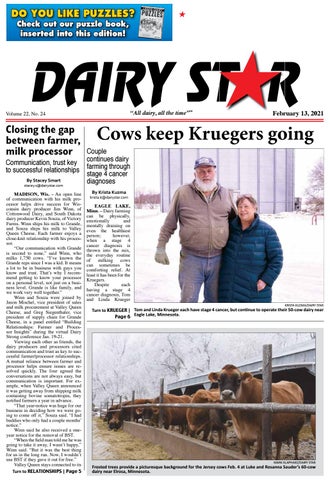
Cows keep Kruegers going
Couple continues dairy farming through stage 4 cancer diagnoses By Krista Kuzma
krista.k@dairystar.com
EAGLE LAKE, Minn. – Dairy farming can be physically, emotionally and mentally draining on even the healthiest person; however, when a stage 4 cancer diagnosis is thrown into the mix, the everyday routine of milking cows can sometimes be comforting relief. At least it has been for the Kruegers. Despite each having a stage 4 cancer diagnosis, Tom and Linda Krueger KRISTA KUZMA/DAIRY STAR
Turn to KRUEGER | Tom and Linda Krueger each have stage 4 cancer, but conƟnue to operate their 50-cow dairy near Page 6 Eagle Lake, Minnesota.
MARK KLAPHAKE/DAIRY STAR
Frosted trees provide a picturesque background for the Jersey cows Feb. 4 at Luke and Rosanna Sauder’s 60-cow dairy near Elrosa, Minnesota.
Page 2 • Dairy Star • Saturday, February 13, 2021
DAIRY ST R www.dairystar.com
ISSN 020355 522 Sinclair Lewis Ave. Sauk Centre, MN 56378 Phone: (320) 352-6303 Fax: (320) 352-5647 Published by Dairy Star LLC General Manager/Editor Mark Klaphake - mark.k@dairystar.com 320-352-6303 (ofce) 320-248-3196 (cell) 320-352-0062 (home) Ad Composition Nancy Powell 320-352-6303 nancy.p@dairystar.com Consultant Jerry Jennissen 320-346-2292 Editorial Staff Krista Kuzma - Editor/Wisconsin (507) 259-8159 • krista.k@dairystar.com Andrea Borgerding - Associate Editor (320) 352-6303 • andrea.b@dairystar.com Jennifer Coyne - Assistant Editor (320) 352-6303 • jenn@dairystar.com Danielle Nauman (608) 487-1101 danielle.n@dairystar.com Stacey Smart - Staff Writer (262) 442-6666 • stacey.s@dairystar.com Maria Bichler - Copy Editor 320-352-6303 Advertising Sales Main Ofce: 320-352-6303 Fax: 320-352-5647 Deadline is 5 p.m. of the Friday the week before publication Sales Manager - Joyce Frericks 320-352-6303 • joyce@dairystar.com Bob Leukam (Northern MN, East Central MN) 320-260-1248 (cell) bob.l@star-pub.com Mark Klaphake (Western MN) 320-352-6303 (ofce) 320-248-3196 (cell) Laura Seljan (National Advertising, SE MN) 507-250-2217 fax: 507-634-4413 laura.s@dairystar.com Jerry Nelson (SW MN, NW Iowa, South Dakota) 605-690-6260 jerry.n@dairystar.com Mike Schafer (Central, South Central MN) 320-894-7825 mike.s@dairystar.com Amanda Hoeer (Eastern Iowa) 320-250-2884 • amanda.h@dairystar.com Julie Barnes (SE WI and Northern IL) julie.b@dairystar.com Megan Stuessel (Western Wisconsin) 608-387-1202 • megan.s@dairystar.com Kati Kindschuh (Northeast WI and Upper MI) 920-979-5284 • kati.k@dairystar.com Deadlines The deadline for news and advertising in the Dairy Star is 5 p.m. Friday the week before publication. Subscriptions One year subscription $35.00, outside the U.S. $110.00. Send check along with mailing address to Dairy Star, 522 Sinclair Lewis Ave., Sauk Centre, MN 56378. Advertising Our ad takers have no authority to bind this newspaper and only publication of an advertisement shall constitute nal acceptance of the advertiser's order. Letters Letters and articles of opinion are welcomed. Letters must be signed and include address and phone number. We reserve the right to edit lengthy letters.
A glance at the other side
Dairy Star likes to provide local stories, which is why we have two versions of the paper. Below are a few highlights from stories you will not nd in this paper, but you can nd online in zone 2. Find full editions on our website, www.dairystar.com, and click on the e-edition tab under the Dairy Star header. Producing goat milk in volume Drumlin Dairy near Chilton, Wisconsin is home to 8,000 milking goats. Starting in 2017 to fulll a need for more goat milk in the area, all of the dairy’s milk is used for cheese production. Saanens, Alpines, Nubians and LaManchas are milked twice a day in a 120-stall rotary parlor and housed in a Dutch-style barn featuring long lanes of deep-bedded packs. Providing milk to make specialty products for people who love the unique taste of goat cheese is the farm’s mission. Uekert turns hobby into successful business Nearly ve years ago Ashlee Uekert launched Busy Kids Workshop, an enterprise where she makes and markets children’s home-sewn toys. Recently she began adding a line of children’s clothing, including garments that she calls ‘Grow With Me,’ which features a series of cuffs that can be folded and unfolded to increase the time the garment might t a quickly growing child. Uekert and her husband Scott milk 48 cows near Athens, Wis. Marklein named Dairy Business Association Legislator of the Year Wisconsin State Senator Howard Marklein was named Legislator of the Year by the Dairy Business Association last month. Marklein, the current co-chair of the Senate Committee on Agriculture and Tourism, has championed prodairy industry legislation, including funding for the Dairy Innovation Hub; truth-in-labeling bills for milk and meat; increased capital access for cheese and other dairy processing plants; and increased funding for rural broadband. Marklein encourages dairy farmers to actively develop relationships with their legislators and voice their opinion on legislative matters. Hughes family represents dairy industry in Super Bowl video Alan and Stephanie Hughes and their family were featured in a three-minute video tribute to essential workers during the COVID-19 pandemic, which aired during the CBS broadcast of Super Bowl LV. The Hugheses welcomed a videography crew to their 55-cow dairy farm near Pittsville, Wis., where they shared their farm and daily routine. They were contacted by Alan’s cousin, a CBS Sports creative director, to participate in the video. The Hugheses embraced the opportunity to represent the dairy industry in the nationally aired video.
SW & RW SERIES 3-point mounted and trailed models
Manual or computer controlled
CONSISTENT,, TIGHTLY WRAPPED BALES Patented e-Twin Technology
Patented AutoLoad Function
Patented Conical Pre-Stretcher
KuhnNorthAmerica.com uhnNorthAmerica.com
8QLTXH ğOP GLVWULEXWLRQ IRU IDVW FRVW HIğFLHQW ZUDSSLQJ
Van-Wall Equipment Albia, IA Indianola, IA Knoxville, IA
1RQ VWRS DXWRPDWLF ZUDSSLQJ (DV\ ğOP UROO FKDQJH DQG DOXPLQXP Low table height allows for gentle UROOHUV IRU HDV\ FOHDQLQJ LQFUHDVHV SURGXFWLYLW\ E\ XS WR loading and unloading of bales
Kunau Implement DeWitt, IA Preston, IA Diagonal Truck & Tractor Diagonal, IA
Roeder Bros. Bellevue, IA Maquoketa, IA Vetter Equipment Clarinda, IA Denison, IA Indianola, IA Mt. Ayr, IA Shenandoah, IA
The views and opinions expressed by Dairy Star columnists and writers are not necessarily those of the Dairy Star LLC.
The Dairy Star is published semi-monthly by Dairy Star, LLC, 522 Sinclair Lewis Ave., Sauk Centre, MN 56378-1246. Periodicals Postage Paid at Sauk Centre, MN and additional mailing ofces. POSTMASTER: Send address changes to Dairy Star, 522 Sinclair Lewis Ave., Sauk Centre, MN 56378-1246.
Bale Wrappers •
Graber Services Lockridge, IA
Lindell Sales & Service Cannon Falls, MN
Carroll Implement LuVerne, IA
Beck Implement Elgin, MN
Bodensteiner Implement Elkader, IA
Kromminga Motors Monticello, IA Vinton, IA
J P Scherrman Farley, IA
Greiner Implement Ottumwa, IA
Burco Sales Independence, IA
Engel Agri-Sales Sac City, IA
Helmuth Repair Kalona, IA
Dee Implement of Waukon Waukon, IA
INVEST IN QUALITY www.kuhn.com
Fluegge’s Ag Mora, MN
A & P Service Wells, MN Jaycox Implement Worthington, MN
St. Joseph Equipment Pfeifer Implement Northland Farm Systems Sioux Falls, SD Eyota, MN Owatonna, MN Arnold's Grossenburg Implement Glencoe, MN Lake Henry Implement Winner, SD Kimball, MN Paynesville, MN Mark's Machinery Sauk Rapids, MN Miller-Sellner-Slayton Yankton, SD St. Martin, MN Slayton, MN Dave’s Repair Woller Equipment Hills, MN Swanville, MN
Visit your local KUHN Hay and Forage Dealer today! ®
Isaacson Sales & Service Lafayette, MN
Dairy Star • Saturday, February 13, 2021 • Page 3
It’s all inside... Columnists
Clay
Hubbard Wadena Clay
e Buena Vista
ke
ero
Ch
Ida
Monona
Palo Alto
Pottawattamie Cass
nt
mo
Fre
Guthrie
ldt
Kanabec
Washington
ms ey Ra
Mitchell Howard Floyd
Boone
Story
Polk
all
h ars
M
aw
as
ick
Ch
Bremer
Wright Franklin Butler
Dallas
Black Hawk
Tama
Jasper
Fayette
Clayton
an
e war Dubuque
an
ch
Bu
Benton
Dela
Jones
Linn
Iowa
Madison Warren Marion Mahaska Keokuk
Adair
y mer Adams
Page
Worth
Webster Hamilton Hardin Grundy
Greene
tgo
Mon
n
lh Ca
n Win
Hancock Cerro Gordo
o
mb
Hu
ou
Sac
Crawford Carroll
Mills
as
nt
ho
ca
Po
Kossuth
e
D
go eba
iek
O’Brien
son Emmet ickin
Harrison Shelby
Zone 1
Valley Acres Dairy wins national award
ake
Osceola
Sioux
Woodbury
Page 22 Second Section
Mower
Second Section: Pages 3 - 4 Lyon
Plymouth
Country Cooking
Faribault
Martin
Houston
sh
Bon Yankton Homme
ln
co
Lin
Jackson
Lewiston
Winona
Fillimore
ne
Turner
Nobles
Freeborn
am
Hutchinson
Rock
Wabasha
Cottonwood Watonwan Blue Earth Waseca Steele Dodge Olmsted
All
Gregory
McCook Minnehaha
Murray
Goodhue
Rice
Clinton on Cedar
s
hn
Jo
Jackson
Scott
Muscatine
n
Douglas
Charles Mix
ns
Ha
Moody
Nicollet
Brown
Taylor
gto
Todd
Tripp
on
Lake
Redwood
W in
Mellette
Miner
Lyon
Dakota
Scott
Sibley
Union old
gg
Rin
Clarke
Lucas
Decatur Wayne
Monroe Wapello e
oos
pan
Ap
Davis
hin
Aurora
Sanborn
Brookings
Hennepin Carver
Wa s
Brule
Jerauld
Kingsbury
McLeod
Renville
Yellow Medicine
Anoka
Wright
Meeker
iek
Lyman
Beadle
Kandiyohi
Chippewa
Isanti
sh
Hand
Buffalo
Deuel
Hamlin
Sherburne
Swift
Lac Qui Parle
Codington
Clark
Stearns
Pope
First Section: Pages 1, 6 - 7
Po
Jones
Hughes
Spink
Benton
eu r
Stanley
Hyde
Stevens
Grant
Morrison
Douglas
Cows keep Kruegers going
Pine
Mille Lacs
Su
Sully
Grant
Eagle Lake
Carlton
Le
Faulk
Aitkin
Crow Wing
Todd
Big Stone
Day
Cass
on
Roberts
Marshall
Edmunds
Ziebach
Haakon
Richland
Sargent
Otter Tail
Wilkin
Dickey
McPherson
Potter
Becker
Ransom
Lake
Itasca
go
Dewey
Mah
Clay
Brown Walworth
Bennett
Cass
LaMoure
McIntosh
Campbell
Corson
The “Mielke” Jackson Market Weekly Shannon
Pages 10 - 11 Second Section
Bames
Emmons Sioux
Cold weather, warm vacations
en nom
Cook
isa Ch
Fall River
Stutsman
St. Louis
Polk
Trail
Steele
Tra ver se
Grant
Pennington Custer
Kidder
Logan
Adams
Page 33 First Section
Lawrence
Burleigh
Morton
Page 31 Hettinger First Section
Come Full Dairy Circle Meade
Butte
Griggs
Norman
Oliver
Veterinary Stark Wisdom
Page 35 Perkins First Section
Harding
Foster
Koochiching
ub
Sheridan Mercer
Beltrami
Lincoln
Bowman
Wells
Lake of the Woods
Red Lake
Eddy
McLean
Third Section: Pages 6 - 7
Pennington
Grand Forks
Pipestone
Slope
Benson Nelson
Roseau
Marshall
n
Billings
Kittson
Walsh
Ramsey
McHenry
Ward
Pembina
io
Dear County Agent Guy Dunn
Golden Valley
Pierce
Mountrail
Page 30 First Section
Cavalier
Towner
Un
McKenzie
Rolette
Da vi so n
Williams
Bottineau
Sauders redesign facilities to meet dairy needs
Third Section: Pages 10 - 11
Au d
Burke27 Page First Section
Elrosa
Kids Corner: The Middendorfs
First Section: Pages 34 - 35
On the Road with Princess Kay Renville
Divide
Sauk Centre
Websters named Big Stone County Farm Family of the Year
we
Ortonville
Pages 8-9 First Section
Clearwater
Ag Insider
son
fer
Jef
Van Buren
Louisa
Henry Des
Moines
Lee
Oskaloosa
Stam brothers upgrade facilities First Section: Pages 10 - 11
Zone 2 Edgerton
Heart for Dairy First Section: Pages 18, 20
For additional stories from our other zone, log on to www.dairystar.com
FROM OUR SIDE OF THE FENCE:
How do you nd time for each other while farming? First Section: Pages 15-16
Hull, IA Watertown, SD
(712) 439-2081 (605) 753-0300
www.automatedwastesystems.com
Page 4 • Dairy Star • Saturday, February 13, 2021
1-800-887-4634•(608) 723-4634 John, Jim & Dave Fuller 423 U.S. Hwy. 61 North • Lancaster, WI
Dirty Water?
Stays on Hooves for 2 weeks!
CLEAN IT UP WITH
Pure 3000 Chlorine Dioxide Technology
A HIGHLY EFFECTIVE WATER INJECTION SYSTEM W
Get your cows’ teat ends in TOP CONDITION!
BI-WEEKLY, LONG-ACTING FOOTBATH
TEAT END ISSUES? BEFORE Exfoliation
AFTER
Exfoliation
• Dual Germicide: Primary: Chlorine Dioxide promotes a quick kill. Secondary: LAS promotes a long-lasting kill. • Effective against ALL Mastitis-Causing Organisms • Contains Lactic Acid to promote Teat Exfoliation • Teat skin conditioning – 12.4% skin conditioning package • Green coloring for easy identification Advanced Dairy Systems
9 State Rd. 29 • Spring Valley, WI 54767 (715) 772-3201
Advanced Dairy Solutions
Removes
IRON, MANGANESE and SULFUR in water!
REDUCES:
• Respiratory • Crypto Issues • Salmonella • Scours • E-coli
Bob’s Dairy Supply
East Central Dairy Supply 2195 Hwy. 23 • Mora, MN 55051 (320) 679-1029
Professional Dairy Systems Eastern Iowa Dairy Systems Anderson Dairy Systems, Inc. 1449 Homecrest Ave. • Wadena, MN 56482 105 3rd Ave. NW • Epworth, IA 52045 Athman Dairy Inc.
238 Main Street North • Pierz, MN 56364 (320) 468-2494
HIGHLY EFFECTIVE AGAINST: • Prototheca • Staph Aureus • Mycoplasma • Pseudomonas
Helps improve hoof health and enhance digital dermis... to promote cow mobility, comfort and overall productivity.
Works in cold weather with better efficacy & less labor! FORMALDEHYDE HAS ZERO EFFICACY.
Average Cost/Lost-Profit per case of Digital Dermatitis is $275 OR MORE!
FOR MORE INFO - CONTACT ONE OF THESE DEALERS...
540 E. County Rd. A • Dorchester, WI 54425 278 W. Court St. • Richland Center, WI 53581 (715) 654-5252 (608) 647-4488 1312 13 1/2 Ave. • Barron, WI 54812 (715) 537-3300
KlingonBlue Klingon Blue™
(218) 632-5416
D&D Ag Supply
133 Atlantic Ave. NE • Pennock, MN 56279 (320) 599-4466
(563) 876-3087
Fuller’s Milker Center, Inc. 423 U.S. 61 • Lancaster, WI 53813 (608) 723-4634
Gorter’s Clay & Dairy Equipment 1400- 7th St. SE • Pipestone, MN 56164 (507) 825-3271
Tri-County Dairy Supply, Inc.
4107 N US HWY 51 • Janesville. WI 53545 608-757-2697
Precision Dairy Equipment 24548 IA-13 • Elkader, IA 52043 (563) 245-2560
Lang’s Dairy Equipment, Inc.
Leedstone
1720 Freitag Dr. • Menomonie, WI 54751 (715) 231-8090
2337 Millennium Rd. • Decorah, IA 52101 United Suckow Dairy (563) 382-8722 12687 Hwy 18 & 52 • Postville, IA 52162 1467 West 5th Street • Winona, MN 55987 (563) 864-7417 (507) 452-5532 210 N. Industrial Pkwy • West Union, IA 52175 Leedstone (563) 422-5355 222 E Co Rd 173, Melrose, MN 56352 (320) 256-3303 24260 Cty. Rd. 27 • Plainview, MN 55964 (507) 534-3161
ConƟnued from RELATIONSHIPS | Page 1 producers through routine eld visits. Communication starts at the farm with the eld service representative and goes all the way up through the CEO. He and Mischel visit farms on a regular basis to have conversations with farmers and exchange ideas. “Since we have such a good relationship, I’m able to contact my eld rep with any problems we have at any time, and he’s able to help us,” said Souza, who milks 5,000 Jerseys. “It’s very important for us to have trust with Valley Queen because we do milk quite a few cows, and we don’t really have another option for outlet of our milk, but Valley Queen has treated us fair. It gives us peace of mind knowing we have a place to ship our milk to every day.” Winn has also had a positive experience working with Grande. “Our previous processor was just looking for pounds of milk, whereas Grande is fanatic about quality,” Winn said. “Their milk quality veterinarian is a huge help, and they’ve taken us to a new level with milk quality. It’s helped our bottom line tremendously. The difference to where we were before with cell count, etc., to where we are now is night and day.” Grande has a veterinarian and a bilingual trainer on staff and wants to continue providing more tools to farmers. “There are a lot of things we can still do, and I’m excited about the possibilities,” Siegenthaler said. “We have a 1-15 rep-to-farm ratio, and our reps are in constant contact with our producers.” Last March and April when farmers were undergoing uncertainty brought on by COVID-19, Winn said he talked to his eld man every day and to Siegenthaler about three times a week. “Grande was looking out for us just as much as we were looking out for them,” Winn said. “That makes a huge difference.” Siegenthaler agreed. “I think I probably heard from every one of our producers during the COVID-19 crisis multiple times, which is good,” Siegenthaler said. “They know that line of communication is open.” Demonstrating support for the dairy producers they serve is important to both Grande and Valley Queen. They stand behind farmers who take initiative to help their community, the environment and the dairy industry as a whole. One way that Grande supports the efforts of Cottonwood Dairy is through its collaboration with the farm’s in-
volvement in an event known as Day at the Dairy. Every spring, fourth graders in Winn’s county visit four farms, including Cottonwood Dairy, and Grande makes pizzas and provides milk for the students. “It’s our eighth year doing it, and it’s just a great day,” Winn said. “When we approached Grande about helping with it, they stepped up to the plate. They’ve been there with us from day one and are very open to helping us out. That really means a lot to the community.” In addition, Grande was one of the sponsors for Winn’s farmer-led watershed group known as LASA, once again demonstrating support for its producers. “Grande understands our efforts,” Winn said. “They get it and that sets them apart from other processors in our area. They view innovation and change as important. The environmental component is important to consumers, and our previous processor could not have cared less about that kind of stuff. We’re very happy with Grande and hope this relationship lasts forever.” From cheese buyers to people in the chocolate business, Valley Queen brings customers to Souza’s farm on a routine basis. These visits give customers a chance to ask questions and interact directly with a dairy farmer. “We feel it’s important for our customers to see where the milk is produced,” Mischel said. “We want them to be comfortable with the size, scope and scale of agriculture we deal with. During these tours, we get a sense of how the supply chain feels about what we’re doing.” Opening his farm doors to Valley Queen’s customers is something Souza enjoys doing. “We’re on the cutting edge just like Valley Queen, and we always want to show the customer what we’re doing next,” Souza said. Mischel described Valley Queen’s relationship with dairy producers as a two-way street. “We promise our producers we’re going to provide a good market for their milk, and in turn, we trust they’re going to continue to support us by providing quality milk for our products,” Mischel said. Souza said he and Valley Queen stay in contact all the time. “You’re not going to agree on everything,” Souza said. “You just need mutual understanding. At Valley Queen, we’re not just a number. We’re like family.”
got room in your tank?
Dairy Star • Saturday, February 13, 2021 • Page 5
COLD CALVES NEED MORE ENERGY!
Use Milkr Energize to keep them growing!
FEATURES AND BENEFITS
• Provides additional energy to maintain consistent growth during bouts of cold weather as calves exposed to ambient temperatures below 59°F will utilize energy for warmth rather than growth • Reduces need for providing an additional feeding • Easy to handle dry formula • Easily mixed into milk or milk replacer
320-836-2145 or 800-450-2145
Check out our newly redesigned website to ½nd a Famo Feeds dealer near you!
www.famofeeds.com
USED EQUIPMENT ON HAND C
‘14 JCB 260T tracked Compact Track Loader, 1310 hrs., # 21301 $44,800
C
‘15 JCB 536-60 AGRI PLUS TeleHandler, 3250 hrs., #22201 $77,000
D
‘17 JCB 541-70 AGRI SUPER TeleHandler, 4575 hrs., #1279 $83,000
C
‘17 JCB TM320 Telescopic Wheel Loader, 2800 hrs., #21304 $89,500
D
JCB 3185 Fastrac Tractor 4WD,
‘15 JCB TM220 Articulated loader
5975 hrs., #20398
#21305
$33,995
D
C
$68,500 D
C
We Finance/Lease Dairy Cattle!
• • • •
Increase your production and your proÛts Free up capital for other needs Avoid complicated bank loan processing Lease will be personalized to your operation
Sunshine Heifers
Your leader in dairy cattle Ànancing/leasing!
Contact: 602-768-6678
‘14 JCB 260 Skid Steer Loader
4282 hrs., # 22117
$26,900
‘15 JCB 541-70 Agri Extra TeleHandler
‘11 JCB 541-70 AGRI TeleHandler
$75,000
$62,500
4546 hrs., #22031
7306 hrs., #15222
MORE LISTINGS ONLINE! www.windridgeimplements.com C Cresco (563) 547-3688 D Decorah (563) 382-3614 E Elkader (563) 245-2636
Page 6 • Dairy Star • Saturday, February 13, 2021
ConƟnued from KRUEGER | Page 1
Willmar, MN • 320.231.1470
EXPANDING OR REMODELING YOUR LIVESTOCK OPERATION? LANGE AG SYSTEMS SPECIALIZES IN:
Ŷ NEW FACILITIES
_
NO JOB TOO BIG OR TOO SMALL
Ŷ RETROFITTING & REMODELING Ŷ TURNKEY PROJECTS Ŷ BARN DESIGN Ŷ INSTALLATION, MAINTENANCE & REPAIRS
ƋƵŝƉŵĞŶƚ tĞ KīĞƌ͗ ͻ sĞŶƟůĂƟŽŶ &ĂŶƐ ͻ sĞŶƟůĂƟŽŶ ŽŶƚƌŽůƐ ͻ WŽƐŝƟǀĞ WƌĞƐƐƵƌĞ dƵďĞƐ ͻ ƵƌƚĂŝŶ ^LJƐƚĞŵƐ ͻ DĂƩƌĞƐƐĞƐ ͻ tĂƚĞƌĞƌƐ ͻ ^ƚĂůů ƋƵŝƉŵĞŶƚ ͻ ,ĞĂĚůŽĐŬƐ ͻ DŝƐƟŶŐ ^LJƐƚĞŵƐ
Lange Ag Systems is proud to offer Grain Bags, Silage Bags & Bunker Covers from Up North Plastics and Feed Fresh Silage Covers & Custom Size Bunker Covers from Raven!
t ^ >> E t Θ h^ 'ͳ ' Θ < >>z Zz E '' Z^
www.LangeAgSystems.com I F A
Roller-Grinder
More milk less feed with uniform Àne-grind Solid cast rolls All belt-electric drive Single or double mills USA & International sales Replacement rolls available for most mills Used mills and tumble mixers on hand Hammer Mills
Phone: (319) 634-3849 • Toll Free: (800) 426-0261 web: www.ifamill.com • email: ifamill@netins.net
Tell the advertisers you saw their ad in the Dairy Star!
BIG BENEFITS IN A SMALL PACKAGE
KUHN Knight PS 235 and 242 ProSpread® apron box spreaders are non-commercial spreaders that provide an affordable option for producers without sacrificing quality. With capacities of 275 and 360 ft³, these machines are ideal for small dairy, feeder, and cow/calf operations. KUHN Knight PS 235 and 242 ProSpread® apron box spreaders are noncommercial spreaders that provide an affordable option for producers without sacrificing quality. The PS 235 and PS 242 are designed for small dairy, feeder, and cow/calf operations that process a wide array of semi-solid and solid materials. An all-steel welded box construction and two-piece poly floor give you a machine that is built to last. Choose between horizontal, VertiSpread® vertical beaters or the AccuSpread® spinner discharge to best fit the spreading needs of your operation. These spreaders, with heaped capacities of 275 and 360 ft³, feature a low loading height, are easy to maneuver around the farm and provide more efficient use of manure with exceptional spreading and metering capabilities.
KRISTA KUZMA/DAIRY STAR
Tom Krueger checks over the milking units in the milkhouse on his dairy near Eagle Lake, Minnesota. continue to operate their 50-cow dairy on their farm near Eagle Lake. While Tom battles esophageal cancer, Linda deals with reoccurring breast cancer that has spread to her bones. “After spending a day in there (getting chemotherapy treatment), it’s a relief getting out of there and into the barn,” Tom said. The barn has been Tom’s happy place since rst being diagnosed in August 2017, two weeks after Linda found out her breast cancer had come back. Tom decided to be checked earlier in 2017 when he was having trouble swallowing. That initial checkup did not nd anything wrong. As the year went on, his symptoms did not improve. “I had more and more trouble swallowing,” Tom said. “By August, I couldn’t really swallow food except for liquid. I had lost 50 pounds in a short time. I knew something was wrong.” When the doctors checked again, they found a tumor farther down in his diaphragm. Tom immediately started chemotherapy treatment, returning every two weeks for 1.5 years. The chemo helped shrink his tumor over time and his symptoms let up. “I could start eating again a week after I started chemo,” Tom said. Although he liked that the nurses and doctors started to get to know him and would ask about farming, Tom dreaded the all-day treatment. “There were 18 chairs, all lined up with pumps,” the 71-year-old said, describing the room where he received
chemotherapy. “It was like a milking parlor.” Physically, Tom endured side effects such as burned off nger nails and toe nails along with hair loss. He also has numbness in his ngers and said jokingly he can now handle straws from the semen tank without a problem. “I actually took it (chemotherapy) really well,” Tom said. “If you would go down there (to the clinic) and look at the clientele, there aren’t all of them who are as fortunate.” Tom attributes some of his wellbeing to the cows. Being in the barn heals him, emotionally. “Even my doctor said having work to do is a big plus,” he said. “If you see the people who are down there at the clinic, it’s way better to be here doing something.” Most days Tom has treatment, he starts and ends his day with chores, relying on help from his daughter and son-in-law, Tracy and Dusty Loberg. One day, not long after starting treatment and having a port put in his chest to help administer his medication, he returned home to a cow giving birth. “I got off the table (from getting chemotherapy) at 6 p.m. and came home,” Tom said. “By 11 p.m., I had a cow calving with the calf’s head ipped around. I had my arm in the cow and delivered the calf.” Tom did not mind the distraction because it is one of his favorite parts of farming. “I like having the calves come and
Milking equipment not running as it should? Let us help! We can do service and maintenance on all dairy equipment! Give us a call to schedule a visit.
Blue Hilltop, Inc. 507-879-3593 – 800-821-7092
Box Box 116, 116, Lake Lake Wilson, Wilson, MN MN 56151 56151 –– www.bluehilltop.com www.bluehilltop.com
Turn to KRUEGER | Page 7
1010 Hoeschler Dr. • Sparta, WI 54656
DAIRY EQUIPMENT INC. Celebrating over 35 Years in Business
Phone: 608-269-3830 Toll Free: 1-888-863-0227 Email: prestonde@prestonde.com
Dairy Star • Saturday, February 13, 2021 • Page 7
ConƟnued from KRUEGER | Page 6 seeing what you get,” he said. Since the spring of 2020, Tom has been back on chemotherapy, which he said will most likely be a regular occurrence for the rest of his life. Both Tom and Linda worked to get chores done in the earlier years of dairying, starting in 1975 when they bought their farm. Despite taking an offfarm job for insurance, Linda continued to work in the barn until her rst breast cancer diagnosis 21 years ago. “I had chemo and radiation and the oncologist said you’re immune suppressed and it’s not a good idea to be out there in the barn,” Linda said. “But I could help out in a pinch if it was unloading cattle or hay.” Although she could not do chores anymore, Linda continued to be the farm’s bookkeeper and worked her offthe-farm job throughout her treatment. She was put into remission in 2001. “I learned over the years that I have patient rights and to stand up for myself and be my own advocate,” Linda said. Her yearly tests came back with good results until 2017 when her oncologist found tumors in her sacrum. “It had gone to the bone, which is better than the brain,” Linda said. When Tom learned of his diagnosis two weeks later, the couple were facing their cancers together. “We will say, ‘Who is worse off today?’” Linda said. While Tom continues to perform outside chores, Linda continues to work her off-farm job from home and keep the books for the farm. While the Kruegers are optimistic for the future, they are also realistic about the outcome. “I’m very matter of fact with my doctor,” Linda said. “I want to know when the worst is coming along the line. That’s why I took the money inherited
KRISTA KUZMA/DAIRY STAR
Tom Krueger stands in his Ɵestall with his herd of crossbred cows. Krueger conƟnues to dairy despite an esophageal cancer diagnosis he received in August 2017. from my mother when she passed away and built a deck and a ramp because they’re telling me if I’m not fortunate enough to die of something else rst, I will become paralyzed.” At some point in time, Linda knows she or Tom will need hospice. Right now, rather than taking expensive medication with no guarantee
of an outcome, Linda prefers to be comfortable in her house. “I refused those drugs that cost $20,000 per month,” she said. “They have horrible side effects, … and there’s a percentage of a percentage chance it will help. We’re not going to sell the farm to try this drug.” Especially since the farm is where
Tom wants to be. “There is probably a point in time where I’m not going to be able to do anything,” Tom said. “But instead of looking at the wall and waiting to die – that’s not for me – my doctor said why don’t you see if you can die of something better rst.” So, the Kruegers continue farming.
One in four consumers believe plant-based food is healthier Page 8 • Dairy Star • Saturday, February 13, 2021
Sustainability seems to be a buzzword that will not shirk the duties and responsibilities of the is connecting with consumers. According to the Department.” Regarding the use of Commodity Credit International Food Information Council’s annual food Corporation funds, Vilsack said he’d ask for the same and health survey, 59 percent of Americans say it is exibility that was given to Secretary Perdue. Climate important for the food they purchase or consumed change, food security and market transparency were is produced in an environmentally addressed during the hearing. Ag Insider sustainable way. Seventy-six percent of consumers consider themselves NMPF asks White House to join omnivores. Nine percent of the people CPTPP trade deal surveyed identied themselves as The National Milk Producers vegetarian and 2 percent are vegan. The Federation is urging the Biden report said the consumption of plantAdministration to join the Comprehensive based meat and dairy alternatives is up. Progressive Trans-Pacic Partnership. Forty-three percent said they would That’s the trade agreement that President assume that a product described as ‘plantTrump dropped in 2017. England is based’ would be healthier than one that is petitioning to join this Pacic Rim not, even if it had the exact same Nutrition trade deal and NMPF wants the United Facts label. Regarding COVID, the IFIC States to follow suit. The dairy industry By Don Wick survey found 60 percent of Americans is dependent on the export markets and are cooking at home more. National Milk sees opportunity in key Columnist markets like Vietnam and the Philippines. COVID hits restaurant business hard According to the National Restaurant Thai dairy market could be lost to New Zealand/ Association’s state of the industry report, more than Australia 110,000 bars and restaurants closed this past year. New analysis from USDA’s Foreign Agricultural For the restaurants that closed for good in 2020, the Service said the United States is in danger of losing majority of the operators had been in business for an market share for its dairy products in Thailand. New average of 16 years. While there is pent-up consumer Zealand and Australia are implementing trade deals demand, the report said consumers are also nding with Thailand, eliminating tariffs and import quotas new ways to enjoy their favorite restaurants, including on whole milk powder, whey, cheese and anhydrous restaurant subscription services and meal kits. milk. Vilsack faces Senate Ag Committee On Groundhog Day, Tom Vilsack ironically found himself back in front of the Senate Agriculture Committee for a conrmation hearing. Vilsack is returning to the job he held for eight years during the Obama Administration. The former Iowa governor kicked off the hearing by saying this is a fundamentally different time in agriculture. “I recognize the unprecedented challenge we face with COVID and while pursuing these ‘why not’ opportunities
Regeneration nation The National Alfalfa and Forage Alliance has launched its Regeneration Nation initiative. The NAFA describes alfalfa as the “ultimate regenerative crop,” helping farmers build soil health and reach sustainability goals. Alfalfa is the third most valuable eld crop in the U.S., but acres are trending lower. The Regeneration Nation effort is being used to tout those benets to dairy and forage growers.
Cattle inventory report released According to USDA’s semi-annual cattle inventory report, beef cow numbers are down 1 percent from one year ago and dairy cow numbers up 1 percent. For dairy cows, the inventory in Wisconsin is unchanged from one year ago. At 4.6 million head, dairy replacement heifers are down 2 percent from last year. The number of milk replacement heifers also dropped in Wisconsin.
WI cheese output increases for rst time in months For the rst time in ve months, Wisconsin cheese processors made more product in December than one year earlier. More than 279 million pounds of cheese were produced in December, up 1.2 percent from December of 2019. Wisconsin’s American cheese production rose nearly 4 percent. Cheddar cheese was up 2.8 percent. Italian cheese production was up .5 percent. Mozzarella production dropped 4.3 percent. Evers promotes budget plan Wisconsin Governor Tony Evers is proposing a $43 million budget for agricultural initiatives in the 2021-2023 biennium. Dollars are being devoted to expand domestic and international markets for Wisconsin farmers, promotes conservation and supports mental health. DBA recognizes Marklein The Dairy Business Association has honored State Senator Howard Marklein of Spring Green as its Legislator of the Year. The DBA cited Marklein’s work on dairy issues, including funding for the Dairy Innovation Hub. WFU awards The Wisconsin Farmers Union has honored University of Wisconsin Center for Integrated Agricultural Systems researcher Michelle Miller with its Friend of the Family Farmer Award. Turn to AG INSIDER | Page 9
Spring is not far away!
SKID STEER ATTACHMENTS Grapple buckets, bale spears, rock buckets etc.
n o t s Fore
WE ARE TAKING ORDERS for corn, soybeans, oats and assorted alfalfas/clover/grass mixtures.
Dahlman Seed
WE CUSTOM BUILD FEED BUNKS
WE ARE TAKING CHICK ORDERS!
Fresh Ûoor stock available for all your animal needs
FARMERS CO-OP CREAMERY
YOUR ONESTOP SHOP CO-OP!
MEETING YOUR ANIMAL FEED NEEDS & MORE! FORES T ON, MN • 320-294-57 11 • M-F 8-5PM • S AT 8-NOON WWW.FORES TONCREAMERY.COM
Dairy Star • Saturday, February 13, 2021 • Page 9
ConƟnued from AG INSIDER | Page 8 Congresssmen Mike Gallagher and Ron Kind received the same award for introducing the Dairy Pricing and Policy Act. WFU members Rachel Henderson of Menomonie, Sarah Lloyd of Wisconsin Dells and the late Dave Fauska of Elroy received the Builders Award. Henderson is president of the Dunn County Farmers Union. Lloyd has the same role with the Columbia County Farmers Union. Fauska, who died in August at 90 years of age, was active in the Monroe County Farmers Union. The new WFU Emerging Leader Award was presented to Aaron Ellringer who co-founded the Just Local Food Cooperative and took an active role in Eau Claire County Farmers Union.
has worked at the Monroe location for eight years. Most recently as the assistant manager. Trivia challenge Ricotta is the Italian cheese made from heating the whey left over from the cheese making process. That answers our last trivia question. For this week, Senate Agriculture Committee Chair Debbie Stabenow represents what state? We’ll have the answer in the next edition of Dairy Star. Don Wick is owner/broadcaster for the Red River Farm Network, based in Grand Forks, North Dakota. Wick has been recognized as the National Farm Broadcaster of the Year and served as president of the National Association of Farm Broadcasting. Don and his wife, Kolleen, have two adult sons, Tony and Sam, and ve grandchildren, Aiden, Piper, Adrienne, Aurora, and Sterling.
Equity promotes Schultz Kevin Schultz is the new manager for Equity Cooperative Livestock Sales Association’s Monroe market. Schultz
The
I.R.S. is at
KLC
Ideal Roasted Soybean! A great value for the money!
The Ideal Roasted Soybean has what you need for your dairy ration: Energy Protein Amino Acids Bypass Protein
“PCDart has adapted to all our needs.” What are some of the DHIA tests you use? Pregnancy check, MUN test, young stock report. What do you like about the PCDart program? Kate took over all herd record keeping in 2017. This is when we started using the PCDart software program. PCDart has been a great program to assist with keeping track of our herd; from calving dates, breeding dates, and milk records. The program has adapted to all our needs and there is always live support if needed, which is extremely helpful! We love the ease of registering our herd as well. PCDart easily syncs with Easy I.D. through Holstein Association for simple, fast, and convenient registration of our herd. We also love that all our records are stored, saved and protected in the PCDart computer program. With the program we can easily access any cow or heifer in our herd and check anything; including their registration number, date of birth, calving date, breeding date, and much more! We are very pleased with PCDart. Tell us about your farm. We own and operate a registered Holstein herd of cows and breeding bulls. Our dairy herd consists of 90 registered Holstein cows. Our rolling herd average is 25,300 M, 975 F, and 800 P, on two times per day milking. We crop and pasture our herd on 300 acres of land, which supplies the feed to sustain our herd. We actively market breeding bulls, embryos, bred heifers and milk cows. We love to be ‘hands on’ and work with good cows day-in and dayout. By continuing our dedicated work with registered Holsteins on our Glencoe farm and focusing on the areas of young stock management, milk production, embryo and semen marketing and quality John Mohr and his daughter, breeding stock - we hope to market and Kate Keenan sell good seed and breeding stock in the 90 cows • Glencoe, MN dairy industry. 32 years with DHIA
307 Brighton Avenue South Buffalo, MN 55313 763.682.1091 www.mndhia.org
DHIA: Now MORE than ever
Put the “I.R.S.” to work for you!
KLC Farms Roasting, Inc. 1-877-738-2326 877 738 232 Visit www.roastedbeans.com
Quality
Consistency
AUTHORIZED DEALERS:
Increase Ef¿ciency By Feeding TMR!
Hanson Silo Lake Lillian, MN 320-664-4171 Hartung Sales & Service Freeport, MN 320-836-2697 Melrose Imp. Melrose, MN 320-256-4253
TMR Feedcarts Stationary TMR Mixers Round Bale Unrollers
Free Brochures! 1.800.436.5623
Anibas Silo & Eq. Arkansaw, WI 715-285-5317 Brubacker Ag Equipment LLC Curtiss, WI Edgar, WI Bagley, WI 715-613-7308
1-800-887-4634•(608) 723-4634 John, Jim & Dave Fuller 423 U.S. Hwy. 61 North • Lancaster, WI
Page 10 • Dairy Star • Saturday, February 13, 2021
A renewed drive for dairying
to Horning Kernel Processors to experience faster throughput, higher nutrition and increased profits. Call us today for early order discounts!
PHOTO SUBMITTED
The Stam family – (front row, from leŌ) Maria, Collin, Jonathan, David and Lucas; (back row, from leŌ) Leah, Ryan, Caleb, Nathan, Nicole and Valerie – stand in the new facility they started using in April 2019 on their 150-cow dairy near Oskaloosa, Iowa.
Stam brothers build new robotic facility By Krista Kuzma
717.354.5040 | New Holland, PA
End to End Expertise for Sealed Silos
krista.k@dairystar.com
OSKALOOSA, Iowa – Although the Stam brothers have always liked dairy farming, a new facility has made the career a lot more exciting. “It makes you want to dairy farm rather than be physically worn out at the end of the day,” Nate Stam said. Three Lely A-5 robots in a new 6-row freestall barn with a new manure pit has been a welcomed upgrade for Nate and his brother, Caleb, on their 150cow dairy near Oskaloosa. They started using the new set up April 30, 2019. The barn with a feed alley splitting the middle has two robots on the outside wall of one side and one robot on the outside wall of the other side. The robots have the ability to sort cows for illness, breeding or going through a footbath. Having robots provides the Stams with more exibility, less physical work and shorter days. “They’re there on holidays and odd hours when it’s hard to get conventional help,” Caleb said. “They can occasionally break down, but they’re always there and don’t leave the farm.” The new milking equipment replaced a double-8 parabone parlor, remodeled from a double-4
SILO SERVICES
` consulting ` YLDELOLW\ DQG ǦQDQFLQJ ` construction ` maintenance and pressure checks ` resealing and roof replacements
BOTTOM UNLOADERS ` unloaders for all feed types ` maintenance plans ` after-hours service ` reliable operation ` modern controls
Early Sign-Ups & Winter Discounts!
Equipment or Projects Rǥ HQGV )HE
Rǥ HQGV 0DU
Ask Marvin and his crew about helping you with your needs.
715.267.1416
sales@greenwoodsilo.com N10828 County Highway O • Greenwood, WI 54437
https://www.greenwoodsilo.com/goodasnew
PHOTO SUBMITTED
A channel between the freestall barn and the pit, pictured in the building stage, allows manure to gravity ow to the new 1.5-million-gallon pit.
herringbone by the Stams’ dad, Calvin, in 2006. “It was pretty much a homemade parlor that was very basic,” Nate said. The parlor always needed two people to get the job done efciently. The Stams hired high school students to help with labor. “If one person didn’t show up, it put you behind all day,” Caleb said. Milking in the old facility included a lot of steps in and out of the parlor. “We didn’t have a crowd gate in our holding pen so for 16 to 17 groups you were up and down from the pit going to get cows,” Caleb said. “It was a lot of wear and tear on your body, typically associated with dairy farmers.” Now, all the chores can be done by one person if needed; however, typically both brothers are on the farm every day along with part-time help from two of their nephews when they are not in school. Plus, the automated milking system allows the Stams to have exibility with chores, crop farming and custom work, especially since both have young families. Nate and his wife, Valerie, have four children: Jonathan, 9, David, 7, Lucas, 5, and Nicole, 2. Caleb and his wife, Leah, have three children: Collin, 8, Maria, 5, and Ryan, 1. “Our kids have a great opportunity if they so choose to stay in the dairy business,” Caleb said. “It’s not nearly as stressful as our old barn was – the hours, the demands. Now there is exibility. I just think it’s a lot more sustainable with our new facility.” The new facility also features automatic alley scrapers that push manure into an 8-by-8 underground channel on the east end of the barn, and it gravity ows to the 1.5 million gallon pit. Once there, sand and solids settle to the bottom and can be cleaned out when the pit is cleaned once a year. “It’s low maintenance and simple,” Nate said. Prior to this set up, the Stams scraped the manure into a small holding area and hauled it every two to three days, depending on weather. “Spring was always a challenge, and during summer when you have crops on the elds, nding a spot to haul was difcult,” Nate said. “This made everything much easier so we can pick our times to spread manure and not ght the weather so much. It was a huge time and labor savings.” After being in their new facility nearly two years, the Stams’ herd is averaging between 2.7 to 3 milkings per cow, per day. Many of the higher producing cows are going through the robots four times. “If it’s a high producing cow, they’re utilizing that ability (to get milked more often) which would have never happened in the old facility,” Caleb said. Production has also increased 15 pounds per cow per day. While the Stams recognize they are also Turn to STAMS | Page 11
Dairy Star • Saturday, February 13, 2021 • Page 11
ConƟnued from STAM | Page 10 feeding the cows to milk a little more, they feel the way they feed is more efcient. “It’s more tailored to each cow,” Nate said. “The cow that’s producing more milk will get more nutrients, and the cow that’s not doesn’t get as much. So, it makes it more efcient on a small scale when you don’t have different groups of cows.” However, the Stams experienced an adjustment period to a new way of feeding that inuenced how often the cows are milked. For the rst 10 months, cows would visit the robots often enough, but refusals – when cows would visit the robots, but it was not time to be milked yet – were at 0.5. The Stams and their equipment dealer wanted to see about two
refusals per cow. “You want the cows coming on their own to the robot and not you going to get them,” Nate said. “It’s a balancing act.” After pulling energy from the bunk and feeding more in the robot in the rst lactation heifers, the Stams saw the response they wanted. “It’s a learning curve for us and our nutritionist as well,” Caleb said. Pregnancy rate and reproduction has also improved due to the activity monitoring system, Caleb said. The cows also have more of a relaxed demeanor. “The cows just really seem to slow down,” Caleb said. “From an animal welfare point of view, the cows are making the choices. It takes very little
PHOTO SUBMITTED
Cows eat feed in the new 6-row freestall barn the Stam family constructed to house their 150cow herd on their dairy near Oskaloosa, Iowa.
PHOTO SUBMITTED
The rst cow to use the new facility is milked by one of three robots the Stams started using in April 2019 on their dairy near Oskaloosa, Iowa.
effort to sort out any cow that needs attention.” While the Stams are now reaping the benets of their new facility, it did not happen overnight. The brothers, who took over the farm in 2007 from their dad after he had health issues, spent nearly seven years researching every aspect of a new facility from the building to the nancials. They also toured dairies and talked to many farmers during that time. “Anytime we were on a
Bongards’ Creameries
Has been a quality market for MN dairy farmers for over 100 years. MN producers provide one of the country’s most distinctive brands of cheese that is still made using the same Old World craftsmanship and has been combined with cutting-edge technology to produce cheese that delivers unforgettable taste with unparalleled quality. MN Dairy farmers and Bongards, quality that stands the test of time. We offer a competitive base price, premiums, and the best Àeld representatives in the industry. 13200 Co. Rd. 51 Bongards, MN 55368 (952) 466-5521 Fax (952) 466-5556 110 3rd Ave. NE Perham, MN 56573 (218) 346-4680 Fax (218) 346-4684
family vacation anywhere in the Upper Midwest, we would go nd a robot barn and see what we could pick up there,” Nate said. And they also built with the option to expand. While it is not their intention to grow their herd, they did not want to limit that opportunity for the future. “We did lots of number crunching,” Nate said. “We worked with our banker, and we got real numbers from farmers who had robots, along
OVE DOROHEAD RS
GE A R GAOORS D
commercial & residential
commercial, residential, rolling steel
CITY-DOOR
(Used) Penta 6730 Twin Screw TMR Mixer $29,900
(Used) Kuhn Knight RC260 Reel Mixer $32,000
with dealers. We put all those together and planned for worst case scenarios.” But what has come about has been best circumstances for the Stams. “It’s a huge improvement,” Nate said. “It would be hard to go back to what we were doing before. Everything is more efcient, you have exibility to be with your family and you’re not reliant on labor. There are no downsides and all upsides. It was the best thing we ever did from my perspective.”
.COM
We work on any make and model
CITY-DOOR 715-781-0256
Jason Rouleau • jason@city-door.com 215 S Chestnut St. • LaCrescent, MN 55947
Roto Grind Corn Grinder $19,600
25ft Penta Soil Finisher ....................................... $13,900 2020 GEA/Houle 5300 Manure Tank ........... Call for Pricing Penta 8030 TMR on 2011 International Truck..... $140,000 (Used) Artex SB300 Manure Spreader .................. $28,000 Westfield 13”x31’ Auger ........................................ $4,500 Farm King Grain Vac with Dual Inlet Hose Kit ......... $21,000 Roto Grind 760 Tub Grinder ................................. $22,900 (Used) 42’ Houle Lagoon Pump .............................. $8,500 (Used) Outlaw Pump Trailer, 4,178.8 Hours, 400HP, Murphy Shut Down ................................... $67,500
www.komrosales.com
New and Used Nuhn Crawlers IN STOCK
Kuhn Primor 4270M $33,400
Page 12 • Dairy Star • Saturday, February 13, 2021
Technology takes a bigger role on dairies Four Minnesota farms share how advancements help their herds By Krista Kuzma
krista.k@dairystar.com
Technology is constantly increasing on dairies across the nation. To help producers nd the right addition to their farm, Form-A-Feed had a producer panel called “Technology, automation and your dairy farm” during its Jan. 14 virtual annual conference. Four Minnesota dairy farms shared their experience with technological advancements. Co-Jo Dairy milks 900 cows near Grove City. Owner Joe Jans along with the farm’s herd manager, Jennessa Thompson, talked about the use of the SCR system for cow activity and health monitoring. Landwehr Dairy, owned by Denny and Marlene Landwehr, operates near Watkins. Herd manager, Theresa Galvan, shared on the panel about the farm’s use of Cow Manager to monitor health and fertility, along with EZfeed, a feed management software. Rick and Sarah Ahlgren spoke about the use of Lely robots, feeding system, auto scrapers and activity monitoring system on their farm, Ahlgren Dairy, where they milk 165 cows near Darwin. The nal panelist, Dean Smith, shared his use of the SCR system; FeedWatch, a feed tracking software; and DairyComp for reproductive management.
“I wasn’t super tech savvy,” Smith said. “But once you learn the curve it’s very good technology to get ahold of and very benecial for many reasons – cow health, efciencies, inventories.” Smith said he spends a couple hours a day doing computer work. “It’s just a lot of stuff you do on computers now that 10 to 15 years ago you did more visual or with pencil and paper,” he said. Galvan said Sarah and Rick even though there Ahlgren is a learning curve Dairy farmers to using technology, the ones she uses are easy to operate. “They try to make it as user friendly as possible,” she said. While the Ahlgrens had a lot of technology to learn at one time with their new automated facility, they said there are ways to work through it with the right people to support them. “Almost every small issue we had (right away) … we were able to resolve over the phone,” he said. “We have a lot to learn, … but that will all come with time, and we’re excited to be able to use it to more of an extent.” All four farms have seen improvement in their reproduction because of the activity systems. Prior to the using an activity monitoring system, the Ahlgrens bred cows based on visual heats. “We were missing a lot and the silent heats,” Rick said. “We didn’t have
PREMIUM AUTOMATIC WATERERS
the data at the time to improve it.” Now their breeding is more accurate, and they are inseminating cows at the right time. To further improve the herd’s reproduction, the Ahlgrens are going to implement a synchronization program starting at 100 days in milk for cows that do not show heat. Galvan said it took time to trust the system. “The technicians we had at rst were unsure the proDean Smith gram was picking Dairy farmer up heats,” she said. “But then the next day the cow would bleed off so now they fully rely on it.” In addition to breeding cows using the farm’s activity system for the past 3.5 years, Landwehr Dairy uses a presynch and double ovsynch program. Co-Jo Dairy has been using the SCR system for the past ve years. Before that, the dairy relied on tail painting and an ovsynch program. Since the switch, the dairy has seen an increase in pregnancy rate, which is now at 28%. It also saved $5,000 per month from cutting back on ovsynch shots. Smith, who has been using the same system, had tail chalking with ovsynch prior. He likes the objectivity of the technology. “If you manage enough employees through your days, two of the hardest things to train people to do are heat detection because everyone has a dif-
ferent idea if that cow is in heat or not, and detecting sick cows,” Smith said. “There are a lot of things to look at. One person’s idea of a sick cow is different from the next. With the system, it picks those up.” Consistency from the use of technology also helps the dairy’s protability. “If you can take out the employee or management variability and give it to a technology that gives you solid information, it’s going to improve your efciencies and your bottom line,” Smith said. Rumination – whether on an individual basis or looking at the herd as a whole – has helped all the farms. “You can catch a cow before they’re sick,” Jans said. “We’ll give them some probiotic pills, and by the next day they’re usually back going and they don’t show up again.” This has signicantly reduced the antibiotic use at Co-Jo Dairy. “That was a key thing we put this in for,” Jans said. “As the industry is getting tougher on antibiotics, we’re hoping to get rid of some of that and don’t have to do a lot of treating on animals.” Feed tracking software at Landwehr Dairy has helped with keeping feed inventory and calculating feed projections for each year. “It makes communication (between different feeders) easier and makes an impact on cows not running out of feed,” Galvan said. Smith said having a feed tracking Turn to TECHNOLOGY | Page 12
Housing the Future When you buy Calf-Tel, you can be confident it will last a lifetime... and then some. For decades, Calf-Tel® has set the standard for superior durability and efficiency, making your investment in calf housing systems one that grows with each generation of calves it protects. Backed by success and people that know how to raise healthy calves, Calf-Tel promises – and delivers – a wise investment. Outdoor Hutches
Group Housing Indoor PensGroup
Indoor Pens
Group Housing
Housing
Ritchie manufactures a complete line of livestock watering products with the highest specifications in the industry. From a single horse Stall Fount to a fountain that waters up to 500 head, Ritchie fountains are top quality. Plus, every Ritchie fountain is backed by our 10 year limited warranty. For more information contact us at:
Carlson Wholesale - 800-669-4038 www.carlsonwholesale.net @carlsonwholesale
Dealer logo For more information, or the name of your nearestand dealer, call contact here
1-800-669-4038 or
tim@carlsonwholesale.net or chad@carlsonwholesale.net
Dairy Star • Saturday, February 13, 2021 • Page 13
ConƟnued from TECHNOLOGY | Page 12
505 West Main Street Marshall, MN 56258
PHOTO SUBMITTED
Dr. Anne Proctor from Form-A-Feed stands next to Theresa Galvan while going over cow records at Landwehr Dairy near Watkins, Minnesota. Galvan is the herd manager at the dairy. software also allows him to see if there are feeder errors. “It keeps people accountable and on task,” Smith said. “If you have a really good feeder and things are going really well it might not be as big of an issue. But if you have issues, or sick cows or don’t know feed inventories, it pays pretty fast.” The Ahlgrens like their automated feeding system to save time, compared to their traditional TMR mixer on a tractor they used before the new setup. “Feeding used to be a big part of
day – mixing before morning and afternoon milking,” Rick said. “It was just one more thing that we needed to nd time to do. … Now it’s freed up our schedule with feeding pressure.” Consistency is also another reason for choosing this particular system. “The cows have small amounts of feed delivered all day and all night,” Rick said. “It has exceeded my expectations on ease of use. Once you learn some of the normal alarms you have to tend to … it’s very good.”
Phone: 806-346-2362 :HVW 0DLQ 6WUHHW
alan@stuhrenterprises.com
The Stuhr Transition-Nutrition Solution
Both research and practical on-farm application demonstrate the consistent results producers see when feeding ANION BOOSTER™ and GLUCOSE BOOSTER™ in the pre-fresh and the early fresh cows. The Stuhr Transition- Nutrition Solution is proven at the University and on the dairy to provide a palatable source of anions and an effective source of glucose precursors to help prevent Hypocalcemia and Ketosis.
For More Information go to: stuhrenterprises.com
airy’s D t s e w id M o t d You’re Invite
A T O S E N N I 2021 M
g n i t e e M t c Distri Due to current COVID-19 restrictions and out of concern for the safety of all participants, the 2021 Minnesota District Meetings will be held virtually through Zoom. Join us on February 17 at 11:30 a.m. to learn about the work Midwest Dairy accomplished in 2020, as well as hearing new strategy plans for 2021-2023. The general session will take place from 11:30 a.m. to 12:30 p.m., followed by district breakout sessions. This is your opportunity to hear from the Midwest Dairy Minnesota Division Board leadership, % 3!/0 %.5Ě/ ƫ +((5 !(6!.Č * % 3!/0 %.5 /0 ûċ $! .! '+10 .++)/ 3%(( ! facilitated by your district leaders to gather feedback and attend to district business.
Register today for the event at https://tinyurl.com/yyo7nvb3 Participants who attend the meeting will receive a free Undeniably Dairy Minnesota cutting board, as pictured here. For more information, contact:
MidwestDairy.com
Brittney Arnold, Minnesota Farmer Relations Manager 651-703-1008 or barnold@midwestdairy.com
Page 14 • Dairy Star • Saturday, February 13, 2021
Your #1 Dealer, 3 Years In A Row!
Your Go-To Shortline Dealer!
SPREADERS
NEW TRAX OPTION! Less compaction and the unmatched durability
Available in Sizes from 320-1520 Cu. Ft.
Most Models In Stock. Service & Installation Available. Parts On Hand.
Steerable Series Spreaderss
Quality Built To Last Longer
Vertical Mixers With More Management Versatility
LIQUID MANURE TANKS, PUMPS AND AGITATORS
• Process bales of hay, straw, cornstalks in the mixer as 1st step in mixing a TMR with other ingredients • Mix all pre-processed feedstuffs for feedlot Ànishing rations • Mix all the ration combinations in-between • No other mixing concept covers such a wide range of feedstuffs
Excellent maneuverability and control on all types of terrain.
Designed to Suit your Needs
Powerful PTO Pumps & Agitators To Handle Liquid Manure
The 600T Pull Type TMR has a maximum payload of 14,000 lbs, struck capacity of 549 ft³ or 641 ft³ with tub extension, and requires 100 horse power
Freestall Tilting Alley Scrapers
Penta 4430
F
ng and Ma eedi n
TMR Mixers
ur e
If y
ou
h
ion .
ing Dealer
Minnesota’s
t es
Spreaders
nd l Ha
La rg
Available In Sizes From 350 Cu. Ft. To 1,660 Cu Ft.
l
ut
so wwave a a w.d barn, we have y.com airylandsuppl
Manufactured by
HYDRA-SPREAD
Sizes Range From 285-550 Bu.
..and more!
SAUK CE CENTRE, OFF I-94 ON THE CORNER OF HWY. 28 & 71 SOUTH
From Our Side Of The Fence
Dairy Star • Saturday, February 13, 2021 • Page 15
How do you find time for each other while farming?
Shoshannah and Kyle Gomm Marsheld, Wisconsin Wood County 55 cows, soon to be 80 How long have you been married? We will be married four years in May. How did you meet? We met at the music festival, Country USA, in 2013. Shoshannah came with her sister, who was college roommates with some of my friends. How do you nd time for each other while farming? We lived 80 miles apart, and I was farming on my own at the time, so it was lots of driving, and very little sleep. Now we just try to sit for a few minutes together at the end of the day, even if we just end up falling asleep on the couch together. Describe a trait you love about your spouse. She’s loyal, ghts for things she believes in and she’s completely family oriented. And her stubbornness. What are ways you show your spouse you love him/her? I try to be her stress relief and be there for her when she’s ready for a hug. Describe your ideal day trip or night out for Valentine’s Day. Nothing goes wrong or breaks, so we can actually have a Valentine’s Day. What are words you live by in your marriage? Always say “I love you.” Tell us about your farm. We milk registered Holsteins and Jerseys. We run it by ourselves and our ve boys. We make most of our own feed and Shoshannah does the breeding. Our getaways are getting to shows as often as we can.
Sarah and Joel Imdieke (with two of their children, Ava and Henry) Melrose, Minnesota Stearns County 100 cows How long have you been married? We have been married nine years this month. Feb. 18 is our anniversary. How did you meet? Sarah: We met online on Farmer’s Only. I wanted to marry a lamb farmer but ended up meeting a dairy farmer. I wasn’t from a dairy farm, but I grew up near Eau Claire, and my uncle had a dairy farm. How do you nd time for each other while farming? We don’t really do much other than farm. We have four kids who keep us busy. We used to occasionally go to St. Cloud to go out for supper but that was maybe once every other month. We haven’t been doing much since COVID-19. Describe a trait you love about your spouse. Sarah: I love his humor. He thinks he’s funny and most of the time he actually is. Other times he just thinks he’s funny. Joel: I like how she is detailed and pays attention to every little thing. It drives me crazy, but it’s funny to watch. What are ways you show your spouse you love him/her? Sarah: I make him coffee and breakfast in the morning. Joel: Sometimes I’ll do the dishes for her. Describe your ideal day trip or night out for Valentine’s Day. Sarah: We would just stay home and watch a movie and get takeout. Just relax a little bit. Joel: We’d have a night to ourselves at home without the kids and just relax. What are words you live by in your marriage? We don’t really have words; we try to communicate and always say “I love you.” Tell us about your farm. We are a fourth-generation dairy farm. We milk 100 cows and raise our steers. We also raise heifers for a few other dairies around here. We have four children ages 3 to 7 years old.
Joann and Andy Groos Colman, South Dakota Moody County 35 cows How long have you been married? We will be married for 58 years on Aug. 29. How did you meet? We met through one of Joann’s friends when we were juniors in high school. It turned out we only lived seven miles apart. Andy was crowned homecoming king when he was a senior on the same night Joann was crowned homecoming queen. But Andy went to school in Colman while Joann went to school in Egan, so we couldn’t attend each other’s coronation. How do you nd time for each other while farming? Joann worked off the farm for many years as a registered nurse, and Andy worked for several years as a part-time ag teacher and counselor. We found that milking together was the best time for us to catch up with each other and what was going on in our kids’ lives. Describe a trait you love about your spouse. Joann: Andy has a decisive mind and a good sense of humor. Andy: Joann is very strong-willed. She has very strong thoughts and can’t be steamrolled. What are ways you show your spouse you love him/her? Joann: I always make sure I x meals he likes. Andy: I enjoy doing things for her even though I don’t always show that I like it. Describe your ideal day trip or night out for Valentine’s Day. We would love to go to Hawaii and eat at a luau and enjoy the tropical weather. What are words you live by in your marriage? The three most important words are “I love you.” The second most important set of words are “I am sorry.” People don’t use those words often enough. Tell us about your farm. We left the farm in 1969 and lived in Iowa for a few years. We didn’t like the idea of
Star Blends has been helping Midwest farm families by providing, high-quality feed, dairy nutrition, and commodity contracting for more than 20 years. Our state of the art mill can accurately blend anything from a custom pre-mix to complete feed, VSHFL¿F WR \RXU IDUP¶V QHHGV 2XU H[SHULHQFHG VWDႇ DUH UHDG\ WR GHOLYHU WKH KLJKHVW TXDOLW\ IHHG DW DQ HFRQRPLFDO SULFH DVVLVW in balancing diets, or work with your private nutritionist or dairy consultant.
Feeding your animals like they’re our own Contact Star Blends at:
800-462-4125 or StarBlends.com
Annie and Nick Stalboerger (with their children, Nathan and Mallory) Lake Henry, Minnesota Stearns County 60 cows How long have you been married? Nine years. How did you meet? We were both out with friends. How do you nd time for each other while farming? Whenever we do chores together is our alone time. I do chores every night during the week and on weekends. Nick does them all day, every day. Describe a trait you love about your spouse. We are both hard workers. What are ways you show your spouse you love him/her? Always supporting each other. Describe your ideal day trip or night out for Valentine’s Day. Spending the day with family. If we could do something as a family for the day or weekend, we would make a weekend trip to Arrowood or a water park. What are words you live by in your marriage? Learn to compromise. Tell us about your farm. We milk 60 cows, raise our replacement heifers, farm 300 acres and plant corn, alfalfa and soybean. I work full time at CentraCare. raising our kids in town, so we came back in 1972 and bought our rst few cows. Andy grew up milking about a dozen Shorthorn cows by hand with his father. Joann also grew up on a dairy farm, but they had milking machines. We have eight children. Three of our sons, Chad, Eric, and Grant, farm with us. The boys run a medium-sized farming operation. They calve about 400 stock cows every spring and sell the calves as feeders. Like many farmers, we struggled during the Mid-1980s Farm Crisis but we somehow managed to make it through.
Page 16 • Dairy Star • Saturday, February 13, 2021
ConƟnued from OUR SIDE | Page 15
Rick and Ann Stocker Jordan, Minnesota Scott County 85 cows How long have you been married? 33 years. How did you meet? A mutual friend introduced us at Union Hill Bar. How do you nd time for each other while farming? We do the milking together each morning and evening, so that gives us time to discuss things. In the winter, we have some time in the evenings after supper to spend time together. Describe a trait you love about your spouse. Ann: He has many traits that I love, but the one that I love the most is that he is caring. I have an off-thefarm job as well, and he always wants to hear about my day. He can tell when it’s been a long day and will offer to nish the evening milking himself, so I can have some time to myself. Rick: She is very understanding, and when things go wrong, she’s there to help get things working and back on track. What are ways you show your spouse you love him/her? Ann: I try to be helpful with more chores when I see that he is running behind. I will start milking without him when he’s busy with eld work. Also, I like to ask him about his favorite meal, or just dessert, and make him the things he likes best. Rick: I like to surprise her by taking her out to lunch or supper and occasionally surprise her with owers. Describe your ideal day trip or night out for Valentine’s Day. Ann: Ideally, we would hire a milker for the evening so we could enjoy a nice dinner out together. Of course, it is nice with just the two of us; however, as empty nesters, I love when we can include our kids and grandkids so the whole family is together. Rick: When both of our days go great and we can be done early then spend the evening together. What are words you live by in your marriage? Ann: Love, faith and hard work. We live by these words every day, and we need all three of them to be both successful and happy. Rick: Understanding and patience. Tell us about your farm. We milk 85 cows in a tiestall barn that holds 38 cows, so we do a lot of switching. We try to be milking shortly after 4 a.m., so that we are nished in time for Ann to get to her job. We nish our steers and raise our replacement heifers. We grow 380 acres of corn, soybean and alfalfa. We have four children who are awesome at coming to help us with eldwork and evening milkings, especially during the busiest times of the year.
Target Your Customers! Advertise Online at www.dairystar.com If you would like to advertise, call 320-352-6303 for more information.
Don’t let your cows fall! Get your concrete scabbled and prevent an accident!
Smith’s of Wisconsin
Serving the Midwest over 30 yrs. REFERENCES AVAILABLE UPON REQUEST
1-800-525-9364
Scabbling makes grooves in your concrete 2” wide and 3/16” deep so your cows ALWAYS have traction.
Abbie and Wayne Saemrow Morristown, Minnesota Rice County 850 cows How long have you been married? 10 years in September. How did you meet? We lived in the same neighborhood. Abbie and her twin sister would walk or ride their horses by the dairy. Then I hired her before I married her. How do you nd time for each other while farming? We work together every day so we are together all the time. It is actually more challenging to make time for ourselves individually. Besides working together, we like to go on a week-long vacation every year. We nd a place in the country we haven’t been to before and we go. We would like to visit Glacier National Park sometime. We also take smaller trips in the state. We have a goal to visit all of Minnesota’s state parks. Even when we are not on vacation, we nd projects to do together. Describe a trait you love about your spouse. Wayne: I like how supportive she is of my dairy farming habit. I call it an addiction because it can consume us 24/7. Abbie: He embraces me and loves me for who I am. What are ways you show your spouse you love him/her? Wayne: Abbie likes to make sure we talk before going to bed. It has been a really good thing for us and something I like. We reect on our day and our life. Abbie: I always like to make sure he has a good meal to eat. I also can be responsible for the dairy when he is gone, which he really appreciates. Every once in a while, I will buy him a special coffee for the morning. We are coffee snobs. Describe your ideal day trip or night out for Valentine’s Day. We do not typically go out for Valentine’s Day. For day trips, we like to bike, hike and snowshoe. We like to visit local county parks and state parks. Every once in a while, we will ride horses. During the summer months we have what we call our nightly date night that mixes a date with work. It is going out to the pasture to check on the heifers, but it has become one of our favorite parts of the day. It gives us time to talk while we drive there and back. Since the pasture is a few miles away, we are already half way to Dairy Queen so we will also go for an ice cream treat after we check the pasture. What are words you live by in your marriage? Abbie: It is OK to disagree, because it helps you gure out how to get along and work through the disagreement. Wayne: A couple that can work cattle together, stays together. Tell us about your farm. I (Wayne) farm in partnership with my three brothers. Along with the dairy, we raise our heifers, have 2,300 acres of crops and raise contract turkeys. I am the third generation with the fourth generation now also being involved on the farm. My 94-year-old mother feeds calves with us every day.
We BUY, SELL, TRADE used dairy equipment and milk tanks WE SPECIALIZE IN USED DAIRY EQUIPMENT.
Milking machine equipment, bulk milk tanks and cooling equipment. Give us a call, we will be glad to help you with any of your milking machine or bulk tank needs.
We also BUY your used equipment and milk tanks.
SALVAGE HOUSE
424 Third Street, Fullerton, NE 68638 • 800-844-5427
Matt and Allison Till Maquoketa, Iowa Jackson County 55 cows How long have you been married? Since September 2017. How did you meet? Matt: We met through 4-H. She says we went on a conference trip to Ames together, but I can’t remember it. I do remember meeting her at the fair. We were in our junior year of high school when we started dating. How do you nd time for each other while farming? Allison: I plug myself into whatever he is doing. I tag along on little runs to town or will jump in the tractor. If he asks for help on the farm, sometimes I see it as nice for us to be together that way. It’s a little tough because we have a 4-month-old daughter now. We are also avid Iowa State fans, so we go to tailgate at the games with University of Iowa and the ISU homecoming. We both went to ISU, Matt in dairy science and me in animal science. Matt: When we need a night out together, I have my little brother milk the cows, and we go out for dinner for a date and Allison’s mom will watch the baby. It gives Allison and me one-on-one time. Describe a trait you love about your spouse. Matt: She never gives up on me. Sometimes it’s hard to love a dairy farmer, but she nds a way to stick with it. Allison: I love his passion for what he does. It takes a strong man to go out and milk cows every day, especially on days like this when it’s 15 degrees below zero. He’s always making sure that everything gets taken care of. He’s just so passionate. What are ways you show your spouse you love him/her? Allison: He likes to show it physically like cleaning out our calf condo stalls. We have eight of them, and my least favorite chore is cleaning them out after moving calves. So, when he does those without question, I appreciate it. That’s where I see love. We also made the promise to say “I love you” to each other every day. Matt: She’s got supper waiting or a snack for me when I pop my head into the house. She’s trying to keep me healthy. She tells me to take my vitamins and not just Mountain Dew. She is always willing to roll up her sleeves and jump in a tractor if I ask her to. Describe your ideal day trip or night out for Valentine’s Day. Matt: She is the one that makes the plans. I just roll with it. Allison: We would do a night so Matt can get his work stuff done; we are always aware of that. We would probably go to Dubuque on a dinner date. We always like to try something different; we never have a set place to go. We make it short and sweet. What are words you live by in your marriage? Allison: Trust. Communication, always keeping the lines open between each other so we are always aware of what is going on. Matt: Give and take. If you want to take something, you have to give something back. Marriage is always a work in progress. Tell us about your farm. Matt: We operate the farm, but my parents, Allan and Karen, own the farm and half the cows. We own the equipment. We raise the youngstock and have about 85 beef cows. My younger brother, Mark, helps with the dairy end of things and my older brother, Michael, helps with the beef side. We raise corn, soybean, hay and oat on 520 acres. We have multiple breeds of dairy cattle and milk in a stanchion barn. Allison: I work as crop insurance agent at Farm Credit in DeWitt working with producers in the surrounding area. On the farm, my primary role is raising calves. You don’t want me milking. I’m too slow.
Dairy Star • Saturday, February 13, 2021 • Page 17
$
$
$ $
Find this cow!
$
$
$
for your chance to win a $100 Gift CertiÄcate or Farm Systems Apparel! $
CF1000A Calf Feeders
Swinging Cow Brush & Mini Swinging Brush MSB Designed to improve cow health, comfort and welfare – and delivers even more!
DeLaval calf feeder CF1000A features the most powerful computer available for calf feeding - the ALPRO® computer.
DeLaval OptiDuo™
Jamesway
Robotic Feed Refresher
Calf Coat
DeLaval VMS™ V300
A SYSTEM APPROACH • Contributes to Improved Farm Profitability
Dura Chain Scraper Vertical Pump Prop Agitator Hammermills
Find this cow!
3 of 24
Instead of compressing feed, OptiDuo™ remixes it - making it much more appetizing for cows. Ideal for farms operating a once-per-day feeding frequency.
DeLaval calf coats keep newborn calves housed in cold climates warm. Calf coats promote healthy growth and ensure future performance.
for your chance to win a $ 100 Gift CertiÄcate or Farm Systems Apparel!
**One entry per customer** • Winner will be notiÄed Cow must be identical to cow on this form (size may vary).
Q. On which product is the cow located?
• Contributes to More Milk per Labor Hour • Contributes to Healthier Cows Contributes to Highest Milk Quality
A.
Name: Phone: Address:
Drop oɈ/mail/email your entries to: 58 Interstate Drive N.W. Melrose, MN 56352 or hand oќ to your service tech DAIRY ST R melrose.farmsystems1@gmail.com
Let us know you saw our ad in the Dairy Star! Proudly serving you from Brookings, SD; St. Peter, MN; and Melrose, MN. 58 Interstate Drive N.W., Melrose, MN 56352 | 800-636-5581
Page 18 • Dairy Star • Saturday, February 13, 2021
HEART
HEART
DAIRY
DAIRY
Donna and Mike Tellers
Wes De Kam
Dairy farming for
40
Dairy farming for Years
46 Years
The Tellers milk 55 cows in Carver County near Chaska, Minnesota.
Wes De Kam milks 500 cows in Pipestone County near Edgerton, Minnesota.
How many years have you been dairy farming? Mike, all his life, and Donna, since our marriage in 1975. Tell us about your farm. Mike’s grandpa was a renter and moved to ve farms before purchasing the farm we live on in 1942. Mike’s dad bought the farm in 1965, and we purchased the farm along with Mike’s brother in 1978. We bought out Mike’s brother in 1991. We have added to the acreage and now own 186 acres. We farm 300 acres – 170 acres of corn, 95 acres of soybean and 35 acres of alfalfa. Tell us about your family. We have three children, Nathan, Heidi and Cory, six grandchildren with a seventh due at the end of March. All our children are college educated and have occupations of their own but help on the family farm. Cory lives close by and is here working most days. What has been the highlight of your dairying career? We have had several highlights. In 2003, we were Carver County Farm Family of the Year. In 2007, Donna was Carver County Farm Woman of the Year. In 2019, we had the highest herd average in Carver County. What do you love about dairy farming? Working with our family, our kids, their spouses and even our grandchildren. They’ve helped with milking, feeding the farm animals and eld work. It is so gratifying to work as a family and especially teaching the fth generation all about farming. What has been the biggest obstacle you have faced in your dairying career and how did you overcome it? In August 2004, Mike was stricken with an autoimmune disease called dermatomyositis. Although his rheumatologist assured us this disease was treatable, Mike continued to get worse, and eventually Donna became his full-time care giver. By the fall of 2005, we had to decide as to whether or not to sell the cows. Our oldest son had gotten married, our daughter had just graduated college, and our youngest son was starting his second year of college. No one was ready to sell the cows. We had made a major investment in 2002 when we bought a TMR and renovated the feed rooms. We installed conveyors to make it all work in a stall barn. Heidi decided to put her career on hold and took over the herd with some part-time help. By the spring of 2006, Mike was back to milking cows. Mike has chronic pain and fatigue, and we would not be able to farm without help from our family. What has been the best decision you have made on your farm? To keep the cows while Mike was ill with dermatomyositis and to get a team of experts together to help in areas such as improving herd production and keeping the farm protable while hiring part-time employees. Who has been an inspiration to you during your dairying career? We met Vern Oraskovich in 1989. He was the Carver County Extension agent. We were not protable the way we were dairying at that time. After a meeting with him, we felt so inspired to change our way of dairying. One comment Vern made that we never forgot was, “To stay the same is to fall behind.” He encouraged us to get on DHIA, start A.I. breeding, sample our feed and the importance of making quality forages. He balanced our feed ration for us, and we started seeing improvement.
How many years have you been dairy farming? I have dairy farmed my entire life. I grew up on a 40-cow dairy farm and worked at a neighboring dairy farm for seven years. I began dairying on my own in 1990. Tell us about your farm. We started by building a 120-cow freestall barn and a double-6 parlor. We doubled our herd seven years later, then doubled it again seven years after that. The last time we expanded our herd, we also expanded our parlor to a double-9. We now milk three times a day. Our daughter, Courtney, helps with feeding calves on our farm and her husband, Grant, is our herdsman. Courtney and Grant are gradually buying into our operation. Tell us about your family. My wife, Sheila, and I have been married 38 years and have three daughters. Heather is married to Rod Bleyenberg and has two sets of twin boys. Ashley is married to Nate Stoel and has a son and a daughter. Courtney is married to Grant Vis and has two sons. What has been the highlight of your dairying career? The highlight has been having our kids and grandkids getting involved with our dairy operation. What do you love about dairy farming? Having our kids and our grandkids around. We can play ball with our grandkids whenever we want, go to their games, let them help feed calves or take them for a ride in the tractor cab. It is fun to watch our grandkids grow and develop. We are teaching them how to care for our animals and how to have a good work ethic. It is the little things like this that make dairy farming a real joy. What has been the biggest obstacle you have faced in your dairying career and how did you overcome it? One of the biggest obstacles is trying to gure out where we want to be as far as size goes in today’s world. How do we stay relevant? Do we go with robots or do we install a bigger milking parlor? We have had our share of problems with labor, so I think robots might be the way of the future. It is difcult to nd good, dependable employees. What has been the best decision you have made on your farm? There were no dairy facilities on this farm when we purchased it. We had ordered a gutter cleaner and tie stalls and were all set to build a 90-cow tiestall barn when I read an article about freestall barns with curtain sidewalls. We drove to Lansing, Michigan, and visited with Bill Bickerton about dairy barn design. This caused us to change our minds about how we wanted to build our dairy facilities. We drove home and switched our plans from a tiestall barn to a freestall barn with curtain sidewalls. We have never had any regrets about making that change. Who has been an inspiration to you during your dairying career? My dad is an inspiration because he taught me how to care for animals and how to respect them. Bill Bickerton was very down to earth and gave us a lot of good insights, including that we should keep things as simple as possible. Bill took the time to sit down and share his knowledge with a young guy right out of high school. Turn to HEART | Page 20
FEBRUARY SPECIAL:
10% OFF
CASH & CARRY SALE ALL MONTH LONG!
• New Holland • Art’s Way • Supreme • Meyer
• Simplicity • Westfield • Notch • Rhino
• Massey • Gehl • Gleaner • White
Powerful PTO Pumps To Handle Liquid Manure
563-534-2724 2724 State Hwy. 24 Ft. Atkinson, IA 52144
Mon.-Fri. Mon -Fri 7AM-5PM; SAT. S 7AM-NOON. Extended Saturday hours during seasons.
www.franzensales.com
608-437-5561
FIE FI ELD’S Your Material Handling Source Trusted sales and service since 1966
Mt. Horeb, WI
Tanks Spread All Types Of Liquid Manure
Dairy Star • Saturday, February 13, 2021 • Page 19
MAKE YOUR NEXT PROJECT
BRENTON BUILT
Rolinda Dairy, Waterville IA
Dairy Facilities & Beef Confinements are Brenton Buildings Specialty, from • New Freestall Construction 50 cow expansions to multi-million • General Contracting dollar facilities click below to see what • Material only or Turn-Key Packages Brenton Buildings can do for you.
BRENTON BUILDINGS 206 W Center St., Monona, IA 52159
563-539-4450
FAX: 563-539-4545 • www.brentonbuildings.com
Brought to you by our Comfort Team:
Sign up for our Enews and be entered in a Gallon-Giveaway!
Click this icon at the top of our homepage at uddercomfort.com DQG À OO RXW WKH IRUP by February 15, 2021 to be automatically entered in a drawing to win a
- FREE GALLON of UDDER COMFORTTM Or call/email us to participate: 1.888.773.5173 sales@uddercomfort.com :LQQHUV ZLOO EH QRWLÀ HG E\ HPDLO Current Enews recipients may also sign up to participate. 1R SXUFKDVH QHFHVVDU\
Timely industry updates, cow comfort resources delivered to your email inbox, compliments of Udder Comfort
Quality Udders Make Quality Milk
Maximum Results Minimal Cost
1.888.773.7153 • uddercomfort.com
Page 20 • Dairy Star • Saturday, February 13, 2021
ConƟnued from HEART | Page 18
HEART
HEART
DAIRY
DAIRY
Neil Jaschen
Neal Sjoquist
Dairy farming for
39 Years
Dairy farming for
49 Years
Neil Jaschen milks 400 cows in Bremer County near Tripoli, Iowa.
Neal Sjoquist milks 830 cows in Goodhue County near Goodhue, Minnesota.
How many years have you been farming? Since 1982, 39 years. Tell us about your farm. I grew up in town, and according to my parents, I wanted to milk cows since I was 3 years old. When I was in school, I had a dairy farmer a mile away across the creek, so I worked out there morning and night. I tried college for one semester and just missed the cows. I came back home, bought 12 cows and started milking in my grandpa’s small, empty barn he said I could use. Then I met my wife. She liked milking cows as much as I did. We’ve been gradually growing since then, starting with 30 cows when we got married, growing to 70 cows milking on two separate farms. In 1989, we added on to one of them, and we brought the cows all under one roof. In 1996, we built a freestall barn and grew to 120 cows. In 1999, we added 140 tie stalls to our barn and grew to 200 cows. We added two full-time employees in 2008 after the older boys went to college. In 2016, we built a 220-stall center drive freestall barn. Now we milk 400 cows in a 200-stall tiestall barn and switch cows in and out. Tell us about your family. My wife, Nancy, and I have three sons, all married, and we have three grandchildren. Our oldest son and his wife live north of Des Moines. He is a high school science teacher and head coach for that school’s track and cross-country programs. Our middle son and his wife live nearby, and he runs an independent ag research business. The older boys help when they can. Our youngest son and his wife bought a semi tanker and are hauling milk for us, and they help around the farm. What has been the highlight of your dairying career? There have been a lot of good things. I always thought good times were during milking at night when the kids were young. They’d come home from school and ride their trikes and bikes up and down the alleyway. I have lots of good memories of those days working with the whole family around. Now we are beginning to see that again with the grandchildren. What do you love about dairy farming? I just love the cows and the variety of work. I like to make good feed, hay and corn silage. What has been the biggest obstacle you have faced in your dairying career and how did you overcome it? Tough nancial years are the hardest, but you’re going to have that. You can’t do anything about it. You just manage the cows the best you can, keep your nose to the grindstone and hope it works it out. What has been the best decision you have made on your farm? Building the newer center-aisle freestall barn has been great for the cows and cut down on labor. Who has been an inspiration to you during your dairying career? So many people have just been helpful with words of advice. When I rst started out my uncle, Barney Buhr (a registered Holstein breeder), helped me pick out cows. He also introduced me to my wife. Ronald Strottman, a neighbor who milked Jerseys, has been a mentor. He is always looking out for us. If he’s seen something he can help out with, he has.
How many years have you been dairy farming? 49 years this fall. Tell us about your farm. This is the farm I grew up on. I joined the farm in October 1972 after spending three years as a mechanic. My dad got sick, and my mom needed help with chores. My younger brother returned to the dairy several years later, and he and I had a partnership for 27 years. During that time, we continued to add land and cows. Then I wanted to go somewhere warmer to dairy. In 2001, we moved to Scott City, Kansas. There, we owned a dairy with 14 other partners until 2014 when we sold the Kansas farm and returned to Minnesota. We had sold the farm in Minnesota, but part of the deal was to lease the dairy facility. While we were in Kansas my brother managed the dairy in Minnesota. When we returned, I bought out my brother’s share of livestock and machinery. In 2018, we were able to buy the building site of the farm along with 57 acres so now we are back to owning the family farm. Tell us about your family. My wife, Chris, and I farm together with our son, Lincoln, and his family: wife, Kim, and their children, Luke, 18, Ashlyn, 17, and Chloe, 13. Luke is employed on the farm. We also have one daughter, Serene, and two sons, Grant and Clinton, who are not involved on the dairy. They are all married and have children. We have 12 grandchildren. What has been the highlight of your dairying career? Just being able to survive. Dairy farming has been a good life, and I have a good family. Growing up on a dairy farmer taught me that hard work and responsibility doesn’t kill anybody. What do you love about dairy farming? Like most dairy farmers, I have a love-hate relationship with it. While I love the routine, I can also hate the routine. My dad always said the cows do not care if it is a weekend, holiday or if you are sick. They need to be fed and milked. Some days when you walk outside and see all that encompasses your farm, you say how good is this? But then you can walk in the barn and have a cow that is down and it’s not as fun. What has been the biggest obstacle you have faced in your dairying career and how did you overcome it? Sometimes no matter how hard you try or work, it might not always work out. It is important to accept that fact and overcome those challenges. For example, before we moved to Kansas, we were going to build a dairy in Nebraska. We even bought the land and were ready to go when the neighbors got together and sued us to stop us from building. The papers were served to me on my 50th birthday. No matter how much we wanted to build that dairy, we didn’t have the time or the money to try to ght it. So, we moved on. What has been the best decision you have made on your farm? When I started farming with my mom and dad and started my dairy farming career. Another good decision was buying back the family farm. Who has been an inspiration to you during your dairying career? My wife, Chris. She has always been my cheerleader, and she does not let anything get her down. She was a city girl from Richeld and has a degree in textiles and apparel design. She didn’t know much about farming when we rst got married, but she really took to living out here and raising our children. She started her own business, rst selling fabric and custom clothes before transforming it into custom bridal, bridesmaid and prom dresses, making 200 dresses per year. It helped her be able to work from home. She is a wonderful wife, mother and grandmother.
MOTOR REPAIR
We Sell and Service Generators!
MANURE SPREADERS
IN STOCK & READY TO WORK!
Each WINCO PTO generator is designed using the highest quality components and the best workmanship available.
USED GENERATORS
Honda 4500W gas generator ................. $1,100 Niagra 15 KW w/powershaft ...................... $900
WE HAVE HANSON SILO REPLACEMENT PARTS AVAILABLE!
• quick • dependable • nearly 40 years experience
Hagedorn Spreader - $16,900
Fliegl ADS100
WE STOCK FRACTIONAL TO 10 HP SINGLE AND 3-PHASE MOTORS!
Marathon 10 HP ......................... $650 Baldor 7.5 HP ............................. $550
105 County Rd. 10 Albany, MN
320-845-4690
Artex CB450, SB600, SB200
McHale Balers new and used IN STOCK Call Us At (715) 223-3361
Or visit us on-line at www.cloverdaleequip.com N13835 County Rd. E - Curtiss, WI 54422
Dairy Star • Saturday, February 13, 2021 • Page 21
1.75% Financing for up to 60 months PLUS a new set of sweeps on qualiÀed Àeld cultivators
JD 2210, 2005, ##167743 166774 7433
JD 2210, 2009, #175257
$
Case IH 200 2014 #176029
$
30,900
$
SunÅower 5035 $ 2016 #177191
28,900
45,000
47,500
JD 2210, 2011, #168037
JD 2210 2012 #178521
49,400
$
41,900
$
Financing subject to pre-approval through JD Financial. Some restrictions apply. See dealer for details.
JD 2210, 2012, #173629
35,900
$
Elmers 6400, $ 1991, #178092
14,900
Over 1000 items with pictures updated daily • Go to www.mmcjd.com 10 10 7 7 15 14 3 4 4 4 2 2 10 17 7 7 6 15 16 5 5 14 14 14 14 4 10 10 10 17 7 7 6 11 8 2 6 9
DISKS JD 2620, 2016, 26 ft, 3-Section Folding, 9” spacing, #175512 ....................... $34,500 JD 235, 21 ft, 3-Section Folding, 9” spacing, #178330 .......................................$8,900 JD 637, 2011, 45 ft, 5-Section Folding, 9” spacing, #166177.......................... $34,900 JD 637, 2011, 42 ft, 5-Section Folding, 9” spacing, #178105.......................... $35,000 Sunflower 1550-50, 49 ft, 5-Section Folding, #172168 ............................. $38,400 JD 2680H, 2019, 42 ft, 3-Section Folding, #176202....................................... $99,500 Wishek 862-NT, 2009, 33 ft, 3-Section Folding, #163465............................ $21,900 FIELD CULTIVATORS JD 2210, 2005, 54 ft, 5-Section Folding, C-Shank, #167743 .......................... $30,900 JD 980, 1996, 44 ft, 5-Section Folding, C-Shank, #169542 ............................ $13,900 JD 2230FH, 2019, 44 ft, 5-Section Folding, C-Shank, #177180 .................... $97,900 JD 2210LL, 2014, 45.5 ft, 3-Section Folding, C-Shank, #173708 .................. $39,000 JD 2210, 2012, 32 ft, 3-Section Folding, C-Shank, #173629 .......................... $35,900 Sunflower 5035, 2016, 24 ft, 3-Section Folding, C-Shank, #177191......... $28,900 JD 2210, 2011, 60 ft, 5-Section Folding, C-Shank, #168037 .......................... $49,400 Case IH 200, 2011, 50 ft, 5-Section Folding, C-Shank, #178082 .................. $43,500 Case IH 200, 2012, 55 ft, 5-Section Folding, C-Shank, #178072 .................. $47,900 JD 960, 1990, 32 ft, 3-Section Folding, C-Shank, #174317 ...............................$4,400 Case IH 4300, 45.5 ft, 3-Section Folding, C-Shank, #176927 ....................... $10,400 JD 2210, 2011, 45.5 ft, 3-Section Folding, C-Shank, #179192....................... $39,900 JD 2210, 2009, 55.5 ft, 5-Section Folding, C-Shank, #175257....................... $45,000 JD 2210, 2010, 45.5 ft, 5-Section Folding, C-Shank, #178291....................... $33,400 JD 960, 1989, 42 ft, 5-Section Folding, C-Shank, #165959 ...............................$6,900 Case IH 200, 2014, 60 ft, 5-Section Folding, C-Shank, #176029 .................. $47,500 Elmers 6400, 1991, 41 ft, 3-Section Folding, S-Tine, #178092 .................... $14,900 JD 2210, 2012, 45.5 ft, 3-Section Folding, C-Shank, #178521....................... $41,900 MOWER CONDITIONERS JD 630, 2014, #177753 .................................................................................... $16,400 JD 635, 2017, #166698..................................................................................... $22,900 JD 956, 2010, #172718 .................................................................................... $24,900 New Holland H7230, 2015, #176984 .......................................................... $22,400 Hesston 1372, 2010, #178648...................................................................... $17,400 JD 635, 2009, #173285..................................................................................... $16,500 New Idea 5212, 1992, #177618 ......................................................................$5,650 JD 946, 2010, #179286 .................................................................................... $18,500 JD 956, 2016, #177925 .................................................................................... $28,900 New Holland H7550, 2014, #167351 .......................................................... $19,900 MULCH FINISHERS JD 724, 1990, 20 ft, 3-Section Folding, #174088 ...............................................$8,500 Sunflower 6331, 32 ft, 3-Section Folding, #174316 .......................................$5,900 Glencoe SF4300, 22 ft, 3-Section Folding, #172068 .......................................$5,600
4 4 2 17 16 16 5 14 3 15 8 3 4 4 4 4 4 2 2 2 2 2 2 10 10 10 10
PLANTERS JD 1750, 1997, 6R30 in, 1.6 Bushel Hopper, #176829 ................................... $13,900 JD 1750, 2000, 6R30”, 3.0 Bushel Hopper, #176783 ....................................... $16,900 JD 1775NT, 2019, 16R30 in, #174754..........................................................$149,500 JD 7200, 1988, 12R30 in, 1.6 Bushel Hopper, #176943 .....................................$9,500 JD DB44, 2014, 24R22 in,, #179344 ..............................................................$159,000 JD DB66, 2017, 36R22 in, #175194 ...............................................................$349,500 JD DB44, 2013, 24R22 in, #179347 ...............................................................$159,900 Wil-Rich PT2200, 2005, 24R22 in, 3.0 Bushel Hopper, #177551................ $39,900 JD 1770NT CCS, 2005, 16R30 in, #179288 .................................................... $52,400 JD 1710, 24R22 in, 3.0 Bushel Hopper, #168140 ........................................... $19,900 JD 1720 CCS, 2012, 16R30 in, #176499 .......................................................... $65,900 JD 7300, 1992, 12R30 in, 1.6 Bushel Hopper, #175563 .................................. $11,900 ROUND BALERS JD 558, 2009, Mega Wide, Surface Wrap Only, 5 Feet, 11000 Bales, #176828 ..$12,900 NH Rollbelt 450, 2011, Twine Only, 540 PTO, 4’ bale, 1200 Bales, #173712$17,000 JD 468, 2011, Mega Wide, wine & Surface Wrap, 1000 pto, 4’ bale, 2972 Bales, #175425........................................................................................... $36,400 JD 459, 2014, Mega Wide, Both Twine and Surface Wrap, 540 pto, 4’ bale, 3600 Bales, #177752 .............................................................................. $29,400 JD 560M, 2019, Mega Wide, Both Twine and Surface Wrap, 1000 pto, 5’ Bale, 2100 Bales, #179000 .............................................................................. $45,500 JD 469 Silage Special, 2016, Mega Wide, Both Twine and Surface Wrap, 1000 pto, 4’ Bales, 4900 Bales, #177354 ............................................................ $36,900 NH BR7060, 2011, Mega Wide, Surface Wrap Only, 540 pto, 4’ bales, Precut Knives, 7300 bales, #169262 ................................................................... $23,900 JD 569, 2015, Mega Wide, Both Twine and Surface Wrap, 1000 pto, 5’ bales, 7222 bales, #179148 ............................................................................. $37,500 NH 664, 1998, Twine Only, 540 PTO, 5’ bales, #171161.....................................$4,950 JD 569, 2012, Mega Wide, Both Twine and Surface Wrap, 1000 pto, 5’ bales, 3300 bales, #173254............................................................................. $38,400 NH BR7070, 2008, Mega Wide, Both Twine and Surface Wrap, 540 pto, 4’ bales, Precut Knives, 7890 bales, #175751....................................... $19,900 JD 569, 2013, Mega Wide, Both Twine and Surface Wrap, 1000 pto, 5’ bales, 19368 bales, #177245......................................................................................... $21,500 JD 469 Silage Special, 2013, Mega Wide, Both Twine and Surface Wrap, 1000 pto, 4’ bales, 7928 Bales, #177623 ........................................................... $28,900 JD 569 Silage Special, 2015, Mega Wide, Both Twine and Surface Wrap, 540 pto, 5’ bales, 3300 bales, #178210 .............................................................. $41,500 NH Rollbelt 460, 2015, Twine/Surface Wrap, 540 pto, 4’ bales, 4 553 bales, #178211 ............................................................................................. $33,500
Visit one of our 17 locations in Central Minnesota! (1) = GLENCOE 4561 Hwy. 212
(4) = ST. CLOUD 1035 35th Ave. NE
(2) = HOWARD LAKE (5) = GLENWOOD 5845 Keats Ave. SW
1710 N. Franklin
(3) = STEWART
(6) = SAUK CENTRE
78412 Co. Rd. 20
1140 Centre St.
(7) = ALEXANDRIA (9) = PRINCETON 320-763-4220 5005 Co. Rd. 82 SE
3708 Baptist Church Rd.
(8) = PAYNESVILLE
16069 Hwy. 27 E.
725 Lake Ave. S.
10 JD 459 Silage Special, 2014, Twine/Surface Wrap, 540 pto, 4’ bales, 15900 Bales, #178525......................................................................................... $19,900 10 JD 560M, 2019, Twine/Surface Wrap, 1000 pto, 5’ bales, 2400 bales, #179138........................................................................................... $45,900 17 JD 569, 2014, Twine/Surface Wrap, 1000 pto, 5’ bales, 15560 Bales, #179194$25,900 6 JD 460M, 2018, Twine/Surface Wrap, 1000 pto, 4’ bales, 5985 Bales, #164359............................................................................................................... $43,900 6 JD 560M, 2019, Surface Wrap Only, 1000 pto, 5’ bales, 7200 bales, #179188$42,400 6 Claas 480RC, 2017, 540 pto, 4’ bales, , 5165 bales, #179187........................ $31,500 6 JD 459 Silage Special, 2017, 4’ bales, 3800 bales, #177855 ...................... $35,900 6 JD V461R, 2019, 1000 pto, 4’ bales, #179103 ................................................. $69,400 6 JD 569 Silage Special, 2013, 1000 pto, 5’ bales, 9540 bales, #177861...... $29,400 6 NH Rollbelt 460, 2015, Twine/Surface Wrap, 540 pto, 4’ bales, 9000 bales, #178946........................................................................................... $20,900 6 JD 567, 2002, Twine Only, 540 pto, 5’ bales, 8312 bales, #179041 ................ $13,400 1 Challenger RB46, 2003, Twine Only, 1000 pto, 4’ bales, 1238 bales, #178031..............................................................................................$8,500 12 JD 469, 2015, Twine Only, 540 pto, 4’ bales, 8060 bales, #175511 ................. $23,900 15 Vermeer 605H, Regular, Twine Only, 540 pto, 5’ bales, #172413 ....................$1,600 9 JD 510, 1983, Twine Only, 540 pto, 5’ bales, #172166 ........................................$1,400 9 JD 450M, 2019, Mega Wide, Twine/Surface Wrap,540 pto, 4’ bales, 1045 bales, #177758........................................................................................... $34,500 5 JD 569, 2013, Mega Wide, Twine/Surface Wrap, 1000 pto, 5’ bales, 8000 bales, #172972........................................................................................... $30,900 5 JD 568, 2008, Mega Wide, Twine/Surface Wrap, 1000 pto, 5’ bales, 13500 bales, #176786......................................................................................... $23,900 11 NH BR780, 2003, Twine Only, 540 pto, 5’ bales, #169873 ................................$9,900 8 JD 569, 2016, Mega Wide, Surface Wrap Only, 1000 pto, 5’ bales, 8352 bales, #176841 .......................................................................................... $26,400 8 JD 560M, 2018, Mega Wide, Surface Wrap Only, 1000 pto, 5’ bales, 4251 bales, #177359 .......................................................................................... $41,400 3 Vermeer 605F, 1980, Regular, Twine Only, 1000 pto, 5’ bales, #168368 ........$3,250 SEEDBED FINISHERS 7 Case IH 110, 2011, #178083 .............................................................................$8,900 VERTICAL TILLAGE 2 Case IH 330, 2015, #178991 .......................................................................... $45,900 10 Case 335 Barracuda, 2018, #178074 .......................................................... $54,900 WINDROWERS 6 JD W260, 2018, 16’ platform, 266 hrs., #163764 ..........................................$149,500 8 JD W260, 2019, 16’ platform, Conditioner, 175 hrs., #175592 .....................$174,900
CALL TODAY! (320)365-1653 (12) = AITKIN 1120 2nd St. NW
(10) = LITTLE FALLS (13) = BAXTER (11) = WADENA 62505 US Hwy. 10
7045 Foley Rd.
(14) = ELBOW LAKE
(16) = BENSON
(15) = MORRIS
(17) = MADISON
110 2nd St. NE
23604 State Hwy. 9
380 Atlantic Ave. 516 1st St. E
SEE OUR COMPLETE INVENTORY WITH PICTURES AND DESCRIPTIONS AT: www.mmcjd.com
Page 22 • Dairy Star • Saturday, February 13, 2021
Boots in the Barn series goes virtual
Give your udder health a ReCharge
Women share techniques for successful herd management By Sherry Newell Contributing Writer
DeLaval Clover™ Liners
DeLaval Teat Dips
Dairy Advisory Team
However you milk, whatever equipment you use, a DeLaval expert can ReCharge any dairy farm’s udder health program. By analyzing everything from liners, chemicals, cleaning and work routines, to vacuum and pulsation settings, it’s a great way to ReCharge the way you manage udder health.
www.delaval.com
Contact one of the following dealers to learn more: IOWA Kramer Bros. Monticello, IA 319-465-5931 Prairie Land Ag Supply Inc. Rock Valley, IA 712-476-9290 United Dairy Systems, Inc. West Union, IA 563-422-5355 WISCONSIN Advanced Dairy/Bob’s Dairy Supply Spring Valley, WI 715-772-3201 Ederer Dairy Supply Plain, WI 608-546-3713
Joe’s Refrigeration Inc. Withee, WI 715-229-2321 Mlsna Dairy Supply Inc. Cashton, WI 608-654-5106 Professional Dairy Services Arlington, WI 608-635-0267 Redeker Dairy Equipment Brandon, WI 920-346-5579 The Scharine Group Inc. Whitewater, WI 800 472-2880 Mt Horeb, WI 800-872-3470
MINNESOTA & SOUTH DAKOTA D&D Ag Supply Pennock, MN 320-599-4466 East Central Dairy Supply Mora, MN 320-679-1029 Farm Systems Melrose, MN 320-256-3276 Watertown, SD 605-886-7401 Sioux Falls, SD 800-284-0015 S&S Dairy System LLC St. Charles, MN 507-932-4288 Professional Dairy Systems Wadena, MN 218-632-5416
is a registered trademark of Tetra Laval Holdings & Finance S.A. and “DeLaval” is a registered trade/servicemark of DeLaval Holding AB © 2021 DeLaval Inc. DeLaval, 11100 North Congress Avenue, Kansas City, Missouri 64153-1296. Nothing in this document shall constitute a warranty or guaranty of performance. www.delaval.com
Iowa State University Extension’s “Boots in the Barn” series targeted at dairy women completed its three-session run Feb. 5 with three women sharing techniques they use for successful herd management. The session, also sponsored by a Professional Dairy Producers Foundation grant, featured Carrisa Buttjer, assistant herdsman for Schanbacher Acres near Atkins, Iowa, along with Minnie Ward, owner of Fallen Oaks Custom Calves in St. Charles Minnesota, and Aaron Titterington, who works full time on her family’s dairy near Spencer, Iowa. Titterington’s family operation, Jones Dairy, milks 1,100 Jerseys in a double-12 parallel Aaron parlor and is implanting beef emTitterington bryos into 40% to 50% of their Dairy farmer milking herd. She highlighted the farm’s calf management protocols during the virtual presentation. Titterington said the dairy averages three new calves daily, each of which spends its rst hours in a warm room where it is weighed, identied, vaccinated, dehorned, fed and has its naval dipped. A calf’s rst meal at Jones Dairy is a colostrum replacer. Most calves are fed with Genesis®, a 150 gram replacer that comes with a disposable tube feeder to which water is added. “We’re kind of grandfathered in on the colostrum replacer, in that 20 years ago we started having pressure from Johne’s, so we went to the replacer and became addicted to the convenience,” Titterington said. “I understand that colostrum is denitely better, but this, for us, is the simplest way to make sure that it’s done promptly, correctly, and we can limit steps and potential for error.” If a calf is born during milking in the hospital parlor, it may receive its mother’s colostrum instead. Each calf’s second feeding is with its mother’s colostrum. Dixie cups with strong iodine are used for dipping navels at birth and again at the second feeding. Vaccinations for newborns include Inforce 3® intranasally, Ultrabac® C and D subcutaneously. Titterington shared a video that is required viewing for everyone on the farm who dehorns. It recommends refrigerating the paste, clipping hair around horn buds and then roughing the horn bud with the scissors before applying paste. For bottle-fed calves, Jones Dairy mixes pasteurized hospital cow milk half and half with a 25-25 milk replacer. “We try to be a little over the top when it comes to cleaning our calf utensils,” Titterington said. “We run about 100 bottles, so we have a bottle washer.” Bottles go through warm, soapy water with dish Turn to BOOTS | Page 23
CALF WARMER
SAVING ONE CALF PAYS FOR YOUR INVESTMENT! • Calf warmer comes complete with new MediHeat forced air heater, 10 ft. Tow Rope and 2 grates • 50” long, 26” wide 43” high. 85 lbs
Call for a FREE Catalog
Watertown, SD
1-800-658-3998
www.koehnmarketing.com
Dairy Star • Saturday, February 13, 2021 • Page 23
ConƟnued from BOOTS | Page 22 soap in it and then through two cycles of acid and detergent. Calves are in individual pens until about three weeks of age, then are in pairs or in a group of about 18 and receive bottles in headlocks. After weaning, they are in groups until 5 to 7 months of age, when they move to a larger barn until two or three months before calving. The second Carissa Buttjer Herdsperson presenter, Buttjer, has been at Schanbacher Acres, owned by J., Barb, Allan and Joyce Schanbacher, for 12 years. One of her responsibilities at the 280-cow dairy is blood sampling for pregnancy checks. Pregnancy can be determined based on the amount of a pregnancy-specic protein in a blood sample drawn from the tail. The Schanbacher cows and heifers wear heat detection collars, with cows receiving them at roughly 20 days in milk. Breeding begins when the monitors show heat after about 70 days in milk. If natural heat is not shown, the cow is added to a timed articial insemination schedule. Blood samples are taken at 35 days after breeding. Positive results are sampled again at 60 days. “If that comes back pregnant, we say she is veried pregnant and then we take the collar off and use it on another cow,” Buttjer said. Open cows are placed on the timed A.I. schedule. Breeding age heifers eat in head-
PHOTO SUBMITTED
Carissa BuƩjer of Schanbacher Acres near Atkins, Iowa, demonstrated blood sampling for pregnancy during a virtual session of Boots in the Barn February 5. locks, allowing breeding and blood samples to be taken more easily on Monday mornings. Collars are also used on the heifers. Heifers are sampled at 45 days. Blood sampling and collar transfers on the milking herd are done on Tuesdays, in combination with timed A.I. and vaccinations, using a management rail after milking. Buttjer said supplies and shipping of blood samples adds up to about $3.22 per sample. She said she takes about 15 blood samples a week. Buttjer said the dairy likes their decision to use blood sampling because it saves time spent with a veterinarian who comes from 1.5 hours away. “We don’t need to sort or move the cows, or reclean the parlor or the management rail, which is what we used to have to do when we would use the vet for preg checking,” Buttjer said. “It only requires one person. And it’s a little more economical for us.”
Milk more cows in less time with less labor...
The third “Boots in the Barn” presenter, Minnie Ward, works with her husband and daughter, Hanna, and has been raising calves at their farm Fallen Oaks for 14 years. They use hutches, super condos and a transition barn to raise calves that arrive once a week at 2 to 7 days old and remain until 4 months old. Ward said observation is the key to successful Minnie Ward calf raising, using Calf raiser the four senses of eyes, smell, ears and touch. She looks for bright and responsive eyes, a smooth and shiny hair coat, nose color and aggressiveness. “I tend to do my evaluations at feeding time,” Ward said. “That is when the calves are probably the most aggressive and you can actually interact and see if they are going to give you a sign. I always tell producers, ‘They tell us a story every day and it is our job to pick up on what they’re telling us.’” Calves are housed two per hutch upon arrival. Ward gives each an overall health score including total protein, body score and weight. They are vaccinated at arrival and again at weaning, and in cold weather are covered with calf jackets – sometimes two in extreme temperatures. Ward also said she is aggressive with uids when needed, keeping milk for nutrition even when electrolytes are given for scours. One of Ward’s tricks of the trade is giving 5 Hour Energy when a calf
is lethargic or slow to respond. When antibiotic treatment is necessary, she follows up with 5 Hour Energy and a Sci Mic bolus to replenish their system. She said she believes the protocol gives those calves a chance to rebound quicker and get back on full feed. With calves usually pail trained when arriving, Ward works to achieve 13% solids most of the year in the 24/20 milk replacer diet the farm uses. Ward uses a refractometer for measurement. She said the use of a milk taxi for mixing, dosing of different amounts and delivery works well for them. “This has been a saving grace for the consistency factor, because it’s not just me who feeds calves here – it is also my husband and daughter,” she said. “With the Milk Taxi we are able to keep the temperature consistent, the volume we’re feeding consistent, and it is very user friendly.” During weaning, calves are moved to pens of six to eight head and drop to once-a-day feeding and free-choice water and all the starter they can consume. They transition to groups of about 2030 head in the barn. The starter ration is a 20% texturized mix along with sorghum Sudan grass baleage. Most are eating at least 5 pounds of grain a day when weaned. Ward stressed that having the correct people with the same passion as their leader is critical to care of young calves. She is planning to add a cross-ventilated barn with auto feeders for 100 calves on milk this spring to replace hutches. An archived version of the webinar can be viewed at https://youtu.be/iUgYa2HEj5g.
Be a Dairy Champion! Joint meeting of SD MDA District & SDDP Annual Meeting February 26, 2021 WILBERT’S EVENT CENTER • BROOKINGS, SD 1:00-2:00 pm
CALL TODAY TO GET A QUOTE Allows the producer to increase herd size at any point in the future. Exceptional performance with Rotaglide. Minimum manpower to operate.
Feeding
SD Dairy Producers Annual Business Meeting • Financial Report • Key Impacts and Outcomes • 2021 plans • Election of Directors • Board Restructure
Very low maintenance.
4:00-5:00 pm
“Pregame Tailgate and Social” Sponsored by:
Dairymaster USA Inc, 11405 Sebring Drive, Cincinnati, OH 45240, USA Email: usa@dairymaster.com Website: www.dairymaster.com
Sort Gates
2:00-4:00 pm
Great cluster alignment.
Call Dairymaster today on 1-877-340-MILK(6455) Milking
1:00 Opening remarks - current state of SD Dairy 1:10 Election of Directors 1:30 Midwest Dairy Checkoff Update Promotion in Action Panel 2:00 Adjourn and break into SDDP Annual Meeting
Unrivalled throughput.
Rotary parlor options to suit everyone.
Midwest Dairy Association - SD District Meeting
Manure Scrapers
Health & Fertility Monitoring
5:00 pm
Depart for SDSU Annual Dairy Drive Basketball Game at Frost Arena Women’s game tip off at 5:30/Men’s at 7:30 pm
Page 24 • Dairy Star • Saturday, February 13, 2021
29TH ANNUAL
Carver County
DAIRY EXPO Moved to virtual platform for 2021!
Monday, February 15, 2021 9:30 a.m. to 12:15 p.m. REGISTRATION IS FREE
Register at https://z.umn.edu/2021DairyExpo
THE 2020 CARVER COUNTY DAIRY EXPO WILL FEATURE THREE SPEAKERS: Dr. Sandra Godden, DVM, UMN College of Veterinary Medicine will discuss improved methods of reducing mastitis with better bedding management and her research work with selective dry cow therapy. Jud Heinrichs, who has thirty years of Dairy Extension experience with Penn State University, will share his work and data on improving heifer raising costs. The event will be wrapped up with a presentation on what current dairy markets and policy looks like from the perspective of Chris A Wolf, Professor, Charles H. Dyson School of Applied Economics and Management at Cornell University.
Schedule 9:30 Welcome 9:40-10:10 Sandra Godden, DVM, Professor, UMN College of Veterinary Medicine Updates on Avenues of Mastitis Prevention: Bedding Management and Selective Dry Cow Therapy
10:20-10:50 Jud Heinrichs, professor, Dairy Nutrition, Penn State
For registration information along with a full schedule of events contact Colleen Carlson at traxl042@umn.edu, 507-521-3640 or visit the event website at https://z.umn.edu/2021DairyExpo
Strategies to Improve Heifer Raising Costs
Howard Lake, MN
(320) 543-2561 • 800-245-7717 www.munsonlakes.com
MUELLER
SALES & SERVICE Glencoe, MN
320-864-3556 OR 888-205-0974
UFC
United Farmers Cooperative
www.ufcmn.com
11:00 to 11:45 Christopher A. Wolf, Professor, Ag Economics, Cornell University,
What we know today: Ag Dairy Market and Policy Update
12:00 Final Remarks
Prairie Farm Supply 115 W Church St. Belle Plaine, MN 56011 www.prairiefarmsupply.com
507-228-8270 71 9TH ST. LAFAYETTE, MN
www.isaacsonsales.com
1015 Highway 212 West Norwood Young America, MN 55368
952-467-2181 lanoequipofnorwood.com
(651) 639-1223 www.mfu.org info@mfu.org
www.formafeed.com (800) 422-3649
www.Bongards.com
133 Atlantic Ave. NE • Pennock, MN
320-599-4466
Dairy Star • Saturday, February 13, 2021 • Page 25
Bovines near the border
Bitzers brave dairying in far northern Minnesota By Danna Sabolik
danna.s@dairystar.com
WARROAD, Minn. – Dairy has no doubt had its challenges the past few years, but the Bitzer family’s way of life was set up to be a little tougher than most. A dairy farm nestled up to the western shore of Lake of the Woods in far northern Minnesota, the Bitzers often struggle with wet weather, cold and isolation. Gene Bitzer and his wife, Marilyn, and their son, Donald, with his wife, Julie, dairy in a partnership near Warroad, about 5 miles from the Canadian border. One of just three dairies in Roseau County, the Bitzers milk 90 cows in a double-10 parlor and run a combined 2,500 acres of crop land together. An issue that comes with isolation is a lack of infrastructure that is essential to a dairy farm. “It’s hard to get the nutritionist up here,” Gene said. “I’ve been asking and looking around for a while but nally found someone from Pierz to come up, so we’ll see how those adjustments go.” Lyle Mattson, their vet, only visits the dairy once a month. “If we have an issue, we usually have to gure it out ourselves,” Gene
said. “He’s from Greenbush, about an hour away.” Thankfully, Mattson can talk Gene and Donald through a lot of issues or at least help with a diagnosis over the phone. The Bitzers milk is shipped to Perham, 180 miles away, and their breeding material comes from Fargo, North Dakota, about a four-hour drive. They do all the articial insemination themselves. The father-son duo works well together, tag-teaming morning and evening chores with the help of their hired man. “I feed calves morning and night on the dairy, but I really do whatever needs to be done,” Donald said. During the winter days, they x machinery. “We have a heated shop and do all of our repair work,” Donald said. “The nearest equipment dealership is in Thief River Falls, about 90 miles away.” Donald and Julie have four children, a son and three daughters. Their son is grown and drives truck full time. He will haul grain for the farm occasionally but mostly hauls logs and for other local projects. The three daughters are at home. Donald raises the heifers and steers at his home, about 6 miles from the Turn to BITZER | Page 26
PHOTO SUBMITTED
Gene (le�) and Donald Bitzer milk 90 cows on their Northern Minnesota dairy, located on the shores of Lake of the Woods. The father-son duo is challenged with a unique climate and lake effect, and also a lack of dairy industry infrastructure because of their northern loca�on.
Buy Direct From The Manufacturer and Save! The Toughest Freestalls on the Market Guaranteed Not to Bend
• 10 gauge tubing; 2 3/8” outside diameter, Hi Tensil Galvanized Steel • Heavy 1.9” - 9 gauge top rail with extra heavy 1/4” thick clamp, 6 1/4 lbs • 2 - 40” Extra Heavy galvanized angle iron brackets, drilled for 8 lags or bolts • Variety of lengths & sizes can also be custom made Our stalls are to Àt your stall unmatched in • 30” - 34” wide opening, easy for cows to get quality, durability, up (custom sizes too) and workmanship • Various types of mounting like the Elevated Dual Rail System available • Thousands in use; stronger than poor imitations • Brisket Board Adapter Clamps available, fastens to bottom of Freestall Loop
One Piece Polythylene Construction
LEGEND SOFT BED MAT
• Simple low maintenance • No thin top cover to break down and tear • Specialized urethane foam underlay which does not pack over time like crumb filled beds • Fully molded and reinforced top mat for stability and added hygiene • Simple and fast installation • 5 year warranty
LEGEND GROOVED ROLL • Proven for extreme durability • 5mm stainless cable inlay • Guaranteed NEVER to stretch • Grooved top for traction • Can be used with automatic & skid steer scrapers • 10 year warranty
Heaviest In The Industry
CS-60 Comfort Stall
WE BUILD OUR STALLS RIGHT!
Take a look at our tubing with unequaled corrosion protection! Clear Organic Coating Chromate Conversion Coating Hot-Dipped Uniform Zinc Galvanizing
Interior Coating
Cold Formed Steel Providing High Tensile-Yield Strength
Freudenthal Tubing has been engineered for your speciÀc requirements where strength and corrosion resistance are critical design factors.
GREAT Corrosion Protection!
Diagonal Feed Thru Panel Made to Order
We Carry A Complete Line Of Stall & Stanchion Clamps At Low Prices. CALL FOR THE ONES YOU NEED!
Calf Warmer
AUTO RELEASE PANELS
Complete Line Of Ritchie Watering Fountains • Top Quality Materials • Smart Design • Built to Last COMPLETE WATERER PARTS ON HAND
Fresh Water On Demand 24 Hours a Day
Heaviest, Strongest, Custom Cattle Gate on the Market!
• 2-3/8” 10-gauge O.D. Hi-tensile galv. • 2-3/8” curb post reinforced with a 3”x18” 5 gauge steel rust guard • HD 6-1/2 lb. top rail clamp • Easy installation • Weight per stall - 100 lbs.
UNMATCHED BY ANY OF OUR COMPETITORS.
THE HEAVIEST BUILT IN THE DAIRY INDUSTRY.
Freudenthal MANUFACTURING 715-748-4132 • 1-800-688-0104 • W. 6322 CTH O • MEDFORD, WI 5445
Visit our website: www.freudenthalmfg.com
Page 26 • Dairy Star • Saturday, February 13, 2021
ConƟnued from BITZER | Page 25
PHOTO SUBMITTED
Gene Bitzer and his son, Donald Bitzer, milk 90 cows in a double-10 pit parlor on their farm near Warroad, Minnesota. The dairy is less than a mile from the shores of Lake of the Woods and ships milk 180 miles south. farm. He also raises 115 beef cattle on a piece of land he owns that stretches along the south shore of the lake. Warroad gets 25 inches of rain and about 3.5 feet of snow per year, on average. The farm is about a mile from the lake and receives additional moisture the city does not. “There’s some sort of lake effect,” Gene said. “We have super wet years, and the last few especially have been hard.” The climate near the lake is wet, and average years even have their challenges when trying to grow a crop. “I don’t remember a single year of drought,” Gene said. “That’s one problem we don’t have.” Harvest time in 2019 was tough for a lot of Upper Midwest farmers, but for the Bitzers, it altered their entire next year of feed plans. “It was so wet in the fall of 2019 that we were low on feed last year and this year too,” Gene said. “Most of our hay was too wet to harvest and then was winterkilled or drowned out.” The challenge continued in 2020, and by the time it was clear to plant, it was nearly autumn. “Instead of risking another year of winter kill, we left it and hope to plant this spring,” Gene said. Typically, the Bitzers plant corn to chop for feed, hay to make baleage and small grains as cash crops. “We grow some wheat, soybeans and sunowers too,” Gene said. Because they struggled to put up a good crop of hay in 2020, Gene said they are limiting the number of cows milking. “We usually milk about 110 but have been cutting back because we just don’t have the feed for them,” Gene said. Gene does not have the option to purchase hay from neighbors. “Nobody around here has hay at all,” Gene said. “Maybe some have a little grass hay for beef cows.” While it is a busy life, it is one the Bitzers are built for. “I just love it,” Donald said. “I like the cows. It’s busy, but you’re always at home, so that’s nice.” Gene likes it too. “Working with cows is easier than working with people,” he said. The mighty challenges do not stand up to the love the Bitzers have for their way of life.
Dairy is at the heart of what you love
Dairy Star • Saturday, February 13, 2021 • Page 27
Valentine’s Day is right around the corner. It is a time where we have the opportunity to show extra appreciation for the people in our lives we love and cherish. Growing up, I On the Road with loved the week leading up to Valentine’s Day. Princess Kay I would go to the store and pick out the perfect treat for my classmates and write their name on the small cards. I would then spend hours decorating a box that my classmates would soon ll with cards and goodies. We were all lled with excitement as we spent the rest of the By Brenna Connelly 67th Princess Kay of the afternoon opening our Milky Way boxes and seeing all of the love our classmates had shown one another with our kind notes and treats. These memories always remind me how simple it can be to show love to others and how much our actions can bring happiness to them. Not only is it important for us to love those around us, but we should also love the things we do. When people are passionate about something, you can truly see how much they love what they are doing or talking about. In the interactions I have with others in my role as Princess Kay of the Milky Way, my favorite message to share is how much dairy farmers care about their animals, land and resources because of the love and passion they have for their jobs. I love sharing the stories of the incredible Minnesota dairy farmers I represent and highlighting the love we all share for the dairy industry. I encourage you to share your love for dairy with the people you meet and interact with. To build a connection with those we interact with, I always come back to the phrase, “Dairy is at the heart of what you love.” Many people do not realize how much dairy is present in their everyday lives. It is present in some of their favorite foods and recipes, and dairy can make for the best memories. One of my favorite treats growing up was created with only three simple ingredients. When my great aunt came to babysit, she would always ask for milk, vanilla ice cream and chocolate syrup. Within minutes, I was presented with one of her specialty chocolate milkshakes. I am sure many of you also have great stories and memories from your childhood that were made possible thanks to the presence of dairy. I hope when I tell stories similar to this with others, they recognize how dairy is present in the things they love. Whether it is on their slice of pizza, in their gooey mac and cheese or a bowl of delicious ice cream, people around us are experiencing the greatness of real dairy. This past month, I also had another amazing opportunity to share my love for dairy. I attended the virtual celebration of the 2020 Fuel Up to Play 60 Hometown Grant Award. This year’s recipient was Brooklyn Middle School. The Hometown Grant program provides a local school or district with $10,000 to help reinforce health and physical
Cleaning Drain Tiles, Manure Systems, Sewers and Frozen Lines
MATHER’S
MARCUS KRAHN
320-217-9607
(Formerly Noah VanBeck)
No Sunday Calls (Emergency Only)
Aircraft Tires For Farm Use Strong dependable tires that last
(605) 05) 838-5362 838 5362
Dell Rapids Rapids, SD 57022 57 farmlandingsllc.com
activity programming within its schools. This is made possible by the collaboration efforts of Midwest Dairy, the NFL, the Minnesota Vikings and Fuel Up to Play 60. With this grant, they plan to introduce a new breakfast grab and go program that will be lled with delicious dairy foods to help students start their day off right. I shared with the students the life of a dairy farmer and how benecial dairy can be to their diets. On the call, we were also joined by Minnesota Vikings legend Greg Coleman who shared incredible words of wisdom and his support of Minnesota dairy farmers. In the coming months, I will continue to share my love and passion for dairy through events and interactions. As we approach Valentine’s Day, I encourage you to show extra love for those around you and pour your passion into the things you love to do.
Princess Kay of the Milky Way, Brenna Connelly serves as the Minnesota dairy community’s goodwill ambassador. Throughout the year, Princess Kay helps people understand the dedication of dairy farmers to wholesome and nutritious food, and the way milk is produced. Princess Kay does many school presentations, represents dairy farmers at the Fuel Up To Play 60 events that are held in conjunction with the Minnesota Vikings, and is very active during June Dairy Month sharing the importance of dairy farming and dairy foods. Brenna grew up in Byron, MN working on her cousin’s dairy farm. She is a sophomore at the University of Minnesota- Twin Cities, studying agricultural education and animal science. When she is not showing cattle or participating in dairy judging, she loves to read and travel.
WE’RE ) *+4+0 Leedstone is a unique and growing business, headquartered in Melrose, MN. With branches in Glencoe, MN; Plainview, MN; and Menomonie, WI, we are in the heart of the dairy industry and strive to help keep families on the farm. We serve the needs of the dairy and beef industries, providing: • Animal health & pharmaceuticals • Dairy and sanitation supplies & services • Dairy performance analysis & services • Installation & service of milking equipment, including robotics We are a trusted dealer for GEA, Lely, Mueller Refrigeration, AIC Waikato and BECO milking equipment.
Adding Installation & Service Technicians—All Locations!
Leedstone is growing and actively seeking full-time professionals to add to our Minnesota and Wisconsin equipment teams. Hired candidates will assist in the installation and service of milk harvesting equipment, including automated milking systems. 3WCNKƂGF %CPFKFCVGU *CXG • Valid state driver’s license; good driving record • High school diploma or equivalent • Understanding of equipment—parlors, robotic milking systems, etc. (preferred, not required) 'ZRGTKGPEG KU C 2NWU • Plumbing • Electrical
• Refrigeration • General equipment maintenance
Training provided and paid for by Leedstone. .QECVKQPU *KTKPI Melrose, MN; Glencoe, MN; Plainview, MN; Menomonie, WI $GPGƂVU Medical, Dental, 401k, Paid Time Off (start with 3 weeks) To apply, please email your resume or application to resume@leedstone.com. An application can be found online at www.leedstone.com/about/careers.
Page 28 • Dairy Star • Saturday, February 13, 2021 Dana Adams adam1744@umn.edu 320-204-2968 Joe Armstrong armst225@umn.edu 612.624.3610 Luciano Caixeta lcaixeta@umn.edu 612-625-3130
www.extension.umn.edu/dairy
Generational tensions can divide us, shared experiences connect us
Gerard Cramer gcramer@umn.edu 612-625-8184 Marcia Endres miendres@umn.edu 612-624-5391 Sandra Godden godde002@umn.edu 612-625-8177
By Samantha Lahman
University of Minnesota Extension Educator
When bringing together multiple generations within a farm operation, even the smallest tasks can create tension and frustration. It is during these times that I have found searching out even the smallest commonality can make a difference. With the changing of each successive generation, an operation will adjust their practices, operating systems and employee structure, but there are traditions that span the ages. My favorite of these? The radio. In almost every barn, along the wall, just above shoulder height, hangs a common radio. In our barn, like others, the station has not been changed in years. The last time it was, I assume, was during a rebellious streak in my millennial youth when I was desperate to hear anything other than The Rolling Stones, Aretha, or broadcasts of Twin’s baseball. The change to early 2000s hip hop didn’t last more than an hour before it was turned back, and although I itched to change the station daily, I found reprieve when The Doors would nd their way to the charts and I could belt “My Generation” along to the radio. Can anyone name another song that throughout the years has connected with every teen in America as they came of age? Misunderstood, wanting to make a difference and trepidation for the future are all concepts that have plagued each generation before and continues as we welcome Generation Z to the farm. You may not have yet met Generation Z. Let me take a minute to introduce you. Those classied as Gen Z were born between 1997 and 2012. While generations are approximately 20 years apart, this isn’t always the case. Instead, generations are grouped by values, which are shaped by family, friends and community in the rst 10 years, and inuences, which are signicant events that occurred primarily during the ages of 15 to 25. These inuences can be cultural, social, political and even personal. These inuences play a major role in how we see the world and how we respond to situations. And while everyone is unique in their values and personality, there are some broad characterizations we can safely make that can help prevent, confront and x intergenerational tension on the farm. Gen Z is quickly making their entrance in the workforce as teens and young adults. They may come in the form of your own children, grandchildren or hired help. This new generation is racially and ethnically diverse, well-educated, competitive, independent and has earned themselves the nickname of the Do-It-Yourself generation. If you are looking to hire a member of Generation Z, a few things may aid in the process. This generation’s inuences are already showing their impact in the wants and needs of those entering the workforce. Gen Z has been inuenced by watching their Generation X/Millennial parents struggle with mortgages and student debt, so this coming generation has shown to be more scally responsible and are showing greater interest in things like job security, salary and benets than
Joleen Hadrich jhadrich@umn.edu 612-626-5620 Les Hansen hanse009@umn.edu 612-624-2277 Brad Heins hein0106@umn.edu 320-589-1711 Nathan Hulinsky huli0013@umn.edu 320-203-6104 Kevin Janni kjanni@umn.edu 612-625-3108 Karen Johnson ande9495@umn.edu 320-484-4334 Emily Krekelberg krek0033@umn.edu 507-280-2863 Claire LaCanne lacanne@umn.edu 507-332-6109 Brenda Miller nels4220@umn.edu 320-732-4435 Erin Royster royster@umn.edu Jim Salfer salfe001@umn.edu 320-203-6093 Mike Schutz mschutz@umn.edu 612-624-1205
older generations at the same age. These values do not necessarily mean that in order to get a Gen Z employee in the door you need to pay more, but perhaps pay differently. What does that mean? Well, this generation of young people are passionate about a few things and one of those is avoiding debt. In surveys, 70% have indicated salary would be a top motivator, and 35% of these young people plan to begin saving for retirement in their 20s. Offering incentives like making savings deposits, helping them open ROTH IRAs, being exible around class schedules, etc., could give you a major advantage on getting them in the door. Once on the job, keeping them can be just as tricky. Gen Z has been heavily impacted by continual social justice movements that include, but are not limited to, school/mass shootings, the #MeToo movement, Blue Lives Matter, Black Lives Matter, etc. These signicant social movements have Gen Z looking not just for a job, but for a work culture that will best t them. This means they value being not just an employee, but a member of the team. Providing them a seat at the table to listen as you discuss ideas or plan tasks allows them to learn and see how decisions are made and shows them that you value them and are making an investment in keeping them on your farm. Remember, this generation is motivated, self-reliant and able to teach themselves new things at a rapid pace, so do not be surprised if you give them a task and they go beyond the original ask by downloading the user manual for the automatic feeder to their phone and gure out how to activate a few options you did not even know existed. One of the highest priorities for younger generations is to connect the work they are doing to something greater. This is where positions in agriculture stand head and shoulders above the rest. Taking the time to talk with potential Gen Z employees about how important agriculture is to your family, your community, the country and the world is a must when selling yourself to a member of this generation. Conveying to them that they will have a role in this system can lead to deep connections to agriculture and ah-ha moments as they grab for a carton of milk in the lunch line. Make sure potential employees know the work they will do is crucial to your operation. Clearing bedding is no one’s favorite task, but when you explain to a young person how fresh bedding leads to higher cow comfort and greater longevity of the herd, a motivation to do the job well can spark. While generational tensions, like communication styles, work habits and expectations can divide us, traditions bring us together. And in agriculture, traditions are in no short supply. While it may take more time training and setting expectations for a Gen Z employee, the rewards of having them on the farm will be worth it. So from the unwritten rule of who gets which side in the parlor, who gets to sit in the good ofce chair or which radio station gets played, welcome Gen Z on the farm and embrace the tradition together.
Spiro-Mix TMR & Trailer Mixers
712-722-3626
• Spiro p reel and auger g provide true end-to-end mixing • Stainless steel in critical areas • Optional p hayy knives to process hay and straw
ale Dell for r Ca iesest yoInurqucliros !! me oer elcal Wde
Powered Feed Carts • Stainless steel feed box • Heavy-duty drive
Conveyors
SERVICE AFTER THE SALE Q-Catch 8500V Vet Squeeze Chute
Belt
Bottom & Top Delivery
E. Rissler Mfg. LLC
All Poly & Treated Wood
2794 Brumbaugh Road, New Enterprise, PA 16664 • 814-766-2246 all: Maki Farm Service Curtis, WI Podevels Sales & Service MarshÀeld, WI
Or C
Reinke Sales Green Bay, WI Swiderski’s Antigo, WI
Easy Cattle Handling
Cowpower 1050 hyd. chute
Replacement heifer inventories
Dairy Star • Saturday, February 13, 2021 • Page 29
As a hobby, I enjoy history and genealogy, and I recently encountered a collection of stories told by pioneers of the expansion of European-American settlers into Minnesota Territory in the middle of the 19th century. Many of these stories related how herds of cattle were moved by boat from Illinois and eastern states to ports along the Mississippi River and then herded west to their new land claims. I was curious how many cows were around back then. Besides, this also gave me an opportunity to update some data I obtained several years ago to explore cow and heifer inventories for a cow culling conference. The Figures 1 and 2 are from the National Agricultural Statistics Service and include numbers of milk cows since 1867 and 500-pound dairy replacement heifers since 1920 for the By Mike Schutz United States (Figure 1) and Minnesota (Figure 2). University of MN These graphs tell an incredible story, especially of increasing efciency. For Minnesota, cow numbers peaked in 1934 at 1.89 million dairy cows. In 2019, the milk cow inventory was at 455,000 cows, but those 75% fewer cows produced 33% more total milk. The trends are interesting and follow historical events. In Minnesota and the U.S., cow numbers continued to expand almost linearly until about 1934 when the combined effects of the Great Depression and the Dust Bowl forced a thinning of the dairy herd. That thinning was more pronounced in Minnesota than nationally, and Minnesota never again returned to 1934 levels, while the U.S. resumed expansion until just after WWII. Following the late 1940s, cow numbers fell in response to the mechanization of the dairy industry, which included rural electrication, machine milking, bulk milk cooling, forage and feeding technologies, and articial insemination that contributed to increases in milk per cow. Cow numbers fell off more quickly in the U.S. than in Minnesota from 1950 through 1970 thanks to the strength of the dairy infrastructure and deeply rooted traditions in dairy farming in Minnesota. Meanwhile in the U.S., the dairy industry began its shift to the western states with larger farm units, newer facilities and mechanization that achieved greater milk per cow, therefore requiring fewer cows. Since 1920, USDA National Agricultural Statistics Service has kept the estimated number of 500-pound or bigger heifers for milk cow replacement. Simply glancing at the yellow heifer lines in the two gures, it is readily apparent that the number of these heifers has been fairly consistent over time, running just below 5 million head in the U.S. and around 300 thousand head in Minnesota. Compared to the number of milk cows, it is quite easy to see that each cow has an increased opportunity to be replaced by a heifer in recent years. There are two well-recognized reasons. First, as an industry, death loss of heifer calves has been reduced radically over time. Second, length of productive life of cows has been reduced. Physiological and reproductive stress of dramatically greater milk production, improved genetics of replacement heifers since the beginning of organized genetic evaluation around 1960, and a greater inventory of heifers to support earlier replacement have likely all contributed to the more rapid herd replacement rates. When comparing Minnesota (Figure 2) to U.S. (Figure 1), it is quite apparent that the percentage of 500-pound replacement heifers relative to the cow herd is greater for Minnesota than the entire U.S., especially over the past 30 years. In other words, Minnesota dairy farmers hang on to more heifers for replacements. For the U.S., the percentage of 500-pound heifers relative to milk cows through the 2010s was 50%, but it was 62% for Minnesota. The reasons for more replacements in Minnesota are not readily apparent. If more heifers were raised in Minnesota than contract grown in other states, that could explain differences when compared to other individual states, but not to the whole U.S. However, if more heifers are raised under contract in Minnesota from other states than raised in other states from Minnesota, this could at least partly explain the differences. Perhaps Minnesota dairy producers simply prefer to give as many heifers as possible the opportunity to enter the dairy herd as a replacement. Of course, the annual cow and heifer numbers are survey estimates by USDA NASS and not actual counts. Nevertheless, it is an interesting observation, and I would be happy to hear your thoughts on why we might have a greater inventory of heifers in Minnesota.
JOIN OUR TEAM!
We’re W looking for hardworking, friendly and motiviated individuals.
AVAILABLE FULL-TIME POSITIONS A AVAI
• Fee Feed Mixer • Feed Truck Driver Competitive Pay • Insurance • 401K C
Call 320-387-2770 for details C
Short on Labor? Short on time?
Automatic AGRi-Speed HITCH We are an exclusive dealer!
20 lb. Propane Refills
899
$
LAST CHANCE!
• One person operation - eliminate the need for a second hand for hook-ups • Available for pick-ups, choppers, tractors, wagons, etc.
Fill 3 & get your 4th fill FREE! Offer Ends March 2021!
SKID LOADER ATTACHMENTS CHECK OUT OUR RENTAL SELECTION! Get your jobs done & save money at the same time!
WE HAVE SNOW BUCKETS
TIRES
Automotive, Skid Loader, Tractor & Implement (Mounting Available) ANY BRAND NAME
NOW BOOKING SEED, FERTILIZER AND CHEMICALS!
Gilman Co-op Creamery FEED & FARM SUPPLY STORE
Gilman, MN 320-387-2770
Open M-F 7:30-7, Sat. 7:30-5, Sun. 8:30-1
Good service - fair prices - every day
WWW.GILMANCREAMERY.COM
Automotive engineering Page 30 • Dairy Star • Saturday, February 13, 2021
When I was young and the world was my oyster, the eld of automotive engineering beckoned. I was 9 that summer, and my buddy Steve was 10. We were exploring a junk pile behind an old shed when we uncovered a treasure: four steel wheels. An unwritten rule among boys states that whenever wheels are available, some type of vehicle must be made from them. With this powerful instinct motivating us, we grunted and lugged the steel wheels to the farm shop. Much debate and consideration took place regarding our vehicle’s design. What we nally decided upon was simple yet elegant. An old plank found in the corner of the shop would serve as our car’s body. We congratulated each other on this stroke of genius. Detroit would turn green with envy when they saw our car’s sleek, aerodynamic lines. Next came the issue of a suspension system. In a
bold, visionary move, we decided to totally eliminate it. We would thus save on unnecessary weight and further decrease drag. Braking and steering would be accomplished via an innovative system we dubbed shoe brakes. The driver could alter his speed and trajectory by applying his shoes to the earth as it passed beneath the car. Increased pressure on either side would produce a turn; equal force on both sides would induce a stop. Our car’s axles were handcrafted from rusty old pipes that we nailed to the plank. After greasing the axles generously, the wheels were installed and our vehicle began to take shape. Next came the question of propulsion. The answer to this riddle was so simple, so elementary, we were amazed that automotive engineers had not thought of it. Their highfalutin educations must have gotten in the way.
THE
FORAGE SHIELD Protect your forage quality.
This has been one of the most challenging forage seasons in years. BULLETPROOF® Forage Preservatives enhances fermentation through the addition of sulfur-containing antioxidants, enzymes and sugar sources. This unique combination of ingredients allows for a more rapid and efficient fermentation by the lactic acid producing bacteria that are naturally present on the forage.
Our car was so aerodynamic that drag would be minimal and the grease had all but eliminated friction. All that our car would need to initiate perpetual motion was a good-sized hill. A boy-powered boost at the start would launch our car down the path to Dear County Agent Guy innite travel. After endless hours of labor, which consumed most of an afternoon, our car was ready for road testing. We briey argued over who should be the test driver. I won the day with the irrefutable logic that I was smaller and lighter. By Jerry Nelson We decided against Columnist testing our car on the nearby township gravel road for fear that a speeding ticket would consume our allowances for several decades. We instead chose to perform a test run on the cow path that ran down a steep hill in the pasture. On our way out to the proving grounds, the driver expressed concerns about possible braking problems. He pointed out that his Keds were threadbare and their soles thin. The chief engineer assured the test driver that plenty of wear remained. If braking proved insufcient, plans were made to construct a drogue chute from a bed sheet that we could requisition from the clothesline. The driver then brought up issue of air friction. Those were the early days of the Space Program, when Walter Conkite held us spellbound as he described the ery re-entry of Gemini space capsules. The driver feared the velocity might be such that his clothing would ignite, necessitating a high-speed bailout. Lacking funds for reproof clothing, the engineer proposed that the driver simply remove all combustible items. The driver balked and suggested a quick dip in the stock tank as a precaution. Another problem solved. When all was ready, I perched on our plank car at the top of the hill. Stock tank water mingled with sweat as I nervously clutched the edges of the vehicle. After a dramatic countdown, the booster engine engaged with neck-snapping force. I clung to the plank as my speed quickly increased to the point where I was certain that I had broken the sound barrier. An inconsiderate badger had decided to make his new home in the cow path. A front wheel struck the badger hole, causing an axle to abruptly separate from the car. What happened next is a mystery to me. Steve said it was an awesome sight as a hodgepodge of dust and car parts ew in all directions. Steve was standing over me when I opened my eyes. “No fair,” he exclaimed. “You get to have all the fun!” We collected the remains of our car and limped back to the farmstead. The booster engine needed refueling, so we raided the fridge for milk and cookies. My mother saw us and regarded me with disgust. “How can a boy get soaking wet and coated with dust at the same time?” she asked. Moms just do not understand the ner points of automotive engineering. Jerry is a recovering dairy farmer from Volga, S.D. He and his wife, Julie, have two grown sons and live on the farm where Jerry’s great-grandfather homesteaded over 110 years ago. Jerry currently works full time for the Dairy Star as a staff writer/ ad salesman. Feel free to E-mail him at: jerry.n@dairystar.com.
Wood
Shavings BULK
OR
BAG
S&S Wood Products
35335 Green Street | Independence, WI 54747
800-234-5893 | 715-985-3122
Failure
“Doc, I consider this to be a failure,” was one of the rst things Tom said when I arrived at the dairy to do a laparotomy to correct an LDA. Tom is a sharp Veterinary Wisdom dairyman, and I like listening to what he has to say because I always learn something. He was correct. This was a failure, and it was a failure by both his management and my veterinary clinic’s consulting efforts. It was a failure because cows do not get displaced By Jim Bennett abomasum out there Columnist in nature on their own. They need some sort of help. Help might be too little bunk space in the pre-fresh pen, or it might be cows that are too fat, or it might be too crowded of a fresh pen, or lots of other things. Of course, we do not know what a normal rate of displaced abomasum might be for cows running around in the woods and not giving much milk like wild animals, but I bet it would be really low. Displaced abomasum is a production-related disease, meaning that increased production increases the risk of DA. However, high producing herds, with high levels of management, often have lower rates of DA than lower producing herds because of their management. This is one of the many paradoxes in animal health in production agriculture. Tom’s herd had an annual rate of 4%, which is calculated by dividing the number of DAs by the total number of calvings. In our practice area, this is too high and easily puts his herd in the top 25th percentile of DA rate. We expect an average of about 2%. So, Tom is right. Though, it is probably unrealistic to consider every DA as a failure, at least
Dairy Star • Saturday, February 13, 2021 • Page 31
in practical terms. Realistically, he has at least 2% example, even though another farm consistently too many. For a 1,000-cow dairy that calves about achieves 1%, because such a signicant reduction 1,000 animals per year, 2% excess would be about might be too much to expect in a short amount of 20 excess DAs per year. Some high producing herds time. can achieve 1% regularly, so by those standards, a Numbers matter. Dairy producers get paid in 1,000-cow dairy with a 4% rate has about 30 DAs numbers. We have to know the numbers before too many annually. we can try to solve problems and to do better. Why should a dairyman care? If we assume an Veterinarians can help dairy producers manage average DA costs $700 in treatment costs, lost milk those numbers by helping them determine what and increased culling, the data to collect, how to annual excess cost for a collect the data, and how Dairy i producers d get paid id iin 1,000-cow farm is $14,000 D to analyze and monitor to $21,000. This is real numbers. We have to know the data. Most dairy money for sure but is not veterinarians today do signicant on a 1,000- the numbers before we can some of the data analysis cow dairy. However, the try to solve problems and to for dairies themselves and incidence of displaced do better. are willing to help. Failure abomasum is one of those is normal in any business. tip of the iceberg kind of However, instead of things. Many, if not most, DA cows suffer from accepting failure, we can and should manage it to other metabolic diseases, such as retained placenta, our advantage. metritis, ketosis, fatty liver disease and others, but Bennett is one of four dairy veterinarians at there are usually many more cows that have one Northern Valley Dairy Production Medicine Center or more of these diseases that never seem to get a in Plainview, Minn. He also consults on dairy displaced abomasum. So the rate of DA on a dairy farms in other states. He and his wife, Pam, have probably vastly underestimates the true incidence four children. Jim can be reached at bennettnvac@ of metabolic disease, and thus the real cost to the gmail.com with comments or questions. dairy is much higher. Tom knows this, and that is why he cares. DAs are often the easiest metabolic disease to dene and to measure. The second point is that we only know this because Tom managed to record these events, and because we know what is normal and what is desired. Normal is determined by looking at a lot Your Mixer, Spreader, Hay Processor Headquarters of data from other farms, but this kind of data is We carry: hard to nd. Desired would be a different name for a goal, and we determine them by looking at lots of data from other farms too. However, we also have www.rotomix.com LLC to look at the history of Tom’s farm because his historic rate will help determine what is possible Dana Berreau to achieve in a reasonable amount of time. Perhaps 507-879-3593 / 800-821-7092 his goal should be 2% displaced abomasum, for Box 116, Lake Wilson, MN 56151
Blue Hilltop, Inc.
Cold weather, warm vacations Page 32 • Dairy Star • Saturday, February 13, 2021
‘Tis the time of the year when it’s best to be anywhere but Minnesota, at least for a few days. The weather in January, February and sometimes into March is well known for its ability to freeze up the best of cattle waterers and make hydraulics inoperable. It’s the best time to visit somewhere closer to the equator or at least closer to the Mexican border than the Canadian one. I remember when growing up that it wasn’t all that common for dairy farmers to go on vacation. Come to think of it, I don’t remember very many people at all going on a sunny winter getaway. The days of bragging about never missing a milking since 1960 seem to be gone. Don’t get me wrong. If every day is a vacation for you because you are doing what you love and see no reason to step away for a bit, then you do you. Bring your umbrella drink to the barn for evening milking in your oral print shirt and sunglasses. If you bed the cows with sand, not only are they com-
fortable, but the beach is always near. One of the many benets of two families running a farm together, like ours, is that if a couple of people disappear to a warmer location for a few days or weeks there is plenty of people around who know how to get that nicky tractor started that does not like cold or what to do when, for no particular reason, the milk transfer pump forgets when it is supposed to pump. Working with family members comes with its own set of challenges, but it sure is nice my parents and our family can get away for a bit to check out other states. This is a luxury none of us used to have. My grandparents passed away shortly after my parents started farming. We cannot all leave at the same time without help from current and past employees to keep the works spinning while we are all gone, but that is life. Mom and Dad took off a few weeks ago to hike around the national and state parks by Sedona, Ari-
“You can see all the cows laying down comfortably.” - Nathan Kling & family, Taylor, Wisconsin
zona. Unfortunately, or fortunately depending on whether you enjoy unusual weather phenomena, they brought a bit of Minnesota with them to the desert in the form of feet of snow. When I woke up for morning milking the day after they left, the story that popped up on my phone from From the Zweber Farm Apple news was a picture of palm trees in Las Vegas covered in snow. They had fun anyway trekking among beautiful rock formations despite the snow and took many pictures of the striking landscape. If you are a fan of hiking the scenic public lands in this country, Sedona By Tim Zweber is a great place to visit. Famer Columnist Emily and I will be headed further south to Puerto Rico when we head out on what was supposed to be a Christmas surprise. I say supposed to be because Google ruined the surprise. No, the Alexa we have in the living room did not listen in on a conversation and then suggest swimsuits Emily might be interested in. It was far blunter about ruining the surprise by reading an email and automatically adding our ight info to our shared calendar then alerting her to the event on both her phone and the iPad as she was teaching our kids in the next room. I even promptly erased the email after saving the conrmation number. Darn you helpful technology. She loved the gift all the same, surprise or not. Hopefully we can sneak off without Minnesota’s weather noticing we left. Until next time friends, keep on living the dream. And seriously, take a vacation if you can. I promise the cows will only miss you a little bit. Tim Zweber farms with his wife, Emily, their three children and his parents, Jon and Lisa, near Elko, Minnesota.
DBIA to award $1M in next round of grants
To watch the full tour with Nathan, please visit:
www.dccwaterbeds.com/klingdairy Contact a DCC Waterbeds dealer near you:
Eastern Iowa Dairy Systems Epworth, IA Livestock Systems Charles City, IA Wille Construction Garnavillo, IA Fuller’s Milker Center Inc Lancaster, WI Field’s Mt. Horeb WI Scharine Group Inc. Whitewater/Janesville, WI & Mt Horeb, WI Nachatelo Construction Mauston, WI
Midwest Livestock Systems Zumbrota, MN, Sioux Falls, SD, Menomonie, WI Northland Farm Systems Owatonna, MN Leedstone Melrose, MN, Glencoe, MN, Plainview, MN, Woodville, WI Gorter’s Clay & Dairy Equipment, Inc. Pipestone, MN Advanced Dairy LLC Spring Valley, WI
Bob’s Dairy Supply Dorchester, WI Dorner Equipment Sales & Service New Franken, WI Komro Sales & Service Durand, WI Preston Dairy Equipment Sparta, WI RLS Vinyl and Farm Supply LLC Hager City, WI Lindstrom Farm Systems Menomonie, WI Russell Berger Wilson, MI
www.DCCWaterbeds.com | (608) 709-2693
MIDWEST ALKOTA
18297 LINCOLN RD. • FAYETTE, IA 563-425-3219 Doug Kiel
MIDWEST ALKOTA
103 5TH ST. • GRUNDY CENTER, IA 319-215-2138 Taylor Appel
SERVING NE IOWA & SW WI
CENTRAL IOWA
Now selling Chlor-clean detergent, one step cleaner and disinfectant, reduce the risk of infection CALL TODAY
We service all brands
dly made ou
in
Advanced Comfort Technology, Inc. © 2021
VISIT US AT THE HAWKEYE FARM SHOW March 2-4
Pr
Nathan recently renovated his robot barn with DCC Waterbeds. This is the fourth time Nathan has installed DCC Waterbeds for his cows and he’s had everything from sand bedding to mattresses. He will take you on a tour of his barn, and explain why he didn’t go to the extra expense of including an washer Åuid in the beds.
The Dairy Business Innovation Alliance (DBIA), a partnership between the Center for Dairy Research (CDR) and Wisconsin Cheese Makers Association (WCMA), will be distributing $1 million this spring in its next grant cycle. Dairy enterprises (farmers, entrepreneurs, processors, etc.) in Illinois, Iowa, Minnesota, South Dakota and Wisconsin are eligible to apply. Eligible projects include dairy farm diversication, the creation of “value added” dairy products and starting/increasing exports of dairy products. Grants of up to $50,000 will be awarded through a competitive process. Grant applications will be available for download on the DBIA website starting March 1, 2021 and are due April 30, 2021. The grant application will be posted on this page: https://www.cdr.wisc.edu/grantprogram. DBIA staff expect to get a signicant number of applications and encourages potential applicants to view the “Let’s Get Started” webinar series (https:// www.cdr.wisc.edu/dbia-webinars) prior to applying for a grant. The webinars share state and federal resources that can be helpful for dairy and farm businesses who wish to apply for a DBIA grant. For example, if an applicant needs help developing a business plan or a project budget, DBIA staff encourages them to contact their local Small Business Development Centers (business plans are required for the DBIA grant applications).
Cleaning the junk drawer
Junk drawers. Not an eyesore because you can close them, but that jumbled mess is annoying because you can’t gure out where the thing is that you need to nd in there. Right? Because house organizing projects are once again on the list due to the recent cold weather and visits from our family member who Come Full Dairy Circle enjoys helping with those types of projects, the junk drawer was due for sorting, purging and only holding the items deemed worthy of arranging in a more suitable way. The entire task took a few hours because there were items that needed new homes, that needed xing having been placed there a few decades ago. (Should it be xed or tossed? What or whose is it anyway?) There were also many batteries that needed testing to determine their fate, paper clips, spare change, nail clippers which seem to have multiplied, and so much By Jean Annexstad more. Wow, it was so nice to see the contents of that drawer Columnist afterward. I had to open it several times just to look. When I was thinking about what to write about this month, my working title was “Cleaning the junk drawer of my brain.” That’s because like the drawer in my house, I have been feeling my thoughts scattered, cluttered and in need of sorting, purging and reorganizing. Maybe it is because the daily tasks outside mostly revolve around keeping our herd fed, bedded and milked in this cold weather and the manure hauled, of course. My part in most of those tasks revolves around the calves, and thankfully, there are not as many to care for presently because we don’t calve our heifers in for a few months in the coldest part of winter. That leaves more time to think and reect. We have turned the corner on the weeks remaining in the winter, although we are in the critically frigid cold part where waterers freeze, our cows don’t want to leave their freestall barn to walk on the outside walkway to our milking parlor in the renovated tiestall barn, and there are other things that can and do break down. Our milking parlor, manure system, calf barn and other facilities are showing their age. We made a lot of changes in the late 90’s. Although they have served us well, we are now faced with whether to put resources and dollars into xing and replacing the worn-out parts or buildings and systems, build new ones, or neither. It will depend on how much longer we want to or can keep doing the work, or if the next generation who would like to dairy farm here. Making big changes would require debt load and a solid plan for success. Those are some big questions to ponder, and they will take a lot of brain work to sort through. This is a good time to gather up some resources and create ideas for what is next. My approach, which I suppose is from my journalist perspective, is to gather information to consider. I have been trying to update my brain by watching Zoom presentations or listening to podcasts. There are so many. They offer so many ideas, statistics, techniques and details. I have listened to quite a few and maybe that is why my brain feels scrambled. Back in the days when educational meetings or speakers at events were attended in person, we didn’t take as many opportunities to go, listen and learn. It can be taxing for us to leave the dairy farm work even for a few hours, no matter how informative and useful the event might potentially be. Now, if you take time to get on the Zoom call at lunch or watch a recording later, the information is at the tap of a keyboard. All that is needed is your undivided attention. Granted, that can be hard to come by with so many other tasks to achieve in a day. With all the information at hand, the next step is to gure out what our next steps for this operation could or should be. There are no denitive answers, only varied options, limited funds and uncertainty. Maybe the next steps include contemplating future goals and how to reach them. The wheel spinning of not having an overall plan leads to that scrambled brain feeling. It is not easy to carve out the time to reect on how to progress, make the tasks more doable or what the end-game should be. The brain work involved is difcult. Yet, we need to get started. The good news is that tools, resources and people who can help us with advice are available in this industry. That can give all of us hope and help us to remain positive and moving in the direction of the next steps. We only need to nd the time to think, ask for the help and make the next priority list. I am hopeful that some of the junk drawer cleaning of our brains can be accomplished before the winter ends and the next, more focused, busy season arrives. Jean dairy farms with her husband, Rolf, and brother-in-law, Mike, and children Emily, Matthias and Leif. They farm near St. Peter, Minnesota, in Norseland, where she is still trying to t in with the Norwegians and Swedes. They milk 200 cows and farm 650 acres. She can be reached at jeanannexstad@ gmail.com.
Target Your Customers!
Advertise Online at www.dairystar.com If you would like to advertise, call 320-352-6303 for more information.
Esgate Rd., Anamosa Silo 8827 Maquoketa, IA 563-652-5125 Repair, LLC
¾ New Silos & Rebuilt Silos w/new staves door frames & doors ¾ Replasters are hand plastered ¾ Complete Silo Repair & Service ¾ Sales & service on all brands of feeding equipment including ValMetal, Jamesway, Van Dale, Hanson & Laidig Bottom unloaders ¾ Jamesway/ValMetal manure equipment 4 & 6 wheel tanks, lagoon pumps, transfer pumps, alley scrapers, stationary, mobile & vertical mixers ¾ Electric Motor Repair drop off station ¾ Metal Culvert Sales
Visit our website for a complete list of available equipment www.jameswayfarmeq.com www.valmetal.com
Dairy Star • Saturday, February 13, 2021 • Page 33
• Bunker Wall Restoration • Silo Restoration • Barn and house foundation restoration
www.premiergunitellc.com
Rubber & Silicone Liners to provide the greatest milking performance!
SILICONE LINERS
Outstanding material properties Silicone's low intermolecular forces lend it excellent chain dynamics. This provides the material with very high elasticity and pliability, properties that are retained even after long-term usage. This ensures that the liners remain highly flexible and capable of adapting to the cow's highly sensitive teats.
RUBBER LINERS
For the greatest milking yields • Unique “venting seat” increases ventretention for optimal milking performance • Optimal adhesion to teats ensures trouble-free milking • Cows will enjoy a fast, teat-friendly,and complete milking process • Unique design features are customized just for the Classic 300 & 300E milking units
Call Jon at Centre Dairy to customize a package that works best for your operation Jon Stein 320-352-5762 • 1-800-342-2697 Henning Area 218-849-0211
DAIRY EQUIPMENT CENTRE AND SUPPLY INC.
40625 State Hwy. 28 • Just West of Hwy. 71 • Sauk Centre, MN
Page 34 • Dairy Star • Saturday, February 13, 2021
Calf care is core of Ortonville operation Websters named Big Stone County Farm Family of the Year By Jerry Nelson
jerry.n@dairystar.com
ORTONVILLE, Minn. – For many dairy farmers, calf care is just another job on an endless list of daily tasks. But for Alan and Jackie Webster and their family, calf care is at the core of their farming operation. Last August, the University of Minnesota recognized the Webster family by naming them the 2020 Big Stone County Farm Family of the Year. “Being named Big Stone County Farm Family of the Year was totally unexpected,” Jackie said. “It was such an honor. Because of the pandemic, we weren’t able to participate in everything as we normally would. But still, it has been a great experience. We have received a lot of nice comments from a good number of people.” The Webster family custom raises calves, with 400 calves on their farm at any given time. Alan and Jackie employ their daughter and son-in-law, Nikki and Aaron Twedt, who have three kids: Brooklyn, 10, Braydon, 7, and Bryleigh, 5. Alan and Jackie’s son, David, works at the Bellingham Elevator where he mixes and delivers feed. This includes mixing and delivering the feed used on his parents’ farm. David and his wife, Kate, have two daughters, Kylie, 8, and Hannah, 4. Along with the dairy calves, Alan
PHOTO SUBMITTED
The Webster family – (from leŌ) Aaron Twedt, Braydon Twedt, Jackie and Alan Webster, Bryleigh Twedt, Nikki Twedt, and Brooklyn Twedt – custom raises dairy heifers on their farm near Ortonville, Minnesota. They were named the 2020 Big Stone County Farm Family of the Year. and Jackie have a herd of 175 beef cows while Nikki and Aaron own 30 beef cows. “It’s very difcult to nd someone who wants to be a calf raiser,” Jackie said. “We think that it’s awesome to work with our family. Our grandkids certainly keep things interesting. They are becoming involved in 4-H, so we
2021
35% OFF
ENTIRE VMS V300 project TM
BE A PART OF THIS GROWING MOVEMENT IN ROBOTIC MILKING WITH VMS V300. ACT NOW!
PLUS
Up to
10% higher capacity
Up to
7500 lbs per day
Up to
99.8%
$10,000 VOUCHER FOR EACH VMS V300 PURCHASED
is a registered trademark of Tetra Laval Holdings & Finance S.A. and “DeLaval” is a registered trade/servicemark of DeLaval Holding AB. The manufacturer reserves the right to make design changes. © 2020 DeLaval Inc. DeLaval, 11100 North Congress Avenue, Kansas City, Missouri 64153-1296. All facts and figures are the result of more than two years of data collection from more than 20 test and pilot farms, actual results may vary and are not guaranteed. www.delaval.com
United Dairy Systems 563-422-5355 • West Union, IA
www.albanychrysler.com
SWEETHEART SAVINGS 2015 CHEVROLET SUBURBAN LTZ
2014 DODGE GRAND CARAVAN
US2856, Navigation, DVD, Bucket Seats, Local Trade $ NOW ONLY 34,990
UV2683, Rear Camera, Stow N’ Go Seating, Power Doors! $ NOW ONLY 10,990
‘10 Nissan Altima, gray, UC4336.................. $7,990 ‘08 Dodge Grand Caravan SXT, Bright Silver, UV2253 ...................................................... $7,990 ‘13 Toyota Prius, Black, UC4319 .................. $8,990 ‘11 Volkswagen Jetta DSL, Silver, UC4327 .. $8,990 ‘10 Mercedes-Benz C300, Black, UC4328.... $8,990 ‘17 Dodge Grand Caravan, Red, UV2671...... $9,990 ‘14 Chevrolet Equinox, Tan, US2804 ..........$11,499 ‘15 Jeep Cherokee, White, US2817 ............$12,490 ‘13 Gmc Acadia, Blue, US2819 ..................$12,990 ‘19 Dodge Grand Caravan, Black, UV2668 ...$15,990 ‘15 Jeep Cherokee, Gray, US2777 ..............$16,990 ‘14 Honda Odyssey, Silver, UV2663 ...........$16,999 ‘14 Jeep Grand Cherokee, Billet Silver, US2822 ....................................................$17,990 ‘14 Ram 1500, White, UT4488 ...................$17,990 ‘18 Hyundai Santa Fe, Bright Silver, UC4318 ............ $17,999 ‘20 Dodge Journey, Billet, US2824.............$18,990 ‘20 Dodge Journey, Black, US2825 ............$18,990 ‘13 Ram 1500, Gray, UT4564 .....................$18,990 ‘16 Subaru Legacy, Blue, US2741 ..............$18,999 ‘14 Ford Explorer, Black, US2785...............$20,990 ‘20 Dodge Grand Caravan, Billet, UV2669..$20,990 ‘19 Chrysler 300, Black, UC4334 ............... $21,990 ‘17 Chrysler Pacifica Touring L, White, UV2452 ...................................................$22,899 ‘17 Jeep Compass, Black, US2813.............$22,990
Turn to WEBSTER | Page 35
2015 RAM 1500 4X4
2020 JEEP WRANGLER
UT4593, Low Miles, 5.7L Hemi Engine, 20 Inch Wheels! $ NOW ONLY 27,990
US2860, Hard Top, Turbo, 4x4! $ NOW ONLY 29,990
2013 DODGE DURANGO
2020 RAM 1500 BIG HORN
US2855, New Tires, Very Low Miles, Towing Package! NOW ONLY $18,990
UT4552, 5.7L Hemi Engine, Heated Seats, Towing Package! $ NOW ONLY 34,990
‘20 Chrysler Voyager, Billet, UV2673 .........$22,990 ‘19 Chrysler 300, White, UC4330 ..............$23,990 ‘18 Jeep Compass, White, US2812 ............$23,990 ‘20 Chrysler Voyager, Velvet, UV2676 ........$23,990 ‘20 Chrysler Voyager, White, UV2677 ........$23,990 ‘19 Dodge Challenger, Gray, UC4331 .........$24,990 ‘14 Ram 1500, Silver, UT4562....................$24,990 ‘18 Dodge Charger, White, UC4324 ...........$24,999 ‘16 Jeep Grand Cherokee, Black, US2744 ..$24,999 ‘15 Ram 1500, Silver, UT4487....................$24,999 ‘18 Jeep Cherokee, White, US2783 ............$25,990 ‘14 Gmc Sierra 1500, White, UT4556 .........$26,990 ‘17 Ford Explorer, Blue, US2725 ................$27,990 ‘15 Chevrolet 1500, Tan, UT4484 ...............$27,990 ‘15 Ram 1500, Silver, UT4501....................$27,999 ‘17 Jeep Grand Cherokee, Black, US2789 ..$28,990 ‘16 Chevrolet 1500, Silver, UT4547............$28,990 ‘16 Ram 1500, Silver, UT4550....................$28,990 ‘09 Jeep Grand Cherokee, Black, US2762 ..$29,999 ‘17 Jeep Grand Cherokee, White, US2793..$30,990 ‘17 Jeep Grand Cherokee, Black, US2800 ..$30,990 ‘16 Jeep Wrangler, Green, US2421.............$30,999 ‘18 Jeep Grand Cherokee, White, US2784..$31,990 ‘17 Jeep Grand Cherokee, Velvet, US2794 .$31,990 ‘18 Ram 2500, Red, UT4506 ......................$31,990 ‘17 Ram 1500, Gray, UT4508 .....................$31,990 ‘16 Ram 1500 Sport Crew Cab 4x4, Red, UT3788 ....................................................$32,799
34650 225th Ave. - Albany, MN 56307
320-845-2801 • 800-392-3426
www.albanychrysler.com
‘19 Jeep Grand Cherokee, Black, US2765 ..$32,999 ‘18 Dodge Durango, White, US2763 ..........$33,990 ‘19 Jeep Grand Cherokee, Billet, US2736...$33,999 ‘19 Ram 1500, Billet, UT4469 ....................$33,999 ‘19 Ram 1500, Granite, UT4470 .................$33,999 ‘19 Ram 1500, Billet, UT4471 ....................$33,999 ‘20 Dodge Durango, Gray, US2743 ............$34,990 ‘18 Jeep Grand Cherokee, Rhino, US2802 .$34,990 ‘17 Ford Expedition, Blue, US2823 ............$34,990 ‘20 Ram 1500, White, UT4552 ...................$34,990 ‘19 Jeep Grand Cherokee, Black, US2752 ..$34,999 ‘19 Jeep Wrangler, White, US2769 .............$35,990 ‘15 Jeep Wrangler, Black, US2837 .............$35,990 ‘17 Ram 1500, Black, UT4485 ....................$35,990 2018 Chevrolet 1500, Gray, UT4483 ..........$35,999 2020 Jeep Grand Cherokee, Black, US2766$36,990 2016 Ford F-150, UT4496 ........................$36,999 ‘20 Jeep Grand Cherokee, Granite, US2755 $37,999 ‘19 Ram 1500, White, UT4567 ...................$38,990 ‘17 Ram 1500, Black, UT4568 ....................$39,990 ‘20 Chevrolet 1500, Gray, UT4566 .............$40,990 ‘18 Ram 1500, Maroon, UT4560 ................$41,990 ‘19 Ram 1500, Forest Green, UT4546 ........$42,990 ‘19 Ram 2500, Black, UT4553 ....................$42,990 ‘19 Ram 2500, Delmonico, UT4554 ...........$44,990 ‘19 Chevrolet 1500, Silver, UT4565............$44,990 ‘19 Ram 1500, Black, UT4454 ....................$44,999 ‘20 Jeep Gladiator, White, UT4452 .............$49,999 2020 Chevrolet 1500, Red, UT4559 ...........$52,990
SALES HOURS: Mon.-Thurs. 8:30 AM - 7:00 PM; Fri. 8:30 AM - 6 PM; Sat. 8:00 AM - 3:00 PM
SERVICE HOURS: Mon.-Fri. 7:00 AM-6:00 PM; Sat. 7:00 AM - 1:00 PM
www.albanychrysler.com www.albanychrysler.com www.albanychrysler.com
MARCH 31ST
www.albanychrysler.com www.albanychrysler.com www.albanychrysler.com www.albanychrysler.com www.albanychrysler.com
Early bird pricing until
with the innovative DeLaval VMSTM milking system V300
baby calves in this area is the weather,” Alan said. “The heat is just as tough on the calves as the cold. There are probably just two months of the year, April and October, when the weather is ideal.” Along with the challenges come the
www.albanychrysler.com www.albanychrysler.com www.albanychrysler.com www.albanychrysler.com www.albanychrysler.com
www.albanychrysler.com
Join the Robotic Revolution
Attachment rate*
get to help them train their animals to lead and attend their 4-H events.” The Websters custom raise heifer calves until they are 12 to 16 weeks old, at which point the animals are sent to a heifer raiser. The Websters also buy and feed out the bull calves from the two dairies they serve. “The biggest challenge of raising
Dairy Star • Saturday, February 13, 2021 • Page 35
ConƟnued from WEBSTER | Page 34
Seven Oaks HD is an underground construction contractor specializing in Horizontal Directional Drilling (HDD) and Land Improvements
PHOTO SUBMITTED
David and Kate Webster and their daughters, Kylie, 8, and Hannah, 4, are part of the Webster family. David works at the Bellingham, Minnesota elevator where he mixes and delivers grain, including the grain mix used on his parents’ calf raising operaƟon. advantages to being custom calf raisers. “One of the biggest rewards of this job is being trusted to raise multiple generations of a cow family,” Alan said. “It’s great to raise a heifer calf whose mother began her life here.” The Websters train their calves to drink from buckets as soon as possible. They also have calf care advice that every dairy farmer can take to heart. “Good colostrum and following a sound dry cow protocol are key to having healthy baby calves,” Alan said. “If the dairyman doesn’t provide the newborn calf with plenty of high-quality colostrum, it makes it very hard for the calf raiser.” The Websters manage quite a few acres of pasture for their beef cattle. They also put up a large amount of hay for use in their calf raising operation. “We bale a lot of alfalfa and orchard grass hay,” Alan said. “The calves like that particular blend of hay and do well on it.” Alan gained an interest in dairy from his dad, who was an A.I. technician for Minnesota Valley Breeders Association, and his grandparents, who milked 20 cows 2 miles from his parents’ house. “I spent a lot of time at Grandpa and Grandma’s farm, helping them milk cows and feeding calves,” Alan said. “It was a very enjoyable part of my childhood.” Jackie grew up on a small dairy farm in Madison, Minnesota. “My daily chores included carrying
grain to the cows in our stanchion barn and feeding the baby calves,” she said. “Growing up on a dairy farm gave me a good work ethic.” After Jackie and Alan were married in 1980, Alan took a job at the Saputo cheese factory in Big Stone City and Jackie embarked on a 40-year-long career as a licensed practical nurse. In 1988, Alan and Jackie purchased the farm where they currently live. “We have always raised a few bull calves on our farm,” Alan said. In 1997, they began raising heifer calves for a local dairy farm. By 2000, they grew their calf raising operation to the point where Alan could quit his cheese factory job and concentrate on raising calves. Jackie said at their peak, they employed six people. “We were housing calves in 1,000 domes,” she said. “We were raising calves for a dozen different dairy farmers. My dad would come here and see how we were doing things and shake his head. He couldn’t believe how much things had changed.” The Websters have since reduced their operation to the point where they are now. As is it is with most dairy operations, it is all about family at the Webster farm. “It has been wonderful to be able to work with our kids and to watch our grandkids grow and learn,” Jackie said. “Just thinking about it makes us smile all day long.”
BENEFITS OF USING DIRECTIONAL DRILLING INSTALLATION INCLUDE:
Ŷ Continuation of Normal Operation Ŷ Avoidance of identi¿ed Infrastructure Installation Ŷ Maintain Integrity of Driveway, Roadways, Buildings, and Natural Features Ŷ Little to No Disturbance to Wetlands or Other Sensitives Areas Ŷ Many Unique Installation Capabilities Vs. Open Cutting/ Digging (Entering under Buildings or Tanks) Ŷ Minimal Site Restoration
PRODUCT INSTALLATION Ŷ Gas Lines Ŷ Power Wire/ Lines Ŷ Communication/ Fiber Optic Ŷ Water Lines/Water Mains Ŷ Drainage/ Tile Lines Ŷ Forced/ On Grade Sewer Ŷ Manure Transfer Lines
Land Improvements Drain Tile Design/ Installation Ditch Cleaning & Grading • Fenceline Clearing
Changing weather and higher inputs got you down? Knight 8040 $25,500
2016 Meyers VB560 $27,500
Loftness 962H Snow Blower Attachment - $5,000
2007 Meyer 7500 $8,250
Vermeer BP8000 Bale Processor - $13,500
Artex SB200 Manure Spreader $24,500
Lots of Used Mixers • Variety of Manure Pumps and Tanks Used Manure Spreaders • All on Hand!
Using Drain Tile to manage excess moisture in the soil pro¿le is the foundation for increasing pro¿tability per acre. - Less compaction - Better soil Structure - Allows more days per year for ¿eld operations - More Yields with same or less inputs
Call Us to Discuss Your Project Now!
920-450-2844 Jon Lamers 920-378-5163 www.SevenOaksteam.com Chad Van Asten
1660 Jordan West Rd., Decorah, IA
563-382-4484
VERTICAL TMRS LLC
www.brynsaas.com
Page 36 • Dairy Star • Saturday, February 13, 2021
Women In Dairy Amy Ruegsegger Darlington, Wisconsin Lafayette County 100 cows Family: Alan Errthum, daughter Kylee Badtke, son Brett Couthard and his girlfriend Alicia Baker. Tell us about your farm. I own 62.5 acres and rent 170 acres of crop ground from my parents. I grew up on this farm and bought the buildings and pastures from my parents 10 years ago. I had to do a lot of upgrading and building as most of the older buildings were obsolete. What is the busiest time of day for you? The mornings with milking and getting my daughter to school and then nishing chores. When you get a spare moment, what do you do? What is that? Seriously, though, before COVID-19, we enjoyed going to tractor pulls, county fairs, wineries; all the little hometown things. World Dairy Expo is always a favorite week too. I missed that last year. Tell us about your most memorable experience working on the farm. It is more funny than memorable, but before I bought this place, I was renting another farm. I had gone up into the silo and changed two doors at once, and then I couldn’t get back out. I only did that once and learned my lesson. What have you enjoyed most about dairy farming or your tie to the dairy industry? The ties to the industry that you make: family ties, the history of the industry, working with the animals and being outside. How do you stay connected with others in the industry? A lot of online groups, which are really neat because you can talk to people around the country and the world. Before COVID-19, it used to be going to co-op meetings,
county fairs and meeting up with local people. Who is someone in the industry who has inspired you? I’ve never met her but had followed her story via Facebook, but I would say a young girl from Pennsylvania named Reese Burdette. She was badly burned in a house re. After we had our house re about 4.5 years ago when our house was stuck by lighting, I was so grateful and blessed everyone got out of the house OK and no one was harmed. If you could give a tour of your farm to a prominent woman in today’s society, who would it be? I would like to share it with someone who could use their inuence to help make our industry better. Someone who could be a positive inuence. Someone who could understand that besides being a way of life, it is a business. Perhaps someone like Ivanka Trump, with her business background and she was involved in the Farmers to Families food box program. What is the best vacation you have ever taken? The FFA Leadership Conference trip to Washington, D.C., my senior year of high school would be one. Also a reciprocal exchange I participated in to England. I stayed with a family there for three weeks, and then their son came back and stayed with my family for three weeks. Both were good learning experiences.
FARM INFORMATION STATION Joe Gill • Farm Director
SERVING CENTRAL MINNESOTA FOR OVER 50 YEARS Catch the Dairy Star’s Mark Klaphake with Joe Gill at 6:45 a.m. the 2nd & 4th Fridays of the month on KASM!
PO Box 160, Albany, MN • (320) 845-2184 • Fax (320) 845-2187
What are some words you like to live by? Work hard and surround yourself with good people: a good banker, nutritionist, veterinarian, crop consultants, etc. You rely on them to give you the best advice and to help steer you in the right direction.
tfn
AVAILABLE AT: www.jcb.com
jcb.com/agriculture
Best-in-class visibility. The new JCB Series III agricultural telehandlers feature an all new, next generation cab designed specifically to meet the needs of the agricultural customer.
A&C Farm Service, Inc. Jct. Hwys. 55 & 23 Paynesville
320-243-3736
www.acfarmservice.com
Income tax ling deadline is March 1 for ag producers Agricultural producers have until March 1 to le their 2020 income tax returns without penalty if they have not made estimates. “Producers have until April 15 to le without penalty if they have paid their estimated tax by Jan. 15,” says Ron Haugen, North Dakota State University Extension farm economist. “It is important to note changes in tax regulations due to the CARES Act and other legislation due to the COVID-19 pandemic,” he adds. Items to note for 2020 income tax preparation: – Coronavirus Food Assistance Program (CFAP) payments are agricultural program payments that you must include in gross income. Report the full amount of your CFAP payments on Schedule F (Form 1040). – The current rule is that you can deduct expenses that are allocable to a Paycheck Protection Program (PPP) loan you received that’s later forgiven. – The CARES Act revised the provisions related to net operating loss (NOL) carrybacks to allow taxpayers to carryback NOLs, including nonfarm NOLs arising from tax years 2018, 2019 and 2020, for ve years. – Schedule SE has changed to allow self-employment tax payments that may have been deferred. – The standard deduction is $24,800 for those who are married and ling jointly and $12,400 for singles. – The Social Security wage base for 2020 is $137,700. – The standard mileage rate for 2020 is 57.5 cents per mile. – Agricultural producers are allowed to use 200% declining balance depreciation for three-year, ve-year, seven-year and 10year property. The 150% declining balance method still is required for 15- and 20-year property.
– For most new agricultural machinery and equipment (except grain bins), the recovery period is ve years. – Like-kind exchanges are not allowed for personal property but are allowed for real property. – The section 179 expense allows producers to deduct up to $1,040,000 on new or used machinery or equipment purchased in the tax year. There is a dollar-for-dollar phase-out for purchases above $2,590,000. – The additional 100% rst-year bonus depreciation is in effect. It is available for used and new property. It is equal to 100% of the adjusted basis after any section 179 expensing. – Income averaging can be used by producers to spread the tax liability to lower income tax brackets in the three previous years. This is done on schedule J. North Dakota farmers who elect to use income averaging for federal purposes also may use Form ND-1FA, which is income averaging for North Dakota income tax calculations. – Crop insurance proceeds and government crop disaster payments can be deferred to the next tax year if a producer is a cashbasis taxpayer and can show that normally income from damaged crops would be included in a tax year following the year of the damage. – A livestock income deferral is available for those who had a forced sale of livestock because of a weather-related disaster. Information on agricultural tax topics can be found in the “Farmers Tax Guide,” publication 225. It is available at any IRS ofce or can be ordered by calling 800-8293676. Any questions about these topics or further updates should be addressed to your tax professional or the IRS at 800-829-1040 or https://www.irs.gov. Call the North Dakota Tax Department at 877-328-7088 or go to http://www.nd.gov/tax for answers to North Dakota income tax questions.
OLSEN IMPLEMENT, INC. “Serving you for 67 Years”
P.O. Box 28 • 2015 Hwy. 9 West • Osage, IA 50461
Dairy Star • Saturday, February 13, 2021 • Page 37
6$8. &(175( 01 3KRQH
ZZZ PPFMG FRP
998, 2324 Hrs, Rear Wheel Assist, 800R32 Tires, Dohrman Inoculate System, High Arch Spout, Kernel Processor
$
69,500
8800, 2018, 1064 Hrs, RWA ............................ $369,000 8800, 2016, 1607 Hrs, RWA ............................ $304,900 8600, 2016, 785 Hrs, RWA .............................. $359,000 8600, 2017, 849 Hrs, RWA .............................. $329,000 600, 2015, 1197 Hrs, RWA .............................. $262,500 8600, 2015, 1531 Hrs, RWA ............................ $236,400 8500, 2016, 665 Hrs, RWA .............................. $329,000 8500, 2016, 588 Hrs, RWA ............................. $315,000 8300, 2017, 350 Hrs, RWA .............................. $336,400 8100, 2016, 519 Hrs, RWA .............................. $241,900 7980, 2013, 1921 Hrs, RWA ............................ $185,900 7780, 2014, 1270 Hrs, RWA ............................ $212,400 6850, 1998, 2324 Hrs, RWA .............................. $69,500 6710, 1993, 4050 Hrs, RWA .............................. $49,400 5400, 3360 Hrs, RWA ........................................ $16,900 All hours listed are “cutter hours”.
Call today for details on our Easy-Lease financing!
Other machines available for lease also. Subject to credit approval. Call for details.
Out of Sight,Out of Mind
MANURE STORAGE
641-732-4301
New Pik Rite HR 400 Spreader 400 bushel capacity
CALL FOR PRICE!
UNDERBARN SLATTED FLOOR MANURE STORAGE SYSTEM
Also Available:
x Bunker Silos x Feed bunks x Grain Storage x Water Tanks x Cattle Guards x Foot Baths
1-800-325-8456 LIKE US ON FACEBOOK!
Visit us on the web: www.wieserconcrete.com
Page 38 • Dairy Star • Saturday, February 13, 2021
Climate change, crop opportunities
University of Minnesota Extension hosts small grains webinar By Danna Sabolik
danna.s@dairystar.com
Climate change can be a loaded phrase, but no matter the causation, there have been shifts in the climate in the past 20 years. Craig Sheaffer and Jochum Wiersma of the University of Minnesota-Extension spoke on how climate change is opening a window of opportunity for farmers in a virtual session Feb. 3. Wiersma, University of MinnesotaExtension small grains specialist, began the session with an overview of cereal crops for grain and cover. “Looking at the climate projections for Minnesota, the data shows there will be a more pronounced effect of the minimum temperature and maximum temperature during winter months,” Wiersma said. “But there will be a cooler and wetter start of the growing season.” Wiersma also predicts a more pronounced effect on daily minimum temperatures in the summer and more severe weather singularity events. Events like a massive thunderstorm hitting one farm and a few miles away, no precipitation. “In short, (Minnesota’s climate) will be a lot more like Iowa, Missouri and parts of eastern Kansas are today,” Wiersma said. As a consequence of the change in
weather trends, the growing season will be affected. “The increase in carbon dioxide concentrations is more advantageous for some crops, like soybeans, wheat, sugar beets and C4 species corn, but not for others,” Wiersma said. “So, you really have to know what you’re planting, and how it will perform in the long run.” He also indicated the growing season will be extended but weighted toward the end of the season. Another predicted change is less days suitable for eldwork due to cold or wet weather. “That gives us a better idea of how these changes will affect our season,” Wiersma said. “Since 1995 we’ve been collecting data and tracking the precipitation in this area.” Wiersma presented data indicating days suitable for eldwork in the past 25 years. His data showed how from 1995 to 2005, year to year there was not much change. From 2005 to 2015, dates suitable for eldwork trended higher than the previously established average, and since 2015, they have been trending lower. There have been fewer days, on average, that have been suitable for eld work each year in the past ve years. “It doesn’t appear as the whole season is changing, but spring days are trending up a little bit, and the alternating wet or dry yearly cycle is pronounced at this time,” Wiersma said. “The bottom line from this data is that you’ll have less time to cover more acres.” The nal quality of certain com-
E L B A I L E R L U F F WEERR OW PPO CE N A M M R R O O F F R R E E PP 6140
Power Shift, 140 hp, loader
$99,950
6215TTV 225 hp, CVT, GPS
$157,900
modities matters more than others, making the decision of what to rotate into a crop more weighted on what the weather will be like. For example, one would not want to plant soybeans on a year that follows a particularly dry year, because as Wiersma pointed out, the years have been alternating which is wet or dry. “All of this is successful in theory,
“The bottom line from this data is that you’ll have less time to cover more acres.” JOCHUM WIERSMA, UNIVERSITY OF MINNESOTAǧEXTENSION
but economies of scale still apply,” Wiersma said. “Equipment is getting bigger and faster. The challenge of physics and logistics still create upper bounds, and there is a point where there’s too much.” Wiersma suggested modifying a traditional crop rotation of corn and soybeans to add a third crop to cover the eld in the winter. Dr. Craig Sheaffer spoke from his expertise working as a professor in the department of agronomy and plant genetics at the University of Minnesota. “These elds are just sitting empty October through June and can produce a nice crop of winter wheat or other cereal grains,” Sheaffer said.
PR
He suggested a variety of crops like hybrid rye, winter wheat, kernza and hairy vetch. “Perennial grasses are great crops and contribute a lot to the environment, but they do have some issues,” Sheaffer said. Cover crops boost soil health but can cause issues if not properly maintained. For example, kernza is a strongrooted perennial that can lead to detrimental results if planted in an area where drainage tile is used. Sheaffer said that he has not looked at specic data regarding this, but in principle, the notion raises some concerns. The discussion-focused session allowed for audience participation and growers’ questions to be answered directly. An audience question was asked about the viability of winter oats or winter barley as a crop for southern Minnesota farmers. Wiersma said not yet. Winter hardiness of the crops are inadequate at this point in time. Winter barley is slightly more winter-hardy than winter oats but both species have a long way to go to get where winter wheat is. “Minnesota is truly the transition zone between winter cereals, because it’s too cold in the winter, and spring cereals, because it’s too hot in the summer,” Wiersma said. Both Sheaffer and Wiersma suggested researching land, crop variety and markets before diving into a third crop rotation, but in the long run, these practices will pay off for farmers.
L A E-SEA I C S ON S PE Skid Steer Loaders Track Loaders
0% APR
60 MONTHS
OR CASH OFF
Ask about 0% Ànance options! 5120
w/loader, 120 hp, power shift
$77,950
MINNESOTA’S NEWEST DEUTZFAHR DEALER
PERFECT TIME TO UPDATE
YOUR SKID STEER OR COMPACT TRACK LOADER! Take advantage of aggressive rates on powerful and reliable Wacker Neuson Skid Steer Loaders and Compact Track Loaders. Retail end-customers can receive financing of 0% for 60 months through March.
Must credit qualify through a third party financial provider. Delivery of machines must take place at time of order. Wacker Neuson reserves the right at any time to modify or discontinue this promotion/program. Cannot be combined with any other offer. Available in the United States and Canada only. Other restrictions may apply. Program ends March 31, 2021.
Call Josh 320-573-2341 4054 50th Ave Swanville, MN 56382
www.wollerequipment.com
Dairy prole
Dairy Star • Saturday, February 13, 2021 • Page 39
sponsored by
Steve and Sharon, Justin and Anna, and Alaina Patterson Neosho, Wisconsin Dodge County 150 cows
farming? Working with my family, watching crops grow during the summer and freshening out heifers that could be the next great one. What advice would you give other dairy farmers? I don’t have to tell you that you have to have a passion for farming – whether you have to pull a calf at 1 a.m. when it is 10 degrees below zero or get up every morning at 3:45 a.m. for months on end even when you’re sick – but also focus on the stuff that will motivate you.
How did you get into farming? As a youth, I (Steve) baled small bales for many farmers in the Fox Lake area. As a high schooler, I worked full time at a dairy herd in Fox Lake. My love for registered Holsteins made me pursue a farming career. Around 1977, the year I graduated from high school, I remembered a quote from a magazine saying farmers will never grow enough food for the growing world population, and also the next Ice Age was coming, so I wanted to do what the world needed – become a food producer. After all, that sounded like job security to me. From 1978 to 1982, I worked for a farm by Juneau. In the spring of 1982, I moved to the farm I’m at now near Neosho, which we rented from my future wife’s parents, Palmer and Jane Schutz, who farmed down the road from us. We later purchased the farm from them.
What has been the best purchase you have ever made on your farm? The TMR, freestall barn, the Slinger spreader where manure application is evenly spread and using manure to cut fertilizer purchases. STACEY SMART/DAIRY STAR
The PaƩerson family – (from leŌ) Steve, Anna holding Alaina, 1.5, and JusƟn – farm together near Neosho, Wisconsin. Not pictured is Steve’s wife, Sharon. What is a management practice you changed in the past year that has beneted you? We tweaked the cattle ration during Thanksgiving weekend, and the last two months, we gained 14 pounds of milk per cow.
What are your thoughts and concerns about the dairy industry for the next year? Low milk prices and bad press. Also something that may play out since the elections is the Green New Deal, which could paralyze animal agriculture and lead to much higher fuel and electrical rates and many more regulations on our farming enterprise.
What cost-saving steps have you implemented during the low milk price? We purchase only what we need as far as equipment. For 4.5 years of depressed milk prices, it was simply trying to survive. My son, Justin, and I do the majority of the work ourselves. Both Sharon and Anna have jobs off the farm. The only employee we have mixes feed for two hours Monday through Saturday.
What is the latest technology you implemented on your farm and the purpose for it? In 2012, we put up a freestall barn for 116 cows with 36-inch fans and cross ventilation for cow comfort.
How do you retain a good working relationship with your employees? As a relatively small farm, my son and his wife, Anna, along with my wife and I are really close-knit. We have one parttime employee, and we all talk to each other often and laugh about stuff we have in common. Tell us about a skill you possess that makes dairy farming easier for you. Justin and I love breeding registered cattle where 75% are Red or Red carriers. Red and Whites will always have a little bit higher sale value, especially if they are of show quality. What do you enjoy most about dairy
What has been your biggest accomplishment while dairy farming? Getting to do what I always wanted to do – dairy farming, along with raising a family, meeting many other people with shared interests and enjoying the camaraderie with small town USA and country folk. What are your plans for your dairy in the next year and ve years? Our top priority is to put up a double-8 parallel parlor in early spring. How do you or your family like to spend time when you are not doing chores? We like going to county fairs and remen’s picnics. We also like celebrating the holidays with our grandkids and all the family. Sharon loves to cook, and we have everyone over. Our whole family also enjoys watching Wisconsin sports teams.
Alfalfa, Seed Oats, Forage Master, and more! MANY ALFALFA VARIETIES TO FIT YOUR OPERATION!
Fine stemmed, leafy dairy quality alfalfa varities • Reduced lignin varieties • 3 or 4 cuttings per year varieties
SEED OATS:
Multiple options to fit your needs!
FORAGE MASTER: Mixture of forage triticale and forage field peas. Provides higher protein levels, lower fiber levels, and better yield consistency
ASK ABOUT EARLY ORDER AND QUANTITY DISCOUNTS
Starwood Rafters Uses Pole Sheds • Free Stalls Riding Arenas Pavilion Shelters Machinery Storage
• Spans up to 72 ft. • Up to 12’ spacing depending on the load you desire • Bird nesting control • Better ventilation & visability • No feed alley post obstruction • Additional ceiling height
Starwood Rafters Lam-Ply Truss
ANOTHER QUALITY PRODUCT FROM STARWOOD RAFTERS
STARWOOD RAFTERS, INC. 715-985-3117
W24141 Starwood Ln. • Independence, WI 54747 Website: www.starwoodrafters.com
888-525-5878
www.kussmaulseeds.com
NO RUSTING METAL, NO WATER “We Protect Your Silage”
The arched rafters create a more open barn allowing better ventilation. Also since there are no open webs in the trusses, there are no places for birds to nest.
608-988-4568
NO WIRES
WHICH BARN IS BEST FOR YOUR HERD?
Birds just love this barn. The webs in these trusses are easy nest areas for birds. They also restrict air flow which leads to poor ventilation and moisture buildup in the building.
Mt. Hope, WI
Made in U.S.A.
100% Nylon, Bias Ply Truck-Tire Sidewalls
Are you tired of tossing whole tires? Finally, there’s an alternative to weigh down your bunker silos! • Eliminate silage contamination from rusting metal • Avoid cutting your hands, arms, clothing or tarps • Reduce labor costs by working more effectively • Get much more effective, broader coverage than passenger tires
Call Toll-Free
• No stagnant water that breeds insects and microbes (e.g., West Nile Virus) • Improve safety and hygiene • Durable and long–lasting • Environmentally friendly • Conveniently stackable • One–time investment
Demand Exceeds Supply!
Reserve Now for 2021!
www.tiresidewalldepot.com
1•888•581•5488 | Danny Nadler | nadler@videotron.ca
Page 40 • Dairy Star • Saturday, February 13, 2021
Mixed to Perfection so you don’t have to! Effinity utilizes two active ingredients, Lactic acid and Phenoxyethanol, and combines them with distinct additives to generate an exceptional teat dip formulation that works in a complimentary way to boost bactericidal efficacy against mastitis-causing pathogens. What makes Effinity different from other dips on the market is that it can provide exceptional kill rates with a formula that is gentler on teat skin. Effinity is 100% customer satisfaction gauranteed - contact your local GEA dealer for more information. Advanced Dairy Solutions Richland Center, WIHygiene Your Local GEA 608-647-4488 • 800-772-4770
Leedstone, Inc. J Gile Dairy Equipment Monroe WestfaliaSurge Melrose, MN Cuba City, WI • (608) 744-2661 Monroe, WI • 608-325-2772 Dealers: 320-256-3303 • 800-996-3303 Glencoe, MN Kozlovsky Dairy Equipment Sioux Dairy Equipment, Inc. Monroe WestfaliaSurge Advanced Dairy Solutions Leedstone, Inc. Centre Dairy Equipment 320-864-5575 • 877-864-5575 Kaukauna, WI •920-759-9223 Rock Valley, IA and Supply Inc.WI Plainview, Melrose, MN • 800-548-5240 Richland Center, MN Monroe, WIWeston, • 608-325-2772 WI • 715-298-6256 712-476-5608 • 800-962-4346 Sauk Centre, MN Menomonie, WI • 715.231.8090 Colton, SD Service 800-944-1217 608-647-4488 • 800-772-4770 320-256-3303 • 800-996-3303 320-352-5762 • 800-342-2697 Preston Dairy Equipment Edgerton, MN Chemical Sales Dairy Sioux Equipment, Inc. MN Midwest Glencoe, Livestock Systems, LLC Sparta, WI • (608) 269-3830 507-920-8626 Rock Valley, IA Centre Dairy Equipment • 877-864-5575 Fuller’s Milker Center, Inc. Zumbrota,320-864-5575 MN • 800-233-8937 712-476-5608 • 800-962-4346 andLancaster, SupplyWI Inc. • 800-887-4634 Menomonie, WI • 715-235-5144 Stanley Schmitz, Inc. Central Ag Supply Inc. Sioux Falls,Midwest MN • 800-705-1447 Sauk Centre, MN Livestock Systems, Colton, SD Chilton, WI • 920-849-4209 Juneau, WI Inc. • 920-386-2611 Baraboo, WI • 608-356-8384 320-352-5762 • 800-342-2697 Menomonie, WI • 715-235-5144 Service 800-944-1217 Tri-County Dairy Supply Owen, WI • 715-229-4740 Edgerton, MN Eastern Iowa Dairy Systems Janesville, WI • (608) 757-2697 Fuller’s Milker Center, Inc. Chemical Sales 507-920-8626 Pine Island, MN • 800-233-8937 Epworth, IA • (563) 876-3087
Lancaster, WI • 800-887-4634
Sioux Falls, MN • 800-705-1447 Beatrice, NE • 800-742-5748
Central Ag Supply Inc. Juneau, WI • 920-386-2611 Baraboo, WI • 608-356-8384