THEDP.COM | THE DAILY PENNSYLVANIAN
NEWS 3
MONDAY, APRIL 25, 2016
Penn Monologues touch upon mental health
The show’s themes ranged from insecurity to love ARIA KOVALOVICH Contributing Reporter
At a time when students are discussing a need for safe spaces and peer-to-peer vulnerability, this weekend’s Penn Monologues show created a lesser-known avenue of insight into Penn students’ lives and personal stories. The show featured 12 Penn students performing original monologues, telling their stories so that those in the audience might find a connection with their own experiences. Entitled “Crossroads,” this year’s show revealed prevailing themes of family failure, love, loss, courage and insecurity. Many stories culminated in an ultimate decision or realization that changed the speaker’s perspective and reversed negative ways of thinking. Body shaming was a common topic students addressed in the
Monologues. Students spoke of being pressured to look thin to conform to a surprising variety of societal standards of beauty — the standards of gay masculinity, middle school bullies, NCAA Division I athletics and those of a gaggle of otherwise loving Vietnamese relatives. The students used varying styles to tell their stories. Some were more serious, such as Wharton senior Emma Kloppenberg’s monologue “And I Laid Down Next To Her,” which evoked the pain and consuming anxiety of losing loved ones to cancer. Some were eloquent, such as College senior Angela Perfetti’s “What the Park Bench Saw,” in which she interspersed lists of things to do on a park bench and lists of Philadelphia suburbs with poetic comparisons, likening her soul to an albatross and the agony and joy of first love to purgatory. Others had the audience laughing throughout, such as Engineering junior Langston MacDiarmid’s “Yogurt,” which
discussed handling failure. He began by informing the audience that he started playing the viola at age 8, adding, “I cannot emphasize enough — no one gives a sh*t about it.” College and Wharton senior and Penn Monologues Producer Aashna Desai said in her opinion, the show is truly born when the executive board spends a morning with the submitted monologues — laughing, reading and choosing which monologues speak to them and fit well together. There is only one rehearsal before the show. Most of the chosen monologues were from juniors and seniors. Desai described participating in Penn Monologues as a transitional moment where students can reflect on their experiences at Penn and share them with others going through similar things in the moment. “Not everyone up there is a performer,” she said. “Most of them do not do anything else performing arts related, this is just one
thing they do once a year or once in their Penn career.” Desai also explained the difference between Penn Monologues and the Vagina Monologues, from which the show originally stemmed. “I think the Vagina Monologues serves a whole different purpose,” she said. “The key difference is that these monologues are completely 100 percent original and there is a whole different vibe every year. It’s people talking about who they are and also the Penn aspect of that.” Though some might expect the Monologues to be critical of the University, “Penn-bashing” is not its goal, Desai said. “That’s not what anyone wants to hear and that’s not really what drives who we are,” she said. Rather, the goal is to reveal the aspects of the speakers’ lives that those who see them in their classes, meetings and social settings might not otherwise know, things about their childhood, family or inner struggles.
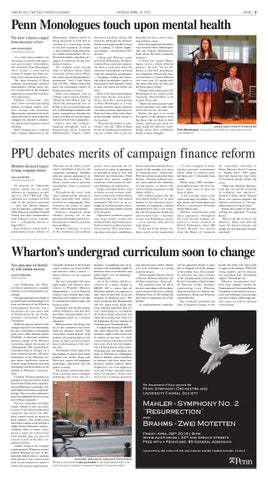
JASHLEY BIDO | STAFF PHOTOGRAPHER
Penn Monologues’ spring show, CrossRoads, took place over the past weekend.
PPU debates merits of campaign finance reform
Members discussed impact of large campaign donors ALLY JOHNSON Contributing Reporter
84 percent of Americans believe money has too much influence in campaigns, according to a 2015 CBS poll. This sentiment has resonated on both ends of the political spectrum — both Sen. Bernie Sanders and presidential candidate and 1968 Wharton graduate Donald Trump tout their independence from Political Action Committees — colloquially known as Super PACs. Penn Political Union held a parliamentary-style debate on
Thursday on the utility of personal contribution limits to curb campaign spending. Students split into groups opposing or affirming the resolution: “This House would remove personal contribution limits to political parties.” Throughout the event, both sides condemned the amount of money, especially “dark” money, involved in campaigning. They criticized the power of super PACs and of the Koch brothers. Debaters disagreed about whether getting rid of the personal contribution limit to political parties would fix or worsen these problems. Students debating in favor of the resolution said political
parties must represent the interests of as much of population as possible in order to win, and therefore are democratic. They argued that parties support moderates with records of coalition-building and compromise. Large individual donors tend to donate to more extreme candidates on both ends of the political spectrum, they said. One student mentioned Ted Cruz as an example of an obstructionist who is supported by large donors instead of by his party. Opposition members argued that large donors would still donate to PACs if personal contribution limits to political parties were removed. They said removing these personal contribution
limits would only promote the interests of the wealthy over those of working-class Americans. PACs do not have to disclose their donors, whereas political parties must publish the identities of large donors, so donors who wish to remain anonymous would donate to PACs. One student argued that the government ought to be an open market of free discourse but is currently an oligopoly, a market dominated by only a few firms. He said the proposal would just add two more firms — the Democratic and Republican parties — to an already small pool of large donors. At the end of the debate, students voted on the proposition
— 23 were in support of maintaining personal contribution limits, while 14 voted to abolish them and 13 abstained from voting. While many PPU members thoroughly prepare for their debates, some come to hear the ideas of others. “A lot of people come to just watch and enjoy the debate,” College junior and Government and Politics Association President Sarah Simon said. Debaters cracked jokes with their opponents throughout the event. Several students referenced a recent incident in British Parliament, when MP Dennis Skinner was ejected from the House of Commons
for repeatedly referring to Prime Minister David Cameron as “Dodgy Dave.” PPU members had shared the viral video in Facebook groups before the event. “Objection! Madame Speaker, I ask that you ask Mr. Overfield to withdraw that adjective,” shouted College junior Samuel Byers over raucous laughter. He had been referred to as “the gentleman known as shady Sam.” Simon also joined in the joke, calling her opponent “Corrupt Korey.” “Half of the fun of this is the theatrics,” Byers said after the event. “It’s fun for everyone, and people get into that kind of backand-forth.”
Wharton’s undergrad curriculum soon to change New plan aims for flexibility with student interests ALIZA OHNOUNA Staff Reporter
Last Wednesday, the Wharton School announced a complete redesign of its undergraduate curriculum. The announcement was made in an email from Lori Rosenkopf, vice dean and director of the Wharton Undergraduate Division, and is the product of a year and a half of deliberations by the Undergraduate Curriculum Review Committee. While the specific details of the changes have yet to be determined, the new curriculum’s overarching goals are to offer students greater flexibility in pursuing academic interests outside of the Wharton curriculum, impart the lessons of “Management 100: Leadership & Communication in Groups” in a more enduring manner, add more dimensions to the Wharton core and better familiarize students with the many different ways that technology and innovation can be applied to Wharton’s concentrations. Currently, Wharton students are required to take two courses within three General Education categories: Social Structures, Language, Arts and Culture and Science and Technology. They are also required to take one additional elective in any one of those categories. The new curriculum will likely require students to take one course in each of the General Education categories and choose the other three courses based on based on their interests. The credits from these three courses can go towards a single General Education category, enabling them to more easily pursue a minor. Or, if they’d like more breadth, they can take two courses in each of the three categories as before. Another change is the complete restructuring of Wharton’s bracket system. Brackets are sets of thematically-linked courses; students must choose a few courses from each of the brackets in order to fulfill the bracket requirements.
Currently included in the bracket course options are legal studies and business ethics courses — which students are not required to take. The new curriculum will move legal studies and business ethics courses to Wharton’s Business Fundamentals — a set of Wharton courses every student must take. Students will continue to be able to concentrate in legal studies and business ethics. Rosenkopf said that this change reflects Wharton’s view that business ethics and legal studies are “a fundamental piece of a business education.” Wharton senior Alice King, who sat on the committee that developed the changes, agreed. “The curriculum would benefit from students all going through an education in ethics and [receiving] a basic understanding of the law,” she said. The brackets will be replaced by new buckets of classes from which students can choose, King said. These new courses will emphasize technology, innovation and the global economy. The bracket restructuring stems from a growing need to integrate technology into every part of a
business. “A marketing view on innovation and technology might be different from an economics and public policy view on marketing,” Rosenkopf said. All of the reforms will be reinforced by a major change to MGMT 100, a course that all Wharton students are required to take, most in their first or second semester of freshman year. “We really recognize that Management 100 was doing many things that were critically important. But it is very challenging to accomplish all of those things effectively and make the learning stick when it is all happening the first semester of freshman year,” Rosenkopf said. To impart the lessons of MGMT 100 more effectively, the single semester, single credit course will be broken up into four, 0.5 credit courses that are to be taken over the four years. Each year will emphasize a different theme of the course. Freshman year will introduce students to Wharton by challenging them to identify critical problems in business and learn about how business leaders address them. Sophomore year will emphasize oral and written communication skills for business. Junior year will focus on honing teamwork
and interpersonal skills. Senior year will culminate in a group capstone project. “Future students will get a lot out of the new Wharton education and the Penn experience,” King said. The transition from the old to the new curriculum will take place over a course of five years, with the Wharton Class of 2021 being the first class to experience all of the changes. An implementation committee
will be appointed shortly to plan how to integrate all of the changes in the coming years. This committee will have the same structure as the Undergraduate Curriculum Review Committee, which includes 10 Wharton faculty members representing each Wharton department and two student representatives, King and Wharton senior Hari Joy. The committee presented the slate of proposed changes to the
faculty last week, who later voted to approve the changes. While the voting numbers can’t be released, the curriculum had “rebounding support,” Rosenkopf said. Wharton incorporated feedback from students outside the Undergraduate Curriculum Review Committee in the form of surveys, town hall meetings, focus groups and data reports addressing specific issues, as well as informal conversations.
The Department of Music presents the
Penn Symphony Orchestra and University Choral Society
Mahler - Symphony No. 2 “Resurrection” and
Brahms - Zwei Motetten Friday, April 29th 2016 | 8 pm Irvine Auditorium | 34th and Spruce Streets Free with a PennCard, $5 General Admission Sponsored by the School of Arts and Sciences and the Student Activities Council GUYRANDY JEAN-GILLES | ASSOCIATE PHOTO EDITOR
Wharton announced a new curriculum to be implemented within the next five years, including increased emphasis on business ethics.