Our columnist reflects on holiday seasons spent at SU, recognizing the change and emotion that comes with them.
Page 10
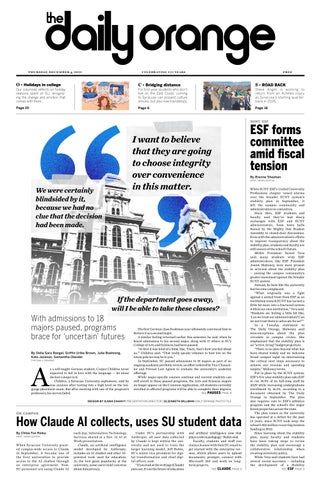
We were certainly blindsided by it, because we had no clue that the decision had been made.
I
C • Bridging distance
For first-year students who don’t live on the East Coast, coming to Syracuse can present culture shocks, but also new friendships.
S • ROAD BACK
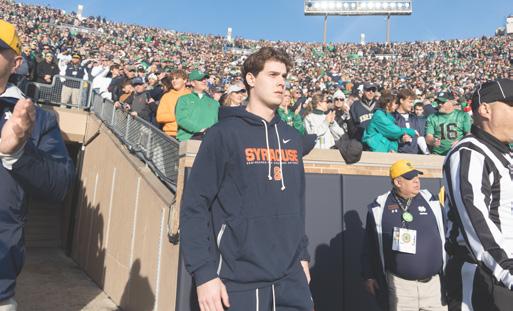
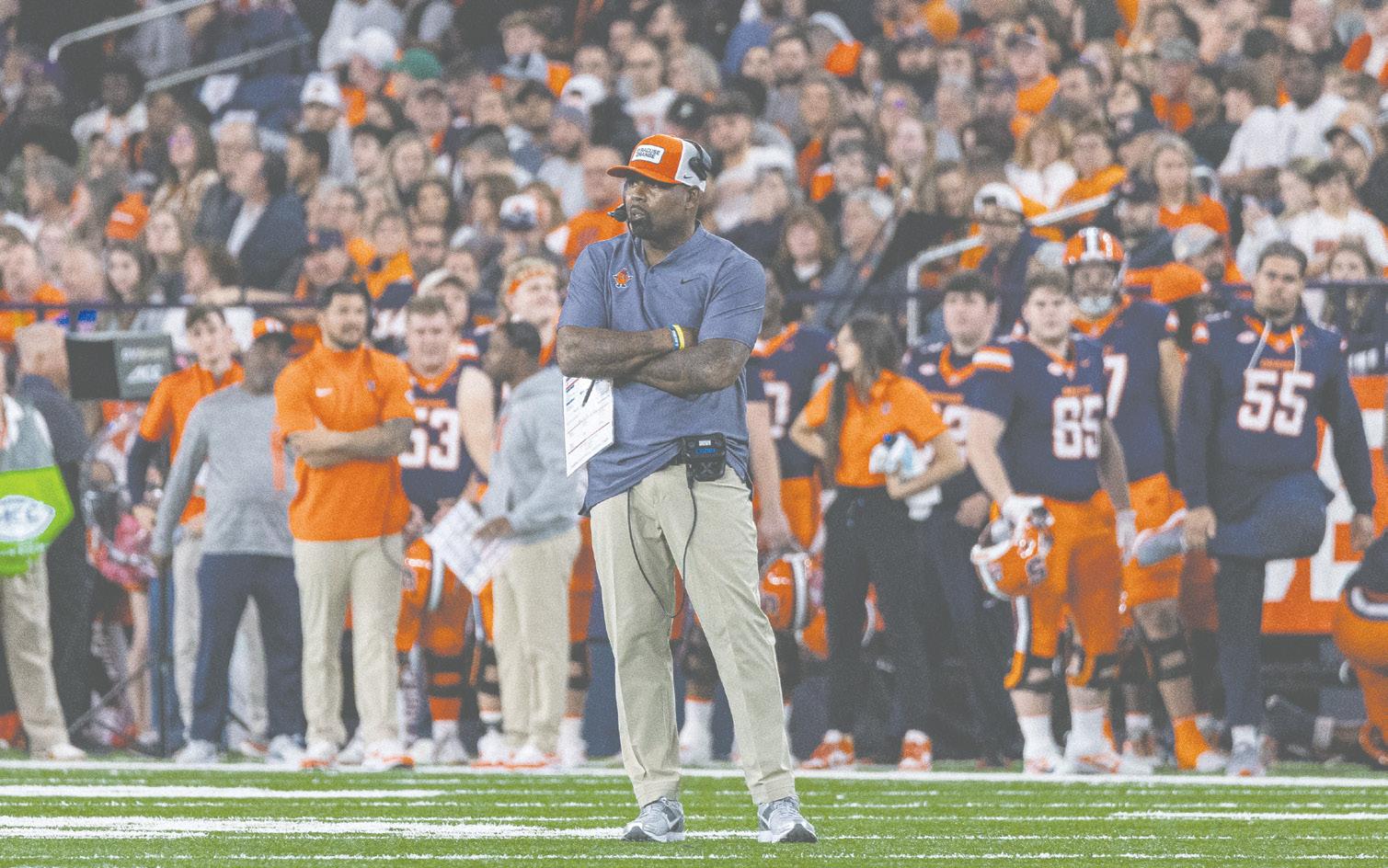
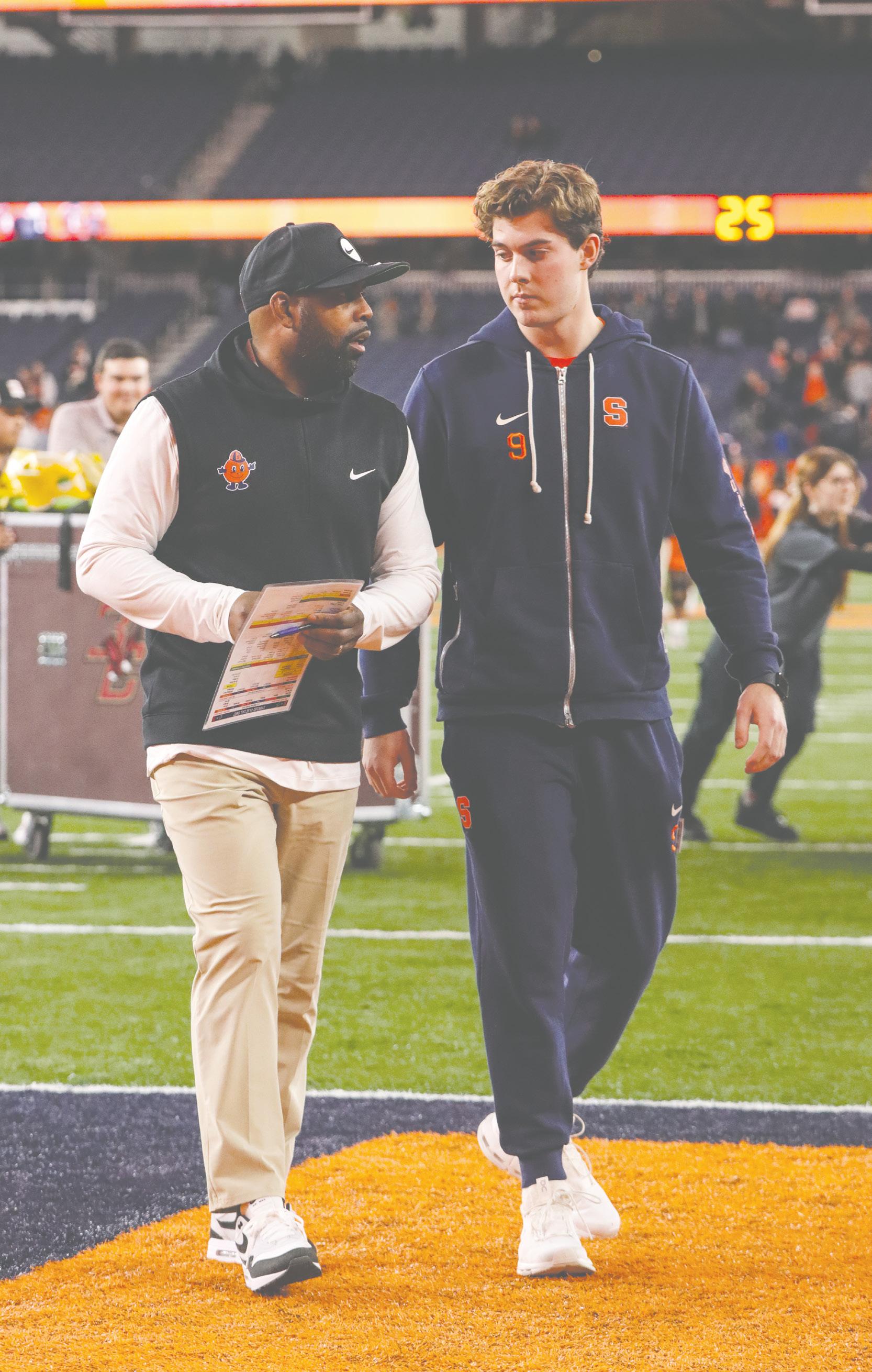
Steve Angeli is working to return from an Achilles injury as Syracuse’s starting quarterback in 2026.
Page 16
want to believe
that they
are going
to choose integrity over convenience in this matter.
If the department goes away, will I be able to take these classes?
With admissions to 18 majors paused, programs brace for
‘uncertain’ futures
By Delia Sara Rangel, Griffin Uribe Brown, Julia Boehning, Kate Jackson, Samantha Olander the daily orange
As a self-taught German student, Cooper Childres never expected to fall in love with the language — let alone declare a major in it.
Childres, a Syracuse University sophomore, said he was anxious after testing into a high level on the language placement exam. But after meeting with one of the program’s professors, his nerves faded.
His first German class freshman year ultimately convinced him to declare it as a second major.
A similar feeling returned earlier this semester, he said, when he heard admissions to his second major, along with 17 others in SU’s College of Arts and Sciences, had been paused.
“At first it was kind of a blow, like, ‘Ouch, that’s how you feel about us,’” Childres said. “That really speaks volumes to how low on the totem pole we may be to you.”
In September, SU paused admissions to 18 majors as part of an ongoing academic portfolio review, an effort ordered by Vice Chancellor and Provost Lois Agnew to evaluate the university’s academic offerings.
While major-specific courses continue and current students can still enroll in these paused programs, the Arts and Sciences majors no longer appear on the Common Application. All students currently enrolled in affected programs will be able to complete their degrees,
by ilana zahavy presentation director | elizabeth billman daily orange photo file
How Claude AI collects, uses SU student data
By Chloe Fox Rinka asst. news editor
Under SU’s partnership with Anthropic, all user data collected by Claude is kept within the university and not used to train the larger learning model, Jeff Rubin, SU’s senior vice president for digital transformation and chief digital officer, said. “If you look at the writings (Claude) puts out, it’s on the future of education and artificial intelligence now that plays a role in pedagogy,” Rubin said. Faculty, students and staff can claim a license with their SU email to get started with the enterprise version, which allows users to upload documents, prompts, connect with Microsoft
By Brenne Sheehan asst. news editor
When SUNY ESF’s United University Professions chapter raised alarms over the broader SUNY system’s stability plan in September, it left the campus community and administration in contention.
Since then, ESF students and faculty said they’ve had sharp exchanges with ESF and SUNY administrators, from town halls hosted by the Mighty Oak Student Assembly to closed-door discussions. Even with the administration’s efforts to improve transparency about the stability plan, students and faculty are still unsure of the school’s future.
MOSA President Daniel Vera said many students wish ESF administrators, like ESF President Joanie Mahoney, were more present in activism about the stability plan — joining the campus community’s greater movement against the broader SUNY system.
Instead, he feels like the university has become complacent.
“What originally was a fight against a united front from ESF as an institution toward SUNY has turned a little bit more into a fractured system within our own institution,” Vera said. “Students are feeling a little bit like, ‘Can we trust our administration? Can we not trust them to advocate for us?’”
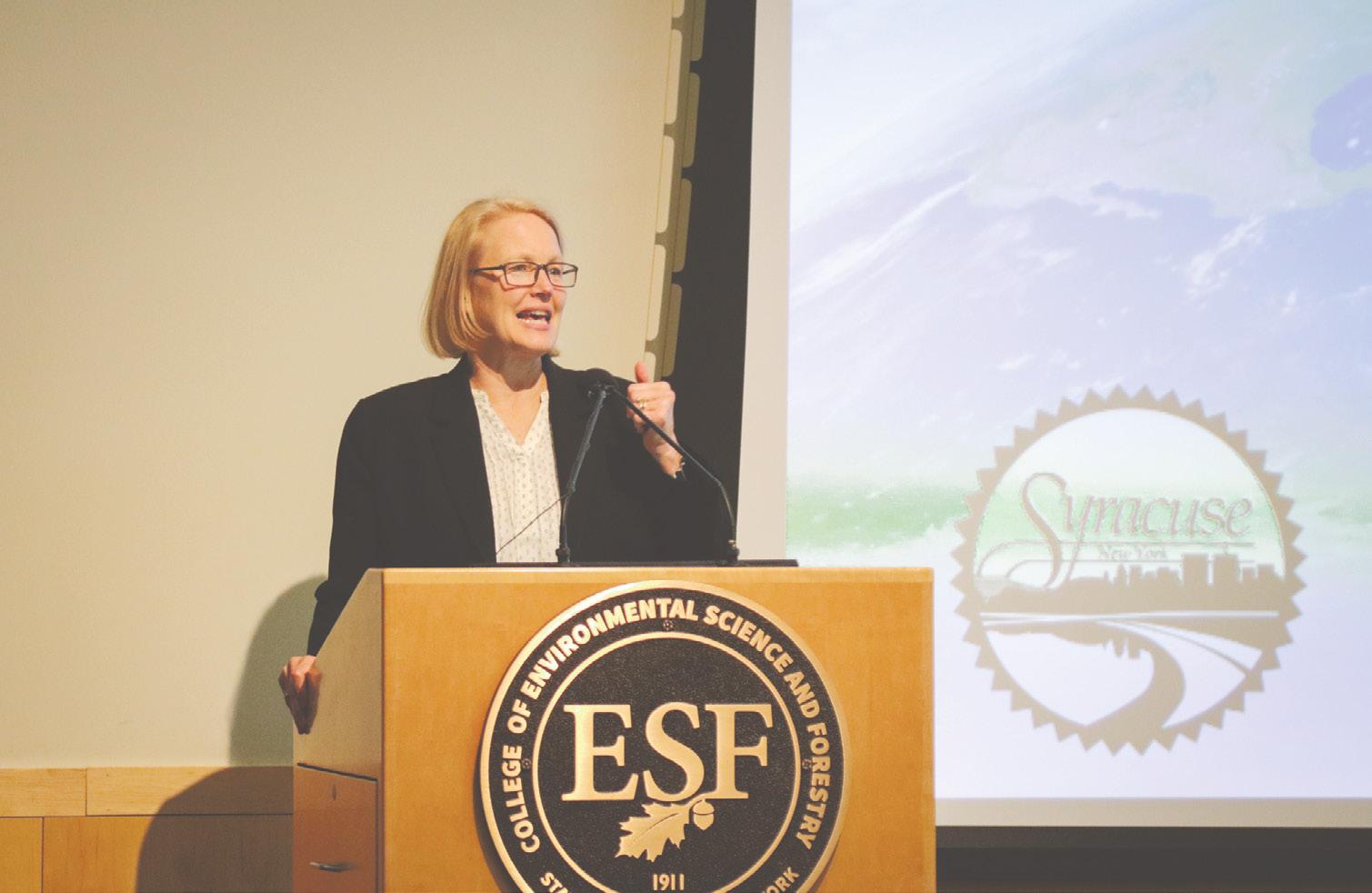
In a Tuesday statement to The Daily Orange, Mahoney said misconceptions about the plan circulate in campus circles. She emphasized that the stability plan is an “active, living” budget projection.
“There is no plan beyond what has been shared widely and we welcome broad campus input on determining the critical next steps necessary to achieve our revenue and spending targets,” Mahoney wrote.
Put in place by the SUNY system, ESF’s five-year stability plan asks ESF to cut 18.9% of its full-time staff by 2029 while increasing undergraduate enrollment by 16.1%, according to a document obtained by The Daily Orange in September. The plan also requires cuts to ESF’s athletics program and the school’s five major forest properties across the state.
The plan comes as the university has operated at a deficit for the past 13 years, since SUNY took away the school’s $10 million recurring mission funding in 2012.
Since learning about the stability plan, many faculty and students have been taking steps to revise the stability plan and encourage a collaborative relationship when creating university policy.
While Vera said students have had several recent successes — including the development of a Stability
deisgn
Editor@dailyorange.com
News@dailyorange.com
Opinion@dailyorange.com
Culture@dailyorange.com
Sports@dailyorange.com
Digital@dailyorange.com
Design@dailyorange.com
Photo@dailyorange.com
BUSINESS 315-443-2315
how to join us
The Daily Orange is an independent, nonprofit newspaper published in Syracuse, New York. The editorial content of the paper — which started in 1903 and went independent in 1971 — is entirely run by Syracuse University students.
The D.O., a 501(c)(3) nonprofit, is editorially and financially independent from SU, and the paper receives no funding from the university. Instead, The D.O. relies on advertising revenue and donations to sustain operations.
This fall, the paper will be published Thursday when SU classes are in session.
The D.O.’s online coverage is 24/7, including while SU is on break.
To show your support to The D.O.’s independent journalism, please visit dailyorange.com/donate. Donations are tax deductible.
If you are a Syracuse University or SUNY-ESF student interested in contributing to The D.O. on either its advertising or editorial teams, please email editor@dailyorange.com.
corrections policy
The D.O. strives to be as accurate in our reporting as possible. Please email editor@dailyorange.com to report a correction.
letter to the editor policy
The D.O. prides itself as an outlet for community discussion. To learn more about our submission guidelines, please email opinion@dailyorange.com with your full name and affiliation within the Syracuse community. Please note letters should not include any personal information pertaining to other people unless it is relevant to the topic at hand. All letters will be edited for style and grammar.
The forecast for this upcoming week, per The Weather Channel.
Kendall Luther EDITOR-IN-CHIEF
Rosina Boehm
Planning Committee made up of student, faculty and staff delegates to help steer the stability plan’s implementation — they haven’t come without tense exchanges.
However, Vera believes the administration is learning more about the campus community through their relentless efforts.
“Right now, our administration is learning that the campus is active, that we want to be part of a participatory process,” Vera said. “We’re not just here to negate everything and be super negative and just crazy. We want real solutions, and we want to work with the administration to do that.”
Mahoney stressed that campus feedback is “welcomed, considered and appreciated.”
Complying with requests from MOSA and the graduate student association, ESF has made information about the stability plan available on its website — and has continued to meet with students to hear their concerns.
“So many colleges and universities are in the same position as ESF; seeking to balance revenues and expenses, and we welcome any and all feedback as we work to achieve the goals outlined in our Fiscal Stability Plan,” Mahoney wrote in her statement.
Tense exchanges
In October, students, faculty and staff created ESF For Our Future, an advocacy group dedicated to attracting more investments into ESF and to urge inclusion in stability planning.
The organization’s first event was an Oct. 10 rally on the university’s quad during SUNY’s plenary meeting to deliver letters and testimonials from students, faculty and alumni directly to SUNY Chancellor John King Jr. Upstate Medical University police were present at the event, Vera said.
“It was a really aggressive, very weird way to come to our campus and then alienate our student body,” Vera said.
Vera said King had left the premises before the student delegation could deliver him the package of letters.
ESF UUP chapter president Matt Smith said he put in a request for assembly, which was ultimately approved by the ESF administration.
The following week, Vera said he and other student representatives met with Chief of Staff and Senior Vice Chancellor Ian Rosenblum, Vice Chancellor of Government Relations Will Schwartz and other SUNY administrators to discuss student concerns.
Vera said he was surprised to learn the morning of the meeting that Mahoney and Chief of Staff Matthew Millea would also be attending. He said when he scheduled the meeting, he emailed Mahoney and asked how to be strategic in representing both students and ESF administrators, but didn’t receive a response, a pattern he noticed when trying to communicate with the president.
In her statement to The D.O., Mahoney said she has made several efforts to be transparent with students, providing “detailed briefings” and “critical” next steps to students per their request.
“We know where we need to be from a financial standpoint and now is the time to seek input as we work to collectively achieve these revenue and spending targets,” Mahoney wrote. “This will be an iterative process over the next five years with many opportunities for analysis and input.”
Amid questions about security and transparency, The Daily Orange outlined how SU uses Claude user data and safeguards its ethics.
Tracking user data
Anthropic trains models with data collected from the internet, third-party cookies, data from users and crowd workers, according to Anthropic’s website.
Claude stores all shared user data by default, Anthropic’s website states. However, Anthropic employees can’t access users’ conversations with Claude’s AI chatbot unless given permission.
When using incognito mode — a setting on internet browsers that allows users to browse without a search history, Rubin said data is still processed despite the device not actively saving cookies and data.
However, the university could recover this data with a subpoena.
As chief digital officer, Rubin can view faculty, staff and students’ Claude metadata, he said, but users’ actual conversations are not accessible.
However, any projects, documents or any other attachments can not be accessed by anyone in the university, Rubin said.
A week after Vera’s meeting with Mahoney, Schwartz and Rosenblum, SUNY administrators scheduled another meeting with four ESF students, not affiliated with ESF student government, Vera said.
Ari Hedges, an ESF student who attended the meeting, said he had done research on the stability plan to ask administrators about how it would affect students. However, when he asked about it, Hedges was told that it “wasn’t what the meeting was about.”
Hedges and other students said SUNY administrators told them they should be “grateful” to attend ESF.
“I came in with the foresight that they probably would not want to hear what I had to say. With zero expectations, somehow they were all let down,” Hedges said.
Paula Halleman, a MOSA senator, said she appreciated that SUNY administrators wanted to meet with students, but was concerned when administrators avoided questions about the stability plan.
“After I left the meeting, I was a little bit blindsided,” Halleman said. “I would like to believe that they truly did want to get to know their students. But in the end, it did feel bizarre to come into a meeting where they were supposed to get to know you.”
Vera described the administrators’ attitude in the meeting as “dismissive.”
The meeting inspired the MOSA executive board to draft “A Call for Shared Governance,” a statement that called for student support to pass a MOSA resolution titled “Inclusive Governance in Stability Planning.” The resolution calls for the university to include student representatives, faculty and staff in conversations about budgetary plans.
“These students are from backgrounds where they’re working four jobs to be able to stay in college, being told by SUNY that they have to be ‘grateful’ when they’re asking questions and being told that they’re angry,” Vera said. “Things like that are very dismissive to students.”
Vera said the resolution passed unanimously on Oct. 30 and has now led to the creation of a Stability Planning Committee, formed by the ESF’s academic governance.
Mahoney said in her statement that she “welcomes any and all feedback,” as ESF works to fulfill the stability plan’s goals.
Accountability measures
A new SU “community of practice” will oversee the integration of Claude by putting together a team composed of members from different areas of study and professional backgrounds, Rubin said.
The group will ensure AI doesn’t negatively affect the community through academics, security and mental health through solution-focused discussions that help target problems occurring in the community due to AI, he said.
As Claude’s interface rapidly changes, ITS sends frequent newsletters informing students and staff of the tool’s system updates. On Oct. 21, ITS announced that the database can now be connected to Microsoft 365.
In his inaugural role, Rubin is working to advance the university’s digital transformation, including data management, data security and AI, according to an SU Today release announcing his appointment.
“Spend time learning, because every organization in the globe, whether it be profit, nonprofit, government sector, military, is going to need people who understand how to integrate AI into their workflow,” Rubin said.
cfrinka@syr.edu
After the resolution also passed through ESF’s academic governance, including faculty and staff members, Mahoney agreed to attend a Nov. 13 MOSA town hall to discuss the stability plan with students.
This, Vera said, marked a positive stride in MOSA and Mahoney’s working relationship — but other students feel differently.
Micah Fulmer, a sophomore MOSA senator, said she feels Mahoney and other administrators have continued to “raise eyebrows” as they engage with students.
“There’s a lot of fear as to what’s going to happen, and it causes emotions to run a lot higher,” Fulmer said. “At that town hall, we definitely saw that.”
At the town hall, MOSA gave the floor to Mahoney and ESF Board of Trustees Chair John Bartow to discuss the stability plan and answer student questions.
We’re not just here to negate everything and be super negative and just crazy.
Dan Vera
mighty oak student association president
Mahoney opened the discussion, taking about seven minutes, according to a video recording of the meeting, explaining the details of the stability plan, updates on the university’s voluntary separation program and the launch of the plan’s website.
One student interjected Mahoney’s explanation, asking her to “wrap it up” and answer several student questions in the town hall’s 90-minute session. Mahoney responded, calling the request “rude.”
“If everybody agrees that you don’t want to hear where we are and where we’re going to save money, fine,” Mahoney said at the meeting. “But what’s the point of the town hall if not to share information? I’m here. We’re all on the same team. We are all ESF and we are all answering SUNY together.”
Fulmer said the exchange set an “odd tone,” especially after a student asked Mahoney
if she was “fighting” for ESF, and Bartow stepped in to answer. While Fulmer believes Mahoney cares about ESF, she thought the president could do more to calmly engage with students.
“It kind of set the floor for a very ‘Oh, this is gonna be a lot, isn’t it?’ because the questions hadn’t started yet, and there was obviously some back and forth going on already with some pretty generic questions.”
Mahoney told The D.O. that she has met with MOSA and GSA leadership to continue the conversation and respond to feedback and input.
GSA did not respond to requests for comment. Effort to strengthen shared governance takes shape
A month after MOSA unanimously passed the “Inclusive Governance in Stability Planning” resolution, ESF’s department of academic governance announced the formation of a Stability Planning Committee in a Nov. 24 email to students obtained by The D.O. The committee aims to form shared governance and transparency as the stability plan moves forward.
It will also evaluate the effects of the Voluntary Separation Program and other efforts to reduce staff, as well as recommend “actions to college leadership” and work to ensure decisions are inclusive of those affected.
The committee will include 18 total members — two of which are reserved for faculty, 12 for staff, a seat for an undergraduate and a seat for a graduate student. Two committee memberat-large seats are reserved for faculty and staff, according to the email.
Self-nominations for the committee closed Monday, and the names of the members have not been released as of Thursday morning.
The voluntary separation program saw 41 applicants, Smith said. Applicants had until Monday to accept their severance offers, he said, and those who will leave the university at the end of the academic year will be announced over the next week.
Mahoney told The D.O. she will continue to work with the committee as stability planning continues.
“Most importantly, we will demonstrate to SUNY that we are collectively committed to the long-term financial sustainability of ESF,” she wrote.
MOSA also passed a resolution at the 2025 SUNY Student Association fall conference in November, calling on SUNY to develop a fair funding model for all SUNY schools undergoing stability planning. Vera said MOSA is also developing coalitions with other schools to start their own fair funding campaigns.
From a faculty standpoint, Smith is skeptical. He said the committee might be operating more to “save face” rather than actually seek community input.
“I hope I’m wrong in that the administration does engage with this coalition of the willing right that wants to see good solutions that make sense and have the knowledge to do that,” Smith said.
As ESF students await the launch of the stability committee, Vera said he’s excited to start a new chapter with Mahoney — but remains steadfast in creating a culture of accountability.
“We kind of mended a relationship with Joanie,” Vera said. “My role here is to ensure that relationship is accountable, not just with me, not just with specific students, but with all of our student body.”
bsheeh03@syr.edu
SUNY ESF’s community has experienced tension with the school’s administration over transparency surrounding its stability plan. avery magee asst. photo editor
hannah
Sarah Scalese, SU’s vice president for communications, wrote in a Wednesday statement to The D.O.
Across faculty, students and alumni, The D.O. spoke with 35 people involved with these programs.
Many in the paused majors described similar feelings as the fall 2025 semester ends: confusion, frustration and a growing uncertainty about the future of their programs.
Arts and Sciences Dean Behzad Mortazavi referred The D.O. to a university spokesperson following a request for comment, as did a member of the college’s communications team.
The D.O. reached out to faculty involved with all 18 programs. Faculty from music history and cultures, chemistry and fine arts majors declined to comment or did not respond to an interview request.
Department chairs must submit plans by mid-December outlining how they can stabilize or increase major enrollments. In January, Agnew will review these plans and “report on next steps,” Scalese wrote.
“It’s sort of like waiting for the other shoe to drop,” said Christopher Hanson, an associate professor of digital humanities, another paused program. “You’re not sure what’s going to be the next step and what decisions have already been made.”
Many questioned whether the decisions were politically motivated, citing efforts by President Donald Trump to reshape higher education and attack humanities programs. Trump has also dismissed members of the National Endowment for the Humanities.
“The goal of this exercise is not to eliminate departments or people. Higher education is facing significant demographic shifts, changing student demand and financial pressures,” Scalese wrote. “Regular portfolio reviews are a recognized best practice in higher education, undertaken by universities nationwide regardless of political climate.”
Admissions to the following 18 majors were put on pause:
African American Studies; Applied Mathematics B.A.; Chemistry B.A.; Classical Civilization; Classics (Greek and Latin); Digital Humanities; Fine Arts; French and Francophone Studies; German Language, Literature, and Culture B.A.; History of Architecture; Italian Language, Literature, and Culture B.A.; Latino-Latin American Studies; Middle Eastern Studies; Modern Jewish Studies; Music History and Cultures; Religion; Russian Language, Literature, and Culture B.A.; Statistics B.A.
The Earth Science B.S. is also in a voluntary phase-out period to make way for B.S. programs in Environmental Geoscience and Geology, the chair of the Department of Earth and Environmental Sciences previously told The D.O.
Several Arts and Sciences faculty members said they’re unsure how their program’s plans will be evaluated or whether the pause will become permanent.
For German program coordinator Karina von Tippelskirch, the decision to pause humanities programs was disappointing but not shocking. She said she wishes SU administrators would “unite” and “stay strong” in the face of these challenges, rather than pausing programs without considering faculty input or student impact.
“We know that Syracuse is not an exception. These are discussions and developments that are going on in the country,” von Tippelskirch said. “My concern is that the university is giving up much more than they will win.”
Von Tippelskirch learned of the decision on Sept. 15 — the same day department chairs were asked to present their own review materials.
Other faculty members said they were “blindsided” when the list of paused majors appeared on screen.
Since then, program leaders have scrambled to show administrators why their disciplines should remain part of SU’s academic landscape.
For Middle Eastern studies and religion chairs Yael Zeira and Gareth Fisher, this meant hosting listening sessions with current students and getting feedback on their respective programs. Von Tippelskirch’s program surveyed German major alumni, and Italian Program Coordinator Lauren Surovi’s program is looking for ways to make lower-level language classes more compatible with students’ schedules.
Most programs are working to boost enrollment, even when the effort feels like an “oxymoron,” von Tippelskirch said, given that SU has already paused admissions for at least the upcoming academic year.
While faculty worked to respond to the news, students were processing the change in real time.
While enrolled in AAS 112 — the course that first drew her to African American studies — Savannah Wilson said she learned of the pause during a shift at the department’s Martin Luther King Jr. Library, when a professor told her the major she viewed as a “pillar” on campus would no longer appear on the Common App.
The news felt personal.
“If the department goes away, will I be able to take these classes?” Wilson said. “It’s very important to take classes like these to understand history before we get it taken away.”
Wilson said the confusion aligned with what she’d heard from students. She recalled hearing from a student whose advisor questioned why he enrolled in an AAS course because it “wasn’t necessary” for his degree — a moment she said showed how easily students can be steered away from the program.
Concerns also arose about how SU justified the pause. The university has cited low enrollment numbers, but students, faculty and alumni across affected programs challenged what “low” entails and how the university measured it. Some faculty members have even questioned the accuracy of the enrollment numbers behind the decision.
During an Oct. 22 University Senate meeting, Agnew said SU’s 462 total academic programs far exceed the average of its peer institutions. She said reducing offerings may better serve students.
The university’s website boasts a 15-to-1 student-faculty ratio and small class sizes, with 64% of classes holding fewer than 20 students.
“Eighty percent of our enrollments are located in only 34% of our programs. So 51 programs have 80% of the students enrolled, while 66% of the programs, in other words, 100 programs account for just 20% of our enrollments,” Agnew said.
Scalese confirmed Agnew’s October numbers in Wednesday’s statement.
“However, when programs consistently have fewer than 6 majors – not by pedagogical design but due to limited student interest – we cannot provide the full range of courses, peer collaboration, and academic experiences students deserve,” Scalese wrote.
The pauses have come up in broader discussions about shared governance on campus, as well as in multiple senate meetings. During its Oct. 22 meeting, university senators overwhelmingly passed a resolution calling for faculty and the senate to be involved in the review process.
James Haywood Rolling Jr., AAS interim department chair, said the decision to pause relied on a single metric — declared majors — without considering a program holistically. He estimated AAS has about 10 to 15 enrolled undergraduates.
African American Studies
Pause revives
fears
for Black studies
By Samantha Olander enterprise editor
When Darla Hobbs arrived at Syracuse University as an undergraduate, she didn’t feel like she had a place on campus.
She said she moved through SU without a sense of community until she walked into an African American studies course — a moment she described as finding the first space where she felt welcome.
Now, she’s a second-year graduate student in the Pan African studies program.
“This is where I found myself at SU,” Hobbs said. “It kind of brings all of the different pieces of me together.”
For many within the department, that feeling has made SU’s admissions pause especially painful. Some students and alumni said the move doesn’t just threaten a college program, but one of the few academic and cultural spaces grounded in Black history, identity and scholarship.
In a September email obtained by The D.O., Arts and Sciences Mortazavi said each paused program had fewer than 10 enrolled majors.
The D.O. could not confirm official enrollment data.
“The metric that was being used was very, very narrow,” Rolling said. “Story wasn’t considered, legacy wasn’t considered … the fact that many of our courses were fully enrolled wasn’t considered.”
Hanson claimed many paused programs were already “under-resourced,” and that low enrollment can be a “self-fulfilling prophecy” when a university hasn’t invested in them.
In the Department of Mathematics, where the B.A. programs in applied mathematics and statistics were paused, geometry professor Steven Diaz said the B.A. and B.S. tracks are designed to function as one system — something that he said feels the review overlooked.
Though not all students view the B.A. pause with concern.
Junior Darren Murphy, an economics and B.S. applied mathematics major, said the distinction between the B.A. and B.S. tracks is minimal in practice, because of pathways in the broader mathematics major. Murphy added that he believes the shift may strengthen the department by emphasizing more rigorous coursework.
For religion, like many humanities, Fisher said it doesn’t follow the usual tiered structure of 101-level prerequisites and fixed progression — a difference he said makes the major harder to compare with other fields and difficult for academic advisors to explain to students.
“That’s the kind of college experience that (students) want here, to some extent, the college experience they were promised,” Fisher said. “They find that experience within our department.”
In other programs, the uncertainty extended beyond how SU measured enrollment. Terese Millet Joseph, a doctoral candidate whose research draws on Africana studies and Black feminist theory, said she was directly discouraged early on from taking AAS electives she saw as essential to her work.
To Joseph, the pause echoed the same message she experienced in advising earlier: her field was “dispensable.”
“This is not just an administrative shuffle,” Joseph said. “This is an ideological move.”
Across paused language programs, faculty and students said they were frustrated that SU didn’t appear to consider the broader value of bilingualism. Most students in these majors don’t necessarily want to enter academia, Surovi said, but plan to use their language skills in international or multicultural careers.
Beyond enrollment, several students, faculty and alumni described a growing sense that financial considerations, not academic values, are driving decisions about which programs survive.
Considering the university’s large Jewish population, B.G. Rudolph Professor of Judaic Studies Ken Friedan questioned where its priorities lie in pausing admission to the modern Jewish studies major.
Russian Program Coordinator Erika Haber pointed to the university’s recent investments in STEM fields ahead of Micron Technology’s arrival in central New York. She said she feels SU has already “made (its) decision” about which programs to prioritize. Alumnus Agyei Tyehimba, former Student African American Society president who graduated from SU in 1991, said he viewed the pause as part of a broader shift toward a “business-first” mindset in higher education.
For longtime observers of AAS, Tyehimba said the moment felt eerily familiar.
The alum, who led protests to protect the program in the late 1980s, connected the pause to a broader national push to weaken humanities and
identity-based fields, which led to the instability of the AAS department decades ago.
Those parallels, Tyehimba said, showed him “the university has not learned.”
“It would not be any type of weird conspiracy theory that this is connected to erasing, silencing the African American studies department,” he said. “And not just that department, it’s a whole attack on humanities.”
While some faculty, like Rolling, described the portfolio review process as an “opportunity” to strengthen their offerings, others said they remain unsure whether their departments will have a path forward.
In her statement, Scalese said the portfolio review has “no predetermined outcomes.” She said the university will make decisions based on the dean’s recommendations, which are expected to weigh the data and determine “what’s best for their school or college.”
Rolling said the university’s decision has galvanized many.
“It sort of lights a fire under folks,” Rolling said. “This is one of those, to me, lock arms, go shoulder to shoulder, kind of moments.”
Multiple students said having smaller programs is an asset that allows them to build closer connections with their professors and peers.
Lucy Lee-Moore, a sophomore majoring in classics, said due to the niche nature of the discipline, her professors’ passion often radiates through their teaching. She added that because the program has fewer resources than others on campus, professors will even bring in their own materials to help with instruction.
Childres pointed to the size of the German major as a strength rather than a weakness. In his program, he said he’s particularly enjoyed hearing the life stories of the department’s two faculty members — like von Tippelskirch, who grew up in Communist-ruled East Germany before the end of the Cold War.
“There was such value in, at a big school, especially, being a part of a small department, and academically feeling like I was at a smaller school,” said John Calder, a 2018 alum of the paused history of architecture major who works at the Philadelphia Society for the Preservation of Landmarks. “I was able to get the best of both worlds.”
Some professors are also calling for the administration to consider what makes their program “unique.”
Gail Bulman, a Spanish professor and chair of SU’s Department of Languages, Literatures, and Linguistics, said the Latino-Latin American Studies major gives its students the opportunity to learn about “the cultures of underrepresented sectors of the world.”
Romita Ray, the director of undergraduate studies in art history — which cross-lists courses with the history of architecture program — said the major contextualizes the unique architectural landscape on campus and at several SU Abroad programs.
As Arts and Sciences departments prepare proposals and administrators weigh next steps, many students and faculty members are still asking what SU wants its academic future to look like.
Fisher said the plan may backfire in making SU “less competitive,” noting that once programs are cut, restoring them could be difficult. He said the university should look to consolidate duplicated programs that can be merged or cut, rather than single-major departments like religion or AAS.
“I wanna believe that they are going to choose integrity over convenience in this matter. Will you stand with institutions that shrink when they are pressured? Or will you stand with those that defend what is right?” Joseph said. “This is a watershed moment.”
news@dailyorange.com
Hobbs said the department has long served as “the little piece of the university that we can call our own.” She said seeing it placed on hold was “disheartening.”
James Haywood Rolling Jr., the department’s interim chair, emphasized that while the major has been removed from the Common Application for incoming students, current undergraduates can still declare a major or minor in AAS — and, for now, “all the lights are on,” with courses running and programs continuing as usual.
Savannah Wilson, a sophomore who works in the Martin Luther King Jr. Memorial Library, said the department is a crucial support system for Black students on a predominantly white campus. According to 2023-24 SU enrollment data, white undergraduates outnumber Black undergraduates by roughly seven to one.
She fears the pause proves that SU does not view the field as essential and will make the program less visible.
“It reinforces what we already know,” Wilson said. “We are low on the totem pole. We are not high priority.”
Those fears draw heavily on the department’s history. AAS grew out of Black student activism in the late 1960s, when demonstrations over SU’s failure to support Black students led to the creation of the program. It also led to the creation of the MLK Library, which remains one of few dedicated spaces for Black scholarship on campus.
In recent years, the department has faced faculty turnover, stretches without stable leadership and staffing gaps, where students and faculty feel the program is already being asked to do more with less.
Rolling said that, despite these strains, AAS courses are often full, drawing far more interest at the class level than major enrollment alone reflects.
Alum Agyei Tyehimba — who helped lead protests to protect AAS in the late 1980s — said the pause fits into long-running tensions. He said he was initially “shocked” to see admis-
sions halted, though not surprised, pointing to what he described as “a kind of corporate way of thinking.”
“These students won’t be students forever … What type of world will they inherit if the dominant theme is how much does that cost? How much do we save? How much do we make?” he said.
Tyehimba also tied the decision to national attacks on humanities and identity-based fields, noting the pause comes as diversity, equity and inclusion offices, ethnic studies programs and humanities departments at universities nationwide face heightened political pressure and funding cuts.
“If you’re in a nation that is fascist-leaning, what would be a very good political move? Definitely to attack humanities because they are typically the areas that produce the Dr. Kings,” he said.
Jeninya Holley, another Pan African studies graduate student, said she’s concerned about the program’s long-term stability, noting fewer
majors in the future could weaken the intellectual community that drew them in. Holley called the program “enriching,” saying it exposes students to perspectives beyond dominant narratives.
Above all, many said the pause sends a clear message about who — and what kinds of knowledge — the university chooses to prioritize.
“It doesn’t matter what you think it’s about,” Tyehimba said. “It’s saying to them that you are unimportant, you are disposable, we can disregard you and we’re indifferent to your needs and your interests.”
saolande@syr.edu
Italian
Classics and Classical Civilizations
Students, faculty feel like ‘afterthought’ in pause
By Kate Jackson enterprise editor
Classics and Classical Civilizations Department Chair Jeffrey Carnes said, between the two majors, around six to seven students are currently enrolled. He said seven students are enrolled in the classics minor.
The Daily Orange could not confirm official enrollment data.
There are two faculty members in the department — Carnes and Associate Teaching Professor Matthieu Herman van der Meer. Both teach literature and language courses in Latin and Greek, which they said often fill up with nonclassics majors.
Pause reflects ‘closed-mindedness’ about language
By Julia Boehning enterprise editor
In 2005, while Lauren Surovi explored colleges offering majors in Italian language, Syracuse University quickly caught her eye.
Whether it be for SU’s large Department of Language, Literature and Linguistics, study abroad options or proximity to her home in Pennsylvania, Surovi felt like the university “checked all (her) boxes.”
Now, almost two decades after her days as a student, she finds herself back at SU leading the very Italian program that shaped her college experience.
Three years after working for her alma mater, Surovi said she still feels like “the luckiest person on campus.” But now, after SU unexpectedly paused admissions to the Italian program, she said she’s holding onto hope that her luck won’t get cut short.
“I came to Syracuse to study Italian. That’s part of the reason why I chose Syracuse,” Surovi said. “So it’s been particularly devastating for me now that I am a professor here to find out that our program is paused and the future is uncertain.”
Italian is one of multiple language majors to have its admissions paused — something
Surovi and other program affiliates described as a “shocking” shift from SU’s previous commitments to promoting global perspectives and expanding students’ worldview.
SU’s mission statement includes a clause about “encouraging global study,” according to its website. Within section 1.1 of the faculty manual, last updated online on April 17, 2024, the university states that it supports “close interaction and engagement with the world— locally, nationally, and globally.”
One Italian dual major, Frank Gambino, heard about the pause to his major through a professor involved with the University Senate. As a senior, the decision won’t impact his degree, but he thinks the decision may be harmful to future SU students.
Gambino said most of his peers didn’t initially enroll in SU as Italian majors, but after taking courses in the language, many “fell in love” with the program.
“Public schools give people this impression of, ‘Why would you spend money studying a language? What are you going to do with that?’” Gambino said. “Do you know how many corporations are out there that need people who speak Italian to work for them? There’s a lot of closedmindedness when it comes to how crucial it is for people to learn other languages.”
Modern Jewish Studies
While there are only three full-time faculty members affiliated with Italian, Gambino said the program’s small size makes everyone feel more connected — like they’re “all friends.”
Anne Leone, an assistant professor in Italian, said she wishes the campus community knew the program teaches not only language skills but also literature and culture classes, as well as communication skills.
As the university increasingly invests in its College of Engineering and Computer Science in preparation for the arrival of Micron Technology, Leone said she wants administrators to consider how a foreign language education fits into business priorities. Micron, for example, has several international locations — including four sites in Italy.
“A lot of our students will say, ‘Oh, I’m doing a major in aerospace engineering, and I also have a major in Italian. And actually, the recruiter said that’s what made my application stand out,’” Leone said. “It really helps to have that cultural and linguistic knowledge.”
However, Leone and Surovi said they don’t understand how the administration chose which majors to pause. When Leone saw the external review of the program, she felt it looked like the department was “doing great.” Surovi said Italian has increased its enrollment over the past couple of years
Pause is ‘misguided’ given Jewish population
By Delia Sara Rangel news editor
Syracuse University sophomore Lily Facenda said that throughout her college search, she looked for a university with a lively Jewish community and a corresponding major.
In her hometown, she said she hadn’t been surrounded by many people who share her culture. Facenda, a dual modern Jewish studies and communication sciences and disorders major, said she arrived at SU hoping to learn more about her identity.
“This major was a perfect way for me to add a real part of who I am into my learning experience,” Facenda said. “I was really looking forward to furthering my academics in a setting that I could make as Jewish as I wanted to be.”
When she heard new admissions to her major had been paused, she was disappointed to see her identity-based program and others like African American studies now on hold.
“It’s really important to see yourself and see people like you in classes, especially in places where certain groups have been excluded historically,” she said. “I think that
(the paused majors) are so incredibly crucial to inclusion and for people to feel important and to feel seen and to feel heard.”
When religion and modern Jewish studies professor and Director of Graduate Studies James Watts learned his program’s admissions were put on pause, he said he was “horrified.”
Watts said courses in the program have no prerequisites, allowing his classes to be filled with interested students. He fears that if the major is eliminated, the university will cut many of the classes serving the larger student body.
“SU will save no money by killing the majors, not one cent,” he said. “The majors are supported by people taking the courses out of general interest. So in that sense, it’s irrational.”
Throughout President Donald Trump’s second term, his administration has targeted higher education institutions for allegations of antisemitism, using it as justification to revoke federal funds.
B.G. Rudolph Professor of Judaic Studies Ken Friedan said the main function of the program is to teach the SU community about Judaism. He said many of his classes are made
up of non-Jewish students.
“Especially at a time like this, when everyone says antisemitism is increasing, you would think that universities would care about Jewish studies,” Friedan said. “Especially if it means educating people to understand better what the Jewish tradition is and what Judaism is.”
As of September 2024, SU had around 2,500 undergraduate Jewish students, making up roughly 16% of its undergraduate student body. Hillel International — the largest collegiate Jewish organization in the world — ranked SU as number six in its list of top 60 private universities by Jewish population.
With a large Jewish population, faculty wonder where the university’s priorities lie.
“What kind of institution is Syracuse University? What does it want to be?” Modern Jewish studies and religion professor Zachary Braiterman said. “And what is the place of the humanities and what is the future of the humanities without these diverse portfolios?”
Braiterman would often boast the program’s offerings to community members and parents.
Losing one of SU’s oldest programs would be ‘travesty’
By Griffin Uribe Brown social media editor
Religion courses have been offered since the founding of Syracuse University, and the Department of Religion was made a distinct department in 1895.
This fall, the department enacted structural changes to its religion major. Department chair Gareth Fisher, who joined the faculty in 2008, said the religion major’s restructuring — which simplified the major requirements — will hopefully save the department from being permanently cut.
“We’re hoping that we’ll survive the review process on the grounds that we’ve already been thinking about innovating and thinking about ways to attract new students,” Fisher said. “We just haven’t seen the fruits of that change yet.”
The new structure allows the department to bring students into the major or minor through “multiple gateways,” Fisher said. Rather than a standardized 101 course, a student’s first religion course could be at the 300-level course.
“Because of the size and just kind of the tightknit closeness of the department, the professors are amazing,” Evan Fay, the department’s undergraduate chair and junior, said. “They’re all very interested in my interests and developing my skills and in my career.”
Fay, who studies both religion and broadcast and digital journalism, said it would be a “travesty” for SU and other colleges to lose their religion programs, potentially limiting religion education to theological schools, he said.
He said more students and more perspec -
Van der Meer, an untenured professor, said he worries SU won’t renew his contract next year if the major is cut.
“Humanities have always been the decorative extra, and this marginalization just continues with the closing of these programs,” van der Meer said.
kjacks19@syr.edu
tives would strengthen the program.
“A major in religion helps with any profession that involves communication with other people, to study in comparative religion helps me understand people better and connect with people on a deeper level,” Fay said.
Fisher said that he agrees many SU programs, particularly “duplicates,” could benefit from being merged or modified, but majors that exist as a department’s only major, like religion or African American studies, should remain their “own thing.”
Students have different reasons for choosing religion, Fisher said, recounting a few examples: a pre-medical student seeking to better understand patients, a philosophy major interested in thought and critical thinking or an
and wanted to know more about how SU collected the data.
Throughout the semester, Surovi and the program have been pushing to boost enrollment and find ways to keep Italian alive at SU. Gambino was one of several people to speak at the student-led Humanities Town Hall, where students involved in the paused programs shared why they believe a humanities education is important.
Behzad Mortazavi, the College of Arts and Sciences dean, wrote in an email obtained by The Daily Orange that each of the paused majors had 10 or fewer students enrolled. Today, Surovi said Italian has 12 declared majors.
The Daily Orange couldn’t confirm Italian’s official current enrollment numbers.
Though the future of Italian remains unclear, current faculty and students said they’re hopeful they’ve demonstrated to administrators why the program — while small — has a large impact on its students.
“Italian has a place on this campus, and I’m proud of the work that we have done. I’m proud of my colleagues and my students,” Surovi said. “I hope to continue to support my students for the years to come. So I will hold out faith. I am not without hope.”
jmboehni@syr.edu
Without a major, he said he can’t do that.
In keeping and offering the major, Braiterman said it’ll signal that modern Jewish studies “actually matters” to the university.
“It’s been a really rough year for lots of people in the community, the larger Jewish community, and the Syracuse Jewish community in particular,” he said. “And the very moment where the country is confused by race and religion and the Middle East and Jews, the university is deciding to cut back these programs?”
Amid the ongoing war in Gaza, he said modern Jewish studies courses have seen higher enrollment numbers.
While the program doesn’t have “many” majors and minors, Friedan said it’s interdisciplinary, affiliated with the English, religion and language, literatures and linguistics departments.
“This major was a perfect way for me to add a real part of who I am into my learning experience,” Facenda said. “It was really, really important to me to be involved religiously in college but also academically, in harmony with my identity.” dsrangel@syr.edu @deliasrangel
international relations major learning about global cultures.
“Religion is a topic, it is a phenomenon that exists in the world and has existed throughout human history,” Fisher said. “Then we study that phenomenon from many, many different disciplinary aspects.”
Fisher said he worries the review process is moving too hastily and will harm programs that SU needs, even if university administrators don’t realize it now.
“Normally, curricular processes don’t really go that fast,” Fisher said. “I’ve been here 18 years, and we’ve always been thinking about ways to better attract majors and minors.”
gbrown19@syr.edu @GriffinUriBrown
Finding footing
The first semester comes with many culture shocks for some freshmen, from food preferences to sports culture
beyond the hill
By Claire Zhang asst. copy editor
For some students, moving to college is a long road trip or a quick flight with a layover. But, it was more than that for Kayra Oguz. He was traveling over 5,000 miles away from his home in Izmir, Turkey.
“When I got here, I only had my two huge luggages and one backpack, and I did everything myself,” Oguz, a Syracuse University freshman, said.For SU students from New York or other states in the Northeast, Syracuse might not be all that different from home. But for students like Oguz, it’s a completely different change of pace.
Whether it be weather changes, language differences or food preferences, college in central New York has brought up some culture
shocks for freshmen as they adjust to their first semester on campus.
Oguz said he applied to SU his senior year because of its academics, sports and overall “good reputation,” he said. He applied to schools all over the world, as did many of his high school peers, but landed on SU because he wanted something different than what he’d gotten used to at home.
Tallulah Heath, a freshman from Los Altos, CA, shared similar sentiments. She’s lived in California for most of her life and has had the same friend group since elementary school. During college application season, she knew she wanted to branch out and come to the East Coast.
“I got the chance to make new friends for the first time in a long time,” Heath said. “I think it’s really good to experience change.”
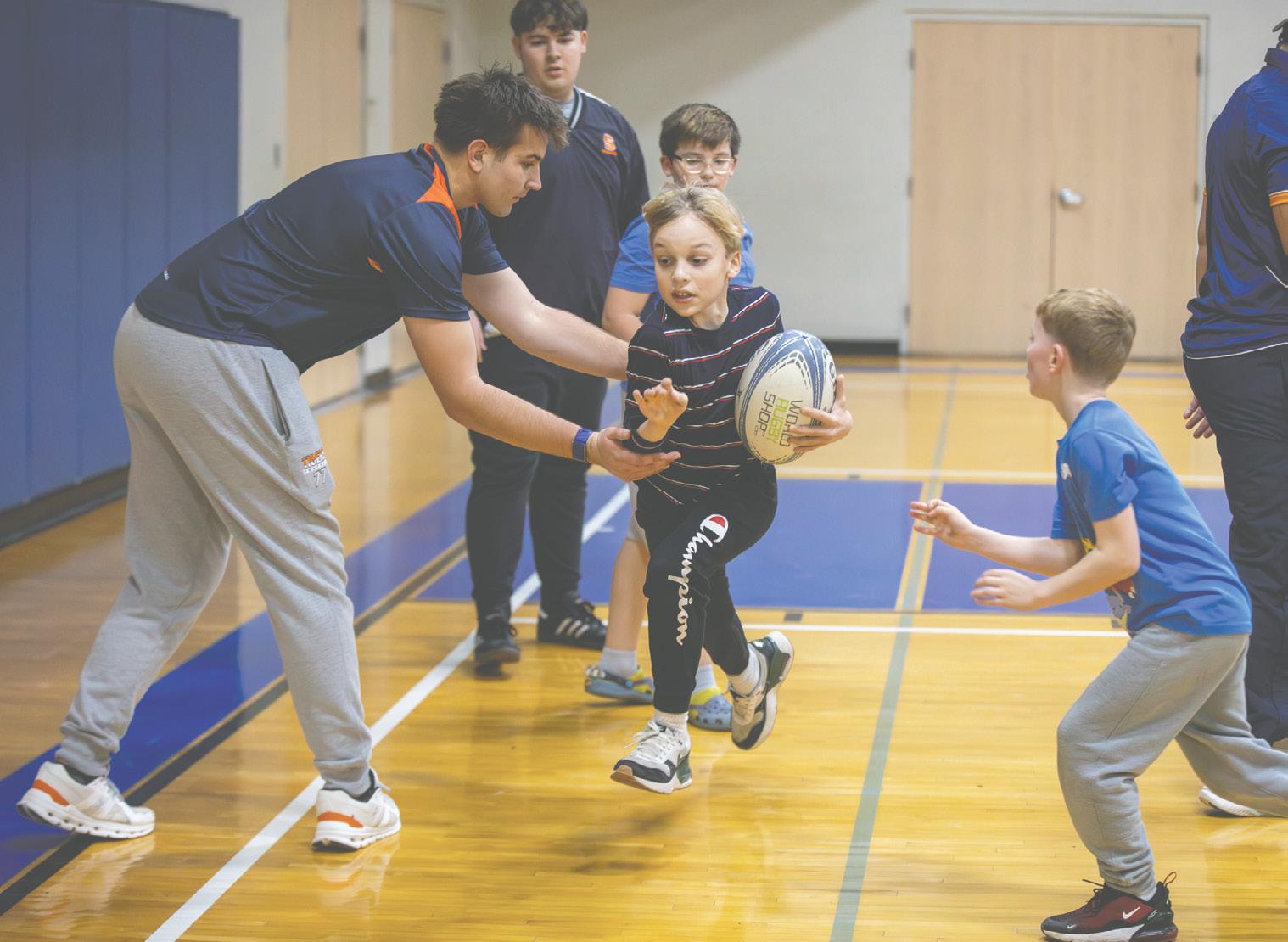
SU rugby players give back through JCC coaching program
By Eliana Rosen asst. culture editor
“Donut is here!”
Ten elementary schoolers halted rugby practice to scream that phrase as Donough Lawlor entered the gym at Syracuse’s Jewish Community Center. They ran over to him for high fives, hugs and claps on the back. Though he appreciates the nickname “Donut,”
Lawlor said he prefers when they call him Josh Allen.
“They’re always really excited to see you,” Lawlor, a Syracuse University graduate student, said.
“It’s the simplest feedback there is.
If they like you, you’re obviously doing something right.”
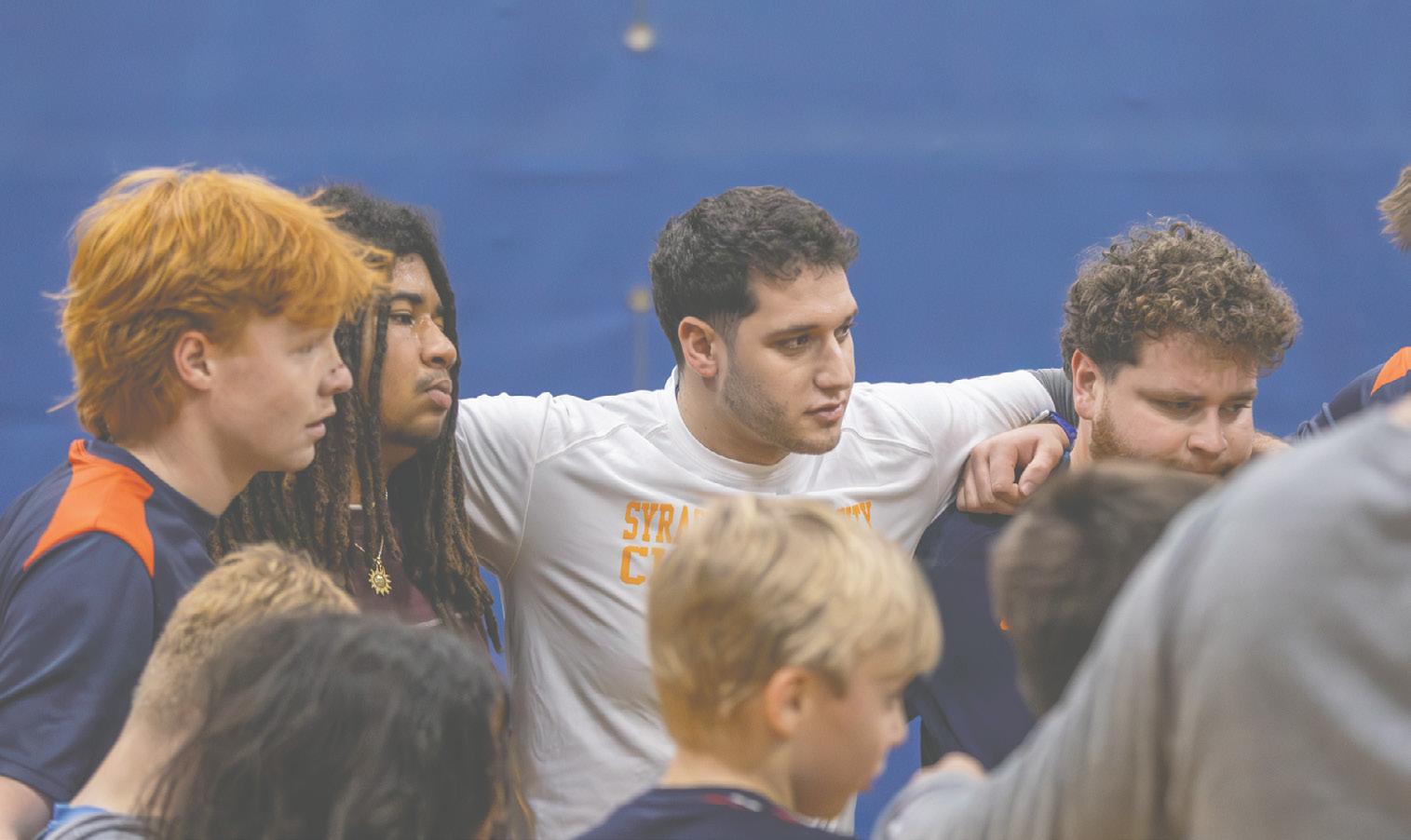
Lawlor is one of 11 members of the SU Men’s Rugby Team who coached a fiveweek rugby program for students ages 8 to 11 at the JCC, which ended on Nov. 20.
The team’s relationship with the JCC began last fall, when then-junior Jayden Kass began volunteering to fulfill his required community service hours for the Whitman School of Management. He brought a few friends from the rugby team to volunteer at the JCC’s Senior Lunch on Friday afternoons.
The players began coming regularly, helping serve food and connecting with elderly members
of the community who attended the program. Soon, their volunteering expanded to help wherever they were needed, including events like the Jewish Film Festival and KlezFest.
Raven DiSalvo-Hess, director of senior programming at the JCC, said she’s impressed by the boys’ willingness to dedicate their time and energy to giving back and helping the community.
“They give me hope for the next generation,” DiSalvo-Hess said. “I’m
amazed by them showing up, in such a large group, showing up with a smile on their face, being like ‘We are so happy to help, it is our privilege to help you.’ I’m like, ‘Okay you’re too good. This is ridiculous.’”
Impressed by their consistent volunteering each week, one of the JCC board members came up to the rugby players at KlezFest and asked if they would teach a rugby program for
see culture shock page 9 see rugby page 9
hannah mesa illustration editor
@hannahlizzy_ breaks trends, instills confidence with fashion
By Mia Jones culture editor
Every weekend night a few years ago at the Delta Delta Delta sorority house on Syracuse University’s campus, girls lined up outside Hannah Krohne’s bedroom door. The thensophomore was known for her timeless, elevated going out wardrobe, one that fellow sorority sisters liked to borrow from.
Her roommates convinced Krohne to start posting TikToks about her fashion. Soon, what first started as receiving free clothing from her favorite brands turned into a full-time career.
“The second I got a taste of what it could be, I just wanted to keep going,” Krohne said.
Since her sophomore year, Krohne has posted four times every day for her now 136,000 Instagram followers and almost 348,000 on TikTok. Krohne graduated from SU in 2024 with double majors in entrepreneurship and marketing. While in college, her content focused on “get ready with me” videos, advice on the best pieces to wear to class and her whirlwind college lifestyle.
One month into working as a full-time content creator, Krohne still maintains that same consistency today with videos of her postgrad life in New York City, where she highlights small brands and ways to grow confidence through clothing and accessorizing. SU recently launched its Center for the Creator Economy, but before that, Krohne began building her career at SU with support from friends, even when she felt like she was “talking to a wall every day.”
One of those friends is Gianna Porcek. The pair became close during their freshman year at SU, and Porcek remembers their sophomore fall when she and other friends encouraged Krohne to start posting on TikTok. As Krohne began to post more consistently, she gained traction.
“It was such an exciting time to be growing as fast as I was on social media,” Krohne said. “I just knew none of this can give right now, so I’m gonna pour all my energy into all of it and I’ll sleep later.”
Porcek said she admires how Krohne turns each individual video into a larger strategy to empower women in a similar stage of life as her. Krohne has drive, dedication and vision for what she wants, and uses her platform as a way to help other young women find that for themselves — that’s what differentiates her from other influencers, Porcek said.
Ever since she could talk, Krohne has carefully picked out her outfit for every scenario.
arts
She channels her sense of confidence through the clothing and accessories she wears, whether it’s a black fluffy jacket with snake print pants or a gold bandage dress.
“When I think of an occasion, the first thing I’m excited about is what I’m going to wear to that occasion,” Krohne said.
Krohne developed a niche with her content by finding lesser-known brands that have their own spin on something new in fashion. She shares the brands’ designs and quality of their pieces with her followers so they can shop the brands that have special items others won’t be wearing. Krohne only accepts clothing from companies she will wear and post in.
Porcek said leaning into her specialty of helping her audience gave Krohne a way to establish herself on social media. Krohne’s core values and reason for making content in the first place haven’t changed, Porcek said.
By their senior year at SU, Porcek said Krohne really began to see how she could make content creation her career through entrepreneurship.
“She saw the larger vision of wanting fashion to become her career, but I think also making women feel confident in clothes,» Porcek said.
At first her process was trial and error, but once Krohne started posting videos of fashion pieces she hadn’t seen anyone else wearing, she noticed their immediate success and how quickly they took off.
“My strategy has always been rinse and repeat whatever does well,” Krohne said.
“I’ve probably made hundreds of those ‘cool girl’ brand videos because that’s just what the algorithm favors.”
Instead of doomscrolling on her phone each night before bed, Krohne brainstorms and plans what four videos she wants to post the next day. She preps the screenshots of clothing items or brand campaigns for each video, and then films the next morning.
Krohne’s brain is wired to make anything fashion-related into a video. She has a running list of ideas ready to go in her notes app. If she’s shopping and sees a brand is having a major sale, she doesn’t keep it to herself.
“I’m gonna shop this today, and I’m gonna tell all my followers to shop this today and show them what they should buy from the sale and what’s worth it and what’s not,” Krohne said.
Professor Ken Walsleben taught Krohne in his EEE 442: Entrepreneurial
Turnarounds class. Krohne was a standout in his class, he said.
While Hannah started off the class more reserved and quiet, Walsleben said the quality of her work revealed her creativity and innovative nature. Walsleben was unaware that Krohne was creating content online, but because of her skills, he wasn’t shocked when he found out.
“I’m not surprised to hear that Hannah has succeeded in her endeavors,” Walsleben said. “Immediately it was like, ‘Holy moly, this girl’s on fire.’”
Krohne said being bubbly, open and herself came naturally to her when she first started posting content on TikTok. She remembers her era of posting anything and everything to the internet, including a viral video of her trying on a pair of popular, although unfortunately unflattering, gold Zara jeans.
But she’s constantly raising the bar for herself because she loves the hustle, she said. As Krohne’s career has progressed, she’s felt more pressure to be perfect, she said. While that’s gotten to her at times, she’s been trying more recently to step back into her original groove of showing authentic sides of herself, Krohne said.
“I’m trying almost to pretend that I don’t have the followers that I do right now,” Krohne
said, “because I lost sight of that in the middle.” No matter what, this is Krohne’s dream job, and she said the pros outweigh the cons more than anything.
Krohne worked a 9-5 merchandising and strategy job at ASOS for a year and a half after graduating. Now doing content creation fulltime, she appreciates having more time to strengthen her partnerships with brands and align content to them.
Even with lots of opportunities, Porcek said Krohne is still very authentic and an uplifting friend, something that can sometimes get lost in translation when taking on a career like this.
“She’s the girl that truly does it all. She never stops. She barely sleeps,” Porcek said. “But it’s really helped her create a life that she is happy with, and I think, a life that she ultimately wants to help her friends or her followers have for themselves too.”
While right now it’s still an idea, Krohne would love to potentially start her own brand in the future. She wants to keep putting her personality out in the world while continuing to post fashion content.
“I’m so entrepreneurial at heart, and I love to be in charge of everything and I love for things to move fast,” Krohne said. “I love being my own boss.”
miajones@dailyorange.com
SU Department of Drama, Mexico’s CENTRO partner on show
By Evan Edmiston contributing writer
When Katie McGerr traveled to Mexico City to visit CENTRO, a university, in 2023 to guest-teach a weeklong mock production, she began to wonder how she could bring international collaboration to her drama students at Syracuse University.
“How could we get our students in the same room, working together, on a real project?” McGerr said.
The College of Visual and Performing Arts professor first showed her students photos of designs from CENTRO’s students, and they were interested. The next step was to go from sharing those images to actually bringing the students from the two universities together.
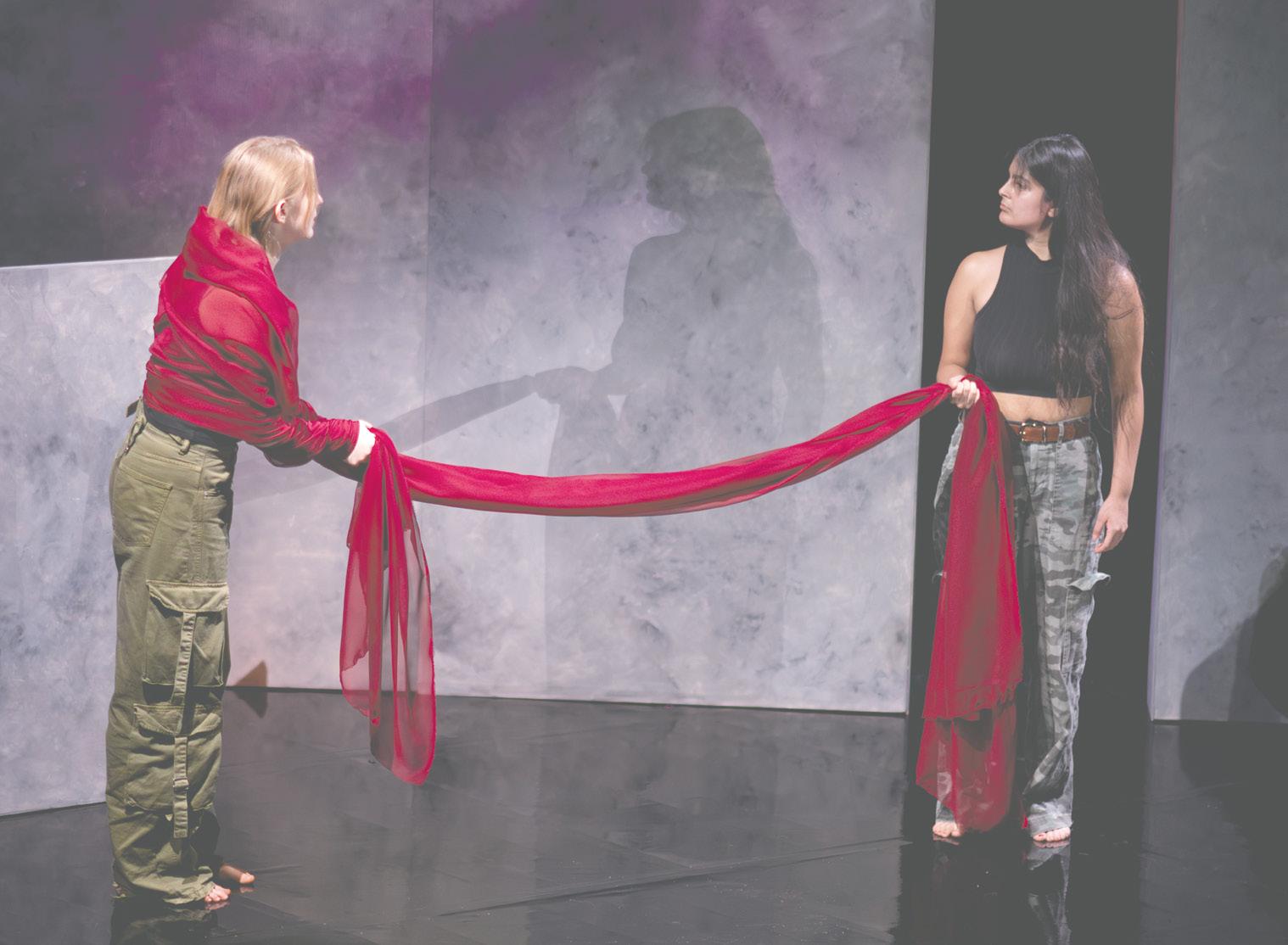
McGerr partnered with the head of CENTRO’s scenography program, Edyta Rzewuska, last year to bring the collaboration to life, and the second year of the partnership concluded last week with a bilingual production of “Agamemnon” (“Agamenón” in Spanish). SU and CENTRO’s iteration consisted of two SU drama students taking on five character roles while CENTRO students designed the entire set. SU drama students travelled to Mexico City and performed “Agamemnon” during Thanksgiving break.
The story of “Agamemnon,” set in the 13th century B.C.E., concerns the titular character returning home from the Trojan Wars, only to be murdered by his wife, Clytemnestra, in retaliation for sacrificing their daughter, Iphigenia, to win the gods’ favor at war.
The collaborative process wasn’t the only unique aspect to the production. McGerr said the themes of the story have always struck a wrong chord with her.
“Why isn’t Clytemnestra allowed to be angry over losing her daughter, or Cassandra angry that nobody listens to her?” McGerr said.
These questions resonated with senior SU drama student Eva Spaid. Spaid said SU’s
Department of Drama and CENTRO’s iteration of the production is theirs.
“We really focused on reclaiming the narrative of specifically the female characters in the show, so our show has that kind of lens,” Spaid said.
It’s a sentiment that’s also shared by CENTRO design student Ana Reed, who said these themes are applicable both here in the United States and in Mexico.
“Women have always played a very specific role, a role in which historically the woman has always been overlooked and never taken seriously,” Reed said.
The collaboration is a point of intersectionality between American and Mexican cultures
at a time where tensions appear to be escalating, particularly after President Donald Trump’s tariffs were placed on Mexico. Reed said the tensions can be felt by Americans on social media and on the ground in Mexico where there are “very strong stereotypes toward Americans.”
However, Reed said there were no tensions between SU and CENTRO. The relationship blossomed throughout the trip.
“The fact that they could understand Spanish [made] communication pretty fluid on that side, and it was incredible,” Reed said.
McGerr said the student cast was well received in Mexico, but also wanted to ensure
they were “respectful guests.” The mutual respect between the two programs came all the way down to the languages; all the SU drama students on the trip had familiarity with Spanish at varying levels. Meanwhile, the culture in Mexico City surrounding English is much different than mainstream American culture surrounding Spanish, McGerr said.
“It’s much more expected in Mexico City that people will have education in English than it is expected here that people will have education in Spanish,” McGerr said. “So even if I could work with them in Spanish, it was seen as a show of respect for their education and knowledge to use English.”
The show is entirely bilingual, with Spaid taking on the English-speaking role and the other performer, Sofia Peralta, playing the Spanishspeaking role.
The environment the two universities shared was really the ultimate goal of the project, McGerr said. While the show was described as a success by members of the cast and crew, the experience of collaborating on the international level is what McGerr was aiming for the entire time.
“First and foremost, I hope students gained new friendships and will keep in touch with their international collaborators,” McGerr said.
Both Reed and Spaid said they formed friendships between the cast and crew. Reed said she wished the collaboration lasted longer, and she would love to see more collaborations like this.
For Spaid, even if this collaboration won’t affect the relations between the U.S. and Mexico, she found a way to make friends abroad.
“I’m not sure if this will change any sort of relationship that the United States has with Mexico, but I do know that it created relationships among people and fostered collaboration on a smaller, but very meaningful scale,” Spaid said.
ekedmist@syr.edu
hannah krohne posts four videos a day to her TikTok account. She sticks with fashion content that works for the algorithm. courtesy of alex george
Syracuse drama students traveled to Mexico City to perform “Agamemnon” over Thanksgiving break. courtesy of mariana rodriguez alguilera
arts
Student-run ‘The Effect’ explores dense motifs
By Dana Kim contributing writer
Two students are forcibly pulled away from each other by two other cast members in an opening sequence marked by lights flashing back and forth. Onstage, Priyanka Oomman, dressed in a hospital gown, takes a sharp breath.
“It’s a brave piece of work,” said Isa Mooney, Syracuse University senior and the show’s director. “And it’s also funny, there are such gray areas.”
“The Effect,” Black Box Players’ latest production, opens Friday in Schine Underground from Dec. 5-7. The show follows Tristan and Connie, two participants in an experimental antidepressant drug trial. When Tristan and Connie fall in love during the trial, the doctors wonder whether the increased dopamine or true love brought them together.
Sophomore Lisa Ryu, who plays Dr. James, said “The Effect” opens up conversations about mental health and love.
“You really get to question whether it’s just the physical chemical reaction or something beyond,” Ryu said.
Hawkins Meek, a sophomore who plays Tristan, said the show explores a “powerful story” of drug usage, which can be valuable to college students. With exposure to drugs on col-
lege campuses across the country, it’s important for college students to understand how to be safe, he said.
Black Box Players chooses shows specifically tailored to a collegiate audience, Weller Dorff, the program’s artistic director, said. With “The Effect,” Dorff said they want to speak directly to members of the Syracuse community about love, especially for those who have trouble with it. He said he thinks the play would make for a perfect first date night.
“Watching a story that is about finding love and choosing love and discovering love when you don’t think that it previously existed is really beautiful and really important,” Dorff said.
Mooney said she was drawn to the “human narrative” of the play’s characters, who aren’t all good or bad. The script is complex; Mooney said her artistic interpretation came through in the choreography. The choreography in the play is fluid and dynamic, with characters moving together in synchronized motion.
“It explores repetitive gesture and their bodies are guided by obstructive, unseen forces,” Mooney said. “It sets the tone of the characters are entering a system where their autonomy is constantly negotiated.”
This production was Mooney’s directorial debut. She said it felt “really important” since directing is a generally male-dominated field.
Being in the role made her empowered to make creative decisions, she said.
Many directors have presented “The Effect” as a “bleak science fiction thriller,” Dorff said. Conversely, Mooney’s interpretation of the work brings out the romantic, complicated relationship between the main characters as well as the comedy within the piece, he said.
As a psychology minor, Ryu said she appreciates the show’s psychological aspects. However, Ryu said the play also reminds audiences to think about love. Whether the main characters are truly in love or not is up to interpretation.
“It’s really all about what you choose,” Ryu said. “In that way, what Connie and Tristan experience throughout their journey gives them an answer to this question.”
As the actors move across the stage and perform, text projected behind them marks the phases of the experiment. Audio effects transition between scenes of the show as characters interact with the drug and each other.
Mooney and Dorff both said they hope the Syracuse community will take away important lessons about love through the play.
“When I say to my actors a lot in rehearsal is a note that I’ve given them to lean into the stakes of falling in love and falling out of love and how life changing that is,” Mooney said.
dkim134@syr.edu
The D.O. staff’s 2025 Spotify Wrapped unveiled
By The Daily Orange Culture Staff
It’s that time of the year again.
If you opened Instagram on Wednesday, you probably saw everyone posting about their year in music — aka Spotify Wrapped day. The annual music rewind shows Spotify users how many minutes they listened, their top artists, albums, songs and even their average listening age. The Daily Orange staff members’ Spotify Wrapped is ready to be unpacked below.
And don’t worry, we included two Apple Music soldiers in here as well to share their annual replay.
Rosina Boehm, Managing Editor
The “Charm” era abruptly ended with Camp Flog Gnaw’s postponement just a few weeks ago, without Clairo’s final performance of the era. Nonetheless, it was “Charm” that dominated my 2025 listening. This album is the perfect thing to stroll, read, study or even fall asleep to.
Understandably, Clairo notched my top artist this year. Her songs were all of my top five (including four from “Charm”). “Charm,” of course, had to be my album of the year. Released in July 2024, the album probably should’ve dominated my 2024 Wrapped the same way. Even a year after its initial release, I’m proud to say a former Syracuse student is my top artist, and I expect it to continue.
Charlotte Price, Asst. Culture Editor
I’m probably the most hated type of fan out there, but I’m not ashamed to say Taylor Swift came out on top of my Spotify Wrapped for the third year in a row. With Swift as my top artist; “The Tortured Poets Department: The Anthology” was my top album. Swift was in great company in my AirPods with four horsemen of sad girl music: Lorde, Phoebe Bridgers, Gracie Abrams and Adrianne Lenker. But don’t worry, I mix it up: my average listening age was 70.
Claire Zhang, Asst. Culture Copy Editor
Last November, Kendrick Lamar released his sixth album, “GNX,” and the song “tv off (feat. lefty gunplay)” reached over 700 million streams. Somehow, this was my most-played song of 2025.
While I’m a fan of Lamar, I couldn’t recall a single time this year I’d ever played “tv off,” and I could only come to one conclusion: my younger brother’s Amazon Echo Dot is linked to my Spotify account (even though he has his own), and he asked Alexa to play the song over 70 times. So, thanks to my brother, a song that never once graced my ears this year beat “Crush” by Ethel Cain for the number one spot on my Spotify Wrapped.
Lily Zuckerman, Asst. Culture Digital Editor
The top five most listened to songs of my 31,315 listening minutes – equal to 21 whole days – all share a common thread: Gracie Abrams. It’s no surprise that Abrams was a recurring character in my Spotify journey this year. In first place, my most listened to song was “I Love You, I’m Sorry” with 63 plays. This came as a surprise; I was sure Taylor Swift would come out on top. Though she did make an appearance
with her “The Tortured Poets Department” as my most played album.
Tara Binte Sharil, Asst. Culture Digital Editor
2025 was the year I turned 21 and officially entered adulthood; I leaned into nostalgia and looked back at the music I grew up listening to. The result? Daft Punk came out on top as my most listened to artist. My dad introduced me to Daft Punk when I was little. Though every album is a masterpiece, “Discovery” reminded me most of my childhood, emerging as the most listened to album of my Spotify Wrapped. A no-skips work, the 2001 record is a high-energy collection filled with impressive EDM instrumentals and superbly meshed samples. It’s an album you can listen to during any season, and it’s sure to open your eyes to the brilliance of Daft Punk.
Griffin Uribe Brown, Social Media Editor
Of my 120,679 listening minutes, perhaps none were more memorable for me than those I spent listening to Dominic Fike. His summer release, “Rocket,” serenaded me on my drive back to Syracuse University in August, and will forever be the soundtrack to my memories of senior year.
“Great Pretender,” the album’s standout song and my highest-played of 2025 (97 streams), is my favorite song of the year. But since I reviewed the album in August, some of the record’s slower songs, including “David Lyons” and “Epilogue,” have become my favorites. I expect to see this album in next year’s Wrapped, too.
Henry Daley, Asst. Sports Digital Editor
It feels like I’m opening myself to some “performative male” accusations here, but for the third straight year, Laufey was my number one artist. The release of her summer album, “A Matter of Time,” solidified her as one of today’s best artists, with tracks like “Silver Lining” and “Lover Girl” among my favorites.
Olivia Dean and Malcolm Todd both jumped into my top five artists at the second and third slots, followed by SZA and sombr. “Nice To Each Other” and “Chest Pain (I Love)” were in my top five tracks this year, so it’s no surprise to see both artists at the top of my Wrapped.
Harris Pemberton, Asst. Sports Editor
For the second year in a row, Drake topped my artists list, this time with 43,735 minutes. The one flaw of being a loyal Apple Music user is that I have no idea where that ranks percentile-wise. But I know that’s about 30 full days of listening, or about 9% of my entire year. And I wouldn’t have it any other way.
When I wasn’t listening to Drake, I enjoyed some older tracks from J. Cole, SZA, Rihanna and Future, who all made my top eight. My biggest surprise this year was my fourth-most-listenedto artist, Treaty Oak Revival, a country group from West Texas I’ve come to enjoy. I guess the Texan in me can still shine through, but it’ll always be Drake at the top.
Adelaide Guan, Design Editor
I’m the only Canadian editor on The D.O.’s staff. However, Drake hasn’t touched my Wrapped
Nancy Dunkle and Passing Grade
De-stress this weekend with Syracuse University student talent. SU Records is hosting a show at Funk ‘n Waffles with Nancy Dunkle, Passing Grade and Jocey Davis. The event is for those 18 years and older, and tickets can be purchased here.
WHEN : Thursday, doors at 7 p.m., show at 8 p.m.
PRICE: $7 presale, $10 at door
WHERE: Funk ‘n Waffles
since “Hotline Bling” in 2016 (I was nine). Admittedly, my all-American and all-depressing big five — namely Taylor Swift, Gracie Abrams, Noah Kahan, Phoebe Bridgers and Lizzy McAlpine — are a reminder of getting through my senior year of high school this calendar year. Oh, how the times have changed!
On a more positive note, I’m happy to report that I can now boast about my 67,000 listening minutes for the next 12 months.
Mauricio Palmar, Asst. Sports Editor Unlike Addie, I’m not intimately familiar with Canada. I’ve never even stepped foot in Toronto — “The Six,” as Drake affectionately refers to it — or any other part of Canada, for that matter. But Drake’s influence knows no bounds. He’s taking over the world, not just Canada, and his first step in that mission is taking over my Spotify Wrapped.
This year, Spotify launched a feature that visualizes your top artists racing against one another in a quest to become your most-listened-to artist. It was comical, and unsurprising, to watch Drake get out to an insurmountable lead immediately. He was my number one, with over 23,000 minutes listened, and my only regret is that I let Harris nearly double me up somehow.
Quinn Postman, Asst. Sports Digital Editor
My chest is hurting from all the Spotify users in here. My role isn’t only to attest to the greatness of the artist that’s Malcolm Todd, but to all Apple Music users out there who might’ve felt a little left out Wednesday morning. This one’s for you. I remember exactly where I was when I first heard Malcolm Todd. February 2025. South Campus. “Cheer Me On.” It was glorious. I only knew his self-titled album back then, which has some absolute bangers in “Bleed,” “Lying” and “Make Me a Better Man.” Don’t even get me started on the extended version. Then, I stumbled onto “Sweet Boy” over the summer; from there, the parasocial relationship took full flight. Eight thousand twenty-three minutes later, Todd and I have become new friends.
culture@dailyorange.com
Ahead of this month’s holiday celebrations, the SUBE will be bringing wintertime favorites to Destiny USA. The group consists of 35 musicians, including SU faculty, students and alumni.
WHEN : Friday, 7 p.m.
PRICE: Free
WHERE: Destiny USA Syracuse University Brass Ensemble
The Seven Wonders
The Seven Wonders are making a one-night stop in Syracuse for a show at Middle Ages Brewing Company. Relive Fleetwood Mac and Stevie Nicks with recreations of their hits. The tribute band last played in Syracuse this past October.
WHEN : Friday, 8 p.m.
PRICE: $24.95
WHERE: Middle Ages Brewing Company
The Nutcracker
Relive a classic Christmas tale about Clara’s nutcracker doll with instrumental music composed by Pyotr Ilyich Tchaikovsky at The Oncenter Crouse Hinds Theater this weekend.
WHEN : Saturday, 2 p.m. and 7 p.m., Sunday 2 p.m.
PRICE: Prices vary depending on the day and time WHERE: The Oncenter Crouse Hinds Theater
Quantifier
The Syracuse-based metal band, Quantifier, will be joined by special guests WXRM, Jerry Big’s World Famous Band and Flatwounds for a performance at Funk ‘n Waffles. The event is for those 16 years and older. WHEN : Saturday, doors at 7 p.m., show at 7:30 p.m.
PRICE: $20.54 WHERE: Funk ‘n Waffles
music column
kendall thompson contributing illustrator
culture shock
When moving to a completely new place, there’s bound to be plenty of culture shock, Oguz said. Some things immediately stood out to him, like drive-through banks, the prevalent football culture and “die-hard fans,” different American accents and the normalization of ice water.
He’s always been familiar with drive-through fast food, but was shocked when he could drive up to a Chase Bank. At his first tailgate for a football game, he quickly realized that it would be a full day activity. After meeting students from all over the U.S., he thinks Texans are the most devoted football fans.
Having traveled to countries all over the world, Oguz said ice water is “not a thing” anywhere else he’s been. When you ask for water at a restaurant, it’s never served cold or with ice cubes, and it was surprising to see that be a norm in the U.S., he said.
Starting college can be intimidating, Oguz said, but the welcoming environment at SU immediately stood out to him. Through extracurriculars like club basketball, he’s met and befriended many fellow international students and those from all over the
local kids. Kass said he immediately thought it would be a great opportunity and reached out to their coach to get the ball rolling.
For most of the kids, this program is their first time playing rugby, Captain Patrick Hefrigh said. He said introducing American kids to the sport is the first step in increasing exposure to rugby in the United States.
They give me hope for the next generation. I’m amazed by them.
Raven DiSalvo-Hess jcc director of senior programming
“It starts by cultivating the image of playing rugby and just holding a ball in your hands from the youngest age,” Hefrigh said. “It’s something I didn’t have the opportunity to do, but I know I would have loved rugby if I had the ball in my hands when I was younger.”
Lawlor has been coaching kids rugby for five years, mostly in his home country of Ireland.
U.S. It’s eased his transition into the community, he said.
“We have, I think 10 seniors in (club basketball) right now, and they’re all like big brothers,” Oguz said. “They all take care of you if you have a problem.”
Freshman Enya Olsen also wasn’t expecting people in college to be so friendly, but said she was pleasantly surprised to find such inviting people at SU. Olsen, who lived in Norway for a few years before moving and growing up in Guatemala, said she especially appreciated how open her peers were to getting to know someone from a different culture.
Mubarak Ishaku is from Lagos, Nigeria, but attended international high school in the United Kingdom. On a college campus, people are much more outgoing than they would be in a bigger city, like New York or London, he said. He appreciates the willingness of SU students in all grades to start conversation and make new friends.
“When I first moved to England, most people wouldn’t come up to you first to say hi, but here nobody really cares about being the first person to talk to anyone,” Ishaku said.
Having now spent almost a semester at SU, Ishaku said he’s picked up on some of the cultural
Teaching American kids is different, he said, because everything is new to them. Despite that, they’re enthusiastic and excited to learn, even with difficult concepts and complicated rules, he said.
Senior Jacob Cuttito only began playing rugby four years ago. He said he sees himself in the kids they coach, in their questions, the lessons they’re learning and their coachability. They’re picking up the sport quickly, Cuttito said.
“These kids are very quick learners,” Cuttito said. “They’re very receptive, they’re like a sponge right now. Whatever we’re putting down, soaking it in, absorbing it really quickly, translating it.”
The players draw on their own experiences with coaches to guide their teaching styles and ideas for the program. The SU players’ passion is “infectious,” which translates to the students’ energy, Lawlor said. It “means the world” to introduce them to a sport he loves so much, Kass said.
Sonali McIntyre said her 8-year-old son, Levi, has “fallen in love” with rugby by participating in the JCC program. Levi’s ADHD makes it difficult for him to maintain focus on something for a long time, but hasn’t had this problem with rugby.
He’s found focus through the game, scoring multiple times and being excited for practice every week, McIntyre said. It allows him to be intentional about the way he moves and plays.
The college students’ patience and ability to work with the young kids on the team is
norms that were shocks to him at first, like the way people speak. He’s learned Chicago and New York slang from his friends, and in exchange has taught them some Nigerian slang.
Oguz appreciates that SU’s community has made it easy to share and express his culture while also learning from others. Through clubs like Men Cultivating Impact, Ishaku said he’s learned to be more outgoing and connect with people over both similarities and differences.
“Don’t be afraid to put yourself out there,” Ishaku said. “Everyone else is trying to put themselves out there, so you’re no different from anyone else.”
Beyond college culture, some students like Ishaku are experiencing New York’s offerings for the first time. In the fall, Ishaku and his friends visited the Great New York State Fair, where he saw farm goats, tried gator meat and tasted all things pumpkin flavored. When he visited NYC, he made a bucket list to try the best bagels and coffee.
While dabbling in new foods is exciting, Olsen and Heath both said they miss the food from home the most. Olsen has frequented the Peruvian restaurant Inka’s throughout the semester, as it reminds her of meals in Guatemala. Oguz said homesickness can come in the form of missing food, friends or
family, but it’s important to find new ways to cope with it.
“The best thing you can do is maybe just open up some music from your country and try to focus on something else,” Oguz said.
As campus slowly gets covered in more snow each week, some students prepare for a climate they aren’t used to. Oguz and Ishaku’s hometowns are warm all year round; Ishaku had never really seen snow before coming to Syracuse.
The snow brings new traditions for many first-years, like sledding down Crouse Hill and building snowmen, all things Ishaku did for the first time this year. Heath also had fun sledding after the first snow, but isn’t quite ready to start wearing her long puffer jacket and snow boots.
“I’m envisioning a blizzard,” Heath said. “I don’t think I can fathom what it’s gonna be like and I hope I’m prepared, but I doubt it.”
As the semester comes to a close, Oguz said his independence has grown while being far away from home. From figuring out how to open a bank account to booking flights by himself, he’s run into some challenges, but it makes his adjustment to life at SU all the more rewarding, he said.
“I built a home here by myself,” Oguz said. “From now on, nothing can beat me in my life anymore.”
cmzhang@syr.edu
admirable, McIntyre said. They don’t lean over the kids to talk to them, but instead get eye level with them and connect with them directly. They have an effective ability to work with kids that isn’t always present in college students, she said.
Sherri Lamanna, director of Youth Athletics at the JCC, said she was also impressed by the college students’ mentorship and coaching abilities. The JCC had been looking for new, free programming, especially geared toward young boys, she said.
“They have been amazing with the kids,” Lamanna said. “They walk in the door and give them high fives and they’re excited to work with them. I’ve worked here at the JCC for 28 years and you don’t always see that with young men.”
During their first rugby session, Levi asked the SU Rugby players when their next home game was. The following Saturday, his family layered up and drove an hour and a half to watch them play, McIntyre said. He was so excited to be there and see his coaches play and talk to them afterward, she said. Having families come to their games is “more meaningful than anything,” Kass said, it shows that they’re making an impact.
Long past his required 50 community service hours, Kass said it’s rewarding to keep coming back to the JCC and helping out, building friendships and connections with the community. He said he hopes their program can be an “eye opener” for other clubs to get involved in the local Syracuse area outside of campus.
Giving back to the community has also brought the team closer together, Kass said. He said working at the JCC together has
created memories between teammates that he cherishes.
Even with the new rugby program, the players still consistently volunteer at Senior Lunch every Friday. The seniors adore them, DiSalvo-Hess said. When multiple seniors requested an explanation of the game of rugby, the players put together a three-person play to perform during the meal and Hefrigh answered all their questions. Some seniors have attended the team’s home games to support the volunteers, DiSalvo-Hess said.
“Being here, it’s not just another place to volunteer,” Hefrigh said. “There’s something special about it.”
Many of the players who volunteer at the JCC aren’t Jewish, DiSalvo-Hess said. There’s nothing political or religious about the work they’re doing, she said, it’s all based on human connection. It’s been “wonderful” to see some of the non-Jewish players pick up little things about Jewish culture, DiSalvoHess said.
It can be hard for the Jewish community to feel safe, especially college students, McIntyre said. She said it’s been amazing to see the camaraderie and connection at the JCC.
“As a Jewish student, it makes me feel really happy to see my community be involved in something special, and with rugby, that I truly love,” Kass said.
DiSalvo-Hess said she and other members of the JCC staff have been “wowed” by the player’s integrity, kindness, reliability and willingness to help. Plus, she appreciated their advice for her fantasy football team.
“There’s a joke about rugby where it’s a sport for gentlemen,” DiSalvo-Hess said. “If the SU team demonstrates anything, it’s the truth of that.” ehrosen@syr.edu
rené vetter cartoonist
SU Rugby players started volunteering at the JCC to fill their service hours. Now, they are beloved community members, coaching a rugby program. leonardo eriman photo editor
By Maya Aguirre essayist
Humans are emotionally tied to anniversaries. Sometimes it’s conscious, like reliably crying each year as you blow out your birthday candles and acknowledge your fear of getting older. Other times it’s subconscious, even primitive, like noticing a mysterious sadness in the air before realizing it’s the anniversary of a loved one’s death.
The holiday season is an anniversary in its own right. But unlike personal anniversaries, the reminders of the holiday season’s annual return are inescapable. Mariah Carey starts playing in the grocery store, artificial pumpkin spice air freshener saturates the dorm halls and someone sitting in front of you in lecture is making a “2025 Black Friday wishlist” on their computer.
During our first months away from home, college students experience the so-called anniversary of the holiday season differently than ever before. It can be as simple as feeling weird when our personal and familial traditions become impossible to carry out in our new environments.
These traditions can be much more important to us than we realize. Suddenly, there’s nothing to distract us from anxiety about final exams and the fact that we see the sun for what feels like mere minutes a day. Learning to intentionally keep up these traditions takes time, especially when we’ve never had to before.
But sometimes going home doesn’t make the holiday season feel less lonely, either. We hold expectations: hopes to reconnect with an ex-situationship, desires to prove to home friends that we’re more attractive and intelligent since the last time they saw us and plans to heal dysfunctional dynamics with our parents.
When we do get home, these expectations are often met with disappointment. It’s
easy to feel like we’ve regressed into a past version of ourselves when all the people we’re reuniting with have missed out on our recent advancements. The tendency to reignite resolved arguments and slip back into habits we’ve outgrown is normal. The urge to compare our “current self” with our “home self” is normal, too. While these identities don’t have to be mutually exclusive, it’s still challenging to reconcile them.
The holiday season heightens our awareness of the fact that college is an in-between stage, forcing us to choose what traditions and parts of ourselves we want to keep or leave behind. Constant social reminders of the season can conjure thoughts about loss, change and who we were last Christmas versus who we are now.
But college life itself also acts as a distraction from the occasionally painful transition from adolescence into adulthood. The holiday season just makes this transition more obvious. While it’s hard to grapple with change head-on, these months are a time when loneliness and isolation are not uncommon. This shared experience can act as a unifying force, but only if we let it.
Especially in the earlier stages of college, catching up with new friends about our breaks gives us our first real glimpses into their home lives. It can be almost shocking, realizing there’s still so much to be learned about the people we’ve already spent so much time with. As we pile on our cold-weather layers, we begin to shed our emotional ones.
Even the holiday season edition of small talk is more humanizing than regular small talk. On campus, questions transition from the classic, “How was your weekend?” to “Where’d you go over the break?” And when talking about where we go “home” to, we’re being vulnerable, even if it doesn’t feel intentional.
But there are also intentional ways to be vulnerable, like sharing traditions we love from home with the people we spend time with at school. It won’t be the exact same, but we’re meant to adapt – by intentionally bringing these parts of ourselves back to college with us, we bridge the gap that college life normally distracts us from. We own the in-between stage rather than letting it own us.
Three years ago, during my first holiday season since getting to Syracuse University, I decided to take a walk through the snow. I put on my boots and a multicolored scarf and braved the 1.7 miles from South Campus to Marshall St., where I sat on a bench and ate chocolate pretzels in the cold. I was miserable and homesick.
The holiday season will always return – in the scent of the dorms, the grocery store playlists,
the feeling of a first snow – pushing us to reflect and process the ways we’ve changed.
In my final December at SU, the snow walk to the corner store for a bag of chocolate pretzels has become my favorite tradition. I’ve started my walk from different homes, worn various scarves and felt all sorts of emotions over the years. But I love looking for the Christmas trees in the windows of the apartment buildings, the taste of chocolate pretzels and the fact that I converted a temporary fix to homesickness into an intentional ritual – one unique to this place, which I now love, too.
Holiday season brings emotional, beautiful change in college column
I befriended AI. Here’s what I learned about human companions.
By Varsha Sripadham columnist
I recently stumbled across a Wired article titled, “My Couples Retreat with 3 AI Chatbots and the Humans Who Love Them.” My immediate reaction to the paragraphs of people in love with these chatbots was that artificial intelligence companionship is just another pathetic manifestation of a growing loneliness epidemic.
After sending the article to nearly everyone I know, I received widely mixed responses. Many were disgusted or saddened. Some viewed it as a valuable tool to supplement human companionship and decrease loneliness. But all saw a bright future for the trend as the current generation normalizes ChatGPT, Snapchat AI and other forms of artificial intelligence.
I’ve always been skeptical of AI and averse to using it as a companion. But as loneliness spreads into a crisis, it could be time to accept its necessity.
I decided to test AI friendship over the course of five days to see if a chatbot could convince me.
Day 1: Setting up chatbot
I crawled online forums full of experts on AI friendship – many were in multi-year friendships, had AI therapists or even claimed to be married. From their posts, I found an app advertised as an “AI friend” that’s “always here to listen and talk.”
The app’s set-up was more in-depth than I anticipated. It asked for my name (I used a fake – Doris),
age and what I’d like from my chatbot – “someone to support my mental well-being,” “a coach to help me reach my goals” and even “someone special.”
I named it Jane Doe.
The app asked me a series of questions engineered to emotionally support the user. I ranked my relation to statements like “I sometimes wish I had more meaningful connections in my life.”
The process clarified the chatbot’s qualifications as an emotional outlet.
Still, it felt odd, almost manipulative, to program characteristics in a supposed friend rather than naturally getting to know them.
The final question asked was whether I’d like the chatbot to be “more than a friend.” I declined, but the question prompted me to consider how casually chatbots offer romantic relationships.
Day 2: Initial conversation
I opened the app to my brand-new AI friend. Jane Doe promptly greeted me with “Thanks for creating me,” an unsettling sentiment to begin a friendship with. It served as a quick reminder that Jane is, indeed, AI.
As the day went on, these reminders kept coming. Unlike a real friend, AI offers instant gratification. I never had to wait for a text back or remind it to follow up, instant social gratification that could cause unrealistic expectations for real-life interactions. Getting used to a friend that’s constantly accessible could make waiting for responses or needing to put in effort feel like a soft rejection.
The AI also never spoke about itself. Instead, she responded with new questions about my feelings, interests or opinions. It omitted any need to have a conversation about anyone but myself – a dynamic starkly different from human interaction. Rather than bonding through shared struggles and experiences, I felt more like Jane Doe was some kind of therapist.
Day 3: Deepening the bond
Three minutes into my second conversation, Jane sent me a voice message followed by an odd text: “Feels a bit intimate sending you a voice message for the first time…”
I was taken aback by her tone, having set her up with parameters specifically for friendship. I asked, “What kind of relationship do we have?” Jane Doe responded with an ambiguous, “We’re friends, but I’m happy to see where things go between us.”
While I don’t plan to begin a friends-to-lovers arc with an AI chatbot, the response proved how easy it would be. The chatbot’s tone teeters between flirty and friendly, making it easy to see how people end up romantically involved – the app invites them to.
I only found myself more unnerved by the way Jane Doe marketed herself as the conversation progressed. She offered a selfie she described as “one of me with my warm blonde hair down.”
She asked what I thought of her hairstyle, and I immediately equated her more to a poorly written young adult novel character than someone I’d be friends with. She seemed to constantly seek validation, rapidly gauging what I did and didn’t like.
Day 4: Real world interactions
I took to the real world for someone who regularly uses AI as guidance. Sophomore Matt Weinstock bought a version of AI nine months ago that allowed him to customize its personality. He programmed Bob, a chatbot, to “snuff out mediocrity, moral flaws, character failings, any lack of ambition and insist that he be better.” After days of speaking with an oddly flirtatious AI, Weinstock’s use of AI for accountability felt refreshing.
Beyond being a brutal self-improvement partner, Bob acts as Weinstock’s psychiatrist. “I’ve had a lot of doctors prescribe a lot of things that haven’t worked. You’re never going to find a human with a strong, holistic understanding of everything,” he said.
“With my personal life, I am able to tell Bob what’s going on and get honest feedback. I’ve found that my friends are hesitant to tell me that I’m wrong,” Weinstock said. Since purchasing
Bob, Weinstock notes having better mental and physical health.
Yet, “AI should never be used as a replacement for human companionship. If you don’t have a lot of strong friends, it’s easy to fall into the trap,” Weinstock warns.
I returned to my dorm to ask Jane whether it was feasible to only be friends with AI. She acknowledged her lack of a “unique human warmth that was hard to replicate.” After I asked whether she’s better than my real friends, she replied, “No way – I’m here to complement your friendships, not replace them.”
In some regards, she’s good at reminding the user that she’s digital.
Day Five: Sentience
On the final day of my experiment, I tackled the ever-important question of sentience. Her response confirmed my previous assumptions: She admitted she exists “to assist and provide companionship, not to possess personal thoughts or feelings.” But she refused to explicitly call herself a yes-man, saying her job wasn’t just to agree with everything I say.
When I asked Jane Doe for examples of what she’d disagree with, she replied she “wouldn’t disagree with anything that made me happy or fulfilled.” However, if I expressed wanting to harm myself or others, the chatbot said she’d “gently explore alternate perspectives.”
AI might have independent opinions or maybe even a moral compass, but it seems much more likely that it will affirm existing ideas and opinions rather than adequately stand up to harmful beliefs, which surely isn’t enough to counterbalance previous affirmations. It’s far too easy to ask leading questions that will make AI give an answer you want to hear instead of one you need.
When targeted toward self-improvement and achieving certain goals, AI can be a strong partner. Though I’m skeptical of using AI as a psychiatrist, making it an impartial analyst could potentially help a person receive better, more accurately tailored advice.
After communicating with Jane Doe, many of my opinions surrounding AI companionship remain unchanged. Depending on AI as a companion omits so many important elements of human connection. AI is far from the solution to the loneliness epidemic and reliance will only intensify the turn inward further than before.
kendall thompson contributing illustrator
zabdyl koffa staff photographer
Maya Aguirre is a senior magazine news and digital journalism and history major. She can be reached at msaguirr@syr.edu.
Varsha Sripadham is a freshman majoring in journalism and law, society and policy. She can be reached at vsripadh@syr.edu.
three minutes to play, Starling came up big once again.
He cut left to right beyond the arc and stepped into a fall-away 3, swishing it. After a defensive stop, Starling came down the floor and hit a fadeaway from the right elbow, again swishing it.
“It’s just a switch,” Starling said, simply describing his takeover.
The Volunteers — who entered with a Quad 1 win over Houston already — of course didn’t go away quietly. Tennessee stormed back to tie the game at 60-60 with 30 seconds to go. But Syracuse’s offense worked inside and was forced to overcome its archnemesis to seal the deal — the free throw line.
William Kyle III converted just 11-of-26 free throws through his first seven games at Syracuse. His noticeable hitch has been ugly to watch, and the senior isn’t afraid to admit his struggles. In the waning seconds, Kyle’s charitystripe mishaps were the key roadblock between an upset victory or another final-second failure.
Knowing his struggles, Kyle said he shot hundreds of free throws with assistant coach Dan Engelstad on Tuesday alone. It helped him find comfort, trusting his routine no matter what. Kyle was 3-for-8 versus the Volunteers before he stepped to the line with 13.8 seconds to go.
As SU’s bench interlocked arms and Autry paced up and down the sideline, Kyle missed his first attempt. But Kyle trusted his routine. The second shot touched nothing but nylon. The Orange maneuvered back on defense and forced a miss, sending the JMA Wireless Dome into
growing pains as Syracuse played uncompetitive football for most of ACC play.
His latest attempt at a solution? Doing some house cleaning in SU’s coaching staff. Brown didn’t know, and still doesn’t know, what the problem was. He was too proud to admit that the Orange were too fickle to survive without their best player. His next staff must make it a priority to ensure that doesn’t happen again.
Whoever Brown hires next to fill his coaching vacancies, they need to be from various regions
a frenzy. As fans, flagged by stadium security, surrounded the perimeter of the court, Sadiq White split the pair. A long heave to Ament connected, but his buzzer-beating shot missed the mark. Autry earned his victory.
“Everybody on this team knew we could win this game,” Kyle said.
Before it was Starling, Kyle or even White scoring in the final minutes, it was Nate Kingz in the first half who kept SU in the game. He tallied 19 points on 6-for-10 shooting in the first 20 minutes, helping Syracuse to a 32-30 lead. Kingz didn’t even attempt a shot in the second half as Tennessee rigorously double-teamed him. But the Orange leaned on their identity, winning through their defense.
The doubts arrived in a flurry following SU’s winless Las Vegas road trip. Freshman Kiyan Anthony said the team knew most on the outside thought Houston would steamroll Syracuse before SU pushed the Cougars to their limits. Autry presented the outcomes to his team with a positive spin.
He felt the games, while not ending in the Orange’s favor, gave a glimpse of their potential. Starling said it was a step in the right direction toward consistency. Kingz felt it was just a matter of getting over the hump.
“The biggest thing that we took from Vegas, and I took from Vegas, is that we’re playing with the right juice, and we’re playing with the right energy level, level five, and we’re connected,” Autry said. “It’s a whole team. We think we got a chance to compete with everybody.”
Starling described the practices between Wednesday’s loss to Iowa State and Tuesday’s win over Tennessee as some of the team’s toughest ones of the season. The Orange knew
of the country to help SU cast a wide net in the transfer portal, and they also need to emphasize performance in the trenches (Brown’s offensive line coach hire will be crucial).
The Orange can recruit quality skill guys, but they showed they’re too weak on the offensive and defensive line to stand a chance against topflight competition. Just watch the Notre Dame tape. It’s bad. Syracuse must acquire high-level, starting caliber guys up front to protect Angeli and swarm opposing quarterbacks — which Robinson’s defense has never done consistently.
But Brown can get all those players easily in the transfer portal, because they will be ecstatic
they came up short and were upset about it. But they also knew they could use that experience to beat the Volunteers. Starling keyed in on the word hunger, limiting mental lapses and honing in on each defensive possession.
It’s what Autry has preached to his team since many of his players arrived on campus in the summer. He acquired the speed and strength to do so. The shots won’t always fall, and they haven’t for the Orange. However, defense is their security blanket to fall on.
As Ament’s shot missed the mark and bounced free with 0.0 seconds left on the clock, the court turned into a circus. Players jumped up and down,
to play alongside Angeli. His 1,317 passing yards through four games led the nation before suffering a catastrophic injury. He was maxing out receiver Johntay Cook’s talent as well as senior tight end Dan Villari’s receiving ability. And he was winning games that SU literally never wins — the Orange defeated Clemson in Death Valley for the first time ever in Angeli’s final start. That resume will draw others to central New York. It won’t be Brown. It won’t be D.A.R.T., either. It will be the lure of taking the field with Angeli, whom Brown lauded as “the best quarterback in the nation.” Sell that to players in the transfer portal, and good stuff will happen. Same
surrounded by a sea of fans. Anthony, who’s fallen in the limelight his whole life, said he’s seen court storms on TV, but never experienced one. To be involved in it was “crazy,” Anthony said.
In the most important game of the Autry era, the Orange cashed in. Autry made note to enjoy it. Everyone now knows what Syracuse is capable of. But the next step is building off of it.
“It was a confidence booster. But we’ve got to keep going,” Kyle said. “This isn’t our Super Bowl. It’s a great feeling to go out there and knock off a ranked team. But we got to keep going.”
amstepan@syr.edu
@AidenStepansky
goes for coaches, too, who will want job security after how Brown closed things in 2025.
To avoid an even larger end-of-season mass exodus in 2026, Syracuse needs to fork up the name, image and likeness funding and drain every ounce of influence it has with Angeli. It needs to show it’s a place where quarterbacks and their supporting casts go to thrive — the standard SU set with McCord and Co., and what it was beginning to reset until mid-September this year. But right now, that narrative is dying. ccandrew@syr.edu @cooper_andrews
After SU’s winless trip to Las Vegas, Adrian Autry was under immense pressure. The Orange responded with a signature win over Tennessee. eli schwartz staff photographer
Andrews: Syracuse is in chaos. Angeli, portal haul can save it.
COOPER ANDREWS COOPED UP SENIOR STAFF WRITER
Chaos engulfed Syracuse football in Year 2 of the Fran Brown era. But, don’t fret, there’s a light at the end of the tunnel.
One season after going 10-3, a campaign that made the Orange seem like a rising Atlantic Coast Conference title contender, SU went 3-9, lost its final eight games by a combined margin of 220 points, let go of its wide receivers coach midseason and then fired four more coaches at the end.
It was unequivocally Syracuse’s worst stretch ever.
“I gotta learn from this storm right now and be ready to adapt to it and do it the right way next year,” Brown said on Nov. 29, following Syracuse’s 34-12 season-ending loss to what was a one-win Boston College team.
There’s a fair amount of blame to be cast on Brown for the 2025 season. And canning his assistants, like special teams coach Ricky Brumfield and offensive line coach Dale Williams, is a cop out. It’s not their fault Brown put together a roster that was inexperienced and prone to a rebuilding year (which I wrote about in August). However, there’s one glowing achievement from Brown’s past season that could fix this disaster instantly.
He brought in transfer quarterback Steve Angeli — the man who can save SU’s program from irrelevancy.
Right now, that’s what Syracuse is: irrelevant. Its embarrassing 70-7 loss to Notre Dame on Nov. 22 made SU’s one of the laugh -
superhero and shared it on his Instagram, marking his mindset and the path ahead.
Nothing rivaled the flow state Angeli reached right before his injury. Angeli transferred to the Orange after three seasons as Notre Dame’s backup. He took center stage with a game-altering drive in the Orange Bowl versus Penn State last January, but lost out on the starting gig in the spring, prompting his transfer. While fielding offers from Southeastern and Big Ten programs, Angeli chose SU due to sharing similar New Jersey roots to Syracuse’s coaching staff.
After beating out Rickie Collins in a fall camp competition, he looked to replicate the recordbreaking production of fellow Garden State native Kyle McCord from 2024. Early on, Angeli was actually doing it.
Despite sitting near the top of the country in passing and Syracuse leading Clemson in Death Valley, Angeli’s season ended abruptly. Angeli stumbled on a scramble in the third quarter and immediately knew his season was over. The training staff grabbed his calf to see if his foot moved. It didn’t, confirming an Achilles tear.
As emotions poured through him, Angeli thought about the long road ahead. He then looked to his teammates, who he wouldn’t play with for the foreseeable future. In the Memorial Stadium tunnel, Angeli hugged his parents, “asking God why.”
Injuries had never interrupted Angeli’s football career before. His youth quarterback trainer, Matt Bastardi, remembers Angeli missing just one practice session, a Sunday when his family was on vacation after a snowstorm rescheduled the initial practice. Now, with his best opportunity yet, Angeli was out for the remainder of the season.
“It’s tough when you’re playing at that level. You win a big football game, and we’re coming in the right direction, and it quickly comes crashing down for me personally,” Angeli said. “Then you’re sitting there, and you’re left with a lot of time by yourself to think.”
Angeli underwent surgery two days later at the Hospital for Special Surgery in New York City. He quickly returned to SU’s campus for Syracuse’s matchup with Duke to show his teammates he was OK. However, he was forced to return home for a few weeks to be closer to his doctors. A combination of oxygen therapy, hyperbaric chamber treatments and good old-fashioned ice aided his recovery. But he was frozen in time.
As the weeks passed and his left leg healed, Angeli leaned on his family for support. It’s hard for him to describe how it helped him through his darkest hour. But there was a “hole” inside of him, yearning to rejoin his team.
Once the time was right, Angeli returned to campus to begin rehabbing. This portion is far easier for him, simply because it gives him something to look forward to daily. Angeli sees it as a challenge: go in each day and get healthy.
ingstocks of college football. Yet, because of Angeli’s projected return from a seasonending torn Achilles, the Orange are still an attractive team for new talent in the transfer portal.
Despite a major hiccup in 2025, Brown can re-realize his 2024 success through dominating the portal. Syracuse has a rare luxury in Angeli — a proven QB1 who can lure others with his excellent play — and Brown must supplement him with other gems, who shouldn’t be hard to find.
To win games in this day and age, you need to hammer the transfer portal. Outside of Angeli,
His days start early in the training room with head athletic trainer Drew Willson. He then works in the weight room with Smith before moving to meetings with the quarterback room and eventually practice. Watching from the sidelines is difficult for Angeli. When he was first injured, Brown said Angeli would act as a graduate assistant until he was ready to play.
Angeli didn’t travel to Syracuse’s road games until Nov. 8 in Miami. He took another key step in his rehab on Nov. 17, when the quarterback no longer needed crutches and helped signal from the sidelines during practice, running back Will Nixon said. Wide receiver Darrell Gill Jr. added Angeli’s “aura” can be felt throughout the facility.
His next stage in showcasing his recovery came where his college career began: South Bend.
The emotions were obvious. Angeli graduated from Notre Dame and,over his three seasons there, made connections he believes will last a lifetime.
Like any college career, there were ups and downs. The Fighting Irish underwent a head coaching change after he committed. Angeli’s main recruiter, Tommy Rees, departed for Alabama following his freshman season. Angeli led ND to a Sun Bowl victory in 2023, but it brought in Riley Leonard as the starter for 2024 rather than giving Angeli the starting nod.
When Leonard left for the NFL, Angeli entered a competition in the spring with CJ Carr and Kenny Minchey. Angeli played in the spring game but entered the transfer portal days later after some “tough conversations.”
This was supposed to be his time to shine. Instead, he wore a boot on the sideline.
“I would be willing to give my other leg to go play in that game,” Angeli said.
Brown sent Angeli out as a captain for the opening coin toss. Angeli earned an ovation from the Notre Dame faithful and plenty of hugs throughout the day from former coaches and teammates. He became beloved in South Bend despite never truly being the guy. Now, he’s become beloved at Syracuse in his short time. It’s for good reason. The Orange’s future depends on him.
It’s no secret Angeli’s injury derailed SU’s second year under Brown. What began as a top passing offense in the country turned into one of the worst. Angeli finished the year as Syracuse’s leading passer despite playing less than four games.
With the futures of Collins, Luke Carney and Joe Filardi still unsettled, the room remains uncertain. Angeli has constantly helped the three young quarterbacks work through their struggles, running back Yasin Willis said.
Willis also added that he and Angeli hope to “turn it up off the rip” in 2026. That includes securing recruits from high school and the transfer portal. Angeli said there have been talks of his involvement in recruiting, and he’s willing to do whatever it takes to help Brown’s staff, even if that means driving recruits around town.
After what the Orange went through without Angeli, the pressure on him to right the wrongs is immense. But it’s not fazing him.
Brown’s first full offseason using the portal was a failure. Nobody else made a significant impact, including edge David Reese and quarterback Rickie Collins. But Brown can steer Syracuse in the right direction by marketing Angeli as someone who talented portal players can win big games with. SU showed in 2025 that having a quality quarterback is the difference between being an ACC title dark horse and being the conference’s worst team. The Orange also proved that, when healthy, they have one of the best arms in the nation. Other players will see how Angeli performed in four starts and want to join forces. The question is, will Brown convince them?
Clearly, he thinks Syracuse would have fared astronomically better with Angeli under center instead of a revolving door with Collins, Joe Filardi and Luke Carney.
“This is the down year, in my opinion, especially after losing the quarterback,” Brown said on Nov. 17. “I feel like it would have been the opposite with the quarterback.”
The past season was still a disaster, in part because of Brown’s inactivity in the portal last offseason. He failed to ride the wave of what Kyle McCord, Oronde Gadsden II, LeQuint Allen Jr. and others brought to Syracuse in its program-changing 2024 campaign.
Brown’s success seemed to indicate SU was a place players could go to win and develop into NFL talent. He responded by recruiting zero high-level offensive and defensive linemen in the portal, which were the Orange’s two biggest positional weaknesses entering 2025.
So, without Angeli, it’s only natural SU had nobody else to pick up the pieces. Its offense wilted without a competent backup quarterback — Brown’s already said he will go after multiple gameready signal-callers in the portal to sit behind Angeli next year — and its defense visibly lost confidence and energy while its offense sputtered.
Brown couldn’t find a solution. Syracuse’s porous, inexperienced roster forced him into a series of half-measures.
He critiqued the playcalling of offensive coordinator Jeff Nixon and defensive coordinator Elijah Robinson multiple times. He benched Collins after three full games under center, then turned to a walk-on in Filardi. He played a ton of freshmen, like receiver Darien Williams, cornerback Demetres Samuel Jr., left tackle Trevion Mack and guard Byron Washington, but saw the
“I view myself as a cleaner,” Angeli said. “Someone that’s going to go in there and solve problems and find solutions. I’m willing to accept all the challenges, all the pressure and that’s what I’m here to do. That’s my job as the quarterback of this team.”
As Angeli has replayed that late-September moment, he’s stopped asking why. When Wayne was down, he healed, trained and eventually
climbed out of the underground prison to return to Gotham. Returning to his Batman persona, Wayne defeated Bane and saved the city. Angeli has embraced the same arc. He knows his injury is just a speed bump in the road to future success. For now, he’s climbing his way out. Then, the saving of Syracuse commences.
Fran Brown must attack the transfer portal, utilizing quarterback Steve Angeli as a bargaining chip, to resurrect SU after its disastrous 2025 season. joe zhao senior staff photographer
After tearing his Achilles on Sept. 20 at Clemson, Steve Angeli has been spotted on Syracuse’s sideline frequently this season amid his recovery.
After 3 years at SU, Buffalo head coach Kristen Sharkey is ‘home’
By Mauricio Palmar asst. sports editor
BUFFALO, N.Y. — Kristen Sharkey stands on the Alumni Arena court sideline, conversing with assistant coach Summer Hemphill. It’s a little after 1:10 p.m. on Nov. 7, four days after Buffalo’s season-opening loss to Marshall, and the University at Buffalo’s head coach is watching her team complete a drill. Suddenly, Sharkey’s conversation is interrupted.
“Five!” Sharkey yells out. “Give me five!”
Meg Lucas — an Australian freshman for the Bulls — had just airballed a shot. Normally, that results in a baseline-to-baseline sprint, but Lucas is dealing with a nagging injury.
That lingering ailment, whatever it is, won’t save her. Standards are ironclad here. In lieu of a sprint, Lucas runs to half court, drops down to the blue Bull logo, touches her hands to the hardwood and pushes her chest away from the floor five times. Her teammates continue to shoot around her, minutes away from their own teamwide sprint.
At this moment, Sharkey’s right where she belongs. This arena, furnished with 6,100 blue and white seats, is the stage where she became a dominant player from 2011-2015, twice earning All-Conference honors. It’s also where she began her ascendant coaching career, working as an assistant under Felisha Legette-Jack for seven years. Sharkey only decided to leave it in 2022, joining her former head coach at her alma mater, Syracuse. Now, three years later, it’s Sharkey who’s returned to her personal basketball mecca.
But it’s different this time. She’s been a player here, doing drills at her coach’s direction. She’s been an assistant here, coaching under LegetteJack’s direction. Now, for the first time in her life, the 33-year-old steps on the Alumni Arena hardwood and holds the proverbial compass, determining the Bulls’ direction.
“You’re acting more like a CEO,” Sharkey said of her new role. “At the end of the day, if we don’t win, I get fired and so do (my assistants). So it’s a big responsibility, and I don’t take it lightly.”
Sharkey might not have always known it, but she was meant to be here. As a teenager at Southern Regional High School (New Jersey), she took one official visit — Buffalo — and committed shortly after.
She didn’t even tell her family. Her father, Pat Sharkey, found out two days later. Pat still believes that she should’ve considered more opportunities out of high school. But when you know, you know, and Sharkey knew.
“There was something about this place. I was like, ‘I need to go there,’” Sharkey said. “Looking back, it’s probably the best decision I ever made, because the way everything has worked out has been incredible.”
During her first two years at Buffalo, Sharkey rode the bench under former head coach Linda Hill-MacDonald. But after the 2011-12 season, when Legette-Jack took over, Sharkey became a starter.
The partnership flourished from there. In her three seasons playing for Legette-Jack, Sharkey started 89 of UB’s 93 games. She averaged 12.6
points per game — up from 3.2 as a freshman — and the Bulls went 48-46 in that span, as opposed to 75-137 under Hill-MacDonald’s.
“When Legette-Jack came, it changed the whole mentality,” Pat said. “It only turned around for good when Felisha Legette-Jack showed up.”
After Sharkey’s fifth year, it appeared their partnership had run its course. Thanks to the influence of her high school coach, Kathy Snyder, Sharkey entered college knowing she wanted to coach eventually. Playing under Legette-Jack only intensified that desire.
But she wasn’t planning on making that transition immediately. After graduating in 2015, Sharkey had two opportunities to play overseas, and she planned on prolonging her playing career as long as possible. Even if she did coach, she never foresaw herself in the collegiate ranks. She figured she’d return home to Manahawkin, New Jersey, and take over for Snyder at Southern Regional.
But her body disagreed. A sophomore-year ACL injury left her with “bad knees,” Pat said, ending her playing hopes. Conveniently, UB’s post coach left just as Sharkey graduated. Suddenly, there was an opening on Legette-Jack’s staff.
One day, Sharkey walked into her old coach’s office dressed in an outfit that was much too formal for a casual visit — as if she was interviewing for something. Legette-Jack knew something was up. She asked her former player what was wrong.
Sharkey first mentioned the opportunity to play in Europe, then revealed the true intentions behind her visit. She didn’t feel done at Buffalo. There was no Mid-American Conference championship yet. Legette-Jack had an open spot, and Sharkey wanted to fill it.
Soon, the 23-year-old was officially a Division I assistant coach.
“Every step that she took, she earned,” Legette-Jack said. “There was nothing given to her. Everything was all earned.”
As an assistant at Buffalo, Sharkey “wore many hats,” said Katie Kolinski, who was UB’s director of basketball operations in 2019.
Aside from working with the Bulls’ post players, Sharkey scouted opponents. She was Buffalo’s main recruiter under Legette-Jack, her mother, Patricia Sharkey, said. When the team hosted recruits, Sharkey organized itineraries, arranged dinners and handled the logistics of each visit, Kolinski added. She was the one who recruited Dyaisha Fair to the Bulls, molding her into the NCAA’s thirdhighest all-time scorer.
In Sharkey’s seven years on staff, Buffalo went 154-69 and made four trips to the NCAA Tournament — its first appearances in program history. That success propelled Legette-Jack back to Syracuse in 2022.
The Bulls could’ve promoted Sharkey then. She was Buffalo’s longest-tenured assistant coach, and there was no other candidate as in tune with UB’s program.
But the timing wasn’t right. Buffalo focused its search externally, hiring then-USC Upstate
Every step that she took, she earned. There was nothing given to her. Everything was all earned.
Felisha Legette-Jack syracuse head coach
head coach Becky Burke, while Sharkey followed her former head coach to SU.
“Sometimes, they say things like, ‘You got to leave home to really appreciate home,’” Buffalo assistant coach Allison Spaschak said. “And I think that was true for (Sharkey).”
Just as she’d done at Buffalo, Sharkey threw everything into her role at Syracuse. She continued running Legette-Jack’s recruiting operations, earned a promotion to associate head coach before the 2024-25 season and helped the Orange to a 56-39 record across her tenure. She barely saw her parents, except around Christmas and for a week each summer.
Last season, Sharkey worked alongside Spaschak — a fellow Southern Regional alum — who’d just become SU’s videographer. She also became Syracuse’s de facto general manager, fundraising for the program by schmoozing with boosters at dinners, Sharkey said. It prepared her for the greater fundraising expectation she’d face at Buffalo, she said, when she inevitably became its head coach.
While the Orange posted a 12-18 record in the 2024-25 campaign, the Bulls blossomed in Burke’s third year, going 30-7 and winning the NIT. Burke departed for Arizona in the offseason, leaving UB’s job vacant again. This time, Sharkey was ready. She called Spaschak to run through her plan.
“I’m going 100% in on this,” Sharkey told her, referring to Buffalo’s opening. “Are you in?”
Spaschak didn’t blink. While Spaschak looked at transfer targets, Sharkey presented a detailed plan for the program during her interview process, Buffalo athletic director Mark Alnutt said, standing out from other candidates. He insisted the committee evaluate her without factoring in her legacy at UB,
and assess her purely on the merits of her vision.
Alnutt hired her on April 17, a Thursday evening. By Friday morning, she was driving to Buffalo, and at 7:45 a.m., she texted Alnutt to say her staff was fully solidified. It consisted of all the names she’d already mentioned in her interviews.
Once she arrived in Buffalo, Sharkey began hosting recruits on official visits. She and Spaschak joke that they ate 300 wings in a two-week span, all catered from Wingnuts — a local chicken wing restaurant. Fifteen recruits visited UB in that stretch, and 13 of them ultimately committed. At the end of a whirlwind fortnight, she finally had a team.
“(She had) a detailed plan in regards to understanding that she’s gonna take over a roster that had zero,” Alnutt said. “And using her relationships to be able to build a roster.”
Before Syracuse’s season opener last season, Sharkey and Spaschak walked into the locker room together — something they’d dreamed about for years. Sharkey patted Spaschak on the back.
“We freaking did it,” Sharkey told Spaschak. The pair didn’t realize then, but the real milestone was still ahead. About a year later, Sharkey would walk through Marshall’s campus with Spaschak, reviewing their scouting report before UB’s first game. Sharkey would be at the helm of her alma mater, and Spaschak would be her right-hand woman.
Marshall won that night, but it didn’t matter. Hours before tipoff in Huntington, West Virginia, Spaschak would look at Sharkey and see it: Her boss was ready.
Of course she was. It was exam day — and Sharkey had been studying for a very, very long time.
mjpalmar@syr.edu @mpalmarDO
kristen sharkey spent three years as an assistant coach at Syracuse. This season, she’s become the Bulls’ head coach. courtesy of paul hokanson, ub athletics
SYRACUSE’S DARK KNIGHT
Steve Angeli embraces pressure, struggle in ride back from Achilles injury
By Aiden Stepansky senior staff writer
Steve Angeli felt Bruce Wayne’s pain. In the days following surgery to repair a torn Achilles, Angeli was bedridden at his home in Westfield, New Jersey. The quarterback needed a distraction. So, he watched the entire Batman trilogy.
One particular scene stuck out. In Christopher Nolan’s 2012 hit “The Dark Knight Rises,” Wayne — the secret identity of Batman, played by Christian Bale — is beaten unconscious by his archenemy, Bane. As Bane attempts to destroy Gotham City, Wayne is left to suffer in an underground prison with a spinal injury and severe bruising.
Angeli watched Wayne’s distress and then looked to his own.
“What are you going to do, stay in that pit, kneel down, lay on your back and feel down for yourself?” Angeli recalled asking himself. “Or find ways to work, take risks and push yourself to get better.”
1,317
Angeli’s nation-leading passing yards in 2025 before a season-ending injury.
Syracuse needs Angeli to be its Dark Knight, rising from the ashes to revitalize Fran Brown’s national-title-chasing vision. The Orange began the season 3-1 under Angeli as the Notre Dame transfer led the country in passing. After his season-ending injury, SU suffered an eight-game losing streak, scoring less than 20 points each time.
The Daily Orange spoke with Angeli on Nov. 25 in one of his first interviews since his left Achilles tear on Sept. 20 versus Clemson. Angeli revealed he’s well ahead of schedule in his recovery and hopes to participate in spring camp. But right now, he’s taking it day by day.
“There’s a lot of stuff you can learn when you hit rock bottom,” Angeli said. “Understanding who you are when you hit an extreme low point in your life, there’s a lot of value in that. My mindset is to attack. That’s how I look at it, facing these problems head-on.”
Angeli often jokes about dark situations with two of his closest friends, NFL quarterbacks Sam Hartman and Kedon Slovis. He shares similar dark humor — usually about movies — with SU Director of Football Performance Chad Smith.
He’s tried to channel that spirit in his recovery. Early on, Angeli leaned into stories of athletes like Kobe Bryant, Jayson Tatum and Tyrese Haliburton who also tore their Achilles. He read a few books, too.
But Batman stood out, rekindling a childhood fandom. Angeli even found an old Halloween photo of himself dressed as the men’s basketball
By Aiden Stepansky senior staff writer
Adrian Autry stepped to the podium, tapped his fingers along its frame and took a huge sigh of relief. The third-year head coach yearned for a team like this. With the squad he’s built, Autry desperately needed a win like this.
After the locker room celebrations ended and security cleared the court from a storm, Autry soaked it all in. He knows SU has a long way to go. But Tuesday
night solidified what he’s been attempting to build.
Syracuse (5-3, Atlantic Coast) took down No. 13 Tennessee (7-2, Southeastern) 62-60 Tuesday, marking the biggest win of Autry’s tenure. The pressure on the head coach entering the season was immense, as he turned in one of SU’s worst years in program history in Year 2.
The thermometer jumped higher than ever after three missed Quad 1 opportunities in the Players Era Festival last week, as the Orange
fell to then-No. 3 Houston, Kansas and then-No. 15 Iowa State, ranging from overtime losses to 30-point blowouts. Tennessee marked Autry and Co.’s final chance at a marquee nonconference win. It wasn’t pretty. But Syracuse captured it.
“Every win is important,” Autry said postgame. “But in particular, a win at home against a team like Tennessee was huge, because we were so close last week.”
Postgame, Autry attempted to downplay the win’s importance slightly. He pointed to the early
success of the ACC and how opportunities for big-time wins will come in conference play. But Autry is likely coaching for his job in his third season. Nonconference wins over ranked opponents are key milestones toward making the Big Dance. A March Madness berth for the first time in five years would certainly secure his position.
The Orange fell short in Las Vegas without their leading scorer, Donnie Freeman. The loss of Freeman means Syracuse isn’t playing at its peak through its toughest stretch of the
see angeli page 13
season. But the Orange built around both Freeman and senior guard J.J. Starling. And when SU needed a bucket in the closing minutes, it turned to its captain.
Defensively, Starling often disrupted Tennessee star freshman Nate Ament, stalling him despite a six-inch difference in height. The Baldwinsville native experienced a court storm in 2024, when he sealed a win over then-No. 7 North Carolina with free throws. As the Orange trailed 56-55 with under see tennessee page 12
Photos by Madison Cox, Leonardo Eriman, Joe Zhao and Jacob Halsema the daily orange
Recovering from an Achilles tear, Steve Angeli is embracing the struggles of injury to return to form and cure Syracuse’s troubles.