The Daily Orange is an independent, nonprofit newspaper published in Syracuse, New York. The editorial content of the paper — which started in 1903 and went independent in 1971 — is entirely run by Syracuse University students.
The D.O., a 501(c)(3) nonprofit, is editorially and financially independentfromSU,andthepaperreceivesnofundingfromthe university. Instead, The D.O. relies on advertising revenue and donations to sustain operations.
This fall, the paper will be published Thursday when SU classes are in session. The D.O.’s online coverage is 24/7, including while SU is on break.
To show your support to The D.O.’s independent journalism, please visit dailyorange.com/donate. Donations are tax deductible.
If you are a Syracuse University or SUNY-ESF student interested in contributing to The D.O. on either its advertising or editorial teams, please email editor@ dailyorange.com.
corrections policy how to join us
The D.O. strives to be as accurate in our reporting as possible. Please email editor@dailyorange. com to report a correction.
letter to the editor policy
The D.O. prides itself as an outlet for community discussion. To learn more about our submission guidelines, please email opinion@dailyorange. com with your full name and affiliation within the Syracuse community. Please note letters should not include any personal information pertaining to other people unless it is relevant to the topic at hand. All letters will be edited for style and grammar.
WEATHER
Kendall Luther EDITOR-IN-CHIEF
Rosina Boehm
James Hoagland
He has this great ability to capture his audience. He makes eye contact with everyone in the room, regardless if it’s a huge lecture hall or just a small group of 10 people.
Leading with faith
Faculty, students reflect on Konkol’s ‘meaningful’ eight years at Hendricks
By Remi Turner contributing writer
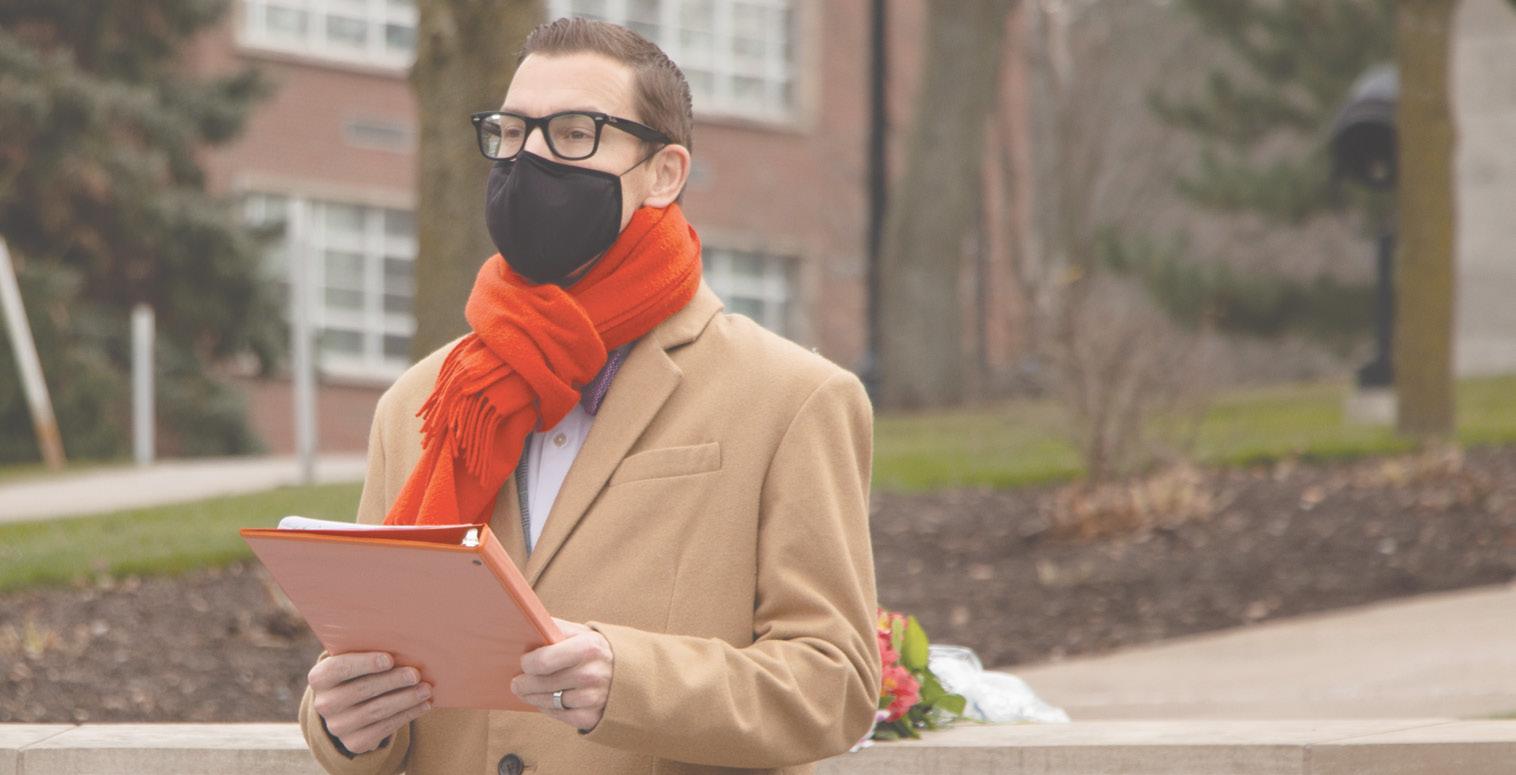
Student leaders at Hendricks Chapel were having their monthly staff meeting when Dean Rev. Brian Konkol popped in wearing one of his signature bow ties.
It’s one of many unique features Anna Dyjach, a technology lead at Hendricks and a Syracuse University sophomore, noticed about the Lutheran minister as she listened to one of his famous stories full of metaphors and personal anecdotes.
“He has this great ability to capture his audience. He makes eye contact with everyone in the room, regardless if it’s a huge lecture hall or just a small group of 10 people,” Dyjach said. “He makes sure
that everyone is heard and that everyone feels welcome.”
For the past eight years, Hendricks staff and faculty recount the dean as someone who fostered a space for interfaith practice, engaging discourse and kindness. Now, Konkol is set to leave the university to begin his new role as president of Valparaiso University, a private Lutheran college in Indiana.
In 2017, Amir Durić, SU’s new Muslim Chaplain, heard his laptop let off a familiar ding. He checked his inbox to see a welcome message from Hendricks Chapel Dean Brian Konkol, who had started his role only two weeks prior. As Durić prepared to embark on his first role in higher education as Hendricks’ Muslim chaplain, he said Konkol became a source of “invaluable” guidance for him.
“I felt empowered. I felt welcomed even before I met him,” Durić said. “Getting that lovely email that communicates you’re welcome here and I’m here to support you is really something that helped me be more certain about my decision.”
Durić said now, he sees Konkol not only as a colleague, but also as a mentor and “good friend,” and hopes to attend his installment at Valparaiso University.
Starting his role in August 2017, Konkol has used his tenure to make Hendricks an interfaith space open to all people of different religious and spiritual backgrounds, Durić said. Konkol focused on promoting interfaith worship, supervising 16 chaplains and more than 25 religious groups and all Hendricks programming, Durić said. see konkol page 7
Lawmakers revoke permission for 2 SU-adjacent Flock readers
By Griffin Uribe Brown social media editor
Flock Safety’s days in the city of Syracuse may be numbered as some Common Councilors push to rescind permission to install the company’s automated license plate readers – starting with two right outside of Syracuse University’s campus.
During a Nov. 24 meeting, the council voted to revoke an ordinance allowing Flock to “install, own, operate and maintain” two ALPRs on streetlight poles located on Waverly
Avenue, which were approved in an agreement with SU.
“Flock is not a public safety partner — it is a private, for-profit surveillance company that built a nationwide vehicle tracking network,” resolution co-sponsor Councilor Jimmy Monto said at the meeting. “We as a city have to figure out how to deal with the civil rights fallout.”
Police use ALPR cameras to capture car information to assist in searches for stolen vehicles or missing persons. Beyond reading license plates, Flock ALPRs’
“Vehicle Fingerprint” technology identifies and stores information like a car’s make and color, according to the company’s website.
SU announced its Department of Public Safety would install eight license plate readers on campus in late August: the two city-approved ALPRs on Waverly Avenue and another six on university property, based on university “safety priorities.”
The two readers revoked by the Syracuse Common Council have not been installed, an SU spokesperson confirmed in a Tuesday statement to
The Daily Orange. The spokesperson also said SU no longer has plans to install readers on city property.
The city of Syracuse began using Flock surveillance technology in 2023. Thirteen of the 26 readers the city contracted with the company are operating.
Because the two cameras on Waverly hadn’t been installed, they were a starting point for the Common Council legislation, Monto said.
The motion sponsored by Monto and Councilor Corey Williams “demands the removal” of cameras
from city property because Flock collects personal data that may violate privacy rights and the data may be inappropriately shared, according to the meeting agenda.
“The cameras track people’s movements, store the data and then make it available far beyond the local community that supposedly controls it,” Monto added. “Flock’s business model depends on normalizing mass tracking of ordinary drivers.”
In a Tuesday statement to The D.O., a Flock spokesperson said
Hendricks Chapel Dean Brian Konkol speaks to students during Remembrance Week in 2018.
corey henry daily orange file photo
Anna Dyjach
hendricks chapel student technology lead
Syracuse food pantries work to recover from SNAP pause
By Kate Jackson asst. copy editor
Around 30 volunteers shuffled in the lower level of University United Methodist Church, steering carts piled with fresh produce. One volunteer quickly placed four oranges into cardboard boxes stacked across every inch of available table space.
The Interfaith Community Collective packs 325 boxes of fresh fruit, vegetables, bread, meats, cheeses, dairy and juice for its emergency food distribution. The boxes, handed out to residents every Friday, feed over 1,000 people, ICC’s Executive Director Galyn Murphy-Stanley said.
After being filled to the brim, each box is carried upstairs and outside, where a long line of cars circles the block. The site’s inventory seemed sufficient until last month, MurphyStanley said.
After Supplemental Nutrition Assistance Program benefits were cut on Nov. 1 during the United States’ longest government shutdown, Syracuse food pantries, soup kitchens and other distributors worked to fill the gaps. Still, many said they didn’t have enough food to meet the growing need — especially as the possibility of another shutdown in February looms.
Meredith Perreault, secretary on ICC’s Interim Board of Directors, usually runs the carpool line and checks people in. When residents lost their SNAP benefits, she said that people were “frightened,” with cars wrapping around the site’s block three times.
“We saw a lot of new people who were like, ‘My SNAP, I don’t have my SNAP. I don’t know what I’m going to do.’ And we would just reassure them, ‘we’re here,’” Perreault said. “But that first day we ran out of food, it was just awful.”
Roughly 42 million Americans rely on monthly food stamps, and SNAP is the largest federally funded nutrition assistance program — providing around $96 billion in assistance.
According to 2023 census data, Rochester, Buffalo and Syracuse ranked among the top 20 U.S. cities for the percentage of households receiving food stamps. In Syracuse, nearly 30% of households — over 17,800 — receive food stamps, including more than 44% of households with children.
The ICC, founded during the COVID-19 pandemic, became a nonprofit organization last year, separate from the Methodist Church. The distribution site is now open weekly from 10 a.m. to noon.
In November, Murphy-Stanley said the site frequently ran out of food in under an hour and 15 minutes, leaving those who arrived later with limited options. She said people were “scared” they wouldn’t have enough food for the week.
On top of neighborhood donations, MurphyStanley said the site receives around 2,000 pounds of food from the Food Bank of Central New York each week, which is then sorted, rebagged and distributed.
Michael Songer, an ICC board member, said he saw regular visitors give up a share of their
city
food to people who lost their SNAP benefits last month. With greater need, the site also expanded its normal 300 boxes to 345 to try and meet demand, he added.
“It was definitely a whole community thing. It wasn’t just us here,” Songer said. “It was the people who are here kind of sacrificing and putting each other first.”
Community vulnerability
The ICC is one of 550 food pantries, banks and soup kitchens in Syracuse that receive food and additional funding from the CNY Food Bank, Becky Lare, the food bank’s vice president of government relations, said.
She added that the food bank’s food distribution increased by 57% during the SNAP cuts.
Anytime there’s a disruption with SNAP, it directly affects the whole emergency food network, Lare said. For every meal the food bank provides, she said, SNAP can provide nine.
Lare said SNAP funding was cut at the start of the federal fiscal year, draining much of the United States Department of Agriculture’s contingency fund that usually helps to prevent disruptions. She called it a “perfect storm.”
While Syracuse is still recovering from the pause, Lare said SNAP benefits wouldn’t be cut in a potential government shutdown this February since the USDA’s full-year funding has been finalized.
Millions are still expected to lose SNAP benefits in the coming years as states roll out new work requirements and eligibility rules passed by Republicans in Congress over the summer. In New York, those changes take effect on March 1.
As the food bank advocates for households to meet the new requirements, Lare said she still
expects some to lose benefits and for food assistance demands to rise by early summer.
Who’s to blame?
Even with SNAP benefits restored, ICC volunteers and residents disagreed on what federal policies could best address food insecurity, as well as who was responsible for the government shutdown.
John, a regular visitor who asked to be identified by first name only, blamed Democrats in Congress for refusing to pass the Republican bill that would end the shutdown.
Because John only receives $23 a month in SNAP benefits, he said the recent cuts didn’t affect him — but rising food prices have. He said he remembers seeing the price of eggs at grocery stores double, forcing him to “stretch food dollars” to get by.
John said President Donald Trump’s administration is doing a good job of addressing national food insecurity and “is not a king like everyone says.”
One Syracuse University student studying television, radio and film, who asked to remain anonymous for privacy, said they found out about the cuts while writing a story about the government shutdown for a local television station. Their job at the station qualifies as a federal work study, allowing them to apply for SNAP benefits.
“I literally look over to my producer, I go, ‘Oh, my God, I don’t have SNAP anymore. I don’t have food money,’” the student said. “I was just shellshocked that as a working person, a student, I wasn’t going to be able to feed myself.”
The student, who receives just under $300 a month, said while they were able to work off their benefits from October and receive help
from her roommate, she was still forced to cut down on groceries.
Having grown up below the poverty line, the student said, it’s something she’s had to “learn how to deal with.”
‘Misconceptions’ about people on SNAP
The SU student said the current political climate and “preconceived notions” about SNAP make them reluctant to tell friends they rely on benefits. They said the Trump administration’s recent changes to work eligibility have added to the stigma.
“It’s becoming a lot harsher of an environment for people to thrive on benefits and not be ashamed of it,” they said. “I think the Trump administration is doing a really good job of hurting the people who voted for him.”
Anne Bellows, a food studies professor at SU who also volunteers at ICC, said some of her past students have struggled to get food on the table every day. However, when she asks her emergency food class to define what food insecurity means, she said few raise their hands.
Lare said there are a lot of “misconceptions” about people who rely on SNAP benefits. Most of the time, she said, they’re seniors, veterans or working families who don’t make enough money to provide for themselves or their families.
“Housing costs, childcare costs, transportation costs, food costs, all of those different pieces affect the bottom line of what resources you have available to put food on the table,” Lare said.
Murphy-Stanley said the largest demographic she sees at the ICC site is retired hourly workers who have little to no pension.
A larger issue, looking forward
On Dec. 2, the Trump administration said it would withhold SNAP benefits from most Democratic-led states next week unless they turn over additional information about recipients, including names and immigration status.
Last month, USDA Secretary Brooke Rollins said her agency uncovered “massive fraud” in SNAP, calling it “corrupt” and justifying recent changes to the program.
Both Murphy-Stanley and Lare said having New York state leadership committed to providing emergency food has made New York less vulnerable than other states, pointing to a new hunger relief fund by Gov. Kathy Hochul.
As a lifelong Syracuse resident, MurphyStanley said addressing food insecurity requires more than government aid and charity, emphasizing the need for stronger local food networks.
Perreault said relying on faith communities to fill gaps in the food system is “unsustainable,” calling for a national “overhaul” of the food system.
“It’s an incredibly broken system, and it’s gonna fall apart,” Murphy-Stanley said. “I’m just working in that system and trying to craft a very grassroots local effort to take care of Syracuseans.”
kjacks19@syr.edu
As Owens prepares for City Hall, local leaders assess issues
By Laura Lemgruber staff writer
As Syracuse Mayor-elect Sharon Owens readies for her first term, local political figures say she faces a turbulent opening stretch as she steers the city through competing forces of growth and potential struggle.
As Micron Technology, a semiconductor and microchip manufacturer, plans to make a multibillion investment in Clay, the city is expected to see extraordinary economic growth. Owens is preparing to lead the city through its subsequent challenges to ensure all residents profit, along with addressing affordable housing and public safety.
The introduction of Micron to the city remained a frequently discussed topic throughout the city’s mayoral race. Bringing nearly 50,000 new jobs, the company could drastically reshape the area, Grant Reeher, a Syracuse University political science professor and host of NPR’s “The Campbell Conversations,” said.
“Syracuse is on the precipice of a potentially new era,” Reeher said. “In 15 years, (Syracuse) might look completely different and feel completely different than it does now. And so I think there’s a lot of opportunity there.”
Throughout her campaign, Owens emphasized her commitment to remedying the Syracuse housing crisis through the Thriving Neighborhoods project, an initiative aiming to address the gap between household budgets and the cost to build and repair homes.
Another major component of her campaign focused on public safety for all residents. Although overall crime dropped 27.3% in the first months of 2025, Owens said she wants to make people’s perception match reality, according to her website.
She says her administration will focus on making Syracuse safer by working with law enforcement to reduce the amount of violent crime and illegal guns in the city.
While Micron brings a promise of economic growth, the incoming mayor will play a pivotal role in determining who will profit from it, Reeher said. Outgoing Syracuse Mayor Ben Walsh told The Daily Orange that an integral part of Owens’ term will be to ensure Syracuse maximizes the benefit of those investments.
“Specifically, that the people of the city of Syracuse, especially the communities that have historically been marginalized by these types of investments, communities of color, women and other marginalized communities, stand to benefit from these investments,” Walsh said.
The city has also received $180 million from New York state and the federal government to
reconstruct the Interstate-81 viaducts. The project presents significant housing redevelopment for the area around the highway, Reeher said.
Largely through sales tax, the Micron project could bring much-needed revenue to Syracuse as it grapples with a housing crisis and homelessness, which saw a 30% increase in central New York between 2022 and 2023. But uneven investment between the city and its suburbs could widen the wealth gap Micron may create, Reeher said.
Reeher said this puts current low-income residents at risk. He worries the project might displace people in public housing and questions how affordable new construction will be — and it’ll take years to fully see how these issues will play out under Owens’ leadership.
“The challenge is the question of how inclusive will all those things be?” Reeher said. “Will they lead to some gentrification?”
Creating a team of people who have a strong background in housing and business will be a “critical” first step to tackling these challenges, Walsh said.
On Thursday, Owens announced her appointments for her transition team who will assist her with tackling her primary priorities during her first phase as mayor.
Owens also appointed Mark Rusin as the Syracuse Police Department’s new Chief of Police on Friday. In his position, Rusin will have the final authority on any matters concerning department policy, operations and discipline.
Rusin has been in the Syracuse Police Department for 19 years, working with Owens
to create community-informed police reform. In the coming weeks before Owens takes office, she is expected to announce the rest of her appointees, including who will fill her current role of deputy mayor.
Syracuse Common Councilor Pat Hogan, who ran against Owens for the mayoral seat in the Democratic primary, said he trusts her to approach the challenges ahead.
However, he is paying attention to Owens’ appointees who will play an important role in determining her administration’s success, especially as he expects many ongoing issues, like housing, to require flexibility.
“A good municipal government should be ready to go in a different direction,” he said. “(They should) be flexible and nimble, and try to expect the unexpected.”
Both Hogan and Reeher said they expect Owens will likely take a more aggressive approach to her role that could help her resolve issues more efficiently than Walsh’s administration — like the I-81 viaduct project.
Owens has served in her position as deputy mayor for the past eight years, which Walsh said will help prepare her for a smooth transition.
“What differentiates her is her heart for the community, for the people that we serve,” Walsh said. “That’s why she is so uniquely positioned to maximize this moment, because she will not rest until she ensures that everyone in the city has the same opportunities.”
Owens will take office on Jan 1. lalemgru@syr.edu
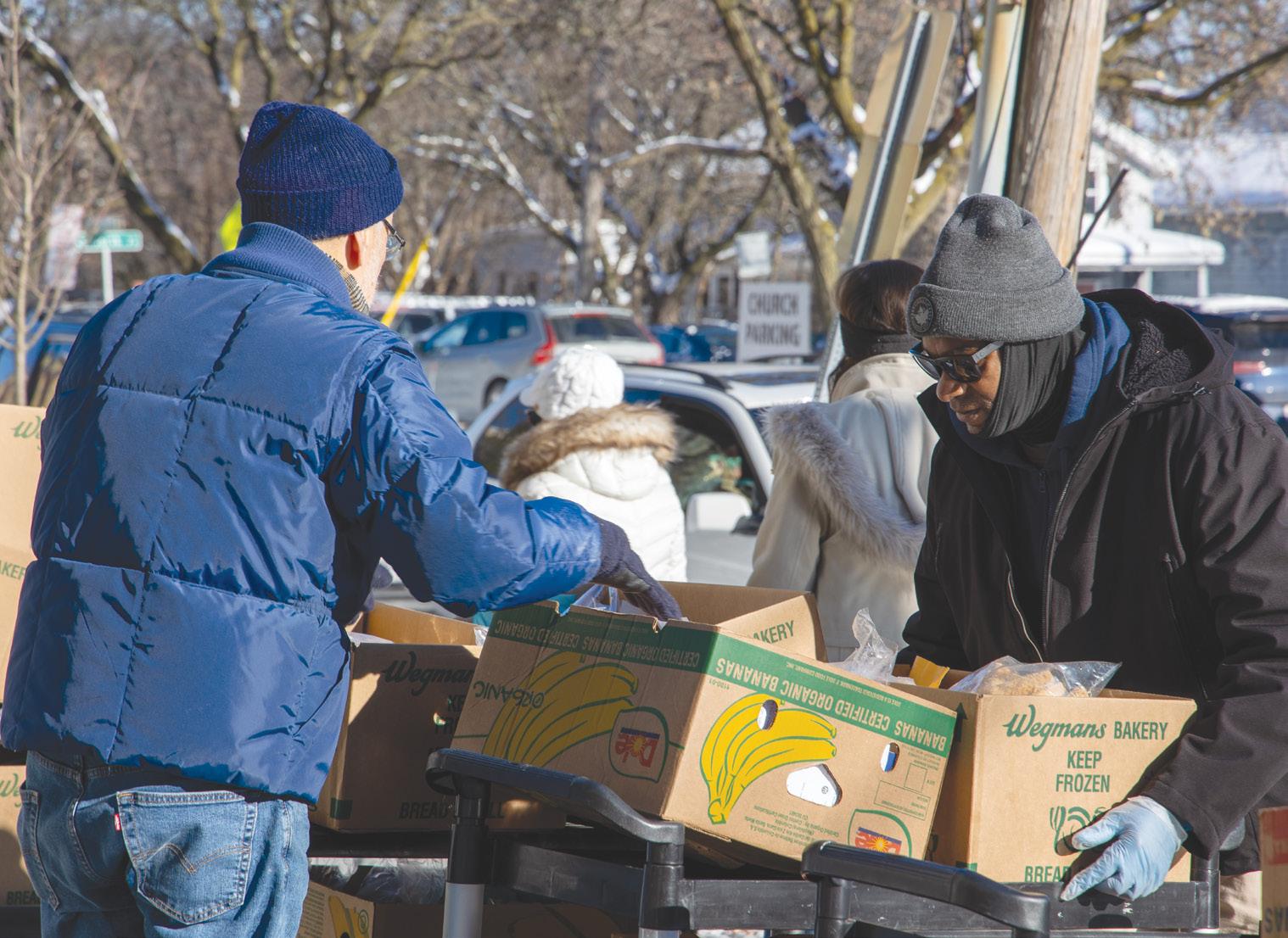
Volunteers gather weekly to distribute over 300 boxes of fresh food to Syracuse residents following a demand increase from the government shutdown. eli schwartz staff photographer
Homelessness increase in Syracuse between 2022 and 2023 30%
“I enjoyed the large-scale programs and services, and I also loved the small group conversations and connections, as it all included remarkable people seeking to build a home for all faiths and a place for all people,” Konkol said in a statement to The Daily Orange.
During his leadership, Konkol made a priority of increasing student involvement in spiritual life and interfaith worship. He has overseen a 150% increase in student engagement at Hendricks over the past eight years, according to SU’s website.
He’s created traditions such as Interfaith Peace Week, with nightly faith-led vigils, and Interfaith Exploration Week, which features panels on negotiating conflicts between people of different beliefs.
Konkol also led numerous other vigils, including an interfaith vigil to promote religious solidarity during the Israel-Hamas war.
Devon Bartholomew, a nondenominational Christian chaplain at Hendricks, said that projects Konkol oversaw – including Interfaith Exploration Week – have allowed the chapel to create broader university events that meet people in their faith.
“Brian has given a lot of great vision for what our long-standing mission statement has been about being the spiritual heart of campus, and talking about how we can extend ourselves across campus and not just be siloed in our one building,” Bartholomew said.
Part of Konkol’s vision for Hendricks was the “roots, reach, results” framework, which focuses on first turning inward to find one’s values, growing those values and then making real-world impact, Durić said.
He added the SU community expressed more interest in Hendricks programming because Konkol had the ability to connect with people through captivating storytelling in new spaces.
“Part of his vision was ‘How can we expand what we do at the chapel in other areas of campus life and then also community?’” Durić said. “We collaborated with other partners and colleagues across campus and beyond, which made what we do more known and also contributed to that success over time.”
Ashley Stevenson, an SU senior and student communications lead at Hendricks, describes Konkol as a “thought leader” who has shaped her experience working at Hendricks for the past three years.
Stevenson worked closely with Konkol to plan the chapel’s annual Rev. Dr. Martin Luther King Jr. Celebration, the largest university-sponsored event in the nation to honor King’s legacy, according to the Hendricks website.
“He’s been super collaborative and inspiring,” Stevenson said. “He also leads with respect and leaves space for creativity and growth in my student leadership.”
Stevenson said one thing she’ll remember about Konkol’s leadership is that he was able to connect people in impactful ways through Hendricks programming.
“I’m just grateful for the time that we’ve had with Dean Konkol. His leadership has been all
comments accusing Flock of tracking individual persons “are simply not true,” given Flock cameras don’t track people’s personal data or share information “outside of a customer’s control.”
Syracuse is not alone in raising alarm bells about Flock’s data use. Though the company maintains that its ALPR products — which it advertises as the nation’s “Largest Fixed LPR Network” — do not violate the Fourth Amendment, legal experts and critics say otherwise.
While Flock says “customers own their own data,” investigative reporting across the United States shows that clients who opt into national data sharing effectively release their own data into a wider network. In some instances, the federal government, including U.S. Immigration and Customs Enforcement, and law enforcement agencies across state lines, accessed other entities’ Flock audits.
“Each agency that uses Flock technology fully owns and controls all of its data. Agencies decide if, when, and with whom to share information,” Paris Lewbel, a public relations manager at Flock, wrote in a Tuesday statement to The D.O. “Every search requires a documented reason and is permanently logged for audit and oversight.”
SU’s spokesperson similarly said the university maintains control of its data.
“Law enforcement agencies do not have automatic access to our data. All data is encrypted and stored securely for 30 days, after which it is permanently deleted unless preserved for an active DPS investigation,”
that I’ve known and it’s really shaped my Hendricks Chapel experience,” Stevenson said. “But, I know that this role that he’s transitioning to is going to be great. He deserves it.”
In addition to Konkol’s work at Hendricks, he also worked as a professor of practice at SU’s Maxwell School of Citizenship and Public Affairs, building relationships with students and faculty through course topics ranging from religion and conflict to collaboration.
“I will miss the student questions, creativity, humor, and hope, and most of all, I will miss the relationships, as the students here are truly special and will always sit at the center of my heart,” Konkol wrote in his statement.
Sarah Hamersma, an advisor for the Christian Staff and Faculty Association, said she collaborated with Konkol to establish CSFA. While CSFA began as just informal meetings for faculty members to connect over their faith, Konkol helped transform the organization into an official campus affinity group.
Now, CSFA hosts monthly book discussions, weekly prayer meetings and semesterly breakfasts. Hamersma said Konkol regularly attended these events, often leading the group in prayer.
“He was supportive of (CSFA) and had our back,” Hamersma said. “As a religious group on a non-religious campus, it can always be a little bit concerning as to whether we’re sort of going to be judged in some way for practicing our religion, and his leadership at Hendricks has really done amazing things
SU’s spokesperson said. “Only authorized investigators within DPS have access to the system and data.”
Monto said “heavily concerning” immigration enforcement activity in Syracuse brought the Flock issue to the forefront.
ICE has arrested at least 162 people in Onondaga County since President Donald Trump was inaugurated, according to ICE data processed by the Deportation Data Project. Sixty-one percent of ICE arrests in New York state involved people with no criminal history, the highest rate of any U.S. state, according to the Deportation Data Project and SU professor Austin Kocher.
Beyond the two Waverly Avenue cameras, a similar resolution seeking to revoke Flock’s citywide deployment of ALPRs was tabled at the council’s Nov. 24 and Dec. 8 meetings. Syracuse Police Department is actively working to find replacements, while lawmakers push to remove Flock’s permissions city-wide “within the next couple months,” Monto said.
“We have given the Syracuse Police Department some room to do some research around replacing Flock with a different vendor,” Monto said.
The SU spokesperson did not provide updates on the status of Flock readers on campus. Monto said that the city has no control over SU’s contract with Flock.
“At the end of the day, this is not a problem with SPD. I think SPD is using the LPRs appropriately, but Flock’s efforts — what they do with the data they have — are not appropriate,” Monto said. “So if SPD can find a different vendor that is not acting like Flock is acting, then I think that’s something we can live with.” gbrown19@syr.edu
for making the campus friendly towards people of faiths.”
But his tenure hasn’t come without challenges. Konkol responded to the COVID-19 pandemic by hosting religious services, both virtual and some in-person with social distancing, in the fall of 2020.
“Because of his leadership, and also a team of outstanding people here at the chapel, we were able to adapt very quickly,” Durić said. “He was able to work closely with campus partners to learn best practices and also to get all needed support to keep the chapel open while following guidelines.”
Next semester, Hendricks will welcome the inaugural cohort for the Global Interfaith Leadership Project. Durić said he created the project alongside Konkol to bring campus leaders together to engage in community service and interfaith projects.
After Konkol announced his leave, Durić said Hendricks staff began planning for an interim dean and started hosting meetings to get ready for the chapel’s change in leadership. Bartholomew and other Hendricks faculty feel optimistic about the future of Hendricks. A lot of the energy in Hendricks right now is celebratory, Bartholomew said.
“At this moment, we’re especially grateful for the collaborative nature that Brian put forward,” Bartholomew said. “(His departure) is a reminder to our campus community that yes, it is a great loss to lose a friend and a
leader like Dean Konkol, but there’s still a lot happening at Hendricks.”
Although saddened by the news of Konkol’s departure, Durić said the announcement didn’t come as a surprise.
“I knew that it was his dream to serve in such a role and in a way we all knew it was coming, but we never knew when and I don’t think nobody anticipated it being this academic year and it being this soon,” Durić said.
As Hendricks looks forward to its next chapter, other staff members echoed Durić’s sentiment, excited to continue Konkol’s interfaithfocused foundation.
Hamersma — for instance — is confident CSFA and Hendricks will continue to grow beyond Konkol’s time.
“His sort of foundational support has allowed us to have some freedom to lead our own organization internally. He isn’t leaving us in the lurch,” Hamersma said. “We’re not without help, because we’ve been able to grow under his leadership.” Konkol will begin his role as president at Valparaiso University on Jan. 1. An interim dean hasn’t been announced as of Thursday.
“I am honored to have served alongside such a remarkable group of chaplains, faculty, staff, alumni, advisors, and friends throughout the Syracuse University campus community,” Konkol said in his statement. “A large part of my heart will be forever Orange, and I am convinced the future will be bright and beautiful.”
rturne03@syr.edu
Dean Brian Konkol will leave Syracuse University after eight years to serve as president at Valparaiso University, a private Lutheran college in Indiana. eli schwartz staff photographer | colin davey daily organge file photo | francis tang daily organge file photo
Syracuse Common Council voted against installing two new Waverly Avenue Flock Safety license plate cameras near SU’s campus. quinn postman asst. digital editor
Sleigh ride
CULTURE
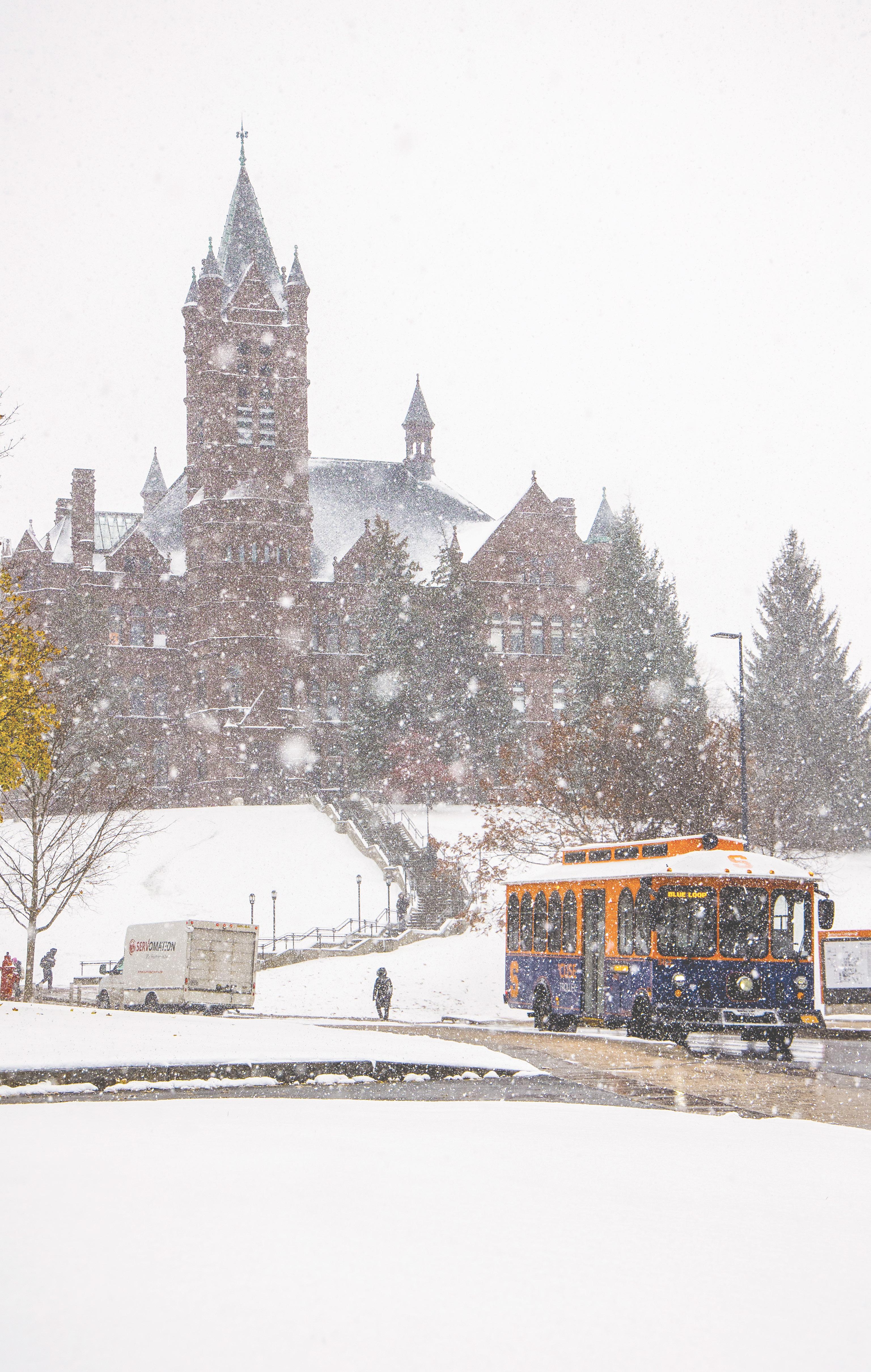
For decades, Crouse College hill has been a popular sledding destination for students
By Lily Zuckerman asst. digital editor
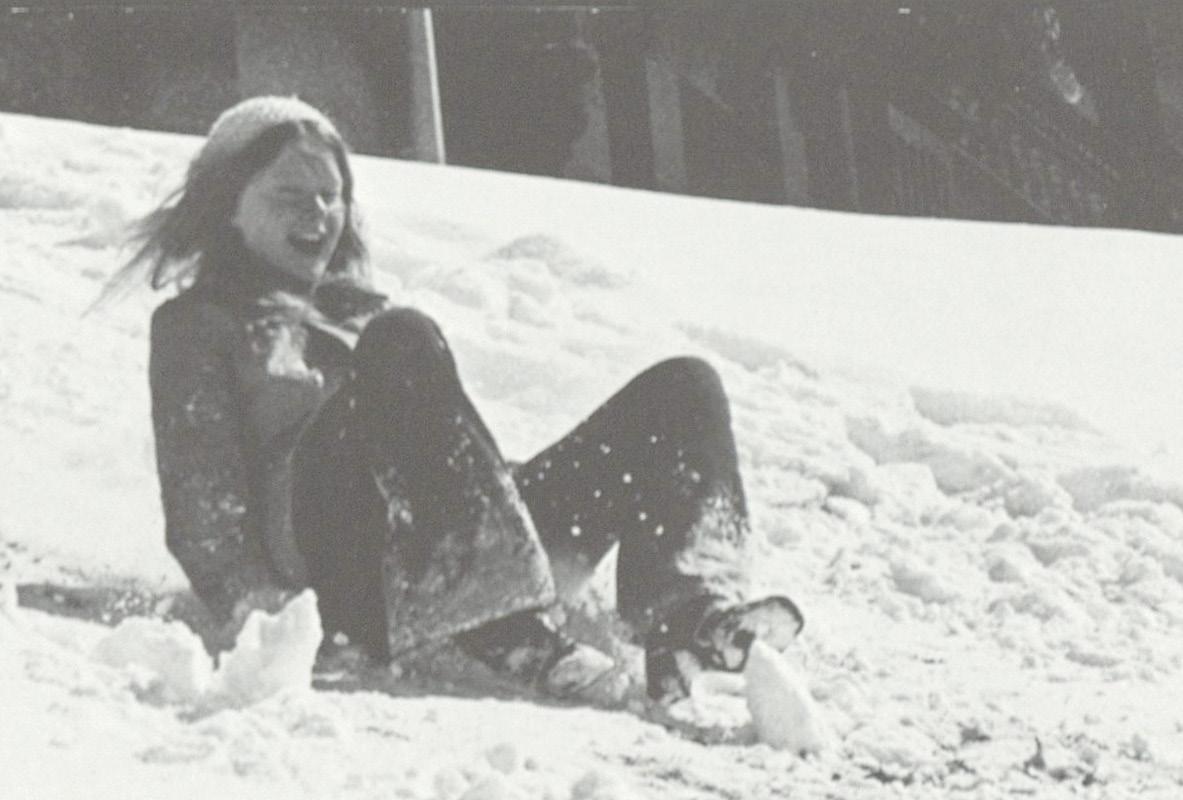
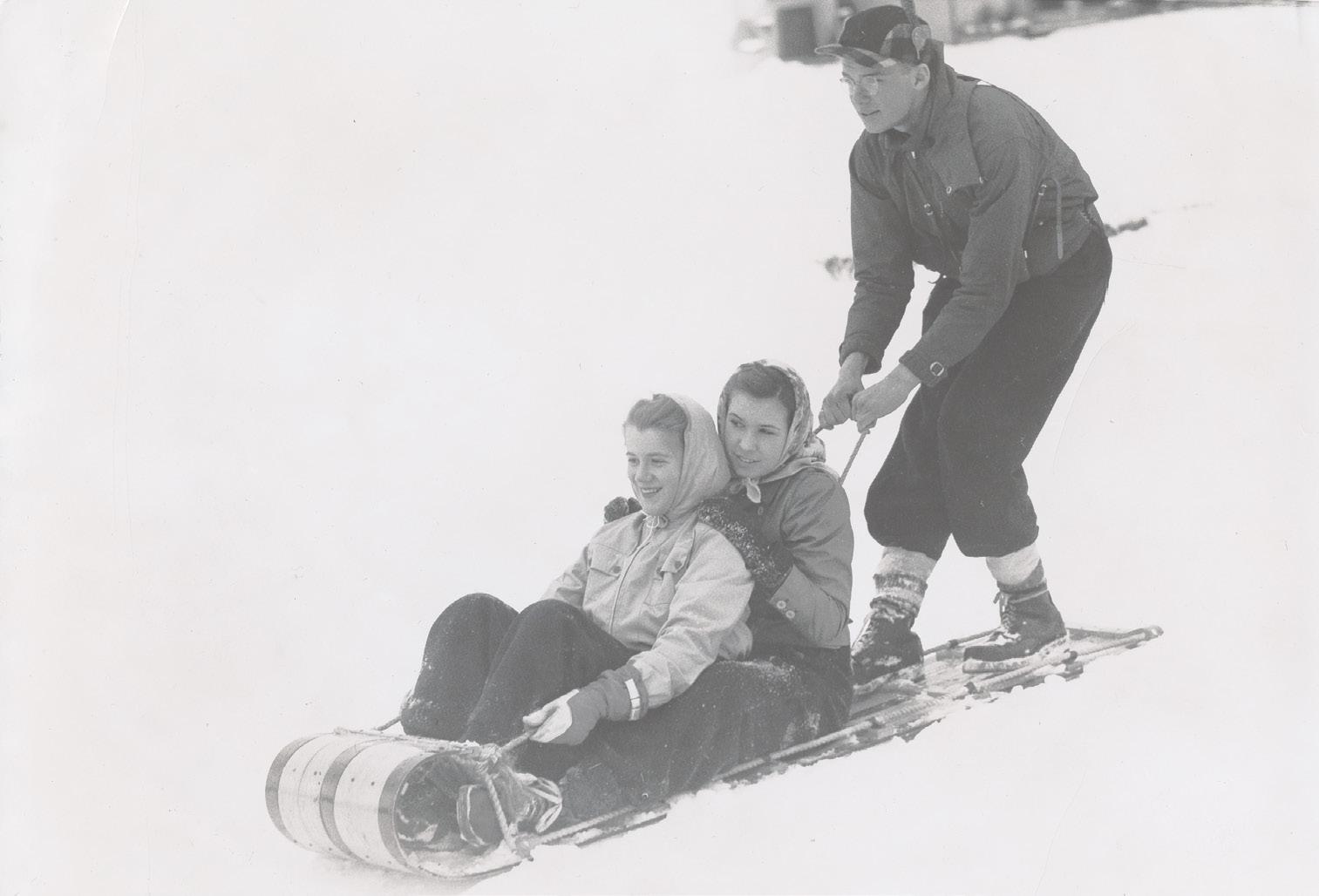
Most of the time when it snowed in the late 1980s, Syracuse University alum Nancy Ring would head to the Sadler Dining Center and grab her makeshift sled: a dining hall tray. Then, she would run over to the hill outside of Crouse College.
“It was just like one big party, everybody would be screaming on the way down, and cheering for each other from the top of the hill, covered
in snow and drenched,” Ring, who graduated in 1988, said.
When SU dining halls discontinued plastic trays in the early 2000s, some SU students have found that any object can double as a sled. But other than that, not much has changed. Since the first snow on Nov. 11, students have used whatever was at their disposal to sled down the snow-covered Crouse hill.
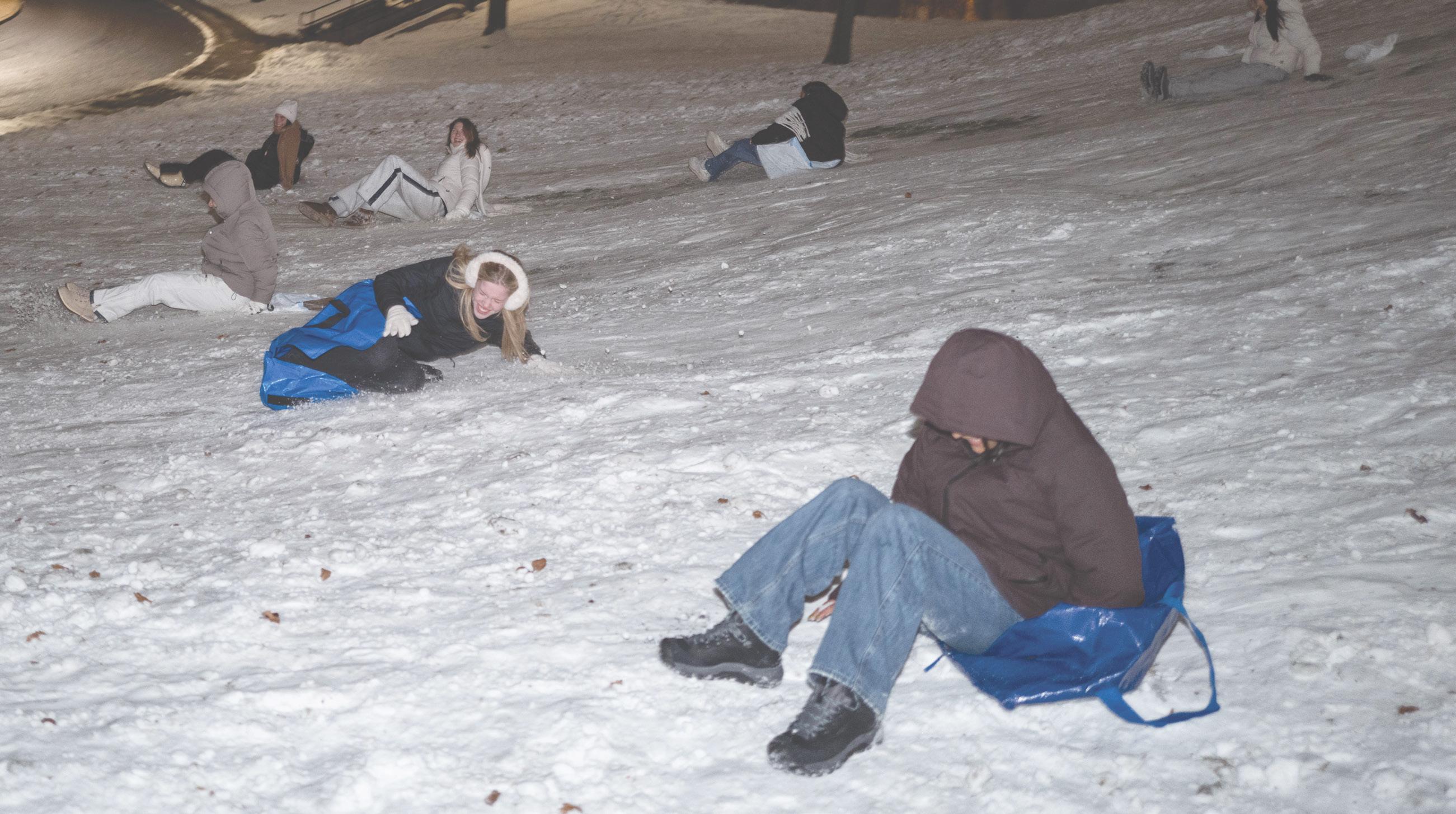
On Dec. 2, freshman Izabella Naloy found the perfect vehicle to act as her sled: the IKEA bags and storage container lids she used to move into her dorm in August.
“It was annoying to walk to class in the snow, but sledding makes up for it,” Naloy said. “It feels like whimsy college behavior, sledding down campus with your friends in the middle of winter is iconic.”
Although Naloy and her friends had finals to study for, their impromptu excursion became an hour-long study break. It felt like a “rite of passage” after hearing about the ritual on campus tours when she was a prospective student, Naloy said.
When touring SU, Naloy heard the Syracuse folklore about the first snowfall of the school year and the herd of students who congregate on top of the Crouse hill.
Sophomore Tess Feldman shares a similar spiel in the tours she gives to prospective students. In fact, most students learn of the
Old friends, white stones: Go Club continues 60-year legacy
By Cam McGraw asst. copy editor
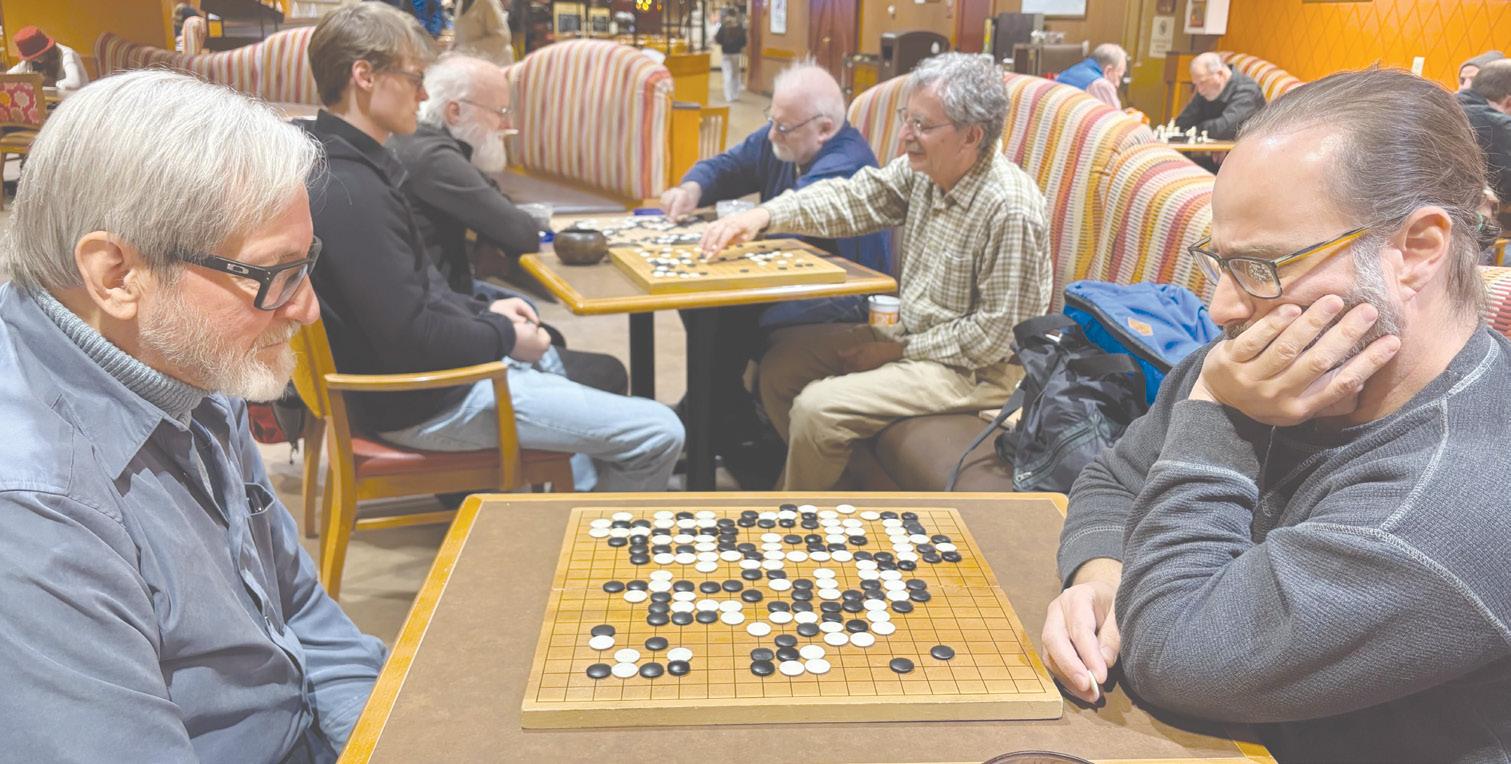
Past the freezers, produce aisles and customers, in the Wegmans DeWitt Café, sit a few old wooden boards with faded grid lines and small black and white stones stacked in bowls. The setup looks simple. But for the Syracuse Go Club, it’s nearly six decades of history.
“I looked in my attic and found a little booklet that had a lot of crazy games, and it gave a description of the game Go,” Mark Brown, a former Syracuse University philosophy professor, said. “I read about a page and said, ‘You can’t make a game out of that!’”
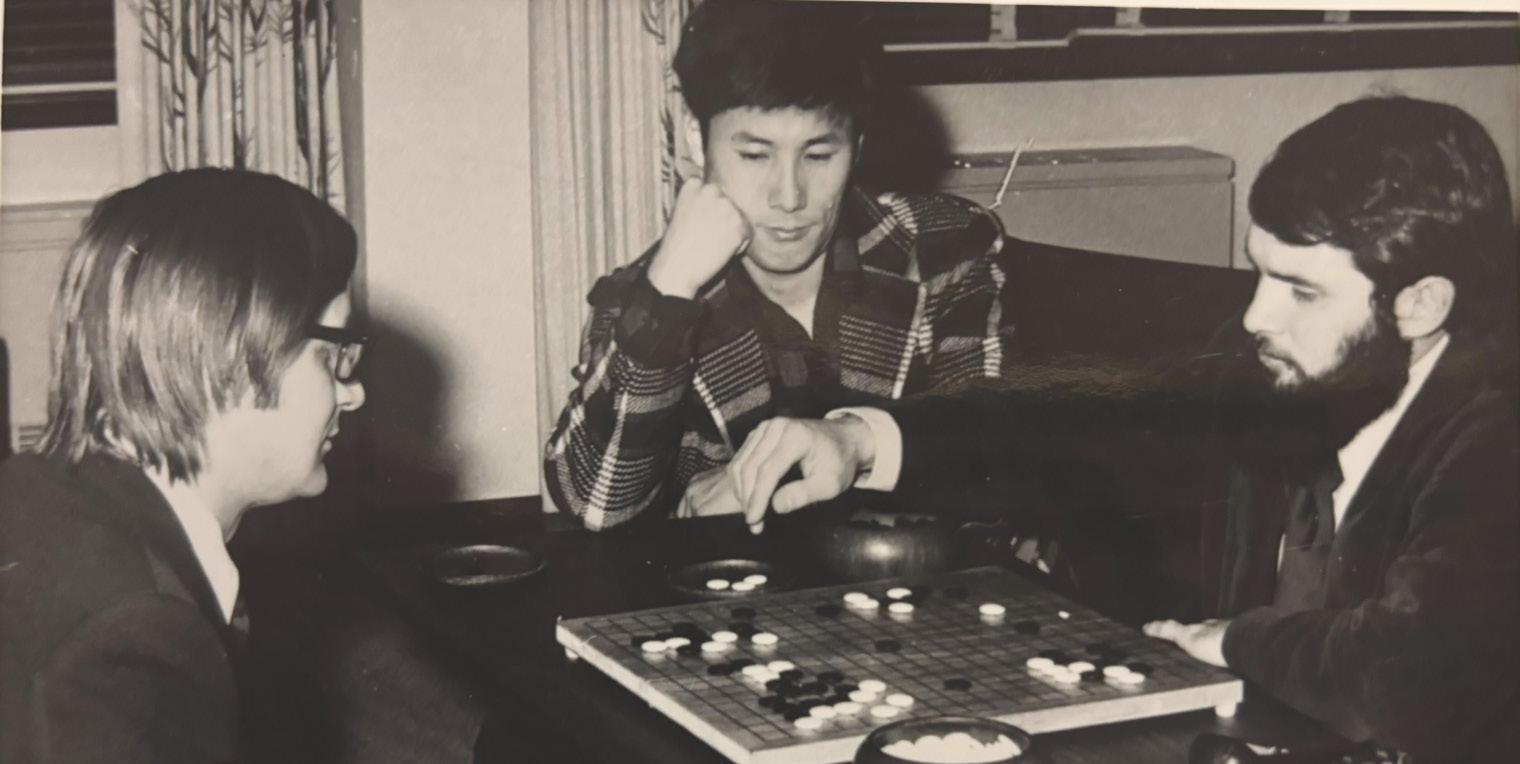
Brown founded an informal Syracuse Go Club in 1967 on SU’s campus after playing Go with other chemistry, engineering and computer science students and professors at various houses. The club still meets today, though they’ve found a more permanent location. When he returned to SU after a year on leave, he learned the informal meetups had stopped, and decided to start the official club himself. Now the club is approaching its 50th anniversary. The game Go is a two-player board game; each person takes turns placing black and white stones on a
19-by-19 grid. The goal is to surround more territory than your opponent by enclosing large spaces. Once placed, stones cannot move but can be captured by an opponent if surrounded. At the end of the game, captured stones and the total grid area are added up by each person to see who won.
The game Go was invented in China over 2,500 years ago, making it one of the world’s oldest board games. Although the rules are simple, the game was designed as a tool for strategy and discipline, and its influence and popularity eventually spread.
Brown started playing the game at SU but first discovered it as a kid.
The club quickly drew interest on campus with around a dozen members, including now SU alum Anton Ninno, who happened to be one of Brown’s former students. Ninno said his interest in eastern philosophy sparked his curiosity about Go. Concepts of balance and discipline are core aspects of the region’s philosophy and deeply intertwined with the game of Go. Brown said he remembers trying to learn as much as he could about the game — even though there were very few books in English — before
bringing it to his academic advisor.
“I pulled this book out and said, ‘Hey, I found this game, you might really like it,’” Ninno said. “He started laughing and said, ‘We have a Go club here,’ and I said, ‘Why didn’t you tell me?’ and he responded, ‘Well, you never asked.’”
That moment sparked a friendship that has lasted for more than 50 years.
As the club expanded, Brown said Ninno gradually started to take the reins. Ninno brought in professional Japanese players who would play 20 games at once.
see sledding page 11 see go club page 11
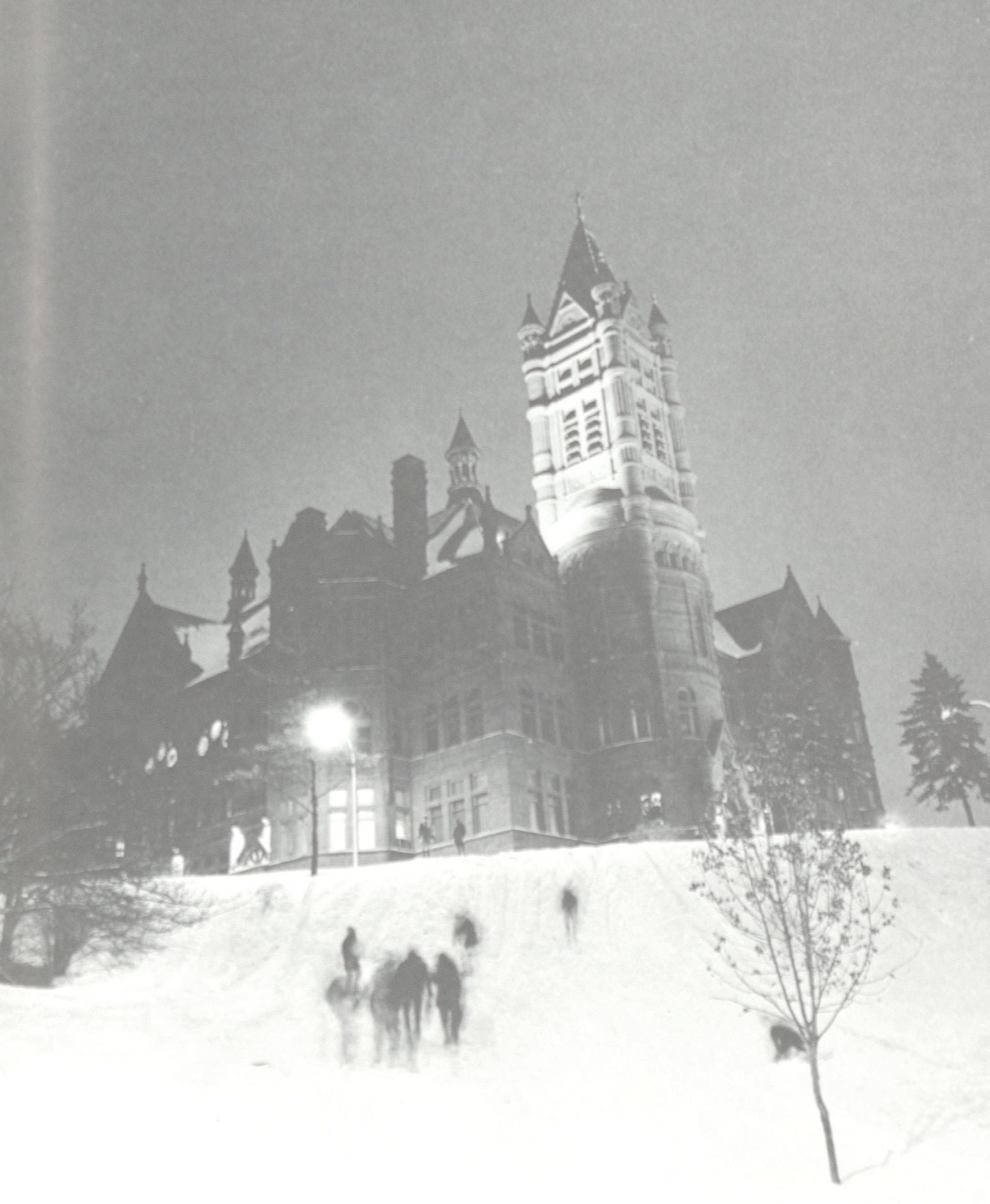
The hill in front of Crouse College has been a popular Syracuse University destination for SU students to sled down, with many students using IKEA bags and container lids as makeshift sleds. tara deluca staff photographer | courtesy of scrc | eli schwartz staff photographer
beyond the hill
Gingerbread Gallery remains ‘community treasure’
By Claire Zhang asst. copy editor
When November rolls around, confectioners’ sugar, flour, piping tips and more fill Kimberly FlomerfeltPuc’s kitchen. Cardboard cutouts turn into gingerbread walls, and soon she’ll have an elaborate house to take to the Erie Canal Museum.
“During the month that I’m making it, I can go eight hours and just be lost in the creation of it,” Flomerfelt-Puc said. “It’s stress-free and just a really nice way to spend my time.”
This year is the 40th anniversary of the Erie Canal Museum’s Gingerbread Gallery, which runs from Nov. 21 to Jan. 11. Every winter, dozens of participants build intricate gingerbread houses to showcase in a special exhibit at the museum. Some builders, like Flomerfelt-Puc, enter in the professional confectioners category of the competition, meaning she bakes all the gingerbread from scratch.
This year, her house is modeled after a dollhouse she found at an antique sale, which she deconstructed and used the walls as a template. Since the Erie Canal turns 200 years old this year, she said she wanted to emulate the supply stores that were found along the canal. Each room in her gingerbread house is decorated with ornate details, like tiny food products and price tags.
“Sometimes less is more, but in gingerbread houses, more is better,” Flomerfelt-Puc said.
What started as a way to get the museum more active during the holidays has now become a staple tradition for many in the Syracuse community, like Flomerfelt-Puc. Debbie Stack, a local who worked at the Erie Canal Museum over 40 years ago, conceptualized the gingerbread gallery with a team in 1985.
During its first year in 1985, the Erie Canal Museum modeled the gallery after an 1800s-style street that the gingerbread houses could line. Most of the houses were from local bakeries, but soon they opened their doors to anyone who wanted to participate.
“It was just you know, ‘Hey, you like to do it. We’d like to have you,’” Stack said. “The community really responded to it.”
In her time working at the museum, Stack and her team began to run other holiday programming events alongside the gallery to expand its outreach. They previously incorporated weekend entertainment like live music and organized a workshop for children to make their own graham cracker gingerbread houses. It made the gallery cross-generational — grandparents could bring their grandchildren for a fun holiday event, she said.
“Kids would walk out so thrilled and of course their mouths were full of gumdrops,” Stack said. “They ate as much as they built.”
Forty years later, the gallery still attracts community participants. Syracuse native Jane Verostek and her daughters Octavia and Minerva Miller have been crafting houses for around 17 years, almost the girls’ entire lives. For each house, Octavia and her sister pick the theme — usually a movie or book they’ve recently enjoyed — and Verostek does the “dirty work” of making the house and its characters.
“It’s always something that I look forward to, and it’s always something that’s in the back of my head, like, ‘Oh, what are we gonna do next year?’” Verostek said.
In the past, they’ve recreated “Shrek”, “Ice Age” and more. This year, their pick was the characters from “Don’t Let the Pigeon Drive the Bus!”, a callback to their childhood and a Mother’s Day gift the daughters gave to Verostek this year. Verostek made the pigeons, elephant and hot dogs out of fondant to assemble the house. It’s a long process; Verostek often works over 12 hours a day on the house, but the result is always worth it, she said.
One of the only rules for the gallery is that everything making up the house must be edible. To accentuate their houses, participants like
Flomerfelt-Puc and Verostek get creative with the ingredients and construction methods.
When their theme was “Cloudy with a Chance of Meatballs” in 2013, Verostek used three real potatoes for the “Hippotatomuses.” When they built the Shrek house in 2022, Verostek sourced not just candy, but also other additions like dried fruits and vegetables from Wegmans to make the plants in the marsh. The family was especially excited because it was the first year their house was displayed in the center of the gallery, Verostek said.
Their family has always been creative; they often bond over art and go to museums like the Erie Canal Museum, Octavia said. Making the gingerbread houses is a way to channel that, and it’s a fun tradition that keeps the holiday season special, Verostek said.
“It’s like, ‘Why would we stop?’” Octavia said. “I would feel empty without it.”
The ingenuity of all the houses is one of the reasons there’s never a set theme for the gallery, Stack said. Every year, participants come up with all kinds of ideas, from movie-set replications to tributes to the Erie Canal’s history. Being able to see all the thought and hard work that goes into each distinct house is part of the fun, Stack said.
“For some people, … it was a family tradition to bake gingerbread and they made their gingerbread creations the way they do,” Stack said. “You don’t want to stifle that.”
Flomerfelt-Puc has competed in the gallery since 2022, but recalls admiring the houses on museum visits years before. Last year, she won first place for her gingerbread replica of Crouse Hinds Hall, and dedicated it to the Syracuse Orchestra. The year before that she did a “Wizard of Oz” house that won her People’s Choice.
Gingerbread house making had been a custom in Flomerfelt-Puc’s family long before she branched off to participate in the Erie Canal Museum gallery. Every winter, all her extended family come from every corner of the country to make houses together, she said.
To decorate her houses for the Erie Canal Museum, she uses a set of 70 different icing tips that she inherited from her mom, who is a baker. Though she works alone, it always gives her time to reflect on memories with her family, she said.
“I also just have a sense of pride when I go there with my family and they’re very complimentary,” Flomerfelt-Puc said.
Because the gallery is centered around the holidays, it’s become a way to bring participants and the community joy, Stack said. Seeing the success of the gallery is a testament to the “silent partner” that is the Syracuse community, she said.
When the gallery opens, the museum is livelier than ever, and it’s a way to bring in new visitors every year, rather than just once every 10 years, Stack said. People make more regular visits to the museum for the exhibit, she said.
Verostek and her family always go to the Erie Canal Museum the day after Thanksgiving to see the houses wearing matching holiday pajamas. They make it a whole day activity, and it’s rewarding to see all the hard work pay off, Verostek said.
“It’s always fun to just take a step back and watch all the other people looking at it,” she said.
The Erie Canal Museum has been an important museum in Syracuse’s history for years, and the gingerbread gallery only makes it more special, Stack said. It’s a “good for everyone” exhibit, and she hopes it can keep bringing people and cultures together.
“It’s demonstrated that if museums do things right, you become a community connector as well as a community treasure,” Stack said. cmzhang@syr.edu
HOLIDAY FILMS TO WATCH
By Joel Pelachik staff writer
“It’s a Wonderful Life”
“It’s a Wonderful Life” follows George Bailey (James Stewart) — a truly benevolent man — who spends his life giving back to his hometown of Bedford Falls (inspired by Seneca Falls).
When George begins to regret his altruistic life, a guardian angel, Clarence (Henry Travers), visits him. Clarence shows him what Bedford Falls would have looked like if George was never born. In a pivotal moment, Clarence explains that George positively impacted so many people’s lives.
Labeled as one of the greatest films ever made, “It’s a Wonderful Life” is a powerful reminder of the value of kindness and appreciating the present.
“Miracle
on 34th Street”
Santa Claus is undoubtedly an iconic Christmas figure, and “Miracle on 34th Street” is all about his existence.
When jolly old Kris Kringle’s (Edmund Gwenn) sanity is questioned, lawyer Fred Gailey (John Payne) must convince the courts that Kringle is the real Santa. Gwenn’s performance is truly heartfelt, even earning him the 1948 Academy Award for Best Actor in a Supporting Role. Because of Kringle’s enthusiasm, joyful personality and love of Christmas, there isn’t a film that captures the season’s magic quite like “Miracle on 34th Street.”
Alone”
“Home
When Kevin McCallister’s (Macaulay Culkin) family travels to Paris for Christmas, they accidentally leave him behind. Then, the 8-year-old is tasked with defending his Chicago home from two burglars, Harry (Joe Pesci) and Marv (Daniel Stern), and he devises homemade booby traps to stop them.
Along the way, Kevin finds out that the alleged murderer, Marley (Roberts Blossom), is a kind, old man, and Kevin realizes how much he loves his family, especially his mom, Kate McCallister (Catherine O’Hara). Aided by John Williams’ score, “Home Alone” is a fantastic, heartwarming time (don’t miss the tarantula scene).
“How the Grinch Stole Christmas”
Adapted from Dr. Seuss’ 1957 book, Howard’s film tells the classic tale of a green, hairy menace, the Grinch (Jim Carrey), who steals Christmas presents and decorations from the fictional town of Whoville.
Bringing the infamous character to life is no easy task, especially with Boris Karloff’s iconic voicing of the Grinch in the 1966 animated film, but Carrey’s zany performance made the film unforgettable.
Arguably the most quotable Christmas movie, “How the Grinch Stole Christmas” is the most fun I have watching TV during the holidays — and starting on Dec. 12, you can catch it in theaters for its 25th anniversary.
“A Charlie Brown Christmas” And, I can’t forget “A Charlie Brown Christmas.” Don’t be fooled by the 25-minute timestamp, this cartoon is one of the deepest movies you can watch this holiday season. It’s a reminder that Christmas isn’t about the presents or materialistic desires; it’s about the birth of Jesus Christ and spending time with loved ones.
jdpelach@syr.edu
Octavia and Minerva Miller choose a gingerbread theme each year. Their 2025 house was inspired by “Don’t Let the Pigeon Drive the Bus!” joe zhao senior staff photographer
Draped with fairy lights and Christmas ornaments, the Erie Canal Museum Gingerbread Gallery features gingerbread houses modeled after movies and tributes to the Erie Canal’s history.
joe zhao senior staff photographer
hill. While sledding down Crouse hill has made Syracuse winters tolerable for some students, it has also caused injuries.
While Mosley has yet to return to sledding, he plans to participate in sledding even after the accident — but on a safer sled and less steep hill.
said she typically sleds three times a winter in Syracuse.
Syracuse sledding tale before they even enroll at SU.
“You have to find those aspects that are interesting to us as humans in a community,” Feldman said. “It would be so easy for the student body to be like, ‘I’m just gonna stay in during the winter,’ but instead we choose to make a tradition out of it. We choose to make it something enjoyable.”
University 100 tour guides are encouraged to mention the tradition when their tour group approaches Crouse, Feldman said. Feldman, a U100 tour guide, typically gives one to two tours a week. In every tour, she said she makes sure to mention the sledding tradition.
While Feldman has yet to sled down the hill at Crouse herself, she said she has seen how the activity brings people with different majors and interests together, which she said is important to highlight in tours.
Feldman said one of the most frequent questions she receives from prospective families is about the safety of sledding down Crouse
SU sophomore Robbie Mosley knew he wanted to sled down the Crouse hill since he toured in high school. Mosley, who is from Texas, had never sled down a hill as steep or snowy as the ones on campus. Last December, during one of the year’s first snows, Mosley sled down the hill for the first time.
Despite not owning a sled, Mosley pushed his creative boundaries to find an object to slide down. He settled on borrowing an innovative sled from a friend: a fiberglass boogie board.
Trying to dodge his friends in a snowball fight at the top of Crouse, Mosley took the boogie board down the hill.
“Sledding was one of the things that I was super excited about going to school somewhere that it snowed,” Mosley said. “I ran up the hill and then just full send. I got in exactly the wrong line down the hill.”
His first sledding trip was short-lived. That trip down the hill left Mosley with several broken bones, a lacerated spleen and a weekand-a-half trip to Upstate University Hospital.
Senior and California native Addy Sprague had also never sledded before coming to campus. The hill on Crouse was the first place she decided to break that streak.
“It’s just been a really fun way to connect with the people and the community,” Sprague said. “When you are sledding here it is really fun, you meet lots of new people who are friendly and have camaraderie.”
But Sprague’s friend, SU senior Zoe Colman’s, college experience is still anchored by her yearly sledding tradition.
Colman’s freshman year roommate was from Australia and had never seen snow before. Colman said it was important to show her right away how fun the winter can be, despite the cold. So, she took her roommate sledding right after the first snowfall.
“It just makes winter better. Winter here can be hard, and sledding is something to look forward to,” Colman said.
Even after that first snow, Colman has kept that tradition alive. Since then, Colman
Membership grew beyond the university after more advertising from Ninno. They chose Thursday night meetings because “people would be partying on Friday and studying on Wednesday,” Brown said.
Parking issues eventually pushed the group off campus, and after a brief stint at a Westwood Street coffee shop, Ninno moved the club to the Wegmans in Dewitt in December 2002. He credits his wife for the switch; she noticed people holding informal meetings at the grocery store.
The club’s first meeting at Wegmans was featured in The Post-Standard newspaper, which attracted more new players. But for longtime member Richard Moseson, joining the club took years.
Moseson heard about the Go Club in 1996 through an email but could never track down where they were meeting. It wasn’t until Ninno moved the club to Wegmans that Moseson was able to join.
“We had some good players playing here in the early days,” Moseson said. “Or at least my early days.”
Brown eventually ended all campus meetups and fully transitioned gameplay to Wegmans. The group still occasionally got SU students to join for a year or two before graduating.
Alongside the game of Go, Ninno also organizes casual chess meetups on the opposite side of the Wegmans seating area. Boards are set out several hours before Go players arrive, and members begin to compete at each table.
While some SU students choose to brave the Syracuse cold with just a hoodie and a light jacket, Colman and Sprague bundled up in ski jackets and snow pants and used their friend’s sled during a big snow on Dec. 2.
“It’s so sentimental, I feel old,” Colman said. “I think about how I would go with my siblings and it’s the same but different experience being able to share my childhood by sledding with my friends my senior year.”
The memories of sledding down the Crouse hill don’t just end at graduation. For Ring, the Facebook groups and videos on social media around sledding down Crouse hill remind her of the joy she had while sledding at SU.
“A lot of traditions have fallen away. So to see that one tradition is still happening, I think ‘Oh, thank goodness something’s hanging in there,’” Ring said. “It brings me great joy, it reminds me of what I love about the place and of some of the best times I’ve ever had.”
lvzucker@syr.edu
Both Ninno and Brown say one of Go’s most meaningful features is its handicap system to balance skill levels between games. Unlike chess, where there are multiple pieces with different values, Go’s identical stones can easily be subtracted, allowing experienced and newer players to compete fairly by adjusting the score at the end.
Brown said he appreciates the evolution of his friendship with Ninno from student-adviser to opponent.
“Oh yeah, I hate his guts,” Brown said. “We usually ignore each other at the grocery store.”
Despite the banter, their friendship is tight, Brown said. Brown calls Ninno the “muscle” of the group, citing his advertising and recruitment of new players. Ninno used to mail letters to student organizations, but he said most players preferred to play casually with friends rather than join a formal club.
Ninno said he is surprised that Go is not as widespread as he expected, especially in the past when there was no internet or video games. Still, he continues doing presentations at nearby colleges and placing boards in libraries to spark curiosity for students.
Brown jokes that his age and memory are catching up to him, but still, he and Ninno have logged more wins than anyone else in the club.
“Well, some of my oldest friends are Go players,” Brown said. “And boy, they’re getting old.”
Now, nearly 60 years after its inception, having undergone location changes and shifting generations of members, the group still gathers each week, facing the same opponents they’ve known for decades.
“White stones never die,” Ninno said. crmcgraw@syr.edu
For many prospective Syracuse University students, the tale of the Crouse College hill has been a popular folklore while touring the school. courtesy of scrc from page 9 sledding
Mark Brown and Anton Ninno play each other in a game of Go in 1974 (top). Over 50 years later, the club still meets weekly. courtesy of anton ninno | cam mcgraw asst. copy editor
from page 9 go club
OPINION
As a twin, I want sibling-specific scholarships in college
By Maria Gertsen guest essayist
Growing up as a twin, my parents had to pay double for every basic necessity and desire. Now that both my twin sister and I are freshmen at Syracuse University and my parents are dealing with double the tuition, I’m finally noticing the disproportionate strain being a twin in college has on my family.
Suddenly, the school I’d always dreamed of attending and the thought of getting into it seems more like a burden.
The current estimated price of attending SU for four years without aid and scholarships is $375,000. For families with two kids, that price can quickly become a financial burden just for the opportunity to receive a quality education at a reputable private institution.
The cost of college tuition has always been a national crisis. Tuition prices have been rising faster than inflation in recent years, making higher education unaffordable for American families.
These prices place a hidden and often overlooked burden on families like mine, or just families that have to send multiple children to school at the same time. I’ve seen firsthand how my dad’s mood changes when the topic comes up and how much he stresses when it comes to paying the bill.
Suddenly, the school I’d always dreamed of attending and the thought of getting into it seems more like a burden.
My dad knew the time for sending my sister and me to college would come. He opened a savings account for both of us when we were born, but he didn’t expect the spike in college tuition to double in 20 years.
Although my sister and I could’ve attended a college close to home with the benefit of in-state tuition, my parents knew how hard we both worked to attend a good university like SU.
My parents are proud that we’re furthering our education, but I know the cost and distance weigh on them. They work hard to make sure we don’t worry about the money and remind us to focus on learning and enjoying the experience. Because my parents sacrifice so much to keep us educated, I feel motivated to make every effort count.
I’m not saying SU isn’t worth it – I really do love it here, and appreciate professors’ care towards education – but the cost always stays in my mind. Not only am I seeing the effect on my dad, but myself as well. I constantly think, “If I don’t do well, this is all for nothing,” or “If I don’t get straight A’s, I’m wasting my dad’s money.” I spend long hours in the library with little sleep, rarely having time to enjoy the full college experience.
My motivation to succeed is a positive attribute but it’s shifted from “do well so that you can be successful in the future” to “do well so that all this money isn’t for nothing.”
SU could do more to support families like mine. Many universities across the country actually offer sibling scholarships. Wilson College and Howard University, for example, offer scholarships that provide tuition discounts when multiple family members attend together, showing that colleges can ease the financial burden many families face. Larger schools like SU should do the same to recognize the reality that paying two or three full tuition bills at once is often impossible.
Although SU already offers aid and a few other scholarships, this overlooks family structure and the unfair advantage students with high academic achievement face. When twins or triplets attend college, costs hit all at once and many struggle to keep up. Along with this, applying for loans and working long hours to pay off debts isn’t a real solution – it just delays the problem.
The university did not respond to The Daily Orange’s request for comment on offering sibling or twin-specific scholarships.
A sibling-based scholarship wouldn’t replace other financial aid; it would simply recognize the unique challenge families face when paying for multiple college educations at once and make higher education a little fairer for everyone.
Creating these programs can benefit SU as well. It will see higher success rates, more applicants from siblings and a reputation for inclusion and legacy. Helping families with multiple students will not only ease financial stress but also build stronger loyalty to the school.
Higher education shouldn’t punish families for having more than one child with dreams. My twin sister and I worked hard to get here and deserve the same chance to succeed as others. Institutions like
SU have the power to change that by offering scholarships or aid for siblings in school at the same time. For many families, that support would mean more than money. It would give us the relief of focusing on what college is supposed to be about: learning, growing and creating a future we’ve worked so hard to reach.
Maria Gertsen is a freshman majoring in marketing and management. She can be reached at mgertsen@syr.edu.
Support human writing, demand artificial intelligence laws
By Bella Tabak columnist
A copyright war is waging between authors, other content creators and artificial intelligence companies. While AI users are enjoying the new shortcuts of AI-generated writing, or the summarizing of other written works, the original authors are not thrilled. Sixty-five lawsuits have been filed as of Dec. 5, with few settled.
After learning AI companies scrape books and other written works for data to train their models, I was shocked this use doesn’t violate copyright laws. Even if it is legal to use AI this way, I would never use it for assistance with my own writing or seek out books created by code.
But the courts don’t seem to agree with me. Training large language models with original works like books and articles currently qualifies as fair use under copyright law.
Nina Brown, an associate professor at Newhouse, researches and writes about AI’s everevolving legal landscape. When looking at these cases broadly, Brown said there are a few claims worth paying attention to, mainly involving the input and output of content from AI companies.
The precedent has been set by Bartz v. Anthropic and Kadrey v. Meta Platforms, Inc. that AI companies are allowed to scrape books to train their LLMs. In court, this act of training was put through fair use’s four-part test and prevailed. The first part of the test addresses the “purpose and character” of the use, and asks if the defendant’s content is transformative or not.
Since the writing resulting from these LLMs is quite different – or by Brown’s legal terminology, “spectacularly transformative” – from the original texts they were trained on, AI companies are allowed to scrape. But the output content is where things get tricky.
“The last factor (of the fair use test) is the most important, and that’s market harm,” Brown said. “Bartz sort of concluded there’s no market harm. They’re not creating substitutes for the original, which is the big concern there.”
Instead of creating market harm, these AIcreated or AI-assisted works would create competition between human and machine authors.
But market harm can occur if the output causes an audience to bypass the original content, causing the original author to lose profits.
Authors could make this argument if potential readers use AI to summarize books instead of buying them.
The Authors Guild, a professional organization for writers, has also filed a lawsuit against OpenAI in regards to copyright infringement
and the monetary harm to authors. The organization calls attention to the fact that many authors are already underpaid, and using their work to train AI systems without compensation doesn’t help.
Brown considers the Guild’s argument to be more of a human plea than a legal one, and I agree. But, these lawsuits will continue. AI companies will have enough resources and funding to fight in court for years. With this in mind, the problem shifts from legality to ethicality.
The responsibility needs to fall on the consumer. Taking the extra step to confirm your reading content without AI intervention is important.
Whether it’s a book, article or short story, I read in hopes of gaining experience or knowledge from a new perspective. I detest the idea of reading any content produced by or in collaboration with a computer system. Even if I did read this content, it would not compare to humanwritten works.
AI’s capabilities are limited to what it has been trained on; a coded program tasked to write is incapable of understanding the human experience. An algorithm could never write Toni Morrison’s “The Bluest Eye,” since code has never lived to tell the tales of the intersection of sexism and racism. Or begin to replicate Robin Waller Kimmerer’s “Braiding Sweetgrass,” which taught me about indigenous wisdom and connection to the environment.
In a society where bingeing millions of 15-second TikTok videos has become normalized, it is vital to find human-written works that hold our attention and impart knowledge.
Authors must continue to call on publishers to refrain from using AI to protect their craft as well. An open letter to publishers from over 70 authors cites problems with AI “authors,” cover art or audio book readings. We shouldn’t normalize digesting such content, even if it is legal to produce.
If you want to support human authors in their fight to keep books human, click here to sign their open letter.
leonardo eriman photo editor
Maria Gertsen guest essayist
“I have two daughters, and if they both turned out like her, I’d be the happiest dad in the world,” former SU assistant coach John Marcum said. “She was the best part of (humanity).
•••
Adeniyi Amadou’s phone wouldn’t stop buzzing. He couldn’t pick up, and every call went to voicemail. He was in Lyon, France, scouting international recruits during the summer of 2017, fresh off his first year as a Syracuse assistant coach. He didn’t yet feel like the premier international recruiting ace he’d eventually become.
He finally checked his phone. At least 10 missed calls from every coach on SU’s staff. He feared something was wrong. Hesitant to call head coach Quentin Hillsman, he rang Reiss instead between games.
She picked up right away.
“Oh, my God. Tiana’s so good,” Reiss told him. “They just finished playing. She’s so good.”
Tiana had just arrived on campus and “tore everything up” on her first day of pickup, Amadou said. Syracuse’s coaches watched on, admiring the budding superstar they had uncovered.
“Oh, OK. She’s the real deal,” former SU assistant coach Vonn Read recalled thinking. “We’re gonna be pretty good.”
This moment — Tiana at Syracuse, dusting all takers in pickup — wasn’t supposed to happen. Growing up, Tiana wasn’t into school. After graduating from the Australian Institute of Sport, she went professional with the Townsville Fire in the Women’s National Basketball League and worked at McDonald’s on the side.
Seeking more playing time, she followed her friend Kalani Purcell to Hutchinson in 2015, only to find that her WNBL career made her ineligible. Instead, Tiana rode the bench, leading Hutchinson’s scout team and acting as a playercoach during games.
By 2017, she had her degree, and Syracuse needed a point guard after Alexis Peterson’s graduation. Amadou jumped at the chance. On her official visit, the Orange took her to Laci’s Tapas, and the team got to know her afterward through a game of “Never Have I Ever.” Reiss wouldn’t divulge what Tiana said. It certainly left a lasting impression.
“Oh, Lord. I’m gonna have to watch this one,” Reiss thought, listening to Tiana’s tales. “She’s a handful, this girl is.”
Yet, the impression Tiana left on the court was even stronger. In the 2017-18 season, she averaged 17.5 points and a nation-leading 9.8 assists per game, constituting one half of a formidable duo with Miranda Drummond.
Off the court, the two hung out with Nikki Oppenheimer, spending countless hours shopping, making late-night runs to Goldstein Student Center and watching movies in Tiana’s apartment. Drummond preferred branching out with psychological thrillers, while Tiana and Oppenheimer liked familiar rom-coms. The majority usually won.
“You’re gonna fall asleep in three seconds,” Drummond would tell Tiana. “Why can’t I pick? I will stay awake the whole time.”
Her averages barely dropped in the 201819 season, but her confidence and dominance surged, Read said. The difference was evident from the outset.
That November, the Orange traveled to Mexico for the Cancun Challenge. Syracuse dispatched Kansas State and Princeton, taking on then-No. 16 DePaul in the final. The squads went to overtime deadlocked at 70.
From that point on, it was all Tiana. She scored 11 of SU’s 13 overtime points, and with the teams tied at 81, she hit a buzzer-beating reverse layup to seal an 83-81 victory for the Orange.
“Nobody’s gonna forget that (layup),” former SU guard Gabrielle Cooper said. “I talked to my friends from DePaul, like Ashton Millender, and she (feels) the same way.”
After the tournament, Drummond went to bed early, absolutely wiped from playing three games in three days. Tiana, on the other hand, didn’t. The next morning, Drummond’s mother — Diane Drummond — entered her daughter’s Hard Rock hotel room to show her a video.
It was Diane and Tiana singing late into the night, performing a duet to a virtually nonexistent audience at the resort’s karaoke bar.
•••
After a sophomore season that ended with a second First-Team All-ACC selection, she had become one of the country’s best point guards. Tiana was supposed to be in Los Angeles because people were starting to take note. Kobe Bryant was among them.
That summer, the Lakers’ legend invited her to California to train alongside Oregon guard Sabrina Ionescu, Cynthia said. But two weeks before she was set to go, Tiana found a lump on her breast.
She got tested, and the morning of June 17, 2019, doctors called her with the results. It was stage 2 breast cancer. Drummond had graduated
by then, but she was still the first person Tiana called to break the news. There were far more tears than words that morning.
First, Drummond gave Tiana time to inform everyone who needed to know. Then, she drove to Syracuse from her Binghamton home. They sat in Goldstein, silently ruminating, as Drummond resisted every urge in her body to tell Tiana she was sorry for her.
“I feel like it didn’t hit me at the time, what she was telling me,” Drummond said. “Because it was so early, and I just couldn’t believe it.”
Brooke Alexander had a feeling something was wrong. The UT Arlington graduate transfer befriended Tiana on her official visit to Syracuse that June. Tiana played a significant role in Alexander’s ensuing commitment. Since the visit, the two had called every day. They even shared their locations with each other on their iPhones.
When Tiana went radio silent for a few days, Alexander checked her location. Tiana was at an oncology center. Alexander, unsure what “oncology” meant, Googled the facility. Her heart sank when the search results loaded.
With Drummond and Oppenheimer gone, Alexander became one of Tiana’s closest confidants. As chemotherapy attacked her scalp, Tiana sent Alexander pictures of hair clumps. After she tried styling her hair into a bob to no avail, she eventually invited Alexander and some friends to her apartment, where they took turns shaving her head.
“I don’t want to speak for her, but from an outsider perspective, I think that’s when it kind of hit her,” Alexander said about Tiana’s hair loss. “Because it’s a visual representation of what your body’s experiencing.”
Tiana’s family alternated visits throughout that summer, keeping her company as she underwent treatment. When Cynthia and Terei visited, she took them to Destiny USA. Standing in the mall, Tiana had what Alexander described as a panic attack. Her body temperature skyrocketed, she grabbed her wig off her head and tossed it to the ground. She had to be bald. She just couldn’t wear it anymore.
Cancer took her hair. It didn’t take her happygo-lucky disposition.
“Well, at least I have a really good shaped head,” Tiana would joke with Alexander. “This is really working out in my favor.”
In one of Alexander’s classes, she was assigned to make a three-minute video profiling an inspirational figure. So, Alexander followed Tiana to appointments and filmed
doctors urged her to return to Queensland to be near family.
Tiana left the Flames, and she continued working on ticking off items on the bucket list she’d drafted shortly after being rediagnosed.
“She didn’t let what the doctors would tell her affect how she lived life,” Panousis said. “She lived every day to the fullest.”
First off was Queenstown, New Zealand. Family might have been the only thing Tiana loved as much as basketball, so she brought them and Panousis to Queenstown for a week in April 2024. Tiana prospected for gold with her brothers, visited an ice bar, whitewater rafted and skydived — modified to lessen the impact on her chest.
Then it was Santorini, Greece. Cynthia and Terei honeymooned there decades ago, and Tiana grew up hearing stories about it. Panousis has family in Greece, so she arranged for Tiana to join her for 12 days. The two spent most of it in Athens, but budgeted two nights in Santorini to fine dine and marvel at its sunsets.
For over a year, Tiana dreamed about podcasting. She returned from Greece a couple of days before Panousis and immediately began messaging her to kick around the idea. She had already bought the microphones — she just needed her co-host.
Panousis resisted — she wasn’t a talker, initially recommending Tiana podcast solo — but resistance never worked on Tiana.
“Once something was in her mind, and she wanted to do it, she got it done,” Panousis said.
Reluctantly, Panousis agreed to host. They released the first episode of “Life’s a Layup” — aptly named “Practically Twins” — on Aug. 11, 2024, followed by eight installments. It was a surprisingly cathartic experience for Panousis. Sometimes, she goes on Spotify and rewatches their episodes, trying to relive memories she knows will never die.
Several months later, Tiana kicked off the new year by joining her family and Panousis on her first-ever cruise, a week-long excursion to Vanuatu and New Caledonia. On that cruise, Terei recalls, Tiana once convinced her brothers to lend her $100 to play blackjack, boasting about her skills. By the end of the night, she walked away $200 poorer.
her playing pickup matches after rounds of chemotherapy. At the end of the semester, she submitted her project.
The video ends with Tiana in the hospital, donning a gray medical gown, embracing her teammates after her double mastectomy. Officially cancer-free.
It had been a while since Tiana last set foot in the JMA Wireless Dome. In the spring of 2023, she was in France, playing out a temporary contract with Toulouse Métropole Basket in the Ligue Féminine de Basketball in between seasons with the WNBL’s Sydney Flames.
Being back in Australia was good for Tiana. The Flames helped her reconnect with Vanessa Panousis, who she had met back at the AIS. They had become “yin and yang,” Panousis said. Oftentimes, Tiana would make herself comfortable in the Panousises’ Sydney home, as if she’d always been there.
In about a month, Tiana’s Toulouse contract would expire, and she’d rejoin the Flames in Australia. The 2023 FIBA Asia Cup was on the horizon, and she was on the precipice of returning to the Australian National Team. Toulouse was supposed to be an interlude.
At least, if not for her nagging chest pains. They began cropping up that April. Did she get hit? Tiana wasn’t sure, but they just weren’t going away. She got scans. They revealed her breast cancer had returned — now stage 4 — and metastasized, invading her bones and organs.
Tiana retired on June 5, 2023. With a year left on her Flames contract, the team gave her an assistant coaching position, but she didn’t immediately take to the bench.
Early in the 2023-24 season, Sydney hit the road to take on the Melbourne Boomers. That game, Flames head coach Guy Molloy called a timeout, and Tiana wedged her way behind him, blocking several players out of the huddle. It took her a couple of seconds to sheepishly bow out, coming to the sobering realization that she wasn’t a player anymore.
“You would imagine that her having cancer is devastating, crippling and all that,” said Renae Garlepp, who coached with Tiana on the Flames. “But I think that her not playing basketball was way harder than dealing with cancer, as ridiculous as that sounds.”
Eventually, she grew to embrace the role. She mentored young point guards, drilling them on pick-and-roll reads, Garlepp said. Molloy offered for her to return for another season, but
“Remember,” Cynthia told her that night. “The house always wins, T.” When she wasn’t on holiday, Tiana coached her niece, Kaylee Mangakahia, at Faith Lutheran College Redlands. She was also the head coach of the Southern District Spartans’ Youth League 1 team. Her coaching career — as well as adopting her dog, Chip — represented Tiana’s desire to be responsible for something other than herself, Cynthia said.
In March, Tiana celebrated her 30th birthday in Hawai’i with her brother, Brandon Mangakahia. Her world tour concluded with a stop in Bali in September, accompanied by Panousis and other friends. They spent time relaxing — Tiana received at least two massages per day, Panousis said — and enjoying the city’s food.
Suddenly, that trip was cut short by a day. Tiana’s physical condition was deteriorating, and she called Garlepp when she returned to Australia. She told her there was nothing the doctors could do. She was going to die, and she wanted Garlepp to visit her.
Tiana refused to die at home. She didn’t want her family to associate the house with such a traumatic memory, Cynthia said, so she insisted on going to a palliative care facility. Three days before her death, she moved into her temporary abode.
Garlepp came to visit her the next day. Panousis had already been in Queensland for a week, searching for closure in her final conversations with Tiana. They both knew what was happening, but it still broke Panousis to hear her best friend say she was ready.
At that point, Tiana didn’t fear death anymore. She only feared the inevitable suffering she would leave behind, and the grief her family would have to reckon with.
By the time Garlepp entered the facility, Tiana was unresponsive. Her friends and family did the talking for her. They laughed and shared stories, and Garlepp found peace knowing Tiana had done just about everything she set out to do.
“She literally did everything she wanted to do,” Garlepp said. “I’ve never seen anything like it.”
Her brother, Jordan Mangakahia, whipped out his guitar. He delicately plucked its strings, playing “Fast Car” by Tracy Chapman — one of her favorites. Everyone began to sing along. How Tiana would’ve loved to see it, all of her favorite people singing all of her favorite songs. They knew her hearing would be the last sense to go, so they sang and sang and sang some more. Peacefully, Tiana laid in bed. Right then, if only for a brief moment, she was still there with them, listening to each word that left their mouths.
mjpalmar@syr.edu
In her final days, Mangakahia’s family surrounded her with love, shared stories and sang her favorite songs. courtesy of cynthia mangakahia
Top 5 positions SU football must address in transfer portal
By Aiden Stepansky senior staff writer
Syracuse’s second season under Fran Brown became a disappointment. The Orange lost quarterback Steve Angeli to an Achilles injury in Week 4 and didn’t win another game, dropping their last eight matchups. SU’s depth was severely tested and ultimately failed, as its shortcomings in the transfer portal forced underclassmen into key situations.
With 2025 in the rearview, Syracuse is already making strides toward Brown’s third season. The Orange secured their best-ever recruiting class, headlined by star wide receiver Calvin Russell.
SU also made monumental changes to its coaching staff, firing multiple assistants and losing Elijah Robinson before signing Vince Kehres as its defensive coordinator, Juan Castillo as its offensive line coach and Jeremy Hawkins as its defensive line coach. Edges coach Nick Williams also departed for Florida State.
The Orange’s next step toward upgrading is through the transfer portal. After past chaos, the NCAA smartly consolidated the portal to two weeks beginning Jan. 2. SU will have plenty of work to do.
Here are the top five position groups Syracuse must address in the transfer portal:
Defensive Line
The Orange already attempted to attack the defensive line in the transfer portal. SU brought in George Rooks Jr., David Reese and Chris Thomas last spring to boost its pass rush. They played contributing roles and fell short of filling Fadil Diggs’ production from 2024.
Syracuse tallied only 20 sacks all season — the fourth worst in the Atlantic Coast Conference — with seven coming in one game against Pitt. Kevin Jobity Jr. led the way with five sacks. But with Jobity on the way out, SU must shore up the position in the transfer portal. Reese is also out of eligibility, along with Denis Jaquez Jr. and Elijah Fuentes-Cundiff.
Rashard Perry will be key on the interior when he returns from injury, and Brown often mentions Nissi Ogbebor and Nathan Nyandoro as young, improving players. The Orange also added recruits Alexander Haskell, Jarius Rodgers, Walt Frazier and Kamron Wilson, among others, through their 2026 class.
While Syracuse certainly has young talent pouring in, it’ll need proven players to make
After all, Kyle III averaged 2.9 points and 1.8 rebounds in his lone season at UCLA. And he doesn’t look the part of a center, either. So, Kline made a list of around 20 6-foot-8 and 6-foot-9 centers in his phone who were top college players to prove Kyle III would fit.
Within the last decade, smaller bigs have carved out roles in the NBA, too. Kline, an NBA scout for eight years before becoming the Orange’s GM, said he first remembers seeing the infiltration around the time the Golden State Warriors and Houston Rockets were battling in the playoffs.
The teams met in back-to-back playoff series in 2015 and 2016. Both teams started traditional 7-footers Andrew Bogut and Dwight Howard at center. But when they met again in 2018 and 2019, 6-foot-9 Kevon Looney and 6-foot-6 Draymond Green played most of the Warriors’ center minutes, while 6-foot-10 Clint Capela and 6-foot-5 P.J. Tucker did so for Houston.
Today, 6-foot-9 center Bam Adebayo is one of the NBA’s best players. Meanwhile, similarlysized centers Robert Williams III, Isaiah Stewart and Larry Nance Jr. have become prominent role players.
“(Kyle III) very much is the typical modern big that plays in the NBA, or has a chance to play in the NBA, and would be someone that teams could really benefit from short-term and longterm,” Kline said.
After his year at UCLA, Kyle Jr. said his son’s confidence was at an “all-time low.” SU needed to rebuild it to reach the NBA level Kline saw in Kyle III.
It was a dramatic difference from where Kyle III was a year prior. After leading South Dakota State to the 2024 NCAA Tournament and earning All-Summit League First Team and Defensive Player of the Year honors as a sophomore, he entered the transfer portal.
Before Kyle III did so, Kyle Jr. asked his son if his life was about to change. Instantly, Kyle III’s phone lit up. Because they have the same names, his father’s and grandfather’s naturally did too, Kyle Jr. said.
The next day, then-Texas A&M head coach Buzz Williams was in his living room, Kyle Jr. said. He added that over 60 high-major programs
instant changes. The Orange finished near the bottom of the conference in sacks in their two seasons under Robinson. Kehres’s Toledo defense tied for 11th in the country in sacks (35), and he could bring Malachi Davis — who tallied 5.5 sacks — as a starting point.
Backup QB
Syracuse faces a predicament in its quarterback room. Angeli will return as the starter once he’s fully healthy. His presence bodes well for SU’s hopes of revitalizing a top passing attack in the country. But the team needs a backup quarterback who can steady the squad if Angeli misses time again. Currently, that option isn’t on the roster. Rickie Collins, Joe Filardi and Luke Carney never played remotely close to Angeli’s level after his injury, leading to Syracuse’s season-ending spiral. Incoming three-star Zaid Lott adds depth, but he shouldn’t be the primary backup.
SU will need to get creative, diving into the transfer portal to find someone with plenty of game experience, yet not someone who expects to be the starter. Brown and Co. won’t lie to the viable options, but they’ll need to frame the position as an open competition, even though Angeli holds a firm grip.
showed interest in his son before he committed to the Bruins.
It was a dream come true for Kyle III. He grew up idolizing UCLA legend Russell Westbrook, and with hopes of playing in the NBA, transferring to a Big Ten program was a crucial step.
It was an impressive feat, considering Kyle III started taking basketball seriously just a few years earlier. As a freshman at Bellevue West High School (Nebraska), Kyle III began the season on the freshman B team. By the end of his sophomore year, when Bellevue West won the State Championship, Kyle III dressed with the varsity team but hardly played.
At the time, he was focusing on track and field. Beyond excelling in the high jump, he ran the 400 and 800-meter dashes as a freshman on varsity.
But once the COVID-19 pandemic canceled the track and field season, Kyle III decided he wanted to go all in on basketball. He worked out three times a day, doing agility, lifting weights for the first time and working out on the court.
Kyle III was teammates with former Louisville guard Chucky Hepburn, whose father owned a gym. There, Kyle III trained with the Hepburns.
Simultaneously, Kyle III began playing AAU basketball and grew to 6-foot-7. He began garnering attention from NAIA and D-III schools, but it took until the summer before his senior year for smaller D-I programs to notice, leading him to South Dakota State.
“My son didn’t have a half a star coming out of high school,” Kyle Jr. said.
At South Dakota State, Kyle Jr. said the initial expectation was that his son would redshirt. An early-season injury to Jackrabbits starting center Luke Appel instead thrust him into a starting role. As a sophomore, he became one of the best players in the conference.
Following his breakout, Kyle III felt his best option was to enter the portal. Kyle Jr. said he was “extremely way off” on his son’s market value. He didn’t disclose how much UCLA or SU paid Kyle III, but he said, “it’s not chump change,” and it’s “life-changing money.”
Nonetheless, Kyle III played just 9.6 minutes per game with the Bruins before entering the portal again. While it was a “humbling” experience, Kyle III said he felt he improved throughout the year.
As the Bruins became a March Madness team, Kyle III faced third-team All-Big Ten selection
Offensive Line
SU essentially devoted its spring transfer portal to offensive-line passion projects. The Orange acquired Naquil Betrand in December, then added Austin Collins, TJ Ferguson, Kam Pringle and Zach Rice in the spring to patch the unit. Ferguson and Collins played key roles. Pringle was a depth piece. Rice redshirted after barely playing.
Collins and Ferguson are now out of eligibility, and the line needs replenishing again in the transfer portal to protect Angeli. But it must hit on those additions. Byron Washington looks like a long-term anchor at right guard. With expected returns of Trevion Mack and Da’Metrius Weatherspoon, a few additions could turn the offensive line into a strength.
Brown fired Dale Williams two days after the season and brought in Castillo, who has ties all over the sport from the last four decades. That move raises the possibility players like Rice and Pringle could reenter the transfer portal after not reaching their potential as former top recruits.
Syracuse is adding multiple three-star recruits on the offensive line, but Williams’ firing seems like Brown is hoping for a complete overhaul up front. He said after its season-ending loss to Boston College that he wants to build
around the offensive line and Angeli. In today’s landscape, the only way to do that quickly is through the transfer portal.
Tight end
It’s a shame starting tight end Dan Villari played just four games with Angeli. In that stretch, Villari averaged 60 receiving yards and five receptions per game. The production proved Angeli loves to lean on his tight end in the middle of the field. With Villari headed for the professional level, it’d be wise for the Orange to invest in a proven replacement.
Of course, there are viable internal options. David Clement could return for his senior year, and Syracuse has additional freak athletes in Elijah Washington-Baker, Daunte Bacheyie and Wyatt Bowman with plenty of eligibility left. Three-star recruit Carter Bashir also signed in the recent 2026 class. Jamie Tremble could even return to tight end after mainly switching to linebacker in 2025.
Angeli won’t lack receivers. Darrell Gill Jr. is expected to return, and the additions of Russell and Amare Gough help. Johntay Cook II hasn’t announced his plans yet. But if SU wants to enhance its offense, snagging a proven tight end would help Angeli.
Linebackers
Syracuse will have to shift its personnel to match Kehres’ scheme, which features concepts of both a 4-2-5 and 3-3-5 defense. The Orange are returning starting inside linebackers Gary Bryant III and Antoine Deslauriers, who both led the team in tackling but were poor in coverage. Based on Kehres’ defense, SU should bring in a linebacker or two who can cover.
The secondary also needs help after losing Duce Chestnut and Devin Grant. Braheem Long Jr. and Cornell Perry are expected to come back, and three-star linebacker Tedarius Hughes could play immediately. The cornerback positions are all but solidified in Chris Peal and Demetres Samuel Jr.
Brown wants to emphasize tackling, and Kehres will use unique combinations to do so. By adding versatile linebackers, Deslauriers and Bryant III can improve their games with less responsibility in a three-linebacker system. Syracuse’s 4-2-5 under Robinson featured a hybrid edge rusher, which rarely worked.
amstepan@syr.edu @AidenStepansky
Tyler Bilodeau, Aday Mara and redshirt Devin Williams in practice. While Bilodeau graduated this offseason, Mara (Michigan) and Williams (Florida Atlantic) both rank top 10 among D-I players in blocks per game alongside Kyle III.
Despite his limited playing time, Kyle III became the first transfer Syracuse brought on campus for a visit, Kline said, before he became its first commit.
“They wanted athletes; it was intriguing for me,” Kyle III said. “They weren’t telling me to do anything different than what I’ve done my whole career.”
Kyle Jr. said the Orange did a “phenomenal job” rebuilding Kyle III’s confidence. Kline added he gives a lot of credit to the coaching staff, specifically Dan Engelstad, for restoring Kyle III’s belief.
It’s got to the point where Hall of Fame coaches now laud him. Houston’s Kelvin Sampson said Kyle III has “a lot of winner” in him at the Players Era Festival. Meanwhile, Tennessee’s Rick Barnes called him an “unsung hero” who “just makes basketball plays.”
Former SU star and current broadcaster Eric Devendorf praised the Orange for how their athleticism, quickness and versatility have improved compared to last year. It all revolves around Kyle III.
“Every game that he plays, he’s going to be more athletic than the guy across from him,” Devendorf said.
Kyle III allows every other defender to play tighter because their center can clean up their mistakes, Devendorf said. It’s helped the Orange become the 34th-best defense in the country, per KenPom and EvanMiya.
Outside of the dynamic blocks and alleyoops, Kyle III’s role isn’t glamorous work. Setting screens. Making the right passing reads from the short roll on a pick-and-roll. Guarding players 1 through 5 on all three defensive levels. Deflecting passes.
Even if it’s in relative silence, it’s paramount to the Orange’s success.
But if anyone dares to meet him at the rim, he’ll make a highlight-reel play by jumping with them. justingirshon@gmail.com @JustinGirshon
Syracuse had some key misses in the transfer portal last season. Addressing these positions could allow the Orange to be more successful next season. leonardo eriman photo editor
william kyle iii’s blend of athleticism, knack for doing the little things and undersized stature make him unique from your typical center. joe zhao senior staff photographer
‘free spirit’
Through her battle with breast cancer, former SU point guard Tiana Mangakahia lived her life to the fullest
By Mauricio Palmar asst. sports editor
For several summers, former Syracuse assistant coach Tammi Reiss hosted annual Welcome Back Barbecues. This particular one, in the summer of 2018, kicked off the assistant’s fourth year at SU. It was only Tiana Mangakahia’s second. Everyone knew who she was, though. It was impossible to not know the fiery Australian point guard, who led the country with 304 assists as a freshman.
But Emily Engstler, a highly-touted incoming freshman, didn’t know Tiana all that well yet. Not the way other attendees did. If she had, perhaps she wouldn’t have spent the past several minutes trying to prove she was more intrepid than her. Reiss — having seen enough of their bickering — stepped in.
“Oh, yeah?” Reiss began. “I bet you $20 that y’all won’t run, jump the fence and jump in my neighbor’s pool.”
“You won’t do it,” Engstler chimed in, goading Tiana.
It’s difficult to imagine a more creative way to lose $20. Enthusiastically, Tiana removed her shoes, ran
men’s basketball
By Justin Girshon senior staff writer
William Kyle III sat in his family’s Kia as they drove nearly 900 miles so he could compete against the world’s best 10-year-old high jumpers. It’s something Kyle III’s father, William Kyle Jr., didn’t initially know his son was qualified to do.
That was until an opposing coach approached him at the USA Track & Field Regionals and asked if they were going to Houston for Nationals. Kyle Jr. hesitated. “You do realize he’s top 20 in the country, right?” the coach responded.
Cancer really, really scares me. But not living my life actually scares me more.
Tiana Mangakahia former su point guard
across the street and hopped Reiss’ neighbor’s fence. She jumped in the pool and swam a lap before returning to the barbecue, drenched and fully-clothed. Then, Reiss informed Tiana that her neighbor owned a Ring camera. All Tiana cared about was collecting her money.
“This girl’s crazy, man,” Reiss recalled Engstler saying. “I thought I was crazy? She’s crazy.”
To most of the dozens of Syracuse coaches and players at Reiss’ home that day, it wasn’t surprising. That was Tiana. Engstler may have been one of few who were truly surprised. Her carefree spirit took her from Australia to Hutchinson Community College in Kansas, then finally to SU, where she became the pro-
Kyle Jr. had no clue. When he went home, he approached his wife about the idea. Despite the financial investment, Kyle Jr. said the family decided to drive to Houston. Kyle III then placed sixth in the high jump. “In my head, he was going to just be like a tall ass Olympian,” Kyle Jr. said.
While he switched gears to focus on basketball, Kyle III’s Olympian-like athleticism has made the center a match made in heaven for Syracuse. Standing 6-foot-8 “on a good day,” per his father, Kyle III is several inches shorter than most centers, isn’t the typical low-post threat and isn’t a 3-point threat like some modern centers.
But with a 44-inch vertical jump and 7-foot-3 wingspan, SU general manager Alex Kline says Kyle III plays like he’s 7-foot. And with a knack for doing the little things, Kyle III’s unique skillset makes him one of the most valuable players on a new-look Orange squad looking to snap their four-year March Madness drought.
“My separator is my motor, my shot blocking ability and the ability to be that freak athlete that finishes lob plays, screen bodies and just makes winning plays,” Kyle III said.
Kyle III’s most pivotal winning play yet came down the stretch in
gram’s all-time assist leader. Across her three seasons as Syracuse’s floor general, Tiana earned two All-Atlantic Coast Conference First-Team selections. But if all went according to plan, she would’ve easily had three.
In the summer of 2019, Tiana was diagnosed with stage 2 breast cancer, forcing her to miss her junior season. After eight rounds of chemotherapy and a double mastectomy, doctors declared her cancer-free. Tiana played out her senior year, graduated from Syracuse in 2021 and pursued a professional basketball career, participating in a WNBA training camp before playing in Russia, France and Australia.
Then, her cancer returned in 2023 — now stage 4. She still refused to let it affect her life. She traveled the world, began coaching and squeezed every bit of joy from the time her body allowed.
“Cancer really, really scares me,” Tiana would often tell her parents, Cynthia and Terei Mangakahia. “But not living my life actually scares me more.”
Tiana died in a palliative care facility on Sept. 11, surrounded by family and friends. She was 30.
SU’s win over Tennessee. He stepped into the lane to disrupt Ja’Kobi Gillespie’s drive, forcing the guard to feed Kyle III’s original assignment, Jaylen Carey, near the restricted area.
Recovering quickly, Kyle III got in front of Carey before the bruising Volunteer forward dropped his shoulder and tried to bully his way through. Kyle III held his ground and went straight up, using his verticality to disrupt Carey’s shot, forcing a game-sealing miss.
It’s one of countless examples why EvanMiya’s Defensive Impact grade — which quantifies how much a player impacts his team’s defensive performance beyond what’s measured in
the box score — rates Kyle III in the 98th percentile. Additionally, Kyle III’s 2.8 blocks per game are tied for the most in the ACC, while his 22 total blocks already surpassed the 16 that last year’s starting center, Eddie Lampkin Jr., a more prototypical big, recorded.
Paired with how he runs like a gazelle and looks like he’s jumping off a springboard in transition for alley-oops, it’s easy to see why the Orange coveted Kyle III when he entered the portal. But externally, Kline said there was plenty of skepticism from fans.
see mangakahia page 14 see kyle page 15
design by ilana zahavy presentation director | courtesy of su athletics | renae garlepp | cynthia mangakahia | nikki oppenheimer