april 10, 2018 high 43°, low 27° the independent student newspaper of syracuse, new york | dailyorange.com
N • Spending plans
Here’s how the Student Association presidential candidates want Syracuse University to spend money raised by the Invest Syracuse initiative. Page 3
O • It’s complicated Gender and Sexuality columnist
C.C. Hendricks addresses sexuality-directed criticism toward Cynthia Nixon in her run for New York state governor. Page 5
Graduate students protest insurance plan
By Catherine Leffert asst. news editor
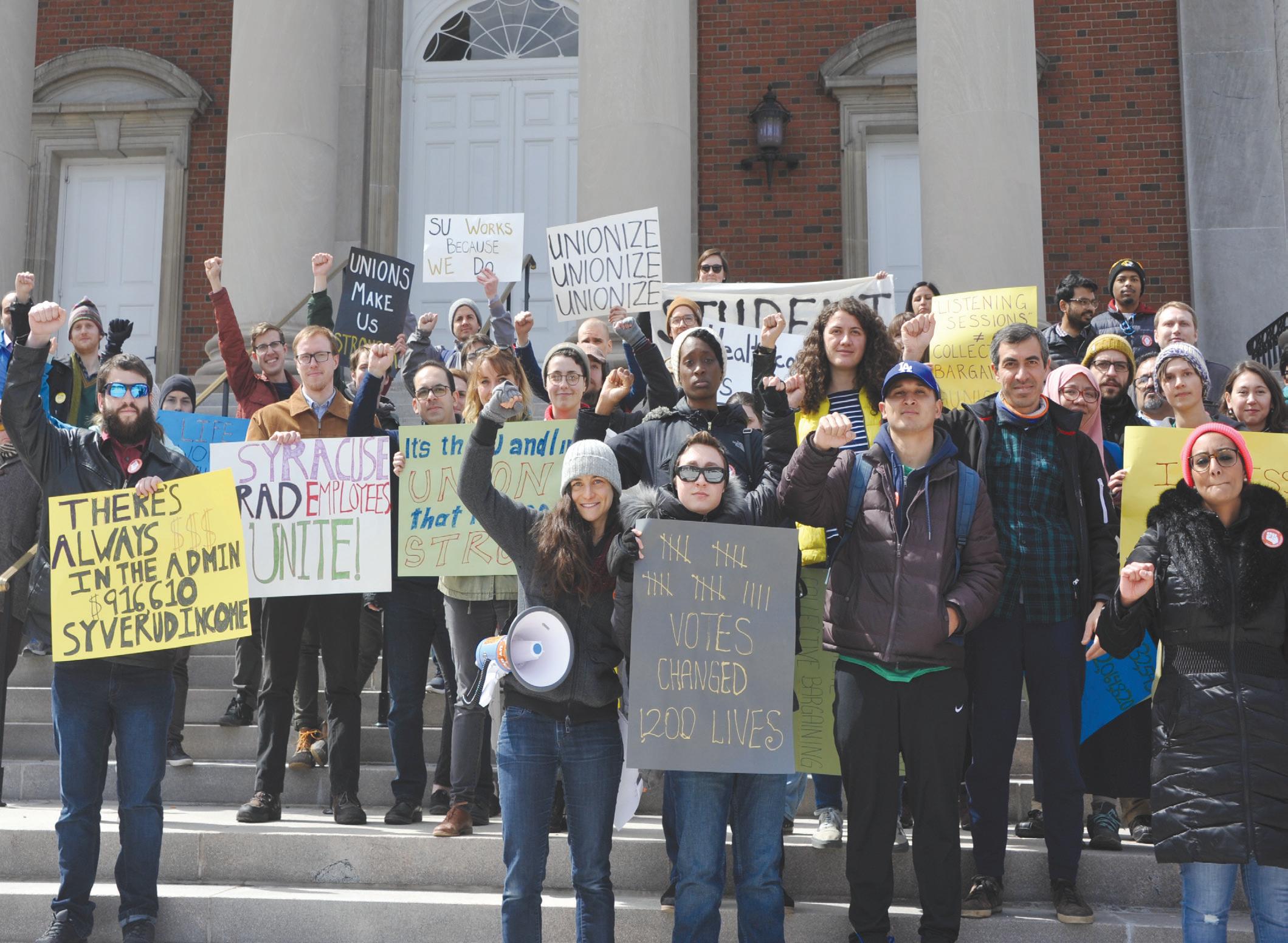
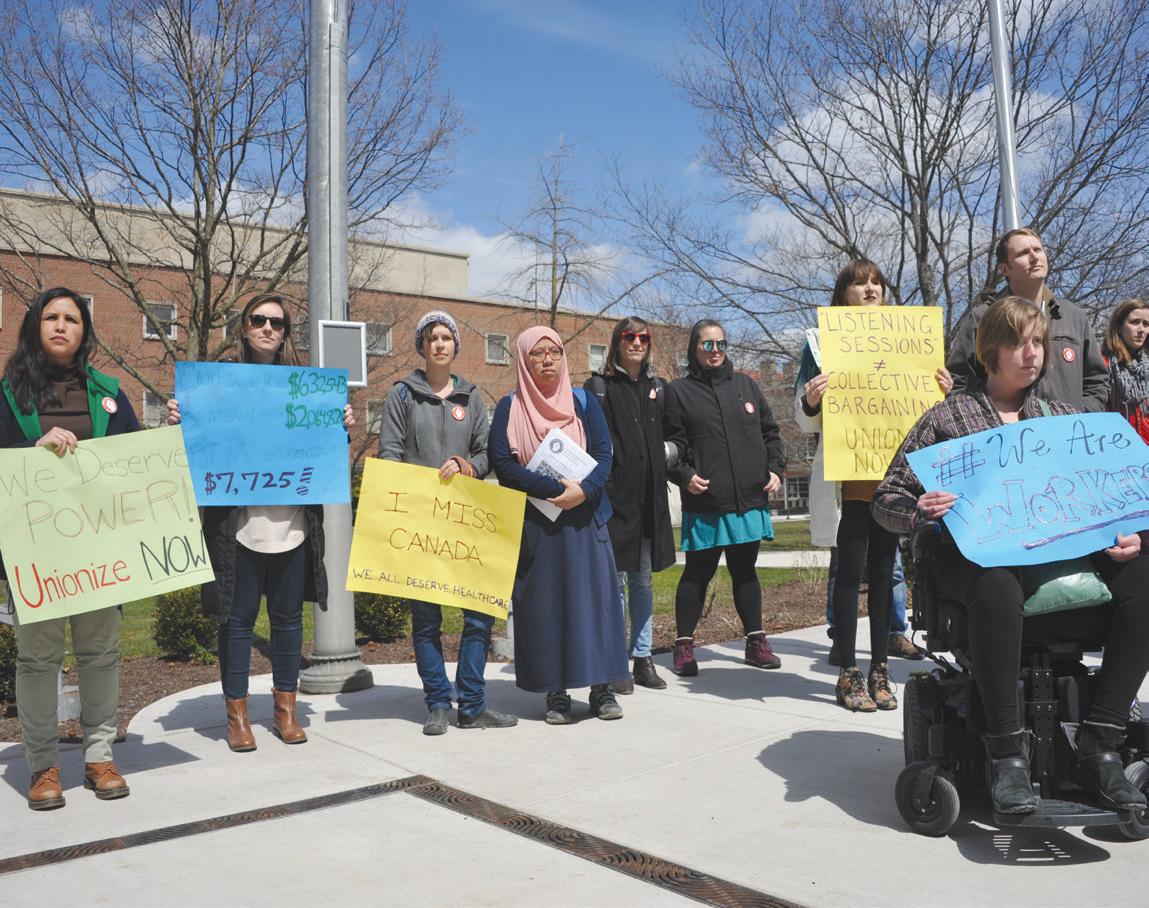
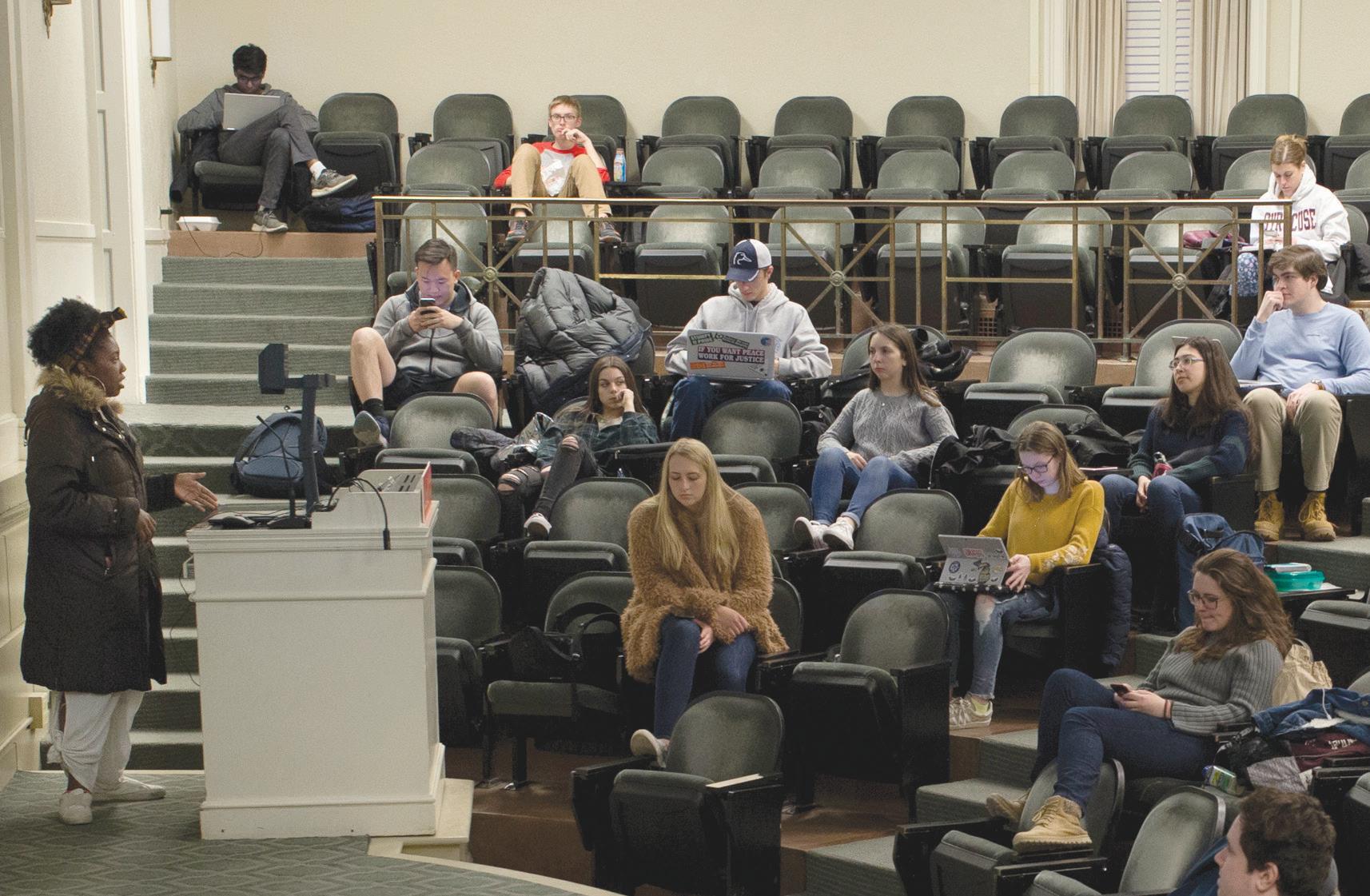
About 50 Syracuse University community members protested on the steps of Hendricks Chapel Monday afternoon to speak out against a new graduate student health care plan passed by the Graduate Student Organization last week.
Syracuse Graduate Employees United, a group of graduate student employees who opposed the new plan and are pushing to unionize, organized the protest.
“Regardless of whatever Peter Vanable’s emails say, this plan is worse,” said Brandon Daniels, a graduate student. Vanable is dean of the graduate school.
SU’s new insurance plan is expected to reduce health care costs, administrators have said. hieu nguyen asst. photo editor
GSO representatives, at their meeting last week, passed a resolution to switch to a cheaper health insurance plan. The new plan would reduce the cost of graduate assistant health care coverage by $994, according to a factsheet distributed by university administrators. A graduate assistant with a spouse or partner also on their health care plan would save $1,057, according to the sheet. A graduate assistant with a child would save $653 and a graduate assistant with a family would save $717 under the new plan, per the sheet.
GSO passed the resolution with 24 representatives in favor.
Before the Monday rally, Terese Gagnon, a graduate student in the Maxwell School of Citizenship and Public Affairs, said SGEU wanted collective bargaining in the health care decision. SGEU, as a unionized group, would have legal power to bargain, but GSO can only bargain as much as SU dictates.
Brian Hennigan, another graduate student who helped organize the rally, said students want to show their dissatisfaction with not only the health care plan, but how little they have been told about it. SGEU wants to broaden the debate, he said.
At the rally, people held signs that read, “24 votes impacted 1,200 lives.” Various faculty and students, both undergraduate and graduate, spoke at the rally.
Joyce Kim, an undergraduate student, voiced concerns about the rising tuition costs and how SU will spend $100 million it plans to raise through the five-year Invest Syracuse initiative. She added that, instead of adding new resources and renovations, the school should focus on giving pay raises to professors and faculty.
“This initiative is going to cost $100 million, and we don’t know see protest page 4
S • In good hands
After taking over the job from Bradley Voigt, David Lipka — the resident handshake guy — keeps the Syracuse men’s lacrosse team loose before games. Page 16
Mayor’s 1st budget keeps tax rate flat
By Casey Darnell design editor
Syracuse Mayor Ben Walsh plans to keep the city’s property tax rate flat, cut spending and freeze hiring in his first budget proposal as mayor. Walsh presented his 2018-19 budget at Monday’s meeting of the Common Council. The budget includes a freeze on hiring and salary increases not included in the budget, as well as $2.8 million in cuts to departmental spending. The cuts, combined with $11 million from the city’s reserves, will allow the city to set aside funds for hiring new police officers and firefighters.
$11 MILLION
Expected city budget deficit under Mayor Ben Walsh’s Fiscal Year 2018-19 budget proposal
“The significant challenges our city faces will not be addressed in a single year. We need a long-term strategy, so this budget is really the first in a multi-year plan,” Walsh said at the meeting.
The total proposed budget spending is $245 million, excluding funding for the Syracuse City School District. That’s more than $3 million less than last year’s budget.
The city was expected to run a $16.5 million deficit, but Walsh’s budget puts next year’s deficit at $11 million.
“The good news is that’s lower than some early predictions, but the bad news is it’s unsustainable” Walsh said in an interview with The Daily Orange on Monday afternoon. “We know we cannot continue to operate at a deficit, but we think that we’re putting the right pieces in places to work towards eliminating that deficit.”
Walsh said he will seek assistance from the Financial Restructuring Board, a state panel that provides non-binding consultation to cities that are struggling financially. Working with the FRB allows the city to apply for $5 million in grants to implement see budget page 4
Syracuse University community members gathered at Hendricks Chapel on Monday afternoon to protest a graduate student health care plan recently passed by the Graduate Student Organization. hieu nguyen asst. photo editor
WALSH
Editor@dailyorange.com
News@dailyorange.com
Opinion@dailyorange.com
Pulp@dailyorange.com
Sports@dailyorange.com
Digital@dailyorange.com
Design@dailyorange.com
ADVERTISING 315-443-9794
BUSINESS
315-443-2315
EDITORIAL
315-443-9798
GENERAL FAX
315-443-3689
how to join us
The Daily Orange is an independent newspaper published in Syracuse, New York. The editorial content of the paper — which originated in 1903 and went independent in 1971 — and its online platforms are entirely run by Syracuse University students.
The D.O.’s coverage of the greater SU area is disseminated through 125 issues during the 2017-18 academic year with a circulation of 6,000 copies, a readership of 30,000 and online circulation of about 500,000 during publishing months. The paper is published Monday through Thursday when SU classes are in session, Fridays before home football games and select basketball games and in the cases of notable and newsworthy occasions. The D.O.’s online coverage is 24/7, including while SU is on break.
To help support The D.O.’s independent journalism, please visit dailyorange.com/donate.
If you are a Syracuse University or State University of New York College of Environmental Science and Forestry student interested in contributing to The D.O. on either its advertising or editorial teams, please email info@dailyorange.com.
corrections policy
The D.O. strives to be as accurate in our reporting as possible. Please email editor@dailyorange.com to report a correction.
inside
P • One-man show
Comedian, actor and movie-connoisseur Steve Hayes is performing a mix of personal stories and comedic monologues in Syracuse this weekend.
Page 7
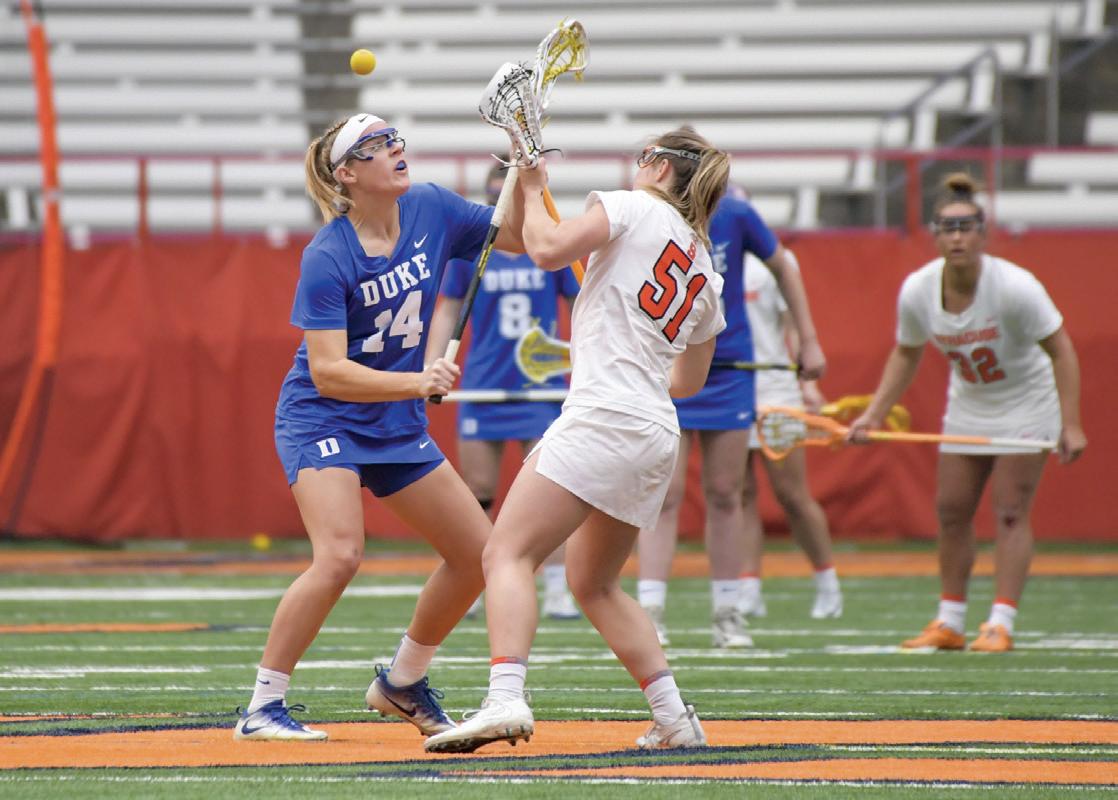
S • String them along Syracuse women’s lacrosse head coach Gary Gait likes stringing his players’ sticks. The way he does it has revolutionized the game.
The D.O. prides itself as an outlet for community discussion. To learn more about our submission guidelines, please email opinion@dailyorange. com with your full name and affiliation within the Syracuse community. Please note letters should not include any personal information pertaining to other people unless it is relevant to the topic at hand. All letters will be edited for style and grammar.
•
D.O. Pulp Newsletter • dailyorange.com
Get the scoop on all the happenings on and off the Syracuse University campus this weekend by signing up for The D.O. Pulp weekly newsletter.
D.O. Sports Newsletter
Check out our must-read newsletter for insight on behind-the-scenes decisionmakers and the details on the quirkiest stories in SU sports.
follow us
@dailyorange • @DOsports • @DO_pulp @DO_Visuals • @DO_Alumni • @DO_DailyDeals digital spotlight The Daily Orange • Daily Orange Sports The Daily Orange Alumni Association
Orange Deals @dailyorange • @dailyorange.events
THE DAILY ORANGE HAS A SNAPCHAT PUBLISHER STORY
Scan this code to subscribe to a weekly slice of Syracuse.
Police forum
Frank Fowler, Syracuse’s police chief, will discuss community policing efforts on Tuesday.
Executive session
Syracuse University’s Student Association closed off public discussion and went into executive session for more than an hour at its Monday night meeting. During portions of the meeting open to the public, the governing body approved additional funds for University Union and discussed Hendricks Chapel’s outreach to student organizations.
college of law
Dozens take oath during citizenship ceremony
By Kennedy Rose asst. news editor
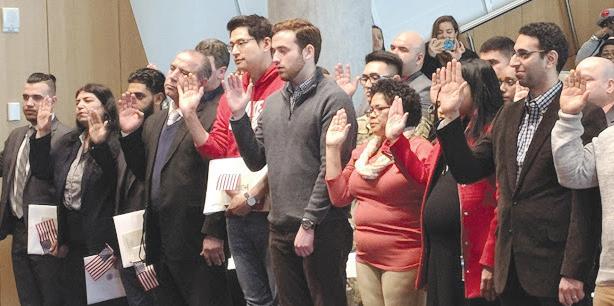
The College of Law hosted a citizenship naturalization ceremony Monday, honoring more than 50 new United States citizens.
Newly naturalized citizens swore their oath of allegiance before Thérèse Wiley Dancks, U.S. Magistrate Judge for the Northern District of New York, in the Melanie Gray Ceremonial Courtroom at Dineen Hall.
Several active-duty military personnel took the oath, wearing uniforms and holding small American flags in their hands. Others held small booklet copies of the U.S. Constitution.
Rep. John Katko (R-Camillus) attended the ceremony on Monday, along with Onondaga County Executive Joanie Mahoney and other local lawmakers.
“Today you become part of something great, the United States of America. And today, America becomes greater and more complete because of you,” Dancks said.
Fifty-one candidates hailing from 32 countries were naturalized on Monday, including 23 soldiers from the U.S. Army stationed at Fort Drum.
Upon taking the oath, the room erupted in applause and candidates were given a standing ovation by family, friends and lawmakers. As the recipients received their certificates, a toddler in the crowd yelled, “Yay!” several times.
Luaipou Tipi, from American Samoa, received applause after her friend yelled, “Woohoo, that’s my best friend!”
The Pledge of Allegiance was read by Private Ibrahima Fall, a newly-
naturalized citizen from Senegal.
“I hope that every time, when you stand up to give the Pledge of Allegiance, you put your hand on your heart and you feel it. Because it means something,” Katko said.
Katko said he was in awe of the soldiers in attendance because they were not citizens when they volunteered to serve in the military, willing to sacrifice their lives for the U.S. He said he was as proud of them as he was of his son, a second lieutenant in the U.S. Army.
“I am really grateful that you did the work,” Mahoney added. “I know how hard it is.”
Katko gave a flag flown over the U.S. Capitol to a randomly selected, newly naturalized citizen. It was presented to Oscar Baez, of Venezuela.
Dancks, Mahoney and Katko are graduates of SU’s College of Law.
The certificate handed out on Monday does not guarantee the
recipient’s ability to travel outside of the U.S., but they are allowed to use it to apply for a passport.
If the recipient has a child who has a green card, the child automatically becomes a citizen, but they do not get the same certificate that their parent does. The parent must file separate paperwork to get the certificate for the child. Certificates cost more than $500 and take about six months to process.
Chol Majok, a representative for New York state Sen. Dave Valesky, said New York is a beautiful state to live in, despite the cold weather that’s so unlike his home country of South Sudan. The crowd laughed. Many of the recipients were from countries in Southeast Asia, Africa or the Middle East.
“This place has given us a place to be. A place we can call home,” Majok said.
He said the U.S. is as beautiful as
Professor retires
David Crane, an SU professor who founded the Syrian Accountability Project, is retiring this
it is because of all the people who do their part. That could be as small as picking up trash or helping homeless people.
Maria Maldonado-Lewis, a representative of Syracuse Mayor Ben Walsh, congratulated the newly naturalized citizens and encouraged them to rely on networks of family, friends and their neighbors for support.
Dancks said no longer being allegiant to their former nations does not mean they should forget their culture and histories, and that they should contribute to the “melting pot” in the U.S. by sharing customs with their neighbors. Though many people fear the unknown, through sharing and education, she said people can bring a wealth of knowledge to the country.
“The American story is now your story,” Dancks said. “You are welcome here.” krose100@syr.edu @KennedyWrites
Candidates discuss fundraising initiative
By Ryan Dunn, India Miraglia and Sarah Slavin the daily orange
As Student Association elections continue this week, the three pairs of candidates all say they want to see funds from a multimillion-dollar Syracuse University initiative spent in different ways.
SU launched Invest Syracuse, a $100 million initiative to improve academic and other student experiences, in summer 2017. The Euclid Shuttle, a new bus route introduced in part by SA members, was supported by Invest Syracuse funds.
Here’s what the presidential and vice presidential candidates had to say about what they would do with Invest Syracuse funding opportunities.
Kaitlyn Ellsweig and Ryan Houck
Presidential candidate Kaitlyn Ellsweig and vice presidential candidate Ryan Houck said they would plan to focus on providing resources to SU international students and focus on their three campaign pillars: Empowering student voices, promoting diversity and advocating for student needs.
Ellsweig said she’d like to see Invest Syracuse funds spent on renovating campus buildings to make rooms and spaces accessible. She added that she thinks money should be spent on scholarship programs. SU already announced plans as part of the initiative to raise $40 million in the next two years to provide additional scholarship support.
The presidential hopeful said she wants to see the funds go toward increasing staff and advisers at the Slutzker Center for International Services and the Counseling Center. She’d also like to see free tutoring services expanded.
SU has already earmarked Invest Syracuse funds to expand Counseling Center services and launch a search for new staff.
Houck said he and Ellsweig would like to see the university be more transparent about where Invest Syracuse funds are being spent.
“Also, we want the university to make sure that students see a change while they are still students at the university, and not after they graduate,” he said.
Ghufran Salih and Kyle Rosenblum
Presidential candidate Ghufran Salih and her running mate Kyle Rosenblum also said they want to advocate for more transparency from the university in matters related to Invest Syracuse.
Salih and Rosenbaum expressed their support for the $100 million project, but emphasized they would like to see more publicized details regarding allocation of those funds. student
see candidates page 4
colleen cambier staff photographer
More than 50 immigrants swore their allegiance to the United States during a Monday ceremony at Syracuse University’s College of Law. kennedy rose asst. news editor
where the money is going,” she said. “A happy professor and/or TA makes for a lighter and better classroom setting.”
Several graduate students spoke after Kim, including Daniels, the graduate student.
Daniels said the new plan is worse for people who have chronic illnesses or families and emphasized that resistance is necessary for change.
Graduate student, mother and wife Christina Deka said that the health care plan negatively affected her and her family. She said that
the panel’s recommendations. Albany and Rochester have used the FRB in the past.
If a city’s deficit becomes too large, a state financial control board can take over a city’s finances to return the city to financial solvency.
The mayor also plans to increase city revenue through the enforcement of existing ordinances, such as housing code violations. A forthcoming Municipal Violations Bureau is expected to help the city lessen its backlog of such violations, Walsh said.
Austerity measures, like the hiring freeze and departmental spending cuts, will help the
“Right now we don’t really know what all that money is being allocated to, which is important to the students,” Salih said.
Along with increased transparency, Salih and Rosenbaum both said they wanted Invest Syracuse funding to be used for health and wellness initiatives.
Salih specifically said she would like to see increased support and accessibility for existing campus resources, such as the LGBT
her daughter was born with a disability and her husband has chronic health issues. While the employee health insurance plan may benefit people who are young and healthy, she said the new plan is worse for her.
“I’m really, really angry about it,” she said. “It feels like SU doesn’t want students like me.”
Biko Gray, an assistant professor in the College of Arts and Sciences, also spoke at the rally in support of SGEU. He said that he felt he has been used and taken advantage of as a black man. He said he felt that’s what’s happening to graduate students now.
Martin Gonzalez, a Ford Foundation Fellowship Scholar, said he has a scholarship that
city “achieve fiscal sustainability,” Walsh said.
The significant challenges our city faces will not be addressed in a single year.
Ben Walsh mayor of syracuse
Improving neighborhood safety is another key component of the budget proposal. The city has hired 25 to 30 new police officers this
candidate also said she wants the funds to go toward making the SU campus more accessible for students with disabilities.
“In general, a lot of the buildings we have here on campus are not as accessible to students,” Salih said.
Salih said she hoped to see Invest Syracuse expand student community engagement. Salih specifically mentioned expanding the Shaw Center, which helps students engage with the local community.
Rosenblum, in an interview with The Daily Orange Editorial Board on Saturday,
Regardless of whatever Peter Vanable’s emails say, this plan is worse.
Brandon Daniels syracuse university graduate student
only about 3 percent of applicants receive. He said he does community service and works with children who think that he’s at a university that cares about him. That’s not how it
year, and the budget will add an additional class of officers. Included in the budget are funds for additional police body cameras and new emergency vehicles.
The budget would also provide $750,000 for the Greater Syracuse Land Bank, a nonprofit organization that acquires abandoned and taxdelinquent houses and puts them to productive use by selling them for redevelopment, or demolishing them and repurposing the land.
Last May the council voted to remove the $1.5 million that had been allocated from the city budget for the Land Bank every year since its creation in 2012. An additional $500,000 will be used to “address blighted properties and demolitions,” Walsh said.
cost report that shows exactly where Invest Syracuse funds are going, if elected.
John Jankovic and Serena Fazal Presidential hopeful John Jankovic and vice presidential candidate Serena Fazal also said they’d like to see funding go to health and wellness initiatives, community engagement, academics and residence halls.
Current SA President James Franco and Vice President Angie Pati have advocated for increased funding and attention to health and wellness on campus, Jankovic said. He
feels, though, he said.
“I’m pissed off,” Gonzalez said. “They ain’t trying to support scholars.”
He asked the crowd of graduate students if they were angry, and most responded that they were.
Throughout the rally, graduate students yelled chants and participated in calls and responses led by students with a megaphone. One graduate student asked the crowd, “When grad worker health care is under attack, what do we do?”
The crowd responded, “Stand up and fight back!”
ccleffer@syr.edu | @ccleffert
Funds from the budget will go toward facttracking Syracuse Build, one of Walsh’s firstyear initiatives. Syracuse Build, a workforce development program, is designed to give city residents jobs on construction projects, including planned changes to Interstate 81. Walsh said the city is working to train residents and put them on worksites this year. The council will deliberate on spending for each department in the next three weeks before submitting its budget. The first of Syracuse’s budget hearings will begin Tuesday, April 10. The hearings are open to the public and, for the first time, will be live streamed through the city’s website and YouTube channel.
cdarnell@syr.edu
campus, he added.
Jankovic said money allocated for community engagement could go toward events that would benefit both the campus and the surrounding area.
“At Syracuse we are kind of in a bubble, on a hill, so it’s about making sure we empower students to kind of go past that,” he added.
Funding for academics could potentially include expanded research opportunities, Jankovic said. He added that he would like to see funds help provide more labs on campus. rarozenb@syr.edu
Nixon’s run challenges political misconceptions
Cynthia Nixon is in the running to become the first woman and openly LGBTQ individual to become governor of New York, and she’s already receiving ignorant insults, including a recent dig as an “unqualified lesbian.”
Former New York City Council Speaker and 2013 mayoral candidate Christine Quinn, an openly gay supporter of Gov. Andrew Cuomo, delivered the insult a day after Nixon, who said in 2012 she identifies as bisexual, announced she would challenge the incumbent Cuomo, also a Democrat.
Quinn’s criticism of Nixon, as well as other criticisms based on the candidate’s sexuality, demonstrate how ingrained intolerance remains in society. By associating lesbianism with Nixon’s incompetence for public office, Quinn echoes the pejorative application of “lesbian,” which is often used in hateful and anti-LGBTQ speech.
And following her visit to campaign’s visit to Syracuse last week, it’s crucial for local residents to consider all the implications a Nixon administration can have on New York residents — both the political and the personal.
While Quinn has apologized and Nixon has adopted the phrase as a campaign slogan, this exchange puts a spotlight on questions of identity and one’s fitness to serve in public office. These questions have grown more pressing under the Trump administration, which has made political moves and promoted rhetoric that targets LGBTQ individuals. Trump recently approved a ban on most transgender troops, and Vice President Mike Pence has a history of endorsing anti-LGBTQ groups and policies.
“There’s misogyny in there, there’s a whole bunch of negative associations with that word,” said Robin Riley, director of LGBT studies at Syracuse University and an assistant professor of women’s and gender studies. “As soon as you say that word, you tap into this long history of homophobia, and then Cynthia Nixon becomes unthinkable in that position for all sorts of reasons.”
Nixon’s celebrity status as a former star of the HBO hit “Sex and the City” and her sexuality have been the primary focuses of her run so far in the eyes of the public. Nixon’s quali-
fications as a politician are directly tied to her identity and to larger questions about the relationship between political representation and political action. This is made more complex by Cuomo’s advocacy for and enactment of policies that are inclusive to LGBTQ communities.
This year, Cuomo appointed the state’s first openly LGBTQ presiding justice and has banned New York state organizations from working with corporations that discriminate against LGBTQ individuals. New to politics, Nixon has engaged in LGBTQ activism for many years. Still, LGBTQ advocacy groups and politicians have voiced their support for Cuomo, citing both Cuomo’s track record and Nixon’s lack of political experience.
Number of openly LGBTQ candidates Victory Fund has endorsed in 2018 source: nbcnews.com
As a cisgender, straight white woman, I wouldn’t presume to know how Nixon’s potential election would influence LGBTQ rights. But whatever your position on Nixon’s candidacy is, her run provides a much-needed spotlight on the issues of LGBTQ representation in local and national politics.
It’s necessary we reflect on our own complicity in the normalization of anti-LGBTQ sentiments and otherwise intolerant ways of thinking and being. This reflection must embody all our practices — and most importantly, how we support candidates.
This begins by engaging in political debates that don’t reduce candidates to how they identify, but ask crucial questions about their potential for enacting progressive change. We should embrace the complexities in all our political decisions and gather information before endorsing a candidate, no matter who they are.
We must resist the traps of hyper-partisan politics to ask nuanced questions about a candidate’s credibility for public service. Only then can we resist the normalization of the misogynistic, patriarchal, racist and anti-LGBTQ sentiments that already plague our political systems.
C.C. Hendricks is a doctoral candidate in composition and cultural rhetoric. Her column appears biweekly. She can be reached at crhen100@syr.edu.
editorial board
SU should encourage assault discourse
The Syracuse University administration has a responsibility to take assault and harassment accusations into consideration when honoring alumni — whether through honorary degrees, statues or other commemorations — to end the preservation of problematic legacies on its campus. This conversation starts with Jim Brown.
Two SU alumni, Samantha Skaller and Seth Quam, are pushing to remove a statue of former Syracuse football player Jim Brown that sits outside the Ensley Athletic Center on South Campus and revoke his 2016 George Arents Award, which recognizes alumni achievement, in light of his controversial history of violence against women.
Between 1965 and 2000, Brown was accused and investigated for at least six incidents of violence against women, including one rape case. Brown was never convicted of rape or assault.
The Daily Orange Editorial Board acknowledges the complexities surrounding Brown’s legacy — which includes his famed affiliation with Syracuse, his advocacy in the civil rights movement and the
letter to the editor
assault accusations made against him — especially in the wake of the #MeToo movement, which has shown the prevalence of sexual assault and misconduct across industries. By promoting more dialogue, the #MeToo movement has forced society to confront how we should perceive individuals we may admire but who have been accused of assault.
That confrontation can be incredibly difficult, and there is no one solution on how to approach it.
Regardless of whether the SU administration removes the statue or revokes Brown’s award, it should publicly answer Skaller, Quam and community members who share their concerns. The administration should not factor potential rebuke from the campus community into its decision to release a public statement on the matter.
In an era when we are learning how to discuss sexual assault, the university won’t be able to produce an answer that fits every perception of Jim Brown in the SU community, and it shouldn’t be expected to. Still, a clear and thorough explanation of the decision to either keep or remove the statue
and award is warranted to the campus community. A community that, like so many others, must confront its own sexual assault problem.
By acknowledging the reality of sexual assault, harassment and misconduct in its own community, SU can facilitate conversations that work toward tangible solutions. That could foster an understanding that some notable alumni shouldn’t be memorialized, and foster a campus that can have the difficult conversations necessary to confront sexual assault. That is the best way SU can stand in solidarity with assault victims and work toward a future defined by proactivity, not reactivity.
The Daily Orange Editorial Board serves as the voice of the organization and aims to contribute the perspectives of students to discussions that concern Syracuse University and the greater Syracuse community. The editorial board’s stances are determined by a majority of its members. Are you interested in pitching a topic for the editorial board to discuss? Email opinion@dailyorange.com.
SA leadership reflects on 61st session
Painted in white on the bright orange walls of the Student Association office, there’s a question. Through every meeting attended, policy implemented, initiative put into place and sleepless night — it’s the only question that matters: What have we done for students?
This year, the 61st Legislative Session of Student Association has expanded on the positive advocacy previous sessions have accomplished. In this three-part series, we’ll outline what members of our organization have done for students. We have:
Continued to focus on Health and Wellness by:
• Successfully advocating for the expansion of SU’s Counseling Center, ensuring the implementation of a policy recommendation from the 60th’s Legislative Session’s Mental Health Report. (Invest Syracuse; Partners: Active Minds)
• Executing the Second Annual Mental Health Awareness Week. (Partners: Hendricks Chapel, Office of Health Promotion, Counseling Center, Office of Student Assistance, Active Minds, NAMI, Delta Kappa Alpha, Disability Cultural Center)
• Advocating and partnering to
offer a free and confidential STI testing clinic. (Partners: Be Well SU)
• Putting on Frisky February’s Sexual Health Resource Fair.
(Partners: Office of Health Promotion, Pride Union, It’s On Us, SASSE, Safer Sex Express, Health Services, Planned Parenthood CNY, Arc Health, SUNY Upstate Medical University)
• Partnering on communication during the mumps outbreak.
(Partners: VISION for Entrepreneurs, E Club, Health Service interns from Falk College)
• Hosting an open forum allowing students to interact directly with health administrators.
(Partners: Counseling Center, Health Services, Office of Health Promotion, Recreation Services, Division of Enrollment and Student Experience)
• Establishing the Health and Wellness subcommittee within SA.
• Supporting Take Back the Night on the planning committee.
• We are continuing to work on:
• Expanding the pilot menstrual health program from the 60th Legislative by installing dispensers by the end of this semester.
• Publishing a policy implementation recommendation
regarding the peer listening service, allowing students to voice concerns to trained peers; this service is scheduled to tentatively launch in Fall 2019 or Spring 2020.
• Forming a formal partnership with the Crisis Text line. Continued to focused on students’ safety and transportation concerns by:
• Launching the Euclid Shuttle — a late night, off-campus shuttle to increase safe transportation options for students. (Invest Syracuse)
• Sponsoring 1,000 free Uber rides for students.
• Co-hosting “Trivia night with DPS” with the Department of Public Safety to increase communication between DPS and students.
• Successfully advocating for pedestrian safety by presenting student suggestions for the implementation of crosswalks and stop signs around campus.
Sincerely, Angie Pati, Student Association Vice President James Franco, Student Association President
The 61st Legislative Session of Student Association
C.C.
Sell yourself
Humor columnist Lauren Perlowski writes an honest cover letter to prospective employers. See dailyorange.com
Travel tips
YouTube stars Damon and Jo will be at SU on Wednesday to discuss traveling on a budget. See Wednesday’s paper
Sustainable style
own shop using environmentally-safe products.
Salon Amare in downtown Syracuse uses
products
By Haley Robertson asst. copy editor
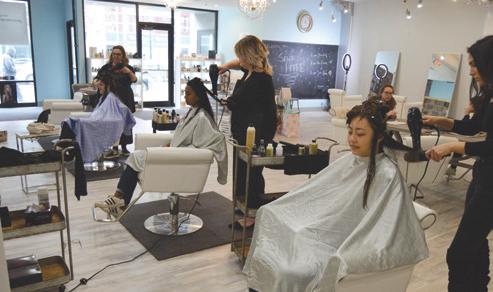
When Anne Marie Fleitz was in middle school, she cut her mother’s bangs with household scissors. This was the start of a lifelong interest in cosmetology. After more than 20 years as a stylist, she now owns her own salon in downtown Syracuse that offers eco-safe products and services.
Salon Amare opened on South Warren Street in January and offers haircuts, color, waxing and makeup application.
The salon uses environmentally-safe products from Davines, a registered B Corporation where Fleitz worked as an educator. Her passion for the brand inspired her to start her own salon. It’s taken off in recent months and seen an influx of students from Syracuse University thanks to a partnership with Hill Communications.
Every Davines product used at the salon comes from sustainable farms, including a “farm to shower” essentials line, Fleitz said. All paper-packaged products are hand-wrapped without glue and come from the Forest Stewardship Council, which advocates for responsible use of forest resources.
“There is a healthy company out there that is not only good for us as stylists to use, but also good for the clients to bring home and safe for the environment,” Fleitz said. “And the products work.”
Fleitz is working toward making the business a Green Circle Salon, which recycles unused color and all clipped hair. Green Circle makes hair bundles to help clean up debris from oil spills in the ocean.
Salon Amare currently has one employee, Ashley Rewakowski, but Fleitz is actively searching for more stylists. While the salon doesn’t have a sign up yet, Rewakowski said that people
YouTube star to perform in one-man show
By Haley Robertson asst. copy editor
When upstate New York native Steve Hayes was 8 years old, his mother said he had two options for an Easter present: a basket of treats or a trip to the movie theater to see “South Pacific.” Hayes chose the movie.
Since then, Hayes has pursued a career in show business, racking up experience in cinema, television and theater. His one-man show “Raised by Warner Brothers, Born in Syracuse” will play three performances at the Red-
An SU alum wrote about strides made in cancer research after his brother died from the disease. See Wednesday’s paper
house Arts Center this weekend.
Hayes describes his upcoming performance as funny, lighthearted and naughty at times. The show will fuse together his storytelling abilities with his humorous side, mixing autobiographical elements with comedic ones.
The entertainer is from New Woodstock, a small town located near Cazenovia. Hayes is excited about performing at the Redhouse because of its community-centered approach to the fine arts.
“The Redhouse is such a wonderful organization because they
take such interest in community,” Hayes said. “They don’t do safe things, they do a lot of unconventional things.”
Although he’ll be taking the stage this weekend, Hayes has always had a love for the silver screen. His interest in film developed through watching “NBC Saturday Night at the Movies” during his adolescence in the ‘60s. Hayes joked that his mother used this interest in film as an incentive for good behavior.
“My mother used to blackmail me,” Hayes said. “She’d look up in the Sunday paper, find out what’s
going to be on ‘Saturday Night at the Movies’ and say ‘Alright, next week: “Demetrius and the Gladiators,” you better behave all week long.’”
His favorite movie is one he watched when he was a kid: Alfred Hitchcock’s “Vertigo.” The movie greatly affected him, despite being only 9 or 10 years old when he first saw it. Growing up, Hayes enjoyed watching movies over and over again. He would watch for different things, such as how they were shot and how the music played a part.
This love for cinema stuck with him see hayes page 10
By Amy Nakamura design editor
When Jenna Koyama arrived at Syracuse University as a freshman from Hawaii, she felt lonelier than she did in the middle of the Pacific Ocean. Coming from a predominately Asian environment, Koyama found the transition to SU’s white-majority campus extremely difficult.
Koyama’s situation isn’t exclusive. She joined Asian Students in America, a general Asian-interest student organization on campus, and found that many Asian American students at SU felt a lack of appreciation and understanding on campus. Now, some of these students work to create events that recognize their ethnic history and experiences.
This month, Syracuse will celebrate Asian American and Pacific Islander Heritage Month with lectures and events to highlight Asian American and Pacific Islander culture. While the heritage month is typically celebrated in May, SU is celebrating a month earlier while classes are still in session. For many students, especially those in the AAPI community, it’s a chance for the rest of SU to learn about AAPI culture and history.
“It’s always been kind of my mission to have events that really promote Asian cultures and show everyone that this is who we are, this is what we’re about, and it’s okay to be different, especially for the freshmen who were in a similar position as me,” Koyama said. “It’s always been my goal to make sure they have a place on campus.”
While the events are centered around Asian American identity and culture, the organizations involved stress students don’t have to be Asian to come to this month’s events.
“Having an opportunity to expand our horizons is really important,” said Bryan Dosono, a Ph.D. candidate at the School of Information Studies and planning committee member. “This month is a really great way for people, especially those who don’t identify as Asian American, to learn about Asian-American culture in an inclusive and safe way.”
The month’s events are hosted by the Office of Multicultural Affairs, but student organizations such as ASIA, Korean American Student Association and Asianinterest Greek organizations have been involved in the planning process. Huey Hsiao, associate director for the Office of Multicultural Affairs and chair of the AAPI Heritage Month planning committee, said organizers aim to get more people thinking about what it means to be Asian American and how to build solidarity within the community.
This year’s AAPI Heritage month theme is “Reclaim the Past, Reframe the Future.” The theme
see heritage page 10
ANNE MARIE FLEITZ opened a salon on South Warren Street in January after working for the brand Davines, which inspired her to open her
haley robertson asst. copy editor
WE THE UNDERSIGNED WOMEN
FACULTY OF SYRACUSE UNIVERSITY WANT TO ADDRESS SOME ISSUES AROUND THE RECENT UNIVERSITY-WIDE SALARY REPORT.
In December 2017, Syracuse University announced to the university community that a university-wide committee’s Faculty Salary Report yielded an unequivocal finding: there is substantial inequity between the salaries of female and male professors at the levels of Associate and Full Professor, translating to an enormous loss of earning potential over time that has a lifelong effect including retirement savings. Our Provost instructed the deans and schools to immediately implement the committee’s recommendations to remedy this inequity.
We’re pleased that the university commissioned the report. Given that it found serious systemic inequities in how women and men at the university are paid, we’re also pleased that the Provost’s office is taking action to begin correcting these inequities.
We do, however, have concerns about the ways in which the university is addressing these inequities. Specifically, the university is offering money to the dean of each college and asking them to use that money to address those inequities.
This is problematic for several reasons. One, it puts both the burden of and the capacity for making change on the Dean’s rather than the university itself. We must remember that the schools, and the departments and units within them, are where the inequities arose and were perpetuated.
Two, the gender gap at Syracuse University grows out of a set of biases that are systemic, institutionalized, and deeply ingrained, as they are in the rest of the culture. These gendered salary inequities constitute discrimination. No one dean’s or school’s biases or opinions—whether intentional or unconsciously internalized—should guide the process of addressing these salary inequities. We strongly recommend the university administration exercise oversight over this process to make sure this discrimination is addressed systematically and fairly.
To push back against these biases, and the resulting pay gap, requires both a willingness to do this work and an ability to be self-critical. At least two deans have already signaled an unwillingness to do either of these, which potentially leaves the women in those colleges without redress or the ability to address the issue.
Our paramount concern is that the process of remedying the salary inequity between male and female professors at Syracuse University be immediate, transparent, and complete. We have these pressing requests:
1. That the process of implementing salary equity not stop at the deans’ requests for selective raises but be thorough and systematic across all schools and overseen by the Provost;
2. That the cumulative effects over time of this past inequity be acknowledged and addressed;
3. That the university require every college to correct ALL inequities in a standardized way;
4. That both the university and the individual deans maintain transparency around this issue.
The issue of salary equity is timely and urgent. Equal pay for equal work is the law. This will either be a crisis of major proportions or open a window of opportunity for Syracuse University to show itself as the model and leader that it is.
SINCERELY,
Harriet Brown, Professor, S.I. Newhouse School of Public Communications
Lori A. Brown, Professor, School of Architecture
Margaret Susan Thompson, Associate Professor, Maxwell School
Tula Goenka, Professor, S.I. Newhouse School of Public Communications
Fiona Chew, Professor, S.I. Newhouse School of Public Communications
Catherine M. Engstrom, Associate Professor, School of Education
Elisabeth Lasch-Quinn, Professor, Maxwell School
Mara Sapon-Shevin, Professor, School of Education
Patricia A Moody, Associate Professor, College of Arts and Sciences
Beth A. Ferri, Professor, School of Education
Deborah Pellow, Professor, Maxwell School
Crystal Bartolovich, Associate Professor, English
Barbara Applebaum, Professor, School of Education
Jackie Orr, Associate Professor, Maxwell School
Denise Heckman, Associate Professor, School of Design
Audie Klotz, Professor, Maxwell School
Sarah McCoubrey, Professor, School of Art
Christine Elaine Ashby, Associate Professor, School of Education
Joanne Punzo Waghorne, Professor, College of Arts and Sciences
Diane Grimes, Associate Professor, Communication and Rhetorical Studies
Farhana Sultana, Associate Professor, Maxwell School
Cecilia Green, Associate Professor, Maxwell School
Yutaka Sho, Associate Professor, School of Architecture
Shannon Novak, Associate Professor, Maxwell School
Susan S. Wadley, Professor, Maxwell School
Jennifer Stromer-Galley, Professor, School of Information Studies
Prema Kurien, Professor, Maxwell School
Martha Garcia-Murillo, Professor, School of Information Studies
Samantha Kahn Herrick, Associate Professor, Maxwell School
Susan Edmunds, Professor, College of Arts and Sciences
Elizabeth Kamell, Associate Professor, School of Architecture
Laura Heyman, Associate Professor, Department of Transmedia
Anonymous, Assistant Professor, College of Visual and Performing Arts
Deborah Dohne, Associate Professor, College of Visual and Performing Arts
Fran Tucker, Associate Professor, Whitman School of Management
Carol M. Liebler, Professor, S.I. Newhouse School of Public Communications
Kira Reed, Associate Professor, Whitman School of Management
Emily Stokes-Rees, Assistant Professor, College of Visual and Performing Arts
Susan Albring, Associate Professor, Whitman School of Management
Robin Riley Assistant Professor College of Arts & Sciences
Myrna García-Calderón, Associate Professor, College of Arts and Sciences
M. Gail Hamner, Professor, College of Arts and Sciences
Coran Klaver, Associate Professor, College of Arts and Sciences
Alicia Ríos, Associate Professor, College of Arts and Sciences
Eleanor Maine, Professor, College of Arts and Sciences
Qinru Qiu, Professor, College of Engineering and Computer Science
Stephanie Fetta, Assistant Professor, College of Arts and Sciences
Chandra Talpade Mohanty, Distinguished Professor, Women’s and Gender Studies
Marcene Sonneborn, Professor of Practice, School of Information Studies
Ping Zhang, Professor, School of Information Studies
Shobha K. Bhatia, Professor, College of Engineering and Computer Science
Jude Lewis, Associate Professor, School of Art, College Of Visual and Performing Arts
Anonymous, Assistant Professor, Whitman School of Management
Lucinda K. Havenhand, Professor, School of Design, College of Visual and Performing Arts
Caroline Haythornthwaite, Professor, School of Information Studies
Ann Grodzins Gold, Thomas J. Watson Professor of Religion and Professor of Anthropology
Melissa Chessher, Professor, S.I. Newhouse School of Public Communications
Eunjung Kim, Assistant Professor, Women’s and Gender Studies, College of Arts and Sciences
Ingrid Erickson, Assistant Professor, School of Information Studies
Minet Schindehutte, Associate Professor, Whitman School of Management
Emily Vey Duke, Associate Professor, College of Visual and Performing Arts
Kathleen Roland-Silverstein, Assistant Professor, College of Visual and Performing Arts
Deborah Nosky, Professor of Practice, School of Information Studies
Barbara H. Kwasnik, Professor, School of Information Studies
Vivian M. May, Professor, College of Arts and Sciences
Erin J. Rand, Associate Professor, College of Visual and Performing Arts
Carol Fadda, Associate Professor, College of Arts and Sciences
Anonymous, Assistant Professor, College of Visual and Performing Arts
Gwendolyn D. Pough, Professor of Women’s and Gender Studies and Dean’s
Professor of the Humanities
Susan R. Henderson, Professor, School of Architecture
Kara Herold, Assistant Professor, College of Visual and Performing Arts
Anonymous, Assistant Professor, College of Visual and Performing Arts
Amy Kallander, Associate Professor, History, Maxwell School
Eileen E. Schell, Professor, College of Arts and Sciences
Eileen Kloss, Assistant Professor, School of Design, College of Visual and Performing Arts
Patricia Roylance, Associate Professor, College of Arts and Sciences
Dianna Miller, Assistant Professor, College of Visual and Performing Arts
Jian Qin, Professor, School of Information Studies
Elizabeth F Cohen, Associate Professor, Maxwell School
Louise R Manfredi, Assistant Professor, College of Visual and Performing Arts
Sinead Mac Namara, Associate Professor, School of Architecture, College of Engineering and Computer Science
Virginia Burrus, Distinguished Professor, College of Arts and Sciences
Susannah Sayler, Associate Professor, College of Visual and Performing Arts
Dawn R. Johnson, Associate Professor, School of Education
Radha Kumar, Assistant Professor, History, Maxwell
Sarah Pralle, Associate Professor, Maxwell School
Marilyn P. Arnone, Professor of Practice, School of Information Studies
Anne Munly, Professor, School of Architecture
Radhika Garg, Assistant Professor, School of Information Studies
Rachel Ivy Clarke, Assistant Professor, School of Information Studies
Bess Krietemeyer, Assistant Professor, School of Architecture
Molly Hunker, Assistant Professor, School of Architecture
Julie Larsen, Assistant Professor, School of Architecture
Margarita Estévez-Abe, Associate Professor, Political Science, Maxwell School
Marion Dorfer, Associate Professor, School of Design, College of Visual and Performing Arts
Stephanie James, Professor School of Art, VPA
Joanna Spitzner, Associate Professor, School of Art, College of Visual and Performing Arts
Kristy Buzard, Assistant Professor, Maxwell School
Sascha Scott, Associate Professor, College of Arts and Sciences
Kathryn Everly, Professor, College of Arts and Sciences
Seyeon Lee, Assistant Professor, School of Design, College of Visual and Performing Arts
Anonymous, Associate Professor, S.I. Newhouse School of Public Communications
Dalia Rodriguez, Associate Professor, School of Education
Linda Stone Fish, Professor, David B. Falk College of Sport and Human Dynamics
Janice Dowell, Professor, College of Arts and Sciences
Dyane Watson, Professor of Practice, David B. Falk College of Sport and Human Dynamics
Rachel Aubrey, Teaching Professor, School of Design, College of Visual and Performing Arts
Rashmi Gangamma, Assistant Professor, David B. Falk College of Sport and Human Dynamics
Kara Richardson, Associate Professor, College of Arts and Sciences
Joan Bryant, Associate Professor, African American Studies
Gail A. Bulman, Associate Professor, College of Arts and Sciences
Sarah E. Hall, Assistant Professor, College of Arts and Sciences
Erika Haber, Associate Professor, College of Arts and Sciences
Rania Habib, Associate Professor, College of Arts and Sciences
Paula C. Johnson, Professor, College of Law
Arlene S. Kanter, Professor, College of Law
Mary Helen McNeal, Professor, College of Law
M. Emma Ticio, Associate Professor, College of Arts and Sciences
Susan Branson, Professor, Maxwell School
Deb Coolhart, Assistant Professor, David B. Falk College of Sport and Human Dynamics
Nancy R. Mudrick, Professor, David B. Falk College of Sport and Human Dynamics
Anonymous, Assistant Professor, College of Visual and Performing Arts
Suzanne Baldwin, Michael G. & Susan T. Thonis Professor of Earth Sciences, College of Arts and Sciences
Tina Nabatchi, Associate Professor, Maxwell School
Gretchen Purser, Assistant Professor, Maxwell School
Barbara Walter, Professor, School of Art
Laura K. Lautz, Jessie Page Heroy Professor, College of Arts and Sciences
Janis A. Mayes, Associate Professor, Department of African American Studies, College of Arts and Sciences
Tara Kahan, Assistant Professor, College of Arts and Sciences
Susan E. Parks, Associate Professor, College of Arts and Sciences
Kari A. Segraves, Associate Professor, College of Arts and Sciences
Shana Kushner Gadarian, Associate Professor, Political Science, Maxwell School
M. Lisa Manning, Associate Professor, Physics, College of Arts and Sciences
Marina Artuso, Professor, Physics, College of Arts and Sciences
Mary E. Lovely, Professor, Economics, Maxwell School and College of Arts and Sciences
Karina von Tippelskirch, Associate Professor of German, College of Arts and Sciences
Katharine Lewis, Associate Professor, College of Arts and Sciences
Hille Paakkunainen, Assistant Professor, College of Arts and Sciences
Amanda Brown, Associate Professor, College of Arts and Sciences
Melissa A. Green, College of Engineering and Computer Science
M. Cristina Marchetti, William R. Kenan, Jr. Professor and Distinguished Professor of Physics, College of Arts & Sciences
J. M. Schwarz, Associate Professor, Physics, College of Arts and Sciences
Katie Cadwell, Assistant Teaching Professor, College of Engineering and Computer Science
Michelle M. Blum, Assistant Teaching Professor, College of Engineering and Computer Science
Rebecca Ruige Xu, Associate Professor, College of Visual and Performing Arts
Emily B. Ansell, Associate Professor, College of Arts and Sciences
Ellyn Riley, Assistant Professor, College of Arts and Sciences
Jody Nyboer, Assistant Professor, School of Design
Donna Korol, Associate Professor, College of Arts and Sciences
Natalie Russo, Assistant professor, College of Arts and Sciences
Sharon Dotger, Assistant Professor, School of Education
Joan V. Dannenhoffer, Associate Professor, College of Engineering and Computer Science
Claudia Miller, Professor, College of Arts and Sciences
Aesoon Park, Associate Professor, College of Arts and Sciences
Susan D’Amato, Associate Professor, School of Art, College of Visual and Performing Arts
Jill Hurst-Wahl, Professor of Practice, School of Information Studies
Amy H. Criss, Professor, College of Arts and Sciences
Gladys McCormick, Associate Professor, Maxwell School
Anonymous, Assistant Professor, S.I. Newhouse School of Public Communications
Milena Petrova, Associate Professor, Whitman School of Management
Romita Ray, Associate Professor, College of Arts and Sciences
Theresa Singleton, Professor, Maxwell School
Laura VanderDrift, Assistant Professor, College of Arts and Sciences
Anonymous, Assistant Professor, Maxwell School
Melissa Pepling, Professor, College of Arts and Sciences
Susan Millar, Associate Professor, Maxwell School
Anonymous, Assistant Professor, Maxwell School
Maria Marrero, Professor, Department of Drama, College of Visual and Performing Arts
Amanda Eubanks Winkler, Associate Professor, College of Arts and Sciences
Sarah Fuchs Sampson, Assistant Professor, College of Arts and Sciences
Julianna Sabol, Associate Professor, College of Visual and Performing Arts
Carol M. Babiracki, Associate Professor, Arts & Sciences; Director, South Asia Center
Dana Cloud, Professor, Visual and Performing Arts
Rebecca Peters, Assistant Professor, Maxwell School
Jane Read, Associate Professor, Maxwell School
Yingyi Ma, Associate Professor, Maxwell School
Anonymous, Assistant Professor, S.I. Newhouse School of Public Communications
Cora True-Frost, Associate Professor, College of Law
Matilde Mateo, Associate Research Professor, Department of Art and Music Histories
Pamela Brandes, Associate Professor, Whitman School of Management
Sara Burke, Assistant Professor, College of Arts and Sciences
Linda Ivany, Professor, College of Arts and Sciences
Jannice Friedman, Assistant Professor, College of Arts and Sciences
Yelena Duterte, Associate Teaching Professor, College of Law
Azra Hromadžić, Associate Professor, Maxwell School
Sandra D. Lane, Professor, The Falk School
Heather Coleman, Assistant Professor, College of Arts and Sciences
Katie Becklin, Assistant Professor, College of Arts and Sciences
Renée de Nevers, Associate Professor, Maxwell School
Sandra J. Hewett, Professor College of Arts and Sciences
Sydney Hutchinson, Associate Professor, College of Arts and Sciences
Maureen Trudelle Schwarz, Professor, Maxwell School
Anonymous, Assistant Professor, Falk College
Yvonne Buchanan, Associate Professor, College of Visual and Performing Art
Stephanie Shirilan, Associate Professor, College of Arts and Sciences
Amy Lutz, Associate Professor, Maxwell School
Katherine E. McDonald, Professor, Falk College
Dessa Bergen-Cico, Associate Professor Public Health, Falk College
Anne E. Mosher, Associate Professor, Maxwell School
Lisa Olson-Gugerty, Associate Teaching Professor, David B. Falk College of Sport and Human Dynamics
Jessica L. MacDonald, Assistant Professor, College of Arts and Sciences
Anonymous, Associate Professor, College of Visual and Performing Arts
Anne C Bellows, Professor, Food Studies, Falk College
Susan Thomas, Assistant Professor, Cultural Foundations of Education, Syracuse University
Anonymous, Associate Professor, Whitman School of Management
have been stopping in because of the “beautiful display of products and the chandeliers.” In the past two weeks, she said she’s had about nine walk-ins.
Rewakowski has worked in other salons before and said other professionals in the industry have tried to follow a similar concept to what Fleitz is doing now. She was attracted to the salon because of its pristine condition and dedication to sustainability.
For Rewakowski, what sets Fleitz apart is her background as an educator and her zeal for her craft.
“She’s genuinely passionate about carrying on Davines’ mantra of just (be) aware, just be smart about what you’re using, have it be healthy, be good to yourself and be good to the earth,” Rewakowski said.
Hill Communications, a student-run public relations firm at SU, works with Salon Amare to manage their website and social media pages. It was the firm’s idea to conduct a con-
was created with the idea that the SU community can come together both to remember local and national incidents that affect the Asian American population and to bridge relations among other communities in general.
Year AAPI Heritage Month speaker Anish Shroff graduated from SU
This year’s AAPI Heritage Month Speaker for the commemorative lecture will be Class
test on Instagram, where each of the 13 Panhellenic Council chapters at SU got a post on the salon’s page. After 3 days, the chapter with the most likes on their post won $15 blowouts, normally $35, on the day of formal.
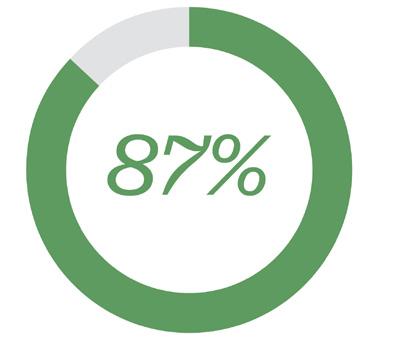
Salon Amare uses sustainable beauty brand Davines, whose hair coloring products are 87 percent biodegradable, paraben-free and gluten free.
SOURCE: DAVINES
Alpha Chi Omega won the contest, with over 3,430 likes on its post as of Monday evening.
Samantha Cooper, an account associate at Hill Communications and a freshman public relations major, said members shared the contest
of 2004 alumnus Anish Shroff. His lecture, titled “Ethnic Identity and the Power of Being Undefined,” will be held in the Peter Graham Scholarly Commons in Bird Library on Friday at 6 p.m.
Shroff received his bachelor’s degree in broadcast journalism from the S.I. New house School of Public Communications. He joined ESPN in 2008 and now works as an on-air host and commentator for college sports for the network, per SU News.
On April 18, an interactive workshop will be held between members of the AAPI community and the Latinx community. The workshop will discuss the respective experiences and cultural differences of each community. The event, titled “Breaking Bar riers in the AAPI and Latinx Community,” will be held from 6 to 8 p.m. in the Hall of Languages and is sponsored by the Filipino Student Association, Lambda Alpha Upsilon and Lambda Phi Epsilon. abnakamu@syr.edu | @nakamura_amy
with friends, family and chapters at different schools to help get more likes on their post.
“It was super exciting to hear people talking about it,” Cooper said. She added that the contest helped the salon gain over 500 Instagram followers, many of whom are Greek life members.
On Saturday from 11 a.m. to 5:45 p.m., over 20 members of the winning sorority braved the snow and wind to get their discounted blowouts at Salon Amare. Two guest stylists joined Fleitz and Rewakowski for the event.
With sorority members signed up for services at various times throughout the day, the salon experienced one of the busiest days since its opening. It was so hectic that during the early afternoon, the shop experienced technical difficulties with the breakers. Within a couple of minutes, the stylists had made the proper adjustments and were back in action.
Linda Lin, a junior psychology major and member of Alpha Chi Omega, said she likes the modern feel of the salon and the refreshments available in the waiting area. She said she will “most definitely” be back to the salon.
Cooper said the firm is happy with the success of the contest and is looking forward to working with the salon next semester.
Fleitz’s eco-friendly practices don’t stop at her business. She and her husband recently sold their house for a smaller condo, where she uses eco-safe household cleaning products such as vinegar. She added that it’s nice to walk places instead of driving sometimes too. Overall, Fleitz said the downsize in their living situation has made the couple more sustainable.
“Instead of using a ton of paper towels, we have rags,”she said. “It’s the things like that that you realize it’s not that big of a deal.”
In addition to hiring more stylists, Fleitz aims to spread awareness of the sustainable services and products her salon has to offer.
“Obviously it’s not going to make me a millionaire, being sustainable,” Fleitz said. “But as long as I can provide and be happy, and be good for the environment, that’s what really matters to me more.”
hrober03@syr.edu
A
From the studio
‘Musical historian’
Kurt Riley’s music draws from rock, hip-hop and electronic to create “meta-pop”
By Brooke Kato staff writer
Kurt Riley began his musical career as a teenager 15 years ago , when he turned to music as an outlet and means of selfexpression. Now, Riley is on tour and will perform at Funk ‘n Waffles on Saturday. His next single, which he’ll play at his gig in Syracuse, is expected to drop this month.
At first, Riley was interested in early rhythm and blues artists. Then he flashed forward, becoming more inspired by The Rolling Stones, Prince, and T. Rex.
“I became a musical historian,” he said. “I looked through decades of music.”
Riley describes his current sound as “metapop,” because it draws from various genres outside of pop such as rock, hip-hop and electronic — he loves to combine sounds.
The artist and his sound have both evolved over the years. Riley’s first album, Bright-
head, was recorded in classic DIY style inside a converted garage. One of the engineers of this album was Beyoncé producer BOOTS. His second album told a story about extraterrestrial life, and his most recent album is more “singer-songwriter.”
“I get bored easily, so I want to do something different (for every album). Each time, I am reinventing myself,” Riley said.
His latest song, released in February, is different from his previous work because it has electronic elements. Another single will debut this month, called “Failure of Imagination,” which combines rock and hip-hop sounds.
The song is about not listening to the people who tell you that you can’t make it, Riley said, and it reflects the rejection he has experienced. The new song will be a part of his setlist at his show in Syracuse.
“My setlists have to have a peak and a valley, much like if you’re looking at a roller coaster from the side,” he said. “It needs to be intense,
but there also needs to be moments where people can relax and contemplate.”
This is his first time in Syracuse, and he said his show is going to be incredible because of the electric percussion. This type of music can at times make the audience feel like they’re at a rock show, and other times like they are at an electronic music festival.
To Riley, applause is the one thing that makes performing great. That’s when he knows he’s done something right and people are enjoying his music.
“I’ve had people tell me I’m one of the more original artists in New York,” Riley said. “I try to be weird and stand out because being weird is more fun.”
Kurt Riley will be performing at Funk ‘n Waffles on Saturday, along with the group The Blind Spots. Doors open at 9 p.m. and the show begins at 10 p.m. Tickets are $10 and can be purchased online.
bnkato@syr.edu
KURT RILEY compares his setlists to rollercoasters — there are peaks and valleys and moments of intensity and relaxation. His newest single, “Failure of Imagination,” will debut this month. madeline foreman staff photographer
SU keeps practices fresh with triples drill, competition
By Anthony Dabbundo staff writer
With Syracuse’s season in the home stretch, head coach Younes Limam is getting creative in practice.
The NCAA allows 20 hours of tennis per week while in season, but Limam knows he can’t do drills and conditioning without burning out his team. To keep them fresh and engaged, Limam uses different practice strategies during the daily afternoon practice.
With Syracuse playing almost two matches per week, Limam keeps practice interesting by playing against the team himself and proposing games for the team to play against one another. No. 25 Syracuse (14-6, 6-5 Atlantic Coast) has two distinct practice settings with different vibes: individualized morning sessions and full team afternoon sessions.
“It’s really important to have them compete against each other, and we try to have everything in practice count,” Limam said. “We want
about it. I just try to let it hit me.”
After leading the team in hit by pitches last season with 11, Holmgren wasted no time in grabbing the team-lead this year, too. After getting plunked in six of the first nine games of the season, Holmgren started the year on base a lot, whether it was by choice or not.
Getting hit by pitches is a relatively new trend for Holmgren, who said that she didn’t get hit a lot when she was younger. Even at Western Kentucky as a freshman in 2016, Holmgren was hit three times in 45 games. Only when she arrived at Syracuse did she start
them to have that mentality where every single point, every game, every match is important.”
Limam said he is careful to balance the players’ fitness with practice time. Whenever SU plays on a Sunday, it doesn’t practice Monday. When SU doesn’t have a Sunday match, players get that day off and practice the next day.
During the offseason, the NCAA heavily regulates how much time players can spend in practice and fitness training. Limam is only allowed two hours of tennis weekly during the off-season with six hours allowed for fitness.
William Hicks, SU’s assistant athletic director for athletic performance, provides a workout plan to help the Orange improve fitness. Hicks develops two plans, one for the offseason and one for the regular season.
“When you’re feeling fit, it helps you mentally to know you can go the distance in tough matches,” Limam said. “Coach Hicks has done a tremendous job with the team.”
When the players build their class schedules for the spring semester, each plans around the daily afternoon practices and two individualized morning sessions each week.
career games at SU, she’s developed a knack for reaching base unconventionally.
Holmgren believes that her tendency to get hit stems from a few factors. As a left-handed batter, she said her right elbow at times hangs close to or over the plate when she’s in the box. Like Dreswick, most pitchers are right-handed. Holmgren often faces pitches on the innerhalf of the plate to crowd her and sometimes pitchers lose control. Holmgren’s willingness to “take one for the team” is another factor that sets her apart in her propensity to get hit.
“I wouldn’t consider it unlucky, I would consider it lucky,” head coach Mike Bosch said.
“Honestly, we just want to get on base any way.”
Holmgren’s consistency in reaching base was clear earlier this season when she broke
Individual practices are much more technical and focused towards improving skills with individual drills, Limam said.
Often, there are only one or two players that attend the morning sessions at a time with Limam and assistant head coach Shelley George. These individual practices are similar to how many of the players practiced growing up.
In the afternoon, Limam and volunteer assistant coach Len Lopoo frequently join in competitive mini-games. Syracuse’s favorite game is triples, where two teams of three face off on opposite ends of the court.
The ball is fed to two players standing on the baseline with one player at the net. This fast-paced, 3-on-3 game helps with reaction times, volleying and keeping the ball away from the person at the net, a major key to being successful in doubles.
“It’s important to have a lot of playful games within our practices,” Gabriela Knutson said. “Because if we don’t, we get into a lull and we’re too focused on just our game.”
SU plays king-of-the-court style games, keeping track of points to see who wins on
the program record for consecutive games reaching base. Holmgren’s streak of 46 broke the previous record of 32 and has since ended, but the WKU-transfer has already begun a new one, reaching base in eightconsecutive games.
Teammate Alicia Hansen has played 138 games for the Orange but has been hit by a pitch just once in her career. The reason, Hansen said, is because she’s “more inclined” than her teammates to move out of the way of pitches.
“Bryce will stick her arm out for it,” Hansen said. “It’s funny, because sometimes she’ll get hit and the umpire will call her back, and then she’ll get a hit, and the joke’s on you. You should want her to just get walked because you might be giving up extra bases if you pull her back.”
Local landlord, NOT corporate mgmt co. Off-street parking Fully-furnished Laundry facilities Short walk to campus
Rent starts at $395 per bedroom Leases negotiable
Call or text anytime: 315-263-5757
the specific court. When Limam stops play, whichever team has more points moves up a court. The team with fewer points moves down a court. After the drill, there is either a prize for the victors or a punishment for the losers. The winning teams sometimes win extra shirts or shorts, while the losing team is faced with a conditioning penalty. Limam joins the games to motivate his team as the players try to beat their coach.
“I like playing coach, it’s always pretty competitive,” Knutson said. “It’s always a goal to beat your coach, and I’ve beaten him a few times.”
When Limam isn’t playing alongside his players, SU practices more broad concepts, such as serving and returning. Limam and George discuss strategies for the upcoming match, making small changes in tactics. After a 7-0 loss at Miami on Sunday, the Orange didn’t practice on Monday. But by Tuesday afternoon, Limam will be wearing a tracksuit, wielding his Babolat racket and ready to challenge his team on the court.
amdabbun@syr.edu
With the Syracuse offense struggling to find consistent sources of power and contact hitting alike, Holmgren has been the lone source of consistency throughout the season. Her batting average has dipped slightly since beginning the year, but her on-base percentage still leads the conference.
Holmgren has remained steady getting on base all season long, even if it’s not in the most conventional way.
“One of our mottos is ‘find a way,’ so if you’re up, find a way on,” Hansen said. “No matter whether you bunt, get hit by a pitch, dropped third strike … taking one for the team sure, because it’s a baserunner that could mean a lot.”
of the stick head with his phone.
He didn’t know then, but that pocket was the result of a near 30-year trial-and-error experiment by Gait, his twin brother Paul and other brother Bob Gait. No. 16 Syracuse (8-6, 0-4 Atlantic Coast) has 43 players on its roster. All of them use sticks strung by Gait. He uses pieces manufactured by his brothers’ company, Laxpocket. The interconnected twine, mesh and leather are the Gait family’s latest gift to lacrosse, a sport they defined and are now trying to innovate.
“The modern pocket is a pocket that evolved from something that, you know, I came up with,” Gait said. “Now, I think every top school in D1 uses it.”
Maryland, Hofstra and Florida are programs that also use Laxpocket stick heads. Some schools, like Michigan, commission the Laxpocket staff to string all its sticks. Others, like North Carolina, have specialists — who are often team assistants — order materials from Laxpocket and string the sticks themselves.
Gait said he allows his players to string their own sticks, but they just prefer him to
Right before game time, the bench creates a tunnel on the field with the starters off to the side. The PA announcer begins to list off names, starting with the attack.
First it’s Nate Solomon, the player who has started in head coach John Desko’s lineup the longest of any player. It’s a quick high five with Lipka into a Macarena-like dance between the two before Stephen Rehfuss follows suit. It’s one of Lipka’s favorite handshakes, where he pats down Rehfuss
do it. Multiple SU players have said that Gait’s ability to have the pocket high up on a stick is invaluable. The stick pocket, according to NCAA rules, cannot be larger than 1.68-inches in diameter. Senior captain Riley Donahue said that Gait’s pockets are deep but not “illegally deep,” as no Syracuse stick has been flagged for being illegal this season.
A deep pocket allows a player more control with the ball, giving attacks more leverage when they attack the goal. SU’s offense ranks second in the ACC and 18th overall with more than 15 scores a game.
“Oh my gosh, it’s awesome,” freshman attack Mackenzie Baker said. “I’ve played with sticks in the past and then playing with sticks that he has worked on, it’s a huge difference.”
The Gaits have had a history of modifying sticks to their advantage. Gary said he started stringing sticks as a child when he learned from older players. In college, while leading the Syracuse men’s team to two national titles, he and his brother Paul would discuss stringing techniques and design new equipment.
Paul was photographed in 2001 while playing for Major League Lacrosse’s Long Island Lizards, and others noticed his new invention: a lime-green tracker pocket. After that, he was
like he’s in an airport security line.
Brendan Bomberry rounds out the usual starting attack with a Euro-step layup, where the two fake dribble a basketball, picking up their “dribble” before taking a step in one direction, and quickly hopping again, faking a shot after the second step.
Bomberry’s is the hardest and always out of sync, Lipka joked. The timing is difficult to measure out and the two often mess it up, Lipka said. But he also said regardless of any mistakes, doing the handshakes allows players to be a little more relaxed entering the opening faceoff.
“A lot of people get hyper focused before games,” Lipka said, “and I’m actually on the more relaxed side before games. I’m not really pounding my head against the locker. I’m pretty relaxed.”
approached to design new products. He created a blended-leather mesh and transferred that to the women’s game.
The
modern pocket is a pocket that evolved from something that, you know, I came up with. Now, I think every top school in DI uses it.
Gary Gait
syracuse
women’s lacrosse head coach
He founded Laxpocket in 2016 after working for a variety of athletic equipment companies. His company operates out of a barn and an office/showroom in Guiderland, and it hand-weaves clients’ custom stick heads using Paul’s patented rail-elite model. Bob Gait joined him and invented a pedaling-powered leather stretcher that allows the leather to flow through the stick head. Their sister, Debby, runs customer service.
“It’s a family affair, to some degree,” Jenny
There are times where Desko makes a lineup change entering the game and Lipka has to adjust. Against Johns Hopkins, Solomon was suspended and Voigt stepped in to start.
A game later, against Rutgers, Brendan Curry was moved up to the first midfield line in lieu of Peter Dearth, and he’s been there since. It’s on Lipka not to forget or mess up the handshakes, even with the changes that occur. And so far, players agree he’s done just as good of a job as the previous players.
“He’s a great handshake guy,” redshirt sophomore Nick Mellen said. “He hasn’t screwed up one yet.”
Once the announcer runs through the first nine names of the starting lineup, just one remains. The oldest starter and one of the six captains on the team: goalie Dom Madonna.
Riitano Levy, a founding member of Laxpocket with no relation to SU’s Levy, said. “They are all amazing people, but their minds are unreal.”
She said Gait has been a “testing ground” for their products. The modern rail pocket, which Laxpocket is trying to integrate into the men’s game, was the end result of a late-night conversation trying to find a suitable mix of leather and mesh materials.
There is no way to tell how much Gait has meant to the evolution of sticks. The brothers are constantly talking about new ideas, just like they’ve done their whole lives.
Gait said it takes him about 20 minutes to string a stick. He customized certain sticks to players, incorporating diamond meshes and alterations to the sidewalls. Throughout the last year, the modern sticks have bled over into the high school game, Riitano Levy said.
SU-branded camp sticks, like the one Nicole Levy fell in love with and her father wanted to replicate, now are more than a souvenir. They are an entryway into a world that the Gaits helped create, and SU midfielder Taylor Gait, Gary’s daughter, knows it.
“You know they are going to come to ‘Cuse because of the ‘Cuse stick,” she said.
nialvare@syr.edu
It’s the one that gets the team the most hyped, calming nerves and cueing that game time is just moments away. As Madonna runs down the lane, the tunnel breaks apart and begin to circle around Madonna and Lipka. The two jump up and bang the inside of their elbows before a huddle ensues around them.
Inside the huddle, the captains take turns giving their pregame speeches before it breaks apart and the team returns to the sideline.
“There’s a lot of hate and aggression and emotion flowing right before the game,” Lipka said. “… It just riles everyone up and gets everyone going on the sideline feeling like they have an edge.”
And that edge starts with Lipka, Syracuse’s handshake guy. csdistur@syr.edu | @charliedisturco
LIPKA
weekdays 3pm - 4pm
Daily Orange sports reporter joins Daniel every Tuesday
Funky fresh
SU tennis keeps things fresh in practice by reaching beyond traditional drills. See page 12
On that grind
Cornell senior defender Jake Pulver’s work ethic has carried him to success for the Big Red.
See dailyorange.com
Road trippin’
No. 7 Syracuse men’s lacrosse plays at No. 9 Cornell at 7 p.m. on Tuesday. See dailyorange.com
catch these hands
By Charlie DiSturco senior staff writer
The day before Syracuse’s season opener against Binghamton, David Lipka walked up to Bradley Voigt in the locker room. It was right after practice, and Voigt was slated to be the team’s handshake guy in 2018, a position passed down by the previous position holder after graduation.
“Dude, I think I should do it,” Voigt remembers Lipka saying to him. Voigt was initially “in shock” by Lipka’s suggestion, he said.
Lipka was slated to start the year on the second
women’s lacrosse
midfield line and Voigt the fourth attack. Because both were not starters, the opportunity to be the handshake guy presented itself. The job was originally passed down from SU midfielder Joe Gillis to Voigt, who considers himself the best dancer on the team.
But on game days for No. 7 Syracuse (6-3, 3-0 Atlantic Coast), Voigt becomes more serious and focuses on the upcoming game by listening to music, while Lipka says he remains more loose. Because of that, and of the fun the job entails, Lipka asked Voigt to be the team’s handshake guy.
“If he wants it, he can have it,” Voigt said, looking back. “If he was bad or if I thought he couldn’t do it or handle it, I wouldn’t have said yes. But he’s doing
Gait strings sticks for athletes
By Nick Alvarez staff writer
Steve Levy watched his daughter Nicole glide across the turf, amazed at the chunk of plastic in her hands.
Nicole, then a high school sophomore, was at a Syracuse-sponsored women’s lacrosse camp run by Orange head coach Gary Gait. She used an SU-branded stick, one of many sold at the camp, strung by Gait.
Steve noticed how well the pocket held the ball and allowed Nicole to cradle from different angles. Hoping to recreate it for his players at East Islip (New York) High School, he snapped pictures see sticks page 14
a good job and it’s pretty creative to see what they come up with.”
Each starter has a different handshake than the rest. Players normally initiate the conversation with Lipka and propose a handshake before the two ultimately decide on the outcome together. Some of the players did the handshakes with Lipka before he even took over the job.
Sophomore midfielder Jamie Trimboli and Lipka completed their handshake, a fake jump into a subtle hand grab, on the sidelines before each game last year.
But now, the two do it in front of the Carrier Dome crowd. Trimboli’s shake comes fifth in a streak of 10.
see handshakes page 14
Hit by pitches help
Holmgren get on base
By Eric Black asst. copy editor
When Bryce Holmgren was hit by a Jessica Dreswick fastball earlier this season against Boston College, there was no fanfare, no display of pain or anguish. She tossed her bat toward Syracuse’s home dugout, spun on her heel and jogged to first base. It was nothing new for the Roland, Iowa, native, who leads the team with 12
hit by pitches. Holmgren paces Syracuse (18-17, 4-10 Atlantic Coast) in nearly every offensive category — first in hits (43), batting average (.434) and runs batted in (25) — and is the only player on the Orange to total more walks (20) than strikeouts (15). Part of the reason she is so adept at getting on base, Holmgren said, has been her patience in the batter’s box. It’s also led to her hit-by-pitch habit. “I try not to lean in, but also it just kind of happens,” Holmgren said. “Things in softball just happen so fast, you don’t really think too much
The way a lacrosse stick is strung affects how a ball exits the head of the stick on shots and passes. max freund staff photographer
holmgren page 12
DAVID LIPKA (20) became Syracuse’s handshake guy this season. He took the job from Bradley Voigt, who was supposed to be the guy after Joe Gillis passed the job down to him. josh shub-seltzer staff photographer