www.
www.
H.E. Mr. Kansuke Nagaoka, Ambassador of Japan to the Czech Republic DEAR CITY OF HIROSHIMA, WE REMEMBER YOU
H.E. Mr. Kansuke Nagaoka, Ambassador of Japan to the Czech Republic
PRESIDENT PETR PAVEL VISITS HIROSHIMA DURING HIS STAY IN JAPAN
Martina Hošková, M. Zisso
TAKING FULL ADVANTAGE OF WHAT THE SCHOOL OFFERS
Dahlia Yaari, certified diamond gemmologist with strategic business acumen
A NEW LEGEND HAS RISEN: THE SECRET RAINBOW TOPAZ
Jiří Raška, Chief Commercial Officer and Managing Partner at Quinta-Analytica
WHEN IT COMES TO HEALTH, THERE’S NO ROOM FOR COMPROMISE
David Andriashvili, Founder of Solvia, an AI voice-agent startup THE LAST TECHNOLOGY HUMANITY NEEDS
H.E. Mr. Gansukh Khashkhan Damdin, Ambassador of Mongolia to the Czech Republic
75 YEARS OF MONGOLIA-CZECHIA COOPERATION: A COMPREHENSIVE PARTNERSHIP IS OPENING A NEW CHAPTER IN BILATERAL RELATIONS
M. Zisso
CZECH CHRISTMAS COOKIES – THIS IS WHAT CHRISTMAS TASTES LIKE HERE
Václav Pavlas and M. Zisso VISIT
Finding a recipe for competitive decarbonization LEADING MINDS FORUM 2025
A powerful story of courage and perseverance
THE 2025 VÁCLAV HAVEL HUMAN RIGHTS PRIZE GOES TO UKRAINIAN JOURNALIST MAKSYM BUTKEVYCH
Interview with H.E. Mr. Vasyl Zvarych, Ambassador of Ukraine DESPITE UNIMAGINABLE PAIN, UKRAINE STANDS STRONG
Interview with H.E. Mr. Vilmars Heninš, Ambassador of Latvia KNOWLEDGE OF HISTORY HELPS ME FIND SOLUTIONS
Interview with Miloslav Kala, President of the Supreme Audit Office of the Czech Republic EVERY INSTITUTION RELIES ON INDIVIDUALS WITH INTEGRITY AND INTELLECT
Interview with Jan Krahulík, Business Developer I WANT TO HAVE A JOB THAT CHALLENGES ME
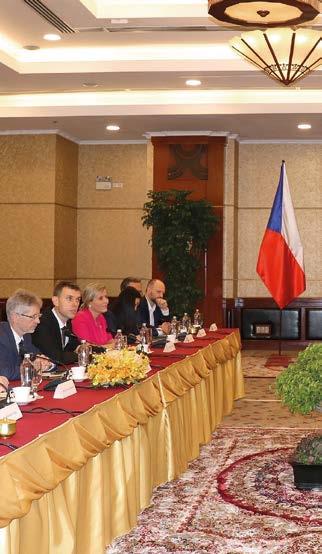
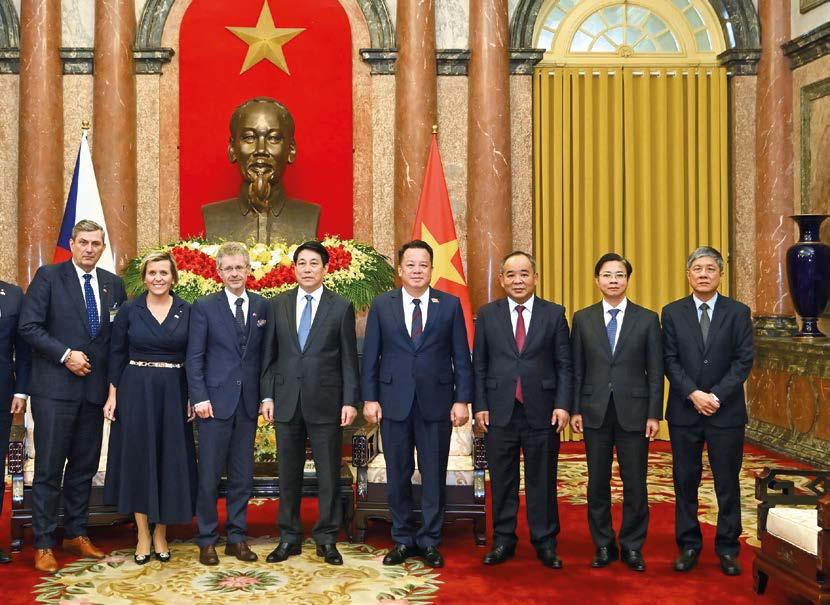
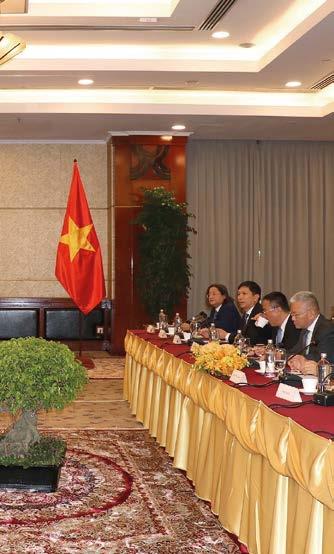
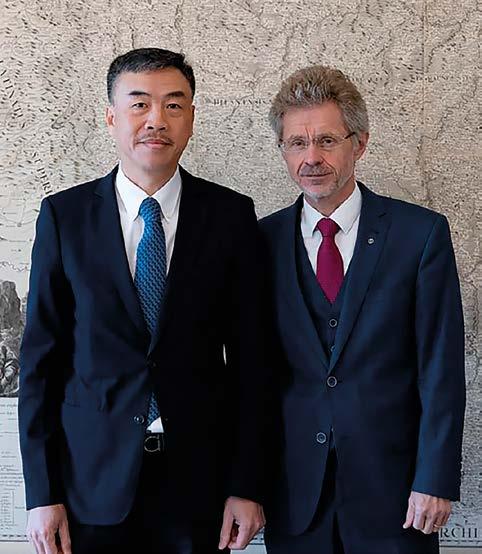
Interview with Miloš Vystrčil, President of the Czech Senate I APPRECIATE THE LONG-STANDING COOPERATION BETWEEN CZECHIA AND VIETNAM
Interview with Eva Stodůlková, CFO Granát Turnov “G” MEANS GENUINE CZECH GARNET
Interview with Pavel Hošek, Director of the Prague Airport Rescue and Fire Brigade THERE’S NO RISK OF BURNOUT HERE
Interview with Gabriela Dítětová, Hotel General Manager IT IS ABOUT GENUINE SERVICE, IT IS ABOUT LOVE

Benke Aikell – Founder | Eva Anderová & Meshulam Zisso – Owners & Executive Editors | Petra Kubernátová – Webmaster | Martina Hošková – Edit & Translation | Martin Mikeš – Graphic Design | Printing house – Tiskárna H.R.G. Litomyšl | Publisher PRIME (1998) s.r.o., Olgy Havlové 2914\52, 130 00 Žižkov - Prague 3, IČ: 25682784, DIČ: CZ25682784, e-mail: info@czechleaders.com, www.czechleaders.com | Czech & Slovak Leaders, Olgy Havlové 2914\52, 130 00 Žižkov - Prague 3, email: info@czechleaders.com, www.czechleaders.com | Licence: MK ČR E 13147 | No reproduction is permitted in whole or part without the express consent of Czech & Slovak Leaders | The advertiser is responsible for the advertising contents | Opinions expressed in this publication are those of the authors or persons interviewed and do not necessarily reflect the views of the editors or Czech & Slovak Leaders | All editorial material and photos in Czech & Slovak Leaders Magazine is digitally stored and may be republished by Czech & Slovak Leaders either in printed form or in various digital media | All correspondence to Czech & Slovak Leaders Magazine may be published.
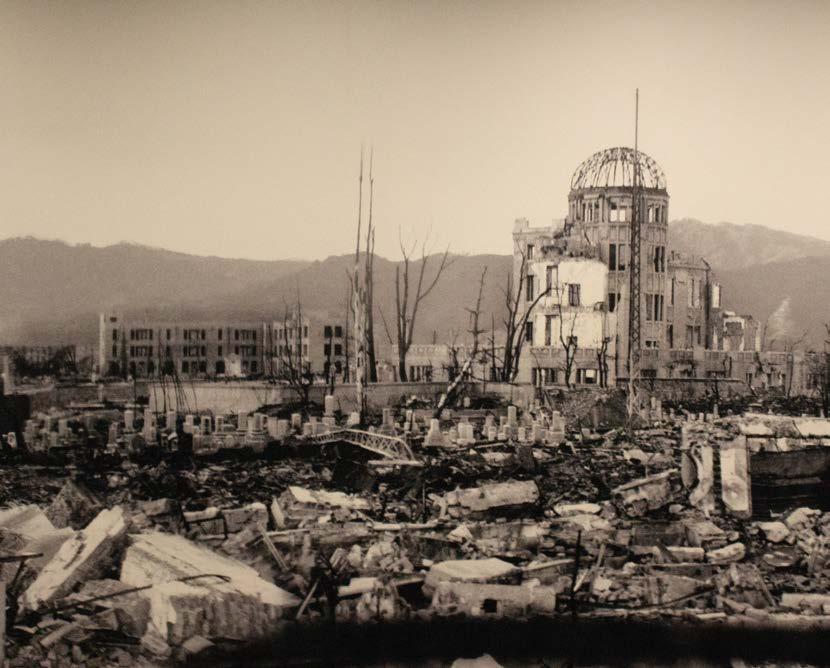
At 8:15 am on August 6th, 1945, the first atomic bomb used against humans was dropped on Hiroshima. 600 meters over the city, and with a blinding flash, the atomic bomb exploded 43 seconds after being dropped, creating a fireball that blazed like a small sun. More than one million degrees Celsius at its center, the fireball reached a radius of over 200 meters in just one second, and surface temperatures near the hypocenter rose to 3,000 to 4,000 °C.
51,787 out of 76,327 buildings were completely destroyed or burnt, and 6,180 were partially destroyed. It is estimated that approximately 140,000 people died by the end of December 1945. Consequently, the radiation continued causing deaths and disorders for decades. Even today, explanations of the effects of radiation over the years are inadequate.
At the time of the explosion, fierce heat rays and radiation burst out in every direction, causing the air around the fireball to expand and creating a super-high-pressure blast. The complex interactions of these three factors inflicted tremendous damage upon the city.
The damage inflicted by the atomic bomb was characterized
by instant and massive destruction, indiscriminate mass slaughter, and radiation. In particular, the damage caused by the radiation led to decades of human suffering.
At the time of the explosion, the temperature of the detonation point exceeded 1,000,000 °C, and the fireball generated in the air grew to a radius of over
200 meters one second later. Beginning 0.2 seconds after detonation, heat rays emitted in all directions by the fireball exerted powerful effects at ground level for three seconds. People sustained severe burns from the powerful heat rays, and many died as a direct result. The surface of roof tiles within 600 meters of the hypocenter
melted and blistered. Many trees ignited, and within three kilometers, electric poles, trees, and lumber were charred.
The explosion of the atomic bomb momentarily created a super-high pressure of several hundred thousand atmospheres. The surrounding air expanded enormously, generating a shock-
wave followed by a tremendous blast of wind. Within two kilometers of the hypocenter, most wooden houses were destroyed. Although ferro-concrete structures remained standing, they were severely damaged, with all windows shattered and interiors completely gutted by fire.
Unlike conventional bombs, the atomic bomb emitted massive amounts of radiation that inflicted grave damage to human bodies. Penetrating deep into bodies, radiation caused damage to cells, altered blood, diminished the blood generation function of bone marrow, and damaged the lungs, liver, and other organs.
The explosion left residual radiation on the ground for a long period of time. Consequently, many who entered the city after the explosion to search for family or co-workers, as well as those who entered to participate in relief activities, developed symptoms similar to those resulting from direct exposure. Many died.
Radiation effects from the atomic bomb extended beyond the acute effects, such as fever, nausea, and diarrhea, that appeared immediately after the bombing. It caused various disorders for decades, and continues to threaten the health of hibakusha (atomic-bomb survivors) today.
Several years after radiation exposure, the number of deaths from leukemia and other cancers increased. Excess cases of leukemia began appearing two to three years after radiation exposure, and peaked seven to eight years after it. In contrast, the latency period for solid cancers is relatively long; they are assumed to have increased five to ten years after the radiation exposure.
Even today, explanations of the effects of radiation over the years
are inadequate. Research and survey efforts continue.
The intense blast and heat rays of the bombing destroyed and burnt almost all buildings within two kilometers of the hypocenter. Even in the area beyond two kilometers of the hypocenter, wooden buildings sustained major damage, and 90 percent of the structures in the city sustained devastating damage. According to the city’s 1946 general survey, 51,787 out of 76,327 buildings were completely destroyed or burnt by the bombing, and 6,180 were partially destroyed.
Various institutions have investigated the number of people who perished in the bombing, but so far the precise number is unknown. The City of Hiroshima estimates that approximately 140,000 people had died by the end of December 1945, when the acute effects of the radiation subsided. It is thought that approximately 350,000 people were in the city when the bomb exploded on August 6th, 1945.
Approximately half of those who were within 1.2 kilometers from the hypocenter died within the day; 80 to 100 percent of those who were closer to the hypocenter are thought to have died. Even among those who were able to escape an instant death or death within the day, the closer they were exposed to the bombing, and the more serious damages they suffered, the higher their mortality was.
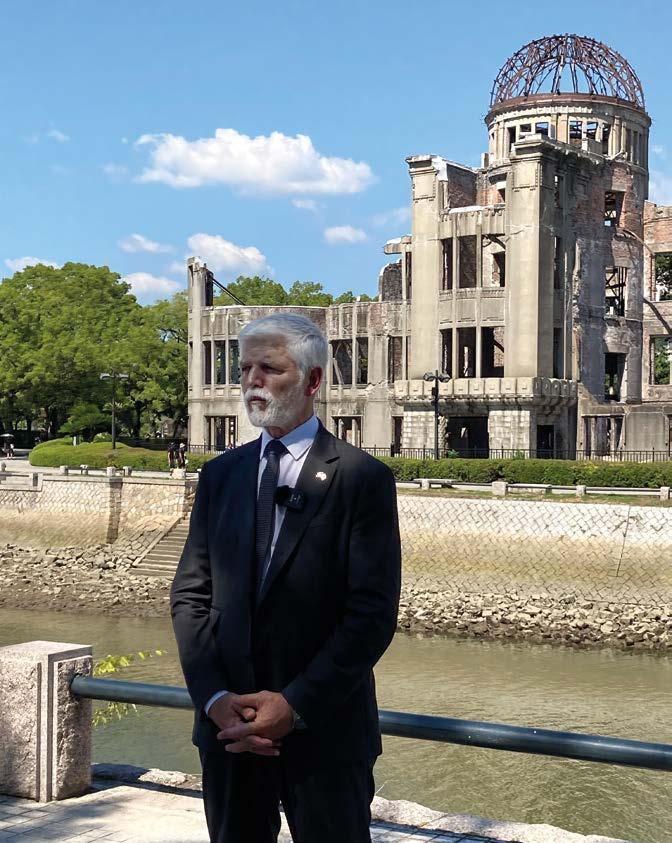
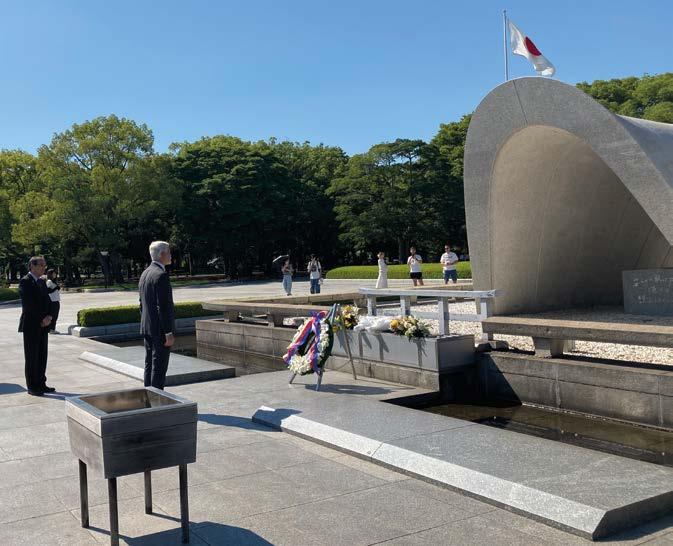
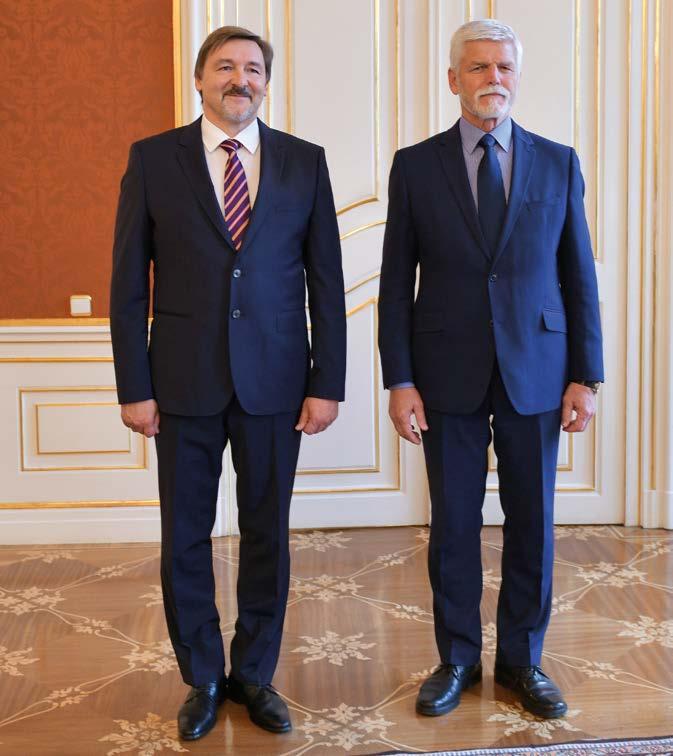
The citizens of Hiroshima warmly welcomed the Czech President, and Mayor Matsui himself guided the guests around the A-bomb Dome memorial, including the inside area, which is usually not open to visitors.
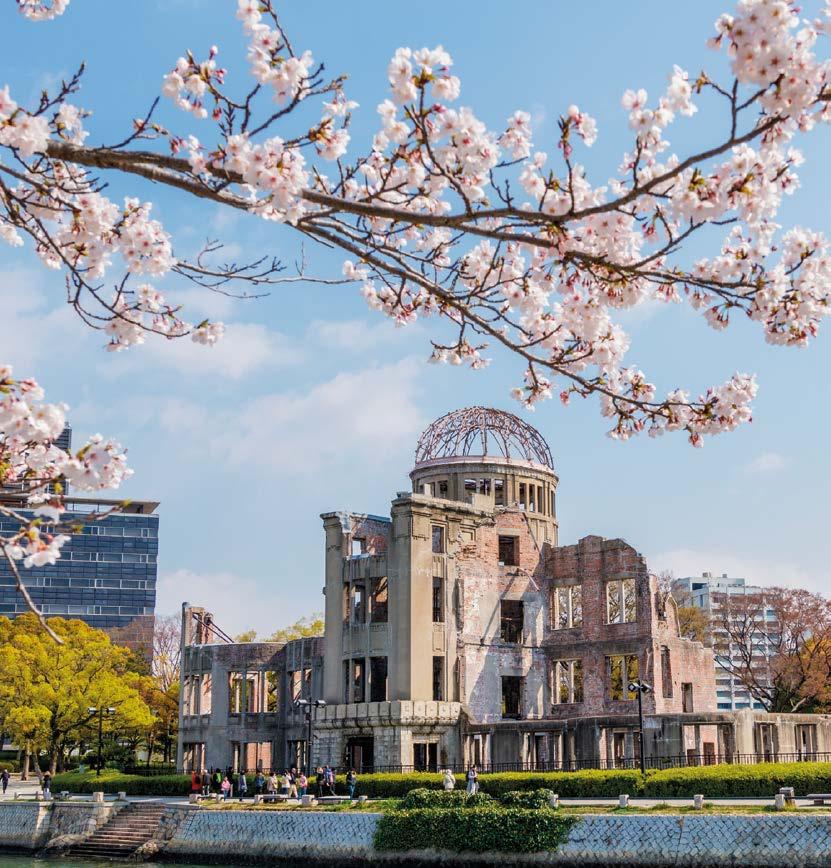
Eighty years ago, in August 1945, when Hiroshima was attacked by the world´s first nuclear bomb, the city was one of the industrial and commercial centers of western Japan. The citizens were proud of their newly built Hiroshima Prefectural Industrial Promotion Hall, designed by architect Jan Letzel from Náchod in the eastern Czech Republic. Despite being very close to the hypocenter, miraculously, its skeleton survived and later became the A-bomb Dome, planned to be preserved indefinitely as a silent witness to the disaster. 2025 also marks the 100th anniversary of Mr. Letzel’s rather early demise.
In this doubly memorable year, President Pavel visited Hiroshima while staying in Japan to participate in the Czech National Day at the Osaka-Kansai Expo.
The citizens of Hiroshima warmly welcomed the President from Letzel’s homeland, and Mayor Matsui himself guided the guests around. The inside of the A-bomb Dome is usually not open to visitors, but we received a special invitation and thus had the opportunity to intently listen to the mayor’s explanation while wearing helmets in the scorching heat.
After that, we continued visiting the Hiroshima Atomic Bomb Museum. Many terrifying items are on display here to inform the world of the reality of the nuclear bomb, including the magnitude of its destructive power and the enormous impact of radiation damage. Here, too, the President listened to all the explanations in a serious manner.
After the tour, President Pavel left the following short message and carefully answered questions from the local media.
“In general, human beings are very weak in learning lessons from history. There is no better place than Hiroshima to realize the value of peace and the cost of war, especially nuclear war. We must continually strive to understand that there is only one Earth that we all share.”
I sincerely hope that many more Czech people will visit Hiroshima too, and learn more about the danger and calamity of the nuclear bomb.
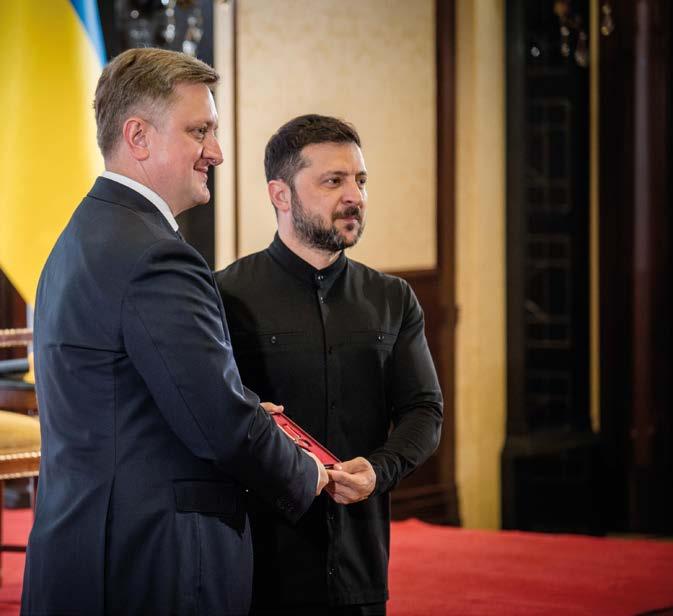
Can you tell us about yourself, and about how you became an ambassador?
Since my school years, I have dreamed of becoming a diplomat. It was a deliberate choice for me to study at the Faculty of International Relations at Lviv State
University. Right after graduation, I joined the Foreign Service of Ukraine in 1999.
I was inspired to pursue diplomacy because I believe in the power of dialogue and cooperation to create positive change. Representing my country and contrib -
“Today, the main task of Ukrainian diplomacy is to consolidate international support to ensure our soldiers receive all the necessary resources to save lives and defend our homeland. This is perhaps the unique reality of being an ambassador of a country that has been attacked and must defend itself in order to survive and not disappear from the map of the world. Every day, ordinary Ukrainians display incredible strength. This war has clarified our national identity even further: we are a free people, and we will never give up,” states H.E. Mr. Vasyl Zvarych, Ambassador of Ukraine, describing the current reality of his homeland.
uting to stronger international partnerships has always been my goal, and becoming an ambassador allows me to do that at the highest level. I am very grateful to President of Ukraine Volodymyr Zelenskyy and to the Minister of Foreign Affairs Andriy Sybiha, as well as his predecessor Dmytro Kuleba, for their confidence in giving me this opportunity.
Before coming to Prague, I served as Ambassador to Poland. It is a great honour and responsibility to represent Ukraine and its courageous people, especially during this extremely challenging time of Russian military aggression. Today, the main task of Ukrainian diplomacy is to consolidate international support to ensure our soldiers receive all the necessary resources to save lives and defend our homeland.
You have been in the Czech Republic for over a year now. Can you share some of your impressions?
My first impression of the Czech Republic was its rich history, beautiful architecture, and warm, welcoming people. I have been impressed by the strong solidarity between our countries, especially in supporting Ukraine during wartime. It is truly inspiring to see Ukrainian flags waving on so many government buildings and in the windows of ordinary people. Every Ukrainian feels the hospitality of the Czech people, which will remain in our memories forever and will become a solid foundation for close relations between Ukrainians and Czechs for generations to come.
In addition, I am pleased to see mutual respect and a shared interest in deepening our relations through increased cultural exchanges, economic cooperation initiatives, and meetings with inspiring Czech and Ukrainian people
who are making a difference every day.
How many countries have you served in so far?
My first posting at a diplomatic mission was in Turkey, where I spent four wonderful years. I have also served in Poland three times, and in the United States of America. And now, I am here in beautiful and friendly Czechia.
Can you recall an experience that could be called your best adventure ever?
One of the best adventures I have had was participating in a large rally in Prague last February in support of Ukraine, attended by the President of the Czech Republic and many other friends. Tens of thousands of people gathered at the Old Town Square, and it was an incredible experience that I will remember for the rest of my life. Seeing such enormous support and solidarity was truly a blessing!
And, on the other hand, what is the weirdest thing you had to deal with?
I cannot recall any particularly weird situations. Perhaps it is because, as a diplomat, I perceive even the most unusual circumstances as part of reality and my professional experience. We have to be accustomed to everything.
Does being an ambassador fit well into your lifestyle?
Yes, being an ambassador fits well with my lifestyle because I enjoy engaging with people, learning about new cultures, languages, and taking on challenges that require adaptability, creativity, and quick thinking. Diplomacy is dynamic, especially during wartime, and I thrive in an environment where every day brings new opportunities to contribute and work together toward Ukraine’s victory.
What is the most difficult part of being an ambassador of Ukraine today?
The most difficult part of being an ambassador is fully realising that people’s lives depend on your work – both the lives of those defending the country and those of ordinary civilians, including children, who suffer every day from Russian missiles and drones. On one hand, you understand that other societies have their own problems, political life, and daily concerns, but even so, you are under constant pressure, trying to gain the understanding of your foreign friends and allies and ensure their rapid response to the atrocities brought to our land by the enemy.
Every day of delay in military supplies, for example, can mean more lost lives – both for our soldiers, who do not receive all the means they need for defence, and for civilians, who can die from Russian attacks because our armed forces have not yet received the necessary air defence systems. This is perhaps the unique reality of being an ambassador of a country that has been attacked and must defend itself in order to survive and not disappear from the map of the world.
Are you able to enjoy your free time in this difficult situation?
In my free time, I try to spend as much time as possible with my family – my wife, children, and our dog. More than ever, we feel the true value of family: the importance of being together, facing challenges side by side, and caring for our loved ones who remain in Ukraine. Every moment of life – whether we live, love, and find joy, or sometimes experience sadness and tears from heavy losses – matters deeply. That is why my free time is wholeheartedly dedicated to family.
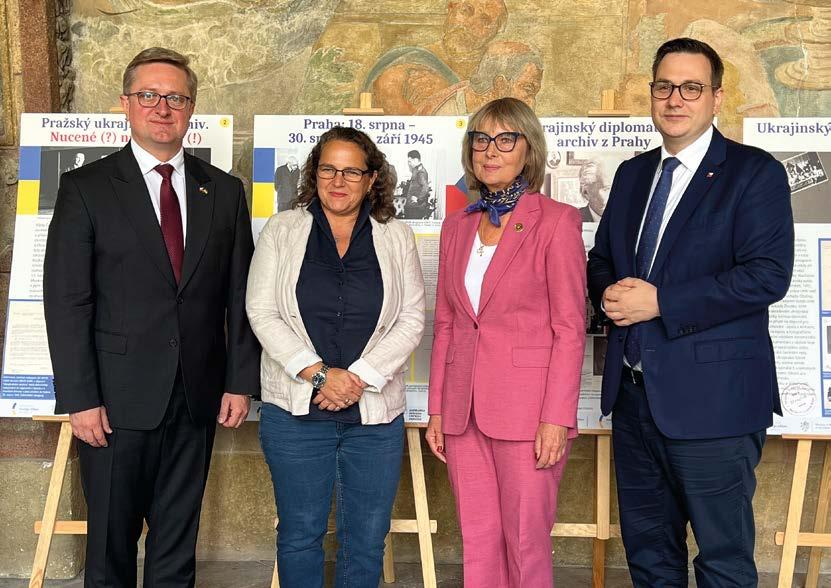
The war in your homeland has been hard and long. What impact do you see it having on your country and its people?
A brutal and unprovoked war launched by Russia against Ukraine has brought unimaginable pain and destruction to our land. Thousands of civilians, including children, have been killed or injured. Entire cities and villages have been destroyed. Millions of Ukrainians have been forced to flee their homes – some abroad, many within Ukraine itself.
And yet, despite this, Ukraine stands strong. Russia continues to deliberately target civilian infrastructure – homes, hospitals, schools, energy facilities – in an attempt to break our spirit. But it will never succeed. The Ukrainian people have shown extraordinary resilience and unity. Our soldiers
are among the bravest in the world, defending not only our homeland but also the values of freedom, democracy, and human dignity.
Every day, ordinary Ukrainians display incredible strength –rebuilding homes, keeping schools open, caring for one another, and continuing to hope and fight. This war has clarified our national identity even further: we are a free people, and we will never give up. Ukraine will endure, and Ukraine will win – because we are fighting for our very right to exist, to freely determine our way of life, and to choose our European future – far from Russian tyranny, totalitarian imperialism, and colonialism.
Do you feel that the future of free Europe and maybe all the free world is on the shoulders of Ukraine?
Yes, absolutely – and it is not just something we feel; we, Ukrainians, live it every day. We fight for justice and for the rule of law to prevail. This principle serves every nation in the world as the best guarantee of their security and stability. Ukraine is now the frontline in the battle between freedom and tyranny.
Russia’s war is not only against Ukraine’s sovereignty, and it is not about expanding territory, which Russia does not need at all. The neo-imperialistic regime led by Putin commits crimes against the principles of international law, human rights, and the rules-based order that underpins peace in Europe and globally. This war serves as a source of enormous power for Putin, who does not respect state borders or the law.
Therefore, our fight is a wake-up call for the free world. Through
our struggle, we are also sending a clear message: freedom, human dignity, and the right of nations to choose their own path cannot be violated. But these values are not given; they must be defended every day, sometimes at the highest possible cost.
If we allow Putin’s aggression to succeed, it will open the door to further expansion of authoritarianism, instability, and war across the continent. The impunity of criminals only encourages them to commit more crimes.
That is also why we are so grateful for the solidarity and support we receive from countries like the Czech Republic. Czechia, based on its own historic experience, understands very well what we are fighting for. We will not let you down; we will stand strong and help the rest of the free world grow stronger together. If Ukraine
stands, Europe and the entire free world – grounded in shared values and principles – stand. If Ukraine fails, the free world faces failure and new wars.
Ukraine would like to join the EU, and maybe even NATO. What would be the benefits in doing that, and are you supported in your efforts?
Ukraine’s strategic goal is full membership in both the European Union and NATO. This is our deliberate choice, defended even by the lives of our heroes on the battlefield. We see these steps not only as crucial for our national security and prosperity, but also as a way for Ukraine to strengthen both organisations. Ukraine is not just asking to join – we are proving on the battlefield and through reforms that we are ready to be a part of the Euro-Atlantic
family. Ukraine is not a burden, but a contributor – a country that has already transformed into one of the most experienced, resilient, and determined democracies in Europe.
Regarding the EU, Ukraine is fully engaged in the accession process. We have already completed the screening of EU law and are ready to start pre-accession talks on all negotiation clusters. Unfortunately, one EU country has been blocking the opening of the first cluster on fundamentals.
We regard this as unfair and are asking our EU partners to take action, so that one country cannot misuse its veto power and hold the entire EU and the Ukrainian people hostage to its domestic politics. We remain deeply committed to continuing reforms and achieving our goal of becoming a full-fledged member of the EU.
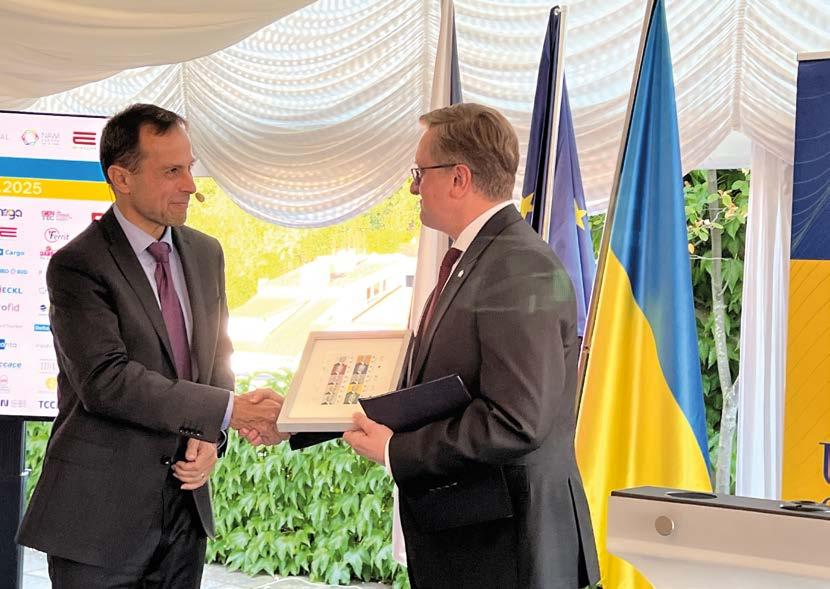
As for NATO, we have achieved unprecedented interoperability with Allied forces. Ukraine today has the most battle-hardened army in Europe, one that is already strengthening Europe’s collective defence. Our membership will make NATO stronger – strategically, operationally, and morally. Russia must have no influence over our sovereign decision to become a NATO member. We are not threatening Russia; on the contrary, Russia attacked Ukraine militarily in violation of all its international commitments. Russia is a threat to NATO, not the other way around.
The people of Europe have shown overwhelming solidarity with Ukraine – and we believe this solidarity will transform into political momentum to complete our integration. Ukraine’s future is in the EU and NATO – not someday, but as soon as possible. And we are doing everything necessary to make that future a reality.
Can you evaluate the current status of Czechia-Ukraine relations?
Over the past year, Czech-Ukrainian relations have officially been elevated to the level of a strategic partnership. Numerous significant bilateral events and initiatives have taken place, greatly strengthening our cooperation across political, economic, humanitarian, and security spheres. This partnership has had a mutually beneficial impact on both our countries.
There has been a notable intensification of high-level dialogue, with regular and constructive contacts between presidents, prime ministers, foreign ministers, and other government officials. Parliamentary cooperation is also strong. Regional cooperation has expanded as well, with cities and regions from both countries building new partnerships and
supporting recovery and reconstruction efforts.
In the context of Russia’s full-scale aggression against Ukraine, the Czech Republic has stood firmly on the side of international law, freedom, and justice. It has become one of Ukraine’s most reliable and principled partners. Czechia has provided critical military-technical assistance, including through its leadership in the ammunition initiative, which we greatly value. It has also offered generous humanitarian support and provided safe refuge for hundreds of thousands of Ukrainians forced to flee their homes.
I would like to emphasise that Ukrainians in Czechia are not just sitting and waiting for social benefits. They are working hard legally, and contributing significantly to the Czech state budget. Last year, the revenue from taxes
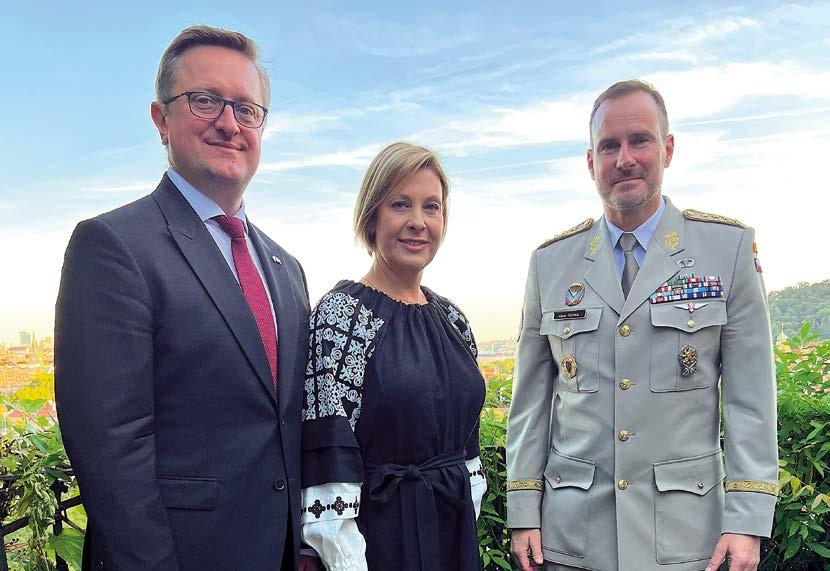
paid by Ukrainians exceeded the volume of social expenditures for Ukrainian refugees by almost 450 million USD. That, to me, is true mutual solidarity.
Moreover, Czech society has shown immense solidarity with Ukraine. Civil society, NGOs, municipalities, and ordinary citizens have played a crucial role in strengthening our relations. Fundraising in support of Ukrainians, and especially the Ukrainian Armed Forces, has become a globally recognised hallmark of the Czech people, who are highly mobilised to help those in need. I deeply appreciate that.
I am profoundly grateful for the Czech Republic’s steadfast support and confident that our strategic partnership will continue to grow. I am thankful to the current government and look forward
to continuing our cooperation with the next government on our shared agenda. I am certain that by working closely together, both our nations will gain more and become stronger in these challenging times.
Let us conclude with our traditional question, although the answer is rather sadly obvious this time. What do you wish for your country, and for Czechia?
My greatest wish for my country is victory and a just, lasting peace built on the foundations of our sovereignty, territorial integrity, and freedom. I wish for Ukraine to become a member of the EU and NATO, and I wish for the safe return home of all Ukrainians forced to flee due to Russian aggression. We will have much work ahead to rebuild our motherland together.
To the Czech Republic and my Czech friends, I wish continued peace, security, prosperity, and unity. I hope that the Czech people, who have shown such deep compassion and courage in standing with Ukraine, continue to thrive in a free, democratic society that remains a pillar of stability in the heart of Europe. May our nations continue walking side by side as friends, allies, and partners.
From all Ukrainians – thank you, dear Czechia, for standing with us. Please do not allow fatigue when it comes to defending values, freedom, and justice for all. Truth always prevails. Pravda vítězí.
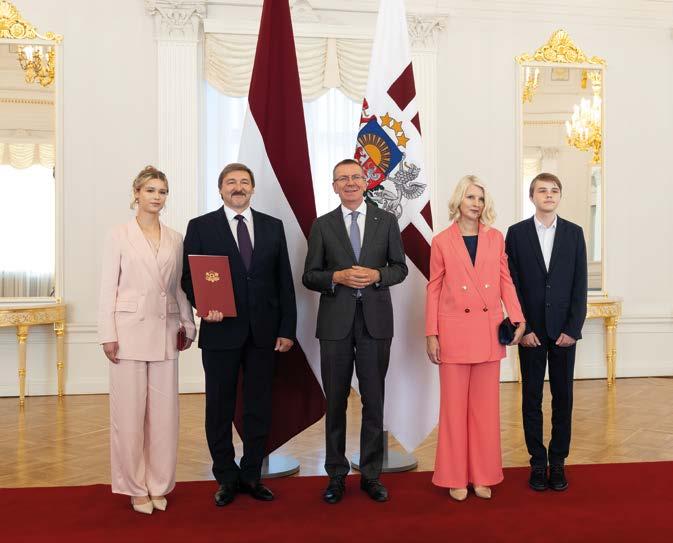
“Latvia´s statehood is just over 100 years old, but its people have a long history, deep roots, and a rich spiritual heritage. Latvians are resilient and determined. I joined the Latvian diplomatic service in 1993, shortly after Latvia regained independence following fifty years of Soviet occupation. This is my second time serving in the Czech Republic as a diplomat,” shares H.E. Mr. Vilmars Heninš, Ambassador of Latvia, reflecting on his experience serving his homeland.
Can you tell us about yourself?
I was born in Riga, the capital of Latvia, where I also completed my studies at the Faculty of History and Philosophy at the University of Latvia, earning a master’s degree
in history. I began considering studying history while still in high school, and this knowledge was –and continues to be – very useful in my active diplomatic career. It helps me better understand the structure of things and find
solutions, especially in today’s geopolitically turbulent times. While still at university, I joined the Latvian diplomatic service, where I’ve worked continuously for 32 years. I’ve also danced Latvian folk dances for many
years, as nearly every Latvian either dances in a folk group, sings in a choir, or plays a musical instrument. We have a unique tradition: every five years, the Latvian Song and Dance Festival brings together thousands of dancers and singers in a shared celebration. This tradition began in 1873, long before Latvia declared statehood, and is included in UNESCO’s Representative List of the Intangible Cultural Heritage of Humanity.
Can you tell us more about your country?
Latvia’s statehood is just over 100 years old, but its people have a long history, deep roots, and a rich spiritual heritage. Latvians are resilient and determined. Despite foreign occupations and many trials, we have preserved our language, culture, and identity. Today, Latvia is a free and democratic country, a member of NATO and the European Union, and ranks among the top 40 countries
globally in terms of development. It is a nation with an equal and democratic society built on knowledge, entrepreneurship, and creativity. Latvia is a respected and reliable international partner, and will become a non-permanent member of the UN Security Council next year. Latvia’s priorities include defending a rules-based international order, supporting Ukraine against Russian aggression, promoting women’s rights and empowerment, and seeking joint solutions to emerging security threats such as cyber and hybrid challenges.
How did you become an ambassador?
I joined the Latvian diplomatic service in 1993, shortly after Latvia regained independence following fifty years of Soviet occupation. At that time, the diplomatic service was being rebuilt from scratch. I was still a third-year history student when I received an unexpected offer
from my professor – who was also the Deputy Foreign Minister – to join the Foreign Service. I began my career as a senior desk officer on Russian affairs, and returned to this topic several times over the years. In the diplomatic service, I’ve held many positions: head of the CIS division, head of the Central European division, press secretary of the Ministry of Foreign Affairs, twice director of the Bilateral Relations Department, foreign affairs adviser to the Prime Minister, and director of the Policy Planning Department. I’ve served in several foreign postings before being appointed Ambassador of the Republic of Latvia to the Czech Republic. I’ve climbed nearly every step of the career ladder to reach the ambassadorial post.
You have been in the Czech Republic for about a year. Can you share some of your impressions?
This is my second time serving in the Czech Republic as a diplomat.
I first worked here twenty years ago as deputy head of mission. I have the warmest memories from that time, so when the Foreign Minister offered me the chance to return as ambassador, I didn’t hesitate for a moment. Comparing the Czech Republic now to twenty years ago, I can say with satisfaction that it has made great strides in socio-economic development while continuing to charm with its cultural and historical heritage. Czech people have preserved many of their customs and traditions. I’m fascinated that many still read books on public transport, love their dogs dearly, and maintain an active lifestyle –especially travelling on weekends. And, of course, Czech beer and ice hockey need no explanation.
How many countries have you served in so far?
As mentioned earlier, I’ve spent half of my diplomatic career working in Latvian embassies abroad. My first posting was to Moscow, where I served as First Secretary at our embassy in Russia. Then came Prague, followed by another posting to Moscow as deputy head of mission. My first ambassadorial appointment was to Hungary, where I was also a non-resident ambassador to Croatia, Slovenia, and Montenegro. Since last autumn, I’ve been back in Prague.
Does living an ambassador’s lifestyle come easily to you?
The ambassador’s lifestyle is very
dynamic. You must be able to adapt to the daily rhythm of the country of residence while essentially being on duty 24/7. As an ambassador, you need to stay informed about developments in Czechia, build and maintain contacts, organize events that promote your country, and participate in political, economic, and cultural events organized by the country of residence. You also need to engage with the Latvian diaspora in the Czech Republic. Looking at my weekly calendar, I sometimes find myself thinking, “Another week without a free evening.” That’s why it’s important to find a balanced approach and make time for hobbies – and most importantly, for family, which has always been my greatest support
in fulfilling diplomatic duties abroad.
When you manage to get some free time outside of work, what do you enjoy doing?
As I mentioned, I’m a historian by education, so I really enjoy exploring local history and culture. On weekends, I try to visit one of the Czech castles or manors, which offer a wide variety of
architectural styles. The Czech Republic is one of the few countries where military conflicts have spared its rich heritage of castles and manors, including their interiors. Each time, I discover that there are still hidden gems, and I encourage my colleagues to enjoy this opportunity while working in the Czech Republic. Czech nature also offers great opportunities for long walks, which are a wonderful way to stay fit.
Latvia has potential as an interesting holiday destination for Czech people. How do you promote your country?
Tourism is one of the most important elements in international relations – it promotes economic cooperation and strengthens people-to-people contacts. Being here, I’ve seen that this sector has huge potential
for bilateral cooperation, so it’s one of my priorities. This year, we’ve already organized a major tourism seminar in Prague, and arranged a visit to Latvia for Czech tourism professionals and media representatives, which received great feedback.
Prague and the Czech Republic have always been popular destinations for Latvians, while Latvia still seems like an undiscovered land for many Czechs. First and foremost, we can offer the sea – with nearly 500 km of sandy beaches. In recent years, improved road infrastructure has significantly shortened the distance between the Czech Republic and Latvia, and therefore there is no longer much difference between traveling to the Adriatic or the Baltic Sea. Our national airline, airBaltic, also provides regular direct flights between Riga and Prague. In addition to beaches, we offer diverse outdoor activities, which Czechs enjoy, as well as many interesting and unique tourist attractions.
One of these unique attractions is the UNESCO World Heritage Site of the Latvian capital Riga with its Historic Centre, including the old town and Art Nouveau quarters. Another UNESCO gem is the town of Kuldīga, known for its authentic 18th and 19th century architecture. There, you can also find the widest waterfall in Europe – the Venta Rapid, which is nearly 250 meters wide. I also must mention Rundāle Palace – Latvia’s mini-Versailles with its French-style garden, a fully restored Baroque and Rococo masterpiece by the famous Italian architect Francesco Rastrelli. Last but not least, if you want to experience something truly Latvian, you must attend the Midsummer celebration (Līgo Eve and Jāņi Night), when Latvians wear national costumes, dance and jump over bonfires, wear
flower crowns, eat caraway-seed cheese and drink beer, sing folk songs, and decorate everything with herbs and branches.
In my opinion, Latvia is a wonderful holiday destination – ideal for vacations or short breaks. We offer high-quality service, we’re not overcrowded with tourists, and our summers are still very enjoyable temperature-wise. Welcome to Latvia!
What is the current state of Czech-Latvian relations?
I would describe the bilateral relations between Latvia and the Czech Republic as excellent. Latvia and the Czech Republic have consistently been like-minded countries in assessing current international challenges, firmly standing for the defence of democratic values and the observance of international law. We have worked together to strengthen global and regional security and have provided strong and selfless support to Ukraine in its fight against Russian aggression.
The bilateral relationship between our countries has been very dynamic – marked by regular political dialogue, exchanges of visits at various levels, active economic cooperation, development of cultural ties, and strong people-to-people contacts. Security and defence remain one of the cornerstones of our cooperation. This includes strengthening NATO’s Eastern flank, the participation of the Czech contingent in NATO’s enhanced forward presence and air policing missions, as well as support for Ukraine through joint initiatives such as the Latvia-led drone coalition and the Czech artillery ammunition initiative for Ukraine.
A positive indicator is the steadily growing trade turnover, which shows that the potential for
cooperation is far from exhausted. There are also frequent exchanges of cultural performances, as well as cooperation between municipalities. A significant element in strengthening relations in the fields of culture and education is the opportunity to study Latvian at Charles University in Prague, where teaching began back in 1923, as well as at Masaryk University in Brno. Similarly, there are opportunities to study Czech at the University of Latvia.
This interview is conducted on the occasion of your national day. What are your wishes for your country and for the Czech Republic?
Latvia and the Czech Republic share many similar historical experiences. Both countries declared their independence in 1918, and endured multiple occupations before regaining their statehood. Our nations have always expressed a deep longing for freedom and independence – both Latvians and Czechs have always been fighters for their homeland. Therefore, I would like to wish for both Latvia and the Czech Republic to continue building on democracy, develop their economies and ensure the well-being of their people, remain strong members of the European Union and NATO, and promote security and stability around the world. In Latvia, we have a saying: “May Latvia live as long as the sun!” – and that is exactly what I wish for the Czech Republic as well.
This article briefly explores the perspectives and experiences of three international students of UNYP, a private university in Prague. Their insights offer a glimpse into the motivations behind their choice of institution, how they navigated academic life in a new country, and the impact their educational decision has had on their lives, even long after graduating and starting their professional careers.

BACHELOR OF BUSINESS ADMINISTRATION, 2016
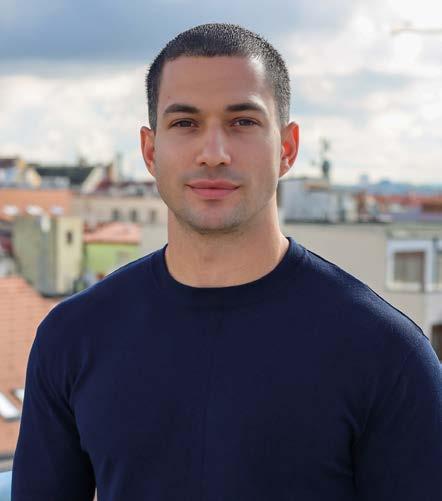
I chose UNYP because it offered exactly what I was looking for: an international environment, small classrooms, and the dual degree program that gave me a recognized qualification both in Europe and the US. What I didn’t realise at the time was just how much the school would shape not only my education, but also the course of my career.
As a Business Administration student, I found myself surrounded by international faculty and classmates from all over the world. Every class felt like a global conversation, and the practical approach made it easy to see how theory connected to real-world business challenges. The small class sizes meant that professors really knew us, and, in my case, one of them even offered me my
very first job after graduation. That opportunity set me on a path where I eventually headed global business operations for the company.
Outside of the classroom, UNYP gave me the space to build something meaningful. While serving on the Student Council, I founded TEDxUNYP, a student-led initiative that, 10 years later, has grown into one of the largest TEDx events in
Central Europe. That experience not only gave me a platform to bring new ideas to Prague but also sparked a career in public speaking and communication that I still carry forward today.
What stands out most to me now are the lifelong connections. Some of my closest friends and professional collaborators come from my time at the university, and they continue to inspire me
BACHELOR OF COMMUNICATION AND MASS MEDIA, 2016
MASTER OF STRATEGIC COMMUNICATION, 2019
MASTER OF BUSINESS ADMINISTRATION (MBA), 2025
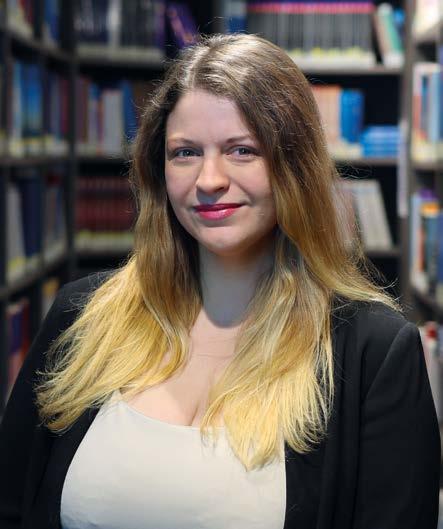
I chose UNYP because it offered everything I wanted: an Englishlanguage education, small classrooms, and a double degree recognised in both the EU and the
US, all while staying in Prague.
What I didn’t expect, though, was how much UNYP would stay with me through every stage of my life.
years after graduation. UNYP wasn’t just a university experience – it became the foundation for so much of what I’ve built since.
My advice to students: If you want to get the most out of your degree, be a good student. Take the extra steps to do more than is expected of you. It may sound obvious, but it’s the only way to truly stand out.
As a Communication & Mass Media student, I found a global community where every conversation broadened my world. The flexible schedule let me work part-time, and put what I learned into practice right away. Leading the Model United Nations Club and joining the Student Council made UNYP feel like home, a place where ideas, friendships, and ambitions came to life.
After graduating, I joined Unilever, but I soon returned for my master’s in Strategic Communication. The weekend program fit perfectly around my career, and reconnecting with classmates reminded me that UNYP isn’t just a university, it’s a community that evolves with you.
Now, as an MBA student, I realise the university has been the constant in my personal and professional journey, the place that always pushes me to grow, learn, and discover more about myself.
My advice to students: Take full advantage of what the school offers. It’s not just about what you study, it’s about who you become along the way.
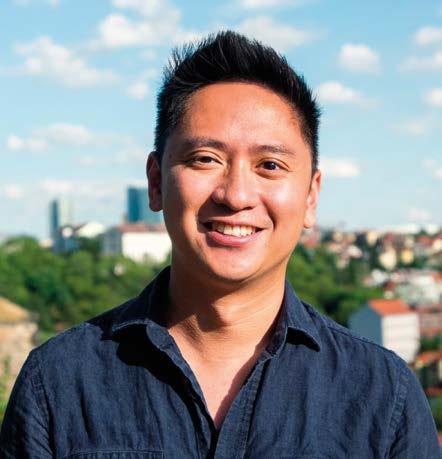
When I was choosing where to study, I knew I wanted an education with a truly global scope. Czech universities offer excellent programs with a strong European focus, but as a child of immigrants, I was looking for something broader, an environment that would reflect the diversity and openness of the world I wanted
to live in. That’s why I chose the University of New York in Prague.
My time at UNYP was transformative. I was surrounded by an international community of students whose different backgrounds and upbringings constantly challenged my perspective and expanded my understanding.
Beyond the classroom, being part of the Student Council gave me the opportunity to contribute to the student community and develop leadership skills that I still use today.
I majored in Communication and Mass Media, which became the foundation of my professional journey. After graduation, I started my career in online marketing as a junior specialist. Over the years, I grew into more strategic roles in media planning and brand management. Today, I run my own business, a multifunctional creative space and event venue that serves both the creative community and corporate clients, helping them express their ideas and visions in unique ways.
My advice to students: Take your time at university to explore your abilities. Don’t just focus on hard skills, use this period as a safe space to discover who you are and what truly excites you. And never underestimate the power of building a strong network – the relationships you form at school can become some of the most valuable connections in your professional life.
is the leading private university in the Czech Republic, offering accredited Bachelor’s, Master’s, MBA, and Ph.D. programs, entirely in English,in partnership with SUNY, Empire State University, Dublin Business School and others. Established in 1998, UNYP has built a strong reputation for delivering high-quality education that blends American and European academic standards.
With a diverse student body representing more than 80 nationalities, the university provides a truly international and inclusive learning environment. UNYP’s mission is to prepare students for success in an increasingly globalized world by emphasizing critical thinking, communication skills, and practical experience.
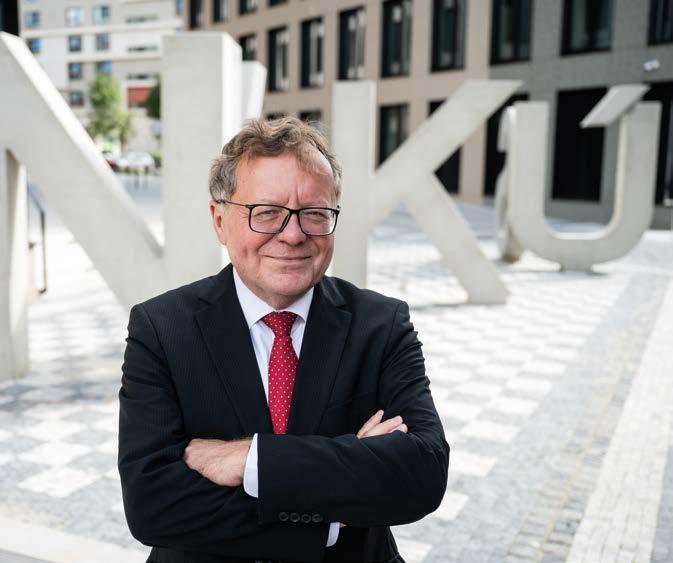
Could you briefly introduce yourself and the Supreme Audit Office you are responsible for?
My name is Miloslav, but my friends call me Míla. I am a father of three kids and a grandfather of
four beautiful grandchildren. This is my greatest joy outside of work; my large – and thankfully healthy – family. I am also an enthusiastic amateur speleologist, photographer, and orchardist.
“The nature of our findings has changed, as has the functioning of the state and its political leadership. Some issues have improved, but new problems have emerged. Becoming an auditor at the Supreme Audit Office is no easy task – it requires continuous education throughout one’s tenure at the NKÚ,” says Miloslav Kala, President of the Supreme Audit Office of the Czech Republic since 2013.
The Supreme Audit Office (NKÚ) is a very important institution. It monitors how the state spends public funds, and reports its findings to those who can make a difference.
By those who can make a difference, you mean the government and members of parliament, right?
Exactly. Our main counterparts are the government, but primarily the Chamber of Deputies, which oversees the government’s activities. An equally important target group is the media and the public, because we are auditing the use of funds collected from Czech taxpayers.
Does the government have an obligation to resolve problems reported by the NKÚ?
The government reviews our findings and typically assigns
the responsible minister to address the issues within a set deadline. We then monitor the implementation of these corrective measures and conduct follow-up audits to evaluate whether the problems have been resolved, how they were addressed, and whether the situation has improved.
How did you become the President of the NKÚ?
I used to work as a sales director in a large private company and then became mayor of Blansko, a mid-sized town in South Moravia, representing the Social Democrats. From there, I moved to the Chamber of Deputies, where I was elected in 2002 and again in 2006. When the opportunity arose to first serve as Vice President and later as President of the NKÚ, I was intrigued. I felt that the energy I would invest in the role would be returned many
times over, which was not always the case as a member of parliament (smiles).
What is the most difficult part of being the President of the Supreme Audit Office?
Leading an organisation whose core mission is to identify shortcomings and deficiencies can sometimes make it challenging to maintain a positive outlook. But with some perspective, I still find the work meaningful, motivating, and deeply rewarding.
What is essential for a supreme audit institution to fulfil its duties effectively?
First and foremost, independence – which is well protected in the Czech Republic. I am not worried about external influence on the NKÚ’s decisions. Of course, every institution relies on individuals with integrity and intellect.
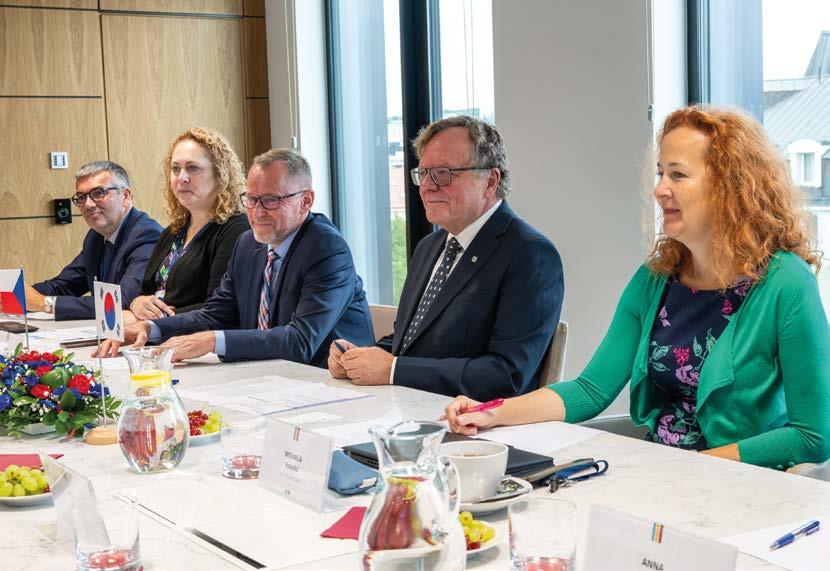
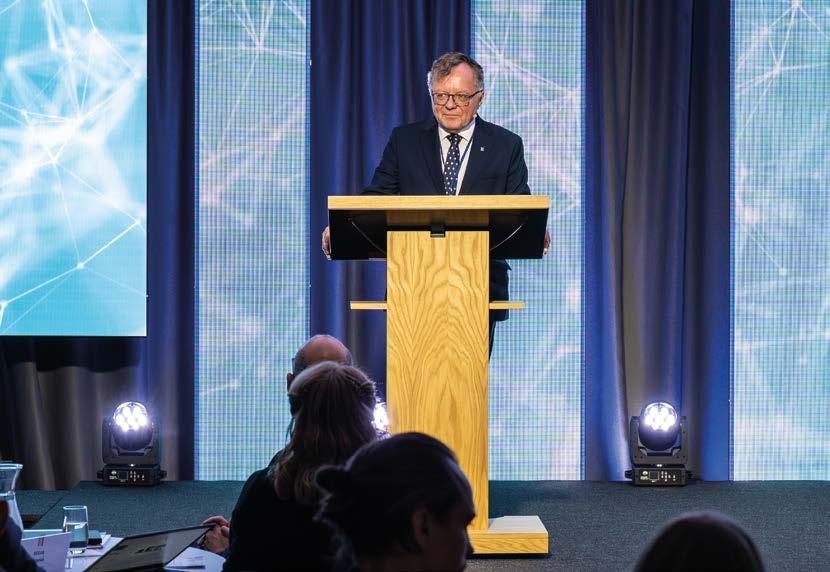
We take pride in selecting the best. Becoming an auditor at the Supreme Audit Office is no easy task – it requires continuous education throughout one’s tenure at the NKÚ.
Does being an excellent auditor make you a good member of the NKÚ Board?
Good board members do not necessarily have to be auditors. For me, it is someone who can see things in context and analyse them deeply. Someone who is capable of reporting objectively in a way that the audience can clearly understand.
Can you tell us about the key audit mechanisms the NKÚ is using for preventing and detecting fraud?
The NKÚ conducts three types of audits: performance, financial, and compliance. Each of them
focuses on a different aspect of public spending and plays a role in both prevention and detection – not necessarily of fraud, but of inefficient use of public funds. Personally, I consider performance audits the most important, as they not only assess legal compliance but also whether the funds achieved the expected results – whether the “value for money” was beneficial for taxpayers.
Sensitive financial information must be safeguarded. How do you implement access control?
Our audits are highly standardised, both in methodology and in the legal mandate defined by the NKÚ Act and the Constitution. We cannot just do whatever we want – we must follow standard audit procedures. Information from each audit is collected in so-called “protocols”, which are confidential by law. We publish
only the audit report, a structured summary and evaluation of the protocols. If an audit reveals information that could threaten national security or strategic interests, we can classify the results and discuss them with parliamentary and government bodies in a secure setting.
One of the key principles in financial control is the segregation of duties. Are there any conflicts related to this concept that need to be addressed?
The legal framework clearly defines the responsibilities of each institution. If there are friction points, we describe them in our audits. Personally, I see the fragmentation of responsibilities and decision-making as a bigger issue – especially in the distribution of EU funds, where too many bodies are involved. This often leads to inefficiencies and a loss of value before the funds reach
their intended recipients. This naturally reduces the impact of such support.
Can you recall your greatest adventure while working at the NKÚ?
My entire term at the NKÚ has been a “wild ride”. Auditing is far from boring. But if I had to name one project, it would be the construction of our new headquarters. For years, I have worked to ensure that the Supreme Audit Office would have a headquarters that reflects its importance and independent status.
I am proud to say that we completed it on time, within budget, and even received the ‘Building of the Year’ Award. That was a true adventure – lasting about eight years.
What is the weirdest thing you have dealt with?
Without being specific – some meetings with certain people have been quite strange.
You have been the president of NKÚ since 2013. Can you compare the situation before and now? Has it improved?
It is different. The nature of our findings has changed, as has the functioning of the state and its political leadership. Some issues have improved. For example, during my time as Vice President, our audits frequently identified violations of the Public Procurement Act. Today, this is no longer such a significant issue, but new problems have emerged. So, the situation is different, but I would not say it is necessarily better.
You were also the president of EUROSAI from 2021-2024. Please, tell us about this organisation and your role as its president.
To simplify it a bit, EUROSAI is like the EU for audit institutions. Every country has its own audit institution. And the European ones gather in this organisation. It has fifty-one members, including the European Court of Auditors. The presidency rotates among the member institutions. We have chaired it for three years during a very turbulent time – COVID, inflation, energy crises, and the war in Ukraine. That made holding this position all the more interesting.
Our goal was to create effective, simple cooperation among the audit institutions. We tried to create conditions for fruitful international cooperation. We launched the BIEP (Benchmarking Information Exchange Project), a portal for auditors to share projects, documents, and exchange best practices. We also built an audit database for international benchmarking. Therefore, our effort was to foster strong connections among EUROSAI members and ensure optimal conditions for working together.
To wrap this interview up nicely, what is your vision for the next five years?
Internationally, if confirmed by the INTOSAI Congress in October 2025, we will join the leadership of one of its main committees. INTOSAI is the global umbrella for audit institutions. So, I see another opportunity to contribute to international cooperation, and this time in an even broader context than just the European one.
On the national level, I would like to continue the work we have been doing – I truly value the efforts of my colleagues. But only a fool would think there is no room for improvement. I want to help take our work to the next level, and to create the best possible conditions for my colleagues – after all, that is one of my key responsibilities.
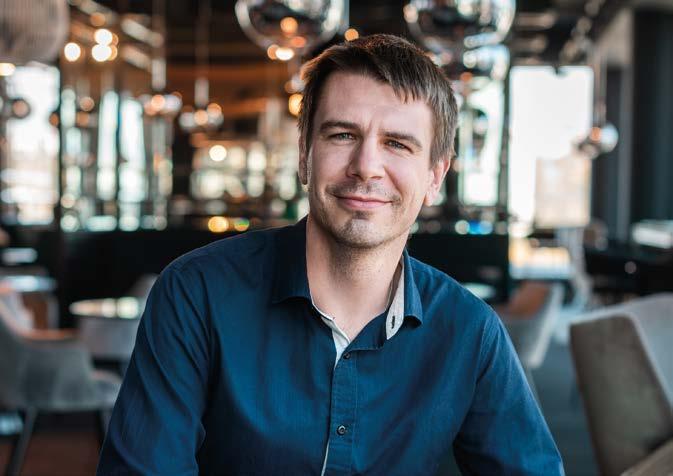
“My passion is helping founders bring their visions to life. Having guided dozens of startups through this process, my core expertise is best summarised as business development and strategy,” says Jan Krahulík. “It is scary for every founder to deal with that uncertainty every day. From a statistical point of view, there is a much higher chance that the founder will fail than succeed, but when you do, it becomes priceless, like any experience of overcoming a challenge.”
We have introduced you as a business developer, which is quite a broad term. Can you tell us more about yourself?
I am a business professional, entrepreneur, father, husband, friend, sportsman, traveller, poker player, and much more. I always liked diversity in my life, seeking a work-life balance. I am always up to new professional challenges and growth, as well as enjoying time with my friends and a beer.
My passion is helping founders bring their visions to life. Through
our VC fund, I provide startups in the CEE region with both the capital and the hands-on guidance they need to succeed. We’ve supported over 50 companies in our portfolio, and actively scout new talent by reviewing thousands of applications annually.
What exactly is your role within the fund?
I was one of the three founding partners, with dual responsibilities in fundraising / investor management and portfolio support. I took a hands-on role with “my”
founders, specialising in business development, strategic direction, customer segmentation, and go-to-market strategy. Having guided dozens of startups through this process, my core expertise is best summarised as business development and strategy.
You are speaking in the past tense. What happened?
Having successfully deployed the capital from our third fund, I decided it was the right time for a professional change. While I remain actively involved with our portfolio and am dedicated to our investors, the intense workload of fundraising and sourcing new deals is behind me.
After deciding on a change, you didn’t start a new career, though. Instead, you started spending more time with family. Why?
Work-life balance is important
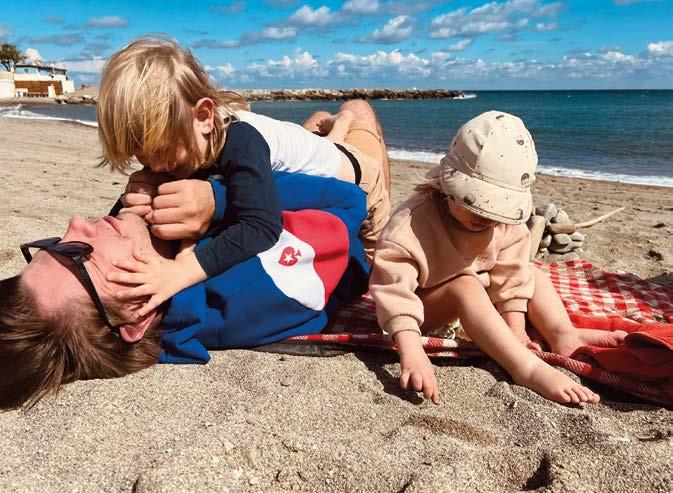
I didn’t want to jump directly to the next project as I felt I needed to take a little break and figure out what my next career steps will be. Having more time for my family was definitely one of the reasons. We travelled in southern France and Spain for two months, enjoying the sun and being together.
Would you recommend other fathers to do the same and go on paternity leave?
I would not call myself a father on paternity leave – as I said, I am still working part-time, and my wife is the one who is on maternity leave and taking care of the kids and our home, so she is the one who deserves all the credit. But yes, I would recommend it. Being able to leave for a midday swim with my daughter or spend a morning at the playground are joys that a rigid 9-5 job simply doesn’t permit. It’s an experience I would
wholeheartedly recommend to any parent.
How long do you expect this phase to last?
Good question. My plan was to enjoy the summer and then re-engage professionally in the autumn. I’ve been selectively exploring opportunities and have done some interim consulting, but I am now actively seeking a permanent, mission-driven role where I can fully apply my skills.
What responsibilities are you looking for?
I am a businessperson who handles sales, customer acquisition, and overall strategy. I am not much into the product, so I am thinking of joining a technical team as a business cofounder or CEO. Another option is to start a project from scratch for people who have an idea but don’t have time for
execution and are looking for someone who would start it instead of them. Interim management or head of business development in an SME is also an option.
Which of your past professional experiences do you find the most valuable?
Before I started my first company, I was in a corporation and had quite a well-paying job. I quit, and started something new with no income. I am quite a risk adverse person, but I did it anyway, and it was scary – and it is scary for every founder to deal with that uncertainty every day. From a statistical point of view, there is a much higher chance that the founder will fail than succeed, but when you do, it is priceless, like any experience of overcoming a challenge.
What should the next generation of startup entrepreneurs do then, to improve their chances of success against the statistical odds?
The team is the number one asset for you, so choose its people wisely. You will spend more time with your cofounder than with your wife, so be sure that you are in the right team, where your cofounder is complementary to your skills but with the same values as you, and that you can rely on them 100%.
At the beginning of this interview, you mentioned you play poker. You won the Czech Poker Tour at Prague’s King’s Casino, so you must be good at it, right?
Poker is my biggest hobby; there are so many similarities between poker, business, and even life. The things I learnt in poker can be
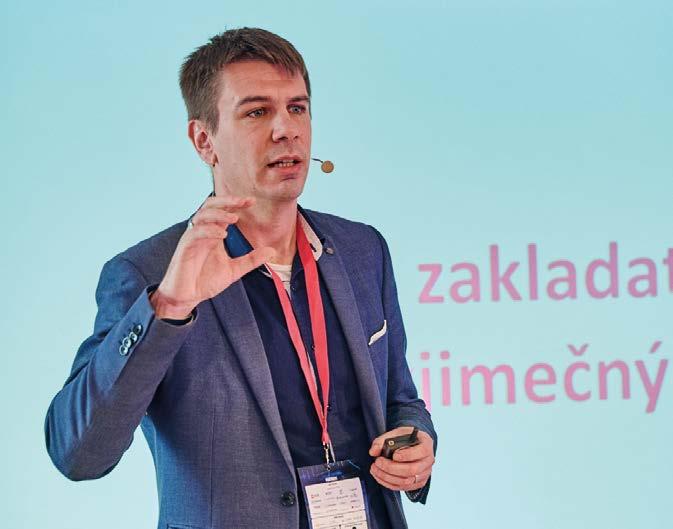
“My passion is helping founders bring their visions to life,” says Jan Krahulík.
easily applied to business and life, and vice versa. You are learning how to work with risk, when to raise your stakes, when to give up and move on, discipline, how to work with tilt, etc. – qualities which not many people have and are so needed in today’s world.
With so many interesting possible activities ahead, where do you see yourself in 10 years?
For me, it is not about the state where I will be but rather about the journey I want to go on, and it is simple: I want to have a job that still challenges me, making me grow and providing me with enough flexibility to be able to spend quality time with my family. I want to be surrounded by people who I can learn from.
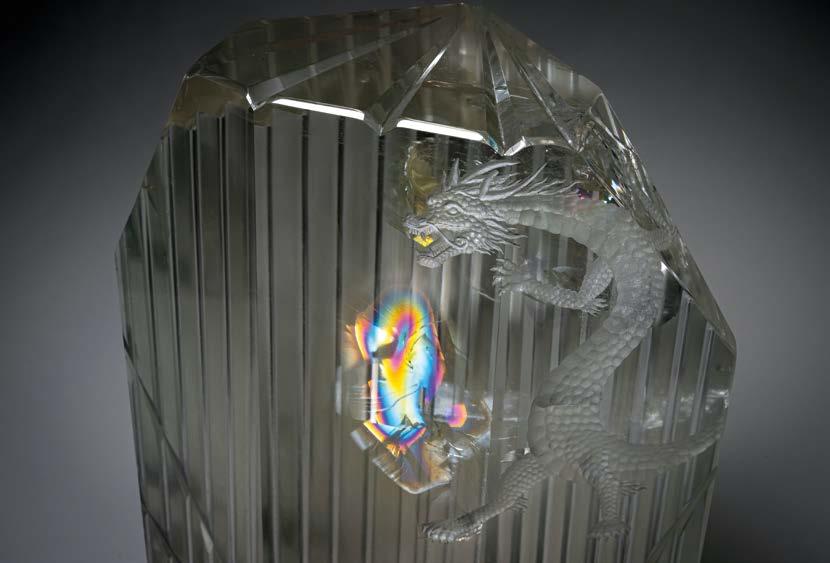
For centuries, humanity has been captivated by giant gems – freaks of nature that embody rarity, beauty, and power. A new legend has now joined this exclusive pantheon: The Secret Rainbow, a 50,200-carat noble-topaz now officially certified as the world’s largest faceted gemstone. Its sheer scale is difficult to comprehend, weighing over 10 kilograms, but its story is not merely one of size; it is a modern epic of scientific ingenuity, artistic vision, and a fiveyear battle against the very laws of mineral physics.
A rare find in Brazil sparks a historic endeavour
The gem’s story begins in 2013, deep within the prolific mines of Minas Gerais, Brazil. It was there that a topaz crystal of extraordinary size and clarity was unearthed. For a year, the massive rough stone circulated in the raw gemstone market, a remarkable but challenging specimen. The standard path for such a large, clean crystal would have been pragmatic: sawing it into numerous smaller, easily marketable gems for rings and pendants.
The risk and expense of handling it as a single piece were deemed too great by most.
In 2014, the stone was sold in a fair of minerals and gems in Munich, and went into a private collection of gemstones to Switzerland. In 2016 it finally crossed the way of Niveau élevé, a Swiss Watch & Juwellery brand, which saw a different destiny for the crystal. They made the audacious decision to preserve its integrity and attempt what had never been done before: to shape it into the largest polished gem in history.
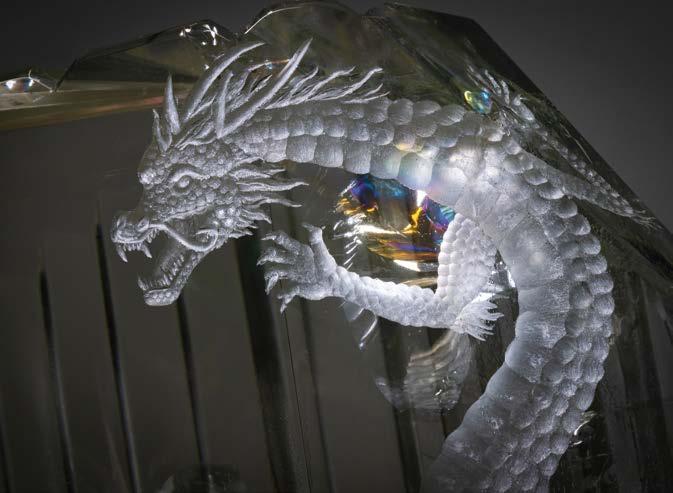
This decision marked the beginning of a half-decade-long project that would push the boundaries of gemmology.
Idar-Oberstein artisans overcome nature’s challenges
The task of cutting the colossal topaz fell to the artisans of Idar-Oberstein, a small German town with a legendary, centuriesold reputation as the world’s premier gem-cutting centre. The project was led by master cutter Jürgen Christmann, a figurehead of the local craft. Yet, even with this depth of experience, the team faced unprecedented challenges.
The primary obstacle was a fundamental property of the topaz mineral: its basal cleavage plane. Imagine the crystal’s atomic structure as a stack of paper. The bonds between the sheets are far weaker than the bonds within
each sheet. This means topaz can be split perfectly and easily along this single plane with a sharp impact, or even with stress from polishing. One mistake could instantly cleave the multi-million-dollar stone in two. The team spent an entire year meticulously studying the rough crystal, mapping its internal stresses and cleavage plane to devise a safe cutting strategy.
The second major problem was mechanical. No machine in existence was built to handle a rough gem weighing more than 20 kilograms. A new, custom-built polishing apparatus had to be designed and constructed, featuring a precision three-axis control system to manoeuvre the stone with absolute stability and accuracy.
To mitigate the immense risk, the team undertook a two-year prototyping phase. Using a specialised Japanese glass with a refractive index identical to topaz’s (1.63),
they created five exact replicas of the rough stone. Polishing these glass models allowed them to test the new machinery, refine the complex cutting pattern, and perfect their technique before ever touching the actual gem. It was a painstaking process of trial and error, a dress rehearsal for one of the most demanding lapidary projects ever attempted.
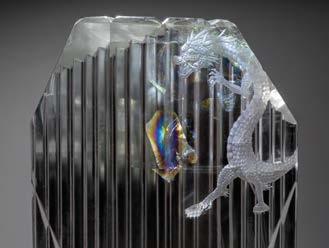
The final design of The Secret Rainbow is a masterclass in optical physics. The crown (top) features a clean step-cut to showcase the gem’s internal purity. The pavilion (back) is where the true innovation lies. It is carved with a series of precise grooves, each angled to achieve a double total reflection from the backside of the stone, directing the incoming light back into the direction from where it came.
This phenomenon occurs when light travelling through a denser optical medium (the topaz) strikes the boundary with a less dense optical medium (air) at a high angle, known as the critical angle. Instead of escaping, the light is reflected back into the gem as if from a flawless mirror. By engineering the pavilion this way, the designers ensured that a maximum amount of light entering the stone is reflected back to the viewer’s eye, creating exceptional brilliance.
This technical brilliance serves a rich symbolic narrative. The grooves are arranged to a symbol of a rising sun, representing new beginnings. Carved into the gem’s side is a dragon, a universal archetype of a treasure’s guardian. The rainbow it guards symbolises higher knowledge or a bridge to the divine.
This symbolism connects deeply with one of the proposed origins of the word ‘topaz’. While often linked to the Greek island Topázios, another theory traces it to the Sanskrit word तपस् (tapas), meaning “heat” or “fire”. This root word is central to the concept of Tapasya, the spiritual discipline of generating internal energy to achieve self-realisation. The gem’s visual story – a guardian dragon at the gate of divine light – mirrors this ancient concept of spiritual struggle and enlightenment.
After two years of polishing the actual topaz, the work was completed in August 2023. In May 2024, the Gubelin Gem Lab provided the final, official validation. Their report confirmed
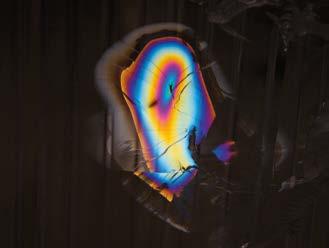
the gem as a 50,200-carat topaz of exceptional quality, officially cementing its status as the largest faceted gemstone ever recorded. It surpasses the former titleholder, the El Dorado Topaz (31,000 carats), by a staggering margin of over 19,000 carats.
The Secret Rainbow represents a convergence of geological chance, human perseverance, scientific understanding, and artistic crafting. It is a testament to the idea that even in the 21st century, there are still new frontiers to explore in one of humanity’s oldest arts.
is a marketing manager and consultant with experience in the high-end jewellery and precious stones industries. She thrives as a certified diamond gemmologist with strategic business acumen, advising several jewellery firms on marketing and growth. In addition, she plays a role in the world’s only fully regulated diamond investment fund, contributing to the design and support of specialized software. Her multi-faceted background allows her to bridge the worlds of fine jewellery craftsmanship and cutting-edge technology.
Vietnam and the Czech Republic are celebrating historic milestones in diplomacy. The year 2025 marks both the 75th anniversary of mutual diplomatic relations and the 80th anniversary of Vietnam’s diplomatic service. To celebrate these occasions, Czech Senate President Miloš Vystrčil has given an interview, reflecting on Vietnam’s achievements and the long-standing friendship between the two countries.
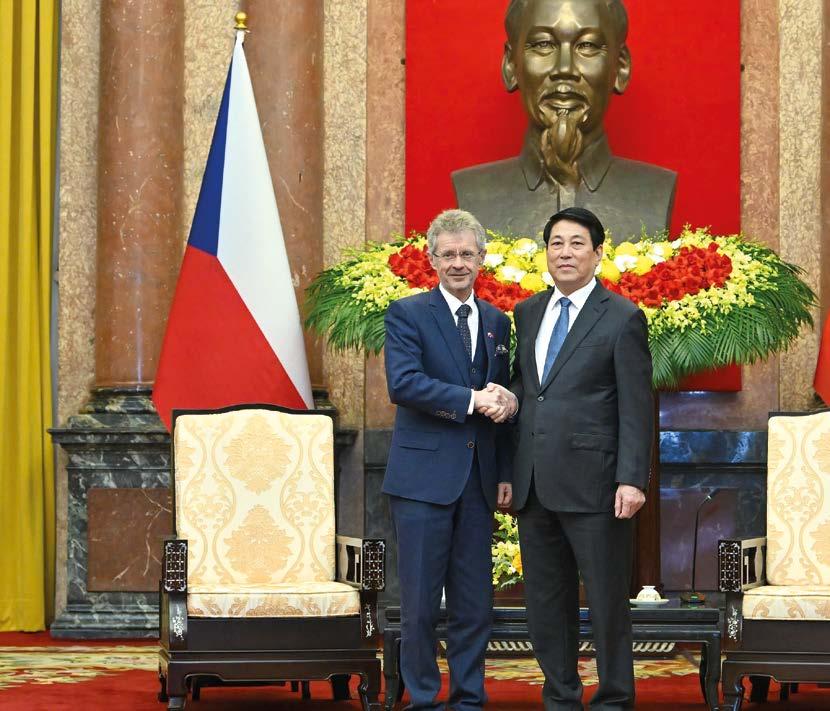
What is your assessment of Vietnam’s achievements over the 80 years since its founding, particularly in the past 40 years of Doi Moi (Reform), integration, and development?
In the Czech Republic, we greatly value the long-standing and very good relations between the Czech people and the citizens of the Socialist Republic of Vietnam. These traditions go back to before 1989. Regarding the changes Vietnam has undergone, I personally have to highlight and appreciate its significant economic growth, as well as the economic success it has achieved since the imple -
mentation of the Doi Moi reforms in 1986. It’s this combination of the entrepreneurial spirit of the Vietnamese people and a development model that differs from that of the Czech Republic that has led to big economic progress. At the same time, it’s important to recognise that the way the country is governed and the path of its development are different from the Czech model.
In our case, we have a pluralistic system, not a single ruling power, but multiple political parties that compete in elections. That said, I want to appreciate the development of the Socialist Republic of Vietnam, the reform it
has carried out, and above all, the long-standing cooperation between our countries. I would also like to point out that the Vietnamese community here, the Vietnamese people, are the most positively regarded non-European minority in the Czech Republic. Only Slovaks and Poles rank higher in terms of public perception, making the Vietnamese the most appreciated community from outside of Europe. Czech citizens have built strong, friendly relations with them, which speaks volumes about the depth of our mutual respect and connection. This, in itself, is a statement to the very good relations between
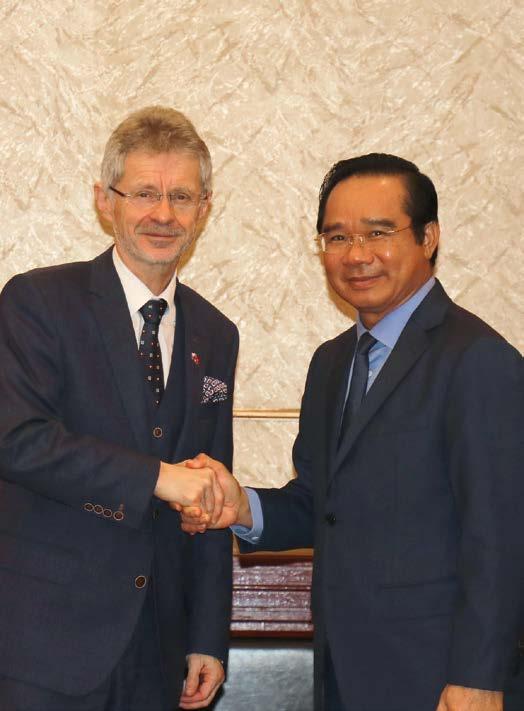
Vietnam and the Czech Republic, and the great potential for further growth in our partnership.
Could you elaborate further on the relations and cooperation between Vietnam and the Czech Republic, and where you see it leading us in future?
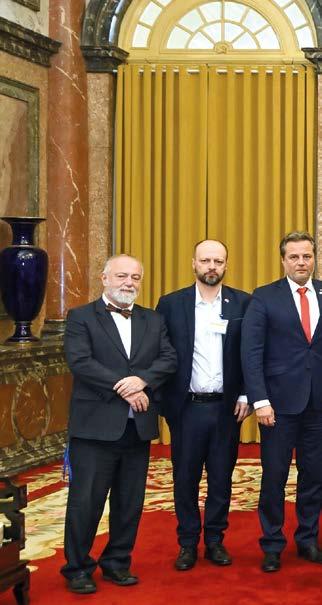
To begin with, I would like to remind everyone that this year marks the 75th anniversary of diplomatic relations between the Socialist Republic of Vietnam and the Czech Republic. I would also like to congratulate the Socialist Republic of Vietnam on its 80 years of independence. These facts alone demonstrate that the relationship between the Czech Republic and Vietnam is long-term. And my recent meetings earlier with both the Vice President of Vietnam and the Prime Minister of Vietnam are small evidence of this. I highly value both meetings and appreciate the friendly relations that we continue to develop. I am also planning to visit Vietnam, and I thank the Chairman of the Vietnamese parliament for the invitation I have received. I believe that this will allow us to further develop our relations.
If I were to mention what I consider absolutely unique and worthy of appreciation in Vietnam, it is Vietnamese cuisine. The Vietnamese soup Pho is something that we in the Czech Republic eat very often, and indeed, Vietnamese gastronomy is something that we admire greatly here in the Czech Republic. We also admire the diligence of Vietnamese citizens, especially in the business sector. I myself come from the Vysočina region, which has a large number of small municipalities, and those who provide the necessary goods and groceries there are mostly
residents and citizens of Vietnam. Some are already citizens of the Czech Republic too, or work here on work permits. I truly want to thank them for this cooperation.
I am also pleased with our cooperation in the culture sector. I would be very happy if we could further improve the functioning of the Czech Centre in Vietnam, and conversely, I think we should support the Vietnamese Centre here in the Czech Republic.
If I look into history, I see certain parallels as well. Both countries had to fight for their independence at some point, and had to sacrifice a lot. We also had experiences with how difficult communication can be with large neighbours or generally with big countries, where we also had to deal with various challenges, and both the Czech Republic and Vietnam managed this very well. This means there are many things that connect us.
Finally, although it may be almost the most important point to repeat, a large number of Vietnamese were in the Czech Republic before and after 1989, studying and working in the Czech Republic. And today, there is a significant opportunity for us to utilise and further develop this cooperation, to create greater business opportunities for the Czech Republic in Vietnam, as well as for Vietnam, not only in the Czech Republic but throughout the European Union.
TEXT:
“Czech garnet is considered the national gemstone and is part of the cultural heritage of the Czech Republic. It symbolises deep love, passion, and devotion. Czech garnet is completely unique in its composition, and is mined exclusively in the Czech Republic,” explains Eva Stodůlková, Chief Financial Officer of Granát Turnov, the only holder of a permit to mine Czech garnets.
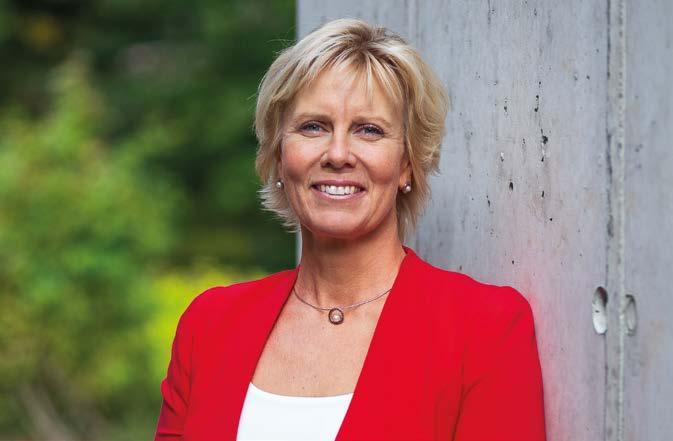
Can you start by telling us a few words about yourself?
I was born in Liberec, in the north of the Czech Republic, and have lived there my entire life. The nature here is beautiful – we are close to the Jizera Mountains and the Bohemian Paradise. I love sports, mountains, and nature, so it’s an ideal place for me to live. I graduated in Business Economics and Management with a focus on Corporate Finance and I have dedicated my entire professional career to this field. For over nine years now, I have been working at the Granát Turnov cooperative as Chief Financial Officer.
What can you tell us about Granát Turnov?
Granát Turnov is a traditional jewellery manufacturer specialising in Czech garnets, with a history spanning over 70 years. It was founded in 1953 in Turnov, where it still operates and maintains its entire production, except for mining. It is a Czech business corporation with 100% Czech capital.
Currently, the cooperative has 160 employees, two Czech garnet mines – located in Podsedice and Dolní Olešnice – seven retail stores, the Czech Garnet Museum
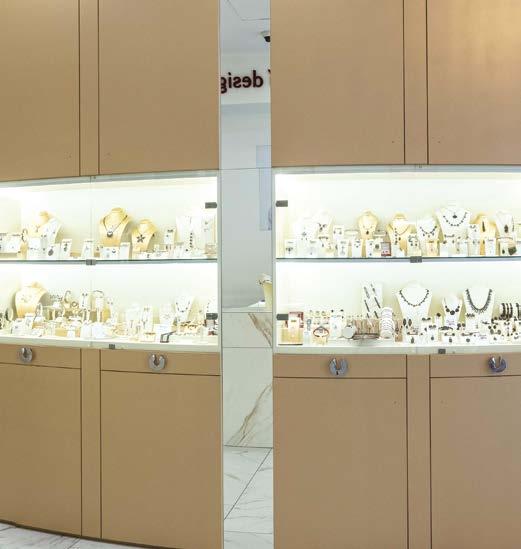
in Prague, and exhibition galleries in Turnov and Český Krumlov. The uniqueness of the cooperative lies in the fact that it is the only holder of a permit to mine and actively mining Czech garnets, and the owner of the trademark “Granát Turnov” and the geographical indications “Bohemian Garnet” and “Bohemian Garnet Jewellery”. All products are certified.
Mining is carried out ecologically in surface mines. After extraction, the area is reclaimed and returned to its original state. From mining to processing, cutting, manufacturing silver and gold jewellery,
and wholesale and retail sales –everything is managed in-house. Most of our production consists of jewellery with Czech garnets, but we also offer a wide range of gold jewellery with other gemstones such as sapphire, emerald, diamond, etc. A popular combination is a Czech garnet with a pearl. Our product portfolio includes over 36,000 models. In addition to traditional designs, we offer modern and fresh styles. We also provide custom-made jewellery, as well as repairs of antique pieces. Our mission is to preserve the traditional craft of jewellery making and Czech garnet processing.
Is it true that the Czech garnet is perceived as the national Czech stone, the nation’s mineralogical symbol?
Yes, the Czech garnet is considered the national gemstone and is part of the cultural heritage of the Czech Republic. It symbolises deep love, passion, and devotion, and is often given as a romantic

talisman believed to bring energy, courage, and confidence. An original piece of jewellery with Czech garnets is seen as one of the distinctive symbols of the Czech Republic. Czech garnet is completely unique in its composition, and is mined exclusively in the Czech Republic.
Can we find some other garnets in the world?
Czech garnet belongs to the garnet group – crystalline silicates with various chemical compositions that determine their colour. Garnets can range in colour from white to black, and are found in many forms around the world.
Czech garnet is exceptional for its composition and deep red colour, often referred to as “pigeon blood”. It is highly resistant to heat and chemicals, and retains its intense colour even in very small sizes, around 1 mm. Other red garnets from global deposits tend to appear pink, orange, or yellow at this size.
Tourists often ask: “Where can I buy a garnet in Prague to be sure it’s not fake?” Do you have a helpful answer?
Each piece of jewellery with Czech garnets from our production is marked with a “G” hallmark. It also comes with a certificate featuring a hologram that guarantees the Czech origin of the stone and the authenticity of the jewellery. These are the main identifiers that help customers recognise genuine Czech garnet jewellery.
Colour and size can also be indicators – Czech garnets have a deep red colour in all sizes and are typically found in smaller dimensions. The most common sizes used are between 1.5 and 3.5 mm. Stones larger than 4.5 mm are rare and are used in more luxurious pieces, usually set in gold.
In the centre of Prague, we have three stores marked with our logo: Dlouhá Street 28, Panská 1/892, and Havířská 581/3.
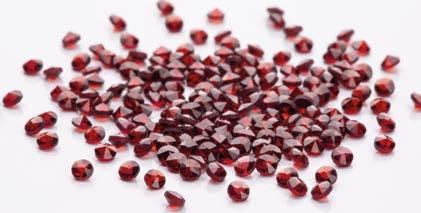
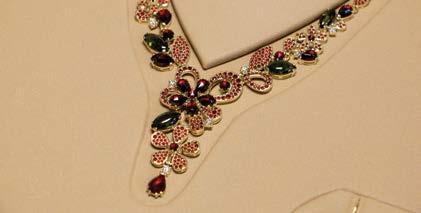
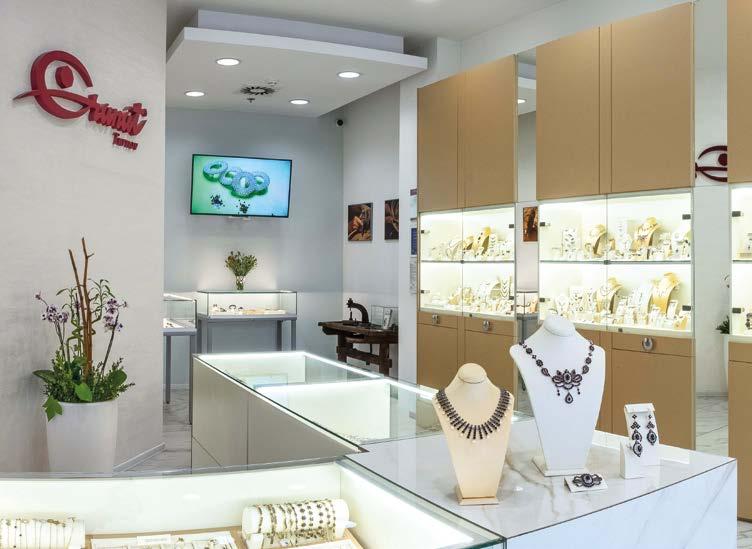
We also operate the Czech Garnet Museum at Karlova Street 8. Additional stores are located in Turnov, Liberec, České Budějovice, and Český Krumlov. At all these locations, customers can be 100% sure they are purchasing authentic Czech garnet jewellery.
Customers can also visit our e-shop at www.granat.cz, where they can shop with delivery available even outside the Czech Republic.
Granát Turnov was part of the Czech pavilion in Osaka this year. How did you present your unique work?
Our participation in the World EXPO in Osaka, Japan, was our most significant event this year. At the turn of July and August, we had the opportunity to present
our brand and products on a global stage in the beautiful setting of the unique Czech pavilion, to both B2B partners and the general public.
For this occasion, we prepared an exclusive gold set consisting of a necklace and earrings adorned with Czech garnets of unique sizes, diamonds, and moldavites. The set was designed and crafted by our designers and goldsmiths, inspired by symbols of Czech and Japanese culture. It was first unveiled to the public at the EXPO.
We were also the general partner of the multimedia cultural performance Ballet of Tomorrow – Symphony of Clouds, which connects Czech and Japanese culture, traditional ballet, opera singing, and piano music with cutting-edge technologies such
as artificial intelligence and holography. Our gold set was featured in holographic form as part of the performance. Both the show and the jewellery were a great success among visitors to the Czech pavilion.
At the end of the summer, we organised the exhibition Tasting Czech Garnet at the Clarion Grandhotel Zlatý Lev in Liberec as part of the Crystal Valley project. Jewellery was presented as a festive feast on a richly decorated table. This exhibition marked the first presentation of the exclusive EXPO set in the Czech Republic, along with new collections created for this autumn and winter.
What are the upcoming challenges for the company, both in Czechia and internationally?
Following our participation in the EXPO in Osaka, we are preparing for an exhibition at the Czech Embassy in Tokyo, scheduled for January. A major event next year will be our Open Day – on October 17th, 2026, we will open our production facilities in Turnov to the public with guided tours. Visitors will have the opportunity to see the entire jewellery-making process.
When you began your career many years ago, did you imagine you would one day have a leadership role such as the one you have today?
When I started my professional career, I focused primarily on developing my expertise in finance and management. Over time, I gained experience and expanded my scope to include trade, IT, and
strategic leadership. I’m grateful for the opportunity to acquire this knowledge, and for the trust placed in me to serve in managerial roles and statutory bodies.
The path to leadership is not just about ambition – it’s about the willingness to learn, take responsibility, and lead with respect. I truly value being part of a team that shares the values of tradition and quality, and I’m proud to contribute to its development.
Besides being CFO of Granát Turnov, you are also a Member of the Credit Council of the Union of Czech and Moravian Production Cooperatives. Does the fact that you are a woman play any role?
I have spent most of my professional life in managerial positions
in finance, with overlaps into trade and IT. This allows me to connect the world of numbers and rules with the dynamics of business strategy – a job that fulfils and inspires me. In the Credit Council, I focus on risk assessment for loans provided to member cooperatives.
Being a woman in business means combining expertise, empathy, and the courage to make decisions. I believe in the power of teamwork, honesty and open communication as the foundation of success.
Can you give a piece of advice to the next generation of women in business?
Follow your dreams and don’t let anything discourage you. Act with integrity and humility. Protect your time for yourself and your family – those are irreplaceable moments.
You were one of the finalists for the Manager of the Year 2024 competition. Is that the right kind of motivation for you?
I had the honour of being nominated and becoming a finalist in the Manager of the Year 2024 competition, organised for the 32nd time by the Czech Management Association. I was nominated by the leadership of the Union of Czech and Moravian Production Cooperatives in the CFO category. The Union brings together 180 production cooperatives, and I deeply appreciate this nomination.
The competition ran from June to early October in two rounds. A 17-member evaluation committee selected finalists and winners based on applications and personal presentations. The committee assessed management approach, personal strengths, achievements, implemented projects, and other criteria.
The awards ceremony took place in early October during a gala evening at the opening of the International Engineering Fair in Brno, in the Rotunda Hall. I greatly value this opportunity and the recognition as a finalist – it is not only an acknowledgement of my work but also of the entire Granát Turnov team. It motivates me to continue – advancing digitalisation, integrating new technologies including AI, supporting innovation, building company culture, and fostering collaboration.
You advised businesswomen to protect their free time. What do you do outside of work?
Unfortunately, my free time is limited, but I try to plan and use it meaningfully. I prefer spending it actively with my family. I relax through sports and dancing. On regular days, I do aerobic exercise, swimming, running,
and Latin American dancing. When I have more time in the season, I also enjoy playing golf. In winter, I love skiing. Scuba diving and freediving are a great form of relaxation for me –underwater feels like entering a different, peaceful, and fascinating world.
What is the most exciting adventure you have ever been on?
I love diving – every dive is a beautiful adventure for me. Some of my most memorable experiences include diving with dolphins, a dugong, and giant sea turtles.
And one that stands out as rather dramatic?
Years ago, during a climb to the Dachstein summit, the weather suddenly turned bad. We were already close to the top, and had
to decide whether to continue or turn back. For safety reasons, we chose not to finish the ascent – and it was the right decision. In the following years, we made up for it by climbing Triglav. I believe we’ll return to Dachstein one day.
All right, we believe you will return to Dachstein again someday. But where do you see yourself in 10 years?
In ten years, I hope to remain active in a field that fulfils me, both professionally and personally, working in strategic financial management, business, and company development. I also wish for my work to have a positive impact on the people around me – whether within my team or in the broader professional environment.
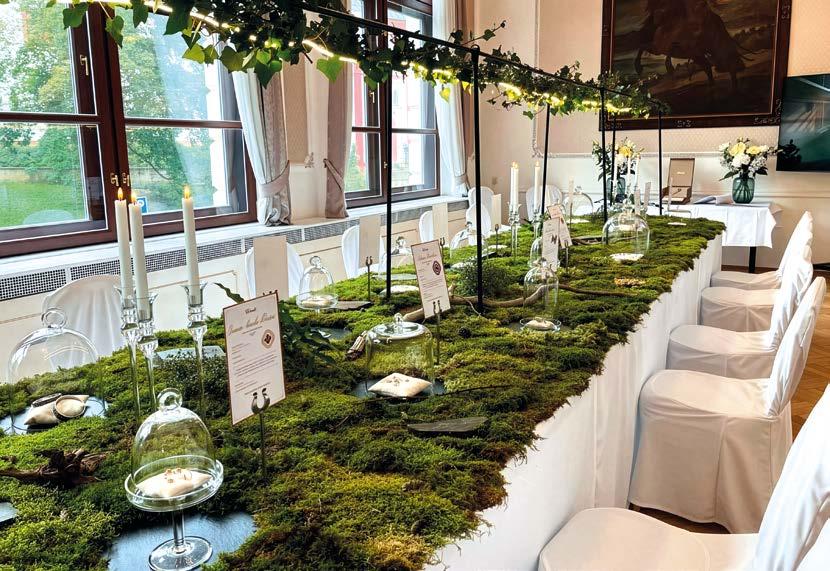
Every medicine we take goes through a long and complex journey before it reaches the pharmacy shelf. From the first idea in a laboratory to the final pill or injection, each step must guarantee one thing: safety and effectiveness for patients. This is not just a regulatory requirement –it’s a matter of trust and health.
We are racing against time
Medicines are high-end products, and even the smallest mistake can have serious consequences. That’s why rigorous testing and quality control are essential throughout the entire development
cycle. It means checking purity, stability, performance, clinical aspects, and ensuring that every dose works exactly as intended. For innovative drugs and their affordable alternatives – generics and biosimilars – these checks are even more critical.
In today’s fast-moving pharmaceutical world, where new therapies like biologics and advanced cancer treatments are emerging, the challenge is bigger than ever. Because when it comes to health, there’s no room for compromise.
Testing the quality of medicines might sound like a boring routine, but in reality it’s full of challenges that sometimes feel like ‘Mission Impossible’. From detecting impurities at incredibly low levels to ensuring complex cancer drugs work exactly as intended, every step requires precision, speed, and creativity. And yet, we make it happen. Why does this matter? Because behind every pill or injection is a race against time to deliver safe, effective treatments to patients. It’s a story of science, responsibility, and determination
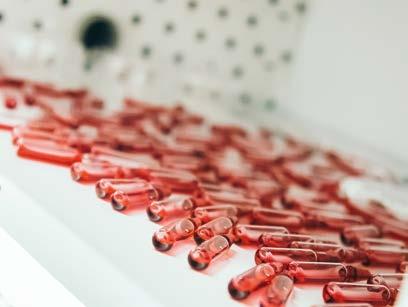
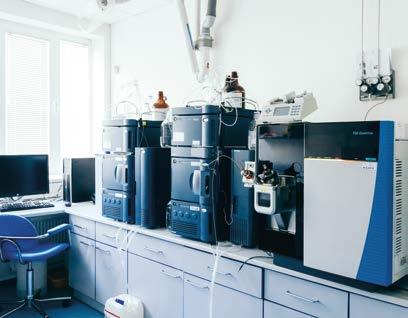
– far more exciting than it seems at first glance. Let me mention just a few examples that I can speak of from my own experience, and which influenced the lives of many.
When the world faced the COVID-19 pandemic, vaccine makers had to act fast. One of them, Novavax, approached the Quinta-Analytica company to make sure their vaccines were produced quickly and safely.
The collaboration started in 2020, right in the middle of the pandemic. Novavax needed help with complex testing and quality checks for vaccine ingredients. We stepped in, creating and implementing hundreds of testing
methods – some from scratch. These tests checked everything from purity and identity to microbiological safety, ensuring every component met strict standards.
Speed was critical. Demand for vaccines was skyrocketing, and Novavax had to scale up production without delays. Turnaround times stayed short, and production kept moving. In fact, by 2022, our lab had tested nearly 6,000 samples of various ingredients – a huge achievement that helped vaccines reach people faster.
The pandemic reminded us how vital vaccines are – and how much teamwork it takes to deliver them. This was one of the biggest projects we are proud to have been part of, helping improve health worldwide.
Antibody-drug conjugates (ADCs) are a new generation of cancer treatments that combine two powerful tools: a targeted antibody and a strong chemotherapy drug. The antibody acts like a GPS, guiding the drug directly to cancer cells, reducing harm to healthy tissue and improving patient outcomes.
Creating ADCs is complex because they mix large biological molecules with small chemical ones. Every detail matters – how they’re linked, how stable they are, and how they behave in the body. Ensuring ADCs are of desired quality must happen before they reach patients, of course. Our experts develop advanced testing methods to check these factors, ensuring ADCs are as safe and effective as the manufacturer expects them to be.
What makes this story exciting is that Sotio, an innovative biotech company based in the Czech Republic, is leading the way in developing cutting-edge ADC therapies. The cooperation
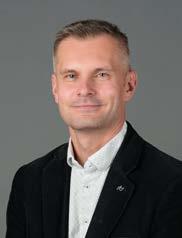
between Sotio and QuintaAnalytica shows the strength of Czech science and industry: two homegrown companies working together to deliver smarter cancer treatments to the world.
ADCs represent the future of oncology – targeted, precise, and with fewer side effects. Behind the scenes, companies like the aforementioned are proving that Czech innovation can compete globally and make a real difference in healthcare.
In 2019, the pharmaceutical world faced a wake-up call when the U.S. FDA uncovered serious manufacturing process violations at a certain Chinese facility. These lapses led to the unexpected formation of nitrosamines –chemical compounds identified as potential carcinogens. What began as a single investigation quickly grew into a global issue, triggering recalls of widely used drugs like blood pressure medications and heartburn treatments. This incident revealed how even small oversights in manufacturing can have massive consequences,
and it set the stage for stricter controls and advanced testing methods to protect patient safety worldwide.
The fun fact is that nitrosamines aren’t just in pharma – they can also be found in smoked meats, beer, and even cosmetics. In medicines,however, standards are far stricter. Quinta has developed and operates advanced methods to detect nitrosamines and their analogues, ensuring drugs meet the highest safety standards. The challenge here, though, is about the concentration levels that are being tested. We are talking about extremes like 2-3 ppb (part per billion). Imagine you have one billion drops of water. If just one drop contains a certain substance (nitrosamines here), that’s 1 part per billion (ppb). It’s an extremely tiny amount – like finding one grain of sugar in an Olympic-sized swimming pool. And this is the real beauty of the services we provide.
Jiří Raška, Chief Commercial Officer and Managing Partner at Quinta-Analytica Archive
TEXT: PHOTO:
is a seasoned expert in the pharmaceutical industry, holding his Ph.D. in physical chemistry. Over the years, he has held key roles in drug quality control and pharmaceutical production management. Since 2013, he has focused on business development and commercial strategy for companies involved in active pharmaceutical ingredients, drug manufacturing, and contract research. He currently serves as Chief Commercial Officer and Managing Partner at Quinta-Analytica, a Prague-based top-class contract research laboratory, and oversees pharmaceutical business activities at Conscio Group, Quinta’s parent company.
Founded in 1997 in Prague, Quinta-Analytica has grown into a globally recognized partner for pharmaceutical companies. Being based in the heart of Europe gives Quinta’s clients a major advantage. Testing medicines here means meeting strict EU regulatory standards, opening doors to one of the world’s most trusted healthcare systems.
A firefighter since 1989, Pavel Hošek is now heading the team of the Prague Airport Rescue and Fire Brigade, ensuring the safety of our travel. “Over the years, an incredible number of things have changed,” he says. “Now, I pass on my experience to younger colleagues, and together we strive to improve things and come up with new ideas. I try to present well-prepared plans and proposals to our board. We have strong support, and our unit is doing well in this regard – we are highly rated, and our reputation is excellent.”
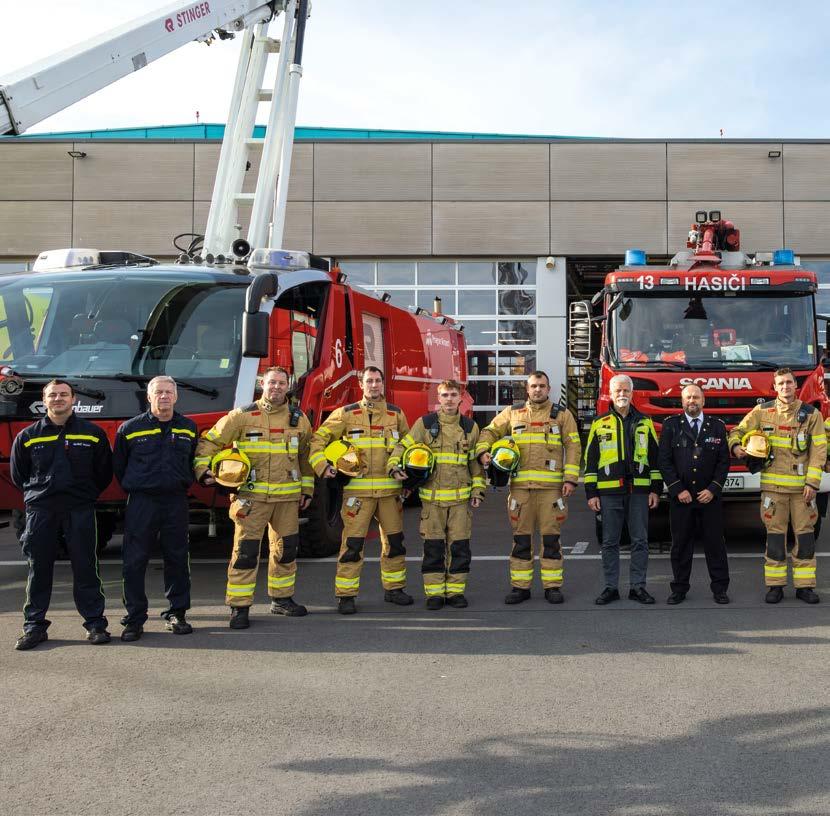
Let us open this interview with a standard yet important question. Can you tell us a bit about yourself?
My name is Pavel Hošek, and I work at Prague Airport as the Director of the Airport Rescue and Fire Brigade. My firefighting career began in 1989, when, after completing my compulsory military service, I joined the Fire Rescue Service of the Capital City of Prague as a young firefighter.
I served with the Prague firefighters for 23 years and worked my way up to the position of shift commander, which means that on a given day, you are in charge of all units in Prague. In 2018, I became the head of the Prague Airport Rescue and Fire Brigade.
The Prague Airport Rescue and Fire Brigade is celebrating its 80th anniversary this year. Can you give us some notable highlights?
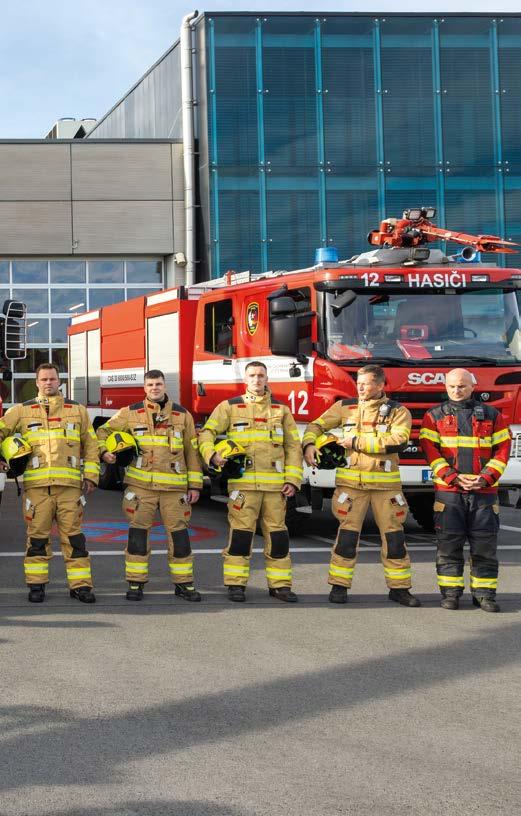
The first written record of a fire unit at Ruzyně dates back to 1945. However, we can assume that organised fire protection at the airport existed from its very beginning, in 1937.
Each year, the airport firefighters respond to around 600 incidents. The most common are fuel spills and smoke detector alerts. These are supplemented by assistance and interventions in the surrounding area, such as accidents on motorways D7, D6, and D0. False alarms are also frequent.
The Prague Airport Rescue and Fire Brigade consists of 104 personnel. Of those, 84 are operational firefighters divided into four shifts. The team also includes eight daytime staff and 12 dispatchers –11 of whom are women. Each shift includes 21 firefighters, divided into specific crews: two for airside operations and one for building interventions. In the event of a major emergency, all crews are deployed.
There are two fire stations on the airport grounds – one central and one satellite. Vehicles must be dispatched within 45 seconds to ensure they can reach any location within the airport premises in 2 to 3 minutes and begin an intervention.
Looking ahead, a brand-new satellite station is planned in connection with the construction of a new parallel runway. The current central station was already built with this future development in mind, and is located accordingly.
Is there any difference between a common firefighter and an airport firefighter?
Airport firefighters, state firefighters, company firefighters, volunteer firefighters; it can be a bit complicated to distinguish and understand the differences, but I will try to explain.
We are company employees, but we have the same education as state firefighters. We also attend joint courses and share some of the qualifications. The main difference is that an airport firefighter must additionally obtain the ARFF (Aircraft Rescue and Firefighting) certification, which involves training in extinguishing burning fuel and responding to aircraft incidents.
How did you get the idea of becoming a firefighter?
When I was younger, I was very active and loved sports. I played ice hockey competitively and spent my free time playing football, tennis, and cycling a lot. I was always part of a team where we motivated each other and competed. When I started my compulsory military service, being in good physical shape really came in handy.
My path to becoming a firefighter was quite straightforward. My best friend finished his military service a bit earlier than I did and joined the fire brigade. So, when
I returned, I followed in his footsteps. I quickly grew to love the job. It wasn’t easy at all – it was demanding and dangerous work, with low financial compensation.
Over the years, an incredible number of things have changed, but I stayed in the profession, while my friend moved on. I still enjoy the work, I pass on my experience to younger colleagues, and together we strive to improve things and come up with new ideas.
Is there something which can be described as “a typical workday” at your position?
Prague Airport is a very dynamic and complex environment where all organisational units must work together to ensure that passengers have everything they need and that they enjoy their travel experience. An essential part of the entire system must be travel safety, and that is precisely our main task and goal.
My job essentially combines the role of the highest-ranking
commander of the fire brigade with that of a manager. I deal with budgeting, development, technical equipment, fleet renewal, facility modernisation, training, and planning. Every morning, I meet with the fire brigade management to share all the necessary updates. This helps us stay informed about what is happening within the team and allows us to cover for each other when needed. Throughout the day, I also take part in airport management activities: attending meetings, negotiations, and working in various committees.
I’ve been serving as the Director of the Prague Airport Rescue and Fire Brigade for eight years, and I have to say that every day is different – there’s no risk of burnout here.
What are your responsibilities as the head of the team?
As I already explained, this position combines the role of a commander with that of a manager. That said, the role of an active firefighter is now
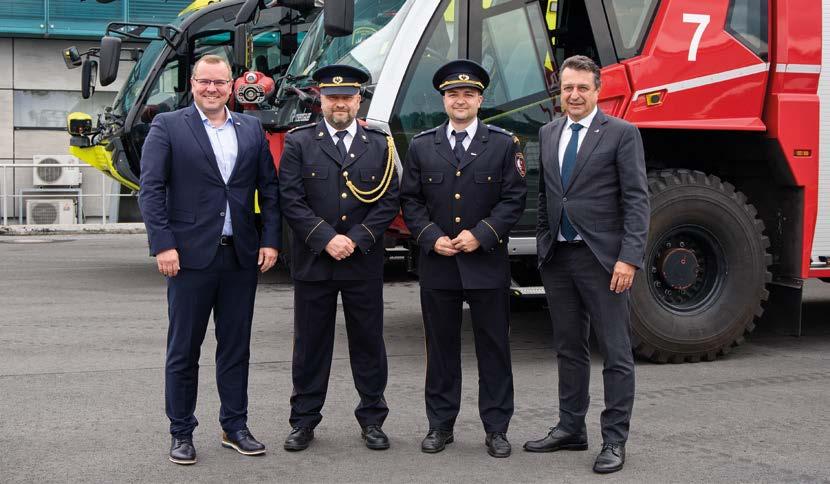
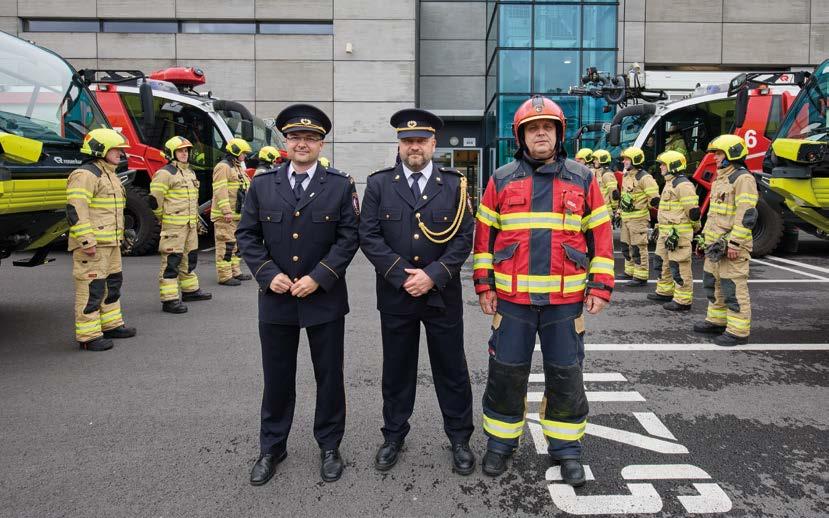
a bit out of reach for me, simply because there’s no time for it anymore.
As the head of a large rescue service, I need to ensure it is in operational synergy with my team – this includes having enough personnel and resources, training, qualifications, equipment, the condition of fire stations, and meeting all requirements for inspections and audits.
I try to present well-prepared plans and proposals to our board. We have strong support, and our unit is doing well in this regard – we are highly rated, and our reputation is excellent.
One of the least favourite parts of any leader’s job is dealing with conflicts. Are you no exception to that rule?
Our work is not easy, and conflicts do arise from time to time. Sometimes I have to restrict people’s rights during our emergency response, and other
times I have to deal with disagreements in the workplace.
Being a firefighter brings about a number of extraordinary situations. Can you share some with us?
I’ve had many experiences and adventures. As both a firefighter and a commander, I’ve responded to numerous fires, traffic accidents, floods, and windstorms.
For example, I was part of the USAR team in Iran in 2003, where a major earthquake struck, and the Czech unit did an outstanding job there.
During major floods, I was deployed to various parts of the Czech Republic, where we rescued people, animals, and property, as well as creating survival shelters.
As a firefighter – and especially as a commander – I’ve been involved in major fires in Prague, such as the SAPA market fire, the Florenc train station, the Vinohrady brewery,
and many apartment fires. I’ve also served as a negotiator in suicide attempt situations.
Is there a particularly unusual situation that you remember?
It happened a long time ago, but the story is still vivid in my mind –and hopefully, the person I saved is still alive and enjoying life. I was serving as the shift commander, and therefore the incident commander, during an event where a young man was about to jump off the Nusle Bridge. He was already sitting on top of the high protective fence, had thrown down his shoes and bag, and refused to communicate. After some time, I managed to start a conversation with him – probably because I wasn’t wearing firefighting gear, just my uniform: a shirt and trousers.
He told me he hadn’t even finished high school, didn’t believe in himself, and wanted to end it all by jumping over 40 meters down from the bridge. Based on his
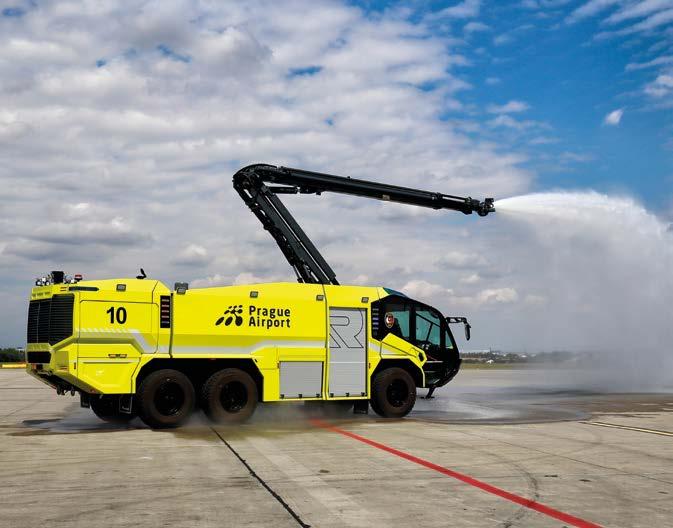
behaviour, we assessed that he was serious about his statement. Eventually, I convinced him that I couldn’t hear him well and that I would climb up to him using an attached ladder. There wasn’t time to secure myself with a rope, so I just nodded to my colleagues to watch me and hold my ankles.
I climbed up behind him, continuing to talk to him. But he realised I was trying to grab him. He tried to hit me with his elbow, but I blocked the blow, grabbed him tightly around the chest and arms, and pulled him back onto the bridge. The emergency medical team took over from there. Only then did I realise what had just happened, how risky it was – and my knees started to shake a little.
But the young man was saved, and that was what mattered the most.
What would you say is the most difficult part of your job?
When I served as a firefighter and later as a commander in Prague, the entire shift was extremely demanding. We worked 24-hour shifts followed by two days off. If you were called out to an incident during the night and spent the whole night there, the exhaustion was intense.
It’s definitely a physically and mentally demanding job for all firefighters, especially because they witness the aftermath of fires, accidents, and natural disasters.
Does your free time enable you to recover from the strains of a demanding job?
These days, I really value my free time.
As you get older, you realise how important it is to enjoy life during your time off and to do things for your health. So, I spend a lot of time in nature – going on trips and holidays. I really enjoy manual work; I have a house and a garden, and there’s always something to do there. One of my big hobbies is riding my motorcycle and going on road trips.
I’ll admit, sometimes I also enjoy just lying on the couch, reading a book, or simply relaxing. And why not? That’s part of life too.
We are living through the final years before absolutely everything changes. Our existing institutions and notions of work will be tested. Artificial General Intelligence is likely the final major invention humanity needs to make, because it can subsequently invent everything else. The defining challenge of our era is to ensure the transition to AGI in a way that strengthens –rather than fractures – social stability.
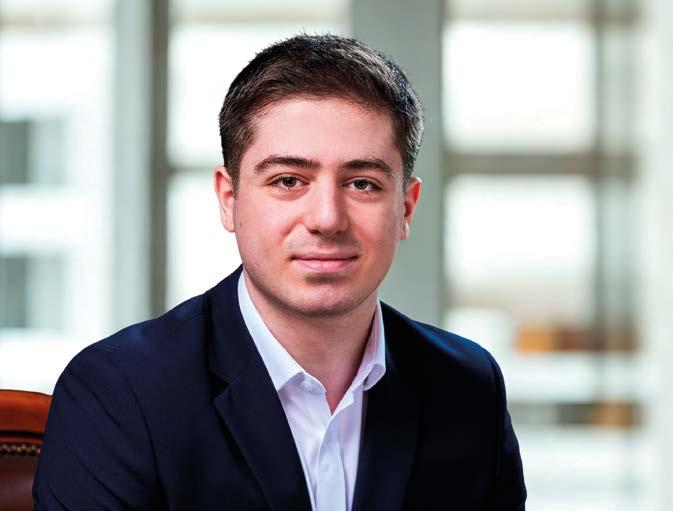
Andriashvili, Founder of Solvia, an AI voice-agent startup in Prague
I’m David Andriashvili, Founder of Solvia, an AI voice-agent startup in Prague. I moved to the Czech Republic three years ago, and graduated from Park Lane International School this year. Business has fascinated me for as long as I can remember, and what drew me to artificial intelligence wasn’t the immediate commercial opportunity but the realization that we are living through the final years before absolutely everything changes.
When I began studying what the world’s leading AI researchers
were actually saying, voice agents stopped looking like mere customer support tools, but rather like the first visible manifestation of the emergence of autonomous intelligence, which will fundamentally change how value is created and distributed in the global economy. These systems can execute tasks autonomously and continuously, without human oversight. Working with voice agents exemplifies this, since they reason through complex customer scenarios, and take action independently while sounding surprisingly human on the phone.

This isn’t the primitive AI of five years ago. This is something qualitatively different, and arriving faster than most people realize.
Within the next five years, we will likely witness Artificial General Intelligence (AGI), which are systems that match or surpass human intelligence in every metric. But here is the question that concerns every leader: what happens to the institutions we’ve built when the fundamental assumption that human labor creates value suddenly stops being true?
AGI is likely the final major invention humanity needs to make, because it can subsequently invent everything else. This is not hyperbole, but a straightforward extrapolation of what general intelligence with superhuman speed and scale can accomplish. It is an intelligence capable of improving itself through rapid feedback loops that could concentrate more power than any technology in human history. The defining challenge of our era is to ensure the transition to AGI in a way that strengthens – rather than fractures – social stability, and this isn’t a distant concern. When AGI can perform any white-collar task, such as accounting, legal logic, strategic forecasting, research, at superhuman speed and scale, our existing institutions and notions of work will be tested. Early
forecasts, such as those by the World Economic Forum once warned that tens of millions of roles could be displaced by automation. However, today, what we’re witnessing is not yet mass unemployment, but sweeping structural churn in which the very nature of work, income, and agency is being redefined. We’re already seeing tangible shifts in how AI is governed. For example, more than fifty countries have now signed the Framework Convention on Artificial Intelligence, that binds themselves to align AI with human rights, democracy, and the rule of law. On the infrastructure front, Europe’s EuroHPC Joint Undertaking is investing in sovereign compute capacity, which includes processor R&D and data center construction to reduce dependence on external cloud powers.
For my part, I believe Solvia’s role is not about prescribing institutional behavior, but about providing a proving ground. We aim to build voice agents with inherently inspectable logic, fallback safety modes, and user control, so that adoption happens through trust, not by decree. The success of those systems will show that AI can empower, rather than obscure. Ultimately, the rise of AGI will measure not only our technical capabilities, but our capacity for foresight, as well as shared purpose. Progress will be judged not by what machines can do, but by what humanity chooses to preserve.
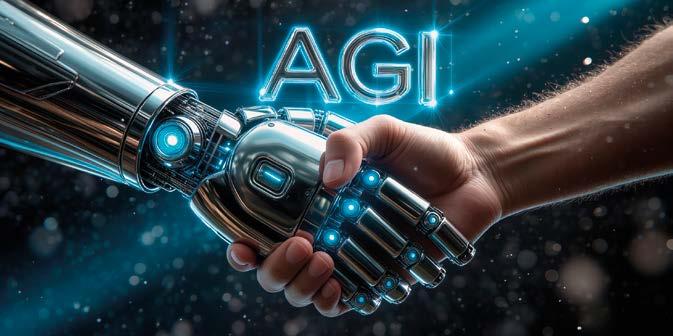
is the Founder of Solvia, an AI startup in Prague, optimizing customer support and operations with 24/7 AI voice agents following the motto “Future on your side.” He moved to the Czech Republic three years ago, and graduated from Park Lane International School this year.

A professional conference titled “Finding a recipe for competitive decarbonization” was held in Ostrava. The main topics included ensuring the competitiveness of Czech companies in light of the European Union’s decarbonisation plans, setting up subsidies and regulatory frameworks for the energy transition, development of the transmission system, challenges linked to the shift towards new energy sources, and the forthcoming introduction of the EU ETS2 emissions system and its impact on energy prices.
Transformation and modernisation of the energy sector in line with climate and energy goals, decentralisation and restructuring of the production mix, support for the investment environment, and changes in domestic heating – these were the main subjects discussed by participants at the annual Leading Minds Forum. The international conference was organised by the consulting firm DDeM.
In addition to representatives of state and public administration, top managers from approximately 50 industrial and energy companies participated in the debate on current and future energy capacities, planned measures,
and new business opportunities.
The event was patroned by Cylinders Holding and innogy Czech Republic, with the Energy Regulatory Office Council Members providing official auspices. The event’s main partners included ČEPS, E.ON, EPH, and the European Conservatives and Reformists Group. The event’s other partners were Anacot Capital, ČEZ ESCO, Gas Storage CZ, GENTEC CHP, Pražská plynárenská, Siemens, ŠKO-ENERGO, and the UCED Group.
You can learn more about the Leading Minds Forum platform at: www.lmf.cz.
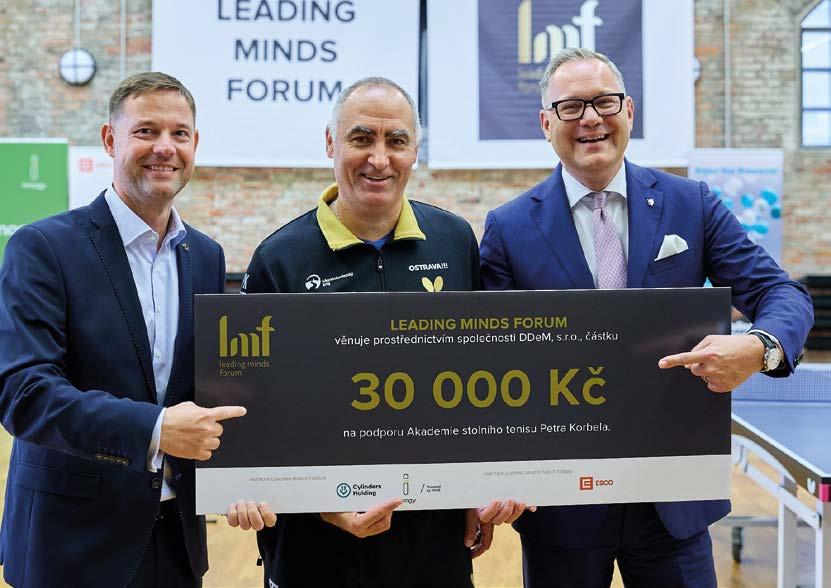
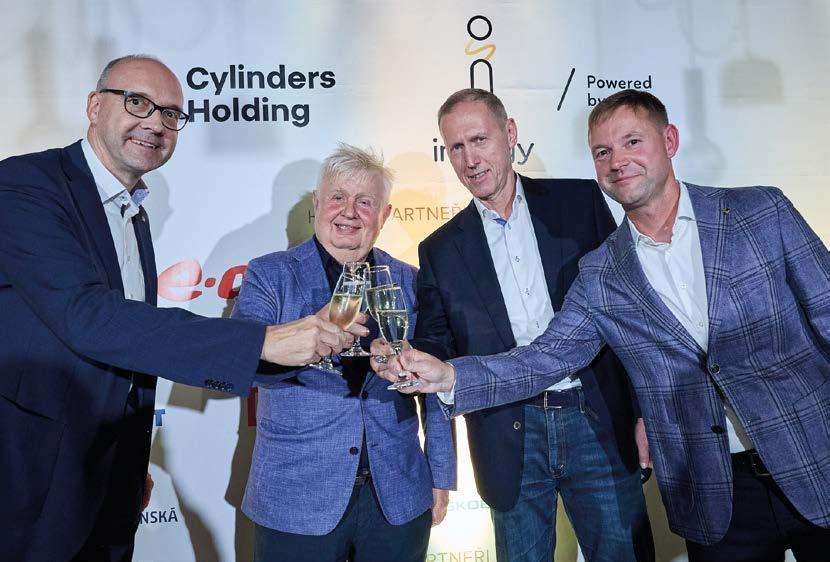
Jan Světlík, CEO and Chairman of the Supervisory Board of Cylinders Holding, highlighted the difficult position of Czech exporters due to high energy prices and pressure from Asian manufacturers.
Alexandr Vondra, Member of the European Parliament, spoke about the ambitions of the European Commission regarding the implementation of the “green policy” and the goal of achieving carbon neutrality on the European continent by 2050.
Kamil Čermák, Chairman of the Board and CEO of ČEZ ESCO, presented the future direction of the ČEZ Group in the areas of nuclear technologies, development of renewable energy sources and battery storage, as well as the transformation of district heating.
Jiří Feist, Member of the Board of Directors, Energy and Industrial Holding (EPH), pointed out the excessive bureaucracy in the EU, noting that Europe contributes less than six percent to global emissions, yet the price of emission allowances here is several times higher than elsewhere in the world.
Jan Šefránek, Chairman of the Energy Regulatory Office, discussed the need for multibillion-crown investments in both electricity and gas infrastructure, which continue to grow. He also mentioned the upcoming sixth regulatory period, covering the years 2026–2030, and addressed changes to the tariff system.
Martin Durčák, Chairman of the Board of Directors, ČEPS, spoke about intensive preparations for the new energy era –including a significant increase in investments in the transmission network and strengthening of cross-border interconnections with the support of European funds.
The objectives and vision of the newly established Czech Energy Association were presented by its Executive Director Josef Kotrba, noting that the founding of the association reflects the generational shift currently underway in the energy sector.
According to Claudia Viohl, Managing Director / CEO of E.ON Czech Republic, the transition to modern energy will be financially demanding and will require substantial investment in network infrastructure.
An affordable energy transition is also tied to intensive electrification, particularly in industry and transport.
Jiří Šimek, Managing Director of innogy Energo, identified strong potential for biogas use in the energy sector. The group recently acquired a biogas plant in Písek and plans to switch to biomethane and inject it into the grid. It also aims to use 100% renewable biomethane fuel across its network of compressed natural gas stations.
The EU ETS2 system was defended by Beatriz Yordi, Director for Carbon Markets and Clean Mobility at the European Commission’s Directorate-General for Climate Action. According to her, the introduction of the new emissions trading system will contribute to further emissions reductions, particularly in transport and building heating. All revenues from EU ETS2 must be allocated to specific climate, energy, and social purposes.
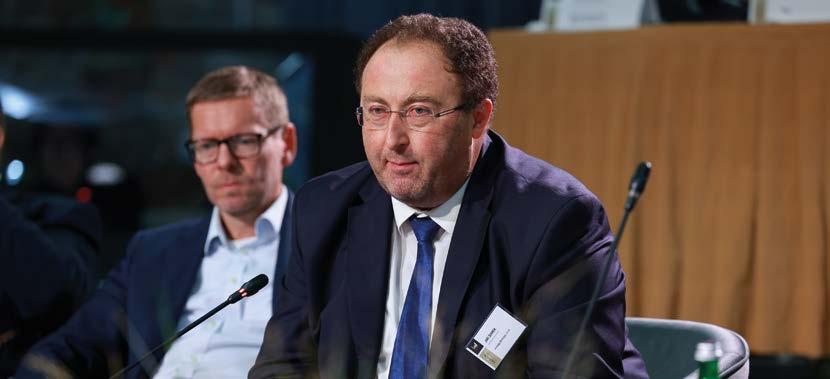
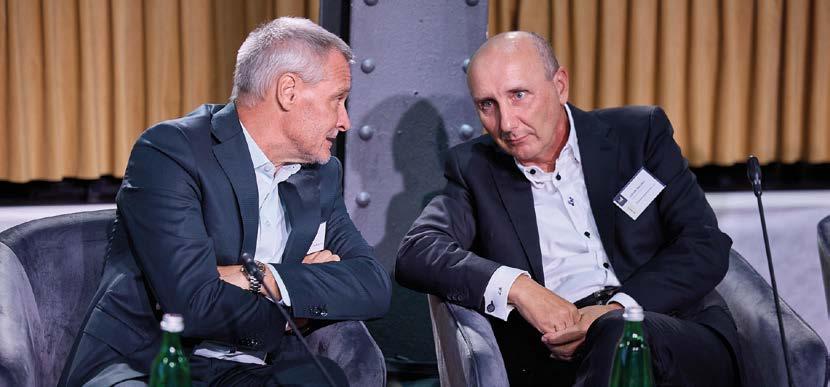
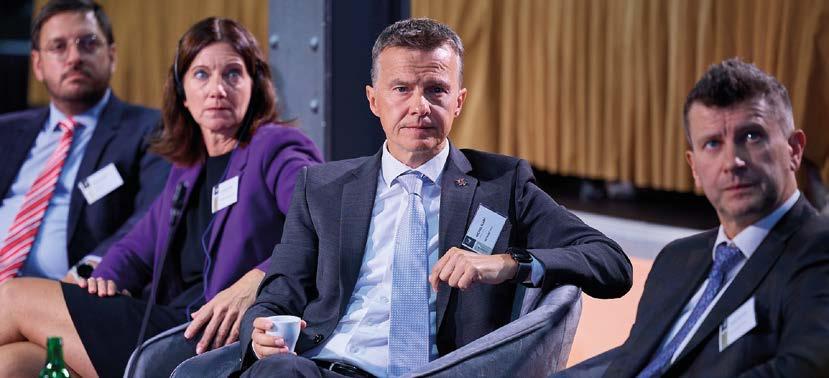
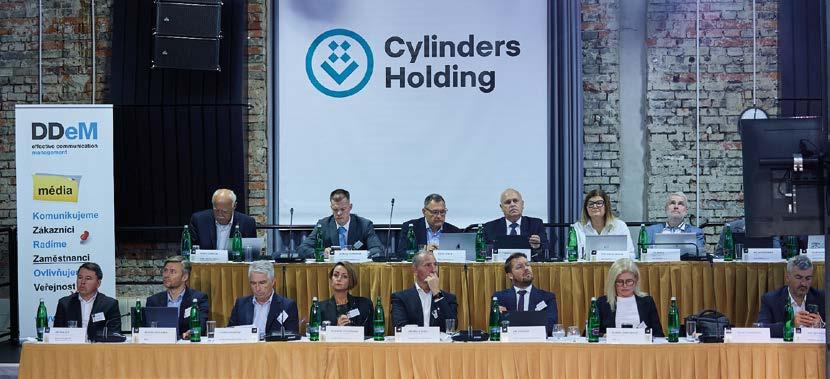
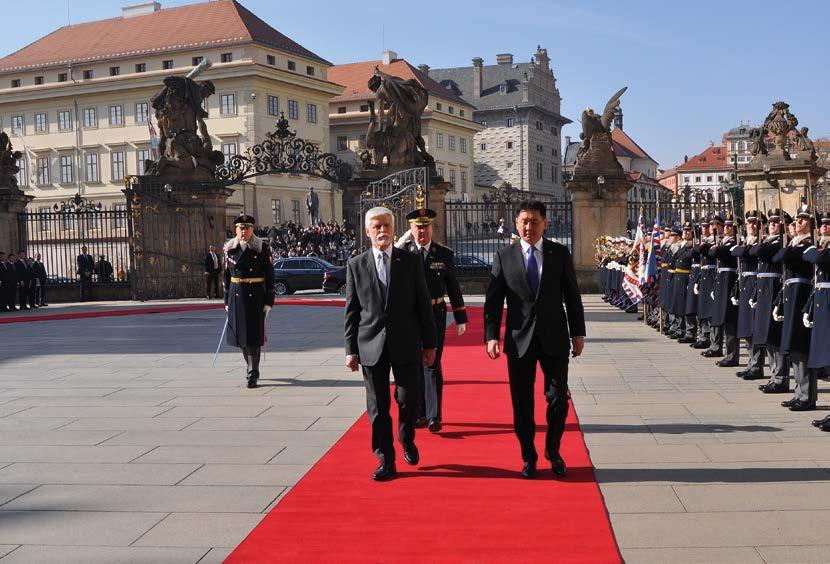
Mongolia and the Czech Republic are both nations that cherish human rights and freedoms, share common democratic values, and take pride in their ancient history, rich culture, and traditions. This year marks the 75th anniversary of the establishment of diplomatic relations between Mongolia and the Czech Republic. Over the past decades, the relationship and mutual trust between the two countries have reached the highest level, while the bonds between our peoples have deepened. Cooperation has expanded and developed in a wide range of areas.
Presidents Khurelsukh Ukhnaa and Petr Pavel have elevated relations to a Comprehensive Partnership
At the invitation of H.E. Mr. Petr Pavel, President of the Czech Republic, H.E. Mr. Khurelsukh Ukhnaa, President of Mongolia, paid a State Visit to the Czech Republic in March 2025. During
this visit, the two sides elevated their relations to the level of a Comprehensive Partnership, opening a new chapter in the history of bilateral relations and cooperation.
Thus, the Czech Republic has become the third member state of the European Union with which Mongolia has established a part-
nership relationship. Mongolia considers the Czech Republic a “third neighbour” and an important partner in Europe, and our long history of steady efforts to broaden and strengthen cooperation in all fields clearly demonstrates this commitment.
A brief glimpse on the bilateral relations and cooperation
Diplomatic relations between the then People’s Republic of Mongolia and the Czechoslovak Socialist Republic were established on April 25th, 1950.
Since the second half of the 20th century, the Czech Republic has made a significant contribution to the development, prosperity, and modernisation of contemporary Mongolia through investment, assistance, and technical support. For instance, a joint Mongolian-Czech geological team discovered the Erdenet copper deposit in the mid-1960s.
With the support and expertise of Czech and Slovak friends, major industrial and social projects such as the Darkhan Cement Plant, the Footwear Factory, the Leather Processing Plant, the Thermal Power Plant, and the First Central Hospital of Mongolia were successfully constructed. Thousands of Mongolians also studied, trained, and worked in the Czech and Slovak Republics, acquiring valuable professional skills and experience.
During his visit, the President of Mongolia met with Mr. Mojmír Krauter, a 98-year-old geologist who participated in the discovery of the Erdenet copper deposit. Mr. Krauter is a highly respected figure in Mongolia, and has been decorated twice with the country’s state honours. He often refers to Mongolia as his “second homeland”.
The foundation of MongoliaCzechia cooperation lies in the
complementarity of Mongolia’s natural resources and raw materials with Czech investment and technology. Maximizing these mutual advantages has been key to the success of the partnership. Until the 1990s, the Czech Republic was Mongolia’s second-largest trading partner, reflecting the extensive scope and strength of economic cooperation between the two countries.
Today, traditionally beneficial cooperation continues
Both sides are committed to continuing this long-standing tradition of cooperation in a mutually beneficial and effective manner. The private sectors of the two countries are actively collaborating in fields such as manufacturing based on Mongolia’s raw materials and Czech technology and know-how, as well as in agriculture, environmental protection, and mineral exploration. In 2024, the trade turnover
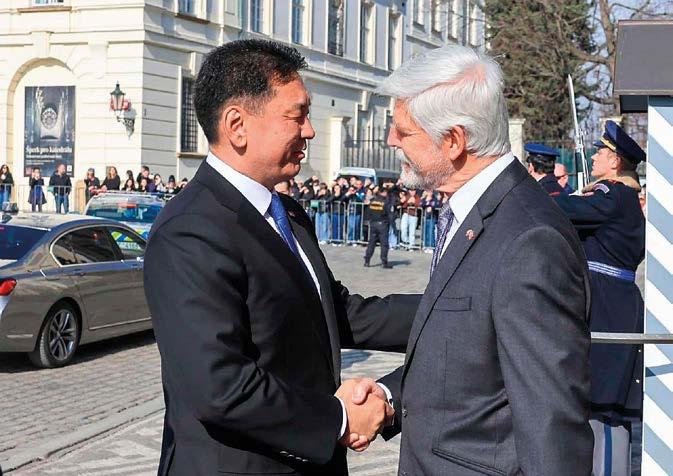
between Mongolia and the Czech Republic reached 20 million USD.
Today, about 70 percent of all bread produced in Ulaanbaatar is made using advanced Czech technology. In Erdenet, Mongolia’s third largest city, home to a major copper-molybdenum plant first discovered by Czechoslovak geologists, eco-friendly residential complexes and Czech beer are being built and produced with Czech technology. A recent example of growing trade and economic cooperation is the opening of an official branch of the Czech health and cosmetics company Dr. Müller Pharma in Ulaanbaatar in October of this year.
The annual Mongolia-Czechia Business Forum, held in Ulaanbaatar, plays a crucial role in promoting and expanding trade and economic collaboration.
During the State Visit of the President of Mongolia, a business forum took place in Prague, bringing together more than 170 companies and entrepreneurs from both countries. Several partnership, trade, and investment contracts were signed during the event, marking an important step forward in elevating the business relations between Mongolia and the Czech Republic to a new level.
In his opening remarks of the Forum, President Khurelsukh Ukhnaa underscored Mongolia’s commitment to expanding its economic cooperation with the Czech Republic, implementing mutually beneficial projects and programs, and deepening collaboration in areas such as environmental protection, healthcare, culture, education, sports, tourism, and agriculture. For his part, President Petr Pavel
stated, “Although Mongolia is geographically distant from the Czech Republic, our two nations share many commonalities. Over the past 75 years, we have maintained friendly and open relations, which provide a strong foundation and great opportunities to deepen cooperation in mining, energy, defence, healthcare, and agriculture.” His remarks further reinforced the spirit of trust and mutual understanding between the two sides.
By elevating bilateral relations to the level of a Comprehensive Partnership, Mongolia and the Czech Republic have created new opportunities to enhance trade and economic cooperation, strengthen business partnerships,
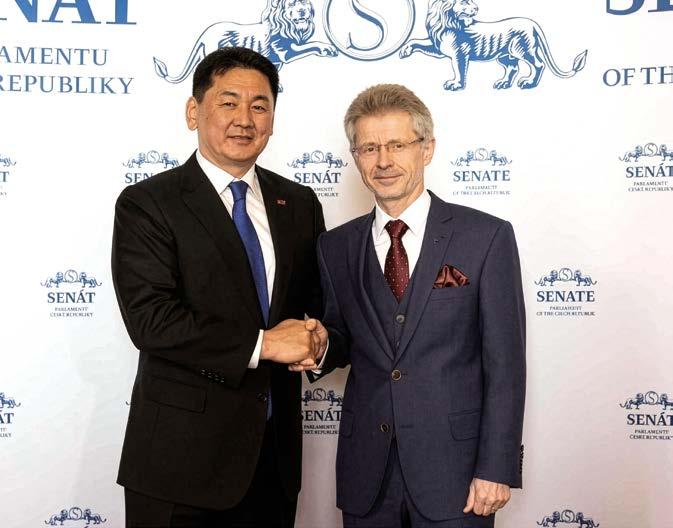
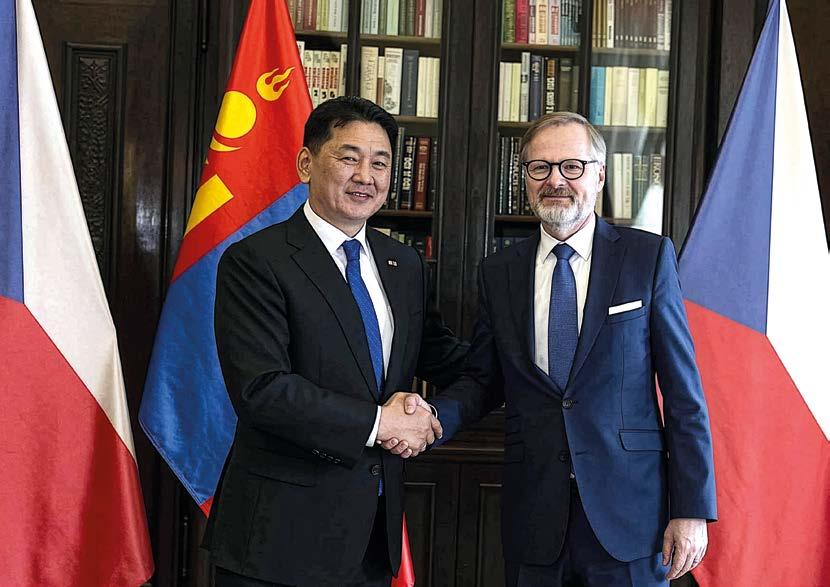
and promote collaboration in a broad range of areas. These include food security, agriculture, crop production through the introduction of advanced machinery and equipment, and the localisation of Czech know-how.
The two countries also aim to cooperate in geological research, mining, energy, and green technologies, as well as in major development and infrastructure projects such as the Kharkhorum and New Zuunmod city initiatives. Further collaboration will extend to water management, defence and defence industries, reforestation, and combating desertification – all of which will contribute to achieving the shared development goals of both nations.
The two Heads of State also exchanged views on addressing
global challenges such as climate change, desertification, and food insecurity. President Khurelsukh Ukhnaa highlighted that, as part of the country’s efforts to combat desertification and land degradation and to mitigate the effects of climate change, Mongolia has launched and is implementing the national ‘Billion Trees’ movement. Within this framework, Mongolia is also cooperating with the European Union through the Forest Partnership initiative.
People-to-people ties form a strong bridge of cooperation
Over the decades, more than 20,000 Mongolians have studied, trained, and worked in the former Czechoslovakia, and this fine tradition has continued in the Czech Republic over the past 30 years. At present, nearly 15,000 Mongolian citizens live,
work, and study in Czechia. More than 1,600 Mongolian children are enrolled in schools at various levels, and it is expected that the number of Mongolians pursuing higher education in the Czech Republic will continue to grow, becoming a valuable source of intellectual capital for Mongolia in the years to come.
Undoubtedly, people-to-people exchanges serve as a solid bridge of mutual understanding, trust, and cultural connection between nations. The Czech Republic hosts the largest Mongolian community among all European countries, a fact that clearly reflects the closeness and vitality of relations between our two countries.
Within the framework of the ‘President’s Fellowship–2100’ program, since the 2023 academic year, more than 50 Mongolian students have been studying at
leading Czech universities in the fields of engineering, technology, computer science, cybersecurity, agriculture, biomedical sciences, mining, and renewable energy.
To mark the historic 75th anniversary of diplomatic relations between Mongolia and Czechia, a series of cultural and commemorative events were organised throughout the year. Among the highlights was the international exhibition ‘Chinggis Khaan’, inaugurated on March 11th, 2025, at the National Museum of the Czech Republic under the patronage of the Presidents of both nations, Mr. Khurelsukh Ukhnaa of Mongolia and Mr. Petr Pavel of the Czech Republic.
The exhibition, which remained open until June 22nd, attracted more than 75,000 visitors.
In his opening remarks, President Khurelsukh emphasised that the exhibition offered a unique opportunity for people around the world to learn about the wisdom, legacy, and cultural heritage of our Mongolian ancestors – the creators of the ‘Pax Mongolica’, a symbol of peace and harmony that once united vast territories under stability and order.
Adding a musical flourish to the celebrations, the Mongolian Morin Khuur Ensemble performed in the Spanish Hall of Prague Castle, the official residence of the Czech President, and later on in the Dvořák Hall of the Rudolfinum, home of the Czech Philharmonic Orchestra. The ensemble presented “Beautiful Mongolia”, a concert program that combined masterpieces of Mongolian traditional music with selections from the renowned Czech composer Antonín Dvořák, including ‘Árie Rusalky’ and ‘Humoresque’.
The performance captivated audiences, symbolising the harmonious blending of two rich musical traditions.
The Przewalski’s horse project is a vivid symbol of the enduring partnership between the nations
When reflecting on the cooperation between Mongolia and the Czech Republic, one cannot overlook the Przewalski’s horse reintroduction project – a vivid symbol of the enduring partnership between the two nations.
In 1959, the Prague Zoo took a pioneering role in global wildlife conservation by initiating and hosting the first international symposium dedicated to saving the Przewalski’s horse, which had been on the brink of extinction since the 1950s. Following this, the zoo began maintaining a comprehensive genetic registry
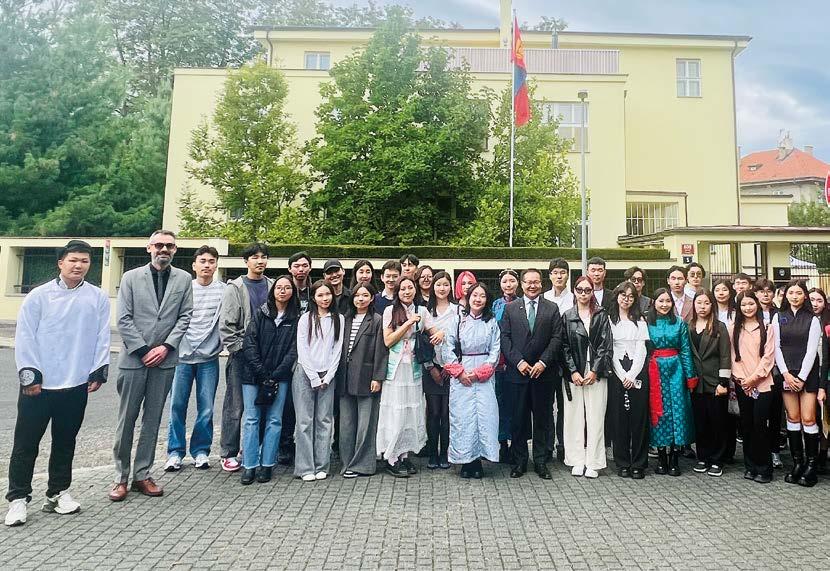
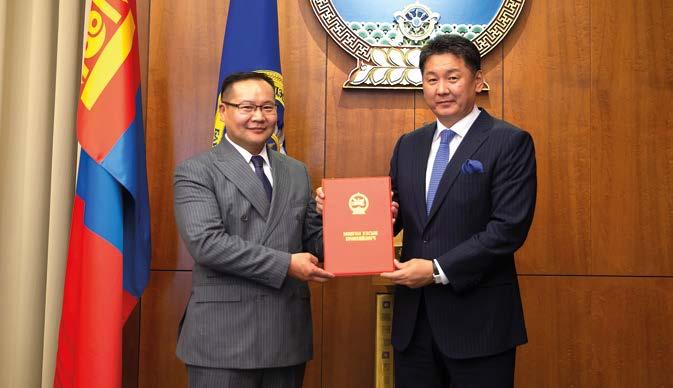
and database for the species, establishing the scientific foundation for its preservation and successful revival.
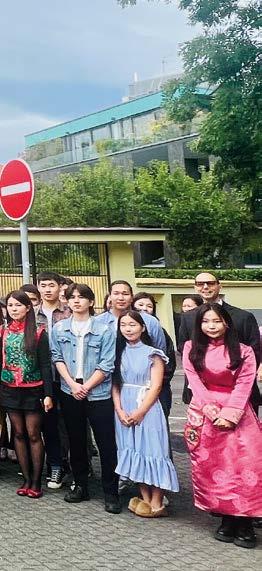
Between 2011 and 2019, the Prague Zoo reintroduced 34 Przewalski’s horses into Mongolia’s Khomiin Tal and the Great Gobi ‘B’ Strictly Protected Area, where their population has since flourished to more than 400. Building on this success, activities are now underway to extend the project to Mongolia’s eastern region, specifically the Nomrog Strictly Protected Area in the Dornod Province.
The Prague Zoo has been working with Mongolia not only to reintroduce the Przewalski’s horse, but also to protect other rare and endangered species such as the saiga antelope and the wild Bactrian camel. These shared conservation efforts have deepened the two nations’ partnership in the vital field of environmental and wildlife preservation.
With shared common values, both nations look confidently to the future
Bound by common values of democracy, human rights, and the rule of law, Mongolia and the Czech Republic have elevated
their long-standing friendship to the level of a Comprehensive Partnership – a milestone that ensures even closer cooperation and continued growth in the years ahead.
The 75-year journey of MongoliaCzechia relations stands not merely as a record of political and economic collaboration, but as a reflection of the enduring friendship and mutual respect between their peoples.
As both nations honour their proud accomplishments, and look with confidence toward the future, this partnership promises to remain a source of hope, trust, and inspiration for the new century.
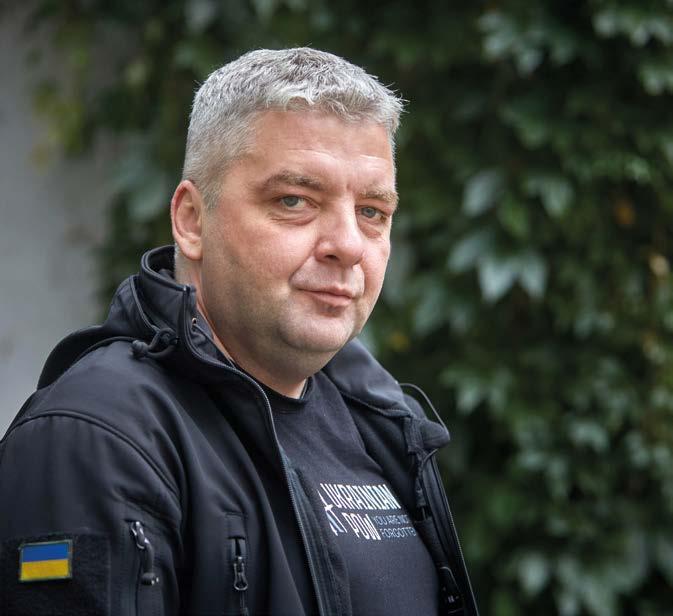
Pre-2022
Maksym Butkevych worked as a journalist at Radio Hromadske in 2012 and 2013, and in 2014 he reported on the Euromaidan revolution from the centre of Kyiv. A former collaborator with BBC World Service, he was also an activist, fighting against racism, right-wing extremism, and hate
speech in the media and public sphere.
Within the No Borders project, he was involved in helping asylum seekers. These were mainly refugees from Russia, Central Asia, the Middle East, Africa, and Belarus, but also internally displaced Ukrainians driven from their homes by war since 2014.
Maksym Butkevych is a Ukrainian journalist, human rights defender, and co-founder of both the Human Rights Centre ZMINA and the news outlet Hromadske – and it was he who was awarded this year’s Václav Havel Human Rights Prize. Despite being a lifelong pacifist, Butkevych voluntarily joined the Ukrainian Armed Forces at the beginning of the Russian full-scale invasion in 2022, becoming a platoon commander. Captured and sentenced to 13 years by Russian forces, he was held for over two years in harsh conditions before being released in a prisoner exchange in October 2024. He remains a powerful symbol of courage and perseverance in the defence of justice and freedom.
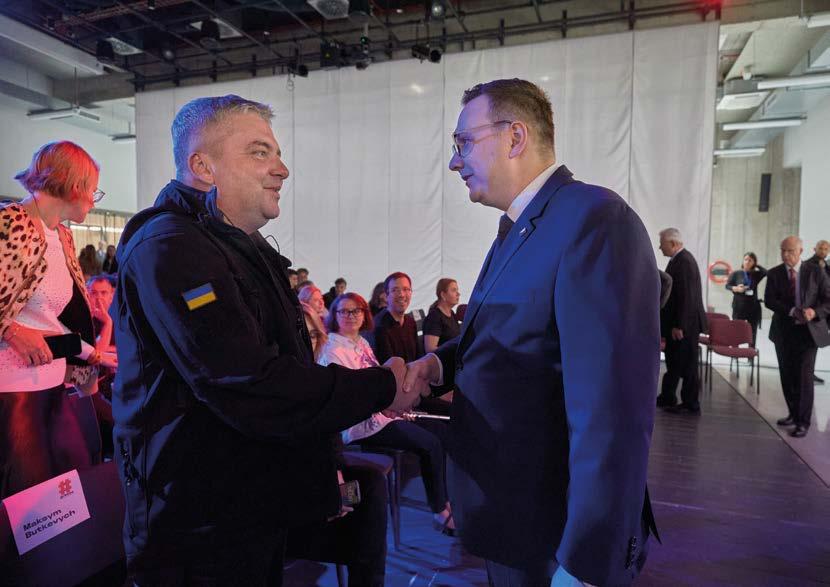
After the full-scale invasion of Ukraine in 2022, Butkevych decided to take up arms and defend his country. At that time, he had been involved in human rights issues for over 15 years and had been closely monitoring the situation (and its rapid deterioration) in that regard in Russia, realising what would happen if Russia was victorious. In an interview with the Havel Channel during his visit to Prague as laureate of the Václav Havel Human Rights Prize, the 48-year-old said that if Russia were to prevail in its aggression against Ukraine then everything that has been achieved in Ukraine in the field of human rights will be destroyed, and human rights activities will be snuffed out in the country. This is because the Russian system does not consider the concept of human rights to be important; on the contrary,
Moscow’s current ideology goes against human dignity and human rights. Butkevych said that if he wanted to be considered a defender of human rights, he had no choice but to sign up for the army. In the interview, he also emphasised that he rejects violence as a means of achieving political goals because of its dehumanising effect. However, if it is necessary to stop aggressors by force, taking up arms is the only alternative; otherwise we become accomplices. It was not easy for him, but, as he told the Havel Channel, he understood that only extreme options were available to defend what was important.
His experience from his initial combat missions – when he participated in the liberation of the Kyiv region and saw the consequences of the Russian occupation – only confirmed what he already knew about the Russian regime.
Unfortunately, his knowledge later deepened considerably when he was taken prisoner in the Luhansk region. He was interrogated, sometimes formally, sometimes violently. He and other prisoners were forced to repeat Russian propaganda without hesitation under threat of violence. It was clear that the occupiers were trying to shake their faith and morale, or even win some of them over to their side. Many prisoners were forced to appear in propaganda videos; when they refused, the Russians subjected them to violence and torture. They were forced to do intense physical exercise until some collapsed. Medical treatment in detention was almost non-existent, except for cases of serious injury.
In March 2023, criminal proceedings were initiated against him, and he was sentenced to 13 years and transferred to another part
of the prison in the so-called Luhansk People’s Republic, where those accused of criminal offences were held. They had completely different, far superior, conditions.
However, there was never a moment when he did not believe he would get out. He was convinced his loved ones, colleagues, friends, and fellow activists would not abandon him. Of course, he had no idea how long it would take, or whether his health would fail him – but even that would have been a way out. He never believed he would serve the full term.
After the release
Following his release under a prisoner exchange, Butkevych spent time at a Ukrainian Armed Forces centre, which he said was greatly beneficial. He then returned to
his native Kyiv, which seemed lovelier to him than ever before. After rehabilitation, he was given a month off, as he was still an active member of the army. It took him two months to decide whether to continue as a soldier or leave, as permitted by law. He thought long and hard about where he would be most useful. After consulting with friends and colleagues, both civilians and soldiers – who, unlike him, had not lost two years of their lives – he decided to step down from active service. However, he remains in the reserve forces and holds the rank of first lieutenant.
The first two or three months after his return to freedom were, from a psychological point of view, the best period of his life. The former POW ceased to take little things – such as waking up and feeling
more or less safe, making small everyday decisions, and not being constantly on guard – for granted. However, he is in rehabilitation.
Maksym Butkevych received the Stories of Injustice Award, presented by the One World in Schools educational programme run by the Czech NGO People in Need. His father, Oleksandr, came to Prague in November 2022 to accept the award on his behalf. On 30th September 2025, he was able to come in person to Strasbourg to accept the Václav Havel Human Rights Prize, before later attending an international conference in Prague organised in his honour by the Václav Havel Library.
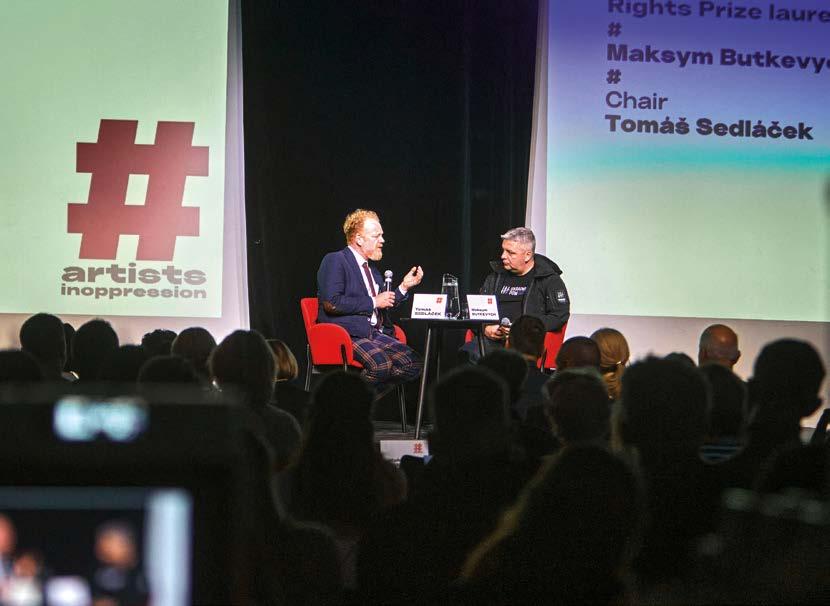
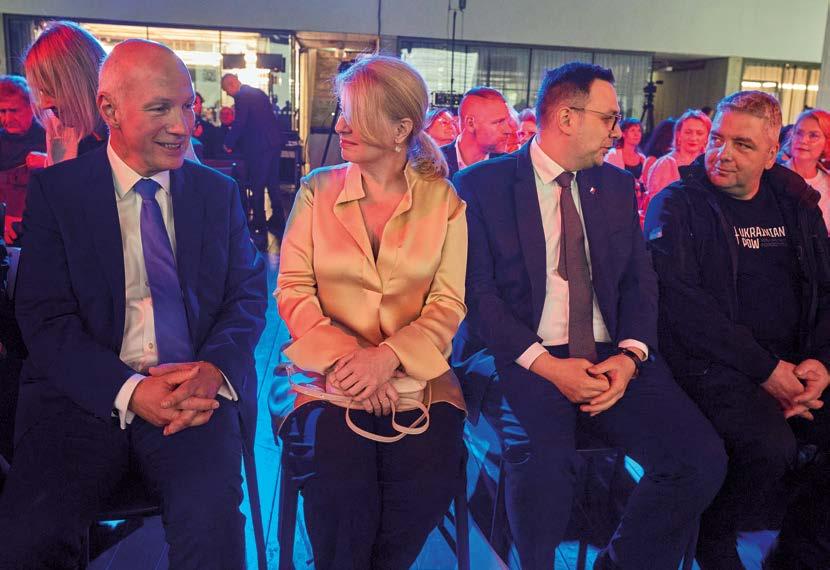
has been awarded annually since 2013 by the Parliamentary Assembly of the Council of Europe in cooperation with the Václav Havel Library and the Charta 77 Foundation. It aims to highlight and reward extraordinary achievements in the field of human rights protection in Europe and beyond.
graduated in theatre production from the Theatre Faculty of the Academy of Performing Arts in Prague in 1997. Before and after her studies, she worked at the Office of the President of the Czech Republic and later at Václav Havel’s private office as his secretary. During her working career she focused mainly on protocol and international relations. At the Václav Havel Library, she is in charge of foreign relations and human rights, including the related public club evening events and their production.
Gabriela Dítětová, Hotel General Manager
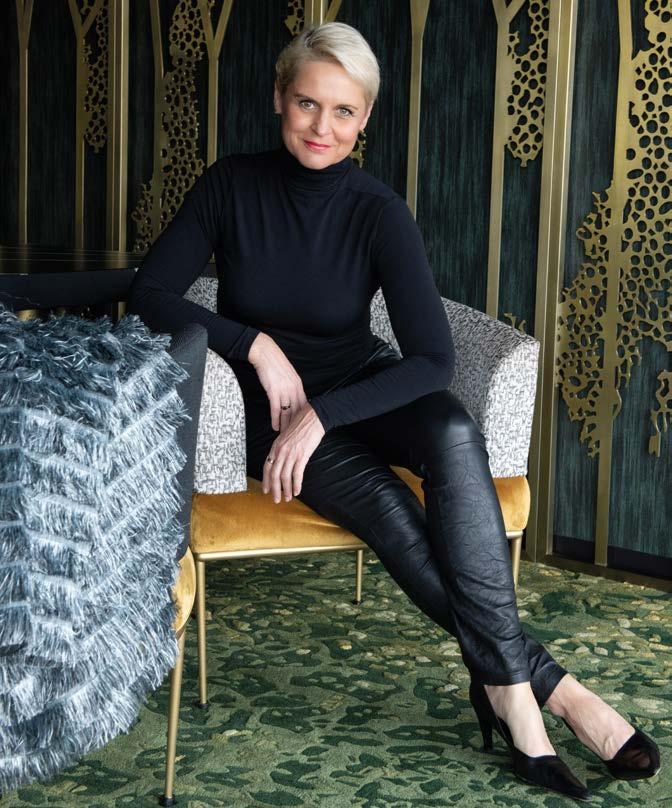
“Do what you love, and you will succeed. I love what I do, and I believe that brings results,” says Gabriela Dítětová, a hotel manager with a long track record of successfully managing hotels in many countries.
“To manage a hotel means to manage a team – sometimes a big one. And every single team member plays a very important role, because only a happy employee can create a happy guest.”
Can you tell us about yourself?
I am originally Czech and grew up in Prague. I had the privilege of experiencing Prague during the 1980s and 1990s, and of being part of the revolution when I was 17 years old. Those were great times in Prague when everything began to change, and we were all very excited about the opportunities we finally had. We could start building our careers, we could travel, and we could feel freedom. I have had various jobs: I started in a hematological laboratory, which was my field of study; later, I worked as a fitness instructor and manager in a fitness center, and eventually I began my career in hospitality – first in sales and marketing, and later in hotel management. I am the mother of one son and three dogs, and I love sports and travel. I move from country to country, working and living in some of the best luxury hotels, and I try to enjoy every day of my life.
What brought you into the world of hoteliers?
I believe it all started very early when I used to visit the Hotel Adria for a Coca-Cola, seeing my grandfather during his shift at the lobby bar. I was a small girl back then, but I already loved the atmosphere of the hotel lobby – the tourists, the different languages, and the overall vibe of the place. My grandfather was very good at languages and would chat with guests, making friends from all over the world. I was always happy to sit on a high chair, listening to conversations I didn’t understand, but which fascinated me.
When you were younger, you were also a model. Why did you change your career?
Hahaha, I was never a successful model! I am from the same generation as Tereza Maxová –
we started around the same time. I also know Milada Karasová, who later approached me, and I did some photo shoots with Tono Stano back then. A few times, I was on the runway with models who later became well-known, but that career ended very early for me.
I remember skipping the Elite Model Look competition, which I should have attended, but didn’t – mostly due to my allergies. I never believed my future was there. There were so many beautiful girls, and I didn’t think I could succeed. But it was a great experience, and now, when I have to do a photo shoot for a business magazine, I know how to stand in front of the camera – that helps!
Do you enjoy the lifestyle of a hotel manager?
I love travelling, exploring, and meeting people. This is a perfect job for me. Usually, hoteliers work
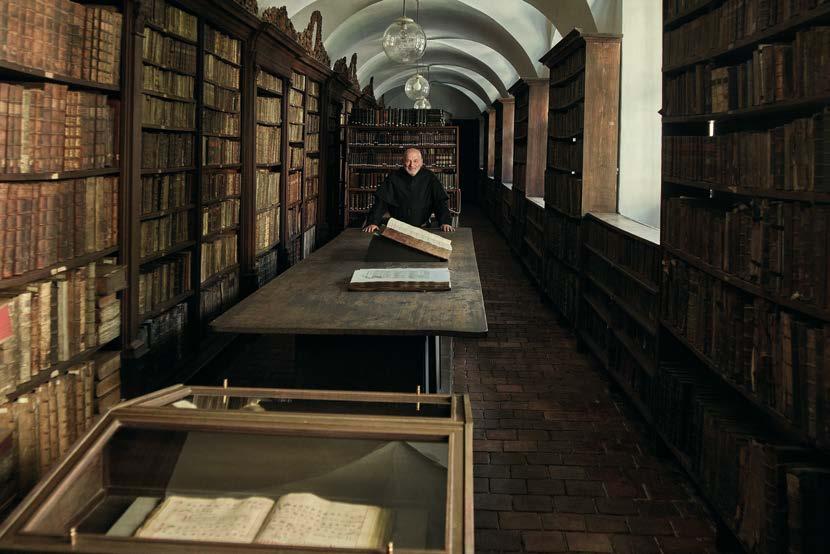
much more than in standard professions – so you either love it, or you can’t stay in hospitality. We hoteliers don’t really mind; it is our pleasure to serve, and we love what we do. But you also need your family to be understanding of your career.
This is especially true if you decide to move for work, which is perfectly normal for international hoteliers. In that case, you need the support of your partner, who either moves with you or accepts that you become a weekend family. In my case, as a travelling mother, I also needed the support of my parents to help with my son. They spent time with me in different countries, babysitting. It worked for me, but this lifestyle isn’t for everyone.
Your profession takes you around the world. Can you share some of your greatest adventures?
I love East Africa. Looking back, every adventure is different, but looking into the eyes of a wild silverback gorilla in Uganda was probably the most exciting experience. I’ve also been to Alaska, to Brooks Falls, to photograph grizzly bears – you get there by hydroplane. I’ve travelled to Kamchatka, to Kuril Lake, where huge brown bears walk and swim everywhere, and the only way to reach this truly beautiful place is by helicopter. There have been many unforgettable moments, and I am really grateful for all of them. I hope there are still many more to come.
How many countries have you worked in so far?
It’s quite a long list! I have worked in Bulgaria, Hungary, Romania, Slovakia, Serbia, Russia, Poland, and now Georgia. I am what you might call an Eastern Europe expert.
What do you think is the most difficult part of being a hotel manager?
To manage a hotel means to manage a team – sometimes a very big one. I have 400 employees in my hotel now, and I need all of them to be happy, motivated, and well-trained to provide the best possible genuine service, being truly interested in guests, their needs, and expectations. Every single team member plays a very important role. A happy employee makes for a happy guest. I am a passionate hotelier with a focus on detail, luxury, and perfect service – something that can only be delivered by highly motivated and happy associates. The same applies whether you are in a luxury hotel or a simple lodge in the middle of nowhere –it’s about genuine service; it’s about love.
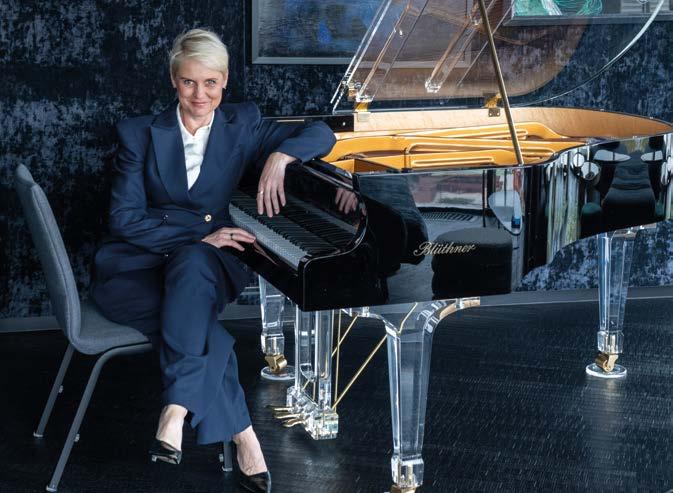
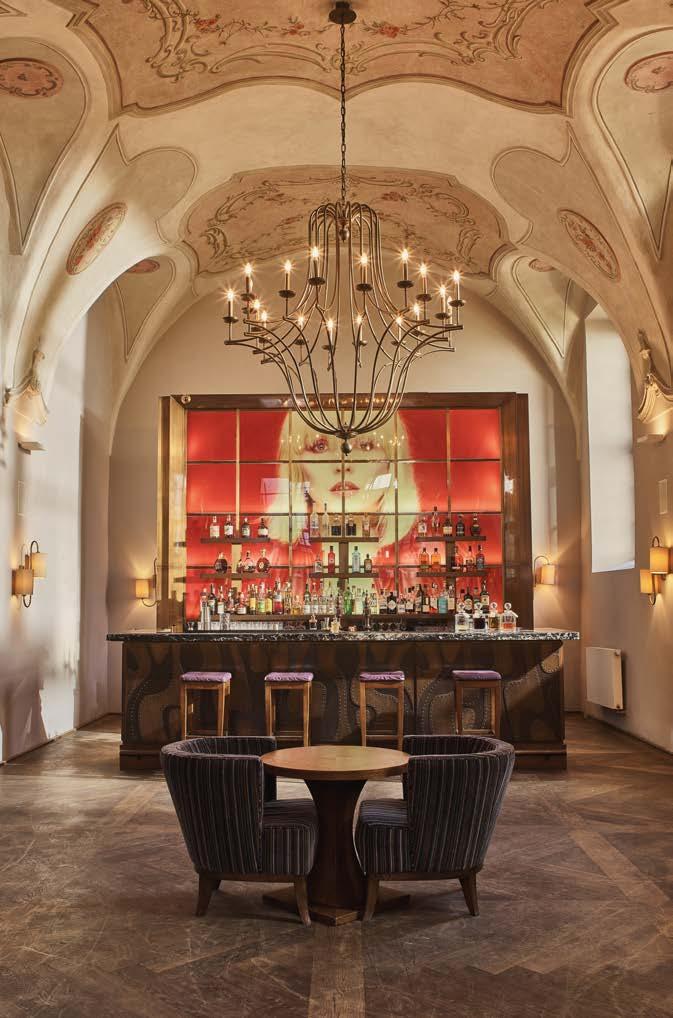
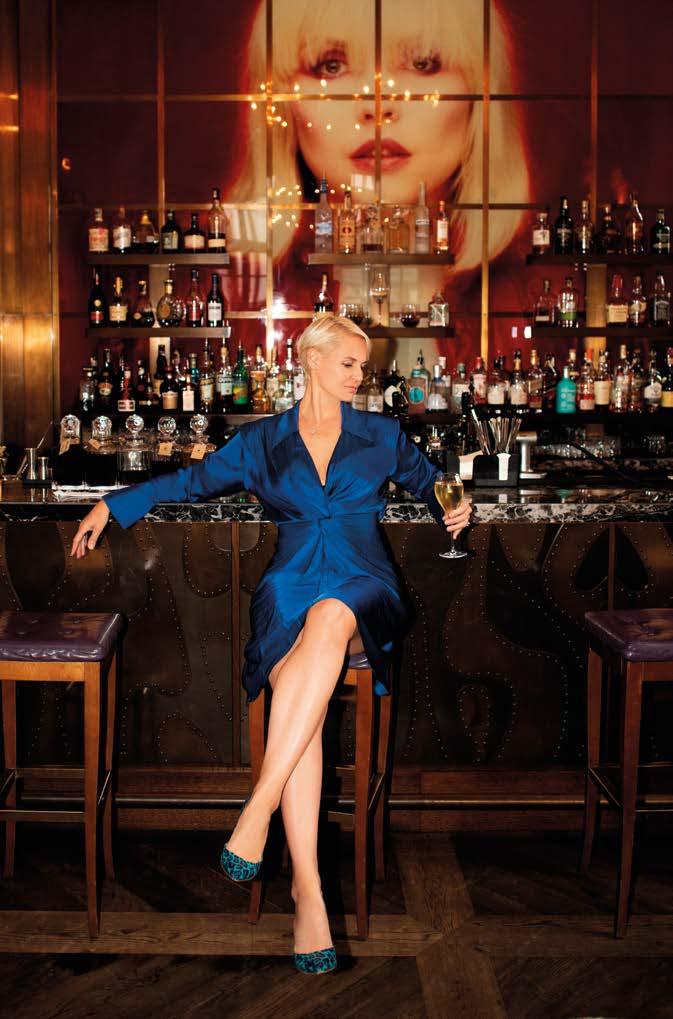
How do you spend your free time?
In my free time, I travel to remote places for wildlife photography, where I can sleep in a simple tent and have dinners under the stars by an open fire. You can meet me in high designer heels, dressed in a tailor-made suit, walking on the marble floor of a luxury hotel – but you can also find me very dirty, in the middle of the bush with my camera. Such places are disappearing; we don’t give enough space to wildlife. I believe that travelling – when done properly and with respect for wild places and their inhabitants – can be part of the solution for preserving them for future generations. I try to capture the last wild animals and landscapes that still remain on our planet. Besides that, I enjoy sports, my dogs, and horseback riding.
What advice would you give to the next generation of hoteliers?
Start from the bottom, learn the operations, and try as many roles in a hotel as possible. Only then will you understand how such a complex organism as a hotel really functions. Do what you love, and you will succeed. I love what I do, and I believe that brings
results. And if you are lucky enough to be surrounded by leaders who support you and believe in your skills, you will grow.
Until just a few months ago, you were the General Manager of the Augustine Hotel in Prague. Can you tell us about your achievements there?
The Augustine, a Luxury Collection Hotel, is a truly unique property of Marriott International. It is still an active monastery, directly connected to the Church of St. Thomas. You can find history and stories in every corner. We offered our guests exclusive tours of the Augustinian library, which houses 27,000 medieval books on religion, medicine, and nature. This hotel is very special and will always stay in my heart as the most beautiful and unique place I have ever worked in. Our cooperation with the Augustinians was wonderful, and together we managed to provide top service in this 800-year-old monastery.
Our work was recognized by the Michelin Guide (one key); we were included in the Travel + Leisure Top 500 List, and rated as a Forbes Four-Star Hotel. We also held a Top 10 position in guest satisfaction among Luxury Collection hotels worldwide for three years.
You are now the General Manager of the Paragraph Freedom Square, a Luxury Collection Hotel in Tbilisi. What are your plans there?
Tbilisi is an amazing city, and Georgia is a beautiful country. The Paragraph Freedom Square, a Luxury Collection Hotel, is the first international luxury brand in the country. We want to make Tbilisi more visible on the map for luxury travelers, as well as for explorers who have already seen many places and are still looking for something new, authentic, different, and unique.
Where do you imagine yourself ten years from now?
It could be a luxury safari lodge in Africa, a hotel on a tropical island, or a hotel somewhere in Svalbard –I don’t know. That’s what I love about my job: I could be anywhere in the world. What I do know is that I need to be close to nature, to believe in the product I manage, and to make a difference for the local community – to protect the beauty of a place and share it with our guests.
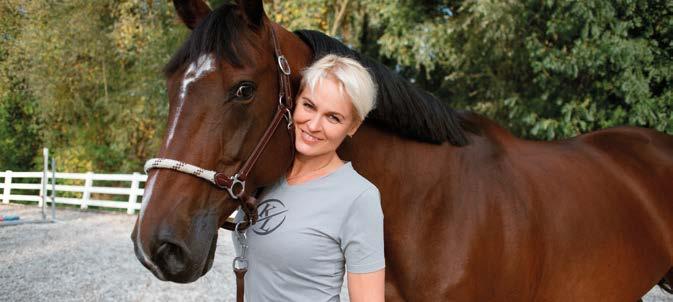
Ask a Czech for the best thing about the Christmas season, and plenty won’t hesitate to reply with “cukroví”. The tradition of Czech Christmas cookies began in the 19th century, evolving from earlier Christmas fruit figurines. This practice has grown in popularity, with many families now making many different types throughout December to serve during the Christmas season. It is a living tradition, proudly passed down from generation to generation.
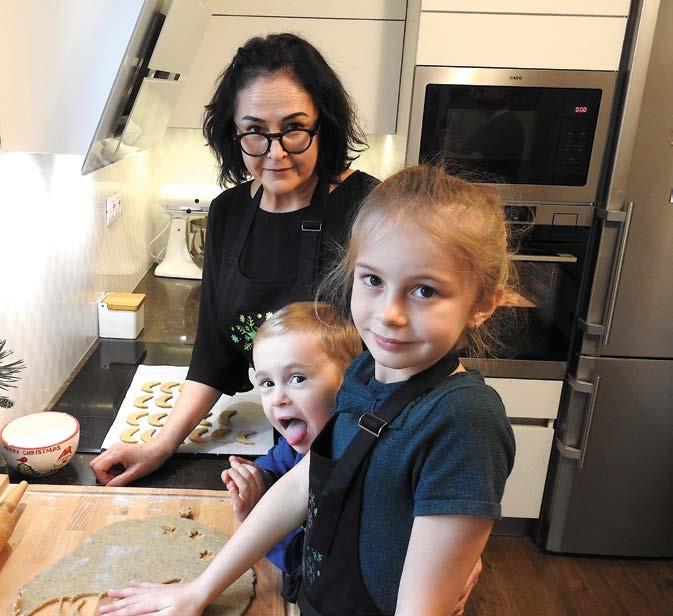
Today, baking a large variety of Christmas cookies is a popular and deeply rooted Czech tradition, often taking place over several weekends in December. Families sometimes compete to make the most varieties, with some creating over twenty different kinds.
Our old babička, grandma, would make the best cukroví ever. Now, her daughter Maria Kerestres is following in her footsteps, and with great success. It’s not an easy job; however, she agreed to bake three kinds of Christmas cookies for you and share her
secret, time-proven recipes. Dobrou chuť a veselé Vánoce! Enjoy your cookies and Merry Christmas!
Work all ingredients into a dough with your hands. Roll out thinly. Use cookie cutters to cut out the shapes you’d like – circles are the easiest. Make sure you always end up with the same number of two types of one shape: one full, and one with a hole in the centre.
Bake at 150 °C for 13 minutes, until it’s pink.
Carefully remove the cookies from the baking sheet. After cooling, there’s no need to hurry. Now, it’s time to put a bit of marmalade, preferably something a bit sour like redcurrant, at the centre of the full cookie, and finally cover it with the piece that has a hole.
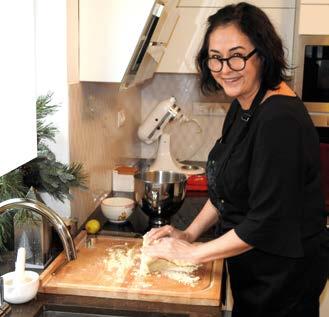
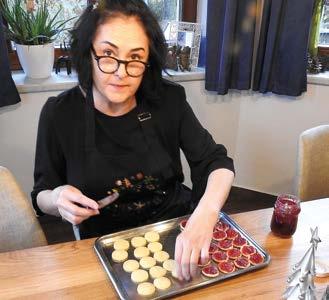

• 300 g plain flour (hladká mouka)
• 200 g unsalted butter
• 100 g powdered sugar (cukr moučka)
• 1 yolk (yellow of an egg)
• Lemon peel
• Pinch of cinnamon and ground cloves

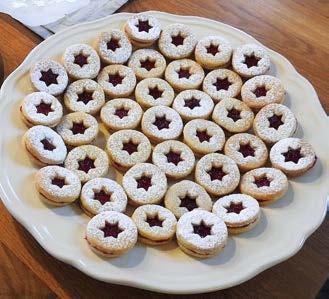
Work all ingredients into a dough with your hands, and then let it sit covered in the fridge for 30 minutes. Roll out thinly. Use a special Christmas cookie cutter to cut out U shapes.
Bake at 150 °C for 15 minutes. It should be easy to peel off the baking paper.
Carefully remove the cookies from the baking sheet. After cooling, dip the edges in melted dark chocolate.
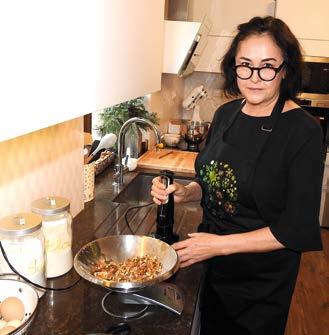
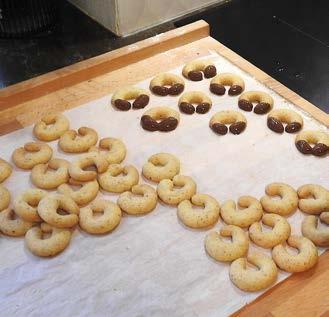
• 140 g plain flour

• 100 g unsalted butter
• 50 g powdered sugar
• 50 g ground almonds, not peeled
• 1 yolk (yellow of an egg)

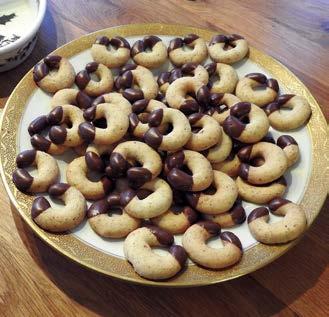
Work all ingredients into a dough with your hands, then let it sit in the fridge for 30 minutes. Roll out thinly. Use a special Christmas cookie cutter to cut out moon shapes.
Bake at 150 °C for 15 minutes. It should be easy to peel off the baking paper.
For the cream:
1 condensed milk with caramel (Salko karamel)
1 butter (250 g)
Mix the butter with the condensed caramel milk.
When the baked moon cookies have cooled, decorate them with the cream and drizzle with melted dark chocolate.
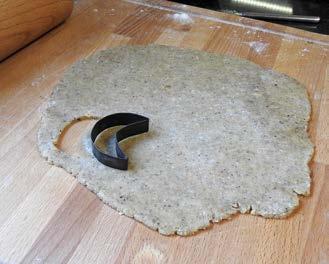
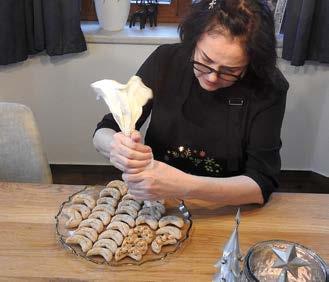
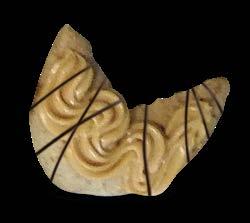
250 g ground walnuts
300 g powdered sugar
50 g plain flour
50 g fine breadcrumbs
2 small eggs
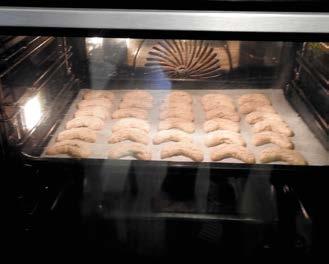
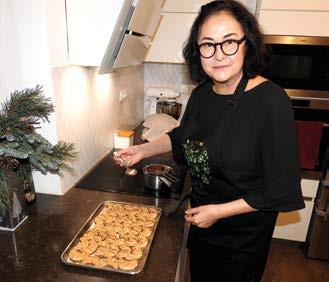
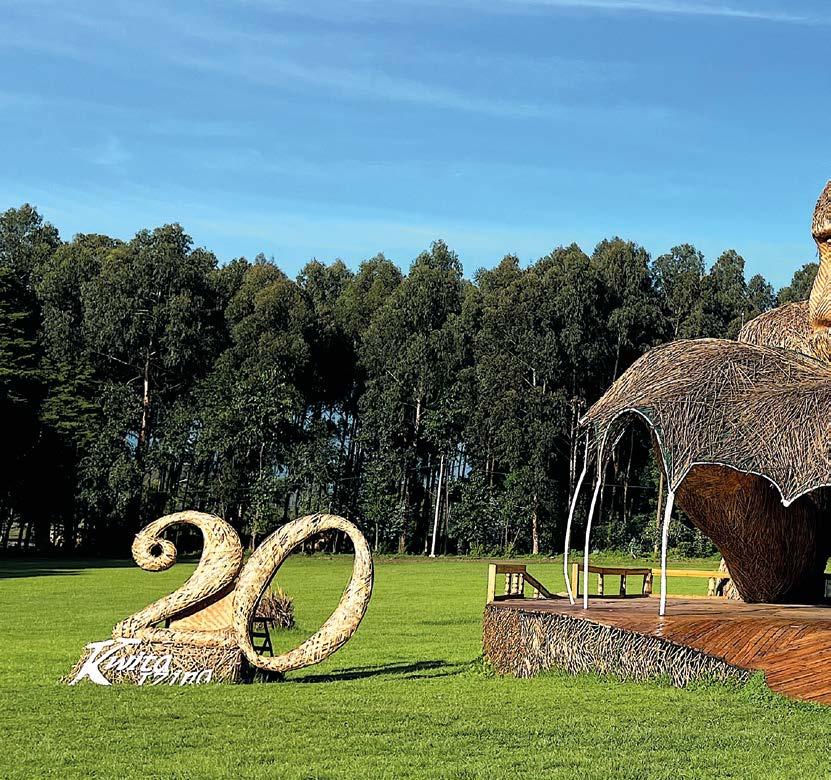
I had a dream of seeing silverback mountain gorillas. The best place to do so in their natural habitat is Rwanda in East Africa, and H.E. Mr. Richard Masozera, the Ambassador of Rwanda to the Czech Republic, Mr. Gerard FJB Volkmar, the Consul and First Secretary, and the Rwanda Development Board helped make this dream come true. Thank you – and without further ado let’s set off, there is a lot to explore!
Our dog-sitter arrived on time. The “boys” already know him from the last time we travelled and welcomed him with love, which makes our departure a bit easier.
The Bolt car was also on time, ready to take us – unfortunately, though, after just a short drive we got a flat tyre. After having to wait for another Bolt car, we got to Prague Václav Havel Airport only two hours before the departure.
I must say, I have never seen such a mess at the airport. The queues started almost at the main entrance. There were two big flights at the counters, and – together with a lack of proper signage –they were the cause of this mess. The result was that we, and others too, were waiting in the wrong queue… and were only able to check in our luggage after one hour. Thankfully, the rest of our airport experience went fast and smoothly, and we departed to Kigali via Doha on time.
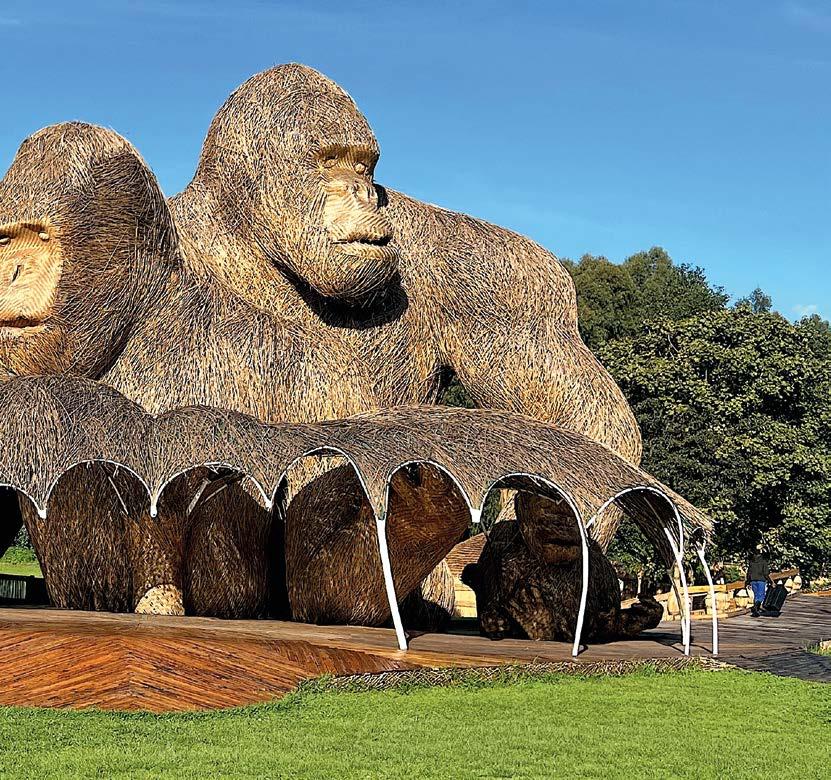
Doha is a really big airport, and although we arrived on time, it took us about 30 minutes to get to the terminal. You better consider this when you have a short-time connection flight.
Our second flight, from Doha to Kigali, was with Rwanda Air, lasting about 6.5 hours. It was a night flight, and I slept for the majority of the time until the landing in Kigali. Kigali airport is small, with a fast visa and luggage service. Within a few minutes, we were out of the terminal, buying a local
SIM card, and taking a car to our first hotel, the Marriott Kigali.
Rwanda is a landlocked country in East Africa known as the “Land of a Thousand Hills” for its high elevation and rolling terrain, dominated by mountains in the west and savanna in the mid and northeast. The largest and most notable lakes are mainly in the western and northern regions of the country (Lake Kivu, The Twin Lakes, and Muhazi), and several volcanoes that form part
are primarily in the northwest. The country has two rainy seasons and two dry seasons each year. Kigali, the capital city of Rwanda, is the largest city, located in the centre of the country.
The day of our arrival was a free day for us, so we took a walk around this beautiful city. We were amazed at how clean the city was, and how friendly and polite the people were. It was a Sunday, and families were going to Church in their festive clothes.
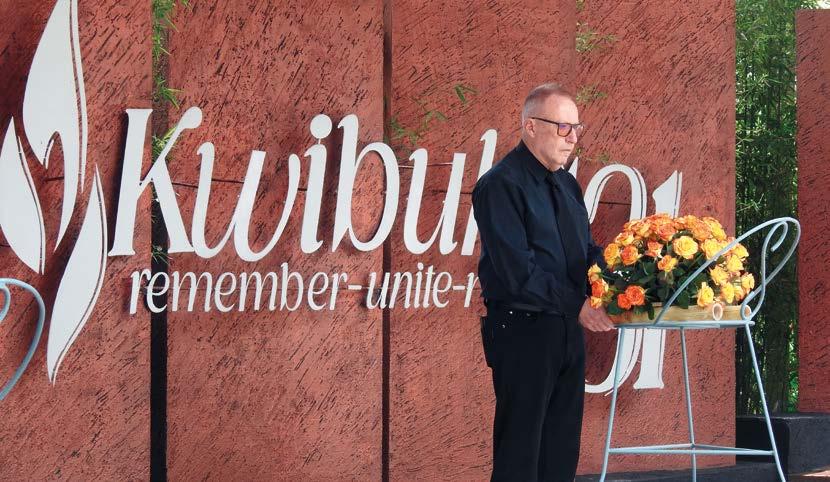
Our first visit was to the Kigali Genocide Memorial. In 1994, one million Rwandans were massacred in a genocide when the Hutu extremist-led government launched a plan to wipe out the country’s entire Tutsi minority and any others who opposed their policies.
It’s not an easy visit, but it is a must-visit place for every visitor to Rwanda. For a better future, we need to remember the past. We paid our respects to the victims of the genocide, visited the museum and the graves, and laid a wreath in their memory.
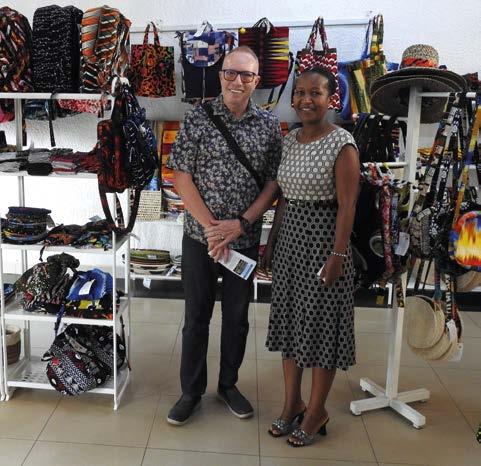
Our next visit was to the Nyamirambo Women’s Centre. We met Ms. Marie Aime, the manager of the NWC, the centre where women teach other women without a profession how to work. Some learn how to sew with sewing machines and make beautiful items as souvenirs and clothes, while other groups learn about hairstyling. They also have a library here to help the neighbourhood children learn English, French, and Rwandan. Some of the women who cannot leave the house (usually because of their small children) can work from home, which gives them a financial boost, helping their families. Very impressive work is being done here. The NWC are collecting donations to build a bigger place to expand their activities. We made our small contribution by buying a few souvenirs.
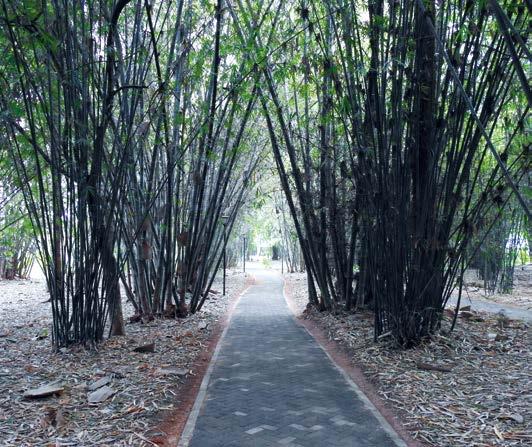
Another important place in Kigali is Nyandungu Eco-Park. Opened only three years ago, it is making a big impact on this area. Once a swamp, this place became a beautiful Eco Park, with unique local medicinal plants, education and research for students, a relaxing place for the residents of Kigali, and even a place for events. The ecosystem, which will now be implemented in other areas too, prevents floods and damage in the area. Over the last three years, the park has become the home of more than 300 kinds of birds and other animals, as well as many kinds of trees and plants.
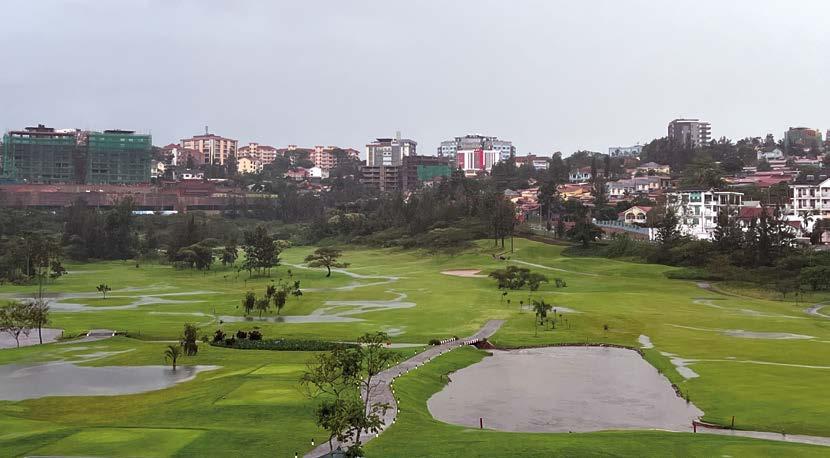
Kigali is a beautiful city built on the hills. At one of the flat places, we visited the Kigali Golf Course. Even for someone like me, who is not a professional golf player, it is an impressive place – a modern design, with Rwanda design elements, and very luxurious, offering several activities: golf, learning how to play golf, fitness, sauna, meeting rooms, a cigar room, and a restaurant with a great view.
Some years ago, when I worked as a manager at a TV station, we organized incentive trips for the channel employees. I can see that Rwanda is a perfect place for when you want to combine outside activities with having meeting rooms for inside activities too.
On our way back to the Marriott hotel, which became our “home” in Kigali, the traffic was really heavy, but they found a great solution to it here which we didn’t see in other places – a motorcycle taxi. This is a cheap and fast solution to get to your meetings on time.
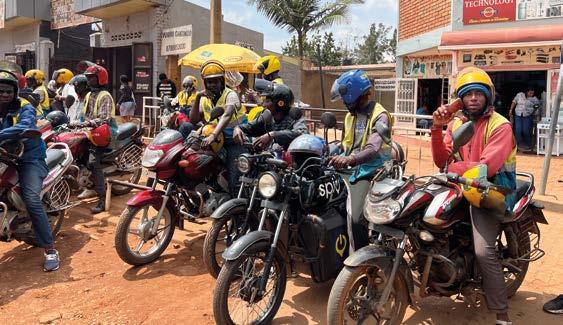
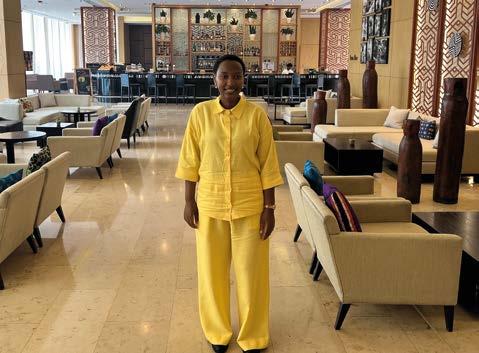
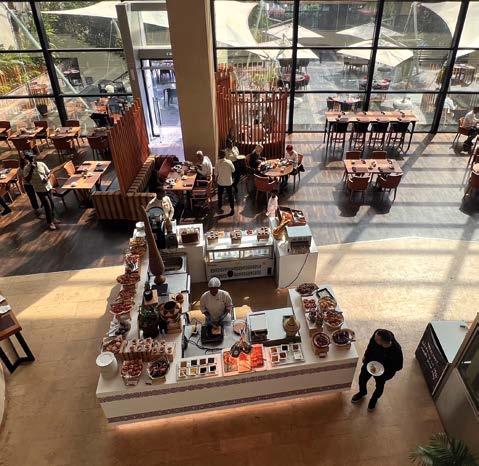
The Marriott Kigali is a luxury hotel opened in 2016 for a big African convention. We met Ms. Emmanuella Belle Uwimbabazi, Director of Rooms Operations, to learn more about this beautiful hotel. The architecture is not typical for a Marriott hotel, with high ceilings and especially the restaurant’s open space, three floors high. There are Rwandan and African design elements in the public spaces, and a very welcoming lounge with a view reaching three floors down.
The hotel’s breakfast was very rich and tasty, one of the best we’ve had, and the service was very good and friendly.
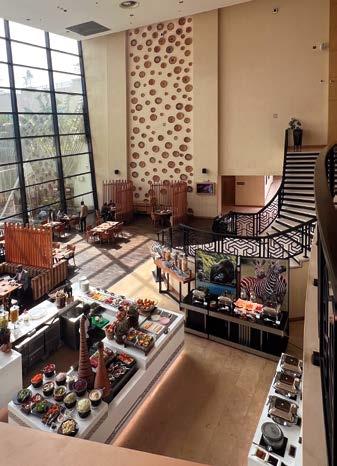
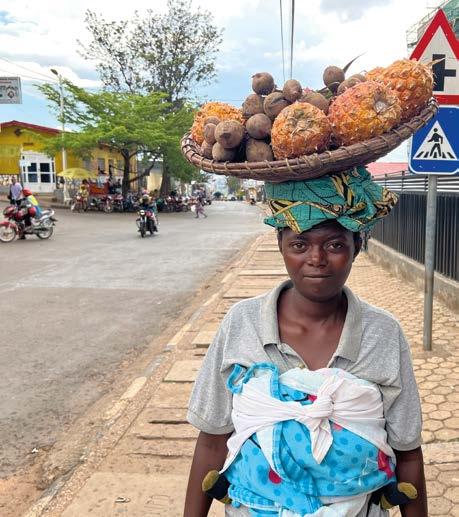
After the hearty breakfast at the Marriott Kigali hotel, we went to visit Kigali’s local market. Kimironko Market is a must for you if you want to get to know the locals. It is a big market where you can find everything, from vegetables, spices, eggs, meat, and fish, and of course local presents. As usual, we bought a few.
Finally, we left Kigali for the Akagera National Park.

We started the day with a behind-the-scenes activity, including a visit to the control centre of the Akagera National Park. They are doing great work securing the area against hunters. They also run a dog centre, training the dogs to fight against the invaders.
The Akagera National Park is an ideal place for safari activities. You can see the Big 5, and enjoy a boat ride experience. While such a safari experience can take a few days at other places, here you can do it in a day or two.
As part of the park, there are two ECO luxury lodges run by the Park Management: Ruzizi Tented Lodge and Karenge Bush Camp (you don’t need to pay any extra fees). They are very nice places to stay in, surrounded by nature.
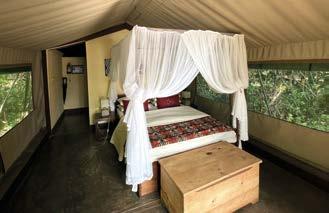
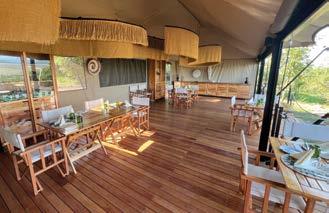
The boat ride at Lake Ihema is a great experience. You can see hippos, many kinds of birds, crocodiles, and other animals, and relax before or after the safari activity. After a full all-nature day and seeing the Big 4 (missed the lions), we were back at our “home away from home”, the Marriott hotel in Kigali.
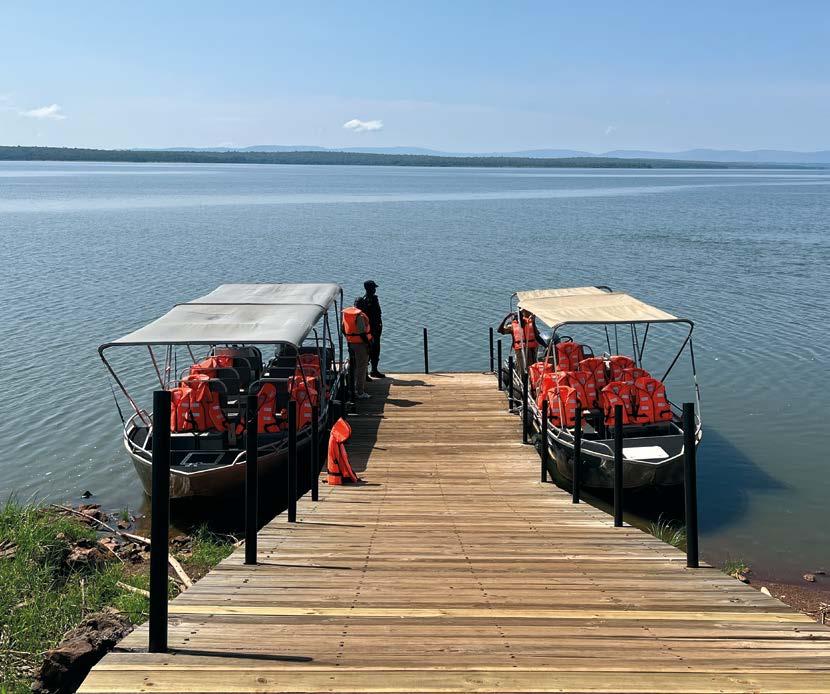
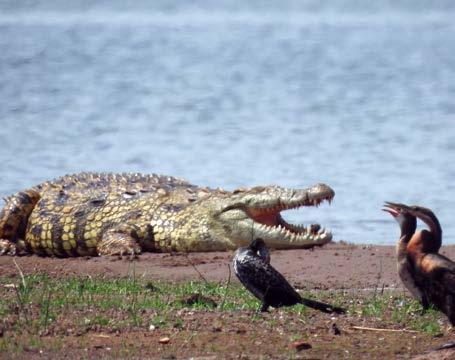
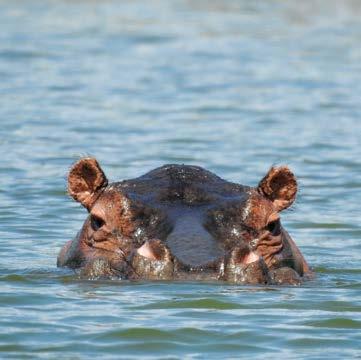
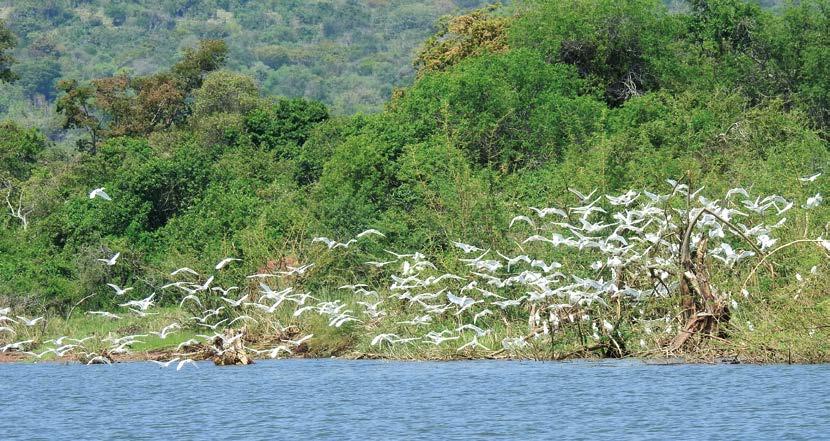
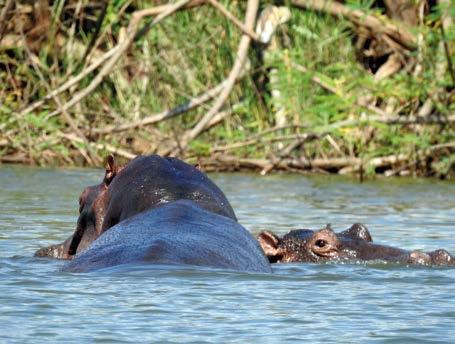
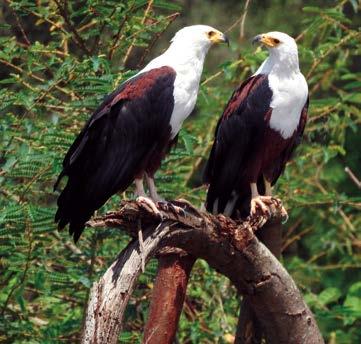
Day 4: Going Zip-lining and appreciating porters
We left Kigali, going to the King’s Palace Museum, with a short stop at the Azizi Life Muhanga culture centre, with its beautiful shop of local handmade products. It was a long drive. On most roads in Rwanda, you can drive only 60 kph, and “karma” hit us again and we got a flat tyre...
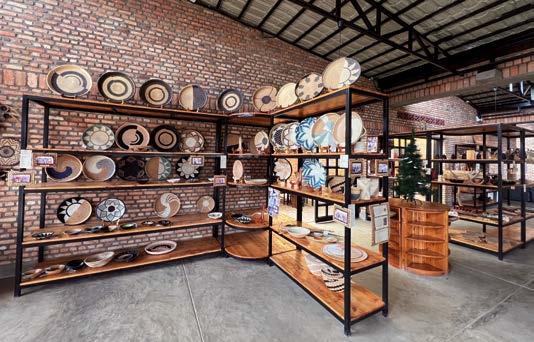
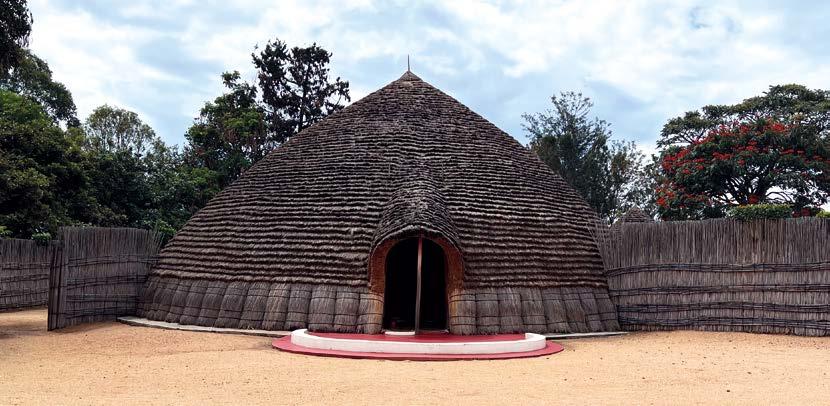
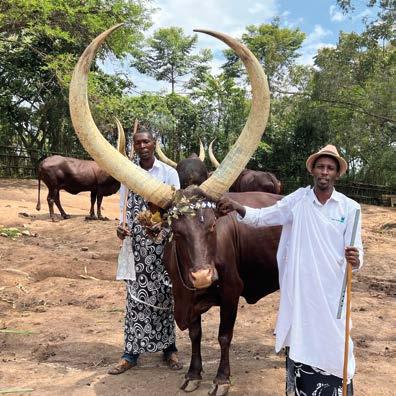
But first to the big adventure – the Zip Line Tour. After a safety training, you get a helmet and harness. 1,850 meters across three scenic sections await you. You soar through the treetops and enjoy breathtaking aerial views of the forest’s rolling hills and the jungle. Václav had the courage to do it – I preferred to walk all the way down to the Canopy Walkway, a 160-meter-long suspension bridge hanging 70 meters above the forest floor. This was definitely an unforgettable experience.

Arriving at the Nyanza Cultural Trails, the Royal Trail, and the Big View Trail. (Pictures on the left.)
There, the King’s Palace Museum, operating since 2002 and officially opened in 2008, offers a detailed look into the Rwandan monarchical period from the 11th century to 1961. The museum consists of three main parts: the replica of a traditional Royal Palace of King Yuhi V Musinga, the modern palace of King Mutara III Rudahigwa built in 1932, and the royal cows Inyambo that were re-introduced in 2011.
The Nyungwe National Park is the largest tract of mountain forest and the first natural site in Rwanda to appear on the UNESCO World Heritage list. It is known for its chimpanzees and diverse monkey species.
We had guides with us, and for the first time we were introduced to the system of “porters”. All Rwanda parks are always a part of the local community. The “porter” is a role for the people from the community who help carrying bags and assisting tourists during the hike. They don’t get any salary from the park. All their income, which goes to the community, comes as tips from tourists. If we did hesitate over the need of a porter’s help before our trip, we are now very sure of our stance – porters were a great help for us, and are a big help for the community. And, of course, don’t forget to show your appreciation to your guide too.
We stayed at the Kivu Marina Bay Hotel overnight.
We left the hotel very early, at 5am. The hike to track the chimpanzee community at Cyamudongo requires an early morning arrival for a briefing at the Cyamudongo tourist centre, as well as a hike to the remote part of the Nyungwe National Park. The tours take place just once a day. It is recommended to book at least three months in advance, or even 6 months at high season.
We were a small group of no more than 8 people. Protecting our legs with hiking gaiters to keep ourselves dry in a muddy area and shielded against fire ants and other insects, we started our walk into the jungle.
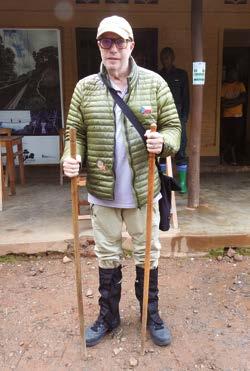
Several guides and porters came with us. The guides were in touch with the “trackers” to find out where the chimpanzees were and how to best find them without having to walk too much. The “trackers” are in daily touch with the chimpanzees, taking care of their safety and health. After more than an hour’s walk in the jungle, we met the first chimpanzee family. They are used to people (even white people), and you can get as close as a few meters from them, watching them play, eat, clean each other, and jump from one tree to another. You need to keep silent and move slowly around these beautiful, clever animals. We watched them and walked with them for over an hour, a miraculous time I will never forget.
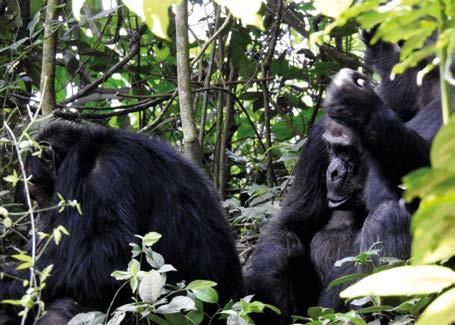
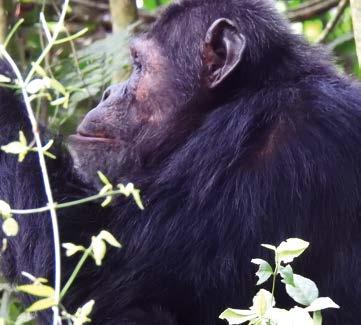
The way back to the Cyamudongo tourist centre took us about two hours, with a surprise from the community people, a show of traditional songs and dance.
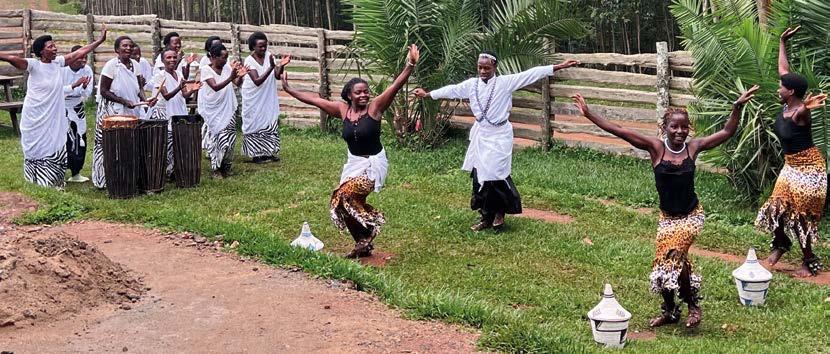
On the way to our next hotel, the Cleo Hotel at Lake Kivu, we stopped for a short experience of collecting tea with the local Gisakura Community entity Ivomo.
Finally, we arrived at the Cleo Hotel at Lake Kivu, a uniquely designed local hotel with a great lake view.
Lake Kivu is the biggest lake in Rwanda, with many islands in the middle. We took a sunrise boat excursion on this beautiful lake. The lake is also important for the gas coming from its depths. This gas is used by Rwanda to produce electricity, and, in a few years, it should fully cover the country’s consumption. We visited an island with a big population of bats, and another one with swimming cows. It is a beautiful area, and a vacation destination seeking more investors to develop it.
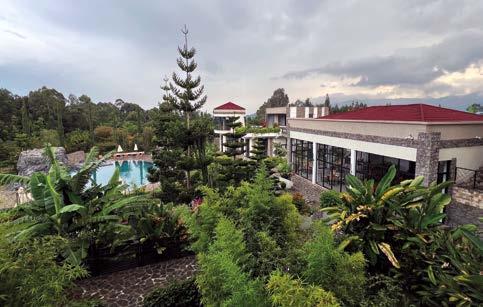
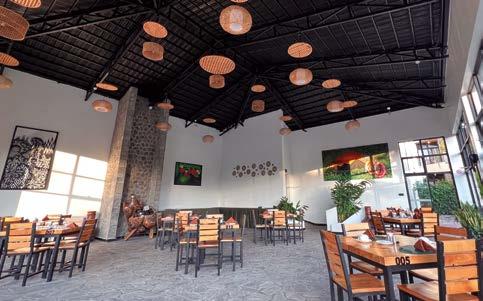
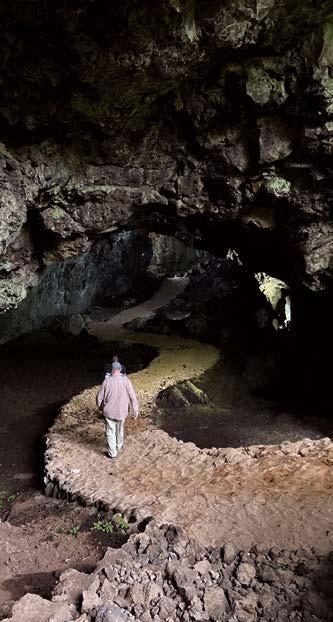
Later that day, we arrived at the Grotta Resort in Musanze. It is a new resort, built on an old volcanic cave. You can enjoy all the facilities – a swimming pool and Jacuzzi, a bar, and, of course, a restaurant with a great young chef. We had a good beef steak with chimichurri. I am sure that it will not take long for this restaurant to gain its reputation.
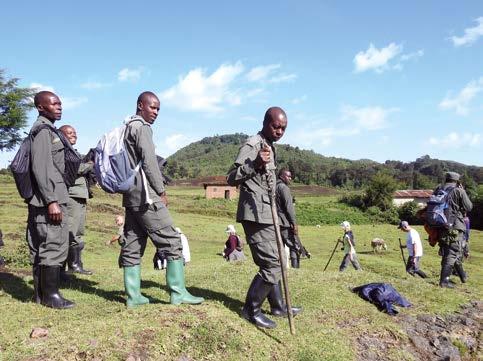
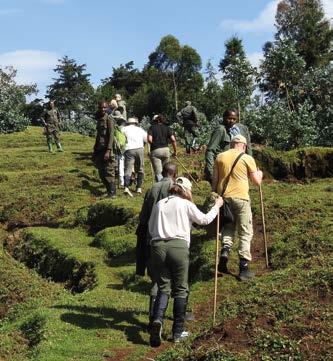
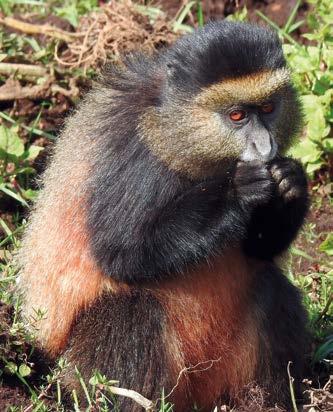
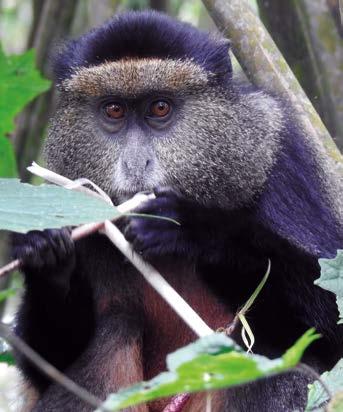
Our trip to the Volcanoes National Park started early in the morning. The golden monkey can be found at very few places outside the Volcanoes National Park, and their rich colours, energetic demeanour, and sizeable troupes of up to 30 individuals are truly a sight to behold. The tours take place once a day, from 7am.
Our group started the track after the usual process of a short briefing from our guide and protecting our legs with hiking gaiters to keep ourselves dry in a muddy area and shielded against fire ants and other insects.
We walked with two guides, and with a porter for each of us. At first, we passed potato fields and beanstalks. The most important issue was to learn where the golden monkeys were, and the trackers supplied that information to our guides. Then, at some point, we stopped and were asked to leave our bags and walking sticks on the spot and to put facemasks on.
A few meters from this place, we saw the golden monkey family. And they really were a sight to behold! We could watch them in their natural habitat, eating potatoes from the fields (don’t worry, the locals are compensated for their damages) and other fruits. The baby golden monkeys were jumping from branch to branch, almost falling down, as if giving us a special show, looking at us and letting us take pictures of them. We spent over an hour with them. They then disappeared inside the jungle, and we walked for about two hours back to our meeting point.
After the tracking effort we took a short break and then visited the Ellen DeGeneres Campus of the Dian Fossey Gorilla Fund. This place is dedicated to the conservation, protection, and study of gorillas and their habitats in Rwanda, Uganda, and the Democratic Republic of the Congo. Saving gorillas is an important mission. For us, it was an important place to visit before tracking mountain gorillas the next day. You too can help by adopting a gorilla.

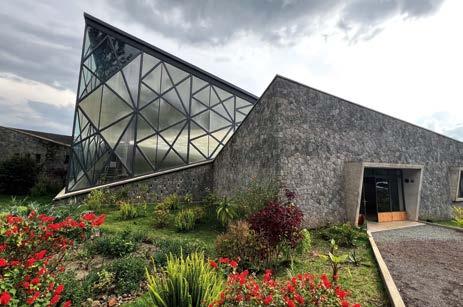
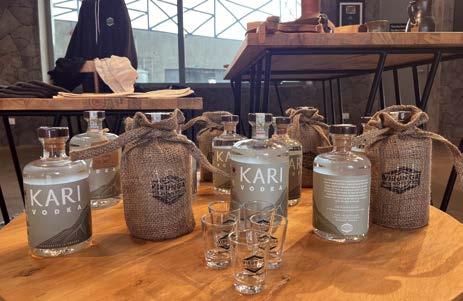
We continued by visiting a unique new vodka distillery from potatoes, Virunga Mountain Spirits. It is a modern building, designed like the volcano mountains around it. Kari Vodka is a premium craft potato vodka made from unwanted potatoes supplied by the local farm cooperatives and Winnaz/ Hollanda Fairfoods, helping the community by using them. The place was established by Karen Sherman, who has served in a number of executive leadership roles working to advance women in Rwanda and around the world. That work inspired the creation of Virunga Mountain Spirits. Besides vodka, they also have a good restaurant with traditional local food, and a gift shop too. We bought a few Kari Vodka bottles as presents to our friends back home.
Early in the morning, we left for the Volcanoes National Park. A familiar place for us, the same place where we started the golden monkeys trekking the previous day.
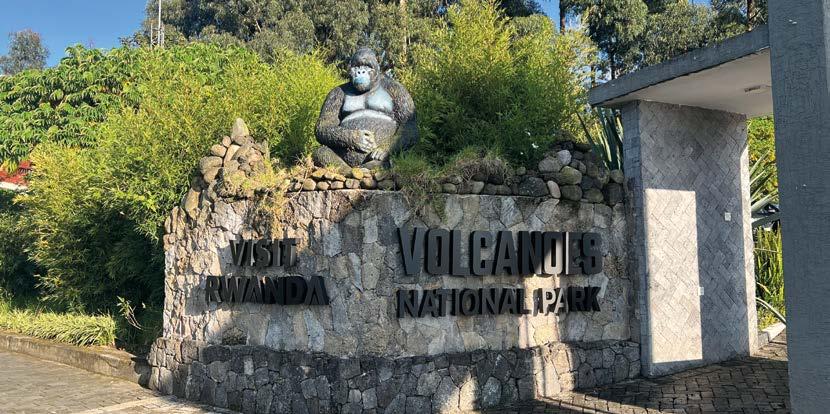
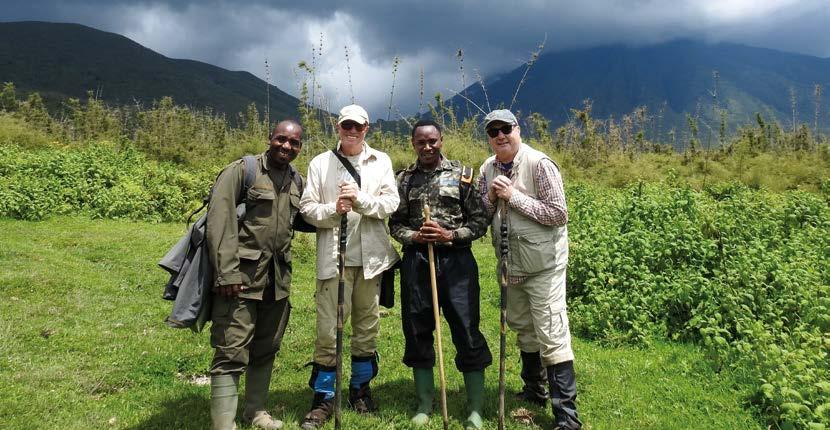
An already traditional short briefing from our guide, protecting our legs with hiking gaiters to keep ourselves dry in a muddy area and shielded against fire ants and other insects, and we were ready to find the mountain gorillas. Together, of course, with our porter.
Rwanda is one of the only three countries in the world where the critically endangered mountain gorillas live. Seeing them is often described as “life changing”, and for a good reason. Only 1,063 mountain gorillas are living in the wild, according to the latest census results from 2018. To see these gentle creatures in their natural habitat is a truly unique moment.
Gorillas make their homes in and amongst the bamboo-covered slopes of the Virunga Mountains in the Volcanoes National Park in northern Rwanda.
After over an hour’s walk between local villages and potato fields, we crossed the fence to the jungle, where the trackers were waiting for us. They located the gorilla family, giving the exact directions to our guide. At one point, we stopped, and, the same as the day before, were asked to leave our bags and walking sticks there and put on our facemasks.
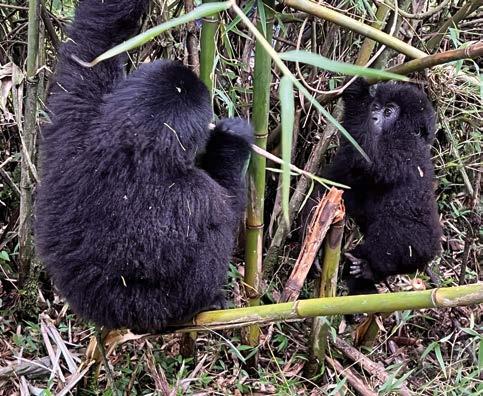
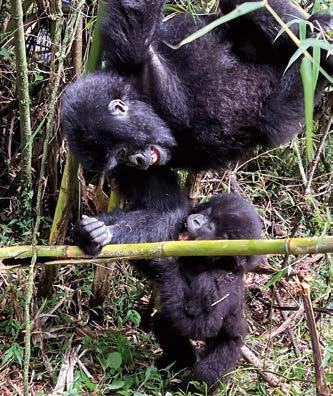
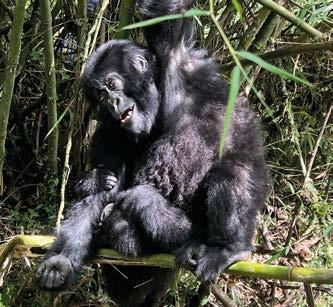
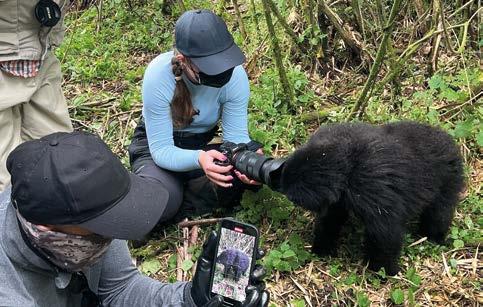
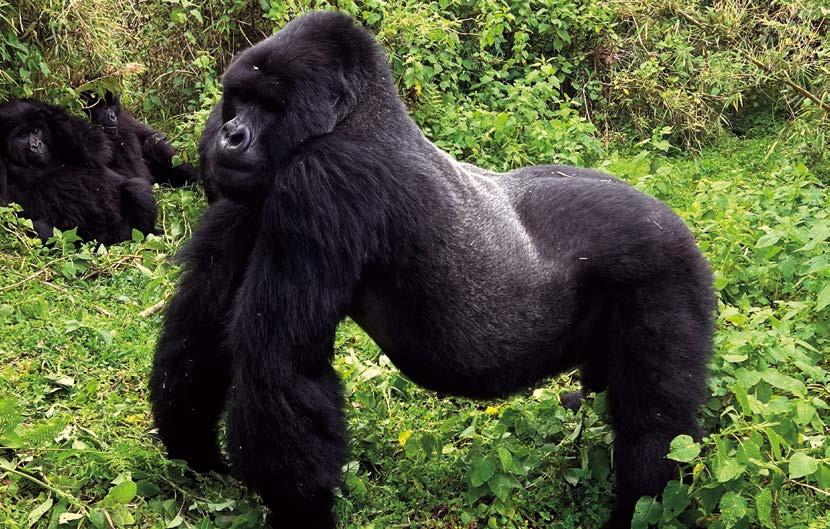
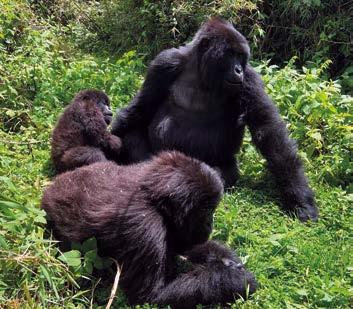
We then met the silverback Hirwa gorilla family: Isango Gato and Isango Gakuru (twins), Uburanga, and other members of the family, including the lovely baby Mushumbamwiza (or ‘Good Shepherd’) who was recently named at the 20th annual Kwita Izina, the mountain gorilla baby naming ceremony – a famous annual gorilla conservation event.
We were just a few meters away, watching the gorillas go about their daily lives. They were friendly, curious, and beautiful. They watched us, with their big beautiful and clever eyes, telling us “We are here for you, protect us for the next generations.”
Some of them “made faces” to the camera, showing us what they can do, and some were shyer. The mother gorilla with her small, sweet baby was looking at us without any fear, ensuring that her baby behaves nicely. More than an hour passed quickly, the Hirwa family left for their regular activity, and we left back to the park with memories we would cherish forever.
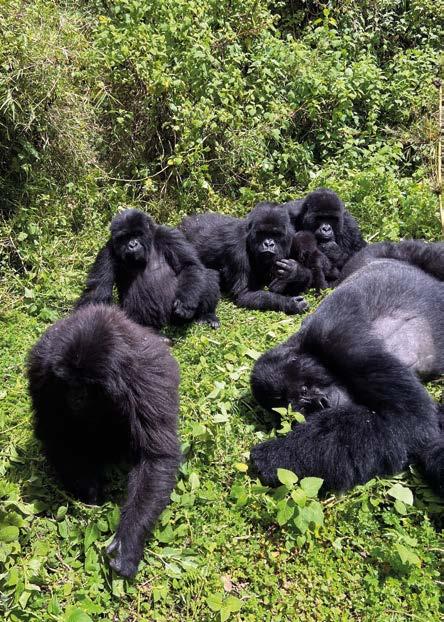
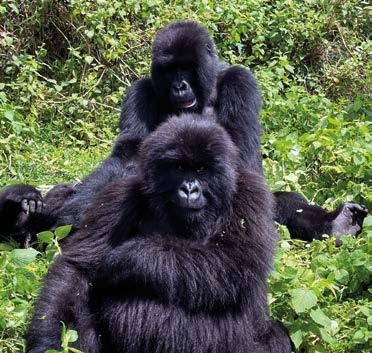
We went back to Kigali to catch our flight back home, but couldn’t leave the city without a last visit to our local home, the Marriott Hotel, which welcomed us with its beautiful lounge once again.
These are memories we will forever cherish. Thank you, Rwanda – such a beautiful country! We are grateful to H.E. Mr. Richard Masozera, the Ambassador of Rwanda to the Czech Republic, Mr. Gerard FJB Volkmar, the Consul and First Secretary, and Rwanda Development Board (RDB) for their big support. And special thanks to you, Maurice Twahirva from RDB, for supporting us during this big adventure, and for your friendship.
Further information on Rwanda can be found at:
https://visitrwanda.com/tourism/destinations/ https://visitrwanda.com/practical-information/ https://kwitaizina.rw/
We also have thousands of our own pictures and videos, which we have made available for you online.

Your Partner beyond Real Es
Sales • Leasing • Property Management Relocation • Investments & Much More!

Buyer’s Agent & Property Management For Expats & International Clients For Expats & International Clients
Real Estate Services Tailored to Your Life in the Czech Republic Relocation, Rental & Sales
Buyer’s Agent & Property Management Whether you’re moving to Prague or already part of the local expat community, we help you find the right home - for rent or for purchase.
www.reallocate.cz www.artofsharing.cz
Buyer’s Agent & Property Management
As your Buyer’s Agent, we represent your interests from search to signing, ensuring transparency and peace of mind. Our Property Management service handles everything - tenants, maintenance, marketing and leasing - so your investment works for you, we guarantee higher yields.